<?xml version="1.0" encoding="ISO-8859-1"?><article xmlns:mml="http://www.w3.org/1998/Math/MathML" xmlns:xlink="http://www.w3.org/1999/xlink" xmlns:xsi="http://www.w3.org/2001/XMLSchema-instance">
<front>
<journal-meta>
<journal-id>0120-6230</journal-id>
<journal-title><![CDATA[Revista Facultad de Ingeniería Universidad de Antioquia]]></journal-title>
<abbrev-journal-title><![CDATA[Rev.fac.ing.univ. Antioquia]]></abbrev-journal-title>
<issn>0120-6230</issn>
<publisher>
<publisher-name><![CDATA[Facultad de Ingeniería, Universidad de Antioquia]]></publisher-name>
</publisher>
</journal-meta>
<article-meta>
<article-id>S0120-62302010000500020</article-id>
<title-group>
<article-title xml:lang="en"><![CDATA[Emulation and remote experimentation as support resources in a PBL approach for control systems]]></article-title>
<article-title xml:lang="es"><![CDATA[La emulación y la experimentación remota como recursos de apoyo en un enfoque de aprendizaje basado en proyectos para sistemas de control]]></article-title>
</title-group>
<contrib-group>
<contrib contrib-type="author">
<name>
<surname><![CDATA[Fernández-Samacá]]></surname>
<given-names><![CDATA[Liliana]]></given-names>
</name>
<xref ref-type="aff" rid="A01"/>
</contrib>
<contrib contrib-type="author">
<name>
<surname><![CDATA[Ramírez Scarpetta]]></surname>
<given-names><![CDATA[José Miguel]]></given-names>
</name>
<xref ref-type="aff" rid="A01"/>
</contrib>
<contrib contrib-type="author">
<name>
<surname><![CDATA[Orozco-Gutiérrez]]></surname>
<given-names><![CDATA[Martha Lucia]]></given-names>
</name>
<xref ref-type="aff" rid="A01"/>
</contrib>
</contrib-group>
<aff id="A01">
<institution><![CDATA[,Universidad del Valle Escuela de Ingeniería Eléctrica y Electrónica Grupo de Investigación en Control Industrial (GICI)]]></institution>
<addr-line><![CDATA[Cali ]]></addr-line>
<country>Colombia</country>
</aff>
<aff id="A02">
<institution><![CDATA[,Universidad Pedagógica y Tecnológica de Colombia Escuela de Ingeniería Electrónica ]]></institution>
<addr-line><![CDATA[Sogamoso ]]></addr-line>
<country>Colombia</country>
</aff>
<pub-date pub-type="pub">
<day>00</day>
<month>09</month>
<year>2010</year>
</pub-date>
<pub-date pub-type="epub">
<day>00</day>
<month>09</month>
<year>2010</year>
</pub-date>
<numero>55</numero>
<fpage>194</fpage>
<lpage>202</lpage>
<copyright-statement/>
<copyright-year/>
<self-uri xlink:href="http://www.scielo.org.co/scielo.php?script=sci_arttext&amp;pid=S0120-62302010000500020&amp;lng=en&amp;nrm=iso"></self-uri><self-uri xlink:href="http://www.scielo.org.co/scielo.php?script=sci_abstract&amp;pid=S0120-62302010000500020&amp;lng=en&amp;nrm=iso"></self-uri><self-uri xlink:href="http://www.scielo.org.co/scielo.php?script=sci_pdf&amp;pid=S0120-62302010000500020&amp;lng=en&amp;nrm=iso"></self-uri><abstract abstract-type="short" xml:lang="en"><p><![CDATA[This paper presents the use of a platform with emulation and remote experimentation tools to support a Project-Based Learning approach for courses of linear-control systems. Emulation and remote experimentation are incorporated as experimentation resources in the academic activities of the approach. The platform resources allow defining projects within new contexts and observing the dynamics of control complex problems from diverse nature. Moreover, emulation is used to experiment with non-available systems in the laboratory and observe the controller performance before implementation in real contexts. This work describes the learning approach, platform, and its different operation conditions. These conditions are shown through the emulation of a DC motor model with oscillating mode. Finally, this paper presents the results of a survey used to evaluate the platform, emphasizing on the assessment of the emulation tool as a learning resource.]]></p></abstract>
<abstract abstract-type="short" xml:lang="es"><p><![CDATA[Este artículo presenta la utilización de una plataforma con herramientas de emulación y experimentación remota como recursos de apoyo en un enfoque de aprendizaje basado en proyectos para cursos de sistemas de control lineal. La emulación y la experimentación remota se incorporan como recursos de experimentación en las actividades académicas de este enfoque. Los recursos de la plataforma permiten la definición de proyectos en nuevos contextos y observar la dinámica de problemas complejos de control de diversa naturaleza. Adicionalmente, la emulación se utiliza para experimentar con sistemas no disponibles en el laboratorio y observar el desempeño de los controladores antes de su implementación en contextos reales. Este trabajo describe el enfoque de aprendizaje, la plataforma, y sus diferentes condiciones de operación. Estas condiciones se muestran a través de la emulación de un modelo de un motor DC con modo oscilante en la carga. Por último, este documento presenta los resultados de la encuesta utilizada para evaluar la plataforma, haciendo énfasis en la evaluación de la herramienta de emulación como recurso de aprendizaje.]]></p></abstract>
<kwd-group>
<kwd lng="en"><![CDATA[emulation]]></kwd>
<kwd lng="en"><![CDATA[remote experimentation]]></kwd>
<kwd lng="en"><![CDATA[control education]]></kwd>
<kwd lng="en"><![CDATA[project-based learning]]></kwd>
<kwd lng="es"><![CDATA[emulación]]></kwd>
<kwd lng="es"><![CDATA[experimentación remota]]></kwd>
<kwd lng="es"><![CDATA[educación en control]]></kwd>
<kwd lng="es"><![CDATA[aprendizaje basado en proyectos]]></kwd>
</kwd-group>
</article-meta>
</front><body><![CDATA[ <p align="center"><font face="Verdana" size="4"> <b>Emulation and remote experimentation as support resources in a PBL approach for control systems</b></font></p>      <p align="center"><font face="Verdana" size="4"> <b>La emulaci&oacute;n y la experimentaci&oacute;n remota como recursos de apoyo en un enfoque de aprendizaje basado en proyectos para sistemas de control</b></font></p>       <p> <font face="Verdana" size="2"><i> Liliana Fern&aacute;ndez-Samac&aacute; <sup>1,2 *</sup>, Jos&eacute; Miguel Ram&iacute;rez Scarpetta <sup>1</sup>, Martha Lucia Orozco-Guti&eacute;rrez <sup>1</sup></i> </font></p>      <p><font face="Verdana" size="2"> <sup>1</sup> Universidad del Valle, Escuela de Ingenier&iacute;a El&eacute;ctrica y Electr&oacute;nica, Grupo de Investigaci&oacute;n en Control Industrial (GICI), Calle 13 N.° 100-00, Edificio 353, Ciudad Universitaria Mel&eacute;ndez, Cali, Valle, Colombia.</font></p>      <p><font face="Verdana" size="2"> <sup>2</sup> Universidad Pedag&oacute;gica y Tecnol&oacute;gica de Colombia, Escuela de Ingenier&iacute;a Electr&oacute;nica, Calle 4 sur N.° 15-134, Sogamoso, Boyac&aacute;, Colombia.</font></p>      <p>&nbsp;</p>   <hr noshade size="1">      <p><font face="Verdana" size="3"> <b>Abstract</b></font></p>      <p><font face="Verdana" size="2">This  paper presents the use of a platform with emulation and remote experimentation  tools to support a Project-Based Learning approach for courses of  linear-control systems. Emulation and remote experimentation are incorporated  as experimentation resources in the academic activities of the approach. The  platform resources allow defining projects within new contexts and observing  the dynamics of control complex problems from diverse nature. Moreover,  emulation is used to experiment with non-available systems in the laboratory  and observe the controller performance before implementation in real contexts.  This work describes the learning approach, platform, and its different  operation conditions. These conditions are shown through the emulation of a DC  motor model with oscillating mode. Finally, this paper presents the results of  a survey used to evaluate the platform, emphasizing on the assessment of the  emulation tool as a learning resource. </font></p>      <p><font face="Verdana" size="2"><b>Keywords: </b>emulation, remote experimentation, control education, project-based learning</font></p>  <hr noshade size="1">      <p><font face="Verdana" size="3"> <b>Resumen:</b></font></p>      ]]></body>
<body><![CDATA[<p><font face="Verdana" size="2">Este art&iacute;culo presenta la utilizaci&oacute;n de una plataforma  con herramientas de emulaci&oacute;n y experimentaci&oacute;n remota como recursos de apoyo  en un enfoque de aprendizaje basado en proyectos para cursos de sistemas de  control lineal. La emulaci&oacute;n y la experimentaci&oacute;n remota se incorporan como  recursos de experimentaci&oacute;n en las actividades acad&eacute;micas de este enfoque. Los  recursos de la plataforma permiten la definici&oacute;n de proyectos en nuevos  contextos y observar la din&aacute;mica de problemas complejos de control de diversa  naturaleza. Adicionalmente, la emulaci&oacute;n se utiliza para experimentar con  sistemas no disponibles en el laboratorio y observar el desempe&ntilde;o de los  controladores antes de su implementaci&oacute;n en contextos reales. Este trabajo  describe el enfoque de aprendizaje, la plataforma, y sus diferentes condiciones  de operaci&oacute;n. Estas condiciones se muestran a trav&eacute;s de la emulaci&oacute;n de un  modelo de un motor DC con modo oscilante en la carga. Por &uacute;ltimo, este  documento presenta los resultados de la encuesta utilizada para evaluar la  plataforma, haciendo &eacute;nfasis en la evaluaci&oacute;n de la herramienta de emulaci&oacute;n  como recurso de aprendizaje. </font></p>      <p><font face="Verdana" size="2"><b>palabras clave: </b>emulaci&oacute;n, experimentaci&oacute;n remota, educaci&oacute;n en control, aprendizaje basado en proyectos </font></p>  <hr noshade size="1">      <p><font face="Verdana" size="3"><b>Introduction</b></font>      <p><font face="Verdana" size="2">Education  in engineering requires new methodologies and learning resources to improve the  professional performance of graduate engineers. Some educational approaches  like Project-Based Learning (PBL) facilitate learning difficult subjects and  allow developing transversal skills like: team work, communication abilities,  leadership, time management, etc. PBL has been used with notable results in  universities around the world, for example: Aalborg  University in Denmark [1], the University  of Louvain in Belgium [2], Sherbrooke  University in Canada [3].  There are many experiences using PBL in technical subjects such as circuits  analysis [4], digital signal processing [5], analog electronic circuits [6],  etc. In LatinAmerica, there are specific experiences in control systems at  Universidad de los Andes [7] and at  Instituto Tecnol&oacute;gico de Estudios Superiores de Monterrey in Mexico [8].     <br>     <br> Communication  and information technologies offer new possibilities for engineering education.  The use of platforms for learning management and platforms with specialized  tools are more common in the teaching and learning of engineering. The  combination of new learning approaches and technology generates new learning  environments and learning resources. Nowadays, it is possible to find diverse  technological resources for control learning. Some available web-based  resources have simulation tools and user interfaces that use Java applets to  define plant parameters, analyze control-system performance, and design control  strategies in real plants. For example, [9, 10] present applications made by  using Easy Java Simulations [11] &mdash; this  tool facilitates the design of applets in Java that can be executed by means of  any web browser&mdash;. Other  resources combine software and hardware, and their access can be remote or  local. These different options provide new experimentation environments for  control systems that include simulation, emulation (real time simulation),  remote experimentation, and prototype plants.     <br>     <br> In  reference [12], the authors classify experimentation environments according to  resource nature and the access to resources. The accessing criterion defines  two ways: remote access and local access (depending if it does or does not  require internet access). The nature criterion refers to whether the resource  can be real or simulated. The current trend in the design of resources for  control learning aims to develop real resources with remote access; most works  present platforms and tools to drive real processes via internet (remote  experimentation), for example, papers [13-15]. But, how can these resources be  used in an educational approach like PBL? This work emphasizes on the use of  emulation and remote experimentation in a PBL approach to increase  experimentation resources for the teaching and learning of linear control  systems in the Electronic Engineering Undergraduate Program at Universidad del Valle, Colombia. In this experience, the emulation  and remote experimentation tools are available on a platform called PERI  (Plataforma de Experimentaci&oacute;n Remota para Educaci&oacute;n en Ingenier&iacute;a - Remote  Experimentation Platform for Engineering Education) [16]. PERI allows remote  operations of plants, simulation and analysis of systems, distributed  simulation of tasks and distributed emulation of physical system models.     <br>     <br> PERI has  been incorporated as experimentation resource in the PBL approach designed for  the control courses. The use of the platform allows defining projects within  new contexts and observing the dynamics of control complex problems from diverse  nature. The definition of context projects is important for a PBL approach;  since learning is encouraged by carrying out projects that aim to solve real  problems, recreating actual circumstances that motivate students to learn while  they work at seeking solutions to the problem. Thus, students manage their own  learning and learn topics when they need them. The use of the platform also  lets students manage their experimentation time according to their learning  process and to the development of the project. Moreover, the emulation of  systems permits students to experiment with non-available systems in the  laboratories and test controllers before implementation in a real context. </font></p>      ]]></body>
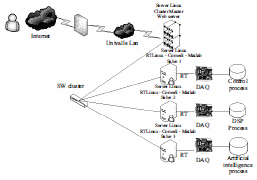
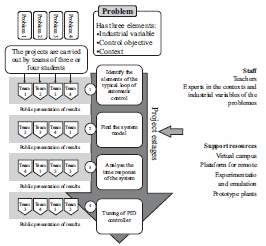
<body><![CDATA[<br>    <p><font face="Verdana" size="2"><b><i>Project-based learning approach in linear control courses</i></b></font></p>     <p><font face="Verdana" size="2">The  linear-control-system area in Electronics Engineering at  Universidad del Valle has four courses on linear-control  systems, two theoretical courses, and two lab courses. In the control courses,  academic and evaluation activities are designed according to the PBL approach.  Also, support resources for these activities are chosen according to this  approach [17]. The defined approach has two important aspects: the problem and  the project. The problem is defined by teacher staff from three factors: the  context, variable, and objective control. The project is the 'road' to solve  the problem. Each project is executed through four stages and each stage is  developed by a student team. The team is advised by teachers and an expert on  specific topics of the problem. The distribution of stages for the first level  (one theory course and one lab course) is shown in figure 1. This course  corresponds to Fundamentals of Linear-Control Systems. To design the problem,  the context is chosen according to kinds of industries within the University's  location. This confronts students to common problems of professional work and  allows that the industries become support resources for the learning. The  context is a reference to solve the problem, but students do not solve the  problem in the industry.     <br>     <br> In short,  the definition of the problems establishes two different experimentation  resources according to the context chosen. Some problems are solved through  projects developed in prototype plants and others are solved by using plant models.  When the problems are solved by using plant models, students use emulation as  an experimentation resource; they connect hardware in loop with the plant model  by using PERI. Students who use prototypes to solve the problem can also use  emulation to observe the controller performance before implementation. The PBL  approach proposes a carefully selected rotation of student teams so that each  stage of the project is developed by a different team, see figure 1. This  rotation allows students to use<br clear="all"> different experimentation resources, participate in the development of diverse  projects, and, hence, learn of several industrial variables and contexts. The  rotation also allows defining peer- assessment activities among teams.</font></p>      <p align="center"><img src="/img/revistas/rfiua/n55/n55a20i01.gif"><a name="figura1"></a></p>      <p><font face="Verdana" size="2"><b>Figure 1</b> approach applied to Fundamentals of Linear-Control Systems</font></p>      <br>    <p><font face="Verdana" size="2"><b>Remote -Experimentation and emulation platform</b></font></p>     <p><font face="Verdana" size="2">The  platform structure is made up a distributed computing system interconnected via  Ethernet TCP/IP through two switches, one for external interconnection and  another for the computer cluster that has four computer servers with Linux  Knopix 5.0 operating system with RTAI 3.4, Real Time Application Interface. See  figure 2 (taken of [18]). The servers also have DAQs (NI PCI- 6229 National  Instruments) to connect hardware; this connection is performed by Comedi  software that provides open-source drivers, tools and libraries for data  acquisition [19]. The analysis and simulation tools can be acceded via Internet  by using a low bandwidth connection and a web browser. The user interfaces were  developed using HTML and Java languages. The data processing (e.g. mathematical  calculations) is performed using MATLAB&reg; via TCP/IP connection. The user access  to the mathematical analysis and simulation tools through a PHP interface;  there, this interface codifies the information that is sent to the process  engine via a TCP/IP connection to the MATLAB&reg; engine. The MATLAB&reg; engine is  used to calculate the desired operations and to store results in  multi-dimensional variables, which are sent to the Workspace user for local  manipulation and further analysis. In short, the interface server runs from  MATLAB&reg;, but the client interface is implemented via an applet in Java that  does not require a prior installation of MATLAB&reg;. The user interfaces for the  simulation and analysis were developed by using Easy Java [11]. A detailed  description of the platform is found in [16]. </font></p>      ]]></body>
<body><![CDATA[<p align="center"><img src="/img/revistas/rfiua/n55/n55a20i02.gif"><a name="figura2"></a></p>      <p><font face="Verdana" size="2"><b>Figure 2</b> Remote-Experimentation and emulation Platform</font></p>     <p><font face="Verdana" size="2">On the  PERI platform, users can carry out four types of emulation: Simple Software,  Simple Physical, Distributed Software, and Distributed Physical. Simple  Software emulation is executed by using only one server without hardware  connected in loop. Simple Physical emulation allows connecting hardware in loop  with the model constrained to use only one server. In the Distributed Software  emulation, the model can be distributed in several servers without hardware  connected in loop. Finally, the Distributed Physical Emulation permits to  distribute the model into several servers and connect the hardware in loop. The  web site of the emulation application contains graphical options to execute<br clear="all"> the emulation types previously discussed. The platform has a management system  that controls the access, availability of equipments, and user time. </font></p>      <p><font face="Verdana" size="2"><b><i>Emulation</i></b></font></p>     <p><font face="Verdana" size="2">In the  PERI platform, emulation is based on a Simulink model using RTAI-Lab blocks. As  defined in [20], the RTAI project provides a tool set to develop block diagrams  that can be compiled and executed on the RTAI real-time Linux operating system.  To execute the emulation, the user must compile the model by means of the  real-time toolbox. As a result of compilation, a folder is generated; this is  compressed as a zip file and uploaded onto the platform. There, a target file  is generated. Finally, the target file is run in one or several servers  according to the type of emulation chosen.</font></p>      <p align="center"><img src="/img/revistas/rfiua/n55/n55a20i03.gif"><a name="figura3"></a></p>      <p><font face="Verdana" size="2"><b>Figure 3</b> Emulation</font></p>     <p><font face="Verdana" size="2">When a Simple or Distributed Physical emulation is  carried out to represent the dynamics of a plant, DAQ can be used to connect  the real controller in loop, see figure 3. This connection must be defined from  a model in Simulink by using Comedi blocks. In the distributed emulation case,  the user defines how to distribute the model  (e.g. a plant model) and creates a subsystem in Simulink for each  part of the model. The subsystems are connected by using special blocks (sender  and receiver). Subsystems are compiled by the real&shy;time toolbox, separately. A  folder is generated for each subsystem. Folders are compressed and uploaded  onto the platform to generate target files. Each target file is executed in a  different server. The emulation is a local resource in real time; however, the  behavior of variables can be seen via internet by using JRTAILab [21] that also  allows saving experimental data. </font></p>      <p><font face="Verdana" size="2"><b><i>Remote experimentation</i></b></font></p>     <p><font face="Verdana" size="2">For  remote experimentation, the user must choose a Simple Physical emulation or  Distributed Physical emulation since these options allow connecting hardware in  loop. In remote experimentation, students follow the same process used for  emulation. There are three different operation conditions in remote  experimentation that can be executed on the platform. In the first condition,  the user operates a real plant that is controlled via emulated controller. In  this instance, the controller model is executed in the servers and the plant is  real. The DAQ is used to read and write signals of sensors and actuators,  respectively. The Simulink model must include the control algorithms, Comedi  blocks, and visualization blocks. In the designed PBL approach, this operation  condition is used in the project stages devoted to testing and comparing controllers  before implementation on the real system.     ]]></body>
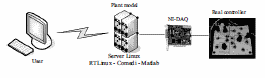
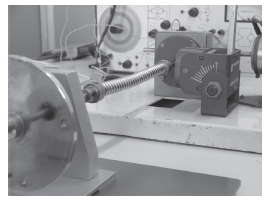
<body><![CDATA[<br>     <br> In the  second condition, both a real plant and a real controller are operated in  remote mode. The Simulink model only includes Comedi blocks and RTAI scopes for  visualization. In this case, the platform is used to communicate the user  (client) with the system and observe the performance of the controller and  plant. This condition is used in the last stage of the project, after students  have designed the control strategy; it is very useful to monitor and record the  performance of system variables. In the third condition, the plant is operated  in open loop and the Simulink model only has the Comedi and visualization  blocks. This condition is helpful in the second and third stage of the project  to obtain models of prototype plants via experimental tests, and analyze the  system in the time and frequency domain. In each condition, source signals  (e.g. Set points) can be generated from the Simulink model by source blocks.  The user executes remote experimentation through the web page of the platform  by means of JRTAILab. This Java applet allows observing and registering the  behavior of system variables and changing parameters of controller and  excitation sources.  Twelve problems were solved during the development of  the first control course with PBL. Every project used emulation to evaluate the  controller performance and six projects used the emulation tool as  experimentation resource to represent the plant model and connect a real  controller in loop. Models of plants like synchronic generator, dryer in sugar  factory, DC motor with oscillating mode, boiler, magnetic levitator and antenna  were analyzed by using the PERI tools.</font></p>       <p align="center"><img src="/img/revistas/rfiua/n55/n55a20i04.gif"><a name="figura4"></a></p>      <p><font face="Verdana" size="2"><b>Figure 4</b> DC motor with oscillating mode</font></p>      <br>    <p><font face="Verdana" size="2"><b><i>Case study: DC motor with oscillating mode</i></b></font></p>     <p><font face="Verdana" size="2">An  example developed on a DC motor with oscillating mode (see figure 4) is used to  show how to use emulation and remote experimentation tools through. The target  is to control the motor speed with a PID controller. For this case, the Simple  Physical emulation is used. This example shows the different cases of emulation  and operation conditions of remote experimentation. Furthermore, this example  stresses on the comparison between the real models and emulated model to  validate emulation as an experimentation resource.     <br> The slow  dynamics of a plant was modeled by a second-order system via step test and the  oscillating mode was modeled by a sinusoidal signal. Tests were performed by  using the third operation condition of remote experimentation described in the  last subsection. The total transfer function of the plant is in equation 1.</font></p>      <p><img src="/img/revistas/rfiua/n55/n55a20e01.gif"><a name="ecuacion1"></a></p>      <p align="center"><img src="/img/revistas/rfiua/n55/n55a20i05.gif"><a name="figura5"></a></p>     ]]></body>
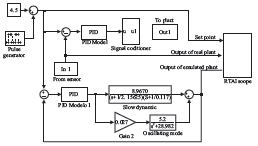
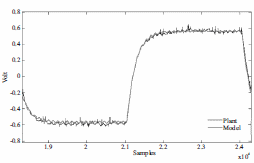
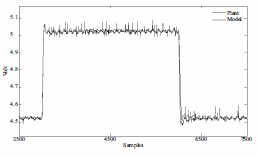
<body><![CDATA[<p><font face="Verdana" size="2"><b>Figure 5</b> Block Diagrams to emulate a D.C. motor with oscillating mode. Block diagram to emulate a PID that controls a real and emulated motor</font></p>     <p><font face="Verdana" size="2">Figure 5  shows the block diagram in simulink used to compare the output of a real plant  with the output of the emulated plant, when both plants are controlled with an  emulated PID. The block diagram has two systems; the first one, on top of the  figure, presents a real plant (DC motor with oscillating mode) controlled with  an emulated PID by using the first operation condition of remote  experimentation. The Comedi block labeled as In1 reads  the sensor signal and the Comedi block labeled as  Out1 writes the control signal in the DAQ. The second one  corresponds to the emulated plant model when it is controlled with an emulated  PID. The output of the real plant, output of the emulated plant, and set point  are compared by means of a RTAI scope. These signals can be observed during the  execution of emulation through JRTAILab. The DC motor model also was controlled  with an external PID. In this case Comedi block  In1 reads the control signal and Comedi block  Out1 writes the error signal in the DAQ. In this case, a real PID  controls a plant model. This experimentation is useful in tuning a real PID  when the real plant is not available.  Data obtained was saved by means of JRTAILab and  plotted by using Matlab&reg; software. In figure 6, the response of the emulated  plant (model) is compared to the response of the real plant. The comparison  between the output of a real plant and the output of an emulated plant, when  both plants are controlled with a real PID controller connected to the platform through DAQ is shown in figure 7.</font></p>      <p align="center"><img src="/img/revistas/rfiua/n55/n55a20i06.gif"><a name="figura6"></a></p>     <p><font face="Verdana" size="2"><b>Figure 6</b> Model response vs. Plant response. The vertical axis corresponds to volts (V), the horizontal axis correspond to samples, Ts=0.01s</font></p>      <p align="center"><img src="/img/revistas/rfiua/n55/n55a20i07.gif"><a name="figura7"></a></p>     <p><font face="Verdana" size="2"><b>Figure 7</b> Comparison between the real plant and emulated plant with a real PID. The vertical axis corresponds to volts (V), the horizontal axis corresponds to samples, Ts=0.01s</font></p>     <p><font face="Verdana" size="2">When a  real PID is used, the relative error between the output of the real plant and  the emulated plant is lower than 5%. When an emulated PID is used, the relative  error is lower than 2%. These error values demonstrate that experimentation  with emulated models is a suitable resource for observing the dynamics of plant  models, testing control algorithms, and tuning controllers when plants are not  available. Note that the facilities of the PERI platform are suitable for the  experimentation needs of each project stage. </font></p>      <p><font face="Verdana" size="2"><b>Student Feedback</b></font></p>     <p><font face="Verdana" size="2">The  platform developed was evaluated as a learning resource through three aspects:  the contribution to learning, platform operation, and platform management. The  students who used the emulation tool were consulted about these three aspects  through a survey. The survey consisted of 12 queries presented as statements.  Students evaluated the level of compliance of each statement. The scale ranged  from 1 to 5; 1 no compliance and 5 excellent level of compliance. Table 1  presents survey statements. The survey evaluates the contribution to learning  by queries Q4, Q8, and Q11; the platform operation by queries Q3, Q5, Q6, Q7,  Q10, and Q12; and the platform management by queries Q1, Q2, and Q9.     <br>     ]]></body>
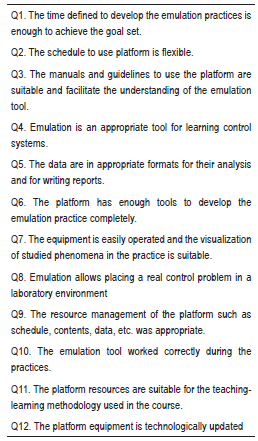
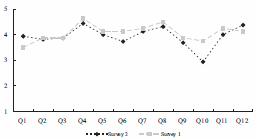
<body><![CDATA[<br> The  survey was applied twice; at the end of first control course (Survey 1) in the  project stage concerning the design of controllers, and at beginning of the  second control course (Survey 2) in the project stage about analysis of the  plant in the frequency domain. Eight students filled out the survey the first  time (Survey 1) and 16 students did so the second time (Survey 2). The  reliability of the surveys was evaluated by means of the Alpha Cronbach  coefficient [22]. The coefficient calculated from the data of Survey 1 was  0.931 and from the data of Survey 2 was 0.85. These coefficients show the good  reliability of the survey.     <br>     <br> The  survey results are presented in figure 8. The queries about the contribution to  learning emphasize on the relationship between the emulation tool and issues  like: the control learning, problem context, and the PBL approach. Regarding  the operation ofthe platform, the survey stresses on the guidelines for users,  data formats, and visualization and operation capabilities. Some queries about  platform management are focused on time management; this is an important  characteristic for the PBL approach, because time management is a transversal  skill encouraged by the approach and the platform must offer facilities so  teams use platform tools according to their needs of experimentation. The total  score average of responses to queries for Survey 1 is 4.1 and 3.9 for Survey 2. </font></p>      <p><font face="Verdana" size="2"><b>Table 1</b> Survey to Evaluate the Emulation Tool</font></p>     <p align="center"><img src="/img/revistas/rfiua/n55/n55a20t01.gif"><a name="tabla1"></a></p>      <p><font face="Verdana" size="2">In Survey 1, the score averages of responses to queries about contribution to learning and platform management are 4.5 and 3.5, respectively. For Survey 2, the averages are 4.3 and 3.3. The score average for the operation aspect is 3.8 in both surveys. Students satisfactorily evaluated the incorporation of the emulation tool in the learning process. Few students assessed statements of the learning aspect with compliance level less than 3; most responses to queries had compliance level 4 or 5.</font></p>      <p align="center"><img src="/img/revistas/rfiua/n55/n55a20i08.gif"><a name="figura8"></a></p>     <p><font face="Verdana" size="2"><b>Figure 8</b> Survey results. The scale ranges from </font></p>  <font face="Verdana" size="2">  <ol>       <li>to  5. 1 = no compliance and 5 = excellent level of compliance of the statement  The score  averages of responses to queries Q4, Q8, and Q11 about the contribution to  learning are 4.6; 4.5 and 4.3 for Survey 1 and for Survey</li>         <li>these are 4.4; 4.3 and 4.0,  respectively. These results show that students have accepted emulation as an  experimentation resource in the designed PBL approach for control systems.  Students graded with high scores the statement referring to the capability of  emulation to place a real control problem in a laboratory environment. </li>     ]]></body>
<body><![CDATA[</ol> </font>     <p align="center">&nbsp;</p>      <p><font face="Verdana" size="3"><b>Conclusions</b></font></p>     <p><font face="Verdana" size="2">The  learning of a control-linear system requires experimentation resources that  bring students closer to real contexts. The emulation and remote  experimentation tools are helpful resources to support the PBL approach, since  these allow defining projects in diverse contexts, placing a real control  problem in a laboratory environment, and experimenting with systems not  available in the laboratory. Additionally, the use of the emulation facilitates  the design of controllers before implementation on real contexts and allows  extending the study examples of control courses to new fields by using a single  technological resource.     <br>     <br> The  facility of the PERI platform for scheduling tasks is an interesting feature to  be used in approaches like PBL that seeks to develop the autonomy to manage  time and resources. With PERI, students choose their turn for experimentation  according to their working hours and the development of the project.     <br>     <br> The  Remote Experimentation Platform for Engineering Education (PERI) has been  accepted as an experimentation resource by students. This is observed in the  high averages of responses to queries of the survey that inquires about the  operation, management of the platform, and its contribution to learning. The  incorporation of the platform in learning processes is increasing; currently,  the teacher staff is designing new academic activities that involve resources  of the platform. </font></p>      <br>     <p><font face="Verdana" size="3"><b>References</b></font></p>      ]]></body>
<body><![CDATA[<!-- ref --><p><font face="Verdana" size="2">1. A. Kolmos. &quot;Estrategias para desarrollar curriculos  basados a la formulaci&oacute;n de problemas y organizados en base a proyectos&quot;. Educar. Vol. 33. 2004. pp. 77-96.     &nbsp;&nbsp;&nbsp;&nbsp;&nbsp;&nbsp;&nbsp;&nbsp;[&#160;<a href="javascript:void(0);" onclick="javascript: window.open('/scielo.php?script=sci_nlinks&ref=000083&pid=S0120-6230201000050002000001&lng=','','width=640,height=500,resizable=yes,scrollbars=1,menubar=yes,');">Links</a>&#160;]<!-- end-ref --><br>    <!-- ref --><br> 2. M.  Frenay, B. Galand, E. Milgrom, B. Raucent. &quot;Project- and Problem-based  Learning in the Engineering Curriculum at the University of Louvain&quot;.  Management of Change: Implementation of Problem- Based and  Project-Based Learning in Engineering. E. De  Graaff, &nbsp;A. Kolmos (editors). Ed. Sense  Publishers. Rotterdam  (Holanda). 2007. pp. 93 -108.     &nbsp;&nbsp;&nbsp;&nbsp;&nbsp;&nbsp;&nbsp;&nbsp;[&#160;<a href="javascript:void(0);" onclick="javascript: window.open('/scielo.php?script=sci_nlinks&ref=000085&pid=S0120-6230201000050002000002&lng=','','width=640,height=500,resizable=yes,scrollbars=1,menubar=yes,');">Links</a>&#160;]<!-- end-ref --><br>    <!-- ref --><br> 3. D. B&eacute;dard, R. Louis, M. B&eacute;lisle,  R. Viau. &quot;Project- and Problem-based Learning in Engineering Curriculum at  the University of   Sherbrooke: Impact on  Students' and Teacher' Perceptions&quot;.  Management of Change: Implementation of Problem-Based and Project-Based  Learning in Engineering. E. De Graaff, A. Kolmos. (editors).  Ed. Sense Publishers. Rotterdam  (Holanda). 2007. pp. 109 -128.     &nbsp;&nbsp;&nbsp;&nbsp;&nbsp;&nbsp;&nbsp;&nbsp;[&#160;<a href="javascript:void(0);" onclick="javascript: window.open('/scielo.php?script=sci_nlinks&ref=000087&pid=S0120-6230201000050002000003&lng=','','width=640,height=500,resizable=yes,scrollbars=1,menubar=yes,');">Links</a>&#160;]<!-- end-ref --><br>    <!-- ref --><br> 4. L. R. J. Costa, M. Honkala, A. Lehtovuori. &quot;Applying  the Problem-Based Learning Approach to Teach Elementary Circuit Analysis&quot;.  IEEE Transactions on Education. Vol. 50. 2007. pp. 41-48.     &nbsp;&nbsp;&nbsp;&nbsp;&nbsp;&nbsp;&nbsp;&nbsp;[&#160;<a href="javascript:void(0);" onclick="javascript: window.open('/scielo.php?script=sci_nlinks&ref=000089&pid=S0120-6230201000050002000004&lng=','','width=640,height=500,resizable=yes,scrollbars=1,menubar=yes,');">Links</a>&#160;]<!-- end-ref --><br>    <!-- ref --><br> 5. K. N. Jill. &quot;Using  Project-Based Assignments in a Graduate-Level Digital Signal Processing  Course&quot;. Digital Signal Processing Workshop,  12th - Signal Processing Education Workshop, Wyoming (USA).  2006. pp. 135-140.     &nbsp;&nbsp;&nbsp;&nbsp;&nbsp;&nbsp;&nbsp;&nbsp;[&#160;<a href="javascript:void(0);" onclick="javascript: window.open('/scielo.php?script=sci_nlinks&ref=000091&pid=S0120-6230201000050002000005&lng=','','width=640,height=500,resizable=yes,scrollbars=1,menubar=yes,');">Links</a>&#160;]<!-- end-ref --><br>    ]]></body>
<body><![CDATA[<!-- ref --><br> 6. J. Northern. &quot;Project-Based  Learning for a Digital Circuits Design Sequence&quot;.  Region 5 Technical Conference. Fayetteville (AR). 2007. pp. 358-362.     &nbsp;&nbsp;&nbsp;&nbsp;&nbsp;&nbsp;&nbsp;&nbsp;[&#160;<a href="javascript:void(0);" onclick="javascript: window.open('/scielo.php?script=sci_nlinks&ref=000093&pid=S0120-6230201000050002000006&lng=','','width=640,height=500,resizable=yes,scrollbars=1,menubar=yes,');">Links</a>&#160;]<!-- end-ref --><br>    <!-- ref --><br> 7. M. Duque, L. A. Osorio, A. Gauthier, F. Jimenez. &quot;Active  learning environments for automatic control courses.&quot;  International Conference on Engineering Education. Valencia (Spain). 2003. pp. 1-8.     &nbsp;&nbsp;&nbsp;&nbsp;&nbsp;&nbsp;&nbsp;&nbsp;[&#160;<a href="javascript:void(0);" onclick="javascript: window.open('/scielo.php?script=sci_nlinks&ref=000095&pid=S0120-6230201000050002000007&lng=','','width=640,height=500,resizable=yes,scrollbars=1,menubar=yes,');">Links</a>&#160;]<!-- end-ref --><br>    <!-- ref --><br> 8. R. Morales-Men&eacute;ndez, I.  Y S. Chavez, M. R. Cadena, L. E. A. G. L. E. Garza. &quot;Control  engineering education at Monterrey Tech&quot;.  American Control Conference. Minneapolis (Minnesota). June 14-16. 2006. pp. 286-291.     &nbsp;&nbsp;&nbsp;&nbsp;&nbsp;&nbsp;&nbsp;&nbsp;[&#160;<a href="javascript:void(0);" onclick="javascript: window.open('/scielo.php?script=sci_nlinks&ref=000097&pid=S0120-6230201000050002000008&lng=','','width=640,height=500,resizable=yes,scrollbars=1,menubar=yes,');">Links</a>&#160;]<!-- end-ref --><br>    <!-- ref --><br> 9. S. Dormido, G. Farias, J. S&aacute;nchez, F. Esquembre. &quot;Adding  interactivity to existing Simulink models using Easy Java Simulations.&quot;  Decision and Control, 2005 and 2005 European Control Conference. CDC-ECC '05. 44th IEEE Conference. Sevilla (Espa&ntilde;a). 2005. pp. 4163-4168.     &nbsp;&nbsp;&nbsp;&nbsp;&nbsp;&nbsp;&nbsp;&nbsp;[&#160;<a href="javascript:void(0);" onclick="javascript: window.open('/scielo.php?script=sci_nlinks&ref=000099&pid=S0120-6230201000050002000009&lng=','','width=640,height=500,resizable=yes,scrollbars=1,menubar=yes,');">Links</a>&#160;]<!-- end-ref --><br>    <!-- ref --><br> 10. S. Dormido, C. Martin, R. Pastor, J. S&aacute;nchez, F.  Esquembre. &quot;Magnetic levitation system: a virtual lab in  &quot;easy Java simulation&quot;.  American Control Conference. 2004. Proceedings of the 2004. Boston (MA). June 30-  July 2. 2004. Vol.4.  2004. pp. 3215-3220.     &nbsp;&nbsp;&nbsp;&nbsp;&nbsp;&nbsp;&nbsp;&nbsp;[&#160;<a href="javascript:void(0);" onclick="javascript: window.open('/scielo.php?script=sci_nlinks&ref=000101&pid=S0120-6230201000050002000010&lng=','','width=640,height=500,resizable=yes,scrollbars=1,menubar=yes,');">Links</a>&#160;]<!-- end-ref --><br>    ]]></body>
<body><![CDATA[<!-- ref --><br> 11. F. Esquembre. Easy Java Simulations Home Page. http://www.um.es/fem/Ejs/. Consultada el 18  de Septiembre de 2008.     &nbsp;&nbsp;&nbsp;&nbsp;&nbsp;&nbsp;&nbsp;&nbsp;[&#160;<a href="javascript:void(0);" onclick="javascript: window.open('/scielo.php?script=sci_nlinks&ref=000103&pid=S0120-6230201000050002000011&lng=','','width=640,height=500,resizable=yes,scrollbars=1,menubar=yes,');">Links</a>&#160;]<!-- end-ref --><br>    <!-- ref --><br> 12. S. Dormido. &quot;Control learning: present and  future&quot;. Annual Reviews in Control. Vol.  28. 2004. pp. 115-136.     &nbsp;&nbsp;&nbsp;&nbsp;&nbsp;&nbsp;&nbsp;&nbsp;[&#160;<a href="javascript:void(0);" onclick="javascript: window.open('/scielo.php?script=sci_nlinks&ref=000105&pid=S0120-6230201000050002000012&lng=','','width=640,height=500,resizable=yes,scrollbars=1,menubar=yes,');">Links</a>&#160;]<!-- end-ref --><br>    <!-- ref --><br> 13. C. Lazar,  S. Carari. &quot;A Remote-Control Engineering Laboratory&quot;.  IEEE Transactions on Industrial Electronics. Vol.  55. 2008. pp. 2368-2375.     &nbsp;&nbsp;&nbsp;&nbsp;&nbsp;&nbsp;&nbsp;&nbsp;[&#160;<a href="javascript:void(0);" onclick="javascript: window.open('/scielo.php?script=sci_nlinks&ref=000107&pid=S0120-6230201000050002000013&lng=','','width=640,height=500,resizable=yes,scrollbars=1,menubar=yes,');">Links</a>&#160;]<!-- end-ref --><br>    <!-- ref --><br> 14. W.  Min, S. Jin-Hua, Z. Gui-Xiu, Y. Ohyama. &quot;Internet- Based Teaching and  Experiment System for Control Engineering Course&quot;. IEEE Transactions on Industrial Electronics. Vol. 55. 2008. pp. 2386-2396.     &nbsp;&nbsp;&nbsp;&nbsp;&nbsp;&nbsp;&nbsp;&nbsp;[&#160;<a href="javascript:void(0);" onclick="javascript: window.open('/scielo.php?script=sci_nlinks&ref=000109&pid=S0120-6230201000050002000014&lng=','','width=640,height=500,resizable=yes,scrollbars=1,menubar=yes,');">Links</a>&#160;]<!-- end-ref --><br>    <!-- ref --><br> 15. R. Dormido, H. Vargas, N. Duro, J. Sanchez, S.  Dormido-Canto, G. Farias, F. Esquembre, S. Dormido. &quot;Development  of a Web-Based Control Laboratory for Automation Technicians: The Three-Tank  System,&quot; IEEE Transactions on Education. Vol. 51. 2008. pp. 35-44.     &nbsp;&nbsp;&nbsp;&nbsp;&nbsp;&nbsp;&nbsp;&nbsp;[&#160;<a href="javascript:void(0);" onclick="javascript: window.open('/scielo.php?script=sci_nlinks&ref=000111&pid=S0120-6230201000050002000015&lng=','','width=640,height=500,resizable=yes,scrollbars=1,menubar=yes,');">Links</a>&#160;]<!-- end-ref --><br>    ]]></body>
<body><![CDATA[<!-- ref --><br> 16. J. Ram&iacute;rez, E. L. Caicedo, C. Pinedo, E. Bacca, C.  Ramos. &quot;A platform for signals and systems internet- based  education&quot;. Inted conference. Valencia (Espa&ntilde;a). 2008. pp. 1-8.     &nbsp;&nbsp;&nbsp;&nbsp;&nbsp;&nbsp;&nbsp;&nbsp;[&#160;<a href="javascript:void(0);" onclick="javascript: window.open('/scielo.php?script=sci_nlinks&ref=000113&pid=S0120-6230201000050002000016&lng=','','width=640,height=500,resizable=yes,scrollbars=1,menubar=yes,');">Links</a>&#160;]<!-- end-ref --><br>    <!-- ref --><br> 17. L. Fern&aacute;ndez-Samac&aacute;, M. Orozco-Guti&eacute;rrez, E. N&uacute;&ntilde;ez, J. M.  Ram&iacute;rez. &quot;Linear Control System Course with a  Project-Based Learning&quot;. 8th Active Learning in Engineering  Education Workshop. Bogot&aacute;. 2008. pp. 325-336.     &nbsp;&nbsp;&nbsp;&nbsp;&nbsp;&nbsp;&nbsp;&nbsp;[&#160;<a href="javascript:void(0);" onclick="javascript: window.open('/scielo.php?script=sci_nlinks&ref=000115&pid=S0120-6230201000050002000017&lng=','','width=640,height=500,resizable=yes,scrollbars=1,menubar=yes,');">Links</a>&#160;]<!-- end-ref --><br>    <!-- ref --><br> 18. A. Escobar. Implementation de una Plataforma de Procesamiento  Distribuido para Emulaci&oacute;n de Procesos en Ingenier&iacute;a. Maestr&iacute;a en Ingenier&iacute;a. Escuela de Ingenier&iacute;a El&eacute;ctrica  y Electr&oacute;nica. Universidad del Valle. Cali. Colombia. 2007. pp. 21.     &nbsp;&nbsp;&nbsp;&nbsp;&nbsp;&nbsp;&nbsp;&nbsp;[&#160;<a href="javascript:void(0);" onclick="javascript: window.open('/scielo.php?script=sci_nlinks&ref=000117&pid=S0120-6230201000050002000018&lng=','','width=640,height=500,resizable=yes,scrollbars=1,menubar=yes,');">Links</a>&#160;]<!-- end-ref --><br>    <!-- ref --><br> 19. COMEDI Linux control and measurement device  interface. www.comedi.org. Consultada el 15 de octubre de 2008.    &nbsp;&nbsp;&nbsp;&nbsp;&nbsp;&nbsp;&nbsp;&nbsp;[&#160;<a href="javascript:void(0);" onclick="javascript: window.open('/scielo.php?script=sci_nlinks&ref=000119&pid=S0120-6230201000050002000019&lng=','','width=640,height=500,resizable=yes,scrollbars=1,menubar=yes,');">Links</a>&#160;]<!-- end-ref --><br>    <!-- ref --><br> 20. The RealTime Application Interface for Linux from  DIAPM, RTAI. https://www.rtai.org/. Consultada el 6 de octubre de 2008.    &nbsp;&nbsp;&nbsp;&nbsp;&nbsp;&nbsp;&nbsp;&nbsp;[&#160;<a href="javascript:void(0);" onclick="javascript: window.open('/scielo.php?script=sci_nlinks&ref=000121&pid=S0120-6230201000050002000020&lng=','','width=640,height=500,resizable=yes,scrollbars=1,menubar=yes,');">Links</a>&#160;]<!-- end-ref --><br>    ]]></body>
<body><![CDATA[<!-- ref --><br> 21. RTAI-XML project team, JRTAILab. http://artist.dsi.  unifi.it/rtaixml/index.php?&amp;MMN_position=5:5. Consultada el 21 de octubre  de 2008.    &nbsp;&nbsp;&nbsp;&nbsp;&nbsp;&nbsp;&nbsp;&nbsp;[&#160;<a href="javascript:void(0);" onclick="javascript: window.open('/scielo.php?script=sci_nlinks&ref=000123&pid=S0120-6230201000050002000021&lng=','','width=640,height=500,resizable=yes,scrollbars=1,menubar=yes,');">Links</a>&#160;]<!-- end-ref --><br>    <!-- ref --><br> 22. R. Ledesma. &quot;AlphaCI: un programa de c&aacute;lculo de  intervalos de confianza para el coeficiente alfa de Cronbach&quot;. Psico-USF. Vol. 9.  2004. pp. 31-37. </font>&nbsp;&nbsp;&nbsp;&nbsp;&nbsp;&nbsp;&nbsp;&nbsp;[&#160;<a href="javascript:void(0);" onclick="javascript: window.open('/scielo.php?script=sci_nlinks&ref=000125&pid=S0120-6230201000050002000022&lng=','','width=640,height=500,resizable=yes,scrollbars=1,menubar=yes,');">Links</a>&#160;]<!-- end-ref --><p>&nbsp;</p>     <p><font face="Verdana" size="2">(Recibido el 9 de octubre de 2009. Aceptado el 7 de abril de 2010)    <br>       <br>   <sup>*</sup>Autor de correspondencia: tel&eacute;fono: + 57 + 8 +772 35 56, fax: + 57 + 8 +771 16 93, correo electr&oacute;nico: <a href="mailto:liliana.fernandez@uptc.edu.co">liliana.fernandez@uptc.edu.co</a> (L. Fern&aacute;ndez)</font></p>      ]]></body><back>
<ref-list>
<ref id="B1">
<label>1</label><nlm-citation citation-type="journal">
<person-group person-group-type="author">
<name>
<surname><![CDATA[Kolmos]]></surname>
<given-names><![CDATA[A]]></given-names>
</name>
</person-group>
<article-title xml:lang="es"><![CDATA[Estrategias para desarrollar curriculos basados a la formulación de problemas y organizados en base a proyectos]]></article-title>
<source><![CDATA[Educar]]></source>
<year>2004</year>
<volume>33</volume>
<page-range>77-96</page-range></nlm-citation>
</ref>
<ref id="B2">
<label>2</label><nlm-citation citation-type="book">
<person-group person-group-type="author">
<name>
<surname><![CDATA[Frenay]]></surname>
<given-names><![CDATA[M]]></given-names>
</name>
<name>
<surname><![CDATA[Galand]]></surname>
<given-names><![CDATA[B]]></given-names>
</name>
<name>
<surname><![CDATA[Milgrom]]></surname>
<given-names><![CDATA[E]]></given-names>
</name>
<name>
<surname><![CDATA[Raucent]]></surname>
<given-names><![CDATA[B]]></given-names>
</name>
</person-group>
<source><![CDATA[Project- and Problem-based Learning in the Engineering Curriculum at the University of Louvain: Management of Change: Implementation of Problem- Based and Project-Based Learning in Engineering]]></source>
<year>2007</year>
<page-range>93 -108</page-range><publisher-loc><![CDATA[Rotterdam ]]></publisher-loc>
<publisher-name><![CDATA[Sense Publishers]]></publisher-name>
</nlm-citation>
</ref>
<ref id="B3">
<label>3</label><nlm-citation citation-type="book">
<person-group person-group-type="author">
<name>
<surname><![CDATA[Bédard]]></surname>
<given-names><![CDATA[D]]></given-names>
</name>
<name>
<surname><![CDATA[Louis]]></surname>
<given-names><![CDATA[R]]></given-names>
</name>
<name>
<surname><![CDATA[Bélisle]]></surname>
<given-names><![CDATA[M]]></given-names>
</name>
</person-group>
<source><![CDATA[Project- and Problem-based Learning in Engineering Curriculum at the University of Sherbrooke: Impact on Students' and Teacher' Perceptions". Management of Change: Implementation of Problem-Based and Project-Based Learning in Engineering]]></source>
<year>2007</year>
<page-range>109 -128</page-range><publisher-loc><![CDATA[Rotterdam ]]></publisher-loc>
<publisher-name><![CDATA[Ed. Sense Publishers]]></publisher-name>
</nlm-citation>
</ref>
<ref id="B4">
<label>4</label><nlm-citation citation-type="journal">
<person-group person-group-type="author">
<name>
<surname><![CDATA[Costa]]></surname>
<given-names><![CDATA[L. R. J]]></given-names>
</name>
<name>
<surname><![CDATA[Honkala]]></surname>
<given-names><![CDATA[M]]></given-names>
</name>
<name>
<surname><![CDATA[Lehtovuori]]></surname>
<given-names><![CDATA[A]]></given-names>
</name>
</person-group>
<article-title xml:lang="en"><![CDATA[Applying the Problem-Based Learning Approach to Teach Elementary Circuit Analysis]]></article-title>
<source><![CDATA[IEEE Transactions on Education]]></source>
<year>2007</year>
<volume>50</volume>
<page-range>41-48</page-range></nlm-citation>
</ref>
<ref id="B5">
<label>5</label><nlm-citation citation-type="">
<person-group person-group-type="author">
<name>
<surname><![CDATA[Jill]]></surname>
<given-names><![CDATA[K. N]]></given-names>
</name>
</person-group>
<source><![CDATA[Using Project-Based Assignments in a Graduate-Level Digital Signal Processing Course]]></source>
<year>2006</year>
<page-range>135-140</page-range><publisher-loc><![CDATA[Wyoming ]]></publisher-loc>
</nlm-citation>
</ref>
<ref id="B6">
<label>6</label><nlm-citation citation-type="">
<person-group person-group-type="author">
<name>
<surname><![CDATA[Northern]]></surname>
<given-names><![CDATA[J]]></given-names>
</name>
</person-group>
<source><![CDATA[Project-Based Learning for a Digital Circuits Design Sequence]]></source>
<year>2007</year>
<page-range>358-362</page-range><publisher-loc><![CDATA[Fayetteville ]]></publisher-loc>
</nlm-citation>
</ref>
<ref id="B7">
<label>7</label><nlm-citation citation-type="confpro">
<person-group person-group-type="author">
<name>
<surname><![CDATA[Duque]]></surname>
<given-names><![CDATA[M]]></given-names>
</name>
<name>
<surname><![CDATA[Osorio]]></surname>
</name>
<name>
<surname><![CDATA[Gauthier]]></surname>
<given-names><![CDATA[A]]></given-names>
</name>
<name>
<surname><![CDATA[Jimenez]]></surname>
<given-names><![CDATA[F]]></given-names>
</name>
</person-group>
<source><![CDATA[Active learning environments for automatic control courses]]></source>
<year></year>
<conf-name><![CDATA[ International Conference on Engineering Education]]></conf-name>
<conf-date>2003</conf-date>
<conf-loc>Valencia </conf-loc>
<page-range>1-8</page-range></nlm-citation>
</ref>
<ref id="B8">
<label>8</label><nlm-citation citation-type="confpro">
<person-group person-group-type="author">
<name>
<surname><![CDATA[Morales-Menéndez]]></surname>
<given-names><![CDATA[R]]></given-names>
</name>
<name>
<surname><![CDATA[Chavez]]></surname>
<given-names><![CDATA[I. Y S]]></given-names>
</name>
<name>
<surname><![CDATA[Cadena]]></surname>
<given-names><![CDATA[M. R]]></given-names>
</name>
</person-group>
<source><![CDATA[Control engineering education at Monterrey Tech]]></source>
<year></year>
<conf-name><![CDATA[ American Control Conference]]></conf-name>
<conf-date>2006</conf-date>
<conf-loc>Minneapolis </conf-loc>
<page-range>286-291</page-range></nlm-citation>
</ref>
<ref id="B9">
<label>9</label><nlm-citation citation-type="confpro">
<person-group person-group-type="author">
<name>
<surname><![CDATA[Dormido]]></surname>
<given-names><![CDATA[S]]></given-names>
</name>
<name>
<surname><![CDATA[Farias]]></surname>
<given-names><![CDATA[G]]></given-names>
</name>
<name>
<surname><![CDATA[Sánchez]]></surname>
<given-names><![CDATA[J]]></given-names>
</name>
<name>
<surname><![CDATA[Esquembre]]></surname>
<given-names><![CDATA[F]]></given-names>
</name>
</person-group>
<source><![CDATA[Adding interactivity to existing Simulink models using Easy Java Simulations]]></source>
<year></year>
<conf-name><![CDATA[ Decision and Control, 2005 and 2005 European Control Conference. CDC-ECC '05. 44th IEEE Conference]]></conf-name>
<conf-date>2005</conf-date>
<conf-loc>Sevilla </conf-loc>
<page-range>4163-4168</page-range></nlm-citation>
</ref>
<ref id="B10">
<label>10</label><nlm-citation citation-type="confpro">
<person-group person-group-type="author">
<name>
<surname><![CDATA[Dormido]]></surname>
<given-names><![CDATA[S]]></given-names>
</name>
<name>
<surname><![CDATA[Martin]]></surname>
<given-names><![CDATA[C]]></given-names>
</name>
<name>
<surname><![CDATA[Pastor]]></surname>
<given-names><![CDATA[R]]></given-names>
</name>
<name>
<surname><![CDATA[Sánchez]]></surname>
<given-names><![CDATA[J]]></given-names>
</name>
<name>
<surname><![CDATA[Esquembre]]></surname>
<given-names><![CDATA[F]]></given-names>
</name>
</person-group>
<source><![CDATA[Magnetic levitation system: a virtual lab in "easy Java simulation]]></source>
<year>2004</year>
<volume>4</volume>
<conf-name><![CDATA[ American Control Conference]]></conf-name>
<conf-date>2004</conf-date>
<conf-loc> </conf-loc>
<page-range>3215-3220</page-range></nlm-citation>
</ref>
<ref id="B11">
<label>11</label><nlm-citation citation-type="">
<source><![CDATA[]]></source>
<year></year>
</nlm-citation>
</ref>
<ref id="B12">
<label>12</label><nlm-citation citation-type="journal">
<person-group person-group-type="author">
<name>
<surname><![CDATA[Dormido]]></surname>
<given-names><![CDATA[S]]></given-names>
</name>
</person-group>
<article-title xml:lang="en"><![CDATA[Control learning: present and future]]></article-title>
<source><![CDATA[Annual Reviews in Control]]></source>
<year>2004</year>
<volume>28</volume>
<page-range>115-136</page-range></nlm-citation>
</ref>
<ref id="B13">
<label>13</label><nlm-citation citation-type="journal">
<person-group person-group-type="author">
<name>
<surname><![CDATA[Lazar]]></surname>
<given-names><![CDATA[C]]></given-names>
</name>
<name>
<surname><![CDATA[Carari]]></surname>
<given-names><![CDATA[S]]></given-names>
</name>
</person-group>
<article-title xml:lang="en"><![CDATA[A Remote-Control Engineering Laboratory]]></article-title>
<source><![CDATA[IEEE Transactions on Industrial Electronics]]></source>
<year>2008</year>
<volume>55</volume>
<page-range>2368-2375</page-range></nlm-citation>
</ref>
<ref id="B14">
<label>14</label><nlm-citation citation-type="journal">
<person-group person-group-type="author">
<name>
<surname><![CDATA[Min]]></surname>
<given-names><![CDATA[W]]></given-names>
</name>
<name>
<surname><![CDATA[Jin-Hua]]></surname>
<given-names><![CDATA[S]]></given-names>
</name>
<name>
<surname><![CDATA[Gui-Xiu]]></surname>
<given-names><![CDATA[Z]]></given-names>
</name>
<name>
<surname><![CDATA[Ohyama]]></surname>
<given-names><![CDATA[Y]]></given-names>
</name>
</person-group>
<article-title xml:lang="en"><![CDATA[Internet- Based Teaching and Experiment System for Control Engineering Course]]></article-title>
<source><![CDATA[IEEE Transactions on Industrial Electronics]]></source>
<year>2008</year>
<volume>55</volume>
<page-range>2386-2396</page-range></nlm-citation>
</ref>
<ref id="B15">
<label>15</label><nlm-citation citation-type="journal">
<person-group person-group-type="author">
<name>
<surname><![CDATA[Dormido]]></surname>
<given-names><![CDATA[R]]></given-names>
</name>
<name>
<surname><![CDATA[Vargas]]></surname>
<given-names><![CDATA[H]]></given-names>
</name>
<name>
<surname><![CDATA[Duro]]></surname>
<given-names><![CDATA[N]]></given-names>
</name>
<name>
<surname><![CDATA[Sanchez]]></surname>
<given-names><![CDATA[J]]></given-names>
</name>
<name>
<surname><![CDATA[Dormido-Canto]]></surname>
<given-names><![CDATA[S]]></given-names>
</name>
<name>
<surname><![CDATA[Farias]]></surname>
<given-names><![CDATA[G]]></given-names>
</name>
<name>
<surname><![CDATA[Esquembre]]></surname>
<given-names><![CDATA[F]]></given-names>
</name>
</person-group>
<article-title xml:lang="en"><![CDATA[Development of a Web-Based Control Laboratory for Automation Technicians: The Three-Tank System]]></article-title>
<source><![CDATA[IEEE Transactions on Education]]></source>
<year>2008</year>
<volume>51</volume>
<page-range>35-44</page-range></nlm-citation>
</ref>
<ref id="B16">
<label>16</label><nlm-citation citation-type="confpro">
<person-group person-group-type="author">
<name>
<surname><![CDATA[Ramírez]]></surname>
<given-names><![CDATA[J]]></given-names>
</name>
<name>
<surname><![CDATA[Caicedo]]></surname>
<given-names><![CDATA[E. L]]></given-names>
</name>
<name>
<surname><![CDATA[Pinedo]]></surname>
<given-names><![CDATA[C]]></given-names>
</name>
<name>
<surname><![CDATA[Bacca]]></surname>
<given-names><![CDATA[E]]></given-names>
</name>
<name>
<surname><![CDATA[Ramos]]></surname>
<given-names><![CDATA[C]]></given-names>
</name>
</person-group>
<source><![CDATA[A platform for signals and systems internet- based education]]></source>
<year></year>
<conf-name><![CDATA[ Inted conference]]></conf-name>
<conf-date>2008</conf-date>
<conf-loc>Valencia </conf-loc>
<page-range>1-8</page-range></nlm-citation>
</ref>
<ref id="B17">
<label>17</label><nlm-citation citation-type="confpro">
<person-group person-group-type="author">
<name>
<surname><![CDATA[Fernández-Samacá]]></surname>
<given-names><![CDATA[L]]></given-names>
</name>
<name>
<surname><![CDATA[Orozco-Gutiérrez]]></surname>
<given-names><![CDATA[M]]></given-names>
</name>
<name>
<surname><![CDATA[Núñez]]></surname>
<given-names><![CDATA[E]]></given-names>
</name>
<name>
<surname><![CDATA[Ramírez]]></surname>
<given-names><![CDATA[J. M]]></given-names>
</name>
</person-group>
<source><![CDATA[Linear Control System Course with a Project-Based Learning]]></source>
<year></year>
<conf-name><![CDATA[8th Active Learning in Engineering Education Workshop]]></conf-name>
<conf-date>2008</conf-date>
<conf-loc>Bogotá </conf-loc>
<page-range>325-336</page-range></nlm-citation>
</ref>
<ref id="B18">
<label>18</label><nlm-citation citation-type="book">
<person-group person-group-type="author">
<name>
<surname><![CDATA[Escobar]]></surname>
<given-names><![CDATA[A]]></given-names>
</name>
</person-group>
<source><![CDATA[Implementation de una Plataforma de Procesamiento Distribuido para Emulación de Procesos en Ingeniería]]></source>
<year>2007</year>
<page-range>21</page-range><publisher-loc><![CDATA[Cali ]]></publisher-loc>
<publisher-name><![CDATA[Maestría en Ingeniería. Escuela de Ingeniería Eléctrica y Electrónica. Universidad del Valle]]></publisher-name>
</nlm-citation>
</ref>
<ref id="B19">
<label>19</label><nlm-citation citation-type="">
<source><![CDATA[]]></source>
<year></year>
</nlm-citation>
</ref>
<ref id="B20">
<label>20</label><nlm-citation citation-type="">
<source><![CDATA[]]></source>
<year></year>
</nlm-citation>
</ref>
<ref id="B21">
<label>21</label><nlm-citation citation-type="">
<source><![CDATA[]]></source>
<year></year>
</nlm-citation>
</ref>
<ref id="B22">
<label>22</label><nlm-citation citation-type="journal">
<person-group person-group-type="author">
<name>
<surname><![CDATA[Ledesma]]></surname>
<given-names><![CDATA[R]]></given-names>
</name>
</person-group>
<article-title xml:lang="es"><![CDATA[AlphaCI: un programa de cálculo de intervalos de confianza para el coeficiente alfa de Cronbach]]></article-title>
<source><![CDATA[Psico-USF]]></source>
<year>2004</year>
<volume>9</volume>
<page-range>31-37</page-range></nlm-citation>
</ref>
</ref-list>
</back>
</article>