<?xml version="1.0" encoding="ISO-8859-1"?><article xmlns:mml="http://www.w3.org/1998/Math/MathML" xmlns:xlink="http://www.w3.org/1999/xlink" xmlns:xsi="http://www.w3.org/2001/XMLSchema-instance">
<front>
<journal-meta>
<journal-id>0120-6230</journal-id>
<journal-title><![CDATA[Revista Facultad de Ingeniería Universidad de Antioquia]]></journal-title>
<abbrev-journal-title><![CDATA[Rev.fac.ing.univ. Antioquia]]></abbrev-journal-title>
<issn>0120-6230</issn>
<publisher>
<publisher-name><![CDATA[Facultad de Ingeniería, Universidad de Antioquia]]></publisher-name>
</publisher>
</journal-meta>
<article-meta>
<article-id>S0120-62302011000100001</article-id>
<title-group>
<article-title xml:lang="en"><![CDATA[Triglyceride transesterification in heterogeneous reaction system with calcium oxide as catalyst]]></article-title>
<article-title xml:lang="es"><![CDATA[Transesterificación de triglicéridos en el sistema de reacción heterogénea con óxido de calcio como catalizador]]></article-title>
</title-group>
<contrib-group>
<contrib contrib-type="author">
<name>
<surname><![CDATA[Becerra Ortega]]></surname>
<given-names><![CDATA[Mónica]]></given-names>
</name>
<xref ref-type="aff" rid="A01"/>
</contrib>
<contrib contrib-type="author">
<name>
<surname><![CDATA[Centeno Hurtado]]></surname>
<given-names><![CDATA[Aristóbulo]]></given-names>
</name>
<xref ref-type="aff" rid="A01"/>
</contrib>
<contrib contrib-type="author">
<name>
<surname><![CDATA[Giraldo Duarte]]></surname>
<given-names><![CDATA[Sonia Azucena]]></given-names>
</name>
<xref ref-type="aff" rid="A01"/>
</contrib>
</contrib-group>
<aff id="A01">
<institution><![CDATA[,Universidad Industrial de Santander (UIS) Escuela de Ingeniería Química Centro de Investigaciones en Catálisis (CICAT)]]></institution>
<addr-line><![CDATA[Bucaramanga ]]></addr-line>
<country>Colombia</country>
</aff>
<pub-date pub-type="pub">
<day>00</day>
<month>01</month>
<year>2011</year>
</pub-date>
<pub-date pub-type="epub">
<day>00</day>
<month>01</month>
<year>2011</year>
</pub-date>
<numero>57</numero>
<fpage>7</fpage>
<lpage>13</lpage>
<copyright-statement/>
<copyright-year/>
<self-uri xlink:href="http://www.scielo.org.co/scielo.php?script=sci_arttext&amp;pid=S0120-62302011000100001&amp;lng=en&amp;nrm=iso"></self-uri><self-uri xlink:href="http://www.scielo.org.co/scielo.php?script=sci_abstract&amp;pid=S0120-62302011000100001&amp;lng=en&amp;nrm=iso"></self-uri><self-uri xlink:href="http://www.scielo.org.co/scielo.php?script=sci_pdf&amp;pid=S0120-62302011000100001&amp;lng=en&amp;nrm=iso"></self-uri><abstract abstract-type="short" xml:lang="en"><p><![CDATA[In this work, the behavior of the CaO as a potential catalyst for the transesterification of triglyceride towards biodiesel production was studied. The effect of the alcohol type, the ratio of alcohol/triacetin, the amount of catalyst, and the chain length of triglyceride on the catalytic behavior of CaO was analyzed. Total conversion was obtained at room temperature with a 6:1 molar ratio of methanol to triacetin over 1% of CaO, after 1 h. It was demonstrated that the whole reaction occurs in heterogeneous phase. During five reaction cycles the CaO maintained a high catalytic activity, showing its good stability. Additionally, it was established that the length of the triglyceride used influenced the transesterification reaction yield due to the steric hindrances and diffusional limitations in the fluid phase.]]></p></abstract>
<abstract abstract-type="short" xml:lang="es"><p><![CDATA[En este trabajo se estudió el comportamiento del CaO como potencial catalizador en la transesterificación de trigliceridos para la producción de biodiesel. Se analizó el efecto del tipo de alcohol, la relación molar alcohol/triacetina, la cantidad de catalizador y el tamaño de la cadena del triglicérido sobre su comportamiento catalítico. Los resultados mostraron que a temperatura ambiente, con una relación molar metanol/triacetina de 6 y 1% de CaO se logró conversión total de la triacetina en 1 h de reacción. Se demostró que la reacción ocurre en fase heterogénea. El CaO mantuvo una elevada actividad catalítica durante cinco ciclos de reacción, lo que demuestra su estabilidad en el sistema de reacción. Además, se pudo establecer que la longitud del triglicérido empleado influye en el rendimiento de la reacción de tranesterificación por causa de impedimentos estéricos y limitaciones difusionales en las fases fluidas.]]></p></abstract>
<kwd-group>
<kwd lng="en"><![CDATA[Biodiesel]]></kwd>
<kwd lng="en"><![CDATA[triacetin]]></kwd>
<kwd lng="en"><![CDATA[basic catalysis]]></kwd>
<kwd lng="en"><![CDATA[triolein]]></kwd>
<kwd lng="es"><![CDATA[Biodiesel]]></kwd>
<kwd lng="es"><![CDATA[triacetina]]></kwd>
<kwd lng="es"><![CDATA[catálisis básica]]></kwd>
<kwd lng="es"><![CDATA[trioleina]]></kwd>
</kwd-group>
</article-meta>
</front><body><![CDATA[ <p align="center"><font face="Verdana" size="4"> <b>Triglyceride transesterification in heterogeneous reaction system with calcium oxide as catalyst</b></font></p>      <p align="center"><font face="Verdana" size="4"> <b>Transesterificaci&oacute;n de triglic&eacute;ridos en el sistema de reacci&oacute;n heterog&eacute;nea con &oacute;xido de calcio como catalizador</b></font></p>      <p> <font face="Verdana" size="2"> <i>M&oacute;nica Becerra Ortega, Arist&oacute;bulo Centeno Hurtado, Sonia Azucena Giraldo Duarte<sup>*</sup> </i></font></p>       <p> <font face="Verdana" size="2">Centro de Investigaciones en Cat&aacute;lisis (CICAT). Escuela  de Ingenier&iacute;a Qu&iacute;mica. Universidad Industrial de Santander (UIS). Carrera 27  Calle 9. Bucaramanga. Colombia</font></p>     <br>  <hr noshade size="1">     <p><font face="Verdana" size="3"><b>Abstract</b></font></p>       <p><font face="Verdana" size="2">In this work, the behavior of  the CaO as a potential catalyst for the transesterification of triglyceride  towards biodiesel production was studied. The effect of the alcohol type, the  ratio of alcohol/triacetin, the amount of catalyst, and the chain length of  triglyceride on the catalytic behavior of CaO was analyzed. Total conversion  was obtained at room temperature with a 6:1 molar ratio of methanol to triacetin  over 1% of CaO, after 1 h. It was demonstrated that the whole reaction occurs  in heterogeneous phase. During five reaction cycles the CaO maintained a high  catalytic activity, showing its good stability. Additionally, it was  established that the length of the triglyceride used influenced the  transesterification reaction yield due to the steric hindrances and diffusional  limitations in the fluid phase. </font></p>       <p><font face="Verdana" size="2"><i>Keywords:</i> Biodiesel, triacetin, basic catalysis, triolein. </font></p>  <hr noshade size="1">      <p><font face="Verdana" size="3"><b>Resumen</b></font></p>      <p><font face="Verdana" size="2">En este  trabajo se estudi&oacute; el comportamiento del CaO como potencial catalizador en la  transesterificaci&oacute;n de trigliceridos para la producci&oacute;n de biodiesel. Se  analiz&oacute; el efecto del tipo de alcohol, la relaci&oacute;n molar alcohol/triacetina, la  cantidad de catalizador y el tama&ntilde;o de la cadena del triglic&eacute;rido sobre su  comportamiento catal&iacute;tico. Los resultados mostraron que a temperatura ambiente,  con una relaci&oacute;n molar metanol/triacetina de 6 y 1% de CaO se logr&oacute; conversi&oacute;n  total de la triacetina en 1 h de reacci&oacute;n. Se demostr&oacute; que la reacci&oacute;n ocurre  en fase heterog&eacute;nea. El CaO mantuvo una elevada actividad catal&iacute;tica durante  cinco ciclos de reacci&oacute;n, lo que demuestra su estabilidad en el sistema de  reacci&oacute;n. Adem&aacute;s, se pudo establecer que la longitud del triglic&eacute;rido empleado  influye en el rendimiento de la reacci&oacute;n de tranesterificaci&oacute;n por causa de  impedimentos est&eacute;ricos y limitaciones difusionales en las fases fluidas. </font></p>      ]]></body>
<body><![CDATA[<p><font face="Verdana" size="2"><i>Palabras clave: </i> Biodiesel, triacetina, cat&aacute;lisis b&aacute;sica, trioleina.</font></p>  <hr noshade size="1">       <p><font face="Verdana" size="3"><b>Introduction</b></font></p>       <p> <font face="Verdana" size="2">The  biodiesel synthesis by transesterification at industrial level is developed  mainly through basic homogeneous catalysis, a process that requires  neutralization and purification stages that increase production costs and  generate significant contaminant effluents. A variety of basic solids that  includes zeolites, hydrotalcites, supported alkali metals and alkali earth  oxides have been tested for transesterification at laboratory scale, in order  to solve these problems and simplify the production process [1-4]. The CaO is  prominent among these solids because of its high catalytic activity at mild  reaction conditions, stability, and low cost. Zhu <i>et al</i> [5] obtained more than 93%  conversion of Jatropha oil using CaO and methanol at 70&deg;C. Reddy et al [6] produced biodiesel from  soybean oil at room temperature using nanocrystalline CaO; however, this  process required 24 h for complete conversion. Gryglewicz [2] reports low  solubility of CaO in the reaction mixture the transesterification of rapeseed  oil over methanol. Kouzu <i>et al</i> [7] investigated the transesterification of soybean oil  with CaO and reported that the catalyst was not deactivated even in the fourth  reaction cycle.     <br>    <br>  In  this work, the effect of alcohol type, the molar ratio alcohol/triacetin, and  the amount of CaO as catalyst on the conversion of triacetin were studied. The  triacetin was selected as a model molecule because it only differs from common  triglycerides in size, and its chemical and structural simplicity facilitates  the identification and quantification of reaction products. Emphasis was placed  on analyzing the stability of CaO by evaluating the presence of calcium in the  reaction mixture by atomic absorption (AA), aiming to study the dissolution  degree of CaO, and performing several reaction cycles with the same catalyst to  analyze their lifetime. Furthermore, the influence of the chain length of  triglyceride on the CaO catalytic activity in the triolein transesterification  with methanol to methyl oleate was studied. </font></p>       <p><font face="Verdana" size="3"><b>Experimental</b> </font></p>      <p> <font face="Verdana" size="2"><b><i>Materials</i></b></font></p>      <p> <font face="Verdana" size="2">Triacetin & (99.0%), dodecane (&gt;99.0%) and triolein (65%) were purchased from Sigma-Aldrich. Butanol (99.8%) was obtained from Carlo Erba. Ethanol (&gt;99.5%),  methanol (99.9%), isopropanol (99.8%) and  calcium oxide (&gt;97.0%) were  obtained from Merck. The CaO in small pieces (~3-20 mm) was pulverized and used  as catalyst without further treatment. Standards of methyl esters that were  used for CG calibration were obtained from Supelco.</font></p>   <font face="Verdana" size="2"><b><i>Characterization of CaO     </i></b></font></p>        <p> <font face="Verdana" size="2"> The textural properties of CaO were obtained from nitrogen adsorption-desorption isotherms (NOVA 1200 Quantachrome); the CaO was previously degassed at 100&deg;C under vacuum for 12 h. Specific surface area was determined by the BET method and pore size by the BJH method. The basic strength (H_) and the basicity of CaO were determined by the Hammett titration method. 0.1 g of CaO was mixed with 2 mL of an indicator solution (0.1 mg of indicator in 1 mL of methanol). This suspension was titrated with 0.01 M benzoic acid in methanol. The following indicators were used: bromothymol blue (<i>H</i>_= 7.2), phenolphthalein (<i>H</i>_= 9.3), 2.4-dinitroaniline (<i>H</i>_= 15.0), 4-nitroaniline (<i>H</i>_= 18.4) and 4-chloroaniline (<i>H</i>_= 26.5).Although this method conventionally used non polar solvents [8], in this work methanol was used to measure the basic properties of the catalyst under reaction conditions.     </font></p>        <p> <font face="Verdana" size="2"><b><i>Catalytic activity tests   </i></b></font></p>        ]]></body>
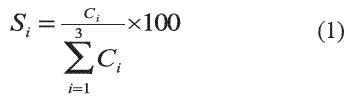
<body><![CDATA[<p> <font face="Verdana" size="2">The CaO behavior for the transesterification of triacetin was evaluated in a batch reaction system composed of a three-neck flask with condensation, sampling, temperature control, and magnetic stirring systems. The reactor charge was composed of alcohol, triacetin, dodecane used as internal standard for chromatographic analysis and catalyst. The preliminary reaction conditions were: reaction volume = 60 mL, molar ratio alcohol/triacetin R<sub>al/tr</sub>= 10, ambient temperature T<sub>a</sub>= 28&deg;C and 3% of CaO based on the weight of the reaction mixture. The sample analysis was performed in a HP 6890 gas chromatograph equipped with a capillary column HP-INNOWax of 30 m x 0.32 mm x 0.25 &micro;m. The CaO activity was expressed through the conversion of triacetin. The diacetin, monoacetin, and glycerin percent selectivity (S<sub>i</sub>) based on the accepted reaction scheme [9] was calculated using the equation 1, where C<sub>i</sub> is the massconcentration of each component.   </font></p>         <p> <img src="/img/revistas/rfiua/n57/n57a01e01.gif"></p>      <p> <font face="Verdana" size="2"> The CaO stability was evaluated by analyzing the presence of Ca in the reaction mixture by atomic absorption and performing several reaction cycles with the same catalyst. After using the CaO in the transesterification for 1 h, it was recovered by filtration, washed by Soxhlet extraction with ethanol during 2 h, dried at 60&deg;C, and reused. In each cycle, an amount of reagents proportional to the weight of the recovered catalyst was used to maintain the initial reaction conditions.    <br>    <br>  Transesterification reactions of triolein were carried out to evaluate the influence of the chain length of triglyceride. Due to the low solubility of glycerol in esters, a phase separation occurs: a lower glycerol-rich layer and an upper methyl-ester rich layer. The upper phase, containing the methyl oleate, was analyzed by gas chromatography. The injector and detector temperatures were set to 255 and 260&deg;C, respectively. After an isothermal period of 4 min at 90&deg;C, the GC oven was heated at 20&deg;C/min to 220&deg;C and held for 4 min, and finally heated at 10&deg;C/min to 230&deg;C and held during 9 min. The content of methyl oleate was determined and expressed as weight percentage. The activity for the transesterification of triolein was expressed by the yield to methyl ester produced. The yields to monoglycerides and diglycerides were not determined, and it is assumed that the ester yield was close to the triglyceride conversion. This may be a good approximation for a conversion higher than 30-40% because the selectivity to mono, and diglycerides is important only at low triglyceride conversion. As the reaction proceeds, the selectivity to mono and diglycerides rapidly decreases, and therefore, the yield to these compounds is very low at high conversion, and much lower in comparison with the methyl ester yield. Hence, it is accepted that ester yield is a reasonable measure to evaluate the catalytic activity [10].    <br>    <br>  The percent yield (Y) to the methyl esters with respect to triglyceride charged amount is expressed by equation (2). </font></p>     <p> <img src="/img/revistas/rfiua/n57/n57a01e02.gif"></p>      <p> <font face="Verdana" size="2">Where the factor 3 is stoichiometric, i.e. 1 mol of triglyceride is required to produce 3 mol of ester.    </font></p>       <p><font face="Verdana" size="3"><b>Results and discussion    </b> </font></p>      ]]></body>

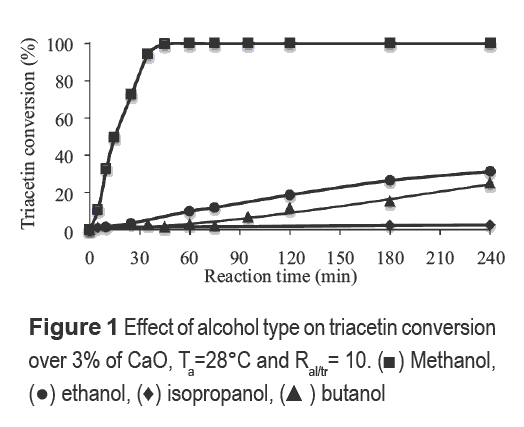
<body><![CDATA[<p> <font face="Verdana" size="2"><b><i>CaO characterization</i></b></font></p>      <p> <font face="Verdana" size="2"> The  CaO BET specific surface is 7 m<sup>2</sup>/g and pore volume 0.03 cm<sup>3</sup>/g.  Regarding the distribution of basic CaO strength, indicators bromothymol blue  and phenolphthalein rapidly showed the color of its basic form on the catalyst,  but with the next indicator, 2,4-dinitroaniline (<i>H</i>_= 15.0), there was no color  change to their conjugate base. Therefore, the strength of basic sites is  within the range 7.2&lt;<i>H</i>_&lt;9.3, with 2.4 and 9.3&lt;<i>H</i>_&lt;15.0 with 0.2  mmol/g of catalyst basic site concentration for a total active site  concentration of 2.6 mmol/g. Although the Hammett method can give qualitative  information of the basic properties, it provides controversial measurement  because diffusional problems of the indicator molecules within the catalyst  pores may occur [11].   </font></p>      <p> <font face="Verdana" size="2"><b><i>Catalytic activity tests    </i></b></font></p>     <p> <font face="Verdana" size="2"><i>Effect of alcohol type on the conversion of triacetin  </i></font></p>      <p> <font face="Verdana" size="2"> <a href="#Figura1">Figure 1</a> shows the effect of alcohol type on triacetin transesterification using four  different alcohols: methanol, ethanol, butanol, and isopropanol. Marked  differences in the reaction rate by varying the alcohol can be observed in <a href="#Figura1">figure 1</a>. It is observed that when the alcohol has longer chain, the activity  of CaO decreased. Marchetti and Errazu [12] reported similar results using  enzymatic catalysis in the esterification of oleic acid. The  transesterification by heterogeneous basic catalysis proceeds via formation of  an alkoxide, which attacks the carbonyl group of the triglyceride and creates a  tetrahedral intermediate or transition state [13]. Asakuma <i>et al</i> [14] proposed that in this  transition state, a polygonal ring between the carbonyl carbon of the  triglyceride and the alkoxy group is formed, and the larger the chain length of  alcohol, the larger the ring size. On this basis, a larger alkyl chain of  alcohol may increase the steric hindrances that affect their reactivity.     <br>    <br></font></p>     <p align="center"><img src="/img/revistas/rfiua/n57/n57a01i01.gif" width="514" ><a name="Figura1"></a></p>      <p> <font face="Verdana" size="2">Complete  conversion is achieved with methanol within 1 h of reaction. This alcohol is  the best option at the established conditions, among the alcohols studied.  According to Stavarache <i>et al</i> [15], the smaller size of methanol could facilitate the  simultaneous attack of the three-triglyceride chains, while a longer chain  alcohol must follow the pathway from triglyceride to diglyceride, and from  diglyceride to monoglyceride in order to obtain the alkyl esters.     <br>    ]]></body>
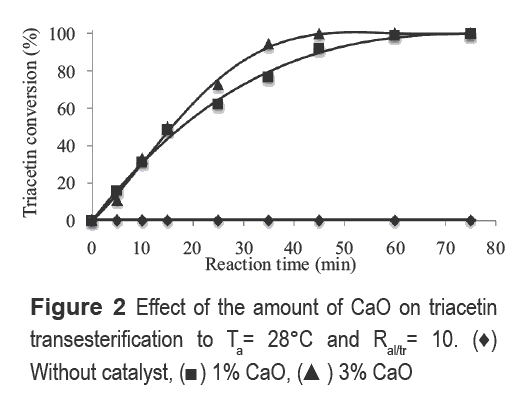
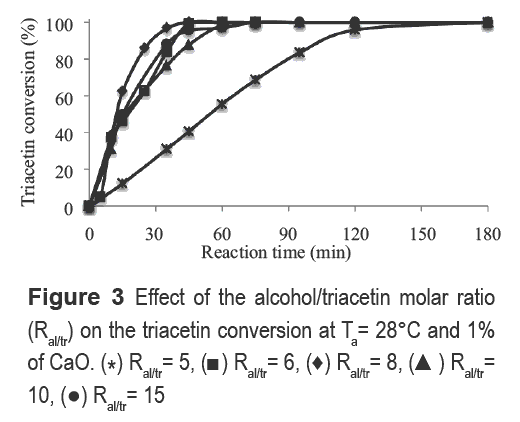
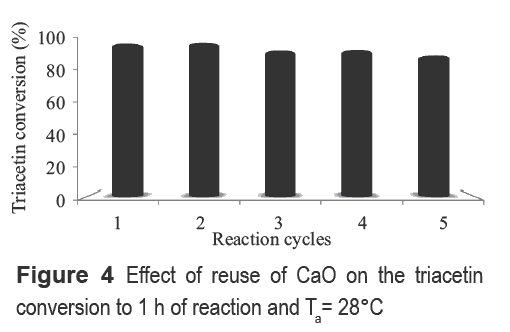
<body><![CDATA[<br> The  final conversion achieved with ethanol and butanol is very low. This shows that  the operating conditions employed are not the best for these alcohols. With  2-propanol, there was no appreciable conversion, and probably because it is a  secondary alcohol, there is even greater steric hindrances that impede their  access to the catalytic sites, which causes the reaction rate to be very low  compared to the normal-chain alcohols [15]. On the other hand, it was found  that the basic CaO strength is high enough to extract the proton from the  alcohol and, thereby, generate nucleophilic attack, and its catalytic  performance in the reaction with methanol is related to the wide distribution  of basic sites on their surface (7.2&lt;<i>H</i>_&lt;15.0).     </font></p>        <p> <font face="Verdana" size="2"><i>Effect of the catalyst amount on the triacetin conversion     </i></font></p>     <p> <font face="Verdana" size="2">  <a href="#Figura2">Figure 2</a> shows triacetin conversion with methanol for concentrations of 1 and 3% of CaO in the reaction mixture, in both cases, total conversion is achieved at 1 h of reaction. Without catalyst addition, the transesterification is not carried out within this reaction time. Differences in the reaction rates were detected. The high stirring speed, the fine particle size (powder), the extremely low pore volume of CaO, and the relatively low percentage of catalyst into the reactive mixture used in our experiments lead us to think that the external and internal diffusions are not limiting steps. For that reason, we have considered that the reaction rate was governed by the surface reaction. X. Liu <i>et al</i> [16] have showed that under reaction conditions similar to the ones presented in this study, the intrinsic kinetic controls the reaction rate.    </font></p>      <p align="center"><img src="/img/revistas/rfiua/n57/n57a01i02.gif" width="535" ><a name="Figura2"></a></p>      <p> <font face="Verdana" size="2"><i> Effect of the alcohol/triacetin molar ratio (R<sub>al/tr</sub>) on triacetin conversion    </i></font></p>     <p> <font face="Verdana" size="2">   The stoichiometry ofthe transesterification requires 3 mol of alcohol per mol of triglyceride to produce 3 mol of alkyl ester and 1 mol of glycerine. An excess of alcohol is required to drive the reaction towards the formation of products, and theoretically an increase of the alcohol to triglyceride molar ratio can raise biodiesel production. However, the high R<sub>al/tr</sub> contributes to increased solubility, making more difficult the separation of glycerin from ester [17]. Moreover, much energy is required to recover the unreacted alcohol. <a href="#Figura3">Figure 3</a> shows the influence of the molar ratio R<sub>al/tr</sub> in the range 5 to 15 on the conversion. By increasing the molar ratio of 5 to 6, the reaction rate increases significantly. Nevertheless, the changes over the conversion are minimal with higher molar ratios, and complete conversion is achieved during 1 h in all cases. Therefore, it is possible to conclude that the best methanol/triacetin molar ratio is 6 under the operation conditions.   </font></p>      <p align="center"><img src="/img/revistas/rfiua/n57/n57a01i03.gif" width="456" ><a name="Figura3"></a></p>      <p> <font face="Verdana" size="2"><i>Catalyst stability      </i></font></p>     <p> <font face="Verdana" size="2"><a href="#Figura4">Figure 4</a> shows triacetin conversion in several reaction cycles with the same catalyst.  CaO did not lose its activity in more than 5 h of reaction reaching conversions  of the same order in every cycle. Furthermore, in a reaction carried out at T<sub>a</sub>=  28&deg;C over 3% of CaO, the atomic absorption measurements indicated the presence  of 430 ppm of Ca. This shows that the amount of dissolved CaO is only 2.3%.  Gryglewicz [2] also reported a low CaO solubility in the presence of methanol.  However, in homogeneous catalysis, a low concentration of a very active  catalyst is enough to carry out the reaction [18]. To verify whether the  detected Ca in solution is involved in the reaction, at the end of the reaction  the catalyst was removed by centrifugation and filtration; triacetin was added  to the filtered solution. No conversion was found during 1 h of stirring at  reaction conditions, confirming that catalysis was associated only with the  solid phase of the material. This is an expected result because dissolved  calcium species are not basic.	</font></p>      <p align="center"><img src="/img/revistas/rfiua/n57/n57a01i04.gif" ><a name="Figura4"></a></p>      ]]></body>
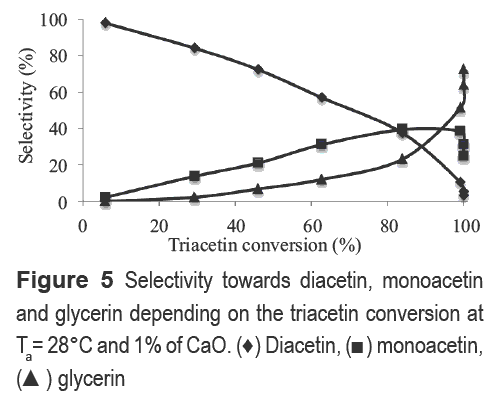
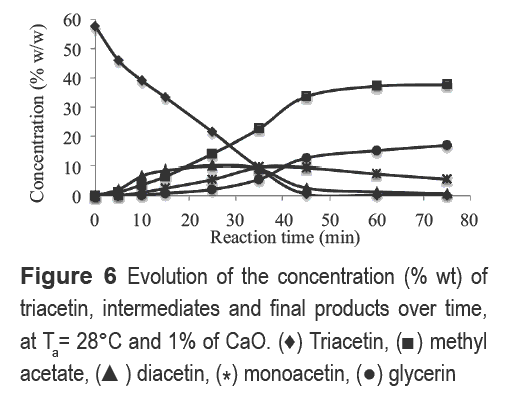
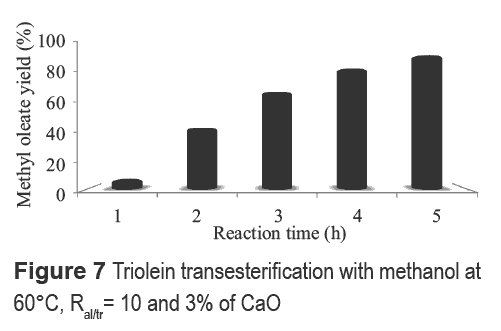
<body><![CDATA[<p> <font face="Verdana" size="2"><i>Selectivity in the transesterification of triacetin      </i></font></p>     <p> <font face="Verdana" size="2"><a href="#Figura5">Figures 5</a> and <a href="#Figura6">6</a> show the selectivity as a function of both triacetin conversion and reaction time, respectively. The results are consistent with the reaction scheme [9], where the diglycerides are the first products formed, and thus the selectivity towards diacetin at low conversion is near 100%. This selectivity rapidly decreases while glycerin and methyl ester are produced. Monoacetin does not reach high selectivity values and has a tendency to disappear with the reaction time, while the glycerine tends to reach 100% selectivity. By varying the CaO amount and the molar ratio R<sub>al/tr</sub>, selectivity does not change significantly.      </font></p>      <p align="center"><img src="/img/revistas/rfiua/n57/n57a01i05.gif" width="506" ><a name="Figura5"></a></p>      <p align="center"><img src="/img/revistas/rfiua/n57/n57a01i06.gif" ><a name="Figura6"></a></p>      <p> <font face="Verdana" size="2"><i>Catalytic activity of calcium oxide in the transesterification of triolein      </i></font></p>      <p> <font face="Verdana" size="2"> For  reactions carried out under the best conditions found in the transesterification  of triacetin with methanol and CaO (T<sub>a</sub>= 28 &deg; C, R<sub>al/tr</sub>= 6  and 1% of CaO), the yield to methyl oleate did not exceed 1% in 5 h unlike the  behavior of triacetin reaction where complete conversion was reached within 1 h  of reaction. There is a clear relationship between the reaction rate and the  chain length of triglyceride used. Evidently, the length of the chain is  affecting the reaction which in principle could be attributed to steric  hindrances. Several authors have reported that basic solid catalysts activate  the carbonyl groups in compounds containing these groups [19]. For this reason,  the reaction conditions were modified to those that favor an adecuate  conversion. The established conditions were: 60&deg;C, a R<sub>al/tr</sub> of 10  and 3% CaO. As it was observed, the long-chain triglycerides require drastic  reaction conditions in order for the reaction to be carried out at shorter  times. </font></p>     <p><font face="Verdana" size="2"><a href="#Figura7">Figure 7</a> shows methyl oleate yield vs time at 60&deg;C, a R<sub>al/tr</sub> of 10 and 3%  of CaO. As can be observed, large triglycerides require more drastic reaction  conditions in order for the transesterification to occur in a viable time. An  increase in temperature favors the formation of methyl esters because the  reaction rate increases, and when the higher the temperature the viscosity  decreases and the solubility increases, which contributes to favor the  homogenization process and the diffusion of triglyceride molecules towards  the active sites. A reaction time of 5 h reached a methyl oleate yield of  approximately 93%     </font></p>      <p align="center"><img src="/img/revistas/rfiua/n57/n57a01i07.gif" height="282" ><a name="Figura7"></a></p>       <p><font face="Verdana" size="3"><b>Conclusions      </b> </font></p>      <p><font face="Verdana" size="2"> Experimental  results show that CaO, with a basic strength of 7.2 &lt;<i>H</i>_&lt;9.3 and 9.3  &lt;<i>H</i>_&lt;15.0 and without any additional treatment, is an active selective and  stable catalyst for the transesterification of triglycerides or biodiesel  production. Factors such as the catalyst amount and molar ratio  alcohol/triglyceride lead to significant variations on the reaction rate of the  triglyceride transesterification. Furthermore, it was demonstrated that the  alcohol nature affects the reaction and that the larger the chain length of  alcohol, the lower the final conversion of triacetin. Undoubtedly, the triglyceride  size used for transesterification plays an important role in the catalytic  activity. When working with large triglycerides, the steric hindrances and the  diffusional limitations presented by the reaction of transesterification become  much more evident.       </font></p>        ]]></body>
<body><![CDATA[<p><font face="Verdana" size="3"><b>Acknowledgments      </b> </font></p>         <p> <font face="Verdana" size="2">The authors express their sincere thanks to VIE- UIS for the financial support through the project 5423. M&oacute;nica Becerra thanks COLCIENCIAS for the financial support of MSc studies through the program: "J&oacute;venes Investigadores".      </font></p>         <p><font face="Verdana" size="3"><b>References      </b> </font></p>          <!-- ref --><p> <font face="Verdana" size="2"> 1. T. Ebiura, T. Echizen, A. Ishikawa, K. Murai, T. Baba. "Selective transesterification of triolein with methanol to methyl oleate and glycerol using alumina loaded with alkali metal salt as a solid-base catalyst". <i>Appl. Catal. A. </i>Vol. 283. 2005. pp. 111-116.    &nbsp;&nbsp;&nbsp;&nbsp;&nbsp;&nbsp;&nbsp;&nbsp;[&#160;<a href="javascript:void(0);" onclick="javascript: window.open('/scielo.php?script=sci_nlinks&ref=000066&pid=S0120-6230201100010000100001&lng=','','width=640,height=500,resizable=yes,scrollbars=1,menubar=yes,');">Links</a>&#160;]<!-- end-ref --><br>    <!-- ref --><br> 2. S. Gryglewicz. "Rapeseed oil methyl esters preparation using heterogeneous catalysts". <i>Bioresource Technol.</i> Vol. 70. 1999. pp. 249-253.    &nbsp;&nbsp;&nbsp;&nbsp;&nbsp;&nbsp;&nbsp;&nbsp;[&#160;<a href="javascript:void(0);" onclick="javascript: window.open('/scielo.php?script=sci_nlinks&ref=000068&pid=S0120-6230201100010000100002&lng=','','width=640,height=500,resizable=yes,scrollbars=1,menubar=yes,');">Links</a>&#160;]<!-- end-ref --><br>    <!-- ref --><br> 3. Y. Xi, R. J. Davis. "Influence of water on the activity and stability of activated Mg-Al hydrotalcites for the transesterification of tributyrin with methanol". <i>J. Catal. </i>Vol. 254. 2008. pp. 190-197.    &nbsp;&nbsp;&nbsp;&nbsp;&nbsp;&nbsp;&nbsp;&nbsp;[&#160;<a href="javascript:void(0);" onclick="javascript: window.open('/scielo.php?script=sci_nlinks&ref=000070&pid=S0120-6230201100010000100003&lng=','','width=640,height=500,resizable=yes,scrollbars=1,menubar=yes,');">Links</a>&#160;]<!-- end-ref --><br>    <!-- ref --><br> 4. G. Arzamendi, E. Arguiñarena, I. Campo, S. Zabala, L. Gand&iacute;a. "Alkaline and alkaline-earth metal compounds as catalysts for methanolysis of sunflower oil". <i>Catal. Today. </i>Vol. 133. 2008. pp. 305-313.    &nbsp;&nbsp;&nbsp;&nbsp;&nbsp;&nbsp;&nbsp;&nbsp;[&#160;<a href="javascript:void(0);" onclick="javascript: window.open('/scielo.php?script=sci_nlinks&ref=000072&pid=S0120-6230201100010000100004&lng=','','width=640,height=500,resizable=yes,scrollbars=1,menubar=yes,');">Links</a>&#160;]<!-- end-ref --><br>    <!-- ref --><br> 5. H. Zhu, Z. Wu, Y. Chen, P. Zhang, S. Duan, X. Liu, Z. Mao. "Preparation of biodiesel catalyzed by solid super base of calcium oxide and its refining process". <i>China J. Catal. </i>Vol. 27. 2006. pp. 391-396.    &nbsp;&nbsp;&nbsp;&nbsp;&nbsp;&nbsp;&nbsp;&nbsp;[&#160;<a href="javascript:void(0);" onclick="javascript: window.open('/scielo.php?script=sci_nlinks&ref=000074&pid=S0120-6230201100010000100005&lng=','','width=640,height=500,resizable=yes,scrollbars=1,menubar=yes,');">Links</a>&#160;]<!-- end-ref --><br>    <!-- ref --><br> 6. C. Reddy, R. Oshel, J. Verkade. "Room-temperature conversion of soybean oil and poultry fat to biodiesel catalyzed by nanocrystalline calcium oxides".<i> Energy & Fuels.</i> Vol. 20. 2006. pp. 1310-1314.    &nbsp;&nbsp;&nbsp;&nbsp;&nbsp;&nbsp;&nbsp;&nbsp;[&#160;<a href="javascript:void(0);" onclick="javascript: window.open('/scielo.php?script=sci_nlinks&ref=000076&pid=S0120-6230201100010000100006&lng=','','width=640,height=500,resizable=yes,scrollbars=1,menubar=yes,');">Links</a>&#160;]<!-- end-ref --><br>    <!-- ref --><br> 7. M. Kouzu, T. Kasuno, M. Tajika, S. Yamanaka, J. Hidaka. "Active phase of calcium oxide used as solid base catalyst for transesterification of soybean oil with refluxing methanol". <i>Appl. Catal. A. </i>Vol. 334. 2008. pp. 357-365.    &nbsp;&nbsp;&nbsp;&nbsp;&nbsp;&nbsp;&nbsp;&nbsp;[&#160;<a href="javascript:void(0);" onclick="javascript: window.open('/scielo.php?script=sci_nlinks&ref=000078&pid=S0120-6230201100010000100007&lng=','','width=640,height=500,resizable=yes,scrollbars=1,menubar=yes,');">Links</a>&#160;]<!-- end-ref --><br>    <!-- ref --><br> 8. K. Tanabe, M. Misono, Y. Ono, H. Hattori. "Determination of acidic and basic properties on solid surfaces". <i>Studies in Surface Science and Catalysis. </i>Vol. 51. 1989. pp. 14-25.    &nbsp;&nbsp;&nbsp;&nbsp;&nbsp;&nbsp;&nbsp;&nbsp;[&#160;<a href="javascript:void(0);" onclick="javascript: window.open('/scielo.php?script=sci_nlinks&ref=000080&pid=S0120-6230201100010000100008&lng=','','width=640,height=500,resizable=yes,scrollbars=1,menubar=yes,');">Links</a>&#160;]<!-- end-ref --><br>    <!-- ref --><br> 9. D. E. L&oacute;pez, J. G. Goodwin Jr., D. A. Bruce, E. Lotero. "Transesterification of triacetin with metanol on solid acid and base catalysts". <i>Appl. Catal. A. </i>Vol. 295. 2005. pp. 97-105.    &nbsp;&nbsp;&nbsp;&nbsp;&nbsp;&nbsp;&nbsp;&nbsp;[&#160;<a href="javascript:void(0);" onclick="javascript: window.open('/scielo.php?script=sci_nlinks&ref=000082&pid=S0120-6230201100010000100009&lng=','','width=640,height=500,resizable=yes,scrollbars=1,menubar=yes,');">Links</a>&#160;]<!-- end-ref --><br>    <!-- ref --><br> 10. A. Kawashima, K. Matsubara, K. Honda. "Development of heterogeneous base catalysts for biodiesel production".<i> Bioresource Technol.</i> Vol. 99. 2008. pp. 3439-3443.    &nbsp;&nbsp;&nbsp;&nbsp;&nbsp;&nbsp;&nbsp;&nbsp;[&#160;<a href="javascript:void(0);" onclick="javascript: window.open('/scielo.php?script=sci_nlinks&ref=000084&pid=S0120-6230201100010000100010&lng=','','width=640,height=500,resizable=yes,scrollbars=1,menubar=yes,');">Links</a>&#160;]<!-- end-ref --><br>    <!-- ref --><br> 11. B. C. Gates, T. K. Cheung. "Sulfated zirconia and iron- and manganese-promoted sulfated zirconia: do they protonate alkanes?" <i>Top. Catal. </i>Vol. 6. 1998. pp. 41-47.    &nbsp;&nbsp;&nbsp;&nbsp;&nbsp;&nbsp;&nbsp;&nbsp;[&#160;<a href="javascript:void(0);" onclick="javascript: window.open('/scielo.php?script=sci_nlinks&ref=000086&pid=S0120-6230201100010000100011&lng=','','width=640,height=500,resizable=yes,scrollbars=1,menubar=yes,');">Links</a>&#160;]<!-- end-ref --><br>    <!-- ref --><br> 12. J. M. Marchetti, A. F. Errazu. "Comparison of different heterogeneous catalysts and different alcohols for the esterification reaction of oleic acid". <i>Fuel.</i> Vol. 87. 2008. pp. 3477-3480.    &nbsp;&nbsp;&nbsp;&nbsp;&nbsp;&nbsp;&nbsp;&nbsp;[&#160;<a href="javascript:void(0);" onclick="javascript: window.open('/scielo.php?script=sci_nlinks&ref=000088&pid=S0120-6230201100010000100012&lng=','','width=640,height=500,resizable=yes,scrollbars=1,menubar=yes,');">Links</a>&#160;]<!-- end-ref --><br>    <!-- ref --><br> 13. U. Schuchardt, R. Serchelia, R. M. Vargas. "Transesterification of Vegetable Oils: a Review". <i>J. Braz. Chem. Soc.</i> Vol. 9. 1998. pp. 199-210.    &nbsp;&nbsp;&nbsp;&nbsp;&nbsp;&nbsp;&nbsp;&nbsp;[&#160;<a href="javascript:void(0);" onclick="javascript: window.open('/scielo.php?script=sci_nlinks&ref=000090&pid=S0120-6230201100010000100013&lng=','','width=640,height=500,resizable=yes,scrollbars=1,menubar=yes,');">Links</a>&#160;]<!-- end-ref --><br>    <!-- ref --><br> 14. Y. Asakuma, K. Maeda, H. Kuramochi, K. Fukui. "Theoretical study of the transesterification of triglycerides to biodiesel fuel". <i>Fuel.</i> Vol. 88. 2009. pp.786-791.    &nbsp;&nbsp;&nbsp;&nbsp;&nbsp;&nbsp;&nbsp;&nbsp;[&#160;<a href="javascript:void(0);" onclick="javascript: window.open('/scielo.php?script=sci_nlinks&ref=000092&pid=S0120-6230201100010000100014&lng=','','width=640,height=500,resizable=yes,scrollbars=1,menubar=yes,');">Links</a>&#160;]<!-- end-ref --><br>    <!-- ref --><br> 15. C. Stavarache, M. Vinatoru, R. Nishimura, Y. Maeda. "Fatty acids methyl esters from vegetable oil by means of ultrasonic energy". <i>Ultrason. Sonochem. </i>Vol. 12. 2005. pp. 367-372.    &nbsp;&nbsp;&nbsp;&nbsp;&nbsp;&nbsp;&nbsp;&nbsp;[&#160;<a href="javascript:void(0);" onclick="javascript: window.open('/scielo.php?script=sci_nlinks&ref=000094&pid=S0120-6230201100010000100015&lng=','','width=640,height=500,resizable=yes,scrollbars=1,menubar=yes,');">Links</a>&#160;]<!-- end-ref --><br>    <!-- ref --><br> 16. X. Liu, X. Piao, Y. Wang, S. Zhu, H. He. "Calcium methoxide as a solid base catalyst for the transesterification of soybean oil to biodiesel with methanol".<i> Fuel.</i> Vol. 87. 2008. pp. 1076-1082.    &nbsp;&nbsp;&nbsp;&nbsp;&nbsp;&nbsp;&nbsp;&nbsp;[&#160;<a href="javascript:void(0);" onclick="javascript: window.open('/scielo.php?script=sci_nlinks&ref=000096&pid=S0120-6230201100010000100016&lng=','','width=640,height=500,resizable=yes,scrollbars=1,menubar=yes,');">Links</a>&#160;]<!-- end-ref --><br>    <!-- ref --><br> 17. L. C. Meher, D. Vidya Sagar, S. N. Naik. "Technical aspects of biodiesel production by transesterification - a review". <i>Renew. Sust. Energ. Rev.</i> Vol. 10. 2006. pp. 248-268.    &nbsp;&nbsp;&nbsp;&nbsp;&nbsp;&nbsp;&nbsp;&nbsp;[&#160;<a href="javascript:void(0);" onclick="javascript: window.open('/scielo.php?script=sci_nlinks&ref=000098&pid=S0120-6230201100010000100017&lng=','','width=640,height=500,resizable=yes,scrollbars=1,menubar=yes,');">Links</a>&#160;]<!-- end-ref --><br>    <!-- ref --><br> 18. S. Yan, M. Kim, S. O. Salley, K. Y Simon Ng. "Oil transesterification over calcium oxides modified with lanthanum".<i> Appl. Catal. A.</i> Vol. 360. 2009. pp. 163-170.    &nbsp;&nbsp;&nbsp;&nbsp;&nbsp;&nbsp;&nbsp;&nbsp;[&#160;<a href="javascript:void(0);" onclick="javascript: window.open('/scielo.php?script=sci_nlinks&ref=000100&pid=S0120-6230201100010000100018&lng=','','width=640,height=500,resizable=yes,scrollbars=1,menubar=yes,');">Links</a>&#160;]<!-- end-ref --><br>    <!-- ref --><br> 19. Y. Ono. "Solid base catalysts for the synthesis of fine chemicals". <i>J. Catal. </i>Vol. 216. 2003. pp. 406-415.    &nbsp;&nbsp;&nbsp;&nbsp;&nbsp;&nbsp;&nbsp;&nbsp;[&#160;<a href="javascript:void(0);" onclick="javascript: window.open('/scielo.php?script=sci_nlinks&ref=000102&pid=S0120-6230201100010000100019&lng=','','width=640,height=500,resizable=yes,scrollbars=1,menubar=yes,');">Links</a>&#160;]<!-- end-ref --><br>    <br>       </font></p>      <br>    <br>    <br>    <br>       <p><font face="Verdana" size="2">(Recibido el 03 de febrero de 2010. Aceptado el 15 de octubre de 2010) </font></p>     <p><font face="Verdana" size="2"><sup>*</sup>Autor de correspondencia: tel&eacute;fono: 57 + 7 + 634 47 46, fax: 57 + 7 + 634 46 84, correo electr&oacute;nico: <a href="mailto:sgiraldo@uis.edu.co ">sgiraldo@uis.edu.co </a> (S. Giraldo)</font></p>      ]]></body><back>
<ref-list>
<ref id="B1">
<label>1</label><nlm-citation citation-type="journal">
<person-group person-group-type="author">
<name>
<surname><![CDATA[Ebiura]]></surname>
<given-names><![CDATA[T]]></given-names>
</name>
<name>
<surname><![CDATA[Echizen]]></surname>
<given-names><![CDATA[T]]></given-names>
</name>
<name>
<surname><![CDATA[Ishikawa]]></surname>
<given-names><![CDATA[A]]></given-names>
</name>
<name>
<surname><![CDATA[Murai]]></surname>
<given-names><![CDATA[K]]></given-names>
</name>
<name>
<surname><![CDATA[Baba]]></surname>
<given-names><![CDATA[T]]></given-names>
</name>
</person-group>
<article-title xml:lang="en"><![CDATA[Selective transesterification of triolein with methanol to methyl oleate and glycerol using alumina loaded with alkali metal salt as a solid-base catalyst]]></article-title>
<source><![CDATA[Appl. Catal. A]]></source>
<year>2005</year>
<volume>283</volume>
<page-range>111-116</page-range></nlm-citation>
</ref>
<ref id="B2">
<label>2</label><nlm-citation citation-type="journal">
<person-group person-group-type="author">
<name>
<surname><![CDATA[Gryglewicz]]></surname>
<given-names><![CDATA[S]]></given-names>
</name>
</person-group>
<article-title xml:lang="en"><![CDATA[Rapeseed oil methyl esters preparation using heterogeneous catalysts]]></article-title>
<source><![CDATA[Bioresource Technol]]></source>
<year>1999</year>
<volume>70</volume>
<page-range>249-253</page-range></nlm-citation>
</ref>
<ref id="B3">
<label>3</label><nlm-citation citation-type="journal">
<person-group person-group-type="author">
<name>
<surname><![CDATA[Xi]]></surname>
<given-names><![CDATA[Y]]></given-names>
</name>
<name>
<surname><![CDATA[Davis]]></surname>
<given-names><![CDATA[R. J]]></given-names>
</name>
</person-group>
<article-title xml:lang="en"><![CDATA[Influence of water on the activity and stability of activated Mg-Al hydrotalcites for the transesterification of tributyrin with methanol]]></article-title>
<source><![CDATA[J. Catal]]></source>
<year>2008</year>
<volume>254</volume>
<page-range>190-197</page-range></nlm-citation>
</ref>
<ref id="B4">
<label>4</label><nlm-citation citation-type="journal">
<person-group person-group-type="author">
<name>
<surname><![CDATA[Arzamendi]]></surname>
<given-names><![CDATA[G]]></given-names>
</name>
<name>
<surname><![CDATA[Arguiñarena]]></surname>
<given-names><![CDATA[E]]></given-names>
</name>
<name>
<surname><![CDATA[Campo]]></surname>
<given-names><![CDATA[I]]></given-names>
</name>
<name>
<surname><![CDATA[Zabala]]></surname>
<given-names><![CDATA[S]]></given-names>
</name>
<name>
<surname><![CDATA[Gandía]]></surname>
<given-names><![CDATA[L]]></given-names>
</name>
</person-group>
<article-title xml:lang="en"><![CDATA[Alkaline and alkaline-earth metal compounds as catalysts for methanolysis of sunflower oil]]></article-title>
<source><![CDATA[Catal. Toda]]></source>
<year>2008</year>
<volume>133</volume>
<page-range>305-313</page-range></nlm-citation>
</ref>
<ref id="B5">
<label>5</label><nlm-citation citation-type="journal">
<person-group person-group-type="author">
<name>
<surname><![CDATA[Zhu]]></surname>
<given-names><![CDATA[H]]></given-names>
</name>
<name>
<surname><![CDATA[Wu]]></surname>
<given-names><![CDATA[Z]]></given-names>
</name>
<name>
<surname><![CDATA[Chen]]></surname>
<given-names><![CDATA[Y]]></given-names>
</name>
<name>
<surname><![CDATA[Zhang]]></surname>
<given-names><![CDATA[P]]></given-names>
</name>
<name>
<surname><![CDATA[Duan]]></surname>
<given-names><![CDATA[S]]></given-names>
</name>
<name>
<surname><![CDATA[Liu]]></surname>
<given-names><![CDATA[X]]></given-names>
</name>
<name>
<surname><![CDATA[Mao]]></surname>
<given-names><![CDATA[Z]]></given-names>
</name>
</person-group>
<article-title xml:lang="en"><![CDATA[Preparation of biodiesel catalyzed by solid super base of calcium oxide and its refining process]]></article-title>
<source><![CDATA[China J. Catal]]></source>
<year>2006</year>
<volume>27</volume>
<page-range>391-396</page-range></nlm-citation>
</ref>
<ref id="B6">
<label>6</label><nlm-citation citation-type="journal">
<person-group person-group-type="author">
<name>
<surname><![CDATA[Reddy]]></surname>
<given-names><![CDATA[C]]></given-names>
</name>
<name>
<surname><![CDATA[Oshel]]></surname>
<given-names><![CDATA[R]]></given-names>
</name>
<name>
<surname><![CDATA[Verkade]]></surname>
<given-names><![CDATA[J]]></given-names>
</name>
</person-group>
<article-title xml:lang="en"><![CDATA[Room-temperature conversion of soybean oil and poultry fat to biodiesel catalyzed by nanocrystalline calcium oxides]]></article-title>
<source><![CDATA[Energy & Fuels]]></source>
<year>2006</year>
<volume>20</volume>
<page-range>1310-1314</page-range></nlm-citation>
</ref>
<ref id="B7">
<label>7</label><nlm-citation citation-type="journal">
<person-group person-group-type="author">
<name>
<surname><![CDATA[Kouzu]]></surname>
<given-names><![CDATA[M]]></given-names>
</name>
<name>
<surname><![CDATA[Kasuno]]></surname>
<given-names><![CDATA[T]]></given-names>
</name>
<name>
<surname><![CDATA[Tajika]]></surname>
<given-names><![CDATA[M]]></given-names>
</name>
<name>
<surname><![CDATA[Yamanaka]]></surname>
<given-names><![CDATA[S]]></given-names>
</name>
<name>
<surname><![CDATA[Hidaka]]></surname>
<given-names><![CDATA[J]]></given-names>
</name>
</person-group>
<article-title xml:lang="en"><![CDATA[Active phase of calcium oxide used as solid base catalyst for transesterification of soybean oil with refluxing methanol]]></article-title>
<source><![CDATA[Appl. Catal. A]]></source>
<year>2008</year>
<volume>334</volume>
<page-range>357-365</page-range></nlm-citation>
</ref>
<ref id="B8">
<label>8</label><nlm-citation citation-type="journal">
<person-group person-group-type="author">
<name>
<surname><![CDATA[Tanabe]]></surname>
<given-names><![CDATA[K]]></given-names>
</name>
<name>
<surname><![CDATA[Misono]]></surname>
<given-names><![CDATA[M]]></given-names>
</name>
<name>
<surname><![CDATA[Ono]]></surname>
<given-names><![CDATA[Y]]></given-names>
</name>
<name>
<surname><![CDATA[Hattori]]></surname>
<given-names><![CDATA[H]]></given-names>
</name>
</person-group>
<article-title xml:lang="en"><![CDATA[Determination of acidic and basic properties on solid surfaces]]></article-title>
<source><![CDATA[Studies in Surface Science and Catalysis]]></source>
<year>1989</year>
<volume>51</volume>
<page-range>14-25</page-range></nlm-citation>
</ref>
<ref id="B9">
<label>9</label><nlm-citation citation-type="journal">
<person-group person-group-type="author">
<name>
<surname><![CDATA[López]]></surname>
<given-names><![CDATA[D. E]]></given-names>
</name>
<name>
<surname><![CDATA[Goodwin]]></surname>
<given-names><![CDATA[J. G]]></given-names>
</name>
<name>
<surname><![CDATA[Bruce]]></surname>
<given-names><![CDATA[D. A]]></given-names>
</name>
<name>
<surname><![CDATA[Lotero]]></surname>
<given-names><![CDATA[E]]></given-names>
</name>
</person-group>
<article-title xml:lang="en"><![CDATA[Transesterification of triacetin with metanol on solid acid and base catalysts]]></article-title>
<source><![CDATA[Appl. Catal. A]]></source>
<year>2005</year>
<volume>295</volume>
<page-range>97-105</page-range></nlm-citation>
</ref>
<ref id="B10">
<label>10</label><nlm-citation citation-type="journal">
<person-group person-group-type="author">
<name>
<surname><![CDATA[Kawashima]]></surname>
<given-names><![CDATA[A]]></given-names>
</name>
<name>
<surname><![CDATA[Matsubara]]></surname>
<given-names><![CDATA[K]]></given-names>
</name>
<name>
<surname><![CDATA[Honda]]></surname>
<given-names><![CDATA[K]]></given-names>
</name>
</person-group>
<article-title xml:lang="en"><![CDATA[Development of heterogeneous base catalysts for biodiesel production]]></article-title>
<source><![CDATA[Bioresource Technol]]></source>
<year>2008</year>
<volume>99</volume>
<page-range>3439-3443</page-range></nlm-citation>
</ref>
<ref id="B11">
<label>11</label><nlm-citation citation-type="journal">
<person-group person-group-type="author">
<name>
<surname><![CDATA[Gates]]></surname>
<given-names><![CDATA[B. C]]></given-names>
</name>
<name>
<surname><![CDATA[Cheung]]></surname>
<given-names><![CDATA[T. K]]></given-names>
</name>
</person-group>
<article-title xml:lang="en"><![CDATA[Sulfated zirconia and iron- and manganese-promoted sulfated zirconia: do they protonate alkanes?]]></article-title>
<source><![CDATA[Top. Catal]]></source>
<year>1998</year>
<volume>6</volume>
<page-range>41-47</page-range></nlm-citation>
</ref>
<ref id="B12">
<label>12</label><nlm-citation citation-type="journal">
<person-group person-group-type="author">
<name>
<surname><![CDATA[Marchetti]]></surname>
<given-names><![CDATA[J. M]]></given-names>
</name>
<name>
<surname><![CDATA[Errazu]]></surname>
<given-names><![CDATA[A. F]]></given-names>
</name>
</person-group>
<article-title xml:lang="en"><![CDATA[Comparison of different heterogeneous catalysts and different alcohols for the esterification reaction of oleic acid]]></article-title>
<source><![CDATA[Fuel]]></source>
<year>2008</year>
<volume>87</volume>
<page-range>3477-3480</page-range></nlm-citation>
</ref>
<ref id="B13">
<label>13</label><nlm-citation citation-type="journal">
<person-group person-group-type="author">
<name>
<surname><![CDATA[Schuchardt]]></surname>
<given-names><![CDATA[U]]></given-names>
</name>
<name>
<surname><![CDATA[Serchelia]]></surname>
<given-names><![CDATA[R]]></given-names>
</name>
<name>
<surname><![CDATA[Vargas]]></surname>
<given-names><![CDATA[R. M]]></given-names>
</name>
</person-group>
<article-title xml:lang="en"><![CDATA[Transesterification of Vegetable Oils: a Review]]></article-title>
<source><![CDATA[J. Braz. Chem. Soc]]></source>
<year>1998</year>
<volume>9</volume>
<page-range>199-210</page-range></nlm-citation>
</ref>
<ref id="B14">
<label>14</label><nlm-citation citation-type="journal">
<person-group person-group-type="author">
<name>
<surname><![CDATA[Asakuma]]></surname>
<given-names><![CDATA[Y]]></given-names>
</name>
<name>
<surname><![CDATA[Maeda]]></surname>
<given-names><![CDATA[K]]></given-names>
</name>
<name>
<surname><![CDATA[Kuramochi]]></surname>
<given-names><![CDATA[H]]></given-names>
</name>
<name>
<surname><![CDATA[Fukui]]></surname>
<given-names><![CDATA[K]]></given-names>
</name>
</person-group>
<article-title xml:lang="en"><![CDATA[Theoretical study of the transesterification of triglycerides to biodiesel fuel]]></article-title>
<source><![CDATA[Fuel]]></source>
<year>2009</year>
<page-range>88</page-range><page-range>786-791</page-range></nlm-citation>
</ref>
<ref id="B15">
<label>15</label><nlm-citation citation-type="journal">
<person-group person-group-type="author">
<name>
<surname><![CDATA[Stavarache]]></surname>
<given-names><![CDATA[C]]></given-names>
</name>
<name>
<surname><![CDATA[Vinatoru]]></surname>
<given-names><![CDATA[M]]></given-names>
</name>
<name>
<surname><![CDATA[Nishimura]]></surname>
<given-names><![CDATA[R]]></given-names>
</name>
<name>
<surname><![CDATA[Maeda]]></surname>
<given-names><![CDATA[Y]]></given-names>
</name>
</person-group>
<article-title xml:lang="en"><![CDATA[Fatty acids methyl esters from vegetable oil by means of ultrasonic energy]]></article-title>
<source><![CDATA[Ultrason. Sonochem]]></source>
<year>2005</year>
<volume>12</volume>
<page-range>367-372</page-range></nlm-citation>
</ref>
<ref id="B16">
<label>16</label><nlm-citation citation-type="journal">
<person-group person-group-type="author">
<name>
<surname><![CDATA[Liu]]></surname>
<given-names><![CDATA[X]]></given-names>
</name>
<name>
<surname><![CDATA[Piao]]></surname>
<given-names><![CDATA[X]]></given-names>
</name>
<name>
<surname><![CDATA[Wang]]></surname>
<given-names><![CDATA[Y]]></given-names>
</name>
<name>
<surname><![CDATA[Zhu]]></surname>
<given-names><![CDATA[S]]></given-names>
</name>
<name>
<surname><![CDATA[He]]></surname>
<given-names><![CDATA[H]]></given-names>
</name>
</person-group>
<article-title xml:lang="en"><![CDATA[Calcium methoxide as a solid base catalyst for the transesterification of soybean oil to biodiesel with methanol]]></article-title>
<source><![CDATA[Fuel]]></source>
<year>2008</year>
<volume>87</volume>
<page-range>1076-1082</page-range></nlm-citation>
</ref>
<ref id="B17">
<label>17</label><nlm-citation citation-type="journal">
<person-group person-group-type="author">
<name>
<surname><![CDATA[Meher]]></surname>
<given-names><![CDATA[L. C]]></given-names>
</name>
<name>
<surname><![CDATA[Vidya Sagar]]></surname>
<given-names><![CDATA[D]]></given-names>
</name>
<name>
<surname><![CDATA[Naik]]></surname>
<given-names><![CDATA[S. N]]></given-names>
</name>
</person-group>
<article-title xml:lang="en"><![CDATA[Technical aspects of biodiesel production by transesterification - a review]]></article-title>
<source><![CDATA[Renew. Sust. Energ. Rev]]></source>
<year>2006</year>
<volume>10</volume>
<page-range>248-268</page-range></nlm-citation>
</ref>
<ref id="B18">
<label>18</label><nlm-citation citation-type="journal">
<person-group person-group-type="author">
<name>
<surname><![CDATA[Yan]]></surname>
<given-names><![CDATA[S]]></given-names>
</name>
<name>
<surname><![CDATA[Kim]]></surname>
<given-names><![CDATA[M]]></given-names>
</name>
<name>
<surname><![CDATA[Salley]]></surname>
<given-names><![CDATA[S. O]]></given-names>
</name>
<name>
<surname><![CDATA[Y Simon Ng]]></surname>
<given-names><![CDATA[K]]></given-names>
</name>
</person-group>
<article-title xml:lang="en"><![CDATA[Oil transesterification over calcium oxides modified with lanthanum]]></article-title>
<source><![CDATA[Appl. Catal. A]]></source>
<year>2009</year>
<volume>360</volume>
<page-range>163-170</page-range></nlm-citation>
</ref>
<ref id="B19">
<label>19</label><nlm-citation citation-type="journal">
<person-group person-group-type="author">
<name>
<surname><![CDATA[Ono]]></surname>
<given-names><![CDATA[Y]]></given-names>
</name>
</person-group>
<article-title xml:lang="en"><![CDATA[Solid base catalysts for the synthesis of fine chemicals]]></article-title>
<source><![CDATA[J. Catal]]></source>
<year>2003</year>
<volume>216</volume>
<page-range>406-415</page-range></nlm-citation>
</ref>
</ref-list>
</back>
</article>