<?xml version="1.0" encoding="ISO-8859-1"?><article xmlns:mml="http://www.w3.org/1998/Math/MathML" xmlns:xlink="http://www.w3.org/1999/xlink" xmlns:xsi="http://www.w3.org/2001/XMLSchema-instance">
<front>
<journal-meta>
<journal-id>0120-6230</journal-id>
<journal-title><![CDATA[Revista Facultad de Ingeniería Universidad de Antioquia]]></journal-title>
<abbrev-journal-title><![CDATA[Rev.fac.ing.univ. Antioquia]]></abbrev-journal-title>
<issn>0120-6230</issn>
<publisher>
<publisher-name><![CDATA[Facultad de Ingeniería, Universidad de Antioquia]]></publisher-name>
</publisher>
</journal-meta>
<article-meta>
<article-id>S0120-62302011000100002</article-id>
<title-group>
<article-title xml:lang="en"><![CDATA[Preparation and characterization of Mg-modified zirconias as catalysts for the direct synthesis of dimethyl carbonate (DMC)]]></article-title>
<article-title xml:lang="es"><![CDATA[Preparación y caracterización de circonias modificadas con Mg como catalizadores para la síntesis directa de carbonato de dimetilo (DMC)]]></article-title>
</title-group>
<contrib-group>
<contrib contrib-type="author">
<name>
<surname><![CDATA[Orrego Romero]]></surname>
<given-names><![CDATA[Andrés]]></given-names>
</name>
<xref ref-type="aff" rid="A01"/>
</contrib>
<contrib contrib-type="author">
<name>
<surname><![CDATA[Montes de Correa]]></surname>
<given-names><![CDATA[Consuelo]]></given-names>
</name>
<xref ref-type="aff" rid="A01"/>
</contrib>
<contrib contrib-type="author">
<name>
<surname><![CDATA[Bustamante Lodoño]]></surname>
<given-names><![CDATA[Felipe]]></given-names>
</name>
<xref ref-type="aff" rid="A01"/>
</contrib>
</contrib-group>
<aff id="A01">
<institution><![CDATA[,Universidad de Antioquia Environmental Catalysis Research Group ]]></institution>
<addr-line><![CDATA[Medellín ]]></addr-line>
<country>Colombia</country>
</aff>
<pub-date pub-type="pub">
<day>00</day>
<month>01</month>
<year>2011</year>
</pub-date>
<pub-date pub-type="epub">
<day>00</day>
<month>01</month>
<year>2011</year>
</pub-date>
<numero>57</numero>
<fpage>14</fpage>
<lpage>22</lpage>
<copyright-statement/>
<copyright-year/>
<self-uri xlink:href="http://www.scielo.org.co/scielo.php?script=sci_arttext&amp;pid=S0120-62302011000100002&amp;lng=en&amp;nrm=iso"></self-uri><self-uri xlink:href="http://www.scielo.org.co/scielo.php?script=sci_abstract&amp;pid=S0120-62302011000100002&amp;lng=en&amp;nrm=iso"></self-uri><self-uri xlink:href="http://www.scielo.org.co/scielo.php?script=sci_pdf&amp;pid=S0120-62302011000100002&amp;lng=en&amp;nrm=iso"></self-uri><abstract abstract-type="short" xml:lang="en"><p><![CDATA[In this work sol-gel zirconia was prepared using H2SO4, HNO3 or HCl as hydrolysis catalysts. Basic and acid sites of synthesized zirconia materials were characterized by XRD, BET, FTIR, CO2- TPD and NH3-TPD. FTIR spectra and TGA confirmed the presence of sulfate in the structure of samples prepared with H2SO4 as hydrolysis catalyst. Different molar ratios of Mg were incorporated by co-gellation on selected zirconia materials in order to improve their basic properties. Mg loading was determined by elemental analysis. The resulting materials were tested for the direct synthesis of dimethyl carbonate (DMC) from methanol and CO2. The addition of Mg to zirconia samples prepared with HCl as hydrolysis catalyst increased their CO2 adsorption capacity between 100 and 200&deg;C. However, methanol conversions on these samples were lower than over unmodified zirconia samples.]]></p></abstract>
<abstract abstract-type="short" xml:lang="es"><p><![CDATA[Se preparó circonia por el método sol-gel usando H2SO4, HNO3 o HCl como catalizadores de hidrólisis. Los materiales resultantes se caracterizaron por DRX, BET, FTIR, desorción de CO2 con temperatura programada (TPD- CO2) y desorción de amoníaco con temperatura programada (TPD-NH3). Los espectros FTIR de las muestras preparadas con H2SO4 muestran bandas típicas de sulfatos, lo cual se confirmó mediante TGA. Adicionalmente, en algunos materiales seleccionados se incorporaron diferentes proporciones de Mg mediante co-gelación. La carga de magnesio de los materiales modificados se determinó por análisis elemental. Los materiales se ensayaron como catalizadores en la síntesis directa de carbonato de dimetilo (DMC) a partir de metanol y CO2. La incorporación de Mg incrementó la capacidad de adsorción de CO2 entre 100 y 200&deg;C. No obstante, las conversiones de metanol obtenidas con estas muestras fueron menores a las de las muestras de circonia sin modificar.]]></p></abstract>
<kwd-group>
<kwd lng="en"><![CDATA[Sol-gel process]]></kwd>
<kwd lng="en"><![CDATA[zirconia]]></kwd>
<kwd lng="en"><![CDATA[basic sites]]></kwd>
<kwd lng="en"><![CDATA[dimethyl carbonate]]></kwd>
<kwd lng="en"><![CDATA[CO2-TPD]]></kwd>
<kwd lng="es"><![CDATA[Método sol-gel]]></kwd>
<kwd lng="es"><![CDATA[circonia]]></kwd>
<kwd lng="es"><![CDATA[sitios básicos]]></kwd>
<kwd lng="es"><![CDATA[carbonato de dimetilo]]></kwd>
<kwd lng="es"><![CDATA[TPD-CO2]]></kwd>
<kwd lng="es"><![CDATA[TPD-NH3]]></kwd>
</kwd-group>
</article-meta>
</front><body><![CDATA[ <p align="center"><font face="Verdana" size="4"> <b>Preparation and characterization of Mg-modified zirconias as catalysts for the direct synthesis of dimethyl carbonate (DMC)</b></font></p>      <p align="center"><font face="Verdana" size="4"> <b>Preparaci&oacute;n y caracterizaci&oacute;n de circonias modificadas con Mg como catalizadores para la s&iacute;ntesis directa de carbonato de dimetilo (DMC)</b></font></p>      <p> <font face="Verdana" size="2"> <i>Andr&eacute;s Orrego Romero, Consuelo Montes de Correa<sup>*</sup> , Felipe Bustamante Lodoño </i></font></p>       <p> <font face="Verdana" size="2">Environmental Catalysis Research Group. Sede de Investigaci&oacute;n Universitaria. Universidad de Antioquia. Calle 53 N.&deg; 61-30. Medell&iacute;n. Colombia</font></p>    <br>  <hr noshade size="1">     <p><font face="Verdana" size="3"><b>Abstract</b></font></p>       <p><font face="Verdana" size="2">In this work sol-gel zirconia was prepared using H<sub>2</sub>SO<sub>4</sub>, HNO<sub>3</sub> or HCl as hydrolysis catalysts. Basic and acid sites of synthesized zirconia materials were characterized by XRD, BET, FTIR, CO<sub>2</sub>- TPD and NH<sub>3</sub>-TPD. FTIR spectra and TGA confirmed the presence of sulfate in the structure of samples prepared with H<sub>2</sub>SO<sub>4</sub> as hydrolysis catalyst. Different molar ratios of Mg were incorporated by co-gellation on selected zirconia materials in order to improve their basic properties. Mg loading was determined by elemental analysis. The resulting materials were tested for the direct synthesis of dimethyl carbonate (DMC) from methanol and CO<sub>2</sub>. The addition of Mg to zirconia samples prepared with HCl as hydrolysis catalyst increased their CO<sub>2</sub> adsorption capacity between 100 and 200&deg;C. However, methanol conversions on these samples were lower than over unmodified zirconia samples. </font></p>        <p><font face="Verdana" size="2"><i>Keywords:</i> Sol-gel process, zirconia, basic sites, dimethyl carbonate, CO<sub>2</sub>-TPD.</font></p>  <hr noshade size="1">      <p><font face="Verdana" size="3"><b>Resumen</b></font></p>       <p><font face="Verdana" size="2">Se prepar&oacute; circonia por el m&eacute;todo sol-gel usando H<sub>2</sub>SO<sub>4</sub>, HNO<sub>3</sub> o HCl como catalizadores de hidr&oacute;lisis. Los materiales resultantes se caracterizaron por DRX, BET, FTIR, desorci&oacute;n de CO<sub>2</sub> con temperatura programada (TPD- CO<sub>2</sub>) y desorci&oacute;n de amon&iacute;aco con temperatura programada (TPD-NH<sub>3</sub>). Los espectros FTIR de las muestras preparadas con H<sub>2</sub>SO<sub>4</sub> muestran bandas t&iacute;picas de sulfatos, lo cual se confirm&oacute; mediante TGA. Adicionalmente, en algunos materiales seleccionados se incorporaron diferentes proporciones de Mg mediante co-gelaci&oacute;n. La carga de magnesio de los materiales modificados se determin&oacute; por an&aacute;lisis elemental. Los materiales se ensayaron como catalizadores en la s&iacute;ntesis directa de carbonato de dimetilo (DMC) a partir de metanol y CO<sub>2</sub>. La incorporaci&oacute;n de Mg increment&oacute; la capacidad de adsorci&oacute;n de CO<sub>2</sub> entre 100 y 200&deg;C. No obstante, las conversiones de metanol obtenidas con estas muestras fueron menores a las de las muestras de circonia sin modificar. </font></p>      ]]></body>
<body><![CDATA[<p><font face="Verdana" size="2"><i>Palabras clave: </i>M&eacute;todo sol-gel, circonia, sitios b&aacute;sicos, carbonato de dimetilo, TPD-CO<sub>2</sub>, TPD-NH<sub>3</sub>.</font></p>   <hr noshade size="1">      <p><font face="Verdana" size="3"><b>Introduction</b></font></p>          <p> <font face="Verdana" size="2">The interest in the production of dimethyl carbonate (DMC), a compound catalogued as a "green chemical", has been growing over the last decade. DMC is an environmentally friendly raw material of wide versatility and a possible substitute of highly corrosive or toxic reagents in organic synthesis such as: dimethyl sulfate, chloromethane and phosgene. Moreover, DMC can act as methylating and carbonylating agent or as an intermediate in the production of higher carbonates, polyurethanes, isocyanates, polycarbonates and other fine chemicals [1]. Due to its high oxygen content and reduced environmental impact, DMC has also emerged as a potential substitute for methyl tertiary butyl ether (MTBE), used as an oxygenated fuel additive (i.e., octane enhancer) [2]. The direct synthesis of DMC from methanol and CO<sub>2</sub> (reaction 1), which would replace the traditional synthesis via the phosgenation of methanol, is an attractive route for its production [3].     </font></p>        <p> <img src="/img/revistas/rfiua/n57/n57a02e01.gif" width="358"></p>          <p><font face="Verdana" size="2">Several  catalysts have been reported for the one-step synthesis of DMC (reaction 1)  [4]: organometallic compounds, Ni and Ti tetra&shy;alkoxides, K<sub>2</sub>CO<sub>3</sub>,  ZrO<sub>2</sub>, H<sub>3</sub>PW<sub>12</sub>O<sub>4</sub>-ZrO<sub>2</sub>, H<sub>3</sub>PO<sub>4</sub>-  V<sub>2</sub>O<sub>5</sub>, Cu-Ni/VSO, Cu-Ni/CA [5], Rh/ZSM-5 [6]. However, DMC  yields are still very low, even in the presence of dehydrating agents (to shift  the reaction towards products) and additives. Furthermore, almost all catalytic  experiments have been carried out in the liquid phase under high pressure  conditions (supercritical conditions) showing disadvantages versus gas&shy;phase processes in terms of  controlling the process variables, catalyst recovery and associated costs.       <br>    <br>    Previous  studies [7, 8] have shown the simultaneous presence of acid and basic sites on  zirconia, which are believed to be the active sites for the direct synthesis of  DMC. However, low methanol conversions have been obtained (less than 1%) due to  the difficulty of CO<sub>2</sub> activation. Those reports also emphasized that  the strength of the basic sites would favor CO<sub>2</sub> activation in that  reaction [9]. The use of metal oxides as dopants is proposed not only to  improve the chemical stability but also, to increase the oxygen anion  concentration and basicity of zirconia [10].     <br>    <br>    The  synthesis of sol-gel zirconia materials has been previously reported. Montes  et. al. [11] reported a 100% tetragonal phase using H<sub>2</sub>SO<sub>4</sub> while  about 63.6% tetragonal phase was obtained using HNO<sub>3</sub>. At a  calcination temperature of 600 &deg;C crystalline materials with defined properties  and surface areas up to 67 m<sup>2</sup>/g were obtained. On the other hand,  Bokhimi et al. [12] mostly obtained the monoclinic phase (97%) when HCl was  used as hydrolysis catalyst and the material was calcined at 800 &deg;C.       <br>    ]]></body>
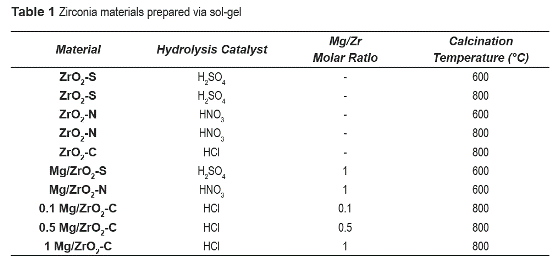
<body><![CDATA[<br>    In  this paper magnesium oxide -which displays CO<sub>2</sub> adsorption capacity  [13] - was added by cogellation to several sol-gel zirconia materials. It was  found that Mg increases the CO<sub>2</sub> adsorption capacity of zirconia in  the temperature range (100 - 200&deg;C) where the formation of DMC occurs. However,  methanol conversions to DMC over Mg modified zirconia are lower than on  unmodified zirconia materials.</font></p>            <p><font face="Verdana" size="3"><b>Experimental      </b> </font></p>         <p> <font face="Verdana" size="2"><b><i>Catalyst preparation      </i></b></font></p>            <p><font face="Verdana" size="2">  Zirconia  was prepared by modifications of previously reported methods [11, 12]. Solution  A, containing 10 mL of zirconium (IV) butoxide (Aldrich) Zr(OC<sub>4</sub>H<sub>9</sub>)<sub>4</sub>  in 85 mL of isopropanol (J.T. Baker), was stirred at room temperature. Then HCl  (37%, Merck), HNO<sub>3</sub> (65%, Merck) or H<sub>2</sub>SO<sub>4</sub>  (95-98%, Merck) was added to solution A in order to favor alkoxide hydrolysis.  After aging the gel for 24 h at room temperature without stirring, solution B,  containing 5 mL of H<sub>2</sub>O and 42 mL of isopropanol, was added drop-wise  to solution A under vigorous stirring until gellation. Finally, the gel was  dried at 100 &deg;C during 60 h. The samples prepared using H<sub>2</sub>SO<sub>4</sub>,  HNO<sub>3</sub> and HCl were coded as ZrO<sub>2</sub>-S, ZrO<sub>2</sub>-N and  ZrO<sub>2</sub>-C, respectively.     <br>    <br>   Magnesium-modified zirconia  was prepared as follows: about 5.5 g of Mg (NO<sub>3</sub>)<sub>2</sub> &bull; 6H<sub>2</sub>O  (Merck) were dissolved in solution B, prior to mixing with solution A. The  Mg/Zr molar ratio was 1. The resulting magnesium-loaded materials were coded:  Mg/ZrO<sub>2</sub>-N (prepared with HNO<sub>3</sub>) and Mg/ZrO<sub>2</sub>-S  (prepared with H<sub>2</sub>SO<sub>4</sub>). Both materials were calcined in a  static air furnace at 600 &deg;C (873 K) and 800 &deg;C (1073 K) for two hours at a  heating rate of 1 &deg;C/min. The highest calcination temperature was used only for  comparison purposes. Other materials were prepared by varying Mg loading  following a similar procedure, but using HCl as initiator of the alkoxide acid  hydrolysis. These samples were calcined at 800 &deg;C in order to obtain a  stabilized monoclinic phase as reported by Bokhimi [12]: The Mg/Zr molar ratios  were 0, 0.1, 0.5 and 1. The codes of the samples are summarized in <a href="#Tabla1">table 1</a>.     </font></p>      <p align="center"><img src="/img/revistas/rfiua/n57/n57a02t01.gif" width="580" ><a name="Tabla1"></a></p>       <p><font face="Verdana" size="3"><b><i>Characterization      </i></b> </font></p>        <p><font face="Verdana" size="2"> The  crystallinity of synthesized materials was determined by X-ray diffraction  (XRD) on a Phillips PW 1710 diffractometer using Cu K&alpha;  radiation and Ni filter operated at 30 kV and  20 mA at room temperature. The scanning range was 2&theta;= 20-60&deg;, step of 0.014&deg;.  Magnesium loading was determined by atomic absorption spectroscopy (AAS) on a  Philips PU9200. Specific surface areas were determined by N<sub>2</sub>  adsorption at 77 K in an AutoChem II 2920 (Micromeritics).     <br>    ]]></body>
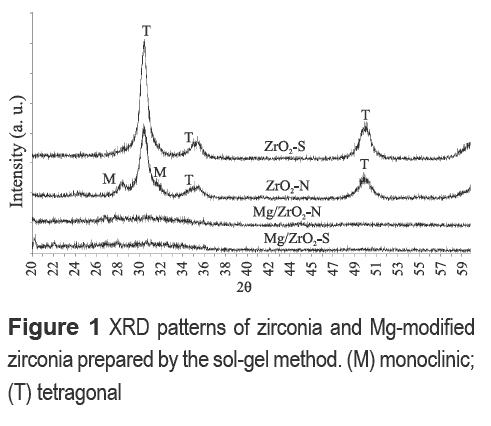
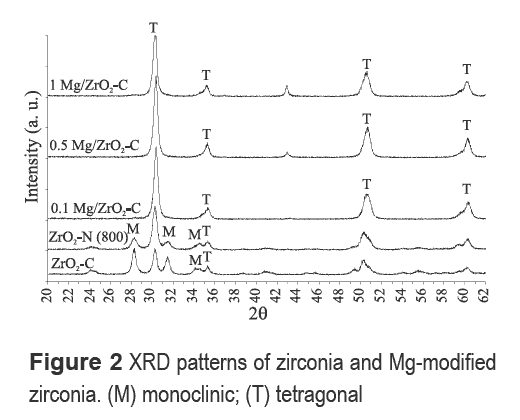
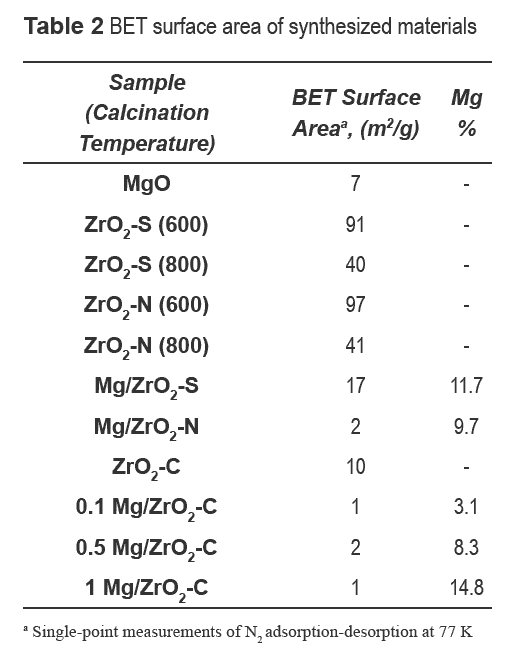
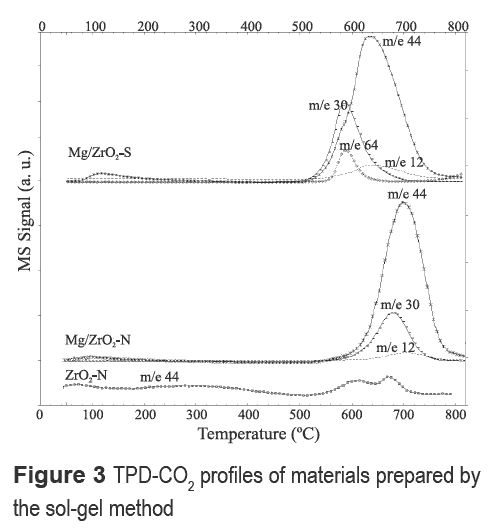
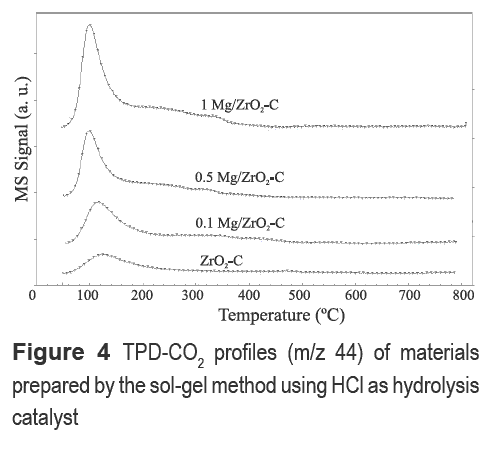
<body><![CDATA[<br> The  basic and acid sites of the samples were characterized by temperature  programmed desorption using 99.9% CO<sub>2</sub>/He and 0.3% NH<sub>3</sub>/He, respectively. TPDs were performed in a Micromeritics AutoChem II 2920  apparatus coupled to a mass spectrometer (Thermostar- QMS 200, Pfeiffer  Vacuum), where the mass signals m/e<sup>-</sup> 44 (basic sites) and m/e<sup>-</sup>  17 (acid sites) were monitored. In addition, signals m/e<sup>-</sup> 30 for the  decomposition of anions NO<sub>3</sub><sup>-</sup> and m/e<sup>-</sup> 64 for  the decomposition of sulphate anions SO<sub>4</sub><sup>-2</sup> were  monitored. Samples (0.1 g) were pretreated in 25 mL/min flowing He (99.99%) up  to 500 &deg;C for 1 hour at 10 &deg; C/min. Samples were then cooled to 50 &deg;C and  saturated with 50 mL/min CO<sub>2</sub> (basic sites) or NH<sub>3</sub> (acid  sites) for 1 hour. CO<sub>2</sub> or NH<sub>3</sub> loosely bound to the  surface were removed by flowing 50 mL/min of He for 1 hour at 10&deg;C/min up to  900 &deg;C. FTIR spectra of selected samples pressed in KBr pellets were collected  with a Nicolet Avatar 330 spectrometer. The sulfur content of samples prepared  with H<sub>2</sub>SO<sub>4</sub> was determined by TGA using a 2950 TGA/HRV6  instrument where the sample was heated up to 950 &deg;C at 10 &deg;C/min in flowing  nitrogen (100 mL/min).      </font></p>      <p> <font face="Verdana" size="2"><b><i>Catalytic tests      </i></b></font></p>      <p> <font face="Verdana" size="2">Catalytic  tests were performed in a tubular quartz reactor (ID 10 mm) packed with 0.5 g  of catalyst sample. The products were analyzed using a mass spectrometer QMS  Thermostar 200 (Pfeiffer) with a resolution of 0.01 ppm. The reaction mixture  consisted of a 2:1 molar ratio of CO<sub>2</sub> (99.9%) and methanol-saturated  helium (grade UAP). The reactions were carried out at 80, 120, 160, and 200 &deg;C  for 60 min. The reactor pressure was 720 mmHg, and the total flow was  maintained about 20 mL/min.   </font></p>       <p><font face="Verdana" size="3"><b> Results and discussion      </b> </font></p>      <p> <font face="Verdana" size="2"><b><i>Catalyst characterization      </i></b></font></p>        <p> <font face="Verdana" size="2">  XRD  patterns of <a href="#Figura1">figure 1</a> indicate that ZrO<sub>2</sub>-N and ZrO<sub>2</sub>-S are  crystalline. Sulfated zirconia, ZrO<sub>2</sub>-S exhibits a tetragonal phase  (diffraction peaks at 2&theta; = 30.5, 35.5, 50&deg;), whereas two phases, monoclinic  (diffraction peaks 2&theta; = 28.5 and 31.5&deg;) and tetragonal were identified in ZrO<sub>2</sub>-N  [14]. Magnesium-modified zirconia materials, Mg/ZrO<sub>2</sub>-S and Mg/ZrO<sub>2</sub>-N,  were amorphous and no diffraction peaks were observed in the 20 interval  examined. This change of crystallinity has been reported by Liu et. al. [15],  where MgO was incorporated on sol-gel zirconia samples. For different MgO  loadings only appreciable diffraction peaks were observed at 2&theta; = 1 0.  Those materials, which are described as mesoporous, were strongly influenced by  MgO incorporation. Their observations were explained in terms of the solubility  of the magnesium precursor salt during the sol-gel process, specifically on  hydrolysis/ condensation of zirconium alkoxide and the self- assembly of the  gel. Thus, excessive magnesium salt added to the system could influence or even  damage the formation of the mesoporous framework. As can be observed in <a href="#Figura1">figure 1</a>, Mg/ZrO<sub>2</sub>-S and Mg/ZrO<sub>2</sub>-N show no XRD peaks indicating  that the tetragonal structure disappeared.  </font></p>        <p align="center"><img src="/img/revistas/rfiua/n57/n57a02i01.gif" ><a name="Figura1"></a></p>       <p> <font face="Verdana" size="2">      As  shown in <a href="#Figura2">figure 2</a>, ZrO<sub>2</sub>-C synthesized using HCl as hydrolysis  catalyst and calcined at 800 &deg;C showed diffraction peaks at 2&theta; = 28.5 and 31.5&deg;  associated with the monoclinic phase. However, incorporation of Mg to zirconia  samples prepared with HCl as hydrolysis catalyst resulted in crystalline  materials with predominantly tetragonal phase. It can be noticed in <a href="#Figura2">figure 2</a>  that increasing calcination temperature to 800 &deg;C and using HCl as hydrolysis  catalyst for the sol&shy;gel synthesis of zirconia improves crystallinity of the  Mg-containing materials. Jung and Bell [8] reported that either monoclinic or  tetragonal zirconia, or a mixture of both, can catalyze the reaction of  methanol and CO<sub>2</sub> to DMC. In this sense, the purpose of this study  was to determine whether Mg incorporation on zirconia would improve conversion  of methanol to dimethyl carbonate (DMC). ZrO<sub>2</sub>-N samples were  calcined at 800 &deg;C to compare their crystallinity with ZrO<sub>2</sub>-C  samples (also calcined at 800 &deg;C). XRD pattern for ZrO<sub>2</sub>-N (calcined  at 600 &deg;C) shows the presence of both crystalline phases, monoclinic and  tetragonal. The increase in the calcination temperature from 600 to 800 &deg;C did  not significantly modify the crystalline phase of ZrO<sub>2</sub>-N samples  but, the surface area decreased (see <a href="#Tabla2">table 2</a>).</font></p>       <p align="center"><img src="/img/revistas/rfiua/n57/n57a02i02.gif" ><a name="Figura2"></a></p>         <p align="center"><img src="/img/revistas/rfiua/n57/n57a02t02.gif" height="617" ><a name="Tabla2"></a></p>        ]]></body>
<body><![CDATA[<p> <font face="Verdana" size="2"><b><i>Surface area and Mg content      </i></b></font></p>        <p> <font face="Verdana" size="2"><a href="#Tabla2">Table 2</a> lists the surface area of Mg-modified zirconia materials. ZrO<sub>2</sub>-N  and ZrO<sub>2</sub>-S have higher surface areas than their Mg-modified  counterparts. The surface areas of ZrO<sub>2</sub>-N and ZrO<sub>2</sub>-S  samples decreased when calcination temperature increased to 800 &deg;C. In general,  materials prepared with different Mg loadings showed lower surface areas than  zirconia samples synthesized with nitric or sulfuric acid.    </font></p>        <p> <font face="Verdana" size="2"><b><i>CO<sub>2</sub>-TPD      </i></b></font></p>        <p> <font face="Verdana" size="2">  The  intensity and the relative strength of basic sites were examined by CO<sub>2</sub>-TPD  (<a href="#Figura3">figures 3</a> and <a href="#Figura4">4</a>). The CO<sub>2</sub> desorption profiles of Mg-containing  materials synthesized with HNO<sub>3</sub> and H<sub>2</sub>SO<sub>4</sub>,  respectively, are shown in <a href="#Figura3">figure 3</a>. Peaks at 640 and 700 &deg;C suggest the  presence of strong basic sites. Furthermore, a significant enhancement of CO<sub>2</sub>  adsorption capacity is obtained on Mg- modified zirconia. ZrO<sub>2</sub>-N  profile also revealed strong basic sites at 600 and 680 &deg;C but CO<sub>2</sub> adsorption  capacity was lower; ZrO<sub>2</sub>-N shows a faint line of CO<sub>2</sub>  desorption between 100-400 &deg;C, a somewhat similar behavior to Mg/ZrO<sub>2</sub>-N.    <br>    <br>  </font></p>        <p align="center"><img src="/img/revistas/rfiua/n57/n57a02i03.gif" ><a name="Figura3"></a></p>       <p align="center"><img src="/img/revistas/rfiua/n57/n57a02i04.gif" ><a name="Figura4"></a></p>         <p> <font face="Verdana" size="2"> Mg/ZrO<sub>2</sub>-N shows a  signal at 580 &deg;C for m/e<sup>-</sup> 30 assigned to the decomposition of NO<sub>3</sub><sup>-</sup>  either from the Mg precursor or nitric acid. Mg/ZrO<sub>2</sub>-S showed weak  basic sites around 100&deg;C with very low adsorption capacity in addition to  decomposition of nitrate and sulfate anions related to signals m/e<sup>-</sup>30 and m/e<sup>-</sup> 64, respectively, around 580 &deg;C. From <a href="#Figura3">figures 3</a> and <a href="#Figura4">4</a> it  can be noticed that the use of HCl during the sol-gel synthesis of zirconia  (ZrO<sub>2</sub>-C and Mg/ZrO<sub>2</sub>-C) affects the strength of the basic  sites of the resulting material, since desorption peaks shift to lower  temperatures. Moreover, CO<sub>2</sub> adsorption in the region between 100 &deg;C  and 200 &deg;C increases with Mg content.   </font></p>          <p> <font face="Verdana" size="2"><b><i>NH<sub>3</sub>-TPD</i></b></font></p>          ]]></body>
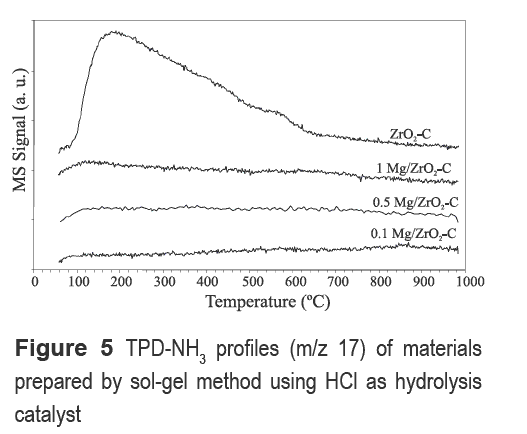
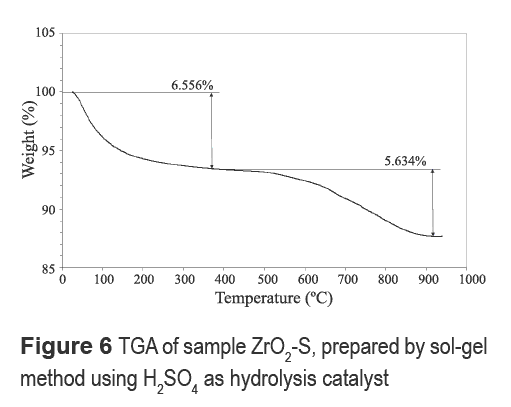
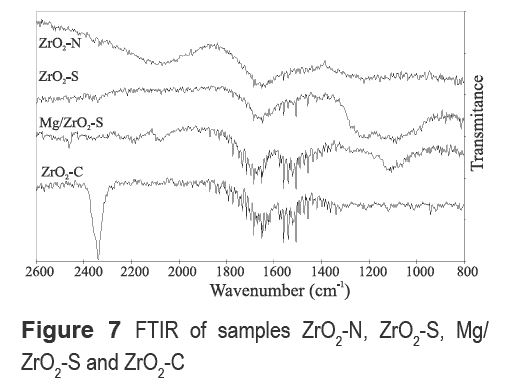
<body><![CDATA[<p> <font face="Verdana" size="2"><a href="#Figura5">Figure 5</a> shows the NH<sub>3</sub>-TPD profiles of magnesium-modified zirconia samples using HCl as hydrolysis catalyst. The NH<sub>3</sub>-TPD profiles indicate that the acid sites of zirconia are affected by Mg incorporation. A broad region of NH<sub>3</sub> desorption between 50 and 600&deg;C is evidenced in the trace corresponding to unmodified zirconia -indicating the presence of acid sites- whereas none of the Mg-modified materials (different Mg loadings) show NH<sub>3</sub> desorption signals in the temperature range examined. Since the surface area of ZrO<sub>2</sub>-C decreased by the addition of Mg (see <a href="#Tabla2">table 2</a>), it may be possible that surface Mg could block NH<sub>3</sub> access to zirconia acid sites.      </font></p>          <p align="center"><img src="/img/revistas/rfiua/n57/n57a02i05.gif" ><a name="Figura5"></a></p>            <p> <font face="Verdana" size="2"><b><i>Thermal analysis      </i></b></font></p>          <p> <font face="Verdana" size="2">  <a href="#Figura6">Figure 6</a> shows the TGA profile of a ZrO<sub>2</sub>-S sample. Two major weight loss  regions are identified. The first weight loss of 6.5% observed up to about 400  &deg;C is associated with the release of physisorbed water with a minor  contribution from oxidation of organic species. The second weight loss of about  5.6% is observed above 500 &deg;C and is attributed to decomposition of surface  sulfate [17].  </font></p>            <p align="center"><img src="/img/revistas/rfiua/n57/n57a02i06.gif" ><a name="Figura6"></a></p>          <p> <font face="Verdana" size="2"><b><i>FTIR     </i></b></font></p>          <p> <font face="Verdana" size="2"><a href="#Figura7">Figure 7</a> shows  the FTIR spectra of samples calcined at 600 &deg;C. ZrO<sub>2</sub>-S and  Mg/ZrO<sub>2</sub>-S samples have a common broad band located at 1120 cm<sup>-1</sup> assigned to  the presence of surface sulfate complex in a bidentate configuration [17]. Furthermore, the spectrum of  ZrO<sub>2</sub>-S shows a broad peak at 1223 cm<sup>-1</sup> typical of a  bidentate sulfate ion coordinated to a metal cation [16, 18]. ZrO<sub>2</sub>-N  and ZrO<sub>2</sub>-C samples show no bands in the region from 800 cm<sup>-1</sup>  to 1300 cm<sup>-1</sup>. Spectra for sample ZrO<sub>2</sub>-C showed a very  intense and sharp band at 2340 cm<sup>-1</sup>. This band has been assigned to  CO<sub>2</sub> trapped inside the bulk structure of the oxide [19]. Bands  between 1550-1556 cm<sup>-1</sup> have been assigned to the stretching vibrations  of Zr-O and between 1637-1642 cm<sup>-1</sup> (observed in all samples from <a href="#Figura7">Fig. 7</a>) are attributed to stretching and flexion vibration of hydroxyl from  water. [16].     </font></p>        <p align="center"><img src="/img/revistas/rfiua/n57/n57a02i07.gif" height="351" ><a name="Figura7"></a></p>          <p> <font face="Verdana" size="2"><b><i>Catalytic experiments      </i></b></font></p>        <p> <font face="Verdana" size="2">   Only  crystalline synthesized materials which exhibited basic sites in the range of  100-200&deg;C (temperature region where high DMC yields have been obtained over  zirconia) were tested as catalysts for the reaction between methanol and CO<sub>2</sub>.  Thence, only ZrO<sub>2</sub>-C and Mg/ZrO<sub>2</sub>-C catalysts series were  used. Zirconia samples synthesized with HNO<sub>3</sub> or H<sub>2</sub>SO<sub>4</sub>  and modified with Mg were not tested because they showed no defined morphology,  and high strength basic sites (CO<sub>2</sub> desorbed above 600 &deg;C).     ]]></body>
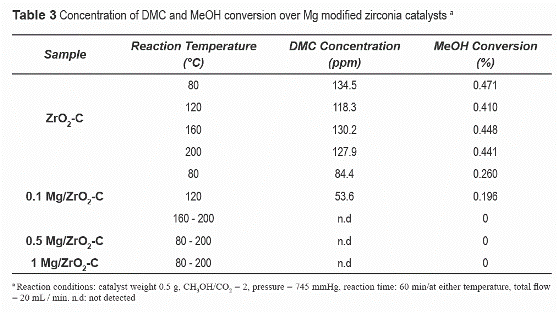
<body><![CDATA[<br>    <br> <a href="#Tabla3">Table 3</a> shows the concentration of DMC and the conversion of methanol (MeOH) on  zirconia materials synthesized with HCl and modified with Mg. As can be  observed in <a href="#Tabla3">table 3</a>, higher conversions are obtained over ZrO<sub>2</sub>-C  than those obtained over Mg-modified samples. In addition, the concentration of  DMC remains relatively constant in the temperature range examined. Methanol  conversions, although very low (&lt;0.5%), are comparable to those reported by  Tomishige et al. [17], where conversions around 0.36% were reached over  commercial zirconia in a batch reaction system at considerably higher pressure  (5 MPa). </font></p>       <p align="center"><img src="/img/revistas/rfiua/n57/n57a02t03.gif" ><a name="Tabla3"></a></p>       <p> <font face="Verdana" size="2"> The  incorporation of Mg affected methanol conversion. The conversions achieved over  Mg- modified materials are 50% lower than those obtained over the unmodified  samples (ZrO<sub>2</sub>-C). In the temperature range evaluated, no methanol  conversion was observed over materials containing higher magnesium loadings  (0.5% Mg/ZrO<sub>2</sub>-C and 1% Mg/ZrO<sub>2</sub>-C). Therefore, although the  addition of Mg stabilizes the tetragonal phase of zirconia and increases its CO<sub>2</sub>  adsorption capacity in the temperature region 100 to 200 &deg;C, methanol  conversion to DMC at moderate pressures is not improved.   </font></p>       <p><font face="Verdana" size="3"><b>Conclusions      </b> </font></p>        <p> <font face="Verdana" size="2"> The  type ofhydrolysis catalyst and the incorporation of Mg influence the surface  area, crystallinity, basic strength, and CO<sub>2</sub> adsorption capacity of  zirconia materials. Mg-modified zirconia exhibited higher CO<sub>2</sub>  adsorption capacity than unmodified zirconia, regardless of the type of hydrolysis  catalyst used; however, the strength of basic sites depends on the acid used  for hydrolysis, i.e. the tetragonal phase of zirconia and adsorption capacity  in the range 100 to 200 &deg;C is obtained when HCl is used. On the other hand,  amorphous materials and stronger basic sites with increased CO<sub>2</sub>  adsorption capacity at temperatures between 600 and 800 &deg;C are obtained for  those materials prepared with HNO<sub>3</sub> and H<sub>2</sub>SO<sub>4</sub>.  Mg-modified zirconia exhibited more basic sites in the temperature range where  zirconia has been reported to be active for the direct synthesis of dimethyl  carbonate (DMC). Nevertheless, it appears that not only basic sites but also,  acid sites are required to obtain DMC from methanol and CO<sub>2</sub> . </font></p>            <p><font face="Verdana" size="3"><b>Acknowledgments      </b> </font></p>      <p> <font face="Verdana" size="2">  The  authors would like to thank the Colombian Ministry of Agriculture and Social  Development, the University of Antioquia and Qu&iacute;mica B&aacute;sica for financial  support of this work trough the project: 2007D3608-66. Also, we are also  grateful to University of Antioquia for sponsoring our group with the  &quot;Sustainability 2009-2010&quot; project.  </font></p>       <p><font face="Verdana" size="3"><b> References     </b> </font></p>        <!-- ref --><p> <font face="Verdana" size="2"> 1. Y. Ono. &quot;Dimethyl  carbonate for environmentally benign reactions&quot;. <i>Catalysis Today.</i> Vol. 35. 1997. pp. 15-25.     &nbsp;&nbsp;&nbsp;&nbsp;&nbsp;&nbsp;&nbsp;&nbsp;[&#160;<a href="javascript:void(0);" onclick="javascript: window.open('/scielo.php?script=sci_nlinks&ref=000072&pid=S0120-6230201100010000200001&lng=','','width=640,height=500,resizable=yes,scrollbars=1,menubar=yes,');">Links</a>&#160;]<!-- end-ref --><br>    <!-- ref --><br> 2. M. A. Pacheco, C. L.  Marshall. &quot;Review of Dimethyl Carbonate (DMC) Manufacture and its  Characteristics as a Fuel Additive&quot;.<i> Energy Fuel.</i> Vol. 11. 1997. pp. 2-29.     &nbsp;&nbsp;&nbsp;&nbsp;&nbsp;&nbsp;&nbsp;&nbsp;[&#160;<a href="javascript:void(0);" onclick="javascript: window.open('/scielo.php?script=sci_nlinks&ref=000074&pid=S0120-6230201100010000200002&lng=','','width=640,height=500,resizable=yes,scrollbars=1,menubar=yes,');">Links</a>&#160;]<!-- end-ref --><br>    <!-- ref --><br> 3. D. Delledonne, F. Rivetti,  U. Romano. &quot;Developments in the production and application of dimethyl  carbonate&quot;. <i>Applied Catalysis A: General.</i> Vol. 221. 2001. pp. 241-251.     &nbsp;&nbsp;&nbsp;&nbsp;&nbsp;&nbsp;&nbsp;&nbsp;[&#160;<a href="javascript:void(0);" onclick="javascript: window.open('/scielo.php?script=sci_nlinks&ref=000076&pid=S0120-6230201100010000200003&lng=','','width=640,height=500,resizable=yes,scrollbars=1,menubar=yes,');">Links</a>&#160;]<!-- end-ref --><br>    <!-- ref --><br> 4. J. Ma, N. Sun, X. Zhang, N.  Zhao, F. Xiao, W. Wei, Y. Sun. &quot;A short review of catalysis for CO<sub>2</sub>  conversion&quot;. <i>Catalysis Today.</i> Vol. 148. 2009. pp. 221-231.     &nbsp;&nbsp;&nbsp;&nbsp;&nbsp;&nbsp;&nbsp;&nbsp;[&#160;<a href="javascript:void(0);" onclick="javascript: window.open('/scielo.php?script=sci_nlinks&ref=000078&pid=S0120-6230201100010000200004&lng=','','width=640,height=500,resizable=yes,scrollbars=1,menubar=yes,');">Links</a>&#160;]<!-- end-ref --><br>    <!-- ref --><br> 5. J. Biana, M. Xiao, S. Wang,  X. Wang, Y. Meng. &quot;Highly effective synthesis of dimethyl carbonate from  methanol and carbon dioxide using a novel copper- nickel/graphite bimetallic  nanocomposite catalyst&quot;. <i>Chemical  Engineering Journal.</i> Vol. 147. 2009. pp. 287-296.     &nbsp;&nbsp;&nbsp;&nbsp;&nbsp;&nbsp;&nbsp;&nbsp;[&#160;<a href="javascript:void(0);" onclick="javascript: window.open('/scielo.php?script=sci_nlinks&ref=000080&pid=S0120-6230201100010000200005&lng=','','width=640,height=500,resizable=yes,scrollbars=1,menubar=yes,');">Links</a>&#160;]<!-- end-ref --><br>    <!-- ref --><br> 6. A. Khalid. &quot;Synthesis  of dimethyl carbonate (DMC) from methanol and CO<sub>2</sub> over Rh-supported  catalyst&quot;.<i> Catalysis Communications.</i> Vol. 10. 2009. pp. 1127&shy;1131.     &nbsp;&nbsp;&nbsp;&nbsp;&nbsp;&nbsp;&nbsp;&nbsp;[&#160;<a href="javascript:void(0);" onclick="javascript: window.open('/scielo.php?script=sci_nlinks&ref=000082&pid=S0120-6230201100010000200006&lng=','','width=640,height=500,resizable=yes,scrollbars=1,menubar=yes,');">Links</a>&#160;]<!-- end-ref --><br>    <!-- ref --><br> 7. K. Tomishige, Y. Ikeda, T. Sakaihori, K. Fujimoto. &quot;Catalytic  Properties and Structured of Zirconia Catalysts for Direct Synthesis of DMC  from Methanol  and Carbon Dioxide&quot;. <i>Journal of Catalysis.</i> Vol. 192. 2000. pp. 355-362.     &nbsp;&nbsp;&nbsp;&nbsp;&nbsp;&nbsp;&nbsp;&nbsp;[&#160;<a href="javascript:void(0);" onclick="javascript: window.open('/scielo.php?script=sci_nlinks&ref=000084&pid=S0120-6230201100010000200007&lng=','','width=640,height=500,resizable=yes,scrollbars=1,menubar=yes,');">Links</a>&#160;]<!-- end-ref --><br>     <!-- ref --><br> 8. K. T. Jung, A. T. Bell.  &quot;Effects of Catalyst phase structure on the elementary processes involved  in the synthesis of dimethyl carbonate from metanol and carbon dioxide over  zirconia&quot;. <i>Topics in Catalysis.</i> Vol. 20. 2002. pp. 97-105.     &nbsp;&nbsp;&nbsp;&nbsp;&nbsp;&nbsp;&nbsp;&nbsp;[&#160;<a href="javascript:void(0);" onclick="javascript: window.open('/scielo.php?script=sci_nlinks&ref=000086&pid=S0120-6230201100010000200008&lng=','','width=640,height=500,resizable=yes,scrollbars=1,menubar=yes,');">Links</a>&#160;]<!-- end-ref --><br>    <!-- ref --><br> 9. K. T. Jung, A. T. Bell. &quot;An in Situ Study of Dimethyl Carbonate  Synthesis from Carbon Dioxide and Methanol over Zirconia&quot;. <i>Journal of  Catalysis.</i>  Vol. 204. 2001. pp. 339-347.     &nbsp;&nbsp;&nbsp;&nbsp;&nbsp;&nbsp;&nbsp;&nbsp;[&#160;<a href="javascript:void(0);" onclick="javascript: window.open('/scielo.php?script=sci_nlinks&ref=000088&pid=S0120-6230201100010000200009&lng=','','width=640,height=500,resizable=yes,scrollbars=1,menubar=yes,');">Links</a>&#160;]<!-- end-ref --><br>    <!-- ref --><br> 10. A. Liu, K. Nyavor, Z. Li,  N. O. Egiebor. &quot;Effects of composition and calcination temperatura on  morphology and structure of barium modified zirconia nanoparticles&quot;. <i>Materials Science  and Engineering.</i> Vol.  366. 2004. pp. 66-73.     &nbsp;&nbsp;&nbsp;&nbsp;&nbsp;&nbsp;&nbsp;&nbsp;[&#160;<a href="javascript:void(0);" onclick="javascript: window.open('/scielo.php?script=sci_nlinks&ref=000090&pid=S0120-6230201100010000200010&lng=','','width=640,height=500,resizable=yes,scrollbars=1,menubar=yes,');">Links</a>&#160;]<!-- end-ref --><br>    <!-- ref --><br> 11. C. Montes de Correa, L. M.  Martinez, J. A. Odriozola, M. A. Centeno. &quot;Synthesis and  characterization of sol&shy;gel zirconia supported Pd and Ni catalysts&quot;. <i>Catalysis Today.</i> Vol. 107-108. 2005. pp.  800-808.     &nbsp;&nbsp;&nbsp;&nbsp;&nbsp;&nbsp;&nbsp;&nbsp;[&#160;<a href="javascript:void(0);" onclick="javascript: window.open('/scielo.php?script=sci_nlinks&ref=000092&pid=S0120-6230201100010000200011&lng=','','width=640,height=500,resizable=yes,scrollbars=1,menubar=yes,');">Links</a>&#160;]<!-- end-ref --><br>    <!-- ref --><br> 12. X.  Bokhimi, A. Morales, O. Novaro, T. L&oacute;pez, R. Gomez. &quot;The effect of hydrolysis initiator on the phase  formation in sulfated sol-gel zirconia&quot;. <i>Polyhedron.</i> Vol. 19. 2000. pp. 2283-2287.     &nbsp;&nbsp;&nbsp;&nbsp;&nbsp;&nbsp;&nbsp;&nbsp;[&#160;<a href="javascript:void(0);" onclick="javascript: window.open('/scielo.php?script=sci_nlinks&ref=000094&pid=S0120-6230201100010000200012&lng=','','width=640,height=500,resizable=yes,scrollbars=1,menubar=yes,');">Links</a>&#160;]<!-- end-ref --><br>     <!-- ref --><br> 13. A. Liu, K. Nyavor, R.  Ankumah. &quot;Strtuctural and Adsorptive properties of Ba or Mg oxide modified zirconia&quot;. <i>Journal of Colloid and  Interface Science.</i> Vol. 284. 2005. pp. 66-70.     &nbsp;&nbsp;&nbsp;&nbsp;&nbsp;&nbsp;&nbsp;&nbsp;[&#160;<a href="javascript:void(0);" onclick="javascript: window.open('/scielo.php?script=sci_nlinks&ref=000096&pid=S0120-6230201100010000200013&lng=','','width=640,height=500,resizable=yes,scrollbars=1,menubar=yes,');">Links</a>&#160;]<!-- end-ref --><br>    <!-- ref --><br> 14. K. T. Jung, A. T. Bell.  &quot;The effect of synthesis and pretreatment conditions on the bulk structure  and surface properties of zirconia&quot;. <i>Journal of  Molecular Catalysis A: Chemical.</i> Vol. 163. 2000. pp. 27-42.     &nbsp;&nbsp;&nbsp;&nbsp;&nbsp;&nbsp;&nbsp;&nbsp;[&#160;<a href="javascript:void(0);" onclick="javascript: window.open('/scielo.php?script=sci_nlinks&ref=000098&pid=S0120-6230201100010000200014&lng=','','width=640,height=500,resizable=yes,scrollbars=1,menubar=yes,');">Links</a>&#160;]<!-- end-ref --><br>    <!-- ref --><br> 15. S. Liu, X. Zhang, J. Li,  N. Zhao, W. Wei, Y. Sun. &quot;Preparation and application of stabilized  mesoporous MgO-ZrO<sub>2</sub> solid base&quot;. <i>Catalysis  Communications. </i>Vol.  9. 2008. pp. 1527-1532.     &nbsp;&nbsp;&nbsp;&nbsp;&nbsp;&nbsp;&nbsp;&nbsp;[&#160;<a href="javascript:void(0);" onclick="javascript: window.open('/scielo.php?script=sci_nlinks&ref=000100&pid=S0120-6230201100010000200015&lng=','','width=640,height=500,resizable=yes,scrollbars=1,menubar=yes,');">Links</a>&#160;]<!-- end-ref --><br>    <!-- ref --><br> 16. L. Castro,  P. Reyes, C. Montes de Correa. &quot;Synthesis and Characterization of Sol-Gel Cu-ZrO<sub>2</sub>  and Fe-ZrO<sub>2</sub> Catalysts&quot;. <i>Journal of  Sol-Gel Science and Technology.</i> Vol. 25. 2002. pp. 159-168.     &nbsp;&nbsp;&nbsp;&nbsp;&nbsp;&nbsp;&nbsp;&nbsp;[&#160;<a href="javascript:void(0);" onclick="javascript: window.open('/scielo.php?script=sci_nlinks&ref=000102&pid=S0120-6230201100010000200016&lng=','','width=640,height=500,resizable=yes,scrollbars=1,menubar=yes,');">Links</a>&#160;]<!-- end-ref --><br>    <!-- ref --><br> 17. K. Tomishige, Y. Ikeda, T. Sakaihori, K.  Fujimoto. &quot;A  novel method of direct synthesis of dimethyl carbonate from methanol and carbon  dioxide catalyzed by zirconia&quot;. <i>Catalysis  Letters.</i>  Vol. 58. 1999. pp. 225-229.     &nbsp;&nbsp;&nbsp;&nbsp;&nbsp;&nbsp;&nbsp;&nbsp;[&#160;<a href="javascript:void(0);" onclick="javascript: window.open('/scielo.php?script=sci_nlinks&ref=000104&pid=S0120-6230201100010000200017&lng=','','width=640,height=500,resizable=yes,scrollbars=1,menubar=yes,');">Links</a>&#160;]<!-- end-ref --><br>     <!-- ref --><br> 18. Ganapati D. Yadav, Jayesh  J. Nair. &quot;Sulfated zirconia and its modified versions as promising  catalysts for industrial processes&quot;.<i> Microporous and  Mesoporous Materials.</i> Vol. 33. 1999. pp. 1-48.     &nbsp;&nbsp;&nbsp;&nbsp;&nbsp;&nbsp;&nbsp;&nbsp;[&#160;<a href="javascript:void(0);" onclick="javascript: window.open('/scielo.php?script=sci_nlinks&ref=000106&pid=S0120-6230201100010000200018&lng=','','width=640,height=500,resizable=yes,scrollbars=1,menubar=yes,');">Links</a>&#160;]<!-- end-ref --><br>    <!-- ref --><br> 19. L. E. Davies, N. A.  Bonini, S. Locatelli, E. E. Gonzo. &quot;Characterization and catalytic  activity of zirconium dioxide prepared by sol-gel&quot;.<i> Latin American  Applied Research. </i> Vol. 35. 2005. pp. 23-28.    </font>&nbsp;&nbsp;&nbsp;&nbsp;&nbsp;&nbsp;&nbsp;&nbsp;[&#160;<a href="javascript:void(0);" onclick="javascript: window.open('/scielo.php?script=sci_nlinks&ref=000108&pid=S0120-6230201100010000200019&lng=','','width=640,height=500,resizable=yes,scrollbars=1,menubar=yes,');">Links</a>&#160;]<!-- end-ref --><br>             <br>    <br>    <br>    ]]></body>
<body><![CDATA[<br>       <p><font face="Verdana" size="2">(Recibido el 03 de febrero de 2010. Aceptado el 15 de octubre de 2010)</font></p>     <p><font face="Verdana" size="2"><sup>*</sup>Autor de correspondencia: tel&eacute;fono: + 57 + 4 + 219 66 05, fax: + 57 + 4 + 219 65 65, correo electr&oacute;nico:  <a href="mailto:cmontes@udea.edu.co ">cmontes@udea.edu.co </a> (C. Montes)</font></p>      ]]></body><back>
<ref-list>
<ref id="B1">
<label>1</label><nlm-citation citation-type="journal">
<person-group person-group-type="author">
<name>
<surname><![CDATA[Ono]]></surname>
<given-names><![CDATA[Y]]></given-names>
</name>
</person-group>
<article-title xml:lang="en"><![CDATA[Dimethyl carbonate for environmentally benign reactions]]></article-title>
<source><![CDATA[Catalysis Today]]></source>
<year>1997</year>
<volume>35</volume>
<page-range>15-25</page-range></nlm-citation>
</ref>
<ref id="B2">
<label>2</label><nlm-citation citation-type="journal">
<person-group person-group-type="author">
<name>
<surname><![CDATA[Pacheco]]></surname>
<given-names><![CDATA[M. A]]></given-names>
</name>
<name>
<surname><![CDATA[Marshall]]></surname>
<given-names><![CDATA[C. L]]></given-names>
</name>
</person-group>
<article-title xml:lang="en"><![CDATA[Review of Dimethyl Carbonate (DMC) Manufacture and its Characteristics as a Fuel Additive]]></article-title>
<source><![CDATA[Energy Fuel]]></source>
<year>1997</year>
<volume>11</volume>
<page-range>2-29</page-range></nlm-citation>
</ref>
<ref id="B3">
<label>3</label><nlm-citation citation-type="journal">
<person-group person-group-type="author">
<name>
<surname><![CDATA[Delledonne]]></surname>
<given-names><![CDATA[D]]></given-names>
</name>
<name>
<surname><![CDATA[Rivetti]]></surname>
<given-names><![CDATA[F]]></given-names>
</name>
<name>
<surname><![CDATA[Romano]]></surname>
<given-names><![CDATA[U]]></given-names>
</name>
</person-group>
<article-title xml:lang="en"><![CDATA[Developments in the production and application of dimethyl carbonate]]></article-title>
<source><![CDATA[Applied Catalysis A: General]]></source>
<year>2001</year>
<volume>221</volume>
<page-range>241-251</page-range></nlm-citation>
</ref>
<ref id="B4">
<label>4</label><nlm-citation citation-type="journal">
<person-group person-group-type="author">
<name>
<surname><![CDATA[Ma]]></surname>
<given-names><![CDATA[J]]></given-names>
</name>
<name>
<surname><![CDATA[Sun]]></surname>
<given-names><![CDATA[N]]></given-names>
</name>
<name>
<surname><![CDATA[Zhang]]></surname>
<given-names><![CDATA[X]]></given-names>
</name>
<name>
<surname><![CDATA[Zhao]]></surname>
<given-names><![CDATA[N]]></given-names>
</name>
<name>
<surname><![CDATA[Xiao]]></surname>
<given-names><![CDATA[F]]></given-names>
</name>
<name>
<surname><![CDATA[Wei]]></surname>
<given-names><![CDATA[W]]></given-names>
</name>
<name>
<surname><![CDATA[Sun]]></surname>
<given-names><![CDATA[Y]]></given-names>
</name>
</person-group>
<article-title xml:lang="en"><![CDATA[A short review of catalysis for CO2 conversion]]></article-title>
<source><![CDATA[Catalysis Today]]></source>
<year>2009</year>
<volume>148</volume>
<page-range>221-231</page-range></nlm-citation>
</ref>
<ref id="B5">
<label>5</label><nlm-citation citation-type="journal">
<person-group person-group-type="author">
<name>
<surname><![CDATA[Biana]]></surname>
<given-names><![CDATA[J]]></given-names>
</name>
<name>
<surname><![CDATA[Xiao]]></surname>
<given-names><![CDATA[M]]></given-names>
</name>
<name>
<surname><![CDATA[Wang]]></surname>
<given-names><![CDATA[S]]></given-names>
</name>
<name>
<surname><![CDATA[Wang]]></surname>
<given-names><![CDATA[X]]></given-names>
</name>
<name>
<surname><![CDATA[Meng]]></surname>
<given-names><![CDATA[Y]]></given-names>
</name>
</person-group>
<article-title xml:lang="en"><![CDATA[Highly effective synthesis of dimethyl carbonate from methanol and carbon dioxide using a novel copper- nickel/graphite bimetallic nanocomposite catalyst]]></article-title>
<source><![CDATA[Chemical Engineering Journal]]></source>
<year>2009</year>
<volume>147</volume>
<page-range>287-296</page-range></nlm-citation>
</ref>
<ref id="B6">
<label>6</label><nlm-citation citation-type="journal">
<person-group person-group-type="author">
<name>
<surname><![CDATA[Khalid]]></surname>
<given-names><![CDATA[A]]></given-names>
</name>
</person-group>
<article-title xml:lang="en"><![CDATA[Synthesis of dimethyl carbonate (DMC) from methanol and CO2 over Rh-supported catalyst]]></article-title>
<source><![CDATA[Catalysis Communications]]></source>
<year>2009</year>
<volume>10</volume>
<page-range>1127&shy;1131</page-range></nlm-citation>
</ref>
<ref id="B7">
<label>7</label><nlm-citation citation-type="journal">
<person-group person-group-type="author">
<name>
<surname><![CDATA[Tomishige]]></surname>
<given-names><![CDATA[K]]></given-names>
</name>
<name>
<surname><![CDATA[Ikeda]]></surname>
<given-names><![CDATA[Y]]></given-names>
</name>
<name>
<surname><![CDATA[Sakaihori]]></surname>
<given-names><![CDATA[T]]></given-names>
</name>
<name>
<surname><![CDATA[Fujimoto]]></surname>
<given-names><![CDATA[K]]></given-names>
</name>
</person-group>
<article-title xml:lang="en"><![CDATA[Catalytic Properties and Structured of Zirconia Catalysts for Direct Synthesis of DMC from Methanol and Carbon Dioxide]]></article-title>
<source><![CDATA[Journal of Catalysis]]></source>
<year>2000</year>
<volume>192</volume>
<page-range>355-362</page-range></nlm-citation>
</ref>
<ref id="B8">
<label>8</label><nlm-citation citation-type="journal">
<person-group person-group-type="author">
<name>
<surname><![CDATA[Jung]]></surname>
<given-names><![CDATA[K. T]]></given-names>
</name>
<name>
<surname><![CDATA[Bell]]></surname>
<given-names><![CDATA[A. T]]></given-names>
</name>
</person-group>
<article-title xml:lang="en"><![CDATA[Effects of Catalyst phase structure on the elementary processes involved in the synthesis of dimethyl carbonate from metanol and carbon dioxide over zirconia]]></article-title>
<source><![CDATA[Topics in Catalysis]]></source>
<year>2002</year>
<volume>20</volume>
<page-range>97-105</page-range></nlm-citation>
</ref>
<ref id="B9">
<label>9</label><nlm-citation citation-type="journal">
<person-group person-group-type="author">
<name>
<surname><![CDATA[Jung]]></surname>
<given-names><![CDATA[K. T]]></given-names>
</name>
<name>
<surname><![CDATA[Bell]]></surname>
<given-names><![CDATA[A. T]]></given-names>
</name>
</person-group>
<article-title xml:lang="en"><![CDATA[An in Situ Study of Dimethyl Carbonate Synthesis from Carbon Dioxide and Methanol over Zirconia]]></article-title>
<source><![CDATA[Journal of Catalysis]]></source>
<year>2001</year>
<volume>204</volume>
<page-range>339-347</page-range></nlm-citation>
</ref>
<ref id="B10">
<label>10</label><nlm-citation citation-type="journal">
<person-group person-group-type="author">
<name>
<surname><![CDATA[Liu]]></surname>
<given-names><![CDATA[A]]></given-names>
</name>
<name>
<surname><![CDATA[Nyavor]]></surname>
<given-names><![CDATA[K]]></given-names>
</name>
<name>
<surname><![CDATA[Li]]></surname>
<given-names><![CDATA[Z]]></given-names>
</name>
<name>
<surname><![CDATA[Egiebor]]></surname>
<given-names><![CDATA[N. O]]></given-names>
</name>
</person-group>
<article-title xml:lang="en"><![CDATA[Effects of composition and calcination temperatura on morphology and structure of barium modified zirconia nanoparticles]]></article-title>
<source><![CDATA[Materials Science and Engineering]]></source>
<year>2004</year>
<volume>366</volume>
<page-range>66-73</page-range></nlm-citation>
</ref>
<ref id="B11">
<label>11</label><nlm-citation citation-type="journal">
<person-group person-group-type="author">
<name>
<surname><![CDATA[Montes de Correa]]></surname>
<given-names><![CDATA[C]]></given-names>
</name>
<name>
<surname><![CDATA[Martinez]]></surname>
<given-names><![CDATA[L]]></given-names>
</name>
<name>
<surname><![CDATA[Odriozola]]></surname>
<given-names><![CDATA[J. A]]></given-names>
</name>
<name>
<surname><![CDATA[Centeno]]></surname>
<given-names><![CDATA[M. A]]></given-names>
</name>
</person-group>
<article-title xml:lang="en"><![CDATA[Synthesis and characterization of sol&shy;gel zirconia supported Pd and Ni catalysts]]></article-title>
<source><![CDATA[Catalysis Today]]></source>
<year>2005</year>
<volume>107-108</volume>
<page-range>800-808</page-range></nlm-citation>
</ref>
<ref id="B12">
<label>12</label><nlm-citation citation-type="journal">
<person-group person-group-type="author">
<name>
<surname><![CDATA[Bokhimi]]></surname>
<given-names><![CDATA[X]]></given-names>
</name>
<name>
<surname><![CDATA[Morales]]></surname>
<given-names><![CDATA[A]]></given-names>
</name>
<name>
<surname><![CDATA[Novaro]]></surname>
<given-names><![CDATA[O]]></given-names>
</name>
<name>
<surname><![CDATA[López]]></surname>
<given-names><![CDATA[T]]></given-names>
</name>
<name>
<surname><![CDATA[Gomez]]></surname>
<given-names><![CDATA[R]]></given-names>
</name>
</person-group>
<article-title xml:lang="en"><![CDATA[The effect of hydrolysis initiator on the phase formation in sulfated sol-gel zirconia]]></article-title>
<source><![CDATA[Polyhedron]]></source>
<year>2000</year>
<volume>19</volume>
<page-range>2283-2287</page-range></nlm-citation>
</ref>
<ref id="B13">
<label>13</label><nlm-citation citation-type="journal">
<person-group person-group-type="author">
<name>
<surname><![CDATA[Liu]]></surname>
<given-names><![CDATA[A]]></given-names>
</name>
<name>
<surname><![CDATA[Nyavor]]></surname>
<given-names><![CDATA[K]]></given-names>
</name>
<name>
<surname><![CDATA[Ankumah]]></surname>
<given-names><![CDATA[R]]></given-names>
</name>
</person-group>
<article-title xml:lang="en"><![CDATA[Strtuctural and Adsorptive properties of Ba or Mg oxide modified zirconia]]></article-title>
<source><![CDATA[Journal of Colloid and Interface Science]]></source>
<year>2005</year>
<volume>284</volume>
<page-range>66-70</page-range></nlm-citation>
</ref>
<ref id="B14">
<label>14</label><nlm-citation citation-type="journal">
<person-group person-group-type="author">
<name>
<surname><![CDATA[Jung]]></surname>
<given-names><![CDATA[K. T]]></given-names>
</name>
<name>
<surname><![CDATA[Bell]]></surname>
<given-names><![CDATA[A. T]]></given-names>
</name>
</person-group>
<article-title xml:lang="en"><![CDATA[The effect of synthesis and pretreatment conditions on the bulk structure and surface properties of zirconia]]></article-title>
<source><![CDATA[Journal of Molecular Catalysis A: Chemical]]></source>
<year>2000</year>
<volume>163</volume>
<page-range>27-42</page-range></nlm-citation>
</ref>
<ref id="B15">
<label>15</label><nlm-citation citation-type="journal">
<person-group person-group-type="author">
<name>
<surname><![CDATA[Liu]]></surname>
<given-names><![CDATA[S]]></given-names>
</name>
<name>
<surname><![CDATA[Zhang]]></surname>
<given-names><![CDATA[X]]></given-names>
</name>
<name>
<surname><![CDATA[Li]]></surname>
<given-names><![CDATA[J]]></given-names>
</name>
<name>
<surname><![CDATA[Zhao]]></surname>
<given-names><![CDATA[N]]></given-names>
</name>
<name>
<surname><![CDATA[Wei]]></surname>
<given-names><![CDATA[W]]></given-names>
</name>
<name>
<surname><![CDATA[Sun]]></surname>
<given-names><![CDATA[Y]]></given-names>
</name>
</person-group>
<article-title xml:lang="en"><![CDATA[Preparation and application of stabilized mesoporous MgO-ZrO2 solid base]]></article-title>
<source><![CDATA[Catalysis Communications]]></source>
<year>2008</year>
<volume>9</volume>
<page-range>1527-1532</page-range></nlm-citation>
</ref>
<ref id="B16">
<label>16</label><nlm-citation citation-type="journal">
<person-group person-group-type="author">
<name>
<surname><![CDATA[Castro]]></surname>
<given-names><![CDATA[L]]></given-names>
</name>
<name>
<surname><![CDATA[Reyes]]></surname>
<given-names><![CDATA[P]]></given-names>
</name>
<name>
<surname><![CDATA[Montes de Correa]]></surname>
<given-names><![CDATA[C]]></given-names>
</name>
</person-group>
<article-title xml:lang="en"><![CDATA[Synthesis and Characterization of Sol-Gel Cu-ZrO2 and Fe-ZrO2 Catalysts]]></article-title>
<source><![CDATA[Journal of Sol-Gel Science and Technology]]></source>
<year>2002</year>
<volume>25</volume>
<page-range>159-168</page-range></nlm-citation>
</ref>
<ref id="B17">
<label>17</label><nlm-citation citation-type="journal">
<person-group person-group-type="author">
<name>
<surname><![CDATA[Tomishige]]></surname>
<given-names><![CDATA[K]]></given-names>
</name>
<name>
<surname><![CDATA[Ikeda]]></surname>
<given-names><![CDATA[Y]]></given-names>
</name>
<name>
<surname><![CDATA[Sakaihori]]></surname>
<given-names><![CDATA[T]]></given-names>
</name>
<name>
<surname><![CDATA[Fujimoto]]></surname>
<given-names><![CDATA[K]]></given-names>
</name>
</person-group>
<article-title xml:lang="en"><![CDATA[A novel method of direct synthesis of dimethyl carbonate from methanol and carbon dioxide catalyzed by zirconia]]></article-title>
<source><![CDATA[Catalysis Letters]]></source>
<year>1999</year>
<volume>58</volume>
<page-range>225-229</page-range></nlm-citation>
</ref>
<ref id="B18">
<label>18</label><nlm-citation citation-type="journal">
<person-group person-group-type="author">
<name>
<surname><![CDATA[Yadav]]></surname>
<given-names><![CDATA[Ganapati D]]></given-names>
</name>
</person-group>
<article-title xml:lang="en"><![CDATA[Sulfated zirconia and its modified versions as promising catalysts for industrial processes]]></article-title>
<source><![CDATA[Microporous and Mesoporous Materials]]></source>
<year>1999</year>
<volume>33</volume>
<page-range>1-48</page-range></nlm-citation>
</ref>
<ref id="B19">
<label>19</label><nlm-citation citation-type="journal">
<person-group person-group-type="author">
<name>
<surname><![CDATA[Davies]]></surname>
<given-names><![CDATA[L. E]]></given-names>
</name>
<name>
<surname><![CDATA[Bonini]]></surname>
<given-names><![CDATA[N. A]]></given-names>
</name>
<name>
<surname><![CDATA[Locatelli]]></surname>
<given-names><![CDATA[S]]></given-names>
</name>
<name>
<surname><![CDATA[Gonzo]]></surname>
<given-names><![CDATA[E. E]]></given-names>
</name>
</person-group>
<article-title xml:lang="en"><![CDATA[Characterization and catalytic activity of zirconium dioxide prepared by sol-gel]]></article-title>
<source><![CDATA[Latin American Applied Research]]></source>
<year>2005</year>
<volume>35</volume>
<page-range>23-28</page-range></nlm-citation>
</ref>
</ref-list>
</back>
</article>