<?xml version="1.0" encoding="ISO-8859-1"?><article xmlns:mml="http://www.w3.org/1998/Math/MathML" xmlns:xlink="http://www.w3.org/1999/xlink" xmlns:xsi="http://www.w3.org/2001/XMLSchema-instance">
<front>
<journal-meta>
<journal-id>0120-6230</journal-id>
<journal-title><![CDATA[Revista Facultad de Ingeniería Universidad de Antioquia]]></journal-title>
<abbrev-journal-title><![CDATA[Rev.fac.ing.univ. Antioquia]]></abbrev-journal-title>
<issn>0120-6230</issn>
<publisher>
<publisher-name><![CDATA[Facultad de Ingeniería, Universidad de Antioquia]]></publisher-name>
</publisher>
</journal-meta>
<article-meta>
<article-id>S0120-62302011000100005</article-id>
<title-group>
<article-title xml:lang="en"><![CDATA[Immobilization of Jacobsen type catalysts on modified silica]]></article-title>
<article-title xml:lang="es"><![CDATA[Inmovilización de catalizadores tipo Jacobsen en sílica modificada]]></article-title>
</title-group>
<contrib-group>
<contrib contrib-type="author">
<name>
<surname><![CDATA[Cubillos]]></surname>
<given-names><![CDATA[Jairo]]></given-names>
</name>
<xref ref-type="aff" rid="A01"/>
</contrib>
<contrib contrib-type="author">
<name>
<surname><![CDATA[Grajales]]></surname>
<given-names><![CDATA[Edwing]]></given-names>
</name>
<xref ref-type="aff" rid="A02"/>
</contrib>
<contrib contrib-type="author">
<name>
<surname><![CDATA[Vásquez]]></surname>
<given-names><![CDATA[Santiago]]></given-names>
</name>
<xref ref-type="aff" rid="A02"/>
</contrib>
<contrib contrib-type="author">
<name>
<surname><![CDATA[Montes de Correa]]></surname>
<given-names><![CDATA[Consuelo]]></given-names>
</name>
<xref ref-type="aff" rid="A02"/>
</contrib>
</contrib-group>
<aff id="A01">
<institution><![CDATA[,Universidad Pedagógica y Tecnológica de Colombia-UPTC Facultad de Ciencias Escuela de Ciencias Químicas]]></institution>
<addr-line><![CDATA[Tunja Boyacá]]></addr-line>
<country>Colombia</country>
</aff>
<aff id="A02">
<institution><![CDATA[,Universidad de Antioquia Facultad de Ingeniería Grupo Catálisis Ambiental]]></institution>
<addr-line><![CDATA[Medellín ]]></addr-line>
<country>Colombia</country>
</aff>
<pub-date pub-type="pub">
<day>00</day>
<month>01</month>
<year>2011</year>
</pub-date>
<pub-date pub-type="epub">
<day>00</day>
<month>01</month>
<year>2011</year>
</pub-date>
<numero>57</numero>
<fpage>38</fpage>
<lpage>48</lpage>
<copyright-statement/>
<copyright-year/>
<self-uri xlink:href="http://www.scielo.org.co/scielo.php?script=sci_arttext&amp;pid=S0120-62302011000100005&amp;lng=en&amp;nrm=iso"></self-uri><self-uri xlink:href="http://www.scielo.org.co/scielo.php?script=sci_abstract&amp;pid=S0120-62302011000100005&amp;lng=en&amp;nrm=iso"></self-uri><self-uri xlink:href="http://www.scielo.org.co/scielo.php?script=sci_pdf&amp;pid=S0120-62302011000100005&amp;lng=en&amp;nrm=iso"></self-uri><abstract abstract-type="short" xml:lang="en"><p><![CDATA[Several immobilized Jacobsen type catalysts were covalently anchored on modified SiO2 using 3-aminopropyltriethoxysilane (3-APTES) as a reactive surface modifier. Characterization of the heterogeneous catalysts, as well as their precursors, by FTIR, DR UV-VIS, TGA and AAS confirms the successful immobilization of chiral Mn(III) salen complexes. These catalysts were examined for the diastereoselective epoxidation of R-(+)-limonene with in situ generated dimethyldioxirane (DMD) as oxidizing agent, yielding 1,2-epoxide as the main product. When compared to homogeneous catalysts, under similar experimental conditions, only a slight selectivity decrease over heterogeneous catalysts was observed. The immobilized catalysts were used three times maintaining the initial selectivity. However, after reusing them more than three times, selectivity to 1,2-epoxide decreased. FTIR results suggest partial degradation ofthe catalytic species. Despite the immobilization method was chosen to minimize changes in the structure of the homogeneous catalysts the diastereoselectivity (d.e.) of heterogeneous catalysts underwent a remarkable decay.]]></p></abstract>
<abstract abstract-type="short" xml:lang="es"><p><![CDATA[Varios catalizadores tipo Jacobsen fueron inmovilizados por enlace covalente en sílica amorfa previamente funcionalizada con 3-aminopropiltrietoxisilano (3-APTES). La caracterización de estos catalizadores y sus precursores por FTIR, DR UV-VIS, TGA y AAS permitió confirmar la inmovilización de los complejos de salen de Mn(III). Los catalizadores heterogéneos se evaluaron en la epoxidación diastereoselectiva de R-(+)-limoneno utilizando dimetildioxirano (DMD) generado in situ como agente oxidante, obteniéndose 1,2-epóxido como producto mayoritario. Bajo las mismas condiciones de reacción, los catalizadores heterogéneos mostraron una leve reducción en la selectividad en comparación con el catalizador homogéneo. La selectividad inicial se mantuvo en tres ensayos consecutivos de los catalizadores. Sin embargo, después de tres reusos, se observó pérdida de selectividad del catalizador inmovilizado. Los resultados FTIR sugieren la degradación parcial del catalizador heterogenizado. A pesar de que el método de inmovilización se seleccionó de tal manera que se minimizaran los cambios en la estructura del catalizador homogéneo, el exceso diastereomérico (d.e.) se redujo considerablemente con los catalizadores inmovilizados.]]></p></abstract>
<kwd-group>
<kwd lng="en"><![CDATA[Jacobsen type catalysts]]></kwd>
<kwd lng="en"><![CDATA[Mn(III) salen complexes]]></kwd>
<kwd lng="en"><![CDATA[immobilization]]></kwd>
<kwd lng="en"><![CDATA[modified SiO2]]></kwd>
<kwd lng="en"><![CDATA[amino-functionalization]]></kwd>
<kwd lng="en"><![CDATA[epoxidation]]></kwd>
<kwd lng="en"><![CDATA[R-(+)-limonene]]></kwd>
<kwd lng="es"><![CDATA[catalizadores tipo Jacobsen]]></kwd>
<kwd lng="es"><![CDATA[complejos de salen de Mn(III)]]></kwd>
<kwd lng="es"><![CDATA[inmovilizació]]></kwd>
<kwd lng="es"><![CDATA[SiO2 modificada]]></kwd>
<kwd lng="es"><![CDATA[amino-funcionalización]]></kwd>
<kwd lng="es"><![CDATA[epoxidación, R-(+)-limoneno]]></kwd>
</kwd-group>
</article-meta>
</front><body><![CDATA[ <p align="center"><font face="Verdana" size="4"> <b>Immobilization of Jacobsen type catalysts on modified silica</b></font></p>      <p align="center"><font face="Verdana" size="4"> <b>Inmovilizaci&oacute;n de catalizadores tipo Jacobsen en s&iacute;lica modificada</b></font></p>      <p> <font face="Verdana" size="2"> <i>Jairo Cubillos<sup>1</sup> , Edwing Grajales<sup>2</sup>, Santiago Vásquez<sup>2</sup>, Consuelo Montes de Correa<sup>2</sup> </i></font></p>       <p> <font face="Verdana" size="2"> <sup>1</sup>Escuela de Ciencias Químicas, Facultad de Ciencias, Universidad Pedagógica y Tecnológica de Colombia-UPTC. Avenida Central del Norte- Tunja, Boyacá, Colombia.    <br>    <br> <sup>2</sup>Grupo Catálisis Ambiental, Facultad de Ingeniería, Universidad de Antioquia, Apartado Aéreo 1226, Medellín, Colombia </font></p>    <br>  <hr noshade size="1">     <p><font face="Verdana" size="3"><b>Abstract</b></font></p>       <p><font face="Verdana" size="2">Several immobilized Jacobsen type catalysts were covalently anchored on modified SiO<sub>2</sub> using 3-aminopropyltriethoxysilane (3-APTES) as a reactive surface modifier. Characterization of the heterogeneous catalysts, as well as their precursors, by FTIR, DR UV-VIS, TGA and AAS confirms the successful immobilization of chiral Mn(III) salen complexes. These catalysts were examined for the diastereoselective epoxidation of R-(+)-limonene with <i>in situ</i> generated dimethyldioxirane (DMD) as oxidizing agent, yielding 1,2-epoxide as the main product. When compared to homogeneous catalysts, under similar experimental conditions, only a slight selectivity decrease over heterogeneous catalysts was observed. The immobilized catalysts were used three times maintaining the initial selectivity. However, after reusing them more than three times, selectivity to 1,2-epoxide decreased. FTIR results suggest partial degradation ofthe catalytic species. Despite the immobilization method was chosen to minimize changes in the structure of the homogeneous catalysts the diastereoselectivity (d.e.) of heterogeneous catalysts underwent a remarkable decay. </font></p>       <p><font face="Verdana" size="2"><i>Keywords:</i> Jacobsen type catalysts, Mn(III) salen complexes, immobilization, modified SiO<sub>2</sub>, amino-functionalization, epoxidation, R-(+)-limonene</font>.</p>  <hr noshade size="1">      ]]></body>
<body><![CDATA[<p><font face="Verdana" size="3"><b>Resumen</b></font></p>      <p><font face="Verdana" size="2">Varios catalizadores tipo  Jacobsen fueron inmovilizados por enlace covalente en s&iacute;lica amorfa previamente  funcionalizada con 3-aminopropiltrietoxisilano (3-APTES). La caracterizaci&oacute;n de  estos catalizadores y sus precursores por FTIR, DR UV-VIS, TGA y AAS permiti&oacute;  confirmar la inmovilizaci&oacute;n de los complejos de salen de Mn(III). Los  catalizadores heterog&eacute;neos se evaluaron en la epoxidaci&oacute;n diastereoselectiva de  R-(+)-limoneno utilizando dimetildioxirano (DMD) generado <i>in situ</i> como agente oxidante,  obteni&eacute;ndose 1,2-ep&oacute;xido como producto mayoritario. Bajo las mismas condiciones  de reacci&oacute;n, los catalizadores heterog&eacute;neos mostraron una leve reducci&oacute;n en la  selectividad en comparaci&oacute;n con el catalizador homog&eacute;neo. La selectividad inicial  se mantuvo en tres ensayos consecutivos de los catalizadores. Sin embargo,  despu&eacute;s de tres reusos, se observ&oacute; p&eacute;rdida de selectividad del catalizador  inmovilizado. Los resultados FTIR sugieren la degradaci&oacute;n parcial del  catalizador heterogenizado. A pesar de que el m&eacute;todo de inmovilizaci&oacute;n se  seleccion&oacute; de tal manera que se minimizaran los cambios en la estructura del  catalizador homog&eacute;neo, el exceso diastereom&eacute;rico (d.e.) se redujo  considerablemente con los catalizadores inmovilizados.</font></p>      <p><font face="Verdana" size="2"><i>Palabras clave: </i>catalizadores tipo Jacobsen, complejos de salen de Mn(III), inmovilizaci&oacute;, SiO<sub>2</sub> modificada, amino-funcionalizaci&oacute;n, epoxidaci&oacute;n, R-(+)-limoneno</font>.</p>   <hr noshade size="1">      <p><font face="Verdana" size="3"><b>Introduction</b></font></p>          <p> <font face="Verdana" size="2">  Jacobsen-Katsuki type catalysts, referred as Mn(III) salen complexes, are highly efficient homogeneous catalysts for the asymmetric epoxidation of several un-functionalized olefins [1]. In spite of the satisfactory results achieved (enantiomeric excess &ge;  95%), no industrial process still exists, because reaction products and catalyst are in the same phase and are difficult to separate by physical-mechanical methods. Therefore, various immobilization strategies have been proposed [2]. One of the solutions extensively explored is the immobilization of these chiral catalysts into insoluble supports allowing their recovery by simple filtration. Besides, it would be possible to avoid the formation of &micro;-oxo- Mn(IV) dimmers which usually occurs with homogeneous catalysts [2]. Initially, organic polymers were extensively used to covalently anchor Mn(III) salen catalysts, but limited success was reported mainly due to the lack of support stability under epoxidation conditions [3]. Inorganic materials such as zeolites have been explored due to higher stability [4]. Also, with the development of mesoporous materials, new structures and well-ordered nanopore arrays have been synthesized offering large surface area, uniform pore size distribution, tunable nanopore diameters and ease of modification by utilizing the available surface silanol groups for anchoring homogeneous catalysts [5]. Among the mesoporous materials, Si-MCM-41 is the most promising. The covalent attachment through the salen ligand on NH<sub>2</sub> modified Si-MCM-41 has generally led to the increase of catalyst stability towards leaching [6]. However, lowest catalytic activities compared with the homogeneous catalysts are obtained probably due to the structural/electronic modifications introduced in the salen ligand and/or blockage of pore channels by the Mn (III) salen complex [7]. Moreover, other effects have been observed, such as: (i) blocking of the pores either by inactive &micro;-oxo-Mn(IV) species or by some other insoluble degraded side reaction product not removed after several washings (ii) collapsing of nanopore structure during experiments [7]. On the other hand, it is generally believed that when the Mn(III) salen complexes are immobilized into the nanopores of mesoporous supports the chiral induction for the asymmetric epoxidation might improve by the support confinement effect [7]. Immobilization has been successfully proved in hydrogenation reactions and few advances have been achieved in oxidation reactions [7]. In previous works, the low stability of MCM-41 nanopores for immobilization either by ionic or covalent attachment has been reported [8, 9]. In the case of the immobilization by covalent attachment onto Si- MCM-41 it was more critical [8]. Therefore, since only the surface silanol groups are required for the immobilization process, non-mesoporous silica was examined in this work. Another important aspect to consider for the successful performance of the heterogeneous catalyst is the stability of the catalyst itself under oxidation conditions [7]. It is well known that commonly used oxidizing agents, sodium hypochlorite (NaOCl) and meta-chloroperbenzoic acid (<i>m</i>-CPBA), promote oxidative catalyst degradation through the imine group [7]. In this regard, the use of <i>in situ</i> generated dimethyldioxirane (DMD) as oxidizing agent improves catalyst resistance to the oxidative degradation [10, 11]. Recently, we reported that depending on reaction conditions un- immobilized Jacobsen type catalysts acted either as homogeneous or heterogeneous catalysts in the asymmetric epoxidation of R-(+)-limonene [12]. Thus, under homogeneous conditions 1,2-epoxide was the main product (100% conversion and 85% selectivity with a diastereomeric excess of 58% to the <i>cis</i>-epoxide). However, in this case, the catalyst was not easily recoverable.      <br>    <br> In this work we report on the use of an amine functionalized non-mesoporous silica (NH<sub>2</sub>SiO<sub>2</sub>) for anchoring four Jacobsen type catalysts: R,R-NH<sub>2</sub> SiO<sub>2</sub> (Jacobsen catalyst with optical configuration R,R), S,S-NH<sub>2</sub>-SiO<sub>2</sub> (Jacobsen catalyst with optical configuration S,S), racemic-NH<sub>2</sub> SiO<sub>2</sub> (equimolar mixture of R,R and S,S), achiral-NH<sub>2</sub>-SiO<sub>2</sub>(1,2-diaminoethane as diamine component instead of 1,2-diaminocyclohexane). These catalysts were tested for the diastereoselective epoxidation of R-(+)-limonene using in situ generated DMD as oxidizing agent. Limonene epoxides are extremely useful in the synthesis of chiral building blocks for the pharmaceutical, as well as, for agrochemical industries [13]. Thermogravimetric analysis (TGA), infrared spectroscopy (FTIR) and diffuse reflectance ultraviolet-visible spectroscopy (DR UV-VIS) were employed to confirm complex immobilization. The occurrence of leaching was evaluated from Mn chemical analysis of the liquid mixture after reaction by atomic absorption spectroscopy (AAS). Reactions with homogeneous catalysts were conducted under the same conditions as the heterogeneous reactions. The influence of catalyst type and support were also examined.    </font></p>       <p><font face="Verdana" size="3"><b> Experimental</b> </font></p>      <p><font face="Verdana" size="2"><b><i>Materials and methods</i></b></font></p>      <p> <font face="Verdana" size="2"> Fumed silica was purchased from Sigma<sup>&reg;</sup> (200 m<sup>2</sup>/g BET surface area, 0.014 &micro;m average par¬ticle size). Unless stated, reagents and solvents to prepare the homogeneous and heterogeneous Jacobsen type catalysts, as well as, to perform the experiments were used as-received. 2,4-di- tert-butylphenol, tin tetrachloride, L-(+)-tartaric acid, D-(-)-tartaric acid, <i>cis/trans</i>-1,2-diami- nocyclohexane, 1,2-diaminoethane, methanol, ethyl acetate, potassium carbonate, lithium chlo¬ride, tetrahydrate manganese (II) acetate, ethanol, 3-aminopropyltriethoxysilane (3-APTES), 2,6-diformyl-4-tertbutyl-phenol, toluene, chloroform, dicloromethane, R-(+)-limonene, <i>cis/ trans</i> 1,2-limonene oxide (1,2-epoxide), acetone, Oxone<sup>&reg;</sup>(KHSO<sub>5</sub>as active component) and so¬dium bicarbonate were purchased from Aldrich<sup>&reg;</sup>. 3,5-di-tert-butyl-2-hydroxybenzaldehyde was prepared from the formylation of 2,4-di-tert-bu- tylphenol with tin tetrachloride [14].      ]]></body>
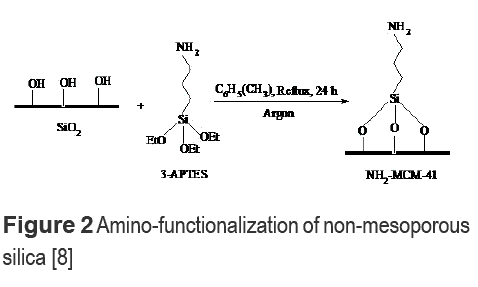
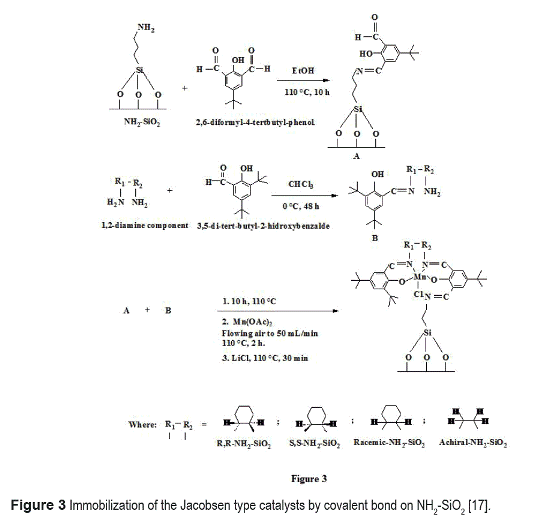
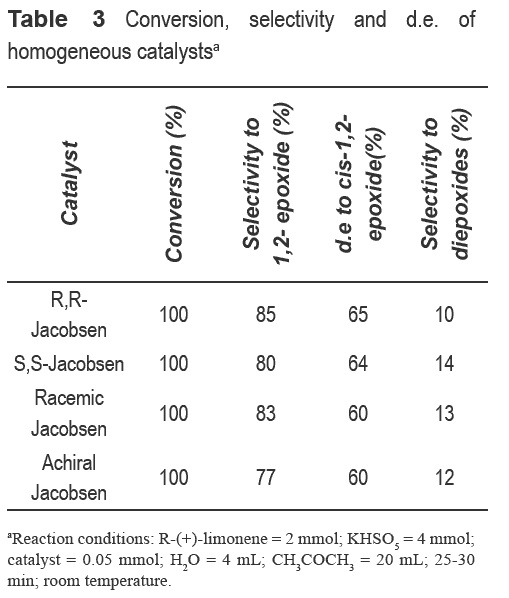
<body><![CDATA[<br>    <br> TGA was carried out in a TGA 2950 thermal analyzer, at a ramp rate of 5 K/min, in the temperature range of 300-1073 K. FTIR spectra were recorded in a Nicolet Avatar 330 in the region 400-4000 cm<sup>-1</sup>. DR UV-VIS spectra were obtained in a Lamda 4B Perkin Elmer spectrophotometer in the range of 200-800 nm. The Mn loading of solid catalysts was determined by AAS in a Model S4 Thermo Electron Corporation spectrometer. To accomplish this measurement, the dry sample was mixed with 2 cm<sup>3</sup>of HF and 2 cm<sup>3</sup> of <i>aqua regia</i>. Finally, the sample was adjusted to a known volume (100 mL) with deionized water. Reaction products were analyzed in a gas chromatograph (Agilent Technologies 7890A GC system) coupled to a mass spectrometer (Agilent Technologies 5975C VL MSD), equipped with a FID and a capillary column Beta-dex GTA (60 m length, 250 mm internal diameter and 0.25 mm film thickness).    </font></p>          <p><font face="Verdana" size="2"><b><i>Catalyst preparation</i></b></font></p>         <p> <font face="Verdana" size="2"> Homogeneous Jacobsen type catalysts (<a href="#Figura1">figure 1</a>) were synthesized as previously reported [12], and characterized by FT-IR and DR UV-VIS [15, 16]. These materials are easily prepared by the condensation of 3,5-di- tert-butyl-2-hydroxybenzaldehyde and its corresponding diamine, followed by metallation with tetrahydrate manganese(II) acetate and neutralization with lithium chloride to obtain the desired Mn(III) salen complex. Thus, pure enantiomerically catalyst samples, R,R-Jacobsen and S,S-Jacobsen, were prepared using (R,R)- 1,2-diaminocyclohexane mono-(+)-tartrate and (S,S)-1,2-diaminocyclohexane mono-(-)-tartrate, respectively. (R,R)-1,2-diaminocyclohexane mono-(+)-tartrate was obtained by racemic resolution of cis/trans-1,2-diaminocyclohexane with L-(+)-tartaric acid, whereas (S,S)-1,2- diaminocyclohexane mono-(-)-tartrate was obtained by racemic resolution of <i>cis/trans</i>- 1,2- diaminocyclohexane with D-(-)-tartaric acid. Racemic Jacobsen was obtained by using directly <i>cis/trans</i>-1,2-diaminocyclohexane, whereas 1,2-diaminoethane was used as the diamine component in the preparation of achiral Jacobsen.     </font></p>       <p align="center"><img src="/img/revistas/rfiua/n57/n57a05i01.gif" ><a name="Figura1"></a></p>      <p> <font face="Verdana" size="2"> The amino-functionalization was accomplished by condensation of 3-APTES with the surface silanol groups of non-mesoporous silica (SiO<sub>2</sub>) [8]. Briefly, 5 g of SiO<sub>2</sub> was first activated under vacuum at 393 K, overnight. A 3 g sample of activated SiO<sub>2</sub> was suspended in 100 mL of dry toluene, and then 1.8 g of 3-APTES was added dropwise under argon atmosphere. The resulting mixture was refluxed for 24 h under inert atmosphere. After cooling, the obtained solid was filtered off, dried and Soxhlet extracted, initially with toluene (8 h) and, then with dichloromethane (for 24 h). Finally, the materials were dried overnight at 373 K, under vacuum. The resulting functionalized materials were coded as NH<sub>2</sub>- SiO<sub>2</sub> <a href="#Figura2">figure 2</a> illustrates the described procedure. </font></p>       <p align="center"><img src="/img/revistas/rfiua/n57/n57a05i02.gif" ><a name="Figura2"></a></p>      <p> <font face="Verdana" size="2"> Heterogeneous catalysts were prepared in three steps as shown in <a href="#Figura3">figure 3</a> [17]. In the first step, a 3.0 g sample of NH<sub>2</sub>SiO<sub>2</sub> previously dried was treated with 4.5 mmol of 2,6-diformyl-4-tertbutyl- phenol in 50 mL of ethanol under reflux for 18 h. Then the mixture was cooled down and filtered. The yellow solid thus obtained was coded as A. On the other hand, the corresponding diamine (4 mmol) was condensed with 3,5-di-tert-butyl-2- hydroxybenzaldehyde (4 mmol) in dry chloroform at 273 K for 48 h yielding a yellow solid which was recovered by reduced pressure. This solid was denoted as B. In a latter step, the solids A and B were added into 50 mL absolute ethanol. When this mixture was refluxed for 10 h, 4.5 mmol of tetrahydrate manganese (II) acetate was added under flowing air (50 mL/min). At this point, the slurry changed from yellow to light brown. After stirring under reflux for 2 h, 5.0 mmol of lithium chloride was added and the air stream removed.</font></p>      <p align="center"><img src="/img/revistas/rfiua/n57/n57a05i03.gif" ><a name="Figura3"></a></p>      <p> <font face="Verdana" size="2">The resulting mixture was stirred under reflux for 30 min and filtered collecting a light brown powder. The solid samples were Soxhlet-extracted, initially with dichloromethane for 12 h and then with toluene for additional 12 h until colorless washings were obtained. Finally, the light brown solid samples were dried at 333 K under vacuum for 12 h. The resulting catalyst samples obtained with (R,R)-1,2-diaminocyclohexane, (S,S)-1,2- diaminocyclohexane, <i>cis/trans</i>-1,2-diaminocyclo- hexane, 1,2-diaminoethane were denoted as R,R- NH<sub>2</sub>-SiO<sub>2</sub>, S,S-NH<sub>2</sub>-SiO<sub>2</sub>, racemic-NH<sub>2</sub>-SiO<sub>2</sub> and achiral-NH<sub>2</sub>-SiO<sub>2</sub>, respectively.     </font></p>        ]]></body>
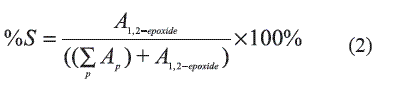
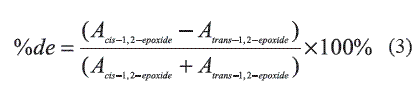
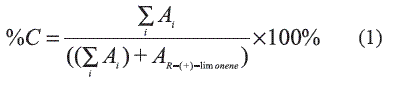
<body><![CDATA[<p> <font face="Verdana" size="2"><b><i> Catalytic experiments </i></b></font></p>     <p> <font face="Verdana" size="2">   Epoxidation of R-(+)-limonene using DMD as oxidant and Jacobsen type catalysts was carried out at atmospheric pressure and room temperature. In a typical reaction, R-(+)-limonene (2 mmol), homogeneous catalyst: 0.05 mmol or the equivalent weight of heterogeneous catalysts (table 1) and acetone (20 mL) were first introduced into a three-necked round bottomed flask. The reaction was started by dropwise addition of an aqueous solution of KHSO<sub>5</sub> (4 mmol/4 mL) under vigorous magnetic stirring. During this step, the pH of the reaction mixture was adjusted between 8.0-8.5 by using a 5 wt. % sodium bicarbonate aqueous solution. After the addition of the oxygen source (c.a 25 min), magnetic stirring was stopped and the catalyst and reaction products were separated. Thus, in the case of the homogeneous catalyst a distillation process under reduced pressure (433 K and 0.08 Mpa) was used while the heterogeneous catalysts were separated using a simple filtration. In both cases, the liquid mixtures were extracted with dichloromethane. The organic and aqueous phases were separated by funnel decantation and the aqueous phase extracted twice with dichloromethane. The organic phases were combined and the solvent partially removed by vacuum at room temperature. An aliquot of this mixture was analyzed by GC-MS. The recovered heterogeneous catalyst samples were washed with dichloromethane in order to remove weakly adsorbed organic residues. After drying at 333 K under vacuum for 12 h, catalyst samples were reused. Also, control reactions were carried out in the absence of catalyst and in the presence of SiO<sub>2</sub> and NH<sub>2</sub>-SiO<sub>2</sub>. </font></p>     <p><font face="Verdana" size="2">The reaction parameters such as conversion of R-(+)-limonene (% C), selectivity to 1,2-epoxide (% S) and diastereomeric excess to <i>cis</i>- 1,2-epoxide (% de) were estimated by area normalization using equations 1-3: </font></p>      <p> <img src="/img/revistas/rfiua/n57/n57a05e01.gif" width="363"></p>     <p> <img src="/img/revistas/rfiua/n57/n57a05e02.gif" width="368"></p>     <p><img src="/img/revistas/rfiua/n57/n57a05e03.gif" width="365"></p>      <p> <font face="Verdana" size="2"> Where Ai stands for chromatographic peak area of the product i, A<sub>R-(+)-limonene</sub> represents the chromatographic peak area of R-(+)-limonene, A<sub>1,2-epoxide</sub> represents the chromatographic peak area of 1,2-epoxide, A<sub>p</sub> represents the chromatographic peak area of the product p except 1,2-epoxide,A<sub>cis-1,2-epoxide</sub>  represents  the chromatographic peak area of <em>cis-</em>1,2-epoxide and  A<sub>trans-1,2-epoxide</sub> represents the chromatographic peak area of trans-1,2-epoxide.     <br>    <br>   It was demonstrated in a previous work that the response factors of R-(+)-limonene and 1,2-epoxide are close to 1 [18]. Therefore, the internal standard method was not used.      </font></p>      <p><font face="Verdana" size="3"><b> Results and discussion </b> </font></p>        ]]></body>
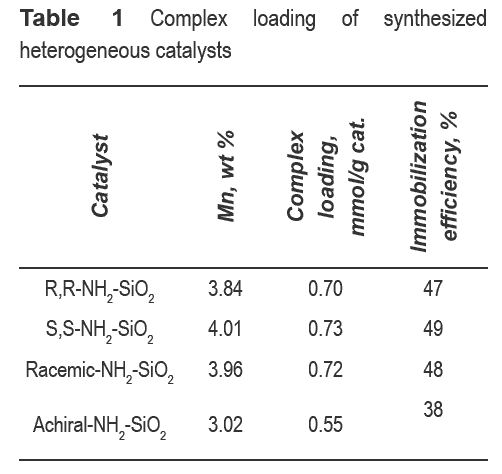
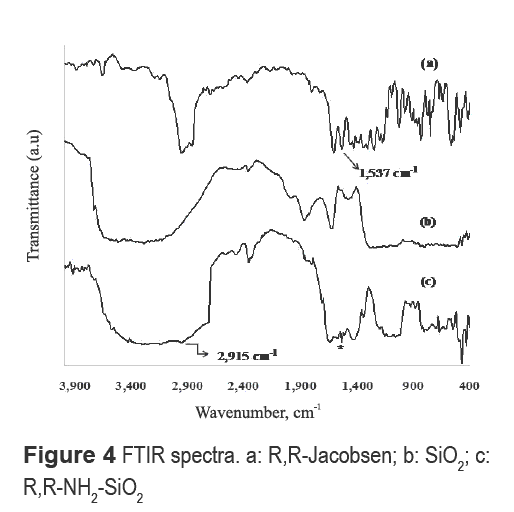
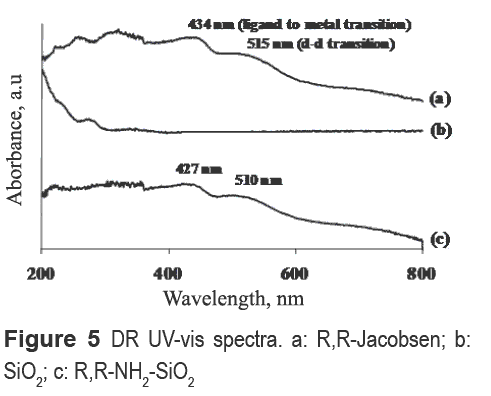
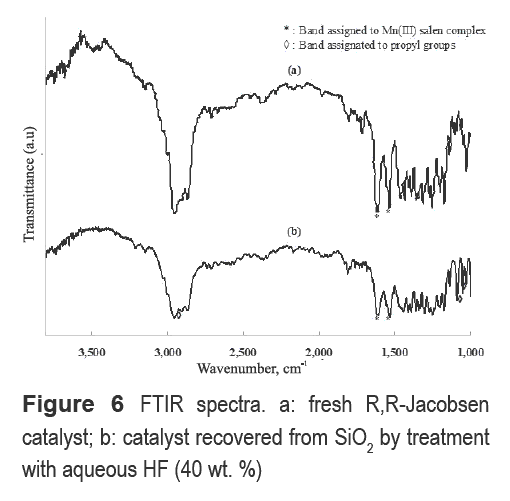
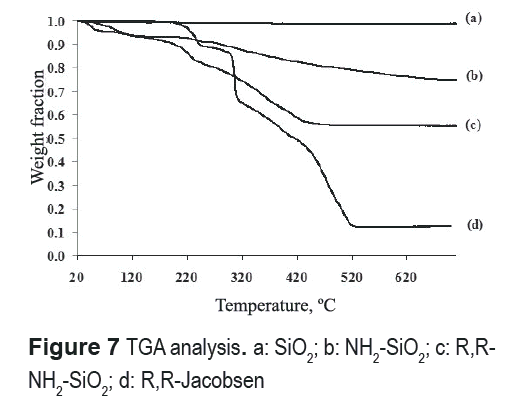
<body><![CDATA[<p> <font face="Verdana" size="2"><b><i> Catalyst characterization </i></b></font></p>	       <p> <font face="Verdana" size="2"> Four Jacobsen-type Mn(III) salen complexes were readily anchored onto amino modified SiO<sub>2</sub> through the fifth salen ligand position as depicted in <a href="#Figura3">figure 3</a>. First, the surface silanol (Si-OH) groups of SiO<sub>2</sub> were condensed with 3-APTES yielding NH<sub>2</sub>-SiO<sub>2</sub> (<a href="#Figura2">figure 2</a>). Either complex was covalently attached to the NH<sub>2</sub>-SiO<sub>2</sub> support by using formyl as linking agent. Imine links are formed between the amino groups on the surface of NH<sub>2</sub>-SiO<sub>2</sub> and one of the terminal formyl groups of the binder (2,6-diformyl-4- tertbutyl-phenol). The other terminal formyl group remains available to react with the free NH<sub>2</sub> group of the salen ligand B. This strategy is simple and economical, and the coordination sphere of manganese ion is preserved during the immobilization process, since the metal is not involved in the covalent bond (<a href="#Figura3">figure 3</a>). The immobilized complexes were repeatedly extracted with dichloromethane and toluene in order to eliminate any physically bounded Mn(III) salen complex from the silica matrix. For comparison, pure SiO<sub>2</sub> samples without modification were used as supports to immobilize the Mn(III) salen complexes but, complex readily leached out during dichloromethane extraction. Since similar results were obtained for the other heterogeneous catalysts, characterization results are shown for the R,R-NH<sub>2</sub>-SiO<sub>2</sub> only. The purity and chemical identity of the immobilized catalyst was checked by FTIR, DR UV-Vis and TGA analyses, whereas the catalyst loading was determined by AAS.      <br>    <br> FTIR and DR UV-Vis spectra of the immobilized complexes were in good agreement with the expected chemical structure of the free complexes [15, 16]. In particular, the formation of the immobilized complexes was confirmed by the presence of bands near 2942 and 1535 cm<sup>-1</sup> due to the propyl groups belonging to the aminopropyl moieties and the stretching vibrations of azomethine groups (H-C=N), respectively [15]. These bands were absent in the FTIR spectra of unmodified SiO<sub>2</sub> (<a href="#Figura4">figure 4</a>). </font></p>      <p align="center"><img src="/img/revistas/rfiua/n57/n57a05i04.gif" ><a name="Figura4"></a></p>      <p> <font face="Verdana" size="2"> The DR UV-vis spectra of R,R-Jacobsen, unmodified SiO<sub>2</sub> and R,R-NH<sub>2</sub>-SiO<sub>2</sub> are given in <a href="#Figura5">figure 5</a>. The spectra of R,R-NH<sub>2</sub>-SiO<sub>2</sub> is similar to those of the free complex, with no obvious absorption of unmodified SiO<sub>2</sub>. The band at 434 nm is due to ligand to-metal charge transfer transition and the bands at 515 nm are assigned to the d-d transition of Mn(III) salen complex [16]. On immobilization, these bands are shifted to 427 and 510 nm, respectively, probably due to the interaction of the chiral Mn(III) salen complex with the corresponding supports [16]. To further confirm the grafting of the salen units onto NH<sub>2</sub>-SiO<sub>2</sub>, the immobilized catalysts (0.2 g) were dissolved in HF solution (5 mL, 40 wt. %), and the resulting mass extracted with CH<sub>2</sub>Cl<sub>2</sub>. After the solvent was completely removed the resulting brown solid was analyzed by FT-IR (<a href="#Figura6">figure 6</a>). The presence of the typical Mn(III) salen complex bands (1600 cm<sup>-1</sup> and 1530 cm<sup>-1</sup>) and propyl moieties of the aminopropyl groups (1030, 1050 and 2900 cm<sup>-1</sup>) was evidenced. </font></p>      <p align="center"><img src="/img/revistas/rfiua/n57/n57a05i05.gif" ><a name="Figura5"></a></p>        <p align="center"><img src="/img/revistas/rfiua/n57/n57a05i06.gif" ><a name="Figura6"></a></p>      <p> <font face="Verdana" size="2"> In agreement with the organic-inorganic nature of either material, TGA of R,R-Jacobsen, SiO<sub>2</sub>, NH<sub>2</sub>-SiO<sub>2</sub> and R,R-NH<sub>2</sub>-SiO<sub>2</sub> shown in <a href="#Figura7">figure 7</a> indicate that the organic material contents follows the order: R,R-Jacobsen > R,R-NH<sub>2</sub>-SiO<sub>2</sub> > NH<sub>2</sub>- SiO<sub>2</sub> > SiO<sub>2</sub>. The decomposition profile of the homogenous complex was completed at ~788 K, the residues amounting to manganese oxides (12 wt %). SiO<sub>2</sub>, NH<sub>2</sub>-SiO<sub>2</sub> and R,R-NH<sub>2</sub>-SiO<sub>2</sub> showed the typical weight loss associated to the desorption of water from silica (c.a 373 K) [19]. NH<sub>2</sub>-SiO<sub>2</sub> shows a wider weight loss in the region of 543-938 K attributed to the loss of the aminopropyl groups [20]. Thus, the estimated content of aminopropyl groups is 15.4 wt. % (2.48 mmol/g). On the other hand, the organic moieties immobilized in R,R-NH<sub>2</sub>-SiO<sub>2</sub> showed a slightly lower thermal stability (758 K) than the free catalyst (788 K). In contrast, it has been accepted that the catalyst increases its thermal stability when immobilized in ordered pore structure supports [21]. This may be explained by considering that outside surface organic moieties, as in non- mesoporous silica, are more easily burned than those located inside the mesoporous support (e.g, MCM-41). The Mn (III) salen complex loading in the heterogenized catalyst based on Mn content was determined by AAS (<a href="#Tabla1">table 1</a>). Because the extraction procedure removed the total amount of complex from the SiO<sub>2</sub>surface, the Mn loading corresponds to the SiO<sub>2</sub> anchored complex. The amount of immobilized Mn(III) salen complex was in the range of 0.55-0.73 mmol/g, suggesting that about 25% of aminopropyl groups participated in the complex covalent bonding. This represents an immobilization efficiency of 38-49% of the initial metal content of the precursor solution (<a href="#Tabla1">table 1</a>). Achiral-NH<sub>2</sub>-SiO<sub>2</sub> showed lowest complex loading, presumably due to the difference of molecular weight between 1,2-diaminoethane and 1,2-diaminocyclohexane.     </font></p>        <p align="center"><img src="/img/revistas/rfiua/n57/n57a05i07.gif" ><a name="Figura7"></a></p>     ]]></body>
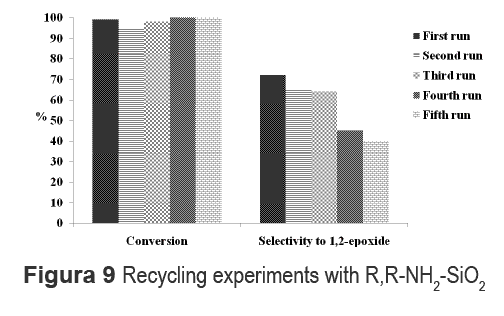
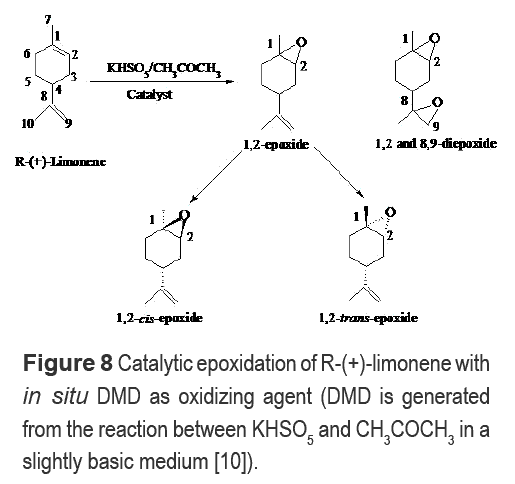
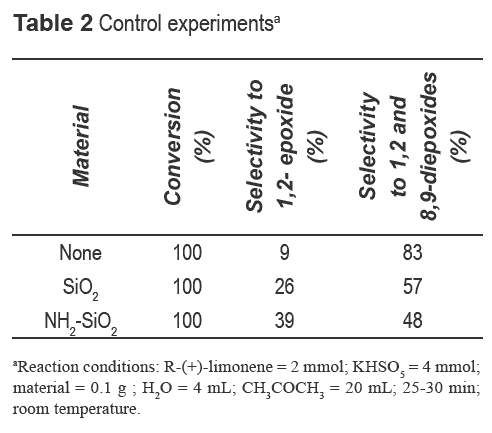
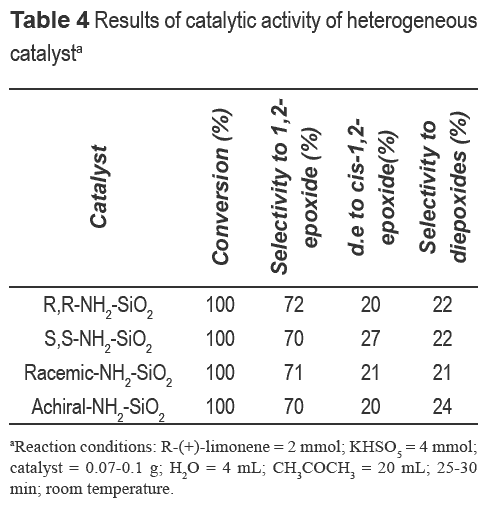
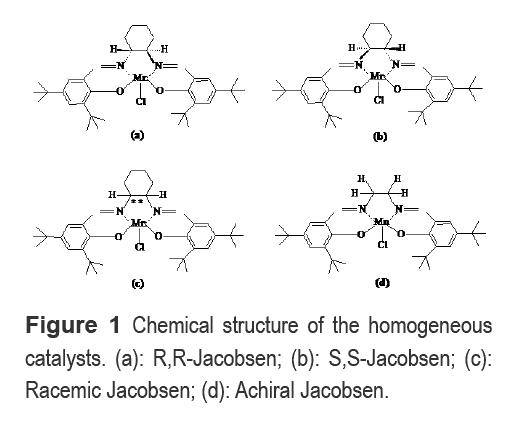
<body><![CDATA[<p align="center"><img src="/img/revistas/rfiua/n57/n57a05t01.gif" ><a name="Tabla1"></a></p>      <p> <font face="Verdana" size="2"> Oxidation ofR-(+)-limonene can yield 1,2-epoxide, 8,9- epoxide and 1,2 and 8,9-diepoxide due to oxidation of the olefinic bonds (<a href="#Figura8">figure 8</a>). However, the epoxidation of R-(+)-limonene with DMD prepared <i>in situ</i> yields two main products: 1,2-epoxide and diepoxide. From 1,2-epoxide, two diastereomers are expected: <i>cis</i>-1,2-epoxide and <i>trans</i>-1,2-epoxide (<a href="#Figura8">figure 8</a>).     </font></p>      <p align="center"><img src="/img/revistas/rfiua/n57/n57a05i08.gif" ><a name="Figura8"></a></p>      <p> <font face="Verdana" size="2">  In order to compare the epoxidation capability of the catalysts, three blank experiments were performed: (i) in the absence of catalyst; (ii) over an unmodified SiO<sub>2</sub> sample and (iii) over a NH<sub>2</sub>-SiO<sub>2</sub> sample (<a href="#Tabla2">table 2</a>). These experiments showed that diepoxide was the major product in the absence of the Mn(III) salen complexes. However, the presence of the support and residual free amino groups on the support surface caused a remarkable decrease of diepoxides and an increase of 1,2-epoxide as compared with the reaction without catalyst. Other minor products obtained from allylic oxidation (e.g carveol and carvone) were obtained. These results suggest that both SiO<sub>2</sub> and NH<sub>2</sub>-SiO<sub>2</sub> have 1,2 epoxide active sites.</font></p>      <p align="center"><img src="/img/revistas/rfiua/n57/n57a05t02.gif" ><a name="Tabla2"></a></p>      <p> <font face="Verdana" size="2"> The results of the diastereoselective epoxidation of R-(+)-limonene using homogeneous and heterogeneous catalysts are listed in <a href="#Tabla3">table 3</a> and <a href="#Tabla4">4</a>, respectively. Homogeneous Mn(III) salen complexes lead to complete conversion, good selectivity to 1,2-epoxide (77-85%) and moderate diastereomeric excess to <i>cis</i>-1,2-epoxide (60¬65% ee). The similarity of the catalytic behavior confirms again, that the chiral induction is mainly governed by the chiral center of R-(+)-limonene rather than the chiral center of the enantiomerically pure catalysts. That means, that irrespective of the catalyst type, the main diastereomer is the same. Recently, we demonstrated that for this reaction, either a racemic or achiral catalyst is sufficient to promote diastereoselectivity [22].</font></p>      <p align="center"><img src="/img/revistas/rfiua/n57/n57a05t03.gif" ><a name="Tabla3"></a></p>      <p align="center"><img src="/img/revistas/rfiua/n57/n57a05t04.gif" ><a name="Tabla4"></a></p>	      <p> <font face="Verdana" size="2">As shown in <a href="#Tabla4">table 4</a>, the heterogeneous catalysts exhibited lower selectivity and diasteroselective excess compared with the homogeneous catalysts (<a href="#Tabla3">table 3</a>). The differences between homogeneous and heterogeneous catalysts could be attributed to the influence of the support surface and changes in conformation geometry of the salen ligand by replacing a tert-butyl group in the immobilization process [7]. In general, metal salen complexes are known to exhibit different conformational geometries (planar, stepped and umbrella-shaped) depending on the salen ligand substituents [23]. The catalytic effect of the support was confirmed by performing catalytic epoxidation experiments on Mn(III) salen complexes mixed with SiO<sub>2</sub> or NH<sub>2</sub>-SiO<sub>2</sub>. The results showed that the selectivity to 1,2-epoxide over such mixtures was lower than that obtained with the homogeneous catalysts. As it can be observed in <a href="#Tabla3">table 3</a> and <a href="#Tabla4">4</a>, the yield over the heterogeneous catalysts was very similar to that in homogeneous catalysts. However, the diatereomeric excess significantly decreases. </font></p>       <p> <font face="Verdana" size="2"> The stability of the immobilized catalysts using R,R-Jacobsen in five epoxidation reactions was studied. At the end of each cycle, the catalyst was filtered, thoroughly washed with dichloromethane, dried under vacuum at 333 K, and then reused with fresh reactants under similar epoxidation conditions. As shown in <a href="#Figura9">figure 9</a>, there is, no obvious 1,2-epoxide selectivity decrease for at least three runs. The aqueous and organic layers of the filtrate were tested for the presence of manganese by AAS. No traces of manganese in the  filtrate were detected. It might suggest that the Mn (III) salen complex was intact on the solid support and that no leaching took place during reaction. Considering the gradual decrease of selectivity, the catalyst was thoroughly Soxhlet-extracted with dichloromethane after three cycles. However, the original selectivity was not recovered. FTIR spectra of the recycled catalyst suggests partial degradation along with deposition of some of the products and reactants onto the support surface that cause a gradual slow down of the epoxidation reaction after the third cycle. </font></p>      ]]></body>
<body><![CDATA[<p align="center"><img src="/img/revistas/rfiua/n57/n57a05i09.gif" ><a name="Figura9"></a></p>      <p><font face="Verdana" size="3"><b> Conclusions </b> </font></p>      <p> <font face="Verdana" size="2"> Four Jacobsen type catalysts were supported on SiO<sub>2</sub> taking advantage of its available surface silanol groups for the anchoring process. The immobilization of Mn(III) salen complexes over previously modified SiO<sub>2</sub> by 3-APTES, has been achieved by a multi-step grafting method. Different characterization techniques: FTIR, DR UV-VIS, TGA and AAS evidence that Mn(III) salen complexes were covalently attached to the NH<sub>2</sub>-SiO<sub>2</sub> surface. These materials and their homogeneous analogous acted as catalysts for the epoxidation of R-(+)-limonene using in situ generated DMD as oxidant. It is noteworthy to notice that in the absence of catalyst diepoxides were the major products, whereas in the presence of catalyst the major product was 1,2-epoxide. The immobilized catalysts exhibited slightly lower selectivity than their homogeneous counterparts. Although the immobilization method was chosen to minimize changes in the structure of the homogeneous catalysts, diastereoselective excesses were lower than those obtained with the corresponding homogeneous catalysts under the experimental conditions of this study. Concerning stability, the immobilized catalysts could be recycled three times without loss of selectivity. Furthermore, these immobilized catalysts appear to be stable to leaching. However, remarkable selectivity lost was observed from the third to fourth use, which is attributed to the partial degradation of the catalyst and deposition of reactants and products onto the support surface.     </font></p>       <p><font face="Verdana" size="3"><b> Acknowledgments </b> </font></p>          <p> <font face="Verdana" size="2"> The  authors gratefully acknowledge the financial support from CENIVAM-Universidad  de Antioquia (RC No 432) and 2009-2010 sustainability project.</font></p>      <p><font face="Verdana" size="3"><b> References</b> </font></p>       <p><font face="Verdana" size="2">     <!-- ref --><p>       1.C.  T. Dalton, K. M. Ryan, V. M. Wall, C. Bousquet, D. G. Gilheany. &quot;Recent  progress towards the understanding of metal-salen catalysed asymmetric alkene  epoxidation&quot;. <i>Top. Catal</i>. Vol. 5. 1998. pp. 75-91.&nbsp;&nbsp;&nbsp;&nbsp;&nbsp;&nbsp;&nbsp;&nbsp;[&#160;<a href="javascript:void(0);" onclick="javascript: window.open('/scielo.php?script=sci_nlinks&ref=000070&pid=S0120-6230201100010000500001&lng=','','width=640,height=500,resizable=yes,scrollbars=1,menubar=yes,');">Links</a>&#160;]<!-- end-ref --><!-- ref --><p>2. Q. H. Xia, H. Q. Ge, C. P. Ye, Z. M. Liu, K. X. Su. &quot;Advances in homogeneous  and heterogeneous catalytic asymmetric epoxidation&quot;. <i>Chem. Rev.</i> Vol. 105. 2005. pp.  1603-1662.<br clear="all">         &nbsp;&nbsp;&nbsp;&nbsp;&nbsp;&nbsp;&nbsp;&nbsp;[&#160;<a href="javascript:void(0);" onclick="javascript: window.open('/scielo.php?script=sci_nlinks&ref=000071&pid=S0120-6230201100010000500002&lng=','','width=640,height=500,resizable=yes,scrollbars=1,menubar=yes,');">Links</a>&#160;]<!-- end-ref --><!-- ref --><br>   3.  P. Mastrorilli, C. F. Nobile. &quot;Supported catalysts from polymerizable  transition metal complexes&quot;. <i>Coord. Chem.</i> Vol. 248. 2004. pp. 377-395. &nbsp;&nbsp;&nbsp;&nbsp;&nbsp;&nbsp;&nbsp;&nbsp;[&#160;<a href="javascript:void(0);" onclick="javascript: window.open('/scielo.php?script=sci_nlinks&ref=000072&pid=S0120-6230201100010000500003&lng=','','width=640,height=500,resizable=yes,scrollbars=1,menubar=yes,');">Links</a>&#160;]<!-- end-ref --><!-- ref --><p>4.  M. Silva, C. Freire, B. de Castro, J. L. Figueiredo. &quot;Styrene oxidation by  manganese Schiff base complexes in zeolite structures&quot;. <i>J. Mol. Catal. A:  Gen.</i>  Vol. 258. 2006. pp. 327-333.&nbsp;&nbsp;&nbsp;&nbsp;&nbsp;&nbsp;&nbsp;&nbsp;[&#160;<a href="javascript:void(0);" onclick="javascript: window.open('/scielo.php?script=sci_nlinks&ref=000073&pid=S0120-6230201100010000500004&lng=','','width=640,height=500,resizable=yes,scrollbars=1,menubar=yes,');">Links</a>&#160;]<!-- end-ref --><!-- ref --><p>5. J. M. Thomas, R. Raja. &quot;Catalytic significance of organometallic compounds  immobilized on mesoporous silica: economically and environmentally important  examples&quot;.<i>J. Organomet. Chem.</i> Vol. 689. 2004. pp.  4110-4124.&nbsp;&nbsp;&nbsp;&nbsp;&nbsp;&nbsp;&nbsp;&nbsp;[&#160;<a href="javascript:void(0);" onclick="javascript: window.open('/scielo.php?script=sci_nlinks&ref=000074&pid=S0120-6230201100010000500005&lng=','','width=640,height=500,resizable=yes,scrollbars=1,menubar=yes,');">Links</a>&#160;]<!-- end-ref --><!-- ref --><p>6. P. Oliveira, A. Machado, A. M. Ramos, I. Fonseca, F. M. Braz Fernandes,  A. M. Botelho do Rego, J. Vital. &quot;MCM-41 anchored manganese salen complexes as  catalysts for limonene oxidation&quot;. <i>Microporous  Mesoporous Mater.</i>  Vol. 120. 2009. pp. 432-440.&nbsp;&nbsp;&nbsp;&nbsp;&nbsp;&nbsp;&nbsp;&nbsp;[&#160;<a href="javascript:void(0);" onclick="javascript: window.open('/scielo.php?script=sci_nlinks&ref=000075&pid=S0120-6230201100010000500006&lng=','','width=640,height=500,resizable=yes,scrollbars=1,menubar=yes,');">Links</a>&#160;]<!-- end-ref --><!-- ref --><p>7.  C. Baleiza&ouml;, H. Garc&iacute;a. &quot;Chiral salen complexes: an overview to  recoverable and reusable homogeneous and heterogeneous catalysts&quot;.<i>Chem. Rev.</i> Vol. 106. 2006. pp.  3987-4043.&nbsp;&nbsp;&nbsp;&nbsp;&nbsp;&nbsp;&nbsp;&nbsp;[&#160;<a href="javascript:void(0);" onclick="javascript: window.open('/scielo.php?script=sci_nlinks&ref=000076&pid=S0120-6230201100010000500007&lng=','','width=640,height=500,resizable=yes,scrollbars=1,menubar=yes,');">Links</a>&#160;]<!-- end-ref --><!-- ref --><p>8. J. A.  Cubillos, W. F.  H&ouml;lderich. &quot;Jacobsen's catalyst anchored on Al-MCM-41 and NH2  group modified Si-MCM-41 as heterogeneous enantioselective epoxidation catalyst  using in situ generated dimethyldioxirane as oxidant&quot;. <i>Rev. Fac.Ing.  Univ. Antioquia. </i> Vol. 41. 2007. pp. 31-47.&nbsp;&nbsp;&nbsp;&nbsp;&nbsp;&nbsp;&nbsp;&nbsp;[&#160;<a href="javascript:void(0);" onclick="javascript: window.open('/scielo.php?script=sci_nlinks&ref=000077&pid=S0120-6230201100010000500008&lng=','','width=640,height=500,resizable=yes,scrollbars=1,menubar=yes,');">Links</a>&#160;]<!-- end-ref --><!-- ref --><p>9. J. Reyes, J. A. Cubillos, A. L. Villa, C. Montes de Correa. &quot;Efecto de la  quiralidad del sustrato y del catalizador en la epoxidaci&oacute;n diastereoselectiva de  R-(+)-limoneno con complejos de salen de manganeso(III)&quot; <i>Rev. Fac. Ing. Univ.  Antioquia.</i>  Vol. 48. 2009. pp. 18-26.&nbsp;&nbsp;&nbsp;&nbsp;&nbsp;&nbsp;&nbsp;&nbsp;[&#160;<a href="javascript:void(0);" onclick="javascript: window.open('/scielo.php?script=sci_nlinks&ref=000078&pid=S0120-6230201100010000500009&lng=','','width=640,height=500,resizable=yes,scrollbars=1,menubar=yes,');">Links</a>&#160;]<!-- end-ref --><!-- ref --><p>10.  J. A. Cubillos, I. D. Montilla, C. Montes de Correa. &quot;Separaci&oacute;n del  catalizador de Jacobsen en la epoxidaci&oacute;n enantioselectiva de cis-cinamato de etilo bajo  condiciones homog&eacute;neas&quot;<i> Rev. Fac. Ing. Univ. Antioquia.</i> Vol. 47. 2009. pp. 9-19.&nbsp;&nbsp;&nbsp;&nbsp;&nbsp;&nbsp;&nbsp;&nbsp;[&#160;<a href="javascript:void(0);" onclick="javascript: window.open('/scielo.php?script=sci_nlinks&ref=000079&pid=S0120-6230201100010000500010&lng=','','width=640,height=500,resizable=yes,scrollbars=1,menubar=yes,');">Links</a>&#160;]<!-- end-ref --><!-- ref --><p>11 J. A. Cubillos, I. D.  Montilla, C. Montes de Correa. &quot;Easy separation and reutilization of the  Jacobsen catalyst in olefin oxidation&quot;. <i>Appl. Catal., A.</i> Vol. 366. pp.  348-352.&nbsp;&nbsp;&nbsp;&nbsp;&nbsp;&nbsp;&nbsp;&nbsp;[&#160;<a href="javascript:void(0);" onclick="javascript: window.open('/scielo.php?script=sci_nlinks&ref=000080&pid=S0120-6230201100010000500011&lng=','','width=640,height=500,resizable=yes,scrollbars=1,menubar=yes,');">Links</a>&#160;]<!-- end-ref --><!-- ref --><p>12. J. A.  Cubillos, S.  V&aacute;squez, C.  Montes de Correa. &quot;Salen  manganese (III) complexes as catalyst for R-(+)-limonene oxidation&quot;. <i>Appl. Catal. A.</i> Vol. 373. pp. 57-65.&nbsp;&nbsp;&nbsp;&nbsp;&nbsp;&nbsp;&nbsp;&nbsp;[&#160;<a href="javascript:void(0);" onclick="javascript: window.open('/scielo.php?script=sci_nlinks&ref=000081&pid=S0120-6230201100010000500012&lng=','','width=640,height=500,resizable=yes,scrollbars=1,menubar=yes,');">Links</a>&#160;]<!-- end-ref --><!-- ref --><p>13. M. A. Uguina, J.A.  Delgado, A. Rodr&iacute;guez, J. Carretero, D. G&oacute;mez-D&iacute;az. &quot;Alumina  as heterogeneous catalyst for the regioselective epoxidation of terpenic diolefins with  hydrogen peroxide&quot;.<i>J. Mol. Catal. A: Chem. </i>Vol. 256. 2006. pp. 208-215.&nbsp;&nbsp;&nbsp;&nbsp;&nbsp;&nbsp;&nbsp;&nbsp;[&#160;<a href="javascript:void(0);" onclick="javascript: window.open('/scielo.php?script=sci_nlinks&ref=000082&pid=S0120-6230201100010000500013&lng=','','width=640,height=500,resizable=yes,scrollbars=1,menubar=yes,');">Links</a>&#160;]<!-- end-ref --><!-- ref --><p>14.  L. Deng, E. N. Jacobsen. &quot;A practical, highly enantioselective synthesis  of the Taxol side chain via asymmetric catalysis&quot;.<i> J. Org. Chem.</i> Vol. 57. 1992. pp. 4320-4323.&nbsp;&nbsp;&nbsp;&nbsp;&nbsp;&nbsp;&nbsp;&nbsp;[&#160;<a href="javascript:void(0);" onclick="javascript: window.open('/scielo.php?script=sci_nlinks&ref=000083&pid=S0120-6230201100010000500014&lng=','','width=640,height=500,resizable=yes,scrollbars=1,menubar=yes,');">Links</a>&#160;]<!-- end-ref --><!-- ref --><p>15.  R. I. Kureshy, I. Ahmad, N-u. H. Khan, S. H. R. Abdi, K. Pathak, R. V. Jasra. &quot;  Encapsulation of a chiral MnIII(salen) complex in ordered mesoporous  silicas: an approach towards heterogenizing asymmetric epoxidation catalysts  for non-functionalized alkenes&quot;. <i>Tetrahedron:  Asymmetry </i> Vol. 16. 2005. pp. 3562&shy;3569.&nbsp;&nbsp;&nbsp;&nbsp;&nbsp;&nbsp;&nbsp;&nbsp;[&#160;<a href="javascript:void(0);" onclick="javascript: window.open('/scielo.php?script=sci_nlinks&ref=000084&pid=S0120-6230201100010000500015&lng=','','width=640,height=500,resizable=yes,scrollbars=1,menubar=yes,');">Links</a>&#160;]<!-- end-ref --><!-- ref --><p>16. K. Yu, Z. Gu, R. Ji, L-L. Lou, F. Ding, C. Zhang, S. Liu. &quot;Effect of pore size  on the performance of mesoporous material supported chiral Mn(III) salen  complex for the epoxidation of unfunctionalized olefins&quot;.<i> J. Catal.</i> Vol. 252. 2007. pp. 312-320.&nbsp;&nbsp;&nbsp;&nbsp;&nbsp;&nbsp;&nbsp;&nbsp;[&#160;<a href="javascript:void(0);" onclick="javascript: window.open('/scielo.php?script=sci_nlinks&ref=000085&pid=S0120-6230201100010000500016&lng=','','width=640,height=500,resizable=yes,scrollbars=1,menubar=yes,');">Links</a>&#160;]<!-- end-ref --><!-- ref --><p>17.  K. Yu, L.-L. Lou, C. Lai, S. Wang, F. Ding, S. Liu. &quot;Asymmetric  epoxidation of unfunctionalized olefins catalyzed by Mn(III) salen complex  immobilized on MCM-48&quot;. <i>Catal. Commun.</i> Vol. 7. 2006. pp. 1057&shy;1060.&nbsp;&nbsp;&nbsp;&nbsp;&nbsp;&nbsp;&nbsp;&nbsp;[&#160;<a href="javascript:void(0);" onclick="javascript: window.open('/scielo.php?script=sci_nlinks&ref=000086&pid=S0120-6230201100010000500017&lng=','','width=640,height=500,resizable=yes,scrollbars=1,menubar=yes,');">Links</a>&#160;]<!-- end-ref --><!-- ref --><p>18. J. Reyes.<i> Epoxidaci&oacute;n diastereoselectiva  de  R-(+)- limoneno y a-(-)-pineno con complejos de salen de manganeso  inmovilizados en MCM-41</i>. Maestr&iacute;a en Ingenier&iacute;a. Universidad de Antioquia, 2008.  pp. 74-79.&nbsp;&nbsp;&nbsp;&nbsp;&nbsp;&nbsp;&nbsp;&nbsp;[&#160;<a href="javascript:void(0);" onclick="javascript: window.open('/scielo.php?script=sci_nlinks&ref=000087&pid=S0120-6230201100010000500018&lng=','','width=640,height=500,resizable=yes,scrollbars=1,menubar=yes,');">Links</a>&#160;]<!-- end-ref --><!-- ref --><p>19.  R. Bai, X. FU, H. Bao. W. Ren. &quot;Chiral Salen Mn(III) complex axial  coordination immobilized on diamine modified ZSPP and their catalytic  epoxidation of styrene&quot;. <i>Catal. Commun.</i> Vol. 9. 2008. pp. 1588&shy;1594.&nbsp;&nbsp;&nbsp;&nbsp;&nbsp;&nbsp;&nbsp;&nbsp;[&#160;<a href="javascript:void(0);" onclick="javascript: window.open('/scielo.php?script=sci_nlinks&ref=000088&pid=S0120-6230201100010000500019&lng=','','width=640,height=500,resizable=yes,scrollbars=1,menubar=yes,');">Links</a>&#160;]<!-- end-ref --><!-- ref --><p>20.  T. Luts, W. Suprun, D. Hofmann, O. Klepel, H. Papp. &quot;Epoxidation of  olefins catalyzed by novel Mn(III) and Mo(IV) salen complexes immobilized on  mesoporous silica gel: Part I. Synthesis and characterization of homogeneous  and immobilized Mn(III) and Mo(IV) Salen complexes&quot;. <i>J. Mol. Catal. A:  Chem.</i>  Vol.261. 2007. pp. 16-23.&nbsp;&nbsp;&nbsp;&nbsp;&nbsp;&nbsp;&nbsp;&nbsp;[&#160;<a href="javascript:void(0);" onclick="javascript: window.open('/scielo.php?script=sci_nlinks&ref=000089&pid=S0120-6230201100010000500020&lng=','','width=640,height=500,resizable=yes,scrollbars=1,menubar=yes,');">Links</a>&#160;]<!-- end-ref --><!-- ref --><p>21.  L-L. Lou, K. Yu, F. Ding, X. Peng, M. Dong, C. Zhang, S. Liu. &quot;Covalently  anchored chiral Mn(III) salen- containing ionic species on mesoporous materials  as effective catalysts for asymmetric epoxidation of unfunctionalized  olefins&quot;. <i>J. Catal.</i> Vol.249. 2007. pp. 102-110.&nbsp;&nbsp;&nbsp;&nbsp;&nbsp;&nbsp;&nbsp;&nbsp;[&#160;<a href="javascript:void(0);" onclick="javascript: window.open('/scielo.php?script=sci_nlinks&ref=000090&pid=S0120-6230201100010000500021&lng=','','width=640,height=500,resizable=yes,scrollbars=1,menubar=yes,');">Links</a>&#160;]<!-- end-ref --><!-- ref --><p>22. J. A.  Cubillos, M. Vargas, J. Reyes, A. Villa, C. Montes de Correa. &quot;Effect of the substrate  and catalyst chirality on the diastereoselective epoxidation of limonene using  Jacobsen-type catalysts&quot;. <i>Chirality.</i> Vol.22. 2010. pp. 403-410.&nbsp;&nbsp;&nbsp;&nbsp;&nbsp;&nbsp;&nbsp;&nbsp;[&#160;<a href="javascript:void(0);" onclick="javascript: window.open('/scielo.php?script=sci_nlinks&ref=000091&pid=S0120-6230201100010000500022&lng=','','width=640,height=500,resizable=yes,scrollbars=1,menubar=yes,');">Links</a>&#160;]<!-- end-ref --><!-- ref --><p>23. L. Saikia, D. Srinivas, P. Ratnasamy. &quot;Chemo-, regio- and  stereo-selective aerial oxidation of limonene to the endo-1,2-epoxide over  Mn(Salen)-sulfonated SBA- 15&quot;. <i>Appl. Catal.</i>, A. Vol. 309. 2006. pp. 144-154.&nbsp;&nbsp;&nbsp;&nbsp;&nbsp;&nbsp;&nbsp;&nbsp;[&#160;<a href="javascript:void(0);" onclick="javascript: window.open('/scielo.php?script=sci_nlinks&ref=000092&pid=S0120-6230201100010000500023&lng=','','width=640,height=500,resizable=yes,scrollbars=1,menubar=yes,');">Links</a>&#160;]<!-- end-ref --><br>     <br>    <br>    <br>       <p><font face="Verdana" size="2">(Recibido el 26 de enero de 2010. Aceptado  el 15 de octubre de 2010)</font></p>     <p><font face="Verdana" size="2"><sup>*</sup>Autor de correspondencia: tel&eacute;fono: + 57 + 8 + 743 62 32, ext. 1690, correo electr&oacute;nico: <a href="mailto:jacubil@gmail.com">jacubil@gmail.com</a> (J. Cubillos)</font></p>      ]]></body><back>
<ref-list>
<ref id="B1">
<label>1</label><nlm-citation citation-type="journal">
<person-group person-group-type="author">
<name>
<surname><![CDATA[Dalton]]></surname>
<given-names><![CDATA[C. T]]></given-names>
</name>
<name>
<surname><![CDATA[Ryan]]></surname>
<given-names><![CDATA[K. M]]></given-names>
</name>
<name>
<surname><![CDATA[Wall]]></surname>
<given-names><![CDATA[V. M]]></given-names>
</name>
<name>
<surname><![CDATA[Bousquet]]></surname>
<given-names><![CDATA[C]]></given-names>
</name>
<name>
<surname><![CDATA[Gilheany]]></surname>
<given-names><![CDATA[D. G]]></given-names>
</name>
</person-group>
<article-title xml:lang="en"><![CDATA[Recent progress towards the understanding of metal-salen catalysed asymmetric alkene epoxidation]]></article-title>
<source><![CDATA[Top. Catal]]></source>
<year>1998</year>
<volume>5</volume>
<page-range>75-91</page-range></nlm-citation>
</ref>
<ref id="B2">
<label>2</label><nlm-citation citation-type="journal">
<person-group person-group-type="author">
<name>
<surname><![CDATA[Xia]]></surname>
<given-names><![CDATA[Q. H]]></given-names>
</name>
<name>
<surname><![CDATA[Ge]]></surname>
<given-names><![CDATA[H. Q]]></given-names>
</name>
<name>
<surname><![CDATA[Ye]]></surname>
<given-names><![CDATA[C. P]]></given-names>
</name>
<name>
<surname><![CDATA[Liu]]></surname>
<given-names><![CDATA[Z. M]]></given-names>
</name>
<name>
<surname><![CDATA[Su]]></surname>
<given-names><![CDATA[K. X]]></given-names>
</name>
</person-group>
<article-title xml:lang="en"><![CDATA[Advances in homogeneous and heterogeneous catalytic asymmetric epoxidation]]></article-title>
<source><![CDATA[Chem. Rev]]></source>
<year>2005</year>
<volume>105</volume>
<page-range>1603-1662</page-range></nlm-citation>
</ref>
<ref id="B3">
<label>3</label><nlm-citation citation-type="journal">
<person-group person-group-type="author">
<name>
<surname><![CDATA[Mastrorilli]]></surname>
<given-names><![CDATA[P]]></given-names>
</name>
<name>
<surname><![CDATA[Nobile]]></surname>
<given-names><![CDATA[C. F]]></given-names>
</name>
</person-group>
<article-title xml:lang="en"><![CDATA[Supported catalysts from polymerizable transition metal complexes]]></article-title>
<source><![CDATA[Coord. Chem]]></source>
<year>2004</year>
<volume>248</volume>
<page-range>377-395</page-range></nlm-citation>
</ref>
<ref id="B4">
<label>4</label><nlm-citation citation-type="journal">
<person-group person-group-type="author">
<name>
<surname><![CDATA[Silva]]></surname>
<given-names><![CDATA[M]]></given-names>
</name>
<name>
<surname><![CDATA[Freire]]></surname>
<given-names><![CDATA[C]]></given-names>
</name>
<name>
<surname><![CDATA[de Castro]]></surname>
<given-names><![CDATA[B]]></given-names>
</name>
<name>
<surname><![CDATA[Figueiredo]]></surname>
<given-names><![CDATA[J. L]]></given-names>
</name>
</person-group>
<article-title xml:lang="en"><![CDATA[Styrene oxidation by manganese Schiff base complexes in zeolite structures]]></article-title>
<source><![CDATA[J. Mol. Catal. A: Gen]]></source>
<year>2006</year>
<volume>258</volume>
<page-range>327-333</page-range></nlm-citation>
</ref>
<ref id="B5">
<label>5</label><nlm-citation citation-type="journal">
<person-group person-group-type="author">
<name>
<surname><![CDATA[Thomas]]></surname>
<given-names><![CDATA[J. M]]></given-names>
</name>
<name>
<surname><![CDATA[Raja]]></surname>
<given-names><![CDATA[R]]></given-names>
</name>
</person-group>
<article-title xml:lang="en"><![CDATA[Catalytic significance of organometallic compounds immobilized on mesoporous silica: economically and environmentally important examples]]></article-title>
<source><![CDATA[J. Organomet. Chem]]></source>
<year>2004</year>
<volume>689</volume>
<page-range>4110-4124</page-range></nlm-citation>
</ref>
<ref id="B6">
<label>6</label><nlm-citation citation-type="journal">
<person-group person-group-type="author">
<name>
<surname><![CDATA[Oliveira]]></surname>
<given-names><![CDATA[P]]></given-names>
</name>
<name>
<surname><![CDATA[Machado]]></surname>
<given-names><![CDATA[A]]></given-names>
</name>
<name>
<surname><![CDATA[Ramos]]></surname>
<given-names><![CDATA[A. M]]></given-names>
</name>
<name>
<surname><![CDATA[Fonseca]]></surname>
<given-names><![CDATA[I]]></given-names>
</name>
<name>
<surname><![CDATA[Braz Fernandes]]></surname>
<given-names><![CDATA[F. M]]></given-names>
</name>
<name>
<surname><![CDATA[Botelho do Rego]]></surname>
<given-names><![CDATA[A. M]]></given-names>
</name>
<name>
<surname><![CDATA[Vital]]></surname>
</name>
</person-group>
<article-title xml:lang="en"><![CDATA[MCM-41 anchored manganese salen complexes as catalysts for limonene oxidation]]></article-title>
<source><![CDATA[Microporous Mesoporous Mater]]></source>
<year>2009</year>
<volume>120</volume>
<page-range>432-440</page-range></nlm-citation>
</ref>
<ref id="B7">
<label>7</label><nlm-citation citation-type="journal">
<person-group person-group-type="author">
<name>
<surname><![CDATA[Baleizaö]]></surname>
<given-names><![CDATA[C]]></given-names>
</name>
<name>
<surname><![CDATA[García]]></surname>
<given-names><![CDATA[H]]></given-names>
</name>
</person-group>
<article-title xml:lang="en"><![CDATA[Chiral salen complexes: an overview to recoverable and reusable homogeneous and heterogeneous catalysts]]></article-title>
<source><![CDATA[Chem. Rev]]></source>
<year>2006</year>
<volume>106</volume>
<page-range>3987-4043</page-range></nlm-citation>
</ref>
<ref id="B8">
<label>8</label><nlm-citation citation-type="journal">
<person-group person-group-type="author">
<name>
<surname><![CDATA[Cubillos]]></surname>
<given-names><![CDATA[J. A]]></given-names>
</name>
<name>
<surname><![CDATA[Hölderich]]></surname>
<given-names><![CDATA[W. F]]></given-names>
</name>
</person-group>
<article-title xml:lang="en"><![CDATA[Jacobsen's catalyst anchored on Al-MCM-41 and NH2 group modified Si-MCM-41 as heterogeneous enantioselective epoxidation catalyst using in situ generated dimethyldioxirane as oxidant]]></article-title>
<source><![CDATA[Rev. Fac.Ing. Univ. Antioquia]]></source>
<year>2007</year>
<volume>41</volume>
<page-range>31-47</page-range></nlm-citation>
</ref>
<ref id="B9">
<label>9</label><nlm-citation citation-type="journal">
<person-group person-group-type="author">
<name>
<surname><![CDATA[Reyes]]></surname>
<given-names><![CDATA[J]]></given-names>
</name>
<name>
<surname><![CDATA[Cubillos]]></surname>
<given-names><![CDATA[J. A]]></given-names>
</name>
<name>
<surname><![CDATA[Villa]]></surname>
<given-names><![CDATA[A. L]]></given-names>
</name>
<name>
<surname><![CDATA[Montes de Correa]]></surname>
<given-names><![CDATA[C]]></given-names>
</name>
</person-group>
<article-title xml:lang="es"><![CDATA[Efecto de la quiralidad del sustrato y del catalizador en la epoxidación diastereoselectiva de R-(+)-limoneno con complejos de salen de manganeso(III)]]></article-title>
<source><![CDATA[Rev. Fac. Ing. Univ. Antioquia]]></source>
<year>2009</year>
<volume>48</volume>
<page-range>18-26</page-range></nlm-citation>
</ref>
<ref id="B10">
<label>10</label><nlm-citation citation-type="journal">
<person-group person-group-type="author">
<name>
<surname><![CDATA[Cubillos]]></surname>
<given-names><![CDATA[J. A]]></given-names>
</name>
<name>
<surname><![CDATA[Montilla]]></surname>
<given-names><![CDATA[I. D]]></given-names>
</name>
<name>
<surname><![CDATA[Montes de Correa]]></surname>
<given-names><![CDATA[C]]></given-names>
</name>
</person-group>
<article-title xml:lang="es"><![CDATA[Separación del catalizador de Jacobsen en la epoxidación enantioselectiva de cis-cinamato de etilo bajo condiciones homogéneas]]></article-title>
<source><![CDATA[Rev. Fac. Ing. Univ. Antioquia]]></source>
<year>2009</year>
<volume>47</volume>
<page-range>9-19</page-range></nlm-citation>
</ref>
<ref id="B11">
<label>11</label><nlm-citation citation-type="journal">
<person-group person-group-type="author">
<name>
<surname><![CDATA[Cubillos]]></surname>
<given-names><![CDATA[J. A]]></given-names>
</name>
<name>
<surname><![CDATA[Montilla]]></surname>
<given-names><![CDATA[I. D]]></given-names>
</name>
<name>
<surname><![CDATA[Montes de Correa]]></surname>
<given-names><![CDATA[C]]></given-names>
</name>
</person-group>
<article-title xml:lang="en"><![CDATA[Easy separation and reutilization of the Jacobsen catalyst in olefin oxidation]]></article-title>
<source><![CDATA[Appl. Catal., A]]></source>
<year></year>
<volume>366</volume>
<page-range>348-352</page-range></nlm-citation>
</ref>
<ref id="B12">
<label>12</label><nlm-citation citation-type="journal">
<person-group person-group-type="author">
<name>
<surname><![CDATA[Cubillos]]></surname>
<given-names><![CDATA[J. A]]></given-names>
</name>
<name>
<surname><![CDATA[Vásquez]]></surname>
<given-names><![CDATA[S]]></given-names>
</name>
<name>
<surname><![CDATA[Montes de Correa]]></surname>
<given-names><![CDATA[C]]></given-names>
</name>
</person-group>
<article-title xml:lang="en"><![CDATA[Salen manganese (III) complexes as catalyst for R-(+)-limonene oxidation]]></article-title>
<source><![CDATA[Appl. Catal. A]]></source>
<year></year>
<volume>373</volume>
<page-range>57-65</page-range></nlm-citation>
</ref>
<ref id="B13">
<label>13</label><nlm-citation citation-type="journal">
<person-group person-group-type="author">
<name>
<surname><![CDATA[Uguina]]></surname>
<given-names><![CDATA[M. A]]></given-names>
</name>
<name>
<surname><![CDATA[Delgado]]></surname>
<given-names><![CDATA[J.A]]></given-names>
</name>
<name>
<surname><![CDATA[Rodríguez]]></surname>
<given-names><![CDATA[A]]></given-names>
</name>
<name>
<surname><![CDATA[Carretero]]></surname>
<given-names><![CDATA[J]]></given-names>
</name>
<name>
<surname><![CDATA[Gómez-Díaz]]></surname>
<given-names><![CDATA[D]]></given-names>
</name>
</person-group>
<article-title xml:lang="en"><![CDATA[Alumina as heterogeneous catalyst for the regioselective epoxidation of terpenic diolefins with hydrogen peroxide]]></article-title>
<source><![CDATA[J. Mol. Catal. A: Chem]]></source>
<year>2006</year>
<volume>256</volume>
<page-range>208-215</page-range></nlm-citation>
</ref>
<ref id="B14">
<label>14</label><nlm-citation citation-type="journal">
<person-group person-group-type="author">
<name>
<surname><![CDATA[Deng]]></surname>
<given-names><![CDATA[L]]></given-names>
</name>
<name>
<surname><![CDATA[Jacobsen]]></surname>
<given-names><![CDATA[E. N]]></given-names>
</name>
</person-group>
<article-title xml:lang="en"><![CDATA[A practical, highly enantioselective synthesis of the Taxol side chain via asymmetric catalysis]]></article-title>
<source><![CDATA[J. Org. Chem]]></source>
<year>1992</year>
<volume>57</volume>
<page-range>4320-4323</page-range></nlm-citation>
</ref>
<ref id="B15">
<label>15</label><nlm-citation citation-type="journal">
<person-group person-group-type="author">
<name>
<surname><![CDATA[Kureshy]]></surname>
<given-names><![CDATA[R. I]]></given-names>
</name>
<name>
<surname><![CDATA[Ahmad]]></surname>
<given-names><![CDATA[I]]></given-names>
</name>
<name>
<surname><![CDATA[Khan]]></surname>
<given-names><![CDATA[N-u. H]]></given-names>
</name>
<name>
<surname><![CDATA[Abdi]]></surname>
<given-names><![CDATA[S. H. R]]></given-names>
</name>
<name>
<surname><![CDATA[Pathak]]></surname>
<given-names><![CDATA[K]]></given-names>
</name>
</person-group>
<article-title xml:lang="en"><![CDATA[Encapsulation of a chiral MnIII(salen) complex in ordered mesoporous silicas: an approach towards heterogenizing asymmetric epoxidation catalysts for non-functionalized alkenes]]></article-title>
<source><![CDATA[Tetrahedron: Asymmetry]]></source>
<year>2005</year>
<volume>16</volume>
<page-range>3562&shy;3569</page-range></nlm-citation>
</ref>
<ref id="B16">
<label>16</label><nlm-citation citation-type="journal">
<person-group person-group-type="author">
<name>
<surname><![CDATA[Yu]]></surname>
<given-names><![CDATA[K]]></given-names>
</name>
<name>
<surname><![CDATA[Gu]]></surname>
<given-names><![CDATA[Z]]></given-names>
</name>
<name>
<surname><![CDATA[Ji]]></surname>
<given-names><![CDATA[R]]></given-names>
</name>
<name>
<surname><![CDATA[Lou]]></surname>
<given-names><![CDATA[L-L]]></given-names>
</name>
<name>
<surname><![CDATA[Liu]]></surname>
<given-names><![CDATA[S]]></given-names>
</name>
</person-group>
<article-title xml:lang="en"><![CDATA[Effect of pore size on the performance of mesoporous material supported chiral Mn(III) salen complex for the epoxidation of unfunctionalized olefins]]></article-title>
<source><![CDATA[J. Catal]]></source>
<year>2007</year>
<volume>252</volume>
<page-range>312-320</page-range></nlm-citation>
</ref>
<ref id="B17">
<label>17</label><nlm-citation citation-type="journal">
<person-group person-group-type="author">
<name>
<surname><![CDATA[Yu]]></surname>
<given-names><![CDATA[K]]></given-names>
</name>
<name>
<surname><![CDATA[Lou]]></surname>
<given-names><![CDATA[L.-L]]></given-names>
</name>
<name>
<surname><![CDATA[Lai]]></surname>
<given-names><![CDATA[C]]></given-names>
</name>
<name>
<surname><![CDATA[Wang]]></surname>
<given-names><![CDATA[S]]></given-names>
</name>
<name>
<surname><![CDATA[Ding]]></surname>
<given-names><![CDATA[F]]></given-names>
</name>
<name>
<surname><![CDATA[Liu]]></surname>
<given-names><![CDATA[S]]></given-names>
</name>
</person-group>
<article-title xml:lang="en"><![CDATA[Asymmetric epoxidation of unfunctionalized olefins catalyzed by Mn(III) salen complex immobilized on MCM-48]]></article-title>
<source><![CDATA[Catal. Commun]]></source>
<year>2006</year>
<volume>7</volume>
<page-range>1057&shy;1060</page-range></nlm-citation>
</ref>
<ref id="B18">
<label>18</label><nlm-citation citation-type="book">
<person-group person-group-type="author">
<name>
<surname><![CDATA[Reyes]]></surname>
<given-names><![CDATA[J]]></given-names>
</name>
</person-group>
<source><![CDATA[Epoxidación diastereoselectiva de R-(+)- limoneno y a-(-)-pineno con complejos de salen de manganeso inmovilizados en MCM-41]]></source>
<year>2008</year>
<page-range>74-79</page-range><publisher-name><![CDATA[Universidad de Antioquia]]></publisher-name>
</nlm-citation>
</ref>
<ref id="B19">
<label>19</label><nlm-citation citation-type="journal">
<person-group person-group-type="author">
<name>
<surname><![CDATA[Bai]]></surname>
<given-names><![CDATA[R]]></given-names>
</name>
<name>
<surname><![CDATA[FU]]></surname>
<given-names><![CDATA[X]]></given-names>
</name>
<name>
<surname><![CDATA[Bao]]></surname>
<given-names><![CDATA[H]]></given-names>
</name>
<name>
<surname><![CDATA[Ren]]></surname>
<given-names><![CDATA[W]]></given-names>
</name>
</person-group>
<article-title xml:lang="en"><![CDATA[Chiral Salen Mn(III) complex axial coordination immobilized on diamine modified ZSPP and their catalytic epoxidation of styrene]]></article-title>
<source><![CDATA[Catal. Commun]]></source>
<year>2008</year>
<volume>9</volume>
<page-range>1588&shy;1594</page-range></nlm-citation>
</ref>
<ref id="B20">
<label>20</label><nlm-citation citation-type="journal">
<person-group person-group-type="author">
<name>
<surname><![CDATA[Luts]]></surname>
<given-names><![CDATA[T]]></given-names>
</name>
<name>
<surname><![CDATA[Suprun]]></surname>
<given-names><![CDATA[W]]></given-names>
</name>
<name>
<surname><![CDATA[Hofmann]]></surname>
<given-names><![CDATA[D]]></given-names>
</name>
<name>
<surname><![CDATA[Klepel]]></surname>
<given-names><![CDATA[O]]></given-names>
</name>
<name>
<surname><![CDATA[Papp]]></surname>
<given-names><![CDATA[H]]></given-names>
</name>
</person-group>
<article-title xml:lang="en"><![CDATA[Epoxidation of olefins catalyzed by novel Mn(III) and Mo(IV) salen complexes immobilized on mesoporous silica gel: Part I. Synthesis and characterization of homogeneous and immobilized Mn(III) and Mo(IV) Salen complexes]]></article-title>
<source><![CDATA[J. Mol. Catal. A: Chem]]></source>
<year>2007</year>
<volume>261</volume>
<page-range>16-23</page-range></nlm-citation>
</ref>
<ref id="B21">
<label>21</label><nlm-citation citation-type="journal">
<person-group person-group-type="author">
<name>
<surname><![CDATA[Lou]]></surname>
<given-names><![CDATA[L-L]]></given-names>
</name>
<name>
<surname><![CDATA[Yu]]></surname>
<given-names><![CDATA[K]]></given-names>
</name>
<name>
<surname><![CDATA[Ding]]></surname>
<given-names><![CDATA[F]]></given-names>
</name>
<name>
<surname><![CDATA[Peng]]></surname>
<given-names><![CDATA[X]]></given-names>
</name>
<name>
<surname><![CDATA[Dong]]></surname>
<given-names><![CDATA[M]]></given-names>
</name>
<name>
<surname><![CDATA[Zhang]]></surname>
<given-names><![CDATA[C]]></given-names>
</name>
<name>
<surname><![CDATA[Liu]]></surname>
<given-names><![CDATA[S]]></given-names>
</name>
</person-group>
<article-title xml:lang="en"><![CDATA[Covalently anchored chiral Mn(III) salen- containing ionic species on mesoporous materials as effective catalysts for asymmetric epoxidation of unfunctionalized olefins]]></article-title>
<source><![CDATA[J. Catal]]></source>
<year>2007</year>
<volume>249</volume>
<page-range>102-110</page-range></nlm-citation>
</ref>
<ref id="B22">
<label>22</label><nlm-citation citation-type="journal">
<person-group person-group-type="author">
<name>
<surname><![CDATA[Cubillos]]></surname>
<given-names><![CDATA[J. A]]></given-names>
</name>
<name>
<surname><![CDATA[Vargas]]></surname>
<given-names><![CDATA[M]]></given-names>
</name>
<name>
<surname><![CDATA[Reyes]]></surname>
<given-names><![CDATA[J]]></given-names>
</name>
<name>
<surname><![CDATA[Villa]]></surname>
<given-names><![CDATA[A]]></given-names>
</name>
<name>
<surname><![CDATA[Montes de Correa]]></surname>
<given-names><![CDATA[C]]></given-names>
</name>
</person-group>
<article-title xml:lang="en"><![CDATA[Effect of the substrate and catalyst chirality on the diastereoselective epoxidation of limonene using Jacobsen-type catalysts]]></article-title>
<source><![CDATA[Chirality]]></source>
<year>2010</year>
<volume>22</volume>
<page-range>403-410</page-range></nlm-citation>
</ref>
<ref id="B23">
<label>23</label><nlm-citation citation-type="journal">
<person-group person-group-type="author">
<name>
<surname><![CDATA[Saikia]]></surname>
<given-names><![CDATA[L]]></given-names>
</name>
<name>
<surname><![CDATA[Srinivas]]></surname>
<given-names><![CDATA[D]]></given-names>
</name>
<name>
<surname><![CDATA[Ratnasamy]]></surname>
<given-names><![CDATA[P]]></given-names>
</name>
</person-group>
<article-title xml:lang="en"><![CDATA[Chemo-, regio- and stereo-selective aerial oxidation of limonene to the endo-1,2-epoxide over Mn(Salen)-sulfonated SBA- 15]]></article-title>
<source><![CDATA[Appl. Catal., A]]></source>
<year>2006</year>
<volume>309</volume>
<page-range>144-154</page-range></nlm-citation>
</ref>
</ref-list>
</back>
</article>