<?xml version="1.0" encoding="ISO-8859-1"?><article xmlns:mml="http://www.w3.org/1998/Math/MathML" xmlns:xlink="http://www.w3.org/1999/xlink" xmlns:xsi="http://www.w3.org/2001/XMLSchema-instance">
<front>
<journal-meta>
<journal-id>0120-6230</journal-id>
<journal-title><![CDATA[Revista Facultad de Ingeniería Universidad de Antioquia]]></journal-title>
<abbrev-journal-title><![CDATA[Rev.fac.ing.univ. Antioquia]]></abbrev-journal-title>
<issn>0120-6230</issn>
<publisher>
<publisher-name><![CDATA[Facultad de Ingeniería, Universidad de Antioquia]]></publisher-name>
</publisher>
</journal-meta>
<article-meta>
<article-id>S0120-62302011000100006</article-id>
<title-group>
<article-title xml:lang="en"><![CDATA[Effect of the synthesis variables of TiO2 on the photocatalytic activity towards the degradation of water pollutants]]></article-title>
<article-title xml:lang="es"><![CDATA[Evaluación del efecto de las variables de síntesis de TiO2 sobre su fotoactividad en la degradación de contaminantes del agua]]></article-title>
</title-group>
<contrib-group>
<contrib contrib-type="author">
<name>
<surname><![CDATA[Castro López]]></surname>
<given-names><![CDATA[Camilo Andrés]]></given-names>
</name>
<xref ref-type="aff" rid="A01"/>
</contrib>
<contrib contrib-type="author">
<name>
<surname><![CDATA[Reyes Gómez]]></surname>
<given-names><![CDATA[Sonia Esperanza]]></given-names>
</name>
<xref ref-type="aff" rid="A01"/>
</contrib>
<contrib contrib-type="author">
<name>
<surname><![CDATA[Centeno Hurtado]]></surname>
<given-names><![CDATA[Aristóbulo]]></given-names>
</name>
<xref ref-type="aff" rid="A01"/>
</contrib>
<contrib contrib-type="author">
<name>
<surname><![CDATA[Giraldo Duarte]]></surname>
<given-names><![CDATA[Sonia Azucena]]></given-names>
</name>
<xref ref-type="aff" rid="A01"/>
</contrib>
</contrib-group>
<aff id="A01">
<institution><![CDATA[,Universidad Industrial de Santander Escuela de Ingeniería Química Centro de Investigaciones en Catálisis (CICAT)]]></institution>
<addr-line><![CDATA[Bucaramanga ]]></addr-line>
<country>Colombia</country>
</aff>
<pub-date pub-type="pub">
<day>00</day>
<month>01</month>
<year>2011</year>
</pub-date>
<pub-date pub-type="epub">
<day>00</day>
<month>01</month>
<year>2011</year>
</pub-date>
<numero>57</numero>
<fpage>49</fpage>
<lpage>56</lpage>
<copyright-statement/>
<copyright-year/>
<self-uri xlink:href="http://www.scielo.org.co/scielo.php?script=sci_arttext&amp;pid=S0120-62302011000100006&amp;lng=en&amp;nrm=iso"></self-uri><self-uri xlink:href="http://www.scielo.org.co/scielo.php?script=sci_abstract&amp;pid=S0120-62302011000100006&amp;lng=en&amp;nrm=iso"></self-uri><self-uri xlink:href="http://www.scielo.org.co/scielo.php?script=sci_pdf&amp;pid=S0120-62302011000100006&amp;lng=en&amp;nrm=iso"></self-uri><abstract abstract-type="short" xml:lang="en"><p><![CDATA[In this work, TiO2 photocatalysts were synthesized using a conventional sol-gel and hydrothermal synthesis methods with steam pressure treatment. Photocatalysts were characterized by X-ray diffraction (XRD), diffuse reflectance spectra (DRS) and N2 adsorption-desorption. The photoactivity of the samples was analyzed towards the photooxidation of the azo dye Orange II (Or-II) and phenol using different illumination set-ups to compare the activity features of photocatalysts. The effect of the synthesis variables such as the synthesis route, water/alcoxide and alcohol/alcoxide ratios, as well as the alcohol type was analyzed. TiO2 photocatalysts obtained by hydrothermal synthesis have a better photoactivity than the particles synthesized by the chosen sol-gel route, reaching the Or-II degradation photoactivity of the commercial TiO2 P25. On the other hand, the water/alcoxide ratio and alcohol type have a marked effect on the photoactivity of the hydrothermal synthesized TiO2, whereas the alcohol/alcoxide ratio does not have a relevant effect on the Or-II degradation photoactivity.]]></p></abstract>
<abstract abstract-type="short" xml:lang="es"><p><![CDATA[En este trabajo, se sintetizó TiO2 usando los métodos sol-gel convencional y el hidrotérmico con un tratamiento a presión de vapor. Los fotocatalizadores se caracterizaron por difracción de rayos X (DRX), espectroscopía de reflectancia difusa (ERD) y con base en las isotermas de adsorción-desorciónde N2 se hizo el análisis textural. La fotoactividad de las muestras de TiO2 se evaluó frente a la degradación del colorante Orange II (Or-II) y del fenol bajo irradiación con diferentes sistemas de iluminación. Se analizó el efecto de las variables de síntesis del TiO2 tales como el método de síntesis, las relaciones agua/alcóxido, alcohol/alcóxido y el tipo de alcohol, sobre su fotoactividad. Los resultados muestran que el TiO2 sintetizado por el método hidrotérmico alcanzó la fotoactividad del TiO2 de referencia Degussa P25, mientras que el proceso sol-gel escogido condujo a un TiO2 menos activo. Adicionalmente, se encontró que la relación agua/alcóxido y el tipo de alcohol tienen un marcado efecto sobre la degradación del Or-II mientras que la relación alcohol/alcóxido no presentó un efecto significativo.]]></p></abstract>
<kwd-group>
<kwd lng="en"><![CDATA[TiO2]]></kwd>
<kwd lng="en"><![CDATA[photocatalytic oxidation]]></kwd>
<kwd lng="en"><![CDATA[sol-gel]]></kwd>
<kwd lng="en"><![CDATA[hydrothermal synthesis]]></kwd>
<kwd lng="en"><![CDATA[orange II]]></kwd>
<kwd lng="es"><![CDATA[TiO2]]></kwd>
<kwd lng="es"><![CDATA[oxidación fotocatalítica]]></kwd>
<kwd lng="es"><![CDATA[síntesis hidrotérmica]]></kwd>
<kwd lng="es"><![CDATA[síntesis sol-gel]]></kwd>
<kwd lng="es"><![CDATA[orange II]]></kwd>
</kwd-group>
</article-meta>
</front><body><![CDATA[ <p align="center"><font face="Verdana" size="4"> <b>Effect of the synthesis variables of TiO<sub>2</sub> on the photocatalytic activity towards the degradation of water pollutants</b></font></p>      <p align="center"><font face="Verdana" size="4"> <b>Evaluaci&oacute;n del efecto de las variables de s&iacute;ntesis de TiO<sub>2</sub> sobre su fotoactividad en la degradaci&oacute;n de contaminantes del agua</b></font></p>      <p> <font face="Verdana" size="2"> <i>Camilo Andr&eacute;s Castro L&oacute;pez, Sonia Esperanza Reyes G&oacute;mez, Arist&oacute;bulo Centeno Hurtado, Sonia Azucena Giraldo Duarte*  </i></font></p>       <p> <font face="Verdana" size="2">Centro de Investigaciones en Cat&aacute;lisis (CICAT), Escuela de Ingenier&iacute;a Qu&iacute;mica, Universidad Industrial de Santander, Cra. 27 Cl. 9. Bucaramanga. Colombia</font></p>    <br>  <hr noshade size="1">     <p><font face="Verdana" size="3"><b>Abstract</b></font></p>       <p><font face="Verdana" size="2">In this work, TiO<sub>2</sub> photocatalysts were synthesized using a conventional sol-gel and hydrothermal synthesis methods with steam pressure treatment. Photocatalysts were characterized by X-ray diffraction (XRD), diffuse reflectance spectra (DRS) and N<sub>2</sub> adsorption-desorption. The photoactivity of the samples was analyzed towards the photooxidation of the azo dye Orange II (Or-II) and phenol using different illumination set-ups to compare the activity features of photocatalysts. The effect of the synthesis variables such as the synthesis route, water/alcoxide and alcohol/alcoxide ratios, as well as the alcohol type was analyzed. TiO<sub>2</sub> photocatalysts obtained by hydrothermal synthesis have a better photoactivity than the particles synthesized by the chosen sol-gel route, reaching the Or-II degradation photoactivity of the commercial TiO<sub>2</sub> P25. On the other hand, the water/alcoxide ratio and alcohol type have a marked effect on the photoactivity of the hydrothermal synthesized TiO<sub>2</sub>, whereas the alcohol/alcoxide ratio does not have a relevant effect on the Or-II degradation photoactivity.</font></p>       <p><font face="Verdana" size="2"><i>Keywords:</i> TiO<sub>2</sub>, photocatalytic oxidation, sol-gel, hydrothermal synthesis, orange II. </font></p> <hr noshade size="1">      <p><font face="Verdana" size="3"><b>Resumen</b></font></p>      <p><font face="Verdana" size="2">En  este trabajo, se sintetiz&oacute; TiO<sub>2</sub> usando los m&eacute;todos sol-gel  convencional y el hidrot&eacute;rmico con un tratamiento a presi&oacute;n de vapor. Los  fotocatalizadores se caracterizaron por difracci&oacute;n de rayos X (DRX),  espectroscop&iacute;a de reflectancia difusa (ERD) y con base en las isotermas de  adsorci&oacute;n-desorci&oacute;nde N<sub>2</sub> se hizo el an&aacute;lisis textural. La  fotoactividad de las muestras de TiO<sub>2</sub> se evalu&oacute; frente a la  degradaci&oacute;n del colorante Orange II (Or-II) y del fenol bajo irradiaci&oacute;n con  diferentes sistemas de iluminaci&oacute;n. Se analiz&oacute; el efecto de las variables de  s&iacute;ntesis del TiO<sub>2</sub> tales como el m&eacute;todo de s&iacute;ntesis, las relaciones  agua/alc&oacute;xido, alcohol/alc&oacute;xido y el tipo de alcohol, sobre su fotoactividad.  Los resultados muestran que el TiO<sub>2</sub> sintetizado por el m&eacute;todo  hidrot&eacute;rmico alcanz&oacute; la fotoactividad del TiO<sub>2</sub> de referencia Degussa  P25, mientras que el proceso sol-gel escogido condujo a un TiO<sub>2</sub>  menos activo. Adicionalmente, se encontr&oacute; que la relaci&oacute;n agua/alc&oacute;xido y el  tipo de alcohol tienen un marcado efecto sobre la degradaci&oacute;n del Or-II  mientras que la relaci&oacute;n alcohol/alc&oacute;xido no present&oacute; un efecto significativo. </font></p>      ]]></body>
<body><![CDATA[<p><font face="Verdana" size="2"><i>Palabras clave: </i>TiO<sub>2</sub>, oxidaci&oacute;n fotocatal&iacute;tica, s&iacute;ntesis  hidrot&eacute;rmica,s&iacute;ntesis sol-gel, orange II.</font></p>  <hr noshade size="1">      <p><font face="Verdana" size="3"><b>Introduction</b></font></p>          <p> <font face="Verdana" size="2"> Titanium  dioxide photocatalyst has been proposed as a route to degrade recalcitrant  organic pollutants in water and air [1-2], as well as for the deactivation of  different bacteria [3-5] and viruses [6]. Based on the semiconductor  photochemistry of TiO<sub>2</sub>, it is possible to generate highly oxidizing  radicals after its excitation with ultraviolet light (UV). In this process the  irradiation of the TiO<sub>2</sub> excites an electron (e<sup>-</sup>) from the  valence band (VB), which is promoted to the conduction band (CB), thus,  surpassing the forbidden gap energy or band gap (E<sub>g</sub>), leaving a positive charge  named hole (h<sup>+</sup>) on the VB. These photogenerated charges (e<sup>-</sup> - h<sup>+</sup>) can simultaneously oxidize the adsorbed H<sub>2</sub>O or <sup>-</sup>OH  and reduce dissolved O<sub>2</sub> to produce oxidizing species such as <sup>&bull;</sup>OH  and O<sub>2</sub><sup>&bull;-</sup> respectively, which are responsible for the  oxidation potential of the UV excited TiO<sub>2</sub>'s particles [1].     <br>          <br> The  sol-gel method has been widely used for the synthesis of TiO<sub>2</sub> [1, 5,  7] because it allows to tailor the conditions of synthesis in order to produce  crystalline and highly specific surface area particles [7]. Sol-gel involves  the hydrolysis of an alcoxide Ti precursor with water in the presence of an  alcohol and a subsequent condensation where the Ti-O-Ti network is formed.  Therefore, the condensation conducts to the formation of a gel, which is dried at  low temperatures. Finally, powders are annealed at 400 - 600 &deg;C to release  organic residuals from the TiO<sub>2</sub> matrix. More recently, significant  variations to  the sol-gel process have been adopted to synthesize the TiO<sub>2</sub>, such  as the replacement of the calcination step by hydrothermal treatments under  pressure. This pressure treatment promotes the formation of TiO<sub>2</sub>  particles with high specific surface area, low grain size, and additionally a  high cristallinity of the anatase phase [8].     <br>    <br> TiO<sub>2</sub>  has two crystalline forms often applied to photocatalytic reactions. In  general, the anatase is considered the crystalline form with the higher  photocatalytic activity towards chemical compound oxidation processes. The  anatase phase presents an E<sub>g</sub> of 3.2 eV allowing wavelengths &lt; 400 nm to produce the  charge separation. For rutile phase, the absorption threshold lies at 410 nm.  Therefore, TiO<sub>2</sub> for solar applications can use only the UV component  that is around 3-4% of the solar irradiation hitting the earth's surface. Thus,  the crystalline structure and light absorption characteristics of the  photocatalyst play a major role in the design of new photoactive materials.     <br>    <br> This  study focuses on the degradation of the azo dye Or-II in solution under  solar-simulated light irradiation. Azo dyes are biorecalcitrant compounds found  in common industrial effluents in a wide concentration range [9]. Traditional  non-destructive treatment methods such as filtration, reverse osmosis and  flocculation have been used to abate this type of pollutant [10]. However,  these treatment methods are expensive. In this work, we compared the  photoactivity and the characteristics of different TiO<sub>2</sub> samples synthesized  by the sol-gel and hydrothermal methods towards the photocatalytic degradation  of Or-II. The result analyses of the photo- oxidation of Or-II under several  light irradiation set-ups such as ultraviolet and solar-simulated light, in  addition to the characterization of the materials, led to the understanding of  the influence of the synthesis variables affecting the photocatalytic activity  of TiO<sub>2</sub>.</font></p>       <p><font face="Verdana" size="3"><b>Experimental      </b> </font></p>      ]]></body>
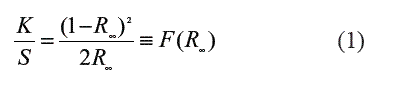
<body><![CDATA[<p> <font face="Verdana" size="2"><b><i>Synthesis of TiO<sub>2</sub> photocatalysts      </i></b></font></p>        <p> <font face="Verdana" size="2">  Two  methods were chosen to synthesize TiO<sub>2</sub> photocatalyst: sol-gel and  hydrothermal synthesis. TiO<sub>2</sub> (SG) was synthesized by the sol-gel route as follows: titanium  butoxide (Ti(O- But)<sub>4</sub>; 97% Aldrich) was added dropwise to  isopropanol (Isop-OH; Merck) in a molar ratio Isop-OH/Ti(O-But)<sub>4</sub> =  55. Then, HNO<sub>3</sub> (65%, Merck) was used as the hydrolysis catalyst, in  a molar ratio HNO<sub>3</sub>/Ti(O-But)<sub>4</sub> = 0.173. The amount of  water corresponds to a molar ratio H<sub>2</sub>O/Ti(O-But)<sub>4</sub> = 1.5.  The formed solution was stirred until gel formation. The gel was aged for 72 h,  and immediately dried at 70&deg;C for 4 h. The obtained solid was grounded in a  mortar, and the powder calcined at 400 &deg;C for 2 h in a muffle furnace.     <br>    <br> TiO<sub>2</sub> (HT) was  hydrothermally synthesized by hydrolysis of Ti(O-But)<sub>4</sub> in aqueous  media. In this case, the Ti(O-But)<sub>4</sub> was added dropwise to Isop- OH,  in a volume ratio Isop-OH/Ti(O-But)<sub>4</sub> = 62.5, or with variations from  10 to 62.5, described where needed. In addition, the alcohol was replaced by  ethanol and methanol, and also described where needed. Then, a specific volume  of water was adjusted to pH = 1.5 using HNO<sub>3</sub>. This solution was  dropwise added to the Ti(O-But)<sub>4</sub>-Isop-OH solution. The amount of  water corresponds to a volume ratio H<sub>2</sub>O/Ti(O-But)<sub>4</sub> = 1 or  with variations of 1 to 5 described where needed. The latter suspension was  hydrothermally treated with water steam in an autoclave at 120 &deg;C and 1980 KPa  during 1 h. Then, the remaining water was extracted by evaporation and  continuous stirring at 70 &deg;C. Finally, the obtained powders were grounded in a  mortar. TiO<sub>2</sub>-P25 (P25) from Evonik, previously known as Degussa, was  used for comparison purposes.  </font></p>      <p> <font face="Verdana" size="2"><b><i>Photocatalyst characterization</i></b></font></p>      <p><font face="Verdana" size="2">  To  analyze the phase structure of the photocatalysts, DRX patterns were collected  using a D-Max IIIB Rigaku system at room temperature from angles <i>2&theta;</i> of 2 to  70&deg;. The diffractometer was operated at 40 kV and 80 mA with a monochromatic Cu  K&alpha; radiation.     <br>    <br>  Specific  surface area was determined by the BET method and pore size by the BJH method  using a Nova 1300 equipment of Quantachrome.     <br>    <br>  UV-Vis diffuse reflectance  spectra (DRS) were recorded on a PerkinElmer 2034RD lambda 35 UV with an  integrating sphere P/NC 6951014 using BaSO<sub>4</sub> as a blank reference. The E<sub>g</sub> widths of the samples were determined using the  Kubelka-Munk phenomenological theory [11]. The DRS can be related to the  absorbance by the <i>K/S</i>  (where <i>K</i> = absorption and <i>S</i> scattering) ratio using the Kubelka-Munk relationship (<i>F</i>(<i>R<sub>&infin;</sub></i>) (Eq. 1), where the reflectance is noted as <i>R</i>. The reflectance is related to the absorption coefficient &alpha; and it is proportional to the absorbance <i>K</i>.</font></p>      ]]></body>
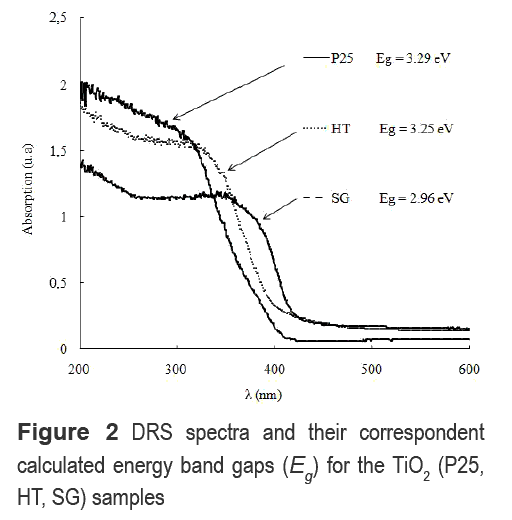
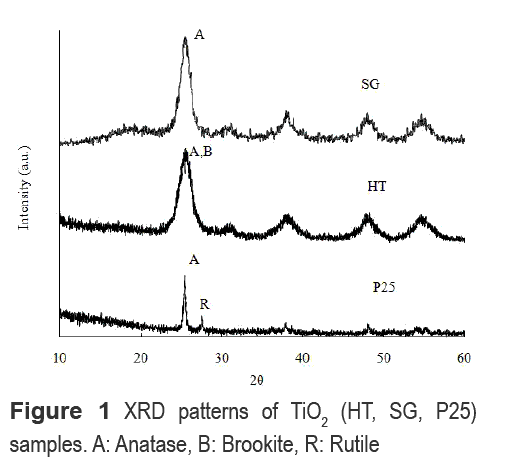
<body><![CDATA[<p> <img src="/img/revistas/rfiua/n57/n57a06e01.gif"></p>      <p><font face="Verdana" size="2">  Where <i>R<sub>&infin;</sub></i> is the ratio of the sample's  reflectance over that of the BaSO<sub>4</sub> reference. The intercept of the  major slope with the wavelength axis gives the value of the sample's E<sub>g</sub> if transformed to energy data  in eV.</font></p>      <p> <font face="Verdana" size="2"><b><i> Photocatalytic tests     </i></b></font></p>      <p> <font face="Verdana" size="2"> The  photocatalytic degradation of Or-II was carried out with a 20 ppm Or-II aqueous  solution with 0.25 g.L<sup>-1</sup> of photocatalyst in borosilicate glass  reactors of 50 mL of volume capacity. Phenol degradation was made using a 0.1  mmol.L<sup>-1</sup> solution and a TiO<sub>2</sub> suspension of 1 g.L<sup>-1</sup>.  This suspension was stirred 1 h under darkness prior to illumination. The  reactors were irradiated under three different illumination systems: (I) under  400 W.m<sup>-2</sup> of solar- simulated light using a Suntest system CPS+ from  ATLAS. This lamp has a spectral distribution with about 0.5% of emitted photons  at wavelengths shorter than 300 nm (UV-C range), and about 4% between 300 and  400 nm (UV-B and UV-A ranges). The distribution of the photons emitted between  400 and 800 nm follows the solar spectrum (II) under 38 W.m<sup>-2</sup> of  ultraviolet light using a set of 5 BLB Phillips lamps (TLD 18 W) with a spectrum  emission between 330 and 400 nm, or (III) under 60 W.m<sup>-2</sup> visible  light using a set of 5 Blue Phillips lamps (TLD 18 W) with emission wavelengths  between 400 and 500 nm. The radiant flux was monitored with a Kipp &amp; Zonen  (CM3) power meter (Omni instruments Ltd., Dundee, UK). Samples were taken every  15 min for 1 h and centrifuged at 3000 rpm for 15 min. The concentration of  Or-II in the supernatant was determined with a HP 8453 UV-Vis spectrophotometer  at the Or-II's maximum wavelength absorption of 486 nm. Phenol oxidation was  followed by sampling 1 mL every 15 min and filtrating with a 0.45 &mu;m pore  membrane. Phenol detection was made using a HPLC Hewlett- Packard series 1100  equipment with a reverse phase Spherisorb silica column (Macherey-Nageland) and  a diode array detector, usig a wavelenght of 220 nm. As mobile phase a mixture  of acetonitrile and water in a volume ratio of 60/40 was used. Blank  experiments were carried out to determine possible degradation by photolysis.  The total organic carbon (TOC) concentration was followed in a Shimadzu 500  system with autosampling. The reported data as X/X<sub>&omicron;</sub>, where X = C for  Or-II concentration in mg/L or X = TOC concentration  in mg/L, denotes the ratio of the concentration at any given time to the  initial concentration. The concentration reached after 1 h of stirring under  darkness was used as the initial value of the concentration (X<sub>&omicron;</sub>) in  the photodegradation analysis. </font></p>       <p><font face="Verdana" size="3"><b>Results and discussion</b> </font></p>        <p> <font face="Verdana" size="2"><b><i>Comparative synthesis routes of TiO<sub>2</sub></i></b></font></p>        <p> <font face="Verdana" size="2"> From  XRD analysis shown in <a href="#Figura1">figure 1</a> it is observed that the phase with major  presence in the obtained TiO<sub>2</sub> particles is anatase, which has a  characteristic peak at <i>2&theta;</i> = 25.2&deg;. In HT, the main peak of anatase overlaps with the diffraction  peaks of brookite phase at <i>2&theta;</i>= 25.34&deg; and 25.68&deg;, which is a characteristic when both  phases coexist in TiO<sub>2</sub> structure [12]. In SG, the anatase phase has  a high crystallinity. This high crystallinity of anatase phase is related to a  high photocatalytic activity of the TiO<sub>2</sub> [13]. </font></p>       <p align="center"><img src="/img/revistas/rfiua/n57/n57a06i01.gif" ><a name="Figura1"></a></p>      <p> <font face="Verdana" size="2">DRS  spectra of the TiO<sub>2</sub> samples and their correspondent energy band gaps (E<sub>g</sub>) obtained by the Kubelka-Munk  theory are shown in <a href="#Figura2">figure 2</a>. P25 shows the highest absorption in the UV region  of the spectrum (200-360 nm). Samples obtained by the sol-gel process exhibit  the lowest E<sub>g</sub>  while HT and P25 have similar values. </font></p>         <p align="center"><img src="/img/revistas/rfiua/n57/n57a06i02.gif" ><a name="Figura2"></a></p>      ]]></body>
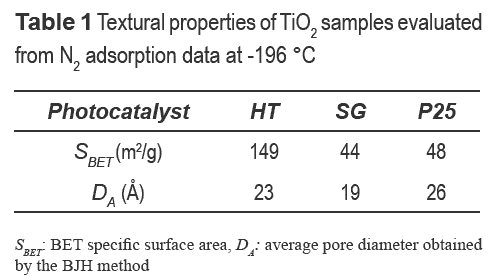
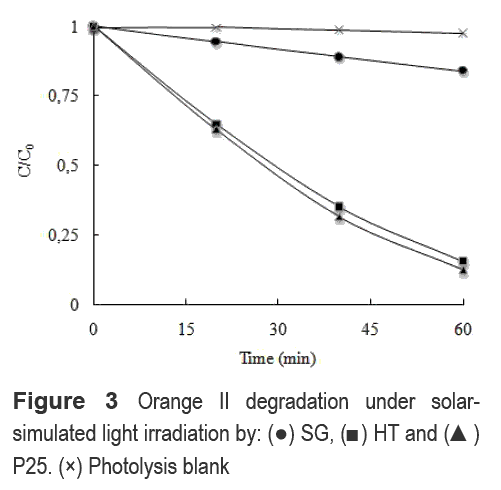
<body><![CDATA[<p> <font face="Verdana" size="2">Textural  properties, the specific surface area (S<sub>BET</sub>),  and average  pore diameter  (D<sub>A</sub>)  of photocatalysts are shown in <a href="#Tabla1">table 1</a>. Hydrothermal synthesis led to TiO<sub>2</sub>  particles (HT) with higher specific surface area and similar average pore  diameter than SG and P25. </font></p>      <p align="center"><img src="/img/revistas/rfiua/n57/n57a06t01.gif" ><a name="Tabla1"></a></p>      <p> <font face="Verdana" size="2">The  chosen sol-gel and the hydrothermal method led to the synthesis of TiO<sub>2</sub>  samples with different crystalline structures, specific surface areas and  different light absorption capacities. Thus, it is expected that the synthesis  method influence the photoactivity of TiO<sub>2</sub> since it alters  remarkably its physical and semiconductor features.</font></p>      <p> <font face="Verdana" size="2">  <a href="#Figura3">Figure 3</a> shows the photocatalytic degradation of Or-II by the TiO<sub>2</sub>  photocatalysts under solar- simulated light irradiation. The SG sample shows  the lowest performance in the photodegradation of Or-II despite of its high cristallinity.  No correlation between the crystallinity of phases in SG and its photoactivity  was found. </font></p>      <p align="center"><img src="/img/revistas/rfiua/n57/n57a06i03.gif" ><a name="Figura3"></a></p>      <p> <font face="Verdana" size="2">However,  it is possible to suggest that the coexistence of two phases in TiO<sub>2</sub>  may explain the higher activity of P25 and HT samples when compared to the  one of SG with anatase phase solely. The coexistence of TiO<sub>2</sub> phases  has been suggested to reduce the recombination of the e<sup>-</sup>- h<sup>+</sup>  pair [12, 14]. The anatase phase, with a E<sub>g</sub> of 3.2 eV, is known as  the most photoactive TiO<sub>2</sub> phase. Nevertheless, an anatase to rutile phase (E<sub>g</sub> of 3.0 eV) ratio of 3:1 of  the commercial TiO<sub>2</sub> P-25 shows the best photocatalytic activity  [14]. Such a difference in the E<sub>g</sub> of the anatase and rutile phases serves as an energy  gradient, which conducts the e<sup>-</sup> from rutile to anatase, thus, avoiding the  recombination. Similarly, a mixed phase TiO<sub>2</sub>, constituted of anatase  and brookite phases, has a higher performance towards the degradation of  2-chlorophenol than pure anatase TiO<sub>2</sub> [12]. Then, an increase in  photoactivity seems to be related to the coexistence of anatase and rutile [14] or brookite in TiO<sub>2</sub>  [15].</font></p>      <p> <font face="Verdana" size="2">Moreover,  the light absorption capacity of the SG sample (<a href="#Figura2">Figure 2</a>) suggests its activity  under visible light illumination. However, no significant activity was found  under visible light illumination with any of the samples.     <br>     <br> In  addition, the initial velocities of phenol degradation, that were determined  during the first 30 min. of reaction, by HT, P25 and SG are 3.3x10<sup>-3</sup>,  4.5x10<sup>-3</sup>, and 0.2x10<sup>-3</sup> &mu;mol.L<sup>-1</sup>. min<sup>-1</sup>,  respectively. These results support that the HT sample has a similar  photo-oxidation activity than the P25 sample; meanwhile, the SG sample  maintains its low performance. The difference in activity for HT and P25  samples may be due to different oxidation pathways for Or-II and phenol. Or-II  may be oxidized by HT due to a surface-hole-mode oxidation as we have already  proposed [16]. Phenol, in contrast, is oxidized in the homogenous phase by  action of <sup>&bull;</sup>OH radicals due to its low adsorption on the P25's  surface as proposed by Sobczynski <i>et al</i> [17].     <br>     ]]></body>
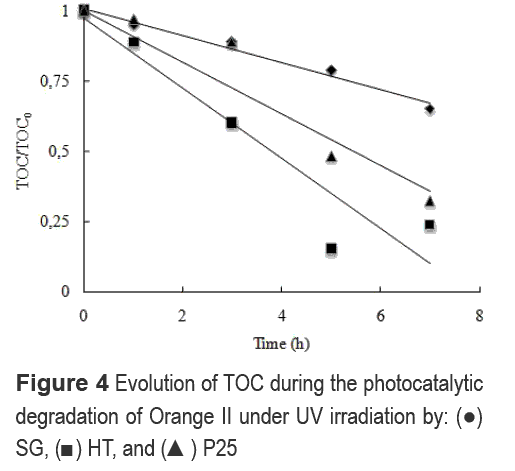
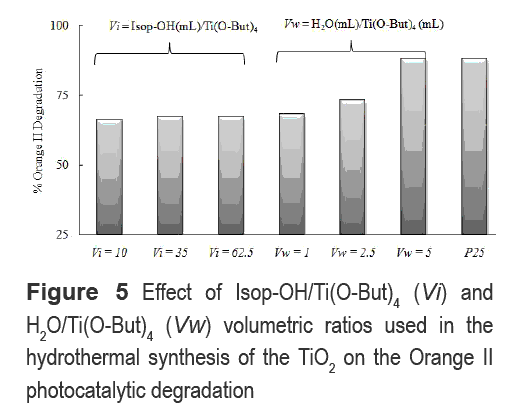
<body><![CDATA[<br> <a href="#Figura4">Figure 4</a> shows the evolution of the TOC concentration during the photodegradation of  Or-II under UV irradiation. Results evidence again the poor photoactivity of  the SG sample. This implies that there is no correlation between the light  absorption capacity and the activity under visible light irradiation for SG. It  is possible to suggest the reduced activity of the SG sample is due to the  removal of adsorbed species such as <sup>-</sup>OH, which is possibly due to  the uncontrolled conditions during the drying and calcinations steps of the  synthesis. Hart <i>et al</i> [18] suggested that the increase in the drying temperature  reduces the presence of adsorbed species such as <sup>-</sup>OH, which indeed can inhibit  the recombination by trapping the h<sup>+</sup>, and thus, forming the <sup>&bull;</sup>OH  radical. Hence, during the synthesis procedure, we may have reduced the surface  reactivity by promoting the desorption of <sup>-</sup>OH, and thus, decreased the  photoactivity of the SG sample. </font></p>      <p align="center"><img src="/img/revistas/rfiua/n57/n57a06i04.gif" ><a name="Figura4"></a></p>      <p> <font face="Verdana" size="2">As  seen in <a href="#Figura4">Figure 4</a> under UV irradiation the overall mineralization caused in the  system by HT is higher than P25 even with a similar reduced concentration of  Or-II followed by absorption at 486 nm (<a href="#Figura3">Fig. 3</a>). This implies a higher  oxidation potential of the HT sample which is possibly due to the higher  surface area of HT particles that may promote a higher adsorption of Or-II, and  thus, the possibility for the molecule to be oxidized is increased.     <br>     <br> Once  evidenced that the hydrothermal synthesis produces photoactive particles, the  effect of hydrothermal synthesis variables such as water/ alcoxide and  alcohol/alcoxide ratios and the alcohol type used as cosolvent for the  hydrolysis of the Ti precursor were analyzed towards the Or- II photocatalytic  degradation.</font></p>        <p> <font face="Verdana" size="2"><b><i> Effect of the TiO<sub>2</sub> liquid phase synthesis variables on its photocatalytic activity     </i></b></font></p>     <p> <font face="Verdana" size="2">  <a href="#Figura5">Figure 5</a> shows the photocatalytic degradation of Or-II using TiO<sub>2</sub> samples  synthesized by the hydrothermal method using different volumetric ratios of  Isop-OH/Ti(O-But)<sub>4</sub> (V<i>i</i>) and H<sub>2</sub>O/ Ti(O- But)<sub>4</sub>  (V<i>w</i>). </font></p>      <p align="center"><img src="/img/revistas/rfiua/n57/n57a06i05.gif" ><a name="Figura5"></a></p>      <p> <font face="Verdana" size="2">The  variation of the alcohol amount used in the hydrothermal synthesis analyzed  here  (V<i>i</i> = 10-62.5)  did not cause a relevant change on the photocatalytic activity of the HT  sample. On the contrary, Xu <i>et al</i> [8] reported that the increase in the alcohol  concentration during the synthesis reduces the photoactivity due to an  increased amount of amorphous in the TiO<sub>2</sub> structure. Nevertheless,  the increase in the V<sub>H<sub>2</sub>O</sub>, as shown in <a href="#Figura4">figure 4</a>, increases the photoactivity.  Possibly the decrease of Isop-OH concentration, caused by the increase in the  quantity of water, may reduce the negative effect over the hydrolysis reaction  due to the presence of Isop-OH [8]. Therefore, particles with a high  crystallinity are produced, which are expected to have a better photoactivity  than amorphous particles.     <br>    ]]></body>
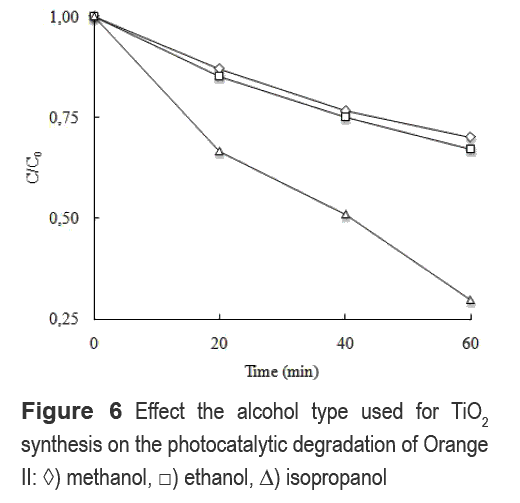
<body><![CDATA[<br> On  the other hand, the effect of the alcohol type used during the hydrothermal  synthesis is shown in <a href="#Figura6">figure 6</a>. The X-ray difractrograms of the samples (not  shown here) are very similar to the HT sample (<a href="#Figura1">Fig. 1</a>) and thus they are  expected to have the same crystallite sizes. However, the photocatalytic  activity is different.    </font></p>      <p align="center"><img src="/img/revistas/rfiua/n57/n57a06i06.gif" ><a name="Figura6"></a></p>      <p> <font face="Verdana" size="2">Possibly,  the reduction of photoactivity caused by the use of short linear chain  alcohols, such as, methanol and ethanol may be due to the tendency of these to  form hydrogen bonds with the surface hydroxyl groups reducing the amount of  oxidation sites on the TiO<sub>2</sub> surface [19]. Moreover, the exchange of  radicals between the Ti alcoxide and the alcohol may be affected by the use of  linear alcohols such as methanol and ethanol, or branched type alcohols such as  isopropanol. Therefore, the use of isopropanol may promote the formation of a  more defective particle than linear alcohols [7], and thus, the surface area  available for photon adsorption by TiO<sub>2</sub> is expected to increase,  promoting the possibility to separate the electron and hole on the surface of  the photocatalyst. The S<sub>BET</sub> for the HT synthesized samples with methanol, ethanol and  isopropanol are 84, 95 and 160 m<sup>2</sup>/g respectively. These results  confirm that the use of branched alcohols increase the specific surface area  during the hydrothermal synthesis of TiO<sub>2</sub>.</font></p>       <p><font face="Verdana" size="3"><b>Conclusions      </b> </font></p>      <p> <font face="Verdana" size="2">Crystalline  TiO<sub>2</sub> powders with major presence of anatase phase in their structure  were synthesized by the sol-gel and hydrothermal synthesis methods using steam  pressure. The synthesis route influence the activity of the TiO<sub>2</sub>,  possibly by the different physical features given to synthesized samples by the  different synthesis conditions. The hydrothermal synthesis route led to TiO<sub>2</sub>  particles with a higher light absorption capacity on the UV region, a higher  specific surface area and a better Or-II photo- oxidation activity under UV and  solar-simulated light irradiation than the sample synthesized by the sol-gel  route. In contrast, the photocatalytic degradation of phenol revealed  differences in photoactivity of the samples, which are possibly due to  different oxidation modes promoted on the TiO<sub>2</sub>'s surface obtained by  the hydrothermal synthesis, or in the homogeneous phase by <sup>&bull;</sup>OH radicals produced by the commercial TiO<sub>2</sub> P25.     <br>    <br> The  water/alcoxide ratio and alcohol type used for the synthesis have a marked  effect on the photoactivity of the HT sample, while the alcohol/alcoxide ratio  does not have a significant effect on the Or-II degradation photoactivity. The  photoactivity increase due to the increase of the water/alcoxide ratio is  possibly due to alcohol dilution, which diminishes its negative effect towards  the hydrolysis of the alcoxide. Moreover, the use of branched type alcohols,  such as, isopropanol increases the activity of the photocatalyst, possibly due  to the increase in the available area for UV light absorption.</font></p>       <p><font face="Verdana" size="3"><b>Acknowledgments      </b> </font></p>     <p> <font face="Verdana" size="2">This  work was financially supported by COLCIENCIAS and SENA (Project code: 1102341-19419).  Financial support by the named government entities and UIS for the PhD study of  Camilo Castro is gratefully acknowledged. Special acknowledgements to:  Institute of Chemical Sciences and Engineering of the EPFL, Switzerland, for  the HPLC and TOC analysis. </font></p>       <p><font face="Verdana" size="3"><b>References      </b> </font></p>      ]]></body>
<body><![CDATA[<!-- ref --><p> <font face="Verdana" size="2">1. O. Carp, C. L. Huisman, A. Reller. &quot;Photoinduced  reactivity of titanium dioxide&quot;.<i> Prog. Solid State  Chem.</i>  Vol. 32. 2004. pp. 33-177.     &nbsp;&nbsp;&nbsp;&nbsp;&nbsp;&nbsp;&nbsp;&nbsp;[&#160;<a href="javascript:void(0);" onclick="javascript: window.open('/scielo.php?script=sci_nlinks&ref=000073&pid=S0120-6230201100010000600001&lng=','','width=640,height=500,resizable=yes,scrollbars=1,menubar=yes,');">Links</a>&#160;]<!-- end-ref --><br>    <!-- ref --><br> 2. J. M. Herrman.  &quot;Heterogeneous photocatalysis: fundamentals and applications to the  removal of various types of aqueous pollutants&quot;. <i>Catal. Today.</i> Vol. 53. 1999. pp. 115-129.     &nbsp;&nbsp;&nbsp;&nbsp;&nbsp;&nbsp;&nbsp;&nbsp;[&#160;<a href="javascript:void(0);" onclick="javascript: window.open('/scielo.php?script=sci_nlinks&ref=000075&pid=S0120-6230201100010000600002&lng=','','width=640,height=500,resizable=yes,scrollbars=1,menubar=yes,');">Links</a>&#160;]<!-- end-ref --><br>    <!-- ref --><br> 3. D. Gumy, C. Morais, P.  Bowen, C. Pulgar&iacute;n, S. Giraldo, R. Hajdu, J. Kiwi. &quot;Catalytic activity of  commercial TiO<sub>2</sub> powders for the abatement of the bacteria <i>(E. coli)</i> under solar simulated light:  Influence of the isoelectric point&quot;.<i> Appl. Catal. B.</i> Vol. 63. 2006. pp. 76-84.     &nbsp;&nbsp;&nbsp;&nbsp;&nbsp;&nbsp;&nbsp;&nbsp;[&#160;<a href="javascript:void(0);" onclick="javascript: window.open('/scielo.php?script=sci_nlinks&ref=000077&pid=S0120-6230201100010000600003&lng=','','width=640,height=500,resizable=yes,scrollbars=1,menubar=yes,');">Links</a>&#160;]<!-- end-ref --><br>    <!-- ref --><br> 4. J. Blanco Galvez, P.  Fern&aacute;ndez Ib&aacute;&ntilde;ez, S. Malato Rodr&iacute;guez. &quot;Solar Photocatalytic  Detoxification and Disinfection of Water: Recent Overview&quot;. <i>J. Sol. Energy  Eng.</i>  Vol. 129. 2007. pp. 4-15.     &nbsp;&nbsp;&nbsp;&nbsp;&nbsp;&nbsp;&nbsp;&nbsp;[&#160;<a href="javascript:void(0);" onclick="javascript: window.open('/scielo.php?script=sci_nlinks&ref=000079&pid=S0120-6230201100010000600004&lng=','','width=640,height=500,resizable=yes,scrollbars=1,menubar=yes,');">Links</a>&#160;]<!-- end-ref --><br>    <!-- ref --><br> 5. C. Castro, A.  Ar&aacute;mbula, A. Centeno, S. A. Giraldo. &quot;Degradaci&oacute;n  Heliofotocatal&iacute;tica de <i>Escherichia coli</i> en sistemas  tipo Desinfecci&oacute;n SODIS, con Di&oacute;xido de Titanio modificado&quot;.<i> Inf. Tecnol.</i> Vol. 20. 2009. pp. 29-36.     &nbsp;&nbsp;&nbsp;&nbsp;&nbsp;&nbsp;&nbsp;&nbsp;[&#160;<a href="javascript:void(0);" onclick="javascript: window.open('/scielo.php?script=sci_nlinks&ref=000081&pid=S0120-6230201100010000600005&lng=','','width=640,height=500,resizable=yes,scrollbars=1,menubar=yes,');">Links</a>&#160;]<!-- end-ref --><br>    ]]></body>
<body><![CDATA[<!-- ref --><br> 6. L. Zan, W. Fa, T. Peng, Z.  Gong. &quot;Photocatalysis effect of nanometer TiO<sub>2</sub> and TiO<sub>2</sub>-coated  ceramic plate on Hepatitis B&quot;. <i>J. Photochem.  Photobiol. B. </i>Vol. 86. 2007. pp. 165-169.     &nbsp;&nbsp;&nbsp;&nbsp;&nbsp;&nbsp;&nbsp;&nbsp;[&#160;<a href="javascript:void(0);" onclick="javascript: window.open('/scielo.php?script=sci_nlinks&ref=000083&pid=S0120-6230201100010000600006&lng=','','width=640,height=500,resizable=yes,scrollbars=1,menubar=yes,');">Links</a>&#160;]<!-- end-ref --><br>    <!-- ref --><br> 7. I. A. Montoya, T. Viveros,  J. M. Dominguez, L. A. Canales, I. Schifter. &quot;On the effects of the sol-gel synthesis parameters on  textural and structural properties of TiO<sub>2</sub>&quot;. <i>Catal. Lett.</i> Vol. 15. 1992. pp. 207-217.     &nbsp;&nbsp;&nbsp;&nbsp;&nbsp;&nbsp;&nbsp;&nbsp;[&#160;<a href="javascript:void(0);" onclick="javascript: window.open('/scielo.php?script=sci_nlinks&ref=000085&pid=S0120-6230201100010000600007&lng=','','width=640,height=500,resizable=yes,scrollbars=1,menubar=yes,');">Links</a>&#160;]<!-- end-ref --><br>    <!-- ref --><br> 8. S. Y. Xu, W. Zheng, W. Liu.  &quot;Enhanced photocatalytic activity of supported TiO<sub>2</sub>: dispersing  effect of SiO<sub>2</sub>&quot;. <i>J. Photochem.  Photobiol. A.</i>  Vol. 122. 1999. pp. 57-60.     &nbsp;&nbsp;&nbsp;&nbsp;&nbsp;&nbsp;&nbsp;&nbsp;[&#160;<a href="javascript:void(0);" onclick="javascript: window.open('/scielo.php?script=sci_nlinks&ref=000087&pid=S0120-6230201100010000600008&lng=','','width=640,height=500,resizable=yes,scrollbars=1,menubar=yes,');">Links</a>&#160;]<!-- end-ref --><br>    <!-- ref --><br> 9. R. Anliker.  &quot;Ecotoxicology of dyestuffs - a joint effort by industry&quot;.<i> J. Ecotox.  Environ. Saf.</i>  Vol. 3. 1979.  pp. 59-74.     &nbsp;&nbsp;&nbsp;&nbsp;&nbsp;&nbsp;&nbsp;&nbsp;[&#160;<a href="javascript:void(0);" onclick="javascript: window.open('/scielo.php?script=sci_nlinks&ref=000089&pid=S0120-6230201100010000600009&lng=','','width=640,height=500,resizable=yes,scrollbars=1,menubar=yes,');">Links</a>&#160;]<!-- end-ref --><br>    <!-- ref --><br> 10. M. R. Hoffman, S. T.  Martin, W. Choi, D. W. Bahnemann. &quot;Environmental applications of  semiconductor photocatalysis&quot;.<i> Chem. Rev.</i> Vol. 95. 1995. pp. 69-96.     &nbsp;&nbsp;&nbsp;&nbsp;&nbsp;&nbsp;&nbsp;&nbsp;[&#160;<a href="javascript:void(0);" onclick="javascript: window.open('/scielo.php?script=sci_nlinks&ref=000091&pid=S0120-6230201100010000600010&lng=','','width=640,height=500,resizable=yes,scrollbars=1,menubar=yes,');">Links</a>&#160;]<!-- end-ref --><br>    ]]></body>
<body><![CDATA[<!-- ref --><br> 11. P. Kubelka, F. Munk. &quot;Ein  Beitrag zur Optik der Farbanstriche&quot;.<i> Z. Tech. Phys.</i> Vol. 12. 1931. pp. 593-601.     &nbsp;&nbsp;&nbsp;&nbsp;&nbsp;&nbsp;&nbsp;&nbsp;[&#160;<a href="javascript:void(0);" onclick="javascript: window.open('/scielo.php?script=sci_nlinks&ref=000093&pid=S0120-6230201100010000600011&lng=','','width=640,height=500,resizable=yes,scrollbars=1,menubar=yes,');">Links</a>&#160;]<!-- end-ref --><br>    <!-- ref --><br> 12. S.  Ardizzone, C. Bianchi, G. Cappelletti, S. Gialanella, C. Pirola, V. Ragaini.  &quot;Tailored Anatase/Brookite Nanocrsytalline TiO<sub>2</sub>. The optimal  Particle Features  for Liquid and Gas-Phase Photocatalytic Reactions&quot;.<i> J.  Phys. Chem. C.</i> Vol. 111. 2007. pp. 13222-13231.     &nbsp;&nbsp;&nbsp;&nbsp;&nbsp;&nbsp;&nbsp;&nbsp;[&#160;<a href="javascript:void(0);" onclick="javascript: window.open('/scielo.php?script=sci_nlinks&ref=000095&pid=S0120-6230201100010000600012&lng=','','width=640,height=500,resizable=yes,scrollbars=1,menubar=yes,');">Links</a>&#160;]<!-- end-ref --><br>    <!-- ref --><br> 13. K. Y.  Jung, S. B. Park. &quot;Anatase-phase titania: preparation by embedding silica  and photocatalytic activity for the decomposition of trichloroethylene&quot;.<i> J.  Photochem. Photobiol. A.</i> Vol. 127. 1999. pp. 117-122.     &nbsp;&nbsp;&nbsp;&nbsp;&nbsp;&nbsp;&nbsp;&nbsp;[&#160;<a href="javascript:void(0);" onclick="javascript: window.open('/scielo.php?script=sci_nlinks&ref=000097&pid=S0120-6230201100010000600013&lng=','','width=640,height=500,resizable=yes,scrollbars=1,menubar=yes,');">Links</a>&#160;]<!-- end-ref --><br>    <!-- ref --><br> 14. D. C. Hurum, A. G. Agrios,  K. A. Gray, T. Rajh, M. C. Thurnauer. &quot;Explaining the enhanced  photocatalytic activity of Degussa P-25 mixed phase oxide TiO<sub>2</sub> using  EPR&quot;. <i>J. Phys. Chem.</i> Vol. 107.  2003. pp.  4545-4549.     &nbsp;&nbsp;&nbsp;&nbsp;&nbsp;&nbsp;&nbsp;&nbsp;[&#160;<a href="javascript:void(0);" onclick="javascript: window.open('/scielo.php?script=sci_nlinks&ref=000099&pid=S0120-6230201100010000600014&lng=','','width=640,height=500,resizable=yes,scrollbars=1,menubar=yes,');">Links</a>&#160;]<!-- end-ref --><br>    <!-- ref --><br> 15. A. Di  Paola, G. Cufalo, M. Addamo, M. Bellardita, R. Campostrini, M. Ischia, R. Ceccato,  L. Palmisano. &quot;Photocatalytic activity of nanocrystalline TiO<sub>2</sub> (brookite,  rutile, and brookite-based) powders prepared by thermohydrolysis of TiCl<sub>4</sub>  in aqueous chloride  solutions&quot;.<i> Colloids Surf. A: Physicochem. Eng. Aspects.</i> Vol. 317. 200S. pp. 366-376.     &nbsp;&nbsp;&nbsp;&nbsp;&nbsp;&nbsp;&nbsp;&nbsp;[&#160;<a href="javascript:void(0);" onclick="javascript: window.open('/scielo.php?script=sci_nlinks&ref=000101&pid=S0120-6230201100010000600015&lng=','','width=640,height=500,resizable=yes,scrollbars=1,menubar=yes,');">Links</a>&#160;]<!-- end-ref --><br>    ]]></body>
<body><![CDATA[<!-- ref --><br> 16. C. A. Castro-L&oacute;pez. A. Centeno, S. A.  Giraldo. &quot;Fe-modified TiO<sub>2</sub> photocatalyst for the oxidative  degradation of recalcitrant water contaminants&quot;.<i> Catal.  Today.</i> Vol. 157. 2010. pp. 119-124.     &nbsp;&nbsp;&nbsp;&nbsp;&nbsp;&nbsp;&nbsp;&nbsp;[&#160;<a href="javascript:void(0);" onclick="javascript: window.open('/scielo.php?script=sci_nlinks&ref=000103&pid=S0120-6230201100010000600016&lng=','','width=640,height=500,resizable=yes,scrollbars=1,menubar=yes,');">Links</a>&#160;]<!-- end-ref --><br>    <!-- ref --><br> 17. A.  Sobczynski, L. Duczman, W. Zmudzinsky. &quot;Phenol destruction by photocatalysis  on TiO<sub>2</sub>: an attempt to solve the reaction mechanism&quot;.<i> J.  Mol. Catal. A.</i> Vol. 213. 2004. pp. 225-230.     &nbsp;&nbsp;&nbsp;&nbsp;&nbsp;&nbsp;&nbsp;&nbsp;[&#160;<a href="javascript:void(0);" onclick="javascript: window.open('/scielo.php?script=sci_nlinks&ref=000105&pid=S0120-6230201100010000600017&lng=','','width=640,height=500,resizable=yes,scrollbars=1,menubar=yes,');">Links</a>&#160;]<!-- end-ref --><br>    <!-- ref --><br> 18. J. N.  Hart, L. Bourgeois, R. Cervini, Y. B. Cheng, G. P. Simon, L. Spiccia. &quot;Low  temperature crystallization behavior of TiO<sub>2</sub> derived from a sol-gel  process&quot;. <i>J. Sol-Gel Sci. Techn.</i> Vol. 42. 2007. pp. 107-117.     &nbsp;&nbsp;&nbsp;&nbsp;&nbsp;&nbsp;&nbsp;&nbsp;[&#160;<a href="javascript:void(0);" onclick="javascript: window.open('/scielo.php?script=sci_nlinks&ref=000107&pid=S0120-6230201100010000600018&lng=','','width=640,height=500,resizable=yes,scrollbars=1,menubar=yes,');">Links</a>&#160;]<!-- end-ref --><br>    <!-- ref --><br> 19. E.  Alonso, I.  Montequi, M. J. Cocero. &quot;Effect of synthesis conditions on photocatalytic  activity of TiO<sub>2</sub> powders synthesized in supercritical CO<sub>2</sub>&quot;.<i> J. Supercritic.  Fluids.</i> Vol. 49. 2009. pp. 233-238.   </font>&nbsp;&nbsp;&nbsp;&nbsp;&nbsp;&nbsp;&nbsp;&nbsp;[&#160;<a href="javascript:void(0);" onclick="javascript: window.open('/scielo.php?script=sci_nlinks&ref=000109&pid=S0120-6230201100010000600019&lng=','','width=640,height=500,resizable=yes,scrollbars=1,menubar=yes,');">Links</a>&#160;]<!-- end-ref --><br>    <br>    <br>    ]]></body>
<body><![CDATA[<br>       <p><font face="Verdana" size="2">(Recibido el 03 de febrero de 2010. Aceptado el 15 de octubre de 2010)</font></p>     <p><font face="Verdana" size="2"><sup>*</sup>Autor de correspondencia: tel&eacute;fono: + 57 + 7 + 634 47 46, fax: + 57 + 7 + 645 96 47, correo electr&oacute;nico:   <a href="mailto:sgiraldo@uis.edu.co">sgiraldo@uis.edu.co</a> (Sonia. A. Giraldo)</font></p>      ]]></body><back>
<ref-list>
<ref id="B1">
<label>1</label><nlm-citation citation-type="journal">
<person-group person-group-type="author">
<name>
<surname><![CDATA[Carp]]></surname>
<given-names><![CDATA[O]]></given-names>
</name>
<name>
<surname><![CDATA[Huisman]]></surname>
<given-names><![CDATA[C. L]]></given-names>
</name>
<name>
<surname><![CDATA[Reller]]></surname>
<given-names><![CDATA[A]]></given-names>
</name>
</person-group>
<article-title xml:lang="en"><![CDATA[Photoinduced reactivity of titanium dioxide]]></article-title>
<source><![CDATA[Prog. Solid State Chem]]></source>
<year>2004</year>
<volume>32</volume>
<page-range>33-177</page-range></nlm-citation>
</ref>
<ref id="B2">
<label>2</label><nlm-citation citation-type="journal">
<person-group person-group-type="author">
<name>
<surname><![CDATA[Herrman]]></surname>
<given-names><![CDATA[J. M]]></given-names>
</name>
</person-group>
<article-title xml:lang="en"><![CDATA[Heterogeneous photocatalysis: fundamentals and applications to the removal of various types of aqueous pollutants]]></article-title>
<source><![CDATA[Catal. Today]]></source>
<year>1999</year>
<volume>53</volume>
<page-range>115-129</page-range></nlm-citation>
</ref>
<ref id="B3">
<label>3</label><nlm-citation citation-type="journal">
<person-group person-group-type="author">
<name>
<surname><![CDATA[Gumy]]></surname>
<given-names><![CDATA[D]]></given-names>
</name>
<name>
<surname><![CDATA[Morais]]></surname>
<given-names><![CDATA[C]]></given-names>
</name>
<name>
<surname><![CDATA[Bowen]]></surname>
<given-names><![CDATA[P]]></given-names>
</name>
<name>
<surname><![CDATA[Pulgarín]]></surname>
<given-names><![CDATA[C]]></given-names>
</name>
<name>
<surname><![CDATA[Kiwi]]></surname>
<given-names><![CDATA[J]]></given-names>
</name>
</person-group>
<article-title xml:lang="en"><![CDATA[Catalytic activity of commercial TiO2 powders for the abatement of the bacteria (E. coli) under solar simulated light: Influence of the isoelectric point]]></article-title>
<source><![CDATA[Appl. Catal. B]]></source>
<year>2006</year>
<volume>63</volume>
<page-range>76-84</page-range></nlm-citation>
</ref>
<ref id="B4">
<label>4</label><nlm-citation citation-type="journal">
<person-group person-group-type="author">
<name>
<surname><![CDATA[Blanco Galvez]]></surname>
<given-names><![CDATA[J]]></given-names>
</name>
<name>
<surname><![CDATA[Fernández Ibáñez]]></surname>
<given-names><![CDATA[P]]></given-names>
</name>
<name>
<surname><![CDATA[Malato Rodríguez]]></surname>
<given-names><![CDATA[S]]></given-names>
</name>
</person-group>
<article-title xml:lang="en"><![CDATA[Solar Photocatalytic Detoxification and Disinfection of Water: Recent Overview]]></article-title>
<source><![CDATA[J. Sol. Energy Eng]]></source>
<year>2007</year>
<volume>129</volume>
<page-range>4-15</page-range></nlm-citation>
</ref>
<ref id="B5">
<label>5</label><nlm-citation citation-type="journal">
<person-group person-group-type="author">
<name>
<surname><![CDATA[Castro]]></surname>
<given-names><![CDATA[C]]></given-names>
</name>
<name>
<surname><![CDATA[Arámbula]]></surname>
<given-names><![CDATA[A]]></given-names>
</name>
<name>
<surname><![CDATA[Centeno]]></surname>
<given-names><![CDATA[A]]></given-names>
</name>
<name>
<surname><![CDATA[Giraldo]]></surname>
<given-names><![CDATA[S. A]]></given-names>
</name>
</person-group>
<article-title xml:lang="en"><![CDATA[Degradación Heliofotocatalítica de Escherichia coli en sistemas tipo Desinfección SODIS, con Dióxido de Titanio modificado]]></article-title>
<source><![CDATA[Inf. Tecnol]]></source>
<year>2009</year>
<volume>20</volume>
<page-range>29-36</page-range></nlm-citation>
</ref>
<ref id="B6">
<label>6</label><nlm-citation citation-type="journal">
<person-group person-group-type="author">
<name>
<surname><![CDATA[Zan]]></surname>
<given-names><![CDATA[L]]></given-names>
</name>
<name>
<surname><![CDATA[Fa]]></surname>
<given-names><![CDATA[W]]></given-names>
</name>
<name>
<surname><![CDATA[Peng]]></surname>
<given-names><![CDATA[T]]></given-names>
</name>
<name>
<surname><![CDATA[Gong]]></surname>
<given-names><![CDATA[Z]]></given-names>
</name>
</person-group>
<article-title xml:lang="en"><![CDATA[Photocatalysis effect of nanometer TiO2 and TiO2-coated ceramic plate on Hepatitis B]]></article-title>
<source><![CDATA[J. Photochem. Photobiol. B]]></source>
<year>2007</year>
<volume>86</volume>
<page-range>165-169</page-range></nlm-citation>
</ref>
<ref id="B7">
<label>7</label><nlm-citation citation-type="journal">
<person-group person-group-type="author">
<name>
<surname><![CDATA[Montoya]]></surname>
<given-names><![CDATA[I. A]]></given-names>
</name>
<name>
<surname><![CDATA[Viveros]]></surname>
<given-names><![CDATA[T]]></given-names>
</name>
<name>
<surname><![CDATA[Dominguez]]></surname>
<given-names><![CDATA[J. M]]></given-names>
</name>
<name>
<surname><![CDATA[Canales]]></surname>
<given-names><![CDATA[L. A]]></given-names>
</name>
<name>
<surname><![CDATA[Schifter]]></surname>
<given-names><![CDATA[I]]></given-names>
</name>
</person-group>
<article-title xml:lang="en"><![CDATA[On the effects of the sol-gel synthesis parameters on textural and structural properties of TiO2]]></article-title>
<source><![CDATA[Catal. Lett]]></source>
<year>1992</year>
<volume>15</volume>
<page-range>207-217</page-range></nlm-citation>
</ref>
<ref id="B8">
<label>8</label><nlm-citation citation-type="journal">
<person-group person-group-type="author">
<name>
<surname><![CDATA[Xu]]></surname>
<given-names><![CDATA[S. Y]]></given-names>
</name>
<name>
<surname><![CDATA[Zheng]]></surname>
<given-names><![CDATA[W]]></given-names>
</name>
<name>
<surname><![CDATA[Liu]]></surname>
<given-names><![CDATA[W]]></given-names>
</name>
</person-group>
<article-title xml:lang="en"><![CDATA[Enhanced photocatalytic activity of supported TiO2: dispersing effect of SiO2]]></article-title>
<source><![CDATA[J. Photochem. Photobiol. A]]></source>
<year>1999</year>
<volume>122</volume>
<page-range>57-60</page-range></nlm-citation>
</ref>
<ref id="B9">
<label>9</label><nlm-citation citation-type="journal">
<person-group person-group-type="author">
<name>
<surname><![CDATA[Anliker]]></surname>
<given-names><![CDATA[R]]></given-names>
</name>
</person-group>
<article-title xml:lang="en"><![CDATA[Ecotoxicology of dyestuffs - a joint effort by industry]]></article-title>
<source><![CDATA[J. Ecotox. Environ. Saf]]></source>
<year>1979</year>
<volume>3</volume>
<page-range>59-74</page-range></nlm-citation>
</ref>
<ref id="B10">
<label>10</label><nlm-citation citation-type="journal">
<person-group person-group-type="author">
<name>
<surname><![CDATA[Hoffman]]></surname>
<given-names><![CDATA[M. R]]></given-names>
</name>
<name>
<surname><![CDATA[Martin]]></surname>
<given-names><![CDATA[S. T]]></given-names>
</name>
<name>
<surname><![CDATA[Choi]]></surname>
<given-names><![CDATA[W]]></given-names>
</name>
<name>
<surname><![CDATA[Bahnemann]]></surname>
<given-names><![CDATA[D. W]]></given-names>
</name>
</person-group>
<article-title xml:lang="en"><![CDATA[Environmental applications of semiconductor photocatalysis]]></article-title>
<source><![CDATA[Chem. Rev]]></source>
<year>1995</year>
<volume>95</volume>
<page-range>69-96</page-range></nlm-citation>
</ref>
<ref id="B11">
<label>11</label><nlm-citation citation-type="journal">
<person-group person-group-type="author">
<name>
<surname><![CDATA[Kubelka]]></surname>
<given-names><![CDATA[P]]></given-names>
</name>
<name>
<surname><![CDATA[Munk]]></surname>
<given-names><![CDATA[F]]></given-names>
</name>
</person-group>
<article-title xml:lang="en"><![CDATA[Ein Beitrag zur Optik der Farbanstriche]]></article-title>
<source><![CDATA[Z. Tech. Phys]]></source>
<year>1931</year>
<volume>12</volume>
<page-range>593-601</page-range></nlm-citation>
</ref>
<ref id="B12">
<label>12</label><nlm-citation citation-type="journal">
<person-group person-group-type="author">
<name>
<surname><![CDATA[Ardizzone]]></surname>
<given-names><![CDATA[S]]></given-names>
</name>
<name>
<surname><![CDATA[Bianchi]]></surname>
<given-names><![CDATA[C]]></given-names>
</name>
<name>
<surname><![CDATA[Cappelletti]]></surname>
<given-names><![CDATA[G]]></given-names>
</name>
<name>
<surname><![CDATA[Gialanella]]></surname>
<given-names><![CDATA[S]]></given-names>
</name>
<name>
<surname><![CDATA[Pirola]]></surname>
<given-names><![CDATA[C]]></given-names>
</name>
<name>
<surname><![CDATA[Ragaini]]></surname>
<given-names><![CDATA[V]]></given-names>
</name>
</person-group>
<article-title xml:lang="en"><![CDATA[Tailored Anatase/Brookite Nanocrsytalline TiO2. The optimal Particle Features for Liquid and Gas-Phase Photocatalytic Reactions]]></article-title>
<source><![CDATA[J. Phys. Chem. C]]></source>
<year>2007</year>
<volume>111</volume>
<page-range>13222-13231</page-range></nlm-citation>
</ref>
<ref id="B13">
<label>13</label><nlm-citation citation-type="journal">
<person-group person-group-type="author">
<name>
<surname><![CDATA[Jung]]></surname>
<given-names><![CDATA[K. Y]]></given-names>
</name>
<name>
<surname><![CDATA[Park]]></surname>
<given-names><![CDATA[S. B]]></given-names>
</name>
</person-group>
<article-title xml:lang="en"><![CDATA[Anatase-phase titania: preparation by embedding silica and photocatalytic activity for the decomposition of trichloroethylene]]></article-title>
<source><![CDATA[J. Photochem. Photobiol. A]]></source>
<year>1999</year>
<volume>127</volume>
<page-range>117-122</page-range></nlm-citation>
</ref>
<ref id="B14">
<label>14</label><nlm-citation citation-type="journal">
<person-group person-group-type="author">
<name>
<surname><![CDATA[Hurum]]></surname>
<given-names><![CDATA[D. C]]></given-names>
</name>
<name>
<surname><![CDATA[Agrios]]></surname>
<given-names><![CDATA[A. G]]></given-names>
</name>
<name>
<surname><![CDATA[Gray]]></surname>
<given-names><![CDATA[K. A]]></given-names>
</name>
<name>
<surname><![CDATA[Rajh]]></surname>
<given-names><![CDATA[T]]></given-names>
</name>
</person-group>
<article-title xml:lang="en"><![CDATA[Explaining the enhanced photocatalytic activity of Degussa P-25 mixed phase oxide TiO2 using EPR]]></article-title>
<source><![CDATA[J. Phys. Chem]]></source>
<year>2003</year>
<volume>107</volume>
<page-range>4545-4549</page-range></nlm-citation>
</ref>
<ref id="B15">
<label>15</label><nlm-citation citation-type="journal">
<person-group person-group-type="author">
<name>
<surname><![CDATA[Di Paola]]></surname>
<given-names><![CDATA[A]]></given-names>
</name>
<name>
<surname><![CDATA[Cufalo]]></surname>
<given-names><![CDATA[G]]></given-names>
</name>
<name>
<surname><![CDATA[Addamo]]></surname>
<given-names><![CDATA[M]]></given-names>
</name>
<name>
<surname><![CDATA[Bellardita]]></surname>
<given-names><![CDATA[M]]></given-names>
</name>
<name>
<surname><![CDATA[Campostrini]]></surname>
<given-names><![CDATA[R]]></given-names>
</name>
<name>
<surname><![CDATA[Ischia]]></surname>
<given-names><![CDATA[M]]></given-names>
</name>
<name>
<surname><![CDATA[Ceccato]]></surname>
<given-names><![CDATA[R]]></given-names>
</name>
<name>
<surname><![CDATA[Palmisano]]></surname>
<given-names><![CDATA[L]]></given-names>
</name>
</person-group>
<article-title xml:lang="en"><![CDATA[Photocatalytic activity of nanocrystalline TiO2 (brookite, rutile, and brookite-based) powders prepared by thermohydrolysis of TiCl4 in aqueous chloride solutions]]></article-title>
<source><![CDATA[Colloids Surf. A: Physicochem. Eng. Aspects]]></source>
<year>200S</year>
<volume>317</volume>
<page-range>366-376</page-range></nlm-citation>
</ref>
<ref id="B16">
<label>16</label><nlm-citation citation-type="journal">
<person-group person-group-type="author">
<name>
<surname><![CDATA[Castro-López]]></surname>
<given-names><![CDATA[C. A]]></given-names>
</name>
<name>
<surname><![CDATA[Centeno]]></surname>
<given-names><![CDATA[A]]></given-names>
</name>
<name>
<surname><![CDATA[Giraldo]]></surname>
<given-names><![CDATA[S. A]]></given-names>
</name>
</person-group>
<article-title xml:lang="en"><![CDATA[Fe-modified TiO2 photocatalyst for the oxidative degradation of recalcitrant water contaminants]]></article-title>
<source><![CDATA[Catal. Today]]></source>
<year>2010</year>
<volume>157</volume>
<page-range>119-124</page-range></nlm-citation>
</ref>
<ref id="B17">
<label>17</label><nlm-citation citation-type="journal">
<person-group person-group-type="author">
<name>
<surname><![CDATA[Sobczynski]]></surname>
<given-names><![CDATA[A]]></given-names>
</name>
<name>
<surname><![CDATA[Duczman]]></surname>
<given-names><![CDATA[L]]></given-names>
</name>
<name>
<surname><![CDATA[Zmudzinsky]]></surname>
<given-names><![CDATA[W]]></given-names>
</name>
</person-group>
<article-title xml:lang="en"><![CDATA[Phenol destruction by photocatalysis on TiO2: an attempt to solve the reaction mechanism]]></article-title>
<source><![CDATA[J. Mol. Catal. A]]></source>
<year>2004</year>
<volume>213</volume>
<page-range>225-230</page-range></nlm-citation>
</ref>
<ref id="B18">
<label>18</label><nlm-citation citation-type="journal">
<person-group person-group-type="author">
<name>
<surname><![CDATA[Hart]]></surname>
<given-names><![CDATA[J. N]]></given-names>
</name>
<name>
<surname><![CDATA[Bourgeois]]></surname>
<given-names><![CDATA[L]]></given-names>
</name>
<name>
<surname><![CDATA[Cervini]]></surname>
<given-names><![CDATA[R]]></given-names>
</name>
<name>
<surname><![CDATA[Cheng]]></surname>
<given-names><![CDATA[Y. B]]></given-names>
</name>
<name>
<surname><![CDATA[Simon]]></surname>
<given-names><![CDATA[G. P]]></given-names>
</name>
<name>
<surname><![CDATA[Spiccia]]></surname>
<given-names><![CDATA[L]]></given-names>
</name>
</person-group>
<article-title xml:lang="en"><![CDATA[Low temperature crystallization behavior of TiO2 derived from a sol-gel process]]></article-title>
<source><![CDATA[J. Sol-Gel Sci. Techn]]></source>
<year>2007</year>
<volume>42</volume>
<page-range>107-117</page-range></nlm-citation>
</ref>
<ref id="B19">
<label>19</label><nlm-citation citation-type="journal">
<person-group person-group-type="author">
<name>
<surname><![CDATA[Alonso]]></surname>
<given-names><![CDATA[E]]></given-names>
</name>
<name>
<surname><![CDATA[Montequi]]></surname>
<given-names><![CDATA[I]]></given-names>
</name>
<name>
<surname><![CDATA[Cocero]]></surname>
<given-names><![CDATA[M. J]]></given-names>
</name>
</person-group>
<article-title xml:lang="en"><![CDATA[Effect of synthesis conditions on photocatalytic activity of TiO2 powders synthesized in supercritical CO2]]></article-title>
<source><![CDATA[J. Supercritic. Fluids]]></source>
<year>2009</year>
<volume>49</volume>
<page-range>233-238</page-range></nlm-citation>
</ref>
</ref-list>
</back>
</article>