<?xml version="1.0" encoding="ISO-8859-1"?><article xmlns:mml="http://www.w3.org/1998/Math/MathML" xmlns:xlink="http://www.w3.org/1999/xlink" xmlns:xsi="http://www.w3.org/2001/XMLSchema-instance">
<front>
<journal-meta>
<journal-id>0120-6230</journal-id>
<journal-title><![CDATA[Revista Facultad de Ingeniería Universidad de Antioquia]]></journal-title>
<abbrev-journal-title><![CDATA[Rev.fac.ing.univ. Antioquia]]></abbrev-journal-title>
<issn>0120-6230</issn>
<publisher>
<publisher-name><![CDATA[Facultad de Ingeniería, Universidad de Antioquia]]></publisher-name>
</publisher>
</journal-meta>
<article-meta>
<article-id>S0120-62302011000200001</article-id>
<title-group>
<article-title xml:lang="en"><![CDATA[The lubricity of ethanol-gasoline fuel blends]]></article-title>
<article-title xml:lang="es"><![CDATA[La lubricidad de las mezclas etanol-gasolina]]></article-title>
</title-group>
<contrib-group>
<contrib contrib-type="author">
<name>
<surname><![CDATA[Agudelo]]></surname>
<given-names><![CDATA[John]]></given-names>
</name>
<xref ref-type="aff" rid="A01"/>
</contrib>
<contrib contrib-type="author">
<name>
<surname><![CDATA[Delgado]]></surname>
<given-names><![CDATA[Álvaro]]></given-names>
</name>
<xref ref-type="aff" rid="A01"/>
</contrib>
<contrib contrib-type="author">
<name>
<surname><![CDATA[Benjumea]]></surname>
<given-names><![CDATA[Pedro]]></given-names>
</name>
<xref ref-type="aff" rid="A02"/>
</contrib>
</contrib-group>
<aff id="A01">
<institution><![CDATA[,Universidad de Antioquia Facultad de Ingeniería ]]></institution>
<addr-line><![CDATA[Medellín ]]></addr-line>
<country>Colombia</country>
</aff>
<aff id="A02">
<institution><![CDATA[,Universidad Nacional de Colombia sede Medellín Facultad de Minas Instituto de Energía]]></institution>
<addr-line><![CDATA[ ]]></addr-line>
<country>Colombia</country>
</aff>
<pub-date pub-type="pub">
<day>00</day>
<month>03</month>
<year>2011</year>
</pub-date>
<pub-date pub-type="epub">
<day>00</day>
<month>03</month>
<year>2011</year>
</pub-date>
<numero>58</numero>
<fpage>9</fpage>
<lpage>16</lpage>
<copyright-statement/>
<copyright-year/>
<self-uri xlink:href="http://www.scielo.org.co/scielo.php?script=sci_arttext&amp;pid=S0120-62302011000200001&amp;lng=en&amp;nrm=iso"></self-uri><self-uri xlink:href="http://www.scielo.org.co/scielo.php?script=sci_abstract&amp;pid=S0120-62302011000200001&amp;lng=en&amp;nrm=iso"></self-uri><self-uri xlink:href="http://www.scielo.org.co/scielo.php?script=sci_pdf&amp;pid=S0120-62302011000200001&amp;lng=en&amp;nrm=iso"></self-uri><abstract abstract-type="short" xml:lang="en"><p><![CDATA[In this work the lubricity of several ethanol (hydrated or anhydrous) / gasoline fuel blends was measured by using a conventional HFRR tester. Tests were carried out at 25&deg;C with no water vapour pressure control, according to the ASTM D6079 standard. According to the results the range of variation of the mean wear scar diameter was small among tested fuels in the range E-20 to E-85, indicating that the addition of ethanol, anhydrous or hydrated, did not impact significantly blend lubricity. The addition of hydrated ethanol (96% v/v) slightly improved blend lubricity in comparison with the addition of anhydrous ethanol. The higher mean wear scar diameters, lower fluid film traces and higher friction coefficients obtained for all tested fuels, in comparison with the typical values for diesel fuels, indicate the necessity of using lubricity additives when gasoline or ethanol / gasoline blends are used in new engine technologies requiring higher pressures in the fuel injection system.]]></p></abstract>
<abstract abstract-type="short" xml:lang="es"><p><![CDATA[En este trabajo se midió la lubricidad de varias mezclas etanol (hidratado o anhidro) / gasolina usando un equipo HFRR convencional. Las pruebas se efectuaron a 25 &deg;C sin control de la presión de vapor del agua, de acuerdo con la norma ASTM D6079. De acuerdo con los resultados obtenidos el rango de variación del diámetro medio de la huella de desgaste fue pequeño entre los combustibles probados, indicando que la adición de etanol, anhidro o hidratado, no impacta significativamente la lubricidad de la mezcla. La adición de etanol hidratado (96% v/v) mejoró ligeramente la lubricidad de la mezcla en comparación con la adición de etanol anhidro. Los mayores diámetros medios de la huella de desgaste, menores películas de fluido y mayores coeficientes de fricción obtenidos para todos los combustibles probados, en comparación con los valores típicos de los combustibles diesel, indican la necesidad de usar aditivos de lubricidad cuando se usen mezclas etanol/gasolina en nuevas tecnologías de motor que requieran mayores presiones en el sistema de inyección de combustible.]]></p></abstract>
<kwd-group>
<kwd lng="en"><![CDATA[Lubricity]]></kwd>
<kwd lng="en"><![CDATA[wear scar]]></kwd>
<kwd lng="en"><![CDATA[gasoline]]></kwd>
<kwd lng="en"><![CDATA[ethanol]]></kwd>
<kwd lng="es"><![CDATA[Lubricidad]]></kwd>
<kwd lng="es"><![CDATA[huella de desgaste]]></kwd>
<kwd lng="es"><![CDATA[gasolina]]></kwd>
<kwd lng="es"><![CDATA[etanol]]></kwd>
</kwd-group>
</article-meta>
</front><body><![CDATA[ <p align="center"><font face="Verdana" size="4"> <b>The lubricity of ethanol-gasoline fuel blends </b></font></p>      <p align="center"><font face="Verdana" size="4"> <b>La lubricidad de las mezclas etanol-gasolina</b></font></p>      <p> <font face="Verdana" size="2"> <i>John Agudelo <sup>1</sup>, &Aacute;lvaro Delgado<sup>1</sup> Pedro Benjumea<sup>2</sup> </i></font></p>       <p> <font face="verdana" size="2"><sup>1</sup>Facultad de  Ingenier&iacute;a. Universidad de Antioquia. Calle 67 N.&deg; 53-108. Medell&iacute;n, Colombia      <br>    <br> <sup>2</sup>Alternative fuels group.  Institute of energy. Faculty of Mines. Universidad Nacional de Colombia sede  Medell&iacute;n, Colombia</font></p>     <br>  <hr noshade size="1">     <p><font face="Verdana" size="3"><b>Abstract</b></font></p>       <p><font face="Verdana" size="2">In this work the lubricity  of several ethanol (hydrated or anhydrous) / gasoline fuel blends was measured  by using a conventional HFRR tester. Tests were carried out at 25&deg;C with no  water vapour pressure control, according to the ASTM D6079 standard. According  to the results the range of variation of the mean wear scar diameter was small  among tested fuels in the range E-20 to E-85, indicating that the addition of  ethanol, anhydrous or hydrated, did not impact significantly blend lubricity.  The addition of hydrated ethanol (96% v/v) slightly improved blend lubricity in  comparison with the addition of anhydrous ethanol. The higher mean wear scar  diameters, lower fluid film traces and higher friction coefficients obtained  for all tested fuels, in comparison with the typical values for diesel fuels,  indicate the necessity of using lubricity additives when gasoline or ethanol /  gasoline blends are used in new engine technologies requiring higher pressures  in the fuel injection system.</font></p>       <p><font face="Verdana" size="2"><i>Keywords:</i>Lubricity, wear scar, gasoline, ethanol. </font></p>  <hr noshade size="1">       ]]></body>
<body><![CDATA[<p><font face="Verdana" size="3"><b>Resumen</b></font></p>      <p><font face="Verdana" size="2">En este trabajo  se midi&oacute; la lubricidad de varias mezclas etanol (hidratado o anhidro) /  gasolina usando un equipo HFRR convencional. Las pruebas se efectuaron a 25 &deg;C  sin control de la presi&oacute;n de vapor del agua, de acuerdo con la norma ASTM  D6079. De acuerdo con los resultados obtenidos el rango de variaci&oacute;n del  di&aacute;metro medio de la huella de desgaste fue peque&ntilde;o entre los combustibles  probados, indicando que la adici&oacute;n de etanol, anhidro o hidratado, no impacta  significativamente la lubricidad de la mezcla. La adici&oacute;n de etanol hidratado  (96% v/v) mejor&oacute; ligeramente la lubricidad de la mezcla en comparaci&oacute;n con la  adici&oacute;n de etanol anhidro. Los mayores di&aacute;metros medios de la huella de  desgaste, menores pel&iacute;culas de fluido y mayores coeficientes de fricci&oacute;n  obtenidos para todos los combustibles probados, en comparaci&oacute;n con los valores  t&iacute;picos de los combustibles diesel, indican la necesidad de usar aditivos de  lubricidad cuando se usen mezclas etanol/gasolina en nuevas tecnolog&iacute;as de  motor que requieran mayores presiones en el sistema de inyecci&oacute;n de  combustible.</font></p>      <p><font face="Verdana" size="2"><i>Palabras clave: </i>Lubricidad, huella de desgaste, gasolina, etanol</font>.</p>  <hr noshade size="1">        <p><font face="Verdana" size="3"><b>Introduction</b></font></p>          <p> <font face="Verdana" size="2">Fuel pump and some  components of the injection system of internal combustion engines are  lubricated by the fuel itself. Problems associated with inadequate fuel  lubricity were firstly identified in the aeronautical industry in the 1960s and  subsequently in light-duty diesel engines when low-sulfur fuel was introduced  [1]. Several studies have reported that the key agents for a good lubrication  are the highly polar fuel compounds (especially those containing oxygen and  nitrogen) which act forming a protective layer on the metal surface [2].  However, many of these surface-active polar compounds are eliminated during  fuel processing causing loss of lubricity [3, 4], and so it has to be restored  by using anti-wear additives.      <br>    <br> Since diesel fuel pumps  operate at much higher pressures than their gasoline counterparts, the  lubricity requirements for diesel fuels are generally more stringent than for  gasoline. In fact, lubricity has not been a quality issue for multipoint port  injected spark ignition engine fuels. Consequently, little research work has  been done in this area and there is no a specific standard test for gasoline  lubricity, as it is for diesel fuels [5-10]. Nevertheless, there have been  anecdotal reports of fuel pump failures, some of them related to poor gasoline  lubricity [11]. The development of direct injection gasoline engines requiring  high pressure injection pumps and the introduction of several constraints to  fuel composition, including reductions of sulfur content for enhancing catalyst  life and performance, are becoming important reasons for considering lubricity  as a key property for gasoline fuels.     <br>    <br> The little reported  technical work on gasoline lubricity have been focused on determining the  effect of fuel composition, detergent additives, commercial anti-wear diesel  additives, and oxygenate content on this property.     <br>    ]]></body>
<body><![CDATA[<br> According to a work  sponsored by the Ford Motor Company, the lubricity of a reformulated gasoline  containing oxygenates (Methyl Tertiary Butyl Ether -MTBE-) and a high aromatic content  was not unusual or markedly different from commercially available  non-oxygenated gasoline fuels [12]. However, Eleftherakis et al. [11] reported  that both aromatics and MTBE enhanced gasoline lubricity. Wei et al. [5]  modified a conventional high frequency reciprocating rig (HFRR) by deepening  the fuel holder and covering the lubricant test chamber with a close-fitting  lid in order to measure the wear performance of gasoline and diesel fuels. They  found that commercial gasoline containing detergent additives had a wide range  of variation in lubricity (from poorer to slightly better than Class 1 Sweden  low sulfur diesel fuel -680 &micro;m-). They concluded that detergent additives did  not significantly affect fuel lubricity and that commercial lubricity additives  for diesel fuels were also effective for gasoline. Spikes, et al. [6]  investigated the lubricity of a range of refinery streams used in gasoline  blending and found that high olefin contents led to lower wear than highly  paraffinic and aromatic streams. They recommended the blending of different  streams in order to obtain acceptable fuel lubricity levels. Wei, et al. [7]  using their modified HFRR tester, tested five gasoline fuels with a sulfur  content, nitrogen content and kinematic viscosity ranging from 27 to 140 ppmw,  0 to 20 ppmw and 0.37 to 0.64 mm<sub>2</sub>/s (at 37.8 &deg;C), respectively.  Tests were carried out at water vapor pressures ranging from 1.0 to 1.5 kPa and  a fuel temperature of 25&deg;C. All tested gasoline fuels had a wear scar diameter  in the range of 700-850 &micro;m. The gasoline with the lowest wear contained the  highest olefin content (19%), highest viscosity (0.53 mm<sup>2</sup>/s at  37.8&deg;C) and an aromatic content of 35% v/v. A content of 11% of MTBE as  oxygenated additive in gasoline led to the highest wear (850 &micro;m), while it was  found that detergent additives reduced wear. Refinery streams with higher  sulfur and dienes or diolefins contents exhibited the best anti-wear results.  The most important factor affecting wear in the absence of dienes was  viscosity, wear felt linearly with fuel kinematic viscosity. Fusco et al. [8]  used a conventional HFRR diesel fuel lubricity tester to measure the lubricity  of different ethanol / gasoline fuel blends according to ASTM D6079 standard at  25&deg;C. They found that the mean wear scar diameter increases (worse lubricity)  with ethanol content ranging from around 200  &micro;m to E20 (20% v/v of ethanol  added to gasoline) to almost 780 &micro;m for neat ethanol. They also found that  lubricity decreased strongly with water content. According to the literature  review carried out, among work published there are conflicting results  indicating that more research has to be done in order to clarify the effect of  fuel composition and additivation on gasoline lubricity.     <br>     <br> In several countries,  including Colombia, there are plans for increasing the ethanol content in  commercial gasoline fuels going from low concentrations at the level of  additive (until 10%) to high ones until 85%. In the last case, ethanol actually  becomes the base fuel and gasoline the additive. The aim of this work is to  further examine the effect of ethanol content on gasoline lubricity. In that  sense the lubricity of representative ethanol / gasoline fuel blends using  hydrated and anhydrous ethanol was evaluated according to ASTM D6079 standard  at 25&deg;C using a conventional HFRR tester.</font></p>      <p><font face="Verdana" size="3"><b>Experimental</b></font></p>      <p><font face="Verdana" size="2"> A commercial gasoline  complying with the European norm EN 228 [13], with an octane number of 95 and a  sulfur content of 10 ppmw was tested. Anhydrous ethanol (99.7%) produced by  fermentation of wheat, barley and corn, fulfilling the European norm EN  15376:2007 [14] was provided by Abengoa Bioenergy. Hydrated ethanol with a  water content of 4% w/w was supplied by Panreac Chemical products.     <br>    <br> The base gasoline fuel was blended with ethanol (hydrated and anhydrous)  in proportions of 5%, 10%, 20%, 50% and 85%, which are commonly called E-5,  E-10, E-20, E-50 and E-85 indicating the volumetric content of ethanol in the  blend. The selection of those blends is justified because these ethanol  proportions have often been used in transportation fleets and sold in filling  stations in several countries. In fact, Colombia has approved standards for  E-10 (anhydrous) blend, and the government is planning to introduce flex fuels  based on blends up to 85% v/v of ethanol from renewable resources. The E-50  blend is not commonly used as the others, but its selection is justified  because this proportion allows explaining the results tendency</font></p>      <p><font face="Verdana" size="2"><b><i>Equipment and procedure</i></b></font>      <p><font face="Verdana" size="2">The lubricity tests were  carried out in a High Frequency Reciprocating Rig (HFRR) of PCS Instruments.  The ASTM D6079 standard was selected because it considers a temperature of 25&deg;C  which is more adequate when there may be concerns about fuel losses derived  from its volatility or degradation. In this method a sample of the fluid under  test is placed in a reservoir which is maintained at a specified test  temperature. A fixed steel ball is held in a vertically mounted chuck and  forced against a horizontally mounted stationary steel plate with an applied  load. The test ball is oscillated at a fixed frequency and stroke length while  the interface with the plate is fully immersed in the fluid reservoir. The  ambient conditions during the test are used to correct the size of the wears  scar generated on the test ball to a standard set of ambient conditions. The  corrected wear scar diameter is a measure of the fluid lubricity [1].     <br>    ]]></body>
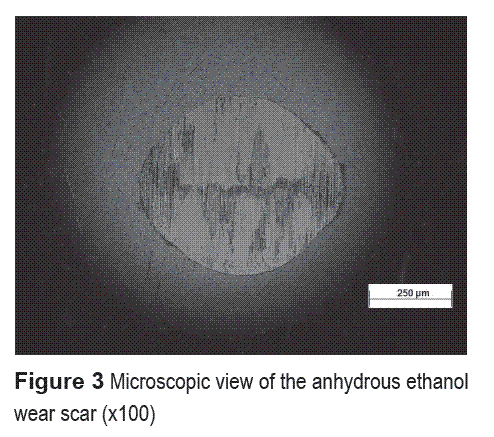
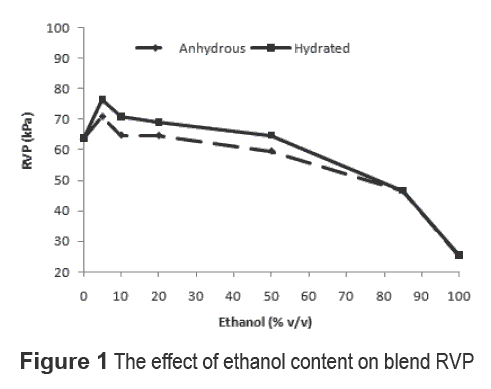
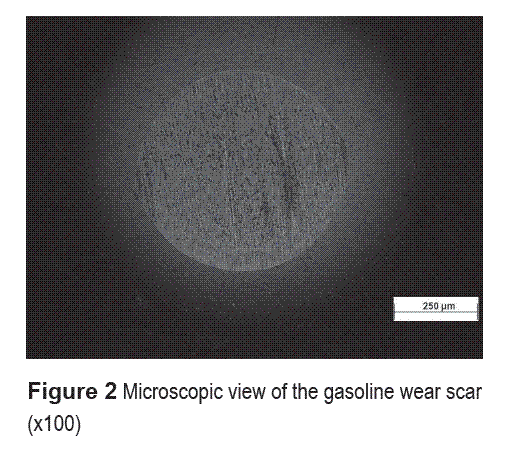
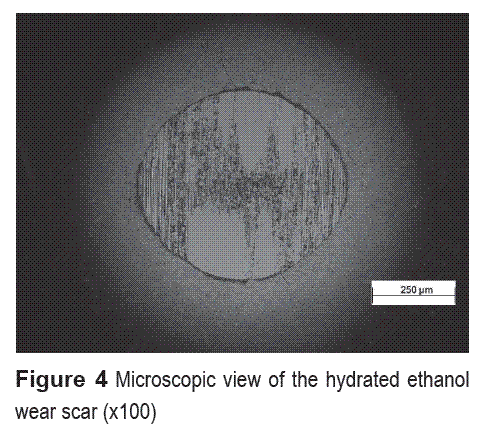
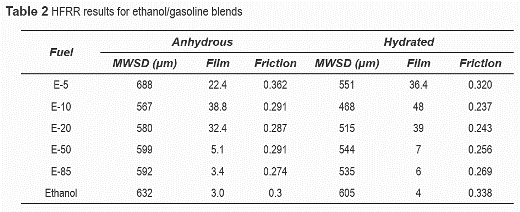
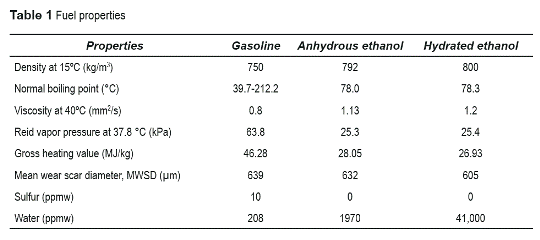
<body><![CDATA[<br> Prior to each test, all  the components of the HFRR having contacted the tested fuels were subjected to  a cleaning procedure composed of three 10-minute immersions in an ultrasonic  bath with toluene (the first and the second) and with acetone (the third). All  tests were performed twice and when differences in the wear scar were higher  than 20 mm an additional test was carried out. During the tests, which lasted  75 minutes, the samples were shaken at a frequency of 50 Hz. They remained open  to the atmosphere, which favored the ethanol losses by evaporation from the  samples, so experiments were carried out taking care that the fuel did not  evaporate at all during the entire test. Afterwards, the size of the wear scar  was measured in an electronic microscope Leica DM IRM equipped with a 100  magnification lent. The mean diameter of the scar observed in the HFRR ball  (MWSD) was obtained from the maximum and minimum measurements as prescribed in  the standard. The resulting scar size was not corrected by atmospheric water  vapor pressure as it was not contemplated in the standard.     <br>    <br> The fluid film trace is  obtained by a contact resistance circuit which applies a 15mV potential across  the specimen contact and a balance resistor in series, forming a potential  divider circuit. The series resistance is set by the electronic unit and is set  to 10 Ohms by default. The potential drop across the contact is thus a measure  of the contact resistance, as compared to the balance resistor. A low or zero  film reading means that the potential drop across the contact, and hence the  contact resistance is low, i.e., there is significant metal- to-metal contact  between the test specimens.</font></p>      <p><font face="Verdana" size="3"><b>Results and discussion</b></font></p>      <p><font face="Verdana" size="2"><b><i>Properties of the neat fuels</i></b></font></p>       <p><font face="Verdana" size="2"><a href="#Tabla1">Table 1</a> compares several  properties of the three main fuels tested. <a href="#Figura1">Figure 1</a> shows the effect of ethanol  content on the blend vapor pressure. As can be seen in <a href="#Tabla1">table 1</a>, some ethanol  properties such as density, normal boiling point, vapor pressure and gross  heating value differ significantly from those of gasoline. However the  viscosity of the neat fuels is very similar. According to <a href="#Figura1">figure 1</a>, the vapor  pressure of the blends with lower ethanol content (5% and 10%) is higher than  of the neat fuels. This behavior has been explained as a result of the  formation of azeotropes between ethanol and hydrocarbons boiling in the range  30&deg;C to about 120&deg;C [15].</font></p>      <p align="center"><img src="/img/revistas/rfiua/n58/n58a01t01.gif" ><a name="Tabla1"></a></p>      <p align="center"><img src="/img/revistas/rfiua/n58/n58a01i01.gif" ><a name="Figura1"></a></p>      <p><font face="Verdana" size="2"><a href="#Figura2">Figure 2</a>, <a href="#Figura3">3</a> and <a href="#Figura4">4</a> show photos captured with the  optical microscopy of the wear scar of neat gasoline, anhydrous and hydrated  ethanol, respectively. The mean wear scar diameters reported in <a href="#Tabla1">table 1</a> were  obtained as the half adder of greater perpendicular distances taken on the  microscope images. These results indicate that the lubricity of a polar  molecule such as ethanol is slightly better than that of gasoline (mixture of  hydrocarbons) and that some water in ethanol may enhance its anti-wear  characteristics.</font></p>      <p align="center"><img src="/img/revistas/rfiua/n58/n58a01i02.gif" ><a name="Figura2"></a></p>      ]]></body>
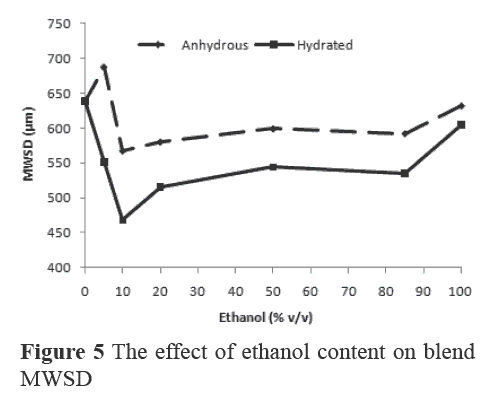
<body><![CDATA[<p align="center"><img src="/img/revistas/rfiua/n58/n58a01i03.gif" ><a name="Figura3"></a></p>      <p align="center"><img src="/img/revistas/rfiua/n58/n58a01i04.gif" ><a name="Figura4"></a></p>      <p><font face="Verdana" size="2">Typical MWSD values for  commercial diesel fuels are between 200 and 460 &micro;m as reported by Lapuerta et  al. [16]. The better lubricity of diesel fuels in comparison with gasoline and  ethanol may be explained by its higher viscosity and its additive package  including anti-wear components.</font></p>       <p><font face="Verdana" size="2"><b><i>The effect of ethanol content on blend lubricity</i></b></font></p>      <p><font face="Verdana" size="2"><a href="#Tabla2">Table 2</a> shows the HFRR  results (MWSD, film and friction coefficient) for the tested ethanol/ gasoline  blends.</font></p>      <p align="center"><img src="/img/revistas/rfiua/n58/n58a01t02.gif" ><a name="Tabla2"></a></p>      <p><font face="Verdana" size="2"><a href="#Figura5">Figure 5</a> shows the variation of the  blend MWSD with ethanol content. For blends greater than E-10 the variation of  the MWSD followed a similar trend regardless ethanol nature: anhydrous or  hydrated. In the range from 20% to 85% the MWSD exhibited slightly variations,  being always greater for the anhydrous ethanol blends. The worst performance  was shown by the E-5 anhydrous ethanol blend while the best lubricity characteristics  corresponded to the E-10 hydrated ethanol blend.</font></p>      <p align="center"><img src="/img/revistas/rfiua/n58/n58a01i05.gif" ><a name="Figura5"></a></p>      <p> <font face="Verdana" size="2">The high MWSD of the E-5 anhydrous ethanol blend can be related to the high fuel vapor pressure azeotrope formed at this ethanol concentration. High volatilities could promote excessive fuel loses during the test affecting negatively fuel lubricity.     <br>    ]]></body>
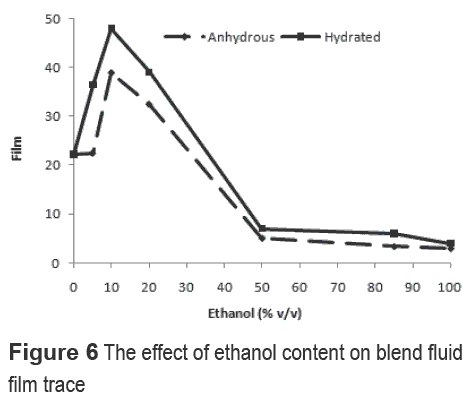
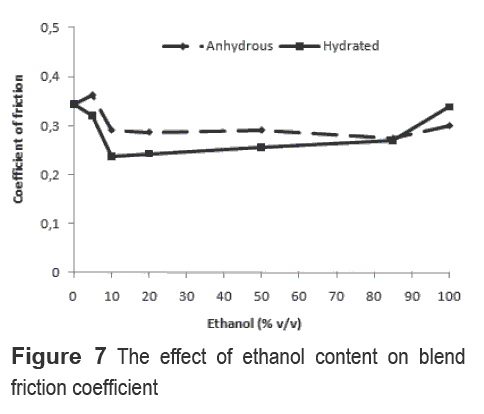
<body><![CDATA[<br> The complex molecular interactions resulting from having water in the blends appear to slightly favor their lubricities. In addition to the strong hydrogen bonds contained in water molecules, the polarity of the OH groups contained in ethanol molecules can form hydrogen bridges causing relatively strong attractive forces between molecules in liquid phases.     <br>    <br> In spite of using similar experimental conditions, several results obtained in this study differ from those published by Fusco et al [8]. The cited authors reported a more pronounced variation of the MWSD with ethanol content in the range E-20 to E-85. In particular, they reported a MWSD for E-20 around 200 µm, which is too low for a low viscosity fuel without anti-wear additives. In this study the measured values for the E-20 anhydrous and hydrated ethanol blends were 580 µm and 515 µm, respectively. Additionally, Fusco et al reported a strong decrease in fuel lubricity with water content while in this study it was determined a slightly decrease in the MWSD with water content.     <br>    <br> <a href="#Figura6">Figure 6 </a>shows the variation of the fluid film trace of the tested fuels with ethanol content. It may be a chemical film formed by additives, or a partial hydrodynamic film if the specimen speed and viscosity are high enough [16]. A low or close to zero film reading means that the potential drop across the contact, and hence the contact resistance is very low, i.e., there is significant metal-to-metal contact taking place between the test specimens. This is usually associated with a high friction force and wear.</font></p>      <p align="center"><img src="/img/revistas/rfiua/n58/n58a01i06.gif" ><a name="Figura6"></a></p>      <p><font face="Verdana" size="2">As can be seen in <a href="#Figura6">figure 6</a>, low ethanol proportions improved the film trace, but for blends greater than E-50 the film was deeply affected. Additionally, there was not an appreciable effect of water content on the film trace. While typical film traces for diesel fuels greater than 90 have been reported [16], in this work a film of 22 was measured for gasoline. A high film reading means that the metal surfaces are being separated.    <br>    <br>  <a href="#Figura7">Figure 7</a> shows the  variation of the friction coefficient with ethanol content for all tested  fuels. A high friction coefficient is normally an indicative of a poor  lubrication with significant metal-to-metal contact and wear taking place.  While typical values of the friction coefficient for diesel fuels around 0.15  have been reported [16], in this work a friction coefficient of 0.34 was  measured for gasoline. This may be explained by the higher diesel fuel  viscosity and its additive package. In general terms, it can be said that  ethanol slightly improved the friction coefficient, which corresponded to a  slightly increase in lubricity. Additionally, water did not appear to  appreciably affect the fuel friction coefficient.</font></p>      <p align="center"><img src="/img/revistas/rfiua/n58/n58a01i07.gif" ><a name="Figura7"></a></p>      ]]></body>
<body><![CDATA[<p><font face="Verdana" size="3"><b>Conclusions</b></font></p>      <p><font face="Verdana" size="2">In this work the lubricity  of representative ethanol (hydrated and anhydrous) / gasoline fuel blends was  measured by using a conventional HFRR tester.</font></p>      <p><font face="Verdana" size="2">In general, the range of  variation of the mean wear scar diameter was small among fuel tested in the  range E-20 to E-85, which means that the addition of ethanol, anhydrous or  hydrated, does not impact significantly blend lubricity.     <br>    <br> The lubricity of the  anhydrous ethanol / gasoline blends appeared to undergo a significant decrease  at low ethanol contents. The high MWSD of the E-5 anhydrous ethanol blend may  be related to the high vapor pressure azeotrope formed at this ethanol  concentration.     <br>    <br> Results indicated that the  addition of hydrated ethanol (96% v/v) slightly improved blend lubricity in  comparison with the addition of anhydrous ethanol.     <br>    <br> The higher MWSD, lower  film traces and higher friction coefficients obtained for all tested fuels in  comparison with the typical values for diesel fuels indicate the necessity of  using lubricity additive when gasoline or ethanol / gasoline blends are used in  new engine technologies requiring higher pressures in the fuel injection  system.</font></p>      <p><font face="Verdana" size="3"><b>Acknowledgements</b></font></p>      ]]></body>
<body><![CDATA[<p><font face="Verdana" size="2">Authors acknowledge the  Colombian Ministry of Agriculture and Rural Development and Sofasa-Renault for  the financial support of project N.&deg; 003 2007D3608-67 (Bioethanol E-20  project). Also our acknowledgements to the University of Castilla-La Mancha  (Group of Fuels and Engines) for their kindly help and for enabling us to carry  out the experiments.</font></p>      <p><font face="Verdana" size="3"><b>References</b></font></p>      <!-- ref --><p><font face="Verdana" size="2">1. D. Margaroni. &quot;Industrial Lubrication and Tribology&quot;.<i> Fuel lubricity.</i> Vol. 50. 1998. pp.  108-118.     &nbsp;&nbsp;&nbsp;&nbsp;&nbsp;&nbsp;&nbsp;&nbsp;[&#160;<a href="javascript:void(0);" onclick="javascript: window.open('/scielo.php?script=sci_nlinks&ref=000075&pid=S0120-6230201100020000100001&lng=','','width=640,height=500,resizable=yes,scrollbars=1,menubar=yes,');">Links</a>&#160;]<!-- end-ref --><br>    <!-- ref --><br> 2. S. Safran.<i>Statistical  thermodynamics of surfaces, interfaces, and membranes. Westview press. </i>New York. 2003.  pp.208-225.     &nbsp;&nbsp;&nbsp;&nbsp;&nbsp;&nbsp;&nbsp;&nbsp;[&#160;<a href="javascript:void(0);" onclick="javascript: window.open('/scielo.php?script=sci_nlinks&ref=000077&pid=S0120-6230201100020000100002&lng=','','width=640,height=500,resizable=yes,scrollbars=1,menubar=yes,');">Links</a>&#160;]<!-- end-ref --><br>    <!-- ref --><br> 3. M. Nikanjam, P. T. Henderson.<i>  Lubricity of Low Sulfur Diesel Fuels.</i> SAE technical Paper.  Warrendale. U.S. N. Giles (editor). 1994. pp. 743-760.     &nbsp;&nbsp;&nbsp;&nbsp;&nbsp;&nbsp;&nbsp;&nbsp;[&#160;<a href="javascript:void(0);" onclick="javascript: window.open('/scielo.php?script=sci_nlinks&ref=000079&pid=S0120-6230201100020000100003&lng=','','width=640,height=500,resizable=yes,scrollbars=1,menubar=yes,');">Links</a>&#160;]<!-- end-ref --><br>    <!-- ref --><br> 4. R. H. Barbour, D. J. Rickeard, N. G. Elliott. Understanding diesel  lubricity, SAE paper 2000-01&shy;1918. 2000. pp. 134-141.     &nbsp;&nbsp;&nbsp;&nbsp;&nbsp;&nbsp;&nbsp;&nbsp;[&#160;<a href="javascript:void(0);" onclick="javascript: window.open('/scielo.php?script=sci_nlinks&ref=000081&pid=S0120-6230201100020000100004&lng=','','width=640,height=500,resizable=yes,scrollbars=1,menubar=yes,');">Links</a>&#160;]<!-- end-ref --><br>    ]]></body>
<body><![CDATA[<!-- ref --><br> 5. D. P. Wei, S. Korcek,  H. A. Spikes.<i> Comparison of the lubricity  of gasoline and diesel.</i> SAE paper 962010. 1996. pp. 62-69.     &nbsp;&nbsp;&nbsp;&nbsp;&nbsp;&nbsp;&nbsp;&nbsp;[&#160;<a href="javascript:void(0);" onclick="javascript: window.open('/scielo.php?script=sci_nlinks&ref=000083&pid=S0120-6230201100020000100005&lng=','','width=640,height=500,resizable=yes,scrollbars=1,menubar=yes,');">Links</a>&#160;]<!-- end-ref --><br>    <!-- ref --><br> 6. H. A. Spikes, D. Wei, S. G. Korcek. &quot;The lubricating properties  of gasoline fuel&quot;.<i>  Proceedings of Fuel Symposium. </i>Munich. 3-5 september 1996.  pp.12-19.     &nbsp;&nbsp;&nbsp;&nbsp;&nbsp;&nbsp;&nbsp;&nbsp;[&#160;<a href="javascript:void(0);" onclick="javascript: window.open('/scielo.php?script=sci_nlinks&ref=000085&pid=S0120-6230201100020000100006&lng=','','width=640,height=500,resizable=yes,scrollbars=1,menubar=yes,');">Links</a>&#160;]<!-- end-ref --><br>    <!-- ref --><br> 7. D. P. Wei, H. A. Spikes, S. Korcek, &quot;The  lubricity of gasoline&quot;.  <i>Tribology transactions. </i>Vol. 42. 1999. pp. 813-823.     &nbsp;&nbsp;&nbsp;&nbsp;&nbsp;&nbsp;&nbsp;&nbsp;[&#160;<a href="javascript:void(0);" onclick="javascript: window.open('/scielo.php?script=sci_nlinks&ref=000087&pid=S0120-6230201100020000100007&lng=','','width=640,height=500,resizable=yes,scrollbars=1,menubar=yes,');">Links</a>&#160;]<!-- end-ref --><br>    <!-- ref --><br> 8. F. Fusco. D. Katsuki, A. Sinatora. &quot;Wear and corrosion evaluation  of electric fuel pumps with ethanol/gasoline blends&quot;. <i>SAE paper 2005-01-2196. </i>2005. pp.  356-364.    &nbsp;&nbsp;&nbsp;&nbsp;&nbsp;&nbsp;&nbsp;&nbsp;[&#160;<a href="javascript:void(0);" onclick="javascript: window.open('/scielo.php?script=sci_nlinks&ref=000089&pid=S0120-6230201100020000100008&lng=','','width=640,height=500,resizable=yes,scrollbars=1,menubar=yes,');">Links</a>&#160;]<!-- end-ref --><br>    <!-- ref --><br> 9. European norm UNE EN-590: 2004. Standard specification for Automotive  fuels. Diesel. Requirements and test methods. 2004.     &nbsp;&nbsp;&nbsp;&nbsp;&nbsp;&nbsp;&nbsp;&nbsp;[&#160;<a href="javascript:void(0);" onclick="javascript: window.open('/scielo.php?script=sci_nlinks&ref=000091&pid=S0120-6230201100020000100009&lng=','','width=640,height=500,resizable=yes,scrollbars=1,menubar=yes,');">Links</a>&#160;]<!-- end-ref --><br>    ]]></body>
<body><![CDATA[<!-- ref --><br> 10. ASTM D 975: 2004 Standard specification for diesel fuel oils. 2004     &nbsp;&nbsp;&nbsp;&nbsp;&nbsp;&nbsp;&nbsp;&nbsp;[&#160;<a href="javascript:void(0);" onclick="javascript: window.open('/scielo.php?script=sci_nlinks&ref=000093&pid=S0120-6230201100020000100010&lng=','','width=640,height=500,resizable=yes,scrollbars=1,menubar=yes,');">Links</a>&#160;]<!-- end-ref --><br>    <!-- ref --><br> 11. &nbsp;J. G. Eleftherakis, M .J.  Harrigan, X. Tao. &quot;Development of a benchtop fuel lubricity assesment  method&quot;. <i>SAE paper 941915.</i>  1994. pp. 1732-1741.     &nbsp;&nbsp;&nbsp;&nbsp;&nbsp;&nbsp;&nbsp;&nbsp;[&#160;<a href="javascript:void(0);" onclick="javascript: window.open('/scielo.php?script=sci_nlinks&ref=000095&pid=S0120-6230201100020000100011&lng=','','width=640,height=500,resizable=yes,scrollbars=1,menubar=yes,');">Links</a>&#160;]<!-- end-ref --><br>    <!-- ref --><br> 12. California Air Resource Board publication. CaRFG. &quot;(California  Reformulated Gasoline) performance and compatibility test program&quot;. <i>Californa Air Resources Board</i>. 1996.  pp. 23-27.     &nbsp;&nbsp;&nbsp;&nbsp;&nbsp;&nbsp;&nbsp;&nbsp;[&#160;<a href="javascript:void(0);" onclick="javascript: window.open('/scielo.php?script=sci_nlinks&ref=000097&pid=S0120-6230201100020000100012&lng=','','width=640,height=500,resizable=yes,scrollbars=1,menubar=yes,');">Links</a>&#160;]<!-- end-ref --><br>    <!-- ref --><br> 13. European norm EN 228: 2008. Standard specification for Automotive  fuels -unleaded petrol - Requirements and test methods. 2008.     &nbsp;&nbsp;&nbsp;&nbsp;&nbsp;&nbsp;&nbsp;&nbsp;[&#160;<a href="javascript:void(0);" onclick="javascript: window.open('/scielo.php?script=sci_nlinks&ref=000099&pid=S0120-6230201100020000100013&lng=','','width=640,height=500,resizable=yes,scrollbars=1,menubar=yes,');">Links</a>&#160;]<!-- end-ref --><br>    <!-- ref --><br> 14. European norm EN 15376:2007. Standar specification for Automotive  fuels - Ethanol as a blending component for petrol - Requirements and test  methods. 2007.     &nbsp;&nbsp;&nbsp;&nbsp;&nbsp;&nbsp;&nbsp;&nbsp;[&#160;<a href="javascript:void(0);" onclick="javascript: window.open('/scielo.php?script=sci_nlinks&ref=000101&pid=S0120-6230201100020000100014&lng=','','width=640,height=500,resizable=yes,scrollbars=1,menubar=yes,');">Links</a>&#160;]<!-- end-ref --><br>    ]]></body>
<body><![CDATA[<!-- ref --><br> 15. Z. Muz&iacute;kov&aacute;, M. Posp&iacute;sil, G. Sebor. &quot;Volatility and phase  stability of petrol blends with ethanol&quot;. <i>Fuel.</i> Vol. 88. 2009. pp. 1351-1356.     &nbsp;&nbsp;&nbsp;&nbsp;&nbsp;&nbsp;&nbsp;&nbsp;[&#160;<a href="javascript:void(0);" onclick="javascript: window.open('/scielo.php?script=sci_nlinks&ref=000103&pid=S0120-6230201100020000100015&lng=','','width=640,height=500,resizable=yes,scrollbars=1,menubar=yes,');">Links</a>&#160;]<!-- end-ref --><br>    <!-- ref --><br> 16. M. Lapuerta, M. Contreras, J. R.  Agudelo. &quot;The  lubricity of etanol-biodiesel-diesel fuel blends&quot;. <i>Energy and Fuels.</i> 2010. 24. 1374-1379.</font>&nbsp;&nbsp;&nbsp;&nbsp;&nbsp;&nbsp;&nbsp;&nbsp;[&#160;<a href="javascript:void(0);" onclick="javascript: window.open('/scielo.php?script=sci_nlinks&ref=000105&pid=S0120-6230201100020000100016&lng=','','width=640,height=500,resizable=yes,scrollbars=1,menubar=yes,');">Links</a>&#160;]<!-- end-ref --><br>    <br>    <br>     <p><font face="Verdana" size="2">(Recibido el 15 de febrero de 2010. Aceptado el 19 de agosto de 2010)</font></p>     <p><font face="Verdana" size="2"><sup>*</sup>Autor de correspondencia: tel&eacute;fono: + 57 + 4 + 219 85 49, fax: + 57 + 4 + 219 85 49, correo electr&oacute;nico: <a href="mailto:jragude@udea.edu.co">jragude@udea.edu.co</a> (J. Agudelo)</font></p>      ]]></body><back>
<ref-list>
<ref id="B1">
<label>1</label><nlm-citation citation-type="journal">
<person-group person-group-type="author">
<name>
<surname><![CDATA[Margaroni]]></surname>
<given-names><![CDATA[D]]></given-names>
</name>
</person-group>
<article-title xml:lang="en"><![CDATA[Industrial Lubrication and Tribology]]></article-title>
<source><![CDATA[Fuel lubricity]]></source>
<year>1998</year>
<volume>50</volume>
<page-range>108-118</page-range></nlm-citation>
</ref>
<ref id="B2">
<label>2</label><nlm-citation citation-type="">
<person-group person-group-type="author">
<name>
<surname><![CDATA[Safran]]></surname>
<given-names><![CDATA[S]]></given-names>
</name>
</person-group>
<source><![CDATA[Statistical thermodynamics of surfaces, interfaces, and membranes: Westview press]]></source>
<year>2003</year>
<page-range>208-225</page-range><publisher-loc><![CDATA[New York ]]></publisher-loc>
</nlm-citation>
</ref>
<ref id="B3">
<label>3</label><nlm-citation citation-type="book">
<person-group person-group-type="author">
<name>
<surname><![CDATA[Nikanjam]]></surname>
<given-names><![CDATA[M]]></given-names>
</name>
<name>
<surname><![CDATA[Henderson]]></surname>
<given-names><![CDATA[P. T]]></given-names>
</name>
</person-group>
<source><![CDATA[Lubricity of Low Sulfur Diesel Fuels]]></source>
<year>1994</year>
<page-range>743-760</page-range><publisher-loc><![CDATA[Warrendale ]]></publisher-loc>
<publisher-name><![CDATA[SAE technical Paper]]></publisher-name>
</nlm-citation>
</ref>
<ref id="B4">
<label>4</label><nlm-citation citation-type="book">
<person-group person-group-type="author">
<name>
<surname><![CDATA[Barbour]]></surname>
<given-names><![CDATA[R. H]]></given-names>
</name>
<name>
<surname><![CDATA[Rickeard]]></surname>
<given-names><![CDATA[D. J]]></given-names>
</name>
<name>
<surname><![CDATA[Elliott]]></surname>
<given-names><![CDATA[N. G]]></given-names>
</name>
</person-group>
<source><![CDATA[Understanding diesel lubricity]]></source>
<year>2000</year>
<page-range>134-141</page-range><publisher-name><![CDATA[SAE paper]]></publisher-name>
</nlm-citation>
</ref>
<ref id="B5">
<label>5</label><nlm-citation citation-type="book">
<person-group person-group-type="author">
<name>
<surname><![CDATA[Wei]]></surname>
<given-names><![CDATA[D. P]]></given-names>
</name>
<name>
<surname><![CDATA[Korcek]]></surname>
<given-names><![CDATA[S]]></given-names>
</name>
<name>
<surname><![CDATA[Spikes]]></surname>
<given-names><![CDATA[H. A]]></given-names>
</name>
</person-group>
<source><![CDATA[Comparison of the lubricity of gasoline and diesel]]></source>
<year>1996</year>
<page-range>62-69</page-range><publisher-name><![CDATA[SAE paper]]></publisher-name>
</nlm-citation>
</ref>
<ref id="B6">
<label>6</label><nlm-citation citation-type="confpro">
<person-group person-group-type="author">
<name>
<surname><![CDATA[Spikes]]></surname>
<given-names><![CDATA[H. A]]></given-names>
</name>
<name>
<surname><![CDATA[Wei]]></surname>
<given-names><![CDATA[D]]></given-names>
</name>
<name>
<surname><![CDATA[Korcek]]></surname>
<given-names><![CDATA[S. G]]></given-names>
</name>
</person-group>
<source><![CDATA[The lubricating properties of gasoline fuel]]></source>
<year></year>
<conf-name><![CDATA[ Fuel Symposium]]></conf-name>
<conf-date>1996</conf-date>
<conf-loc>Munich </conf-loc>
<page-range>12-19</page-range></nlm-citation>
</ref>
<ref id="B7">
<label>7</label><nlm-citation citation-type="journal">
<person-group person-group-type="author">
<name>
<surname><![CDATA[Wei]]></surname>
<given-names><![CDATA[D. P]]></given-names>
</name>
<name>
<surname><![CDATA[Spikes]]></surname>
<given-names><![CDATA[H. A]]></given-names>
</name>
<name>
<surname><![CDATA[Korcek]]></surname>
<given-names><![CDATA[S]]></given-names>
</name>
</person-group>
<article-title xml:lang="en"><![CDATA[The lubricity of gasoline]]></article-title>
<source><![CDATA[Tribology transactions]]></source>
<year>1999</year>
<volume>42</volume>
<page-range>813-823</page-range></nlm-citation>
</ref>
<ref id="B8">
<label>8</label><nlm-citation citation-type="book">
<person-group person-group-type="author">
<name>
<surname><![CDATA[Fusco]]></surname>
<given-names><![CDATA[F]]></given-names>
</name>
<name>
<surname><![CDATA[Katsuki]]></surname>
<given-names><![CDATA[D]]></given-names>
</name>
<name>
<surname><![CDATA[Sinatora]]></surname>
<given-names><![CDATA[A]]></given-names>
</name>
</person-group>
<source><![CDATA[Wear and corrosion evaluation of electric fuel pumps with ethanol/gasoline blends]]></source>
<year>2005</year>
<page-range>356-364</page-range><publisher-name><![CDATA[SAE paper]]></publisher-name>
</nlm-citation>
</ref>
<ref id="B9">
<label>9</label><nlm-citation citation-type="">
<source><![CDATA[European norm UNE EN-590: 2004. Standard specification for Automotive fuels: Diesel. Requirements and test methods]]></source>
<year>2004</year>
</nlm-citation>
</ref>
<ref id="B10">
<label>10</label><nlm-citation citation-type="">
<source><![CDATA[]]></source>
<year></year>
</nlm-citation>
</ref>
<ref id="B11">
<label>11</label><nlm-citation citation-type="">
<person-group person-group-type="author">
<name>
<surname><![CDATA[Eleftherakis]]></surname>
<given-names><![CDATA[J. G]]></given-names>
</name>
<name>
<surname><![CDATA[Harrigan]]></surname>
<given-names><![CDATA[M .J]]></given-names>
</name>
<name>
<surname><![CDATA[Tao]]></surname>
<given-names><![CDATA[X]]></given-names>
</name>
</person-group>
<source><![CDATA[Development of a benchtop fuel lubricity assesment method]]></source>
<year>1994</year>
<page-range>1732-1741</page-range></nlm-citation>
</ref>
<ref id="B12">
<label>12</label><nlm-citation citation-type="">
<collab>California Air Resource Board publication. CaRFG</collab>
<source><![CDATA[performance and compatibility test program]]></source>
<year>1996</year>
<page-range>23-27</page-range></nlm-citation>
</ref>
<ref id="B13">
<label>13</label><nlm-citation citation-type="">
<source><![CDATA[]]></source>
<year></year>
</nlm-citation>
</ref>
<ref id="B14">
<label>14</label><nlm-citation citation-type="">
<source><![CDATA[]]></source>
<year></year>
</nlm-citation>
</ref>
<ref id="B15">
<label>15</label><nlm-citation citation-type="journal">
<person-group person-group-type="author">
<name>
<surname><![CDATA[Muzíková]]></surname>
<given-names><![CDATA[Z]]></given-names>
</name>
<name>
<surname><![CDATA[Pospísil]]></surname>
<given-names><![CDATA[M]]></given-names>
</name>
<name>
<surname><![CDATA[Sebor]]></surname>
<given-names><![CDATA[G]]></given-names>
</name>
</person-group>
<article-title xml:lang="en"><![CDATA[Volatility and phase stability of petrol blends with ethanol]]></article-title>
<source><![CDATA[Fuel]]></source>
<year>2009</year>
<volume>88</volume>
<page-range>1351-1356</page-range></nlm-citation>
</ref>
<ref id="B16">
<label>16</label><nlm-citation citation-type="journal">
<person-group person-group-type="author">
<name>
<surname><![CDATA[Lapuerta]]></surname>
<given-names><![CDATA[M]]></given-names>
</name>
<name>
<surname><![CDATA[Contreras]]></surname>
<given-names><![CDATA[M]]></given-names>
</name>
<name>
<surname><![CDATA[Agudelo]]></surname>
<given-names><![CDATA[J. R]]></given-names>
</name>
</person-group>
<article-title xml:lang="en"><![CDATA[The lubricity of etanol-biodiesel-diesel fuel blends]]></article-title>
<source><![CDATA[Energy and Fuels]]></source>
<year>2010</year>
<volume>24</volume>
<page-range>1374-1379</page-range></nlm-citation>
</ref>
</ref-list>
</back>
</article>