<?xml version="1.0" encoding="ISO-8859-1"?><article xmlns:mml="http://www.w3.org/1998/Math/MathML" xmlns:xlink="http://www.w3.org/1999/xlink" xmlns:xsi="http://www.w3.org/2001/XMLSchema-instance">
<front>
<journal-meta>
<journal-id>0120-6230</journal-id>
<journal-title><![CDATA[Revista Facultad de Ingeniería Universidad de Antioquia]]></journal-title>
<abbrev-journal-title><![CDATA[Rev.fac.ing.univ. Antioquia]]></abbrev-journal-title>
<issn>0120-6230</issn>
<publisher>
<publisher-name><![CDATA[Facultad de Ingeniería, Universidad de Antioquia]]></publisher-name>
</publisher>
</journal-meta>
<article-meta>
<article-id>S0120-62302011000200002</article-id>
<title-group>
<article-title xml:lang="en"><![CDATA[Energy use in the production of unrefined sugar in Colombia (exergy analysis)]]></article-title>
<article-title xml:lang="es"><![CDATA[Uso de energía en la producción de panela en Colombia (análisis exergético)]]></article-title>
</title-group>
<contrib-group>
<contrib contrib-type="author">
<name>
<surname><![CDATA[Velásquez]]></surname>
<given-names><![CDATA[Héctor]]></given-names>
</name>
<xref ref-type="aff" rid="A01"/>
</contrib>
<contrib contrib-type="author">
<name>
<surname><![CDATA[Agudelo]]></surname>
<given-names><![CDATA[Andrés]]></given-names>
</name>
<xref ref-type="aff" rid="A02"/>
</contrib>
<contrib contrib-type="author">
<name>
<surname><![CDATA[Chejne]]></surname>
<given-names><![CDATA[Farid]]></given-names>
</name>
<xref ref-type="aff" rid="A03"/>
</contrib>
</contrib-group>
<aff id="A01">
<institution><![CDATA[,Universidad Nacional de Colombia Sede Medellín Energy Institute Alternative Fuels Group]]></institution>
<addr-line><![CDATA[Medellín ]]></addr-line>
<country>Colombia</country>
</aff>
<aff id="A02">
<institution><![CDATA[,Universidad de Antioquia Facultad de Ingeniería ]]></institution>
<addr-line><![CDATA[Medellín ]]></addr-line>
<country>Colombia</country>
</aff>
<aff id="A03">
<institution><![CDATA[,Universidad Nacional de Colombia Sede Medellín Energy Institute ]]></institution>
<addr-line><![CDATA[Medellín ]]></addr-line>
<country>Colombia</country>
</aff>
<pub-date pub-type="pub">
<day>00</day>
<month>03</month>
<year>2011</year>
</pub-date>
<pub-date pub-type="epub">
<day>00</day>
<month>03</month>
<year>2011</year>
</pub-date>
<numero>58</numero>
<fpage>17</fpage>
<lpage>26</lpage>
<copyright-statement/>
<copyright-year/>
<self-uri xlink:href="http://www.scielo.org.co/scielo.php?script=sci_arttext&amp;pid=S0120-62302011000200002&amp;lng=en&amp;nrm=iso"></self-uri><self-uri xlink:href="http://www.scielo.org.co/scielo.php?script=sci_abstract&amp;pid=S0120-62302011000200002&amp;lng=en&amp;nrm=iso"></self-uri><self-uri xlink:href="http://www.scielo.org.co/scielo.php?script=sci_pdf&amp;pid=S0120-62302011000200002&amp;lng=en&amp;nrm=iso"></self-uri><abstract abstract-type="short" xml:lang="en"><p><![CDATA[The aim of this study is to determine how energy resources are used in the production of unrefined sugar in Colombia. To do this, measurements were carried out in eight sugar mills that represent the typical production processes for unrefined sugar. These data were used to obtain first and second law balances, which were then used to calculate efficiencies and some energy use indicators. By comparing the mills it was found that technological improvements enable energy efficiency to be increased to acceptable levels due to better combustion processes and reductions in energy losses from exhaust gases and heat transfer to the walls. The effect of these improvements in second law efficiency is not significant, which suggests that cogeneration systems should be implemented in large-scale production processes in order to make a better use of the energy resources.]]></p></abstract>
<abstract abstract-type="short" xml:lang="es"><p><![CDATA[El objetivo de este estudio es determinar cómo se usan los recursos energéticos en la producción de panela en Colombia. Para este fin, se realizaron mediciones en ocho trapiches que representan los procesos productivos típicos de la panela. Con los datos experimentales se obtuvieron los balances de primera y segunda ley de la termodinámica, a partir de los cuales se calcularon las eficiencias y algunos indicadores del uso de la energía. La comparación de los trapiches mostró que las mejoras tecnológicas permiten aumentar la eficiencia energética a niveles aceptables debido a un mejor proceso de combustión y a la reducción de las pérdidas energéticas asociadas con los gases de escape y la transferencia de calor a través de las paredes. El efecto de dichas mejoras sobre la eficiencia de segunda ley no es significativo, lo cual sugiere que se deberían implementar sistemas de cogeneración en los procesos de producción a gran escala con el fin de hacer un uso más racional de los recursos energéticos.]]></p></abstract>
<kwd-group>
<kwd lng="en"><![CDATA[Unrefined sugar production]]></kwd>
<kwd lng="en"><![CDATA[sugar mills]]></kwd>
<kwd lng="en"><![CDATA[energy efficiency]]></kwd>
<kwd lng="en"><![CDATA[exergy analysis]]></kwd>
<kwd lng="es"><![CDATA[Producción de panela]]></kwd>
<kwd lng="es"><![CDATA[trapiches]]></kwd>
<kwd lng="es"><![CDATA[eficiencia energética]]></kwd>
<kwd lng="es"><![CDATA[análisis energético]]></kwd>
</kwd-group>
</article-meta>
</front><body><![CDATA[ <p align="center"><font face="Verdana" size="4"> <b>Energy use in the production of unrefined sugar in Colombia (exergy analysis) </b></font></p>      <p align="center"><font face="Verdana" size="4"> <b>Uso de energ&iacute;a en la producci&oacute;n de panela en Colombia  (an&aacute;lisis exerg&eacute;tico)</b></font></p>      <p> <font face="Verdana" size="2"> <i>H&eacute;ctor Vel&aacute;squez<sup>1</sup>, Andr&eacute;s Agudelo<sup>2</sup>, Farid Chejne<sup>3</sup> </i></font></p>       <p> <font face="verdana" size="2"><sup>1</sup>Alternative  Fuels Group, Energy Institute, Universidad Nacional de Colombia Sede Medell&iacute;n,  Cra 77B N.&deg; 58 47-70 AA 1001, Medell&iacute;n, Colombia    <br>       <br> <sup>2</sup>Facultad de  Ingenier&iacute;a, Universidad de Antioquia, Calle 67 N.&deg; 53-108, Medell&iacute;n, Colombia    <br>     <br> <sup>3</sup>Energy Institute, Universidad Nacional de Colombia Sede Medell&iacute;n, Cra  77B N.&deg; 47-70 AA 1001, Medell&iacute;n, Colombia </font></p>     <br>  <hr noshade size="1">     <p><font face="Verdana" size="3"><b>Abstract</b></font></p>       ]]></body>
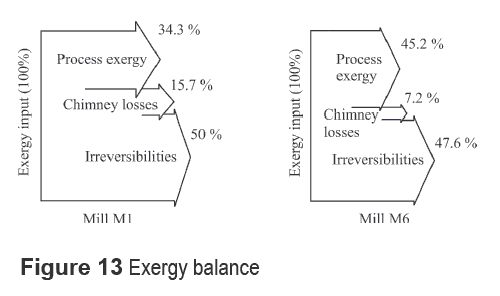
<body><![CDATA[<p><font face="Verdana" size="2">The aim of this study is to determine how energy  resources are used in the production of unrefined sugar in Colombia. To do  this, measurements were carried out in eight sugar mills that represent the  typical production processes for unrefined sugar. These data were used to  obtain first and second law balances, which were then used to calculate  efficiencies and some energy use indicators. By comparing the mills it was  found that technological improvements enable energy efficiency to be increased  to acceptable levels due to better combustion processes and reductions in  energy losses from exhaust gases and heat transfer to the walls. The effect of  these improvements in second law efficiency is not significant, which suggests  that cogeneration systems should be implemented in large-scale production  processes in order to make a better use of the energy resources.</font></p>        <p><font face="Verdana" size="2"><i>Keywords:</i>Unrefined sugar production, sugar mills, energy efficiency, exergy analysis. </font></p>   <hr noshade size="1">       <p><font face="Verdana" size="3"><b>Resumen</b></font></p>      <p><font face="Verdana" size="2">El objetivo de este estudio es determinar c&oacute;mo se usan  los recursos energ&eacute;ticos en la producci&oacute;n de panela en Colombia. Para este fin,  se realizaron mediciones en ocho trapiches que representan los procesos  productivos t&iacute;picos de la panela. Con los datos experimentales se obtuvieron  los balances de primera y segunda ley de la termodin&aacute;mica, a partir de los  cuales se calcularon las eficiencias y algunos indicadores del uso de la  energ&iacute;a. La comparaci&oacute;n de los trapiches mostr&oacute; que las mejoras tecnol&oacute;gicas  permiten aumentar la eficiencia energ&eacute;tica a niveles aceptables debido a un  mejor proceso de combusti&oacute;n y a la reducci&oacute;n de las p&eacute;rdidas energ&eacute;ticas  asociadas con los gases de escape y la transferencia de calor a trav&eacute;s de las  paredes. El efecto de dichas mejoras sobre la eficiencia de segunda ley no es  significativo, lo cual sugiere que se deber&iacute;an implementar sistemas de  cogeneraci&oacute;n en los procesos de producci&oacute;n a gran escala con el fin de hacer un  uso m&aacute;s racional de los recursos energ&eacute;ticos.</font></p>      <p><font face="Verdana" size="2"><i>Palabras clave: </i>Producci&oacute;n  de panela, trapiches, eficiencia energ&eacute;tica, an&aacute;lisis  energ&eacute;tico</font>.</p>  <hr noshade size="1">        <p><font face="Verdana" size="3"><b>Introduction</b></font></p>          <p> <font face="Verdana" size="2">Unrefined sugar is known as <i>panela</i> in Colombia, <i>gur</i> in India and Pakistan, <i>rapadura</i> in Brazil and Ecuador, <i>chancaca</i> in Peru and Chile, and <i>papel&oacute;n</i> in Mexico, Guatemala and other  countries of Central America. This product is the result of evaporating  sugarcane juice produced by milling. For centuries it has been produced in a  traditional fashion, although current production processes include several technological  improvements. India is the most important of the 25 countries producing  unrefined sugar with about 86% of production, followed by Colombia with 13.9%  of world production in the period of 1998-2002. Colombia consumes more  unrefined sugar per capita than any other country, with a consumption of 38.6  kg/person/year [1, 2].    <br>    <br>    Sugar cane is the raw material for unrefined sugar  production. The cane is crushed in a mill which extracts the juice with  efficiencies ranging between 55 and 70%. The milling residue, called bagasse,  has moisture content between 45 and 60%. For this reason, many producers dry  the bagasse in atmospheric conditions before using it as fuel. The juice  extracted is passed through a purification and concentration process in order  to obtain unrefined sugar [2]. In Colombia there are about 23,000 mills for  unrefined sugar production. Sugar cane production takes the second place after  coffee, with nearly 308,238 farmed hectares [1]. Unrefined sugar is produced in  402 of the 1098 municipalities of the country, and the industry generates more  than 350,000 jobs per year, which represents 12% of the economically active  rural population [3].     <br>    ]]></body>
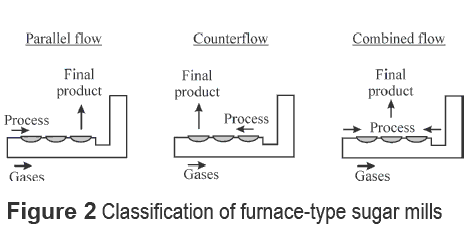
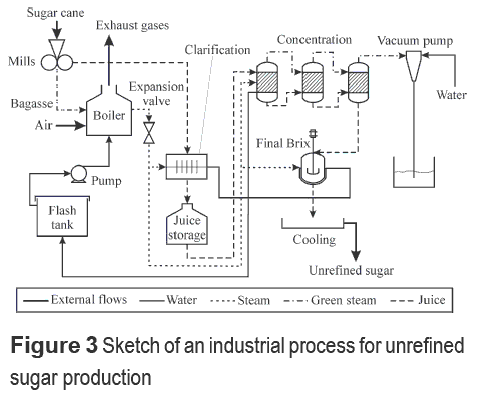
<body><![CDATA[<br> Several studies on the energy diagnostics of  unrefined sugar production processes have shown that chimney losses are near  30%, exhaust gas temperatures are near 700 &deg;C, losses through walls are near  7%, energy efficiency is between 20 and 25%, and CO emissions may reach values  of up to 10% by volume [4, 5]. In many mills the bagasse produced is not  sufficient as fuel due to the low energy efficiency of the mill, which leads to  the use of wood or used tires to supply the energy for the process [5]. The  studies that use exergy analysis are dedicated to refined sugar production and  to the use of bagasse in power generation systems [6, 7]. There is a lack of  studies that use second law analysis of unrefined sugar production. This paper  presents an energy and exergy evaluation of unrefined sugar production  processes in Colombia using experimental data from the different processes. A  traditional furnace-type mill designed by one of the authors is included in the  evaluation [8]. First and second law efficiencies were determined for the  different processes and some indices were calculated, which allowed a  characterization of production units.   </font></p>      <p> <font face="Verdana" size="2"><i><b>Production processes of unrefined sugar</b></i></font></p>        <p> <font face="Verdana" size="2">Unrefined sugar is obtained using processes with  different degrees of technological development. The simplest process is the  furnace-type, used in traditional mills. This is composed of two main parts:  the combustion chamber and the juice evaporation zone, or process zone. The  gases generated by the combustion of bagasse are used in the evaporation of  sugar cane juice. Evaporation is carried out in large containers or pans  exposed to the atmosphere. The bottom of these pans is exposed to combustion  gases (see <a href="#Figura1">figure 1</a>). The furnace-type mills use natural draught.</font></p>        <p align="center"><img src="/img/revistas/rfiua/n58/n58a02i01.gif" ><a name="Figura1"></a></p>         <p> <font face="Verdana" size="2">Furnace-type sugar mills are classified according to the flow direction of the production process with respect to the combustion gases. When both process and gases are flowing in the same direction, the mill is said to be a parallel flow furnace-type mill. In this kind of mill the product is obtained at the end nearest to the chimney. Modifications to this configuration include the counter flow and combined flow furnace-type mills, where the product is obtained at the furnace end and in the centre, respectively (see  <a href="#Figura2">figure 2</a>).</font></p>         <p align="center"><img src="/img/revistas/rfiua/n58/n58a02i02.gif" ><a name="Figura2"></a></p>        <p> <font face="Verdana" size="2">In more advanced processes the combustion chamber is replaced by a boiler that produces steam. This steam is used for the evaporation process by means of heat exchangers submerged in the containers, or in a vacuum process (see <a href="#Figura3">figure 3</a>).</font></p>         <p align="center"><img src="/img/revistas/rfiua/n58/n58a02i03.gif" ><a name="Figura3"></a></p>         <p> <font face="Verdana" size="2">These industrial processes allow increased production levels with more control, resulting in a higher quality product</font></p>         <p><font face="Verdana" size="3"><b>Methodology</b></font></p>         ]]></body>
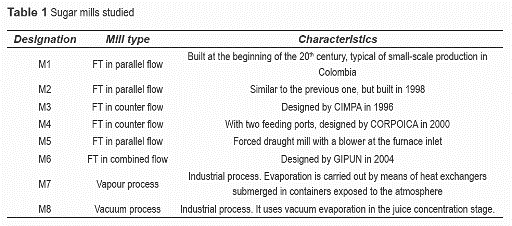
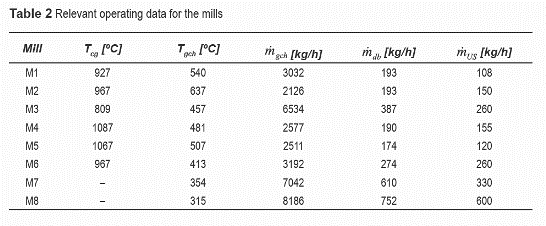
<body><![CDATA[<p><font face="Verdana" size="2"> Concerns about depletion of natural resources and environmental pollution have lead to new designs for production processes, aimed at achieving higher energy efficiency. In this study we use a group of sugar mills that represent production processes for unrefined sugar in Colombia: traditional furnace-type (FT) mills, some furnace- type mills with technological improvements, and industrial processes. The facilities are located in different regions of the country. The main characteristics of the mills studied are presented in <a href="#Tabla1">table 1</a>. The mills are listed in an approximate order of technological development. The abreviature CIMPA in <a href="#Tabla1">table 1</a> stands for Centro de Investigaciones para el Mejoramiento de la Agroindustria Panelera (Research Centre for the Improvement of Unrefined Sugar Agro-Industry). GIPUN stands for Grupo de Investigaci&oacute;n en Panela (Research Group in Unrefined Sugar), Universidad Nacional de Colombia.</font></p>      <p align="center"><img src="/img/revistas/rfiua/n58/n58a02t01.gif" ><a name="Tabla1"></a></p>      <p><font face="Verdana" size="2"> The nearly 23,000 mills for unrefined sugar production in the country have a production capacity between 50 and 300 kg/h. About 83% of the mills are small units that produce less than 100 kg/h, 15% are mid-capacity units producing 150-250 kg/h, and only 2% of the mills are classified as "large" units, with a production higher than 250 kg/h [1]. According to the knowledge of the authors most of mills are of types M1, M2 , M3, and M5. Also, there are no more than ten mills of type M4 and M7, only one mill of type M6, and less than five mills of type M8.    <br>    <br> Atmospheric pressure, temperature and relative humidity were measured in order to calculate the balances. Process variables were also measured, such as temperature at each stage, juice temperature and purity, and mass flows of sugarcane, bagasse, and unrefined sugar. These data was used to determine the enthalpy, entropy, and exergy of the streams. The chemical exergy and activity coefficient of the juice were determined according to Nebra and Fernandez-Parra [9].     <br>    <br> Combustion was characterized by measuring the  composition (in dry basis), temperature and mass flow of flue gases, as well as  the temperature in the combustion chamber. The elemental composition, heating  value and moisture content of bagasse were determined at the Laboratorio de  Carbones (Coal Laboratory) ofthe Universidad Nacional de Colombia. The values  measured were verified by comparison with those reported in the technical  literature [10, 11]. <a href="#Tabla2">Table 2</a> presents representative values of the temperature  of combustion gases (<i>T<sub>cg</sub></i>), temperature of chimney gases (<i>T<sub>gch</sub></i>), mass flow of chimney gases (<i><b>m</b><sub>gch</sub></i>),  dry bagasse mass flow (<i><b>m</b><sub>db</sub></i>),  and unrefined sugar production (<i><b>m</b><sub>US</sub></i>)  for the studied mills</font></p>      <p align="center"><img src="/img/revistas/rfiua/n58/n58a02t02.gif" ><a name="Tabla2"></a></p>      <p><font face="Verdana" size="2">There is no data of <i>T<sub>cg</sub></i> for the last two mills, since the energy source for evaporation in them  comes from steam instead of coming from combustion gases. Steam temperature for  mills M7 and M8 is of 449 &deg;C and 457 &deg;C, respectively. The values of <i>T<sub>gch</sub></i> are quite high, which means that chimney gases still have a significant  energy potential</font></p>      <p><font face="Verdana" size="2"><b><i>Thermodynamic analysis</i></b></font>       ]]></body>
<body><![CDATA[<p><font face="Verdana" size="2">In order to carry out a first and second law evaluation of the sugar mills it is necessary to do mass, energy and exergy balances of the production processes. The energy balance, taking the mill as control volume, can be expressed according to equation 1.</font></p>      <p> <img src="/img/revistas/rfiua/n58/n58a02e01.gif"></p>      <p><font face="Verdana" size="2">In equation 1 <i><b>m</b></i> stands for mass flow, <i>LHV</i> stands for lower heating value of  dry bagasse, <i>h</i> stands for  specific enthalpy, and <i><b>E</b></i> stands for  energy flow. Subscript <i>db</i> stands for  dry bagasse, <i>bw</i> stands for  moisture in bagasse, <i>fw</i> stands for  saturated liquid water, <i>&alpha;</i>  stands for air, <i>cg</i> stands for  combustion gases at furnace outlet, <i>i</i>  stands for a generic sub process in the production of unrefined sugar, and <i>l</i> stands for energy losses through  walls and with exhaust gases.    <br>    <br> Differing from traditional first law  analysis, exergy analysis includes a consumption term that quantifies the  irreversibility of processes [12]. For this reason it is very useful in the  study of energy conversion systems, since it allows the determination of  location, type and true magnitude of losses [13-15].    <br>    <br> The global exergy balance of  processes, taking the whole mill as control volume, can be expressed as shown  in equation 2.</font></p>      <p> <img src="/img/revistas/rfiua/n58/n58a02e02.gif"></p>      <p><font face="Verdana" size="2">In this equation <i><b>B</b></i> stands for exergy flow and <i><b>I</b></i> stands for irreversibility rate or flow of exergy  destruction. Subscript <i>j</i> stands for  sugarcane juice, <i>gch</i> stands for  gases at the outlet of the chimney, and <i>US</i> stands for unrefined sugar. The physical exergy of bagasse, of  the moisture in bagasse, of air, and of unrefined sugar are zero because all of  these are at ambient conditions. The exergy flow of the wastes (which is  considered as destroyed) is negligible due to its low thermal level and mass  flow. The chemical exergy of dry bagasse is determined from its composition as  expressed in equation 3 [16].</font></p>      <p> <img src="/img/revistas/rfiua/n58/n58a02e03.gif"></p>      ]]></body>
<body><![CDATA[<p><font face="Verdana" size="2">   Where the superscript <i>ch</i> stands for chemical, <i>X</i> is the mass fraction of each  component and the subscripts <i>H, C, N</i> and <i>O</i> stand for hydrogen, carbon, nitrogen,  and oxygen, respectively.    <br>    <br> The chemical exergies of sugarcane  juice and unrefined sugar are calculated as those of a sucrose-water solution,  following the model proposed by Nebra and Fernandez-Parra [9].    <br>    <br> It was assumed that combustion was  complete. This can be justified by the low levels of CO measured. As a  consequence, the combustion products will consist of species present in the  environment (O<sub>2</sub>, CO<sub>2</sub>, H<sub>2</sub>O, N<sub>2</sub>). The  chemical exergy of this stream is calculated as indicated by Moran and Sciubba  [14].    <br>    <br> In order to analyse the processes  used in the mills in a detailed fashion, the system is divided in two parts:  heat generation zone and process zone</font></p>      <p><font face="Verdana" size="2"><i>Heat generation zone</i>    <br>    <br>  The exergy balance in this zone for  the furnace- type mills can be expressed according to equation 4</font>.</p>      ]]></body>
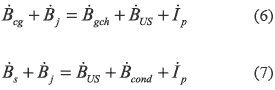
<body><![CDATA[<p> <img src="/img/revistas/rfiua/n58/n58a02e04.gif"></p>      <p><font face="Verdana" size="2">The exergy supplied by bagasse is  transformed into hot combustion gases with some exergy destruction. Subscript <i>c</i> stands for the combustion process. In  the processes that use vapour, the boiler inputs are wet bagasse, air and water  condensates, and its outputs are combustion gases, water vapour, and residues,  with some exergy destruction. Recalling that the physical exergy of air and  water are zero, and neglecting the exergy of residues, the exergy balance is as  shown in equation 5.</font></p>     <p> <img src="/img/revistas/rfiua/n58/n58a02e05.gif"></p>      <p><font face="Verdana" size="2">In equation 5 subscript <i>cond</i> stands for condensates and <i>s</i> stands for steam.</font></p>      <p><font face="Verdana" size="2"><i>Process zone</i></font></p>      <p><font face="Verdana" size="2">The final product for both types of mills is the same, the only difference being the energy resource used. In the furnace-type mills, the energy of combustion gases is used to evaporate the sugarcane juice, while the energy resource in the other processes is the steam generated in a boiler. The input exergy is used for unrefined sugar production with the corresponding irreversibilities. For the furnace-type mills, the exhaust streams are chimney gases, while for the industrial processes the exhaust stream is the condensate. equations 6 and 7 show the exergy balance for furnace-type and for industrial mills is, respectively.</font></p>      <p> <img src="/img/revistas/rfiua/n58/n58a02e06.gif"></p>      <p><font face="Verdana" size="2">The subscript <i>p</i> in these equations stands for process.</font></p>       <p><font face="Verdana" size="3"><b>Results and discussion</b></font></p>      <p><font face="Verdana" size="2">Sugar mills aim to be self-sufficient  by using bagasse as fuel. This allows the definition of an index that records  excess or lack of bagasse, defined as remainder bagasse &#1060;<sub>1</sub> (see  equation 8). The moisture content of the bagasse produced and consumed varies  with the juice extraction and drying processes. For this reason, it is not  possible to make a direct comparison of the mills when wet bagasse is used.  Instead it is necessary to define this index based on the dry bagasse produced  and consumed.</font></p>      ]]></body>
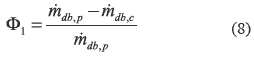
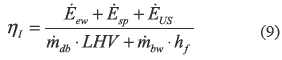
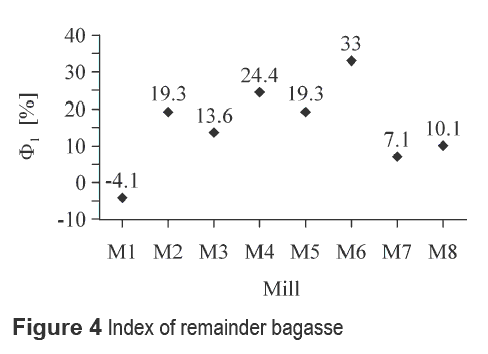
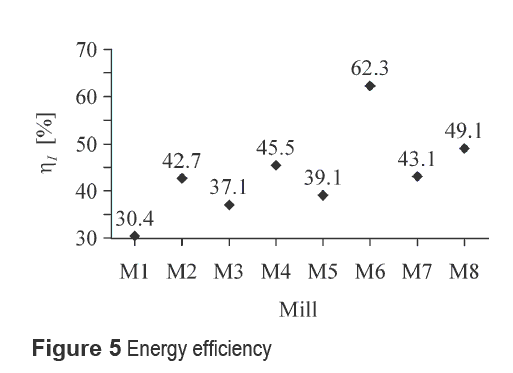
<body><![CDATA[<p> <img src="/img/revistas/rfiua/n58/n58a02e08.gif"></p>      <p><font face="Verdana" size="2">In equation 8 subscript <i>p</i>  stands for produced and <i>c</i> for consumed. The value of this index is shown in <a href="#Figura4">figure 4.</a></font></p>      <p align="center"><img src="/img/revistas/rfiua/n58/n58a02i04.gif" ><a name="Figura4"></a></p>        <p><font face="Verdana" size="2">It can be observed that technological  improvements help in achieving the goal ofenergy self-sufficiency. It can also  be observed that traditional mills need to use additional fuels. The first mill  is the only one in which the energy of the bagasse is not enough for unrefined  sugar production, showing a lack of 4.1% in the bagasse necessary for the mill  to be self-sufficient. This is an alarming result, since most production units  in the country have similar characteristics to this mill.    <br>    <br> Energy efficiency is a very important  index of a mill's performance (see equation 9). This is defined as the ratio of  the energy used in the transformation of sugarcane juice into unrefined sugar,  and the energy of the fuel.</font></p> 	     <p> <img src="/img/revistas/rfiua/n58/n58a02e09.gif"></p>	      <p><font face="Verdana" size="2"> In equation 9 <i>&eta;</i><sub>I</sub> stands for first law or energy efficiency, subscript <i>ew</i> stands for evaporated water, <i>sp</i> stands for solid juice residue. The efficiency for  the mills studied is shown in <a href="#Figura5">figure 5</a>.</font></p>      <p align="center"><img src="/img/revistas/rfiua/n58/n58a02i05.gif" ><a name="Figura5"></a></p>        <p><font face="Verdana" size="2">The low efficiency of the  traditional furnace- type mill (M1) is evident. This result agrees with  previous measurements [4, 5]. It can be seen that technological improvements  allow energy efficiency to be increased. The fraction of the energy lost with  exhaust gases is defined in equation 10.</font></p>      ]]></body>
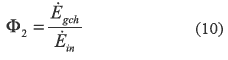
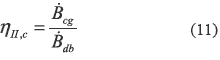
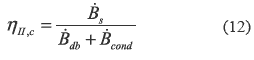
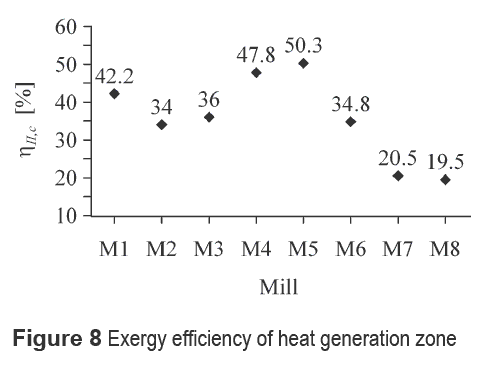
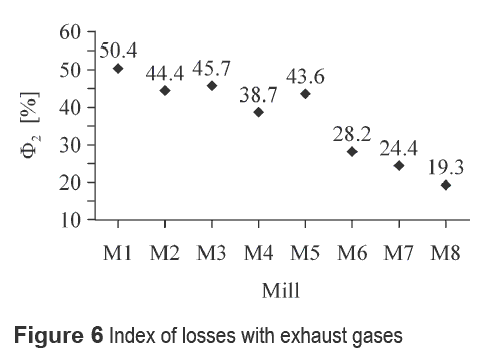
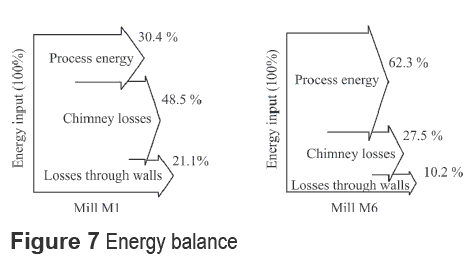
<body><![CDATA[<p> <img src="/img/revistas/rfiua/n58/n58a02e10.gif"></p>	      <p><font face="Verdana" size="2">In equation 10 the subscript <i>in</i> stands for input.  The energy flow of the exhaust stream is a function of its mass flow and  specific enthalpy. For this reason, its value depends on excess air as well as  on the temperature of chimney gases. <a href="#Figura6">Figure 6</a> shows the value of this index.</font></p>      <p align="center"><img src="/img/revistas/rfiua/n58/n58a02i06.gif" ><a name="Figura6"></a></p>      <p><font face="Verdana" size="2">This figure shows how losses with exhaust gases decrease as technological development increases. The results of the energy balance for the unmodified traditional mill (M1) and for the mill designed with engineering criteria (M6) are shown in <a href="#Figura7">figure 7</a>. Mill M6 is superior in regard to the distribution of energy resources. This advantage results in higher productivity.</font></p>      <p align="center"><img src="/img/revistas/rfiua/n58/n58a02i07.gif" ><a name="Figura7"></a></p>      <p><font face="Verdana" size="2">The exergy efficiency of the combustion chamber in the furnace-type mills is defined in equation 11 as the ratio of the exergy of hot combustion gases to that supplied with bagasse.</font></p>      <p> <img src="/img/revistas/rfiua/n58/n58a02e11.gif"></p>      <p><font face="Verdana" size="2">In equation 11 <i>&eta;<sub>II</sub></i> stands for second law efficiency and subscript <i>c</i> stands for  combustion chamber. For the processes that use vapour, the exergy efficiency of  the boiler (equation 12) is defined using the exergy of the produced steam and  that of the input flows of bagasse and condensates.</font></p>      <p> <img src="/img/revistas/rfiua/n58/n58a02e12.gif"></p>      <p><font face="Verdana" size="2">The exergy efficiency of the heat generation process of the mills is shown in <a href="#Figura8">figure 8</a>.</font></p>      ]]></body>
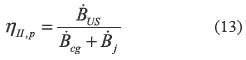
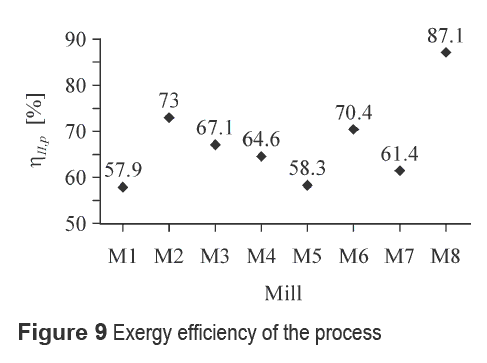
<body><![CDATA[<p align="center"><img src="/img/revistas/rfiua/n58/n58a02i08.gif" ><a name="Figura8"></a></p>      <p><font face="Verdana" size="2">The behaviour of exergy efficiency in  the combustion chamber is determined by the burning of the fuel, the mixing of  air with fuel, the temperature of the combustion chamber, the flow of gases,  and the moisture of the bagasse, among other factors. Consequently, it would be  necessary to perform a detailed analysis in order to determine the effect of  each factor.    <br>    <br>   The mills that use vapour for the  process have low exergy efficiencies, due mainly to the fact that temperatures  in the combustion chamber are lower because the bagasse burned is wet, and  because the gases produced are used for steam production instead of being used  directly for unrefined sugar production, which introduces an additional source  of irreversibilities. The second law efficiency of the process in the  furnace-type mills is defined in equation 13.</font></p>        <p> <img src="/img/revistas/rfiua/n58/n58a02e13.gif"></p>         <p><font face="Verdana" size="2"> For the processes with vapour, the efficiency will be as in equation 14.</font></p>      <p> <img src="/img/revistas/rfiua/n58/n58a02e14.gif"></p>         <p><font face="Verdana" size="2"><a href="#Figura9">Figure 9</a> shows the exergy efficiencies of the process for the different mills.</font></p>       <p align="center"><img src="/img/revistas/rfiua/n58/n58a02i09.gif" ><a name="Figura9"></a></p>      <p><font face="Verdana" size="2">The nature of the evaporation process in the mills studied means that it is not possible to make a direct comparison between furnace-type mills and the ones that use vapour. There are many factors determining this behaviour: temperature of combustion products, heat transfer coefficient, flow of gases, etc. Mill M8 has the highest process exergy efficiency due to the use of vacuum evaporators in series for the concentration of the juice.    ]]></body>
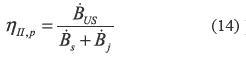
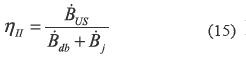
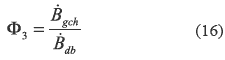
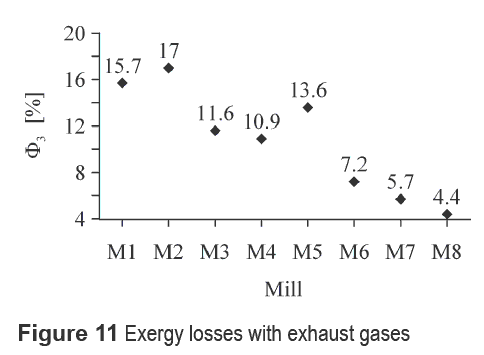
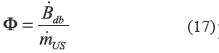
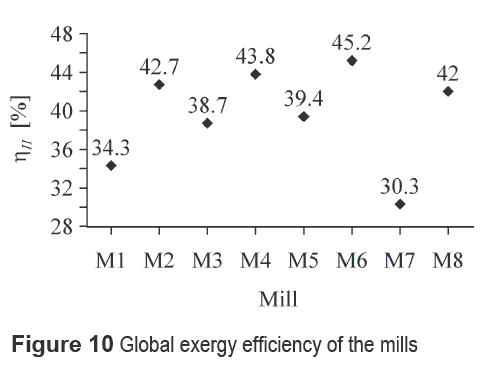
<body><![CDATA[<br>    <br> The global exergy efficiency of a mill is defined according to equation 15.</font></p>      <p> <img src="/img/revistas/rfiua/n58/n58a02e15.gif"></p>         <p><font face="Verdana" size="2"><a href="#Figura10">Figure 10</a> shows the value of the global exergy efficiency for the mills studied.</font></p>      <p align="center"><img src="/img/revistas/rfiua/n58/n58a02i10.gif" ><a name="Figura10"></a></p>      <p><font face="Verdana" size="2">Mill M6, recently built and designed  with the aim of improving the use of energy, is the one with the highest exergy  efficiency. In the processes that use vapour, the energy of the fuel suffers an  additional degradation step in the boiler. In mill M8, this is compensated by  the high efficiency of the concentration process. In mill M7 the efficiency of  the process is sacrificed in the interests of a higher quality product  (ecological unrefined sugar). The sugar cane used in this mill is farmed  without using chemical products, so its sucrose content is lower and it has  higher moisture content. As a consequence, the evaporation of the juice  requires a higher amount of bagasse.    <br>    <br>   It is interesting to define an index  that quantifies exergy losses through chimney gases (equation 16).</font></p>      <p> <img src="/img/revistas/rfiua/n58/n58a02e16.gif"></p>         <p><font face="Verdana" size="2"> The behaviour of this index is similar to the energy losses with exhaust gases (see <a href="#Figura11">figure 11</a>). The mills that use vapour have lower losses due to controlled combustion, which allows low temperature of the chimney gases and excess air.</font></p>        ]]></body>
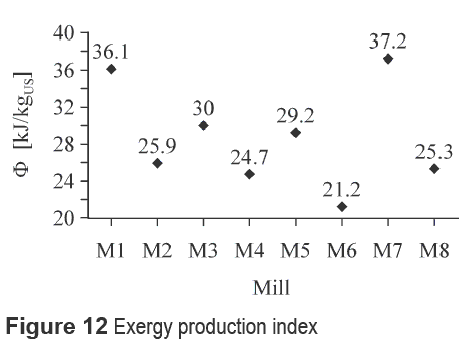
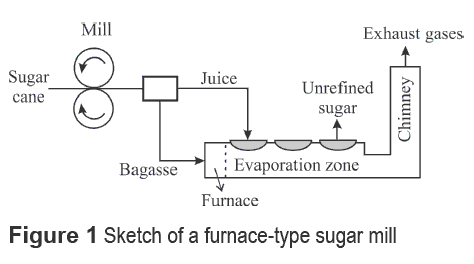
<body><![CDATA[<p align="center"><img src="/img/revistas/rfiua/n58/n58a02i11.gif" ><a name="Figura11"></a></p>      <p><font face="Verdana" size="2">It is useful to define an index for characterizing the exergy use in the mills that takes into account the production level of each mill (see equation 17). This index is defined as the ratio of the exergy supplied with bagasse and the mass flow of unrefined sugar produced:</font></p>      <p> <img src="/img/revistas/rfiua/n58/n58a02e17.gif"></p>      <p><font face="Verdana" size="2">A low value on this index indicates a good  relationship between exergy use and productivity. This exergy production index  is shown in <a href="#Figura12">figure 12</a>. The value of this index for mill Ml is high due to major  energy losses and low productivity. Mill M2 has reduced losses through walls  and higher productivity, which partially compensates the high exergy losses  through exhaust gases, resulting in a lower index. In mill M3 the bagasse is  not dried, leading to significant energy consumption in the evaporation of its  moisture, increasing the value of the index. In the mill with two feeding ports  (M4), there are moderate losses and bagasse is effectively dried, resulting in  a low value for the exergy production index. Although in mill M5 the bagasse is  dried, there is a high amount of excess air, and consequently the index is  relatively high. Mill M6 has been designed to improve the combustion process  and heat transfer, and has moderate excess air and exhaust temperature. As a  result, the exergy production index for this mill is the lowest. Mill M7  operates with &quot;ecological production&quot; criteria, sacrificing  productivity in order to obtain a high quality final product. The term  &quot;ecological production&quot; means that despite the high energy demand of  the process, bagasse is the only energy source used with no additional  consumption of fossil fuels. This explains why the highest index corresponds to  this mill. This drawback is compensated by increasing the price of the product.  The index corresponding to mill M8 is low because the efficiency of the process  is very high.</font></p>       <p align="center"><img src="/img/revistas/rfiua/n58/n58a02i12.gif" ><a name="Figura12"></a></p>      <p><font face="Verdana" size="2">The exergy balance for mills Ml and  M6 is shown in <a href="#Figura13">figure 13</a>. The improvements in design result in better use of  energy resources. It is important to mention that construction and operation  costs of mills Ml and M6 are similar.</font></p>       <p align="center"><img src="/img/revistas/rfiua/n58/n58a02i13.gif" ><a name="Figura13"></a></p>      <p><font face="Verdana" size="3"><b>Conclusions</b></font> </p>  <font face="Verdana" size="2">In this study, first and second law  analyses were applied to eight sugar mills that represent the different mill  designs for unrefined sugar production in Colombia. The study is based on  experimental data from the mills, and on laboratory tests to characterize  bagasse fuel. The main findings of the research are the following:  <ul>       <li>In spite of the technological improvements in furnace-type  sugar mills, there is still a high energy potential in exhaust gases due to  high mass flow and temperature in the chimney.</li>       <li>Technological improvements of furnace - type mills result in  an increase of energy efficiency, leading to self-sufficiency.</li>       ]]></body>
<body><![CDATA[<li>The application of thermal engineering criteria to design of  furnace-type mills allows energy and exergy efficiency to be increased, as well  as improving self-sufficiency and productivity, as demonstrated by the results  of mill M6.</li>       <li>The results show that improvements have been conceived based  on first law criteria and not on an exergy basis. Consequently, the exergy  destruction remains high.</li>     </ul> There is a high potential for  improving second law performance in sugar mills by using cogeneration. In this  way, the exergy of the fuel will be used for power generation, and the residual  streams for evaporation of sugarcane juice. This alternative is more suitable  for larger, industrial mills.</font></p>     <p><font face="Verdana" size="3"><b>Acknowledgements</b></font></p>      <p><font face="Verdana" size="2">The authors wish to thank FEDEPANELA  Antioquia, especially to engineer Francisco Cadavid; to the owners of the mills  studied, and the members of GIPUN, especially to engineers Eugenia Gonzalez,  Pedro Rivero, and Jorge Iv&aacute;n Alvarez.</font></p>       <p><font face="Verdana" size="3"><b>References</b></font></p>        <!-- ref --><p><font face="Verdana" size="2">1. Ministry of Agriculture and Rural  Development. &quot;The unrefined sugar sector in Colombia&quot; Bogot&aacute; 2006. pp. 16 <a href="http://www.minagricultura.gov.co/archivos/SectorPaneleroColombiano.pdf." target="_blank">http://www.minagricultura.gov.co/archivos/SectorPaneleroColombiano.pdf.</a>   Consultada el 14 de julio de 2010. pp. 1-22.    &nbsp;&nbsp;&nbsp;&nbsp;&nbsp;&nbsp;&nbsp;&nbsp;[&#160;<a href="javascript:void(0);" onclick="javascript: window.open('/scielo.php?script=sci_nlinks&ref=000129&pid=S0120-6230201100020000200001&lng=','','width=640,height=500,resizable=yes,scrollbars=1,menubar=yes,');">Links</a>&#160;]<!-- end-ref --><br>          <!-- ref --><br>  2. H. I. Vel&aacute;squez.  <i>Energy evaluation of unrefined sugar production processes in Colombia.</i>  M.Sc. Thesis. Engineering Faculty. Universidad Pontificia Bolivariana.  Medell&iacute;n. 2002. pp. 22-35.    &nbsp;&nbsp;&nbsp;&nbsp;&nbsp;&nbsp;&nbsp;&nbsp;[&#160;<a href="javascript:void(0);" onclick="javascript: window.open('/scielo.php?script=sci_nlinks&ref=000131&pid=S0120-6230201100020000200002&lng=','','width=640,height=500,resizable=yes,scrollbars=1,menubar=yes,');">Links</a>&#160;]<!-- end-ref --><br>    ]]></body>
<body><![CDATA[<!-- ref --><br> 3. H. Mart&iacute;nez, X. Acevedo.  &quot;Agro industrial chain in of unrefined sugar Colombia. A global look at  its structure and dynamics&quot;. <i>Work paper. N.&deg; 57.</i> Agricultural and Rural Development Ministry.  Bogot&aacute;. 2005. pp. 3.    &nbsp;&nbsp;&nbsp;&nbsp;&nbsp;&nbsp;&nbsp;&nbsp;[&#160;<a href="javascript:void(0);" onclick="javascript: window.open('/scielo.php?script=sci_nlinks&ref=000133&pid=S0120-6230201100020000200003&lng=','','width=640,height=500,resizable=yes,scrollbars=1,menubar=yes,');">Links</a>&#160;]<!-- end-ref --><br>    <!-- ref --><br> 4. ICA. &quot;Sugarcane production and elaboration of unrefined  sugar&quot;. <i>Document. 45.</i>  Colombian Farming Institute - National Federation of Coffee Growers of  Colombia. 1986. pp. 61.    &nbsp;&nbsp;&nbsp;&nbsp;&nbsp;&nbsp;&nbsp;&nbsp;[&#160;<a href="javascript:void(0);" onclick="javascript: window.open('/scielo.php?script=sci_nlinks&ref=000135&pid=S0120-6230201100020000200004&lng=','','width=640,height=500,resizable=yes,scrollbars=1,menubar=yes,');">Links</a>&#160;]<!-- end-ref --><br>    <!-- ref --><br> 5. CORPOICA. &quot;Technical papers on sugarcane growing and  unrefined sugar production&quot;. Santander. <i>Document. 17612.</i>  Colombian Corporation for Farming Research. 1996. pp. 22-46.    &nbsp;&nbsp;&nbsp;&nbsp;&nbsp;&nbsp;&nbsp;&nbsp;[&#160;<a href="javascript:void(0);" onclick="javascript: window.open('/scielo.php?script=sci_nlinks&ref=000137&pid=S0120-6230201100020000200005&lng=','','width=640,height=500,resizable=yes,scrollbars=1,menubar=yes,');">Links</a>&#160;]<!-- end-ref --><br>    <!-- ref --><br> 6. I. Kilicaslan, H. I. Sarac, E. Ozdemir, K. Ermis. &quot;Sugar cane as an  alternative energy source for Turkey&quot;.  <i>Energy Conversion and Management.</i> Vol. 40. 1999. pp. 1-11.    &nbsp;&nbsp;&nbsp;&nbsp;&nbsp;&nbsp;&nbsp;&nbsp;[&#160;<a href="javascript:void(0);" onclick="javascript: window.open('/scielo.php?script=sci_nlinks&ref=000139&pid=S0120-6230201100020000200006&lng=','','width=640,height=500,resizable=yes,scrollbars=1,menubar=yes,');">Links</a>&#160;]<!-- end-ref --><br>    <!-- ref --><br> 7. M. Bayrak, A. Midilli, K. Nurveren. &quot;Energy and exergy  analyses of sugar production stages&quot;.  <i>Int. J. Energy Res.</i> Vol. 27. 2003. pp. 989-1001.    &nbsp;&nbsp;&nbsp;&nbsp;&nbsp;&nbsp;&nbsp;&nbsp;[&#160;<a href="javascript:void(0);" onclick="javascript: window.open('/scielo.php?script=sci_nlinks&ref=000141&pid=S0120-6230201100020000200007&lng=','','width=640,height=500,resizable=yes,scrollbars=1,menubar=yes,');">Links</a>&#160;]<!-- end-ref --><br>    ]]></body>
<body><![CDATA[<!-- ref --><br> 8. H. I. Vel&aacute;squez. <i>Energy evaluation of unrefined  sugar production processes in Colombia and design proposal for an improved  mill. GIPUN.</i> Work for teaching  promotion. Universidad Nacional de Colombia. Medell&iacute;n. 2004. pp. 57-78.    &nbsp;&nbsp;&nbsp;&nbsp;&nbsp;&nbsp;&nbsp;&nbsp;[&#160;<a href="javascript:void(0);" onclick="javascript: window.open('/scielo.php?script=sci_nlinks&ref=000143&pid=S0120-6230201100020000200008&lng=','','width=640,height=500,resizable=yes,scrollbars=1,menubar=yes,');">Links</a>&#160;]<!-- end-ref --><br>    <!-- ref --><br> 9. S. A. Nebra, M. I. Fernandez Parra. &quot;The exergy of  sucrose-water solutions: proposal of a calculation method&quot;. <i>Proceedings of ECOS 2005. </i> Trondheim (Norway). Vol. 1. 2005. pp. 385-392.    &nbsp;&nbsp;&nbsp;&nbsp;&nbsp;&nbsp;&nbsp;&nbsp;[&#160;<a href="javascript:void(0);" onclick="javascript: window.open('/scielo.php?script=sci_nlinks&ref=000145&pid=S0120-6230201100020000200009&lng=','','width=640,height=500,resizable=yes,scrollbars=1,menubar=yes,');">Links</a>&#160;]<!-- end-ref --><br>    <!-- ref --><br> 10. L. A. Cortez, E.  O. G&oacute;mez. &quot;A  method for exergy analysis of sugarcane bagasse boilers&quot;. <i>Brazilian Journal of Chemical  Engineering.</i> 1998. Vol. 15. pp. 1-13.    &nbsp;&nbsp;&nbsp;&nbsp;&nbsp;&nbsp;&nbsp;&nbsp;[&#160;<a href="javascript:void(0);" onclick="javascript: window.open('/scielo.php?script=sci_nlinks&ref=000147&pid=S0120-6230201100020000200010&lng=','','width=640,height=500,resizable=yes,scrollbars=1,menubar=yes,');">Links</a>&#160;]<!-- end-ref --><br>    <!-- ref --><br> 11. E. Hugot. <i>Handbook of cane sugar  engineering.</i> 3<sup>a</sup> ed. Ed. Elsevier. Amsterdam. 1986. pp.  918-919.    &nbsp;&nbsp;&nbsp;&nbsp;&nbsp;&nbsp;&nbsp;&nbsp;[&#160;<a href="javascript:void(0);" onclick="javascript: window.open('/scielo.php?script=sci_nlinks&ref=000149&pid=S0120-6230201100020000200011&lng=','','width=640,height=500,resizable=yes,scrollbars=1,menubar=yes,');">Links</a>&#160;]<!-- end-ref --><br>    <!-- ref --><br> 12. M. A. Rosen.  &quot;Second-law analysis: approaches and implications&quot;. <i>Int. J. Energy Res.</i>  Vol. 23. 1999. pp. 415-429.    &nbsp;&nbsp;&nbsp;&nbsp;&nbsp;&nbsp;&nbsp;&nbsp;[&#160;<a href="javascript:void(0);" onclick="javascript: window.open('/scielo.php?script=sci_nlinks&ref=000151&pid=S0120-6230201100020000200012&lng=','','width=640,height=500,resizable=yes,scrollbars=1,menubar=yes,');">Links</a>&#160;]<!-- end-ref --><br>    ]]></body>
<body><![CDATA[<!-- ref --><br> 13. R. A. Gaggioli, P. J.  Petit. &quot;Use the second law, first&quot;. <i>Chemtech.</i> Vol. 7.  1977. pp. 496-506.    &nbsp;&nbsp;&nbsp;&nbsp;&nbsp;&nbsp;&nbsp;&nbsp;[&#160;<a href="javascript:void(0);" onclick="javascript: window.open('/scielo.php?script=sci_nlinks&ref=000153&pid=S0120-6230201100020000200013&lng=','','width=640,height=500,resizable=yes,scrollbars=1,menubar=yes,');">Links</a>&#160;]<!-- end-ref --><br>    <!-- ref --><br> 14. M. J. Moran, E. Sciubba.  &quot;Exergy analysis: Principles and practice&quot;. <i>Journal of Engineering for Gas  Turbines and Power.</i> Vol. 116. 1994. pp. 285-290.    &nbsp;&nbsp;&nbsp;&nbsp;&nbsp;&nbsp;&nbsp;&nbsp;[&#160;<a href="javascript:void(0);" onclick="javascript: window.open('/scielo.php?script=sci_nlinks&ref=000155&pid=S0120-6230201100020000200014&lng=','','width=640,height=500,resizable=yes,scrollbars=1,menubar=yes,');">Links</a>&#160;]<!-- end-ref --><br>    <!-- ref --><br> 15. I. Dincer, Y. A. Cengel. &quot;Energy,  entropy and exergy concepts and their roles in thermal engineering&quot;. <i>Entropy.</i> Vol. 3.  2001. pp. 116-149.    &nbsp;&nbsp;&nbsp;&nbsp;&nbsp;&nbsp;&nbsp;&nbsp;[&#160;<a href="javascript:void(0);" onclick="javascript: window.open('/scielo.php?script=sci_nlinks&ref=000157&pid=S0120-6230201100020000200015&lng=','','width=640,height=500,resizable=yes,scrollbars=1,menubar=yes,');">Links</a>&#160;]<!-- end-ref --><br>     <!-- ref --><br> 16. T. J. Kotas. <i>The exergy method of thermal plant  analysis.</i> Ed. Butterworths. London. 1985. p. 268-328.</font>&nbsp;&nbsp;&nbsp;&nbsp;&nbsp;&nbsp;&nbsp;&nbsp;[&#160;<a href="javascript:void(0);" onclick="javascript: window.open('/scielo.php?script=sci_nlinks&ref=000159&pid=S0120-6230201100020000200016&lng=','','width=640,height=500,resizable=yes,scrollbars=1,menubar=yes,');">Links</a>&#160;]<!-- end-ref --><br>       <br>    <br>    ]]></body>
<body><![CDATA[<br>     <p><font face="Verdana" size="2">(Recibido el 4 de Mayo de 2010. Aceptado el 25 de noviembre de 2010)</font></p>     <p><font face="Verdana" size="2"><sup>*</sup>Autor de correspondencia: tel&eacute;fono: + 57 + 4 + 425 53 00, fax: + 57 + 4 + 230 53 51, correo electr&oacute;nico: <a href="mailto:hivelasq@unal.edu.co">hivelasq@unal.edu.co</a>( H. Vel&aacute;squez)</font></p>      ]]></body><back>
<ref-list>
<ref id="B1">
<label>1</label><nlm-citation citation-type="">
<collab>Ministry of Agriculture and Rural Development</collab>
<source><![CDATA[The unrefined sugar sector in Colombia]]></source>
<year>2006</year>
<page-range>16</page-range><publisher-loc><![CDATA[Bogotá ]]></publisher-loc>
</nlm-citation>
</ref>
<ref id="B2">
<label>2</label><nlm-citation citation-type="">
<person-group person-group-type="author">
<name>
<surname><![CDATA[Velásquez]]></surname>
<given-names><![CDATA[H. I]]></given-names>
</name>
</person-group>
<source><![CDATA[Energy evaluation of unrefined sugar production processes in Colombia]]></source>
<year></year>
</nlm-citation>
</ref>
<ref id="B3">
<label>3</label><nlm-citation citation-type="journal">
<person-group person-group-type="author">
<name>
<surname><![CDATA[Martínez]]></surname>
<given-names><![CDATA[H]]></given-names>
</name>
<name>
<surname><![CDATA[Acevedo]]></surname>
<given-names><![CDATA[X]]></given-names>
</name>
</person-group>
<article-title xml:lang="en"><![CDATA[Agro industrial chain in of unrefined sugar Colombia: A global look at its structure and dynamics]]></article-title>
<source><![CDATA[Work paper]]></source>
<year>2005</year>
<numero>57</numero>
<issue>57</issue>
<page-range>3</page-range><publisher-loc><![CDATA[Bogotá ]]></publisher-loc>
<publisher-name><![CDATA[Agricultural and Rural Development Ministry]]></publisher-name>
</nlm-citation>
</ref>
<ref id="B4">
<label>4</label><nlm-citation citation-type="journal">
<collab>ICA</collab>
<article-title xml:lang="en"><![CDATA[Sugarcane production and elaboration of unrefined sugar]]></article-title>
<source><![CDATA[Document. 45]]></source>
<year>1986</year>
<page-range>61</page-range><publisher-name><![CDATA[Colombian Farming Institute - National Federation of Coffee Growers of Colombia]]></publisher-name>
</nlm-citation>
</ref>
<ref id="B5">
<label>5</label><nlm-citation citation-type="">
<collab>CORPOICA</collab>
<source><![CDATA[Technical papers on sugarcane growing and unrefined sugar production]]></source>
<year>1996</year>
<page-range>22-46</page-range></nlm-citation>
</ref>
<ref id="B6">
<label>6</label><nlm-citation citation-type="journal">
<person-group person-group-type="author">
<name>
<surname><![CDATA[Kilicaslan]]></surname>
<given-names><![CDATA[I]]></given-names>
</name>
<name>
<surname><![CDATA[Sarac]]></surname>
<given-names><![CDATA[H. I]]></given-names>
</name>
<name>
<surname><![CDATA[Ozdemir]]></surname>
<given-names><![CDATA[E]]></given-names>
</name>
<name>
<surname><![CDATA[Ermis]]></surname>
<given-names><![CDATA[K]]></given-names>
</name>
</person-group>
<article-title xml:lang="en"><![CDATA[Sugar cane as an alternative energy source for Turkey]]></article-title>
<source><![CDATA[Energy Conversion and Management]]></source>
<year>1999</year>
<volume>40</volume>
<page-range>1-11</page-range></nlm-citation>
</ref>
<ref id="B7">
<label>7</label><nlm-citation citation-type="journal">
<person-group person-group-type="author">
<name>
<surname><![CDATA[Bayrak]]></surname>
<given-names><![CDATA[M]]></given-names>
</name>
<name>
<surname><![CDATA[Midilli]]></surname>
<given-names><![CDATA[A]]></given-names>
</name>
<name>
<surname><![CDATA[Nurveren]]></surname>
<given-names><![CDATA[K]]></given-names>
</name>
</person-group>
<article-title xml:lang="en"><![CDATA[Energy and exergy analyses of sugar production stages]]></article-title>
<source><![CDATA[Int. J. Energy Res]]></source>
<year>2003</year>
<volume>27</volume>
<page-range>989-1001</page-range></nlm-citation>
</ref>
<ref id="B8">
<label>8</label><nlm-citation citation-type="book">
<person-group person-group-type="author">
<name>
<surname><![CDATA[Velásquez]]></surname>
<given-names><![CDATA[H. I]]></given-names>
</name>
</person-group>
<source><![CDATA[Energy evaluation of unrefined sugar production processes in Colombia and design proposal for an improved mill]]></source>
<year>2004</year>
<page-range>57-78</page-range><publisher-loc><![CDATA[Medellín ]]></publisher-loc>
<publisher-name><![CDATA[GIPUN. Work for teaching promotion. Universidad Nacional de Colombia]]></publisher-name>
</nlm-citation>
</ref>
<ref id="B9">
<label>9</label><nlm-citation citation-type="journal">
<person-group person-group-type="author">
<name>
<surname><![CDATA[Nebra]]></surname>
<given-names><![CDATA[S. A]]></given-names>
</name>
<name>
<surname><![CDATA[Fernandez Parra]]></surname>
<given-names><![CDATA[M. I]]></given-names>
</name>
</person-group>
<article-title xml:lang="en"><![CDATA[The exergy of sucrose-water solutions: proposal of a calculation method]]></article-title>
<source><![CDATA[Proceedings of ECOS 2005]]></source>
<year>2005</year>
<volume>1</volume>
<page-range>385-392</page-range></nlm-citation>
</ref>
<ref id="B10">
<label>10</label><nlm-citation citation-type="journal">
<person-group person-group-type="author">
<name>
<surname><![CDATA[Cortez]]></surname>
<given-names><![CDATA[L. A]]></given-names>
</name>
<name>
<surname><![CDATA[Gómez]]></surname>
<given-names><![CDATA[E. O]]></given-names>
</name>
</person-group>
<article-title xml:lang="en"><![CDATA[A method for exergy analysis of sugarcane bagasse boilers]]></article-title>
<source><![CDATA[Brazilian Journal of Chemical Engineering]]></source>
<year>1998</year>
<volume>15</volume>
<page-range>1-13</page-range></nlm-citation>
</ref>
<ref id="B11">
<label>11</label><nlm-citation citation-type="book">
<person-group person-group-type="author">
<name>
<surname><![CDATA[Hugot]]></surname>
<given-names><![CDATA[E]]></given-names>
</name>
</person-group>
<source><![CDATA[Handbook of cane sugar engineering]]></source>
<year>1986</year>
<edition>3</edition>
<page-range>918-919</page-range><publisher-loc><![CDATA[Amsterdam ]]></publisher-loc>
<publisher-name><![CDATA[Elsevier]]></publisher-name>
</nlm-citation>
</ref>
<ref id="B12">
<label>12</label><nlm-citation citation-type="journal">
<person-group person-group-type="author">
<name>
<surname><![CDATA[Rosen]]></surname>
<given-names><![CDATA[M. A]]></given-names>
</name>
</person-group>
<article-title xml:lang="en"><![CDATA[Second-law analysis: approaches and implications]]></article-title>
<source><![CDATA[Int. J. Energy Res]]></source>
<year>1999</year>
<volume>23</volume>
<page-range>415-429</page-range></nlm-citation>
</ref>
<ref id="B13">
<label>13</label><nlm-citation citation-type="journal">
<person-group person-group-type="author">
<name>
<surname><![CDATA[Gaggioli]]></surname>
<given-names><![CDATA[R. A]]></given-names>
</name>
<name>
<surname><![CDATA[Petit]]></surname>
<given-names><![CDATA[P. J]]></given-names>
</name>
</person-group>
<article-title xml:lang="en"><![CDATA[Use the second law, first]]></article-title>
<source><![CDATA[Chemtech]]></source>
<year>1977</year>
<volume>7</volume>
<page-range>496-506</page-range></nlm-citation>
</ref>
<ref id="B14">
<label>14</label><nlm-citation citation-type="journal">
<person-group person-group-type="author">
<name>
<surname><![CDATA[Moran]]></surname>
<given-names><![CDATA[M. J]]></given-names>
</name>
<name>
<surname><![CDATA[Sciubba]]></surname>
<given-names><![CDATA[E]]></given-names>
</name>
</person-group>
<article-title xml:lang="en"><![CDATA[Exergy analysis: Principles and practice]]></article-title>
<source><![CDATA[Journal of Engineering for Gas Turbines and Power]]></source>
<year>1994</year>
<volume>116</volume>
<page-range>285-290</page-range></nlm-citation>
</ref>
<ref id="B15">
<label>15</label><nlm-citation citation-type="journal">
<person-group person-group-type="author">
<name>
<surname><![CDATA[Dincer]]></surname>
<given-names><![CDATA[I]]></given-names>
</name>
<name>
<surname><![CDATA[Cengel]]></surname>
<given-names><![CDATA[Y. A]]></given-names>
</name>
</person-group>
<article-title xml:lang="en"><![CDATA[Energy, entropy and exergy concepts and their roles in thermal engineering]]></article-title>
<source><![CDATA[Entropy]]></source>
<year>2001</year>
<volume>3</volume>
<page-range>116-149</page-range></nlm-citation>
</ref>
<ref id="B16">
<label>16</label><nlm-citation citation-type="book">
<person-group person-group-type="author">
<name>
<surname><![CDATA[Kotas]]></surname>
<given-names><![CDATA[T. J]]></given-names>
</name>
</person-group>
<source><![CDATA[The exergy method of thermal plant analysis]]></source>
<year>1985</year>
<page-range>268-328</page-range><publisher-loc><![CDATA[London ]]></publisher-loc>
<publisher-name><![CDATA[Ed. Butterworths]]></publisher-name>
</nlm-citation>
</ref>
</ref-list>
</back>
</article>