<?xml version="1.0" encoding="ISO-8859-1"?><article xmlns:mml="http://www.w3.org/1998/Math/MathML" xmlns:xlink="http://www.w3.org/1999/xlink" xmlns:xsi="http://www.w3.org/2001/XMLSchema-instance">
<front>
<journal-meta>
<journal-id>0120-6230</journal-id>
<journal-title><![CDATA[Revista Facultad de Ingeniería Universidad de Antioquia]]></journal-title>
<abbrev-journal-title><![CDATA[Rev.fac.ing.univ. Antioquia]]></abbrev-journal-title>
<issn>0120-6230</issn>
<publisher>
<publisher-name><![CDATA[Facultad de Ingeniería, Universidad de Antioquia]]></publisher-name>
</publisher>
</journal-meta>
<article-meta>
<article-id>S0120-62302011000400007</article-id>
<title-group>
<article-title xml:lang="en"><![CDATA[Piecewise line-symmetric spherical motions for orientation interpolation in 5-Axis CNC tool path planning]]></article-title>
<article-title xml:lang="es"><![CDATA[Movimientos simétrico lineales esféricos segmentados para interpolación de orientaciones en planificación de trayectorias de herramienta en CNC de 5 Ejes]]></article-title>
</title-group>
<contrib-group>
<contrib contrib-type="author">
<name>
<surname><![CDATA[Trujillo Suárez]]></surname>
<given-names><![CDATA[Carlos Andrés]]></given-names>
</name>
<xref ref-type="aff" rid="A01"/>
</contrib>
<contrib contrib-type="author">
<name>
<surname><![CDATA[Jeffrey Ge]]></surname>
<given-names><![CDATA[Qiaode]]></given-names>
</name>
<xref ref-type="aff" rid="A02"/>
</contrib>
</contrib-group>
<aff id="A01">
<institution><![CDATA[,Universidad de Antioquia Departamento de Ingeniería Mecánica ]]></institution>
<addr-line><![CDATA[ ]]></addr-line>
</aff>
<aff id="A02">
<institution><![CDATA[,State University of New York at Stony Brook Department of Mechanical Engineering ]]></institution>
<addr-line><![CDATA[New York ]]></addr-line>
<country>Estados Unidos</country>
</aff>
<pub-date pub-type="pub">
<day>00</day>
<month>09</month>
<year>2011</year>
</pub-date>
<pub-date pub-type="epub">
<day>00</day>
<month>09</month>
<year>2011</year>
</pub-date>
<numero>60</numero>
<fpage>62</fpage>
<lpage>71</lpage>
<copyright-statement/>
<copyright-year/>
<self-uri xlink:href="http://www.scielo.org.co/scielo.php?script=sci_arttext&amp;pid=S0120-62302011000400007&amp;lng=en&amp;nrm=iso"></self-uri><self-uri xlink:href="http://www.scielo.org.co/scielo.php?script=sci_abstract&amp;pid=S0120-62302011000400007&amp;lng=en&amp;nrm=iso"></self-uri><self-uri xlink:href="http://www.scielo.org.co/scielo.php?script=sci_pdf&amp;pid=S0120-62302011000400007&amp;lng=en&amp;nrm=iso"></self-uri><abstract abstract-type="short" xml:lang="en"><p><![CDATA[This paper employs quaternion biarcs to interpolate a set of orientations with angular velocity constraints. The resulting quaternion curve represents a piecewise line-symmetric spherical motion with C¹ continuity. The purpose of this effort is to put line-symmetric motions into use from the viewpoint of motion approximation and interpolation, and to present their potential applications in Computerized Numerical Control (CNC) machining simulation and tool path planning. Quaternion biarcs may be used to approximate B-spline quaternion curves that represent rational spherical motions that have applications in robot path planning, CAD/CAM and computer graphics.]]></p></abstract>
<abstract abstract-type="short" xml:lang="es"><p><![CDATA[Este artículo emplea biarcos cuaterniónicos para interpolar un conjunto de orientaciones con restricciones de velocidad angular. La curva cuaterniónica resultante representa un movimiento simétrico lineal esférico segmentado con continuidad C¹. El propósito de este esfuerzo es poner en uso los movimientos simétrico lineales desde el punto de vista de aproximación e interpolación de movimiento y presentar su potencial aplicación en la simulación de mecanizado por Control Numérico Computarizado (CNC) y planeación de trayectorias de herramienta. Los biarcos cuaterniónicos pueden ser usados para aproximar curvas B-spline cuaterniónicas que representan movimientos esféricos racionales, los cuales tienen aplicaciones en planeación de trayectorias de robots, en CAD/CAM y en gráficas por computador.]]></p></abstract>
<kwd-group>
<kwd lng="en"><![CDATA[Quaternions]]></kwd>
<kwd lng="en"><![CDATA[biarcs]]></kwd>
<kwd lng="en"><![CDATA[orientation interpolation]]></kwd>
<kwd lng="en"><![CDATA[computerized numerical control]]></kwd>
<kwd lng="en"><![CDATA[path planning]]></kwd>
<kwd lng="es"><![CDATA[Cuaterniones]]></kwd>
<kwd lng="es"><![CDATA[biarcos]]></kwd>
<kwd lng="es"><![CDATA[interpolación de orientaciones]]></kwd>
<kwd lng="es"><![CDATA[control numérico computarizado]]></kwd>
<kwd lng="es"><![CDATA[planeación de trayectorias]]></kwd>
</kwd-group>
</article-meta>
</front><body><![CDATA[ <p align="center"><font face="Verdana" size="4"> <b>Piecewise line-symmetric spherical motions for orientation interpolation in 5-Axis CNC tool path planning</b></font></p>      <p align="center"><font face="Verdana" size="4"> <b>Movimientos sim&eacute;trico lineales esf&eacute;ricos segmentados para interpolaci&oacute;n de orientaciones en planificaci&oacute;n de trayectorias de herramienta en CNC de 5 Ejes</b></font></p>      <p> <font face="Verdana" size="2"> <i>Carlos Andr&eacute;s Trujillo Su&aacute;rez*<sup>1</sup>, Qiaode Jeffrey Ge<sup>2</sup></i></font></p>       <p> <font face="Verdana" size="2"> <sup>1</sup>Departamento de Ingenier&iacute;a Mec&aacute;nica, Universidad de Antioquia. Calle 67 N&deg; 53-108. Medell&iacute;n,  Colombia.     <br>    <br>   <sup>2</sup>Department of Mechanical  Engineering, State University of New York at Stony Brook. C. P. 11794.  New York, Estados Unidos. </font></p>    <br>  <hr noshade size="1">      <p><font face="Verdana" size="3"><b>Abstract</b></font></p>       <p><font face="Verdana" size="2">This  paper employs quaternion biarcs to interpolate a set of orientations with  angular velocity constraints. The resulting quaternion curve represents a  piecewise line-symmetric spherical motion with <i>C</i><sup>1</sup> continuity. The purpose of  this effort is to put line-symmetric motions into use from the viewpoint of  motion approximation and interpolation, and to present their potential  applications in Computerized Numerical Control (CNC) machining simulation and tool  path planning. Quaternion biarcs may be used to approximate B-spline quaternion  curves that represent rational spherical motions that have applications in  robot path planning, CAD/CAM and computer graphics. </font></p>       <p><font face="Verdana" size="2"><i>Keywords: </i>Quaternions, biarcs, orientation interpolation,  computerized numerical control, path planning.</font></p>  <hr noshade size="1">       ]]></body>
<body><![CDATA[<p><font face="Verdana" size="3"><b>Resumen</b></font></p>      <p><font face="Verdana" size="2">Este art&iacute;culo emplea biarcos cuaterni&oacute;nicos para interpolar un conjunto  de orientaciones con restricciones de velocidad angular. La curva cuaterni&oacute;nica  resultante representa un movimiento sim&eacute;trico lineal esf&eacute;rico segmentado con  continuidad<i> C</i><sup>1</sup>. El  prop&oacute;sito de este esfuerzo es poner en uso los movimientos sim&eacute;trico lineales  desde el punto de vista de aproximaci&oacute;n e interpolaci&oacute;n de movimiento y  presentar su potencial aplicaci&oacute;n en la simulaci&oacute;n de mecanizado por Control  Num&eacute;rico Computarizado (CNC) y planeaci&oacute;n de trayectorias de herramienta. Los  biarcos cuaterni&oacute;nicos pueden ser usados para aproximar curvas B-spline  cuaterni&oacute;nicas que representan movimientos esf&eacute;ricos racionales, los cuales  tienen aplicaciones en planeaci&oacute;n de trayectorias de robots, en CAD/CAM y en  gr&aacute;ficas por computador. </font></p>      <p><font face="Verdana" size="2"><i>Palabras clave: </i>Cuaterniones, biarcos, interpolaci&oacute;n de  orientaciones, control num&eacute;rico computarizado, planeaci&oacute;n de trayectorias. </font></p>  <hr noshade size="1">      <p><font face="Verdana" size="3"><b>Introduction</b></font></p>      <p><font face="Verdana" size="2">It  is common practice in Computer Graphics and Computer Aided Geometric Design  (CAGD) to approximate a space curve such as a cubic B-spline with <em>C</em><sup>0</sup> piecewise line segments, or  better, with <em>G</em><sup>1</sup> continuous biarcs &#91;1&#93;. Such techniques are commonly  employed in robot motion planning to generate joint trajectories in what is  called the configuration space (C-space) &#91;2, 3&#93;. There is abundant literature  on the subject (e.g. &#91;4, 5&#93;) but the general approach consists of optimizing  some parameter or objective function while avoiding obstacles and kinematic  singularities which are mapped onto the C-space. A similar approach is followed  in CNC motion generation for 5-axis machining. In this context, a discrete set  of tool positions, or cutter location (CL) data, is generated out of the  geometry of the surface to be machined; then, the inverse kinematics is  performed for each CL data, the corresponding joint parameters are obtained,  and the C-space techniques are applied (see, e.g. &#91;6-8&#93;). However, in most  commercial machines a simple piecewise linear interpolation of the joint  parameters is commonly used which requires a huge amount of data in order to  achieve the desired tolerance and does not offer velocity continuity since the  cutter has to abruptly change its direction of motion and orientation between  line segments compromising surface accuracy and machining time &#91;9, 10&#93;.  Furthermore, a drawback of the C-space for motion design is that it does not  seamlessly reflect the traits of the actual rigid body motion and does not  allow for intuitive manipulation and fine-tuning of the motion.     <br>    <br>  This  is why the space defined by the four components of a quaternion is recognized  as an elegant tool for handling rotations, or spherical motions, and it is  referred to as the image space of spherical displacements because it permits a  direct description of the spherical motion of a rigid body &#91;11, 12&#93;. Typically,  unit quaternions are used and the resulting image space is a unit hypersphere  &#91;13&#93;. Alternatively, when four components of a quaternion are considered as  homogeneous coordinates, the resulting image space is a projective three-space  where no normalization of the quaternions is required in order to be valid representations  of spherical displacements &#91;14&#93;. Thus, the study of a spherical motion  corresponds to that of a curve, called image curve, in the image space. For  example, a great circle on the unit hypersphere corresponds to a pure  rotational motion about a fixed axis. This property has formed the basis for  the so- called spherical linear interpolation (Slerp) by Shoemake &#91;15&#93; and has  been used for spherical motion planning in robotics and 5-axis machining, yet  the angular velocity is not continuous &#91;16, 17&#93;. Although regular, or small,  circular arcs on the unit hypersphere, such as spherical biarcs, have been used  to generate interpolating spherical motions (see, for example, &#91;18&#93;) and even <em>C</em><sup>1</sup> quaternion biarcs on the  hypersphere have been used to approximate cubic B-spline quaternion curves  &#91;19&#93;, it is far less well known that a planar curve in the image space  corresponds to a line-symmetric motion &#91;20&#93;. Line-symmetric motions offer more  flexibility to the motion designer since they are not restricted to be circular  arcs and can be designed in the projective three-space decreasing the  computational burden inasmuch as no constraint in the magnitude of the  quaternions is imposed.     <br>    <br>  The  purpose of this paper is to put line-symmetric motions into use from the viewpoint  of motion approximation and interpolation and to show their potential  applications in Computerized Numerical Control (CNC) machining simulation and  tool path planning. To this end quaternion biarcs are used for motion design.  Kinematically, this means that we can use a velocity-continuous piecewise  line-symmetric spherical motion to approximate the B-spline rational spherical  motion. The advantage of using quaternion biarcs is that they can be generated  much more efficiently than cubic b-spline quaternion curves.     <br>    ]]></body>
<body><![CDATA[<br>  The  content hereby presented is organized as follows. Firstly, some kinematics  fundamentals are briefly reviewed including quaternions and line-symmetric  motions. Also, the constraint manifold of a positioning head for 5-axis  machining is obtained. Secondly, the biarc technique is extended to handle  quaternions resulting in an image curve describing a piecewise line-symmetric  spherical motion. Then, the quaternion biarcs are used for 5-axis tool path  generation; the algorithm is sketched and an example is discussed. Concluding  remarks are drawn at the end. </font></p>      <p><font face="Verdana" size="2"><i><b>Kinematics fundamentals</b></i></font></p>      <p><font face="Verdana" size="2">In  this section quaternions and line-symmetric motions are reviewed in the extent  that pertains to this paper. Also, the kinematic constraint manifold of a  positioning head for 5-axis machining is obtained which will be used in the  application discussed further. </font></p>      <p><font face="Verdana" size="2"><i>Quaternions</i></font></p>      <p><font face="Verdana" size="2">A  unit quaternion <b>q</b> =<i> q</i><sub>1</sub><b>i</b> +<i> q</i><sub>2</sub><b>j</b> +<i> q</i><sub>3</sub><b>k</b> + <i>q</i><sub>4</sub> representing  a spherical displacement is made up by the so-called Euler-Rodrigues parameters  as follows</font></p>      <p> <img src="/img/revistas/rfiua/n60/n60a07e01.gif"></p>      <p><font face="Verdana" size="2">where &theta; and the unit vector <b>s</b> = (<i>s</i><sub>1</sub>, <i>s</i><sub>2</sub>, <i>s</i><sub>3</sub>,)  represent the angle and the axis of the rotation, respectively. The quaternion  basis units <b>i</b>, <b>j</b>,  and <b>k</b> satisfy  the fundamental multiplication rules</font></p>      <p> <img src="/img/revistas/rfiua/n60/n60a07e02.gif"></p>      <p><font face="Verdana" size="2">The  quaternion  <b>q</b> is said to  be a unit quaternion since its magnitude is one, i.e. <em>q</em><sub>1</sub><sup>2</sup> + <em>q</em><sub>2</sub><sup>2</sup> +<em> q</em><sub>3</sub><sup>2</sup> + <em>q</em><sub>4</sub><sup>2</sup> = 1. Although it has been  widely accepted that only unit quaternions represent spherical displacements,  it has been shown that this restriction is not necessary in case of rational  motion synthesis (see Purwar and Ge &#91;21&#93;). Therefore, a unit quaternion <b>q</b> and a multiple of it <b>Q</b> = <i>w</i><b>q</b> = ( <i>Q</i><sub>1</sub>,<i>Q</i><sub>2</sub>,<i>Q</i><sub>3</sub>, <i>Q</i><sub>4</sub>,), <i>w</i> &gt; 0, represent the same  rotation since the components of <b>Q</b> are homogeneous coordinates  of  <b>q</b> and the  quaternion space is referred to as the image space of spherical kinematics.     <br>    ]]></body>
<body><![CDATA[<br>  The  spherical displacement of a point <b>P</b>, whose homogeneous coordinates  are  (<i>P</i><sub>1</sub>, <i>P</i><sub>2</sub>, <i>P</i><sub>3</sub>, <i>P</i><sub>4</sub>,), is given by</font></p>      <p> <img src="/img/revistas/rfiua/n60/n60a07e03.gif"></p>      <p><font face="Verdana" size="2">where <img src="/img/revistas/rfiua/n60/n60a07e00a.gif"> denotes the homogeneous coordinates of the  point after the displacement; <b>Q*</b> = (-<i>Q</i><sub>1</sub>, <em>-</em><i>Q</i><sub>2</sub>, <em>-</em><i>Q</i><sub>3</sub>, -<i>Q</i><sub>4</sub>,) is the conjugate of <b>Q</b>. Thus, a curve<b> <i>Q</i></b>(<i>t</i>) in the image space describes the spherical motion of a  rigid body being t a parameter usually associated with time.     <br>    <bR>  The  time derivative <img src="/img/revistas/rfiua/n60/n60a07e00b.gif"> of a unit quaternion q is related to the  instantaneous angular velocity vector <img src="/img/revistas/rfiua/n60/n60a07e00c.gif"> of  the rotation as follows</font></p>      <p> <img src="/img/revistas/rfiua/n60/n60a07e04.gif"></p>      <p><font face="Verdana" size="2"><img src="/img/revistas/rfiua/n60/n60a07e00c.gif"> is a vector quaternion whose scalar part is zero. For details on quaternions and the image space, the interested reader is referred to &#91;11-13&#93;.</font></p>      <p><font face="Verdana" size="2"><i>Line-symmetric spherical motion</i></font></p>      <p><font face="Verdana" size="2">A  general line-symmetric motion is a geometric construction of motion in which an  arbitrary position in the space is rotated half-turn about a continuous set of  lines. The set of positions obtained is called a line-symmetric motion. The  arbitrary position is called polar position and the ruled surface formed by the  set of lines is the basic surface of the line-symmetric motion. If the polar  position is described as a quaternion <b>P</b> relative to a frame <i>F</i>; and the  rotation of &nbsp;the i-th line-symmetric  position with respect to the polar position is described by the quaternion <i><b>s</b><sub>i</sub></i>; then, the line-symmetric  rotation  <b>Q</b><em><sub>i</sub></em> of each one of the positions relative to <i>F</i> is </font></p>      <p> <img src="/img/revistas/rfiua/n60/n60a07e05.gif"></p>      ]]></body>
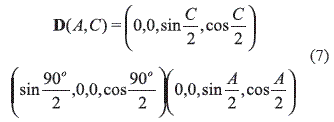
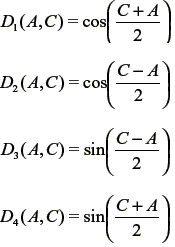
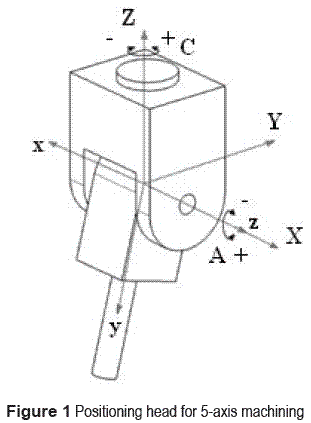
<body><![CDATA[<p><font face="Verdana" size="2">Since  every one of the quaternions <b>Q</b><em><sub>i</sub></em> is displaced half-turn with  respect to the unique polar position <b>P</b> in the quaternion space then <b>P</b> is analogous to the normal of  a plane. Thus,  <b>P</b> can be  obtained from the wedge product "&Lambda;" of any three of the  quaternions  <b>Q</b><em><sub>i</sub></em> (<em>i</em> = 0, 1,...,<em> n</em>),  e.g. </font></p>      <p> <img src="/img/revistas/rfiua/n60/n60a07e06.gif"></p>      <p><font face="Verdana" size="2">This  means that all the quaternions representing a line-symmetric spherical motion  lie on a hyperplane in the image space. Hence, a quadratic curve on the image space  indeed represents a line-symmetric spherical motion. Therefore, the curve can  be defined by a set of three Bezier control positions and written as a rational  Bezier conic, for instance. For a thorough discussion on line-symmetric motions  see &#91;12, 20&#93;. </font></p>      <p><font face="Verdana" size="2"><i>Kinematic constraint manifold of a positioning head</i></font></p>      <p><font face="Verdana" size="2">In  this paper, the problem of spherical motion planning in 5-axis CNC machining  will be addressed assuming that the tool is attached to a positioning head as  shown in <a href="#Figura1">figure 1</a>. Nevertheless, a similar analysis applies for a tilting  rotary-table type of machine setting up the appropriate coordinate frames. In  our case, we attach the moving frame <b>xyz</b> to the tool and the fixed  frame  <b>XYZ</b> to the  machine. </font></p>      <p align="center"><img src="/img/revistas/rfiua/n60/n60a07i01.gif" ><a name="Figura1"></a></p>      <p><font face="Verdana" size="2">With  these conventions the structure equation of the head is defined by a rotation  of the tool about the <b>z</b> axis on the moving frame by angle <em>A</em>, a rotation about <b>x</b> by an angle of 90&ordm;,  and a rotation of the head about <b>Z</b> on the fixed frame by angle <em>C</em>. In terms of quaternions we  have </font></p>      <p> <img src="/img/revistas/rfiua/n60/n60a07e07.gif"></p>      <p><font face="Verdana" size="2">Expanding this product, the parameterized constraint manifold in <b>R</b><sup>4</sup> is</font></p>      <p> <img src="/img/revistas/rfiua/n60/n60a07e08.gif"></p>      ]]></body>
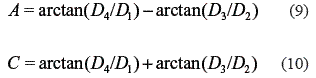
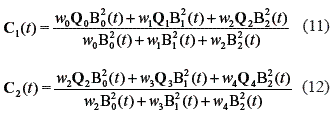
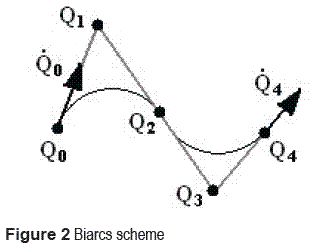
<body><![CDATA[<p><font face="Verdana" size="2">where</font></p>      <p> <img src="/img/revistas/rfiua/n60/n60a07e00d.gif"></p>      <p><font face="Verdana" size="2">The  parameterized constraint manifold of the head, equation 8, describes the  quaternions that represent the orientations of the tool, with respect to the  machine frame, given angles <em>A</em> and <em>C</em>. Furthermore, from a quaternion  representing a given orientation of the tool, the inverse kinematics can be  carried out by solving for <em>A</em> and <em>C</em> from the constraint manifold equation.  Thus,</font></p>      <p> <img src="/img/revistas/rfiua/n60/n60a07e09.gif"></p>      <p> <font face="Verdana" size="2"><i>Interpolation of orientations with specified angular velocities using quaternion biarcs</i></font></p>      <p><font face="Verdana" size="2">Biarcs  are a technique of interpolation of data based on the fact that two points and  their corresponding tangent vectors can be fitted not by one circular arc but  by two, though some special cases need four arcs &#91;1&#93;. In the traditional biarc  technique, unit tangent vectors are used so that the fitting curve obtained is <em>G</em><sup>1</sup> continuous &#91;1, 22&#93;. In this paper  the goal is to extend this approach in order to interpolate a set of  orientations expressed in terms of unit quaternions, which can be regarded as  points on a unit hypersphere in <b>R</b><sup>4</sup>, with angular velocity constraints. Moreover, we are not  willing to limit our approach to circular arcs but to allow for elliptical,  parabolical, or hyperbolical arcs, i.e. quadric arcs, achieving a flexible  technique for the motion design task. Therefore, for two given orientations <b>Q</b><em><sub>s</sub></em> and <b>Q</b><em><sub>e</sub></em>with respective angular velocities <img src="/img/revistas/rfiua/n60/n60a07e00e.gif"><em><sub>s</sub></em> and <img src="/img/revistas/rfiua/n60/n60a07e00e.gif"><em><sub>e</sub></em>, and consequently with corresponding non-unit tangent  vectors <img src="/img/revistas/rfiua/n60/n60a07e00f.gif"><em><sub>s</sub></em>&nbsp;and <img src="/img/revistas/rfiua/n60/n60a07e00f.gif"><em><sub>e</sub></em>, an interpolating piecewise quadric arc, i.e. a  biarc, must meet the following conditions: it passes through <b>Q</b><em><sub>s</sub></em> and <b>Q</b><em><sub>e</sub></em>; the  tangent vectors at those points are <img src="/img/revistas/rfiua/n60/n60a07e00f.gif"><em><sub>s</sub></em>&nbsp;and <img src="/img/revistas/rfiua/n60/n60a07e00f.gif"><em><sub>e</sub></em>&nbsp;respectively;  and the continuity of the arcs is <em>C<sup>1</sup></em> at the junction point. Although equation 4 is only valid for unit quaternions,  there is no need to impose normalization constraints on the interpolating  quaternions if homogeneous coordinates are used to compute the rotations of  points of a rigid body since a unit quaternion and a multiple of it represent  the same rotation as explained before.    <br>    <br>  Let <b>Q</b><em><sub>s</sub></em>= <b>Q</b><em><sub>0</sub></em> and&nbsp;<b>Q</b><em><sub>e</sub></em>= <b>Q</b><em><sub>4</sub></em>represent two desired orientations  of a rigid body with respect to an arbitrary fixed frame as illustrated in  <a href="#Figura2">figure 2</a>. </font></p>      <p align="center"><img src="/img/revistas/rfiua/n60/n60a07i02.gif" ><a name="Figura2"></a></p>      <p><font face="Verdana" size="2">It  should be noticed that <a href="#Figura2">figure 2</a> sketches a biarc for regular planar points  although the current paper deals with quaternions which are impossible to  visualize in  <b>R</b><sup>4</sup>.  However, the considerations on biarcs can be extended to the quaternion space since  a quadratic arc is also a planar curve in <b>R</b><sup>4</sup>. The unit quaternions <b>Q</b><sub>0</sub> and <b>Q</b><sub>4</sub> and their respective  derivatives is all what is needed to apply the biarc method. It is required to  find the Bezier control quaternions <b>Q</b><sub>1</sub>, <b>Q</b><sub>2</sub>,  <b>Q</b><sub>3</sub>  such that the arcs <b>C</b><sub>1</sub> defined by <b>Q</b><sub>0</sub>, <b>Q</b><sub>1</sub>, <b>Q</b><sub>2</sub>, and <b>C</b><sub>2</sub> defined by <b>Q</b><sub>2</sub>, <b>Q</b><sub>3</sub>,  <b>Q</b><sub>4</sub>  can be written as rational Bezier curves</font></p>      ]]></body>
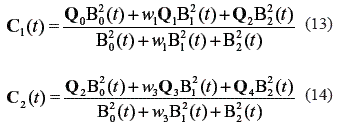
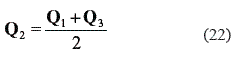
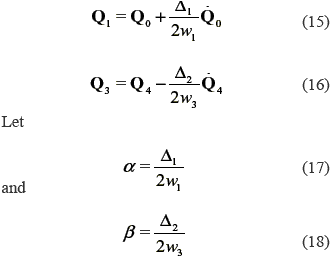
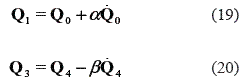
<body><![CDATA[<p> <img src="/img/revistas/rfiua/n60/n60a07e11.gif"></p>      <p><font face="Verdana" size="2">where <em>w<sub>i</sub></em> are the weights and&nbsp;  B<sub>0</sub><sup>2</sup> (<em>t</em>), B<sub>1</sub><sup>2</sup> (<em>t</em>), and B<sub>2</sub><sup>2</sup>  (<em>t</em>) are quadratic rational Bernstein polynomials and 0 &le; <em>t</em> &le; 1 is a dimensionless local  parameter that can be correlated to time. When the weights of the end points  are equal to one, the arcs can be written in standard form &#91;23&#93;, as follows. </font></p>      <p> <img src="/img/revistas/rfiua/n60/n60a07e13.gif"></p>      <p><font face="Verdana" size="2">Similar  to the traditional CAGD theory it can be said that if the weight is smaller  than one an elliptical arc is obtained, if the weight is equal to one the arc  is parabolic, and if the weight is larger than one the arc is a hyperbola.  Recalling the derivative for a rational Bezier B-spline conic in standard form  and denoting the parameter intervals &Delta;<sub>1</sub> = <i>u</i><sub>1</sub> - <i>u</i><sub>0</sub> and &Delta;<sub>2</sub> = <i>u</i><sub>2</sub> - <i>u</i><sub>1</sub>, where each arc is defined,  the unknown control quaternions<b>Q</b><sub>1</sub> and <b>Q</b><sub>3</sub> are correlated to the  interpolated quaternions by </font></p>      <p> <img src="/img/revistas/rfiua/n60/n60a07e15.gif"></p>      <p><font face="Verdana" size="2">Then, equations 15 and 16 can be written as follows </font></p>      <p> <img src="/img/revistas/rfiua/n60/n60a07e19.gif"></p>      <p><font face="Verdana" size="2"><strong>Q</strong><sub>2</sub> is the point of one arc and the start point of the next  one; thus, the derivatives at this quaternion must be equal for both arcs in  order to guarantee <em>C</em><sup>1</sup> continuity of the biarc  segment. From this </font></p>      <p> <img src="/img/revistas/rfiua/n60/n60a07e21.gif"></p>      <p><font face="Verdana" size="2">&alpha;  and &beta; are degrees of freedom that allow the designer to fine-tune the motion  which also depend on the parameter intervals and weights. For instance, after  choosing &alpha; and &beta; one can pick the parameter interval and solve for the weight  of each arc segment. This course of action makes sense in the context of CNC  machining since the parameter interval is related to the sampling time of the  controller which is a fixed feature of the machine hardware. Of course, one can  instead pick the weights and use the derived values of &alpha; and &beta; for computation  of the control quaternions of the arc segments. It should be recalled that a  change in the weights affects the shape of the actual motion of the rigid body  and that the rational arc segments can always be reparameterized such that the  path of the motion does not change but only the speed of the motion does as  explored in &#91;21&#93;. The choice of &alpha; = &beta; facilitates computations, avoids  awkward-looking curves and, as pointed out in &#91;22&#93;, optimized values of &alpha; and &beta;  do not offer significant advantages and this is the alternative used in this  paper. In such a case equation 21 becomes. </font></p>      ]]></body>
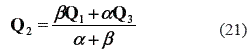
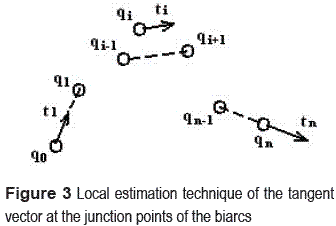
<body><![CDATA[<p> <img src="/img/revistas/rfiua/n60/n60a07e22.gif"></p>      <p><font face="Verdana" size="2">It  must also be recalled that the local parameter <i>t</i> defined as follows must be  used when evaluating each of the arcs in equations 13 and 14.</font></p>      <p> <img src="/img/revistas/rfiua/n60/n60a07e23.gif"></p>      <p><font face="Verdana" size="2">This  procedure can be carried out for every two consecutive quaternions representing  a set of specified key orientations such that the b-spline curve obtained,  which is composed by biarc segments, interpolates the series of input orientations  and is <em>C</em><sup>1</sup> continuous. Finally, since each of the segments is a  quadratic arc, the rigid body motion obtained is a continuous-velocity  piecewise line-symmetric spherical motion. </font></p>      <p><font face="Verdana" size="2"><i>Tool path generation by means of piecewise line-symmetric spherical motion</i></font></p>      <p><font face="Verdana" size="2">This  section describes the application of the oiuatornionbiarcs, oe piecewise  line-symmetric spherical motion, in path generation of a cutter mounted on a  positioning head as that described in section 2. Let us assume that a set of <i>n</i> key orientations of a cutter is  specified in quaternion form <b>q</b><em><sub>i</sub></em> (<i>i</i> =1, 2,..., <i>n</i>), along with their respective angular  velocities <img src="/img/revistas/rfiua/n60/n60a07e00e.gif"><i><sub>i</sub></i>.  Such a CL data set can be obtained from discretization procedures and local  gouging analyses as those found elsewhere &#91;24, 25&#93;.     <br>       <br>  It  should be noticed that the angular velocity can be established from velocity  tracking control if this type of control is available in the machine &#91;6&#93; and  then the quaternion derivative can be computed. Otherwise, local estimation  methods borrowed from CAGD may be implemented &#91;26- 28&#93; in order to compute the  tangent at each quaternion. This is the type of approach that we propose in  this paper. Basically, one can use the unit direction vector of the line that  joins two quaternions <b>q</b><sub><em>i</em> - 1</sub> and <b>q</b><sub><em>i</em> + 1</sub> as the direction of the tangent vector <b>t</b><em><sub>i </sub></em>at <b>q</b><em><sub>i</sub></em>. Kinematically this means  that the tangent vector points along the direction of the screw displacement  between the positions represented by <b>q</b><sub><em>i</em> - 1</sub> and <b>q</b><sub><em>i</em> + 1</sub> &#91;29, 30&#93;. For the first and  last quaternions, <b>q</b><em><sub>0</sub></em> and <b>q</b><em><sub>n</sub></em>, the tangent vector can be  computed from the line that joins <b>q</b><em><sub>0</sub></em> and <b>q</b><em><sub>1</sub></em>, and <b>q</b><sub><em>n</em> - 1</sub><strong> </strong>and <b>q</b><sub><em>n</em></sub>, respectively, as depicted in <a href="#Figura3">figure 3</a>. As far as the  magnitude goes one can use the maximum angular velocity allowed by the machine  motors as an upper bound and eventually fine tune it after the interpolation,  if it is required. </font></p>      <p align="center"><img src="/img/revistas/rfiua/n60/n60a07i03.gif" ><a name="Figura3"></a></p>      <p><font face="Verdana" size="2">The  quaternions are assembled from the angles <i>A</i> and <i>C</i> of the CL data using equation  8. The time derivatives are computed by means of equation 4, if the angular  velocity is known at each tool position, or by the local estimation method  aforementioned. The parameter interval for each arc may be attached to the  sampling period of the controller. Here, we assume a uniform parameterization  of the piecewise biarc curve. The value of &alpha; is found by solving equation 17.  The weights of each quaternion biarc can be interactively adjusted by the  motion designer in order to fine-tune the motion of the tool and this way  improve the accuracy of the machining if required. The control quaternions of  each biarc segment are evaluated using equations 19, 20 and 21. After the  control quaternions of the piecewise biarc curve have been obtained, several  intermediate positions on each biarc segment can be evaluated by using  equations 13 and 14; i.e. a piecewise line-symmetric motion interpolates the  key orientations and approximates the actual motion of the machine. Equations 9  and 10 provide reference values of joint displacement to the machine  controller.     ]]></body>
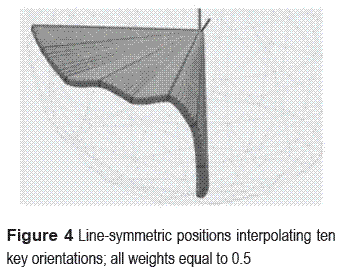
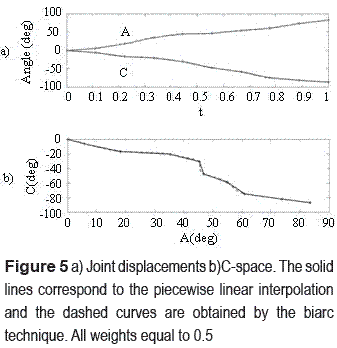
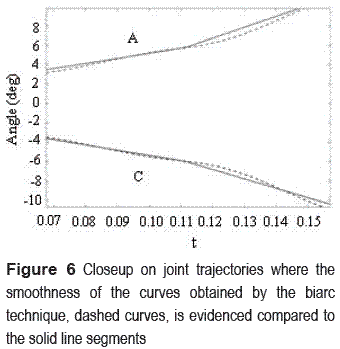
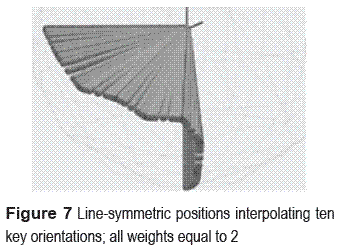
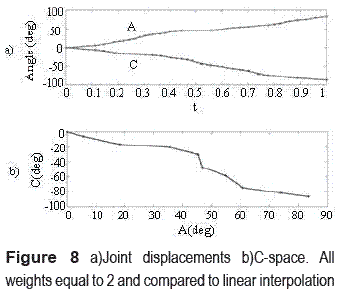
<body><![CDATA[<br>    <br>  After  applying the quaternion biarc interpolation method to the orientation data in  <a href="#Tabla1">table 1</a>, describing the tool orientation at each cutter contact (CC) point,  several intermediate orientations are obtained, see <a href="#Figura4">figure 4</a>. In this case a  weight of 0.5 and an angular velocity of 0.2 rad/s were assumed for all of the  biarc segments. The plots of the joint displacements and C-space are shown in  <a href="#Figura5">figure 5 </a>, which are smoother compared to the traditional piecewise linear  interpolation used by CNC interpolators, even though the curves obtained are very close  to the line segments. <a href="#Figura6">Figure 6 </a> shows a closeup on a segment of the joint  trajectories in C- space, where the smoothness claimed for the curves obtained  from the biarc technique is evidenced. </font></p>      <p align="center"><img src="/img/revistas/rfiua/n60/n60a07t01.gif" ><a name="Tabla1"></a></p>      <p align="center"><img src="/img/revistas/rfiua/n60/n60a07i04.gif" ><a name="Figura4"></a></p>      <p align="center"><img src="/img/revistas/rfiua/n60/n60a07i05.gif" ><a name="Figura5"></a></p>      <p align="center"><img src="/img/revistas/rfiua/n60/n60a07i06.gif" ><a name="Figura6"></a></p>      <p><font face="Verdana" size="2"><a href="#Figura7">Figure 7</a> shows the motion generated when the weight was changed to 2. As expected, a  slight change in the path of the motion is evidenced. Also, the plots of the  displacements of the joints suffer changes as seen in <a href="#Figura8">figure 8 </a>. Nonetheless,  the joint displacement curve is smoother than the piecewise linear one. The  algorithm was implemented on a 1.50 GHz laptop using MATLAB. The computational  time to generate the motion and the joint displacement curves of these examples  was less than 2 s.</font></p>      <p align="center"><img src="/img/revistas/rfiua/n60/n60a07i07.gif" ><a name="Figura7"></a></p>      <p align="center"><img src="/img/revistas/rfiua/n60/n60a07i08.gif" ><a name="Figura8"></a></p>       <p><font face="Verdana" size="3"><b>Conclusiones</b> </font></p>      ]]></body>
<body><![CDATA[<p><font face="Verdana" size="2">Quaternion  biarcs permit to interpolate a set of orientations by means of a piecewise  quadratic curve constituted by arcs. Quadratic curves in the image space of  spatial motions describe line-symmetric motions so that the b-spline obtained  describes a piecewise line-symmetric motion. The spherical line-symmetric  motion achieved with this b-spline curve is <em>C</em><sup>1</sup> continuous  which is a desirable feature for orientation interpolation in 5-axis machining  of sculptured surfaces in order to avoid poor surface finish as in the  traditional method of linear interpolation of tool orientation. Moreover, the  biarc technique is a superior alternative since the discrete orientations are  exactly interpolated. The computational efficiency and flexibility offered for  fine-tuning of the piecewise line-symmetric motion makes it an appealing choice  for motion interpolation. Moreover, since the method developed here directly  interpolates the actual orientations of the tool, represented by quaternions,  it is superior to the traditional C-space interpolation approach in the sense  that the interpolation of the motion is accomplished in the cartesian space,  enabling the designer to visualize, tune and modify the motion directly in the  real three-dimensional space and not through a mathematical construction such  as the C-space. Therefore, the method described in this paper is useful in  CAD/CAM, robot path planning and computer graphics. </font></p>      <p><font face="Verdana" size="3"><b>Referencias</b> </font></p>      <!-- ref --><p><font face="Verdana" size="2">1. L. Piegl, W. Tiller. "Data Approximation Using  Biarcs". <i>Engineering with Computers</i>. Vol. 18. 2002. pp. 59-65.     &nbsp;&nbsp;&nbsp;&nbsp;&nbsp;&nbsp;&nbsp;&nbsp;[&#160;<a href="javascript:void(0);" onclick="javascript: window.open('/scielo.php?script=sci_nlinks&ref=000095&pid=S0120-6230201100040000700001&lng=','','width=640,height=500,resizable=yes,scrollbars=1,menubar=yes,');">Links</a>&#160;]<!-- end-ref --><br>    <!-- ref --><br>  2. J. C. Latombe. <i>Robot Motion  Planning</i>.  Ed. Kluwer Academic Publishers. Boston, MA. 1991. pp. 5-11.     &nbsp;&nbsp;&nbsp;&nbsp;&nbsp;&nbsp;&nbsp;&nbsp;[&#160;<a href="javascript:void(0);" onclick="javascript: window.open('/scielo.php?script=sci_nlinks&ref=000097&pid=S0120-6230201100040000700002&lng=','','width=640,height=500,resizable=yes,scrollbars=1,menubar=yes,');">Links</a>&#160;]<!-- end-ref --><br>    <!-- ref --><br>  3. T. Lozano P&eacute;rez. "Spatial Planning: A Configuration  Space Approach". <i>IEEE Transactions on Computers</i>. Vol. 32. 1983. pp. 108-120.     &nbsp;&nbsp;&nbsp;&nbsp;&nbsp;&nbsp;&nbsp;&nbsp;[&#160;<a href="javascript:void(0);" onclick="javascript: window.open('/scielo.php?script=sci_nlinks&ref=000099&pid=S0120-6230201100040000700003&lng=','','width=640,height=500,resizable=yes,scrollbars=1,menubar=yes,');">Links</a>&#160;]<!-- end-ref --><br>    <!-- ref --><br>  4. F. Schwarzer, M. Saha, J. C. Latombe. "Exact  Collision Checking of Robot Paths". <i>Algorithmic  Foundations of Robotics. V</i>. J. D. Boissonnat, J. Burdick, K. Goldberg, S. Hutchinson  (editors). Ed. Springer. Berlin, Alemania. 2004. pp. 25-41.     &nbsp;&nbsp;&nbsp;&nbsp;&nbsp;&nbsp;&nbsp;&nbsp;[&#160;<a href="javascript:void(0);" onclick="javascript: window.open('/scielo.php?script=sci_nlinks&ref=000101&pid=S0120-6230201100040000700004&lng=','','width=640,height=500,resizable=yes,scrollbars=1,menubar=yes,');">Links</a>&#160;]<!-- end-ref --><br>    ]]></body>
<body><![CDATA[<!-- ref --><br>  5. A. Gasparetto, V. Zanotto. "A New Method for Smooth  Trajectory Planning of Robot Manipulators". <i>Mechanism and  Machine Theory</i>. Vol. 42. 2007. pp. 455-471.     &nbsp;&nbsp;&nbsp;&nbsp;&nbsp;&nbsp;&nbsp;&nbsp;[&#160;<a href="javascript:void(0);" onclick="javascript: window.open('/scielo.php?script=sci_nlinks&ref=000103&pid=S0120-6230201100040000700005&lng=','','width=640,height=500,resizable=yes,scrollbars=1,menubar=yes,');">Links</a>&#160;]<!-- end-ref --><br>    <!-- ref --><br>  6. J. J. Chou, D. C. H. Yang. "On the Generation of  Coordinated Motion of Five-Axis CNC/CMM Machines". <i>Journal of  Engineering for Industry</i>. Vol. 114. 1992. pp. 15-22.     &nbsp;&nbsp;&nbsp;&nbsp;&nbsp;&nbsp;&nbsp;&nbsp;[&#160;<a href="javascript:void(0);" onclick="javascript: window.open('/scielo.php?script=sci_nlinks&ref=000105&pid=S0120-6230201100040000700006&lng=','','width=640,height=500,resizable=yes,scrollbars=1,menubar=yes,');">Links</a>&#160;]<!-- end-ref --><br>    <!-- ref --><br>  7. K. Morishige, K. Kase, Y. Takeuchi. "Collision-Free  Tool Path Generation Using 2-Dimensional C-space for 5-Axis Control  Machining". <i>The International Journal of Advanced Manufacturing  Technology</i>. Vol. 13. 1997. pp. 393-400.     &nbsp;&nbsp;&nbsp;&nbsp;&nbsp;&nbsp;&nbsp;&nbsp;[&#160;<a href="javascript:void(0);" onclick="javascript: window.open('/scielo.php?script=sci_nlinks&ref=000107&pid=S0120-6230201100040000700007&lng=','','width=640,height=500,resizable=yes,scrollbars=1,menubar=yes,');">Links</a>&#160;]<!-- end-ref --><br>    <!-- ref --><br>  8. C. S. Jun, K. Cha, Y. S. Lee. "Optimizing Tool  Orientations for 5-Axis Machining by Configuration- Space Search Method". <i>Computer-Aided  Design</i>.  Vol. 35. 2003. pp. 549-566.     &nbsp;&nbsp;&nbsp;&nbsp;&nbsp;&nbsp;&nbsp;&nbsp;[&#160;<a href="javascript:void(0);" onclick="javascript: window.open('/scielo.php?script=sci_nlinks&ref=000109&pid=S0120-6230201100040000700008&lng=','','width=640,height=500,resizable=yes,scrollbars=1,menubar=yes,');">Links</a>&#160;]<!-- end-ref --><br>    <!-- ref --><br>  9. Y. Koren, R. S. Lin. "Five-Axis Surface  Interpolators". <i>Annals of the CIRP</i>. Vol. 44. 1995. pp. 379-382.     &nbsp;&nbsp;&nbsp;&nbsp;&nbsp;&nbsp;&nbsp;&nbsp;[&#160;<a href="javascript:void(0);" onclick="javascript: window.open('/scielo.php?script=sci_nlinks&ref=000111&pid=S0120-6230201100040000700009&lng=','','width=640,height=500,resizable=yes,scrollbars=1,menubar=yes,');">Links</a>&#160;]<!-- end-ref --><br>    ]]></body>
<body><![CDATA[<!-- ref --><br>  10. M. C. Tsai, M. Y. Cheng, K. F. Lin, N. C. Tsai. <i>On  Acceleration/Deceleration before Interpolation for CNC Motion Control</i>. ICM '05, IEEE International  Conference on Mechatronics. 2005. pp. 382-387.     &nbsp;&nbsp;&nbsp;&nbsp;&nbsp;&nbsp;&nbsp;&nbsp;[&#160;<a href="javascript:void(0);" onclick="javascript: window.open('/scielo.php?script=sci_nlinks&ref=000113&pid=S0120-6230201100040000700010&lng=','','width=640,height=500,resizable=yes,scrollbars=1,menubar=yes,');">Links</a>&#160;]<!-- end-ref --><br>    <!-- ref --><br>  11. B. Ravani, B. Roth. "Mappings of Spatial  Kinematics". <i>ASME Journal of Mechanisms, Transmissions, and Automation  in Design</i>. Vol. 106. 1984. pp. 341-347.     &nbsp;&nbsp;&nbsp;&nbsp;&nbsp;&nbsp;&nbsp;&nbsp;[&#160;<a href="javascript:void(0);" onclick="javascript: window.open('/scielo.php?script=sci_nlinks&ref=000115&pid=S0120-6230201100040000700011&lng=','','width=640,height=500,resizable=yes,scrollbars=1,menubar=yes,');">Links</a>&#160;]<!-- end-ref --><br>    <!-- ref --><br>  12. O. Bottema, B. Roth. <i>Theoretical  Kinematics</i>.  Ed. Dover Publications. New York. 1990. pp. 518-521.     &nbsp;&nbsp;&nbsp;&nbsp;&nbsp;&nbsp;&nbsp;&nbsp;[&#160;<a href="javascript:void(0);" onclick="javascript: window.open('/scielo.php?script=sci_nlinks&ref=000117&pid=S0120-6230201100040000700012&lng=','','width=640,height=500,resizable=yes,scrollbars=1,menubar=yes,');">Links</a>&#160;]<!-- end-ref --><br>    <!-- ref --><br>  13. J. M. McCarthy. <i>An Introduction  to Theoretical Kinematics</i>. Ed. The MIT Press. Cambridge, MA. 1990. pp. 60-62.     &nbsp;&nbsp;&nbsp;&nbsp;&nbsp;&nbsp;&nbsp;&nbsp;[&#160;<a href="javascript:void(0);" onclick="javascript: window.open('/scielo.php?script=sci_nlinks&ref=000119&pid=S0120-6230201100040000700013&lng=','','width=640,height=500,resizable=yes,scrollbars=1,menubar=yes,');">Links</a>&#160;]<!-- end-ref --><br>    <!-- ref --><br>  14. Q. J. Ge, M. Sirchia. "Computer Aided Geometric  Design of Two-Parameter Freeform Motions". <i>ASME Journal of  Mechanical Design</i>. Vol. 121. 1999. pp. 502-506.     &nbsp;&nbsp;&nbsp;&nbsp;&nbsp;&nbsp;&nbsp;&nbsp;[&#160;<a href="javascript:void(0);" onclick="javascript: window.open('/scielo.php?script=sci_nlinks&ref=000121&pid=S0120-6230201100040000700014&lng=','','width=640,height=500,resizable=yes,scrollbars=1,menubar=yes,');">Links</a>&#160;]<!-- end-ref --><br>    ]]></body>
<body><![CDATA[<!-- ref --><br>  15. K. Shoemake. "Animating Rotations with Quaternion  Curves". <i>ACM SIGGRAPH Computer Graphics</i>. Vol. 19. 1985. pp. 245-254.     &nbsp;&nbsp;&nbsp;&nbsp;&nbsp;&nbsp;&nbsp;&nbsp;[&#160;<a href="javascript:void(0);" onclick="javascript: window.open('/scielo.php?script=sci_nlinks&ref=000123&pid=S0120-6230201100040000700015&lng=','','width=640,height=500,resizable=yes,scrollbars=1,menubar=yes,');">Links</a>&#160;]<!-- end-ref --><br>    <!-- ref --><br>  16. F. Y. Lin, T. S. L&uuml;. "Development of a Robot  System for Complex Surfaces Polishing Based on CL Data".<i> The International  Journal of Advanced Manufacturing Technology</i>. Vol. 26. 2005. pp. 1132-1137.     &nbsp;&nbsp;&nbsp;&nbsp;&nbsp;&nbsp;&nbsp;&nbsp;[&#160;<a href="javascript:void(0);" onclick="javascript: window.open('/scielo.php?script=sci_nlinks&ref=000125&pid=S0120-6230201100040000700016&lng=','','width=640,height=500,resizable=yes,scrollbars=1,menubar=yes,');">Links</a>&#160;]<!-- end-ref --><br>    <!-- ref --><br>  17. M. C. Ho, Y. R. Hwang, C. H. Hu. "Five-Axis Tool  Orientation Smoothing Using Quaternion Interpolation Algorithm". <i>International  Journal of Machine Tools and Manufacture</i>. Vol. 43. 2003. pp. 1259-1267.     &nbsp;&nbsp;&nbsp;&nbsp;&nbsp;&nbsp;&nbsp;&nbsp;[&#160;<a href="javascript:void(0);" onclick="javascript: window.open('/scielo.php?script=sci_nlinks&ref=000127&pid=S0120-6230201100040000700017&lng=','','width=640,height=500,resizable=yes,scrollbars=1,menubar=yes,');">Links</a>&#160;]<!-- end-ref --><br>    <!-- ref --><br>  18. W. Wang, B. Joe. "Orientation Interpolation in  Quaternion Space Using Spherical Biarcs". <i>Proceedings  Graphics Interface '93</i>. Ed. Morgan Kaufmann. Toronto, Canad&aacute;. 1993. pp. 24-32.     &nbsp;&nbsp;&nbsp;&nbsp;&nbsp;&nbsp;&nbsp;&nbsp;[&#160;<a href="javascript:void(0);" onclick="javascript: window.open('/scielo.php?script=sci_nlinks&ref=000129&pid=S0120-6230201100040000700018&lng=','','width=640,height=500,resizable=yes,scrollbars=1,menubar=yes,');">Links</a>&#160;]<!-- end-ref --><br>    <!-- ref --><br>  19. B. J&uuml;ttler. "Visualization of Moving Objects Using  Dual Quaternion Curves". <i>Computers and Graphics</i>. Vol. 18. 1994. pp. 315-326.     &nbsp;&nbsp;&nbsp;&nbsp;&nbsp;&nbsp;&nbsp;&nbsp;[&#160;<a href="javascript:void(0);" onclick="javascript: window.open('/scielo.php?script=sci_nlinks&ref=000131&pid=S0120-6230201100040000700019&lng=','','width=640,height=500,resizable=yes,scrollbars=1,menubar=yes,');">Links</a>&#160;]<!-- end-ref --><br>    ]]></body>
<body><![CDATA[<!-- ref --><br>  20. S. Li, Q. J. Ge. "Rational B&eacute;zier Line-Symmmetric  Motions". <i>ASME Journal of Mechanical Design</i>. Vol. 127. 2005. pp. 222-226.     &nbsp;&nbsp;&nbsp;&nbsp;&nbsp;&nbsp;&nbsp;&nbsp;[&#160;<a href="javascript:void(0);" onclick="javascript: window.open('/scielo.php?script=sci_nlinks&ref=000133&pid=S0120-6230201100040000700020&lng=','','width=640,height=500,resizable=yes,scrollbars=1,menubar=yes,');">Links</a>&#160;]<!-- end-ref --><br>    <!-- ref --><br>  21. A. Purwar, Q. J. Ge. "On the Effect of Dual Weights in Computer  Aided Design of Rational Motions". <i>ASME Journal of  Mechanical Design</i>.  Vol. 127. 2005. pp. 967-972.     &nbsp;&nbsp;&nbsp;&nbsp;&nbsp;&nbsp;&nbsp;&nbsp;[&#160;<a href="javascript:void(0);" onclick="javascript: window.open('/scielo.php?script=sci_nlinks&ref=000135&pid=S0120-6230201100040000700021&lng=','','width=640,height=500,resizable=yes,scrollbars=1,menubar=yes,');">Links</a>&#160;]<!-- end-ref --><br>    <!-- ref --><br>  22. J. Rossignac, A. Requicha. "Piecewise Circular  Curves for Geometric Modeling". <i>IBM Journal of  Research and Development</i>. Vol. 31. 1987. pp. 296-313.     &nbsp;&nbsp;&nbsp;&nbsp;&nbsp;&nbsp;&nbsp;&nbsp;[&#160;<a href="javascript:void(0);" onclick="javascript: window.open('/scielo.php?script=sci_nlinks&ref=000137&pid=S0120-6230201100040000700022&lng=','','width=640,height=500,resizable=yes,scrollbars=1,menubar=yes,');">Links</a>&#160;]<!-- end-ref --><br>    <!-- ref --><br>  23. G. Farin. <i>Curves and Surfaces for  Computer Aided Geometric Design: A Practical Guide</i>. 4<sup>th</sup>  ed. Ed.Academic Press. San Diego, CA. 1996. pp. 196-211.     &nbsp;&nbsp;&nbsp;&nbsp;&nbsp;&nbsp;&nbsp;&nbsp;[&#160;<a href="javascript:void(0);" onclick="javascript: window.open('/scielo.php?script=sci_nlinks&ref=000139&pid=S0120-6230201100040000700023&lng=','','width=640,height=500,resizable=yes,scrollbars=1,menubar=yes,');">Links</a>&#160;]<!-- end-ref --><br>     <!-- ref --><br>  24. R. Klass, P. Schramm. "Numerically-Controlled  Milling of CAD Surface Data". <i>Geometric  Modeling: Methods and Applications</i>. H. Hagen, D. Roller (editors). Ed. Springer-Verlag. New York,  USA. 1991. pp. 213-225.     &nbsp;&nbsp;&nbsp;&nbsp;&nbsp;&nbsp;&nbsp;&nbsp;[&#160;<a href="javascript:void(0);" onclick="javascript: window.open('/scielo.php?script=sci_nlinks&ref=000141&pid=S0120-6230201100040000700024&lng=','','width=640,height=500,resizable=yes,scrollbars=1,menubar=yes,');">Links</a>&#160;]<!-- end-ref --><br>    ]]></body>
<body><![CDATA[<!-- ref --><br>  25. W. Zhang, Y. F. Zhang, Q. J. Ge. "Interference-Free Tool Path Generation for  5-Axis Sculputured Surface Machining Using Rational B&eacute;zier Motions of a Flat- End  Cutter". <i>International Journal of Production Research</i>. Vol. 43. 2005. pp. 4103-4124.     &nbsp;&nbsp;&nbsp;&nbsp;&nbsp;&nbsp;&nbsp;&nbsp;[&#160;<a href="javascript:void(0);" onclick="javascript: window.open('/scielo.php?script=sci_nlinks&ref=000143&pid=S0120-6230201100040000700025&lng=','','width=640,height=500,resizable=yes,scrollbars=1,menubar=yes,');">Links</a>&#160;]<!-- end-ref --><br>    <!-- ref --><br>  26. L. Piegl, W. Tiller. <i>The NURBS Book. Ed</i>. Springer. Berlin,  Alemania. 1995. pp. 382-404.     &nbsp;&nbsp;&nbsp;&nbsp;&nbsp;&nbsp;&nbsp;&nbsp;[&#160;<a href="javascript:void(0);" onclick="javascript: window.open('/scielo.php?script=sci_nlinks&ref=000145&pid=S0120-6230201100040000700026&lng=','','width=640,height=500,resizable=yes,scrollbars=1,menubar=yes,');">Links</a>&#160;]<!-- end-ref --><br>    <!-- ref --><br>  27. H. Akima. "A New Method of Interpolation and  Smooth Curve Fitting Based on Local Procedures". <i>Journal of the  ACM</i>.  Vol. 17. 1970. pp. 589-602.     &nbsp;&nbsp;&nbsp;&nbsp;&nbsp;&nbsp;&nbsp;&nbsp;[&#160;<a href="javascript:void(0);" onclick="javascript: window.open('/scielo.php?script=sci_nlinks&ref=000147&pid=S0120-6230201100040000700027&lng=','','width=640,height=500,resizable=yes,scrollbars=1,menubar=yes,');">Links</a>&#160;]<!-- end-ref --><br>    <!-- ref --><br>  28. T. Arney. <i>Dynamic Path  Planning and Execution Using B-Splines</i>. ICIAFS 2007, Third  International Conference on Information and Automation for Sustainability.  2007. pp. 1-6.     &nbsp;&nbsp;&nbsp;&nbsp;&nbsp;&nbsp;&nbsp;&nbsp;[&#160;<a href="javascript:void(0);" onclick="javascript: window.open('/scielo.php?script=sci_nlinks&ref=000149&pid=S0120-6230201100040000700028&lng=','','width=640,height=500,resizable=yes,scrollbars=1,menubar=yes,');">Links</a>&#160;]<!-- end-ref --><br>    <!-- ref --><br>  29. Q. J. Ge, B. Ravani. "Geometric Construction  of B&eacute;zier Motions". <i>ASME Journal of  Mechanical Design</i>.  Vol. 116. 1994. pp. 749-755.     &nbsp;&nbsp;&nbsp;&nbsp;&nbsp;&nbsp;&nbsp;&nbsp;[&#160;<a href="javascript:void(0);" onclick="javascript: window.open('/scielo.php?script=sci_nlinks&ref=000151&pid=S0120-6230201100040000700029&lng=','','width=640,height=500,resizable=yes,scrollbars=1,menubar=yes,');">Links</a>&#160;]<!-- end-ref --><br>    ]]></body>
<body><![CDATA[<!-- ref --><br>  30. Q. J. Ge, B. Ravani. "Computer Aided Geometric  Design of Motion Interpolants". <i>ASME Journal of  Mechanical Design</i>.  Vol. 116. 1994. pp. 756-762. </font>&nbsp;&nbsp;&nbsp;&nbsp;&nbsp;&nbsp;&nbsp;&nbsp;[&#160;<a href="javascript:void(0);" onclick="javascript: window.open('/scielo.php?script=sci_nlinks&ref=000153&pid=S0120-6230201100040000700030&lng=','','width=640,height=500,resizable=yes,scrollbars=1,menubar=yes,');">Links</a>&#160;]<!-- end-ref --><br>    <br>    <br>    <br>       <p><font face="Verdana" size="2">(Recibido  el 13 de mayo de 2010. Aceptado el 26 de mayo de 2011)</font></p>     <p><font face="Verdana" size="2"><sup>*</sup>Autor de correspondencia: tel&eacute;fono: +57 + 4 + 219 55 50, fax:  + 57 +4 + 219 55 14, correo  electr&oacute;nico: <a href="mailto:catruji@udea.edu.co">catruji@udea.edu.co</a> (C. Trujillo)</font></p>      ]]></body><back>
<ref-list>
<ref id="B1">
<label>1</label><nlm-citation citation-type="journal">
<person-group person-group-type="author">
<name>
<surname><![CDATA[Piegl]]></surname>
<given-names><![CDATA[L]]></given-names>
</name>
<name>
<surname><![CDATA[Tiller]]></surname>
<given-names><![CDATA[W]]></given-names>
</name>
</person-group>
<article-title xml:lang="en"><![CDATA[Data Approximation Using Biarcs]]></article-title>
<source><![CDATA[Engineering with Computers]]></source>
<year>2002</year>
<volume>18</volume>
<page-range>59-65</page-range></nlm-citation>
</ref>
<ref id="B2">
<label>2</label><nlm-citation citation-type="book">
<person-group person-group-type="author">
<name>
<surname><![CDATA[Latombe]]></surname>
<given-names><![CDATA[J. C]]></given-names>
</name>
</person-group>
<source><![CDATA[Robot Motion Planning]]></source>
<year>1991</year>
<page-range>5-11</page-range><publisher-loc><![CDATA[Boston ]]></publisher-loc>
<publisher-name><![CDATA[Ed. Kluwer Academic Publishers]]></publisher-name>
</nlm-citation>
</ref>
<ref id="B3">
<label>3</label><nlm-citation citation-type="journal">
<person-group person-group-type="author">
<name>
<surname><![CDATA[Lozano Pérez]]></surname>
<given-names><![CDATA[T]]></given-names>
</name>
</person-group>
<article-title xml:lang="en"><![CDATA[Spatial Planning: A Configuration Space Approach]]></article-title>
<source><![CDATA[IEEE Transactions on Computers]]></source>
<year>1983</year>
<volume>32</volume>
<page-range>108-120</page-range></nlm-citation>
</ref>
<ref id="B4">
<label>4</label><nlm-citation citation-type="">
<person-group person-group-type="author">
<name>
<surname><![CDATA[Schwarzer]]></surname>
<given-names><![CDATA[F]]></given-names>
</name>
<name>
<surname><![CDATA[Saha]]></surname>
<given-names><![CDATA[M]]></given-names>
</name>
<name>
<surname><![CDATA[Latombe]]></surname>
<given-names><![CDATA[J. C]]></given-names>
</name>
</person-group>
<article-title xml:lang="en"><![CDATA[Exact Collision Checking of Robot Paths]]></article-title>
<person-group person-group-type="editor">
<name>
<surname><![CDATA[Boissonnat]]></surname>
<given-names><![CDATA[V. J. D]]></given-names>
</name>
<name>
<surname><![CDATA[Burdick]]></surname>
<given-names><![CDATA[J]]></given-names>
</name>
<name>
<surname><![CDATA[Goldberg]]></surname>
<given-names><![CDATA[K]]></given-names>
</name>
</person-group>
<source><![CDATA[Algorithmic Foundations of Robotics]]></source>
<year>2004</year>
<page-range>25-41</page-range><publisher-loc><![CDATA[Berlin ]]></publisher-loc>
</nlm-citation>
</ref>
<ref id="B5">
<label>5</label><nlm-citation citation-type="journal">
<person-group person-group-type="author">
<name>
<surname><![CDATA[Gasparetto]]></surname>
<given-names><![CDATA[A]]></given-names>
</name>
<name>
<surname><![CDATA[Zanotto]]></surname>
<given-names><![CDATA[V]]></given-names>
</name>
</person-group>
<article-title xml:lang="en"><![CDATA[A New Method for Smooth Trajectory Planning of Robot Manipulators]]></article-title>
<source><![CDATA[Mechanism and Machine Theory]]></source>
<year>2007</year>
<volume>42</volume>
<page-range>455-471</page-range></nlm-citation>
</ref>
<ref id="B6">
<label>6</label><nlm-citation citation-type="journal">
<person-group person-group-type="author">
<name>
<surname><![CDATA[Chou]]></surname>
<given-names><![CDATA[J. J]]></given-names>
</name>
<name>
<surname><![CDATA[Yang]]></surname>
<given-names><![CDATA[D. C. H]]></given-names>
</name>
</person-group>
<article-title xml:lang="en"><![CDATA[On the Generation of Coordinated Motion of Five-Axis CNC/CMM Machines]]></article-title>
<source><![CDATA[Journal of Engineering for Industry]]></source>
<year>1992</year>
<volume>114</volume>
<page-range>15-22</page-range></nlm-citation>
</ref>
<ref id="B7">
<label>7</label><nlm-citation citation-type="journal">
<person-group person-group-type="author">
<name>
<surname><![CDATA[Morishige]]></surname>
<given-names><![CDATA[K]]></given-names>
</name>
<name>
<surname><![CDATA[Kase]]></surname>
<given-names><![CDATA[K]]></given-names>
</name>
<name>
<surname><![CDATA[Takeuchi]]></surname>
<given-names><![CDATA[Y]]></given-names>
</name>
</person-group>
<article-title xml:lang="en"><![CDATA[Collision-Free Tool Path Generation Using 2-Dimensional C-space for 5-Axis Control Machining]]></article-title>
<source><![CDATA[The International Journal of Advanced Manufacturing Technology]]></source>
<year>1997</year>
<volume>13</volume>
<page-range>393-400</page-range></nlm-citation>
</ref>
<ref id="B8">
<label>8</label><nlm-citation citation-type="journal">
<person-group person-group-type="author">
<name>
<surname><![CDATA[Jun]]></surname>
<given-names><![CDATA[C. S]]></given-names>
</name>
<name>
<surname><![CDATA[Cha]]></surname>
<given-names><![CDATA[K]]></given-names>
</name>
<name>
<surname><![CDATA[Lee]]></surname>
<given-names><![CDATA[Y. S]]></given-names>
</name>
</person-group>
<article-title xml:lang="en"><![CDATA[Optimizing Tool Orientations for 5-Axis Machining by Configuration- Space Search Method]]></article-title>
<source><![CDATA[Computer-Aided Design]]></source>
<year>2003</year>
<volume>35</volume>
<page-range>549-566</page-range></nlm-citation>
</ref>
<ref id="B9">
<label>9</label><nlm-citation citation-type="journal">
<person-group person-group-type="author">
<name>
<surname><![CDATA[Koren]]></surname>
<given-names><![CDATA[Y]]></given-names>
</name>
<name>
<surname><![CDATA[Lin]]></surname>
<given-names><![CDATA[R. S]]></given-names>
</name>
</person-group>
<article-title xml:lang="en"><![CDATA[Five-Axis Surface Interpolators]]></article-title>
<source><![CDATA[Annals of the CIRP]]></source>
<year>1995</year>
<volume>44</volume>
<page-range>379-382</page-range></nlm-citation>
</ref>
<ref id="B10">
<label>10</label><nlm-citation citation-type="confpro">
<person-group person-group-type="author">
<name>
<surname><![CDATA[Tsai]]></surname>
<given-names><![CDATA[M. C]]></given-names>
</name>
<name>
<surname><![CDATA[Cheng]]></surname>
<given-names><![CDATA[M. Y]]></given-names>
</name>
<name>
<surname><![CDATA[Lin]]></surname>
<given-names><![CDATA[K. F]]></given-names>
</name>
<name>
<surname><![CDATA[Tsai]]></surname>
<given-names><![CDATA[N. C]]></given-names>
</name>
</person-group>
<source><![CDATA[On Acceleration/Deceleration before Interpolation for CNC Motion Control]]></source>
<year></year>
<conf-name><![CDATA[05 IEEE International Conference on Mechatronics]]></conf-name>
<conf-date>2005</conf-date>
<conf-loc> </conf-loc>
<page-range>382-387</page-range></nlm-citation>
</ref>
<ref id="B11">
<label>11</label><nlm-citation citation-type="journal">
<person-group person-group-type="author">
<name>
<surname><![CDATA[Ravani]]></surname>
<given-names><![CDATA[B]]></given-names>
</name>
<name>
<surname><![CDATA[Roth]]></surname>
<given-names><![CDATA[B]]></given-names>
</name>
</person-group>
<article-title xml:lang="en"><![CDATA[Mappings of Spatial Kinematics]]></article-title>
<source><![CDATA[ASME Journal of Mechanisms, Transmissions, and Automation in Design]]></source>
<year>1984</year>
<volume>106</volume>
<page-range>341-347</page-range></nlm-citation>
</ref>
<ref id="B12">
<label>12</label><nlm-citation citation-type="book">
<person-group person-group-type="author">
<name>
<surname><![CDATA[Bottema]]></surname>
<given-names><![CDATA[O]]></given-names>
</name>
<name>
<surname><![CDATA[Roth]]></surname>
<given-names><![CDATA[B]]></given-names>
</name>
</person-group>
<source><![CDATA[Theoretical Kinematics]]></source>
<year>1990</year>
<page-range>518-521</page-range><publisher-loc><![CDATA[New York ]]></publisher-loc>
<publisher-name><![CDATA[Ed. Dover Publications]]></publisher-name>
</nlm-citation>
</ref>
<ref id="B13">
<label>13</label><nlm-citation citation-type="book">
<person-group person-group-type="author">
<name>
<surname><![CDATA[McCarthy]]></surname>
<given-names><![CDATA[J. M]]></given-names>
</name>
</person-group>
<source><![CDATA[An Introduction to Theoretical Kinematics]]></source>
<year>1990</year>
<page-range>60-62</page-range><publisher-loc><![CDATA[Cambridge ]]></publisher-loc>
<publisher-name><![CDATA[Ed. The MIT Press]]></publisher-name>
</nlm-citation>
</ref>
<ref id="B14">
<label>14</label><nlm-citation citation-type="journal">
<person-group person-group-type="author">
<name>
<surname><![CDATA[Ge]]></surname>
<given-names><![CDATA[Q. J]]></given-names>
</name>
<name>
<surname><![CDATA[Sirchia]]></surname>
<given-names><![CDATA[M]]></given-names>
</name>
</person-group>
<article-title xml:lang="en"><![CDATA[Computer Aided Geometric Design of Two-Parameter Freeform Motions]]></article-title>
<source><![CDATA[ASME Journal of Mechanical Design]]></source>
<year>1999</year>
<volume>121</volume>
<page-range>502-506</page-range></nlm-citation>
</ref>
<ref id="B15">
<label>15</label><nlm-citation citation-type="journal">
<person-group person-group-type="author">
<name>
<surname><![CDATA[Shoemake]]></surname>
<given-names><![CDATA[K]]></given-names>
</name>
</person-group>
<article-title xml:lang="en"><![CDATA[Animating Rotations with Quaternion Curves]]></article-title>
<source><![CDATA[ACM SIGGRAPH Computer Graphics]]></source>
<year>1985</year>
<volume>19</volume>
<page-range>245-254</page-range></nlm-citation>
</ref>
<ref id="B16">
<label>16</label><nlm-citation citation-type="journal">
<person-group person-group-type="author">
<name>
<surname><![CDATA[Lin]]></surname>
<given-names><![CDATA[F. Y]]></given-names>
</name>
<name>
<surname><![CDATA[Lü]]></surname>
<given-names><![CDATA[T. S]]></given-names>
</name>
</person-group>
<article-title xml:lang="en"><![CDATA[Development of a Robot System for Complex Surfaces Polishing Based on CL Data]]></article-title>
<source><![CDATA[The International Journal of Advanced Manufacturing Technology]]></source>
<year>2005</year>
<volume>26</volume>
<page-range>1132-1137</page-range></nlm-citation>
</ref>
<ref id="B17">
<label>17</label><nlm-citation citation-type="journal">
<person-group person-group-type="author">
<name>
<surname><![CDATA[Ho]]></surname>
<given-names><![CDATA[M. C]]></given-names>
</name>
<name>
<surname><![CDATA[Hwang]]></surname>
<given-names><![CDATA[Y. R]]></given-names>
</name>
<name>
<surname><![CDATA[Hu]]></surname>
<given-names><![CDATA[C. H]]></given-names>
</name>
</person-group>
<article-title xml:lang="en"><![CDATA[Five-Axis Tool Orientation Smoothing Using Quaternion Interpolation Algorithm]]></article-title>
<source><![CDATA[International Journal of Machine Tools and Manufacture]]></source>
<year>2003</year>
<volume>43</volume>
<page-range>1259-1267</page-range></nlm-citation>
</ref>
<ref id="B18">
<label>18</label><nlm-citation citation-type="book">
<person-group person-group-type="author">
<name>
<surname><![CDATA[Wang]]></surname>
<given-names><![CDATA[W]]></given-names>
</name>
<name>
<surname><![CDATA[Joe]]></surname>
<given-names><![CDATA[B]]></given-names>
</name>
</person-group>
<article-title xml:lang="en"><![CDATA[Orientation Interpolation in Quaternion Space Using Spherical Biarcs]]></article-title>
<source><![CDATA[Proceedings Graphics Interface '93]]></source>
<year>1993</year>
<page-range>24-32</page-range><publisher-loc><![CDATA[Toronto ]]></publisher-loc>
<publisher-name><![CDATA[Ed. Morgan Kaufmann]]></publisher-name>
</nlm-citation>
</ref>
<ref id="B19">
<label>19</label><nlm-citation citation-type="journal">
<person-group person-group-type="author">
<name>
<surname><![CDATA[Jüttler]]></surname>
<given-names><![CDATA[B]]></given-names>
</name>
</person-group>
<article-title xml:lang="en"><![CDATA[Visualization of Moving Objects Using Dual Quaternion Curves]]></article-title>
<source><![CDATA[Computers and Graphics]]></source>
<year>1994</year>
<volume>18</volume>
<page-range>315-326</page-range></nlm-citation>
</ref>
<ref id="B20">
<label>20</label><nlm-citation citation-type="journal">
<person-group person-group-type="author">
<name>
<surname><![CDATA[Li]]></surname>
<given-names><![CDATA[S]]></given-names>
</name>
<name>
<surname><![CDATA[Ge]]></surname>
<given-names><![CDATA[Q. J]]></given-names>
</name>
</person-group>
<article-title xml:lang="en"><![CDATA[Rational Bézier Line-Symmmetric Motions]]></article-title>
<source><![CDATA[ASME Journal of Mechanical Design]]></source>
<year>2005</year>
<volume>127</volume>
<page-range>222-226</page-range></nlm-citation>
</ref>
<ref id="B21">
<label>21</label><nlm-citation citation-type="journal">
<person-group person-group-type="author">
<name>
<surname><![CDATA[Purwar]]></surname>
<given-names><![CDATA[A]]></given-names>
</name>
<name>
<surname><![CDATA[Ge]]></surname>
<given-names><![CDATA[Q. J]]></given-names>
</name>
</person-group>
<article-title xml:lang="en"><![CDATA[On the Effect of Dual Weights in Computer Aided Design of Rational Motions]]></article-title>
<source><![CDATA[ASME Journal of Mechanical Design]]></source>
<year>2005</year>
<numero>127</numero>
<issue>127</issue>
<page-range>967-972</page-range></nlm-citation>
</ref>
<ref id="B22">
<label>22</label><nlm-citation citation-type="journal">
<person-group person-group-type="author">
<name>
<surname><![CDATA[Rossignac]]></surname>
<given-names><![CDATA[J]]></given-names>
</name>
<name>
<surname><![CDATA[Requicha]]></surname>
<given-names><![CDATA[A]]></given-names>
</name>
</person-group>
<article-title xml:lang="en"><![CDATA[Piecewise Circular Curves for Geometric Modeling]]></article-title>
<source><![CDATA[IBM Journal of Research and Development]]></source>
<year>1987</year>
<volume>31</volume>
<page-range>296-313</page-range></nlm-citation>
</ref>
<ref id="B23">
<label>23</label><nlm-citation citation-type="book">
<person-group person-group-type="author">
<name>
<surname><![CDATA[Farin]]></surname>
<given-names><![CDATA[G]]></given-names>
</name>
</person-group>
<source><![CDATA[Curves and Surfaces for Computer Aided Geometric Design: A Practical Guide]]></source>
<year>1996</year>
<edition>4</edition>
<page-range>196-211</page-range><publisher-loc><![CDATA[San Diego ]]></publisher-loc>
<publisher-name><![CDATA[Ed.Academic Press]]></publisher-name>
</nlm-citation>
</ref>
<ref id="B24">
<label>24</label><nlm-citation citation-type="book">
<person-group person-group-type="author">
<name>
<surname><![CDATA[Klass]]></surname>
<given-names><![CDATA[R]]></given-names>
</name>
<name>
<surname><![CDATA[Schramm]]></surname>
<given-names><![CDATA[P]]></given-names>
</name>
</person-group>
<article-title xml:lang="en"><![CDATA[Numerically-Controlled Milling of CAD Surface Data]]></article-title>
<person-group person-group-type="editor">
<name>
<surname><![CDATA[Hagen]]></surname>
<given-names><![CDATA[H]]></given-names>
</name>
<name>
<surname><![CDATA[Roller]]></surname>
<given-names><![CDATA[D]]></given-names>
</name>
</person-group>
<source><![CDATA[Geometric Modeling: Methods and Applications]]></source>
<year>1991</year>
<page-range>213-225</page-range><publisher-loc><![CDATA[New York ]]></publisher-loc>
<publisher-name><![CDATA[Ed. Springer-Verlag]]></publisher-name>
</nlm-citation>
</ref>
<ref id="B25">
<label>25</label><nlm-citation citation-type="journal">
<person-group person-group-type="author">
<name>
<surname><![CDATA[Zhang]]></surname>
<given-names><![CDATA[W]]></given-names>
</name>
<name>
<surname><![CDATA[Zhang]]></surname>
<given-names><![CDATA[Y. F]]></given-names>
</name>
<name>
<surname><![CDATA[Ge]]></surname>
<given-names><![CDATA[Q. J]]></given-names>
</name>
</person-group>
<article-title xml:lang="en"><![CDATA[Interference-Free Tool Path Generation for 5-Axis Sculputured Surface Machining Using Rational Bézier Motions of a Flat- End Cutter]]></article-title>
<source><![CDATA[International Journal of Production Research]]></source>
<year>2005</year>
<volume>43</volume>
<page-range>4103-4124</page-range></nlm-citation>
</ref>
<ref id="B26">
<label>26</label><nlm-citation citation-type="book">
<person-group person-group-type="author">
<name>
<surname><![CDATA[Piegl]]></surname>
<given-names><![CDATA[L]]></given-names>
</name>
<name>
<surname><![CDATA[Tiller]]></surname>
<given-names><![CDATA[W]]></given-names>
</name>
</person-group>
<source><![CDATA[The NURBS Book]]></source>
<year>1995</year>
<page-range>382-404</page-range><publisher-loc><![CDATA[Berlin ]]></publisher-loc>
<publisher-name><![CDATA[Ed. Springer]]></publisher-name>
</nlm-citation>
</ref>
<ref id="B27">
<label>27</label><nlm-citation citation-type="journal">
<person-group person-group-type="author">
<name>
<surname><![CDATA[Akima]]></surname>
<given-names><![CDATA[H]]></given-names>
</name>
</person-group>
<article-title xml:lang="en"><![CDATA[A New Method of Interpolation and Smooth Curve Fitting Based on Local Procedures]]></article-title>
<source><![CDATA[Journal of the ACM]]></source>
<year>1970</year>
<volume>17</volume>
<page-range>589-602</page-range></nlm-citation>
</ref>
<ref id="B28">
<label>28</label><nlm-citation citation-type="confpro">
<person-group person-group-type="author">
<name>
<surname><![CDATA[Arney]]></surname>
<given-names><![CDATA[T]]></given-names>
</name>
</person-group>
<source><![CDATA[Dynamic Path Planning and Execution Using B-Splines]]></source>
<year></year>
<conf-name><![CDATA[Third International Conference on Information and Automation for Sustainability]]></conf-name>
<conf-date>2007</conf-date>
<conf-loc> </conf-loc>
<page-range>1-6</page-range></nlm-citation>
</ref>
<ref id="B29">
<label>29</label><nlm-citation citation-type="journal">
<person-group person-group-type="author">
<name>
<surname><![CDATA[Ge]]></surname>
<given-names><![CDATA[Q. J]]></given-names>
</name>
<name>
<surname><![CDATA[Ravani]]></surname>
<given-names><![CDATA[B]]></given-names>
</name>
</person-group>
<article-title xml:lang="en"><![CDATA[Geometric Construction of Bézier Motions]]></article-title>
<source><![CDATA[ASME Journal of Mechanical Design]]></source>
<year>1994</year>
<volume>116</volume>
</nlm-citation>
</ref>
<ref id="B30">
<label>30</label><nlm-citation citation-type="journal">
<person-group person-group-type="author">
<name>
<surname><![CDATA[Ge]]></surname>
<given-names><![CDATA[Q. J]]></given-names>
</name>
<name>
<surname><![CDATA[Ravani]]></surname>
<given-names><![CDATA[B]]></given-names>
</name>
</person-group>
<article-title xml:lang="en"><![CDATA[Computer Aided Geometric Design of Motion Interpolants]]></article-title>
<source><![CDATA[ASME Journal of Mechanical Design]]></source>
<year>1994</year>
<volume>116</volume>
<page-range>756-762</page-range></nlm-citation>
</ref>
</ref-list>
</back>
</article>