<?xml version="1.0" encoding="ISO-8859-1"?><article xmlns:mml="http://www.w3.org/1998/Math/MathML" xmlns:xlink="http://www.w3.org/1999/xlink" xmlns:xsi="http://www.w3.org/2001/XMLSchema-instance">
<front>
<journal-meta>
<journal-id>0120-6230</journal-id>
<journal-title><![CDATA[Revista Facultad de Ingeniería Universidad de Antioquia]]></journal-title>
<abbrev-journal-title><![CDATA[Rev.fac.ing.univ. Antioquia]]></abbrev-journal-title>
<issn>0120-6230</issn>
<publisher>
<publisher-name><![CDATA[Facultad de Ingeniería, Universidad de Antioquia]]></publisher-name>
</publisher>
</journal-meta>
<article-meta>
<article-id>S0120-62302011000400008</article-id>
<title-group>
<article-title xml:lang="en"><![CDATA[A novel aerobic-anoxic biological filter for nitrogen removal from UASB effluent using biogas compounds as electron donors for denitrification]]></article-title>
<article-title xml:lang="es"><![CDATA[Nueva configuración de filtro biológico aerobio- anóxico para la remoción de nitrógeno del efluente de un reactor UASB usando biogás como donador de electrones para la desnitrificación]]></article-title>
</title-group>
<contrib-group>
<contrib contrib-type="author">
<name>
<surname><![CDATA[Rodríguez Victoria]]></surname>
<given-names><![CDATA[Jenny]]></given-names>
</name>
<xref ref-type="aff" rid="A01"/>
</contrib>
<contrib contrib-type="author">
<name>
<surname><![CDATA[Foresti]]></surname>
<given-names><![CDATA[Eugenio]]></given-names>
</name>
<xref ref-type="aff" rid="A01"/>
</contrib>
</contrib-group>
<aff id="A01">
<institution><![CDATA[,Universidad del Valle  ]]></institution>
<addr-line><![CDATA[Cali ]]></addr-line>
<country>Colombia</country>
</aff>
<aff id="A02">
<institution><![CDATA[,Universidade de Sao Paulo Escola de Engenharia de Sao Carlos Departamento de Hidráulica e Saneamento]]></institution>
<addr-line><![CDATA[Sao Carlos ]]></addr-line>
<country>Brasil</country>
</aff>
<pub-date pub-type="pub">
<day>00</day>
<month>09</month>
<year>2011</year>
</pub-date>
<pub-date pub-type="epub">
<day>00</day>
<month>09</month>
<year>2011</year>
</pub-date>
<numero>60</numero>
<fpage>72</fpage>
<lpage>80</lpage>
<copyright-statement/>
<copyright-year/>
<self-uri xlink:href="http://www.scielo.org.co/scielo.php?script=sci_arttext&amp;pid=S0120-62302011000400008&amp;lng=en&amp;nrm=iso"></self-uri><self-uri xlink:href="http://www.scielo.org.co/scielo.php?script=sci_abstract&amp;pid=S0120-62302011000400008&amp;lng=en&amp;nrm=iso"></self-uri><self-uri xlink:href="http://www.scielo.org.co/scielo.php?script=sci_pdf&amp;pid=S0120-62302011000400008&amp;lng=en&amp;nrm=iso"></self-uri><abstract abstract-type="short" xml:lang="en"><p><![CDATA[The performance of a new trickling filter (TF) configuration composed of an upper compartment for nitrification and a lower compartment for denitrification of effluent from a UASB reactor treating domestic sewage was evaluated. The TF was packed with new plastic material characterized by its durability and high percentage of void spaces. The feasibility of using the reduced compounds present in the biogas produced by a UASB reactor as electron donor for denitrification was also evaluated. Efficient nitrification and denitrification was achieved for the mean hydraulic (5.6 m³ m-2 d-1), organic (0.26 kg COD m-3 d-1) and ammonia-N (0.08 kg m-3 d-1) loading rates applied, resulting in ammonia-N removal ranging from 60 to 74%. The final effluent presented ammonia-N lower than 13 mg L-1. Despite the presence of dissolved oxygen (DO) in the denitrification compartment, its performance was considered quite satisfactory and final nitrate concentrations were lower than 10 mg L-1. The results indicate that methane was the main electron donor used for denitrification. Additionally, denitrification can probably be improved by avoiding high DO concentration in the denitrification compartment and by enhancing biogas transfer in the anoxic zone.]]></p></abstract>
<abstract abstract-type="short" xml:lang="es"><p><![CDATA[El presente estudio tuvo como objetivo evaluar una nueva configuración de filtro biológico, aerobio, para obtener la nitrificación y desnitrificación del efluente de un reactor UASB que trata agua residual doméstica. El filtro biológico estuvo compuesto por dos compartimientos, uno superior aerobio nitrificante simulando un filtro percolador y uno inferior anóxico desnitrificante con medio de soporte sumergido. Adicionalmente, fue evaluada la factibilidad de usar el biogás producido en el reactor UASB como donador de electrones para la desnitrificación. Para una carga hidráulica aplicada de 5.6 m³ m-2 d-1, una carga orgánica aplicada de 0.26 kg DQO m-3 d-1 y una carga aplicada de nitrógeno amoniacal de 0.08 kg m-3 d-1 se obtuvo una transformación del nitrógeno amoniacal entre el 60 y 74%, con concentraciones efluentes menores de 13 mg L-1. A pesar de la presencia de oxígeno disuelto en el compartimiento de desnitrificación, se alcanzaron concentraciones de nitrato efluente menores de 10 mg L-1. Los resultados obtenidos indican que el metano presente en el biogás, fue el principal donador de electrones para la desnitrificación.]]></p></abstract>
<kwd-group>
<kwd lng="en"><![CDATA[nitrification]]></kwd>
<kwd lng="en"><![CDATA[denitrification]]></kwd>
<kwd lng="en"><![CDATA[nitrogen]]></kwd>
<kwd lng="en"><![CDATA[biological filter]]></kwd>
<kwd lng="en"><![CDATA[UASB]]></kwd>
<kwd lng="es"><![CDATA[nitrificación]]></kwd>
<kwd lng="es"><![CDATA[desnitrificación]]></kwd>
<kwd lng="es"><![CDATA[nitrógeno]]></kwd>
<kwd lng="es"><![CDATA[metano]]></kwd>
<kwd lng="es"><![CDATA[filtro biológico]]></kwd>
<kwd lng="es"><![CDATA[UASB]]></kwd>
</kwd-group>
</article-meta>
</front><body><![CDATA[ <p align="center"><font face="Verdana" size="4"> <b>A novel aerobic-anoxic biological filter for nitrogen removal from UASB effluent using biogas compounds as electron donors for denitrification</b></font></p>      <p align="center"><font face="Verdana" size="4"> <b>Nueva configuraci&oacute;n de filtro biol&oacute;gico aerobio- an&oacute;xico para la remoci&oacute;n de nitr&oacute;geno del efluente de un reactor UASB usando biog&aacute;s como donador de electrones para la desnitrificaci&oacute;n</b></font></p>      <p> <font face="Verdana" size="2"> <i>Jenny Rodr&iacute;guez Victoria<sup>1</sup>*, Eugenio Foresti<sup>2</sup></i></font></p>       <p> <font face="Verdana" size="2"><sup>1</sup>EIDENAR. Universidad del Valle, Ciudad Universitaria  Mel&eacute;ndez. Calle 13 N&deg; 100-00. Cali, Colombia.     <br>    <br>  <sup>2</sup>Departamento de Hidr&aacute;ulica e Saneamento. Escola de  Engenharia de Sao Carlos. Universidade de Sao Paulo. Av. Trabalhador  Sao-carlense, 400. Sao Carlos, Brasil. </font></p>      <br>  <hr noshade size="1">      <p><font face="Verdana" size="3"><b>Abstract</b></font></p>       <p><font face="Verdana" size="2">The  performance of a new trickling filter (TF) configuration composed of an upper  compartment for nitrification and a lower compartment for denitrification of  effluent from a UASB reactor treating domestic sewage was evaluated. The TF was  packed with new plastic material characterized by its durability and high  percentage of void spaces. The feasibility of using the reduced compounds  present in the biogas produced by a UASB reactor as electron donor for  denitrification was also evaluated. Efficient nitrification and denitrification  was achieved for the mean hydraulic (5.6 m<sup>3</sup> m<sup>-2</sup> d<sup>-1</sup>),  organic (0.26 kg COD m<sup>-3</sup> d<sup>-1</sup>) and ammonia-N (0.08 kg m<sup>-3</sup> d<sup>-1</sup>) loading rates applied, resulting in ammonia-N removal ranging  from 60 to 74%. The final effluent presented ammonia-N lower than 13 mg L<sup>-1</sup>.  Despite the presence of dissolved oxygen (DO) in the denitrification  compartment, its performance was considered quite satisfactory and final  nitrate concentrations were lower than 10 mg L<sup>-1</sup>. The results  indicate that methane was the main electron donor used for denitrification.  Additionally, denitrification can probably be improved by avoiding high DO  concentration in the denitrification compartment and by enhancing biogas  transfer in the anoxic zone. </font></p>       <p><font face="Verdana" size="2"><i>Keywords:</i> nitrification, denitrification, nitrogen, methane,  biological filter, UASB.</font></p>  <hr noshade size="1">      ]]></body>
<body><![CDATA[<p><font face="Verdana" size="3"><b>Resumen</b></font></p>      <p><font face="Verdana" size="2">El presente estudio tuvo como objetivo evaluar una nueva configuraci&oacute;n  de filtro biol&oacute;gico, aerobio, para obtener la nitrificaci&oacute;n y desnitrificaci&oacute;n  del efluente de un reactor UASB que trata agua residual dom&eacute;stica. El filtro  biol&oacute;gico estuvo compuesto por dos compartimientos, uno superior aerobio  nitrificante simulando un filtro percolador y uno inferior an&oacute;xico  desnitrificante con medio de soporte sumergido. Adicionalmente, fue evaluada la  factibilidad de usar el biog&aacute;s producido en el reactor UASB como donador de  electrones para la desnitrificaci&oacute;n. Para una carga hidr&aacute;ulica aplicada de 5.6  m<sup>3</sup> m<sup>-2</sup> d<sup>-1</sup>, una carga org&aacute;nica aplicada de  0.26 kg DQO m<sup>-3</sup> d<sup>-1</sup> y una carga aplicada de nitr&oacute;geno  amoniacal de 0.08 kg m<sup>-3</sup> d<sup>-1</sup> se obtuvo una transformaci&oacute;n  del nitr&oacute;geno amoniacal entre el 60 y 74%, con concentraciones efluentes  menores de 13 mg L<sup>-1</sup>. A pesar de la presencia de ox&iacute;geno disuelto en  el compartimiento de desnitrificaci&oacute;n, se alcanzaron concentraciones de nitrato  efluente menores de 10 mg L<sup>-1</sup>. Los resultados obtenidos indican que  el metano presente en el biog&aacute;s, fue el principal donador de electrones para la  desnitrificaci&oacute;n. </font></p>      <p><font face="Verdana" size="2"><i>Palabras clave: </i>nitrificaci&oacute;n, desnitrificaci&oacute;n, nitr&oacute;geno, metano,  filtro biol&oacute;gico, UASB.</font></p>   <hr noshade size="1">      <p><font face="Verdana" size="3"><b>Introduction</b></font></p>        <p><font face="Verdana" size="2">Given  environmental, cultural, and economic conditions in Latin-American countries,  waste-water treatment systems have to be functionally simple; the cost-benefit  ratio has to be high and; the applied technologies have to be appropriate to  local realities. At the moment, none of the simple and low-cost technologies  available satisfy all of the dispositions imposed by environmental protection  requirements. Even so, despite anaerobic technology in its diverse forms not  representing the only nor the best technology for environmental and health  protection, it has been considered viable to be implemented in many cities.     <br>        <br>   The  environmental conditions in developing countries, besides the low costs and  efficient removal of biodegradable matter of anaerobic reactors, make the  application of the anaerobic technology very favorable under the perspective of  sustainable development. However, this technology produces an effluent with  relatively high concentrations of suspended solids and residual organic  material. It also shows poor capacity to remove nitrogen and pathogens.  Therefore a post-treatment step is usually required.     <br>     <br>  Regarding  biological nutrient removal from wastewater, various system configurations can  be adopted. Recently, a number of new processes and reactor configurations were  developed. Immobilized biomass reactors have been increasingly used for  nitrogen removal &#91;1-6&#93;, achieving high performance and stability because they  can efficiently retain the biomass inside them allowing for the operation at  high cellular retention times. This condition favors nitrification and denitrification processes to occur in a sole unit. As biomass immobilization  normally results in high-cell concentrations, the volumetric efficiency is  greatly increased. This can lead to relatively small reactors, and may afford  protection from toxic shocks and adverse temperatures &#91;7&#93;.     <br>     ]]></body>
<body><![CDATA[<br>  Trickling  filters (TF) have been used successfully for BOD removal only, for combined  BOD removal and nitrification and for tertiary nitrification after secondary  treatment. The first investigations with tertiary nitrification indicated that  the filters filled with plastic support are stable reactors able to produce a  high effluent quality even under adverse conditions &#91;8-10&#93;. Its simple  operation along with its low operation and maintenance costs were also  demonstrated. Four operating variables: temperature, influent ammonia  concentration, hydraulic loading, and recirculation, are considered important for  nitrification in trickling filters. Subsequent studies revealed that  nitrification is often diffusion-limited and it will depend on the ammonia  loading, oxygen availability, temperature and support media &#91;11-14&#93;.     <br>     <br>  Some  experiences have demonstrated that the combination of BOD and ammonia removal  in nitrifying trickling filters (NTF), besides being possible, is frequent &#91;15,  16&#93;. The high cellular retention time and oxygen concentration present in NTF  create appropriate conditions for heterotrophic population growth and  accumulation &#91;17&#93;.     <br>     <br>  Both  BOD removal and nitrification can be obtained in TFs operated at low organic  loading rates &#91;18&#93;. Due to competition between heterotrophic and autotrophic  bacteria, significant nitrification occurs only after the organic matter  concentration is considerably reduced. From different experiments, it can be  concluded that nitrification takes place mainly at the bottom portion of the  filter. In this region, BOD should be under 30 mg L<sup>-1</sup> for  nitrification initiation and under 15 mg L<sup>-1</sup> for complete  nitrification &#91;15, 16&#93;.     <br>     <br>  A  number of investigations have shown that trickling filters can perform  aerobic, anoxic, and anaerobic processes depending on the biofilm characteristics  (thickness and activity), availability of oxygen, presence of nitrate, and  concentration and nature of the electron donors &#91;15,19-22&#93;. For these reasons,  denitrification could be obtained in TFs when their effluents are recycled back  to existing upstream of low-loaded carbonaceous TFs.     <br>    <br>  The  use of TF for the post-treatment of anaerobic reactor effluents is  increasingly accepted as both a technically and economically feasible alternative,  especially for removal of the remaining COD and suspended solids &#91;23&#93;. However, the applicability of  TFs for nitrogen removal of anaerobic effluents has not been well studied so  far.     <br>    ]]></body>
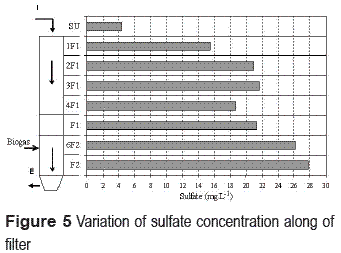
<body><![CDATA[<br>  Nitrogen  removal from anaerobic effluents in TFs proceeds via nitrification followed by  denitrification. During the nitrification step, however, most of the effluent  organic matter that could be used for denitrification is oxidized. Therefore,  supplemental electron donors are required for denitrification to proceed. It  should be noted that the need for the supplementary addition of an external  carbon source for denitrification makes it inconvenient from the sustainability  point of view. Recently, search for electron donors produced during the  wastewater treatment processes has deserved special attention from researchers  aiming to lower the costs of denitrification. The literature suggests that  methane and reduced sulfur compounds could be possible and interesting  alternative electron donors &#91;24-28&#93;. Moreover, anaerobic treatment plants produce CH<sub>4</sub>  and H<sub>2</sub>S containing biogas. Consequently, it is expected that  anaerobic technology based systems can produce low-cost and efficient electron  donors readily useable for denitrification.     <br>    <br>  Therefore,  the UASB-TF combination can present relevant advantages relative to operation  simplicity and low costs if the biogas produced in the UASB reactor can be  used for denitrification. Such a concept implies modifications in TF configurations  to incorporate a denitrification compartment equipped with a biogas  distribution system below the nitrification compartment.     <br>    <br>  This  paper presents and discusses data on the performance of a novel,  two-compartment integrated aerobic-anoxic TF for the post treatment of  effluents from a UASB reactor treating domestic sewage. Special emphasis is  given to nitrogen removal in the denitrification compartment fed with biogas as  electron donor source.</font></p>      <p><font face="Verdana" size="3"><b>Experimental apparatus and methods</b></font></p>      <p><font face="Verdana" size="2"><b><i>Reactor description</i></b></font></p>      <p><font face="Verdana" size="2">The  pilot scale treatment plant consisted of two sequentially disposed units. The  first unit was a UASB reactor with a useful volume of 0.2 m<sup>3</sup>. The  effluent of the UASB reactor was treated in the second unit, the aerobic-anoxic  trickling filter (AATF). A schematic diagram of the pilot plant employed in  this study is shown in <a href="#Figura1">figure 1</a>. </font></p>      <p align="center"><img src="/img/revistas/rfiua/n60/n60a08i01.gif" ><a name="Figura1"></a></p>      <p><font face="Verdana" size="2">The  filter was constructed in PVC with a diameter of 0.35 m and total height of 2.70 m. The  AATF was composed of two vertically disposed compartments. The upper aerobic  compartment had a trickling filter configuration for removal of residual COD  and nitrification with a useful volume of 200 L. In order to improve natural  aeration, vertical ventilation windows were provided in the external wall. The  lower compartment (60 L) was meant to be operated under anoxic conditions for  denitrification. For this reason, it was submerged. Five sampling ports were  located along the upper compartment height (SU, 1F1, 2F1, 3F1 and 4F1); whereas,  the lower compartment had three sampling ports (F1, 6F2 and F2). Biogas  employed as electron donor was supplied by two superposed manifolds located  inside the anoxic compartment and connected to the UASB reactor biogas outlet  line.     ]]></body>
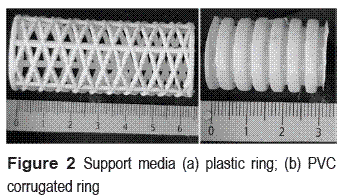
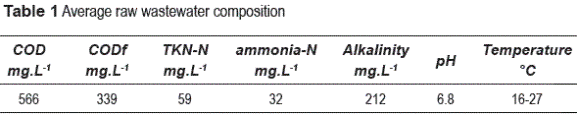
<body><![CDATA[<br>    <br>  The  support media were novel plastic rings commercially known as "rulo"  (3.3 cm in diameter, 6.4 cm in length, void ratio 95% and specific surface area  143 m<sup>2</sup> m<sup>-3</sup>) obtained from local suppliers. Additional to  the "rulo", PVC corrugated rings were used in the anoxic compartment  (2.2 cm in diameter, 3.0 cm in length, void ratio 94% and specific surface area  135 m<sup>2</sup> m<sup>-3</sup>). Pictures of the support media are shown in  <a href="#Figura2">figure 2</a>. </font></p>      <p align="center"><img src="/img/revistas/rfiua/n60/n60a08i02.gif" ><a name="Figura2"></a></p>      <p><font face="Verdana" size="2">After  the star-up period, the AATF was continuously operated at the flow rate of 0.54  m<sup>3</sup> d<sup>-1</sup>, corresponding to the hydraulic loading rate of  5.6 m<sup>3</sup> m<sup>-2</sup> d<sup>-1</sup>. Organic loading rate ranged  from 0.22 - 1.2 kg COD m<sup>-3</sup> d<sup>-1</sup>, and ammonia-N loading  rate ranged from 0.062 - 0.104 kg m<sup>-3</sup> d<sup>-1</sup>, according to  variations of COD and ammonia-N in the UASB reactor effluent. Due to operating  problems along the first operation Stage, the pilot UASB operation was  interrupted and the filter started to be fed with the effluent from a  full-scale UASB reactor treating domestic wastewater. The full-scale UASB  reactor also provided the biogas for denitrification. The biogas was constantly  flushed with a mean flow of 1.7 L min<sup>-1</sup> at the mean composition of  376 mg L<sup>-1</sup> of CH<sub>4</sub>, 112 mg L<sup>-1</sup> of CO<sub>2</sub>,  and 0.493 mg L<sup>-1</sup> of H<sub>2</sub>S. The average composition of the  UASB influent is summarized in <a href="#Tabla1">table 1</a>. </font></p>      <p align="center"><img src="/img/revistas/rfiua/n60/n60a08t01.gif" ><a name="Tabla1"></a></p>      <p> <font face="Verdana" size="2"><b><i>Analytical methods</i></b></font></p>      <p><font face="Verdana" size="2">Monitoring  consisted in collecting samples once or twice a week at different points of the  reactor. The parameters analyzed were: temperature, pH, COD, ammonia-N,  nitrate, nitrite, and sulfate. Analytical determinations were according to  procedures recommended by the Standard Methods for the Examination of Water and  Wastewater &#91;29&#93;. Composition of biogas was determined by gas chromatography by using  a thermal conductivity detector. Aiming at verifying if the increase of  ammonia-N in the denitrifying compartment was due to dissimilatory metabolism,  a denitrification assay was carried out by using a modification of the method  described by &#91;30&#93;. Additionally, the thickness of the biofilm along the height  of the filter was regularly examined under a microscope equipped with an ocular  micrometer. </font></p>      <p><font face="Verdana" size="3"><b>Results and discussion</b> </font></p>      <p> <font face="Verdana" size="2"><b><i>Biofilm development</i></b></font></p>      <p><font face="Verdana" size="2">A  fast colonization of microorganisms was observed mainly inside the support  media. During colonization, biomass growth was patchy. Colonization began with  the emergence of a gelatinous substance on the whole surface of the support  media. After the biofilm reached a given thickness (0.5 mm approx.), the  gelatinous substance practically disappeared. The biomass attached on the  support media suffered stratification along the height of the filter; with the  absolute predominance of heterotrophic populations in the upper part of filter.  This fact can be attributed to the high organic loads applied due to the  operating problems occurring with the UASB reactor, which resulted in high COD  concentrations in its effluent. According to microscopy observations (data not  shown), such as the organic matter being consumed, the nitrifying population  was increasing along the filter. </font></p>      ]]></body>
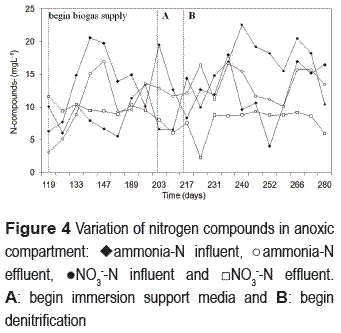
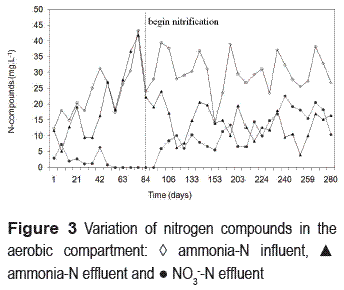
<body><![CDATA[<p> <font face="Verdana" size="2"><i>Organic matter removal</i></font></p>      <p><font face="Verdana" size="2">The  analysis of the COD results was divided into two stages regarding the  application of different organic loads. During Stage 1, the filter received the  effluent from the pilot UASB reactor. This period can be characterized by the  application of higher organic loading rates due to operating problems in the  pilot UASB reactor. As a consequence, the filter performance was also unstable  and low COD removal efficiencies (&lt; 50%) were observed. Even so, filter  effluent COD was approximately constant (&lt; 20 mg L<sup>-1</sup>) by the end  of Stage 1, independently on the applied organic loading rate. This result  confirms the capacity of AATF to efficiently remove high organic loads (COD  removal ~ 90%). It also indicates a progressive development of the biomass  throughout a selective process leading the heterotrophic population to settle  down mainly until the middle of the aerobic compartment. Stage 2 corresponded  to the use of the full-scale UASB effluent, whose operation was stable and COD  removal efficiencies were higher than those observed when the effluent of the  pilot UASB reactor was used to feed the TF. Organic loading rates were lower than  those applied during Stage 1. </font></p>      <p> <font face="Verdana" size="2"><i>Nitrification-aerobic compartment</i></font></p>      <p><font face="Verdana" size="2">Nitrification was clearly manifested on the 98th day of operation (<a href="#Figura3">figure 3</a>).</font></p>      <p align="center"><img src="/img/revistas/rfiua/n60/n60a08i03.gif" ><a name="Figura3"></a></p>      <p><font face="Verdana" size="2">At  the beginning of nitrification, effluent ammonia concentrations were mainly  related to the influent values. Thereafter, such dependence was reduced and  better efficiencies were obtained, indicating the nitrifying biomass was  growing and attaining stability with time. By the end of the operation period,  the average effluent ammonia-N concentration was 13 mg L<sup>-1</sup>, the  average effluent NO<sub>3</sub>-N concentration was 12 mg L<sup>-1</sup>  and the average nitrification efficiency was 60%. Ammonia concentrations are  expected to decrease along the reactor height in nitrification TFs. In this  study, a slight increase of ammonia concentration was observed on some  occasions. This may have been caused by nitrogen compound releases from  cellular lyses, probably due to the high amount of biomass accumulated at the  bottom of the aerobic compartment. A similar trend was found by &#91;31&#93;. Despite  the increase of ammonia concentration, a decrease of effluent nitrate  concentrations was observed. Such a denitrification process near the bottom of  the nitrifying compartment can be attributed to the existence of anoxic  microenvironments generated by the accumulation of biomass in this region.     <br>       <br>  DO  concentrations along the aerobic compartment ranged from 3 to 5 mg L<sup>-1</sup>;  thus, confirming the adequacy of adopting ventilation windows in the external  filter wall. Significant decreases of DO inside the reactor were not observed.  Therefore, the nitrification process was not limited by oxygen availability as  the high void space of support media allowed for an efficient air supply inside  the filter. </font></p>      <p> <font face="Verdana" size="2"><i>Denitrification-anoxic compartment</i></font></p>      <p><font face="Verdana" size="2">Once  nitrification was obtained, the biogas supply was started, aiming at  establishing the denitrification process. Before being submerged, the  denitrifying compartment was not free from DO (4 mg L<sup>-1</sup>). Additionally,  nitrifying biomass was also washed out from the aerobic compartment and  retained in the denitrifying compartment. Initially, this fact favored the  nitrification and limited the denitrification. In fact, the characteristics of  the support media propitiated favorable conditions for the free circulation of  air and biogas. Such a condition did not allow the suitable contact between  biogas and the denitrifying bacteria to occur, affecting the availability of  electron donor (biogas) for denitrification. To improve environmental  conditions for denitrification, the support media was submerged (204th day).  The objective was to offer a resistance to the rapid biogas ascension and  mixture with the air, thus allowing a better contact between the biogas  compounds and the denitrifying bacteria. As shown in <a href="#Figura4">figure 4</a>, the denitrification process  was improved after the support media was submerged (217th day). The average  effluent NO<sub>3</sub>-N concentration dropped to 8 mg L<sup>-1</sup> and the average  denitrification efficiency was 52%. </font></p>      ]]></body>
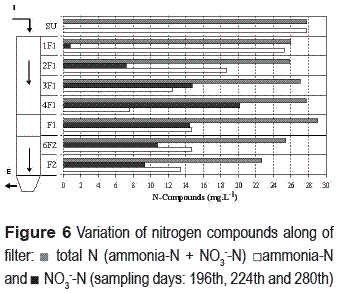
<body><![CDATA[<p align="center"><img src="/img/revistas/rfiua/n60/n60a08i04.gif" ><a name="Figura4"></a></p>      <p><font face="Verdana" size="2">Simultaneous  to denitrification improvement, an increase of effluent ammonia-N over the  influent concentration was observed. In order to understand this phenomenon, a  test of dissimilatory nitrate reduction to ammonium in denitrifying biomass was  performed as described by &#91;30&#93;. The production of ammonium was not observed, indicating  that dissimilatory nitrate reduction was not taking place inside the reactor.  The other possible reason for the increase in ammonia-N concentration would be  the endogenous metabolism of the biomass accumulated at the bottom of the  nitrification- aerobic compartment. Aiming at avoiding the production of N  compounds via cellular lyses, the sludge accumulated at the bottom of the  compartment started to be removed once a week.     <br>    <br>  There  are two compounds in the biogas that are potentially used as electron donor for  denitrification: CH<sub>4</sub> and H<sub>2</sub>S. The effective use of such  in denitrification depends on environmental conditions as it is the presence or  absence of DO. In the present study, the biogas was probably the sole electron  source for denitrification since organic matter availability from wastewater  was very low (COD &lt; 20 mg L<sup>-1</sup>). Additionally, no significant variation of  COD concentrations between influent and effluent was observed as expected if  COD was used as electron donor.     <br>    <br>  Considering  that DO was also present in the denitrification compartment (1 mg L<sup>-1</sup>), it can be  assumed that this fact favored the oxidation of methane present in the biogas  to intermediate organic compounds, which were then used for denitrification.  This effect was observed by &#91;24&#93; in laboratory experiments. Nevertheless, with an excess of  DO concentration complete oxidation of methane to CO<sub>2</sub> can occur  resulting in the consumption of significant fraction of methane limiting its  use as electron donor for denitrification.     <br>    <br>  On  the other hand, denitrification occurred concomitantly with the increase of  sulfate concentration. Due to the presence of DO in the compartment, it is  suggested that sulfate was produced by full oxidation of H<sub>2</sub>S from  biogas and probably also by its use for denitrification. In <a href="#Figura5">figure 5</a> is observed as the sulfate has  its highest values in the closest ports of supply biogas, with an increase in  port F2 and a tendency to decrease as the rises by AATF biogas. The highest  values of sulfate in F2 can be the result partly of sulfate produced in the top  spots that the downflow of wastewater, have led to an increase in its  concentration of ports below. The lowest values of sulfate are attributed to  the decrease in availability biogas. H<sub>2</sub>S was being partly oxidized  into its upward, due to high DO concentration present between ports F1 and 1F1  and partly released to the outside of the AATF through ventilation windows. </font></p>      <p align="center"><img src="/img/revistas/rfiua/n60/n60a08i05.gif" ><a name="Figura5"></a></p>      <p><font face="Verdana" size="2">As  reported in the literature &#91;32&#93;, there are indications that denitrification  occurs more easily by using sulfur compounds than methane. In contrast, the low  concentrations of H<sub>2</sub>S in the biogas could have limited its  utilization as electron donor for denitrification.     ]]></body>
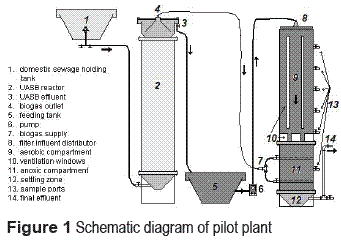
<body><![CDATA[<br>    <br>  In  spite of the fact that it was not possible to demonstrate that the H<sub>2</sub>S  present in the biogas was fully used for denitrification, H<sub>2</sub>S was  transformed inside the filter and removed from the biogas. This fact  demonstrated an additional ability of the AATF that can be used for the  treatment of the biogas produced in anaerobic reactors.     <br>    <br>  The  evolution of the nitrogen species along the reactor, from ammonia-N to nitrate  in the nitrifying compartment and the performance of the denitrifying  compartment is shown in <a href="#Figura6">figure 6</a>. In port F1, a significant increase in ammonia-N  concentration can be observed due to biomass accumulation in the interface  between the compartments, as well as, the persistence of this compound at a  stable concentration from this port onwards. As expected, NO<sub>3</sub>-N reduction by denitrification occurred steadily along the lower compartment,  but the process was probably limited by the electron donor availability. </font></p>      <p align="center"><img src="/img/revistas/rfiua/n60/n60a08i06.gif" ><a name="Figura6"></a></p>      <p><font face="Verdana" size="2">From  the data obtained in this research, aerobic/anoxic TFs can be applied for the  post-treatment of effluents from anaerobic reactors. The unit removed  significant fractions of the soluble COD and nitrogen. Even considering the  limitations observed, the effluent produced attains the requirements of organic  matter and nitrogen compound concentrations for discharge in superficial waters  in many developing countries.     <br>    <br>  In  order to optimize its performance, the design of the AATF can be improved to  enhance biogas transfer to the liquid phase and also to avoid the accumulation  of suspended solids inside the unit. </font></p>      <p><font face="Verdana" size="3"><b>Conclusions</b> </font></p>      <p><font face="Verdana" size="2">The  novel reactor configuration (aerobic-anoxic trickling filter - AATF) presented  promising results for its application in the post-treatment of effluents from  anaerobic reactors treating domestic sewage, especially for the removal of  dissolved organic matter and nitrogen. However, some changes in the design of  the AATF are recommended to avoid biomass accumulation in the interface between  the two compartments and also to improve the biogas transfer to the liquid  phase and, consequently, to enhance denitrification. The support media was  considered adequate for application in AAFT due to its durability and high  percentage of void spaces, besides offering favorable conditions for biomass  attachment and colonization. Nitrification of the anaerobic effluent was  effective in the aerobic compartment. For the applied hydraulic load of 5.6 m<sup>3</sup>  m<sup>-2</sup> d<sup>-1</sup> and applied organic load of 0.26 kg COD m<sup>-3</sup>  d<sup>-1</sup> ammonia conversion to nitrate ranged 60 to 74%, and the average  ammonia concentration effluent was below 13 mg L<sup>-1</sup>. A significant  fraction of NO<sub>3</sub>-N was denitrified in the submerged  compartment in the presence of the biogas, thus indicating the potential use of  the biogas as electron donor for denitrification in such a unit. As the  submerged compartment presented DO concentration of about 1 mg L<sup>-1</sup>,  methane might have been the main biogas constituent used as electron donor.  Despite the presence of DO, the denitrification was satisfactorily performed  and nitrate concentration in the final effluent was under 10 mg L<sup>-1</sup>. </font></p>      ]]></body>
<body><![CDATA[<p><font face="Verdana" size="3"><b>Referencias</b> </font></p>      <!-- ref --><p><font face="Verdana" size="2">1. F. Qejen, I. Gonenf I.  "Criteria for nitrification and denitrification of high-strength wastes in  two up flow submerged filters". <i>Water Environ.  Res</i>.  Vol. 67. 1995. pp. 32-142.     &nbsp;&nbsp;&nbsp;&nbsp;&nbsp;&nbsp;&nbsp;&nbsp;[&#160;<a href="javascript:void(0);" onclick="javascript: window.open('/scielo.php?script=sci_nlinks&ref=000084&pid=S0120-6230201100040000800001&lng=','','width=640,height=500,resizable=yes,scrollbars=1,menubar=yes,');">Links</a>&#160;]<!-- end-ref --><br>    <!-- ref --><br>  2. M. Strous, E. Van Gerven,  P. Zheng, G. Kuenen, M. Jetten. "Ammonium removal from concentrated waste  streams with the anaerobic ammonium oxidation (ANAMMOX) process in different  reactor configurations". <i>Water Res</i>. Vol. 31. 1997. pp. 1955-1962.     &nbsp;&nbsp;&nbsp;&nbsp;&nbsp;&nbsp;&nbsp;&nbsp;[&#160;<a href="javascript:void(0);" onclick="javascript: window.open('/scielo.php?script=sci_nlinks&ref=000086&pid=S0120-6230201100040000800002&lng=','','width=640,height=500,resizable=yes,scrollbars=1,menubar=yes,');">Links</a>&#160;]<!-- end-ref --><br>    <!-- ref --><br>  3. M. C. M. Van Loosdrecht, M.  S. Jetten. "Microbiological conversions in nitrogen removal". <i>Water Sci. Technol</i>. Vol.  38. 1998. pp. 1-7.     &nbsp;&nbsp;&nbsp;&nbsp;&nbsp;&nbsp;&nbsp;&nbsp;[&#160;<a href="javascript:void(0);" onclick="javascript: window.open('/scielo.php?script=sci_nlinks&ref=000088&pid=S0120-6230201100040000800003&lng=','','width=640,height=500,resizable=yes,scrollbars=1,menubar=yes,');">Links</a>&#160;]<!-- end-ref --><br>    <!-- ref --><br>  4. J. Bosander, A. Westlund.  "Operation of full-scale fluidized bed for denitrification". <i>Water Sci.  Technol</i>. Vol.  41. 2000. pp. 115-121.     &nbsp;&nbsp;&nbsp;&nbsp;&nbsp;&nbsp;&nbsp;&nbsp;[&#160;<a href="javascript:void(0);" onclick="javascript: window.open('/scielo.php?script=sci_nlinks&ref=000090&pid=S0120-6230201100040000800004&lng=','','width=640,height=500,resizable=yes,scrollbars=1,menubar=yes,');">Links</a>&#160;]<!-- end-ref --><br>    <!-- ref --><br>  5. O. Lahav, E. Artzi, S.  Tarre, M. Green. "Ammonium removal using a novel unsaturated flow  biological filter with passive aeration". <i>Water Res</i>. Vol. 35. 2001. pp. 397-404.     &nbsp;&nbsp;&nbsp;&nbsp;&nbsp;&nbsp;&nbsp;&nbsp;[&#160;<a href="javascript:void(0);" onclick="javascript: window.open('/scielo.php?script=sci_nlinks&ref=000092&pid=S0120-6230201100040000800005&lng=','','width=640,height=500,resizable=yes,scrollbars=1,menubar=yes,');">Links</a>&#160;]<!-- end-ref --><br>    <!-- ref --><br>  6. K. Than, P. Ajit.  "Novel microbial nitrogen removal process". <i>Biotechnol. Adv</i>. Vol. 22. 2004. pp. 519-532.     &nbsp;&nbsp;&nbsp;&nbsp;&nbsp;&nbsp;&nbsp;&nbsp;[&#160;<a href="javascript:void(0);" onclick="javascript: window.open('/scielo.php?script=sci_nlinks&ref=000094&pid=S0120-6230201100040000800006&lng=','','width=640,height=500,resizable=yes,scrollbars=1,menubar=yes,');">Links</a>&#160;]<!-- end-ref --><br>    <!-- ref --><br>  7. W. M. Rostron, D. C.  Stuckey, A. A. Young. "Nitrification of high strength ammonia wastewater:  comparative study of immobilization media". <i>Water Res</i>. Vol. 35. 2001. pp. 1167-1178.     &nbsp;&nbsp;&nbsp;&nbsp;&nbsp;&nbsp;&nbsp;&nbsp;[&#160;<a href="javascript:void(0);" onclick="javascript: window.open('/scielo.php?script=sci_nlinks&ref=000096&pid=S0120-6230201100040000800007&lng=','','width=640,height=500,resizable=yes,scrollbars=1,menubar=yes,');">Links</a>&#160;]<!-- end-ref --><br>    <!-- ref --><br>  8. Environmental Protection  Agency (EPA). <i>Process design for nitrogen control</i>. Ed. Office of technology transfer. Washington, USA. 1975.  pp. 1-64.     &nbsp;&nbsp;&nbsp;&nbsp;&nbsp;&nbsp;&nbsp;&nbsp;[&#160;<a href="javascript:void(0);" onclick="javascript: window.open('/scielo.php?script=sci_nlinks&ref=000098&pid=S0120-6230201100040000800008&lng=','','width=640,height=500,resizable=yes,scrollbars=1,menubar=yes,');">Links</a>&#160;]<!-- end-ref --><br>    <!-- ref --><br>  9. H. A. Gullicks, J. Cleasby.  "Design of trickling filter nitrification towers". <i>J. Water Pollut.  Control Fed</i>.  Vol. 58. 1986. pp. 60-67.     &nbsp;&nbsp;&nbsp;&nbsp;&nbsp;&nbsp;&nbsp;&nbsp;[&#160;<a href="javascript:void(0);" onclick="javascript: window.open('/scielo.php?script=sci_nlinks&ref=000100&pid=S0120-6230201100040000800009&lng=','','width=640,height=500,resizable=yes,scrollbars=1,menubar=yes,');">Links</a>&#160;]<!-- end-ref --><br>    <!-- ref --><br>  10. M. Boller, W. Gujer.  "Nitrification in tertiary trickling filters followed by deep bed  filters". <i>Water Res</i>. Vol. 20. 1986. pp. 1363-1373.     &nbsp;&nbsp;&nbsp;&nbsp;&nbsp;&nbsp;&nbsp;&nbsp;[&#160;<a href="javascript:void(0);" onclick="javascript: window.open('/scielo.php?script=sci_nlinks&ref=000102&pid=S0120-6230201100040000800010&lng=','','width=640,height=500,resizable=yes,scrollbars=1,menubar=yes,');">Links</a>&#160;]<!-- end-ref --><br>    <!-- ref --><br>  11. D. Parker, M. Lutz, R.  Dahl, S. Bernkopf. "Enhancing reaction rates in nitrifying trickling  filters through biofilm control". <i>J. Water Pollut.  Control Fed</i>.  Vol. 61. 1989. pp. 618-630.     &nbsp;&nbsp;&nbsp;&nbsp;&nbsp;&nbsp;&nbsp;&nbsp;[&#160;<a href="javascript:void(0);" onclick="javascript: window.open('/scielo.php?script=sci_nlinks&ref=000104&pid=S0120-6230201100040000800011&lng=','','width=640,height=500,resizable=yes,scrollbars=1,menubar=yes,');">Links</a>&#160;]<!-- end-ref --><br>    <!-- ref --><br>  12. W. Okey, O. E. Albertson.  "Diffusion's role in regulating rate and masking temperature effects in  fixed film nitrification". <i>J. Water Pollut.  Control Fed</i>. Vol.  61. 1989. pp. 500-509.     &nbsp;&nbsp;&nbsp;&nbsp;&nbsp;&nbsp;&nbsp;&nbsp;[&#160;<a href="javascript:void(0);" onclick="javascript: window.open('/scielo.php?script=sci_nlinks&ref=000106&pid=S0120-6230201100040000800012&lng=','','width=640,height=500,resizable=yes,scrollbars=1,menubar=yes,');">Links</a>&#160;]<!-- end-ref --><br>    <!-- ref --><br>  13. E. A. Evans, T. Ellis, H.  Gullicks, J. Ringelestein. "Trickling filter nitrification performance  characteristics and potential of a full-scale municipal wastewater treatment  facility". <i>J. Environ Eng-ASCE</i>. Vol. 130. 2004. pp. 1280-1288.     &nbsp;&nbsp;&nbsp;&nbsp;&nbsp;&nbsp;&nbsp;&nbsp;[&#160;<a href="javascript:void(0);" onclick="javascript: window.open('/scielo.php?script=sci_nlinks&ref=000108&pid=S0120-6230201100040000800013&lng=','','width=640,height=500,resizable=yes,scrollbars=1,menubar=yes,');">Links</a>&#160;]<!-- end-ref --><br>    <!-- ref --><br>  14. T. C. Zhang, Y. Fu, P.  Bishop. "Competition for substrate and space in biofilms". <i>Water Environ.  Res</i>. Vol.  67. 1995. pp. 992-1003.     &nbsp;&nbsp;&nbsp;&nbsp;&nbsp;&nbsp;&nbsp;&nbsp;[&#160;<a href="javascript:void(0);" onclick="javascript: window.open('/scielo.php?script=sci_nlinks&ref=000110&pid=S0120-6230201100040000800014&lng=','','width=640,height=500,resizable=yes,scrollbars=1,menubar=yes,');">Links</a>&#160;]<!-- end-ref --><br>    <!-- ref --><br>  15. D. Parker, T. Richards.  "Nitrification in trickling filters". <i>J. Water Pollut.  Control Fed</i>.  Vol. 58. 1986. pp. 896-902.     &nbsp;&nbsp;&nbsp;&nbsp;&nbsp;&nbsp;&nbsp;&nbsp;[&#160;<a href="javascript:void(0);" onclick="javascript: window.open('/scielo.php?script=sci_nlinks&ref=000112&pid=S0120-6230201100040000800015&lng=','','width=640,height=500,resizable=yes,scrollbars=1,menubar=yes,');">Links</a>&#160;]<!-- end-ref --><br>    <!-- ref --><br>  16. M. Boller,  W. Gujer, M. Tschui. "Parameters affecting nitrifying biofilm reactors". <i>Water Sci</i>.  Technol.  Vol. 29. 1994. pp. 1-11.     &nbsp;&nbsp;&nbsp;&nbsp;&nbsp;&nbsp;&nbsp;&nbsp;[&#160;<a href="javascript:void(0);" onclick="javascript: window.open('/scielo.php?script=sci_nlinks&ref=000114&pid=S0120-6230201100040000800016&lng=','','width=640,height=500,resizable=yes,scrollbars=1,menubar=yes,');">Links</a>&#160;]<!-- end-ref --><br>    <!-- ref --><br>  17. Metcalf and Eddy. <i>Wastewater  engineering: treatment and reuse</i>. 4<sup>th</sup> ed. Ed. McGraw-Hill. Inc. New York, USA.  2003. pp. 888-930     &nbsp;&nbsp;&nbsp;&nbsp;&nbsp;&nbsp;&nbsp;&nbsp;[&#160;<a href="javascript:void(0);" onclick="javascript: window.open('/scielo.php?script=sci_nlinks&ref=000116&pid=S0120-6230201100040000800017&lng=','','width=640,height=500,resizable=yes,scrollbars=1,menubar=yes,');">Links</a>&#160;]<!-- end-ref --><br>    <!-- ref --><br>  18. R. J. Stenquist, D.  Parker, J. J. Dosh. "Carbon oxidation- nitrification in synthetic media  filters". <i>J. Water Pollut. Control Fed</i>. Vol. 46. 1974. pp. 2327-2339.     &nbsp;&nbsp;&nbsp;&nbsp;&nbsp;&nbsp;&nbsp;&nbsp;[&#160;<a href="javascript:void(0);" onclick="javascript: window.open('/scielo.php?script=sci_nlinks&ref=000118&pid=S0120-6230201100040000800018&lng=','','width=640,height=500,resizable=yes,scrollbars=1,menubar=yes,');">Links</a>&#160;]<!-- end-ref --><br>    <!-- ref --><br>  19. G. F. Mehlhart.  "Upgrading of existing trickling filter plants for denitrification". <i>Water Sci.  Technol</i>.  Vol. 30. 1994. pp. 173-179.     &nbsp;&nbsp;&nbsp;&nbsp;&nbsp;&nbsp;&nbsp;&nbsp;[&#160;<a href="javascript:void(0);" onclick="javascript: window.open('/scielo.php?script=sci_nlinks&ref=000120&pid=S0120-6230201100040000800019&lng=','','width=640,height=500,resizable=yes,scrollbars=1,menubar=yes,');">Links</a>&#160;]<!-- end-ref --><br>    <!-- ref --><br>  20. B. Dorias, P. Baumann.  "Denitrification in trickling filter". <i>Water Sci. Technol</i>. Vol. 30. 1994. pp. 181-184.     &nbsp;&nbsp;&nbsp;&nbsp;&nbsp;&nbsp;&nbsp;&nbsp;[&#160;<a href="javascript:void(0);" onclick="javascript: window.open('/scielo.php?script=sci_nlinks&ref=000122&pid=S0120-6230201100040000800020&lng=','','width=640,height=500,resizable=yes,scrollbars=1,menubar=yes,');">Links</a>&#160;]<!-- end-ref --><br>    <!-- ref --><br>  21. S. Biesterfeld,  G. Farmer,  L. Figueroa, D. Parker, P. Russell. "Quantification of denitrification  potential in carbonaceous trickling filters". <i>Water Res</i>. Vol. 37. 2003. pp. 4011-4017.     &nbsp;&nbsp;&nbsp;&nbsp;&nbsp;&nbsp;&nbsp;&nbsp;[&#160;<a href="javascript:void(0);" onclick="javascript: window.open('/scielo.php?script=sci_nlinks&ref=000124&pid=S0120-6230201100040000800021&lng=','','width=640,height=500,resizable=yes,scrollbars=1,menubar=yes,');">Links</a>&#160;]<!-- end-ref --><br>    <!-- ref --><br>  22. P. Pearce. "Trickling  filter for upgrading low technology wastewater plants for nitrogen  removal". <i>Water Sci. Technol</i>. Vol. 49. 2004. pp. 47-53.     &nbsp;&nbsp;&nbsp;&nbsp;&nbsp;&nbsp;&nbsp;&nbsp;[&#160;<a href="javascript:void(0);" onclick="javascript: window.open('/scielo.php?script=sci_nlinks&ref=000126&pid=S0120-6230201100040000800022&lng=','','width=640,height=500,resizable=yes,scrollbars=1,menubar=yes,');">Links</a>&#160;]<!-- end-ref --><br>    <!-- ref --><br>  23. R. F. Gonjalves, C. Chernicharo, C.  De Andrade Neto, P. Sobrinho, M. Kato, R. Da Costa, M. Aisse, M. Zaiat. "P&oacute;s-tratamento  de efluentes de reatores anaer&oacute;bios por reatores com  biofilme". <i>P&oacute;s-tratamento de efluentes  de reatores anaer&oacute;bio.  Projeto PROSAB</i>. Ed. Belo Horizonte. 2001. pp. 171-199.     &nbsp;&nbsp;&nbsp;&nbsp;&nbsp;&nbsp;&nbsp;&nbsp;[&#160;<a href="javascript:void(0);" onclick="javascript: window.open('/scielo.php?script=sci_nlinks&ref=000128&pid=S0120-6230201100040000800023&lng=','','width=640,height=500,resizable=yes,scrollbars=1,menubar=yes,');">Links</a>&#160;]<!-- end-ref --><br>     <!-- ref --><br>  24. F.  Thalasso, A. Vallecillo, P. Garc&iacute;a-Encina, F. Fdz-  Polanco. "The  use of  methane as a sole carbon source for wastewater denitrification". <i>Water Res</i>. Vol. 31. 1997. pp. 55-60.     &nbsp;&nbsp;&nbsp;&nbsp;&nbsp;&nbsp;&nbsp;&nbsp;[&#160;<a href="javascript:void(0);" onclick="javascript: window.open('/scielo.php?script=sci_nlinks&ref=000130&pid=S0120-6230201100040000800024&lng=','','width=640,height=500,resizable=yes,scrollbars=1,menubar=yes,');">Links</a>&#160;]<!-- end-ref --><br>    <!-- ref --><br>  25. J. P. Rajapakse, J. E.  Scutt. "Denitrification with natural gas and various new growth  media". <i>Water Res</i>. Vol. 33. 1999. pp.  3723-3734.     &nbsp;&nbsp;&nbsp;&nbsp;&nbsp;&nbsp;&nbsp;&nbsp;[&#160;<a href="javascript:void(0);" onclick="javascript: window.open('/scielo.php?script=sci_nlinks&ref=000132&pid=S0120-6230201100040000800025&lng=','','width=640,height=500,resizable=yes,scrollbars=1,menubar=yes,');">Links</a>&#160;]<!-- end-ref --><br>    <!-- ref --><br>  26. C. Costa,  C. Dijkema, M. Friedrich, P. Garc&iacute;a-Encina, F. Fernandez-Polanco, A. Stams. "Denitrification with  methane as electron donor in oxygen-limited bioreactors". <i>App. Microbiol.  Biot</i>.  Vol. 53. 2000. pp. 754-762.     &nbsp;&nbsp;&nbsp;&nbsp;&nbsp;&nbsp;&nbsp;&nbsp;[&#160;<a href="javascript:void(0);" onclick="javascript: window.open('/scielo.php?script=sci_nlinks&ref=000134&pid=S0120-6230201100040000800026&lng=','','width=640,height=500,resizable=yes,scrollbars=1,menubar=yes,');">Links</a>&#160;]<!-- end-ref --><br>    <!-- ref --><br>  27. M. I. M. Soares.  "Denitrification of groundwater with elemental sulfur". <i>Water Res</i>. Vol. 36. 2002. pp. 1392-1395.     &nbsp;&nbsp;&nbsp;&nbsp;&nbsp;&nbsp;&nbsp;&nbsp;[&#160;<a href="javascript:void(0);" onclick="javascript: window.open('/scielo.php?script=sci_nlinks&ref=000136&pid=S0120-6230201100040000800027&lng=','','width=640,height=500,resizable=yes,scrollbars=1,menubar=yes,');">Links</a>&#160;]<!-- end-ref --><br>    <!-- ref --><br>  28. S. Islas-Lima, F. Thalasso, J. Gomez-Hernandez. "Evidence  of anoxic methane oxidation coupled to denitrification". <i>Water Res</i>. Vol. 38. 2004. pp. 13-16.     &nbsp;&nbsp;&nbsp;&nbsp;&nbsp;&nbsp;&nbsp;&nbsp;[&#160;<a href="javascript:void(0);" onclick="javascript: window.open('/scielo.php?script=sci_nlinks&ref=000138&pid=S0120-6230201100040000800028&lng=','','width=640,height=500,resizable=yes,scrollbars=1,menubar=yes,');">Links</a>&#160;]<!-- end-ref --><br>    <!-- ref --><br>  29. American Public Health  Association (APHA). <i>Standard Methods  for the Examination of Water and Wastewater</i>. 20<sup>th</sup> ed. Ed.  American Public Health Association. Washington, DC. 1998. pp. 1-46     &nbsp;&nbsp;&nbsp;&nbsp;&nbsp;&nbsp;&nbsp;&nbsp;[&#160;<a href="javascript:void(0);" onclick="javascript: window.open('/scielo.php?script=sci_nlinks&ref=000140&pid=S0120-6230201100040000800029&lng=','','width=640,height=500,resizable=yes,scrollbars=1,menubar=yes,');">Links</a>&#160;]<!-- end-ref --><br>    <!-- ref --><br>  30. M. Guynot,  A. Toribio, M. Quevedo, L. Mux&iacute;. "Microflora of dissimilative  nitrate reduction in a denitrifying reactor". <i>Appl. Microbiol.  Biot</i>.  Vol. 50. 1998. pp. 396-400.     &nbsp;&nbsp;&nbsp;&nbsp;&nbsp;&nbsp;&nbsp;&nbsp;[&#160;<a href="javascript:void(0);" onclick="javascript: window.open('/scielo.php?script=sci_nlinks&ref=000142&pid=S0120-6230201100040000800030&lng=','','width=640,height=500,resizable=yes,scrollbars=1,menubar=yes,');">Links</a>&#160;]<!-- end-ref --><br>    <!-- ref --><br>  31. R. Del Pozo, V. Diez. "Integrated  anaerobic-aerobic fixed-film reactor for slaughterhouse wastewater  treatment". <i>Water Res</i>. Vol. 39. 2005. pp. 1114-1122.     &nbsp;&nbsp;&nbsp;&nbsp;&nbsp;&nbsp;&nbsp;&nbsp;[&#160;<a href="javascript:void(0);" onclick="javascript: window.open('/scielo.php?script=sci_nlinks&ref=000144&pid=S0120-6230201100040000800031&lng=','','width=640,height=500,resizable=yes,scrollbars=1,menubar=yes,');">Links</a>&#160;]<!-- end-ref --><br>    <!-- ref --><br>  32. E. Houbron, M. Torrijos,  B. Capdeville. "An alternative use of biogas applied in water  denitrification". <i>Water Sci. Technol</i>. Vol. 40. 1999. pp. 115-122.</font>&nbsp;&nbsp;&nbsp;&nbsp;&nbsp;&nbsp;&nbsp;&nbsp;[&#160;<a href="javascript:void(0);" onclick="javascript: window.open('/scielo.php?script=sci_nlinks&ref=000146&pid=S0120-6230201100040000800032&lng=','','width=640,height=500,resizable=yes,scrollbars=1,menubar=yes,');">Links</a>&#160;]<!-- end-ref --><br>    <br>    <br>    <br>       <p><font face="Verdana" size="2">(Recibido  el 4 de junio de 2010. Aceptado el 20 de mayo 2011)</font></p>     <p><font face="Verdana" size="2"><sup>*</sup>Autor de correspondencia: tel&eacute;fono: 311 366 26 46, fax: + 54 + 2 + 331 21 75, correo  electr&oacute;nico: <a href="mailto:jenny.rodriguez@correounivalle.edu.co">jenny.rodriguez@correounivalle.edu.co</a> (J. Rodr&iacute;guez)</font></p>     ]]></body>
<body><![CDATA[ ]]></body><back>
<ref-list>
<ref id="B1">
<label>1</label><nlm-citation citation-type="journal">
<person-group person-group-type="author">
<name>
<surname><![CDATA[Qejen]]></surname>
<given-names><![CDATA[F]]></given-names>
</name>
<name>
<surname><![CDATA[Gonenf I]]></surname>
<given-names><![CDATA[I]]></given-names>
</name>
</person-group>
<article-title xml:lang="en"><![CDATA[Criteria for nitrification and denitrification of high-strength wastes in two up flow submerged filters]]></article-title>
<source><![CDATA[Water Environ. Res]]></source>
<year>1995</year>
<volume>67</volume>
<page-range>32-142</page-range></nlm-citation>
</ref>
<ref id="B2">
<label>2</label><nlm-citation citation-type="journal">
<person-group person-group-type="author">
<name>
<surname><![CDATA[Strous]]></surname>
<given-names><![CDATA[M]]></given-names>
</name>
<name>
<surname><![CDATA[Van Gerven]]></surname>
<given-names><![CDATA[E]]></given-names>
</name>
<name>
<surname><![CDATA[Zheng]]></surname>
<given-names><![CDATA[P]]></given-names>
</name>
<name>
<surname><![CDATA[Kuenen]]></surname>
<given-names><![CDATA[G]]></given-names>
</name>
<name>
<surname><![CDATA[Jetten]]></surname>
<given-names><![CDATA[M]]></given-names>
</name>
</person-group>
<article-title xml:lang="en"><![CDATA[Ammonium removal from concentrated waste streams with the anaerobic ammonium oxidation (ANAMMOX) process in different reactor configurations]]></article-title>
<source><![CDATA[Water Res]]></source>
<year>1997</year>
<volume>31</volume>
<page-range>1955-1962</page-range></nlm-citation>
</ref>
<ref id="B3">
<label>3</label><nlm-citation citation-type="journal">
<person-group person-group-type="author">
<name>
<surname><![CDATA[Van Loosdrecht]]></surname>
<given-names><![CDATA[M. C. M]]></given-names>
</name>
<name>
<surname><![CDATA[Jetten]]></surname>
<given-names><![CDATA[M. S]]></given-names>
</name>
</person-group>
<article-title xml:lang="en"><![CDATA[Microbiological conversions in nitrogen removal]]></article-title>
<source><![CDATA[Water Sci. Technol]]></source>
<year>1998</year>
<volume>38</volume>
<page-range>1-7</page-range></nlm-citation>
</ref>
<ref id="B4">
<label>4</label><nlm-citation citation-type="journal">
<person-group person-group-type="author">
<name>
<surname><![CDATA[Bosander]]></surname>
<given-names><![CDATA[J]]></given-names>
</name>
<name>
<surname><![CDATA[Westlund]]></surname>
<given-names><![CDATA[A]]></given-names>
</name>
</person-group>
<article-title xml:lang="en"><![CDATA[Operation of full-scale fluidized bed for denitrification]]></article-title>
<source><![CDATA[Water Sci. Technol]]></source>
<year>2000</year>
<volume>41</volume>
<page-range>115-121</page-range></nlm-citation>
</ref>
<ref id="B5">
<label>5</label><nlm-citation citation-type="journal">
<person-group person-group-type="author">
<name>
<surname><![CDATA[Lahav]]></surname>
<given-names><![CDATA[O]]></given-names>
</name>
<name>
<surname><![CDATA[Artzi]]></surname>
<given-names><![CDATA[E]]></given-names>
</name>
<name>
<surname><![CDATA[Tarre]]></surname>
<given-names><![CDATA[S]]></given-names>
</name>
<name>
<surname><![CDATA[Green]]></surname>
<given-names><![CDATA[M]]></given-names>
</name>
</person-group>
<article-title xml:lang="en"><![CDATA[Ammonium removal using a novel unsaturated flow biological filter with passive aeration]]></article-title>
<source><![CDATA[Water Res]]></source>
<year>2001</year>
<volume>35</volume>
<page-range>397-404</page-range></nlm-citation>
</ref>
<ref id="B6">
<label>6</label><nlm-citation citation-type="journal">
<person-group person-group-type="author">
<name>
<surname><![CDATA[Than]]></surname>
<given-names><![CDATA[K]]></given-names>
</name>
<name>
<surname><![CDATA[Ajit]]></surname>
<given-names><![CDATA[P]]></given-names>
</name>
</person-group>
<article-title xml:lang="en"><![CDATA[Novel microbial nitrogen removal process]]></article-title>
<source><![CDATA[Biotechnol. Adv]]></source>
<year>2004</year>
<volume>22</volume>
<page-range>519-532</page-range></nlm-citation>
</ref>
<ref id="B7">
<label>7</label><nlm-citation citation-type="journal">
<person-group person-group-type="author">
<name>
<surname><![CDATA[Rostron]]></surname>
<given-names><![CDATA[W. M]]></given-names>
</name>
<name>
<surname><![CDATA[Stuckey]]></surname>
<given-names><![CDATA[D. C]]></given-names>
</name>
<name>
<surname><![CDATA[Young]]></surname>
<given-names><![CDATA[A. A]]></given-names>
</name>
</person-group>
<article-title xml:lang="en"><![CDATA[Nitrification of high strength ammonia wastewater: comparative study of immobilization media]]></article-title>
<source><![CDATA[Water Res]]></source>
<year>2001</year>
<volume>35</volume>
<page-range>1167-1178</page-range></nlm-citation>
</ref>
<ref id="B8">
<label>8</label><nlm-citation citation-type="book">
<collab>Environmental Protection Agency</collab>
<source><![CDATA[Process design for nitrogen control]]></source>
<year>1975</year>
<page-range>1-64</page-range><publisher-loc><![CDATA[Washington ]]></publisher-loc>
<publisher-name><![CDATA[Ed. Office of technology transfer]]></publisher-name>
</nlm-citation>
</ref>
<ref id="B9">
<label>9</label><nlm-citation citation-type="journal">
<person-group person-group-type="author">
<name>
<surname><![CDATA[Gullicks]]></surname>
<given-names><![CDATA[H. A]]></given-names>
</name>
<name>
<surname><![CDATA[Cleasby]]></surname>
<given-names><![CDATA[J]]></given-names>
</name>
</person-group>
<article-title xml:lang="en"><![CDATA[Design of trickling filter nitrification towers]]></article-title>
<source><![CDATA[J. Water Pollut. Control Fed]]></source>
<year>1986</year>
<volume>58</volume>
<page-range>60-67</page-range></nlm-citation>
</ref>
<ref id="B10">
<label>10</label><nlm-citation citation-type="journal">
<person-group person-group-type="author">
<name>
<surname><![CDATA[Boller]]></surname>
<given-names><![CDATA[M]]></given-names>
</name>
<name>
<surname><![CDATA[Gujer]]></surname>
<given-names><![CDATA[W]]></given-names>
</name>
</person-group>
<article-title xml:lang="en"><![CDATA[Nitrification in tertiary trickling filters followed by deep bed filters]]></article-title>
<source><![CDATA[Water Res]]></source>
<year>1986</year>
<volume>20</volume>
<page-range>1363-1373</page-range></nlm-citation>
</ref>
<ref id="B11">
<label>11</label><nlm-citation citation-type="journal">
<person-group person-group-type="author">
<name>
<surname><![CDATA[Parker]]></surname>
<given-names><![CDATA[D]]></given-names>
</name>
<name>
<surname><![CDATA[Lutz]]></surname>
<given-names><![CDATA[M]]></given-names>
</name>
<name>
<surname><![CDATA[Dahl]]></surname>
<given-names><![CDATA[R]]></given-names>
</name>
<name>
<surname><![CDATA[Bernkopf]]></surname>
<given-names><![CDATA[S]]></given-names>
</name>
</person-group>
<article-title xml:lang="en"><![CDATA[Enhancing reaction rates in nitrifying trickling filters through biofilm control]]></article-title>
<source><![CDATA[J. Water Pollut. Control Fed]]></source>
<year>1989</year>
<volume>61</volume>
<page-range>618-630</page-range></nlm-citation>
</ref>
<ref id="B12">
<label>12</label><nlm-citation citation-type="journal">
<person-group person-group-type="author">
<name>
<surname><![CDATA[Okey]]></surname>
<given-names><![CDATA[W]]></given-names>
</name>
<name>
<surname><![CDATA[Albertson]]></surname>
<given-names><![CDATA[O. E]]></given-names>
</name>
</person-group>
<article-title xml:lang="en"><![CDATA[Diffusion's role in regulating rate and masking temperature effects in fixed film nitrification]]></article-title>
<source><![CDATA[J. Water Pollut. Control Fed]]></source>
<year>1989</year>
<volume>61</volume>
<page-range>500-509</page-range></nlm-citation>
</ref>
<ref id="B13">
<label>13</label><nlm-citation citation-type="journal">
<person-group person-group-type="author">
<name>
<surname><![CDATA[Evans]]></surname>
<given-names><![CDATA[E. A]]></given-names>
</name>
<name>
<surname><![CDATA[Ellis]]></surname>
<given-names><![CDATA[T]]></given-names>
</name>
<name>
<surname><![CDATA[Gullicks]]></surname>
<given-names><![CDATA[H]]></given-names>
</name>
<name>
<surname><![CDATA[Ringelestein]]></surname>
<given-names><![CDATA[J]]></given-names>
</name>
</person-group>
<article-title xml:lang="en"><![CDATA[Trickling filter nitrification performance characteristics and potential of a full-scale municipal wastewater treatment facility]]></article-title>
<source><![CDATA[J. Environ Eng-ASCE]]></source>
<year>2004</year>
<volume>130</volume>
<page-range>1280-1288</page-range></nlm-citation>
</ref>
<ref id="B14">
<label>14</label><nlm-citation citation-type="journal">
<person-group person-group-type="author">
<name>
<surname><![CDATA[Zhang]]></surname>
<given-names><![CDATA[T. C]]></given-names>
</name>
<name>
<surname><![CDATA[Fu]]></surname>
<given-names><![CDATA[Y]]></given-names>
</name>
<name>
<surname><![CDATA[Bishop]]></surname>
<given-names><![CDATA[P]]></given-names>
</name>
</person-group>
<article-title xml:lang="en"><![CDATA[Competition for substrate and space in biofilms]]></article-title>
<source><![CDATA[Water Environ. Res]]></source>
<year>1995</year>
<volume>67</volume>
<page-range>992-1003</page-range></nlm-citation>
</ref>
<ref id="B15">
<label>15</label><nlm-citation citation-type="journal">
<person-group person-group-type="author">
<name>
<surname><![CDATA[Parker]]></surname>
<given-names><![CDATA[D]]></given-names>
</name>
<name>
<surname><![CDATA[Richards]]></surname>
<given-names><![CDATA[T]]></given-names>
</name>
</person-group>
<article-title xml:lang="en"><![CDATA[Nitrification in trickling filters]]></article-title>
<source><![CDATA[J. Water Pollut. Control Fed]]></source>
<year>1986</year>
<volume>58</volume>
<page-range>896-902</page-range></nlm-citation>
</ref>
<ref id="B16">
<label>16</label><nlm-citation citation-type="journal">
<person-group person-group-type="author">
<name>
<surname><![CDATA[Boller]]></surname>
<given-names><![CDATA[M]]></given-names>
</name>
<name>
<surname><![CDATA[Gujer]]></surname>
<given-names><![CDATA[W]]></given-names>
</name>
<name>
<surname><![CDATA[Tschui]]></surname>
<given-names><![CDATA[M]]></given-names>
</name>
</person-group>
<article-title xml:lang="en"><![CDATA[Parameters affecting nitrifying biofilm reactors]]></article-title>
<source><![CDATA[Water Sci. Technol]]></source>
<year>1994</year>
<volume>29</volume>
<page-range>1-11</page-range></nlm-citation>
</ref>
<ref id="B17">
<label>17</label><nlm-citation citation-type="book">
<collab>Metcalf and Eddy</collab>
<source><![CDATA[Wastewater engineering: treatment and reuse]]></source>
<year>2003</year>
<edition>4</edition>
<page-range>888-930</page-range><publisher-loc><![CDATA[New York ]]></publisher-loc>
<publisher-name><![CDATA[Ed. McGraw-Hill. Inc]]></publisher-name>
</nlm-citation>
</ref>
<ref id="B18">
<label>18</label><nlm-citation citation-type="journal">
<person-group person-group-type="author">
<name>
<surname><![CDATA[Stenquist]]></surname>
<given-names><![CDATA[R. J]]></given-names>
</name>
<name>
<surname><![CDATA[Parker]]></surname>
<given-names><![CDATA[D]]></given-names>
</name>
<name>
<surname><![CDATA[Dosh]]></surname>
<given-names><![CDATA[J. J]]></given-names>
</name>
</person-group>
<article-title xml:lang="en"><![CDATA[Carbon oxidation- nitrification in synthetic media filters]]></article-title>
<source><![CDATA[J. Water Pollut. Control Fed]]></source>
<year>1974</year>
<volume>46</volume>
<page-range>2327-2339</page-range></nlm-citation>
</ref>
<ref id="B19">
<label>19</label><nlm-citation citation-type="journal">
<person-group person-group-type="author">
<name>
<surname><![CDATA[Mehlhart]]></surname>
<given-names><![CDATA[G. F]]></given-names>
</name>
</person-group>
<article-title xml:lang="en"><![CDATA[Upgrading of existing trickling filter plants for denitrification]]></article-title>
<source><![CDATA[Water Sci. Technol]]></source>
<year>1994</year>
<volume>30</volume>
<page-range>173-179</page-range></nlm-citation>
</ref>
<ref id="B20">
<label>20</label><nlm-citation citation-type="journal">
<person-group person-group-type="author">
<name>
<surname><![CDATA[Dorias]]></surname>
<given-names><![CDATA[B]]></given-names>
</name>
<name>
<surname><![CDATA[Baumann]]></surname>
<given-names><![CDATA[P]]></given-names>
</name>
</person-group>
<article-title xml:lang="en"><![CDATA[Denitrification in trickling filter]]></article-title>
<source><![CDATA[Water Sci. Technol]]></source>
<year>1994</year>
<volume>30</volume>
<page-range>181-184</page-range></nlm-citation>
</ref>
<ref id="B21">
<label>21</label><nlm-citation citation-type="journal">
<person-group person-group-type="author">
<name>
<surname><![CDATA[Biesterfeld]]></surname>
<given-names><![CDATA[S]]></given-names>
</name>
<name>
<surname><![CDATA[Farmer]]></surname>
<given-names><![CDATA[G]]></given-names>
</name>
<name>
<surname><![CDATA[Figueroa]]></surname>
<given-names><![CDATA[L]]></given-names>
</name>
<name>
<surname><![CDATA[Parker]]></surname>
<given-names><![CDATA[D]]></given-names>
</name>
<name>
<surname><![CDATA[Russell]]></surname>
<given-names><![CDATA[P]]></given-names>
</name>
</person-group>
<article-title xml:lang="en"><![CDATA[Quantification of denitrification potential in carbonaceous trickling filters]]></article-title>
<source><![CDATA[Water Res]]></source>
<year>2003</year>
<volume>37</volume>
<page-range>4011-4017</page-range></nlm-citation>
</ref>
<ref id="B22">
<label>22</label><nlm-citation citation-type="journal">
<person-group person-group-type="author">
<name>
<surname><![CDATA[Pearce]]></surname>
<given-names><![CDATA[P]]></given-names>
</name>
</person-group>
<article-title xml:lang="en"><![CDATA[Trickling filter for upgrading low technology wastewater plants for nitrogen removal]]></article-title>
<source><![CDATA[Water Sci. Technol]]></source>
<year>2004</year>
<volume>49</volume>
<page-range>47-53</page-range></nlm-citation>
</ref>
<ref id="B23">
<label>23</label><nlm-citation citation-type="book">
<person-group person-group-type="author">
<name>
<surname><![CDATA[Gonjalves]]></surname>
<given-names><![CDATA[R. F]]></given-names>
</name>
<name>
<surname><![CDATA[Chernicharo]]></surname>
<given-names><![CDATA[C]]></given-names>
</name>
<name>
<surname><![CDATA[De Andrade Neto]]></surname>
<given-names><![CDATA[C]]></given-names>
</name>
<name>
<surname><![CDATA[Sobrinho]]></surname>
<given-names><![CDATA[P]]></given-names>
</name>
<name>
<surname><![CDATA[Kato]]></surname>
<given-names><![CDATA[M]]></given-names>
</name>
<name>
<surname><![CDATA[Da Costa]]></surname>
<given-names><![CDATA[R]]></given-names>
</name>
<name>
<surname><![CDATA[Aisse]]></surname>
<given-names><![CDATA[M]]></given-names>
</name>
<name>
<surname><![CDATA[Zaiat]]></surname>
<given-names><![CDATA[M]]></given-names>
</name>
</person-group>
<article-title xml:lang="pt"><![CDATA[Pós-tratamento de efluentes de reatores anaeróbios por reatores com biofilme]]></article-title>
<source><![CDATA[Pós-tratamento de efluentes de reatores anaeróbio: Projeto PROSAB]]></source>
<year>2001</year>
<page-range>171-199</page-range><publisher-name><![CDATA[Ed. Belo Horizonte]]></publisher-name>
</nlm-citation>
</ref>
<ref id="B24">
<label>24</label><nlm-citation citation-type="journal">
<person-group person-group-type="author">
<name>
<surname><![CDATA[Thalasso]]></surname>
<given-names><![CDATA[F]]></given-names>
</name>
<name>
<surname><![CDATA[Vallecillo]]></surname>
<given-names><![CDATA[A]]></given-names>
</name>
<name>
<surname><![CDATA[García-Encina]]></surname>
<given-names><![CDATA[P]]></given-names>
</name>
<name>
<surname><![CDATA[Fdz- Polanco]]></surname>
<given-names><![CDATA[F]]></given-names>
</name>
</person-group>
<article-title xml:lang="en"><![CDATA[The use of methane as a sole carbon source for wastewater denitrification]]></article-title>
<source><![CDATA[Water Res]]></source>
<year>1997</year>
<volume>31</volume>
<page-range>55-60</page-range></nlm-citation>
</ref>
<ref id="B25">
<label>25</label><nlm-citation citation-type="journal">
<person-group person-group-type="author">
<name>
<surname><![CDATA[Rajapakse]]></surname>
<given-names><![CDATA[J. P]]></given-names>
</name>
<name>
<surname><![CDATA[Scutt]]></surname>
<given-names><![CDATA[J. E]]></given-names>
</name>
</person-group>
<article-title xml:lang="en"><![CDATA[Denitrification with natural gas and various new growth media]]></article-title>
<source><![CDATA[Water Res]]></source>
<year>1999</year>
<volume>33</volume>
<page-range>3723-3734</page-range></nlm-citation>
</ref>
<ref id="B26">
<label>26</label><nlm-citation citation-type="journal">
<person-group person-group-type="author">
<name>
<surname><![CDATA[Costa]]></surname>
<given-names><![CDATA[C]]></given-names>
</name>
<name>
<surname><![CDATA[Dijkema]]></surname>
<given-names><![CDATA[C]]></given-names>
</name>
<name>
<surname><![CDATA[Friedrich]]></surname>
<given-names><![CDATA[M]]></given-names>
</name>
<name>
<surname><![CDATA[García-Encina]]></surname>
<given-names><![CDATA[P]]></given-names>
</name>
<name>
<surname><![CDATA[Fernandez-Polanco]]></surname>
<given-names><![CDATA[F]]></given-names>
</name>
<name>
<surname><![CDATA[Stams]]></surname>
<given-names><![CDATA[A]]></given-names>
</name>
</person-group>
<article-title xml:lang="en"><![CDATA[Denitrification with methane as electron donor in oxygen-limited bioreactors]]></article-title>
<source><![CDATA[App. Microbiol. Biot]]></source>
<year>2000</year>
<volume>53</volume>
<page-range>754-762</page-range></nlm-citation>
</ref>
<ref id="B27">
<label>27</label><nlm-citation citation-type="journal">
<person-group person-group-type="author">
<name>
<surname><![CDATA[Soares]]></surname>
<given-names><![CDATA[M. I. M]]></given-names>
</name>
</person-group>
<article-title xml:lang="en"><![CDATA[Denitrification of groundwater with elemental sulfur]]></article-title>
<source><![CDATA[Water Res]]></source>
<year>2002</year>
<volume>36</volume>
<page-range>1392-1395</page-range></nlm-citation>
</ref>
<ref id="B28">
<label>28</label><nlm-citation citation-type="journal">
<person-group person-group-type="author">
<name>
<surname><![CDATA[Islas-Lima]]></surname>
<given-names><![CDATA[S]]></given-names>
</name>
<name>
<surname><![CDATA[Thalasso]]></surname>
<given-names><![CDATA[F]]></given-names>
</name>
<name>
<surname><![CDATA[Gomez-Hernandez]]></surname>
<given-names><![CDATA[J]]></given-names>
</name>
</person-group>
<article-title xml:lang="en"><![CDATA[Evidence of anoxic methane oxidation coupled to denitrification]]></article-title>
<source><![CDATA[Water Res]]></source>
<year>2004</year>
<volume>38</volume>
<page-range>13-16</page-range></nlm-citation>
</ref>
<ref id="B29">
<label>29</label><nlm-citation citation-type="book">
<collab>American Public Health Association</collab>
<source><![CDATA[Standard Methods for the Examination of Water and Wastewater]]></source>
<year>1998</year>
<edition>20</edition>
<page-range>1-46</page-range><publisher-loc><![CDATA[Washington ]]></publisher-loc>
<publisher-name><![CDATA[Ed. American Public Health Association]]></publisher-name>
</nlm-citation>
</ref>
<ref id="B30">
<label>30</label><nlm-citation citation-type="journal">
<person-group person-group-type="author">
<name>
<surname><![CDATA[Guynot]]></surname>
<given-names><![CDATA[M]]></given-names>
</name>
<name>
<surname><![CDATA[Toribio]]></surname>
<given-names><![CDATA[A]]></given-names>
</name>
<name>
<surname><![CDATA[Quevedo]]></surname>
<given-names><![CDATA[M]]></given-names>
</name>
<name>
<surname><![CDATA[Muxí]]></surname>
<given-names><![CDATA[L]]></given-names>
</name>
</person-group>
<article-title xml:lang="en"><![CDATA[Microflora of dissimilative nitrate reduction in a denitrifying reactor]]></article-title>
<source><![CDATA[Appl. Microbiol. Biot]]></source>
<year>1998</year>
<volume>50</volume>
<page-range>396-400</page-range></nlm-citation>
</ref>
<ref id="B31">
<label>31</label><nlm-citation citation-type="journal">
<person-group person-group-type="author">
<name>
<surname><![CDATA[Del Pozo]]></surname>
<given-names><![CDATA[R]]></given-names>
</name>
<name>
<surname><![CDATA[Diez]]></surname>
<given-names><![CDATA[V]]></given-names>
</name>
</person-group>
<article-title xml:lang="en"><![CDATA[Integrated anaerobic-aerobic fixed-film reactor for slaughterhouse wastewater treatment]]></article-title>
<source><![CDATA[Water Res]]></source>
<year>2005</year>
<volume>39</volume>
<page-range>1114-1122</page-range></nlm-citation>
</ref>
<ref id="B32">
<label>32</label><nlm-citation citation-type="journal">
<person-group person-group-type="author">
<name>
<surname><![CDATA[Houbron]]></surname>
<given-names><![CDATA[E]]></given-names>
</name>
<name>
<surname><![CDATA[Torrijos]]></surname>
<given-names><![CDATA[M]]></given-names>
</name>
<name>
<surname><![CDATA[Capdeville]]></surname>
<given-names><![CDATA[B]]></given-names>
</name>
</person-group>
<article-title xml:lang="en"><![CDATA[An alternative use of biogas applied in water denitrification]]></article-title>
<source><![CDATA[Water Sci. Technol]]></source>
<year>1999</year>
<volume>40</volume>
<page-range>115-122</page-range></nlm-citation>
</ref>
</ref-list>
</back>
</article>