<?xml version="1.0" encoding="ISO-8859-1"?><article xmlns:mml="http://www.w3.org/1998/Math/MathML" xmlns:xlink="http://www.w3.org/1999/xlink" xmlns:xsi="http://www.w3.org/2001/XMLSchema-instance">
<front>
<journal-meta>
<journal-id>0120-6230</journal-id>
<journal-title><![CDATA[Revista Facultad de Ingeniería Universidad de Antioquia]]></journal-title>
<abbrev-journal-title><![CDATA[Rev.fac.ing.univ. Antioquia]]></abbrev-journal-title>
<issn>0120-6230</issn>
<publisher>
<publisher-name><![CDATA[Facultad de Ingeniería, Universidad de Antioquia]]></publisher-name>
</publisher>
</journal-meta>
<article-meta>
<article-id>S0120-62302011000400009</article-id>
<title-group>
<article-title xml:lang="en"><![CDATA[A novel graphical and analytical method for thekinematic analysis of fourth class Assur groups]]></article-title>
<article-title xml:lang="es"><![CDATA[Un método grafo-analítico para el análisiscinemático de los grupos de Assur de cuarta clase]]></article-title>
</title-group>
<contrib-group>
<contrib contrib-type="author">
<name>
<surname><![CDATA[Quintero]]></surname>
<given-names><![CDATA[Héctor]]></given-names>
</name>
<xref ref-type="aff" rid="A01"/>
</contrib>
<contrib contrib-type="author">
<name>
<surname><![CDATA[Calle]]></surname>
<given-names><![CDATA[Gabriel]]></given-names>
</name>
<xref ref-type="aff" rid="A01"/>
</contrib>
<contrib contrib-type="author">
<name>
<surname><![CDATA[Díaz]]></surname>
<given-names><![CDATA[Alexander]]></given-names>
</name>
<xref ref-type="aff" rid="A01"/>
</contrib>
<contrib contrib-type="author">
<name>
<surname><![CDATA[Henao]]></surname>
<given-names><![CDATA[Edison]]></given-names>
</name>
<xref ref-type="aff" rid="A01"/>
</contrib>
</contrib-group>
<aff id="A01">
<institution><![CDATA[,Universidad Tecnológica de Pereira Facultad de Ingeniería Mecánica Grupo Procesos de Manufactura y Diseño de Máquinas]]></institution>
<addr-line><![CDATA[Pereira ]]></addr-line>
<country>Colombia</country>
</aff>
<pub-date pub-type="pub">
<day>00</day>
<month>09</month>
<year>2011</year>
</pub-date>
<pub-date pub-type="epub">
<day>00</day>
<month>09</month>
<year>2011</year>
</pub-date>
<numero>60</numero>
<fpage>81</fpage>
<lpage>91</lpage>
<copyright-statement/>
<copyright-year/>
<self-uri xlink:href="http://www.scielo.org.co/scielo.php?script=sci_arttext&amp;pid=S0120-62302011000400009&amp;lng=en&amp;nrm=iso"></self-uri><self-uri xlink:href="http://www.scielo.org.co/scielo.php?script=sci_abstract&amp;pid=S0120-62302011000400009&amp;lng=en&amp;nrm=iso"></self-uri><self-uri xlink:href="http://www.scielo.org.co/scielo.php?script=sci_pdf&amp;pid=S0120-62302011000400009&amp;lng=en&amp;nrm=iso"></self-uri><abstract abstract-type="short" xml:lang="en"><p><![CDATA[A method for the kinematic analysis of a fourth class Assur group, using a combination of graphical and analytical methods, is presented in this paper. The solution is obtained through a method in which two special Assur points are used. A mechanism of 1 DOF with a fourth class group is considered as an example to develop the proposed method. The results of this method are in agreement with the results obtained by a dynamic simulation program. Since there are no solutions for fourth class structural groups in the literature, this method allows developing a complete modular procedure for the kinematic analysis of mechanisms, with the methodological advantages that this type of solution offers.]]></p></abstract>
<abstract abstract-type="short" xml:lang="es"><p><![CDATA[En este artículo se presenta un método para el análisis cinemático de un grupo de cuarta clase, utilizando un método grafo-analítico. La solución es obtenida utilizando dos puntos especiales de Assur. Se utiliza como ejemplo un mecanismo de 1 GDL con un grupo de Assur de cuarta clase. Los resultados obtenidos coinciden plenamente con los resultados obtenidos al utilizar un programa de simulación dinámica. Ya que este tipo de tareas para los grupos estructurales de cuarta clase, no se resuelve en la literatura, el método propuesto permite el desarrollo de un análisis modular completo para el análisis cinemático de mecanismos, con las ventajas metodológicas que ofrecen este tipo de soluciones.]]></p></abstract>
<kwd-group>
<kwd lng="en"><![CDATA[Kinematic analysis]]></kwd>
<kwd lng="en"><![CDATA[fourth class Assur group]]></kwd>
<kwd lng="en"><![CDATA[structural analysis]]></kwd>
<kwd lng="es"><![CDATA[Análisis cinemático]]></kwd>
<kwd lng="es"><![CDATA[grupo de Assur de cuarta clase]]></kwd>
<kwd lng="es"><![CDATA[análisis estructural]]></kwd>
</kwd-group>
</article-meta>
</front><body><![CDATA[ <p align="center"><font face="Verdana" size="4"> <b>A novel graphical and analytical method for thekinematic analysis of fourth class Assur groups</b></font></p>      <p align="center"><font face="Verdana" size="4"> <b>Un m&eacute;todo grafo-anal&iacute;tico para el an&aacute;lisiscinem&aacute;tico de los grupos de Assur de cuarta clase</b></font></p>      <p> <font face="Verdana" size="2"> <i>H&eacute;ctor Quintero*, Gabriel Calle, Alexander D&iacute;az, Edison Henao</i></font></p>       <p> <font face="Verdana" size="2">Grupo Procesos de Manufactura y Dise&ntilde;o de M&aacute;quinas, Facultad de Ingenier&iacute;a Mec&aacute;nica, Universidad Tecnol&oacute;gica de Pereira. Vereda la Julita, A.A. 97. Pereira, Colombia.</font></p>      <br>  <hr noshade size="1">      <p><font face="Verdana" size="3"><b>Abstract</b></font></p>       <p><font face="Verdana" size="2">A method for the kinematic analysis of a fourth class Assur  group, using a combination of graphical and analytical methods, is presented in  this paper. The solution is obtained through a method in which two special  Assur points are used. A mechanism of 1 DOF with a fourth class group is  considered as an example to develop the proposed method. The results of this  method are in agreement with the results obtained by a dynamic simulation  program. Since there are no solutions for fourth class structural groups in the  literature, this method allows developing a complete modular procedure for the kinematic  analysis of mechanisms, with the methodological advantages that this type of  solution offers. </font></p>       <p><font face="Verdana" size="2"><i>Keywords:</i> Kinematic analysis,  fourth class Assur group, structural analysis.</font></p>   <hr noshade size="1">    <p><font face="Verdana" size="3"><b>Resumen</b></font></p>      <p><font face="Verdana" size="2">En este art&iacute;culo se presenta un m&eacute;todo para el an&aacute;lisis  cinem&aacute;tico de un grupo de cuarta clase, utilizando un m&eacute;todo grafo-anal&iacute;tico.  La soluci&oacute;n es obtenida utilizando dos puntos especiales de Assur. Se utiliza  como ejemplo un mecanismo de 1 GDL con un grupo de Assur de cuarta clase. Los  resultados obtenidos coinciden plenamente con los resultados obtenidos al  utilizar un programa de simulaci&oacute;n din&aacute;mica. Ya que este tipo de tareas para  los grupos estructurales de cuarta clase, no se resuelve en la literatura, el m&eacute;todo  propuesto permite el desarrollo de un an&aacute;lisis modular completo para el  an&aacute;lisis cinem&aacute;tico de mecanismos, con las ventajas metodol&oacute;gicas que ofrecen  este tipo de soluciones. </font></p>      ]]></body>
<body><![CDATA[<p><font face="Verdana" size="2"><i>Palabras clave: </i>An&aacute;lisis cinem&aacute;tico, grupo de  Assur de cuarta clase, an&aacute;lisis estructural.</font></p>      <p><font face="Verdana" size="3"><b>Introducci&oacute;n</b></font></p>       <p><font face="Verdana" size="2">A planar mechanism can be described with the help of  different modules such as the frame, the driver links, and Assur groups of  second, third, fourth class, etc. &#91;1&#93;. The essential classification of  mechanisms was proposed by L V Assur in1914. This scientist proposed and  developed a method for the creation of mechanisms as a consecutive  superposition of kinematic chains that have specific structural properties.     <br>    <br>  Mechanism assembly consists of connecting the group (all  the joints that are external to the group) to a base mechanism. The joints are  connected to some mobile links, which has a defined movement law, or to the  structure of the mechanism. The kinematic analysis (positions, velocities, and accelerations)  can be performed through the consecutive determination of each Assur group, when  the movement laws of the driving links are given. This method is known as the  modular method &#91;2&#93;, in which the kinematic equations are formulated and solved  separately for each module. The order of the solutions of the equations is defined  by the structure of the mechanism. The analysis of positions for each Assur  group consists of determining all the possible configurations, when the  positions of the external joints and the lengths of the links are given. The  solution for second, third and fourth class Assur groups are described in works  such as &#91;3-8&#93;.     <br>    <br>  The kinematic analyses for an Assur group consists of  determining the angular velocities and accelerations of the links and the  linear velocities and accelerations of the internal joints of the group.  Kinematic analysis, using graphical methods, for second and third class Assur  groups are described in several works &#91;1, 8, 9&#93;. Analytical methods for second  and third class groups are described in &#91;3, 9&#93;. Some authors propose numerical  methods for the kinematic and dynamic analysis of multibody systems &#91;10&#93; based on  natural coordinates. The numerical methods have contributed to the development  of dynamic simulation computer programs. Buskiewicz &#91;11&#93; proposes an algorithm  that compiles structural and kinematic analysis; this is numerically easy to  implement. The kinematic analysis is based on standard kinematic equations that  are functions of velocities and accelerations, allowing a modular and kinematic  analysis for the different Assur groups that constitute the mechanism.     <br>    <br>  Kinematic analyses of a fourth class Assur group are  studied in several papers &#91;9-12&#93;. For this group is also possible to use  analytical methods, formulate the kinematic equations of the group, and then  derive them with respect to time &#91;13&#93;. Once the Jacobian matrix is obtained,  velocities and accelerations for the group are easy to determine by solving a  linear equation system.     <br>     ]]></body>
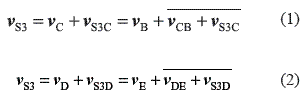
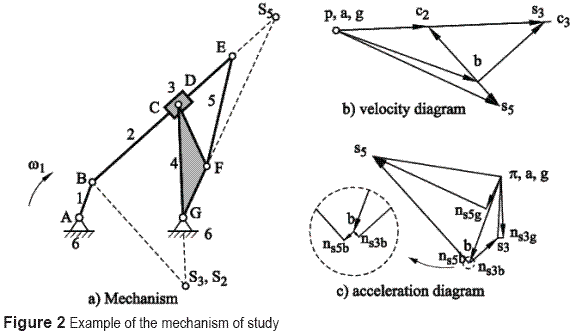
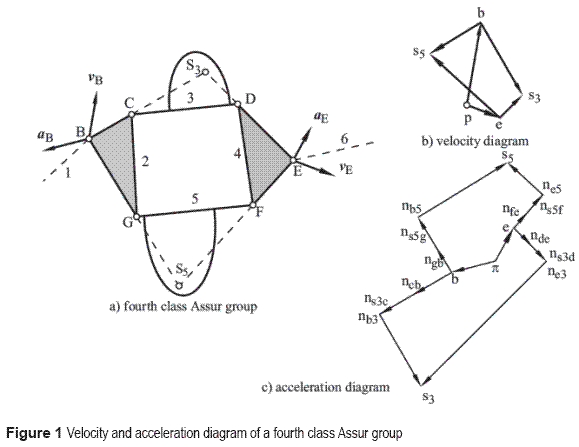
<body><![CDATA[<br>  From the literature review it is concluded that the grapho-analytical  kinematic solutions for the fourth class Assur groups practically do not exist  in the specialized literature, that fact makes difficult to develop a complete  modular method for this kind of task.     <br>    <br>  A new method for the kinematic  analyses of a fourth class Assur group, based on the combination of graphical  and analytical methods, is proposed in this paper. Initially, a graphical procedure  is used to determine the velocities and accelerations for points that are <em>special Assur points</em>; there are two special  points, one for each link with internal joints (mentioned in this paper as <i>closure links</i>) of the fourth class Assur  group. A system of four linear equation is obtained from the kinematic diagrams  (velocity or acceleration): two equations for each special point concerned with  the relative velocities or the relative accelerations. The system of linear equation  has four unknown variables that are the angular velocities or the angular  accelerations of the group links. Once the angular velocities or accelerations  for the links related to the group are obtained, the velocity or acceleration  for any point that belongs to some of their links can be calculated. The  proposed procedure is verified in this work by taking as examples one mechanism  of a 1 DOF with a fourth class Assur group. </font></p>      <p><font face="Verdana" size="3"><b>Methodology</b></font></p>      <p><font face="Verdana" size="2">The determination of velocities and accelerations for a  fourth class Assur group can be obtained using the Assur <i>special  point method</i>.  A fourth class Assur group, shown in <a href="#Figura1">figure 1.a</a>, consists of two ternary links,  called here  <i>drag members</i>,  two joints, which are an internal and an external joint, and two binary links,  both being internal joints. The external joint of the ternary links, as shown  in <a href="#Figura1">figure 1.a</a>, are joints with links 1 and6 of the base mechanism. Given the  velocities and accelerations of the external points of the group, joints B and  E of <a href="#Figura1">figure 1</a>, the kinematic analysis of a fourth class Assur group consists of  determine the angular velocities and accelerations for the links of the group. </font></p>      <p align="center"><img src="/img/revistas/rfiua/n60/n60a09i01.gif" ><a name="Figura1"></a></p>      <p><font face="Verdana" size="2">The first step of the analysis consists of determining the  special Assur points for the binary links of the group with internal joints,  links 3 and 5 (called in this paper <i>closure links</i>). The special Assur point of  link 3 is obtained by extending line BC, which belongs to link 2, and ED, which  belongs to link 4, to find the intersection point S<sub>3</sub>; this point is  considered to belong to link 3. A similar procedure is followed to obtain point  S<sub>5</sub>; this point is considered to belong to link 5. In this case, the  point can be found by projecting line BG, which belongs to link 2, and line EF,  which belongs to link 4. </font></p>      <p> <font face="Verdana" size="2"><b><i>Analysis of velocities</i></b></font></p>      <p><font face="Verdana" size="2">Now, it is possible to determine the velocities for points  S<sub>3</sub> and S<sub>5</sub> using the velocity diagram shown in <a href="#Figura1">figure 1.b</a>.  Therefore, the segments <i>pb</i> and <i>pe</i> can be drawn from point <i>p</i>. These segments represent the  given velocities of points B and E, at the chosen scale. The velocity <b><i>v</i></b><sub>S3</sub> of point S<sub>3</sub> is  determined by the vectorial equations given by Eq.1 and Eq. 2:</font></p>      <p> <img src="/img/revistas/rfiua/n60/n60a09e01.gif"></p>      ]]></body>
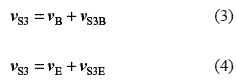
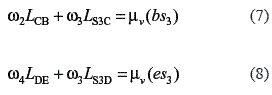
<body><![CDATA[<p><font face="Verdana" size="2">The last two vectors of each equation can be  represented by the same line because both vectors are perpendicular to S<sub>3</sub>B  and S<sub>3</sub>E, respectively; therefore, vector <img src="/img/revistas/rfiua/n60/n60a09e00a.gif"> is perpendicular to line S3B,  and vector <img src="/img/revistas/rfiua/n60/n60a09e00b.gif"> is perpendicular to line S<sub>3</sub>E.    <br>    <br>  Similarly, the vectorial equation for S<sub>3</sub>  can be formulated using Eq.3 and Eq. 4:</font></p>      <p> <img src="/img/revistas/rfiua/n60/n60a09e03.gif"></p>      <p><font face="Verdana" size="2">For representing graphically Eq. 3 and Eq. 4, a  straight line can be drawn from point <em>b</em> on the velocity diagram, with the direction of the velocity <strong><em>v </em></strong><sub>S3B</sub> (perpendicular to S<sub>3</sub>B).  Similarly, from point <em>e,</em> a straight  line can be drawn with the direction of the velocity<em><strong> </strong></em><strong><em>v</em></strong><sub>S3E</sub> (vector  that is perpendicular to S<sub>3</sub>E). The intersection point of these two  straight lines on the velocity diagram (point <em>s<sub>3</sub></em> from <a href="#Figura1">figure 1.b</a>) represents the end of the vector of  the velocity <strong><em>v</em></strong><sub>S3</sub> of point S<sub>3</sub>. The magnitude of the  velocity of this point can be obtained by multiplying the distance between  points<em> p</em> and<em> s<sub>3</sub></em> by the velocity scale factor chosen, &mu;<sub>v</sub>:</font></p>      <p> <img src="/img/revistas/rfiua/n60/n60a09e05.gif"></p>      <p><font face="Verdana" size="2">From the velocity diagram, it is possible to determine the relative velocities <strong><em>v</em></strong><sub>S3B</sub> and <strong><em>v</em></strong><sub>S3E</sub>:</font></p>      <p> <img src="/img/revistas/rfiua/n60/n60a09e06.gif"></p>      <p><font face="Verdana" size="2">These relative velocities depend on the angular velocities of the links that constitute the fourth class Assur group. To establish the corresponding equations, it is necessary to assume the directions for the angular velocities. The following relations can be obtained from the velocity diagram, shown in <a href="#Figura1">figure 1.b</a>, and by assuming that the angular velocities of links 2 to 5 are clockwise.</font></p>      <p> <img src="/img/revistas/rfiua/n60/n60a09e07.gif"></p>      ]]></body>
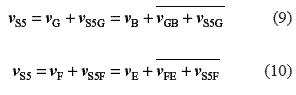
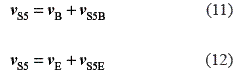
<body><![CDATA[<p><font face="Verdana" size="2">In Eq. 7, the direction of velocity <strong><em>v</em></strong><sub>S3B</sub>  is the same as the direction obtained if the angular velocities of links 2 and  3 were clockwise; therefore, the resultant velocity is positive. In the same  way, the relative velocity <strong><em>v</em></strong><sub>S3E</sub> of Eq. 8 has the  same direction to the one obtained if the angular velocities for links 3 and 4  were clockwise.    <br>    <br>  The velocity <strong><em>v</em></strong><sub>S5</sub> of point S<sub>5</sub>,  related to link 5, is determined by the formulation of the relative velocity  equation with respect to points G and F, Eq. 9 and Eq. 10:</font></p>      <p> <img src="/img/revistas/rfiua/n60/n60a09e09.gif"></p>      <p><font face="Verdana" size="2">The last two vectors of each equation are located on the same line, because  both vectors are perpendicular to S<sub>5</sub>B or to S<sub>5</sub>E; this  means that vector <img src="/img/revistas/rfiua/n60/n60a09e00c.gif"> is perpendicular to S<sub>5</sub>B  and vector <img src="/img/revistas/rfiua/n60/n60a09e00d.gif"> is perpendicular to S<sub>5</sub>E.    <br>    <br>  Similarly to the velocity vectorial equations for point S<sub>3</sub>,  the vectorial equation system for S<sub>5</sub> can be described through Eqs.11  and 12:</font></p>      <p> <img src="/img/revistas/rfiua/n60/n60a09e11.gif"></p>      <p><font face="Verdana" size="2">For the graphical representation of these equations, <a href="#Figura1">figure 1.b</a>, a  straight line can be drawn from point <em>b</em> on the velocity diagram with the direction of velocity <strong><em>v</em></strong><sub>S5B</sub>  (perpendicular to S<sub>5</sub>B). Similarly, a straight line is drawn from  point <em>e</em> with the direction of the  vector for the velocity <strong><em>v</em></strong><sub>S5E</sub> (perpendicular to S<sub>5</sub>E).  The intersection point of these two straight lines on the velocity diagram  (point s<sub>5</sub> in <a href="#Figura1">figure 1.b</a>) represents the end of the vector for the  velocity <strong><em>v</em></strong><sub>S5</sub> of point S<sub>5</sub>. The magnitude of the  velocity of this point can be obtained by multiplying the length of line <em>ps</em><sub>5</sub> by the velocity scale  factor:</font></p>      <p> <img src="/img/revistas/rfiua/n60/n60a09e13.gif"></p>      ]]></body>
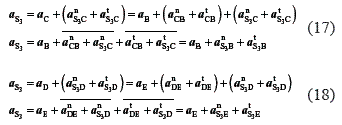
<body><![CDATA[<p><font face="Verdana" size="2">Then, from the velocity diagram, it is possible to determine the relative velocities <i><b>v</b></i><sub>S5B</sub> and <i><b>v</b></i><sub>S5E</sub></font></p>      <p> <img src="/img/revistas/rfiua/n60/n60a09e14.gif"></p>      <p><font face="Verdana" size="2">Similar to the analysis of  the velocity diagram of point S<sub>3</sub>, the relative velocities <i><b>v</b></i><sub>S5B</sub>  and<i><b> v</b></i><sub>S5E</sub>  depend also on the direction of the angular velocities for links 2, 3, 4, and  5. Considering all the angular velocities clockwise, the following equations  are given:</font></p>      <p> <img src="/img/revistas/rfiua/n60/n60a09e15.gif"></p>      <p><font face="Verdana" size="2">In both equations, the  relative velocities are positive because the directions of velocities <i><b>v</b></i><sub>S5B</sub>  and<i><b> v</b></i><sub>S5E</sub> are the same as the direction obtained if the angular  velocities for links 2, 3, 4, and 5 were clockwise. Solving the system of  linear equation given by Eqs. 7, 8, 15, and 16 simultaneously, the angular  velocities for the links 2, 3, 4, and 5 are determined.</font></p>      <p> <font face="Verdana" size="2"><b><i>Analysis of accelerations</i></b></font></p>      <p><font face="Verdana" size="2">The solution to the analysis of accelerations for a  fourth class Assur group with two drag members can be obtained in a similar  manner to the velocities solution. As in the analysis for velocities, it is  necessary to make use of the special points S<sub>3</sub>, related to link 3,  and S<sub>5</sub>, related to link 5.    <br>    <br>  Taking an arbitrary point &pi; (<a href="#Figura1">figure 1.c</a>) as a pole and  as a starting point for segments &pi;<em>b </em>and &pi;<em>e</em> for the accelerations  diagram, the segments &pi;<em>b </em>and &pi;<em>e</em> can be drawn; these segments represent the accelerations <strong><em>&alpha;</em></strong><sub>B</sub>  and <strong><em>&alpha;</em></strong><sub>E</sub> at the chosen scale &mu;<sub><i>&alpha;</i></sub> for points B and E. The  acceleration<strong><em> &alpha;</em></strong><sub>S3</sub> of the special point S<sub>3</sub> can be  determined by using Eqs. 17 and 18:</font></p>      <p> <img src="/img/revistas/rfiua/n60/n60a09e17.gif"></p>      ]]></body>
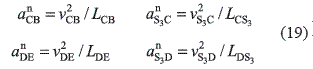
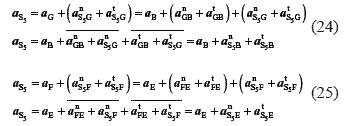
<body><![CDATA[<p><font face="Verdana" size="2">In Eqs. 17 and 18, the sums of the normal and  tangential accelerations are shown as vectors <strong><em>&alpha;</em></strong><sup>n</sup><sub>S3B</sub>, <strong><em>&alpha;</em></strong><sup>n</sup><sub>S3E</sub>,<strong><em> &alpha;</em></strong><sup>t</sup><sub>S3B</sub>  and,<strong><em> &alpha;</em></strong><sup>t</sup><sub>S3E</sub>  because the directions of their components are the same. The magnitudes for the  relative normal accelerations are determined by:</font></p>      <p> <img src="/img/revistas/rfiua/n60/n60a09e19.gif"></p>      <p><font face="Verdana" size="2">The directions for  these vectors can also be determined by the same methods already mentioned. As  the direction of both tangential components, for each vectorial equation, are  the same, it is not necessary to determine the magnitude of each components. To  calculate the resultant of the sum of the tangential components, drawing vector  action line for the tangential accelerations from the ends of the normal  accelerations<strong><em> &alpha;</em></strong><sup>n</sup><sub>S3B</sub>,<strong><em> </em></strong><strong><em>&alpha;</em></strong><sup>n</sup><sub>S3E</sub> is sufficient.  For this purpose, segments <em>bn</em><sub>b3</sub> and<em> en</em><sub>e3</sub> can be  drawn from points <em>b</em> and <em>e,</em> obtained from the acceleration  diagram; these are the representations for the accelerations<strong><em> &alpha;</em></strong><sup>n</sup><sub>S3B</sub>  and<strong><em> &alpha;</em></strong><sup>n</sup><sub>S3E</sub>  (at scale &mu;<sub><i>&alpha;</i></sub>).    <br>         <br>  Then, straight lines  are drawn in the direction of the tangential accelerations <strong><em>&alpha;</em></strong><sup>t</sup><sub>S3B</sub>  and <strong><em>&alpha;</em></strong><sup>t</sup><sub>S3E</sub>  from points <em>n</em><sub>b3</sub> and <em>n</em><sub>e3</sub>, which are perpendicular  to lines S<sub>3</sub>B and S<sub>3</sub>E, respectively. Point s<sub>3</sub>,  where these two lines intersect, is the end of vector <strong><em>&alpha;</em></strong><sub>S3</sub>;  the  magnitude of the absolute acceleration of point S<sub>3</sub> is determined by:</font></p>      <p> <img src="/img/revistas/rfiua/n60/n60a09e20.gif"></p>      <p><font face="Verdana" size="2">From  the acceleration diagram, it is now possible to determine the magnitude of the  relative accelerations<strong><em> &alpha;</em></strong><sup>t</sup><sub>S3B</sub> and<strong><em> &alpha;</em></strong><sup>t</sup><sub>S3E</sub>: </font></p>      <p> <img src="/img/revistas/rfiua/n60/n60a09e21.gif"></p>      <p><font face="Verdana" size="2">The senses for the relative tangential accelerations and  the angular accelerations follow the same procedure described for the velocity  case. These relative tangential accelerations depend on the angular  accelerations of the links that constitute the fourth class group. For this  case, all the angular accelerations are assumed clockwise. The following  relations are obtained from the accelerations diagram: </font></p>      <p> <img src="/img/revistas/rfiua/n60/n60a09e22.gif"></p>      ]]></body>
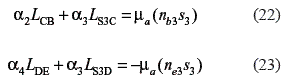
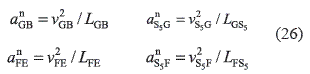
<body><![CDATA[<p><font face="Verdana" size="2">The tangential acceleration is positive in the former  equation, because the direction of the acceleration <strong><em>&alpha;</em></strong><sup>t</sup><sub>S3B</sub>  is the same  as the one that the angular accelerations for links 2 and 3 would have if they  were clockwise. In the second case, the relative tangential acceleration<strong><em> &alpha;</em></strong><sup>t</sup><sub>S3E</sub>  has opposite direction to the one that would be obtained if the angular  accelerations for links 3 and 4 were clockwise; this is the reason for the  negative sign.     <br>    <br>  The acceleration <strong><em>&alpha;</em></strong><sub>S5</sub>  from the special point S<sub>5</sub> is determined by using Eqs. 24 and 25:</font></p>      <p> <img src="/img/revistas/rfiua/n60/n60a09e24.gif"></p>      <p><font face="Verdana" size="2">In Eqs. 24 and 25 the sums of the normal and  tangential accelerations are shown as resultant vectors <strong><em>&alpha;</em></strong><sup>n</sup><sub>S5B</sub>,<strong><em> &alpha;</em></strong><sup>n</sup><sub>S5E</sub>,<strong><em> &alpha;</em></strong><sup>t</sup><sub>S5B</sub>  and,<strong><em> &alpha;</em></strong><sup>t</sup><sub>S5E</sub>  as the directions of their components are equal. The magnitudes of the  normal accelerations are determined as usual, making use of Eq. 26:</font></p>      <p> <img src="/img/revistas/rfiua/n60/n60a09e26.gif"></p>      <p><font face="Verdana" size="2">The direction of the normal acceleration vectors is  also determined by the same methods already mentioned. In the acceleration  diagram, tangential accelerations are drawn from the ends of the normal  accelerations<strong><em> &alpha;</em></strong><sup>n</sup><sub>S5B</sub> and<strong><em> &alpha;</em></strong><sup>n</sup><sub>S5E</sub>.  The directions of these vectors are perpendicular to the vectors of the normal  accelerations. For this purpose, segments <em>bn</em><sub>b5</sub> and <em>en</em><sub>e5</sub> are drawn  starting on points <em>b </em>and <em>e. </em>These segments are obtained from the  acceleration diagram and are the representations for the accelerations <strong><em>&alpha;</em></strong><sup>n</sup><sub>S5B</sub>  and<strong><em> &alpha;</em></strong><sup>n</sup><sub>S5E</sub>.    <br>    <br>  Then, straight lines are drawn from points <em>n</em><sub>b3</sub> and <em>n</em><sub>e3</sub> in the direction of the accelerations<strong><em> &alpha;</em></strong><sup>t</sup><sub>S5B</sub>  and<strong><em> &alpha;</em></strong><sup>t</sup><sub>S5E</sub>,  which are perpendicular to S<sub>5</sub>B and S<sub>5</sub>E respectively.  Point s<sub>5</sub>, which is the intersection point of these two lines, is the  end of vector <strong><em>&alpha;</em></strong><sub>S5</sub> from the resultant acceleration of point <em>S</em><sub>5</sub>, whose magnitude is  determined by:</font></p>      <p> <img src="/img/revistas/rfiua/n60/n60a09e27.gif"></p>      ]]></body>
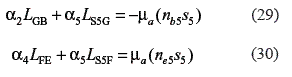
<body><![CDATA[<p><font face="Verdana" size="2">Repeating the procedure for the relative accelerations  of point S<sub>3</sub>, the magnitude of the relative accelerations<strong><em> &alpha;</em></strong><sup>t</sup><sub>S5B</sub>  and <strong><em>&alpha;</em></strong><sup>t</sup><sub>S5E</sub>  are determined from the acceleration diagram, multiplying by the acceleration  scale factor</font></p>      <p> <img src="/img/revistas/rfiua/n60/n60a09e28.gif"></p>      <p><font face="Verdana" size="2">Now, these relative tangential accelerations depend on  the angular accelerations of the links that constitute the fourth class group.  Taking into account that all the angular accelerations are assumed clockwise,  the following relations are obtained from the accelerations diagram:</font></p>      <p> <img src="/img/revistas/rfiua/n60/n60a09e29.gif"></p>      <p><font face="Verdana" size="2">In Eqs. 29 the relative tangential accelerations <strong><em>&alpha;</em></strong><sup>t</sup><sub>S5B</sub>  are opposite to one that angular accelerations of links 2 and 5 were clockwise.  For that reason, it is necessary to write the negative sign in Eqs. 29.     <br>    <br>  From the simultaneous solution of the systems of linear  equation given by Eqs. 22, 23, 29, and 30, the angular accelerations for the  links that constitute the fourth class group can be determined.</font></p>       <p><font face="Verdana" size="3"><b>Results</b> </font></p>      <p><font face="Verdana" size="2">In the present section, a mechanism R - (RRP -RRR) of 1 DOF  is considered as example. <a href="#Figura2">Figure 2.a</a> shows the representation of a  mechanismcomprised by driving link 1, fixed link 6, and afourth class group  (links 2, 3, 4, and 5). Links 2and 4 are the ternary links of the group, and  jointsB and G are the joints that connect the group tothe base mechanism. Links  3 and 5 join to the twodrag links.</font></p>      <p align="center"><img src="/img/revistas/rfiua/n60/n60a09i02.gif" ><a name="Figura2"></a></p>      ]]></body>
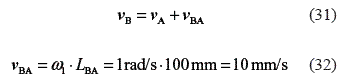
<body><![CDATA[<p><font face="Verdana" size="2">The lengths of the links are: <em>L</em><sub>AG</sub> = 275 mm, <em>L</em><sub>AB</sub>= 100 mm, <em>L</em><sub>BE</sub>= 500 mm, <em>L</em><sub>EF</sub>= 300 mm, <em>L</em><sub>GD</sub>= 300 mm, <em>L</em><sub>FG</sub>= 150 mm, and <em>L</em><sub>FD</sub> = 180 mm; the  angular velocity of link 1 is &omega;<sub>1</sub> = 1 rad/s. The additional lengths  required for the analysis of velocities and accelerations are obtained from the  positions diagram. The additional lengths are the distances measured from the  joints to the special points S<sub>3</sub> and S<sub>5</sub>: <em>L</em><sub>BS3</sub> = 248.0601 mm, <em>L</em><sub>DS3</sub>= 481.9848 mm, <em>L</em><sub>FS5</sub>= 436.2923 mm, and <em>L</em><sub>ES5</sub>= 155.1123 mm.     <br>    <br>  For the kinematic analysis of the fourth class Assur group,  it is necessary to determine the special point S<sub>3</sub>, which belongs to  link 3, and point S<sub>5</sub>, which belongs to link 5. Link 3 has a prismatic  joint with link 2 and one rotation joint with link 4. The procedure to locate  the special point requires a modification with respect to the case in which the  link with internal joints has only rotation joints. The special point of link  3 must be such that, when formulating the relative velocities equation, the unknown  velocities are parallel. Observing that the relative movement between links 2  and 3 is parallel to link 3, the special point must be located on a line that  is perpendicular to link 2 and that intercepts point B. Point S<sub>3</sub> is located on  the intersection between a line that is perpendicular to the relative movement between  links 2 and 3 and the projection of line GD of link 4; point D represents the  rotation joint between links 4 and 3. Point S<sub>2</sub> is the point of link2  concurrent to point S<sub>3</sub>.     <br>    <br>  The binary link 5 joins with the ternary links (2 and 4)  with rotation joints. Point S<sub>5</sub> is the intersection point when line  BE related to link 2and line GF related to link 4 are projected.     <br>    <br>  <b><i>Analysis of  velocities:</i></b>  <a href="#Figura2">Figure 2.b</a> shows the velocities diagram of the mechanism.     <br>    <br>  The  solution for the driving link is: </font></p>      <p> <img src="/img/revistas/rfiua/n60/n60a09e31.gif"></p>      ]]></body>
<body><![CDATA[<p><font face="Verdana" size="2">The equations for the velocity of point S<sub>3</sub>  related to link 3 are obtained using the equation of relative velocities from  joints S<sub>2</sub> and D: </font></p>      <p> <img src="/img/revistas/rfiua/n60/n60a09e33.gif"></p>      <p><font face="Verdana" size="2">The velocities v<sub>S2B</sub> and v<sub>S3S2</sub> are  parallel, because v<sub>S2B</sub> is perpendicular to line BS<sub>2</sub>, and  v<sub>S3S2</sub> isparallel to link 2. As BS<sub>2</sub> is perpendicular to  link2, they can be drawn together as is presented inEq. 33. A similar procedure  is given for velocities v<sub>DG</sub> and v<sub>S3G</sub>, which are  perpendicular to line DG.    <br>       <br>  For link 5, special point S<sub>5</sub> has to be  determined, by projecting lines BE and GF. The procedure to determine the  velocity of point S<sub>5</sub> is the same as the one followed for point S<sub>3</sub>;  that is, using relative velocities from points E and F: </font></p>      <p> <img src="/img/revistas/rfiua/n60/n60a09e34.gif"></p>      <p><font face="Verdana" size="2">Point  S<sub>5</sub> is chosen so that the velocities v<sub>EB</sub> and v<sub>S5E</sub>  become parallel, as v<sub>FG</sub> and v<sub>S5F</sub>.     <br>    <br>      <a href="#Figura2">Figure 2.b</a> shows the velocities diagram, which is useful to  solve the velocities at points S<sub>3</sub> and S<sub>5</sub>. The distance  between points s<sub>3</sub> and b (from the velocities diagram) gives the sum  of the relative velocities <i><b>v</b></i><sub>S2B</sub> and <i><b>v</b></i><sub>S3S2</sub>. Assuming clockwise angular  velocities for links 2 and 3 the relative movement between links 2 and 3 from left  to right (observed from link 2), the following equation results:</font></p> 	     <p> <img src="/img/revistas/rfiua/n60/n60a09e35.gif"></p>	      ]]></body>

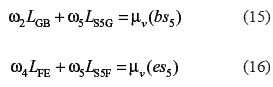
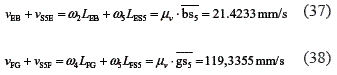
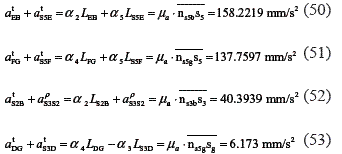
<body><![CDATA[<p><font face="Verdana" size="2">where the distance between points b and s<sub>3</sub> is  represented by line <img src="/img/revistas/rfiua/n60/n60a09e00e.gif">; its magnitude is obtained by multiplying it  by the scale actor &micro;<sub>V</sub>. If the direction of the angular velocity of  link 2is assumed clockwise, then the direction of the relative velocity <i><b>v</b></i><sub>S2B</sub> is opposite to the resultant  velocity <img src="/img/revistas/rfiua/n60/n60a09e00e.gif">.  A Similar procedure is followed for the other velocities: </font></p>      <p> <img src="/img/revistas/rfiua/n60/n60a09e36.gif"></p>      <p><font face="Verdana" size="2">If the angular velocities of links 3 and 4 are assumed clockwise,  the relative velocities <i>v</i><sub>DG</sub> and <em>v</em><sub>S3D</sub> have opposite directions.  Then, in Eq.36, the latter relative velocity<em> v</em><sub>S3D</sub> is negative. Next, the  equations for the relative velocities related to point S<sub>5</sub> can be  formulated as:</font></p>      <p> <img src="/img/revistas/rfiua/n60/n60a09e37.gif"></p>      <p><font face="Verdana" size="2">In the linear equation systems given by Eqs. 35, 36, 37 and  38, the unknown variables are the angular velocities &omega;<sub>2</sub>, &omega;<sub>4</sub>,  and &omega;<sub>5</sub> and the relative velocity between links 2 and 3,<em> v</em><sub>S3S2</sub>. This system of equations can  now be solved. The distances <em>L</em><sub>BS3</sub>, <em>L</em><sub>ES5</sub>, and <em>L</em><sub>FS5</sub> can be taken from the  positions diagram. The solution for the system of equations gives the following  results:    <br>    <br>  &omega;<sub>2</sub> = 0.0086 rad/s, &omega;<sub>4</sub> = 0.4746 rad/s, &omega;<sub>5</sub> = 0.1104 rad/s, <em>v</em><sub>S3S2</sub> = 61.5254  mm/s.    <br>    <br>  <i><b>Analysis for  accelerations:</b></i>  <a href="#Figura2">Figure 2.c</a> represents the acceleration diagram for the mechanism.     <br>    ]]></body>

<body><![CDATA[<br>  The  first step consists of solving the driving link. </font></p>      <p> <img src="/img/revistas/rfiua/n60/n60a09e39.gif"></p>      <p><font face="Verdana" size="2">The direction of the acceleration <i>&alpha;</i><sup>n</sup><sub>BA</sub>  is from point B to point A. Next, the accelerations of point S<sub>3</sub>,  related to link 3, and S<sub>5</sub>, related to link 5, are determined. </font></p>      <p> <img src="/img/revistas/rfiua/n60/n60a09e42.gif"></p>      <p><font face="Verdana" size="2">where <img src="/img/revistas/rfiua/n60/n60a09e00f.gif">, the direction is from point D to E    <br>    <br>   <strong><em>&alpha;</em></strong><sup>t</sup><sub>S2B</sub>= &alpha;<sub>2</sub> . <em>L</em><sub>S2B</sub>, that is perpendicular to  line BS<sub>2</sub>    <br>    <br>   <img src="/img/revistas/rfiua/n60/n60a09e00g.gif">, the direction of this component is obtained by rotating the vector v<sub>S3S2</sub>  through of angle of 90&deg; in the direction of the angular velocity &omega;<sub>2</sub> (the direction is opposite to that  of the component <strong><em>&alpha;</em></strong><sup>n</sup><sub>S2B</sub>).    <br>    ]]></body>
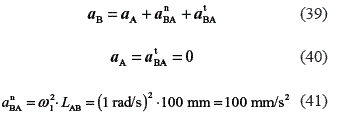
<body><![CDATA[<br>    <strong><em>&alpha; </em></strong><em><sup>&rho;</sup></em><sub>S3D</sub> is parallel to link 2.    <br>    <br>    In Eq. 42, the accelerations<strong><em> &alpha;</em></strong><sup>t</sup><sub>DE</sub> and <strong><em>&alpha; </em></strong><em><sup>&rho;</sup></em><sub>S3S2</sub>  are unknown. The components <strong><em>&alpha;</em></strong><sup>n</sup><sub>S2B</sub> and<strong><em> &alpha;</em></strong><sup>c</sup><sub>S3S2</sub>  are parallel due to the method to find point S<sub>3</sub>  (this point is located on line DE). A similar case occurs with the components<strong><em> &alpha;</em></strong><sup>t</sup><sub>DE</sub> and<strong><em> </em></strong><strong><em>&alpha; </em></strong><em><sup>&rho;</sup></em><sub>S3S2</sub>.  Making use of this condition, Eq.42 can be formulated as:</font></p>      <p> <img src="/img/revistas/rfiua/n60/n60a09e43.gif"></p>      <p><font face="Verdana" size="2"><a href="#Figura2">Figure 2.c</a> shows the representation for<strong><em> &alpha;</em></strong><sup>n</sup><sub>S2B</sub> +<strong><em> &alpha;</em></strong><sup>c</sup><sub>S3S2</sub>  through  line bn<sub>s3b</sub>. As this component has opposite direction, its total  magnitude can be obtained by subtracting both components in the direction of  line bs<sub>3</sub>. The resultant tangential acceleration<strong><em> </em></strong><strong><em>&alpha;</em></strong><sup>t</sup><sub>S3B</sub> (perpendicular to the  normal acceleration) is represented through point n<sub>s3b</sub>. A second  equation is determined for point S<sub>3</sub>:</font></p>      <p> <img src="/img/revistas/rfiua/n60/n60a09e44.gif"></p>      <p><font face="Verdana" size="2">where    <br>    <br>  <img src="/img/revistas/rfiua/n60/n60a09e00h.gif">, from D to G    <br>    ]]></body>
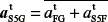
<body><![CDATA[<br>    <strong><em>&alpha;</em></strong><sup>t</sup><sub>DG</sub>= <i>&alpha;</i><sub>4</sub> . <em>L</em><sub>S3D</sub>,  that is perpendicular to DG    <br>    <br> 	 <img src="/img/revistas/rfiua/n60/n60a09e00i.gif">, from S<sub>3</sub> to D    <br>    <br>  <strong><em>&alpha;</em></strong><sup>t</sup><sub>S3D</sub>= <i>&alpha;</i><sub>3</sub> . <em>L</em><sub>S3D</sub>, perpendicular to line S<sub>3</sub>D </font></p>      <p><font face="Verdana" size="2">In this equation, the  tangential accelerations are unknown. Due to the method used to find point S3  (this point is located on line DG), the normal components<strong><em> &alpha;</em></strong><sup>n</sup><sub>DG</sub> and<strong><em> &alpha;</em></strong><sup>n</sup><sub>S3D</sub> and  the tangential components<strong><em> &alpha;</em></strong><sup>t</sup><sub>DG</sub> and<strong><em> &alpha;</em></strong><sup>t</sup><sub>S3D</sub> are  parallel. Makinguse of this condition, Eq. 44 can be expressed as:</font></p>      <p> <img src="/img/revistas/rfiua/n60/n60a09e45.gif"></p>      <p><font face="Verdana" size="2">The normal acceleration<strong><em> &alpha;</em></strong><sup>n</sup><sub>S3G</sub> is represented through the segment gn<sub>S3g</sub> on the  accelerations diagram. Here, the normal accelerations are subtracted by each  other and the resultant acceleration can be found. The component<strong><em> &alpha;</em></strong><sup>t</sup><sub>S3G</sub> is represented through a line drawn from point n<sub>S3e</sub>,  perpendicular to the normal component<strong><em> &alpha;</em></strong><sup>n</sup><sub>S3G</sub>. The point of intersection of the lines that represent the  relative tangential accelerations is the point of the acceleration of point S<sub>3</sub>, <strong><em>&alpha;</em></strong><sub>S3</sub>.    <br>    <br>  Two equations are needed to find the acceleration S<sub>5</sub>  (S<sub>5</sub> belongs to link 5). These equations are taken from the relative  accelerations between points S<sub>5</sub> and E, and between points S<sub>5</sub>  and F:</font></p>      ]]></body>
<body><![CDATA[<p> <img src="/img/revistas/rfiua/n60/n60a09e46.gif"></p>      <p><font face="Verdana" size="2">where <img src="/img/revistas/rfiua/n60/n60a09e00j.gif"> the direction of this acceleration is given by line FG    <br>    <br>  <strong><em>&alpha;</em></strong><sup>t</sup><sub>FG</sub>=<strong><em> &alpha;</em></strong><sub>4</sub><strong>.</strong><strong> </strong><em>L</em><sub>FG</sub>,  that is perpendicular to line FG    <br>    <br>  <img src="/img/revistas/rfiua/n60/n60a09e00k.gif">, with direction from S<sub>5</sub> to F    <br>    <br>  <strong><em>&alpha;</em></strong><sup>t</sup><sub>S5F</sub>=<strong><em> &alpha;</em></strong><sub>5</sub><strong>.</strong> <em>L</em><sub>S5F</sub> that is perpendicular to line S<sub>5</sub>F    <br>    <br>  Due to the parallelism condition, Eq. 46 can be reduced to:</font></p>      ]]></body>
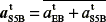
<body><![CDATA[<p> <img src="/img/revistas/rfiua/n60/n60a09e47.gif"></p>      <p><font face="Verdana" size="2">where<strong><em> &alpha;</em></strong><sup>n</sup><sub>S5G</sub>=<strong><em>&alpha;</em></strong><sup>n</sup><sub>FG</sub> + <strong><em>&alpha;</em></strong><sup>n</sup><sub>S5F</sub> is represented through line gn<sub>s5g</sub>; the  magnitude is obtained by adding the normal components from F to G, and the  tangential acceleration <img src="/img/revistas/rfiua/n60/n60a09e00l.gif"> is represented from point n<sub>s5g</sub>, and  it is perpendicular to the direction of the normal acceleration.    <br>    <br>  Taking relative accelerations between  points E and S<sub>5</sub>:</font></p>      <p> <img src="/img/revistas/rfiua/n60/n60a09e48.gif"></p>      <p><font face="Verdana" size="2">where <img src="/img/revistas/rfiua/n60/n60a09e00m.gif">, from E to B    <br>    <br>    <strong><em>&alpha;</em></strong><sup>t</sup><sub>EB</sub>= <strong><em>&alpha;</em></strong><sub>2</sub> <b>.</b> <em>L</em><sub>EB</sub>, perpendicular to line EB    <br>       <br>      <img src="/img/revistas/rfiua/n60/n60a09e00n.gif">, from S<sub>5</sub> to E    ]]></body>
<body><![CDATA[<br>    <br>   <strong><em>&alpha;</em></strong><sup>t</sup><sub>S5E</sub>=<strong><em> &alpha;</em></strong><sub>5</sub><strong>.</strong> <em>L</em><sub>S5E</sub>,  perpendicular to line S<sub>5</sub>E    <br>    <br>    Making use of the parallelism  condition, Eq. 48 can be formulated as:</font></p>      <p> <img src="/img/revistas/rfiua/n60/n60a09e49.gif"></p>      <p><font face="Verdana" size="2">where<strong><em> &alpha;</em></strong><sup>n</sup><sub>S5B</sub>=<strong><em> &alpha;</em></strong><sup>n</sup><sub>EB</sub> +<strong><em> &alpha;</em></strong><sup>n</sup><sub>S5E</sub> is represented through line bn<sub>s5b</sub>; the  magnitude is obtained by adding the normal components from E to B, and the  tangential acceleration <img src="/img/revistas/rfiua/n60/n60a09e00o.gif"> is represented from point n<sub>s5b</sub>, and  it is perpendicular to the direction of the normal acceleration.    <br>    <br>  <a href="#Figura2">Figure 2.c</a> represents the graphical procedure for the  accelerations of points S<sub>3</sub> and S<sub>5</sub>. The expressions for  the relative tangential accelerations are obtained from the accelerations  diagram. To determine the equations, the angular accelerations for links 2, 3,  4, and 5 are assumed to be counterclockwise, and the relative acceleration <strong><em>&alpha; </em></strong><em><sup>&rho;</sup></em><sub>S3S2</sub> from left to right.</font></p> 	     <p> <img src="/img/revistas/rfiua/n60/n60a09e50.gif"></p>      <p><font face="Verdana" size="2">In the system of linear equations given by Eqs.50 to 53, it  is necessary to analyze the directions of the tangential accelerations in order  to assign the matching sign. In these set of equations, the variables are: the  angular accelerations &alpha;<sub>2</sub>, &alpha;<sub>3</sub> = &alpha;<sub>2</sub>, &alpha;<sub>4</sub>,  and &alpha;<sub>5</sub> and the relative acceleration<strong><em> &alpha; </em></strong><em><sup>&rho;</sup></em><sub>S3S2</sub>. Solving the set of equations  yields:     ]]></body>
<body><![CDATA[<br>         <br>  &alpha;<sub>2</sub> = &alpha;<sub>3</sub> = 0.2663 rad/s<sup>2</sup>, &alpha;<sub>4</sub>  = 0.4485 rad/s<sup>2</sup>, &alpha;<sub>5</sub> = 0.1616 rad/s<sup>2</sup>, and <strong><em>&alpha; </em></strong><em><sup>&rho;</sup></em><sub>S3S2</sub> = -25.6695 m/s<sup>2</sup> </font></p>      <p><font face="Verdana" size="3"><b>Conclusions</b> </font></p>      <p><font face="Verdana" size="2">A method that uses a combination of analytical and  graphical methods to perform the kinematic analysis of a fourth class Assur  group was presented in this paper. Special Assur points, which are points that  belong to the links with internal joints, are used in the proposed solution.     <br>    <br>  An example that comprised a mechanisms R &ndash; (RRR &ndash; RRR) was  presented to show the application of the proposed method; the solution for this  example was verified using a commercial software and classical analytical  methods. The results obtained demonstrate the reliability of the proposed  method.    <br>    <br>  The  developed method can be used for the kinematic analysis of planar mechanisms  with one, two, or three degrees of freedom, including such groups. This method  allows developing a modular method for the kinematic analysis of mechanisms.  This is especially appropriate for pedagogical purposes. </font></p>      <p><font face="Verdana" size="3"><b>Referencias</b> </font></p>      <!-- ref --><p><font face="Verdana" size="2">1. I. I. Artobolevski. <i>Theory of Mechanisms  and Machines</i>. Ed.  Nauka. Moscow. Russian. 1988. pp. 52-63.     &nbsp;&nbsp;&nbsp;&nbsp;&nbsp;&nbsp;&nbsp;&nbsp;[&#160;<a href="javascript:void(0);" onclick="javascript: window.open('/scielo.php?script=sci_nlinks&ref=000192&pid=S0120-6230201100040000900001&lng=','','width=640,height=500,resizable=yes,scrollbars=1,menubar=yes,');">Links</a>&#160;]<!-- end-ref --><br>    <!-- ref --><br>  2. P. Fanghella, C. Galleti.  "A modular method for computational kinematics".<i> Computational  Kinematics</i>. J.  Angeles, G. Hommel and P. Kovacs (editors). Ed. Kluwer.  Dordrecht. 1993. pp. 275-284.     &nbsp;&nbsp;&nbsp;&nbsp;&nbsp;&nbsp;&nbsp;&nbsp;[&#160;<a href="javascript:void(0);" onclick="javascript: window.open('/scielo.php?script=sci_nlinks&ref=000194&pid=S0120-6230201100040000900002&lng=','','width=640,height=500,resizable=yes,scrollbars=1,menubar=yes,');">Links</a>&#160;]<!-- end-ref --><br>    <!-- ref --><br>  3. G. Calle, A.  Diaz, H. F. Quintero. <i>An&aacute;lisis cinem&aacute;tico de mecanismos planos a partir del an&aacute;lisis  estructural seg&uacute;n Assur</i>. V Congreso Iberoamericano de Ingenier&iacute;a Mec&aacute;nica.  Merida. Venezuela. Octubre 23-26. 2001. pp. 1231-1240.     &nbsp;&nbsp;&nbsp;&nbsp;&nbsp;&nbsp;&nbsp;&nbsp;[&#160;<a href="javascript:void(0);" onclick="javascript: window.open('/scielo.php?script=sci_nlinks&ref=000196&pid=S0120-6230201100040000900003&lng=','','width=640,height=500,resizable=yes,scrollbars=1,menubar=yes,');">Links</a>&#160;]<!-- end-ref --><br>    <!-- ref --><br>  4. S. Mitsi, K. D. Bouzakis,  G. Mansour. "Position analysis in polynomial form of planar mechanism with  an Assur group of class 4 including one prismatic joint". <i>Mech. And Mach.  Theory</i>.  Vol. 39. 2004. pp. 237-245.     &nbsp;&nbsp;&nbsp;&nbsp;&nbsp;&nbsp;&nbsp;&nbsp;[&#160;<a href="javascript:void(0);" onclick="javascript: window.open('/scielo.php?script=sci_nlinks&ref=000198&pid=S0120-6230201100040000900004&lng=','','width=640,height=500,resizable=yes,scrollbars=1,menubar=yes,');">Links</a>&#160;]<!-- end-ref --><br>     <!-- ref --><br>  5. W. Y. Cheng. "The  position analysis of Assur kinematicchain with five links". <i>Mech. and Mach. Theory</i>.  Vol.40. 2005. pp. 1015-1029.     &nbsp;&nbsp;&nbsp;&nbsp;&nbsp;&nbsp;&nbsp;&nbsp;[&#160;<a href="javascript:void(0);" onclick="javascript: window.open('/scielo.php?script=sci_nlinks&ref=000200&pid=S0120-6230201100040000900005&lng=','','width=640,height=500,resizable=yes,scrollbars=1,menubar=yes,');">Links</a>&#160;]<!-- end-ref --><br>    <!-- ref --><br>  6. S. Mitsi, K. D. Bouzakis,  G. Mansour, I. Popescu. "Position analysis in polynomial form of  class-three Assur". <i>Mech. and Mach. Theory</i>. Vol. 43. 2008. pp. 1401-1415.     &nbsp;&nbsp;&nbsp;&nbsp;&nbsp;&nbsp;&nbsp;&nbsp;[&#160;<a href="javascript:void(0);" onclick="javascript: window.open('/scielo.php?script=sci_nlinks&ref=000202&pid=S0120-6230201100040000900006&lng=','','width=640,height=500,resizable=yes,scrollbars=1,menubar=yes,');">Links</a>&#160;]<!-- end-ref --><br>    <!-- ref --><br>  7. K. Romaniak. <i>Methodology of  the Assur Groups Creation</i>. 12<sup>th</sup> IFToMM World Congress. Besan&ccedil;on, France. June 18-21.  2007. pp. 1- 5.     &nbsp;&nbsp;&nbsp;&nbsp;&nbsp;&nbsp;&nbsp;&nbsp;[&#160;<a href="javascript:void(0);" onclick="javascript: window.open('/scielo.php?script=sci_nlinks&ref=000204&pid=S0120-6230201100040000900007&lng=','','width=640,height=500,resizable=yes,scrollbars=1,menubar=yes,');">Links</a>&#160;]<!-- end-ref --><br>    <!-- ref --><br>  8. G. G.  Bar&aacute;nov. <i>Curso de la teor&iacute;a de Mecanismos y M&aacute;quinas</i>. Ed. Mir.  Barcelona. 1979. pp. 46-82.     &nbsp;&nbsp;&nbsp;&nbsp;&nbsp;&nbsp;&nbsp;&nbsp;[&#160;<a href="javascript:void(0);" onclick="javascript: window.open('/scielo.php?script=sci_nlinks&ref=000206&pid=S0120-6230201100040000900008&lng=','','width=640,height=500,resizable=yes,scrollbars=1,menubar=yes,');">Links</a>&#160;]<!-- end-ref --><br>    <!-- ref --><br>  9. Mashinostroyenye:  Enciclopedy in 40 Vols. <i>Dynamic and Strength of machines. Theory of Mechanisms and Machines</i>. Vols. 1-3. Book 2. Ed.  Mashinostroyenye. Mosc&uacute;. 1995. pp. 415-417.     &nbsp;&nbsp;&nbsp;&nbsp;&nbsp;&nbsp;&nbsp;&nbsp;[&#160;<a href="javascript:void(0);" onclick="javascript: window.open('/scielo.php?script=sci_nlinks&ref=000208&pid=S0120-6230201100040000900009&lng=','','width=640,height=500,resizable=yes,scrollbars=1,menubar=yes,');">Links</a>&#160;]<!-- end-ref --><br>    <!-- ref --><br>  10. R. Brock, H. Dresig, C.  Hammerschmidt, B. H&uuml;ther, E. Huhn, W. Ihme, P. Jacobi, G. Jokisch, W. M&uuml;ller,M.  Schulze, G. Thiel. "Kinematische Analyse ebener Mechanismen". <i>Getriebetechnik  Lehrbuch</i>.  J. Volmer. (editor). 1<sup>a</sup> ed. Ed. Verl Technik. Berlin. 1987. pp. 166-168.     &nbsp;&nbsp;&nbsp;&nbsp;&nbsp;&nbsp;&nbsp;&nbsp;[&#160;<a href="javascript:void(0);" onclick="javascript: window.open('/scielo.php?script=sci_nlinks&ref=000210&pid=S0120-6230201100040000900010&lng=','','width=640,height=500,resizable=yes,scrollbars=1,menubar=yes,');">Links</a>&#160;]<!-- end-ref --><br>     <!-- ref --><br>  11. J. Buskiewicz. "A  method of optimization of solving a kinematic problem with the use of  structural analysis algorithm (SAM)". <i>Mech. and Mach.  Theory</i>.  Vol. 41. 2006. pp. 823-837     &nbsp;&nbsp;&nbsp;&nbsp;&nbsp;&nbsp;&nbsp;&nbsp;[&#160;<a href="javascript:void(0);" onclick="javascript: window.open('/scielo.php?script=sci_nlinks&ref=000212&pid=S0120-6230201100040000900011&lng=','','width=640,height=500,resizable=yes,scrollbars=1,menubar=yes,');">Links</a>&#160;]<!-- end-ref --><br>    <!-- ref --><br>  12. L. T. Dvornikov, S. P.  Starikov. "Kinematics and kinetostatics of Assur's flat six-section group  of the fourth class". <i>Mech. and Mach. Theory</i>. Vol. 4. 2006. pp. 61-65.     &nbsp;&nbsp;&nbsp;&nbsp;&nbsp;&nbsp;&nbsp;&nbsp;[&#160;<a href="javascript:void(0);" onclick="javascript: window.open('/scielo.php?script=sci_nlinks&ref=000214&pid=S0120-6230201100040000900012&lng=','','width=640,height=500,resizable=yes,scrollbars=1,menubar=yes,');">Links</a>&#160;]<!-- end-ref --><br>    <!-- ref --><br>  13. M. Z. Kolovsky, A. N.  Evggrafov, Y. U. Semenov, A. V. Slousch. <i>Advanced Theory  of Mechanisms and Machines</i>. Ed. Springer. Berlin. 2000. pp. 79-85. </font>&nbsp;&nbsp;&nbsp;&nbsp;&nbsp;&nbsp;&nbsp;&nbsp;[&#160;<a href="javascript:void(0);" onclick="javascript: window.open('/scielo.php?script=sci_nlinks&ref=000216&pid=S0120-6230201100040000900013&lng=','','width=640,height=500,resizable=yes,scrollbars=1,menubar=yes,');">Links</a>&#160;]<!-- end-ref --><br>    <br>    <br>    <br>       <p><font face="Verdana" size="2">(Recibido el 4 de junio de 2010.  Aceptado el 13 de abril de 2011)</font></p>     <p><font face="Verdana" size="2"><sup>*</sup>Autor de correspondencia: tel&eacute;fono: + 57 + 6 + 313 71 24, fax: + 57 + 6 + 313 72 92, correo electr&oacute;nico: <a href="mailto:hquinte@utp.edu.co">hquinte@utp.edu.co</a> (H. Quintero)</font></p>     ]]></body>
<body><![CDATA[ ]]></body><back>
<ref-list>
<ref id="B1">
<label>1</label><nlm-citation citation-type="book">
<person-group person-group-type="author">
<name>
<surname><![CDATA[Artobolevski]]></surname>
<given-names><![CDATA[I. I]]></given-names>
</name>
</person-group>
<source><![CDATA[Theory of Mechanisms and Machines]]></source>
<year>1988</year>
<page-range>52-63</page-range><publisher-loc><![CDATA[Moscow ]]></publisher-loc>
<publisher-name><![CDATA[Nauka]]></publisher-name>
</nlm-citation>
</ref>
<ref id="B2">
<label>2</label><nlm-citation citation-type="book">
<person-group person-group-type="author">
<name>
<surname><![CDATA[Fanghella]]></surname>
<given-names><![CDATA[P]]></given-names>
</name>
<name>
<surname><![CDATA[Galleti]]></surname>
<given-names><![CDATA[C]]></given-names>
</name>
</person-group>
<article-title xml:lang="en"><![CDATA[A modular method for computational kinematics]]></article-title>
<person-group person-group-type="editor">
<name>
<surname><![CDATA[Angeles]]></surname>
<given-names><![CDATA[J]]></given-names>
</name>
<name>
<surname><![CDATA[Hommel]]></surname>
<given-names><![CDATA[G]]></given-names>
</name>
<name>
<surname><![CDATA[Kovacs]]></surname>
<given-names><![CDATA[P]]></given-names>
</name>
</person-group>
<source><![CDATA[Computational Kinematics]]></source>
<year>1993</year>
<page-range>275-284</page-range><publisher-loc><![CDATA[Dordrecht ]]></publisher-loc>
<publisher-name><![CDATA[Ed. Kluwer]]></publisher-name>
</nlm-citation>
</ref>
<ref id="B3">
<label>3</label><nlm-citation citation-type="confpro">
<person-group person-group-type="author">
<name>
<surname><![CDATA[Calle]]></surname>
<given-names><![CDATA[G]]></given-names>
</name>
<name>
<surname><![CDATA[Diaz]]></surname>
<given-names><![CDATA[A]]></given-names>
</name>
<name>
<surname><![CDATA[Quintero]]></surname>
<given-names><![CDATA[H. F]]></given-names>
</name>
</person-group>
<source><![CDATA[Análisis cinemático de mecanismos planos a partir del análisis estructural según Assur]]></source>
<year></year>
<conf-name><![CDATA[V Congreso Iberoamericano de Ingeniería Mecánica]]></conf-name>
<conf-date>2001</conf-date>
<conf-loc>Merida </conf-loc>
<page-range>1231-1240</page-range></nlm-citation>
</ref>
<ref id="B4">
<label>4</label><nlm-citation citation-type="journal">
<person-group person-group-type="author">
<name>
<surname><![CDATA[Mitsi]]></surname>
<given-names><![CDATA[S]]></given-names>
</name>
<name>
<surname><![CDATA[Bouzakis]]></surname>
<given-names><![CDATA[K. D]]></given-names>
</name>
<name>
<surname><![CDATA[Mansour]]></surname>
<given-names><![CDATA[G]]></given-names>
</name>
</person-group>
<article-title xml:lang="en"><![CDATA[Position analysis in polynomial form of planar mechanism with an Assur group of class 4 including one prismatic joint]]></article-title>
<source><![CDATA[Mech. And Mach. Theory]]></source>
<year>2004</year>
<volume>39</volume>
<page-range>237-245</page-range></nlm-citation>
</ref>
<ref id="B5">
<label>5</label><nlm-citation citation-type="journal">
<person-group person-group-type="author">
<name>
<surname><![CDATA[Cheng]]></surname>
<given-names><![CDATA[W. Y]]></given-names>
</name>
</person-group>
<article-title xml:lang="en"><![CDATA[The position analysis of Assur kinematicchain with five links]]></article-title>
<source><![CDATA[Mech. and Mach. Theory]]></source>
<year>2005</year>
<volume>40</volume>
<page-range>1015-1029</page-range></nlm-citation>
</ref>
<ref id="B6">
<label>6</label><nlm-citation citation-type="journal">
<person-group person-group-type="author">
<name>
<surname><![CDATA[Mitsi]]></surname>
<given-names><![CDATA[S]]></given-names>
</name>
<name>
<surname><![CDATA[Bouzakis]]></surname>
<given-names><![CDATA[K. D]]></given-names>
</name>
<name>
<surname><![CDATA[Mansour]]></surname>
<given-names><![CDATA[G]]></given-names>
</name>
<name>
<surname><![CDATA[Popescu]]></surname>
<given-names><![CDATA[I]]></given-names>
</name>
</person-group>
<article-title xml:lang="en"><![CDATA[Position analysis in polynomial form of class-three Assur]]></article-title>
<source><![CDATA[Mech. and Mach. Theory]]></source>
<year>2008</year>
<volume>43</volume>
<page-range>1401-1415</page-range></nlm-citation>
</ref>
<ref id="B7">
<label>7</label><nlm-citation citation-type="confpro">
<person-group person-group-type="author">
<name>
<surname><![CDATA[Romaniak]]></surname>
<given-names><![CDATA[K]]></given-names>
</name>
</person-group>
<source><![CDATA[Methodology of the Assur Groups Creation]]></source>
<year></year>
<conf-name><![CDATA[12 IFToMM World Congress]]></conf-name>
<conf-date>2007</conf-date>
<conf-loc>Besançon </conf-loc>
<page-range>1- 5</page-range></nlm-citation>
</ref>
<ref id="B8">
<label>8</label><nlm-citation citation-type="book">
<person-group person-group-type="author">
<name>
<surname><![CDATA[Baránov]]></surname>
<given-names><![CDATA[G. G]]></given-names>
</name>
</person-group>
<source><![CDATA[Curso de la teoría de Mecanismos y Máquinas]]></source>
<year>1979</year>
<page-range>46-82</page-range><publisher-loc><![CDATA[Barcelona ]]></publisher-loc>
<publisher-name><![CDATA[Ed. Mir]]></publisher-name>
</nlm-citation>
</ref>
<ref id="B9">
<label>9</label><nlm-citation citation-type="book">
<source><![CDATA[Mashinostroyenye: Enciclopedy in 40 Vols. Dynamic and Strength of machines: Theory of Mechanisms and Machines]]></source>
<year>1995</year>
<volume>1-3</volume>
<page-range>415-417</page-range><publisher-loc><![CDATA[Moscú ]]></publisher-loc>
<publisher-name><![CDATA[Ed. Mashinostroyenye]]></publisher-name>
</nlm-citation>
</ref>
<ref id="B10">
<label>10</label><nlm-citation citation-type="book">
<person-group person-group-type="author">
<name>
<surname><![CDATA[Brock]]></surname>
<given-names><![CDATA[R]]></given-names>
</name>
<name>
<surname><![CDATA[Dresig]]></surname>
<given-names><![CDATA[H]]></given-names>
</name>
<name>
<surname><![CDATA[Hammerschmidt]]></surname>
<given-names><![CDATA[C]]></given-names>
</name>
<name>
<surname><![CDATA[Hüther]]></surname>
<given-names><![CDATA[B]]></given-names>
</name>
<name>
<surname><![CDATA[Huhn]]></surname>
<given-names><![CDATA[E]]></given-names>
</name>
<name>
<surname><![CDATA[Ihme]]></surname>
<given-names><![CDATA[W]]></given-names>
</name>
<name>
<surname><![CDATA[Jacobi]]></surname>
<given-names><![CDATA[P]]></given-names>
</name>
<name>
<surname><![CDATA[Jokisch]]></surname>
<given-names><![CDATA[G]]></given-names>
</name>
<name>
<surname><![CDATA[Müller]]></surname>
<given-names><![CDATA[W]]></given-names>
</name>
<name>
<surname><![CDATA[Schulze]]></surname>
<given-names><![CDATA[M]]></given-names>
</name>
<name>
<surname><![CDATA[Thiel]]></surname>
<given-names><![CDATA[G]]></given-names>
</name>
</person-group>
<source><![CDATA[Kinematische Analyse ebener Mechanismen]]></source>
<year>1987</year>
<edition>1</edition>
<page-range>166-168</page-range><publisher-loc><![CDATA[Berlin ]]></publisher-loc>
<publisher-name><![CDATA[Ed. Verl Technik]]></publisher-name>
</nlm-citation>
</ref>
<ref id="B11">
<label>11</label><nlm-citation citation-type="journal">
<person-group person-group-type="author">
<name>
<surname><![CDATA[Buskiewicz]]></surname>
<given-names><![CDATA[J]]></given-names>
</name>
</person-group>
<article-title xml:lang="en"><![CDATA[A method of optimization of solving a kinematic problem with the use of structural analysis algorithm (SAM)]]></article-title>
<source><![CDATA[Mech. and Mach. Theory]]></source>
<year>2006</year>
<volume>41</volume>
<page-range>823-837</page-range></nlm-citation>
</ref>
<ref id="B12">
<label>12</label><nlm-citation citation-type="journal">
<person-group person-group-type="author">
<name>
<surname><![CDATA[Dvornikov]]></surname>
<given-names><![CDATA[L. T]]></given-names>
</name>
<name>
<surname><![CDATA[Starikov]]></surname>
<given-names><![CDATA[S. P]]></given-names>
</name>
</person-group>
<article-title xml:lang="en"><![CDATA[Kinematics and kinetostatics of Assur's flat six-section group of the fourth class]]></article-title>
<source><![CDATA[Mech. and Mach. Theory]]></source>
<year>2006</year>
<volume>4</volume>
<page-range>61-65</page-range></nlm-citation>
</ref>
<ref id="B13">
<label>13</label><nlm-citation citation-type="book">
<person-group person-group-type="author">
<name>
<surname><![CDATA[Kolovsky]]></surname>
<given-names><![CDATA[M. Z]]></given-names>
</name>
<name>
<surname><![CDATA[Evggrafov]]></surname>
<given-names><![CDATA[A. N]]></given-names>
</name>
<name>
<surname><![CDATA[Semenov]]></surname>
<given-names><![CDATA[Y. U]]></given-names>
</name>
<name>
<surname><![CDATA[Slousch]]></surname>
<given-names><![CDATA[A. V]]></given-names>
</name>
</person-group>
<source><![CDATA[Advanced Theory of Mechanisms and Machines]]></source>
<year>2000</year>
<page-range>79-85</page-range><publisher-loc><![CDATA[Berlin ]]></publisher-loc>
<publisher-name><![CDATA[Ed. Springer]]></publisher-name>
</nlm-citation>
</ref>
</ref-list>
</back>
</article>