<?xml version="1.0" encoding="ISO-8859-1"?><article xmlns:mml="http://www.w3.org/1998/Math/MathML" xmlns:xlink="http://www.w3.org/1999/xlink" xmlns:xsi="http://www.w3.org/2001/XMLSchema-instance">
<front>
<journal-meta>
<journal-id>0120-6230</journal-id>
<journal-title><![CDATA[Revista Facultad de Ingeniería Universidad de Antioquia]]></journal-title>
<abbrev-journal-title><![CDATA[Rev.fac.ing.univ. Antioquia]]></abbrev-journal-title>
<issn>0120-6230</issn>
<publisher>
<publisher-name><![CDATA[Facultad de Ingeniería, Universidad de Antioquia]]></publisher-name>
</publisher>
</journal-meta>
<article-meta>
<article-id>S0120-62302012000200005</article-id>
<title-group>
<article-title xml:lang="en"><![CDATA[Advanced oxidation process H2O2/UV combined with anaerobic digestion to remove chlorinated organics from bleached kraft pulp mill wastewater]]></article-title>
<article-title xml:lang="es"><![CDATA[Proceso de oxidación avanzada H2O2/UV combinado con digestión anaerobia para remoción de compuestos organoclorados presentes en efluentes de papel y celulosa kraft]]></article-title>
</title-group>
<contrib-group>
<contrib contrib-type="author">
<name>
<surname><![CDATA[Botelho Ruas]]></surname>
<given-names><![CDATA[Diego]]></given-names>
</name>
<xref ref-type="aff" rid="A01"/>
</contrib>
<contrib contrib-type="author">
<name>
<surname><![CDATA[Rodríguez Chaparro]]></surname>
<given-names><![CDATA[Tatiana]]></given-names>
</name>
<xref ref-type="aff" rid="A02"/>
</contrib>
<contrib contrib-type="author">
<name>
<surname><![CDATA[Cleto Pires]]></surname>
<given-names><![CDATA[Eduardo]]></given-names>
</name>
<xref ref-type="aff" rid="A01"/>
</contrib>
</contrib-group>
<aff id="A01">
<institution><![CDATA[,University of Sao Paulo School of Engineering of Sao Carlos Hydraulics and Sanitary Engineering Department]]></institution>
<addr-line><![CDATA[Sao Carlos SP]]></addr-line>
<country>Brazil</country>
</aff>
<aff id="A02">
<institution><![CDATA[,Military University Civil Engineering Department ]]></institution>
<addr-line><![CDATA[Bogotá ]]></addr-line>
<country>Colombia</country>
</aff>
<pub-date pub-type="pub">
<day>00</day>
<month>06</month>
<year>2012</year>
</pub-date>
<pub-date pub-type="epub">
<day>00</day>
<month>06</month>
<year>2012</year>
</pub-date>
<numero>63</numero>
<fpage>43</fpage>
<lpage>54</lpage>
<copyright-statement/>
<copyright-year/>
<self-uri xlink:href="http://www.scielo.org.co/scielo.php?script=sci_arttext&amp;pid=S0120-62302012000200005&amp;lng=en&amp;nrm=iso"></self-uri><self-uri xlink:href="http://www.scielo.org.co/scielo.php?script=sci_abstract&amp;pid=S0120-62302012000200005&amp;lng=en&amp;nrm=iso"></self-uri><self-uri xlink:href="http://www.scielo.org.co/scielo.php?script=sci_pdf&amp;pid=S0120-62302012000200005&amp;lng=en&amp;nrm=iso"></self-uri><abstract abstract-type="short" xml:lang="en"><p><![CDATA[This study investigated the application of an advanced oxidation process combining hydrogen peroxide with ultraviolet radiation (H2O2/UV) to remove recalcitrant compounds from Kraft bleaching effluent. Anaerobic pre-treatment was performed to remove easily degraded organics using a horizontal-flow anaerobic immobilized biomass (HAIB) reactor. Bleaching plant effluent was treated in the HAIB reactor processed over 19 h of hydraulic retention time (HRT), reaching the expected removal efficiencies for COD (61 &plusmn; 3%), TOC (69 &plusmn; 9%), BOD5 (90 &plusmn; 5%) and AOX (55 &plusmn; 14%). However, the anaerobic treatment did not achieve acceptable removal of UV254 compounds. Furthermore, there was an increase of lignin, measured as total phenols. The H2O2/UV post-treatment provided a wide range of removal efficiencies depending on the dosage of hydrogen peroxide and UV irradiation: COD ranged from 0 to 11%, UV254 from16 to 35%, lignin from 0 to 29% and AOX from 23 to 54%. All peroxide dosages applied in this work promoted an increase in the BOD5/COD ratio of the wastewater. The experiments demonstrate the technical feasibility of using H2O2/UV for post-treatment of bleaching effluents submitted to anaerobic pre-treatment.]]></p></abstract>
<abstract abstract-type="short" xml:lang="es"><p><![CDATA[Este trabajo tuvo como objetivo investigar la aplicación de un proceso de oxidación avanzada basado en la combinación de peróxido de hidrógeno con la radiación ultravioleta (H2O2/UV) para eliminar compuestos recalcitrantes de presentes en los efluentes de blanqueamiento de pulpa celulosita. Con el fin de degradar la materia orgánica fácilmente hidrolizable, se utilizo como pretratamiento el reactor anaerobio horizontal de lecho fijo (RAHLF). El reactor RAHLF operó con un tiempo de detención hidráulica (TRH) de 19 horas, alcanzando eficiencias de remoción de DQO (61 &plusmn; 3%), COT (69 &plusmn; 9%), DBO5 (90 &plusmn; 5%) y AOX (55 &plusmn; 14%). Sin embargo, en el tratamiento anaerobio no se observo una reducción considerable de compuestos aromáticos medidos como UV254. Adicional a lo anterior, se presento un aumento de la lignina, medida como fenoles totales. La aplicación del proceso de oxidación avanzada como pos tratamiento del efluente anaerobio, mostró una amplia gama de eficiencias de remoción en función de la dosis aplicada de peróxido de hidrógeno y la radiación ultravioleta: la DQO varió de 0 a 11%, la UV254 del 16 al 35%, la lignina 0-29% y los AOX variaron del 23 al 54%. Todas las dosis de peróxido aplicado en este trabajo promovieron un aumento en la razón de biodegradabilidad aerobia (DBO5/DQO). Con este estudio se demuestra la viabilidad técnica del uso de H2O2/UV como post-tratamiento de efluentes previamente tratados por procesos anaerobios.]]></p></abstract>
<kwd-group>
<kwd lng="en"><![CDATA[Advanced oxidation process]]></kwd>
<kwd lng="en"><![CDATA[bleaching effluents]]></kwd>
<kwd lng="en"><![CDATA[recalcitrant organic matter]]></kwd>
<kwd lng="en"><![CDATA[AOX]]></kwd>
<kwd lng="en"><![CDATA[biodegradability ratio]]></kwd>
<kwd lng="es"><![CDATA[Procesos de oxidación avanzada]]></kwd>
<kwd lng="es"><![CDATA[efluentes de blanqueamiento]]></kwd>
<kwd lng="es"><![CDATA[materia orgánica recalcitrante]]></kwd>
<kwd lng="es"><![CDATA[AOX]]></kwd>
<kwd lng="es"><![CDATA[razón de biodegradabilidad]]></kwd>
</kwd-group>
</article-meta>
</front><body><![CDATA[ <font face="Verdana, Arial, Helvetica, sans-serif" size="2">     <p align="right"><b>ART&Iacute;CULO ORIGINAL</b></p>     <p align="right">&nbsp;</p>     <p align="center"><font size="4"> <b>Advanced oxidation process H<sub>2</sub>O<sub>2</sub>/UV combined with anaerobic digestion to remove chlorinated organics from bleached <i>kraft</i> pulp mill wastewater</b></font></p>     <p align="center">&nbsp;</p>     <p align="center"><font size="3"> <b>Proceso de oxidaci&oacute;n avanzada H<sub>2</sub>O<sub>2</sub>/UV combinado con digesti&oacute;n anaerobia para remoci&oacute;n de compuestos organoclorados presentes en efluentes de papel y celulosa kraft</b></font></p>     <p align="center">&nbsp;</p>     <p align="center">&nbsp;</p>     <p> <i><b>Diego Botelho Ruas<sup>1</sup>, Tatiana Rodr&iacute;guez Chaparro<sup>2*</sup>, Eduardo Cleto Pires<sup>1</sup></b></i></p>       <p><sup>1</sup>Hydraulics and Sanitary Engineering Department. School of  Engineering of Sao Carlos. University of Sao Paulo. Av. Trabalhador Saocarlense,  No 400. Zip code: 13566-590. Sao Carlos - SP, Brazil.</p>      ]]></body>
<body><![CDATA[<p><sup>2</sup>Civil Engineering Department. Military University. Cra. 11 No 101-80. Bogot&aacute;, Colombia.</p>      <p><sup>*</sup>Autor de correspondencia: tel&eacute;fono:  + 57 + 65 0 00 00 ext 1286, fax: + 57 + 21 47 280  correo electr&oacute;nico: <a href="mailto:adela.rodriguez@unimilitar.edu.co">adela.rodriguez@unimilitar.edu.co</a> (T. Rodr&iacute;guez)</p>     <p>&nbsp;</p>     <p align="center">(Recibido  el 21 de junio de 2011. Aceptado el 23 de mayo de 2012)</p>     <p align="center">&nbsp;</p>     <p align="center">&nbsp;</p> <hr noshade size="1">      <p><font size="3"><b>Abstract</b></font></p>       <p>This  study investigated the application of an advanced oxidation process combining  hydrogen peroxide with ultraviolet radiation (H<sub>2</sub>O<sub>2</sub>/UV) to  remove recalcitrant compounds from Kraft bleaching effluent. Anaerobic  pre-treatment was performed to remove easily degraded organics using a  horizontal-flow anaerobic immobilized biomass (HAIB) reactor. Bleaching plant  effluent was treated in the HAIB reactor processed over 19 h of hydraulic  retention time (HRT), reaching the expected removal efficiencies for COD (61 &plusmn;  3%), TOC (69 &plusmn; 9%), BOD<sub>5</sub> (90 &plusmn; 5%) and AOX (55 &plusmn; 14%). However, the  anaerobic treatment did not achieve acceptable removal of UV<sub>254</sub>  compounds. Furthermore, there was an increase of lignin, measured as total  phenols. The H<sub>2</sub>O<sub>2</sub>/UV post-treatment provided a wide range  of removal efficiencies depending on the dosage of hydrogen peroxide and UV  irradiation: COD ranged from 0 to 11%, UV<sub>254</sub> from16 to 35%, lignin  from 0 to 29% and AOX from 23 to 54%.&nbsp; All  peroxide dosages applied in this work promoted an increase in the BOD<sub>5</sub>/COD  ratio of the wastewater. The experiments demonstrate the technical feasibility  of using H<sub>2</sub>O<sub>2</sub>/UV for post-treatment of bleaching  effluents submitted to anaerobic pre-treatment.</p>        <p><i>Keywords: </i>Advanced oxidation process, bleaching effluents, recalcitrant  organic matter, AOX, biodegradability ratio</p>   <hr noshade size="1">      <p><font size="3"><b>Resumen</b></font></p>     ]]></body>
<body><![CDATA[<p>Este  trabajo tuvo como objetivo investigar la aplicaci&oacute;n de un proceso de oxidaci&oacute;n  avanzada basado en la combinaci&oacute;n de per&oacute;xido de hidr&oacute;geno con la radiaci&oacute;n  ultravioleta (H<sub>2</sub>O<sub>2</sub>/UV) para eliminar compuestos  recalcitrantes de presentes en los efluentes de blanqueamiento de pulpa  celulosita. Con el fin de degradar la materia org&aacute;nica f&aacute;cilmente hidrolizable,  se utilizo como pretratamiento el reactor anaerobio horizontal de lecho fijo  (RAHLF). El reactor RAHLF oper&oacute; con un tiempo de detenci&oacute;n hidr&aacute;ulica (TRH) de  19 horas, alcanzando eficiencias de remoci&oacute;n de DQO (61 &plusmn; 3%), COT (69 &plusmn; 9%),  DBO<sub>5</sub> (90 &plusmn; 5%) y AOX (55 &plusmn; 14%). Sin embargo, en el tratamiento  anaerobio no se observo una reducci&oacute;n considerable de compuestos arom&aacute;ticos  medidos como UV<sub>254</sub>. Adicional a lo anterior, se presento un aumento  de la lignina, medida como fenoles totales. La aplicaci&oacute;n del proceso de  oxidaci&oacute;n avanzada como pos tratamiento del efluente anaerobio, mostr&oacute; una  amplia gama de eficiencias de remoci&oacute;n en funci&oacute;n de la dosis aplicada de  per&oacute;xido de hidr&oacute;geno y la radiaci&oacute;n ultravioleta: la DQO vari&oacute; de 0 a 11%, la  UV<sub>254</sub> del 16 al 35%, la lignina 0-29% y los AOX variaron del 23 al  54%. Todas las dosis de per&oacute;xido aplicado en este trabajo promovieron un  aumento en la raz&oacute;n de biodegradabilidad aerobia (DBO<sub>5</sub>/DQO). Con este estudio se  demuestra la viabilidad t&eacute;cnica del uso de H<sub>2</sub>O<sub>2</sub>/UV como  post-tratamiento de efluentes previamente tratados por procesos anaerobios. </p>      <p><i>Palabras clave: </i>Procesos de oxidaci&oacute;n avanzada, efluentes de blanqueamiento,  materia org&aacute;nica recalcitrante, AOX, raz&oacute;n de biodegradabilidad</p>  <hr noshade size="1">      <p>&nbsp;</p>     <p>&nbsp;</p>     <p><font size="3"><b>Introduction</b></font></p>      <p>The chlorolignins present in  bleached effluents from a <i>Kraft</i> mill have high molecular weights (HWM). They are the  source of difficulties in biological wastewater treatment plants since the  phenolic byproducts of lignin result in recalcitrance and toxic wastewater  characteristics  &#91;1-3 &#93;. Pulp and paper mills typically use aerobic biological  systems such as activated sludge and aerated ponds as their main wastewater  treatment processes. However, beginning in the 1980s, some pulp and paper mills  incorporated anaerobic-aerobic biological sequences, due to several potential  advantages over pure aerobic treatment: lower operational cost, sludge  production, land, and nutrients requirements; energy recoverability via  methane combustion; and a substantial capacity of chlorinated organic matter  removal, which is a particularly important issue for bleached pulp production   &#91;4-7 &#93;. Removal of organochlorine compounds under anaerobic conditions has been  attributed largely to ''reductive dechlorination''  &#91;8 &#93;. According to  these authors, the electronegative nature of the chlorine substituent  increases  the oxidation level of organic compounds, making them more susceptible to  reduction reactions. Although combined anaerobic-aerobic treatment sequences  have been successful in eliminating some chlorinated compounds, a growing  concern about the remaining concentration of these compounds drives the  continued search for processes that could further reduce their concentration in  the discharged effluents. Therefore, several new technologies have been  developed and tested in recent decades; among the most promising are advanced  oxidation processes (AOPs),  &#91;9 &#93;. The &bull;OH radical can also modify the chemical  structure of recalcitrant organic chemicals transforming them into simpler  compounds, with lower molecular mass and less toxicity toward microorganisms,  which are, therefore, more biodegradable,  &#91;3, 10-14 &#93;. Hydrogen peroxide (H<sub>2</sub>O<sub>2</sub>)  has been used for many years to remove organic matter from industrial  wastewater and supply water  &#91;12, 15 &#93;. It is a versatile oxidizing agent that is  more effective than chlorine, chlorine dioxide or potassium permanganate, and  it can be converted via catalysis to hydroxyl radicals, either rapidly in the  presence of ultraviolet radiation (UV) or more slowly in its absence  &#91;16, 17 &#93;.  This research is focused on the application of the H<sub>2</sub>O<sub>2</sub>/UV  AOP for treating anaerobically pre-treated bleaching plant wastewater from a <i>Kraft</i> pulp mill in preparation for  a final aerobic polishing. To date, there have been several studies  investigating the application of AOPs combined with aerobic biological  treatments in recalcitrant effluents  &#91;3, 11, 13, 18 &#93;. However, investigations  into the use of the H<sub>2</sub>O<sub>2</sub>/UV process following anaerobic  pre-treatment have been scarce. </p>      <p>&nbsp;</p>     <p><font size="3"><b>Materials and methods</b></font></p>     <p><b><i>Wastewater</i></b></p>       <p>Wastewater  was obtained from a Brazilian <i>Kraft</i> pulp  mill with ECF sequence (<i>Elemental chlorine free</i>).Wastewater was collected from the alkaline and acid step of the fully  bleached line. These effluents are discharged by the industrial plant in the  ratio of 60% and 40%, respectively. The effluents were collected in two times  separately and mixed in the ratio of 60%:40% in the laboratory and storage at  4&deg;C until use. This mixture is the model wastewater for this research. The  residual hydrogen peroxide in the bleaching effluent was much lower than the applied  dosages (&lt; 3.0 mg L<sup>-1</sup>).</p>        ]]></body>
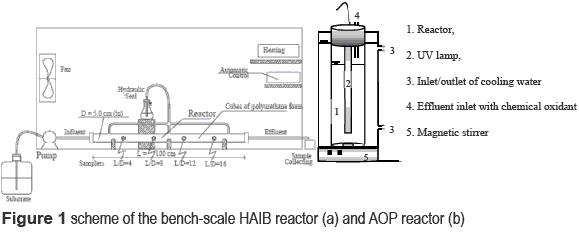
<body><![CDATA[<p><b><i>Anaerobic treatment</i></b></p>      <p>The  horizontal-flow anaerobic immobilized biomass (HAIB) was selected for the  biological treatment. The HAIB bioreactor was comprised of a 1000 mm long (L),  50 mm diameter (D) acrylic cylinder with a total volume of approximately 1964  mL and an L/D of 20. Polyurethane foam cubes (5 mm in size with an apparent  density of 23 kg/m<sup>3</sup>) were used as biomass immobilization support.  The reactor was inoculated with granulated sludge from an UASB reactor treating  effluent from poultry slaughterhouse (Avicola Dacar S.A., Tiete, state of Sao  Paulo, Brazil) (<a href="#Figura1">figure 1</a>). The sludge was macerated and immobilized in the foam  according to  &#91;19 &#93;. The HAIB reactor was kept in an acclimatized chamber set at  30&deg;C&plusmn;1&deg;C during 112 days and operated with hydraulic retention time of 19 h  based on the net volume of the reactor. Prior to feeding the wastewater into  the anaerobic reactor, the pH was adjusted to between 7.0 and 7.5. Nitrogen (N)  and phosphorous (P) were added as urea and monobasic sodium phosphate,  respectively, to obtain a COD:N:P ratio equal to 500:5:1, as suggested by  &#91;20 &#93;.</p>      <p align="center"><img src="/img/revistas/rfiua/n63/n63a05i01.gif" ><a name="Figura1"></a></p>      <p>&nbsp; </p>     <p><font size="3"><b>Post-treatment with the advanced oxidation process H<sub>2</sub>O<sub>2</sub>/UV</b></font></p>     <p>The HAIB reactor effluent was  submitted to post-treatment with hydrogen peroxide and ultraviolet radiation,  in an attempt to promote the removal of recalcitrant organic matter and to  increase the biodegradability ratio of the remaining compounds. The AOP experiments  were carried out in a cylindrical tube reactor made of borosilicate glass,  which is mounted inside another glass tube such that a thermostatic bath can  enclose the reactor, as shown in <a href="#Figura1">figure 1</a>. The reactor was 54 cm high and had  an internal diameter of 7 cm, with a net volume of 1000 mL. This experiment was  conducted in a batch mode. A 15W low-pressure UV lamp with 254 nm emission, a  length of 45 cm long and diameter of 2.5 cm (<i>Starlux</i> G15T8) was inserted  vertically into the centre of the reactor.</p>     <p>The hydrogen peroxide was  introduced at the beginning of the treatment process by thoroughly mixing the  necessary amount of a 35% hydrogen peroxide solution with one litre of the  sample to be treated at the start of the treatment. All experiments were performed  with analytical reagent grade hydrogen peroxide. The experiments were performed  with four sample replicates using 50, 100, 250 and 500 mg L<sup>-1</sup> H<sub>2</sub>O<sub>2</sub>  and applying ultraviolet radiation for 15, 30, 45 and 60 minutes. Where  possible the results are expressed in terms of ''applied energy'' (kWh  m<sup>-3</sup> of treated effluent) to show the order of magnitude of the  energy consumed by the H<sub>2</sub>O<sub>2</sub>/UV process. Since the volume  treated in the AOP reactor was one litre and the power consumption of the  ultraviolet radiation lamp was 15 W, one hour of ultraviolet irradiation  corresponds to an applied energy of 15 kWh m<sup>-3</sup>. The residual H<sub>2</sub>O<sub>2</sub>  in the wastewater after AOP treatment was neutralized by adding sodium sulphite  (Na<sub>2</sub>SO<sub>3</sub>) to avoid any further reaction that could  interfere with the interpretation of the experimental results. Prior to  neutralization with sodium sulphite a sub-sample was collected for immediate  measurement of the residual hydrogen peroxide concentration.</p>      <p><b><i>Analytical methods</i></b></p>      <p>Analyses  of COD, BOD<sub>5</sub>, TOC, UV<sub>254</sub>,  lignin and pH were performed according to  &#91;21 &#93;. Modifications proposed by  &#91;22 &#93;  were applied to determine the total volatile acid concentration and alkalinity. The AOX  determinations followed the  &#91;23 &#93; batch method using a Thermo Glass/Dextar  apparatus. The chloride ion analysis was carried out using the thiocyanate  mercury method. The residual hydrogen peroxide present in the samples was  measured in accordance with  &#91;24 &#93; using a DR 4000/HACH spectrophotometer. The  presence or absence of H<sub>2</sub>O<sub>2</sub> was also qualitatively tested  with Merckoquant kits (MERCK).</p>      <p>&nbsp;</p>     ]]></body>
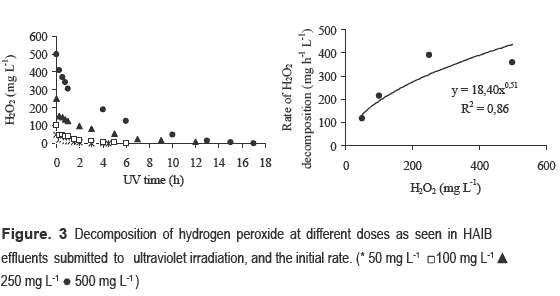
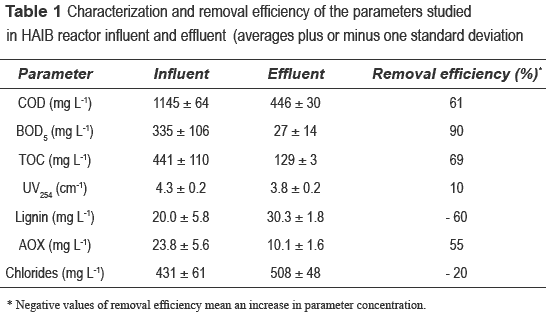
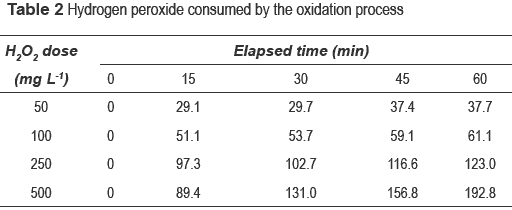
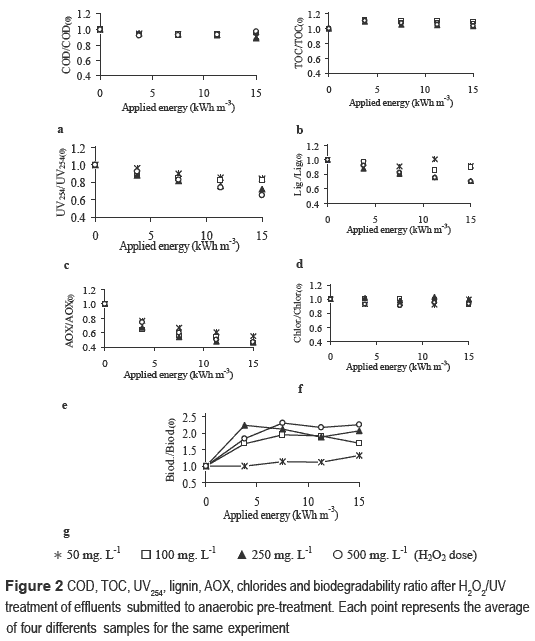
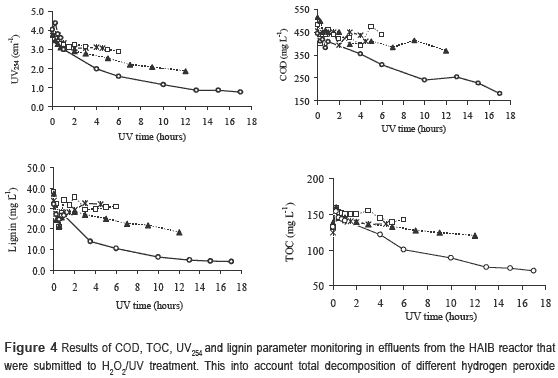
<body><![CDATA[<p><font size="3"><b>Results and discussion</b></font></p>     <p><b><i>Anaerobic treatment</i></b></p>        <p>Reactor  stability (less than 10% variation in COD removal efficiency) was achieved after  a start-up period of 44 days. The anaerobic reactor was subsequently monitored  over 112 days of continuous operation. The removal efficiencies achieved for  COD, BOD<sub>5</sub>, and TOC (seen in <a href="#Tabla1">table 1</a>) can be considered adequate,  because the HAIB reactor would function as an initial treatment for removing  easily degradable organics. However, there was only 10% removal of UV<sub>254</sub>  compounds in the biological system. The anaerobic reactor maintained  satisfactory operational stability, with an applied average organic load of  1.47 &plusmn; 0.08 kg COD m<sup>-3</sup> d<sup>-1</sup> over the experimental period.   &#91;25 &#93; compared results from several authors and concluded that the COD removal  efficiency is around 60% in anaerobic reactors treating bleaching effluents.  Biodegradability, as represented by the BOD<sub>5</sub>/COD ratio, decreased from the  influent (0.29 &plusmn; 0.07) to the effluent (0.06 &plusmn; 0.03). This indicated that the  effluent entering post-treatment with H<sub>2</sub>O<sub>2</sub>/UV was of  inherently recalcitrant nature  &#91;26 &#93;. The pH values were 7.1 &plusmn; 0.2 for influent  samples and 8.0 &plusmn; 0.1 for the effluent. The bicarbonate alkalinity showed  higher values for the effluent (589 &plusmn; 53 mg CaCO<sub>3</sub> L<sup>-1</sup>)  than for the influent (302 &plusmn; 129 mg CaCO<sub>3</sub> L<sup>-1</sup>). The ratio  of intermediate alkalinity to partial alkalinity (IA/PA) of the effluent in the  anaerobic reactor (0.23 &plusmn; 0.08) varied within the range of values found in  stable anaerobic conversion processes, as suggested by  &#91;22 &#93;.</p>        <p align="center"><img src="/img/revistas/rfiua/n63/n63a05t01.gif" ><a name="Tabla1"></a></p>        <p>Volatile  acids were successfully removed to a significant extent, with average values in  the influent and effluent of 123 &plusmn; 17 and 47 &plusmn; 7 mg HCHO L<sup>-1</sup>,  respectively. The results show increment of lignin concentration from the  influent (20 &plusmn; 5.8 mg L<sup>-1</sup>) to the effluent (30 &plusmn; 1.8 mg L<sup>-1</sup>)  of the HAIB reactor. According to  &#91;21 &#93;, the lignin analysis via colorimetry  method (Method 5550-A;  &#91;21 &#93;) using the folin-phenol reagent is not specific for  lignin, but rather takes other phenolic compounds into account; thus the lignin  is expressed in terms of ''mg phenol L<sup>-1</sup>''. Some of these  compounds, such as aromatic chemical groups and intermediate chemicals produced  by the anaerobic digestion, can affect the chemical analysis of lignin  &#91;27 &#93;.  With regard to the chlorinated organic compounds, the HAIB reactor provided an  average AOX removal efficiency of 55%, resulting in an average effluent  concentration of 10 &plusmn; 1.6 mg L<sup>-1</sup>.  &#91;7 &#93; mentioned that AOX removal  efficiency ranges from 40 to 65% in the anaerobic treatment of pulp and paper  wastewaters. In fact, aerobic treatment systems also present similar AOX  removals in pulp mill effluents.  &#91;4 &#93; noted studies in which the average AOX  removal efficiency in activated sludge systems range from 40 to 60%. Because of  its similar removal efficiencies, the anaerobic technology may be a better  option to remove chlorinated organic matter from bleached <i>Kraft</i> pulp mill effluents, as its operational cost is  lower than the costs of activated sludge systems. Another important factor is  that anaerobic bacteria can transform chlorinated compounds into compounds that  can more easily be degraded by aerobic microorganisms in a subsequent stage   &#91;28 &#93;. Dechlorination occurred during the anaerobic treatment, as indicated by  the increase in chloride ion concentration in the effluent (508 &plusmn; 48 mg L<sup>-1</sup>)  compared to the influent (431 &plusmn; 61 mg L<sup>-1</sup>). Some chlorinated organic  compounds were decomposed by biological oxidation, resulting in the liberation  of Cl- ions, a process known as ''reductive dechlorination''  that can decrease the biorefractory and toxic characteristics of the effluents   &#91;8, 13, 29 &#93;. However, the mass balance between the AOX analysis and chloride  ions (both parameters are expressed in terms of ''mg Cl- L<sup>-1</sup>'')  was not closed. The sum average of the AOX and chloride parameters in the  influent (455 mg Cl- L<sup>-1</sup>) was lower than that in the  effluent (518 mg Cl- L<sup>-1</sup>).  &#91;8 &#93; also observed this  imbalance in the analysis of AOX and chloride in anaerobic fermentation of  bleached <i>Kraft</i> mill effluents and proposed two hypotheses to  explain their observation. The first hypothesis was the release of  intracellular chloride by anaerobic biomass which was not initially detected by  the AOX measurement; the second was that the chlorinated compounds modified by  the anaerobic digestion influenced the AOX quantification method. In the  present case, the explanation may be in the chloride measurement method, since  the content of AOX compared with the content of chlorine ions is not high  enough to impact the mass balance if experimental uncertainties are taken into  consideration.</p>        <p><b><i>Post-treatment with H<sub>2</sub>O<sub>2</sub>/UV</i></b></p>       <p>To  understand the results of the post-treatment, it is helpful to look first at  the H<sub>2</sub>O<sub>2</sub> conversion over time, as seen in <a href="#Tabla2">table 2</a>. After one hour of reaction, 75% of the  H<sub>2</sub>O<sub>2</sub> was consumed when the dosage was 50 mg H<sub>2</sub>O<sub>2</sub> L<sup>-1</sup>, but only 39% was consumed when 500 mg H<sub>2</sub>O<sub>2</sub>  L<sup>-1</sup> was applied. This result has important implications when  considering specific removal loads, on reactor design, and on treatment cost.</p>        <p align="center"><img src="/img/revistas/rfiua/n63/n63a05t02.gif" ><a name="Tabla2"></a></p>        <p>In all  tested hydrogen peroxide dosages, the concentrations of COD, TOC, and chloride  ions showed minimal changes after AOP treatment (<a href="#Figura2">figure 2a</a>, <a href="#Figura2">b</a>, and <a href="#Figura2">f</a>). This is  important since it implies that organic matter was not being completely  mineralized, but rather transformed to a more biodegradable state (as shown in  <a href="#Figura2">figure 2g</a>), which was the goal of the H<sub>2</sub>O<sub>2</sub>/UV treatment.  An increase in chloride ions was expected for the treated effluents, in  parallel with the AOX removal. Such an effect would be caused mainly by the  rupture of chlorinated organic compound chains and the resulting liberation of  chloride ions, as noted by other authors  &#91;13, 29 &#93;. In fact, this effect was  also observed in the anaerobic treatment, which increased the chloride ion  concentration with the corresponding AOX removal, although not equally  balanced. After one hour of treatment, the UV<sub>254</sub> removal efficiency  for 50 and 100 mg H<sub>2</sub>O<sub>2</sub> L<sup>-1</sup> reached nearly the  same level, 16 and 17%, respectively (<a href="#Figura2">figure 2c</a>). On the other hand, higher  removal efficiencies were achieved for dosages of 250 and 500 mg H<sub>2</sub>O<sub>2</sub>  L<sup>-1</sup>, at 28 and 35%, respectively; however a constant decrease of the  UV<sub>254</sub> content clearly indicated that more time was necessary to  reach the potential removal that these dosages provided. Subsequent  experiments, shown in <a href="#Figura3">figure 3</a> and <a href="#Figura4">4</a>, indicated that one hour of treatment was  not sufficient to convert all the H<sub>2</sub>O<sub>2</sub> into hydroxyl  radicals. Two observations could be made concerning lignin (as seen in <a href="#Figura2">figure 2d</a>): (a) the average removal levels with 50 and 100 mg H<sub>2</sub>O<sub>2</sub>  L<sup>-1</sup> (at the optimal energy application level of 7.5 kWh m<sup>-3</sup>)  were 9 and 20%, respectively, since higher UV doses may seem to result in the  formation of phenols and a ''recovery'' of lignin; (b) doses of 250 and  500 mg H<sub>2</sub>O<sub>2</sub> L<sup>-1</sup> promoted removal efficiencies  that increased simultaneously with the increase in applied energy, reaching  values of 29% when 15.0 kWh m<sup>-3</sup> was applied. Further investigation is needed to determine the behaviour  of lignin under low hydrogen peroxide doses. The AOX removal (<a href="#Figura2">figure 2e</a>) was  more closely related to UV radiation exposure time, or the applied energy, than  to hydrogen peroxide dosage. For different H<sub>2</sub>O<sub>2</sub> doses,  there were only minor differences in AOX removal efficiencies, ranging from 45%  for 50 mg H<sub>2</sub>O<sub>2</sub> L<sup>-1</sup> to 54% when 500 mg H<sub>2</sub>O<sub>2</sub>  L<sup>-1</sup> was applied under exposure to 15.0 kWh m<sup>-3</sup> of UV  radiation. When the results of UV<sub>254</sub> compound removal (<a href="#Figura4">figure 4</a>) are  extrapolated to AOX removal two to three hours of treatment are necessary to  provide a clear distinction between the removal efficiencies of different  hydrogen peroxide doses.</p>        <p align="center"><img src="/img/revistas/rfiua/n63/n63a05i02.gif" ><a name="Figura2"></a></p>      ]]></body>
<body><![CDATA[<p align="center"><img src="/img/revistas/rfiua/n63/n63a05i03.gif" ><a name="Figura3"></a></p>      <p align="center"><img src="/img/revistas/rfiua/n63/n63a05i04.gif" ><a name="Figura4"></a></p>        <p>It seems that for higher H<sub>2</sub>O<sub>2</sub>  dosages longer UV exposures may induce the decomposition of biodegradable  chemicals, as observed in the decreased biodegradability ratio for 250 and 500  mg H<sub>2</sub>O<sub>2</sub> L<sup>-1</sup>. However, the results are  inconclusive. As in other yet unpublished results from other AOP experiments,  some small but consistent fluctuations in the biodegradability ratio seem to  occur over time for high hydrogen peroxide doses as time passes. This behaviour  is expected since intermediate compounds are formed and consumed until complete  mineralization is achieved and some of these intermediate compounds may be more  biodegradable than others. </p>        <p>This point will be addressed  later on. For instance, for 250 mg H<sub>2</sub>O<sub>2</sub> L<sup>-1</sup>  there was an increase of 125% with just 3.8 kWh m<sup>-3</sup>, while applying  15.0 kWh m<sup>-3</sup> resulted in a107% biodegradability ratio increase.  Thus, in order to minimize chemical and energy consumption H<sub>2</sub>O<sub>2</sub>  doses must be optimized. Other studies have also indicated that there are  optimal oxidizing agent dosages for treating effluents with advanced oxidative  processes  &#91;2, 13, 18 &#93;. In particular, these studies noted that at high  concentrations, hydrogen peroxide itself may act as a free-radical scavenger in  secondary reactions, causing a decrease in the hydroxyl radical concentration   &#91;10, 16, 17 &#93;. As indicated in <a href="#Figura3">figure 3</a>, complete consumption of the hydrogen  peroxide can take many hours. To observe the long term behaviour of the  residual H<sub>2</sub>O<sub>2</sub> concentration, COD, TOC, lignin, and UV<sub>254</sub>,  the experiments shown in <a href="#Figura2">figure 2</a> were extended until all the hydrogen peroxide  was consumed. This required three hours for the lowest dosage (50 mg H<sub>2</sub>O<sub>2</sub>  L<sup>-1</sup>) and 17 h for the highest dosage (500 mg H<sub>2</sub>O<sub>2</sub>  L<sup>-1</sup>). <a href="#Figura2">Figure 2</a> presents the kinetic analysis of the hydrogen  peroxide decomposition during the oxidation treatment under ultraviolet  radiation, as estimated by the initial rate method using the Microcal Origin  7.5&reg; software. The order of the reaction of hydrogen peroxide in anaerobic  effluents under ultraviolet radiation was approximately 0.51. This value  differed from that reported by  &#91;15 &#93;, who suggested that a pseudo-first order  model could describe the reaction between H<sub>2</sub>O<sub>2</sub>/UV and  bleaching effluents. However, it is noteworthy to highlight that the studied  effluents had different characteristics, as the bleaching effluents used in the  current work were previously submitted to anaerobic treatment. The <a href="#Figura2">figures 2</a>  and <a href="#Figura4">4</a> show that there was some saturation in the reaction rate of hydrogen  peroxide in doses above 250 mg L<sup>-1</sup> with the effluent perhaps  approaching a reaction of zero order. It is also important to observe that the  reaction rate decreases as the H<sub>2</sub>O<sub>2</sub> concentration  increases. The correlation coefficients can be considered adequate, (R<sup>2</sup>  = 0.86), and it is possible to state that the observed behaviour is due to the  change in hydrogen peroxide dosage. <a href="#Figura4">Figure 4</a> shows the physicochemical  parameters monitored during the kinetic study of the hydrogen peroxide decay.  Doses of 50 mg L<sup>-1</sup> and 100 mg L<sup>-1</sup> provided maximum COD  removals of 14% (after two hours of UV irradiation) and 19% (after four hours  of UV radiation), respectively. The most extensive removals did not necessarily  correspond with the highest exposure to UV radiation. According to some authors   &#91;10, 16, 17 &#93; this can be related either to the effect of &bull;OH radicals that  recombine to form hydrogen peroxide or to an excess of H<sub>2</sub>O<sub>2</sub>  in the reaction environment. However, the latter hypothesis is not supported by  the data of this particular work since higher dosages provided higher removal  of TOC and COD, thus showing that our oxidant was not dosed in excess. </p>        <p>TOC was not removed using the  two lowest dosages regardless of UV exposure time. In fact, there was a 5 to  24% TOC increase, which may be the result of compounds originally in the  colloidal state that became soluble during the advanced oxidation process; this  phenomenon has been observed in some other experiments performed during this  work as well as by other researchers  &#91;27 &#93;. Higher dosages induced significant  COD and TOC removals above a UV exposure threshold. However, exact threshold  values were not determined in these experiments. On the other hand, doses of  250 and 500 mg H<sub>2</sub>O<sub>2</sub> L<sup>-1</sup> both provided maximum  COD removals of 28% after 12 hours of UV irradiation and 59% after 17 hours of  UV irradiation, respectively. The maximum TOC removal reached 13% with 12 hours  of UV irradiation and 46% with 17 hours of UV irradiation. These hydrogen  peroxide dosages also induced TOC increases of up to 16%, mainly in the first  hour of the chemical treatment. Nonetheless, after three hours of UV radiation  TOC was gradually removed, indicating that the H<sub>2</sub>O<sub>2</sub>/UV  process induced mineralization of the effluent.  &#91;18 &#93; also observed this  behaviour in the TOC removal for the H<sub>2</sub>O<sub>2</sub>/UV process as  applied to a synthetic effluent containing the recalcitrant compound  tetrahydrofuran. The authors concluded that pre&shy;treatment of the effluent for a  posterior biological treatment could be achieved with H<sub>2</sub>O<sub>2</sub>  dosages as low as 1 mol H<sub>2</sub>O<sub>2</sub> per mol TOC, which  significantly increased the biodegradability ratio of the effluent. However, to  employ the H<sub>2</sub>O<sub>2</sub>/UV process as a tertiary treatment,  &#91;18 &#93;  proposed a higher hydrogen peroxide dosage of 4 mol H<sub>2</sub>O<sub>2</sub>  per mol of TOC to promote effluent mineralization rather than just  modifications of the characteristics of organic matter. It should be observed  that the dosages proposed by  &#91;18 &#93; are specific to their work and as some simple  stoichiometric calculations can demonstrate, they may not necessarily hold true  for other compounds. To use their data, it would be necessary to apply  approximately 1240 mg H<sub>2</sub>O<sub>2</sub> L<sup>-1</sup> just to  increase biodegradability ratio, a dosage that is 2.5 times higher than the  highest used in this work. </p>      <p>The maximum removal  efficiencies of UV<sub>254</sub> compounds were similar at 20% after three  hours of UV exposure for 50 mg H<sub>2</sub>O<sub>2</sub> L<sup>-1</sup> and  22% after six hours of UV exposure for 100 mg H<sub>2</sub>O<sub>2</sub> L<sup>-1</sup>.  However, the two higher dosages applied, 250 and 500 mg H<sub>2</sub>O<sub>2</sub>  L<sup>-1</sup>, resulted in significantly increased removal efficiencies of 50%  and 80%, respectively. Oscillations in the lignin removal efficiencies during  exposure to ultraviolet radiation appeared during the first two hours. For  doses of 50 and 100 mg L<sup>-1</sup>, the lowest lignin values were reached  after 30 minutes of treatment at 26 and 21 mg L<sup>-1</sup>, respectively.  Afterwards there was some increase of lignin, reaching maximum values of 32 mg  L<sup>-1</sup> after three hours of UV irradiation at 50 mg H<sub>2</sub>O<sub>2</sub>  L<sup>-1</sup>, and 36 mg L<sup>-1</sup> after two hours of UV irradiation at  100 mg H<sub>2</sub>O<sub>2</sub> L<sup>-1</sup>. After this, the lignin  concentration maintained a relatively constant level. The other H<sub>2</sub>O<sub>2</sub>  dosages tested (250 and 500 mg H<sub>2</sub>O<sub>2</sub> L<sup>-1</sup>) also  resulted in oscillating lignin concentrations over the first two hours of UV  exposure. However, in contrast with the lower dose cases, there was a general  tendency of lignin reduction with increasing UV radiation exposure. As  mentioned previously, the oscillatory behaviour of lignin degradation may be  related to intermediate species formation from the decomposition of organic  matter, with its subsequent removal, or to colloidal matter that becomes  soluble and is then removed.</p>        <p>&nbsp;</p>      <p><font size="3"><b>Conclusions</b> </font></p>      <p>The  horizontal-flow anaerobic immobilized biomass reactor performed effectively in  treating effluents from the bleached <i>Kraft</i> pulp Mill. There was suitable removal of organic  matter and chlorinated organic compounds. However, post-treatment of the  effluent was necessary to achieve discharge requirements. The H<sub>2</sub>O<sub>2</sub>/UV  post-treatment provided additional AOX removal (up to 54%) and increased the  biodegradability ratio (up to 131%) of the anaerobic effluents. A dosage of 100  mg H<sub>2</sub>O<sub>2</sub> L<sup>-1</sup> and an  energy level of 11.3 kWh per m<sup>3</sup> applied by the UV radiation lamp was  the optimal combination for increasing the biodegradability ratio and removing  chlorinated organic compounds and lignin. The kinetic studies of complete H<sub>2</sub>O<sub>2</sub>  decomposition demonstrated good removal efficiencies for both organic matter  and lignin, though long ultraviolet irradiation times may be required. It is  concluded that the application of H<sub>2</sub>O<sub>2</sub>/UV as  post-treatment for complex effluents from anaerobic reactors is a technically  feasible option.</p>      <p>&nbsp;</p>     ]]></body>
<body><![CDATA[<p><font size="3"><b>Acknowledgements</b> </font></p>      <p>This study  was supported by Funda&ccedil;&atilde;o de Amparo a Pesquisa do Estado de S&atilde;o Paulo (FAPESP). Grants received from Coordena&ccedil;&atilde;o de Aperfei&ccedil;oamento  de Pessoal de N&iacute;vel Superior  (CAPES) and Conselho Nacional  de Desenvolvimento Cient&iacute;fico e Tecnol&oacute;gico (CNPq) are gratefully acknowledged.</p>      <p>&nbsp;</p>     <p><font size="3"><b>References</b> </font></p>       <!-- ref --><p>1.  D. Savant, R. Abdul, D. Ranade. ''Anaerobic degradation of adsorbable  organic halides (AOX) from pulp and paper industry wastewater''. <i>Bioresource  Technology</i>.  Vol. 97. 2006. pp. 1092-1104.    &nbsp;&nbsp;&nbsp;&nbsp;&nbsp;&nbsp;&nbsp;&nbsp;[&#160;<a href="javascript:void(0);" onclick="javascript: window.open('/scielo.php?script=sci_nlinks&ref=000067&pid=S0120-6230201200020000500001&lng=','','width=640,height=500,resizable=yes,scrollbars=1,menubar=yes,');">Links</a>&#160;]<!-- end-ref --> </p>       <!-- ref --><p>2. E. Catalkaya, F. Kargi. ''Color, TOC and AOX  removals from pulp mill effluent by advanced oxidation processes: A comparative  study''.  <i>Journal of Hazardous Materials B139</i>. Vol. 139. 2007. pp. 244&shy;253.    &nbsp;&nbsp;&nbsp;&nbsp;&nbsp;&nbsp;&nbsp;&nbsp;[&#160;<a href="javascript:void(0);" onclick="javascript: window.open('/scielo.php?script=sci_nlinks&ref=000069&pid=S0120-6230201200020000500002&lng=','','width=640,height=500,resizable=yes,scrollbars=1,menubar=yes,');">Links</a>&#160;]<!-- end-ref --> </p>       <!-- ref --><p>3. L. Bijan, M. Mohseni. ''Integrated ozone and  biotreatment of pulp mill effluent and changes in biodegradability and  molecular weight distribution of organic compounds''. <i>Water Research</i>. Vol. 39. 2005. pp. 3763-3772.    &nbsp;&nbsp;&nbsp;&nbsp;&nbsp;&nbsp;&nbsp;&nbsp;[&#160;<a href="javascript:void(0);" onclick="javascript: window.open('/scielo.php?script=sci_nlinks&ref=000071&pid=S0120-6230201200020000500003&lng=','','width=640,height=500,resizable=yes,scrollbars=1,menubar=yes,');">Links</a>&#160;]<!-- end-ref --> </p>       ]]></body>
<body><![CDATA[<!-- ref --><p>4. D. Pokhrel, T. Viraraghavan. ''Treatment of pulp and  paper mill wastewater - a review''. <i>Science of the  Total Environment</i>.  Vol. 333. 2004. pp. 37-58.    &nbsp;&nbsp;&nbsp;&nbsp;&nbsp;&nbsp;&nbsp;&nbsp;[&#160;<a href="javascript:void(0);" onclick="javascript: window.open('/scielo.php?script=sci_nlinks&ref=000073&pid=S0120-6230201200020000500004&lng=','','width=640,height=500,resizable=yes,scrollbars=1,menubar=yes,');">Links</a>&#160;]<!-- end-ref --> </p>       <!-- ref --><p>5. G. Vidal, M. Soto, J. Field, R. Mendez, J. Lema. ''Anaerobic  biodegradability and toxicity of wastewaters from chlorine and total  chlorine-free bleaching of eucalyptus kraft pulps''. <i>Water Research</i>. Vol. 31. 1997. pp. 2487-2494.    &nbsp;&nbsp;&nbsp;&nbsp;&nbsp;&nbsp;&nbsp;&nbsp;[&#160;<a href="javascript:void(0);" onclick="javascript: window.open('/scielo.php?script=sci_nlinks&ref=000075&pid=S0120-6230201200020000500005&lng=','','width=640,height=500,resizable=yes,scrollbars=1,menubar=yes,');">Links</a>&#160;]<!-- end-ref --> </p>       <!-- ref --><p>6. G. Lettinga. ''Sustainable integrated biological  wastewater treatment''. <i>Water Science and Technology</i>. Vol. 33. 1996. pp. 85-98.    &nbsp;&nbsp;&nbsp;&nbsp;&nbsp;&nbsp;&nbsp;&nbsp;[&#160;<a href="javascript:void(0);" onclick="javascript: window.open('/scielo.php?script=sci_nlinks&ref=000077&pid=S0120-6230201200020000500006&lng=','','width=640,height=500,resizable=yes,scrollbars=1,menubar=yes,');">Links</a>&#160;]<!-- end-ref --> </p>       <!-- ref --><p>7. J. Rintala, J. Puhakka. ''Anaerobic treatment in  pulp and paper-mill waste management - a review''.<i> Bioresource  Technology</i>.  Vol. 47. 1994. pp. 1-18.    &nbsp;&nbsp;&nbsp;&nbsp;&nbsp;&nbsp;&nbsp;&nbsp;[&#160;<a href="javascript:void(0);" onclick="javascript: window.open('/scielo.php?script=sci_nlinks&ref=000079&pid=S0120-6230201200020000500007&lng=','','width=640,height=500,resizable=yes,scrollbars=1,menubar=yes,');">Links</a>&#160;]<!-- end-ref --> </p>       <!-- ref --><p>8. W. Parker, E. Hall, G. Farquhar. ''Evaluation of  dechlorination mechanisms during anaerobic fermentation of bleached kraft mill  effluent''. <i>Water Research</i>. Vol. 27. 1993. pp. 1269-1273.    &nbsp;&nbsp;&nbsp;&nbsp;&nbsp;&nbsp;&nbsp;&nbsp;[&#160;<a href="javascript:void(0);" onclick="javascript: window.open('/scielo.php?script=sci_nlinks&ref=000081&pid=S0120-6230201200020000500008&lng=','','width=640,height=500,resizable=yes,scrollbars=1,menubar=yes,');">Links</a>&#160;]<!-- end-ref --> </p>       ]]></body>
<body><![CDATA[<!-- ref --><p>9. J. Carey, E. Hall, N. McCubbin. <i>Review of  scientific basis for AOX effluent standard in British Columbia</i>. Minister of Water. Land and  Air Protection in British Columbia. Disponible en:<a href="http://www.environment.gov.au/epbc/notices/assessments/2007/3385/pubs/20dioxins.pdf" target="_blank"> http://www.environment.gov.au/epbc/notices/assessments/2007/3385/pubs/20dioxins.pdf</a>. 2002.    &nbsp;&nbsp;&nbsp;&nbsp;&nbsp;&nbsp;&nbsp;&nbsp;[&#160;<a href="javascript:void(0);" onclick="javascript: window.open('/scielo.php?script=sci_nlinks&ref=000083&pid=S0120-6230201200020000500009&lng=','','width=640,height=500,resizable=yes,scrollbars=1,menubar=yes,');">Links</a>&#160;]<!-- end-ref --> </p>       <!-- ref --><p>10. C. Huang, C. Dong, Z. Tang. ''Advanced chemical  oxidation: its present role and potential future in hazardous waste  treatment''. <i>Waste Management</i>. Vol. 13. 1993. pp. 361-377.    &nbsp;&nbsp;&nbsp;&nbsp;&nbsp;&nbsp;&nbsp;&nbsp;[&#160;<a href="javascript:void(0);" onclick="javascript: window.open('/scielo.php?script=sci_nlinks&ref=000085&pid=S0120-6230201200020000500010&lng=','','width=640,height=500,resizable=yes,scrollbars=1,menubar=yes,');">Links</a>&#160;]<!-- end-ref --> </p>       <!-- ref --><p>11.  D. Ruas, A. Mounteer, A. Lopes, B. Gomes, F. Brandao, L. Girondoli.  ''Combined chemical biological treatment of bleached eucalypt kraft pulp  mill effluent''. <i>Water Science and Technology</i>. Vol. 55. 2007. pp. 143-150.    &nbsp;&nbsp;&nbsp;&nbsp;&nbsp;&nbsp;&nbsp;&nbsp;[&#160;<a href="javascript:void(0);" onclick="javascript: window.open('/scielo.php?script=sci_nlinks&ref=000087&pid=S0120-6230201200020000500011&lng=','','width=640,height=500,resizable=yes,scrollbars=1,menubar=yes,');">Links</a>&#160;]<!-- end-ref --> </p>       <!-- ref --><p>12.  P. Gogate, A. Pandit. ''A review of imperative technologies for wastewater  treatment I: oxidation technologies at ambient conditions''. <i>Advances in  Environment Research</i>. Vol. 8. 2004. pp. 501-551.    &nbsp;&nbsp;&nbsp;&nbsp;&nbsp;&nbsp;&nbsp;&nbsp;[&#160;<a href="javascript:void(0);" onclick="javascript: window.open('/scielo.php?script=sci_nlinks&ref=000089&pid=S0120-6230201200020000500012&lng=','','width=640,height=500,resizable=yes,scrollbars=1,menubar=yes,');">Links</a>&#160;]<!-- end-ref --> </p>       <!-- ref --><p>13. M. Yeber, J. Rodriguez, J. Freer, J. Baeza, N. Duran,  H. Mansilla. ''Advanced oxidation of a pulp mill bleaching  wastewater''. <i>Chemosphere</i>. Vol. 39. 1999. pp. 1679-1688.    &nbsp;&nbsp;&nbsp;&nbsp;&nbsp;&nbsp;&nbsp;&nbsp;[&#160;<a href="javascript:void(0);" onclick="javascript: window.open('/scielo.php?script=sci_nlinks&ref=000091&pid=S0120-6230201200020000500013&lng=','','width=640,height=500,resizable=yes,scrollbars=1,menubar=yes,');">Links</a>&#160;]<!-- end-ref --> </p>       ]]></body>
<body><![CDATA[<!-- ref --><p>14. A. Marco, S. Esplugas, G. Saum. ''How and why  combine chemical and biological processes for wastewater treatment''. <i>Water Science and  Technology</i>. Vol.  35. 1997. pp. 321-327.    &nbsp;&nbsp;&nbsp;&nbsp;&nbsp;&nbsp;&nbsp;&nbsp;[&#160;<a href="javascript:void(0);" onclick="javascript: window.open('/scielo.php?script=sci_nlinks&ref=000093&pid=S0120-6230201200020000500014&lng=','','width=640,height=500,resizable=yes,scrollbars=1,menubar=yes,');">Links</a>&#160;]<!-- end-ref --> </p>       <!-- ref --><p>15. C. Prat, M. Vicente, S Esplugas. ''Treatment of  bleaching waters in the paper-industry by hydrogen- peroxide and  ultraviolet-radiation''. <i>Water Research</i>. Vol. 22. 1988. pp. 663-668.    &nbsp;&nbsp;&nbsp;&nbsp;&nbsp;&nbsp;&nbsp;&nbsp;[&#160;<a href="javascript:void(0);" onclick="javascript: window.open('/scielo.php?script=sci_nlinks&ref=000095&pid=S0120-6230201200020000500015&lng=','','width=640,height=500,resizable=yes,scrollbars=1,menubar=yes,');">Links</a>&#160;]<!-- end-ref --> </p>       <!-- ref --><p>16. J. Crittenden, S. Hu, D. Hand, S. Green. ''A  kinetic model for UV/ H2O2 process in a completely mixed  batch reactor''. <i>Water Research</i>. Vol. 33. 1999. pp. 2315-2328.    &nbsp;&nbsp;&nbsp;&nbsp;&nbsp;&nbsp;&nbsp;&nbsp;[&#160;<a href="javascript:void(0);" onclick="javascript: window.open('/scielo.php?script=sci_nlinks&ref=000097&pid=S0120-6230201200020000500016&lng=','','width=640,height=500,resizable=yes,scrollbars=1,menubar=yes,');">Links</a>&#160;]<!-- end-ref --> </p>       <!-- ref --><p>17. O. Legrini, E. Oliveros, A. Braun. ''Photochemical  processes for water-treatment''. <i>Chemical Review</i>. Vol. 93. 1993. pp. 671-698.    &nbsp;&nbsp;&nbsp;&nbsp;&nbsp;&nbsp;&nbsp;&nbsp;[&#160;<a href="javascript:void(0);" onclick="javascript: window.open('/scielo.php?script=sci_nlinks&ref=000099&pid=S0120-6230201200020000500017&lng=','','width=640,height=500,resizable=yes,scrollbars=1,menubar=yes,');">Links</a>&#160;]<!-- end-ref --> </p>       <!-- ref --><p>18. C. Raj, H. Quen. ''Advanced oxidation processes for  wastewater treatment: Optimization of UV/H2O2 process  through a statistical technique''. <i>Chemical  Engineering Science</i>. Vol. 60. 2005. pp. 5305-5311.    &nbsp;&nbsp;&nbsp;&nbsp;&nbsp;&nbsp;&nbsp;&nbsp;[&#160;<a href="javascript:void(0);" onclick="javascript: window.open('/scielo.php?script=sci_nlinks&ref=000101&pid=S0120-6230201200020000500018&lng=','','width=640,height=500,resizable=yes,scrollbars=1,menubar=yes,');">Links</a>&#160;]<!-- end-ref --> </p>       ]]></body>
<body><![CDATA[<!-- ref --><p>19. E. Foresti, M. Zaiat, A. Cabral, V. Nery.  ''Horizontal- flow anaerobic immobilized sludge (HAIS) reactor for paper  industry wastewater treatment''. <i>Brazilian Journal  of Chemical Engineering</i>. Vol. 12. 1995. pp. 157-163.    &nbsp;&nbsp;&nbsp;&nbsp;&nbsp;&nbsp;&nbsp;&nbsp;[&#160;<a href="javascript:void(0);" onclick="javascript: window.open('/scielo.php?script=sci_nlinks&ref=000103&pid=S0120-6230201200020000500019&lng=','','width=640,height=500,resizable=yes,scrollbars=1,menubar=yes,');">Links</a>&#160;]<!-- end-ref --> </p>       <!-- ref --><p>20. B. Ammary. ''Nutrients requierements in biological  industrial wastewater treatment''. <i>African Journal  of Biotechnology</i>.  Vol. 3. 2004. pp. 236-238.    &nbsp;&nbsp;&nbsp;&nbsp;&nbsp;&nbsp;&nbsp;&nbsp;[&#160;<a href="javascript:void(0);" onclick="javascript: window.open('/scielo.php?script=sci_nlinks&ref=000105&pid=S0120-6230201200020000500020&lng=','','width=640,height=500,resizable=yes,scrollbars=1,menubar=yes,');">Links</a>&#160;]<!-- end-ref --> </p>       <!-- ref --><p>21. APHA. <i>Standard Methods for the Examination of Water and  Wastewater</i>.  21<sup>th</sup> ed. Ed. American Public Health Association. Washington, D.C.  2005. pp. 1325.    &nbsp;&nbsp;&nbsp;&nbsp;&nbsp;&nbsp;&nbsp;&nbsp;[&#160;<a href="javascript:void(0);" onclick="javascript: window.open('/scielo.php?script=sci_nlinks&ref=000107&pid=S0120-6230201200020000500021&lng=','','width=640,height=500,resizable=yes,scrollbars=1,menubar=yes,');">Links</a>&#160;]<!-- end-ref --> </p>       <!-- ref --><p>22. L. Ripley, W. Boyle, J. Converse. ''Improved  alkalimetric monitoring for anaerobic-digestion of high-strength wastes''. <i>Journal (Water  Pollution Control Federation)</i>. Vol. 58. 1986. pp. 406-411.    &nbsp;&nbsp;&nbsp;&nbsp;&nbsp;&nbsp;&nbsp;&nbsp;[&#160;<a href="javascript:void(0);" onclick="javascript: window.open('/scielo.php?script=sci_nlinks&ref=000109&pid=S0120-6230201200020000500022&lng=','','width=640,height=500,resizable=yes,scrollbars=1,menubar=yes,');">Links</a>&#160;]<!-- end-ref --> </p>       <!-- ref --><p>23. Scan, Scandinavian Pulp. <i>Paper and Board  Testing Committee</i>.  Test Methods. Estocolmo. 1989.    &nbsp;&nbsp;&nbsp;&nbsp;&nbsp;&nbsp;&nbsp;&nbsp;[&#160;<a href="javascript:void(0);" onclick="javascript: window.open('/scielo.php?script=sci_nlinks&ref=000111&pid=S0120-6230201200020000500023&lng=','','width=640,height=500,resizable=yes,scrollbars=1,menubar=yes,');">Links</a>&#160;]<!-- end-ref --> </p>       ]]></body>
<body><![CDATA[<!-- ref --><p>24. N. Klassen, D. Marchington, H. McGowan. ''H2O2  Determination by the I3- Method and by KMnO4 titration''. <i>Analytical  Chemistry</i>.  Vol. 66. 1994. pp. 2921-2925.    &nbsp;&nbsp;&nbsp;&nbsp;&nbsp;&nbsp;&nbsp;&nbsp;[&#160;<a href="javascript:void(0);" onclick="javascript: window.open('/scielo.php?script=sci_nlinks&ref=000113&pid=S0120-6230201200020000500024&lng=','','width=640,height=500,resizable=yes,scrollbars=1,menubar=yes,');">Links</a>&#160;]<!-- end-ref --> </p>       <!-- ref --><p>25. G. Vidal, S. Videla, M. Diez. ''Molecular weight  distribution of Pinus radiata kraft mill wastewater treated by anaerobic  digestion''. <i>Bioresource Technology</i>. Vol. 77. 2001. pp. 183-191.    &nbsp;&nbsp;&nbsp;&nbsp;&nbsp;&nbsp;&nbsp;&nbsp;[&#160;<a href="javascript:void(0);" onclick="javascript: window.open('/scielo.php?script=sci_nlinks&ref=000115&pid=S0120-6230201200020000500025&lng=','','width=640,height=500,resizable=yes,scrollbars=1,menubar=yes,');">Links</a>&#160;]<!-- end-ref --> </p>       <!-- ref --><p>26. Metcalf &amp; Eddy. <i>Wastewater  Engineering treatment Disposal Reuse</i>. 4<sup>th</sup> ed. Ed. McGraw  - Hill Book. New York. 2003. pp. 1815.    &nbsp;&nbsp;&nbsp;&nbsp;&nbsp;&nbsp;&nbsp;&nbsp;[&#160;<a href="javascript:void(0);" onclick="javascript: window.open('/scielo.php?script=sci_nlinks&ref=000117&pid=S0120-6230201200020000500026&lng=','','width=640,height=500,resizable=yes,scrollbars=1,menubar=yes,');">Links</a>&#160;]<!-- end-ref --> </p>       <!-- ref --><p>27. R. Pereira. <i>Combination of aerobic biological treatment with advanced  oxidative process seeking to intensify organic matter removal in textile and  kraft pulp mill effluents</i>. Dissertation (Magister Scientiae), Federal University  of Vifosa, Vifosa. (MG-Brazil). 2007. pp. 80.    &nbsp;&nbsp;&nbsp;&nbsp;&nbsp;&nbsp;&nbsp;&nbsp;[&#160;<a href="javascript:void(0);" onclick="javascript: window.open('/scielo.php?script=sci_nlinks&ref=000119&pid=S0120-6230201200020000500027&lng=','','width=640,height=500,resizable=yes,scrollbars=1,menubar=yes,');">Links</a>&#160;]<!-- end-ref --> </p>       <!-- ref --><p>28. J. Field, R. Sierra. ''Microbial transformation and  degradation of polychlorinated biphenyls''. <i>Environmental  Pollution</i>.  Vol. 155. 2008. pp. 1-12.    &nbsp;&nbsp;&nbsp;&nbsp;&nbsp;&nbsp;&nbsp;&nbsp;[&#160;<a href="javascript:void(0);" onclick="javascript: window.open('/scielo.php?script=sci_nlinks&ref=000121&pid=S0120-6230201200020000500028&lng=','','width=640,height=500,resizable=yes,scrollbars=1,menubar=yes,');">Links</a>&#160;]<!-- end-ref --> </p>       ]]></body>
<body><![CDATA[<!-- ref --><p>29. T. Essam, M. Amin, O. El Tayeb, B. Mattiasson, B.  Guieysse. Sequential photochemical-biological degra&shy;dation of  chlorophenols''. <i>Chemosphere</i>. Vol. 66. 2007. pp. 2201-2209.    &nbsp;&nbsp;&nbsp;&nbsp;&nbsp;&nbsp;&nbsp;&nbsp;[&#160;<a href="javascript:void(0);" onclick="javascript: window.open('/scielo.php?script=sci_nlinks&ref=000123&pid=S0120-6230201200020000500029&lng=','','width=640,height=500,resizable=yes,scrollbars=1,menubar=yes,');">Links</a>&#160;]<!-- end-ref --></p>        <p>&nbsp;</p>   </font>     ]]></body><back>
<ref-list>
<ref id="B1">
<label>1</label><nlm-citation citation-type="journal">
<person-group person-group-type="author">
<name>
<surname><![CDATA[Savant]]></surname>
<given-names><![CDATA[D.]]></given-names>
</name>
<name>
<surname><![CDATA[Abdul]]></surname>
<given-names><![CDATA[R.]]></given-names>
</name>
<name>
<surname><![CDATA[Ranade]]></surname>
<given-names><![CDATA[D.]]></given-names>
</name>
</person-group>
<article-title xml:lang="en"><![CDATA[Anaerobic degradation of adsorbable organic halides (AOX) from pulp and paper industry wastewater]]></article-title>
<source><![CDATA[Bioresource Technology]]></source>
<year>2006</year>
<volume>97</volume>
<page-range>1092-1104</page-range></nlm-citation>
</ref>
<ref id="B2">
<label>2</label><nlm-citation citation-type="journal">
<person-group person-group-type="author">
<name>
<surname><![CDATA[Catalkaya]]></surname>
<given-names><![CDATA[E.]]></given-names>
</name>
<name>
<surname><![CDATA[Kargi]]></surname>
<given-names><![CDATA[F.]]></given-names>
</name>
</person-group>
<article-title xml:lang="en"><![CDATA[Color, TOC and AOX removals from pulp mill effluent by advanced oxidation processes: A comparative study]]></article-title>
<source><![CDATA[Journal of Hazardous Materials B139]]></source>
<year>2007</year>
<volume>139</volume>
<page-range>244&shy;253</page-range></nlm-citation>
</ref>
<ref id="B3">
<label>3</label><nlm-citation citation-type="journal">
<person-group person-group-type="author">
<name>
<surname><![CDATA[Bijan]]></surname>
<given-names><![CDATA[L.]]></given-names>
</name>
<name>
<surname><![CDATA[Mohseni]]></surname>
<given-names><![CDATA[M.]]></given-names>
</name>
</person-group>
<article-title xml:lang="en"><![CDATA[Integrated ozone and biotreatment of pulp mill effluent and changes in biodegradability and molecular weight distribution of organic compounds]]></article-title>
<source><![CDATA[Water Research]]></source>
<year>2005</year>
<volume>39</volume>
<page-range>3763-3772</page-range></nlm-citation>
</ref>
<ref id="B4">
<label>4</label><nlm-citation citation-type="journal">
<person-group person-group-type="author">
<name>
<surname><![CDATA[Pokhrel]]></surname>
<given-names><![CDATA[D.]]></given-names>
</name>
<name>
<surname><![CDATA[Viraraghavan]]></surname>
<given-names><![CDATA[T.]]></given-names>
</name>
</person-group>
<article-title xml:lang="en"><![CDATA[Treatment of pulp and paper mill wastewater - a review]]></article-title>
<source><![CDATA[Science of the Total Environment]]></source>
<year>2004</year>
<volume>333</volume>
<page-range>37-58</page-range></nlm-citation>
</ref>
<ref id="B5">
<label>5</label><nlm-citation citation-type="journal">
<person-group person-group-type="author">
<name>
<surname><![CDATA[Vidal]]></surname>
<given-names><![CDATA[G.]]></given-names>
</name>
<name>
<surname><![CDATA[Soto]]></surname>
<given-names><![CDATA[M.]]></given-names>
</name>
<name>
<surname><![CDATA[Field]]></surname>
<given-names><![CDATA[J.]]></given-names>
</name>
<name>
<surname><![CDATA[Mendez]]></surname>
<given-names><![CDATA[R.]]></given-names>
</name>
<name>
<surname><![CDATA[Lema]]></surname>
<given-names><![CDATA[J.]]></given-names>
</name>
</person-group>
<article-title xml:lang="en"><![CDATA[Anaerobic biodegradability and toxicity of wastewaters from chlorine and total chlorine-free bleaching of eucalyptus kraft pulps]]></article-title>
<source><![CDATA[Water Research]]></source>
<year>1997</year>
<volume>31</volume>
<page-range>2487-2494</page-range></nlm-citation>
</ref>
<ref id="B6">
<label>6</label><nlm-citation citation-type="journal">
<person-group person-group-type="author">
<name>
<surname><![CDATA[Lettinga]]></surname>
<given-names><![CDATA[G.]]></given-names>
</name>
</person-group>
<article-title xml:lang="en"><![CDATA[Sustainable integrated biological wastewater treatment]]></article-title>
<source><![CDATA[Water Science and Technology]]></source>
<year>1996</year>
<volume>33</volume>
<page-range>85-98</page-range></nlm-citation>
</ref>
<ref id="B7">
<label>7</label><nlm-citation citation-type="journal">
<person-group person-group-type="author">
<name>
<surname><![CDATA[Rintala]]></surname>
<given-names><![CDATA[J.]]></given-names>
</name>
<name>
<surname><![CDATA[Puhakka]]></surname>
<given-names><![CDATA[J.]]></given-names>
</name>
</person-group>
<article-title xml:lang="en"><![CDATA[Anaerobic treatment in pulp and paper-mill waste management - a review]]></article-title>
<source><![CDATA[Bioresource Technology]]></source>
<year>1994</year>
<volume>47</volume>
<page-range>1-18</page-range></nlm-citation>
</ref>
<ref id="B8">
<label>8</label><nlm-citation citation-type="journal">
<person-group person-group-type="author">
<name>
<surname><![CDATA[Parker]]></surname>
<given-names><![CDATA[W.]]></given-names>
</name>
<name>
<surname><![CDATA[Hall]]></surname>
<given-names><![CDATA[E.]]></given-names>
</name>
<name>
<surname><![CDATA[Farquhar]]></surname>
<given-names><![CDATA[G.]]></given-names>
</name>
</person-group>
<article-title xml:lang="en"><![CDATA[Evaluation of dechlorination mechanisms during anaerobic fermentation of bleached kraft mill effluent]]></article-title>
<source><![CDATA[Water Research]]></source>
<year>1993</year>
<volume>27</volume>
<page-range>1269-1273</page-range></nlm-citation>
</ref>
<ref id="B9">
<label>9</label><nlm-citation citation-type="book">
<person-group person-group-type="author">
<name>
<surname><![CDATA[Carey]]></surname>
<given-names><![CDATA[J.]]></given-names>
</name>
<name>
<surname><![CDATA[Hall]]></surname>
<given-names><![CDATA[E.]]></given-names>
</name>
<name>
<surname><![CDATA[McCubbin]]></surname>
<given-names><![CDATA[N.]]></given-names>
</name>
</person-group>
<source><![CDATA[Review of scientific basis for AOX effluent standard in British Columbia]]></source>
<year>2002</year>
<publisher-name><![CDATA[Minister of Water. Land and Air Protection in British Columbia]]></publisher-name>
</nlm-citation>
</ref>
<ref id="B10">
<label>10</label><nlm-citation citation-type="journal">
<person-group person-group-type="author">
<name>
<surname><![CDATA[Huang]]></surname>
<given-names><![CDATA[C.]]></given-names>
</name>
<name>
<surname><![CDATA[Dong]]></surname>
<given-names><![CDATA[C.]]></given-names>
</name>
<name>
<surname><![CDATA[Tang]]></surname>
<given-names><![CDATA[Z.]]></given-names>
</name>
</person-group>
<article-title xml:lang="en"><![CDATA[Advanced chemical oxidation: its present role and potential future in hazardous waste treatment]]></article-title>
<source><![CDATA[Waste Management]]></source>
<year>1993</year>
<volume>13</volume>
<page-range>361-377</page-range></nlm-citation>
</ref>
<ref id="B11">
<label>11</label><nlm-citation citation-type="journal">
<person-group person-group-type="author">
<name>
<surname><![CDATA[Ruas]]></surname>
<given-names><![CDATA[D.]]></given-names>
</name>
<name>
<surname><![CDATA[Mounteer]]></surname>
<given-names><![CDATA[A.]]></given-names>
</name>
<name>
<surname><![CDATA[Lopes]]></surname>
<given-names><![CDATA[A.]]></given-names>
</name>
<name>
<surname><![CDATA[Gomes]]></surname>
<given-names><![CDATA[B.]]></given-names>
</name>
<name>
<surname><![CDATA[Brandao]]></surname>
<given-names><![CDATA[F.]]></given-names>
</name>
<name>
<surname><![CDATA[Girondoli]]></surname>
<given-names><![CDATA[L.]]></given-names>
</name>
</person-group>
<article-title xml:lang="en"><![CDATA[Combined chemical biological treatment of bleached eucalypt kraft pulp mill effluent]]></article-title>
<source><![CDATA[Water Science and Technology]]></source>
<year>2007</year>
<volume>55</volume>
<page-range>143-150</page-range></nlm-citation>
</ref>
<ref id="B12">
<label>12</label><nlm-citation citation-type="journal">
<person-group person-group-type="author">
<name>
<surname><![CDATA[Gogate]]></surname>
<given-names><![CDATA[P.]]></given-names>
</name>
<name>
<surname><![CDATA[Pandit]]></surname>
<given-names><![CDATA[A.]]></given-names>
</name>
</person-group>
<article-title xml:lang="en"><![CDATA[A review of imperative technologies for wastewater treatment I: oxidation technologies at ambient conditions]]></article-title>
<source><![CDATA[Advances in Environment Research]]></source>
<year>2004</year>
<volume>8</volume>
<page-range>501-551</page-range></nlm-citation>
</ref>
<ref id="B13">
<label>13</label><nlm-citation citation-type="journal">
<person-group person-group-type="author">
<name>
<surname><![CDATA[Yeber]]></surname>
<given-names><![CDATA[M.]]></given-names>
</name>
<name>
<surname><![CDATA[Rodriguez]]></surname>
<given-names><![CDATA[J.]]></given-names>
</name>
<name>
<surname><![CDATA[Freer]]></surname>
<given-names><![CDATA[J.]]></given-names>
</name>
<name>
<surname><![CDATA[Baeza]]></surname>
<given-names><![CDATA[J.]]></given-names>
</name>
<name>
<surname><![CDATA[Duran]]></surname>
<given-names><![CDATA[N.]]></given-names>
</name>
<name>
<surname><![CDATA[Mansilla]]></surname>
<given-names><![CDATA[H.]]></given-names>
</name>
</person-group>
<article-title xml:lang="en"><![CDATA[Advanced oxidation of a pulp mill bleaching wastewater]]></article-title>
<source><![CDATA[Chemosphere]]></source>
<year>1999</year>
<volume>39</volume>
<page-range>1679-1688</page-range></nlm-citation>
</ref>
<ref id="B14">
<label>14</label><nlm-citation citation-type="journal">
<person-group person-group-type="author">
<name>
<surname><![CDATA[Marco]]></surname>
<given-names><![CDATA[A.]]></given-names>
</name>
<name>
<surname><![CDATA[Esplugas]]></surname>
<given-names><![CDATA[S.]]></given-names>
</name>
<name>
<surname><![CDATA[Saum]]></surname>
<given-names><![CDATA[G.]]></given-names>
</name>
</person-group>
<article-title xml:lang="en"><![CDATA[How and why combine chemical and biological processes for wastewater treatment]]></article-title>
<source><![CDATA[Water Science and Technology]]></source>
<year>1997</year>
<volume>35</volume>
<page-range>321-327</page-range></nlm-citation>
</ref>
<ref id="B15">
<label>15</label><nlm-citation citation-type="journal">
<person-group person-group-type="author">
<name>
<surname><![CDATA[Prat]]></surname>
<given-names><![CDATA[C.]]></given-names>
</name>
<name>
<surname><![CDATA[Vicente]]></surname>
<given-names><![CDATA[M.]]></given-names>
</name>
<name>
<surname><![CDATA[Esplugas]]></surname>
<given-names><![CDATA[S]]></given-names>
</name>
</person-group>
<article-title xml:lang="en"><![CDATA[Treatment of bleaching waters in the paper-industry by hydrogen- peroxide and ultraviolet-radiation]]></article-title>
<source><![CDATA[Water Research]]></source>
<year>1988</year>
<volume>22</volume>
<page-range>663-668</page-range></nlm-citation>
</ref>
<ref id="B16">
<label>16</label><nlm-citation citation-type="journal">
<person-group person-group-type="author">
<name>
<surname><![CDATA[Crittenden]]></surname>
<given-names><![CDATA[J.]]></given-names>
</name>
<name>
<surname><![CDATA[Hu]]></surname>
<given-names><![CDATA[S.]]></given-names>
</name>
<name>
<surname><![CDATA[Hand]]></surname>
<given-names><![CDATA[D.]]></given-names>
</name>
<name>
<surname><![CDATA[Green]]></surname>
<given-names><![CDATA[S.]]></given-names>
</name>
</person-group>
<article-title xml:lang="en"><![CDATA[A kinetic model for UV/ H2O2 process in a completely mixed batch reactor]]></article-title>
<source><![CDATA[Water Research]]></source>
<year>1999</year>
<volume>33</volume>
<page-range>2315-2328</page-range></nlm-citation>
</ref>
<ref id="B17">
<label>17</label><nlm-citation citation-type="journal">
<person-group person-group-type="author">
<name>
<surname><![CDATA[Legrini]]></surname>
<given-names><![CDATA[O.]]></given-names>
</name>
<name>
<surname><![CDATA[Oliveros]]></surname>
<given-names><![CDATA[E.]]></given-names>
</name>
<name>
<surname><![CDATA[Braun]]></surname>
<given-names><![CDATA[A.]]></given-names>
</name>
</person-group>
<article-title xml:lang="en"><![CDATA[Photochemical processes for water-treatment]]></article-title>
<source><![CDATA[Chemical Review]]></source>
<year>1993</year>
<volume>93</volume>
<page-range>671-698</page-range></nlm-citation>
</ref>
<ref id="B18">
<label>18</label><nlm-citation citation-type="journal">
<person-group person-group-type="author">
<name>
<surname><![CDATA[Raj]]></surname>
<given-names><![CDATA[C.]]></given-names>
</name>
<name>
<surname><![CDATA[Quen]]></surname>
<given-names><![CDATA[H.]]></given-names>
</name>
</person-group>
<article-title xml:lang="en"><![CDATA[Advanced oxidation processes for wastewater treatment: Optimization of UV/H2O2 process through a statistical technique]]></article-title>
<source><![CDATA[Chemical Engineering Science]]></source>
<year>2005</year>
<volume>60</volume>
<page-range>5305-5311</page-range></nlm-citation>
</ref>
<ref id="B19">
<label>19</label><nlm-citation citation-type="journal">
<person-group person-group-type="author">
<name>
<surname><![CDATA[Foresti]]></surname>
<given-names><![CDATA[E.]]></given-names>
</name>
<name>
<surname><![CDATA[Zaiat]]></surname>
<given-names><![CDATA[M.]]></given-names>
</name>
<name>
<surname><![CDATA[Cabral]]></surname>
<given-names><![CDATA[A.]]></given-names>
</name>
<name>
<surname><![CDATA[Nery]]></surname>
<given-names><![CDATA[V.]]></given-names>
</name>
</person-group>
<article-title xml:lang="en"><![CDATA[Horizontal- flow anaerobic immobilized sludge (HAIS) reactor for paper industry wastewater treatment]]></article-title>
<source><![CDATA[Brazilian Journal of Chemical Engineering]]></source>
<year>1995</year>
<volume>12</volume>
<page-range>157-163</page-range></nlm-citation>
</ref>
<ref id="B20">
<label>20</label><nlm-citation citation-type="journal">
<person-group person-group-type="author">
<name>
<surname><![CDATA[Ammary]]></surname>
<given-names><![CDATA[B.]]></given-names>
</name>
</person-group>
<article-title xml:lang="en"><![CDATA[Nutrients requierements in biological industrial wastewater treatment]]></article-title>
<source><![CDATA[African Journal of Biotechnology]]></source>
<year>2004</year>
<volume>3</volume>
<page-range>236-238</page-range></nlm-citation>
</ref>
<ref id="B21">
<label>21</label><nlm-citation citation-type="book">
<collab>APHA</collab>
<source><![CDATA[Standard Methods for the Examination of Water and Wastewater]]></source>
<year>2005</year>
<edition>21</edition>
<page-range>1325</page-range><publisher-loc><![CDATA[Washington^eD.C. D.C.]]></publisher-loc>
<publisher-name><![CDATA[Ed. American Public Health Association]]></publisher-name>
</nlm-citation>
</ref>
<ref id="B22">
<label>22</label><nlm-citation citation-type="journal">
<person-group person-group-type="author">
<name>
<surname><![CDATA[Ripley]]></surname>
<given-names><![CDATA[L.]]></given-names>
</name>
<name>
<surname><![CDATA[Boyle]]></surname>
<given-names><![CDATA[W.]]></given-names>
</name>
<name>
<surname><![CDATA[Converse]]></surname>
<given-names><![CDATA[J.]]></given-names>
</name>
</person-group>
<article-title xml:lang="en"><![CDATA[Improved alkalimetric monitoring for anaerobic-digestion of high-strength wastes]]></article-title>
<source><![CDATA[Journal (Water Pollution Control Federation)]]></source>
<year>1986</year>
<volume>58</volume>
<page-range>406-411</page-range></nlm-citation>
</ref>
<ref id="B23">
<label>23</label><nlm-citation citation-type="">
<collab>Scan, Scandinavian Pulp</collab>
<source><![CDATA[Paper and Board Testing Committee]]></source>
<year>1989</year>
<publisher-loc><![CDATA[Estocolmo ]]></publisher-loc>
</nlm-citation>
</ref>
<ref id="B24">
<label>24</label><nlm-citation citation-type="journal">
<person-group person-group-type="author">
<name>
<surname><![CDATA[Klassen]]></surname>
<given-names><![CDATA[N.]]></given-names>
</name>
<name>
<surname><![CDATA[Marchington]]></surname>
<given-names><![CDATA[D.]]></given-names>
</name>
<name>
<surname><![CDATA[McGowan]]></surname>
<given-names><![CDATA[H.]]></given-names>
</name>
</person-group>
<article-title xml:lang="en"><![CDATA[H2O2 Determination by the I3- Method and by KMnO4 titration]]></article-title>
<source><![CDATA[Analytical Chemistry]]></source>
<year>1994</year>
<volume>66</volume>
<page-range>2921-2925</page-range></nlm-citation>
</ref>
<ref id="B25">
<label>25</label><nlm-citation citation-type="journal">
<person-group person-group-type="author">
<name>
<surname><![CDATA[Vidal]]></surname>
<given-names><![CDATA[G.]]></given-names>
</name>
<name>
<surname><![CDATA[Videla]]></surname>
<given-names><![CDATA[S.]]></given-names>
</name>
<name>
<surname><![CDATA[Diez]]></surname>
<given-names><![CDATA[M.]]></given-names>
</name>
</person-group>
<article-title xml:lang="en"><![CDATA[Molecular weight distribution of Pinus radiata kraft mill wastewater treated by anaerobic digestion]]></article-title>
<source><![CDATA[Bioresource Technology]]></source>
<year>2001</year>
<volume>77</volume>
<page-range>183-191</page-range></nlm-citation>
</ref>
<ref id="B26">
<label>26</label><nlm-citation citation-type="book">
<person-group person-group-type="author">
<name>
<surname><![CDATA[Metcalf]]></surname>
</name>
<name>
<surname><![CDATA[Eddy]]></surname>
</name>
</person-group>
<source><![CDATA[Wastewater Engineering treatment Disposal Reuse]]></source>
<year>2003</year>
<edition>4</edition>
<page-range>1815</page-range><publisher-loc><![CDATA[New York ]]></publisher-loc>
<publisher-name><![CDATA[Ed. McGraw - Hill Book]]></publisher-name>
</nlm-citation>
</ref>
<ref id="B27">
<label>27</label><nlm-citation citation-type="">
<person-group person-group-type="author">
<name>
<surname><![CDATA[Pereira]]></surname>
<given-names><![CDATA[R.]]></given-names>
</name>
</person-group>
<source><![CDATA[Combination of aerobic biological treatment with advanced oxidative process seeking to intensify organic matter removal in textile and kraft pulp mill effluents]]></source>
<year>2007</year>
<page-range>80</page-range></nlm-citation>
</ref>
<ref id="B28">
<label>28</label><nlm-citation citation-type="journal">
<person-group person-group-type="author">
<name>
<surname><![CDATA[Field]]></surname>
<given-names><![CDATA[J.]]></given-names>
</name>
<name>
<surname><![CDATA[Sierra]]></surname>
<given-names><![CDATA[R.]]></given-names>
</name>
</person-group>
<article-title xml:lang="en"><![CDATA[Microbial transformation and degradation of polychlorinated biphenyls]]></article-title>
<source><![CDATA[Environmental Pollution]]></source>
<year>2008</year>
<volume>155</volume>
<page-range>1-12</page-range></nlm-citation>
</ref>
<ref id="B29">
<label>29</label><nlm-citation citation-type="journal">
<person-group person-group-type="author">
<name>
<surname><![CDATA[Essam]]></surname>
<given-names><![CDATA[T.]]></given-names>
</name>
<name>
<surname><![CDATA[Amin]]></surname>
<given-names><![CDATA[M.]]></given-names>
</name>
<name>
<surname><![CDATA[El Tayeb]]></surname>
<given-names><![CDATA[O.]]></given-names>
</name>
<name>
<surname><![CDATA[Mattiasson]]></surname>
<given-names><![CDATA[B.]]></given-names>
</name>
<name>
<surname><![CDATA[Guieysse]]></surname>
<given-names><![CDATA[B.]]></given-names>
</name>
</person-group>
<article-title xml:lang="en"><![CDATA[Sequential photochemical-biological degra&shy;dation of chlorophenols]]></article-title>
<source><![CDATA[Chemosphere]]></source>
<year>2007</year>
<volume>66</volume>
<page-range>2201-2209</page-range></nlm-citation>
</ref>
</ref-list>
</back>
</article>