<?xml version="1.0" encoding="ISO-8859-1"?><article xmlns:mml="http://www.w3.org/1998/Math/MathML" xmlns:xlink="http://www.w3.org/1999/xlink" xmlns:xsi="http://www.w3.org/2001/XMLSchema-instance">
<front>
<journal-meta>
<journal-id>0120-6230</journal-id>
<journal-title><![CDATA[Revista Facultad de Ingeniería Universidad de Antioquia]]></journal-title>
<abbrev-journal-title><![CDATA[Rev.fac.ing.univ. Antioquia]]></abbrev-journal-title>
<issn>0120-6230</issn>
<publisher>
<publisher-name><![CDATA[Facultad de Ingeniería, Universidad de Antioquia]]></publisher-name>
</publisher>
</journal-meta>
<article-meta>
<article-id>S0120-62302012000400009</article-id>
<title-group>
<article-title xml:lang="en"><![CDATA[Expert knowledge-guided feature selection for data-based industrial process monitoring]]></article-title>
<article-title xml:lang="es"><![CDATA[Selección de variables guiada por conocimiento del experto para el monitoreo basados en datos de procesos industriales]]></article-title>
</title-group>
<contrib-group>
<contrib contrib-type="author">
<name>
<surname><![CDATA[Uribe]]></surname>
<given-names><![CDATA[César]]></given-names>
</name>
<xref ref-type="aff" rid="A01"/>
</contrib>
<contrib contrib-type="author">
<name>
<surname><![CDATA[Isaza]]></surname>
<given-names><![CDATA[Claudia]]></given-names>
</name>
<xref ref-type="aff" rid="A01"/>
<xref ref-type="aff" rid="A02"/>
</contrib>
</contrib-group>
<aff id="A01">
<institution><![CDATA[,Universidad de Antioquia Department of Electronic Engineering ]]></institution>
<addr-line><![CDATA[Medellín ]]></addr-line>
<country>Colombia</country>
</aff>
<aff id="A02">
<institution><![CDATA[,Universidad de Antioquia Department of Electronic Engineering ]]></institution>
<addr-line><![CDATA[ ]]></addr-line>
</aff>
<pub-date pub-type="pub">
<day>00</day>
<month>12</month>
<year>2012</year>
</pub-date>
<pub-date pub-type="epub">
<day>00</day>
<month>12</month>
<year>2012</year>
</pub-date>
<numero>65</numero>
<fpage>112</fpage>
<lpage>125</lpage>
<copyright-statement/>
<copyright-year/>
<self-uri xlink:href="http://www.scielo.org.co/scielo.php?script=sci_arttext&amp;pid=S0120-62302012000400009&amp;lng=en&amp;nrm=iso"></self-uri><self-uri xlink:href="http://www.scielo.org.co/scielo.php?script=sci_abstract&amp;pid=S0120-62302012000400009&amp;lng=en&amp;nrm=iso"></self-uri><self-uri xlink:href="http://www.scielo.org.co/scielo.php?script=sci_pdf&amp;pid=S0120-62302012000400009&amp;lng=en&amp;nrm=iso"></self-uri><abstract abstract-type="short" xml:lang="en"><p><![CDATA[Industrial processes are characterized to be in open environments with uncertainty, unpredictability and nonlinear behavior. Rigorous measuring and monitoring is required to strive for product quality, safety and finance. Therefore, data-based monitoring systems have gain interest in academia and industry (e.g. clustering). However industrial processes have high volumes of complex and high dimensional data available, with poorly defined domains and sometimes redundant, noisy or inaccurate measures with unknown parameters. When a mechanistic or structural model is not available or suitable, selecting relevant and informative variables (reducing the high dimensionality) eases pattern recognition to identify functional states of the process. In this paper, we address the feature selection problem in data-based industrial processes monitoring where a mathematical or structural model is not available or suitable. Expert knowledge-guidance is used inside a wrapper feature selection based on clustering. The reduced set of features is capable of represent intrinsic historical-data structure integrating the expert knowledge about the process. A monitoring system is proposed and tested on an intensification reactor, the 'open plate reactor (OPR.)', over the thiosulfate and the esterification reaction. Results show fewer variables are needed to correctly identify the process functional states.]]></p></abstract>
<abstract abstract-type="short" xml:lang="es"><p><![CDATA[Los procesos industriales se caracterizan por estar en ambientes abiertos, inciertos y no lineales. La medición y monitoreo de estos busca calidad, seguridad y economía en los productos. Los sistemas de monitoreo basados en datos han ganado un gran interés en la academia y en la industria, pero los procesos industriales tienen grandes volúmenes de datos complejos y de alta dimensión, con dominios poco definidos, medidas redundantes, ruidosas e imprecisas y parámetros desconocidos. Cuando un modelo mecánico no está disponible, seleccionar las variables relevantes e informativas (reduciendo la dimensión de los datos) facilita la identificación de los patrones en los estados funcionales del proceso. En este artículo se propone usar el conocimiento del experto como guía dentro de un wrapper de selección de descriptores basado en agrupamiento para reducir el conjunto de variables necesarias para representar la estructura intrínseca de los datos históricos del proceso. Un sistema de monitoreo es propuesto y evaluado en un reactor de intensificación, el Open Píate Reactor, en las reacciones de tiosulfato y esterificación. Los resultados muestran que sólo algunas variables son necesarias para identificar correctamente los estados funcionales del proceso.]]></p></abstract>
<kwd-group>
<kwd lng="en"><![CDATA[Feature selection]]></kwd>
<kwd lng="en"><![CDATA[processes monitoring]]></kwd>
<kwd lng="en"><![CDATA[fault detection]]></kwd>
<kwd lng="en"><![CDATA[fuzzy clustering]]></kwd>
<kwd lng="es"><![CDATA[Selección de variables]]></kwd>
<kwd lng="es"><![CDATA[monitoreo de procesos]]></kwd>
<kwd lng="es"><![CDATA[detección de fallos]]></kwd>
<kwd lng="es"><![CDATA[agolpamiento difuso]]></kwd>
</kwd-group>
</article-meta>
</front><body><![CDATA[ <p align="right"><b>ART&Iacute;CULO ORIGINAL</b></p>     <p align="right">&nbsp;</p>     <p align="center"><font size="4"> <b>Expert knowledge-guided feature selection for data-based industrial process monitoring</b></font></p>     <p align="center">&nbsp;</p>     <p align="center"><font size="3"> <b>Selecci&oacute;n de variables guiada por conocimiento del experto para el monitoreo basados en datos de procesos industriales</b></font></p>     <p align="center">&nbsp;</p>     <p align="center">&nbsp;</p>     <p> <i><b>C&eacute;sar Uribe, Claudia Isaza*</b></i></p>       <p>Department of Electronic  Engineering. Universidad de Antioquia. Calle 67 No. 53-108 Bl.19 Of. 426,  Medell&iacute;n,  Colombia.</p>     <p><sup>*</sup>Autor de correspondencia: tel&eacute;fono:  + 57 + 4 + 219 85 60, fax: 57 + 4 + 219 55 84, correo  electr&oacute;nico: <a href="mailto:cisaza@udea.edu.co">cisaza@udea.edu.co</a> (C. Isaza)</p>      ]]></body>
<body><![CDATA[<p>&nbsp;</p>     <p align="center">(Recibido el 10 enero  de 2012. Aceptado el 6 noviembre del 2012)</p>     <p align="center">&nbsp;</p> <hr noshade size="1">      <p><font size="3"><b>Abstract</b></font></p>       <p>Industrial processes are  characterized to be in open environments with uncertainty, unpredictability and  nonlinear behavior. Rigorous measuring and monitoring is required to strive for  product quality, safety and finance. Therefore, data-based monitoring systems  have gain interest in academia and industry (e.g. clustering). However  industrial processes have high volumes of complex and high dimensional data  available, with poorly defined domains and sometimes redundant, noisy or  inaccurate measures with unknown parameters. When a mechanistic or structural  model is not available or suitable, selecting relevant and informative  variables (reducing the high dimensionality) eases pattern recognition to  identify functional states of the process. In this paper, we address the  feature selection problem in data-based industrial processes monitoring where a  mathematical or structural model is not available or suitable. Expert  knowledge-guidance is used inside a wrapper feature selection based on  clustering. The reduced set of features is capable of represent intrinsic  historical-data structure integrating the expert knowledge about the process. A  monitoring system is proposed and tested on an intensification reactor, the  'open plate reactor (OPR.)', over the thiosulfate and the esterification  reaction. Results show fewer variables are needed to correctly identify the  process functional states.</p>        <p><i>Keywords:</i> Feature selection, processes monitoring, fault detection, fuzzy clustering</p>  <hr noshade size="1">      <p><font size="3"><b>Resumen</b></font></p>     <p>Los procesos industriales se caracterizan por estar  en ambientes abiertos, inciertos y no lineales. La medici&oacute;n y monitoreo de  estos busca calidad, seguridad y econom&iacute;a en los productos. Los sistemas de  monitoreo basados en datos han ganado un gran inter&eacute;s en la academia y en la  industria, pero los procesos industriales tienen grandes vol&uacute;menes de datos  complejos y de alta dimensi&oacute;n, con dominios poco definidos, medidas  redundantes, ruidosas e imprecisas y par&aacute;metros desconocidos. Cuando un modelo  mec&aacute;nico no est&aacute; disponible, seleccionar las variables relevantes e  informativas (reduciendo la dimensi&oacute;n de los datos) facilita la identificaci&oacute;n  de los patrones en los estados funcionales del proceso. En este art&iacute;culo se  propone usar el conocimiento del experto como gu&iacute;a dentro de un <i>wrapper</i> de selecci&oacute;n de descriptores basado en agrupamiento para reducir el  conjunto de variables necesarias para representar la estructura intr&iacute;nseca de  los datos hist&oacute;ricos del proceso. Un sistema de monitoreo es propuesto y  evaluado en un reactor de intensificaci&oacute;n, el <i>Open P&iacute;ate Reactor</i>, en las reacciones de tiosulfato y esterificaci&oacute;n. Los resultados  muestran que s&oacute;lo algunas variables son necesarias para identificar  correctamente los estados funcionales del proceso.</p>      <p><i>Palabras clave: </i>Selecci&oacute;n de variables, monitoreo de procesos, detecci&oacute;n de fallos, agolpamiento difuso</p>  <hr noshade size="1">      <p>&nbsp;</p>     ]]></body>
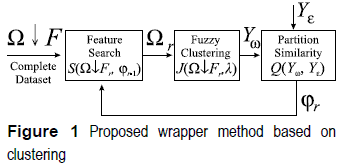
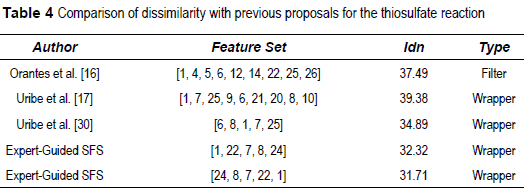
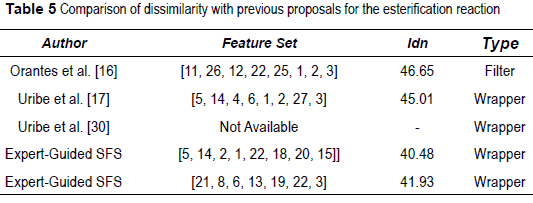
<body><![CDATA[<p>&nbsp;</p>     <p><font size="3"><b>Introduction</b></font></p>      <p>Large volumes of complex  and high dimensional data available set a barrier for developing efficient  decision support and monitoring systems &#91;1&#93;. Using relevant and informative  variables eases data understanding, classification accuracy and computational efficiency  &#91;2&#93;, &#91;3&#93;, For example, Mukse et al. &#91;4&#93; used the Pareto optimal trade&#8211;off  between the process information that can be obtained and the sensor cost for  the selected process measurements, but a process model is needed. Sikora et al.  &#91;5&#93; designed an effective and efficient genetic algorithm for a wrapper feature  selection method based on Hausdorff distance measure in a supervised manner.  Fraleigth et al. &#91;6&#93; developed a sensor system selection for model-based  real-time optimization. Verron et al. &#91;7&#93; proposed supervised fault diagnosis  with feature selection based on discriminant analysis and mutual information.  Bensch et al. &#91;8&#93; tackled the problem of identifying the features responsible  for success or failure in the manufacturing process in a supervised context.  These methods focus on constructing process models and identify the gap with  the actual system using supervised learning. However, complex processes do not  always have classical models available &#91;9&#93;. Thus, several researchers focused  on the development of robust and reliable monitoring systems based on data  analysis.</p>       <p>Data-based monitoring  systems use measurement's information to identify process behaviors as  functional states or classes. Such information is classified according to its  resemblance with previously classified historical data &#91;10&#93;. However, in  industrial processes, class labels are unknown and most of the knowledge is  held by the expert. Such knowledge constrains knowledge discovery, avoid the  data over fitting problem &#91;11&#93; and describes the relationship between  attributes, categories and correlations among them. The expert judgment  approach may result in an effective feature selection without bias by the  distribution of the training set &#91;12&#93;. Real-life applications require the involvement  of domain experts to validate the allocation of operating states of the process  into classes resulting from clustering. Nevertheless, high dependency upon  expert knowledge is not desirable due to their inability to examine large  amounts of data in a rigorous fashion without the effects of boredom or  frustration &#91;13&#93;. Using computational intelligence techniques seems to be an  alternative to take into account the process expert knowledge. In this context,  techniques that use data artificially labed by the expert are valuable to  diagnosis and classification systems. &#91;14&#93;.</p>       <p>In this paper, a wrapper  feature selection guided by the process expert's knowledge is proposed.  Expert's knowledge is not used for supervised training but as guidance in order  to look for clustering results as similar as the expert data partition  maintaining a cluster structure. The method is applied on fault detection and  monitoring (i.e. classification of the process dynamic in a predefined  functional state) of the 'open plate reactor (OPR.)'' &#91;15, 16&#93; on the  thiosulfate reaction and the esterification reaction.</p>     <p>Next section shows the proposed wrapper framework for feature selection:  feature search, clustering algorithms, clustering quality assessment. Third  section details the open plate reactor application over two chemical reactions  (esterification and thiosulfate). Results are presented in section four. Last  section shows conclusions and future work.</p>      <p>&nbsp;</p>       <p><font size="3"><b>Wrapper feature selection guided by the expert knowledge</b></font></p>          <p>The wrapper methodology &#91;2&#93;,  offers a simple and powerful way to address the problem of variable selection  &#91;17&#93;, regardless of the chosen learning machine or quality subset criterion  &#91;18&#93;. The performance of the induction algorithm guides the search, producing  better results than filter feature selection methods for specific applications  &#91;19&#93;.</p>       <p><a href="#Figura1">Figure 1</a> shows a detailed graphic of the proposed methodology.  Historical data (i.e. database of the process) is defined in the <i>N</i> x <i>n</i> space, as a set &Omega;; <i>N</i> is the number of elements, <i>n</i> is the number of features in the original feature  set <i>F</i> <img src="/img/revistas/rfiua/n65/n65a08e00a.gif"> <img src="/img/revistas/rfiua/n65/n65a09e00a.gif"> and <i>F<sub>r</sub></i> <img src="/img/revistas/rfiua/n65/n65a08e00a.gif"> <img src="/img/revistas/rfiua/n65/n65a09e00a.gif"> with <i>r</i> &le; <i>n</i> represented as &Omega; &darr; <i>F<sub>r</sub></i>. The clustering algorithm partitions the data subset into <i>c</i> clusters, optimizing some metric <i>J</i> over the data. Consider the clustering algorithm as <i>Y</i>=<i>J</i>(&Omega; &darr;&nbsp;<i>F<sub>r</sub></i>, &lambda;)  where &lambda; are the clustering method parameters. Let <i>Y<sub>&omega;</sub><sup>T</sup></i>=&#91;<i>y</i><sub>1</sub>,<i>y</i><sub>2</sub>,&hellip;,<i>y</i><sub>N</sub>&#93;, <i>y</i><sub>i </sub><img src="/img/revistas/rfiua/n65/n65a08e00a.gif">  {1,2,&hellip;,<i>c</i>} be the partition produced by the clustering algorithm and <em>Q</em>(<i>Y<sub>&omega;</sub>, Y<sub>&epsilon;</sub></i>)= <em>&phi;</em> be the performance function that assesses similarity between two  partitions (e.g. expert and clustering partition). The feature search procedure  generates the optimal set of features <i>F<sub>OP</sub></i> by testing different forms of the map &Omega;<i><sub>r</sub></i>=<I>f</I>(&Omega;, &phi;).</p>          ]]></body>
<body><![CDATA[<p align="center"><a name="Figura1"></a><img src="/img/revistas/rfiua/n65/n65a09i01.gif" ></p>          <p><b><i>Feature search</i></b></p>         <p>Finding the optimal  feature subset <i>F<sub>OP</sub></i>  requires either an exhaustive search that involves the evaluation of 2<sup><i>n</i></sup>  subsets (becoming infeasible since<i> n</i>  is large) &#91;19&#93; or the monotonicity of a pertinence measure. Two different  sequential search strategies were implemented to analyze the case study:  Sequential Forward Selection (SFS) and Sequential Backward Elimination (SBE).  SFS starts with the subset <i>F<sub>0</sub></i>, <i>n</i>  partitions are obtained using clustering and its quality is computed. First,  each feature subset includes only one variable. The feature subset &Omega;<sub>1</sub> associated with the  highest quality &phi;, is set to  be the first selected variable in the vector v. Each feature that is not yet  included in <i>v</i> is included and the quality of the <i>n</i> - 1 partitions is computed. The  vector <i>v</i> with two features that led to the highest quality is selected as the  new vector of selected features. These steps are repeated, adding one feature  per iteration until a pre-specified number of characteristics is achieved (e.g.  the total number of characteristics) or a performance criterion is met.  Sequential Backward Elimination makes the search in the opposite direction.  Starting with the full set of features, at each step the features are removed  one by one.</p>          <p><b><i>Clustering algorithm</i></b></p>         <p>Data-based monitoring  systems based on clustering try to find similarities in the process data and  group them into classes that correspond to functional states. The term ''similarity''  should be understood as a mathematical measure of similarity, in some well-defined  sense (e.g. distance based, hierarchy based, possibility based among others).  In crisp clustering, when a data partition is build, a single sample belongs to  only one cluster. The fuzzy clustering extends this notion, and each data  belongs to all clusters with different membership degrees.</p>       <p>In this article the Learning Algorithm for Multivariate Data Analysis  (LAMDA) is used. LAMDA method has been widely used in the literature for the  construction of systems for monitoring industrial processes &#91;14, 16, 17,  20-24&#93;, LAMDA &#91;25&#93; is based on finding the overall adequacy level of each  individual to each class, called Global Adequacy Degree (GAD). The GAD is the  membership degree of each object to each class. Its value is estimated using  the contributions of the features based on a marginal concept of adequacy which  replaces the use of traditional distance approximations. The contribution of  each descriptor is called the Marginal Adequacy Degree (MAD) and it is computed  using a possibility function. The class adequacy concept is expressed as the ''fuzzy''  truth value of a compound sentence using logical connectives between elementary  assertions. Attributes can be numeric, symbolic or mixed (which is an advantage  compared to other fuzzy classifiers that can only handle numeric descriptors).  Also, LAMDA methodology does not require a number of classes to be specified as  parameter, thus, it is capable of producing a data partition estimating the  number of classes based on the data distribution. For a complete description of  the LAMDA methodology see &#91;25, 26&#93;.</p>          <p><b><i>Feature evaluation criteria</i></b></p>         <p>Partitions results are  evaluated comparing the clustering algorithm and the process expert partition.  The expert's partition is not used as classification vector in supervised way  because even though the proposed method looks for producing partitions similar  to the expert proposal, it still looks for finding underlying structures among  data in order to identify similarities in the historical data &#91;27&#93;.</p>       <p>The Index of Dissimilarity <i>Idn</i> proposed by Lopez de Mantaras in &#91;28, 29&#93; allows  to compare two data partitions with different number of classes and it has been  recently used to compare partitions of industrial process &#91;14&#93;. The contingency  matrix is established for two partitions: A (whose classes are denoted (<i>&alpha;</i><sub>1</sub>, <i>&alpha;</i><sub>2</sub>,..., <i>&alpha;</i><sub>i</sub>, ..., <i>&alpha;</i><sub>p</sub>)) and B (whose classes are denoted (<i>b</i><sub>1</sub>,<i>b</i><sub>2</sub>,...,<i>b</i><sub>j</sub>,...,  <i>b</i><sub>r</sub>)). The probabilities corresponding to each class and the probability of the  intersection between a class of A partition and a partition class B are noted  as Eq.1:</p>          <p><img src="/img/revistas/rfiua/n65/n65a09e01.gif"></p>          ]]></body>
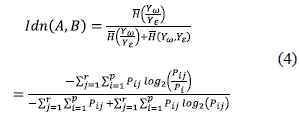
<body><![CDATA[<p>where <i>&alpha;<sub>i</sub></i> <img src="/img/revistas/rfiua/n65/n65a09e00b.gif"> <i>b<sub>i</sub></i> is formed by the elements that belong simultaneously to the  latter class <i>&alpha;<sub>i</sub></i> and class <i>b<sub>i</sub></i>. The probabilities satisfy Eq. 2:</p>          <p><img src="/img/revistas/rfiua/n65/n65a09e02.gif"></p>          <p>The probability of  elements belonging to this class <i>&alpha;<sub>i</sub></i>  and class <i>b<sub>i</sub></i> is  computed with Eq. 3. <i>M</i> is the  cardinality <i>N</i> and the  total number of individuals ordered  <i>M</i>(<i>X</i>).</p>          <p><img src="/img/revistas/rfiua/n65/n65a09e03.gif"></p>          <p>The <i>Idn</i> is zero only if the contingency  matrix is ''almost diagonal'' or ''quasi-diagonalizable'', that is, when the  partitions are either equal or compatible or equal modulo zero. The <i>Idn</i> is estimated from the conditional  information between partitions A and B.</p>         <p>A normalized index of  dissimilarity <i>Idn</i> = <i>&phi;</i> between  the clustering partition <i>Y<sub>&omega;</sub></i> and expert partition <i>Y<sub>&epsilon;</sub></i> is defined in Eq. 4.</p> 	      <p><img src="/img/revistas/rfiua/n65/n65a09e04.gif"></p>        <p>If the partition <i>Y<sub>&omega;</sub></i> is consistent or equal to <i>Y<sub>&epsilon;</sub></i>, <i>Idn</i> = 0 and  <i>Idn</i> = 1 in the opposite case.</p>        <p>&nbsp;</p>        <p><font size="3"><b>Cases studies: Open Plate Reactor -OPR</b></font></p>        ]]></body>
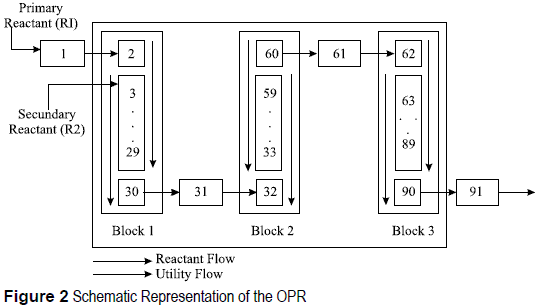
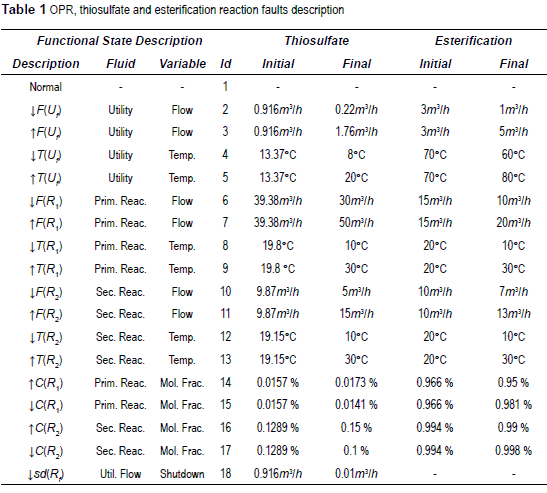
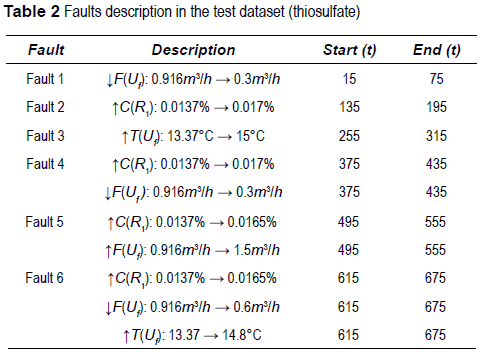
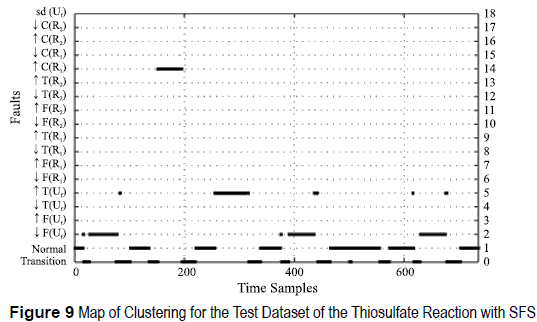
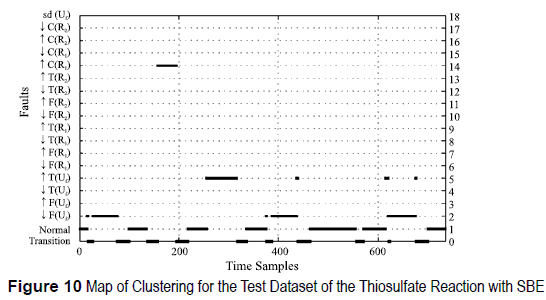
<body><![CDATA[<p>The OPR is a plate heat  exchanger of new design &#91;15&#93;. One side is used as a chemical continuous reactor  while the other side a cooling/heating thermal fluid flows. The primary  reactant <i>R</i><sub>1</sub> flows from the inlet to the outlet of the reactor (see <a href="#Figura2">figure 2</a>).  The secondary reactant R2 can then be injected along the reactor  side with R2 Depending on the reaction, the utility flow is used to  cool (exothermic reaction) or heat (endothermic reaction) the reactor side.</p>        <p align="center"><a name="Figura2"></a><img src="/img/revistas/rfiua/n65/n65a09i02.gif" ></p>        <p><a href="#Figura2">Figure 2</a> shows the  schematic representation of the pilot plant; two feeding loops ensure the  introduction of the reactants in the reactor at normal temperature &#91;15&#93;. The  OPR has 27 available sensor measurements from temperatures and pressures from  different cells of the reactor.</p>      <p>The OPR is studied under two chemical reactions; thiosulfate and  esterification; described below. Failures in the OPR for the thiosulphate  reaction and the esterification reaction were introduced in the process in the  form of disturbances on the main variables: increase and decrease of  temperatures and flows of the utility, primary and secondary reactants and  increase and decrease of the compositions of the primary and secondary  reactants.</p>        <p><b><i>Thiosulphate reaction</i></b></p>        <p>The thiosulphate reaction  has the following characteristics: its stoichiometry and kinetic are known, the  reaction is irreversible, fast and highly exothermic.</p>        <p><a href="#Tabla1">Table 1</a> shows a  description of all functional states over the thiosulfate reaction. The  database used is composed by the measure of the 27 variables with 17 simulated  faults over 2076 time samples. The reaction scheme is in Eq. 5:</p>        <p><img src="/img/revistas/rfiua/n65/n65a09e05.gif"></p>      <p align="center"><a name="Tabla1"></a><img src="/img/revistas/rfiua/n65/n65a09t01.gif" ></p>          <p>In order to validate the  generated model using just the selected subset of sensors (the selected features),  a test database with 735 new samples described only by the selected features  was simulated. Six new faults were induced in the test dataset as described in  <a href="#Tabla2">table 2</a>.</p>        ]]></body>
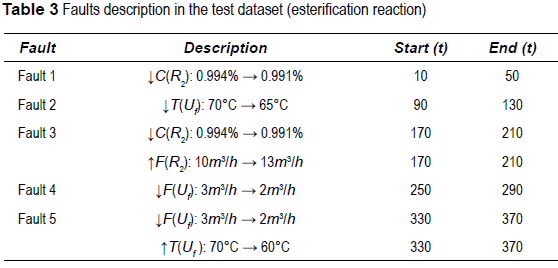
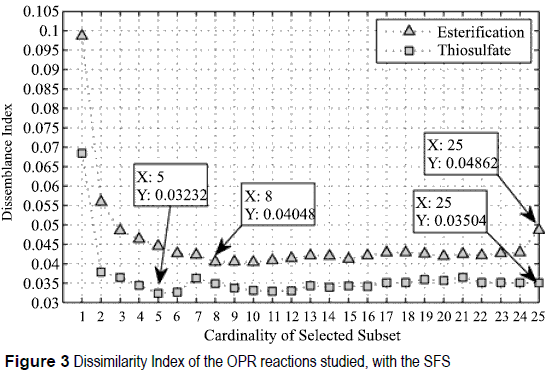
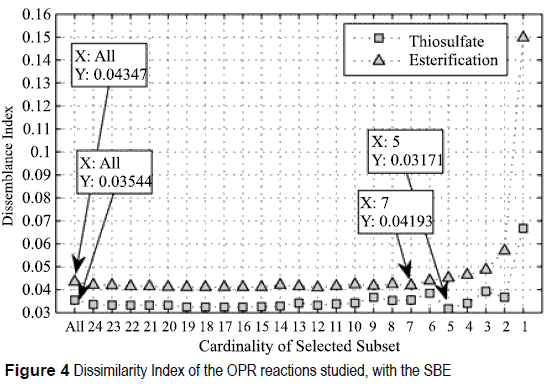
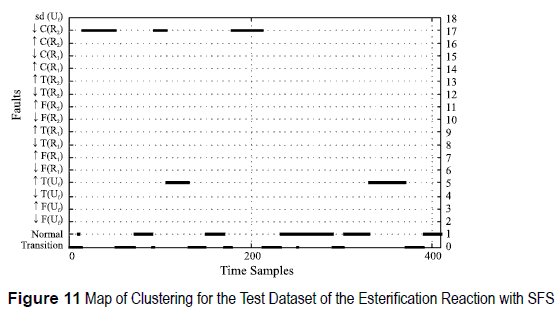
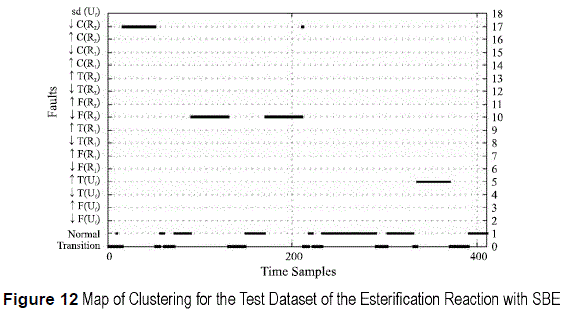
<body><![CDATA[<p align="center"><a name="Tabla2"></a><img src="/img/revistas/rfiua/n65/n65a09t02.gif" ></p>        <p><b><i>Estertification reaction</i></b></p>        <p>The esterification  reaction is slow and weakly exothermic. To accelerate it, it is necessary to  heat the reaction medium. In this case, the utility flow serves as fluid  heating. In total, 16 faults have been applied to the reactor. Failures in the  OPR are disturbances on the temperatures and flow rates of main reactantO (<i>C<sub>4</sub>H<sub>8</sub>O</i>)  secondary or injected reactant (<i>C<sub>6</sub>H<sub>10</sub>O<sub>3</sub></i>),  cooling system (utility), and composition in primary and secondary reagents,  see <a href="#Tabla2">table 2</a>.</p>      <p>Validation on the esterification reaction results is made over a test  database consisting of 410 new samples described only by the selected feature  was simulated. Five new faults were induced in the test dataset as described in  <a href="#Tabla3">table 3</a>.</p>        <p align="center"><a name="Tabla3"></a><img src="/img/revistas/rfiua/n65/n65a09t03.gif" ></p>        <p>&nbsp;</p>        <p><font size="3"><b>Experimental results and discussion</b></font></p>        <p>Variables representing input pressures for primary  and secondary reactants were eliminated since they are constant. Feature  selection is applied to the remaining 25 variables. The data subset associated  with the lowest <i>Idn</i> value is represented by the set of features that minimize the  dissemblance between the partition produced by the clustering algorithm and the  partition proposed by the expert knowledge. For the thiosulfate reaction, the  feature set <i>f<sup> t</sup><sub>SFS</sub></i> (<i>5</i>) =  {<i>1,22,7,8,24</i>} and <i>f<sup> t</sup><sub>SBE</sub></i> (<i>5</i>) =  {<i>24,8, 7,22,1</i>} are selected as the best set  of features reaching <i>Idn</i> = 0.03232 and <i>Idn</i> = 0.03171 respectively, see <a href="#Figura3">figure 3</a>. For the  esterification reaction, features sets <i>f<sup> e</sup><sub>SFS </sub></i>(<i>8</i>) =  {<i>5,14,2,1,22,18,20,15</i>} and <i>f<sup> e</sup><sub>SBE </sub></i>(<i>7</i>)  = {<i>21,8,6,13,19,22,3</i>} with dissemblance index values  of <i>Idn</i> = 0.04048 and <i>Idn</i> = 0.04193, see <a href="#Figura4">figure 4</a>.</p>        <p align="center"><a name="Figura3"></a><img src="/img/revistas/rfiua/n65/n65a09i03.gif" ></p>      <p align="center"><a name="Figura4"></a><img src="/img/revistas/rfiua/n65/n65a09i04.gif" ></p>        ]]></body>
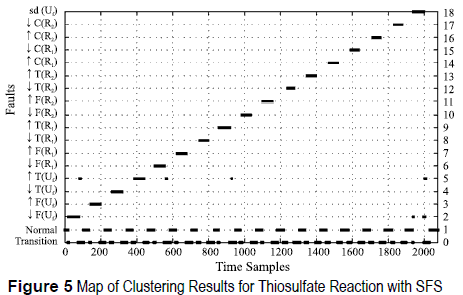
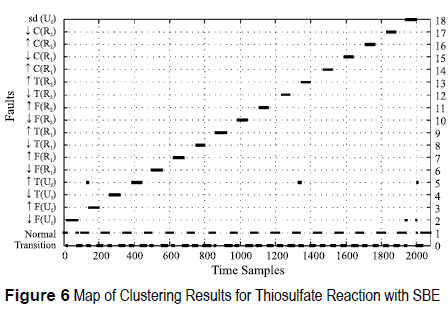
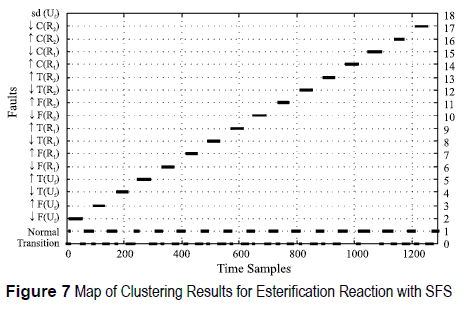
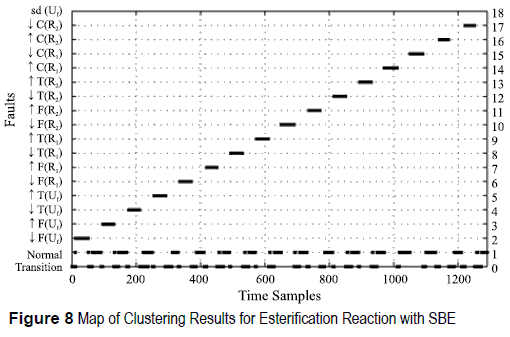
<body><![CDATA[<p><a href="#Figura5">Figures 5</a>, <a href="#Figura6">6</a>, <a href="#Figura7">7</a> and <a href="#Figura8">8</a> show the classification  results of the training datasets when using just the selected features. The  monitoring system identifies all functional states for both chemical reactions  studied, with similar results for SFS and SBE. Additionally, a new class is  defined, the transition class. This class represents a deviation from the  Normal state and it is not included by the process expert. False alarms appears  at the end of some faults, most of them are misclassification with the increase  of Temperature of the Utility Flow &uarr;<i>T</i>(<i>U<sub>f</sub></i>)  since the utility flow acts as temperature regulation and influences directly  all functional states.</p>        <p align="center"><a name="Figura5"></a><img src="/img/revistas/rfiua/n65/n65a09i05.gif" ></p>      <p align="center"><a name="Figura6"></a><img src="/img/revistas/rfiua/n65/n65a09i06.gif" ></p>      <p align="center"><a name="Figura7"></a><img src="/img/revistas/rfiua/n65/n65a09i07.gif" ></p>      <p align="center"><a name="Figura8"></a><img src="/img/revistas/rfiua/n65/n65a09i08.gif" ></p>        <p>The resulting classifiers  are tested on validation datasets, obtaining the results shown in <a href="#Figura9">figures 9 </a>, <a href="#Figura10">10</a>, <a href="#Figura11">11</a> and <a href="#Figura12">12</a>. For the thiosulfate reaction, when using SFS, the first three  single disturbances are correctly identified. The classifier is able to identify  the fault when several disturbances are presented simultaneously. Perturbation  5 is classified as normal because the combined effect of both perturbations  cancels out. The reactor is fed with more primary reactant, but the utility  fluid cools more, which corresponds to a normal operating state. For the  esterification reaction both procedures, SFS and SBE, produce different sets of  features. Fault 4 is identified as normal in both cases, since the  esterification reaction is very exothermic, so the impact of such small  variation does not affect la reaction. In the SBE search, the second  perturbation corresponding to &darr;<i>T</i>(<i>U<sub>f</sub></i>), is  misclassified with functional state &uarr;<i>F</i>(<i>R<sub>2</sub></i>) this  is because a decrease on the utility fluid temperature increases the  temperature of the reaction, and this increase appears when there is an  increase of flow of the Secondary Reactant.</p>        <p align="center"><a name="Figura9"></a><img src="/img/revistas/rfiua/n65/n65a09i09.gif" ></p>      <p align="center"><a name="Figura10"></a><img src="/img/revistas/rfiua/n65/n65a09i10.gif" ></p>      <p align="center"><a name="Figura11"></a><img src="/img/revistas/rfiua/n65/n65a09i11.gif" ></p>      <p align="center"><a name="Figura12"></a><img src="/img/revistas/rfiua/n65/n65a09i12.gif" ></p>        ]]></body>
<body><![CDATA[<p>Previously in &#91;16&#93;, the  authors proposed a ranking method based on information-theoretic measures to  evaluate the amount of information within each variable to select the most  informative ones. Additionally, &#91;17&#93; and &#91;30&#93; explore wrapper approaches for  unsupervised feature selection. <a href="#Tabla4">Tables 4</a> and <a href="#Tabla5">5</a> show a comparison of previous  feature selection results on the same process showing a better performance,  with lower Idn value.</p>        <p align="center"><a name="Tabla4"></a><img src="/img/revistas/rfiua/n65/n65a09t04.gif" ></p>      <p align="center"><a name="Tabla5"></a><img src="/img/revistas/rfiua/n65/n65a09t05.gif" ></p>        <p>&nbsp;</p>        <p><font size="3"><b>Conclusions and future work</b> </font></p>         <p>An expert-guided wrapper  for feature selection on data-based industrial process monitoring is presented.  Expert knowledge is incorporated in the feature search to look for a subset of  features able to represent the expert knowledge, but not in a supervised way,  since it is important to take into account the data structure itself.  Sequential Forward Selection (SFS) and Sequential Backward Elimination (SBE)  were used as search methods, coupled with LAMDA as clustering algorithm and the  Index of Dissimilarity to assess the cluster quality measure comparing the  expert-&#8211;knowledge partition with the clustering results.</p>        <p>The proposed methodology  was successfully applied to a complex industrial process known as the Open  Plate Reactor (OPR), on the thiosulfate and the esterification reaction. The  objective was identify abnormal behaviors in the process when using relative  simple sensor (temperature), even though some states concerns changes on flow  composition of primary and secondary reactants. First, using a training data  set, the subset of feature is selected and a behavioral model is constructed  using just the reduced set of features. Then, the generated model was tested on  a validation data set consisting of perturbations different than those used in  training, including simultaneous faults. In both cases, the proposed approach  was able to select a set of features capable of generating a behavioral model  robust enough to identify not only all functional states on the train data set  but correctly identify faults on the test dataset.</p>      <p>The proposed procedure was compared with previous approaches dealing  with the same chemical reactions. A fewer number of features were needed to  correctly identify all the functional states of the complex chemical process.  The feature subset shows a good response and performance since the index of  dissimilarity was lower than other approaches, indicating a high similarity  with the expert-knowledge proposal. The main improvement of this methodology is  introducing the unsupervised learning and expert guidance in the search  process. The use of a non-iterative clustering algorithm leads to fast  performance on the search over the feature subset space. Even though some  specific methods were used at each block of the wrapper, the presented  framework can be applied to any clustering method. Future work will consist in  comparing different methods of feature selection, clustering, cluster quality  and partition comparing to determine which among the methods proposed in the  literature has better performance on specific applications.</p>        <p>&nbsp;</p>      <p><font size="3"><b>Acknowledgement</b> </font></p>      ]]></body>
<body><![CDATA[<p>Thanks to Dr. A. Orantes  and DISCO Group at LAAS/CNRS for the access to the OPR databases. Thanks to  CODI-Universidad de Antioquia and COLCIENCIAS for financial support.</p>      <p>&nbsp;</p>      <p><font size="3"><b>References</b> </font></p>      <!-- ref --><p>1. F. Akbaryan, P. Bishnoi. ''Fault diagnosis of multivariate systems  using pattern recognition and multisensor data analysis technique''. <i>Computers &amp; Chemical  Engineering</i>. Vol. 25. 2001. pp. 1313-1339.    &nbsp;&nbsp;&nbsp;&nbsp;&nbsp;&nbsp;&nbsp;&nbsp;[&#160;<a href="javascript:void(0);" onclick="javascript: window.open('/scielo.php?script=sci_nlinks&ref=000096&pid=S0120-6230201200040000900001&lng=','','width=640,height=500,resizable=yes,scrollbars=1,menubar=yes,');">Links</a>&#160;]<!-- end-ref --></p>       <!-- ref --><p>2. I. Guyon, S. Gunn, M. Nikravesh, L.  Zadeh. ''Feature  Extraction: Foundations and Applications''  <i>Studies in Fuzziness and Soft Computing</i>. Vol. 207. pp. 1-22.    &nbsp;&nbsp;&nbsp;&nbsp;&nbsp;&nbsp;&nbsp;&nbsp;[&#160;<a href="javascript:void(0);" onclick="javascript: window.open('/scielo.php?script=sci_nlinks&ref=000098&pid=S0120-6230201200040000900002&lng=','','width=640,height=500,resizable=yes,scrollbars=1,menubar=yes,');">Links</a>&#160;]<!-- end-ref --></p>       <!-- ref --><p>3. D. Aha, R. Bankert. <i>A comparative evaluation of  sequentialfeature selection algorithms</i>. In Proceedings of the  Fifth International Workshop on Artificial Intelligence and Statistics.  Springer-Verlag. 1995. Fort Lauderdale. USA. pp. 1-7.    &nbsp;&nbsp;&nbsp;&nbsp;&nbsp;&nbsp;&nbsp;&nbsp;[&#160;<a href="javascript:void(0);" onclick="javascript: window.open('/scielo.php?script=sci_nlinks&ref=000100&pid=S0120-6230201200040000900003&lng=','','width=640,height=500,resizable=yes,scrollbars=1,menubar=yes,');">Links</a>&#160;]<!-- end-ref --></p>       <!-- ref --><p>4. K. Muske, C. Georgakis. <i>A methodology for optimal  sensor selection in chemical processes</i>.  Proc. American Control Conference the 2002. Villanova,  Pennsylvania, USA. 2002. pp. 4274-4278.    &nbsp;&nbsp;&nbsp;&nbsp;&nbsp;&nbsp;&nbsp;&nbsp;[&#160;<a href="javascript:void(0);" onclick="javascript: window.open('/scielo.php?script=sci_nlinks&ref=000102&pid=S0120-6230201200040000900004&lng=','','width=640,height=500,resizable=yes,scrollbars=1,menubar=yes,');">Links</a>&#160;]<!-- end-ref --></p>       <!-- ref --><p>5. R. Sikora, S. Piramuthu. ''Efficient genetic  algorithm based data mining using feature selection with hausdorff distance''. <i>Inf. Tech. and Management</i>.  Vol. 6. 2005. pp. 315-331.    &nbsp;&nbsp;&nbsp;&nbsp;&nbsp;&nbsp;&nbsp;&nbsp;[&#160;<a href="javascript:void(0);" onclick="javascript: window.open('/scielo.php?script=sci_nlinks&ref=000104&pid=S0120-6230201200040000900005&lng=','','width=640,height=500,resizable=yes,scrollbars=1,menubar=yes,');">Links</a>&#160;]<!-- end-ref --></p>       <!-- ref --><p>6. L. Fraleigh, M. Guay, J. Forbes. ''Sensor selection  for model-based real-time optimization: relating design of experiments and  design cost''. <i>Journal of Process Control</i>.  Vol. 13. 2003. pp. 667-678.    &nbsp;&nbsp;&nbsp;&nbsp;&nbsp;&nbsp;&nbsp;&nbsp;[&#160;<a href="javascript:void(0);" onclick="javascript: window.open('/scielo.php?script=sci_nlinks&ref=000106&pid=S0120-6230201200040000900006&lng=','','width=640,height=500,resizable=yes,scrollbars=1,menubar=yes,');">Links</a>&#160;]<!-- end-ref --></p>       <!-- ref --><p>7. S. Verron, T. Tiplica, A. Kobi. ''Fault detection and  identification with a new feature selection based on mutual information''. <i>Journal of Process Control</i>.  Vol. 18. 2008. pp. 479-490.    &nbsp;&nbsp;&nbsp;&nbsp;&nbsp;&nbsp;&nbsp;&nbsp;[&#160;<a href="javascript:void(0);" onclick="javascript: window.open('/scielo.php?script=sci_nlinks&ref=000108&pid=S0120-6230201200040000900007&lng=','','width=640,height=500,resizable=yes,scrollbars=1,menubar=yes,');">Links</a>&#160;]<!-- end-ref --></p>       <!-- ref --><p>8. M. Bensch, M. Schroder, M. Bogdan, W.  Rosenstiel. <i>Feature selection for  high-dimensional industrial data</i>. Proceeding of the European Symposium  of Artificial Neural Networks. 2005. Brugues, Belgium. pp. 375-380.    &nbsp;&nbsp;&nbsp;&nbsp;&nbsp;&nbsp;&nbsp;&nbsp;[&#160;<a href="javascript:void(0);" onclick="javascript: window.open('/scielo.php?script=sci_nlinks&ref=000110&pid=S0120-6230201200040000900008&lng=','','width=640,height=500,resizable=yes,scrollbars=1,menubar=yes,');">Links</a>&#160;]<!-- end-ref --></p>       <!-- ref --><p>9. T. Kourti. ''Process analysis and abnormal  situation detection: from theory to practice''. <i>Control Systems Magazine IEEE</i>.  Vol. 22. pp. 10-25.    &nbsp;&nbsp;&nbsp;&nbsp;&nbsp;&nbsp;&nbsp;&nbsp;[&#160;<a href="javascript:void(0);" onclick="javascript: window.open('/scielo.php?script=sci_nlinks&ref=000112&pid=S0120-6230201200040000900009&lng=','','width=640,height=500,resizable=yes,scrollbars=1,menubar=yes,');">Links</a>&#160;]<!-- end-ref --></p>       <!-- ref --><p>10. T. Kempowsky. <i>Surveillance de proc&eacute;d&eacute;es &agrave; base de m&eacute;thodes de classification</i>. Ph.D. dissertation. INSA  Toulouse. 2004. pp. 16-20.    &nbsp;&nbsp;&nbsp;&nbsp;&nbsp;&nbsp;&nbsp;&nbsp;[&#160;<a href="javascript:void(0);" onclick="javascript: window.open('/scielo.php?script=sci_nlinks&ref=000114&pid=S0120-6230201200040000900010&lng=','','width=640,height=500,resizable=yes,scrollbars=1,menubar=yes,');">Links</a>&#160;]<!-- end-ref --></p>       <!-- ref --><p>11. P. Domingos. ''The role of Occam's razor in knowledge discovery''.<i> Data Mining and Knowledge  Discovery</i>. Vol. 3. 1999. pp. 409-425.    &nbsp;&nbsp;&nbsp;&nbsp;&nbsp;&nbsp;&nbsp;&nbsp;[&#160;<a href="javascript:void(0);" onclick="javascript: window.open('/scielo.php?script=sci_nlinks&ref=000116&pid=S0120-6230201200040000900011&lng=','','width=640,height=500,resizable=yes,scrollbars=1,menubar=yes,');">Links</a>&#160;]<!-- end-ref --></p>       <!-- ref --><p>12. T. Cheng, C. Wei, V. Tseng. ''Feature selection for  medical data mining: Comparisons of expert judgment and automatic approaches''. <i>Computer-Based Medical Systems</i>.  2006. pp. 165-170.    &nbsp;&nbsp;&nbsp;&nbsp;&nbsp;&nbsp;&nbsp;&nbsp;[&#160;<a href="javascript:void(0);" onclick="javascript: window.open('/scielo.php?script=sci_nlinks&ref=000118&pid=S0120-6230201200040000900012&lng=','','width=640,height=500,resizable=yes,scrollbars=1,menubar=yes,');">Links</a>&#160;]<!-- end-ref --></p>      <!-- ref --><p> 13. B. Bums, A. Danyluk. ''Feature selection vs theory  reformulation: A study of genetic refinement of knowledge-based neural networks''. <i>Mach. Learn</i>. Vol.  38. 2000. pp. 89-107.    &nbsp;&nbsp;&nbsp;&nbsp;&nbsp;&nbsp;&nbsp;&nbsp;[&#160;<a href="javascript:void(0);" onclick="javascript: window.open('/scielo.php?script=sci_nlinks&ref=000120&pid=S0120-6230201200040000900013&lng=','','width=640,height=500,resizable=yes,scrollbars=1,menubar=yes,');">Links</a>&#160;]<!-- end-ref --></p>       <!-- ref --><p>14. C. Isaza.  <i>Diagnostic par techniques d'apprentissage floues: Conception d'une m&eacute;thode de  validation et d'optimisation des partitions</i>. Ph.D.  dissertation. Laboratoire d'Analyse et d'Architecture des Syst&egrave;mes du CNRS.  Toulouse, France. 2007. pp. 5-23.    &nbsp;&nbsp;&nbsp;&nbsp;&nbsp;&nbsp;&nbsp;&nbsp;[&#160;<a href="javascript:void(0);" onclick="javascript: window.open('/scielo.php?script=sci_nlinks&ref=000122&pid=S0120-6230201200040000900014&lng=','','width=640,height=500,resizable=yes,scrollbars=1,menubar=yes,');">Links</a>&#160;]<!-- end-ref --></p>       <!-- ref --><p>15. L. Prat, A. Devatine, P. Cognet, M. Cabassud, C.  Gourdon, S. Elgue, F. Chopard. ''Performance evaluation of a novel concept ''open  plate reactor'' applied to highly exothermic reactions''. <i>Chemical Engineering and  Technology</i>. Vol. 28. 2005. pp. 1028&#8211;1034.    &nbsp;&nbsp;&nbsp;&nbsp;&nbsp;&nbsp;&nbsp;&nbsp;[&#160;<a href="javascript:void(0);" onclick="javascript: window.open('/scielo.php?script=sci_nlinks&ref=000124&pid=S0120-6230201200040000900015&lng=','','width=640,height=500,resizable=yes,scrollbars=1,menubar=yes,');">Links</a>&#160;]<!-- end-ref --></p>      <!-- ref --><p> 16. A. Orantes, T. Kempowsky, M. Lann, L. Prat, S.  Elgue, C. Gourdon, M. Cabassud. ''Selection of sensors by a new methodology  coupling a classification technique and entropy criteria''. <i>Chemical Engineering Research and  Design</i>. Vol. 85. 2007. pp. 825-838.    &nbsp;&nbsp;&nbsp;&nbsp;&nbsp;&nbsp;&nbsp;&nbsp;[&#160;<a href="javascript:void(0);" onclick="javascript: window.open('/scielo.php?script=sci_nlinks&ref=000126&pid=S0120-6230201200040000900016&lng=','','width=640,height=500,resizable=yes,scrollbars=1,menubar=yes,');">Links</a>&#160;]<!-- end-ref --></p>       <!-- ref --><p>17. C. Uribe, C. Isaza, O. Gualdron, C. Duran, A.  Carvajal. <i>A wrapper approach based on  clustering for sensors selection of industrial monitoring systems</i>. Proceedings  of the 2010 International Conference on Broadband. Wireless Computing,  Communication and Applications. Japan. 2010. pp. 428-487.    &nbsp;&nbsp;&nbsp;&nbsp;&nbsp;&nbsp;&nbsp;&nbsp;[&#160;<a href="javascript:void(0);" onclick="javascript: window.open('/scielo.php?script=sci_nlinks&ref=000128&pid=S0120-6230201200040000900017&lng=','','width=640,height=500,resizable=yes,scrollbars=1,menubar=yes,');">Links</a>&#160;]<!-- end-ref --></p>       <!-- ref --><p>18. I. Guyon, A. Elisseeff. ''An introduction to  variable and feature selection''.  <i>J. Mach. Learn. Res</i>. Vol. 3. 2003. pp. 1157-1182.    &nbsp;&nbsp;&nbsp;&nbsp;&nbsp;&nbsp;&nbsp;&nbsp;[&#160;<a href="javascript:void(0);" onclick="javascript: window.open('/scielo.php?script=sci_nlinks&ref=000130&pid=S0120-6230201200040000900018&lng=','','width=640,height=500,resizable=yes,scrollbars=1,menubar=yes,');">Links</a>&#160;]<!-- end-ref --></p>       <!-- ref --><p>19. S. Guerif, Y. Bennani. ''Selection of clusters  number and features subset during a two-levels clustering task'' <i>Artificial Intelligence and Soft  Computing</i>. 2006. pp. 28-33.    &nbsp;&nbsp;&nbsp;&nbsp;&nbsp;&nbsp;&nbsp;&nbsp;[&#160;<a href="javascript:void(0);" onclick="javascript: window.open('/scielo.php?script=sci_nlinks&ref=000132&pid=S0120-6230201200040000900019&lng=','','width=640,height=500,resizable=yes,scrollbars=1,menubar=yes,');">Links</a>&#160;]<!-- end-ref --></p>       <!-- ref --><p>20. C. Isaza, A. Orantes, T. Kempowsky, M.  Le Lann. <i>Contribution of fuzzy classification  for the diagnosis of complex systems</i>. The 7<sup>th</sup> IFAC International Symposium  of Fault Detection. Supervision and Safety of Technical Processes. 2009.  Barcelona, Espa&ntilde;a. pp. 1132-1137.    &nbsp;&nbsp;&nbsp;&nbsp;&nbsp;&nbsp;&nbsp;&nbsp;[&#160;<a href="javascript:void(0);" onclick="javascript: window.open('/scielo.php?script=sci_nlinks&ref=000134&pid=S0120-6230201200040000900020&lng=','','width=640,height=500,resizable=yes,scrollbars=1,menubar=yes,');">Links</a>&#160;]<!-- end-ref --></p>       <!-- ref --><p>21. T. Kempowsky, A. Subias, J. Aguilar-Martin. ''Process  situation assessment: From a fuzzy partition to a finite state machine''. <i>Engineering Applications of  Artificial Intelligence</i>. Vol. 19. 2006. pp. 461-477.    &nbsp;&nbsp;&nbsp;&nbsp;&nbsp;&nbsp;&nbsp;&nbsp;[&#160;<a href="javascript:void(0);" onclick="javascript: window.open('/scielo.php?script=sci_nlinks&ref=000136&pid=S0120-6230201200040000900021&lng=','','width=640,height=500,resizable=yes,scrollbars=1,menubar=yes,');">Links</a>&#160;]<!-- end-ref --></p>       <!-- ref --><p>22. J. Aguilar, C. Isaza, E. Diez, M. LeLann, J.  Waissman. ''Process Monitoring Using Residuals and Fuzzy Classification with  Learning Capabilities''. <em>Advances in Soft Computing</em>.  Vol. 42. 2007. pp. 275-284&nbsp;&nbsp;&nbsp;&nbsp;&nbsp;&nbsp;&nbsp;&nbsp;[&#160;<a href="javascript:void(0);" onclick="javascript: window.open('/scielo.php?script=sci_nlinks&ref=000138&pid=S0120-6230201200040000900022&lng=','','width=640,height=500,resizable=yes,scrollbars=1,menubar=yes,');">Links</a>&#160;]<!-- end-ref --><!-- ref --><p>23. C. Isaza, M. Lann, J. Aguilar. <i>Diagnosis of chemical  processes by fuzzy clustering methods: New optimization method of partitions</i>. 18<sup>th</sup> European Symposium  on Computer Aided Process Engineering (ESCAPE 10). 2008. pp. 1-6.    &nbsp;&nbsp;&nbsp;&nbsp;&nbsp;&nbsp;&nbsp;&nbsp;[&#160;<a href="javascript:void(0);" onclick="javascript: window.open('/scielo.php?script=sci_nlinks&ref=000139&pid=S0120-6230201200040000900023&lng=','','width=640,height=500,resizable=yes,scrollbars=1,menubar=yes,');">Links</a>&#160;]<!-- end-ref --></p>       <!-- ref --><p>24. A. Orantes.  <i>Methodologie pour le placement des capteurs a base de methodes  de classification en vue du diagnostic</i>. Ph.D. dissertation.  Laboratoire d'Analyse et d'Architecture des Systemes du CNRS. 2005. pp. 29-39.    &nbsp;&nbsp;&nbsp;&nbsp;&nbsp;&nbsp;&nbsp;&nbsp;[&#160;<a href="javascript:void(0);" onclick="javascript: window.open('/scielo.php?script=sci_nlinks&ref=000141&pid=S0120-6230201200040000900024&lng=','','width=640,height=500,resizable=yes,scrollbars=1,menubar=yes,');">Links</a>&#160;]<!-- end-ref --></p>       ]]></body>
<body><![CDATA[<!-- ref --><p>25. J. Aguilar, R. deMantaras. <i>The process of classification and  learning the meaning of linguistic descriptors of concepts</i>.  Approximate Reasoning in Decision Analysis. 1982. M.M. Gupta et E. Sanchez  (eds.) North Holland. pp. 165-175.    &nbsp;&nbsp;&nbsp;&nbsp;&nbsp;&nbsp;&nbsp;&nbsp;[&#160;<a href="javascript:void(0);" onclick="javascript: window.open('/scielo.php?script=sci_nlinks&ref=000143&pid=S0120-6230201200040000900025&lng=','','width=640,height=500,resizable=yes,scrollbars=1,menubar=yes,');">Links</a>&#160;]<!-- end-ref --></p>       <!-- ref --><p>26. J. Aguado, J. Aguilar. <i>A mixed  qualitative-quantitative selfleaniing classification technique applied to diagnosis</i>. QR'99 The Thirteenth International Workshop  on Qualitative Reasoning.  1999. Loch Awe. pp. 124-128.    &nbsp;&nbsp;&nbsp;&nbsp;&nbsp;&nbsp;&nbsp;&nbsp;[&#160;<a href="javascript:void(0);" onclick="javascript: window.open('/scielo.php?script=sci_nlinks&ref=000145&pid=S0120-6230201200040000900026&lng=','','width=640,height=500,resizable=yes,scrollbars=1,menubar=yes,');">Links</a>&#160;]<!-- end-ref --></p>       <!-- ref --><p>27. X. Nguyen, J. Epps, J. Bailey. <i>Information theoretic  measures for clustering comparison: is a correction for chance necessary?</i> ICML. New York, USA. 2009. pp. 135.    &nbsp;&nbsp;&nbsp;&nbsp;&nbsp;&nbsp;&nbsp;&nbsp;[&#160;<a href="javascript:void(0);" onclick="javascript: window.open('/scielo.php?script=sci_nlinks&ref=000147&pid=S0120-6230201200040000900027&lng=','','width=640,height=500,resizable=yes,scrollbars=1,menubar=yes,');">Links</a>&#160;]<!-- end-ref --></p>       <!-- ref --><p>28. R. Mantaras. ''A distance-based attribute  selection measure for decision tree induction''. <i>Mach. Learn.</i>. Vol.  6. 1991. pp. 81-92.    &nbsp;&nbsp;&nbsp;&nbsp;&nbsp;&nbsp;&nbsp;&nbsp;[&#160;<a href="javascript:void(0);" onclick="javascript: window.open('/scielo.php?script=sci_nlinks&ref=000149&pid=S0120-6230201200040000900028&lng=','','width=640,height=500,resizable=yes,scrollbars=1,menubar=yes,');">Links</a>&#160;]<!-- end-ref --></p>       <!-- ref --><p>29. R. Mantaras. <i>Autoapprentissage d'une  partition: application au classement iteratif de donnees multidimensionelles</i>. Ph.D. dissertation. Univ. Paul  Sabatier. Toulouse. 1979. pp. 20-37.    &nbsp;&nbsp;&nbsp;&nbsp;&nbsp;&nbsp;&nbsp;&nbsp;[&#160;<a href="javascript:void(0);" onclick="javascript: window.open('/scielo.php?script=sci_nlinks&ref=000151&pid=S0120-6230201200040000900029&lng=','','width=640,height=500,resizable=yes,scrollbars=1,menubar=yes,');">Links</a>&#160;]<!-- end-ref --></p>     ]]></body>
<body><![CDATA[<!-- ref --><p>30. C. Uribe, C. Isaza. <i>Unsupervised feature selection based on fuzzy partition optimization  for industrial processes monitoring</i>.  Proccedings of the 2011 IEEE International Conference on Computational  Intelligence for Measurement Systems and Applications. 2011. Ottawa, pp 1-5.    &nbsp;&nbsp;&nbsp;&nbsp;&nbsp;&nbsp;&nbsp;&nbsp;[&#160;<a href="javascript:void(0);" onclick="javascript: window.open('/scielo.php?script=sci_nlinks&ref=000153&pid=S0120-6230201200040000900030&lng=','','width=640,height=500,resizable=yes,scrollbars=1,menubar=yes,');">Links</a>&#160;]<!-- end-ref --></p>      <p>&nbsp;</p>       <p>&nbsp;</p>     <p>&nbsp;</p>         ]]></body><back>
<ref-list>
<ref id="B1">
<label>1</label><nlm-citation citation-type="journal">
<person-group person-group-type="author">
<name>
<surname><![CDATA[Akbaryan]]></surname>
<given-names><![CDATA[F]]></given-names>
</name>
<name>
<surname><![CDATA[Bishnoi]]></surname>
<given-names><![CDATA[P]]></given-names>
</name>
</person-group>
<article-title xml:lang="en"><![CDATA[Fault diagnosis of multivariate systems using pattern recognition and multisensor data analysis technique]]></article-title>
<source><![CDATA[Computers & Chemical Engineering]]></source>
<year>2001</year>
<volume>25</volume>
<page-range>1313-1339</page-range></nlm-citation>
</ref>
<ref id="B2">
<label>2</label><nlm-citation citation-type="journal">
<person-group person-group-type="author">
<name>
<surname><![CDATA[Guyon]]></surname>
<given-names><![CDATA[I.]]></given-names>
</name>
<name>
<surname><![CDATA[Gunn]]></surname>
<given-names><![CDATA[S.]]></given-names>
</name>
<name>
<surname><![CDATA[Nikravesh]]></surname>
<given-names><![CDATA[M.]]></given-names>
</name>
<name>
<surname><![CDATA[Zadeh]]></surname>
<given-names><![CDATA[L.]]></given-names>
</name>
</person-group>
<article-title xml:lang="en"><![CDATA[Feature Extraction: Foundations and Applications]]></article-title>
<source><![CDATA[Studies in Fuzziness and Soft Computing]]></source>
<year></year>
<volume>207</volume>
<page-range>1-22</page-range></nlm-citation>
</ref>
<ref id="B3">
<label>3</label><nlm-citation citation-type="book">
<person-group person-group-type="author">
<name>
<surname><![CDATA[Aha]]></surname>
<given-names><![CDATA[D.]]></given-names>
</name>
<name>
<surname><![CDATA[Bankert]]></surname>
<given-names><![CDATA[R.]]></given-names>
</name>
</person-group>
<article-title xml:lang="en"><![CDATA[A comparative evaluation of sequentialfeature selection algorithms]]></article-title>
<source><![CDATA[In Proceedings of the Fifth International Workshop on Artificial Intelligence and Statistics]]></source>
<year>1995</year>
<page-range>1-7</page-range><publisher-loc><![CDATA[Fort Lauderdale ]]></publisher-loc>
<publisher-name><![CDATA[Springer-Verlag]]></publisher-name>
</nlm-citation>
</ref>
<ref id="B4">
<label>4</label><nlm-citation citation-type="">
<person-group person-group-type="author">
<name>
<surname><![CDATA[Muske]]></surname>
<given-names><![CDATA[K]]></given-names>
</name>
<name>
<surname><![CDATA[Georgakis]]></surname>
<given-names><![CDATA[C.]]></given-names>
</name>
</person-group>
<source><![CDATA[A methodology for optimal sensor selection in chemical processes]]></source>
<year>2002</year>
<page-range>4274-4278</page-range><publisher-loc><![CDATA[Villanova^ePennsylvania Pennsylvania]]></publisher-loc>
</nlm-citation>
</ref>
<ref id="B5">
<label>5</label><nlm-citation citation-type="journal">
<person-group person-group-type="author">
<name>
<surname><![CDATA[Sikora]]></surname>
<given-names><![CDATA[R]]></given-names>
</name>
<name>
<surname><![CDATA[Piramuthu]]></surname>
<given-names><![CDATA[S]]></given-names>
</name>
</person-group>
<article-title xml:lang="en"><![CDATA[Efficient genetic algorithm based data mining using feature selection with hausdorff distance]]></article-title>
<source><![CDATA[Inf. Tech. and Management]]></source>
<year>2005</year>
<volume>6</volume>
<page-range>315-331</page-range></nlm-citation>
</ref>
<ref id="B6">
<label>6</label><nlm-citation citation-type="journal">
<person-group person-group-type="author">
<name>
<surname><![CDATA[Fraleigh]]></surname>
<given-names><![CDATA[L]]></given-names>
</name>
<name>
<surname><![CDATA[Guay]]></surname>
<given-names><![CDATA[M]]></given-names>
</name>
<name>
<surname><![CDATA[Forbes]]></surname>
<given-names><![CDATA[J]]></given-names>
</name>
</person-group>
<article-title xml:lang="en"><![CDATA[Sensor selection for model-based real-time optimization: relating design of experiments and design cost]]></article-title>
<source><![CDATA[Journal of Process Control]]></source>
<year>2003</year>
<volume>13</volume>
<page-range>667-678</page-range></nlm-citation>
</ref>
<ref id="B7">
<label>7</label><nlm-citation citation-type="journal">
<person-group person-group-type="author">
<name>
<surname><![CDATA[Verron]]></surname>
<given-names><![CDATA[S]]></given-names>
</name>
<name>
<surname><![CDATA[Tiplica]]></surname>
<given-names><![CDATA[T]]></given-names>
</name>
<name>
<surname><![CDATA[Kobi]]></surname>
<given-names><![CDATA[A]]></given-names>
</name>
</person-group>
<article-title xml:lang="en"><![CDATA[Fault detection and identification with a new feature selection based on mutual information]]></article-title>
<source><![CDATA[Journal of Process Control]]></source>
<year>2008</year>
<volume>18</volume>
<page-range>479-490</page-range></nlm-citation>
</ref>
<ref id="B8">
<label>8</label><nlm-citation citation-type="">
<person-group person-group-type="author">
<name>
<surname><![CDATA[Bensch]]></surname>
<given-names><![CDATA[M.]]></given-names>
</name>
<name>
<surname><![CDATA[Schroder]]></surname>
<given-names><![CDATA[M.]]></given-names>
</name>
<name>
<surname><![CDATA[Bogdan]]></surname>
<given-names><![CDATA[M.]]></given-names>
</name>
<name>
<surname><![CDATA[Rosenstiel]]></surname>
<given-names><![CDATA[W.]]></given-names>
</name>
</person-group>
<source><![CDATA[Feature selection for high-dimensional industrial data]]></source>
<year>2005</year>
<page-range>375-380</page-range><publisher-loc><![CDATA[Brugues ]]></publisher-loc>
</nlm-citation>
</ref>
<ref id="B9">
<label>9</label><nlm-citation citation-type="journal">
<person-group person-group-type="author">
<name>
<surname><![CDATA[Kourti]]></surname>
<given-names><![CDATA[T.]]></given-names>
</name>
</person-group>
<article-title xml:lang="en"><![CDATA[''Process analysis and abnormal situation detection: from theory to practice'']]></article-title>
<source><![CDATA[Control Systems Magazine IEEE]]></source>
<year></year>
<volume>22</volume>
<page-range>10-25</page-range></nlm-citation>
</ref>
<ref id="B10">
<label>10</label><nlm-citation citation-type="">
<person-group person-group-type="author">
<name>
<surname><![CDATA[Kempowsky]]></surname>
<given-names><![CDATA[T.]]></given-names>
</name>
</person-group>
<source><![CDATA[Surveillance de procédées à base de méthodes de classification]]></source>
<year>2004</year>
<page-range>16-20</page-range></nlm-citation>
</ref>
<ref id="B11">
<label>11</label><nlm-citation citation-type="journal">
<person-group person-group-type="author">
<name>
<surname><![CDATA[Domingos]]></surname>
<given-names><![CDATA[P]]></given-names>
</name>
</person-group>
<article-title xml:lang="en"><![CDATA[The role of Occam's razor in knowledge discovery]]></article-title>
<source><![CDATA[Data Mining and Knowledge Discovery]]></source>
<year>1999</year>
<volume>3</volume>
<page-range>409-425</page-range></nlm-citation>
</ref>
<ref id="B12">
<label>12</label><nlm-citation citation-type="journal">
<person-group person-group-type="author">
<name>
<surname><![CDATA[Cheng]]></surname>
<given-names><![CDATA[T.]]></given-names>
</name>
<name>
<surname><![CDATA[Wei]]></surname>
<given-names><![CDATA[C.]]></given-names>
</name>
<name>
<surname><![CDATA[Tseng]]></surname>
<given-names><![CDATA[V.]]></given-names>
</name>
</person-group>
<article-title xml:lang="en"><![CDATA[''Feature selection for medical data mining: Comparisons of expert judgment and automatic approaches'']]></article-title>
<source><![CDATA[Computer-Based Medical Systems]]></source>
<year>2006</year>
<page-range>165-170</page-range></nlm-citation>
</ref>
<ref id="B13">
<label>13</label><nlm-citation citation-type="journal">
<person-group person-group-type="author">
<name>
<surname><![CDATA[Bums]]></surname>
<given-names><![CDATA[B]]></given-names>
</name>
<name>
<surname><![CDATA[Danyluk]]></surname>
<given-names><![CDATA[A]]></given-names>
</name>
</person-group>
<article-title xml:lang="en"><![CDATA[Feature selection vs theory reformulation: A study of genetic refinement of knowledge-based neural networks]]></article-title>
<source><![CDATA[Mach. Learn]]></source>
<year>2000</year>
<volume>38</volume>
<page-range>89-107</page-range></nlm-citation>
</ref>
<ref id="B14">
<label>14</label><nlm-citation citation-type="">
<person-group person-group-type="author">
<name>
<surname><![CDATA[Isaza]]></surname>
<given-names><![CDATA[C.]]></given-names>
</name>
</person-group>
<source><![CDATA[Diagnostic par techniques d'apprentissage floues: Conception d'une méthode de validation et d'optimisation des partitions]]></source>
<year>2007</year>
<page-range>5-23</page-range><publisher-loc><![CDATA[Toulouse ]]></publisher-loc>
</nlm-citation>
</ref>
<ref id="B15">
<label>15</label><nlm-citation citation-type="journal">
<person-group person-group-type="author">
<name>
<surname><![CDATA[Prat]]></surname>
<given-names><![CDATA[L]]></given-names>
</name>
<name>
<surname><![CDATA[Devatine]]></surname>
<given-names><![CDATA[A]]></given-names>
</name>
<name>
<surname><![CDATA[Cognet]]></surname>
<given-names><![CDATA[P]]></given-names>
</name>
<name>
<surname><![CDATA[Cabassud]]></surname>
<given-names><![CDATA[M]]></given-names>
</name>
<name>
<surname><![CDATA[Gourdon]]></surname>
<given-names><![CDATA[C]]></given-names>
</name>
<name>
<surname><![CDATA[Elgue]]></surname>
<given-names><![CDATA[S]]></given-names>
</name>
<name>
<surname><![CDATA[Chopard]]></surname>
<given-names><![CDATA[F]]></given-names>
</name>
</person-group>
<article-title xml:lang="en"><![CDATA[Performance evaluation of a novel concept ''open plate reactor'' applied to highly exothermic reactions]]></article-title>
<source><![CDATA[Chemical Engineering and Technology]]></source>
<year>2005</year>
<volume>28</volume>
<page-range>1028-1034</page-range></nlm-citation>
</ref>
<ref id="B16">
<label>16</label><nlm-citation citation-type="journal">
<person-group person-group-type="author">
<name>
<surname><![CDATA[Orantes]]></surname>
<given-names><![CDATA[A]]></given-names>
</name>
<name>
<surname><![CDATA[Kempowsky]]></surname>
<given-names><![CDATA[T]]></given-names>
</name>
<name>
<surname><![CDATA[Lann]]></surname>
<given-names><![CDATA[M]]></given-names>
</name>
<name>
<surname><![CDATA[Prat]]></surname>
<given-names><![CDATA[L]]></given-names>
</name>
<name>
<surname><![CDATA[Elgue]]></surname>
<given-names><![CDATA[S]]></given-names>
</name>
<name>
<surname><![CDATA[Gourdon]]></surname>
<given-names><![CDATA[C]]></given-names>
</name>
<name>
<surname><![CDATA[Cabassud]]></surname>
<given-names><![CDATA[M]]></given-names>
</name>
</person-group>
<article-title xml:lang="en"><![CDATA[Selection of sensors by a new methodology coupling a classification technique and entropy criteria]]></article-title>
<source><![CDATA[Chemical Engineering Research and Design]]></source>
<year>2007</year>
<volume>85</volume>
<page-range>825-838</page-range></nlm-citation>
</ref>
<ref id="B17">
<label>17</label><nlm-citation citation-type="">
<person-group person-group-type="author">
<name>
<surname><![CDATA[Uribe]]></surname>
<given-names><![CDATA[C.]]></given-names>
</name>
<name>
<surname><![CDATA[Isaza]]></surname>
<given-names><![CDATA[C.]]></given-names>
</name>
<name>
<surname><![CDATA[Gualdron]]></surname>
<given-names><![CDATA[O.]]></given-names>
</name>
<name>
<surname><![CDATA[Duran]]></surname>
<given-names><![CDATA[C.]]></given-names>
</name>
<name>
<surname><![CDATA[Carvajal]]></surname>
<given-names><![CDATA[A.]]></given-names>
</name>
</person-group>
<source><![CDATA[A wrapper approach based on clustering for sensors selection of industrial monitoring systems]]></source>
<year>2010</year>
<page-range>428-487</page-range><publisher-loc><![CDATA[Japan ]]></publisher-loc>
</nlm-citation>
</ref>
<ref id="B18">
<label>18</label><nlm-citation citation-type="journal">
<person-group person-group-type="author">
<name>
<surname><![CDATA[Guyon]]></surname>
<given-names><![CDATA[I]]></given-names>
</name>
<name>
<surname><![CDATA[Elisseeff]]></surname>
<given-names><![CDATA[A]]></given-names>
</name>
</person-group>
<article-title xml:lang="en"><![CDATA[An introduction to variable and feature selection]]></article-title>
<source><![CDATA[J. Mach. Learn. Res]]></source>
<year>2003</year>
<volume>3</volume>
<page-range>1157-1182</page-range></nlm-citation>
</ref>
<ref id="B19">
<label>19</label><nlm-citation citation-type="journal">
<person-group person-group-type="author">
<name>
<surname><![CDATA[Guerif]]></surname>
<given-names><![CDATA[S.]]></given-names>
</name>
<name>
<surname><![CDATA[Bennani]]></surname>
<given-names><![CDATA[Y.]]></given-names>
</name>
</person-group>
<article-title xml:lang="en"><![CDATA[''Selection of clusters number and features subset during a two-levels clustering task'']]></article-title>
<source><![CDATA[Artificial Intelligence and Soft Computing]]></source>
<year>2006</year>
<page-range>28-33</page-range></nlm-citation>
</ref>
<ref id="B20">
<label>20</label><nlm-citation citation-type="confpro">
<person-group person-group-type="author">
<name>
<surname><![CDATA[Isaza]]></surname>
<given-names><![CDATA[C.]]></given-names>
</name>
<name>
<surname><![CDATA[Orantes]]></surname>
<given-names><![CDATA[A.]]></given-names>
</name>
<name>
<surname><![CDATA[Kempowsky]]></surname>
<given-names><![CDATA[T.]]></given-names>
</name>
<name>
<surname><![CDATA[Le Lann]]></surname>
<given-names><![CDATA[M.]]></given-names>
</name>
</person-group>
<source><![CDATA[Contribution of fuzzy classification for the diagnosis of complex systems]]></source>
<year></year>
<conf-name><![CDATA[7 IFAC International Symposium of Fault Detection. Supervision and Safety of Technical Processes]]></conf-name>
<conf-date>2009</conf-date>
<conf-loc>Barcelona </conf-loc>
<page-range>1132-1137</page-range></nlm-citation>
</ref>
<ref id="B21">
<label>21</label><nlm-citation citation-type="journal">
<person-group person-group-type="author">
<name>
<surname><![CDATA[Kempowsky]]></surname>
<given-names><![CDATA[T]]></given-names>
</name>
<name>
<surname><![CDATA[Subias]]></surname>
<given-names><![CDATA[A]]></given-names>
</name>
<name>
<surname><![CDATA[Aguilar-Martin]]></surname>
<given-names><![CDATA[J]]></given-names>
</name>
</person-group>
<article-title xml:lang="en"><![CDATA[Process situation assessment: From a fuzzy partition to a finite state machine]]></article-title>
<source><![CDATA[Engineering Applications of Artificial Intelligence]]></source>
<year>2006</year>
<volume>19</volume>
<page-range>461-477</page-range></nlm-citation>
</ref>
<ref id="B22">
<label>22</label><nlm-citation citation-type="journal">
<person-group person-group-type="author">
<name>
<surname><![CDATA[Aguilar]]></surname>
<given-names><![CDATA[J]]></given-names>
</name>
<name>
<surname><![CDATA[Isaza]]></surname>
<given-names><![CDATA[C]]></given-names>
</name>
<name>
<surname><![CDATA[Diez]]></surname>
<given-names><![CDATA[E]]></given-names>
</name>
<name>
<surname><![CDATA[LeLann]]></surname>
<given-names><![CDATA[M]]></given-names>
</name>
<name>
<surname><![CDATA[Waissman]]></surname>
<given-names><![CDATA[J]]></given-names>
</name>
</person-group>
<article-title xml:lang="en"><![CDATA[Process Monitoring Using Residuals and Fuzzy Classification with Learning Capabilities]]></article-title>
<source><![CDATA[Advances in Soft Computing]]></source>
<year>2007</year>
<volume>42</volume>
<page-range>275-284</page-range></nlm-citation>
</ref>
<ref id="B23">
<label>23</label><nlm-citation citation-type="confpro">
<person-group person-group-type="author">
<name>
<surname><![CDATA[Isaza]]></surname>
<given-names><![CDATA[C.]]></given-names>
</name>
<name>
<surname><![CDATA[Lann]]></surname>
<given-names><![CDATA[M.]]></given-names>
</name>
<name>
<surname><![CDATA[Aguilar]]></surname>
<given-names><![CDATA[J.]]></given-names>
</name>
</person-group>
<source><![CDATA[Diagnosis of chemical processes by fuzzy clustering methods: New optimization method of partitions]]></source>
<year></year>
<conf-name><![CDATA[18 European Symposium on Computer Aided Process Engineering (ESCAPE 10)]]></conf-name>
<conf-date>2008</conf-date>
<conf-loc> </conf-loc>
<page-range>1-6</page-range></nlm-citation>
</ref>
<ref id="B24">
<label>24</label><nlm-citation citation-type="">
<person-group person-group-type="author">
<name>
<surname><![CDATA[Orantes]]></surname>
<given-names><![CDATA[A.]]></given-names>
</name>
</person-group>
<source><![CDATA[Methodologie pour le placement des capteurs a base de methodes de classification en vue du diagnostic]]></source>
<year>2005</year>
<page-range>29-39</page-range></nlm-citation>
</ref>
<ref id="B25">
<label>25</label><nlm-citation citation-type="">
<person-group person-group-type="author">
<name>
<surname><![CDATA[Aguilar]]></surname>
<given-names><![CDATA[J.]]></given-names>
</name>
<name>
<surname><![CDATA[deMantaras]]></surname>
<given-names><![CDATA[R.]]></given-names>
</name>
</person-group>
<source><![CDATA[The process of classification and learning the meaning of linguistic descriptors of concepts]]></source>
<year></year>
<page-range>165-175</page-range><publisher-loc><![CDATA[North Holland ]]></publisher-loc>
</nlm-citation>
</ref>
<ref id="B26">
<label>26</label><nlm-citation citation-type="">
<person-group person-group-type="author">
<name>
<surname><![CDATA[Aguado]]></surname>
<given-names><![CDATA[J.]]></given-names>
</name>
<name>
<surname><![CDATA[Aguilar]]></surname>
<given-names><![CDATA[J.]]></given-names>
</name>
</person-group>
<source><![CDATA[A mixed qualitative-quantitative selfleaniing classification technique applied to diagnosis]]></source>
<year>1999</year>
<page-range>124-128</page-range></nlm-citation>
</ref>
<ref id="B27">
<label>27</label><nlm-citation citation-type="book">
<person-group person-group-type="author">
<name>
<surname><![CDATA[Nguyen]]></surname>
<given-names><![CDATA[X.]]></given-names>
</name>
<name>
<surname><![CDATA[Epps]]></surname>
<given-names><![CDATA[J.]]></given-names>
</name>
<name>
<surname><![CDATA[Bailey]]></surname>
<given-names><![CDATA[J.]]></given-names>
</name>
</person-group>
<source><![CDATA[Information theoretic measures for clustering comparison: is a correction for chance necessary?]]></source>
<year>2009</year>
<page-range>135</page-range><publisher-loc><![CDATA[New York ]]></publisher-loc>
<publisher-name><![CDATA[ICML]]></publisher-name>
</nlm-citation>
</ref>
<ref id="B28">
<label>28</label><nlm-citation citation-type="journal">
<person-group person-group-type="author">
<name>
<surname><![CDATA[Mantaras]]></surname>
<given-names><![CDATA[R]]></given-names>
</name>
</person-group>
<article-title xml:lang="en"><![CDATA[A distance-based attribute selection measure for decision tree induction]]></article-title>
<source><![CDATA[Mach. Learn.]]></source>
<year>1991</year>
<volume>6</volume>
<page-range>81-92</page-range></nlm-citation>
</ref>
<ref id="B29">
<label>29</label><nlm-citation citation-type="book">
<person-group person-group-type="author">
<name>
<surname><![CDATA[Mantaras]]></surname>
<given-names><![CDATA[R.]]></given-names>
</name>
</person-group>
<source><![CDATA[Autoapprentissage d'une partition: application au classement iteratif de donnees multidimensionelles]]></source>
<year>1979</year>
<page-range>20-37</page-range><publisher-loc><![CDATA[Toulouse ]]></publisher-loc>
<publisher-name><![CDATA[Univ. Paul Sabatier]]></publisher-name>
</nlm-citation>
</ref>
<ref id="B30">
<label>30</label><nlm-citation citation-type="">
<person-group person-group-type="author">
<name>
<surname><![CDATA[Uribe]]></surname>
<given-names><![CDATA[C.]]></given-names>
</name>
<name>
<surname><![CDATA[Isaza]]></surname>
<given-names><![CDATA[C.]]></given-names>
</name>
</person-group>
<source><![CDATA[Unsupervised feature selection based on fuzzy partition optimization for industrial processes monitoring]]></source>
<year>2011</year>
<page-range>1-5</page-range><publisher-loc><![CDATA[Ottawa ]]></publisher-loc>
</nlm-citation>
</ref>
</ref-list>
</back>
</article>