<?xml version="1.0" encoding="ISO-8859-1"?><article xmlns:mml="http://www.w3.org/1998/Math/MathML" xmlns:xlink="http://www.w3.org/1999/xlink" xmlns:xsi="http://www.w3.org/2001/XMLSchema-instance">
<front>
<journal-meta>
<journal-id>0120-6230</journal-id>
<journal-title><![CDATA[Revista Facultad de Ingeniería Universidad de Antioquia]]></journal-title>
<abbrev-journal-title><![CDATA[Rev.fac.ing.univ. Antioquia]]></abbrev-journal-title>
<issn>0120-6230</issn>
<publisher>
<publisher-name><![CDATA[Facultad de Ingeniería, Universidad de Antioquia]]></publisher-name>
</publisher>
</journal-meta>
<article-meta>
<article-id>S0120-62302012000400011</article-id>
<title-group>
<article-title xml:lang="en"><![CDATA[Purification of lactic acid obtained from a fermentative process of cassava syrup using ion exchange resins]]></article-title>
<article-title xml:lang="es"><![CDATA[Purificación de ácido láctico obtenido a partir de un proceso fermentativo de jarabe de yuca, empleando resinas de intercambio iónico]]></article-title>
</title-group>
<contrib-group>
<contrib contrib-type="author">
<name>
<surname><![CDATA[Quintero]]></surname>
<given-names><![CDATA[Joan]]></given-names>
</name>
<xref ref-type="aff" rid="A01"/>
</contrib>
<contrib contrib-type="author">
<name>
<surname><![CDATA[Acosta]]></surname>
<given-names><![CDATA[Alejandro]]></given-names>
</name>
<xref ref-type="aff" rid="A01"/>
</contrib>
<contrib contrib-type="author">
<name>
<surname><![CDATA[Mejía]]></surname>
<given-names><![CDATA[Carlos]]></given-names>
</name>
<xref ref-type="aff" rid="A01"/>
</contrib>
<contrib contrib-type="author">
<name>
<surname><![CDATA[Ríos]]></surname>
<given-names><![CDATA[Rigoberto]]></given-names>
</name>
<xref ref-type="aff" rid="A02"/>
</contrib>
<contrib contrib-type="author">
<name>
<surname><![CDATA[Torres]]></surname>
<given-names><![CDATA[Ana María]]></given-names>
</name>
<xref ref-type="aff" rid="A03"/>
</contrib>
</contrib-group>
<aff id="A01">
<institution><![CDATA[,Universidad de Antioquia Escuela de Microbiología Grupo de Biotransformation]]></institution>
<addr-line><![CDATA[Medellín ]]></addr-line>
<country>Colombia</country>
</aff>
<aff id="A02">
<institution><![CDATA[,Universidad de Antioquia Facultad de Ingeniería Departamento de Ingeniería Química]]></institution>
<addr-line><![CDATA[Medellín ]]></addr-line>
<country>Colombia</country>
</aff>
<aff id="A03">
<institution><![CDATA[,Universidad de Antioquia Facultad de Ingeniería Programa de Bioingeniería]]></institution>
<addr-line><![CDATA[Medellín ]]></addr-line>
<country>Colombia</country>
</aff>
<pub-date pub-type="pub">
<day>00</day>
<month>12</month>
<year>2012</year>
</pub-date>
<pub-date pub-type="epub">
<day>00</day>
<month>12</month>
<year>2012</year>
</pub-date>
<numero>65</numero>
<fpage>139</fpage>
<lpage>151</lpage>
<copyright-statement/>
<copyright-year/>
<self-uri xlink:href="http://www.scielo.org.co/scielo.php?script=sci_arttext&amp;pid=S0120-62302012000400011&amp;lng=en&amp;nrm=iso"></self-uri><self-uri xlink:href="http://www.scielo.org.co/scielo.php?script=sci_abstract&amp;pid=S0120-62302012000400011&amp;lng=en&amp;nrm=iso"></self-uri><self-uri xlink:href="http://www.scielo.org.co/scielo.php?script=sci_pdf&amp;pid=S0120-62302012000400011&amp;lng=en&amp;nrm=iso"></self-uri><abstract abstract-type="short" xml:lang="en"><p><![CDATA[In this work, the fermentative lactic acid (LA) production and its further separation by ionic exchange resins was evaluated. A Lactobacillus brevis strain was used to perform lab scale experiments under anaerobic conditions, using a low nutritional content media with cassava flour as carbon source (HY1). For a fermentation time of 120h in a 7.5-L bioreactor, the LA concentration was 24.3&plusmn;0.07g LA/L and productivity 0.20 g/L/h, at pH 6.5 and 38&deg;C. For LA recovery, the Amberlite IRA-400 and IR-120 exchange resins were used. First of all, a LA isothermal adsorption on Amberlite IRA-400, Cl-, OH- and HS0(4)2- activated form, was performed at 25&deg;C. The Cl- activated resin was tested at pH 5, whereas the OH- activated form was tested at pH 3.5 and 6.3. The highest adsórbate content was 0.59&plusmn;0.03 g LA/g resin at pH 6.3 when the resin was OH- activated. Following, the breakthrough curves were carried out in an Amberlite IRA-400 packed column at pH 3 and 5, and 0.5 and lmL/min; the maximum LA loaded was 0.109&plusmn;0.005 g AL/g resin at pH 3 and 0.5 mL/min. Finally, the LA recovery was assessed in a system of series of columns packed with Amberlite IRA-400 e IR-120; the LA recovery was 77% and 73%, when the system was set at 0.5mL/min, 25&deg;C, and a feeding at pH 3 and 5, respectively, into the packed columns.]]></p></abstract>
<abstract abstract-type="short" xml:lang="es"><p><![CDATA[En el presente trabajo se evalúo la producción de ácido láctico (AL) vía fermentativa, y su posterior separación mediante un sistema de resinas de intercambio iónico. Para la biosíntesis de AL se usó la cepa Lactobacillus brevis la cual fue cultivada bajo condiciones anaeróbicas usando un medio de bajo contenido nutricional a base de hidrolizado de yuca, denominado HY1. Para una cinética de cultivo de 120 h, en un biorreactor de 7,5 L, la más alta concentración de AL encontrada fue 24,3&plusmn;0,07g AL/L, con una productividad de 0,20 g/L/h, a pH 6,5 y 38&deg;C. Para la recuperación del AL se usaron las resinas de intercambio iónico Amberlite IRA-400 e IR-120. Inicialmente se determinó la isoterma de adsorción de AL (25&deg;C) sobre la resina Amberlite IRA-400 activada en su forma Cl-, OH- y HSO4(2-). La forma Cl- de la resina activada fue evaluada a pH 5, mientras que la forma OH fue evaluada a pH 3,5 y 6,3. El más alto contenido de adsorbato fue 0,59&plusmn;0,03g AL/g resina at pH 6,3, cuando la resina esta activada en su forma OH-. Seguidamente, se desarrollaron las curvas de ruptura en la resina Amberlite IRA-400 a pH 3 y 5, y 0,5 y 1mL/ min de flujo de alimentación. La máxima concentración de AL adsorbida fue 0,109&plusmn;0,005g AL/g resina a pH 3 y 0,5 mL/min. Finalmente, la recuperación de AL se evaluó en un sistema de columnas en serie empacadas con las resinas Amberlite IRA-400 e IR-120; La recuperación de AL fue 77% y 73%, cuando el sistema se ajustó en 0,5mL/min, 25&deg;C, pH 3 y 5, respectivamente.]]></p></abstract>
<kwd-group>
<kwd lng="en"><![CDATA[Lactic acid]]></kwd>
<kwd lng="en"><![CDATA[Lactobacillus brevis]]></kwd>
<kwd lng="en"><![CDATA[ionic exchange resins]]></kwd>
<kwd lng="en"><![CDATA[adsorption isotherms]]></kwd>
<kwd lng="es"><![CDATA[Ácido láctico]]></kwd>
<kwd lng="es"><![CDATA[Lactobacillus brevis]]></kwd>
<kwd lng="es"><![CDATA[resinas de intercambio iónico]]></kwd>
<kwd lng="es"><![CDATA[isotermas de adsorción]]></kwd>
</kwd-group>
</article-meta>
</front><body><![CDATA[ <p align="right"><b>ART&Iacute;CULO ORIGINAL</b></p>     <p align="right">&nbsp;</p>     <p align="center"><font size="4"> <b>Purification of lactic acid obtained from a fermentative process of cassava syrup using ion exchange resins</b></font></p>     <p align="center">&nbsp;</p>     <p align="center"><font size="3"> <b>Purificaci&oacute;n de &aacute;cido l&aacute;ctico obtenido a partir de un proceso fermentativo de jarabe de yuca, empleando resinas de intercambio i&oacute;nico</b></font></p>     <p align="center">&nbsp;</p>     <p align="center">&nbsp;</p>     <p> <i><b>Joan Quintero<sup>1</sup>, Alejandro Acosta<sup>1</sup>, Carlos Mej&iacute;a<sup>1</sup>, Rigoberto R&iacute;os<sup>1</sup>, Ana Mar&iacute;a Torres<sup>3*</sup></b></i></p>       <p><sup>1</sup>Grupo de Biotransformation. Escuela de Microbiolog&iacute;a, Universidad de  Antioquia, Calle 67 N&deg;. 53-108, bloque 5, oficina 226. Medell&iacute;n, Colombia.</p>     <p><sup>2</sup>Grupo de  Bioprocesos. Departamento de Ingenier&iacute;a Qu&iacute;mica, Facultad de Ingenier&iacute;a,  Universidad de Antioquia. Calle 67 N&deg;. 53-108, bloque 18, oficina 439. Medell&iacute;n, Colombia.</p>      ]]></body>
<body><![CDATA[<p><sup>3</sup>Grupo de Bioprocesos. Programa de Bioingenier&iacute;a, Facultad de Ingenier&iacute;a,  Universidad de Antioquia. Calle 67 N&deg;. 53-108, bloque 19, oficina 415.  Medell&iacute;n, Colombia.</p>     <p><sup>*</sup>Autor de correspondencia: tel&eacute;fono:  + 57 + 4 + 219 85 90, correo electr&oacute;nico: <a href="mailto:atorres@udea.edu.co">atorres@udea.edu.co</a> (A.  Torres)</p>     <p>&nbsp;</p>     <p align="center">(Recibido el 10 de enero de 2012. Aceptado  6 de noviembre de 2012)</p>     <p align="center">&nbsp;</p> <hr noshade size="1">      <p><font size="3"><b>Abstract</b></font></p>       <p>In this work, the fermentative lactic acid (LA)  production and its further separation by ionic exchange resins was evaluated. A <em>Lactobacillus brevis</em> strain was used  to perform lab scale experiments under anaerobic conditions, using a low  nutritional content media with cassava flour as carbon source (HY1). For a  fermentation time of 120h in a 7.5-L bioreactor, the LA concentration was  24.3&plusmn;0.07g LA/L and productivity 0.20 g/L/h, at pH 6.5 and 38&deg;C.</p>        <p>For LA recovery, the Amberlite IRA-400 and IR-120 exchange resins were  used. First of all, a LA isothermal adsorption on Amberlite IRA-400, Cl<sup>-</sup>,  OH<sup>-</sup> and HS0<sub>4</sub><sup>2-</sup> activated form, was performed  at 25&deg;C. The Cl<sup>-</sup> activated resin was tested at pH 5, whereas the OH<sup>-</sup>  activated form was tested at pH 3.5 and 6.3. The highest ads&oacute;rbate content was  0.59&plusmn;0.03 g LA/g resin at pH 6.3 when the resin was OH<sup>-</sup> activated.  Following, the breakthrough curves were carried out in an Amberlite IRA-400  packed column at pH 3 and 5, and 0.5 and lmL/min; the maximum LA loaded was  0.109&plusmn;0.005 g AL/g resin at pH 3 and 0.5 mL/min. Finally, the LA recovery was  assessed in a system of series of columns packed with Amberlite IRA-400 e  IR-120; the LA recovery was 77% and 73%, when the system was set at 0.5mL/min,  25&deg;C, and a feeding at pH 3 and 5, respectively, into the packed columns.</p>        <p><i>Keywords:</i> Lactic acid, Lactobacillus brevis, ionic exchange resins, adsorption isotherms</p>  <hr noshade size="1">      <p><font size="3"><b>Resumen</b></font></p>     ]]></body>
<body><![CDATA[<p>En el presente  trabajo se eval&uacute;o la producci&oacute;n de &aacute;cido l&aacute;ctico (AL) v&iacute;a fermentativa, y su  posterior separaci&oacute;n mediante un sistema de resinas de intercambio i&oacute;nico. Para  la bios&iacute;ntesis de AL se us&oacute; la cepa  <i>Lactobacillus brevis</i> la cual fue cultivada bajo condiciones  anaer&oacute;bicas usando un medio de bajo contenido nutricional a base de hidrolizado  de yuca, denominado HY1. Para una cin&eacute;tica de cultivo de 120 h, en un  biorreactor de 7,5 L, la m&aacute;s alta concentraci&oacute;n de AL encontrada fue 24,3&plusmn;0,07g  AL/L, con una productividad de 0,20 g/L/h, a pH 6,5 y 38&deg;C.</p>      <p>Para la  recuperaci&oacute;n del AL se usaron las resinas de intercambio i&oacute;nico Amberlite  IRA-400 e IR-120. Inicialmente se determin&oacute; la isoterma de adsorci&oacute;n de AL  (25&deg;C) sobre la resina Amberlite IRA-400 activada en su forma Cl<sup>-</sup>,  OH<sup>-</sup> y HSO<sub>4</sub><sup>2-</sup>. La forma Cl<sup>-</sup> de la  resina activada fue evaluada a pH 5, mientras que la forma OH fue evaluada a pH  3,5 y 6,3. El m&aacute;s alto contenido de adsorbato fue 0,59&plusmn;0,03g AL/g resina at pH  6,3, cuando la resina esta activada en su forma OH-. Seguidamente,  se desarrollaron las curvas de ruptura en la resina Amberlite IRA-400 a pH 3 y  5, y 0,5 y 1mL/ min de flujo de alimentaci&oacute;n. La m&aacute;xima concentraci&oacute;n de AL  adsorbida fue 0,109&plusmn;0,005g AL/g resina a pH 3 y 0,5 mL/min. Finalmente, la  recuperaci&oacute;n de AL se evalu&oacute; en un sistema de columnas en serie empacadas con  las resinas Amberlite IRA-400 e IR-120; La recuperaci&oacute;n de AL fue 77% y 73%,  cuando el sistema se ajust&oacute; en 0,5mL/min, 25&deg;C, pH 3 y 5, respectivamente.</p>      <p><i>Palabras clave: </i>&Aacute;cido l&aacute;ctico, Lactobacillus brevis, resinas de intercambio i&oacute;nico, isotermas de adsorci&oacute;n</p>  <hr noshade size="1">      <p>&nbsp;</p>     <p>&nbsp;</p>     <p><font size="3"><b>Introduction</b></font></p>      <p>Lactic acid (LA)  production has been a topic of continuous interest mainly due to its wide  variety of applications, not only the acid itself but its derivatives. Among  others, LA has been extensively used in food, textile, and pharmaceutical  industry &#91;1&#93; and more recently, its demand has dramatically increased for poly-  lactic acid (PLA) production, where it is used as a monomer &#91;2, 3&#93;, The LA  market is continuously growing; it has been estimated that its worldwide demand  ranges from 130000 to 150000 ton/year (approx. U$ 68 million per year) &#91;4&#93;.</p>       <p>Even though LA production  started 100 years ago, research in this field is very active, mainly, due to  new LA applications and the need for lower production and recovery costs that  still are indeed high at large scale.</p>   Regarding LA production,  90% comes from microbial fermentation, in contrast to chemical synthesis. The  organisms traditionally used in fermentation processes are gram-negative  bacteria belonging to the species  <i>Lactobacillus, Carnobacterium, Leuconostc, Tetragenococus, Pediococcus,  Streptococcus, Lactococcus, Vagococcus, Esterococcus, Aerococcus  y Weissellas </i>&#91;5, 6&#93;.</p>       <p>Biotechnological  production of LA employs mainly saccharose and glucose as carbon source;  however, due to the high-quality sugar's cost, different studies, aim at  evaluating cheaper sources such as cassava syrup, are carried out.</p>   Bioprocess studies for  higher LA production are commonly performed in erlenmeyer or lab scale batch  bioreactors. Environmental conditions are usually set at 30-42&deg;C, 120-200 rpm,  and pH ranging from 5 to 6.8 &#91;7&#93;. In the search of obtaining a high purity  product, many studies have been conducted to assess diverse separation  techniques, such as reactive extraction &#91;8&#93;, membrane separation &#91;9&#93;, ionic  exchange &#91;10, 11&#93;, electrodialysis &#91;12&#93;, and reactive distillation &#91;13&#93;.</p>       <p>One of the most widely  used LA separation and purification techniques is ionic exchange resins since  the required equipment is relatively simple and inexpensive &#91;14&#93;; its use is  specially recommended when the LA solution has low salt concentration &#91;15&#93;. The  process involves cationic exchange resins for Na<sup>+</sup>, Ca<sup>2+</sup>, Mg<sup>2+</sup>  removal, and the anionic type for eliminating chlorine and sulfate. Commercial  resins such as Amberlite IRA-420 &#91;16&#93;, IRA-400 &#91;17&#93;, DOWEX-50W &#91;13&#93; and PVP  &#91;18&#93; are currently available. The LA recovery and purification process using  ion exchange resins can be described in three different steps: lactate ion  adsorption, elution, and lactate conversion to its acid form &#91;11&#93;.</p> In the task of having a viable LA ionic exchange resin purification  process at industrial scale, it is required to perform optimization and scaling  studies that eventually involve research at lab and pilot plant scale, to  observe the effect of diverse environmental conditions on LA yield and  recovery. This work aims at studying the ionic exchange resins as a promising  alternative for LA recovery and purification. LA was produced using <i>Lactobacillus brevis</i>, growing on cassava syrup as the unique carbon source.</p>      ]]></body>
<body><![CDATA[<p>&nbsp;</p>       <p><font size="3"><b>Materials and methods</b></font></p>     <p><b><i>Microorganism, culture medium and lactic acid production</i></b></p>        <p>A <i>Lactobacillus brevis</i> strain was used. Cryogenic vials  with a high nutritional content medium (MRS) &#91;g/L&#93;: glucose: 100, peptone: 10,  yeast extract: 10, meat extract: 10, K<sub>2</sub>HPO<sub>4</sub>: 2, sodium  acetate: 5, ammonium citrate: 2, MgSO<sub>4</sub>.7H<sub>2</sub>O: 0.2, MnS0<sub>4</sub>.H<sub>2</sub>0:  0.05 and 30% glycerol, were used for strain conservation at -4&deg;C. The strain  was maintained in Petri dishes with MRS medium and 1% agar at 4&deg;C, and  subcultured every other month.</p>      <p>Inoculums for bioreactor operation were grown in a low nutritional  content medium with cassava flour as the unique carbon source, named HY. whose  composition was &#91;g/L&#93;: reducing sugars from enzymatic hydroxylation of cassava  flour: 30, yeast extract: 15, KH<sub>2</sub>PO<sub>4</sub>: 5.6, K<sub>2</sub>HPO<sub>4</sub>:  4.16; initial pH set at 5.5. Operating conditions for inoculums were set at  38&deg;C, 150 rpm and 24h. The culture medium used for LA production in bioreactor  was the HY1 medium which includes &#91;g/L&#93;: reducing sugars from enzymatic  hydroxylation of cassava flour: 100, yeast extract: 15, KH<sub>2</sub>P0<sub>4</sub>:  5.6, K<sub>2</sub>HP0<sub>4</sub>: 4.16; initial pH was set at 6.5. LA  biosynthesis was carried out in a 7.5-L bioreactor, containing 5-L of culture  media. (BioFlo/CelliGen 115-New Brunswick). Operating conditions were set at  38&deg;C, 200rpm for 120h. Inoculum preparation consisted of 490mL of medium HY.  For pH control, NaOH 2N y H<sub>3</sub>P0<sub>4</sub> 8.5% solutions were used.  Experiments were performed with one replicate.</p>        <p>&nbsp;</p>      <p><font size="3"><b>LA separation and purification techniques</b></font></p>         <p><b><i>LA recovery using ion exchange resins Amberiite IRA- 400 and IR-120</i></b></p>        <p>For resin activation  Anionic Amberiite IRA-400 was converted into its three forms: OH<sup>-</sup>,  CI<sup>-</sup> and HS0<sub>4</sub><sup>2-</sup>, following the protocol  reported by Moldes et al. &#91;11&#93;, Once activated, resins were exposed to dryness  (60&deg;C, 12h). Cationic resin Amberiite IR-120 was converted into its H+ form  as described by Vaccari et ai. &#91;19&#93;. Once activated, it was exposed to dryness  (60&deg;C, 12h). Each ionic Amberiite IRA-400 resin form (1g), was tested with an  LA solution (34g/L) prepared with residual fermentation broth, pH 5. Samples  were incubated at 25&deg;C, 150rpm for 12h (this time was set up based on previous  experiments, data not shown). Following, LA concentration was determined by  HPLC and adsorbed LA was calculated by mass balances. Assays for this and the  remaining experiments were performed by triplicate.</p>        <p><b><i>Isothermal adsorption for the ionic resin Amberlite IRA-400</i></b></p>        ]]></body>
<body><![CDATA[<p>For the CI<sup>-</sup>  form study, lOmL solutions with different LA concentration ranging, from 15 to  25 Og/L, were prepared using residual fermentation broth. Values for LA  concentration range were set up based on previous experimental results (data  not shown). After the pH of each solution was set to 5, lg of resin was added  to each solution. Solutions were incubated at 25&deg;C, 150rpm for 12h. The  remaining LA in the supernatant was measured by HPLC; the amount of LA adsorbed  was determined by mass balances. The same protocol was followed for the case of  the resin in its OH<sup>-</sup> form; in this case, solutions were prepared with LA  concentration ranging from 35 to 380g/L, based on previous experimental results  (data not shown), and the pH for each solution was set to 3, 5 and 6.3. Assays  were performed by triplicate. The pH value of 6.3 was set up based on previous  experimental work showing that at pH 6.5, there was an inflection point  suggesting a slightly lower value for the upper experimental bound to be  selected (data not shown).</p>        <p><b><i>Yield and breakthrough curves in an Amberiite IRA-400 resin</i></b></p>        <p>For analyzing the  adsorption process behavior in a continuous system, a glass column (1cmx40cm)  was packed with 18g of dry resin into its OH<sup>-</sup> form. Following, an LA  solution with a concentration corresponding to that of the fermentation process  was passed through until resin saturation. Eluent was continuously sampled to  determine LA concentration by a colorimetric enzymatic assay (Roche). Two pH  levels (3 and 5) and two flow rates (0.5 and 1 mL/min) were studied by a  factorial experimental design 2x2. In an attempt for evaluating the adverse  consequence of the remaining culture media components, assays with an aqueous  LA solution (0.5mL/min; pH 3) were performed. LA acid solution were prepared  using a commercial 88% LA (Carlo Erba)</p>        <p><b><i>Eluent selection for lactate ion recovery in an Amberiite IRA-400 resin</i></b></p>        <p>Seven grams of resin were  saturated with lactate ions coming from a concentrated LA solution, during 12h  at 150rpm and 25&deg;C. Next, 10mL solutions of eluents (HC1 0.1N, CH<sub>3</sub>OH  10%, H<sub>2</sub>S0<sub>4</sub> 1M, NaCl 1M, NaOH IN) were prepared and  inoculated with 0.5g of the saturated resin. The solutions were incubated at  150 rpm and 25 &deg;C for 12h; afterwards, LA concentration in the resulting  solutions was determined by a colorimetric enzymatic assay (Roche).</p>        <p><b><i>LA recovery and purification by using the Amberiite IRA-400 and IR-120 resins, arranged in series</i></b></p>        <p>A first glass column (lcmx40cm) was packed with 18g  of Amberiite IRA-400 resin and fed with a fermentative LA solution at pH and  flow rate set up according to the yield and breakthrough assays. The column was  washed with distilled water and fed with NaOH IN for the purpose of ion lactate  recovery. In order to recover the lactate ion as lactic acid, the eluent coming  out from this first column was added to a second glass column (lcmx40cm),  packed with 20g of the cationic Amberlite IR-120 resin. Distilled water was  passed through both columns for 30min; then, the cationic resin was activated  by means of addition of a 50mL solution of HCl 1N. Samples were sequentially  taken from the second column for LA enzymatic determination. Sulfate was also  determined, both, prior to the resin purification and after resin exposure. The  feeding process was repeated by passing spent fermentation broth through the  first column looking for identifying resin activity lost.</p>        <p>&nbsp;</p>        <p><font size="3"><b>Analytical methods</b></font></p>        <p>LA was measured by HPLC  using a C-610H column with 7.8mm ID, and 30cm length; H<sub>3</sub>PO<sub>4</sub>  at 0.1% and 0.5ml/min as the mobile phase, UV detection at 210nm, and 30&deg;C  &#91;20&#93;, LA was also determined by a colorimetric enzymatic assay (Roche). Sulfate  concentration was evaluated by a turbidimetric method 4500 SO4 E &#91;2&#93;.</p>        ]]></body>
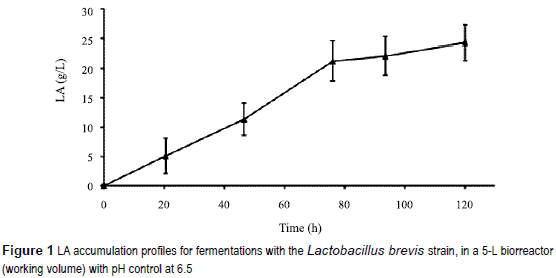
<body><![CDATA[<p>&nbsp;</p>        <p><font size="3"><b>Results and discussion </b></font></p>        <p><b><i>Lactic acid production</i></b></p>        <p>The genus <i>Lactobacillus</i> has been widely known as the  major LA producer strain. For the purpose of this work, a <i>Lactobacillus</i> brevis strain was used; it can be stated that cassava flour, the main  component for the HY1 medium, is an appropriate substrate for LA biosynthesis.  In addition to reducing sugars, cassava flour has salts, aminoacids and  proteins that might favor bacterial growth and product biosynthesis. <a href="#Figura1">Figure 1</a>  shows the obtained profile for LA accumulation over a 120h of cultivation.</p>        <p align="center"><a name="Figura1"></a><img src="/img/revistas/rfiua/n65/n65a11i01.gif" ></p>        <p>The largest LA  accumulation, reached at 120h, was 24.3&plusmn;3.0 g/L; this value is comparable to  most literature reports. For substrates such as glucose, corn flour, sawdust,  molasses, whey, among others, LA production ranges from 1 to 100 g/L, using  commercial strains such as <i>Lb.  plantarum, Lb. casei, Lb. delbrueckii, Lb. helveticus</i>, etc &#91;1&#93;.  Siebold et al. &#91;21&#93; and Kious et al. &#91;22&#93; did report LA production close to  26.8&#8211;27.8 g/L and 13.3-19.6 g/L, respectively, using glucose as the only  substrate.</p>        <p>&nbsp;</p>        <p><font size="3"><b>Separation and purification</b> </font></p>        <p><b><i>LA recovery by using ionic exchange resins</i></b></p>        <p><i>Evaluation  of the ionic form of the resin Amberlite IRA-400</i></p>      ]]></body>
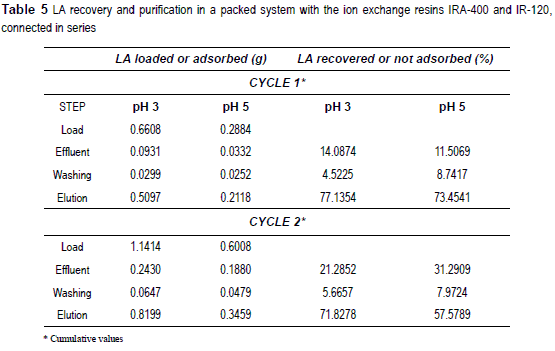
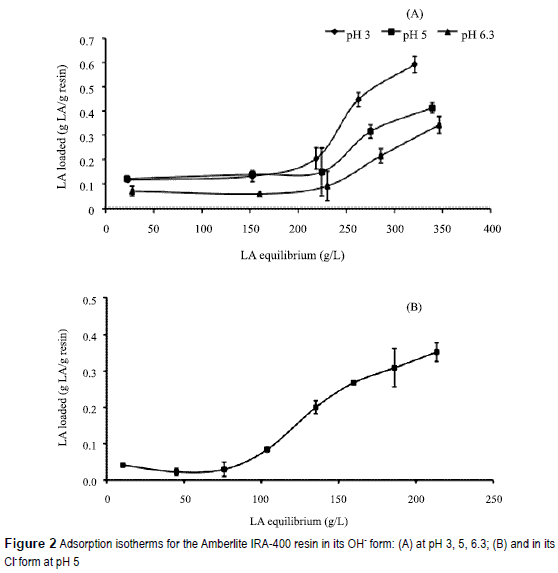
<body><![CDATA[<p>It was observed that the resin OH'' form did show higher LA adsorption  capacity rather than the Cl<sup>-</sup> and HS0<sub>4</sub><sup>2-</sup> forms  (<a href="#Tabla1">table 1</a>), perhaps due to the fact that the adsorption process in ionic  exchange resins is favored towards ions with high valence and low molecular  weight (MW); under these circumstances, the chemical potential between the  resin active site and the working solution is enlarged &#91;23&#93;.</p>        <p align="center"><a name="Tabla1"></a><img src="/img/revistas/rfiua/n65/n65a11t01.gif" ></p>        <p>Since the OH<sup>-</sup>  ion has a lower MW than CI<sup>-</sup>, it establishes weaker bonds with the  resin active sites, thus propitiating its displacement by lactate ion, during  adsorption. Moldes et al. &#91;11&#93; found adsorption capacities of 0.10 and 0.13g LA  adsorbed/g resin, for the Cl<sup>-</sup> and OH<sup>-</sup> form, respectively.  These results are comparable to those found in this work.</p>        <p>On the other hand, the high HSO<sub>4</sub><sup>2-</sup>  ion MW, which dissociates in S0<sub>4</sub><sup>2-</sup> having two  charges, leads to the formation of stronger bonds with the resin.</p>        <p><i>Adsorption  isotherms for the anionic Amberlite IRA-400 resin in its Cl<sup>-</sup> and OH<sup>-</sup>  forms</i></p>       <p> Ion exchange resin  adsorption capacity is usually favored by the ion-of-interest valency number,  its size and concentration, activity coefficient as well as the active surface  of the exchange resin &#91;24&#93;.</p>      <p>The  <a href="#Figura2">figure 2</a> shows the acquired adsorption isotherms for the Amberlite  IRA-400 resin in its Cl<sup>-</sup> y OH<sup>-</sup> forms.</p>        <p align="center"><a name="Figura2"></a><img src="/img/revistas/rfiua/n65/n65a11i02.gif" ></p>        <p>For the Amberlite IRA-400  resin, a pH below of the lactic acid pKa value (3.86) has a manifest incidence  on lactate adsorption. Larger pH values would provoke reduction in acid  dissociation, thus affecting the adsorption process.</p>        <p>As it is observed, by  comparing the results, at pH 5, the resin in its OH<sup>-</sup> activated form  has larger lactate ion adsorption capacity (0.41&plusmn;0.02g LA adsorbed/g resin)  than that of the Cl<sup>-</sup> form at the same pH (0.35&plusmn;0.03g LA adsorbed/g  resin), mainly due to the lower OH<sup>-</sup> ion molecular weight compared to  that of the Cl<sup>-</sup> ion; this facilitates ion transport from the resin  active site. The strength of chemical bonds, formed between the resin active  site and the exchange ions, depends on electronegative differences. Due to its  smaller atomic ratio, Cl<sup>-</sup> ions have higher ionization energy, making  stronger chemical bonds and causing difficulties in its displacement.</p>      ]]></body>
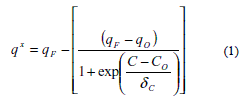
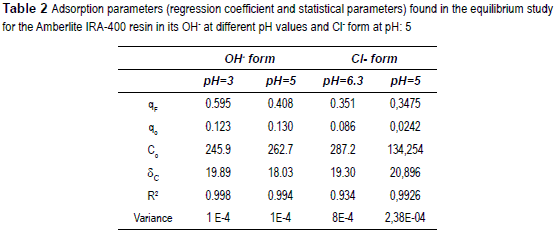
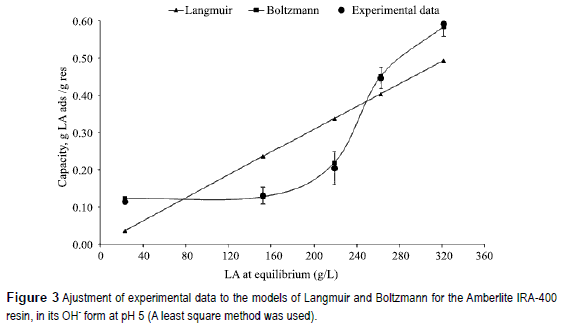
<body><![CDATA[<p>On the other hand, the experimental data for the resin Cl<sup>-</sup> and  OH<sup>-</sup> form does not follow the Langmuir model, R<sup>2</sup>=0.5894, R<sup>2</sup>=0.7393  respectively, but do follow the semi-empirical Boltzmann model, R<sup>2</sup>=0.5894,  R<sup>2</sup>=0.998, R<sup>2</sup>=0.998 respectively (See <a href="#Tabla2">table 2</a>, <a href="#Figura3">figure 3</a>.  The Boltzmann model is known as:</p>        <p><img src="/img/revistas/rfiua/n65/n65a11e01.gif"></p>        <p>Where,</p>      <p>  q*: Adsorbate per gram of resin in equilibrium with LA,  C, in solution &#91;g LA/g resin&#93;.</p>       <p> q<sub>F</sub> and q<sub>O</sub>:  Final and initial loading of adsorbate per gram of resin &#91;g LA/g resin&#93;.</p>      <p>  C<sub>O</sub>: LA concentration in the middle point  &#91;g/L&#93;.</p>      <p> &delta;<sub>C</sub>: Increment value for LA.</p>         <p align="center"><a name="Tabla2"></a><img src="/img/revistas/rfiua/n65/n65a11t02.gif" ></p>      <p align="center"><a name="Figura3"></a><img src="/img/revistas/rfiua/n65/n65a11i03.gif" ></p>         <p>The low experimental data  adjustment to the Langmuir model gives insights about the resin surface, and  allows one to consider it as no plane and/or homogeneous. The kind of  interaction between the resin active sites and lactate ions present in the  fermentative solution, are not just simple-site type, but acid-base, hydrogen  bonds, and/or hydrophobic interactions &#91;13&#93;. Based on the Chenlo et al. &#91;25&#93;  classification, the isotherms created for the lactate adsorption in the  Amberlite IRA-400 resin, are type V, which means, they are not suitable for the  lactate ion loading, but good for the elusion step in a fixed bed system &#91;26&#93;.</p>          ]]></body>
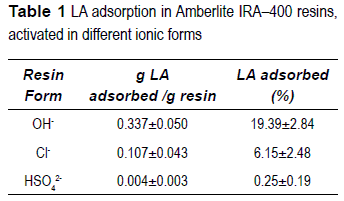
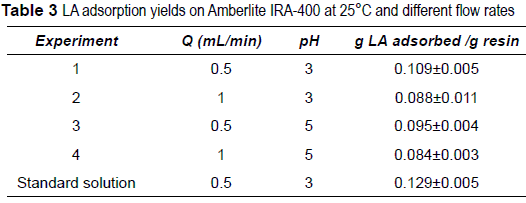
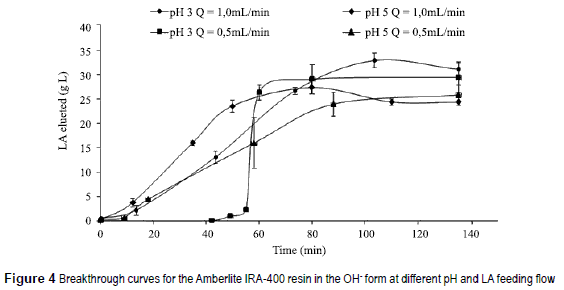
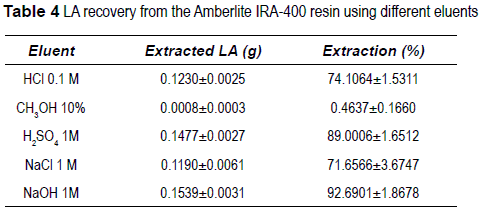
<body><![CDATA[<p><i>Yield  and breakthrough curves in an Amberlite IRA-400 resin</i></p>    <a href="#Tabla3">Table 3</a> shows the  experimental results for LA adsorption on Amberlite IRA-400 in its OH<sup>-</sup> form.  Both, pH values lower than those for LA pKa (3.86), and LA solution inlet flow  rate reduction, did favor adsorption of lactate ion on the Amberlite resin.  This is in agreement with the adsorption isotherms acquired from the batch  system experiments. The lower the volumetric flow rate, the higher the  residence time, (13.92&plusmn;0.85 min and 24.24&plusmn;0.90min, for 1 and 0.5mL/min  respectively), thus improving ion exchanging and reducing mass transport  problems such as channeling and/or dead volume.</p>       <p align="center"><a name="Tabla3"></a><img src="/img/revistas/rfiua/n65/n65a11t03.gif" ></p>      <p>Breakthrough curves have  an initial step of maximum adsorption rate until the resin saturation is  reached; after that, the concentration of the target ion noticeably increases  in the effluent. The closer operation conditions that did render this trend  were pH 5 and 0.5 mL/min; the remaining curves showed a progressive increase of  LA concentration in the effluent, perhaps because of the competition that might  occur between aminoacid and salts in the spent culture media for interacting  with the resin active site. Under similar flow and pH conditions a loading of  0.129g LA/g resin was acquired for the LA aqueous solution, 18.35% higher than  that of the spent culture medium (<a href="#Figura4">figure 4</a>), with statistical significance (<i>p</i>=0.0029). It was also proved that  there exists statistical significance between the evaluated volumetric flow  rates with a <i>p</i> value of  0.0021.</p>      <p align="center"><a name="Figura4"></a><img src="/img/revistas/rfiua/n65/n65a11i04.gif" ></p>      <p>For all glass columns,  resin loading reached 95% of that of the batch system, for a solution with a  concentration equal to the fermentation media; however, as a result of the  dilution effect, it just achieved 18.31% of the batch system maximum capacity,  being necessary to concentrate the LA solution before it is fed to the ion  exchange columns.</p>       <p><i>Eluent  selection for lactate ions recovery</i></p>     <p>The resin was loaded with 0.332 g LA/g resin. <a href="#Tabla4">Table 4</a> shows the results  for lactate ion elution in the anionic resin IRA-400. Though there is no  statistical significance (<em>p</em>=0.0571)  between the acquired results with NaOH IN or H<sub>2</sub>S0<sub>4</sub> 1M, it  is recommended to use NaOH in order to attend regulatory commission rules such  as that of the Food Chemical Codex (FCC), aim at producing LA with low sulfate  concentrations &#91;19&#93;. In addition, due to the sulfate ion bivalence properties,  it shows higher affinity for the resin active sites limiting future resin  applications. The additional evaluated eluents showed lower lactate ion elution  which might be the result of its lower adsorption capacity and dielectric  constant; the lower the dielectric constant, the higher the limitations of ion  transport in solution. In a further process for LA recovery using a system with  resins, IRA-400 and IR-120 resins, arranged in series, NaOH IN was used as  eluent.</p>      <p align="center"><a name="Tabla4"></a><img src="/img/revistas/rfiua/n65/n65a11t04.gif" ></p>      <p><em>LA recovery in a  series of resin - Amberlite IRA-400 and IR-120 &#8211; purification system</em></p>       <p><a href="#Tabla5">Table 5</a> shows the results  for LA recovery and purification in a packed system with the ion exchange  resins IRA-400 and IR-120, connected in series. Amberlite IRA-400 did not reach  saturation due to lack of enough retention time; thus, adsorbed LA concentration  was 0.0367 and 0.0160g LA/g resin, for a process at pH 3 and 5, respectively.  On the other hand, the washing steps did yield LA losses close to 5 and 8%,  when the feeding solution was set to pH 3 and 5, respectively. The anionic  resin showed better regeneration capacity at pH 3. LA losses changed from  14.08% in the first cycle to 21.6% in the second, whereas at pH 5, losses  changed from 11.4% to 31.73% in the first and second cycle, respectively; this  can be explained considering that, in spite of washing, OH<sup>-</sup> ions were  accumulated favoring the equilibrium reaction towards the complex R-OH  generation, instead of lactate ion L-Na<sup>+</sup> formation.</p>        ]]></body>
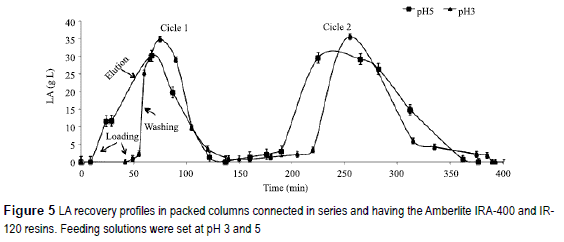
<body><![CDATA[<p align="center"><a name="Tabla5"></a><img src="/img/revistas/rfiua/n65/n65a11t05.gif" ></p>        <p>For the sake of clarity,  it is needed to emphasize that the reduction in the Amberlite IRA-400 resin  adsorption capacity between the first and second cycle, could be the result of  a normal active site activity lost due to usage, without resin physical  degradation occurrence, as it has been reported by Avila et al. &#91;27&#93;, for these  types of resin.</p>       <p>The acquired results  endorse the better performance of the ion exchange resin working at pH lower  than the LA pKa value. At pH 3, the system showed a higher capacity,  approximately 50% higher than that at pH 5; in addition, the process profile  showed low LA concentrations in the effluent of the loading step (See <a href="#Figura5">figure 5</a>), which is in agreement with the results from the breakthrough curve.</p>      <p align="center"><a name="Figura5"></a><img src="/img/revistas/rfiua/n65/n65a11i05.gif" ></p>        <p>The LA acid purification  using ion exchange resins did appear to be a workable alternative, since up to  77% of the LA in the fermentation media was recovered, a value close to that  attained from the salt precipitation treatment. Even though it was not  promising to concentrate LA in the eluent solution, it was possible to remove  macromolecules such as reducing sugars whose content changed from 27.6 g/L in  the fermentation broth to 1 g/L in the eluent solution. After resin treatment,  a sulfate reduction close to 99.68% was observed; this calls attention to the  importance of using ion exchange resins for sulfate removal (sulfate content prior  to resin treatment: 16.61&plusmn;1.65 g/L and after resin treatment: 0.0525&plusmn;0.002.7  g/L).</p>      <p>&nbsp;</p>     <p><font size="3"><b>Conclusions</b> </font></p>       <p>LA biosynthesis was  accomplished using alternative low-price nutrient-rich substrates such as  cassava flour. This kind of substrate showed high nutrient and reducing sugar  content as well as calcium and aminoacids, all of them available for the  fermentative process.</p>       <p>On the other hand, LA  recovery by means of a fixed packed bed, is enhanced by a reduction in the  inlet/feeding volumetric flow rate (set to 0.5 mL/min), perhaps because of the  higher residence time, allowing longer time of contact between the resin and LA  solution phases.</p>       <p>At low scale, ionic  exchange systems are suitable for LA purification since, at a low cost, it  allows one to remove macromolecules and possibly ions formed during  fermentation; the obtained recovery percentages were close to 77 %.</p>       ]]></body>
<body><![CDATA[<p>The reusing of the  Amberlite IRA-400 resin allows arecovery ofLAin various steps, showing loss of  resin activity close to 7% during the first two cycles.</p>       <p>Concentrating the acid  before it is actually fed to the ion exchange column would cause reduction in  the Amberlite IRA-400 resin capacity. Now, desorbing the acid from the resin at  temperature higher than the ambient one, would direct the adsorption equilibrium  towards eluent solution, concentrating it and allowing column restoration.</p>       <p>In spite of the good  results for LA recovery using ion exchange resins, it is necessary to implement  further separation and concentration steps in order to obtain a product that  efficiently satisfy the purity requirements for a specific application such as  polymerization processes.</p>        <p>&nbsp;</p>      <p><font size="3"><b>Acknowledgements</b> </font></p>      <p>Authors wish to thank the  CODI -<i>Comit&eacute; para el desarrollo de la  Investigacion</i>- Universidad de Antioquia for the financial support  of the project MC-07-1-13.</p>      <p>&nbsp;</p>      <p><font size="3"><b>References</b> </font></p>      <!-- ref --><p>1. S. Cock, A. Rodr&iacute;guez. ''Producci&oacute;n  biotecnol&oacute;gica de &aacute;cido l&aacute;ctico: estado del arte. Sociedad Mexicana de  nutrici&oacute;n y tecnolog&iacute;a de alimentos''.  <i>Ciencia y tecnolog&iacute;a alimentaria</i>. Vol. 5. 2005. pp. 54-65.    &nbsp;&nbsp;&nbsp;&nbsp;&nbsp;&nbsp;&nbsp;&nbsp;[&#160;<a href="javascript:void(0);" onclick="javascript: window.open('/scielo.php?script=sci_nlinks&ref=000111&pid=S0120-6230201200040001100001&lng=','','width=640,height=500,resizable=yes,scrollbars=1,menubar=yes,');">Links</a>&#160;]<!-- end-ref --></p>       ]]></body>
<body><![CDATA[<!-- ref --><p>2. S. Ahmad, E. Vasheghani. ''In situ separation of  lactic acid from fermentation broth using ion exchange resins''. <i>J. Ind. Microbiol. Biotechnol</i>.  Vol. 35. 2008. pp. 1229-1233.    &nbsp;&nbsp;&nbsp;&nbsp;&nbsp;&nbsp;&nbsp;&nbsp;[&#160;<a href="javascript:void(0);" onclick="javascript: window.open('/scielo.php?script=sci_nlinks&ref=000113&pid=S0120-6230201200040001100002&lng=','','width=640,height=500,resizable=yes,scrollbars=1,menubar=yes,');">Links</a>&#160;]<!-- end-ref --></p>       <!-- ref --><p>3. T. Harington, Md. Hossain. ''Extraction of lactic  acid into sunflower oil and its recovery into an aqueous solution''. <i>Desalination</i>. Vol.  218. 2008. pp. 287-296.    &nbsp;&nbsp;&nbsp;&nbsp;&nbsp;&nbsp;&nbsp;&nbsp;[&#160;<a href="javascript:void(0);" onclick="javascript: window.open('/scielo.php?script=sci_nlinks&ref=000115&pid=S0120-6230201200040001100003&lng=','','width=640,height=500,resizable=yes,scrollbars=1,menubar=yes,');">Links</a>&#160;]<!-- end-ref --></p>       <!-- ref --><p>4. Y. Wee, J. Kim, H. Ryu. ''Biotechnological  production of lactic acid and its recent applications. <i>Food Technolog. Biotechnol</i>.  Vol. 44. 2006. pp.163-172.    &nbsp;&nbsp;&nbsp;&nbsp;&nbsp;&nbsp;&nbsp;&nbsp;[&#160;<a href="javascript:void(0);" onclick="javascript: window.open('/scielo.php?script=sci_nlinks&ref=000117&pid=S0120-6230201200040001100004&lng=','','width=640,height=500,resizable=yes,scrollbars=1,menubar=yes,');">Links</a>&#160;]<!-- end-ref --></p>       <!-- ref --><p>5. P. Sneath.  Bergey's. <i>Manual of systematic bacteriology</i>. Ed. Williams and  Wilkins Baltimore. London, UK. 1984. pp. 175-181.    &nbsp;&nbsp;&nbsp;&nbsp;&nbsp;&nbsp;&nbsp;&nbsp;[&#160;<a href="javascript:void(0);" onclick="javascript: window.open('/scielo.php?script=sci_nlinks&ref=000119&pid=S0120-6230201200040001100005&lng=','','width=640,height=500,resizable=yes,scrollbars=1,menubar=yes,');">Links</a>&#160;]<!-- end-ref --></p>       <!-- ref --><p>6. K. Hofvendahl, H. Hhanhagerdal. ''Factors affecting  the fermentative lactic acid production from renewable resource. <i>Enzyme and Microbial Technology</i>.  Vol. 26. 2000. pp. 87-107.    &nbsp;&nbsp;&nbsp;&nbsp;&nbsp;&nbsp;&nbsp;&nbsp;[&#160;<a href="javascript:void(0);" onclick="javascript: window.open('/scielo.php?script=sci_nlinks&ref=000121&pid=S0120-6230201200040001100006&lng=','','width=640,height=500,resizable=yes,scrollbars=1,menubar=yes,');">Links</a>&#160;]<!-- end-ref --></p>      ]]></body>
<body><![CDATA[<!-- ref --><p> 7. L. Serna, A. Rodr&iacute;guez. ''Producci&oacute;n  Biotecnol&oacute;gica de &aacute;cido l&aacute;ctio: Estado del arte''. <i>Cienc tecnol</i>. Aliment. Vol.  5. 2005. pp. 54-65.    &nbsp;&nbsp;&nbsp;&nbsp;&nbsp;&nbsp;&nbsp;&nbsp;[&#160;<a href="javascript:void(0);" onclick="javascript: window.open('/scielo.php?script=sci_nlinks&ref=000123&pid=S0120-6230201200040001100007&lng=','','width=640,height=500,resizable=yes,scrollbars=1,menubar=yes,');">Links</a>&#160;]<!-- end-ref --></p>      <!-- ref --><p> 8. M. Jarvinen, L. Myllykosk, R. Keiski,  J. Sohlo. ''Separation  of lactic acid from fermented broth by reactive extraction''. <i>Bioseparation</i>. Vol.  9. 2000. pp.163-166.    &nbsp;&nbsp;&nbsp;&nbsp;&nbsp;&nbsp;&nbsp;&nbsp;[&#160;<a href="javascript:void(0);" onclick="javascript: window.open('/scielo.php?script=sci_nlinks&ref=000125&pid=S0120-6230201200040001100008&lng=','','width=640,height=500,resizable=yes,scrollbars=1,menubar=yes,');">Links</a>&#160;]<!-- end-ref --></p>       <!-- ref --><p>9. A. Persson, A. Jonsson, G. Zacchi. ''Separation of  lactic acid-producing bacteria from fermentation broth using a ceramic  microfiltration membrane with constant permeate flow''. <i>Biotechnol. Bioeng</i>.  Vol. 72. 2001. pp. 269-277.    &nbsp;&nbsp;&nbsp;&nbsp;&nbsp;&nbsp;&nbsp;&nbsp;[&#160;<a href="javascript:void(0);" onclick="javascript: window.open('/scielo.php?script=sci_nlinks&ref=000127&pid=S0120-6230201200040001100009&lng=','','width=640,height=500,resizable=yes,scrollbars=1,menubar=yes,');">Links</a>&#160;]<!-- end-ref --></p>       <!-- ref --><p>10. A. Sosa, A. Ochoa, N. Perotti. ''Modeling of direct  recovery of lactic acid from whole broths by ion exchange adsorption''. <i>Bioseparation</i>. Vol.  9. 2000. pp. 283-289.    &nbsp;&nbsp;&nbsp;&nbsp;&nbsp;&nbsp;&nbsp;&nbsp;[&#160;<a href="javascript:void(0);" onclick="javascript: window.open('/scielo.php?script=sci_nlinks&ref=000129&pid=S0120-6230201200040001100010&lng=','','width=640,height=500,resizable=yes,scrollbars=1,menubar=yes,');">Links</a>&#160;]<!-- end-ref --></p>       <!-- ref --><p>11. A. Moldes, J. Alonso, J. Paraj&oacute;. ''Recovery oflactic acid  from simultaneous saccharification and fermentation media using anion exchange  resins''. <i>Biop. Biosystem Eng</i>.  Vol. 25. 2003. pp. 357-363.    &nbsp;&nbsp;&nbsp;&nbsp;&nbsp;&nbsp;&nbsp;&nbsp;[&#160;<a href="javascript:void(0);" onclick="javascript: window.open('/scielo.php?script=sci_nlinks&ref=000131&pid=S0120-6230201200040001100011&lng=','','width=640,height=500,resizable=yes,scrollbars=1,menubar=yes,');">Links</a>&#160;]<!-- end-ref --></p>       ]]></body>
<body><![CDATA[<!-- ref --><p>12. K. Lee. ''A media design program for lactic acid  production coupled with extraction by electrodialy sis''. <i>Bioresource Technology</i>.  Vol. 96. 2005. pp. 1505-1510.    &nbsp;&nbsp;&nbsp;&nbsp;&nbsp;&nbsp;&nbsp;&nbsp;[&#160;<a href="javascript:void(0);" onclick="javascript: window.open('/scielo.php?script=sci_nlinks&ref=000133&pid=S0120-6230201200040001100012&lng=','','width=640,height=500,resizable=yes,scrollbars=1,menubar=yes,');">Links</a>&#160;]<!-- end-ref --></p>       <!-- ref --><p>13. J. Chol, W. Hong. ''Recovery oflactic acid by  batch distillation with chemical reactions using ion exchange resin''. <i>Journal of chemical engineering of  Japan</i>. Vol. 32. 1999. pp. 184-189.    &nbsp;&nbsp;&nbsp;&nbsp;&nbsp;&nbsp;&nbsp;&nbsp;[&#160;<a href="javascript:void(0);" onclick="javascript: window.open('/scielo.php?script=sci_nlinks&ref=000135&pid=S0120-6230201200040001100013&lng=','','width=640,height=500,resizable=yes,scrollbars=1,menubar=yes,');">Links</a>&#160;]<!-- end-ref --></p>       <!-- ref --><p>14. W. Tong. ''Purification of L(+)-latic acid from fermentation broth  with paper sludge as a cellulosic feedstock using weak anion exchanger  Amberlite IRA- 92''. <i>Bioch. Eng. Journal</i>.  Vol. 18. 2004. pp. 89-96.    &nbsp;&nbsp;&nbsp;&nbsp;&nbsp;&nbsp;&nbsp;&nbsp;[&#160;<a href="javascript:void(0);" onclick="javascript: window.open('/scielo.php?script=sci_nlinks&ref=000137&pid=S0120-6230201200040001100014&lng=','','width=640,height=500,resizable=yes,scrollbars=1,menubar=yes,');">Links</a>&#160;]<!-- end-ref --></p>       <!-- ref --><p>15. M. Fern&aacute;ndez, R. de la Vega. <i>Planta de producci&oacute;n de &aacute;cido  l&aacute;ctico alimentario</i>. Desarrollo de la ingenier&iacute;a del proceso y  del proyecto industrial. Universidad de Oviedo. 2006. Disponible en: <a href="http://aeipro.com/files/congresos/2003pamplona/ciip03_0772_0780.2183.pdf"target="_blank">http://aeipro.com/files/congresos/2003pamplona/ciip03_0772_0780.2183.pdf</a>. Consultado en  mayo 19 de 2009.    &nbsp;&nbsp;&nbsp;&nbsp;&nbsp;&nbsp;&nbsp;&nbsp;[&#160;<a href="javascript:void(0);" onclick="javascript: window.open('/scielo.php?script=sci_nlinks&ref=000139&pid=S0120-6230201200040001100015&lng=','','width=640,height=500,resizable=yes,scrollbars=1,menubar=yes,');">Links</a>&#160;]<!-- end-ref --></p>      <!-- ref --><p> 16. Y. Gonz&aacute;lez, G. Vaccari, E. Dosi, A.  Trilli, M. Rossi, D. Matteuzzi. ''Enhanced production of l(+)-lactic acid in chemostat by Lactobacillus casei  DSM 20011 using ion-exchange resins and cross-flow filtration in a fully  automated pilot plant controlled via NIR''.  <i>Biotechnol. Bioeng</i>. Vol. 67. 2000. pp. 147- 156.    &nbsp;&nbsp;&nbsp;&nbsp;&nbsp;&nbsp;&nbsp;&nbsp;[&#160;<a href="javascript:void(0);" onclick="javascript: window.open('/scielo.php?script=sci_nlinks&ref=000141&pid=S0120-6230201200040001100016&lng=','','width=640,height=500,resizable=yes,scrollbars=1,menubar=yes,');">Links</a>&#160;]<!-- end-ref --></p>       ]]></body>
<body><![CDATA[<!-- ref --><p>17. X. Cao, H. Yun, Y. Koo. ''Recovery of (+)-lactic  acid by anion exchange resin Amberlite IRA-400''.<i>Biochem. Eng. J</i>. Vol.  11. 2002. pp. 189-196.    &nbsp;&nbsp;&nbsp;&nbsp;&nbsp;&nbsp;&nbsp;&nbsp;[&#160;<a href="javascript:void(0);" onclick="javascript: window.open('/scielo.php?script=sci_nlinks&ref=000143&pid=S0120-6230201200040001100017&lng=','','width=640,height=500,resizable=yes,scrollbars=1,menubar=yes,');">Links</a>&#160;]<!-- end-ref --></p>       <!-- ref --><p>18. Y. Zheng. X. Ding, P. Cen, C. Yang, G. Tsao. ''Lactic  acid fermentation and adsorption on PVP''.  <i>Appl. Biochem. Biotechnol</i>. Vols. 57/58. 1996. pp. 627-632.    &nbsp;&nbsp;&nbsp;&nbsp;&nbsp;&nbsp;&nbsp;&nbsp;[&#160;<a href="javascript:void(0);" onclick="javascript: window.open('/scielo.php?script=sci_nlinks&ref=000145&pid=S0120-6230201200040001100018&lng=','','width=640,height=500,resizable=yes,scrollbars=1,menubar=yes,');">Links</a>&#160;]<!-- end-ref --></p>       <!-- ref --><p>19. G. Vaccari, A. Gonz&aacute;lez, L. Anna, E.  Dosi, P. Brigidi, D. Matteuzzi. ''Fermentative production of L-lactic acid by Lactobacillus  casei DSM 20011 and product recovery using ion exchange resins''. <i>Applied Microbiology and  Biotechnology</i>. Vol. 40. 1993. pp. 23-27.    &nbsp;&nbsp;&nbsp;&nbsp;&nbsp;&nbsp;&nbsp;&nbsp;[&#160;<a href="javascript:void(0);" onclick="javascript: window.open('/scielo.php?script=sci_nlinks&ref=000147&pid=S0120-6230201200040001100019&lng=','','width=640,height=500,resizable=yes,scrollbars=1,menubar=yes,');">Links</a>&#160;]<!-- end-ref --></p>       <!-- ref --><p>20. M. Hussain, D. Rouch, M. Britz. ''Biochemistry of  non&#8211;starter lactic acid bacteria isolate Lactobacillus casei GCRL163:  Production of metabolites by stationary- phase cultures''. <i>International Dairy Journal</i>.  Vol. 19. 2009. pp. 12-21.    &nbsp;&nbsp;&nbsp;&nbsp;&nbsp;&nbsp;&nbsp;&nbsp;[&#160;<a href="javascript:void(0);" onclick="javascript: window.open('/scielo.php?script=sci_nlinks&ref=000149&pid=S0120-6230201200040001100020&lng=','','width=640,height=500,resizable=yes,scrollbars=1,menubar=yes,');">Links</a>&#160;]<!-- end-ref --></p>       <!-- ref --><p>21. M. Siebold, P. Frieling, R. Joppien,  D. Rindfleisch, K. Sch&uuml;gerl, H. Roper. ''Comparison of the production of  lactic acid by three different lactobacilli and its recovery by extraction and  electrodialysis''. <i>Process biochemistry</i>.  Vol. 30. 1995. pp. 81-95.    &nbsp;&nbsp;&nbsp;&nbsp;&nbsp;&nbsp;&nbsp;&nbsp;[&#160;<a href="javascript:void(0);" onclick="javascript: window.open('/scielo.php?script=sci_nlinks&ref=000151&pid=S0120-6230201200040001100021&lng=','','width=640,height=500,resizable=yes,scrollbars=1,menubar=yes,');">Links</a>&#160;]<!-- end-ref --></p>       ]]></body>
<body><![CDATA[<!-- ref --><p>22. J. Kious. <i>Lactobacillus  and lactic acid production</i>. Tesis. Applied biological science  branch. Le Tourneau university. Golden, Colorado (USA). 2000. pp. 15-21.    &nbsp;&nbsp;&nbsp;&nbsp;&nbsp;&nbsp;&nbsp;&nbsp;[&#160;<a href="javascript:void(0);" onclick="javascript: window.open('/scielo.php?script=sci_nlinks&ref=000153&pid=S0120-6230201200040001100022&lng=','','width=640,height=500,resizable=yes,scrollbars=1,menubar=yes,');">Links</a>&#160;]<!-- end-ref --></p>       <!-- ref --><p>23. F. Dechow. <i>Separation and Purification  Techniques in Biotechnology</i>. Ed. William Andrew. New Tork, EEUU  1989. pp. 42-58.    &nbsp;&nbsp;&nbsp;&nbsp;&nbsp;&nbsp;&nbsp;&nbsp;[&#160;<a href="javascript:void(0);" onclick="javascript: window.open('/scielo.php?script=sci_nlinks&ref=000155&pid=S0120-6230201200040001100023&lng=','','width=640,height=500,resizable=yes,scrollbars=1,menubar=yes,');">Links</a>&#160;]<!-- end-ref --></p>       <!-- ref --><p>24. A. Zerquera, G. P&eacute;rez, I. Diaz, S. Delgado,  R. de Armas, S. Leyva. ''Resinas de intercambio i&oacute;nico para prolongar la  liberaci&oacute;n de los f&aacute;rmacos''. <i>Rev.  Cubana Farm</i>. Vol. 34. 2000. pp. 196-206.    &nbsp;&nbsp;&nbsp;&nbsp;&nbsp;&nbsp;&nbsp;&nbsp;[&#160;<a href="javascript:void(0);" onclick="javascript: window.open('/scielo.php?script=sci_nlinks&ref=000157&pid=S0120-6230201200040001100024&lng=','','width=640,height=500,resizable=yes,scrollbars=1,menubar=yes,');">Links</a>&#160;]<!-- end-ref --></p>       <!-- ref --><p>25. F. Chenlo, R. Moreira, L. Chaguri,  F. Santos. ''Isotermas de desorci&oacute;n de pimiento sde padr&oacute;n (Capsicum annuuml. Var.  Longum)''. <i>Ciencia y tecnologia alimentaria</i>.  Vol 5. 2005. pp. 18-24.    &nbsp;&nbsp;&nbsp;&nbsp;&nbsp;&nbsp;&nbsp;&nbsp;[&#160;<a href="javascript:void(0);" onclick="javascript: window.open('/scielo.php?script=sci_nlinks&ref=000159&pid=S0120-6230201200040001100025&lng=','','width=640,height=500,resizable=yes,scrollbars=1,menubar=yes,');">Links</a>&#160;]<!-- end-ref --></p>       <!-- ref --><p>26. R. Perry, D. Green. <i>Adsorption and ion exchange</i>. Perry's  Chemical Engineers' Handbook</i>. 7<sup>th</sup> ed. Ed. McGraw-Hill. New York (USA).  1997. Vol. 4. pp. 16/12 -16/15.    &nbsp;&nbsp;&nbsp;&nbsp;&nbsp;&nbsp;&nbsp;&nbsp;[&#160;<a href="javascript:void(0);" onclick="javascript: window.open('/scielo.php?script=sci_nlinks&ref=000161&pid=S0120-6230201200040001100026&lng=','','width=640,height=500,resizable=yes,scrollbars=1,menubar=yes,');">Links</a>&#160;]<!-- end-ref --></p>       ]]></body>
<body><![CDATA[<!-- ref --><p>27. J. Avilla. ''Lo Esencial acerca del  intercambio i&oacute;nico''. Resintech Inc. Available in: <a href="http://resintech.com"target="_blank">http://resintech.com</a>. Accessed 19 may 2009.    &nbsp;&nbsp;&nbsp;&nbsp;&nbsp;&nbsp;&nbsp;&nbsp;[&#160;<a href="javascript:void(0);" onclick="javascript: window.open('/scielo.php?script=sci_nlinks&ref=000163&pid=S0120-6230201200040001100027&lng=','','width=640,height=500,resizable=yes,scrollbars=1,menubar=yes,');">Links</a>&#160;]<!-- end-ref --></p>        <p>&nbsp;</p>       <p>&nbsp;</p>     <p>&nbsp;</p>         ]]></body><back>
<ref-list>
<ref id="B1">
<label>1</label><nlm-citation citation-type="journal">
<person-group person-group-type="author">
<name>
<surname><![CDATA[Cock]]></surname>
<given-names><![CDATA[S]]></given-names>
</name>
<name>
<surname><![CDATA[Rodríguez]]></surname>
<given-names><![CDATA[A]]></given-names>
</name>
</person-group>
<article-title xml:lang="es"><![CDATA[Producción biotecnológica de ácido láctico: estado del arte. Sociedad Mexicana de nutrición y tecnología de alimentos]]></article-title>
<source><![CDATA[Ciencia y tecnología alimentaria]]></source>
<year>2005</year>
<volume>5</volume>
<page-range>54-65</page-range></nlm-citation>
</ref>
<ref id="B2">
<label>2</label><nlm-citation citation-type="journal">
<person-group person-group-type="author">
<name>
<surname><![CDATA[Ahmad]]></surname>
<given-names><![CDATA[S]]></given-names>
</name>
<name>
<surname><![CDATA[Vasheghani]]></surname>
<given-names><![CDATA[E]]></given-names>
</name>
</person-group>
<article-title xml:lang="en"><![CDATA[In situ separation of lactic acid from fermentation broth using ion exchange resins]]></article-title>
<source><![CDATA[J. Ind. Microbiol. Biotechnol]]></source>
<year>2008</year>
<volume>35</volume>
<page-range>1229-1233</page-range></nlm-citation>
</ref>
<ref id="B3">
<label>3</label><nlm-citation citation-type="journal">
<person-group person-group-type="author">
<name>
<surname><![CDATA[Harington]]></surname>
<given-names><![CDATA[T]]></given-names>
</name>
<name>
<surname><![CDATA[Hossain]]></surname>
<given-names><![CDATA[Md]]></given-names>
</name>
</person-group>
<article-title xml:lang="en"><![CDATA[Extraction of lactic acid into sunflower oil and its recovery into an aqueous solution]]></article-title>
<source><![CDATA[Desalination]]></source>
<year>2008</year>
<volume>218</volume>
<page-range>287-296</page-range></nlm-citation>
</ref>
<ref id="B4">
<label>4</label><nlm-citation citation-type="journal">
<person-group person-group-type="author">
<name>
<surname><![CDATA[Wee]]></surname>
<given-names><![CDATA[Y]]></given-names>
</name>
<name>
<surname><![CDATA[Kim]]></surname>
<given-names><![CDATA[J]]></given-names>
</name>
<name>
<surname><![CDATA[Ryu]]></surname>
<given-names><![CDATA[H]]></given-names>
</name>
</person-group>
<article-title xml:lang="en"><![CDATA[Biotechnological production of lactic acid and its recent applications]]></article-title>
<source><![CDATA[Food Technolog. Biotechnol]]></source>
<year>2006</year>
<volume>44</volume>
<page-range>163-172</page-range></nlm-citation>
</ref>
<ref id="B5">
<label>5</label><nlm-citation citation-type="book">
<person-group person-group-type="author">
<name>
<surname><![CDATA[Sneath]]></surname>
<given-names><![CDATA[P.]]></given-names>
</name>
</person-group>
<source><![CDATA[Bergey's. Manual of systematic bacteriology]]></source>
<year>1984</year>
<page-range>175-181</page-range><publisher-loc><![CDATA[London ]]></publisher-loc>
<publisher-name><![CDATA[Ed. Williams and Wilkins Baltimore]]></publisher-name>
</nlm-citation>
</ref>
<ref id="B6">
<label>6</label><nlm-citation citation-type="journal">
<person-group person-group-type="author">
<name>
<surname><![CDATA[Hofvendahl]]></surname>
<given-names><![CDATA[K]]></given-names>
</name>
<name>
<surname><![CDATA[Hhanhagerdal]]></surname>
<given-names><![CDATA[H]]></given-names>
</name>
</person-group>
<article-title xml:lang="en"><![CDATA[Factors affecting the fermentative lactic acid production from renewable resource]]></article-title>
<source><![CDATA[Enzyme and Microbial Technology]]></source>
<year>2000</year>
<volume>26</volume>
<page-range>87-107</page-range></nlm-citation>
</ref>
<ref id="B7">
<label>7</label><nlm-citation citation-type="journal">
<person-group person-group-type="author">
<name>
<surname><![CDATA[Serna]]></surname>
<given-names><![CDATA[L]]></given-names>
</name>
<name>
<surname><![CDATA[Rodríguez]]></surname>
<given-names><![CDATA[A]]></given-names>
</name>
</person-group>
<article-title xml:lang="es"><![CDATA[Producción Biotecnológica de ácido láctio: Estado del arte]]></article-title>
<source><![CDATA[Cienc tecnol. Aliment]]></source>
<year>2005</year>
<volume>5</volume>
<page-range>54-65</page-range></nlm-citation>
</ref>
<ref id="B8">
<label>8</label><nlm-citation citation-type="journal">
<person-group person-group-type="author">
<name>
<surname><![CDATA[Jarvinen]]></surname>
<given-names><![CDATA[M]]></given-names>
</name>
<name>
<surname><![CDATA[Myllykosk]]></surname>
<given-names><![CDATA[L]]></given-names>
</name>
<name>
<surname><![CDATA[Keiski]]></surname>
<given-names><![CDATA[R]]></given-names>
</name>
<name>
<surname><![CDATA[Sohlo]]></surname>
<given-names><![CDATA[J]]></given-names>
</name>
</person-group>
<article-title xml:lang="en"><![CDATA[Separation of lactic acid from fermented broth by reactive extraction]]></article-title>
<source><![CDATA[Bioseparation]]></source>
<year>2000</year>
<volume>9</volume>
<page-range>163-166</page-range></nlm-citation>
</ref>
<ref id="B9">
<label>9</label><nlm-citation citation-type="journal">
<person-group person-group-type="author">
<name>
<surname><![CDATA[Persson]]></surname>
<given-names><![CDATA[A]]></given-names>
</name>
<name>
<surname><![CDATA[Jonsson]]></surname>
<given-names><![CDATA[A]]></given-names>
</name>
<name>
<surname><![CDATA[Zacchi]]></surname>
<given-names><![CDATA[G]]></given-names>
</name>
</person-group>
<article-title xml:lang="en"><![CDATA[Separation of lactic acid-producing bacteria from fermentation broth using a ceramic microfiltration membrane with constant permeate flow]]></article-title>
<source><![CDATA[Biotechnol. Bioeng]]></source>
<year>2001</year>
<volume>72</volume>
<page-range>269-277</page-range></nlm-citation>
</ref>
<ref id="B10">
<label>10</label><nlm-citation citation-type="journal">
<person-group person-group-type="author">
<name>
<surname><![CDATA[Sosa]]></surname>
<given-names><![CDATA[A]]></given-names>
</name>
<name>
<surname><![CDATA[Ochoa]]></surname>
<given-names><![CDATA[A]]></given-names>
</name>
<name>
<surname><![CDATA[Perotti]]></surname>
<given-names><![CDATA[N]]></given-names>
</name>
</person-group>
<article-title xml:lang="en"><![CDATA[Modeling of direct recovery of lactic acid from whole broths by ion exchange adsorption]]></article-title>
<source><![CDATA[Bioseparation]]></source>
<year>2000</year>
<volume>9</volume>
<page-range>283-289</page-range></nlm-citation>
</ref>
<ref id="B11">
<label>11</label><nlm-citation citation-type="journal">
<person-group person-group-type="author">
<name>
<surname><![CDATA[Moldes]]></surname>
<given-names><![CDATA[A]]></given-names>
</name>
<name>
<surname><![CDATA[Alonso]]></surname>
<given-names><![CDATA[J]]></given-names>
</name>
<name>
<surname><![CDATA[Parajó]]></surname>
<given-names><![CDATA[J]]></given-names>
</name>
</person-group>
<article-title xml:lang="en"><![CDATA[Recovery oflactic acid from simultaneous saccharification and fermentation media using anion exchange resins]]></article-title>
<source><![CDATA[Biop. Biosystem Eng]]></source>
<year>2003</year>
<volume>25</volume>
<page-range>357-363</page-range></nlm-citation>
</ref>
<ref id="B12">
<label>12</label><nlm-citation citation-type="journal">
<person-group person-group-type="author">
<name>
<surname><![CDATA[Lee]]></surname>
<given-names><![CDATA[K]]></given-names>
</name>
</person-group>
<article-title xml:lang="en"><![CDATA[A media design program for lactic acid production coupled with extraction by electrodialy sis]]></article-title>
<source><![CDATA[Bioresource Technology]]></source>
<year>2005</year>
<volume>96</volume>
<page-range>1505-1510</page-range></nlm-citation>
</ref>
<ref id="B13">
<label>13</label><nlm-citation citation-type="journal">
<person-group person-group-type="author">
<name>
<surname><![CDATA[Chol]]></surname>
<given-names><![CDATA[J]]></given-names>
</name>
<name>
<surname><![CDATA[Hong]]></surname>
<given-names><![CDATA[W]]></given-names>
</name>
</person-group>
<article-title xml:lang="en"><![CDATA[Recovery oflactic acid by batch distillation with chemical reactions using ion exchange resin]]></article-title>
<source><![CDATA[Journal of chemical engineering of Japan]]></source>
<year>1999</year>
<volume>32</volume>
<page-range>184-189</page-range></nlm-citation>
</ref>
<ref id="B14">
<label>14</label><nlm-citation citation-type="journal">
<person-group person-group-type="author">
<name>
<surname><![CDATA[Tong]]></surname>
<given-names><![CDATA[W]]></given-names>
</name>
</person-group>
<article-title xml:lang="en"><![CDATA[Purification of L(+)-latic acid from fermentation broth with paper sludge as a cellulosic feedstock using weak anion exchanger Amberlite IRA- 92]]></article-title>
<source><![CDATA[Bioch. Eng. Journal]]></source>
<year>2004</year>
<volume>18</volume>
<page-range>89-96</page-range></nlm-citation>
</ref>
<ref id="B15">
<label>15</label><nlm-citation citation-type="book">
<person-group person-group-type="author">
<name>
<surname><![CDATA[Fernández]]></surname>
<given-names><![CDATA[M.]]></given-names>
</name>
<name>
<surname><![CDATA[de la Vega]]></surname>
<given-names><![CDATA[R.]]></given-names>
</name>
</person-group>
<source><![CDATA[Planta de producción de ácido láctico alimentario]]></source>
<year>2006</year>
<publisher-name><![CDATA[Universidad de Oviedo]]></publisher-name>
</nlm-citation>
</ref>
<ref id="B16">
<label>16</label><nlm-citation citation-type="journal">
<person-group person-group-type="author">
<name>
<surname><![CDATA[González]]></surname>
<given-names><![CDATA[Y]]></given-names>
</name>
<name>
<surname><![CDATA[Vaccari]]></surname>
<given-names><![CDATA[G]]></given-names>
</name>
<name>
<surname><![CDATA[Dosi]]></surname>
<given-names><![CDATA[E]]></given-names>
</name>
<name>
<surname><![CDATA[Trilli]]></surname>
<given-names><![CDATA[A]]></given-names>
</name>
<name>
<surname><![CDATA[Rossi]]></surname>
<given-names><![CDATA[M]]></given-names>
</name>
<name>
<surname><![CDATA[Matteuzzi]]></surname>
<given-names><![CDATA[D]]></given-names>
</name>
</person-group>
<article-title xml:lang="en"><![CDATA[Enhanced production of l(+)-lactic acid in chemostat by Lactobacillus casei DSM 20011 using ion-exchange resins and cross-flow filtration in a fully automated pilot plant controlled via NIR]]></article-title>
<source><![CDATA[Biotechnol. Bioeng]]></source>
<year>2000</year>
<volume>67</volume>
<page-range>147- 156</page-range></nlm-citation>
</ref>
<ref id="B17">
<label>17</label><nlm-citation citation-type="journal">
<person-group person-group-type="author">
<name>
<surname><![CDATA[Cao]]></surname>
<given-names><![CDATA[X]]></given-names>
</name>
<name>
<surname><![CDATA[Yun]]></surname>
<given-names><![CDATA[H]]></given-names>
</name>
<name>
<surname><![CDATA[Koo]]></surname>
<given-names><![CDATA[Y]]></given-names>
</name>
</person-group>
<article-title xml:lang="en"><![CDATA[Recovery of (+)-lactic acid by anion exchange resin Amberlite IRA-400]]></article-title>
<source><![CDATA[Biochem. Eng. J]]></source>
<year>2002</year>
<volume>11</volume>
<page-range>189-196</page-range></nlm-citation>
</ref>
<ref id="B18">
<label>18</label><nlm-citation citation-type="journal">
<person-group person-group-type="author">
<name>
<surname><![CDATA[Zheng]]></surname>
<given-names><![CDATA[Y]]></given-names>
</name>
<name>
<surname><![CDATA[Ding]]></surname>
<given-names><![CDATA[X.]]></given-names>
</name>
<name>
<surname><![CDATA[Cen]]></surname>
<given-names><![CDATA[P]]></given-names>
</name>
<name>
<surname><![CDATA[Yang]]></surname>
<given-names><![CDATA[C]]></given-names>
</name>
<name>
<surname><![CDATA[Tsao]]></surname>
<given-names><![CDATA[G]]></given-names>
</name>
</person-group>
<article-title xml:lang="en"><![CDATA[Lactic acid fermentation and adsorption on PVP]]></article-title>
<source><![CDATA[Appl. Biochem. Biotechnol]]></source>
<year>1996</year>
<volume>57/58</volume>
<page-range>627-632</page-range></nlm-citation>
</ref>
<ref id="B19">
<label>19</label><nlm-citation citation-type="journal">
<person-group person-group-type="author">
<name>
<surname><![CDATA[Vaccari]]></surname>
<given-names><![CDATA[G]]></given-names>
</name>
<name>
<surname><![CDATA[González]]></surname>
<given-names><![CDATA[A]]></given-names>
</name>
<name>
<surname><![CDATA[Anna]]></surname>
<given-names><![CDATA[L]]></given-names>
</name>
<name>
<surname><![CDATA[Dosi]]></surname>
<given-names><![CDATA[E]]></given-names>
</name>
<name>
<surname><![CDATA[Brigidi]]></surname>
<given-names><![CDATA[P]]></given-names>
</name>
<name>
<surname><![CDATA[Matteuzzi]]></surname>
<given-names><![CDATA[D]]></given-names>
</name>
</person-group>
<article-title xml:lang="en"><![CDATA[Fermentative production of L-lactic acid by Lactobacillus casei DSM 20011 and product recovery using ion exchange resins]]></article-title>
<source><![CDATA[Applied Microbiology and Biotechnology]]></source>
<year>1993</year>
<volume>40</volume>
<page-range>23-27</page-range></nlm-citation>
</ref>
<ref id="B20">
<label>20</label><nlm-citation citation-type="journal">
<person-group person-group-type="author">
<name>
<surname><![CDATA[Hussain]]></surname>
<given-names><![CDATA[M]]></given-names>
</name>
<name>
<surname><![CDATA[Rouch]]></surname>
<given-names><![CDATA[D]]></given-names>
</name>
<name>
<surname><![CDATA[Britz]]></surname>
<given-names><![CDATA[M]]></given-names>
</name>
</person-group>
<article-title xml:lang="en"><![CDATA[Biochemistry of non-starter lactic acid bacteria isolate Lactobacillus casei GCRL163: Production of metabolites by stationary- phase cultures]]></article-title>
<source><![CDATA[International Dairy Journal]]></source>
<year>2009</year>
<volume>19</volume>
<page-range>12-21</page-range></nlm-citation>
</ref>
<ref id="B21">
<label>21</label><nlm-citation citation-type="journal">
<person-group person-group-type="author">
<name>
<surname><![CDATA[Siebold]]></surname>
<given-names><![CDATA[M]]></given-names>
</name>
<name>
<surname><![CDATA[Frieling]]></surname>
<given-names><![CDATA[P]]></given-names>
</name>
<name>
<surname><![CDATA[Joppien]]></surname>
<given-names><![CDATA[R]]></given-names>
</name>
<name>
<surname><![CDATA[Rindfleisch]]></surname>
<given-names><![CDATA[D]]></given-names>
</name>
<name>
<surname><![CDATA[Schügerl]]></surname>
<given-names><![CDATA[K]]></given-names>
</name>
<name>
<surname><![CDATA[Roper]]></surname>
<given-names><![CDATA[H]]></given-names>
</name>
</person-group>
<article-title xml:lang="en"><![CDATA[Comparison of the production of lactic acid by three different lactobacilli and its recovery by extraction and electrodialysis]]></article-title>
<source><![CDATA[Process biochemistry]]></source>
<year>1995</year>
<volume>30</volume>
<page-range>81-95</page-range></nlm-citation>
</ref>
<ref id="B22">
<label>22</label><nlm-citation citation-type="">
<person-group person-group-type="author">
<name>
<surname><![CDATA[Kious]]></surname>
<given-names><![CDATA[J.]]></given-names>
</name>
</person-group>
<source><![CDATA[Lactobacillus and lactic acid production]]></source>
<year></year>
<page-range>15-21</page-range></nlm-citation>
</ref>
<ref id="B23">
<label>23</label><nlm-citation citation-type="book">
<person-group person-group-type="author">
<name>
<surname><![CDATA[Dechow]]></surname>
<given-names><![CDATA[F.]]></given-names>
</name>
</person-group>
<source><![CDATA[Separation and Purification Techniques in Biotechnology]]></source>
<year>1989</year>
<page-range>42-58</page-range><publisher-loc><![CDATA[New Tork ]]></publisher-loc>
<publisher-name><![CDATA[Ed. William Andrew]]></publisher-name>
</nlm-citation>
</ref>
<ref id="B24">
<label>24</label><nlm-citation citation-type="journal">
<person-group person-group-type="author">
<name>
<surname><![CDATA[Zerquera]]></surname>
<given-names><![CDATA[A]]></given-names>
</name>
<name>
<surname><![CDATA[Pérez]]></surname>
<given-names><![CDATA[G]]></given-names>
</name>
<name>
<surname><![CDATA[Diaz]]></surname>
<given-names><![CDATA[I]]></given-names>
</name>
<name>
<surname><![CDATA[Delgado]]></surname>
<given-names><![CDATA[S]]></given-names>
</name>
<name>
<surname><![CDATA[de Armas]]></surname>
<given-names><![CDATA[R]]></given-names>
</name>
<name>
<surname><![CDATA[Leyva]]></surname>
<given-names><![CDATA[S]]></given-names>
</name>
</person-group>
<article-title xml:lang="es"><![CDATA[Resinas de intercambio iónico para prolongar la liberación de los fármacos]]></article-title>
<source><![CDATA[Rev. Cubana Farm]]></source>
<year>2000</year>
<volume>34</volume>
<page-range>196-206</page-range></nlm-citation>
</ref>
<ref id="B25">
<label>25</label><nlm-citation citation-type="journal">
<person-group person-group-type="author">
<name>
<surname><![CDATA[Chenlo]]></surname>
<given-names><![CDATA[F]]></given-names>
</name>
<name>
<surname><![CDATA[Moreira]]></surname>
<given-names><![CDATA[R]]></given-names>
</name>
<name>
<surname><![CDATA[Chaguri]]></surname>
<given-names><![CDATA[L]]></given-names>
</name>
<name>
<surname><![CDATA[Santos]]></surname>
<given-names><![CDATA[F]]></given-names>
</name>
</person-group>
<article-title xml:lang="es"><![CDATA[Isotermas de desorción de pimiento sde padrón (Capsicum annuuml. Var. Longum)]]></article-title>
<source><![CDATA[Ciencia y tecnologia alimentaria]]></source>
<year>2005</year>
<volume>5</volume>
<page-range>18-24</page-range></nlm-citation>
</ref>
<ref id="B26">
<label>26</label><nlm-citation citation-type="book">
<person-group person-group-type="author">
<name>
<surname><![CDATA[Perry]]></surname>
<given-names><![CDATA[R.]]></given-names>
</name>
<name>
<surname><![CDATA[Green]]></surname>
<given-names><![CDATA[D.]]></given-names>
</name>
</person-group>
<source><![CDATA[Adsorption and ion exchange]]></source>
<year>1997</year>
<volume>4</volume>
<edition>7</edition>
<page-range>16/12 -16/15</page-range><publisher-loc><![CDATA[New York ]]></publisher-loc>
<publisher-name><![CDATA[Ed. McGraw-Hill]]></publisher-name>
</nlm-citation>
</ref>
<ref id="B27">
<label>27</label><nlm-citation citation-type="">
<person-group person-group-type="author">
<name>
<surname><![CDATA[Avilla]]></surname>
<given-names><![CDATA[J.]]></given-names>
</name>
</person-group>
<source><![CDATA[''Lo Esencial acerca del intercambio iónico'']]></source>
<year></year>
</nlm-citation>
</ref>
</ref-list>
</back>
</article>