<?xml version="1.0" encoding="ISO-8859-1"?><article xmlns:mml="http://www.w3.org/1998/Math/MathML" xmlns:xlink="http://www.w3.org/1999/xlink" xmlns:xsi="http://www.w3.org/2001/XMLSchema-instance">
<front>
<journal-meta>
<journal-id>0120-6230</journal-id>
<journal-title><![CDATA[Revista Facultad de Ingeniería Universidad de Antioquia]]></journal-title>
<abbrev-journal-title><![CDATA[Rev.fac.ing.univ. Antioquia]]></abbrev-journal-title>
<issn>0120-6230</issn>
<publisher>
<publisher-name><![CDATA[Facultad de Ingeniería, Universidad de Antioquia]]></publisher-name>
</publisher>
</journal-meta>
<article-meta>
<article-id>S0120-62302013000100002</article-id>
<title-group>
<article-title xml:lang="en"><![CDATA[Hydrogeochemistry and pollution effects of an aquifer in Quaternary loess like sediments in the landfilling area of Mar del Plata, Argentina]]></article-title>
<article-title xml:lang="es"><![CDATA[Hidrogeoquímica y efectos de la contaminación en un acuífero en sedimentos loéssicos Cuaternarios en el área de rellenos sanitarios de Mar del Plata, Argentina]]></article-title>
</title-group>
<contrib-group>
<contrib contrib-type="author">
<name>
<surname><![CDATA[Martínez]]></surname>
<given-names><![CDATA[Daniel E.]]></given-names>
</name>
<xref ref-type="aff" rid="A01"/>
<xref ref-type="aff" rid="A02"/>
</contrib>
<contrib contrib-type="author">
<name>
<surname><![CDATA[Osterrieth]]></surname>
<given-names><![CDATA[Margarita]]></given-names>
</name>
<xref ref-type="aff" rid="A01"/>
<xref ref-type="aff" rid="A02"/>
</contrib>
</contrib-group>
<aff id="A01">
<institution><![CDATA[,U.N. de Mar del Plata Instituto de Investigaciones Marinas y Costeras ]]></institution>
<addr-line><![CDATA[Mar del Plata ]]></addr-line>
<country>Argentina</country>
</aff>
<aff id="A02">
<institution><![CDATA[,U.N. de Mar del Plata Instituto de Geología de Costas y del Cuaternario ]]></institution>
<addr-line><![CDATA[Mar del Plata ]]></addr-line>
<country>Argentina</country>
</aff>
<pub-date pub-type="pub">
<day>00</day>
<month>03</month>
<year>2013</year>
</pub-date>
<pub-date pub-type="epub">
<day>00</day>
<month>03</month>
<year>2013</year>
</pub-date>
<numero>66</numero>
<fpage>9</fpage>
<lpage>23</lpage>
<copyright-statement/>
<copyright-year/>
<self-uri xlink:href="http://www.scielo.org.co/scielo.php?script=sci_arttext&amp;pid=S0120-62302013000100002&amp;lng=en&amp;nrm=iso"></self-uri><self-uri xlink:href="http://www.scielo.org.co/scielo.php?script=sci_abstract&amp;pid=S0120-62302013000100002&amp;lng=en&amp;nrm=iso"></self-uri><self-uri xlink:href="http://www.scielo.org.co/scielo.php?script=sci_pdf&amp;pid=S0120-62302013000100002&amp;lng=en&amp;nrm=iso"></self-uri><abstract abstract-type="short" xml:lang="en"><p><![CDATA[Loess like sediments cover an area of about 1.800.000 km² in the Pampa plain of Argentina, forming an aquifer system which is used for water supply for most of the cities a rural population in the region. This aquifer supplies water to agricultural productive activities that contribute to about a 60% of the national gross produce of the country. In this paper, detailed studies in a local sector of the aquifer near to Mar del Plata, in the landfilling area of the city, are performed. The main goal is to characterise the hydrogeochemical processes giving the chemical groundwater composition, and to analyze the impact of the infiltration of the leachate from a neighbouring landfill on some samples. Five wells were drilled to take sediments and water samples. The textural and mineralogical composition of the aquifer sediments was analysed and the chemical composition of groundwater was determined. The equilibrium relationship between the solid phase and groundwater was considered using specific computer codes. The achieved conclusions were that the chemical composition of groundwater is mainly due to calcite equilibrium and cationic exchange with calcium uptake and sodium release. The dissolution of amorphous silica minerals, and subordinate silicate hydrolysis, are responsible of the characteristic high dissolved silica concentrations. High chloride and nitrate contents result from leachate infiltration, but the main geochemical processes in the mix are the same.]]></p></abstract>
<abstract abstract-type="short" xml:lang="es"><p><![CDATA[Sedimentos de tipo loéssico cubren una superficie aproximada de 1.800.000 km² en la llanura Pampeana de Argentina, formando un sistema acuífero que es utilizado para abastecimiento de agua a ciudades y la población rural en la región. Este sistema acuífero suministra el agua que sustenta las actividades productivas que contribuyen en un 60% al producto bruto nacional. Es este trabajo se realiza un estudio detallado en un sector del acuífero próximo a la ciudad de Mar del Plata, provincia de Buenos Aires, en el que se localizan tres rellenos sanitarios. El principal objetivo es caracterizar los procesos geoquímicos que dan origen a la composición observada del agua subterránea. Se perforaron cinco pozos para la toma de muestras de agua y sedimentos, y evaluar el impacto de la infiltración del lixiviado sobre esos procesos. Se determinó la composición textural y mineralógica de los sedimentos y la composición química del agua. Las relaciones de equilibrio entre la fase sólida y la solución se determinó utilizando programas específicos. Se concluye que la composición química observada en la aguas es consecuencia principalmente de procesos de equilibrio con calcita e intercambio catiónico con adsorción de calcio y liberación de sodio. La disolución de minerales de sílice amorfo, y la hidrólisis de silicatos en forma subordinada, da origen a altas concentraciones de sílice en las aguas. La mezcla con la infiltración del lixiviado incrementa las concentraciones de los iones conservativos cloruro y nitrato, pero no se modifican en general los procesos hidrogeoquímicos mayoritarios.]]></p></abstract>
<kwd-group>
<kwd lng="en"><![CDATA[Hydrochemistry]]></kwd>
<kwd lng="en"><![CDATA[Loess sediments]]></kwd>
<kwd lng="en"><![CDATA[Argentina]]></kwd>
<kwd lng="en"><![CDATA[mineral saturation]]></kwd>
<kwd lng="en"><![CDATA[silica contents]]></kwd>
<kwd lng="es"><![CDATA[Hidrogeoquímica]]></kwd>
<kwd lng="es"><![CDATA[sedimentos loéssicos]]></kwd>
<kwd lng="es"><![CDATA[Argentina]]></kwd>
<kwd lng="es"><![CDATA[saturación de minerales]]></kwd>
<kwd lng="es"><![CDATA[contenido de sílice]]></kwd>
</kwd-group>
</article-meta>
</front><body><![CDATA[ <p align="right"><b>ART&Iacute;CULO ORIGINAL</b></p>     <p align="right">&nbsp;</p>     <p align="center"><font size="4"> <b>Hydrogeochemistry and pollution effects of an aquifer in Quaternary loess like sediments in the landfilling area of Mar del Plata, Argentina</b></font></p>     <p align="center">&nbsp;</p>     <p align="center"><font size="3"> <b>Hidrogeoqu&iacute;mica y efectos de la contaminaci&oacute;n en un acu&iacute;fero en sedimentos lo&eacute;ssicos Cuaternarios en el &aacute;rea de rellenos sanitarios de Mar del Plata, Argentina</b></font></p>     <p align="center">&nbsp;</p>     <p align="center">&nbsp;</p>     <p> <i><b>Daniel E. Mart&iacute;nez<sup>*1,2</sup>, Margarita Osterrieth <sup>1,2</sup></b></i></p>       <p><sup>1</sup>CONICET - Instituto de Investigaciones Marinas  y Costeras. U.N. de Mar del Plata. Casilla de Correo 722 (7600), Mar del Plata, Argentina. </p>     <p><sup>2</sup>Instituto de Geolog&iacute;a de Costas y del Cuaternario,  U.N. de Mar del Plata. Casilla de Correo 722 (7600), Mar del Plata, Argentina..</p>      ]]></body>
<body><![CDATA[<p><sup>*</sup>Autor de correspondencia: tel&eacute;fono: + 54  + 233 4754060, fax: + 54 + 223 4753150, correo electr&oacute;nico: <a href="mailto:demarti@mdp.edu.ar">demarti@mdp.edu.ar</a> (D. Mart&iacute;nez)</p>     <p>&nbsp;</p>     <p align="center">(Recibido el 3 de noviembre de 2012. Aceptado el 18 de enero de 2013)</p>     <p align="center">&nbsp;</p>     <p align="center">&nbsp;</p> <hr noshade size="1">      <p><font size="3"><b>Abstract</b></font></p>       <p>Loess like sediments cover an area of about 1.800.000  km<sup>2</sup> in the Pampa plain of Argentina, forming an aquifer system which  is used for water supply for most of the cities a rural population in the  region. This aquifer supplies water to agricultural productive activities that  contribute to about a 60% of the national gross produce of the country. In this  paper, detailed studies in a local sector of the aquifer near to Mar del Plata,  in the landfilling area of the city, are performed. The main goal is to  characterise the hydrogeochemical processes giving the chemical groundwater  composition, and to analyze the impact of the infiltration of the leachate from  a neighbouring landfill on some samples. Five wells were drilled to take  sediments and water samples. The textural and mineralogical composition of the  aquifer sediments was analysed and the chemical composition of groundwater was  determined. The equilibrium relationship between the solid phase and  groundwater was considered using specific computer codes. The achieved  conclusions were that the chemical composition of groundwater is mainly due to  calcite equilibrium and cationic exchange with calcium uptake and sodium  release. The dissolution of amorphous silica minerals, and subordinate silicate  hydrolysis, are responsible of the characteristic high dissolved silica  concentrations. High chloride and nitrate contents result from leachate infiltration,  but the main geochemical processes in the mix are the same.</p>        <p><i>Keywords: </i>Hydrochemistry, Loess sediments, Argentina, mineral saturation, silica contents</p>   <hr noshade size="1">      <p><font size="3"><b>Resumen</b></font></p>     <p>Sedimentos de tipo lo&eacute;ssico cubren una superficie aproximada de  1.800.000 km<sup>2</sup> en la llanura Pampeana de Argentina, formando un  sistema acu&iacute;fero que es utilizado para abastecimiento de agua a ciudades y la  poblaci&oacute;n rural en la regi&oacute;n. Este sistema acu&iacute;fero suministra el agua que  sustenta las actividades productivas que contribuyen en un 60% al producto  bruto nacional. Es este trabajo se realiza un estudio detallado en un sector  del acu&iacute;fero pr&oacute;ximo a la ciudad de Mar del Plata, provincia de Buenos Aires,  en el que se localizan tres rellenos sanitarios. El principal objetivo es  caracterizar los procesos geoqu&iacute;micos que dan origen a la composici&oacute;n observada  del agua subterr&aacute;nea. Se perforaron cinco pozos para la toma de muestras de  agua y sedimentos, y evaluar el impacto de la infiltraci&oacute;n del lixiviado sobre  esos procesos. Se determin&oacute; la composici&oacute;n textural y mineral&oacute;gica de los  sedimentos y la composici&oacute;n qu&iacute;mica del agua. Las relaciones de equilibrio  entre la fase s&oacute;lida y la soluci&oacute;n se determin&oacute; utilizando programas  espec&iacute;ficos. Se concluye que la composici&oacute;n qu&iacute;mica observada en la aguas es  consecuencia principalmente de procesos de equilibrio con calcita e intercambio  cati&oacute;nico con adsorci&oacute;n de calcio y liberaci&oacute;n de sodio. La disoluci&oacute;n de  minerales de s&iacute;lice amorfo, y la hidr&oacute;lisis de silicatos en forma subordinada,  da origen a altas concentraciones de s&iacute;lice en las aguas. La mezcla con la  infiltraci&oacute;n del lixiviado incrementa las concentraciones de los iones  conservativos cloruro y nitrato, pero no se modifican en general los procesos  hidrogeoqu&iacute;micos mayoritarios.</p>      ]]></body>
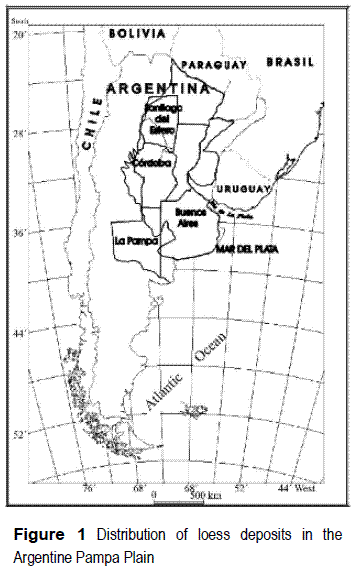
<body><![CDATA[<p><i>Palabras clave: </i>Hidrogeoqu&iacute;mica, sedimentos  lo&eacute;ssicos, Argentina, saturaci&oacute;n de minerales, contenido de  s&iacute;lice</p>  <hr noshade size="1">      <p>&nbsp;</p>     <p>&nbsp;</p>     <p><font size="3"><b>Introduction</b></font></p>      <p>The so-called Pampean sediments &#91;1&#93; represent one of  the largest geological formations in Argentina, covering approximately  1,800,000 km<sup>2</sup> (<a href="#Figura1">figure 1</a>). These sediments, of silt and silty-sand  composition, with interstratified silt-clay layers, are of eolic and  fluvial-eolic origin, dating back to the middle to Upper Quaternary. They  contain a lot of aquifers which, as a whole, conform the aquifer system that  provides one of the most densely populated and most economically active with a  supply of fresh water. In fact, this area accounts for more than a 60% of the  national gross product of the country &#91;2&#93;. The quality of the water obtained  varies greatly along this system of aquifers, with some areas in the Pampean  region evidencing problems related to high contents of arsenic and fluoride &#91;3  - 9&#93; or nitrate &#91;10&#93;.</p>      <p align="center"><a name="Figura1"></a><img src="/img/revistas/rfiua/n66/n66a02i01.gif" ></p>      <p>In order to analyze a hydrogeological system like  this, it is necessary to look into the interrelation among its three phases: a  gas phase resulting from an exchange with the atmosphere or from biogeochemical  processes in the unsaturated zone, a solid phase formed by the minerals that  constitute the porous media, and a liquid phase, the aqueous solution that is  groundwater. Chemical equilibrium as a way of understanding has been early  developed in the work of Chebotarev &#91;11&#93;, but especially the work of Garrels  and Christ &#91;12&#93; highlighted the usefulness of this tool, leading it to be the  most applied methods of analysis at present.</p>       <p>The main goal of this work is to increase the  knowledge of the hydrogeochemistry of the aquifers formed by Pampean sediments  by mean of a detailed study of the mineralogical composition of the sediment  matrix in contact with the analyzed groundwater samples and the complementary  measurement of silica and aluminum in the solution, which allows the  consideration of the equilibrium with silicate minerals. Some specific features  of the restricted considered area are very locals, i.e. coastal location,  marine aerosol contribution in recharge, small thickness of the aquifer,  proximity of the hydrogeological basement, etc., and especially the fact that  the wells are located very near to a landfill which is operating since 1995,  occupying a surface of 40 ha. Previous studies have characterized the  groundwater pollution in the area &#91;13 - 15&#93; at a descriptive level.</p>       <p>Nevertheless few previous contributions relate  hydrochemistry with a detailed mineralogy of the sediments also including clay  cristallinity and composition, and which specific processes take place if high  recharge is partially affected by landfills leachate. This paper is focused in  a single area of the Pampean Plain, but the application of a whole study  involving mineralogy, chemistry of sediments, hydrochemistry and processes  modeling under chemical equilibrium conditions make it a contribution that  rises regional meaning in reference with the study methodology.</p>      <p> The mineralogical composition of the loess-like  sediments was described in the study area in an important previous work on the  Pampean Loess by Teruggi &#91;16&#93; analyzing samples taken near to Mar del Plata and  La Plata, and describing a constant composition in all the considered samples.  The content of calcite in this loess and loess-like sediments is about 2% and  4% &#91;17&#93;. A study carried on Pampean sediments in the southeast o the province of  C&oacute;rdoba &#91;3&#93; assign the major composition of sand and silt fractions to  feldspars (40-75%) followed by volcanic glass (25-50%), and decreasing  proportions of quartz, calcite, muscovite and rock debris. Illite is the  dominant species in the clay fraction. Volcanic glass abundance is a  distinctive feature of argentine loess, differentiating it from the loess in  China that having a similar composition and also CaCO<sub>3</sub> content,  doesn't include volcanic shards &#91;18&#93;.</p>        ]]></body>
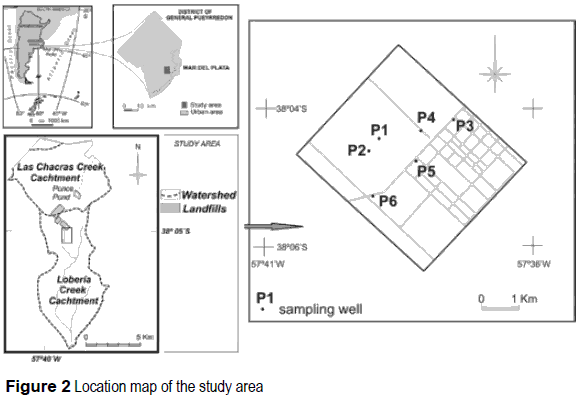
<body><![CDATA[<p>&nbsp;</p>       <p><font size="3"><b>Study area characterization</b></font></p>          <p>The study area is presented in <a href="#Figura2">figure 2</a>, corresponding to the headwaters sector in the basin of the Loberia creek  (total area 15 km<sup>2</sup>), placed in the District of General Pueyrred&oacute;n,  near to the city of Mar del Piata, at 38&deg;05' lat. S and 57&deg;38' long. W.</p>          <p align="center"><a name="Figura2"></a><img src="/img/revistas/rfiua/n66/n66a02i02.gif" ></p>          <p>The  climate is dry sub-humid mesothermal type "B2" &#91;19&#93;. Over the past 10  years, annual precipitation values have ranged from 703 to 1.400 mm/year, with  an average of 943 mm/year.</p>         <p>The catchment of the Lober&iacute;a Creek is characterised by  a hilly relief, which is due to a shallow structural control. Blocks formed by  orthoquartzites of Early Palaeozoic age corresponding to Balcarce Formation  &#91;20&#93;. They are the southernmost spurs of the Tandilia Range &#91;21&#93;, and a  thickness of more than 400 m has been described in the area, overlying  Precambrian metamorphic rocks. Three fault systems are recognized in the  Paleozoic bedrock, with NW-SE, NE-SW, and E-W trends with which three joint  systems are associated &#91;21&#93;.</p>         <p>The orthoquartzites comprise the impermeable  hydrogeological basement of the region &#91;22&#93;. They have been reached by the  study wells at depth between 4 and 50 m below the sedimentary cover of  loess-like sediments. Though generally considered impermeable, the joints of  these orthoquarzites produce a secondary porosity, which considered negligible  as an aquifer with regard to the overlying clastic aquifer. The most common  sequence presents orthoquartzites topped by loess-like Pleistocene-Holocene  sediments and very thin sandy sediments. Hydrologically, these loess-like  deposits represent the principal aquifer in the region. The clastic thickness  of the analyzed basin was determined by means of drilling and geoelectrical prospecting  &#91;13&#93;.</p>         <p>The basement reaches a depth of more than 100 m in the  distal zone of the basin. The aquifer of Mar del Plata is a Pleistocene  sedimentary sequence (silt and silty-sand). The permeability varies from 10-15  m/day. Pumping tests show values for transmissivity of 500 m<sup>2</sup>/day in  the southwestern zone of the district, between 500 and 700 m<sup>2</sup>/day in  the urban zone, and between 1,000 and 1,200 m<sup>2</sup>/day in the northern  and northwestern rural zones. The storage coefficient is in the order of 0.001.  The recharge takes place in the upper part of the aquifer in practically the  entire exposed area. The recharge reaches the highest levels of the aquifer and  from there drains into deeper levels. Rainfall infiltration produces the  recharge to the systems. The annual average rainfall for the period 1901-1987  was 851.6 mm. The losses produced by evapotranspiration have been calculated by  the Thornthwaite method in 719.2 mm/year, leaving a surplus of 132.4 mm/year.</p>         <p>The underground flow direction is the same as the surface  water flow direction on the northern slope, i.e., it is NW-SE. The average  hydraulic gradient in the foothills is 0.015, whereas on the plains it is 0.008  &#91;13, 15&#93;.</p> 	     <p><font size="3"><b>Methods</b></font></p> 	      ]]></body>
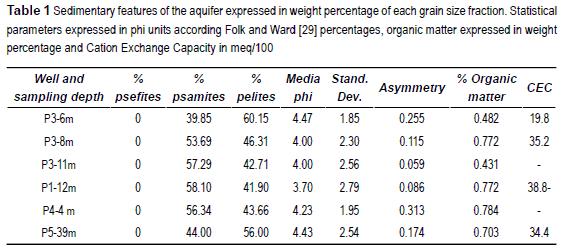
<body><![CDATA[<p>Six boreholes of a 4" diameter were built using a  rotary machine in a zone of low thickness of the sedimentary section (<a href="#Figura2">figure 2</a>). The boreholes were drilled almost on the water divide, corresponding then  to a recharge zone where groundwater starts the flow sense towards the SE. The  final depth of each well was: P1: 12 m; P2: 6m; P3:11.5 m; P4:15 m; P5: 39.5 m;  P6: 12 m, reaching the quartzitic bedrock the wells P1, P2, P3 and P5. A PVC  casing was used in each of them. Debris samples were taken each meter of depth  to be analyzed in laboratory.</p>        <p>Water samples were taken in each well, including an  additional sampling of wells P4 and P5 using the pump at different depths.  Water table depth was recorded by using a bipolar probe, and the values were  between 2 m and 5 m. Physical-chemical parameters temperature, pH, electrical  conductivity (EC) and alkalinity where measured "in situ" during  sampling procedure. Partial pressure of CO<sub>2</sub> (P<sub>CO2</sub>) is  obtained if pH and alkalinity are measured as they are related according the  expression &#91;23&#93;.</p>       <p align="center"><img src="/img/revistas/rfiua/n66/n66a02e01.gif"></p>            <p>Codes like NETPATH &#91;24&#93; or PHREEQC &#91;25&#93; compute P<sub>CO2</sub>  automatically from the input alkalinity and pH data.</p>        <p>Considering the well logs, six representative sediment  samples were selected to perform detailed studies. The samples correspond to  different wells and different depths. The studies include textural analysis by  sieving and pipette techniques and mineralogical description of the sand  fraction using binocular magnifying glass, X-ray diffraction analysis of the  mineralogy of clay fraction using a cooper radiation Philips instrument.  Cationic exchange capacity (CEC) and organic matter content were also measured.  The content of organic matter was determined using the chromic acid titration  method &#91;26&#93;. The chemical composition of the selected sediment samples were  analysed by acid digestion spectrometry ICP in order to give a more complete  characterisation.</p>        <p>Water sampling methods were according to Kent and  Payne &#91;27&#93; suggestions, especially in relation to pumping time to take  representative samples. United Sates Geological Survey (USGS) techniques &#91;28&#93;  were applied for water samples conservation. Standard techniques were used to  measure the major ion concentrations. Analytical results were processed using  PHREEQC2.0 code &#91;25&#93; in order to study equilibrium processes. Saturation  indexes (SI) of mineral species were obtained, and some reaction paths were  simulated. Netpath code &#91;24&#93; was used to perform mass balances to quantify the  identified processes.</p>        <p>&nbsp;</p>        <p><font size="3"><b>Results </b></font></p>          <p><b><i>Solid phase</i></b></p>          <p>The textural analysis of the selected sediment samples  shows that the material forming the Pampean aquifer present a normal  distribution of is grain size, being comprise in the range between phi -0.5 and  11 (32 mm to 0.00005 mm). The modal fraction I in the range from 3.5 to 4.5 phi  (0.088 mm to 0.044 mm), indicating that almost the 40% of the aquifer is formed  by fine sand and coarse silt. The statistical parameters &#91;29&#93; of the analyzed  samples are shown in <a href="#Tabla1">table 1</a>.</p>        ]]></body>
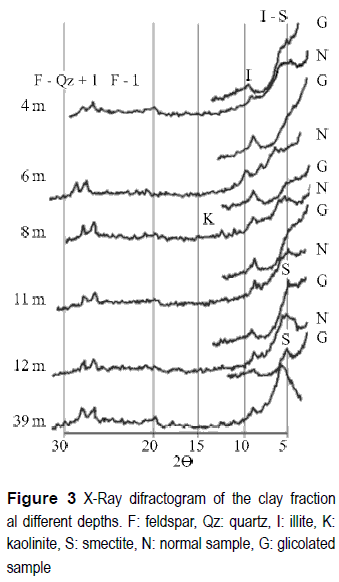
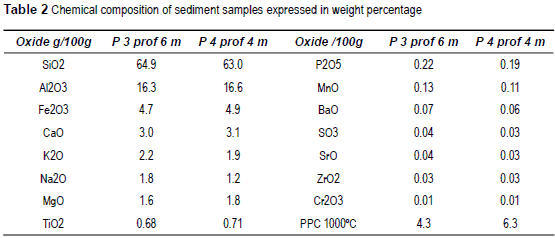
<body><![CDATA[<p align="center"><a name="Tabla1"></a><img src="/img/revistas/rfiua/n66/n66a02t01.gif" ></p>            <p>Quartz is the dominant mineral in the very fine sand  fraction, followed by plagioclases, rock debris, potassium feldspar, volcanic  glass, mica, pyroxene, amphibole, magnetite, calcite, amorphous silica (mainly  silicophytolites and sponge needles), olivine and sillimanite. In general, the  weathering degree of the minerals is inversely related to the order of  abundance. The most weathering affected minerals are: silicophytolites, rock  debris, olivine, pyroxene, mica, potassium feldspar, plagioclases, and finally  quartz and volcanic glass that appears with a low weathering degree.</p>          <p>The mineralogy of the clay fraction (<a href="#Figura3">figure 3</a>) shows a  dominance of expansive minerals, of the type of the smectites to the deeper  levels. In the upper levels the interstratified minerals are dominant. They are  of the type illite-smectite with poorly defined reflections, only expressed in  an expansive zone between 3&deg; and 7&deg; (2&theta;). Illite is found with the typical  reflection at 1.004 n&Aring; in the natural and glicolated samples, and at 1.765 n&Aring;  in the natural samples. This mineral increases its crystallographic definition  to the deeper levels.</p>      <p align="center"><a name="Figura3"></a><img src="/img/revistas/rfiua/n66/n66a02i03.gif" ></p> 	       <p>The definition of the reflection peaks of illite  muscovite increases to the deeper levels, and more clear peaks of the  reflection of calcium and magnesium smectites at 1.496 n&Aring; and calcium smectites  in glicolated samples at 1.522/1.605 can be observed. Kaolinite is present as a  trace in surface samples and increases lightly its abundance to deeper levels.  Quartz, potassium feldspars and plagioclases are common in the clay fraction of  all the studied samples.</p>        <p>The chemical composition of two samples of sediments  taken at 4 m and 6 m depth is shown in <a href="#Tabla2">table 2</a>.</p>        <p align="center"><a name="Tabla2"></a><img src="/img/revistas/rfiua/n66/n66a02t02.gif" ></p>         <p><b><i>Hydrogeochemistry</i></b></p>         <p>Reliability check of the analysis was done considering  the electroneutrality balance. Most of the samples are below the 5% of  difference, with the only exception of sample P4 which is about 16%. The  results are used anyway considering that despite the analysis includes some non  acceptable error; the main conclusions are not strongly affected because of  that.</p>          <p>The water samples taken are bicarbonate waters, being  sodium waters the samples from wells P1, P3, sodium being dominant cation the  samples from wells P2, P4, P5, P5A, P5B, P6. Only the sample P4' presents  HCO3-Ca/Mg composition. The hydrochemical water-types are represented in the  Piper diagram of <a href="#Figura4">figure 4</a>. The waters are low or medium salinity, with a salt  content between 500 mg/L and 1.250 mg/L. The chemical composition of the  samples and their pH and EC values are shown in <a href="#Tabla3">table 3</a>.</p> 	      ]]></body>
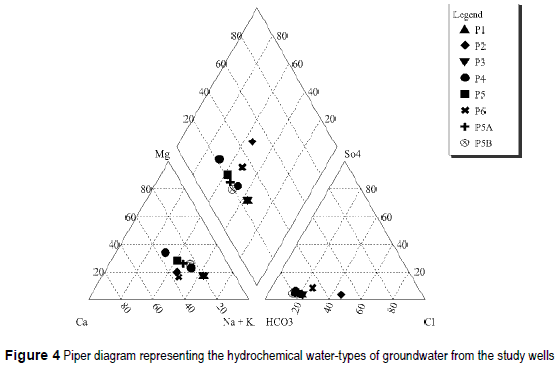
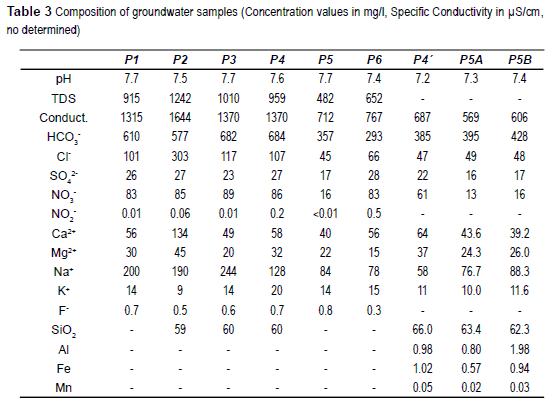
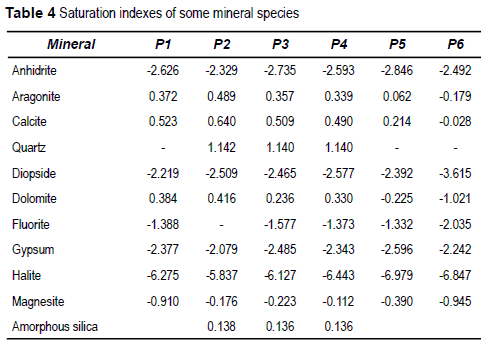
<body><![CDATA[<p align="center"><a name="Figura4"></a><img src="/img/revistas/rfiua/n66/n66a02i04.gif" ></p>     <p align="center">&nbsp;</p>     <p align="center"><a name="Tabla3"></a><img src="/img/revistas/rfiua/n66/n66a02t03.gif" ></p> 	           <p>A main  differentiation can be made in water samples. One group is integrated by  samples P1, P2, P3 and P4 is characterized by EC higher than 1,300 &mu;S/cm,  chloride concentrations over 100 mg/l and nitrate concentrations exceeding 80  mg/l. On the other hand samples P4', P5, P5A and P5B are low salinity (EC &lt;  750 &mu;S/cm) and low chloride (&lt; 70 mg/l) and nitrate (&lt; 16 mg/l excepting  P6 which is 61 mg/l) concentrations.</p>            <p>A preliminary explanation is that the first group,  more saline and nitrate contaminated, correspond to the shallow boreholes which  are closer to the landfill area. On the other side it is the well P5, which is  farther from the landfill (about 500 m) and much deeper (39.5 m) because a  higher aquifer thickness, and partially well P6 which is also farther. P1, P2,  P3 and P4 are probably affected by a leachate infiltration enhanced by the low  dilution in so slim saturated zone. P5, P5A and P5B samples, and sample P4'  taken at the bottom of P4 seems not to be affected by leachate infiltration.  Also P6 is far enough to the landfill to be affected by leachate infiltration,  and its nitrate concentration can be attributed to farming practices in the  surroundings.</p>            <p>On the basis of the calculated  concentrations as activities it is possible to obtain the saturation indexes  (SI) of the solution respecting the minerals that can be formed with the  measured components. The SI is</p>            <p>IS = log (Ionic Activity  Product/Equilibrium constant)</p>            <p>Positive values of SI indicate  over-saturated samples, and negative values indicate under- saturated samples.  La IS values for some mineral species are shown in <a href="#Tabla4">table 4</a>.</p> 	        <p align="center"><a name="Tabla4"></a><img src="/img/revistas/rfiua/n66/n66a02t04.gif" ></p>	         <p>Most of the samples are  under-saturated in sulfate minerals or halogen salts, over-saturated in quartz,  and near to equilibrium with carbonate minerals, being calcite the existing  phase.</p>       ]]></body>
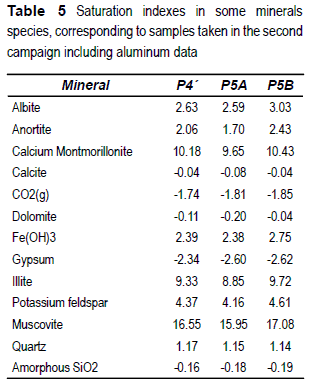
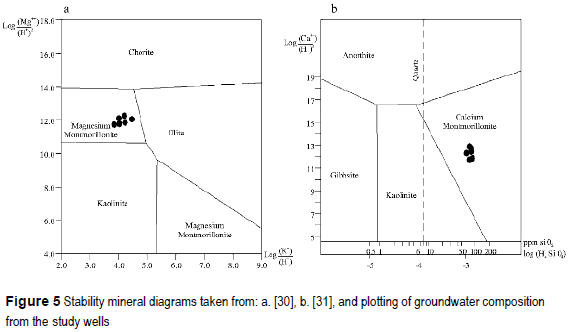
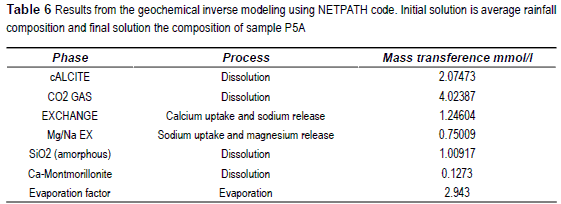
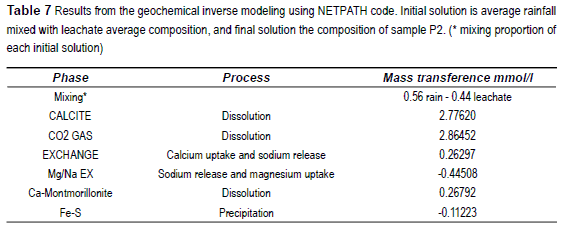
<body><![CDATA[<p>Aluminum was measured in the samples  taken in the second sampling, allowing obtaining the SI of some  aluminum-silicate minerals, as shown in <a href="#Tabla5">table 5</a>.</p>        <p align="center"><a name="Tabla5"></a><img src="/img/revistas/rfiua/n66/n66a02t05.gif" ></p>        <p>Using the activity ratios it is  possible to plot the observed compositions in equilibrium diagrams as showed in  <a href="#Figura5">figure 5.a.</a> (taken from &#91;30&#93;). The ionic rations of the analyzed solutions are  plotted in the field of the magnesium montmorillonite. Ionic ratios including  calcium area shown in <a href="#Figura5">figure 5.b.</a> (from &#91;31&#93;), where it is possible to see that  the considered solutions are represented in the calcium-montmorillonite field.  Using PHREEQC2.0 it is possible to simulate the reaction between anorthite and  rainwater giving as product the neo-formation of calcium- montmorillonite. This  reaction, forcing the previous calculated SI, gives as result that it is  necessary to dissolve 2.53 &mu;mol of anortite, resulting in the montmorillonite  formation and the release of 3 &mu;mol of Ca<sup>2+</sup> and 5 &mu;mol of Si.</p>      <p align="center"><a name="Figura5"></a><img src="/img/revistas/rfiua/n66/n66a02i05.gif" ></p>      <p>Taking into account the observed  equilibrium, and inverse modeling using NETPTAH &#91;24&#93; was performed in order to  quantify the processes that explain the observed compositions. One model was  done to explain the non polluted composition model, and the initial solution  used was the average composition of the rain water of Mar del Plata. This  average composition is: pH 6.54, Na<sup>+</sup> 18.33 ppm, K<sup>+</sup> 0.2  ppm, Mg<sup>2+</sup> 2.07 ppm, Ca<sup>2+</sup> 3.52 ppm, Cl<sup>-</sup> 16.67  ppm, SO<sub>4</sub><sup>2+</sup> 18.42 ppm and HCO<sub>3</sub><sup>-</sup>  13.10 ppm. The final composition is that of sample P5A.</p>       <p>The models devoted to explain groundwater composition  of the polluted wells use as initials a mix between rain water and leachate  average composition &#91;13&#93; to achieve the final composition of sample P2. This  average leachate composition is: pH 8.21, Na<sup>+</sup> 426.5 ppm, K<sup>+</sup>  22.8 ppm, Mg<sup>2+</sup> 74.9 ppm, Ca<sup>2+</sup> 77.4 ppm, Cl<sup>-</sup>  665.7 ppm, SO<sub>4</sub><sup>2-</sup> 62.3 ppm and HCO<sub>3</sub><sup>-</sup>  587.2 ppm.</p>       <p>According the observed SI the considered processes  were carbonate equilibrium, amorphous silica equilibrium, loss or dissolution  of CO<sub>2</sub> and cationic exchange. The solid phase calcium  montmorillonite was also included. The increase in chloride concentration was  used to calculate the rain water evaporation factor. The obtained results were  very similar for the three final solutions, showing below the model  corresponding to sample P5A in <a href="#Tabla6">table 6</a>.</p>      <p align="center"><a name="Tabla6"></a><img src="/img/revistas/rfiua/n66/n66a02t06.gif" ></p>        <p>On the other hand the results of modeling for polluted  groundwater are shown in <a href="#Tabla7">table 7</a>, considering almost the same processes but  considering rain water and leachate mixing during recharge after reacting with  the solid phase. The formation of iron monosulfides (FeS) was included to  explain the sulfur decrease in the mass balance.</p>      <p align="center"><a name="Tabla7"></a><img src="/img/revistas/rfiua/n66/n66a02t07.gif" ></p  >    ]]></body>
<body><![CDATA[<p>&nbsp;</p>       <p><font size="3"><b>Discussion</b> </font></p>      <p>The chemical composition of groundwater is the result  of the interaction with the minerals present in the flow path. The ratio Ca<sup>2+</sup>/Mg<sup>2+</sup>  determines that calcite is the most stable carbonate mineral. The SI values for  calcite are consistent with this sentence, being near to 0. SI of dolomite also  is near to equilibrium, but this mineral has not been identified in the  sediments of the aquifer, and its precipitation is not possible according to  its diagenetic origin as determined by Berner &#91;32&#93;. Other minerals of fast  reaction, like gypsum, halite or mirabilte are under-saturated, and then they  must not be presents in the sediment in the study area.</p>       <p>Calcite SI indicates equilibrium conditions in the  samples showed in <a href="#Tabla5">table 5 </a>, but oversaturation in the samples included in <a href="#Tabla4">table 4</a>. These oversaturation conditions correspond probably to sampling errors,  being possible that the pH measurements in surface were affected by the sample  aeration due to the pumping by a centrifugal pump.</p>       <p>The SI of the silicate minerals forming the aquifer  matrix indicates oversaturation in all the cases. According the  magnesium/potassium ratio represented in stability diagrams, magnesium  montmorillonite is the stable clay mineral. Taking this into account it is  possible that montmorillonite is a neoformation product mineral, while illite  should be of detritic origin. Taking into account the ratio of calcium and  proton activities, and the activity of silica in solution, calcium  montmorillonite apperas as the stable phase against anortite, which unstable in  this environment. Then it is again considered that anorthite is of detritic  origin and calcium montmorillonite due to neoformation. The increase in the  proportion of smectite toward deeper levels, together with the increase in its  degree of crystallinity, supports the hypothesis of the neoformation of these  minerals. Moreover, the modeling performed with PHREEQC demonstrated  numerically the coherence of the reaction of incongruent dissolution of  anorthite, the montmorillonite neoformation and the addition to solution of  calcium and silica. The incongruent dissolution of silicates produces an effect  on groundwater that is the addition of cations and silica, and in a secondary  way the bicarbonate formation &#91;23&#93;.</p>       <p>The SI value of amorphous silica of 0.16 shows an  equilibrium state. The high concentration of silica, which is a characteristic  of the pampeano aquifer, can be explained by the dissolution of the amorphous  silica minerals, and in a lower degree by the weathering of silicates. Among  the amorphous silica minerals the more abundant are volcanic glass and  silicophytolites. In spite of the alteration of volcanic glass has been  observed in other areas ofthe Pampean Plain &#91;3&#93;, in the studied sector the  volcanic glass shards are observed in general with a low degree of weathering.  The dissolution of biogenic silica minerals has been evidenced for their high  degree of weathering, bringing silica to the solution. Taking into account the  dominant water type existing in the area (NaHCO<sub>3</sub>) it should be  important to mention that Marshall and Warakomski &#91;33&#93; demonstrated that the  solubility of amorphous silica is higher in NaHCO<sub>3</sub> solutions. The  amorphous silica minerals present in the argentine loess are the reason of the  high contents of dissolved silica. Groundwater in the loess form China, not  containing important proportions of amorphous silica, has just about 10% to 20%  &#91;18&#93; of the amounts of silica determinate in this study.</p>       <p>Moreover the incongruent dissolution of silicates and  monmorillonite neoformation involves a reaction of the type:</p>       <p>Cation-aluminum silicate + CO<sub>2</sub> + H<sub>2</sub>O  <b>&lt;&#8212;&gt;</b>  amorphous aluminum silicate + SiO<sub>2</sub> + cation</p>       <p>The cation composition given to the solution by the  silicate dissolution processes are later affected by exchange processes in  adsorption surfaces. Cation exchange capacity (CEC) measurements in the  sediments result in values in the order of 30-40 meq/100 g. The main exchange  processes in this aquifer have been specifically studied &#91;34&#93;, determining in  the recharge areas like that considered in this work the dominance of calcium  uptake and sodium release. The cation adsorption selectivity determined for  normal flow conditions from recharge to discharge zones is Ca&gt;Mg&gt;Na&gt;K  and is responsible of the evolution from calcium waters to sodium waters.</p>       <p>Inverse hydrogeochemical modeling applied to non  polluted (i.e. low chloride and low nitrate groundwater) indicates that,  starting from rain water, to achieve the composition of the sample P5A, it is  necessary: to dissolve 2.047 mol of calcite, 4.024 mol of CO<sub>2</sub> and  1.009 mol of amorphous silica. In the cationic exchange process 0.49 mol of Na<sup>+</sup>  and 0.75 mol of Mg<sup>2+</sup> are released and 1.246 mol of Ca<sup>2+</sup>  are uptake. A small quantity of calcium montmorillonite must be dissolved to  explain the Al<sup>3+</sup> in solution. Nevertheless, it should be noted that  Al<sup>3+</sup> was not measured in rain water, considering 0 its  concentration.</p>       ]]></body>
<body><![CDATA[<p>Inverse modeling applied to a contaminated sample  indicates approximately equal proportions of landfill leachate infiltrates mixed  with precipitation recharge. This mixing contributes with most of the high  salinity, i.e. dissolved chloride and sodium, while the other ions seem to be  affected by the same processes than in normal evolution.</p>     <p>&nbsp;</p>       <p><font size="3"><b>Conclusions</b> </font></p>        <p>The hydrochemistry of the Pampeano aquifer system is  the result of the interaction of recharge water, mainly rain water, with the  mineral phases forming the aquifer. Taking into account the mineralogical  composition there are two main kind of processes: chemical equilibrium between  the solution and some minerals, specially calcite and amorphous silica, and  cationic exchange. Calcite is a mineral widely distributed in Pampean sediments  present forming compact layers or disseminated as small concretions, and  equilibrium condition can be assumed according the rapid reversible dissolution  reaction. Amorphous silica is present as volcanic glass shards or silica  minerals formed by biological (vegetal) processes known as silicophytolites. As  mentioned silicophytolites appears more weathered than volcanic glass in the  study area. Amorphous silica minerals dissolution is responsible of one of the  most noticeable features of groundwater from loess pampean aquifers, which the  high dissolved silica contents, ranging usually in the order of 50-70 mg/L.</p>       <p>Groundwater in the area is in equilibrium respect to  calcite and amorphous silica and oversaturated with respect to most of the  silicate minerals forming the aquifer. The solution is subsaturated in sulfate  and halogen salts, which explains the absence of gypsum or mirabilite in the  sediment. The cation adsorption selectivity determined for normal flow  conditions from recharge to discharge zones is Ca&gt;Mg&gt;Na&gt;K and is  responsible of the evolution from calcium waters to sodium waters, and the high  CEC ofthe loess-like sediments in the Argentine Pampa enhance the importance of  the process. Incongruent dissolution of silicates with montmorrillonite  neoformation is also partially responsible of silica and calcium content.</p>        <p>&nbsp;</p>      <p><font size="3"><b>Acknowledgements</b> </font></p>      <p>The authors are grateful to Cart. Virginia Bernasconi  and Cart. Marcelo Farenga for the figures illustrating the text, to Tec.  Mariquita Trassens for the textural analysis of sediments and to Tec. Angel  Ferrante for his collaboration in sampling campaigns.</p>      <p>&nbsp;</p>      <p><font size="3"><b>References</b> </font></p>      ]]></body>
<body><![CDATA[<!-- ref --><p>1. F. Ameghino. "La formaci&oacute;n Pampeana o estudio de  los terrenos de transporte de la cuenca del Plata". Buenos Aires-Par&iacute;s. 1881.  pp. 371.    &nbsp;&nbsp;&nbsp;&nbsp;&nbsp;&nbsp;&nbsp;&nbsp;[&#160;<a href="javascript:void(0);" onclick="javascript: window.open('/scielo.php?script=sci_nlinks&ref=000103&pid=S0120-6230201300010000200001&lng=','','width=640,height=500,resizable=yes,scrollbars=1,menubar=yes,');">Links</a>&#160;]<!-- end-ref --></p>       <!-- ref --><p>2. C. Schultz, E. Castro. "Estudio,  planificaci&oacute;n y explotaci&oacute;n del agua subterr&aacute;nea. Una trilog&iacute;a ut&oacute;pica en la  Rep&uacute;blica Argentina". III Congreso Argentino de Hidrogeolog&iacute;a. Actas I: 219-225. Rosario,  Argentina. 2003.    &nbsp;&nbsp;&nbsp;&nbsp;&nbsp;&nbsp;&nbsp;&nbsp;[&#160;<a href="javascript:void(0);" onclick="javascript: window.open('/scielo.php?script=sci_nlinks&ref=000105&pid=S0120-6230201300010000200002&lng=','','width=640,height=500,resizable=yes,scrollbars=1,menubar=yes,');">Links</a>&#160;]<!-- end-ref --></p>       <!-- ref --><p>3. H. Nicolli, J. Suriano, M. G&oacute;mez, L.  Ferpozzi, O. Baleani. "Groundwater contamination with arsenic and other trace  elements in an area of the Pampa, province of C&oacute;rdoba, Argentina". <i>Environmental Geology</i>. Vol. 14. 1989.  pp. 3-16.    &nbsp;&nbsp;&nbsp;&nbsp;&nbsp;&nbsp;&nbsp;&nbsp;[&#160;<a href="javascript:void(0);" onclick="javascript: window.open('/scielo.php?script=sci_nlinks&ref=000107&pid=S0120-6230201300010000200003&lng=','','width=640,height=500,resizable=yes,scrollbars=1,menubar=yes,');">Links</a>&#160;]<!-- end-ref --></p>       <!-- ref --><p>4. H. Nicolli, A. Tineo, J. Garcia, C.  Falc&oacute;n. Distribuci&oacute;n del ars&eacute;nico y otros oligoelementos asociados en aguas  subterr&aacute;neas de la regi&oacute;n de Los Pereyra. Provincia de Tucum&aacute;n, Argentina. En:  Galindo G, Fern&aacute;ndez- Turiel JL, Parada MA, Gimeno Torrente D, eds. Ars&eacute;nico en  aguas: origen, movilidad y tratamiento. Taller. II Seminario  Hispano-Latinoamericano sobre temas actuales de hidrolog&iacute;a subterr&aacute;nea - IV  Congreso Hidrogeol&oacute;gico Argentino. 2005 Octubre 25-28; Rio Cuarto, Argentina. 2005. pp. 83-91.    &nbsp;&nbsp;&nbsp;&nbsp;&nbsp;&nbsp;&nbsp;&nbsp;[&#160;<a href="javascript:void(0);" onclick="javascript: window.open('/scielo.php?script=sci_nlinks&ref=000109&pid=S0120-6230201300010000200004&lng=','','width=640,height=500,resizable=yes,scrollbars=1,menubar=yes,');">Links</a>&#160;]<!-- end-ref --></p>       <!-- ref --><p>5. H. Nicolli, J. Bundschuh, M. Blanco,  O. Tujchneider, H. Panarello, C. Dape&ntilde;a, J. Rusansky. "Arsenic and associated  trace-elements in groundwater from the Chaco-Pampean plain, Argentina: Results  from 100 years of research".  <i>Science of the Total Environment</i>. Vol. 429. 2012. pp. 36-56.    &nbsp;&nbsp;&nbsp;&nbsp;&nbsp;&nbsp;&nbsp;&nbsp;[&#160;<a href="javascript:void(0);" onclick="javascript: window.open('/scielo.php?script=sci_nlinks&ref=000111&pid=S0120-6230201300010000200005&lng=','','width=640,height=500,resizable=yes,scrollbars=1,menubar=yes,');">Links</a>&#160;]<!-- end-ref --></p>       ]]></body>
<body><![CDATA[<!-- ref --><p>6. E. Kruse, J. Ainchil. "Assessment of fluoride  concentration in groundwater, Saldungaray, Argentina". Sililo et al  (editors): Groundwater: Past Achievements and Future Challenges. Proceedings of  the XXX IAH Congress. Rotterdam, Netherlands. 2000. pp. 545-548.    &nbsp;&nbsp;&nbsp;&nbsp;&nbsp;&nbsp;&nbsp;&nbsp;[&#160;<a href="javascript:void(0);" onclick="javascript: window.open('/scielo.php?script=sci_nlinks&ref=000113&pid=S0120-6230201300010000200006&lng=','','width=640,height=500,resizable=yes,scrollbars=1,menubar=yes,');">Links</a>&#160;]<!-- end-ref --></p>       <!-- ref --><p>7. J. Bundschuh, B. Farias , R. Martin , A. Storniolo  , P. Bhattacharya , J. Cortes , G. Bonorino , R. Alboury. "Groundwater  arsenic in the Chaco-Pampean Plain, Argentina: Case study from Robles County,  Santiago del Estero Province".  <i>Appl. Geochem</i>. Vol.19. 2004. pp. 231-243&nbsp;&nbsp;&nbsp;&nbsp;&nbsp;&nbsp;&nbsp;&nbsp;[&#160;<a href="javascript:void(0);" onclick="javascript: window.open('/scielo.php?script=sci_nlinks&ref=000115&pid=S0120-6230201300010000200007&lng=','','width=640,height=500,resizable=yes,scrollbars=1,menubar=yes,');">Links</a>&#160;]<!-- end-ref --><!-- ref --><p>8. M. Gomez, M. Blarasin, D. Martinez. "Arsenic and Fluoride  in a loess aquifer in the central area of Argentina". <i>Environmental Geology</i>.  Vol. 57. 2009. pp. 143-155.    &nbsp;&nbsp;&nbsp;&nbsp;&nbsp;&nbsp;&nbsp;&nbsp;[&#160;<a href="javascript:void(0);" onclick="javascript: window.open('/scielo.php?script=sci_nlinks&ref=000116&pid=S0120-6230201300010000200008&lng=','','width=640,height=500,resizable=yes,scrollbars=1,menubar=yes,');">Links</a>&#160;]<!-- end-ref --></p>       <!-- ref --><p>9. D. Martinez, O. Quiroz, H. Massone,  P. Palacio, L. Lima. "Hydrogeochemistry of Fluoride in the Quequen River  Basin: Natural Pollutants Distribution in the Argentine Pampa". <i>Environmental Earth Sciences</i>. Vol.  65. 2012. pp. 411-420.    &nbsp;&nbsp;&nbsp;&nbsp;&nbsp;&nbsp;&nbsp;&nbsp;[&#160;<a href="javascript:void(0);" onclick="javascript: window.open('/scielo.php?script=sci_nlinks&ref=000118&pid=S0120-6230201300010000200009&lng=','','width=640,height=500,resizable=yes,scrollbars=1,menubar=yes,');">Links</a>&#160;]<!-- end-ref --></p>       <!-- ref --><p>10. J. Costa, H. Massone, D. Martinez,  E. Suero, F. Bedmar. "Nitrate contamination of a rural aquifer and nitrate  accumulation in the no saturated zone". <i>Agricultural-Water Management</i>.  Vol. 57. 2002. pp. 33-47.    &nbsp;&nbsp;&nbsp;&nbsp;&nbsp;&nbsp;&nbsp;&nbsp;[&#160;<a href="javascript:void(0);" onclick="javascript: window.open('/scielo.php?script=sci_nlinks&ref=000120&pid=S0120-6230201300010000200010&lng=','','width=640,height=500,resizable=yes,scrollbars=1,menubar=yes,');">Links</a>&#160;]<!-- end-ref --></p>       <!-- ref --><p>11. I. Chebotarev. "Metamorphism of Natural  Waters in the Crust of Weathering".  <i>Geochim Cosmochim. Acta</i>. Vol. 8. 1955. pp. 22-48,137.    &nbsp;&nbsp;&nbsp;&nbsp;&nbsp;&nbsp;&nbsp;&nbsp;[&#160;<a href="javascript:void(0);" onclick="javascript: window.open('/scielo.php?script=sci_nlinks&ref=000122&pid=S0120-6230201300010000200011&lng=','','width=640,height=500,resizable=yes,scrollbars=1,menubar=yes,');">Links</a>&#160;]<!-- end-ref --></p>       <!-- ref --><p>12. R. Garrels, C. Christ. <i>Solutions, Minerals and  Equilibrio</i>. Ed. Harper &amp; Row. New York, USA. 1965. pp. 450.    &nbsp;&nbsp;&nbsp;&nbsp;&nbsp;&nbsp;&nbsp;&nbsp;[&#160;<a href="javascript:void(0);" onclick="javascript: window.open('/scielo.php?script=sci_nlinks&ref=000124&pid=S0120-6230201300010000200012&lng=','','width=640,height=500,resizable=yes,scrollbars=1,menubar=yes,');">Links</a>&#160;]<!-- end-ref --></p>       <!-- ref --><p>13. E. Bocanegra, H. Massone, D. Martinez, E. Civit,  M. Farenga. "Groundwater contamination: risk management and assessment for  landfills in Mar del Plata, Argentina". <i>Environmental Geology</i>. Vol. 40. 2001.  pp. 732-741.    &nbsp;&nbsp;&nbsp;&nbsp;&nbsp;&nbsp;&nbsp;&nbsp;[&#160;<a href="javascript:void(0);" onclick="javascript: window.open('/scielo.php?script=sci_nlinks&ref=000126&pid=S0120-6230201300010000200013&lng=','','width=640,height=500,resizable=yes,scrollbars=1,menubar=yes,');">Links</a>&#160;]<!-- end-ref --></p>       <!-- ref --><p>14. D. Martinez, H. Massone, J. Ceron,  M. Farenga, A. Ferrante. "Hidrogeoqu&iacute;mica del &aacute;rea de disposici&oacute;n final de  residuos de Mar del Plata, Argentina". <i>Bolet&iacute;n  Geol&oacute;gico Minero de Espa&ntilde;a, N&uacute;mero Monogr&aacute;fico Iberoamericano Hidrolog&iacute;a  Subterr&aacute;nea</i>. Vol. 114. 2003. pp. 237-246.    &nbsp;&nbsp;&nbsp;&nbsp;&nbsp;&nbsp;&nbsp;&nbsp;[&#160;<a href="javascript:void(0);" onclick="javascript: window.open('/scielo.php?script=sci_nlinks&ref=000128&pid=S0120-6230201300010000200014&lng=','','width=640,height=500,resizable=yes,scrollbars=1,menubar=yes,');">Links</a>&#160;]<!-- end-ref --></p>       <!-- ref --><p>15. D. Martinez, S. Mascioli, E.  Bocanegra. "Determination  of Zn partition coefficient and reactive transport simulation form landfills in  Mar del Plata, Argentina". <i>Environmental  Geology</i>. Vol. 51. 2006. pp. 463-469.    &nbsp;&nbsp;&nbsp;&nbsp;&nbsp;&nbsp;&nbsp;&nbsp;[&#160;<a href="javascript:void(0);" onclick="javascript: window.open('/scielo.php?script=sci_nlinks&ref=000130&pid=S0120-6230201300010000200015&lng=','','width=640,height=500,resizable=yes,scrollbars=1,menubar=yes,');">Links</a>&#160;]<!-- end-ref --></p>       <!-- ref --><p>16. M. Teruggi. "The nature and origin of the  Argentine loess".  <i>Journal of Sedimentary Petrology</i>. Vol. 27. 1957. pp.  322-332.    &nbsp;&nbsp;&nbsp;&nbsp;&nbsp;&nbsp;&nbsp;&nbsp;[&#160;<a href="javascript:void(0);" onclick="javascript: window.open('/scielo.php?script=sci_nlinks&ref=000132&pid=S0120-6230201300010000200016&lng=','','width=640,height=500,resizable=yes,scrollbars=1,menubar=yes,');">Links</a>&#160;]<!-- end-ref --></p>       <!-- ref --><p>17. J. Tricart. "Geomorfolog&iacute;a de  la Pampa Deprimida". Instituto Nacional de Tecnolog&iacute;a Agropecuaria, Colecci&oacute;n  Cient&iacute;fica N&deg; 12. Buenos Aires, Argentina. 1973. pp. 202.    &nbsp;&nbsp;&nbsp;&nbsp;&nbsp;&nbsp;&nbsp;&nbsp;[&#160;<a href="javascript:void(0);" onclick="javascript: window.open('/scielo.php?script=sci_nlinks&ref=000134&pid=S0120-6230201300010000200017&lng=','','width=640,height=500,resizable=yes,scrollbars=1,menubar=yes,');">Links</a>&#160;]<!-- end-ref --></p>       <!-- ref --><p>18. M. Currell, I. Cartwright. "Major-ion chemistry, S13C and S7Sr/S6Sr  as indicators of hydrochemical evolution and sources of salinity in groundwater  in the Yuncheng Basin, China".  <i>Hydrogeology Journal</i>. Vol. 19. 2011. pp. S35-S50.    &nbsp;&nbsp;&nbsp;&nbsp;&nbsp;&nbsp;&nbsp;&nbsp;[&#160;<a href="javascript:void(0);" onclick="javascript: window.open('/scielo.php?script=sci_nlinks&ref=000136&pid=S0120-6230201300010000200018&lng=','','width=640,height=500,resizable=yes,scrollbars=1,menubar=yes,');">Links</a>&#160;]<!-- end-ref --></p>       <!-- ref --><p>19. C. Thornthwaite. "An approach toward a  rational classification of climate".  <i>Geogr. Rev</i>. Vol. 3S. 194S. pp. 55-94.    &nbsp;&nbsp;&nbsp;&nbsp;&nbsp;&nbsp;&nbsp;&nbsp;[&#160;<a href="javascript:void(0);" onclick="javascript: window.open('/scielo.php?script=sci_nlinks&ref=000138&pid=S0120-6230201300010000200019&lng=','','width=640,height=500,resizable=yes,scrollbars=1,menubar=yes,');">Links</a>&#160;]<!-- end-ref --></p>      <!-- ref --><p> 20. Dalla, M. I&ntilde;iguez. "La Tinta,  Precambrico y Paleozoico de Buenos Aires". VII Cong. Geol. Arg. Actas, I.  La Plata, Argentina. 1979. pp. 539-550.    &nbsp;&nbsp;&nbsp;&nbsp;&nbsp;&nbsp;&nbsp;&nbsp;[&#160;<a href="javascript:void(0);" onclick="javascript: window.open('/scielo.php?script=sci_nlinks&ref=000140&pid=S0120-6230201300010000200020&lng=','','width=640,height=500,resizable=yes,scrollbars=1,menubar=yes,');">Links</a>&#160;]<!-- end-ref --></p>       <!-- ref --><p>21. M. Teruggi, J. Kilmurray.  "Tandilia relatorio geolog&iacute;a de la Provincia de Buenos Aires". VI Congr Geol Argentino.  Bah&iacute;a Blanca, Argentina. 1975. pp. 55-77.    &nbsp;&nbsp;&nbsp;&nbsp;&nbsp;&nbsp;&nbsp;&nbsp;[&#160;<a href="javascript:void(0);" onclick="javascript: window.open('/scielo.php?script=sci_nlinks&ref=000142&pid=S0120-6230201300010000200021&lng=','','width=640,height=500,resizable=yes,scrollbars=1,menubar=yes,');">Links</a>&#160;]<!-- end-ref --></p>       <!-- ref --><p>22. J. Sala. "Recursos H&iacute;dricos  (especial menci&oacute;n de las aguas subterr&aacute;neas)". Relatorio Geolog&iacute;a de la  Provincia de Buenos Aires. IV Congreso Geol&oacute;gico Argentino. Buenos Aires, Argentina.  1975. pp. 169.    &nbsp;&nbsp;&nbsp;&nbsp;&nbsp;&nbsp;&nbsp;&nbsp;[&#160;<a href="javascript:void(0);" onclick="javascript: window.open('/scielo.php?script=sci_nlinks&ref=000144&pid=S0120-6230201300010000200022&lng=','','width=640,height=500,resizable=yes,scrollbars=1,menubar=yes,');">Links</a>&#160;]<!-- end-ref --></p>       <!-- ref --><p>23. C. Appelo, D. Postma. <i>Geochemistry, Groundwater and  Pollution</i>. Ed. A.A. Balkema/Rotterdam/ Brookfield. Leiden, The  Netherlands. 1993. pp. 536.    &nbsp;&nbsp;&nbsp;&nbsp;&nbsp;&nbsp;&nbsp;&nbsp;[&#160;<a href="javascript:void(0);" onclick="javascript: window.open('/scielo.php?script=sci_nlinks&ref=000146&pid=S0120-6230201300010000200023&lng=','','width=640,height=500,resizable=yes,scrollbars=1,menubar=yes,');">Links</a>&#160;]<!-- end-ref --></p>       <!-- ref --><p>24. L. Plummer, E. Prestemon, D. Parkhurst. "An  Interactive Code (NETPATH) for Modelling NET Geochemical Reactions Along a Flow  PATH." U.S.G.S. Water Resources Investigations Report 912- 407S. Reston,  VA, USA. 407S, 1991. pp. 227.    &nbsp;&nbsp;&nbsp;&nbsp;&nbsp;&nbsp;&nbsp;&nbsp;[&#160;<a href="javascript:void(0);" onclick="javascript: window.open('/scielo.php?script=sci_nlinks&ref=000148&pid=S0120-6230201300010000200024&lng=','','width=640,height=500,resizable=yes,scrollbars=1,menubar=yes,');">Links</a>&#160;]<!-- end-ref --></p>       <!-- ref --><p>25. D. Parkhurst, T. Appelo. "User's guide to  PHREEQC (Version 2) - A computer program for speciation, batch reaction, one  dimensional transport, and inverse geochemical calculations. U.S.G.S."  Water-Resources Investigations Report 99-4259. Reston, VA, Estados Unidos.  1999. pp. 1-312.    &nbsp;&nbsp;&nbsp;&nbsp;&nbsp;&nbsp;&nbsp;&nbsp;[&#160;<a href="javascript:void(0);" onclick="javascript: window.open('/scielo.php?script=sci_nlinks&ref=000150&pid=S0120-6230201300010000200025&lng=','','width=640,height=500,resizable=yes,scrollbars=1,menubar=yes,');">Links</a>&#160;]<!-- end-ref --></p>       <!-- ref --><p>26. A. Walkey, A. Black. <i>Organic carbon</i>.  Black CA (editor). Methods of soil analysis. American Society of Agronomy.  Madison, Wisconsin, USA. 1965. pp. 1372-1374.    &nbsp;&nbsp;&nbsp;&nbsp;&nbsp;&nbsp;&nbsp;&nbsp;[&#160;<a href="javascript:void(0);" onclick="javascript: window.open('/scielo.php?script=sci_nlinks&ref=000152&pid=S0120-6230201300010000200026&lng=','','width=640,height=500,resizable=yes,scrollbars=1,menubar=yes,');">Links</a>&#160;]<!-- end-ref --></p>       <!-- ref --><p>27. T. Kent, E. Payne. <i>Sampling Groundwater Monitoring  Wells: Special Quality Assurance and Quality Considerations</i>. L.H.  Keith (editors) .Principles of Environmental Sampling. ACS Professional  Reference Book. Washington DC, USA. 1988. pp. 231-246.    &nbsp;&nbsp;&nbsp;&nbsp;&nbsp;&nbsp;&nbsp;&nbsp;[&#160;<a href="javascript:void(0);" onclick="javascript: window.open('/scielo.php?script=sci_nlinks&ref=000154&pid=S0120-6230201300010000200027&lng=','','width=640,height=500,resizable=yes,scrollbars=1,menubar=yes,');">Links</a>&#160;]<!-- end-ref --></p>       <!-- ref --><p>28. E. Brown, M. Skougstad, M. Fishman. "Methods  for collection and analysis of water samples for dissolved minerals and  gases". US Geol Surv Tech Water Resour Invest 5 (A-1). Washington DC, USA.  1970. pp. 160.    &nbsp;&nbsp;&nbsp;&nbsp;&nbsp;&nbsp;&nbsp;&nbsp;[&#160;<a href="javascript:void(0);" onclick="javascript: window.open('/scielo.php?script=sci_nlinks&ref=000156&pid=S0120-6230201300010000200028&lng=','','width=640,height=500,resizable=yes,scrollbars=1,menubar=yes,');">Links</a>&#160;]<!-- end-ref --></p>       <!-- ref --><p>29. R. Folk, W. Ward. "Brazos River bar: a study  in the significance of grain size parameters". <i>Journal of Sedimentary Petrology</i>.  Vol. 27. 1957. pp. 3-26.    &nbsp;&nbsp;&nbsp;&nbsp;&nbsp;&nbsp;&nbsp;&nbsp;[&#160;<a href="javascript:void(0);" onclick="javascript: window.open('/scielo.php?script=sci_nlinks&ref=000158&pid=S0120-6230201300010000200029&lng=','','width=640,height=500,resizable=yes,scrollbars=1,menubar=yes,');">Links</a>&#160;]<!-- end-ref --></p>       <!-- ref --><p>30. T. Henderson. "Geochemistry of groundwater in  two sandstone aquifer systems in the Northern Great Plains in parts of Montana,  Wyoming, North Dakota and South Dakota". U.S.G.S. Professional Paper,  1402C. Washington, USA. 1984. pp. 93.    &nbsp;&nbsp;&nbsp;&nbsp;&nbsp;&nbsp;&nbsp;&nbsp;[&#160;<a href="javascript:void(0);" onclick="javascript: window.open('/scielo.php?script=sci_nlinks&ref=000160&pid=S0120-6230201300010000200030&lng=','','width=640,height=500,resizable=yes,scrollbars=1,menubar=yes,');">Links</a>&#160;]<!-- end-ref --></p>       <!-- ref --><p>31. M. Tardy. "Characterization of principal  weathering types by the geochemestry of waters from some European and African  cristalline massifs".  <i>Chem. Geology</i>. Vol. 7. 1971. pp. 253-271.    &nbsp;&nbsp;&nbsp;&nbsp;&nbsp;&nbsp;&nbsp;&nbsp;[&#160;<a href="javascript:void(0);" onclick="javascript: window.open('/scielo.php?script=sci_nlinks&ref=000162&pid=S0120-6230201300010000200031&lng=','','width=640,height=500,resizable=yes,scrollbars=1,menubar=yes,');">Links</a>&#160;]<!-- end-ref --></p>       <!-- ref --><p>32. R. Berner. "Chemical diagenesis in some  modern carbonate sediments". <i>American  Journal of Science</i>. Vol. 264. 1966. pp.2-36.    &nbsp;&nbsp;&nbsp;&nbsp;&nbsp;&nbsp;&nbsp;&nbsp;[&#160;<a href="javascript:void(0);" onclick="javascript: window.open('/scielo.php?script=sci_nlinks&ref=000164&pid=S0120-6230201300010000200032&lng=','','width=640,height=500,resizable=yes,scrollbars=1,menubar=yes,');">Links</a>&#160;]<!-- end-ref --></p>       <!-- ref --><p>33. W. Marshall, J. Warakomski. "Amorphous silica  solubilities - II. Effect of aqueous salt solutions at 25&deg;C. <i>Geochimica Cosmochimica Acta</i>.  Vol. 44. 1980. pp. 915-924.    &nbsp;&nbsp;&nbsp;&nbsp;&nbsp;&nbsp;&nbsp;&nbsp;[&#160;<a href="javascript:void(0);" onclick="javascript: window.open('/scielo.php?script=sci_nlinks&ref=000166&pid=S0120-6230201300010000200033&lng=','','width=640,height=500,resizable=yes,scrollbars=1,menubar=yes,');">Links</a>&#160;]<!-- end-ref --></p>       <!-- ref --><p>34. D. Martinez, E. Bocanegra. "Hydrogeochemistry  and cationic exchange processes in the coastal aquifer of Mar del Plata,  Argentina". <i>Hydrogeology Journal</i>.  Vol. 10. 2002. pp. 393-408.    &nbsp;&nbsp;&nbsp;&nbsp;&nbsp;&nbsp;&nbsp;&nbsp;[&#160;<a href="javascript:void(0);" onclick="javascript: window.open('/scielo.php?script=sci_nlinks&ref=000168&pid=S0120-6230201300010000200034&lng=','','width=640,height=500,resizable=yes,scrollbars=1,menubar=yes,');">Links</a>&#160;]<!-- end-ref --></p>     <p>&nbsp;</p>         ]]></body><back>
<ref-list>
<ref id="B1">
<label>1</label><nlm-citation citation-type="">
<person-group person-group-type="author">
<name>
<surname><![CDATA[Ameghino]]></surname>
<given-names><![CDATA[F.]]></given-names>
</name>
</person-group>
<source><![CDATA["La formación Pampeana o estudio de los terrenos de transporte de la cuenca del Plata"]]></source>
<year>1881</year>
<page-range>371</page-range><publisher-loc><![CDATA[Buenos Aires ]]></publisher-loc>
</nlm-citation>
</ref>
<ref id="B2">
<label>2</label><nlm-citation citation-type="confpro">
<person-group person-group-type="author">
<name>
<surname><![CDATA[Schultz]]></surname>
<given-names><![CDATA[C.]]></given-names>
</name>
<name>
<surname><![CDATA[Castro]]></surname>
<given-names><![CDATA[E.]]></given-names>
</name>
</person-group>
<source><![CDATA["Estudio, planificación y explotación del agua subterránea. Una trilogía utópica en la República Argentina"]]></source>
<year>2003</year>
<conf-name><![CDATA[III Congreso Argentino de Hidrogeología]]></conf-name>
<conf-loc> </conf-loc>
<page-range>219-225</page-range><publisher-loc><![CDATA[Rosario ]]></publisher-loc>
</nlm-citation>
</ref>
<ref id="B3">
<label>3</label><nlm-citation citation-type="journal">
<person-group person-group-type="author">
<name>
<surname><![CDATA[Nicolli]]></surname>
<given-names><![CDATA[H]]></given-names>
</name>
<name>
<surname><![CDATA[Suriano]]></surname>
<given-names><![CDATA[J]]></given-names>
</name>
<name>
<surname><![CDATA[Gómez]]></surname>
<given-names><![CDATA[M]]></given-names>
</name>
<name>
<surname><![CDATA[Ferpozzi]]></surname>
<given-names><![CDATA[L]]></given-names>
</name>
<name>
<surname><![CDATA[Baleani]]></surname>
<given-names><![CDATA[O]]></given-names>
</name>
</person-group>
<article-title xml:lang="en"><![CDATA[Groundwater contamination with arsenic and other trace elements in an area of the Pampa, province of Córdoba, Argentina]]></article-title>
<source><![CDATA[Environmental Geology]]></source>
<year>1989</year>
<volume>14</volume>
<page-range>3-16</page-range></nlm-citation>
</ref>
<ref id="B4">
<label>4</label><nlm-citation citation-type="">
<person-group person-group-type="author">
<name>
<surname><![CDATA[Nicolli]]></surname>
<given-names><![CDATA[H.]]></given-names>
</name>
<name>
<surname><![CDATA[Tineo]]></surname>
<given-names><![CDATA[A.]]></given-names>
</name>
<name>
<surname><![CDATA[Garcia]]></surname>
<given-names><![CDATA[J.]]></given-names>
</name>
<name>
<surname><![CDATA[Falcón]]></surname>
<given-names><![CDATA[C.]]></given-names>
</name>
</person-group>
<article-title xml:lang="es"><![CDATA[Distribución del arsénico y otros oligoelementos asociados en aguas subterráneas de la región de Los Pereyra. Provincia de Tucumán, Argentina]]></article-title>
<person-group person-group-type="editor">
<name>
<surname><![CDATA[Galindo]]></surname>
<given-names><![CDATA[G]]></given-names>
</name>
<name>
<surname><![CDATA[Fernández- Turiel]]></surname>
<given-names><![CDATA[JL]]></given-names>
</name>
<name>
<surname><![CDATA[Parada]]></surname>
<given-names><![CDATA[MA]]></given-names>
</name>
<name>
<surname><![CDATA[Gimeno Torrente]]></surname>
<given-names><![CDATA[D]]></given-names>
</name>
</person-group>
<source><![CDATA[Arsénico en aguas: origen, movilidad y tratamiento]]></source>
<year>2005</year>
<page-range>83-91</page-range><publisher-loc><![CDATA[Rio Cuarto ]]></publisher-loc>
</nlm-citation>
</ref>
<ref id="B5">
<label>5</label><nlm-citation citation-type="journal">
<person-group person-group-type="author">
<name>
<surname><![CDATA[Nicolli]]></surname>
<given-names><![CDATA[H]]></given-names>
</name>
<name>
<surname><![CDATA[Bundschuh]]></surname>
<given-names><![CDATA[J]]></given-names>
</name>
<name>
<surname><![CDATA[Blanco]]></surname>
<given-names><![CDATA[M]]></given-names>
</name>
<name>
<surname><![CDATA[Tujchneider]]></surname>
<given-names><![CDATA[O]]></given-names>
</name>
<name>
<surname><![CDATA[Panarello]]></surname>
<given-names><![CDATA[H]]></given-names>
</name>
<name>
<surname><![CDATA[Dapeña]]></surname>
<given-names><![CDATA[C]]></given-names>
</name>
<name>
<surname><![CDATA[Rusansky]]></surname>
<given-names><![CDATA[J]]></given-names>
</name>
</person-group>
<article-title xml:lang="en"><![CDATA[Arsenic and associated trace-elements in groundwater from the Chaco-Pampean plain, Argentina: Results from 100 years of research]]></article-title>
<source><![CDATA[Science of the Total Environment]]></source>
<year>2012</year>
<volume>429</volume>
<page-range>36-56</page-range></nlm-citation>
</ref>
<ref id="B6">
<label>6</label><nlm-citation citation-type="">
<person-group person-group-type="author">
<name>
<surname><![CDATA[Kruse]]></surname>
<given-names><![CDATA[E.]]></given-names>
</name>
<name>
<surname><![CDATA[Ainchil]]></surname>
<given-names><![CDATA[J.]]></given-names>
</name>
</person-group>
<source><![CDATA["Assessment of fluoride concentration in groundwater, Saldungaray, Argentina"]]></source>
<year>2000</year>
<page-range>545-548</page-range><publisher-loc><![CDATA[Rotterdam ]]></publisher-loc>
</nlm-citation>
</ref>
<ref id="B7">
<label>7</label><nlm-citation citation-type="journal">
<person-group person-group-type="author">
<name>
<surname><![CDATA[Bundschuh]]></surname>
<given-names><![CDATA[J]]></given-names>
</name>
<name>
<surname><![CDATA[Farias]]></surname>
<given-names><![CDATA[B]]></given-names>
</name>
<name>
<surname><![CDATA[Martin]]></surname>
<given-names><![CDATA[R]]></given-names>
</name>
<name>
<surname><![CDATA[Storniolo]]></surname>
<given-names><![CDATA[A]]></given-names>
</name>
<name>
<surname><![CDATA[Bhattacharya]]></surname>
<given-names><![CDATA[P]]></given-names>
</name>
<name>
<surname><![CDATA[Cortes]]></surname>
<given-names><![CDATA[J]]></given-names>
</name>
<name>
<surname><![CDATA[Bonorino]]></surname>
<given-names><![CDATA[G]]></given-names>
</name>
<name>
<surname><![CDATA[Alboury]]></surname>
<given-names><![CDATA[R]]></given-names>
</name>
</person-group>
<article-title xml:lang="en"><![CDATA[Groundwater arsenic in the Chaco-Pampean Plain, Argentina: Case study from Robles County, Santiago del Estero Province]]></article-title>
<source><![CDATA[Appl. Geochem]]></source>
<year>2004</year>
<volume>19</volume>
<page-range>231-243</page-range></nlm-citation>
</ref>
<ref id="B8">
<label>8</label><nlm-citation citation-type="journal">
<person-group person-group-type="author">
<name>
<surname><![CDATA[Gomez]]></surname>
<given-names><![CDATA[M]]></given-names>
</name>
<name>
<surname><![CDATA[Blarasin]]></surname>
<given-names><![CDATA[M]]></given-names>
</name>
<name>
<surname><![CDATA[Martinez]]></surname>
<given-names><![CDATA[D]]></given-names>
</name>
</person-group>
<article-title xml:lang="en"><![CDATA[Arsenic and Fluoride in a loess aquifer in the central area of Argentina]]></article-title>
<source><![CDATA[Environmental Geology]]></source>
<year>2009</year>
<volume>57</volume>
<page-range>143-155</page-range></nlm-citation>
</ref>
<ref id="B9">
<label>9</label><nlm-citation citation-type="journal">
<person-group person-group-type="author">
<name>
<surname><![CDATA[Martinez]]></surname>
<given-names><![CDATA[D]]></given-names>
</name>
<name>
<surname><![CDATA[Quiroz]]></surname>
<given-names><![CDATA[O]]></given-names>
</name>
<name>
<surname><![CDATA[Massone]]></surname>
<given-names><![CDATA[H]]></given-names>
</name>
<name>
<surname><![CDATA[Palacio]]></surname>
<given-names><![CDATA[P]]></given-names>
</name>
<name>
<surname><![CDATA[Lima]]></surname>
<given-names><![CDATA[L]]></given-names>
</name>
</person-group>
<article-title xml:lang="en"><![CDATA[Hydrogeochemistry of Fluoride in the Quequen River Basin: Natural Pollutants Distribution in the Argentine Pampa]]></article-title>
<source><![CDATA[Environmental Earth Sciences]]></source>
<year>2012</year>
<volume>65</volume>
<page-range>411-420</page-range></nlm-citation>
</ref>
<ref id="B10">
<label>10</label><nlm-citation citation-type="journal">
<person-group person-group-type="author">
<name>
<surname><![CDATA[Costa]]></surname>
<given-names><![CDATA[J]]></given-names>
</name>
<name>
<surname><![CDATA[Massone]]></surname>
<given-names><![CDATA[H]]></given-names>
</name>
<name>
<surname><![CDATA[Martinez]]></surname>
<given-names><![CDATA[D]]></given-names>
</name>
<name>
<surname><![CDATA[Suero]]></surname>
<given-names><![CDATA[E]]></given-names>
</name>
<name>
<surname><![CDATA[Bedmar]]></surname>
<given-names><![CDATA[F]]></given-names>
</name>
</person-group>
<article-title xml:lang="en"><![CDATA[Nitrate contamination of a rural aquifer and nitrate accumulation in the no saturated zone]]></article-title>
<source><![CDATA[Agricultural-Water Management]]></source>
<year>2002</year>
<volume>57</volume>
<page-range>33-47</page-range></nlm-citation>
</ref>
<ref id="B11">
<label>11</label><nlm-citation citation-type="journal">
<person-group person-group-type="author">
<name>
<surname><![CDATA[Chebotarev]]></surname>
<given-names><![CDATA[I]]></given-names>
</name>
</person-group>
<article-title xml:lang="en"><![CDATA[Metamorphism of Natural Waters in the Crust of Weathering]]></article-title>
<source><![CDATA[Geochim Cosmochim. Acta]]></source>
<year>1955</year>
<volume>8</volume>
<page-range>22-48,137</page-range></nlm-citation>
</ref>
<ref id="B12">
<label>12</label><nlm-citation citation-type="book">
<person-group person-group-type="author">
<name>
<surname><![CDATA[Garrels]]></surname>
<given-names><![CDATA[R.]]></given-names>
</name>
<name>
<surname><![CDATA[Christ]]></surname>
<given-names><![CDATA[C.]]></given-names>
</name>
</person-group>
<source><![CDATA[Solutions, Minerals and Equilibrio]]></source>
<year>1965</year>
<page-range>450</page-range><publisher-loc><![CDATA[New York ]]></publisher-loc>
<publisher-name><![CDATA[Ed. Harper & Row]]></publisher-name>
</nlm-citation>
</ref>
<ref id="B13">
<label>13</label><nlm-citation citation-type="journal">
<person-group person-group-type="author">
<name>
<surname><![CDATA[Bocanegra]]></surname>
<given-names><![CDATA[E]]></given-names>
</name>
<name>
<surname><![CDATA[Massone]]></surname>
<given-names><![CDATA[H]]></given-names>
</name>
<name>
<surname><![CDATA[Martinez]]></surname>
<given-names><![CDATA[D]]></given-names>
</name>
<name>
<surname><![CDATA[Civit]]></surname>
<given-names><![CDATA[E]]></given-names>
</name>
<name>
<surname><![CDATA[Farenga]]></surname>
<given-names><![CDATA[M]]></given-names>
</name>
</person-group>
<article-title xml:lang="en"><![CDATA[Groundwater contamination: risk management and assessment for landfills in Mar del Plata, Argentina]]></article-title>
<source><![CDATA[Environmental Geology]]></source>
<year>2001</year>
<volume>40</volume>
<page-range>732-741</page-range></nlm-citation>
</ref>
<ref id="B14">
<label>14</label><nlm-citation citation-type="journal">
<person-group person-group-type="author">
<name>
<surname><![CDATA[Martinez]]></surname>
<given-names><![CDATA[D]]></given-names>
</name>
<name>
<surname><![CDATA[Massone]]></surname>
<given-names><![CDATA[H]]></given-names>
</name>
<name>
<surname><![CDATA[Ceron]]></surname>
<given-names><![CDATA[J]]></given-names>
</name>
<name>
<surname><![CDATA[Farenga]]></surname>
<given-names><![CDATA[M]]></given-names>
</name>
<name>
<surname><![CDATA[Ferrante]]></surname>
<given-names><![CDATA[A]]></given-names>
</name>
</person-group>
<article-title xml:lang="es"><![CDATA[Hidrogeoquímica del área de disposición final de residuos de Mar del Plata, Argentina]]></article-title>
<source><![CDATA[Boletín Geológico Minero de España, Número Monográfico Iberoamericano Hidrología Subterránea]]></source>
<year>2003</year>
<volume>114</volume>
<page-range>237-246</page-range></nlm-citation>
</ref>
<ref id="B15">
<label>15</label><nlm-citation citation-type="journal">
<person-group person-group-type="author">
<name>
<surname><![CDATA[Martinez]]></surname>
<given-names><![CDATA[D]]></given-names>
</name>
<name>
<surname><![CDATA[Mascioli]]></surname>
<given-names><![CDATA[S]]></given-names>
</name>
<name>
<surname><![CDATA[Bocanegra]]></surname>
<given-names><![CDATA[E]]></given-names>
</name>
</person-group>
<article-title xml:lang="en"><![CDATA[Determination of Zn partition coefficient and reactive transport simulation form landfills in Mar del Plata, Argentina]]></article-title>
<source><![CDATA[Environmental Geology]]></source>
<year>2006</year>
<volume>51</volume>
<page-range>463-469</page-range></nlm-citation>
</ref>
<ref id="B16">
<label>16</label><nlm-citation citation-type="journal">
<person-group person-group-type="author">
<name>
<surname><![CDATA[Teruggi]]></surname>
<given-names><![CDATA[M]]></given-names>
</name>
</person-group>
<article-title xml:lang="en"><![CDATA[The nature and origin of the Argentine loess]]></article-title>
<source><![CDATA[Journal of Sedimentary Petrology]]></source>
<year>1957</year>
<volume>27</volume>
<page-range>322-332</page-range></nlm-citation>
</ref>
<ref id="B17">
<label>17</label><nlm-citation citation-type="">
<person-group person-group-type="author">
<name>
<surname><![CDATA[Tricart]]></surname>
<given-names><![CDATA[J.]]></given-names>
</name>
</person-group>
<source><![CDATA["Geomorfología de la Pampa Deprimida"]]></source>
<year>1973</year>
<page-range>202</page-range><publisher-loc><![CDATA[Buenos Aires ]]></publisher-loc>
</nlm-citation>
</ref>
<ref id="B18">
<label>18</label><nlm-citation citation-type="journal">
<person-group person-group-type="author">
<name>
<surname><![CDATA[Currell]]></surname>
<given-names><![CDATA[M]]></given-names>
</name>
<name>
<surname><![CDATA[Cartwright]]></surname>
<given-names><![CDATA[I]]></given-names>
</name>
</person-group>
<article-title xml:lang="en"><![CDATA[Major-ion chemistry, S13C and S7Sr/S6Sr as indicators of hydrochemical evolution and sources of salinity in groundwater in the Yuncheng Basin, China]]></article-title>
<source><![CDATA[Hydrogeology Journal]]></source>
<year>2011</year>
<volume>19</volume>
<page-range>S35-S50</page-range></nlm-citation>
</ref>
<ref id="B19">
<label>19</label><nlm-citation citation-type="journal">
<person-group person-group-type="author">
<name>
<surname><![CDATA[Thornthwaite]]></surname>
<given-names><![CDATA[C]]></given-names>
</name>
</person-group>
<article-title xml:lang="en"><![CDATA[An approach toward a rational classification of climate]]></article-title>
<source><![CDATA[Geogr. Rev]]></source>
<year>194S</year>
<volume>3S</volume>
<page-range>55-94</page-range></nlm-citation>
</ref>
<ref id="B20">
<label>20</label><nlm-citation citation-type="confpro">
<person-group person-group-type="author">
<name>
<surname><![CDATA[M. Iñiguez]]></surname>
<given-names><![CDATA[Dalla]]></given-names>
</name>
</person-group>
<source><![CDATA["La Tinta, Precambrico y Paleozoico de Buenos Aires"]]></source>
<year>1979</year>
<conf-name><![CDATA[VII Cong. Geol. Arg. Actas, I]]></conf-name>
<conf-loc> </conf-loc>
<page-range>539-550</page-range><publisher-loc><![CDATA[La Plata ]]></publisher-loc>
</nlm-citation>
</ref>
<ref id="B21">
<label>21</label><nlm-citation citation-type="confpro">
<person-group person-group-type="author">
<name>
<surname><![CDATA[Teruggi]]></surname>
<given-names><![CDATA[M.]]></given-names>
</name>
<name>
<surname><![CDATA[Kilmurray]]></surname>
<given-names><![CDATA[J.]]></given-names>
</name>
</person-group>
<source><![CDATA["Tandilia relatorio geología de la Provincia de Buenos Aires"]]></source>
<year>1975</year>
<conf-name><![CDATA[VI Congr Geol Argentino]]></conf-name>
<conf-loc> </conf-loc>
<page-range>55-77</page-range><publisher-loc><![CDATA[Bahía Blanca ]]></publisher-loc>
</nlm-citation>
</ref>
<ref id="B22">
<label>22</label><nlm-citation citation-type="confpro">
<person-group person-group-type="author">
<name>
<surname><![CDATA[Sala]]></surname>
<given-names><![CDATA[J.]]></given-names>
</name>
</person-group>
<source><![CDATA["Recursos Hídricos (especial mención de las aguas subterráneas)"]]></source>
<year>1975</year>
<conf-name><![CDATA[IV Congreso Geológico Argentino]]></conf-name>
<conf-loc> </conf-loc>
<page-range>169</page-range><publisher-loc><![CDATA[Buenos Aires ]]></publisher-loc>
</nlm-citation>
</ref>
<ref id="B23">
<label>23</label><nlm-citation citation-type="book">
<person-group person-group-type="author">
<name>
<surname><![CDATA[Appelo]]></surname>
<given-names><![CDATA[C.]]></given-names>
</name>
<name>
<surname><![CDATA[Postma]]></surname>
<given-names><![CDATA[D.]]></given-names>
</name>
</person-group>
<source><![CDATA[Geochemistry, Groundwater and Pollution]]></source>
<year>1993</year>
<page-range>536</page-range><publisher-loc><![CDATA[Leiden^eThe Netherlands The Netherlands]]></publisher-loc>
<publisher-name><![CDATA[Ed. A.A. Balkema/Rotterdam/ Brookfield]]></publisher-name>
</nlm-citation>
</ref>
<ref id="B24">
<label>24</label><nlm-citation citation-type="">
<person-group person-group-type="author">
<name>
<surname><![CDATA[Plummer]]></surname>
<given-names><![CDATA[L.]]></given-names>
</name>
<name>
<surname><![CDATA[Prestemon]]></surname>
<given-names><![CDATA[E.]]></given-names>
</name>
<name>
<surname><![CDATA[Parkhurst]]></surname>
<given-names><![CDATA[D.]]></given-names>
</name>
</person-group>
<source><![CDATA["An Interactive Code (NETPATH) for Modelling NET Geochemical Reactions Along a Flow PATH."]]></source>
<year>1991</year>
<page-range>227</page-range><publisher-loc><![CDATA[Reston^eVA VA]]></publisher-loc>
</nlm-citation>
</ref>
<ref id="B25">
<label>25</label><nlm-citation citation-type="">
<person-group person-group-type="author">
<name>
<surname><![CDATA[Parkhurst]]></surname>
<given-names><![CDATA[D.]]></given-names>
</name>
<name>
<surname><![CDATA[Appelo]]></surname>
<given-names><![CDATA[T.]]></given-names>
</name>
</person-group>
<source><![CDATA["User's guide to PHREEQC (Version 2) - A computer program for speciation, batch reaction, one dimensional transport, and inverse geochemical calculations. U.S.G.S."]]></source>
<year>1999</year>
<page-range>1-312</page-range><publisher-loc><![CDATA[Reston^eVA VA]]></publisher-loc>
</nlm-citation>
</ref>
<ref id="B26">
<label>26</label><nlm-citation citation-type="">
<person-group person-group-type="author">
<name>
<surname><![CDATA[Walkey]]></surname>
<given-names><![CDATA[A.]]></given-names>
</name>
<name>
<surname><![CDATA[Black]]></surname>
<given-names><![CDATA[A.]]></given-names>
</name>
</person-group>
<article-title xml:lang="en"><![CDATA[Organic carbon]]></article-title>
<person-group person-group-type="editor">
<name>
<surname><![CDATA[Black]]></surname>
<given-names><![CDATA[CA]]></given-names>
</name>
</person-group>
<source><![CDATA[Methods of soil analysis. American Society of Agronomy]]></source>
<year>1965</year>
<page-range>1372-1374</page-range><publisher-loc><![CDATA[Madison^eWisconsin Wisconsin]]></publisher-loc>
</nlm-citation>
</ref>
<ref id="B27">
<label>27</label><nlm-citation citation-type="">
<person-group person-group-type="author">
<name>
<surname><![CDATA[Kent]]></surname>
<given-names><![CDATA[T.]]></given-names>
</name>
<name>
<surname><![CDATA[Payne]]></surname>
<given-names><![CDATA[E.]]></given-names>
</name>
</person-group>
<article-title xml:lang="en"><![CDATA[Sampling Groundwater Monitoring Wells: Special Quality Assurance and Quality Considerations]]></article-title>
<person-group person-group-type="editor">
<name>
<surname><![CDATA[Keith]]></surname>
<given-names><![CDATA[L.H.]]></given-names>
</name>
</person-group>
<source><![CDATA[Principles of Environmental Sampling. ACS Professional Reference Book]]></source>
<year>1988</year>
<page-range>231-246</page-range><publisher-loc><![CDATA[Washington^eDC DC]]></publisher-loc>
</nlm-citation>
</ref>
<ref id="B28">
<label>28</label><nlm-citation citation-type="">
<person-group person-group-type="author">
<name>
<surname><![CDATA[Brown]]></surname>
<given-names><![CDATA[E.]]></given-names>
</name>
<name>
<surname><![CDATA[Skougstad]]></surname>
<given-names><![CDATA[M.]]></given-names>
</name>
<name>
<surname><![CDATA[Fishman]]></surname>
<given-names><![CDATA[M.]]></given-names>
</name>
</person-group>
<source><![CDATA["Methods for collection and analysis of water samples for dissolved minerals and gases"]]></source>
<year>1970</year>
<page-range>160</page-range><publisher-loc><![CDATA[Washington^eDC DC]]></publisher-loc>
</nlm-citation>
</ref>
<ref id="B29">
<label>29</label><nlm-citation citation-type="journal">
<person-group person-group-type="author">
<name>
<surname><![CDATA[Folk]]></surname>
<given-names><![CDATA[R]]></given-names>
</name>
<name>
<surname><![CDATA[Ward]]></surname>
<given-names><![CDATA[W]]></given-names>
</name>
</person-group>
<article-title xml:lang="en"><![CDATA[Brazos River bar: a study in the significance of grain size parameters]]></article-title>
<source><![CDATA[Journal of Sedimentary Petrology]]></source>
<year>1957</year>
<volume>27</volume>
<page-range>3-26</page-range></nlm-citation>
</ref>
<ref id="B30">
<label>30</label><nlm-citation citation-type="">
<person-group person-group-type="author">
<name>
<surname><![CDATA[Henderson]]></surname>
<given-names><![CDATA[T.]]></given-names>
</name>
</person-group>
<source><![CDATA["Geochemistry of groundwater in two sandstone aquifer systems in the Northern Great Plains in parts of Montana, Wyoming, North Dakota and South Dakota"]]></source>
<year>1984</year>
<volume>1402C</volume>
<page-range>93</page-range><publisher-loc><![CDATA[Washington ]]></publisher-loc>
</nlm-citation>
</ref>
<ref id="B31">
<label>31</label><nlm-citation citation-type="journal">
<person-group person-group-type="author">
<name>
<surname><![CDATA[Tardy]]></surname>
<given-names><![CDATA[M]]></given-names>
</name>
</person-group>
<article-title xml:lang="en"><![CDATA[Characterization of principal weathering types by the geochemestry of waters from some European and African cristalline massifs]]></article-title>
<source><![CDATA[Chem. Geology]]></source>
<year>1971</year>
<volume>7</volume>
<page-range>253-271</page-range></nlm-citation>
</ref>
<ref id="B32">
<label>32</label><nlm-citation citation-type="journal">
<person-group person-group-type="author">
<name>
<surname><![CDATA[Berner]]></surname>
<given-names><![CDATA[R]]></given-names>
</name>
</person-group>
<article-title xml:lang="en"><![CDATA[Chemical diagenesis in some modern carbonate sediments]]></article-title>
<source><![CDATA[American Journal of Science]]></source>
<year>1966</year>
<volume>264</volume>
<page-range>2-36</page-range></nlm-citation>
</ref>
<ref id="B33">
<label>33</label><nlm-citation citation-type="journal">
<person-group person-group-type="author">
<name>
<surname><![CDATA[Marshall]]></surname>
<given-names><![CDATA[W.]]></given-names>
</name>
<name>
<surname><![CDATA[Warakomski]]></surname>
<given-names><![CDATA[J.]]></given-names>
</name>
</person-group>
<article-title xml:lang="en"><![CDATA["Amorphous silica solubilities - II. Effect of aqueous salt solutions at 25&deg;C]]></article-title>
<source><![CDATA[Geochimica Cosmochimica Acta]]></source>
<year>1980</year>
<volume>44</volume>
<page-range>915-924</page-range></nlm-citation>
</ref>
<ref id="B34">
<label>34</label><nlm-citation citation-type="journal">
<person-group person-group-type="author">
<name>
<surname><![CDATA[Martinez]]></surname>
<given-names><![CDATA[D]]></given-names>
</name>
<name>
<surname><![CDATA[Bocanegra]]></surname>
<given-names><![CDATA[E]]></given-names>
</name>
</person-group>
<article-title xml:lang="en"><![CDATA[Hydrogeochemistry and cationic exchange processes in the coastal aquifer of Mar del Plata, Argentina]]></article-title>
<source><![CDATA[Hydrogeology Journal]]></source>
<year>2002</year>
<volume>10</volume>
<page-range>393-408</page-range></nlm-citation>
</ref>
</ref-list>
</back>
</article>