<?xml version="1.0" encoding="ISO-8859-1"?><article xmlns:mml="http://www.w3.org/1998/Math/MathML" xmlns:xlink="http://www.w3.org/1999/xlink" xmlns:xsi="http://www.w3.org/2001/XMLSchema-instance">
<front>
<journal-meta>
<journal-id>0120-6230</journal-id>
<journal-title><![CDATA[Revista Facultad de Ingeniería Universidad de Antioquia]]></journal-title>
<abbrev-journal-title><![CDATA[Rev.fac.ing.univ. Antioquia]]></abbrev-journal-title>
<issn>0120-6230</issn>
<publisher>
<publisher-name><![CDATA[Facultad de Ingeniería, Universidad de Antioquia]]></publisher-name>
</publisher>
</journal-meta>
<article-meta>
<article-id>S0120-62302013000300007</article-id>
<title-group>
<article-title xml:lang="en"><![CDATA[Managing and developing distributed research projects in software engineering by means of action-research]]></article-title>
<article-title xml:lang="es"><![CDATA[Gestión y desarrollo de proyectos de investigación distribuidos en ingeniería del software por medio de investigación-acción]]></article-title>
</title-group>
<contrib-group>
<contrib contrib-type="author">
<name>
<surname><![CDATA[Pino]]></surname>
<given-names><![CDATA[Francisco J]]></given-names>
</name>
<xref ref-type="aff" rid="A01"/>
<xref ref-type="aff" rid="A04"/>
</contrib>
<contrib contrib-type="author">
<name>
<surname><![CDATA[Piattini]]></surname>
<given-names><![CDATA[Mario]]></given-names>
</name>
<xref ref-type="aff" rid="A02"/>
</contrib>
<contrib contrib-type="author">
<name>
<surname><![CDATA[Horta Travassos]]></surname>
<given-names><![CDATA[Guilherme]]></given-names>
</name>
<xref ref-type="aff" rid="A03"/>
</contrib>
</contrib-group>
<aff id="A01">
<institution><![CDATA[,University of Cauca  ]]></institution>
<addr-line><![CDATA[Popayán ]]></addr-line>
<country>Colombia</country>
</aff>
<aff id="A02">
<institution><![CDATA[,University of Castilla-La Mancha  ]]></institution>
<addr-line><![CDATA[Ciudad Real ]]></addr-line>
<country>Spain</country>
</aff>
<aff id="A03">
<institution><![CDATA[,ESE Group  ]]></institution>
<addr-line><![CDATA[Rio de Janeiro ]]></addr-line>
<country>Brazil</country>
</aff>
<aff id="A04">
<institution><![CDATA[,University of Cauca  ]]></institution>
<addr-line><![CDATA[ ]]></addr-line>
</aff>
<pub-date pub-type="pub">
<day>00</day>
<month>09</month>
<year>2013</year>
</pub-date>
<pub-date pub-type="epub">
<day>00</day>
<month>09</month>
<year>2013</year>
</pub-date>
<numero>68</numero>
<fpage>61</fpage>
<lpage>74</lpage>
<copyright-statement/>
<copyright-year/>
<self-uri xlink:href="http://www.scielo.org.co/scielo.php?script=sci_arttext&amp;pid=S0120-62302013000300007&amp;lng=en&amp;nrm=iso"></self-uri><self-uri xlink:href="http://www.scielo.org.co/scielo.php?script=sci_abstract&amp;pid=S0120-62302013000300007&amp;lng=en&amp;nrm=iso"></self-uri><self-uri xlink:href="http://www.scielo.org.co/scielo.php?script=sci_pdf&amp;pid=S0120-62302013000300007&amp;lng=en&amp;nrm=iso"></self-uri><abstract abstract-type="short" xml:lang="en"><p><![CDATA[Participation in software research projects involving several organizations (research groups, enterprises, etc) scattered all around the world is an increasingly frequent phenomenon. The geographical distribution of the organizations entails the research projects development and management taking suitable Software Engineering research methods which must satisfy the acquired commitments as well as the new coming challenges. In that respect, this paper discusses how the Action-research qualitative method can be suitable for managing and developing software engineering distributed research projects. Furthermore, we propose a strategy to guide the use of Action-research in the context of distributed research projects. The application of this strategy in a research project, in which more than 10 enterprises and 27 research groups from 13 countries from Latin-America plus Portugal and Spain took part, is also illustrated. We observed that the use of the proposed strategy was able to provide the research managers with: (i) a suitable research project centralized administration, and (ii) appropriate coordination and apportioning of the research responsibilities for the research products construction and validation. It is important to highlight that the proposed strategy is a new way of applying the Action-research method in Software Engineering.]]></p></abstract>
<abstract abstract-type="short" xml:lang="es"><p><![CDATA[Cada vez es más frecuente que proyectos de investigación relacionados con software involucren diferentes organizaciones (grupos de investigación, empresas, etc.) repartidos por todo el mundo. Esta distribución geográfica implica que para el desarrollo y la gestión de estos proyectos de investigación se debe asumir un adecuado método de investigación de Ingeniería del Software que satisfaga los compromisos adquiridos, así como los desafíos adicionales que puedan surgir. En este sentido, el presente artículo analiza cómo el método de investigación cualitativo investigación-acción puede ser adecuado para gestionar y desarrollar proyectos de investigación distribuidos en el campo de ingeniería de software. Además, se propone una estrategia para orientar el uso del método de investigación-acción en el marco de proyectos de investigación realizados de manera distribuida. También se muestra en este artículo la aplicación de la estrategia propuesta en un proyecto de investigación que involucró más de 10 empresas y 27 grupos de investigación de 13 países de Iberoamérica. Se ha observado que el uso de esta estrategia proporcionó a los gestores de investigación: (i) una adecuada administración centralizada del proyecto de investigación, y (ii) una apropiada coordinación y reparto de las responsabilidades de investigación para la construcción y validación de los productos de investigación. Es importante resaltar que la estrategia propuesta es una nueva forma de aplicar el método de investigación-acción en Ingeniería de Software.]]></p></abstract>
<kwd-group>
<kwd lng="en"><![CDATA[Action research]]></kwd>
<kwd lng="en"><![CDATA[research qualitative]]></kwd>
<kwd lng="en"><![CDATA[distributed research projects]]></kwd>
<kwd lng="es"><![CDATA[Investigación-acción]]></kwd>
<kwd lng="es"><![CDATA[investigación cualitativa]]></kwd>
<kwd lng="es"><![CDATA[proyectos de investigación distribuidos]]></kwd>
</kwd-group>
</article-meta>
</front><body><![CDATA[ <font face="Verdana" size="2">      <p align="right"><b>ART&Iacute;CULO ORIGINAL</b></p>     <p align="right">&nbsp;</p>     <p align="center"><font size="4"> <b>Managing and developing distributed research projects in software engineering by means of action-research</b></font></p>     <p align="center">&nbsp;</p>     <p align="center"><font size="3"> <b>Gesti&oacute;n y desarrollo de proyectos de investigaci&oacute;n distribuidos en ingenier&iacute;a del software por medio de investigaci&oacute;n-acci&oacute;n</b></font></p>     <p align="center">&nbsp;</p>     <p align="center">&nbsp;</p>     <p> <i><b>Francisco J. Pino <sup>1*</sup>, Mario Piattini <sup>2</sup>, Guilherme Horta Travassos<sup>3</sup></b></i></p>       <p><sup>1</sup>IDIS Research Group, University of Cauca. Calle 5 # 4 - 70. Popay&aacute;n, Colombia. </p>      ]]></body>
<body><![CDATA[<p><sup>2</sup>Alarcos Research Group, University of Castilla-La  Mancha. Paseo de la Universidad, 4. C.P. 13071. Ciudad Real, Spain. </p>      <p><sup>3</sup>ESE Group, PESC/COPPE/UFRJ, C.P. 68511-21945-970.  Rio de Janeiro, Brazil. </p>      <p><sup>*</sup>Autor de correspondencia:  tel&eacute;fono: + 57 + 2 + 82 09 800 ext. 2117, fax: + 57 + 2 + 82 09 810, correo  eletr&oacute;nico: <a href="mailto:fjpino@unicauca.edu.co">fjpino@unicauca.edu.co</a> (F. Pino) </p>      <p>&nbsp;</p>     <p align="center">(Recibido  el 29 de enero de 2013. Aceptado el 5 de agosto de 2013)</p>     <p align="center">&nbsp;</p>     <p align="center">&nbsp;</p> <hr noshade size="1">      <p><font size="3"><b>Abstract</b></font></p>      <p>Participation  in software research projects involving several organizations (research groups,  enterprises, etc) scattered all around the world is an increasingly frequent  phenomenon. The geographical distribution of the organizations entails the  research projects development and management taking suitable Software  Engineering research methods which must satisfy the acquired commitments as  well as the new coming challenges. In that respect, this paper discusses how  the Action-research qualitative method can be suitable for managing and  developing software engineering distributed research projects. Furthermore, we  propose a strategy to guide the use of Action-research in the context of  distributed research projects. The application of this strategy in a research  project, in which more than 10 enterprises and 27 research groups from 13  countries from Latin-America plus Portugal and Spain took part, is also  illustrated. We observed that the use of the proposed strategy was able to  provide the research managers with: (i) a suitable research project centralized  administration, and (ii) appropriate coordination and apportioning of the  research responsibilities for the research products construction and  validation. It is important to highlight that the proposed strategy is a new  way of applying the Action-research method in Software Engineering.</p>       <p><i>Keywords:</i> Action research, research qualitative, distributed research projects</p>  <hr noshade size="1">      ]]></body>
<body><![CDATA[<p><font size="3"><b>Resumen</b></font></p>     <p>Cada vez es m&aacute;s frecuente que  proyectos de investigaci&oacute;n relacionados con software involucren diferentes  organizaciones (grupos de investigaci&oacute;n, empresas, etc.) repartidos por todo el  mundo. Esta distribuci&oacute;n geogr&aacute;fica implica que para el desarrollo y la gesti&oacute;n  de estos proyectos de investigaci&oacute;n se debe asumir un adecuado m&eacute;todo de  investigaci&oacute;n de Ingenier&iacute;a del Software que satisfaga los compromisos  adquiridos, as&iacute; como los desaf&iacute;os adicionales que puedan surgir. En este  sentido, el presente art&iacute;culo analiza c&oacute;mo el m&eacute;todo de investigaci&oacute;n  cualitativo investigaci&oacute;n-acci&oacute;n puede ser adecuado para gestionar y  desarrollar proyectos de investigaci&oacute;n distribuidos en el campo de ingenier&iacute;a  de software. Adem&aacute;s, se propone una estrategia para orientar el uso del m&eacute;todo  de investigaci&oacute;n-acci&oacute;n en el marco de proyectos de investigaci&oacute;n realizados de  manera distribuida. Tambi&eacute;n se muestra en este art&iacute;culo la aplicaci&oacute;n de la  estrategia propuesta en un proyecto de investigaci&oacute;n que involucr&oacute; m&aacute;s de 10  empresas y 27 grupos de investigaci&oacute;n de 13 pa&iacute;ses de Iberoam&eacute;rica. Se ha  observado que el uso de esta estrategia proporcion&oacute; a los gestores de  investigaci&oacute;n: (i) una adecuada administraci&oacute;n centralizada del proyecto de  investigaci&oacute;n, y (ii) una apropiada coordinaci&oacute;n y reparto de las  responsabilidades de investigaci&oacute;n para la construcci&oacute;n y validaci&oacute;n de los  productos de investigaci&oacute;n. Es importante resaltar que la estrategia propuesta  es una nueva forma de aplicar el m&eacute;todo de investigaci&oacute;n-acci&oacute;n en Ingenier&iacute;a  de Software.</p>      <p><i>Palabras clave: </i>Investigaci&oacute;n-acci&oacute;n, investigaci&oacute;n cualitativa, proyectos de investigaci&oacute;n distribuidos</p>  <hr noshade size="1">      <p>&nbsp;</p>     <p><font size="3"><b>Introduction</b></font></p>      <p>The methods used  by researchers to create new knowledge have changed, due to the frequency and  ease of communication between them, increasing the dynamism of knowledge  sharing, which had led to the growth of distributed research where practitioners  conduct parallel research in their own locations and then share results &#91;1&#93;.  This fact has led to a situation where many areas of research are growing more  multidisciplinary and team-oriented in nature &#91;2&#93;.</p>     <p>In the software  Engineering area, participation in research projects of organizations scattered  all over the world is an increasingly frequent phenomenon nowadays, given that  there is a growing demand for this type of projects to be financed by administrations.  However, distributed research projects have features that make them an  altogether new form of collaboration; they use the global information  infrastructure and they are team-oriented, task-sharing, and often cross-  disciplinary &#91;1&#93;. Managing and developing these projects requires a different  set of considerations than those required for other research projects.</p>       <p>On the  other hand, Global Software Engineering is still immature, with a lack of  empirical evaluation of methods, techniques and tools in an industrial context  &#91;3&#93;. We consider that an aspect which would help to increase the maturity in  this area is to look into the tailoring of research methods used in Software  Engineering for guiding the use of such methods in the distributed context. In  that respect, in this paper we propose a strategy to guide the use of the  Action-research qualitative method in the context of distributed research  projects. This has arisen from our own work and experience of using this method  in an Ibero-American (Latin-     <p>America plus Portugal and Spain) distributed  research project. The COMPETISOFT project &#91;4&#93; was funded by CYTED (Programa  Iberoamericano de Ciencia y Tecnolog&iacute;a para el Desarrollo - Ibero-American  Science and Technology Development Programme-), which was created in 1984 for  multilateral scientific and technological cooperation and is supported by 21  Ibero-American countries. For its development, 1 national body for  standardization and certification, more than 10 small software companies and 27  research groups from 13 countries in Ibero&shy;America were involved. The  COMPETISOFT project was developed with the objective of increasing the level of  competitiveness of small software organizations, through the creation and  dissemination of a common Methodological framework for the improvement and  certification of their software processes, adapted to the typical  characteristics of the Ibero-American software industry. Such framework is  composed of (i) a <i>process reference model</i>, (ii) a <i>process  assessment method</i>  and (iii) an  <i>improvement framework</i> for  guiding the activities of implementation of improvements. In this paper we also  discuss how Action-research can be suitable for managing and developing  distributed research projects.</p>       <p>The rest of  the paper is organized as follows. Initially an overview of the Action-research  method is shown and then the strategy to guide the use of this method in  distributed environments is described. Later a summary of the application of  this strategy in a distributed research project is discussed. Finally,  conclusions are drawn and future work is suggested.</p>        ]]></body>
<body><![CDATA[<p>&nbsp;</p>     <p><font size="3"><b>Action-research overview</b></font></p>        <p>Action-research  does not refer to a specific research method, but rather to a set of methods of  the same type which share the following properties &#91;5&#93;: (i) Focus on action and  change; (ii) Focus on a problem, (iii) An ''organic'' process model  which involves systematic and interactive phases, and (iv) Participants'  collaboration. Since it is not a specific method, there are many definitions of  Action-research, the most important of which are:</p>       <p>&bull; According to &#91;6&#93;, it is the  manner in which the required conditions are to be met, to learn from our own  experiences and make them accessible to others.</p>       <p>&bull; According to &#91;7&#93;, it is the  process of collecting research data by means of systematic mechanisms. The data  collected refers to a current system related to an objective or system  requirement; feeding the system with that data; undertaking actions by means of  alternative variables selected from the system, based on the data and the  hypotheses; and evaluating the results of the actions by collecting additional  data.</p>       <p>&bull; According to &#91;8&#93;, it consists  in the participation of all research members in studying the current  problematic scenario, in an effort to improve or change it. </p>       <p>These  definitions make it possible to deduce that Action-research has two aims: to  benefit the research ''client'' and to increase the research knowledge  &#91;9&#93;. Hence, Action-research is a collaborative type of research which seeks to  make theory and practice meet, to establish a link between research and  practice by means of a cyclical process. Action- Research focuses on yielding  new knowledge which is useful in practice. It is gained by introducing changes  and by researching into candidate solutions to different real scenarios which  are relevant to a group in practice &#91;10&#93;. This is achieved thanks to the  intervention of a researcher in the real circumstances surrounding the group.  The results of these experiences must be beneficial to both the researcher and  the participants. A fundamental premise regarding this kind of research is the  complexity of social processes (and the use of information technologies in this  type of organizations), which can be better studied by making changes to those  processes and observing the effects of the changes &#91;5&#93;.</p>       <p>An  outline of the use of Action-research in Information Systems is provided in  &#91;11&#93;, including several examples published by different authors regarding the  analysis, design and development of Information Systems, and particularly on  software implementation and related processes. An introduction to the use of  Action-research in Information Systems is given in &#91;5&#93;, indicating ten  Action-research forms and four characteristics which determine the way in which  Action-research is used. These are as follows: Process Model (iterative,  reflective, linear); structure (rigorous, fluid); typical involvement  (collaborative, facilitative, expert); and primary goals (organizational  development, system design, scientific knowledge, training). Seven basic  strategies for achieving Action-research in Information Systems are listed in  &#91;12&#93;: using the ''change paradigm'', establishing an agreement or  formal research contract, providing a theoretical framework, planning data-collecting  methods, maintaining collaboration and mutual learning between the researcher  and the critical reference group, providing incentives for the performance of  the typical cycle interactions and looking for the generalization of solutions.</p>       <p>In  recent years, there is an increasing tendency towards the use of  Action-research in Software Engineering to address different research topics  &#91;13&#93;. However, the community of experts has detected some problems in its  application, the causes of which are as follows &#91;14&#93;:</p>       <p>&bull; Lack of Action-research  methodology for Software Engineering. </p>       ]]></body>
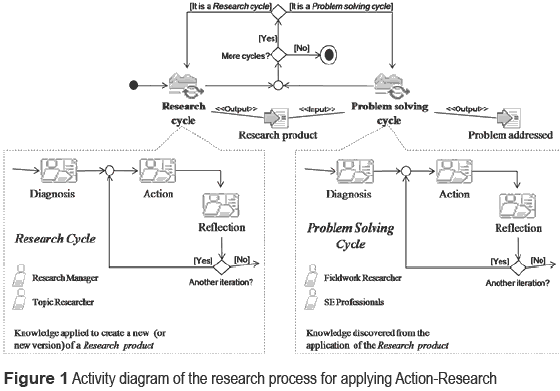
<body><![CDATA[<p>&bull; The lack of a defined research  process model which indicates the steps to follow for Action-research in  Software Engineering. </p>       <p>&bull; The consulting framework  imposes an over-restrictive perspective, since it implies contractual  liabilities and organizational interests that could be detrimental to the  research. </p>       <p>All  the issues indicated above may be understood to imply that this is not a  rigorous research process. In addition, the literature survey on Action-research  use in Software Engineering &#91;13&#93; shows that researchers of this area should be  more rigorous when defining, applying and reporting Action-research studies in  Software Engineering. In this respect, the main contribution of this paper is  to propose a strategy to guide the use of Action- research in the context of  distributed research projects, aiming to improve the control and rigor of the  execution of such projects. There are several papers from the literature that  deal with the suitability of Action-research for Information Systems and  Software Engineering, namely &#91;7, 10, 15, 16&#93;, but they do not propose a  guideline for applying this method in the distributed environments.</p>        <p>&nbsp;</p>      <p><font size="3"><b>Strategy to guide the use of action-research in distributed research projects</b></font></p>        <p>Since  its origins, different ways of applying Action-research methodology have been  developed &#91;17&#93;. To develop an Action-research strategy suitable for the  features of distributed Software Engineering, it is necessary to analyze and  adapt the different ways of organizing the steps and iterations described by  this qualitative research method. In this respect, the study presented in &#91;18&#93;  discusses various forms ofaction- research, including: Canonical action  research, IS prototyping, Soft system methodology, Action science, Participant  observation, Action learning, Multiview, Ethics, Clinical field work and  Process consultation. In addition, other forms of action-research are also  described in &#91;19&#93; (the dual imperatives of action-research) and in &#91;20&#93;  (cooperative method development). We analyzed the characteristics of these  action-research forms and we observed that none of these forms met the needs  and characteristics for the management and execution of a distributed research  project appropriately. For this reason, we have developed a research process  for applying action-research, in the quest to address the needs, complexity and  challenges related to this type of project.</p>       <p>The  research process proposed for managing and developing distributed research projects  by using action-research is shown in <a href="#Figura1">figure 1</a>. Such a process is in keeping  with several previous approaches on this research method:</p>       <p>&bull; The general model of  action-research proposed by &#91;19&#93; and the general outline presented in &#91;21&#93;.  This approach describes how action-research involves a research cycle and a  problem solving cycle, in which knowledge is applied and discovered  interactively between activities with different goals and outcomes. </p>       <p>&bull; The generic activities of a  cycle of action- research indicated in &#91;10&#93;. According to this paper,  action-research is an iterative process which involves researchers and  practitioners acting together on a particular cycle of activities, including  problem diagnosis, action intervention and reflective learning. We consider  that it is possible to group the activity proposals according to other action-research approaches, like &#91;19, 22, 23&#93;, within these three generic activities. </p>       <p>&bull; Finally, the approach  discussed in &#91;19&#93; has also been taken into account in strengthening our  research cycle. Besides, we propose using and integrating other empirical  research methods, such as Controlled Experiments, Case Studies, Surveys and  Interviews to support the problem solving cycle.</p>      ]]></body>
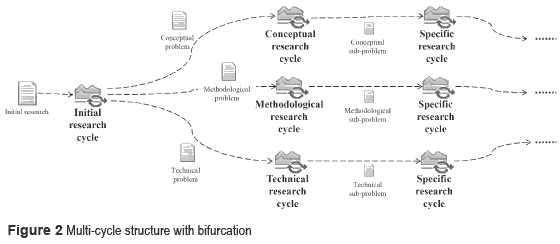
<body><![CDATA[<p align="center"><a name="Figura1"></a><img src="/img/revistas/rfiua/n68/n68a07i01.gif"></p>        <p>Below the cycles  of the research process proposed are described in a more detailed way.</p>      <p><b><i>Research cycles</i></b></p>       <p>We  break down the generic activities of the Research cycle (to see <a href="#Figura1">figure 1</a>) by  using the tasks for action-research described by &#91;19&#93; as follows:</p>       <p>&bull; Diagnosis: Identify the  research theme, Analysis of relevant literature, and Plan and design the  research project. </p>       <p>&bull; Action: Action steps and  Implement. </p>      <p> &bull; Reflection: Monitor research,  Evaluate in terms of research questions, and Amend plan and design. </p>       <p>The  first research cycle is a special cycle, because the Research Manager must  analyze the research goals and deliverables for the research project, together  with the research experience, strengths and interests from the several  participant organizations (work groups). Taking into account this analysis, the  Research Manager makes a general plan and distributes the planned tasks to the  different work groups of the project, aiming to fulfill the commitments  acquired. In other words, during the first research cycle the Research Manager  plans and designs the execution of the research project.</p>     <p>Subsequent research cycles are  performed by each work group to tackle the research theme, in order to create  the Research product that has been assigned, offering a solution to the problem  addressed. Each work group plans and carries out activities (diagnosis, action  and reflection) of its own research cycle to achieve the given tasks, that is  to say to construct the Research product that is its responsibility. To reach  the goal set for it, the work group should use a project structure: multi&shy;cycle  with bifurcation (see <a href="#Figura2">figure 2</a>). This is most suitable when new research cycles  are needed, due to the emergence of a new sub-problem and/ or new problem from  the research work carried out during the current cycle &#91;24&#93;.</p>      <p align="center"><a name="Figura2"></a><img src="/img/revistas/rfiua/n68/n68a07i02.gif"></p>      ]]></body>
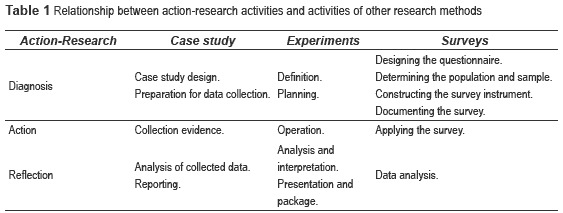
<body><![CDATA[<p>Regarding  the task of  <i>Identify research theme</i>, the approach to the action-research cycle proposed in &#91;22&#93;  describes a set of elements to identify and define the research theme,  including:</p>       <p>&bull; Research theme (area) (A): The  research area of interest is described in this item. </p>       <p>&bull; Research Framework (F):  Analysis of theory, concepts and relevant literature about proposals that  address the research area. </p>       <p>&bull; Research method for research  cycle (MR): The action-research method that guides the study of the area of  interest, as well as the development of the Research product, is described in  this section. In this respect, a set of forms to apply action-research methods  is presented in &#91;18&#93;. </p>       <p>&bull;Reflection within the research  cycles must be based on F, MR and A. The knowledge obtained from the study of  the area of interest and the development of the Research product is used as  feedback to refine and improve the research. </p>       <p>As  far as the task of <i>Analysis of relevant literature</i>, is concerned, we should use  the different approaches (Literature review, Literature survey, Systematic  literature review, Systematic mapping study, etc.) to identify, analyze and  interpret all available evidence related to the research area of interest.</p>       <p>During  the task known as <i>Plan and design the research project</i>, it is important to offer an  integrated view of the research work to be carried out, by describing the  action-research elements, both the research cycle and the problem solving  cycle. In this respect, the elements to consider in action-research are  described in &#91;8&#93;:</p>       <p>&bull; The researched object: This is  the research area to be tackled, seeking to provide solutions to problems found  in this area. </p>       <p>&bull; Researchers: The person or  group of people who actively carry out a research cycle. We have divided this  group into different roles: research managers (who are responsible for the  management of the distributed research project), area researchers (who are  responsible for developing the research products) and fieldwork researchers (who  are the field researchers responsible for the application of the research  products in the critical reference group). </p>       <p>&bull; Critical reference group: A  group on which research is performed, in view of the fact that it has a problem  that needs to be solved. In this group there are people who participate in the  research (Software Engineering Professionals) and they can take part in the  research process, though not as actively as the researcher. </p>       ]]></body>
<body><![CDATA[<p>&bull; Stakeholders of the research:  Anyone that can benefit from the research project but who does not directly  participate in it. Stakeholders may include organizations that are using a new  method to solve Software Engineering problems, or experts who apply those  methods. </p>       <p>&bull; Research products: These are  the work products generated during the research process that address both the  research theme and the problem to be solved. This element has been proposed by  us. </p>       <p><a href="#Figura3">Figure 3</a>  illustrates the relationship of these elements of action-research. </p>      <p align="center"><a name="Figura3"></a><img src="/img/revistas/rfiua/n68/n68a07i03.gif"></p>        <p><b><i>Problem solving cycles</i></b></p>       <p>By means of the  problem solving cycles, work groups apply the Research products in the critical  reference group to refine, improve and validate them, thus offering a suitable  solution to the research problem.</p>   Regarding  the activity of <i>Diagnosis</i>, it is important to identify initially the problem to be  solved. In this respect, by following the approach described in &#91;19&#93;, the  elements to consider are:</p>      <p> &bull; A problem in the real world  (P): A real-world situation which enables researchers to tackle the research  theme (A) from a practical viewpoint. </p>       <p>&bull; A research method for the  problem solving cycle (MPS): the method that guides the solution of the problem  by using the Research products in a real situation. This method should allow  the analysis of the research approach developed, in order to determine its  validity. </p>       <p>&bull; Reflection in the problem  solving cycles is based on P and MPS. The knowledge discovered from application  of the research product is used as feedback, to refine and improve the approach  developed by means of the application of this new knowledge. </p>       <p><a href="#Figura3">Figure 3</a> also shows that there are different ways of applying the research products in  the critical reference group, which are related to the execution of the problem  solving cycles. In this respect, &#91;7&#93; proposes four variations which basically  depend on the characteristics of how this cycle is executed:</p>       ]]></body>
<body><![CDATA[<p>&bull; Diagnosis: The researcher  comes up against a difficult situation; s/he diagnoses it and gives  recommendations to the critical reference group, but without controlling the  effects afterwards. </p>       <p>&bull; Collaborative: The critical  reference group puts in place the recommendations made by the researcher, and  informs him or her of the results and effects. </p>       <p>&bull; Empirical: The critical  reference group carries out broad and systematic research into the situations  and effects. This characteristic makes this variant difficult to implement. </p>       <p>&bull; Experimental: This consists of  evaluating the different options available to achieve an objective that exist.  The main disadvantage is that the different options are difficult to measure,  since they will be generally applied either in different organizations (with  different characteristics, which may cloud the research results) or in one  organization but at different times (the work environment may have changed). </p>       <p>We  propose using an empirical research method for Global Software Engineering in  order to: (i) strengthen and increase the rigor of the empirical variant during  the execution of a problem solving cycle of this type, and (ii) address the  difficulty of implementing this variant. In this respect, the main empirical  methods used by the researchers in Global Software Engineering are case  studies, surveys, controlled experiments and interviews &#91;3&#93;. Furthermore, there  are studies that describe the necessary activities and guidelines to carry out  these research methods in Software Engineering: &#91;25&#93; for case studies, &#91;26&#93; for  controlled experiments, and &#91;27-32&#93; for surveys.</p>     <p>To show how the generic  activities of the problem solving cycle (diagnosis, action and reflection) can  be met from those activities described to these empirical research methods, we  present <a href="#Tabla1">table 1</a>. Furthermore, this table presents the way of grouping the  activities of case study, experiments and surveys within the three generic  activities of a problem solving cycle.</p>      <p align="center"><a name="Tabla1"></a><img src="/img/revistas/rfiua/n68/n68a07t01.gif" ></p>      <p>The  fieldwork researcher is in charge of preparing the protocol of the research  method (including the field procedure) to use in the problem solving cycle, and  they must consider the studies and activities described above. The protocol  and/or field procedure can be distributed to the other field researchers or SE  professionals in order to have the guideline with which to carry out the  intervention in the critical reference groups (of other places) with the work  products developed. At the end of the intervention in the critical reference  group, each field researcher or SE professional reports on the work performed.  This evidence is used by the area researchers of the research cycles to refine  and improve the research products by means of the execution of new research  cycles.</p>      <p>&nbsp;</p>     <p><font size="3"><b>Applying action-research in a distributed research project</b> </font></p>      ]]></body>
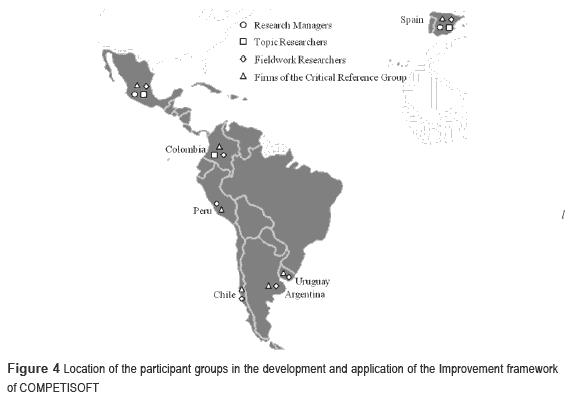
<body><![CDATA[<p>The  research strategy proposal arises from the work performed in the COMPETISOFT  project and it was applied in the management and development of such project.  In this respect, this section will describe an overview of using the research  strategy proposed to develop and apply the <i>Improvement  framework</i>  of the COMPETISOFT's Methodological framework.</p>       <p>The  research work began with the carrying out of the <i>first research  cycle</i>,  during which the <i>research managers</i> planned and designed the  development and application of the <i>Improvement  framework</i>.  Furthermore, in the first meeting of the project, the planned tasks and  responsibilities were distributed to the topic and fieldwork researchers.</p>       <p>The <i>researchers</i> involved in the development  and application of the Improvement Framework were assigned as follows: (i) The <i>research managers</i>  are the  work group from the University of Castilla-La Mancha in Spain and the UNAM in Mexico;  (ii) The  <i>topic researchers</i>  are the work groups from the University of Cauca in Colombia, the UNAM and the  University of Castilla-La Mancha; (iii) the <i>fieldwork  researchers</i>  are the work groups from National University of La Matanza in Argentina, National  University of La Planta in Argentina, Catholic University of the Maule in Chile;  University of the Republic in Uruguay, Pontificial Catholic University of Peru,  University of Castilla-La Mancha, UNAM and University of Cauca. The <i>critical  reference group</i> is  composed of the following small organizations: ENXENIO, STL and UAC Databases  Laboratory from Spain; UNISOFT, INPUT, SERATIC, TOTEMS and SIDEM from Colombia;  VEMN and BST from Argentina; PALL from Chile; and Ultrasist of Mexico. <a href="#Figura4">Figure 4</a>  shows the location of the participants involved in the development and  application of this component of COMPETISOFT.</p>      <p align="center"><a name="Figura4"></a><img src="/img/revistas/rfiua/n68/n68a07i04.gif"></p>        <p>The <i>research theme</i> or <i>object</i> (A) is the software process  improvement area and, more precisely, the issue of how to guide the performing  of the practices involved in this area for small software organizations. We  identified, analyzed and interpreted the theory, concepts and relevant  literature related to the research theme (F) by means of the execution of a  systematic literature review on this issue &#91;33&#93;, which was carried out during a  <i>initial  conceptual research cycle. The research method</i> (MR) used to lead the  research was the approach described in the previous section. Initially, we  analyzed the characteristics of the different action-research forms and we  observed that none of these forms met the needs and characteristics  appropriately for the development and application of this component of  COMPETISOFT.</p>       <p>The <i>research product</i> to be developed is an <i>Improvement  framework</i>  through which to guide the activities involved in the execution of software  process improvement projects in the small organizations context in detail. The  framework should integrate different SPI practices, process, strategies and  tools which should be tailored to small organizations' characteristics, aiming  to offer them a complete guideline, which is useful and practical for  addressing SPI projects.</p>     <p>The <i>topic researchers</i> responsible for the construction of the <i>Improvement framework</i> carried out several <i>research cycles</i> to develop the components of such framework. The <i>third research cycle</i> was carried out to define PmCOMPETISOFT &#91;34&#93;,  which describes the activities needed to manage and lead the process  improvement initiatives in small organizations (this was a <i>methodological research cycle</i>). Then PmCOMPETISOFT was applied in companies of the <i>critical reference group</i>, with the support of their respective <i>fieldwork researcher</i> through <i>problem solving cycles</i>. In this respect, the <i>problem</i> to tackle (P) is the difficulty of successfully  carrying out software process improvement projects in small organizations, and  we have used the case study method (empirical variant) to guide execution of  the  <i>problem solving cycles</i> (MPS). The information and knowledge acquired from each <i>problem solving cycle</i> were registered in the respective case study  reports, from which it was observed that more detailed improvement guidelines  were necessary. With this feedback, other components of the <i>Improvement Framework</i> were identified and by means of the execution of  new <i>methodological  research cycles</i>, components  such as METvalCOMPETISOFT, PfemCOMPETISOFT and the Strategy for process  selection and prioritization &#91;35&#93; were developed. In addition, by means of the  execution of new <i>technical research cycles</i>, software tools for supporting this framework such as GENESIS &#91;36&#93;,  EvalTOOL &#91;37&#93;, HEPALE! &#91;38&#93; were also constructed. These components were  applied in the small organizations, and the acquired knowledge from these <i>problem solving cycles</i> was once more used by the following <i>research cycles</i> to refine and improve these components of the  Improvement framework, so as to create a new version of these. During the  period of execution of the COMPETISFOT project, a continuous feedback between <i>problem solving cycles</i> and <i>research cycles</i> (and vice versa) took place. In each case, the  latest versions available of the components of this framework were used as  input for the execution of the ensuing <i>problem solving cycle</i>. An overview of the final version of the  Improvement framework is described in &#91;39&#93;.</p>      <p>&nbsp;</p>     <p><font size="3"><b>Discussion</b> </font></p>      <p>Some  outcomes of the COMPETISOFT project (in which was used the research strategy)  are presented of a quantitative way below:</p>       ]]></body>
<body><![CDATA[<p>&bull; 7 versions of the  COMPETISOFT's methodological framework were produced during the project. Each  new version was improved and refined until obtain the final version of the  framework. These versions involved 28 deliverables and 22 technical reports  developed of a distributed way by the different participants of the project. </p>       <p>&bull; 19 training courses on the  methodological framework, in which around of 500 stakeholders participated,  were carried out in several Ibero-american countries. </p>       <p>&bull; 14 small organizations from 7  countries used the COMPETISOFT's methodological framework to carry out their  software process improvement initiatives. </p>       <p>&bull; 6 doctoral thesis, 10 master  thesis and 18 undergraduate works were performed in the context of this  project. </p>       <p>&bull; 2 books, 6 papers in journals  of the JCR index, 4 papers in specialized journals, 22 papers in publishers  LNCS, ACM and IEEE, 12 papers in Ibero-American journals, and 92 papers in  proceedings of international conferences were published in the context of this  project. </p>       <p>Based  on the outcomes obtained, the main objective of Competisoft's project of  create, disseminate and apply a methodological framework for software process  improvement in Ibero-american small software development organizations was  fulfilled. The methodological framework integrates different components such as  processes, methodologies, strategies and tools which were developed of a  distributed way by the different participants of this project. Furthermore  taking into account the case studies carried out in the organizations of  different Ibero-american countries, the increase of the capability of the  processes to be improved by these organizations, the effort of applying the  proposed framework and the benefits described by stakeholders of the project  (reported in &#91;39&#93;); we consider that the methodological framework is suitable  for leading SPI initiatives in small organizations. In this way, the results in  terms of the framework developed, the training provided, the case studies  carried out, the research works developed (to level doctoral, master and  undergraduate) and the publications created (in general of the fulfillment of  objectives of COMPETISOFT by the researchers of the project) are an indicator  that the proposed research strategy was able to provide the research managers  with: (i) a suitable research project centralized administration, and (ii)  appropriate coordination and apportioning of the research responsibilities for  the research products construction and validation.</p>       <p>On  the other hand, the research on Global Software Engineering ought to focus more  on evaluating practices, methods and techniques in this context, rather on the  managerial problem-oriented lessons that have been learned &#91;3&#93;. In this  respect, the proposed research strategy describes how to use the  action-research qualitative method for managing and developing distributed  research projects. Furthermore, according to the four characteristics of using  action-research presented in &#91;18&#93;, our research strategy has a process model:  reflective, a structure: rigorous, a typical involvement: collaborative and  facilitative, and primary goals: system design and scientific knowledge. In  this respect, we analyzed the characteristics of the various forms of  action-research discussed in &#91;18&#93; versus the characteristics of our research  strategy, and based on this analysis, we consider that this research strategy  can be a new form of applying action-research in Software Engineering.</p>        <p>&nbsp;</p>     <p><font size="3"><b>Conclusions</b> </font></p>      <p>This  paper has concentrated on describing how the action-research qualitative method  can be useful for managing and developing distributed research projects. This  paper also sets forth a research strategy to guide the use of action- research  in this type of projects, along with how it is used to develop and apply a  component, the Improvement framework of the COMPETISOFT project.</p>       ]]></body>
<body><![CDATA[<p>The  proposed research strategy describes a set of elements including: (i) a process  for applying action-research, (ii) the relationship between the research cycle  and the problem-solving cycle, (iii) different elements to consider in these  cycles, and (iv) the way to strengthen the problem solving cycle by using  empirical methods, such as: case studies, experiments and surveys. The first  cycles of action-research should be used to define a first version of the  research products, which should be applied in the critical reference group  during the next cycles. Due to the fact that the organizations are  geographically dispersed, a guideline for the systematic application of this  proposal is needed. This guideline can be offered by the case study protocol,  experimental package or survey package from the empirical research methods that  we propose using to carry out the problem solving cycle. This strategy  encourages us to: (i) follow the action-research qualitative method, (ii) start  with a research cycle to analyze and understand the theoretical knowledge of a specific  area when creating new research products that address a problem from the area  of research, and (iii) apply the research products by means of empirical  research methods (problem solving cycle), thereby obtaining knowledge of their  practical application so as to refine, improve and validate these products. The  goal is to increase the rigor when defining, applying and reporting  action-research studies in Software Engineering.</p>       <p>In  future work we aim to perform a systematic literature review on the use of action-research  in Software Engineering. The aim is to keep on working on extending, refining  and improving this strategy in order to develop a guideline for conducting and  reporting on action-research in Software Engineering.</p>      <p>&nbsp;</p>       <p><font size="3"><b>Acknowledgment</b> </font></p>        <p>This  work has been funded by the GEODAS-BC project (Ministerio de Econom&iacute;a y  Competitividad and Fondo Europeo de Desarrollo Regional FEDER,  TIN2012-37493-C03-01). Francisco J. Pino acknowledges the contribution of the  University of Cauca, where he works as a Titular Professor.</p>      <p>&nbsp;</p>       <p><font size="3"><b>References</b> </font></p>      <!-- ref --><p>1. C. Wagner,  L. Staheli, R. Silberglitt, A. Wong, J.  Kadtke. <i>Linking Effectively: Learning Lessons from Successful  Collaboration in Science and Technology (DB-345-OSTP)</i>. RAND's Science &amp; Technology  Policy Institute. 2002. Available on: <a href="http://www.rand.org/content/dam/rand/pubs/documented_briefings/2005/DB345.pdf"target="_blank">http://www.rand.org/content/dam/rand/pubs/documented_briefings/2005/DB345.pdf</a>. Accessed  on: August 2013.    &nbsp;&nbsp;&nbsp;&nbsp;&nbsp;&nbsp;&nbsp;&nbsp;[&#160;<a href="javascript:void(0);" onclick="javascript: window.open('/scielo.php?script=sci_nlinks&ref=000120&pid=S0120-6230201300030000700001&lng=','','width=640,height=500,resizable=yes,scrollbars=1,menubar=yes,');">Links</a>&#160;]<!-- end-ref --></p>       <!-- ref --><p>2. M. Gibbons, C. Limoges, H. Nowotny,  S. Schwartzman,  P. Scott, M. Trow. <i>The New Production of Knowledge: The Dynamics of Science  and Research in Contemporary Societies</i>. 1<sup>st</sup> ed. Ed. Sage Publications. London,  England 1994. pp. 1-179&nbsp;&nbsp;&nbsp;&nbsp;&nbsp;&nbsp;&nbsp;&nbsp;[&#160;<a href="javascript:void(0);" onclick="javascript: window.open('/scielo.php?script=sci_nlinks&ref=000122&pid=S0120-6230201300030000700002&lng=','','width=640,height=500,resizable=yes,scrollbars=1,menubar=yes,');">Links</a>&#160;]<!-- end-ref --><!-- ref --><p>3. D. Smite,  C. Wohlin, T. Gorschek, R. Feldt. ''Empirical evidence in  global software engineering: a systematic review''. <i>Empirical  Software Engineering</i>. Vol. 15. 2010. pp. 91-118.    &nbsp;&nbsp;&nbsp;&nbsp;&nbsp;&nbsp;&nbsp;&nbsp;[&#160;<a href="javascript:void(0);" onclick="javascript: window.open('/scielo.php?script=sci_nlinks&ref=000123&pid=S0120-6230201300030000700003&lng=','','width=640,height=500,resizable=yes,scrollbars=1,menubar=yes,');">Links</a>&#160;]<!-- end-ref --></p>       <!-- ref --><p>4. H. Oktaba, F. Garcia, M. Piattini, F. Pino, C. Alquicira, F. Ruiz. ''Software  Process  Improvement: The COMPETISOFT Project''. <i>IEEE  Computer</i>. Vol. 40. 2007. pp. 21-28.    &nbsp;&nbsp;&nbsp;&nbsp;&nbsp;&nbsp;&nbsp;&nbsp;[&#160;<a href="javascript:void(0);" onclick="javascript: window.open('/scielo.php?script=sci_nlinks&ref=000125&pid=S0120-6230201300030000700004&lng=','','width=640,height=500,resizable=yes,scrollbars=1,menubar=yes,');">Links</a>&#160;]<!-- end-ref --></p>       <!-- ref --><p>5. R.  Baskerville. ''Investigating  Information Systems with Action Research''.  <i>Communications of the Association for Information Systems</i>. Vol. 2. 1999. pp. 1-32.    &nbsp;&nbsp;&nbsp;&nbsp;&nbsp;&nbsp;&nbsp;&nbsp;[&#160;<a href="javascript:void(0);" onclick="javascript: window.open('/scielo.php?script=sci_nlinks&ref=000127&pid=S0120-6230201300030000700005&lng=','','width=640,height=500,resizable=yes,scrollbars=1,menubar=yes,');">Links</a>&#160;]<!-- end-ref --></p>       <!-- ref --><p>6. R.  McTaggart. ''Principles  of Participatory Action Research''. <i>Adult Education  Quarterly</i>. Vol. 41. 1991. pp. 168-187.    &nbsp;&nbsp;&nbsp;&nbsp;&nbsp;&nbsp;&nbsp;&nbsp;[&#160;<a href="javascript:void(0);" onclick="javascript: window.open('/scielo.php?script=sci_nlinks&ref=000129&pid=S0120-6230201300030000700006&lng=','','width=640,height=500,resizable=yes,scrollbars=1,menubar=yes,');">Links</a>&#160;]<!-- end-ref --></p>       <!-- ref --><p>7. W. French, C. Bell. <i>Organization Development: Behavioral Science  Interventions for Organization Improvement</i>. 6<sup>th</sup> ed. Ed. Prentice-Hall. London, England. 1999. pp. 1-343&nbsp;&nbsp;&nbsp;&nbsp;&nbsp;&nbsp;&nbsp;&nbsp;[&#160;<a href="javascript:void(0);" onclick="javascript: window.open('/scielo.php?script=sci_nlinks&ref=000131&pid=S0120-6230201300030000700007&lng=','','width=640,height=500,resizable=yes,scrollbars=1,menubar=yes,');">Links</a>&#160;]<!-- end-ref --><!-- ref --><p>8. Y. Wadsworth. ''What is  participatory Action Research?'' <i>Action Research  International (Paper 2)</i>. 1998. Available on: <a href="http://www.aral.com.au/ari/p-ywadsworth98.html"target="_blank">http://www.aral.com.au/ari/p-ywadsworth98.html</a>. Accessed on: August 2013.    &nbsp;&nbsp;&nbsp;&nbsp;&nbsp;&nbsp;&nbsp;&nbsp;[&#160;<a href="javascript:void(0);" onclick="javascript: window.open('/scielo.php?script=sci_nlinks&ref=000132&pid=S0120-6230201300030000700008&lng=','','width=640,height=500,resizable=yes,scrollbars=1,menubar=yes,');">Links</a>&#160;]<!-- end-ref --></p>       <!-- ref --><p>9. N. Kock, F. Lau. ''Information  Systems Action Research: Serving Two Demanding Masters''. <i>Information  Technology &amp; People (special issue on Action Research in Information  Systems)</i>.  Vol. 14. 2001. pp.  6-11.    &nbsp;&nbsp;&nbsp;&nbsp;&nbsp;&nbsp;&nbsp;&nbsp;[&#160;<a href="javascript:void(0);" onclick="javascript: window.open('/scielo.php?script=sci_nlinks&ref=000134&pid=S0120-6230201300030000700009&lng=','','width=640,height=500,resizable=yes,scrollbars=1,menubar=yes,');">Links</a>&#160;]<!-- end-ref --></p>       <!-- ref --><p>10. D. Avison, F. Lan, M.  Myers, A. Nielsen. ''Action Research''. <i>Communications of  the ACM</i>.  Vol. 42. 1999. pp. 94-97.    &nbsp;&nbsp;&nbsp;&nbsp;&nbsp;&nbsp;&nbsp;&nbsp;[&#160;<a href="javascript:void(0);" onclick="javascript: window.open('/scielo.php?script=sci_nlinks&ref=000136&pid=S0120-6230201300030000700010&lng=','','width=640,height=500,resizable=yes,scrollbars=1,menubar=yes,');">Links</a>&#160;]<!-- end-ref --></p>       <!-- ref --><p>11. F. Lau. <i>A Review on the Use of Action  Research in Information Systems Studies, in Information Systems Research:  Information Systems and Qualitative Research</i>. A. Lee, J. Liebenau,  J. Degross (editors). Ed. Chapman &amp; Hill.  London, England. 1997. pp. 31-68.    &nbsp;&nbsp;&nbsp;&nbsp;&nbsp;&nbsp;&nbsp;&nbsp;[&#160;<a href="javascript:void(0);" onclick="javascript: window.open('/scielo.php?script=sci_nlinks&ref=000138&pid=S0120-6230201300030000700011&lng=','','width=640,height=500,resizable=yes,scrollbars=1,menubar=yes,');">Links</a>&#160;]<!-- end-ref --></p>       <!-- ref --><p>12. R. Baskerville, A. Wood.  ''A Critical Perspective on Action Research as a Method for Information  Systems Research''. <i>Journal of Information Technology</i>. Vol. 3. 1996. pp. 235-246.    &nbsp;&nbsp;&nbsp;&nbsp;&nbsp;&nbsp;&nbsp;&nbsp;[&#160;<a href="javascript:void(0);" onclick="javascript: window.open('/scielo.php?script=sci_nlinks&ref=000140&pid=S0120-6230201300030000700012&lng=','','width=640,height=500,resizable=yes,scrollbars=1,menubar=yes,');">Links</a>&#160;]<!-- end-ref --></p>       <!-- ref --><p>13. P. Medeiros, G. Travassos. <i>Action research  use in software engineering: An initial survey</i>. In 3<sup>rd</sup> International  Symposium on Empirical Software Engineering and Measurement (ESEM 2009). Florida,  USA. 2009. pp.  414-417.    &nbsp;&nbsp;&nbsp;&nbsp;&nbsp;&nbsp;&nbsp;&nbsp;[&#160;<a href="javascript:void(0);" onclick="javascript: window.open('/scielo.php?script=sci_nlinks&ref=000142&pid=S0120-6230201300030000700013&lng=','','width=640,height=500,resizable=yes,scrollbars=1,menubar=yes,');">Links</a>&#160;]<!-- end-ref --></p>       <!-- ref --><p>14. M. Diaz. <i>Measurement  Framework for the Definition of Software Measurement Programs in SMEs: MIS-  PyME</i>.  PhD Thesis. Technologies and Information Systems Division. University of  Castilla-La Mancha. Ciudad Real, Spain. 2009. pp. 1-259&nbsp;&nbsp;&nbsp;&nbsp;&nbsp;&nbsp;&nbsp;&nbsp;[&#160;<a href="javascript:void(0);" onclick="javascript: window.open('/scielo.php?script=sci_nlinks&ref=000144&pid=S0120-6230201300030000700014&lng=','','width=640,height=500,resizable=yes,scrollbars=1,menubar=yes,');">Links</a>&#160;]<!-- end-ref --><!-- ref --><p>15. C. Seaman.  ''Qualitative Methods in Empirical Studies of Software Engineering''. <i>IEEE Transaction  on Software Engineering</i>. Vol. 25. 1999. pp. 557-572.    &nbsp;&nbsp;&nbsp;&nbsp;&nbsp;&nbsp;&nbsp;&nbsp;[&#160;<a href="javascript:void(0);" onclick="javascript: window.open('/scielo.php?script=sci_nlinks&ref=000145&pid=S0120-6230201300030000700015&lng=','','width=640,height=500,resizable=yes,scrollbars=1,menubar=yes,');">Links</a>&#160;]<!-- end-ref --></p>       <!-- ref --><p>16. M. Polo, M. Piattini, F.  Ruiz. ''Using  a qualitative research method for building a software maintenance  methodology''. <i>Software Practice and Experience</i>. Vol. 32. 2002. pp. 1239-1260.    &nbsp;&nbsp;&nbsp;&nbsp;&nbsp;&nbsp;&nbsp;&nbsp;[&#160;<a href="javascript:void(0);" onclick="javascript: window.open('/scielo.php?script=sci_nlinks&ref=000147&pid=S0120-6230201300030000700016&lng=','','width=640,height=500,resizable=yes,scrollbars=1,menubar=yes,');">Links</a>&#160;]<!-- end-ref --></p>       <!-- ref --><p>17. I. Chein, S. Cook, J.  Harding. ''The field of action research''. <i>American  Psychologist</i>.  Vol. 3. 1948. pp.  43-50.    &nbsp;&nbsp;&nbsp;&nbsp;&nbsp;&nbsp;&nbsp;&nbsp;[&#160;<a href="javascript:void(0);" onclick="javascript: window.open('/scielo.php?script=sci_nlinks&ref=000149&pid=S0120-6230201300030000700017&lng=','','width=640,height=500,resizable=yes,scrollbars=1,menubar=yes,');">Links</a>&#160;]<!-- end-ref --></p>       <!-- ref --><p>18. R. Baskerville, A. Wood.  ''Diversity in information systems action research methods''. <i>European Journal  of Information Systems</i>. Vol. 7. 1998. pp. 90-107.    &nbsp;&nbsp;&nbsp;&nbsp;&nbsp;&nbsp;&nbsp;&nbsp;[&#160;<a href="javascript:void(0);" onclick="javascript: window.open('/scielo.php?script=sci_nlinks&ref=000151&pid=S0120-6230201300030000700018&lng=','','width=640,height=500,resizable=yes,scrollbars=1,menubar=yes,');">Links</a>&#160;]<!-- end-ref --></p>       ]]></body>
<body><![CDATA[<!-- ref --><p>19. J. McKay, P. Marshall.  ''The dual imperatives of action research''. <i>Information  Technology &amp; People (special issue on Action Research in Information  Systems)</i>.  Vol. 14. 2001. pp.  46-59.    &nbsp;&nbsp;&nbsp;&nbsp;&nbsp;&nbsp;&nbsp;&nbsp;[&#160;<a href="javascript:void(0);" onclick="javascript: window.open('/scielo.php?script=sci_nlinks&ref=000153&pid=S0120-6230201300030000700019&lng=','','width=640,height=500,resizable=yes,scrollbars=1,menubar=yes,');">Links</a>&#160;]<!-- end-ref --></p>       <!-- ref --><p>20. Y. Dittrich, K. R&ouml;nkk&ouml;, J. Eriksson,  C. Hansson, O. Lindeberg. ''Cooperative method development. Combining qualitative  empirical research with method, technique and process improvement''. <i>Empirical  Software Engineering</i>. Vol. 13. 2008. pp. 231-260.    &nbsp;&nbsp;&nbsp;&nbsp;&nbsp;&nbsp;&nbsp;&nbsp;[&#160;<a href="javascript:void(0);" onclick="javascript: window.open('/scielo.php?script=sci_nlinks&ref=000155&pid=S0120-6230201300030000700020&lng=','','width=640,height=500,resizable=yes,scrollbars=1,menubar=yes,');">Links</a>&#160;]<!-- end-ref --></p>       <!-- ref --><p>21. M. Chiasson, M. Germonprez, L. Mathiassen.  ''Pluralist action research: a review of the information systems  literature''. <i>Information Systems Journal</i>. Vol. 19. 2009. pp. 31-54.    &nbsp;&nbsp;&nbsp;&nbsp;&nbsp;&nbsp;&nbsp;&nbsp;[&#160;<a href="javascript:void(0);" onclick="javascript: window.open('/scielo.php?script=sci_nlinks&ref=000157&pid=S0120-6230201300030000700021&lng=','','width=640,height=500,resizable=yes,scrollbars=1,menubar=yes,');">Links</a>&#160;]<!-- end-ref --></p>       <!-- ref --><p>22. P. Checkland. ''From  Framework through Experience to Learning: The Essential Nature of Action  Research''. <i>Information Systems Research: Contemporary Approaches and  Emergent Traditions</i>. H. Nissen, H. Klein, R. Hirscheim (editors). Ed. Elsevier. Amsterdam,  Netherlands. 1991. pp. 397-403&nbsp;&nbsp;&nbsp;&nbsp;&nbsp;&nbsp;&nbsp;&nbsp;[&#160;<a href="javascript:void(0);" onclick="javascript: window.open('/scielo.php?script=sci_nlinks&ref=000159&pid=S0120-6230201300030000700022&lng=','','width=640,height=500,resizable=yes,scrollbars=1,menubar=yes,');">Links</a>&#160;]<!-- end-ref --><!-- ref --><p>23. R. Davison, M. Martinsons,  N. Kock. ''Principles of canonical action research''. <i>Information  Systems Journal</i>.  Vol. 14. 2004. pp.  65-86.    &nbsp;&nbsp;&nbsp;&nbsp;&nbsp;&nbsp;&nbsp;&nbsp;[&#160;<a href="javascript:void(0);" onclick="javascript: window.open('/scielo.php?script=sci_nlinks&ref=000160&pid=S0120-6230201300030000700023&lng=','','width=640,height=500,resizable=yes,scrollbars=1,menubar=yes,');">Links</a>&#160;]<!-- end-ref --></p>       <!-- ref --><p>24. J. McNiff. <i>Action Research.  Principles and Practice</i>. 3<sup>rd</sup> ed. Ed. Routledge. New York, USA. 2013. pp.  1-226&nbsp;&nbsp;&nbsp;&nbsp;&nbsp;&nbsp;&nbsp;&nbsp;[&#160;<a href="javascript:void(0);" onclick="javascript: window.open('/scielo.php?script=sci_nlinks&ref=000162&pid=S0120-6230201300030000700024&lng=','','width=640,height=500,resizable=yes,scrollbars=1,menubar=yes,');">Links</a>&#160;]<!-- end-ref --><!-- ref --><p>25. P. Runeson, M. H&ouml;st. ''Guidelines  for conducting and reporting case study research in software engineering''.  <i>Empirical  Software Engineering</i>. Vol. 14. 2009. pp. 131-164.    &nbsp;&nbsp;&nbsp;&nbsp;&nbsp;&nbsp;&nbsp;&nbsp;[&#160;<a href="javascript:void(0);" onclick="javascript: window.open('/scielo.php?script=sci_nlinks&ref=000163&pid=S0120-6230201300030000700025&lng=','','width=640,height=500,resizable=yes,scrollbars=1,menubar=yes,');">Links</a>&#160;]<!-- end-ref --></p>       <!-- ref --><p>26. C. Wohlin,  P. Runeson, M. H&ouml;st, M. Ohlson, B. Regnell, A. Wessl&eacute;n. <i>Experimentation in  Software Engineering: An Introduction</i>. 1<sup>st</sup> ed. Ed. Kluwer  Academic Publishers. Norwell, Massachusetts, USA. 2000. pp. 1-204&nbsp;&nbsp;&nbsp;&nbsp;&nbsp;&nbsp;&nbsp;&nbsp;[&#160;<a href="javascript:void(0);" onclick="javascript: window.open('/scielo.php?script=sci_nlinks&ref=000165&pid=S0120-6230201300030000700026&lng=','','width=640,height=500,resizable=yes,scrollbars=1,menubar=yes,');">Links</a>&#160;]<!-- end-ref --><!-- ref --><p>27. S. Pfleeger, B. Kitchenham.  ''Principles of survey research: part 1: turning lemons into  lemonade''. <i>ACM SIGSOFT Software Engineering Notes</i>. Vol. 26. 2001. pp. 16-18.    &nbsp;&nbsp;&nbsp;&nbsp;&nbsp;&nbsp;&nbsp;&nbsp;[&#160;<a href="javascript:void(0);" onclick="javascript: window.open('/scielo.php?script=sci_nlinks&ref=000166&pid=S0120-6230201300030000700027&lng=','','width=640,height=500,resizable=yes,scrollbars=1,menubar=yes,');">Links</a>&#160;]<!-- end-ref --></p>       <!-- ref --><p>28. B. Kitchenham, S.  Pfleeger. ''Principles of survey research part 2: designing a survey''. <i>ACM SIGSOFT  Software Engineering Notes</i>. Vol. 27. 2002. pp. 18-20.    &nbsp;&nbsp;&nbsp;&nbsp;&nbsp;&nbsp;&nbsp;&nbsp;[&#160;<a href="javascript:void(0);" onclick="javascript: window.open('/scielo.php?script=sci_nlinks&ref=000168&pid=S0120-6230201300030000700028&lng=','','width=640,height=500,resizable=yes,scrollbars=1,menubar=yes,');">Links</a>&#160;]<!-- end-ref --></p>       <!-- ref --><p>29. B. Kitchenham, S.  Pfleeger. ''Principles of survey research: part 3: constructing a survey  instrument''. <i>ACM SIGSOFT Software Engineering Notes</i>. Vol. 27. 2002. pp. 20-24.    &nbsp;&nbsp;&nbsp;&nbsp;&nbsp;&nbsp;&nbsp;&nbsp;[&#160;<a href="javascript:void(0);" onclick="javascript: window.open('/scielo.php?script=sci_nlinks&ref=000170&pid=S0120-6230201300030000700029&lng=','','width=640,height=500,resizable=yes,scrollbars=1,menubar=yes,');">Links</a>&#160;]<!-- end-ref --></p>       <!-- ref --><p>30. B. Kitchenham, S.  Pfleeger. ''Principles of survey research part 4: questionnaire  evaluation''. <i>ACM SIGSOFT Software Engineering Notes</i>. Vol. 27. 2002. pp. 20-23.    &nbsp;&nbsp;&nbsp;&nbsp;&nbsp;&nbsp;&nbsp;&nbsp;[&#160;<a href="javascript:void(0);" onclick="javascript: window.open('/scielo.php?script=sci_nlinks&ref=000172&pid=S0120-6230201300030000700030&lng=','','width=640,height=500,resizable=yes,scrollbars=1,menubar=yes,');">Links</a>&#160;]<!-- end-ref --></p>       <!-- ref --><p>31. B. Kitchenham, S.  Pfleeger. ''Principles of survey research: part 5: populations and  samples''. <i>ACM SIGSOFT Software Engineering Notes</i>. Vol. 27. 2002. pp. 17-20.    &nbsp;&nbsp;&nbsp;&nbsp;&nbsp;&nbsp;&nbsp;&nbsp;[&#160;<a href="javascript:void(0);" onclick="javascript: window.open('/scielo.php?script=sci_nlinks&ref=000174&pid=S0120-6230201300030000700031&lng=','','width=640,height=500,resizable=yes,scrollbars=1,menubar=yes,');">Links</a>&#160;]<!-- end-ref --></p>       <!-- ref --><p>32. B. Kitchenham, S.  Pfleeger. ''Principles of survey research part 6: data analysis''. <i>ACM SIGSOFT  Software Engineering Notes</i>. Vol. 28. 2GG3. pp. 24-27.    &nbsp;&nbsp;&nbsp;&nbsp;&nbsp;&nbsp;&nbsp;&nbsp;[&#160;<a href="javascript:void(0);" onclick="javascript: window.open('/scielo.php?script=sci_nlinks&ref=000176&pid=S0120-6230201300030000700032&lng=','','width=640,height=500,resizable=yes,scrollbars=1,menubar=yes,');">Links</a>&#160;]<!-- end-ref --></p>       <!-- ref --><p>33. F. Pino,  F. Garcia, M. Piattini. ''Software Process Improvement in Small and Medium  Software Enterprises: A Systematic Review''. <i>Software Quality  Journal</i>.  Vol. 16. 2GG8.  pp. 237-261.    &nbsp;&nbsp;&nbsp;&nbsp;&nbsp;&nbsp;&nbsp;&nbsp;[&#160;<a href="javascript:void(0);" onclick="javascript: window.open('/scielo.php?script=sci_nlinks&ref=000178&pid=S0120-6230201300030000700033&lng=','','width=640,height=500,resizable=yes,scrollbars=1,menubar=yes,');">Links</a>&#160;]<!-- end-ref --></p>       <!-- ref --><p>34. F. Pino,  J. Hurtado, J. Vidal, F. Garc&iacute;a, M. Piattini. <i>A process for  driving process improvement in VSEs</i>. In International Conference on  Software Process. Vancouver, Canada. 2GG9. pp. 342-353.    &nbsp;&nbsp;&nbsp;&nbsp;&nbsp;&nbsp;&nbsp;&nbsp;[&#160;<a href="javascript:void(0);" onclick="javascript: window.open('/scielo.php?script=sci_nlinks&ref=000180&pid=S0120-6230201300030000700034&lng=','','width=640,height=500,resizable=yes,scrollbars=1,menubar=yes,');">Links</a>&#160;]<!-- end-ref --></p>       <!-- ref --><p>35. F. Pino,  F. Garcia, M. Piattini. <i>Key processes to  start software process improvement in small companies</i>. In 24<sup>th</sup> Annual ACM  Symposium on Applied Computing. Honolulu, Hawaii, USA. 2009. pp. 509-516.    &nbsp;&nbsp;&nbsp;&nbsp;&nbsp;&nbsp;&nbsp;&nbsp;[&#160;<a href="javascript:void(0);" onclick="javascript: window.open('/scielo.php?script=sci_nlinks&ref=000182&pid=S0120-6230201300030000700035&lng=','','width=640,height=500,resizable=yes,scrollbars=1,menubar=yes,');">Links</a>&#160;]<!-- end-ref --></p>       <!-- ref --><p>36. M. Hern&aacute;ndez, A. Florez, F.  Pino, F. Garcia, M. Piattini, G. Ibarg&uuml;engoitia, H. Oktaba. <i>Supporting the  Improvement Process for Small Software Enterprises through a software tool</i>. in Software Enginering  Symposium during Ninth Mexican International Conference on Computer Science. Mexicali,  M&eacute;xico. 2GG8. pp. 1-8.    &nbsp;&nbsp;&nbsp;&nbsp;&nbsp;&nbsp;&nbsp;&nbsp;[&#160;<a href="javascript:void(0);" onclick="javascript: window.open('/scielo.php?script=sci_nlinks&ref=000184&pid=S0120-6230201300030000700036&lng=','','width=640,height=500,resizable=yes,scrollbars=1,menubar=yes,');">Links</a>&#160;]<!-- end-ref --> </p>       <!-- ref --><p>37. T.  Mart&iacute;nez, F. Pino, E. Le&oacute;n, F. Garc&iacute;a, M. Piattini.  ''Supporting the Process Assessment through a Flexible Software Environment''.  <i>Communications in Computer and Information Science</i>. Vol. 47. 2GG9. pp. 187-199.    &nbsp;&nbsp;&nbsp;&nbsp;&nbsp;&nbsp;&nbsp;&nbsp;[&#160;<a href="javascript:void(0);" onclick="javascript: window.open('/scielo.php?script=sci_nlinks&ref=000186&pid=S0120-6230201300030000700037&lng=','','width=640,height=500,resizable=yes,scrollbars=1,menubar=yes,');">Links</a>&#160;]<!-- end-ref --></p>       <!-- ref --><p>38. R. Cruz, M. Morales,  M. Morgado, F. Pino, H. Oktaba, G. Ibarg&uuml;engoitia,  M. Piattini. <i>Supporting the Software  Process Improvement in Very Small Entities through E-learning:  the  HEPALE! Project</i>. Mexican International  Conference on Computer Science. Mexico City, Mexico. 2GG9. pp. 221-231.    &nbsp;&nbsp;&nbsp;&nbsp;&nbsp;&nbsp;&nbsp;&nbsp;[&#160;<a href="javascript:void(0);" onclick="javascript: window.open('/scielo.php?script=sci_nlinks&ref=000188&pid=S0120-6230201300030000700038&lng=','','width=640,height=500,resizable=yes,scrollbars=1,menubar=yes,');">Links</a>&#160;]<!-- end-ref --></p>       <!-- ref --><p>39. F. Pino,  F. Garc&iacute;a, M. Piattini. ''An Integrated Framework to Guide  Software Process  Improvement in Small Organizations''. <i>Communications in  Computer and Information Science</i>. Vol. 42. 2GG9. pp. 213-224.    &nbsp;&nbsp;&nbsp;&nbsp;&nbsp;&nbsp;&nbsp;&nbsp;[&#160;<a href="javascript:void(0);" onclick="javascript: window.open('/scielo.php?script=sci_nlinks&ref=000190&pid=S0120-6230201300030000700039&lng=','','width=640,height=500,resizable=yes,scrollbars=1,menubar=yes,');">Links</a>&#160;]<!-- end-ref --></p>     <p>&nbsp;</p>     ]]></body>
<body><![CDATA[<p>&nbsp;</p>     <p>&nbsp;</p>     <p>&nbsp;</p>    </font>     ]]></body><back>
<ref-list>
<ref id="B1">
<label>1</label><nlm-citation citation-type="book">
<person-group person-group-type="author">
<name>
<surname><![CDATA[Wagner]]></surname>
<given-names><![CDATA[C]]></given-names>
</name>
<name>
<surname><![CDATA[Staheli]]></surname>
<given-names><![CDATA[L]]></given-names>
</name>
<name>
<surname><![CDATA[Silberglitt]]></surname>
<given-names><![CDATA[R]]></given-names>
</name>
<name>
<surname><![CDATA[Wong]]></surname>
<given-names><![CDATA[A]]></given-names>
</name>
<name>
<surname><![CDATA[Kadtke]]></surname>
<given-names><![CDATA[J]]></given-names>
</name>
</person-group>
<source><![CDATA[Linking Effectively: Learning Lessons from Successful Collaboration in Science and Technology (DB-345-OSTP)]]></source>
<year>2002</year>
<publisher-name><![CDATA[RAND's Science & Technology Policy Institute]]></publisher-name>
</nlm-citation>
</ref>
<ref id="B2">
<label>2</label><nlm-citation citation-type="book">
<person-group person-group-type="author">
<name>
<surname><![CDATA[Gibbons]]></surname>
<given-names><![CDATA[M]]></given-names>
</name>
<name>
<surname><![CDATA[Limoges]]></surname>
<given-names><![CDATA[C]]></given-names>
</name>
<name>
<surname><![CDATA[Nowotny]]></surname>
<given-names><![CDATA[H]]></given-names>
</name>
<name>
<surname><![CDATA[Schwartzman]]></surname>
<given-names><![CDATA[S]]></given-names>
</name>
<name>
<surname><![CDATA[Scott]]></surname>
<given-names><![CDATA[P]]></given-names>
</name>
<name>
<surname><![CDATA[Trow]]></surname>
<given-names><![CDATA[M]]></given-names>
</name>
</person-group>
<source><![CDATA[The New Production of Knowledge: The Dynamics of Science and Research in Contemporary Societies]]></source>
<year>1994</year>
<edition>1st</edition>
<page-range>1-179</page-range><publisher-loc><![CDATA[London ]]></publisher-loc>
<publisher-name><![CDATA[Ed. Sage Publications]]></publisher-name>
</nlm-citation>
</ref>
<ref id="B3">
<label>3</label><nlm-citation citation-type="journal">
<person-group person-group-type="author">
<name>
<surname><![CDATA[Smite]]></surname>
<given-names><![CDATA[D]]></given-names>
</name>
<name>
<surname><![CDATA[Wohlin]]></surname>
<given-names><![CDATA[C]]></given-names>
</name>
<name>
<surname><![CDATA[Gorschek]]></surname>
<given-names><![CDATA[T]]></given-names>
</name>
<name>
<surname><![CDATA[Feldt]]></surname>
<given-names><![CDATA[R]]></given-names>
</name>
</person-group>
<article-title xml:lang="en"><![CDATA[Empirical evidence in global software engineering: a systematic review]]></article-title>
<source><![CDATA[Empirical Software Engineering]]></source>
<year></year>
<volume>15</volume>
</nlm-citation>
</ref>
<ref id="B4">
<label>4</label><nlm-citation citation-type="journal">
<person-group person-group-type="author">
<name>
<surname><![CDATA[Oktaba]]></surname>
<given-names><![CDATA[H]]></given-names>
</name>
<name>
<surname><![CDATA[Garcia]]></surname>
<given-names><![CDATA[F]]></given-names>
</name>
<name>
<surname><![CDATA[Piattini]]></surname>
<given-names><![CDATA[M]]></given-names>
</name>
<name>
<surname><![CDATA[Pino]]></surname>
<given-names><![CDATA[F]]></given-names>
</name>
<name>
<surname><![CDATA[Alquicira]]></surname>
<given-names><![CDATA[C]]></given-names>
</name>
<name>
<surname><![CDATA[Ruiz]]></surname>
<given-names><![CDATA[F]]></given-names>
</name>
</person-group>
<article-title xml:lang="en"><![CDATA[Software Process Improvement: The COMPETISOFT Project]]></article-title>
<source><![CDATA[IEEE Computer]]></source>
<year>2007</year>
<volume>40</volume>
<page-range>21-28</page-range></nlm-citation>
</ref>
<ref id="B5">
<label>5</label><nlm-citation citation-type="journal">
<person-group person-group-type="author">
<name>
<surname><![CDATA[Baskerville]]></surname>
<given-names><![CDATA[R]]></given-names>
</name>
</person-group>
<article-title xml:lang="en"><![CDATA[Investigating Information Systems with Action Research]]></article-title>
<source><![CDATA[Communications of the Association for Information Systems]]></source>
<year>1999</year>
<volume>2</volume>
<page-range>1-32</page-range></nlm-citation>
</ref>
<ref id="B6">
<label>6</label><nlm-citation citation-type="journal">
<person-group person-group-type="author">
<name>
<surname><![CDATA[McTaggart]]></surname>
<given-names><![CDATA[R]]></given-names>
</name>
</person-group>
<article-title xml:lang="en"><![CDATA[Principles of Participatory Action Research]]></article-title>
<source><![CDATA[Adult Education Quarterly]]></source>
<year>1991</year>
<volume>41</volume>
<page-range>168-187</page-range></nlm-citation>
</ref>
<ref id="B7">
<label>7</label><nlm-citation citation-type="book">
<person-group person-group-type="author">
<name>
<surname><![CDATA[French]]></surname>
<given-names><![CDATA[W]]></given-names>
</name>
<name>
<surname><![CDATA[Bell]]></surname>
<given-names><![CDATA[C]]></given-names>
</name>
</person-group>
<source><![CDATA[Organization Development: Behavioral Science Interventions for Organization Improvement]]></source>
<year>1999</year>
<edition>6th</edition>
<page-range>1-343</page-range><publisher-loc><![CDATA[London ]]></publisher-loc>
<publisher-name><![CDATA[. Prentice-Hall]]></publisher-name>
</nlm-citation>
</ref>
<ref id="B8">
<label>8</label><nlm-citation citation-type="journal">
<person-group person-group-type="author">
<name>
<surname><![CDATA[Wadsworth]]></surname>
<given-names><![CDATA[Y]]></given-names>
</name>
</person-group>
<article-title xml:lang="en"><![CDATA[What is participatory Action Research?]]></article-title>
<source><![CDATA[Action Research International (Paper 2)]]></source>
<year>1998</year>
</nlm-citation>
</ref>
<ref id="B9">
<label>9</label><nlm-citation citation-type="journal">
<person-group person-group-type="author">
<name>
<surname><![CDATA[Kock]]></surname>
<given-names><![CDATA[N]]></given-names>
</name>
<name>
<surname><![CDATA[Lau]]></surname>
<given-names><![CDATA[F]]></given-names>
</name>
</person-group>
<article-title xml:lang="en"><![CDATA[Information Systems Action Research: Serving Two Demanding Masters]]></article-title>
<source><![CDATA[Information Technology & People (special issue on Action Research in Information Systems)]]></source>
<year>2001</year>
<volume>14</volume>
<page-range>6-11</page-range></nlm-citation>
</ref>
<ref id="B10">
<label>10</label><nlm-citation citation-type="journal">
<person-group person-group-type="author">
<name>
<surname><![CDATA[Avison]]></surname>
<given-names><![CDATA[D]]></given-names>
</name>
<name>
<surname><![CDATA[Lan]]></surname>
<given-names><![CDATA[F]]></given-names>
</name>
<name>
<surname><![CDATA[Myers]]></surname>
<given-names><![CDATA[M]]></given-names>
</name>
<name>
<surname><![CDATA[Nielsen]]></surname>
<given-names><![CDATA[A]]></given-names>
</name>
</person-group>
<article-title xml:lang="en"><![CDATA[Action Research]]></article-title>
<source><![CDATA[Communications of the ACM]]></source>
<year>1999</year>
<volume>42</volume>
<page-range>94-97</page-range></nlm-citation>
</ref>
<ref id="B11">
<label>11</label><nlm-citation citation-type="book">
<person-group person-group-type="author">
<name>
<surname><![CDATA[Lau]]></surname>
<given-names><![CDATA[F]]></given-names>
</name>
</person-group>
<article-title xml:lang="en"><![CDATA[A Review on the Use of Action Research in Information Systems Studies, in Information Systems Research: Information Systems and Qualitative Research]]></article-title>
<person-group person-group-type="editor">
<name>
<surname><![CDATA[Lee]]></surname>
<given-names><![CDATA[A]]></given-names>
</name>
<name>
<surname><![CDATA[Liebenau]]></surname>
<given-names><![CDATA[J]]></given-names>
</name>
<name>
<surname><![CDATA[Degross]]></surname>
<given-names><![CDATA[J]]></given-names>
</name>
</person-group>
<source><![CDATA[]]></source>
<year>1997</year>
<page-range>31-68</page-range><publisher-loc><![CDATA[London ]]></publisher-loc>
<publisher-name><![CDATA[Chapman & Hill]]></publisher-name>
</nlm-citation>
</ref>
<ref id="B12">
<label>12</label><nlm-citation citation-type="journal">
<person-group person-group-type="author">
<name>
<surname><![CDATA[Baskerville]]></surname>
<given-names><![CDATA[R]]></given-names>
</name>
<name>
<surname><![CDATA[Wood]]></surname>
<given-names><![CDATA[A]]></given-names>
</name>
</person-group>
<article-title xml:lang="en"><![CDATA[A Critical Perspective on Action Research as a Method for Information Systems Research]]></article-title>
<source><![CDATA[Journal of Information Technology]]></source>
<year>1996</year>
<volume>3</volume>
<page-range>235-246</page-range></nlm-citation>
</ref>
<ref id="B13">
<label>13</label><nlm-citation citation-type="confpro">
<person-group person-group-type="author">
<name>
<surname><![CDATA[Medeiros]]></surname>
<given-names><![CDATA[P]]></given-names>
</name>
<name>
<surname><![CDATA[Travassos]]></surname>
<given-names><![CDATA[G]]></given-names>
</name>
</person-group>
<source><![CDATA[Action research use in software engineering: An initial survey]]></source>
<year></year>
<conf-name><![CDATA[3rd International Symposium on Empirical Software Engineering and Measurement (ESEM 2009)]]></conf-name>
<conf-date>2009</conf-date>
<conf-loc>Florida </conf-loc>
<page-range>414-417</page-range></nlm-citation>
</ref>
<ref id="B14">
<label>14</label><nlm-citation citation-type="">
<person-group person-group-type="author">
<name>
<surname><![CDATA[Diaz]]></surname>
<given-names><![CDATA[M]]></given-names>
</name>
</person-group>
<source><![CDATA[Measurement Framework for the Definition of Software Measurement Programs in SMEs: MIS- PyME]]></source>
<year></year>
<page-range>1-259</page-range></nlm-citation>
</ref>
<ref id="B15">
<label>15</label><nlm-citation citation-type="journal">
<person-group person-group-type="author">
<name>
<surname><![CDATA[Seaman]]></surname>
<given-names><![CDATA[C]]></given-names>
</name>
</person-group>
<article-title xml:lang="en"><![CDATA[Qualitative Methods in Empirical Studies of Software Engineering]]></article-title>
<source><![CDATA[IEEE Transaction on Software Engineering]]></source>
<year>1999</year>
<volume>25</volume>
<page-range>557-572</page-range></nlm-citation>
</ref>
<ref id="B16">
<label>16</label><nlm-citation citation-type="journal">
<person-group person-group-type="author">
<name>
<surname><![CDATA[Polo]]></surname>
<given-names><![CDATA[M]]></given-names>
</name>
<name>
<surname><![CDATA[Piattini]]></surname>
<given-names><![CDATA[M]]></given-names>
</name>
<name>
<surname><![CDATA[Ruiz]]></surname>
<given-names><![CDATA[F]]></given-names>
</name>
</person-group>
<article-title xml:lang="en"><![CDATA[Using a qualitative research method for building a software maintenance methodology]]></article-title>
<source><![CDATA[Software Practice and Experience]]></source>
<year>2002</year>
<volume>32</volume>
<page-range>1239-1260</page-range></nlm-citation>
</ref>
<ref id="B17">
<label>17</label><nlm-citation citation-type="journal">
<person-group person-group-type="author">
<name>
<surname><![CDATA[Chein]]></surname>
<given-names><![CDATA[I]]></given-names>
</name>
<name>
<surname><![CDATA[Cook]]></surname>
<given-names><![CDATA[S]]></given-names>
</name>
<name>
<surname><![CDATA[Harding]]></surname>
<given-names><![CDATA[J]]></given-names>
</name>
</person-group>
<article-title xml:lang="es"><![CDATA[''The field of action research]]></article-title>
<source><![CDATA[American Psychologist]]></source>
<year>1948</year>
<volume>3</volume>
<page-range>43-50</page-range></nlm-citation>
</ref>
<ref id="B18">
<label>18</label><nlm-citation citation-type="journal">
<person-group person-group-type="author">
<name>
<surname><![CDATA[Baskerville]]></surname>
<given-names><![CDATA[R]]></given-names>
</name>
<name>
<surname><![CDATA[Wood]]></surname>
<given-names><![CDATA[A]]></given-names>
</name>
</person-group>
<article-title xml:lang="en"><![CDATA[Diversity in information systems action research methods]]></article-title>
<source><![CDATA[European Journal of Information Systems]]></source>
<year>1998</year>
<volume>7</volume>
<page-range>90-107</page-range></nlm-citation>
</ref>
<ref id="B19">
<label>19</label><nlm-citation citation-type="journal">
<person-group person-group-type="author">
<name>
<surname><![CDATA[McKay]]></surname>
<given-names><![CDATA[J]]></given-names>
</name>
<name>
<surname><![CDATA[Marshall]]></surname>
<given-names><![CDATA[P]]></given-names>
</name>
</person-group>
<article-title xml:lang="en"><![CDATA[The dual imperatives of action research]]></article-title>
<source><![CDATA[Information Technology & People (special issue on Action Research in Information Systems)]]></source>
<year>2001</year>
<volume>14</volume>
<page-range>46-59</page-range></nlm-citation>
</ref>
<ref id="B20">
<label>20</label><nlm-citation citation-type="journal">
<person-group person-group-type="author">
<name>
<surname><![CDATA[Dittrich]]></surname>
<given-names><![CDATA[Y]]></given-names>
</name>
<name>
<surname><![CDATA[Rönkkö]]></surname>
<given-names><![CDATA[K]]></given-names>
</name>
<name>
<surname><![CDATA[Eriksson]]></surname>
<given-names><![CDATA[J]]></given-names>
</name>
<name>
<surname><![CDATA[Hansson]]></surname>
<given-names><![CDATA[C]]></given-names>
</name>
<name>
<surname><![CDATA[Lindeberg]]></surname>
<given-names><![CDATA[O]]></given-names>
</name>
</person-group>
<article-title xml:lang="en"><![CDATA[Cooperative method development. Combining qualitative empirical research with method, technique and process improvement]]></article-title>
<source><![CDATA[Empirical Software Engineering]]></source>
<year>2008</year>
<volume>13</volume>
<page-range>231-260</page-range></nlm-citation>
</ref>
<ref id="B21">
<label>21</label><nlm-citation citation-type="journal">
<person-group person-group-type="author">
<name>
<surname><![CDATA[Chiasson]]></surname>
<given-names><![CDATA[M]]></given-names>
</name>
<name>
<surname><![CDATA[Germonprez]]></surname>
<given-names><![CDATA[M]]></given-names>
</name>
<name>
<surname><![CDATA[Mathiassen]]></surname>
<given-names><![CDATA[L]]></given-names>
</name>
</person-group>
<article-title xml:lang="en"><![CDATA[Pluralist action research: a review of the information systems literature]]></article-title>
<source><![CDATA[Information Systems Journal]]></source>
<year>2009</year>
<volume>19</volume>
<page-range>31-54</page-range></nlm-citation>
</ref>
<ref id="B22">
<label>22</label><nlm-citation citation-type="book">
<person-group person-group-type="author">
<name>
<surname><![CDATA[Checkland]]></surname>
<given-names><![CDATA[P]]></given-names>
</name>
</person-group>
<article-title xml:lang="en"><![CDATA[From Framework through Experience to Learning: The Essential Nature of Action Research]]></article-title>
<source><![CDATA[Information Systems Research: Contemporary Approaches and Emergent Traditions]]></source>
<year>1991</year>
<page-range>397-403</page-range><publisher-loc><![CDATA[Amsterdam ]]></publisher-loc>
<publisher-name><![CDATA[Ed. Elsevier]]></publisher-name>
</nlm-citation>
</ref>
<ref id="B23">
<label>23</label><nlm-citation citation-type="journal">
<person-group person-group-type="author">
<name>
<surname><![CDATA[Davison]]></surname>
<given-names><![CDATA[R]]></given-names>
</name>
<name>
<surname><![CDATA[Martinsons]]></surname>
<given-names><![CDATA[M]]></given-names>
</name>
<name>
<surname><![CDATA[Kock]]></surname>
<given-names><![CDATA[N]]></given-names>
</name>
</person-group>
<article-title xml:lang="en"><![CDATA[Principles of canonical action research]]></article-title>
<source><![CDATA[Information Systems Journal]]></source>
<year>2004</year>
<volume>14</volume>
<page-range>65-86</page-range></nlm-citation>
</ref>
<ref id="B24">
<label>24</label><nlm-citation citation-type="book">
<person-group person-group-type="author">
<name>
<surname><![CDATA[McNiff]]></surname>
<given-names><![CDATA[J]]></given-names>
</name>
</person-group>
<source><![CDATA[Action Research. Principles and Practice]]></source>
<year>2013</year>
<edition>3rd</edition>
<page-range>1-226</page-range><publisher-loc><![CDATA[New York ]]></publisher-loc>
<publisher-name><![CDATA[Ed. Routledge]]></publisher-name>
</nlm-citation>
</ref>
<ref id="B25">
<label>25</label><nlm-citation citation-type="journal">
<person-group person-group-type="author">
<name>
<surname><![CDATA[Runeson]]></surname>
<given-names><![CDATA[P]]></given-names>
</name>
<name>
<surname><![CDATA[Höst]]></surname>
<given-names><![CDATA[M]]></given-names>
</name>
</person-group>
<article-title xml:lang="en"><![CDATA[Guidelines for conducting and reporting case study research in software engineering]]></article-title>
<source><![CDATA[Empirical Software Engineering]]></source>
<year>2009</year>
<volume>14</volume>
<page-range>131-164</page-range></nlm-citation>
</ref>
<ref id="B26">
<label>26</label><nlm-citation citation-type="book">
<person-group person-group-type="author">
<name>
<surname><![CDATA[Wohlin]]></surname>
<given-names><![CDATA[C]]></given-names>
</name>
<name>
<surname><![CDATA[Runeson]]></surname>
<given-names><![CDATA[P]]></given-names>
</name>
<name>
<surname><![CDATA[Höst]]></surname>
<given-names><![CDATA[M]]></given-names>
</name>
<name>
<surname><![CDATA[Ohlson]]></surname>
<given-names><![CDATA[M]]></given-names>
</name>
<name>
<surname><![CDATA[Regnell]]></surname>
<given-names><![CDATA[B]]></given-names>
</name>
<name>
<surname><![CDATA[Wesslén]]></surname>
<given-names><![CDATA[A]]></given-names>
</name>
</person-group>
<source><![CDATA[Experimentation in Software Engineering: An Introduction]]></source>
<year>2000</year>
<edition>1st</edition>
<page-range>1-204</page-range><publisher-loc><![CDATA[Norwell^eMassachusetts Massachusetts]]></publisher-loc>
<publisher-name><![CDATA[Ed. Kluwer Academic Publishers]]></publisher-name>
</nlm-citation>
</ref>
<ref id="B27">
<label>27</label><nlm-citation citation-type="journal">
<person-group person-group-type="author">
<name>
<surname><![CDATA[Pfleeger]]></surname>
<given-names><![CDATA[S]]></given-names>
</name>
<name>
<surname><![CDATA[Kitchenham]]></surname>
<given-names><![CDATA[B]]></given-names>
</name>
</person-group>
<article-title xml:lang="en"><![CDATA[Principles of survey research: part 1: turning lemons into lemonade]]></article-title>
<source><![CDATA[ACM SIGSOFT Software Engineering Notes]]></source>
<year>2001</year>
<volume>26</volume>
<page-range>16-18</page-range></nlm-citation>
</ref>
<ref id="B28">
<label>28</label><nlm-citation citation-type="journal">
<person-group person-group-type="author">
<name>
<surname><![CDATA[Kitchenham]]></surname>
<given-names><![CDATA[B]]></given-names>
</name>
<name>
<surname><![CDATA[Pfleeger]]></surname>
<given-names><![CDATA[S]]></given-names>
</name>
</person-group>
<article-title xml:lang="en"><![CDATA[Principles of survey research part 2: designing a survey]]></article-title>
<source><![CDATA[ACM SIGSOFT Software Engineering Notes]]></source>
<year>2002</year>
<volume>27</volume>
<page-range>18-20</page-range></nlm-citation>
</ref>
<ref id="B29">
<label>29</label><nlm-citation citation-type="journal">
<person-group person-group-type="author">
<name>
<surname><![CDATA[Kitchenham]]></surname>
<given-names><![CDATA[B]]></given-names>
</name>
<name>
<surname><![CDATA[Pfleeger]]></surname>
<given-names><![CDATA[S]]></given-names>
</name>
</person-group>
<article-title xml:lang="en"><![CDATA[Principles of survey research: part 3: constructing a survey instrument]]></article-title>
<source><![CDATA[ACM SIGSOFT Software Engineering Notes]]></source>
<year>2002</year>
<volume>27</volume>
<page-range>20-24</page-range></nlm-citation>
</ref>
<ref id="B30">
<label>30</label><nlm-citation citation-type="journal">
<person-group person-group-type="author">
<name>
<surname><![CDATA[Kitchenham]]></surname>
<given-names><![CDATA[B]]></given-names>
</name>
<name>
<surname><![CDATA[Pfleeger]]></surname>
<given-names><![CDATA[S]]></given-names>
</name>
</person-group>
<article-title xml:lang="en"><![CDATA[Principles of survey research part 4: questionnaire evaluation]]></article-title>
<source><![CDATA[ACM SIGSOFT Software Engineering Notes]]></source>
<year>2002</year>
<volume>27</volume>
<page-range>20-23</page-range></nlm-citation>
</ref>
<ref id="B31">
<label>31</label><nlm-citation citation-type="journal">
<person-group person-group-type="author">
<name>
<surname><![CDATA[Kitchenham]]></surname>
<given-names><![CDATA[B]]></given-names>
</name>
<name>
<surname><![CDATA[Pfleeger]]></surname>
<given-names><![CDATA[S]]></given-names>
</name>
</person-group>
<article-title xml:lang="en"><![CDATA[Principles of survey research: part 5: populations and samples]]></article-title>
<source><![CDATA[ACM SIGSOFT Software Engineering Notes]]></source>
<year>2002</year>
<volume>27</volume>
<page-range>17-20</page-range></nlm-citation>
</ref>
<ref id="B32">
<label>32</label><nlm-citation citation-type="journal">
<person-group person-group-type="author">
<name>
<surname><![CDATA[Kitchenham]]></surname>
<given-names><![CDATA[B]]></given-names>
</name>
<name>
<surname><![CDATA[Pfleeger]]></surname>
<given-names><![CDATA[S]]></given-names>
</name>
</person-group>
<article-title xml:lang="en"><![CDATA[Principles of survey research part 6: data analysis]]></article-title>
<source><![CDATA[ACM SIGSOFT Software Engineering Notes]]></source>
<year></year>
<volume>28</volume>
<numero>2GG3</numero>
<issue>2GG3</issue>
<page-range>24-27</page-range></nlm-citation>
</ref>
<ref id="B33">
<label>33</label><nlm-citation citation-type="journal">
<person-group person-group-type="author">
<name>
<surname><![CDATA[Pino]]></surname>
<given-names><![CDATA[F]]></given-names>
</name>
<name>
<surname><![CDATA[Garcia]]></surname>
<given-names><![CDATA[F]]></given-names>
</name>
<name>
<surname><![CDATA[Piattini]]></surname>
<given-names><![CDATA[M]]></given-names>
</name>
</person-group>
<article-title xml:lang="en"><![CDATA[Software Process Improvement in Small and Medium Software Enterprises: A Systematic Review]]></article-title>
<source><![CDATA[Software Quality Journal]]></source>
<year></year>
<volume>16</volume>
<numero>2GG8</numero>
<issue>2GG8</issue>
<page-range>237-261</page-range></nlm-citation>
</ref>
<ref id="B34">
<label>34</label><nlm-citation citation-type="confpro">
<person-group person-group-type="author">
<name>
<surname><![CDATA[Pino]]></surname>
<given-names><![CDATA[F]]></given-names>
</name>
<name>
<surname><![CDATA[Hurtado]]></surname>
<given-names><![CDATA[J]]></given-names>
</name>
<name>
<surname><![CDATA[Vidal]]></surname>
<given-names><![CDATA[J]]></given-names>
</name>
<name>
<surname><![CDATA[García]]></surname>
<given-names><![CDATA[F]]></given-names>
</name>
<name>
<surname><![CDATA[Piattini]]></surname>
<given-names><![CDATA[M]]></given-names>
</name>
</person-group>
<source><![CDATA[A process for driving process improvement in VSEs]]></source>
<year></year>
<conf-name><![CDATA[ International Conference on Software Process]]></conf-name>
<conf-loc>Vancouver </conf-loc>
<page-range>342-353</page-range></nlm-citation>
</ref>
<ref id="B35">
<label>35</label><nlm-citation citation-type="confpro">
<person-group person-group-type="author">
<name>
<surname><![CDATA[Pino]]></surname>
<given-names><![CDATA[F]]></given-names>
</name>
<name>
<surname><![CDATA[Garcia]]></surname>
<given-names><![CDATA[F]]></given-names>
</name>
<name>
<surname><![CDATA[Piattini]]></surname>
<given-names><![CDATA[M]]></given-names>
</name>
</person-group>
<source><![CDATA[Key processes to start software process improvement in small companies]]></source>
<year></year>
<conf-name><![CDATA[24th Annual ACM Symposium on Applied Computing]]></conf-name>
<conf-date>2009</conf-date>
<conf-loc>Honolulu Hawaii</conf-loc>
<page-range>509-516</page-range></nlm-citation>
</ref>
<ref id="B36">
<label>36</label><nlm-citation citation-type="confpro">
<person-group person-group-type="author">
<name>
<surname><![CDATA[Hernández]]></surname>
<given-names><![CDATA[M]]></given-names>
</name>
<name>
<surname><![CDATA[Florez]]></surname>
<given-names><![CDATA[A]]></given-names>
</name>
<name>
<surname><![CDATA[Pino]]></surname>
<given-names><![CDATA[F]]></given-names>
</name>
<name>
<surname><![CDATA[Garcia]]></surname>
<given-names><![CDATA[F]]></given-names>
</name>
<name>
<surname><![CDATA[Piattini]]></surname>
<given-names><![CDATA[M]]></given-names>
</name>
<name>
<surname><![CDATA[Ibargüengoitia]]></surname>
<given-names><![CDATA[G]]></given-names>
</name>
<name>
<surname><![CDATA[Oktaba]]></surname>
<given-names><![CDATA[H]]></given-names>
</name>
</person-group>
<source><![CDATA[Supporting the Improvement Process for Small Software Enterprises through a software tool]]></source>
<year></year>
<volume>2GG8</volume>
<conf-name><![CDATA[ Software Enginering Symposium during Ninth Mexican International Conference on Computer Science]]></conf-name>
<conf-loc>Mexicali </conf-loc>
<page-range>1-8</page-range></nlm-citation>
</ref>
<ref id="B37">
<label>37</label><nlm-citation citation-type="journal">
<person-group person-group-type="author">
<name>
<surname><![CDATA[Martínez]]></surname>
<given-names><![CDATA[T]]></given-names>
</name>
<name>
<surname><![CDATA[Pino]]></surname>
<given-names><![CDATA[F]]></given-names>
</name>
<name>
<surname><![CDATA[León]]></surname>
<given-names><![CDATA[E]]></given-names>
</name>
<name>
<surname><![CDATA[García]]></surname>
<given-names><![CDATA[F]]></given-names>
</name>
<name>
<surname><![CDATA[Piattini]]></surname>
<given-names><![CDATA[M]]></given-names>
</name>
</person-group>
<article-title xml:lang="en"><![CDATA[Supporting the Process Assessment through a Flexible Software Environment]]></article-title>
<source><![CDATA[Communications in Computer and Information Science]]></source>
<year></year>
<volume>47</volume>
<numero>2GG9</numero>
<issue>2GG9</issue>
<page-range>187-199</page-range></nlm-citation>
</ref>
<ref id="B38">
<label>38</label><nlm-citation citation-type="confpro">
<person-group person-group-type="author">
<name>
<surname><![CDATA[Cruz]]></surname>
<given-names><![CDATA[R]]></given-names>
</name>
<name>
<surname><![CDATA[Morales]]></surname>
<given-names><![CDATA[M]]></given-names>
</name>
<name>
<surname><![CDATA[Morgado]]></surname>
<given-names><![CDATA[M]]></given-names>
</name>
<name>
<surname><![CDATA[Pino]]></surname>
<given-names><![CDATA[F]]></given-names>
</name>
<name>
<surname><![CDATA[Oktaba]]></surname>
<given-names><![CDATA[H]]></given-names>
</name>
<name>
<surname><![CDATA[Ibargüengoitia]]></surname>
<given-names><![CDATA[G]]></given-names>
</name>
<name>
<surname><![CDATA[Piattini]]></surname>
<given-names><![CDATA[M]]></given-names>
</name>
</person-group>
<source><![CDATA[Supporting the Software Process Improvement in Very Small Entities through E-learning: the HEPALE! Project]]></source>
<year></year>
<volume>2GG9</volume>
<conf-name><![CDATA[ Mexican International Conference on Computer Science]]></conf-name>
<conf-loc>Mexico City </conf-loc>
<page-range>221-231</page-range></nlm-citation>
</ref>
<ref id="B39">
<label>39</label><nlm-citation citation-type="journal">
<person-group person-group-type="author">
<name>
<surname><![CDATA[Pino]]></surname>
<given-names><![CDATA[F]]></given-names>
</name>
<name>
<surname><![CDATA[García]]></surname>
<given-names><![CDATA[F]]></given-names>
</name>
<name>
<surname><![CDATA[Piattini]]></surname>
<given-names><![CDATA[M]]></given-names>
</name>
</person-group>
<article-title xml:lang="en"><![CDATA[An Integrated Framework to Guide Software Process Improvement in Small Organizations]]></article-title>
<source><![CDATA[Communications in Computer and Information Science]]></source>
<year></year>
<volume>42</volume>
<numero>2GG9</numero>
<issue>2GG9</issue>
<page-range>213-224</page-range></nlm-citation>
</ref>
</ref-list>
</back>
</article>