<?xml version="1.0" encoding="ISO-8859-1"?><article xmlns:mml="http://www.w3.org/1998/Math/MathML" xmlns:xlink="http://www.w3.org/1999/xlink" xmlns:xsi="http://www.w3.org/2001/XMLSchema-instance">
<front>
<journal-meta>
<journal-id>0120-6230</journal-id>
<journal-title><![CDATA[Revista Facultad de Ingeniería Universidad de Antioquia]]></journal-title>
<abbrev-journal-title><![CDATA[Rev.fac.ing.univ. Antioquia]]></abbrev-journal-title>
<issn>0120-6230</issn>
<publisher>
<publisher-name><![CDATA[Facultad de Ingeniería, Universidad de Antioquia]]></publisher-name>
</publisher>
</journal-meta>
<article-meta>
<article-id>S0120-62302013000300009</article-id>
<title-group>
<article-title xml:lang="en"><![CDATA[Molecular dynamics simulations of nanoindentation in Cr, Ni, and Ni/Cr bilayer films using a hard spherical potential]]></article-title>
<article-title xml:lang="es"><![CDATA[Simulación por dinámica molecular de nanoindentación de películas Cr, Ni y bicapas de Ni/Cr usando un potencial de esfera dura]]></article-title>
</title-group>
<contrib-group>
<contrib contrib-type="author">
<name>
<surname><![CDATA[Amaya Roncando]]></surname>
<given-names><![CDATA[Sebastian]]></given-names>
</name>
<xref ref-type="aff" rid="A01"/>
</contrib>
<contrib contrib-type="author">
<name>
<surname><![CDATA[Restrepo Parra]]></surname>
<given-names><![CDATA[Elisabeth]]></given-names>
</name>
<xref ref-type="aff" rid="A01"/>
</contrib>
<contrib contrib-type="author">
<name>
<surname><![CDATA[Arias Mateus]]></surname>
<given-names><![CDATA[Diego Fernando]]></given-names>
</name>
<xref ref-type="aff" rid="A02"/>
<xref ref-type="aff" rid="A03"/>
</contrib>
<contrib contrib-type="author">
<name>
<surname><![CDATA[Gómez Hermida]]></surname>
<given-names><![CDATA[Mónica María]]></given-names>
</name>
<xref ref-type="aff" rid="A02"/>
</contrib>
<contrib contrib-type="author">
<name>
<surname><![CDATA[Riaño Rojas]]></surname>
<given-names><![CDATA[Juan Carlos]]></given-names>
</name>
<xref ref-type="aff" rid="A01"/>
</contrib>
</contrib-group>
<aff id="A01">
<institution><![CDATA[,Universidad Nacional de Colombia  ]]></institution>
<addr-line><![CDATA[Manizales ]]></addr-line>
<country>Colombia</country>
</aff>
<aff id="A02">
<institution><![CDATA[,Universidad Católica de Pereira  ]]></institution>
<addr-line><![CDATA[Pereira ]]></addr-line>
<country>Colombia</country>
</aff>
<aff id="A03">
<institution><![CDATA[,Universidad Nacional de Colombia  ]]></institution>
<addr-line><![CDATA[ ]]></addr-line>
</aff>
<pub-date pub-type="pub">
<day>00</day>
<month>09</month>
<year>2013</year>
</pub-date>
<pub-date pub-type="epub">
<day>00</day>
<month>09</month>
<year>2013</year>
</pub-date>
<numero>68</numero>
<fpage>88</fpage>
<lpage>94</lpage>
<copyright-statement/>
<copyright-year/>
<self-uri xlink:href="http://www.scielo.org.co/scielo.php?script=sci_arttext&amp;pid=S0120-62302013000300009&amp;lng=en&amp;nrm=iso"></self-uri><self-uri xlink:href="http://www.scielo.org.co/scielo.php?script=sci_abstract&amp;pid=S0120-62302013000300009&amp;lng=en&amp;nrm=iso"></self-uri><self-uri xlink:href="http://www.scielo.org.co/scielo.php?script=sci_pdf&amp;pid=S0120-62302013000300009&amp;lng=en&amp;nrm=iso"></self-uri><abstract abstract-type="short" xml:lang="en"><p><![CDATA[Molecular dynamics (MD) simulations of nanoindentation using the hard sphere potential were carried out for Cr, Ni and Ni/Cr bilayer thin films with interaction of BCC and FCC single-crystal and the contact between the Cr- Ni. On the other hand, fixed boundary conditions were used and the repulsive radial potential was employed for modeling the interaction between the tip and sample surface. Mechanical properties of the material at 300 K were obtained for Cr and Ni thin films and Ni/Cr bilayers. Hardness and elastic parameters were determined from the load-unload curves obtained by means of the simulations. These results show a better mechanical response in the case of bilayers compared to the Ni and Cr monolayers.]]></p></abstract>
<abstract abstract-type="short" xml:lang="es"><p><![CDATA[Se empleó la simulación por dinámica molecular de nanoindentación usando el potencial de esfera dura en películas delgadas de Cr, Ni y bicapa de Ni/ Cr con interacción mono-cristal BCC y FCC y contacto entre el Cr y Ni. Por otro lado, se consideraron condiciones de frontera fijas y el potencial radial repulsivo fue usado para modelar la indentación entre la punta y la superficie de la muestra. Propiedades mecánicas del material a 300 K fueron obtenidas para las películas delgadas de Cr, Ni y bicapa de Ni/Cr. Los parámetros elásticos y de dureza fueron obtenidos de las curvas de carga y descarga generadas de la simulación. Estos resultados muestran una mejor respuesta mecánica en la bicapa comparado con las monocapas de películas delgadas de Ni y Cr.]]></p></abstract>
<kwd-group>
<kwd lng="en"><![CDATA[Molecular dynamics]]></kwd>
<kwd lng="en"><![CDATA[nanoindentation]]></kwd>
<kwd lng="en"><![CDATA[Cr film]]></kwd>
<kwd lng="en"><![CDATA[Ni film]]></kwd>
<kwd lng="en"><![CDATA[bilayer]]></kwd>
<kwd lng="es"><![CDATA[Dinámica molecular]]></kwd>
<kwd lng="es"><![CDATA[nanoindentación]]></kwd>
<kwd lng="es"><![CDATA[película de Cr]]></kwd>
<kwd lng="es"><![CDATA[película de Ni]]></kwd>
<kwd lng="es"><![CDATA[bicapa]]></kwd>
</kwd-group>
</article-meta>
</front><body><![CDATA[ <font face="Verdana" size="2">      <p align="right"><b>ART&Iacute;CULO ORIGINAL</b></p>     <p align="right">&nbsp;</p>     <p align="center"><font size="4"> <b>Molecular dynamics simulations of nanoindentation in Cr, Ni, and Ni/Cr bilayer films using a hard spherical potential</b></font></p>     <p align="center">&nbsp;</p>     <p align="center"><font size="3"> <b>Simulaci&oacute;n por din&aacute;mica molecular de nanoindentación de pel&iacute;culas Cr, Ni y bicapas de Ni/Cr usando un potencial de esfera dura</b></font></p>     <p align="center">&nbsp;</p>     <p align="center">&nbsp;</p>     <p> <i><b>Sebastian Amaya Roncando<sup>1</sup>, Elisabeth Restrepo Parra<sup>1</sup>, Diego Fernando Arias Mateus<sup>2*</sup>, M&oacute;nica Mar&iacute;a G&oacute;mez Hermida<sup>2</sup>, Juan Carlos Ria&ntilde;o Rojas<sup>1</sup></b></i></p>       <p><sup>1</sup>PCM-Computational  Applications, Universidad Nacional de Colombia. C.P. 111321. Manizales,  Colombia.</p>      ]]></body>
<body><![CDATA[<p><sup>2</sup>Grupo GEMA,  Universidad Cat&oacute;lica de Pereira. A.A. 2435. Pereira,  Colombia.</p>      <p><sup>*</sup>Autor de correspondencia: tel&eacute;fono: + 57 + 6 + 312 40 00,  fax: + 57 + 6 + 31 27 613, correo electr&oacute;nico: <a href="mailto:diego.arias@ucp.edu.co">diego.arias@ucp.edu.co</a> (D.  Arias) </p>      <p>&nbsp;</p>     <p align="center">(Recibido  el 15 de Agosto de 2012. Aceptado el 5 de Agosto de 2013)</p>     <p align="center">&nbsp;</p>     <p align="center">&nbsp;</p> <hr noshade size="1">      <p><font size="3"><b>Abstract</b></font></p>      <p>Molecular  dynamics (MD) simulations of nanoindentation using the hard sphere potential  were carried out for Cr, Ni and Ni/Cr bilayer thin films with interaction of  BCC and FCC single-crystal and the contact between the Cr- Ni. On the other  hand, fixed boundary conditions were used and the repulsive radial potential  was employed for modeling the interaction between the tip and sample surface.  Mechanical properties of the material at 300 K were obtained for Cr and Ni thin  films and Ni/Cr bilayers. Hardness and elastic parameters were determined from  the load-unload curves obtained by means of the simulations. These results show  a better mechanical response in the case of bilayers compared to the Ni and Cr  monolayers.</p>       <p><i>Keywords:</i>Molecular dynamics, nanoindentation, Cr film, Ni film, bilayer</p>  <hr noshade size="1">      <p><font size="3"><b>Resumen</b></font></p>     ]]></body>
<body><![CDATA[<p>Se emple&oacute; la simulaci&oacute;n por din&aacute;mica molecular de  nanoindentaci&oacute;n usando el potencial de esfera dura en pel&iacute;culas delgadas de Cr,  Ni y bicapa de Ni/ Cr con interacci&oacute;n mono-cristal BCC y FCC y contacto entre  el Cr y Ni. Por otro lado, se consideraron condiciones de frontera fijas y el  potencial radial repulsivo fue usado para modelar la indentaci&oacute;n entre la punta  y la superficie de la muestra. Propiedades mec&aacute;nicas del material a 300 K  fueron obtenidas para las pel&iacute;culas delgadas de Cr, Ni y bicapa de Ni/Cr. Los  par&aacute;metros el&aacute;sticos y de dureza fueron obtenidos de las curvas de carga y  descarga generadas de la simulaci&oacute;n. Estos resultados muestran una mejor respuesta  mec&aacute;nica en la bicapa comparado con las monocapas de pel&iacute;culas delgadas de Ni y  Cr. </p>      <p><i>Palabras clave: </i>Din&aacute;mica molecular, nanoindentaci&oacute;n, película de Cr, película de Ni, bicapa</p>  <hr noshade size="1">      <p>&nbsp;</p>     <p><font size="3"><b>Introduction</b></font></p>      <p>Thin  films have been widely used for improving the contact surfaces performance in  applications such as magnetic storage and microelectromechanisms (MEMS) &#91;1, 2&#93;.  Nevertheless, there is a remarkable difference between monolayer and multilayer  films; a monolayer is strongly influenced by the interfaces that normally  improve the mechanical performance. In order to understand these differences, a  surface study in thin films is required.</p>       <p>The  nanoindentation has been widely used for measuring mechanical properties of  thin films, because this technique employs small loads (in the order of  nanonewtons-nN) and thicknesses not greater than nanometers. In this method, an  indenter with a well-known geometry placed in contact with the sample surface  applying a load is used.</p>       <p>For  this type of test (in the order of nanometers) several complex and expensive  equipment are required. It makes the tests highly expensive and normally they  take long time. These difficulties have been overcome by using molecular  dynamics (MD) simulations &#91;3&#93;. MD is a powerful tool for studying material  properties in areas as bioscience, chemistry, material science among others.  Because of the computer technology development, simulations with millions of  atoms are currently possible.</p>       <p>Recently,  several works that implement MD for simulating nanoindentation processes in  order to study mechanical properties in thin films have been carried out.  Iizuka  et al  &#91;4&#93; has used MD simulations for studying the relationship between thin films of  aluminum and silicon substrates &#91;4&#93;. Shi and Falk applied MD for studying the  structural transformation and atoms localization during the nanoindentation  process in crystalline and metallic thin films &#91;5&#93;. Liu et al, simulated the nanoindentation  of diamond and gold thin films studying the load, load speed and temperature  effects on the mechanical properties of the system &#91;6&#93;. The thin  films-substrate system was studied &#91;7&#93; analyzing the hardness and deformation  during the nanoindentation. In the Fang and Wu work, the deformation, contact  and adhesion of an Al/Ni multilayer system was analyzed by means of MD &#91;8&#93;.</p>       <p>The  principal aim of this work is to study the Cr and Ni thin films deformation,  comparing these results with those obtained in the case of Cr/Ni bilayers. The  Morse interatomic potential is used for describing the interaction between the  atoms of the system. The nanoindentation process is simulated by using  molecular dynamics.</p>        <p>&nbsp;</p>       ]]></body>
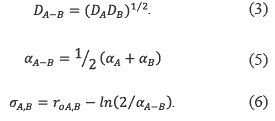
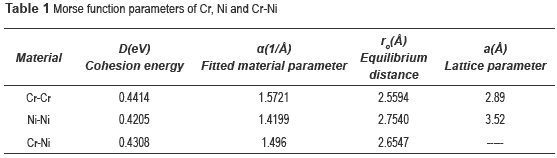
<body><![CDATA[<p><font size="3"><b>Computational model</b></font></p>          <p>The  model used in this work consists of the construction of a spherical indenter  ideally non- deformable, with radius of 3 nm. This equation denotes the  repulsive spherical potential between the rigid sphere (the indenter) and the  atoms belonging to the sample. In this equation R and r.. represent the indenter radius  and the distance between the center of the indenter and each atom of the simple  placed in the position j. K represents the hardness of the indenter that in  this case is considered as the diamond. The exponent 3 in this equation is the  first odd power that represents the harmonic type interaction. It means that  any atom that comes into contact with the indenter will be repelled in the  direction of the sphere movement, generating the effect of displacement or  indenter penetration.</p>         <p>The  sample contains a layer of Ni atoms with FCC crystalline structure oriented in  the plane (100) and a layer of Cr with BCC (100) structure. Values of lattice  parameters are shown in <a href="#Tabla1">table 1</a>.</p>      <p align="center"><a name="Tabla1"></a><img src="/img/revistas/rfiua/n68/n68a09t01.gif" ></p> 	       <p>The  parameter alpha (&alpha;), also named fitting parameter is the dimensionless  parameter of the Morse equation. This parameter allows finding the lowest  energy value ofthe interaction between atoms not only of the same type, but  also of the different type. Because of the potential employed is numerical, the  parameter alpha represents the lowest value for which two neighbor atoms can be  considered as bond atoms. Moreover, this parameter also controls the width of  the energy well for which there is a bond. As is observed in the paper, for  finding the alpha parameter of as for example CrN, it is necessary to fit  values with the Eq. (4). Then, this parameter depends on the atoms interacting  named control material parameter. </p>         <p>Sample  dimensions are 14.45 &Aring; in the x-y plane and 28.9 &Aring; in the z axis. During the collision of  energetic particles of a solid, the temperature of the system is experiencing a  peak related to the change of the instantaneous kinetic energy of each atom  within the network. This change is caused by the collision of each particle  with its neighbors and for this reason is necessary to implement a numerical  model that is responsible for controlling the change in energy of these  particles in order to stabilize the thermally &#91;9&#93;. For crystalline materials,  the computational box is usually generated by an algorithm which executes  repetitions of the unit crystal cell along each dimension until the required  system size is obtained. The constraints of computer power force MD simulations  to employ small systems of atoms and hence it is important to choose a  computational cell large enough to minimize any finite-size effects. Boundary  conditions of &#91;10&#93; are employed to maintain as accurately as possible the  realistic physical behaviour of the simulated material. Hence, boundary conditions  serve to mimic the influence of bulk material surrounding the computational  cell. This ensures that physically meaningful properties of the material can be  obtained from simulations employing a small number of atoms.</p>         <p>When  there are no restrictions on the dynamics of an atom (typically atoms central  to the simulated phenomena) then free boundary conditions are usually applied.  Fixed or rigid conditions can be applied to edge atoms to constrain the  vertical or horizontal motion of the computational cell. An atom is simply made  rigid by not integrating the equations of motion for that particular atom.  However, although the fixed atoms are sited away from the centre of interest,  they can be a problem by creating an artificial interface between the rigid atoms  and the dynamic atoms &#91;11&#93;.</p>         <p>Boundary  conditions are fixed in the <i>x-y</i> plane and in the lower face, while free boundary  conditions were used in the upper face of the sample. The Indentation was  carried out controlling the nanoindenter position (pulling it down) depending  on the applied load and the repulsive potential. This repulsive potential is  described by:</p>      <p><img src="/img/revistas/rfiua/n68/n68a09e01.gif"></p> 	       <p>where <i>K</i> and <i>R</i> represent the sphere  stiffness and sphere radius respectively and <i>r<sub>ij</sub></i> is the distance between the  center of the spherical nanoindenter and the sample atoms &#91;10&#93;. In this case, <i>K</i> has a value of 4.5ev/&Aring;<sup>3</sup> and <i>R</i> is 3 nm. In this work, the  Morse interatomic potential is used for describing the interaction between all  the atoms in the sample. Generally this potential is given by the equation:</p>      ]]></body>
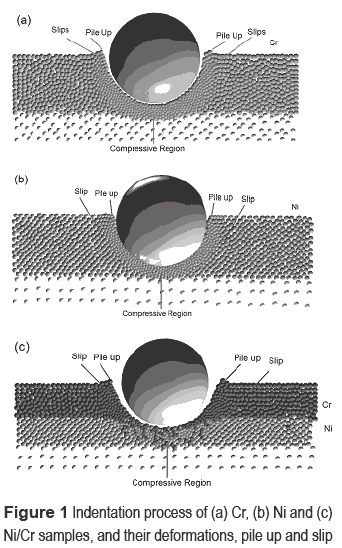
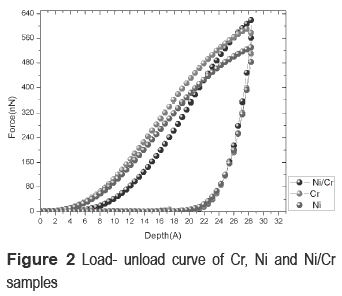
<body><![CDATA[<p><img src="/img/revistas/rfiua/n68/n68a09e02.gif"></p>         <p>For  a like Morse system, <i>D<sub>ij</sub></i>  is the bond dissociation energy; it means, the equilibrium  energy between bonded atoms. <i>r<sub>ij</sub></i>, <i>r</i><sub>0</sub> are the system interatomic  and equilibrium distances. In this model, the interaction distance for each  atom is considered up to three times the lattice parameter. Note that in  equation (2) the distance between non-interacting atoms is not considering.  This distance is called cutoff radius and is used to improve computational time  calculation. &alpha; is the fitted parameter of the material that depends on the  binding tension energy and the bulk modulus. Morse potential parameters of  materials studied here are shown in <a href="#Tabla1">table 1</a>. Values of D, <i>r</i> y &alpha; depend on the type of  atoms. For the different atomic species interaction, many parameters are needed  in the Morse function; these parameters can be calculated with the  Lorentz-Berteloth rules &#91;12&#93;. These rules are expressed by the next equations:</p>      <p><img src="/img/revistas/rfiua/n68/n68a09e03.gif"></p>      <p>Where <i>A</i> and <i>B</i> represent the two type of  atoms (Cr-Cr, Ni-Ni, Cr-Ni at the interface). The Verlet time integration  algorithm &#91;13&#93; is used with a dynamic step time of 1.92 fs. During the  nanoindentation process the solid sphere is placed at 7.2 &Aring; over the sample surface. As  is shown in Eq. (1), the repulsive potential that represents the indenter  depends on the distance between atoms of the sample and the center of the  sphere <i>r<em><sub>ij</sub></em></i>. For this reason, the  indenter can be placed in any position of the system, because this element  exerts a repulsive force that can be lower of greater depending on the  distance. The indenter is placed at the center of the sample surface, because  as is also considered in the real experiments, the boundary conditions may not  affect the results in an asymmetric way. For this reason, the center of the  sample is the ideal place for the test. When the simulations are carrying out  placed the indenter at the center of the sample, although there is any effect  of the fixed boundary conditions, this influence is canceled because of the  symmetry, being important only the contribution of the force in the z  direction. The indentation forces are obtained summing the force in the z axis of each atom that is  affected by the process &#91;14&#93;.</p>      <p>&nbsp;</p>      <p><font size="3"><b>Results and discussion</b></font></p>        <p>The  nanoindentation processes applied to Cr, Ni and Cr/Ni for studying their  mechanical properties are presented in <a href="#Figura1">figures 1</a><a href="#Figura1">(a)</a>, <a href="#Figura1">(b)</a> and <a href="#Figura1">(c)</a>) respectively.  Values of force and indentation depth were obtained as shown in <a href="#Figura2">figure 2</a>, in  order to find the hardness and elastic modulus.</p>      <p align="center"><a name="Figura1"></a><img src="/img/revistas/rfiua/n68/n68a09i01.gif"></p>      <p align="center"><a name="Figura2"></a><img src="/img/revistas/rfiua/n68/n68a09i02.gif"></p>      <p>Simulations  for the Cr film shows pile up around the indenter (<a href="#Figura1">figures 1</a><a href="#Figura1">(a)</a>). This behavior  is less appreciable in the Ni film (<a href="#Figura1">figures 1</a><a href="#Figura1">(b)</a>). This pile up indicates that  Cr has a higher plastic response compared with Ni, as explained by Bolshakov  &#91;15&#93;. In both cases, a compressive region around the spherical indenter is  observed, causing an increase in the applied load required for penetrating the  sample. Indenter geometry influences the results of the hardness and Young's  modulus &#91;16&#93;. This behavior is in agreement with simulations carried out in  &#91;7&#93;. They reported the same compressive region around the indenter in thin  films of aluminum grown on silicon substrates. In the case of Ni/Cr bilayers  simulated in this work, the surface deformation is similar to the Cr thin film;  nevertheless, a high deformation at the interface between the Cr and Ni  boundary and a reduction of the compressive region are observed (<a href="#Figura1">figures 1</a><a href="#Figura1">(c)</a>).  This phenomenon is according to study &#91;6&#93;. They modeled the indentation of a  Ni/Al system finding a decrease in the compressive region; moreover, the  indented sample deformation is governed by slips and dislocations of the  multilayer crystalline structure &#91;6&#93;. The plasticity of the sample refers to  the recovering of the material after undergoing the effects of external forces.  At the load is increased, the material recovering decreases because the load  displaces the sample atoms to positions where they are forced to find  equilibrium interactions that are not initially neighbor. When it happens, the  material loses the initial structural information and the system plasticity  decreases. On the contrary, if the force is low, the atomic displacements are  lower and the original equilibrium positions are reached. For obtaining the  samples hardness (H), the next equation is used:</p>      ]]></body>
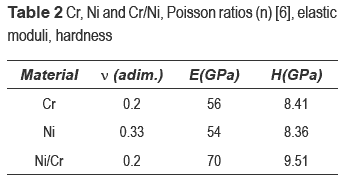
<body><![CDATA[<p><img src="/img/revistas/rfiua/n68/n68a09e07.gif"></p>      <p><i>P <sub>max</sub></i> is the maximum load from the unload curve (Fig.  2), <i>A<sub>c</sub></i> is the indenter contact area,  corresponding to the sphere area. In this case<i> A<sub>c</sub></i> is given by:</p>      <p><img src="/img/revistas/rfiua/n68/n68a09e08.gif"></p>       <p>where <i>h<sub>c</sub></i> is the indentation depth. For  obtaining the hardness and the system Young's modulus the Oliver-Pharr method  &#91;15&#93; was used. In general, for any material, the elastic modulus can be  calculated by using:</p>      <p><img src="/img/revistas/rfiua/n68/n68a09e09.gif"></p>      <p>where <i>E<sub>i</sub></i> and <i>E<sub>s</sub></i> are the indenter and sample  Young's moduli and <img src="/img/revistas/rfiua/n68/n68a09e00a.gif"><sub><i>i</i></sub>. and <img src="/img/revistas/rfiua/n68/n68a09e00a.gif"><sub><i>s</i></sub> are the indenter and sample  Poisson's ratios. These parameters are shown in <a href="#Tabla2">Table 2</a>.</p>      <p align="center"><a name="Tabla2"></a><img src="/img/revistas/rfiua/n68/n68a09t02.gif" ></p>      <p>The  hardness is obtained for Cr, Ni and Ni/Cr using equations (8), (9) and results  from <a href="#Figura2">figure 2</a>. Values of elastic moduli and hardness are shown in <a href="#Tabla2">table 2</a>. Cr  hardness is in agreement with the experimental results reported &#91;17&#93;. They  carried out several experimental tests for Cr and CrN samples. In the case of  the Ni thin film, the hardness is similar to that obtained by experimental  results reported &#91;18&#93;. Regarding to the Ni/Cr system, the hardness is higher  than those obtained for Cr and Ni thin films, similar to values reported in  &#91;8&#93;.</p>       <p>The  difference between the values obtained in our simulations and the real  experiments reported by Wang &#91;18&#93; since the molecular dynamics simulations are  carried out in a nanometric scale, while experiments are in the micro-scale.  this fact affects the deformation mechanisms; for instance, from the point of  view of the micro-scale and polycrystalline samples, the precipitation of the  grain boundaries and lattice defects are significantly higher, affecting the  material behavior between 100-0.1&mu;. Because in this case  the scale is between the 100-0.1 nm or even lower, grain boundaries and defects  in the crystal structures are statistically neglected; then, in the  experimental case, material deformations are strongly affected by dislocations  and slips. Moreover, the assumption of a perfect lattice structure affects the  simulations response compared to the experiments at the micro-scale, where  there are defects in the crystal structure &#91;19&#93;.</p>       <p>In  this work, the stress at the interface (epitaxial stress) plays an important  role in the multilayer mechanical properties, depending strongly on the  interface type, crystal structure and lattice parameter. According to Sergey N,  interfaces can be classified in coherent, semi-incoherent and incoherent &#91;20&#93;.  In the first case, the type of materials involved at the interface are similar  in crystalline structure and lattice parameter; in the second case, the  crystalline structure is the same but the lattice parameters are different; and  in the third case, both, the lattice parameter and the crystal structure are  different. In our study, an incoherent interface was considered &#91;21&#93;. According  to the literature, incoherent interfaces offer a high hardness. It is because  changes in the crystalline structure can interrupt the slips propagation &#91;21,  22&#93;.</p>        ]]></body>
<body><![CDATA[<p>&nbsp;</p>      <p><font size="3"><b>Conclusions</b> </font></p>        <p>Mechanical  response of Cr, Ni thin films and Ni/Cr bilayers was obtained by simulations of  nanoindentation using molecular dynamics. The contact behavior of the indenter  modeled consists of a repulsive spherical potential. The area around the  indentation presented a compressive region. This region is less visible in the  bilayer because of the interface. Results show that changes in the crystal  structure affect the system hardness. Moreover, Cr and Ni structures have  similar parameters of cohesive energy, equilibrium radius and hardness. The  presence of an interface in the bilayer can avoid the slips increasing the  hardness and the mechanical performance of the system.</p>      <p>&nbsp;</p>       <p><font size="3"><b>References</b> </font></p>      <!-- ref --><p>1. G. Radhakrishnan, R.  Robertson, P. Adams, R. Cole.''Integrated TiC coatings for moving  MEMS''.  <i>ThinSolid Films</i>.  Vol. 420. 2002. pp. 553-564.    &nbsp;&nbsp;&nbsp;&nbsp;&nbsp;&nbsp;&nbsp;&nbsp;[&#160;<a href="javascript:void(0);" onclick="javascript: window.open('/scielo.php?script=sci_nlinks&ref=000068&pid=S0120-6230201300030000900001&lng=','','width=640,height=500,resizable=yes,scrollbars=1,menubar=yes,');">Links</a>&#160;]<!-- end-ref --></p>       <!-- ref --><p>2.  W. Ashurst, C. Carraro, R. Maboudian, W. Frey. ''Wafer level anti-stiction  coatings for MEMS''. <i>Sensors and Actuators A</i>. Vol. 104. 2003. pp. 213-221.    &nbsp;&nbsp;&nbsp;&nbsp;&nbsp;&nbsp;&nbsp;&nbsp;[&#160;<a href="javascript:void(0);" onclick="javascript: window.open('/scielo.php?script=sci_nlinks&ref=000070&pid=S0120-6230201300030000900002&lng=','','width=640,height=500,resizable=yes,scrollbars=1,menubar=yes,');">Links</a>&#160;]<!-- end-ref --></p>       <!-- ref --><p>3.  T. Fang, W. Chang, C. Weng, ''Nanoindentation and nanomachining  characteristics of gold and platinum thin films''. <i>Mater. Sci. Eng. A. Vol</i>. 430. 2006. pp. 332-340.    &nbsp;&nbsp;&nbsp;&nbsp;&nbsp;&nbsp;&nbsp;&nbsp;[&#160;<a href="javascript:void(0);" onclick="javascript: window.open('/scielo.php?script=sci_nlinks&ref=000072&pid=S0120-6230201300030000900003&lng=','','width=640,height=500,resizable=yes,scrollbars=1,menubar=yes,');">Links</a>&#160;]<!-- end-ref --></p>       <!-- ref --><p>4. T. Iizuka, A. Onoda, T. Hoshide. ''MD Simulation of  Hardness Property of Al Thin Film Sputtered on Si Substrate and Its Related to  Porosity''. <i>JSME</i>. Vol. 44. 2001. pp. 346-353.    &nbsp;&nbsp;&nbsp;&nbsp;&nbsp;&nbsp;&nbsp;&nbsp;[&#160;<a href="javascript:void(0);" onclick="javascript: window.open('/scielo.php?script=sci_nlinks&ref=000074&pid=S0120-6230201300030000900004&lng=','','width=640,height=500,resizable=yes,scrollbars=1,menubar=yes,');">Links</a>&#160;]<!-- end-ref --></p>       <!-- ref --><p>5.  Y. Shi, M. Falk. ''Structural transformation and localization during  simulated nanoindentation of a noncrystalline metal film''. <i>Appl. Phys. Lett</i>. Vol. 86. 2005. pp. 011914 -  011914-3.    &nbsp;&nbsp;&nbsp;&nbsp;&nbsp;&nbsp;&nbsp;&nbsp;[&#160;<a href="javascript:void(0);" onclick="javascript: window.open('/scielo.php?script=sci_nlinks&ref=000076&pid=S0120-6230201300030000900005&lng=','','width=640,height=500,resizable=yes,scrollbars=1,menubar=yes,');">Links</a>&#160;]<!-- end-ref --></p>       <!-- ref --><p>6. C. Liu, T. Fang, J. Lin. ''Atomistic simulations of  hard and soft films under nanoindentation''. <i>Mater. Sci. Eng. A</i>. Vol. 452-453. 2007. pp.  135-141.    &nbsp;&nbsp;&nbsp;&nbsp;&nbsp;&nbsp;&nbsp;&nbsp;[&#160;<a href="javascript:void(0);" onclick="javascript: window.open('/scielo.php?script=sci_nlinks&ref=000078&pid=S0120-6230201300030000900006&lng=','','width=640,height=500,resizable=yes,scrollbars=1,menubar=yes,');">Links</a>&#160;]<!-- end-ref --></p>       <!-- ref --><p>7. P. Peng, G. Liao, T Shi, Z.Tang, Y. Gao. ''Molecular dynamic simulations  of nanoindentation in aluminum thin film on silicon substrate''. <i>Appl. Surf. Sci</i>. Vol. 256. 2010. pp.  6284-6290.    &nbsp;&nbsp;&nbsp;&nbsp;&nbsp;&nbsp;&nbsp;&nbsp;[&#160;<a href="javascript:void(0);" onclick="javascript: window.open('/scielo.php?script=sci_nlinks&ref=000080&pid=S0120-6230201300030000900007&lng=','','width=640,height=500,resizable=yes,scrollbars=1,menubar=yes,');">Links</a>&#160;]<!-- end-ref --></p>       <!-- ref --><p>8.  T. Fang, W. Hung. ''Molecular dynamics simulations on nanoindentation  mechanisms of multilayered films''. <i>Comput. Mater.  Sci</i>.  Vol. 43. 2008. pp. 785-790.    &nbsp;&nbsp;&nbsp;&nbsp;&nbsp;&nbsp;&nbsp;&nbsp;[&#160;<a href="javascript:void(0);" onclick="javascript: window.open('/scielo.php?script=sci_nlinks&ref=000082&pid=S0120-6230201300030000900008&lng=','','width=640,height=500,resizable=yes,scrollbars=1,menubar=yes,');">Links</a>&#160;]<!-- end-ref --></p>       <!-- ref --><p>9.  Y. Hu, S. Sinnott. ''Constant temperature molecular dynamics simulations of  energetic particle-solid collisions: comparison of temperature control  methods.'' <i>Journal of Computational Physics</i>. Vol. 200. 2004. pp. 251-266.    &nbsp;&nbsp;&nbsp;&nbsp;&nbsp;&nbsp;&nbsp;&nbsp;[&#160;<a href="javascript:void(0);" onclick="javascript: window.open('/scielo.php?script=sci_nlinks&ref=000084&pid=S0120-6230201300030000900009&lng=','','width=640,height=500,resizable=yes,scrollbars=1,menubar=yes,');">Links</a>&#160;]<!-- end-ref --></p>       <!-- ref --><p>10. C. Goringe, D. Bowler, E. Hernandes. ''Tight-binding modelling  of materials''. <i>Rep. Prog. Phys</i>.Vol. 60. 1997. pp. 1447.    &nbsp;&nbsp;&nbsp;&nbsp;&nbsp;&nbsp;&nbsp;&nbsp;[&#160;<a href="javascript:void(0);" onclick="javascript: window.open('/scielo.php?script=sci_nlinks&ref=000086&pid=S0120-6230201300030000900010&lng=','','width=640,height=500,resizable=yes,scrollbars=1,menubar=yes,');">Links</a>&#160;]<!-- end-ref --></p>       <!-- ref --><p>11.  D. Christopher. <i>Molecular Dynamics Modelling of Nanoindentation</i>. Doctoral Thesis. Loughborough  University. Loughborough, UK. 2002.    &nbsp;&nbsp;&nbsp;&nbsp;&nbsp;&nbsp;&nbsp;&nbsp;[&#160;<a href="javascript:void(0);" onclick="javascript: window.open('/scielo.php?script=sci_nlinks&ref=000088&pid=S0120-6230201300030000900011&lng=','','width=640,height=500,resizable=yes,scrollbars=1,menubar=yes,');">Links</a>&#160;]<!-- end-ref --></p>       <!-- ref --><p>12.  G. Ziegenhain, A. Hartmaier, H. Urbassek. ''Pair vs many-body potentials:  Influence on elastic and plastic behavior in nanoindentation of fcc metals  Gerolf Ziegenhain''. <i>J. Mech.  Phys. Solids</i>. Vol. 57. 2009. pp. 1514-1526.    &nbsp;&nbsp;&nbsp;&nbsp;&nbsp;&nbsp;&nbsp;&nbsp;[&#160;<a href="javascript:void(0);" onclick="javascript: window.open('/scielo.php?script=sci_nlinks&ref=000090&pid=S0120-6230201300030000900012&lng=','','width=640,height=500,resizable=yes,scrollbars=1,menubar=yes,');">Links</a>&#160;]<!-- end-ref --></p>       <!-- ref --><p>13.  D. Frenkel, B. Smit. <i>Understanding Molecular Simulation From Algorithms to  Applications</i>.  2<sup>nd</sup> ed. Ed. Academic Press. San Diego, USA. 2002. pp. 82-84.    &nbsp;&nbsp;&nbsp;&nbsp;&nbsp;&nbsp;&nbsp;&nbsp;[&#160;<a href="javascript:void(0);" onclick="javascript: window.open('/scielo.php?script=sci_nlinks&ref=000092&pid=S0120-6230201300030000900013&lng=','','width=640,height=500,resizable=yes,scrollbars=1,menubar=yes,');">Links</a>&#160;]<!-- end-ref --></p>       <!-- ref --><p>14. R. Komanduria, N. Chandrasekarana, L. Ra. ''Molecular dynamics (MD)  simulation of uniaxial tension of some single-crystal cubic metals at nanolevel.'' <i>Inter. J. Mech.  Sci</i>.  Vol. 43. 2001. pp. 2237-2260.    &nbsp;&nbsp;&nbsp;&nbsp;&nbsp;&nbsp;&nbsp;&nbsp;[&#160;<a href="javascript:void(0);" onclick="javascript: window.open('/scielo.php?script=sci_nlinks&ref=000094&pid=S0120-6230201300030000900014&lng=','','width=640,height=500,resizable=yes,scrollbars=1,menubar=yes,');">Links</a>&#160;]<!-- end-ref --></p>       <!-- ref --><p>15.  A. Bolshakov, G. Pharr. ''Influences of pile up on the measurement of  mechanical properties by load and depth sensing indentation techniques.'' <i>J. Mater. Res</i>. Vol. 13. 1998. pp. 1049-1058.    &nbsp;&nbsp;&nbsp;&nbsp;&nbsp;&nbsp;&nbsp;&nbsp;[&#160;<a href="javascript:void(0);" onclick="javascript: window.open('/scielo.php?script=sci_nlinks&ref=000096&pid=S0120-6230201300030000900015&lng=','','width=640,height=500,resizable=yes,scrollbars=1,menubar=yes,');">Links</a>&#160;]<!-- end-ref --></p>       <!-- ref --><p>16.  R. Mirshams, R. Pothapragada. ''Correlation of nanoindentation measurements  of nickel made using geometrically different indenter tips.'' <i>Acta Materialia</i>. Vol. 54. 2006. pp. 1123-1134.    &nbsp;&nbsp;&nbsp;&nbsp;&nbsp;&nbsp;&nbsp;&nbsp;[&#160;<a href="javascript:void(0);" onclick="javascript: window.open('/scielo.php?script=sci_nlinks&ref=000098&pid=S0120-6230201300030000900016&lng=','','width=640,height=500,resizable=yes,scrollbars=1,menubar=yes,');">Links</a>&#160;]<!-- end-ref --></p>       <!-- ref --><p>17.  H. Barankova, L. Bardos. ''Comparison of pulsed dc and rf hollow cathode  depositions of Cr and CrN films''. <i>Surf. Coat.  Technol</i>.  Vol. 205. 2011. pp. 4169-4176.    &nbsp;&nbsp;&nbsp;&nbsp;&nbsp;&nbsp;&nbsp;&nbsp;[&#160;<a href="javascript:void(0);" onclick="javascript: window.open('/scielo.php?script=sci_nlinks&ref=000100&pid=S0120-6230201300030000900017&lng=','','width=640,height=500,resizable=yes,scrollbars=1,menubar=yes,');">Links</a>&#160;]<!-- end-ref --></p>       <!-- ref --><p>18.  C. Wang, S. Jian, J. Jan, Y. Lai, P. Yang. ''Multiscale simulation of  nanoindentation on Ni (1 0 0) thin film''. <i>Appl. Surf. Sci</i>. Vol. 255. 2010. pp. 3240-3250.    &nbsp;&nbsp;&nbsp;&nbsp;&nbsp;&nbsp;&nbsp;&nbsp;[&#160;<a href="javascript:void(0);" onclick="javascript: window.open('/scielo.php?script=sci_nlinks&ref=000102&pid=S0120-6230201300030000900018&lng=','','width=640,height=500,resizable=yes,scrollbars=1,menubar=yes,');">Links</a>&#160;]<!-- end-ref --></p>       <!-- ref --><p>19. T. Fang, C. Weng, J. Chang. ''Molecular dynamics  analysis of temperature effects on nanoindentation measurement.'' <i>Mater. Sci. Eng</i>. Vol. 357. 2003. pp. 7-12.    &nbsp;&nbsp;&nbsp;&nbsp;&nbsp;&nbsp;&nbsp;&nbsp;[&#160;<a href="javascript:void(0);" onclick="javascript: window.open('/scielo.php?script=sci_nlinks&ref=000104&pid=S0120-6230201300030000900019&lng=','','width=640,height=500,resizable=yes,scrollbars=1,menubar=yes,');">Links</a>&#160;]<!-- end-ref --></p>       <!-- ref --><p>20.  S. Medyanik, S. Shao. ''Strengthening effects of coherent interfaces in  nanoscale metallic bilayers.'' <i>Comp. Mater. Sci</i>. Vol. 45. 2009. pp. 1129-1133.    &nbsp;&nbsp;&nbsp;&nbsp;&nbsp;&nbsp;&nbsp;&nbsp;[&#160;<a href="javascript:void(0);" onclick="javascript: window.open('/scielo.php?script=sci_nlinks&ref=000106&pid=S0120-6230201300030000900020&lng=','','width=640,height=500,resizable=yes,scrollbars=1,menubar=yes,');">Links</a>&#160;]<!-- end-ref --></p>       <!-- ref --><p>21. R. Hoagland , R. Kurtz, C. Henager Jr. ''Slip resistance of  interfaces and the strength of metallic multilayer composites.'' <i>Scripta Mater</i>. Vol. 50. 2004. pp. 775-779.    &nbsp;&nbsp;&nbsp;&nbsp;&nbsp;&nbsp;&nbsp;&nbsp;[&#160;<a href="javascript:void(0);" onclick="javascript: window.open('/scielo.php?script=sci_nlinks&ref=000108&pid=S0120-6230201300030000900021&lng=','','width=640,height=500,resizable=yes,scrollbars=1,menubar=yes,');">Links</a>&#160;]<!-- end-ref --></p>       <!-- ref --><p>22.  Y. Cao, J. Zhang, Y. Liang, F. Yu, T. Sun. ''Mechanical and tribological  properties of Ni/Al multilayers&#8212;A molecular dynamics study.'' <i>Appl. Surf. Sci</i>. Vol. 257. 2010. pp. 847-851.    &nbsp;&nbsp;&nbsp;&nbsp;&nbsp;&nbsp;&nbsp;&nbsp;[&#160;<a href="javascript:void(0);" onclick="javascript: window.open('/scielo.php?script=sci_nlinks&ref=000110&pid=S0120-6230201300030000900022&lng=','','width=640,height=500,resizable=yes,scrollbars=1,menubar=yes,');">Links</a>&#160;]<!-- end-ref --></p>        <p>&nbsp;</p>     ]]></body>
<body><![CDATA[<p>&nbsp;</p>     <p>&nbsp;</p>     <p>&nbsp;</p>    </font>     ]]></body><back>
<ref-list>
<ref id="B1">
<label>1</label><nlm-citation citation-type="journal">
<person-group person-group-type="author">
<name>
<surname><![CDATA[Radhakrishnan]]></surname>
<given-names><![CDATA[G]]></given-names>
</name>
<name>
<surname><![CDATA[Robertson]]></surname>
<given-names><![CDATA[R]]></given-names>
</name>
<name>
<surname><![CDATA[Adams]]></surname>
<given-names><![CDATA[P]]></given-names>
</name>
<name>
<surname><![CDATA[Cole]]></surname>
<given-names><![CDATA[R]]></given-names>
</name>
</person-group>
<article-title xml:lang="en"><![CDATA[Integrated TiC coatings for moving MEMS]]></article-title>
<source><![CDATA[ThinSolid Films]]></source>
<year>2002</year>
<volume>420</volume>
<page-range>553-564</page-range></nlm-citation>
</ref>
<ref id="B2">
<label>2</label><nlm-citation citation-type="journal">
<person-group person-group-type="author">
<name>
<surname><![CDATA[Ashurst]]></surname>
<given-names><![CDATA[W]]></given-names>
</name>
<name>
<surname><![CDATA[Carraro]]></surname>
<given-names><![CDATA[C]]></given-names>
</name>
<name>
<surname><![CDATA[Maboudian]]></surname>
<given-names><![CDATA[R]]></given-names>
</name>
<name>
<surname><![CDATA[Frey]]></surname>
<given-names><![CDATA[W]]></given-names>
</name>
</person-group>
<article-title xml:lang="en"><![CDATA[Wafer level anti-stiction coatings for MEMS]]></article-title>
<source><![CDATA[Sensors and Actuators A]]></source>
<year>2003</year>
<volume>104</volume>
<page-range>213-221</page-range></nlm-citation>
</ref>
<ref id="B3">
<label>3</label><nlm-citation citation-type="journal">
<person-group person-group-type="author">
<name>
<surname><![CDATA[Fang]]></surname>
<given-names><![CDATA[T]]></given-names>
</name>
<name>
<surname><![CDATA[Chang]]></surname>
<given-names><![CDATA[W]]></given-names>
</name>
<name>
<surname><![CDATA[Weng]]></surname>
<given-names><![CDATA[C]]></given-names>
</name>
</person-group>
<article-title xml:lang="en"><![CDATA[Nanoindentation and nanomachining characteristics of gold and platinum thin films]]></article-title>
<source><![CDATA[Mater. Sci. Eng. A.]]></source>
<year>2006</year>
<volume>430</volume>
<page-range>332-340</page-range></nlm-citation>
</ref>
<ref id="B4">
<label>4</label><nlm-citation citation-type="journal">
<person-group person-group-type="author">
<name>
<surname><![CDATA[Iizuka]]></surname>
<given-names><![CDATA[T]]></given-names>
</name>
<name>
<surname><![CDATA[Onoda]]></surname>
<given-names><![CDATA[A]]></given-names>
</name>
<name>
<surname><![CDATA[Hoshide]]></surname>
<given-names><![CDATA[T]]></given-names>
</name>
</person-group>
<article-title xml:lang="en"><![CDATA[MD Simulation of Hardness Property of Al Thin Film Sputtered on Si Substrate and Its Related to Porosity]]></article-title>
<source><![CDATA[JSME]]></source>
<year>2001</year>
<volume>44</volume>
<page-range>346-353</page-range></nlm-citation>
</ref>
<ref id="B5">
<label>5</label><nlm-citation citation-type="journal">
<person-group person-group-type="author">
<name>
<surname><![CDATA[Shi]]></surname>
<given-names><![CDATA[Y]]></given-names>
</name>
<name>
<surname><![CDATA[Falk]]></surname>
<given-names><![CDATA[M]]></given-names>
</name>
</person-group>
<article-title xml:lang="en"><![CDATA[Structural transformation and localization during simulated nanoindentation of a noncrystalline metal film]]></article-title>
<source><![CDATA[Appl. Phys. Lett.]]></source>
<year>2005</year>
<volume>86</volume>
<page-range>011914 - 011914-3</page-range></nlm-citation>
</ref>
<ref id="B6">
<label>6</label><nlm-citation citation-type="journal">
<person-group person-group-type="author">
<name>
<surname><![CDATA[Liu]]></surname>
<given-names><![CDATA[C]]></given-names>
</name>
<name>
<surname><![CDATA[Fang]]></surname>
<given-names><![CDATA[T]]></given-names>
</name>
<name>
<surname><![CDATA[Lin]]></surname>
<given-names><![CDATA[J]]></given-names>
</name>
</person-group>
<article-title xml:lang="en"><![CDATA[Atomistic simulations of hard and soft films under nanoindentation]]></article-title>
<source><![CDATA[Mater. Sci. Eng. A.]]></source>
<year>2007</year>
<volume>452-453</volume>
<page-range>135-141</page-range></nlm-citation>
</ref>
<ref id="B7">
<label>7</label><nlm-citation citation-type="journal">
<person-group person-group-type="author">
<name>
<surname><![CDATA[Peng]]></surname>
<given-names><![CDATA[P]]></given-names>
</name>
<name>
<surname><![CDATA[Liao]]></surname>
<given-names><![CDATA[G]]></given-names>
</name>
<name>
<surname><![CDATA[Shi]]></surname>
<given-names><![CDATA[T]]></given-names>
</name>
<name>
<surname><![CDATA[Tang]]></surname>
<given-names><![CDATA[Z]]></given-names>
</name>
<name>
<surname><![CDATA[Gao]]></surname>
<given-names><![CDATA[Y]]></given-names>
</name>
</person-group>
<article-title xml:lang="en"><![CDATA[Molecular dynamic simulations of nanoindentation in aluminum thin film on silicon substrate]]></article-title>
<source><![CDATA[Appl. Surf. Sci.]]></source>
<year>2010</year>
<volume>256</volume>
<page-range>6284-6290</page-range></nlm-citation>
</ref>
<ref id="B8">
<label>8</label><nlm-citation citation-type="journal">
<person-group person-group-type="author">
<name>
<surname><![CDATA[Fang]]></surname>
<given-names><![CDATA[T]]></given-names>
</name>
<name>
<surname><![CDATA[Hung]]></surname>
<given-names><![CDATA[W]]></given-names>
</name>
</person-group>
<article-title xml:lang="en"><![CDATA[Molecular dynamics simulations on nanoindentation mechanisms of multilayered films]]></article-title>
<source><![CDATA[Comput. Mater. Sci]]></source>
<year>2008</year>
<volume>43</volume>
<page-range>785-790</page-range></nlm-citation>
</ref>
<ref id="B9">
<label>9</label><nlm-citation citation-type="journal">
<person-group person-group-type="author">
<name>
<surname><![CDATA[Hu]]></surname>
<given-names><![CDATA[Y]]></given-names>
</name>
<name>
<surname><![CDATA[Sinnott]]></surname>
<given-names><![CDATA[S]]></given-names>
</name>
</person-group>
<article-title xml:lang="en"><![CDATA[Constant temperature molecular dynamics simulations of energetic particle-solid collisions: comparison of temperature control methods]]></article-title>
<source><![CDATA[Journal of Computational Physics]]></source>
<year>2004</year>
<volume>200</volume>
<page-range>251-266</page-range></nlm-citation>
</ref>
<ref id="B10">
<label>10</label><nlm-citation citation-type="journal">
<person-group person-group-type="author">
<name>
<surname><![CDATA[Goringe]]></surname>
<given-names><![CDATA[C]]></given-names>
</name>
<name>
<surname><![CDATA[Bowler]]></surname>
<given-names><![CDATA[D]]></given-names>
</name>
<name>
<surname><![CDATA[Hernandes]]></surname>
<given-names><![CDATA[E]]></given-names>
</name>
</person-group>
<article-title xml:lang="en"><![CDATA[Tight-binding modelling of materials]]></article-title>
<source><![CDATA[Rep. Prog. Phys.]]></source>
<year>1997</year>
<volume>60</volume>
<page-range>1447</page-range></nlm-citation>
</ref>
<ref id="B11">
<label>11</label><nlm-citation citation-type="">
<person-group person-group-type="author">
<name>
<surname><![CDATA[Christopher]]></surname>
<given-names><![CDATA[D]]></given-names>
</name>
</person-group>
<source><![CDATA[Molecular Dynamics Modelling of Nanoindentation]]></source>
<year></year>
</nlm-citation>
</ref>
<ref id="B12">
<label>12</label><nlm-citation citation-type="journal">
<person-group person-group-type="author">
<name>
<surname><![CDATA[Ziegenhain]]></surname>
<given-names><![CDATA[G]]></given-names>
</name>
<name>
<surname><![CDATA[Hartmaier]]></surname>
<given-names><![CDATA[A]]></given-names>
</name>
<name>
<surname><![CDATA[Urbassek]]></surname>
<given-names><![CDATA[H]]></given-names>
</name>
</person-group>
<article-title xml:lang="en"><![CDATA[Pair vs many-body potentials: Influence on elastic and plastic behavior in nanoindentation of fcc metals Gerolf Ziegenhain]]></article-title>
<source><![CDATA[J. Mech. Phys. Solids]]></source>
<year>2009</year>
<volume>57</volume>
<page-range>1514-1526</page-range></nlm-citation>
</ref>
<ref id="B13">
<label>13</label><nlm-citation citation-type="book">
<person-group person-group-type="author">
<name>
<surname><![CDATA[Frenkel]]></surname>
<given-names><![CDATA[D]]></given-names>
</name>
<name>
<surname><![CDATA[Smit]]></surname>
<given-names><![CDATA[B]]></given-names>
</name>
</person-group>
<source><![CDATA[Understanding Molecular Simulation From Algorithms to Applications]]></source>
<year>2002</year>
<edition>2nd</edition>
<page-range>82-84</page-range><publisher-loc><![CDATA[San Diego ]]></publisher-loc>
<publisher-name><![CDATA[Ed. Academic Press]]></publisher-name>
</nlm-citation>
</ref>
<ref id="B14">
<label>14</label><nlm-citation citation-type="journal">
<person-group person-group-type="author">
<name>
<surname><![CDATA[Komanduria]]></surname>
<given-names><![CDATA[R]]></given-names>
</name>
<name>
<surname><![CDATA[Chandrasekarana]]></surname>
<given-names><![CDATA[N.]]></given-names>
</name>
<name>
<surname><![CDATA[Ra]]></surname>
<given-names><![CDATA[L]]></given-names>
</name>
</person-group>
<article-title xml:lang="en"><![CDATA[Molecular dynamics (MD) simulation of uniaxial tension of some single-crystal cubic metals at nanolevel]]></article-title>
<source><![CDATA[Inter. J. Mech. Sci]]></source>
<year>2001</year>
<volume>43</volume>
<page-range>2237-2260</page-range></nlm-citation>
</ref>
<ref id="B15">
<label>15</label><nlm-citation citation-type="journal">
<person-group person-group-type="author">
<name>
<surname><![CDATA[Bolshakov]]></surname>
<given-names><![CDATA[A]]></given-names>
</name>
<name>
<surname><![CDATA[Pharr]]></surname>
<given-names><![CDATA[G]]></given-names>
</name>
</person-group>
<article-title xml:lang="en"><![CDATA[Influences of pile up on the measurement of mechanical properties by load and depth sensing indentation techniques]]></article-title>
<source><![CDATA[J. Mater. Res]]></source>
<year>1998</year>
<volume>13</volume>
<page-range>1049-1058</page-range></nlm-citation>
</ref>
<ref id="B16">
<label>16</label><nlm-citation citation-type="journal">
<person-group person-group-type="author">
<name>
<surname><![CDATA[Mirshams]]></surname>
<given-names><![CDATA[R]]></given-names>
</name>
<name>
<surname><![CDATA[Pothapragada]]></surname>
<given-names><![CDATA[R]]></given-names>
</name>
</person-group>
<article-title xml:lang="en"><![CDATA[Correlation of nanoindentation measurements of nickel made using geometrically different indenter tips]]></article-title>
<source><![CDATA[Acta Materialia]]></source>
<year>2006</year>
<volume>54</volume>
<page-range>1123-1134</page-range></nlm-citation>
</ref>
<ref id="B17">
<label>17</label><nlm-citation citation-type="journal">
<person-group person-group-type="author">
<name>
<surname><![CDATA[Barankova]]></surname>
<given-names><![CDATA[H]]></given-names>
</name>
<name>
<surname><![CDATA[Bardos]]></surname>
<given-names><![CDATA[L]]></given-names>
</name>
</person-group>
<article-title xml:lang="en"><![CDATA[Comparison of pulsed dc and rf hollow cathode depositions of Cr and CrN films]]></article-title>
<source><![CDATA[Surf. Coat. Technol]]></source>
<year>2011</year>
<volume>205</volume>
<page-range>4169-4176</page-range></nlm-citation>
</ref>
<ref id="B18">
<label>18</label><nlm-citation citation-type="journal">
<person-group person-group-type="author">
<name>
<surname><![CDATA[Wang]]></surname>
<given-names><![CDATA[C]]></given-names>
</name>
<name>
<surname><![CDATA[Jian]]></surname>
<given-names><![CDATA[S]]></given-names>
</name>
<name>
<surname><![CDATA[Jan]]></surname>
<given-names><![CDATA[J]]></given-names>
</name>
<name>
<surname><![CDATA[Lai]]></surname>
<given-names><![CDATA[Y]]></given-names>
</name>
<name>
<surname><![CDATA[Yang]]></surname>
<given-names><![CDATA[P]]></given-names>
</name>
</person-group>
<article-title xml:lang="en"><![CDATA[Multiscale simulation of nanoindentation on Ni (1 0 0) thin film]]></article-title>
<source><![CDATA[Appl. Surf. Sci]]></source>
<year>2010</year>
<volume>255</volume>
<page-range>3240-3250</page-range></nlm-citation>
</ref>
<ref id="B19">
<label>19</label><nlm-citation citation-type="journal">
<person-group person-group-type="author">
<name>
<surname><![CDATA[Fang]]></surname>
<given-names><![CDATA[T]]></given-names>
</name>
<name>
<surname><![CDATA[Weng]]></surname>
<given-names><![CDATA[C]]></given-names>
</name>
<name>
<surname><![CDATA[Chang]]></surname>
<given-names><![CDATA[J]]></given-names>
</name>
</person-group>
<article-title xml:lang="en"><![CDATA[Molecular dynamics analysis of temperature effects on nanoindentation measurement]]></article-title>
<source><![CDATA[Mater. Sci. Eng]]></source>
<year>2003</year>
<volume>357</volume>
<page-range>7-12</page-range></nlm-citation>
</ref>
<ref id="B20">
<label>20</label><nlm-citation citation-type="journal">
<person-group person-group-type="author">
<name>
<surname><![CDATA[Medyanik]]></surname>
<given-names><![CDATA[S]]></given-names>
</name>
<name>
<surname><![CDATA[Shao]]></surname>
<given-names><![CDATA[S]]></given-names>
</name>
</person-group>
<article-title xml:lang="en"><![CDATA[Strengthening effects of coherent interfaces in nanoscale metallic bilayers]]></article-title>
<source><![CDATA[Comp. Mater. Sci]]></source>
<year>2009</year>
<volume>45</volume>
<page-range>1129-1133</page-range></nlm-citation>
</ref>
<ref id="B21">
<label>21</label><nlm-citation citation-type="journal">
<person-group person-group-type="author">
<name>
<surname><![CDATA[Hoagland]]></surname>
<given-names><![CDATA[R]]></given-names>
</name>
<name>
<surname><![CDATA[Kurtz]]></surname>
<given-names><![CDATA[R]]></given-names>
</name>
<name>
<surname><![CDATA[Henager Jr]]></surname>
<given-names><![CDATA[C]]></given-names>
</name>
</person-group>
<article-title xml:lang="en"><![CDATA[Slip resistance of interfaces and the strength of metallic multilayer composites]]></article-title>
<source><![CDATA[Scripta Mater]]></source>
<year>2004</year>
<volume>50</volume>
<page-range>775-779</page-range></nlm-citation>
</ref>
<ref id="B22">
<label>22</label><nlm-citation citation-type="journal">
<person-group person-group-type="author">
<name>
<surname><![CDATA[Cao]]></surname>
<given-names><![CDATA[Y]]></given-names>
</name>
<name>
<surname><![CDATA[Zhang]]></surname>
<given-names><![CDATA[J]]></given-names>
</name>
<name>
<surname><![CDATA[Liang]]></surname>
<given-names><![CDATA[Y]]></given-names>
</name>
<name>
<surname><![CDATA[Yu]]></surname>
<given-names><![CDATA[F]]></given-names>
</name>
<name>
<surname><![CDATA[Sun]]></surname>
<given-names><![CDATA[T]]></given-names>
</name>
</person-group>
<article-title xml:lang="en"><![CDATA[Mechanical and tribological properties of Ni/Al multilayers-A molecular dynamics study]]></article-title>
<source><![CDATA[Appl. Surf. Sci]]></source>
<year>2010</year>
<volume>257</volume>
<page-range>847-851</page-range></nlm-citation>
</ref>
</ref-list>
</back>
</article>