<?xml version="1.0" encoding="ISO-8859-1"?><article xmlns:mml="http://www.w3.org/1998/Math/MathML" xmlns:xlink="http://www.w3.org/1999/xlink" xmlns:xsi="http://www.w3.org/2001/XMLSchema-instance">
<front>
<journal-meta>
<journal-id>0120-6230</journal-id>
<journal-title><![CDATA[Revista Facultad de Ingeniería Universidad de Antioquia]]></journal-title>
<abbrev-journal-title><![CDATA[Rev.fac.ing.univ. Antioquia]]></abbrev-journal-title>
<issn>0120-6230</issn>
<publisher>
<publisher-name><![CDATA[Facultad de Ingeniería, Universidad de Antioquia]]></publisher-name>
</publisher>
</journal-meta>
<article-meta>
<article-id>S0120-62302013000300012</article-id>
<title-group>
<article-title xml:lang="en"><![CDATA[Effect of chloride salts on biodesulfurization process of a colombian coal]]></article-title>
<article-title xml:lang="es"><![CDATA[Efecto de sales cloruros en un proceso de biodesulfurización de un carbón colombiano]]></article-title>
</title-group>
<contrib-group>
<contrib contrib-type="author">
<name>
<surname><![CDATA[Caicedo Pineda]]></surname>
<given-names><![CDATA[Gerardo Andrés]]></given-names>
</name>
<xref ref-type="aff" rid="A01"/>
<xref ref-type="aff" rid="A03"/>
</contrib>
<contrib contrib-type="author">
<name>
<surname><![CDATA[Márquez Godoy]]></surname>
<given-names><![CDATA[Marco Antonio]]></given-names>
</name>
<xref ref-type="aff" rid="A02"/>
</contrib>
</contrib-group>
<aff id="A01">
<institution><![CDATA[,National University of Colombia  ]]></institution>
<addr-line><![CDATA[Medellin ]]></addr-line>
<country>Colombia</country>
</aff>
<aff id="A02">
<institution><![CDATA[,National University of Colombia School of Materials Engineering ]]></institution>
<addr-line><![CDATA[Medellin ]]></addr-line>
<country>Colombia</country>
</aff>
<aff id="A03">
<institution><![CDATA[,National University of Colombia  ]]></institution>
<addr-line><![CDATA[ ]]></addr-line>
</aff>
<pub-date pub-type="pub">
<day>00</day>
<month>09</month>
<year>2013</year>
</pub-date>
<pub-date pub-type="epub">
<day>00</day>
<month>09</month>
<year>2013</year>
</pub-date>
<numero>68</numero>
<fpage>115</fpage>
<lpage>123</lpage>
<copyright-statement/>
<copyright-year/>
<self-uri xlink:href="http://www.scielo.org.co/scielo.php?script=sci_arttext&amp;pid=S0120-62302013000300012&amp;lng=en&amp;nrm=iso"></self-uri><self-uri xlink:href="http://www.scielo.org.co/scielo.php?script=sci_abstract&amp;pid=S0120-62302013000300012&amp;lng=en&amp;nrm=iso"></self-uri><self-uri xlink:href="http://www.scielo.org.co/scielo.php?script=sci_pdf&amp;pid=S0120-62302013000300012&amp;lng=en&amp;nrm=iso"></self-uri><abstract abstract-type="short" xml:lang="en"><p><![CDATA[A chloride salts medium was evaluated in biodesulfurization processes of a Colombian coal (2.34% total sulfur: 1.34% as pyritic, 0.90% as organic and 0.10% from sulfates), employing a consortium of Acidithiobacillus ferrooxidans and Acidithiobacillus thiooxidans. The process was carried out at three pulp concentrations (9.09%, 16.67% and 23.08%) and was compared with assays under similar conditions but containing modified T&K medium. All the tests were determined by measuring changes in soluble iron, pH, redox potential and microbial populations approach. Original and treated coal was analyzed by scanning electron microscopy with an energy-dispersive X-ray (SEM-EDX). For bioassays with chloride salts medium, the results showed above 70% of pyritic sulfur oxidation after 12 days, regardless of pulp concentration in contrast with results obtained for bioassays with a T&K modified medium where pulp concentration had influence and the pyrite oxidation was lower (below 55%).]]></p></abstract>
<abstract abstract-type="short" xml:lang="es"><p><![CDATA[Se evaluó el efecto de un medio de sales cloruros para un consorcio de Acidithiobacillus ferrooxidans y Acidithiobacillus thiooxidans en un proceso de biodesulfurización de un carbón colombiano (azufre total: 2.34%, azufre pirítico: 1.34%, azufre orgánico: 0.90% y azufre de sulfatos: 0.10%), bajo tres concentraciones de pulpa (9.09%, 16.67% y 23.08%). Los ensayos se compararon con otros bajo condiciones similares, pero utilizando medio T&K modificado. Todos los procesos se monitorearon con mediciones periódicas de hierro en solución, pH, potencial redox y concentración celular. El carbón fue analizado antes y después de la biodesulfurización por microscopía electrónica de barrido con analizador microquímico (SEM-EDX). Los ensayos con el medio de sales cloruros obtuvieron una oxidación del 70% de azufre pirítico después de 12 días para todas las concentraciones de pulpa evaluadas. En contraste, en los ensayos con el medio T&K modificado, la concentración de pulpa influyó en la oxidación de pirita y fue menor (por debajo de 55%).]]></p></abstract>
<kwd-group>
<kwd lng="en"><![CDATA[Acidithiobacillus]]></kwd>
<kwd lng="en"><![CDATA[biodesulfurization]]></kwd>
<kwd lng="en"><![CDATA[coal]]></kwd>
<kwd lng="en"><![CDATA[iron removed]]></kwd>
<kwd lng="en"><![CDATA[pyrite]]></kwd>
<kwd lng="en"><![CDATA[culture medium]]></kwd>
<kwd lng="es"><![CDATA[Acidithiobacillus]]></kwd>
<kwd lng="es"><![CDATA[biodesulfurización]]></kwd>
<kwd lng="es"><![CDATA[carbón]]></kwd>
<kwd lng="es"><![CDATA[hierro removido]]></kwd>
<kwd lng="es"><![CDATA[pirita]]></kwd>
<kwd lng="es"><![CDATA[medio de cultivo]]></kwd>
</kwd-group>
</article-meta>
</front><body><![CDATA[ <font face="Verdana" size="2">      <p align="right"><b>ART&Iacute;CULO ORIGINAL</b></p>     <p align="right">&nbsp;</p>     <p align="center"><font size="4"> <b>Effect of chloride salts on biodesulfurization process of a colombian coal</b></font></p>     <p align="center">&nbsp;</p>     <p align="center"><font size="3"> <b>Efecto de sales cloruros en un proceso de biodesulfurizaci&oacute;n de un carb&oacute;n colombiano</b></font></p>     <p align="center">&nbsp;</p>     <p align="center">&nbsp;</p>     <p> <i><b>Gerardo Andr&eacute;s Caicedo Pineda<sup>1</sup>, Marco Antonio M&aacute;rquez Godoy<sup>2</sup></b></i></p>       <p><sup>1</sup>M.Sc. Biotechnology. National University of Colombia. Cra.  80 No. 65-223. Medellin, Colombia. </p>      ]]></body>
<body><![CDATA[<p><sup>2</sup>Ph.D. in Applied Mineralogy, School of Materials  Engineering. National University of Colombia. Cra. 80 No. 65-223. Medellin,  Colombia.</p>      <p><sup>*</sup>Autor de correspondencia: tel&eacute;fono: + 57 + 315 802 37 60, fax: + 57 + 4 + 425 52 48, correo electr&oacute;nico: <a href="mailto:gacaiced@unal,edu.co">gacaiced@unal,edu.co</a> (G. Caicedo)</p>      <p>&nbsp;</p>     <p align="center">(Recibido  el 26 de marzo de 2012. Aprobado el 5 de agosto de 2013)</p>     <p align="center">&nbsp;</p>     <p align="center">&nbsp;</p> <hr noshade size="1">      <p><font size="3"><b>Abstract</b></font></p>      <p>A chloride salts medium was evaluated in biodesulfurization  processes of a Colombian coal (2.34% total sulfur: 1.34% as pyritic, 0.90% as  organic and 0.10% from sulfates), employing a consortium of <i>Acidithiobacillus  ferrooxidans</i>  and  <i>Acidithiobacillus thiooxidans</i>. The process was carried out at three pulp concentrations  (9.09%, 16.67% and 23.08%) and was compared with assays under similar  conditions but containing modified T&amp;K medium. All the tests were  determined by measuring changes in soluble iron, pH, redox potential and  microbial populations approach. Original and treated coal was analyzed by  scanning electron microscopy with an energy-dispersive X-ray (SEM-EDX). For  bioassays with chloride salts medium, the results showed above 70% of pyritic  sulfur oxidation after 12 days, regardless of pulp concentration in contrast  with results obtained for bioassays with a T&amp;K modified medium where pulp  concentration had influence and the pyrite oxidation was lower (below 55%).</p>       <p><i>Keywords:</i><i> Acidithiobacillus</i>, biodesulfurization, coal, iron removed, pyrite, culture medium</p>  <hr noshade size="1">      <p><font size="3"><b>Resumen</b></font></p>     ]]></body>
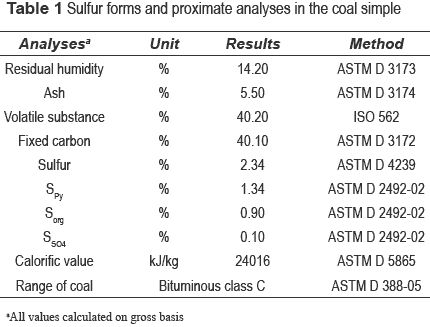
<body><![CDATA[<p>Se evalu&oacute; el efecto de un medio de sales cloruros para  un consorcio de <i>Acidithiobacillus ferrooxidans</i> y  <i>Acidithiobacillus thiooxidans</i> en un proceso de biodesulfurizaci&oacute;n de un carb&oacute;n  colombiano (azufre total: 2.34%, azufre pir&iacute;tico: 1.34%, azufre  org&aacute;nico: 0.90% y azufre de sulfatos: 0.10%), bajo tres concentraciones de pulpa (9.09%, 16.67% y  23.08%). Los ensayos se compararon con otros bajo condiciones similares, pero  utilizando medio T&amp;K modificado. Todos los procesos se monitorearon con  mediciones peri&oacute;dicas de hierro en soluci&oacute;n, pH, potencial redox y  concentraci&oacute;n celular. El carb&oacute;n fue analizado antes y despu&eacute;s de la  biodesulfurizaci&oacute;n por microscop&iacute;a electr&oacute;nica de barrido con analizador  microqu&iacute;mico (SEM-EDX). Los ensayos con el medio de sales cloruros obtuvieron  una oxidaci&oacute;n del 70% de azufre pir&iacute;tico despu&eacute;s de 12 d&iacute;as para todas las  concentraciones de pulpa evaluadas. En contraste, en los ensayos con el medio  T&amp;K modificado, la concentraci&oacute;n de pulpa influy&oacute; en la oxidaci&oacute;n de pirita  y fue menor (por debajo de 55%).</p>      <p><i>Palabras clave: </i><i>Acidithiobacillus</i>, biodesulfurizaci&oacute;n, carb&oacute;n, hierro removido, pirita, medio de cultivo</p>  <hr noshade size="1">      <p>&nbsp;</p>     <p><font size="3"><b>Introduction</b></font></p>      <p>Precombustion  processes to reduce sulfur forms from coal (organic and inorganic) are  considered good methods to limit sulfur oxide emissions &#91;1, 2&#93;. Among the  different kinds of desulfurization processes, the biological have many  advantages in comparison to chemical and physical processes. Coal  biodesulfurization has lower operational costs and is easily designed and  built, does not require high temperatures or pressures for its operation, self-  regenerate solvents in form of ferric iron (implied in pyrite oxidation) and  produce no pollutant gases. Also, liquid and solid wastes are easily treated  and environmentally accepted &#91;3-8&#93;. Although some researchers have designed  plants at industrial level, the commercialization of this process has not been  enhanced yet, especially related to operation cost versus residence time &#91;7&#93;.  Many physic-chemical factors must be enhanced yet.</p>       <p>Biodesulfurization  processes are based on bioleaching mechanisms, where sulfide oxidation is  catalyzed by acidophilic microorganisms in an aqueous medium, generating  soluble sulfates &#91;9&shy;11&#93;. Physical, chemical and biological factors as pH,  dissolved oxygen (DO), temperature, iron concentration, number and type the  microorganisms have been evaluated, searching alternatives for a possible  application at commercial level &#91;12-15&#93;.</p>       <p>Sometimes,  sulfates produced during pyrite oxidation precipitate onto the surface of coal,  forming insoluble salts, jarosites and others, which can reduce desulfurization  efficiency &#91;15&#93;. An alternative to avoid sulfate precipitation involves  decreasing sulfate concentration in the culture media. It implies to reduce the  concentration of sulfate salts used as nutrients or change them by their  counterparts in another kind of salts (chloride, nitrate, phosphate). However,  it is important to take into account that new reagents do not affect cell  growth and helps to increase the efficiency of sulfur removal.</p>       <p>This work evaluated the effect of two culture media (a  conventional T&amp;K medium and an experimental using chloride salts) on pyrite  biooxidation and sulfate precipitation, in order to obtain a basis for  selecting conditions which provide a biological alternative for the use of  sulfur-rich coals.</p>        <p>&nbsp;</p>       <p><font size="3"><b>Experimental</b></font></p>      ]]></body>
<body><![CDATA[<p><b><i>Coal</i></b></p>        <p>Coal sample was collected from ''La Guacamaya''  coal mine (Puerto Libertador, C&oacute;rdoba, Colombia). Proximate analyses and sulfur  forms are shown in <a href="#Tabla1">table 1</a>. The sample was grounded to achieve a particle size  -60 Tyler mesh. The mineralogical composition of the sample was established by  Scanning Electron Microscopy with Energy Dispersive X-Ray Spectrometer  (SEM/EDS).</p>      <p align="center"><a name="Tabla1"></a><img src="/img/revistas/rfiua/n68/n68a12t01.gif" ></p>      <p><b><i>Microorganisms</i></b></p>      <p>A consortium which contains <i>Acidithiobacillus  ferrooxidans</i>  and  <i>Acidithiobacillus thiooxidans</i> was selected from The Laboratory of Biomineralogy of The  National University of Colombia. The culture was previously adapted to coal  biode sulfurization according to an established protocol &#91;16&#93;. An inoculum was  prepared in 500 mL flasks, with a working volume of 200 mL, using two different  media: modified T&amp;K defined as <i>Tk</i> (g/L): (NH<sub>4</sub>)<sub>2</sub>SO<sub>4</sub>,  0.5 g/L; MgSO<sub>4</sub>, 0.5 g/L; KH<sub>2</sub>PO<sub>4</sub>, 0.5 g/L; S,  0.1% w/v; FeSO<sub>4</sub>.7H<sub>2</sub>O, 1.0 and chloride salts medium  defined as  <i>Cl</i> (g/L): NH<sub>4</sub>Cl,  0.5; MgCl<sub>2</sub>, 0.5; KH<sub>2</sub>PO<sub>4</sub>, 0.5; S, 0.1% w/v;  FeSO<sub>4</sub>.7H<sub>2</sub>O, 1.0. To each medium was added 10 %w coal and  10 %v of inoculum with a bacterial concentration between 10<sup>7</sup>-10<sup>8</sup>  cells/ mL. Initial pH was adjusted to 1.5. The cultures were incubated in a shaker  for 12 days at 30 &deg;C &plusmn; 1 &deg;C, using a mixing rate of 180 &plusmn; 2 rpm.</p>       <p><b><i>Coal biodesulfurization process</i></b></p>       <p>Formal assays were prepared in 500 mL flasks (working  volume 200 mL). The variables to evaluate were: (i) media: <i>Tk</i> and <i>Cl</i> and (ii) pulp concentrations  (g of coal:mL leaching solution): <i>1:10</i> (9.09 %w), <i>2:10</i> (16,67 %w) and <i>3:10</i> (23,08 %w). Initial pH was  adjusted to 1.5 with sulfuric acid. All processes were incubated for 12 days  under similar conditions of the inoculum preparation. All the experiments had a  respective replica and abiotic control (i.e., an essay with the same operation  conditions but without inoculum).</p>       <p>The assays were monitored every two days measuring pH and  redox potential (ORP), using a pH/ORP-meter SCHOTT Handylab. Microorganism  concentration was determined by cell count in Neuba&uuml;er chamber. Total iron in  solution was determined in a spectrophotometer Thermo GENESYS UV 10, employing  the method 3500-Fe B, according to the Standard Methods for Water Analyses.</p>       <p>Iron removed from coal  (<i>Fe<sub>lix</sub></i>,  g Fe/kg coal) was calculated by equation (1) in base to iron in solution at  time 0 (<i>Fe<sub>0</sub></i>, mg/L), iron in solution at time t (<i>Fe<sub>t</sub></i>, mg/L), leachate volume (<i>V</i>, L) and coal employed (<i>M<sub>coal</sub></i>, g).</p>      <p><img src="/img/revistas/rfiua/n68/n68a12e01.gif"></p>        ]]></body>
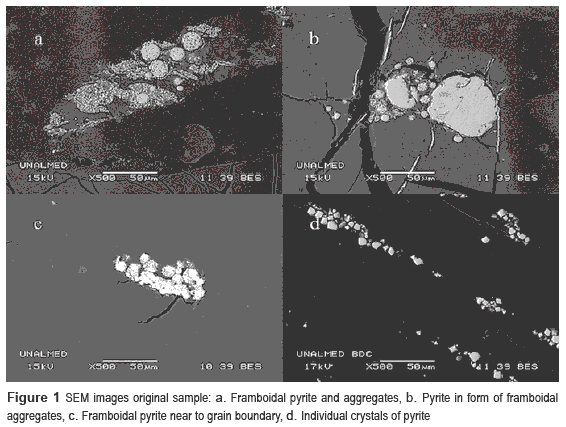
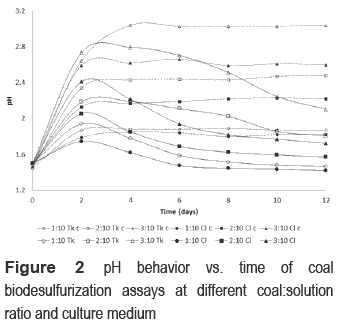
<body><![CDATA[<p>At the end of the experiments, sulfur forms in coal samples  were measured by the ASTM D 2492-02 method. The mineralogical composition of  the treated samples was established by SEM/ EDS.</p>      <p>&nbsp;</p>      <p><font size="3"><b>Results and discussion</b></font></p>      <p><b><i>Mineralogical characterization of coal</i></b></p>       <p>Observations done over pyrite crystals in the SEM/EDS  showed that pyrite is mainly present as framboidals surrounded by disseminate  crystals (<a href="#Figura1">figure 1.a</a>) and aggregates (<a href="#Figura1">figure 1.b</a>). Pyrite near to grains  boundary (<a href="#Figura1">figure 1.c</a>) and individual crystals (<a href="#Figura1">figure 1.d</a>) were also observed.</p>      <p align="center"><a name="Figura1"></a><img src="/img/revistas/rfiua/n68/n68a12i01.gif"></p>      <p><b><i>Biodesulfurization process</i></b></p>      <p>On the first days of the processes, pH values increased for  all the bioassays (<a href="#Figura2">figure 2</a>) and the abiotic controls. Between both culture  media, the assays with <i>Tk</i> medium had the highest pH. After the second day, pH  diminishes for all bioassays.</p>       <p>Abiotic  controls did not have changes after pH increasing. On day 12, only the  bioassays with pulp concentration of <i>1:10</i> obtained values below the  initial one (around 1.45). The bioassay <i>3:10</i> <i>Tk</i> had the highest pH value at  the end of process (2.11).</p>      <p align="center"><a name="Figura2"></a><img src="/img/revistas/rfiua/n68/n68a12i02.gif"></p>        ]]></body>
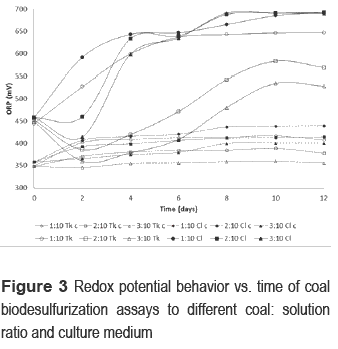
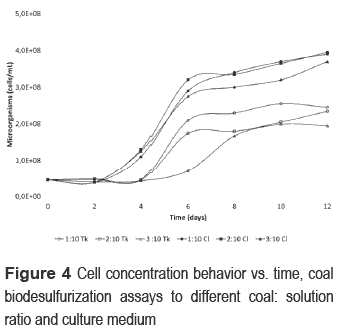
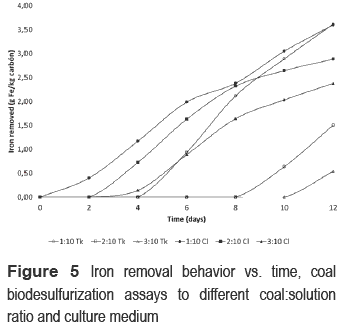
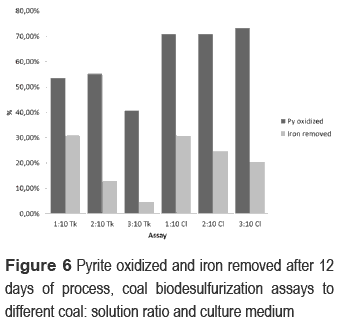
<body><![CDATA[<p>pH behavior during coal biodesulfurization was typical for  this kind of processes. Although consumption of protons in the lag phase by  bacteria, necessary for ferric ions generation, influence pH increasing &#91;17,  18&#93;, the abiotic controls show that coal is the main causative of this  phenomenon due to alkalinizing compounds, such as carbonates, which react with  the acid of the media, similar to found in other similar works &#91;6, 19-21&#93;. For  this reason, pH increasing is directly proportional to pulp concentration. The  subsequent decrease in pH is explained by acid generation in the biooxidation  of pyrite and elemental sulfur, showing that pH diminishing is only caused by  bacteria effect &#91;19, 22, 23&#93;. At the end of the processes, acid produced was  not sufficient to neutralize pH increasing on assays with high concentrations  of pulp  (<i>2:10</i>  and  <i>3:10</i>). However, <i>Cl</i> medium helps to maintain  better conditions for the process, regardless of pulp concentration, between  the evaluated parameters. Mildly acidic properties of chloride salts in <i>Cl</i> medium seem to help counter  coal effects on pH increasing, in comparison to their counterpart sulfates.</p>        <p>Redox potentials (<a href="#Figura3">figure 3</a>) of <i>1:10 Cl</i> and <i>1:10</i> <i>Tk</i> continuously increased until  day 12. In contrast, the values of other bioassays diminished in the two first  days of the process before a subsequent rising. <i>2:10 Cl</i> and <i>3:10 Cl</i> reached similar values that <i>1:10 Cl</i> on day 4 and day 6  respectively. At the end of the process, all <i>Cl</i> bioassays had a similar redox  potential (693 mV). The behavior of redox potential in <i>Tk</i> bioassays was different to  the three pulp concentrations. Although <i>1:10 Tk</i> reached a value of 647 mV, <i>2:10 Tk</i> and <i>3:10 Tk</i> had a slow increase until  values below 600 mV at the end of the process. Abiotic controls did not present  significant changes on redox potential in all cases.</p>      <p align="center"><a name="Figura3"></a><img src="/img/revistas/rfiua/n68/n68a12i03.gif"></p>            <p>Culture media had also influence on redox potential  behavior. Whereas assays with <i>Cl</i> medium reached similar values around 690 mV regardless of  pulp concentration, redox potential for assays with <i>Tk</i> medium was indirectly related  to pulp concentration, according to reported by other authors in the literature  &#91;20&#93;. Employing chloride salts, instead of sulfate salts, helps to mitigate  pulp concentration effects over cell concentration.</p>         <p>Cell concentration in leaching solution (<a href="#Figura4">figure 4</a>) was  different for the two media. While in the assays with <i>Tk</i> medium, it started growing in  the fourth day, in assays with <i>Cl</i> medium, it started in the second day. <i>Cl</i> assays had a higher cell  growth than  <i>Tk</i> assays  during the processes. The results obtained contrast with researches about pyrite biooxidation and cell growth  under chloride salts, where the bacterial activity has a higher inhibition than  using sulfate salts &#91;24, 25&#93;. However, in this research, <i>Cl</i> medium helped in the generation  of a favorable environment for pyrite oxidation carried out in a  biodesulfurization process. Although chloride anions may inhibit bacterial  activity, also seem to minimize the inhibitory effects of coal and pulp  concentration. Some authors have found that pulp concentrations above 20%w  inhibit the growth of microorganism &#91;20&#93;, similar to observed in <i>3:10 Tk</i>. Nevertheless, in <i>3:10 Cl</i>. cells were not affected.</p>      <p align="center"><a name="Figura4"></a><img src="/img/revistas/rfiua/n68/n68a12i04.gif"></p> 	     <p>The maximum iron that can be removed from coal in all  assays is 11.72 g Fe/kg coal. <i>1:10 Cl</i> showed removal from the beginning of the process (<a href="#Figura5">figure 5</a>), <i>2:10 Cl</i> and <i>3:10 Cl</i> from the second day, <i>1:10 Tk</i> from fourth day, <i>2:10 Tk</i> from eight day and <i>3:10 Tk</i> from tenth day. At the end of  the process, the better removal was reached in the bioassays with pulp  concentration of <i>1:10</i> (3.6 g Fe/kg coal). Abiotic controls did not show removal  of iron. After 12 days of process, bioassays with <i>Cl</i> medium oxidized 70% of pyrite  without significant differences in this value for the three pulp concentrations  (<a href="#Figura6">figure 6</a>). On the other hand, in the <i>Tk</i> medium bioassays, the maximum  reached of pyrite oxidation was around 55% except the assay <i>3:10 Tk</i> (40%). Differences in iron  removal were also found between the two culture media, except for pulp  concentration of <i>1:10</i>. Pyrite concentration did not have significant changes in  abiotic controls. In base to evaluated parameters, chloride medium enhanced  pyrite oxidation, which could not be affected by pulp concentration.  Nonetheless, remain of organic sulfur after the biodesulfurization processes  indicate the microorganism used for this work only can attack the inorganic  sulfur in coal &#91;19, 20&#93;.</p>      <p align="center"><a name="Figura5"></a><img src="/img/revistas/rfiua/n68/n68a12i05.gif"></p>      <p align="center"><a name="Figura6"></a><img src="/img/revistas/rfiua/n68/n68a12i06.gif"></p>      <p><b><i>SEM images after coal biodesulfurization</i></b></p>      ]]></body>
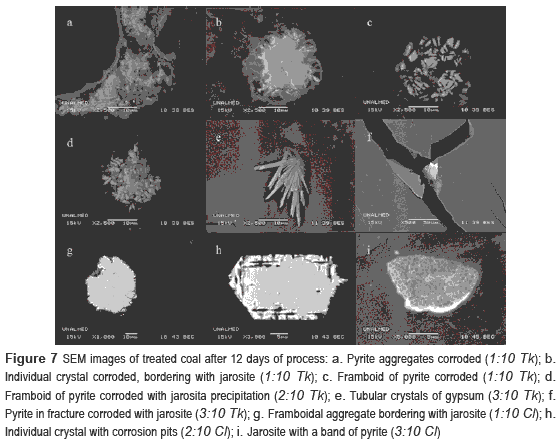
<body><![CDATA[<p>Scanning electron micrographs of biooxidated coal samples  (<a href="#Figura7">figure 7</a>) show typical corrosion features according to other reports on the  literature &#91;19&#93;. In comparison to raw coal, aggregates disappear; leaving only  groups of framboidals isolated which were not completely attacked. These  crystals are surrounded by precipitates of hydroxisulfates. On the other hand,  Individual crystals, bigger than framboidal crystals, suffered less oxidative  attack during the process, showing only pits and gulfs on the surface of pyrite  crystals (<a href="#Figura7">figure 7h</a>). In <i>2:10 Tk</i> and <i>3:10 Tk</i>, tubular crystals of gypsum (<a href="#Figura7">figure 7e</a>) were found.</p>      <p align="center"><a name="Figura7"></a><img src="/img/revistas/rfiua/n68/n68a12i07.gif"></p>      <p>Pyrite  morphology played an important role. Size and form of the grains have a direct  relation with rate of pyrite biooxidation. For this reason framboidal crystals  and aggregates, which have irregular form and their pyrite grains are small  (particle diameter around 0.25 &mu;m), tends to disappear totally in comparison to  individual crystals, which have well-defined-geometric form and a particle  diameter even 100 larger than framboidal crystals.</p>       <p>The increase in the pH values generated precipitates such  as gypsum and jarosites. These precipitates impede the complete oxidation  ofpyrite, constituting a physical barrier for the interaction of the mineral  with microorganisms and/or leaching medium &#91;15&#93;. Probably, the low  concentration of sulfates in bioassays with <i>Cl</i> medium and the better  conditions of pH behavior obtained may have avoided gypsum generation, helping  to mitigate precipitation of products of biooxidation, increasing iron removal.</p>        <p>&nbsp;</p>     <p><font size="3"><b>Conclusions</b> </font></p>      <p>The bioassays performed, helped in the evaluation of  factors which must be taken into account when a process of this type is carried  out. Using the conventional culture medium T&amp;K, pulp concentration  influences on the rate of pyrite biooxidation and in the generation of  precipitated salts (such as gypsum and jarosite). However, this factor can be  mitigated employing a culture medium where sulfate salts, using as sources of  nitrogen and magnesium, are replaced by their counterpart chloride salts. This  salts help to maintain appropriate conditions for the growing of microorganism  and action of biooxidation processes, regardless of pulp concentration.</p>       <p>The high content of organic sulfur in the coal sample does  not permit a complete elimination of sulfur using this kind of microorganisms,  because it is considered that they only can attack the inorganic sulfur in  coal. Even if the process can remove the 100% of the pyritic sulfur, the  organic phase would be important (0.9%). In spite of this, the fact that the  predominant habit of pyrite in coal is framboidal, it is considered favorable  for the biological process because the smaller size of the crystals increase  the superficial area exposed to the microorganisms attack.</p>       <p>This work will be the support for similar researches  developed in the Biomineralogy Laboratory of the National University of  Colombia that pretend proposing an applicable alternative for the treatment of  coals in the country.</p>      <p>&nbsp;</p>       ]]></body>
<body><![CDATA[<p><font size="3"><b>Acknowledgements</b> </font></p>        <p>To COLCIENCIAS and Cementos ARGOS S.A.S. who supports the  project. To the Biomineralogy Laboratory (National University of Colombia)  where the investigation was carried out.</p>      <p>&nbsp;</p>       <p><font size="3"><b>References</b> </font></p>      <!-- ref --><p>1. H. Calkins. ''The chemical forms of sulfur in coal:  a review''.<i> Fuel</i>. Vol. 73. 1994. pp. 475-484.    &nbsp;&nbsp;&nbsp;&nbsp;&nbsp;&nbsp;&nbsp;&nbsp;[&#160;<a href="javascript:void(0);" onclick="javascript: window.open('/scielo.php?script=sci_nlinks&ref=000077&pid=S0120-6230201300030001200001&lng=','','width=640,height=500,resizable=yes,scrollbars=1,menubar=yes,');">Links</a>&#160;]<!-- end-ref --></p>       <!-- ref --><p>2. A. Mor&aacute;n, A. &Aacute;ller, J. Cara, O. Martinez, E. Encinas,  E. G&oacute;mez. ''Microbiological  desulfurization of column- packed coal''. <i>Fuel Processing  Technology</i>.  Vol. 52. 1997. pp. 155-164.    &nbsp;&nbsp;&nbsp;&nbsp;&nbsp;&nbsp;&nbsp;&nbsp;[&#160;<a href="javascript:void(0);" onclick="javascript: window.open('/scielo.php?script=sci_nlinks&ref=000079&pid=S0120-6230201300030001200002&lng=','','width=640,height=500,resizable=yes,scrollbars=1,menubar=yes,');">Links</a>&#160;]<!-- end-ref --></p>       <!-- ref --><p>3. A. &Aacute;ller, O. Mart&iacute;nez, J. de Linaje, R. M&eacute;ndez, A.  Mor&aacute;n. ''Biodesulphurization  of coal by microorganisms isolated from the coal itself''. <i>Fuel Processing  Technology</i>.  Vol. 69. 2001. pp. 45-57.    &nbsp;&nbsp;&nbsp;&nbsp;&nbsp;&nbsp;&nbsp;&nbsp;[&#160;<a href="javascript:void(0);" onclick="javascript: window.open('/scielo.php?script=sci_nlinks&ref=000081&pid=S0120-6230201300030001200003&lng=','','width=640,height=500,resizable=yes,scrollbars=1,menubar=yes,');">Links</a>&#160;]<!-- end-ref --></p>       ]]></body>
<body><![CDATA[<!-- ref --><p>4. T. Bozdemir, T Durusoy, E. Erincin, Y. Y&uuml;r&uuml;m. ''Biodesulfurization of  Turkish lignites''. <i>Fuel</i>. Vol. 75. 1996. pp. 1596-1600.    &nbsp;&nbsp;&nbsp;&nbsp;&nbsp;&nbsp;&nbsp;&nbsp;[&#160;<a href="javascript:void(0);" onclick="javascript: window.open('/scielo.php?script=sci_nlinks&ref=000083&pid=S0120-6230201300030001200004&lng=','','width=640,height=500,resizable=yes,scrollbars=1,menubar=yes,');">Links</a>&#160;]<!-- end-ref --></p>       <!-- ref --><p>5. A. Juszczak, F. Domka, M. Kozlowsky, H. Wachowska.  ''Microbial desulfurization of coal with Thiobacillus  ferrooxidans  bacteria''. <i>Fuel</i>. Vol. 75. 1995. pp. 725-728.    &nbsp;&nbsp;&nbsp;&nbsp;&nbsp;&nbsp;&nbsp;&nbsp;[&#160;<a href="javascript:void(0);" onclick="javascript: window.open('/scielo.php?script=sci_nlinks&ref=000085&pid=S0120-6230201300030001200005&lng=','','width=640,height=500,resizable=yes,scrollbars=1,menubar=yes,');">Links</a>&#160;]<!-- end-ref --></p>       <!-- ref --><p>6. C. Eligwe. ''Microbial desulphurization of  coal''.  <i>Fuel</i>. Vol.  67. 1988. pp. 451-458.    &nbsp;&nbsp;&nbsp;&nbsp;&nbsp;&nbsp;&nbsp;&nbsp;[&#160;<a href="javascript:void(0);" onclick="javascript: window.open('/scielo.php?script=sci_nlinks&ref=000087&pid=S0120-6230201300030001200006&lng=','','width=640,height=500,resizable=yes,scrollbars=1,menubar=yes,');">Links</a>&#160;]<!-- end-ref --></p>       <!-- ref --><p>7. J. Klein. ''Technological and economic aspects of  coal biodesulfurization''. <i>Biodegradation</i>. Vol. 9. 1998. pp. 293-300.    &nbsp;&nbsp;&nbsp;&nbsp;&nbsp;&nbsp;&nbsp;&nbsp;[&#160;<a href="javascript:void(0);" onclick="javascript: window.open('/scielo.php?script=sci_nlinks&ref=000089&pid=S0120-6230201300030001200007&lng=','','width=640,height=500,resizable=yes,scrollbars=1,menubar=yes,');">Links</a>&#160;]<!-- end-ref --></p>       <!-- ref --><p>8. J. Cara, A. Mor&aacute;n, T. Carballo, F. Rozada, A.  &Aacute;ller. ''The  biodesulphurization of a semianthracite coal in a packed-bed system''. <i>Fuel</i>. Vol. 82. 2003. pp. 2065-2068.    &nbsp;&nbsp;&nbsp;&nbsp;&nbsp;&nbsp;&nbsp;&nbsp;[&#160;<a href="javascript:void(0);" onclick="javascript: window.open('/scielo.php?script=sci_nlinks&ref=000091&pid=S0120-6230201300030001200008&lng=','','width=640,height=500,resizable=yes,scrollbars=1,menubar=yes,');">Links</a>&#160;]<!-- end-ref --></p>       ]]></body>
<body><![CDATA[<!-- ref --><p>9. J. Cara, M. Carballo, A. Mor&aacute;n, D. Bonilla, O.  Escolano, F. Garc&iacute;a. ''Biodesulphurization of high sulphur coal by heap  leaching''. <i>Fuel</i>. Vol. 84. 2005. pp. 1905-1910.    &nbsp;&nbsp;&nbsp;&nbsp;&nbsp;&nbsp;&nbsp;&nbsp;[&#160;<a href="javascript:void(0);" onclick="javascript: window.open('/scielo.php?script=sci_nlinks&ref=000093&pid=S0120-6230201300030001200009&lng=','','width=640,height=500,resizable=yes,scrollbars=1,menubar=yes,');">Links</a>&#160;]<!-- end-ref --></p>       <!-- ref --><p>10. B. Kodali, B. Rao, L. Narasu, R. Pogakub. ''Effect of biochemical  reactions in enhancement of rate of leaching''. <i>Chemical  Engineering Science</i>. Vol. 59. 2004. pp. 5069-5073.    &nbsp;&nbsp;&nbsp;&nbsp;&nbsp;&nbsp;&nbsp;&nbsp;[&#160;<a href="javascript:void(0);" onclick="javascript: window.open('/scielo.php?script=sci_nlinks&ref=000095&pid=S0120-6230201300030001200010&lng=','','width=640,height=500,resizable=yes,scrollbars=1,menubar=yes,');">Links</a>&#160;]<!-- end-ref --></p>       <!-- ref --><p>11. J. Petersen, D. Dixon. ''Competitive bioleaching of  pyrite and chalcopyrite''. <i>Hydrometallurgy</i>. Vol. 83. 2006. pp. 40-49.    &nbsp;&nbsp;&nbsp;&nbsp;&nbsp;&nbsp;&nbsp;&nbsp;[&#160;<a href="javascript:void(0);" onclick="javascript: window.open('/scielo.php?script=sci_nlinks&ref=000097&pid=S0120-6230201300030001200011&lng=','','width=640,height=500,resizable=yes,scrollbars=1,menubar=yes,');">Links</a>&#160;]<!-- end-ref --></p>       <!-- ref --><p>12. G. Rossi. ''Biodepyritization of coal: achievements  and problems''. <i>Fuel</i>. Vol. 72. 1992. pp. 1581-1592.    &nbsp;&nbsp;&nbsp;&nbsp;&nbsp;&nbsp;&nbsp;&nbsp;[&#160;<a href="javascript:void(0);" onclick="javascript: window.open('/scielo.php?script=sci_nlinks&ref=000099&pid=S0120-6230201300030001200012&lng=','','width=640,height=500,resizable=yes,scrollbars=1,menubar=yes,');">Links</a>&#160;]<!-- end-ref --></p>       <!-- ref --><p>13. H. Ryu, Y. Chang, S. Kim. ''Microbial coal  desulfurization in an airlift bioreactor by sulfur- oxidizing bacterium Thiobacillus  ferrooxidans''. <i>Fuel Processing  Technology</i>.  Vol. 36. 1993. pp. 267-275.    &nbsp;&nbsp;&nbsp;&nbsp;&nbsp;&nbsp;&nbsp;&nbsp;[&#160;<a href="javascript:void(0);" onclick="javascript: window.open('/scielo.php?script=sci_nlinks&ref=000101&pid=S0120-6230201300030001200013&lng=','','width=640,height=500,resizable=yes,scrollbars=1,menubar=yes,');">Links</a>&#160;]<!-- end-ref --></p>       ]]></body>
<body><![CDATA[<!-- ref --><p>14. A. Malik, M. Dastidara, P. Roychoudhuryb. ''Biodesulphurization  of coal: effect of pulse feeding and leachate recycle''. <i>Enzyme and  Microbial Technology</i>. Vol. 28. 2001. pp. 49-56.    &nbsp;&nbsp;&nbsp;&nbsp;&nbsp;&nbsp;&nbsp;&nbsp;[&#160;<a href="javascript:void(0);" onclick="javascript: window.open('/scielo.php?script=sci_nlinks&ref=000103&pid=S0120-6230201300030001200014&lng=','','width=640,height=500,resizable=yes,scrollbars=1,menubar=yes,');">Links</a>&#160;]<!-- end-ref --></p>       <!-- ref --><p>15. J. Cara, M. Vargas, A. Mor&aacute;n, E. G&oacute;mez, O. Mart&iacute;nez,  F. Garc&iacute;a. ''Biodesulphurization  of a coal by packed- column leaching. Simultaneous thermogravimetric and mass  spectrometric analyses''. <i>Fuel</i>. Vol. 85. 2006. pp. 1756-1762.    &nbsp;&nbsp;&nbsp;&nbsp;&nbsp;&nbsp;&nbsp;&nbsp;[&#160;<a href="javascript:void(0);" onclick="javascript: window.open('/scielo.php?script=sci_nlinks&ref=000105&pid=S0120-6230201300030001200015&lng=','','width=640,height=500,resizable=yes,scrollbars=1,menubar=yes,');">Links</a>&#160;]<!-- end-ref --> </p>       <!-- ref --><p>16. G. Caicedo, M. M&aacute;rquez.  ''Mecanismo de selecci&oacute;n de consorcios bacterianos compatibles con A. ferrooxidans y A. thiooxidans en  procesos de biodesulfurizaci&oacute;n de carb&oacute;n''. <i>Revista Facultad  de Ingenier&iacute;a Universidad de Antioquia</i>. N&deg; 52.  2010. pp. 88-94.    &nbsp;&nbsp;&nbsp;&nbsp;&nbsp;&nbsp;&nbsp;&nbsp;[&#160;<a href="javascript:void(0);" onclick="javascript: window.open('/scielo.php?script=sci_nlinks&ref=000107&pid=S0120-6230201300030001200016&lng=','','width=640,height=500,resizable=yes,scrollbars=1,menubar=yes,');">Links</a>&#160;]<!-- end-ref --> </p>       <!-- ref --><p>17. W. Sand, T. Gehrke. ''Extracellular polymeric  substances mediate bioleaching/biocorrosion via interfacial processes involving  iron(III) ions and acidophilic bacteria''. <i>Research in  Microbiology</i>.  Vol. 157. 2006. pp. 49-56.    &nbsp;&nbsp;&nbsp;&nbsp;&nbsp;&nbsp;&nbsp;&nbsp;[&#160;<a href="javascript:void(0);" onclick="javascript: window.open('/scielo.php?script=sci_nlinks&ref=000109&pid=S0120-6230201300030001200017&lng=','','width=640,height=500,resizable=yes,scrollbars=1,menubar=yes,');">Links</a>&#160;]<!-- end-ref --></p>       <!-- ref --><p>18. M. Nemat&iacute;, S. Harrison, G. Handsford, C. Webb.  ''Biological oxidation of ferrous sulphate by Thiobacillus  ferrooxidans:  a review on the kinetic aspects''.<i> Biochemical  Engineering Journal</i>. Vol. I. 1998. pp. 171-190.    &nbsp;&nbsp;&nbsp;&nbsp;&nbsp;&nbsp;&nbsp;&nbsp;[&#160;<a href="javascript:void(0);" onclick="javascript: window.open('/scielo.php?script=sci_nlinks&ref=000111&pid=S0120-6230201300030001200018&lng=','','width=640,height=500,resizable=yes,scrollbars=1,menubar=yes,');">Links</a>&#160;]<!-- end-ref --></p>       ]]></body>
<body><![CDATA[<!-- ref --><p>19. I. Cardona, M. M&aacute;rquez. ''Biodesulfurization of two  Colombian coals with native microorganisms''. <i>Fuel Processing  Technology</i>.  Vol. 90. 2009. pp. 1099-1106.    &nbsp;&nbsp;&nbsp;&nbsp;&nbsp;&nbsp;&nbsp;&nbsp;[&#160;<a href="javascript:void(0);" onclick="javascript: window.open('/scielo.php?script=sci_nlinks&ref=000113&pid=S0120-6230201300030001200019&lng=','','width=640,height=500,resizable=yes,scrollbars=1,menubar=yes,');">Links</a>&#160;]<!-- end-ref --></p>       <!-- ref --><p>20. C. Acharya, R. Kar, L. Sukla. ''Bacterial removal  of sulphur from three diferent coals''. <i>Fuel</i>. Vol. 80.  2001. pp. 2207-2216.    &nbsp;&nbsp;&nbsp;&nbsp;&nbsp;&nbsp;&nbsp;&nbsp;[&#160;<a href="javascript:void(0);" onclick="javascript: window.open('/scielo.php?script=sci_nlinks&ref=000115&pid=S0120-6230201300030001200020&lng=','','width=640,height=500,resizable=yes,scrollbars=1,menubar=yes,');">Links</a>&#160;]<!-- end-ref --> </p>       <!-- ref --><p>21. G. Caicedo, M. M&aacute;rquez, C. Moreno. ''Influencia  de la concentraci&oacute;n de hierro y pH iniciales en un proceso de  biodesulfurizaci&oacute;n de carb&oacute;n - ensayos a nivel de laboratorio''. <i>Revista  Colombiana de Biotecnolog&iacute;a</i>. Vol. 13. 2011. pp.199-209.    &nbsp;&nbsp;&nbsp;&nbsp;&nbsp;&nbsp;&nbsp;&nbsp;[&#160;<a href="javascript:void(0);" onclick="javascript: window.open('/scielo.php?script=sci_nlinks&ref=000117&pid=S0120-6230201300030001200021&lng=','','width=640,height=500,resizable=yes,scrollbars=1,menubar=yes,');">Links</a>&#160;]<!-- end-ref --> </p>       <!-- ref --><p>22. M. Ossa, M. M&aacute;rquez. ''Biooxidaci&oacute;n de  sulfuros mediante cepas nativas de acid&oacute;filos compatibles con Acidithiobacillus  ferrooxidans y thiooxidans, mina de oro el Zancudo, (Titirib&iacute;, Colombia)''. <i>Revista Colombiana  de Biotecnolog&iacute;a</i>.  Vol. 7. 2005. pp. 55-66.    &nbsp;&nbsp;&nbsp;&nbsp;&nbsp;&nbsp;&nbsp;&nbsp;[&#160;<a href="javascript:void(0);" onclick="javascript: window.open('/scielo.php?script=sci_nlinks&ref=000119&pid=S0120-6230201300030001200022&lng=','','width=640,height=500,resizable=yes,scrollbars=1,menubar=yes,');">Links</a>&#160;]<!-- end-ref --></p>       <!-- ref --><p>23. O. Garc&iacute;a, J. Bigham, O. Tuovinen. ''Oxidation of  isochemical FeS2 (marcasite-pyrite) by Acidithiobacillus  thiooxidans  and  Acidithiobacillus ferrooxidans''. <i>Minerals Engineering</i>. Vol 20. 2007. pp. 98-101.    &nbsp;&nbsp;&nbsp;&nbsp;&nbsp;&nbsp;&nbsp;&nbsp;[&#160;<a href="javascript:void(0);" onclick="javascript: window.open('/scielo.php?script=sci_nlinks&ref=000121&pid=S0120-6230201300030001200023&lng=','','width=640,height=500,resizable=yes,scrollbars=1,menubar=yes,');">Links</a>&#160;]<!-- end-ref --></p>       ]]></body>
<body><![CDATA[<!-- ref --><p>24. I. Suzuki, D. Lee, B. Mackay, L. Harahuc, J.K. Oh.  ''Effect of various ions, pH, and osmotic pressure on oxidation of  elemental sulfur by Thiobacillus thiooxidans''. <i>Applied and Environmental  Microbiology</i>.  Vol. 65. 1999. pp. 5163-5168.    &nbsp;&nbsp;&nbsp;&nbsp;&nbsp;&nbsp;&nbsp;&nbsp;[&#160;<a href="javascript:void(0);" onclick="javascript: window.open('/scielo.php?script=sci_nlinks&ref=000123&pid=S0120-6230201300030001200024&lng=','','width=640,height=500,resizable=yes,scrollbars=1,menubar=yes,');">Links</a>&#160;]<!-- end-ref --></p>       <!-- ref --><p>25. C. Gahan, J. Sundkvist, A. Sandstrom. ''A study on  the toxic effects of chloride on the biooxidation efficiency of pyrite''. <i>Journal of  Hazardous Materials</i>. Vol. 172. 2009. pp. 1273-1281.    &nbsp;&nbsp;&nbsp;&nbsp;&nbsp;&nbsp;&nbsp;&nbsp;[&#160;<a href="javascript:void(0);" onclick="javascript: window.open('/scielo.php?script=sci_nlinks&ref=000125&pid=S0120-6230201300030001200025&lng=','','width=640,height=500,resizable=yes,scrollbars=1,menubar=yes,');">Links</a>&#160;]<!-- end-ref --></p>        <p>&nbsp;</p>     <p>&nbsp;</p>     <p>&nbsp;</p>     <p>&nbsp;</p>    </font>     ]]></body><back>
<ref-list>
<ref id="B1">
<label>1</label><nlm-citation citation-type="journal">
<person-group person-group-type="author">
<name>
<surname><![CDATA[Calkins]]></surname>
<given-names><![CDATA[H]]></given-names>
</name>
</person-group>
<article-title xml:lang="en"><![CDATA[The chemical forms of sulfur in coal: a review]]></article-title>
<source><![CDATA[Fuel]]></source>
<year>1994</year>
<volume>73</volume>
<page-range>475-484</page-range></nlm-citation>
</ref>
<ref id="B2">
<label>2</label><nlm-citation citation-type="journal">
<person-group person-group-type="author">
<name>
<surname><![CDATA[Morán]]></surname>
<given-names><![CDATA[A]]></given-names>
</name>
<name>
<surname><![CDATA[Áller]]></surname>
<given-names><![CDATA[A]]></given-names>
</name>
<name>
<surname><![CDATA[Cara]]></surname>
<given-names><![CDATA[J]]></given-names>
</name>
<name>
<surname><![CDATA[Martinez]]></surname>
<given-names><![CDATA[O]]></given-names>
</name>
<name>
<surname><![CDATA[Encinas]]></surname>
<given-names><![CDATA[E]]></given-names>
</name>
<name>
<surname><![CDATA[Gómez]]></surname>
<given-names><![CDATA[E]]></given-names>
</name>
</person-group>
<article-title xml:lang="en"><![CDATA[Microbiological desulfurization of column- packed coal]]></article-title>
<source><![CDATA[Fuel Processing Technology]]></source>
<year>1997</year>
<volume>52</volume>
<page-range>155-164</page-range></nlm-citation>
</ref>
<ref id="B3">
<label>3</label><nlm-citation citation-type="journal">
<person-group person-group-type="author">
<name>
<surname><![CDATA[Áller]]></surname>
<given-names><![CDATA[A]]></given-names>
</name>
<name>
<surname><![CDATA[Martínez]]></surname>
<given-names><![CDATA[O]]></given-names>
</name>
<name>
<surname><![CDATA[de Linaje]]></surname>
<given-names><![CDATA[J]]></given-names>
</name>
<name>
<surname><![CDATA[Méndez]]></surname>
<given-names><![CDATA[R]]></given-names>
</name>
<name>
<surname><![CDATA[Morán]]></surname>
<given-names><![CDATA[A]]></given-names>
</name>
</person-group>
<article-title xml:lang="en"><![CDATA[Biodesulphurization of coal by microorganisms isolated from the coal itself]]></article-title>
<source><![CDATA[Fuel Processing Technology]]></source>
<year>2001</year>
<volume>69</volume>
<page-range>45-57</page-range></nlm-citation>
</ref>
<ref id="B4">
<label>4</label><nlm-citation citation-type="journal">
<person-group person-group-type="author">
<name>
<surname><![CDATA[Bozdemir]]></surname>
<given-names><![CDATA[T]]></given-names>
</name>
<name>
<surname><![CDATA[Durusoy]]></surname>
<given-names><![CDATA[T]]></given-names>
</name>
<name>
<surname><![CDATA[Erincin]]></surname>
<given-names><![CDATA[E]]></given-names>
</name>
<name>
<surname><![CDATA[Yürüm]]></surname>
<given-names><![CDATA[Y]]></given-names>
</name>
</person-group>
<article-title xml:lang="en"><![CDATA[Biodesulfurization of Turkish lignites]]></article-title>
<source><![CDATA[Fuel]]></source>
<year>1996</year>
<volume>75</volume>
<page-range>1596-1600</page-range></nlm-citation>
</ref>
<ref id="B5">
<label>5</label><nlm-citation citation-type="journal">
<person-group person-group-type="author">
<name>
<surname><![CDATA[Juszczak]]></surname>
<given-names><![CDATA[A]]></given-names>
</name>
<name>
<surname><![CDATA[Domka]]></surname>
<given-names><![CDATA[F]]></given-names>
</name>
<name>
<surname><![CDATA[Kozlowsky]]></surname>
<given-names><![CDATA[M]]></given-names>
</name>
<name>
<surname><![CDATA[Wachowska]]></surname>
<given-names><![CDATA[H]]></given-names>
</name>
</person-group>
<article-title xml:lang="en"><![CDATA[Microbial desulfurization of coal with Thiobacillus ferrooxidans bacteria]]></article-title>
<source><![CDATA[Fuel]]></source>
<year>1995</year>
<volume>75</volume>
<page-range>725-728</page-range></nlm-citation>
</ref>
<ref id="B6">
<label>6</label><nlm-citation citation-type="journal">
<person-group person-group-type="author">
<name>
<surname><![CDATA[Eligwe]]></surname>
<given-names><![CDATA[C]]></given-names>
</name>
</person-group>
<article-title xml:lang="en"><![CDATA[Microbial desulphurization of coal]]></article-title>
<source><![CDATA[Fuel]]></source>
<year>1988</year>
<volume>67</volume>
<page-range>451-458</page-range></nlm-citation>
</ref>
<ref id="B7">
<label>7</label><nlm-citation citation-type="journal">
<person-group person-group-type="author">
<name>
<surname><![CDATA[Klein]]></surname>
<given-names><![CDATA[J]]></given-names>
</name>
</person-group>
<article-title xml:lang="en"><![CDATA[Technological and economic aspects of coal biodesulfurization]]></article-title>
<source><![CDATA[Biodegradation]]></source>
<year>1998</year>
<volume>9</volume>
<page-range>293-300</page-range></nlm-citation>
</ref>
<ref id="B8">
<label>8</label><nlm-citation citation-type="journal">
<person-group person-group-type="author">
<name>
<surname><![CDATA[Cara]]></surname>
<given-names><![CDATA[J]]></given-names>
</name>
<name>
<surname><![CDATA[Morán]]></surname>
<given-names><![CDATA[A]]></given-names>
</name>
<name>
<surname><![CDATA[Carballo]]></surname>
<given-names><![CDATA[T]]></given-names>
</name>
<name>
<surname><![CDATA[Rozada]]></surname>
<given-names><![CDATA[F]]></given-names>
</name>
<name>
<surname><![CDATA[Áller]]></surname>
<given-names><![CDATA[A]]></given-names>
</name>
</person-group>
<article-title xml:lang="en"><![CDATA[The biodesulphurization of a semianthracite coal in a packed-bed system]]></article-title>
<source><![CDATA[Fuel]]></source>
<year>2003</year>
<volume>82</volume>
<page-range>2065-2068</page-range></nlm-citation>
</ref>
<ref id="B9">
<label>9</label><nlm-citation citation-type="journal">
<person-group person-group-type="author">
<name>
<surname><![CDATA[Cara]]></surname>
<given-names><![CDATA[J]]></given-names>
</name>
<name>
<surname><![CDATA[Carballo]]></surname>
<given-names><![CDATA[M]]></given-names>
</name>
<name>
<surname><![CDATA[Morán]]></surname>
<given-names><![CDATA[A]]></given-names>
</name>
<name>
<surname><![CDATA[Bonilla]]></surname>
<given-names><![CDATA[D]]></given-names>
</name>
<name>
<surname><![CDATA[Escolano]]></surname>
<given-names><![CDATA[O]]></given-names>
</name>
<name>
<surname><![CDATA[García]]></surname>
<given-names><![CDATA[F]]></given-names>
</name>
</person-group>
<article-title xml:lang="en"><![CDATA[Biodesulphurization of high sulphur coal by heap leaching]]></article-title>
<source><![CDATA[Fuel]]></source>
<year>2005</year>
<volume>84</volume>
<page-range>1905-1910</page-range></nlm-citation>
</ref>
<ref id="B10">
<label>10</label><nlm-citation citation-type="journal">
<person-group person-group-type="author">
<name>
<surname><![CDATA[Kodali]]></surname>
<given-names><![CDATA[B]]></given-names>
</name>
<name>
<surname><![CDATA[Rao]]></surname>
<given-names><![CDATA[B]]></given-names>
</name>
<name>
<surname><![CDATA[Narasu]]></surname>
<given-names><![CDATA[L]]></given-names>
</name>
<name>
<surname><![CDATA[Pogakub]]></surname>
<given-names><![CDATA[R]]></given-names>
</name>
</person-group>
<article-title xml:lang="en"><![CDATA[Effect of biochemical reactions in enhancement of rate of leaching]]></article-title>
<source><![CDATA[Chemical Engineering Science]]></source>
<year>2004</year>
<volume>59</volume>
<page-range>5069-5073</page-range></nlm-citation>
</ref>
<ref id="B11">
<label>11</label><nlm-citation citation-type="journal">
<person-group person-group-type="author">
<name>
<surname><![CDATA[Petersen]]></surname>
<given-names><![CDATA[J]]></given-names>
</name>
<name>
<surname><![CDATA[Dixon]]></surname>
<given-names><![CDATA[D]]></given-names>
</name>
</person-group>
<article-title xml:lang="en"><![CDATA[Competitive bioleaching of pyrite and chalcopyrite]]></article-title>
<source><![CDATA[Hydrometallurgy]]></source>
<year>2006</year>
<volume>83</volume>
<page-range>40-49</page-range></nlm-citation>
</ref>
<ref id="B12">
<label>12</label><nlm-citation citation-type="journal">
<person-group person-group-type="author">
<name>
<surname><![CDATA[Rossi]]></surname>
<given-names><![CDATA[G]]></given-names>
</name>
</person-group>
<article-title xml:lang="en"><![CDATA[Biodepyritization of coal: achievements and problems]]></article-title>
<source><![CDATA[Fuel]]></source>
<year>1992</year>
<volume>72</volume>
<page-range>1581-1592</page-range></nlm-citation>
</ref>
<ref id="B13">
<label>13</label><nlm-citation citation-type="journal">
<person-group person-group-type="author">
<name>
<surname><![CDATA[Ryu]]></surname>
<given-names><![CDATA[H]]></given-names>
</name>
<name>
<surname><![CDATA[Chang]]></surname>
<given-names><![CDATA[Y]]></given-names>
</name>
<name>
<surname><![CDATA[Kim]]></surname>
<given-names><![CDATA[S]]></given-names>
</name>
</person-group>
<article-title xml:lang="en"><![CDATA[Microbial coal desulfurization in an airlift bioreactor by sulfur- oxidizing bacterium Thiobacillus ferrooxidans]]></article-title>
<source><![CDATA[Fuel Processing Technology]]></source>
<year>1993</year>
<volume>36</volume>
<page-range>267-275</page-range></nlm-citation>
</ref>
<ref id="B14">
<label>14</label><nlm-citation citation-type="journal">
<person-group person-group-type="author">
<name>
<surname><![CDATA[Malik]]></surname>
<given-names><![CDATA[A]]></given-names>
</name>
<name>
<surname><![CDATA[Dastidara]]></surname>
<given-names><![CDATA[M]]></given-names>
</name>
<name>
<surname><![CDATA[Roychoudhuryb]]></surname>
<given-names><![CDATA[P]]></given-names>
</name>
</person-group>
<article-title xml:lang="en"><![CDATA[Biodesulphurization of coal: effect of pulse feeding and leachate recycle]]></article-title>
<source><![CDATA[Enzyme and Microbial Technology]]></source>
<year>2001</year>
<volume>28</volume>
<page-range>49-56</page-range></nlm-citation>
</ref>
<ref id="B15">
<label>15</label><nlm-citation citation-type="journal">
<person-group person-group-type="author">
<name>
<surname><![CDATA[Cara]]></surname>
<given-names><![CDATA[J]]></given-names>
</name>
<name>
<surname><![CDATA[Vargas]]></surname>
<given-names><![CDATA[M]]></given-names>
</name>
<name>
<surname><![CDATA[Morán]]></surname>
<given-names><![CDATA[A]]></given-names>
</name>
<name>
<surname><![CDATA[Gómez]]></surname>
<given-names><![CDATA[E]]></given-names>
</name>
<name>
<surname><![CDATA[Martínez]]></surname>
<given-names><![CDATA[O]]></given-names>
</name>
<name>
<surname><![CDATA[García]]></surname>
<given-names><![CDATA[F]]></given-names>
</name>
</person-group>
<article-title xml:lang="en"><![CDATA[Biodesulphurization of a coal by packed- column leaching. Simultaneous thermogravimetric and mass spectrometric analyses]]></article-title>
<source><![CDATA[Fuel]]></source>
<year>2006</year>
<volume>85</volume>
<page-range>1756-1762</page-range></nlm-citation>
</ref>
<ref id="B16">
<label>16</label><nlm-citation citation-type="journal">
<person-group person-group-type="author">
<name>
<surname><![CDATA[Caicedo]]></surname>
<given-names><![CDATA[G]]></given-names>
</name>
<name>
<surname><![CDATA[Márquez]]></surname>
<given-names><![CDATA[M]]></given-names>
</name>
</person-group>
<article-title xml:lang="en"><![CDATA[Mecanismo de selección de consorcios bacterianos compatibles con A. ferrooxidans y A. thiooxidans en procesos de biodesulfurización de carbón]]></article-title>
<source><![CDATA[Revista Facultad de Ingeniería Universidad de Antioquia]]></source>
<year>2010</year>
<volume>52</volume>
<page-range>88-94</page-range></nlm-citation>
</ref>
<ref id="B17">
<label>17</label><nlm-citation citation-type="journal">
<person-group person-group-type="author">
<name>
<surname><![CDATA[Sand]]></surname>
<given-names><![CDATA[W]]></given-names>
</name>
<name>
<surname><![CDATA[Gehrke]]></surname>
<given-names><![CDATA[T]]></given-names>
</name>
</person-group>
<article-title xml:lang="en"><![CDATA[Extracellular polymeric substances mediate bioleaching/biocorrosion via interfacial processes involving iron(III) ions and acidophilic bacteria]]></article-title>
<source><![CDATA[Research in Microbiology]]></source>
<year>2006</year>
<volume>157</volume>
<page-range>49-56</page-range></nlm-citation>
</ref>
<ref id="B18">
<label>18</label><nlm-citation citation-type="journal">
<person-group person-group-type="author">
<name>
<surname><![CDATA[Nematí]]></surname>
<given-names><![CDATA[M]]></given-names>
</name>
<name>
<surname><![CDATA[Harrison]]></surname>
<given-names><![CDATA[S]]></given-names>
</name>
<name>
<surname><![CDATA[Handsford]]></surname>
<given-names><![CDATA[G]]></given-names>
</name>
<name>
<surname><![CDATA[Webb]]></surname>
<given-names><![CDATA[C]]></given-names>
</name>
</person-group>
<article-title xml:lang="en"><![CDATA[Biological oxidation of ferrous sulphate by Thiobacillus ferrooxidans: a review on the kinetic aspects]]></article-title>
<source><![CDATA[Biochemical Engineering Journal]]></source>
<year>1998</year>
<volume>I</volume>
<page-range>171-190</page-range></nlm-citation>
</ref>
<ref id="B19">
<label>19</label><nlm-citation citation-type="journal">
<person-group person-group-type="author">
<name>
<surname><![CDATA[Cardona]]></surname>
<given-names><![CDATA[I]]></given-names>
</name>
<name>
<surname><![CDATA[Márquez]]></surname>
<given-names><![CDATA[M]]></given-names>
</name>
</person-group>
<article-title xml:lang="en"><![CDATA[Biodesulfurization of two Colombian coals with native microorganisms]]></article-title>
<source><![CDATA[Fuel Processing Technology]]></source>
<year>2009</year>
<volume>90</volume>
<page-range>1099-1106</page-range></nlm-citation>
</ref>
<ref id="B20">
<label>20</label><nlm-citation citation-type="journal">
<person-group person-group-type="author">
<name>
<surname><![CDATA[Acharya]]></surname>
<given-names><![CDATA[C]]></given-names>
</name>
<name>
<surname><![CDATA[Kar]]></surname>
<given-names><![CDATA[R]]></given-names>
</name>
<name>
<surname><![CDATA[Sukla]]></surname>
<given-names><![CDATA[L]]></given-names>
</name>
</person-group>
<article-title xml:lang="en"><![CDATA[Bacterial removal of sulphur from three diferent coals]]></article-title>
<source><![CDATA[Fuel]]></source>
<year>2001</year>
<volume>80</volume>
<page-range>2207-2216</page-range></nlm-citation>
</ref>
<ref id="B21">
<label>21</label><nlm-citation citation-type="journal">
<person-group person-group-type="author">
<name>
<surname><![CDATA[Caicedo]]></surname>
<given-names><![CDATA[G]]></given-names>
</name>
<name>
<surname><![CDATA[Márquez]]></surname>
<given-names><![CDATA[M]]></given-names>
</name>
<name>
<surname><![CDATA[Moreno]]></surname>
<given-names><![CDATA[C]]></given-names>
</name>
</person-group>
<article-title xml:lang="es"><![CDATA[Influencia de la concentración de hierro y pH iniciales en un proceso de biodesulfurización de carbón - ensayos a nivel de laboratorio]]></article-title>
<source><![CDATA[Revista Colombiana de Biotecnología]]></source>
<year>2011</year>
<volume>13</volume>
<page-range>199-209</page-range></nlm-citation>
</ref>
<ref id="B22">
<label>22</label><nlm-citation citation-type="journal">
<person-group person-group-type="author">
<name>
<surname><![CDATA[Ossa]]></surname>
<given-names><![CDATA[M.]]></given-names>
</name>
<name>
<surname><![CDATA[Márquez]]></surname>
<given-names><![CDATA[M]]></given-names>
</name>
</person-group>
<article-title xml:lang="es"><![CDATA[Biooxidación de sulfuros mediante cepas nativas de acidófilos compatibles con Acidithiobacillus ferrooxidans y thiooxidans, mina de oro el Zancudo, (Titiribí, Colombia)]]></article-title>
<source><![CDATA[Revista Colombiana de Biotecnología]]></source>
<year>2005</year>
<volume>7</volume>
<page-range>55-66</page-range></nlm-citation>
</ref>
<ref id="B23">
<label>23</label><nlm-citation citation-type="journal">
<person-group person-group-type="author">
<name>
<surname><![CDATA[García]]></surname>
<given-names><![CDATA[O]]></given-names>
</name>
<name>
<surname><![CDATA[Bigham]]></surname>
<given-names><![CDATA[J]]></given-names>
</name>
<name>
<surname><![CDATA[Tuovinen]]></surname>
<given-names><![CDATA[O]]></given-names>
</name>
</person-group>
<article-title xml:lang="en"><![CDATA[Oxidation of isochemical FeS2 (marcasite-pyrite) by Acidithiobacillus thiooxidans and Acidithiobacillus ferrooxidans]]></article-title>
<source><![CDATA[Minerals Engineering]]></source>
<year>2007</year>
<volume>20</volume>
<page-range>98-101</page-range></nlm-citation>
</ref>
<ref id="B24">
<label>24</label><nlm-citation citation-type="journal">
<person-group person-group-type="author">
<name>
<surname><![CDATA[Suzuki]]></surname>
<given-names><![CDATA[I]]></given-names>
</name>
<name>
<surname><![CDATA[Lee]]></surname>
<given-names><![CDATA[D]]></given-names>
</name>
<name>
<surname><![CDATA[Mackay]]></surname>
<given-names><![CDATA[B]]></given-names>
</name>
<name>
<surname><![CDATA[Harahuc]]></surname>
<given-names><![CDATA[L]]></given-names>
</name>
<name>
<surname><![CDATA[Oh]]></surname>
<given-names><![CDATA[J.K]]></given-names>
</name>
</person-group>
<article-title xml:lang="en"><![CDATA[Effect of various ions, pH, and osmotic pressure on oxidation of elemental sulfur by Thiobacillus thiooxidans]]></article-title>
<source><![CDATA[Applied and Environmental Microbiology]]></source>
<year>1999</year>
<volume>65</volume>
<page-range>5163-5168</page-range></nlm-citation>
</ref>
<ref id="B25">
<label>25</label><nlm-citation citation-type="journal">
<person-group person-group-type="author">
<name>
<surname><![CDATA[Gahan]]></surname>
<given-names><![CDATA[C]]></given-names>
</name>
<name>
<surname><![CDATA[Sundkvist]]></surname>
<given-names><![CDATA[J]]></given-names>
</name>
<name>
<surname><![CDATA[Sandstrom]]></surname>
<given-names><![CDATA[A]]></given-names>
</name>
</person-group>
<article-title xml:lang="en"><![CDATA[A study on the toxic effects of chloride on the biooxidation efficiency of pyrite]]></article-title>
<source><![CDATA[Journal of Hazardous Materials]]></source>
<year>2009</year>
<volume>172</volume>
<page-range>1273-1281</page-range></nlm-citation>
</ref>
</ref-list>
</back>
</article>