<?xml version="1.0" encoding="ISO-8859-1"?><article xmlns:mml="http://www.w3.org/1998/Math/MathML" xmlns:xlink="http://www.w3.org/1999/xlink" xmlns:xsi="http://www.w3.org/2001/XMLSchema-instance">
<front>
<journal-meta>
<journal-id>0120-6230</journal-id>
<journal-title><![CDATA[Revista Facultad de Ingeniería Universidad de Antioquia]]></journal-title>
<abbrev-journal-title><![CDATA[Rev.fac.ing.univ. Antioquia]]></abbrev-journal-title>
<issn>0120-6230</issn>
<publisher>
<publisher-name><![CDATA[Facultad de Ingeniería, Universidad de Antioquia]]></publisher-name>
</publisher>
</journal-meta>
<article-meta>
<article-id>S0120-62302013000300015</article-id>
<title-group>
<article-title xml:lang="en"><![CDATA[Passive sampling in the study of dynamic and environmental impact of pesticides in water]]></article-title>
<article-title xml:lang="es"><![CDATA[Muestreadores pasivos en el estudio de la dinámica de plaguicidas y el impacto ambiental en el agua]]></article-title>
</title-group>
<contrib-group>
<contrib contrib-type="author">
<name>
<surname><![CDATA[Narváez V.]]></surname>
<given-names><![CDATA[Jhon F.]]></given-names>
</name>
<xref ref-type="aff" rid="A01"/>
<xref ref-type="aff" rid="A03"/>
</contrib>
<contrib contrib-type="author">
<name>
<surname><![CDATA[López]]></surname>
<given-names><![CDATA[Carlos A.]]></given-names>
</name>
<xref ref-type="aff" rid="A02"/>
</contrib>
<contrib contrib-type="author">
<name>
<surname><![CDATA[Molina P.]]></surname>
<given-names><![CDATA[Francisco J.]]></given-names>
</name>
<xref ref-type="aff" rid="A02"/>
</contrib>
</contrib-group>
<aff id="A01">
<institution><![CDATA[,Universidad de Antioquia Facultad de Ingeniería ]]></institution>
<addr-line><![CDATA[Medellín ]]></addr-line>
<country>Colombia</country>
</aff>
<aff id="A02">
<institution><![CDATA[,Universidad de Antioquia Instituto de Química ]]></institution>
<addr-line><![CDATA[Medellín ]]></addr-line>
<country>Colombia</country>
</aff>
<aff id="A03">
<institution><![CDATA[,Universidad de Antioquia  ]]></institution>
<addr-line><![CDATA[ ]]></addr-line>
</aff>
<pub-date pub-type="pub">
<day>00</day>
<month>09</month>
<year>2013</year>
</pub-date>
<pub-date pub-type="epub">
<day>00</day>
<month>09</month>
<year>2013</year>
</pub-date>
<numero>68</numero>
<fpage>147</fpage>
<lpage>159</lpage>
<copyright-statement/>
<copyright-year/>
<self-uri xlink:href="http://www.scielo.org.co/scielo.php?script=sci_arttext&amp;pid=S0120-62302013000300015&amp;lng=en&amp;nrm=iso"></self-uri><self-uri xlink:href="http://www.scielo.org.co/scielo.php?script=sci_abstract&amp;pid=S0120-62302013000300015&amp;lng=en&amp;nrm=iso"></self-uri><self-uri xlink:href="http://www.scielo.org.co/scielo.php?script=sci_pdf&amp;pid=S0120-62302013000300015&amp;lng=en&amp;nrm=iso"></self-uri><abstract abstract-type="short" xml:lang="en"><p><![CDATA[Pesticides are the most applied substances in agricultural activities which can contaminate water bodies by direct or indirect discharge, but large volumes and natural transformation processes can decrease the concentration of these substances and their degradates in watershed. Currently, conventional extraction methods such as: solid phase extraction (SPE) and solid phase micro extraction (SPME) among others do not permit low detection limits. However low levels of pesticides and degradates could produce chronic toxicity in different species. Nowadays, passive sampling is widespread used for monitoring pesticides and for ensuring the water quality and bioaccumulation studies due to this methodology allows the detection of pollutant from parts per quadrillion (ppq). The most popular membranes used in passive sampling are the semipermeable membrane devices (SPMD), which permit the concentration of lipophilic substances and the polar organic chemical integrative sampler (POCIS), which permits concentration of the hydrophilic ones. This review is about the application of passive samplers in pesticides analysis, the importance of these devices in the bioaccumulation studies and the evaluation of the ecotoxicological risks. Finally, passive sampling allows reducing costs, time and the amount of organic solvent used which classifies it within the environmental trends of ''green analytical chemistry''.]]></p></abstract>
<abstract abstract-type="short" xml:lang="es"><p><![CDATA[Los plaguicidas son las sustancias con mayor aplicación en la agricultura las cuales pueden contaminar los cuerpos de agua por descarga directa o indirecta, pero los grandes volúmenes y los procesos transformación pueden disminuir la concentración de estas sustancias y sus productos de degradación en las cuencas. Actualmente, los métodos convencionales de extracción tales como: la extracción en fase sólida (SPE) y la micro extracción en fase sólida (SPME) entre otras, no permiten bajos límites de detección, sin embargo bajos niveles de pesticidas y productos de degradación podrían producir toxicidad crónica en diferentes especies. Actualmente el muestreo pasivo es ampliamente usado en el monitoreo de plaguicidas y para el aseguramiento de la calidad del agua debido a que esta metodología es aplicada in estudios de bioacumulación y deteccion a partes por cuatrillón (ppq). Las membranas con mayor uso en el muestreo pasivo son las membranas tipo SPMD (Semi-permeable membrane devices), las cuales permiten la concentración de sustancias lipofílicas y las membranas tipo POCIS (Polar organic chemistry integrative sampler), las cuales permiten concentrar sustancias hidrofílicas. Esta revisión cubre la aplicación de los muestreadores pasivos en el análisis de plaguicidas, en los estudios de biacumulación y en la evaluación de los riesgos ecotoxicológicos. Finalmente los muestreadores pasivos permiten reducir costos, el tiempo de concentración y la cantidad de solventes orgánicos empleados en el tratamiento de muestra, lo que conduce a su clasificación dentro de las tendencias de la ''química analítica verde''.]]></p></abstract>
<kwd-group>
<kwd lng="en"><![CDATA[Persistence]]></kwd>
<kwd lng="en"><![CDATA[xenobiotics]]></kwd>
<kwd lng="en"><![CDATA[metabolites]]></kwd>
<kwd lng="en"><![CDATA[passive sampling]]></kwd>
<kwd lng="en"><![CDATA[SPMD]]></kwd>
<kwd lng="en"><![CDATA[POCIS and green analytical chemistry]]></kwd>
<kwd lng="es"><![CDATA[Persistencia]]></kwd>
<kwd lng="es"><![CDATA[xenobióticos]]></kwd>
<kwd lng="es"><![CDATA[metabolitos]]></kwd>
<kwd lng="es"><![CDATA[muestreadores pasivos]]></kwd>
<kwd lng="es"><![CDATA[SPMD]]></kwd>
<kwd lng="es"><![CDATA[POCIS y química analítica verde]]></kwd>
</kwd-group>
</article-meta>
</front><body><![CDATA[ <font face="Verdana" size="2">      <p align="right"><b>ART&Iacute;CULO ORIGINAL</b></p>     <p align="right">&nbsp;</p>     <p align="center"><font size="4"> <b>Passive sampling in the study of dynamic and environmental impact of pesticides in water</b></font></p>     <p align="center">&nbsp;</p>     <p align="center"><font size="3"> <b>Muestreadores pasivos en el estudio de la din&aacute;mica de plaguicidas y el impacto ambiental en el agua</b></font></p>     <p align="center">&nbsp;</p>     <p align="center">&nbsp;</p>     <p> <i><b>Jhon F. Narv&aacute;ez V. <sup>1*</sup>,Carlos A. L&oacute;pez<sup>2</sup>, Francisco J. Molina P.<sup>1</sup></b></i></p>       <p><sup>1</sup>Grupo de Investigaci&oacute;n en Gesti&oacute;n y Modelaci&oacute;n Ambiental-GAIA.  Facultad de  Ingenier&iacute;a, Universidad de Antioquia A.A. 1226. Calle 67 N&deg; 53-108. Medell&iacute;n, Colombia.</p>      ]]></body>
<body><![CDATA[<p><sup>2</sup>Laboratorio An&aacute;lisis de Residuos. Instituto de Qu&iacute;mica.  Universidad de Antioquia A.A. 1226. Calle 67 N&deg; 53-108. Medell&iacute;n, Colombia.</p>      <p><sup>*</sup>Autor  de correspondencia: tel&eacute;fono: + 57 + 4  + 219 65 63, fax: + 57 + 4 + 219 65 68, correo electr&oacute;nico: <a href="mailto:jhon.narvaez@udea.edu.co">jhon.narvaez@udea.edu.co</a> (J. Narvaez)</p>      <p>&nbsp;</p>     <p align="center">(Recibido  el 9 de agosto de 2012. Aceptado el 5 de agosto de 2013)</p>     <p align="center">&nbsp;</p>     <p align="center">&nbsp;</p> <hr noshade size="1">      <p><font size="3"><b>Abstract</b></font></p>      <p>Pesticides  are the most applied substances in agricultural activities which can  contaminate water bodies by direct or indirect discharge, but large volumes and  natural transformation processes can decrease the concentration of these  substances and their degradates in watershed. Currently, conventional  extraction methods such as: solid phase extraction (SPE) and solid phase micro  extraction (SPME) among others do not permit low detection limits. However low  levels of pesticides and degradates could produce chronic toxicity in different  species. Nowadays, passive sampling is widespread used for monitoring  pesticides and for ensuring the water quality and bioaccumulation studies due  to this methodology allows the detection of pollutant from parts per quadrillion  (ppq). The most popular membranes used in passive sampling are the  semipermeable membrane devices (SPMD), which permit the concentration of  lipophilic substances and the polar organic chemical integrative sampler  (POCIS), which permits concentration of the hydrophilic ones. This review is  about the application of passive samplers in pesticides analysis, the  importance of these devices in the bioaccumulation studies and the evaluation  of the ecotoxicological risks. Finally, passive sampling allows reducing costs,  time and the amount of organic solvent used which classifies it within the  environmental trends of ''green analytical chemistry''.</p>       <p><i>Keywords:</i> Persistence, xenobiotics, metabolites, passive sampling, SPMD, POCIS and green analytical chemistry</p>  <hr noshade size="1">      <p><font size="3"><b>Resumen</b></font></p>     ]]></body>
<body><![CDATA[<p>Los plaguicidas son las sustancias con mayor aplicaci&oacute;n  en la agricultura las cuales pueden contaminar los cuerpos de agua por descarga  directa o indirecta, pero los grandes vol&uacute;menes y los procesos transformaci&oacute;n  pueden disminuir la concentraci&oacute;n de estas sustancias y sus productos de  degradaci&oacute;n en las cuencas. Actualmente, los m&eacute;todos convencionales de  extracci&oacute;n tales como: la extracci&oacute;n en fase s&oacute;lida (SPE) y la micro extracci&oacute;n  en fase s&oacute;lida (SPME) entre otras, no permiten bajos l&iacute;mites de detecci&oacute;n, sin  embargo bajos niveles de pesticidas y productos de degradaci&oacute;n podr&iacute;an producir  toxicidad cr&oacute;nica en diferentes especies. Actualmente el muestreo pasivo  es ampliamente usado en el monitoreo de plaguicidas y para el aseguramiento de  la calidad del agua debido a que esta metodolog&iacute;a es aplicada in estudios de bioacumulaci&oacute;n y  deteccion a partes por cuatrill&oacute;n (ppq). Las membranas con mayor uso en el  muestreo pasivo son las membranas tipo SPMD (Semi-permeable  membrane devices), las  cuales permiten la concentraci&oacute;n de sustancias lipof&iacute;licas y las membranas tipo  POCIS (Polar organic chemistry integrative sampler), las cuales permiten concentrar  sustancias hidrof&iacute;licas. Esta revisi&oacute;n cubre la aplicaci&oacute;n de los muestreadores  pasivos en el an&aacute;lisis de plaguicidas, en los estudios de biacumulaci&oacute;n y en la  evaluaci&oacute;n de los riesgos ecotoxicol&oacute;gicos. Finalmente los muestreadores  pasivos permiten reducir costos, el tiempo de concentraci&oacute;n y la cantidad de  solventes org&aacute;nicos empleados en el tratamiento de muestra, lo que conduce a su  clasificaci&oacute;n dentro de las tendencias de la ''qu&iacute;mica anal&iacute;tica  verde''.</p>      <p><i>Palabras clave: </i>Persistencia, xenobi&oacute;ticos, metabolitos, muestreadores pasivos, SPMD, POCIS y qu&iacute;mica anal&iacute;tica verde</p>  <hr noshade size="1">      <p>&nbsp;</p>     <p><font size="3"><b>Introduction</b></font></p>      <p>Population growth and pesticides used in the agriculture  have increased pollution of water bodies. Those substances can arrive to the  water from crops or by direct discharge in water bodies where pesticides are  transformed by biodegradation, photodegradation, chemical hydrolysis and other  processes. However, metabolites may have higher toxicity than the parent  compounds &#91;1-2&#93;. In Colombia, some pesticides such as chlorpyrifos, diazinon  and mancozeb are widespread used in agricultural activities, but in many cases  the presence in water of this substances and their degradates  3,5,6-trichloro-2-pyridinol (TCP), 4-hydroxy- 2-isopropyl-6-methylpyrimidine  (IMHP) and ethylene thiourea (ETU) respectively is still unknown.</p>       <p>Recent studies have found that low levels of xenobiotics in  the water could produce endocrine disruption, carcinogenicity and  teratogenicity. Some pesticides such as organochlorines and some metabolites  such as ETU are considered endocrine disruptors &#91;3-4&#93;.</p>       <p>Detection of metabolites and parent compounds are one of  the major problems in the ecotoxicity and dynamic study of these substances. As  long as conventional methods do not allow detection of these xenobiotics, their  environment impact will be unknown. Techniques such as GC and HPLC represent only  a small percentage of the analytical success compared with the larger part  represented by separation methods and sampler treatments &#91;5&#93;. Although some  conventional methods such as solid-phase micro extraction (SPME), solid phase  extraction (SPE), Matrix solid-phase dispersion (MSPD), liquid-liquid  extraction, soxhlet extraction, microwave/ sonication-assisted extraction,  pressurized liquid extraction are widespread used to concentrate pesticides and  their metabolites from water samples, in many cases the low levels of these  substances are undetectable by those methods &#91;6&#93;.</p>       <p>Passive sampling is a new methodology used in monitoring  pharmaceutical and personal-care products, metabolites, pesticides and heavy  metals in aquatic ecosystems, because it can concentrate different substances  found in very low concentrations in water bodies. Some countries such as USA,  Canada and European countries have used the passive sampling in pesticides'  monitoring. Only Chile and Brazil in South America have used these methodologies.  Passive sampling has been used for more than two decades; the first work about  passive sampling for organic micro pollutants in water was published in 1987.  This methodology allows a holistic understanding of the behavior of pesticides  in aquatic ecosystems and allows obtaining values of the time-weighted average  (TWA) for different substances &#91;7&#93;.</p>       <p>The SPMDs are membranes used in monitoring pesticides or  other substances with log <i>K<sub>ow</sub></i> between 4 and 8 (lipophilic  organic compounds), as organochlorines and organophosphorus pesticides. On the  other hand, the POCIS are membranes used widely in monitoring polar organic  compounds which log <i>K<sub>ow</sub></i> &lt; 4 such as degradates,  some antibiotics and other pharmaceutical compounds &#91;8-9&#93;. These devices can be  located at key points in bodies of water (e.g. effluent treatment plants or  tributary streams), thus substances present in water are transported across the  membrane of the device by diffusion and finally the substances are retained by  packed phase present on the membranes.</p>       <p>This paper discusses the importance of passive sampling in  ecotoxicological analysis, and explains some basic topics, such as selecting  and implementing passive samplers in water bodies. Furthermore, this paper  shows the importance of passive sampling in pesticides' monitoring in Colombia.  These substances are widely used in agricultural activities, for this reason it  is a priority to evaluate the ecotoxicological impact and human risk of  pesticides and metabolites in water bodies and especially in drinking water  supplies &#91;10&#93;.</p>        ]]></body>
<body><![CDATA[<p>&nbsp;</p>       <p><font size="3"><b>Passive sampling: basic principles</b></font></p>          <p>Passive sampling includes any technique that enables the  free transfer of substances in water, soil and air into a collector medium  &#91;11&#93;. Therefore aquatic and terrestrial organisms are considered passive  samplers because they concentrate different substances by free transfer.</p>         <p>The passive sampler has a packed phase that interacts with  the analytes and permits their absorption in equilibrium with the concentration  in the water body &#91;12&#93;. The passive samplers are membranes in which Fick's law  is applied to estimate the diffusion of analytes. The analytes diffuse from  higher concentration to lower concentration in a time (t) when the flux is  linear and the membrane efficiency is 100%. Equation 1 describes the diffusion  process:</p>      <p><img src="/img/revistas/rfiua/n68/n68a15e01.gif"></p> 	     <p>Where</p>         <p><em>&bull; &nbsp;&nbsp;&nbsp;</em><em><b>M:</b></em><em> Mass of a  substance transported</em></p>       <p><i>&bull; &nbsp;&nbsp;<b>U:</b> Diffusive transport rate (mol/s).</i></p>      <p> <i>&bull; &nbsp;&nbsp;D: Molecular diffusion coefficient of the analyte (cm<sup>2</sup>/s).</i></p>      <p> <i>&bull; &nbsp;&nbsp;<b>A:</b> Cross section of the diffusion path (cm<sup>2</sup>).</i></p>      ]]></body>
<body><![CDATA[<p><i> &bull; &nbsp;&nbsp;<b>L:</b> Total length of the diffusion path (cm).</i></p>       <p><i>&bull; &nbsp;<b>Co:</b> Analyte concentration in the medium (mol/cm<sup>3</sup>).</i></p>       <p><i>&bull;&nbsp; &nbsp;<b>t:</b> Diffusion time (s).</i></p>          <p>Therefore, DA/L is the flux (cm<sup>3</sup>/s). In some  literature it is known as <i>Rs</i> and is related to the temperature and biofouling in the  water body &#91;13&#93;. These conditions determine the device efficiency and the  analyte losses by leaching. For this reason, often it is necessary to calibrate  each sampler &#91;14-16&#93;.</p>         <p>Through calibration, the analyst determines the field  sampling time in order to determine how much time the passive sampler should  remain in the water for detecting the possible analyte concentration.  Furthermore, analyte losses by photodegradation or by leaching are controlled  injecting performance reference compounds (PRC). These PRC allow finding the  correction factor for the result (i.e. pesticides level in the water). Many  substances monitored by SPMDs are susceptible to ultraviolet-A (UVA) and ultraviolet-B  (UVB) due to the UV transparency of the SPMDs &#91;10&#93;. Some PRC such as the PAHs  are used in studies of photodegradation processes. These are quantified at the  beginning and at the end of the sampling time. The percentage loss of PAHs will  be considered as the correction factor. On the other hand, PRCs like PBCs are  commonly used in the detection of analyte losses during the fugacity process.  For example, PCBs congeners 14, 29, and 50 are often used as PRCs since they do  not occur in the environment under natural conditions &#91;17&#93;.</p>         <p>The obtained correction factors are used to find the  sampling rate  (<i>Rs</i>).  This value is fundamental to determine the concentration of pesticides  monitored in the water. The models include the variables: log <i>K<sub>ow</sub></i> , the PRC's release rate  constant  (<i>K<sub>e</sub></i>)  and SPMD-water partition coefficient (<i>K<sub>sw</sub></i>) to find the <i>Rs</i> and, finally, the pesticide  concentration &#91;18&#93;. Equation 2 shows the calculation of concentration:</p>         <p>&nbsp;</p>      <p><img src="/img/revistas/rfiua/n68/n68a15e02.gif"></p>      <p>Where:</p>         <p><em>&bull;&nbsp; </em><em><b>Cw:</b></em><em> Chemical  concentration in the water (ng/L).</em></p>         ]]></body>
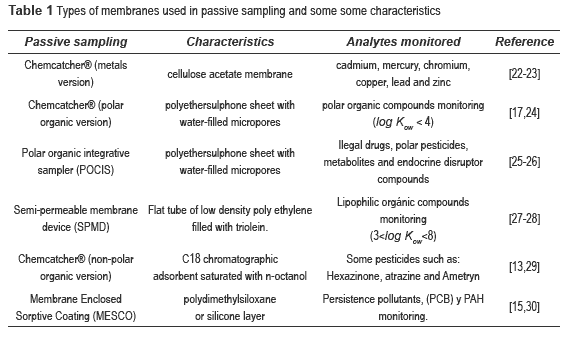
<body><![CDATA[<p><em>&bull;&nbsp; </em><em><b>N:</b></em><em> Amount of the  chemical accumulated by the sampler (typically in ng).</em></p>         <p><em>&bull;&nbsp; </em><em><b>Rs:</b></em><em> Sampling rate  (L/d)</em></p>         <p><em>&bull;&nbsp; </em><em><b>t:</b></em><em> Exposure time  (d).</em></p>       <p>Currently, the U.S. Geological Survey (USGS) has two free  versions in Microsoft Excel on their website to calculate the <i>Rs</i> &#91;19&#93;.</p>     <p>Some factors, such as  temperature, dissolved organic carbon and the flux, are related to the  calculated <i>Rs</i>. Therefore <i>Rs</i> takes a specific value for each monitoring place  &#91;18&#93;.</p>      <p><b><i>Membranes used for pesticides monitoring and other pollutants</i></b></p>      <p>Passive sampler membranes can have ionic, lipophilic and  hydrophilic packed phases which ensure the interaction between the membrane and  the analytes present in the water. Some polyethylene membranes with organic  internal solvent (TRIMPS) are adequate for capture of lipophilic pesticides  such as endosulfan and chlorpyrifos &#91;20&#93;. However, polar pesticides and their  degradates are not retained by this type of membrane. Therefore, packed  cellulose and enzymatic inhibitors have been incorporated into polyethylene  membranes for sampling water-soluble xenobiotics. Enzymatic inhibitors are  added to increase resistance to biodegradation of cellulose which are known as  passive sampling stained-cellulose or CIDS, which have shown stability for 21  days &#91;21&#93;.</p>       <p>Some commonly used membranes are shown in the <a href="#Tabla1">table 1</a>.</p>        <p align="center"><a name="Tabla1"></a><img src="/img/revistas/rfiua/n68/n68a15t01.gif" ></p>         <p>SPMDs and POCIS are the most popular membranes used for  monitoring of pesticides and their degradate due to their affinity for  metabolites and parent compounds. For example, substances with log <i>K<sub>ow</sub></i> between 1-8 can be easily  monitored using SPMD s and POCIS &#91;31-32&#93;.</p>        ]]></body>
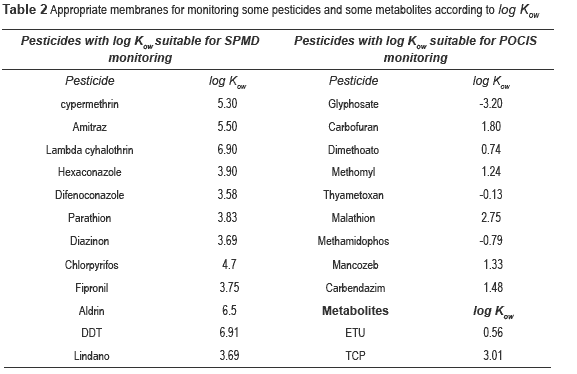
<body><![CDATA[<p>For the optimal membrane selection, <i>log K<sub>ow</sub></i> is considered as an important  physicochemical property due to necessary affinity between the membrane and the  analytes. For example, triolein as packed phase in SPMDs absorbs lipophilic  substances while the packed phase polyether sulfone used in POCIS absorbs polar  pesticides. <a href="#Tabla2">Table 2</a> shows the appropriate membrane (SPMDs or POCIS) for  monitoring some pesticides and metabolites.</p>      <p align="center"><a name="Tabla2"></a><img src="/img/revistas/rfiua/n68/n68a15t02.gif" ></p>      <p><b><i>Selection of membranes number and field sampling time</i></b></p>         <p>An initial survey is fundamental in order to know what  kinds of substances are used in a specific place. Also, <i>log K<sub>ow</sub></i>,  <i>log K<sub>oc</sub></i> and  solubility provide information about the dynamics of specific pesticides and  allow selecting the appropriate membrane &#91;33-34&#93;.</p>       <p>Additionally, the analyst needs to know what the frequency  and quantity of pesticides applied for the study zone is and what the  pesticides half-life is. These values allow estimating the pesticide  concentration in the water and the amount of membranes required. Some equations  allow to find the possible number of membranes necessary in the monitoring  &#91;18&#93;. See equation 3.</p>        <p><img src="/img/revistas/rfiua/n68/n68a15e03.gif"></p>        <p><em>Where:</em></p>       <p>&bull;&nbsp; <i><b>Cc:</b> Predicted environmental chemical concentration (ng/L).</i></p>       <p>&bull;&nbsp; <i><b>t:</b> Deployment time in days.</i></p>       <p>&bull;&nbsp; <i><b>Rs:</b> Sampling rate in liters of water extracted by the passive  sampler per day (L/d).</i></p>       ]]></body>
<body><![CDATA[<p>&bull;&nbsp; <i><b>Pr:</b> Overall method recovery for the analyte (expressed as a  factor of one; therefore 0.9 is used for 90 percent recovery).</i></p>       <p>&bull;&nbsp; <i><b>n:</b> Number of passive samplers combined into a single sample.</i></p>       <p>&bull;&nbsp; <i><b>Et:</b> Fraction of the total sample extract that is injected into  the instrument for quantification (0.001 if 1 microliter, &mu;L, of a 1-milliliter,  mL, sample is injected).</i></p>       <p>&bull;&nbsp; <i><b>MQL:</b> Method quantification limit (ng/L).</i></p>       <p>&bull;&nbsp; <i><b>Vi:</b> Volume of standard injection (commonly 1 &mu;L).</i></p>       <p>As an example, for determining the amount of passive  sampling for monitoring chlorpyrifos in a reservoir the analyst could apply the  following steps:</p>       <p>1. The analyst needs to know:</p>       <p><em>&bull;&nbsp; </em>Possible quantity applied in the zone study.</p>       <p><em>&bull;&nbsp; </em>The possible quantity transformed in the time of study.</p>       <p><em>&bull;&nbsp; </em>The possible attenuation factor</p>       ]]></body>
<body><![CDATA[<p><em>&bull;&nbsp; </em>The volume of water body</p>       <p>2. The analyst could use the  equation 4, which explains a first natural decay rates:</p>      <p><img src="/img/revistas/rfiua/n68/n68a15e04.gif"></p>        <p>Where:</p>         <p>&bull;&nbsp; <i><b>Cf</b> = Final concentration or  final quantity (Kg).</i></p>         <p>&bull;&nbsp; <i><b>Co</b> =Initial concentration or  initial quantity (Kg).</i></p>         <p>&bull;&nbsp; <i><b>K</b> = Degradation constant (1/d)</i></p>         <p>&bull;&nbsp; <i><b>t</b> = Time (d)</i></p>       <p>Therefore,  the half time in the nature is given by equation 5:</p>      <p><img src="/img/revistas/rfiua/n68/n68a15e05.gif"></p>        ]]></body>
<body><![CDATA[<p>Finally  the possible pesticides in water are given by equation 6:</p>      <p><img src="/img/revistas/rfiua/n68/n68a15e06.gif"></p>      <p>Where:</p>       <p>&bull;  AF = Is the attenuation factor</p>       <p>Equations 4, 5 and 6 are applied in order to determine the  level of pesticides in water after transformation and leaching processes. In  this paper, the following values were used in order to find the possible  concentration of chlorpyrifos in a drinking water reservoir in Colombia:</p>       <p>&bull;  <i><b>Quantity of application of chlorpyrifos in the zone of influence:</b> 9.42 Kg (This value was  calculated according to application frequency)</i></p>       <p>&bull; <i><b>Half time in soil:</b> 50 days &#91;35&#93;</i></p>       <p>&bull;  <i><b>Degradation constant:</b> -0.0139/d(Obtained by Equation 5)</i></p>       <p>&bull;  <i><b>The  possible attenuation factor:</b> 0.001</i></p>       <p>&bull;  <i><b>Reservoir  volume in liters: 2.5 x 10⁷ L Time of study:</b> 15 days</i></p>       ]]></body>
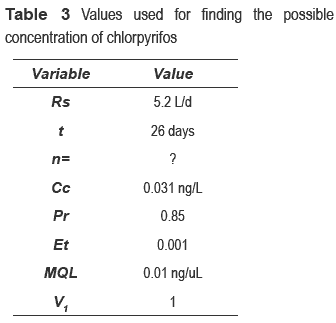
<body><![CDATA[<p>To find the quantity of chlorpyrifos in soil, It was  applied the equation 4.</p>      <p><img src="/img/revistas/rfiua/n68/n68a15e00a.gif"></p>        <p>According to equation 4, in the zone of influence there are  76.49 Kg of chlorpyrifos after 15 days.</p>       <p>To calculate the possible quantity of chlorpyrifos in the  reservoir, It was applied the equation 6.</p>        <p><img src="/img/revistas/rfiua/n68/n68a15e00b.gif"></p>        <p>According to equation 6, 0.0076 kg ofchlorpyrifos arrives  at the reservoir.</p>       <p>Using the reservoir volume, it was found that the possible  concentration of chlorpyrifos in the water is 0.031 ng/L. This concentration is  undetectable by conventional separation methods, but passive sampling  methodology does detect it.</p>       <p>Equation 1 and the estimated chlorpyrifos concentration are  used in order to find the number of passive samplings through the following  values in <a href="#Tabla3">table 3</a>.</p>          <p align="center"><a name="Tabla3"></a><img src="/img/revistas/rfiua/n68/n68a15t03.gif" ></p>          <p>Results indicate that three passive samplers are necessary  to detect 0.031 ng/L of chlorpyrifos in the reservoir. Also, according to <i>log K<sub>ow</sub></i> of chlorpyrifos (see <a href="#Tabla2">table 2</a>.), SPMDs membranes could be appropriate for monitoring this pesticide.</p>         ]]></body>

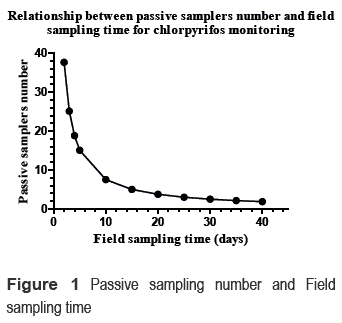
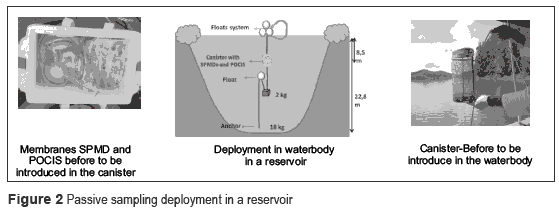
<body><![CDATA[<p>The analyst has the possibility of modifying either the  number of passive samplers or the field sampling time. For example, when the  analyst uses less time, he should increase the amount of passive samplers, and  if the analyst uses more time, he could decrease the amount of passive  samplers. <a href="#Figura1">Figure 1</a> shows the relationship between the number of passive  samplers and the field sampling time.</p>      <p align="center"><a name="Figura1"></a><img src="/img/revistas/rfiua/n68/n68a15i01.gif"></p> 	     <p><a href="#Figura1">Figure 1</a> shows the exponential relationship between the  number of passive samplers and the field sampling time for the chlorpyrifos  monitoring. According to <a href="#Figura1">figure 1</a>, 25 days of monitoring are necessary using 3  passive samplers in order to determine a chlorpyrifos concentration of 0.031  ng/L in the reservoir. Similarly, according to the figure, it is possible  shorten the time by using more passive samplers. As comparative methods, some  conventional separation methods, such as SPE, require about 1000-1200 liters of  water in order to detect this chlorpyrifos concentration with 0.01 ng/uL limit  of detection (LOD).</p>         <p>The deployment of passive sampling is presented in the  <a href="#Figura2">figure 2</a>.</p>      <p align="center"><a name="Figura2"></a><img src="/img/revistas/rfiua/n68/n68a15i02.gif"></p> 	     <p>&nbsp;</p>     <p><font size="3"><b>Processing spmds and pocis: analyte desorption</b></font></p>      <p>To recover the trapped analytes in the packed phase ofthe  passive samplers, desorption methods are used. Some desorption methods for  pesticides trapped in SPMDs and POCIS are described below &#91;36&#93;.</p>      <p><b><i>SPMDs dialysis</i></b></p>       <p>After elapse of the field sampling time, the passive  samplers are recovered and transported to a laboratory. Each SPMD is removed  from the canister and immediately cleaned with a soft toothbrush to remove  biofouling and particles.</p>       ]]></body>
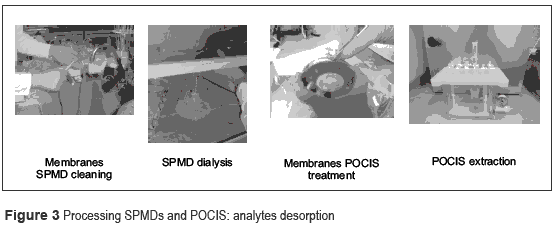
<body><![CDATA[<p>Then the SPMD membrane is immersed in dilute hydrochloric  acid to remove salts and rinsed with deionized water. The cleanliness is  improved with acetone and hexane &#91;37&#93;.</p>       <p>The SPMD membrane needs a dialysis time to desorb the  analytes trapped in the triolein packed phase. Membranes are placed in a glass  container with sufficient volume of hexane at 18&deg; C for 18 to 24 hours.  Repeating this step using hexane as solvent and a minimum dialysis time of 6  hours improves the desorption process. The dialysis times may vary depending on  the properties of the analytes that are extracted. Usually, a period of 18  hours followed by another 6 hours is sufficient for most analytes, though, some  pesticides, such as pyrethroids, may require up to three periods of 24 hours to  achieve an adequate recovery &#91;18&#93;. However, long dialysis times increase the  number of interferences in the assay.</p>     <p>The hexane extract is passed  through the SPE cartridge to increase the purity of the sample. This process  protects the equipment and decreases the interference in GC and HPLC  chromatograms. Some investigations suggest using gel permeation chromatography  to remove the triolein residues in the sample, although, with a better  dialysis, the last step is not needed. The extracts are finally concentrated  and injected into the analysis equipment. The GC is more common in pesticide  analysis after SPMD dialysis &#91;38-41&#93;.</p>      <p><b><i>POCIS dialysis</i></b></p>       <p>After field recovery, the POCIS membranes are removed from  each canister. The analyte extraction methods may vary according to available  resources in the laboratory. Due to high polar characteristics of the chemicals  absorbed, the extraction methods include the use of chromatographic columns or  SPE cartridges. Contrary to SPMD dialysis, the POCIS membranes are opened  gently on the top of chromatography column or directly on the top of the SPE  cartridge. Afterward, the absorbent is washed with a suitable solvent in order  to ensure the complete transfer of analytes. Methanol and water are commonly  used as solvents in this procedure &#91;36&#93;.</p>       <p>The combination of three solvents: methanol, toluene and  dichloromethane are the most common solvent mix used for analyte extraction.  The solvent proportions in this combination depend primarily on the POCIS configuration  (type of absorbent) and specific substances studied. A mixture of methanol:  toluene: dichloromethane can be used for pesticide analysis, while for drug  analysis only methanol (40 ml) is used &#91;18&#93;.</p>       <p>When analytes are volatile, for example tetrachloroethylene,  methanolis notrecommended as a solvent, because it requires high temperatures  of evaporation (Rota-evaporation), resulting in the loss of some volatile  analytes. An alternative method includes the use of 25 mL of a mixture of  dichloromethane:methyl-tert-butyl ether 8:2 (v:v) &#91;36&#93;.</p>     <p>Regardless of the method of  extraction of analytes from the membranes, analysts should consider evaluation  of recoveries by the method applied. The passive sampling treatments in the  laboratory are showed in <a href="#Figura3">figure 3</a>.</p>      <p align="center"><a name="Figura3"></a><img src="/img/revistas/rfiua/n68/n68a15i03.gif"></p>      <p>&nbsp;</p>       ]]></body>
<body><![CDATA[<p><font size="3"><b>Passive samplers and assessment of eco-toxicological risks</b> </font></p>      <p>Some environmental organic pollutants have high  toxicological risk on biota. Lipophilic substances can bioaccumulate in fish  tissue or other aquatic organisms and trigger environmental problems related to  the bio-magnification process &#91;42-43&#93;.</p>       <p>Pesticide and metabolite monitoring ensure the control of  exposure of aquatic organisms to these substances. Organochlorine pesticides  such as DDT, PCBs and PAHs have high affinity to fish tissue because their  non-polar structure. The passive sampler is an adequate monitoring device for  this purpose, because the packed phase mimics the fish tissue and allows  paralleling the bioaccumulation process &#91;44&#93;. Also, some passive samplers, such  as POCIS, mimic the intake of contaminants in aquatic organisms by respiratory  exposure &#91;45&#93;.</p>       <p>Therefore, after the SPMD cleanup, the desorbed analytes or  extract obtained can be used in toxicity bioassays such as <i>Daphnia spp,  Vibrio fischeri</i>  or <i>Pseudokirchneriella  subcapitata</i> &#91;46-48&#93;. These kinds of bioassays describe the toxicity behavior for many  compounds in the environment. Toxicity results can be compared with  determinations by instrumental techniques. Both represent the possible  bioaccumulation during the field sampling time. For example, passive sampling  applied in wastewater treatment plants allows analyzing the efficiency of the  removal process for the substances of interest &#91;49&#93;. Some substances such as  PAHs and PCBs were analyzed with GC/MS in sewage plants in Asia through SPMD  monitoring &#91;50&#93;. The results indicate a low concentration of these persistent  substances in wastewater. Also, the toxicity analysis demonstrated the low  reduction of toxic impact and therefore the low reduction of persistent organic  compounds by conventional processes, such as pretreatment (screens, grit traps,  pre-aeration), primary clarifiers, aeration tanks, and secondary clarifiers  &#91;50&#93;.</p>       <p>Monitoring by passive sampling is appropriate in  ecotoxicity analysis for different organic substances present at low levels in water &#91;51-52&#93;. The  passive sampling technique combined with chemical analyses and bioassays are a  valuable tool for monitoring priority organic pollutants in aquatic ecosystems  &#91;53-54&#93;.</p>        <p>&nbsp;</p>       <p><font size="3"><b>Conclusions</b> </font></p>        <p>Some environmental problems such as endocrine disruption,  carcinogenicity and teratogenicity have a major impact on global public health.  Substances such as pesticides and metabolites induce chronic and acute toxicity  at low concentration levels. Therefore, passive sampling is a new methodology  used in some countries for monitoring pesticides, their degradates and other  organic pollutants at low concentrations in the water. These methodologies  provide a better assessment of environmental risk and help to improve the  understanding what is the possible effect of substances to low level. Passive  sampling methods such as SPMDs and POCIS have a wide range for monitoring  organic pollutants in water. These membranes provide a dynamic approach and can  estimate the ecotoxicity and risk factor for major substances of anthropogenic  origin. Analysts should consider the physicochemical properties of specific  analytes to select adequate membranes, the number and the field sampling time.  Passive sampling permits evaluation of the exposure of humans and aquatic  organisms to low levels of pollutants where the impact of these substances at  low levels remains unknown.</p>      <p>&nbsp;</p>       <p><font size="3"><b>Acknowledgements</b> </font></p>      ]]></body>
<body><![CDATA[<p>The authors thank Jaime Alberto Palacio Baena (PhD) for his  valuable scientific suggestions and kind help in ecotoxicological knowledge.  The authors thank Santiago Alvarez and James Smith for their suggestions in  English writing. Aditionally the authors thank Environmental Sampling  Technologies (Est-Lab) for advice and recommendations about SPMDs and POCIS  membranes. Finally, this work was supported of Sustainability program 2011-2012  at University of Antioquia.</p>      <p>&nbsp;</p>       <p><font size="3"><b>References</b> </font></p>      <!-- ref --><p>1. I. Cavoski,  P. Caboni, G. Sarais, T. Miano. ''Degradation and Persistence of Rotenone in Soils and  Influence of Temperature Variations''.<i> Journal of  agricultural and food chemistry</i>. Vol. 56. 2008. pp. 8066-8073.    &nbsp;&nbsp;&nbsp;&nbsp;&nbsp;&nbsp;&nbsp;&nbsp;[&#160;<a href="javascript:void(0);" onclick="javascript: window.open('/scielo.php?script=sci_nlinks&ref=000146&pid=S0120-6230201300030001500001&lng=','','width=640,height=500,resizable=yes,scrollbars=1,menubar=yes,');">Links</a>&#160;]<!-- end-ref --></p>       <!-- ref --><p>2. A.  Belfroid, M. Van Drunen, M. Beek, S. Schrap, C. Van Gestel, B. Van Hattum. ''Relative risks of  transformation products of pesticides for aquatic ecosystems''. <i>The Science of  the total environment</i>. Vol. 222. 1998. pp.167-183.    &nbsp;&nbsp;&nbsp;&nbsp;&nbsp;&nbsp;&nbsp;&nbsp;[&#160;<a href="javascript:void(0);" onclick="javascript: window.open('/scielo.php?script=sci_nlinks&ref=000148&pid=S0120-6230201300030001500002&lng=','','width=640,height=500,resizable=yes,scrollbars=1,menubar=yes,');">Links</a>&#160;]<!-- end-ref --></p>       <!-- ref --><p>3. C. Colosio,  S. Fustinoni, S. Birindelli, I. Bonomi, G. De Paschale, T. Mammone, et al. ''Ethylenethiourea in  urine as an indicator of exposure to mancozeb in vineyard workers''. <i>Toxicology  letters</i>.  Vol. 134. 2002. pp. 133-140.    &nbsp;&nbsp;&nbsp;&nbsp;&nbsp;&nbsp;&nbsp;&nbsp;[&#160;<a href="javascript:void(0);" onclick="javascript: window.open('/scielo.php?script=sci_nlinks&ref=000150&pid=S0120-6230201300030001500003&lng=','','width=640,height=500,resizable=yes,scrollbars=1,menubar=yes,');">Links</a>&#160;]<!-- end-ref --></p>       <!-- ref --><p>4. G. Darko, O. Akoto, C.  Oppong. ''Persistent organochlorine pesticide residues in fish, sediments  and water from Lake Bosomtwi, Ghana''. <i>Chemosphere</i>. Vol. 72. 2008. pp. 21-24.    &nbsp;&nbsp;&nbsp;&nbsp;&nbsp;&nbsp;&nbsp;&nbsp;[&#160;<a href="javascript:void(0);" onclick="javascript: window.open('/scielo.php?script=sci_nlinks&ref=000152&pid=S0120-6230201300030001500004&lng=','','width=640,height=500,resizable=yes,scrollbars=1,menubar=yes,');">Links</a>&#160;]<!-- end-ref --></p>       <!-- ref --><p>5. Y. Chen, Z.  Guo, X. Wang, C. Qiu. ''Sample preparation''. <i>Journal of  Chromatography A</i>.  Vol. 1184. 2008. pp. 191-219.    &nbsp;&nbsp;&nbsp;&nbsp;&nbsp;&nbsp;&nbsp;&nbsp;[&#160;<a href="javascript:void(0);" onclick="javascript: window.open('/scielo.php?script=sci_nlinks&ref=000154&pid=S0120-6230201300030001500005&lng=','','width=640,height=500,resizable=yes,scrollbars=1,menubar=yes,');">Links</a>&#160;]<!-- end-ref --></p>       <!-- ref --><p>6. Nollet L. ''Handbook of  Water Analysis''. Tribaldo EB. <i>Analysis of  Pesticides in Water</i>. 2<sup>nd</sup> ed. Ed. CRC Press Taylor and Francis Group.  Boca Raton, FL, USA. 2007. pp. 449-481.    &nbsp;&nbsp;&nbsp;&nbsp;&nbsp;&nbsp;&nbsp;&nbsp;[&#160;<a href="javascript:void(0);" onclick="javascript: window.open('/scielo.php?script=sci_nlinks&ref=000156&pid=S0120-6230201300030001500006&lng=','','width=640,height=500,resizable=yes,scrollbars=1,menubar=yes,');">Links</a>&#160;]<!-- end-ref --></p>       <!-- ref --><p>7. B. Vrana, I. Allan, R.  Greenwood, G. Mills, E. Dominiak, K. Svensson, et al. Passive sampling  techniques for monitoring pollutants in water. <i>TrAC Trends in  Analytical Chemistry</i>. Vol. 24. 2005. pp. 845-868.    &nbsp;&nbsp;&nbsp;&nbsp;&nbsp;&nbsp;&nbsp;&nbsp;[&#160;<a href="javascript:void(0);" onclick="javascript: window.open('/scielo.php?script=sci_nlinks&ref=000158&pid=S0120-6230201300030001500007&lng=','','width=640,height=500,resizable=yes,scrollbars=1,menubar=yes,');">Links</a>&#160;]<!-- end-ref --></p>       <!-- ref --><p>8. C. Harman, O. Beyum, K.  Tollefsen, K. Thomas, M. Grung. ''Uptake of some selected aquatic  pollutants in semipermeable membrane devices (SPMDs) and the polar organic  chemical integrative sampler (POCIS)''. <i>J. Environ. Monit</i>. Vol. 10. 2008. pp. 239-247.    &nbsp;&nbsp;&nbsp;&nbsp;&nbsp;&nbsp;&nbsp;&nbsp;[&#160;<a href="javascript:void(0);" onclick="javascript: window.open('/scielo.php?script=sci_nlinks&ref=000160&pid=S0120-6230201300030001500008&lng=','','width=640,height=500,resizable=yes,scrollbars=1,menubar=yes,');">Links</a>&#160;]<!-- end-ref --></p>       <!-- ref --><p>9. C. Harman, K. Tollefsen, O.  Beyum, K. Thomas, M. Grung. ''Uptake rates of alkylphenols, PAHs and  carbazoles in semipermeable membrane devices (SPMDs) and polar organic chemical  integrative samplers (POCIS)''. <i>Chemosphere</i>. Vol. 72. 2008. pp. 1510-1516.    &nbsp;&nbsp;&nbsp;&nbsp;&nbsp;&nbsp;&nbsp;&nbsp;[&#160;<a href="javascript:void(0);" onclick="javascript: window.open('/scielo.php?script=sci_nlinks&ref=000162&pid=S0120-6230201300030001500009&lng=','','width=640,height=500,resizable=yes,scrollbars=1,menubar=yes,');">Links</a>&#160;]<!-- end-ref --></p>       <!-- ref --><p>10. Van der WerfHMG.  ''Assessing the impact ofpesticides on the environment''. <i>Agriculture, Ecosystems  &amp; Environment</i>.  Vol. 60. 1996. pp. 81-96.    &nbsp;&nbsp;&nbsp;&nbsp;&nbsp;&nbsp;&nbsp;&nbsp;[&#160;<a href="javascript:void(0);" onclick="javascript: window.open('/scielo.php?script=sci_nlinks&ref=000164&pid=S0120-6230201300030001500010&lng=','','width=640,height=500,resizable=yes,scrollbars=1,menubar=yes,');">Links</a>&#160;]<!-- end-ref --></p>       <!-- ref --><p>11. F. Stuer. ''Review of  passive accumulation devices for monitoring organic micropollutants in the  aquatic environment''. <i>Environmental Pollution</i>. Vol.136. 2005. pp. 503-524.    &nbsp;&nbsp;&nbsp;&nbsp;&nbsp;&nbsp;&nbsp;&nbsp;[&#160;<a href="javascript:void(0);" onclick="javascript: window.open('/scielo.php?script=sci_nlinks&ref=000166&pid=S0120-6230201300030001500011&lng=','','width=640,height=500,resizable=yes,scrollbars=1,menubar=yes,');">Links</a>&#160;]<!-- end-ref --></p>       <!-- ref --><p>12. T. Gorecki, J. Namiesnik.  ''Passive sampling''. <i>TrAC Trends in Analytical Chemistry.</i> Vol. 21. 2002. pp. 276-291.    &nbsp;&nbsp;&nbsp;&nbsp;&nbsp;&nbsp;&nbsp;&nbsp;[&#160;<a href="javascript:void(0);" onclick="javascript: window.open('/scielo.php?script=sci_nlinks&ref=000168&pid=S0120-6230201300030001500012&lng=','','width=640,height=500,resizable=yes,scrollbars=1,menubar=yes,');">Links</a>&#160;]<!-- end-ref --></p>       <!-- ref --><p>13. R. Greenwood, G. Mills, B.  Vrana. ''Potential applications of passive sampling for monitoring non-polar  industrial pollutants in the aqueous environment in support of REACH''. <i>Journal of  Chromatography A</i>. Vol.  1216. 2009. pp. 631-639.    &nbsp;&nbsp;&nbsp;&nbsp;&nbsp;&nbsp;&nbsp;&nbsp;[&#160;<a href="javascript:void(0);" onclick="javascript: window.open('/scielo.php?script=sci_nlinks&ref=000170&pid=S0120-6230201300030001500013&lng=','','width=640,height=500,resizable=yes,scrollbars=1,menubar=yes,');">Links</a>&#160;]<!-- end-ref --></p>       <!-- ref --><p>14. B. Vrana, G. Mills, E.  Dominiak, R. Greenwood. ''Calibration of the Chemcatcher passive sampler  for the monitoring of priority organic pollutants in water''. <i>Environmental  Pollution</i>.  Vol. 142. 2006. pp. 333-343.    &nbsp;&nbsp;&nbsp;&nbsp;&nbsp;&nbsp;&nbsp;&nbsp;[&#160;<a href="javascript:void(0);" onclick="javascript: window.open('/scielo.php?script=sci_nlinks&ref=000172&pid=S0120-6230201300030001500014&lng=','','width=640,height=500,resizable=yes,scrollbars=1,menubar=yes,');">Links</a>&#160;]<!-- end-ref --></p>       <!-- ref --><p>15. G. Ouyang, J. Pawliszyn.  ''Configurations and calibration methods for passive sampling  techniques''. <i>Journal of Chromatography A</i>. Vol. 1168. 2007. pp. 226-235.    &nbsp;&nbsp;&nbsp;&nbsp;&nbsp;&nbsp;&nbsp;&nbsp;[&#160;<a href="javascript:void(0);" onclick="javascript: window.open('/scielo.php?script=sci_nlinks&ref=000174&pid=S0120-6230201300030001500015&lng=','','width=640,height=500,resizable=yes,scrollbars=1,menubar=yes,');">Links</a>&#160;]<!-- end-ref --></p>       <!-- ref --><p>16. S. MacLeod, E. McClure, C.  Wong. ''Laboratory calibration and field deployment of the polar organic  chemical integrative sampler for pharmaceuticals and personal care products in  wastewater and surface water''. <i>Environmental  Toxicology and Chemistry.</i> Vol. 26. 2007. pp. 2517-2529.    &nbsp;&nbsp;&nbsp;&nbsp;&nbsp;&nbsp;&nbsp;&nbsp;[&#160;<a href="javascript:void(0);" onclick="javascript: window.open('/scielo.php?script=sci_nlinks&ref=000176&pid=S0120-6230201300030001500016&lng=','','width=640,height=500,resizable=yes,scrollbars=1,menubar=yes,');">Links</a>&#160;]<!-- end-ref --></p>       <!-- ref --><p>17. S. Seethapathy, T.  G&oacute;recki, X. Li. ''Passive sampling in environmental analysis''. <i>Journal of  Chromatography A</i>.  Vol. 1184. 2008. pp. 234-253.    &nbsp;&nbsp;&nbsp;&nbsp;&nbsp;&nbsp;&nbsp;&nbsp;[&#160;<a href="javascript:void(0);" onclick="javascript: window.open('/scielo.php?script=sci_nlinks&ref=000178&pid=S0120-6230201300030001500017&lng=','','width=640,height=500,resizable=yes,scrollbars=1,menubar=yes,');">Links</a>&#160;]<!-- end-ref --></p>       <!-- ref --><p>18. D. Alvarez. <i>Guidelines for the use of the  semipermeable membrane device (SPMD) and the polar organic chemical integrative  sampler (POCIS) in environmental monitoring studies</i>. US Geological  Survey, Techniques and Methods. 2010:1-D4. Available on: <a href="http://pubs.usgs.gov/tm/tm1d4/pdf/tm1d4.pdf"target="_blank">http://pubs.usgs.gov/tm/tm1d4/pdf/tm1d4.pdf</a>. Accessed: April  2012&nbsp;&nbsp;&nbsp;&nbsp;&nbsp;&nbsp;&nbsp;&nbsp;[&#160;<a href="javascript:void(0);" onclick="javascript: window.open('/scielo.php?script=sci_nlinks&ref=000180&pid=S0120-6230201300030001500018&lng=','','width=640,height=500,resizable=yes,scrollbars=1,menubar=yes,');">Links</a>&#160;]<!-- end-ref --><!-- ref --><p>19. U.S. Geological Survey. Columbia Environmental  Research Center.  Available on: <a href="http://www.cerc.usgs.gov/Branches.aspx?BranchId=8"target="_blank">http://www.cerc.usgs.gov/Branches.aspx?BranchId=8</a>. Accessed: April 2012&nbsp;&nbsp;&nbsp;&nbsp;&nbsp;&nbsp;&nbsp;&nbsp;[&#160;<a href="javascript:void(0);" onclick="javascript: window.open('/scielo.php?script=sci_nlinks&ref=000181&pid=S0120-6230201300030001500019&lng=','','width=640,height=500,resizable=yes,scrollbars=1,menubar=yes,');">Links</a>&#160;]<!-- end-ref --><!-- ref --><p>20. F. Esteve,  V. Yus&aacute;, A. Pastor, M. De La Guardia. ''New perspectives in the  use of semipermeable membrane devices as passive samplers''. <i>Talanta</i>. Vol. 74. 2008. pp. 443-457.    &nbsp;&nbsp;&nbsp;&nbsp;&nbsp;&nbsp;&nbsp;&nbsp;[&#160;<a href="javascript:void(0);" onclick="javascript: window.open('/scielo.php?script=sci_nlinks&ref=000182&pid=S0120-6230201300030001500020&lng=','','width=640,height=500,resizable=yes,scrollbars=1,menubar=yes,');">Links</a>&#160;]<!-- end-ref --></p>       <!-- ref --><p>21. R. Hyne, M. Aistrope. <i>Continuous  sampling of pesticides in waterways</i>. Centre for Ecotoxicology, Department of  Environment &amp; Conservation, NSW. Available on: <a href="http://www.irec.org.au/farmer_f/pdf_171/Continuous%20sampling%20of%20pesticides%20in%20waterways.pdf"target="_blank">http://www.irec.org.au/farmer_f/pdf_171/Continuous%20sampling%20of%20pesticides%20in%20waterways.pdf</a>. Accessed: April 2012.    &nbsp;&nbsp;&nbsp;&nbsp;&nbsp;&nbsp;&nbsp;&nbsp;[&#160;<a href="javascript:void(0);" onclick="javascript: window.open('/scielo.php?script=sci_nlinks&ref=000184&pid=S0120-6230201300030001500021&lng=','','width=640,height=500,resizable=yes,scrollbars=1,menubar=yes,');">Links</a>&#160;]<!-- end-ref --></p>       <!-- ref --><p>22. R. Aguilar, M. G&oacute;mez, R,  Greenwood, G. Mills, B. Vrana, M. Palacios. ''Application of Chemcatcher  passive sampler for monitoring levels of mercury in contaminated river  water''.  <i>Talanta</i>.  Vol. 77. 2009. pp. 1483-1489.    &nbsp;&nbsp;&nbsp;&nbsp;&nbsp;&nbsp;&nbsp;&nbsp;[&#160;<a href="javascript:void(0);" onclick="javascript: window.open('/scielo.php?script=sci_nlinks&ref=000186&pid=S0120-6230201300030001500022&lng=','','width=640,height=500,resizable=yes,scrollbars=1,menubar=yes,');">Links</a>&#160;]<!-- end-ref --></p>       <!-- ref --><p>23. R.  Aguilar, R. Greenwood, G. Mills, B. Vrana, M. Palacios, M. Gomez. ''Assessment of  Chemcatcher passive sampler for the monitoring of inorganic mercury and  organotin compounds in water''. <i>International  Journal of Environmental and Analytical Chemistry</i>. Vol. 88. 2008. pp. 75-90.    &nbsp;&nbsp;&nbsp;&nbsp;&nbsp;&nbsp;&nbsp;&nbsp;[&#160;<a href="javascript:void(0);" onclick="javascript: window.open('/scielo.php?script=sci_nlinks&ref=000188&pid=S0120-6230201300030001500023&lng=','','width=640,height=500,resizable=yes,scrollbars=1,menubar=yes,');">Links</a>&#160;]<!-- end-ref --></p>       <!-- ref --><p>24. R.  Sch&auml;fer, A. Paschke, B. Vrana, R. Mueller, M. Liess. ''Performance of the  Chemcatcher passive sampler when used to monitor 10 polar and semi-polar  pesticides in 16 Central European streams, and comparison with two other  sampling methods''. <i>Water research</i>. Vol. 42. 2008. pp. 2707-2717.    &nbsp;&nbsp;&nbsp;&nbsp;&nbsp;&nbsp;&nbsp;&nbsp;[&#160;<a href="javascript:void(0);" onclick="javascript: window.open('/scielo.php?script=sci_nlinks&ref=000190&pid=S0120-6230201300030001500024&lng=','','width=640,height=500,resizable=yes,scrollbars=1,menubar=yes,');">Links</a>&#160;]<!-- end-ref --></p>       <!-- ref --><p>25. E. Bailly, Y. Levi, S.  Karolak. ''Calibration and field evaluation of polar organic chemical  integrative sampler (POCIS) for monitoring pharmaceuticals in hospital  wastewater''. <i>Environmental Pollution</i>. Vol. 174. 2013. pp. 100-105.    &nbsp;&nbsp;&nbsp;&nbsp;&nbsp;&nbsp;&nbsp;&nbsp;[&#160;<a href="javascript:void(0);" onclick="javascript: window.open('/scielo.php?script=sci_nlinks&ref=000192&pid=S0120-6230201300030001500025&lng=','','width=640,height=500,resizable=yes,scrollbars=1,menubar=yes,');">Links</a>&#160;]<!-- end-ref --></p>       <!-- ref --><p>26. A. Arditsoglou, D. Voutsa.  ''Passive sampling of selected endocrine disrupting compounds using polar  organic chemical integrative samplers''. <i>Environmental  Pollution</i>.  Vol 156. 2008. pp. 316-324.    &nbsp;&nbsp;&nbsp;&nbsp;&nbsp;&nbsp;&nbsp;&nbsp;[&#160;<a href="javascript:void(0);" onclick="javascript: window.open('/scielo.php?script=sci_nlinks&ref=000194&pid=S0120-6230201300030001500026&lng=','','width=640,height=500,resizable=yes,scrollbars=1,menubar=yes,');">Links</a>&#160;]<!-- end-ref --></p>       <!-- ref --><p>27. F. Esteve,  A. Pastor, V. Yusa, M. De La Guardia. ''Using semi-permeable  membrane devices as passive samplers''. <i>TrAC Trends in  Analytical Chemistry</i>. Vol. 26. 2008. pp. 703-712.    &nbsp;&nbsp;&nbsp;&nbsp;&nbsp;&nbsp;&nbsp;&nbsp;[&#160;<a href="javascript:void(0);" onclick="javascript: window.open('/scielo.php?script=sci_nlinks&ref=000196&pid=S0120-6230201300030001500027&lng=','','width=640,height=500,resizable=yes,scrollbars=1,menubar=yes,');">Links</a>&#160;]<!-- end-ref --></p>       <!-- ref --><p>28. Y. Wang, Z. Wang, J. Liu,  M. Ma, N. Belzile.''Monitoring priority pollutants in the Yanghe River by  dichloromethane extraction and semipermeable membrane device (SPMD)''. <i>Chemosphere</i>. Vol. 39. 1999. pp. 113-131.    &nbsp;&nbsp;&nbsp;&nbsp;&nbsp;&nbsp;&nbsp;&nbsp;[&#160;<a href="javascript:void(0);" onclick="javascript: window.open('/scielo.php?script=sci_nlinks&ref=000198&pid=S0120-6230201300030001500028&lng=','','width=640,height=500,resizable=yes,scrollbars=1,menubar=yes,');">Links</a>&#160;]<!-- end-ref --></p>       <!-- ref --><p>29. M. Shaw,  M. Furnas, K. Fabricius, D. Haynes, S. Carter, G. Eaglesham, et al. ''Monitoring pesticides in  the Great Barrier Reef''. <i>Marine Pollution Bulletin</i>. Vol. 60. 2010. pp. 113-122.    &nbsp;&nbsp;&nbsp;&nbsp;&nbsp;&nbsp;&nbsp;&nbsp;[&#160;<a href="javascript:void(0);" onclick="javascript: window.open('/scielo.php?script=sci_nlinks&ref=000200&pid=S0120-6230201300030001500029&lng=','','width=640,height=500,resizable=yes,scrollbars=1,menubar=yes,');">Links</a>&#160;]<!-- end-ref --></p>       <!-- ref --><p>30. J. Namiesnik, B.  Zabiegala, A. Kot, M. Partyka, A. Wasik. ''Passive sampling and/or  extraction techniques in environmental analysis: a review''. <i>Analytical and  bioanalytical chemistry</i>. Vol. 381. 2005. pp. 279-301.    &nbsp;&nbsp;&nbsp;&nbsp;&nbsp;&nbsp;&nbsp;&nbsp;[&#160;<a href="javascript:void(0);" onclick="javascript: window.open('/scielo.php?script=sci_nlinks&ref=000202&pid=S0120-6230201300030001500030&lng=','','width=640,height=500,resizable=yes,scrollbars=1,menubar=yes,');">Links</a>&#160;]<!-- end-ref --></p>       <!-- ref --><p>31. J. Huckins, D. Alvarez. <i>Semipermeable membrane  devices (SPMD)</i>.  Columbia Environmental Research Center. Available on: <a href="http://www.cerc.usgs.gov/pubs/center/pdfDocs/SPMD.pdf"target="_blank">http://www.cerc.usgs.gov/pubs/center/pdfDocs/SPMD.pdf</a>. Accessed: April 2012.    &nbsp;&nbsp;&nbsp;&nbsp;&nbsp;&nbsp;&nbsp;&nbsp;[&#160;<a href="javascript:void(0);" onclick="javascript: window.open('/scielo.php?script=sci_nlinks&ref=000204&pid=S0120-6230201300030001500031&lng=','','width=640,height=500,resizable=yes,scrollbars=1,menubar=yes,');">Links</a>&#160;]<!-- end-ref --></p>       <!-- ref --><p>32. J. Huckins, D. Alvarez. <i>Polar Organic  Chemical Integrative Sampler</i>. Columbia Environmental Research Center. Available on: <a href="http://www.cerc.usgs.gov/Content/UploadedFiles/ExternalDocs/POCIS.pdf"target="_blank">http://www.cerc.usgs.gov/Content/UploadedFiles/ExternalDocs/POCIS.pdf</a>. Accessed: April 2012.    &nbsp;&nbsp;&nbsp;&nbsp;&nbsp;&nbsp;&nbsp;&nbsp;[&#160;<a href="javascript:void(0);" onclick="javascript: window.open('/scielo.php?script=sci_nlinks&ref=000206&pid=S0120-6230201300030001500032&lng=','','width=640,height=500,resizable=yes,scrollbars=1,menubar=yes,');">Links</a>&#160;]<!-- end-ref --></p>       <!-- ref --><p>33. T. Reemtsma,  M. Jekel.  <i>Organic Pollutants in the Water Cycle: Properties, Occurrence, Analysis &amp;  Environmental Relevance of Polar Compounds</i>. Ed. Thorsten  Reemtsma and Martin Jekel. Berlin, Germany. 2006. pp. 2-59.    &nbsp;&nbsp;&nbsp;&nbsp;&nbsp;&nbsp;&nbsp;&nbsp;[&#160;<a href="javascript:void(0);" onclick="javascript: window.open('/scielo.php?script=sci_nlinks&ref=000208&pid=S0120-6230201300030001500033&lng=','','width=640,height=500,resizable=yes,scrollbars=1,menubar=yes,');">Links</a>&#160;]<!-- end-ref --></p>       <!-- ref --><p>34. C. Harman,  S. Brooks, R. Sundt, S. Meier, M. Grung. ''Field comparison of  passive sampling and biological approaches for measuring exposure to PAH and  alkylphenols from offshore produced water discharges''. <i>Marine Pollution  Bulletin</i>.  Vol. 63. 2011. pp. 141-148.    &nbsp;&nbsp;&nbsp;&nbsp;&nbsp;&nbsp;&nbsp;&nbsp;[&#160;<a href="javascript:void(0);" onclick="javascript: window.open('/scielo.php?script=sci_nlinks&ref=000210&pid=S0120-6230201300030001500034&lng=','','width=640,height=500,resizable=yes,scrollbars=1,menubar=yes,');">Links</a>&#160;]<!-- end-ref --></p>       <!-- ref --><p>35. IUPAC. <i>Global  availability of information on agrochemicals</i>. Available on: <a href="http://sitem.herts.ac.uk/aeru/iupac/154.htm"target="_blank">http://sitem.herts.ac.uk/aeru/iupac/154.htm</a>. Accessed: April 2012.    &nbsp;&nbsp;&nbsp;&nbsp;&nbsp;&nbsp;&nbsp;&nbsp;[&#160;<a href="javascript:void(0);" onclick="javascript: window.open('/scielo.php?script=sci_nlinks&ref=000212&pid=S0120-6230201300030001500035&lng=','','width=640,height=500,resizable=yes,scrollbars=1,menubar=yes,');">Links</a>&#160;]<!-- end-ref --></p>       <!-- ref --><p>36. N. Fork. <i>Investigation of Organic  Chemicals Potentially Responsible for Mortality and Intersex in Fish of the  North Fork of the Shenandoah River, Virginia, during Spring of 2007</i>. Available on: <a href="http://pubs.usgs.gov/of/2008/1093/pdf/0FR2008-1093.pdf"target="_blank">http://pubs.usgs.gov/of/2008/1093/pdf/0FR2008-1093.pdf</a>. Accessed: April  2012.    &nbsp;&nbsp;&nbsp;&nbsp;&nbsp;&nbsp;&nbsp;&nbsp;[&#160;<a href="javascript:void(0);" onclick="javascript: window.open('/scielo.php?script=sci_nlinks&ref=000214&pid=S0120-6230201300030001500036&lng=','','width=640,height=500,resizable=yes,scrollbars=1,menubar=yes,');">Links</a>&#160;]<!-- end-ref --></p>       <!-- ref --><p>37. G. Liu, G. Zhang, J. Li,  X. Li, X. Peng, S. Qi. ''Spatial distribution and seasonal variations of  polycyclic aromatic hydrocarbons (PAHs) using semi-permeable membrane devices  (SPMD) and pine needles in the Pearl River Delta, South China''. <i>Atmospheric  Environment</i>.  Vol. 40. pp. 3134-3143.    &nbsp;&nbsp;&nbsp;&nbsp;&nbsp;&nbsp;&nbsp;&nbsp;[&#160;<a href="javascript:void(0);" onclick="javascript: window.open('/scielo.php?script=sci_nlinks&ref=000216&pid=S0120-6230201300030001500037&lng=','','width=640,height=500,resizable=yes,scrollbars=1,menubar=yes,');">Links</a>&#160;]<!-- end-ref --></p>       <!-- ref --><p>38. N. Felsvik, E. Brevik, J.  Berge. ''Monitoring of organotin compounds in seawaterusing semipermeable  membrane devices (SPMDs)&#8212;tentative results''. <i>J Environ Monit</i>. Vol. 2. 2000. pp. 281-284.    &nbsp;&nbsp;&nbsp;&nbsp;&nbsp;&nbsp;&nbsp;&nbsp;[&#160;<a href="javascript:void(0);" onclick="javascript: window.open('/scielo.php?script=sci_nlinks&ref=000218&pid=S0120-6230201300030001500038&lng=','','width=640,height=500,resizable=yes,scrollbars=1,menubar=yes,');">Links</a>&#160;]<!-- end-ref --></p>       <!-- ref --><p>39. S. Goodbred, W. Bryant, M.  Rosen, D. Alvarez, T. Spencer. ''How useful are the ''other''  semipermeable membrane devices (SPMDs); the mini-unit (15.2cm long)?''. <i>Science of the  Total Environment</i>.  Vol. 407. 2009. pp. 4149-4156.    &nbsp;&nbsp;&nbsp;&nbsp;&nbsp;&nbsp;&nbsp;&nbsp;[&#160;<a href="javascript:void(0);" onclick="javascript: window.open('/scielo.php?script=sci_nlinks&ref=000220&pid=S0120-6230201300030001500039&lng=','','width=640,height=500,resizable=yes,scrollbars=1,menubar=yes,');">Links</a>&#160;]<!-- end-ref --></p>       <!-- ref --><p>40. L. Setkov&aacute;, J. Hajslov&aacute;,  P. Bergqvist, V. Kocourek, R. Kazda, P. Suchan. ''Fast isolation of  hydrophobic organic environmental contaminants from exposed semipermeable  membrane devices (SPMDs) prior to GC analysis''. <i>Journal of  Chromatography A</i>.  Vol. 1092. 2005. pp. 170-181.    &nbsp;&nbsp;&nbsp;&nbsp;&nbsp;&nbsp;&nbsp;&nbsp;[&#160;<a href="javascript:void(0);" onclick="javascript: window.open('/scielo.php?script=sci_nlinks&ref=000222&pid=S0120-6230201300030001500040&lng=','','width=640,height=500,resizable=yes,scrollbars=1,menubar=yes,');">Links</a>&#160;]<!-- end-ref --></p>       <!-- ref --><p>41. D.  Sabaliunas, J. Ellington, I. Sabaliuniene. ''Screening bioavailable  hydrophobic toxicants in surface waters with semipermeable membrane devices:  role of inherent oleic acid in toxicity evaluations''. <i>Ecotoxicology and  Environmental Safety</i>. Vol. 44. 1999. pp. 160-167.    &nbsp;&nbsp;&nbsp;&nbsp;&nbsp;&nbsp;&nbsp;&nbsp;[&#160;<a href="javascript:void(0);" onclick="javascript: window.open('/scielo.php?script=sci_nlinks&ref=000224&pid=S0120-6230201300030001500041&lng=','','width=640,height=500,resizable=yes,scrollbars=1,menubar=yes,');">Links</a>&#160;]<!-- end-ref --></p>       <!-- ref --><p>42. F. Cid, R. Ant&oacute;n, E.  Caviedes. ''Organochlorine pesticide contamination in three bird species of  the Embalse La Florida water reservoir in the semiarid midwest of Argentina''. <i>Science of the  Total Environment</i>.  Vol. 385. 2007. pp. 86-96.    &nbsp;&nbsp;&nbsp;&nbsp;&nbsp;&nbsp;&nbsp;&nbsp;[&#160;<a href="javascript:void(0);" onclick="javascript: window.open('/scielo.php?script=sci_nlinks&ref=000226&pid=S0120-6230201300030001500042&lng=','','width=640,height=500,resizable=yes,scrollbars=1,menubar=yes,');">Links</a>&#160;]<!-- end-ref --></p>       <!-- ref --><p>43. L. Kalyoncu, I. Agca, A.  Aktumsek. ''Some organochlorine pesticide residues in fish species in  Konya, Turkey''. <i>Chemosphere</i>. Vol. 74. 2009. pp. 885-889.    &nbsp;&nbsp;&nbsp;&nbsp;&nbsp;&nbsp;&nbsp;&nbsp;[&#160;<a href="javascript:void(0);" onclick="javascript: window.open('/scielo.php?script=sci_nlinks&ref=000228&pid=S0120-6230201300030001500043&lng=','','width=640,height=500,resizable=yes,scrollbars=1,menubar=yes,');">Links</a>&#160;]<!-- end-ref --></p>       <!-- ref --><p>44. V. Yus&aacute;,  A. Pastor, M. Guardia. ''Microwave-assisted extraction of OCPs, PCBs and PAHs  concentrated by semi-permeable membrane devices (SPMDs)''. <i>Analytica chimica  acta</i>.  Vol. 540. 2005. pp. 355-366.    &nbsp;&nbsp;&nbsp;&nbsp;&nbsp;&nbsp;&nbsp;&nbsp;[&#160;<a href="javascript:void(0);" onclick="javascript: window.open('/scielo.php?script=sci_nlinks&ref=000230&pid=S0120-6230201300030001500044&lng=','','width=640,height=500,resizable=yes,scrollbars=1,menubar=yes,');">Links</a>&#160;]<!-- end-ref --></p>       <!-- ref --><p>45. D. Alvarez, P.  Stackelberg, J. Petty, J. Huckins, E. Furlong, S. Zaugg, et al.  ''Comparison of a novel passive sampler to standard water-column sampling  for organic contaminants associated with wastewater effluents entering a New  Jersey stream''. <i>Chemosphere</i>. Vol. 61. 2005. pp. 610-622.    &nbsp;&nbsp;&nbsp;&nbsp;&nbsp;&nbsp;&nbsp;&nbsp;[&#160;<a href="javascript:void(0);" onclick="javascript: window.open('/scielo.php?script=sci_nlinks&ref=000232&pid=S0120-6230201300030001500045&lng=','','width=640,height=500,resizable=yes,scrollbars=1,menubar=yes,');">Links</a>&#160;]<!-- end-ref --></p>       <!-- ref --><p>46. M.  Isidori, M. Ferrara, M. Lavorgna, A. Nardelli, A. Parrella. ''In situ monitoring of  urban air in Southern Italy with the Tradescantia micronucleus bioassay and  semipermeable membrane devices (SPMDs)''. <i>Chemosphere</i>. Vol. 52. 2003. pp. 121-126.    &nbsp;&nbsp;&nbsp;&nbsp;&nbsp;&nbsp;&nbsp;&nbsp;[&#160;<a href="javascript:void(0);" onclick="javascript: window.open('/scielo.php?script=sci_nlinks&ref=000234&pid=S0120-6230201300030001500046&lng=','','width=640,height=500,resizable=yes,scrollbars=1,menubar=yes,');">Links</a>&#160;]<!-- end-ref --></p>       <!-- ref --><p>47. D. Sabaliunas, A.  Sodergren. ''Use of semi-permeable membrane devices to monitor pollutants  in water and assess their effects: A laboratory test and field  verification''. <i>Environmental Pollution</i>. Vol. 96. 1997. pp. 195-205.    &nbsp;&nbsp;&nbsp;&nbsp;&nbsp;&nbsp;&nbsp;&nbsp;[&#160;<a href="javascript:void(0);" onclick="javascript: window.open('/scielo.php?script=sci_nlinks&ref=000236&pid=S0120-6230201300030001500047&lng=','','width=640,height=500,resizable=yes,scrollbars=1,menubar=yes,');">Links</a>&#160;]<!-- end-ref --></p>       <!-- ref --><p>48. C. Gourlay, C. Mi&eacute;ge, A.  Noir, C. Ravelet, J. Garric, J. Mouchel. ''How accurately do semi-permeable  membrane devices measure the bioavailability of polycyclic aromatic hydrocarbons to Daphnia  magna?''. <i>Chemosphere</i>. Vol. 61. 2005. pp. 1734-1739.    &nbsp;&nbsp;&nbsp;&nbsp;&nbsp;&nbsp;&nbsp;&nbsp;[&#160;<a href="javascript:void(0);" onclick="javascript: window.open('/scielo.php?script=sci_nlinks&ref=000238&pid=S0120-6230201300030001500048&lng=','','width=640,height=500,resizable=yes,scrollbars=1,menubar=yes,');">Links</a>&#160;]<!-- end-ref --></p>       <!-- ref --><p>49. B. Tan, D  Hawker, J. M&uuml;ller, F. Leusch, L. Tremblay, H. Chapman. ''Comprehensive study of  endocrine disrupting compounds using grab and passive sampling at selected  wastewater treatment plants in South East Queensland, Australia''. <i>Environment  international</i>. Vol.  33. 2007. pp. 654-669.    &nbsp;&nbsp;&nbsp;&nbsp;&nbsp;&nbsp;&nbsp;&nbsp;[&#160;<a href="javascript:void(0);" onclick="javascript: window.open('/scielo.php?script=sci_nlinks&ref=000240&pid=S0120-6230201300030001500049&lng=','','width=640,height=500,resizable=yes,scrollbars=1,menubar=yes,');">Links</a>&#160;]<!-- end-ref --></p>       <!-- ref --><p>50. C. Wang,  Y. Wang, F. Kiefer, A. Yediler, Z. Wang, A. Kettrup. ''Ecotoxicological and  chemical characterization of selected treatment process effluents of municipal  sewage treatment plant''. <i>Ecotoxicology and Environmental Safety</i>. Vol. 56. 2003. pp. 211-217.    &nbsp;&nbsp;&nbsp;&nbsp;&nbsp;&nbsp;&nbsp;&nbsp;[&#160;<a href="javascript:void(0);" onclick="javascript: window.open('/scielo.php?script=sci_nlinks&ref=000242&pid=S0120-6230201300030001500050&lng=','','width=640,height=500,resizable=yes,scrollbars=1,menubar=yes,');">Links</a>&#160;]<!-- end-ref --></p>       <!-- ref --><p>51. D.  Sabaliunas, J. Lazutka, I. Sabaliuniene. ''Acute toxicity and  genotoxicity of aquatic hydrophobic pollutants sampled with semipermeable  membrane devices''.<i> Environmental Pollution</i>. Vol. 109. 2000. pp. 251-265.    &nbsp;&nbsp;&nbsp;&nbsp;&nbsp;&nbsp;&nbsp;&nbsp;[&#160;<a href="javascript:void(0);" onclick="javascript: window.open('/scielo.php?script=sci_nlinks&ref=000244&pid=S0120-6230201300030001500051&lng=','','width=640,height=500,resizable=yes,scrollbars=1,menubar=yes,');">Links</a>&#160;]<!-- end-ref --></p>       <!-- ref --><p>52. R. Muller,  J. Tang, R. Thier, J. Mueller. ''Combining passive sampling and toxicity testing for  evaluation of mixtures of polar organic chemicals in sewage treatment plant  effluent''. <i>J Environ Monit</i>. Vol. 9. 2007. pp. 105-110.    &nbsp;&nbsp;&nbsp;&nbsp;&nbsp;&nbsp;&nbsp;&nbsp;[&#160;<a href="javascript:void(0);" onclick="javascript: window.open('/scielo.php?script=sci_nlinks&ref=000246&pid=S0120-6230201300030001500052&lng=','','width=640,height=500,resizable=yes,scrollbars=1,menubar=yes,');">Links</a>&#160;]<!-- end-ref --></p>       <!-- ref --><p>53. S.  Bonetta, E. Carraro, C. Pignata, I. Pavan, C. Romano, G. Gilli. ''Application of  semipermeable membrane device (SPMD) to assess air genotoxicity in an  occupational environment''. <i>Chemosphere</i>. Vol. 75. 2009. pp. 1446-1452.    &nbsp;&nbsp;&nbsp;&nbsp;&nbsp;&nbsp;&nbsp;&nbsp;[&#160;<a href="javascript:void(0);" onclick="javascript: window.open('/scielo.php?script=sci_nlinks&ref=000248&pid=S0120-6230201300030001500053&lng=','','width=640,height=500,resizable=yes,scrollbars=1,menubar=yes,');">Links</a>&#160;]<!-- end-ref --></p>       <!-- ref --><p>54. E.  Vermeirssen, N. Bramaz, J. Hollender, H. Singer, B. Escher. ''Passive sampling  combined with ecotoxicological and chemical analysis of pharmaceuticals and  biocides-evaluation of three Chemcatcher (TM) configurations''. <i>Water research</i>. Vol. 43. 2009. pp. 903-914.    &nbsp;&nbsp;&nbsp;&nbsp;&nbsp;&nbsp;&nbsp;&nbsp;[&#160;<a href="javascript:void(0);" onclick="javascript: window.open('/scielo.php?script=sci_nlinks&ref=000250&pid=S0120-6230201300030001500054&lng=','','width=640,height=500,resizable=yes,scrollbars=1,menubar=yes,');">Links</a>&#160;]<!-- end-ref --></p>        <p>&nbsp;</p>     ]]></body>
<body><![CDATA[<p>&nbsp;</p>     <p>&nbsp;</p>     <p>&nbsp;</p>    </font>     ]]></body><back>
<ref-list>
<ref id="B1">
<label>1</label><nlm-citation citation-type="journal">
<person-group person-group-type="author">
<name>
<surname><![CDATA[Cavoski]]></surname>
<given-names><![CDATA[I]]></given-names>
</name>
<name>
<surname><![CDATA[Caboni]]></surname>
<given-names><![CDATA[P]]></given-names>
</name>
<name>
<surname><![CDATA[Sarais]]></surname>
<given-names><![CDATA[G]]></given-names>
</name>
<name>
<surname><![CDATA[Miano]]></surname>
<given-names><![CDATA[T]]></given-names>
</name>
</person-group>
<article-title xml:lang="en"><![CDATA[Degradation and Persistence of Rotenone in Soils and Influence of Temperature Variations]]></article-title>
<source><![CDATA[Journal of agricultural and food chemistry]]></source>
<year>2008</year>
<volume>56</volume>
<page-range>8066-8073</page-range></nlm-citation>
</ref>
<ref id="B2">
<label>2</label><nlm-citation citation-type="journal">
<person-group person-group-type="author">
<name>
<surname><![CDATA[Belfroid]]></surname>
<given-names><![CDATA[A]]></given-names>
</name>
<name>
<surname><![CDATA[Van Drunen]]></surname>
<given-names><![CDATA[M]]></given-names>
</name>
<name>
<surname><![CDATA[Beek]]></surname>
<given-names><![CDATA[M]]></given-names>
</name>
<name>
<surname><![CDATA[Schrap]]></surname>
<given-names><![CDATA[S]]></given-names>
</name>
<name>
<surname><![CDATA[Van Gestel]]></surname>
<given-names><![CDATA[C]]></given-names>
</name>
<name>
<surname><![CDATA[Van Hattum]]></surname>
<given-names><![CDATA[B]]></given-names>
</name>
</person-group>
<article-title xml:lang="en"><![CDATA[Relative risks of transformation products of pesticides for aquatic ecosystems]]></article-title>
<source><![CDATA[The Science of the total environment]]></source>
<year>1998</year>
<volume>222</volume>
<page-range>167-183</page-range></nlm-citation>
</ref>
<ref id="B3">
<label>3</label><nlm-citation citation-type="journal">
<person-group person-group-type="author">
<name>
<surname><![CDATA[Colosio]]></surname>
<given-names><![CDATA[C]]></given-names>
</name>
<name>
<surname><![CDATA[Fustinoni]]></surname>
<given-names><![CDATA[S]]></given-names>
</name>
<name>
<surname><![CDATA[Birindelli]]></surname>
<given-names><![CDATA[S]]></given-names>
</name>
<name>
<surname><![CDATA[Bonomi]]></surname>
<given-names><![CDATA[I]]></given-names>
</name>
<name>
<surname><![CDATA[De Paschale]]></surname>
<given-names><![CDATA[G]]></given-names>
</name>
<name>
<surname><![CDATA[Mammone]]></surname>
<given-names><![CDATA[T]]></given-names>
</name>
</person-group>
<article-title xml:lang="en"><![CDATA[Ethylenethiourea in urine as an indicator of exposure to mancozeb in vineyard workers]]></article-title>
<source><![CDATA[Toxicology letters]]></source>
<year>2002</year>
<volume>134</volume>
<page-range>133-140</page-range></nlm-citation>
</ref>
<ref id="B4">
<label>4</label><nlm-citation citation-type="journal">
<person-group person-group-type="author">
<name>
<surname><![CDATA[Darko]]></surname>
<given-names><![CDATA[G]]></given-names>
</name>
<name>
<surname><![CDATA[Akoto]]></surname>
<given-names><![CDATA[O]]></given-names>
</name>
<name>
<surname><![CDATA[Oppong]]></surname>
<given-names><![CDATA[C]]></given-names>
</name>
</person-group>
<article-title xml:lang="en"><![CDATA[Persistent organochlorine pesticide residues in fish, sediments and water from Lake Bosomtwi, Ghana]]></article-title>
<source><![CDATA[Chemosphere]]></source>
<year>2008</year>
<volume>72</volume>
<page-range>21-24</page-range></nlm-citation>
</ref>
<ref id="B5">
<label>5</label><nlm-citation citation-type="journal">
<person-group person-group-type="author">
<name>
<surname><![CDATA[Chen]]></surname>
<given-names><![CDATA[Y]]></given-names>
</name>
<name>
<surname><![CDATA[Guo]]></surname>
<given-names><![CDATA[Z]]></given-names>
</name>
<name>
<surname><![CDATA[Wang]]></surname>
<given-names><![CDATA[X]]></given-names>
</name>
<name>
<surname><![CDATA[Qiu]]></surname>
<given-names><![CDATA[C]]></given-names>
</name>
</person-group>
<article-title xml:lang="en"><![CDATA[Sample preparation]]></article-title>
<source><![CDATA[Journal of Chromatography A]]></source>
<year>2008</year>
<volume>1184</volume>
<page-range>191-219</page-range></nlm-citation>
</ref>
<ref id="B6">
<label>6</label><nlm-citation citation-type="book">
<person-group person-group-type="author">
<name>
<surname><![CDATA[Nollet]]></surname>
<given-names><![CDATA[L]]></given-names>
</name>
</person-group>
<article-title xml:lang="en"><![CDATA[Handbook of Water Analysis]]></article-title>
<person-group person-group-type="editor">
<name>
<surname><![CDATA[Tribaldo]]></surname>
<given-names><![CDATA[EB]]></given-names>
</name>
</person-group>
<source><![CDATA[Analysis of Pesticides in Water]]></source>
<year>2007</year>
<edition>2nd</edition>
<page-range>449-481</page-range><publisher-loc><![CDATA[Boca Raton^eFL FL]]></publisher-loc>
<publisher-name><![CDATA[Ed. CRC Press Taylor and Francis Group]]></publisher-name>
</nlm-citation>
</ref>
<ref id="B7">
<label>7</label><nlm-citation citation-type="journal">
<person-group person-group-type="author">
<name>
<surname><![CDATA[Vrana]]></surname>
<given-names><![CDATA[B]]></given-names>
</name>
<name>
<surname><![CDATA[Allan]]></surname>
<given-names><![CDATA[I]]></given-names>
</name>
<name>
<surname><![CDATA[Greenwood]]></surname>
<given-names><![CDATA[R]]></given-names>
</name>
<name>
<surname><![CDATA[Mills]]></surname>
<given-names><![CDATA[G]]></given-names>
</name>
<name>
<surname><![CDATA[Dominiak]]></surname>
<given-names><![CDATA[E]]></given-names>
</name>
<name>
<surname><![CDATA[Svensson]]></surname>
<given-names><![CDATA[K]]></given-names>
</name>
</person-group>
<article-title xml:lang="en"><![CDATA[Passive sampling techniques for monitoring pollutants in water]]></article-title>
<source><![CDATA[TrAC Trends in Analytical Chemistry]]></source>
<year>2005</year>
<volume>24</volume>
<page-range>845-868</page-range></nlm-citation>
</ref>
<ref id="B8">
<label>8</label><nlm-citation citation-type="journal">
<person-group person-group-type="author">
<name>
<surname><![CDATA[Harman]]></surname>
<given-names><![CDATA[C]]></given-names>
</name>
<name>
<surname><![CDATA[Beyum]]></surname>
<given-names><![CDATA[O]]></given-names>
</name>
<name>
<surname><![CDATA[Tollefsen]]></surname>
<given-names><![CDATA[K]]></given-names>
</name>
<name>
<surname><![CDATA[Thomas]]></surname>
<given-names><![CDATA[K]]></given-names>
</name>
<name>
<surname><![CDATA[Grung]]></surname>
<given-names><![CDATA[M]]></given-names>
</name>
</person-group>
<article-title xml:lang="en"><![CDATA[Uptake of some selected aquatic pollutants in semipermeable membrane devices (SPMDs) and the polar organic chemical integrative sampler (POCIS)]]></article-title>
<source><![CDATA[J. Environ. Monit]]></source>
<year>2008</year>
<volume>10</volume>
<page-range>239-247</page-range></nlm-citation>
</ref>
<ref id="B9">
<label>9</label><nlm-citation citation-type="journal">
<person-group person-group-type="author">
<name>
<surname><![CDATA[Harman]]></surname>
<given-names><![CDATA[C]]></given-names>
</name>
<name>
<surname><![CDATA[Tollefsen]]></surname>
<given-names><![CDATA[K]]></given-names>
</name>
<name>
<surname><![CDATA[Beyum]]></surname>
<given-names><![CDATA[O]]></given-names>
</name>
<name>
<surname><![CDATA[Thomas]]></surname>
<given-names><![CDATA[K]]></given-names>
</name>
<name>
<surname><![CDATA[Grung]]></surname>
<given-names><![CDATA[M]]></given-names>
</name>
</person-group>
<article-title xml:lang="en"><![CDATA[Uptake rates of alkylphenols, PAHs and carbazoles in semipermeable membrane devices (SPMDs) and polar organic chemical integrative samplers (POCIS)]]></article-title>
<source><![CDATA[Chemosphere]]></source>
<year>2008</year>
<volume>72</volume>
<page-range>1510-1516</page-range></nlm-citation>
</ref>
<ref id="B10">
<label>10</label><nlm-citation citation-type="journal">
<person-group person-group-type="author">
<name>
<surname><![CDATA[Van der Werf]]></surname>
<given-names><![CDATA[HMG]]></given-names>
</name>
</person-group>
<article-title xml:lang="en"><![CDATA[Assessing the impact ofpesticides on the environment]]></article-title>
<source><![CDATA[Agriculture, Ecosystems & Environment]]></source>
<year>1996</year>
<volume>60</volume>
<page-range>81-96</page-range></nlm-citation>
</ref>
<ref id="B11">
<label>11</label><nlm-citation citation-type="journal">
<person-group person-group-type="author">
<name>
<surname><![CDATA[Stuer]]></surname>
<given-names><![CDATA[F]]></given-names>
</name>
</person-group>
<article-title xml:lang="en"><![CDATA[Review of passive accumulation devices for monitoring organic micropollutants in the aquatic environment]]></article-title>
<source><![CDATA[Environmental Pollution]]></source>
<year>2005</year>
<volume>136</volume>
<page-range>503-524</page-range></nlm-citation>
</ref>
<ref id="B12">
<label>12</label><nlm-citation citation-type="journal">
<person-group person-group-type="author">
<name>
<surname><![CDATA[Gorecki]]></surname>
<given-names><![CDATA[T]]></given-names>
</name>
<name>
<surname><![CDATA[Namiesnik]]></surname>
<given-names><![CDATA[J]]></given-names>
</name>
</person-group>
<article-title xml:lang="en"><![CDATA[Passive sampling]]></article-title>
<source><![CDATA[TrAC Trends in Analytical Chemistry]]></source>
<year>2002</year>
<volume>21</volume>
<page-range>276-291</page-range></nlm-citation>
</ref>
<ref id="B13">
<label>13</label><nlm-citation citation-type="journal">
<person-group person-group-type="author">
<name>
<surname><![CDATA[Greenwood]]></surname>
<given-names><![CDATA[R]]></given-names>
</name>
<name>
<surname><![CDATA[Mills]]></surname>
<given-names><![CDATA[G]]></given-names>
</name>
<name>
<surname><![CDATA[Vrana]]></surname>
<given-names><![CDATA[B]]></given-names>
</name>
</person-group>
<article-title xml:lang="en"><![CDATA[Potential applications of passive sampling for monitoring non-polar industrial pollutants in the aqueous environment in support of REACH]]></article-title>
<source><![CDATA[Journal of Chromatography A]]></source>
<year>2009</year>
<volume>1216</volume>
<page-range>631-639</page-range></nlm-citation>
</ref>
<ref id="B14">
<label>14</label><nlm-citation citation-type="journal">
<person-group person-group-type="author">
<name>
<surname><![CDATA[Vrana]]></surname>
<given-names><![CDATA[B]]></given-names>
</name>
<name>
<surname><![CDATA[Mills]]></surname>
<given-names><![CDATA[G]]></given-names>
</name>
<name>
<surname><![CDATA[Dominiak]]></surname>
<given-names><![CDATA[E]]></given-names>
</name>
<name>
<surname><![CDATA[Greenwood]]></surname>
<given-names><![CDATA[R]]></given-names>
</name>
</person-group>
<article-title xml:lang="en"><![CDATA[Calibration of the Chemcatcher passive sampler for the monitoring of priority organic pollutants in water]]></article-title>
<source><![CDATA[Environmental Pollution]]></source>
<year>2006</year>
<volume>142</volume>
<page-range>333-343</page-range></nlm-citation>
</ref>
<ref id="B15">
<label>15</label><nlm-citation citation-type="journal">
<person-group person-group-type="author">
<name>
<surname><![CDATA[Ouyang]]></surname>
<given-names><![CDATA[G]]></given-names>
</name>
<name>
<surname><![CDATA[Pawliszyn]]></surname>
<given-names><![CDATA[J]]></given-names>
</name>
</person-group>
<article-title xml:lang="en"><![CDATA[Configurations and calibration methods for passive sampling techniques]]></article-title>
<source><![CDATA[Journal of Chromatography A]]></source>
<year>2007</year>
<volume>1168</volume>
<page-range>226-235</page-range></nlm-citation>
</ref>
<ref id="B16">
<label>16</label><nlm-citation citation-type="journal">
<person-group person-group-type="author">
<name>
<surname><![CDATA[MacLeod]]></surname>
<given-names><![CDATA[S]]></given-names>
</name>
<name>
<surname><![CDATA[McClure]]></surname>
<given-names><![CDATA[E]]></given-names>
</name>
<name>
<surname><![CDATA[Wong]]></surname>
<given-names><![CDATA[C]]></given-names>
</name>
</person-group>
<article-title xml:lang="en"><![CDATA[Laboratory calibration and field deployment of the polar organic chemical integrative sampler for pharmaceuticals and personal care products in wastewater and surface water]]></article-title>
<source><![CDATA[Environmental Toxicology and Chemistry]]></source>
<year>2007</year>
<volume>26</volume>
<page-range>2517-2529</page-range></nlm-citation>
</ref>
<ref id="B17">
<label>17</label><nlm-citation citation-type="journal">
<person-group person-group-type="author">
<name>
<surname><![CDATA[Seethapathy]]></surname>
<given-names><![CDATA[S]]></given-names>
</name>
<name>
<surname><![CDATA[Górecki]]></surname>
<given-names><![CDATA[T]]></given-names>
</name>
<name>
<surname><![CDATA[Li]]></surname>
<given-names><![CDATA[X]]></given-names>
</name>
</person-group>
<article-title xml:lang="en"><![CDATA[Passive sampling in environmental analysis]]></article-title>
<source><![CDATA[Journal of Chromatography A]]></source>
<year>2008</year>
<volume>1184</volume>
<page-range>234-253</page-range></nlm-citation>
</ref>
<ref id="B18">
<label>18</label><nlm-citation citation-type="book">
<person-group person-group-type="author">
<name>
<surname><![CDATA[Alvarez]]></surname>
<given-names><![CDATA[D]]></given-names>
</name>
</person-group>
<source><![CDATA[Guidelines for the use of the semipermeable membrane device (SPMD) and the polar organic chemical integrative sampler (POCIS) in environmental monitoring studies]]></source>
<year>2010</year>
<page-range>1-D4</page-range><publisher-name><![CDATA[US Geological Survey, Techniques and Methods]]></publisher-name>
</nlm-citation>
</ref>
<ref id="B19">
<label>19</label><nlm-citation citation-type="">
<collab>U.S. Geological Survey</collab>
<source><![CDATA[Columbia Environmental Research Center]]></source>
<year></year>
</nlm-citation>
</ref>
<ref id="B20">
<label>20</label><nlm-citation citation-type="journal">
<person-group person-group-type="author">
<name>
<surname><![CDATA[Esteve]]></surname>
<given-names><![CDATA[F]]></given-names>
</name>
<name>
<surname><![CDATA[Yusá]]></surname>
<given-names><![CDATA[V]]></given-names>
</name>
<name>
<surname><![CDATA[Pastor]]></surname>
<given-names><![CDATA[A]]></given-names>
</name>
<name>
<surname><![CDATA[De La Guardia]]></surname>
<given-names><![CDATA[M]]></given-names>
</name>
</person-group>
<article-title xml:lang="en"><![CDATA[New perspectives in the use of semipermeable membrane devices as passive samplers]]></article-title>
<source><![CDATA[Talanta]]></source>
<year>2008</year>
<volume>74</volume>
</nlm-citation>
</ref>
<ref id="B21">
<label>21</label><nlm-citation citation-type="book">
<person-group person-group-type="author">
<name>
<surname><![CDATA[Hyne]]></surname>
<given-names><![CDATA[R]]></given-names>
</name>
<name>
<surname><![CDATA[Aistrope]]></surname>
<given-names><![CDATA[M]]></given-names>
</name>
</person-group>
<source><![CDATA[Continuous sampling of pesticides in waterways]]></source>
<year></year>
<publisher-name><![CDATA[Centre for Ecotoxicology, Department of Environment & Conservation, NSW]]></publisher-name>
</nlm-citation>
</ref>
<ref id="B22">
<label>22</label><nlm-citation citation-type="journal">
<person-group person-group-type="author">
<name>
<surname><![CDATA[Aguilar]]></surname>
<given-names><![CDATA[R]]></given-names>
</name>
<name>
<surname><![CDATA[Gómez]]></surname>
<given-names><![CDATA[M]]></given-names>
</name>
<name>
<surname><![CDATA[Greenwood]]></surname>
<given-names><![CDATA[R]]></given-names>
</name>
<name>
<surname><![CDATA[Mills]]></surname>
<given-names><![CDATA[G]]></given-names>
</name>
<name>
<surname><![CDATA[Vrana]]></surname>
<given-names><![CDATA[B]]></given-names>
</name>
<name>
<surname><![CDATA[Palacios]]></surname>
<given-names><![CDATA[M]]></given-names>
</name>
</person-group>
<article-title xml:lang="en"><![CDATA[Application of Chemcatcher passive sampler for monitoring levels of mercury in contaminated river water]]></article-title>
<source><![CDATA[Talanta]]></source>
<year>2009</year>
<volume>77</volume>
<page-range>1483-1489</page-range></nlm-citation>
</ref>
<ref id="B23">
<label>23</label><nlm-citation citation-type="journal">
<person-group person-group-type="author">
<name>
<surname><![CDATA[Aguilar]]></surname>
<given-names><![CDATA[R]]></given-names>
</name>
<name>
<surname><![CDATA[Greenwood]]></surname>
<given-names><![CDATA[R]]></given-names>
</name>
<name>
<surname><![CDATA[Mills]]></surname>
<given-names><![CDATA[G]]></given-names>
</name>
<name>
<surname><![CDATA[Vrana]]></surname>
<given-names><![CDATA[B]]></given-names>
</name>
<name>
<surname><![CDATA[Palacios]]></surname>
<given-names><![CDATA[M]]></given-names>
</name>
<name>
<surname><![CDATA[Gomez]]></surname>
<given-names><![CDATA[M]]></given-names>
</name>
</person-group>
<article-title xml:lang="en"><![CDATA[Assessment of Chemcatcher passive sampler for the monitoring of inorganic mercury and organotin compounds in water]]></article-title>
<source><![CDATA[International Journal of Environmental and Analytical Chemistry]]></source>
<year>2008</year>
<volume>88</volume>
<page-range>75-90</page-range></nlm-citation>
</ref>
<ref id="B24">
<label>24</label><nlm-citation citation-type="journal">
<person-group person-group-type="author">
<name>
<surname><![CDATA[Schäfer]]></surname>
<given-names><![CDATA[R]]></given-names>
</name>
<name>
<surname><![CDATA[Paschke]]></surname>
<given-names><![CDATA[A]]></given-names>
</name>
<name>
<surname><![CDATA[Vrana]]></surname>
<given-names><![CDATA[B]]></given-names>
</name>
<name>
<surname><![CDATA[Mueller]]></surname>
<given-names><![CDATA[R]]></given-names>
</name>
<name>
<surname><![CDATA[Liess]]></surname>
<given-names><![CDATA[M]]></given-names>
</name>
</person-group>
<article-title xml:lang="en"><![CDATA[Performance of the Chemcatcher passive sampler when used to monitor 10 polar and semi-polar pesticides in 16 Central European streams, and comparison with two other sampling methods]]></article-title>
<source><![CDATA[Water research]]></source>
<year>2008</year>
<volume>42</volume>
<page-range>2707-2717</page-range></nlm-citation>
</ref>
<ref id="B25">
<label>25</label><nlm-citation citation-type="journal">
<person-group person-group-type="author">
<name>
<surname><![CDATA[Bailly]]></surname>
<given-names><![CDATA[E]]></given-names>
</name>
<name>
<surname><![CDATA[Levi]]></surname>
<given-names><![CDATA[Y]]></given-names>
</name>
<name>
<surname><![CDATA[Karolak]]></surname>
<given-names><![CDATA[S]]></given-names>
</name>
</person-group>
<article-title xml:lang="en"><![CDATA[Calibration and field evaluation of polar organic chemical integrative sampler (POCIS) for monitoring pharmaceuticals in hospital wastewater]]></article-title>
<source><![CDATA[Environmental Pollution]]></source>
<year>2013</year>
<volume>174</volume>
<page-range>100-105</page-range></nlm-citation>
</ref>
<ref id="B26">
<label>26</label><nlm-citation citation-type="journal">
<person-group person-group-type="author">
<name>
<surname><![CDATA[Arditsoglou]]></surname>
<given-names><![CDATA[A]]></given-names>
</name>
<name>
<surname><![CDATA[Voutsa]]></surname>
<given-names><![CDATA[D]]></given-names>
</name>
</person-group>
<article-title xml:lang="en"><![CDATA[Passive sampling of selected endocrine disrupting compounds using polar organic chemical integrative samplers]]></article-title>
<source><![CDATA[Environmental Pollution]]></source>
<year>2008</year>
<volume>156</volume>
<page-range>316-324</page-range></nlm-citation>
</ref>
<ref id="B27">
<label>27</label><nlm-citation citation-type="journal">
<person-group person-group-type="author">
<name>
<surname><![CDATA[Esteve]]></surname>
<given-names><![CDATA[F]]></given-names>
</name>
<name>
<surname><![CDATA[Pastor]]></surname>
<given-names><![CDATA[A]]></given-names>
</name>
<name>
<surname><![CDATA[Yusa]]></surname>
<given-names><![CDATA[V]]></given-names>
</name>
<name>
<surname><![CDATA[De La Guardia]]></surname>
<given-names><![CDATA[M]]></given-names>
</name>
</person-group>
<article-title xml:lang="en"><![CDATA[Using semi-permeable membrane devices as passive samplers]]></article-title>
<source><![CDATA[TrAC Trends in Analytical Chemistry]]></source>
<year>2008</year>
<volume>26</volume>
<page-range>703-712</page-range></nlm-citation>
</ref>
<ref id="B28">
<label>28</label><nlm-citation citation-type="journal">
<person-group person-group-type="author">
<name>
<surname><![CDATA[Wang]]></surname>
<given-names><![CDATA[Y]]></given-names>
</name>
<name>
<surname><![CDATA[Wang]]></surname>
<given-names><![CDATA[Z]]></given-names>
</name>
<name>
<surname><![CDATA[Liu]]></surname>
<given-names><![CDATA[J]]></given-names>
</name>
<name>
<surname><![CDATA[Ma]]></surname>
<given-names><![CDATA[M]]></given-names>
</name>
<name>
<surname><![CDATA[Belzile]]></surname>
<given-names><![CDATA[N]]></given-names>
</name>
</person-group>
<article-title xml:lang="en"><![CDATA[Monitoring priority pollutants in the Yanghe River by dichloromethane extraction and semipermeable membrane device (SPMD)]]></article-title>
<source><![CDATA[Chemosphere]]></source>
<year>1999</year>
<volume>39</volume>
<page-range>113-131</page-range></nlm-citation>
</ref>
<ref id="B29">
<label>29</label><nlm-citation citation-type="journal">
<person-group person-group-type="author">
<name>
<surname><![CDATA[Shaw]]></surname>
<given-names><![CDATA[M]]></given-names>
</name>
<name>
<surname><![CDATA[Furnas]]></surname>
<given-names><![CDATA[M]]></given-names>
</name>
<name>
<surname><![CDATA[Fabricius]]></surname>
<given-names><![CDATA[K]]></given-names>
</name>
<name>
<surname><![CDATA[Haynes]]></surname>
<given-names><![CDATA[D]]></given-names>
</name>
<name>
<surname><![CDATA[Carter]]></surname>
<given-names><![CDATA[S]]></given-names>
</name>
<name>
<surname><![CDATA[Eaglesham]]></surname>
<given-names><![CDATA[G]]></given-names>
</name>
</person-group>
<article-title xml:lang="en"><![CDATA[Monitoring pesticides in the Great Barrier Reef]]></article-title>
<source><![CDATA[Marine Pollution Bulletin]]></source>
<year>2010</year>
<volume>60</volume>
<page-range>113-122</page-range></nlm-citation>
</ref>
<ref id="B30">
<label>30</label><nlm-citation citation-type="journal">
<person-group person-group-type="author">
<name>
<surname><![CDATA[Namiesnik]]></surname>
<given-names><![CDATA[J]]></given-names>
</name>
<name>
<surname><![CDATA[Zabiegala]]></surname>
<given-names><![CDATA[B]]></given-names>
</name>
<name>
<surname><![CDATA[Kot]]></surname>
<given-names><![CDATA[A]]></given-names>
</name>
<name>
<surname><![CDATA[Partyka]]></surname>
<given-names><![CDATA[M]]></given-names>
</name>
<name>
<surname><![CDATA[Wasik]]></surname>
<given-names><![CDATA[A]]></given-names>
</name>
</person-group>
<article-title xml:lang="en"><![CDATA[Passive sampling and/or extraction techniques in environmental analysis: a review]]></article-title>
<source><![CDATA[Analytical and bioanalytical chemistry]]></source>
<year>2005</year>
<volume>381</volume>
<page-range>279-301</page-range></nlm-citation>
</ref>
<ref id="B31">
<label>31</label><nlm-citation citation-type="book">
<person-group person-group-type="author">
<name>
<surname><![CDATA[Huckins]]></surname>
<given-names><![CDATA[J]]></given-names>
</name>
<name>
<surname><![CDATA[Alvarez]]></surname>
<given-names><![CDATA[D]]></given-names>
</name>
</person-group>
<source><![CDATA[Semipermeable membrane devices (SPMD)]]></source>
<year></year>
<publisher-name><![CDATA[Columbia Environmental Research Center]]></publisher-name>
</nlm-citation>
</ref>
<ref id="B32">
<label>32</label><nlm-citation citation-type="book">
<person-group person-group-type="author">
<name>
<surname><![CDATA[Huckins]]></surname>
<given-names><![CDATA[J]]></given-names>
</name>
<name>
<surname><![CDATA[Alvarez]]></surname>
<given-names><![CDATA[D]]></given-names>
</name>
</person-group>
<source><![CDATA[Polar Organic Chemical Integrative Sampler]]></source>
<year></year>
<publisher-name><![CDATA[Columbia Environmental Research Center]]></publisher-name>
</nlm-citation>
</ref>
<ref id="B33">
<label>33</label><nlm-citation citation-type="book">
<person-group person-group-type="author">
<name>
<surname><![CDATA[Reemtsma]]></surname>
<given-names><![CDATA[T]]></given-names>
</name>
<name>
<surname><![CDATA[Jekel]]></surname>
<given-names><![CDATA[M]]></given-names>
</name>
</person-group>
<source><![CDATA[Organic Pollutants in the Water Cycle: Properties, Occurrence, Analysis & Environmental Relevance of Polar Compounds]]></source>
<year>2006</year>
<page-range>2-59</page-range><publisher-loc><![CDATA[Berlin ]]></publisher-loc>
<publisher-name><![CDATA[Ed. Thorsten Reemtsma and Martin Jekel]]></publisher-name>
</nlm-citation>
</ref>
<ref id="B34">
<label>34</label><nlm-citation citation-type="journal">
<person-group person-group-type="author">
<name>
<surname><![CDATA[Harman]]></surname>
<given-names><![CDATA[C]]></given-names>
</name>
<name>
<surname><![CDATA[Brooks]]></surname>
<given-names><![CDATA[S]]></given-names>
</name>
<name>
<surname><![CDATA[Sundt]]></surname>
<given-names><![CDATA[R]]></given-names>
</name>
<name>
<surname><![CDATA[Meier]]></surname>
<given-names><![CDATA[S]]></given-names>
</name>
<name>
<surname><![CDATA[Grung]]></surname>
<given-names><![CDATA[M]]></given-names>
</name>
</person-group>
<article-title xml:lang="en"><![CDATA[Field comparison of passive sampling and biological approaches for measuring exposure to PAH and alkylphenols from offshore produced water discharges]]></article-title>
<source><![CDATA[Marine Pollution Bulletin]]></source>
<year>2011</year>
<volume>63</volume>
<page-range>141-148</page-range></nlm-citation>
</ref>
<ref id="B35">
<label>35</label><nlm-citation citation-type="">
<collab>IUPAC</collab>
<source><![CDATA[Global availability of information on agrochemicals]]></source>
<year></year>
</nlm-citation>
</ref>
<ref id="B36">
<label>36</label><nlm-citation citation-type="">
<person-group person-group-type="author">
<name>
<surname><![CDATA[Fork]]></surname>
<given-names><![CDATA[N]]></given-names>
</name>
</person-group>
<source><![CDATA[Investigation of Organic Chemicals Potentially Responsible for Mortality and Intersex in Fish of the North Fork of the Shenandoah River, Virginia, during Spring of 2007]]></source>
<year></year>
</nlm-citation>
</ref>
<ref id="B37">
<label>37</label><nlm-citation citation-type="journal">
<person-group person-group-type="author">
<name>
<surname><![CDATA[Liu]]></surname>
<given-names><![CDATA[G]]></given-names>
</name>
<name>
<surname><![CDATA[Zhang]]></surname>
<given-names><![CDATA[G]]></given-names>
</name>
<name>
<surname><![CDATA[Li]]></surname>
<given-names><![CDATA[J]]></given-names>
</name>
<name>
<surname><![CDATA[Li]]></surname>
<given-names><![CDATA[X]]></given-names>
</name>
<name>
<surname><![CDATA[Peng]]></surname>
<given-names><![CDATA[X]]></given-names>
</name>
<name>
<surname><![CDATA[Qi]]></surname>
<given-names><![CDATA[S]]></given-names>
</name>
</person-group>
<article-title xml:lang="en"><![CDATA[Spatial distribution and seasonal variations of polycyclic aromatic hydrocarbons (PAHs) using semi-permeable membrane devices (SPMD) and pine needles in the Pearl River Delta, South China]]></article-title>
<source><![CDATA[Atmospheric Environment]]></source>
<year></year>
<volume>40</volume>
<page-range>3134-3143</page-range></nlm-citation>
</ref>
<ref id="B38">
<label>38</label><nlm-citation citation-type="journal">
<person-group person-group-type="author">
<name>
<surname><![CDATA[Felsvik]]></surname>
<given-names><![CDATA[N]]></given-names>
</name>
<name>
<surname><![CDATA[Brevik]]></surname>
<given-names><![CDATA[E]]></given-names>
</name>
<name>
<surname><![CDATA[Berge]]></surname>
<given-names><![CDATA[J]]></given-names>
</name>
</person-group>
<article-title xml:lang="en"><![CDATA[Monitoring of organotin compounds in seawaterusing semipermeable membrane devices (SPMDs)-tentative results]]></article-title>
<source><![CDATA[J Environ Monit]]></source>
<year>2000</year>
<volume>2</volume>
<page-range>281-284</page-range></nlm-citation>
</ref>
<ref id="B39">
<label>39</label><nlm-citation citation-type="journal">
<person-group person-group-type="author">
<name>
<surname><![CDATA[Goodbred]]></surname>
<given-names><![CDATA[S]]></given-names>
</name>
<name>
<surname><![CDATA[Bryant]]></surname>
<given-names><![CDATA[W]]></given-names>
</name>
<name>
<surname><![CDATA[Rosen]]></surname>
<given-names><![CDATA[M]]></given-names>
</name>
<name>
<surname><![CDATA[Alvarez]]></surname>
<given-names><![CDATA[D]]></given-names>
</name>
<name>
<surname><![CDATA[Spencer]]></surname>
<given-names><![CDATA[T]]></given-names>
</name>
</person-group>
<article-title xml:lang="en"><![CDATA[How useful are the ''other'' semipermeable membrane devices (SPMDs); the mini-unit (15.2cm long)?]]></article-title>
<source><![CDATA[Science of the Total Environment]]></source>
<year>2009</year>
<volume>407</volume>
<page-range>4149-4156</page-range></nlm-citation>
</ref>
<ref id="B40">
<label>40</label><nlm-citation citation-type="journal">
<person-group person-group-type="author">
<name>
<surname><![CDATA[Setková]]></surname>
<given-names><![CDATA[L]]></given-names>
</name>
<name>
<surname><![CDATA[Hajslová]]></surname>
<given-names><![CDATA[J]]></given-names>
</name>
<name>
<surname><![CDATA[Bergqvist]]></surname>
<given-names><![CDATA[P]]></given-names>
</name>
<name>
<surname><![CDATA[Kocourek]]></surname>
<given-names><![CDATA[V]]></given-names>
</name>
<name>
<surname><![CDATA[Kazda]]></surname>
<given-names><![CDATA[R]]></given-names>
</name>
<name>
<surname><![CDATA[Suchan]]></surname>
<given-names><![CDATA[P]]></given-names>
</name>
</person-group>
<article-title xml:lang="en"><![CDATA[Fast isolation of hydrophobic organic environmental contaminants from exposed semipermeable membrane devices (SPMDs) prior to GC analysis]]></article-title>
<source><![CDATA[Journal of Chromatography A]]></source>
<year>2005</year>
<volume>1092</volume>
<page-range>170-181</page-range></nlm-citation>
</ref>
<ref id="B41">
<label>41</label><nlm-citation citation-type="journal">
<person-group person-group-type="author">
<name>
<surname><![CDATA[Sabaliunas]]></surname>
<given-names><![CDATA[D]]></given-names>
</name>
<name>
<surname><![CDATA[Ellington]]></surname>
<given-names><![CDATA[J]]></given-names>
</name>
<name>
<surname><![CDATA[Sabaliuniene]]></surname>
<given-names><![CDATA[I]]></given-names>
</name>
</person-group>
<article-title xml:lang="en"><![CDATA[Screening bioavailable hydrophobic toxicants in surface waters with semipermeable membrane devices: role of inherent oleic acid in toxicity evaluations]]></article-title>
<source><![CDATA[Ecotoxicology and Environmental Safety]]></source>
<year>1999</year>
<volume>44</volume>
<page-range>160-167</page-range></nlm-citation>
</ref>
<ref id="B42">
<label>42</label><nlm-citation citation-type="journal">
<person-group person-group-type="author">
<name>
<surname><![CDATA[Cid]]></surname>
<given-names><![CDATA[F]]></given-names>
</name>
<name>
<surname><![CDATA[Antón]]></surname>
<given-names><![CDATA[R]]></given-names>
</name>
<name>
<surname><![CDATA[Caviedes]]></surname>
<given-names><![CDATA[E]]></given-names>
</name>
</person-group>
<article-title xml:lang="en"><![CDATA[Organochlorine pesticide contamination in three bird species of the Embalse La Florida water reservoir in the semiarid midwest of Argentina]]></article-title>
<source><![CDATA[Science of the Total Environment]]></source>
<year>2007</year>
<volume>385</volume>
<page-range>86-96</page-range></nlm-citation>
</ref>
<ref id="B43">
<label>43</label><nlm-citation citation-type="journal">
<person-group person-group-type="author">
<name>
<surname><![CDATA[Kalyoncu]]></surname>
<given-names><![CDATA[L]]></given-names>
</name>
<name>
<surname><![CDATA[Agca]]></surname>
<given-names><![CDATA[I]]></given-names>
</name>
<name>
<surname><![CDATA[Aktumsek]]></surname>
<given-names><![CDATA[A]]></given-names>
</name>
</person-group>
<article-title xml:lang="en"><![CDATA[Some organochlorine pesticide residues in fish species in Konya, Turkey]]></article-title>
<source><![CDATA[Chemosphere]]></source>
<year>2009</year>
<volume>74</volume>
<page-range>885-889</page-range></nlm-citation>
</ref>
<ref id="B44">
<label>44</label><nlm-citation citation-type="journal">
<person-group person-group-type="author">
<name>
<surname><![CDATA[Yusá]]></surname>
<given-names><![CDATA[V]]></given-names>
</name>
<name>
<surname><![CDATA[Pastor]]></surname>
<given-names><![CDATA[A]]></given-names>
</name>
<name>
<surname><![CDATA[Guardia]]></surname>
<given-names><![CDATA[M]]></given-names>
</name>
</person-group>
<article-title xml:lang="en"><![CDATA[Microwave-assisted extraction of OCPs, PCBs and PAHs concentrated by semi-permeable membrane devices (SPMDs)]]></article-title>
<source><![CDATA[Analytica chimica acta]]></source>
<year>2005</year>
<volume>540</volume>
<page-range>355-366</page-range></nlm-citation>
</ref>
<ref id="B45">
<label>45</label><nlm-citation citation-type="journal">
<person-group person-group-type="author">
<name>
<surname><![CDATA[Alvarez]]></surname>
<given-names><![CDATA[D]]></given-names>
</name>
<name>
<surname><![CDATA[Stackelberg]]></surname>
<given-names><![CDATA[P]]></given-names>
</name>
<name>
<surname><![CDATA[Petty]]></surname>
<given-names><![CDATA[J]]></given-names>
</name>
<name>
<surname><![CDATA[Huckins]]></surname>
<given-names><![CDATA[J]]></given-names>
</name>
<name>
<surname><![CDATA[Furlong]]></surname>
<given-names><![CDATA[E]]></given-names>
</name>
<name>
<surname><![CDATA[Zaugg]]></surname>
<given-names><![CDATA[S]]></given-names>
</name>
</person-group>
<article-title xml:lang="en"><![CDATA[Comparison of a novel passive sampler to standard water-column sampling for organic contaminants associated with wastewater effluents entering a New Jersey stream]]></article-title>
<source><![CDATA[Chemosphere]]></source>
<year>2005</year>
<volume>61</volume>
<page-range>610-622</page-range></nlm-citation>
</ref>
<ref id="B46">
<label>46</label><nlm-citation citation-type="journal">
<person-group person-group-type="author">
<name>
<surname><![CDATA[Isidori]]></surname>
<given-names><![CDATA[M]]></given-names>
</name>
<name>
<surname><![CDATA[Ferrara]]></surname>
<given-names><![CDATA[M]]></given-names>
</name>
<name>
<surname><![CDATA[Lavorgna]]></surname>
<given-names><![CDATA[M]]></given-names>
</name>
<name>
<surname><![CDATA[Nardelli]]></surname>
<given-names><![CDATA[A]]></given-names>
</name>
<name>
<surname><![CDATA[Parrella]]></surname>
<given-names><![CDATA[A]]></given-names>
</name>
</person-group>
<article-title xml:lang="en"><![CDATA[In situ monitoring of urban air in Southern Italy with the Tradescantia micronucleus bioassay and semipermeable membrane devices (SPMDs)]]></article-title>
<source><![CDATA[Chemosphere]]></source>
<year>2003</year>
<volume>52</volume>
<page-range>121-126</page-range></nlm-citation>
</ref>
<ref id="B47">
<label>47</label><nlm-citation citation-type="journal">
<person-group person-group-type="author">
<name>
<surname><![CDATA[Sabaliunas]]></surname>
<given-names><![CDATA[D]]></given-names>
</name>
<name>
<surname><![CDATA[Sodergren]]></surname>
<given-names><![CDATA[A]]></given-names>
</name>
</person-group>
<article-title xml:lang="en"><![CDATA[Use of semi-permeable membrane devices to monitor pollutants in water and assess their effects: A laboratory test and field verification]]></article-title>
<source><![CDATA[Environmental Pollution]]></source>
<year>1997</year>
<volume>96</volume>
<page-range>195-205</page-range></nlm-citation>
</ref>
<ref id="B48">
<label>48</label><nlm-citation citation-type="journal">
<person-group person-group-type="author">
<name>
<surname><![CDATA[Gourlay]]></surname>
<given-names><![CDATA[C]]></given-names>
</name>
<name>
<surname><![CDATA[Miége]]></surname>
<given-names><![CDATA[C]]></given-names>
</name>
<name>
<surname><![CDATA[Noir]]></surname>
<given-names><![CDATA[A]]></given-names>
</name>
<name>
<surname><![CDATA[Ravelet]]></surname>
<given-names><![CDATA[C]]></given-names>
</name>
<name>
<surname><![CDATA[Garric]]></surname>
<given-names><![CDATA[J]]></given-names>
</name>
<name>
<surname><![CDATA[Mouchel]]></surname>
<given-names><![CDATA[J]]></given-names>
</name>
</person-group>
<article-title xml:lang="en"><![CDATA[How accurately do semi-permeable membrane devices measure the bioavailability of polycyclic aromatic hydrocarbons to Daphnia magna?]]></article-title>
<source><![CDATA[Chemosphere]]></source>
<year>2005</year>
<volume>61</volume>
<page-range>1734-1739</page-range></nlm-citation>
</ref>
<ref id="B49">
<label>49</label><nlm-citation citation-type="journal">
<person-group person-group-type="author">
<name>
<surname><![CDATA[Tan]]></surname>
<given-names><![CDATA[B]]></given-names>
</name>
<name>
<surname><![CDATA[Hawker]]></surname>
<given-names><![CDATA[D]]></given-names>
</name>
<name>
<surname><![CDATA[Müller]]></surname>
<given-names><![CDATA[J]]></given-names>
</name>
<name>
<surname><![CDATA[Leusch]]></surname>
<given-names><![CDATA[F]]></given-names>
</name>
<name>
<surname><![CDATA[Tremblay]]></surname>
<given-names><![CDATA[L]]></given-names>
</name>
<name>
<surname><![CDATA[Chapman]]></surname>
<given-names><![CDATA[H]]></given-names>
</name>
</person-group>
<article-title xml:lang="en"><![CDATA[Comprehensive study of endocrine disrupting compounds using grab and passive sampling at selected wastewater treatment plants in South East Queensland, Australia]]></article-title>
<source><![CDATA[Environment international]]></source>
<year>2007</year>
<numero>33</numero>
<issue>33</issue>
<page-range>654-669</page-range></nlm-citation>
</ref>
<ref id="B50">
<label>50</label><nlm-citation citation-type="journal">
<person-group person-group-type="author">
<name>
<surname><![CDATA[Wang]]></surname>
<given-names><![CDATA[C]]></given-names>
</name>
<name>
<surname><![CDATA[Wang]]></surname>
<given-names><![CDATA[Y]]></given-names>
</name>
<name>
<surname><![CDATA[Kiefer]]></surname>
<given-names><![CDATA[F]]></given-names>
</name>
<name>
<surname><![CDATA[Yediler]]></surname>
<given-names><![CDATA[A]]></given-names>
</name>
<name>
<surname><![CDATA[Wang]]></surname>
<given-names><![CDATA[Z]]></given-names>
</name>
<name>
<surname><![CDATA[Kettrup]]></surname>
<given-names><![CDATA[A]]></given-names>
</name>
</person-group>
<article-title xml:lang="en"><![CDATA[Ecotoxicological and chemical characterization of selected treatment process effluents of municipal sewage treatment plant]]></article-title>
<source><![CDATA[Ecotoxicology and Environmental Safety]]></source>
<year>2003</year>
<volume>56</volume>
<page-range>211-217</page-range></nlm-citation>
</ref>
<ref id="B51">
<label>51</label><nlm-citation citation-type="journal">
<person-group person-group-type="author">
<name>
<surname><![CDATA[Sabaliunas]]></surname>
<given-names><![CDATA[D]]></given-names>
</name>
<name>
<surname><![CDATA[Lazutka]]></surname>
<given-names><![CDATA[J]]></given-names>
</name>
<name>
<surname><![CDATA[Sabaliuniene]]></surname>
<given-names><![CDATA[I]]></given-names>
</name>
</person-group>
<article-title xml:lang="en"><![CDATA[Acute toxicity and genotoxicity of aquatic hydrophobic pollutants sampled with semipermeable membrane devices]]></article-title>
<source><![CDATA[Environmental Pollution]]></source>
<year>2000</year>
<volume>109</volume>
<page-range>251-265</page-range></nlm-citation>
</ref>
<ref id="B52">
<label>52</label><nlm-citation citation-type="journal">
<person-group person-group-type="author">
<name>
<surname><![CDATA[Muller]]></surname>
<given-names><![CDATA[R]]></given-names>
</name>
<name>
<surname><![CDATA[Tang]]></surname>
<given-names><![CDATA[J]]></given-names>
</name>
<name>
<surname><![CDATA[Thier]]></surname>
<given-names><![CDATA[R]]></given-names>
</name>
<name>
<surname><![CDATA[Mueller]]></surname>
<given-names><![CDATA[J]]></given-names>
</name>
</person-group>
<article-title xml:lang="en"><![CDATA[Combining passive sampling and toxicity testing for evaluation of mixtures of polar organic chemicals in sewage treatment plant effluent]]></article-title>
<source><![CDATA[J Environ Monit]]></source>
<year>2007</year>
<volume>9</volume>
<page-range>105-110</page-range></nlm-citation>
</ref>
<ref id="B53">
<label>53</label><nlm-citation citation-type="journal">
<person-group person-group-type="author">
<name>
<surname><![CDATA[Bonetta]]></surname>
<given-names><![CDATA[S]]></given-names>
</name>
<name>
<surname><![CDATA[Carraro]]></surname>
<given-names><![CDATA[E]]></given-names>
</name>
<name>
<surname><![CDATA[Pignata]]></surname>
<given-names><![CDATA[C]]></given-names>
</name>
<name>
<surname><![CDATA[Pavan]]></surname>
<given-names><![CDATA[I]]></given-names>
</name>
<name>
<surname><![CDATA[Romano]]></surname>
<given-names><![CDATA[C]]></given-names>
</name>
<name>
<surname><![CDATA[Gilli]]></surname>
<given-names><![CDATA[G]]></given-names>
</name>
</person-group>
<article-title xml:lang="en"><![CDATA[Application of semipermeable membrane device (SPMD) to assess air genotoxicity in an occupational environment]]></article-title>
<source><![CDATA[Chemosphere]]></source>
<year>2009</year>
<volume>75</volume>
<page-range>1446-1452</page-range></nlm-citation>
</ref>
<ref id="B54">
<label>54</label><nlm-citation citation-type="journal">
<person-group person-group-type="author">
<name>
<surname><![CDATA[Vermeirssen]]></surname>
<given-names><![CDATA[E]]></given-names>
</name>
<name>
<surname><![CDATA[Bramaz]]></surname>
<given-names><![CDATA[N]]></given-names>
</name>
<name>
<surname><![CDATA[Hollender]]></surname>
<given-names><![CDATA[J]]></given-names>
</name>
<name>
<surname><![CDATA[Singer]]></surname>
<given-names><![CDATA[H]]></given-names>
</name>
<name>
<surname><![CDATA[Escher]]></surname>
<given-names><![CDATA[B]]></given-names>
</name>
</person-group>
<article-title xml:lang="en"><![CDATA[Passive sampling combined with ecotoxicological and chemical analysis of pharmaceuticals and biocides-evaluation of three Chemcatcher (TM) configurations]]></article-title>
<source><![CDATA[Water research]]></source>
<year>2009</year>
<volume>43</volume>
<page-range>903-914</page-range></nlm-citation>
</ref>
</ref-list>
</back>
</article>