<?xml version="1.0" encoding="ISO-8859-1"?><article xmlns:mml="http://www.w3.org/1998/Math/MathML" xmlns:xlink="http://www.w3.org/1999/xlink" xmlns:xsi="http://www.w3.org/2001/XMLSchema-instance">
<front>
<journal-meta>
<journal-id>0120-6230</journal-id>
<journal-title><![CDATA[Revista Facultad de Ingeniería Universidad de Antioquia]]></journal-title>
<abbrev-journal-title><![CDATA[Rev.fac.ing.univ. Antioquia]]></abbrev-journal-title>
<issn>0120-6230</issn>
<publisher>
<publisher-name><![CDATA[Facultad de Ingeniería, Universidad de Antioquia]]></publisher-name>
</publisher>
</journal-meta>
<article-meta>
<article-id>S0120-62302013000300016</article-id>
<title-group>
<article-title xml:lang="en"><![CDATA[Home health care logistics management problems: a critical review of models and methods]]></article-title>
<article-title xml:lang="es"><![CDATA[Gestión logística de sistemas de hospitalización domiciliaria: una revisión crítica de modelos y métodos]]></article-title>
</title-group>
<contrib-group>
<contrib contrib-type="author">
<name>
<surname><![CDATA[Gutiérrez]]></surname>
<given-names><![CDATA[Elena Valentina]]></given-names>
</name>
<xref ref-type="aff" rid="A01"/>
<xref ref-type="aff" rid="A02"/>
<xref ref-type="aff" rid="A03"/>
</contrib>
<contrib contrib-type="author">
<name>
<surname><![CDATA[Vidal]]></surname>
<given-names><![CDATA[Carlos Julio]]></given-names>
</name>
<xref ref-type="aff" rid="A01"/>
</contrib>
</contrib-group>
<aff id="A01">
<institution><![CDATA[,Universidad del Valle Escuela de Ingeniería Industrial ]]></institution>
<addr-line><![CDATA[Cali ]]></addr-line>
<country>Colombia</country>
</aff>
<aff id="A02">
<institution><![CDATA[,Universidad de Antioquia Departamento de Ingeniería Industrial ]]></institution>
<addr-line><![CDATA[Medellín ]]></addr-line>
<country>Colombia</country>
</aff>
<aff id="A03">
<institution><![CDATA[,Universidad del Valle  ]]></institution>
<addr-line><![CDATA[ ]]></addr-line>
</aff>
<pub-date pub-type="pub">
<day>00</day>
<month>09</month>
<year>2013</year>
</pub-date>
<pub-date pub-type="epub">
<day>00</day>
<month>09</month>
<year>2013</year>
</pub-date>
<numero>68</numero>
<fpage>160</fpage>
<lpage>175</lpage>
<copyright-statement/>
<copyright-year/>
<self-uri xlink:href="http://www.scielo.org.co/scielo.php?script=sci_arttext&amp;pid=S0120-62302013000300016&amp;lng=en&amp;nrm=iso"></self-uri><self-uri xlink:href="http://www.scielo.org.co/scielo.php?script=sci_abstract&amp;pid=S0120-62302013000300016&amp;lng=en&amp;nrm=iso"></self-uri><self-uri xlink:href="http://www.scielo.org.co/scielo.php?script=sci_pdf&amp;pid=S0120-62302013000300016&amp;lng=en&amp;nrm=iso"></self-uri><abstract abstract-type="short" xml:lang="en"><p><![CDATA[Home Health Care (HHC) services are based on a delivery network in which patients are hospitalized at their homes and health care providers must deliver coordinated medical care to patients. Demand for HHC services is rapidly growing and governments and health care providers face the challenge to make a set of complex decisions in a medical service business that has an important component of logistics problems. The objective of this paper is to provide a critical review of models and methods used to support logistics decisions in HHC. For this purpose, a reference framework is proposed first in order to identify research perspectives in the field. Based on this framework, a literature review is presented and research gaps are identified. In particular, the literature review reveals that more emphasizes is needed to develop and implement more integrated methodologies to support decisions at tactical and strategic planning levels and to consider key features from real systems.]]></p></abstract>
<abstract abstract-type="short" xml:lang="es"><p><![CDATA[Los servicios de Hospitalización Domiciliaria (HD) se basan en una red de distribución, en la cual los pacientes son hospitalizados en sus casas y los prestadores de servicios de salud deben entregar cuidados médicos coordinados a los pacientes. La demanda de estos servicios está creciendo rápidamente y los gobiernos y proveedores de servicios de salud enfrentan el reto de tomar un conjunto de decisiones complejas en un sector con un componente logístico importante. En este artículo se presenta una revisión crítica de los modelos y métodos utilizados para darle soporte a las decisiones logísticas en HD. Para esto se presenta primero un marco de referencia, con el objetivo de identificar las oportunidades de investigación en el campo. Con base en dicho marco, se presenta la revisión de la literatura y la identificación de brechas en la investigación. En particular, se hace énfasis en la necesidad de desarrollar e implementar metodologías más integradas para dar soporte a las decisiones estratégicas y tácticas y de considerar puntos clave de los sistemas reales.]]></p></abstract>
<kwd-group>
<kwd lng="en"><![CDATA[Home health care]]></kwd>
<kwd lng="en"><![CDATA[health care]]></kwd>
<kwd lng="en"><![CDATA[logistics management]]></kwd>
<kwd lng="es"><![CDATA[Sistemas de hospitalización domiciliaria]]></kwd>
<kwd lng="es"><![CDATA[sistemas de salud]]></kwd>
<kwd lng="es"><![CDATA[gestión logística]]></kwd>
</kwd-group>
</article-meta>
</front><body><![CDATA[ <font face="Verdana" size="2">      <p align="right"><b>ART&Iacute;CULO ORIGINAL</b></p>     <p align="right">&nbsp;</p>     <p align="center"><font size="4"> <b>Home health care logistics management problems: a critical review of models and methods</b></font></p>     <p align="center">&nbsp;</p>     <p align="center"><font size="3"> <b>Gesti&oacute;n log&iacute;stica de sistemas de hospitalizaci&oacute;n domiciliaria: una revisi&oacute;n cr&iacute;tica de modelos y m&eacute;todos</b></font></p>     <p align="center">&nbsp;</p>     <p align="center">&nbsp;</p>     <p> <i><b>Elena Valentina Guti&eacute;rrez<sup>1,2*</sup>, Carlos Julio Vidal<sup>1</sup></b></i></p>       <p><sup>1</sup>Escuela  de Ingenier&iacute;a Industrial. Universidad del Valle, Calle 13 No 100-00. Cali, Colombia.</p>      ]]></body>
<body><![CDATA[<p><sup>2</sup>Departamento  de Ingenier&iacute;a Industrial. Universidad de Antioquia, A.A. 1226. Medell&iacute;n, Colombia.</p>      <p><sup>*</sup>Autor de correspondencia: tel&eacute;fono: + 57 + 2 + 333 49 03, fax: + 57 + 2 +  339 84 62, correo electr&oacute;nico: <a href="mailto:valentina.gutierrez@correounivalle.edu.co">valentina.gutierrez@correounivalle.edu.co</a> (E. Guti&eacute;rrez) </p>      <p>&nbsp;</p>     <p align="center">(Recibido  el 8 de noviembre de 2012. Aceptado el 5 de agosto de 2013)</p>     <p align="center">&nbsp;</p>     <p align="center">&nbsp;</p> <hr noshade size="1">      <p><font size="3"><b>Abstract</b></font></p>      <p>Home  Health Care (HHC) services are based on a delivery network in which patients  are hospitalized at their homes and health care providers must deliver  coordinated medical care to patients. Demand for HHC services is rapidly  growing and governments and health care providers face the challenge to make a  set of complex decisions in a medical service business that has an important  component of logistics problems. The objective of this paper is to provide a  critical review of models and methods used to support logistics decisions in  HHC. For this purpose, a reference framework is proposed first in order to  identify research perspectives in the field. Based on this framework, a  literature review is presented and research gaps are identified. In particular,  the literature review reveals that more emphasizes is needed to develop and  implement more integrated methodologies to support decisions at tactical and  strategic planning levels and to consider key features from real systems.</p>       <p><i>Keywords:</i> Home health care, health care, logistics management</p>  <hr noshade size="1">      <p><font size="3"><b>Resumen</b></font></p>     ]]></body>
<body><![CDATA[<p>Los servicios de  Hospitalizaci&oacute;n Domiciliaria (HD) se basan en una red de distribuci&oacute;n, en la  cual los pacientes son hospitalizados en sus casas y los prestadores de  servicios de salud deben entregar cuidados m&eacute;dicos coordinados a los pacientes.  La demanda de estos servicios est&aacute; creciendo r&aacute;pidamente y los gobiernos y  proveedores de servicios de salud enfrentan el reto de tomar un conjunto de  decisiones complejas en un sector con un componente log&iacute;stico importante. En  este art&iacute;culo se presenta una revisi&oacute;n cr&iacute;tica de los modelos y m&eacute;todos  utilizados para darle soporte a las decisiones log&iacute;sticas en HD. Para esto se  presenta primero un marco de referencia, con el objetivo de identificar las  oportunidades de investigaci&oacute;n en el campo. Con base en dicho marco, se  presenta la revisi&oacute;n de la literatura y la identificaci&oacute;n de brechas en la  investigaci&oacute;n. En particular, se hace &eacute;nfasis en la necesidad de desarrollar e  implementar metodolog&iacute;as m&aacute;s integradas para dar soporte a las decisiones  estrat&eacute;gicas y t&aacute;cticas y de considerar puntos clave de los sistemas reales.</p>      <p><i>Palabras clave: </i>Sistemas de hospitalizaci&oacute;n domiciliaria, sistemas de salud, gesti&oacute;n log&iacute;stica</p>  <hr noshade size="1">      <p>&nbsp;</p>     <p><font size="3"><b>Introduction</b></font></p>      <p>Home  Health Care (HHC) services appeared around 1950 as an alternative to reduce  overall costs of health care systems, to improve the utilization of scarce  resources and to improve patients life quality &#91;1&#93;. These services are a  growing sector in the medical service business due to social and economic  factors that have accelerated their expansion. On one hand, the increase on  life expectancy and the ageing of the population have influenced on the demand  for health care &#91;2&#93;. On the other hand, resources for health care are limited  and health care providers face the challenge to design and operate more  efficient health care delivery systems &#91;3&#93;. Having a patient receiving medical  care at home instead of a hospital, results in a lower general cost for the health  system &#91;4, 5&#93; and HHC services allow to improve life quality of patients and to  reduce recovery periods &#91;6&#93;.</p>       <p>According  to the U.S. Home Health Services Industry &#91;7&#93;, the industry of HHC services  comprises establishments primarily engaged in providing skilled nursing or  medical care at home, under supervision of a physician. A HHC system can be  viewed as a health services network that includes the patient; the person who  asks for the home care (the patient, his family, the hospital or the  physician); the people involved in the logistics implementation (coordinator in  charge of the evaluation of material and human needs, pharmacy) or in the  financial aspect of home care (health insurance); and the home care team  (nurses, physicians, therapists, among others) &#91;8&#93;. The coordination of this  health services network is a complex task and managers have to face many  logistics decisions when designing, planning, and operating the system.</p>       <p>Most research  found in the literature dedicated to HHC services refers to studies based on  developed countries for operational decisions. Brailsford and Vissers &#91;9&#93; show  the increase on the development of Operations Research techniques in health  care in Europe, where HHC services have become a central element in the health  policies. Despite these achievements, no scientific study focused on the  design, planning, or operation of HHC has been carried out in developing  countries. The majority of developing countries face severe health care crisis  and the dilemma of very restrictive budget limitations for health care  expenditures with a growing population &#91;10, 11&#93;. Health care systems vary among  countries and the current state of the art on HHC cannot be generalized due to  differences on health policies and funding structures. This suggests that  models and methods for logistics management need to be studied and developed in  order to reach more efficient HHC delivery networks.</p>       <p>The objective of  this paper is to provide a critical review of models and methods used to  support logistics decisions in HHC. For doing so, a reference framework is  proposed first in order to identify research perspectives in the field. Then, a  review of the existent literature of models and methods used to support  logistics decisions based on the proposed framework is presented. Based on the  state of the art identified, a critical analysis of the review is provided,  pointing out important features that have received little attention in the  literature. Finally, conclusions are presented and research perspectives are identified.</p>        <p>&nbsp;</p>       <p><font size="3"><b>Home health care framework</b></font></p>          ]]></body>
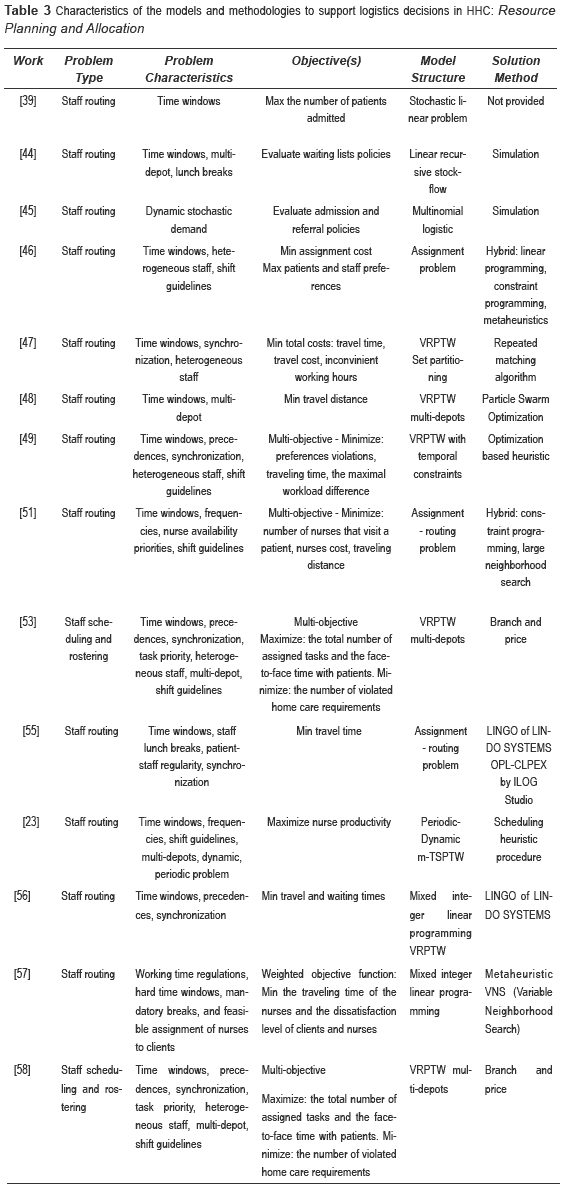
<body><![CDATA[<p>In  order to provide a framework, three different dimensions from which HHC  logistics management can be viewed are presented (see <a href="#Figura1">figure 1</a>). First, the <i>planning horizon</i> is identified according to  the duration and impact of the planning decisions. Second, logistics functions  are differentiated by groups of <i>management decisions</i>. Finally, <i>services  processes</i>  are defined as the set of steps performed when the HHC service is delivered to  a patient.</p>        <p align="center"><a name="Figura1"></a><img src="/img/revistas/rfiua/n68/n68a16i01.gif"></p>        <p>In  HHC logistics management three levels of planning can be distinguished  depending on the time horizon, namely <i>strategic,  tactical</i> and <i>operational</i> &#91;12&#93;. The <i>strategic level</i> considers time horizons of  more than one year and includes the design and allocation of long- lasting resources  over long periods. Decisions at this level include the location and allocation  of HHC central facilities, urban districting, fleet size and selection,  staffing levels, and supplier selection. The <i>tactical level</i> involves medium term  decisions that are usually made for a year. The fleet assignment to urban  districts, shift scheduling and staff allocation, and the definition of  inventory policies are considered as tactical. The <i>operational level</i> is related to short term  decisions that need to be made daily. These decisions include staff assignment  and routing as well as inventory control. A fourth planning level has been  recently recognized as the <i>real-time level</i>, and it refers to decision making situations in which  operations must be undertaken or altered in a short time, according to the  actual execution of the service processes of the system. A detailed definition  of each of the  management decisions and the <i>service processes</i> is provided in &#91;13&#93;.</p>       <p>For  each of the logistics functions, the abovementioned levels define a hierarchy  among management decisions that impose constraints in lower planning levels and  influence the performance of the HHC delivery network. For example, in  transportation management, the size and selection of the fleet used by medical staff  to visit patients is a long-term decision that influences the way the fleet is  then assigned to patients' districts at the medium-term. Equivalently, the  fleet assignment to districts influences staff routing decisions at the short-  term. This hierarchy suggests that models and methods used to support logistics  decisions at the operational level will not have a significant impact on the  system performance, if decisions made at upper levels are not based on proper  methods to design the network and to assign resources.</p>        <p>&nbsp;</p>      <p><font size="3"><b>Literature review</b></font></p>        <p>This  section presents an overview of the existent literature of models and methods  used to support logistics decisions in HHC. For doing so, the classification of  logistics problems is followed according to the planning horizon. Thereby, the  strategic level corresponds to <i>design and planning decisions</i>, the tactical level  corresponds to  resource planning and allocation, and the operational level corresponds to <i>services  scheduling</i>.</p>       <p>This  literature review is not intended to be exhaustive but rather it is directed  towards identifying the key aspects to consider when designing and implementing  a model or a method to support logistics decisions in HHC. The main  contribution of this review is the classification of the logistics problems  according to the proposed framework and the identification of the  characteristics of the models and methods, including the <i>authors</i>, the <i>problem type</i>, the <i>problem characteristics</i>, the <i>objective(s)</i>, the <i>model structure</i>, and the <i>solution methods</i>.</p>        <p><b><i>Design and planning decisions</i></b></p>       <p>In  the context of  <i>Network Design</i>  decisions, few researches study facility location and districting problems in  HHC. As stated by Daskin and Dean &#91;14&#93;, these problems are critical in health  care and their impact goes beyond cost and customer service considerations.  However, despite the large number of publications dedicated to the facility  location problem in health care, no published works that study this problem in  HHC were found. Referring to the districting problem, the majority of the works  that study this decision problem is found in the context of health care &#91;15-20&#93;  but not in home health care.</p>       ]]></body>
<body><![CDATA[<p>The  literature review shows that the first published work that study the  districting problem in HHC is presented in &#91;21&#93;. The authors solved a practical  districting problem in the management of public HHC services for a local  community health clinics center in a province of Canada. They modeled the  situation as a multi-criteria optimization problem which was solved with a Tabu  Search heuristic. Two criteria were considered in the objective function: the  mobility of visiting staff and the workload equilibrium among districts.  Authors reported an improvement of the districting configuration after two  years of implementation of the solution. The improvement was measured in terms  of the standard deviation of the number of annual visits assigned to the set of  districts. Later on, authors in &#91;22&#93; analyzed the territorial approach to  deliver homecare services in the same context. Based on a historical comparison  of patients visits, the authors concluded that the districting problem must be  solved in a more frequent periodicity due to the changes in the patients census  over the time.</p>       <p>The  work presented in &#91;23&#93; studied a home health nurse districting problem through  a set partitioning model, which was solved by a column generation heuristic  that integrated ideas from optimization and local search. In the model,  districts demand, districts cost and districts workload feasibility are  formally defined and included in the mathematical formulation. The solution  procedure included a heuristic to obtain an initial solution that might be  unfeasible. Then, local search was used to attain feasibility and to improve  initial solutions. Based on computational experiments performed with instances  of a real home health care agency, the author reported that the column  generation heuristic is effective when improving initial solutions.</p>       <p>More  recently, the same author &#91;24&#93; described the home health nurse districting  problem as a tactical decision, and identified formulations and solution  methods for this problem. The author presented a survey of the relevant  literature of the problem and found that the works presented in &#91;21, 23&#93; and  &#91;25&#93; are the three studies published that present computational results for the  districting problem in HHC. According to the author, two formulations are  appropriate for the districting problem in HHC, the  <i>location-allocation</i>  and the <i>set  partitioning</i>.  In the first type of formulation the decisions include selecting which district  centers must be opened, and the assignment of each basic unit to one district  center. The second formulation does not require a fixed set of districts center  and a large set of possible combinations of basic units is evaluated.</p>        <p><b><i>Resources planning and allocation</i></b></p>       <p>Related  to tactical level decisions, the resource planning and allocation models  published have focused on the definition of patient admission policies and on  the staff allocation problem. The <i>staff allocation</i> decision refers to the need  to employ temporary staff or to use float staff to handle unexpected large  patient demands or staff shortages, during particular shifts and to assign  individual staff to patients' districts &#91;26&#93;.</p>       <p>Despite  the impact of  <i>Staff Management</i>  and <i>Inventory  Management</i>  at this level, only few works study decisions such as <i>staffing</i>, shift  <i>scheduling</i>  and  <i>inventory policies</i>  for HHC services. On one hand, concern about <i>Staff Management</i>, the <i>staffing</i> decision is usually made between  the strategic and the tactical level, and it involves determining the number of  personnel of the required qualification in order to meet estimated patients  demand &#91;27-29&#93;. This is a complex problem given the factors to consider such as  organizational structure and characteristics, personnel recruitment, skill  classes of the staff, working preferences and patient needs &#91;30&#93;. At the  tactical level, <i>shift scheduling</i> deals with the problem of selecting, from a potentially  large pool of candidates, what shifts are to be worked, together with an  assignment of the number of employees to each shift.</p>       <p>On  the other hand, for <i>Inventory management, inventory policies</i> determine when the inventory  levels of each reference of medicines, supplies and devices (MSD) should be  reviewed, how much to order from the supplier and when to do so &#91;31&#93;.  Investments in inventory are substantial and the control of capital associated  with MSD represent an improvement opportunity for the HHC network, in which  scientific methods can give a significant competitive advantage &#91;32&#93;. To the  best of our knowledge, the work presented in &#91;33&#93; is the first published paper  that tackles the inventory problem in a HCC network. They studied the planning  of operations related to chemotherapy at home, focusing on the anti&shy;cancer drug  supply chain. The problem is solved by an optimization model that seeks to  minimize the production and delivery costs of medicines. The model also  considers production scheduling and nurse routing decisions simultaneously and  it is solved by an exact method.</p>       <p>The  work presented in &#91;34&#93; dealt with the problem of allocating resources to the  home care service provided to AIDS patients in the city of Rome, Italy. The  author developed a linear programming model for solving the problem for single  organizations and for providing assistance to public health authorities, in  order to evaluate the results of tentative budgets assigned to home care. The  model produces an optimal schedule for admitting new patients to the HHC system  for a 12-week period, with the objective to maximize the total number of  patients admitted, subject to constraints on available resources.</p>       <p>In  &#91;35&#93; a waiting list model for residential care for mentally disabled patients  in The Netherlands was developed. The model is a linear stock-flow model and  distributes the mentally disabled patients over different living situations. It  explicitly includes institutional and semi-institutional care, and it  implicitly considers ambulatory and other types of care. Four scenarios were  also simulated with the objective to include the differences in the mortality  rate of mentally disabled patients, the supply and use of ambulatory care, and  the possible effect of uncertainty in the data.</p>       <p>Authors  in &#91;36&#93; studied the client demands and the allocation of home care in The  Netherlands, through a multinomial logit model of client types, care needs and  referrals. The purpose of the model was to facilitate policy decisions by  offering simulations of intended policy measures. The model represents a  section of an overall route followed by the person seeking help from a home  care service. The model was estimated on the basis of more than 7,000 requests  for home care in the northern area of the Netherlands. Results showed that  elderly chronically ill applicants have a greater chance of being referred for  domestic help only, while applicants with psychosocial disorders are more  liable to be offered packages that include social support.</p>       ]]></body>
<body><![CDATA[<p>The  work presented in &#91;25&#93; considered the problem of assigning patients to nurses  for HHC services, in the context of the local community health clinics center  in Montreal, Canada, in order to improve the workload assignment achieved by  the districting configuration defined in &#91;21&#93;. For doing so, they proposed a mixed  integer programming model which was solved with a Tabu Search heuristic and  compared with solutions obtained by CPLEX. The objective function was a  weighted quadratic relation that included three measures of the workload: the  average number of visits, the average number of cases, and the travel load. A  first formulation of the model resulted in a <i>multi-resource  generalized assignment problem</i> (MRGAP), which is known as an NP-hard problem and it could  easily result in unfeasible solutions. The authors then developed a non-linear  model that minimizes the deviations from the ideal average of the three  measures considered. The model was tested in three different instances and  computational experiments demonstrated the effectiveness of the Tabu Search  algorithm. No further detail is provided about the implementation of the model  in the real system in Montreal.</p>        <p><b><i>Services scheduling</i></b></p>       <p>In  the study of  <i>Transportation</i>  and  <i>Staff Management</i>,  the  <i>staff routing</i>  decision is directly related to the vehicle routing problem which consists on  designing optimal delivery routes from a central location to a set of  geographically distributed patients subject to various constraints &#91;37&#93;. In  HHC, this problem is also related to the <i>staff assignment</i> decision which is concerned  with the assignment of visits among a given medical staff. In the staff  scheduling literature, the problem is known as task assignment and it is often  studied when working shifts have already been determined but tasks have not yet  been allocated to individual medical staff &#91;38&#93;.</p>       <p>The  first application of this problem in HHC is due to authors of &#91;39&#93; who studied  a manpower decision problem in order to schedule the available nurses to visit  patients in a defined route. The objective was to develop schedules that  minimize non value-added travel time and that balance workload requirements  among all nurses. They developed a mixed integer programming model for a  five-day weekly scheduling problem. The model was formulated as a single-depot,  single-period multiple travel salesman problem (m-TSP). To solve the problem,  the authors implemented the well-known <i>Clarke and Wright</i> savings-type route&shy;building  heuristics &#91;40&#93; and the sweeping algorithm &#91;41&#93;. To improve the routs, they  used the insertion procedures proposed &#91;42&#93; and the edge-exchange procedures  &#91;43&#93;.</p>       <p>Authors  of &#91;44&#93; worked on the home health care routing and scheduling problem. The  problem was treated as a <i>vehicle routing problem with time windows</i> (VRPTW) and <i>multi-depots</i>. Although the formulation did  not include differentiation among staff skills, feasible matches were defined  in terms of staff and patients. Staff over-time is also included. The objective  was to find an optimal schedule such that each nurse that is scheduled to work  leaves from her home, visit a set of feasible patients within their time  window, takes a lunch break and returns home. To solve it, the authors  developed a two-phase algorithm. In the first phase they implemented a parallel  tour-building procedure and in the second one, attempts are made to improve the  resulting tours.</p>      <p> The  work presented in &#91;45&#93; studied a dynamic stochastic vehicle routing problem in  HHC scheduling in the context of the Senior Care Department of the Sinclair  School of Nursing at the University of Missouri in the US. The author developed  a  <i>cluster-first route-second</i> heuristic, three solution strategies to solve the problem,  and a pure dynamic discrete event simulation model to study the dynamic  scheduling and routing aspects of the problem. The solution method was tested  on a real instance with four staff members and 24 patients.</p>       <p>Authors  of &#91;46&#93; considered the integration of staff rostering and routing decisions in  the context of a project for the development of a software called PARAP. The  development includes a single-depot, single-period configuration with time  windows, heterogeneous skills and shift guidelines. The model was formulated as  an assignment problem, such that the overall assignment cost is minimized and  the patients and staff preferences are maximized. Patients' preferences include  the accomplishment of time windows. Staff preferences include the nurses'  preference for certain patients, the experience for certain jobs, and factors  that guide a fair distribution of difficult jobs. All preferences are modeled  as soft constraints and penalized in the objective function. To solve the  problem, the authors developed a hybrid solution method that uses linear  programming, constraint programming and metaheuristics.</p>       <p>The  work proposed in &#91;47&#93; presented the development of a decision support system  called LAPS CARE for the staff planning in home care. The objective of the  support system is to develop visiting schedules for care providers that  incorporate soft constraints. The system includes time windows, required  skills, staff breaks and working areas. These conditions, as well as customer  preferences, were modeled as soft constraints. The model was based on a VRPTW  scheme with a single depot and a single period. The authors used a set  partitioning approach to solve the model. Authors of &#91;48&#93; dealt with the  scheduling problem of home care workers in the United Kingdom. The problem  consists in determining optimal routes for each care worker in order to minimize  the distance traveled providing that the route durations and service time  window constraints are respected, while having a multi-depot condition. The  authors used a  <i>Particle Swarm Optimization</i> (PSO) technique to solve the problem. PSO is a  population-based searching technique, based on observations of the social  behaviors.</p>       <p>The  work presented in &#91;49&#93; studied the combination of vehicle routing and  scheduling with precedence and synchronization constraints. The problem was  formulated and solved in a home care environment, as a single-depot single-period case, with time windows, shift guidelines and heterogeneous staff  skills. Authors proposed a mixed-integer programming model with the formal  constraints of the VRPTW and temporal and balancing constraints. They  considered four different objective functions: minimize preferences violations,  traveling time, maximal workload difference, and a combination of the second  and third functions. To solve the problem, they introduced an optimization  based heuristic approach &#91;50&#93;. The idea of the approach is to solve  significantly restricted mixed integer programs (MIP) problems to iteratively  improve the best known feasible solution. The solution approach was tested in a  home care staff scheduling application &#91;47&#93;, and proposed for forest  applications.</p>       <p>Later  on, authors of &#91;51&#93; also studied the combination of the vehicle routing problem  and the nurse rostering problem and developed a hybrid approach that uses  constraint programming and the large neighborhood search metaheuristic to solve  the model in a periodic HHC problem. The model is proposed for a week-period  and its objective is to minimize a weighted function composed of the number of  nurses that visit a patient during the schedule, the nurses cost, and the  traveling distance. The solution method was tested on randomly generated data  and on instances of the <i>periodic vehicle routing problem with time windows</i> (PVRPTW) &#91;52&#93;.</p>       ]]></body>
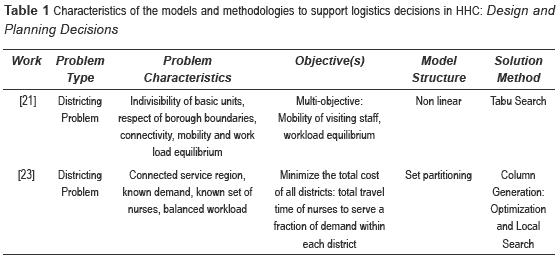
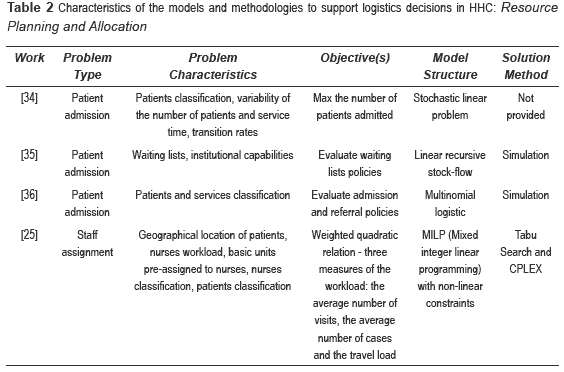
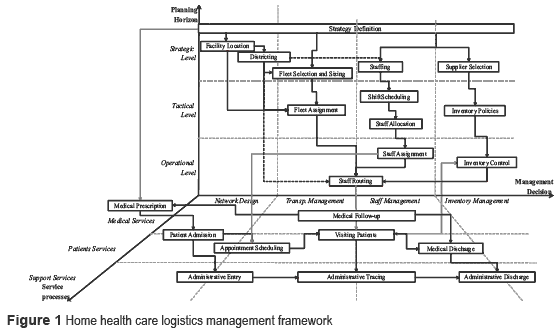
<body><![CDATA[<p>The  work presented in &#91;53&#93; studied the Home Care Crew Scheduling Problem (HCCSP) in  the context of the Danish home care company Zeland Care, where the problem was  tackled as a combination of the VRPTW and the Crew Scheduling Problem with Time  Windows (CSPTW). In their problem, a staff of caretakers had to be assigned to  a number of tasks, such that the total number of assigned tasks is maximized.  In the model formulation, the authors considered a list of competences for each  caretaker, and for each competence a level from zero to five that measures  their expertise level. Caretakers' shift assignments and their location were  also considered. For each patient a list of tasks were considered, and for each  task, its address, duration and time windows, and priority were included in the  model. The objective included three components: maximizing the total number of  assigned tasks, maximizing the face-to-face time with patients, and minimizing  the number of violated home care requirements. To solve the problem, the  authors developed an exact algorithm based on a branch-and-price approach using  column generation. The solution method was tested on four real-life instances  and seven generated instances. According to the authors, in most of the cases,  near-optimal solutions were found, and significant improvements were achieved  when comparing with manual and heuristically built solutions. Results of this  work were recently published by in &#91;54&#93;.</p>       <p>Authors  of &#91;55&#93; described a mixed integer linear programming model to assign each nurse  to a set of patients to be visited within each route. The objective of the  model was to minimize the total travel time and it considered time windows,  staff lunch breaks, patient-staff regularity (to make the same staff member  visits the same patient), and synchronization among staff members. The authors  solved one instance of the model by two solvers: LINGO of LINDO SYSTEMS and  OPL-CLPEX by ILOG Studio. The instance included seven patients, three nurses  and a planning horizon of five days.</p>       <p>In  &#91;23&#93;, quantitative methods for the home health nurse routing and scheduling  problem are developed, considering the decision as a dynamic periodic routing  problem with fixed appointment times. The author considered a set of patients  that must be visited by a home health nurse according to a prescribed weekly  frequency for a prescribed number of weeks. The costs of offering fixed  appointment times are quantified, and a distance-based heuristics is presented  to solve the problem. The author also developed a new rolling horizon  capacity-based heuristic for the problem, which considered interactions between  travel times, service times, and the fixed appointment choices when inserting  appointments of new patients. Based on computational experiments, the new  heuristic developed outperformed the distance-based heuristic on metrics  related to the satisfaction of patient demands.</p>       <p>More  recently authors of &#91;56&#93; developed a collaborative model for planning and  scheduling caregivers' activities in a homecare context in France. In the  model, patients' time windows, precedence and synchronization relations among  visits to patients were considered. The model is based on the VRPTW structure.  The authors evaluated the model with an instance composed by two caregivers and  eight patients. In the same year, authors of &#91;57&#93; worked on the optimization of  daily scheduling for home care services in Austria. In the model, the authors  considered working time regulations, hard time windows, mandatory breaks, and  feasible assignment of nurses to clients. For solving the model, a  metaheuristic solution approach based on a <i>Variable Neighborhood  Search </i> (VNS) was developed. According to the authors, the proposed method finds global  optimal solutions for small problem instances and numerical studies show that  the algorithm is capable of solving real life instances with up to 512 home  visits and 75 nurses.</p>       <p>The  work of &#91;58&#93; presented a mid-term and short-term planning support for HHC  services in Germany. The authors first introduced the HHC problem as a  full-sized weekly model, which task is to create a service plan with nurses and  patients such that the patients are served with the provided nurses. Then, they  developed a second model that takes a current planning process into account and  considers the construction of good master schedules. The master schedule  problem (MSP) addresses the task to create optimal master schedules for a  current patient pool in a given week, and to generate a schedule with a minimum  number of tours, such that all patients visits are performed. Third, the  authors studied an operational planning problem (OPP) that considers the  requirements to incorporate last minute changes into an existing plan resulting  from a solution to the HHC problem or an assignment of nurses to a master  schedule. To solve each of the problems, the authors used different  metaheuristics such as <i>adaptive large neighborhood search</i> (ALNS) and Tabu Search,  combined with constraint programming. The capabilities of the solution  approaches were evaluated with two real-world data sets, and results were  reported for the HHC problem and the master schedule problem, showing an  improvement on the solutions.</p>      <p>Bennett  &#91;24&#93; identified four common formulations to deal with the home health nurse  routing and scheduling problem: m-TSPTW, MD-VRPTW, PMD-VRPTW, CPMD-VRPTW.  According to the author, the <i>multiple travel salesman problem with time windows</i> (m-TSPTW) formulation is  useful when the assignment of patient visits to nurses and days are treated as  exogenous decisions. The <i>multi-depot vehicle routing problem with time windows</i> (MD-VRPTW) formulation can be  used when it is required to include nurse assignment decisions and additional  side constraints that match patient requirements and preferences with nurse  characteristics. The third formulation (<i>periodic  multi-depot vehicle routing problem with time windows</i> - PMD-VRPTW) is useful when  decisions to include the assignment of patient visits to days must be  considered. Finally, the <i>consistency periodic multi-depot vehicle routing problem  with time windows</i>  (CPMD-VRPTW) formulation is presented by the author for the cases where nurse  consistency, defined as the continuity of care, is a desired objective of the  problem.</p>      <p><font size="3"><b>Critical review and lack of features</b> </font></p>        <p><a href="#Tabla1">Tables 1</a> to <a href="#Tabla3">3</a> summarize the main models found in the literature at the three planning  horizons respectively. By observing these tables it can be concluded that the  majority of the models to support logistics decisions in HHC have been  developed at the <i>operational</i> level and for <i>staff routing</i> and scheduling problems.  Moreover, the literature review reveals that all works are based on developed  countries. Two implications derive from these findings. On one hand, the  research gap in HHC services between developed and developing countries contrasts  with the financial investment levels on public or national health systems. The  majority of the countries where research works for HHC services have been  undertaken are countries with a solid National Health System, where the  government is responsible for the largest part of the health expenses. On the  contrary, no evidence was found of a scientific publication nor a practical  implementation, with the use of models and methods to support this kind of  decisions in HHC in developing countries.</p>      <p align="center"><a name="Tabla1"></a><img src="/img/revistas/rfiua/n68/n68a16t01.gif" ></p>      <p align="center"><a name="Tabla2"></a><img src="/img/revistas/rfiua/n68/n68a16t02.gif" ></p>      ]]></body>
<body><![CDATA[<p align="center"><a name="Tabla3"></a><img src="/img/revistas/rfiua/n68/n68a16t03.gif" ></p>      <p>These  results evidence the lack of attention that the scientific community has had  over these important decisions in developing countries.</p>        <p>Controversially,  these countries are the ones facing the most severe health care crisis, and the  ones where private companies are responsible for providing the larger part of  health care services. These companies are facing more and more complex  challenges to support logistics decisions in HHC services. Moreover, many of  them face the risk of losing financial feasibility, due to the increasing  demand and the incremental costs for providing the service. There is therefore  a strong need to develop models and methods to support logistics decisions in  those contexts. </p>      <p>On  the other hand, the fact that most of the research has been focused on  operational decisions, could derive in a low impact of the use of models and  methods over the HHC systems performance. For each of the logistics functions,  there is a hierarchy among management decisions that impose constraints in  lower planning levels and influence the performance of the HHC delivery  network. This hierarchy suggests that models and methods used to support  logistics decisions at the operational level will not have a significant impact  on the system performance, if decisions made at upper levels are not based on  proper methodologies to design the network and to assign resources.</p>       <p>The  above considerations allow us to claim that there exist several research  opportunities to improve models and methods to support logistics decisions in  HHC at the  <i>strategic</i>  and  <i>tactical</i>  levels. Real features can be considered to develop more comprehensive models to  support in  <i>districting, transportation, staff</i> and <i>inventory</i> management decisions. Specific research opportunities are  the following:</p>       <p>&bull;  consideration of the increase in the diversification of HHC service references,  and its impact on the workload measurement in<em> districting</em> and<em> staffing</em> problems;</p>       <p>&bull; the inclusion of the limited access to specific areas in  urban settings in the <i>districting</i> problem;</p>       <p>&bull; modeling of the <i>staffing</i> problems in HHC environments,  that explicitly considers the work legal regulation for medical staff in the  respective context;</p>      <p> &bull; the development of models to support <i>fleet selection and sizing </i> and <i>supplier selection</i>;</p>       <p>&bull; inclusion of insurance coverage and <i>districting</i> configurations on patient  admission;</p>       ]]></body>
<body><![CDATA[<p>&bull; modeling of work legal regulations in models to support <i>shift scheduling</i> decisions in HHC;</p>       <p>&bull; development of models to support <i>inventory  policies</i>  for medicines, supplies and devices along the HHC delivery network;</p>       <p>The  evolution of models and methods reported in the literature, shows that the  integral study of different logistics decisions in different planning horizons  is an important research opportunity in HHC management. Nickel et al.&#91;58&#93;  demonstrated how tactical and operational decisions can be integrated to build  weekly staff service plans, to schedule staff and to program patient visits.  The integration of decisions of different logistics functions, such as <i>districting</i> and <i>staffing</i>, and the impact of their  result on tactical decisions, it is also a research opportunity that can  provide a better support to improve the performance of HHC delivery systems.</p>        <p>&nbsp;</p>     <p><font size="3"><b>Conclusions and research perspectives</b> </font></p>     <p>This  paper provides a critical review of models and methods used to support  decisions logistics in HHC. A three-dimension framework was presented to  characterize HHC logistics management problems. The first dimension deals with  the duration and impact of the planning decisions through three <i>planning horizons</i>:  <i>strategic, tactical</i>  and  <i>operational</i>.  The second dimension differentiates the logistics functions by groups of four <i>management  decisions:  network  design, transportation management, staff management</i> and <i>inventory  management</i>. The  third dimension describes the <i>services processes</i>, defined as the set of steps  performed when the HHC service is delivered to a patient: <i>medical services,  patient services</i>  and  <i>support services</i>.  For each dimension a sampling of the available literature of models and methods  used to support logistics decisions is provided.</p>       <p>Three  perspectives of future research emerge from our review. First, due to the  limited nature of resources and the restrictive budgets for health care,  especially in developing countries, most of the critical management problems  faced by HHC providers are not related to short-term or real-time scheduling  decisions. Instead, the location and allocation of long-lasting resources at  strategic and tactical levels are key decisions that determine the performance  of the health delivery system in a large proportion. As life expectancy  continues to increase, demands for health care will grow in quantity and  diversification, and HHC providers will continue to face the challenge to  design and operate more efficient health care delivery systems. These  management problems do not rely only on short-term decisions to schedule  medical staff visits to patients. Therefore, more research attention should be  placed on models and methods to support decisions of resources location and allocation.</p>       <p>Second,  few researches have focused on the inclusion of real features in the modeling  process of HHC logistics management problems. The major interest observed in  the literature consists of designing efficient solution methods to short-time  decision problems. However, key real features as the diversification of  patients' pathologies and HHC service references, as well as work legal  regulations for medical staff have received little attention in the research  literature. The inclusion of these features in districting problems and staff  management problems such as staffing and shift scheduling can provide  significant improvements in HHC systems.</p>     <p>Finally, more research  attention should be placed on the study of the hierarchical integral structure  of logistics management decisions in HHC. For example, at the staff management  dimension, the staffing decisions and their allocation to districts are  long-term decisions that are influenced by the distribution of patients'  demands. Nevertheless, these demands are dynamic over time and thus new hiring  decisions and staff configurations for districts might be required in the  medium- term. This suggests that an integrated analysis of logistics decisions  among different decision levels can provide a better support, if the impact of  long-term and medium-term decisions is integrally evaluated.</p>      <p>&nbsp;</p>       ]]></body>
<body><![CDATA[<p><font size="3"><b>References</b> </font></p>      <!-- ref --><p>1. M. Cotta,  M. Morales, A. Gonz&aacute;lez, J. Cotta, E. Real, A. D&iacute;as, D. Ric&oacute;s. ''La  hospitalizaci&oacute;n domiciliaria: antecedentes, situaci&oacute;n actual y  perspectivas.'' <i>American Journal of Public Health</i>. Vol. 10. 2001. pp. 45-55.    &nbsp;&nbsp;&nbsp;&nbsp;&nbsp;&nbsp;&nbsp;&nbsp;[&#160;<a href="javascript:void(0);" onclick="javascript: window.open('/scielo.php?script=sci_nlinks&ref=000094&pid=S0120-6230201300030001600001&lng=','','width=640,height=500,resizable=yes,scrollbars=1,menubar=yes,');">Links</a>&#160;]<!-- end-ref --></p>       <!-- ref --><p>2. World Bank. <i>Life expectancy  learning module, World  Bank Development Education Program</i>. 2011. Available: <a href="http://www.worldbank.org/depweb/english/modules/social/life/"target="_blank">http://www.worldbank.org/depweb/english/modules/social/life/</a>. Accessed: August. 2013.    &nbsp;&nbsp;&nbsp;&nbsp;&nbsp;&nbsp;&nbsp;&nbsp;[&#160;<a href="javascript:void(0);" onclick="javascript: window.open('/scielo.php?script=sci_nlinks&ref=000096&pid=S0120-6230201300030001600002&lng=','','width=640,height=500,resizable=yes,scrollbars=1,menubar=yes,');">Links</a>&#160;]<!-- end-ref --></p>       <!-- ref --><p>3. M.  Brandeau, F. Sainfort, W. Pierskalla. ''Health care delivery:  current problems and future challenges.'' <i>Handbook of OR/MS  in Health Care: A Handbook of Methods and Applications</i>. W. P. Brandeau, M.L.  Sainfort, F. and Pierskalla (editors). Ed. Kluwer Academic Publishers. New  York, USA. 1st ed. 2005. pp. 1-14.    &nbsp;&nbsp;&nbsp;&nbsp;&nbsp;&nbsp;&nbsp;&nbsp;[&#160;<a href="javascript:void(0);" onclick="javascript: window.open('/scielo.php?script=sci_nlinks&ref=000098&pid=S0120-6230201300030001600003&lng=','','width=640,height=500,resizable=yes,scrollbars=1,menubar=yes,');">Links</a>&#160;]<!-- end-ref --></p>       <!-- ref --><p>4. V. Borsani,  A. Matta, G. Beschi, F. Sommaruga. <i>A Home Care  Scheduling Model For Human Resources</i>. 2006 International Conference  on Service Systems and Service Management. Troyes, France. 2006. pp. 449-454.    &nbsp;&nbsp;&nbsp;&nbsp;&nbsp;&nbsp;&nbsp;&nbsp;[&#160;<a href="javascript:void(0);" onclick="javascript: window.open('/scielo.php?script=sci_nlinks&ref=000100&pid=S0120-6230201300030001600004&lng=','','width=640,height=500,resizable=yes,scrollbars=1,menubar=yes,');">Links</a>&#160;]<!-- end-ref --></p>       <!-- ref --><p>5. WHO World Health  Organization Study Group. <i> Home- based long term care</i>. WHO Technical Report Series.  898. Geneva, Switzerland. 2000. pp. 1-41.    &nbsp;&nbsp;&nbsp;&nbsp;&nbsp;&nbsp;&nbsp;&nbsp;[&#160;<a href="javascript:void(0);" onclick="javascript: window.open('/scielo.php?script=sci_nlinks&ref=000102&pid=S0120-6230201300030001600005&lng=','','width=640,height=500,resizable=yes,scrollbars=1,menubar=yes,');">Links</a>&#160;]<!-- end-ref --></p>       <!-- ref --><p>6. M. Ahlner,  M. Jordhzy, K. Bjordal, M. Jannert, S. Kaasa. ''Characteristics and  quality of life of patients who choose home care at the end of life.'' <i>Journal of Pain  and Symptom Management</i>. Vol. 36. 2008. pp. 217-227.    &nbsp;&nbsp;&nbsp;&nbsp;&nbsp;&nbsp;&nbsp;&nbsp;[&#160;<a href="javascript:void(0);" onclick="javascript: window.open('/scielo.php?script=sci_nlinks&ref=000104&pid=S0120-6230201300030001600006&lng=','','width=640,height=500,resizable=yes,scrollbars=1,menubar=yes,');">Links</a>&#160;]<!-- end-ref --></p>       <!-- ref --><p>7. Barnes Reports. <i>Home Health Care  Services Industry</i>. Ed.  C. Barnes &amp; Co. 2011. USA, 2011, pp. 1-242.    &nbsp;&nbsp;&nbsp;&nbsp;&nbsp;&nbsp;&nbsp;&nbsp;[&#160;<a href="javascript:void(0);" onclick="javascript: window.open('/scielo.php?script=sci_nlinks&ref=000106&pid=S0120-6230201300030001600007&lng=','','width=640,height=500,resizable=yes,scrollbars=1,menubar=yes,');">Links</a>&#160;]<!-- end-ref --></p>       <!-- ref --><p>8. N. Bricon, F. Anceaux, N.  Bennani, E. Dufresne, L. Watbled. ''A distributed coordination platform for  home care: analysis, framework and prototype.,'' <i>International  Journal of Medical Informatics</i>. Vol. 74. 2005. pp. 809-S25.    &nbsp;&nbsp;&nbsp;&nbsp;&nbsp;&nbsp;&nbsp;&nbsp;[&#160;<a href="javascript:void(0);" onclick="javascript: window.open('/scielo.php?script=sci_nlinks&ref=000108&pid=S0120-6230201300030001600008&lng=','','width=640,height=500,resizable=yes,scrollbars=1,menubar=yes,');">Links</a>&#160;]<!-- end-ref --></p>       <!-- ref --><p>9. S. Brailsford, J. Vissers.  ''OR in healthcare: A European perspective.'' <i>European Journal  of Operational Research</i>. Vol. 212. 2011. pp. 223-234.    &nbsp;&nbsp;&nbsp;&nbsp;&nbsp;&nbsp;&nbsp;&nbsp;[&#160;<a href="javascript:void(0);" onclick="javascript: window.open('/scielo.php?script=sci_nlinks&ref=000110&pid=S0120-6230201300030001600009&lng=','','width=640,height=500,resizable=yes,scrollbars=1,menubar=yes,');">Links</a>&#160;]<!-- end-ref --></p>       <!-- ref --><p>10. K.  Doerner, A. Focke, W. Gutjahr. ''Multicriteria tour planning for mobile healthcare  facilities in a developing country.'' <i>European Journal  of Operational Research</i>. Vol. 179. 2007. pp. 1078-1096.    &nbsp;&nbsp;&nbsp;&nbsp;&nbsp;&nbsp;&nbsp;&nbsp;[&#160;<a href="javascript:void(0);" onclick="javascript: window.open('/scielo.php?script=sci_nlinks&ref=000112&pid=S0120-6230201300030001600010&lng=','','width=640,height=500,resizable=yes,scrollbars=1,menubar=yes,');">Links</a>&#160;]<!-- end-ref --></p>       <!-- ref --><p>11. S. Flessa. ''Where  efficiency saves lives: a linear programme for the optimal allocation of health  care resources in developing countries.'' <i>Health Care  Management Science</i>.  Vol. 3. 2000. pp. 249-267.    &nbsp;&nbsp;&nbsp;&nbsp;&nbsp;&nbsp;&nbsp;&nbsp;[&#160;<a href="javascript:void(0);" onclick="javascript: window.open('/scielo.php?script=sci_nlinks&ref=000114&pid=S0120-6230201300030001600011&lng=','','width=640,height=500,resizable=yes,scrollbars=1,menubar=yes,');">Links</a>&#160;]<!-- end-ref --></p>       <!-- ref --><p>12. R. Ballou. <i>Business logistics/supply  chain management: planning, organizing, and controlling the supply chain</i>. Pearson  International ed. Ed. Pearson Prentice Hall. New York, USA. 2004. pp. 23-25.    &nbsp;&nbsp;&nbsp;&nbsp;&nbsp;&nbsp;&nbsp;&nbsp;[&#160;<a href="javascript:void(0);" onclick="javascript: window.open('/scielo.php?script=sci_nlinks&ref=000116&pid=S0120-6230201300030001600012&lng=','','width=640,height=500,resizable=yes,scrollbars=1,menubar=yes,');">Links</a>&#160;]<!-- end-ref --></p>       <!-- ref --><p>13. E. Guti&eacute;rrez, C. Vidal. <i>Home Health Care  Logistics Management Problems : Framework and Research Perspectives</i>. 3<sup>rd</sup> International  conference on Industrial Engineering and Operations Management. Istanbul,  Turkey. 2012. pp. 1-9.    &nbsp;&nbsp;&nbsp;&nbsp;&nbsp;&nbsp;&nbsp;&nbsp;[&#160;<a href="javascript:void(0);" onclick="javascript: window.open('/scielo.php?script=sci_nlinks&ref=000118&pid=S0120-6230201300030001600013&lng=','','width=640,height=500,resizable=yes,scrollbars=1,menubar=yes,');">Links</a>&#160;]<!-- end-ref --></p>       <!-- ref --><p>14. M. Daskin, L. Dean.  ''Location of Health Care Facilities.'' <i>Handbook of OR/MS  in Health Care: A Handbook of Methods and Applications</i>. W. Brandeau, M. Sainfort, F.  Pierskalla. (editors). 1<sup>st</sup> ed. Ed. Kluwer Academic Publishers. New  York, USA. 2005. pp. 43-75.    &nbsp;&nbsp;&nbsp;&nbsp;&nbsp;&nbsp;&nbsp;&nbsp;[&#160;<a href="javascript:void(0);" onclick="javascript: window.open('/scielo.php?script=sci_nlinks&ref=000120&pid=S0120-6230201300030001600014&lng=','','width=640,height=500,resizable=yes,scrollbars=1,menubar=yes,');">Links</a>&#160;]<!-- end-ref --></p>       <!-- ref --><p>15. F.  Pezzella, R. Bonanno, B. Nicoletti. ''A system approach to the optimal health-care  districting.'' <i>European Journal of Operational Research</i>. Vol. 8. 1981. pp. 139-146.    &nbsp;&nbsp;&nbsp;&nbsp;&nbsp;&nbsp;&nbsp;&nbsp;[&#160;<a href="javascript:void(0);" onclick="javascript: window.open('/scielo.php?script=sci_nlinks&ref=000122&pid=S0120-6230201300030001600015&lng=','','width=640,height=500,resizable=yes,scrollbars=1,menubar=yes,');">Links</a>&#160;]<!-- end-ref --></p>       <!-- ref --><p>16. N. Bullen, G. Moon, K.  Jones, ''Defining localities for health planning: a GIS approach.'' <i>Social Science &amp;  Medicine</i>.  Vol. 42. 1996. pp. 801-816.    &nbsp;&nbsp;&nbsp;&nbsp;&nbsp;&nbsp;&nbsp;&nbsp;[&#160;<a href="javascript:void(0);" onclick="javascript: window.open('/scielo.php?script=sci_nlinks&ref=000124&pid=S0120-6230201300030001600016&lng=','','width=640,height=500,resizable=yes,scrollbars=1,menubar=yes,');">Links</a>&#160;]<!-- end-ref --></p>       <!-- ref --><p>17. S.  Lapierre, J. Myrick, G. Russell. ''The public health care planning problem: a case study  using geographic information systems.'' <i>Journal of  Medical Systems</i>. Vol.  23. 1999. pp. 401-417.    &nbsp;&nbsp;&nbsp;&nbsp;&nbsp;&nbsp;&nbsp;&nbsp;[&#160;<a href="javascript:void(0);" onclick="javascript: window.open('/scielo.php?script=sci_nlinks&ref=000126&pid=S0120-6230201300030001600017&lng=','','width=640,height=500,resizable=yes,scrollbars=1,menubar=yes,');">Links</a>&#160;]<!-- end-ref --></p>       <!-- ref --><p>18. N. Shortt, A. Moore, M.  Coombes, C. Wymer. ''Defining regions for locality health care planning: a  multidimensional approach.'' Social Science &amp; <i> Medicine</i>.  Vol. 60. 2005. pp. 2715-2727.    &nbsp;&nbsp;&nbsp;&nbsp;&nbsp;&nbsp;&nbsp;&nbsp;[&#160;<a href="javascript:void(0);" onclick="javascript: window.open('/scielo.php?script=sci_nlinks&ref=000128&pid=S0120-6230201300030001600018&lng=','','width=640,height=500,resizable=yes,scrollbars=1,menubar=yes,');">Links</a>&#160;]<!-- end-ref --></p>       <!-- ref --><p>19. A. Iannoni, R. Morabito,  C. Saydam. ''An optimization approach for ambulance location and the  districting of the response segments on highways.'' <i>European Journal  of Operational Research</i>. Vol. 195. 2009. pp. 528-542.    &nbsp;&nbsp;&nbsp;&nbsp;&nbsp;&nbsp;&nbsp;&nbsp;[&#160;<a href="javascript:void(0);" onclick="javascript: window.open('/scielo.php?script=sci_nlinks&ref=000130&pid=S0120-6230201300030001600019&lng=','','width=640,height=500,resizable=yes,scrollbars=1,menubar=yes,');">Links</a>&#160;]<!-- end-ref --></p>       <!-- ref --><p>20. D. Bandara, M. Mayorga. <i>Optimal  Geographical Districting of Emergency Vehicles</i>. Proceedings of the 2011  Industrial Engineering Research Conference. Reno, NV, USA. 2011. pp. 8-13.    &nbsp;&nbsp;&nbsp;&nbsp;&nbsp;&nbsp;&nbsp;&nbsp;[&#160;<a href="javascript:void(0);" onclick="javascript: window.open('/scielo.php?script=sci_nlinks&ref=000132&pid=S0120-6230201300030001600020&lng=','','width=640,height=500,resizable=yes,scrollbars=1,menubar=yes,');">Links</a>&#160;]<!-- end-ref --></p>       <!-- ref --><p>21. M. Blais, S.  Lapierre, G. Laporte. ''Solving a home- care districting problem in an urban  setting.'' <i>Journal of the Operational Research Society</i>. Vol. 54. 2003. pp. 1141-1147.    &nbsp;&nbsp;&nbsp;&nbsp;&nbsp;&nbsp;&nbsp;&nbsp;[&#160;<a href="javascript:void(0);" onclick="javascript: window.open('/scielo.php?script=sci_nlinks&ref=000134&pid=S0120-6230201300030001600021&lng=','','width=640,height=500,resizable=yes,scrollbars=1,menubar=yes,');">Links</a>&#160;]<!-- end-ref --></p>       <!-- ref --><p>22. N.  Lahrichi, S. Lapierre, A. Hertz, A. Talib, L. Bouvier. ''Analysis of a  Territorial Approach to the Delivery of Nursing Home Care Services Based on  Historical Data.'' <i>Journal of Medical Systems</i>. Vol. 30. 2006. pp. 283-291.    &nbsp;&nbsp;&nbsp;&nbsp;&nbsp;&nbsp;&nbsp;&nbsp;[&#160;<a href="javascript:void(0);" onclick="javascript: window.open('/scielo.php?script=sci_nlinks&ref=000136&pid=S0120-6230201300030001600022&lng=','','width=640,height=500,resizable=yes,scrollbars=1,menubar=yes,');">Links</a>&#160;]<!-- end-ref --></p>       <!-- ref --><p>23. A. Bennett. <i>Home Health Care  Logistics Planning Georgia Institute of Technology</i>. Doctoral Dissertation, H.  Milton Stewart School of Industrial and Systems Engineering, Georgia Institute  of Technology. 2010. pp. 1-145.    &nbsp;&nbsp;&nbsp;&nbsp;&nbsp;&nbsp;&nbsp;&nbsp;[&#160;<a href="javascript:void(0);" onclick="javascript: window.open('/scielo.php?script=sci_nlinks&ref=000138&pid=S0120-6230201300030001600023&lng=','','width=640,height=500,resizable=yes,scrollbars=1,menubar=yes,');">Links</a>&#160;]<!-- end-ref --></p>       <!-- ref --><p>24. A. Bennett.  ''Operations Research Applications in Home Healthcare.'' <i>Handbook of  Healthcare System Scheduling, Internatio</i>. Ed. Springer. Boston. USA.  2012. pp. 281-302.    &nbsp;&nbsp;&nbsp;&nbsp;&nbsp;&nbsp;&nbsp;&nbsp;[&#160;<a href="javascript:void(0);" onclick="javascript: window.open('/scielo.php?script=sci_nlinks&ref=000140&pid=S0120-6230201300030001600024&lng=','','width=640,height=500,resizable=yes,scrollbars=1,menubar=yes,');">Links</a>&#160;]<!-- end-ref --></p>       <!-- ref --><p>25. A. Hertz, N. Lahrichi.  ''A patient assignment algorithm for home care services.'' <i>Journal of the  Operational Research Society</i>. Vol. 60. 2009. pp. 481-495.    &nbsp;&nbsp;&nbsp;&nbsp;&nbsp;&nbsp;&nbsp;&nbsp;[&#160;<a href="javascript:void(0);" onclick="javascript: window.open('/scielo.php?script=sci_nlinks&ref=000142&pid=S0120-6230201300030001600025&lng=','','width=640,height=500,resizable=yes,scrollbars=1,menubar=yes,');">Links</a>&#160;]<!-- end-ref --></p>       <!-- ref --><p>26. J. Turner, S. Mehrotra, M.  Daskin. ''Perspectives on Health-Care Resource Management Problems.'' <i>A Long View of  Research and Practice in Operations Research and Management Science: The Past  and the Future</i>.  M. Sodhi, C. Tang, Eds. Ed. MA: Springer. Boston. USA. 2010. pp. 231-247.    &nbsp;&nbsp;&nbsp;&nbsp;&nbsp;&nbsp;&nbsp;&nbsp;[&#160;<a href="javascript:void(0);" onclick="javascript: window.open('/scielo.php?script=sci_nlinks&ref=000144&pid=S0120-6230201300030001600026&lng=','','width=640,height=500,resizable=yes,scrollbars=1,menubar=yes,');">Links</a>&#160;]<!-- end-ref --> </p>       <!-- ref --><p>27. K. Schneider, D.  Kilpatrick. ''An Optimum Manpower Utilization Model for Health Maintenance  Organizations.'' <i>Operations Research</i>. Vol. 23. 1975. pp. 869.    &nbsp;&nbsp;&nbsp;&nbsp;&nbsp;&nbsp;&nbsp;&nbsp;[&#160;<a href="javascript:void(0);" onclick="javascript: window.open('/scielo.php?script=sci_nlinks&ref=000146&pid=S0120-6230201300030001600027&lng=','','width=640,height=500,resizable=yes,scrollbars=1,menubar=yes,');">Links</a>&#160;]<!-- end-ref --></p>       <!-- ref --><p>28. V. Smith, S. Schweikhart,  D. Smith. ''Capacity Management in Health Care Services: Review and Future  Research Directions.'' <i>Decision Scienes</i>. Vol. 19. 1988. pp. 889-919.    &nbsp;&nbsp;&nbsp;&nbsp;&nbsp;&nbsp;&nbsp;&nbsp;[&#160;<a href="javascript:void(0);" onclick="javascript: window.open('/scielo.php?script=sci_nlinks&ref=000148&pid=S0120-6230201300030001600028&lng=','','width=640,height=500,resizable=yes,scrollbars=1,menubar=yes,');">Links</a>&#160;]<!-- end-ref --></p>       <!-- ref --><p>29. G. de Vries, ''Nursing  workload measurement as management information.'' <i>European Journal  of Operational Research</i>. Vol. 28. 1987. pp. 199-208.    &nbsp;&nbsp;&nbsp;&nbsp;&nbsp;&nbsp;&nbsp;&nbsp;[&#160;<a href="javascript:void(0);" onclick="javascript: window.open('/scielo.php?script=sci_nlinks&ref=000150&pid=S0120-6230201300030001600029&lng=','','width=640,height=500,resizable=yes,scrollbars=1,menubar=yes,');">Links</a>&#160;]<!-- end-ref --></p>       <!-- ref --><p>30. P. Burke,  E. DeCausmaecker, G. Berghe. ''Novel Meta- heuristic Approaches to Nurse Rostering  Problems in Belgian Hospitals.'' <i>Handbook of  Scheduling: Algorithms, Models, and Performance Analysis</i>. Chapman &amp; Hall/CRC  Computer &amp; Information Science Series. USA. 2004. pp. 44-1-44-18.    &nbsp;&nbsp;&nbsp;&nbsp;&nbsp;&nbsp;&nbsp;&nbsp;[&#160;<a href="javascript:void(0);" onclick="javascript: window.open('/scielo.php?script=sci_nlinks&ref=000152&pid=S0120-6230201300030001600030&lng=','','width=640,height=500,resizable=yes,scrollbars=1,menubar=yes,');">Links</a>&#160;]<!-- end-ref --></p>       <!-- ref --><p>31. V. Guti&eacute;rrez, C. Vidal.  ''Inventory Management Models in Supply Chains : A Literature Review.'' <i>Rev. Fac. Ing.  Univ. Antioquia</i>.  Vol. 43. 2008. pp. 134-149.    &nbsp;&nbsp;&nbsp;&nbsp;&nbsp;&nbsp;&nbsp;&nbsp;[&#160;<a href="javascript:void(0);" onclick="javascript: window.open('/scielo.php?script=sci_nlinks&ref=000154&pid=S0120-6230201300030001600031&lng=','','width=640,height=500,resizable=yes,scrollbars=1,menubar=yes,');">Links</a>&#160;]<!-- end-ref --></p>       <!-- ref --><p>32. S. Axs&auml;ter.  ''Inventory Control. 2nd ed''. New York: International  Series in Operations Research &amp; <i>Management Science</i>. Vol. 90. 2006. pp.  336.    &nbsp;&nbsp;&nbsp;&nbsp;&nbsp;&nbsp;&nbsp;&nbsp;[&#160;<a href="javascript:void(0);" onclick="javascript: window.open('/scielo.php?script=sci_nlinks&ref=000156&pid=S0120-6230201300030001600032&lng=','','width=640,height=500,resizable=yes,scrollbars=1,menubar=yes,');">Links</a>&#160;]<!-- end-ref --></p>       <!-- ref --><p>33. S. Chahed, E. Marcon, E.  Sahin, D. Feillet, Y. Dallery. ''Exploring new operational research  opportunities within the Home Care context: the chemotherapy at home.'' <i>Health Care  Management Science</i>.  Vol. 12. 2009. pp. 179-191.    &nbsp;&nbsp;&nbsp;&nbsp;&nbsp;&nbsp;&nbsp;&nbsp;[&#160;<a href="javascript:void(0);" onclick="javascript: window.open('/scielo.php?script=sci_nlinks&ref=000158&pid=S0120-6230201300030001600033&lng=','','width=640,height=500,resizable=yes,scrollbars=1,menubar=yes,');">Links</a>&#160;]<!-- end-ref --></p>       <!-- ref --><p>34. V. De Angelis.  ''Planning Home Assistance for AIDS Patients in the City of Rome,  Italy.''  <i>Interfaces</i>.  Vol. 28. 1998. pp. 75-83.    &nbsp;&nbsp;&nbsp;&nbsp;&nbsp;&nbsp;&nbsp;&nbsp;[&#160;<a href="javascript:void(0);" onclick="javascript: window.open('/scielo.php?script=sci_nlinks&ref=000160&pid=S0120-6230201300030001600034&lng=','','width=640,height=500,resizable=yes,scrollbars=1,menubar=yes,');">Links</a>&#160;]<!-- end-ref --></p>       <!-- ref --><p>35. G. Kommer. ''A waiting  list model for residential care for the mentally disabled in The  Netherlands.'' <i>Health Care Management Science</i>. Vol. 5. 2002. pp. 285-290.    &nbsp;&nbsp;&nbsp;&nbsp;&nbsp;&nbsp;&nbsp;&nbsp;[&#160;<a href="javascript:void(0);" onclick="javascript: window.open('/scielo.php?script=sci_nlinks&ref=000162&pid=S0120-6230201300030001600035&lng=','','width=640,height=500,resizable=yes,scrollbars=1,menubar=yes,');">Links</a>&#160;]<!-- end-ref --></p>       <!-- ref --><p>36. C. Van  Campen, I. Woittiez. ''Client demands and the allocation of home care in the  Netherlands. A multinomial logit model of client types, care needs and  referrals.'' <i>Health Policy</i>. Vol. 64. 2003. pp. 229-241.    &nbsp;&nbsp;&nbsp;&nbsp;&nbsp;&nbsp;&nbsp;&nbsp;[&#160;<a href="javascript:void(0);" onclick="javascript: window.open('/scielo.php?script=sci_nlinks&ref=000164&pid=S0120-6230201300030001600036&lng=','','width=640,height=500,resizable=yes,scrollbars=1,menubar=yes,');">Links</a>&#160;]<!-- end-ref --></p>       <!-- ref --><p>37. P. Toth, D. Vigo. <i>The Vehicle  Routing Problem</i>.  Society for Industrial and Applied Mathematics. Philadelphia, USA. 2002. pp. 157-194.    &nbsp;&nbsp;&nbsp;&nbsp;&nbsp;&nbsp;&nbsp;&nbsp;[&#160;<a href="javascript:void(0);" onclick="javascript: window.open('/scielo.php?script=sci_nlinks&ref=000166&pid=S0120-6230201300030001600037&lng=','','width=640,height=500,resizable=yes,scrollbars=1,menubar=yes,');">Links</a>&#160;]<!-- end-ref --></p>       <!-- ref --><p>38. A. Ernst,  H. Jiang, M. Krishnamoorthy, D. Sier. ''Staff scheduling and  rostering: A review of applications, methods and models.'' <i>European Journal  of Operational Research</i>. Vol. 153. 2004. pp. 3-27.    &nbsp;&nbsp;&nbsp;&nbsp;&nbsp;&nbsp;&nbsp;&nbsp;[&#160;<a href="javascript:void(0);" onclick="javascript: window.open('/scielo.php?script=sci_nlinks&ref=000168&pid=S0120-6230201300030001600038&lng=','','width=640,height=500,resizable=yes,scrollbars=1,menubar=yes,');">Links</a>&#160;]<!-- end-ref --></p>       <!-- ref --><p>39. S. Begur, D. Miller, J.  Weaver. ''An Integrated Spatial DSS for Scheduling and Routing  Home-Health-Care Nurses,'' <i>Interfaces</i>. Vol. 27. 1997. pp. 35-48.    &nbsp;&nbsp;&nbsp;&nbsp;&nbsp;&nbsp;&nbsp;&nbsp;[&#160;<a href="javascript:void(0);" onclick="javascript: window.open('/scielo.php?script=sci_nlinks&ref=000170&pid=S0120-6230201300030001600039&lng=','','width=640,height=500,resizable=yes,scrollbars=1,menubar=yes,');">Links</a>&#160;]<!-- end-ref --></p>       <!-- ref --><p>40. G. Clark, J. Wright.  ''Scheduling of vehicles from a central depot to a number of delivery  points.'' <i>Operations Research</i>. Vol. 12. 1964. pp. 568-582.    &nbsp;&nbsp;&nbsp;&nbsp;&nbsp;&nbsp;&nbsp;&nbsp;[&#160;<a href="javascript:void(0);" onclick="javascript: window.open('/scielo.php?script=sci_nlinks&ref=000172&pid=S0120-6230201300030001600040&lng=','','width=640,height=500,resizable=yes,scrollbars=1,menubar=yes,');">Links</a>&#160;]<!-- end-ref --></p>       <!-- ref --><p>41. B. Gillett, L. Miller.  ''A Heuristic Algorithm for the Vehicle-Dispatch Problem.'' <i>Operations  Research</i>. Vol.  22. 1974. pp. 340-349.    &nbsp;&nbsp;&nbsp;&nbsp;&nbsp;&nbsp;&nbsp;&nbsp;[&#160;<a href="javascript:void(0);" onclick="javascript: window.open('/scielo.php?script=sci_nlinks&ref=000174&pid=S0120-6230201300030001600041&lng=','','width=640,height=500,resizable=yes,scrollbars=1,menubar=yes,');">Links</a>&#160;]<!-- end-ref --></p>       <!-- ref --><p>42. D. Rosenkrantz,  R. Sterns, P. Lewis. ''An analysis of several heuristics for the traveling  salesman problem.'' <i>SIAM Journal of Computing</i>. Vol. 6. 1977. pp. 563-581.    &nbsp;&nbsp;&nbsp;&nbsp;&nbsp;&nbsp;&nbsp;&nbsp;[&#160;<a href="javascript:void(0);" onclick="javascript: window.open('/scielo.php?script=sci_nlinks&ref=000176&pid=S0120-6230201300030001600042&lng=','','width=640,height=500,resizable=yes,scrollbars=1,menubar=yes,');">Links</a>&#160;]<!-- end-ref --></p>       <!-- ref --><p>43. S. Lin, B. Kernighan.  ''An efficient heuristic algorithm for the traveling salesman.''<i> Operations  Research</i>.  Vol. 21. 1973. pp. 498-516.    &nbsp;&nbsp;&nbsp;&nbsp;&nbsp;&nbsp;&nbsp;&nbsp;[&#160;<a href="javascript:void(0);" onclick="javascript: window.open('/scielo.php?script=sci_nlinks&ref=000178&pid=S0120-6230201300030001600043&lng=','','width=640,height=500,resizable=yes,scrollbars=1,menubar=yes,');">Links</a>&#160;]<!-- end-ref --></p>       <!-- ref --><p>44. E. Cheng, J. Rich. <i>A Home Health  Care Routing and Scheduling Problem</i>. Doctoral Dissertation, Oakland University. Rochester, MA.  USA. 1998. pp. 1-24.    &nbsp;&nbsp;&nbsp;&nbsp;&nbsp;&nbsp;&nbsp;&nbsp;[&#160;<a href="javascript:void(0);" onclick="javascript: window.open('/scielo.php?script=sci_nlinks&ref=000180&pid=S0120-6230201300030001600044&lng=','','width=640,height=500,resizable=yes,scrollbars=1,menubar=yes,');">Links</a>&#160;]<!-- end-ref --></p>       <!-- ref --><p>45. P. Gurumurthy. <i>Dynamic  Stochastic Vehicle Routing Model in Home Healthcare Scheduling</i>. Master of Science Thesis.  University of Missouri-Columbia, USA. 2004. pp.1-118.    &nbsp;&nbsp;&nbsp;&nbsp;&nbsp;&nbsp;&nbsp;&nbsp;[&#160;<a href="javascript:void(0);" onclick="javascript: window.open('/scielo.php?script=sci_nlinks&ref=000182&pid=S0120-6230201300030001600045&lng=','','width=640,height=500,resizable=yes,scrollbars=1,menubar=yes,');">Links</a>&#160;]<!-- end-ref --></p>       <!-- ref --><p>46. S. Bertels, T. Fahle.  ''A hybrid setup for a hybrid scenario: combining heuristics for the home  health care problem.'' <i>Computers &amp; Operations Research</i>. Vol. 33. 2006. pp. 2866-2890.    &nbsp;&nbsp;&nbsp;&nbsp;&nbsp;&nbsp;&nbsp;&nbsp;[&#160;<a href="javascript:void(0);" onclick="javascript: window.open('/scielo.php?script=sci_nlinks&ref=000184&pid=S0120-6230201300030001600046&lng=','','width=640,height=500,resizable=yes,scrollbars=1,menubar=yes,');">Links</a>&#160;]<!-- end-ref --></p>       <!-- ref --><p>47. P. Eveborn, P. Flisberg,  M. Ronnqvist. ''Laps Care&#8212;an operational system for staff planning of home  care.'' <i>European  Journal of Operational Research</i>. Vol. 171. 2006. pp. 962-976.    &nbsp;&nbsp;&nbsp;&nbsp;&nbsp;&nbsp;&nbsp;&nbsp;[&#160;<a href="javascript:void(0);" onclick="javascript: window.open('/scielo.php?script=sci_nlinks&ref=000186&pid=S0120-6230201300030001600047&lng=','','width=640,height=500,resizable=yes,scrollbars=1,menubar=yes,');">Links</a>&#160;]<!-- end-ref --></p>       <!-- ref --><p>48. C.  Akjiratikarl, P. Yenradee, P. Drake. ''PSO-based algorithm for  home care worker scheduling in the UK.'' Computers &amp; <i>Industrial  Engineering</i>.  Vol. 53. 2007. pp. 559-583.    &nbsp;&nbsp;&nbsp;&nbsp;&nbsp;&nbsp;&nbsp;&nbsp;[&#160;<a href="javascript:void(0);" onclick="javascript: window.open('/scielo.php?script=sci_nlinks&ref=000188&pid=S0120-6230201300030001600048&lng=','','width=640,height=500,resizable=yes,scrollbars=1,menubar=yes,');">Links</a>&#160;]<!-- end-ref --></p>       <!-- ref --><p>49. D. Bredstr&ouml;m, M.  R&ouml;nnqvist. ''Combined vehicle routing and scheduling with temporal  precedence and synchronization constraints.'' <i>European Journal  of Operational Research</i>. Vol. 191. 2008. pp. 19-31.    &nbsp;&nbsp;&nbsp;&nbsp;&nbsp;&nbsp;&nbsp;&nbsp;[&#160;<a href="javascript:void(0);" onclick="javascript: window.open('/scielo.php?script=sci_nlinks&ref=000190&pid=S0120-6230201300030001600049&lng=','','width=640,height=500,resizable=yes,scrollbars=1,menubar=yes,');">Links</a>&#160;]<!-- end-ref --></p>       <!-- ref --><p>50. M.  Fischetti, C. Polo, M. Scantamburlo. ''A local branching  heuristic for mixed-integer programs with 2-level variables, with an  application to a telecommunication network design problem.'' <i>Networks</i>. Vol. 44. 2004. pp. 61-72.    &nbsp;&nbsp;&nbsp;&nbsp;&nbsp;&nbsp;&nbsp;&nbsp;[&#160;<a href="javascript:void(0);" onclick="javascript: window.open('/scielo.php?script=sci_nlinks&ref=000192&pid=S0120-6230201300030001600050&lng=','','width=640,height=500,resizable=yes,scrollbars=1,menubar=yes,');">Links</a>&#160;]<!-- end-ref --></p>       <!-- ref --><p>51. J. Steeg, M. Schr&ouml;der. <i>A Hybrid Approach  to Solve the Periodic Home Health Care Problem</i>. Operations Research  Proceedings 2007 Selected Papers of the Annual International Conference of the  German Operations Research Society (GOR). Saarbr&uuml;cken, Deutschland. 2007. pp. 297-302.    &nbsp;&nbsp;&nbsp;&nbsp;&nbsp;&nbsp;&nbsp;&nbsp;[&#160;<a href="javascript:void(0);" onclick="javascript: window.open('/scielo.php?script=sci_nlinks&ref=000194&pid=S0120-6230201300030001600051&lng=','','width=640,height=500,resizable=yes,scrollbars=1,menubar=yes,');">Links</a>&#160;]<!-- end-ref --></p>       <!-- ref --><p>52. J. Cordeau, M. Gendreau,  G. Laporte. ''A Tabu Search Heuristic for Periodic and Multi-Depot Vehicle  Routing Problems.'' <i>Networks</i>. Vol. 30. 1997. pp. 105-119.    &nbsp;&nbsp;&nbsp;&nbsp;&nbsp;&nbsp;&nbsp;&nbsp;[&#160;<a href="javascript:void(0);" onclick="javascript: window.open('/scielo.php?script=sci_nlinks&ref=000196&pid=S0120-6230201300030001600052&lng=','','width=640,height=500,resizable=yes,scrollbars=1,menubar=yes,');">Links</a>&#160;]<!-- end-ref --></p>       <!-- ref --><p>53. T. Justesen, M. Rasmussen. <i>The Home Care  Crew Scheduling Problem</i>. Master Thesis, Department of Informatics and Mathematical  Modeling, Technical University of Denmark and Department of Computer Science,  University of Copenhagen. Copenhague, Denmark. 2008. pp.1-218.    &nbsp;&nbsp;&nbsp;&nbsp;&nbsp;&nbsp;&nbsp;&nbsp;[&#160;<a href="javascript:void(0);" onclick="javascript: window.open('/scielo.php?script=sci_nlinks&ref=000198&pid=S0120-6230201300030001600053&lng=','','width=640,height=500,resizable=yes,scrollbars=1,menubar=yes,');">Links</a>&#160;]<!-- end-ref --></p>       <!-- ref --><p>54. M.  Rasmussen, T. Justesen, A. Dohn, J. Larsen. ''The Home Care Crew  Scheduling Problem: Preference- based visit clustering and temporal  dependencies.'' <i>European Journal of Operational Research</i>. Vol. 219. 2012. pp. 598-610.    &nbsp;&nbsp;&nbsp;&nbsp;&nbsp;&nbsp;&nbsp;&nbsp;[&#160;<a href="javascript:void(0);" onclick="javascript: window.open('/scielo.php?script=sci_nlinks&ref=000200&pid=S0120-6230201300030001600054&lng=','','width=640,height=500,resizable=yes,scrollbars=1,menubar=yes,');">Links</a>&#160;]<!-- end-ref --></p>       <!-- ref --><p>55. R. Bachouch, M. Fakhfakh,  A. Guinet, S. Hajri. <i>Planification de la tourn&eacute;e des infirmiers dans une  structure de soins &agrave; domicile</i>. Projet R&eacute;gional HRP3 Collaboration. Lyon, France. 2009.  pp.1-6.    &nbsp;&nbsp;&nbsp;&nbsp;&nbsp;&nbsp;&nbsp;&nbsp;[&#160;<a href="javascript:void(0);" onclick="javascript: window.open('/scielo.php?script=sci_nlinks&ref=000202&pid=S0120-6230201300030001600055&lng=','','width=640,height=500,resizable=yes,scrollbars=1,menubar=yes,');">Links</a>&#160;]<!-- end-ref --></p>       <!-- ref --><p>56. R. Rabeh, K. Sa&iuml;d, M. Eric. <i>Collaborative model for planning and scheduling caregivers  activities in homecare</i>. 18<sup>th</sup> IFAC World Congress. Milan, Italy. 2011. pp.  2877-2882.    &nbsp;&nbsp;&nbsp;&nbsp;&nbsp;&nbsp;&nbsp;&nbsp;[&#160;<a href="javascript:void(0);" onclick="javascript: window.open('/scielo.php?script=sci_nlinks&ref=000204&pid=S0120-6230201300030001600056&lng=','','width=640,height=500,resizable=yes,scrollbars=1,menubar=yes,');">Links</a>&#160;]<!-- end-ref --></p>       <!-- ref --><p>57. A. Trautsamwieser, P.  Hirsch. ''Optimization of daily scheduling for home health care  services.'' <i>Journal of Applied Operational Research</i>. Vol. 3. 2011. pp. 124-136.    &nbsp;&nbsp;&nbsp;&nbsp;&nbsp;&nbsp;&nbsp;&nbsp;[&#160;<a href="javascript:void(0);" onclick="javascript: window.open('/scielo.php?script=sci_nlinks&ref=000206&pid=S0120-6230201300030001600057&lng=','','width=640,height=500,resizable=yes,scrollbars=1,menubar=yes,');">Links</a>&#160;]<!-- end-ref --></p>       <!-- ref --><p>58. S. Nickel,  M. Schr&ouml;der, J. Steeg. ''Mid-term and short- term planning support for home  health care services.'' <i>European Journal of Operational Research</i>. Vol. 219. 2012.  pp. 574-587.    &nbsp;&nbsp;&nbsp;&nbsp;&nbsp;&nbsp;&nbsp;&nbsp;[&#160;<a href="javascript:void(0);" onclick="javascript: window.open('/scielo.php?script=sci_nlinks&ref=000208&pid=S0120-6230201300030001600058&lng=','','width=640,height=500,resizable=yes,scrollbars=1,menubar=yes,');">Links</a>&#160;]<!-- end-ref --></p>        <p>&nbsp;</p>     <p>&nbsp;</p>     <p>&nbsp;</p>     ]]></body>
<body><![CDATA[<p>&nbsp;</p>    </font>     ]]></body><back>
<ref-list>
<ref id="B1">
<label>1</label><nlm-citation citation-type="journal">
<person-group person-group-type="author">
<name>
<surname><![CDATA[Cotta]]></surname>
<given-names><![CDATA[M]]></given-names>
</name>
<name>
<surname><![CDATA[Morales]]></surname>
<given-names><![CDATA[M]]></given-names>
</name>
<name>
<surname><![CDATA[González]]></surname>
<given-names><![CDATA[A]]></given-names>
</name>
<name>
<surname><![CDATA[Cotta]]></surname>
<given-names><![CDATA[J]]></given-names>
</name>
<name>
<surname><![CDATA[Real]]></surname>
<given-names><![CDATA[E]]></given-names>
</name>
<name>
<surname><![CDATA[Días]]></surname>
<given-names><![CDATA[A]]></given-names>
</name>
<name>
<surname><![CDATA[Ricós]]></surname>
<given-names><![CDATA[D]]></given-names>
</name>
</person-group>
<article-title xml:lang="es"><![CDATA[La hospitalización domiciliaria: antecedentes, situación actual y perspectivas]]></article-title>
<source><![CDATA[American Journal of Public Health]]></source>
<year>2001</year>
<volume>10</volume>
<page-range>45-55</page-range></nlm-citation>
</ref>
<ref id="B2">
<label>2</label><nlm-citation citation-type="">
<collab>World Bank</collab>
<source><![CDATA[Life expectancy learning module, World Bank Development Education Program]]></source>
<year>2011</year>
</nlm-citation>
</ref>
<ref id="B3">
<label>3</label><nlm-citation citation-type="book">
<person-group person-group-type="author">
<name>
<surname><![CDATA[Brandeau]]></surname>
<given-names><![CDATA[M]]></given-names>
</name>
<name>
<surname><![CDATA[Sainfort]]></surname>
<given-names><![CDATA[F]]></given-names>
</name>
<name>
<surname><![CDATA[Pierskalla]]></surname>
<given-names><![CDATA[W]]></given-names>
</name>
</person-group>
<article-title xml:lang="en"><![CDATA[Health care delivery: current problems and future challenges]]></article-title>
<source><![CDATA[Handbook of OR/MS in Health Care: A Handbook of Methods and Applications]]></source>
<year>2005</year>
<edition>1st</edition>
<page-range>1-14</page-range><publisher-loc><![CDATA[New York ]]></publisher-loc>
<publisher-name><![CDATA[Ed. Kluwer Academic Publishers]]></publisher-name>
</nlm-citation>
</ref>
<ref id="B4">
<label>4</label><nlm-citation citation-type="confpro">
<person-group person-group-type="author">
<name>
<surname><![CDATA[Borsani]]></surname>
<given-names><![CDATA[V]]></given-names>
</name>
<name>
<surname><![CDATA[Matta]]></surname>
<given-names><![CDATA[A]]></given-names>
</name>
<name>
<surname><![CDATA[Beschi]]></surname>
<given-names><![CDATA[G]]></given-names>
</name>
<name>
<surname><![CDATA[Sommaruga]]></surname>
<given-names><![CDATA[F]]></given-names>
</name>
</person-group>
<source><![CDATA[A Home Care Scheduling Model For Human Resources]]></source>
<year></year>
<conf-name><![CDATA[ International Conference on Service Systems and Service Management]]></conf-name>
<conf-date>2006</conf-date><conf-date>2006</conf-date>
<conf-loc>Troyes </conf-loc>
<page-range>449-454</page-range></nlm-citation>
</ref>
<ref id="B5">
<label>5</label><nlm-citation citation-type="">
<collab>WHO World Health Organization Study Group</collab>
<source><![CDATA[Home- based long term care]]></source>
<year>2000</year>
<volume>898</volume>
<page-range>1-41</page-range><publisher-loc><![CDATA[Geneva ]]></publisher-loc>
</nlm-citation>
</ref>
<ref id="B6">
<label>6</label><nlm-citation citation-type="journal">
<person-group person-group-type="author">
<name>
<surname><![CDATA[Ahlner]]></surname>
<given-names><![CDATA[M]]></given-names>
</name>
<name>
<surname><![CDATA[Jordhzy]]></surname>
<given-names><![CDATA[M]]></given-names>
</name>
<name>
<surname><![CDATA[Bjordal]]></surname>
<given-names><![CDATA[K]]></given-names>
</name>
<name>
<surname><![CDATA[Jannert]]></surname>
<given-names><![CDATA[M]]></given-names>
</name>
<name>
<surname><![CDATA[Kaasa]]></surname>
<given-names><![CDATA[S]]></given-names>
</name>
</person-group>
<article-title xml:lang="en"><![CDATA[Characteristics and quality of life of patients who choose home care at the end of life]]></article-title>
<source><![CDATA[Journal of Pain and Symptom Management]]></source>
<year>2008</year>
<volume>36</volume>
<page-range>217-227</page-range></nlm-citation>
</ref>
<ref id="B7">
<label>7</label><nlm-citation citation-type="book">
<collab>Barnes Reports</collab>
<source><![CDATA[Home Health Care Services Industry]]></source>
<year>2011</year>
<page-range>1-242</page-range><publisher-name><![CDATA[Ed. C. Barnes & Co]]></publisher-name>
</nlm-citation>
</ref>
<ref id="B8">
<label>8</label><nlm-citation citation-type="journal">
<person-group person-group-type="author">
<name>
<surname><![CDATA[Bricon]]></surname>
<given-names><![CDATA[N]]></given-names>
</name>
<name>
<surname><![CDATA[Anceaux]]></surname>
<given-names><![CDATA[F]]></given-names>
</name>
<name>
<surname><![CDATA[Bennani]]></surname>
<given-names><![CDATA[N]]></given-names>
</name>
<name>
<surname><![CDATA[Dufresne]]></surname>
<given-names><![CDATA[E]]></given-names>
</name>
<name>
<surname><![CDATA[Watbled]]></surname>
<given-names><![CDATA[L]]></given-names>
</name>
</person-group>
<article-title xml:lang="en"><![CDATA[A distributed coordination platform for home care: analysis, framework and prototype]]></article-title>
<source><![CDATA[International Journal of Medical Informatics]]></source>
<year>2005</year>
<volume>74</volume>
<page-range>809-S25</page-range></nlm-citation>
</ref>
<ref id="B9">
<label>9</label><nlm-citation citation-type="journal">
<person-group person-group-type="author">
<name>
<surname><![CDATA[Brailsford]]></surname>
<given-names><![CDATA[S]]></given-names>
</name>
<name>
<surname><![CDATA[Vissers]]></surname>
<given-names><![CDATA[J]]></given-names>
</name>
</person-group>
<article-title xml:lang="en"><![CDATA[OR in healthcare: A European perspective]]></article-title>
<source><![CDATA[European Journal of Operational Research]]></source>
<year>2011</year>
<volume>212</volume>
<page-range>223-234</page-range></nlm-citation>
</ref>
<ref id="B10">
<label>10</label><nlm-citation citation-type="journal">
<person-group person-group-type="author">
<name>
<surname><![CDATA[Doerner]]></surname>
<given-names><![CDATA[K]]></given-names>
</name>
<name>
<surname><![CDATA[Focke]]></surname>
<given-names><![CDATA[A]]></given-names>
</name>
<name>
<surname><![CDATA[Gutjahr]]></surname>
<given-names><![CDATA[W]]></given-names>
</name>
</person-group>
<article-title xml:lang="en"><![CDATA[Multicriteria tour planning for mobile healthcare facilities in a developing country]]></article-title>
<source><![CDATA[European Journal of Operational Research]]></source>
<year>2007</year>
<volume>179</volume>
<page-range>1078-1096</page-range></nlm-citation>
</ref>
<ref id="B11">
<label>11</label><nlm-citation citation-type="journal">
<person-group person-group-type="author">
<name>
<surname><![CDATA[Flessa]]></surname>
<given-names><![CDATA[S]]></given-names>
</name>
</person-group>
<article-title xml:lang="en"><![CDATA[Where efficiency saves lives: a linear programme for the optimal allocation of health care resources in developing countries]]></article-title>
<source><![CDATA[Health Care Management Science]]></source>
<year>2000</year>
<volume>3</volume>
<page-range>249-267</page-range></nlm-citation>
</ref>
<ref id="B12">
<label>12</label><nlm-citation citation-type="book">
<person-group person-group-type="author">
<name>
<surname><![CDATA[Ballou]]></surname>
<given-names><![CDATA[R]]></given-names>
</name>
</person-group>
<source><![CDATA[Business logistics/supply chain management: planning, organizing, and controlling the supply chain]]></source>
<year>2004</year>
<page-range>23-25</page-range><publisher-loc><![CDATA[New York ]]></publisher-loc>
<publisher-name><![CDATA[Pearson International ed. Ed. Pearson Prentice Hall]]></publisher-name>
</nlm-citation>
</ref>
<ref id="B13">
<label>13</label><nlm-citation citation-type="confpro">
<person-group person-group-type="author">
<name>
<surname><![CDATA[Gutiérrez]]></surname>
<given-names><![CDATA[E]]></given-names>
</name>
<name>
<surname><![CDATA[Vidal]]></surname>
<given-names><![CDATA[C]]></given-names>
</name>
</person-group>
<source><![CDATA[Home Health Care Logistics Management Problems: Framework and Research Perspectives]]></source>
<year></year>
<conf-name><![CDATA[3rd International conference on Industrial Engineering and Operations Management]]></conf-name>
<conf-date>2012</conf-date>
<conf-loc>Istanbul </conf-loc>
<page-range>1-9</page-range></nlm-citation>
</ref>
<ref id="B14">
<label>14</label><nlm-citation citation-type="book">
<person-group person-group-type="author">
<name>
<surname><![CDATA[Daskin]]></surname>
<given-names><![CDATA[M]]></given-names>
</name>
<name>
<surname><![CDATA[Dean]]></surname>
<given-names><![CDATA[L]]></given-names>
</name>
</person-group>
<article-title xml:lang="en"><![CDATA[Location of Health Care Facilities]]></article-title>
<source><![CDATA[Handbook of OR/MS in Health Care: A Handbook of Methods and Applications]]></source>
<year>2005</year>
<edition>1st</edition>
<page-range>43-75</page-range><publisher-loc><![CDATA[New York ]]></publisher-loc>
<publisher-name><![CDATA[Ed. Kluwer Academic Publishers]]></publisher-name>
</nlm-citation>
</ref>
<ref id="B15">
<label>15</label><nlm-citation citation-type="journal">
<person-group person-group-type="author">
<name>
<surname><![CDATA[Pezzella]]></surname>
<given-names><![CDATA[F]]></given-names>
</name>
<name>
<surname><![CDATA[Bonanno]]></surname>
<given-names><![CDATA[R]]></given-names>
</name>
<name>
<surname><![CDATA[Nicoletti]]></surname>
<given-names><![CDATA[B]]></given-names>
</name>
</person-group>
<article-title xml:lang="en"><![CDATA[A system approach to the optimal health-care districting]]></article-title>
<source><![CDATA[European Journal of Operational Research]]></source>
<year>1981</year>
<volume>8</volume>
<page-range>139-146</page-range></nlm-citation>
</ref>
<ref id="B16">
<label>16</label><nlm-citation citation-type="journal">
<person-group person-group-type="author">
<name>
<surname><![CDATA[Bullen]]></surname>
<given-names><![CDATA[N]]></given-names>
</name>
<name>
<surname><![CDATA[Moon]]></surname>
<given-names><![CDATA[G]]></given-names>
</name>
<name>
<surname><![CDATA[Jones]]></surname>
<given-names><![CDATA[K]]></given-names>
</name>
</person-group>
<article-title xml:lang="en"><![CDATA[Defining localities for health planning: a GIS approach]]></article-title>
<source><![CDATA[Social Science & Medicine]]></source>
<year>1996</year>
<volume>42</volume>
<page-range>801-816</page-range></nlm-citation>
</ref>
<ref id="B17">
<label>17</label><nlm-citation citation-type="journal">
<person-group person-group-type="author">
<name>
<surname><![CDATA[Lapierre]]></surname>
<given-names><![CDATA[S]]></given-names>
</name>
<name>
<surname><![CDATA[Myrick]]></surname>
<given-names><![CDATA[J]]></given-names>
</name>
<name>
<surname><![CDATA[Russell]]></surname>
<given-names><![CDATA[G]]></given-names>
</name>
</person-group>
<article-title xml:lang="en"><![CDATA[The public health care planning problem: a case study using geographic information systems]]></article-title>
<source><![CDATA[Journal of Medical Systems]]></source>
<year>1999</year>
<volume>23</volume>
<page-range>401-417</page-range></nlm-citation>
</ref>
<ref id="B18">
<label>18</label><nlm-citation citation-type="journal">
<person-group person-group-type="author">
<name>
<surname><![CDATA[Shortt]]></surname>
<given-names><![CDATA[N]]></given-names>
</name>
<name>
<surname><![CDATA[Moore]]></surname>
<given-names><![CDATA[A]]></given-names>
</name>
<name>
<surname><![CDATA[Coombes]]></surname>
<given-names><![CDATA[M]]></given-names>
</name>
<name>
<surname><![CDATA[Wymer]]></surname>
<given-names><![CDATA[C]]></given-names>
</name>
</person-group>
<article-title xml:lang="en"><![CDATA[Defining regions for locality health care planning: a multidimensional approach]]></article-title>
<source><![CDATA[Social Science & Medicine]]></source>
<year>2005</year>
<volume>60</volume>
<page-range>2715-2727</page-range></nlm-citation>
</ref>
<ref id="B19">
<label>19</label><nlm-citation citation-type="journal">
<person-group person-group-type="author">
<name>
<surname><![CDATA[Iannoni]]></surname>
<given-names><![CDATA[A]]></given-names>
</name>
<name>
<surname><![CDATA[Morabito]]></surname>
<given-names><![CDATA[R]]></given-names>
</name>
<name>
<surname><![CDATA[Saydam]]></surname>
<given-names><![CDATA[C]]></given-names>
</name>
</person-group>
<article-title xml:lang="en"><![CDATA[An optimization approach for ambulance location and the districting of the response segments on highways]]></article-title>
<source><![CDATA[European Journal of Operational Research]]></source>
<year>2009</year>
<volume>195</volume>
<page-range>528-542</page-range></nlm-citation>
</ref>
<ref id="B20">
<label>20</label><nlm-citation citation-type="confpro">
<person-group person-group-type="author">
<name>
<surname><![CDATA[Bandara]]></surname>
<given-names><![CDATA[D]]></given-names>
</name>
<name>
<surname><![CDATA[Mayorga]]></surname>
<given-names><![CDATA[M]]></given-names>
</name>
</person-group>
<source><![CDATA[Optimal Geographical Districting of Emergency Vehicles]]></source>
<year></year>
<conf-name><![CDATA[ 2011 Industrial Engineering Research Conference]]></conf-name>
<conf-date>2011</conf-date>
<conf-loc>Reno NV</conf-loc>
<page-range>8-13</page-range></nlm-citation>
</ref>
<ref id="B21">
<label>21</label><nlm-citation citation-type="journal">
<person-group person-group-type="author">
<name>
<surname><![CDATA[Blais]]></surname>
<given-names><![CDATA[M]]></given-names>
</name>
<name>
<surname><![CDATA[Lapierre]]></surname>
<given-names><![CDATA[S]]></given-names>
</name>
<name>
<surname><![CDATA[Laporte]]></surname>
<given-names><![CDATA[G]]></given-names>
</name>
</person-group>
<article-title xml:lang="en"><![CDATA[Solving a home- care districting problem in an urban setting]]></article-title>
<source><![CDATA[Journal of the Operational Research Society]]></source>
<year>2003</year>
<volume>54</volume>
<page-range>1141-1147</page-range></nlm-citation>
</ref>
<ref id="B22">
<label>22</label><nlm-citation citation-type="journal">
<person-group person-group-type="author">
<name>
<surname><![CDATA[Lahrichi]]></surname>
<given-names><![CDATA[N]]></given-names>
</name>
<name>
<surname><![CDATA[Lapierre]]></surname>
<given-names><![CDATA[S]]></given-names>
</name>
<name>
<surname><![CDATA[Hertz]]></surname>
<given-names><![CDATA[A]]></given-names>
</name>
<name>
<surname><![CDATA[Talib]]></surname>
<given-names><![CDATA[A]]></given-names>
</name>
<name>
<surname><![CDATA[Bouvier]]></surname>
<given-names><![CDATA[L]]></given-names>
</name>
</person-group>
<article-title xml:lang="en"><![CDATA[Analysis of a Territorial Approach to the Delivery of Nursing Home Care Services Based on Historical Data]]></article-title>
<source><![CDATA[Journal of Medical Systems]]></source>
<year>2006</year>
<volume>30</volume>
<page-range>283-291</page-range></nlm-citation>
</ref>
<ref id="B23">
<label>23</label><nlm-citation citation-type="">
<person-group person-group-type="author">
<name>
<surname><![CDATA[Bennett]]></surname>
<given-names><![CDATA[A]]></given-names>
</name>
</person-group>
<source><![CDATA[Home Health Care Logistics Planning Georgia Institute of Technology]]></source>
<year></year>
<page-range>1-145</page-range></nlm-citation>
</ref>
<ref id="B24">
<label>24</label><nlm-citation citation-type="book">
<person-group person-group-type="author">
<name>
<surname><![CDATA[Bennett]]></surname>
<given-names><![CDATA[A]]></given-names>
</name>
</person-group>
<article-title xml:lang="en"><![CDATA[Operations Research Applications in Home Healthcare]]></article-title>
<source><![CDATA[Handbook of Healthcare System Scheduling, Internatio]]></source>
<year>2012</year>
<page-range>281-302</page-range><publisher-loc><![CDATA[Boston ]]></publisher-loc>
<publisher-name><![CDATA[Ed. Springer]]></publisher-name>
</nlm-citation>
</ref>
<ref id="B25">
<label>25</label><nlm-citation citation-type="journal">
<person-group person-group-type="author">
<name>
<surname><![CDATA[Hertz]]></surname>
<given-names><![CDATA[A]]></given-names>
</name>
<name>
<surname><![CDATA[Lahrichi]]></surname>
<given-names><![CDATA[N]]></given-names>
</name>
</person-group>
<article-title xml:lang="en"><![CDATA[A patient assignment algorithm for home care services]]></article-title>
<source><![CDATA[Journal of the Operational Research Society]]></source>
<year>2009</year>
<volume>60</volume>
<page-range>481-495</page-range></nlm-citation>
</ref>
<ref id="B26">
<label>26</label><nlm-citation citation-type="book">
<person-group person-group-type="author">
<name>
<surname><![CDATA[Turner]]></surname>
<given-names><![CDATA[J]]></given-names>
</name>
<name>
<surname><![CDATA[Mehrotra]]></surname>
<given-names><![CDATA[S]]></given-names>
</name>
<name>
<surname><![CDATA[Daskin]]></surname>
<given-names><![CDATA[M]]></given-names>
</name>
</person-group>
<article-title xml:lang="en"><![CDATA[Perspectives on Health-Care Resource Management Problems]]></article-title>
<source><![CDATA[A Long View of Research and Practice in Operations Research and Management Science: The Past and the Future]]></source>
<year>2010</year>
<page-range>231-247</page-range><publisher-loc><![CDATA[Boston ]]></publisher-loc>
<publisher-name><![CDATA[Ed. MA: Springer]]></publisher-name>
</nlm-citation>
</ref>
<ref id="B27">
<label>27</label><nlm-citation citation-type="journal">
<person-group person-group-type="author">
<name>
<surname><![CDATA[Schneider]]></surname>
<given-names><![CDATA[K]]></given-names>
</name>
<name>
<surname><![CDATA[Kilpatrick]]></surname>
<given-names><![CDATA[D]]></given-names>
</name>
</person-group>
<article-title xml:lang="en"><![CDATA[An Optimum Manpower Utilization Model for Health Maintenance Organizations]]></article-title>
<source><![CDATA[Operations Research]]></source>
<year>1975</year>
<volume>23</volume>
</nlm-citation>
</ref>
<ref id="B28">
<label>28</label><nlm-citation citation-type="journal">
<person-group person-group-type="author">
<name>
<surname><![CDATA[Smith]]></surname>
<given-names><![CDATA[V]]></given-names>
</name>
<name>
<surname><![CDATA[Schweikhart]]></surname>
<given-names><![CDATA[S]]></given-names>
</name>
<name>
<surname><![CDATA[Smith]]></surname>
<given-names><![CDATA[D]]></given-names>
</name>
</person-group>
<article-title xml:lang="en"><![CDATA[Capacity Management in Health Care Services: Review and Future Research Directions]]></article-title>
<source><![CDATA[Decision Scienes]]></source>
<year>1988</year>
<volume>19</volume>
<page-range>889-919</page-range></nlm-citation>
</ref>
<ref id="B29">
<label>29</label><nlm-citation citation-type="journal">
<person-group person-group-type="author">
<name>
<surname><![CDATA[de Vries]]></surname>
<given-names><![CDATA[G]]></given-names>
</name>
</person-group>
<article-title xml:lang="en"><![CDATA[Nursing workload measurement as management information]]></article-title>
<source><![CDATA[European Journal of Operational Research]]></source>
<year>1987</year>
<volume>28</volume>
<page-range>199-208</page-range></nlm-citation>
</ref>
<ref id="B30">
<label>30</label><nlm-citation citation-type="book">
<person-group person-group-type="author">
<name>
<surname><![CDATA[Burke]]></surname>
<given-names><![CDATA[P]]></given-names>
</name>
<name>
<surname><![CDATA[DeCausmaecker]]></surname>
<given-names><![CDATA[E]]></given-names>
</name>
<name>
<surname><![CDATA[Berghe]]></surname>
<given-names><![CDATA[G]]></given-names>
</name>
</person-group>
<article-title xml:lang="en"><![CDATA[Novel Meta- heuristic Approaches to Nurse Rostering Problems in Belgian Hospitals]]></article-title>
<source><![CDATA[Handbook of Scheduling: Algorithms, Models, and Performance Analysis]]></source>
<year>2004</year>
<page-range>44-1-44-18</page-range><publisher-name><![CDATA[Chapman & Hall/CRC Computer & Information Science Series]]></publisher-name>
</nlm-citation>
</ref>
<ref id="B31">
<label>31</label><nlm-citation citation-type="journal">
<person-group person-group-type="author">
<name>
<surname><![CDATA[Gutiérrez]]></surname>
<given-names><![CDATA[V]]></given-names>
</name>
<name>
<surname><![CDATA[Vidal]]></surname>
<given-names><![CDATA[C]]></given-names>
</name>
</person-group>
<article-title xml:lang="en"><![CDATA[Inventory Management Models in Supply Chains: A Literature Review]]></article-title>
<source><![CDATA[Rev. Fac. Ing. Univ. Antioquia]]></source>
<year>2008</year>
<volume>43</volume>
<page-range>134-149</page-range></nlm-citation>
</ref>
<ref id="B32">
<label>32</label><nlm-citation citation-type="journal">
<person-group person-group-type="author">
<name>
<surname><![CDATA[Axsäter]]></surname>
<given-names><![CDATA[S]]></given-names>
</name>
</person-group>
<article-title xml:lang="en"><![CDATA[Inventory Control. 2nd ed]]></article-title>
<source><![CDATA[New York: International Series in Operations Research & Management Science]]></source>
<year>2006</year>
<volume>90</volume>
</nlm-citation>
</ref>
<ref id="B33">
<label>33</label><nlm-citation citation-type="journal">
<person-group person-group-type="author">
<name>
<surname><![CDATA[Chahed]]></surname>
<given-names><![CDATA[S]]></given-names>
</name>
<name>
<surname><![CDATA[Marcon]]></surname>
<given-names><![CDATA[E]]></given-names>
</name>
<name>
<surname><![CDATA[Sahin]]></surname>
<given-names><![CDATA[E]]></given-names>
</name>
<name>
<surname><![CDATA[Feillet]]></surname>
<given-names><![CDATA[D]]></given-names>
</name>
<name>
<surname><![CDATA[Dallery]]></surname>
<given-names><![CDATA[Y]]></given-names>
</name>
</person-group>
<article-title xml:lang="en"><![CDATA[Exploring new operational research opportunities within the Home Care context: the chemotherapy at home]]></article-title>
<source><![CDATA[Health Care Management Science]]></source>
<year>2009</year>
<volume>12</volume>
<page-range>179-191</page-range></nlm-citation>
</ref>
<ref id="B34">
<label>34</label><nlm-citation citation-type="journal">
<person-group person-group-type="author">
<name>
<surname><![CDATA[De Angelis]]></surname>
<given-names><![CDATA[V]]></given-names>
</name>
</person-group>
<article-title xml:lang="en"><![CDATA[Planning Home Assistance for AIDS Patients in the City of Rome, Italy]]></article-title>
<source><![CDATA[Interfaces]]></source>
<year>1998</year>
<volume>28</volume>
<page-range>75-83</page-range></nlm-citation>
</ref>
<ref id="B35">
<label>35</label><nlm-citation citation-type="journal">
<person-group person-group-type="author">
<name>
<surname><![CDATA[Kommer]]></surname>
<given-names><![CDATA[G]]></given-names>
</name>
</person-group>
<article-title xml:lang="en"><![CDATA[A waiting list model for residential care for the mentally disabled in The Netherlands]]></article-title>
<source><![CDATA[Health Care Management Science]]></source>
<year>2002</year>
<volume>5</volume>
<page-range>285-290</page-range></nlm-citation>
</ref>
<ref id="B36">
<label>36</label><nlm-citation citation-type="journal">
<person-group person-group-type="author">
<name>
<surname><![CDATA[Van Campen]]></surname>
<given-names><![CDATA[C]]></given-names>
</name>
<name>
<surname><![CDATA[Woittiez]]></surname>
<given-names><![CDATA[I]]></given-names>
</name>
</person-group>
<article-title xml:lang="en"><![CDATA[Client demands and the allocation of home care in the Netherlands. A multinomial logit model of client types, care needs and referrals]]></article-title>
<source><![CDATA[Health Policy]]></source>
<year>2003</year>
<volume>64</volume>
<page-range>229-241</page-range></nlm-citation>
</ref>
<ref id="B37">
<label>37</label><nlm-citation citation-type="book">
<person-group person-group-type="author">
<name>
<surname><![CDATA[Toth]]></surname>
<given-names><![CDATA[P]]></given-names>
</name>
<name>
<surname><![CDATA[Vigo]]></surname>
<given-names><![CDATA[D]]></given-names>
</name>
</person-group>
<source><![CDATA[The Vehicle Routing Problem]]></source>
<year>2002</year>
<publisher-loc><![CDATA[Philadelphia ]]></publisher-loc>
<publisher-name><![CDATA[Society for Industrial and Applied Mathematics]]></publisher-name>
</nlm-citation>
</ref>
<ref id="B38">
<label>38</label><nlm-citation citation-type="journal">
<person-group person-group-type="author">
<name>
<surname><![CDATA[Ernst]]></surname>
<given-names><![CDATA[A]]></given-names>
</name>
<name>
<surname><![CDATA[Jiang]]></surname>
<given-names><![CDATA[H]]></given-names>
</name>
<name>
<surname><![CDATA[Krishnamoorthy]]></surname>
<given-names><![CDATA[M]]></given-names>
</name>
<name>
<surname><![CDATA[Sier]]></surname>
<given-names><![CDATA[D]]></given-names>
</name>
</person-group>
<article-title xml:lang="en"><![CDATA[Staff scheduling and rostering: A review of applications, methods and models]]></article-title>
<source><![CDATA[European Journal of Operational Research]]></source>
<year>2004</year>
<volume>153</volume>
<page-range>3-27</page-range></nlm-citation>
</ref>
<ref id="B39">
<label>39</label><nlm-citation citation-type="journal">
<person-group person-group-type="author">
<name>
<surname><![CDATA[Begur]]></surname>
<given-names><![CDATA[S]]></given-names>
</name>
<name>
<surname><![CDATA[Miller]]></surname>
<given-names><![CDATA[D]]></given-names>
</name>
<name>
<surname><![CDATA[Weaver]]></surname>
<given-names><![CDATA[J]]></given-names>
</name>
</person-group>
<article-title xml:lang="en"><![CDATA[An Integrated Spatial DSS for Scheduling and Routing Home-Health-Care Nurses]]></article-title>
<source><![CDATA[Interfaces]]></source>
<year>1997</year>
<volume>27</volume>
<page-range>35-48</page-range></nlm-citation>
</ref>
<ref id="B40">
<label>40</label><nlm-citation citation-type="journal">
<person-group person-group-type="author">
<name>
<surname><![CDATA[Clark]]></surname>
<given-names><![CDATA[G]]></given-names>
</name>
<name>
<surname><![CDATA[Wright]]></surname>
<given-names><![CDATA[J]]></given-names>
</name>
</person-group>
<article-title xml:lang="en"><![CDATA[Scheduling of vehicles from a central depot to a number of delivery points]]></article-title>
<source><![CDATA[Operations Research]]></source>
<year>1964</year>
<volume>12</volume>
<page-range>568-582</page-range></nlm-citation>
</ref>
<ref id="B41">
<label>41</label><nlm-citation citation-type="journal">
<person-group person-group-type="author">
<name>
<surname><![CDATA[Gillett]]></surname>
<given-names><![CDATA[B]]></given-names>
</name>
<name>
<surname><![CDATA[Miller]]></surname>
<given-names><![CDATA[L]]></given-names>
</name>
</person-group>
<article-title xml:lang="en"><![CDATA[A Heuristic Algorithm for the Vehicle-Dispatch Problem]]></article-title>
<source><![CDATA[Operations Research]]></source>
<year>1974</year>
<volume>22</volume>
<page-range>340-349</page-range></nlm-citation>
</ref>
<ref id="B42">
<label>42</label><nlm-citation citation-type="journal">
<person-group person-group-type="author">
<name>
<surname><![CDATA[Rosenkrantz]]></surname>
<given-names><![CDATA[D]]></given-names>
</name>
<name>
<surname><![CDATA[Sterns]]></surname>
<given-names><![CDATA[R]]></given-names>
</name>
<name>
<surname><![CDATA[Lewis]]></surname>
<given-names><![CDATA[P]]></given-names>
</name>
</person-group>
<article-title xml:lang="en"><![CDATA[An analysis of several heuristics for the traveling salesman problem]]></article-title>
<source><![CDATA[SIAM Journal of Computing]]></source>
<year>1977</year>
<volume>6</volume>
<page-range>563-581</page-range></nlm-citation>
</ref>
<ref id="B43">
<label>43</label><nlm-citation citation-type="journal">
<person-group person-group-type="author">
<name>
<surname><![CDATA[Lin]]></surname>
<given-names><![CDATA[S]]></given-names>
</name>
<name>
<surname><![CDATA[Kernighan]]></surname>
<given-names><![CDATA[B]]></given-names>
</name>
</person-group>
<article-title xml:lang="en"><![CDATA[An efficient heuristic algorithm for the traveling salesman]]></article-title>
<source><![CDATA[Operations Research]]></source>
<year>1973</year>
<volume>21</volume>
<page-range>498-516</page-range></nlm-citation>
</ref>
<ref id="B44">
<label>44</label><nlm-citation citation-type="">
<person-group person-group-type="author">
<name>
<surname><![CDATA[Cheng]]></surname>
<given-names><![CDATA[E]]></given-names>
</name>
<name>
<surname><![CDATA[Rich]]></surname>
<given-names><![CDATA[J]]></given-names>
</name>
</person-group>
<source><![CDATA[A Home Health Care Routing and Scheduling Problem]]></source>
<year></year>
<page-range>1-24</page-range></nlm-citation>
</ref>
<ref id="B45">
<label>45</label><nlm-citation citation-type="">
<person-group person-group-type="author">
<name>
<surname><![CDATA[Gurumurthy]]></surname>
<given-names><![CDATA[P]]></given-names>
</name>
</person-group>
<source><![CDATA[Dynamic Stochastic Vehicle Routing Model in Home Healthcare Scheduling]]></source>
<year></year>
<page-range>1-118</page-range></nlm-citation>
</ref>
<ref id="B46">
<label>46</label><nlm-citation citation-type="journal">
<person-group person-group-type="author">
<name>
<surname><![CDATA[Bertels]]></surname>
<given-names><![CDATA[S]]></given-names>
</name>
<name>
<surname><![CDATA[Fahle]]></surname>
<given-names><![CDATA[T]]></given-names>
</name>
</person-group>
<article-title xml:lang="en"><![CDATA[A hybrid setup for a hybrid scenario: combining heuristics for the home health care problem]]></article-title>
<source><![CDATA[Computers & Operations Research]]></source>
<year>2006</year>
<volume>33</volume>
<page-range>2866-2890</page-range></nlm-citation>
</ref>
<ref id="B47">
<label>47</label><nlm-citation citation-type="journal">
<person-group person-group-type="author">
<name>
<surname><![CDATA[Eveborn]]></surname>
<given-names><![CDATA[P]]></given-names>
</name>
<name>
<surname><![CDATA[Flisberg]]></surname>
<given-names><![CDATA[P]]></given-names>
</name>
<name>
<surname><![CDATA[Ronnqvist]]></surname>
<given-names><![CDATA[M]]></given-names>
</name>
</person-group>
<article-title xml:lang="en"><![CDATA[Laps Care-an operational system for staff planning of home care]]></article-title>
<source><![CDATA[European Journal of Operational Research]]></source>
<year>2006</year>
<volume>171</volume>
<page-range>962-976</page-range></nlm-citation>
</ref>
<ref id="B48">
<label>48</label><nlm-citation citation-type="journal">
<person-group person-group-type="author">
<name>
<surname><![CDATA[Akjiratikarl]]></surname>
<given-names><![CDATA[C]]></given-names>
</name>
<name>
<surname><![CDATA[Yenradee]]></surname>
<given-names><![CDATA[P]]></given-names>
</name>
<name>
<surname><![CDATA[Drake]]></surname>
<given-names><![CDATA[P]]></given-names>
</name>
</person-group>
<article-title xml:lang="en"><![CDATA[PSO-based algorithm for home care worker scheduling in the UK]]></article-title>
<source><![CDATA[Computers & Industrial Engineering]]></source>
<year>2007</year>
<volume>53</volume>
<page-range>559-583</page-range></nlm-citation>
</ref>
<ref id="B49">
<label>49</label><nlm-citation citation-type="journal">
<person-group person-group-type="author">
<name>
<surname><![CDATA[Bredström]]></surname>
<given-names><![CDATA[D]]></given-names>
</name>
<name>
<surname><![CDATA[Rönnqvist]]></surname>
<given-names><![CDATA[M]]></given-names>
</name>
</person-group>
<article-title xml:lang="en"><![CDATA[Combined vehicle routing and scheduling with temporal precedence and synchronization constraints]]></article-title>
<source><![CDATA[European Journal of Operational Research]]></source>
<year>2008</year>
<volume>191</volume>
<page-range>19-31</page-range></nlm-citation>
</ref>
<ref id="B50">
<label>50</label><nlm-citation citation-type="journal">
<person-group person-group-type="author">
<name>
<surname><![CDATA[Fischetti]]></surname>
<given-names><![CDATA[M]]></given-names>
</name>
<name>
<surname><![CDATA[Polo]]></surname>
<given-names><![CDATA[C]]></given-names>
</name>
<name>
<surname><![CDATA[Scantamburlo]]></surname>
<given-names><![CDATA[M]]></given-names>
</name>
</person-group>
<article-title xml:lang="en"><![CDATA[A local branching heuristic for mixed-integer programs with 2-level variables, with an application to a telecommunication network design problem]]></article-title>
<source><![CDATA[Networks]]></source>
<year>2004</year>
<volume>44</volume>
<page-range>61-72</page-range></nlm-citation>
</ref>
<ref id="B51">
<label>51</label><nlm-citation citation-type="confpro">
<person-group person-group-type="author">
<name>
<surname><![CDATA[Steeg]]></surname>
<given-names><![CDATA[J]]></given-names>
</name>
<name>
<surname><![CDATA[Schröder]]></surname>
<given-names><![CDATA[M]]></given-names>
</name>
</person-group>
<source><![CDATA[A Hybrid Approach to Solve the Periodic Home Health Care Problem]]></source>
<year></year>
<conf-name><![CDATA[ Operations Research Proceedings 2007 Selected Papers of the Annual International Conference of the German Operations Research Society (GOR)]]></conf-name>
<conf-date>2007</conf-date>
<conf-loc>Saarbrücken </conf-loc>
<page-range>297-302</page-range></nlm-citation>
</ref>
<ref id="B52">
<label>52</label><nlm-citation citation-type="journal">
<person-group person-group-type="author">
<name>
<surname><![CDATA[Cordeau]]></surname>
<given-names><![CDATA[J]]></given-names>
</name>
<name>
<surname><![CDATA[Gendreau]]></surname>
<given-names><![CDATA[M]]></given-names>
</name>
<name>
<surname><![CDATA[Laporte]]></surname>
<given-names><![CDATA[G]]></given-names>
</name>
</person-group>
<article-title xml:lang="en"><![CDATA[A Tabu Search Heuristic for Periodic and Multi-Depot Vehicle Routing Problems]]></article-title>
<source><![CDATA[Networks]]></source>
<year>1997</year>
<volume>30</volume>
<page-range>105-119</page-range></nlm-citation>
</ref>
<ref id="B53">
<label>53</label><nlm-citation citation-type="">
<person-group person-group-type="author">
<name>
<surname><![CDATA[Justesen]]></surname>
<given-names><![CDATA[T]]></given-names>
</name>
<name>
<surname><![CDATA[Rasmussen]]></surname>
<given-names><![CDATA[M]]></given-names>
</name>
</person-group>
<source><![CDATA[The Home Care Crew Scheduling Problem]]></source>
<year>2008</year>
<page-range>1-218</page-range><publisher-loc><![CDATA[Copenhague ]]></publisher-loc>
</nlm-citation>
</ref>
<ref id="B54">
<label>54</label><nlm-citation citation-type="journal">
<person-group person-group-type="author">
<name>
<surname><![CDATA[Rasmussen]]></surname>
<given-names><![CDATA[M]]></given-names>
</name>
<name>
<surname><![CDATA[Justesen]]></surname>
<given-names><![CDATA[T]]></given-names>
</name>
<name>
<surname><![CDATA[Dohn]]></surname>
<given-names><![CDATA[A]]></given-names>
</name>
<name>
<surname><![CDATA[Larsen]]></surname>
<given-names><![CDATA[J]]></given-names>
</name>
</person-group>
<article-title xml:lang="en"><![CDATA[The Home Care Crew Scheduling Problem: Preference- based visit clustering and temporal dependencies]]></article-title>
<source><![CDATA[European Journal of Operational Research]]></source>
<year>2012</year>
<volume>219</volume>
<page-range>598-610</page-range></nlm-citation>
</ref>
<ref id="B55">
<label>55</label><nlm-citation citation-type="book">
<person-group person-group-type="author">
<name>
<surname><![CDATA[Bachouch]]></surname>
<given-names><![CDATA[R]]></given-names>
</name>
<name>
<surname><![CDATA[Fakhfakh]]></surname>
<given-names><![CDATA[M]]></given-names>
</name>
<name>
<surname><![CDATA[Guinet]]></surname>
<given-names><![CDATA[A.]]></given-names>
</name>
<name>
<surname><![CDATA[Hajri]]></surname>
<given-names><![CDATA[S]]></given-names>
</name>
</person-group>
<source><![CDATA[Planification de la tournée des infirmiers dans une structure de soins à domicile]]></source>
<year>2009</year>
<page-range>1-6</page-range><publisher-loc><![CDATA[Lyon ]]></publisher-loc>
<publisher-name><![CDATA[Projet Régional HRP3 Collaboration]]></publisher-name>
</nlm-citation>
</ref>
<ref id="B56">
<label>56</label><nlm-citation citation-type="confpro">
<person-group person-group-type="author">
<name>
<surname><![CDATA[Rabeh]]></surname>
<given-names><![CDATA[R]]></given-names>
</name>
<name>
<surname><![CDATA[Saïd]]></surname>
<given-names><![CDATA[K]]></given-names>
</name>
<name>
<surname><![CDATA[Eric]]></surname>
<given-names><![CDATA[M]]></given-names>
</name>
</person-group>
<source><![CDATA[Collaborative model for planning and scheduling caregivers activities in homecare]]></source>
<year></year>
<conf-name><![CDATA[18th IFAC World Congress]]></conf-name>
<conf-date>2011</conf-date>
<conf-loc>Milan </conf-loc>
<page-range>2877-2882</page-range></nlm-citation>
</ref>
<ref id="B57">
<label>57</label><nlm-citation citation-type="journal">
<person-group person-group-type="author">
<name>
<surname><![CDATA[Trautsamwieser]]></surname>
<given-names><![CDATA[A]]></given-names>
</name>
<name>
<surname><![CDATA[Hirsch]]></surname>
<given-names><![CDATA[P]]></given-names>
</name>
</person-group>
<article-title xml:lang="en"><![CDATA[Optimization of daily scheduling for home health care services]]></article-title>
<source><![CDATA[Journal of Applied Operational Research]]></source>
<year>2011</year>
<volume>3</volume>
<page-range>124-136</page-range></nlm-citation>
</ref>
<ref id="B58">
<label>58</label><nlm-citation citation-type="journal">
<person-group person-group-type="author">
<name>
<surname><![CDATA[Nickel]]></surname>
<given-names><![CDATA[S]]></given-names>
</name>
<name>
<surname><![CDATA[Schröder]]></surname>
<given-names><![CDATA[M]]></given-names>
</name>
<name>
<surname><![CDATA[Steeg]]></surname>
<given-names><![CDATA[J]]></given-names>
</name>
</person-group>
<article-title xml:lang="en"><![CDATA[Mid-term and short- term planning support for home health care services]]></article-title>
<source><![CDATA[European Journal of Operational Research]]></source>
<year>2012</year>
<volume>219</volume>
<page-range>574-587</page-range></nlm-citation>
</ref>
</ref-list>
</back>
</article>