<?xml version="1.0" encoding="ISO-8859-1"?><article xmlns:mml="http://www.w3.org/1998/Math/MathML" xmlns:xlink="http://www.w3.org/1999/xlink" xmlns:xsi="http://www.w3.org/2001/XMLSchema-instance">
<front>
<journal-meta>
<journal-id>0120-6230</journal-id>
<journal-title><![CDATA[Revista Facultad de Ingeniería Universidad de Antioquia]]></journal-title>
<abbrev-journal-title><![CDATA[Rev.fac.ing.univ. Antioquia]]></abbrev-journal-title>
<issn>0120-6230</issn>
<publisher>
<publisher-name><![CDATA[Facultad de Ingeniería, Universidad de Antioquia]]></publisher-name>
</publisher>
</journal-meta>
<article-meta>
<article-id>S0120-62302013000300017</article-id>
<title-group>
<article-title xml:lang="en"><![CDATA[Genetic algorithm for estimating in-situ rock elastic constants by acoustic reflection records]]></article-title>
<article-title xml:lang="es"><![CDATA[Algoritmo genético para estimar in-situ constantes elásticas de rocas mediante registros de reflexión acústica]]></article-title>
</title-group>
<contrib-group>
<contrib contrib-type="author">
<name>
<surname><![CDATA[Montes]]></surname>
<given-names><![CDATA[Luis]]></given-names>
</name>
<xref ref-type="aff" rid="A01"/>
<xref ref-type="aff" rid="A04"/>
</contrib>
<contrib contrib-type="author">
<name>
<surname><![CDATA[Almanza]]></surname>
<given-names><![CDATA[Ovidio]]></given-names>
</name>
<xref ref-type="aff" rid="A02"/>
</contrib>
<contrib contrib-type="author">
<name>
<surname><![CDATA[Ghisays]]></surname>
<given-names><![CDATA[Alfredo]]></given-names>
</name>
<xref ref-type="aff" rid="A03"/>
</contrib>
</contrib-group>
<aff id="A01">
<institution><![CDATA[,Universidad Nacional de Colombia Departamento de Geociencias ]]></institution>
<addr-line><![CDATA[Bogotá ]]></addr-line>
<country>Colombia</country>
</aff>
<aff id="A02">
<institution><![CDATA[,Universidad Nacional de Colombia Departamento de Física ]]></institution>
<addr-line><![CDATA[Bogotá ]]></addr-line>
<country>Colombia</country>
</aff>
<aff id="A03">
<institution><![CDATA[,Universidad del Atlántico Facultad de Ciencias Básicas ]]></institution>
<addr-line><![CDATA[Barranquilla ]]></addr-line>
<country>Colombia</country>
</aff>
<aff id="A04">
<institution><![CDATA[,Universidad Nacional de Colombia  ]]></institution>
<addr-line><![CDATA[ ]]></addr-line>
</aff>
<pub-date pub-type="pub">
<day>00</day>
<month>09</month>
<year>2013</year>
</pub-date>
<pub-date pub-type="epub">
<day>00</day>
<month>09</month>
<year>2013</year>
</pub-date>
<numero>68</numero>
<fpage>176</fpage>
<lpage>186</lpage>
<copyright-statement/>
<copyright-year/>
<self-uri xlink:href="http://www.scielo.org.co/scielo.php?script=sci_arttext&amp;pid=S0120-62302013000300017&amp;lng=en&amp;nrm=iso"></self-uri><self-uri xlink:href="http://www.scielo.org.co/scielo.php?script=sci_abstract&amp;pid=S0120-62302013000300017&amp;lng=en&amp;nrm=iso"></self-uri><self-uri xlink:href="http://www.scielo.org.co/scielo.php?script=sci_pdf&amp;pid=S0120-62302013000300017&amp;lng=en&amp;nrm=iso"></self-uri><abstract abstract-type="short" xml:lang="en"><p><![CDATA[The elastic properties of rocks can be estimated from the density (&rho;), acoustic (Vp), and shear (Vs) wave velocities, whose values establish the reflected wave amplitudes. This paper presents an indirect method to estimate rocks' elastic properties, that uses Vp, Vs, and &rho; values supplied by the inversion of acoustic reflection records. Because of the non-uniqueness and non-linear nature of the inversion, the solution must be sought in a search space by minimizing a cost function that measures the error between the observed datum and the inferred one. The search may converge to a local minimum, and then the true global minima may not be reached. Genetic algorithms have proven to be more efficient in finding the optimal solution for this type of search space. A genetic algorithm coded in Matlab estimates &rho;, Vp, and Vs through the inversion of the equation that relates them to the amplitudes and angles of incidence of the acoustic waves. Lamé elastic constant (&lambda;), Poisson's ratio (v), and modulus of elasticity (E), compressibility (K) and rigidity (G) can be deemed from &rho;, Vp and Vs. The algorithm was tested in synthetic data to verify its robustness and stability, and then applied to seismic records showing a good performance in both cases. The presented method has a deeper scope than the refraction method, and is applicable to different engineering fields.]]></p></abstract>
<abstract abstract-type="short" xml:lang="es"><p><![CDATA[Las propiedades elastomecánicas de las rocas se pueden estimar a partir de la densidad (&rho;) y las velocidades de ondas acústica (Vp) y cizalla (Vs) cuyos valores establecen las amplitudes de las ondas reflejadas. Este artículo presenta un método indirecto para estimar propiedades elásticas de las rocas, que usa valores de Vp, Vs y &rho; por la inversión de registros de reflexión acústica. Debido a la no-unicidad y a la naturaleza no-lineal de la inversión el motor de inferencia debe buscar una solución en un espacio de búsqueda, minimizando una función de costo que mide el error entre el dato observado y el inferido. La búsqueda puede converger en un mínimo local y no alcanzar el mínimo global verdadero. Los algoritmos genéticos han mostrado ser más eficientes en hallar la solución óptima en este tipo de espacios de búsqueda. Un algoritmo genético codificado en Matlab estima &rho;, Vp y Vs a través de la inversión de una ecuación que las relaciona con las amplitudes y ángulos de incidencia de las ondas acústicas. La constante elástica de Lamé (&lambda;), el coeficiente de Poisson (v), y los módulos de elasticidad (E), compresibilidad (K) y rigidez (G) se pueden estimar a partir de &rho;, Vp y Vs. Para verificar la robustez y estabilidad del algoritmo, éste se probó con datos sintéticos y se aplicó a registros reales exhibiendo un buen desempeño en alcanzar las soluciones en ambos casos. El método presentado tiene una profundidad de sondeo mayor al método de refracción, siendo aplicable en distintos campos de la ingeniería.]]></p></abstract>
<kwd-group>
<kwd lng="en"><![CDATA[Elastic constants]]></kwd>
<kwd lng="en"><![CDATA[rocks]]></kwd>
<kwd lng="en"><![CDATA[in situ]]></kwd>
<kwd lng="en"><![CDATA[genetic algorithm]]></kwd>
<kwd lng="en"><![CDATA[inversion]]></kwd>
<kwd lng="es"><![CDATA[Constantes elásticas]]></kwd>
<kwd lng="es"><![CDATA[rocas]]></kwd>
<kwd lng="es"><![CDATA[in situ]]></kwd>
<kwd lng="es"><![CDATA[algoritmo genético]]></kwd>
<kwd lng="es"><![CDATA[inversión]]></kwd>
</kwd-group>
</article-meta>
</front><body><![CDATA[ <font face="Verdana" size="2">      <p align="right"><b>ART&Iacute;CULO ORIGINAL</b></p>     <p align="right">&nbsp;</p>     <p align="center"><font size="4"> <b>Genetic algorithm for estimating in-situ rock elastic constants by acoustic reflection records</b></font></p>     <p align="center">&nbsp;</p>     <p align="center"><font size="3"> <b>Algoritmo gen&eacute;tico para estimar in-situ constantes el&aacute;sticas de rocas mediante registros de reflexi&oacute;n ac&uacute;stica</b></font></p>     <p align="center">&nbsp;</p>     <p align="center">&nbsp;</p>     <p> <i><b>Luis Montes<sup>1*</sup>, Ovidio Almanza<sup>2</sup>, Alfredo Ghisays<sup>3</sup></b></i></p>       <p><sup>1</sup>Departamento de Geociencias, Universidad Nacional de Colombia. Edificio  Manuel Anc&iacute;zar, Oficina 326. Carrera 30 N&deg;. 45-03. Bogot&aacute;, Colombia. </p>      ]]></body>
<body><![CDATA[<p><sup>2</sup>Departamento de F&iacute;sica, Universidad Nacional de Colombia. Edificio de  F&iacute;sica, Matem&aacute;ticas y Estad&iacute;stica, Oficina 337. Carrera 30 N&deg;. 45-03. Bogot&aacute;,  Colombia. </p>      <p><sup>3</sup>Facultad de Ciencias B&aacute;sicas, Universidad del Atl&aacute;ntico. Ciudadela  Universitaria. Km 7 V&iacute;a Puerto Colombia. Barranquilla, Colombia.</p>      <p><sup>*</sup>Autor de correspondencia:  tel&eacute;fono: + 57 + 1 + 3165000 ext. 16539, fax: + 57 + 1 + 3165390, correo  electr&oacute;nico: <a href="mailto:lamontesv@unal.edu.co">lamontesv@unal.edu.co</a> (L. Montes)</p>      <p>&nbsp;</p>     <p align="center">(Recibido el 4 de diciembre  de 2012. Aceptado el 5 de agosto de 2013)</p>     <p align="center">&nbsp;</p>     <p align="center">&nbsp;</p> <hr noshade size="1">      <p><font size="3"><b>Abstract</b></font></p>      <p>The  elastic properties of rocks can be estimated from the density (&rho;), acoustic  (Vp), and shear (Vs) wave velocities, whose values establish the reflected wave  amplitudes. This paper presents an indirect method to estimate rocks' elastic  properties, that uses Vp, Vs, and &rho; values supplied by the inversion of  acoustic reflection records. Because of the non-uniqueness and non-linear  nature of the inversion, the solution must be sought in a search space by  minimizing a cost function that measures the error between the observed datum  and the inferred one. The search may converge to a local minimum, and then the  true global minima may not be reached. Genetic algorithms have proven to be  more efficient in finding the optimal solution for this type of search space.</p>     <p>A  genetic algorithm coded in Matlab estimates &rho;, Vp, and Vs through the inversion  of the equation that relates them to the amplitudes and angles of incidence of  the acoustic waves. Lam&eacute; elastic constant (&lambda;), Poisson's ratio (v), and modulus of  elasticity (E), compressibility (K) and rigidity (G) can be deemed from &rho;, Vp  and Vs.</p>     ]]></body>
<body><![CDATA[<p>The  algorithm was tested in synthetic data to verify its robustness and stability,  and then applied to seismic records showing a good performance in both cases.  The presented method has a deeper scope than the refraction method, and is  applicable to different engineering fields.</p>       <p><i>Keywords:</i> Elastic constants, rocks, in situ, genetic algorithm, inversion</p>  <hr noshade size="1">      <p><font size="3"><b>Resumen</b></font></p>      <p>Las propiedades elastomec&aacute;nicas de las rocas se pueden estimar a partir de  la densidad (&rho;) y las velocidades de ondas ac&uacute;stica (Vp) y cizalla (Vs) cuyos  valores establecen las amplitudes de las ondas reflejadas. Este art&iacute;culo  presenta un m&eacute;todo indirecto para estimar propiedades el&aacute;sticas de las rocas,  que usa valores de Vp, Vs y &rho; por la inversi&oacute;n de registros de reflexi&oacute;n  ac&uacute;stica. Debido a la no-unicidad y a la naturaleza no-lineal de la inversi&oacute;n  el motor de inferencia debe buscar una soluci&oacute;n en un espacio de b&uacute;squeda,  minimizando una funci&oacute;n de costo que mide el error entre el dato observado y el  inferido. La b&uacute;squeda puede converger en un m&iacute;nimo local y no alcanzar el  m&iacute;nimo global verdadero. Los algoritmos gen&eacute;ticos han mostrado ser m&aacute;s  eficientes en hallar la soluci&oacute;n &oacute;ptima en este tipo de espacios de b&uacute;squeda.  Un algoritmo gen&eacute;tico codificado en Matlab estima &rho;, Vp y Vs a trav&eacute;s de la  inversi&oacute;n de una ecuaci&oacute;n que las relaciona con las amplitudes y &aacute;ngulos de  incidencia de las ondas ac&uacute;sticas. La constante el&aacute;stica de Lam&eacute; (&lambda;), el  coeficiente de Poisson (v), y los m&oacute;dulos de elasticidad (E), compresibilidad (K)  y rigidez (G) se pueden estimar a partir de &rho;, Vp y Vs. Para verificar la  robustez y estabilidad del algoritmo, &eacute;ste se prob&oacute; con datos sint&eacute;ticos y se  aplic&oacute; a registros reales exhibiendo un buen desempe&ntilde;o en alcanzar las  soluciones en ambos casos. El m&eacute;todo presentado tiene una profundidad de sondeo  mayor al m&eacute;todo de refracci&oacute;n, siendo aplicable en distintos campos de la  ingenier&iacute;a. </p>      <p><i>Palabras clave: </i>Constantes el&aacute;sticas, rocas, in situ, algoritmo gen&eacute;tico, inversi&oacute;n</p>  <hr noshade size="1">      <p>&nbsp;</p>     <p><font size="3"><b>Introduction</b></font></p>      <p>The  static modulus of deformation is the parameter that best represents the  mechanical behaviour of a rock, and in particular when it comes to underground  excavations, therefore this modulus is a cornerstone of many geomechanical  analyses. Field tests to determine this parameter directly are time consuming  and expensive, and the reliability of the results of these tests is sometimes  questionable &#91;1&#93;. Because of this, the deformation modulus is often estimated  indirectly from classification systems or by geophysical methods. All methods  of field modulus measurement or estimation provide values that vary from  laboratory values by significant amounts; deformation modulus on intact rock  samples is in the order of 5 to 20 times higher than in situ values &#91;2&#93;. This  modulus depends on the stress conditions, being higher in areas under high  stresses than in rock masses under low stresses. ''It is a steadily  increasing trend in the fields of engineering geology and rock mechanics to  substitute geological reality by mathematical idealizations. This lack of  interest in uncertainty and field observations easily leads to reducing the  quality of the input parameters'' &#91;2&#93;. Usually, the rock's mechanical  constants are measured in rock cores or witness samples in the laboratory using  different methods that provides different values &#91;3&#93;. Laboratory tests require  high-quality core samples, not always available, particularly from  thinly-bedded rock masses. Therefore, the modulus of elasticity may be  estimated from other rock properties using predictor equations published in  literature &#91;4&#93;. Attempting to diminish the associated uncertainty, Artificial  Intelligence methods are being applied providing low-level errors &#91;5&#93;.</p>       <p>In  situ estimation thereof, has been tried by measuring the velocities of acoustic  waves (P) and shear (S) in seismic reflection surveys, to which the rock  density must be predetermined &#91;6&#93;, or by using well-logs in drill holes &#91;7&#93;.  Poisson's ratio and dynamic elastic modulus are then estimated from Vp, Vs and &rho;  values, and therefore, the immediate deformations &#91;8&#93;.</p>       <p>The  parameters &rho;, Vp and Vs, are related to the amplitude of the recorded waves and  the distance between the source and the receiver (offset) according to a matrix  system of equations &#91;9&#93; which are approximated to linear equations &#91;10&#93;. In order  to estimate &rho;, Vp and Vs from CMP gathers the anterior equations that are used  in an inversion process named AVO analysis (Amplitude versus offset). The  seismic data are essentially sensitive to both seismic wave velocities, and the  density of contrasts in the subsurface rocks. Due to the significant overlap in  the elastic properties between different rock types, the mapping of the elastic  properties of the rock types and porosity estimation are not trivial. The  inversion itself is a problem with multiple solutions (ill-posed) which, in  order to be solved, should be constrained by a priori,  (information-based-model), which restricts the search space &#91;11&#93;. Genetic  algorithms have been used extensively to solve problems inherently nonlinear  &#91;12&#93;. The basic seismic processing corrects the influence of the topography  without restriction of planar horizontal and parallel layers &#91;13&#93;.</p>       ]]></body>
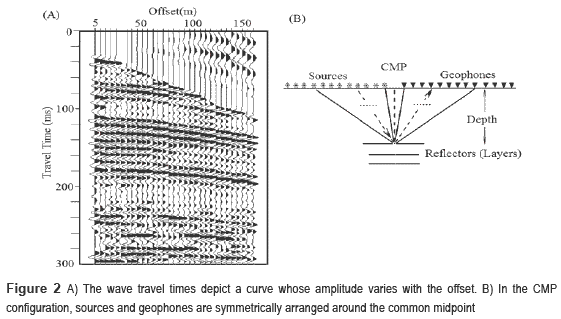
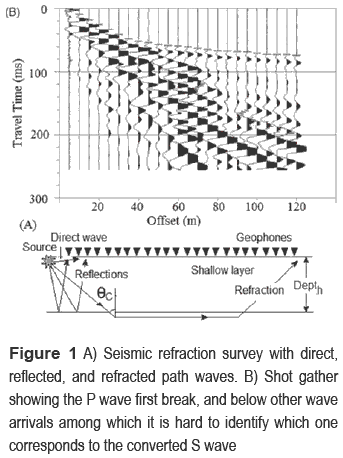
<body><![CDATA[<p>A  genetic algorithm based on AVO analysis was coded in Matlab that invert CMP  gathers, and provide Vp, Vs, and &rho; values, lately used to calculate the elastic  constants. Tested in synthetic seismograms, the algorithm provided reliable  values of the elastic parameters. The algorithm was applied in a CMP gather  acquired in the vicinity of a well with available well logs, proving elastic  parameter values in rocks with small errors, compared with those calculated  using the well logs.</p>        <p>&nbsp;</p>       <p><font size="3"><b>The seismic surveys</b></font></p>          <p>For  relatively shallow surveys, less than 20 m deep, a seismic refraction survey as  that shown in <a href="#Figura1">figure 1A</a> can be used to measure Vp and Vs, with the limitation  that each successively deeper refractor must have a higher velocity than the  shallower refractor. The waves penetrate the overburden and refract along the  bedrock surface. While they are traveling along this surface, they continually  refract seismic waves back to the ground surface. If deeper refractors are  present and are imaged by the refraction spread, they will also refract seismic  waves back to the geophones on the ground surface. As a result, a shot gather  that contains both acoustic and shear waves, as shown in the record of <a href="#Figura1">figure 1B</a>.</p>      <p align="center"><a name="Figura1"></a><img src="/img/revistas/rfiua/n68/n68a17i01.gif"></p>        <p>In  <a href="#Figura1">figure 1B</a>, the direct and refracted P and S waves associated to the shallower  layer must be identified separately in order to pick their first arrivals,  which might be easy in the P case because it corresponds to the first low  amplitude and high frequency signal that reaches the geophone. The picking of  the first arrival of the converted low frequency S wave is a hard task, because  it is not possible to know a priori among the different strong amplitude  recorded S waves which one corresponds to the converted wave. In another  expensive survey, a shearing source generates a reflected S in the record that  is commonly noisy. In general, both procedures induce errors in the estimation  of P and S velocities, the error being bigger in the S case. On the other hand,  the rock density &rho; is measured in a cored rock sample that could be obtained  depending on the drilling depth.</p>       <p>In  a configuration as of that in <a href="#Figura2">figure 2B</a>, a source and a geophone are situated  symmetrically around a Common Mid Point (CMP or CDP) to record one trace, then  the source-geophone distance (offset) is increased and another trace is  recorded, the procedure is repeated until a set of traces is obtained, as that  shown in <a href="#Figura2">figure 2A</a> (CDP gather).</p>      <p align="center"><a name="Figura2"></a><img src="/img/revistas/rfiua/n68/n68a17i02.gif"></p>          <p>&nbsp;</p>      <p><font size="3"><b>Elastic constants of rocks</b></font></p>        ]]></body>
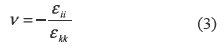
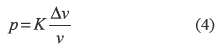
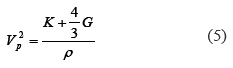
<body><![CDATA[<p>Rocks  in depth become more compact due to the litho static pressure, which increases  stiffness and elastic wave velocities. In these circumstances the behaviour of  the rock changes from elastic to rigid, a procedure known as enduring by  strain. To characterize a rock elastically, at least two parameters among &lambda;  (Lame's constant), v (Poisson's ratio), (Elasticity modulus), (Bulk modulus) y  (shear modulus) must be known. The parameters E and v are most commonly cited  in engineering. The modulus of elasticity or tensile modulus (E) relates the  stress component (&sigma;<sub>ii</sub>) with the uniaxial deformation component (&epsilon;<sub>ii</sub>) expressed as Hooke's Law is  given by equation (1):</p>      <p><img src="/img/revistas/rfiua/n68/n68a17e01.gif"></p>      <p>For  Sandstones E fluctuates from 0.5 to 8x10⁵ kg/cm2 and for  Shales from 1 to 3.5x10⁵kg/cm2 &#91;14&#93;.</p>       <p>In  a shear stress (&sigma;ik) equation (1) becomes equation (2):</p>        <p><img src="/img/revistas/rfiua/n68/n68a17e02.gif"></p>        <p>The  shear deformation &epsilon;ik depends on the shear modulus (G) that  indicates the resistance of the material to be sheared. Under uniaxial stress  the material shrinks in one direction (&epsilon;<sub>ii</sub>) and expands in the other  (&epsilon;<sub>kk</sub>), being Poisson's ratio, the rate between them, or numerically,  the negative ratio of transverse to axial strain. Poisson's ratio is described  by equation (3)</p>      <p><img src="/img/revistas/rfiua/n68/n68a17e03.gif"></p>      <p>Under  the hydrostatic pressure, the volume V of a given mass of rock will be reduced  to V - &Delta;V when the pressure is exerted  uniformly all over its surface. The change in volume divided by the original  volume (&Delta;V/V) is named volumetric  strain and is linearly related with the exerted pressure according to equation  (4):</p>      <p><img src="/img/revistas/rfiua/n68/n68a17e04.gif"></p>      <p>K  is the Bulk modulus of the rock, and measures the resistance of the material to  be deformed.</p>       ]]></body>

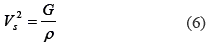
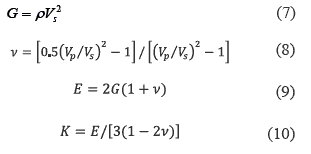
<body><![CDATA[<p>The  velocities with which acoustic and shear waves travel through rocks depend on  the density, and on both the shear and the incompressibility modulus, according  equation (5) &#91;14&#93;:</p>      <p><img src="/img/revistas/rfiua/n68/n68a17e05.gif"></p>        <p>and  equation (6)</p>      <p><img src="/img/revistas/rfiua/n68/n68a17e06.gif"></p>      <p>Consequently,  and can be expressed in terms of &rho;, Vs and Vp &#91;14&#93; according equations (7-10):</p>      <p><img src="/img/revistas/rfiua/n68/n68a17e07.gif"></p>      <p>Also,  the Oedometric modulus that measures the variation of rigidity in depth is  estimated by equation (11): </p>      <p><img src="/img/revistas/rfiua/n68/n68a17e11.gif"></p>      <p>If a  variable has a true value A, then the error to estimate it is given by the  ratio of the difference &delta;A between the true and the estimated value to the true  value, i.e. &delta;A/A. Suppose the variables A,B,C, . . represent independent  measurable quantities used to obtain a value for some calculated quantity U  (A,B,C, . . .). According the theory of errors &#91;15, 16&#93; if the errors for  A,B,C, . . . are independent and random, the difference between the estimated  and true value of U will be given by equation (12):</p>      <p><img src="/img/revistas/rfiua/n68/n68a17e12.gif"></p>      ]]></body>

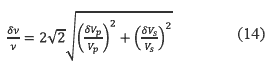
<body><![CDATA[<p>Considering  the Equation 7, the error percentage (&delta;G/G) in the estimation of G due to  errors in the estimation of density (&delta;&rho;/&rho;) and shear wave velocity (&delta;Vs/Vs)  will be estimated by equation (13):</p>      <p><img src="/img/revistas/rfiua/n68/n68a17e13.gif"></p>      <p>Equation  13 indicates the great sensitivity of estimating G, because it depends on the  square of the shear wave velocity and on the rock density, so errors of 10% on  both p and Vs propagate an error of 22.3% to G.</p>       <p>By  a similar procedure applied to equation 8, to establish the error in the  estimation of Poisson's ratio due to errors on Vp and Vs it established by  equation (14):</p>      <p><img src="/img/revistas/rfiua/n68/n68a17e14.gif"></p>        <p>Equation  (15) points out that the error committed in the estimation of Poisson s ratio  depends on the errors in Vp and Vs, and in case of a Vp/Vs ratio equals 2 and  errors of 10% on both Vp and in Vs estimations, Poisson's ratio will be  estimated with an error of 28%.</p>       <p>Considering  the error analysis on equation 9, the error on the estimation of E is  determined by equation (15):</p>      <p><img src="/img/revistas/rfiua/n68/n68a17e15.gif"></p>        <p>Equations  (13-15) indicate a high sensitivity in the estimation of the elastic parameters  due to errors committed in the estimation of density and velocities of shear  and acoustic waves, pointing out the necessity of a reliable and robust method  to estimate them.</p>      <p>&nbsp;</p>     ]]></body>
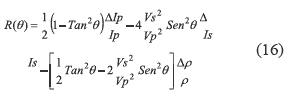
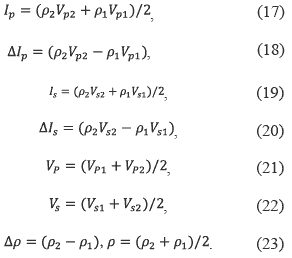
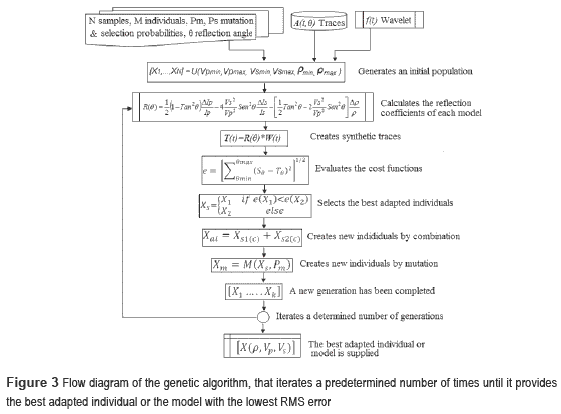
<body><![CDATA[<p><font size="3"><b>Amplitude analysis versus offset - AVO</b> </font></p>      <p>When  a wave strikes an interface between two media, part of its energy is reflected  and part is transmitted at angles that depend on the angle of incidence (&theta;) and  velocities V<sub>S1</sub>, V<sub>S2</sub>, V<sub>P1</sub>, V<sub>P2</sub> of  each media, while their amplitude depends, in addition, on the densities &rho;<sub>1</sub>  and &rho;<sub>2</sub>.</p>        <P>When  &rho;, V<SUB>P</SUB> y V <SUB>S</SUB> vary slightly from one medium to another, the  complex matrix equation relating the amplitude R (&theta;) with all of the above  parameters can be approximated by the equation (16) &#91;10&#93;:</p>      <p><img src="/img/revistas/rfiua/n68/n68a17e16.gif"></p>        <p>The  terms of the above equation are defined operationally by the equations (17-23):</p>      <p><img src="/img/revistas/rfiua/n68/n68a17e17.gif"></p>      <p>&nbsp;</p>     <p><font size="3"><b>Genetic algorithm</b> </font></p>      <p>The  mathematical procedures to obtain information about the physical world on the  basis of inference drawn from observations may provide multiple solutions, so  the principal objective in a non-linear inverse problem is to locate a model for  which a suitable defined cost function has a minimum. The optimal solution is  searched in a large number of possibilities or state space that can be  restricted by a priori information, e.g. a range of wave velocities or  densities. The optimal model must explain the observations reasonably well  within the limits of noise in the data. In presence of minima, a premature  convergence to a solution may appear without considering the entire search  space. Minima global optimization methods, which are generally stochastic  algorithms, avoid these local minima and converge to a global optimal solution.  Genetic algorithms establish an analogy between a set of solutions to a  problem, called phenotype, and a set of individuals in a natural population,  encoding the information of each solution in a string or chromosomes. Each of  these individuals is seen as a point in the search space, and symbols that form  the chain of chromosomes are called genes. Individuals evolve through  iterations, called generations. In each generation, individuals are evaluated  by measuring the adaptation function that measures similarities between the  observed and synthetic data, then the best adapted models are selected to  replace the previous generation. In each iteration, the selection, recombination  and mutation generate new individuals until the full set of generations is  achieved &#91;17&#93;. The structure of the genetic algorithm is shown in <a href="#Figura3">figure 3</a>.</p>      <p align="center"><a name="Figura3"></a><img src="/img/revistas/rfiua/n68/n68a17i03.gif"></p>      ]]></body>
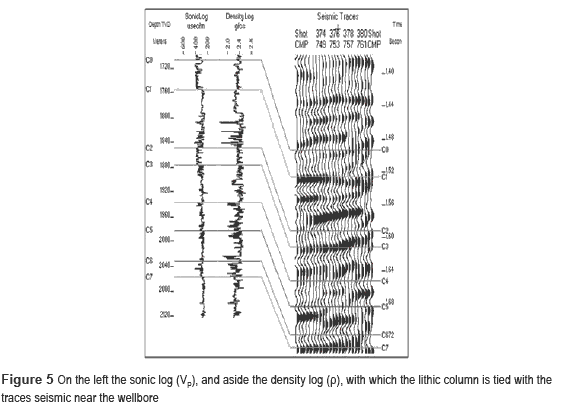
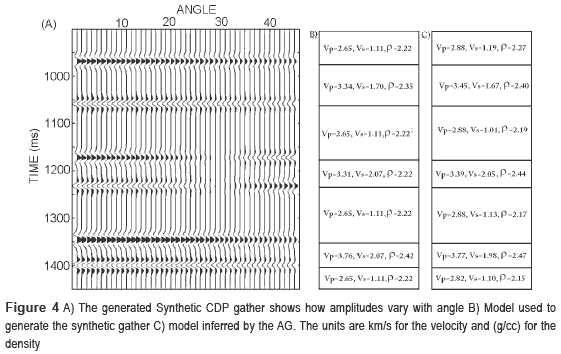
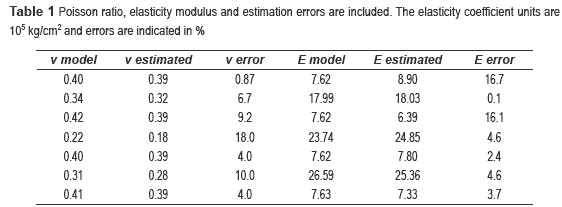
<body><![CDATA[<p>Each  individual (model) is represented by the matrix, where I is the number of  layers, M the length of each of the 3 binary strings for V<sub>P</sub>, V<sub>s</sub>  and &rho;, whose values fluctuate within pre-established ranges. An initial  population is generated randomly using a uniform distribution. Amplitudes are  calculated for each angle and each reflector with equation (12), to create the  synthetic seismogram by convolving with the wavelet extracted from the CDP  record using statistical methods. The RMS error between the synthetic  seismogram, associated with each individual, and the CDP gather is calculated.  By selection, combination, and mutation, new patterns are generated, iterating  until the number of established generations pass and the optimal model is  delivered.</p>      <p>&nbsp;</p>     <p><font size="3"><b>Inverting synthetic seismograms</b> </font></p>      <p>The  <a href="#Figura4">figure 4A</a> shows a synthetic CDP gather generated through equation 16 that  simulates the seismic response in the 7- layer model depicted in <a href="#Figura4">figure 4B</a>. The  genetic algorithm was applied to this CDP gather doing the inversion, and  providing the solution model whose numerical values are included in <a href="#Figura4">figure 4C</a>.  The comparison between the former and the estimated model resulted in V<sub>P</sub>,  V<sub>S</sub> and &rho; maximum errors of 0.269 km/s, 0.176 km/s and 0.089 g/cc,  which are considered acceptable small errors.</p>      <p align="center"><a name="Figura4"></a><img src="/img/revistas/rfiua/n68/n68a17i04.gif"></p>      <p>Equations  (7-9) together with the V<sub>P</sub>,  V<sub>s</sub> and &rho; values of both former and  predicted models, were  used to calculate Poisson's ratios, elasticity modules and estimation errors.  The results shown  in <a href="#Tabla1">table 1</a> indicate errors below 20% in the estimation of these  parameters. This order error is considered acceptable to design calculations in  engineering that involve rocks &#91;18&#93;.</p>      <p align="center"><a name="Tabla1"></a><img src="/img/revistas/rfiua/n68/n68a17t01.gif" ></p>      <p>&nbsp;</p>     <p><font size="3"><b>Inverting real data</b> </font></p>     <p>The  <a href="#Figura5">figure 5</a> shows the sonic log measured in &mu;sec/m, and the density log in g/cc.  On the right, it shows a seismic image of the subsurface in the vicinity of the  well, along 40m in the 1400&shy;-1800 ms interval. The seismic in the vicinity of  the well is tied by identifying lithic units, and the time-depth relationship.  Then, a CDP gather located in the vicinity of the well was selected and  processed by filtering and applying static corrections a plane datum, and  finally, applying a dynamic correction (Normal Move out) until the section in  <a href="#Figura6">figure 6A</a> was achieved. For a full explanation of the anterior steps a  specialized literature is recommended &#91;13&#93;.</p>      ]]></body>
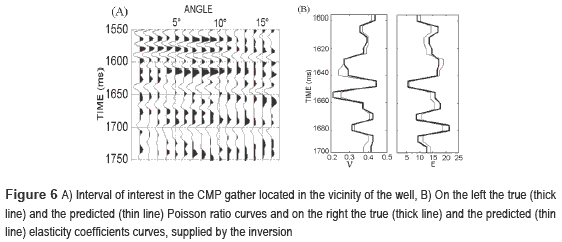
<body><![CDATA[<p align="center"><a name="Figura5"></a><img src="/img/revistas/rfiua/n68/n68a17i05.gif"></p>      <p align="center"><a name="Figura6"></a><img src="/img/revistas/rfiua/n68/n68a17i06.gif"></p>      <p><a href="#Figura6">Figure 6A</a> shows the 1550-1750 ms interval of a gather previously processed until the  reflectors become horizontal, where the estimated incidence angles vary between  0&deg; and 15&deg;. As a result of applying the genetic algorithm from 1600 to 1700 ms  of the CDP gather, Poisson ratio and elasticity coefficient values were  obtained. The true values were calculated using well log data and equations 6,  8 and 9. <a href="#Figura6">Figure 6B</a> shows on the left the predicted and the true Poisson ratio  curves and on the right the true and the predicted elasticity coefficient  curves, where true and predicted values look very close. The errors in the  estimation of these parameters are below 20% consistent with the observed  errors in the case of the synthetic model.</p>      <p>&nbsp;</p>     <p><font size="3"><b>Conclusions</b> </font></p>      <p>An  indirect method to estimate rock's elastic properties in situ, by the inversion  of reflection records, is presented. Implemented in a Matlab code, the GA was  tested on synthetic data supplying reliable Poisson's ratios and elasticity  coefficients. Applied to a depth interval of a CDP gather located near a well,  the GA provided reliable Poisson's ratios and elasticity coefficients according  to available well logs. Theoretical analysis of errors pointed out the high  sensibility of elastic parameters associated to the uncertainty in shear wave  velocity estimation. The method overcomes the limitations faced of the  refraction method, the high uncertainty in the estimation of shear wave  velocity and availability of a core rock to measure density in the laboratory.  The results, achieved in the synthetic and real cases, outline the robustness  and low sensibility of the GA. The level of uncertainty in the parameter  estimation is considered acceptable in calculations that involve rocks. This  non-expensive method has a deeper scope than the refraction method and is  applicable to different engineering fields.</p>      <p>&nbsp;</p>       <p><font size="3"><b>Acknowledgements</b> </font></p>      <p>The  authors express their gratitude to the Universidad Nacional de Colombia and in  particular the Department of Geosciences, for their support during the  development of the project.</p>      <p>&nbsp;</p>       ]]></body>
<body><![CDATA[<p><font size="3"><b>References</b> </font></p>      <!-- ref --><p>1. E. Hoek, M. Diederichs.  ''Empirical estimation of rock mass modulus''. <i>International  Journal of Rock Mechanics &amp; Mining Sciences</i>. Vol. 43. 2006. pp. 203-215.    &nbsp;&nbsp;&nbsp;&nbsp;&nbsp;&nbsp;&nbsp;&nbsp;[&#160;<a href="javascript:void(0);" onclick="javascript: window.open('/scielo.php?script=sci_nlinks&ref=000104&pid=S0120-6230201300030001700001&lng=','','width=640,height=500,resizable=yes,scrollbars=1,menubar=yes,');">Links</a>&#160;]<!-- end-ref --></p>       <!-- ref --><p>2. P. Palmstrom, S. Rajbal.  ''The Deformation Modulus of Rock Masses, - Comparisons between in situ  tests and indirect estimates''. <i>Tunnelling and  Underground Space Technology</i>. Vol. 16. 2001. pp. 115-131.    &nbsp;&nbsp;&nbsp;&nbsp;&nbsp;&nbsp;&nbsp;&nbsp;[&#160;<a href="javascript:void(0);" onclick="javascript: window.open('/scielo.php?script=sci_nlinks&ref=000106&pid=S0120-6230201300030001700002&lng=','','width=640,height=500,resizable=yes,scrollbars=1,menubar=yes,');">Links</a>&#160;]<!-- end-ref --></p>       <!-- ref --><p>3. P. Santi,  J. Holschen, R. Stephenson. ''Improving Elastic Modulus measurements for based on  Geology''. Enviromental &amp; <i>Engineering Geosciences</i>. Vol. VI. 2000. pp. 333-346.    &nbsp;&nbsp;&nbsp;&nbsp;&nbsp;&nbsp;&nbsp;&nbsp;[&#160;<a href="javascript:void(0);" onclick="javascript: window.open('/scielo.php?script=sci_nlinks&ref=000108&pid=S0120-6230201300030001700003&lng=','','width=640,height=500,resizable=yes,scrollbars=1,menubar=yes,');">Links</a>&#160;]<!-- end-ref --></p>       <!-- ref --><p>4. I. Ocak. <i>Empirical  estimation of intact rock elastic modulus</i>. 21<sup>th</sup> international  mining congress of Turkey. Antalya, Turkey. 2009. pp. 165-172.    &nbsp;&nbsp;&nbsp;&nbsp;&nbsp;&nbsp;&nbsp;&nbsp;[&#160;<a href="javascript:void(0);" onclick="javascript: window.open('/scielo.php?script=sci_nlinks&ref=000110&pid=S0120-6230201300030001700004&lng=','','width=640,height=500,resizable=yes,scrollbars=1,menubar=yes,');">Links</a>&#160;]<!-- end-ref --></p>       <!-- ref --><p>5. I. Ocak, S. Seker.  ''Estimation of Elastic Modulus of Intact Rocks by Artificial Neural  Network''. <i>Rock Mech. Rock Eng</i>. Vol. 45. 2012. pp. 1047-1054.    &nbsp;&nbsp;&nbsp;&nbsp;&nbsp;&nbsp;&nbsp;&nbsp;[&#160;<a href="javascript:void(0);" onclick="javascript: window.open('/scielo.php?script=sci_nlinks&ref=000112&pid=S0120-6230201300030001700005&lng=','','width=640,height=500,resizable=yes,scrollbars=1,menubar=yes,');">Links</a>&#160;]<!-- end-ref --></p>       <!-- ref --><p>6. L. Brice&ntilde;o, R. D&iacute;az. ''Medida  de propiedades din&aacute;micas de rocas ''in situ'' y c&oacute;mputo de par&aacute;metros  elastomec&aacute;nicos''. <i>Geof&iacute;sica Colombiana</i>. Vol. 3. 1995. pp. 73-79.    &nbsp;&nbsp;&nbsp;&nbsp;&nbsp;&nbsp;&nbsp;&nbsp;[&#160;<a href="javascript:void(0);" onclick="javascript: window.open('/scielo.php?script=sci_nlinks&ref=000114&pid=S0120-6230201300030001700006&lng=','','width=640,height=500,resizable=yes,scrollbars=1,menubar=yes,');">Links</a>&#160;]<!-- end-ref --></p>       <!-- ref --><p>7. T. Odumosu,  C. Torres, M. Salazar, J. Ma, B. Voss, G. Wang. <i>Estimation of  Dry-Rock Elastic Moduli Based on the Simulation of Mud-Filtrate Invasion  Effects on Borehole Acoustic Logs</i>. 2007 SPE Annual Technical Conference and Exhibition. Anaheim, Ca,  USA. 2007. pp. 1-16.    &nbsp;&nbsp;&nbsp;&nbsp;&nbsp;&nbsp;&nbsp;&nbsp;[&#160;<a href="javascript:void(0);" onclick="javascript: window.open('/scielo.php?script=sci_nlinks&ref=000116&pid=S0120-6230201300030001700007&lng=','','width=640,height=500,resizable=yes,scrollbars=1,menubar=yes,');">Links</a>&#160;]<!-- end-ref --> </p>       <!-- ref --><p>8. A. Manilla,  P. Garnica, A. P&eacute;rez. ''Evaluaci&oacute;n indirecta de los m&oacute;dulos el&aacute;sticos de  rigidez in situ y la relaci&oacute;n entre Vp/Vs y el &aacute;ngulo de fricci&oacute;n  interna''. <i>Publicaci&oacute;n T&eacute;cnica</i>. N&deg; 225. 2003. pp. 5-25.    &nbsp;&nbsp;&nbsp;&nbsp;&nbsp;&nbsp;&nbsp;&nbsp;[&#160;<a href="javascript:void(0);" onclick="javascript: window.open('/scielo.php?script=sci_nlinks&ref=000118&pid=S0120-6230201300030001700008&lng=','','width=640,height=500,resizable=yes,scrollbars=1,menubar=yes,');">Links</a>&#160;]<!-- end-ref --></p>       <!-- ref --><p>9. K. Aki, P. Richards. <i>Quantitative  seismology</i>.  2<sup>nd</sup> ed. Ed. University Science Books. Sausalito, Ca, USA. 2002. pp.  119-183.    &nbsp;&nbsp;&nbsp;&nbsp;&nbsp;&nbsp;&nbsp;&nbsp;[&#160;<a href="javascript:void(0);" onclick="javascript: window.open('/scielo.php?script=sci_nlinks&ref=000120&pid=S0120-6230201300030001700009&lng=','','width=640,height=500,resizable=yes,scrollbars=1,menubar=yes,');">Links</a>&#160;]<!-- end-ref --></p>       <!-- ref --><p>10. J. Fatti, G. Smith, P.  Vail, P. Strauss, P. Levitt. ''Detection of gas in sandstone reservoirs  using AVO analysis: A 3-D seismic case history using Geostack technique''. <i>Geophysics</i>. Vol. 59. 1994. pp. 1362-1376.    &nbsp;&nbsp;&nbsp;&nbsp;&nbsp;&nbsp;&nbsp;&nbsp;[&#160;<a href="javascript:void(0);" onclick="javascript: window.open('/scielo.php?script=sci_nlinks&ref=000122&pid=S0120-6230201300030001700010&lng=','','width=640,height=500,resizable=yes,scrollbars=1,menubar=yes,');">Links</a>&#160;]<!-- end-ref --></p>       <!-- ref --><p>11. M. Sen. <i>Seismic Inversion</i>. 1<sup>st</sup> ed. Edited by  the Society of Petroleum Engineers. Richardson, Tx, USA. 2006. pp. 61-67.    &nbsp;&nbsp;&nbsp;&nbsp;&nbsp;&nbsp;&nbsp;&nbsp;[&#160;<a href="javascript:void(0);" onclick="javascript: window.open('/scielo.php?script=sci_nlinks&ref=000124&pid=S0120-6230201300030001700011&lng=','','width=640,height=500,resizable=yes,scrollbars=1,menubar=yes,');">Links</a>&#160;]<!-- end-ref --></p>       <!-- ref --><p>12. K.  Casta&ntilde;o, G. Ojeda, L. Montes. ''Thin-layer detection using spectral inversion and a  genetic algorithm''. <i>Earth Sci. Res. J</i>. Vol. 15. 2011. pp. 121-128.    &nbsp;&nbsp;&nbsp;&nbsp;&nbsp;&nbsp;&nbsp;&nbsp;[&#160;<a href="javascript:void(0);" onclick="javascript: window.open('/scielo.php?script=sci_nlinks&ref=000126&pid=S0120-6230201300030001700012&lng=','','width=640,height=500,resizable=yes,scrollbars=1,menubar=yes,');">Links</a>&#160;]<!-- end-ref --></p>       <!-- ref --><p>13. O. Yilmaz. <i>Seismic Data  Analysis: processing, inversion and Interpretation of Seismic Data</i>. 2<sup>nd</sup> ed. Published  by the Society of Exploration Geophysicists. Tulsa, Ok, USA. 2001. pp. 25-124.    &nbsp;&nbsp;&nbsp;&nbsp;&nbsp;&nbsp;&nbsp;&nbsp;[&#160;<a href="javascript:void(0);" onclick="javascript: window.open('/scielo.php?script=sci_nlinks&ref=000128&pid=S0120-6230201300030001700013&lng=','','width=640,height=500,resizable=yes,scrollbars=1,menubar=yes,');">Links</a>&#160;]<!-- end-ref --></p>       <!-- ref --><p>14. G. Mavko, T. Mukerji, J.  Dvorkin. <i> The Rock Physics Handbook</i>. 1<sup>st</sup> ed. Ed. Cambridge University Press.  Cambridge, UK. 2009. pp. 21-76.    &nbsp;&nbsp;&nbsp;&nbsp;&nbsp;&nbsp;&nbsp;&nbsp;[&#160;<a href="javascript:void(0);" onclick="javascript: window.open('/scielo.php?script=sci_nlinks&ref=000130&pid=S0120-6230201300030001700014&lng=','','width=640,height=500,resizable=yes,scrollbars=1,menubar=yes,');">Links</a>&#160;]<!-- end-ref --></p>       <!-- ref --><p>15. D. Cacuci. <i>Sensitivity and  uncertainty analysis: Theory</i>. Vol. 1. Ed. Chapman &amp; Hall/CRC. Boca Raton, USA. 2003.  pp 132-141.    &nbsp;&nbsp;&nbsp;&nbsp;&nbsp;&nbsp;&nbsp;&nbsp;[&#160;<a href="javascript:void(0);" onclick="javascript: window.open('/scielo.php?script=sci_nlinks&ref=000132&pid=S0120-6230201300030001700015&lng=','','width=640,height=500,resizable=yes,scrollbars=1,menubar=yes,');">Links</a>&#160;]<!-- end-ref --></p>       <!-- ref --><p>16. A.  Saltelli, S. Tarantola, F. Campolongo, M. Ratto. <i>Sensitivity  analysis in practice: a guide to assessing scientific models</i>. 1<sup>st</sup> ed. Ed. John  Wiley &amp; Sons. Chichester, England. 2004. pp. 109-148.    &nbsp;&nbsp;&nbsp;&nbsp;&nbsp;&nbsp;&nbsp;&nbsp;[&#160;<a href="javascript:void(0);" onclick="javascript: window.open('/scielo.php?script=sci_nlinks&ref=000134&pid=S0120-6230201300030001700016&lng=','','width=640,height=500,resizable=yes,scrollbars=1,menubar=yes,');">Links</a>&#160;]<!-- end-ref --></p>       <!-- ref --><p>17. M. Mitchell. <i>An Introduction  to Genetic Algorithms</i>. 1<sup>st</sup> ed. Ed. MIT Press. Boston, Mass., USA. 1998.  pp. 35-81.    &nbsp;&nbsp;&nbsp;&nbsp;&nbsp;&nbsp;&nbsp;&nbsp;[&#160;<a href="javascript:void(0);" onclick="javascript: window.open('/scielo.php?script=sci_nlinks&ref=000136&pid=S0120-6230201300030001700017&lng=','','width=640,height=500,resizable=yes,scrollbars=1,menubar=yes,');">Links</a>&#160;]<!-- end-ref --></p>       <!-- ref --><p>18. I. Farmer. <i>Engineering  Property of Rocks</i>.  1<sup>st</sup> ed. Ed. E &amp; F. N. Spon Ltd. London, England. 1968. pp.  59-85.    &nbsp;&nbsp;&nbsp;&nbsp;&nbsp;&nbsp;&nbsp;&nbsp;[&#160;<a href="javascript:void(0);" onclick="javascript: window.open('/scielo.php?script=sci_nlinks&ref=000138&pid=S0120-6230201300030001700018&lng=','','width=640,height=500,resizable=yes,scrollbars=1,menubar=yes,');">Links</a>&#160;]<!-- end-ref --></p>        <p>&nbsp;</p>     <p>&nbsp;</p>     <p>&nbsp;</p>     ]]></body>
<body><![CDATA[<p>&nbsp;</p>    </font>     ]]></body><back>
<ref-list>
<ref id="B1">
<label>1</label><nlm-citation citation-type="journal">
<person-group person-group-type="author">
<name>
<surname><![CDATA[Hoek]]></surname>
<given-names><![CDATA[E]]></given-names>
</name>
<name>
<surname><![CDATA[Diederichs]]></surname>
<given-names><![CDATA[M]]></given-names>
</name>
</person-group>
<article-title xml:lang="en"><![CDATA[Empirical estimation of rock mass modulus]]></article-title>
<source><![CDATA[International Journal of Rock Mechanics & Mining Sciences]]></source>
<year>2006</year>
<volume>43</volume>
<page-range>203-215</page-range></nlm-citation>
</ref>
<ref id="B2">
<label>2</label><nlm-citation citation-type="journal">
<person-group person-group-type="author">
<name>
<surname><![CDATA[Palmstrom]]></surname>
<given-names><![CDATA[P]]></given-names>
</name>
<name>
<surname><![CDATA[Rajbal]]></surname>
<given-names><![CDATA[S]]></given-names>
</name>
</person-group>
<article-title xml:lang="en"><![CDATA[The Deformation Modulus of Rock Masses, - Comparisons between in situ tests and indirect estimates]]></article-title>
<source><![CDATA[Tunnelling and Underground Space Technology]]></source>
<year>2001</year>
<volume>16</volume>
<page-range>115-131</page-range></nlm-citation>
</ref>
<ref id="B3">
<label>3</label><nlm-citation citation-type="journal">
<person-group person-group-type="author">
<name>
<surname><![CDATA[Santi]]></surname>
<given-names><![CDATA[P]]></given-names>
</name>
<name>
<surname><![CDATA[Holschen]]></surname>
<given-names><![CDATA[J]]></given-names>
</name>
<name>
<surname><![CDATA[Stephenson]]></surname>
<given-names><![CDATA[R]]></given-names>
</name>
</person-group>
<article-title xml:lang="en"><![CDATA[Improving Elastic Modulus measurements for based on Geology]]></article-title>
<source><![CDATA[Enviromental & Engineering Geosciences]]></source>
<year>2000</year>
<volume>VI</volume>
<page-range>333-346</page-range></nlm-citation>
</ref>
<ref id="B4">
<label>4</label><nlm-citation citation-type="confpro">
<person-group person-group-type="author">
<name>
<surname><![CDATA[Ocak]]></surname>
<given-names><![CDATA[I]]></given-names>
</name>
</person-group>
<source><![CDATA[Empirical estimation of intact rock elastic modulus]]></source>
<year></year>
<conf-name><![CDATA[21th international mining congress of Turkey]]></conf-name>
<conf-date>2009</conf-date>
<conf-loc>Antalya </conf-loc>
<page-range>165-172</page-range></nlm-citation>
</ref>
<ref id="B5">
<label>5</label><nlm-citation citation-type="journal">
<person-group person-group-type="author">
<name>
<surname><![CDATA[Ocak]]></surname>
<given-names><![CDATA[I]]></given-names>
</name>
<name>
<surname><![CDATA[Seker]]></surname>
<given-names><![CDATA[S]]></given-names>
</name>
</person-group>
<article-title xml:lang="en"><![CDATA[Estimation of Elastic Modulus of Intact Rocks by Artificial Neural Network]]></article-title>
<source><![CDATA[Rock Mech. Rock Eng]]></source>
<year>2012</year>
<volume>45</volume>
<page-range>1047-1054</page-range></nlm-citation>
</ref>
<ref id="B6">
<label>6</label><nlm-citation citation-type="journal">
<person-group person-group-type="author">
<name>
<surname><![CDATA[Briceño]]></surname>
<given-names><![CDATA[L]]></given-names>
</name>
<name>
<surname><![CDATA[Díaz]]></surname>
<given-names><![CDATA[R]]></given-names>
</name>
</person-group>
<article-title xml:lang="es"><![CDATA[Medida de propiedades dinámicas de rocas ''in situ'' y cómputo de parámetros elastomecánicos]]></article-title>
<source><![CDATA[Geofísica Colombiana]]></source>
<year>1995</year>
<volume>3</volume>
<page-range>73-79</page-range></nlm-citation>
</ref>
<ref id="B7">
<label>7</label><nlm-citation citation-type="confpro">
<person-group person-group-type="author">
<name>
<surname><![CDATA[Odumosu]]></surname>
<given-names><![CDATA[T]]></given-names>
</name>
<name>
<surname><![CDATA[Torres]]></surname>
<given-names><![CDATA[C]]></given-names>
</name>
<name>
<surname><![CDATA[Salazar]]></surname>
<given-names><![CDATA[M]]></given-names>
</name>
<name>
<surname><![CDATA[Ma]]></surname>
<given-names><![CDATA[J]]></given-names>
</name>
<name>
<surname><![CDATA[Voss]]></surname>
<given-names><![CDATA[B]]></given-names>
</name>
<name>
<surname><![CDATA[Wang]]></surname>
<given-names><![CDATA[G]]></given-names>
</name>
</person-group>
<source><![CDATA[Estimation of Dry-Rock Elastic Moduli Based on the Simulation of Mud-Filtrate Invasion Effects on Borehole Acoustic Logs]]></source>
<year></year>
<conf-name><![CDATA[ 2007 SPE Annual Technical Conference and Exhibition]]></conf-name>
<conf-date>2007</conf-date>
<conf-loc>Anaheim Ca</conf-loc>
<page-range>1-16</page-range></nlm-citation>
</ref>
<ref id="B8">
<label>8</label><nlm-citation citation-type="journal">
<person-group person-group-type="author">
<name>
<surname><![CDATA[Manilla]]></surname>
<given-names><![CDATA[A]]></given-names>
</name>
<name>
<surname><![CDATA[Garnica]]></surname>
<given-names><![CDATA[P]]></given-names>
</name>
<name>
<surname><![CDATA[Pérez]]></surname>
<given-names><![CDATA[A]]></given-names>
</name>
</person-group>
<article-title xml:lang="es"><![CDATA[Evaluación indirecta de los módulos elásticos de rigidez in situ y la relación entre Vp/Vs y el ángulo de fricción interna]]></article-title>
<source><![CDATA[Publicación Técnica]]></source>
<year>2003</year>
<volume>225</volume>
<page-range>5-25</page-range></nlm-citation>
</ref>
<ref id="B9">
<label>9</label><nlm-citation citation-type="book">
<person-group person-group-type="author">
<name>
<surname><![CDATA[Aki]]></surname>
<given-names><![CDATA[K]]></given-names>
</name>
<name>
<surname><![CDATA[Richards]]></surname>
<given-names><![CDATA[P]]></given-names>
</name>
</person-group>
<source><![CDATA[Quantitative seismology]]></source>
<year>2002</year>
<edition>2nd</edition>
<page-range>119-183</page-range><publisher-loc><![CDATA[Sausalito^eCa Ca]]></publisher-loc>
<publisher-name><![CDATA[Ed. University Science Books]]></publisher-name>
</nlm-citation>
</ref>
<ref id="B10">
<label>10</label><nlm-citation citation-type="journal">
<person-group person-group-type="author">
<name>
<surname><![CDATA[Fatti]]></surname>
<given-names><![CDATA[J]]></given-names>
</name>
<name>
<surname><![CDATA[Smith]]></surname>
<given-names><![CDATA[G]]></given-names>
</name>
<name>
<surname><![CDATA[Vail]]></surname>
<given-names><![CDATA[P]]></given-names>
</name>
<name>
<surname><![CDATA[Strauss]]></surname>
<given-names><![CDATA[P]]></given-names>
</name>
<name>
<surname><![CDATA[Levitt]]></surname>
<given-names><![CDATA[P]]></given-names>
</name>
</person-group>
<article-title xml:lang="en"><![CDATA[Detection of gas in sandstone reservoirs using AVO analysis: A 3-D seismic case history using Geostack technique]]></article-title>
<source><![CDATA[Geophysics]]></source>
<year>1994</year>
<volume>59</volume>
<page-range>1362-1376</page-range></nlm-citation>
</ref>
<ref id="B11">
<label>11</label><nlm-citation citation-type="book">
<person-group person-group-type="author">
<name>
<surname><![CDATA[Sen]]></surname>
<given-names><![CDATA[M]]></given-names>
</name>
</person-group>
<source><![CDATA[Seismic Inversion]]></source>
<year>2006</year>
<edition>1st</edition>
<page-range>61-67</page-range><publisher-loc><![CDATA[Richardson^eTx Tx]]></publisher-loc>
<publisher-name><![CDATA[Edited by the Society of Petroleum Engineers]]></publisher-name>
</nlm-citation>
</ref>
<ref id="B12">
<label>12</label><nlm-citation citation-type="journal">
<person-group person-group-type="author">
<name>
<surname><![CDATA[Castaño]]></surname>
<given-names><![CDATA[K]]></given-names>
</name>
<name>
<surname><![CDATA[Ojeda]]></surname>
<given-names><![CDATA[G]]></given-names>
</name>
<name>
<surname><![CDATA[Montes]]></surname>
<given-names><![CDATA[L]]></given-names>
</name>
</person-group>
<article-title xml:lang="en"><![CDATA[Thin-layer detection using spectral inversion and a genetic algorithm]]></article-title>
<source><![CDATA[Earth Sci. Res. J]]></source>
<year>2011</year>
<volume>15</volume>
<page-range>121-128</page-range></nlm-citation>
</ref>
<ref id="B13">
<label>13</label><nlm-citation citation-type="book">
<person-group person-group-type="author">
<name>
<surname><![CDATA[Yilmaz]]></surname>
<given-names><![CDATA[O]]></given-names>
</name>
</person-group>
<source><![CDATA[Seismic Data Analysis: processing, inversion and Interpretation of Seismic Data]]></source>
<year>2001</year>
<edition>2nd</edition>
<page-range>25-124</page-range><publisher-loc><![CDATA[Tulsa^eOk Ok]]></publisher-loc>
<publisher-name><![CDATA[Published by the Society of Exploration Geophysicists]]></publisher-name>
</nlm-citation>
</ref>
<ref id="B14">
<label>14</label><nlm-citation citation-type="book">
<person-group person-group-type="author">
<name>
<surname><![CDATA[Mavko]]></surname>
<given-names><![CDATA[G]]></given-names>
</name>
<name>
<surname><![CDATA[Mukerji]]></surname>
<given-names><![CDATA[T]]></given-names>
</name>
<name>
<surname><![CDATA[Dvorkin]]></surname>
<given-names><![CDATA[J]]></given-names>
</name>
</person-group>
<source><![CDATA[The Rock Physics Handbook]]></source>
<year>2009</year>
<edition>1st</edition>
<page-range>21-76</page-range><publisher-loc><![CDATA[Cambridge ]]></publisher-loc>
<publisher-name><![CDATA[Ed. Cambridge University Press]]></publisher-name>
</nlm-citation>
</ref>
<ref id="B15">
<label>15</label><nlm-citation citation-type="book">
<person-group person-group-type="author">
<name>
<surname><![CDATA[Cacuci]]></surname>
<given-names><![CDATA[D]]></given-names>
</name>
</person-group>
<source><![CDATA[Sensitivity and uncertainty analysis: Theory]]></source>
<year>2003</year>
<volume>1</volume>
<page-range>132-141</page-range><publisher-loc><![CDATA[Boca Raton ]]></publisher-loc>
<publisher-name><![CDATA[Ed. Chapman & Hall/CRC]]></publisher-name>
</nlm-citation>
</ref>
<ref id="B16">
<label>16</label><nlm-citation citation-type="book">
<person-group person-group-type="author">
<name>
<surname><![CDATA[Saltelli]]></surname>
<given-names><![CDATA[A]]></given-names>
</name>
<name>
<surname><![CDATA[Tarantola]]></surname>
<given-names><![CDATA[S]]></given-names>
</name>
<name>
<surname><![CDATA[Campolongo]]></surname>
<given-names><![CDATA[F]]></given-names>
</name>
<name>
<surname><![CDATA[Ratto]]></surname>
<given-names><![CDATA[M]]></given-names>
</name>
</person-group>
<source><![CDATA[Sensitivity analysis in practice: a guide to assessing scientific models]]></source>
<year>2004</year>
<edition>1st</edition>
<page-range>109-148</page-range><publisher-loc><![CDATA[Chichester ]]></publisher-loc>
<publisher-name><![CDATA[Ed. John Wiley & Sons]]></publisher-name>
</nlm-citation>
</ref>
<ref id="B17">
<label>17</label><nlm-citation citation-type="book">
<person-group person-group-type="author">
<name>
<surname><![CDATA[Mitchell]]></surname>
<given-names><![CDATA[M]]></given-names>
</name>
</person-group>
<source><![CDATA[An Introduction to Genetic Algorithms]]></source>
<year>1998</year>
<edition>1st</edition>
<page-range>35-81</page-range><publisher-loc><![CDATA[Boston^eMass Mass]]></publisher-loc>
<publisher-name><![CDATA[Ed. MIT Press]]></publisher-name>
</nlm-citation>
</ref>
<ref id="B18">
<label>18</label><nlm-citation citation-type="book">
<person-group person-group-type="author">
<name>
<surname><![CDATA[Farmer]]></surname>
<given-names><![CDATA[I]]></given-names>
</name>
</person-group>
<source><![CDATA[Engineering Property of Rocks]]></source>
<year>1968</year>
<edition>1st</edition>
<page-range>59-85</page-range><publisher-loc><![CDATA[London ]]></publisher-loc>
<publisher-name><![CDATA[Ed. E & F. N. Spon Ltd]]></publisher-name>
</nlm-citation>
</ref>
</ref-list>
</back>
</article>