<?xml version="1.0" encoding="ISO-8859-1"?><article xmlns:mml="http://www.w3.org/1998/Math/MathML" xmlns:xlink="http://www.w3.org/1999/xlink" xmlns:xsi="http://www.w3.org/2001/XMLSchema-instance">
<front>
<journal-meta>
<journal-id>0120-8705</journal-id>
<journal-title><![CDATA[CES Medicina]]></journal-title>
<abbrev-journal-title><![CDATA[CES Med.]]></abbrev-journal-title>
<issn>0120-8705</issn>
<publisher>
<publisher-name><![CDATA[Universidad CES]]></publisher-name>
</publisher>
</journal-meta>
<article-meta>
<article-id>S0120-87052009000100002</article-id>
<title-group>
<article-title xml:lang="en"><![CDATA[General versus regional anesthesia for ambulatory arthroscopic knee surgery]]></article-title>
<article-title xml:lang="es"><![CDATA[Anestesia general versus regional para cirugía artroscópica ambulatoria de rodilla]]></article-title>
</title-group>
<contrib-group>
<contrib contrib-type="author">
<name>
<surname><![CDATA[GONZÁLEZ O]]></surname>
<given-names><![CDATA[MARÍA PATRICIA]]></given-names>
</name>
<xref ref-type="aff" rid="A01"/>
</contrib>
<contrib contrib-type="author">
<name>
<surname><![CDATA[VÁSQUEZ S]]></surname>
<given-names><![CDATA[MARÍA ISABEL]]></given-names>
</name>
<xref ref-type="aff" rid="A01"/>
</contrib>
<contrib contrib-type="author">
<name>
<surname><![CDATA[HERRERA-MORALES]]></surname>
<given-names><![CDATA[LUIS ANDRÉS]]></given-names>
</name>
<xref ref-type="aff" rid="A01"/>
</contrib>
<contrib contrib-type="author">
<name>
<surname><![CDATA[RIVERA D]]></surname>
<given-names><![CDATA[ROBERTO CARLO]]></given-names>
</name>
<xref ref-type="aff" rid="A01"/>
</contrib>
<contrib contrib-type="author">
<name>
<surname><![CDATA[ARCILA L]]></surname>
<given-names><![CDATA[MARIO ANDRÉS]]></given-names>
</name>
<xref ref-type="aff" rid="A01"/>
</contrib>
<contrib contrib-type="author">
<name>
<surname><![CDATA[PUERTA M]]></surname>
<given-names><![CDATA[JUAN JOSÉ]]></given-names>
</name>
<xref ref-type="aff" rid="A01"/>
</contrib>
<contrib contrib-type="author">
<name>
<surname><![CDATA[TRUJILLO H]]></surname>
<given-names><![CDATA[LIZA MARGOTH]]></given-names>
</name>
<xref ref-type="aff" rid="A01"/>
</contrib>
<contrib contrib-type="author">
<name>
<surname><![CDATA[TORRES DE G]]></surname>
<given-names><![CDATA[YOLANDA]]></given-names>
</name>
<xref ref-type="aff" rid="A02"/>
</contrib>
</contrib-group>
<aff id="A01">
<institution><![CDATA[,Universidad CES Anesthesiology Faculty ]]></institution>
<addr-line><![CDATA[Medellin ]]></addr-line>
<country>Colombia</country>
</aff>
<aff id="A02">
<institution><![CDATA[,Universidad CES Clinical Epidemiologist & Public Health Faculty ]]></institution>
<addr-line><![CDATA[ ]]></addr-line>
<country>Colombia</country>
</aff>
<pub-date pub-type="pub">
<day>01</day>
<month>01</month>
<year>2009</year>
</pub-date>
<pub-date pub-type="epub">
<day>01</day>
<month>01</month>
<year>2009</year>
</pub-date>
<volume>23</volume>
<numero>1</numero>
<fpage>7</fpage>
<lpage>16</lpage>
<copyright-statement/>
<copyright-year/>
<self-uri xlink:href="http://www.scielo.org.co/scielo.php?script=sci_arttext&amp;pid=S0120-87052009000100002&amp;lng=en&amp;nrm=iso"></self-uri><self-uri xlink:href="http://www.scielo.org.co/scielo.php?script=sci_abstract&amp;pid=S0120-87052009000100002&amp;lng=en&amp;nrm=iso"></self-uri><self-uri xlink:href="http://www.scielo.org.co/scielo.php?script=sci_pdf&amp;pid=S0120-87052009000100002&amp;lng=en&amp;nrm=iso"></self-uri><abstract abstract-type="short" xml:lang="en"><p><![CDATA[Background Arthroscopic surgical procedures on the knee are now frequently performed and there is still no agreement as to what is the best anesthesia technique for them. Any anesthetic technique used should bring fast and safe recovery, accompanied by good postoperative pain control and good patient satisfaction, all very important goals of ambulatory anesthesia. Objective: The goal of the study was to compare general versus regional anesthesia (sciatic, femoral and obturator nerve blocks) in terms of pain control, time to discharge and overall patient satisfaction among others. Methods: We conducted a randomized, non-blinded, clinical essay. The sample included all patients scheduled for arthroscopic knee surgery at Clinica CES that met inclusion criteria, during the period of time that the study was performed. Results: There were no significant differences in demographic characteristics, or intraoperative time between groups. Time spent in post anesthesia care unit was significantly lower in the group where regional anesthesia was used (15 vs. 78 minutes, p<0.05). Patients in the regional anesthesia group also did not require supplemental analgesia and were discharged earlier. In fact, all the patients in regional anesthesia group had VAS Pain Scores less than 3 one hour after surgery, while 56 % of the patients in the general anesthesia group had pain scores above 5 and required supplemental analgesia. There were higher incidence of postoperative nausea and vomit and greater anesthesia-related costs in general anesthesia group. Regional anesthesia patients were more satisfied with the anesthetic technique used than the general anesthesia ones. Conclusion: The results of this study suggest that regional anesthesia for ambulatory arthroscopy knee surgery provides better postoperative analgesia, earlier discharge and better patient satisfaction than general anesthesia. Regional anesthesia also seems to facilitate early rehabilitation and could provide good care at lower cost.]]></p></abstract>
<abstract abstract-type="short" xml:lang="es"><p><![CDATA[Introducción: La cirugía artroscópica de rodilla realizada ambulatoriamente impone el reto de encontrar la técnica anestésica más adecuada para este tipo de procedimiento. La técnica usada debe conllevar a una rápida y segura recuperación, brindar buen control del dolor en el postoperatorio e incrementar la satisfacción del paciente. Objetivo: Comparar la anestesia general versus anestesia regional (bloqueo de nervio periférico de los nervios ciático [abordaje posterior], femoral y obturador) en cirugía artroscópica de rodilla en términos de control del dolor, tiempo para el alta hospitalaria y satisfacción general del paciente, entre otros. Métodos: Realizamos un estudio clínico, aleatorizado no cegado. La muestra incluyó todos los pacientes con cirugía artroscópica de rodilla ambulatoria efectuadas en la Clínica CES durante 2005. Resultados: No hubo diferencia estadísticamente significativa en las características demográficas, ni en el tiempo intraoperatorio entre los grupos. El tiempo de estancia promedio en la unidad de cuidados postanestésicos fue significativamente menor en el grupo de anestesia regional (15 vs 78 min, p<0.05). El grupo de anestesia regional no requirió ningún suplemento analgésico. Todos los pacientes de este grupo tuvieron puntajes de dolor VAS menor a 3 una hora después de cirugía, mientras que el 56 % de los pacientes en el grupo de anestesia general tuvo puntajes de dolor VAS mayores de 5 y requirieron suplemento analgésico. En forma significativa, el grupo de anestesia regional manifestó un mayor grado de satisfacción con la técnica anestésica empleada, que el grupo de anestesia general. Hubo una mayor incidencia de nauseas y vómito postoperatorio y un costo anestésico más elevado en el grupo de anestesia general, pero dado el tamaño de la muestra, la diferencia no fue estadísticamente significativa para estas variables. Conclusión: Los resultados sugieren que la anestesia regional para cirugía artroscópica de rodilla provee mejor analgesia postoperatoria, un alta hospitalaria más temprana, y un mayor grado de satisfacción del paciente que la anestesia general. La anestesia regional también parece facilitar la rehabilitación temprana y podría proveer buen cuidado a un menor costo.]]></p></abstract>
<kwd-group>
<kwd lng="en"><![CDATA[Arthroscopy]]></kwd>
<kwd lng="en"><![CDATA[Nerve block]]></kwd>
<kwd lng="en"><![CDATA[General anesthesia]]></kwd>
<kwd lng="en"><![CDATA[Anesthesia recovery period]]></kwd>
<kwd lng="en"><![CDATA[Patient satisfaction]]></kwd>
<kwd lng="es"><![CDATA[Artroscopia]]></kwd>
<kwd lng="es"><![CDATA[Bloqueo de nervio periférico]]></kwd>
<kwd lng="es"><![CDATA[Anestesia general]]></kwd>
<kwd lng="es"><![CDATA[Periodo de recuperación anestésico]]></kwd>
<kwd lng="es"><![CDATA[Satisfacción del paciente]]></kwd>
</kwd-group>
</article-meta>
</front><body><![CDATA[ <p align="right"><b><FONT SIZE="2" FACE="Verdana">ART&Iacute;CULOS DE INVESTIGACI&Oacute;N CIENT&Iacute;FICA O TECNOL&Oacute;GICA</FONT></b></p>     <p align="right">&nbsp;</p>     <p align="center"><b><FONT SIZE="4" FACE="Verdana">General versus regional anesthesia for ambulatory arthroscopic knee surgery</FONT SIZE="2" FACE="Verdana"></b></p>     <p align="center">&nbsp;</p>     <p align="center"><FONT SIZE="3" FACE="Verdana"> <b>Anestesia general versus regional para cirug&iacute;a artrosc&oacute;pica ambulatoria de rodilla</b></FONT></p>     <p>&nbsp;</p>     <p>&nbsp;</p>         <p><font FACE="Verdana" size="2">MAR&Iacute;A PATRICIA GONZ&Aacute;LEZ O<sup>1</sup>, MAR&Iacute;A ISABEL V&Aacute;SQUEZ S<sup>1</sup>, LUIS ANDR&Eacute;S HERRERA&#45;MORALES<sup>1</sup>, ROBERTO CARLO RIVERA D<sup>1</sup></font><font face="Verdana" size="2">, MARIO ANDR&Eacute;S ARCILA L<sup>1</sup></font><font face="Verdana" size="2">, JUAN JOS&Eacute; PUERTA M<sup>1</sup></font><font face="Verdana" size="2">, LIZA MARGOTH TRUJILLO H<sup>1</sup></font><font face="Verdana" size="2">, YOLANDA TORRES DE G<sup>2</sup></font><br />   <br /> </sup><font size="2" FACE="Verdana"><sup>1 </sup>Anesthesiologist Clinica CES. Anesthesiology Faculty Universidad CES, Medellin, Colombia.<br /> <sup>2</sup> Clinical Epidemiologist & Public Health Faculty Universidad CES, Medellin, Colombia. Grupo Observatorio de la Salud P&uacute;blica Corresponding author: <a href="mailto:mariapgonzalez@hotmail.com ">mariapgonzalez@hotmail.com </a></font></p>     <p>&nbsp;</p>     <p>&nbsp;</p> <hr size="1" noshade="noshade" />     ]]></body>
<body><![CDATA[<p><font size="2" face="Verdana"><b>ABSTRACT </b></font></p>     <p><font size="2" face="Verdana"><b>Background</b> Arthroscopic surgical procedures on the knee are now frequently performed and there is still no agreement as to what is the best anesthesia technique for them. Any anesthetic technique used should bring fast and safe recovery, accompanied by good postoperative pain control and good patient satisfaction, all very important goals of ambulatory anesthesia.</font></p>     <p> <font size="2" face="Verdana"><b>Objective:</b> The goal of the study was to compare general versus regional anesthesia (sciatic, femoral and obturator nerve blocks) in terms of pain control, time to discharge and overall patient satisfaction among others.</font></p>     <p><font size="2" face="Verdana"><b>Methods: </b>We conducted a randomized, non&#45;blinded, clinical essay. The sample included all patients scheduled for arthroscopic knee surgery at Clinica CES that met inclusion criteria, during the period of time that the study was performed.</font></p>     <p><font size="2" face="Verdana"><b>Results: </b>There were no significant differences in demographic characteristics, or intraoperative time between groups. Time spent in post anesthesia care unit was significantly lower in the group where regional anesthesia was used (15 vs. 78 minutes, p&#60;0.05). Patients in the regional anesthesia group also did not require supplemental analgesia and were discharged earlier. In fact, all the patients in regional anesthesia group had VAS Pain Scores less than 3 one hour after surgery, while 56 &#37; of the patients in the general anesthesia group had pain scores above 5 and required supplemental analgesia. There were higher incidence of postoperative nausea and vomit and greater anesthesia&#45;related costs in general anesthesia group. Regional anesthesia patients were more satisfied with the anesthetic technique used than the general anesthesia ones.</font></p>     <p> <font size="2" face="Verdana"><b>Conclusion: </b>The results of this study suggest that regional anesthesia for ambulatory arthroscopy knee surgery provides better postoperative analgesia, earlier discharge and better patient satisfaction than general anesthesia. Regional anesthesia also seems to facilitate early rehabilitation and could provide good care at lower cost.</font></p>     <p><font size="2" face="Verdana"> <b>KEY WORDS </b> </font></p>     <p><font size="2" face="Verdana">Arthroscopy, Nerve block, General anesthesia, Anesthesia recovery period, Patient satisfaction. </font><FONT SIZE="2" FACE="Verdana">   </FONT></p> <FONT SIZE="2" FACE="Verdana"> <hr size="1" noshade>     <p><font size="2" face="Verdana"><b>RESUMEN</b> </font></p> </FONT>     <p> <font size="2" face="Verdana"><b>Introducci&oacute;n: </b>La cirug&iacute;a artrosc&oacute;pica de rodilla realizada ambulatoriamente impone el reto de encontrar la t&eacute;cnica anest&eacute;sica m&aacute;s adecuada para este tipo de procedimiento. La t&eacute;cnica usada debe conllevar a una r&aacute;pida y segura recuperaci&oacute;n, brindar buen control del dolor en el postoperatorio e incrementar la satisfacci&oacute;n del paciente.</font></p>     ]]></body>
<body><![CDATA[<p> <font size="2" face="Verdana"><b>Objetivo: </b>Comparar la anestesia general versus anestesia regional (bloqueo de nervio perif&eacute;rico de los nervios ci&aacute;tico [abordaje posterior], femoral y obturador) en cirug&iacute;a artrosc&oacute;pica de rodilla en t&eacute;rminos de control del dolor, tiempo para el alta hospitalaria y satisfacci&oacute;n general del paciente, entre otros.</font></p>     <p><font size="2" face="Verdana"><b> M&eacute;todos:</b> Realizamos un estudio cl&iacute;nico, aleatorizado no cegado. La muestra incluy&oacute; todos los pacientes con cirug&iacute;a artrosc&oacute;pica de rodilla ambulatoria efectuadas en la Cl&iacute;nica CES durante 2005.</font></p>     <p><font size="2" face="Verdana"><b>Resultados:</b> No hubo diferencia estad&iacute;sticamente significativa en las caracter&iacute;sticas demogr&aacute;ficas, ni en el tiempo intraoperatorio entre los grupos. El tiempo de estancia promedio en la unidad de cuidados postanest&eacute;sicos fue significativamente menor en el grupo de anestesia regional (15 vs 78 min, p&#60;0.05). El grupo de anestesia regional no requiri&oacute; ning&uacute;n suplemento analg&eacute;sico. Todos los pacientes de este grupo tuvieron puntajes de dolor VAS menor a 3 una hora despu&eacute;s de cirug&iacute;a, mientras que el 56 &#37; de los pacientes en el grupo de anestesia general tuvo puntajes de dolor VAS mayores de 5 y requirieron suplemento analg&eacute;sico. En forma significativa, el grupo de anestesia regional manifest&oacute; un mayor grado de satisfacci&oacute;n con la t&eacute;cnica anest&eacute;sica empleada, que el grupo de anestesia general. Hubo una mayor incidencia de nauseas y v&oacute;mito postoperatorio y un costo anest&eacute;sico m&aacute;s elevado en el grupo de anestesia general, pero dado el tama&ntilde;o de la muestra, la diferencia no fue estad&iacute;sticamente significativa para estas variables.</font><font size="2" face="Verdana"><br /> </font><font size="2" face="Verdana"></font></p>     <p> <font size="2" face="Verdana"><b>Conclusi&oacute;n:</b> Los resultados sugieren que la anestesia regional para cirug&iacute;a artrosc&oacute;pica de rodilla provee mejor analgesia postoperatoria, un alta hospitalaria m&aacute;s temprana, y un mayor grado de satisfacci&oacute;n del paciente que la anestesia general. La anestesia regional tambi&eacute;n parece facilitar la rehabilitaci&oacute;n temprana y podr&iacute;a proveer buen cuidado a un menor costo.</font></p>     <p><font size="2" face="Verdana"><b> PALABRAS CLAVES</b></font></p>     <p><font size="2" face="Verdana">Artroscopia, Bloqueo de nervio perif&eacute;rico, Anestesia general, Periodo de recuperaci&oacute;n anest&eacute;sico, Satisfacci&oacute;n del paciente</font><FONT SIZE="2" FACE="Verdana"></FONT></p> <FONT SIZE="2" FACE="Verdana"> <hr size="1" noshade> </p>     <p>&nbsp;</p> </FONT>     <p><b><font face="Verdana" SIZE="3">INTRODUCTION</font></b></p>      <p><font size="2" face="Verdana">Ambulatory anesthesia history began with anesthesia history itself. In the 1840&#39;s, first anesthesia experiments were made using outpatient management. After this beginning ambulatory management became infrequent, few articles were published about it and medical community attention focused on intrahospitalary management of post surgery period (1). </font></p>     <p><font size="2" face="Verdana">It was not until 1959 that a paper denoting interest   in ambulatory anesthesia was published; Webb and   Graves described their experience in ambulatory   patient management during a 10 year period (2).   Following this article, use of ambulatory anesthesia   and surgery has grown constantly along publications   related to it. This has been more obvious since   1980&#39;s. In 1959 approximately 5 &#37; of anesthesia   patients were managed ambulatorily (2). During   1980 outpatient surgery represented 16 &#37; of   surgical procedures in the United States, in 1990 it   represented 50 &#37;, and by the year 2000, it had   grown to represent 60 &#37; of all surgical practice.   The main factor influencing this growing tendency   appears to be economic aspects (3). On the other   hand aspects directly related with patient   management, such as postoperative nausea and   vomiting (PONV) incidence (4&#45;6), and adequate pain   management (7,8), have been the main variables   influencing anesthetic technique choice.   </font></p>     ]]></body>
<body><![CDATA[<p><font size="2" face="Verdana">In patients undergoing ambulatory surgery endpoints   like postoperative pain, PONV, and early   rehabilitation, are considered as the most important   factors to evaluate (9,10). Nevertheless economic   issues, intraoperative time (defined as surgical time   plus anesthetic time), postanesthetic care unit   (PACU) time and readmission rate have been   studied as well. Patient and surgical team   satisfaction are considered a result of previous   factors combination (11).   </font></p>     <p><font size="2" face="Verdana">In the last decade medical community has   reinforced its interest in further development of   ambulatory surgery and related anesthetic   techniques. Now it looks obvious that ambulatory   management of certain pathologies does not   jeopardize patient welfare, increases patient and   relatives&#39; satisfaction due to earlier discharge and   rehabilitation begin (12) and decreases medical   attention associated cost. Being this a paramount   goal for healthcare system.</font></p>     <p><font size="2" face="Verdana"> Beside the wider use of minimally invasive surgery   that allow procedures performance in less traumatic   and faster way (like laparoscopy and arthroscopy),   surges the anesthetic challenge of finding out the   most appropriate technique that facilitates taking   advantage of this surgical advances (13,14).   </font></p>     <p><font size="2" face="Verdana">Clinica CES Anesthesiology division attends all types   of patients for different surgical procedures. Among   them there are arthroscopic knee surgery (AKS)   procedures. During the whole 2004 year, there was   266 AKS and most of them were managed   ambulatorily. This reality created the necessity of   evaluation and comparison of anesthetic techniques   commonly used at Clinica CES, using evidencebased   medicine parameters.</font></p>     <p>&nbsp;</p>     <p><b><font size="3" face="Verdana"> METHODS </font></b></p>     <p><font size="2" face="Verdana"><B>Hypothesis:</B> Combination of sciatic nerve   (posterior approach) plus femoral and obturator   peripheral nerve blocks (PNB), in comparison to a   general anesthesia (GA) protocol for AKS, results in   better postoperative analgesia, earlier discharge,   lower PONV incidence and good patient satisfaction.</font></p>     <p><font size="2" face="Verdana"> <B>Type of study:</B> This is a non&#45;blinded prospective   randomized controlled trial. Sample size was   calculated according to information published on   several other studies in these topics, being the most   related, given the objectives, the one by Hadzic et   al (15). In this study they found that under their   study conditions, the combination of lumbar plexus   and sciatic blocks with 2&#45;chloroprocaine 3 &#37; was   associated with a superior recovery profile   compared with GA in patients having outpatient   AKS. The difference of proportions of the variables evaluated in these studies was taken in a 1 to1 ratio for each group, according to the calculations on Epi info 6.0&#174;, based on the JL. Fleiss formula (16). According to this calculation, for a power of 80 &#37;, and a confidence level of 95 &#37;, a minimum number of 40 patients was required, 20 in each group. Hoping to increase the study&#39;s power, 50 patients were included. For aleatorization purposes a randomized numbers table, provided by Epi info 6.0&#174; was obtained. </font></p>     <p><font size="2" face="Verdana"><b>Inclusion criteria:</b> Patient scheduled for AKS,   surgical procedures lasting more than 30 min, patient   age: 17 to 62 years, ASA class I or II scheduled to   outpatient procedures, patient treated according to   the assigned protocol exclusively, patient who did not meet these criteria were excluded. </font></p>     <p><font size="2" face="Verdana"><b>Anesthetic technique protocols:</b> Patients   assigned to regional anesthesia (RA) group were   considered as experimental group, conversely those   assigned to GA were referred as the control group.   Both groups share: preanesthetic evaluation and   received information about both anesthetic   techniques, patient&#39;s agreement to participate in   the study, and sign of informed consent. Patients   were admitted to the preoperative room, 1 hour   before surgery, and then they received Midazolam   7.5mg orally, a peripheral venous access was   granted. Later they were assigned to a subgroup according to the random table. </font></p>     ]]></body>
<body><![CDATA[<p><font size="2" face="Verdana"><b>General anesthesia protocol (Control   group)</b> </font></p>     <p><font size="2" face="Verdana">Basic ASA monitoring was used. Preoxygenation: 5   lt/min 100 &#37; Oxygen during 3 min. Anesthetic   induction: Dexametasone 8mg IV, Fentanyl 1&#45;2mg/   kg intravenous (IV), Lidocaine 1&#45;2mg/kg IV, Propofol   1&#45;2mg/kg IV, Rocuronium 10mg IV. Airway   management: Laryngeal airway mask &#35; 3, 4 or 5.   Anesthetic Maintenance: Isoflurane 1&#45;2 MAC, Oxygen   100 &#37; at 1 lt/min flow. Mechanical or spontaneous   ventilation according to patient tolerance to   ventilator. Intraoperative analgesia (17): Sodium Metamizol 30 &#45; 50mg / kg IV. Diclofenac 75mg IV. </font></p>     <p><font size="2" face="Verdana"><b>RA protocol (Experimental group)   </b></font></p>     <p><font size="2" face="Verdana">Basic ASA monitoring was used. Sedation before   PNB: Fentanyl 50&#45;100mg IV and Midazolam 1&#45;3mg   IV. Oxygen by nasal cannula at 2lt/min.   </font></p>     <p><font size="2" face="Verdana">Block technique: Sciatic nerve block, posterior   approach: Patient position: Lateral decubitus with   a slight forward tilt. Block technique: Sciatic nerve   block with posterior approach, as described by   Hadzic A et al (18). With aseptic technique a   Stimuplex&#174; &#35; 100 needle was introduced at an   angle perpendicular to the spherical skin plane,   connected to a peripheral nerve stimulator (BRAUN   Dig) that was initially set to deliver 1.0mA current   (2Hz, 100 Î¼sec) until visible or palpable twitches of   the hamstrings, calf muscles, foot or toes was   detected. After negative aspiration for blood 10 ml   of Lidocaine 2 &#37; plus 10 ml Levobupivacaine 0.75   &#37; both without Epinephrine were injected.</font></p>     <p><font size="2" face="Verdana"> Femoral nerve block: Patient position: Supine with   ipsilateral extremity abducted 10&#45;20 degrees. Block   technique: Femoral nerve block, as described by   Singelyn FJ (19). With aseptic technique the same   Stimuplex&#174; &#35;100 needle connected to a nerve   stimulator (BRAUN Dig) set a current intensity of   1.0mA, 0.2msec, 2Hz, was introduced in the   inguinal area and advanced through the fascia lata   until quadriceps muscle contractions (i.e. patellar   twitch) were obtained. After a negative aspiration   test for blood 10 ml of Lidocaine 1 &#37; with   Epinephrine plus 10 ml Levobupivacaine 0.75 &#37;   without Epinephrine were injected.   </font></p>     <p><font size="2" face="Verdana">Obturator nerve block: Patient position: Supine,   with the knee flexed and hip abduction. Block   technique: Femoral nerve block, as described by   Bouaziz H (20). With aseptic technique the same   Stimuplex&#174; &#35;100 needle was advanced, connected   to a peripheral nerve stimulator (BRAUN Dig) set a   current intensity of 1.0mA, 0.2msec, 2Hz, until   adduction of the leg was detected, then 5 ml of   Lidocaine 1 &#37; with Epinephrine plus 5 ml   Levobupivacaine 0.75 &#37; without Epinephrine were injected. </font></p>     <p><font size="2" face="Verdana">Intraoperative sedation: Fentanyl: Titration of dose   up to 150mg, Midazolam: Titration of dose up to   3mg. </font><font size="2" face="Verdana">Intraoperative analgesia: Sodium Metamizol   30&#45;50mg/kg IV, Diclofenac 75mg IV.   </font></p>     <p><font size="2" face="Verdana">Pain Evaluation: After surgical procedure patients   were evaluated for complications, and pain. Pain was   assessed with the Visual Analogue Scale (VAS) (21);   this evaluation was performed immediately after   procedure was finished (0 min post surgery), 5, 10,   15, 30, 60 min; and 24 hours after (Phone call). </font></p>     <p>&nbsp;</p>     ]]></body>
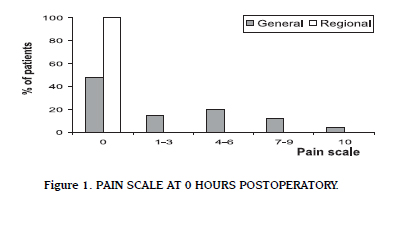
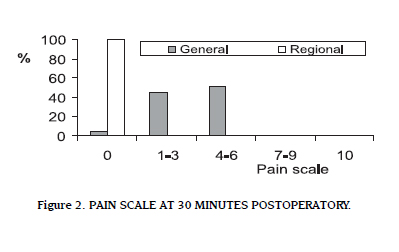
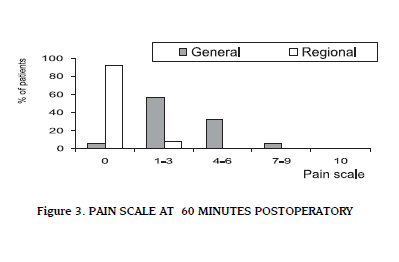
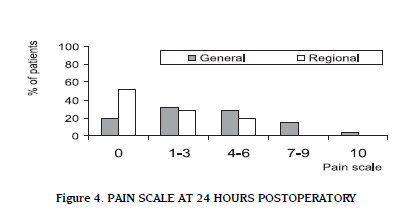
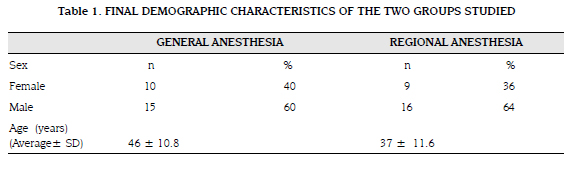
<body><![CDATA[<p><font size="3" face="Verdana"><b>RESULTS</b> </font></p>     <p><font size="2" face="Verdana">Fifty patients were included (25 patients each received RA or GA) and successfully completed the study; there were no failed blocks or breaches in protocols. There were no differences with statistic significance (p&#61;0.770) between the 2 groups in demographic characteristics, ASA status, and types of surgical procedures performed (<a href="#t1">table 1</a>). </font></p>     <p>&nbsp;</p>     <p align="center"><img src="/img/revistas/cesm/v23n1/v23n1a02t1.jpg"/><a name="t1" id="t1"></a><br />   <br /> </p>     <p><font size="2" face="Verdana"> Intraoperative average time in experimental group was 75 min &#177; 48.8 min, and in control group average time was 94 &#177; 46.54 min. This difference between average times had statistic significance, p&#60; 0.000000. PACU average time in RA group was 15 &#177; 16.18 min. In control group PACU average time was 74 &#177; 47.7 min (p&#60;0. 000000). </font></p>     <p><font size="2" face="Verdana"><b>Postoperatory pain</b></font></p>     <p><font size="2" face="Verdana">When VAS for pain was evaluated on experimental group at 0 hours postoperative, a value of 0 was found in the whole group. In control group, 48 &#37; of patients had a value of 0, only 4 &#37; had a maximum value of 10, the average value was 1 (SD: 3.1) (<a href="#f1">figure 1</a>). Five minutes post surgery, 100 &#37; of patient in RA group had a pain value of 0. In GA group at 5 minutes post surgery, 32 &#37; of patient had a value of 0 for pain, 8 &#37; had the maximum value (10), and average was 3 (SD: 3.2). Ten minutes after surgery, 100 &#37; of patient in RA group still had no pain (value for pain: 0), whereas only 16 &#37; of those in GA had the same value, also 4 &#37; of them had a value of 8 (severe pain), and average value was 4 (SD: 2.4). Fifteen minutes post surgery all patients in RA group still had no pain (Value: 0), in GA group, only 8 &#37; had a value of 0 for pain, 4 &#37; had a value of 7, and mean value was 3 (SD: 1.9). </font></p>     <p><font size="2" face="Verdana">Thirty minutes post surgery (<a href="#f2">figure 2</a>) no patient was   found to have pain in RA group, whereas in GA group,   only 4 &#37; had no pain at all, 24 &#37; had a value of 6, an   their average value was 4 (SD: 1.9) .</font></p>     <p><font size="2" face="Verdana"> One hour after surgery (<a href="#f3">figure 3</a>), over 90 &#37; of patient   in RA group still had a value of 0 for pain, and the   maximum VAS value found in this group was 3;   average value at time was 0 (SD: 0.7). Control group   had a value of 0 in only 4 &#37; of patients, and the   maximum VAS value found was 8, average value was   3 (SD: 1.8).</font></p>     <p><font size="2" face="Verdana"> Half of RA group, reported no pain 24 hours post   surgery, 30 &#37; of patients reported only mild pain (VAS:   1&#45;3), and 20 &#37; reported moderate pain (VAS: 4&#45;6).   No patient reported severe pain (VAS&#61; 7) in PNB   group (<a href="#f4">Figure 4</a>).</font></p>     ]]></body>
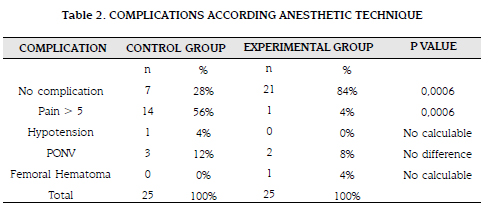
<body><![CDATA[<p>&nbsp;</p>     <p align="center"><img src="/img/revistas/cesm/v23n1/v23n1a02f1.jpg"/><a name="f1" id="f1"></a></p>     <p align="center"><img src="/img/revistas/cesm/v23n1/v23n1a02f2.jpg"/><a name="f2" id="f2"></a></p>     <p align="center">&nbsp;</p>     <p align="center"><img src="/img/revistas/cesm/v23n1/v23n1a02f3.jpg"/><a name="f3" id="f3"></a></p>     <p align="center"><img src="/img/revistas/cesm/v23n1/v23n1a02f4.jpg"/><a name="f4" id="f4"></a></p>     <p>&nbsp;</p>     <p><font size="2" face="Verdana">Summarizing, the whole RA group showed no pain at 30 minutes post surgery. After 60 minutes 82 &#37; still had no pain, and after 24 hour of surgery 52 &#37; of RA group had no pain at all. </font></p>     <p><font size="2" face="Verdana"><b>Anesthesia&#45;related complications</b></font></p>     <p><font size="2" face="Verdana"> Most common complication in GA group was pain   score &#62; 5. PONV occurred in 12 &#37; of GA group   patients and in 8 &#37; of RA group, although there   was a difference, group&#39;s size were too small for   comparing this variable. One patient in control   group (4 &#37;) had hypotension needing management,   and a patient (4 &#37;) in experimental group had a   complication inherent to anesthetic technique   (femoral hematoma), but it did not delay discharge,   increase anesthetic costs, nor generate patient   discomfort (<a href="#t2">table 2</a>). </font></p>     ]]></body>
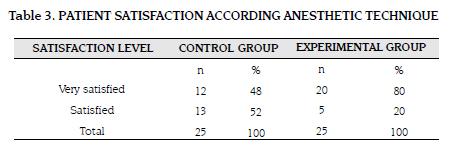
<body><![CDATA[<p>&nbsp;</p>     <p align="center"><img src="/img/revistas/cesm/v23n1/v23n1a02t2.jpg"/><a name="t2" id="t2"></a></p>     <p>&nbsp;</p>     <p><font size="2" face="Verdana"><b>Anesthesia&#45;related costs </b></font></p>     <p><font size="2" face="Verdana">At this time 1 USD is equal to &#36;2.350 pesos (March   2009) </font></p>     <p><font size="2" face="Verdana">RA group average cost per case was &#36;88.321 &#177; &#36;29.886 (USD 37.58 &#177; 12.71). GA group average     cost per case was &#36;&#36;117.501 &#177; &#36;27.501 (USD 50   &#177; 11.70). Although RA group had anesthesia related lower cost, there was no statistic significance   between values. It is important to mention that   there was also a difference in post surgery analgesia   cost which was principally needed in GA group, but   these were not considered as part of anesthetic   costs. </font></p>     <p><font size="2" face="Verdana">PACU average cost per case in GA group was   &#36;18.500 &#177; &#36;11.990 (USD 7.71 &#177; 5.10). In RA   group average cost per case was &#36;3.750 &#177; &#36;4.913   (USD 1.56 &#177; 2.05). </font></p>     <p><font size="2" face="Verdana">Eighty percent of individuals in RA group, felt very   satisfied with the anesthetic technique, compared to   48 &#37; of those who received GA. We consider this as   the most important finding of our study due to our   objective of research about different ways of giving   better healthcare services to our patients (<a href="#t3">table 3</a>). </font></p>     <p align="center"><img src="/img/revistas/cesm/v23n1/v23n1a02t3.jpg"/><a name="t3" id="t3"></a></p>     <p>&nbsp;</p>     ]]></body>
<body><![CDATA[<p><font size="3" face="Verdana"><c>   </font><font size="3" face="Verdana"><b>DISCUSION:</b></b> </font></p>     <p><font size="2" face="Verdana">PNBs are commonly used anesthetic techniques in orthopedic procedures; they help to optimize surgical conditions, post surgery analgesia and rehabilitation. Use of PNB has been associated to lower intensity and incidence of postoperative pain, PONV, and hospital readmissions, when compared to GA (4). Post surgery pain still is one of the most difficult obstacles to overcome in ambulatory anesthesia, inappropriate pain management is associated to higher opioid requirements, which increase PONV incidence, delay discharge, and increases hospital readmission rate (10,13). </font></p>     <p><font size="2" face="Verdana">We evaluated 50 patients, 25 were randomized to   receive GA, and 25 to receive PNB as anesthetic   technique for AKS. We demonstrated several   advantages of PNB technique itself, as are lower   incidence of postoperative pain, and no need of   further analgesia in PACU. This result is consistent with   the reported by Borgeat A. et al in 1200 patients (4). </font></p>     <p><font size="2" face="Verdana">A disadvantage observed with RA is the time spent   in PNB performance. We applied PNB in a special   place for it before taking patient into operation room,   with that average intraoperative time was lower in   this group (p&#61;0,000000). These results are   consistent with those found by Hadzic A. et al (15)   who did not find differences in the intraoperative   time between GA and PNB groups. This reinforced   the necessity of create in surgical services a section   specially designed for PNB placement. </font></p>     <p><font size="2" face="Verdana">PONV are determinant factors for patient   satisfaction, and its incidence in ambulatory   procedures is increased with the use of GA. We found   a lower frequency of PONV in patients who received   PNB but this difference was not significant, because   the sample size was too small to evaluate this variable.</font></p>     <p><font size="2" face="Verdana"> Average PACU time was lower in PNB group   compared to GA group. This suggest that patients   in the PNB group had better pain management, and   lower PONV because this are the most common   factors that would delay sign&#45;off of patients. Similar   data were found by Jankowski et al (22). </font></p>     <p><font size="2" face="Verdana">According to Avidan et al (11), patient satisfaction   is a fundamental indicator of anesthetic technique quality. Satisfaction is higher if analgesia is provided using PNB rather than intravenous opioids. We found similar results because a higher percentage of patients in RA group were very satisfied than in GA group. With regard to anesthesia&#45;related cost we found a little difference, being RA cheaper than GA but it was not of statistical significance. We believe that this is due to the protocol design employed and the simple size.</font></p>     <p><font size="2" face="Verdana">We conclude that this study suggest that regional   anesthesia for ambulatory arthroscopic knee surgery   provides better postoperative analgesia, earlier   discharge and better patient satisfaction than   general anesthesia. Regional anesthesia also seems   to facilitate early rehabilitation and could provide   good care at a lower cost. </font></p>     <p>&nbsp;</p>     <p><b><FONT face="verdana" size="3">REFERENCES</FONT></b></p> <FONT SIZE="2" FACE="Verdana">     ]]></body>
<body><![CDATA[<!-- ref --><p>1. Pregler JL, Kapur PA. The development of ambulatory anesthesia and future challenges. Anesthesiol Clin N Am 2003; 21:207&#45;228.&nbsp;&nbsp;&nbsp;&nbsp;&nbsp;&nbsp;&nbsp;&nbsp;[&#160;<a href="javascript:void(0);" onclick="javascript: window.open('/scielo.php?script=sci_nlinks&ref=000093&pid=S0120-8705200900010000200001&lng=','','width=640,height=500,resizable=yes,scrollbars=1,menubar=yes,');">Links</a>&#160;]<!-- end-ref --><!-- ref --><p>2. Webb E, Graves H. Anesthesia for the   ambulatory patient. Anesth Analg 1959;   38:359&#45;363.&nbsp;&nbsp;&nbsp;&nbsp;&nbsp;&nbsp;&nbsp;&nbsp;[&#160;<a href="javascript:void(0);" onclick="javascript: window.open('/scielo.php?script=sci_nlinks&ref=000094&pid=S0120-8705200900010000200002&lng=','','width=640,height=500,resizable=yes,scrollbars=1,menubar=yes,');">Links</a>&#160;]<!-- end-ref --><!-- ref --><p>3. Pastor PN, Makuc DM, Reuben C, Xia H.   Chartbook on Trends in the Health of   Americans. Health, United States, 2002.   Hyattsville, Maryland: National Center for   Health Statistics, 2002.&nbsp;&nbsp;&nbsp;&nbsp;&nbsp;&nbsp;&nbsp;&nbsp;[&#160;<a href="javascript:void(0);" onclick="javascript: window.open('/scielo.php?script=sci_nlinks&ref=000095&pid=S0120-8705200900010000200003&lng=','','width=640,height=500,resizable=yes,scrollbars=1,menubar=yes,');">Links</a>&#160;]<!-- end-ref --><!-- ref --><p> 4. Borgeat A, Ekatodramis G, Schenker CA,   Warltier DC. Postoperative nausea and vomiting   in regional anesthesia: A review. Anesthesiology   2003; 98:530&#45;547.&nbsp;&nbsp;&nbsp;&nbsp;&nbsp;&nbsp;&nbsp;&nbsp;[&#160;<a href="javascript:void(0);" onclick="javascript: window.open('/scielo.php?script=sci_nlinks&ref=000096&pid=S0120-8705200900010000200004&lng=','','width=640,height=500,resizable=yes,scrollbars=1,menubar=yes,');">Links</a>&#160;]<!-- end-ref --><!-- ref --><p>5. Trame&#39;r MR. Strategies for postoperative   nausea and vomiting. Best Pract Res Clin   Anaesthesiol 2004; 18:693&#45;701.&nbsp;&nbsp;&nbsp;&nbsp;&nbsp;&nbsp;&nbsp;&nbsp;[&#160;<a href="javascript:void(0);" onclick="javascript: window.open('/scielo.php?script=sci_nlinks&ref=000097&pid=S0120-8705200900010000200005&lng=','','width=640,height=500,resizable=yes,scrollbars=1,menubar=yes,');">Links</a>&#160;]<!-- end-ref --><!-- ref --><p> 6. Gan TJ, Meyer T, Apfel CC, Chung F, et al.   Consensus guidelines for managing   postoperative nausea and vomiting. Anesth   Analg 2003; 97:62&#45;71.&nbsp;&nbsp;&nbsp;&nbsp;&nbsp;&nbsp;&nbsp;&nbsp;[&#160;<a href="javascript:void(0);" onclick="javascript: window.open('/scielo.php?script=sci_nlinks&ref=000098&pid=S0120-8705200900010000200006&lng=','','width=640,height=500,resizable=yes,scrollbars=1,menubar=yes,');">Links</a>&#160;]<!-- end-ref --><!-- ref --><p>7. Rosenquist RW, Rosenberg J. Postoperative Pain   Guidelines. Reg Anesth Pain Med 2003;   28:279&#45;288.  &nbsp;&nbsp;&nbsp;&nbsp;&nbsp;&nbsp;&nbsp;&nbsp;[&#160;<a href="javascript:void(0);" onclick="javascript: window.open('/scielo.php?script=sci_nlinks&ref=000099&pid=S0120-8705200900010000200007&lng=','','width=640,height=500,resizable=yes,scrollbars=1,menubar=yes,');">Links</a>&#160;]<!-- end-ref --><!-- ref --><p>8. McGrath B, Chung F. Postoperative recovery   and discharge. Anesthesiol Clin N Am 2003;   21:367&#45;386.&nbsp;&nbsp;&nbsp;&nbsp;&nbsp;&nbsp;&nbsp;&nbsp;[&#160;<a href="javascript:void(0);" onclick="javascript: window.open('/scielo.php?script=sci_nlinks&ref=000100&pid=S0120-8705200900010000200008&lng=','','width=640,height=500,resizable=yes,scrollbars=1,menubar=yes,');">Links</a>&#160;]<!-- end-ref --><!-- ref --><p>9. Macario A, Weinger M, Carney S, Kim A. Which   clinical anesthesia outcomes are important to   avoid&#63; The perspective of patients. Anesth   Analg 1999; 89:652&#45;658.&nbsp;&nbsp;&nbsp;&nbsp;&nbsp;&nbsp;&nbsp;&nbsp;[&#160;<a href="javascript:void(0);" onclick="javascript: window.open('/scielo.php?script=sci_nlinks&ref=000101&pid=S0120-8705200900010000200009&lng=','','width=640,height=500,resizable=yes,scrollbars=1,menubar=yes,');">Links</a>&#160;]<!-- end-ref --><!-- ref --><p> 10. Deutsch N, Wu CL. Patient outcomes following   ambulatory anesthesia. Anesthesiology Clin N   Am 2003; 21:403&#45;415. &nbsp;&nbsp;&nbsp;&nbsp;&nbsp;&nbsp;&nbsp;&nbsp;[&#160;<a href="javascript:void(0);" onclick="javascript: window.open('/scielo.php?script=sci_nlinks&ref=000102&pid=S0120-8705200900010000200010&lng=','','width=640,height=500,resizable=yes,scrollbars=1,menubar=yes,');">Links</a>&#160;]<!-- end-ref --><!-- ref --><p>11. Avidan A, Drenger B, Ginosar Y. Peripheral nerve   block for ambulatory surgery and postoperative   analgesia. Curr Opin Anesthesiol 2003; 16:567&#45;   573.  &nbsp;&nbsp;&nbsp;&nbsp;&nbsp;&nbsp;&nbsp;&nbsp;[&#160;<a href="javascript:void(0);" onclick="javascript: window.open('/scielo.php?script=sci_nlinks&ref=000103&pid=S0120-8705200900010000200011&lng=','','width=640,height=500,resizable=yes,scrollbars=1,menubar=yes,');">Links</a>&#160;]<!-- end-ref --><!-- ref --><p>12. Jenkis K, Grady D, Wong J, et al. Post&#45;operative   recovery: day surgery patients&#39; preferences. Br   J Anaesth 2001; 86:272&#45;274.&nbsp;&nbsp;&nbsp;&nbsp;&nbsp;&nbsp;&nbsp;&nbsp;[&#160;<a href="javascript:void(0);" onclick="javascript: window.open('/scielo.php?script=sci_nlinks&ref=000104&pid=S0120-8705200900010000200012&lng=','','width=640,height=500,resizable=yes,scrollbars=1,menubar=yes,');">Links</a>&#160;]<!-- end-ref --><!-- ref --><p>13. Mulroy MF, McDonald SB. Regional anesthesia   for outpatient surgery. Anesth Clin N Am 2003;   21:289&#45;303.  &nbsp;&nbsp;&nbsp;&nbsp;&nbsp;&nbsp;&nbsp;&nbsp;[&#160;<a href="javascript:void(0);" onclick="javascript: window.open('/scielo.php?script=sci_nlinks&ref=000105&pid=S0120-8705200900010000200013&lng=','','width=640,height=500,resizable=yes,scrollbars=1,menubar=yes,');">Links</a>&#160;]<!-- end-ref --><!-- ref --><p>14. Enneking FK, Chan V, Greger J. Lower&#45;Extremity   peripheral nerve blockade: Essential of our   current understanding. Reg Anesth Pain Med   2005; 30:4&#45;35.&nbsp;&nbsp;&nbsp;&nbsp;&nbsp;&nbsp;&nbsp;&nbsp;[&#160;<a href="javascript:void(0);" onclick="javascript: window.open('/scielo.php?script=sci_nlinks&ref=000106&pid=S0120-8705200900010000200014&lng=','','width=640,height=500,resizable=yes,scrollbars=1,menubar=yes,');">Links</a>&#160;]<!-- end-ref --><!-- ref --><p>15. Hadzic A, Karaka PE, Hobeika P, et al. Peripheral   nerve blocks result in superior recovery profile   compared with general anesthesia in outpatient   knee arthroscopy. Anesth Analg 2005;   100:976&#45;981.  &nbsp;&nbsp;&nbsp;&nbsp;&nbsp;&nbsp;&nbsp;&nbsp;[&#160;<a href="javascript:void(0);" onclick="javascript: window.open('/scielo.php?script=sci_nlinks&ref=000107&pid=S0120-8705200900010000200015&lng=','','width=640,height=500,resizable=yes,scrollbars=1,menubar=yes,');">Links</a>&#160;]<!-- end-ref --><!-- ref --><p>16. Fleiss JL. Statistical methods for rates and   proportions. John Miley and Sons Company.   Second edition. 1981.  &nbsp;&nbsp;&nbsp;&nbsp;&nbsp;&nbsp;&nbsp;&nbsp;[&#160;<a href="javascript:void(0);" onclick="javascript: window.open('/scielo.php?script=sci_nlinks&ref=000108&pid=S0120-8705200900010000200016&lng=','','width=640,height=500,resizable=yes,scrollbars=1,menubar=yes,');">Links</a>&#160;]<!-- end-ref --><!-- ref --><p>17. Brown AK, Christo PJ, Wu CL. Strategies for   postoperative pain management. Best Pract Res   Clin Anaesthesiol 2004; 18:703&#45;717.&nbsp;&nbsp;&nbsp;&nbsp;&nbsp;&nbsp;&nbsp;&nbsp;[&#160;<a href="javascript:void(0);" onclick="javascript: window.open('/scielo.php?script=sci_nlinks&ref=000109&pid=S0120-8705200900010000200017&lng=','','width=640,height=500,resizable=yes,scrollbars=1,menubar=yes,');">Links</a>&#160;]<!-- end-ref --><!-- ref --><p>18. Hadzic A, et al. Textbook of regional anesthesia   and acute pain management. 1st ed, Chapter 37 p 517&#45;532. New York: McGraw&#45;Hill   Companies; 2007.&nbsp;&nbsp;&nbsp;&nbsp;&nbsp;&nbsp;&nbsp;&nbsp;[&#160;<a href="javascript:void(0);" onclick="javascript: window.open('/scielo.php?script=sci_nlinks&ref=000110&pid=S0120-8705200900010000200018&lng=','','width=640,height=500,resizable=yes,scrollbars=1,menubar=yes,');">Links</a>&#160;]<!-- end-ref --><!-- ref --><p>19. Singelyn FJ. Textbook of regional anesthesia and   acute pain management. 1st ed, Chapter 35 p 499&#45;   508. New York: McGraw&#45;Hill Companies; 2007.&nbsp;&nbsp;&nbsp;&nbsp;&nbsp;&nbsp;&nbsp;&nbsp;[&#160;<a href="javascript:void(0);" onclick="javascript: window.open('/scielo.php?script=sci_nlinks&ref=000111&pid=S0120-8705200900010000200019&lng=','','width=640,height=500,resizable=yes,scrollbars=1,menubar=yes,');">Links</a>&#160;]<!-- end-ref --><!-- ref --><p> 20. Bouaziz H. Textbook of regional anesthesia and   acute pain management. 1st ed, Chapter 34 p 489&#45;   498. New York: McGraw&#45;Hill Companies; 2007.&nbsp;&nbsp;&nbsp;&nbsp;&nbsp;&nbsp;&nbsp;&nbsp;[&#160;<a href="javascript:void(0);" onclick="javascript: window.open('/scielo.php?script=sci_nlinks&ref=000112&pid=S0120-8705200900010000200020&lng=','','width=640,height=500,resizable=yes,scrollbars=1,menubar=yes,');">Links</a>&#160;]<!-- end-ref --><!-- ref --><p>21. Kittelberger KP, Lebel AA, Borsook D. Valoraci&oacute;n   del dolor. Massachussets General Hospital   tratamiento del dolor 26&#45;30. 1999&nbsp;&nbsp;&nbsp;&nbsp;&nbsp;&nbsp;&nbsp;&nbsp;[&#160;<a href="javascript:void(0);" onclick="javascript: window.open('/scielo.php?script=sci_nlinks&ref=000113&pid=S0120-8705200900010000200021&lng=','','width=640,height=500,resizable=yes,scrollbars=1,menubar=yes,');">Links</a>&#160;]<!-- end-ref --><!-- ref --><p>22. Jawkosi CJ, Hebe JR, Stuart MJ, et al. A   comparison of psoas compartment block and   spinal and general anesthesia for outpatient   knee arthroscopy. Anesth Analg 2003, 97;   1003&#45;9.&nbsp;&nbsp;&nbsp;&nbsp;&nbsp;&nbsp;&nbsp;&nbsp;[&#160;<a href="javascript:void(0);" onclick="javascript: window.open('/scielo.php?script=sci_nlinks&ref=000114&pid=S0120-8705200900010000200022&lng=','','width=640,height=500,resizable=yes,scrollbars=1,menubar=yes,');">Links</a>&#160;]<!-- end-ref --><p><hr size="1" noshade></p>     <p>Recibido: marzo 10 de 2009. Revisado: abril 25 de 2009. Aceptado: mayo 4 de 2009</p>     <p>&nbsp;</p>     <p>Forma de citar: Gonz&aacute;lez Obreg&oacute;n MP, V&aacute;squez Sadder MI, Herrera&#45;Morales LA, Rivera Diaz RC, Arcila Lotero MA, Puerta Mart&iacute;nez JJ, Trujillo Hinestroza LM, Torres Y. General versus regional anesthesia for ambulatory arthroscopic knee surgery. Rev CES Med 2009; 23(1):7&#45;16</p> </FONT>      ]]></body><back>
<ref-list>
<ref id="B1">
<label>1</label><nlm-citation citation-type="journal">
<person-group person-group-type="author">
<name>
<surname><![CDATA[Pregler]]></surname>
<given-names><![CDATA[JL]]></given-names>
</name>
<name>
<surname><![CDATA[Kapur]]></surname>
<given-names><![CDATA[PA]]></given-names>
</name>
</person-group>
<article-title xml:lang="en"><![CDATA[The development of ambulatory anesthesia and future challenges]]></article-title>
<source><![CDATA[Anesthesiol Clin N Am]]></source>
<year>2003</year>
<volume>21</volume>
<page-range>207-228</page-range></nlm-citation>
</ref>
<ref id="B2">
<label>2</label><nlm-citation citation-type="journal">
<person-group person-group-type="author">
<name>
<surname><![CDATA[Webb]]></surname>
<given-names><![CDATA[E]]></given-names>
</name>
<name>
<surname><![CDATA[Graves]]></surname>
<given-names><![CDATA[H]]></given-names>
</name>
</person-group>
<article-title xml:lang="en"><![CDATA[Anesthesia for the ambulatory patient]]></article-title>
<source><![CDATA[Anesth Analg]]></source>
<year>1959</year>
<volume>38</volume>
<page-range>359-363</page-range></nlm-citation>
</ref>
<ref id="B3">
<label>3</label><nlm-citation citation-type="book">
<person-group person-group-type="author">
<name>
<surname><![CDATA[Pastor]]></surname>
<given-names><![CDATA[PN]]></given-names>
</name>
<name>
<surname><![CDATA[Makuc]]></surname>
<given-names><![CDATA[DM]]></given-names>
</name>
<name>
<surname><![CDATA[Reuben]]></surname>
<given-names><![CDATA[C]]></given-names>
</name>
<name>
<surname><![CDATA[Xia]]></surname>
<given-names><![CDATA[H]]></given-names>
</name>
</person-group>
<article-title xml:lang="en"><![CDATA[Chartbook on Trends in the Health of Americans]]></article-title>
<source><![CDATA[Health, United States, 2002]]></source>
<year>2002</year>
<publisher-loc><![CDATA[Hyattsville^eMaryland Maryland]]></publisher-loc>
<publisher-name><![CDATA[National Center for Health Statistics]]></publisher-name>
</nlm-citation>
</ref>
<ref id="B4">
<label>4</label><nlm-citation citation-type="journal">
<person-group person-group-type="author">
<name>
<surname><![CDATA[Borgeat]]></surname>
<given-names><![CDATA[A]]></given-names>
</name>
<name>
<surname><![CDATA[Ekatodramis]]></surname>
<given-names><![CDATA[G]]></given-names>
</name>
<name>
<surname><![CDATA[Schenker]]></surname>
<given-names><![CDATA[CA]]></given-names>
</name>
<name>
<surname><![CDATA[Warltier]]></surname>
<given-names><![CDATA[DC]]></given-names>
</name>
</person-group>
<article-title xml:lang="en"><![CDATA[Postoperative nausea and vomiting in regional anesthesia: A review]]></article-title>
<source><![CDATA[nesthesiology]]></source>
<year>2003</year>
<volume>98</volume>
<page-range>530-547</page-range></nlm-citation>
</ref>
<ref id="B5">
<label>5</label><nlm-citation citation-type="journal">
<person-group person-group-type="author">
<name>
<surname><![CDATA[Trame'r]]></surname>
<given-names><![CDATA[MR]]></given-names>
</name>
</person-group>
<article-title xml:lang="en"><![CDATA[Strategies for postoperative nausea and vomiting]]></article-title>
<source><![CDATA[Best Pract Res Clin Anaesthesiol]]></source>
<year>2004</year>
<volume>18</volume>
<page-range>693-701</page-range></nlm-citation>
</ref>
<ref id="B6">
<label>6</label><nlm-citation citation-type="journal">
<person-group person-group-type="author">
<name>
<surname><![CDATA[Gan]]></surname>
<given-names><![CDATA[TJ]]></given-names>
</name>
<name>
<surname><![CDATA[Meyer]]></surname>
<given-names><![CDATA[T]]></given-names>
</name>
<name>
<surname><![CDATA[Apfel]]></surname>
<given-names><![CDATA[CC]]></given-names>
</name>
<name>
<surname><![CDATA[Chung]]></surname>
<given-names><![CDATA[F]]></given-names>
</name>
</person-group>
<article-title xml:lang="en"><![CDATA[Consensus guidelines for managing postoperative nausea and vomiting]]></article-title>
<source><![CDATA[Anesth Analg]]></source>
<year>2003</year>
<volume>97</volume>
<page-range>62-71</page-range></nlm-citation>
</ref>
<ref id="B7">
<label>7</label><nlm-citation citation-type="journal">
<person-group person-group-type="author">
<name>
<surname><![CDATA[Rosenquist]]></surname>
<given-names><![CDATA[RW]]></given-names>
</name>
<name>
<surname><![CDATA[Rosenberg]]></surname>
<given-names><![CDATA[J.]]></given-names>
</name>
</person-group>
<article-title xml:lang="en"><![CDATA[Postoperative Pain Guidelines]]></article-title>
<source><![CDATA[Reg Anesth Pain Med]]></source>
<year>2003</year>
<volume>28</volume>
<page-range>279-288</page-range></nlm-citation>
</ref>
<ref id="B8">
<label>8</label><nlm-citation citation-type="journal">
<person-group person-group-type="author">
<name>
<surname><![CDATA[McGrath]]></surname>
<given-names><![CDATA[B]]></given-names>
</name>
<name>
<surname><![CDATA[Chung]]></surname>
<given-names><![CDATA[F]]></given-names>
</name>
</person-group>
<article-title xml:lang="en"><![CDATA[Postoperative recovery and discharge]]></article-title>
<source><![CDATA[Anesthesiol Clin N Am]]></source>
<year>2003</year>
<volume>21</volume>
<page-range>367-386</page-range></nlm-citation>
</ref>
<ref id="B9">
<label>9</label><nlm-citation citation-type="journal">
<person-group person-group-type="author">
<name>
<surname><![CDATA[Macario]]></surname>
<given-names><![CDATA[A]]></given-names>
</name>
<name>
<surname><![CDATA[Weinger]]></surname>
<given-names><![CDATA[M]]></given-names>
</name>
<name>
<surname><![CDATA[Carney]]></surname>
<given-names><![CDATA[S]]></given-names>
</name>
<name>
<surname><![CDATA[Kim]]></surname>
<given-names><![CDATA[A]]></given-names>
</name>
</person-group>
<article-title xml:lang="en"><![CDATA[Which clinical anesthesia outcomes are important to avoid?: The perspective of patients]]></article-title>
<source><![CDATA[Anesth Analg]]></source>
<year>1999</year>
<volume>89</volume>
<page-range>652-658</page-range></nlm-citation>
</ref>
<ref id="B10">
<label>10</label><nlm-citation citation-type="journal">
<person-group person-group-type="author">
<name>
<surname><![CDATA[Deutsch]]></surname>
<given-names><![CDATA[N]]></given-names>
</name>
<name>
<surname><![CDATA[Wu]]></surname>
<given-names><![CDATA[CL]]></given-names>
</name>
</person-group>
<article-title xml:lang="en"><![CDATA[Patient outcomes following ambulatory anesthesia]]></article-title>
<source><![CDATA[Anesthesiology Clin N Am]]></source>
<year>2003</year>
<volume>21</volume>
<page-range>403-415</page-range></nlm-citation>
</ref>
<ref id="B11">
<label>11</label><nlm-citation citation-type="journal">
<person-group person-group-type="author">
<name>
<surname><![CDATA[Avidan]]></surname>
<given-names><![CDATA[A]]></given-names>
</name>
<name>
<surname><![CDATA[Drenger]]></surname>
<given-names><![CDATA[B]]></given-names>
</name>
<name>
<surname><![CDATA[Ginosar]]></surname>
<given-names><![CDATA[Y]]></given-names>
</name>
</person-group>
<article-title xml:lang="en"><![CDATA[Peripheral nerve block for ambulatory surgery and postoperative analgesia]]></article-title>
<source><![CDATA[Curr Opin Anesthesiol]]></source>
<year>2003</year>
<volume>16</volume>
<page-range>567- 573</page-range></nlm-citation>
</ref>
<ref id="B12">
<label>12</label><nlm-citation citation-type="journal">
<person-group person-group-type="author">
<name>
<surname><![CDATA[Jenkis]]></surname>
<given-names><![CDATA[K]]></given-names>
</name>
<name>
<surname><![CDATA[Grady]]></surname>
<given-names><![CDATA[D]]></given-names>
</name>
<name>
<surname><![CDATA[Wong]]></surname>
<given-names><![CDATA[J]]></given-names>
</name>
</person-group>
<article-title xml:lang="en"><![CDATA[Post-operative recovery: day surgery patients' preferences]]></article-title>
<source><![CDATA[Br J Anaesth]]></source>
<year>2001</year>
<volume>86</volume>
<page-range>272-274</page-range></nlm-citation>
</ref>
<ref id="B13">
<label>13</label><nlm-citation citation-type="journal">
<person-group person-group-type="author">
<name>
<surname><![CDATA[Mulroy]]></surname>
<given-names><![CDATA[MF]]></given-names>
</name>
<name>
<surname><![CDATA[McDonald]]></surname>
<given-names><![CDATA[SB]]></given-names>
</name>
</person-group>
<article-title xml:lang="en"><![CDATA[Regional anesthesia for outpatient surgery]]></article-title>
<source><![CDATA[Anesth Clin N Am]]></source>
<year>2003</year>
<volume>21</volume>
<page-range>289-303</page-range></nlm-citation>
</ref>
<ref id="B14">
<label>14</label><nlm-citation citation-type="journal">
<person-group person-group-type="author">
<name>
<surname><![CDATA[Enneking]]></surname>
<given-names><![CDATA[FK]]></given-names>
</name>
<name>
<surname><![CDATA[Chan]]></surname>
<given-names><![CDATA[V]]></given-names>
</name>
<name>
<surname><![CDATA[Greger]]></surname>
<given-names><![CDATA[J.]]></given-names>
</name>
</person-group>
<article-title xml:lang="en"><![CDATA[Lower-Extremity peripheral nerve blockade: Essential of our current understanding]]></article-title>
<source><![CDATA[Reg Anesth Pain Med]]></source>
<year>2005</year>
<volume>30</volume>
<page-range>4-35</page-range></nlm-citation>
</ref>
<ref id="B15">
<label>15</label><nlm-citation citation-type="journal">
<person-group person-group-type="author">
<name>
<surname><![CDATA[Hadzic]]></surname>
<given-names><![CDATA[A]]></given-names>
</name>
<name>
<surname><![CDATA[Karaka]]></surname>
<given-names><![CDATA[PE]]></given-names>
</name>
<name>
<surname><![CDATA[Hobeika]]></surname>
<given-names><![CDATA[P]]></given-names>
</name>
</person-group>
<article-title xml:lang="en"><![CDATA[Peripheral nerve blocks result in superior recovery profile compared with general anesthesia in outpatient knee arthroscopy]]></article-title>
<source><![CDATA[Anesth Analg]]></source>
<year>2005</year>
<volume>100</volume>
<page-range>976-981</page-range></nlm-citation>
</ref>
<ref id="B16">
<label>16</label><nlm-citation citation-type="book">
<person-group person-group-type="author">
<name>
<surname><![CDATA[Fleiss]]></surname>
<given-names><![CDATA[JL]]></given-names>
</name>
</person-group>
<source><![CDATA[Statistical methods for rates and proportions]]></source>
<year>1981</year>
<edition>Second</edition>
<publisher-name><![CDATA[John Miley and Sons Company]]></publisher-name>
</nlm-citation>
</ref>
<ref id="B17">
<label>17</label><nlm-citation citation-type="journal">
<person-group person-group-type="author">
<name>
<surname><![CDATA[Brown]]></surname>
<given-names><![CDATA[AK]]></given-names>
</name>
<name>
<surname><![CDATA[Christo]]></surname>
<given-names><![CDATA[PJ]]></given-names>
</name>
<name>
<surname><![CDATA[Wu]]></surname>
<given-names><![CDATA[CL]]></given-names>
</name>
</person-group>
<article-title xml:lang="en"><![CDATA[Strategies for postoperative pain management]]></article-title>
<source><![CDATA[Best Pract Res Clin Anaesthesiol]]></source>
<year>2004</year>
<volume>18</volume>
<page-range>703-717</page-range></nlm-citation>
</ref>
<ref id="B18">
<label>18</label><nlm-citation citation-type="book">
<person-group person-group-type="author">
<name>
<surname><![CDATA[Hadzic]]></surname>
<given-names><![CDATA[A]]></given-names>
</name>
</person-group>
<source><![CDATA[Textbook of regional anesthesia and acute pain management]]></source>
<year>2007</year>
<page-range>517-532</page-range><publisher-loc><![CDATA[New York ]]></publisher-loc>
<publisher-name><![CDATA[McGraw-Hill Companies]]></publisher-name>
</nlm-citation>
</ref>
<ref id="B19">
<label>19</label><nlm-citation citation-type="book">
<person-group person-group-type="author">
<name>
<surname><![CDATA[Singelyn]]></surname>
<given-names><![CDATA[FJ]]></given-names>
</name>
</person-group>
<source><![CDATA[Textbook of regional anesthesia and acute pain management]]></source>
<year>2007</year>
<page-range>499- 508</page-range><publisher-loc><![CDATA[New York ]]></publisher-loc>
<publisher-name><![CDATA[McGraw-Hill Companies]]></publisher-name>
</nlm-citation>
</ref>
<ref id="B20">
<label>20</label><nlm-citation citation-type="book">
<person-group person-group-type="author">
<name>
<surname><![CDATA[Bouaziz]]></surname>
<given-names><![CDATA[H]]></given-names>
</name>
</person-group>
<source><![CDATA[Textbook of regional anesthesia and acute pain management]]></source>
<year>2007</year>
<page-range>489- 498</page-range><publisher-loc><![CDATA[New York ]]></publisher-loc>
<publisher-name><![CDATA[McGraw-Hill Companies]]></publisher-name>
</nlm-citation>
</ref>
<ref id="B21">
<label>21</label><nlm-citation citation-type="book">
<person-group person-group-type="author">
<name>
<surname><![CDATA[Kittelberger]]></surname>
<given-names><![CDATA[KP]]></given-names>
</name>
<name>
<surname><![CDATA[Lebel]]></surname>
<given-names><![CDATA[AA]]></given-names>
</name>
<name>
<surname><![CDATA[Borsook]]></surname>
<given-names><![CDATA[D]]></given-names>
</name>
</person-group>
<source><![CDATA[Valoración del dolor]]></source>
<year>1999</year>
<page-range>26-30</page-range><publisher-loc><![CDATA[^eMassachussets Massachussets]]></publisher-loc>
<publisher-name><![CDATA[General Hospital tratamiento del dolor]]></publisher-name>
</nlm-citation>
</ref>
<ref id="B22">
<label>22</label><nlm-citation citation-type="journal">
<person-group person-group-type="author">
<name>
<surname><![CDATA[Jawkosi]]></surname>
<given-names><![CDATA[CJ]]></given-names>
</name>
<name>
<surname><![CDATA[Hebe]]></surname>
<given-names><![CDATA[JR]]></given-names>
</name>
<name>
<surname><![CDATA[Stuart]]></surname>
<given-names><![CDATA[MJ]]></given-names>
</name>
</person-group>
<article-title xml:lang="en"><![CDATA[A comparison of psoas compartment block and spinal and general anesthesia for outpatient knee arthroscopy]]></article-title>
<source><![CDATA[Anesth Analg]]></source>
<year>2003</year>
<volume>97</volume>
<page-range>1003-9</page-range></nlm-citation>
</ref>
</ref-list>
</back>
</article>