<?xml version="1.0" encoding="ISO-8859-1"?><article xmlns:mml="http://www.w3.org/1998/Math/MathML" xmlns:xlink="http://www.w3.org/1999/xlink" xmlns:xsi="http://www.w3.org/2001/XMLSchema-instance">
<front>
<journal-meta>
<journal-id>0120-8705</journal-id>
<journal-title><![CDATA[CES Medicina]]></journal-title>
<abbrev-journal-title><![CDATA[CES Med.]]></abbrev-journal-title>
<issn>0120-8705</issn>
<publisher>
<publisher-name><![CDATA[Universidad CES]]></publisher-name>
</publisher>
</journal-meta>
<article-meta>
<article-id>S0120-87052009000200002</article-id>
<title-group>
<article-title xml:lang="en"><![CDATA[Association of severe malaria with ABO&#45;blood group types in an endemic zone of Colombia]]></article-title>
<article-title xml:lang="es"><![CDATA[Asociación de malaria severa con tipo de grupo sanguíneo ABO en una zona endémica de Colombia]]></article-title>
</title-group>
<contrib-group>
<contrib contrib-type="author">
<name>
<surname><![CDATA[HERRERA]]></surname>
<given-names><![CDATA[ANA MILENA]]></given-names>
</name>
<xref ref-type="aff" rid="A01"/>
</contrib>
<contrib contrib-type="author">
<name>
<surname><![CDATA[MONTOYA]]></surname>
<given-names><![CDATA[LILIANA PATRICIA]]></given-names>
</name>
<xref ref-type="aff" rid="A02"/>
</contrib>
<contrib contrib-type="author">
<name>
<surname><![CDATA[ARBOLEDA]]></surname>
<given-names><![CDATA[MARGARITA]]></given-names>
</name>
<xref ref-type="aff" rid="A03"/>
</contrib>
<contrib contrib-type="author">
<name>
<surname><![CDATA[ORTIZ]]></surname>
<given-names><![CDATA[LUISA FERNANDA]]></given-names>
</name>
<xref ref-type="aff" rid="A04"/>
</contrib>
</contrib-group>
<aff id="A01">
<institution><![CDATA[,Universidad CES Facultad de Medicina Grupo de investigación Ciencias Básicas]]></institution>
<addr-line><![CDATA[ ]]></addr-line>
</aff>
<aff id="A02">
<institution><![CDATA[,Universidad CES Facultad de Medicina Grupo de investigación Observatorio de la Salud Pública]]></institution>
<addr-line><![CDATA[ ]]></addr-line>
</aff>
<aff id="A03">
<institution><![CDATA[,Universidad CES Investigadora Instituto Colombiano de Medicina Tropical Grupo de investigación Instituto Colombiano de Medicina Tropical]]></institution>
<addr-line><![CDATA[ ]]></addr-line>
</aff>
<aff id="A04">
<institution><![CDATA[,Universidad CES  ]]></institution>
<addr-line><![CDATA[ ]]></addr-line>
</aff>
<pub-date pub-type="pub">
<day>00</day>
<month>07</month>
<year>2009</year>
</pub-date>
<pub-date pub-type="epub">
<day>00</day>
<month>07</month>
<year>2009</year>
</pub-date>
<volume>23</volume>
<numero>2</numero>
<fpage>7</fpage>
<lpage>14</lpage>
<copyright-statement/>
<copyright-year/>
<self-uri xlink:href="http://www.scielo.org.co/scielo.php?script=sci_arttext&amp;pid=S0120-87052009000200002&amp;lng=en&amp;nrm=iso"></self-uri><self-uri xlink:href="http://www.scielo.org.co/scielo.php?script=sci_abstract&amp;pid=S0120-87052009000200002&amp;lng=en&amp;nrm=iso"></self-uri><self-uri xlink:href="http://www.scielo.org.co/scielo.php?script=sci_pdf&amp;pid=S0120-87052009000200002&amp;lng=en&amp;nrm=iso"></self-uri><abstract abstract-type="short" xml:lang="en"><p><![CDATA[Introduction: malaria is considered one of the most important tropical illnesses in public health causing millions of infections and deaths each year. Many studies have tried to establish an association between the severe form of the disease and the ABO&#45;blood group type. In Colombia, a country with large endemic zones for malaria there are not enough studies or statistic data about this possible association. Methods: a retrospective case&#45;control study of patients with severe and uncomplicated malaria in the endemic zone of Apartadó, Colombia, was performed between January 2000 and June 2006. Only the clinical records with blood group ABO and Rh classification were included. Results: a total sample of 92 patients was obtained: 49 with severe malaria and 43 with uncomplicated malaria. From the total sample, 68.5% were women and the median age of 21.5 years (min 1&#45;max 80). Of the patients with diagnosis of severe malaria, 59.2 % were women. The more frequent parasite species was Plasmodium falciparum. Severe malaria was more frequent among patients classified with blood group O (65.3 %) and positive Rh (93.9 %), but this association was not statistically significant. Conclusion: even though severe malaria was more frequent among patients classified with blood group O and positive Rh, an association between blood group and severe malaria could not be established. The controversial association of these variables previously found in other populations could be probably explained by the demographic distribution and characteristics of those.]]></p></abstract>
<abstract abstract-type="short" xml:lang="es"><p><![CDATA[Introducción: la malaria es considerada una de las más importantes enfermedades tropicales en salud pública, causando millones de infecciones y muertes cada año. Muchos estudios han tratado de establecer una asociación entre la forma grave de la enfermedad y la clasificación sanguínea ABO. En Colombia, un país con grandes zonas endémicas de malaria, no existen suficientes estudios y datos estadísticos acerca de esta posible asociación. Objetivo: identificar pacientes con trastornos de la deglución, en una unidad de cuidados especiales y caracterizar las causas directas de dichos trastorno Métodos: se realizó un estudio de casos y controles de pacientes con malaria severa y no complicada en la zona endémica de Apartadó, Colombia y ejecutado entre enero de 2000 y junio de 2006. Sólo las historias clínicas con información acerca de la clasificación sanguínea ABO o Rh fueron incluidas. Resultados: la muestra total fue de 92 pacientes, 49 con malaria grave y 43 con malaria no complicada. De la muestra total, 68,5% eran mujeres y la edad media de 21,5 años (mínimo 1&#45;máximo 80). De los pacientes con diagnóstico de malaria grave, 59,2 % eran mujeres. El parásito más frecuente fue la especie de P. falciparum. La malaria grave fue mas frecuente entre los pacientes clasificados con grupo sanguíneo O (65,3 %) y Rh positivo (93,9 %), pero esta asociación no fue estadísticamente significativa. Conclusión: aunque la malaria severa fue mas frecuente en pacientes con grupo sanguíneo O y Rh positivo, una asociación entre la severidad de la malaria y la clasificación sanguínea no pudo ser establecida. La controvertida asociación entre estas variables previamente encontrada en otras poblaciones, probablemente puede ser explicada por la distribución y características demográficas de dichas poblaciones.]]></p></abstract>
<kwd-group>
<kwd lng="en"><![CDATA[Malaria]]></kwd>
<kwd lng="en"><![CDATA[ABO blood Group system]]></kwd>
<kwd lng="en"><![CDATA[Colombia]]></kwd>
<kwd lng="es"><![CDATA[Malaria]]></kwd>
<kwd lng="es"><![CDATA[Clasificación grupo sanguíneo ABO]]></kwd>
<kwd lng="es"><![CDATA[Colombia]]></kwd>
</kwd-group>
</article-meta>
</front><body><![CDATA[  <head> </head>  <body>     <p align="right"><b><FONT SIZE="2" FACE="Verdana">ART&Iacute;CULOS DE INVESTIGACI&Oacute;N CIENT&Iacute;FICA O TECNOL&Oacute;GICA</FONT></b></p>     <p align="right">&nbsp;</p>     <p align="center"><b><FONT SIZE="4" FACE="Verdana">Association of severe malaria with ABO&#45;blood group types in an endemic zone of Colombia</FONT SIZE="2" FACE="Verdana"></b></p>     <p align="center">&nbsp;</p>     <p align="center"><FONT SIZE="3" FACE="Verdana"> <b>Asociaci&oacute;n de malaria severa con tipo de grupo sangu&iacute;neo ABO en una zona end&eacute;mica de Colombia</b></FONT></p>     <p>&nbsp;</p>     <p>&nbsp;</p>     <p><font FACE="Verdana" size="2">ANA MILENA HERRERA<sup>1</sup>, LILIANA PATRICIA MONTOYA<sup>2</sup>, MARGARITA ARBOLEDA<sup>3</sup>, LUISA FERNANDA ORTIZ<sup>4</sup></font><br /> </sup><font size="2" FACE="Verdana"><sup>1 </sup>Ph. D en Patolog&iacute;a. Docente Facultad de Medicina &ndash; - &#45; Universidad CES. Grupo de investigaci&oacute;n Ciencias &nbsp;&nbsp;&nbsp;B&aacute;sicas. Correo electr&oacute;nico: <a href="mailto:aherrera@ces.edu.co">aherrera@ces.edu.co</a><br /> <sup>2</sup> Mag&iacute;ster en Epidemiolog&iacute;a. Docente Facultad de Medicina &#45; Universidad CES. Grupo de investigaci&oacute;n &nbsp;&nbsp;Observatorio de la Salud P&uacute;blica.<br /> <sup>3</sup> Mag&iacute;ster en Medicina Tropical. Investigadora Instituto Colombiano de Medicina Tropical. Grupo de &nbsp;&nbsp;&nbsp;investigaci&oacute;n Instituto Colombiano de Medicina Tropical.<br /> </font><font size="2" FACE="Verdana"> <sup>4</sup> M&eacute;dico. Universidad CES.       </font></p>     <p>&nbsp;</p>     ]]></body>
<body><![CDATA[<p>&nbsp;</p> <hr size="1" noshade="noshade" />     <p><font size="2" face="Verdana"><b>ABSTRACT </b></font></p>     <p><font size="2" face="Verdana"><b>Introduction:</b> malaria is considered one of the most important tropical illnesses in public   health causing millions of infections and deaths each year. Many studies have tried to establish   an association between the severe form of the disease and the ABO&#45;blood group type. In Colombia,   a country with large endemic zones for malaria there are not enough studies or statistic data about   this possible association.</font></p>     <p> <font size="2" face="Verdana"><b>Methods:</b> a retrospective case&#45;control study of patients with severe and uncomplicated malaria in   the endemic zone of Apartad&oacute;, Colombia, was performed between January 2000 and June 2006. Only the clinical records with blood group ABO and Rh classification were included.</font></p>     <p><font size="2" face="Verdana"><b>Results: </b>a total sample of 92 patients was obtained: 49 with severe malaria and 43 with uncomplicated   malaria. From the total sample, 68.5&#37; were women and the median age of 21.5 years (min 1&#45;max 80). Of the patients with diagnosis of severe   malaria, 59.2 &#37; were women. The more frequent parasite   species was Plasmodium falciparum. Severe malaria   was more frequent among patients classified with blood   group O (65.3 &#37;) and positive Rh (93.9 &#37;), but this association was not statistically significant.</font></p>     <p> <font size="2" face="Verdana"><b>Conclusion: </b>even though severe malaria was more   frequent among patients classified with blood group O   and positive Rh, an association between blood group and   severe malaria could not be established. The controversial   association of these variables previously found in other   populations could be probably explained by the demographic   distribution and characteristics of those.</font></p>     <p><font size="2" face="Verdana"> <b>KEY WORDS </b> </font></p>     <p><font size="2" face="Verdana"> Malaria,   ABO blood Group system,   Colombia </font><FONT SIZE="2" FACE="Verdana">   </FONT></p> <FONT SIZE="2" FACE="Verdana"> <hr size="1" noshade>     <p><font size="2" face="Verdana"><b>RESUMEN</b> </font></p> </FONT>     <p> <font size="2" face="Verdana"><b>Introducci&oacute;n: </b>la malaria es considerada una de las m&aacute;s importantes enfermedades tropicales en salud p&uacute;blica, causando millones de infecciones y muertes cada a&ntilde;o. Muchos estudios han tratado de establecer una asociaci&oacute;n entre la forma grave de la enfermedad y la clasificaci&oacute;n sangu&iacute;nea ABO. En Colombia, un pa&iacute;s con grandes zonas end&eacute;micas de malaria, no existen suficientes estudios y datos estad&iacute;sticos acerca de esta posible asociaci&oacute;n.</font></p>     ]]></body>
<body><![CDATA[<p> <font size="2" face="Verdana"><b>Objetivo: </b>identificar pacientes con trastornos de la degluci&oacute;n, en una unidad de cuidados especiales   y caracterizar las causas directas de dichos trastorno</font></p>     <p><font size="2" face="Verdana"><b> M&eacute;todos:</b> se realiz&oacute; un estudio de casos y controles de pacientes con malaria severa y no complicada en la zona end&eacute;mica de Apartad&oacute;, Colombia y ejecutado entre enero de 2000 y junio de 2006. S&oacute;lo las historias cl&iacute;nicas con informaci&oacute;n acerca de la clasificaci&oacute;n sangu&iacute;nea ABO o Rh fueron incluidas.</font></p>     <p><font size="2" face="Verdana"><b>Resultados:</b> la muestra total fue de 92 pacientes, 49 con malaria grave y 43 con malaria no complicada. De la muestra total, 68,5&#37; eran mujeres y la edad media de 21,5 a&ntilde;os (m&iacute;nimo 1&#45;m&aacute;ximo 80). De los pacientes con diagn&oacute;stico de malaria grave, 59,2 &#37; eran mujeres. El par&aacute;sito m&aacute;s frecuente fue la especie de P. falciparum. La malaria grave fue mas frecuente entre los pacientes clasificados con grupo sangu&iacute;neo O (65,3 &#37;) y Rh positivo (93,9 &#37;), pero esta asociaci&oacute;n no fue estad&iacute;sticamente significativa.<br /> </font><font size="2" face="Verdana"></font></p>     <p> <font size="2" face="Verdana"><b>Conclusi&oacute;n:</b> aunque la malaria severa fue mas frecuente en pacientes con grupo sangu&iacute;neo O y Rh positivo, una asociaci&oacute;n entre la severidad de la malaria y la clasificaci&oacute;n sangu&iacute;nea no pudo ser establecida. La controvertida asociaci&oacute;n entre estas variables previamente encontrada en otras poblaciones, probablemente puede ser explicada por la distribuci&oacute;n y caracter&iacute;sticas demogr&aacute;ficas de dichas poblaciones.</font></p>     <p><font size="2" face="Verdana"><b> PALABRAS CLAVES</b></font></p>     <p><font size="2" face="Verdana"> Malaria, Clasificaci&oacute;n grupo sangu&iacute;neo ABO, Colombia</font><FONT SIZE="2" FACE="Verdana"></FONT></p> <FONT SIZE="2" FACE="Verdana"> <hr size="1" noshade> </p>     <p>&nbsp;</p> </FONT>     <p><b><font face="Verdana" SIZE="3">INTRODUCTION</font></b></p>      <p><font size="2" face="Verdana">Malaria is considered a worldwide major public health problem (1) as it is the most important parasite disease affecting humans and causing millions of deaths each year (2). In tropical and subtropical regions of the world, it is estimated that malaria is responsible for 300 to 500 millions of infections and 2 to 3 millions of deaths per year (3); being considered as one of the main health problems in regions like Africa, India, Southeast of Asia, and South America (4). Given the optimal environmental conditions for malaria transmission among different territories of Colombia, the country is considered as one of the endemic zones in the world (1,3). In the Colombian zones of Urab&aacute; and Bajo Cauca (1998), among the people affected by the disease, the reported parasite species prevalence is 66 &#37; for P. vivax and 33 &#37; for P. falciparum (1). The latest, is the parasite widely associated with a more severe presentation of the disease (1,2). However, besides the parasite species, the clinical presentation and severity of the disease are influenced by the geographic zone, demographic characteristics and host susceptibility (5).</font></p>     <p><font size="2" face="Verdana"> Many pathophysiological mechanisms have been   postulated to explain host susceptibility for parasite   colonization and clinical presentation of   the disease. Some studies have suggested that   host susceptibility could be linked to the ABOblood   group and/or Rh type due to the presence   of different erythrocyte receptor systems that   act as ligands to facilitate parasite adhesion (6). </font></p>     ]]></body>
<body><![CDATA[<p><font size="2" face="Verdana">Several authors have stated that while groups A,   B, and O seem to be equally susceptible to the   infection, group AB show less propensity to infections.   Additionally, it is suggested that groups   A and O exhibit less colonization by P. falciparum   (7). In a systematic review published in 2007, it   was reported that while in 7 different studies a   significant association between P. falciparum malaria   and ABO blood classification was found,   this association could not be demonstrated in   other seven studies (8). About Rh classification,   many studies have found a protective association   between negative Rh and the susceptibility   to P. vivax malaria as this blood group get less   infections (9,10). </font></p>     <p><font size="2" face="Verdana">In terms of the severity of the disease, it has   been found that severe malaria frequency is in   linear relation with parasite concentration and   intra&#45;erythrocyte rosettes formation mainly by   P. falciparum that invades all type of erythrocytes   involving complex physiopathological processes   deriving in more severe effects (1,6). P. falciparum   erythrocyte invasion and rosette formation is believed   to be favored by erythrocyte surface antigens   among the different ABO&#45;blood group and   Duffy types (6). Some studies have found that P.   falciparum form rosettes with more frequency in   those erythrocytes with A and B blood groups,   but less frequently in those of group O, which   could indicate some resistance of this group to   the severe presentation of malaria (8,11&#45;15). </font></p>     <p><font size="2" face="Verdana">At the epidemiological level and only considering   the clinical studies, a clear association between   severe malaria and blood group classification has   not been established (16). Some comparative   studies have demonstrated differences in terms   of blood group types and the presence of severe   malaria concluding that patients with group   O could be more resistant to the infection by   P. falciparum (14,15). However, other studies have   failed to demonstrate this association (16,17). In   a recent publication, Cserti and Dzik (2007) suggested   that the controversial association between   severe malaria and ABO blood groups is   closely related to the geographic distribution of   the different blood groups among the endemic   zones (16). These studies have been performed   in many tropical territories affected by malaria   around the world, however, in Colombia, a country   with large endemic zones; there are no many   similar studies or statistic data about this alleged   association. </font></p>     <p>&nbsp;</p>     <p>&nbsp;</p>     <p><b><font size="3" face="Verdana">MATERIALS AND   METHODS </font></b></p>     <p><font size="2" face="Verdana">All the clinical records of hospitalized patients with malaria, in the regional hospital of the Apartad&oacute; town, an endemic zone of Urab&aacute; (Colombia) during the period of January 2000 and December 2005 were evaluated. The clinical records of patients with malaria and ABO blood group and Rh classification were included. A retrospective case&#45;control study of patients diagnosed with severe malaria and uncomplicated malaria during this period was performed. Neonatal malaria was used as exclusion criteria. </font></p>     <p><font size="2" face="Verdana">The cases of severe malaria were defined by the   presence of one or more of the following criteria based on the report published by the World Health Organization (WHO, 2000) (18) and adapted by the researchers keeping into account the criteria established in Colombia by the Ministry of Social Protection for malaria falciparum parasitemia and severe anemia (2007) (19), and for severe trombocitopenia according to the definition published by Tobon et al. 2006 (20): cerebral malaria (defined as unrousable coma not attributable to any other cause in a patient with falciparum malaria), severe normocytic anaemia (hemoglobin &#60;7.0 mg/dL and hematocrite &#60;20 &#37; &#45;adapted by the researchers&#45;, hypoglycaemia (glucose &#60;40 mg/dL), metabolic acidosis with respiratory distress, fluid and electrolyte disturbances, acute renal failure (creatinin &#62;3.0 mg/dL), acute pulmonary oedema and adult respiratory distress syndrome (ARDS), circulatory collapse, shock, septicaemia, abnormal bleeding, jaundice (total bilirrubin TB &#62;3.0 mg/dL),haemoglobinuria, hyperparasitaemia (&#62;50,000 asexual parasites / &#181;L&#42; &#45;adapted by the researchers&#45;), severe thrombocytopenia (platelets &#60;20.000/&#181;L &#45;adapted by the researchers&#45;). </font></p>     <p><font size="2" face="Verdana">Information about demographic variables, blood   group classification, and parasite type and laboratory   tests values was collected from each clinical   record of both groups: uncomplicated malaria   and severe malaria. Data was processed in the   statistic software SPSS 10&#174;. Bivariated analysis   to evaluate differences between numeric variables   between cases and controls was performed   through the U Mann&#45;Whitney test and to evaluate   the association between categorical variables   a Chi&#45;square test was performed. Odds ratios   (OR) and 95&#37; confidence intervals (CI) were calculated.   A p value &#60;0.05 was set for statistical significance. </font></p>     <p>&nbsp;</p>     ]]></body>
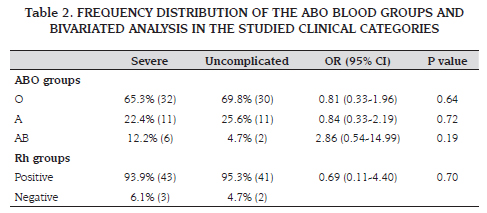
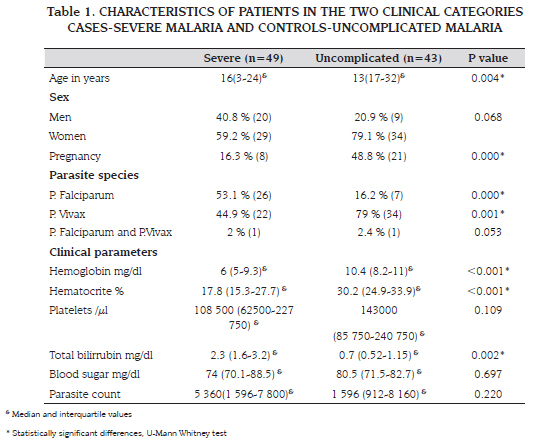
<body><![CDATA[<p>&nbsp;</p>     <p><font size="3" face="Verdana"><b>RESULTS</b> </font></p>     <p><font size="2" face="Verdana">A total of 197 clinical records of hospitalized patients with malaria between January 2000 and December 2005 in the Hospital Antonio Rold&aacute;n Betancur were initially evaluated, of those, 92 records fulfilled the inclusion criteria of having information about ABO or Rh blood classification. The sample was conformed by 49 patients in the group of cases and 43 in the control group. Median age of the total sample was 20 years (interquartile range 5.5&#45;28 years) and 68.5 &#37; (63/92) were women, from these, 46 &#37; (n&#61;29) were in the third trimester of pregnancy. The frequency distribution of the different ABO blood groups of the total sample was: group O (67.4 &#37;), group A (23.9 &#37;) and group AB (8.7 &#37;). In terms of Rh classification, 94.6 &#37; of patients of the total sample were classified as positive. The more frequent parasite in the total sample was P. vivax (61.5 &#37;), followed by P. falciparum (36.3 &#37;). Mixed malaria by both parasites was present in 2 patients (2.2 &#37;). The demographic and clinical characteristics of patients of cases and control groups are displayed in <a href="#t1">table 1</a>.</font></p>     <p><font size="2" face="Verdana"> In the group of cases of severe malaria (n&#61;49)   the diagnosis was performed by the following   criteria: severe anemia 69.4 &#37; (34), ADRS in 22.4   &#37; (11), hyperparasitemia in 16.7 &#37; (8), hepatic   failure 14.6 &#37; (7), severe thrombocytopenia in 4.2 &#37;   (2), renal failure 2.1 &#37; (1), and cerebral malaria   2.1 &#37; (1). There were no cases diagnosed by severe   hypoglycemia. There was one death caused   by severe malaria. </font></p>     <p><font size="2" face="Verdana">The bivariated analysis to establish association   between severity of the disease and the ABO and   Rh blood group classification did not show statistical   significance for any of the blood types.</font></p>     <p>&nbsp;</p>     <p align="center"><img src="/img/revistas/cesm/v23n2/v23n2a02t1.jpg"/><a name="t1" id="t1"></a></p>     <p>&nbsp;</p>     <p><font size="2" face="Verdana"><a href="#t2">Table 2</a> displays the calculated OR values with their respective 95 &#37; CI for each of the groups with respect of severity of malaria. </font></p>     <p><font size="2" face="Verdana">With regard to the association of the rest of   variables with the severity of malaria, a statistically   significant association between this one   and sex was found (OR 2.60, 95 &#37; CI 1.03&#45;6.60;   p&#61;0.044) being males 2.6 times more at risk of   developing severe malaria than females. Examining   the association of the severity of the disease   and range of age, it was observed that severe   malaria affects significantly more those patients   between one and 12 years of age (OR 5.46, 95 &#37;   CI 1.78&#45;17.51; p&#61;0.0015). Also, there was significant   association with the parasite species being   P. falciparum as a risk factor (OR 5.65, 95 &#37; CI   1.92&#45;17.21; p&#61;0.0003) and P. vivax as a protective   factor (OR 0.19, 95 &#37; CI 0.07&#45;0.54; p&#61;0.0004)   for developing severe malaria. Pregnancy also   presented a significant association with severe   malaria (OR 0.24, 95 &#37; CI 0.07&#45;0.77; p&#61;0.006).   As in the rest of patients of the sample, in pregnant   women, severe malaria did not show significant   association with the ABO blood Group   classification. </font></p>     ]]></body>
<body><![CDATA[<p><font size="2" face="Verdana">Evaluating parasite species and its possible association   with any blood type, it was found that   for infection with each of both parasites: P. falciparum   and P. vivax, the most frequent blood type   was O (75.8 &#37; for P. falciparum and 62.5 &#37; for P. vivax)   without any significant association between this blood type and parasite species.</font></p>     <p>&nbsp;</p>     <p align="center"><img src="/img/revistas/cesm/v23n2/v23n2a02t2.jpg"/><a name="t2" id="t2"></a></p>     <p>&nbsp;</p>     <p><font size="3" face="Verdana"><c>   </font></p>     <p><font size="3" face="Verdana"><b>DISCUSION:</b></b> </font></p>     <p><font size="2" face="Verdana">Several reports in the literature establish association between the blood classification system ABO and malaria; specifically between group AB and severe malaria and refer that people with blood type O are relatively resistant to develop severe malaria by P. Faciparum (8,9,14,15). In the present study, an association between blood group and severe malaria was not found. These findings are similar to what was reported by Montoya et al. where no association could be established between the presence of ABO antigens and malaria by P. Falciparum or P.Vivax in 4 different ethnic groups in Colombia (9). Alike, Cavasin et al. found similar frequencies of ABO phenotype between blood donors and malaria patients in 4 areas of Brazilian Amazone (10). In another Amazonic area, Beiguelman et al. also failed to find such association arguing that it is probably due to the geographic distribution of the different ABO phenotypes in this region (21). In the present study, 65.3 &#37; of the cases of severe malaria were blood type O, different from what was found by Pathirana et al (15) where the ratio was of 23.8 &#37;; also, in that study, type A was the most frequent (32.5 &#37;) and type B represented 27.5 &#37;. In the present study no cases of severe malaria had blood type B. In uncomplicated malaria patients the predominant blood type was also O, while Pathirana&#39;s reported 47.9 &#37; (15). These findings support more the idea that the alleged association between blood type and severity of malaria depends on the demographic distribution and characteristics of the studied population, as every region in the world seems to have different ABO phenotype distribution. </font></p>     <p><font size="2" face="Verdana">The demographic characteristics of the evaluated   population in the present study suggest   in general a higher frequency of the disease in   women specially those in their third trimester   of pregnancy. The bivariated analysis indicated   that males are at more risk of developing severe   malaria, however, there are not physiopatological   mechanisms that could explain this association.   This situation could be explained from the   public health system point of view, as the strict   prenatal assistance and control system of our   country assures that women in fertile age and   during pregnancy could be detected rapidly in   the early phases of the disease avoiding the progression   of malaria to a severe stage. Therefore,   the ratio of 20 of 29 males affected by severe   malaria contrast with the ratio of 29 of 63 females   with the same diagnosis probably indicating   that even though in this study malaria is more   frequent among women, its progress to a severe   stage is less frequent in those as well. Another   explanation could be the fact that pregnant women   with uncomplicated malaria are hospitalized   and given special care due to their condition,   therefore avoiding complications of their   disease (22).<br /> </font><font size="2" face="Verdana"><br />  The median age of affected patients by the severe disease was constituted by young adults, but after performing the analysis by groups of age, a high frequency of severe malaria in the age group between 1&#45;12 years was evident. This is possibly due to the susceptibility of children to experience a more severe form of the disease given the poor immunological and nutritional conditions of this population (23&#45;25). </font></p>     <p><font size="2" face="Verdana">In agreement with the epidemiological data   found in our country and previously described   in the literature, in the total sample of this study,   the most frequent parasite for non complicated   malaria found in this endemic zone was P. vivax,   and for severe malaria was P. falciparum being a   risk factor for its development as has already   been described for many dacades (1,20). Only   2 patients presented mixed infection by P. falciparum   and P. vivax, one of them manifested the   severe form of the disease.   </font></p>     <p><font size="2" face="Verdana">The majority of severe cases of malaria were diagnosed   by the presence of severe anemia given by   highly compromised levels of hemoglobin and hematocrit.   This contrast with the results obtained   by Tob&oacute;n et al. (2006) in two Colombian populations,   where severe malaria diagnose was more   frequently performed by hyerparasitemia and   hepatic failure, and less frequently due to severe   anemia (20). However, this finding is in agreement   with other studies where severe anemia is reported   as one of the most frequent parameters for   the diagnose of severe malaria in other populations   probably due to their geographic conditions   (15&#45;17). Coherent also with the reported in the literature,   there were not cases of severe malaria diagnosed by severe hypoglycemia (15&#45;17). </font></p>     ]]></body>
<body><![CDATA[<p>&nbsp;</p>     <p>&nbsp;</p>     <p><b><font face="Verdana" SIZE="3">CONCLUSION</font></b></p> <FONT SIZE="2" FACE="Verdana">     <p>In the present study, although severe malaria was more frequent among patients classified with blood group O (65.3 &#37;) and positive Rh (93.9 &#37;), an association between blood group and severe malaria could not be established. These findings support more the idea that the alleged association between blood type and severity of malaria depends on the demographic distribution and characteristics of the studied population, as every region in the world seems to have different ABO phenotype distribution.</p>     <p>&nbsp;</p>     <p>&nbsp;</p>     <p><b><FONT face="verdana" size="3">REFERENCES</FONT></b></p>     <!-- ref --><p>1. Botero D, Restrepo M. Malaria. En: Parasitosis Humanas. Tercera edici&oacute;n. Medell&iacute;n, Colombia. 1998. p.158&#45;201.&nbsp;&nbsp;&nbsp;&nbsp;&nbsp;&nbsp;&nbsp;&nbsp;[&#160;<a href="javascript:void(0);" onclick="javascript: window.open('/scielo.php?script=sci_nlinks&ref=000070&pid=S0120-8705200900020000200001&lng=','','width=640,height=500,resizable=yes,scrollbars=1,menubar=yes,');">Links</a>&#160;]<!-- end-ref --><!-- ref --><p>2. W hite JN, Breman GJ. Malaria and Babesiosis:   Diseases caused by red blood cell parasites.   En: Harrison&#39;s principles of internal   medicine. Edici&oacute;n 16. Mc Graw Hill. 2005. p.1218&#45;1233.  &nbsp;&nbsp;&nbsp;&nbsp;&nbsp;&nbsp;&nbsp;&nbsp;[&#160;<a href="javascript:void(0);" onclick="javascript: window.open('/scielo.php?script=sci_nlinks&ref=000071&pid=S0120-8705200900020000200002&lng=','','width=640,height=500,resizable=yes,scrollbars=1,menubar=yes,');">Links</a>&#160;]<!-- end-ref --><!-- ref --><p>3. W orld Health Organization. Expert Committee   on Malaria. WHO technical report series 892,   i&#45;v. World Health Organization, Geneva; 2000.&nbsp;&nbsp;&nbsp;&nbsp;&nbsp;&nbsp;&nbsp;&nbsp;[&#160;<a href="javascript:void(0);" onclick="javascript: window.open('/scielo.php?script=sci_nlinks&ref=000072&pid=S0120-8705200900020000200003&lng=','','width=640,height=500,resizable=yes,scrollbars=1,menubar=yes,');">Links</a>&#160;]<!-- end-ref --><!-- ref --><p> 4. W orld Health Organization (2003) The African   malaria report 2003. World Health Organization,   Geneva  &nbsp;&nbsp;&nbsp;&nbsp;&nbsp;&nbsp;&nbsp;&nbsp;[&#160;<a href="javascript:void(0);" onclick="javascript: window.open('/scielo.php?script=sci_nlinks&ref=000073&pid=S0120-8705200900020000200004&lng=','','width=640,height=500,resizable=yes,scrollbars=1,menubar=yes,');">Links</a>&#160;]<!-- end-ref --><!-- ref --><p>5. Thakur A, Verma IC. Malaria and ABO blood   groups. Indian journal Malariol. 1992; 29   (4):241&#45;4.&nbsp;&nbsp;&nbsp;&nbsp;&nbsp;&nbsp;&nbsp;&nbsp;[&#160;<a href="javascript:void(0);" onclick="javascript: window.open('/scielo.php?script=sci_nlinks&ref=000074&pid=S0120-8705200900020000200005&lng=','','width=640,height=500,resizable=yes,scrollbars=1,menubar=yes,');">Links</a>&#160;]<!-- end-ref --><!-- ref --><p> 6. Daniels G. Blood group polymorphisms: molecular   approach and biological significance.   Transfus. Clin. Biol. 1997. 4:383&#45;390.  &nbsp;&nbsp;&nbsp;&nbsp;&nbsp;&nbsp;&nbsp;&nbsp;[&#160;<a href="javascript:void(0);" onclick="javascript: window.open('/scielo.php?script=sci_nlinks&ref=000075&pid=S0120-8705200900020000200006&lng=','','width=640,height=500,resizable=yes,scrollbars=1,menubar=yes,');">Links</a>&#160;]<!-- end-ref --><!-- ref --><p>7. Singh N, Shukla MM, Uniyal VP, Sharma VP.   ABO blood groups among malaria cases   from district Mandla, Madhya Pradesh. Indian   Journal Malariol. 1995; 32 (2): 59&#45;63.&nbsp;&nbsp;&nbsp;&nbsp;&nbsp;&nbsp;&nbsp;&nbsp;[&#160;<a href="javascript:void(0);" onclick="javascript: window.open('/scielo.php?script=sci_nlinks&ref=000076&pid=S0120-8705200900020000200007&lng=','','width=640,height=500,resizable=yes,scrollbars=1,menubar=yes,');">Links</a>&#160;]<!-- end-ref --><!-- ref --><p> 8. Uneke CJ. Plasmodium falciparum malaria   and ABO blood group: is there any relationship&#63;   Parasitol Res. 2007; 100(4):759&#45;65.&nbsp;&nbsp;&nbsp;&nbsp;&nbsp;&nbsp;&nbsp;&nbsp;[&#160;<a href="javascript:void(0);" onclick="javascript: window.open('/scielo.php?script=sci_nlinks&ref=000077&pid=S0120-8705200900020000200008&lng=','','width=640,height=500,resizable=yes,scrollbars=1,menubar=yes,');">Links</a>&#160;]<!-- end-ref --><!-- ref --><p> 9. Montoya FM, Restrepo AF. Blood groups   and malaria. Rev. Inst. Med. Trop. S&atilde;o Paulo   1994; 36:33&#45;38. &nbsp;&nbsp;&nbsp;&nbsp;&nbsp;&nbsp;&nbsp;&nbsp;[&#160;<a href="javascript:void(0);" onclick="javascript: window.open('/scielo.php?script=sci_nlinks&ref=000078&pid=S0120-8705200900020000200009&lng=','','width=640,height=500,resizable=yes,scrollbars=1,menubar=yes,');">Links</a>&#160;]<!-- end-ref --><!-- ref --><p>10. Cavasin CE, De Mattos LC, Tome Alves R,   Couto AA, Pachiano VS, Bonin CR, Castilho   L, et al. Frequencies of ABO, MNSs, and   Duffy phenotypes among blood donors   and malaria patients from four Brazilian   Amazon areas. Human Biology. 2006; 78   (2):215&#45;219.&nbsp;&nbsp;&nbsp;&nbsp;&nbsp;&nbsp;&nbsp;&nbsp;[&#160;<a href="javascript:void(0);" onclick="javascript: window.open('/scielo.php?script=sci_nlinks&ref=000079&pid=S0120-8705200900020000200010&lng=','','width=640,height=500,resizable=yes,scrollbars=1,menubar=yes,');">Links</a>&#160;]<!-- end-ref --><!-- ref --><p> 11. Udomsangpetch R, Todd J, Carlson J,   Greenwood B.M. The effects of hemoglobin   genotype and ABO blood group on the   formation of rosettes by Plasmodium Falciparum   infected red blood cells. Am. J. Trop.   Med. Hyg. 1993;48 (2): 149&#45;153.  &nbsp;&nbsp;&nbsp;&nbsp;&nbsp;&nbsp;&nbsp;&nbsp;[&#160;<a href="javascript:void(0);" onclick="javascript: window.open('/scielo.php?script=sci_nlinks&ref=000080&pid=S0120-8705200900020000200011&lng=','','width=640,height=500,resizable=yes,scrollbars=1,menubar=yes,');">Links</a>&#160;]<!-- end-ref --><!-- ref --><p>12. Barragan A, Kremsner P.Wahlgren M, Carlson   J. Blood group A is a coreceptor in   plasmodium falciparum roseting. Infection   and Immunity. 2000; 68 (5): 2971&#45;2975.&nbsp;&nbsp;&nbsp;&nbsp;&nbsp;&nbsp;&nbsp;&nbsp;[&#160;<a href="javascript:void(0);" onclick="javascript: window.open('/scielo.php?script=sci_nlinks&ref=000081&pid=S0120-8705200900020000200012&lng=','','width=640,height=500,resizable=yes,scrollbars=1,menubar=yes,');">Links</a>&#160;]<!-- end-ref --><!-- ref --><p>13. Rowe A, Obeiro J, Newbold C.I, Marsh K.   Plasmodium Falciparum rosetting is associated   with malaria severity in Kenya. Infection   and Immunity. 1995; 63 (6): 2323&#45;2326.  &nbsp;&nbsp;&nbsp;&nbsp;&nbsp;&nbsp;&nbsp;&nbsp;[&#160;<a href="javascript:void(0);" onclick="javascript: window.open('/scielo.php?script=sci_nlinks&ref=000082&pid=S0120-8705200900020000200013&lng=','','width=640,height=500,resizable=yes,scrollbars=1,menubar=yes,');">Links</a>&#160;]<!-- end-ref --><!-- ref --><p>14. Rowe JA, Handel IG, Thera MA, Deans A&#45;M,   Lyke KE, Kone A, Diallo DA, et al. Blood   group O protects against severe Plasmodium   Falciparum malaria through the   mechanism of reduced resetting. PNAS.   2007;104 (44): 17474&#45;17476.&nbsp;&nbsp;&nbsp;&nbsp;&nbsp;&nbsp;&nbsp;&nbsp;[&#160;<a href="javascript:void(0);" onclick="javascript: window.open('/scielo.php?script=sci_nlinks&ref=000083&pid=S0120-8705200900020000200014&lng=','','width=640,height=500,resizable=yes,scrollbars=1,menubar=yes,');">Links</a>&#160;]<!-- end-ref --><!-- ref --><p>15. Pathirana SL, Alles HK, Bandara S, Phone&#45;   Kyaw M, Prerra MK, Wickremassinghe AR,   Mendis KN, Handunnetti Sm. Abo&#45;bloodgroup   types and protection against severe,   plasmodium falciparum malaria. Ann tropical   Medicine Parasitol. 2005; 99 (2): 119&#45;24.&nbsp;&nbsp;&nbsp;&nbsp;&nbsp;&nbsp;&nbsp;&nbsp;[&#160;<a href="javascript:void(0);" onclick="javascript: window.open('/scielo.php?script=sci_nlinks&ref=000084&pid=S0120-8705200900020000200015&lng=','','width=640,height=500,resizable=yes,scrollbars=1,menubar=yes,');">Links</a>&#160;]<!-- end-ref --><!-- ref --><p>16. Cserti C.M, Dzik W.H. The blood group system   and Plasmodium Falciparum malaria.   Blood. 2007;110: 2250&#45;2258.&nbsp;&nbsp;&nbsp;&nbsp;&nbsp;&nbsp;&nbsp;&nbsp;[&#160;<a href="javascript:void(0);" onclick="javascript: window.open('/scielo.php?script=sci_nlinks&ref=000085&pid=S0120-8705200900020000200016&lng=','','width=640,height=500,resizable=yes,scrollbars=1,menubar=yes,');">Links</a>&#160;]<!-- end-ref --><!-- ref --><p> 17. Fischer P, Boone P. Short report: severe malaria   associates with blood group. Amer J   Trop Med Hyg. 1998; 58 (1): 122&#45;123. &nbsp;&nbsp;&nbsp;&nbsp;&nbsp;&nbsp;&nbsp;&nbsp;[&#160;<a href="javascript:void(0);" onclick="javascript: window.open('/scielo.php?script=sci_nlinks&ref=000086&pid=S0120-8705200900020000200017&lng=','','width=640,height=500,resizable=yes,scrollbars=1,menubar=yes,');">Links</a>&#160;]<!-- end-ref --><!-- ref --><p>18. W orld Health Organization. Severe falciparum   malaria. World Health Organization,   Communicable Diseases Cluster. Trans R   Soc Trop Med Hyg 2000; 94 (Suppl 1):S1&#45;   90.&nbsp;&nbsp;&nbsp;&nbsp;&nbsp;&nbsp;&nbsp;&nbsp;[&#160;<a href="javascript:void(0);" onclick="javascript: window.open('/scielo.php?script=sci_nlinks&ref=000087&pid=S0120-8705200900020000200018&lng=','','width=640,height=500,resizable=yes,scrollbars=1,menubar=yes,');">Links</a>&#160;]<!-- end-ref --><!-- ref --><p>19. Colombia, Ministerio de la Protecci&oacute;n Social.   Gu&iacute;as y Normas 412 &#45; Tomo 3. Gu&iacute;as de promoci&oacute;n   de la salud y prevenci&oacute;n de enfermedades   en la salud p&uacute;blica. Gu&iacute;a 19. Gu&iacute;a de Atenci&oacute;n de la Malaria. 2007; p. 71&#45;131.  &nbsp;&nbsp;&nbsp;&nbsp;&nbsp;&nbsp;&nbsp;&nbsp;[&#160;<a href="javascript:void(0);" onclick="javascript: window.open('/scielo.php?script=sci_nlinks&ref=000088&pid=S0120-8705200900020000200019&lng=','','width=640,height=500,resizable=yes,scrollbars=1,menubar=yes,');">Links</a>&#160;]<!-- end-ref --><!-- ref --><p>20. Tob&oacute;n A, Giraldo C, Pineros JG, Arboleda   M, Blair S, Carmona&#45;Fonseca J. The epidemiology   of complicated falciparum malaria:   case and controls study in Tumaco and   Turbo, Colombia 2003. Rev. Bras. Epidemiol. 2006; 9(3):283&#45;296.&nbsp;&nbsp;&nbsp;&nbsp;&nbsp;&nbsp;&nbsp;&nbsp;[&#160;<a href="javascript:void(0);" onclick="javascript: window.open('/scielo.php?script=sci_nlinks&ref=000089&pid=S0120-8705200900020000200020&lng=','','width=640,height=500,resizable=yes,scrollbars=1,menubar=yes,');">Links</a>&#160;]<!-- end-ref --><!-- ref --><p> 21. Beiguelman B, Alves P.F, Moura M.M. Association   of genetic markers and malaria infection   in the Brazilian Western Amazonian   region. Mem. Inst. Oswaldo Cruz. 2003;98   (4): 455&#45;460&nbsp;&nbsp;&nbsp;&nbsp;&nbsp;&nbsp;&nbsp;&nbsp;[&#160;<a href="javascript:void(0);" onclick="javascript: window.open('/scielo.php?script=sci_nlinks&ref=000090&pid=S0120-8705200900020000200021&lng=','','width=640,height=500,resizable=yes,scrollbars=1,menubar=yes,');">Links</a>&#160;]<!-- end-ref --><!-- ref --><p> 22. Schantz&#45;Dunn J, Nour NM. Malaria and pregnancy:   a global health perspective. Rev Obstet   Gynecol. 2009; Summer;2(3):186&#45;92.&nbsp;&nbsp;&nbsp;&nbsp;&nbsp;&nbsp;&nbsp;&nbsp;[&#160;<a href="javascript:void(0);" onclick="javascript: window.open('/scielo.php?script=sci_nlinks&ref=000091&pid=S0120-8705200900020000200022&lng=','','width=640,height=500,resizable=yes,scrollbars=1,menubar=yes,');">Links</a>&#160;]<!-- end-ref --><!-- ref --><p>23. Crawley J, Nahlen B. Prevention and   treatment of malaria in young african children.   Semin Pediatr infect dis. 2004; 15 (3):   169&#45;180.    &nbsp;&nbsp;&nbsp;&nbsp;&nbsp;&nbsp;&nbsp;&nbsp;[&#160;<a href="javascript:void(0);" onclick="javascript: window.open('/scielo.php?script=sci_nlinks&ref=000092&pid=S0120-8705200900020000200023&lng=','','width=640,height=500,resizable=yes,scrollbars=1,menubar=yes,');">Links</a>&#160;]<!-- end-ref --><!-- ref -->   24. Maitland K, Marsh K. Pathophysiology of   severe malaria in children. Acta Trop. 2004;   90 (2): 131&#45;140.&nbsp;&nbsp;&nbsp;&nbsp;&nbsp;&nbsp;&nbsp;&nbsp;[&#160;<a href="javascript:void(0);" onclick="javascript: window.open('/scielo.php?script=sci_nlinks&ref=000093&pid=S0120-8705200900020000200024&lng=','','width=640,height=500,resizable=yes,scrollbars=1,menubar=yes,');">Links</a>&#160;]<!-- end-ref --><!-- ref --><p>25. Dubos F, Dauriac A, El Mansouf L, Courouble   C, Aurel M, Martinot A, the Hospital Network   for Evaluating the Management of   Common Childhood Diseases. Imported   malaria in children: incidence and risk factors   for severity. Diagn Microbiol Infect Dis. 2009 Sep 28. &#91;Epub ahead of print&#93;&nbsp;&nbsp;&nbsp;&nbsp;&nbsp;&nbsp;&nbsp;&nbsp;[&#160;<a href="javascript:void(0);" onclick="javascript: window.open('/scielo.php?script=sci_nlinks&ref=000094&pid=S0120-8705200900020000200025&lng=','','width=640,height=500,resizable=yes,scrollbars=1,menubar=yes,');">Links</a>&#160;]<!-- end-ref --><p>&nbsp;</p>     <p><hr size="1" noshade></p>     <p>Recibido: junio de 2009. Revisado: Julio de 2009. Aceptado: noviembre 20 de 2009</p>     <p>&nbsp;</p>     <p>Forma de citar: Herrera AM, Montoya LM, Arboleda M, Ortiz LF. Asociaci&oacute;n de la malaria severa con tipo de grupo sangu&iacute;neo ABO en una zona end&eacute;mica de Colombia. Rev CES Med 2009;23(2):9&#45;16.&nbsp;</p> </FONT>      ]]></body><back>
<ref-list>
<ref id="B1">
<label>1</label><nlm-citation citation-type="">
<person-group person-group-type="author">
<name>
<surname><![CDATA[Botero]]></surname>
<given-names><![CDATA[D]]></given-names>
</name>
<name>
<surname><![CDATA[Restrepo]]></surname>
<given-names><![CDATA[M]]></given-names>
</name>
</person-group>
<article-title xml:lang="es"><![CDATA[Malaria]]></article-title>
<source><![CDATA[Parasitosis Humanas]]></source>
<year>1998</year>
<edition>Tercera edición</edition>
<page-range>158-201</page-range><publisher-loc><![CDATA[Medellín ]]></publisher-loc>
</nlm-citation>
</ref>
<ref id="B2">
<label>2</label><nlm-citation citation-type="book">
<person-group person-group-type="author">
<name>
<surname><![CDATA[W hite]]></surname>
<given-names><![CDATA[JN]]></given-names>
</name>
<name>
<surname><![CDATA[Breman]]></surname>
<given-names><![CDATA[GJ]]></given-names>
</name>
</person-group>
<article-title xml:lang="en"><![CDATA[Malaria and Babesiosis: Diseases caused by red blood cell parasites]]></article-title>
<source><![CDATA[Harrison's principles of internal medicine]]></source>
<year>2005</year>
<edition>Edición 16</edition>
<page-range>1218-1233</page-range><publisher-name><![CDATA[Mc Graw Hill]]></publisher-name>
</nlm-citation>
</ref>
<ref id="B3">
<label>3</label><nlm-citation citation-type="book">
<collab>World Health Organization</collab>
<article-title xml:lang="en"><![CDATA[Expert Committee on Malaria]]></article-title>
<source><![CDATA[WHO technical report series 892, i-v]]></source>
<year>2000</year>
<publisher-loc><![CDATA[Geneva ]]></publisher-loc>
<publisher-name><![CDATA[World Health Organization]]></publisher-name>
</nlm-citation>
</ref>
<ref id="B4">
<label>4</label><nlm-citation citation-type="book">
<collab>World Health Organization</collab>
<source><![CDATA[The African malaria report 2003]]></source>
<year></year>
<publisher-loc><![CDATA[Geneva ]]></publisher-loc>
<publisher-name><![CDATA[World Health Organization]]></publisher-name>
</nlm-citation>
</ref>
<ref id="B5">
<label>5</label><nlm-citation citation-type="journal">
<person-group person-group-type="author">
<name>
<surname><![CDATA[Thakur]]></surname>
<given-names><![CDATA[A]]></given-names>
</name>
<name>
<surname><![CDATA[Verma]]></surname>
<given-names><![CDATA[IC]]></given-names>
</name>
</person-group>
<article-title xml:lang="en"><![CDATA[Malaria and ABO blood groups]]></article-title>
<source><![CDATA[Indian journal Malariol]]></source>
<year>1992</year>
<volume>29</volume>
<numero>4</numero>
<issue>4</issue>
<page-range>241-4</page-range></nlm-citation>
</ref>
<ref id="B6">
<label>6</label><nlm-citation citation-type="journal">
<person-group person-group-type="author">
<name>
<surname><![CDATA[Daniels]]></surname>
<given-names><![CDATA[G]]></given-names>
</name>
</person-group>
<article-title xml:lang="en"><![CDATA[Blood group polymorphisms: molecular approach and biological significance]]></article-title>
<source><![CDATA[Transfus. Clin. Biol]]></source>
<year>1997</year>
<volume>4</volume>
<page-range>383-390</page-range></nlm-citation>
</ref>
<ref id="B7">
<label>7</label><nlm-citation citation-type="journal">
<person-group person-group-type="author">
<name>
<surname><![CDATA[Singh]]></surname>
<given-names><![CDATA[N]]></given-names>
</name>
<name>
<surname><![CDATA[Shukla]]></surname>
<given-names><![CDATA[MM]]></given-names>
</name>
<name>
<surname><![CDATA[Uniyal]]></surname>
<given-names><![CDATA[VP]]></given-names>
</name>
<name>
<surname><![CDATA[Sharma]]></surname>
<given-names><![CDATA[VP]]></given-names>
</name>
</person-group>
<article-title xml:lang="en"><![CDATA[ABO blood groups among malaria cases from district Mandla, Madhya Pradesh]]></article-title>
<source><![CDATA[Indian Journal Malariol]]></source>
<year>1995</year>
<volume>32</volume>
<numero>2</numero>
<issue>2</issue>
<page-range>59-63</page-range></nlm-citation>
</ref>
<ref id="B8">
<label>8</label><nlm-citation citation-type="journal">
<person-group person-group-type="author">
<name>
<surname><![CDATA[Uneke]]></surname>
<given-names><![CDATA[CJ]]></given-names>
</name>
</person-group>
<article-title xml:lang="en"><![CDATA[Plasmodium falciparum malaria and ABO blood group: is there any relationship&#63;]]></article-title>
<source><![CDATA[Parasitol Res]]></source>
<year>2007</year>
<volume>100</volume>
<numero>4</numero>
<issue>4</issue>
<page-range>759-65</page-range></nlm-citation>
</ref>
<ref id="B9">
<label>9</label><nlm-citation citation-type="journal">
<person-group person-group-type="author">
<name>
<surname><![CDATA[Montoya]]></surname>
<given-names><![CDATA[FM]]></given-names>
</name>
<name>
<surname><![CDATA[Restrepo]]></surname>
<given-names><![CDATA[AF]]></given-names>
</name>
</person-group>
<article-title xml:lang="en"><![CDATA[Blood groups and malaria]]></article-title>
<source><![CDATA[Rev. Inst. Med. Trop]]></source>
<year>1994</year>
<volume>36</volume>
<page-range>33-38</page-range></nlm-citation>
</ref>
<ref id="B10">
<label>10</label><nlm-citation citation-type="journal">
<person-group person-group-type="author">
<name>
<surname><![CDATA[Cavasin]]></surname>
<given-names><![CDATA[CE]]></given-names>
</name>
<name>
<surname><![CDATA[De Mattos]]></surname>
<given-names><![CDATA[LC]]></given-names>
</name>
<name>
<surname><![CDATA[Tome Alves]]></surname>
<given-names><![CDATA[R]]></given-names>
</name>
<name>
<surname><![CDATA[Couto]]></surname>
<given-names><![CDATA[AA]]></given-names>
</name>
<name>
<surname><![CDATA[Pachiano]]></surname>
<given-names><![CDATA[VS]]></given-names>
</name>
<name>
<surname><![CDATA[Bonin]]></surname>
<given-names><![CDATA[CR]]></given-names>
</name>
<name>
<surname><![CDATA[Castilho]]></surname>
<given-names><![CDATA[L]]></given-names>
</name>
</person-group>
<article-title xml:lang="en"><![CDATA[Frequencies of ABO, MNSs, and Duffy phenotypes among blood donors and malaria patients from four Brazilian Amazon areas]]></article-title>
<source><![CDATA[Human Biology]]></source>
<year>2006</year>
<volume>78</volume>
<numero>2</numero>
<issue>2</issue>
<page-range>215-219</page-range></nlm-citation>
</ref>
<ref id="B11">
<label>11</label><nlm-citation citation-type="journal">
<person-group person-group-type="author">
<name>
<surname><![CDATA[Udomsangpetch]]></surname>
<given-names><![CDATA[R]]></given-names>
</name>
<name>
<surname><![CDATA[Todd]]></surname>
<given-names><![CDATA[J]]></given-names>
</name>
<name>
<surname><![CDATA[Carlson]]></surname>
<given-names><![CDATA[J]]></given-names>
</name>
<name>
<surname><![CDATA[Greenwood]]></surname>
<given-names><![CDATA[B.M]]></given-names>
</name>
</person-group>
<article-title xml:lang="en"><![CDATA[The effects of hemoglobin genotype and ABO blood group on the formation of rosettes by Plasmodium Falciparum infected red blood cells]]></article-title>
<source><![CDATA[Am. J. Trop. Med. Hyg]]></source>
<year>1993</year>
<volume>48</volume>
<numero>2</numero>
<issue>2</issue>
<page-range>149-153</page-range></nlm-citation>
</ref>
<ref id="B12">
<label>12</label><nlm-citation citation-type="journal">
<person-group person-group-type="author">
<name>
<surname><![CDATA[Barragan]]></surname>
<given-names><![CDATA[A]]></given-names>
</name>
<name>
<surname><![CDATA[Kremsner]]></surname>
<given-names><![CDATA[P]]></given-names>
</name>
<name>
<surname><![CDATA[Wahlgren]]></surname>
<given-names><![CDATA[M]]></given-names>
</name>
<name>
<surname><![CDATA[Carlson]]></surname>
<given-names><![CDATA[J]]></given-names>
</name>
</person-group>
<article-title xml:lang="en"><![CDATA[Blood group A is a coreceptor in plasmodium falciparum roseting]]></article-title>
<source><![CDATA[Infection and Immunity]]></source>
<year>2000</year>
<volume>68</volume>
<numero>5</numero>
<issue>5</issue>
<page-range>2971-2975</page-range></nlm-citation>
</ref>
<ref id="B13">
<label>13</label><nlm-citation citation-type="journal">
<person-group person-group-type="author">
<name>
<surname><![CDATA[Rowe]]></surname>
<given-names><![CDATA[A]]></given-names>
</name>
<name>
<surname><![CDATA[Obeiro]]></surname>
<given-names><![CDATA[J]]></given-names>
</name>
<name>
<surname><![CDATA[Newbold]]></surname>
<given-names><![CDATA[C.I]]></given-names>
</name>
<name>
<surname><![CDATA[Marsh]]></surname>
<given-names><![CDATA[K]]></given-names>
</name>
</person-group>
<article-title xml:lang="en"><![CDATA[Plasmodium Falciparum rosetting is associated with malaria severity in Kenya]]></article-title>
<source><![CDATA[Infection and Immunity]]></source>
<year>1995</year>
<volume>63</volume>
<numero>6</numero>
<issue>6</issue>
<page-range>2323-2326</page-range></nlm-citation>
</ref>
<ref id="B14">
<label>14</label><nlm-citation citation-type="journal">
<person-group person-group-type="author">
<name>
<surname><![CDATA[Rowe]]></surname>
<given-names><![CDATA[JA]]></given-names>
</name>
<name>
<surname><![CDATA[Handel]]></surname>
<given-names><![CDATA[IG]]></given-names>
</name>
<name>
<surname><![CDATA[Thera]]></surname>
<given-names><![CDATA[MA]]></given-names>
</name>
<name>
<surname><![CDATA[Deans]]></surname>
<given-names><![CDATA[A-M]]></given-names>
</name>
<name>
<surname><![CDATA[Lyke]]></surname>
<given-names><![CDATA[KE]]></given-names>
</name>
<name>
<surname><![CDATA[Kone]]></surname>
<given-names><![CDATA[A]]></given-names>
</name>
<name>
<surname><![CDATA[Diallo]]></surname>
<given-names><![CDATA[DA]]></given-names>
</name>
</person-group>
<article-title xml:lang="en"><![CDATA[Blood group O protects against severe Plasmodium Falciparum malaria through the mechanism of reduced resetting]]></article-title>
<source><![CDATA[PNAS]]></source>
<year>2007</year>
<volume>104</volume>
<numero>44</numero>
<issue>44</issue>
<page-range>17474-17476</page-range></nlm-citation>
</ref>
<ref id="B15">
<label>15</label><nlm-citation citation-type="journal">
<person-group person-group-type="author">
<name>
<surname><![CDATA[Pathirana]]></surname>
<given-names><![CDATA[SL]]></given-names>
</name>
<name>
<surname><![CDATA[Alles]]></surname>
<given-names><![CDATA[HK]]></given-names>
</name>
<name>
<surname><![CDATA[Bandara]]></surname>
<given-names><![CDATA[S]]></given-names>
</name>
<name>
<surname><![CDATA[Phone- Kyaw]]></surname>
<given-names><![CDATA[M]]></given-names>
</name>
<name>
<surname><![CDATA[Prerra]]></surname>
<given-names><![CDATA[MK]]></given-names>
</name>
<name>
<surname><![CDATA[Wickremassinghe]]></surname>
<given-names><![CDATA[AR]]></given-names>
</name>
<name>
<surname><![CDATA[Mendis]]></surname>
<given-names><![CDATA[KN]]></given-names>
</name>
<name>
<surname><![CDATA[Handunnetti]]></surname>
<given-names><![CDATA[Sm]]></given-names>
</name>
</person-group>
<article-title xml:lang="en"><![CDATA[Abo-bloodgroup types and protection against severe, plasmodium falciparum malaria]]></article-title>
<source><![CDATA[Ann tropical Medicine Parasitol]]></source>
<year>2005</year>
<volume>99</volume>
<numero>2</numero>
<issue>2</issue>
<page-range>119-24</page-range></nlm-citation>
</ref>
<ref id="B16">
<label>16</label><nlm-citation citation-type="journal">
<person-group person-group-type="author">
<name>
<surname><![CDATA[Cserti]]></surname>
<given-names><![CDATA[C.M]]></given-names>
</name>
<name>
<surname><![CDATA[Dzik]]></surname>
<given-names><![CDATA[W.H]]></given-names>
</name>
</person-group>
<article-title xml:lang="en"><![CDATA[The blood group system and Plasmodium Falciparum malaria]]></article-title>
<source><![CDATA[Blood]]></source>
<year>2007</year>
<volume>110</volume>
<page-range>2250-2258</page-range></nlm-citation>
</ref>
<ref id="B17">
<label>17</label><nlm-citation citation-type="journal">
<person-group person-group-type="author">
<name>
<surname><![CDATA[Fischer]]></surname>
<given-names><![CDATA[P]]></given-names>
</name>
<name>
<surname><![CDATA[Boone]]></surname>
<given-names><![CDATA[P]]></given-names>
</name>
</person-group>
<article-title xml:lang="en"><![CDATA[Short report: severe malaria associates with blood group]]></article-title>
<source><![CDATA[Amer J Trop Med Hyg]]></source>
<year>1998</year>
<volume>58</volume>
<numero>1</numero>
<issue>1</issue>
<page-range>122-123</page-range></nlm-citation>
</ref>
<ref id="B18">
<label>18</label><nlm-citation citation-type="journal">
<collab>World Health Organization</collab>
<article-title xml:lang="en"><![CDATA[Severe falciparum malaria. World Health Organization, Communicable Diseases Cluster]]></article-title>
<source><![CDATA[Trans R Soc Trop Med Hyg]]></source>
<year>2000</year>
<volume>94</volume>
<numero>^sSuppl 1</numero>
<issue>^sSuppl 1</issue>
<supplement>Suppl 1</supplement>
<page-range>S1- 90</page-range></nlm-citation>
</ref>
<ref id="B19">
<label>19</label><nlm-citation citation-type="">
<collab>Colombia^dMinisterio de la Protección Social</collab>
<article-title xml:lang="es"><![CDATA[Guías y Normas 412 - Tomo 3: Guías de promoción de la salud y prevención de enfermedades en la salud pública]]></article-title>
<source><![CDATA[Guía 19: Guía de Atención de la Malaria]]></source>
<year>2007</year>
<page-range>71-131</page-range></nlm-citation>
</ref>
<ref id="B20">
<label>20</label><nlm-citation citation-type="journal">
<person-group person-group-type="author">
<name>
<surname><![CDATA[Tobón]]></surname>
<given-names><![CDATA[A]]></given-names>
</name>
<name>
<surname><![CDATA[Giraldo]]></surname>
<given-names><![CDATA[C]]></given-names>
</name>
<name>
<surname><![CDATA[Pineros]]></surname>
<given-names><![CDATA[JG]]></given-names>
</name>
<name>
<surname><![CDATA[Arboleda]]></surname>
<given-names><![CDATA[M]]></given-names>
</name>
<name>
<surname><![CDATA[Blair]]></surname>
<given-names><![CDATA[S]]></given-names>
</name>
<name>
<surname><![CDATA[Carmona-Fonseca]]></surname>
<given-names><![CDATA[J]]></given-names>
</name>
</person-group>
<article-title xml:lang="en"><![CDATA[The epidemiology of complicated falciparum malaria: case and controls study in Tumaco and Turbo, Colombia 2003]]></article-title>
<source><![CDATA[Rev. Bras. Epidemiol]]></source>
<year>2006</year>
<volume>9</volume>
<numero>3</numero>
<issue>3</issue>
<page-range>283-296</page-range></nlm-citation>
</ref>
<ref id="B21">
<label>21</label><nlm-citation citation-type="journal">
<person-group person-group-type="author">
<name>
<surname><![CDATA[Beiguelman]]></surname>
<given-names><![CDATA[B]]></given-names>
</name>
<name>
<surname><![CDATA[Alves]]></surname>
<given-names><![CDATA[P.F]]></given-names>
</name>
<name>
<surname><![CDATA[Moura]]></surname>
<given-names><![CDATA[M.M]]></given-names>
</name>
</person-group>
<article-title xml:lang="en"><![CDATA[Association of genetic markers and malaria infection in the Brazilian Western Amazonian region]]></article-title>
<source><![CDATA[Mem. Inst. Oswaldo Cruz]]></source>
<year>2003</year>
<volume>98</volume>
<numero>4</numero>
<issue>4</issue>
<page-range>455-460</page-range></nlm-citation>
</ref>
<ref id="B22">
<label>22</label><nlm-citation citation-type="journal">
<person-group person-group-type="author">
<name>
<surname><![CDATA[Schantz-Dunn]]></surname>
<given-names><![CDATA[J]]></given-names>
</name>
<name>
<surname><![CDATA[Nour]]></surname>
<given-names><![CDATA[NM]]></given-names>
</name>
</person-group>
<article-title xml:lang="en"><![CDATA[Malaria and pregnancy: a global health perspective]]></article-title>
<source><![CDATA[Rev Obstet Gynecol]]></source>
<year>2009</year>
<volume>2</volume>
<numero>3</numero>
<issue>3</issue>
<page-range>186-92</page-range></nlm-citation>
</ref>
<ref id="B23">
<label>23</label><nlm-citation citation-type="journal">
<person-group person-group-type="author">
<name>
<surname><![CDATA[Crawley]]></surname>
<given-names><![CDATA[J]]></given-names>
</name>
<name>
<surname><![CDATA[Nahlen]]></surname>
<given-names><![CDATA[B]]></given-names>
</name>
</person-group>
<article-title xml:lang="en"><![CDATA[Prevention and treatment of malaria in young african children]]></article-title>
<source><![CDATA[Semin Pediatr infect dis]]></source>
<year>2004</year>
<volume>15</volume>
<numero>3</numero>
<issue>3</issue>
<page-range>169-180</page-range></nlm-citation>
</ref>
<ref id="B24">
<label>24</label><nlm-citation citation-type="journal">
<person-group person-group-type="author">
<name>
<surname><![CDATA[Maitland]]></surname>
<given-names><![CDATA[K]]></given-names>
</name>
<name>
<surname><![CDATA[Marsh]]></surname>
<given-names><![CDATA[K]]></given-names>
</name>
</person-group>
<article-title xml:lang="en"><![CDATA[Pathophysiology of severe malaria in children]]></article-title>
<source><![CDATA[Acta Trop]]></source>
<year>2004</year>
<volume>90</volume>
<numero>2</numero>
<issue>2</issue>
<page-range>131-140</page-range></nlm-citation>
</ref>
<ref id="B25">
<label>25</label><nlm-citation citation-type="journal">
<person-group person-group-type="author">
<name>
<surname><![CDATA[Dubos]]></surname>
<given-names><![CDATA[F]]></given-names>
</name>
<name>
<surname><![CDATA[Dauriac]]></surname>
<given-names><![CDATA[A]]></given-names>
</name>
<name>
<surname><![CDATA[El Mansouf]]></surname>
<given-names><![CDATA[L]]></given-names>
</name>
<name>
<surname><![CDATA[Courouble]]></surname>
<given-names><![CDATA[C]]></given-names>
</name>
<name>
<surname><![CDATA[Aurel]]></surname>
<given-names><![CDATA[M]]></given-names>
</name>
<name>
<surname><![CDATA[Martinot]]></surname>
<given-names><![CDATA[A]]></given-names>
</name>
</person-group>
<collab>the Hospital Network for Evaluating the Management of Common Childhood Diseases</collab>
<article-title xml:lang="en"><![CDATA[Imported malaria in children: incidence and risk factors for severity]]></article-title>
<source><![CDATA[Diagn Microbiol Infect Dis]]></source>
<year>2009</year>
<month> S</month>
<day>ep</day>
</nlm-citation>
</ref>
</ref-list>
</back>
</article>