<?xml version="1.0" encoding="ISO-8859-1"?><article xmlns:mml="http://www.w3.org/1998/Math/MathML" xmlns:xlink="http://www.w3.org/1999/xlink" xmlns:xsi="http://www.w3.org/2001/XMLSchema-instance">
<front>
<journal-meta>
<journal-id>0120-8705</journal-id>
<journal-title><![CDATA[CES Medicina]]></journal-title>
<abbrev-journal-title><![CDATA[CES Med.]]></abbrev-journal-title>
<issn>0120-8705</issn>
<publisher>
<publisher-name><![CDATA[Universidad CES]]></publisher-name>
</publisher>
</journal-meta>
<article-meta>
<article-id>S0120-87052009000200007</article-id>
<title-group>
<article-title xml:lang="en"><![CDATA[Terminal ileum perforation secondary to an impacted phytobezoar: case report and review of the literature]]></article-title>
<article-title xml:lang="es"><![CDATA[Perforación del ileon terminal por un fitobezoar impactado: reporte de caso]]></article-title>
</title-group>
<contrib-group>
<contrib contrib-type="author">
<name>
<surname><![CDATA[HILLER]]></surname>
<given-names><![CDATA[HEINZ GEORG]]></given-names>
</name>
<xref ref-type="aff" rid="A01"/>
</contrib>
<contrib contrib-type="author">
<name>
<surname><![CDATA[ELAH ABDEL-HALIM]]></surname>
<given-names><![CDATA[MUSTAFAH RASHID]]></given-names>
</name>
<xref ref-type="aff" rid="A02"/>
</contrib>
<contrib contrib-type="author">
<name>
<surname><![CDATA[FERNANDO LAGATOLLA]]></surname>
<given-names><![CDATA[NICHOLAS RAUL]]></given-names>
</name>
<xref ref-type="aff" rid="A03"/>
</contrib>
</contrib-group>
<aff id="A01">
<institution><![CDATA[,Fundación Cardioinfantil  ]]></institution>
<addr-line><![CDATA[Bogotá ]]></addr-line>
<country>Colombia</country>
</aff>
<aff id="A02">
<institution><![CDATA[,Dorset County Hospital  ]]></institution>
<addr-line><![CDATA[ ]]></addr-line>
<country>UK</country>
</aff>
<aff id="A03">
<institution><![CDATA[,Vascular Surgery Dorset County Hospital  ]]></institution>
<addr-line><![CDATA[ ]]></addr-line>
<country>UK</country>
</aff>
<pub-date pub-type="pub">
<day>00</day>
<month>07</month>
<year>2009</year>
</pub-date>
<pub-date pub-type="epub">
<day>00</day>
<month>07</month>
<year>2009</year>
</pub-date>
<volume>23</volume>
<numero>2</numero>
<fpage>55</fpage>
<lpage>61</lpage>
<copyright-statement/>
<copyright-year/>
<self-uri xlink:href="http://www.scielo.org.co/scielo.php?script=sci_arttext&amp;pid=S0120-87052009000200007&amp;lng=en&amp;nrm=iso"></self-uri><self-uri xlink:href="http://www.scielo.org.co/scielo.php?script=sci_abstract&amp;pid=S0120-87052009000200007&amp;lng=en&amp;nrm=iso"></self-uri><self-uri xlink:href="http://www.scielo.org.co/scielo.php?script=sci_pdf&amp;pid=S0120-87052009000200007&amp;lng=en&amp;nrm=iso"></self-uri><abstract abstract-type="short" xml:lang="en"><p><![CDATA[Bezoars are concretions of undigested food particles, medications, milk formulas and hair. The most common presentation of a bezoar is in the form of a phytobezoar, which is caused by precipitation of undigested particles of vegetables and seeds. Small bowel obstruction is mainly caused by adhesions from previous surgery. Of all causes of intestinal obstruction, phytobezoars are responsible for only 0.4-4 % of all causes. They are mainly precipitated by previous strictures caused by surgery, partial gastrectomy, Crohn's disease or intestinal tuberculosis. Symptoms can range from a vague abdominal discomfort to nausea, early satiety, vomiting, halitosis and weight loss. Perforation is a rare complication in an intact abdomen because patients seek early medical treatment before this occurs. We describe the case of an 85 year old male patient, who presented with perforation of the terminal ileum, caused by an impacted phytobezoar and caused a localised abscess that was successfully treated with surgery.]]></p></abstract>
<abstract abstract-type="short" xml:lang="es"><p><![CDATA[Los bezoares son concreciones de porciones de alimento no digerido, medicamentos, fórmulas de leche o cabello. La presentación más común del bezoar es en la forma de fitobezoar, el cual es causado por la acumulación de partículas sin digerir de verduras y semillas. La obstrucción del intestino delgado es causada principalmente por adherencias de anteriores cirugías. Los fitobezoares son responsables de sólo 0,4-4 % de todas las causas de obstrucción intestinal. Tales obstrucciones son principalmente provocadas por estenosis anteriores secundarias a cirugía, gastrectomía parcial, enfermedad de Crohn o tuberculosis intestinal. Los síntomas pueden variar desde una molestia abdominal vaga hasta náuseas, saciedad precoz, vómitos, mal aliento y pérdida de peso. La perforación es una complicación poco frecuente en un abdomen intacto, porque los pacientes buscan tratamiento médico temprano antes de que esto ocurra. Se describe el caso de un paciente de 85 años de edad, que se presentó con perforación del íleon terminal, causada por un fitobezoar impactado que le causó un absceso localizado, el cual fue tratado con éxito mediante cirugía.]]></p></abstract>
<kwd-group>
<kwd lng="en"><![CDATA[Bezoar]]></kwd>
<kwd lng="en"><![CDATA[Enterolith]]></kwd>
<kwd lng="en"><![CDATA[Enteric Perforation]]></kwd>
<kwd lng="en"><![CDATA[Foreign Body]]></kwd>
<kwd lng="en"><![CDATA[Intestinal Obstruction]]></kwd>
<kwd lng="es"><![CDATA[Bezoar]]></kwd>
<kwd lng="es"><![CDATA[Enterolito]]></kwd>
<kwd lng="es"><![CDATA[Perforation intestinal]]></kwd>
<kwd lng="es"><![CDATA[Cuerpo extraño]]></kwd>
<kwd lng="es"><![CDATA[Obstrucción intestinal]]></kwd>
</kwd-group>
</article-meta>
</front><body><![CDATA[  <head>  </head>  <body>     <p align="right"><b><font size="2" face="Verdana">REPORTE DE CASO</font></b></p>     <p align="right">&nbsp;</p>     <p align="center"><b><font size="4" face="Verdana">Terminal ileum perforation secondary to an impacted phytobezoar: case report and review of the literature</font SIZE="2" FACE="Verdana"></b></p>     <p align="center">&nbsp;</p>     <p align="center"><font size="3" face="Verdana"> <b>Perforaci&oacute;n del ileon terminal por un fitobezoar impactado: reporte de caso</b></font></p>     <p>&nbsp;</p>     <p>&nbsp;</p>     <p><font face="Verdana" size="2">HEINZ GEORG HILLER<sup>1</sup>, MUSTAFAH RASHID ELAH ABDEL-HALIM,<sup>2</sup> NICHOLAS RAUL FERNANDO LAGATOLLA<sup>3</sup></font><br /> <font size="2" face="Verdana"><sup>1 </sup>Vascular surgeon at the Fundaci&oacute;n Cardioinfantil, Bogot&aacute;Colombia. <a href="mailto:heinzhiller@gmail.com">heinzhiller@gmail.com</a><br /> </font><font size="2" face="Verdana"><sup>2 </sup>Surgical registrar at Department of General and Vascular Surgery. Dorset County Hospital, UK<br /> </font><font size="2" face="Verdana"><sup>3 </sup>Consultant Vascular Surgeon at Department of General and Vascular Surgery Dorset County Hospital, UK<br />   </font></p> </p>     <p>&nbsp;	</p> <hr size="1" noshade="noshade" />     ]]></body>
<body><![CDATA[<p><font size="2" face="Verdana"><b>ABSTRACT</b></font></p>     <p> <font size="2" face="Verdana">Bezoars are concretions of undigested food particles, medications, milk formulas and hair. The most common presentation of a bezoar is in the form of a phytobezoar, which is caused by precipitation of undigested particles of vegetables and seeds. Small bowel obstruction is mainly caused by adhesions from previous surgery. Of all causes of intestinal obstruction, phytobezoars are responsible for only 0.4-4 &#37; of all causes. They are mainly precipitated by previous strictures caused by surgery, partial gastrectomy, Crohn&#39;s disease or intestinal tuberculosis. Symptoms can range from a vague abdominal discomfort to nausea, early satiety, vomiting, halitosis and weight loss. Perforation is a rare complication in an intact abdomen because patients seek early medical treatment before this occurs. We describe the case of an 85 year old male patient, who presented with perforation of the terminal ileum, caused by an impacted phytobezoar and caused a localised abscess that was successfully treated with surgery.</font></p> <font size="2" face="Verdana">     <p><b> KEY WORDS</b></p>     <p>Bezoar, Enterolith, Enteric Perforation, Foreign Body, Intestinal Obstruction</p> <hr size="1" noshade="noshade" />     <p><b><br /> RESUMEN </b></p>     <p>Los bezoares son concreciones de porciones de alimento no digerido, medicamentos, f&oacute;rmulas de leche o cabello. La presentaci&oacute;n m&aacute;s com&uacute;n del bezoar es en la forma de fitobezoar, el cual es causado por la acumulaci&oacute;n de part&iacute;culas sin digerir de verduras y semillas. La obstrucci&oacute;n del intestino delgado es causada principalmente por adherencias de anteriores cirug&iacute;as. Los fitobezoares son responsables de s&oacute;lo 0,4-4 &#37; de todas las causas de obstrucci&oacute;n intestinal. Tales obstrucciones son principalmente provocadas por estenosis anteriores secundarias a cirug&iacute;a, gastrectom&iacute;a parcial, enfermedad de Crohn o tuberculosis intestinal. Los s&iacute;ntomas pueden variar desde una molestia abdominal vaga hasta n&aacute;useas, saciedad precoz, v&oacute;mitos, mal aliento y p&eacute;rdida de peso. La perforaci&oacute;n es una complicaci&oacute;n poco frecuente en un abdomen intacto, porque los pacientes buscan tratamiento m&eacute;dico temprano antes de que esto ocurra. Se describe el caso de un paciente de 85 a&ntilde;os de edad, que se present&oacute; con perforaci&oacute;n del &iacute;leon terminal, causada por un fitobezoar impactado que le caus&oacute; un absceso localizado, el cual fue tratado con &eacute;xito mediante cirug&iacute;a.   <font size="2" face="Verdana"> </font></p> </font><font size="2" face="Verdana">     <p><b>PALABRAS CLAVE </b> </p>     <p> Bezoar, Enterolito, Perforation intestinal, Cuerpo extra&ntilde;o, Obstrucci&oacute;n intestinal</p> <hr size="1" noshade="noshade" /> </p>     <p>&nbsp;</p> </font>     <p><b><font face="Verdana" size="3">INTRODUCTION</font></b></p>     ]]></body>
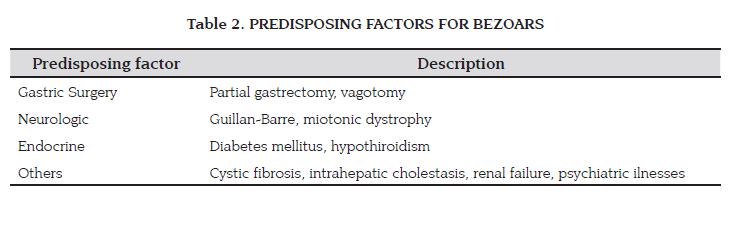
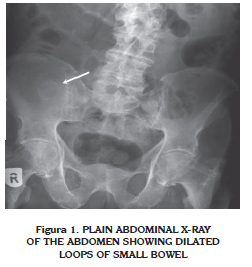
<body><![CDATA[<p><font size="2" face="Verdana">Bezoars are concretions of substances that can&#180;t be digested by normal means and can occur in any segment of the gastrointestinal tract, most commonly in the stomach. They can be composed almost by any substance such as hair, pills, seeds and undigested vegetables. Bezoars form in the majority of cases in patients with altered intestinal motility and in patients with previous intestinal surgery and can be classified in four types depending on their origin and components: trichobezoar, phytobezoar, lactobezoar and lactobezoar (<a href="#t1">table 1</a>) (1,2). </font></p>     <p><font size="2" face="Verdana">Phytobezoars are the most common form of   bezoars in humans and are primarily formed in   the ileum, especially in the presence of strictures   caused by Crohn&#39;s disease, intestinal tuberculosis,   previous surgery or even form inside   diverticulae. They can also occur in the stomach   by the concretion of poorly digested fruit and   vegetable fiber predisposed by disturbed gastric   motility and decreased acidity in patients after   a gastrectomy or vagotomy, and by autonomic   intestinal dysmotility in diabetic patients. They   are mainly composed of cellulose, hemicellulose,   tannins and lignin which can be found in   foods such as celery, raisins, prunes, grape skins   and most notably persimmons. In high concentrations   these foods form a coagulum that upon   exposure to and acidic environment begin the   formation of a bezoar (4-6).   </font></p>     <p><font size="2" face="Verdana">The most common factors predisposing to the   formation of bezoars include previous surgery   such as partial gastrectomy and vagotomy and   previous small bowel surgery. Medical causes are   also associated with this presentation such as   hypothiroidism, Guillan -Barre syndrome, diabetes   mellitus, cystic fibrosis and psychiatric illnesses   with trichophagia (<a href="#t2">table 2</a>) (7,8).   </font></p>     <p><font size="2" face="Verdana">Clinical manifestations of phytobezoars include   chronic indigestion and early satiety and chronic   abdominal pain. The most common clinical   presentation is a vague epigastric or lower abdominal discomfort. Other symptoms include dysphagia, anorexia, halitosis and weight loss. Of all causes of intestinal obstruction, of which the most common are adhesions. Phyotbezoars account only for 0.4-4 &#37; of all causes and rarely cause perforation. Diagnosis of phytobezoars can be difficult at times, depending on the level of impaction. Clinical examination may reveal a mass at the site of impaction. Plain abdominal films may only show unspecified loops of dilated bowel, and barium studies may show a filling defect as the barium surrounds the bezoar. If the impaction occurs in the stomach, gastroscopy is the method of choice and can be used as a treatment strategy to either fragment or retrieve the bezoar. Abdominal CT scanning has proven useful especially to detect the presence of localised obstruction or perforation (9,10). </font></p>     <p>&nbsp;</p>     <p align="center"><img src="/img/revistas/cesm/v23n2/v23n2a07t1.jpg"/><a name="t1" id="t1"></a></p>     <p align="center">&nbsp;</p>     <p align="center"><img src="/img/revistas/cesm/v23n2/v23n2a07t2.JPG"/><a name="t2" id="t2"></a></p>     <p><font size="2" face="Verdana">We present the case of an 85 year old male patient   admitted to hospital with a diagnosis of peritonitis   caused by a perforated intestine. During laparotomy   the cause was found to be an impacted   phytobezoar at the terminal ileum with perforation of the adjacent ileum and abscess formation.</font></p>     <p>&nbsp;</p>     ]]></body>
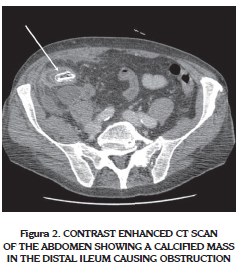
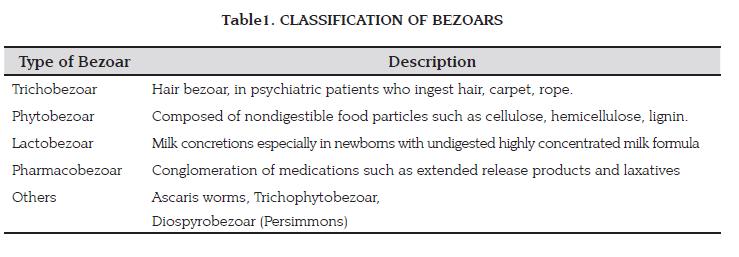
<body><![CDATA[<p>&nbsp;</p>     <p><b><font face="Verdana" size="3">CASE PRESENTATION</font></b></p>     <p><font size="2" face="Verdana"> </font><font size="2" face="Verdana"> An 85 year old male patient was admitted to the emergency department with a three day history of progressive, severe right iliac fossa pain and partial constipation. Previously, he had been suffering of intermittent and self-limiting abdominal pain in the same region. The past medical history included non-insulin dependent diabetes mellitus, chronic atrial fibrillation, hypertension and aortic stenosis with an 80mmHg gradient. </font></p>     <p><font size="2" face="Verdana">On clinical examination he was dehydrated, with   an irregular tachycardia at 103 bpm and normotensive.   His abdominal examination revealed a   tender, immobile mass in the right iliac fossa.   The rest of his examination revealed an ejection systolic murmur, normal respiratory findings and no neurological deterioration. Blood tests revealed a high C-Reactive Protein (313.9 mg/L) in the presence of normal leucocytic count, haemoglobin and serum electrolytes. A plain abdominal film was obtained, which showed small bowel loop dilation with collapsed large bowel and a rounded, radio-opaque shadow projected over the right ileum (<a href="#f1">Fig 1</a>).</font></p>     <p><font size="2" face="Verdana"> An abdominal CT scan revealed thickening of the   terminal ileum, surrounding free peritoneal fluid   and a calcified mass in the lumen. The rest of the   abdomen was reported as normal. (<a href="#f2">Fig 2</a>)</font></p>     <p>&nbsp;</p>     <p align="center"><font size="2" face="Verdana"></font><img src="/img/revistas/cesm/v23n2/v23n2a07f1.jpg"/><a name="f1" id="f1"></a> &nbsp;&nbsp; <img src="/img/revistas/cesm/v23n2/v23n2a07f2.jpg"/><a name="f2" id="f2"></a></p>     <p align="center">&nbsp;</p>     <p><font size="2" face="Verdana">Conservative management was initiated with alimentary rest, intravenous fluids and antibiotics, but his signs developed into peritonitis of the abdomen. The patient was taken for a laparotomy, which revealed an abscess in the right paracolic gutter involving the caecum and the terminal ileum. On inspection of the lumen a 3 x 3 cm enterolith was found impacted in the ileocaecal valve causing perforation. A limited right hemicolectomy was performed and sutured with an end to end anastomosis. The patient recovered uneventfully and was discharged after seven days. Histological analysis revealed a phytobezoar, with chronic inflammation of the terminal ileum and caecum. No malignancy or other anatomical anomalies were found.</font></p>     <p>&nbsp;</p>     ]]></body>
<body><![CDATA[<p>&nbsp;</p>     <p><b><font face="Verdana" size="3">DISCUSI&Oacute;N </font></b></p>     <p><font size="2" face="Verdana">The prevalence of bezoars is largely unknown due to the vague clinical presentations especially for a high incidence of sub-diagnosis of the disease. From a surgical point of view, obstruction of any part of the gastrointestinal tract caused by a Bezoar is rare, accounting for only 0.4 to 4 &#37; of all causes of abdominal obstruction. Perforation of the small bowel is even rare because patients usually seek medical advice early in the presentation before this complication occurs. This presentation and perforation of the terminal ileum secondary to a bezoar has been only reported in very few cases (1,2,8).</font></p>     <p><font size="2" face="Verdana"> Typically, the presentation is of a small bowel   obstruction that fails to resolve with conservative   management. The most common site of   obstruction and perforation described in the   previous reports, in the absence of any other   anatomical precipitants is at the ileo-caecal valve.   From our review of articles as far behind a   1993, there are only 17 case reports of obstruction   caused by bezoars precipitated by different   causes. In one of the larger series of cases by   Dirican et al (11) they describe the surgical management   of 24 patients in a period of 10 years.   The most common cause of obstruction was an   impacted bezoar at the site of previous gastric   surgery (83.3 &#37;). </font></p>     <p><font size="2" face="Verdana">In this report, it was clear that CT scanning of the   abdomen was able to identify the bezoar causing   the obstruction in all patients. Other causes for   precipitating obstruction have been described   such as a bezoar impacted in strictures caused by   Crohn&rsquo;s  disease, (10,12-14); there are two case   reports of bezoars causing ileus and obstruction   in a Meckel&rsquo;s diverticulum and a Jejunal diverticulum   (in 3 cases) (15-17), and more recently   there is a case report by Wilhelmi MH et al. of a   phytobezoar in a &#34;healthy adult with a long year   history of vegetarian lifestyle&#34; (18). </font></p>     <p><font size="2" face="Verdana">Perforation of the small bowel caused by an obstructing   bezoar is very rare, finding only three   reports in the literature since 1993 (19-21). The   most plausible explanation for this, is that patients   usually seek early medical advice due to the   obstructing symptoms, and these perforations   occur more due to the impaction of the bezoar   and perforation by erosion of the intestinal wall   rather than directly through the pressure build   up from the obstruction, which is the mechanism   underlying the perforation in our case report.   </font></p>     <p><font size="2" face="Verdana">Diagnostic modalities include clinical examination   which may reveal a mass in the affected   segment in about 30 &#37; of cases, a plain abdominal   film which shows only in half of the cases   a radio-opaque shadow at the site of obstruction   with proximal bowel dilatation. Ultrasound   has been evaluated and can be a useful tool in   detecting bezoars especially if they are calcified   (22). This method, however, is subject to the expertise   of the sonographer and the high index   of suspicion for the differential diagnosis. More   recently, CT scanning of the abdomen reveals   more precisely the cause of bowel obstruction   with a higher sensitivity and specificity in different   case reports (11,23). </font></p>     <p><font size="2" face="Verdana">Details of the different treatment methods are   beyond the scope of this case report but briefly,   for bezoars located in the stomach, endoscopic   fragmentation or retrieval is the standard   treatment. In the cases presenting with distal   bowel obstruction and perforation, a laparotomy   or a laparoscopic enterotomy is the only   available treatment method (10). At operation,   patients should be thoroughly assessed for diverticulae   and especially strictures associated   to Crohn&#39;s disease, and tissue samples must   be obtained for definitive diagnosis. In our case   no anatomical cause was found for the perforation   on laparotomy. The presence of the bezoar   could only be explained by the patient&#39;s diabetes   and gastric dismotility and simple impaction   in the ileocaecal valve which unfortunately led to   perforation of the small bowel. At present only   dietary recommendations are made for the long   term prevention of this disease.</font></p>     <p>&nbsp;</p>     <p>&nbsp;</p>     ]]></body>
<body><![CDATA[<p><b><font face="verdana" size="3">CONCLUSIONS</font></b></p>     <p><font face="Verdana" size="2">Obstruction of the small intestine by a phytobezoar is a rare presentation of bezoars of the alimentary tract, but no uncommon, and should be part of the differential diagnosis especially in patients with known predisposing factors. CT scanning of the abdomen remains the most reliable method for diagnosing the presence of a phytobezoar in the digestive tract. At present, surgery remains the mainstay of treating effectively an impacted phytobezoar of the small bowel with or without perforation.</font></p>     <p>&nbsp;</p>     <p>&nbsp;</p>     <p><b><font face="verdana" size="3">REFERENCES</font></b></p> <font size="2" face="Verdana">     <!-- ref --><p>1. Andrus CH, Ponsky JL. Bezoars. classification, pathophysiology, and treatment. Am J Gastroenterol, 1988;83(5):476-478.    &nbsp;&nbsp;&nbsp;&nbsp;&nbsp;&nbsp;&nbsp;&nbsp;[&#160;<a href="javascript:void(0);" onclick="javascript: window.open('/scielo.php?script=sci_nlinks&ref=000058&pid=S0120-8705200900020000700001&lng=','','width=640,height=500,resizable=yes,scrollbars=1,menubar=yes,');">Links</a>&#160;]<!-- end-ref --><!-- ref --><p>2. Pfau P, Ginsberg G. Foreign Bodies and   Bezoars. In Feldman: Sleisenger and   Fordtran&#39;s Gastrointestinal and Liver Diseases, 7th edition. 2002:395-397.    &nbsp;&nbsp;&nbsp;&nbsp;&nbsp;&nbsp;&nbsp;&nbsp;[&#160;<a href="javascript:void(0);" onclick="javascript: window.open('/scielo.php?script=sci_nlinks&ref=000059&pid=S0120-8705200900020000700002&lng=','','width=640,height=500,resizable=yes,scrollbars=1,menubar=yes,');">Links</a>&#160;]<!-- end-ref --><!-- ref --><p> 3. Holloway WD, Lee SP, Nicholson GI. The composition   and dissolution of phytobezoars.   Arch Pathol Lab Med, 1980;104:159- 161.    &nbsp;&nbsp;&nbsp;&nbsp;&nbsp;&nbsp;&nbsp;&nbsp;[&#160;<a href="javascript:void(0);" onclick="javascript: window.open('/scielo.php?script=sci_nlinks&ref=000060&pid=S0120-8705200900020000700003&lng=','','width=640,height=500,resizable=yes,scrollbars=1,menubar=yes,');">Links</a>&#160;]<!-- end-ref --><!-- ref --><p>4. Matsuo T, Ito S. The chemical structure of kaki-   tannin from immature fruit of the persimmon.   Agric Biol Chem, 1978; 126:421- 424.    &nbsp;&nbsp;&nbsp;&nbsp;&nbsp;&nbsp;&nbsp;&nbsp;[&#160;<a href="javascript:void(0);" onclick="javascript: window.open('/scielo.php?script=sci_nlinks&ref=000061&pid=S0120-8705200900020000700004&lng=','','width=640,height=500,resizable=yes,scrollbars=1,menubar=yes,');">Links</a>&#160;]<!-- end-ref --><!-- ref --><p>5. Izumi S, Isida K, Iwamoto M. The mechanism     of the formation of phytobezoars,     with special reference to the persimmon     ball. Jpn J Med Biochem, 1933;2:21-35.    &nbsp;&nbsp;&nbsp;&nbsp;&nbsp;&nbsp;&nbsp;&nbsp;[&#160;<a href="javascript:void(0);" onclick="javascript: window.open('/scielo.php?script=sci_nlinks&ref=000062&pid=S0120-8705200900020000700005&lng=','','width=640,height=500,resizable=yes,scrollbars=1,menubar=yes,');">Links</a>&#160;]<!-- end-ref --><!-- ref --><p> 6. Bowden TA, Hooks VH, Mansberger AR.   The stomach after surgery: An endoscopic   perspective. Ann Surg, 1983;197:637- 644.    &nbsp;&nbsp;&nbsp;&nbsp;&nbsp;&nbsp;&nbsp;&nbsp;[&#160;<a href="javascript:void(0);" onclick="javascript: window.open('/scielo.php?script=sci_nlinks&ref=000063&pid=S0120-8705200900020000700006&lng=','','width=640,height=500,resizable=yes,scrollbars=1,menubar=yes,');">Links</a>&#160;]<!-- end-ref --><!-- ref --><p>7. De Backer A, Van Nooten V, Vandenplas Y.   Huge gastric trichobezoar in a 10-year-old   girl: Case report with emphasis on endoscopy   in diagnosis and therapy. J Pediatr   Gastroenterol Nutr, 1999;28:513-515.    &nbsp;&nbsp;&nbsp;&nbsp;&nbsp;&nbsp;&nbsp;&nbsp;[&#160;<a href="javascript:void(0);" onclick="javascript: window.open('/scielo.php?script=sci_nlinks&ref=000064&pid=S0120-8705200900020000700007&lng=','','width=640,height=500,resizable=yes,scrollbars=1,menubar=yes,');">Links</a>&#160;]<!-- end-ref --><!-- ref --><p>8. Kim JH, Ha HK, Sohn MJ, et al. CT findings     of phytobezoar associated with small     bowel obstruction. European Radiology,     2003;13:299-304.    &nbsp;&nbsp;&nbsp;&nbsp;&nbsp;&nbsp;&nbsp;&nbsp;[&#160;<a href="javascript:void(0);" onclick="javascript: window.open('/scielo.php?script=sci_nlinks&ref=000065&pid=S0120-8705200900020000700008&lng=','','width=640,height=500,resizable=yes,scrollbars=1,menubar=yes,');">Links</a>&#160;]<!-- end-ref --><!-- ref --><p>9. Teng HC, Nawawi O, Ng KL, Yik YI. Phytobezoar:       an unusual cause of intestinal obstruction.       Biomed Imaging Interv J. 2005; 1-4(1)    &nbsp;&nbsp;&nbsp;&nbsp;&nbsp;&nbsp;&nbsp;&nbsp;[&#160;<a href="javascript:void(0);" onclick="javascript: window.open('/scielo.php?script=sci_nlinks&ref=000066&pid=S0120-8705200900020000700009&lng=','','width=640,height=500,resizable=yes,scrollbars=1,menubar=yes,');">Links</a>&#160;]<!-- end-ref -->:     <!-- ref --><p>10. Jones MW, Koper B, Weatherhead WF.         Crohn&#39;s disease with enterolith treated laparoscopically.         JSLS. 2005; 9 (3): 339-41.    &nbsp;&nbsp;&nbsp;&nbsp;&nbsp;&nbsp;&nbsp;&nbsp;[&#160;<a href="javascript:void(0);" onclick="javascript: window.open('/scielo.php?script=sci_nlinks&ref=000068&pid=S0120-8705200900020000700010&lng=','','width=640,height=500,resizable=yes,scrollbars=1,menubar=yes,');">Links</a>&#160;]<!-- end-ref --><!-- ref --><p>11. Dirican A, Unal B, Tatli F, Sofotli I, Ozgor D,   Piskin T, Kayaalp C, Kirimlioglu V. Surgical   treatment of phytobezoars causes acute   small intestinal obstruction Bratisl Lek Listy.   2009;110(3):158-61.    &nbsp;&nbsp;&nbsp;&nbsp;&nbsp;&nbsp;&nbsp;&nbsp;[&#160;<a href="javascript:void(0);" onclick="javascript: window.open('/scielo.php?script=sci_nlinks&ref=000069&pid=S0120-8705200900020000700011&lng=','','width=640,height=500,resizable=yes,scrollbars=1,menubar=yes,');">Links</a>&#160;]<!-- end-ref --><!-- ref --><p>12. Shah SR, Bhaduri A, Desai DC, Abraham P,     Joshi A. Obstructing enterolith as presenting     feature in Crohn&#39;s disease. Indian J     Gastroenterol. 2003; 22 (1): 24.    &nbsp;&nbsp;&nbsp;&nbsp;&nbsp;&nbsp;&nbsp;&nbsp;[&#160;<a href="javascript:void(0);" onclick="javascript: window.open('/scielo.php?script=sci_nlinks&ref=000070&pid=S0120-8705200900020000700012&lng=','','width=640,height=500,resizable=yes,scrollbars=1,menubar=yes,');">Links</a>&#160;]<!-- end-ref --><!-- ref --><p>13. Geoghegan T, Stunel H, Ridgeway P, Birido     N, Geraghty J, Torreggiani WC. Small bowel     obstruction secondary to a giant enterolith     complicating Crohn&#39;s disease. Ir J Med Sci.     2005; 174 (2): 58-62     &nbsp;&nbsp;&nbsp;&nbsp;&nbsp;&nbsp;&nbsp;&nbsp;[&#160;<a href="javascript:void(0);" onclick="javascript: window.open('/scielo.php?script=sci_nlinks&ref=000071&pid=S0120-8705200900020000700013&lng=','','width=640,height=500,resizable=yes,scrollbars=1,menubar=yes,');">Links</a>&#160;]<!-- end-ref --><!-- ref --><p>14. Harrington S, Mohamed S, Bloch R. Small   bowel obstruction by a primary phytobezoar   in Crohn&#39;s disease. Am Surg. 2009   Jan;75(1):93-4     &nbsp;&nbsp;&nbsp;&nbsp;&nbsp;&nbsp;&nbsp;&nbsp;[&#160;<a href="javascript:void(0);" onclick="javascript: window.open('/scielo.php?script=sci_nlinks&ref=000072&pid=S0120-8705200900020000700014&lng=','','width=640,height=500,resizable=yes,scrollbars=1,menubar=yes,');">Links</a>&#160;]<!-- end-ref --><!-- ref --><p>15. Ozdemir S, G&#252;lpinar K, Leventoglu S, Aydin     S, Oz&ccedil;ay N. A case report of intestinal     obstruction due to phytobezoar within     Meckel&#39;s diverticulum. Turk J Gastroenterol.     2009 Mar;20(1):76-7     &nbsp;&nbsp;&nbsp;&nbsp;&nbsp;&nbsp;&nbsp;&nbsp;[&#160;<a href="javascript:void(0);" onclick="javascript: window.open('/scielo.php?script=sci_nlinks&ref=000073&pid=S0120-8705200900020000700015&lng=','','width=640,height=500,resizable=yes,scrollbars=1,menubar=yes,');">Links</a>&#160;]<!-- end-ref --><!-- ref --><p>16. Lough E, Richmond B, Maxwell D, Hayes   JD. Obstructing phytobezoar arising from   proximal jejunal diverticulum. Am J Surg. 2008 Jan;195(1):106-7.    &nbsp;&nbsp;&nbsp;&nbsp;&nbsp;&nbsp;&nbsp;&nbsp;[&#160;<a href="javascript:void(0);" onclick="javascript: window.open('/scielo.php?script=sci_nlinks&ref=000074&pid=S0120-8705200900020000700016&lng=','','width=640,height=500,resizable=yes,scrollbars=1,menubar=yes,');">Links</a>&#160;]<!-- end-ref --><!-- ref --><p> 17. Steenvorde P, Schaardenburgh P, Viersma JH.   Enterolith ileus as a complication of jejunal diverticulosis:   two case reports and a review of   the literature. Dig Surg. 2003; 20 (1): 57-60.    &nbsp;&nbsp;&nbsp;&nbsp;&nbsp;&nbsp;&nbsp;&nbsp;[&#160;<a href="javascript:void(0);" onclick="javascript: window.open('/scielo.php?script=sci_nlinks&ref=000075&pid=S0120-8705200900020000700017&lng=','','width=640,height=500,resizable=yes,scrollbars=1,menubar=yes,');">Links</a>&#160;]<!-- end-ref --><!-- ref --><p>18. W ilhelmi MH, Simanowski J, Aper T, Mlasowsky     B, Jung D. Phytobezoars: case report and     review of the literature. Zentralbl Chir. 2005     Feb;130(1):77-9.    &nbsp;&nbsp;&nbsp;&nbsp;&nbsp;&nbsp;&nbsp;&nbsp;[&#160;<a href="javascript:void(0);" onclick="javascript: window.open('/scielo.php?script=sci_nlinks&ref=000076&pid=S0120-8705200900020000700018&lng=','','width=640,height=500,resizable=yes,scrollbars=1,menubar=yes,');">Links</a>&#160;]<!-- end-ref --><!-- ref --><p>19. McLaughlin SJ, Jones T. Calcific enterolith   perforation: an unusual complication of   small bowel anastomosis. Aust N Z J Surg. 1983; 53 (6): 583-5.    &nbsp;&nbsp;&nbsp;&nbsp;&nbsp;&nbsp;&nbsp;&nbsp;[&#160;<a href="javascript:void(0);" onclick="javascript: window.open('/scielo.php?script=sci_nlinks&ref=000077&pid=S0120-8705200900020000700019&lng=','','width=640,height=500,resizable=yes,scrollbars=1,menubar=yes,');">Links</a>&#160;]<!-- end-ref --><!-- ref --><p>20. Karen M, Moralioglu S, Mentes BB. Intestinal   perforation due to phytobezoar obstruction:   a case report. Acta Chir Belg. 2008   May-Jun;108(3):360-1.    &nbsp;&nbsp;&nbsp;&nbsp;&nbsp;&nbsp;&nbsp;&nbsp;[&#160;<a href="javascript:void(0);" onclick="javascript: window.open('/scielo.php?script=sci_nlinks&ref=000078&pid=S0120-8705200900020000700020&lng=','','width=640,height=500,resizable=yes,scrollbars=1,menubar=yes,');">Links</a>&#160;]<!-- end-ref --><!-- ref --><p>21. Ci&ccedil;ek Y, Ayan F, Carkman S, Gazioglu E,   Pekmezci S, Tas&ccedil;i H. Intestinal perforation   due to phytobezoar obstruction. Acta Chir   Belg. 1993 May-Jun;93(3):92-3.    &nbsp;&nbsp;&nbsp;&nbsp;&nbsp;&nbsp;&nbsp;&nbsp;[&#160;<a href="javascript:void(0);" onclick="javascript: window.open('/scielo.php?script=sci_nlinks&ref=000079&pid=S0120-8705200900020000700021&lng=','','width=640,height=500,resizable=yes,scrollbars=1,menubar=yes,');">Links</a>&#160;]<!-- end-ref --><!-- ref --><p>22. Ko YT, Lim JH, Lee DH, Yoon Y. Small intestinal     phytobezoars: sonographic detection.     Abdom Imaging. 1993;18(3):271-3. Related     Articles,    &nbsp;&nbsp;&nbsp;&nbsp;&nbsp;&nbsp;&nbsp;&nbsp;[&#160;<a href="javascript:void(0);" onclick="javascript: window.open('/scielo.php?script=sci_nlinks&ref=000080&pid=S0120-8705200900020000700022&lng=','','width=640,height=500,resizable=yes,scrollbars=1,menubar=yes,');">Links</a>&#160;]<!-- end-ref --><!-- ref --><p>23. Yildirim T, Yildirim S, Barutcu O, Oguzkurt       L, Noyan T. Small bowel obstruction due       to phytobezoar: CT diagnosis. Eur Radiol.       2002 Nov;12(11):2659-61.    &nbsp;&nbsp;&nbsp;&nbsp;&nbsp;&nbsp;&nbsp;&nbsp;[&#160;<a href="javascript:void(0);" onclick="javascript: window.open('/scielo.php?script=sci_nlinks&ref=000081&pid=S0120-8705200900020000700023&lng=','','width=640,height=500,resizable=yes,scrollbars=1,menubar=yes,');">Links</a>&#160;]<!-- end-ref --><p> <hr size="1" noshade="noshade" &#47;>      ]]></body>
<body><![CDATA[<p>&nbsp;</p>     <p>Recibido: abril de 2009. Revisado: mayo de 2009. Aceptado: septiembre 19 de 2009</p>     <p>&nbsp;</p>     <p> Forma de citar: Hiller HG, Mustafah AH, Lagatolla NR. Terminal ileum perforation secondary to an impacted phytobezoar: case report and review of the literature. Rev CES Med 2009; vol232;55-62</p> </font>      ]]></body><back>
<ref-list>
<ref id="B1">
<label>1</label><nlm-citation citation-type="journal">
<person-group person-group-type="author">
<name>
<surname><![CDATA[Andrus]]></surname>
<given-names><![CDATA[CH]]></given-names>
</name>
<name>
<surname><![CDATA[Ponsky]]></surname>
<given-names><![CDATA[JL]]></given-names>
</name>
</person-group>
<article-title xml:lang="en"><![CDATA[Bezoars: classification, pathophysiology, and treatment]]></article-title>
<source><![CDATA[Am J Gastroenterol]]></source>
<year>1988</year>
<volume>83</volume>
<numero>5</numero>
<issue>5</issue>
<page-range>476-478</page-range></nlm-citation>
</ref>
<ref id="B2">
<label>2</label><nlm-citation citation-type="">
<person-group person-group-type="author">
<name>
<surname><![CDATA[Pfau]]></surname>
<given-names><![CDATA[P]]></given-names>
</name>
<name>
<surname><![CDATA[Ginsberg]]></surname>
<given-names><![CDATA[G]]></given-names>
</name>
</person-group>
<article-title xml:lang="en"><![CDATA[Foreign Bodies and Bezoars]]></article-title>
<person-group person-group-type="editor">
<name>
<surname><![CDATA[Feldman]]></surname>
</name>
</person-group>
<source><![CDATA[Sleisenger and Fordtran's Gastrointestinal and Liver Diseases]]></source>
<year>2002</year>
<edition>7</edition>
<page-range>395-397</page-range></nlm-citation>
</ref>
<ref id="B3">
<label>3</label><nlm-citation citation-type="journal">
<person-group person-group-type="author">
<name>
<surname><![CDATA[Holloway]]></surname>
<given-names><![CDATA[WD]]></given-names>
</name>
<name>
<surname><![CDATA[Lee]]></surname>
<given-names><![CDATA[SP]]></given-names>
</name>
<name>
<surname><![CDATA[Nicholson]]></surname>
<given-names><![CDATA[GI]]></given-names>
</name>
</person-group>
<article-title xml:lang="en"><![CDATA[The composition and dissolution of phytobezoars]]></article-title>
<source><![CDATA[Arch Pathol Lab Med]]></source>
<year>1980</year>
<volume>104</volume>
<page-range>159- 161</page-range></nlm-citation>
</ref>
<ref id="B4">
<label>4</label><nlm-citation citation-type="journal">
<person-group person-group-type="author">
<name>
<surname><![CDATA[Matsuo]]></surname>
<given-names><![CDATA[T]]></given-names>
</name>
<name>
<surname><![CDATA[Ito]]></surname>
<given-names><![CDATA[S]]></given-names>
</name>
</person-group>
<article-title xml:lang="en"><![CDATA[The chemical structure of kaki- tannin from immature fruit of the persimmon]]></article-title>
<source><![CDATA[Agric Biol Chem]]></source>
<year>1978</year>
<volume>126</volume>
<page-range>421- 424</page-range></nlm-citation>
</ref>
<ref id="B5">
<label>5</label><nlm-citation citation-type="journal">
<person-group person-group-type="author">
<name>
<surname><![CDATA[Izumi]]></surname>
<given-names><![CDATA[S]]></given-names>
</name>
<name>
<surname><![CDATA[Isida]]></surname>
<given-names><![CDATA[K]]></given-names>
</name>
<name>
<surname><![CDATA[Iwamoto]]></surname>
<given-names><![CDATA[M]]></given-names>
</name>
</person-group>
<article-title xml:lang="en"><![CDATA[The mechanism of the formation of phytobezoars, with special reference to the persimmon ball]]></article-title>
<source><![CDATA[Jpn J Med Biochem]]></source>
<year>1933</year>
<volume>2</volume>
<page-range>21-35</page-range></nlm-citation>
</ref>
<ref id="B6">
<label>6</label><nlm-citation citation-type="journal">
<person-group person-group-type="author">
<name>
<surname><![CDATA[Bowden]]></surname>
<given-names><![CDATA[TA]]></given-names>
</name>
<name>
<surname><![CDATA[Hooks]]></surname>
<given-names><![CDATA[VH]]></given-names>
</name>
<name>
<surname><![CDATA[Mansberger]]></surname>
<given-names><![CDATA[AR]]></given-names>
</name>
</person-group>
<article-title xml:lang="en"><![CDATA[The stomach after surgery: An endoscopic perspective]]></article-title>
<source><![CDATA[Ann Surg]]></source>
<year>1983</year>
<volume>197</volume>
<page-range>637- 644</page-range></nlm-citation>
</ref>
<ref id="B7">
<label>7</label><nlm-citation citation-type="journal">
<person-group person-group-type="author">
<name>
<surname><![CDATA[De Backer]]></surname>
<given-names><![CDATA[A]]></given-names>
</name>
<name>
<surname><![CDATA[Van Nooten]]></surname>
<given-names><![CDATA[V]]></given-names>
</name>
<name>
<surname><![CDATA[Vandenplas]]></surname>
<given-names><![CDATA[Y]]></given-names>
</name>
</person-group>
<article-title xml:lang="en"><![CDATA[Huge gastric trichobezoar in a 10-year-old girl: Case report with emphasis on endoscopy in diagnosis and therapy]]></article-title>
<source><![CDATA[J Pediatr Gastroenterol Nutr]]></source>
<year>1999</year>
<volume>28</volume>
<page-range>513-515</page-range></nlm-citation>
</ref>
<ref id="B8">
<label>8</label><nlm-citation citation-type="journal">
<person-group person-group-type="author">
<name>
<surname><![CDATA[Kim]]></surname>
<given-names><![CDATA[JH]]></given-names>
</name>
<name>
<surname><![CDATA[Ha]]></surname>
<given-names><![CDATA[HK]]></given-names>
</name>
<name>
<surname><![CDATA[Sohn]]></surname>
<given-names><![CDATA[MJ]]></given-names>
</name>
</person-group>
<article-title xml:lang="en"><![CDATA[CT findings of phytobezoar associated with small bowel obstruction]]></article-title>
<source><![CDATA[European Radiology]]></source>
<year>2003</year>
<volume>13</volume>
<page-range>299-304</page-range></nlm-citation>
</ref>
<ref id="B9">
<label>9</label><nlm-citation citation-type="journal">
<person-group person-group-type="author">
<name>
<surname><![CDATA[Teng]]></surname>
<given-names><![CDATA[HC]]></given-names>
</name>
<name>
<surname><![CDATA[Nawawi]]></surname>
<given-names><![CDATA[O]]></given-names>
</name>
<name>
<surname><![CDATA[Ng]]></surname>
<given-names><![CDATA[KL]]></given-names>
</name>
<name>
<surname><![CDATA[Yik]]></surname>
<given-names><![CDATA[YI]]></given-names>
</name>
</person-group>
<article-title xml:lang="en"><![CDATA[Phytobezoar: an unusual cause of intestinal obstruction]]></article-title>
<source><![CDATA[Biomed Imaging Interv J]]></source>
<year>2005</year>
</nlm-citation>
</ref>
<ref id="B10">
<label>10</label><nlm-citation citation-type="journal">
<person-group person-group-type="author">
<name>
<surname><![CDATA[Jones]]></surname>
<given-names><![CDATA[MW]]></given-names>
</name>
<name>
<surname><![CDATA[Koper]]></surname>
<given-names><![CDATA[B]]></given-names>
</name>
<name>
<surname><![CDATA[Weatherhead]]></surname>
<given-names><![CDATA[WF]]></given-names>
</name>
</person-group>
<article-title xml:lang="en"><![CDATA[Crohn's disease with enterolith treated laparoscopically]]></article-title>
<source><![CDATA[JSLS]]></source>
<year>2005</year>
<volume>9</volume>
<numero>3</numero>
<issue>3</issue>
<page-range>339-41</page-range></nlm-citation>
</ref>
<ref id="B11">
<label>11</label><nlm-citation citation-type="journal">
<person-group person-group-type="author">
<name>
<surname><![CDATA[Dirican]]></surname>
<given-names><![CDATA[A]]></given-names>
</name>
<name>
<surname><![CDATA[Unal]]></surname>
<given-names><![CDATA[B]]></given-names>
</name>
<name>
<surname><![CDATA[Tatli]]></surname>
<given-names><![CDATA[F]]></given-names>
</name>
<name>
<surname><![CDATA[Sofotli]]></surname>
<given-names><![CDATA[I]]></given-names>
</name>
<name>
<surname><![CDATA[Ozgor]]></surname>
<given-names><![CDATA[D]]></given-names>
</name>
<name>
<surname><![CDATA[Piskin]]></surname>
<given-names><![CDATA[T]]></given-names>
</name>
<name>
<surname><![CDATA[Kayaalp]]></surname>
<given-names><![CDATA[C]]></given-names>
</name>
<name>
<surname><![CDATA[Kirimlioglu]]></surname>
<given-names><![CDATA[V]]></given-names>
</name>
</person-group>
<article-title xml:lang="en"><![CDATA[Surgical treatment of phytobezoars causes acute small intestinal obstruction]]></article-title>
<source><![CDATA[Bratisl Lek Listy]]></source>
<year>2009</year>
<volume>110</volume>
<numero>3</numero>
<issue>3</issue>
<page-range>158-61</page-range></nlm-citation>
</ref>
<ref id="B12">
<label>12</label><nlm-citation citation-type="journal">
<person-group person-group-type="author">
<name>
<surname><![CDATA[Shah]]></surname>
<given-names><![CDATA[SR]]></given-names>
</name>
<name>
<surname><![CDATA[Bhaduri]]></surname>
<given-names><![CDATA[A]]></given-names>
</name>
<name>
<surname><![CDATA[Desai]]></surname>
<given-names><![CDATA[DC]]></given-names>
</name>
<name>
<surname><![CDATA[Abraham]]></surname>
<given-names><![CDATA[P]]></given-names>
</name>
<name>
<surname><![CDATA[Joshi]]></surname>
<given-names><![CDATA[A]]></given-names>
</name>
</person-group>
<article-title xml:lang="en"><![CDATA[Obstructing enterolith as presenting feature in Crohn's disease]]></article-title>
<source><![CDATA[Indian J Gastroenterol]]></source>
<year>2003</year>
<volume>22</volume>
<numero>1</numero>
<issue>1</issue>
<page-range>24</page-range></nlm-citation>
</ref>
<ref id="B13">
<label>13</label><nlm-citation citation-type="journal">
<person-group person-group-type="author">
<name>
<surname><![CDATA[Geoghegan]]></surname>
<given-names><![CDATA[T]]></given-names>
</name>
<name>
<surname><![CDATA[Stunel]]></surname>
<given-names><![CDATA[H]]></given-names>
</name>
<name>
<surname><![CDATA[Ridgeway]]></surname>
<given-names><![CDATA[P]]></given-names>
</name>
<name>
<surname><![CDATA[Birido]]></surname>
<given-names><![CDATA[N]]></given-names>
</name>
<name>
<surname><![CDATA[Geraghty]]></surname>
<given-names><![CDATA[J]]></given-names>
</name>
<name>
<surname><![CDATA[Torreggiani]]></surname>
<given-names><![CDATA[WC]]></given-names>
</name>
</person-group>
<article-title xml:lang="en"><![CDATA[Small bowel obstruction secondary to a giant enterolith complicating Crohn's disease]]></article-title>
<source><![CDATA[Ir J Med Sci]]></source>
<year>2005</year>
<volume>174</volume>
<numero>2</numero>
<issue>2</issue>
<page-range>58-62</page-range></nlm-citation>
</ref>
<ref id="B14">
<label>14</label><nlm-citation citation-type="journal">
<person-group person-group-type="author">
<name>
<surname><![CDATA[Harrington]]></surname>
<given-names><![CDATA[S]]></given-names>
</name>
<name>
<surname><![CDATA[Mohamed]]></surname>
<given-names><![CDATA[S]]></given-names>
</name>
<name>
<surname><![CDATA[Bloch]]></surname>
<given-names><![CDATA[R]]></given-names>
</name>
</person-group>
<article-title xml:lang="en"><![CDATA[Small bowel obstruction by a primary phytobezoar in Crohn's disease]]></article-title>
<source><![CDATA[Am Surg]]></source>
<year>2009</year>
<month> J</month>
<day>an</day>
<volume>75</volume>
<numero>1</numero>
<issue>1</issue>
<page-range>93-4</page-range></nlm-citation>
</ref>
<ref id="B15">
<label>15</label><nlm-citation citation-type="journal">
<person-group person-group-type="author">
<name>
<surname><![CDATA[Ozdemir]]></surname>
<given-names><![CDATA[S]]></given-names>
</name>
<name>
<surname><![CDATA[Gülpinar]]></surname>
<given-names><![CDATA[K]]></given-names>
</name>
<name>
<surname><![CDATA[Leventoglu]]></surname>
<given-names><![CDATA[S]]></given-names>
</name>
<name>
<surname><![CDATA[Aydin]]></surname>
<given-names><![CDATA[S]]></given-names>
</name>
<name>
<surname><![CDATA[Ozçay]]></surname>
<given-names><![CDATA[N]]></given-names>
</name>
</person-group>
<article-title xml:lang="en"><![CDATA[A case report of intestinal obstruction due to phytobezoar within Meckel's diverticulum]]></article-title>
<source><![CDATA[Turk J Gastroenterol]]></source>
<year>2009</year>
<month> M</month>
<day>ar</day>
<volume>20</volume>
<numero>1</numero>
<issue>1</issue>
<page-range>76-7</page-range></nlm-citation>
</ref>
<ref id="B16">
<label>16</label><nlm-citation citation-type="journal">
<person-group person-group-type="author">
<name>
<surname><![CDATA[Lough]]></surname>
<given-names><![CDATA[E]]></given-names>
</name>
<name>
<surname><![CDATA[Richmond]]></surname>
<given-names><![CDATA[B]]></given-names>
</name>
<name>
<surname><![CDATA[Maxwell]]></surname>
<given-names><![CDATA[D]]></given-names>
</name>
<name>
<surname><![CDATA[Hayes]]></surname>
<given-names><![CDATA[JD]]></given-names>
</name>
</person-group>
<article-title xml:lang="en"><![CDATA[Obstructing phytobezoar arising from proximal jejunal diverticulum]]></article-title>
<source><![CDATA[Am J Surg]]></source>
<year>2008</year>
<month> J</month>
<day>an</day>
<volume>195</volume>
<numero>1</numero>
<issue>1</issue>
<page-range>106-7</page-range></nlm-citation>
</ref>
<ref id="B17">
<label>17</label><nlm-citation citation-type="journal">
<person-group person-group-type="author">
<name>
<surname><![CDATA[Steenvorde]]></surname>
<given-names><![CDATA[P]]></given-names>
</name>
<name>
<surname><![CDATA[Schaardenburgh]]></surname>
<given-names><![CDATA[P]]></given-names>
</name>
<name>
<surname><![CDATA[Viersma]]></surname>
<given-names><![CDATA[JH]]></given-names>
</name>
</person-group>
<article-title xml:lang="en"><![CDATA[Enterolith ileus as a complication of jejunal diverticulosis: two case reports and a review of the literature]]></article-title>
<source><![CDATA[Dig Surg]]></source>
<year>2003</year>
<volume>20</volume>
<numero>1</numero>
<issue>1</issue>
<page-range>57-60</page-range></nlm-citation>
</ref>
<ref id="B18">
<label>18</label><nlm-citation citation-type="journal">
<person-group person-group-type="author">
<name>
<surname><![CDATA[Wilhelmi]]></surname>
<given-names><![CDATA[MH]]></given-names>
</name>
<name>
<surname><![CDATA[Simanowski]]></surname>
<given-names><![CDATA[J]]></given-names>
</name>
<name>
<surname><![CDATA[Aper]]></surname>
<given-names><![CDATA[T]]></given-names>
</name>
<name>
<surname><![CDATA[Mlasowsky]]></surname>
<given-names><![CDATA[B]]></given-names>
</name>
<name>
<surname><![CDATA[Jung]]></surname>
<given-names><![CDATA[D]]></given-names>
</name>
</person-group>
<article-title xml:lang="en"><![CDATA[Phytobezoars: case report and review of the literature]]></article-title>
<source><![CDATA[Zentralbl Chir]]></source>
<year>2005</year>
<month> F</month>
<day>eb</day>
<volume>130</volume>
<numero>1</numero>
<issue>1</issue>
<page-range>77-9</page-range></nlm-citation>
</ref>
<ref id="B19">
<label>19</label><nlm-citation citation-type="journal">
<person-group person-group-type="author">
<name>
<surname><![CDATA[McLaughlin]]></surname>
<given-names><![CDATA[SJ]]></given-names>
</name>
<name>
<surname><![CDATA[Jones]]></surname>
<given-names><![CDATA[T]]></given-names>
</name>
</person-group>
<article-title xml:lang="en"><![CDATA[Calcific enterolith perforation: an unusual complication of small bowel anastomosis]]></article-title>
<source><![CDATA[Aust N Z J Surg]]></source>
<year>1983</year>
<volume>53</volume>
<numero>6</numero>
<issue>6</issue>
<page-range>583-5</page-range></nlm-citation>
</ref>
<ref id="B20">
<label>20</label><nlm-citation citation-type="journal">
<person-group person-group-type="author">
<name>
<surname><![CDATA[Karen]]></surname>
<given-names><![CDATA[M]]></given-names>
</name>
<name>
<surname><![CDATA[Moralioglu]]></surname>
<given-names><![CDATA[S]]></given-names>
</name>
<name>
<surname><![CDATA[Mentes]]></surname>
<given-names><![CDATA[BB]]></given-names>
</name>
</person-group>
<article-title xml:lang="en"><![CDATA[Intestinal perforation due to phytobezoar obstruction: a case report]]></article-title>
<source><![CDATA[Acta Chir Belg]]></source>
<year>2008</year>
<month> M</month>
<day>ay</day>
<volume>108</volume>
<numero>3</numero>
<issue>3</issue>
<page-range>360-1</page-range></nlm-citation>
</ref>
<ref id="B21">
<label>21</label><nlm-citation citation-type="journal">
<person-group person-group-type="author">
<name>
<surname><![CDATA[Ciçek]]></surname>
<given-names><![CDATA[Y]]></given-names>
</name>
<name>
<surname><![CDATA[Ayan]]></surname>
<given-names><![CDATA[F]]></given-names>
</name>
<name>
<surname><![CDATA[Carkman]]></surname>
<given-names><![CDATA[S]]></given-names>
</name>
<name>
<surname><![CDATA[Gazioglu]]></surname>
<given-names><![CDATA[E]]></given-names>
</name>
<name>
<surname><![CDATA[Pekmezci]]></surname>
<given-names><![CDATA[S]]></given-names>
</name>
<name>
<surname><![CDATA[Tasçi]]></surname>
<given-names><![CDATA[H]]></given-names>
</name>
</person-group>
<article-title xml:lang="en"><![CDATA[Intestinal perforation due to phytobezoar obstruction]]></article-title>
<source><![CDATA[Acta Chir Belg]]></source>
<year>1993</year>
<month> M</month>
<day>ay</day>
<volume>93</volume>
<numero>3</numero>
<issue>3</issue>
<page-range>92-3</page-range></nlm-citation>
</ref>
<ref id="B22">
<label>22</label><nlm-citation citation-type="journal">
<person-group person-group-type="author">
<name>
<surname><![CDATA[Ko]]></surname>
<given-names><![CDATA[YT]]></given-names>
</name>
<name>
<surname><![CDATA[Lim]]></surname>
<given-names><![CDATA[JH]]></given-names>
</name>
<name>
<surname><![CDATA[Lee]]></surname>
<given-names><![CDATA[DH]]></given-names>
</name>
<name>
<surname><![CDATA[Yoon]]></surname>
<given-names><![CDATA[Y]]></given-names>
</name>
</person-group>
<article-title xml:lang="en"><![CDATA[Small intestinal phytobezoars: sonographic detection]]></article-title>
<source><![CDATA[Abdom Imaging]]></source>
<year>1993</year>
<volume>18</volume>
<numero>3</numero>
<issue>3</issue>
<page-range>271-3</page-range></nlm-citation>
</ref>
<ref id="B23">
<label>23</label><nlm-citation citation-type="journal">
<person-group person-group-type="author">
<name>
<surname><![CDATA[Yildirim]]></surname>
<given-names><![CDATA[T]]></given-names>
</name>
<name>
<surname><![CDATA[Yildirim]]></surname>
<given-names><![CDATA[S]]></given-names>
</name>
<name>
<surname><![CDATA[Barutcu]]></surname>
<given-names><![CDATA[O]]></given-names>
</name>
<name>
<surname><![CDATA[Oguzkurt]]></surname>
<given-names><![CDATA[L]]></given-names>
</name>
<name>
<surname><![CDATA[Noyan]]></surname>
<given-names><![CDATA[T]]></given-names>
</name>
</person-group>
<article-title xml:lang="en"><![CDATA[Small bowel obstruction due to phytobezoar: CT diagnosis]]></article-title>
<source><![CDATA[Eur Radiol]]></source>
<year>2002</year>
<month> N</month>
<day>ov</day>
<volume>12</volume>
<numero>11</numero>
<issue>11</issue>
<page-range>2659-61</page-range></nlm-citation>
</ref>
</ref-list>
</back>
</article>