<?xml version="1.0" encoding="ISO-8859-1"?><article xmlns:mml="http://www.w3.org/1998/Math/MathML" xmlns:xlink="http://www.w3.org/1999/xlink" xmlns:xsi="http://www.w3.org/2001/XMLSchema-instance">
<front>
<journal-meta>
<journal-id>0121-0793</journal-id>
<journal-title><![CDATA[Iatreia]]></journal-title>
<abbrev-journal-title><![CDATA[Iatreia]]></abbrev-journal-title>
<issn>0121-0793</issn>
<publisher>
<publisher-name><![CDATA[Universidad de Antioquia]]></publisher-name>
</publisher>
</journal-meta>
<article-meta>
<article-id>S0121-07932013000200001</article-id>
<title-group>
<article-title xml:lang="en"><![CDATA[Enzymatic dissociation of long muscles from mice: a model for the study of skeletal muscle fiber types]]></article-title>
<article-title xml:lang="es"><![CDATA[Disociación enzimática de músculos largos de ratón: un modelo para el estudio de los tipos de fibras del músculo esquelético]]></article-title>
</title-group>
<contrib-group>
<contrib contrib-type="author">
<name>
<surname><![CDATA[Calderón]]></surname>
<given-names><![CDATA[Juan Camilo]]></given-names>
</name>
<xref ref-type="aff" rid="A01"/>
</contrib>
</contrib-group>
<aff id="A01">
<institution><![CDATA[,Universidad de Antioquia Facultad de Medicina Grupo de Investigación en Fisiología y Bioquímica - Physis]]></institution>
<addr-line><![CDATA[Medellín ]]></addr-line>
<country>Colombia</country>
</aff>
<pub-date pub-type="pub">
<day>00</day>
<month>04</month>
<year>2013</year>
</pub-date>
<pub-date pub-type="epub">
<day>00</day>
<month>04</month>
<year>2013</year>
</pub-date>
<volume>26</volume>
<numero>2</numero>
<fpage>117</fpage>
<lpage>126</lpage>
<copyright-statement/>
<copyright-year/>
<self-uri xlink:href="http://www.scielo.org.co/scielo.php?script=sci_arttext&amp;pid=S0121-07932013000200001&amp;lng=en&amp;nrm=iso"></self-uri><self-uri xlink:href="http://www.scielo.org.co/scielo.php?script=sci_abstract&amp;pid=S0121-07932013000200001&amp;lng=en&amp;nrm=iso"></self-uri><self-uri xlink:href="http://www.scielo.org.co/scielo.php?script=sci_pdf&amp;pid=S0121-07932013000200001&amp;lng=en&amp;nrm=iso"></self-uri><abstract abstract-type="short" xml:lang="en"><p><![CDATA[The enzymatic dissociation of short muscles from mice, such as flexor digitorum brevis, has allowed a great accumulation of physiological, pharmacological and biochemical knowledge about skeletal muscle. However, this body of knowledge has been restricted to the types of fibers present in these muscles. Information about the other fiber types has been limited and has been primarily obtained by the manual isolation of fibers from other species, typically rats, via a difficult and time-consuming procedure. In this report, the author describes a technique for the enzymatic dissociation of long muscles, such as soleus or extensor digitorum longus (EDL), which can be applied to study a wider spectrum of fiber types and larger quantities of cells. Additionally, the kinetics of Ca2+ transients obtained in soleus and EDL fibers are compared in this report. The usefulness of this methodology for other physiological, biochemical and molecular biology experiments is also discussed. This methodology introduces the possibility of using the whole spectrum of fiber types to study normal muscle biology and the pathophysiology of muscle diseases.]]></p></abstract>
<abstract abstract-type="short" xml:lang="es"><p><![CDATA[La disociación enzimática de músculos cortos de ratón, como el flexor digitorum brevis, ha permitido la acumulación de gran cantidad de información fisiológica, farmacológica y bioquímica sobre el músculo esquelético, la cual, sin embargo, ha estado limitada a los tipos de fibras presentes en estos músculos. La acumulación de información sobre los demás tipos de fibras ha sido escasa y se ha logrado mediante el aislamiento manual de fibras en otras especies, clásicamente en ratas: un procedimiento difícil y que toma mucho tiempo. En este trabajo se presenta una descripción de la técnica que permite la disociación enzimática de músculos largos de ratón como el soleus o el extensor digitorum longus (EDL), lo cual aumenta el espectro de tipos de fibras y el número de ellas disponibles para el estudio de los fenómenos biológicos en el músculo esquelético. Además se compara la cinética de los transitorios de Ca2+ en fibras de soleus y EDL y se prueba la utilidad del modelo en otros experimentos que utilizan técnicas de fisiología, bioquímica y biología celular. Esto abre la posibilidad de utilizar todo el espectro de fibras musculares para estudiar la biología muscular y la fisiopatología de las enfermedades musculares.]]></p></abstract>
<kwd-group>
<kwd lng="en"><![CDATA[Calcium Signaling]]></kwd>
<kwd lng="en"><![CDATA[Muscle]]></kwd>
<kwd lng="en"><![CDATA[Skeletal]]></kwd>
<kwd lng="en"><![CDATA[Myosin Heavy Chains]]></kwd>
<kwd lng="en"><![CDATA[Soleus Muscle]]></kwd>
<kwd lng="es"><![CDATA[Cadenas Pesadas de Miosina]]></kwd>
<kwd lng="es"><![CDATA[Músculo Esquelético]]></kwd>
<kwd lng="es"><![CDATA[Músculo Soleus]]></kwd>
<kwd lng="es"><![CDATA[Señalización del Calcio]]></kwd>
</kwd-group>
</article-meta>
</front><body><![CDATA[ <p align="right"><font size="2" face="Verdana, Arial, Helvetica, sans-serif"><b>INVESTIGACI&Oacute;N ORIGINAL </b></font></p>     <p>&nbsp;</p>     <p>&nbsp; </p>     <p align="center"><font size="4" face="Verdana, Arial, Helvetica, sans-serif"><b>Enzymatic dissociation of long muscles from mice:   a model for the study of skeletal muscle fiber types</b></font></p>     <p align="center">&nbsp;</p>     <p align="center"><font size="3" face="Verdana, Arial, Helvetica, sans-serif"><b>Disociaci&oacute;n enzim&aacute;tica de m&uacute;sculos largos de rat&oacute;n: un modelo para el estudio de los   tipos de fibras del m&uacute;sculo esquel&eacute;tico</b></font></p>     <p>&nbsp;</p>     <p>&nbsp;</p>     <p><font size="2" face="Verdana, Arial, Helvetica, sans-serif"><b>Juan Camilo Calder&oacute;n&#42;</b> </font></p>     <p>&nbsp;</p>     ]]></body>
<body><![CDATA[<p><font size="2" face="Verdana, Arial, Helvetica, sans-serif">&#42; M&eacute;dico y cirujano. Doctor en Ciencias, menci&oacute;n Fisiolog&iacute;a y Biof&iacute;sica. Grupo de Investigaci&oacute;n en Fisiolog&iacute;a y Bioqu&iacute;mica &#8211; Physis. Profesor, Facultad de Medicina, Universidad   de Antioquia, Medell&iacute;n, Colombia.  <a href="mailto:jcalderonv00@yahoo.com">jcalderonv00@yahoo.com</a></font></p>     <p>&nbsp;</p>     <p>&nbsp;</p>     <p><font size="2" face="Verdana, Arial, Helvetica, sans-serif">Recibido: febrero 22 de 2012    <br>   Aceptado: octubre 22 de 2012</font></p>     <p>&nbsp;</p>     <p>&nbsp;</p> <hr noshade size="1">     <p><font size="2" face="Verdana, Arial, Helvetica, sans-serif"><b>SUMMARY</b>   </font></p>     <p><font size="2" face="Verdana, Arial, Helvetica, sans-serif">The enzymatic dissociation of short muscles from mice, such as <i>flexor digitorum brevis</i>, has   allowed a great accumulation of physiological, pharmacological and biochemical knowledge   about skeletal muscle. However, this body of knowledge has been restricted to the types of   fibers present in these muscles. Information about the other fiber types has been limited and has   been primarily obtained by the manual isolation of fibers from other species, typically rats, via   a difficult and time-consuming procedure. In this report, the author describes a technique for   the enzymatic dissociation of long muscles, such as <i>soleus or extensor digitorum longus</i> &#40;EDL&#41;,   which can be applied to study a wider spectrum of fiber types and larger quantities of cells.   Additionally, the kinetics of Ca<sup>2&#43;</sup> transients obtained in <i>soleus</i> and EDL fibers are compared   in this report. The usefulness of this methodology for other physiological, biochemical   and molecular biology experiments is also discussed. This methodology introduces the   possibility of using the whole spectrum of fiber types to study normal muscle biology and the   pathophysiology of muscle diseases. </font></p>     <p><font size="2" face="Verdana, Arial, Helvetica, sans-serif"><b>KEY WORDS</b></font></p>     ]]></body>
<body><![CDATA[<p><font size="2" face="Verdana, Arial, Helvetica, sans-serif"><i> Calcium Signaling, Muscle, Skeletal, Myosin Heavy Chains, Soleus Muscle</i> </font></p> <hr noshade size="1">     <p><font size="2" face="Verdana, Arial, Helvetica, sans-serif"><b>RESUMEN</b></font></p>     <p><font size="2" face="Verdana, Arial, Helvetica, sans-serif"> La disociaci&oacute;n enzim&aacute;tica de m&uacute;sculos cortos de rat&oacute;n, como el <i>flexor digitorum brevis</i>,   ha permitido la acumulaci&oacute;n de gran cantidad de informaci&oacute;n fisiol&oacute;gica, farmacol&oacute;gica y   bioqu&iacute;mica sobre el m&uacute;sculo esquel&eacute;tico, la cual, sin embargo, ha estado limitada a los tipos   de fibras presentes en estos m&uacute;sculos. La acumulaci&oacute;n de informaci&oacute;n sobre los dem&aacute;s tipos de fibras ha sido escasa y se ha logrado mediante   el aislamiento manual de fibras en otras especies,   cl&aacute;sicamente en ratas: un procedimiento dif&iacute;cil y que   toma mucho tiempo. En este trabajo se presenta una   descripci&oacute;n de la t&eacute;cnica que permite la disociaci&oacute;n   enzim&aacute;tica de m&uacute;sculos largos de rat&oacute;n como el   <i>soleus</i> o el <i>extensor digitorum longus</i> &#40;EDL&#41;, lo cual   aumenta el espectro de tipos de fibras y el n&uacute;mero   de ellas disponibles para el estudio de los fen&oacute;menos   biol&oacute;gicos en el m&uacute;sculo esquel&eacute;tico. Adem&aacute;s se   compara la cin&eacute;tica de los transitorios de Ca<sup>2&#43;</sup> en fibras   de <i>soleus</i> y EDL y se prueba la utilidad del modelo en   otros experimentos que utilizan t&eacute;cnicas de fisiolog&iacute;a,   bioqu&iacute;mica y biolog&iacute;a celular. Esto abre la posibilidad   de utilizar todo el espectro de fibras musculares para   estudiar la biolog&iacute;a muscular y la fisiopatolog&iacute;a de las   enfermedades musculares. </font></p>     <p><font size="2" face="Verdana, Arial, Helvetica, sans-serif"><b>PALABRAS CLAVE</b></font></p>     <p><font size="2" face="Verdana, Arial, Helvetica, sans-serif"><i> Cadenas Pesadas de Miosina, M&uacute;sculo Esquel&eacute;tico,   M&uacute;sculo Soleus, Se&ntilde;alizaci&oacute;n del Calcio</i> </font></p> <hr noshade size="1">     <p>&nbsp;</p>     <p>&nbsp;</p>     <p><font size="3" face="Verdana, Arial, Helvetica, sans-serif"><b>INTRODUCTION</b>   </font></p>     <p><font size="2" face="Verdana, Arial, Helvetica, sans-serif">To study skeletal muscle physiology, single muscle   fibers can be obtained from mice by either manual   isolation or enzymatic dissociation. However, long   muscle fibers from mice are difficult to isolate by both   techniques. Accordingly, many published reports are   based solely on the enzymatic dissociation of short   muscles &#40;less than 1 mm long&#41;, such as the flexor   digitorum brevis &#40;FDB&#41; or the interossei &#40;1-13&#41;.</font></p>     <p><font size="2" face="Verdana, Arial, Helvetica, sans-serif"> Fibers obtained from dissociated short muscles have   been used to study the recovery of the inactivation   of Ca<sup>2&#43;</sup> release &#40;1,2&#41;, the sarcoplasmic reticulum   &#40;SR&#41; Ca<sup>2&#43;</sup> content and emptying, and the storeoperated   Ca<sup>2&#43;</sup>-entry &#40;SOCE&#41; phenomenon &#40;3,6,12&#41;.   Furthermore, researchers have utilized short fibers   to evaluate the effects of multiple compounds and   treatments on excitation-contraction coupling &#40;ECC&#41;,   measure sarcomere size, analyze the distribution and   function of mitochondria and study transgenically   modified forms of ECC proteins &#40;4,5,7-11&#41;. However,   the use of short muscles has been accompanied by   some limitations: the fibers are difficult to classify   using polyacrylamide gel electrophoresis &#40;SDS-PAGE&#41;,   the muscles that are commonly used for experiments   lack some fiber types, and much of the information   available on muscle physiology and biochemistry was   obtained using whole muscles, such as the soleus and   extensor digitorum longus &#40;EDL&#41;.</font></p>     ]]></body>
<body><![CDATA[<p><font size="2" face="Verdana, Arial, Helvetica, sans-serif"> The enzymatic dissociation of longer, bulkier mouse   muscles &#40;longer than 1 mm&#41;, such as the soleus   and EDL, was previously used in experiments that   addressed only a few physiological variables in a   small number of cells with unspecified fiber types   &#40;14,15&#41;. Only recently, the technique was adapted to   evaluate the kinetics of Ca<sup>2&#43;</sup> transients in different   fiber types from soleus and EDL muscles &#40;8,16&#41; as   well as to study other physiological phenomena &#40;17-19&#41;.   Regarding the kinetics of Ca<sup>2&#43;</sup> transients, the different   amplitudes and half-widths of the slow and fast-twitch   single Ca<sup>2&#43;</sup> transients found by different authors   &#40;16,20&#41; have sparked some controversy about both   the kinetics of Ca<sup>2&#43;</sup> release in these fibers and the   authors' corresponding experimental models; this   issue is worthy of further investigation.   </font></p>     <p><font size="2" face="Verdana, Arial, Helvetica, sans-serif">The aim of this work is to demonstrate that a standard   methodology for dissociating long muscles of the   murine hind leg will expand the use of enzymatic   dissociation to the study of other muscle fibers types   &#40;via multiple physiological, biochemical, cellular and   molecular techniques&#41;. This is possible because long   muscles such as the soleus and EDL are composed   of different fiber types than those of the FDB and   other short muscles. This document has three major   components: i&#41; a detailed methodology for the   enzymatic dissociation of long muscles, ii&#41; the results   from our analysis of Ca<sup>2&#43;</sup> transient kinetics in adult   mouse soleus and EDL fibers, using the largest number   of fibers known to date, and iii&#41; a discussion of the   applicability of our model to the study of multiple   phenomena with various experimental techniques.   </font></p>     <p>&nbsp;</p>     <p><font size="3" face="Verdana, Arial, Helvetica, sans-serif"><b>METHODS</b></font></p>     <p><font size="2" face="Verdana, Arial, Helvetica, sans-serif"><b> Ethical approval</b></font></p>     <p><font size="2" face="Verdana, Arial, Helvetica, sans-serif"> All manipulations and procedures performed on mice   during the development of this work were approved   by the local Bioethics Committee on Animal Research   &#40;COBIANIM&#41; at the Venezuelan Institute for Scientific   Research &#40;IVIC&#41;. </font></p>     <p><font size="2" face="Verdana, Arial, Helvetica, sans-serif"><b>Preparation of the fibers</b>   </font></p>     <p><font size="2" face="Verdana, Arial, Helvetica, sans-serif">The method of enzymatic dissociation was based on a   protocol for rat muscle that was originally described   by Bekoff &#38; Betz &#40;21&#41; and modified by Capote et al.   &#40;2&#41;. NMRI and C57BL/6 mice were housed at room   temperature with free access to food and water. They   were maintained on light-darkness cycles of 12-12 h.   At an age between 42-49 days and weight between   30 to 40 g, the mice were sacrificed by cervical   dislocation. Muscles were immediately dissected &#40;the   viability diminishes with time following dissection&#41;   and immersed for 1 hour in various quantities of   collagenase type II &#40;Worthington, USA&#41;, at a temperature   between 36.6 and 36.8 &#176;C. The amount of enzyme used   and incubation time should be standardized for each   muscle according to laboratory conditions and the   collagenase batch. <a href="/img/revistas/iat/v26n2/v26n2a1t1.jpg" target="_blank">Table 1</a> shows the conditions under   which the best yield was obtained in the dissociation   of the soleus and EDL muscles for this work; the &#40;FDB&#41;   is also shown for comparison. The muscles were then   thoroughly washed in Tyrode solution &#40;and occasionally   maintained in culture medium&#41; and dissociated with   fire-polished glass Pasteur pipettes.</font></p>     <p><font size="2" face="Verdana, Arial, Helvetica, sans-serif"><b> Experimental procedures with fibers obtained   by enzymatic dissociation</b></font></p>     <p><font size="2" face="Verdana, Arial, Helvetica, sans-serif"> A total of 208 fibers, between 1 and 12 from each   mouse, were used for all experimental procedures.   The dissociated fibers were transferred to an   experimental chamber for passive loading with several   fluorescent indicators. For obtaining Ca<sup>2&#43;</sup> transients,   the cells were incubated for 30 to 45 min in 8-10 &#181;M   Magfluo-4 AM &#40;Life Technologies, USA&#41;, a low-affinity   Ca<sup>2&#43;</sup> and Mg<sup>2&#43;</sup> dye. Once loaded, cells were washed   before the chamber was mounted on the stage of   a fluorescence microscope. The cells were then   electrically stimulated to generate single and tetanic   Ca<sup>2&#43;</sup> transients. Recordings were obtained, kept and   analyzed using pClamp 6.0 &#40;Molecular Devices, USA&#41;.   A square stimulation that was 1 ms in duration was   used to elicit single twitches &#40;2,8&#41;. To reduce muscle   fiber movement, which can alter the morphology   of Ca<sup>2&#43;</sup> transients, and to prevent the fibers from   exiting the light excitation field &#40;e.g., during tetani or   long protocols of stimulation&#41;, they were placed on   laminin-coated slides &#40;1 mg/mL, Sigma-Aldrich, USA;   see also ref 8&#41;. Alternatively, other compounds, such   as butanedionemonoxime &#40;BDM&#41; &#40;2&#41; and N-benzyl   p-toluene sulphonamide &#40;BTS&#41; &#40;8&#41;, can be used.   </font></p>     ]]></body>
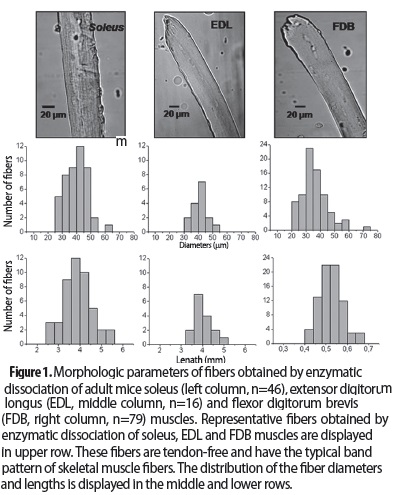
<body><![CDATA[<p><font size="2" face="Verdana, Arial, Helvetica, sans-serif">For structural studies, fibers were loaded with   MitotrackerGreen-FM &#40;Life Technologies, USA&#41; to stain   mitochondria and Di-8Anepps &#40;Life Technologies,   USA&#41; to stain the plasma membrane and T-tubules.   Fibers were visualized using a Nikon Eclipse TE2000   confocal microscope.   </font></p>     <p><font size="2" face="Verdana, Arial, Helvetica, sans-serif"><b>Soleus and EDL fiber typing</b>   </font></p>     <p><font size="2" face="Verdana, Arial, Helvetica, sans-serif">A major advantage of using long muscle fibers is that   typing via immunostaining or SDS-PAGE is possible.   These techniques identify isoforms of myosin heavy   chain &#40;MHC&#41;, the protein that classifies a fiber, present   in the cells. For immunostaining, the fibers were fixed   with 4&#37; paraformaldehyde, permeabilized with 1&#37;   Triton X-100, blocked with 1&#37; bovine serum albumin,   incubated with an anti-myosin II &#40;My-32, Sigma&#41;   antibody and then incubated with a secondary   antibody coupled to the fluorescent compound   AlexaFluor-488 &#40;Life Technologies, USA&#41;. The fibers were visualized using a Nikon Eclipse TE2000 confocal   microscope.</font></p>     <p><font size="2" face="Verdana, Arial, Helvetica, sans-serif"> For MHC determination by SDS-PAGE, isolated fibers   were incubated in 30 &#181;l of loading solution &#40;62.5 mM Tris,   1&#37; sodium dodecylsulfate, 0.01 of bromophenol blue, 5&#37;   mercaptoethanol, 15.2&#37; glycerol&#41;, sonicated for 40-60 s   &#40;Fisher Sonic Dismembrator Model 550&#41; and frozen at -80   &#176;C until the SDS-PAGE was carried out. The SDS-PAGE   protocol was developed by Talmadge and Roy &#40;22&#41; and   modified by Calder&oacute;n et al. &#40;8&#41;. In summary, the stacking   gel was a 4&#37; acrylamide/polyacrylamide mixture with   30&#37; glycerol and 4 mM EDTA, and the separating gel was   8&#37; acrylamide/polyacrylamide with 30&#37; glycerol. Either   Mini-Protean II or Mini-Protean III can be used for SDSPAGE.   The internal buffer, which is in contact with the   gel, and external buffer solutions were different &#40;8,16&#41; and   were not mixed. To improve the resolution of the bands,   2-mercaptoethanol was added to the internal solution at a   final concentration of 10 mM &#40;23&#41;. The electrophoresis was   run at 70 V at a temperature of 4-6 &#176;C for 26-28 hours. The   gels were stained with silver nitrate or Coomassie blue.   </font></p>     <p><font size="2" face="Verdana, Arial, Helvetica, sans-serif"><b>Statistics</b></font></p>     <p><font size="2" face="Verdana, Arial, Helvetica, sans-serif"> Values are reported as the mean &#177; standard error   &#40;SEM&#41;. Comparisons were performed with Origin   software, version 7.5 &#40;OriginLab Corporation, USA&#41;.   Differences were considered statistically significant at   P&lt;0.05. ImageJ software, version 1.45 &#40;<a href="http://rsbweb. nih.gov/ij/" target="_blank">http://rsbweb.   nih.gov/ij/</a>&#41; was used for image analysis.   </font></p>     <p>&nbsp;</p>     <p><font size="3" face="Verdana, Arial, Helvetica, sans-serif"><b>RESULTS</b></font></p>     <p><font size="2" face="Verdana, Arial, Helvetica, sans-serif"> Preparation of the fibers     <a href="#f1">Figure 1</a> shows the fibers typically obtained with the   dissociation protocol and also compares the sizes of   soleus &#40;3.9&#177;0.1 mm, n=46&#41; and EDL &#40;4.0&#177;0.1 mm,   n=16&#41; fibers with those of the shorter FDB fibers   &#40;0.52&#177;0.006 mm, n=79&#41;. The diameters of the soleus   &#40;39.5&#177;1.1 &#181;m&#41; and EDL &#40;40.8&#177;1.5 &#181;m&#41; fibers are also   greater than those from the FDB &#40;35.1&#177;1 &#181;m&#41;. FDB   fibers were significantly different from soleus and EDL   ones. </font></p>     <p align="center"><a name="f1"></a><img src="/img/revistas/iat/v26n2/v26n2a1f1.jpg"></p>     ]]></body>
<body><![CDATA[<p><font size="2" face="Verdana, Arial, Helvetica, sans-serif"><b>Ca<sup>2&#43;</sup> transients in soleus and EDL fibers   obtained by enzymatic dissociation</b></font></p>     <p><font size="2" face="Verdana, Arial, Helvetica, sans-serif"> In <a href="/img/revistas/iat/v26n2/v26n2a1f2.jpg" target="_blank">figure 2</a>, representative single Ca<sup>2&#43;</sup> transients   obtained from one soleus &#40;A&#41; and one EDL &#40;B&#41; fiber   are shown. <a href="/img/revistas/iat/v26n2/v26n2a1t2.jpg" target="_blank">Table 2</a> summarizes the kinetics of single   Ca<sup>2&#43;</sup> transients obtained in 45 soleus and 26 EDL   fibers. A double exponential function was fitted to   calculate the decay kinetics &#40;8&#41;. Soleus fibers were   significantly slower for all variables and had smaller   amplitudes than the EDL fibers.</font></p>     <p><font size="2" face="Verdana, Arial, Helvetica, sans-serif"> <b>Experimental procedures with fibers obtained   by enzymatic dissociation</b></font></p>     <p><font size="2" face="Verdana, Arial, Helvetica, sans-serif"> <a href="/img/revistas/iat/v26n2/v26n2a1f3.jpg" target="_blank">Figure 3</a> is a confocal image of a fiber labeled with   MitotrackerGreen-FM and Di-8Anepps. The picture   demonstrates that the procedure renders structurally   normal cells and also allows us to know that the   distribution of labeled mitochondria &#40;<a href="/img/revistas/iat/v26n2/v26n2a1f3.jpg" target="_blank">figure 3C</a>&#41;   is similar to that reported for fast FDB cells &#40;5&#41;. The   sarcomere length is also comparable to that of fast   fibers, despite the fact that it differs in some structural   protein isoforms &#40;5&#41;. The sarcomere size based on   the non-fitted profile plot of the Di-8Anepps image is   preferred &#40;<a href="/img/revistas/iat/v26n2/v26n2a1f3.jpg" target="_blank">figure 3B</a>&#41; because of potential bias when   the calculation is based on a fitted mitochondrial   array &#40;Calder&oacute;n J, unpublished results&#41;.</font></p>     <p><font size="2" face="Verdana, Arial, Helvetica, sans-serif"><b> Soleus and EDL fiber typing</b>   </font></p>     <p><font size="2" face="Verdana, Arial, Helvetica, sans-serif"><a href="/img/revistas/iat/v26n2/v26n2a1f4.jpg" target="_blank">Figure 4A</a> is a confocal image of a type II fiber   isolated from the soleus. The fiber was labeled with   an anti-myosin II antibody prior to incubation with   a secondary antibody coupled to AlexaFluor-488,   a fluorescent compound. In <a href="/img/revistas/iat/v26n2/v26n2a1f4.jpg" target="_blank">figure 4B</a>, separate gels   were loaded with either an isolated soleus or EDL fiber.   Several MHC bands may be present in each fiber. In mice,   the observed pattern of MHC electrophoretic mobility is IIA, IIX/D, IIB and I &#40;24,25&#41;. <a href="/img/revistas/iat/v26n2/v26n2a1t3.jpg" target="_blank">Table 3</a> lists the proportion of   pure and hybrid fibers present in 54 soleus and EDL fibers,   as analyzed by SDS-PAGE. The soleus is comprised of a   greater proportion of hybrid fibers than the EDL. </font></p>     <p>&nbsp;</p>     <p><font size="3" face="Verdana, Arial, Helvetica, sans-serif"><b>DISCUSSION</b>   </font></p>     <p><font size="2" face="Verdana, Arial, Helvetica, sans-serif">Although enzymatic dissociation of mammalian   muscles was first described decades ago &#40;21&#41;,   dissociation and physiological experimentation on   muscle cells longer than 1 mm are seldom performed.   The many publications using the rat FDB, mouse FDB   and mouse interossei &#40;1-13,21&#41; have produced a large   amount of physiological information on a subset of   fiber types, leading to an unbalanced understanding   of muscle fiber physiology.</font></p>     <p><font size="2" face="Verdana, Arial, Helvetica, sans-serif"> In mammalian skeletal muscle, there are four major   types of fibers: I, IIA, IIX/D and IIB &#40;26&#41;. Multiple   contractile properties have been studied in all types,   including the maximum speed of contraction, the   characteristics of the force-speed curve, the maximal   power, the timing of contraction and relaxation, the   maximal tension, and ATP consumption. &#40;27,28&#41;.   However, other functional properties have only been   studied in a limited number of fiber types. These   properties include the kinetics of the Ca<sup>2&#43;</sup> transients   and Ca<sup>2&#43;</sup> flow in both developing and mature fibers,   the characteristics and factors that affect SOCE, the   role of mitochondria in Ca<sup>2&#43;</sup> regulation within muscle   fibers, and alterations that occur during muscle   fatigue &#40;1-4,6,29&#41;. In these publications, the fiber type   used in the experiments was not specified; however,   the fibers can be assumed to be type IIX/D because   they are the predominant type in the FDB &#40;8,30&#41;,   which is the most frequently studied muscle. The   dissociation of muscles such as the soleus or the EDL   introduces the possibility of using the whole spectrum   of fiber types. The results of this study show that the   soleus of mature NMRI mice is composed of fiber   types I, IIA and hybrid fiber types IC and IIC. The EDL   is composed of fiber types IIX/D, IIB and hybrid fibers   with different proportions of IIX/D and IIB.   </font></p>     ]]></body>
<body><![CDATA[<p><font size="2" face="Verdana, Arial, Helvetica, sans-serif">Although not yet confirmed by other researchers &#40;20&#41;,   each fiber type uses different proteins for Ca<sup>2&#43;</sup> handling   and has unique ECC properties &#40;16&#41;. This work presents   the mean values of kinetic variables of Ca<sup>2&#43;</sup> transients   obtained from the largest number of soleus and EDL   fibers so far published in the literature. The results   include some fibers that were already published and   others obtained during the last two years. The results   are very similar to those previously reported &#40;8,16&#41;,   suggesting that the data are reproducible and the   experiments were performed well. Some differences   among earlier studies &#40;8,16,20&#41; may have arisen   from several factors: dissociated fibers are shortened   approximately 20&#37; compared to stretched fibers   mounted in a transducer &#40;5,8&#41;, different loading   methods may result in differences in intracellular   dye concentrations, and manually isolated cells &#40;20&#41;   may be damaged because of imperceptible stretches   during the isolation procedure.   </font></p>     <p><font size="2" face="Verdana, Arial, Helvetica, sans-serif">One main advantage of using long muscle fibers in   physiological experiments is the ability to determine   MHC isoforms of the fiber via SDS-PAGE. In short   muscles fibers, the bands are difficult to distinguish,   and there is occasionally too little protein for sufficient   staining with silver nitrate &#40;Calder&oacute;n J, unpublished   results&#41;, likely leading to the underestimation of some   MHC isoforms in hybrid fibers. As the soleus and EDL   fibers are approximately eight times longer than those   of FDB &#40;<a href="/img/revistas/iat/v26n2/v26n2a1f2.jpg" target="_blank">figure 2</a>&#41;, the amount of myosin &#40;and other   proteins&#41; present in the soleus and EDL fibers can be considered eight times larger than the amount in the   FDB fibers. Therefore, long muscles generate cleaner   bands.   </font></p>     <p><font size="2" face="Verdana, Arial, Helvetica, sans-serif">One use for models of dissociated long muscles is to   study hybrid fibers. Hybrid fibers were first observed   in the early 1990s in rats and named by the Pette   group &#40;31-33&#41;. Their physiological significance began   to be recognized approximately a decade later &#40;34,35&#41;.   While they have been studied in rats &#40;33-36&#41;, little is   known about hybrid fibers in mice; this shortcoming   is not trivial because the mouse is the preferred model   for muscle physiological studies. Gorza described the   frequency of hybrid fibers in the tibialis anterior of   mouse using antibodies against different myosin types   &#40;37&#41;; however, because there are no antibodies against   myosin type IIX/D, the hybrid fibers expressing this   myosin type could only be detected by indirect means   &#40;38&#41;. Hence, the study of hybrid fibers in mouse muscles   and the correlation of physiological phenomena with   the content of MHC in these fibers have been hindered   by technical difficulties related with the dissociation or   isolation of the mouse fibers, the decreased amount of   myosin present in short muscles in comparison with   rat muscle fibers and the lack of specific antibodies to   some myosin isoforms. The case of the study of the   Ca<sup>2&#43;</sup> transients according to the fiber type &#40;pure and   hybrid&#41; seems to be illustrative: the rat fibers that yield   good bands via SDS-PAGE are very long and difficult   to be successfully dissociated; short mouse muscles   &#40;i.e., FDB&#41;, easier to dissociate, are very small to give   good bands via SDS-PAGE, but those of long muscles   of mouse are susceptible to dissociation and give   nice bands in the SDS-PAGE. Our results corroborate   the findings by Gorza &#40;31&#41; that fast muscles are   composed of fewer hybrid fibers than slow muscles.   This difference could be related to the decreased   variability among type II fibers &#40;which predominate in   fast muscles&#41; than among fibers of types I and II &#40;both   of which are present in slow muscles&#41;.</font></p>     <p><font size="2" face="Verdana, Arial, Helvetica, sans-serif"> Increasing the knowledge about hybrid fibers may   help answer many questions in muscle physiology   and biochemistry, especially in regard to the structure   and function of the proteins involved in the ECC   and genetic regulation &#40;34&#41;. This knowledge may   have important applications to sports medicine,   musculoskeletal rehabilitation and muscle disease   therapies.   </font></p>     <p><font size="2" face="Verdana, Arial, Helvetica, sans-serif">There are several advantages to the described   methodology: i&#41; experiments on larger muscles are   possible, ii&#41; a greater number of cells can be studied,   iii&#41; the methodology is a more reliable way to classify   muscle fibers, and iv&#41; the methodology widens the   spectrum of fibers to be studied. However, some   limitations of the methodology exist: i&#41; it requires   more training than dissociating short muscles, and   ii&#41; in some experiments, more laminin is required to   attach the fibers to the cover slide.</font></p>     <p><font size="2" face="Verdana, Arial, Helvetica, sans-serif"> In summary, a methodology to enzymatically dissociate   long mouse muscles was presented. Additionally, the   usefulness of the methodology was demonstrated for   studying phenomena such as the kinetics of the Ca<sup>2&#43;</sup>   transients, evaluating different structures and reliably   determining the fiber type used in immunostaining   or SDS-PAGE experiments. Moreover, the greatest   number of experiments on Ca<sup>2&#43;</sup> transients kinetics   in the soleus and EDL was presented, showing that   those of the soleus are lower and slower than those   of EDL. This methodology is expected to be applied to   other types of experiments &#40;not described here, such   as inactivation of Ca<sup>2&#43;</sup> release, SOCE regulation and   fatigue&#41; &#40;17&#41;, increasing the knowledge of muscle fiber   biology and pathophysiology, especially that related   to pure and hybrid fiber types.   </font></p>     <p>&nbsp;</p>     <p><font size="3" face="Verdana, Arial, Helvetica, sans-serif"><b>ACKNOWLEDGEMENTS</b></font></p>     <p><font size="2" face="Verdana, Arial, Helvetica, sans-serif"> I would like to thank Dr. Carlo Caputo and Pura   Bola&ntilde;os from Cellular Physiology Laboratory,   Venezuelan Institute for Scientific Research. I would   also like to thank doctor Raul Narvaez-Sanchez and   doctor Marco Giraldo from University of Antioquia for   comments to this manuscript.   </font></p>     <p>&nbsp;</p>     ]]></body>
<body><![CDATA[<p><font size="3" face="Verdana, Arial, Helvetica, sans-serif"><b>BIBLIOGRAPHIC REFERENCES</b></font></p>     <!-- ref --><p><font size="2" face="Verdana, Arial, Helvetica, sans-serif"> 1. Caputo C, Bola&ntilde;os P, Gonzalez A. Inactivation of   Ca2&#43; transients in amphibian and mammalian   muscle fibres. J Muscle Res Cell Motil. 2004 Jan;25&#40;4-   5&#41;:315&#8211;28.    &nbsp;&nbsp;&nbsp;&nbsp;&nbsp;&nbsp;&nbsp;&nbsp;[&#160;<a href="javascript:void(0);" onclick="javascript: window.open('/scielo.php?script=sci_nlinks&ref=000074&pid=S0121-0793201300020000100001&lng=','','width=640,height=500,resizable=yes,scrollbars=1,menubar=yes,');">Links</a>&#160;]<!-- end-ref -->   </font></p>     <!-- ref --><p><font size="2" face="Verdana, Arial, Helvetica, sans-serif">2. Capote J, Bola&ntilde;os P, Schuhmeier RP, Melzer W,   Caputo C. Calcium transients in developing mouse   skeletal muscle fibres. J Physiol. 2005 Apr 15;564&#40;Pt   2&#41;:451&#8211;64.    &nbsp;&nbsp;&nbsp;&nbsp;&nbsp;&nbsp;&nbsp;&nbsp;[&#160;<a href="javascript:void(0);" onclick="javascript: window.open('/scielo.php?script=sci_nlinks&ref=000076&pid=S0121-0793201300020000100002&lng=','','width=640,height=500,resizable=yes,scrollbars=1,menubar=yes,');">Links</a>&#160;]<!-- end-ref --> </font></p>     <!-- ref --><p><font size="2" face="Verdana, Arial, Helvetica, sans-serif">3. Gonz&aacute;lez Narv&aacute;ez AA, Castillo A. Ca2&#43; store   determines gating of store operated calcium entry   in mammalian skeletal muscle. J Muscle Res Cell   Motil. 2007 Jan;28&#40;2-3&#41;:105&#8211;13.    &nbsp;&nbsp;&nbsp;&nbsp;&nbsp;&nbsp;&nbsp;&nbsp;[&#160;<a href="javascript:void(0);" onclick="javascript: window.open('/scielo.php?script=sci_nlinks&ref=000078&pid=S0121-0793201300020000100003&lng=','','width=640,height=500,resizable=yes,scrollbars=1,menubar=yes,');">Links</a>&#160;]<!-- end-ref -->   </font></p>     <!-- ref --><p><font size="2" face="Verdana, Arial, Helvetica, sans-serif">4. Caputo C, Bola&ntilde;os P. Effect of mitochondria poisoning   by FCCP on Ca2&#43; signaling in mouse skeletal muscle   fibers. Pflugers Arch. 2008 Jan;455&#40;4&#41;:733&#8211;43.    &nbsp;&nbsp;&nbsp;&nbsp;&nbsp;&nbsp;&nbsp;&nbsp;[&#160;<a href="javascript:void(0);" onclick="javascript: window.open('/scielo.php?script=sci_nlinks&ref=000080&pid=S0121-0793201300020000100004&lng=','','width=640,height=500,resizable=yes,scrollbars=1,menubar=yes,');">Links</a>&#160;]<!-- end-ref --></font></p>     <!-- ref --><p><font size="2" face="Verdana, Arial, Helvetica, sans-serif"> 5. Bola&ntilde;os P, Guillen A, Rojas H, Boncompagni S,   Caputo C. The use of CalciumOrange-5N as a specific   marker of mitochondrial Ca2&#43; in mouse skeletal   muscle fibers. Pflugers Arch. 2008 Jan;455&#40;4&#41;:721&#8211;31.    &nbsp;&nbsp;&nbsp;&nbsp;&nbsp;&nbsp;&nbsp;&nbsp;[&#160;<a href="javascript:void(0);" onclick="javascript: window.open('/scielo.php?script=sci_nlinks&ref=000082&pid=S0121-0793201300020000100005&lng=','','width=640,height=500,resizable=yes,scrollbars=1,menubar=yes,');">Links</a>&#160;]<!-- end-ref -->   </font></p>     <!-- ref --><p><font size="2" face="Verdana, Arial, Helvetica, sans-serif">6. Bola&ntilde;os P, Guill&eacute;n A, DiPolo R, Caputo C. Factors   affecting SOCE activation in mammalian skeletal   muscle fibers. J Physiol Sci. 2009 Jul;59&#40;4&#41;:317&#8211;28.    &nbsp;&nbsp;&nbsp;&nbsp;&nbsp;&nbsp;&nbsp;&nbsp;[&#160;<a href="javascript:void(0);" onclick="javascript: window.open('/scielo.php?script=sci_nlinks&ref=000084&pid=S0121-0793201300020000100006&lng=','','width=640,height=500,resizable=yes,scrollbars=1,menubar=yes,');">Links</a>&#160;]<!-- end-ref -->   </font></p>     <!-- ref --><p><font size="2" face="Verdana, Arial, Helvetica, sans-serif">7. Legrand C, Giacomello E, Berthier C, Allard B,   Sorrentino V, Jacquemond V. Spontaneous and   voltage-activated Ca2&#43; release in adult mouse   skeletal muscle fibres expressing the type 3 ryanodine   receptor. J Physiol. 2008 Jan 15;586&#40;2&#41;:441&#8211;57.    &nbsp;&nbsp;&nbsp;&nbsp;&nbsp;&nbsp;&nbsp;&nbsp;[&#160;<a href="javascript:void(0);" onclick="javascript: window.open('/scielo.php?script=sci_nlinks&ref=000086&pid=S0121-0793201300020000100007&lng=','','width=640,height=500,resizable=yes,scrollbars=1,menubar=yes,');">Links</a>&#160;]<!-- end-ref --></font></p>     <!-- ref --><p><font size="2" face="Verdana, Arial, Helvetica, sans-serif"> 8. Calder&oacute;n JC, Bola&ntilde;os P, Torres SH, Rodr&iacute;guez-Arroyo   G, Caputo C. Different fibre populations distinguished   by their calcium transient characteristics in   enzymatically dissociated murine flexor digitorum   brevis and soleus muscles. J Muscle Res Cell Motil.   2009 Jan;30&#40;3-4&#41;:125&#8211;37.    &nbsp;&nbsp;&nbsp;&nbsp;&nbsp;&nbsp;&nbsp;&nbsp;[&#160;<a href="javascript:void(0);" onclick="javascript: window.open('/scielo.php?script=sci_nlinks&ref=000088&pid=S0121-0793201300020000100008&lng=','','width=640,height=500,resizable=yes,scrollbars=1,menubar=yes,');">Links</a>&#160;]<!-- end-ref --></font></p>     <!-- ref --><p><font size="2" face="Verdana, Arial, Helvetica, sans-serif"> 9. Apostol S, Ursu D, Lehmann-Horn F, Melzer W. Local   calcium signals induced by hyper-osmotic stress in   mammalian skeletal muscle cells. J Muscle Res Cell   Motil. 2009 Jan;30&#40;3-4&#41;:97&#8211;109.    &nbsp;&nbsp;&nbsp;&nbsp;&nbsp;&nbsp;&nbsp;&nbsp;[&#160;<a href="javascript:void(0);" onclick="javascript: window.open('/scielo.php?script=sci_nlinks&ref=000090&pid=S0121-0793201300020000100009&lng=','','width=640,height=500,resizable=yes,scrollbars=1,menubar=yes,');">Links</a>&#160;]<!-- end-ref -->   </font></p>     <!-- ref --><p><font size="2" face="Verdana, Arial, Helvetica, sans-serif">10. DiFranco M, Quinonez M, Capote J, Vergara J. DNA   transfection of mammalian skeletal muscles using in   vivo electroporation. J Vis Exp. 2009 Jan;&#40;32&#41;    &nbsp;&nbsp;&nbsp;&nbsp;&nbsp;&nbsp;&nbsp;&nbsp;[&#160;<a href="javascript:void(0);" onclick="javascript: window.open('/scielo.php?script=sci_nlinks&ref=000092&pid=S0121-0793201300020000100010&lng=','','width=640,height=500,resizable=yes,scrollbars=1,menubar=yes,');">Links</a>&#160;]<!-- end-ref -->.   </font></p>     <!-- ref --><p><font size="2" face="Verdana, Arial, Helvetica, sans-serif">11. DiFranco M, Tran P, Qui&ntilde;onez M, Vergara JL.   Functional expression of transgenic a 1sDHPR   channels in adult mammalian skeletal muscle fibres.   J Physiol. 2011 Mar 15;589&#40;Pt 6&#41;:1421&#8211;42.    &nbsp;&nbsp;&nbsp;&nbsp;&nbsp;&nbsp;&nbsp;&nbsp;[&#160;<a href="javascript:void(0);" onclick="javascript: window.open('/scielo.php?script=sci_nlinks&ref=000094&pid=S0121-0793201300020000100011&lng=','','width=640,height=500,resizable=yes,scrollbars=1,menubar=yes,');">Links</a>&#160;]<!-- end-ref --></font></p>     <!-- ref --><p><font size="2" face="Verdana, Arial, Helvetica, sans-serif"> 12. Sztretye M, Yi J, Figueroa L, Zhou J, Royer L, R&iacute;os E.   D4cpv-calsequestrin: a sensitive ratiometric biosensor   accurately targeted to the calcium store of skeletal   muscle. J Gen Physiol. 2011 Aug;138&#40;2&#41;:211&#8211;29.    &nbsp;&nbsp;&nbsp;&nbsp;&nbsp;&nbsp;&nbsp;&nbsp;[&#160;<a href="javascript:void(0);" onclick="javascript: window.open('/scielo.php?script=sci_nlinks&ref=000096&pid=S0121-0793201300020000100012&lng=','','width=640,height=500,resizable=yes,scrollbars=1,menubar=yes,');">Links</a>&#160;]<!-- end-ref -->   </font></p>     <!-- ref --><p><font size="2" face="Verdana, Arial, Helvetica, sans-serif">13. Figueroa L, Shkryl VM, Zhou J, Manno C, Momotake   A, Brum G, et al. Synthetic localized calcium   transients directly probe signalling mechanisms   in skeletal muscle. J Physiol. 2012 Mar 15;590&#40;Pt   6&#41;:1389&#8211;411.    &nbsp;&nbsp;&nbsp;&nbsp;&nbsp;&nbsp;&nbsp;&nbsp;[&#160;<a href="javascript:void(0);" onclick="javascript: window.open('/scielo.php?script=sci_nlinks&ref=000098&pid=S0121-0793201300020000100013&lng=','','width=640,height=500,resizable=yes,scrollbars=1,menubar=yes,');">Links</a>&#160;]<!-- end-ref -->   </font></p>     <!-- ref --><p><font size="2" face="Verdana, Arial, Helvetica, sans-serif">14. Williams DA, Head SI, Bakker AJ, Stephenson DG.   Resting calcium concentrations in isolated skeletal   muscle fibres of dystrophic mice. J Physiol. 1990   Sep;428:243&#8211;56.    &nbsp;&nbsp;&nbsp;&nbsp;&nbsp;&nbsp;&nbsp;&nbsp;[&#160;<a href="javascript:void(0);" onclick="javascript: window.open('/scielo.php?script=sci_nlinks&ref=000100&pid=S0121-0793201300020000100014&lng=','','width=640,height=500,resizable=yes,scrollbars=1,menubar=yes,');">Links</a>&#160;]<!-- end-ref -->   </font></p>     <!-- ref --><p><font size="2" face="Verdana, Arial, Helvetica, sans-serif">15. Szentesi P, Jacquemond V, Kov&aacute;cs L, Csernoch   L. Intramembrane charge movement and   sarcoplasmic calcium release in enzymatically   isolated mammalian skeletal muscle fibres. J Physiol.   1997 Dec 1;505 &#40;Pt 2&#41;:371-84.    &nbsp;&nbsp;&nbsp;&nbsp;&nbsp;&nbsp;&nbsp;&nbsp;[&#160;<a href="javascript:void(0);" onclick="javascript: window.open('/scielo.php?script=sci_nlinks&ref=000102&pid=S0121-0793201300020000100015&lng=','','width=640,height=500,resizable=yes,scrollbars=1,menubar=yes,');">Links</a>&#160;]<!-- end-ref -->   </font></p>     <!-- ref --><p><font size="2" face="Verdana, Arial, Helvetica, sans-serif">16. Calder&oacute;n JC, Bola&ntilde;os P, Caputo C. Myosin heavy   chain isoform composition and Ca2&#43; transients in   fibres from enzymatically dissociated murine soleus   and extensor digitorum longus muscles. J Physiol.   2010 Jan 1;588&#40;Pt 1&#41;:267-79.    &nbsp;&nbsp;&nbsp;&nbsp;&nbsp;&nbsp;&nbsp;&nbsp;[&#160;<a href="javascript:void(0);" onclick="javascript: window.open('/scielo.php?script=sci_nlinks&ref=000104&pid=S0121-0793201300020000100016&lng=','','width=640,height=500,resizable=yes,scrollbars=1,menubar=yes,');">Links</a>&#160;]<!-- end-ref -->   </font></p>     <!-- ref --><p><font size="2" face="Verdana, Arial, Helvetica, sans-serif">17. Calder&oacute;n JC, Bola&ntilde;os P, Caputo C. Kinetic changes in   tetanic Ca2&#43; transients in enzymatically dissociated   muscle fibres under repetitive stimulation. J Physiol.   2011 Nov 1;589&#40;Pt 21&#41;:5269-83.    &nbsp;&nbsp;&nbsp;&nbsp;&nbsp;&nbsp;&nbsp;&nbsp;[&#160;<a href="javascript:void(0);" onclick="javascript: window.open('/scielo.php?script=sci_nlinks&ref=000106&pid=S0121-0793201300020000100017&lng=','','width=640,height=500,resizable=yes,scrollbars=1,menubar=yes,');">Links</a>&#160;]<!-- end-ref -->   </font></p>     <!-- ref --><p><font size="2" face="Verdana, Arial, Helvetica, sans-serif">18. Chemello F, Bean C, Cancellara P, Laveder P, Reggiani   C, Lanfranchi G. Microgenomic analysis in skeletal   muscle: expression signatures of individual fast and   slow myofibers. PLoS One. 2011 Jan;6&#40;2&#41;:e16807.    &nbsp;&nbsp;&nbsp;&nbsp;&nbsp;&nbsp;&nbsp;&nbsp;[&#160;<a href="javascript:void(0);" onclick="javascript: window.open('/scielo.php?script=sci_nlinks&ref=000108&pid=S0121-0793201300020000100018&lng=','','width=640,height=500,resizable=yes,scrollbars=1,menubar=yes,');">Links</a>&#160;]<!-- end-ref -->   </font></p>     <!-- ref --><p><font size="2" face="Verdana, Arial, Helvetica, sans-serif">19. Head SI. Branched fibres in old dystrophic mdx   muscle are associated with mechanical weakening   of the sarcolemma, abnormal Ca2&#43; transients and a   breakdown of Ca2&#43; homeostasis during fatigue. Exp   Physiol. 2010 May;95&#40;5&#41;:641&#8211;56.    &nbsp;&nbsp;&nbsp;&nbsp;&nbsp;&nbsp;&nbsp;&nbsp;[&#160;<a href="javascript:void(0);" onclick="javascript: window.open('/scielo.php?script=sci_nlinks&ref=000110&pid=S0121-0793201300020000100019&lng=','','width=640,height=500,resizable=yes,scrollbars=1,menubar=yes,');">Links</a>&#160;]<!-- end-ref -->   </font></p>     <!-- ref --><p><font size="2" face="Verdana, Arial, Helvetica, sans-serif">20. Hollingworth S, Kim MM, Baylor SM. Measurement   and simulation of myoplasmic calcium transients in   mouse slow-twitch muscle fibres. J Physiol. 2012 Feb   1;590&#40;Pt 3&#41;:575&#8211;94.    &nbsp;&nbsp;&nbsp;&nbsp;&nbsp;&nbsp;&nbsp;&nbsp;[&#160;<a href="javascript:void(0);" onclick="javascript: window.open('/scielo.php?script=sci_nlinks&ref=000112&pid=S0121-0793201300020000100020&lng=','','width=640,height=500,resizable=yes,scrollbars=1,menubar=yes,');">Links</a>&#160;]<!-- end-ref -->   </font></p>     <!-- ref --><p><font size="2" face="Verdana, Arial, Helvetica, sans-serif">21. Bekoff A, Betz WJ. Physiological properties of   dissociated muscle fibres obtained from innervated   and denervated adult rat muscle. J Physiol. 1977   Sep;271&#40;1&#41;:25&#8211;40.    &nbsp;&nbsp;&nbsp;&nbsp;&nbsp;&nbsp;&nbsp;&nbsp;[&#160;<a href="javascript:void(0);" onclick="javascript: window.open('/scielo.php?script=sci_nlinks&ref=000114&pid=S0121-0793201300020000100021&lng=','','width=640,height=500,resizable=yes,scrollbars=1,menubar=yes,');">Links</a>&#160;]<!-- end-ref -->   </font></p>     <!-- ref --><p><font size="2" face="Verdana, Arial, Helvetica, sans-serif">22. Talmadge RJ, Roy RR. Electrophoretic separation of   rat skeletal muscle myosin heavy-chain isoforms. J   Appl Physiol. 1993 Nov;75&#40;5&#41;:2337&#8211;40.    &nbsp;&nbsp;&nbsp;&nbsp;&nbsp;&nbsp;&nbsp;&nbsp;[&#160;<a href="javascript:void(0);" onclick="javascript: window.open('/scielo.php?script=sci_nlinks&ref=000116&pid=S0121-0793201300020000100022&lng=','','width=640,height=500,resizable=yes,scrollbars=1,menubar=yes,');">Links</a>&#160;]<!-- end-ref -->   </font></p>     <!-- ref --><p><font size="2" face="Verdana, Arial, Helvetica, sans-serif">23. Blough ER, Rennie ER, Zhang F, Reiser PJ. Enhanced   electrophoretic separation and resolution of myosin   heavy chains in mammalian and avian skeletal   muscles. Anal Biochem. 1996 Jan 1;233&#40;1&#41;:31&#8211;5.    &nbsp;&nbsp;&nbsp;&nbsp;&nbsp;&nbsp;&nbsp;&nbsp;[&#160;<a href="javascript:void(0);" onclick="javascript: window.open('/scielo.php?script=sci_nlinks&ref=000118&pid=S0121-0793201300020000100023&lng=','','width=640,height=500,resizable=yes,scrollbars=1,menubar=yes,');">Links</a>&#160;]<!-- end-ref --></font></p>     <!-- ref --><p><font size="2" face="Verdana, Arial, Helvetica, sans-serif"> 24. H&auml;m&auml;l&auml;inen N, Pette D. The histochemical profiles   of fast fiber types IIB, IID, and IIA in skeletal muscles   of mouse, rat, and rabbit. J Histochem Cytochem.   1993 May;41&#40;5&#41;:733&#8211;43.    &nbsp;&nbsp;&nbsp;&nbsp;&nbsp;&nbsp;&nbsp;&nbsp;[&#160;<a href="javascript:void(0);" onclick="javascript: window.open('/scielo.php?script=sci_nlinks&ref=000120&pid=S0121-0793201300020000100024&lng=','','width=640,height=500,resizable=yes,scrollbars=1,menubar=yes,');">Links</a>&#160;]<!-- end-ref --> </font></p>     <!-- ref --><p><font size="2" face="Verdana, Arial, Helvetica, sans-serif">25. Agbulut O, Li Z, Mouly V, Butler-Browne GS. Analysis   of skeletal and cardiac muscle from desmin knockout   and normal mice by high resolution separation   of myosin heavy-chain isoforms. Biol Cell. 1996   Jan;88&#40;3&#41;:131&#8211;5.    &nbsp;&nbsp;&nbsp;&nbsp;&nbsp;&nbsp;&nbsp;&nbsp;[&#160;<a href="javascript:void(0);" onclick="javascript: window.open('/scielo.php?script=sci_nlinks&ref=000122&pid=S0121-0793201300020000100025&lng=','','width=640,height=500,resizable=yes,scrollbars=1,menubar=yes,');">Links</a>&#160;]<!-- end-ref -->   </font></p>     <!-- ref --><p><font size="2" face="Verdana, Arial, Helvetica, sans-serif">26. Schiaffino S, Reggiani C. Myosin isoforms in   mammalian skeletal muscle. J Appl Physiol. 1994   Aug;77&#40;2&#41;:493&#8211;501.    &nbsp;&nbsp;&nbsp;&nbsp;&nbsp;&nbsp;&nbsp;&nbsp;[&#160;<a href="javascript:void(0);" onclick="javascript: window.open('/scielo.php?script=sci_nlinks&ref=000124&pid=S0121-0793201300020000100026&lng=','','width=640,height=500,resizable=yes,scrollbars=1,menubar=yes,');">Links</a>&#160;]<!-- end-ref --></font></p>     <!-- ref --><p><font size="2" face="Verdana, Arial, Helvetica, sans-serif"> 27. Bottinelli R. Functional heterogeneity of mammalian   single muscle fibres: do myosin isoforms tell the   whole story&#63; Pflugers Arch. 2001 Oct;443&#40;1&#41;:6&#8211;17.    &nbsp;&nbsp;&nbsp;&nbsp;&nbsp;&nbsp;&nbsp;&nbsp;[&#160;<a href="javascript:void(0);" onclick="javascript: window.open('/scielo.php?script=sci_nlinks&ref=000126&pid=S0121-0793201300020000100027&lng=','','width=640,height=500,resizable=yes,scrollbars=1,menubar=yes,');">Links</a>&#160;]<!-- end-ref -->   </font></p>     <!-- ref --><p><font size="2" face="Verdana, Arial, Helvetica, sans-serif">28. Bottinelli R, Reggiani C. Human skeletal muscle   fibres: molecular and functional diversity. Prog   Biophys Mol Biol. 2000 Jan;73&#40;2-4&#41;:195&#8211;262.    &nbsp;&nbsp;&nbsp;&nbsp;&nbsp;&nbsp;&nbsp;&nbsp;[&#160;<a href="javascript:void(0);" onclick="javascript: window.open('/scielo.php?script=sci_nlinks&ref=000128&pid=S0121-0793201300020000100028&lng=','','width=640,height=500,resizable=yes,scrollbars=1,menubar=yes,');">Links</a>&#160;]<!-- end-ref -->   </font></p>     <!-- ref --><p><font size="2" face="Verdana, Arial, Helvetica, sans-serif">29. Westerblad H, Allen DG. Changes of myoplasmic   calcium concentration during fatigue in single mouse   muscle fibers. J Gen Physiol. 1991 Sep;98&#40;3&#41;:615&#8211;35.    &nbsp;&nbsp;&nbsp;&nbsp;&nbsp;&nbsp;&nbsp;&nbsp;[&#160;<a href="javascript:void(0);" onclick="javascript: window.open('/scielo.php?script=sci_nlinks&ref=000130&pid=S0121-0793201300020000100029&lng=','','width=640,height=500,resizable=yes,scrollbars=1,menubar=yes,');">Links</a>&#160;]<!-- end-ref -->   </font></p>     <!-- ref --><p><font size="2" face="Verdana, Arial, Helvetica, sans-serif">30. Gonzalez E, Messi ML, Zheng Z, Delbono O. Insulinlike   growth factor-1 prevents age-related decrease in   specific force and intracellular Ca2&#43; in single intact   muscle fibres from transgenic mice. J Physiol. 2003   Nov 1;552&#40;Pt 3&#41;:833&#8211;44.    &nbsp;&nbsp;&nbsp;&nbsp;&nbsp;&nbsp;&nbsp;&nbsp;[&#160;<a href="javascript:void(0);" onclick="javascript: window.open('/scielo.php?script=sci_nlinks&ref=000132&pid=S0121-0793201300020000100030&lng=','','width=640,height=500,resizable=yes,scrollbars=1,menubar=yes,');">Links</a>&#160;]<!-- end-ref -->   </font></p>     <!-- ref --><p><font size="2" face="Verdana, Arial, Helvetica, sans-serif">31. Termin A, Staron RS, Pette D. Myosin heavy chain   isoforms in histochemically defined fiber types of rat   muscle. Histochemistry. 1989 Jan;92&#40;6&#41;:453&#8211;7.    &nbsp;&nbsp;&nbsp;&nbsp;&nbsp;&nbsp;&nbsp;&nbsp;[&#160;<a href="javascript:void(0);" onclick="javascript: window.open('/scielo.php?script=sci_nlinks&ref=000134&pid=S0121-0793201300020000100031&lng=','','width=640,height=500,resizable=yes,scrollbars=1,menubar=yes,');">Links</a>&#160;]<!-- end-ref --></font></p>     <!-- ref --><p><font size="2" face="Verdana, Arial, Helvetica, sans-serif"> 32. Termin A, Staron RS, Pette D. Changes in myosin   heavy chain isoforms during chronic low-frequency   stimulation of rat fast hindlimb muscles. A single-fiber   study. Eur J Biochem. 1989 Dec 22;186&#40;3&#41;:749&#8211;54.    &nbsp;&nbsp;&nbsp;&nbsp;&nbsp;&nbsp;&nbsp;&nbsp;[&#160;<a href="javascript:void(0);" onclick="javascript: window.open('/scielo.php?script=sci_nlinks&ref=000136&pid=S0121-0793201300020000100032&lng=','','width=640,height=500,resizable=yes,scrollbars=1,menubar=yes,');">Links</a>&#160;]<!-- end-ref -->   </font></p>     <!-- ref --><p><font size="2" face="Verdana, Arial, Helvetica, sans-serif">33. Staron RS, Pette D. The continuum of pure and hybrid   myosin heavy chain-based fibre types in rat skeletal   muscle. Histochemistry. 1993 Aug;100&#40;2&#41;:149&#8211;53.    &nbsp;&nbsp;&nbsp;&nbsp;&nbsp;&nbsp;&nbsp;&nbsp;[&#160;<a href="javascript:void(0);" onclick="javascript: window.open('/scielo.php?script=sci_nlinks&ref=000138&pid=S0121-0793201300020000100033&lng=','','width=640,height=500,resizable=yes,scrollbars=1,menubar=yes,');">Links</a>&#160;]<!-- end-ref -->   </font></p>     <!-- ref --><p><font size="2" face="Verdana, Arial, Helvetica, sans-serif">34. Stephenson G. Hybrid skeletal muscle fibres: a   rare or common phenomenon&#63; Proc Austr Physiol   Pharmacol Soc. 2001;32&#40;1&#41;:69&#8211;87.    &nbsp;&nbsp;&nbsp;&nbsp;&nbsp;&nbsp;&nbsp;&nbsp;[&#160;<a href="javascript:void(0);" onclick="javascript: window.open('/scielo.php?script=sci_nlinks&ref=000140&pid=S0121-0793201300020000100034&lng=','','width=640,height=500,resizable=yes,scrollbars=1,menubar=yes,');">Links</a>&#160;]<!-- end-ref -->   </font></p>     <!-- ref --><p><font size="2" face="Verdana, Arial, Helvetica, sans-serif">35. Caiozzo VJ, Haddad F, Baker M, McCue S, Baldwin   KM. MHC polymorphism in rodent plantaris muscle:   effects of mechanical overload and hypothyroidism.   Am J Physiol Cell Physiol. 2000 Apr;278&#40;4&#41;:C709&#8211;17.    &nbsp;&nbsp;&nbsp;&nbsp;&nbsp;&nbsp;&nbsp;&nbsp;[&#160;<a href="javascript:void(0);" onclick="javascript: window.open('/scielo.php?script=sci_nlinks&ref=000142&pid=S0121-0793201300020000100035&lng=','','width=640,height=500,resizable=yes,scrollbars=1,menubar=yes,');">Links</a>&#160;]<!-- end-ref -->   </font></p>     <!-- ref --><p><font size="2" face="Verdana, Arial, Helvetica, sans-serif">36. Staron RS, Kraemer WJ, Hikida RS, Fry AC, Murray   JD, Campos GE. Fiber type composition of four   hindlimb muscles of adult Fisher 344 rats. Histochem   Cell Biol. 1999 Feb;111&#40;2&#41;:117&#8211;23.    &nbsp;&nbsp;&nbsp;&nbsp;&nbsp;&nbsp;&nbsp;&nbsp;[&#160;<a href="javascript:void(0);" onclick="javascript: window.open('/scielo.php?script=sci_nlinks&ref=000144&pid=S0121-0793201300020000100036&lng=','','width=640,height=500,resizable=yes,scrollbars=1,menubar=yes,');">Links</a>&#160;]<!-- end-ref -->   </font></p>     <!-- ref --><p><font size="2" face="Verdana, Arial, Helvetica, sans-serif">37. Gorza L. Identification of a novel type 2 fiber   population in mammalian skeletal muscle by   combined use of histochemical myosin ATPase and   anti-myosin monoclonal antibodies. J Histochem   Cytochem. 1990 Feb;38&#40;2&#41;:257&#8211;65.    &nbsp;&nbsp;&nbsp;&nbsp;&nbsp;&nbsp;&nbsp;&nbsp;[&#160;<a href="javascript:void(0);" onclick="javascript: window.open('/scielo.php?script=sci_nlinks&ref=000146&pid=S0121-0793201300020000100037&lng=','','width=640,height=500,resizable=yes,scrollbars=1,menubar=yes,');">Links</a>&#160;]<!-- end-ref -->   </font></p>     <!-- ref --><p><font size="2" face="Verdana, Arial, Helvetica, sans-serif">38. Bottinelli R, Schiaffino S, Reggiani C. Force-velocity   relations and myosin heavy chain isoform compositions   of skinned fibres from rat skeletal muscle.   J Physiol. 1991 Jun;437:655&#8211;72.    &nbsp;&nbsp;&nbsp;&nbsp;&nbsp;&nbsp;&nbsp;&nbsp;[&#160;<a href="javascript:void(0);" onclick="javascript: window.open('/scielo.php?script=sci_nlinks&ref=000148&pid=S0121-0793201300020000100038&lng=','','width=640,height=500,resizable=yes,scrollbars=1,menubar=yes,');">Links</a>&#160;]<!-- end-ref --> </font></p>      ]]></body><back>
<ref-list>
<ref id="B1">
<label>1</label><nlm-citation citation-type="journal">
<person-group person-group-type="author">
<name>
<surname><![CDATA[Caputo]]></surname>
<given-names><![CDATA[C]]></given-names>
</name>
<name>
<surname><![CDATA[Bolaños]]></surname>
<given-names><![CDATA[P]]></given-names>
</name>
<name>
<surname><![CDATA[Gonzalez]]></surname>
<given-names><![CDATA[A.]]></given-names>
</name>
</person-group>
<article-title xml:lang="en"><![CDATA[Inactivation of Ca2+ transients in amphibian and mammalian muscle fibres]]></article-title>
<source><![CDATA[J Muscle Res Cell Motil]]></source>
<year>2004</year>
<month> J</month>
<day>an</day>
<volume>25</volume>
<numero>4- 5</numero>
<issue>4- 5</issue>
<page-range>315-28</page-range></nlm-citation>
</ref>
<ref id="B2">
<label>2</label><nlm-citation citation-type="journal">
<person-group person-group-type="author">
<name>
<surname><![CDATA[Capote]]></surname>
<given-names><![CDATA[J]]></given-names>
</name>
<name>
<surname><![CDATA[Bolaños]]></surname>
<given-names><![CDATA[P]]></given-names>
</name>
<name>
<surname><![CDATA[Schuhmeier]]></surname>
<given-names><![CDATA[RP]]></given-names>
</name>
<name>
<surname><![CDATA[Melzer]]></surname>
<given-names><![CDATA[W]]></given-names>
</name>
<name>
<surname><![CDATA[Caputo]]></surname>
<given-names><![CDATA[C.]]></given-names>
</name>
</person-group>
<article-title xml:lang="en"><![CDATA[Calcium transients in developing mouse skeletal muscle fibres]]></article-title>
<source><![CDATA[J Physiol]]></source>
<year>2005</year>
<month> A</month>
<day>pr</day>
<volume>564</volume>
<numero>Pt 2</numero>
<issue>Pt 2</issue>
<page-range>451-64</page-range></nlm-citation>
</ref>
<ref id="B3">
<label>3</label><nlm-citation citation-type="journal">
<person-group person-group-type="author">
<name>
<surname><![CDATA[González Narváez]]></surname>
<given-names><![CDATA[AA]]></given-names>
</name>
<name>
<surname><![CDATA[Castillo]]></surname>
<given-names><![CDATA[A.]]></given-names>
</name>
</person-group>
<article-title xml:lang="en"><![CDATA[Ca2+ store determines gating of store operated calcium entry in mammalian skeletal muscle]]></article-title>
<source><![CDATA[J Muscle Res Cell Motil]]></source>
<year>2007</year>
<month> J</month>
<day>an</day>
<volume>28</volume>
<numero>2-3</numero>
<issue>2-3</issue>
<page-range>105-13</page-range></nlm-citation>
</ref>
<ref id="B4">
<label>4</label><nlm-citation citation-type="journal">
<person-group person-group-type="author">
<name>
<surname><![CDATA[Caputo]]></surname>
<given-names><![CDATA[C]]></given-names>
</name>
<name>
<surname><![CDATA[Bolaños]]></surname>
<given-names><![CDATA[P.]]></given-names>
</name>
</person-group>
<article-title xml:lang="en"><![CDATA[Effect of mitochondria poisoning by FCCP on Ca2+ signaling in mouse skeletal muscle fibers]]></article-title>
<source><![CDATA[Pflugers Arch]]></source>
<year>2008</year>
<month> J</month>
<day>an</day>
<volume>455</volume>
<numero>4</numero>
<issue>4</issue>
<page-range>733-43</page-range></nlm-citation>
</ref>
<ref id="B5">
<label>5</label><nlm-citation citation-type="journal">
<person-group person-group-type="author">
<name>
<surname><![CDATA[Bolaños]]></surname>
<given-names><![CDATA[P]]></given-names>
</name>
<name>
<surname><![CDATA[Guillen]]></surname>
<given-names><![CDATA[A]]></given-names>
</name>
<name>
<surname><![CDATA[Rojas]]></surname>
<given-names><![CDATA[H]]></given-names>
</name>
<name>
<surname><![CDATA[Boncompagni]]></surname>
<given-names><![CDATA[S]]></given-names>
</name>
<name>
<surname><![CDATA[Caputo]]></surname>
<given-names><![CDATA[C.]]></given-names>
</name>
</person-group>
<article-title xml:lang="en"><![CDATA[The use of CalciumOrange-5N as a specific marker of mitochondrial Ca2+ in mouse skeletal muscle fibers]]></article-title>
<source><![CDATA[Pflugers Arch]]></source>
<year>2008</year>
<month> J</month>
<day>an</day>
<volume>455</volume>
<numero>4</numero>
<issue>4</issue>
<page-range>721-31</page-range></nlm-citation>
</ref>
<ref id="B6">
<label>6</label><nlm-citation citation-type="journal">
<person-group person-group-type="author">
<name>
<surname><![CDATA[Bolaños]]></surname>
<given-names><![CDATA[P]]></given-names>
</name>
<name>
<surname><![CDATA[Guillén]]></surname>
<given-names><![CDATA[A]]></given-names>
</name>
<name>
<surname><![CDATA[DiPolo]]></surname>
<given-names><![CDATA[R]]></given-names>
</name>
<name>
<surname><![CDATA[Caputo]]></surname>
<given-names><![CDATA[C.]]></given-names>
</name>
</person-group>
<article-title xml:lang="en"><![CDATA[Factors affecting SOCE activation in mammalian skeletal muscle fibers]]></article-title>
<source><![CDATA[J Physiol Sci]]></source>
<year>2009</year>
<month> J</month>
<day>ul</day>
<volume>59</volume>
<numero>4</numero>
<issue>4</issue>
<page-range>317-28</page-range></nlm-citation>
</ref>
<ref id="B7">
<label>7</label><nlm-citation citation-type="journal">
<person-group person-group-type="author">
<name>
<surname><![CDATA[Legrand]]></surname>
<given-names><![CDATA[C]]></given-names>
</name>
<name>
<surname><![CDATA[Giacomello]]></surname>
<given-names><![CDATA[E]]></given-names>
</name>
<name>
<surname><![CDATA[Berthier]]></surname>
<given-names><![CDATA[C]]></given-names>
</name>
<name>
<surname><![CDATA[Allard]]></surname>
<given-names><![CDATA[B]]></given-names>
</name>
<name>
<surname><![CDATA[Sorrentino]]></surname>
<given-names><![CDATA[V]]></given-names>
</name>
<name>
<surname><![CDATA[Jacquemond]]></surname>
<given-names><![CDATA[V.]]></given-names>
</name>
</person-group>
<article-title xml:lang="en"><![CDATA[Spontaneous and voltage-activated Ca2+ release in adult mouse skeletal muscle fibres expressing the type 3 ryanodine receptor]]></article-title>
<source><![CDATA[J Physiol]]></source>
<year>2008</year>
<month> J</month>
<day>an</day>
<volume>586</volume>
<numero>2</numero>
<issue>2</issue>
<page-range>441-57</page-range></nlm-citation>
</ref>
<ref id="B8">
<label>8</label><nlm-citation citation-type="journal">
<person-group person-group-type="author">
<name>
<surname><![CDATA[Calderón]]></surname>
<given-names><![CDATA[JC]]></given-names>
</name>
<name>
<surname><![CDATA[Bolaños]]></surname>
<given-names><![CDATA[P]]></given-names>
</name>
<name>
<surname><![CDATA[Torres]]></surname>
<given-names><![CDATA[SH]]></given-names>
</name>
<name>
<surname><![CDATA[Rodríguez-Arroyo]]></surname>
<given-names><![CDATA[G]]></given-names>
</name>
<name>
<surname><![CDATA[Caputo]]></surname>
<given-names><![CDATA[C.]]></given-names>
</name>
</person-group>
<article-title xml:lang="en"><![CDATA[Different fibre populations distinguished by their calcium transient characteristics in enzymatically dissociated murine flexor digitorum brevis and soleus muscles]]></article-title>
<source><![CDATA[J Muscle Res Cell Motil]]></source>
<year>2009</year>
<month> J</month>
<day>an</day>
<volume>30</volume>
<numero>3-4</numero>
<issue>3-4</issue>
<page-range>125-37</page-range></nlm-citation>
</ref>
<ref id="B9">
<label>9</label><nlm-citation citation-type="journal">
<person-group person-group-type="author">
<name>
<surname><![CDATA[Apostol]]></surname>
<given-names><![CDATA[S]]></given-names>
</name>
<name>
<surname><![CDATA[Ursu]]></surname>
<given-names><![CDATA[D]]></given-names>
</name>
<name>
<surname><![CDATA[Lehmann-Horn]]></surname>
<given-names><![CDATA[F]]></given-names>
</name>
<name>
<surname><![CDATA[Melzer]]></surname>
<given-names><![CDATA[W.]]></given-names>
</name>
</person-group>
<article-title xml:lang="en"><![CDATA[Local calcium signals induced by hyper-osmotic stress in mammalian skeletal muscle cells]]></article-title>
<source><![CDATA[J Muscle Res Cell Motil]]></source>
<year>2009</year>
<month> J</month>
<day>an</day>
<volume>30</volume>
<numero>3-4</numero>
<issue>3-4</issue>
<page-range>97-109</page-range></nlm-citation>
</ref>
<ref id="B10">
<label>10</label><nlm-citation citation-type="journal">
<person-group person-group-type="author">
<name>
<surname><![CDATA[DiFranco]]></surname>
<given-names><![CDATA[M]]></given-names>
</name>
<name>
<surname><![CDATA[Quinonez]]></surname>
<given-names><![CDATA[M]]></given-names>
</name>
<name>
<surname><![CDATA[Capote]]></surname>
<given-names><![CDATA[J]]></given-names>
</name>
<name>
<surname><![CDATA[Vergara]]></surname>
<given-names><![CDATA[J]]></given-names>
</name>
</person-group>
<article-title xml:lang="en"><![CDATA[DNA transfection of mammalian skeletal muscles using in vivo electroporation]]></article-title>
<source><![CDATA[J Vis Exp.]]></source>
<year>2009</year>
<month> J</month>
<day>an</day>
<volume>32</volume>
</nlm-citation>
</ref>
<ref id="B11">
<label>11</label><nlm-citation citation-type="journal">
<person-group person-group-type="author">
<name>
<surname><![CDATA[DiFranco]]></surname>
<given-names><![CDATA[M]]></given-names>
</name>
<name>
<surname><![CDATA[Tran]]></surname>
<given-names><![CDATA[P]]></given-names>
</name>
<name>
<surname><![CDATA[Quiñonez]]></surname>
<given-names><![CDATA[M]]></given-names>
</name>
<name>
<surname><![CDATA[Vergara]]></surname>
<given-names><![CDATA[JL.]]></given-names>
</name>
</person-group>
<article-title xml:lang="en"><![CDATA[Functional expression of transgenic a 1sDHPR channels in adult mammalian skeletal muscle fibres]]></article-title>
<source><![CDATA[J Physiol]]></source>
<year>2011</year>
<month> M</month>
<day>ar</day>
<volume>589</volume>
<numero>Pt 6</numero>
<issue>Pt 6</issue>
<page-range>1421-42</page-range></nlm-citation>
</ref>
<ref id="B12">
<label>12</label><nlm-citation citation-type="journal">
<person-group person-group-type="author">
<name>
<surname><![CDATA[Sztretye]]></surname>
<given-names><![CDATA[M]]></given-names>
</name>
<name>
<surname><![CDATA[Yi]]></surname>
<given-names><![CDATA[J]]></given-names>
</name>
<name>
<surname><![CDATA[Figueroa]]></surname>
<given-names><![CDATA[L]]></given-names>
</name>
<name>
<surname><![CDATA[Zhou]]></surname>
<given-names><![CDATA[J]]></given-names>
</name>
<name>
<surname><![CDATA[Royer]]></surname>
<given-names><![CDATA[L]]></given-names>
</name>
<name>
<surname><![CDATA[Ríos]]></surname>
<given-names><![CDATA[E.]]></given-names>
</name>
</person-group>
<article-title xml:lang="en"><![CDATA[D4cpv-calsequestrin: a sensitive ratiometric biosensor accurately targeted to the calcium store of skeletal muscle]]></article-title>
<source><![CDATA[J Gen Physiol]]></source>
<year>2011</year>
<month> A</month>
<day>ug</day>
<volume>138</volume>
<numero>2</numero>
<issue>2</issue>
<page-range>211-29</page-range></nlm-citation>
</ref>
<ref id="B13">
<label>13</label><nlm-citation citation-type="journal">
<person-group person-group-type="author">
<name>
<surname><![CDATA[Figueroa]]></surname>
<given-names><![CDATA[L]]></given-names>
</name>
<name>
<surname><![CDATA[Shkryl]]></surname>
<given-names><![CDATA[VM]]></given-names>
</name>
<name>
<surname><![CDATA[Zhou]]></surname>
<given-names><![CDATA[J]]></given-names>
</name>
<name>
<surname><![CDATA[Manno]]></surname>
<given-names><![CDATA[C]]></given-names>
</name>
<name>
<surname><![CDATA[Momotake]]></surname>
<given-names><![CDATA[A]]></given-names>
</name>
<name>
<surname><![CDATA[Brum]]></surname>
<given-names><![CDATA[G]]></given-names>
</name>
</person-group>
<article-title xml:lang="en"><![CDATA[Synthetic localized calcium transients directly probe signalling mechanisms in skeletal muscle]]></article-title>
<source><![CDATA[J Physiol]]></source>
<year>2012</year>
<month> M</month>
<day>ar</day>
<volume>590</volume>
<numero>Pt 6</numero>
<issue>Pt 6</issue>
<page-range>1389-411</page-range></nlm-citation>
</ref>
<ref id="B14">
<label>14</label><nlm-citation citation-type="journal">
<person-group person-group-type="author">
<name>
<surname><![CDATA[Williams]]></surname>
<given-names><![CDATA[DA]]></given-names>
</name>
<name>
<surname><![CDATA[Head]]></surname>
<given-names><![CDATA[SI]]></given-names>
</name>
<name>
<surname><![CDATA[Bakker]]></surname>
<given-names><![CDATA[AJ]]></given-names>
</name>
<name>
<surname><![CDATA[Stephenson]]></surname>
<given-names><![CDATA[DG.]]></given-names>
</name>
</person-group>
<article-title xml:lang="en"><![CDATA[Resting calcium concentrations in isolated skeletal muscle fibres of dystrophic mice]]></article-title>
<source><![CDATA[J Physiol]]></source>
<year>1990</year>
<month> S</month>
<day>ep</day>
<volume>428</volume>
<page-range>243-56</page-range></nlm-citation>
</ref>
<ref id="B15">
<label>15</label><nlm-citation citation-type="journal">
<person-group person-group-type="author">
<name>
<surname><![CDATA[Szentesi]]></surname>
<given-names><![CDATA[P]]></given-names>
</name>
<name>
<surname><![CDATA[Jacquemond]]></surname>
<given-names><![CDATA[V]]></given-names>
</name>
<name>
<surname><![CDATA[Kovács]]></surname>
<given-names><![CDATA[L]]></given-names>
</name>
<name>
<surname><![CDATA[Csernoch]]></surname>
<given-names><![CDATA[L.]]></given-names>
</name>
</person-group>
<article-title xml:lang="en"><![CDATA[Intramembrane charge movement and sarcoplasmic calcium release in enzymatically isolated mammalian skeletal muscle fibres]]></article-title>
<source><![CDATA[J Physiol]]></source>
<year>1997</year>
<month> D</month>
<day>ec</day>
<volume>505</volume>
<numero>Pt 2</numero>
<issue>Pt 2</issue>
<page-range>371-84</page-range></nlm-citation>
</ref>
<ref id="B16">
<label>16</label><nlm-citation citation-type="journal">
<person-group person-group-type="author">
<name>
<surname><![CDATA[Calderón]]></surname>
<given-names><![CDATA[JC]]></given-names>
</name>
<name>
<surname><![CDATA[Bolaños]]></surname>
<given-names><![CDATA[P]]></given-names>
</name>
<name>
<surname><![CDATA[Caputo]]></surname>
<given-names><![CDATA[C.]]></given-names>
</name>
</person-group>
<article-title xml:lang="en"><![CDATA[Myosin heavy chain isoform composition and Ca2+ transients in fibres from enzymatically dissociated murine soleus and extensor digitorum longus muscles]]></article-title>
<source><![CDATA[J Physiol]]></source>
<year>2010</year>
<month> J</month>
<day>an</day>
<volume>588</volume>
<numero>Pt 1</numero>
<issue>Pt 1</issue>
<page-range>267-79</page-range></nlm-citation>
</ref>
<ref id="B17">
<label>17</label><nlm-citation citation-type="journal">
<person-group person-group-type="author">
<name>
<surname><![CDATA[Calderón]]></surname>
<given-names><![CDATA[JC]]></given-names>
</name>
<name>
<surname><![CDATA[Bolaños]]></surname>
<given-names><![CDATA[P]]></given-names>
</name>
<name>
<surname><![CDATA[Caputo]]></surname>
<given-names><![CDATA[C.]]></given-names>
</name>
</person-group>
<article-title xml:lang="en"><![CDATA[Kinetic changes in tetanic Ca2+ transients in enzymatically dissociated muscle fibres under repetitive stimulation]]></article-title>
<source><![CDATA[J Physiol]]></source>
<year>2011</year>
<month> N</month>
<day>ov</day>
<volume>589</volume>
<numero>Pt 21</numero>
<issue>Pt 21</issue>
<page-range>5269-83</page-range></nlm-citation>
</ref>
<ref id="B18">
<label>18</label><nlm-citation citation-type="journal">
<person-group person-group-type="author">
<name>
<surname><![CDATA[Chemello]]></surname>
<given-names><![CDATA[F]]></given-names>
</name>
<name>
<surname><![CDATA[Bean]]></surname>
<given-names><![CDATA[C]]></given-names>
</name>
<name>
<surname><![CDATA[Cancellara]]></surname>
<given-names><![CDATA[P]]></given-names>
</name>
<name>
<surname><![CDATA[Laveder]]></surname>
<given-names><![CDATA[P]]></given-names>
</name>
<name>
<surname><![CDATA[Reggiani]]></surname>
<given-names><![CDATA[C]]></given-names>
</name>
<name>
<surname><![CDATA[Lanfranchi]]></surname>
<given-names><![CDATA[G.]]></given-names>
</name>
</person-group>
<article-title xml:lang="en"><![CDATA[Microgenomic analysis in skeletal muscle: expression signatures of individual fast and slow myofibers]]></article-title>
<source><![CDATA[PLoS One]]></source>
<year>2011</year>
<month> J</month>
<day>an</day>
<volume>6</volume>
<numero>2</numero>
<issue>2</issue>
<page-range>e16807</page-range></nlm-citation>
</ref>
<ref id="B19">
<label>19</label><nlm-citation citation-type="journal">
<person-group person-group-type="author">
<name>
<surname><![CDATA[Head]]></surname>
<given-names><![CDATA[SI.]]></given-names>
</name>
</person-group>
<article-title xml:lang="en"><![CDATA[Branched fibres in old dystrophic mdx muscle are associated with mechanical weakening of the sarcolemma, abnormal Ca2+ transients and a breakdown of Ca2+ homeostasis during fatigue]]></article-title>
<source><![CDATA[Exp Physiol]]></source>
<year>2010</year>
<month> M</month>
<day>ay</day>
<volume>95</volume>
<numero>5</numero>
<issue>5</issue>
<page-range>641-56</page-range></nlm-citation>
</ref>
<ref id="B20">
<label>20</label><nlm-citation citation-type="journal">
<person-group person-group-type="author">
<name>
<surname><![CDATA[Hollingworth]]></surname>
<given-names><![CDATA[S]]></given-names>
</name>
<name>
<surname><![CDATA[Kim]]></surname>
<given-names><![CDATA[MM]]></given-names>
</name>
<name>
<surname><![CDATA[Baylor]]></surname>
<given-names><![CDATA[SM.]]></given-names>
</name>
</person-group>
<article-title xml:lang="en"><![CDATA[Measurement and simulation of myoplasmic calcium transients in mouse slow-twitch muscle fibres]]></article-title>
<source><![CDATA[J Physiol]]></source>
<year>2012</year>
<month> F</month>
<day>eb</day>
<volume>590</volume>
<numero>Pt 3</numero>
<issue>Pt 3</issue>
<page-range>575-94</page-range></nlm-citation>
</ref>
<ref id="B21">
<label>21</label><nlm-citation citation-type="journal">
<person-group person-group-type="author">
<name>
<surname><![CDATA[Bekoff]]></surname>
<given-names><![CDATA[A]]></given-names>
</name>
<name>
<surname><![CDATA[Betz]]></surname>
<given-names><![CDATA[WJ.]]></given-names>
</name>
</person-group>
<article-title xml:lang="en"><![CDATA[Physiological properties of dissociated muscle fibres obtained from innervated and denervated adult rat muscle]]></article-title>
<source><![CDATA[J Physiol]]></source>
<year>1977</year>
<month> S</month>
<day>ep</day>
<volume>271</volume>
<numero>1</numero>
<issue>1</issue>
<page-range>25-40</page-range></nlm-citation>
</ref>
<ref id="B22">
<label>22</label><nlm-citation citation-type="journal">
<person-group person-group-type="author">
<name>
<surname><![CDATA[Talmadge]]></surname>
<given-names><![CDATA[RJ]]></given-names>
</name>
<name>
<surname><![CDATA[Roy]]></surname>
<given-names><![CDATA[RR.]]></given-names>
</name>
</person-group>
<article-title xml:lang="en"><![CDATA[Electrophoretic separation of rat skeletal muscle myosin heavy-chain isoforms]]></article-title>
<source><![CDATA[J Appl Physiol]]></source>
<year>1993</year>
<month> N</month>
<day>ov</day>
<volume>75</volume>
<numero>5</numero>
<issue>5</issue>
<page-range>2337-40</page-range></nlm-citation>
</ref>
<ref id="B23">
<label>23</label><nlm-citation citation-type="journal">
<person-group person-group-type="author">
<name>
<surname><![CDATA[Blough]]></surname>
<given-names><![CDATA[ER]]></given-names>
</name>
<name>
<surname><![CDATA[Rennie]]></surname>
<given-names><![CDATA[ER]]></given-names>
</name>
<name>
<surname><![CDATA[Zhang]]></surname>
<given-names><![CDATA[F]]></given-names>
</name>
<name>
<surname><![CDATA[Reiser]]></surname>
<given-names><![CDATA[PJ.]]></given-names>
</name>
</person-group>
<article-title xml:lang="en"><![CDATA[Enhanced electrophoretic separation and resolution of myosin heavy chains in mammalian and avian skeletal muscles]]></article-title>
<source><![CDATA[Anal Biochem]]></source>
<year>1996</year>
<month> J</month>
<day>an</day>
<volume>233</volume>
<numero>1</numero>
<issue>1</issue>
<page-range>31-5</page-range></nlm-citation>
</ref>
<ref id="B24">
<label>24</label><nlm-citation citation-type="journal">
<person-group person-group-type="author">
<name>
<surname><![CDATA[Hämäläinen]]></surname>
<given-names><![CDATA[N]]></given-names>
</name>
<name>
<surname><![CDATA[Pette]]></surname>
<given-names><![CDATA[D.]]></given-names>
</name>
</person-group>
<article-title xml:lang="en"><![CDATA[The histochemical profiles of fast fiber types IIB, IID, and IIA in skeletal muscles of mouse, rat, and rabbit]]></article-title>
<source><![CDATA[J Histochem Cytochem]]></source>
<year>1993</year>
<month> M</month>
<day>ay</day>
<volume>41</volume>
<numero>5</numero>
<issue>5</issue>
<page-range>733-43</page-range></nlm-citation>
</ref>
<ref id="B25">
<label>25</label><nlm-citation citation-type="journal">
<person-group person-group-type="author">
<name>
<surname><![CDATA[Agbulut]]></surname>
<given-names><![CDATA[O]]></given-names>
</name>
<name>
<surname><![CDATA[Li]]></surname>
<given-names><![CDATA[Z]]></given-names>
</name>
<name>
<surname><![CDATA[Mouly]]></surname>
<given-names><![CDATA[V]]></given-names>
</name>
<name>
<surname><![CDATA[Butler-Browne]]></surname>
<given-names><![CDATA[GS.]]></given-names>
</name>
</person-group>
<article-title xml:lang="en"><![CDATA[Analysis of skeletal and cardiac muscle from desmin knockout and normal mice by high resolution separation of myosin heavy-chain isoforms]]></article-title>
<source><![CDATA[Biol Cell]]></source>
<year>1996</year>
<month> J</month>
<day>an</day>
<volume>88</volume>
<numero>3</numero>
<issue>3</issue>
<page-range>131-5</page-range></nlm-citation>
</ref>
<ref id="B26">
<label>26</label><nlm-citation citation-type="journal">
<person-group person-group-type="author">
<name>
<surname><![CDATA[Schiaffino]]></surname>
<given-names><![CDATA[S]]></given-names>
</name>
<name>
<surname><![CDATA[Reggiani]]></surname>
<given-names><![CDATA[C.]]></given-names>
</name>
</person-group>
<article-title xml:lang="en"><![CDATA[Myosin isoforms in mammalian skeletal muscle]]></article-title>
<source><![CDATA[J Appl Physiol]]></source>
<year>1994</year>
<month> A</month>
<day>ug</day>
<volume>77</volume>
<numero>2</numero>
<issue>2</issue>
<page-range>493-501</page-range></nlm-citation>
</ref>
<ref id="B27">
<label>27</label><nlm-citation citation-type="journal">
<person-group person-group-type="author">
<name>
<surname><![CDATA[Bottinelli]]></surname>
<given-names><![CDATA[R.]]></given-names>
</name>
</person-group>
<article-title xml:lang="en"><![CDATA[Functional heterogeneity of mammalian single muscle fibres: do myosin isoforms tell the whole story?]]></article-title>
<source><![CDATA[Pflugers Arch]]></source>
<year>2001</year>
<month> O</month>
<day>ct</day>
<volume>443</volume>
<numero>1</numero>
<issue>1</issue>
<page-range>6-17</page-range></nlm-citation>
</ref>
<ref id="B28">
<label>28</label><nlm-citation citation-type="journal">
<person-group person-group-type="author">
<name>
<surname><![CDATA[Bottinelli]]></surname>
<given-names><![CDATA[R]]></given-names>
</name>
<name>
<surname><![CDATA[Reggiani]]></surname>
<given-names><![CDATA[C.]]></given-names>
</name>
</person-group>
<article-title xml:lang="en"><![CDATA[Human skeletal muscle fibres: molecular and functional diversity]]></article-title>
<source><![CDATA[Prog Biophys Mol Biol]]></source>
<year>2000</year>
<month> J</month>
<day>an</day>
<volume>73</volume>
<numero>2-4</numero>
<issue>2-4</issue>
<page-range>195-262</page-range></nlm-citation>
</ref>
<ref id="B29">
<label>29</label><nlm-citation citation-type="journal">
<person-group person-group-type="author">
<name>
<surname><![CDATA[Westerblad]]></surname>
<given-names><![CDATA[H]]></given-names>
</name>
<name>
<surname><![CDATA[Allen]]></surname>
<given-names><![CDATA[DG.]]></given-names>
</name>
</person-group>
<article-title xml:lang="en"><![CDATA[Changes of myoplasmic calcium concentration during fatigue in single mouse muscle fibers]]></article-title>
<source><![CDATA[J Gen Physiol]]></source>
<year>1991</year>
<month> S</month>
<day>ep</day>
<volume>98</volume>
<numero>3</numero>
<issue>3</issue>
<page-range>615-35</page-range></nlm-citation>
</ref>
<ref id="B30">
<label>30</label><nlm-citation citation-type="journal">
<person-group person-group-type="author">
<name>
<surname><![CDATA[Gonzalez]]></surname>
<given-names><![CDATA[E]]></given-names>
</name>
<name>
<surname><![CDATA[Messi]]></surname>
<given-names><![CDATA[ML]]></given-names>
</name>
<name>
<surname><![CDATA[Zheng]]></surname>
<given-names><![CDATA[Z]]></given-names>
</name>
<name>
<surname><![CDATA[Delbono]]></surname>
<given-names><![CDATA[O.]]></given-names>
</name>
</person-group>
<article-title xml:lang="en"><![CDATA[Insulinlike growth factor-1 prevents age-related decrease in specific force and intracellular Ca2+ in single intact muscle fibres from transgenic mice]]></article-title>
<source><![CDATA[J Physiol]]></source>
<year>2003</year>
<month> N</month>
<day>ov</day>
<volume>552</volume>
<numero>Pt 3</numero>
<issue>Pt 3</issue>
<page-range>833-44</page-range></nlm-citation>
</ref>
<ref id="B31">
<label>31</label><nlm-citation citation-type="journal">
<person-group person-group-type="author">
<name>
<surname><![CDATA[Termin]]></surname>
<given-names><![CDATA[A]]></given-names>
</name>
<name>
<surname><![CDATA[Staron]]></surname>
<given-names><![CDATA[RS]]></given-names>
</name>
<name>
<surname><![CDATA[Pette]]></surname>
<given-names><![CDATA[D.]]></given-names>
</name>
</person-group>
<article-title xml:lang="en"><![CDATA[Myosin heavy chain isoforms in histochemically defined fiber types of rat muscle]]></article-title>
<source><![CDATA[Histochemistry]]></source>
<year>1989</year>
<month> J</month>
<day>an</day>
<volume>92</volume>
<numero>6</numero>
<issue>6</issue>
<page-range>453-7</page-range></nlm-citation>
</ref>
<ref id="B32">
<label>32</label><nlm-citation citation-type="journal">
<person-group person-group-type="author">
<name>
<surname><![CDATA[Termin]]></surname>
<given-names><![CDATA[A]]></given-names>
</name>
<name>
<surname><![CDATA[Staron]]></surname>
<given-names><![CDATA[RS]]></given-names>
</name>
<name>
<surname><![CDATA[Pette]]></surname>
<given-names><![CDATA[D.]]></given-names>
</name>
</person-group>
<article-title xml:lang="en"><![CDATA[Changes in myosin heavy chain isoforms during chronic low-frequency stimulation of rat fast hindlimb muscles A single-fiber study]]></article-title>
<source><![CDATA[Eur J Biochem]]></source>
<year>1989</year>
<month> D</month>
<day>ec</day>
<volume>186</volume>
<numero>3</numero>
<issue>3</issue>
<page-range>749-54</page-range></nlm-citation>
</ref>
<ref id="B33">
<label>33</label><nlm-citation citation-type="journal">
<person-group person-group-type="author">
<name>
<surname><![CDATA[Staron]]></surname>
<given-names><![CDATA[RS]]></given-names>
</name>
<name>
<surname><![CDATA[Pette]]></surname>
<given-names><![CDATA[D.]]></given-names>
</name>
</person-group>
<article-title xml:lang="en"><![CDATA[The continuum of pure and hybrid myosin heavy chain-based fibre types in rat skeletal muscle]]></article-title>
<source><![CDATA[Histochemistry]]></source>
<year>1993</year>
<month> A</month>
<day>ug</day>
<volume>100</volume>
<numero>2</numero>
<issue>2</issue>
<page-range>149-53</page-range></nlm-citation>
</ref>
<ref id="B34">
<label>34</label><nlm-citation citation-type="journal">
<person-group person-group-type="author">
<name>
<surname><![CDATA[Stephenson]]></surname>
<given-names><![CDATA[G.]]></given-names>
</name>
</person-group>
<article-title xml:lang="en"><![CDATA[Hybrid skeletal muscle fibres: a rare or common phenomenon?]]></article-title>
<source><![CDATA[Proc Austr Physiol Pharmacol Soc]]></source>
<year>2001</year>
<volume>32</volume>
<numero>1</numero>
<issue>1</issue>
<page-range>69-87</page-range></nlm-citation>
</ref>
<ref id="B35">
<label>35</label><nlm-citation citation-type="journal">
<person-group person-group-type="author">
<name>
<surname><![CDATA[Caiozzo]]></surname>
<given-names><![CDATA[VJ]]></given-names>
</name>
<name>
<surname><![CDATA[Haddad]]></surname>
<given-names><![CDATA[F]]></given-names>
</name>
<name>
<surname><![CDATA[Baker]]></surname>
<given-names><![CDATA[M]]></given-names>
</name>
<name>
<surname><![CDATA[McCue]]></surname>
<given-names><![CDATA[S]]></given-names>
</name>
<name>
<surname><![CDATA[Baldwin]]></surname>
<given-names><![CDATA[KM.]]></given-names>
</name>
</person-group>
<article-title xml:lang="en"><![CDATA[MHC polymorphism in rodent plantaris muscle: effects of mechanical overload and hypothyroidism]]></article-title>
<source><![CDATA[Am J Physiol Cell Physiol]]></source>
<year>2000</year>
<month> A</month>
<day>pr</day>
<volume>278</volume>
<numero>4</numero>
<issue>4</issue>
<page-range>C709-17</page-range></nlm-citation>
</ref>
<ref id="B36">
<label>36</label><nlm-citation citation-type="journal">
<person-group person-group-type="author">
<name>
<surname><![CDATA[Staron]]></surname>
<given-names><![CDATA[RS]]></given-names>
</name>
<name>
<surname><![CDATA[Kraemer]]></surname>
<given-names><![CDATA[WJ]]></given-names>
</name>
<name>
<surname><![CDATA[Hikida]]></surname>
<given-names><![CDATA[RS]]></given-names>
</name>
<name>
<surname><![CDATA[Fry]]></surname>
<given-names><![CDATA[AC]]></given-names>
</name>
<name>
<surname><![CDATA[Murray]]></surname>
<given-names><![CDATA[JD]]></given-names>
</name>
<name>
<surname><![CDATA[Campos]]></surname>
<given-names><![CDATA[GE.]]></given-names>
</name>
</person-group>
<article-title xml:lang="en"><![CDATA[Fiber type composition of four hindlimb muscles of adult Fisher 344 rats]]></article-title>
<source><![CDATA[Histochem Cell Biol]]></source>
<year>1999</year>
<month> F</month>
<day>eb</day>
<volume>111</volume>
<numero>2</numero>
<issue>2</issue>
<page-range>117-23</page-range></nlm-citation>
</ref>
<ref id="B37">
<label>37</label><nlm-citation citation-type="journal">
<person-group person-group-type="author">
<name>
<surname><![CDATA[Gorza]]></surname>
<given-names><![CDATA[L.]]></given-names>
</name>
</person-group>
<article-title xml:lang="en"><![CDATA[Identification of a novel type 2 fiber population in mammalian skeletal muscle by combined use of histochemical myosin ATPase and anti-myosin monoclonal antibodies]]></article-title>
<source><![CDATA[J Histochem Cytochem]]></source>
<year>1990</year>
<month> F</month>
<day>eb</day>
<volume>38</volume>
<numero>2</numero>
<issue>2</issue>
<page-range>257-65</page-range></nlm-citation>
</ref>
<ref id="B38">
<label>38</label><nlm-citation citation-type="journal">
<person-group person-group-type="author">
<name>
<surname><![CDATA[Bottinelli]]></surname>
<given-names><![CDATA[R]]></given-names>
</name>
<name>
<surname><![CDATA[Schiaffino]]></surname>
<given-names><![CDATA[S]]></given-names>
</name>
<name>
<surname><![CDATA[Reggiani]]></surname>
<given-names><![CDATA[C.]]></given-names>
</name>
</person-group>
<article-title xml:lang="en"><![CDATA[Force-velocity relations and myosin heavy chain isoform compositions of skinned fibres from rat skeletal muscle]]></article-title>
<source><![CDATA[J Physiol]]></source>
<year>1991</year>
<month> J</month>
<day>un</day>
<volume>437</volume>
<page-range>655-72</page-range></nlm-citation>
</ref>
</ref-list>
</back>
</article>
