<?xml version="1.0" encoding="ISO-8859-1"?><article xmlns:mml="http://www.w3.org/1998/Math/MathML" xmlns:xlink="http://www.w3.org/1999/xlink" xmlns:xsi="http://www.w3.org/2001/XMLSchema-instance">
<front>
<journal-meta>
<journal-id>0121-0793</journal-id>
<journal-title><![CDATA[Iatreia]]></journal-title>
<abbrev-journal-title><![CDATA[Iatreia]]></abbrev-journal-title>
<issn>0121-0793</issn>
<publisher>
<publisher-name><![CDATA[Universidad de Antioquia]]></publisher-name>
</publisher>
</journal-meta>
<article-meta>
<article-id>S0121-07932014000400008</article-id>
<title-group>
<article-title xml:lang="en"><![CDATA[Acute pancreatitis: Reflections through the history of the Atlanta Consensus]]></article-title>
<article-title xml:lang="es"><![CDATA[Pancreatitis aguda: reflexiones a través de la historia del Consenso de Atlanta]]></article-title>
<article-title xml:lang="pt"><![CDATA[Pancreatites aguda: reflexões através da história do Consenso de Atlanta]]></article-title>
</title-group>
<contrib-group>
<contrib contrib-type="author">
<name>
<surname><![CDATA[Torres López]]></surname>
<given-names><![CDATA[Ana María]]></given-names>
</name>
<xref ref-type="aff" rid="A01"/>
</contrib>
<contrib contrib-type="author">
<name>
<surname><![CDATA[Hoyos Duque]]></surname>
<given-names><![CDATA[Sergio Iván]]></given-names>
</name>
<xref ref-type="aff" rid="A02"/>
</contrib>
</contrib-group>
<aff id="A01">
<institution><![CDATA[,Universidad de Antioquia  ]]></institution>
<addr-line><![CDATA[Medellín ]]></addr-line>
<country>Colombia</country>
</aff>
<aff id="A02">
<institution><![CDATA[,Universidad de Antioquia  ]]></institution>
<addr-line><![CDATA[Medellin ]]></addr-line>
<country>Colombia</country>
</aff>
<pub-date pub-type="pub">
<day>00</day>
<month>12</month>
<year>2014</year>
</pub-date>
<pub-date pub-type="epub">
<day>00</day>
<month>12</month>
<year>2014</year>
</pub-date>
<volume>27</volume>
<numero>4</numero>
<fpage>449</fpage>
<lpage>459</lpage>
<copyright-statement/>
<copyright-year/>
<self-uri xlink:href="http://www.scielo.org.co/scielo.php?script=sci_arttext&amp;pid=S0121-07932014000400008&amp;lng=en&amp;nrm=iso"></self-uri><self-uri xlink:href="http://www.scielo.org.co/scielo.php?script=sci_abstract&amp;pid=S0121-07932014000400008&amp;lng=en&amp;nrm=iso"></self-uri><self-uri xlink:href="http://www.scielo.org.co/scielo.php?script=sci_pdf&amp;pid=S0121-07932014000400008&amp;lng=en&amp;nrm=iso"></self-uri><abstract abstract-type="short" xml:lang="en"><p><![CDATA[Acute pancreatitis is an inflammatory process with systemic and local repercussions. Most cases are mild with a low mortality rate, but 20% of patients have severe pancreatitis, with a mortality rate up to 30%. Throughout the years, the medical community has tried to reach a consensus about this disease to better understand, classify and treat it. The most important consensus is known as the Atlanta Consensus of 1992, which has been in use for many years. However, it has recently been the subject of various proposals for change and updating, which are discussed in this review.]]></p></abstract>
<abstract abstract-type="short" xml:lang="es"><p><![CDATA[La pancreatitis aguda es un proceso inflamatorio con repercusiones sistémicas y locales; la mayoría de los casos son leves con baja tasa de mortalidad, pero el 20% de los pacientes sufren pancreatitis grave cuya tasa de mortalidad puede llegar a ser hasta de un 30%. A lo largo de los años se ha intentado llegar a consensos acerca de esta enfermedad con el fin de orientar a la comunidad médica hacia su mejor entendimiento, clasificación y tratamiento. El más importante de estos ha sido conocido como el Consenso de Atlanta de 1992, vigente por muchos años, pero que está siendo objeto de diferentes propuestas de modificación y actualización, que se discuten en este artículo de revisión.]]></p></abstract>
<abstract abstract-type="short" xml:lang="pt"><p><![CDATA[A pancreatites aguda é um processo inflamatório com repercussões sistémicas e locais; a maioria dos casos são leves com baixa taxa de mortalidade, mas 20% dos pacientes sofrem pancreatites grave cuja taxa de mortalidade pode chegar a ser até de um 30%. Ao longo dos anos se tentou chegar a consensos a respeito desta doença com o fim de orientar à comunidade médica para seu melhor entendimento, classificação e tratamento. O mais importante destes foi conhecido como o Consenso de Atlanta de 1992, vigente por muitos anos, mas que está sendo objeto de diferentes propostas de modificação e atualização, que se discutem neste artigo de revisão.]]></p></abstract>
<kwd-group>
<kwd lng="en"><![CDATA[Acute Pancreatitis]]></kwd>
<kwd lng="en"><![CDATA[Atlanta Consensus]]></kwd>
<kwd lng="en"><![CDATA[Multiorganic failure]]></kwd>
<kwd lng="en"><![CDATA[Necrosis]]></kwd>
<kwd lng="en"><![CDATA[Pseudocyst]]></kwd>
<kwd lng="es"><![CDATA[Consenso de Atlanta]]></kwd>
<kwd lng="es"><![CDATA[Falla Multiorgánica]]></kwd>
<kwd lng="es"><![CDATA[Pancreatitis Aguda]]></kwd>
<kwd lng="es"><![CDATA[Necrosis]]></kwd>
<kwd lng="es"><![CDATA[Seudoquiste]]></kwd>
<kwd lng="pt"><![CDATA[Consenso de Atlanta]]></kwd>
<kwd lng="pt"><![CDATA[Falha Multiorgânica]]></kwd>
<kwd lng="pt"><![CDATA[Pancreatites Aguda]]></kwd>
<kwd lng="pt"><![CDATA[Necroses]]></kwd>
<kwd lng="pt"><![CDATA[Pseudocisto]]></kwd>
</kwd-group>
</article-meta>
</front><body><![CDATA[ <p align="right"><font size="2" face="Verdana, Arial, Helvetica, sans-serif"><b>AT&Iacute;CULO DE REVISI&Oacute;N</b></font></p>     <p>&nbsp;</p>     <p align="center"><font size="4" face="Verdana, Arial, Helvetica, sans-serif"><b> Acute pancreatitis: Reflections through the history   of the Atlanta Consensus </b></font></p>     <p>&nbsp;</p>     <p align="center"><font size="3" face="Verdana, Arial, Helvetica, sans-serif"><b>Pancreatitis aguda: reflexiones a trav&eacute;s de la historia del Consenso de Atlanta</b></font></p>     <p>&nbsp;</p>     <p align="center"><font size="3" face="Verdana, Arial, Helvetica, sans-serif"><b> Pancreatites aguda: reflex&otilde;es atrav&eacute;s da hist&oacute;ria   do Consenso de Atlanta</b></font></p>     <p>&nbsp;</p>     <p>&nbsp;</p>     <p><font size="2" face="Verdana, Arial, Helvetica, sans-serif"><b> Ana Mar&iacute;a Torres L&oacute;pez<sup>1</sup>; Sergio Iv&aacute;n Hoyos Duque<sup>2</sup></b></font></p>     ]]></body>
<body><![CDATA[<p>&nbsp;</p>     <p><font size="2" face="Verdana, Arial, Helvetica, sans-serif"> 1 Student, Medical School, Universidad de Antioquia; Gastro-hepatology Group, Universidad de Antioquia, Medell&iacute;n, Colombia.</font></p>     <p><font size="2" face="Verdana, Arial, Helvetica, sans-serif"> 2 Surgeon, Titular Professor, Medical School, Universidad de Antioquia. Liver Transplant Group at Hospital Pablo Tob&oacute;n. Medellin, Colombia.  <a href="mailto:sergiohoyosd@yahoo.es">sergiohoyosd@yahoo.es</a> </font></p>     <p>&nbsp;</p>     <p>&nbsp;</p>     <p><font size="2" face="Verdana, Arial, Helvetica, sans-serif">Received: November 15, 2013    <br>   Accepted: March 03, 2014</font></p>     <p>&nbsp;</p>     <p>&nbsp;</p> <hr noshade size="1">     <p><font size="2" face="Verdana, Arial, Helvetica, sans-serif"><b>SUMMARY</b>   </font></p>     ]]></body>
<body><![CDATA[<p><font size="2" face="Verdana, Arial, Helvetica, sans-serif">Acute pancreatitis is an inflammatory process with systemic and local repercussions. Most   cases are mild with a low mortality rate, but 20&#37; of patients have severe pancreatitis, with a   mortality rate up to 30&#37;. Throughout the years, the medical community has tried to reach a   consensus about this disease to better understand, classify and treat it. The most important   consensus is known as the Atlanta Consensus of 1992, which has been in use for many years.   However, it has recently been the subject of various proposals for change and updating, which   are discussed in this review.   </font></p>     <p><font size="2" face="Verdana, Arial, Helvetica, sans-serif"><b>KEY WORDS</b></font></p>     <p><font size="2" face="Verdana, Arial, Helvetica, sans-serif"><i> Acute Pancreatitis, Atlanta Consensus, Multiorganic failure, Necrosis, Pseudocyst</i></font></p> <hr noshade size="1">     <p><font size="2" face="Verdana, Arial, Helvetica, sans-serif"><b> RESUMEN</b></font></p>     <p><font size="2" face="Verdana, Arial, Helvetica, sans-serif"> La pancreatitis aguda es un proceso inflamatorio con repercusiones sist&eacute;micas y locales; la   mayor&iacute;a de los casos son leves con baja tasa de mortalidad, pero el 20&#37; de los pacientes sufren   pancreatitis grave cuya tasa de mortalidad puede llegar a ser hasta de un 30&#37;. A lo largo de   los a&ntilde;os se ha intentado llegar a consensos acerca de esta enfermedad con el fin de orientar a   la comunidad m&eacute;dica hacia su mejor entendimiento, clasificaci&oacute;n y tratamiento. El m&aacute;s importante   de estos ha sido conocido como el Consenso de Atlanta de 1992, vigente por muchos   a&ntilde;os, pero que est&aacute; siendo objeto de diferentes propuestas de modificaci&oacute;n y actualizaci&oacute;n,   que se discuten en este art&iacute;culo de revisi&oacute;n.   </font></p>     <p><font size="2" face="Verdana, Arial, Helvetica, sans-serif"><b>PALABRAS CLAVE</b></font></p>     <p><font size="2" face="Verdana, Arial, Helvetica, sans-serif"><i> Consenso de Atlanta, Falla Multiorg&aacute;nica, Pancreatitis Aguda, Necrosis, Seudoquiste</i> </font></p> <hr noshade size="1">     <p><font size="2" face="Verdana, Arial, Helvetica, sans-serif"><b>RESUMO</b></font></p>     <p><font size="2" face="Verdana, Arial, Helvetica, sans-serif"> A pancreatites aguda &eacute; um processo inflamat&oacute;rio com   repercuss&otilde;es sist&eacute;micas e locais; a maioria dos casos   s&atilde;o leves com baixa taxa de mortalidade, mas 20&#37;   dos pacientes sofrem pancreatites grave cuja taxa de   mortalidade pode chegar a ser at&eacute; de um 30&#37;. Ao longo   dos anos se tentou chegar a consensos a respeito   desta doen&ccedil;a com o fim de orientar &agrave; comunidade   m&eacute;dica para seu melhor entendimento, classifica&ccedil;&atilde;o   e tratamento. O mais importante destes foi conhecido   como o Consenso de Atlanta de 1992, vigente por   muitos anos, mas que est&aacute; sendo objeto de diferentes   propostas de modifica&ccedil;&atilde;o e atualiza&ccedil;&atilde;o, que se discutem   neste artigo de revis&atilde;o. </font></p>     <p><font size="2" face="Verdana, Arial, Helvetica, sans-serif"><b>PALAVRAS IMPORTANTES</b></font></p>     ]]></body>
<body><![CDATA[<p><font size="2" face="Verdana, Arial, Helvetica, sans-serif"><i> Consenso de Atlanta, Falha Multiorg&acirc;nica, Pancreatites   Aguda, Necroses, Pseudocisto</i> </font></p> <hr noshade size="1">     <p>&nbsp;</p>     <p>&nbsp;</p>     <p><font size="3" face="Verdana, Arial, Helvetica, sans-serif"><b>INTRODUCTION</b></font></p>     <p><font size="2" face="Verdana, Arial, Helvetica, sans-serif"> Acute pancreatitis is an inflammatory process with systemic   and local repercussions. Most cases are mild with   a low mortality rate, but 20&#37; of patients with severe   pancreatitis have a high mortality rate. The condition is   also associated with complications that set the course   and treatment of this disease &#40;1,2&#41;. Over the years,   the medical community has tried to reach a consensus   about this disease in order to standardize different   aspects of diagnosis and treatment. One of the most   broad-reaching of these attempts was the Atlanta symposium   in 1992 &#40;3&#41;, which improved the previous classification   of Marseille &#40;4&#41;. However, knowledge about   the pathophysiology of the disease, therapeutic strategies   and technology has evolved in the last 20 years.   Moreover, the 1992 Atlanta classification has been the   subject of criticism concerning the severity of acute   pancreatitis, the interobserver variability of local complications   and the concept of organ failure, among   other topics &#40;5&#41;. For these reasons it was necessary to   reassess those concepts. This review aims to provide a   comparative analysis of the classification and the terminology   used for acute pancreatitis from the Atlanta   Symposium. It will provide concepts from the medical   literature supported by evidence and especially emphasize   the revision of the Atlanta classification and   definitions by the international consensus formulated   in 2012. This consensus guides the diagnosis and provides   new information about the types of pancreatitis,   its severity and local complications, accounting for the   implementation of existing knowledge and current diagnostic   tools for acute pancreatitis.   </font></p>     <p>&nbsp;</p>     <p><font size="3" face="Verdana, Arial, Helvetica, sans-serif"><b>GENERAL CONCEPTS</b>   </font></p>     <p><font size="2" face="Verdana, Arial, Helvetica, sans-serif">Acute pancreatitis is an acute inflammatory process of   the pancreas triggered by the unregulated activation   of pancreatic enzymes, leading to the autodigestion   of the gland, tissue injury and a local and systemic   inflammatory response with the variable involvement   of distant organs and tissues &#40;1&#41; The main causes of   this disease are gallstones and alcohol abuse, which   account for 80&#37; to 90&#37; of the cases; the remaining 10&#37;   to 20&#37; are idiopathic, and a smaller proportion are   due to other etiologies, such as metabolic abnormalities   &#40;hypertriglyceridemia, hypercalcemia&#41;, pancreatic   duct obstruction, medications, post-endoscopic   retrograde cholangiopancreatography &#40;ERCP&#41; and   trauma &#40;2&#41;. The overall incidence of acute pancreatitis   is 4.9 to 35 cases per 100,000 population &#40;6&#41;. Annually,   this disease accounts for more than 220,000 cases in   the United States &#40;7&#41;. Worldwide statistics show that   mild acute pancreatitis represents approximately 80&#37;   of cases and has a mortality rate of less than 1&#37;, &#40;2&#41;,   whereas in severe forms, which represent the remaining   20&#37; of the cases, the mortality rate can range from   30&#37; to 50&#37; according to different studies &#40;8,9&#41;   </font></p>     <p><font size="2" face="Verdana, Arial, Helvetica, sans-serif">It is noteworthy that the classification of the severity   of acute pancreatitis was modified according to the   2012 Atlanta consensus for mild, moderate and severe   acute pancreatitis, taking into account the presence   of organ failure, its evolution over time and local or   systemic complications. The importance of this classification   lies in addressing the treatment and the site of   care. Furthermore, according to the biphasic mortality   model, acute pancreatitis has two peaks: the first,   during an early phase &#40;the first two weeks&#41;, is associated   with a systemic inflammatory response &#40;SIRS&#41;   and subsequent organ failure; the other, which occurs   later &#40;after two weeks&#41;, is related to infection and   sepsis &#40;10,11&#41;. Others propose using the International Multidisciplinary Classification &#40;IMC&#41;, which consists   of four severity categories: mild acute, moderate, severe   and critical pancreatitis; the latter is also called   fulminant in some publications &#40;12-15&#41;.</font></p>     <p><font size="2" face="Verdana, Arial, Helvetica, sans-serif"> There are few published studies about this subject in   Colombia. One was conducted at Pablo Tob&oacute;n Uribe   Hospital, in Medell&iacute;n. In this descriptive study &#40;case series&#41;   45 patients diagnosed with severe acute pancreatitis   were admitted to this institution between 1999   and 2004; 48.9&#37; of the patients were between 31 and   55 years old, and 57.8&#37; were female. The etiology was   biliary tract-related in 49&#37; of the cases, idiopathic in   33&#37;, alcohol-related in 11&#37; and due to trauma in the   remaining 7&#37; &#40;16&#41;.</font></p>     ]]></body>
<body><![CDATA[<p>&nbsp;</p>     <p><font size="3" face="Verdana, Arial, Helvetica, sans-serif"><b> PATHOPHYSIOLOGY </b></font></p>     <p><font size="2" face="Verdana, Arial, Helvetica, sans-serif"> The pathophysiological process underlying this disease   is the unregulated activation of trypsin within the   pancreatic acinar cells. The main factors influencing   the hyperstimulation of the gland are gallstones and   alcohol abuse. Acute pancreatitis is initiated when hyperstimulation   exceeds the intrapancreatic protective   mechanisms that prevent trypsinogen activation or reduce   the activity of trypsin; such mechanisms include   enzymes stored as zymogen granules, low intracellular   ionized calcium concentrations, a pressure gradient   that favors the flow from the pancreas towards the   duodenum, secretion of pancreatic enzymes in an inactive   form &#40;proenzymes&#41;, and enzymes that activate   the zymogen outside the pancreas and synthesis of   specific trypsin inhibitors by acinar cells &#40;17,18&#41;. When   these mechanisms are unable to contain the hyperstimulation   of the pancreas, activation of enzymes   within the gland leads to its autodigestion and triggers   an inflammatory response mediated by interleukins   and tumor necrosis factor alpha &#40;TNF-&alpha;&#41;. This process   affects the organ through local complications, such as   interstitial edematous pancreatitis or necrotizing pancreatitis.   This response can be generalized as Systemic   Inflammatory Response Syndrome &#40;SIRS&#41; and can   lead to multiple organ failure &#40;MOF&#41; &#40;19&#41;.   </font></p>     <p>&nbsp;</p>     <p><font size="3" face="Verdana, Arial, Helvetica, sans-serif"><b>HOW TO REACH A CONSENSUS&#63;</b>   </font></p>     <p><font size="2" face="Verdana, Arial, Helvetica, sans-serif">Currently, guidelines and expert consensus have a   great influence on clinical practice, but coming to   an agreement is a huge challenge in terms of decision   making. It should ensure the participation of all   members and clarity of concepts, control for factors   such as the lack of time and address differing views   on a topic. Several strategies have been developed to   address these difficulties. One is the GRADE &#40;Grading   of Recommendations Assessment, Development   and Evaluation&#41; system that classifies the quality of   evidence and grades the strength of the recommendations.   This system collects information in a structured   way to analyze and summarize relevant clinical evidence   and uses that evidence to establish a degree for   a recommendation. That is, it measures the weight of   the items, with emphasis on efficiency, on the grounds   that clinical trials are conducted under ideal conditions   &#40;RCT or randomized clinical trials&#41;.   </font></p>     <p><font size="2" face="Verdana, Arial, Helvetica, sans-serif">The GRADE system is characterized by organization of   the information analysis in a three-stage process: &#40;1&#41;   Formulation of the research question and stratification   of the outcomes according to their relative importance.   &#40;2&#41; Evaluation of the quality of the evidence   and classification into four categories: high, moderate,   low and very low. Afterwards, a general idea   about the body of evidence is achieved. This system   allows for the improvement of the quality of evidence   obtained from observational data from the low quality   category to the moderate or high quality category;   likewise, it could lower the category of a randomized   study, taking into consideration details of its design   and implementation. However, the decision about the   quality of evidence has subjective aspects that can   lead to differences of opinion. &#40;3&#41;. Lastly, the strength   of recommendations &#40;strong or weak&#41; is stratified; that   is, the degree of certainty that the desirable effects of   an intervention outweigh the undesirable ones is determined   &#40;20&#41;.   </font></p>     <p><font size="2" face="Verdana, Arial, Helvetica, sans-serif">Another strategy is based on formal consensus methods,   in which all participants can contribute similarly.   This approach measures effectiveness rather than efficiency,   because each expert provides realistic scenarios   from their experience. The most common types   of formal consensus methods are the Delphi method   and the nominal group technique. The Delphi method   is based on the principle of collective intelligence;   it uses a large number of participants, who answer   questionnaires in different rounds, and has a coordinator.   There is a period for anonymous feedback and finally a statistical group response is achieved. For example,   the 2012 Atlanta consensus used this method.   In contrast, the nominal group technique obtains reviews   from a smaller number of experts, everyone has   the opportunity to participate, and there is feedback   for each response. It consists of many reviews that   are stratified in terms of acceptance. The 1992 Atlanta   consensus was based on this technique &#40;21-23&#41;.   </font></p>     <p>&nbsp;</p>     <p><font size="3" face="Verdana, Arial, Helvetica, sans-serif"><b>A CLINICALLY BASED CLASSIFICATION   SYSTEM FOR ACUTE PANCREATITIS   &#40;ATLANTA SYMPOSIUM, 1992&#41;</b>   </font></p>     ]]></body>
<body><![CDATA[<p><font size="2" face="Verdana, Arial, Helvetica, sans-serif"><b>Positive aspects</b>   </font></p>     <p><font size="2" face="Verdana, Arial, Helvetica, sans-serif">Overall, this consensus allows a working diagnosis   based on information that can be obtained within the   first and second days of hospitalization, using the patient's   medical history, laboratory results and some   radiological findings &#40;3&#41;. It improves upon the previous   classification of Marseilles, which was based on   morphology and data that could not be obtained during   hospitalization &#40;3&#41;; and reclassifies acute pancreatitis   during its evolution, recognizing it as a dynamic   process. The 1992 Atlanta classification system also   reached a consensus on the terminology for acute   pancreatitis in order to facilitate the communication   between institutions and researchers &#40;3&#41;.</font></p>     <p><font size="2" face="Verdana, Arial, Helvetica, sans-serif"><b> Why is important to review the 1992 Atlanta   classification system&#63;</b></font></p>     <p><font size="2" face="Verdana, Arial, Helvetica, sans-serif"> Knowledge about the pathophysiology of the disease,   therapeutic strategies and technology, has changed   and evolved over two decades. Furthermore, this   classification has been the subject of criticism: &#40;1&#41;   The 1992 Atlanta classification does not provide a   cutoff level for pancreatic enzymes for the diagnosis   of acute pancreatitis &#40;5&#41;; &#40;2&#41; It divides the severity of   acute pancreatitis into mild and severe according to   the organ failure criteria proposed; &#40;3&#41; It determines   that a patient has pancreatitis according to a certain   Ranson and APACHE II score, which also predicts severity;   however, this concept of severity differs from   the current one, which is related to organ failure. It   is critical to understand these two concepts because   not all patients assigned a significant prediction score   for severity actually have severe acute pancreatitis &#40;5,   24&#41;. Currently, there is better understanding about the   pathophysiology and treatment of shock; additionally,   organ failure criteria and its classification have   changed. &#40;4&#41; Lastly, local complications have large   interobserver variability and lack clear radiological   criteria &#40;25,26&#41;. All of these factors led to a continued   failure to use standardized definitions for acute pancreatitis.   In addition, heterogeneity of the criteria for   inclusion of patients in clinical trials has hindered the   progress of evidence-based research.   </font></p>     <p><font size="2" face="Verdana, Arial, Helvetica, sans-serif"><b>Classification of acute pancreatitis&#8212;2012:   revision of the Atlanta classification and   definitions by international consensus</b></font></p>     <p><font size="2" face="Verdana, Arial, Helvetica, sans-serif"> The update of the 1992 Atlanta consensus was made   using the Delphi method. This process started in 2007   with a web-based consultation to ensure a broad participation   of experts. Subsequently, a working group   was formed to coordinate the management of the final   document, according to the reviewer's annotations.   This consultation process was repeated three times and   eventually the consensus was published in 2012, retaining   only the information with the supporting evidence.</font></p>     <p><font size="2" face="Verdana, Arial, Helvetica, sans-serif"> In this new consensus, the interstitial edematous pancreatitis   and necrotizing pancreatitis concepts remain. It   also proposes diagnostic criteria for acute pancreatitis,   which is divided into two phases, early &#40;first two weeks&#41;   and late &#40;more than two weeks and only for moderately   severe and severe pancreatitis&#41;. Severity also incorporates   new parameters; by accounting for organ failure,   pancreatitis is classified as mild, moderately severe or   severe. According to this new classification, complications   of the disease can be systemic or local; the latter   are described in detail, taking into consideration CT   findings, differently from the previous classification,   and are classified into peripancreatic fluid collections,   pancreatic and peripancreatic necrosis &#40;sterile or infected&#41;,   pseudocyst and walled-off necrosis.</font></p>     <p>&nbsp;</p>     <p><font size="3" face="Verdana, Arial, Helvetica, sans-serif"><b> DIAGNOSIS OF ACUTE PANCREATITIS</b></font></p>     <p><font size="2" face="Verdana, Arial, Helvetica, sans-serif"> The diagnosis of acute pancreatitis requires two of the   following three features: </font></p> <ol>       ]]></body>
<body><![CDATA[<li><font size="2" face="Verdana, Arial, Helvetica, sans-serif"> Abdominal pain consistent with acute pancreatitis     &#40;acute onset of a persistent, severe epigastric pain,     often radiating to the back&#41;.   </font></li>       <li><font size="2" face="Verdana, Arial, Helvetica, sans-serif"> Pancreatic enzymes &#40;serum lipase or amylase activity&#41;     at least three times greater than the upper     normal limit.   </font></li>       <li><font size="2" face="Verdana, Arial, Helvetica, sans-serif">Typical imaging findings.</font></li>     </ol>     <p><font size="2" face="Verdana, Arial, Helvetica, sans-serif"> If a patient meets the criteria for abdominal pain and   elevated pancreatic enzymes, no images are required   to make a diagnosis upon admission to the hospital.   Conversely, if symptoms are highly suggestive of pancreatitis,   but pancreatic enzyme levels are not diagnostic,   an imaging study is recommended &#40;27,28&#41;.   </font></p>     <p><font size="2" face="Verdana, Arial, Helvetica, sans-serif">It is important to define the onset of acute pancreatitis as   the time when the abdominal pain began and not when   the patient was admitted to the hospital; the relevance of   this distinction lies in the need to know the time course   of the symptoms in order to classify the organ failure.   </font></p>     <p>&nbsp;</p>     <p><font size="3" face="Verdana, Arial, Helvetica, sans-serif"><b>TYPES OF ACUTE PANCREATIITS</b></font></p>     <p><font size="2" face="Verdana, Arial, Helvetica, sans-serif"><b> Interstitial edematous pancreatitis</b></font></p>     <p><font size="2" face="Verdana, Arial, Helvetica, sans-serif"> Interstitial edematous pancreatitis is the most common   type and usually resolves within a few days. Morphologically,   it is characterized by diffuse enlargement of the   pancreas due to inflammatory edema of the parenchyma   and peripancreatic tissues, but without recognizable   tissue necrosis. On a CT scan &#40;Contrast Enhanced   Computed Tomography&#41;, the pancreatic parenchyma   shows relatively homogeneous enhancement, and   peripancreatic fat usually shows some inflammatory   changes such as haziness or mild stranding.</font></p>     ]]></body>
<body><![CDATA[<p><font size="2" face="Verdana, Arial, Helvetica, sans-serif"> In a CT scan during the first days after onset of acute   pancreatitis, pancreatic parenchymal tissue may show   a heterogeneous enhancement pattern that is not categorized   definitively as either interstitial edematous   pancreatitis or necrosis. Thus, the presence or absence   of necrosis should be described as undetermined. A CT   scan after 5-7 days allows for a better characterization.</font></p>     <p><font size="2" face="Verdana, Arial, Helvetica, sans-serif"><b> Necrotizing pancreatitis</b></font></p>     <p><font size="2" face="Verdana, Arial, Helvetica, sans-serif"> Necrotizing pancreatitis is less common and is characterized   by the presence of pancreatic or peripancreatic   necrosis &#40;29&#41;. It is necessary to emphasize that   the impairment of pancreatic perfusion and signs of   peripancreatic necrosis evolve over the course of several   days, which explains why an early CT scan may   underestimate the extent of pancreatic and peripancreatic   necrosis. In the first week, the pattern of perfusion   of pancreatic parenchyma on a CT scan can   be patchy, but a non-enhancing area of pancreatic   parenchyma could be evident few days afterwards,   and it denotes the extent of necrosis &#40;26&#41;, which may   remain sterile or become infected.   </font></p>     <p><font size="2" face="Verdana, Arial, Helvetica, sans-serif">The 2012 Atlanta consensus highlights the diagnosis   of infected pancreatic necrosis because, if it is present,   the patient needs antibiotic therapy and possibly   invasive procedures. Infected pancreatic necrosis is   associated with increased morbidity and with a reported   mortality rate up to 30&#37; &#40;30,31&#41;. The presence   of infection may be suspected if gas is observed in   the pancreatic and/or peripancreatic tissues on the   CT scan or when a percutaneous, image-guided, fineneedle   aspiration &#40;FNA&#41; is positive for bacteria and/or   fungi by Gram stain and culture. (<a href="/img/revistas/iat/v27n4/v27n4a8t1.jpg" target="_blank">table 1</a>)</font></p>     <p>&nbsp;</p>     <p>&nbsp;</p>     <p><font size="3" face="Verdana, Arial, Helvetica, sans-serif"><b> LOCAL COMPLICATIONS</b></font></p>     <p><font size="2" face="Verdana, Arial, Helvetica, sans-serif"> The 1992 Atlanta classification system proposed the   following terms: acute fluid collection, pseudocyst,   pancreatic necrosis and pancreatic abscess, but their   descriptions and tomographic criteria were unclear.   The new classification system &#40;Atlanta 2012&#41; provided   a comprehensive description of the local complications   of pancreatitis, including tomographic and morphological   criteria that considered the natural course   of the disease and management to reach a more accurate   diagnosis with decreased interobserver variability.   This update proposed the following local complication   terms: acute peripancreatic fluid, pancreatic   pseudocyst, acute necrotic collections and walled-off   necrosis.   </font></p>     <p><font size="2" face="Verdana, Arial, Helvetica, sans-serif">The term ''pancreatic abscess'' was proposed by the   original Atlanta classification. It was defined as a localized   pus collection without significant necrotic   material. The new classification of 2012 does not take   this term into account, arguing that it is an extremely   rare finding, is confusing and has not been widely adopted   &#40;32&#41;.</font></p>     <p><font size="2" face="Verdana, Arial, Helvetica, sans-serif"> The term pancreatic pseudocyst has been used repeatedly   and erroneously in the medical literature and in   clinical practice. In fact, it is used inappropriately to   describe most of the peripancreatic collections in the   context of acute pancreatitis. The new classification   places more clear and objective limits on pancreatic   and peripancreatic collections &#40;33&#41;. Consequently, it is   important to clarify that a peripancreatic fluid collection   that persists for more than 4 weeks can probably   become pseudocyst, although during the evolution   of acute pancreatitis, it is rare that a true pseudocyst   &#40;a persistent fluid collection bound by a well-defined   wall whose content is primarily not solid&#41; develops.   </font></p>     ]]></body>
<body><![CDATA[<p><font size="2" face="Verdana, Arial, Helvetica, sans-serif">Likewise, the 2012 Atlanta classification states that   the term pseudocyst should not be used if there is   evidence of solid necrotic material within the collection.   As a result, it ensures that a pseudocyst cannot   be formed from an acute necrotic collection; for this   reason, the term &lsquo;pancreatic pseudocyst' in the context   of acute pancreatitis may fall into disuse. Bearing   in mind that the pathophysiology of a pseudocyst involves   an alteration of the ducts, another way that a   pseudocyst may develop is the via &lsquo;disconnected duct   syndrome'. This term refers to the localized leakage of   pancreatic fluid due to the lack of continuity between   viable pancreatic tissue and the cavity where a necrosectomy   was previously performed &#40;34&#41; in which necrosis   was not found because it had been removed by   this procedure.   </font></p>     <p><font size="2" face="Verdana, Arial, Helvetica, sans-serif">To differentiate pancreatic pseudocysts from peripancreatic   necrosis in cases where a CT scan does not distinguish   solid from liquid content immediately, it may   be necessary to use other immunological techniques   such as magnetic resonance imaging &#40;MRI&#41; or endoscopic   ultrasound to support the diagnosis, by showing   the absence of solid material within the collection.   Another local complication is walled-off necrosis, the   mature phase of an acute necrotic collection. Its content   is characterized by varying amounts of solid and   liquid material surrounded by an uncoated, fibrous reactive   capsule. It usually develops after 4 weeks from   the onset of necrotizing pancreatitis &#40;33,35&#41;. Imaging   studies other than CECT may be required to differentiate   that collection from a pancreatic pseudocyst.</font></p>     <p>&nbsp;</p>     <p><font size="3" face="Verdana, Arial, Helvetica, sans-serif"><b> ORGANIC FAILURE</b></font></p>     <p><font size="2" face="Verdana, Arial, Helvetica, sans-serif"> The 2012 Atlanta classification proposes a definition   of organ failure different from the 1992 Atlanta classification   based on the modified Marshall scoring   system &#40;36&#41;, which is recognized for having universal   applicability and the ability to stratify disease severity   easily and objectively. Three systems were evaluated:   the respiratory system measured based on the PaO2/   FiO2 ratio, the renal system, considering serum creatinine   and the cardiovascular system by measuring   systolic blood pressure and patient's response to fluid   resuscitation. Organ failure is defined as a score of 2   or more for one of these three organ systems. These   parameters are relatively similar to those used by the   1992 Atlanta classification, but it only took into account   blood pressure to define shock and respiratory   failure defined by PaO2. The 2012 Atlanta Consensus   also classifies organ failure into transient, if resolved   in less than 48 hours, or persistent, if not resolved by   then.   </font></p>     <p>&nbsp;</p>     <p><font size="3" face="Verdana, Arial, Helvetica, sans-serif"><b>SEVERITY OF ACUTE PANCREATITIS</b></font></p>     <p><font size="2" face="Verdana, Arial, Helvetica, sans-serif"> At admission, it is important to define and stratify the   severity of acute pancreatitis because patients with severe acute pancreatitis require aggressive early   treatment; moreover, it is important in these cases to   determine the necessity for a higher level of care and   referral to a specialist. Also, for specialists who receive   such referrals, it is advantageous to stratify these patients   into subgroups based on the presence of persistent   or transient organ failure and local or systemic   complications &#40;37,38&#41;.</font></p>     <p><font size="2" face="Verdana, Arial, Helvetica, sans-serif"><b> Mild acute pancreatitis</b>   </font></p>     <p><font size="2" face="Verdana, Arial, Helvetica, sans-serif">Mild acute pancreatitis is characterized by the absence   of organ failure and local or systemic complications.   It usually resolves during the early phase and   no imaging studies are required.   </font></p>     ]]></body>
<body><![CDATA[<p><font size="2" face="Verdana, Arial, Helvetica, sans-serif"><b>Moderately severe acute pancreatitis</b>   </font></p>     <p><font size="2" face="Verdana, Arial, Helvetica, sans-serif">Moderately severe acute pancreatitis is characterized   by transient organ failure and/or local or systemic   complications. One example of a symptomatic local   complication is a peripancreatic collection associated   with prolonged abdominal pain, fever and leukocytosis,   or that produces an impairment to tolerate taking   anything by mouth.</font></p>     <p><font size="2" face="Verdana, Arial, Helvetica, sans-serif"> Moderately severe acute pancreatitis may be resolved   without intervention &#40;as for a transient organ failure   or acute fluid collection&#41; or require specialized longterm   care &#40;as for a sterile necrosis without organ failure&#41;.   This entity may be resolved during the second   week or require an extended hospitalization due to   local or systemic complications.   </font></p>     <p><font size="2" face="Verdana, Arial, Helvetica, sans-serif">This new category has been criticized by some authors,   who argue that it includes three different types   of patients, namely: those with organ failure, those   whose health is impaired by systemic diseases and   those with local complications. However, the 1992 Atlanta   classification explained the introduction of this   new category. It included patients with organ failure,   either multiple, simple, transient or persistent, in the   definition of severe acute pancreatitis. This is because,   at the time, there were no such distinctions. This classification   also included patients with local complications.   This division was heavily criticized due to its   simplicity as prospective. Retrospective analysis suggested   a new category called moderately severe acute   pancreatitis. Studies demonstrated that mortality and   time in the intensive care unit were higher in patients   with severe acute pancreatitis with organ failure compared   with those who had moderately severe acute   pancreatitis, but without organ failure &#40;local complications&#41;   according to the Atlanta criteria. Using the   arguments mentioned above, it was decided to split   the severity into moderately severe and severe acute   pancreatitis &#40;39-41&#41;.   </font></p>     <p><font size="2" face="Verdana, Arial, Helvetica, sans-serif"><b>Severe acute pancreatitis</b></font></p>     <p><font size="2" face="Verdana, Arial, Helvetica, sans-serif"> Severe acute pancreatitis is characterized by the presence   of persistent &#40;either single or multiple&#41; organ failure   &#40;42&#41;. Patients with severe acute pancreatitis that   develops within the first phase are at increased risk of   death: approximately 36&#37; to 50&#37; of these patients die   at that stage of the disease &#40;43-45&#41;. The subsequent development   of infected necrosis leads to an extremely   high mortality rate &#40;31,46&#41;. A meta-analysis published   in 2010 showed that both pancreatic necrosis and organ   failure are independent factors that increase mortality   in severe acute pancreatitis up to 30&#37; and 32&#37;,   respectively, but when both factors are present, it rises   to 43&#37; &#40;31&#41;.   </font></p>     <p><font size="2" face="Verdana, Arial, Helvetica, sans-serif">One of the most innovative points concerning the   new proposed classification &#40;Atlanta 2012&#41; is the distinction   between the concept of predicted severity   and current severity. The 1992 Atlanta classification   system splits severity into mild and severe acute pancreatitis,   according to organ failure criteria proposed   at the time. It also considered that a patient with a   Ranson score &ge; 3 or an APACHE II score &#62; 8 had   severe pancreatitis; these scores predicted severity   differently from the current severity concept which   is associated with organ failure. These tests are also   cumbersome, requiring multiple measurements and   Ranson's score is not completely accurate until 48   hours after the onset of symptoms.</font></p>     <p><font size="2" face="Verdana, Arial, Helvetica, sans-serif"> It is important to differentiate between the two concepts,   current and predicted severity, since less than   50&#37; of patients with predicted severity will finally   show a current serious illness. This lack of distinction   may explain the variation in the incidence of acute   pancreatitis. Additionally, treatment may be delayed   by the inability to differentiate between the mild and   severe forms of the disease &#40;5,24&#41;.</font></p>     <p><font size="2" face="Verdana, Arial, Helvetica, sans-serif"><b> Evolution of the severity of acute pancreatitis</b></font></p>     <p><font size="2" face="Verdana, Arial, Helvetica, sans-serif"> During the clinical approach to patients with acute   pancreatitis, it is crucial to evaluate the severity over   time. From the time of admission to the hospital, the   presence or absence of organ failure must be identified   and it must be determined, according to its   evolution over time, if the organ failure is persistent   or not. However, because it is difficult to determine   when organ failure is present in the first 24 hours,   treatment of the patient for severe acute pancreatitis   is recommended. In addition, monitoring should be   performed during the early phase, after 24 hours, 48   hours and 7 days after admission.   </font></p>     ]]></body>
<body><![CDATA[<p><font size="2" face="Verdana, Arial, Helvetica, sans-serif">When the diagnosis of pancreatitis is clear, a CT scan   is not recommended during the first 48 to 72 hours   because the presence of necrotizing pancreatitis cannot   be accurately determined during that period, nor   can its extension be defined. Moreover, it is not necessary   to identify local complications during the first   week since the extent of morphological changes and   necrosis are not directly proportional to the severity   of organ failure and treatment is not required for   complications detected during the early phase &#40;47&#41;. A   CECT is only recommended during the first days of   symptoms when the diagnosis is uncertain or the patient   presents a rapid health impairment despite supportive   measures &#40;24,26,38&#41;.   </font></p>     <p>&nbsp;</p>     <p><font size="3" face="Verdana, Arial, Helvetica, sans-serif"><b>PHASES OF ACUTE PANCREATITIS</b>   </font></p>     <p><font size="2" face="Verdana, Arial, Helvetica, sans-serif"><b>Early acute pancreatitis</b>   </font></p>     <p><font size="2" face="Verdana, Arial, Helvetica, sans-serif">Early acute pancreatitis usually lasts one or two   weeks. During this phase systemic changes occur as   a response to local pancreatic injury, which is mainly   due to three factors: activated pancreatic enzymes,   microcirculatory impairment and the release of inflammatory   mediators &#40;48,49&#41;. These elements manifest   clinically as a systemic inflammatory response   &#40;SIRS&#41;. Organ failure risk increases if the SIRS persists;   SIRS presence on day one predicts the severity of   pancreatitis with a sensitivity of 85&#37; to 100&#37;, while its   absence on that day has a negative predictive value   &#40;NPV&#41; for severe pancreatitis from 98&#37; to 100&#37; &#40;49&#41;.   On the whole, it can be concluded that the main   cause of death during the early phase is the inflammatory   response associated with organ failure &#40;14&#41;. At   this stage, about half of the deaths from necrotizing   pancreatitis are attributable to multiple organ failure   &#40;46&#41;. The usefulness of surgical intervention during   the first phase has been questioned, since it has been   shown to be of some benefit only in a very few cases,   because the phenomenon has a purely inflammatory   systemic nature &#40;50&#41;.   </font></p>     <p><font size="2" face="Verdana, Arial, Helvetica, sans-serif"><b>Late acute pancreatitis</b>   </font></p>     <p><font size="2" face="Verdana, Arial, Helvetica, sans-serif">Late acute pancreatitis is characterized by persistent   signs of systemic inflammation or the presence of local   complications. By definition, it only occurs in patients   with acute severe or moderately severe pancreatitis,   according to Atlanta 2012. Local complications   evolve during this phase. It is important to distinguish   the morphological characteristics of local complications   radiologically owing to the implications for their   treatment. Nevertheless, the main determinant of severity   is still persistent organ failure. Therefore, the   diagnosis of pancreatitis in this phase requires clinical   and morphological criteria. The main determinant of   mortality during this phase is infection: approximately   30&#37; of patients with necrotizing pancreatitis during   this phase die from an infected necrotic zone &#40;31&#41;.   </font></p>     <p>&nbsp;</p>     <p><font size="3" face="Verdana, Arial, Helvetica, sans-serif"><b>CONCLUSIONS</b>   </font></p>     <p><font size="2" face="Verdana, Arial, Helvetica, sans-serif">The 2012 Atlanta classification updates the concepts   proposed 20 years ago by the 1992 Atlanta Consensus.   It contains innovative proposals because it is based on   current knowledge about the natural history, pathophysiology,   and the diagnosis of acute pancreatitis, as   well as the use of clinical and radiological criteria to   reach an updated consensus on this topic. The 2012   Atlanta classification system provides more accurate   guidelines to diagnose acute pancreatitis; moreover,   it provides a reference level for pancreatic enzymes   and a diagnostic algorithm. It also incorporates the   current concept of organ failure to classify acute   pancreatitis as mild, moderately severe and severe,   emphasizing differentiation by current and predicted   severity scores such as Ranson and APACHE II   </font></p>     ]]></body>
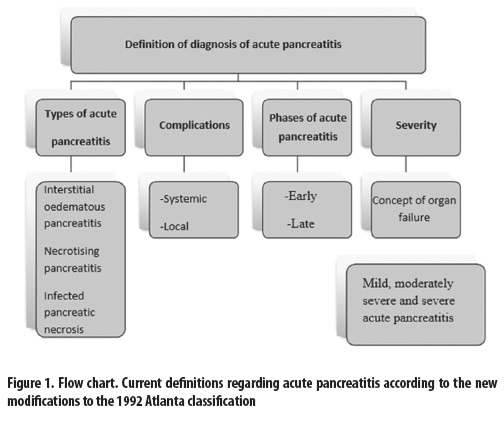
<body><![CDATA[<p><font size="2" face="Verdana, Arial, Helvetica, sans-serif">This consensus reaches an agreement about the terminology   for local complications, formerly debated   because of the large interobserver variability. It divides   local complications into acute peripancreatic fluid collection, pancreatic pseudocyst, acute necrotic   collection and walled-off necrosis. Additionally, as   an innovative factor, it includes tomographic criteria   to classify these findings. Moreover, it highlights the   importance of infected necrosis because of its association   with high morbidity and mortality &#40;<a href="#f1">figure 1</a>&#41; </font></p>     <p><font size="2" face="Verdana, Arial, Helvetica, sans-serif">Arrived at using the Delphi method, the 2012 Atlanta   consensus brings strong clinical evidence and common   points provided by international experts regarding   the current knowledge of acute pancreatitis. Moreover,   it is considered a proposal that helps the medical   community to make decisions. Although it apparently   has no direct effect on the treatment of patients with   acute pancreatitis, this consensus will help in the design   of clinical studies with standardized parameters,   which in turn will have an impact on the recommendations   about interventions and specific treatment.   In addition, this consensus must be validated by prospective   studies that support these guidelines.   </font></p>     <p align="center"><a name="f1"></a><img src="/img/revistas/iat/v27n4/v27n4a8f1.jpg"></p>     <p><font size="3" face="Verdana, Arial, Helvetica, sans-serif"><b>ACKNOWLEDGMENTS</b></font></p>     <p><font size="2" face="Verdana, Arial, Helvetica, sans-serif"> Thanks to the sustainability project, Vicerrector&iacute;a de   Investigaciones, Universidad de Antioquia.</font></p>     <p>&nbsp;</p>     <p><font size="3" face="Verdana, Arial, Helvetica, sans-serif"><b>REFERENCES</b></font></p>     <!-- ref --><p><font size="2" face="Verdana, Arial, Helvetica, sans-serif"> 1. Nieto JA, Rodr&iacute;guez SJ. Manejo de la pancreatitis   aguda: gu&iacute;a de pr&aacute;ctica cl&iacute;nica basada en la   mejor informaci&oacute;n disponible. Rev Colomb Cir.   2010;25:76-96</font>.    &nbsp;&nbsp;&nbsp;&nbsp;&nbsp;&nbsp;&nbsp;&nbsp;[&#160;<a href="javascript:void(0);" onclick="javascript: window.open('/scielo.php?script=sci_nlinks&ref=000120&pid=S0121-0793201400040000800001&lng=','','width=640,height=500,resizable=yes,scrollbars=1,menubar=yes,');">Links</a>&#160;]<!-- end-ref --></p>     <!-- ref --><p><font size="2" face="Verdana, Arial, Helvetica, sans-serif"> 2. Whitcomb DC. Clinical practice. Acute pancreatitis. N   Engl J Med. 2006 May;354&#40;20&#41;:2142&#8211;50.    &nbsp;&nbsp;&nbsp;&nbsp;&nbsp;&nbsp;&nbsp;&nbsp;[&#160;<a href="javascript:void(0);" onclick="javascript: window.open('/scielo.php?script=sci_nlinks&ref=000122&pid=S0121-0793201400040000800002&lng=','','width=640,height=500,resizable=yes,scrollbars=1,menubar=yes,');">Links</a>&#160;]<!-- end-ref -->   </font></p>     <!-- ref --><p><font size="2" face="Verdana, Arial, Helvetica, sans-serif">3. Bradley EL. A clinically based classification system   for acute pancreatitis. Summary of the International   Symposium on Acute Pancreatitis, Atlanta, Ga,   September 11 through 13, 1992. Arch Surg. 1993   May;128&#40;5&#41;:586&#8211;90.    &nbsp;&nbsp;&nbsp;&nbsp;&nbsp;&nbsp;&nbsp;&nbsp;[&#160;<a href="javascript:void(0);" onclick="javascript: window.open('/scielo.php?script=sci_nlinks&ref=000124&pid=S0121-0793201400040000800003&lng=','','width=640,height=500,resizable=yes,scrollbars=1,menubar=yes,');">Links</a>&#160;]<!-- end-ref --></font></p>     <!-- ref --><p><font size="2" face="Verdana, Arial, Helvetica, sans-serif"> 4. Singer M V, Gyr K, Sarles H. Revised classification   of pancreatitis. Report of the Second International   Symposium on the Classification of Pancreatitis in   Marseille, France, March 28-30, 1984. Gastroenterology.   1985 Oct;89&#40;3&#41;:683&#8211;5.    &nbsp;&nbsp;&nbsp;&nbsp;&nbsp;&nbsp;&nbsp;&nbsp;[&#160;<a href="javascript:void(0);" onclick="javascript: window.open('/scielo.php?script=sci_nlinks&ref=000126&pid=S0121-0793201400040000800004&lng=','','width=640,height=500,resizable=yes,scrollbars=1,menubar=yes,');">Links</a>&#160;]<!-- end-ref --> </font></p>     <!-- ref --><p><font size="2" face="Verdana, Arial, Helvetica, sans-serif">5. Bollen TL, van Santvoort HC, Besselink MG, van   Leeuwen MS, Horvath KD, Freeny PC, et al. The Atlanta   Classification of acute pancreatitis revisited. Br   J Surg. 2008 Jan;95&#40;1&#41;:6&#8211;21.    &nbsp;&nbsp;&nbsp;&nbsp;&nbsp;&nbsp;&nbsp;&nbsp;[&#160;<a href="javascript:void(0);" onclick="javascript: window.open('/scielo.php?script=sci_nlinks&ref=000128&pid=S0121-0793201400040000800005&lng=','','width=640,height=500,resizable=yes,scrollbars=1,menubar=yes,');">Links</a>&#160;]<!-- end-ref -->   </font></p>     <!-- ref --><p><font size="2" face="Verdana, Arial, Helvetica, sans-serif">6. Talley NJ, Locke III GR, Saito YA, editors. GI Epidemiology.   Massachusetts: Wiley-Blackwell; 2008.    &nbsp;&nbsp;&nbsp;&nbsp;&nbsp;&nbsp;&nbsp;&nbsp;[&#160;<a href="javascript:void(0);" onclick="javascript: window.open('/scielo.php?script=sci_nlinks&ref=000130&pid=S0121-0793201400040000800006&lng=','','width=640,height=500,resizable=yes,scrollbars=1,menubar=yes,');">Links</a>&#160;]<!-- end-ref --></font></p>     <!-- ref --><p><font size="2" face="Verdana, Arial, Helvetica, sans-serif"> 7. Fagenholz PJ, Castillo CF, Harris NS, Pelletier AJ, Camargo   CA. Increasing United States hospital admissions   for acute pancreatitis, 1988-2003. Ann Epidemiol.   2007 Jul;17&#40;7&#41;:491&#8211;7.    &nbsp;&nbsp;&nbsp;&nbsp;&nbsp;&nbsp;&nbsp;&nbsp;[&#160;<a href="javascript:void(0);" onclick="javascript: window.open('/scielo.php?script=sci_nlinks&ref=000132&pid=S0121-0793201400040000800007&lng=','','width=640,height=500,resizable=yes,scrollbars=1,menubar=yes,');">Links</a>&#160;]<!-- end-ref --></font></p>     <!-- ref --><p><font size="2" face="Verdana, Arial, Helvetica, sans-serif"> 8. D&iacute;az C, Garz&oacute;n S, Morales CH, Montoya M. Pancreatitis   aguda grave: curso cl&iacute;nico, manejo y factores asociados   con mortalidad. Rev Colomb Cir. 2012;27:281-9.    &nbsp;&nbsp;&nbsp;&nbsp;&nbsp;&nbsp;&nbsp;&nbsp;[&#160;<a href="javascript:void(0);" onclick="javascript: window.open('/scielo.php?script=sci_nlinks&ref=000134&pid=S0121-0793201400040000800008&lng=','','width=640,height=500,resizable=yes,scrollbars=1,menubar=yes,');">Links</a>&#160;]<!-- end-ref -->   </font></p>     <!-- ref --><p><font size="2" face="Verdana, Arial, Helvetica, sans-serif">9. Ueda T, Takeyama Y, Yasuda T, Matsumura N, Sawa H,   Nakajima T, et al. Simple scoring system for the prediction   of the prognosis of severe acute pancreatitis.   Surgery. 2007 Jan;141&#40;1&#41;:51&#8211;8.    &nbsp;&nbsp;&nbsp;&nbsp;&nbsp;&nbsp;&nbsp;&nbsp;[&#160;<a href="javascript:void(0);" onclick="javascript: window.open('/scielo.php?script=sci_nlinks&ref=000136&pid=S0121-0793201400040000800009&lng=','','width=640,height=500,resizable=yes,scrollbars=1,menubar=yes,');">Links</a>&#160;]<!-- end-ref -->   </font></p>     <!-- ref --><p><font size="2" face="Verdana, Arial, Helvetica, sans-serif">10. Hoyos S, Pelaez M. Soporte nutricional en pacientes   con pancreatitis aguda grave. Iatreia. 2007;20&#40;2&#41;:   178-185.    &nbsp;&nbsp;&nbsp;&nbsp;&nbsp;&nbsp;&nbsp;&nbsp;[&#160;<a href="javascript:void(0);" onclick="javascript: window.open('/scielo.php?script=sci_nlinks&ref=000138&pid=S0121-0793201400040000800010&lng=','','width=640,height=500,resizable=yes,scrollbars=1,menubar=yes,');">Links</a>&#160;]<!-- end-ref -->   </font></p>     <!-- ref --><p><font size="2" face="Verdana, Arial, Helvetica, sans-serif">11. Beger HG, Rau BM. Severe acute pancreatitis: Clinical   course and management. World J Gastroenterol. 2007   Oct 14;13&#40;38&#41;:5043&#8211;51.    &nbsp;&nbsp;&nbsp;&nbsp;&nbsp;&nbsp;&nbsp;&nbsp;[&#160;<a href="javascript:void(0);" onclick="javascript: window.open('/scielo.php?script=sci_nlinks&ref=000140&pid=S0121-0793201400040000800011&lng=','','width=640,height=500,resizable=yes,scrollbars=1,menubar=yes,');">Links</a>&#160;]<!-- end-ref --></font></p>     <!-- ref --><p><font size="2" face="Verdana, Arial, Helvetica, sans-serif"> 12. Windsor JA, Petrov MS. Acute pancreatitis reclassified.   Gut. 2013 Jan;62&#40;1&#41;:4&#8211;5.    &nbsp;&nbsp;&nbsp;&nbsp;&nbsp;&nbsp;&nbsp;&nbsp;[&#160;<a href="javascript:void(0);" onclick="javascript: window.open('/scielo.php?script=sci_nlinks&ref=000142&pid=S0121-0793201400040000800012&lng=','','width=640,height=500,resizable=yes,scrollbars=1,menubar=yes,');">Links</a>&#160;]<!-- end-ref --></font></p>     <!-- ref --><p><font size="2" face="Verdana, Arial, Helvetica, sans-serif"> 13. Petrov MS, Windsor JA. Classification of the severity   of acute pancreatitis: how many categories make   sense&#63; Am J Gastroenterol. 2010 Jan;105&#40;1&#41;:74&#8211;6.    &nbsp;&nbsp;&nbsp;&nbsp;&nbsp;&nbsp;&nbsp;&nbsp;[&#160;<a href="javascript:void(0);" onclick="javascript: window.open('/scielo.php?script=sci_nlinks&ref=000144&pid=S0121-0793201400040000800013&lng=','','width=640,height=500,resizable=yes,scrollbars=1,menubar=yes,');">Links</a>&#160;]<!-- end-ref -->   </font></p>     <!-- ref --><p><font size="2" face="Verdana, Arial, Helvetica, sans-serif">14. Petrov MS, Windsor JA. Conceptual framework for   classifying the severity of acute pancreatitis. Clin Res   Hepatol Gastroenterol. 2012 Aug;36&#40;4&#41;:341&#8211;4.    &nbsp;&nbsp;&nbsp;&nbsp;&nbsp;&nbsp;&nbsp;&nbsp;[&#160;<a href="javascript:void(0);" onclick="javascript: window.open('/scielo.php?script=sci_nlinks&ref=000146&pid=S0121-0793201400040000800014&lng=','','width=640,height=500,resizable=yes,scrollbars=1,menubar=yes,');">Links</a>&#160;]<!-- end-ref --></font></p>     <!-- ref --><p><font size="2" face="Verdana, Arial, Helvetica, sans-serif"> 15. Petrov MS, Windsor JA, L&eacute;vy P. New international classification   of acute pancreatitis: more than just 4 categories   of severity. Pancreas. 2013 May;42&#40;3&#41;:389&#8211;91.    &nbsp;&nbsp;&nbsp;&nbsp;&nbsp;&nbsp;&nbsp;&nbsp;[&#160;<a href="javascript:void(0);" onclick="javascript: window.open('/scielo.php?script=sci_nlinks&ref=000148&pid=S0121-0793201400040000800015&lng=','','width=640,height=500,resizable=yes,scrollbars=1,menubar=yes,');">Links</a>&#160;]<!-- end-ref --></font></p>     <!-- ref --><p><font size="2" face="Verdana, Arial, Helvetica, sans-serif"> 16. Hoyos S, Giraldo N, Donado J, Henao K, Pel&aacute;ez M.   Costos, d&iacute;as estancia y complicaciones seg&uacute;n tipo   de soporte nutricional en pacientes con pancreatitis   aguda grave. Rev Colomb Cir. 2007;22&#40;3&#41;:157-65.    &nbsp;&nbsp;&nbsp;&nbsp;&nbsp;&nbsp;&nbsp;&nbsp;[&#160;<a href="javascript:void(0);" onclick="javascript: window.open('/scielo.php?script=sci_nlinks&ref=000150&pid=S0121-0793201400040000800016&lng=','','width=640,height=500,resizable=yes,scrollbars=1,menubar=yes,');">Links</a>&#160;]<!-- end-ref --></font></p>     <!-- ref --><p><font size="2" face="Verdana, Arial, Helvetica, sans-serif"> 17. Brunicardi F, Andersen D, Billiar T, Dunn D, Hunter   J, Matthews J, et al. Schwartz's Principles of Surgery.   9th ed. New York: McGraw-Hill; 2010.    &nbsp;&nbsp;&nbsp;&nbsp;&nbsp;&nbsp;&nbsp;&nbsp;[&#160;<a href="javascript:void(0);" onclick="javascript: window.open('/scielo.php?script=sci_nlinks&ref=000152&pid=S0121-0793201400040000800017&lng=','','width=640,height=500,resizable=yes,scrollbars=1,menubar=yes,');">Links</a>&#160;]<!-- end-ref -->   </font></p>     <!-- ref --><p><font size="2" face="Verdana, Arial, Helvetica, sans-serif">18. Sabiston DC, Townsend CM. Sabiston Textbook of Surgery:   The Biological Basis of Modern Surgical Practice.   18th ed. Philadelphia: Elsevier Saunders; 2008.    &nbsp;&nbsp;&nbsp;&nbsp;&nbsp;&nbsp;&nbsp;&nbsp;[&#160;<a href="javascript:void(0);" onclick="javascript: window.open('/scielo.php?script=sci_nlinks&ref=000154&pid=S0121-0793201400040000800018&lng=','','width=640,height=500,resizable=yes,scrollbars=1,menubar=yes,');">Links</a>&#160;]<!-- end-ref -->   </font></p>     <!-- ref --><p><font size="2" face="Verdana, Arial, Helvetica, sans-serif">19. Frossard J-L, Steer ML, Pastor CM. Acute pancreatitis.   Lancet. 2008 Jan;371&#40;9607&#41;:143&#8211;52.    &nbsp;&nbsp;&nbsp;&nbsp;&nbsp;&nbsp;&nbsp;&nbsp;[&#160;<a href="javascript:void(0);" onclick="javascript: window.open('/scielo.php?script=sci_nlinks&ref=000156&pid=S0121-0793201400040000800019&lng=','','width=640,height=500,resizable=yes,scrollbars=1,menubar=yes,');">Links</a>&#160;]<!-- end-ref -->   </font></p>     <!-- ref --><p><font size="2" face="Verdana, Arial, Helvetica, sans-serif">20. Andrews J, Guyatt G, Oxman AD, Alderson P, Dahm P,   Falck-Ytter Y, et al. GRADE guidelines: 14. Going from   evidence to recommendations: the significance and   presentation of recommendations. J Clin Epidemiol.   2013 Jul;66&#40;7&#41;:719&#8211;25.    &nbsp;&nbsp;&nbsp;&nbsp;&nbsp;&nbsp;&nbsp;&nbsp;[&#160;<a href="javascript:void(0);" onclick="javascript: window.open('/scielo.php?script=sci_nlinks&ref=000158&pid=S0121-0793201400040000800020&lng=','','width=640,height=500,resizable=yes,scrollbars=1,menubar=yes,');">Links</a>&#160;]<!-- end-ref --></font></p>     <!-- ref --><p><font size="2" face="Verdana, Arial, Helvetica, sans-serif"> 21. Jaeschke R, Guyatt GH, Dellinger P, Sch&uuml;nemann H,   Levy MM, Kunz R, et al. Use of GRADE grid to reach   decisions on clinical practice guidelines when consensus   is elusive. BMJ. 2008 Jan;337:a744.    &nbsp;&nbsp;&nbsp;&nbsp;&nbsp;&nbsp;&nbsp;&nbsp;[&#160;<a href="javascript:void(0);" onclick="javascript: window.open('/scielo.php?script=sci_nlinks&ref=000160&pid=S0121-0793201400040000800021&lng=','','width=640,height=500,resizable=yes,scrollbars=1,menubar=yes,');">Links</a>&#160;]<!-- end-ref -->   </font></p>     <!-- ref --><p><font size="2" face="Verdana, Arial, Helvetica, sans-serif">22. Guyatt G, Oxman AD, Akl EA, Kunz R, Vist G, Brozek J,   et al. GRADE guidelines: 1. Introduction-GRADE evidence   profiles and summary of findings tables. J Clin   Epidemiol. 2011 Apr;64&#40;4&#41;:383&#8211;94.    &nbsp;&nbsp;&nbsp;&nbsp;&nbsp;&nbsp;&nbsp;&nbsp;[&#160;<a href="javascript:void(0);" onclick="javascript: window.open('/scielo.php?script=sci_nlinks&ref=000162&pid=S0121-0793201400040000800022&lng=','','width=640,height=500,resizable=yes,scrollbars=1,menubar=yes,');">Links</a>&#160;]<!-- end-ref -->   </font></p>     <!-- ref --><p><font size="2" face="Verdana, Arial, Helvetica, sans-serif">23. Alonso-Coello P, Rigau D, Sanabria AJ, Plaza V, Miravitlles   M, Martinez L. Calidad y fuerza: el sistema   GRADE para la formulaci&oacute;n de recomendaciones   en las gu&iacute;as de pr&aacute;ctica cl&iacute;nica. Arch Bronconeumol   2013 ;49&#40;6&#41;:261-7.    &nbsp;&nbsp;&nbsp;&nbsp;&nbsp;&nbsp;&nbsp;&nbsp;[&#160;<a href="javascript:void(0);" onclick="javascript: window.open('/scielo.php?script=sci_nlinks&ref=000164&pid=S0121-0793201400040000800023&lng=','','width=640,height=500,resizable=yes,scrollbars=1,menubar=yes,');">Links</a>&#160;]<!-- end-ref --></font></p>     <!-- ref --><p><font size="2" face="Verdana, Arial, Helvetica, sans-serif"> 24. Tenner S. Initial management of acute pancreatitis:   critical issues during the first 72 hours. Am J Gastroenterol.   2004 Dec;99&#40;12&#41;:2489&#8211;94.    &nbsp;&nbsp;&nbsp;&nbsp;&nbsp;&nbsp;&nbsp;&nbsp;[&#160;<a href="javascript:void(0);" onclick="javascript: window.open('/scielo.php?script=sci_nlinks&ref=000166&pid=S0121-0793201400040000800024&lng=','','width=640,height=500,resizable=yes,scrollbars=1,menubar=yes,');">Links</a>&#160;]<!-- end-ref -->   </font></p>     <!-- ref --><p><font size="2" face="Verdana, Arial, Helvetica, sans-serif">25. Bollen TL. Imaging of acute pancreatitis: update of   the revised Atlanta classification. Radiol Clin North   Am. 2012 May;50&#40;3&#41;:429&#8211;45.    &nbsp;&nbsp;&nbsp;&nbsp;&nbsp;&nbsp;&nbsp;&nbsp;[&#160;<a href="javascript:void(0);" onclick="javascript: window.open('/scielo.php?script=sci_nlinks&ref=000168&pid=S0121-0793201400040000800025&lng=','','width=640,height=500,resizable=yes,scrollbars=1,menubar=yes,');">Links</a>&#160;]<!-- end-ref -->   </font></p>     <!-- ref --><p><font size="2" face="Verdana, Arial, Helvetica, sans-serif">26. Thoeni RF. The revised Atlanta classification of acute   pancreatitis: its importance for the radiologist and its   effect on treatment. Radiology. 2012 Mar;262&#40;3&#41;:751&#8211;   64.    &nbsp;&nbsp;&nbsp;&nbsp;&nbsp;&nbsp;&nbsp;&nbsp;[&#160;<a href="javascript:void(0);" onclick="javascript: window.open('/scielo.php?script=sci_nlinks&ref=000170&pid=S0121-0793201400040000800026&lng=','','width=640,height=500,resizable=yes,scrollbars=1,menubar=yes,');">Links</a>&#160;]<!-- end-ref --></font></p>     <!-- ref --><p><font size="2" face="Verdana, Arial, Helvetica, sans-serif"> 27. Clavien PA, Robert J, Meyer P, Borst F, Hauser H, Herrmann   F, et al. Acute pancreatitis and normoamylasemia.   Not an uncommon combination. Ann Surg.   1989 Nov;210&#40;5&#41;:614&#8211;20.    &nbsp;&nbsp;&nbsp;&nbsp;&nbsp;&nbsp;&nbsp;&nbsp;[&#160;<a href="javascript:void(0);" onclick="javascript: window.open('/scielo.php?script=sci_nlinks&ref=000172&pid=S0121-0793201400040000800027&lng=','','width=640,height=500,resizable=yes,scrollbars=1,menubar=yes,');">Links</a>&#160;]<!-- end-ref -->   </font></p>     <!-- ref --><p><font size="2" face="Verdana, Arial, Helvetica, sans-serif">28. Fallat RW, Vester JW, Glueck CJ. Suppression of amylase   activity by hypertriglyceridemia. JAMA. 1973 Sep   10;225&#40;11&#41;:1331&#8211;4.    &nbsp;&nbsp;&nbsp;&nbsp;&nbsp;&nbsp;&nbsp;&nbsp;[&#160;<a href="javascript:void(0);" onclick="javascript: window.open('/scielo.php?script=sci_nlinks&ref=000174&pid=S0121-0793201400040000800028&lng=','','width=640,height=500,resizable=yes,scrollbars=1,menubar=yes,');">Links</a>&#160;]<!-- end-ref --></font></p>     <!-- ref --><p><font size="2" face="Verdana, Arial, Helvetica, sans-serif"> 29. Bakker OJ, van Santvoort H, Besselink MGH, Boermeester   MA, van Eijck C, Dejong K, et al. Extrapancreatic   necrosis without pancreatic parenchymal necrosis:   a separate entity in necrotising pancreatitis&#63;   Gut. 2013 Oct;62&#40;10&#41;:1475&#8211;80.    &nbsp;&nbsp;&nbsp;&nbsp;&nbsp;&nbsp;&nbsp;&nbsp;[&#160;<a href="javascript:void(0);" onclick="javascript: window.open('/scielo.php?script=sci_nlinks&ref=000176&pid=S0121-0793201400040000800029&lng=','','width=640,height=500,resizable=yes,scrollbars=1,menubar=yes,');">Links</a>&#160;]<!-- end-ref --></font></p>     <!-- ref --><p><font size="2" face="Verdana, Arial, Helvetica, sans-serif"> 30. Banks PA, Freeman ML. Practice guidelines in   acute pancreatitis. Am J Gastroenterol. 2006   Oct;101&#40;10&#41;:2379&#8211;400.    &nbsp;&nbsp;&nbsp;&nbsp;&nbsp;&nbsp;&nbsp;&nbsp;[&#160;<a href="javascript:void(0);" onclick="javascript: window.open('/scielo.php?script=sci_nlinks&ref=000178&pid=S0121-0793201400040000800030&lng=','','width=640,height=500,resizable=yes,scrollbars=1,menubar=yes,');">Links</a>&#160;]<!-- end-ref --> </font></p>     <!-- ref --><p><font size="2" face="Verdana, Arial, Helvetica, sans-serif">31. Petrov MS, Shanbhag S, Chakraborty M, Phillips   ARJ, Windsor JA. Organ failure and infection of pancreatic   necrosis as determinants of mortality in patients   with acute pancreatitis. Gastroenterology. 2010   Sep;139&#40;3&#41;:813&#8211;20.    &nbsp;&nbsp;&nbsp;&nbsp;&nbsp;&nbsp;&nbsp;&nbsp;[&#160;<a href="javascript:void(0);" onclick="javascript: window.open('/scielo.php?script=sci_nlinks&ref=000180&pid=S0121-0793201400040000800031&lng=','','width=640,height=500,resizable=yes,scrollbars=1,menubar=yes,');">Links</a>&#160;]<!-- end-ref -->   </font></p>     <!-- ref --><p><font size="2" face="Verdana, Arial, Helvetica, sans-serif">32. Van Santvoort HC, Bollen TL, Besselink MG, Banks   PA, Boermeester MA, van Eijck CH, et al. Describing   peripancreatic collections in severe acute pancreatitis   using morphologic terms: an international interobserver   agreement study. Pancreatology. 2008   Jan;8&#40;6&#41;:593&#8211;9.    &nbsp;&nbsp;&nbsp;&nbsp;&nbsp;&nbsp;&nbsp;&nbsp;[&#160;<a href="javascript:void(0);" onclick="javascript: window.open('/scielo.php?script=sci_nlinks&ref=000182&pid=S0121-0793201400040000800032&lng=','','width=640,height=500,resizable=yes,scrollbars=1,menubar=yes,');">Links</a>&#160;]<!-- end-ref -->   </font></p>     <!-- ref --><p><font size="2" face="Verdana, Arial, Helvetica, sans-serif">33. Sarr MG. 2012 revision of the Atlanta classification of   acute pancreatitis. Pol Arch Med Wewnetrznej. 2013   Jan;123&#40;3&#41;:118&#8211;24.    &nbsp;&nbsp;&nbsp;&nbsp;&nbsp;&nbsp;&nbsp;&nbsp;[&#160;<a href="javascript:void(0);" onclick="javascript: window.open('/scielo.php?script=sci_nlinks&ref=000184&pid=S0121-0793201400040000800033&lng=','','width=640,height=500,resizable=yes,scrollbars=1,menubar=yes,');">Links</a>&#160;]<!-- end-ref -->   </font></p>     <!-- ref --><p><font size="2" face="Verdana, Arial, Helvetica, sans-serif">34. Pelaez-Luna M, Vege SS, Petersen BT, Chari ST, Clain   JE, Levy MJ, et al. Disconnected pancreatic duct syndrome   in severe acute pancreatitis: clinical and imaging   characteristics and outcomes in a cohort of 31   cases. Gastrointest Endosc. 2008 Jul;68&#40;1&#41;:91&#8211;7.    &nbsp;&nbsp;&nbsp;&nbsp;&nbsp;&nbsp;&nbsp;&nbsp;[&#160;<a href="javascript:void(0);" onclick="javascript: window.open('/scielo.php?script=sci_nlinks&ref=000186&pid=S0121-0793201400040000800034&lng=','','width=640,height=500,resizable=yes,scrollbars=1,menubar=yes,');">Links</a>&#160;]<!-- end-ref -->   </font></p>     <!-- ref --><p><font size="2" face="Verdana, Arial, Helvetica, sans-serif">35. Stamatakos M, Stefanaki C, Kontzoglou K, Stergiopoulos   S, Giannopoulos G, Safioleas M. Walled-off   pancreatic necrosis. World J Gastroenterol. 2010 Apr   14;16&#40;14&#41;:1707&#8211;12.    &nbsp;&nbsp;&nbsp;&nbsp;&nbsp;&nbsp;&nbsp;&nbsp;[&#160;<a href="javascript:void(0);" onclick="javascript: window.open('/scielo.php?script=sci_nlinks&ref=000188&pid=S0121-0793201400040000800035&lng=','','width=640,height=500,resizable=yes,scrollbars=1,menubar=yes,');">Links</a>&#160;]<!-- end-ref --></font></p>     <!-- ref --><p><font size="2" face="Verdana, Arial, Helvetica, sans-serif"> 36. Marshall JC, Cook DJ, Christou N V, Bernard GR,   Sprung CL, Sibbald WJ. Multiple organ dysfunction   score: a reliable descriptor of a complex clinical   outcome. Crit Care Med. 1995 Oct;23&#40;10&#41;:1638&#8211;52.    &nbsp;&nbsp;&nbsp;&nbsp;&nbsp;&nbsp;&nbsp;&nbsp;[&#160;<a href="javascript:void(0);" onclick="javascript: window.open('/scielo.php?script=sci_nlinks&ref=000190&pid=S0121-0793201400040000800036&lng=','','width=640,height=500,resizable=yes,scrollbars=1,menubar=yes,');">Links</a>&#160;]<!-- end-ref -->   </font></p>     <!-- ref --><p><font size="2" face="Verdana, Arial, Helvetica, sans-serif">37. Besselink MGH, van Santvoort HC, Witteman BJ,   Gooszen HG. Management of severe acute pancreatitis:   it's all about timing. Curr Opin Crit Care. 2007   Apr;13&#40;2&#41;:200&#8211;6.    &nbsp;&nbsp;&nbsp;&nbsp;&nbsp;&nbsp;&nbsp;&nbsp;[&#160;<a href="javascript:void(0);" onclick="javascript: window.open('/scielo.php?script=sci_nlinks&ref=000192&pid=S0121-0793201400040000800037&lng=','','width=640,height=500,resizable=yes,scrollbars=1,menubar=yes,');">Links</a>&#160;]<!-- end-ref -->   </font></p>     <!-- ref --><p><font size="2" face="Verdana, Arial, Helvetica, sans-serif">38. Banks PA, Bollen TL, Dervenis C, Gooszen HG, Johnson   CD, Sarr MG, et al. Classification of acute pancreatitis--   2012: revision of the Atlanta classification   and definitions by international consensus. Gut. 2013   Jan;62&#40;1&#41;:102&#8211;11.    &nbsp;&nbsp;&nbsp;&nbsp;&nbsp;&nbsp;&nbsp;&nbsp;[&#160;<a href="javascript:void(0);" onclick="javascript: window.open('/scielo.php?script=sci_nlinks&ref=000194&pid=S0121-0793201400040000800038&lng=','','width=640,height=500,resizable=yes,scrollbars=1,menubar=yes,');">Links</a>&#160;]<!-- end-ref -->   </font></p>     <!-- ref --><p><font size="2" face="Verdana, Arial, Helvetica, sans-serif">39. Talukdar R, Clemens M, Vege SS. Moderately severe   acute pancreatitis: prospective validation of this   new subgroup of acute pancreatitis. Pancreas. 2012   Mar;41&#40;2&#41;:306&#8211;9.    &nbsp;&nbsp;&nbsp;&nbsp;&nbsp;&nbsp;&nbsp;&nbsp;[&#160;<a href="javascript:void(0);" onclick="javascript: window.open('/scielo.php?script=sci_nlinks&ref=000196&pid=S0121-0793201400040000800039&lng=','','width=640,height=500,resizable=yes,scrollbars=1,menubar=yes,');">Links</a>&#160;]<!-- end-ref -->   </font></p>     <!-- ref --><p><font size="2" face="Verdana, Arial, Helvetica, sans-serif">40. Vege SS, Gardner TB, Chari ST, Munukuti P, Pearson   RK, Clain JE, et al. Low mortality and high morbidity   in severe acute pancreatitis without organ failure: a   case for revising the Atlanta classification to include   ''moderately severe acute pancreatitis''. Am J Gastroenterol.   2009 Mar;104&#40;3&#41;:710&#8211;5.    &nbsp;&nbsp;&nbsp;&nbsp;&nbsp;&nbsp;&nbsp;&nbsp;[&#160;<a href="javascript:void(0);" onclick="javascript: window.open('/scielo.php?script=sci_nlinks&ref=000198&pid=S0121-0793201400040000800040&lng=','','width=640,height=500,resizable=yes,scrollbars=1,menubar=yes,');">Links</a>&#160;]<!-- end-ref -->   </font></p>     <!-- ref --><p><font size="2" face="Verdana, Arial, Helvetica, sans-serif">41. Vege SS, Chari ST. Organ failure as an indicator   of severity of acute pancreatitis: time to revisit   the Atlanta classification. Gastroenterology. 2005   Apr;128&#40;4&#41;:1133&#8211;5.    &nbsp;&nbsp;&nbsp;&nbsp;&nbsp;&nbsp;&nbsp;&nbsp;[&#160;<a href="javascript:void(0);" onclick="javascript: window.open('/scielo.php?script=sci_nlinks&ref=000200&pid=S0121-0793201400040000800041&lng=','','width=640,height=500,resizable=yes,scrollbars=1,menubar=yes,');">Links</a>&#160;]<!-- end-ref -->   </font></p>     <!-- ref --><p><font size="2" face="Verdana, Arial, Helvetica, sans-serif">42. Lytras D, Manes K, Triantopoulou C, Paraskeva C, Delis   S, Avgerinos C, et al. Persistent early organ failure:   defining the high-risk group of patients with severe   acute pancreatitis&#63; Pancreas. 2008 Apr;36&#40;3&#41;:249&#8211;54.    &nbsp;&nbsp;&nbsp;&nbsp;&nbsp;&nbsp;&nbsp;&nbsp;[&#160;<a href="javascript:void(0);" onclick="javascript: window.open('/scielo.php?script=sci_nlinks&ref=000202&pid=S0121-0793201400040000800042&lng=','','width=640,height=500,resizable=yes,scrollbars=1,menubar=yes,');">Links</a>&#160;]<!-- end-ref --></font></p>     <!-- ref --><p><font size="2" face="Verdana, Arial, Helvetica, sans-serif"> 43. Johnson CD, Abu-Hilal M. Persistent organ failure during   the first week as a marker of fatal outcome in   acute pancreatitis. Gut. 2004 Sep;53&#40;9&#41;:1340&#8211;4.    &nbsp;&nbsp;&nbsp;&nbsp;&nbsp;&nbsp;&nbsp;&nbsp;[&#160;<a href="javascript:void(0);" onclick="javascript: window.open('/scielo.php?script=sci_nlinks&ref=000204&pid=S0121-0793201400040000800043&lng=','','width=640,height=500,resizable=yes,scrollbars=1,menubar=yes,');">Links</a>&#160;]<!-- end-ref -->   </font></p>     <!-- ref --><p><font size="2" face="Verdana, Arial, Helvetica, sans-serif">44. Buter A, Imrie CW, Carter CR, Evans S, McKay CJ.   Dynamic nature of early organ dysfunction determines   outcome in acute pancreatitis. Br J Surg. 2002   Mar;89&#40;3&#41;:298&#8211;302.    &nbsp;&nbsp;&nbsp;&nbsp;&nbsp;&nbsp;&nbsp;&nbsp;[&#160;<a href="javascript:void(0);" onclick="javascript: window.open('/scielo.php?script=sci_nlinks&ref=000206&pid=S0121-0793201400040000800044&lng=','','width=640,height=500,resizable=yes,scrollbars=1,menubar=yes,');">Links</a>&#160;]<!-- end-ref -->   </font></p>     <!-- ref --><p><font size="2" face="Verdana, Arial, Helvetica, sans-serif">45. Mofidi R, Duff MD, Wigmore SJ, Madhavan KK, Garden   OJ, Parks RW. Association between early systemic   inflammatory response, severity of multiorgan   dysfunction and death in acute pancreatitis. Br J   Surg. 2006 Jun;93&#40;6&#41;:738&#8211;44.    &nbsp;&nbsp;&nbsp;&nbsp;&nbsp;&nbsp;&nbsp;&nbsp;[&#160;<a href="javascript:void(0);" onclick="javascript: window.open('/scielo.php?script=sci_nlinks&ref=000208&pid=S0121-0793201400040000800045&lng=','','width=640,height=500,resizable=yes,scrollbars=1,menubar=yes,');">Links</a>&#160;]<!-- end-ref --></font></p>     <!-- ref --><p><font size="2" face="Verdana, Arial, Helvetica, sans-serif"> 46. Van Santvoort HC, Bakker OJ, Bollen TL, Besselink   MG, Ahmed Ali U, Schrijver AM, et al. A conservative   and minimally invasive approach to necrotizing pancreatitis   improves outcome. Gastroenterology. 2011   Oct;141&#40;4&#41;:1254&#8211;63.    &nbsp;&nbsp;&nbsp;&nbsp;&nbsp;&nbsp;&nbsp;&nbsp;[&#160;<a href="javascript:void(0);" onclick="javascript: window.open('/scielo.php?script=sci_nlinks&ref=000210&pid=S0121-0793201400040000800046&lng=','','width=640,height=500,resizable=yes,scrollbars=1,menubar=yes,');">Links</a>&#160;]<!-- end-ref -->   </font></p>     <!-- ref --><p><font size="2" face="Verdana, Arial, Helvetica, sans-serif">47. Spanier BWM, Nio Y, van der Hulst RWM, Tuynman   HARE, Dijkgraaf MGW, Bruno MJ. Practice and yield   of early CT scan in acute pancreatitis: a Dutch Observational   Multicenter Study. Pancreatology. 2010   Jan;10&#40;2-3&#41;:222&#8211;8.    &nbsp;&nbsp;&nbsp;&nbsp;&nbsp;&nbsp;&nbsp;&nbsp;[&#160;<a href="javascript:void(0);" onclick="javascript: window.open('/scielo.php?script=sci_nlinks&ref=000212&pid=S0121-0793201400040000800047&lng=','','width=640,height=500,resizable=yes,scrollbars=1,menubar=yes,');">Links</a>&#160;]<!-- end-ref -->   </font></p>     <!-- ref --><p><font size="2" face="Verdana, Arial, Helvetica, sans-serif">48. Elfar M, Gaber LW, Sabek O, Fischer CP, Gaber AO.   The inflammatory cascade in acute pancreatitis: relevance   to clinical disease. Surg Clin North Am. 2007   Dec;87&#40;6&#41;:1325&#8211;40, vii.    &nbsp;&nbsp;&nbsp;&nbsp;&nbsp;&nbsp;&nbsp;&nbsp;[&#160;<a href="javascript:void(0);" onclick="javascript: window.open('/scielo.php?script=sci_nlinks&ref=000214&pid=S0121-0793201400040000800048&lng=','','width=640,height=500,resizable=yes,scrollbars=1,menubar=yes,');">Links</a>&#160;]<!-- end-ref -->   </font></p>     <!-- ref --><p><font size="2" face="Verdana, Arial, Helvetica, sans-serif">49. Singh VK, Wu BU, Bollen TL, Repas K, Maurer R, Mortele   KJ, et al. Early systemic inflammatory response   syndrome is associated with severe acute pancreatitis.   Clin Gastroenterol Hepatol. 2009 Nov;7&#40;11&#41;:1247&#8211;51.    &nbsp;&nbsp;&nbsp;&nbsp;&nbsp;&nbsp;&nbsp;&nbsp;[&#160;<a href="javascript:void(0);" onclick="javascript: window.open('/scielo.php?script=sci_nlinks&ref=000216&pid=S0121-0793201400040000800049&lng=','','width=640,height=500,resizable=yes,scrollbars=1,menubar=yes,');">Links</a>&#160;]<!-- end-ref -->   </font></p>     <!-- ref --><p><font size="2" face="Verdana, Arial, Helvetica, sans-serif">50. Nathens AB, Curtis JR, Beale RJ, Cook DJ, Moreno RP,   Romand J-A, et al. Management of the critically ill   patient with severe acute pancreatitis. Crit Care Med.   2004 Dec;32&#40;12&#41;:2524&#8211;36.    &nbsp;&nbsp;&nbsp;&nbsp;&nbsp;&nbsp;&nbsp;&nbsp;[&#160;<a href="javascript:void(0);" onclick="javascript: window.open('/scielo.php?script=sci_nlinks&ref=000218&pid=S0121-0793201400040000800050&lng=','','width=640,height=500,resizable=yes,scrollbars=1,menubar=yes,');">Links</a>&#160;]<!-- end-ref --> </font></p>      ]]></body><back>
<ref-list>
<ref id="B1">
<label>1</label><nlm-citation citation-type="journal">
<person-group person-group-type="author">
<name>
<surname><![CDATA[Nieto]]></surname>
<given-names><![CDATA[JA]]></given-names>
</name>
<name>
<surname><![CDATA[Rodríguez]]></surname>
<given-names><![CDATA[SJ.]]></given-names>
</name>
</person-group>
<article-title xml:lang="es"><![CDATA[Manejo de la pancreatitis aguda: guía de práctica clínica basada en la mejor información disponible]]></article-title>
<source><![CDATA[Rev Colomb Cir]]></source>
<year>2010</year>
<volume>25</volume>
<page-range>76-96</page-range></nlm-citation>
</ref>
<ref id="B2">
<label>2</label><nlm-citation citation-type="journal">
<person-group person-group-type="author">
<name>
<surname><![CDATA[Whitcomb]]></surname>
<given-names><![CDATA[DC.]]></given-names>
</name>
</person-group>
<article-title xml:lang="es"><![CDATA[Clinical practice. Acute pancreatitis]]></article-title>
<source><![CDATA[N Engl J Med]]></source>
<year>2006</year>
<month> M</month>
<day>ay</day>
<volume>354</volume>
<numero>20</numero>
<issue>20</issue>
<page-range>2142-50</page-range></nlm-citation>
</ref>
<ref id="B3">
<label>3</label><nlm-citation citation-type="journal">
<person-group person-group-type="author">
<name>
<surname><![CDATA[Bradley]]></surname>
<given-names><![CDATA[EL.]]></given-names>
</name>
</person-group>
<article-title xml:lang="en"><![CDATA[A clinically based classification system for acute pancreatitis. Summary of the International Symposium on Acute Pancreatitis, Atlanta, Ga, September 11 through 13, 1992]]></article-title>
<source><![CDATA[Arch Surg]]></source>
<year>1993</year>
<month> M</month>
<day>ay</day>
<volume>128</volume>
<numero>5</numero>
<issue>5</issue>
<page-range>586-90</page-range></nlm-citation>
</ref>
<ref id="B4">
<label>4</label><nlm-citation citation-type="journal">
<person-group person-group-type="author">
<name>
<surname><![CDATA[Singer]]></surname>
<given-names><![CDATA[M V]]></given-names>
</name>
<name>
<surname><![CDATA[Gyr]]></surname>
<given-names><![CDATA[K]]></given-names>
</name>
<name>
<surname><![CDATA[Sarles]]></surname>
<given-names><![CDATA[H.]]></given-names>
</name>
</person-group>
<article-title xml:lang="en"><![CDATA[Revised classification of pancreatitis Report of the Second International Symposium on the Classification of Pancreatitis in Marseille, France, March 28-30, 1984]]></article-title>
<source><![CDATA[Gastroenterology]]></source>
<year>1985</year>
<month> O</month>
<day>ct</day>
<volume>89</volume>
<numero>3</numero>
<issue>3</issue>
<page-range>683-5</page-range></nlm-citation>
</ref>
<ref id="B5">
<label>5</label><nlm-citation citation-type="journal">
<person-group person-group-type="author">
<name>
<surname><![CDATA[Bollen]]></surname>
<given-names><![CDATA[TL]]></given-names>
</name>
<name>
<surname><![CDATA[van Santvoort]]></surname>
<given-names><![CDATA[HC]]></given-names>
</name>
<name>
<surname><![CDATA[Besselink]]></surname>
<given-names><![CDATA[MG]]></given-names>
</name>
<name>
<surname><![CDATA[van Leeuwen]]></surname>
<given-names><![CDATA[MS]]></given-names>
</name>
<name>
<surname><![CDATA[Horvath]]></surname>
<given-names><![CDATA[KD]]></given-names>
</name>
<name>
<surname><![CDATA[Freeny]]></surname>
<given-names><![CDATA[PC]]></given-names>
</name>
</person-group>
<article-title xml:lang="en"><![CDATA[The Atlanta Classification of acute pancreatitis revisited]]></article-title>
<source><![CDATA[Br J Surg]]></source>
<year>2008</year>
<month> J</month>
<day>an</day>
<volume>95</volume>
<numero>1</numero>
<issue>1</issue>
<page-range>6-21</page-range></nlm-citation>
</ref>
<ref id="B6">
<label>6</label><nlm-citation citation-type="book">
<person-group person-group-type="author">
<name>
<surname><![CDATA[Talley]]></surname>
<given-names><![CDATA[NJ]]></given-names>
</name>
<name>
<surname><![CDATA[Locke]]></surname>
<given-names><![CDATA[III GR]]></given-names>
</name>
<name>
<surname><![CDATA[Saito]]></surname>
<given-names><![CDATA[YA]]></given-names>
</name>
</person-group>
<source><![CDATA[Epidemiology]]></source>
<year>2008</year>
<publisher-loc><![CDATA[Massachusetts ]]></publisher-loc>
<publisher-name><![CDATA[Wiley-Blackwell]]></publisher-name>
</nlm-citation>
</ref>
<ref id="B7">
<label>7</label><nlm-citation citation-type="journal">
<person-group person-group-type="author">
<name>
<surname><![CDATA[Fagenholz]]></surname>
<given-names><![CDATA[PJ]]></given-names>
</name>
<name>
<surname><![CDATA[Castillo]]></surname>
<given-names><![CDATA[CF]]></given-names>
</name>
<name>
<surname><![CDATA[Harris]]></surname>
<given-names><![CDATA[NS]]></given-names>
</name>
<name>
<surname><![CDATA[Pelletier]]></surname>
<given-names><![CDATA[AJ]]></given-names>
</name>
<name>
<surname><![CDATA[Camargo]]></surname>
<given-names><![CDATA[CA.]]></given-names>
</name>
</person-group>
<article-title xml:lang="en"><![CDATA[Increasing United States hospital admissions for acute pancreatitis, 1988-2003]]></article-title>
<source><![CDATA[Ann Epidemiol]]></source>
<year>2007</year>
<month> J</month>
<day>ul</day>
<volume>17</volume>
<numero>7</numero>
<issue>7</issue>
<page-range>491-7</page-range></nlm-citation>
</ref>
<ref id="B8">
<label>8</label><nlm-citation citation-type="journal">
<person-group person-group-type="author">
<name>
<surname><![CDATA[Díaz]]></surname>
<given-names><![CDATA[C]]></given-names>
</name>
<name>
<surname><![CDATA[Garzón]]></surname>
<given-names><![CDATA[S]]></given-names>
</name>
<name>
<surname><![CDATA[Morales]]></surname>
<given-names><![CDATA[CH]]></given-names>
</name>
<name>
<surname><![CDATA[Montoya]]></surname>
<given-names><![CDATA[M.]]></given-names>
</name>
</person-group>
<article-title xml:lang="es"><![CDATA[Pancreatitis aguda grave: curso clínico, manejo y factores asociados con mortalidad]]></article-title>
<source><![CDATA[Rev Colomb Cir]]></source>
<year>2012</year>
<volume>27</volume>
<page-range>281-9</page-range></nlm-citation>
</ref>
<ref id="B9">
<label>9</label><nlm-citation citation-type="journal">
<person-group person-group-type="author">
<name>
<surname><![CDATA[Ueda]]></surname>
<given-names><![CDATA[T]]></given-names>
</name>
<name>
<surname><![CDATA[Takeyama]]></surname>
<given-names><![CDATA[Y]]></given-names>
</name>
<name>
<surname><![CDATA[Yasuda]]></surname>
<given-names><![CDATA[T]]></given-names>
</name>
<name>
<surname><![CDATA[Matsumura]]></surname>
<given-names><![CDATA[N]]></given-names>
</name>
<name>
<surname><![CDATA[Sawa]]></surname>
<given-names><![CDATA[H]]></given-names>
</name>
<name>
<surname><![CDATA[Nakajima]]></surname>
<given-names><![CDATA[T]]></given-names>
</name>
</person-group>
<article-title xml:lang="en"><![CDATA[Simple scoring system for the prediction of the prognosis of severe acute pancreatitis]]></article-title>
<source><![CDATA[Surgery]]></source>
<year>2007</year>
<month> J</month>
<day>an</day>
<volume>141</volume>
<numero>1</numero>
<issue>1</issue>
<page-range>51-8</page-range></nlm-citation>
</ref>
<ref id="B10">
<label>10</label><nlm-citation citation-type="journal">
<person-group person-group-type="author">
<name>
<surname><![CDATA[Hoyos]]></surname>
<given-names><![CDATA[S]]></given-names>
</name>
<name>
<surname><![CDATA[Pelaez]]></surname>
<given-names><![CDATA[M.]]></given-names>
</name>
</person-group>
<article-title xml:lang="es"><![CDATA[Soporte nutricional en pacientes con pancreatitis aguda grave]]></article-title>
<source><![CDATA[Iatreia]]></source>
<year>2007</year>
<volume>20</volume>
<numero>2</numero>
<issue>2</issue>
<page-range>178-185</page-range></nlm-citation>
</ref>
<ref id="B11">
<label>11</label><nlm-citation citation-type="journal">
<person-group person-group-type="author">
<name>
<surname><![CDATA[Beger]]></surname>
<given-names><![CDATA[HG]]></given-names>
</name>
<name>
<surname><![CDATA[Rau]]></surname>
<given-names><![CDATA[BM.]]></given-names>
</name>
</person-group>
<article-title xml:lang="en"><![CDATA[Severe acute pancreatitis: Clinical course and management]]></article-title>
<source><![CDATA[World J Gastroenterol]]></source>
<year>2007</year>
<month> O</month>
<day>ct</day>
<volume>13</volume>
<numero>38</numero>
<issue>38</issue>
<page-range>5043-51</page-range></nlm-citation>
</ref>
<ref id="B12">
<label>12</label><nlm-citation citation-type="journal">
<person-group person-group-type="author">
<name>
<surname><![CDATA[Windsor]]></surname>
<given-names><![CDATA[JA]]></given-names>
</name>
<name>
<surname><![CDATA[Petrov]]></surname>
<given-names><![CDATA[MS.]]></given-names>
</name>
</person-group>
<article-title xml:lang="en"><![CDATA[Acute pancreatitis reclassified]]></article-title>
<source><![CDATA[Gut]]></source>
<year>2013</year>
<month> J</month>
<day>an</day>
<volume>62</volume>
<numero>1</numero>
<issue>1</issue>
<page-range>4-5</page-range></nlm-citation>
</ref>
<ref id="B13">
<label>13</label><nlm-citation citation-type="journal">
<person-group person-group-type="author">
<name>
<surname><![CDATA[Petrov]]></surname>
<given-names><![CDATA[MS]]></given-names>
</name>
<name>
<surname><![CDATA[Windsor]]></surname>
<given-names><![CDATA[JA.]]></given-names>
</name>
</person-group>
<article-title xml:lang="en"><![CDATA[Classification of the severity of acute pancreatitis: how many categories make sense?]]></article-title>
<source><![CDATA[Am J Gastroenterol]]></source>
<year>2010</year>
<month> J</month>
<day>an</day>
<volume>105</volume>
<numero>1</numero>
<issue>1</issue>
<page-range>74-6</page-range></nlm-citation>
</ref>
<ref id="B14">
<label>14</label><nlm-citation citation-type="journal">
<person-group person-group-type="author">
<name>
<surname><![CDATA[Petrov]]></surname>
<given-names><![CDATA[MS]]></given-names>
</name>
<name>
<surname><![CDATA[Windsor]]></surname>
<given-names><![CDATA[JA.]]></given-names>
</name>
</person-group>
<article-title xml:lang="en"><![CDATA[Conceptual framework for classifying the severity of acute pancreatitis]]></article-title>
<source><![CDATA[Clin Res Hepatol Gastroenterol]]></source>
<year>2012</year>
<month> A</month>
<day>ug</day>
<volume>36</volume>
<numero>4</numero>
<issue>4</issue>
<page-range>341-4</page-range></nlm-citation>
</ref>
<ref id="B15">
<label>15</label><nlm-citation citation-type="journal">
<person-group person-group-type="author">
<name>
<surname><![CDATA[Petrov]]></surname>
<given-names><![CDATA[MS]]></given-names>
</name>
<name>
<surname><![CDATA[Windsor]]></surname>
<given-names><![CDATA[JA]]></given-names>
</name>
<name>
<surname><![CDATA[Lévy]]></surname>
<given-names><![CDATA[P.]]></given-names>
</name>
</person-group>
<article-title xml:lang="en"><![CDATA[New international classification of acute pancreatitis: more than just 4 categories of severity]]></article-title>
<source><![CDATA[Pancreas]]></source>
<year>2013</year>
<month> M</month>
<day>ay</day>
<volume>42</volume>
<numero>3</numero>
<issue>3</issue>
<page-range>389-91</page-range></nlm-citation>
</ref>
<ref id="B16">
<label>16</label><nlm-citation citation-type="journal">
<person-group person-group-type="author">
<name>
<surname><![CDATA[Hoyos]]></surname>
<given-names><![CDATA[S]]></given-names>
</name>
<name>
<surname><![CDATA[Giraldo]]></surname>
<given-names><![CDATA[N]]></given-names>
</name>
<name>
<surname><![CDATA[Donado]]></surname>
<given-names><![CDATA[J]]></given-names>
</name>
<name>
<surname><![CDATA[Henao]]></surname>
<given-names><![CDATA[K]]></given-names>
</name>
<name>
<surname><![CDATA[Peláez]]></surname>
<given-names><![CDATA[M.]]></given-names>
</name>
</person-group>
<article-title xml:lang="es"><![CDATA[Costos, días estancia y complicaciones según tipo de soporte nutricional en pacientes con pancreatitis aguda grave]]></article-title>
<source><![CDATA[Rev Colomb Cir]]></source>
<year>2007</year>
<volume>22</volume>
<numero>3</numero>
<issue>3</issue>
<page-range>157-65</page-range></nlm-citation>
</ref>
<ref id="B17">
<label>17</label><nlm-citation citation-type="book">
<person-group person-group-type="author">
<name>
<surname><![CDATA[Brunicardi]]></surname>
<given-names><![CDATA[F]]></given-names>
</name>
<name>
<surname><![CDATA[Andersen]]></surname>
<given-names><![CDATA[D]]></given-names>
</name>
<name>
<surname><![CDATA[Billiar]]></surname>
<given-names><![CDATA[T]]></given-names>
</name>
<name>
<surname><![CDATA[Dunn]]></surname>
<given-names><![CDATA[D]]></given-names>
</name>
<name>
<surname><![CDATA[Hunter]]></surname>
<given-names><![CDATA[J]]></given-names>
</name>
<name>
<surname><![CDATA[Matthews]]></surname>
<given-names><![CDATA[J]]></given-names>
</name>
</person-group>
<source><![CDATA[Schwartz's Principles of Surgery]]></source>
<year>2010</year>
<edition>9th</edition>
<publisher-loc><![CDATA[New York ]]></publisher-loc>
<publisher-name><![CDATA[McGraw-Hill]]></publisher-name>
</nlm-citation>
</ref>
<ref id="B18">
<label>18</label><nlm-citation citation-type="book">
<person-group person-group-type="author">
<name>
<surname><![CDATA[Sabiston]]></surname>
<given-names><![CDATA[DC]]></given-names>
</name>
<name>
<surname><![CDATA[Townsend]]></surname>
<given-names><![CDATA[CM]]></given-names>
</name>
</person-group>
<source><![CDATA[Sabiston Textbook of Surgery: The Biological Basis of Modern Surgical Practice]]></source>
<year>2008</year>
<edition>18th</edition>
<publisher-loc><![CDATA[Philadelphia ]]></publisher-loc>
<publisher-name><![CDATA[Elsevier Saunders]]></publisher-name>
</nlm-citation>
</ref>
<ref id="B19">
<label>19</label><nlm-citation citation-type="journal">
<person-group person-group-type="author">
<name>
<surname><![CDATA[Frossard]]></surname>
<given-names><![CDATA[J-L]]></given-names>
</name>
<name>
<surname><![CDATA[Steer]]></surname>
<given-names><![CDATA[ML]]></given-names>
</name>
<name>
<surname><![CDATA[Pastor]]></surname>
<given-names><![CDATA[CM.]]></given-names>
</name>
</person-group>
<article-title xml:lang="en"><![CDATA[Acute pancreatitis]]></article-title>
<source><![CDATA[Lancet]]></source>
<year>2008</year>
<month> J</month>
<day>an</day>
<volume>371</volume>
<numero>9607</numero>
<issue>9607</issue>
<page-range>143-52</page-range></nlm-citation>
</ref>
<ref id="B20">
<label>20</label><nlm-citation citation-type="journal">
<person-group person-group-type="author">
<name>
<surname><![CDATA[Andrews]]></surname>
<given-names><![CDATA[J]]></given-names>
</name>
<name>
<surname><![CDATA[Guyatt]]></surname>
<given-names><![CDATA[G]]></given-names>
</name>
<name>
<surname><![CDATA[Oxman]]></surname>
<given-names><![CDATA[AD]]></given-names>
</name>
<name>
<surname><![CDATA[Alderson]]></surname>
<given-names><![CDATA[P]]></given-names>
</name>
<name>
<surname><![CDATA[Dahm]]></surname>
<given-names><![CDATA[P]]></given-names>
</name>
<name>
<surname><![CDATA[Falck-Ytter]]></surname>
<given-names><![CDATA[Y]]></given-names>
</name>
<name>
<surname><![CDATA[et]]></surname>
<given-names><![CDATA[al.]]></given-names>
</name>
</person-group>
<article-title xml:lang="en"><![CDATA[GRADE guidelines: 14. Going from evidence to recommendations: the significance and presentation of recommendations]]></article-title>
<source><![CDATA[J Clin Epidemiol]]></source>
<year>2013</year>
<month> J</month>
<day>ul</day>
<volume>66</volume>
<numero>7</numero>
<issue>7</issue>
<page-range>719-25</page-range></nlm-citation>
</ref>
<ref id="B21">
<label>21</label><nlm-citation citation-type="journal">
<person-group person-group-type="author">
<name>
<surname><![CDATA[Jaeschke]]></surname>
<given-names><![CDATA[R]]></given-names>
</name>
<name>
<surname><![CDATA[Guyatt]]></surname>
<given-names><![CDATA[GH]]></given-names>
</name>
<name>
<surname><![CDATA[Dellinger]]></surname>
<given-names><![CDATA[P]]></given-names>
</name>
<name>
<surname><![CDATA[Schünemann]]></surname>
<given-names><![CDATA[H]]></given-names>
</name>
<name>
<surname><![CDATA[Levy]]></surname>
<given-names><![CDATA[MM]]></given-names>
</name>
<name>
<surname><![CDATA[Kunz]]></surname>
<given-names><![CDATA[R]]></given-names>
</name>
</person-group>
<article-title xml:lang="en"><![CDATA[Use of GRADE grid to reach decisions on clinical practice guidelines when consensus is elusive]]></article-title>
<source><![CDATA[BMJ]]></source>
<year>2008</year>
<month> J</month>
<day>an</day>
<volume>337</volume>
<page-range>a744</page-range></nlm-citation>
</ref>
<ref id="B22">
<label>22</label><nlm-citation citation-type="journal">
<person-group person-group-type="author">
<name>
<surname><![CDATA[Guyatt]]></surname>
<given-names><![CDATA[G]]></given-names>
</name>
<name>
<surname><![CDATA[Oxman]]></surname>
<given-names><![CDATA[AD]]></given-names>
</name>
<name>
<surname><![CDATA[Akl]]></surname>
<given-names><![CDATA[EA]]></given-names>
</name>
<name>
<surname><![CDATA[Kunz]]></surname>
<given-names><![CDATA[R]]></given-names>
</name>
<name>
<surname><![CDATA[Vist]]></surname>
<given-names><![CDATA[G]]></given-names>
</name>
<name>
<surname><![CDATA[Brozek]]></surname>
<given-names><![CDATA[J]]></given-names>
</name>
</person-group>
<article-title xml:lang="en"><![CDATA[GRADE guidelines: 1. Introduction-GRADE evidence profiles and summary of findings tables]]></article-title>
<source><![CDATA[J Clin Epidemiol]]></source>
<year>2011</year>
<month> A</month>
<day>pr</day>
<volume>64</volume>
<numero>4</numero>
<issue>4</issue>
<page-range>383-94</page-range></nlm-citation>
</ref>
<ref id="B23">
<label>23</label><nlm-citation citation-type="journal">
<person-group person-group-type="author">
<name>
<surname><![CDATA[Alonso-Coello]]></surname>
<given-names><![CDATA[P]]></given-names>
</name>
<name>
<surname><![CDATA[Rigau]]></surname>
<given-names><![CDATA[D]]></given-names>
</name>
<name>
<surname><![CDATA[Sanabria]]></surname>
<given-names><![CDATA[AJ]]></given-names>
</name>
<name>
<surname><![CDATA[Plaza]]></surname>
<given-names><![CDATA[V]]></given-names>
</name>
<name>
<surname><![CDATA[Miravitlles]]></surname>
<given-names><![CDATA[M]]></given-names>
</name>
<name>
<surname><![CDATA[Martinez]]></surname>
<given-names><![CDATA[L.]]></given-names>
</name>
</person-group>
<article-title xml:lang="es"><![CDATA[Calidad y fuerza: el sistema GRADE para la formulación de recomendaciones en las guías de práctica clínica]]></article-title>
<source><![CDATA[Arch Bronconeumol]]></source>
<year>2013</year>
<volume>49</volume>
<numero>6</numero>
<issue>6</issue>
<page-range>261-7</page-range></nlm-citation>
</ref>
<ref id="B24">
<label>24</label><nlm-citation citation-type="journal">
<person-group person-group-type="author">
<name>
<surname><![CDATA[Tenner]]></surname>
<given-names><![CDATA[S.]]></given-names>
</name>
</person-group>
<article-title xml:lang="en"><![CDATA[Initial management of acute pancreatitis: critical issues during the first 72 hours]]></article-title>
<source><![CDATA[Am J Gastroenterol]]></source>
<year>2004</year>
<month> D</month>
<day>ec</day>
<volume>99</volume>
<numero>12</numero>
<issue>12</issue>
<page-range>2489-94</page-range></nlm-citation>
</ref>
<ref id="B25">
<label>25</label><nlm-citation citation-type="journal">
<person-group person-group-type="author">
<name>
<surname><![CDATA[Bollen]]></surname>
<given-names><![CDATA[TL.]]></given-names>
</name>
</person-group>
<article-title xml:lang="en"><![CDATA[Imaging of acute pancreatitis: update of the revised Atlanta classification]]></article-title>
<source><![CDATA[Radiol Clin North Am]]></source>
<year>2012</year>
<month> M</month>
<day>ay</day>
<volume>50</volume>
<numero>3</numero>
<issue>3</issue>
<page-range>429-45</page-range></nlm-citation>
</ref>
<ref id="B26">
<label>26</label><nlm-citation citation-type="journal">
<person-group person-group-type="author">
<name>
<surname><![CDATA[Thoeni]]></surname>
<given-names><![CDATA[RF.]]></given-names>
</name>
</person-group>
<article-title xml:lang="en"><![CDATA[The revised Atlanta classification of acute pancreatitis: its importance for the radiologist and its effect on treatment]]></article-title>
<source><![CDATA[Radiology]]></source>
<year>2012</year>
<month> M</month>
<day>ar</day>
<volume>262</volume>
<numero>3</numero>
<issue>3</issue>
<page-range>751- 64</page-range></nlm-citation>
</ref>
<ref id="B27">
<label>27</label><nlm-citation citation-type="journal">
<person-group person-group-type="author">
<name>
<surname><![CDATA[Clavien]]></surname>
<given-names><![CDATA[PA]]></given-names>
</name>
<name>
<surname><![CDATA[Robert]]></surname>
<given-names><![CDATA[J]]></given-names>
</name>
<name>
<surname><![CDATA[Meyer]]></surname>
<given-names><![CDATA[P]]></given-names>
</name>
<name>
<surname><![CDATA[Borst]]></surname>
<given-names><![CDATA[F]]></given-names>
</name>
<name>
<surname><![CDATA[Hauser]]></surname>
<given-names><![CDATA[H]]></given-names>
</name>
<name>
<surname><![CDATA[Herrmann]]></surname>
<given-names><![CDATA[F]]></given-names>
</name>
</person-group>
<article-title xml:lang="en"><![CDATA[Acute pancreatitis and normoamylasemia. Not an uncommon combination]]></article-title>
<source><![CDATA[Ann Surg]]></source>
<year>1989</year>
<month> N</month>
<day>ov</day>
<volume>210</volume>
<numero>5</numero>
<issue>5</issue>
<page-range>614-20</page-range></nlm-citation>
</ref>
<ref id="B28">
<label>28</label><nlm-citation citation-type="journal">
<person-group person-group-type="author">
<name>
<surname><![CDATA[Fallat]]></surname>
<given-names><![CDATA[RW]]></given-names>
</name>
<name>
<surname><![CDATA[Vester]]></surname>
<given-names><![CDATA[JW]]></given-names>
</name>
<name>
<surname><![CDATA[Glueck]]></surname>
<given-names><![CDATA[CJ.]]></given-names>
</name>
</person-group>
<article-title xml:lang="en"><![CDATA[Suppression of amylase activity by hypertriglyceridemia]]></article-title>
<source><![CDATA[JAMA]]></source>
<year>1973</year>
<month> S</month>
<day>ep</day>
<volume>225</volume>
<numero>11</numero>
<issue>11</issue>
<page-range>1331-4</page-range></nlm-citation>
</ref>
<ref id="B29">
<label>29</label><nlm-citation citation-type="journal">
<person-group person-group-type="author">
<name>
<surname><![CDATA[Bakker]]></surname>
<given-names><![CDATA[OJ]]></given-names>
</name>
<name>
<surname><![CDATA[van Santvoort]]></surname>
<given-names><![CDATA[H]]></given-names>
</name>
<name>
<surname><![CDATA[Besselink]]></surname>
<given-names><![CDATA[MGH]]></given-names>
</name>
<name>
<surname><![CDATA[Boermeester]]></surname>
<given-names><![CDATA[MA]]></given-names>
</name>
<name>
<surname><![CDATA[van Eijck]]></surname>
<given-names><![CDATA[C]]></given-names>
</name>
<name>
<surname><![CDATA[Dejong]]></surname>
<given-names><![CDATA[K]]></given-names>
</name>
</person-group>
<article-title xml:lang="en"><![CDATA[Extrapancreatic necrosis without pancreatic parenchymal necrosis: a separate entity in necrotising pancreatitis?]]></article-title>
<source><![CDATA[Gut]]></source>
<year>2013</year>
<month> O</month>
<day>ct</day>
<volume>62</volume>
<numero>10</numero>
<issue>10</issue>
<page-range>1475-80</page-range></nlm-citation>
</ref>
<ref id="B30">
<label>30</label><nlm-citation citation-type="journal">
<person-group person-group-type="author">
<name>
<surname><![CDATA[Banks]]></surname>
<given-names><![CDATA[PA]]></given-names>
</name>
<name>
<surname><![CDATA[Freeman]]></surname>
<given-names><![CDATA[ML.]]></given-names>
</name>
</person-group>
<article-title xml:lang="en"><![CDATA[Practice guidelines in acute pancreatitis]]></article-title>
<source><![CDATA[Am J Gastroenterol]]></source>
<year>2006</year>
<month> O</month>
<day>ct</day>
<volume>101</volume>
<numero>10</numero>
<issue>10</issue>
<page-range>2379-400</page-range></nlm-citation>
</ref>
<ref id="B31">
<label>31</label><nlm-citation citation-type="journal">
<person-group person-group-type="author">
<name>
<surname><![CDATA[Petrov]]></surname>
<given-names><![CDATA[MS]]></given-names>
</name>
<name>
<surname><![CDATA[Shanbhag]]></surname>
<given-names><![CDATA[S]]></given-names>
</name>
<name>
<surname><![CDATA[Chakraborty]]></surname>
<given-names><![CDATA[M]]></given-names>
</name>
<name>
<surname><![CDATA[Phillips]]></surname>
<given-names><![CDATA[ARJ]]></given-names>
</name>
<name>
<surname><![CDATA[Windsor]]></surname>
<given-names><![CDATA[JA.]]></given-names>
</name>
</person-group>
<article-title xml:lang="en"><![CDATA[Organ failure and infection of pancreatic necrosis as determinants of mortality in patients with acute pancreatitis]]></article-title>
<source><![CDATA[Gastroenterology]]></source>
<year>2010</year>
<month> S</month>
<day>ep</day>
<volume>139</volume>
<numero>3</numero>
<issue>3</issue>
<page-range>813-20</page-range></nlm-citation>
</ref>
<ref id="B32">
<label>32</label><nlm-citation citation-type="journal">
<person-group person-group-type="author">
<name>
<surname><![CDATA[Van]]></surname>
<given-names><![CDATA[Santvoort HC]]></given-names>
</name>
<name>
<surname><![CDATA[Bollen]]></surname>
<given-names><![CDATA[TL]]></given-names>
</name>
<name>
<surname><![CDATA[Besselink]]></surname>
<given-names><![CDATA[MG]]></given-names>
</name>
<name>
<surname><![CDATA[Banks]]></surname>
<given-names><![CDATA[PA]]></given-names>
</name>
<name>
<surname><![CDATA[Boermeester]]></surname>
<given-names><![CDATA[MA]]></given-names>
</name>
<name>
<surname><![CDATA[van]]></surname>
<given-names><![CDATA[Eijck CH]]></given-names>
</name>
<name>
<surname><![CDATA[et]]></surname>
<given-names><![CDATA[al.]]></given-names>
</name>
</person-group>
<article-title xml:lang="en"><![CDATA[Describing peripancreatic collections in severe acute pancreatitis using morphologic terms: an international interobserver agreement study]]></article-title>
<source><![CDATA[Pancreatology]]></source>
<year>2008</year>
<month> J</month>
<day>an</day>
<volume>8</volume>
<numero>6</numero>
<issue>6</issue>
<page-range>593-9</page-range></nlm-citation>
</ref>
<ref id="B33">
<label>33</label><nlm-citation citation-type="journal">
<person-group person-group-type="author">
<name>
<surname><![CDATA[Sarr]]></surname>
<given-names><![CDATA[MG.]]></given-names>
</name>
</person-group>
<article-title xml:lang="en"><![CDATA[2012 revision of the Atlanta classification of acute pancreatitis]]></article-title>
<source><![CDATA[Pol Arch Med Wewnetrznej]]></source>
<year>2013</year>
<month> J</month>
<day>an</day>
<volume>123</volume>
<numero>3</numero>
<issue>3</issue>
<page-range>118-24</page-range></nlm-citation>
</ref>
<ref id="B34">
<label>34</label><nlm-citation citation-type="journal">
<person-group person-group-type="author">
<name>
<surname><![CDATA[Pelaez-Luna]]></surname>
<given-names><![CDATA[M]]></given-names>
</name>
<name>
<surname><![CDATA[Vege]]></surname>
<given-names><![CDATA[SS]]></given-names>
</name>
<name>
<surname><![CDATA[Petersen]]></surname>
<given-names><![CDATA[BT]]></given-names>
</name>
<name>
<surname><![CDATA[Chari]]></surname>
<given-names><![CDATA[ST]]></given-names>
</name>
<name>
<surname><![CDATA[Clain]]></surname>
<given-names><![CDATA[JE]]></given-names>
</name>
<name>
<surname><![CDATA[Levy]]></surname>
<given-names><![CDATA[MJ]]></given-names>
</name>
</person-group>
<article-title xml:lang="en"><![CDATA[Disconnected pancreatic duct syndrome in severe acute pancreatitis: clinical and imaging characteristics and outcomes in a cohort of 31 cases]]></article-title>
<source><![CDATA[Gastrointest Endosc]]></source>
<year>2008</year>
<month> J</month>
<day>ul</day>
<volume>68</volume>
<numero>1</numero>
<issue>1</issue>
<page-range>91-7</page-range></nlm-citation>
</ref>
<ref id="B35">
<label>35</label><nlm-citation citation-type="journal">
<person-group person-group-type="author">
<name>
<surname><![CDATA[Stamatakos]]></surname>
<given-names><![CDATA[M]]></given-names>
</name>
<name>
<surname><![CDATA[Stefanaki]]></surname>
<given-names><![CDATA[C]]></given-names>
</name>
<name>
<surname><![CDATA[Kontzoglou]]></surname>
<given-names><![CDATA[K]]></given-names>
</name>
<name>
<surname><![CDATA[Stergiopoulos]]></surname>
<given-names><![CDATA[S]]></given-names>
</name>
<name>
<surname><![CDATA[Giannopoulos]]></surname>
<given-names><![CDATA[G]]></given-names>
</name>
<name>
<surname><![CDATA[Safioleas]]></surname>
<given-names><![CDATA[M.]]></given-names>
</name>
</person-group>
<article-title xml:lang="en"><![CDATA[Walled-off pancreatic necrosis]]></article-title>
<source><![CDATA[World J Gastroenterol]]></source>
<year>2010</year>
<month> A</month>
<day>pr</day>
<volume>16</volume>
<numero>14</numero>
<issue>14</issue>
<page-range>1707-12</page-range></nlm-citation>
</ref>
<ref id="B36">
<label>36</label><nlm-citation citation-type="journal">
<person-group person-group-type="author">
<name>
<surname><![CDATA[Marshall]]></surname>
<given-names><![CDATA[JC]]></given-names>
</name>
<name>
<surname><![CDATA[Cook]]></surname>
<given-names><![CDATA[DJ]]></given-names>
</name>
<name>
<surname><![CDATA[Christou]]></surname>
<given-names><![CDATA[N V]]></given-names>
</name>
<name>
<surname><![CDATA[Bernard]]></surname>
<given-names><![CDATA[GR]]></given-names>
</name>
<name>
<surname><![CDATA[Sprung]]></surname>
<given-names><![CDATA[CL]]></given-names>
</name>
<name>
<surname><![CDATA[Sibbald]]></surname>
<given-names><![CDATA[WJ.]]></given-names>
</name>
</person-group>
<article-title xml:lang="en"><![CDATA[Multiple organ dysfunction score: a reliable descriptor of a complex clinical outcome]]></article-title>
<source><![CDATA[Crit Care Med]]></source>
<year>1995</year>
<month> O</month>
<day>ct</day>
<volume>23</volume>
<numero>10</numero>
<issue>10</issue>
<page-range>1638-52</page-range></nlm-citation>
</ref>
<ref id="B37">
<label>37</label><nlm-citation citation-type="journal">
<person-group person-group-type="author">
<name>
<surname><![CDATA[Besselink]]></surname>
<given-names><![CDATA[MGH]]></given-names>
</name>
<name>
<surname><![CDATA[van Santvoort]]></surname>
<given-names><![CDATA[HC]]></given-names>
</name>
<name>
<surname><![CDATA[Witteman]]></surname>
<given-names><![CDATA[BJ]]></given-names>
</name>
<name>
<surname><![CDATA[Gooszen]]></surname>
<given-names><![CDATA[HG.]]></given-names>
</name>
</person-group>
<article-title xml:lang="en"><![CDATA[Management of severe acute pancreatitis: it's all about timing]]></article-title>
<source><![CDATA[Curr Opin Crit Care]]></source>
<year>2007</year>
<month> A</month>
<day>pr</day>
<volume>13</volume>
<numero>2</numero>
<issue>2</issue>
<page-range>200-6</page-range></nlm-citation>
</ref>
<ref id="B38">
<label>38</label><nlm-citation citation-type="journal">
<person-group person-group-type="author">
<name>
<surname><![CDATA[Banks]]></surname>
<given-names><![CDATA[PA]]></given-names>
</name>
<name>
<surname><![CDATA[Bollen]]></surname>
<given-names><![CDATA[TL]]></given-names>
</name>
<name>
<surname><![CDATA[Dervenis]]></surname>
<given-names><![CDATA[C]]></given-names>
</name>
<name>
<surname><![CDATA[Gooszen]]></surname>
<given-names><![CDATA[HG]]></given-names>
</name>
<name>
<surname><![CDATA[Johnson]]></surname>
<given-names><![CDATA[CD]]></given-names>
</name>
<name>
<surname><![CDATA[Sarr]]></surname>
<given-names><![CDATA[MG]]></given-names>
</name>
</person-group>
<article-title xml:lang="en"><![CDATA[Classification of acute pancreatitis-- 2012: revision of the Atlanta classification and definitions by international consensus]]></article-title>
<source><![CDATA[Gut]]></source>
<year>2013</year>
<month> J</month>
<day>an</day>
<volume>62</volume>
<numero>1</numero>
<issue>1</issue>
<page-range>102-11</page-range></nlm-citation>
</ref>
<ref id="B39">
<label>39</label><nlm-citation citation-type="journal">
<person-group person-group-type="author">
<name>
<surname><![CDATA[Talukdar]]></surname>
<given-names><![CDATA[R]]></given-names>
</name>
<name>
<surname><![CDATA[Clemens]]></surname>
<given-names><![CDATA[M]]></given-names>
</name>
<name>
<surname><![CDATA[Vege]]></surname>
<given-names><![CDATA[SS.]]></given-names>
</name>
</person-group>
<article-title xml:lang="en"><![CDATA[Moderately severe acute pancreatitis: prospective validation of this new subgroup of acute pancreatitis]]></article-title>
<source><![CDATA[Pancreas]]></source>
<year>2012</year>
<month> M</month>
<day>ar</day>
<volume>41</volume>
<numero>2</numero>
<issue>2</issue>
<page-range>306-9</page-range></nlm-citation>
</ref>
<ref id="B40">
<label>40</label><nlm-citation citation-type="journal">
<person-group person-group-type="author">
<name>
<surname><![CDATA[Vege]]></surname>
<given-names><![CDATA[SS]]></given-names>
</name>
<name>
<surname><![CDATA[Gardner]]></surname>
<given-names><![CDATA[TB]]></given-names>
</name>
<name>
<surname><![CDATA[Chari]]></surname>
<given-names><![CDATA[ST]]></given-names>
</name>
<name>
<surname><![CDATA[Munukuti]]></surname>
<given-names><![CDATA[P]]></given-names>
</name>
<name>
<surname><![CDATA[Pearson]]></surname>
<given-names><![CDATA[RK]]></given-names>
</name>
<name>
<surname><![CDATA[Clain]]></surname>
<given-names><![CDATA[JE]]></given-names>
</name>
</person-group>
<article-title xml:lang="en"><![CDATA[Low mortality and high morbidity in severe acute pancreatitis without organ failure: a case for revising the Atlanta classification to include ''moderately severe acute pancreatitis'']]></article-title>
<source><![CDATA[Am J Gastroenterol]]></source>
<year>2009</year>
<month> M</month>
<day>ar</day>
<volume>104</volume>
<numero>3</numero>
<issue>3</issue>
<page-range>710-5</page-range></nlm-citation>
</ref>
<ref id="B41">
<label>41</label><nlm-citation citation-type="journal">
<person-group person-group-type="author">
<name>
<surname><![CDATA[Vege]]></surname>
<given-names><![CDATA[SS]]></given-names>
</name>
<name>
<surname><![CDATA[Chari]]></surname>
<given-names><![CDATA[ST.]]></given-names>
</name>
</person-group>
<article-title xml:lang="en"><![CDATA[Organ failure as an indicator of severity of acute pancreatitis: time to revisit the Atlanta classification]]></article-title>
<source><![CDATA[Gastroenterology]]></source>
<year>2005</year>
<month> A</month>
<day>pr</day>
<volume>128</volume>
<numero>4</numero>
<issue>4</issue>
<page-range>1133-5</page-range></nlm-citation>
</ref>
<ref id="B42">
<label>42</label><nlm-citation citation-type="journal">
<person-group person-group-type="author">
<name>
<surname><![CDATA[Lytras]]></surname>
<given-names><![CDATA[D]]></given-names>
</name>
<name>
<surname><![CDATA[Manes]]></surname>
<given-names><![CDATA[K]]></given-names>
</name>
<name>
<surname><![CDATA[Triantopoulou]]></surname>
<given-names><![CDATA[C]]></given-names>
</name>
<name>
<surname><![CDATA[Paraskeva]]></surname>
<given-names><![CDATA[C]]></given-names>
</name>
<name>
<surname><![CDATA[Delis]]></surname>
<given-names><![CDATA[S]]></given-names>
</name>
<name>
<surname><![CDATA[Avgerinos]]></surname>
<given-names><![CDATA[C]]></given-names>
</name>
</person-group>
<article-title xml:lang="en"><![CDATA[Persistent early organ failure: defining the high-risk group of patients with severe acute pancreatitis?]]></article-title>
<source><![CDATA[Pancreas]]></source>
<year>2008</year>
<month> A</month>
<day>pr</day>
<volume>36</volume>
<numero>3</numero>
<issue>3</issue>
<page-range>249-54</page-range></nlm-citation>
</ref>
<ref id="B43">
<label>43</label><nlm-citation citation-type="journal">
<person-group person-group-type="author">
<name>
<surname><![CDATA[Johnson]]></surname>
<given-names><![CDATA[CD]]></given-names>
</name>
<name>
<surname><![CDATA[Abu-Hilal]]></surname>
<given-names><![CDATA[M.]]></given-names>
</name>
</person-group>
<article-title xml:lang="en"><![CDATA[Persistent organ failure during the first week as a marker of fatal outcome in acute pancreatitis]]></article-title>
<source><![CDATA[Gut]]></source>
<year>2004</year>
<month> S</month>
<day>ep</day>
<volume>53</volume>
<numero>9</numero>
<issue>9</issue>
<page-range>1340-4</page-range></nlm-citation>
</ref>
<ref id="B44">
<label>44</label><nlm-citation citation-type="journal">
<person-group person-group-type="author">
<name>
<surname><![CDATA[Buter]]></surname>
<given-names><![CDATA[A]]></given-names>
</name>
<name>
<surname><![CDATA[Imrie]]></surname>
<given-names><![CDATA[CW]]></given-names>
</name>
<name>
<surname><![CDATA[Carter]]></surname>
<given-names><![CDATA[CR]]></given-names>
</name>
<name>
<surname><![CDATA[Evans]]></surname>
<given-names><![CDATA[S]]></given-names>
</name>
<name>
<surname><![CDATA[McKay]]></surname>
<given-names><![CDATA[CJ.]]></given-names>
</name>
</person-group>
<article-title xml:lang="en"><![CDATA[Dynamic nature of early organ dysfunction determines outcome in acute pancreatitis]]></article-title>
<source><![CDATA[Br J Surg]]></source>
<year>2002</year>
<month> M</month>
<day>ar</day>
<volume>89</volume>
<numero>3</numero>
<issue>3</issue>
<page-range>298-302</page-range></nlm-citation>
</ref>
<ref id="B45">
<label>45</label><nlm-citation citation-type="journal">
<person-group person-group-type="author">
<name>
<surname><![CDATA[Mofidi]]></surname>
<given-names><![CDATA[R]]></given-names>
</name>
<name>
<surname><![CDATA[Duff]]></surname>
<given-names><![CDATA[MD]]></given-names>
</name>
<name>
<surname><![CDATA[Wigmore]]></surname>
<given-names><![CDATA[SJ]]></given-names>
</name>
<name>
<surname><![CDATA[Madhavan]]></surname>
<given-names><![CDATA[KK]]></given-names>
</name>
<name>
<surname><![CDATA[Garden]]></surname>
<given-names><![CDATA[OJ]]></given-names>
</name>
<name>
<surname><![CDATA[Parks]]></surname>
<given-names><![CDATA[RW.]]></given-names>
</name>
</person-group>
<article-title xml:lang="en"><![CDATA[Association between early systemic inflammatory response, severity of multiorgan dysfunction and death in acute pancreatitis]]></article-title>
<source><![CDATA[Br J Surg]]></source>
<year>2006</year>
<month> J</month>
<day>un</day>
<volume>93</volume>
<numero>6</numero>
<issue>6</issue>
<page-range>738-44</page-range></nlm-citation>
</ref>
<ref id="B46">
<label>46</label><nlm-citation citation-type="journal">
<person-group person-group-type="author">
<name>
<surname><![CDATA[Van]]></surname>
<given-names><![CDATA[Santvoort HC]]></given-names>
</name>
<name>
<surname><![CDATA[Bakker]]></surname>
<given-names><![CDATA[OJ]]></given-names>
</name>
<name>
<surname><![CDATA[Bollen]]></surname>
<given-names><![CDATA[TL]]></given-names>
</name>
<name>
<surname><![CDATA[Besselink]]></surname>
<given-names><![CDATA[MG]]></given-names>
</name>
<name>
<surname><![CDATA[Ahmed]]></surname>
<given-names><![CDATA[Ali U]]></given-names>
</name>
<name>
<surname><![CDATA[Schrijver]]></surname>
<given-names><![CDATA[AM]]></given-names>
</name>
</person-group>
<article-title xml:lang="en"><![CDATA[A conservative and minimally invasive approach to necrotizing pancreatitis improves outcome]]></article-title>
<source><![CDATA[Gastroenterology]]></source>
<year>2011</year>
<month> O</month>
<day>ct</day>
<volume>141</volume>
<numero>4</numero>
<issue>4</issue>
<page-range>1254-63</page-range></nlm-citation>
</ref>
<ref id="B47">
<label>47</label><nlm-citation citation-type="journal">
<person-group person-group-type="author">
<name>
<surname><![CDATA[Spanier]]></surname>
<given-names><![CDATA[BWM]]></given-names>
</name>
<name>
<surname><![CDATA[Nio]]></surname>
<given-names><![CDATA[Y]]></given-names>
</name>
<name>
<surname><![CDATA[van der Hulst]]></surname>
<given-names><![CDATA[RWM]]></given-names>
</name>
<name>
<surname><![CDATA[Tuynman]]></surname>
<given-names><![CDATA[HARE]]></given-names>
</name>
<name>
<surname><![CDATA[Dijkgraaf]]></surname>
<given-names><![CDATA[MGW]]></given-names>
</name>
<name>
<surname><![CDATA[Bruno]]></surname>
<given-names><![CDATA[MJ.]]></given-names>
</name>
</person-group>
<article-title xml:lang="en"><![CDATA[Practice and yield of early CT scan in acute pancreatitis: a Dutch Observational Multicenter Study]]></article-title>
<source><![CDATA[Pancreatology]]></source>
<year>2010</year>
<month> J</month>
<day>an</day>
<volume>10</volume>
<numero>2-3</numero>
<issue>2-3</issue>
<page-range>222-8</page-range></nlm-citation>
</ref>
<ref id="B48">
<label>48</label><nlm-citation citation-type="journal">
<person-group person-group-type="author">
<name>
<surname><![CDATA[Elfar]]></surname>
<given-names><![CDATA[M]]></given-names>
</name>
<name>
<surname><![CDATA[Gaber]]></surname>
<given-names><![CDATA[LW]]></given-names>
</name>
<name>
<surname><![CDATA[Sabek]]></surname>
<given-names><![CDATA[O]]></given-names>
</name>
<name>
<surname><![CDATA[Fischer]]></surname>
<given-names><![CDATA[CP]]></given-names>
</name>
<name>
<surname><![CDATA[Gaber]]></surname>
<given-names><![CDATA[AO.]]></given-names>
</name>
</person-group>
<article-title xml:lang="en"><![CDATA[The inflammatory cascade in acute pancreatitis: relevance to clinical disease]]></article-title>
<source><![CDATA[Surg Clin North Am]]></source>
<year>2007</year>
<month> D</month>
<day>ec</day>
<volume>87</volume>
<numero>6</numero>
<issue>6</issue>
<page-range>1325-40, vii</page-range></nlm-citation>
</ref>
<ref id="B49">
<label>49</label><nlm-citation citation-type="journal">
<person-group person-group-type="author">
<name>
<surname><![CDATA[Singh]]></surname>
<given-names><![CDATA[VK]]></given-names>
</name>
<name>
<surname><![CDATA[Wu]]></surname>
<given-names><![CDATA[BU]]></given-names>
</name>
<name>
<surname><![CDATA[Bollen]]></surname>
<given-names><![CDATA[TL]]></given-names>
</name>
<name>
<surname><![CDATA[Repas]]></surname>
<given-names><![CDATA[K]]></given-names>
</name>
<name>
<surname><![CDATA[Maurer]]></surname>
<given-names><![CDATA[R]]></given-names>
</name>
<name>
<surname><![CDATA[Mortele]]></surname>
<given-names><![CDATA[KJ]]></given-names>
</name>
</person-group>
<article-title xml:lang="en"><![CDATA[Early systemic inflammatory response syndrome is associated with severe acute pancreatitis]]></article-title>
<source><![CDATA[Clin Gastroenterol Hepatol]]></source>
<year>2009</year>
<month> N</month>
<day>ov</day>
<volume>7</volume>
<numero>11</numero>
<issue>11</issue>
<page-range>1247-51</page-range></nlm-citation>
</ref>
<ref id="B50">
<label>50</label><nlm-citation citation-type="journal">
<person-group person-group-type="author">
<name>
<surname><![CDATA[Nathens]]></surname>
<given-names><![CDATA[AB]]></given-names>
</name>
<name>
<surname><![CDATA[Curtis]]></surname>
<given-names><![CDATA[JR]]></given-names>
</name>
<name>
<surname><![CDATA[Beale]]></surname>
<given-names><![CDATA[RJ]]></given-names>
</name>
<name>
<surname><![CDATA[Cook]]></surname>
<given-names><![CDATA[DJ]]></given-names>
</name>
<name>
<surname><![CDATA[Moreno]]></surname>
<given-names><![CDATA[RP]]></given-names>
</name>
<name>
<surname><![CDATA[Romand]]></surname>
<given-names><![CDATA[J-A]]></given-names>
</name>
</person-group>
<article-title xml:lang="en"><![CDATA[Management of the critically ill patient with severe acute pancreatitis]]></article-title>
<source><![CDATA[Crit Care Med]]></source>
<year>2004</year>
<month> D</month>
<day>ec</day>
<volume>32</volume>
<numero>12</numero>
<issue>12</issue>
<page-range>2524-36</page-range></nlm-citation>
</ref>
</ref-list>
</back>
</article>
