<?xml version="1.0" encoding="ISO-8859-1"?><article xmlns:mml="http://www.w3.org/1998/Math/MathML" xmlns:xlink="http://www.w3.org/1999/xlink" xmlns:xsi="http://www.w3.org/2001/XMLSchema-instance">
<front>
<journal-meta>
<journal-id>0121-0793</journal-id>
<journal-title><![CDATA[Iatreia]]></journal-title>
<abbrev-journal-title><![CDATA[Iatreia]]></abbrev-journal-title>
<issn>0121-0793</issn>
<publisher>
<publisher-name><![CDATA[Universidad de Antioquia]]></publisher-name>
</publisher>
</journal-meta>
<article-meta>
<article-id>S0121-07932016000100007</article-id>
<article-id pub-id-type="doi">10.17533/udea.iatreia.v29n1a07</article-id>
<title-group>
<article-title xml:lang="en"><![CDATA[Heterotopic mesenteric ossification in a child: Case report]]></article-title>
<article-title xml:lang="es"><![CDATA[Osificación mesentérica heterotópica en un niño: informe del caso]]></article-title>
<article-title xml:lang="pt"><![CDATA[Ossificação mesentérica heterotópica num menino: relatório do caso]]></article-title>
</title-group>
<contrib-group>
<contrib contrib-type="author">
<name>
<surname><![CDATA[Herrera-Toro]]></surname>
<given-names><![CDATA[Natalia]]></given-names>
</name>
<xref ref-type="aff" rid="A01"/>
</contrib>
<contrib contrib-type="author">
<name>
<surname><![CDATA[Mejía-Sarasti]]></surname>
<given-names><![CDATA[Francisco Javier]]></given-names>
</name>
<xref ref-type="aff" rid="A02"/>
</contrib>
</contrib-group>
<aff id="A01">
<institution><![CDATA[,Universidad de Antioquia Facultad de Medicina ]]></institution>
<addr-line><![CDATA[Medellín ]]></addr-line>
<country>Colombia</country>
</aff>
<aff id="A02">
<institution><![CDATA[,Hospital Pablo Tobón Uribe  ]]></institution>
<addr-line><![CDATA[Medellín ]]></addr-line>
<country>Colombia</country>
</aff>
<pub-date pub-type="pub">
<day>00</day>
<month>03</month>
<year>2016</year>
</pub-date>
<pub-date pub-type="epub">
<day>00</day>
<month>03</month>
<year>2016</year>
</pub-date>
<volume>29</volume>
<numero>1</numero>
<fpage>75</fpage>
<lpage>80</lpage>
<copyright-statement/>
<copyright-year/>
<self-uri xlink:href="http://www.scielo.org.co/scielo.php?script=sci_arttext&amp;pid=S0121-07932016000100007&amp;lng=en&amp;nrm=iso"></self-uri><self-uri xlink:href="http://www.scielo.org.co/scielo.php?script=sci_abstract&amp;pid=S0121-07932016000100007&amp;lng=en&amp;nrm=iso"></self-uri><self-uri xlink:href="http://www.scielo.org.co/scielo.php?script=sci_pdf&amp;pid=S0121-07932016000100007&amp;lng=en&amp;nrm=iso"></self-uri><abstract abstract-type="short" xml:lang="en"><p><![CDATA[The term heterotopic ossification refers to bone formation in normally non-ossifying tissue. It represents a benign, localized, self-limiting and well-circumscribed lesion, and the phenomenon is rather unusual in the immediate vicinity of bones. Likewise, it is very rare in soft tissues such as the gastrointestinal tract, where it is also known as heterotopic mesenteric ossification (HMO). Intra-abdominal heterotopic ossification (IHO) is also known as intra-abdominal myositis ossificans, mesenteritis ossificans, heterotopic mesenteric ossification, and heterotopic ossification of the intestinal mesentery. It is extremely rare and only approximately 30 cases have been reported in the literature since it was first described in 1983. This paper presents the case of a male 14 year-old patient diagnosed with mesenteric ossification who was treated by the pediatric surgeons. Additionally, the authors present a review of the medical literature regarding this condition.]]></p></abstract>
<abstract abstract-type="short" xml:lang="es"><p><![CDATA[El término osificación heterotópica se refiere a la neoformación de tejido óseo en sitios donde normalmente el tejido no se osifica. Es una condición benigna, localizada, bien definida y autolimitada; ocurre con mayor frecuencia en la vecindad inmediata de los huesos. Es muy raro que se presente en los tejidos blandos del tracto gastrointestinal, donde es conocida como osificación heterotópica del mesenterio (OHM). La osificación heterotópica intraabdominal (OHI) es además conocida como miositis osificante, mesenteritis osificante, osificación heterotópica del mesenterio y osificación heterotópica del mesenterio intestinal. Es una condición extremadamente rara, con solo 30 casos aproximadamente reportados en la literatura desde su primera descripción en 1983. Este artículo presenta el caso de un niño de 14 años con diagnóstico de mesenteritis osificante que fue tratado por un grupo de cirujanos pediátricos. Además, se presenta una revisión de la literatura médica sobre esta extraña condición.]]></p></abstract>
<abstract abstract-type="short" xml:lang="pt"><p><![CDATA[O termo ossificação heterotópica se refere à neoformação de tecido ósseo em lugares onde normalmente o tecido não se ossifica. É uma condição benigna, localizada, bem definida e autolimitada; ocorre com maior frequência na vizinhança imediata dos ossos. É muito raro que se apresente nos tecidos macios do trato gastrointestinal, onde é conhecida como ossificação heterotópica do mesentério (OHM). A ossificação heterotópica intra-abdominal (OHI) é ademais conhecida como miosite ossificante, mesenterites ossificante, ossificação heterotópica do mesentério e ossificação heterotópica do mesentério intestinal. É uma condição extremamente rara, com só 30 casos aproximadamente reportados na literatura desde sua primeira descrição em 1983. Este artigo apresenta o caso de um menino de 14 anos com diagnóstico de mesenterites ossificante que foi tratado por um grupo de cirurgiões pediátricos. Ademais, apresenta-se uma revisão da literatura médica sobre esta estranha condição.]]></p></abstract>
<kwd-group>
<kwd lng="en"><![CDATA[Digestive System Fistula]]></kwd>
<kwd lng="en"><![CDATA[Intestinal Obstruction]]></kwd>
<kwd lng="en"><![CDATA[Mesentery]]></kwd>
<kwd lng="en"><![CDATA[Ossification Heterotopic]]></kwd>
<kwd lng="en"><![CDATA[Osteogenesis]]></kwd>
<kwd lng="es"><![CDATA[Fístula del Sistema Digestivo]]></kwd>
<kwd lng="es"><![CDATA[Mesenterio]]></kwd>
<kwd lng="es"><![CDATA[Obstrucción Intestinal]]></kwd>
<kwd lng="es"><![CDATA[Osificación Heterotópica]]></kwd>
<kwd lng="es"><![CDATA[Osteogénesis]]></kwd>
<kwd lng="pt"><![CDATA[Fístula do sistema digestivo]]></kwd>
<kwd lng="pt"><![CDATA[Mesentério]]></kwd>
<kwd lng="pt"><![CDATA[Obstrução intestinal]]></kwd>
<kwd lng="pt"><![CDATA[Ossificação Heterotópica]]></kwd>
<kwd lng="pt"><![CDATA[Osteogêneses]]></kwd>
</kwd-group>
</article-meta>
</front><body><![CDATA[ <font size="2" face="Verdana, Arial, Helvetica, sans-serif">     <p align="right"><b>PRESENTACI&Oacute;N DE CASO</b></p>     <p align="right">&nbsp;</p>     <p align="right">DOI <a href="http://dx.doi.org/10.17533/udea.iatreia.v29n1a07" target="_blank">10.17533/udea.iatreia.v29n1a07</a></p>     <p>&nbsp;</p>     <p align="center"><font size="4"><b>Heterotopic mesenteric ossification in a child: Case report</b></font></p>     <p>&nbsp;</p>     <p align="center"><font size="3"><b>Osificaci&oacute;n mesent&eacute;rica heterot&oacute;pica en un ni&ntilde;o: informe del caso</b></font></p>     <p>&nbsp;</p>     <p align="center"><font size="3"><b>Ossifica&ccedil;&atilde;o mesent&eacute;rica heterot&oacute;pica num menino: relat&oacute;rio do caso</b></font></p>     ]]></body>
<body><![CDATA[<p align="center">&nbsp;</p>     <p align="center">&nbsp;</p>     <p><b>Natalia Herrera-Toro<sup>1</sup>; Francisco Javier Mej&iacute;a-Sarasti<sup>2</sup></b></p>     <p>&nbsp;</p>    <p>1 Cirujana general y pedi&aacute;trica. Profesora, Facultad de Medicina, Universidad de Antioquia, Medell&iacute;n, Colombia. Cirujana pedi&aacute;trica, Hospital Pablo Tob&oacute;n Uribe, Medell&iacute;n, Colombia. <a href="mailto:nataherrerat@gmail.com">nataherrerat@gmail.com</a></p>     <p>2 Cirujano pedi&aacute;trico, Hospital Pablo Tob&oacute;n Uribe, Medell&iacute;n, Colombia.</p>     <p>&nbsp;</p>     <p>&nbsp;</p>     <p>Recibido: abril 08 de 2015    <br>   Aceptado: abril 15 de 2015</p>     ]]></body>
<body><![CDATA[<p>&nbsp;</p>       <p>&nbsp;</p>   <hr size="1" />     <p><b>SUMMARY</b></p>       <p>The term <i>heterotopic ossification</i> refers to bone formation in normally non-ossifying tissue. It   represents a benign, localized, self-limiting and well-circumscribed lesion, and the phenomenon   is rather unusual in the immediate vicinity of bones. Likewise, it is very rare in soft tissues   such as the gastrointestinal tract, where it is also known as heterotopic mesenteric ossification   (HMO). Intra-abdominal heterotopic ossification (IHO) is also known as intra-abdominal myositis   ossificans, mesenteritis ossificans, heterotopic mesenteric ossification, and heterotopic   ossification of the intestinal mesentery. It is extremely rare and only approximately 30 cases   have been reported in the literature since it was first described in 1983. This paper presents   the case of a male 14 year-old patient diagnosed with mesenteric ossification who was treated   by the pediatric surgeons. Additionally, the authors present a review of the medical literature   regarding this condition.  </p>       <p><b>KEY WORDS    </b></p>       <p><i>Digestive System Fistula, Intestinal Obstruction, Mesentery, Ossification Heterotopic, Osteogenesis</i></p>   <hr size="1" />     <p><b>RESUMEN</b></p>       <p> El t&eacute;rmino <i>osificaci&oacute;n heterot&oacute;pica</i> se refiere a la neoformaci&oacute;n de tejido &oacute;seo en sitios donde     normalmente el tejido no se osifica. Es una condici&oacute;n benigna, localizada, bien definida y     autolimitada; ocurre con mayor frecuencia en la vecindad inmediata de los huesos. Es muy     raro que se presente en los tejidos blandos del tracto gastrointestinal, donde es conocida como     osificaci&oacute;n heterot&oacute;pica del mesenterio (OHM). La osificaci&oacute;n heterot&oacute;pica intraabdominal   (OHI) es adem&aacute;s conocida como miositis osificante, mesenteritis osificante, osificaci&oacute;n heterot&oacute;pica     del mesenterio y osificaci&oacute;n heterot&oacute;pica del mesenterio intestinal. Es una condici&oacute;n     extremadamente rara, con solo 30 casos aproximadamente reportados en la literatura desde su primera descripci&oacute;n en 1983. Este art&iacute;culo presenta     el caso de un ni&ntilde;o de 14 a&ntilde;os con diagn&oacute;stico de     mesenteritis osificante que fue tratado por un grupo     de cirujanos pedi&aacute;tricos. Adem&aacute;s, se presenta una revisi&oacute;n     de la literatura m&eacute;dica sobre esta extra&ntilde;a condici&oacute;n.    </p>       <p><b>PALABRAS CLAVE</b></p>       <p> <i>F&iacute;stula del Sistema Digestivo, Mesenterio, Obstrucci&oacute;n     Intestinal, Osificaci&oacute;n Heterot&oacute;pica, Osteog&eacute;nesis </i></p>   <hr size="1" />     ]]></body>
<body><![CDATA[<p><b>RESUMO</b></p>     <p>O termo ossifica&ccedil;&atilde;o heterot&oacute;pica se refere &agrave; neoforma&ccedil;&atilde;o     de tecido &oacute;sseo em lugares onde normalmente     o tecido n&atilde;o se ossifica. &Eacute; uma condi&ccedil;&atilde;o benigna,     localizada, bem definida e autolimitada; ocorre com     maior frequ&ecirc;ncia na vizinhan&ccedil;a imediata dos ossos.   &Eacute; muito raro que se apresente nos tecidos macios do     trato gastrointestinal, onde &eacute; conhecida como ossifica&ccedil;&atilde;o     heterot&oacute;pica do mesent&eacute;rio (OHM). A ossifica&ccedil;&atilde;o     heterot&oacute;pica intra-abdominal (OHI) &eacute; ademais     conhecida como miosite ossificante, mesenterites     ossificante, ossifica&ccedil;&atilde;o heterot&oacute;pica do mesent&eacute;rio e     ossifica&ccedil;&atilde;o heterot&oacute;pica do mesent&eacute;rio intestinal. &Eacute;     uma condi&ccedil;&atilde;o extremamente rara, com s&oacute; 30 casos     aproximadamente reportados na literatura desde sua     primeira descri&ccedil;&atilde;o em 1983. Este artigo apresenta o     caso de um menino de 14 anos com diagn&oacute;stico de     mesenterites ossificante que foi tratado por um grupo     de cirurgi&otilde;es pedi&aacute;tricos. Ademais, apresenta-se uma     revis&atilde;o da literatura m&eacute;dica sobre esta estranha condi&ccedil;&atilde;o.    </p>       <p><b>PALAVRAS CHAVE</b> </p>       <p><i>F&iacute;stula do sistema digestivo, Mesent&eacute;rio, Obstru&ccedil;&atilde;o     intestinal, Ossifica&ccedil;&atilde;o Heterot&oacute;pica, Osteog&ecirc;neses </i></p>       <p><b>C&oacute;mo citar:</b> Herrera-Toro N, Mej&iacute;a-Sarasti FJ. Heterotopic mesenteric ossification in a child: Case report. Iatreia. 2016 Jan-Mar;29(1):75-80. DOI <a href="http://dx.doi.org/10.17533/udea.iatreia.v29n1a07" target="_blank">10.17533/udea.iatreia.v29n1a07</a>. </p>   <hr size="1" />     <p>&nbsp;</p>     <p>&nbsp;</p>     <p><font size="3"><b>INTRODUCTION</b></font></p>       <p>The presence of heterotopic bones in the gastrointestinal     tract is very rare. Mesenteritis ossificans, also     known as heterotopic mesenteric ossification (HMO),     refers to a reactive bone formation in the adipose tissue of the mesentery which is frequently related to     repetitive abdominal surgery, tumors, intra-abdominal     infections, or trauma. However, the pathological     mechanisms are yet to be determined. This pathology     may often be accompanied by intestinal obstructions     or recurrent enterocutaneous fistulas. This paper     presents the case of a patient treated by the pediatric     surgery group of a high-complexity level hospital.</p>       <p>&nbsp;</p>     ]]></body>
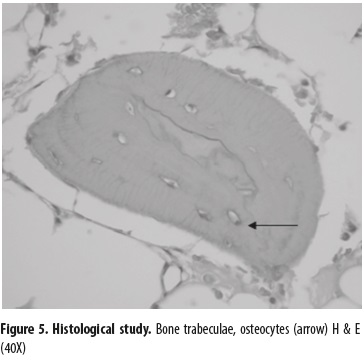
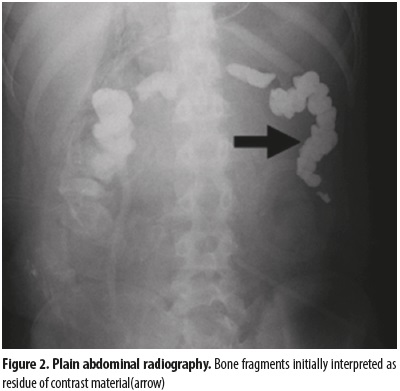
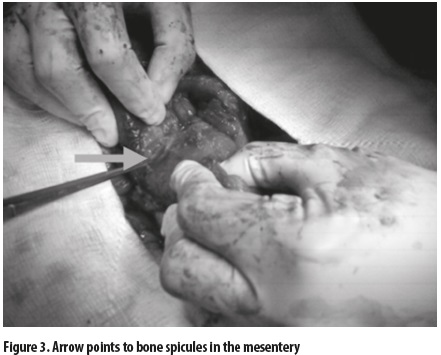
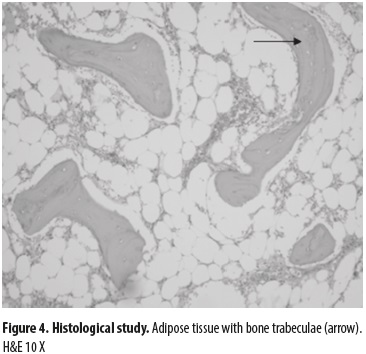
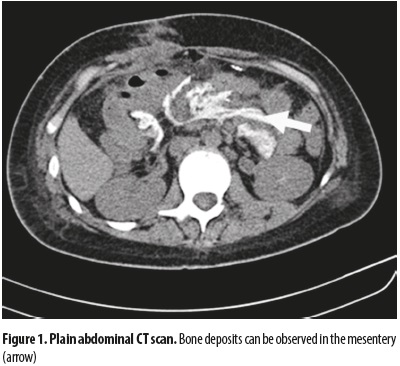
<body><![CDATA[<p><font size="3"><b>CASE REPORT</b></font></p>       <p>The patient was a 14-year-old male with a history of     high anorectal malformation and rectourethral fistula,     first requiring a neonatal colostomy and then     posterior sagittal anorectoplasty. Colostomy closure     was performed after one year. The patient also had a     history of tethered spinal cord syndrome with surgical     decompression at age two. Secondary to these pathologies     were neurogenic colon and bladder, which were     treated through augmentation ileocystoplasty and a     Mitrofanoff continent urinary diversion of the bladder.     Similarly, a Malone continent ostomy of the cecal appendix     was carried out in order to perform antegrade     enemas for controlling the neurogenic colon.    </p>       <p>The patient consulted a doctor due to symptoms of     the Malone ostomy obstruction associated with soft     tissue abscess. Treatment consisted of draining the     collection and performing the Malone procedure     again. In the postoperative period cecal ischemia was     observed together with intestinal leakage and fecal     peritonitis. The patient required surgical interventions     with ileostomy, open abdomen management to     wash the peritoneal cavity, implantation of a vacuumassisted     wall closure system with negative pressure     and, subsequently, abdominal wall closure using     polypropylene mesh. He was discharged and showed     adequate progress.    </p>       <p>Fifteen days later, the patient was admitted with     symptoms of intestinal obstruction and stool output     through the surgical wound. An entero-cutaneous fistula     was diagnosed and treatment for both conditions     was initiated. An upper gastrointestinal tract X-ray test     was done which confirmed the presence of the fistula     and showed that it was located in the proximal jejunum,     which was inconsistent with the clinical findings.     Additionally, an abdominal CT was performed     which showed changes due to mesenteritis (<a href="#f1">figure 1</a>).</p> 	    <p align="center"><a name="f1"></a><img src="/img/revistas/iat/v29n1/v29n1a07f1.jpg"></p>       <p> Given that the patient did not improve as a result     of the medical treatment, and that new fistulas appeared,     a barium enema test was requested. The simple     X-ray results of this test described the persistence of the contrast material (<a href="#f2">figure 2</a>). Consequently, surgery     was conducted which showed that the particles     that had been described were actually bone residues     in the mesentery. </p> 	    <p align="center"><a name="f2"></a><img src="/img/revistas/iat/v29n1/v29n1a07f2.jpg"></p>       <p>During surgery the abdomen was found to be     blocked by a severe adhesion syndrome, five intestinal     fistulas associated with the presence of multiple     bone spicules, and by the ossification of almost     all of the mesentery. Adhesiolysis was performed and the entero-cutaneous fistulas were closed. The     bone lesions were partially removed (<a href="#f3">figure 3</a>) and     samples were sent to pathology, which confirmed     the diagnosis of mesenteritis ossificans (<a href="#f4">figures 4</a>    and <a href="#f5">5</a>). </p>       <p align="center"><a name="f3"></a><img src="/img/revistas/iat/v29n1/v29n1a07f3.jpg"></p>       <p align="center"><a name="f4"></a><img src="/img/revistas/iat/v29n1/v29n1a07f4.jpg"></p>       ]]></body>
<body><![CDATA[<p align="center"><a name="f5"></a><img src="/img/revistas/iat/v29n1/v29n1a07f5.jpg"></p>       <p>&nbsp;</p>     <p><font size="3"><b>DISCUSSION</b></font></p>       <p>Heterotopic mesenteric ossification (HMO) is a rare     bone-producing alteration that takes place in the     mesentery. It was first proposed by Wilson; however     there were previous descriptions of a pseudo-malignant     bone tumor of the connective tissue or intraabdominal     myositis ossificans (1).    </p>       <p>The etiology and pathogenesis of this condition are     unknown. It has been found associated with trauma,     intra-abdominal surgeries such as laparotomies in     predisposed patients, intra-abdominal infections, venous     stasis, ischemia, edema, inflammation (2) or in     the presence of mucinous epithelial tumors (3,4). It     has also been reported to be associated with benign     polyps, carcinomas, colon and stomach carcinoid     tumors and mucoceles of the appendix (5). Most patients     had previously undergone abdominal surgery.     The lesions had a tendency to grow and developed     within weeks or even days after the surgical procedure   (6).    </p>       <p>The age of onset for HMO falls within a wide range.     Reports of its appearance range from 22 to 80 years     old (7); however, most of the patients described in the     literature have been middle-aged individuals, mostly     males, between the ages of 40 and 80. There are no     reports of patients in the pediatric age. Symptoms are     usually based on recurrent intestinal obstruction and     enterocutaneous fistulas (8), and the precise pathological     mechanisms for heterotopic ossification remain     unsolved. It has been suggested that the osteoblastic     metaplasia is a response to multipotent mesenchymal     cell trauma and an inflammatory reaction with the     transformation of fibroblasts and adipose tissue into     bone cells. No malignant potential has been found,     but morbidity is attributed to it because of its capacity     to block the intestines. The presence of reactive sites     resembling nodular fascitis, osteoid thickening, and     the absence of nuclear atypia, necrosis and atypical     mitotic figures make it possible to differentiate this     condition from osteosarcoma and other malignant lesions,     such as lipomiosarcoma (9,10).</p>       <p> There are several theories explaining heterotopic     ossification mechanisms: 1) bone formation occurs     because of the implantation of small particles containing     osteogenic cells from the perichondrium or     periosteum that are planted during a laparotomy or     trauma; 2) bone formation is caused by differentiated     stem cells in the mesoblast, as well as in the osteoblasts     or chondroblasts, which result from local lesions,     inflammatory processes, or infectious stimuli.    </p>       <p>Preoperative diagnosis is sometimes difficult; abdominal     CT scans can provide evidence of the pathology,     yet radiological differentiation between mesenteritis     ossificans, dystrophic calcification, bone neoplasms,     and intestinal leakage of contrast material may be difficult   (11).    </p>       <p>Heterotopic mesenteric ossification is considered to     have good prognosis; however, it becomes a challenge     once it appears since it tends to return. In some cases,     the condition manifests itself through intestinal obstruction     and requires intestinal resection. Despite this,     since the condition has been associated with surgery,     repeated surgical procedures should be avoided (4,12).     In this case the condition was very aggressive and was     accompanied by intestinal obstruction and multiple     hard to treat entero-cutaneous fistulas. The patient required     complete resection of the affected mesentery,     and of the small intestine from the duodenum to the     ileum. Treatment involved total parenteral nutrition,     and the patient was included in the waiting list for intestinal     transplant.    </p>       <p>&nbsp;</p>     ]]></body>
<body><![CDATA[<p><font size="3"><b>BIBLIOGRAPHIC REFERENCES</b></font></p>       <!-- ref --><p>1. Ib&aacute;&ntilde;ez Alonso S, Pe&ntilde;a Sarnago JM, Insausti Jaca N,     Atilano Santos L. Mesenteritis osificante. Radiolog&iacute;a.     2007;49:51-2.    &nbsp;&nbsp;&nbsp;&nbsp;&nbsp;&nbsp;&nbsp;&nbsp;[&#160;<a href="javascript:void(0);" onclick="javascript: window.open('/scielo.php?script=sci_nlinks&ref=000064&pid=S0121-0793201600010000700001&lng=','','width=640,height=500,resizable=yes,scrollbars=1,menubar=yes,');">Links</a>&#160;]<!-- end-ref --> DOI <a href="http://dx.doi.org/10.1016/S0033-8338(07)73717-7" target="_blank">10.1016/S0033-8338(07)73717-7</a>.    </p>       <!-- ref --><p>2. Wilson JD, Montague CJ, Salcuni P, Bordi C, Rosai J.     Heterotopic mesenteric ossification ('intraabdominal     myositis ossificans'): report of five cases. Am J Surg     Pathol. 1999 Dec;23(12):1464-70.    &nbsp;&nbsp;&nbsp;&nbsp;&nbsp;&nbsp;&nbsp;&nbsp;[&#160;<a href="javascript:void(0);" onclick="javascript: window.open('/scielo.php?script=sci_nlinks&ref=000066&pid=S0121-0793201600010000700002&lng=','','width=640,height=500,resizable=yes,scrollbars=1,menubar=yes,');">Links</a>&#160;]<!-- end-ref -->    </p>       <!-- ref --><p>3. Bovo G, Romano F, Perego E, Franciosi C, Buffa R,     Uggeri F. Heterotopic mesenteric ossification (''intraabdominal     myositis ossificans''): a case report. Int J     Surg Pathol. 2004 Oct;12(4):407-9.    &nbsp;&nbsp;&nbsp;&nbsp;&nbsp;&nbsp;&nbsp;&nbsp;[&#160;<a href="javascript:void(0);" onclick="javascript: window.open('/scielo.php?script=sci_nlinks&ref=000068&pid=S0121-0793201600010000700003&lng=','','width=640,height=500,resizable=yes,scrollbars=1,menubar=yes,');">Links</a>&#160;]<!-- end-ref -->    </p>       <!-- ref --><p>4. Zamolyi RQ, Souza P, Nascimento AG, Unni KK. Intraabdominal     myositis ossificans: a report of 9 new     cases. Int J Surg Pathol. 2006 Jan;14(1):37-41.    &nbsp;&nbsp;&nbsp;&nbsp;&nbsp;&nbsp;&nbsp;&nbsp;[&#160;<a href="javascript:void(0);" onclick="javascript: window.open('/scielo.php?script=sci_nlinks&ref=000070&pid=S0121-0793201600010000700004&lng=','','width=640,height=500,resizable=yes,scrollbars=1,menubar=yes,');">Links</a>&#160;]<!-- end-ref -->    </p>       <!-- ref --><p>5. Yasuma T, Hashimoto K, Miyazawa R, Hiyama Y. Bone     formation and calcification in gastric cancer--case     report and review of literature. Acta Pathol Jpn. 1973     Feb;23(1):155-72.    &nbsp;&nbsp;&nbsp;&nbsp;&nbsp;&nbsp;&nbsp;&nbsp;[&#160;<a href="javascript:void(0);" onclick="javascript: window.open('/scielo.php?script=sci_nlinks&ref=000072&pid=S0121-0793201600010000700005&lng=','','width=640,height=500,resizable=yes,scrollbars=1,menubar=yes,');">Links</a>&#160;]<!-- end-ref --> </p>       <!-- ref --><p>6. Hansen O, Sim F, Marton PF, Gr&uuml;ner OP. Heterotopic     ossification of the intestinal mesentery. Report of a     case following intraabdominal surgery. Pathol Res     Pract. 1983 Mar;176(2-4):125-30.    &nbsp;&nbsp;&nbsp;&nbsp;&nbsp;&nbsp;&nbsp;&nbsp;[&#160;<a href="javascript:void(0);" onclick="javascript: window.open('/scielo.php?script=sci_nlinks&ref=000074&pid=S0121-0793201600010000700006&lng=','','width=640,height=500,resizable=yes,scrollbars=1,menubar=yes,');">Links</a>&#160;]<!-- end-ref -->    </p>       <!-- ref --><p>7. Fletcher CDM, Unni KK, Mertens F, editors. Pathology     and genetics of tumours of soft tissue and bone.     Lyon: IARC; 2000.    &nbsp;&nbsp;&nbsp;&nbsp;&nbsp;&nbsp;&nbsp;&nbsp;[&#160;<a href="javascript:void(0);" onclick="javascript: window.open('/scielo.php?script=sci_nlinks&ref=000076&pid=S0121-0793201600010000700007&lng=','','width=640,height=500,resizable=yes,scrollbars=1,menubar=yes,');">Links</a>&#160;]<!-- end-ref --></p>       <!-- ref --><p> 8. Yushuva A, Nagda P, Suzuki K, Llaguna OH, Avgerinos     D, Goodman E. Heterotopic mesenteric ossification     following gastric bypass surgery: case series and review     of literature. Obes Surg. 2010 Sep;20(9):1312-5.    &nbsp;&nbsp;&nbsp;&nbsp;&nbsp;&nbsp;&nbsp;&nbsp;[&#160;<a href="javascript:void(0);" onclick="javascript: window.open('/scielo.php?script=sci_nlinks&ref=000078&pid=S0121-0793201600010000700008&lng=','','width=640,height=500,resizable=yes,scrollbars=1,menubar=yes,');">Links</a>&#160;]<!-- end-ref -->     DOI <a href="http://dx.doi.org/10.1007/s11695-009-0072-8" target="_blank">10.1007/s11695-009-0072-8</a>.    </p>       <!-- ref --><p>9. Patel RM, Weiss SW, Folpe AL. Heterotopic mesenteric     ossification: a distinctive pseudosarcoma commonly     associated with intestinal obstruction. Am J Surg     Pathol. 2006 Jan;30(1):119-22.    &nbsp;&nbsp;&nbsp;&nbsp;&nbsp;&nbsp;&nbsp;&nbsp;[&#160;<a href="javascript:void(0);" onclick="javascript: window.open('/scielo.php?script=sci_nlinks&ref=000080&pid=S0121-0793201600010000700009&lng=','','width=640,height=500,resizable=yes,scrollbars=1,menubar=yes,');">Links</a>&#160;]<!-- end-ref -->    </p>       <!-- ref --><p>10. Nascimento AG, Kurtin PJ, Guillou L, Fletcher CD.     Dedifferentiated liposarcoma: a report of nine cases     with a peculiar neurallike whorling pattern associated     with metaplastic bone formation. Am J Surg     Pathol. 1998 Aug;22(8):945-55.    &nbsp;&nbsp;&nbsp;&nbsp;&nbsp;&nbsp;&nbsp;&nbsp;[&#160;<a href="javascript:void(0);" onclick="javascript: window.open('/scielo.php?script=sci_nlinks&ref=000082&pid=S0121-0793201600010000700010&lng=','','width=640,height=500,resizable=yes,scrollbars=1,menubar=yes,');">Links</a>&#160;]<!-- end-ref --></p>       <!-- ref --><p> 11. Tonino BA, van der Meulen HG, Kuijpers KC, Mallens     WM, van Gils AP. Heterotropic mesenteric ossification:     a case report (2004:10b). Eur Radiol. 2005     Jan;15(1):195-7.    &nbsp;&nbsp;&nbsp;&nbsp;&nbsp;&nbsp;&nbsp;&nbsp;[&#160;<a href="javascript:void(0);" onclick="javascript: window.open('/scielo.php?script=sci_nlinks&ref=000084&pid=S0121-0793201600010000700011&lng=','','width=640,height=500,resizable=yes,scrollbars=1,menubar=yes,');">Links</a>&#160;]<!-- end-ref -->    </p>       <!-- ref --><p>12. Yannopoulos K, Katz S, Flesher L, Geller A, Berroya     R. Mesenteritis ossificans. Am J Gastroenterol. 1992     Feb;87(2):230-3.    &nbsp;&nbsp;&nbsp;&nbsp;&nbsp;&nbsp;&nbsp;&nbsp;[&#160;<a href="javascript:void(0);" onclick="javascript: window.open('/scielo.php?script=sci_nlinks&ref=000086&pid=S0121-0793201600010000700012&lng=','','width=640,height=500,resizable=yes,scrollbars=1,menubar=yes,');">Links</a>&#160;]<!-- end-ref --></p> </font>      ]]></body><back>
<ref-list>
<ref id="B1">
<label>1</label><nlm-citation citation-type="journal">
<person-group person-group-type="author">
<name>
<surname><![CDATA[Ibáñez-Alonso]]></surname>
<given-names><![CDATA[S]]></given-names>
</name>
<name>
<surname><![CDATA[Peña-Sarnago]]></surname>
<given-names><![CDATA[JM]]></given-names>
</name>
<name>
<surname><![CDATA[Insausti-Jaca]]></surname>
<given-names><![CDATA[N]]></given-names>
</name>
<name>
<surname><![CDATA[Atilano-Santos]]></surname>
<given-names><![CDATA[L.]]></given-names>
</name>
</person-group>
<article-title xml:lang="pt"><![CDATA[Mesenteritis osificante]]></article-title>
<source><![CDATA[Radiología]]></source>
<year>2007</year>
<volume>49</volume>
<page-range>51-2</page-range></nlm-citation>
</ref>
<ref id="B2">
<label>2</label><nlm-citation citation-type="journal">
<person-group person-group-type="author">
<name>
<surname><![CDATA[Wilson]]></surname>
<given-names><![CDATA[JD]]></given-names>
</name>
<name>
<surname><![CDATA[Montague]]></surname>
<given-names><![CDATA[CJ]]></given-names>
</name>
<name>
<surname><![CDATA[Salcuni]]></surname>
<given-names><![CDATA[P]]></given-names>
</name>
<name>
<surname><![CDATA[Bordi]]></surname>
<given-names><![CDATA[C]]></given-names>
</name>
<name>
<surname><![CDATA[Rosai]]></surname>
<given-names><![CDATA[J.]]></given-names>
</name>
</person-group>
<article-title xml:lang="en"><![CDATA[Heterotopic mesenteric ossification ('intraabdominal myositis ossificans'): report of five cases]]></article-title>
<source><![CDATA[Am J Surg Pathol]]></source>
<year>1999</year>
<month> D</month>
<day>ec</day>
<volume>23</volume>
<numero>12</numero>
<issue>12</issue>
<page-range>1464-70</page-range></nlm-citation>
</ref>
<ref id="B3">
<label>3</label><nlm-citation citation-type="journal">
<person-group person-group-type="author">
<name>
<surname><![CDATA[Bovo]]></surname>
<given-names><![CDATA[G]]></given-names>
</name>
<name>
<surname><![CDATA[Romano]]></surname>
<given-names><![CDATA[F]]></given-names>
</name>
<name>
<surname><![CDATA[Perego]]></surname>
<given-names><![CDATA[E]]></given-names>
</name>
<name>
<surname><![CDATA[Franciosi]]></surname>
<given-names><![CDATA[C]]></given-names>
</name>
<name>
<surname><![CDATA[Buffa]]></surname>
<given-names><![CDATA[R]]></given-names>
</name>
<name>
<surname><![CDATA[Uggeri]]></surname>
<given-names><![CDATA[F.]]></given-names>
</name>
</person-group>
<article-title xml:lang="en"><![CDATA[Heterotopic mesenteric ossification (''intraabdominal myositis ossificans''): a case report]]></article-title>
<source><![CDATA[Int J Surg Pathol]]></source>
<year>2004</year>
<month> O</month>
<day>ct</day>
<volume>12</volume>
<numero>4</numero>
<issue>4</issue>
<page-range>407-9</page-range></nlm-citation>
</ref>
<ref id="B4">
<label>4</label><nlm-citation citation-type="journal">
<person-group person-group-type="author">
<name>
<surname><![CDATA[Zamolyi]]></surname>
<given-names><![CDATA[RQ]]></given-names>
</name>
<name>
<surname><![CDATA[Souza]]></surname>
<given-names><![CDATA[P]]></given-names>
</name>
<name>
<surname><![CDATA[Nascimento]]></surname>
<given-names><![CDATA[AG]]></given-names>
</name>
<name>
<surname><![CDATA[Unni]]></surname>
<given-names><![CDATA[KK.]]></given-names>
</name>
</person-group>
<article-title xml:lang="en"><![CDATA[Intraabdominal myositis ossificans: a report of 9 new cases]]></article-title>
<source><![CDATA[Int J Surg Pathol]]></source>
<year>2006</year>
<month> J</month>
<day>an</day>
<volume>14</volume>
<numero>1</numero>
<issue>1</issue>
<page-range>37-41</page-range></nlm-citation>
</ref>
<ref id="B5">
<label>5</label><nlm-citation citation-type="journal">
<person-group person-group-type="author">
<name>
<surname><![CDATA[Yasuma]]></surname>
<given-names><![CDATA[T]]></given-names>
</name>
<name>
<surname><![CDATA[Hashimoto]]></surname>
<given-names><![CDATA[K]]></given-names>
</name>
<name>
<surname><![CDATA[Miyazawa]]></surname>
<given-names><![CDATA[R]]></given-names>
</name>
<name>
<surname><![CDATA[Hiyama]]></surname>
<given-names><![CDATA[Y.]]></given-names>
</name>
</person-group>
<article-title xml:lang="en"><![CDATA[Bone formation and calcification in gastric cancer--case report and review of literature]]></article-title>
<source><![CDATA[Acta Pathol Jpn]]></source>
<year>1973</year>
<month> F</month>
<day>eb</day>
<volume>23</volume>
<numero>1</numero>
<issue>1</issue>
<page-range>155-72</page-range></nlm-citation>
</ref>
<ref id="B6">
<label>6</label><nlm-citation citation-type="journal">
<person-group person-group-type="author">
<name>
<surname><![CDATA[Hansen]]></surname>
<given-names><![CDATA[O]]></given-names>
</name>
<name>
<surname><![CDATA[Sim]]></surname>
<given-names><![CDATA[F]]></given-names>
</name>
<name>
<surname><![CDATA[Marton]]></surname>
<given-names><![CDATA[PF]]></given-names>
</name>
<name>
<surname><![CDATA[Grüner]]></surname>
<given-names><![CDATA[OP.]]></given-names>
</name>
</person-group>
<article-title xml:lang="en"><![CDATA[Heterotopic ossification of the intestinal mesentery. Report of a case following intraabdominal surgery]]></article-title>
<source><![CDATA[Pathol Res Pract]]></source>
<year>1983</year>
<month> M</month>
<day>ar</day>
<volume>176</volume>
<numero>2-4</numero>
<issue>2-4</issue>
<page-range>125-30</page-range></nlm-citation>
</ref>
<ref id="B7">
<label>7</label><nlm-citation citation-type="book">
<person-group person-group-type="author">
<name>
<surname><![CDATA[Fletcher]]></surname>
<given-names><![CDATA[CDM]]></given-names>
</name>
<name>
<surname><![CDATA[Unni]]></surname>
<given-names><![CDATA[KK]]></given-names>
</name>
<name>
<surname><![CDATA[Mertens]]></surname>
<given-names><![CDATA[F]]></given-names>
</name>
</person-group>
<source><![CDATA[Pathology and genetics of tumours of soft tissue and bone]]></source>
<year>2000</year>
<publisher-loc><![CDATA[Lyon ]]></publisher-loc>
<publisher-name><![CDATA[IARC]]></publisher-name>
</nlm-citation>
</ref>
<ref id="B8">
<label>8</label><nlm-citation citation-type="journal">
<person-group person-group-type="author">
<name>
<surname><![CDATA[Yushuva]]></surname>
<given-names><![CDATA[A]]></given-names>
</name>
<name>
<surname><![CDATA[Nagda]]></surname>
<given-names><![CDATA[P]]></given-names>
</name>
<name>
<surname><![CDATA[Suzuki]]></surname>
<given-names><![CDATA[K]]></given-names>
</name>
<name>
<surname><![CDATA[Llaguna]]></surname>
<given-names><![CDATA[OH]]></given-names>
</name>
<name>
<surname><![CDATA[Avgerinos]]></surname>
<given-names><![CDATA[D]]></given-names>
</name>
<name>
<surname><![CDATA[Goodman]]></surname>
<given-names><![CDATA[E.]]></given-names>
</name>
</person-group>
<article-title xml:lang="en"><![CDATA[Heterotopic mesenteric ossification following gastric bypass surgery: case series and review of literature]]></article-title>
<source><![CDATA[Obes Surg]]></source>
<year>2010</year>
<month> S</month>
<day>ep</day>
<volume>20</volume>
<numero>9</numero>
<issue>9</issue>
<page-range>1312-5</page-range></nlm-citation>
</ref>
<ref id="B9">
<label>9</label><nlm-citation citation-type="journal">
<person-group person-group-type="author">
<name>
<surname><![CDATA[Patel]]></surname>
<given-names><![CDATA[RM]]></given-names>
</name>
<name>
<surname><![CDATA[Weiss]]></surname>
<given-names><![CDATA[SW]]></given-names>
</name>
<name>
<surname><![CDATA[Folpe]]></surname>
<given-names><![CDATA[AL.]]></given-names>
</name>
</person-group>
<article-title xml:lang="en"><![CDATA[Heterotopic mesenteric ossification: a distinctive pseudosarcoma commonly associated with intestinal obstruction]]></article-title>
<source><![CDATA[Am J Surg Pathol]]></source>
<year>2006</year>
<month> J</month>
<day>an</day>
<volume>30</volume>
<numero>1</numero>
<issue>1</issue>
<page-range>119-22</page-range></nlm-citation>
</ref>
<ref id="B10">
<label>10</label><nlm-citation citation-type="journal">
<person-group person-group-type="author">
<name>
<surname><![CDATA[Nascimento]]></surname>
<given-names><![CDATA[AG]]></given-names>
</name>
<name>
<surname><![CDATA[Kurtin]]></surname>
<given-names><![CDATA[PJ]]></given-names>
</name>
<name>
<surname><![CDATA[Guillou]]></surname>
<given-names><![CDATA[L]]></given-names>
</name>
<name>
<surname><![CDATA[Fletcher]]></surname>
<given-names><![CDATA[CD.]]></given-names>
</name>
</person-group>
<article-title xml:lang="en"><![CDATA[Dedifferentiated liposarcoma: a report of nine cases with a peculiar neurallike whorling pattern associated with metaplastic bone formation]]></article-title>
<source><![CDATA[Am J Surg Pathol]]></source>
<year>1998</year>
<month> A</month>
<day>ug</day>
<volume>22</volume>
<numero>8</numero>
<issue>8</issue>
<page-range>945-55</page-range></nlm-citation>
</ref>
<ref id="B11">
<label>11</label><nlm-citation citation-type="journal">
<person-group person-group-type="author">
<name>
<surname><![CDATA[Tonino]]></surname>
<given-names><![CDATA[BA]]></given-names>
</name>
<name>
<surname><![CDATA[van-der-Meulen]]></surname>
<given-names><![CDATA[HG]]></given-names>
</name>
<name>
<surname><![CDATA[Kuijpers]]></surname>
<given-names><![CDATA[KC]]></given-names>
</name>
<name>
<surname><![CDATA[Mallens]]></surname>
<given-names><![CDATA[WM]]></given-names>
</name>
<name>
<surname><![CDATA[van-Gils]]></surname>
<given-names><![CDATA[AP.]]></given-names>
</name>
</person-group>
<article-title xml:lang="en"><![CDATA[Heterotropic mesenteric ossification: a case report (2004:10b)]]></article-title>
<source><![CDATA[Eur Radiol]]></source>
<year>2005</year>
<month> J</month>
<day>an</day>
<volume>15</volume>
<numero>1</numero>
<issue>1</issue>
<page-range>195-7</page-range></nlm-citation>
</ref>
<ref id="B12">
<label>12</label><nlm-citation citation-type="journal">
<person-group person-group-type="author">
<name>
<surname><![CDATA[Yannopoulos]]></surname>
<given-names><![CDATA[K]]></given-names>
</name>
<name>
<surname><![CDATA[Katz]]></surname>
<given-names><![CDATA[S]]></given-names>
</name>
<name>
<surname><![CDATA[Flesher]]></surname>
<given-names><![CDATA[L]]></given-names>
</name>
<name>
<surname><![CDATA[Geller]]></surname>
<given-names><![CDATA[A]]></given-names>
</name>
<name>
<surname><![CDATA[Berroya]]></surname>
<given-names><![CDATA[R.]]></given-names>
</name>
</person-group>
<article-title xml:lang="en"><![CDATA[Mesenteritis ossificans]]></article-title>
<source><![CDATA[Am J Gastroenterol]]></source>
<year>1992</year>
<month> F</month>
<day>eb</day>
<volume>87</volume>
<numero>2</numero>
<issue>2</issue>
<page-range>230-3</page-range></nlm-citation>
</ref>
</ref-list>
</back>
</article>