<?xml version="1.0" encoding="ISO-8859-1"?><article xmlns:mml="http://www.w3.org/1998/Math/MathML" xmlns:xlink="http://www.w3.org/1999/xlink" xmlns:xsi="http://www.w3.org/2001/XMLSchema-instance">
<front>
<journal-meta>
<journal-id>0121-4004</journal-id>
<journal-title><![CDATA[Vitae]]></journal-title>
<abbrev-journal-title><![CDATA[Vitae]]></abbrev-journal-title>
<issn>0121-4004</issn>
<publisher>
<publisher-name><![CDATA[Facultad de Química Farmacéutica, Universidad de Antioquia]]></publisher-name>
</publisher>
</journal-meta>
<article-meta>
<article-id>S0121-40042005000200001</article-id>
<title-group>
<article-title xml:lang="es"><![CDATA[MÉTODOS COMBINADOS DE SECADO PARA EL ESCARCHADO DE MANGO (Mangifera indica) var. Kent]]></article-title>
<article-title xml:lang="en"><![CDATA[COMBINING DRYING METHODS FOR CANDY MANGO (Mangifera indica) var. Kent]]></article-title>
</title-group>
<contrib-group>
<contrib contrib-type="author">
<name>
<surname><![CDATA[GIRALDO G.]]></surname>
<given-names><![CDATA[Germán A.]]></given-names>
</name>
<xref ref-type="aff" rid="A01"/>
</contrib>
<contrib contrib-type="author">
<name>
<surname><![CDATA[DUQUE C.]]></surname>
<given-names><![CDATA[Alba L.]]></given-names>
</name>
<xref ref-type="aff" rid="A01"/>
</contrib>
<contrib contrib-type="author">
<name>
<surname><![CDATA[GARCÍA W.]]></surname>
<given-names><![CDATA[Claudia L.]]></given-names>
</name>
<xref ref-type="aff" rid="A01"/>
</contrib>
</contrib-group>
<aff id="A01">
<institution><![CDATA[,Universidad del Quindío Programa de Química ]]></institution>
<addr-line><![CDATA[Armenia ]]></addr-line>
<country>Colombia</country>
</aff>
<pub-date pub-type="pub">
<day>00</day>
<month>03</month>
<year>2005</year>
</pub-date>
<pub-date pub-type="epub">
<day>00</day>
<month>03</month>
<year>2005</year>
</pub-date>
<volume>12</volume>
<numero>2</numero>
<fpage>05</fpage>
<lpage>12</lpage>
<copyright-statement/>
<copyright-year/>
<self-uri xlink:href="http://www.scielo.org.co/scielo.php?script=sci_arttext&amp;pid=S0121-40042005000200001&amp;lng=en&amp;nrm=iso"></self-uri><self-uri xlink:href="http://www.scielo.org.co/scielo.php?script=sci_abstract&amp;pid=S0121-40042005000200001&amp;lng=en&amp;nrm=iso"></self-uri><self-uri xlink:href="http://www.scielo.org.co/scielo.php?script=sci_pdf&amp;pid=S0121-40042005000200001&amp;lng=en&amp;nrm=iso"></self-uri><abstract abstract-type="short" xml:lang="es"><p><![CDATA[En este trabajo la deshidratación osmótica (DO) y el secado con aire caliente se combinan para producir mango cristalizado conservando las propiedades organolépticas de la fruta fresca. El mango se procesa en cilindros de 1.5cm de diámetro por 2cm de altura. Estos se deshidratan osmóticamente durante 72 horas y luego se secan con aire a 35&ordm;C hasta alcanzar concentraciones de 68 grados Brix (&ordm;Bx) y 72&ordm;Bx. El tratamiento se inicia con un pretratamiento osmótico (PO), utilizando soluciones de sacarosa a 25, 35, 45, 55 y 65&ordm;Bx, aplicando un pulso de vacío (50 mbar) durante 10 minutos, después del cual las muestras se mantienen durante 20 minutos más a presión atmosférica. A continuación, las muestras se sumergen en solución de 65&ordm;Bx y se mantienen a presión atmosférica, hasta alcanzar 72 horas de tratamiento total. De la misma manera, se trata otra muestra usando una concentración de sacarosa de 45&ordm;Bx durante todo el proceso. Se caracterizan las muestras secas analizando masa, volumen, humedad y sólidos solubles. Las pérdidas de masa y volumen son más bajas para las muestras que se tratan con 25, 45 y 65&ordm;Bx durante el pretratamiento osmótico. También se observa que a 25&ordm;Bx las muestras ganan una cantidad más alta de sólidos solubles al compararlas con el resto de las muestras mientras que la difusividad de agua durante el proceso de secado es mayor para las muestras tratadas en soluciones menos concentradas durante el pretratamiento osmótico.]]></p></abstract>
<abstract abstract-type="short" xml:lang="en"><p><![CDATA[In this work, osmotic dehydration (OD) and air drying (AD) are combined in order to produce crystallized mango keeping the organoleptic properties of the fresh fruit. Mango fruits are cut into cylinders of 1.5cm diameter and 2cm height; they are osmotically dehydrated during 72 hours and then dried with air at 35&ordm;C to reach 68 and 72 Brix degrees (&ordm;Bx). The treatment begins with an osmotic pre-treatment (OP), with different sucrose solutions at 25, 35, 45, 55 and 65&ordm;Bx and applying a vacuum pulse (50mbar) during 10 minutes, after which the samples are left 20 minutes more to atmospheric pressure. Next, the samples are submerged into a solution of 65&ordm;Bx and are left to atmospheric pressure until reaching 72 hours of total treatment. In the same way, other sample is treated with a 45&ordm;Bx sucrose concentration solution during the whole process. The dry samples are characterized by analyzing the amounts of mass, volume, moisture and soluble solids. Mass and volume losses are lower for the samples treated with 25, 45 and 65&ordm;Bx solutions during the osmotic pre-treatment. It is also observed that the 25&ordm;Bx sample gains a significantly higher amount of soluble solids compared to the rest of the samples, while water diffusivity during the drying process is higher for the samples treated in less concentrated solutions.]]></p></abstract>
<kwd-group>
<kwd lng="es"><![CDATA[mango]]></kwd>
<kwd lng="es"><![CDATA[frutas cristalizadas]]></kwd>
<kwd lng="es"><![CDATA[secado]]></kwd>
<kwd lng="es"><![CDATA[sólidos solubles]]></kwd>
<kwd lng="en"><![CDATA[mango]]></kwd>
<kwd lng="en"><![CDATA[crystallized fruits]]></kwd>
<kwd lng="en"><![CDATA[drying]]></kwd>
<kwd lng="en"><![CDATA[soluble solids]]></kwd>
</kwd-group>
</article-meta>
</front><body><![CDATA[ <p><b>M&Eacute;TODOS COMBINADOS DE SECADO PARA EL    ESCARCHADO DE MANGO (<i>Mangifera indica) var. Kent</i></b></p>      <p><strong>  COMBINING DRYING METHODS FOR CANDY MANGO (<i>Mangifera indica) var. Kent</i> </strong></p>     <p>  GIRALDO G. Germ&aacute;n A. <sup>1*</sup>, DUQUE C. Alba L.<sup>1</sup> y GARC&Iacute;A W. Claudia L.<sup>1</sup> </p>     <p>  <sup>1</sup> Programa de Qu&iacute;mica. Universidad del Quind&iacute;o. Calle 12 Norte Cra 15, Armenia, Colombia. <br />   * Autor a quien se debe dirigir la correspondencia: <a href="mailto:ggiraldo@uniquindio.edu.co">ggiraldo@uniquindio.edu.co</a> </p>     <p>  Recibido: agosto 2 de 2005 Aceptado: septiembre 13 de 2005 </p>     <p><b>  RESUMEN </b></p>     <p>  En este trabajo la deshidrataci&oacute;n osm&oacute;tica (DO) y el secado con aire caliente se combinan para producir mango    cristalizado conservando las propiedades organol&eacute;pticas de la fruta fresca. El mango se procesa en cilindros    de 1.5cm de di&aacute;metro por 2cm de altura. Estos se deshidratan osm&oacute;ticamente durante 72 horas y luego se    secan con aire a 35&ordm;C hasta alcanzar concentraciones de 68 grados Brix (&ordm;Bx) y 72&ordm;Bx. El tratamiento se inicia    con un pretratamiento osm&oacute;tico (PO), utilizando soluciones de sacarosa a 25, 35, 45, 55 y 65&ordm;Bx, aplicando    un pulso de vac&iacute;o (50 mbar) durante 10 minutos, despu&eacute;s del cual las muestras se mantienen durante 20    minutos m&aacute;s a presi&oacute;n atmosf&eacute;rica. A continuaci&oacute;n, las muestras se sumergen en soluci&oacute;n de 65&ordm;Bx y se    mantienen a presi&oacute;n atmosf&eacute;rica, hasta alcanzar 72 horas de tratamiento total. De la misma manera, se trata    otra muestra usando una concentraci&oacute;n de sacarosa de 45&ordm;Bx durante todo el proceso. Se caracterizan las    muestras secas analizando masa, volumen, humedad y s&oacute;lidos solubles. Las p&eacute;rdidas de masa y volumen son    m&aacute;s bajas para las muestras que se tratan con 25, 45 y 65&ordm;Bx durante el pretratamiento osm&oacute;tico. Tambi&eacute;n se    observa que a 25&ordm;Bx las muestras ganan una cantidad m&aacute;s alta de s&oacute;lidos solubles al compararlas con el resto    de las muestras mientras que la difusividad de agua durante el proceso de secado es mayor para las muestras    tratadas en soluciones menos concentradas durante el pretratamiento osm&oacute;tico. <br />   <b>Palabras clave:</b> mango, frutas cristalizadas, secado, s&oacute;lidos solubles </p>     <p><b>  ABSTRACT </b></p>     <p>  In this work, osmotic dehydration (OD) and air drying (AD) are combined in order to produce crystallized    mango keeping the organoleptic properties of the fresh fruit. Mango fruits are cut into cylinders of 1.5cm    diameter and 2cm height; they are osmotically dehydrated during 72 hours and then dried with air at 35&ordm;C    to reach 68 and 72 Brix degrees (&ordm;Bx). The treatment begins with an osmotic pre-treatment (OP), with    different sucrose solutions at 25, 35, 45, 55 and 65&ordm;Bx and applying a vacuum pulse (50mbar) during 10    minutes, after which the samples are left 20 minutes more to atmospheric pressure. Next, the samples are    submerged into a solution of 65&ordm;Bx and are left to atmospheric pressure until reaching 72 hours of total    treatment. In the same way, other sample is treated with a 45&ordm;Bx sucrose concentration solution during the    whole process. The dry samples are characterized by analyzing the amounts of mass, volume, moisture and    soluble solids. Mass and volume losses are lower for the samples treated with 25, 45 and 65&ordm;Bx solutions    during the osmotic pre-treatment. It is also observed that the 25&ordm;Bx sample gains a significantly higher    amount of soluble solids compared to the rest of the samples, while water diffusivity during the drying    process is higher for the samples treated in less concentrated solutions. <br />   <b>Keywords:</b> mango, crystallized fruits, drying, soluble solids </p>     <p><b>  INTRODUCTION </b></p>     ]]></body>
<body><![CDATA[<p>  Dehydrated tropical fruits are used nowadays    to produce candy fruits or as a garnish in pastry    making. However their use as a raw material to    elaborate products such as breakfast snacks, jams,    dairy products with fruits, jellies, ice-creams, sauces    and desserts, is not a common practice. In Latino    America some works have been carried out using    combined methods of preservation for mango,    pineapple and peach, providing good results for    products with intermediate moisture content which    means a useful life up to 4 months of storage at    room temperature (1). </p>     <p>  The osmotic pre-treatment (OP), is a process    that helps to diminish the detrimental changes that    can take place during the processing or storage of    plant tissues. OP has been previously used in the    dehydration of fruits to produce candy pineapple    with non-thermal treatments (2). Samples were    vacuum impregnated in sucrose solutions at concentrations    of 25, 35, 45, 55 and 65 Brix degrees    (&deg;Bx). Samples were then equilibrated immersed in    a 65&ordm;Bx sucrose solution, the samples with the better    quality, yield and organoleptic properties were the    samples impregnated in a 25&ordm;Bx sucrose solution,    dehydrated for 24 hours in a 55&ordm;Bx solution and    finally equilibrated in a 65&ordm;Bx solution for 48 hours.    Likewise, some authors propose that in osmotic    dehydration processes, sucrose acts lowering the    water activity in the sample (3); in this sense, sugar    concentration has a greater effect than the temperature    in the preservation of the product for longer    periods of time. </p>     <p>  There are several works about dehydration of    mango fruit, one of them (4) shows the advantage    of increasing solutions concentration for further    dehydration in processes where a vacuum pulse is    applied. It has been previously demonstrated that an    osmotic dehydration treatment reduces the drying    time of mango samples up to 75 % when compared    to fresh samples (5,6). </p>     <p>  Dried fresh mango slices (var. <i>Manila</i>) have    been treated with air at various temperatures 50,    60 and 70&deg;C and two different air velocities 0.5 and    1.75m/s (7). From their experimentation, the authors    concluded that the external convection is the    main mechanism responsible for the heat transfer    while the internal water diffusion is the mechanism    responsible for the overall transfer. In another work,    the authors frosted mango in cubes of 2cm, scalded    the samples for 10 min and transferred them to a    sucrose:glucose (9:1) solution at 30&ordm;Bx with pH    4. Mango samples were hold for 48 hours until    osmotic equilibrium was attained, and then the initial    solution was replaced for higher concentration    solutions. After 19 days, the concentration solution    was 76.5&deg;Bx and the fruit reached 71.6 &ordm;Bx (8). </p>     <p>  Other investigation (9) scalded and dehydrated    mango in a sugar solution of 60&ordm;Bx for 6 hours. After    the osmotic dehydration treatment the samples were    dried for 21 hours in a stove with air circulation, the    results being so promising so that they considered    this combined drying methods as a technological    alternative for the conservation of mango fruit. </p>     <p>  The aim of this work was the optimisation of    the candy process in mango fruit using osmotic    dehydration treatments for long periods of time    combined with hot air-drying. The variables were    the sugar solution concentration during the vacuum    pulse and the final moisture content after the drying    process. </p>     <p><b>  MATERIALS AND METHODS </b></p>     <p><b>  Raw material </b></p>     <p>  The mango (<i>Mangifera indica var. Kent</i>) was    purchased in a local market and selected according    to a similar ripeness degree. Each fruit was peeled    and cut into parallel pieces to the bone obtaining    cylinders of 1.5cm height and 2cm diameter, fresh    fruit was characterised measuring the moisture and    soluble solids content as well as the water activity. </p>     <p><b>  Osmotic pre-treatment (OP) </b></p>     ]]></body>
<body><![CDATA[<p>  The osmotic pre-treatment was carried out in    two steps; in the first one, a vacuum pulse was    applied to the samples immersed in different osmotic    solutions and in the second step the samples were    placed in a concentrated solution and held there to    attain the osmotic equilibrium. The cylinders were    immersed in sucrose solution (25, 35, 45, 55 and    65&ordm;Bx), the sample: solution ratio was 1:20. A vacuum    pulse of 50 mbar was applied for 10 minutes,    after which the atmospheric pressure was restored    for 20 minutes. In the second step, the samples were    transferred to a 65&ordm;Bx solution. All samples were    osmotic dehydrated for a total time of 72 hours,    which is the estimated time to reach the equilibrium    according to the water activity (a<sub>w</sub>) measurements    of the mango samples and final sucrose solution.    Another experiment was carried out in which the    mango fruits were processed in a 45&ordm;Bx solution    (10). The moisture and soluble solids content of    the mango samples were analysed at the end of the    osmotic treatment. Volume and mass changes were    also determined. </p>     <p><b>  Drying period </b></p>     <p>  The osmotic dehydrated cylinders were dried    with air at 35&deg;C until the soluble solids concentration    in the liquid phase (z<sub>s</sub>) was 0.68 or 0.72.    From the initial values of the moisture content and    soluble solids content the loss of mass during the    process drying was calculated in order to achieve the    required concentrations. At the end of the drying    process, the mechanical properties of the samples    were evaluated as well as the moisture and soluble    solids content, mass and volume changes. </p>     <p><b>  Analysis </b></p>     <p>  The volumes of the samples were measured    with a picnometer using the respective isotonic    solution. The mass was determined by gravimetry    in an analytic scale with four significative numbers.    The moisture content was determined drying the    samples in a vacuum oven at 60&deg;C until constant    weight was reached (11). Water activity (a<sub>w</sub>) was    determined with a dew point hygrometer (Decagon,    model Aqualab CX3) and the soluble solids    content of the samples previously homogenized was    determined with a refractometer (model 89553 3T).    Mechanical assays were performed using a texture    analyser Stable Micro Systems TA.XT2. Samples    were positioned vertically on the slotted platform;    the cylinders were cut/compressed parallel to the    main axis of them. </p>     <p><b>  RESULTS AND DISCUSSION </b></p>     <p>  The mango fruits were processed keeping in    mind the system of combined drying methods,    osmotic pre-treatment and air-drying. The two    processed lots reached mass fractions of soluble    solids in the liquid phase (zs) of 0.68 and 0.72. It was    used like methodological principle the observations    made by (2,3,8,12). </p>     <p><b>  PRODUCT CHARACTERIZATION </b></p>     <p>  Physicochemical properties of the fresh fruit    The moisture content of the fresh mango fruit    was 0.83 &plusmn; 0.03, the water activity 0.983 &plusmn; 0.005 and    the soluble solids content 0.14 &plusmn; 0.03; similar to that    previously determined in other lost. (10). </p>     <p><b>  Variation in mass, volume of the liquid phase,    moisture and soluble solids content during    the periods of candy process </b></p>     ]]></body>
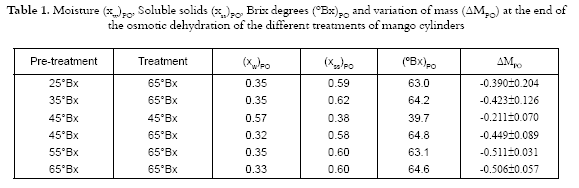
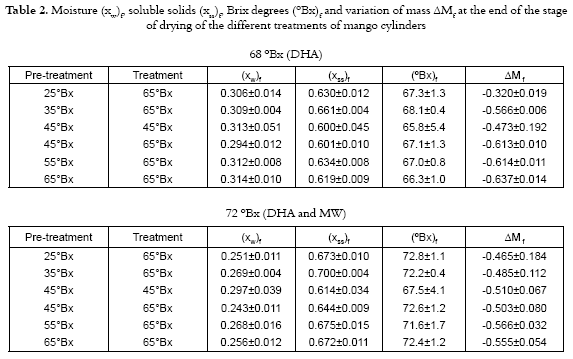
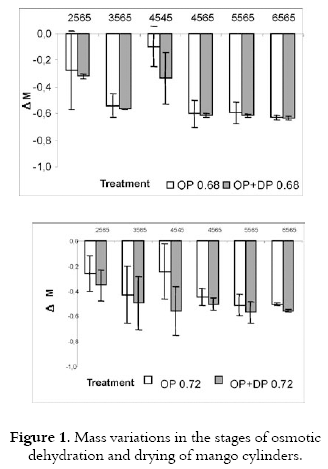
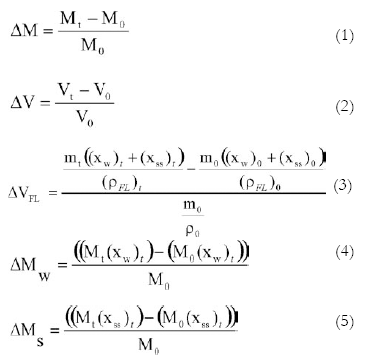
<body><![CDATA[<p>  The candy process took place in two periods:    A first period which consisted in a pre-treatment    of osmotic dehydration and a drying period. Mass,    volume, moisture and soluble solids content were    registered for all the samples in each period. From    these data the next values were calculated: mass changes,    &Delta;M (<a href="#g1">equation 1</a>); volume changes, &Delta;V (<a href="#g1">equation 2</a>); variations in liquid phase volume of the samples,    &Delta;V<sub>FL</sub> (<a href="#g1">equation 3</a>); water loss, &Delta;M<sub>w</sub> (<a href="#g1">equation 4</a>) and    soluble solids gain, &Delta;M<sub>s</sub> (<a href="#g1">equation 5</a>). </p>     <p align="center"><a name="g1" id="g1"></a><img src="/img/revistas/vitae/v12n2/v12n2a01g1.gif" /></p>     <p>Where:</p>   M<sub>0</sub> = initial sample mass (Kg).<br />   M<sub>t</sub> = sample mass at time t (Kg).<br />   V<sub>0</sub> = initial volume sample (m<sup>3</sup>).<br />   V<sub>t</sub> = sample volume at time t (m<sup>3</sup>).<br />   (x<sub>ss</sub>)<sub>0</sub>= Mass fraction of soluble solids at time 0 (&ordm;Bx).<br />   (x<sub>ss</sub>)<sub>t</sub> = Mass fraction of soluble solids at time t (&ordm;Bx).<br />   (x<sub>w</sub>)<sub>0</sub> = Mass fraction of water at time 0 (Kg/Kg).<br /> (x<sub>w</sub>)<sub>t</sub> = Mass fraction of water at time t (Kg/Kg).</p>     <p>  <a href="#t1">Table 1</a> shows the moisture content, Brix degrees, soluble solids content and mass changes of the samples    once osmotic treatment was finished. As it was expected, the soluble solid content in the fruit after 72    hours of osmotic treatment was very similar to the soluble solid content of the respective solution. From    previous works 72 hours of process was considered the proper time length to reach the equilibrium. </p>     <p align="center"><a name="t1" id="t1"></a><img src="/img/revistas/vitae/v12n2/v12n2a01t1.gif" /></p>     <p>  At the end of the pre-treatment, mass changes were greater with solutions of higher concentration,    which is in coherence with the observations of other authors (10,13). This is the result of increasing soluble    solids gain instead of water loss as concentration/viscosity of the solution increases. The treatment    45-45 treatment (pre-treatment at 45&deg;Bx and treatment at 45&deg;Bx) resulted in lower mass changes as well    as soluble solids content and in a higher moisture level during the equilibrium period due to the low    concentration of the osmotic solution. </p>     <p>  <a href="#t2">Table 2</a> shows the moisture content, Brix degrees, soluble solids content and mass changes of the    samples during the drying process until two different levels, 68 and 72&deg;Bx, were reached. The values    obtained for the Brix degrees were very close to the preset values except for the 45-45 treatment, these    samples offered resistance to the drying, probably due to the compositional changes occurred during the    osmotic treatment in which solutes gain was very high. </p>     <p align="center"><a name="t2" id="t2"></a><img src="/img/revistas/vitae/v12n2/v12n2a01t2.gif" /></p>     <p>  <a href="#f1">Figure 1</a> shows the mass changes during the OP    and during the drying process for the two concentration    levels. In the osmotic stage, the treatments    25-65 and 35-65 showed a great variability in mass    losses. During the drying stage, the samples equilibrated    with 45 &deg;Bx solution lost more mass due to its    lower initial concentration value. For the remaining    treatments the differences were not statistically significant.    The best yields in the candy process were    established according to the total mass losses, in this    sense the treatments 25-65 and 45-65 resulted in    lower mass losses for the same final level of soluble    solids concentration. It has been observed that the    impregnation with diluted solutions also restrains    the mass losses during pineapple candy process (2).    On the other hand, it was previously reported that    treatments with sucrose at 45&deg;Bx increases solutes    gain (10) which will have a relevant effect in the    process efficiency. </p>     <p align="center"><a name="f1" id="f1"></a><img src="/img/revistas/vitae/v12n2/v12n2a01f1.gif" /></p>     ]]></body>
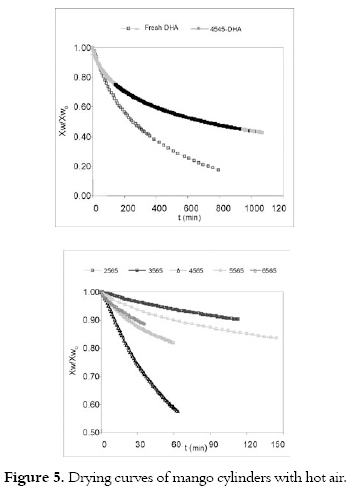
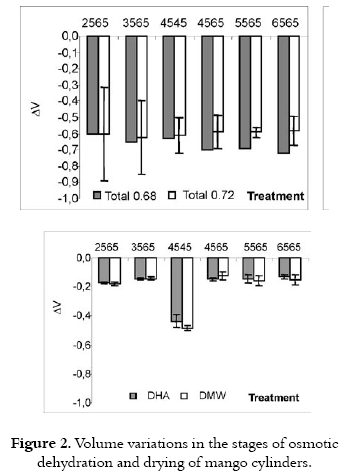
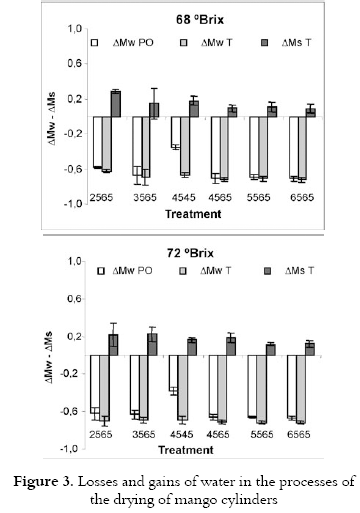
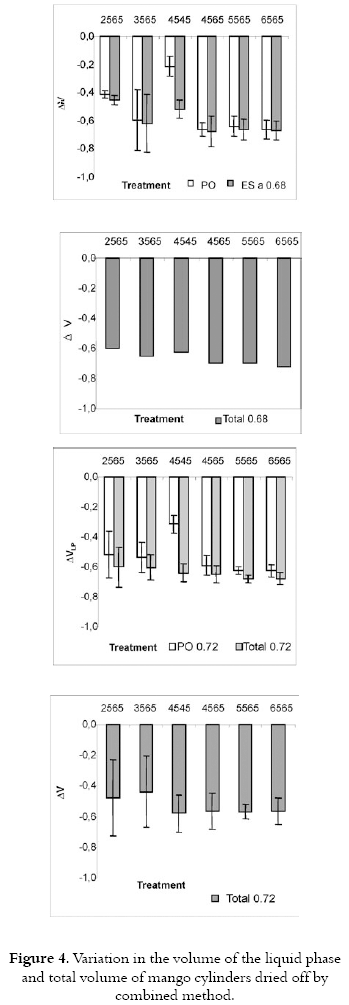
<body><![CDATA[<p>  Volume sample changes at the end of the candy    process are shown in <a href="#f2">figure 2</a>. There were no significant    differences between samples caused by any of    the analysed factors: different osmotic treatments or    final drying level. The response of different samples    to the same treatment presented a great variability    in volume changes. </p>     <p align="center"><a name="f2" id="f2"></a><img src="/img/revistas/vitae/v12n2/v12n2a01f2.gif" /></p>     <p>  The moisture loss and solids gain in the dehydration    processes, which were calculated from <a href="#g1">equations    4</a> and <a href="#g1">5</a>, and are shown in <a href="#f3">Figure 3</a>. During the    osmotic treatment, moisture losses were higher as    the solution concentration was higher. It could be    said that the vacuum impregnation period had an    effect on the samples treated with higher concentration    solutions although the effect of the equilibrium    period on the dehydration was more relevant, due    to the osmotic and diffusion effect caused by the    viscosity and concentration solution (10,13). The    air drying process resulted in minimal additional    water losses as the mass fractions of the soluble solids    content in the liquid phase of the samples (zs)    were very close to the preset values after the osmotic    treatment. The 45-45 treatment was the exception as    it reached the equilibrium in the osmotic solution at    a lower concentration (z<sub>s</sub>=0.45), this lower concentration    increased the ratio of soluble solids gain to    water loss, helping to preserve the sample shape and    volume. Solution concentration and viscosity had a    direct effect on solutes gain, since 25-65 and 45-45    treatments resulted in higher solids concentrations    without damaging the cellular tissues. </p>     <p align="center"><a name="f3" id="f3"></a><img src="/img/revistas/vitae/v12n2/v12n2a01f3.gif" /></p>     <p>  The drying stage decreased the differences    among the final moisture content of the cylinders,    this is one of the reasons why the drying process was    used as a way to provide the samples the required    stability to increase the life of the candy mango    storage at room temperature (<a href="#f3">Figure 3</a>) </p>     <p><b>  Volume variations </b></p>     <p>  The total volume loss is plotted versus volume    loss of the liquid phase at the end of the candy process    for all different treatments. The candy process    with a final level zs=0.68, showed a volume loss    of the liquid phase smaller than the total volume    loss, this effect could be caused probably by the    solubilization of the sucrose. The forces generated    as a consequence of the water loss results in the    shrinkage of the tissue and the loss of porous. The    opposite situation appeared when samples were    dried up to zs=0.72, in this case the total volume    loss was smaller than the liquid phase volume loss    (with the exception of 45-45 treatment), the smaller    total volume loss implies an increase in porosity    which could be caused by the formation of sucrose    crystals during storage as a consequence of the lower    moisture level (<a href="#f4">figure 4</a>). </p>     <p align="center"><a name="f4" id="f4"></a><img src="/img/revistas/vitae/v12n2/v12n2a01f4.gif" /></p>     <p><b>  Drying curves </b></p>     <p>  <a href="#f5">Figure 5</a> shows the drying curves for the different    treatments. As it was expected samples processed according    with the 45-45 treatment presented higher    drying times due to the higher amount of water in    the samples at the end of the osmotic treatment and    the distribution of the water inside the sample. </p>     ]]></body>
<body><![CDATA[<p align="center"><a name="f5" id="f5"></a><img src="/img/revistas/vitae/v12n2/v12n2a01f5.gif" /></p>     <p>  The diffusivity of the water was calculated from    <a href="#g6">equation 6</a> (14). In <a href="#f6">figure 6</a> it is observed that the    diffusivity was highest for the 25-65 and 45-45    treatments due to the better distribution of the    water inside the solid matrix as a response to the    concentration/viscosity balance. </p>     <p align="center"><a name="g2" id="g2"></a><img src="../img/revistas/vitae/v12n2/v12n2a01g2.gif"  /></p>     <p>  donde: </p>     <p>  De = Effective diffusivity (m<sup>2</sup>/s) <br />   L = half height of the cylinder (m) <br />   t = time (s) <br />   X<sub>bs. (r,t)</sub> = Water content   (Kg water/Kg soluble solids)  <br />   X<sub>bs.0</sub> = Initial water content    (Kg water/Kg soluble solids) <br />   X<sub>bs.e</sub> = Water content at equilibrium (Kg water/ Kg    soluble solids) <br />   &lambda;n = Characteristic value for the repetitions (m<sup>-1</sup>). </p>     <p align="center"><a name="f6" id="f6"></a><img src="../img/revistas/vitae/v12n2/v12n2a01f6.gif" /></p>     <p><b>  Mechanical properties: Compression assay </b></p>     <p>  The mechanical properties of the processed candy    mango were evaluated according to the response    of the samples to a compression/shearing assay.    Three different treatments were evaluated: Samples    dried up to zs=0.68, a second set of samples dried up    to Zs=0.72 and for the third treatment an additional    storage stage was included after drying the samples    up to zs=0.72. Storage conditions were RH content    of 0.72 at room temperature. </p>     <p>  The <a href="#f7">Figure 7</a> shows the compression force versus    the distance during the mechanical assay of mango    cylinders processed combining osmotic dehydration    and air drying. Each curve represent the average    curve for each candy process. </p>     <p align="center"><a name="f7" id="f7"></a><img src="../img/revistas/vitae/v12n2/v12n2a01f7.gif" /></p>     ]]></body>
<body><![CDATA[<p>  There were no significant differences in the    response of the samples dried up to zs=0.68 and up    to zs=0.72, this can be due to the small differences    in the soluble solids concentration at the end of the    process and to the short availability of time to crystallize    the sugar. On the other hand, when comparing    samples dried up to zs=0.72 without storage with    the stored ones, it can be observed that the storage    increased the hardness of the samples probably due    to the sugar crystallization. The different osmotic    treatment caused different sample textures; from    soft samples (45-45) to very hard samples (45-65    with storage). </p>     <p>  Differences between osmotic treatments for the    same candy process are shown in <a href="#f8">Figure 8</a>. In most    of the cases the stored samples dried up to 72&deg;Bx    exhibited higher compression forces, probably due    to the case hardening effect during the air drying    process and to the sugar crystallization during the    storage stage. 25-65 and 45-45 treatments didn&rsquo;t    show differences among the three candy processes,    showing a low compression force. From these results,    these two treatments can be considered as the    recommended ones for the candy process, especially    given that these samples showed a low variability in    their response to the compression assay. </p>     <p align="center"><a name="f8" id="f8"></a><img src="../img/revistas/vitae/v12n2/v12n2a01f8.gif"  /></p>     <p><b>  BIBLIOGRAPHICAL REFERENCES </b></p>     <!-- ref --><p>1. Aguilera JM, Chirife J. Combined Methods for the Preservation of Foods in Latin America and the CYTED-D Project. J Food Eng 1994; 22: 433-444.&nbsp;&nbsp;&nbsp;&nbsp;&nbsp;&nbsp;&nbsp;&nbsp;[&#160;<a href="javascript:void(0);" onclick="javascript: window.open('/scielo.php?script=sci_nlinks&ref=000067&pid=S0121-4004200500020000100001&lng=','','width=640,height=500,resizable=yes,scrollbars=1,menubar=yes,');">Links</a>&#160;]<!-- end-ref --><!-- ref --><p>2. Barat JM, Talens P, Barrera C, Chiralt A. No-thermal pineapple candying optimization. J Food Sci 2002&nbsp;&nbsp;&nbsp;&nbsp;&nbsp;&nbsp;&nbsp;&nbsp;[&#160;<a href="javascript:void(0);" onclick="javascript: window.open('/scielo.php?script=sci_nlinks&ref=000068&pid=S0121-4004200500020000100002&lng=','','width=640,height=500,resizable=yes,scrollbars=1,menubar=yes,');">Links</a>&#160;]<!-- end-ref --><!-- ref --><p>3. Panagiotou N, Karathanos V, Maroulis Z. Mass transfer modelling of the osmotic dehydration of some fruits. Int J Food Sci Technol 1998; 33: 267-284.&nbsp;&nbsp;&nbsp;&nbsp;&nbsp;&nbsp;&nbsp;&nbsp;[&#160;<a href="javascript:void(0);" onclick="javascript: window.open('/scielo.php?script=sci_nlinks&ref=000069&pid=S0121-4004200500020000100003&lng=','','width=640,height=500,resizable=yes,scrollbars=1,menubar=yes,');">Links</a>&#160;]<!-- end-ref --><!-- ref --><p>4.	Mujica-Paz H, Valdez-Fragoso A, Martínez-Pantoja Y, Welti-Canes J. Response surface methodology applied to vacuum osmotic dehydration of mango slices. En: Welty-Chanes J, Barbosa-Cánovas GV, Aguilera JM, editores. Proceedings of the Eighth International Congress on Engineering and Food -ICEF 8-. Lancaster: Technomic Publishing Co.; 2000.&nbsp;&nbsp;&nbsp;&nbsp;&nbsp;&nbsp;&nbsp;&nbsp;[&#160;<a href="javascript:void(0);" onclick="javascript: window.open('/scielo.php?script=sci_nlinks&ref=000070&pid=S0121-4004200500020000100004&lng=','','width=640,height=500,resizable=yes,scrollbars=1,menubar=yes,');">Links</a>&#160;]<!-- end-ref --><!-- ref --><p>5. Castañón X, Ibarz A, Welti-Chanel J, Palou E, Lopez-Malo A. Water activity on air drying behaviour and quality of mango. En: Welty-Chanes J, Barbosa-Cánovas GV, Aguilera JM. Proceedings of the Eighth International Congress on Engineering and Food -ICEF 8-. Lancaster: Technomic Publishing Co.; 2000. p.1066-1070&nbsp;&nbsp;&nbsp;&nbsp;&nbsp;&nbsp;&nbsp;&nbsp;[&#160;<a href="javascript:void(0);" onclick="javascript: window.open('/scielo.php?script=sci_nlinks&ref=000071&pid=S0121-4004200500020000100005&lng=','','width=640,height=500,resizable=yes,scrollbars=1,menubar=yes,');">Links</a>&#160;]<!-- end-ref --><!-- ref --><p>6. Welti J, Palou E, Lopez-Malo A, Balseira A. Osmotic Concentration – Drying of Mango Slices. Drying Technol 1995; 13 (1-2): 405-416.&nbsp;&nbsp;&nbsp;&nbsp;&nbsp;&nbsp;&nbsp;&nbsp;[&#160;<a href="javascript:void(0);" onclick="javascript: window.open('/scielo.php?script=sci_nlinks&ref=000072&pid=S0121-4004200500020000100006&lng=','','width=640,height=500,resizable=yes,scrollbars=1,menubar=yes,');">Links</a>&#160;]<!-- end-ref --><!-- ref --><p>7. Pavón-Meléndez, Hernández, Salgado, García. Dimensionless Analysis of the simultaneous heat and mass transfer in food drying. J Food Eng 2002; 51 (4): 347-453.&nbsp;&nbsp;&nbsp;&nbsp;&nbsp;&nbsp;&nbsp;&nbsp;[&#160;<a href="javascript:void(0);" onclick="javascript: window.open('/scielo.php?script=sci_nlinks&ref=000073&pid=S0121-4004200500020000100007&lng=','','width=640,height=500,resizable=yes,scrollbars=1,menubar=yes,');">Links</a>&#160;]<!-- end-ref --><!-- ref --><p>8. Ribeiro MS, Anuncio De Sabaa A. Mango (<i>Mangifera indica</i> L.) saturación del cv. Rosa con azúcares. Ciencia e Tecnología de Alimentos 2000; 19 (1): 118-122.&nbsp;&nbsp;&nbsp;&nbsp;&nbsp;&nbsp;&nbsp;&nbsp;[&#160;<a href="javascript:void(0);" onclick="javascript: window.open('/scielo.php?script=sci_nlinks&ref=000074&pid=S0121-4004200500020000100008&lng=','','width=640,height=500,resizable=yes,scrollbars=1,menubar=yes,');">Links</a>&#160;]<!-- end-ref --><!-- ref --><p>9. Maldonado S, Sammán N. Dehydration of tropical fruits produced in noa region, Argentina: Mango (Mangifera indica) stage 1. En: Welty-Chanes J, Barbosa-Cánovas GV, Aguilera JM. Proceedings of the Eighth International Congress on Engineering and Food -ICEF 8-. Lancaster: Technomic Publishing Co.; (pp.1204-1208). p.1204-1208.&nbsp;&nbsp;&nbsp;&nbsp;&nbsp;&nbsp;&nbsp;&nbsp;[&#160;<a href="javascript:void(0);" onclick="javascript: window.open('/scielo.php?script=sci_nlinks&ref=000075&pid=S0121-4004200500020000100009&lng=','','width=640,height=500,resizable=yes,scrollbars=1,menubar=yes,');">Links</a>&#160;]<!-- end-ref --><!-- ref --><p>10. Giraldo G, Talens P, Fito P, Chiralt A. Influence of sucrose solution concentration on kinetics and yield of mango osmotic dehydration. J Food Eng 2003; (58): 33-43.&nbsp;&nbsp;&nbsp;&nbsp;&nbsp;&nbsp;&nbsp;&nbsp;[&#160;<a href="javascript:void(0);" onclick="javascript: window.open('/scielo.php?script=sci_nlinks&ref=000076&pid=S0121-4004200500020000100010&lng=','','width=640,height=500,resizable=yes,scrollbars=1,menubar=yes,');">Links</a>&#160;]<!-- end-ref --><!-- ref --><p>11. AOAC. Official Methods of Analysis. Washington (DC): El Instituto; 1980.&nbsp;&nbsp;&nbsp;&nbsp;&nbsp;&nbsp;&nbsp;&nbsp;[&#160;<a href="javascript:void(0);" onclick="javascript: window.open('/scielo.php?script=sci_nlinks&ref=000077&pid=S0121-4004200500020000100011&lng=','','width=640,height=500,resizable=yes,scrollbars=1,menubar=yes,');">Links</a>&#160;]<!-- end-ref --><!-- ref --><p>12. Lewicki P. Some remarks on rehydration of dried foods. J Food Eng 1998; 36: 81-87.&nbsp;&nbsp;&nbsp;&nbsp;&nbsp;&nbsp;&nbsp;&nbsp;[&#160;<a href="javascript:void(0);" onclick="javascript: window.open('/scielo.php?script=sci_nlinks&ref=000078&pid=S0121-4004200500020000100012&lng=','','width=640,height=500,resizable=yes,scrollbars=1,menubar=yes,');">Links</a>&#160;]<!-- end-ref --><!-- ref --><p>13. Lewicki P, Lenart A. Osmotic dehydration of fruits and vegetables. En: Mujundar AS. Handbook of Industrial Drying. New York: Marcel Dekker; 1995. p.691-713.&nbsp;&nbsp;&nbsp;&nbsp;&nbsp;&nbsp;&nbsp;&nbsp;[&#160;<a href="javascript:void(0);" onclick="javascript: window.open('/scielo.php?script=sci_nlinks&ref=000079&pid=S0121-4004200500020000100013&lng=','','width=640,height=500,resizable=yes,scrollbars=1,menubar=yes,');">Links</a>&#160;]<!-- end-ref --><!-- ref --><p>14.	Bon J, Benedito J, Sanjuán N, Cárcel J, Clemente G. Cálculo y ajuste de propiedades de transferencia de materia en productos con geometría cilíndrica. [Sitio en Internet] Disponible en: <a href="http://www.ingenieriaquimica.net/recursos/descarga.php?id=40" target="_blank">http://www.ingenieriaquimica.net/recursos/descarga.php?id=40</a>. Consultado: 20 de junio de 2004.&nbsp;&nbsp;&nbsp;&nbsp;&nbsp;&nbsp;&nbsp;&nbsp;[&#160;<a href="javascript:void(0);" onclick="javascript: window.open('/scielo.php?script=sci_nlinks&ref=000080&pid=S0121-4004200500020000100014&lng=','','width=640,height=500,resizable=yes,scrollbars=1,menubar=yes,');">Links</a>&#160;]<!-- end-ref --> ]]></body><back>
<ref-list>
<ref id="B1">
<label>1</label><nlm-citation citation-type="journal">
<person-group person-group-type="author">
<name>
<surname><![CDATA[Aguilera]]></surname>
<given-names><![CDATA[JM]]></given-names>
</name>
<name>
<surname><![CDATA[Chirife]]></surname>
<given-names><![CDATA[J]]></given-names>
</name>
</person-group>
<article-title xml:lang="en"><![CDATA[Combined Methods for the Preservation of Foods in Latin America and the CYTED-D Project]]></article-title>
<source><![CDATA[J Food Eng]]></source>
<year>1994</year>
<volume>22</volume>
<page-range>433-444</page-range></nlm-citation>
</ref>
<ref id="B2">
<label>2</label><nlm-citation citation-type="journal">
<person-group person-group-type="author">
<name>
<surname><![CDATA[Barat]]></surname>
<given-names><![CDATA[JM]]></given-names>
</name>
<name>
<surname><![CDATA[Talens]]></surname>
<given-names><![CDATA[P]]></given-names>
</name>
<name>
<surname><![CDATA[Barrera]]></surname>
<given-names><![CDATA[C]]></given-names>
</name>
<name>
<surname><![CDATA[Chiralt]]></surname>
<given-names><![CDATA[A]]></given-names>
</name>
</person-group>
<article-title xml:lang="en"><![CDATA[No-thermal pineapple candying optimization]]></article-title>
<source><![CDATA[J Food Sci]]></source>
<year>2002</year>
</nlm-citation>
</ref>
<ref id="B3">
<label>3</label><nlm-citation citation-type="journal">
<person-group person-group-type="author">
<name>
<surname><![CDATA[Panagiotou]]></surname>
<given-names><![CDATA[N]]></given-names>
</name>
<name>
<surname><![CDATA[Karathanos]]></surname>
<given-names><![CDATA[V]]></given-names>
</name>
<name>
<surname><![CDATA[Maroulis]]></surname>
<given-names><![CDATA[Z]]></given-names>
</name>
</person-group>
<article-title xml:lang="en"><![CDATA[Mass transfer modelling of the osmotic dehydration of some fruits]]></article-title>
<source><![CDATA[Int J Food Sci Technol]]></source>
<year>1998</year>
<volume>33</volume>
<page-range>267-284</page-range></nlm-citation>
</ref>
<ref id="B4">
<label>4</label><nlm-citation citation-type="book">
<person-group person-group-type="author">
<name>
<surname><![CDATA[Mujica-Paz]]></surname>
<given-names><![CDATA[H]]></given-names>
</name>
<name>
<surname><![CDATA[Valdez-Fragoso]]></surname>
<given-names><![CDATA[A]]></given-names>
</name>
<name>
<surname><![CDATA[Martínez-Pantoja]]></surname>
<given-names><![CDATA[Y]]></given-names>
</name>
<name>
<surname><![CDATA[Welti-Canes]]></surname>
<given-names><![CDATA[J]]></given-names>
</name>
</person-group>
<article-title xml:lang="en"><![CDATA[Response surface methodology applied to vacuum osmotic dehydration of mango slices]]></article-title>
<person-group person-group-type="editor">
<name>
<surname><![CDATA[Welty-Chanes]]></surname>
<given-names><![CDATA[J]]></given-names>
</name>
<name>
<surname><![CDATA[Barbosa-Cánovas]]></surname>
<given-names><![CDATA[GV]]></given-names>
</name>
<name>
<surname><![CDATA[Aguilera]]></surname>
<given-names><![CDATA[JM]]></given-names>
</name>
</person-group>
<source><![CDATA[Proceedings of the Eighth International Congress on Engineering and Food -ICEF 8-]]></source>
<year>2000</year>
<publisher-loc><![CDATA[Lancaster ]]></publisher-loc>
<publisher-name><![CDATA[Technomic Publishing Co.]]></publisher-name>
</nlm-citation>
</ref>
<ref id="B5">
<label>5</label><nlm-citation citation-type="book">
<person-group person-group-type="author">
<name>
<surname><![CDATA[Castañón]]></surname>
<given-names><![CDATA[X]]></given-names>
</name>
<name>
<surname><![CDATA[Ibarz]]></surname>
<given-names><![CDATA[A]]></given-names>
</name>
<name>
<surname><![CDATA[Welti-Chanel]]></surname>
<given-names><![CDATA[J]]></given-names>
</name>
<name>
<surname><![CDATA[Palou]]></surname>
<given-names><![CDATA[E]]></given-names>
</name>
<name>
<surname><![CDATA[Lopez-Malo]]></surname>
<given-names><![CDATA[A]]></given-names>
</name>
</person-group>
<article-title xml:lang="en"><![CDATA[Water activity on air drying behaviour and quality of mango]]></article-title>
<person-group person-group-type="editor">
<name>
<surname><![CDATA[Welty-Chanes]]></surname>
<given-names><![CDATA[J]]></given-names>
</name>
<name>
<surname><![CDATA[Barbosa-Cánovas]]></surname>
<given-names><![CDATA[GV]]></given-names>
</name>
<name>
<surname><![CDATA[Aguilera]]></surname>
<given-names><![CDATA[JM]]></given-names>
</name>
</person-group>
<source><![CDATA[Proceedings of the Eighth International Congress on Engineering and Food -ICEF 8-]]></source>
<year>2000</year>
<page-range>1066-1070</page-range><publisher-loc><![CDATA[Lancaster ]]></publisher-loc>
<publisher-name><![CDATA[Technomic Publishing Co.]]></publisher-name>
</nlm-citation>
</ref>
<ref id="B6">
<label>6</label><nlm-citation citation-type="journal">
<person-group person-group-type="author">
<name>
<surname><![CDATA[Welti]]></surname>
<given-names><![CDATA[J]]></given-names>
</name>
<name>
<surname><![CDATA[Palou]]></surname>
<given-names><![CDATA[E]]></given-names>
</name>
<name>
<surname><![CDATA[Lopez-Malo]]></surname>
<given-names><![CDATA[A]]></given-names>
</name>
<name>
<surname><![CDATA[Balseira]]></surname>
<given-names><![CDATA[A]]></given-names>
</name>
</person-group>
<article-title xml:lang="en"><![CDATA[Osmotic Concentration - Drying of Mango Slices]]></article-title>
<source><![CDATA[Drying Technol]]></source>
<year>1995</year>
<volume>13</volume>
<numero>1-2</numero>
<issue>1-2</issue>
<page-range>405-416</page-range></nlm-citation>
</ref>
<ref id="B7">
<label>7</label><nlm-citation citation-type="journal">
<person-group person-group-type="author">
<name>
<surname><![CDATA[Pavón-Meléndez]]></surname>
</name>
<name>
<surname><![CDATA[Hernández]]></surname>
</name>
<name>
<surname><![CDATA[Salgado]]></surname>
</name>
<name>
<surname><![CDATA[García]]></surname>
</name>
</person-group>
<source><![CDATA[J Food Eng]]></source>
<year>2002</year>
<volume>51</volume>
<numero>4</numero>
<issue>4</issue>
<page-range>347-453</page-range></nlm-citation>
</ref>
<ref id="B8">
<label>8</label><nlm-citation citation-type="journal">
<person-group person-group-type="author">
<name>
<surname><![CDATA[Ribeiro]]></surname>
<given-names><![CDATA[MS]]></given-names>
</name>
<name>
<surname><![CDATA[Anuncio De Sabaa]]></surname>
<given-names><![CDATA[A]]></given-names>
</name>
</person-group>
<article-title xml:lang="es"><![CDATA[Mango (Mangifera indica L.) saturación del cv. Rosa con azúcares]]></article-title>
<source><![CDATA[Ciencia e Tecnología de Alimentos]]></source>
<year>2000</year>
<volume>19</volume>
<numero>1</numero>
<issue>1</issue>
<page-range>118-122</page-range></nlm-citation>
</ref>
<ref id="B9">
<label>9</label><nlm-citation citation-type="book">
<person-group person-group-type="author">
<name>
<surname><![CDATA[Maldonado]]></surname>
<given-names><![CDATA[S]]></given-names>
</name>
<name>
<surname><![CDATA[Sammán]]></surname>
<given-names><![CDATA[N]]></given-names>
</name>
</person-group>
<article-title xml:lang="en"><![CDATA[Dehydration of tropical fruits produced in noa region, Argentina: Mango (Mangifera indica) stage 1]]></article-title>
<person-group person-group-type="editor">
<name>
<surname><![CDATA[Welty-Chanes]]></surname>
<given-names><![CDATA[J]]></given-names>
</name>
<name>
<surname><![CDATA[Barbosa-Cánovas]]></surname>
<given-names><![CDATA[GV]]></given-names>
</name>
<name>
<surname><![CDATA[Aguilera]]></surname>
<given-names><![CDATA[JM]]></given-names>
</name>
</person-group>
<source><![CDATA[Proceedings of the Eighth International Congress on Engineering and Food -ICEF 8-]]></source>
<year></year>
<page-range>1204-1208</page-range><publisher-loc><![CDATA[Lancaster ]]></publisher-loc>
<publisher-name><![CDATA[Technomic Publishing Co.]]></publisher-name>
</nlm-citation>
</ref>
<ref id="B10">
<label>10</label><nlm-citation citation-type="journal">
<person-group person-group-type="author">
<name>
<surname><![CDATA[Giraldo]]></surname>
<given-names><![CDATA[G]]></given-names>
</name>
<name>
<surname><![CDATA[Talens]]></surname>
<given-names><![CDATA[P]]></given-names>
</name>
<name>
<surname><![CDATA[Fito]]></surname>
<given-names><![CDATA[P]]></given-names>
</name>
<name>
<surname><![CDATA[Chiralt]]></surname>
<given-names><![CDATA[A]]></given-names>
</name>
</person-group>
<article-title xml:lang="en"><![CDATA[Influence of sucrose solution concentration on kinetics and yield of mango osmotic dehydration]]></article-title>
<source><![CDATA[J Food Eng]]></source>
<year>2003</year>
<volume>58</volume>
<page-range>33-43</page-range></nlm-citation>
</ref>
<ref id="B11">
<label>11</label><nlm-citation citation-type="book">
<collab>AOAC</collab>
<source><![CDATA[Official Methods of Analysis]]></source>
<year>1980</year>
<publisher-loc><![CDATA[Washington^eDC DC]]></publisher-loc>
<publisher-name><![CDATA[El Instituto]]></publisher-name>
</nlm-citation>
</ref>
<ref id="B12">
<label>12</label><nlm-citation citation-type="journal">
<person-group person-group-type="author">
<name>
<surname><![CDATA[Lewicki]]></surname>
<given-names><![CDATA[P]]></given-names>
</name>
</person-group>
<article-title xml:lang="en"><![CDATA[Some remarks on rehydration of dried foods]]></article-title>
<source><![CDATA[J Food Eng]]></source>
<year>1998</year>
<volume>36</volume>
<page-range>81-87</page-range></nlm-citation>
</ref>
<ref id="B13">
<label>13</label><nlm-citation citation-type="book">
<person-group person-group-type="author">
<name>
<surname><![CDATA[Lewicki]]></surname>
<given-names><![CDATA[P]]></given-names>
</name>
<name>
<surname><![CDATA[Lenart]]></surname>
<given-names><![CDATA[A]]></given-names>
</name>
</person-group>
<article-title xml:lang="en"><![CDATA[Osmotic dehydration of fruits and vegetables]]></article-title>
<person-group person-group-type="editor">
<name>
<surname><![CDATA[Mujundar]]></surname>
<given-names><![CDATA[AS]]></given-names>
</name>
</person-group>
<source><![CDATA[Handbook of Industrial Drying]]></source>
<year>1995</year>
<page-range>691-713</page-range><publisher-loc><![CDATA[New York ]]></publisher-loc>
<publisher-name><![CDATA[Marcel Dekker]]></publisher-name>
</nlm-citation>
</ref>
<ref id="B14">
<label>14</label><nlm-citation citation-type="">
<person-group person-group-type="author">
<name>
<surname><![CDATA[Bon]]></surname>
<given-names><![CDATA[J]]></given-names>
</name>
<name>
<surname><![CDATA[Benedito]]></surname>
<given-names><![CDATA[J]]></given-names>
</name>
<name>
<surname><![CDATA[Sanjuán]]></surname>
<given-names><![CDATA[N]]></given-names>
</name>
<name>
<surname><![CDATA[Cárcel]]></surname>
<given-names><![CDATA[J]]></given-names>
</name>
<name>
<surname><![CDATA[Clemente]]></surname>
<given-names><![CDATA[G]]></given-names>
</name>
</person-group>
<source><![CDATA[Cálculo y ajuste de propiedades de transferencia de materia en productos con geometría cilíndrica]]></source>
<year>20 d</year>
<month>e </month>
<day>ju</day>
</nlm-citation>
</ref>
</ref-list>
</back>
</article>