<?xml version="1.0" encoding="ISO-8859-1"?><article xmlns:mml="http://www.w3.org/1998/Math/MathML" xmlns:xlink="http://www.w3.org/1999/xlink" xmlns:xsi="http://www.w3.org/2001/XMLSchema-instance">
<front>
<journal-meta>
<journal-id>0121-4004</journal-id>
<journal-title><![CDATA[Vitae]]></journal-title>
<abbrev-journal-title><![CDATA[Vitae]]></abbrev-journal-title>
<issn>0121-4004</issn>
<publisher>
<publisher-name><![CDATA[Facultad de Química Farmacéutica, Universidad de Antioquia]]></publisher-name>
</publisher>
</journal-meta>
<article-meta>
<article-id>S0121-40042009000100004</article-id>
<title-group>
<article-title xml:lang="en"><![CDATA[Influence of storage conditions on freeze-dried apple fortified with vitamin E]]></article-title>
<article-title xml:lang="es"><![CDATA[Influencia de las condiciones de almacenamiento sobre manzana liofilizada fortificada con vitamina E]]></article-title>
</title-group>
<contrib-group>
<contrib contrib-type="author">
<name>
<surname><![CDATA[CORTÉS R]]></surname>
<given-names><![CDATA[Misael]]></given-names>
</name>
<xref ref-type="aff" rid="A01"/>
</contrib>
<contrib contrib-type="author">
<name>
<surname><![CDATA[CHIRALT B]]></surname>
<given-names><![CDATA[Amparo]]></given-names>
</name>
<xref ref-type="aff" rid="A02"/>
</contrib>
<contrib contrib-type="author">
<name>
<surname><![CDATA[SUAREZ M]]></surname>
<given-names><![CDATA[Héctor]]></given-names>
</name>
<xref ref-type="aff" rid="A01"/>
</contrib>
</contrib-group>
<aff id="A01">
<institution><![CDATA[,National University Department of and Food Engineering Agricultural Science Faculty]]></institution>
<addr-line><![CDATA[Medellín ]]></addr-line>
<country>Colombia</country>
</aff>
<aff id="A02">
<institution><![CDATA[,Polytechnic University of Valencia Department of Food Technology ]]></institution>
<addr-line><![CDATA[Valencia ]]></addr-line>
<country>Spain</country>
</aff>
<pub-date pub-type="pub">
<day>00</day>
<month>01</month>
<year>2009</year>
</pub-date>
<pub-date pub-type="epub">
<day>00</day>
<month>01</month>
<year>2009</year>
</pub-date>
<volume>16</volume>
<numero>1</numero>
<fpage>31</fpage>
<lpage>41</lpage>
<copyright-statement/>
<copyright-year/>
<self-uri xlink:href="http://www.scielo.org.co/scielo.php?script=sci_arttext&amp;pid=S0121-40042009000100004&amp;lng=en&amp;nrm=iso"></self-uri><self-uri xlink:href="http://www.scielo.org.co/scielo.php?script=sci_abstract&amp;pid=S0121-40042009000100004&amp;lng=en&amp;nrm=iso"></self-uri><self-uri xlink:href="http://www.scielo.org.co/scielo.php?script=sci_pdf&amp;pid=S0121-40042009000100004&amp;lng=en&amp;nrm=iso"></self-uri><abstract abstract-type="short" xml:lang="en"><p><![CDATA[The effect of different storage conditions (temperature: 4, 20 and 30 &deg;C; time: 30, 60, 90 and 180 days; package: with and without vacuum), is evaluated in terms of the stability of vitamin E, color and texture of freeze-dried apple fortified with vitamin E, using matrix engineering as a methodology for obtaining functional foods. The vitamin"s quantification was carried out using gas chromatography. The color"s by coordinates CIE- L*a*b*, hue and chroma and texture by penetration test. Degradation of vitamin E was modeled using a first order kinetics. However the kinetic constants weren"t fitted by Arrhenius equation, due to an abrupt change in them between 4 and 20&ordm;C, the effect of the transition from glassy to rubbery state in the product. At 4&ordm;C, the color was acceptable at 180 days, whereas browning is observed at 20&ordm;C and 30&ordm;C, and is higher according to temperature and time. Vacuum packaging showed a negative effect in the samples color, probably due to the mechanical effects. Textural changes, caused by progressive moisture gain, are related to permeability of packaging material, generating loss of crunch, which was well evaluated at the initial control time (30 day).]]></p></abstract>
<abstract abstract-type="short" xml:lang="es"><p><![CDATA[El efecto de diferentes condiciones de almacenamiento (temperatura: 4, 20 y 30&ordm;C; tiempo: 30, 60, 90 y 180 días; envasado: con y sin vacío), se evalúa en función de la estabilidad de la vitamina E, el color y la textura de manzana liofilizada fortificada con vitamina E, utilizando la ingeniería de matrices como metodología de obtención de alimentos funcionales. La vitamina se cuantifica por cromatografía de gases, el color a partir de las coordenadas CIE-L*a*b*, tono y croma y la textura por ensayos de punción. La degradación de la vitamina E modeliza a una cinética de primer orden; sin embargo, las constantes cinéticas no se ajustan a la ecuación de Arrhenius, debido a un cambio brusco de éstas entre 4 y 20&ordm;C, por efecto de la transición del estado vítreo a gomoso en el producto. A 4&ordm;C, el color fue aceptable a los 180 días, mientras que a 20 y 30&ordm;C se observa pardeamiento, siendo mayor cuanto mayores son la temperatura y el tiempo. El envasado al vacío tiene un efecto negativo en el color de las muestras, debido a los efectos mecánicos. Los cambios texturales debidos a la progresiva ganancia de humedad, tienen que ver con la permeabilidad del material de empaque e inducen la pérdida de crujencia, la cual fue bien valorada a los 30 días.]]></p></abstract>
<kwd-group>
<kwd lng="en"><![CDATA[functional food]]></kwd>
<kwd lng="en"><![CDATA[vitamin E]]></kwd>
<kwd lng="en"><![CDATA[vacuum impregnation]]></kwd>
<kwd lng="en"><![CDATA[storage]]></kwd>
<kwd lng="en"><![CDATA[fortified freeze-dried apple]]></kwd>
<kwd lng="es"><![CDATA[alimentos funcionales]]></kwd>
<kwd lng="es"><![CDATA[vitamina E]]></kwd>
<kwd lng="es"><![CDATA[impregnación al vacío]]></kwd>
<kwd lng="es"><![CDATA[almacenamiento]]></kwd>
<kwd lng="es"><![CDATA[manzana liofilizada fortificada]]></kwd>
</kwd-group>
</article-meta>
</front><body><![CDATA[ <p align="right"><font size="2" face="Verdana, Arial, Helvetica, sans-serif"><b>INGENIER&Iacute;A Y TECNOLOG&Iacute;A DE ALIMENTOS</b></font></p>     <p>&nbsp;</p>     <p><font size="4" face="Verdana, Arial, Helvetica, sans-serif"><b>Influence of storage conditions on  freeze-dried apple fortified with vitamin E </b> </font></p>     <p>&nbsp;</p>     <p><font size="3" face="Verdana, Arial, Helvetica, sans-serif"><b>Influencia de las condiciones de  almacenamiento sobre manzana liofilizada fortificada con vitamina E</b></font></p>     <p>&nbsp;</p>     <p>&nbsp;</p>     <p><font size="2" face="Verdana, Arial, Helvetica, sans-serif"><b>Misael CORT&Eacute;S R.<sup>1<a href="#ast01">*</a></sup><a name="ast" id="ast"></a>; Amparo CHIRALT B.<sup>2</sup>; H&eacute;ctor SUAREZ M.<sup>1</sup></b></font></p>     <p><font size="2" face="Verdana, Arial, Helvetica, sans-serif"><sup>1</sup>Agricultural Science Faculty, Department of and Food Engineering,  National University. A.A. 568. Medell&iacute;n, Colombia<br />   <sup>2</sup>Department of Food  Technology, Polytechnic University of Valencia. P0 Box 22012, 46071.  Valencia, Spain</font></p>     <p>&nbsp;</p>     ]]></body>
<body><![CDATA[<p>&nbsp;</p> <hr size="1" noshade="noshade"/>        <p><font size="2" face="Verdana, Arial, Helvetica, sans-serif"><b>ABSTRACT </b></font></p>       <p><font size="2" face="Verdana, Arial, Helvetica, sans-serif">The  effect of different storage conditions (temperature: 4, 20 and 30 &deg;C;  time: 30, 60, 90 and 180 days; package: with and without vacuum), is  evaluated in terms of the stability of vitamin E, color and texture of  freeze-dried apple fortified with vitamin E, using matrix engineering  as a methodology for obtaining functional foods. The vitamin"s  quantification was carried out using gas chromatography. The color"s by  coordinates CIE- L<sup>*</sup>a<sup>*</sup>b<sup>*</sup>,  hue and chroma and texture by penetration test. Degradation of vitamin  E was modeled using a first order kinetics. However the kinetic  constants weren"t fitted by Arrhenius equation, due to an abrupt change  in them between 4 and 20&ordm;C, the effect of the transition from glassy to  rubbery state in the product. At 4&ordm;C, the color was acceptable at 180  days, whereas browning is observed at 20&ordm;C and 30&ordm;C, and is higher  according to temperature and time. Vacuum packaging showed a negative  effect in the samples color, probably due to the mechanical effects.  Textural changes, caused by progressive moisture gain, are related to  permeability of packaging material, generating loss of crunch, which  was well evaluated at the initial control time (30 day). </font></p>       <p><font size="2" face="Verdana, Arial, Helvetica, sans-serif"><b>Keywords</b>: functional food, vitamin E, vacuum impregnation, storage, fortified freeze-dried apple. </font></p> <hr size="1" noshade="noshade"/>       <p><font size="2" face="Verdana, Arial, Helvetica, sans-serif"><b>RESUMEN </b></font></p>       <p><font size="2" face="Verdana, Arial, Helvetica, sans-serif">El  efecto de diferentes condiciones de almacenamiento (temperatura: 4, 20  y 30&ordm;C; tiempo: 30, 60, 90 y 180 d&iacute;as; envasado: con y sin vac&iacute;o), se  eval&uacute;a en funci&oacute;n de la estabilidad de la vitamina E, el color y la  textura de manzana liofilizada fortificada con vitamina E, utilizando  la ingenier&iacute;a de matrices como metodolog&iacute;a de obtenci&oacute;n de alimentos  funcionales. La vitamina se cuantifica por cromatograf&iacute;a de gases, el  color a partir de las coordenadas CIE-L<sup>*</sup>a<sup>*</sup>b<sup>*</sup>,  tono y croma y la textura por ensayos de punci&oacute;n. La degradaci&oacute;n de la  vitamina E modeliza a una cin&eacute;tica de primer orden; sin embargo, las  constantes cin&eacute;ticas no se ajustan a la ecuaci&oacute;n de Arrhenius, debido a  un cambio brusco de &eacute;stas entre 4 y 20&ordm;C, por efecto de la transici&oacute;n  del estado v&iacute;treo a gomoso en el producto. A 4&ordm;C, el color fue  aceptable a los 180 d&iacute;as, mientras que a 20 y 30&ordm;C se observa  pardeamiento, siendo mayor cuanto mayores son la temperatura y el  tiempo. El envasado al vac&iacute;o tiene un efecto negativo en el color de  las muestras, debido a los efectos mec&aacute;nicos. Los cambios texturales  debidos a la progresiva ganancia de humedad, tienen que ver con la  permeabilidad del material de empaque e inducen la p&eacute;rdida de  crujencia, la cual fue bien valorada a los 30 d&iacute;as. </font></p>       <p><font size="2" face="Verdana, Arial, Helvetica, sans-serif"><b>Palabras clave</b>: alimentos funcionales, vitamina E, impregnaci&oacute;n al vac&iacute;o, almacenamiento, manzana liofilizada fortificada. </font></p> <hr size="1" noshade="noshade"/>       <p>&nbsp;</p>       <p>&nbsp;</p>       <p><font size="3" face="Verdana, Arial, Helvetica, sans-serif"><b>INTRODUCTION </b></font></p>       ]]></body>
<body><![CDATA[<p><font size="2" face="Verdana, Arial, Helvetica, sans-serif">As  time passes, nourishing habits have shown changes. Every day customers  demand are a healthier diet or products with physiological activity  compounds to allow a better physical and mental health, reducing the  illness risks and prolonging quality life. These are the functional  foods (1, 2, 3). This situation is driving to a faster growth in the  market and marketing of functional food in the world and the food  industry must evolve everyday to satisfy customers" needs (4, 5, 6). </font></p>       <p><font size="2" face="Verdana, Arial, Helvetica, sans-serif">The  tocopherols are the principal compound exhibiting vitamin E activity  and they are the most important natural antioxidants allowed for use in  food to prevent or interrupt the chain reactions produced by the free  radicals, neutralizing them by donation of their phenolics hydrogen.  These are very unstable species which have a despaired electron that  can react with any other molecules like fat acids of the cell"s  membrane, fats which circulate in blood, proteins, vitamins, gene"s  nucleic acids, etc. (7, 8, 9, 10). The effect of different factors,  such as alkaline medium, light and cations (Fe<sup>+3</sup>, Cu<sup>+2</sup>),  in tocopherol degradation rate has been studied in model systems of  dehydrated foods (11, 12, 13, 14). Several authors (15) studied the  tocopherol stability in different food matrixes (wheat flour, rye meal,  biscuits, margarine, jams). Stability in rice (16) and infant milks  (17) was also analyzed. Nevertheless, studies about the stability of  vitamin E impregnated in dehydrated food matrices have not been found.  The degradation rate of the compounds with vitamin E activity depends  on oxygen availability, temperature, water activity and storage time,  as well as on the fat content and food composition (18)<b>. </b></font></p>       <p><font size="2" face="Verdana, Arial, Helvetica, sans-serif">The  preservation of this kind of products can be carried out by drying  methods. Several dehydration methods have been used in fruit  preservation, each one affecting in different ways the final product  properties such as color, texture, density and porosity (19, 20, 21).  Likewise, degradation of physiologically active compounds component  (native or incorporated to the product) can be affected by drying  conditions. Product fortification with dl-&#945;-tocopherol acetate or other  forms of vitamin E or other antioxidants can be a required practice in  manufacturing of functional foods. The darkening of the fruits and  vegetables during the drying and the storage represents a very  important consideration in the product"s shelf life determination, as  enzymatic browning reactions as non enzymatic are present (21, 22, 23).  On the other hand, reactions complex"s formation with metallic ions  like copper and iron, also operate in the browning with a diminution of  the lightness (L<sup>*</sup>) and increase of a</font> <font size="2" face="Verdana, Arial, Helvetica, sans-serif">(&gt; chromaticity redness) (24). </font></p>       <p><font size="2" face="Verdana, Arial, Helvetica, sans-serif">There  are many reasons why this work studied the freeze-drying in  thedevelopment of functional food: to increase the shelf-life of  products and reduce chemical degradation during storage, to reduce the  moisture of products until a level near to the bond water to improve  the characteristic crunchiness of products. </font></p>       <p><font size="2" face="Verdana, Arial, Helvetica, sans-serif">Vacuum  impregnation, through the action of hydrodynamic mechanism (25, 26) has  been described as an effective technique for enriching porous matrixes  (27) since it is an alternative application in the food industry for  the production of new functional foods, because of its advantages:  kinetics of transference of fast masses, higher gain of solutes in  short times, better color conservation and color improvement in some  products, taste and scentconservation of the fresh product (28). The  aim of this work is evaluating the effect of different storage  conditions (temperature, time and packing) on freeze-dried apple  fortified with vitamin E, in terms of the stability of vitamin E, color  and texture. </font></p>       <p>&nbsp;</p>       <p><font size="3" face="Verdana, Arial, Helvetica, sans-serif"><b>MATERIALS AND METHODS </b></font></p>       <p><font size="2" face="Verdana, Arial, Helvetica, sans-serif">The       criteria for fortification was to add enough amounts of components to       assure that 100 % of recommended daily intake (RDI) was present in 200       g of fresh apple which is equivalent to 100 % of the recommended       dietary allowance (RDA) in USA law (33 mg of dl-&#945;-tocopherol       acetate) (The National Academy of Sciences<b>, </b><u><a href="http://www.nap.edu" target="_blank">www.nap.edu</a> </u>) (29). </font></p>       <p><font size="2" face="Verdana, Arial, Helvetica, sans-serif">Quarter slices of <i>Granny Smith </i>apples       variety with a weight of 3 g approximately were used (inside and       outside diameter 22.4 and 66.7 mm respectively and 5 mm in thickness).       The apples were obtained from the local market (Valencia, Spain) taking       into account homogeneity in size, shape and apparent ripeness, and they       were stored at 4&ordm;C before being used. Two lots of apples were used       during the study of vitamin activity compounds degradation and 75       samples for each lot. The initial conditions were for lots 1 and 2:       moisture content (0.862 &plusmn; 0.009, </font><font size="2" face="Verdana, Arial, Helvetica, sans-serif">0.856   &plusmn; 0.011), water activity (0.991 &plusmn; 0.003, 0.990 &plusmn;   0.004) and soluble solids (12.5 &plusmn; 1.3, 11.3 &plusmn; 1.7)       respectively. </font></p>       <p><font size="2" face="Verdana, Arial, Helvetica, sans-serif">The       dl-&#945;-tocopherol acetate (0.065%) was emulsified in an isotonic       glucose solution (9&ordm;Brix) containing: 0.051% tween 80<sup>&reg;</sup>, 0.049% Span 60<sup>&reg;</sup>, 0.1% Arabic gum and 1.7 % of CaCl<sub>2</sub>to         reinforce fruit texture (30). Batchs of the 250 mL emulsions were         prepared in a vacuum homogenizer (Ultraturrax T25 -Janke &amp; Kunkel         IKA -Labortechnik) for 20 minutes to 24000 rpm. A glass container with         recirculation and a jacket refrigeration was adapted. The analysis for         Cryo-SEM Techniques allowed to get the diameter of the drop in the         emulsion (1 -1.5 &mu;m) and the values of the density of emulsions were         1045 &plusmn; 1 kg/m<sup>3</sup> (31). </font></p>       ]]></body>
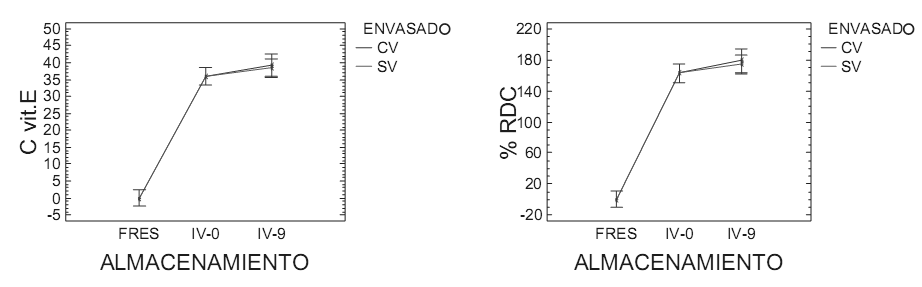
<body><![CDATA[<p><font size="2" face="Verdana, Arial, Helvetica, sans-serif">The       concentration of dl-&#945;-tocopherol acetate in the emulsion was       determined in order to reach the defined concentration in the product,       taking into account the fruit response to vacuum impregnation. VI       experiments were carried out in specially designed equipment (32, 33)       and the parameter evaluated was the volume fraction of emulsion, X (m<sup>3 </sup>emulsion / m<sup>3 </sup>fruit), the mass ratio, X<sub>HDM </sub>(Kg         emulsion / Kg impregnated fruit) and the effective porosity of the         sample (&epsilon;) available to the hydrodynamic mechanism (HDM). This         was quantified by applying a previously described methodology (26),         which is through the control of mass and density sample before and         after impregnation process. Therefore in the impregnation process, the         vacuum (50 mbars) step deformation was considered insignificant and it         doesn"t have any atmospheric pressure (32, 33). </font></p>       <p><font size="2" face="Verdana, Arial, Helvetica, sans-serif">The       Freeze-Dried Equipment was a laboratory lyophilizer LIOALFA 6-80,       TELSTAR for 48 h, condenser temperature: -45&ordm;C, hot plate       temperature: 25&ordm;C and vacuum: 1.2 x 10<sup>-2 </sup>mbar. Moisture level in dried samples ranged between 5-7%. </font></p>       <p><font size="2" face="Verdana, Arial, Helvetica, sans-serif">The       extraction process used (31) is a modification of Kmostak`s method       (34), by incorporation of ultrasound treatment instead of agitation.       The analytical determination was carried out in a gas chromatography       (CG-FID) - Fisons Instrument model NPD 800. The       dl-&#945;-tocopherol acetate was quantified from calibrations curves.       To obtain it, we prepared dissolutions with 0.250, 0.5 y 1 mg/ml       internal standard intern (squalane) and standard reference       (dl-&#945;-tocopheryl acetate, 99.1% Supelco or dl-&#945;-tocopherol,       99.8% Supelco). Operating conditions: detector and injector       temperature: 320&ordm;C and 300&ordm;C respectively, initial column       temperature, 120&ordm;C, initial ramp programmed at 20 &ordm;C/min to       240&ordm;C; end ramp programmed at 5&ordm;C/min to 300&ordm;C and       keeping 2 min at 300&ordm;C. Carrier gas: Helium 5.0, ratio split:       1/11.4, Flow velocity: 1.2 mL/min.; make-up pressure (N<sub>2</sub>):         120 kPa. Chromatographic column: DB-5, J&amp;W Scientific, 30m x 0.32         mm I.D.: 0.25 &mu;m. The injection in the CG-FID was 2 &mu;L per         sample. Under these conditions, squalane, dl-&#945;-tocopherol and         dl-&#945;-tocopherol acetate had retention times of 12.5, 17.9 y 18.5         min respectively. For the study, each condition was made by triplets. </font></p>       <p><font size="2" face="Verdana, Arial, Helvetica, sans-serif">The       color was tested with a Minolta Spectra Magic CM-3600D       spectrocolorimeter, illuminant D65 for the 10&ordm; observer. The color       parameters values of lightness (L<sup>*</sup>), chromaticity greenness / redness (a<sup>*</sup>), chromaticity blueness/yellowness (b<sup>*</sup>), hue (h<sub>ab </sub><sup>*</sup>) and chroma (C<sub>ab </sub><sup>*</sup>) were recorded. The samples were evaluated thirty six times for each storage condition. </font></p>       <p><font size="2" face="Verdana, Arial, Helvetica, sans-serif">The       mechanical tests were carried out at 25 &ordm;C with a Universal       Texture Analyzer TA.XT2 (Stable Micro Systems). A penetration test was       carried out with plastic probe 10 mm diameter, strain 95% and test rate       2 mm/sec. From the force - % relative deformation curves       obtained, force deformation at 95% (F<sub>95%</sub>), force deformation constant (F<sub>f</sub>) and the % initial relative deformation (&#947;<sup>&ordm;</sup>) and end (&#947;<sup>f</sup>), keeping F<sub>f</sub>. Six samples were evaluated for each storage condition. </font></p>       <p><font size="2" face="Verdana, Arial, Helvetica, sans-serif">The temperature"s determination of vitreous transition (T<sub>g</sub>)       of the freeze-dried emulsion was made in a differential scanning       calorimeter (DSC) made by Seiko Instruments, model DSC-5200CO, Chiba,       Japan. The samples were equilibrated to 20&ordm;C according to the       procedure described for the obtention of the sorption"s isotherms       (35). The study samples" size was approximately 25 mg and they       were set in crucibles of sealed aluminum. The interval of       temperature"s scanning was between -110 y 60&ordm;C,       depending on the samples and the velocity of the scanning in the       warning"s stage was 5&ordm;C/min. </font></p>       <p><font color="#221e1f" size="2" face="Verdana, Arial, Helvetica, sans-serif">The samples were packed in plastic bags: Polyamide / Polyetilen (reference RCA 20-70 Eurobag) with oxygen permeability (O<sub>2</sub>), 40-50 cm<sup>3</sup>/m<sup>2</sup>; water permeability, 2.6 g/m<sup>2</sup>; nitrogen permeability (N<sub>2</sub>), 10 cm<sup>3</sup>/m<sup>2 </sup>and oxygen permeability carbon dioxide (CO<sub>2</sub>), 150 cm<sup>3</sup>/m<sup>2</sup>.       The samples were stored under vacuum (CV) and at atmospheric conditions       (SV). The products were stored at 4, 20 y 30&ordm;C and controls at 0,       30, 60, 90 and 180 days were made. </font></p>       <p>&nbsp;</p>       <p><font size="3" face="Verdana, Arial, Helvetica, sans-serif"><b>RESULTS AND DISCUSSION</b></font></p>       <p><font size="2" face="Verdana, Arial, Helvetica, sans-serif"><b> Vacuum Impregnation</b></font></p>       ]]></body>
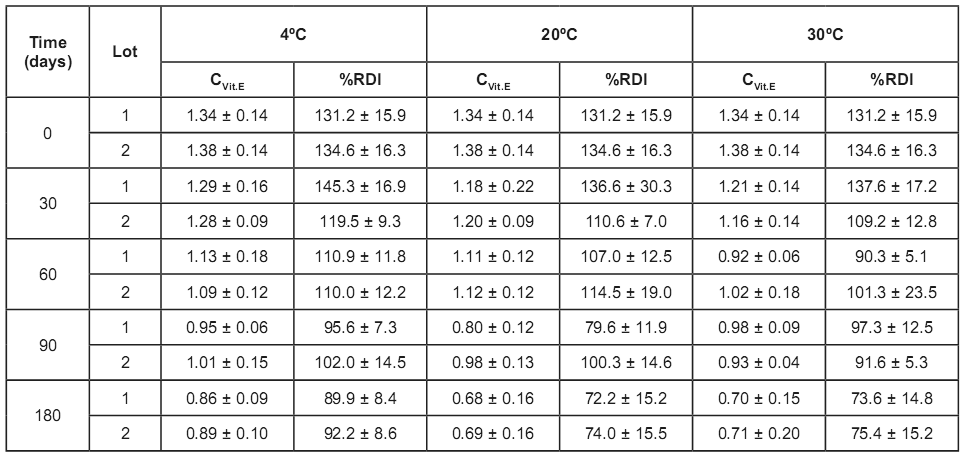
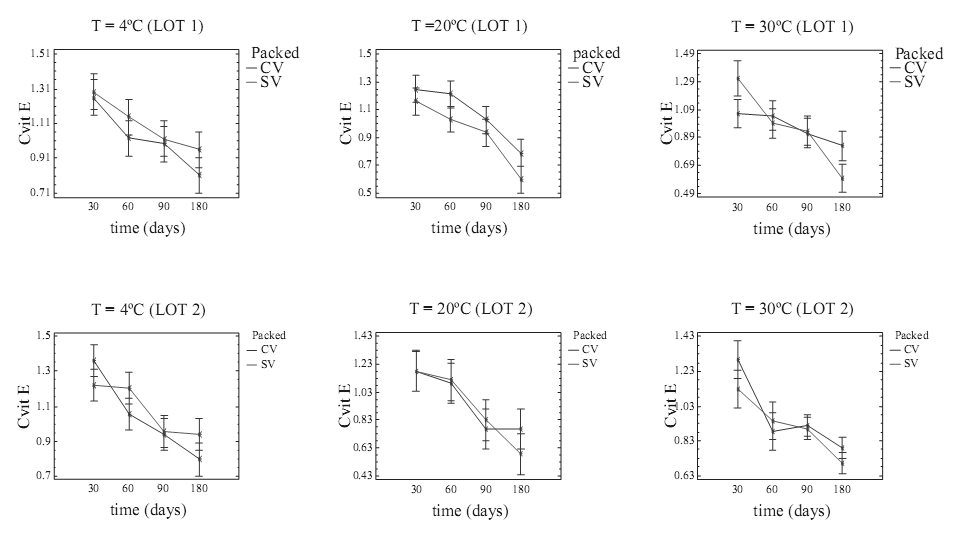
<body><![CDATA[<p><font size="2" face="Verdana, Arial, Helvetica, sans-serif">The characterization of response to impregnation        showed an excellent reproducibility for two lots, X        = 0.09 &plusmn; 0.03, X<sub>HDM</sub> = 0.11 &plusmn; 0.03 and &epsilon;	= 0.10 &plusmn;    0.03. The impregnation levels are less than to those obtained by using isotonic sucrose solutions (36),    this  is  attributable mainly  for  to  the  interactions    of  pectins  in  the  apple with Ca<sup>+2</sup> ions  present  in  the  emulsion  (37),  that block  the  inside  f low  because of jellification. Also, the structure and the  mechanicals properties of  solid matrix  (32) help  at  the  contraction  of  porous  during  process  for  the  coupling  of  the  impregnation-deformation  phenomena during the pressure change.</font></p>       <p><font size="2" face="Verdana, Arial, Helvetica, sans-serif"><b>Product"s Stability</b></font></p>       <p><font size="2" face="Verdana, Arial, Helvetica, sans-serif"><a href="#g01">Figure  1</a> shows  the  average  values  (and LSD        intervals, 95%) of concentration of dl-&#945;-tocopherol        acetate reached at each storage time and temperature        for samples stored under vacuum and at atmospheric      conditions.</font></p>       <p>&nbsp;</p>       <p align="center"><font size="2" face="Verdana, Arial, Helvetica, sans-serif"><a name="g01" id="g01"></a><a href="/img/revistas/vitae/v16n1/a04g01.gif"><img src="/img/revistas/vitae/v16n1/a04g01th.gif" border="2" /></a></font></p>       <p align="center"><font size="2" face="Verdana, Arial, Helvetica, sans-serif"><b>Figure 1.</b> Medium values (and LSD intervals, 95%) of concentration of dl-&#945;-tocopherol        acetate (CVit.E) reached at each storage time and temperature for samples stored under      vacuum (CV) and at atmospheric conditions (SV) </font></p>       <p>&nbsp;</p>       <p><font size="2" face="Verdana, Arial, Helvetica, sans-serif">In two lots, the multifactor ANOVA did not reflect        significant differences between the concentrations of        dl-&#945;-tocopherol  acetate  (C<sub>Vit.E</sub>)  associated with  the        vacuum packing. This is attributable to the protection        that could be having the molecules of the component        with vitamin activity when they remain encapsulated        by the peptic components" jellification of the cellular        wall with the Ca<sup>+2</sup>. Therefore, mean values (SV and        CV) of the corresponding values at each temperature-time condition were considered for kinetic analysis.        The  <a href="#t01">table 1</a>  show  the medium values of CVit.E and      %RDI and its standard deviations for of both lots.</font></p>       <p>&nbsp;</p>       <p align="center"><font size="2" face="Verdana, Arial, Helvetica, sans-serif"><a name="t01" id="t01"></a><a href="/img/revistas/vitae/v16n1/a04t01.gif"><img src="/img/revistas/vitae/v16n1/a04t01th.gif" border="2" /></a></font></p>       ]]></body>
<body><![CDATA[<p align="center"><font size="2" face="Verdana, Arial, Helvetica, sans-serif"><b>Table 1.</b> Medium Values of C<sub>Vit.E</sub> and % RDI and its standard deviation for lots 1 and 2.</font></p>       <p>&nbsp;</p>       <p><font size="2" face="Verdana, Arial, Helvetica, sans-serif">C<sub>Vit.E</sub> data variability is high and it is due to  the differences in the impregnation levels of the different samples  which take to initial concentrations different in every one of them.  Moreover, the oxidation process can also present fluctuations from some  samples to others because of the catalytic effect of some factors as  metal presence, free radicals, etc. which can present variability from  some samples to others. Otherwise, the tocopherol extraction process  for its analysis, presents a source of variability, as the right to the  proper analysis. </font></p>       <p><font size="2" face="Verdana, Arial, Helvetica, sans-serif">It  is observed that some medium values of the reached %DRI are superior to  the estimated in the theoretic calculus (100%). The reason is that  principally during vacuum stage, in the impregnation process; part of  the native apple liquid (in the intercellular spaces or in the open  cellules) comes out from the structures and is replaced by a mayor  quantity of emulsion. The evaluated impregnation quantity, by  difference of weight in the samples, before and after the in vacuum  operation, does not take into account this liquid interchange. Due to  this, the quantity of gained emulsion is evaluated by change. This  effect becomes very important, when the increase in the relation  surface / volume allows space to a bigger number of cut cells and to a  shorter run of the native liquid in the intercellular spaces during  their expulsion by vacuum. </font></p>       <p><font size="2" face="Verdana, Arial, Helvetica, sans-serif">The temperature influence over the C<sub>Vit. E</sub>,  showed that exists significant differences, presenting two homogenous  groups in both lots, for the lot one: 4-20&deg;C and 20-30&deg;C and for the  lot two, 4&deg;C and 20-30&deg;C. In terms of time, for both lots there are  very significant differences, which are explained by the fast diffusion  of the air to the interior of the product"s porous structure, as well  as the synergy with the temperature becomes mayor with the increase of  this, also favoring the oxidation reactions and the decomposition. </font></p>       <p><font size="2" face="Verdana, Arial, Helvetica, sans-serif"><b>Kinetic results </b></font></p>       <p><font size="2" face="Verdana, Arial, Helvetica, sans-serif">The first order velocity equation (<a href="#eq01">equation 1</a>) (38)  was the one which presented the best description of the dl-&#945;-tocopherol  acetate losses regarding time. <a href="#g02">Figure 2</a> shows the kinetics adjustment  of the data and their straight to 4, 20 and 30&ordm;C for each one of the  lots. The <i>K</i><b>&acute; </b>pendant in the graphic represents the constant of degradation velocity dl-&#945;-tocopherol acetate, being C<sup>t</sup> <sub>Vit.E</sub> y C&ordm;<sub>Vit.E</sub> the concentrations of dl-&#945;-tocopherol acetate to time t and to time zero, respectively. </font></p>       <p>&nbsp;</p>       <p align="center"><font size="2" face="Verdana, Arial, Helvetica, sans-serif"><a name="eq01" id="eq01"></a><img src="/img/revistas/vitae/v16n1/a04eq01.gif" /></font></p>       <p align="center"><font size="2" face="Verdana, Arial, Helvetica, sans-serif"><b>Ecuaci&oacute;n 1.</b> </font></p>       ]]></body>
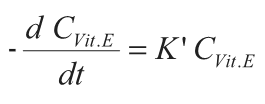
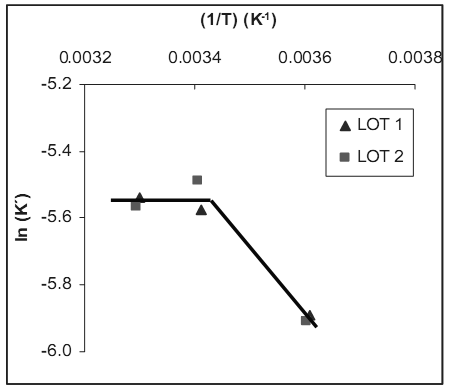
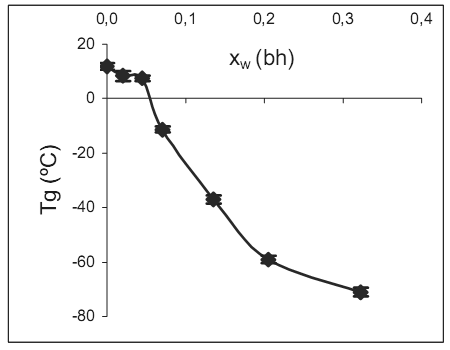
<body><![CDATA[<p>&nbsp;</p>       <p align="center"><font size="2" face="Verdana, Arial, Helvetica, sans-serif"><a name="g02" id="g02"></a><a href="/img/revistas/vitae/v16n1/a03g04.gif"><img src="/img/revistas/vitae/v16n1/a03g04th.gif" border="2" /></a></font></p>       <p align="center"><font size="2" face="Verdana, Arial, Helvetica, sans-serif"><b>Figure  2.</b> Kinetic model fitted of the degradation of dl-&#945;-tocopherol acetate  at 4, 20 y30&ordm;C as a function of temperature and storage time. </font></p>       <p>&nbsp;</p>       <p><font size="2" face="Verdana, Arial, Helvetica, sans-serif">The kinetics constants (<i>K</i>&acute;) to both lots increased with temperature, that can be attributed to high samples" porosity which makes easier  the biggest oxygen's diffusion to the intercellular spaces of the tissue where it is found the dl-&#945;-tocopherol acetate      distributed by the impregnation process. <a href="#g03">Figure 3</a> presents the Arrhenius" graphic, where it is observed      an abrupt change in the behavior when passing from 4 to 20&deg;C, which does not alow a good adjustment in its equation. The fraction of the soluble apples" (in which it is encapsulated the dl-&#945;-tocopherol acetate in the intercellular spaces) with the presented humidity (5-7%), it can present a vitreous transition between 4 y 20&deg;C, which would imply a drastic in the diffusion properties of the matrix and as a consequence, in the product stability.</font></p>       <p>&nbsp;</p>       <p align="center"><font size="2" face="Verdana, Arial, Helvetica, sans-serif"><a name="g03" id="g03"></a><img src="/img/revistas/vitae/v16n1/a04g03.gif" /></font></p>       <p align="center"><font size="2" face="Verdana, Arial, Helvetica, sans-serif"><b>Figure 3.</b> Semi-logarithmic representation of the kinetic constant (<i>K&acute;</i>) vs. 1/T (K<sup>-1</sup>) on freeze-dried apple fortified with vitamin E.</font></p>       <p>&nbsp;</p>       <p><font size="2" face="Verdana, Arial, Helvetica, sans-serif"><a href="#g04">Figure  4</a>,  presents  the  evolution  of  vitreous        transition  temperature  values  (T<sub>g</sub> )  taken  in  the        transition interval middle point of the thermograms obtained  from  the  impregnated  freeze-dried        emulsion,  as will  be  found  in  the  freeze-dried        apple"s  porous  and  according  to  humidity  content. The T<sub>g</sub> diminished with the increase of the  sample"s a<sub>w</sub> due to plasticizer effect water has (39).  The behaviour of the T<sub>g</sub> in low humidity (a<sub>w</sub> between 0.112 y 0.225) presents a very low inf luence  of the moisture, while the plasticizer effect intensifies with a<sub>w</sub> values over 0.225. In equilibrium state  to  the humidity conditions of  the final product,  the product would have a a<sub>w</sub> between 0.11 y 0.22,  with values of T<sub>g</sub> of 8.3 and 7.5&deg;C respectively. It  supposes that in inferior temperature conditions  the emulsion solid, which encapsulates the component with  vitamin E, will  be  vitreous, while  in higher  temperatures  it will  be  rubbery. The  kinetics for the oxygen diffusion in this last case  will be much faster, with the consequent increase  of the degradation velocity. </font></p>       ]]></body>
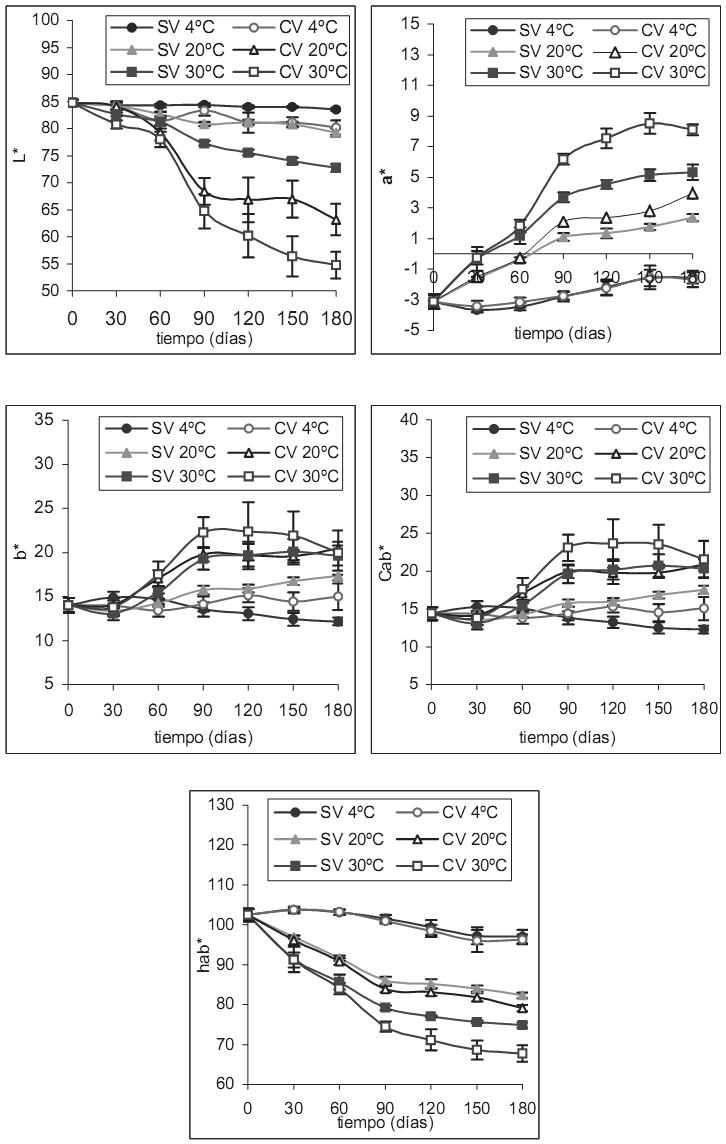
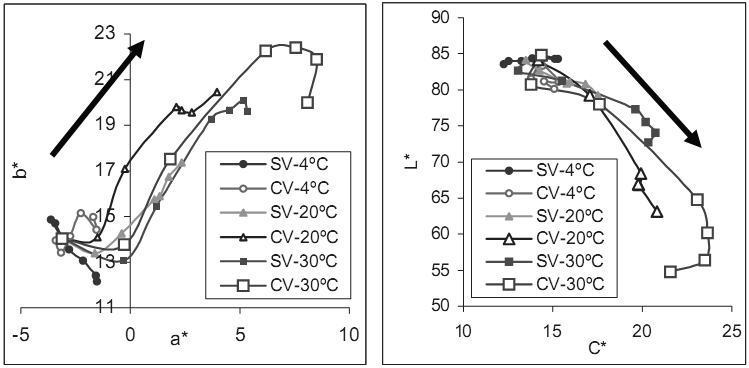
<body><![CDATA[<p><font size="2" face="Verdana, Arial, Helvetica, sans-serif">These results are coherent with the  storage"s        temperature inf luence in the degradation kinetics        of the vitamin E, which accelerates a lot to 20 y 30      &ordm;C  in relation  to 4&ordm;C,  in which solids would be        in vitreous state conferring much higher stability        to  the  encapsulated  vitamin. The  possibility  of        mayor  stability  in  higher  storage  temperatures        would  imply  the  emulsion"s  reformulation  to        obtain anhydrous solids with higher value of T<sub>g</sub>      ,      which assures their vitreous state in the required storage temperature. </font></p>       <p>&nbsp;</p>       <p align="center"><font size="2" face="Verdana, Arial, Helvetica, sans-serif"><a name="g04" id="g04"></a><img src="/img/revistas/vitae/v16n1/a04g04.gif" /></font></p>       <p align="center"><font size="2" face="Verdana, Arial, Helvetica, sans-serif"><b>Figure 4.</b> Curve of the vitreous transition against the ransition against the humidity of the freeze-dried emulsion. </font></p>       <p>&nbsp;</p>       <p><font size="2" face="Verdana, Arial, Helvetica, sans-serif"><b>Color</b></font></p>       <p><font size="2" face="Verdana, Arial, Helvetica, sans-serif"><a href="#g05">Figure 5</a> illustrates the L<sup>*</sup>      , a<sup>*</sup>      , b<sup>*</sup>      , C<sub>ab</sub><sup>*</sup>      y h<sub>ab</sub>      <sup>*</sup> evolution      during the 180 days of storage to 4, 20 y 30&ordm;C packing,      with  and without vacuum. The  samples of  apples      fortified with vitamin E present,  in  the beginning,     high luminosity values, a greenish color (&gt; h<sub>ab</sub> <sup>*</sup> ) and a      little intense (&lt; C<sub>ab</sub> <sup>*</sup> ). During the storage, the porosity      seems to play a decisive role in the color deterioration,      probably when favoring the oxidations.      To 4&deg;C exist significant differences in terms of      time in all the parameters, except in L<sup>*</sup> (samples SV).      The decrease of L<sup>*</sup> (samples CV) can be attributed      to volumetric contractions of the samples and their      compactation because of  the  vacuum"s mechanic      effect. The samples presented higher matrix"s contraction, as much as the storage time was higher.      This is due to the high samples" porosity and to the      solid matrix"s rubbery induced by the progressive adsorption  of  the water  through  the  pack, with      certain permeability to the vapor of water. The color purity increased progressively with the storage      (associate to an increase of b<sup>*</sup> ) much more notable      in the CV samples. The a<sup>*</sup> and h<sub>ab</sub> <sup>*</sup> parameters did      not present significant differences associated to the  packing type (CV y SV).</font></p>       <p><font size="2" face="Verdana, Arial, Helvetica, sans-serif">To 20&ordm;C exist significant differences in terms of        time and packing"s conditions, being the luminosity        (L<sup>*</sup> ) so similar during the first 30 days and after an        abrupt decrease in the samples CV according to the        SV ones, here  the  samples"  contraction  also play        an  important role  in  this evolution. The CV and        SV samples start to foster more the reddish yellow  colors, ref lecting in the increasing of a<sup>*</sup> y b<sup>*</sup>.</font></p>       <p><font size="2" face="Verdana, Arial, Helvetica, sans-serif">To 30&deg;C it exist differences highly significant        in all the color"s parameters because all the factors.        In the SV samples the velocity of  luminosity  loss        was smaller. The b<sup>*</sup> parameter in the SV and CV  samples  presented  and  increase  to  90  days  and  from here the curves tend to be asymptotic, while  a<sub><sup>*</sup></sub> always was crescent in the SV and CV samples  being promoted  the  reddish yellow  colors  in  the  CV samples against the SV ones.</font></p>       <p><font size="2" face="Verdana, Arial, Helvetica, sans-serif"><a href="#g06">Figure 6</a> presents the color's evolution with the time in the chromatics planes a<sup>*</sup>      b<sup>*</sup> and L<sup>*</sup> C<sub>ab</sub>      <sup>*</sup> . It is      observed that to 4&deg;C the variation in both graphics      is not very critic to total color change, while to 20      y 30&deg;C in the a<sup>*</sup> b<sup>*</sup>"s plane it is observed a tendency      to pass from a greenish yellow to an orange. This      color"s  trajectory  is  also present  to  the grey zone      because of the low purity and the low reached levels      of L<sup>*</sup> . In the L<sup>*</sup> C<sub>ab</sub><sup>*</sup>"s plane it is clearly observed the      pass from pale colors to dark ones while the time  and the temperature of storage increase.</font></p>       ]]></body>
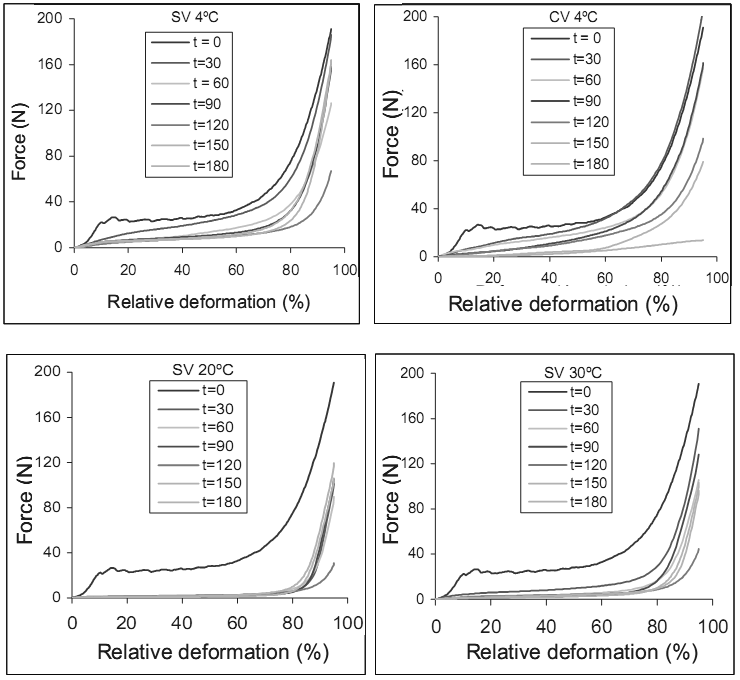
<body><![CDATA[<p>&nbsp;</p>       <p align="center"><font size="2" face="Verdana, Arial, Helvetica, sans-serif"><a name="g05" id="g05"></a><a href="/img/revistas/vitae/v16n1/a04g05.gif"><img src="/img/revistas/vitae/v16n1/a04g05th.gif" border="2" /></a></font></p>       <p align="center"><font size="2" face="Verdana, Arial, Helvetica, sans-serif"><b>Figure 5.</b> Color parameters L<sup>*</sup>, a<sup>*</sup>, b<sup>*</sup>, C<sub>ab</sub><sup>*</sup> y h<sub>ab</sub><sup>*</sup> in storage"s time function. </font></p>       <p>&nbsp;</p>       <p align="center"><font size="2" face="Verdana, Arial, Helvetica, sans-serif"><a name="g06" id="g06"></a><a href="/img/revistas/vitae/v16n1/a04g06.gif"><img src="/img/revistas/vitae/v16n1/a04g06th.gif" border="2" /></a></font></p>       <p align="center"><font size="2" face="Verdana, Arial, Helvetica, sans-serif"><b>Figure 6.</b> Evolution of the experimental points in the a<sup>*</sup>b<sup>*</sup> y L<sup>*</sup>C<sub>ab</sub> <sup>*</sup> color"s planes, during the storage. </font></p>       <p>&nbsp;</p>       <p><font size="2" face="Verdana, Arial, Helvetica, sans-serif">Food  color  is  affected  by multiple  factors        (process, process conditions, storage, etc.) (40, 41,        42, 20). The application of the IV process modifies        the food optical properties, increasing the absorbed        light over the surface which makes the samples look        lighter (&lt;L<sup>*</sup> ) (43, 44).        Previous  researches  in  freeze-dried  apple        fortified with vitamin E using conventional dried,        don"t show significative changes during storage to        4&ordm;C  and 180 days, whereas  to 20  and 30&ordm;C,  the        browning phenomena become stronger, rising the        L<sup>*</sup> and a<sup>*</sup> values and decreasing b<sup>*</sup> (45, 46). The color  parameters in freeze-dried fortified with vitamin  E samples were lighter (&gt;L<sup>*</sup> ), with more greenness  (&lt;a<sup>*</sup> ), and less yellow (&gt;b<sup>*</sup> ).</font></p>       <p><font size="2" face="Verdana, Arial, Helvetica, sans-serif"><b>Texture</b></font></p>       <p><font size="2" face="Verdana, Arial, Helvetica, sans-serif"> During  the  storage  some  samples  presented        structural changes due to the vacuum effect applied        in  packing  and  for  the  progressive humectation        through  the  package. The CV  samples  stored        at  20&ordm;C  and  30&ordm;C  presented,  after  30  days,  an        approximated volumetric contraction from the 70        to  the 80%, associated  to  the mechanic action of        the vacuum due to the limited mechanic resistance        of the matrix solid to those temperatures. To 4&ordm;C        the effects were smaller which is explained by the        higher matrix"s rigidity in those temperatures. In        <a href="#g07">figure 7</a> it is given the representatives curves to 4&ordm;C        (SV y CV), SV 20&ordm;C and SV 30&ordm;C compared with a  control sample at the beginning of the storage where the product presents crunchy characteristics (F<sub>95</sub> = 202.0 &plusmn; 10.7 N, F<sub>f</sub>= 29.1 &plusmn; 3.1 N, &#947;&deg; = 14.5 &plusmn;   2.8 % and  &#947;<sup>f</sup> = 47.7 &plusmn; 8.5%). It is observed that the samples to 4&deg;C, in the first control (30 days) already present a sigmoidal form which reflexes the loss of       the crunchy characteristics of the product due to the hygroscopicity of the samples and the permeability       to vapor water of the package commented before. This phenomenon becomes more critical in the samples storage to 20 and 30&deg;C.       Rubbery texture characteristics have been found in air-dried apple fortified with vitamin E (46) making different the freeze-dried samples, by presenting a crunchy texture at the beginning of the storage.</font></p>       ]]></body>
<body><![CDATA[<p><font size="2" face="Verdana, Arial, Helvetica, sans-serif"><b>Shelf life's prediction</b> </font></p>       <p><font size="2" face="Verdana, Arial, Helvetica, sans-serif">The shelf life time (t<sub>s</sub>) in constant temperature conditions  and water  activity,  can  be  predicted        with  regard  to  a  final wished  concentration  of        dl-&#945;-tocopherol acetate (C<sup>f</sup>      <sub>Vit E</sub>). For this study, t<sub>s</sub> has been evaluated in base to the reduction of the        concentration of dl-&#945;-tocopherol acetate in 50%,        that means, t<sub>1/2</sub> (C<sup>f</sup> <sub>Vit E</sub> = 0.5 C&ordm;<sub>Vit.E</sub>). The average of  t<sub>1/2</sub> in the two lots of the products freeze-dried at  4, 20 y 30&ordm;C were 253, 175 y 179 days respectively.  In terms of color, to 4&ordm;C the freeze-dried samples  were acceptable until the 180 days, but the samples  storage  to  20  and  30&ordm;C  in  any  condition of SV  and CV  packing  just would  be  acceptable until  30 days.</font></p>       <p>&nbsp;</p>       <p align="center"><font size="2" face="Verdana, Arial, Helvetica, sans-serif"><a name="g07" id="g07"></a><a href="/img/revistas/vitae/v16n1/a04g07.gif"><img src="/img/revistas/vitae/v16n1/a04g07th.gif" border="2" /></a></font></p>       <p align="center"><b>Figure 7.</b> Comprehension test (force against % relative deformation) in the samples to 4&deg;C (SV and CV), SV 20&deg;C and SV 30&deg;C.</p>       <p>&nbsp;</p>       <p><font size="3" face="Verdana, Arial, Helvetica, sans-serif"><b>CONCLUSIONS</b></font></p>       <p> <font size="2" face="Verdana, Arial, Helvetica, sans-serif">&bull;  Vacuum impregnation of apple samples allows        us their fortification with vitamin E previously        emulsified in an adequate media. Freeze-drying        of samples did not imply loss of vitamin but its        degradation  occurs  progressively,  depending        on  temperature, when  packed  in  polyamide/ polyethylene bags with or without vacuum.</font></p>       <p><font size="2" face="Verdana, Arial, Helvetica, sans-serif">&bull;  Storage temperature higher than a critical value        (between 4 and 20 &ordm;C) implied faster degradation        of vitamin E. The level of vitamin E at 180 days        was of 92, 74 y 75 % RDI at temperatures 4, 20  y 30&ordm;C, respectively.</font></p>       <p><font size="2" face="Verdana, Arial, Helvetica, sans-serif">&bull;  The samples fortified with vitamin E and freeze-dried are very opaque and very ref lective due to gas occluded  in the porous, what makes them        look  so  light  at  the  beginning, moreover  the        velocity of luminosity loss and browning is too        high, so much in packing conditions (CV). To        4&ordm;C the samples present an acceptable color until        the 180 days, but the samples stored at 20 and 30&ordm;C  in any condition of SV and CV packing      would be acceptable until the 30 days.</font></p>       ]]></body>
<body><![CDATA[<p> <font size="2" face="Verdana, Arial, Helvetica, sans-serif">&bull;  The  texture  is  affected  negatively  by  the        vacuum packing due to the package used, with        some water  permeability. Low  temperatures        (4&ordm;C) help  to preserve  the  textural properties        of  the  freeze-dried products, but  it  is needed        an impermeable package to water to avoid the problems od humectation </font></p>       <p>&nbsp;</p>       <p><font size="3" face="Verdana, Arial, Helvetica, sans-serif"><b>REFERENCES</b></font></p>       <!-- ref --><p><font size="2" face="Verdana, Arial, Helvetica, sans-serif">1. Thomas PR, Earl R. Enhancing the food supply. En: Thomas PR,      Earl R, editores. Opportunities in the Nutrition and Food Sciences. Washington: National Academy Press; 1994. p 98-142.</font>&nbsp;&nbsp;&nbsp;&nbsp;&nbsp;&nbsp;&nbsp;&nbsp;[&#160;<a href="javascript:void(0);" onclick="javascript: window.open('/scielo.php?script=sci_nlinks&ref=000106&pid=S0121-4004200900010000400001&lng=','','width=640,height=500,resizable=yes,scrollbars=1,menubar=yes,');">Links</a>&#160;]<!-- end-ref --><!-- ref --><p><font size="2" face="Verdana, Arial, Helvetica, sans-serif"> 2.  O"Donnell E. Functional Foods-Designed for Health. Leatherhead Food RA. Food Industry Journal. 1998; 1: 10-17.</font>&nbsp;&nbsp;&nbsp;&nbsp;&nbsp;&nbsp;&nbsp;&nbsp;[&#160;<a href="javascript:void(0);" onclick="javascript: window.open('/scielo.php?script=sci_nlinks&ref=000107&pid=S0121-4004200900010000400002&lng=','','width=640,height=500,resizable=yes,scrollbars=1,menubar=yes,');">Links</a>&#160;]<!-- end-ref --><!-- ref --><p><font size="2" face="Verdana, Arial, Helvetica, sans-serif">      3.  Robertfroid M. Defining Functional Food. En: Gibson G, Williams CM,  editores. Functional Foods: Concepts  to product.        Cambridge: Woodhead; 2000. p. 9-29.</font>&nbsp;&nbsp;&nbsp;&nbsp;&nbsp;&nbsp;&nbsp;&nbsp;[&#160;<a href="javascript:void(0);" onclick="javascript: window.open('/scielo.php?script=sci_nlinks&ref=000108&pid=S0121-4004200900010000400003&lng=','','width=640,height=500,resizable=yes,scrollbars=1,menubar=yes,');">Links</a>&#160;]<!-- end-ref --><!-- ref --><p><font size="2" face="Verdana, Arial, Helvetica, sans-serif"> 4.  Menrad K. Market and Marketing of Functional Food in Europe.        J Food Eng. 2003; 56 (2-3): 181-188.</font>&nbsp;&nbsp;&nbsp;&nbsp;&nbsp;&nbsp;&nbsp;&nbsp;[&#160;<a href="javascript:void(0);" onclick="javascript: window.open('/scielo.php?script=sci_nlinks&ref=000109&pid=S0121-4004200900010000400004&lng=','','width=640,height=500,resizable=yes,scrollbars=1,menubar=yes,');">Links</a>&#160;]<!-- end-ref --><!-- ref --><p><font size="2" face="Verdana, Arial, Helvetica, sans-serif"> 5.  Xu Y. Perspectives on the 21st century development of functional        foods: bringing Chinese medicated diet and functional foods. Int        J Food Sci Technol. 2001; 36 (3): 229-242.</font>&nbsp;&nbsp;&nbsp;&nbsp;&nbsp;&nbsp;&nbsp;&nbsp;[&#160;<a href="javascript:void(0);" onclick="javascript: window.open('/scielo.php?script=sci_nlinks&ref=000110&pid=S0121-4004200900010000400005&lng=','','width=640,height=500,resizable=yes,scrollbars=1,menubar=yes,');">Links</a>&#160;]<!-- end-ref --><!-- ref --><p><font size="2" face="Verdana, Arial, Helvetica, sans-serif">D&aacute;valos A, Bartolom&eacute; B, G&oacute;mez-Cordob&eacute;s C. Futura Tendencia        de la Alimentaci&oacute;n. Alimentaci&oacute;n, Equipos y Tecnolog&iacute;a. 2000;  19 (1): 191-196.</font>&nbsp;&nbsp;&nbsp;&nbsp;&nbsp;&nbsp;&nbsp;&nbsp;[&#160;<a href="javascript:void(0);" onclick="javascript: window.open('/scielo.php?script=sci_nlinks&ref=000111&pid=S0121-4004200900010000400006&lng=','','width=640,height=500,resizable=yes,scrollbars=1,menubar=yes,');">Links</a>&#160;]<!-- end-ref --><!-- ref --><p><font size="2" face="Verdana, Arial, Helvetica, sans-serif"> 7.  Wang X, Quinn PJ. Vitamin E and Function in membranes. Prog        Lipid Res. 1999; 38 (4): 309-326.</font>&nbsp;&nbsp;&nbsp;&nbsp;&nbsp;&nbsp;&nbsp;&nbsp;[&#160;<a href="javascript:void(0);" onclick="javascript: window.open('/scielo.php?script=sci_nlinks&ref=000112&pid=S0121-4004200900010000400007&lng=','','width=640,height=500,resizable=yes,scrollbars=1,menubar=yes,');">Links</a>&#160;]<!-- end-ref --><!-- ref --><p><font size="2" face="Verdana, Arial, Helvetica, sans-serif"> 8.  Curtay JP, Lyon J. La Enciclopedia Pr&aacute;ctica de las Vitaminas, las        Sales Minerales y los Oligoelementos. Espa&ntilde;a: Salvat; 2000. p.        127-136.</font>&nbsp;&nbsp;&nbsp;&nbsp;&nbsp;&nbsp;&nbsp;&nbsp;[&#160;<a href="javascript:void(0);" onclick="javascript: window.open('/scielo.php?script=sci_nlinks&ref=000113&pid=S0121-4004200900010000400008&lng=','','width=640,height=500,resizable=yes,scrollbars=1,menubar=yes,');">Links</a>&#160;]<!-- end-ref --><!-- ref --><p><font size="2" face="Verdana, Arial, Helvetica, sans-serif"> 9.  Kritharides L, Stocker R. The use of antioxidant supplements        in coronary hearth disease. Atherosclerosis. 2002; 164 (2): 211-       219.</font>&nbsp;&nbsp;&nbsp;&nbsp;&nbsp;&nbsp;&nbsp;&nbsp;[&#160;<a href="javascript:void(0);" onclick="javascript: window.open('/scielo.php?script=sci_nlinks&ref=000114&pid=S0121-4004200900010000400009&lng=','','width=640,height=500,resizable=yes,scrollbars=1,menubar=yes,');">Links</a>&#160;]<!-- end-ref --><!-- ref --><p><font size="2" face="Verdana, Arial, Helvetica, sans-serif"> 10.  Bast A, Haenen GRMM. The toxicity of antioxidants and their        metabolites. Environ Toxicol Pharmacol. 2002; 11  (3-4): 251-       258.</font>&nbsp;&nbsp;&nbsp;&nbsp;&nbsp;&nbsp;&nbsp;&nbsp;[&#160;<a href="javascript:void(0);" onclick="javascript: window.open('/scielo.php?script=sci_nlinks&ref=000115&pid=S0121-4004200900010000400010&lng=','','width=640,height=500,resizable=yes,scrollbars=1,menubar=yes,');">Links</a>&#160;]<!-- end-ref --><!-- ref --><p><font size="2" face="Verdana, Arial, Helvetica, sans-serif"> 11.  Cort WM, Mergens W, Greene A. Stability of &#945; y &#947;-Tocopherol:        Fe<sup>+3</sup>      y Cu<sup>+2</sup>      interactions. J Food Sci. 1978; 43 (1): 797-798.</font>&nbsp;&nbsp;&nbsp;&nbsp;&nbsp;&nbsp;&nbsp;&nbsp;[&#160;<a href="javascript:void(0);" onclick="javascript: window.open('/scielo.php?script=sci_nlinks&ref=000116&pid=S0121-4004200900010000400011&lng=','','width=640,height=500,resizable=yes,scrollbars=1,menubar=yes,');">Links</a>&#160;]<!-- end-ref --><!-- ref --><p><font size="2" face="Verdana, Arial, Helvetica, sans-serif">12.  Bauerfeind J. Tocopherols in Food. En: Machlin LJ, editor. Vitamin E: a Comprehensive Treatise. New York: Deckker; 1980.        p. 99-167.</font>&nbsp;&nbsp;&nbsp;&nbsp;&nbsp;&nbsp;&nbsp;&nbsp;[&#160;<a href="javascript:void(0);" onclick="javascript: window.open('/scielo.php?script=sci_nlinks&ref=000117&pid=S0121-4004200900010000400012&lng=','','width=640,height=500,resizable=yes,scrollbars=1,menubar=yes,');">Links</a>&#160;]<!-- end-ref --><!-- ref --><p><font size="2" face="Verdana, Arial, Helvetica, sans-serif"> 13.  Widicus WA, Kird JR, Gregory JF. Storage stability of &#945;-Tocopherol in dehydrated model food system containing no fat. J Food        Sci. 1980; 46 (3): 813-816.</font>&nbsp;&nbsp;&nbsp;&nbsp;&nbsp;&nbsp;&nbsp;&nbsp;[&#160;<a href="javascript:void(0);" onclick="javascript: window.open('/scielo.php?script=sci_nlinks&ref=000118&pid=S0121-4004200900010000400013&lng=','','width=640,height=500,resizable=yes,scrollbars=1,menubar=yes,');">Links</a>&#160;]<!-- end-ref --><!-- ref --><p><font size="2" face="Verdana, Arial, Helvetica, sans-serif"> 14.  Widicus WA, Kird  JR. Storage  stability  of &#945;- Tocopherol  in        dehydrated model  food  system  containing methyl  linoleate.  J        Food Sci. 1981; 45 (4): 1015-1018.</font>&nbsp;&nbsp;&nbsp;&nbsp;&nbsp;&nbsp;&nbsp;&nbsp;[&#160;<a href="javascript:void(0);" onclick="javascript: window.open('/scielo.php?script=sci_nlinks&ref=000119&pid=S0121-4004200900010000400014&lng=','','width=640,height=500,resizable=yes,scrollbars=1,menubar=yes,');">Links</a>&#160;]<!-- end-ref --><!-- ref --><p><font size="2" face="Verdana, Arial, Helvetica, sans-serif"> 15.  Pieronen V, Varo P, Koivistoinen P. Stability of Tocopherols and        Tocotrienols during Storage of foods. J Food Comp Anal. 1998;        1 (2): 124-129.</font>&nbsp;&nbsp;&nbsp;&nbsp;&nbsp;&nbsp;&nbsp;&nbsp;[&#160;<a href="javascript:void(0);" onclick="javascript: window.open('/scielo.php?script=sci_nlinks&ref=000120&pid=S0121-4004200900010000400015&lng=','','width=640,height=500,resizable=yes,scrollbars=1,menubar=yes,');">Links</a>&#160;]<!-- end-ref --><!-- ref --><p><font size="2" face="Verdana, Arial, Helvetica, sans-serif"><br />   16.  Tai-Sun-Shun. Kinetic of antioxidant degradation in rice bran    on extruder stabilization processing. Food Sci Biotechnol. 1999;    7 (2): 47-31.</font>&nbsp;&nbsp;&nbsp;&nbsp;&nbsp;&nbsp;&nbsp;&nbsp;[&#160;<a href="javascript:void(0);" onclick="javascript: window.open('/scielo.php?script=sci_nlinks&ref=000121&pid=S0121-4004200900010000400016&lng=','','width=640,height=500,resizable=yes,scrollbars=1,menubar=yes,');">Links</a>&#160;]<!-- end-ref --><!-- ref --><p><font size="2" face="Verdana, Arial, Helvetica, sans-serif"> 17.  Albal&aacute; S, Veciana MT, Vidal MC, Marine A. Stability of Vitamin        A, E, and B complex in Infant Milk Claimed to have Equal Final        Composition in Liquid and Powdered Form. J Food Sci. 2000;  65 (6): 1052-1055. </font>&nbsp;&nbsp;&nbsp;&nbsp;&nbsp;&nbsp;&nbsp;&nbsp;[&#160;<a href="javascript:void(0);" onclick="javascript: window.open('/scielo.php?script=sci_nlinks&ref=000122&pid=S0121-4004200900010000400017&lng=','','width=640,height=500,resizable=yes,scrollbars=1,menubar=yes,');">Links</a>&#160;]<!-- end-ref --><!-- ref --><p><font size="2" face="Verdana, Arial, Helvetica, sans-serif"> 18.  Bramley PM, Elmadfa I, Kafatos A, Kelly FJ, Manios Y, Roxborough HE, et al. Review Vitamin E. J Sci Food Agr. 2000; 80:        913-938.</font>&nbsp;&nbsp;&nbsp;&nbsp;&nbsp;&nbsp;&nbsp;&nbsp;[&#160;<a href="javascript:void(0);" onclick="javascript: window.open('/scielo.php?script=sci_nlinks&ref=000123&pid=S0121-4004200900010000400018&lng=','','width=640,height=500,resizable=yes,scrollbars=1,menubar=yes,');">Links</a>&#160;]<!-- end-ref --><!-- ref --><p><font size="2" face="Verdana, Arial, Helvetica, sans-serif"> 19.  Yang CST, Atallah WA. Effect of four drying methods on  the        quality of intermediate moisture low bush blueberries. J Food        Sci. 1985; 50 (5): 1233-1237.</font>&nbsp;&nbsp;&nbsp;&nbsp;&nbsp;&nbsp;&nbsp;&nbsp;[&#160;<a href="javascript:void(0);" onclick="javascript: window.open('/scielo.php?script=sci_nlinks&ref=000124&pid=S0121-4004200900010000400019&lng=','','width=640,height=500,resizable=yes,scrollbars=1,menubar=yes,');">Links</a>&#160;]<!-- end-ref --><!-- ref --><p><font size="2" face="Verdana, Arial, Helvetica, sans-serif"> 20.  Krokida MK, Tsami E, Maroulis ZB. Kinetics on color changes        during drying of some fruits and vegetables. Drying Technology.        1998; 16 (1): 667-685.</font>&nbsp;&nbsp;&nbsp;&nbsp;&nbsp;&nbsp;&nbsp;&nbsp;[&#160;<a href="javascript:void(0);" onclick="javascript: window.open('/scielo.php?script=sci_nlinks&ref=000125&pid=S0121-4004200900010000400020&lng=','','width=640,height=500,resizable=yes,scrollbars=1,menubar=yes,');">Links</a>&#160;]<!-- end-ref --><!-- ref --><p><font size="2" face="Verdana, Arial, Helvetica, sans-serif"> 21.  Krokida MK, Maroulis ZB, Saravacos GD. The  effect of  the        method of drying on the color of dehydrated products. Int J Food        Sci Technol. 2001; 36 (1):53-59.</font>&nbsp;&nbsp;&nbsp;&nbsp;&nbsp;&nbsp;&nbsp;&nbsp;[&#160;<a href="javascript:void(0);" onclick="javascript: window.open('/scielo.php?script=sci_nlinks&ref=000126&pid=S0121-4004200900010000400021&lng=','','width=640,height=500,resizable=yes,scrollbars=1,menubar=yes,');">Links</a>&#160;]<!-- end-ref --><!-- ref --><p><font size="2" face="Verdana, Arial, Helvetica, sans-serif"> 22.  Bolin HR, Steele RJ. Nonenzymatic Browning in Dried Apples        during Storage. J Food Sci. 1987; 52 (6): 1654-1657.      </font>&nbsp;&nbsp;&nbsp;&nbsp;&nbsp;&nbsp;&nbsp;&nbsp;[&#160;<a href="javascript:void(0);" onclick="javascript: window.open('/scielo.php?script=sci_nlinks&ref=000127&pid=S0121-4004200900010000400022&lng=','','width=640,height=500,resizable=yes,scrollbars=1,menubar=yes,');">Links</a>&#160;]<!-- end-ref --><!-- ref --><p><font size="2" face="Verdana, Arial, Helvetica, sans-serif">23.  Sapers GM, Garzarella L, Pilizota V. Applications of browning        inhibitors  to  cup  apples  and  potato  by  vacuum  and  pressure        infiltration. J Food Sci. 1990; 55 (4): 1049-1053.</font>&nbsp;&nbsp;&nbsp;&nbsp;&nbsp;&nbsp;&nbsp;&nbsp;[&#160;<a href="javascript:void(0);" onclick="javascript: window.open('/scielo.php?script=sci_nlinks&ref=000128&pid=S0121-4004200900010000400023&lng=','','width=640,height=500,resizable=yes,scrollbars=1,menubar=yes,');">Links</a>&#160;]<!-- end-ref --><!-- ref --><p><font size="2" face="Verdana, Arial, Helvetica, sans-serif"> 24.  Mastrocola D, Severini C, Lerici C. Colorimetric  control of        enzymatic browning  in  fruit and vegetables. En: Spiess WEL,        Schubert H, editores. Engineering and Food. Londres: Elsevier        Applied Science; 1989. p. 662</font>&nbsp;&nbsp;&nbsp;&nbsp;&nbsp;&nbsp;&nbsp;&nbsp;[&#160;<a href="javascript:void(0);" onclick="javascript: window.open('/scielo.php?script=sci_nlinks&ref=000129&pid=S0121-4004200900010000400024&lng=','','width=640,height=500,resizable=yes,scrollbars=1,menubar=yes,');">Links</a>&#160;]<!-- end-ref --><!-- ref --><p><font size="2" face="Verdana, Arial, Helvetica, sans-serif"> 25.  Fito P. Modelling of vacuum osmotic dehydration of  foods.  J        Food Eng. 1994; 22 (1-4): 313-328.</font>&nbsp;&nbsp;&nbsp;&nbsp;&nbsp;&nbsp;&nbsp;&nbsp;[&#160;<a href="javascript:void(0);" onclick="javascript: window.open('/scielo.php?script=sci_nlinks&ref=000130&pid=S0121-4004200900010000400025&lng=','','width=640,height=500,resizable=yes,scrollbars=1,menubar=yes,');">Links</a>&#160;]<!-- end-ref --><!-- ref --><p><font size="2" face="Verdana, Arial, Helvetica, sans-serif">26.  Fito P, Pastor R. On  some diffusional mechanism occurring        Vacuum Osmotic Dehydration  (VOD).  J Food Eng. 1994; 21        (4): 513-519. </font>&nbsp;&nbsp;&nbsp;&nbsp;&nbsp;&nbsp;&nbsp;&nbsp;[&#160;<a href="javascript:void(0);" onclick="javascript: window.open('/scielo.php?script=sci_nlinks&ref=000131&pid=S0121-4004200900010000400026&lng=','','width=640,height=500,resizable=yes,scrollbars=1,menubar=yes,');">Links</a>&#160;]<!-- end-ref --><!-- ref --><p><font size="2" face="Verdana, Arial, Helvetica, sans-serif"> 27.  Fito P, Chiralt A, Barat  JM, Andr&eacute;s A, Mart&iacute;nez-Monzo  J,        Mart&iacute;nez-Navarrete N. (2001). Vacuum  impregnation  for development of new dehydrated products. J Food Eng. 2001; 49        (4): 297-302</font>&nbsp;&nbsp;&nbsp;&nbsp;&nbsp;&nbsp;&nbsp;&nbsp;[&#160;<a href="javascript:void(0);" onclick="javascript: window.open('/scielo.php?script=sci_nlinks&ref=000132&pid=S0121-4004200900010000400027&lng=','','width=640,height=500,resizable=yes,scrollbars=1,menubar=yes,');">Links</a>&#160;]<!-- end-ref --><!-- ref --><p><font size="2" face="Verdana, Arial, Helvetica, sans-serif"> 28.  Chiralt A, Fito P, Andr&eacute;s A, Barat JM, Mart&iacute;nez-Monz&oacute; J, Mart&iacute;nez-Navarrete N. Vacuum impregnation: a tool in minimally processing of foods. En: Oliveira FAR, Oliveira JC. Processing        of Foods: Quality Optimization and Process Assesment. Boca      Rat&oacute;n: CRC Press; 1999. p. 341-356.</font>&nbsp;&nbsp;&nbsp;&nbsp;&nbsp;&nbsp;&nbsp;&nbsp;[&#160;<a href="javascript:void(0);" onclick="javascript: window.open('/scielo.php?script=sci_nlinks&ref=000133&pid=S0121-4004200900010000400028&lng=','','width=640,height=500,resizable=yes,scrollbars=1,menubar=yes,');">Links</a>&#160;]<!-- end-ref --><!-- ref --><p><font size="2" face="Verdana, Arial, Helvetica, sans-serif">29. Foods and Nutrition Board. Dietary reference intakes for vitamin        C, vitamin E, selenium and carotenoids. Washington DC: National Academy of Science, National Academic Press; 2000. [Sitio        en Internet]. Disponible en: <a href="http://www.nap.edu" target="_blank">http://www.nap.edu</a>. Consultado:      20 de febrero de 2009.</font>&nbsp;&nbsp;&nbsp;&nbsp;&nbsp;&nbsp;&nbsp;&nbsp;[&#160;<a href="javascript:void(0);" onclick="javascript: window.open('/scielo.php?script=sci_nlinks&ref=000134&pid=S0121-4004200900010000400029&lng=','','width=640,height=500,resizable=yes,scrollbars=1,menubar=yes,');">Links</a>&#160;]<!-- end-ref --><!-- ref --><p><font size="2" face="Verdana, Arial, Helvetica, sans-serif"> 30.  Sham PYH, Scaman TD, Durance TD. Texture  of Vacuum        Microwave Dehydrated Apple Chips  as  affected  by Calcium        Pretreatment, Vacuum Level,  and Apple Variety.  J Food Sci.        2001; 66 (9): 1341-1347.</font>&nbsp;&nbsp;&nbsp;&nbsp;&nbsp;&nbsp;&nbsp;&nbsp;[&#160;<a href="javascript:void(0);" onclick="javascript: window.open('/scielo.php?script=sci_nlinks&ref=000135&pid=S0121-4004200900010000400030&lng=','','width=640,height=500,resizable=yes,scrollbars=1,menubar=yes,');">Links</a>&#160;]<!-- end-ref --><!-- ref --><p><font size="2" face="Verdana, Arial, Helvetica, sans-serif"> 31.  Cort&eacute;s M. Desarrollo de productos de manzana deshidratados        enriquecidos con vitamina E [Tesis Doctoral]. Valencia: Universidad Polit&eacute;cnica de Valencia; 2004. </font>&nbsp;&nbsp;&nbsp;&nbsp;&nbsp;&nbsp;&nbsp;&nbsp;[&#160;<a href="javascript:void(0);" onclick="javascript: window.open('/scielo.php?script=sci_nlinks&ref=000136&pid=S0121-4004200900010000400031&lng=','','width=640,height=500,resizable=yes,scrollbars=1,menubar=yes,');">Links</a>&#160;]<!-- end-ref --><!-- ref --><p><font size="2" face="Verdana, Arial, Helvetica, sans-serif"> 32.  Fito P, Andr&eacute;s A, Chiralt A, Pardo P. Coupling of Hydrodynamic        Mechanism  and Deformation-Relaxion Phenomena During        Vacuum Treatments  in Solid Porous Food-Liquid Systems.  J        Food Eng. 1996; 27 (3): 229-240. </font>&nbsp;&nbsp;&nbsp;&nbsp;&nbsp;&nbsp;&nbsp;&nbsp;[&#160;<a href="javascript:void(0);" onclick="javascript: window.open('/scielo.php?script=sci_nlinks&ref=000137&pid=S0121-4004200900010000400032&lng=','','width=640,height=500,resizable=yes,scrollbars=1,menubar=yes,');">Links</a>&#160;]<!-- end-ref --><!-- ref --><p><font size="2" face="Verdana, Arial, Helvetica, sans-serif"> 33.  Salvatori D, Andr&eacute;s A, Chiralt A, Fito P. The response of some        properties of fruits to vacuum impregnation. J Food Process Eng.        1998; 21(1): 59-73.</font>&nbsp;&nbsp;&nbsp;&nbsp;&nbsp;&nbsp;&nbsp;&nbsp;[&#160;<a href="javascript:void(0);" onclick="javascript: window.open('/scielo.php?script=sci_nlinks&ref=000138&pid=S0121-4004200900010000400033&lng=','','width=640,height=500,resizable=yes,scrollbars=1,menubar=yes,');">Links</a>&#160;]<!-- end-ref --><!-- ref --><p><font size="2" face="Verdana, Arial, Helvetica, sans-serif"> 34.  Kmostak S, Kurtz D. Rapid Determination  of Supplemental        Vitamin E Acetate in Feed Premixes by Capillary Gas Chromatography. J. AOAC Int. 1993; 76 (4): 735-741.</font>&nbsp;&nbsp;&nbsp;&nbsp;&nbsp;&nbsp;&nbsp;&nbsp;[&#160;<a href="javascript:void(0);" onclick="javascript: window.open('/scielo.php?script=sci_nlinks&ref=000139&pid=S0121-4004200900010000400034&lng=','','width=640,height=500,resizable=yes,scrollbars=1,menubar=yes,');">Links</a>&#160;]<!-- end-ref --><!-- ref --><p><font size="2" face="Verdana, Arial, Helvetica, sans-serif"> 35.  Mart&iacute;nez-Navarrete N, Andr&eacute;s A, Chiralt A, Fito P. Termodin&aacute;mica y Cin&eacute;tica de Sistemas, Alimento y Entorno. En: Aspectos        Pr&aacute;cticos de Isotermas de Sorci&oacute;n. Valencia: Universidad Polit&eacute;cnica de Valencia, Servicio de Publicaciones; 1998. p. 179 - 217.</font>&nbsp;&nbsp;&nbsp;&nbsp;&nbsp;&nbsp;&nbsp;&nbsp;[&#160;<a href="javascript:void(0);" onclick="javascript: window.open('/scielo.php?script=sci_nlinks&ref=000140&pid=S0121-4004200900010000400035&lng=','','width=640,height=500,resizable=yes,scrollbars=1,menubar=yes,');">Links</a>&#160;]<!-- end-ref --><!-- ref --><p><font size="2" face="Verdana, Arial, Helvetica, sans-serif"> 36.  Fito P, Chiralt A, Betoret N, Grass M, Ch&aacute;fer M, Mart&iacute;nez-Monzo J, et al. Vacuum impregnation and osmotic dehydration        in matrix engineering application in functional fresh food development. J Food Eng. 2001; 49 (2-3): 175-183.</font>&nbsp;&nbsp;&nbsp;&nbsp;&nbsp;&nbsp;&nbsp;&nbsp;[&#160;<a href="javascript:void(0);" onclick="javascript: window.open('/scielo.php?script=sci_nlinks&ref=000141&pid=S0121-4004200900010000400036&lng=','','width=640,height=500,resizable=yes,scrollbars=1,menubar=yes,');">Links</a>&#160;]<!-- end-ref --><!-- ref --><p><font size="2" face="Verdana, Arial, Helvetica, sans-serif"> 37.  Grass M, Vidal-Brotons D, Betoret N, Chiralt A, Fito P. Calcium        Fortification of vegetables by vacuum impregnation Interactions        with cellular matrix. J Food Eng. 2003; 56(2-3): 279-284.</font>&nbsp;&nbsp;&nbsp;&nbsp;&nbsp;&nbsp;&nbsp;&nbsp;[&#160;<a href="javascript:void(0);" onclick="javascript: window.open('/scielo.php?script=sci_nlinks&ref=000142&pid=S0121-4004200900010000400037&lng=','','width=640,height=500,resizable=yes,scrollbars=1,menubar=yes,');">Links</a>&#160;]<!-- end-ref --><!-- ref --><p><font size="2" face="Verdana, Arial, Helvetica, sans-serif"> 38.  Tijskens LMM, Hertog MLAM, Nicolai BM. Food  process        modelling. En: Kinetic Modelling. CRC Press. Boca Rat&oacute;n-        Boston- New York- Washington: Woohead Publishing Limited;  2000. p. 35-59.</font>&nbsp;&nbsp;&nbsp;&nbsp;&nbsp;&nbsp;&nbsp;&nbsp;[&#160;<a href="javascript:void(0);" onclick="javascript: window.open('/scielo.php?script=sci_nlinks&ref=000143&pid=S0121-4004200900010000400038&lng=','','width=640,height=500,resizable=yes,scrollbars=1,menubar=yes,');">Links</a>&#160;]<!-- end-ref --><!-- ref --><p><font size="2" face="Verdana, Arial, Helvetica, sans-serif"> 39.  Roos YH. Phase Transitions in Foods. San Diego- New York-        Boston- London- Sydney- Tokio- Toronto: Academic Press;        1995.</font>&nbsp;&nbsp;&nbsp;&nbsp;&nbsp;&nbsp;&nbsp;&nbsp;[&#160;<a href="javascript:void(0);" onclick="javascript: window.open('/scielo.php?script=sci_nlinks&ref=000144&pid=S0121-4004200900010000400039&lng=','','width=640,height=500,resizable=yes,scrollbars=1,menubar=yes,');">Links</a>&#160;]<!-- end-ref --><!-- ref --><p><font size="2" face="Verdana, Arial, Helvetica, sans-serif"> 40.  Acevedo NC, Briones V, Buera P, Aguilera  JM. Microstructure  affects  the  rate of  chemical, physical  and  color  changes        during storage of dried apple discs. J Food Eng. 2008; 85 (2):        222-231</font>&nbsp;&nbsp;&nbsp;&nbsp;&nbsp;&nbsp;&nbsp;&nbsp;[&#160;<a href="javascript:void(0);" onclick="javascript: window.open('/scielo.php?script=sci_nlinks&ref=000145&pid=S0121-4004200900010000400040&lng=','','width=640,height=500,resizable=yes,scrollbars=1,menubar=yes,');">Links</a>&#160;]<!-- end-ref --><!-- ref --><p><font size="2" face="Verdana, Arial, Helvetica, sans-serif"> 41.  Tijskens LMM, Konopacki PJ, Schoutena RE, Hribarc J, Simcicc        M. Biological  variance  in  the  colour of Granny Smith  apples        Modelling the effect of senescence and chilling injury. Postharvest Biol Tec. 2008; 50 (2-3): 153-163.</font>&nbsp;&nbsp;&nbsp;&nbsp;&nbsp;&nbsp;&nbsp;&nbsp;[&#160;<a href="javascript:void(0);" onclick="javascript: window.open('/scielo.php?script=sci_nlinks&ref=000146&pid=S0121-4004200900010000400041&lng=','','width=640,height=500,resizable=yes,scrollbars=1,menubar=yes,');">Links</a>&#160;]<!-- end-ref --><!-- ref --><p><font size="2" face="Verdana, Arial, Helvetica, sans-serif"> 42.  P&eacute;rez-Gago MB, Serra M, del R&iacute;o MA. Color change of fresh-cut  apples coated with whey protein concentrate-based edible        coatings. Postharvest Biol Tec. 2006; 39 (1): 84-92.</font>&nbsp;&nbsp;&nbsp;&nbsp;&nbsp;&nbsp;&nbsp;&nbsp;[&#160;<a href="javascript:void(0);" onclick="javascript: window.open('/scielo.php?script=sci_nlinks&ref=000147&pid=S0121-4004200900010000400042&lng=','','width=640,height=500,resizable=yes,scrollbars=1,menubar=yes,');">Links</a>&#160;]<!-- end-ref --><!-- ref --><p><font size="2" face="Verdana, Arial, Helvetica, sans-serif"> 43.  Restrepo A. Nuevas perspectivas de consumo de frutas: uchuva        (<i>Physalis peruviana L.</i>) y fresa (<i>Fragaria vesca L.</i>) m&iacute;nimamente procesadas fortificadas con vitamina E [Tesis magistral]. Colombia:  Universidad Nacional de Colombia; 2008. </font>&nbsp;&nbsp;&nbsp;&nbsp;&nbsp;&nbsp;&nbsp;&nbsp;[&#160;<a href="javascript:void(0);" onclick="javascript: window.open('/scielo.php?script=sci_nlinks&ref=000148&pid=S0121-4004200900010000400043&lng=','','width=640,height=500,resizable=yes,scrollbars=1,menubar=yes,');">Links</a>&#160;]<!-- end-ref --><!-- ref --><p><font size="2" face="Verdana, Arial, Helvetica, sans-serif"> 44.  Cort&eacute;s M, Garc&iacute;a A, Su&aacute;rez H. Fortificaci&oacute;n de hongos comestibles (<i>Pleurotus ostreatus</i>) con calcio, selenio y vitamina C. Vitae.        2007; 14(1): 3-16.</font>&nbsp;&nbsp;&nbsp;&nbsp;&nbsp;&nbsp;&nbsp;&nbsp;[&#160;<a href="javascript:void(0);" onclick="javascript: window.open('/scielo.php?script=sci_nlinks&ref=000149&pid=S0121-4004200900010000400044&lng=','','width=640,height=500,resizable=yes,scrollbars=1,menubar=yes,');">Links</a>&#160;]<!-- end-ref --><!-- ref --><p><font size="2" face="Verdana, Arial, Helvetica, sans-serif"> 45.  Cort&eacute;s M, Chiralt A. Cin&eacute;tica de los cambios de color en manzana        deshidratada por aire fortificada con vitamin E. Vitae. 2008; 15        (1): 8-16.</font>&nbsp;&nbsp;&nbsp;&nbsp;&nbsp;&nbsp;&nbsp;&nbsp;[&#160;<a href="javascript:void(0);" onclick="javascript: window.open('/scielo.php?script=sci_nlinks&ref=000150&pid=S0121-4004200900010000400045&lng=','','width=640,height=500,resizable=yes,scrollbars=1,menubar=yes,');">Links</a>&#160;]<!-- end-ref --><!-- ref --><p><font size="2" face="Verdana, Arial, Helvetica, sans-serif"> 46.  Cort&eacute;s M, Osorio A, Garc&iacute;a E. Manzana deshidratada fortificada        con vitamina E utilizando la Ingenier&iacute;a de Matrices. Vitae. 2007;        14 (2): 17-26.</font>&nbsp;&nbsp;&nbsp;&nbsp;&nbsp;&nbsp;&nbsp;&nbsp;[&#160;<a href="javascript:void(0);" onclick="javascript: window.open('/scielo.php?script=sci_nlinks&ref=000151&pid=S0121-4004200900010000400046&lng=','','width=640,height=500,resizable=yes,scrollbars=1,menubar=yes,');">Links</a>&#160;]<!-- end-ref --><p>&nbsp;</p>       ]]></body>
<body><![CDATA[<p>&nbsp;</p>       <p><font size="2" face="Verdana, Arial, Helvetica, sans-serif">Recibido: Octubre 8 de 2008.<br /> Aceptado: Marzo 30 de 2009.</font></p>       <p>&nbsp;</p>       <p>&nbsp;</p>       <p><font size="2" face="Verdana, Arial, Helvetica, sans-serif"><a href="#ast">*</a><a name="ast01" id="ast01"></a> Autor a quien se debe dirigir la correspondencia: <a href="mailto:mcortesro@unalmed.edu.co">mcortesro@unalmed.edu.co</a></font></p>      ]]></body><back>
<ref-list>
<ref id="B1">
<label>1</label><nlm-citation citation-type="book">
<person-group person-group-type="author">
<name>
<surname><![CDATA[Thomas]]></surname>
<given-names><![CDATA[PR]]></given-names>
</name>
<name>
<surname><![CDATA[Earl]]></surname>
<given-names><![CDATA[R]]></given-names>
</name>
</person-group>
<article-title xml:lang="en"><![CDATA[Enhancing the food supply]]></article-title>
<person-group person-group-type="editor">
<name>
<surname><![CDATA[Thomas]]></surname>
<given-names><![CDATA[PR]]></given-names>
</name>
<name>
<surname><![CDATA[Earl]]></surname>
<given-names><![CDATA[R]]></given-names>
</name>
</person-group>
<source><![CDATA[Opportunities in the Nutrition and Food Sciences]]></source>
<year>1994</year>
<page-range>98-142</page-range><publisher-loc><![CDATA[Washington ]]></publisher-loc>
<publisher-name><![CDATA[National Academy Press]]></publisher-name>
</nlm-citation>
</ref>
<ref id="B2">
<label>2</label><nlm-citation citation-type="journal">
<person-group person-group-type="author">
<name>
<surname><![CDATA[O"Donnell]]></surname>
<given-names><![CDATA[E]]></given-names>
</name>
</person-group>
<article-title xml:lang="en"><![CDATA[Functional Foods-Designed for Health]]></article-title>
<source><![CDATA[Leatherhead Food RA. Food Industry Journal]]></source>
<year>1998</year>
<volume>1</volume>
<page-range>10-17</page-range></nlm-citation>
</ref>
<ref id="B3">
<label>3</label><nlm-citation citation-type="book">
<person-group person-group-type="author">
<name>
<surname><![CDATA[Robertfroid]]></surname>
<given-names><![CDATA[M]]></given-names>
</name>
</person-group>
<article-title xml:lang="en"><![CDATA[Defining Functional Food]]></article-title>
<person-group person-group-type="editor">
<name>
<surname><![CDATA[Gibson]]></surname>
<given-names><![CDATA[G]]></given-names>
</name>
<name>
<surname><![CDATA[Williams]]></surname>
<given-names><![CDATA[CM]]></given-names>
</name>
</person-group>
<source><![CDATA[Functional Foods: Concepts to product]]></source>
<year>2000</year>
<page-range>9-29</page-range><publisher-loc><![CDATA[Cambridge ]]></publisher-loc>
<publisher-name><![CDATA[Woodhead]]></publisher-name>
</nlm-citation>
</ref>
<ref id="B4">
<label>4</label><nlm-citation citation-type="journal">
<person-group person-group-type="author">
<name>
<surname><![CDATA[Menrad]]></surname>
<given-names><![CDATA[K]]></given-names>
</name>
</person-group>
<article-title xml:lang="en"><![CDATA[Market and Marketing of Functional Food in Europe]]></article-title>
<source><![CDATA[J Food Eng]]></source>
<year>2003</year>
<volume>56</volume>
<numero>2-3</numero>
<issue>2-3</issue>
<page-range>181-188</page-range></nlm-citation>
</ref>
<ref id="B5">
<label>5</label><nlm-citation citation-type="journal">
<person-group person-group-type="author">
<name>
<surname><![CDATA[Xu]]></surname>
<given-names><![CDATA[Y]]></given-names>
</name>
</person-group>
<article-title xml:lang="en"><![CDATA[Perspectives on the 21st century development of functional foods: bringing Chinese medicated diet and functional foods]]></article-title>
<source><![CDATA[Int J Food Sci Technol]]></source>
<year>2001</year>
<volume>36</volume>
<numero>3</numero>
<issue>3</issue>
<page-range>229-242</page-range></nlm-citation>
</ref>
<ref id="B6">
<nlm-citation citation-type="journal">
<person-group person-group-type="author">
<name>
<surname><![CDATA[Dávalos]]></surname>
<given-names><![CDATA[A]]></given-names>
</name>
<name>
<surname><![CDATA[Bartolomé]]></surname>
<given-names><![CDATA[B]]></given-names>
</name>
<name>
<surname><![CDATA[Gómez-Cordobés]]></surname>
<given-names><![CDATA[C]]></given-names>
</name>
</person-group>
<article-title xml:lang="es"><![CDATA[Futura Tendencia de la Alimentación]]></article-title>
<source><![CDATA[Alimentación, Equipos y Tecnología]]></source>
<year>2000</year>
<volume>19</volume>
<numero>1</numero>
<issue>1</issue>
<page-range>191-196</page-range></nlm-citation>
</ref>
<ref id="B7">
<label>7</label><nlm-citation citation-type="journal">
<person-group person-group-type="author">
<name>
<surname><![CDATA[Wang]]></surname>
<given-names><![CDATA[X]]></given-names>
</name>
<name>
<surname><![CDATA[Quinn]]></surname>
<given-names><![CDATA[PJ]]></given-names>
</name>
</person-group>
<article-title xml:lang="en"><![CDATA[Vitamin E and Function in membranes]]></article-title>
<source><![CDATA[Prog Lipid Res]]></source>
<year>1999</year>
<volume>38</volume>
<numero>4</numero>
<issue>4</issue>
<page-range>309-326</page-range></nlm-citation>
</ref>
<ref id="B8">
<label>8</label><nlm-citation citation-type="book">
<person-group person-group-type="author">
<name>
<surname><![CDATA[Curtay]]></surname>
<given-names><![CDATA[JP]]></given-names>
</name>
<name>
<surname><![CDATA[Lyon]]></surname>
<given-names><![CDATA[J]]></given-names>
</name>
</person-group>
<source><![CDATA[La Enciclopedia Práctica de las Vitaminas, las Sales Minerales y los Oligoelementos]]></source>
<year>2000</year>
<page-range>127-136</page-range><publisher-loc><![CDATA[España ]]></publisher-loc>
<publisher-name><![CDATA[Salvat]]></publisher-name>
</nlm-citation>
</ref>
<ref id="B9">
<label>9</label><nlm-citation citation-type="journal">
<person-group person-group-type="author">
<name>
<surname><![CDATA[Kritharides]]></surname>
<given-names><![CDATA[L]]></given-names>
</name>
<name>
<surname><![CDATA[Stocker]]></surname>
<given-names><![CDATA[R]]></given-names>
</name>
</person-group>
<article-title xml:lang="en"><![CDATA[The use of antioxidant supplements in coronary hearth disease]]></article-title>
<source><![CDATA[Atherosclerosis]]></source>
<year>2002</year>
<volume>164</volume>
<numero>2</numero>
<issue>2</issue>
<page-range>211- 219</page-range></nlm-citation>
</ref>
<ref id="B10">
<label>10</label><nlm-citation citation-type="journal">
<person-group person-group-type="author">
<name>
<surname><![CDATA[Bast]]></surname>
<given-names><![CDATA[A]]></given-names>
</name>
<name>
<surname><![CDATA[Haenen]]></surname>
<given-names><![CDATA[GRMM]]></given-names>
</name>
</person-group>
<article-title xml:lang="en"><![CDATA[The toxicity of antioxidants and their metabolites]]></article-title>
<source><![CDATA[Environ Toxicol Pharmacol]]></source>
<year>2002</year>
<volume>11</volume>
<numero>3-4</numero>
<issue>3-4</issue>
<page-range>251- 258</page-range></nlm-citation>
</ref>
<ref id="B11">
<label>11</label><nlm-citation citation-type="journal">
<person-group person-group-type="author">
<name>
<surname><![CDATA[Cort]]></surname>
<given-names><![CDATA[WM]]></given-names>
</name>
<name>
<surname><![CDATA[Mergens]]></surname>
<given-names><![CDATA[W]]></given-names>
</name>
<name>
<surname><![CDATA[Greene]]></surname>
<given-names><![CDATA[A]]></given-names>
</name>
</person-group>
<article-title xml:lang="en"><![CDATA[Stability of &#945; y &#947;-Tocopherol: Fe+3 y Cu+2 interactions]]></article-title>
<source><![CDATA[J Food Sci]]></source>
<year>1978</year>
<volume>43</volume>
<numero>1</numero>
<issue>1</issue>
<page-range>797-798</page-range></nlm-citation>
</ref>
<ref id="B12">
<label>12</label><nlm-citation citation-type="book">
<person-group person-group-type="author">
<name>
<surname><![CDATA[Bauerfeind]]></surname>
<given-names><![CDATA[J]]></given-names>
</name>
</person-group>
<article-title xml:lang="en"><![CDATA[Tocopherols in Food]]></article-title>
<person-group person-group-type="editor">
<name>
<surname><![CDATA[Machlin]]></surname>
<given-names><![CDATA[LJ]]></given-names>
</name>
</person-group>
<source><![CDATA[Vitamin E: a Comprehensive Treatise]]></source>
<year>1980</year>
<page-range>99-167</page-range><publisher-loc><![CDATA[New York ]]></publisher-loc>
<publisher-name><![CDATA[Deckker]]></publisher-name>
</nlm-citation>
</ref>
<ref id="B13">
<label>13</label><nlm-citation citation-type="journal">
<person-group person-group-type="author">
<name>
<surname><![CDATA[Widicus]]></surname>
<given-names><![CDATA[WA]]></given-names>
</name>
<name>
<surname><![CDATA[Kird]]></surname>
<given-names><![CDATA[JR]]></given-names>
</name>
<name>
<surname><![CDATA[Gregory]]></surname>
<given-names><![CDATA[JF]]></given-names>
</name>
</person-group>
<article-title xml:lang="en"><![CDATA[Storage stability of &#945;-Tocopherol in dehydrated model food system containing no fat]]></article-title>
<source><![CDATA[J Food Sci]]></source>
<year>1980</year>
<volume>46</volume>
<numero>3</numero>
<issue>3</issue>
<page-range>813-816</page-range></nlm-citation>
</ref>
<ref id="B14">
<label>14</label><nlm-citation citation-type="journal">
<person-group person-group-type="author">
<name>
<surname><![CDATA[Widicus]]></surname>
<given-names><![CDATA[WA]]></given-names>
</name>
<name>
<surname><![CDATA[Kird]]></surname>
<given-names><![CDATA[JR]]></given-names>
</name>
</person-group>
<article-title xml:lang="en"><![CDATA[Storage stability of &#945;- Tocopherol in dehydrated model food system containing methyl linoleate]]></article-title>
<source><![CDATA[J Food Sci]]></source>
<year>1981</year>
<volume>45</volume>
<numero>4</numero>
<issue>4</issue>
<page-range>1015-1018</page-range></nlm-citation>
</ref>
<ref id="B15">
<label>15</label><nlm-citation citation-type="journal">
<person-group person-group-type="author">
<name>
<surname><![CDATA[Pieronen]]></surname>
<given-names><![CDATA[V]]></given-names>
</name>
<name>
<surname><![CDATA[Varo]]></surname>
<given-names><![CDATA[P]]></given-names>
</name>
<name>
<surname><![CDATA[Koivistoinen]]></surname>
<given-names><![CDATA[P]]></given-names>
</name>
</person-group>
<article-title xml:lang="en"><![CDATA[Stability of Tocopherols and Tocotrienols during Storage of foods]]></article-title>
<source><![CDATA[J Food Comp Anal]]></source>
<year>1998</year>
<volume>1</volume>
<numero>2</numero>
<issue>2</issue>
<page-range>124-129</page-range></nlm-citation>
</ref>
<ref id="B16">
<label>16</label><nlm-citation citation-type="journal">
<person-group person-group-type="author">
<name>
<surname><![CDATA[Tai-Sun-Shun]]></surname>
</name>
</person-group>
<article-title xml:lang="en"><![CDATA[Kinetic of antioxidant degradation in rice bran on extruder stabilization processing]]></article-title>
<source><![CDATA[Food Sci Biotechnol]]></source>
<year>1999</year>
<volume>7</volume>
<numero>2</numero>
<issue>2</issue>
<page-range>47-31</page-range></nlm-citation>
</ref>
<ref id="B17">
<label>17</label><nlm-citation citation-type="journal">
<person-group person-group-type="author">
<name>
<surname><![CDATA[Albalá]]></surname>
<given-names><![CDATA[S]]></given-names>
</name>
<name>
<surname><![CDATA[Veciana]]></surname>
<given-names><![CDATA[MT]]></given-names>
</name>
<name>
<surname><![CDATA[Vidal]]></surname>
<given-names><![CDATA[MC]]></given-names>
</name>
<name>
<surname><![CDATA[Marine]]></surname>
<given-names><![CDATA[A]]></given-names>
</name>
</person-group>
<article-title xml:lang="en"><![CDATA[Stability of Vitamin A, E, and B complex in Infant Milk Claimed to have Equal Final Composition in Liquid and Powdered Form]]></article-title>
<source><![CDATA[J Food Sci]]></source>
<year>2000</year>
<volume>65</volume>
<numero>6</numero>
<issue>6</issue>
<page-range>1052-1055</page-range></nlm-citation>
</ref>
<ref id="B18">
<label>18</label><nlm-citation citation-type="journal">
<person-group person-group-type="author">
<name>
<surname><![CDATA[Bramley]]></surname>
<given-names><![CDATA[PM]]></given-names>
</name>
<name>
<surname><![CDATA[Elmadfa]]></surname>
<given-names><![CDATA[I]]></given-names>
</name>
<name>
<surname><![CDATA[Kafatos]]></surname>
<given-names><![CDATA[A]]></given-names>
</name>
<name>
<surname><![CDATA[Kelly]]></surname>
<given-names><![CDATA[FJ]]></given-names>
</name>
<name>
<surname><![CDATA[Manios]]></surname>
<given-names><![CDATA[Y]]></given-names>
</name>
<name>
<surname><![CDATA[Roxborough]]></surname>
<given-names><![CDATA[HE]]></given-names>
</name>
</person-group>
<article-title xml:lang="en"><![CDATA[Review Vitamin E]]></article-title>
<source><![CDATA[J Sci Food Agr]]></source>
<year>2000</year>
<volume>80</volume>
<page-range>913-938</page-range></nlm-citation>
</ref>
<ref id="B19">
<label>19</label><nlm-citation citation-type="journal">
<person-group person-group-type="author">
<name>
<surname><![CDATA[Yang]]></surname>
<given-names><![CDATA[CST]]></given-names>
</name>
<name>
<surname><![CDATA[Atallah]]></surname>
<given-names><![CDATA[WA]]></given-names>
</name>
</person-group>
<article-title xml:lang="en"><![CDATA[Effect of four drying methods on the quality of intermediate moisture low bush blueberries]]></article-title>
<source><![CDATA[J Food Sci]]></source>
<year>1985</year>
<volume>50</volume>
<numero>5</numero>
<issue>5</issue>
<page-range>1233-1237</page-range></nlm-citation>
</ref>
<ref id="B20">
<label>20</label><nlm-citation citation-type="journal">
<person-group person-group-type="author">
<name>
<surname><![CDATA[Krokida]]></surname>
<given-names><![CDATA[MK]]></given-names>
</name>
<name>
<surname><![CDATA[Tsami]]></surname>
<given-names><![CDATA[E]]></given-names>
</name>
<name>
<surname><![CDATA[Maroulis]]></surname>
<given-names><![CDATA[ZB]]></given-names>
</name>
</person-group>
<article-title xml:lang="en"><![CDATA[Kinetics on color changes during drying of some fruits and vegetables]]></article-title>
<source><![CDATA[Drying Technology]]></source>
<year>1998</year>
<volume>16</volume>
<numero>1</numero>
<issue>1</issue>
<page-range>667-685</page-range></nlm-citation>
</ref>
<ref id="B21">
<label>21</label><nlm-citation citation-type="journal">
<person-group person-group-type="author">
<name>
<surname><![CDATA[Krokida]]></surname>
<given-names><![CDATA[MK]]></given-names>
</name>
<name>
<surname><![CDATA[Maroulis]]></surname>
<given-names><![CDATA[ZB]]></given-names>
</name>
<name>
<surname><![CDATA[Saravacos]]></surname>
<given-names><![CDATA[GD]]></given-names>
</name>
</person-group>
<article-title xml:lang="en"><![CDATA[The effect of the method of drying on the color of dehydrated products]]></article-title>
<source><![CDATA[Int J Food Sci Technol]]></source>
<year>2001</year>
<volume>36</volume>
<numero>1</numero>
<issue>1</issue>
<page-range>53-59</page-range></nlm-citation>
</ref>
<ref id="B22">
<label>22</label><nlm-citation citation-type="journal">
<person-group person-group-type="author">
<name>
<surname><![CDATA[Bolin]]></surname>
<given-names><![CDATA[HR]]></given-names>
</name>
<name>
<surname><![CDATA[Steele]]></surname>
<given-names><![CDATA[RJ]]></given-names>
</name>
</person-group>
<article-title xml:lang="en"><![CDATA[Nonenzymatic Browning in Dried Apples during Storage]]></article-title>
<source><![CDATA[J Food Sci]]></source>
<year>1987</year>
<volume>52</volume>
<numero>6</numero>
<issue>6</issue>
<page-range>1654-1657</page-range></nlm-citation>
</ref>
<ref id="B23">
<label>23</label><nlm-citation citation-type="journal">
<person-group person-group-type="author">
<name>
<surname><![CDATA[Sapers]]></surname>
<given-names><![CDATA[GM]]></given-names>
</name>
<name>
<surname><![CDATA[Garzarella]]></surname>
<given-names><![CDATA[L]]></given-names>
</name>
<name>
<surname><![CDATA[Pilizota]]></surname>
<given-names><![CDATA[V]]></given-names>
</name>
</person-group>
<article-title xml:lang="en"><![CDATA[Applications of browning inhibitors to cup apples and potato by vacuum and pressure infiltration]]></article-title>
<source><![CDATA[J Food Sci]]></source>
<year>1990</year>
<volume>55</volume>
<numero>4</numero>
<issue>4</issue>
<page-range>1049-1053</page-range></nlm-citation>
</ref>
<ref id="B24">
<label>24</label><nlm-citation citation-type="book">
<person-group person-group-type="author">
<name>
<surname><![CDATA[Mastrocola]]></surname>
<given-names><![CDATA[D]]></given-names>
</name>
<name>
<surname><![CDATA[Severini]]></surname>
<given-names><![CDATA[C]]></given-names>
</name>
<name>
<surname><![CDATA[Lerici]]></surname>
<given-names><![CDATA[C]]></given-names>
</name>
</person-group>
<article-title xml:lang="en"><![CDATA[Colorimetric control of enzymatic browning in fruit and vegetables]]></article-title>
<person-group person-group-type="editor">
<name>
<surname><![CDATA[Spiess]]></surname>
<given-names><![CDATA[WEL]]></given-names>
</name>
<name>
<surname><![CDATA[Schubert]]></surname>
<given-names><![CDATA[H]]></given-names>
</name>
</person-group>
<source><![CDATA[Engineering and Food]]></source>
<year>1989</year>
<page-range>662</page-range><publisher-loc><![CDATA[Londres ]]></publisher-loc>
<publisher-name><![CDATA[Elsevier Applied Science]]></publisher-name>
</nlm-citation>
</ref>
<ref id="B25">
<label>25</label><nlm-citation citation-type="journal">
<person-group person-group-type="author">
<name>
<surname><![CDATA[Fito]]></surname>
<given-names><![CDATA[P]]></given-names>
</name>
</person-group>
<article-title xml:lang="en"><![CDATA[Modelling of vacuum osmotic dehydration of foods]]></article-title>
<source><![CDATA[J Food Eng]]></source>
<year>1994</year>
<volume>22</volume>
<numero>1-4</numero>
<issue>1-4</issue>
<page-range>313-328</page-range></nlm-citation>
</ref>
<ref id="B26">
<label>26</label><nlm-citation citation-type="journal">
<person-group person-group-type="author">
<name>
<surname><![CDATA[Fito]]></surname>
<given-names><![CDATA[P]]></given-names>
</name>
<name>
<surname><![CDATA[Pastor]]></surname>
<given-names><![CDATA[R]]></given-names>
</name>
</person-group>
<article-title xml:lang="en"><![CDATA[On some diffusional mechanism occurring Vacuum Osmotic Dehydration (VOD)]]></article-title>
<source><![CDATA[J Food Eng]]></source>
<year>1994</year>
<volume>21</volume>
<numero>4</numero>
<issue>4</issue>
<page-range>513-519</page-range></nlm-citation>
</ref>
<ref id="B27">
<label>27</label><nlm-citation citation-type="journal">
<person-group person-group-type="author">
<name>
<surname><![CDATA[Fito]]></surname>
<given-names><![CDATA[P]]></given-names>
</name>
<name>
<surname><![CDATA[Chiralt]]></surname>
<given-names><![CDATA[A]]></given-names>
</name>
<name>
<surname><![CDATA[Barat]]></surname>
<given-names><![CDATA[JM]]></given-names>
</name>
<name>
<surname><![CDATA[Andrés]]></surname>
<given-names><![CDATA[A]]></given-names>
</name>
<name>
<surname><![CDATA[Martínez-Monzo]]></surname>
<given-names><![CDATA[J]]></given-names>
</name>
<name>
<surname><![CDATA[Martínez-Navarrete]]></surname>
<given-names><![CDATA[N]]></given-names>
</name>
</person-group>
<article-title xml:lang="en"><![CDATA[Vacuum impregnation for development of new dehydrated products]]></article-title>
<source><![CDATA[J Food Eng]]></source>
<year>2001</year>
<month>20</month>
<day>01</day>
<volume>49</volume>
<numero>4</numero>
<issue>4</issue>
<page-range>297-302</page-range></nlm-citation>
</ref>
<ref id="B28">
<label>28</label><nlm-citation citation-type="book">
<person-group person-group-type="author">
<name>
<surname><![CDATA[Chiralt]]></surname>
<given-names><![CDATA[A]]></given-names>
</name>
<name>
<surname><![CDATA[Fito]]></surname>
<given-names><![CDATA[P]]></given-names>
</name>
<name>
<surname><![CDATA[Andrés]]></surname>
<given-names><![CDATA[A]]></given-names>
</name>
<name>
<surname><![CDATA[Barat]]></surname>
<given-names><![CDATA[JM]]></given-names>
</name>
<name>
<surname><![CDATA[Martínez-Monzó]]></surname>
<given-names><![CDATA[J]]></given-names>
</name>
<name>
<surname><![CDATA[Martínez-Navarrete]]></surname>
<given-names><![CDATA[N]]></given-names>
</name>
</person-group>
<article-title xml:lang="en"><![CDATA[Vacuum impregnation: a tool in minimally processing of foods]]></article-title>
<person-group person-group-type="editor">
<name>
<surname><![CDATA[Oliveira]]></surname>
<given-names><![CDATA[FAR]]></given-names>
</name>
<name>
<surname><![CDATA[Oliveira]]></surname>
<given-names><![CDATA[JC]]></given-names>
</name>
</person-group>
<source><![CDATA[Processing of Foods: Quality Optimization and Process Assesment]]></source>
<year>1999</year>
<page-range>341-356</page-range><publisher-loc><![CDATA[Boca Ratón ]]></publisher-loc>
<publisher-name><![CDATA[CRC Press]]></publisher-name>
</nlm-citation>
</ref>
<ref id="B29">
<label>29</label><nlm-citation citation-type="book">
<collab>Foods and Nutrition Board</collab>
<source><![CDATA[Dietary reference intakes for vitamin C, vitamin E, selenium and carotenoids]]></source>
<year>2000</year>
<publisher-loc><![CDATA[Washington DC ]]></publisher-loc>
<publisher-name><![CDATA[National Academy of Science, National Academic Press]]></publisher-name>
</nlm-citation>
</ref>
<ref id="B30">
<label>30</label><nlm-citation citation-type="journal">
<person-group person-group-type="author">
<name>
<surname><![CDATA[Sham]]></surname>
<given-names><![CDATA[PYH]]></given-names>
</name>
<name>
<surname><![CDATA[Scaman]]></surname>
<given-names><![CDATA[TD]]></given-names>
</name>
<name>
<surname><![CDATA[Durance]]></surname>
<given-names><![CDATA[TD]]></given-names>
</name>
</person-group>
<article-title xml:lang="en"><![CDATA[Texture of Vacuum Microwave Dehydrated Apple Chips as affected by Calcium Pretreatment, Vacuum Level, and Apple Variety]]></article-title>
<source><![CDATA[J Food Sci]]></source>
<year>2001</year>
<volume>66</volume>
<numero>9</numero>
<issue>9</issue>
<page-range>1341-1347</page-range></nlm-citation>
</ref>
<ref id="B31">
<label>31</label><nlm-citation citation-type="">
<person-group person-group-type="author">
<name>
<surname><![CDATA[Cortés]]></surname>
<given-names><![CDATA[M]]></given-names>
</name>
</person-group>
<source><![CDATA[Desarrollo de productos de manzana deshidratados enriquecidos con vitamina E]]></source>
<year></year>
</nlm-citation>
</ref>
<ref id="B32">
<label>32</label><nlm-citation citation-type="journal">
<person-group person-group-type="author">
<name>
<surname><![CDATA[Fito]]></surname>
<given-names><![CDATA[P]]></given-names>
</name>
<name>
<surname><![CDATA[Andrés]]></surname>
<given-names><![CDATA[A]]></given-names>
</name>
<name>
<surname><![CDATA[Chiralt]]></surname>
<given-names><![CDATA[A]]></given-names>
</name>
<name>
<surname><![CDATA[Pardo]]></surname>
<given-names><![CDATA[P]]></given-names>
</name>
</person-group>
<article-title xml:lang="en"><![CDATA[Coupling of Hydrodynamic Mechanism and Deformation-Relaxion Phenomena During Vacuum Treatments in Solid Porous Food-Liquid Systems]]></article-title>
<source><![CDATA[J Food Eng]]></source>
<year>1996</year>
<volume>27</volume>
<numero>3</numero>
<issue>3</issue>
<page-range>229-240</page-range></nlm-citation>
</ref>
<ref id="B33">
<label>33</label><nlm-citation citation-type="journal">
<person-group person-group-type="author">
<name>
<surname><![CDATA[Salvatori]]></surname>
<given-names><![CDATA[D]]></given-names>
</name>
<name>
<surname><![CDATA[Andrés]]></surname>
<given-names><![CDATA[A]]></given-names>
</name>
<name>
<surname><![CDATA[Chiralt]]></surname>
<given-names><![CDATA[A]]></given-names>
</name>
<name>
<surname><![CDATA[Fito]]></surname>
<given-names><![CDATA[P]]></given-names>
</name>
</person-group>
<article-title xml:lang="en"><![CDATA[The response of some properties of fruits to vacuum impregnation]]></article-title>
<source><![CDATA[J Food Process Eng]]></source>
<year>1998</year>
<volume>21</volume>
<numero>1</numero>
<issue>1</issue>
<page-range>59-73</page-range></nlm-citation>
</ref>
<ref id="B34">
<label>34</label><nlm-citation citation-type="journal">
<person-group person-group-type="author">
<name>
<surname><![CDATA[Kmostak]]></surname>
<given-names><![CDATA[S]]></given-names>
</name>
<name>
<surname><![CDATA[Kurtz]]></surname>
<given-names><![CDATA[D]]></given-names>
</name>
</person-group>
<article-title xml:lang="en"><![CDATA[Rapid Determination of Supplemental Vitamin E Acetate in Feed Premixes by Capillary Gas Chromatography]]></article-title>
<source><![CDATA[J. AOAC Int]]></source>
<year>1993</year>
<volume>76</volume>
<numero>4</numero>
<issue>4</issue>
<page-range>735-741</page-range></nlm-citation>
</ref>
<ref id="B35">
<label>35</label><nlm-citation citation-type="book">
<person-group person-group-type="author">
<name>
<surname><![CDATA[Martínez-Navarrete]]></surname>
<given-names><![CDATA[N]]></given-names>
</name>
<name>
<surname><![CDATA[Andrés]]></surname>
<given-names><![CDATA[A]]></given-names>
</name>
<name>
<surname><![CDATA[Chiralt]]></surname>
<given-names><![CDATA[A]]></given-names>
</name>
<name>
<surname><![CDATA[Fito]]></surname>
<given-names><![CDATA[P]]></given-names>
</name>
</person-group>
<article-title xml:lang="es"><![CDATA[Termodinámica y Cinética de Sistemas, Alimento y Entorno]]></article-title>
<source><![CDATA[Aspectos Prácticos de Isotermas de Sorción]]></source>
<year>1998</year>
<page-range>179 - 217</page-range><publisher-loc><![CDATA[Valencia ]]></publisher-loc>
<publisher-name><![CDATA[Universidad Politécnica de Valencia, Servicio de Publicaciones]]></publisher-name>
</nlm-citation>
</ref>
<ref id="B36">
<label>36</label><nlm-citation citation-type="journal">
<person-group person-group-type="author">
<name>
<surname><![CDATA[Fito]]></surname>
<given-names><![CDATA[P]]></given-names>
</name>
<name>
<surname><![CDATA[Chiralt]]></surname>
<given-names><![CDATA[A]]></given-names>
</name>
<name>
<surname><![CDATA[Betoret]]></surname>
<given-names><![CDATA[N]]></given-names>
</name>
<name>
<surname><![CDATA[Grass]]></surname>
<given-names><![CDATA[M]]></given-names>
</name>
<name>
<surname><![CDATA[Cháfer]]></surname>
<given-names><![CDATA[M]]></given-names>
</name>
<name>
<surname><![CDATA[Martínez-Monzo]]></surname>
<given-names><![CDATA[J]]></given-names>
</name>
</person-group>
<article-title xml:lang="en"><![CDATA[Vacuum impregnation and osmotic dehydration in matrix engineering application in functional fresh food development]]></article-title>
<source><![CDATA[J Food Eng]]></source>
<year>2001</year>
<volume>49</volume>
<numero>2-3</numero>
<issue>2-3</issue>
<page-range>175-183</page-range></nlm-citation>
</ref>
<ref id="B37">
<label>37</label><nlm-citation citation-type="journal">
<person-group person-group-type="author">
<name>
<surname><![CDATA[Grass]]></surname>
<given-names><![CDATA[M]]></given-names>
</name>
<name>
<surname><![CDATA[Vidal-Brotons]]></surname>
<given-names><![CDATA[D]]></given-names>
</name>
<name>
<surname><![CDATA[Betoret]]></surname>
<given-names><![CDATA[N]]></given-names>
</name>
<name>
<surname><![CDATA[Chiralt]]></surname>
<given-names><![CDATA[A]]></given-names>
</name>
<name>
<surname><![CDATA[Fito]]></surname>
<given-names><![CDATA[P]]></given-names>
</name>
</person-group>
<article-title xml:lang="en"><![CDATA[Calcium Fortification of vegetables by vacuum impregnation Interactions with cellular matrix]]></article-title>
<source><![CDATA[J Food Eng]]></source>
<year>2003</year>
<volume>56</volume>
<numero>2-3</numero>
<issue>2-3</issue>
<page-range>279-284</page-range></nlm-citation>
</ref>
<ref id="B38">
<label>38</label><nlm-citation citation-type="book">
<person-group person-group-type="author">
<name>
<surname><![CDATA[Tijskens]]></surname>
<given-names><![CDATA[LMM]]></given-names>
</name>
<name>
<surname><![CDATA[Hertog]]></surname>
<given-names><![CDATA[MLAM]]></given-names>
</name>
<name>
<surname><![CDATA[Nicolai]]></surname>
<given-names><![CDATA[BM]]></given-names>
</name>
</person-group>
<article-title xml:lang="en"><![CDATA[Food process modelling]]></article-title>
<collab>CRC Press</collab>
<source><![CDATA[Kinetic Modelling]]></source>
<year>2000</year>
<page-range>35-59</page-range><publisher-loc><![CDATA[Boca Ratón- Boston- New York- Washington ]]></publisher-loc>
<publisher-name><![CDATA[Woohead Publishing Limited]]></publisher-name>
</nlm-citation>
</ref>
<ref id="B39">
<label>39</label><nlm-citation citation-type="book">
<person-group person-group-type="author">
<name>
<surname><![CDATA[Roos]]></surname>
<given-names><![CDATA[YH]]></given-names>
</name>
</person-group>
<source><![CDATA[Phase Transitions in Foods]]></source>
<year>1995</year>
<publisher-loc><![CDATA[San Diego- New York- Boston- London- Sydney- Tokio- Toronto ]]></publisher-loc>
<publisher-name><![CDATA[Academic Press]]></publisher-name>
</nlm-citation>
</ref>
<ref id="B40">
<label>40</label><nlm-citation citation-type="journal">
<person-group person-group-type="author">
<name>
<surname><![CDATA[Acevedo]]></surname>
<given-names><![CDATA[NC]]></given-names>
</name>
<name>
<surname><![CDATA[Briones]]></surname>
<given-names><![CDATA[V]]></given-names>
</name>
<name>
<surname><![CDATA[Buera]]></surname>
<given-names><![CDATA[P]]></given-names>
</name>
<name>
<surname><![CDATA[Aguilera]]></surname>
<given-names><![CDATA[JM]]></given-names>
</name>
</person-group>
<article-title xml:lang="en"><![CDATA[Microstructure affects the rate of chemical, physical and color changes during storage of dried apple discs]]></article-title>
<source><![CDATA[J Food Eng]]></source>
<year>2008</year>
<volume>85</volume>
<numero>2</numero>
<issue>2</issue>
<page-range>222-231</page-range></nlm-citation>
</ref>
<ref id="B41">
<label>41</label><nlm-citation citation-type="journal">
<person-group person-group-type="author">
<name>
<surname><![CDATA[Tijskens]]></surname>
<given-names><![CDATA[LMM]]></given-names>
</name>
<name>
<surname><![CDATA[Konopacki]]></surname>
<given-names><![CDATA[PJ]]></given-names>
</name>
<name>
<surname><![CDATA[Schoutena]]></surname>
<given-names><![CDATA[RE]]></given-names>
</name>
<name>
<surname><![CDATA[Hribarc]]></surname>
<given-names><![CDATA[J]]></given-names>
</name>
<name>
<surname><![CDATA[Simcicc]]></surname>
<given-names><![CDATA[M]]></given-names>
</name>
</person-group>
<article-title xml:lang="en"><![CDATA[Biological variance in the colour of Granny Smith apples Modelling the effect of senescence and chilling injury]]></article-title>
<source><![CDATA[Postharvest Biol Tec]]></source>
<year>2008</year>
<volume>50</volume>
<numero>2-3</numero>
<issue>2-3</issue>
<page-range>153-163</page-range></nlm-citation>
</ref>
<ref id="B42">
<label>42</label><nlm-citation citation-type="journal">
<person-group person-group-type="author">
<name>
<surname><![CDATA[Pérez-Gago]]></surname>
<given-names><![CDATA[MB]]></given-names>
</name>
<name>
<surname><![CDATA[Serra]]></surname>
<given-names><![CDATA[M]]></given-names>
</name>
<name>
<surname><![CDATA[del Río]]></surname>
<given-names><![CDATA[MA]]></given-names>
</name>
</person-group>
<article-title xml:lang="en"><![CDATA[Color change of fresh-cut apples coated with whey protein concentrate-based edible coatings]]></article-title>
<source><![CDATA[Postharvest Biol Tec]]></source>
<year>2006</year>
<volume>39</volume>
<numero>1</numero>
<issue>1</issue>
<page-range>84-92</page-range></nlm-citation>
</ref>
<ref id="B43">
<label>43</label><nlm-citation citation-type="">
<person-group person-group-type="author">
<name>
<surname><![CDATA[Restrepo]]></surname>
<given-names><![CDATA[A]]></given-names>
</name>
</person-group>
<source><![CDATA[Nuevas perspectivas de consumo de frutas: uchuva (Physalis peruviana L.) y fresa (Fragaria vesca L.) mínimamente procesadas fortificadas con vitamina E]]></source>
<year></year>
</nlm-citation>
</ref>
<ref id="B44">
<label>44</label><nlm-citation citation-type="journal">
<person-group person-group-type="author">
<name>
<surname><![CDATA[Cortés]]></surname>
<given-names><![CDATA[M]]></given-names>
</name>
<name>
<surname><![CDATA[García]]></surname>
<given-names><![CDATA[A]]></given-names>
</name>
<name>
<surname><![CDATA[Suárez]]></surname>
<given-names><![CDATA[H]]></given-names>
</name>
</person-group>
<article-title xml:lang="en"><![CDATA[Fortificación de hongos comestibles (Pleurotus ostreatus) con calcio, selenio y vitamina C]]></article-title>
<source><![CDATA[Vitae]]></source>
<year>2007</year>
<volume>14</volume>
<numero>1</numero>
<issue>1</issue>
<page-range>3-16</page-range></nlm-citation>
</ref>
<ref id="B45">
<label>45</label><nlm-citation citation-type="journal">
<person-group person-group-type="author">
<name>
<surname><![CDATA[Cortés]]></surname>
<given-names><![CDATA[M]]></given-names>
</name>
<name>
<surname><![CDATA[Chiralt]]></surname>
<given-names><![CDATA[A]]></given-names>
</name>
</person-group>
<article-title xml:lang="es"><![CDATA[Cinética de los cambios de color en manzana deshidratada por aire fortificada con vitamin E]]></article-title>
<source><![CDATA[Vitae]]></source>
<year>2008</year>
<volume>15</volume>
<numero>1</numero>
<issue>1</issue>
<page-range>8-16</page-range></nlm-citation>
</ref>
<ref id="B46">
<label>46</label><nlm-citation citation-type="journal">
<person-group person-group-type="author">
<name>
<surname><![CDATA[Cortés]]></surname>
<given-names><![CDATA[M]]></given-names>
</name>
<name>
<surname><![CDATA[Osorio]]></surname>
<given-names><![CDATA[A]]></given-names>
</name>
<name>
<surname><![CDATA[García]]></surname>
<given-names><![CDATA[E]]></given-names>
</name>
</person-group>
<article-title xml:lang="es"><![CDATA[Manzana deshidratada fortificada con vitamina E utilizando la Ingeniería de Matrices]]></article-title>
<source><![CDATA[Vitae]]></source>
<year>2007</year>
<volume>14</volume>
<numero>2</numero>
<issue>2</issue>
<page-range>17-26</page-range></nlm-citation>
</ref>
</ref-list>
</back>
</article>