<?xml version="1.0" encoding="ISO-8859-1"?><article xmlns:mml="http://www.w3.org/1998/Math/MathML" xmlns:xlink="http://www.w3.org/1999/xlink" xmlns:xsi="http://www.w3.org/2001/XMLSchema-instance">
<front>
<journal-meta>
<journal-id>0121-4004</journal-id>
<journal-title><![CDATA[Vitae]]></journal-title>
<abbrev-journal-title><![CDATA[Vitae]]></abbrev-journal-title>
<issn>0121-4004</issn>
<publisher>
<publisher-name><![CDATA[Facultad de Química Farmacéutica, Universidad de Antioquia]]></publisher-name>
</publisher>
</journal-meta>
<article-meta>
<article-id>S0121-40042012000200004</article-id>
<title-group>
<article-title xml:lang="en"><![CDATA[CHARACTERIZATION OF COLOMBIAN QUESILLO CHEESE BY SPECTROCOLORIMETRY]]></article-title>
<article-title xml:lang="es"><![CDATA[CARACTERIZACIÓN DE QUESILLO COLOMBIANO POR ESPECTROCOLORIMETRÍA]]></article-title>
</title-group>
<contrib-group>
<contrib contrib-type="author">
<name>
<surname><![CDATA[RAMÍREZ-NAVAS]]></surname>
<given-names><![CDATA[Juan S.]]></given-names>
</name>
<xref ref-type="aff" rid="A01"/>
</contrib>
<contrib contrib-type="author">
<name>
<surname><![CDATA[RODRÍGUEZ DE STOUVENEL]]></surname>
<given-names><![CDATA[Aida]]></given-names>
</name>
<xref ref-type="aff" rid="A01"/>
</contrib>
</contrib-group>
<aff id="A01">
<institution><![CDATA[,Universidad del Valle Facultad de Ingeniería Escuela de Ingeniería de Alimentos]]></institution>
<addr-line><![CDATA[Cali ]]></addr-line>
<country>Colombia</country>
</aff>
<pub-date pub-type="pub">
<day>00</day>
<month>08</month>
<year>2012</year>
</pub-date>
<pub-date pub-type="epub">
<day>00</day>
<month>08</month>
<year>2012</year>
</pub-date>
<volume>19</volume>
<numero>2</numero>
<fpage>178</fpage>
<lpage>185</lpage>
<copyright-statement/>
<copyright-year/>
<self-uri xlink:href="http://www.scielo.org.co/scielo.php?script=sci_arttext&amp;pid=S0121-40042012000200004&amp;lng=en&amp;nrm=iso"></self-uri><self-uri xlink:href="http://www.scielo.org.co/scielo.php?script=sci_abstract&amp;pid=S0121-40042012000200004&amp;lng=en&amp;nrm=iso"></self-uri><self-uri xlink:href="http://www.scielo.org.co/scielo.php?script=sci_pdf&amp;pid=S0121-40042012000200004&amp;lng=en&amp;nrm=iso"></self-uri><abstract abstract-type="short" xml:lang="en"><p><![CDATA[Rationale: The colour of food is one of the major attributes which affect a consumer's perception of its quality, and it is also a powerful tool for quality control and marketing. The Quesillo cheese is a typical Colombian cheese. The observed colour in Quesillo cheese is a composite of many contributing factors. Objectives: The objective of the current work was to characterize the colour of Quesillo cheese using parameters L*, a* and b* of the CIE (Commission Internationale d'Eclairage) system by spectrocolorimetry. Methods: The collection of data with colorimeters was used for the instrumental characterization of colour in Quesillo cheese. Colour parameters L*, a* and b* were measured in triplicate using CIE-LAB space for fourteen commercial Quesillo cheese and seven manufactured cheeses. Using the mean values of colour in the analysed cheeses, parameters of chroma metric (C*), hue (H*), colour differences (&Delta;E), whiteness index (WI) and yellowness indix (YI) were determined. Results: The general mean values obtained were, L*= 78.13, a*= -0.96, b* = 22.95, C*= 22.97 and H*= 92.38&deg;. These can be estimated as the reference values for Quesillo cheese, which could be used in quality control in the manufacturing process. Different factors are discussed that can change or influence the colour in the final product. Conclusions: The colour variations of this type of cheese are principally due to the initial composition of milk, composition of acid whey and manufacturing technology.]]></p></abstract>
<abstract abstract-type="short" xml:lang="es"><p><![CDATA[Antecedentes: El color de los alimentos es uno de los mayores atributos que afecta la percepción de la calidad por parte de los consumidores y también es una potente herramienta para el control de calidad y mercadeo. El quesillo es un queso típico colombiano. El color que se observa en el quesillo es una combinación de muchos factores. Objetivos: El objetivo del presente trabajo fue caracterizar el color del quesillo utilizando los parámetros L*, a* y b* del sistema CIE (Comisión Internationale d'Eclairage) mediante espectrocolorimetría. Métodos: Los datos del color del quesillo fueron obtenidos con un colorímetro. Se determinó los parámetros de color L*, a*, b* por triplicado, utilizando el espacio CIE-LAB, para catorce quesillos comerciales y siete quesillos fabricados para este estudio. Utilizando los valores medios del color de los quesos analizados se determinó los parámetros de croma métrico (C*), tonalidad (H*), diferencia de color (&Delta;E), índice de blancura (WI) e índice de amarillo (YI). Resultados: Los valores medios generales obtenidos fueron: L*= 78,13, a*= -0,96, b*= 22,95, C* =22,97 and H*= 92,38. Éstos pueden ser estimados como valores de referencia para el quesillo y podría emplearse en control de calidad la fabricación. Se discutelos diversos factores que pueden cambiar o influir en el color del producto final. Conclusiones: Las variaciones de color de este queso se deben, principalmente, a la composición inicial de la leche, la composición del suero ácido y la tecnología de fabricación.]]></p></abstract>
<kwd-group>
<kwd lng="en"><![CDATA[Milk]]></kwd>
<kwd lng="en"><![CDATA[pasta-filata]]></kwd>
<kwd lng="en"><![CDATA[colombian quesillo cheese]]></kwd>
<kwd lng="en"><![CDATA[colour]]></kwd>
<kwd lng="en"><![CDATA[colorimetry]]></kwd>
<kwd lng="es"><![CDATA[Leche]]></kwd>
<kwd lng="es"><![CDATA[pasta-hilada]]></kwd>
<kwd lng="es"><![CDATA[quesillo colombiano]]></kwd>
<kwd lng="es"><![CDATA[color]]></kwd>
<kwd lng="es"><![CDATA[colorimetría]]></kwd>
</kwd-group>
</article-meta>
</front><body><![CDATA[  <font face="Verdana, Arial, Helvetica, sans-serif" size="2">     <p align="right"> <b>FOODS: SCIENCE, TECHNOLOGY AND ENGINEERING</b></p>     <p>&nbsp;</p>     <p align="center"><b><font size="4">CHARACTERIZATION OF COLOMBIAN QUESILLO CHEESE BY SPECTROCOLORIMETRY</font></b></p>     <p>&nbsp;</p>     <p align="center"><b><font size="3"> CARACTERIZACI&Oacute;N DE QUESILLO COLOMBIANO POR ESPECTROCOLORIMETR&Iacute;A</font></b></p>     <p>&nbsp;</p>     <p>&nbsp;</p>     <p><b> Juan S. RAM&Iacute;REZ-NAVAS Ph.D.<sup>2</sup>*; Aida RODR&Iacute;GUEZ DE STOUVENEL Ph.D.<sup>1</sup></b></p>     <p>1 Escuela de Ingenier&iacute;a de Alimentos. Facultad de Ingenier&iacute;a. Universidad del Valle, Sede Mel&eacute;ndez. Calle 13 No 100-00, Edificio 338, 2&deg; piso, Espacio 2023. Cali, Colombia.</p>     ]]></body>
<body><![CDATA[<p> * Corresponding author: <a href="mailto:juan.sebastian.ramirez@correounivalle.edu.co">juan.sebastian.ramirez@correounivalle.edu.co</a>.</p>     <p>&nbsp;</p>     <p>Received: 12 April 2011 Accepted: 28 August 2012</p>     <p>&nbsp;</p> <hr noshade size="1">     <p><b> ABSTRACT</b></p>     <p> <b>Rationale</b>: The colour of food is one of the major attributes which affect a consumer's perception of its   quality, and it is also a powerful tool for quality control and marketing. The Quesillo cheese is a typical   Colombian cheese. The observed colour in Quesillo cheese is a composite of many contributing factors.   <b>Objectives</b>: The objective of the current work was to characterize the colour of Quesillo cheese using   parameters L*, a* and b* of the CIE (Commission Internationale d'Eclairage) system by spectrocolorimetry.   <b>Methods</b>: The collection of data with colorimeters was used for the instrumental characterization of   colour in Quesillo cheese. Colour parameters L*, a* and b* were measured in triplicate using CIE-LAB   space for fourteen commercial Quesillo cheese and seven manufactured cheeses. Using the mean values   of colour in the analysed cheeses, parameters of chroma metric (C*), hue (H*), colour differences (&Delta;E),   whiteness index (WI) and yellowness indix (YI) were determined. <b>Results</b>: The general mean values   obtained were, L*= 78.13, a*= -0.96, b* = 22.95, C*= 22.97 and H*= 92.38&deg;. These can be estimated as   the reference values for Quesillo cheese, which could be used in quality control in the manufacturing   process. Different factors are discussed that can change or influence the colour in the final product.   <b>Conclusions</b>: The colour variations of this type of cheese are principally due to the initial composition   of milk, composition of acid whey and manufacturing technology.</p>     <p> <b>Keywords:</b> Milk, pasta-filata, colombian quesillo cheese, colour, colorimetry.</p> <hr noshade size="1">     <p> <b>RESUMEN</b></p>     <p> <b>Antecedentes</b>: El color de los alimentos es uno de los mayores atributos que afecta la percepci&oacute;n de la   calidad por parte de los consumidores y tambi&eacute;n es una potente herramienta para el control de calidad   y mercadeo. El quesillo es un queso t&iacute;pico colombiano. El color que se observa en el quesillo es una   combinaci&oacute;n de muchos factores. <b>Objetivos</b>: El objetivo del presente trabajo fue caracterizar el color   del quesillo utilizando los par&aacute;metros L*, a* y b* del sistema CIE (Comisi&oacute;n Internationale d'Eclairage)   mediante espectrocolorimetr&iacute;a. <b>M&eacute;todos</b>: Los datos del color del quesillo fueron obtenidos con un   color&iacute;metro. Se determin&oacute; los par&aacute;metros de color L*, a*, b* por triplicado, utilizando el espacio CIE-LAB,   para catorce quesillos comerciales y siete quesillos fabricados para este estudio. Utilizando los valores   medios del color de los quesos analizados se determin&oacute; los par&aacute;metros de croma m&eacute;trico (C*), tonalidad   (H*), diferencia de color (&Delta;E), &iacute;ndice de blancura (WI) e &iacute;ndice de amarillo (YI). <b>Resultados</b>: Los valores   medios generales obtenidos fueron: L*= 78,13, a*= -0,96, b*= 22,95, C* =22,97 and H*= 92,38. &Eacute;stos   pueden ser estimados como valores de referencia para el quesillo y podr&iacute;a emplearse en control de calidad   la fabricaci&oacute;n. Se discutelos diversos factores que pueden cambiar o influir en el color del producto final.   <b>Conclusiones</b>: Las variaciones de color de este queso se deben, principalmente, a la composici&oacute;n inicial   de la leche, la composici&oacute;n del suero &aacute;cido y la tecnolog&iacute;a de fabricaci&oacute;n.</p>     <p> <b>Palabras clave:</b> Leche, pasta-hilada, quesillo colombiano, color, colorimetr&iacute;a.  </p> <hr noshade size="1">     ]]></body>
<body><![CDATA[<p>&nbsp;</p>     <p>&nbsp;</p>     <p><font face="Verdana, Arial, Helvetica, sans-serif" size="3"><b>INTRODUCTION</b></font></p>     <p>   Quesillo cheese, Doble Crema cheese, Trenza   cheese and Pera Cheese are typical Colombian   cheeses that are members of the pasta-filata cheese   family. It is believed that the technology to produce   this cheese was developed by Italian immigrants   (1). From Colombia, Quesillo cheese has reached   other Latin American countries, among which are:   Guatemala, Honduras, El Salvador and Nicaragua.   Quesillo and Doble Crema cheese have become   the most popular cheese varieties in Colombia   because of their functional properties which are of   utmost importance for pizza and other foods, like   sandwiches, burgers, and others that use them (2).   Colombia produces approximately about 23000   tons per year of Doble Crema cheese and Quesillo.   Quesillo is an acid fresh unripened cheese that can   be classified as semi-soft cheese with a medium to high content of fat (1, 3, 4).</p>     <p> Quesillo is manufactured from raw whole cow's   milk, which is slightly heat-treated at 50&deg;C for 15 - 30 min and thereafter coagulated at 35 - 37&deg;C by using acid whey and rennet as adjuvants (50% of the amount normally used). Acid whey fermented in the same cheese, making plant to pH 4.5, providing a natural whey culture. Natural whey starters are preferred as they contribute to the typical flavour and aroma of the final cheese product (5). The curd is placed on tables specially designed for removal of whey (for 10 min or more if necessary), until the pH reaches about 5.3 suitable enough for stretching. The stretching process is performed in a hot bowl, without water or liquid, at a temperature higher than 75&deg;C for about 25 min. The cheese curd is salted at the beginning of the stretching process. The physical structure of casein by the action of lactic acid and accelerated by the high temperature is transformed from dicalcium paracaseinate to monocalcium caseinate, increasing its elasticity and strength. After stretching, the cheese is moulded into 1 &#8211; 2.5 kg sample sizes and ventilated, so that the cheese becomes bright, and cooled at 4&deg;C. Normally, it has a rectangular shape.</p>     <p> An important factor to consider is that several   craft industries, working in the manufacturing   process, use a curd stretching step done in a bowl   at the end of cheese production whereby the heat   of the fire is reduced but the curd is allowed to   stretch for a few more minutes to give the cheese   more consistency, making the final colour a more   intense yellow. Also, in some craft industries they   leave the moulded cheese on shelves for at least 12   hours before being packed and stored in cold rooms   (6). Several studies have evaluated the browning in   cheese and the factors involved, such as temperature   of storage in warm climate, of cooling and heating   (7 - 10). This allows understanding the appearance   of a more intense yellow colour in the surface of   Quesillo cheese.</p>     <p> The aspect of foodstuffs is one of the acceptable   ways to appreciate quality and desirable on-sale   food products (11). A product will be accepted if it   has an attractive appearance (texture and colour).   This parameter is often the primary consideration   of consumers when making purchase decisions (12,   13). Colour of food is one of the major attributes   that affect the consumer's perception of quality   (14), also is included the flavour, odour, origin,   naturalness and ripeness. This makes a potent   tool for quality control and marketing. Colour is   qualitatively distinguished by the human eye but   not quantified; however, colour can be measured   using a colorimeter, which has greater sensitivity   and higher reproducibility than the human eye. The   information obtained from colorimeters correlate   well with human perception (15).</p>     <p> Colour is an important factor when it comes   to consumer choice and selection of cheese. For   most cheeses produced in the world, the quality   of milk affects the final product. The observed   colour in Quesillo cheese is a composite of many   contributing factors. Several studies on the colour   characterization of cheeses have shown that colour   is closely related to the initial composition of milk,   the manufacturing technology and the addition of   food additives, among other findings (10, 16 - 19).   <a href="/img/revistas/vitae/v19n2/v19n2a4t1.jpg" target="_blank">Table 1</a> summarizes the information about colour   attributes for different cheese varieties.</p>     <p>   Attributes of colour are chroma metric or saturation   (C*), and hue (H*) (also found as tonality or   tone). C* represent the radial distance and describes   the extent to which a colour is separated from the   neutral gray colour which is closer to a pure spectrum   between vividness and dullness. H* is defined   by its angular position in a cylindrical colour space   and corresponds to the dominance of Radiation   specific wavelengths over others (colours: red 0 &deg;,   90 &deg; yellow, 180 green and 270 &deg; blue).</p>     <p> Colour indexes are Whiteness index (WI) and   Yellowness index (YI). WI is widely used in the   textile and paper industries, although recently its   use has been extended to food, drugs, plastic and   ceramic industries. A WI value of 100 indicates an   ideal white surface (16). Any differences to these   values indicate a deviation from ideal white. YI value   indicates the grade by which the sample surface is   different to the ideal white in terms of yellowness.   The YI increases when the difference in ideal white   increases. However, if these values grow on the   positive scale YI (+) they will indicate a difference   in the yellowness. It also indicates a difference in   blueness if it decreases on the negative scale YI (-).</p>     ]]></body>
<body><![CDATA[<p> Colombian cheeses have not been classified according   to their colour, but it could be said that the   Molido Nari&ntilde;ese cheese and Quesito Antioque&ntilde;o   have white colour, Pera cheese and Trenza cheese   have a colour from white to pale-yellow, Coste&ntilde;o   cheese and Campesino cheese has a pale-yellow   colour surface, Doble Crema cheese and Quesillo   cheeses are more yellow than the previous ones but   not as much as Paipa cheese (1). Most of the Colombian   population know and differentiates among   each of these cheeses. Although there is no formal   ranking of the colour of them, the Colombian population   relate the colour with the composition and   quality. The Quesillo cheese produced from a low   fat milk, less than 3% fat, resulting in much whiter   colour than the normal colour of Quesillo cheese.   Consumers consider this product as a dietary   cheese, although it is not yet fully accepted by the   entire population. Another incidence occurs in the   department of Nari&ntilde;o, where Molido Nari&ntilde;ense   yellow cheese is considered as stale or old, and it is   not desired (20).</p>     <p> The colour variations of Quesillo are due principally   to: the initial milk composition and acid   whey used in the production of cheese. The fat and   indigenous microflora, the manufacturing technology   including the time of stretching, holding time   before packaging and temperature of storage also   affect the final colour of the product.</p>     <p> The objective of the current work is to characterize   the colour of Quesillo cheese using parameters   L*, a* and b* of the Commission Internationale   d'Eclairage (CIE) system.</p>     <p>&nbsp;  </p>     <p><font size="3"><b>MATERIALS AND METHODS</b></font></p>     <p> <b>Cheeses samples</b></p>     <p> Seven Quesillo cheese samples were produced   (6), with raw milk at pH 6.7 &plusmn; 0.1 and acid whey   at pH 4.5 &plusmn; 0.3. The procedure for the production   of Quesillo cheese is presented in flowchart as   shown in <a href="/img/revistas/vitae/v19n2/v19n2a4f1.jpg" target="_blank">Figure 1</a>. Fourteen commercial samples   of Quesillo cheeses from different regions of Colombia   were procured from local supermarkets in   Cali-Colombia and used for comparative purposes.   Quesillo cheese samples were cut as cylinders of   approximately 2 cm in height and 5 cm in radius,   packed in plastic bag and stored at 4&deg;C for 24 h   before the colour test analysis.</p>     <p>  <b>Colour measurements</b></p>     <p> Colour measurements were performed in a   spectrocolorimeter (Colour flex&reg; &#8211; HunterLab).   The reference illuminant used was D65 (standard   daylight). The colour parameters of L*, a* and b* of   samples were determined. A glass plate was placed   over the light port of the Hunter colorimeter and   was standardized using black and white reference   plates. Samples were placed in Petri dishes for   analysis. All of the samples were large enough to   cover the entire light port, and they were placed on   the glass plate over the light port and covered with   a black glass to prevent that stray light interferes   with the readings. Surface colour of each sample   was measured. After the colour parameters were   read for a sample, it was rotated 145 &deg; and read again.   This procedure was triplicate.</p>     <p>  Colour parameters were obtained using the   CIE-LAB space, where L* corresponds to lightness/   darkness (colour change ranges from 0% dark to   100% light), a* to green/red chromaticity (from -60   green to 60 red), and b* to blue/yellow chromaticity   (from -60 blue to 60 yellow). Colour parameters   were averaged for each of the commercial Quesillo   cheeses, 3 samples per cheese for Quesillo cheese   were analysed. For manufactured Quesillo cheese   3 samples per 7 cheeses were analysed. The colour   parameters calculated were C*, H*, &Delta;E* and the indexes   WI and YI were calculated from the average   values of L*, a*, b*.</p>     ]]></body>
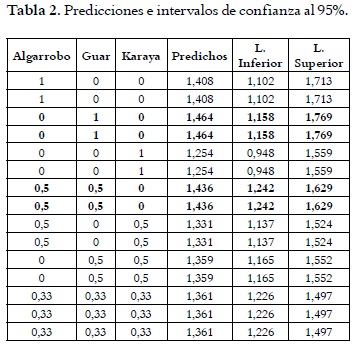
<body><![CDATA[<p> The attributes of colour which are; chroma metric   or saturation (C*), hue, tonality or tone (H*),   were calculated according to equations 1 and 2;   and the colour indexes which are: WI and YI were   determined according to (16) in equation 3 and (15)   in equation 4, respectively, as shown below:</p>     <p align="center"><img src="/img/revistas/vitae/v19n2/v19n2a3e1.jpg"></p>     <p> Colour differences (symbolized as &Delta;E*), in the   CIE-LAB space, numerically represents the perception   of difference of colour for the human eye   between two food samples. Also &Delta;E* represents an   overall index of colour variation. &Delta;E* was calculated   using equation 5, shown below:</p>     <p align="center"><img src="/img/revistas/vitae/v19n2/v19n2a3e2.jpg"></p>     <p> <b>Statistical Analysis</b></p>     <p> Data were reported in the CIE L*a*b* colorimetric   system and analysed using Microsoft Excel&reg;   (version 2010) and SPSS&reg; (version 18.0.0). Significant   differences in composition for commercial and   manufactured Quesillo cheeses were tested using   a one-way analysis of variance (ANOVA) and included   a Tukey's Studentized multiple comparison   test at the 5% level.</p>     <p>&nbsp;</p>     <p> <font size="3"><b>RESULTS</b></font></p>     <p> <a href="#t2">Table 2</a> shows the physicochemical composition   of manufactured Quesillo cheese for this study.</p>       <p align="center"><a name="t2"></a><img src="/img/revistas/vitae/v19n2/v19n2a3t2.jpg"></p>     ]]></body>
<body><![CDATA[<p>&nbsp;</p>     <p>  The mean values and standard deviation of L* a*   b*, C*, H*, &Delta;E*, WI and YI are shown in <a href="/img/revistas/vitae/v19n2/v19n2a4t3.jpg" target="_blank">Table 3</a>.   Colour analysis of commercial and manufactured   cheeses indicated that, in general, L* and b* values   are not significantly different from each other, only   a* values showed significant differences. Also, It   shows that this type of cheese is located in sector   yellow (+ b*) with slight tones of green (-a*), H*   greater than 90&deg; and C* greater than 20. The a*   (-0.96) and b* (22.95) values of manufactured   cheese is close to the values of commercial cheeses,   except for one that moves away from the set of data   (a * -1.47, b * 23.14) that have higher yellowness   and greenness than the others. As for the white, the   manufactured cheese was much whiter than most   of the samples. The average values obtained for L*,   C* and H*, can be characterized by the colorimetric   region, in which the samples fall within a paleyellow   colour to yellow colour, and a bright surface.</p>     <p>  The relationship between whiteness and yellowness   is shown in <a href="/img/revistas/vitae/v19n2/v19n2a4f2.jpg" target="_blank">Figure 2</a>. In <a href="/img/revistas/vitae/v19n2/v19n2a4f2.jpg" target="_blank">figure 2a</a>, it could be   observed that at least three commercial cheeses are   whiter and two are yellower than manufactured   cheese. <a href="/img/revistas/vitae/v19n2/v19n2a4f2.jpg" target="_blank">Figure 2b</a> shows that as WI decreases, YI   increases. YI value determines only the level of   yellow (+) or blue (-) of samples, in this case, the   yellowing of the cheese.</p>     <p>&nbsp;</p>     <p> <font size="3"> <b>DISCUSSION</b></font></p>     <p><b> Milk composition</b></p>     <p> The fat content of raw milk in Colombia is variable;   it may range between 3.1% and 4.8% (21). From   the results as indicated in Table 2 and Table 3 the   colour of manufactured Quesillo cheese is closely   related to the initial composition of milk which is   3.3% fat, and final composition of the cheese which   is 28% fat approximately. Carpino et al., 2004 (22)   found that compounds from pasture plants are   transferred to cheese and they also may transfer   flavour and colour. Doan (1924) indicated that the   yellow fat globules are responsible primarily for the   yellowish tints, where the size of these fat globules   from milk probably influences the composite colour   of the cheese as well as the colour of the globules   themselves (23). The pigments in milk fat globules   which are &beta;-carotene and related carotenoid compounds   (22, 24) are associated with a small amount   of <i>xanthophylls</i> and that these pigments are the same   as those found in green and yellow vegetation (23).   In Colombia, the cattle usually have access to pasture   or are fed with considerable quantities of green   feeds (25 - 27) which contain comparatively large   amounts of carotenoids (28). In traditional cheese   production, milk used to produce Quesillo cheese   did not receive extensive pre-treatment, except only   a brief heat treatment (6); allowing probably the fat   globules to retain their integrity and size in the final   cheese product. This is a very important factor in   the final colour of the manufactured cheese.</p>     <p> From the results as indicated in <a href="/img/revistas/vitae/v19n2/v19n2a4t3.jpg" target="_blank">Table 3</a>, the   mean value calculated for L* is comparable with   values reported in the literature, indicated in <a href="/img/revistas/vitae/v19n2/v19n2a4t1.jpg" target="_blank">Table   1</a>, i.e. Edam, Fresh cheese, Egyptian, Gouda, Reggianito   Argentino and Tilsit; a* is similar for Feta   and Molido Nari&ntilde;ense cheese, while b* differs   from them.</p>     <p> <b>Quesillo cheese technology</b></p>     <p> Also an appreciation of the manufacturing procedure   of Quesillo cheese is crucial to understand   its peculiar colour. Many small-scale enterprises   do not use standardized milk in cheese manufacturing   (1), which explains why artisan-produced   cheeses are more yellow in colour intensity than   the commercial types which use standardized milk   in cheese preparation (29).</p>     ]]></body>
<body><![CDATA[<p> Quesillo cheese is made with acid whey, which   contains indigenous microflora that eliminates the   need for a starter culture (6). In some traditional   pasta filata cheeses, such as Caciocavallo, Ragusano   (30, 31), Provolone, Mozzarella, and Pizza cheeses   (32), the whey is stored and employed as starter in   the manufacturing process the following day. The   culture contained in the whey may change the colour   of the cheese, as observed by Chamba, 2004   (33), who reported the modifications in colour of   cheese due to the activity of the culture.</p>     <p> <b>Colour difference</b></p>     <p> From the results as indicated in <a href="/img/revistas/vitae/v19n2/v19n2a4t3.jpg" target="_blank">Table 3</a>, there   are no significant colour differences between the   samples and general mean value, confirming the   impossibility of the visual perception of the human   eye. Can be explained the relationship between   the opinion of the observer and the values of &Delta;E*,   which were below 2.70 that are not noticeable to the   human eye (none 0 - 0.7, lightly 0.7 &#8211; 2.5, remarkable   2.5 - 3.0, appreciable 3.0 - 6.0, considerable 6.0   - 12.0, and biggest 12.0).</p>     <p> <b>Colour indexes</b></p>     <p> The calculated Index was used to study the   changes in colour over time. Although Quesillo   belongs to the fresh-cheese category that is intended   for consumption within 25 days, they have   variations in colour. The mean value of WI = 68.28   is an indication that the cheese colour, which is   yellowish in appearance, is due to its composition.   A mean of YI = 41.97 suggests that Quesillo does   not have an intense yellow colour, but it is possible   to see yellow tones in it. From the data calculated   for WI and YI and compared to data from several   workers, indicated in Table 1, it is possible to place   Quesillo cheese between other cheese, it could be   inferred that Quesillo cheese is more white than   Edam, Tilsit or Gouda and it is more yellow than   Crottin de Chavignol, Feta, Queso de Roncal, Fresh   cheese, Molido Nari&ntilde;ense cheese, Processed cheese   or Roquefort. Colour indexes may be served for   categorizing the cheese on the scale of white (WI)   or yellow (YI), better than only L* or a* (Figure 3).</p>     <p>&nbsp;</p>     <p><font size="3"> <b>CONCLUSIONS</b></font></p>     <p> The mean values and ranges calculated from a   set of data could serve as information for quality   control and colour characterization of these chee185   ses. The general mean values obtained for Quesillo   cheese were, L*= 78.13, a*= -0.96, b*= 22.95, C*=   22.97 and H*= 92.38&deg;.</p>     <p>&nbsp;</p>     <p> <font size="3"><b>ACKNOWLEDGMENTS</b></font></p>     ]]></body>
<body><![CDATA[<p> The authors want to thank to The Food Engineering   School (Universidad del Valle) and Huaca/   Ipilacteos Dairy Inc. for technical support, COLCIENCIAS   for financial support and to all persons   of Teagasc-Moorepak (Fermoy, Co. Cork, Ireland)   who helped with the correction of the manuscript,   specially Benedict Arku and Phil Kelly.</p>     <p>&nbsp;</p>     <p><font size="3"> <b>REFERENCES</b></font></p>     <!-- ref --><p> 1. Rodr&iacute;guez CA, Novoa CC. Gu&iacute;a para Producir Quesos Colombianos.   1 ed. Santaf&eacute; de Bogot&aacute; D.C., Colombia: Banco   Ganadero; 1994. 139 p.&nbsp;&nbsp;&nbsp;&nbsp;&nbsp;&nbsp;&nbsp;&nbsp;[&#160;<a href="javascript:void(0);" onclick="javascript: window.open('/scielo.php?script=sci_nlinks&ref=000076&pid=S0121-4004201200020000400001&lng=','','width=640,height=500,resizable=yes,scrollbars=1,menubar=yes,');">Links</a>&#160;]<!-- end-ref --><!-- ref --><p> 2. Ram&iacute;rez-Navas JS. Propiedades funcionales de los quesos:   &Eacute;nfasis en los quesos de pasta hilada. Rev Reciteia. 2010 Dec;   10 (2): 70-97.&nbsp;&nbsp;&nbsp;&nbsp;&nbsp;&nbsp;&nbsp;&nbsp;[&#160;<a href="javascript:void(0);" onclick="javascript: window.open('/scielo.php?script=sci_nlinks&ref=000077&pid=S0121-4004201200020000400002&lng=','','width=640,height=500,resizable=yes,scrollbars=1,menubar=yes,');">Links</a>&#160;]<!-- end-ref --><!-- ref --><p> 3. MinSalud. Resoluci&oacute;n n&uacute;mero 2310. Bogot&aacute;: Ministerio de   Salud; 1986.&nbsp;&nbsp;&nbsp;&nbsp;&nbsp;&nbsp;&nbsp;&nbsp;[&#160;<a href="javascript:void(0);" onclick="javascript: window.open('/scielo.php?script=sci_nlinks&ref=000078&pid=S0121-4004201200020000400003&lng=','','width=640,height=500,resizable=yes,scrollbars=1,menubar=yes,');">Links</a>&#160;]<!-- end-ref --><!-- ref --><p> 4. MinSalud. Resoluci&oacute;n n&uacute;mero 1804. Bogot&aacute;: Ministerio de   Salud; 1989.&nbsp;&nbsp;&nbsp;&nbsp;&nbsp;&nbsp;&nbsp;&nbsp;[&#160;<a href="javascript:void(0);" onclick="javascript: window.open('/scielo.php?script=sci_nlinks&ref=000079&pid=S0121-4004201200020000400004&lng=','','width=640,height=500,resizable=yes,scrollbars=1,menubar=yes,');">Links</a>&#160;]<!-- end-ref --><!-- ref --><p> 5. Morea M, Matarante A, Di Cagno R, Baruzzi F, Minervini   F. Contribution of autochthonous non-starter lactobacilli to   proteolysis in Caciocavallo Pugliese cheese. Int Dairy J. 2007   May; 17 (5): 525-534.&nbsp;&nbsp;&nbsp;&nbsp;&nbsp;&nbsp;&nbsp;&nbsp;[&#160;<a href="javascript:void(0);" onclick="javascript: window.open('/scielo.php?script=sci_nlinks&ref=000080&pid=S0121-4004201200020000400005&lng=','','width=640,height=500,resizable=yes,scrollbars=1,menubar=yes,');">Links</a>&#160;]<!-- end-ref --><!-- ref --><p> 6. Ram&iacute;rez-Navas JS, Londo&ntilde;o M, Rodr&iacute;guez A. Quesillo: queso   colombiano de pasta hilada. Tecnol L&aacute;ct Latinoam. 2010 Apr;   60: 63-67.&nbsp;&nbsp;&nbsp;&nbsp;&nbsp;&nbsp;&nbsp;&nbsp;[&#160;<a href="javascript:void(0);" onclick="javascript: window.open('/scielo.php?script=sci_nlinks&ref=000081&pid=S0121-4004201200020000400006&lng=','','width=640,height=500,resizable=yes,scrollbars=1,menubar=yes,');">Links</a>&#160;]<!-- end-ref --><!-- ref --><p> 7. Thomas MA. Browning reaction in Cheddar cheese. Aust J   Dairy Technol. 1969; 24 (4): 185-189.&nbsp;&nbsp;&nbsp;&nbsp;&nbsp;&nbsp;&nbsp;&nbsp;[&#160;<a href="javascript:void(0);" onclick="javascript: window.open('/scielo.php?script=sci_nlinks&ref=000082&pid=S0121-4004201200020000400007&lng=','','width=640,height=500,resizable=yes,scrollbars=1,menubar=yes,');">Links</a>&#160;]<!-- end-ref --><!-- ref --><p> 8. Johnson ME, Olson NF. Nonenzymatic Browning of Mozzarella   Cheese. J Dairy Sci. 1985 Dec; 68 (12): 3143-3147.&nbsp;&nbsp;&nbsp;&nbsp;&nbsp;&nbsp;&nbsp;&nbsp;[&#160;<a href="javascript:void(0);" onclick="javascript: window.open('/scielo.php?script=sci_nlinks&ref=000083&pid=S0121-4004201200020000400008&lng=','','width=640,height=500,resizable=yes,scrollbars=1,menubar=yes,');">Links</a>&#160;]<!-- end-ref --><!-- ref --><p> 9. Matzdorf B, Cuppett SL, Keeler L, Hutkins RW. Browning of   Mozzarella Cheese During High Temperature Pizza Baking. J   Dairy Sci. 1994 Oct; 77 (10): 2850-2853.&nbsp;&nbsp;&nbsp;&nbsp;&nbsp;&nbsp;&nbsp;&nbsp;[&#160;<a href="javascript:void(0);" onclick="javascript: window.open('/scielo.php?script=sci_nlinks&ref=000084&pid=S0121-4004201200020000400009&lng=','','width=640,height=500,resizable=yes,scrollbars=1,menubar=yes,');">Links</a>&#160;]<!-- end-ref --><!-- ref --><p> 10. Kristensen D, Hansen E, Arndal A, Trinderup RA, Skibsted LH.   Influence of light and temperature on the colour and oxidative   stability of processed cheese. Int Dairy J. 2001; 11 (10): 837-843.&nbsp;&nbsp;&nbsp;&nbsp;&nbsp;&nbsp;&nbsp;&nbsp;[&#160;<a href="javascript:void(0);" onclick="javascript: window.open('/scielo.php?script=sci_nlinks&ref=000085&pid=S0121-4004201200020000400010&lng=','','width=640,height=500,resizable=yes,scrollbars=1,menubar=yes,');">Links</a>&#160;]<!-- end-ref --><!-- ref --><p> 11. Dufoss&eacute; L, Galaup P, Carlet E, Flamin C, Valla A. Spectrocolorimetry   in the CIE L*a*b* color space as useful tool for monitoring   the ripening process and the quality of PDO red-smear   soft cheeses. Food Res Int. 2005 Oct-Nov; 38 (8-9): 919-924.&nbsp;&nbsp;&nbsp;&nbsp;&nbsp;&nbsp;&nbsp;&nbsp;[&#160;<a href="javascript:void(0);" onclick="javascript: window.open('/scielo.php?script=sci_nlinks&ref=000086&pid=S0121-4004201200020000400011&lng=','','width=640,height=500,resizable=yes,scrollbars=1,menubar=yes,');">Links</a>&#160;]<!-- end-ref --><!-- ref --><p> 12. Kneifel W, Ulberth F, Schaffer E. Tristimulus colour ref lectance   measurement of milk and dairy products. Le Lait. 1992 May;   72 (4): 383-391.&nbsp;&nbsp;&nbsp;&nbsp;&nbsp;&nbsp;&nbsp;&nbsp;[&#160;<a href="javascript:void(0);" onclick="javascript: window.open('/scielo.php?script=sci_nlinks&ref=000087&pid=S0121-4004201200020000400012&lng=','','width=640,height=500,resizable=yes,scrollbars=1,menubar=yes,');">Links</a>&#160;]<!-- end-ref --><!-- ref --><p> 13. Pinho O, Mendes E, Alves MM, Ferreira IMPLVO. Chemical,   Physical, and Sensorial Characteristics of ''Terrincho'' Ewe   Cheese: Changes During Ripening and Intravarietal Comparison.   J Dairy Sci. 2004 Feb; 87 (2): 249-257.&nbsp;&nbsp;&nbsp;&nbsp;&nbsp;&nbsp;&nbsp;&nbsp;[&#160;<a href="javascript:void(0);" onclick="javascript: window.open('/scielo.php?script=sci_nlinks&ref=000088&pid=S0121-4004201200020000400013&lng=','','width=640,height=500,resizable=yes,scrollbars=1,menubar=yes,');">Links</a>&#160;]<!-- end-ref --><!-- ref --><p> 14. Francis FJ. Quality as inf luenced by color. Food Qual and   Preference. 1995; 6 (3): 149-155.&nbsp;&nbsp;&nbsp;&nbsp;&nbsp;&nbsp;&nbsp;&nbsp;[&#160;<a href="javascript:void(0);" onclick="javascript: window.open('/scielo.php?script=sci_nlinks&ref=000089&pid=S0121-4004201200020000400014&lng=','','width=640,height=500,resizable=yes,scrollbars=1,menubar=yes,');">Links</a>&#160;]<!-- end-ref --><!-- ref --><p> 15. Ram&iacute;rez-Navas JS. Espectrocolorimetr&iacute;a: caracterizaci&oacute;n de   leche y quesos. Tecnol L&aacute;ct Latinoam. 2010 Jun; 61: 52-58.&nbsp;&nbsp;&nbsp;&nbsp;&nbsp;&nbsp;&nbsp;&nbsp;[&#160;<a href="javascript:void(0);" onclick="javascript: window.open('/scielo.php?script=sci_nlinks&ref=000090&pid=S0121-4004201200020000400015&lng=','','width=640,height=500,resizable=yes,scrollbars=1,menubar=yes,');">Links</a>&#160;]<!-- end-ref --><!-- ref --><p> 16. Boun HR, Huxsoll CC. Control of Minimally Processed Carrot   (Daucus carota) Surface Discoloration Caused by Abrasion   Peeling. J Food Sci. 1991 Mar; 56 (2): 416-422.&nbsp;&nbsp;&nbsp;&nbsp;&nbsp;&nbsp;&nbsp;&nbsp;[&#160;<a href="javascript:void(0);" onclick="javascript: window.open('/scielo.php?script=sci_nlinks&ref=000091&pid=S0121-4004201200020000400016&lng=','','width=640,height=500,resizable=yes,scrollbars=1,menubar=yes,');">Links</a>&#160;]<!-- end-ref --><!-- ref --><p> 17. Pavia M, Guamis B, Trujillo AJ, Capellas M, Ferragut V. Changes   in microstructural, textural and colour characteristics during   ripening of Manchego-type cheese salted by brine vacuum   impregnation. Int Dairy J. 1999 Feb; 9 (2): 91-98.&nbsp;&nbsp;&nbsp;&nbsp;&nbsp;&nbsp;&nbsp;&nbsp;[&#160;<a href="javascript:void(0);" onclick="javascript: window.open('/scielo.php?script=sci_nlinks&ref=000092&pid=S0121-4004201200020000400017&lng=','','width=640,height=500,resizable=yes,scrollbars=1,menubar=yes,');">Links</a>&#160;]<!-- end-ref --><!-- ref --><p> 18. Juric M, Bertelsen G, Mortensen G, Petersen MA. Lightinduced   colour and aroma changes in sliced, modified atmosphere   packaged semi-hard cheeses. Int Dairy J. 2003; 13 (2-3):   239-249.&nbsp;&nbsp;&nbsp;&nbsp;&nbsp;&nbsp;&nbsp;&nbsp;[&#160;<a href="javascript:void(0);" onclick="javascript: window.open('/scielo.php?script=sci_nlinks&ref=000093&pid=S0121-4004201200020000400018&lng=','','width=640,height=500,resizable=yes,scrollbars=1,menubar=yes,');">Links</a>&#160;]<!-- end-ref --><!-- ref --><p> 19. &Aacute;lvarez S, Rodr&iacute;guez V, Ruiz ME, Fresno M. Correlaciones   de textura y color instrumental con la composici&oacute;n qu&iacute;mica de   quesos de cabra canarios. Arch Zootec. 2007 Dec; 56: 663-666.&nbsp;&nbsp;&nbsp;&nbsp;&nbsp;&nbsp;&nbsp;&nbsp;[&#160;<a href="javascript:void(0);" onclick="javascript: window.open('/scielo.php?script=sci_nlinks&ref=000094&pid=S0121-4004201200020000400019&lng=','','width=640,height=500,resizable=yes,scrollbars=1,menubar=yes,');">Links</a>&#160;]<!-- end-ref --><!-- ref --><p> 20. Ram&iacute;rez-Navas JS. Queso Molido Nari&ntilde;ense. Tecnol L&aacute;ct   Latinoam. 2010 Feb; 59: 56-59.&nbsp;&nbsp;&nbsp;&nbsp;&nbsp;&nbsp;&nbsp;&nbsp;[&#160;<a href="javascript:void(0);" onclick="javascript: window.open('/scielo.php?script=sci_nlinks&ref=000095&pid=S0121-4004201200020000400020&lng=','','width=640,height=500,resizable=yes,scrollbars=1,menubar=yes,');">Links</a>&#160;]<!-- end-ref --><!-- ref --><p> 21. Lascano CE, Avila P. Potencial de producci&oacute;n de leche en   pasturas solas y asociadas con leguminosas adaptadas a suelos &aacute;cidos. Pasturas Trop. 1991; 13 (3): 2-10.&nbsp;&nbsp;&nbsp;&nbsp;&nbsp;&nbsp;&nbsp;&nbsp;[&#160;<a href="javascript:void(0);" onclick="javascript: window.open('/scielo.php?script=sci_nlinks&ref=000096&pid=S0121-4004201200020000400021&lng=','','width=640,height=500,resizable=yes,scrollbars=1,menubar=yes,');">Links</a>&#160;]<!-- end-ref --><!-- ref --><p> 22. Carpino S, Horne J, Melilli C, Licitra G, Barbano DM, Van   Soest PJ. Contribution of Native Pasture to the Sensory Properties   of Ragusano Cheese. J Dairy Sci. 2004 Feb;87 (2): 308-315.&nbsp;&nbsp;&nbsp;&nbsp;&nbsp;&nbsp;&nbsp;&nbsp;[&#160;<a href="javascript:void(0);" onclick="javascript: window.open('/scielo.php?script=sci_nlinks&ref=000097&pid=S0121-4004201200020000400022&lng=','','width=640,height=500,resizable=yes,scrollbars=1,menubar=yes,');">Links</a>&#160;]<!-- end-ref --><!-- ref --><p> 23. Doan FJ. The Color of Cow's Milk and its Value. J Dairy Sci.   1924 Mar; 7 (2): 147-153.&nbsp;&nbsp;&nbsp;&nbsp;&nbsp;&nbsp;&nbsp;&nbsp;[&#160;<a href="javascript:void(0);" onclick="javascript: window.open('/scielo.php?script=sci_nlinks&ref=000098&pid=S0121-4004201200020000400023&lng=','','width=640,height=500,resizable=yes,scrollbars=1,menubar=yes,');">Links</a>&#160;]<!-- end-ref --><!-- ref --><p> 24. Fox PF, Guinee TO, Cogan TM, McSweeney PLH. Fundamentals   of Cheese Science. Gaithersburg, Maryland, USA: Aspen   Publishers. 2000. 608 p.&nbsp;&nbsp;&nbsp;&nbsp;&nbsp;&nbsp;&nbsp;&nbsp;[&#160;<a href="javascript:void(0);" onclick="javascript: window.open('/scielo.php?script=sci_nlinks&ref=000099&pid=S0121-4004201200020000400024&lng=','','width=640,height=500,resizable=yes,scrollbars=1,menubar=yes,');">Links</a>&#160;]<!-- end-ref --><!-- ref --><p> 25. Laredo MA, Mendoza PE. Valor nutritivo de pastos de zonas   fr&iacute;as, 1: Pasto kikuyo (Pennisetum clandestinum Hochst) anual y   estacional. Rev ICA (Colombia). 1982 Dec; 17 (4): 157-167.&nbsp;&nbsp;&nbsp;&nbsp;&nbsp;&nbsp;&nbsp;&nbsp;[&#160;<a href="javascript:void(0);" onclick="javascript: window.open('/scielo.php?script=sci_nlinks&ref=000100&pid=S0121-4004201200020000400025&lng=','','width=640,height=500,resizable=yes,scrollbars=1,menubar=yes,');">Links</a>&#160;]<!-- end-ref --><!-- ref --><p> 26. Carulla JE, C&aacute;rdenas E, S&aacute;nchez N, Riveros C. Valor nutricional   de los forrajes m&aacute;s usados en los sistemas de producci&oacute;n   lechera especializada de la zona andina colombiana. V seminario   Internacional en Reproducci&oacute;n y metabolismo en bovinos;   2004 Nov 4-5; Manizales, Colombia. Manizales: Universidad   de Caldas; 2004.&nbsp;&nbsp;&nbsp;&nbsp;&nbsp;&nbsp;&nbsp;&nbsp;[&#160;<a href="javascript:void(0);" onclick="javascript: window.open('/scielo.php?script=sci_nlinks&ref=000101&pid=S0121-4004201200020000400026&lng=','','width=640,height=500,resizable=yes,scrollbars=1,menubar=yes,');">Links</a>&#160;]<!-- end-ref --><!-- ref --><p> 27. Mila A, Corredor G. Evoluci&oacute;n de la composici&oacute;n bot&aacute;nica   en pradera de Kikuyo (<i>Pennisetum clandestinum</i>) recuperada   mediante escarificaci&oacute;n mec&aacute;nica y fertilizaci&oacute;n con compost.   Rev Corpoica. 2004 Oct; 5 (1): 70-75.&nbsp;&nbsp;&nbsp;&nbsp;&nbsp;&nbsp;&nbsp;&nbsp;[&#160;<a href="javascript:void(0);" onclick="javascript: window.open('/scielo.php?script=sci_nlinks&ref=000102&pid=S0121-4004201200020000400027&lng=','','width=640,height=500,resizable=yes,scrollbars=1,menubar=yes,');">Links</a>&#160;]<!-- end-ref --><!-- ref --><p> 28. Taverna MA. Composici&oacute;n qu&iacute;mica de la leche producida en la   Argentina. Idia XXI. 2007 Dec; 7 (9): 112-117.&nbsp;&nbsp;&nbsp;&nbsp;&nbsp;&nbsp;&nbsp;&nbsp;[&#160;<a href="javascript:void(0);" onclick="javascript: window.open('/scielo.php?script=sci_nlinks&ref=000103&pid=S0121-4004201200020000400028&lng=','','width=640,height=500,resizable=yes,scrollbars=1,menubar=yes,');">Links</a>&#160;]<!-- end-ref --><!-- ref --><p> 29. Lemay A, Paquin P, Lacroix C. Influence of microf luidization   of milk on Cheddar cheese composition, color, texture, and   yield. J Dairy Sci. 1994 May; 77 (10): 2870-2879.&nbsp;&nbsp;&nbsp;&nbsp;&nbsp;&nbsp;&nbsp;&nbsp;[&#160;<a href="javascript:void(0);" onclick="javascript: window.open('/scielo.php?script=sci_nlinks&ref=000104&pid=S0121-4004201200020000400029&lng=','','width=640,height=500,resizable=yes,scrollbars=1,menubar=yes,');">Links</a>&#160;]<!-- end-ref --><!-- ref --><p> 30. Licitra G, Portelli G, Campo P, Longombardo G, Farina G,   Carpino S, et al. Technology to Produce Ragusano Cheese: A   Survey. J Dairy Sci. 1998 Dec; 81 (12): 3343-3349.&nbsp;&nbsp;&nbsp;&nbsp;&nbsp;&nbsp;&nbsp;&nbsp;[&#160;<a href="javascript:void(0);" onclick="javascript: window.open('/scielo.php?script=sci_nlinks&ref=000105&pid=S0121-4004201200020000400030&lng=','','width=640,height=500,resizable=yes,scrollbars=1,menubar=yes,');">Links</a>&#160;]<!-- end-ref --><!-- ref --><p> 31. Fallico V, McSweeney PLH, Siebert KJ, Horne J, Carpino S, Licitra   G. Chemometric Analysis of Proteolysis During Ripening   of Ragusano Cheese. J Dairy Sci. 2004 Oct; 87 (10): 3138-3152.&nbsp;&nbsp;&nbsp;&nbsp;&nbsp;&nbsp;&nbsp;&nbsp;[&#160;<a href="javascript:void(0);" onclick="javascript: window.open('/scielo.php?script=sci_nlinks&ref=000106&pid=S0121-4004201200020000400031&lng=','','width=640,height=500,resizable=yes,scrollbars=1,menubar=yes,');">Links</a>&#160;]<!-- end-ref --><!-- ref --><p> 32. Reinbold GW. Italian Cheese Varieties. 1<sup>st</sup> ed. New York, USA:   Chas. Pfizer &amp; Co., Inc.; 1963. 43 p.&nbsp;&nbsp;&nbsp;&nbsp;&nbsp;&nbsp;&nbsp;&nbsp;[&#160;<a href="javascript:void(0);" onclick="javascript: window.open('/scielo.php?script=sci_nlinks&ref=000107&pid=S0121-4004201200020000400032&lng=','','width=640,height=500,resizable=yes,scrollbars=1,menubar=yes,');">Links</a>&#160;]<!-- end-ref --><!-- ref --><p> 33. Chamba JF, Irlinger F. Cheese: Chemistry, Physics and Microbiology,   3<sup>rd</sup> ed. Fox PF, McSweeney PLH, Cogan TM, Guinee   PT, editors. San Diego, California, USA: Elsevier Academic   Press; 2004. Chapter 9, Secondary and Adjunct Cultures; p.   191-206.&nbsp;&nbsp;&nbsp;&nbsp;&nbsp;&nbsp;&nbsp;&nbsp;[&#160;<a href="javascript:void(0);" onclick="javascript: window.open('/scielo.php?script=sci_nlinks&ref=000108&pid=S0121-4004201200020000400033&lng=','','width=640,height=500,resizable=yes,scrollbars=1,menubar=yes,');">Links</a>&#160;]<!-- end-ref --> ]]></body><back>
<ref-list>
<ref id="B1">
<label>1</label><nlm-citation citation-type="book">
<person-group person-group-type="author">
<name>
<surname><![CDATA[Rodríguez]]></surname>
<given-names><![CDATA[CA]]></given-names>
</name>
<name>
<surname><![CDATA[Novoa]]></surname>
<given-names><![CDATA[CC]]></given-names>
</name>
</person-group>
<source><![CDATA[Guía para Producir Quesos Colombianos]]></source>
<year>1994</year>
<edition>1</edition>
<page-range>139</page-range><publisher-loc><![CDATA[Santafé de Bogotá^eD.C. D.C.]]></publisher-loc>
<publisher-name><![CDATA[Banco Ganadero]]></publisher-name>
</nlm-citation>
</ref>
<ref id="B2">
<label>2</label><nlm-citation citation-type="journal">
<person-group person-group-type="author">
<name>
<surname><![CDATA[Ramírez-Navas]]></surname>
<given-names><![CDATA[JS.]]></given-names>
</name>
</person-group>
<article-title xml:lang="es"><![CDATA[Propiedades funcionales de los quesos: Énfasis en los quesos de pasta hilada]]></article-title>
<source><![CDATA[Rev Reciteia]]></source>
<year>2010</year>
<month> D</month>
<day>ec</day>
<volume>10</volume>
<numero>2</numero>
<issue>2</issue>
<page-range>70-97</page-range></nlm-citation>
</ref>
<ref id="B3">
<label>3.</label><nlm-citation citation-type="book">
<collab>MinSalud</collab>
<source><![CDATA[Resolución número 2310]]></source>
<year>1986</year>
<publisher-loc><![CDATA[Bogotá ]]></publisher-loc>
<publisher-name><![CDATA[Ministerio de Salud]]></publisher-name>
</nlm-citation>
</ref>
<ref id="B4">
<label>4</label><nlm-citation citation-type="book">
<collab>MinSalud</collab>
<source><![CDATA[Resolución número 1804]]></source>
<year>1989</year>
<publisher-loc><![CDATA[Bogotá ]]></publisher-loc>
<publisher-name><![CDATA[Ministerio]]></publisher-name>
</nlm-citation>
</ref>
<ref id="B5">
<label>5</label><nlm-citation citation-type="journal">
<person-group person-group-type="author">
<name>
<surname><![CDATA[Morea]]></surname>
<given-names><![CDATA[M]]></given-names>
</name>
<name>
<surname><![CDATA[Matarante]]></surname>
<given-names><![CDATA[A]]></given-names>
</name>
<name>
<surname><![CDATA[Di]]></surname>
<given-names><![CDATA[Cagno R]]></given-names>
</name>
<name>
<surname><![CDATA[Baruzzi]]></surname>
<given-names><![CDATA[F]]></given-names>
</name>
<name>
<surname><![CDATA[Minervini]]></surname>
<given-names><![CDATA[F.]]></given-names>
</name>
</person-group>
<article-title xml:lang="en"><![CDATA[Contribution of autochthonous non-starter lactobacilli to proteolysis in Caciocavallo Pugliese cheese]]></article-title>
<source><![CDATA[Int Dairy J]]></source>
<year>2007</year>
<month> M</month>
<day>ay</day>
<volume>17</volume>
<numero>5</numero>
<issue>5</issue>
<page-range>525-534</page-range></nlm-citation>
</ref>
<ref id="B6">
<label>6</label><nlm-citation citation-type="journal">
<person-group person-group-type="author">
<name>
<surname><![CDATA[Ramírez-Navas]]></surname>
<given-names><![CDATA[JS]]></given-names>
</name>
<name>
<surname><![CDATA[Londoño]]></surname>
<given-names><![CDATA[M]]></given-names>
</name>
<name>
<surname><![CDATA[Rodríguez]]></surname>
<given-names><![CDATA[A.]]></given-names>
</name>
</person-group>
<article-title xml:lang="es"><![CDATA[Quesillo: queso colombiano de pasta hilada]]></article-title>
<source><![CDATA[Tecnol Láct Latinoam]]></source>
<year>2010</year>
<month> A</month>
<day>pr</day>
<volume>60</volume>
<page-range>63-67</page-range></nlm-citation>
</ref>
<ref id="B7">
<label>7</label><nlm-citation citation-type="journal">
<person-group person-group-type="author">
<name>
<surname><![CDATA[Thomas]]></surname>
<given-names><![CDATA[MA.]]></given-names>
</name>
</person-group>
<article-title xml:lang="en"><![CDATA[Browning reaction in Cheddar cheese]]></article-title>
<source><![CDATA[Aust J Dairy Technol]]></source>
<year>1969</year>
<volume>24</volume>
<numero>4</numero>
<issue>4</issue>
<page-range>185-189</page-range></nlm-citation>
</ref>
<ref id="B8">
<label>8</label><nlm-citation citation-type="journal">
<person-group person-group-type="author">
<name>
<surname><![CDATA[Johnson]]></surname>
<given-names><![CDATA[ME]]></given-names>
</name>
<name>
<surname><![CDATA[Olson]]></surname>
<given-names><![CDATA[NF.]]></given-names>
</name>
</person-group>
<article-title xml:lang="en"><![CDATA[Nonenzymatic Browning of Mozzarella Cheese]]></article-title>
<source><![CDATA[J Dairy Sci]]></source>
<year>1985</year>
<month> D</month>
<day>ec</day>
<volume>68</volume>
<numero>12</numero>
<issue>12</issue>
<page-range>3143-3147</page-range></nlm-citation>
</ref>
<ref id="B9">
<label>9</label><nlm-citation citation-type="journal">
<person-group person-group-type="author">
<name>
<surname><![CDATA[Matzdorf]]></surname>
<given-names><![CDATA[B]]></given-names>
</name>
<name>
<surname><![CDATA[Cuppett]]></surname>
<given-names><![CDATA[SL]]></given-names>
</name>
<name>
<surname><![CDATA[Keeler]]></surname>
<given-names><![CDATA[L]]></given-names>
</name>
<name>
<surname><![CDATA[Hutkins]]></surname>
<given-names><![CDATA[RW.]]></given-names>
</name>
</person-group>
<article-title xml:lang="en"><![CDATA[Browning of Mozzarella Cheese During High Temperature Pizza Baking]]></article-title>
<source><![CDATA[J Dairy Sci]]></source>
<year>1994</year>
<month> O</month>
<day>ct</day>
<volume>77</volume>
<numero>10</numero>
<issue>10</issue>
<page-range>2850-2853</page-range></nlm-citation>
</ref>
<ref id="B10">
<label>10</label><nlm-citation citation-type="journal">
<person-group person-group-type="author">
<name>
<surname><![CDATA[Kristensen]]></surname>
<given-names><![CDATA[D]]></given-names>
</name>
<name>
<surname><![CDATA[Hansen]]></surname>
<given-names><![CDATA[E]]></given-names>
</name>
<name>
<surname><![CDATA[Arndal]]></surname>
<given-names><![CDATA[A]]></given-names>
</name>
<name>
<surname><![CDATA[Trinderup]]></surname>
<given-names><![CDATA[RA]]></given-names>
</name>
<name>
<surname><![CDATA[Skibsted]]></surname>
<given-names><![CDATA[LH.]]></given-names>
</name>
</person-group>
<article-title xml:lang="en"><![CDATA[Influence of light and temperature on the colour and oxidative stability of processed cheese]]></article-title>
<source><![CDATA[Int Dairy J]]></source>
<year>2001</year>
<volume>11</volume>
<numero>10</numero>
<issue>10</issue>
<page-range>837-843</page-range></nlm-citation>
</ref>
<ref id="B11">
<label>11</label><nlm-citation citation-type="journal">
<person-group person-group-type="author">
<name>
<surname><![CDATA[Dufossé]]></surname>
<given-names><![CDATA[L]]></given-names>
</name>
<name>
<surname><![CDATA[Galaup]]></surname>
<given-names><![CDATA[P]]></given-names>
</name>
<name>
<surname><![CDATA[Carlet]]></surname>
<given-names><![CDATA[E]]></given-names>
</name>
<name>
<surname><![CDATA[Flamin]]></surname>
<given-names><![CDATA[C]]></given-names>
</name>
<name>
<surname><![CDATA[Valla]]></surname>
<given-names><![CDATA[A.]]></given-names>
</name>
</person-group>
<article-title xml:lang="en"><![CDATA[Spectrocolorimetry in the CIE L*a*b* color space as useful tool for monitoring the ripening process and the quality of PDO red-smear soft cheeses]]></article-title>
<source><![CDATA[Food Res Int]]></source>
<year>2005</year>
<month> O</month>
<day>ct</day>
<volume>38</volume>
<numero>8-9</numero>
<issue>8-9</issue>
<page-range>919-924</page-range></nlm-citation>
</ref>
<ref id="B12">
<label>12</label><nlm-citation citation-type="journal">
<person-group person-group-type="author">
<name>
<surname><![CDATA[Kneifel]]></surname>
<given-names><![CDATA[W]]></given-names>
</name>
<name>
<surname><![CDATA[Ulberth]]></surname>
<given-names><![CDATA[F]]></given-names>
</name>
<name>
<surname><![CDATA[Schaffer]]></surname>
<given-names><![CDATA[E.]]></given-names>
</name>
</person-group>
<article-title xml:lang="en"><![CDATA[Tristimulus colour ref lectance measurement of milk and dairy products]]></article-title>
<source><![CDATA[Le Lait]]></source>
<year>1992</year>
<month> M</month>
<day>ay</day>
<volume>72</volume>
<numero>4</numero>
<issue>4</issue>
<page-range>383-391</page-range></nlm-citation>
</ref>
<ref id="B13">
<label>13</label><nlm-citation citation-type="journal">
<person-group person-group-type="author">
<name>
<surname><![CDATA[Pinho]]></surname>
<given-names><![CDATA[O]]></given-names>
</name>
<name>
<surname><![CDATA[Mendes]]></surname>
<given-names><![CDATA[E]]></given-names>
</name>
<name>
<surname><![CDATA[Alves]]></surname>
<given-names><![CDATA[MM]]></given-names>
</name>
<name>
<surname><![CDATA[Ferreira]]></surname>
<given-names><![CDATA[IMPLVO.]]></given-names>
</name>
</person-group>
<article-title xml:lang="en"><![CDATA[Chemical, Physical, and Sensorial Characteristics of ''Terrincho'' Ewe Cheese: Changes During Ripening and Intravarietal Comparison]]></article-title>
<source><![CDATA[J Dairy Sci]]></source>
<year>2004</year>
<month> F</month>
<day>eb</day>
<volume>87</volume>
<numero>2</numero>
<issue>2</issue>
<page-range>249-257</page-range></nlm-citation>
</ref>
<ref id="B14">
<label>14</label><nlm-citation citation-type="journal">
<person-group person-group-type="author">
<name>
<surname><![CDATA[Francis]]></surname>
<given-names><![CDATA[FJ.]]></given-names>
</name>
</person-group>
<article-title xml:lang="en"><![CDATA[Quality as inf luenced by color]]></article-title>
<source><![CDATA[Food Qual and Preference]]></source>
<year>1995</year>
<volume>6</volume>
<numero>3</numero>
<issue>3</issue>
<page-range>149-155</page-range></nlm-citation>
</ref>
<ref id="B15">
<label>15</label><nlm-citation citation-type="journal">
<person-group person-group-type="author">
<name>
<surname><![CDATA[Ramírez-Navas]]></surname>
<given-names><![CDATA[JS.]]></given-names>
</name>
</person-group>
<article-title xml:lang="es"><![CDATA[Espectrocolorimetría: caracterización de leche y quesos]]></article-title>
<source><![CDATA[Tecnol Láct Latinoam]]></source>
<year>2010</year>
<month> J</month>
<day>un</day>
<volume>61</volume>
<page-range>52-58</page-range></nlm-citation>
</ref>
<ref id="B16">
<label>16</label><nlm-citation citation-type="journal">
<person-group person-group-type="author">
<name>
<surname><![CDATA[Boun]]></surname>
<given-names><![CDATA[HR]]></given-names>
</name>
<name>
<surname><![CDATA[Huxsoll]]></surname>
<given-names><![CDATA[CC.]]></given-names>
</name>
</person-group>
<article-title xml:lang="es"><![CDATA[Control of Minimally Processed Carrot (Daucus carota) Surface Discoloration Caused by Abrasion Peeling]]></article-title>
<source><![CDATA[J Food Sci]]></source>
<year>1991</year>
<month> M</month>
<day>ar</day>
<volume>56</volume>
<numero>2</numero>
<issue>2</issue>
<page-range>416-422</page-range></nlm-citation>
</ref>
<ref id="B17">
<label>17</label><nlm-citation citation-type="journal">
<person-group person-group-type="author">
<name>
<surname><![CDATA[Pavia]]></surname>
<given-names><![CDATA[M]]></given-names>
</name>
<name>
<surname><![CDATA[Guamis]]></surname>
<given-names><![CDATA[B]]></given-names>
</name>
<name>
<surname><![CDATA[Trujillo]]></surname>
<given-names><![CDATA[AJ]]></given-names>
</name>
<name>
<surname><![CDATA[Capellas]]></surname>
<given-names><![CDATA[M]]></given-names>
</name>
<name>
<surname><![CDATA[Ferragut]]></surname>
<given-names><![CDATA[V.]]></given-names>
</name>
</person-group>
<article-title xml:lang="en"><![CDATA[Changes in microstructural, textural and colour characteristics during ripening of Manchego-type cheese salted by brine vacuum impregnation]]></article-title>
<source><![CDATA[Int Dairy J]]></source>
<year>1999</year>
<month> F</month>
<day>eb</day>
<volume>9</volume>
<numero>2</numero>
<issue>2</issue>
<page-range>91-98</page-range></nlm-citation>
</ref>
<ref id="B18">
<label>18</label><nlm-citation citation-type="journal">
<person-group person-group-type="author">
<name>
<surname><![CDATA[Juric]]></surname>
<given-names><![CDATA[M]]></given-names>
</name>
<name>
<surname><![CDATA[Bertelsen]]></surname>
<given-names><![CDATA[G]]></given-names>
</name>
<name>
<surname><![CDATA[Mortensen]]></surname>
<given-names><![CDATA[G]]></given-names>
</name>
<name>
<surname><![CDATA[Petersen]]></surname>
<given-names><![CDATA[MA.]]></given-names>
</name>
</person-group>
<article-title xml:lang="en"><![CDATA[Lightinduced colour and aroma changes in sliced, modified atmosphere packaged semi-hard cheeses]]></article-title>
<source><![CDATA[Int Dairy J]]></source>
<year>2003</year>
<volume>13</volume>
<numero>2-3</numero>
<issue>2-3</issue>
<page-range>239-249</page-range></nlm-citation>
</ref>
<ref id="B19">
<label>19</label><nlm-citation citation-type="journal">
<person-group person-group-type="author">
<name>
<surname><![CDATA[Álvarez]]></surname>
<given-names><![CDATA[S]]></given-names>
</name>
<name>
<surname><![CDATA[Rodríguez]]></surname>
<given-names><![CDATA[V]]></given-names>
</name>
<name>
<surname><![CDATA[Ruiz]]></surname>
<given-names><![CDATA[ME]]></given-names>
</name>
<name>
<surname><![CDATA[Fresno]]></surname>
<given-names><![CDATA[M.]]></given-names>
</name>
</person-group>
<article-title xml:lang="es"><![CDATA[Correlaciones de textura y color instrumental con la composición química de quesos de cabra canarios]]></article-title>
<source><![CDATA[Arch Zootec]]></source>
<year>2007</year>
<month> D</month>
<day>ec</day>
<volume>56</volume>
<page-range>663-666</page-range></nlm-citation>
</ref>
<ref id="B20">
<label>20</label><nlm-citation citation-type="journal">
<person-group person-group-type="author">
<name>
<surname><![CDATA[Ramírez-Navas]]></surname>
<given-names><![CDATA[JS.]]></given-names>
</name>
</person-group>
<article-title xml:lang="es"><![CDATA[Queso Molido Nariñense]]></article-title>
<source><![CDATA[Tecnol Láct Latinoam]]></source>
<year>2010</year>
<month> F</month>
<day>eb</day>
<volume>59</volume>
<page-range>56-59</page-range></nlm-citation>
</ref>
<ref id="B21">
<label>21</label><nlm-citation citation-type="journal">
<person-group person-group-type="author">
<name>
<surname><![CDATA[Lascano]]></surname>
<given-names><![CDATA[CE]]></given-names>
</name>
<name>
<surname><![CDATA[Avila]]></surname>
<given-names><![CDATA[P.]]></given-names>
</name>
</person-group>
<article-title xml:lang="es"><![CDATA[Potencial de producción de leche en pasturas solas y asociadas con leguminosas adaptadas a suelos ácidos]]></article-title>
<source><![CDATA[Pasturas Trop]]></source>
<year>1991</year>
<volume>13</volume>
<numero>3</numero>
<issue>3</issue>
<page-range>2-10</page-range></nlm-citation>
</ref>
<ref id="B22">
<label>22</label><nlm-citation citation-type="journal">
<person-group person-group-type="author">
<name>
<surname><![CDATA[Carpino]]></surname>
<given-names><![CDATA[S]]></given-names>
</name>
<name>
<surname><![CDATA[Horne]]></surname>
<given-names><![CDATA[J]]></given-names>
</name>
<name>
<surname><![CDATA[Melilli]]></surname>
<given-names><![CDATA[C]]></given-names>
</name>
<name>
<surname><![CDATA[Licitra]]></surname>
<given-names><![CDATA[G]]></given-names>
</name>
<name>
<surname><![CDATA[Barbano]]></surname>
<given-names><![CDATA[DM]]></given-names>
</name>
<name>
<surname><![CDATA[Van Soest]]></surname>
<given-names><![CDATA[PJ.]]></given-names>
</name>
</person-group>
<article-title xml:lang="es"><![CDATA[Contribution of Native Pasture to the Sensory Properties of Ragusano Cheese]]></article-title>
<source><![CDATA[J Dairy Sci]]></source>
<year>2004</year>
<month> F</month>
<day>eb</day>
<volume>87</volume>
<numero>2</numero>
<issue>2</issue>
<page-range>308-315</page-range></nlm-citation>
</ref>
<ref id="B23">
<label>23</label><nlm-citation citation-type="journal">
<person-group person-group-type="author">
<name>
<surname><![CDATA[Doan]]></surname>
<given-names><![CDATA[FJ.]]></given-names>
</name>
</person-group>
<article-title xml:lang="es"><![CDATA[The Color of Cow's Milk and its Value]]></article-title>
<source><![CDATA[J Dairy Sci]]></source>
<year>1924</year>
<month> M</month>
<day>ar</day>
<volume>7</volume>
<numero>2</numero>
<issue>2</issue>
<page-range>147-153</page-range></nlm-citation>
</ref>
<ref id="B24">
<label>24</label><nlm-citation citation-type="book">
<person-group person-group-type="author">
<name>
<surname><![CDATA[Fox]]></surname>
<given-names><![CDATA[PF]]></given-names>
</name>
<name>
<surname><![CDATA[Guinee]]></surname>
<given-names><![CDATA[TO]]></given-names>
</name>
<name>
<surname><![CDATA[Cogan]]></surname>
<given-names><![CDATA[TM]]></given-names>
</name>
<name>
<surname><![CDATA[McSweeney]]></surname>
<given-names><![CDATA[PLH]]></given-names>
</name>
</person-group>
<source><![CDATA[Fundamentals of Cheese Science]]></source>
<year>2000</year>
<page-range>608</page-range><publisher-loc><![CDATA[Gaithersburg^eMaryland Maryland]]></publisher-loc>
<publisher-name><![CDATA[Aspen Publishers]]></publisher-name>
</nlm-citation>
</ref>
<ref id="B25">
<label>25</label><nlm-citation citation-type="journal">
<person-group person-group-type="author">
<name>
<surname><![CDATA[Laredo]]></surname>
<given-names><![CDATA[MA]]></given-names>
</name>
<name>
<surname><![CDATA[Mendoza]]></surname>
<given-names><![CDATA[PE.]]></given-names>
</name>
</person-group>
<article-title xml:lang="es"><![CDATA[Valor nutritivo de pastos de zonas frías, 1: Pasto kikuyo (Pennisetum clandestinum Hochst) anual y estacional]]></article-title>
<source><![CDATA[Rev ICA (Colombia)]]></source>
<year>1982</year>
<month> D</month>
<day>ec</day>
<volume>17</volume>
<numero>4</numero>
<issue>4</issue>
<page-range>157-167</page-range></nlm-citation>
</ref>
<ref id="B26">
<label>26</label><nlm-citation citation-type="confpro">
<person-group person-group-type="author">
<name>
<surname><![CDATA[Carulla]]></surname>
<given-names><![CDATA[JE]]></given-names>
</name>
<name>
<surname><![CDATA[Cárdenas]]></surname>
<given-names><![CDATA[E]]></given-names>
</name>
<name>
<surname><![CDATA[Sánchez]]></surname>
<given-names><![CDATA[N]]></given-names>
</name>
<name>
<surname><![CDATA[Riveros]]></surname>
<given-names><![CDATA[C]]></given-names>
</name>
</person-group>
<source><![CDATA[Valor nutricional de los forrajes más usados en los sistemas de producción lechera especializada de la zona andina colombiana]]></source>
<year>2004</year>
<conf-name><![CDATA[V seminario Internacional en Reproducción y metabolismo en bovinos]]></conf-name>
<conf-date>2004 Nov 4-5</conf-date>
<conf-loc>Manizales </conf-loc>
<publisher-loc><![CDATA[Manizales ]]></publisher-loc>
<publisher-name><![CDATA[Universidad de Caldas]]></publisher-name>
</nlm-citation>
</ref>
<ref id="B27">
<label>27</label><nlm-citation citation-type="journal">
<person-group person-group-type="author">
<name>
<surname><![CDATA[Mila]]></surname>
<given-names><![CDATA[A]]></given-names>
</name>
<name>
<surname><![CDATA[Corredor]]></surname>
<given-names><![CDATA[G.]]></given-names>
</name>
</person-group>
<article-title xml:lang="es"><![CDATA[Evolución de la composición botánica en pradera de Kikuyo (Pennisetum clandestinum) recuperada mediante escarificación mecánica y fertilización con compost]]></article-title>
<source><![CDATA[Rev Corpoica]]></source>
<year>2004</year>
<month> O</month>
<day>ct</day>
<volume>5</volume>
<numero>1</numero>
<issue>1</issue>
<page-range>70-75</page-range></nlm-citation>
</ref>
<ref id="B28">
<label>28</label><nlm-citation citation-type="journal">
<person-group person-group-type="author">
<name>
<surname><![CDATA[Taverna]]></surname>
<given-names><![CDATA[MA.]]></given-names>
</name>
</person-group>
<article-title xml:lang="es"><![CDATA[Composición química de la leche producida en la Argentina]]></article-title>
<source><![CDATA[Idia XXI]]></source>
<year>2007</year>
<month> D</month>
<day>ec</day>
<volume>7</volume>
<numero>9</numero>
<issue>9</issue>
<page-range>112-117</page-range></nlm-citation>
</ref>
<ref id="B29">
<label>29</label><nlm-citation citation-type="journal">
<person-group person-group-type="author">
<name>
<surname><![CDATA[Lemay]]></surname>
<given-names><![CDATA[A]]></given-names>
</name>
<name>
<surname><![CDATA[Paquin]]></surname>
<given-names><![CDATA[P]]></given-names>
</name>
<name>
<surname><![CDATA[Lacroix]]></surname>
<given-names><![CDATA[C.]]></given-names>
</name>
</person-group>
<article-title xml:lang="en"><![CDATA[Influence of microf luidization of milk on Cheddar cheese composition, color, texture, and yield]]></article-title>
<source><![CDATA[J Dairy Sci]]></source>
<year>1994</year>
<month> M</month>
<day>ay</day>
<volume>77</volume>
<numero>10</numero>
<issue>10</issue>
<page-range>2870-2879</page-range></nlm-citation>
</ref>
<ref id="B30">
<label>30</label><nlm-citation citation-type="journal">
<person-group person-group-type="author">
<name>
<surname><![CDATA[Licitra]]></surname>
<given-names><![CDATA[G]]></given-names>
</name>
<name>
<surname><![CDATA[Portelli]]></surname>
<given-names><![CDATA[G]]></given-names>
</name>
<name>
<surname><![CDATA[Campo]]></surname>
<given-names><![CDATA[P]]></given-names>
</name>
<name>
<surname><![CDATA[Longombardo]]></surname>
<given-names><![CDATA[G]]></given-names>
</name>
<name>
<surname><![CDATA[Farina]]></surname>
<given-names><![CDATA[G]]></given-names>
</name>
<name>
<surname><![CDATA[Carpino]]></surname>
<given-names><![CDATA[S]]></given-names>
</name>
</person-group>
<article-title xml:lang="en"><![CDATA[Technology to Produce Ragusano Cheese: A Survey]]></article-title>
<source><![CDATA[J Dairy Sci]]></source>
<year>1998</year>
<month> D</month>
<day>ec</day>
<volume>81</volume>
<numero>12</numero>
<issue>12</issue>
<page-range>3343-3349</page-range></nlm-citation>
</ref>
<ref id="B31">
<label>31</label><nlm-citation citation-type="journal">
<person-group person-group-type="author">
<name>
<surname><![CDATA[Fallico]]></surname>
<given-names><![CDATA[V]]></given-names>
</name>
<name>
<surname><![CDATA[McSweeney]]></surname>
<given-names><![CDATA[PLH]]></given-names>
</name>
<name>
<surname><![CDATA[Siebert]]></surname>
<given-names><![CDATA[KJ]]></given-names>
</name>
<name>
<surname><![CDATA[Horne]]></surname>
<given-names><![CDATA[J]]></given-names>
</name>
<name>
<surname><![CDATA[Carpino]]></surname>
<given-names><![CDATA[S]]></given-names>
</name>
<name>
<surname><![CDATA[Licitra]]></surname>
<given-names><![CDATA[G.]]></given-names>
</name>
</person-group>
<article-title xml:lang="en"><![CDATA[Chemometric Analysis of Proteolysis During Ripening of Ragusano Cheese]]></article-title>
<source><![CDATA[J Dairy Sci]]></source>
<year>2004</year>
<month> O</month>
<day>ct</day>
<volume>87</volume>
<numero>10</numero>
<issue>10</issue>
<page-range>3138-3152</page-range></nlm-citation>
</ref>
<ref id="B32">
<label>32</label><nlm-citation citation-type="book">
<person-group person-group-type="author">
<name>
<surname><![CDATA[Reinbold]]></surname>
<given-names><![CDATA[GW]]></given-names>
</name>
</person-group>
<source><![CDATA[Italian Cheese Varieties]]></source>
<year>1963</year>
<edition>1</edition>
<page-range>43</page-range><publisher-loc><![CDATA[New York ]]></publisher-loc>
<publisher-name><![CDATA[Chas. Pfizer & Co., Inc.]]></publisher-name>
</nlm-citation>
</ref>
<ref id="B33">
<label>33</label><nlm-citation citation-type="">
<person-group person-group-type="author">
<name>
<surname><![CDATA[Chamba]]></surname>
<given-names><![CDATA[JF]]></given-names>
</name>
<name>
<surname><![CDATA[Irlinger]]></surname>
<given-names><![CDATA[F]]></given-names>
</name>
</person-group>
<source><![CDATA[Cheese: Chemistry, Physics and Microbiology]]></source>
<year></year>
<edition>3</edition>
<page-range>191-206</page-range></nlm-citation>
</ref>
</ref-list>
</back>
</article>