<?xml version="1.0" encoding="ISO-8859-1"?><article xmlns:mml="http://www.w3.org/1998/Math/MathML" xmlns:xlink="http://www.w3.org/1999/xlink" xmlns:xsi="http://www.w3.org/2001/XMLSchema-instance">
<front>
<journal-meta>
<journal-id>0121-4004</journal-id>
<journal-title><![CDATA[Vitae]]></journal-title>
<abbrev-journal-title><![CDATA[Vitae]]></abbrev-journal-title>
<issn>0121-4004</issn>
<publisher>
<publisher-name><![CDATA[Facultad de Química Farmacéutica, Universidad de Antioquia]]></publisher-name>
</publisher>
</journal-meta>
<article-meta>
<article-id>S0121-40042012000200005</article-id>
<title-group>
<article-title xml:lang="en"><![CDATA[MODIFIED ARRACACHA STARCH FILMS CHARACTERIZATION AND ITS POTENTIAL UTILIZATION AS FOOD PACKAGING]]></article-title>
<article-title xml:lang="es"><![CDATA[CARACTERIZACIÓN DE PELÍCULAS DE ALMIDÓN MODIFICADO DE ARRACACHA Y SU EVENTUAL APLICACIÓN COMO EMPAQUE DE ALIMENTOS]]></article-title>
</title-group>
<contrib-group>
<contrib contrib-type="author">
<name>
<surname><![CDATA[MEDINA V.]]></surname>
<given-names><![CDATA[Oscar J.]]></given-names>
</name>
<xref ref-type="aff" rid="A01"/>
</contrib>
<contrib contrib-type="author">
<name>
<surname><![CDATA[PARDO C.]]></surname>
<given-names><![CDATA[Oscar H.]]></given-names>
</name>
<xref ref-type="aff" rid="A01"/>
</contrib>
<contrib contrib-type="author">
<name>
<surname><![CDATA[ORTIZ M.]]></surname>
<given-names><![CDATA[Cesar A.]]></given-names>
</name>
<xref ref-type="aff" rid="A02"/>
</contrib>
</contrib-group>
<aff id="A01">
<institution><![CDATA[,Universidad Pedagógica y Tecnológica de Colombia Grupo de investigación Química y Tecnología de Alimentos ]]></institution>
<addr-line><![CDATA[Tunja Boyacá]]></addr-line>
<country>Colombia</country>
</aff>
<aff id="A02">
<institution><![CDATA[,Universidad Pedagógica y Tecnológica de Colombia Grupo de investigación en Grupo de Investigación en Superficies Electroquímica y Corrosión ]]></institution>
<addr-line><![CDATA[Tunja Boyacá]]></addr-line>
<country>Colombia</country>
</aff>
<pub-date pub-type="pub">
<day>00</day>
<month>08</month>
<year>2012</year>
</pub-date>
<pub-date pub-type="epub">
<day>00</day>
<month>08</month>
<year>2012</year>
</pub-date>
<volume>19</volume>
<numero>2</numero>
<fpage>186</fpage>
<lpage>196</lpage>
<copyright-statement/>
<copyright-year/>
<self-uri xlink:href="http://www.scielo.org.co/scielo.php?script=sci_arttext&amp;pid=S0121-40042012000200005&amp;lng=en&amp;nrm=iso"></self-uri><self-uri xlink:href="http://www.scielo.org.co/scielo.php?script=sci_abstract&amp;pid=S0121-40042012000200005&amp;lng=en&amp;nrm=iso"></self-uri><self-uri xlink:href="http://www.scielo.org.co/scielo.php?script=sci_pdf&amp;pid=S0121-40042012000200005&amp;lng=en&amp;nrm=iso"></self-uri><abstract abstract-type="short" xml:lang="en"><p><![CDATA[Background: The use of petroleum-based plastics has increased in recent years. These materials are resistant and economically competitive. However, the environmental pollution caused by these is very high. For this reason, some research has focused on the alleviation of this environmental problem, mainly through the development and use of biodegradable polymers. The food industry as an economic dynamic sector is looking for new environmental and secure alternatives for the consumer welfare. In packaging sector, materials should be renewable and final products must be recyclable, innovative and economically competitive. New starch sources could be an adequate alternative. Objetive: The main objective in this research project was to evaluate the chemical modification of arracacha starch, testing different plasticizer concentrations, as a raw material for food biodegradable packaging production. Methods: The arracacha native starch was acetylated or oxidized to produce biodegradable films. The starches were characterized by infrared spectroscopy, scanning electron microscopy, x-ray diffraction and volumetric techniques. Results: Films made with acetylated starch presented more transparency. Native starch films had lower water solubility and greater stability in acid and alkaline conditions. The effect of alkaline conditions was higher than the acid conditions for the three types of films in all treatments. Conclusion: Physicochemical properties of the films were directly influenced by the amount of plasticizer used and by the starch modification type. The physicochemical and microbiological tests of the meat show the possible use of starch films for packaging.]]></p></abstract>
<abstract abstract-type="short" xml:lang="es"><p><![CDATA[Antecedentes: El uso de plásticos derivados del petróleo se ha incrementado en los últimos años. Estos materiales son resistentes y económicamente competitivos. Sin embargo, la contaminación ambiental causada por estos es muy alta. Por esta razón, algunas investigaciones se han centrado en la mitigación de este problema ambiental, principalmente a través del desarrollo y la utilización de polímeros biodegradables. La industria de la alimentación como un sector económico dinámico, está buscando alternativas ambientales y seguras para el bienestar de los consumidores. En el sector de envases, los materiales deben ser renovables, reciclables, innovadores y competitivos; las nuevas fuentes de almidón pueden ser una alternativa. Objetivo: El objetivo de esta investigación fue evaluar la modificación química del almidón de arracacha y variar la concentración del plastificante como materia prima para la producción de películas biodegradables para empaques de alimentos. Métodos: El almidón nativo de arracacha se acetiló u oxidó para producir películas biodegradables. Los almidones fueron caracterizados por espectroscopía infrarroja, microscopía electrónica de barrido, difracción de rayos-x y técnicas volumétricas. Resultados: Las películas obtenidas con almidón acetilado presentaron más transparencia. Las películas de almidón nativo tuvieron una menor solubilidad en agua y una mayor estabilidad en condiciones ácidas y alcalinas. El efecto de las condiciones alcalinas fue mayor que las condiciones ácidas para los tres tipos de películas en todos los tratamientos. Conclusión: Las propiedades fisicoquímicas de las películas fueron directamente influenciados por la cantidad de plastificante utilizado y por el tipo de modificación del almidón. Las pruebas fisicoquímicas y microbiológicas de la carne muestran la posible utilización de películas de almidón como material de empaque.]]></p></abstract>
<kwd-group>
<kwd lng="en"><![CDATA[Starch]]></kwd>
<kwd lng="en"><![CDATA[acetylated]]></kwd>
<kwd lng="en"><![CDATA[oxidized]]></kwd>
<kwd lng="en"><![CDATA[plasticizer]]></kwd>
<kwd lng="en"><![CDATA[films]]></kwd>
<kwd lng="es"><![CDATA[Almidón]]></kwd>
<kwd lng="es"><![CDATA[acetilado]]></kwd>
<kwd lng="es"><![CDATA[oxidados]]></kwd>
<kwd lng="es"><![CDATA[plastificantes]]></kwd>
<kwd lng="es"><![CDATA[películas]]></kwd>
</kwd-group>
</article-meta>
</front><body><![CDATA[  <font face="Verdana, Arial, Helvetica, sans-serif" size="2">     <p align="right"> <b>FOODS: SCIENCE, TECHNOLOGY AND ENGINEERING</b></p>     <p>&nbsp;</p>     <p align="center"><b><font size="4">MODIFIED ARRACACHA STARCH FILMS   CHARACTERIZATION AND ITS POTENTIAL UTILIZATION AS FOOD PACKAGING</font></b></p>     <p>&nbsp;</p>     <p align="center"><b><font size="3"> CARACTERIZACI&Oacute;N DE PEL&Iacute;CULAS DE ALMID&Oacute;N MODIFICADO DE ARRACACHA Y SU EVENTUAL APLICACI&Oacute;N COMO EMPAQUE DE ALIMENTOS</font></b></p>     <p>&nbsp;</p>     <p>&nbsp;</p>     <p><b> Oscar J. MEDINA V. Ph.D.<sup>1</sup>; Oscar H. PARDO C. M. Sc.<sup>1</sup>*; Cesar A. ORTIZ M. Sc.<sup>2</sup></b></p>     <p>1 Grupo de investigaci&oacute;n Qu&iacute;mica y Tecnolog&iacute;a de Alimentos (GQTA). Universidad Pedag&oacute;gica y Tecnol&oacute;gica de Colombia. Avenida Norte, Km 2, Tunja-Boyac&aacute;, Colombia.</p>     ]]></body>
<body><![CDATA[<p> 2 Grupo de investigaci&oacute;n en Grupo de Investigaci&oacute;n en Superficies Electroqu&iacute;mica y Corrosi&oacute;n (GSEC). Universidad Pedag&oacute;gica y Tecnol&oacute;gica   de Colombia. Avenida Norte, Km 2, Tunja-Boyac&aacute;, Colombia.</p>     <p> * Autor a quien se debe dirigir la correspondencia: <a href="mailto:oscarhernando.pardo@uptc.edu.co">oscarhernando.pardo@uptc.edu.co</a>.</p>     <p>&nbsp;</p>     <p>Received: 04 November 2011 Accepted: 28 August 2012</p>     <p>&nbsp;</p> <hr noshade size="1">     <p><b> ABSTRACT</b></p>     <p> <b>Background</b>: The use of petroleum-based plastics has increased in recent years. These materials are   resistant and economically competitive. However, the environmental pollution caused by these is very   high. For this reason, some research has focused on the alleviation of this environmental problem,   mainly through the development and use of biodegradable polymers. The food industry as an economic   dynamic sector is looking for new environmental and secure alternatives for the consumer welfare. In   packaging sector, materials should be renewable and final products must be recyclable, innovative and   economically competitive. New starch sources could be an adequate alternative. <b>Objetive</b>: The main   objective in this research project was to evaluate the chemical modification of arracacha starch, testing   different plasticizer concentrations, as a raw material for food biodegradable packaging production.   <b>Methods</b>: The arracacha native starch was acetylated or oxidized to produce biodegradable films. The   starches were characterized by infrared spectroscopy, scanning electron microscopy, x-ray diffraction and   volumetric techniques. <b>Results</b>: Films made with acetylated starch presented more transparency. Native   starch films had lower water solubility and greater stability in acid and alkaline conditions. The effect   of alkaline conditions was higher than the acid conditions for the three types of films in all treatments.   <b>Conclusion</b>: Physicochemical properties of the films were directly influenced by the amount of plasticizer   used and by the starch modification type. The physicochemical and microbiological tests of the meat show the possible use of starch films for packaging.</p>     <p> <b>Keywords</b>: Starch, acetylated, oxidized, plasticizer, films.</p> <hr noshade size="1">     <p> <b>RESUMEN</b></p>     <p> <b>Antecedentes</b>: El uso de pl&aacute;sticos derivados del petr&oacute;leo se ha incrementado en los &uacute;ltimos a&ntilde;os. Estos   materiales son resistentes y econ&oacute;micamente competitivos. Sin embargo, la contaminaci&oacute;n ambiental   causada por estos es muy alta. Por esta raz&oacute;n, algunas investigaciones se han centrado en la mitigaci&oacute;n   de este problema ambiental, principalmente a trav&eacute;s del desarrollo y la utilizaci&oacute;n de pol&iacute;meros   biodegradables. La industria de la alimentaci&oacute;n como un sector econ&oacute;mico din&aacute;mico, est&aacute; buscando   alternativas ambientales y seguras para el bienestar de los consumidores. En el sector de envases, los materiales deben ser renovables, reciclables, innovadores y competitivos; las nuevas fuentes de almid&oacute;n pueden ser una alternativa. <b>Objetivo</b>: El objetivo de esta investigaci&oacute;n fue evaluar la modificaci&oacute;n qu&iacute;mica del almid&oacute;n de arracacha y variar la concentraci&oacute;n del plastificante como materia prima para la producci&oacute;n de pel&iacute;culas biodegradables para empaques de alimentos. <b>M&eacute;todos</b>: El almid&oacute;n nativo de arracacha se acetil&oacute; u oxid&oacute; para producir pel&iacute;culas biodegradables. Los almidones fueron caracterizados por espectroscop&iacute;a infrarroja, microscop&iacute;a electr&oacute;nica de barrido, difracci&oacute;n de rayos-x y t&eacute;cnicas volum&eacute;tricas. <b>Resultados</b>: Las pel&iacute;culas obtenidas con almid&oacute;n acetilado presentaron m&aacute;s transparencia. Las pel&iacute;culas de almid&oacute;n nativo tuvieron una menor solubilidad en agua y una mayor estabilidad en condiciones &aacute;cidas y alcalinas. El efecto de las condiciones alcalinas fue mayor que las condiciones &aacute;cidas para los tres tipos de pel&iacute;culas en todos los tratamientos. <b>Conclusi&oacute;n</b>: Las propiedades fisicoqu&iacute;micas de las pel&iacute;culas fueron directamente influenciados por la cantidad de plastificante utilizado y por el tipo de modificaci&oacute;n del almid&oacute;n. Las pruebas fisicoqu&iacute;micas y microbiol&oacute;gicas de la carne muestran la posible utilizaci&oacute;n de pel&iacute;culas de almid&oacute;n como material de empaque.</p>     ]]></body>
<body><![CDATA[<p> <b>Palabras clave: </b>Almid&oacute;n, acetilado, oxidados, plastificantes, pel&iacute;culas.  </p> <hr noshade size="1">     <p>&nbsp;</p>     <p>&nbsp;</p>     <p><font face="Verdana, Arial, Helvetica, sans-serif" size="3"><b>INTRODUCTION</b></font></p>     <p>   According to recent reports, more than 150   million tons of plastic are produced worldwide   every year (1). The pollution caused by these   materials is very high, so research activities have   focused to alleviate this environmental problem,   mainly through the development and use of   biodegradable polymers (2).</p>     <p> Biodegradable polymers are used and tested in   a large number of applications such as packaging,   paper production, fibers, and biomedical applications   as implants and controlled release of medicines (3).   These polymers must be biodegradable and nontoxic   and must have good chemical, mechanical,   thermal and rheological properties. In packaging   sector, materials should be renewable and final   products must be recyclable, innovative and   economically competitive (4).</p>     <p> However, only a few monomers and polymers   accomplish these requirements. Among most   common polymers, starch meets most of these   rigorous requirements. Starch essentially consists   of a mixture of polysaccharides mainly amylose,   amylopectin, and a minor fraction (1% -2%) with   non glucosidic conformation (5). Most of the   starches in the glucosidic structure are composed of   20% amylose and the remaining 80% amylopectin   (6).</p>     <p> Traditionally, Starch is obtained from grains   of cereals, seeds of legumes, tubers, and corn   is the main source (7-9). However, functional,   rheological, and physicochemical properties of   starches from non-conventional sources have been   studied as well (10).</p>     <p> Several studies have focused on the use of starch   in obtaining biodegradable films as a product   with non-toxic characteristics, low-cost, abundant   raw material, and relatively easy handling (11-13).   However, the use of native starches is limited to   the condition of processing (temperature, pH and   pressure) which reduces their use in industrial   applications (14). In addition, the use of the   unmodified starch is also limited due to its fragility,   when used as packaging material, but also because   of the deterioration of mechanical properties at   environmental conditions by exposure to moisture,   its reduced processability due to its high viscosity   and its incompatibility with some solvents and   polymers (15, 16).</p>     <p> In order to improve its characteristics, several   modifications are carried out with starch, by   using three methods: physicochemical reactions,   microbial type changes, or a combination of these   (6).</p>     ]]></body>
<body><![CDATA[<p> Plastics with high content of native starch   are highly hydrophilic and quickly disintegrable   in contact with water (13). Modif ied starches   with lower levels of chemical modification can   signif icantly improve their hydrophobicity.   Likewise, they change their chemical, physical   and rheological properties. The introduction   of a polysaccharide ester group is an important   development that allows changes in the hydrophilic   nature and produces significant changes in the   mechanical and thermal properties (6).</p>     <p> This work focuses on the chemical modification   of arracacha starch by using two methods (acetylation   and oxidation), its suitability as materials for making   biodegradable films, with the best physicochemical   properties, and its application as food packaging   material. It is worth to bear in mind that this root   has considerably higher starch content (17), and   that Colombia is the largest arracacha producer in   the world (18).</p>     <p>&nbsp;</p>     <p><font size="3"> <b>MATERIALS AND METHODS</b></font></p>     <p> Mature arracacha (<i>Arracacia xanthorrhiza Bancroft</i>)   samples, variety yellow, were obtained from La   Paz (Santander, Colombia). Arracacha starch was   extracted according to the methodology proposed   by Aristiz&aacute;bal and S&aacute;nchez (19), with some   modifications. All reagents used were analytical   grade (Merck&reg;, Carlo Erba&reg; and J.T. Baker&reg;).</p>     <p> <b>Arracacha starch acetylation</b></p>     <p> Acetylated Starch (AS) was obtained with the   methodology described by Phillips et al., 1999 (20),   with some modifications. 50 g of native starch (NS)   in dry dock were suspended in 250 mL of distilled   water, pH was adjusted to 8.4 and the solutions   were shaken constantly during 30 min. 4.2 g of   acetic anhydride were slowly added and pH was   maintained between 8.0-8.4. After adjusting pH to   4.5 with HCl 0.5 eq-g L<sup>-1</sup>, samples were centrifuged   and the precipitates were washed four times with   distilled water, dried at 35 &plusmn; 2&deg;C on stove, during   48 h, and finally, the obtained starch was milled in   a IKA&reg; A11 basic S1 miller.</p>     <p> <b>Arracacha starch oxidation</b></p>     <p> Oxidized starch (OS) was obtained by following   the methodology proposed by Wang et al., 2003   (21), with some modifications. A 20% (w/v) starch   suspension was prepared shaking constantly at   35&deg;C during 15 min. Then, pH was adjusted to   9.5 with NaOH 0.3 eq-g L<sup>-1</sup>and NaOCl 2.0% of   active chlorine (p/v) was added, maintaining pH at   9.5 with NaOH 0.3 eq-g L<sup>-1</sup>. The reaction was left   for one hour more. Afterwards, pH was neutralized   to 7.0 with HCl 0.3 eq-g L<sup>-1</sup>, twice washed with   distilled water and dried in oven at 35 &plusmn; 2&deg;C during   48 h, and finally, the obtained starch was milled in   a IKA&reg; A11 basic S1 miller.</p>     <p> <b>Determination of the substitution degree</b></p>     ]]></body>
<body><![CDATA[<p> For the determination of the AS substitution   degree, the percentage of acetyl groups was firstly   estimated. This percentage was based on the   titration of acetyl residues after the sample alkaline   treatment (22). 1 g of AS (dry base) in a 250 mL   Erlenmeyer flask was weighted. 50 mL of 75%   ethanol were added and then placed in a water bath   at 50&deg;C, shaking during 30 min. The sample was   cooled to room temperature, 40 mL of KOH 0.5   eq-g L<sup>-1</sup> and a few drops of phenolphthalein were   added, shaking it throughout the process. The flask   was covered and shaken for 72 h more. After this,   the saponified sample was titled with HCl 0.5 eq-g   L<sup>-1</sup>, and kept at rest during 2 h. The additional alkali   which could be leachate from sample was titled.   Same procedure was carried out with the NS in   order to use it as a reference. The percentage of   groups CH<sub>3</sub>-C = O was calculated as follows:</p>     <p align="center"><img src="/img/revistas/vitae/v19n2/v19n2a5e1.jpg"></p>     <p> where: Blank = mL of HCl used in the NS titration;   Sample = mL of HCl used in the AS titration; 0.043   = milliequivalents of the acetyl group.</p>     <p> In AS the substitution degree (DS) is equivalent   to the average number of hydroxyl groups replaced   by groups CH<sub>3</sub>-C = O in the anhydrous glucose   unit (AGU), and was calculated as follows:</p>     <p align="center"><img src="/img/revistas/vitae/v19n2/v19n2a5e2.jpg"></p>     <p> where: 162 = molecular weight of glucose, 4300 =   100 x molecular weight of the acetyl group, 42 =   molecular weight of the acetyl group -1.</p>     <p> <b>Determination of Carbonyl groups</b></p>     <p> The percentage of Carbonyl groups in OS was   calculated according to the methodology of Smith   (23). 4 g of NS were suspended in 100 mL of   distilled water. The suspension was boiled for 20   minutes, cooled to 40&deg;C and pH was adjusted to   3.2 with HCl 0.1 eq-g L<sup>-1</sup>. 15 mL of hydroxylamine   were added and kept in slow shaking for 4 hours.   The excess of hydroxylamine was titled quickly   with HCl 0.1 eq-g L<sup>-1</sup> till pH 3.2. A blank with   hydroxylamine reagent was used. Carbonyl content   was calculated as follows:</p>     <p align="center"><img src="/img/revistas/vitae/v19n2/v19n2a5e3.jpg"></p>     <p> where: Blank = mL of HCl used in the NS titration;   Sample = mL of HCl used in the AS titration; 0.028   = milliequivalents of the carbonyl group.</p>     ]]></body>
<body><![CDATA[<p>  <b>Determination of carboxyl groups</b></p>     <p> The percentage of the carboxyl groups in OS   was determined by following the methodology   of Chattopadhyay et al., 1997 (24). 2 g of NS were   weighted and 25 mL of HCl 0.1 eq-g L<sup>-1</sup> were added.   The sample was kept under stirring for 30 min.   Sample was vacuum filtered using filters Watman   No. 4 and washed with 400 mL of distilled water.   Starch paste was transferred to a 500 mL beaker, and   300 mL of distilled water was added. It was warmed   in a bath with boiling water along with constant   agitation during 20 min. 150 mL of distilled water   were added to the dispersion of hot starch adjusting   pH to 8.3 with standardized NaOH 0.01 eq-g L<sup>-1</sup>.   A blank with NS was used and carboxyl content   was calculated as follows:</p>     <p align="center"><img src="/img/revistas/vitae/v19n2/v19n2a5e4.jpg"></p>     <p> where: Blank = mL of NaOH used in the NS   titration, Sample = mL of NaOH used in the AS   titration, 0.0453 = milliequivalents of the carboxyl   group.</p>     <p> <b>Infrared spectroscopy (FTIR)</b></p>     <p> NS, OS and AS Infrared spectra were obtained   with a Prestige-21 SHIMADZU spectrophotometer.   The FTIR analysis was performed using a   Prestige-21 SHIMADZU spectrometer. The NS,   OS and AS samples were collected using the KBr   pellet method. FTIR spectra were recorded at a   resolution of 4 cm<sup>-1</sup> and 32 scans. Wave number   ranged between 750 and 3500 cm<sup>-1</sup>. The NS, AS   and OS were equilibrated at 50&deg;C to a constant   moisture (10%) prior to analysis.</p>     <p> <b>Diffraction of X-rays (DRX)</b></p>     <p> The X-ray diffraction was analyzed using   a XPERT-PRO PANalytical diffractometer, a   conventional copper target X-ray tube set to 40   kV and 40 mA. The X-ray source was Cu K&alpha;-1   radiation and data were collected from 2&theta; of 5&deg; to   45&deg; (&theta; being the angle of diffraction) with a step   width of 0.02&deg;, at room temperature. The NS, AS   and OS were equilibrated at 50&deg;C to a constant   moisture (10%) prior to analysis.</p>     <p> <b>Scanning electron microscopy (SEM)</b></p>     <p> The morphology of the NS, OS and AS samples   was observed in a LEO-430 microscope. Samples   were placed in a double adhesive tape and coated   with carbon at vacuum conditions and 2000x micrographs   were captured.</p>     ]]></body>
<body><![CDATA[<p> <b>Preparation of starch films</b></p>     <p> AS, OS and AS films were prepared by suspending   2 g of starch in a mixture of distilled water   and glycerol in different proportions, shaken at 500   r.p.m at room temperature for 20 min. The suspension   was treated with gelatinization process for 15   min. The mixture was poured into moulds of 30 x   15 cm steel and left to dry at room temperature for 5   days. Followed by a full factorial design AxB, where   A is the amount of glycerol with 5 levels (A: 0.6;   B: 0.8; C: 1.0; D: 1.2; E: 1.4 mL), and B the type of   starches with 3 levels (AS, OS y NS). Combinations   (treatments) were considered in total 15.</p>     <p> <b>Physicochemical properties</b></p>     <p> For the characterization of films, the methodology   proposed by Hu et al., 2009 (1), was followed   with some modifications.</p>     <p> <b>Transparency films</b></p>     <p> The transparency value of the films of NS, OS   and AS was obtained by measuring its transmittance   in a spectrophotometer Thermo GENESYS 10uV   at a wavelength of 800 nm. Samples were tested in   triplicate.</p>     <p> <b>Solubility percentage of starch films in water</b></p>     <p> Samples with a size of 4 x 2 cm for each NS,   OS and AS films were dried up to 40&deg;C until reach   constant weight (Wo), submerged in a beaker with   50 mL of distilled water, and the covered vessels   staged at 27&deg;C with some agitation for 24 h. After   this time, samples were released and dried up to   40&deg;C until reach constant weight (W<sub>2</sub>). Percentage   of water solubility (% WS) was calculated as follows:</p>     <p align="center"><img src="/img/revistas/vitae/v19n2/v19n2a5e6.jpg"></p>     <p> Samples were tested in triplicate.</p>     ]]></body>
<body><![CDATA[<p> <b>Stability in Alkaline conditions</b></p>     <p> Samples with a size of 4x4 cm for each NS,   OS and AS films were immersed in sealed glass   container with 30 mL of NaOH 0.1 eq-g L<sup>-1</sup> maintaining   the temperature at 25&deg;C with eventual   stirring. The stability of the films was determined   by observing changes in appearance for 60 days and   a photographic record was kept.</p>     <p> <b>Stability in acid conditions</b></p>     <p> Samples with a size of 4x4 cm for each NS,   OS and AS f ilms were immersed in sealed   glass container with 30 mL of HCl 0.1 eq-g L<sup>-1</sup>   maintaining the temperature at 25&deg;C with eventual   stirring. The stability of the films was determined   by observing changes in appearance for 60 days and   a photographic record was kept.</p>     <p> <b>Arracacha starch films used as packaging of   meat</b></p>     <p> Taking into account all characteristics showed by   the NS films of formulation C, these were selected   for an experiment of application as packing material,   as follows:</p>     <p> Two cuts of the same size with a weight of 50 gr   of lean beef tenderloin from a healthy calf Normand   race 2 years old were packed separately. Another cut   of meat with the same characteristics was packed   in a commercial plastic bag (Vinipel&reg;). All the   samples were stored at refrigeration temperature   between 4&deg;C &plusmn; 1. To evaluate the effectiveness of   arracacha starch films as packing material from the   physicochemical and microbiological properties   analysis of meat, all the cuts were monitored every   three days during a period of 12 days.</p>     <p> <b>pH and titratable acidity determination</b></p>     <p> The pH was determined by potentiometric   method AOAC 945.10 (25) and titratable acidity by   volumetric method AOAC 942.15. (26).</p>     <p> <b>Fecal coliforms most probable number (MPN)</b></p>     ]]></body>
<body><![CDATA[<p> The MPN was determined according to the   Colombian Technical Norm (NTC 4516). (27)</p>     <p> <b>Statistical analysis</b></p>     <p> Analysis of variance with the statistical program   SPSS version 17 was performed; when significant   differences were found, the Tukey test was used   (p <u>&lt;</u> 0. 05).</p>     <p>&nbsp;</p>     <p> <font size="3"> <b>RESULTS</b></font></p>     <p align="center"><a name="t1"></a><img src="/img/revistas/vitae/v19n2/v19n2a5t1.jpg"></p>     <p align="center">&nbsp;</p>     <p align="center"><a name="f1"></a><img src="/img/revistas/vitae/v19n2/v19n2a5f1.jpg"></p>     <p align="center">&nbsp;</p>     <p align="center"><a name="f2"></a><img src="/img/revistas/vitae/v19n2/v19n2a5f2.jpg"></p>     ]]></body>
<body><![CDATA[<p>&nbsp;  </p>     <p align="center"><a href="/img/revistas/vitae/v19n2/v19n2a5f3.jpg" target="_blank">Figura 3</a></p>     <p>&nbsp;</p>     <p><b>Physicochemical characterization of films</b></p>     <p> The following are the results of physicochemical   trials of five samples from each one of the classes   of starch, except for the AS films for which D and   E formulations did not allow conducting any tests.</p>     <p align="center"><a name="f4"></a><img src="/img/revistas/vitae/v19n2/v19n2a5f4.jpg"></p>     <p align="center">&nbsp;</p>     <p align="center"><a name="f5"></a><img src="/img/revistas/vitae/v19n2/v19n2a5f5.jpg"></p>     <p align="center">&nbsp;</p>     <p align="center"><a name="t2"></a><img src="/img/revistas/vitae/v19n2/v19n2a5t2.jpg"></p>     ]]></body>
<body><![CDATA[<p>&nbsp;  </p>     <p align="center"><a href="/img/revistas/vitae/v19n2/v19n2a5f6.jpg" target="_blank">Figura 6</a></p>     <p>&nbsp;  </p>     <p align="center"><a href="/img/revistas/vitae/v19n2/v19n2a5f7.jpg" target="_blank">Figura 7</a></p>     <p>&nbsp;  </p>     <p>  <b>Arracacha starch films used as packaging of   meat</b></p>     <p> <i>pH and titratable acidity determination</i></p>     <p align="center"><a name="t3"></a><img src="/img/revistas/vitae/v19n2/v19n2a5t3.jpg"></p>     <p>&nbsp;</p>     <p>  <b>Fecal coliforms most probable number (MPN)</b></p>     ]]></body>
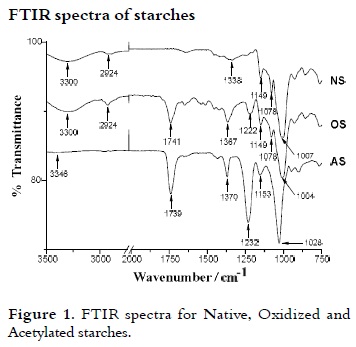
<body><![CDATA[<p> Meat extracts packaged in commercial plastic as   well as in bags made from NS, formulation C, were   diluted at 10<sup>-1</sup>, 10<sup>-2</sup> and 10<sup>-3</sup>. Of each one, 1 mL was   extracted and then inoculated in 3 tubes containing   Brilla Broth. All these 3 series of 3 tubes each one,   were incubated at 37&deg;C during 48 h. After this, nor   gas presence neither turbidity were evidenced in   Durham bell, so they were marbled as negatives (-).</p>     <p>&nbsp;</p>     <p><font size="3"> <b>DISCUSSION</b></font></p>     <p> <b>Characteristics of the starches used in the   films preparation</b></p>     <p> The Percentage of starch extraction matches   the value reported by Hermann et al., 1997 (28).   Despite of the diversity of its varieties, arracacha   starch extraction has been reported as well as its   quantification methods. After the esterification   reaction was performed, AS was obtained with a   percentage of acetyl groups of 6.45%, which equates   to a 0.259 DS, (<a href="#t1">Table 1</a>). This means that from the   whole OH functional groups, 0.259 were replaced   by acetyls. Similar results have been reported by   Singh et al., 2004 (29). The percentage of carbonyl   and carboxyl groups of oxidized starch OS was   obtained with a value of 0.019 carbonyl groups   and a percentage of 0.025 carboxyl groups. Similar   results were reported by Sandhua et al., 2008 (30)   and Rivas et al., 2008 (31), (<a href="#t1">Table 1</a>).</p>     <p> <b>Infrared spectroscopy (FTIR) of starches</b></p> </font>    <p> <font size="2" face="Verdana, Arial, Helvetica, sans-serif"><a href="#f1">Figure 1</a> shows the spectrum FTIR of NS,   whose bands are characteristic for this kind of   compounds (32 - 34). The vibration of the hydroxyl   group appears as a broad band at 3300 cm<sup>-1</sup>. The   vibration of the C-O bond of secondary hydroxyls   appears at 1007 cm<sup>-1</sup> and the C-O-C vibration   appears at 1149 cm<sup>-1</sup>; tension bands corresponding   to OH, are located at 1338 cm<sup>-1</sup>, and the tension   band ''out of plane'' corresponding to CH is found   at 1078 cm<sup>-1</sup>.</font></p>     <p><font size="2" face="Verdana, Arial, Helvetica, sans-serif"> The FTIR spectrum of the OS in which a   new band appears at 1741 cm<sup>-1</sup> corresponding to   the vibration of the carbonyl bond formed by the   oxidation reaction is showed. Two new bands at   1367 cm<sup>-1</sup> and 1222 cm<sup>-1</sup> appear, corresponding   to the tension of the C-O-H and C-O bonds   respectively, formed during oxidation of starch from   the carboxylic groups.</font></p>     <p><font size="2" face="Verdana, Arial, Helvetica, sans-serif"> Two new bands appear in the AS FTIR spectrum:   1739 cm<sup>-1</sup>, that is attributed to the vibration of   the carbonyl group, formed by the reaction of   acetylation of hydroxyl groups and other at 1232   cm<sup>-1</sup>, that is characteristic of tension vibration of   the ester function C-O bonds. The vibration of   the tension of O-C-C bonds of esters appears at   1153 cm<sup>-1</sup>. The vibration of bending of the methyl   group of the formed ester appears at 1370 cm<sup>-1</sup>.   Finally, the intensity of the band corresponding to   the OH group decreases considerably due to the   high degree of substitution.</font></p>     <p><font size="2" face="Verdana, Arial, Helvetica, sans-serif"> <b>X-rays diffraction (DRX) of starches</b></font></p>     ]]></body>
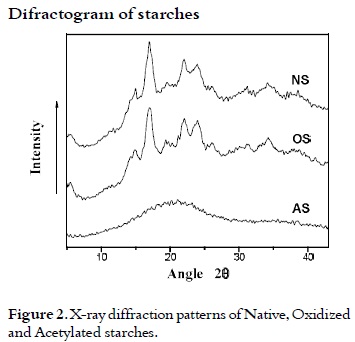
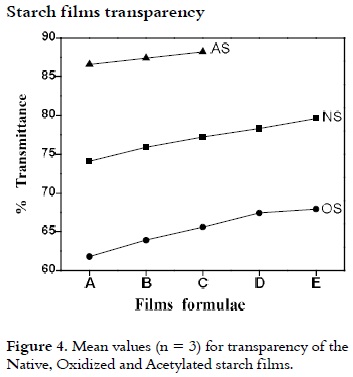
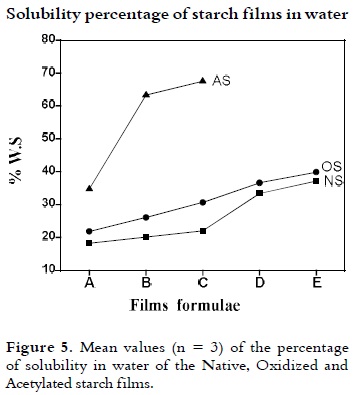
<body><![CDATA[<p><font size="2" face="Verdana, Arial, Helvetica, sans-serif"> <a href="#f2">Figure 2</a> shows the diffraction patterns of the   three types of starches. The diffraction pattern of   native starch of arracacha showed a &beta; type crystal   structure with peaks at 5, 15, 17, 20, 22 and 24 at the   angle (2&theta;), indicating a typical pattern of arracacha   starch similar to the potato starch (35). The oxidation   reaction did not affect the X-ray diffraction pattern,   but the percentage of crystallinity of starch (31).   It is 12.88% for the OS whereas for the NS is   11.08%. The increase of crystallinity for OS could   be due to depolymerization reactions presumably,   as a secondary effect of the oxidation reaction (36),   obtaining amylose chains which undergo a certain   order degree (37).</font></p>     <p><font size="2" face="Verdana, Arial, Helvetica, sans-serif"> During the acetylation reaction, the AS   semicrystalline structure affected largely the   x-ray diffraction pattern, and a new structure of   amorphous nature is observed. For AS, crystallinity   loss may have been due to the acetylation reaction on   the amylopectin, reducing its order degree, due to the   obtained high degree of substitution. Similar results   have been reported by Hui Chi et al., 2008 (38).</font></p>     <p><font size="2" face="Verdana, Arial, Helvetica, sans-serif"> <b>Scanning electron microscopy (SEM) of starches</b></font></p>     <p><font size="2" face="Verdana, Arial, Helvetica, sans-serif"> The micrograph of NS reveals particles whose   sizes vary from 5 to 9 &micro;m the smallest ones, and   from 12.4 to 15 &micro;m the largest ones. The form of   granules tends to be rounded, but it also observed   morphological irregularities (cuboids or deformed   pyramids) and other truncated forms, probably   originated during the starch extraction process.   During the Oxidation reaction, morphology suffers   no obvious changes except the greater tendency   to the clustering. In the OS morphology there are   fewer tendencies to form conglomerates of particles   forming clusters (See <a href="/img/revistas/vitae/v19n2/v19n2a5f3.jpg" target="_blank">Figure 3</a>).</font></p>     <p><font size="2" face="Verdana, Arial, Helvetica, sans-serif"> The acetylation reaction causes a disruption   of the matrix, which is evidenced by a greater   agglomeration of the granules and a modification   of their size, shape and texture. In these conditions,   the AS probably suffers destructuration as it   interacts with amylose and amylopectin, resulting   in a different sort of chemical bonds. The size of   the agglomerates in the AS reveals a different type   of intergranular cohesion, which may be caused by   changes in functional groups, which, in turn, results   in increasing hydrogen bonds and a subsequent   intergranular agglomeration (29).</font></p>     <p><font size="2" face="Verdana, Arial, Helvetica, sans-serif"> <b>Films Transparency</b></font></p>     <p><font size="2" face="Verdana, Arial, Helvetica, sans-serif"> In <a href="#f4">Figure 4</a>, is shown the average of the   transmittance values as indicator of f ilms   transparency for each one of the three types of   films with different glycerol concentrations. It was   observed that at higher glycerol content, greater   transparency of NS, OS and AS films was observed.   The greatest transparency value was obtained for the   AS films. Thus, starch increases its structural water   retention capacity, which facilitates the crossing of   light. Furthermore, the lowest transparency of OS   films may be due to the oxidation reaction, when   starch undergoes a whitening process, which is   maintained during the gelling step. This makes OS   films more opaque.</font></p>     <p><font size="2" face="Verdana, Arial, Helvetica, sans-serif"> <b>Solubility percentage of starch films in water</b></font></p>     <p><font size="2" face="Verdana, Arial, Helvetica, sans-serif"> The percentage of the films water solubility (%   WS) is shown in <a href="#f5">Figure 5</a>. It shows that when the   films glycerol amount is increased, its solubility   increases as well, due to the hydrophilic nature of   this compound (39). On average, the films made   with NS showed a lower solubility in water than   films with OS and AS. The NS and OS films water   solubility is very similar. During the oxidation   reaction, starch undergoes partial hydrolysis which   shortens the length of the chains of glucose and   increases its solubility.</font></p>     <p><font size="2" face="Verdana, Arial, Helvetica, sans-serif"> Probably, the increasing in the AS films water   solubility is due to the reaction of acetylation which   induces greater water absorption of starch granules.   In this case, the substituent group acts as a spacer,   preventing that starch chains become closer. During   the solubility test at 25&deg;C and under agitation, the   trapped water gets out and this phenomenon causes   a greater loss of weight.</font></p>     ]]></body>
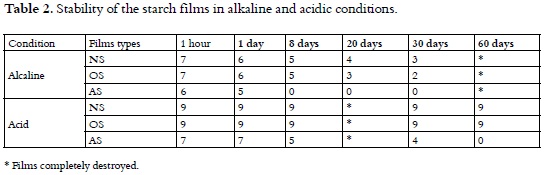
<body><![CDATA[<p><font size="2" face="Verdana, Arial, Helvetica, sans-serif"> <b>Stability in alkaline and acid conditions of   starch films</b></font></p>     <p><font size="2" face="Verdana, Arial, Helvetica, sans-serif"> Taking into account that films could be used as   packaging and therefore they would eventually be   exposed to acidic or alkaline conditions, a test and   a photographic record of the stability of the films   in acid and alkaline conditions were conducted.</font></p>     <p><font size="2" face="Verdana, Arial, Helvetica, sans-serif"> Stability, both in alkaline and acid conditions,   was measured on a scale from 0 (stable) to 10   (unstable), at 1 hour, 1 day, 8 days, 20 days, 30 days   and additionally in acid conditions at 60 days. The   average results of the five films test score with each   starch type are shown in <a href="#t2">Table 2</a> and some samples   of the photographic record are included in <a href="/img/revistas/vitae/v19n2/v19n2a5f6.jpg" target="_blank">Figure 6</a>.</font></p>     <p><font size="2" face="Verdana, Arial, Helvetica, sans-serif"> In alkaline condition and one hour later of the   test beginning, NS, OS and AS films showed swelling   and size increasing. One day later, the three   types of films maintained their swelling and began   to show breakdown also; these characteristics were   more evident in the AS films.</font></p>     <p><font size="2" face="Verdana, Arial, Helvetica, sans-serif"> Eight days later, NS films breakdown increased   while OS films breakdown continued and AS films   were completely destroyed (<a href="/img/revistas/vitae/v19n2/v19n2a5f6.jpg" target="_blank">Figure 6A</a>). Twenty   days later NS films were stable yet, while OS films   showed total breakdown (<a href="/img/revistas/vitae/v19n2/v19n2a5f6.jpg" target="_blank">Figure 6B</a>). Thirty days   later NS films began to breakdown (<a href="/img/revistas/vitae/v19n2/v19n2a5f6.jpg" target="_blank">Figure 6C</a>).</font></p>     <p><font size="2" face="Verdana, Arial, Helvetica, sans-serif"> Probably, the low stability of the three types   of f ilms in alkaline conditions may be due to   that sodium hydroxide reacted with the hydroxyl   groups of the films starch molecules and broke the   hydrogen bonds, which would cause weakness of   the intra and inter molecular interactions. However,   the smaller stability of the OS films may be due to   that sodium ions react with carboxyl groups to form   carboxilates, which would increase the hydrophilic   nature and therefore the starch solubility (1).</font></p>     <p><font size="2" face="Verdana, Arial, Helvetica, sans-serif"> On the other hand, in AS ester bonds could   undergo some degree of hydrolysis caused by sodium   hydroxide. This reaction facilitates that the   starch hydroxyl groups be formed again, besides of   the formation of sodium acetate; this one has high   solubility in water. Consequently, the AS films   solubility is greater than NS and OS ones; this fact   explains its greater instability.</font></p>     <p><font size="2" face="Verdana, Arial, Helvetica, sans-serif"> In acid conditions and one hour after the test   beginning, the NS and OS films size, increased   slightly, while the AS films showed high swelling;   one day after, the three types of films maintained   these same characteristics.</font></p>     <p><font size="2" face="Verdana, Arial, Helvetica, sans-serif"> Eight Days later, the AS film began to show   breakdown (<a href="/img/revistas/vitae/v19n2/v19n2a5f7.jpg" target="_blank">Figure 7A</a>). Although Thirty days   after, NS and OS films remained stable, the AS   films showed greater breakdown (<a href="/img/revistas/vitae/v19n2/v19n2a5f7.jpg" target="_blank">Figure 7B</a>) and   60 days later, NS and OS films maintained stable   and AS films showed total breakdown (<a href="/img/revistas/vitae/v19n2/v19n2a5f7.jpg" target="_blank">Figure 7C</a>).   Acid conditions do not affect considerably NS and   OS films stability.</font></p>     <p><font size="2" face="Verdana, Arial, Helvetica, sans-serif"> AS films stability is lower possibly due to the   ester group acid hydrolysis reactions which retrieve   original starch hydroxyl groups. On the other hand,   this hydrolysis reaction produces acetic acid also,   which has higher solubility in water and therefore   increases the instability of the films made with this   type of starch.</font></p>     ]]></body>
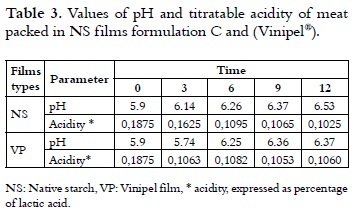
<body><![CDATA[<p><font size="2" face="Verdana, Arial, Helvetica, sans-serif"> <b>Arracacha starch films used as packaging of   meat</b></font></p>     <p><font size="2" face="Verdana, Arial, Helvetica, sans-serif"> <i>pH and titratable acidity determination</i></font></p>     <p><font size="2" face="Verdana, Arial, Helvetica, sans-serif"> The initial pH and acidity of the meat are within   the characteristic values for these products (40). As   time goes by, the pH of the meat increases while   acidity values decrease, due to increasing of basic   character of compounds derived from the hydrolysis   of the meat proteins, as can be seen in <a href="#t3">Table 3</a>. There   is no major difference in these physicochemical   parameters, when commercial plastic (Vinipel&reg;)   or NS films of formulation C, are used as packing   material.</font></p>     <p><font size="2" face="Verdana, Arial, Helvetica, sans-serif"> <b>Fecal coliforms most probable number (MPN)</b></font></p>     <p><font size="2" face="Verdana, Arial, Helvetica, sans-serif"> These results confirm absence of fecal coliforms   and a hygienic product as well. The results obtained   indicate that NS films, formulation C, do not   permit any contamination with microorganisms   to the meat sample, compared to the reference   material used.</font></p> <font face="Verdana, Arial, Helvetica, sans-serif" size="2">    <p>&nbsp;</p>     <p><font size="3"> <b>CONCLUSIONS</b></font></p>     <p> AS films showed greater transparency and water   solubility than NS and OS films, at the same glycerol   amounts. NS Films showed greater stability in   acid and alkaline conditions than AS and OS films.   In all treatments, for the three types of films, the   effect of the alkaline condition was greater than the   acid one. The films physicochemical properties are   directly influenced by the plasticizer concentration   and by the type of starch used for their production.   From the laboratory analysis report, is possible to   asseverate that films made from arracacha starch are   suitable for being used as meat packaging. However,   these films experiment a degradation process due   to the crystallization of water after 10 days of use.</p>     <p>&nbsp;</p>     <p><font size="3"> <b>REFERENCES</b></font></p>     ]]></body>
<body><![CDATA[<!-- ref --><p> 1. Hu G, Chen J, Gao J. Preparation and characteristics of oxidized   potato starch films.&nbsp;&nbsp;&nbsp;&nbsp;&nbsp;&nbsp;&nbsp;&nbsp;[&#160;<a href="javascript:void(0);" onclick="javascript: window.open('/scielo.php?script=sci_nlinks&ref=000153&pid=S0121-4004201200020000500001&lng=','','width=640,height=500,resizable=yes,scrollbars=1,menubar=yes,');">Links</a>&#160;]<!-- end-ref --><!-- ref --><p> 2. Carbohydr Polym. 2009 Mar; 76 (2): 291-298.&nbsp;&nbsp;&nbsp;&nbsp;&nbsp;&nbsp;&nbsp;&nbsp;[&#160;<a href="javascript:void(0);" onclick="javascript: window.open('/scielo.php?script=sci_nlinks&ref=000154&pid=S0121-4004201200020000500002&lng=','','width=640,height=500,resizable=yes,scrollbars=1,menubar=yes,');">Links</a>&#160;]<!-- end-ref --><!-- ref --><p> 3. Merchan JP, Ballesteros D, Jim&eacute;nez IC, Jim&eacute;nez JA, Medina   AO. Estudio de la Biodegradaci&oacute;n Aerobia de Almid&oacute;n Termopl &aacute;stico (TPS). Suplemento de la RLMM. 2009 Jul; 1 (1): 39-44.&nbsp;&nbsp;&nbsp;&nbsp;&nbsp;&nbsp;&nbsp;&nbsp;[&#160;<a href="javascript:void(0);" onclick="javascript: window.open('/scielo.php?script=sci_nlinks&ref=000155&pid=S0121-4004201200020000500003&lng=','','width=640,height=500,resizable=yes,scrollbars=1,menubar=yes,');">Links</a>&#160;]<!-- end-ref --><!-- ref --><p> 4. Uhrich KE, Cannizzaro SM, Langer RS, Shakesheff KM.   Polymeric systems for controlled drug release. Chem Rev. 1999   Jun; 99 (11): 3181-3198.&nbsp;&nbsp;&nbsp;&nbsp;&nbsp;&nbsp;&nbsp;&nbsp;[&#160;<a href="javascript:void(0);" onclick="javascript: window.open('/scielo.php?script=sci_nlinks&ref=000156&pid=S0121-4004201200020000500004&lng=','','width=640,height=500,resizable=yes,scrollbars=1,menubar=yes,');">Links</a>&#160;]<!-- end-ref --><!-- ref --><p> 5. Tuominen J. Chain linked acid polymers: polymerization degradation   studies &#91;dissertation&#93;. &#91;Helsinki&#93;: Technology University   of Helsinki, 2003. 54 p.&nbsp;&nbsp;&nbsp;&nbsp;&nbsp;&nbsp;&nbsp;&nbsp;[&#160;<a href="javascript:void(0);" onclick="javascript: window.open('/scielo.php?script=sci_nlinks&ref=000157&pid=S0121-4004201200020000500005&lng=','','width=640,height=500,resizable=yes,scrollbars=1,menubar=yes,');">Links</a>&#160;]<!-- end-ref --><!-- ref --><p> 6. BeMiller JN, Whistler RL. Starch Chemistry and Technology.   2nd ed. London, UK: Academic Press Publications; 1984. 879 p.&nbsp;&nbsp;&nbsp;&nbsp;&nbsp;&nbsp;&nbsp;&nbsp;[&#160;<a href="javascript:void(0);" onclick="javascript: window.open('/scielo.php?script=sci_nlinks&ref=000158&pid=S0121-4004201200020000500006&lng=','','width=640,height=500,resizable=yes,scrollbars=1,menubar=yes,');">Links</a>&#160;]<!-- end-ref --><!-- ref --><p> 7. Pe&ntilde;aranda OI, Perilla JE, Algecira NA. A review of using   organic acids to chemically modify starch. Ingenier&iacute;a e Investigaci &oacute;n. 2008 Dec; 28 (3): 47-52.&nbsp;&nbsp;&nbsp;&nbsp;&nbsp;&nbsp;&nbsp;&nbsp;[&#160;<a href="javascript:void(0);" onclick="javascript: window.open('/scielo.php?script=sci_nlinks&ref=000159&pid=S0121-4004201200020000500007&lng=','','width=640,height=500,resizable=yes,scrollbars=1,menubar=yes,');">Links</a>&#160;]<!-- end-ref --><!-- ref --><p> 8. Waliszewski KW, Aparicio MA, Bello LA, Monroy JA. Changes   of banana starch by chemical and physical modification. Carbohydr   Polym. 2003 May; 52 (3): 237-242.&nbsp;&nbsp;&nbsp;&nbsp;&nbsp;&nbsp;&nbsp;&nbsp;[&#160;<a href="javascript:void(0);" onclick="javascript: window.open('/scielo.php?script=sci_nlinks&ref=000160&pid=S0121-4004201200020000500008&lng=','','width=640,height=500,resizable=yes,scrollbars=1,menubar=yes,');">Links</a>&#160;]<!-- end-ref --><!-- ref --><p> 9. Alarc&oacute;n M, Dufour D. Almid&oacute;n agrio de yuca en Colombia,   Tomo I Producci&oacute;n y Recomendaciones. 1<sup>era</sup> ed. Cali, Colombia:   CIAT; 1998. 62 p.&nbsp;&nbsp;&nbsp;&nbsp;&nbsp;&nbsp;&nbsp;&nbsp;[&#160;<a href="javascript:void(0);" onclick="javascript: window.open('/scielo.php?script=sci_nlinks&ref=000161&pid=S0121-4004201200020000500009&lng=','','width=640,height=500,resizable=yes,scrollbars=1,menubar=yes,');">Links</a>&#160;]<!-- end-ref --><!-- ref --><p> 10. Medina JA, Salas JC. Morphological Characterization of Native   starch Granule: Apperance, Shape, Size and its Distribution. Rev   Ing. 2003 Jun; 27: 56-62.&nbsp;&nbsp;&nbsp;&nbsp;&nbsp;&nbsp;&nbsp;&nbsp;[&#160;<a href="javascript:void(0);" onclick="javascript: window.open('/scielo.php?script=sci_nlinks&ref=000162&pid=S0121-4004201200020000500010&lng=','','width=640,height=500,resizable=yes,scrollbars=1,menubar=yes,');">Links</a>&#160;]<!-- end-ref --><!-- ref --><p> 11. Hoover R. Composition, molecular structure, and physicochemical   properties of tuber and root starches: a review. Carbohydr   Polym. 2001 Apr; 45 (3): 253-267.&nbsp;&nbsp;&nbsp;&nbsp;&nbsp;&nbsp;&nbsp;&nbsp;[&#160;<a href="javascript:void(0);" onclick="javascript: window.open('/scielo.php?script=sci_nlinks&ref=000163&pid=S0121-4004201200020000500011&lng=','','width=640,height=500,resizable=yes,scrollbars=1,menubar=yes,');">Links</a>&#160;]<!-- end-ref --><!-- ref --><p> 12. Lourdin DV, Colonna P. Influence of amylase content on starch   films and foams. Carbohydr Polym. 1995 Jan; 27 (4): 261-270.&nbsp;&nbsp;&nbsp;&nbsp;&nbsp;&nbsp;&nbsp;&nbsp;[&#160;<a href="javascript:void(0);" onclick="javascript: window.open('/scielo.php?script=sci_nlinks&ref=000164&pid=S0121-4004201200020000500012&lng=','','width=640,height=500,resizable=yes,scrollbars=1,menubar=yes,');">Links</a>&#160;]<!-- end-ref --><!-- ref --><p> 13. Garc&iacute;a MA, Martino MN, Zaritzky NE. Lipid addition to   improve barrier properties of edible starch-based films and   coatings. J Food Science. 2000 Sep; 65 (6): 941-947.&nbsp;&nbsp;&nbsp;&nbsp;&nbsp;&nbsp;&nbsp;&nbsp;[&#160;<a href="javascript:void(0);" onclick="javascript: window.open('/scielo.php?script=sci_nlinks&ref=000165&pid=S0121-4004201200020000500013&lng=','','width=640,height=500,resizable=yes,scrollbars=1,menubar=yes,');">Links</a>&#160;]<!-- end-ref --><!-- ref --><p> 14. Garc&iacute;a MA, Pinotti M, Zaritzky NM. Characterization of   composite hydrocolloid films. Carbohydr Polym. 2004 Jul; 56   (3): 339-345.&nbsp;&nbsp;&nbsp;&nbsp;&nbsp;&nbsp;&nbsp;&nbsp;[&#160;<a href="javascript:void(0);" onclick="javascript: window.open('/scielo.php?script=sci_nlinks&ref=000166&pid=S0121-4004201200020000500014&lng=','','width=640,height=500,resizable=yes,scrollbars=1,menubar=yes,');">Links</a>&#160;]<!-- end-ref --><!-- ref --><p> 15. Zamudio FP, Bello PL, Vargas TA, Hern&aacute;ndez UJ, Romero BC.   Partial characterization of films prepared with oxidized banana   starch. Agrociencia. 2007 Sep; 41 (8): 837-844.&nbsp;&nbsp;&nbsp;&nbsp;&nbsp;&nbsp;&nbsp;&nbsp;[&#160;<a href="javascript:void(0);" onclick="javascript: window.open('/scielo.php?script=sci_nlinks&ref=000167&pid=S0121-4004201200020000500015&lng=','','width=640,height=500,resizable=yes,scrollbars=1,menubar=yes,');">Links</a>&#160;]<!-- end-ref --><!-- ref --><p> 16. Fang JM, Fowler PA, Tomkinson J, Hill CA. An investigation   of the use of recovered vegetable oil for the preparation of starch   thermoplastics. Carbohydr Polym. 2002 Dec; 50 (4): 429-434.&nbsp;&nbsp;&nbsp;&nbsp;&nbsp;&nbsp;&nbsp;&nbsp;[&#160;<a href="javascript:void(0);" onclick="javascript: window.open('/scielo.php?script=sci_nlinks&ref=000168&pid=S0121-4004201200020000500016&lng=','','width=640,height=500,resizable=yes,scrollbars=1,menubar=yes,');">Links</a>&#160;]<!-- end-ref --><!-- ref --><p> 17. Gong Q, Wang LQ, Tu K. In situ polymerization of starch   with lactic acid in aqueous solution and the microstructure   characterization. Carbohydr Polym. 2006 Jun; 64 (4): 501-509.&nbsp;&nbsp;&nbsp;&nbsp;&nbsp;&nbsp;&nbsp;&nbsp;[&#160;<a href="javascript:void(0);" onclick="javascript: window.open('/scielo.php?script=sci_nlinks&ref=000169&pid=S0121-4004201200020000500017&lng=','','width=640,height=500,resizable=yes,scrollbars=1,menubar=yes,');">Links</a>&#160;]<!-- end-ref --><!-- ref --><p><font size="2" face="Verdana, Arial, Helvetica, sans-serif"> 18. Jim&eacute;nez FS. Caracter&iacute;sticas nutricionales de la arracacha (<i>Arracacia   xanthorrhiza</i>) y sus perspectivas en la alimentaci&oacute;n &#91;Internet&#93;.   Lima (PE): Red peruana de alimentaci&oacute;n y nutrici&oacute;n; 2005 Jan (cited 2010 Dec 15). Available from: <a href="http://www.slideshare.net/kevin1990/caracteristicas-nutricionales-de-la-arrecacha" target="_blank">http://www.slideshare.net/kevin1990/caracteristicas-nutricionales-de-la-arrecacha</a>.</font>&nbsp;&nbsp;&nbsp;&nbsp;&nbsp;&nbsp;&nbsp;&nbsp;[&#160;<a href="javascript:void(0);" onclick="javascript: window.open('/scielo.php?script=sci_nlinks&ref=000170&pid=S0121-4004201200020000500018&lng=','','width=640,height=500,resizable=yes,scrollbars=1,menubar=yes,');">Links</a>&#160;]<!-- end-ref --><!-- ref --><p><font size="2" face="Verdana, Arial, Helvetica, sans-serif"> 19. Rodr&iacute;guez G. Concepci&oacute;n de un modelo de agroindustria   rural para la elaboraci&oacute;n de harina y almid&oacute;n a partir de ra&iacute;ces   y tub&eacute;rculos promisorios, con &eacute;nfasis en los casos de achira   (<i>Canna edulis</i>), arracacha (<i>Arracacia xanthorriza</i>) y &ntilde;ame (<i>Dioscorea</i>  sp.) &#91;Internet&#93;. Tibaitat&aacute; (CO): CORPOICA.PRONATTA;   2003 Dec (cited 2010 Oct 18). Available from: <a href="http://www.infoandina.org/system/files/recursos/AIRachira.pdf" target="_blank">http://www.infoandina.org/system/files/recursos/AIRachira.pdf</a>.</font>&nbsp;&nbsp;&nbsp;&nbsp;&nbsp;&nbsp;&nbsp;&nbsp;[&#160;<a href="javascript:void(0);" onclick="javascript: window.open('/scielo.php?script=sci_nlinks&ref=000171&pid=S0121-4004201200020000500019&lng=','','width=640,height=500,resizable=yes,scrollbars=1,menubar=yes,');">Links</a>&#160;]<!-- end-ref --><!-- ref --><p> 20. Aristiz&aacute;bal J, S&aacute;nchez T. Gu&iacute;a t&eacute;cnica para producci&oacute;n y an&aacute;lisis de almid&oacute;n de yuca. 1<sup>era</sup> ed. Roma, Italia: FAO; 2007. 104 p.&nbsp;&nbsp;&nbsp;&nbsp;&nbsp;&nbsp;&nbsp;&nbsp;[&#160;<a href="javascript:void(0);" onclick="javascript: window.open('/scielo.php?script=sci_nlinks&ref=000172&pid=S0121-4004201200020000500020&lng=','','width=640,height=500,resizable=yes,scrollbars=1,menubar=yes,');">Links</a>&#160;]<!-- end-ref --><!-- ref --><p> 21. Phillips DL, Huijum L, Duohai P, Harold C. General application   of Raman spectroscopy for the determination of level of   acetylation in modified starches. Cereal Chem. 1999 Feb; 76   (3): 439-443.&nbsp;&nbsp;&nbsp;&nbsp;&nbsp;&nbsp;&nbsp;&nbsp;[&#160;<a href="javascript:void(0);" onclick="javascript: window.open('/scielo.php?script=sci_nlinks&ref=000173&pid=S0121-4004201200020000500021&lng=','','width=640,height=500,resizable=yes,scrollbars=1,menubar=yes,');">Links</a>&#160;]<!-- end-ref --><!-- ref --><p> 22. Wang YJ, Wang L. Physicochemical properties of common   and waxy corn starches oxidized by different levels of sodium   hypochlorite. Carbohydr Polym. 2003 May; 52 (3): 207-217.&nbsp;&nbsp;&nbsp;&nbsp;&nbsp;&nbsp;&nbsp;&nbsp;[&#160;<a href="javascript:void(0);" onclick="javascript: window.open('/scielo.php?script=sci_nlinks&ref=000174&pid=S0121-4004201200020000500022&lng=','','width=640,height=500,resizable=yes,scrollbars=1,menubar=yes,');">Links</a>&#160;]<!-- end-ref --><!-- ref --><p> 23. Wurzburg OB. Methods in Carbohydrate Chemistry. 1st ed.   New York, USA: Academic Press; 1964. 240-241 p.&nbsp;&nbsp;&nbsp;&nbsp;&nbsp;&nbsp;&nbsp;&nbsp;[&#160;<a href="javascript:void(0);" onclick="javascript: window.open('/scielo.php?script=sci_nlinks&ref=000175&pid=S0121-4004201200020000500023&lng=','','width=640,height=500,resizable=yes,scrollbars=1,menubar=yes,');">Links</a>&#160;]<!-- end-ref --><!-- ref --><p> 24. Smith RJ. Starch chemistry and technology. 3<sup>rd</sup> ed. New York,   USA: Academic Press; 2009. 620-625 p.&nbsp;&nbsp;&nbsp;&nbsp;&nbsp;&nbsp;&nbsp;&nbsp;[&#160;<a href="javascript:void(0);" onclick="javascript: window.open('/scielo.php?script=sci_nlinks&ref=000176&pid=S0121-4004201200020000500024&lng=','','width=640,height=500,resizable=yes,scrollbars=1,menubar=yes,');">Links</a>&#160;]<!-- end-ref --><!-- ref --><p> 25. Chattopadhyay S, Singhal RS, Kulkarni PR. Optimization of   conditions of synthesis of oxidized starch from corn and amaranth   for use in film-forming applications. Carbohydr Polym.   1997 Dec; 34 (4): 203-212.&nbsp;&nbsp;&nbsp;&nbsp;&nbsp;&nbsp;&nbsp;&nbsp;[&#160;<a href="javascript:void(0);" onclick="javascript: window.open('/scielo.php?script=sci_nlinks&ref=000177&pid=S0121-4004201200020000500025&lng=','','width=640,height=500,resizable=yes,scrollbars=1,menubar=yes,');">Links</a>&#160;]<!-- end-ref --><!-- ref --><p> 26. Official Methods of Analysis. Association of Official Analytical   Chemists (AOAC). Potentiometric method, Number 945.10.   18th ed. Washington D.C, USA: AOAC; 2000.&nbsp;&nbsp;&nbsp;&nbsp;&nbsp;&nbsp;&nbsp;&nbsp;[&#160;<a href="javascript:void(0);" onclick="javascript: window.open('/scielo.php?script=sci_nlinks&ref=000178&pid=S0121-4004201200020000500026&lng=','','width=640,height=500,resizable=yes,scrollbars=1,menubar=yes,');">Links</a>&#160;]<!-- end-ref --><!-- ref --><p> 27. Official Methods of Analysis. Association of Official Analytical   Chemists (AOAC). Potentiometric method, Number 942.15.   18th ed. Washington D.C, USA: AOAC; 2000.&nbsp;&nbsp;&nbsp;&nbsp;&nbsp;&nbsp;&nbsp;&nbsp;[&#160;<a href="javascript:void(0);" onclick="javascript: window.open('/scielo.php?script=sci_nlinks&ref=000179&pid=S0121-4004201200020000500027&lng=','','width=640,height=500,resizable=yes,scrollbars=1,menubar=yes,');">Links</a>&#160;]<!-- end-ref --><!-- ref --><p> 28. Instituto Colombiano de Normas T&eacute;cnicas y Certificaci&oacute;n.   Norma T&eacute;cnica Colombiana. NTC 4516. Primera actualizaci&oacute;n.   Bogot&aacute;: ICONTEC; 2009.&nbsp;&nbsp;&nbsp;&nbsp;&nbsp;&nbsp;&nbsp;&nbsp;[&#160;<a href="javascript:void(0);" onclick="javascript: window.open('/scielo.php?script=sci_nlinks&ref=000180&pid=S0121-4004201200020000500028&lng=','','width=640,height=500,resizable=yes,scrollbars=1,menubar=yes,');">Links</a>&#160;]<!-- end-ref --><!-- ref --><p><font size="2" face="Verdana, Arial, Helvetica, sans-serif"> 29. Hermann H, Uptmoor R, Freire I, Montalvo J. International   Potato Centre Program Report 1995-1996: Crop Growth and   Starch Productivity of Edible Canna &#91;Internet&#93;. Lima, (PE):   Partnership by Josephine Dell' Orco Prain; 1997 Sep (cited 2010   Nov 21). Available from: <a href="http://books.google.com.co/books?id=6mE35sBhT48C&dq=Crop+Growth+and+Starch+Productivity+of+Edible+Canna&hl=es&source=gbs_navlinks_s" target="_blank">http://books.google.com.co/books?id=6mE35sBhT48Cdq=Crop+Growth+and+Starch+Productivity+of+Edible+Cannahl=essource=gbs_navlinks_s</a>.</font>&nbsp;&nbsp;&nbsp;&nbsp;&nbsp;&nbsp;&nbsp;&nbsp;[&#160;<a href="javascript:void(0);" onclick="javascript: window.open('/scielo.php?script=sci_nlinks&ref=000181&pid=S0121-4004201200020000500029&lng=','','width=640,height=500,resizable=yes,scrollbars=1,menubar=yes,');">Links</a>&#160;]<!-- end-ref --><!-- ref --><p> 30. Singh N, Chawla D, Singh J. Inf luence of acetic anhydride on   physicochemical, morphological and thermal properties of corn   and potato starch. Food Chem. 2004 Aug; 86 (4): 601-608.&nbsp;&nbsp;&nbsp;&nbsp;&nbsp;&nbsp;&nbsp;&nbsp;[&#160;<a href="javascript:void(0);" onclick="javascript: window.open('/scielo.php?script=sci_nlinks&ref=000182&pid=S0121-4004201200020000500030&lng=','','width=640,height=500,resizable=yes,scrollbars=1,menubar=yes,');">Links</a>&#160;]<!-- end-ref --><!-- ref --><p> 31. Sandhua KS, Kaura M, Singhb N, Lim ST. A comparison of   native and oxidized normal and waxy corn starches: Physicochemical,   thermal, morphological and pasting properties. LWT.   2008 Jul; 41(6): 1000-1010.&nbsp;&nbsp;&nbsp;&nbsp;&nbsp;&nbsp;&nbsp;&nbsp;[&#160;<a href="javascript:void(0);" onclick="javascript: window.open('/scielo.php?script=sci_nlinks&ref=000183&pid=S0121-4004201200020000500031&lng=','','width=640,height=500,resizable=yes,scrollbars=1,menubar=yes,');">Links</a>&#160;]<!-- end-ref --><!-- ref --><p> 32. Rivas GM, Montealvo MM, S&aacute;nchez RM, N&uacute;&ntilde;ez SM, Bello PL.   Morphological Molecular and Physicochemical Characterization   of Oxidized and Lintnerized Banana Starch. Agrociencia.   2008 Jul-Aug; 42 (5): 487-497.&nbsp;&nbsp;&nbsp;&nbsp;&nbsp;&nbsp;&nbsp;&nbsp;[&#160;<a href="javascript:void(0);" onclick="javascript: window.open('/scielo.php?script=sci_nlinks&ref=000184&pid=S0121-4004201200020000500032&lng=','','width=640,height=500,resizable=yes,scrollbars=1,menubar=yes,');">Links</a>&#160;]<!-- end-ref --><!-- ref --><p> 33. Dumoulin Y, Alex S, Szabo P, Cartilier L, Alexandru M. Cross   linked amylose as matrix for drug controlled release. X-ray and   FT-IR structural analysis. Carbohydr Polym. 1998 Dec; 37 (4):   361-370.&nbsp;&nbsp;&nbsp;&nbsp;&nbsp;&nbsp;&nbsp;&nbsp;[&#160;<a href="javascript:void(0);" onclick="javascript: window.open('/scielo.php?script=sci_nlinks&ref=000185&pid=S0121-4004201200020000500033&lng=','','width=640,height=500,resizable=yes,scrollbars=1,menubar=yes,');">Links</a>&#160;]<!-- end-ref --><!-- ref --><p> 34. Dragunski DC, Pawlicka A. Preparation and characterization   of Starch Grafted with Toluene Poly (propylene oxide) diisocyanate.   Materials Research. 2001 Apr; 4 (2): 77-81.&nbsp;&nbsp;&nbsp;&nbsp;&nbsp;&nbsp;&nbsp;&nbsp;[&#160;<a href="javascript:void(0);" onclick="javascript: window.open('/scielo.php?script=sci_nlinks&ref=000186&pid=S0121-4004201200020000500034&lng=','','width=640,height=500,resizable=yes,scrollbars=1,menubar=yes,');">Links</a>&#160;]<!-- end-ref --><!-- ref --><p> 35. Kacurakova M, Wilson R.H. Developments in mid-infrared   FT-IR spectroscopy of seleted carbohydrates. Carbohydr Polym.   2001 Apr; 44 (4): 291-303.&nbsp;&nbsp;&nbsp;&nbsp;&nbsp;&nbsp;&nbsp;&nbsp;[&#160;<a href="javascript:void(0);" onclick="javascript: window.open('/scielo.php?script=sci_nlinks&ref=000187&pid=S0121-4004201200020000500035&lng=','','width=640,height=500,resizable=yes,scrollbars=1,menubar=yes,');">Links</a>&#160;]<!-- end-ref --><!-- ref --><p> 36. Mathew S, Adlercreutz P. Mediator facilitated, laccase catalysed   oxidation of granular potato starch and the physico-chemical   characterisation of the oxidized products. Bioresour Technol.   2009 Jul; 100 (14): 3576-3584.&nbsp;&nbsp;&nbsp;&nbsp;&nbsp;&nbsp;&nbsp;&nbsp;[&#160;<a href="javascript:void(0);" onclick="javascript: window.open('/scielo.php?script=sci_nlinks&ref=000188&pid=S0121-4004201200020000500036&lng=','','width=640,height=500,resizable=yes,scrollbars=1,menubar=yes,');">Links</a>&#160;]<!-- end-ref --><!-- ref --><p> 37. Kuakpetoon D, Wang Y. Locations of hypochlorite oxidation   in corn starches varying in amylose content. Carbohydr Res.   2008 Jan; 343 (1): 90-100.&nbsp;&nbsp;&nbsp;&nbsp;&nbsp;&nbsp;&nbsp;&nbsp;[&#160;<a href="javascript:void(0);" onclick="javascript: window.open('/scielo.php?script=sci_nlinks&ref=000189&pid=S0121-4004201200020000500037&lng=','','width=640,height=500,resizable=yes,scrollbars=1,menubar=yes,');">Links</a>&#160;]<!-- end-ref --><!-- ref --><p> 38. Morrison WR, Tester RF, Gidley MJ, Karkalas J. Resistance to   acid hydrolysis of lipid complexed amylose and lipid free amylose   in linterized waxy and non-waxy barley starch. Carbohydr   Res. 1993 Jul; 245 (2): 289-302&nbsp;&nbsp;&nbsp;&nbsp;&nbsp;&nbsp;&nbsp;&nbsp;[&#160;<a href="javascript:void(0);" onclick="javascript: window.open('/scielo.php?script=sci_nlinks&ref=000190&pid=S0121-4004201200020000500038&lng=','','width=640,height=500,resizable=yes,scrollbars=1,menubar=yes,');">Links</a>&#160;]<!-- end-ref --><!-- ref --><p> 39. Chi H, Xu K, Wua X, Chen Q, Xue D, Song Ch, et al. Effect of   acetylation on the properties of corn starch. Food Chem. 2008   Feb; 106 (3): 923-928.&nbsp;&nbsp;&nbsp;&nbsp;&nbsp;&nbsp;&nbsp;&nbsp;[&#160;<a href="javascript:void(0);" onclick="javascript: window.open('/scielo.php?script=sci_nlinks&ref=000191&pid=S0121-4004201200020000500039&lng=','','width=640,height=500,resizable=yes,scrollbars=1,menubar=yes,');">Links</a>&#160;]<!-- end-ref --><!-- ref --><p> 40. L&oacute;pez OV, Garc&iacute;a MA, Zaritzky NE. Film forming capacity   of chemically modified corn starches. Carbohydr Polym. 2008   Sep; 73 (4): 573-581.&nbsp;&nbsp;&nbsp;&nbsp;&nbsp;&nbsp;&nbsp;&nbsp;[&#160;<a href="javascript:void(0);" onclick="javascript: window.open('/scielo.php?script=sci_nlinks&ref=000192&pid=S0121-4004201200020000500040&lng=','','width=640,height=500,resizable=yes,scrollbars=1,menubar=yes,');">Links</a>&#160;]<!-- end-ref --><!-- ref --><p> 41. Varnam AH, Sutherland JP. Carne y productos c&aacute;rnicos. Tecnolog&iacute;a, Qu&iacute;mica y Microbiolog&iacute;a. 1<sup>era</sup> ed. Zaragoza, Espa&ntilde;a:   Acribia, S.A; 1995.&nbsp;&nbsp;&nbsp;&nbsp;&nbsp;&nbsp;&nbsp;&nbsp;[&#160;<a href="javascript:void(0);" onclick="javascript: window.open('/scielo.php?script=sci_nlinks&ref=000193&pid=S0121-4004201200020000500041&lng=','','width=640,height=500,resizable=yes,scrollbars=1,menubar=yes,');">Links</a>&#160;]<!-- end-ref --> ]]></body><back>
<ref-list>
<ref id="B1">
<label>1</label><nlm-citation citation-type="">
<person-group person-group-type="author">
<name>
<surname><![CDATA[Hu]]></surname>
<given-names><![CDATA[G]]></given-names>
</name>
<name>
<surname><![CDATA[Chen]]></surname>
<given-names><![CDATA[J]]></given-names>
</name>
<name>
<surname><![CDATA[Gao]]></surname>
<given-names><![CDATA[J]]></given-names>
</name>
</person-group>
<article-title xml:lang="en"><![CDATA[Preparation and characteristics of oxidized potato starch films]]></article-title>
<source><![CDATA[]]></source>
<year></year>
</nlm-citation>
</ref>
<ref id="B2">
<label>2</label><nlm-citation citation-type="journal">
<source><![CDATA[Carbohydr Polym]]></source>
<year>2009</year>
<month> M</month>
<day>ar</day>
<volume>76</volume>
<numero>2</numero>
<issue>2</issue>
<page-range>291-298</page-range></nlm-citation>
</ref>
<ref id="B3">
<label>3</label><nlm-citation citation-type="journal">
<person-group person-group-type="author">
<name>
<surname><![CDATA[Merchan]]></surname>
<given-names><![CDATA[JP]]></given-names>
</name>
<name>
<surname><![CDATA[Ballesteros]]></surname>
<given-names><![CDATA[D]]></given-names>
</name>
<name>
<surname><![CDATA[Jiménez]]></surname>
<given-names><![CDATA[IC]]></given-names>
</name>
<name>
<surname><![CDATA[Jiménez]]></surname>
<given-names><![CDATA[JA]]></given-names>
</name>
<name>
<surname><![CDATA[Medina]]></surname>
<given-names><![CDATA[AO.]]></given-names>
</name>
</person-group>
<article-title xml:lang="es"><![CDATA[Estudio de la Biodegradación Aerobia de Almidón Termopl ástico (TPS)]]></article-title>
<source><![CDATA[Suplemento de la RLMM]]></source>
<year>2009</year>
<month> J</month>
<day>ul</day>
<volume>1</volume>
<numero>1</numero>
<issue>1</issue>
<page-range>39-44</page-range></nlm-citation>
</ref>
<ref id="B4">
<label>4</label><nlm-citation citation-type="journal">
<person-group person-group-type="author">
<name>
<surname><![CDATA[Uhrich]]></surname>
<given-names><![CDATA[KE]]></given-names>
</name>
<name>
<surname><![CDATA[Cannizzaro]]></surname>
<given-names><![CDATA[SM]]></given-names>
</name>
<name>
<surname><![CDATA[Langer]]></surname>
<given-names><![CDATA[RS]]></given-names>
</name>
<name>
<surname><![CDATA[Shakesheff]]></surname>
<given-names><![CDATA[KM.]]></given-names>
</name>
</person-group>
<article-title xml:lang="en"><![CDATA[Polymeric systems for controlled drug release]]></article-title>
<source><![CDATA[Chem Rev]]></source>
<year>1999</year>
<month> J</month>
<day>un</day>
<volume>99</volume>
<numero>11</numero>
<issue>11</issue>
<page-range>3181-3198</page-range></nlm-citation>
</ref>
<ref id="B5">
<label>5</label><nlm-citation citation-type="book">
<person-group person-group-type="author">
<name>
<surname><![CDATA[Tuominen]]></surname>
<given-names><![CDATA[J.]]></given-names>
</name>
</person-group>
<source><![CDATA[Chain linked acid polymers: polymerization degradation studies]]></source>
<year>2003</year>
<page-range>54</page-range><publisher-loc><![CDATA[Helsinki ]]></publisher-loc>
<publisher-name><![CDATA[Technology University of Helsinki]]></publisher-name>
</nlm-citation>
</ref>
<ref id="B6">
<label>6</label><nlm-citation citation-type="book">
<person-group person-group-type="author">
<name>
<surname><![CDATA[BeMiller]]></surname>
<given-names><![CDATA[JN]]></given-names>
</name>
<name>
<surname><![CDATA[Whistler]]></surname>
<given-names><![CDATA[RL]]></given-names>
</name>
</person-group>
<source><![CDATA[Starch Chemistry and Technology.]]></source>
<year>1984</year>
<edition>2</edition>
<page-range>879</page-range><publisher-loc><![CDATA[London ]]></publisher-loc>
<publisher-name><![CDATA[Academic Press Publications]]></publisher-name>
</nlm-citation>
</ref>
<ref id="B7">
<label>7</label><nlm-citation citation-type="journal">
<person-group person-group-type="author">
<name>
<surname><![CDATA[Peñaranda]]></surname>
<given-names><![CDATA[OI]]></given-names>
</name>
<name>
<surname><![CDATA[Perilla]]></surname>
<given-names><![CDATA[JE]]></given-names>
</name>
<name>
<surname><![CDATA[Algecira]]></surname>
<given-names><![CDATA[NA.]]></given-names>
</name>
</person-group>
<article-title xml:lang="en"><![CDATA[A review of using organic acids to chemically modify starch]]></article-title>
<source><![CDATA[Ingeniería e Investigaci ón]]></source>
<year>2008</year>
<month> D</month>
<day>ec</day>
<volume>28</volume>
<numero>3</numero>
<issue>3</issue>
<page-range>47-52</page-range></nlm-citation>
</ref>
<ref id="B8">
<label>8</label><nlm-citation citation-type="journal">
<person-group person-group-type="author">
<name>
<surname><![CDATA[Waliszewski]]></surname>
<given-names><![CDATA[KW]]></given-names>
</name>
<name>
<surname><![CDATA[Aparicio]]></surname>
<given-names><![CDATA[MA]]></given-names>
</name>
<name>
<surname><![CDATA[Bello]]></surname>
<given-names><![CDATA[LA]]></given-names>
</name>
<name>
<surname><![CDATA[Monroy]]></surname>
<given-names><![CDATA[JA.]]></given-names>
</name>
</person-group>
<article-title xml:lang="en"><![CDATA[Changes of banana starch by chemical and physical modification]]></article-title>
<source><![CDATA[Carbohydr Polym]]></source>
<year>2003</year>
<month> M</month>
<day>ay</day>
<volume>52</volume>
<numero>3</numero>
<issue>3</issue>
<page-range>237-242</page-range></nlm-citation>
</ref>
<ref id="B9">
<label>9</label><nlm-citation citation-type="book">
<person-group person-group-type="author">
<name>
<surname><![CDATA[Alarcón]]></surname>
<given-names><![CDATA[M]]></given-names>
</name>
<name>
<surname><![CDATA[Dufour]]></surname>
<given-names><![CDATA[D]]></given-names>
</name>
</person-group>
<source><![CDATA[Almidón agrio de yuca en Colombia, Tomo I Producción y Recomendaciones]]></source>
<year>1998</year>
<edition>1</edition>
<page-range>62</page-range><publisher-loc><![CDATA[Cali ]]></publisher-loc>
<publisher-name><![CDATA[CIAT]]></publisher-name>
</nlm-citation>
</ref>
<ref id="B10">
<label>10</label><nlm-citation citation-type="journal">
<person-group person-group-type="author">
<name>
<surname><![CDATA[Medina]]></surname>
<given-names><![CDATA[JA]]></given-names>
</name>
<name>
<surname><![CDATA[Salas]]></surname>
<given-names><![CDATA[JC.]]></given-names>
</name>
</person-group>
<article-title xml:lang="en"><![CDATA[Morphological Characterization of Native starch Granule: Apperance, Shape, Size and its Distribution]]></article-title>
<source><![CDATA[Rev Ing]]></source>
<year>2003</year>
<month> J</month>
<day>un</day>
<volume>27</volume>
<page-range>56-62</page-range></nlm-citation>
</ref>
<ref id="B11">
<label>11</label><nlm-citation citation-type="journal">
<person-group person-group-type="author">
<name>
<surname><![CDATA[Hoover]]></surname>
<given-names><![CDATA[R.]]></given-names>
</name>
</person-group>
<article-title xml:lang="en"><![CDATA[Composition, molecular structure, and physicochemical properties of tuber and root starches: a review]]></article-title>
<source><![CDATA[Carbohydr Polym]]></source>
<year>2001</year>
<month> A</month>
<day>pr</day>
<volume>45</volume>
<numero>3</numero>
<issue>3</issue>
<page-range>253-267</page-range></nlm-citation>
</ref>
<ref id="B12">
<label>12</label><nlm-citation citation-type="journal">
<person-group person-group-type="author">
<name>
<surname><![CDATA[Lourdin]]></surname>
<given-names><![CDATA[DV]]></given-names>
</name>
<name>
<surname><![CDATA[Colonna]]></surname>
<given-names><![CDATA[P.]]></given-names>
</name>
</person-group>
<article-title xml:lang="en"><![CDATA[Influence of amylase content on starch films and foams]]></article-title>
<source><![CDATA[Carbohydr Polym]]></source>
<year>1995</year>
<month> J</month>
<day>an</day>
<volume>27</volume>
<numero>4</numero>
<issue>4</issue>
<page-range>261-270</page-range></nlm-citation>
</ref>
<ref id="B13">
<label>13</label><nlm-citation citation-type="journal">
<person-group person-group-type="author">
<name>
<surname><![CDATA[García]]></surname>
<given-names><![CDATA[MA]]></given-names>
</name>
<name>
<surname><![CDATA[Martino]]></surname>
<given-names><![CDATA[MN]]></given-names>
</name>
<name>
<surname><![CDATA[Zaritzky]]></surname>
<given-names><![CDATA[NE.]]></given-names>
</name>
</person-group>
<article-title xml:lang="en"><![CDATA[Lipid addition to improve barrier properties of edible starch-based films and coatings]]></article-title>
<source><![CDATA[J Food Science]]></source>
<year>2000</year>
<month> S</month>
<day>ep</day>
<volume>65</volume>
<numero>6</numero>
<issue>6</issue>
<page-range>941-947</page-range></nlm-citation>
</ref>
<ref id="B14">
<label>14</label><nlm-citation citation-type="journal">
<person-group person-group-type="author">
<name>
<surname><![CDATA[García]]></surname>
<given-names><![CDATA[MA]]></given-names>
</name>
<name>
<surname><![CDATA[Pinotti]]></surname>
<given-names><![CDATA[M]]></given-names>
</name>
<name>
<surname><![CDATA[Zaritzky]]></surname>
<given-names><![CDATA[NM.]]></given-names>
</name>
</person-group>
<article-title xml:lang="en"><![CDATA[Characterization of composite hydrocolloid films]]></article-title>
<source><![CDATA[Carbohydr Polym]]></source>
<year>2004</year>
<month> J</month>
<day>ul</day>
<volume>56</volume>
<numero>3</numero>
<issue>3</issue>
<page-range>339-345</page-range></nlm-citation>
</ref>
<ref id="B15">
<label>15</label><nlm-citation citation-type="journal">
<person-group person-group-type="author">
<name>
<surname><![CDATA[Zamudio]]></surname>
<given-names><![CDATA[FP]]></given-names>
</name>
<name>
<surname><![CDATA[Bello]]></surname>
<given-names><![CDATA[PL]]></given-names>
</name>
<name>
<surname><![CDATA[Vargas]]></surname>
<given-names><![CDATA[TA]]></given-names>
</name>
<name>
<surname><![CDATA[Hernández]]></surname>
<given-names><![CDATA[UJ]]></given-names>
</name>
<name>
<surname><![CDATA[Romero]]></surname>
<given-names><![CDATA[BC.]]></given-names>
</name>
</person-group>
<article-title xml:lang="en"><![CDATA[Partial characterization of films prepared with oxidized banana starch]]></article-title>
<source><![CDATA[Agrociencia]]></source>
<year>2007</year>
<month> S</month>
<day>ep</day>
<volume>41</volume>
<numero>8</numero>
<issue>8</issue>
<page-range>837-844</page-range></nlm-citation>
</ref>
<ref id="B16">
<label>16</label><nlm-citation citation-type="journal">
<person-group person-group-type="author">
<name>
<surname><![CDATA[Fang]]></surname>
<given-names><![CDATA[JM]]></given-names>
</name>
<name>
<surname><![CDATA[Fowler]]></surname>
<given-names><![CDATA[PA]]></given-names>
</name>
<name>
<surname><![CDATA[Tomkinson]]></surname>
<given-names><![CDATA[J]]></given-names>
</name>
<name>
<surname><![CDATA[Hill]]></surname>
<given-names><![CDATA[CA.]]></given-names>
</name>
</person-group>
<article-title xml:lang="en"><![CDATA[An investigation of the use of recovered vegetable oil for the preparation of starch thermoplastics]]></article-title>
<source><![CDATA[Carbohydr Polym]]></source>
<year>2002</year>
<month> D</month>
<day>ec</day>
<volume>50</volume>
<numero>4</numero>
<issue>4</issue>
<page-range>429-434</page-range></nlm-citation>
</ref>
<ref id="B17">
<label>17</label><nlm-citation citation-type="journal">
<person-group person-group-type="author">
<name>
<surname><![CDATA[Gong]]></surname>
<given-names><![CDATA[Q]]></given-names>
</name>
<name>
<surname><![CDATA[Wang]]></surname>
<given-names><![CDATA[LQ]]></given-names>
</name>
<name>
<surname><![CDATA[Tu]]></surname>
<given-names><![CDATA[K.]]></given-names>
</name>
</person-group>
<article-title xml:lang="en"><![CDATA[In situ polymerization of starch with lactic acid in aqueous solution and the microstructure characterization]]></article-title>
<source><![CDATA[Carbohydr Polym]]></source>
<year>2006</year>
<month> J</month>
<day>un</day>
<volume>64</volume>
<numero>4</numero>
<issue>4</issue>
<page-range>501-509</page-range></nlm-citation>
</ref>
<ref id="B18">
<label>18</label><nlm-citation citation-type="book">
<person-group person-group-type="author">
<name>
<surname><![CDATA[Jiménez]]></surname>
<given-names><![CDATA[FS]]></given-names>
</name>
</person-group>
<source><![CDATA[Características nutricionales de la arracacha (Arracacia xanthorrhiza) y sus perspectivas en la alimentación]]></source>
<year>2005</year>
<month> J</month>
<day>an</day>
<publisher-loc><![CDATA[Lima ]]></publisher-loc>
<publisher-name><![CDATA[Red peruana de alimentación y nutrición]]></publisher-name>
</nlm-citation>
</ref>
<ref id="B19">
<label>19</label><nlm-citation citation-type="book">
<person-group person-group-type="author">
<name>
<surname><![CDATA[Rodríguez]]></surname>
<given-names><![CDATA[G]]></given-names>
</name>
</person-group>
<source><![CDATA[Concepción de un modelo de agroindustria rural para la elaboración de harina y almidón a partir de raíces y tubérculos promisorios, con énfasis en los casos de achira (Canna edulis), arracacha (Arracacia xanthorriza) y ñame (Dioscorea sp.)]]></source>
<year>2003</year>
<month> D</month>
<day>ec</day>
<publisher-loc><![CDATA[Tibaitatá ]]></publisher-loc>
<publisher-name><![CDATA[CORPOICA.PRONATTA]]></publisher-name>
</nlm-citation>
</ref>
<ref id="B20">
<label>20</label><nlm-citation citation-type="book">
<person-group person-group-type="author">
<name>
<surname><![CDATA[Aristizábal]]></surname>
<given-names><![CDATA[J]]></given-names>
</name>
<name>
<surname><![CDATA[Sánchez]]></surname>
<given-names><![CDATA[T]]></given-names>
</name>
</person-group>
<source><![CDATA[Guía técnica para producción y análisis de almidón de yuca]]></source>
<year>2007</year>
<edition>1</edition>
<page-range>104</page-range><publisher-loc><![CDATA[RomaItalia ]]></publisher-loc>
<publisher-name><![CDATA[FAO]]></publisher-name>
</nlm-citation>
</ref>
<ref id="B21">
<label>21</label><nlm-citation citation-type="journal">
<person-group person-group-type="author">
<name>
<surname><![CDATA[Phillips]]></surname>
<given-names><![CDATA[DL]]></given-names>
</name>
<name>
<surname><![CDATA[Huijum]]></surname>
<given-names><![CDATA[L]]></given-names>
</name>
<name>
<surname><![CDATA[Duohai]]></surname>
<given-names><![CDATA[P]]></given-names>
</name>
<name>
<surname><![CDATA[Harold]]></surname>
<given-names><![CDATA[C.]]></given-names>
</name>
</person-group>
<article-title xml:lang="en"><![CDATA[General application of Raman spectroscopy for the determination of level of acetylation in modified starches]]></article-title>
<source><![CDATA[Cereal Chem]]></source>
<year>1999</year>
<month> F</month>
<day>eb</day>
<volume>76</volume>
<numero>3</numero>
<issue>3</issue>
<page-range>439-443</page-range></nlm-citation>
</ref>
<ref id="B22">
<label>22</label><nlm-citation citation-type="journal">
<person-group person-group-type="author">
<name>
<surname><![CDATA[Wang]]></surname>
<given-names><![CDATA[YJ]]></given-names>
</name>
<name>
<surname><![CDATA[Wang]]></surname>
<given-names><![CDATA[L.]]></given-names>
</name>
</person-group>
<article-title xml:lang="en"><![CDATA[Physicochemical properties of common and waxy corn starches oxidized by different levels of sodium hypochlorite]]></article-title>
<source><![CDATA[Carbohydr Polym]]></source>
<year>2003</year>
<month> M</month>
<day>ay</day>
<volume>52</volume>
<numero>3</numero>
<issue>3</issue>
<page-range>207-217</page-range></nlm-citation>
</ref>
<ref id="B23">
<label>23</label><nlm-citation citation-type="book">
<person-group person-group-type="author">
<name>
<surname><![CDATA[Wurzburg]]></surname>
<given-names><![CDATA[OB]]></given-names>
</name>
</person-group>
<source><![CDATA[Methods in Carbohydrate Chemistry]]></source>
<year>1964</year>
<edition>1</edition>
<page-range>240-241</page-range><publisher-loc><![CDATA[New York ]]></publisher-loc>
<publisher-name><![CDATA[Academic Press]]></publisher-name>
</nlm-citation>
</ref>
<ref id="B24">
<label>24</label><nlm-citation citation-type="book">
<person-group person-group-type="author">
<name>
<surname><![CDATA[Smith]]></surname>
<given-names><![CDATA[RJ]]></given-names>
</name>
</person-group>
<source><![CDATA[Starch chemistry and technology]]></source>
<year>2009</year>
<edition>3</edition>
<page-range>620-625</page-range><publisher-loc><![CDATA[New York ]]></publisher-loc>
<publisher-name><![CDATA[Academic Press]]></publisher-name>
</nlm-citation>
</ref>
<ref id="B25">
<label>25</label><nlm-citation citation-type="journal">
<person-group person-group-type="author">
<name>
<surname><![CDATA[Chattopadhyay]]></surname>
<given-names><![CDATA[S]]></given-names>
</name>
<name>
<surname><![CDATA[Singhal]]></surname>
<given-names><![CDATA[RS]]></given-names>
</name>
<name>
<surname><![CDATA[Kulkarni]]></surname>
<given-names><![CDATA[PR.]]></given-names>
</name>
</person-group>
<article-title xml:lang="en"><![CDATA[Optimization of conditions of synthesis of oxidized starch from corn and amaranth for use in film-forming applications]]></article-title>
<source><![CDATA[Carbohydr Polym]]></source>
<year>1997</year>
<month> D</month>
<day>ec</day>
<volume>34</volume>
<numero>4</numero>
<issue>4</issue>
<page-range>203-212</page-range></nlm-citation>
</ref>
<ref id="B26">
<label>26</label><nlm-citation citation-type="book">
<source><![CDATA[Official Methods of Analysis. Association of Official Analytical Chemists (AOAC). Potentiometric method, Number 945.10]]></source>
<year>2000</year>
<edition>18</edition>
<publisher-loc><![CDATA[Washington^eD.C D.C]]></publisher-loc>
<publisher-name><![CDATA[AOAC]]></publisher-name>
</nlm-citation>
</ref>
<ref id="B27">
<label>27</label><nlm-citation citation-type="book">
<source><![CDATA[Official Methods of Analysis. Association of Official Analytical Chemists (AOAC)]]></source>
<year>2000</year>
<publisher-loc><![CDATA[Washington^eD.C D.C]]></publisher-loc>
<publisher-name><![CDATA[AOAC]]></publisher-name>
</nlm-citation>
</ref>
<ref id="B28">
<label>28</label><nlm-citation citation-type="book">
<source><![CDATA[Instituto Colombiano de Normas Técnicas y Certificación. Norma Técnica Colombiana. NTC 4516. Primera actualización]]></source>
<year>2009</year>
<publisher-loc><![CDATA[Bogotá ]]></publisher-loc>
<publisher-name><![CDATA[ICONTEC]]></publisher-name>
</nlm-citation>
</ref>
<ref id="B29">
<label>29</label><nlm-citation citation-type="book">
<person-group person-group-type="author">
<name>
<surname><![CDATA[Hermann]]></surname>
<given-names><![CDATA[H]]></given-names>
</name>
<name>
<surname><![CDATA[Uptmoor]]></surname>
<given-names><![CDATA[R]]></given-names>
</name>
<name>
<surname><![CDATA[Freire]]></surname>
<given-names><![CDATA[I]]></given-names>
</name>
<name>
<surname><![CDATA[Montalvo]]></surname>
<given-names><![CDATA[J]]></given-names>
</name>
</person-group>
<source><![CDATA[International Potato Centre Program Report 1995-1996: Crop Growth and Starch Productivity of Edible Canna]]></source>
<year>1997</year>
<month> S</month>
<day>ep</day>
<publisher-loc><![CDATA[Lima ]]></publisher-loc>
<publisher-name><![CDATA[Partnership by Josephine Dell' Orco Prain]]></publisher-name>
</nlm-citation>
</ref>
<ref id="B30">
<label>30</label><nlm-citation citation-type="journal">
<person-group person-group-type="author">
<name>
<surname><![CDATA[Singh]]></surname>
<given-names><![CDATA[N]]></given-names>
</name>
<name>
<surname><![CDATA[Chawla]]></surname>
<given-names><![CDATA[D]]></given-names>
</name>
<name>
<surname><![CDATA[Singh]]></surname>
<given-names><![CDATA[J.]]></given-names>
</name>
</person-group>
<article-title xml:lang="en"><![CDATA[Inf luence of acetic anhydride on physicochemical, morphological and thermal properties of corn and potato starch]]></article-title>
<source><![CDATA[Food Chem]]></source>
<year>2004</year>
<month> A</month>
<day>ug</day>
<volume>86</volume>
<numero>4</numero>
<issue>4</issue>
<page-range>601-608</page-range></nlm-citation>
</ref>
<ref id="B31">
<label>31</label><nlm-citation citation-type="journal">
<person-group person-group-type="author">
<name>
<surname><![CDATA[Sandhua]]></surname>
<given-names><![CDATA[KS]]></given-names>
</name>
<name>
<surname><![CDATA[Kaura]]></surname>
<given-names><![CDATA[M]]></given-names>
</name>
<name>
<surname><![CDATA[Singhb]]></surname>
<given-names><![CDATA[N]]></given-names>
</name>
<name>
<surname><![CDATA[Lim]]></surname>
<given-names><![CDATA[ST.]]></given-names>
</name>
</person-group>
<article-title xml:lang="en"><![CDATA[A comparison of native and oxidized normal and waxy corn starches: Physicochemical, thermal, morphological and pasting properties]]></article-title>
<source><![CDATA[LWT]]></source>
<year>2008</year>
<month> J</month>
<day>ul</day>
<volume>41</volume>
<numero>6</numero>
<issue>6</issue>
<page-range>1000-1010</page-range></nlm-citation>
</ref>
<ref id="B32">
<label>32</label><nlm-citation citation-type="journal">
<person-group person-group-type="author">
<name>
<surname><![CDATA[Rivas]]></surname>
<given-names><![CDATA[GM]]></given-names>
</name>
<name>
<surname><![CDATA[Montealvo]]></surname>
<given-names><![CDATA[MM]]></given-names>
</name>
<name>
<surname><![CDATA[Sánchez]]></surname>
<given-names><![CDATA[RM]]></given-names>
</name>
<name>
<surname><![CDATA[Núñez]]></surname>
<given-names><![CDATA[SM]]></given-names>
</name>
<name>
<surname><![CDATA[Bello]]></surname>
<given-names><![CDATA[PL.]]></given-names>
</name>
</person-group>
<article-title xml:lang="en"><![CDATA[Morphological Molecular and Physicochemical Characterization of Oxidized and Lintnerized Banana Starch]]></article-title>
<source><![CDATA[Agrociencia]]></source>
<year>2008</year>
<month> J</month>
<day>ul</day>
<volume>42</volume>
<numero>5</numero>
<issue>5</issue>
<page-range>487-497</page-range></nlm-citation>
</ref>
<ref id="B33">
<label>33</label><nlm-citation citation-type="journal">
<person-group person-group-type="author">
<name>
<surname><![CDATA[Dumoulin]]></surname>
<given-names><![CDATA[Y]]></given-names>
</name>
<name>
<surname><![CDATA[Alex]]></surname>
<given-names><![CDATA[S]]></given-names>
</name>
<name>
<surname><![CDATA[Szabo]]></surname>
<given-names><![CDATA[P]]></given-names>
</name>
<name>
<surname><![CDATA[Cartilier]]></surname>
<given-names><![CDATA[L]]></given-names>
</name>
<name>
<surname><![CDATA[Alexandru]]></surname>
<given-names><![CDATA[M.]]></given-names>
</name>
</person-group>
<article-title xml:lang="en"><![CDATA[Cross linked amylose as matrix for drug controlled release. X-ray and FT-IR structural analysis]]></article-title>
<source><![CDATA[Carbohydr Polym]]></source>
<year>1998</year>
<month> D</month>
<day>ec</day>
<volume>37</volume>
<numero>4</numero>
<issue>4</issue>
<page-range>361-370</page-range></nlm-citation>
</ref>
<ref id="B34">
<label>34</label><nlm-citation citation-type="journal">
<person-group person-group-type="author">
<name>
<surname><![CDATA[Dragunski]]></surname>
<given-names><![CDATA[DC]]></given-names>
</name>
<name>
<surname><![CDATA[Pawlicka]]></surname>
<given-names><![CDATA[A.]]></given-names>
</name>
</person-group>
<article-title xml:lang="en"><![CDATA[Preparation and characterization of Starch Grafted with Toluene Poly (propylene oxide) diisocyanate]]></article-title>
<source><![CDATA[Materials Research]]></source>
<year>2001</year>
<month> A</month>
<day>pr</day>
<volume>4</volume>
<numero>2</numero>
<issue>2</issue>
<page-range>77-81</page-range></nlm-citation>
</ref>
<ref id="B35">
<label>35</label><nlm-citation citation-type="journal">
<person-group person-group-type="author">
<name>
<surname><![CDATA[Kacurakova]]></surname>
<given-names><![CDATA[M]]></given-names>
</name>
<name>
<surname><![CDATA[Wilson]]></surname>
<given-names><![CDATA[R.H.]]></given-names>
</name>
</person-group>
<article-title xml:lang="en"><![CDATA[Developments in mid-infrared FT-IR spectroscopy of seleted carbohydrates]]></article-title>
<source><![CDATA[Carbohydr Polym]]></source>
<year>2001</year>
<month> A</month>
<day>pr</day>
<volume>44</volume>
<numero>4</numero>
<issue>4</issue>
<page-range>291-303</page-range></nlm-citation>
</ref>
<ref id="B36">
<label>36</label><nlm-citation citation-type="journal">
<person-group person-group-type="author">
<name>
<surname><![CDATA[Mathew]]></surname>
<given-names><![CDATA[S]]></given-names>
</name>
<name>
<surname><![CDATA[Adlercreutz]]></surname>
<given-names><![CDATA[P.]]></given-names>
</name>
</person-group>
<article-title xml:lang="en"><![CDATA[Mediator facilitated, laccase catalysed oxidation of granular potato starch and the physico-chemical characterisation of the oxidized products]]></article-title>
<source><![CDATA[Bioresour Technol]]></source>
<year>2009</year>
<month> J</month>
<day>ul</day>
<volume>100</volume>
<numero>14</numero>
<issue>14</issue>
<page-range>3576-3584</page-range></nlm-citation>
</ref>
<ref id="B37">
<label>37</label><nlm-citation citation-type="journal">
<person-group person-group-type="author">
<name>
<surname><![CDATA[Kuakpetoon]]></surname>
<given-names><![CDATA[D]]></given-names>
</name>
<name>
<surname><![CDATA[Wang]]></surname>
<given-names><![CDATA[Y.]]></given-names>
</name>
</person-group>
<article-title xml:lang="en"><![CDATA[Locations of hypochlorite oxidation in corn starches varying in amylose content]]></article-title>
<source><![CDATA[Carbohydr Res]]></source>
<year>2008</year>
<month> J</month>
<day>an</day>
<volume>343</volume>
<numero>1</numero>
<issue>1</issue>
<page-range>90-100</page-range></nlm-citation>
</ref>
<ref id="B38">
<label>38</label><nlm-citation citation-type="journal">
<person-group person-group-type="author">
<name>
<surname><![CDATA[Morrison]]></surname>
<given-names><![CDATA[WR]]></given-names>
</name>
<name>
<surname><![CDATA[Tester]]></surname>
<given-names><![CDATA[RF]]></given-names>
</name>
<name>
<surname><![CDATA[Gidley]]></surname>
<given-names><![CDATA[MJ]]></given-names>
</name>
<name>
<surname><![CDATA[Karkalas]]></surname>
<given-names><![CDATA[J.]]></given-names>
</name>
</person-group>
<article-title xml:lang="en"><![CDATA[Resistance to acid hydrolysis of lipid complexed amylose and lipid free amylose in linterized waxy and non-waxy barley starch]]></article-title>
<source><![CDATA[Carbohydr Res]]></source>
<year>1993</year>
<month> J</month>
<day>ul</day>
<volume>245</volume>
<numero>2</numero>
<issue>2</issue>
<page-range>289-302</page-range></nlm-citation>
</ref>
<ref id="B39">
<label>39</label><nlm-citation citation-type="journal">
<person-group person-group-type="author">
<name>
<surname><![CDATA[Chi]]></surname>
<given-names><![CDATA[H]]></given-names>
</name>
<name>
<surname><![CDATA[Xu]]></surname>
<given-names><![CDATA[K]]></given-names>
</name>
<name>
<surname><![CDATA[Wua]]></surname>
<given-names><![CDATA[X]]></given-names>
</name>
<name>
<surname><![CDATA[Chen]]></surname>
<given-names><![CDATA[Q]]></given-names>
</name>
<name>
<surname><![CDATA[Xue]]></surname>
<given-names><![CDATA[D]]></given-names>
</name>
<name>
<surname><![CDATA[Song]]></surname>
<given-names><![CDATA[Ch]]></given-names>
</name>
</person-group>
<article-title xml:lang="en"><![CDATA[Effect of acetylation on the properties of corn starch]]></article-title>
<source><![CDATA[Food Chem]]></source>
<year>2008</year>
<month> F</month>
<day>eb</day>
<volume>106</volume>
<numero>3</numero>
<issue>3</issue>
<page-range>923-928</page-range></nlm-citation>
</ref>
<ref id="B40">
<label>40</label><nlm-citation citation-type="journal">
<person-group person-group-type="author">
<name>
<surname><![CDATA[López]]></surname>
<given-names><![CDATA[OV]]></given-names>
</name>
<name>
<surname><![CDATA[García]]></surname>
<given-names><![CDATA[MA]]></given-names>
</name>
<name>
<surname><![CDATA[Zaritzky]]></surname>
<given-names><![CDATA[NE.]]></given-names>
</name>
</person-group>
<article-title xml:lang="en"><![CDATA[Film forming capacity of chemically modified corn starches]]></article-title>
<source><![CDATA[Carbohydr Polym]]></source>
<year>2008</year>
<month> S</month>
<day>ep</day>
<volume>73</volume>
<numero>4</numero>
<issue>4</issue>
<page-range>573-581</page-range></nlm-citation>
</ref>
<ref id="B41">
<label>41</label><nlm-citation citation-type="book">
<person-group person-group-type="author">
<name>
<surname><![CDATA[Varnam]]></surname>
<given-names><![CDATA[AH]]></given-names>
</name>
<name>
<surname><![CDATA[Sutherland]]></surname>
<given-names><![CDATA[JP]]></given-names>
</name>
</person-group>
<source><![CDATA[Carne y productos cárnicos. Tecnología, Química y Microbiología]]></source>
<year>1995</year>
<edition>1</edition>
<publisher-loc><![CDATA[Zaragoza ]]></publisher-loc>
<publisher-name><![CDATA[Acribia, S.A]]></publisher-name>
</nlm-citation>
</ref>
</ref-list>
</back>
</article>