<?xml version="1.0" encoding="ISO-8859-1"?><article xmlns:mml="http://www.w3.org/1998/Math/MathML" xmlns:xlink="http://www.w3.org/1999/xlink" xmlns:xsi="http://www.w3.org/2001/XMLSchema-instance">
<front>
<journal-meta>
<journal-id>0121-4004</journal-id>
<journal-title><![CDATA[Vitae]]></journal-title>
<abbrev-journal-title><![CDATA[Vitae]]></abbrev-journal-title>
<issn>0121-4004</issn>
<publisher>
<publisher-name><![CDATA[Facultad de Química Farmacéutica, Universidad de Antioquia]]></publisher-name>
</publisher>
</journal-meta>
<article-meta>
<article-id>S0121-40042012000200006</article-id>
<title-group>
<article-title xml:lang="en"><![CDATA[EVALUATION OF NON FAT SOLIDS SUBSTITUTES (NSL) IN A HARD DAIRY ICE CREAM MIX WITH VEGETABLE FAT]]></article-title>
<article-title xml:lang="es"><![CDATA[EVALUACIÓN DE SUSTITUYENTES DE SÓLIDOS NO GRASOS (SNG) EN UNA MEZCLA DE HELADO DURO DE LECHE CON GRASA VEGETAL]]></article-title>
</title-group>
<contrib-group>
<contrib contrib-type="author">
<name>
<surname><![CDATA[LÓPEZ B.]]></surname>
<given-names><![CDATA[Francy N.]]></given-names>
</name>
<xref ref-type="aff" rid="A01"/>
</contrib>
<contrib contrib-type="author">
<name>
<surname><![CDATA[SEPÚLVEDA V.]]></surname>
<given-names><![CDATA[José U.]]></given-names>
</name>
<xref ref-type="aff" rid="A02"/>
</contrib>
</contrib-group>
<aff id="A01">
<institution><![CDATA[,Universidad Nacional de Colombia Agricultural Sciences Faculty ]]></institution>
<addr-line><![CDATA[Medellín ]]></addr-line>
<country>Colombia</country>
</aff>
<aff id="A02">
<institution><![CDATA[,Universidad Nacional de Colombia Agricultural Sciences Faculty ]]></institution>
<addr-line><![CDATA[Medellín ]]></addr-line>
<country>Colombia</country>
</aff>
<pub-date pub-type="pub">
<day>00</day>
<month>08</month>
<year>2012</year>
</pub-date>
<pub-date pub-type="epub">
<day>00</day>
<month>08</month>
<year>2012</year>
</pub-date>
<volume>19</volume>
<numero>2</numero>
<fpage>197</fpage>
<lpage>206</lpage>
<copyright-statement/>
<copyright-year/>
<self-uri xlink:href="http://www.scielo.org.co/scielo.php?script=sci_arttext&amp;pid=S0121-40042012000200006&amp;lng=en&amp;nrm=iso"></self-uri><self-uri xlink:href="http://www.scielo.org.co/scielo.php?script=sci_abstract&amp;pid=S0121-40042012000200006&amp;lng=en&amp;nrm=iso"></self-uri><self-uri xlink:href="http://www.scielo.org.co/scielo.php?script=sci_pdf&amp;pid=S0121-40042012000200006&amp;lng=en&amp;nrm=iso"></self-uri><abstract abstract-type="short" xml:lang="en"><p><![CDATA[Background: In industries that produce ice cream, NFMS required in the mixture are obtained by addition of skim milk powder and whole milk, condensed milk, caseinate and others. However, due to factors such as national lack of these (caseinates) and the seasonal climate of regions which produce milk, these raw materials are relatively expensive, so it has increased the interest of using different substituents of non-fat milk solids (NFMS) without affecting the nutritional and sensory quality of ice cream, which comply with national legislation and represent a lower price to make them. Objectives: This study aimed to implement and evaluate a NFMS formulation for applying in ice cream mixes. Methods: the formulation (F1 substitute), was applied at different rates (20, 40, 60%) in mixtures of ice cream and was compared to a control without replacement. The physicochemical properties that were investigated included the mix viscosity, acidity, ph, mineral content (calcium and phosphorus), protein, ash, fat and total solids. In the ice cream was determined freezing, melting, overrun, whipping ability and sensory evaluation. For the study of the data was used Statgraphics 5.0 and the experimental design was a randomized complete block model with multiple range test of Duncan. Results: The results show that the viscosity value of the treatment, varies in a range of 398.7 to 1108.6 cp at a temperature of 4 &deg; C, being higher for T4 (higher percentage of substitution). The titratable acidity values of the ice cream mixture ranged from 0.17% to 0.12% with a higher (P <0.05) for T1. The protein content ranged from 3.2% to 2.5%. Conclusions: As the percentage of non-fat milk solids replacement increases, the protein percentage and melting decrease, reaching values established by Colombian law. With this study it is concluded that, the 40% substitution of non fat milk solids over ice cream mixture, is the one with the best physicochemical and sensory characteristics.]]></p></abstract>
<abstract abstract-type="short" xml:lang="es"><p><![CDATA[Antecedentes: En las industrias que elaboran helados, los SNGL requeridos en la mezcla, son obtenidos por adición de leche en polvo descremada y entera, leche condensada, caseinato, entre otros. Sin embargo, debido a factores como la inexistencia nacional de los mismos (caseinatos) y la estacionalidad climática de las regiones del país productor de leche, estas materias prima tienen un costo relativamente alto, por lo cual se ha incrementado el interés de usar diferentes sustituyentes de Sólidos No Grasos Lácteos (SNGL), que no afecten la calidad nutricional y sensorial del helado, que cumplan con la legislación nacional y que representen un menor precio en su fa bricación. Objetivos: Este estudio tuvo como objetivo implementar y evaluar una formulación de SNGL para ser aplicados en mezclas de helado. Métodos: La formulación (sustituto F1), fue aplicada en diferentes porcentajes (20, 40, 60%) sobre mezclas de helado y fue comparada con un testigo sin sustitución. Las propiedades fisicoquímicas que fueron investigadas para la mezcla incluyeron viscosidad, acidez, ph, contenido de minerales (calcio y fósforo), proteínas, cenizas, grasa y sólidos totales. En el helado se determinó punto de congelamiento, derretimiento, sobreaumento, habilidad de batido y evaluación sensorial. Para el estudio de los datos se empleó el programa Statgraphics 5.0 y el diseño experimental fue un modelo por bloques completamente aleatorizado con prueba de rangos múltiples de Duncan. Resultados: Los resultados demostraron que el valor de viscosidad de los tratamientos, varía en un rango de 398,7 cp a 1108,6 cp a una temperatura de 4&deg;C, siendo el mayor para T4 (mayor porcentaje de sustitución). Los valores de acidez titulable de la mezcla de helado variaron de 0,17% a 0,12% con un valor más alto (P < 0,05) para T1. El contenido de proteína varió entre 3,2% a 2,5%. Conclusión: Se concluye que a medida que aumenta el porcentaje de sustitución de SNGL, el porcentaje de proteína y derretimiento, disminuye alcanzando valores establecidos por la Legislación Colombiana. Con este estudio se concluye que el 40 % de sustitución de SNGL sobre la mezcla de helado es el que presenta mejores características fisicoquímicas y sensoriales.]]></p></abstract>
<kwd-group>
<kwd lng="en"><![CDATA[Replacements]]></kwd>
<kwd lng="en"><![CDATA[Non-fat milk solids]]></kwd>
<kwd lng="en"><![CDATA[melting]]></kwd>
<kwd lng="en"><![CDATA[freezing point]]></kwd>
<kwd lng="en"><![CDATA[ice cream]]></kwd>
<kwd lng="es"><![CDATA[Sustitutos]]></kwd>
<kwd lng="es"><![CDATA[sólidos no grasos lácteos]]></kwd>
<kwd lng="es"><![CDATA[derretimiento]]></kwd>
<kwd lng="es"><![CDATA[punto de congelamiento]]></kwd>
<kwd lng="es"><![CDATA[helado]]></kwd>
</kwd-group>
</article-meta>
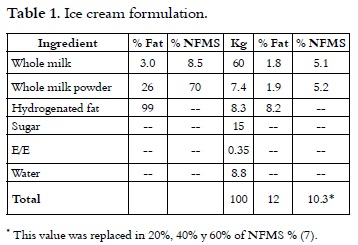
</front><body><![CDATA[  <font face="Verdana, Arial, Helvetica, sans-serif" size="2">     <p align="right"> <b>FOODS: SCIENCE, TECHNOLOGY AND ENGINEERING</b></p>     <p>&nbsp;</p>     <p align="center"><b><font size="4">EVALUATION OF NON FAT SOLIDS SUBSTITUTES (NSL) IN A HARD DAIRY ICE CREAM MIX WITH VEGETABLE FAT</font></b></p>     <p>&nbsp;</p>     <p align="center"><b><font size="3"> EVALUACI&Oacute;N DE SUSTITUYENTES DE S&Oacute;LIDOS NO GRASOS (SNG) EN UNA MEZCLA DE HELADO DURO DE LECHE CON GRASA VEGETAL</font></b></p>     <p>&nbsp;</p>     <p>&nbsp;</p>     <p><b> Francy N. L&Oacute;PEZ B. M. Sc.<sup>1</sup>*; Jos&eacute; U. SEP&Uacute;LVEDA V. M. Sc.<sup>2</sup></b></p>     <p>1 1 Agricultural Sciences Faculty. Universidad Nacional de Colombia. Medell&iacute;n, Colombia.</p>     ]]></body>
<body><![CDATA[<p> 2 Associated Professor. Agricultural Sciences Faculty, Universidad Nacional de Colombia. Medell&iacute;n, Colombia.</p>     <p> * Corresponding author: <a href="mailto:fnlopezb@unalmed.edu.co">fnlopezb@unalmed.edu.co</a>.</p>     <p>&nbsp;</p>     <p>Received: 03 June 2011 Accepted: 28 August 2012</p>     <p>&nbsp;</p> <hr noshade size="1">     <p><b> ABSTRACT</b></p>     <p> <b>Background</b>: In industries that produce ice cream, NFMS required in the mixture are obtained by   addition of skim milk powder and whole milk, condensed milk, caseinate and others. However, due   to factors such as national lack of these (caseinates) and the seasonal climate of regions which produce   milk, these raw materials are relatively expensive, so it has increased the interest of using different   substituents of non-fat milk solids (NFMS) without affecting the nutritional and sensory quality of ice   cream, which comply with national legislation and represent a lower price to make them. <b>Objectives</b>:   This study aimed to implement and evaluate a NFMS formulation for applying in ice cream mixes.   <b>Methods</b>: the formulation (F1 substitute), was applied at different rates (20, 40, 60%) in mixtures of ice   cream and was compared to a control without replacement. The physicochemical properties that were   investigated included the mix viscosity, acidity, ph, mineral content (calcium and phosphorus), protein,   ash, fat and total solids. In the ice cream was determined freezing, melting, overrun, whipping ability   and sensory evaluation. For the study of the data was used Statgraphics 5.0 and the experimental design   was a randomized complete block model with multiple range test of Duncan. <b>Results</b>: The results show   that the viscosity value of the treatment, varies in a range of 398.7 to 1108.6 cp at a temperature of 4 &deg;   C, being higher for T4 (higher percentage of substitution). The titratable acidity values of the ice cream   mixture ranged from 0.17% to 0.12% with a higher (P &lt;0.05) for T1. The protein content ranged from   3.2% to 2.5%. <b>Conclusions</b>: As the percentage of non-fat milk solids replacement increases, the protein   percentage and melting decrease, reaching values established by Colombian law. With this study it is   concluded that, the 40% substitution of non fat milk solids over ice cream mixture, is the one with the   best physicochemical and sensory characteristics.</p>     <p><b>Keywords</b>: Replacements, Non-fat milk solids, melting, freezing point, ice cream.</p> <hr noshade size="1">     <p> <b>RESUMEN</b></p>     <p> <b>Antecedentes</b>: En las industrias que elaboran helados, los SNGL requeridos en la mezcla, son obtenidos   por adici&oacute;n de leche en polvo descremada y entera, leche condensada, caseinato, entre otros. Sin embargo,   debido a factores como la inexistencia nacional de los mismos (caseinatos) y la estacionalidad clim&aacute;tica   de las regiones del pa&iacute;s productor de leche, estas materias prima tienen un costo relativamente alto, por   lo cual se ha incrementado el inter&eacute;s de usar diferentes sustituyentes de S&oacute;lidos No Grasos L&aacute;cteos   (SNGL), que no afecten la calidad nutricional y sensorial del helado, que cumplan con la legislaci&oacute;n   nacional y que representen un menor precio en su fa bricaci&oacute;n. <b>Objetivos</b>: Este estudio tuvo como   objetivo implementar y evaluar una formulaci&oacute;n de SNGL para ser aplicados en mezclas de helado.   <b>M&eacute;todos</b>: La formulaci&oacute;n (sustituto F1), fue aplicada en diferentes porcentajes (20, 40, 60%) sobre   mezclas de helado y fue comparada con un testigo sin sustituci&oacute;n. Las propiedades fisicoqu&iacute;micas que   fueron investigadas para la mezcla incluyeron viscosidad, acidez, ph, contenido de minerales (calcio y   f&oacute;sforo), prote&iacute;nas, cenizas, grasa y s&oacute;lidos totales. En el helado se determin&oacute; punto de congelamiento,   derretimiento, sobreaumento, habilidad de batido y evaluaci&oacute;n sensorial. Para el estudio de los datos se   emple&oacute; el programa Statgraphics 5.0 y el dise&ntilde;o experimental fue un modelo por bloques completamente   aleatorizado con prueba de rangos m&uacute;ltiples de Duncan. <b>Resultados</b>: Los resultados demostraron que   el valor de viscosidad de los tratamientos, var&iacute;a en un rango de 398,7 cp a 1108,6 cp a una temperatura   de 4&deg;C, siendo el mayor para T4 (mayor porcentaje de sustituci&oacute;n). Los valores de acidez titulable de la   mezcla de helado variaron de 0,17% a 0,12% con un valor m&aacute;s alto (P &lt; 0,05) para T1. El contenido de   prote&iacute;na vari&oacute; entre 3,2% a 2,5%. <b>Conclusi&oacute;n</b>: Se concluye que a medida que aumenta el porcentaje de   sustituci&oacute;n de SNGL, el porcentaje de prote&iacute;na y derretimiento, disminuye alcanzando valores establecidos   por la Legislaci&oacute;n Colombiana. Con este estudio se concluye que el 40 % de sustituci&oacute;n de SNGL sobre la mezcla de helado es el que presenta mejores caracter&iacute;sticas fisicoqu&iacute;micas y sensoriales.</p>     ]]></body>
<body><![CDATA[<p> <b>Palabras clave</b>: Sustitutos, s&oacute;lidos no grasos l&aacute;cteos, derretimiento, punto de congelamiento, helado.  </p> <hr noshade size="1">     <p>&nbsp;</p>     <p>&nbsp;</p>     <p><font size="3"><b>INTRODUCTION</b></font></p>     <p> In Colombia, production of milk in 2008 was   6.55 billion liters. A large part of it was devoted to   the production of ice cream, which for this year   was 35102 tons. The per capita consumption in   recent years is 2.3 kg of mixture, which proves to   be a high-impact product within the dairy industry   (1). Some of the ingredients that provide non-fat   solids (NFS), used for making ice cream by small,   medium and big companies, are integrated products   imported in its entirety (2). The application   of NFS is important for its nutritional value and   functional properties. With this project, it is shown   an alternative implementation of this variable using   raw materials, mostly obtained at national level,   maintaining the functional properties in the final   product. The main objective of this study was to   apply and evaluate a Non Fat Solids replacement   (NFS) in an ice cream mixture.</p>     <p>&nbsp;</p>     <p><font size="3"> <b>MATERIALS AND METHODS</b></font></p>     <p><b> Raw Materials</b></p>     <p> In the preparation of ice cream mixes the following materials were used:</p>     <p> Liquid whole milk 3.0% fat and 8.5% non fat   milk solids (NFMS), whole milk powder 26% fat   and 70% non fat milk solids, hydrogenated fat at 99.9%, Sucrose, Stabilizer / Emulsifier.</p>     ]]></body>
<body><![CDATA[<p> Composition of substitute F1: Maltodextrin   19% D.E: it was replaced in 15% of total solids, **   Whey Protein at 12%: it was replaced 30% of NFMS   variable**, Dipotassium Phosphate: maximum 10   g / kg **, Sodium tripolyphosphate: maximum 10   g / kg **, soy protein concentrated: it was replaced   in 5% of the NFMS **, Sodium caseinate: it was   replaced in 10% of the NFMS **, yolk powder: 0.5%   **, precooked rice f lour: 2% **, Cassava starch: 1%   **, potato starch: 1% **, Salt: 0.02% ** hydrogenated   fat at 99.9%: 5% **, Palm oil: 5 % **, WPC   80: 30% **, soy lecithin: it was replaced 3000 mg /   kg **, Mono and diglycerides of fatty acids: it was   replaced 1500 mg / kg ** Glucose: it was replaced 30% of the total sweetness * *.</p>     <p> ** Maximum amounts added to the formulation (3-6).</p>     <p> The restrictions in the formulation were made by trial and error. Data not shown.</p>     <p> <b>Analysis of the substitute</b></p>     <p> The composition analysis of the substitute was   made (5), resulting in the following percentages:   6.89% protein, 38.69% fat, 48.01% carbohydrate, 3% humidity.</p>     <p> With this formulation, different percentages of   NFMS were replaced in mixtures; these results   were compared with a sample without substitution which was used as control. It can be seen in <a href="#t1">Table 1</a>.</p>     <p align="center"><a name="t1"></a><img src="/img/revistas/vitae/v19n2/v19n2a6t1.jpg"></p>     <p>&nbsp;</p>     <p>  <b>Ice cream making (8)</b></p>     <p> Formulation of mixtures was made with 12%   fat, 10.3% of NFMS, 15% sugar and 0.35% stabilizer   / emulsifier. NFMS source was replaced by   20%, 40% and 60% with the substitute F1. Three   replicates were made of each treatment. Liquid   ingredients were placed in a pasteurizer in which   was added the dry ingredients of each one of the   mixtures using a solids mixer. The mixes were   pasteurized at 73&deg;C for 30 min and homogenized   in two stages at a pressure of 2000 psi (APV Gaulin   homogenizer). Each mixture was cooled down to   4&deg;C. Then, they were matured for 24 hours at a   temperature of 4&deg;C (9). After this stage, it was added   to each treatment 0.1% of vanilla extract per liter of   mixture. The emulsions were subjected to mixing   process at -4.0&deg;C in a blender (Taylor) and they   were made with an overrun of 90-100% by method   weight &#8211; volume (10, 11). Ice creams were packed in presentations of 1 L and they were stored at -30&deg;C.</p>     ]]></body>
<body><![CDATA[<p> <b>Physico-chemical analysis</b></p>     <p> Physicochemical tests of each replicas of the   different treatments (20%, 40%, 60% and control),   both in the mix as in ice cream, were performed in triplicate (5).</p>     <p> <i>Viscosity</i></p>     <p> It was held in a cylinder cone, 1mm Gap (Brookfield   Rheometer DV III Ultra usillo SC421),   15cm<sup>3</sup> of mixture were taken at 4&deg;C, after 24 hours   of maturation (8). Flow determinations were found   exposing the samples to a deformation cycle, with   a shear rate sweep upward from 0.5 to 250 s-1 at   intervals of five seconds and one descending at the   same shear. The apparent viscosity values were obtained   at a shear rate of 10 s<sup>-1</sup>. It has been estimated   that the deformation rate of the oral cavity on fatty   foods like ice cream is 11.5 s-1 or less (12). The ascending   curve data for all treatments were adjusted   to power law model (13, 14), as it is shown in equation 1, using the software R / S Plus Rheometer.</p>     <p align="center"><img src="/img/revistas/vitae/v19n2/v19n2a6e1.jpg"></p>     <p> where: &tau; = Shear stress; K = Consistency Coefficient; D = Velocity gradient; n = Flow behavior index.</p>     <p> <i>Titratable Acidity</i></p>     <p> Was expressed as lactic acid percentage. The pH   value was measured with a potentiometer (Corning, model 350 pH analyzer) (15).</p>     <p> <i>Content of minerals</i></p>     <p> Calcium and phosphorus were obtained by   atomic absorption, spectrophotometry. The protein   content was measured by Kjeldahl method. The   protein was determined by multiplying the total   nitrogen by a factor of 6.25. Ash value was obtained   by direct incineration, total solids by Gravimetric method (15) and fat by Pennsylvania method (7).</p>     ]]></body>
<body><![CDATA[<p> <b>Methods of analysis in the ice cream</b></p>     <p> Freezing Point was determined on the temperature   of the ice cream mix after being whipped (10).   Melting rate was evaluated on ice cream samples   stored at -18&deg;C. Melting rate was determined by   carefully cutting ice cream samples (weighed as   100g), placing the ice cream onto 1 mm stainless   steel mesh over a cup and weighing the amount of   ice cream drained into the cup at temperature room (25&deg;C) for 1 hour.</p>     <p> Fall time of the first drop was determined by   taking the time where the first drop has fallen (8).   Whipping ability was evaluated by the time it took   for the mixture to reach an overrun of 90% - 100% (11).</p>     <p> <i>Sensory evaluation</i></p>     <p> The frozen ice cream at -14&deg;C &plusmn; 1 (16-17),   was subject to an acceptance test with 98 potential   consumers of the product (18). Each sample was   presented randomly to a particular evaluator. These   were placed in identical containers and labeled with   random numbers, using water to wash the mouth between samples.</p>     <p>  <i>Statistical analysis</i></p>     <p> Statistical analysis of the data was performed   using the Statgraphics 5.0 program, and the experimental   design was a randomized complete   block model with Duncan's multiple range tests. It   was used a confidence level of 95% and a level of   power of 85%, to detect significant differences in   the sensory test (19). One-way analysis of variance   (ANOVA) (&alpha; = 95%) was performed; ice cream   mixes or frozen ice creams were the treatments,   and the means were compared using Duncan's multiple range test.</p>     <p>&nbsp;</p>     <p> <font size="3"><b>RESULTS</b></font></p>     <p> <b>Physicochemical analysis of the mixture</b></p>     ]]></body>
<body><![CDATA[<p align="center"><a name="t2"></a><img src="/img/revistas/vitae/v19n2/v19n2a6t2.jpg"></p>     <p align="center">&nbsp;</p>     <p align="center"><a name="f1"></a><img src="/img/revistas/vitae/v19n2/v19n2a6f1.jpg"></p>     <p align="center">&nbsp;</p>     <p align="center"><a name="f2"></a><img src="/img/revistas/vitae/v19n2/v19n2a6f2.jpg"></p>     <p align="center">&nbsp;</p>     <p align="center"><a name="t3"></a><img src="/img/revistas/vitae/v19n2/v19n2a6t3.jpg"></p>     <p align="center">&nbsp;</p>     <p align="center"><a name="f3"></a><img src="/img/revistas/vitae/v19n2/v19n2a6f3.jpg"></p>     <p align="center">&nbsp;</p>     ]]></body>
<body><![CDATA[<p align="center"><a name="f4"></a><img src="/img/revistas/vitae/v19n2/v19n2a6f4.jpg"></p>     <p align="center">&nbsp;</p>     <p align="center"><a name="f5"></a><img src="/img/revistas/vitae/v19n2/v19n2a6f5.jpg"></p>     <p align="center">&nbsp;</p>     <p align="center"><a href="/img/revistas/vitae/v19n2/v19n2a6t4.jpg" target="_blank">Tabla 4</a></p>     <p align="center">&nbsp;</p>     <p align="center"><a name="f6"></a><img src="/img/revistas/vitae/v19n2/v19n2a6f6.jpg"></p>     <p align="center">&nbsp;</p>     <p align="center"><a name="f7"></a><img src="/img/revistas/vitae/v19n2/v19n2a6f7.jpg"></p>     <p align="center">&nbsp;</p>     ]]></body>
<body><![CDATA[<p align="center"><a name="f8"></a><img src="/img/revistas/vitae/v19n2/v19n2a6f8.jpg"></p>     <p align="center">&nbsp;</p>     <p align="center"><a name="f9"></a><img src="/img/revistas/vitae/v19n2/v19n2a6f9.jpg"></p>     <p align="center">&nbsp;</p>     <p align="center"><a name="t5"></a><img src="/img/revistas/vitae/v19n2/v19n2a6t5.jpg"></p>     <p>&nbsp;</p>     <p>  Different letters by row indicate significant differences   (p &lt; 0.05), according to Duncan's multiple range test.</p>     <p>&nbsp;</p>     <p><font size="3"> <b>DISCUSSION</b></font></p>     <p> <b>Physicochemical analysis of the mixture</b></p>     ]]></body>
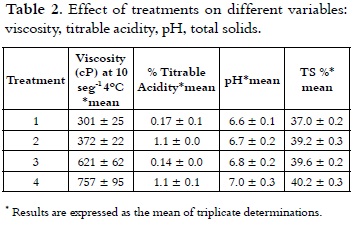
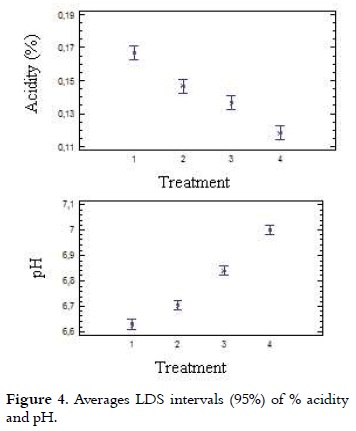
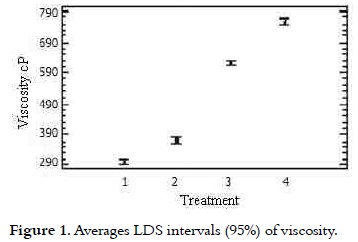
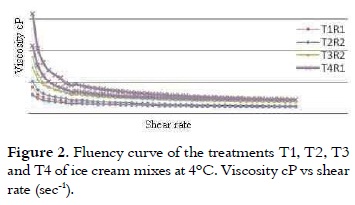
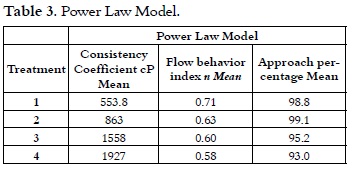
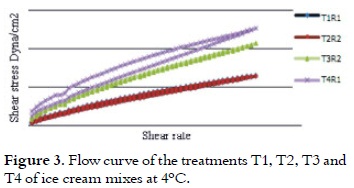
<body><![CDATA[<p> <i>Viscosity</i></p> </font>    <p> <font size="2" face="Verdana, Arial, Helvetica, sans-serif"><a href="#t2">Table 2</a> shows the apparent viscosity of the   treatments at a rate of 10 s<sup>-1</sup>, which varied in the   range of 301 cP to 757 cP at 4&deg;C.</font></p>     <p><font size="2" face="Verdana, Arial, Helvetica, sans-serif"> These results were consistent with studies (20-   21) where viscosities determined for ice cream   mixes ranged from 270-810 cP at 10&deg;C and 100 s-1   with 10.5% fat, 10.5% of NFMS, 12% of sugar and   4% of corn syrup solids. Research works showed   that the real or basic viscosity at 20&deg;C fluctuates between   50 and 300 cP (14), (8), (22). The analysis of   variance showed statistically significant difference   on the viscosity of the treatments (p &lt; 0.05). The   multiple range test permitted to see that T4 (60%   replacement) had the highest value (p &lt; 0.05) of   757 cP. Considering the significant differences   (p &lt; 0.05), multiple range test of Duncan was   applied, which reports in Figure 1 that among the   four treatments heterogeneity is presented.</font></p>     <p><font size="2" face="Verdana, Arial, Helvetica, sans-serif"> Viscosity is temperature dependent, and with   decreasing temperature in the storage the viscosity   of the mixture will increase as this occurred in   the different treatments (10). It was observed that   increasing the percentage of NFMS replacement,   the viscosity increased possibly by the presence of   ingredients such as maltodextrin, mono and diglycerides   of fatty acids. Maltodextrins are widely   used in the food industry as stabilizers (modifying   texture and volume) in emulsions (23-24). Maltodextrin   used in the different treatments showed   19% of DE, which means that a large percentage of   starch is present with the addition of this ingredient   and it is reflected in the viscosity increase. This   variable was higher as increased the percentage of   replacement, due to the presence of mono-and diglycerides   of fatty acids, that act as emulsifiers and   salts (calcium, sodium, citrates, phosphates) that   can modify it, due to its effect on casein and serum   proteins (25-26). These results are consistent with   studies made before (27), where increasing the level   of emulsifier in ice cream, a higher viscosity is obtained.   The viscosity is also affected by the addition   of caseinate in the formulation. This is a mixture of   four active casein (&alpha;s1-&alpha;s2-, &beta;-and k-casein), which   are widely used as food ingredients due to their   significant nutritional value, its viscosity-modifying   properties, water and fat-binding , foaming and   emulsifying properties (23).</font></p>     <p><font size="2" face="Verdana, Arial, Helvetica, sans-serif"> All treatments had thinning viscosity behavior   because of the shear stress effect and by increasing   the shear rate (28) as it is shown in <a href="#f2">figure 2</a>.</font></p>     <p><font size="2" face="Verdana, Arial, Helvetica, sans-serif"> The treatment T4 had higher apparent viscosity   in the flow curve, followed by T3, T2 and   T1. This higher loss of the structure of ice cream   mixes, when are subjected to shear rates, can be   related to the rapid breakdown of the networks   of casein, leading to a reduction in viscosity (29).   This apparent viscosity at rest or at low shear rate,   is because of the phenomena such as aggregation of   fat globules that cause thinning behavior as a result   of the effort, particularly due to the thixotropic   nature of the mixture (14). It is shown in <a href="#t3">Table 3</a>   that after making the adjustment to the power law   model, it can be said that the treatments do not   show the yield points because, although they have   a degree of ordination, it is not enough to have a   strong structure for developing an opposition to the   flow, taking into account that relatively large values   of effort in the rheometer are sensed.</font></p>     <p><font size="2" face="Verdana, Arial, Helvetica, sans-serif"> As it is shown in <a href="#f3">Figure 3</a> the hysteresis area   of the treatments 1, 2 and 3 is very low, so it could   be concluded that the behavior of the treatments   with these substitution percentages is not highly   dependent on the time to recover its structure, while   T4 has a higher thixotropy by the area of hysteresis   seen in the two curves.</font></p>     <p><font size="2" face="Verdana, Arial, Helvetica, sans-serif"> The thixotropic behavior reflects the destruction   of the product structure during flow, and the   subsequent recovery of viscosity when it stops. Ice   creams with high consistency scores had higher   resistance to flow (30). This information is useful   for the analysis of this parameter in the piping design and pumping of ice cream mixes (27). Table 3   shows that all treatments have a f low index n &lt;1,   this result indicates a decrease in apparent viscosity   when the shear rate increases, which is related to   pseudoplastic behavior (14).</font></p>     <p><font size="2" face="Verdana, Arial, Helvetica, sans-serif"> <i>Acidity and pH</i></font></p>     <p><font size="2" face="Verdana, Arial, Helvetica, sans-serif"> As it is shown in <a href="#t2">Table 2</a>, acidity values of the   ice cream mix ranged from 0.17% to 0.12% with a   lower value (P &lt; 0.05) for T4, compared with all   other treatments. The analysis of variance for the   data obtained in the acidity test showed statistically   significant differences (p &lt; 0.05) in each of   the treatments with different NFMS replacement   percentage. Considering the significant differences   (p &lt;0.05), the multiple range test of Duncan was   applied, which reports in <a href="#f4">Figure 4</a> that among the   four treatments it is presented heterogeneity.</font></p>     ]]></body>
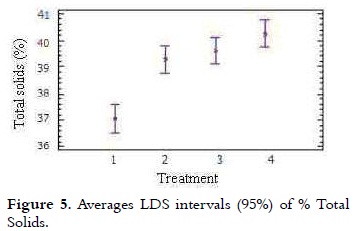
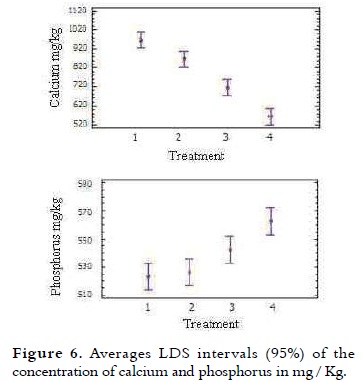
<body><![CDATA[<p><font size="2" face="Verdana, Arial, Helvetica, sans-serif"> Apparent or natural acidity of the ice cream   mixture is caused by milk proteins, such as   &beta;-lactoglobulin (&beta;-lg), serum albumin and immunoglobulin   G (IgG), which contain disulfide bonds,   free sulfhydryl groups, the &alpha; s2 casein and k-casein   which also contain disulfide bonds (31), and also   caused by mineral salts (especially phosphates and   citrates) and dissolved carbon dioxide (10), (20).   Therefore, when it is replaced milk protein by   mixes of milk and vegetable protein in different   treatments, the acidity was decreased. It should be   mentioned that the acidity will be increased when   the not fat solids content is higher (8). A blend with   10% of NFMS has an acidity of 0.18% (7). The pH   values of mixtures of ice cream are presented in <a href="#t2">Table   2</a>, these showed inversely proportional behavior   to the acidity and were between 6.63 and 7.0 with a   higher value (P &lt; 0.05) for T4, compared with all   other treatments. These values are very similar to   those found by other authors (32, 33), which are in   the range of 6.7 to 6.9. Considering the significant   differences (p &lt; 0.05), the multiple range test of   Duncan was applied, which reported that among   the four treatments is presented heterogeneity, as   it is shown in <a href="#f4">Figure 4</a>.</font></p>     <p><font size="2" face="Verdana, Arial, Helvetica, sans-serif"> <i>Total solids</i></font></p>     <p><font size="2" face="Verdana, Arial, Helvetica, sans-serif"> The content of solids in the different treatments   was in a range between 37.05% and 40.26%. It can   be seen in <a href="#t2">Table 2</a> that with increasing the NFMS   substitution percentage, the content of TS was   higher.</font></p>     <p><font size="2" face="Verdana, Arial, Helvetica, sans-serif"> The variance analysis showed statistically   significant difference on the content of TS from   the different treatments (p &lt; 0.05). The multiple   comparison test (<a href="#f5">Figure 5</a>) showed that T1 had a   lower percentage of TS (p &lt; 0.05) compared with   other treatments, total solids of T2, T3 and T4,   were growing steadily. Theoretically it is expected   that for classifying a product as hard ice cream, its   mix should contain total solids levels higher than   33% (21).</font></p>     <p><font size="2" face="Verdana, Arial, Helvetica, sans-serif"> The moisture content for an ice cream with   11.25% NFMS, 10% fat, 36.7% total solids is between   63% - 64% (32, 34).</font></p>     <p><font size="2" face="Verdana, Arial, Helvetica, sans-serif"> <i>Minerals</i></font></p>     <p><font size="2" face="Verdana, Arial, Helvetica, sans-serif"> The calcium average content of the treatments   is presented in <a href="/img/revistas/vitae/v19n2/v19n2a6t4.jpg" target="_blank">Table 4</a>. It was observed that with   increasing the NFMS percentage substitution, the   calcium content in the treatments decreased.</font></p>     <p><font size="2" face="Verdana, Arial, Helvetica, sans-serif"> The analysis of variance showed significant difference   on the calcium and phosphorus percentage   of different treatments (p &lt; 0.05). The multiple   comparison test in <a href="#f6">Figure 6</a> indicates that T1 with   967.8 mg / kg of calcium had the highest value (p   &lt; 0.05). It was found that the calcium content of   T2 and T3 was 868 and 717.2 mg / kg, respectively.   For T4 was obtained 564.5 mg / kg, being the   lowest of all treatments. Given that to be a good   source of calcium, ice cream must contain 10%   -19% Daily Value (DV) of this mineral, or 100-190   mg of calcium per serving (10), (35) the reported   values for each of the treatments differ slightly to   these percentages.</font></p>     <p><font size="2" face="Verdana, Arial, Helvetica, sans-serif"> Ice cream by its calcium content can contribute   significantly to the diet (36), therefore T1, T2 and   T3 in particular, are the treatments that are closer   to these requirements. By consuming 70 g, with   a 40% replacement of NFMS, would be contributing   approximately 7% (50.20 mg of Ca) of the   recommended daily intake. The average content of   phosphorus in the treatments is presented in <a href="/img/revistas/vitae/v19n2/v19n2a6t4.jpg" target="_blank">Table   4</a>. It was noted that from 40% NFMS substitution,   the phosphorus content of the treatments increased.   This result may be due to the presence of acidity   regulators as dipotassium phosphate and sodium   tripolyphosphate (37). The study found that replacing   40% of the NFMS, 70 g of ice cream provide   values of 37.95 mg, representing 5% of the adult   daily requirement.</font></p>     <p><font size="2" face="Verdana, Arial, Helvetica, sans-serif">  <i>Protein</i></font></p>     ]]></body>
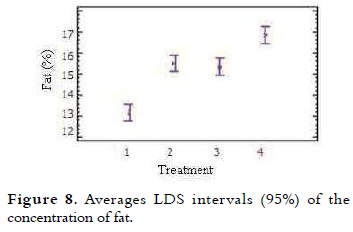
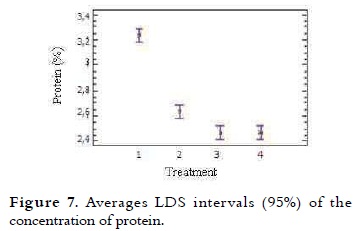
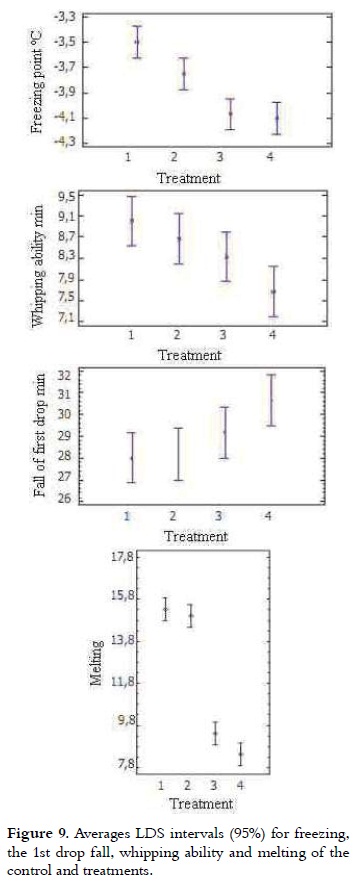
<body><![CDATA[<p><font size="2" face="Verdana, Arial, Helvetica, sans-serif"> This content in the mixtures of ice cream varied   between 2.5% and 3.2% and it is presented in <a href="/img/revistas/vitae/v19n2/v19n2a6t4.jpg" target="_blank">Table   4</a>. A trend in the decrease in protein content was   seen, as different NFMS percentages were substituted   in the mixtures. The variance analysis showed   significant difference (p &lt; 0.05) in the protein value   in the different treatments. Protein levels were   similar between the T4 and T3. This content in T1   and T2 was higher (P &lt; 0.05) compared with all   other treatments, due to their low substitution as it   is shown in <a href="#f7">Figure 7</a>. These results are acceptable   when compared to the NTC 1239, which specifies   that the milk ice cream with vegetable fat must have   at least 2.5% protein (11).</font></p>     <p><font size="2" face="Verdana, Arial, Helvetica, sans-serif"> Proteins contribute to the ice cream structure   development, including emulsification, mixing (38),   and water holding capacity (39). The emulsifying   properties of proteins in the mixture arise from its   adsorption to the fat globules at the homogenization   time (40). The amounts of protein in a single serving   of regular ice cream are approximately 2.2%. Additionally   when whey solids are added to replace 25%   of the NFSM in the mixture, the protein decreases   (10). It was noted that the greater the amount of   protein, the greater the rate of melting, in T1 the   protein content was 3.2% and the melting was 15.3%,   while for T4 with 2.5% protein the melting was   8.4%, this value is the lowest of all treatments. This   phenomenon may be due to protein concentrates and   soy isolates, which contain relatively large amounts   of ionized polar amino acids such as glutamic and   aspartic acid, they can link almost three times more   water than non-ionizable polar groups (41).</font></p>     <p><font size="2" face="Verdana, Arial, Helvetica, sans-serif"> <i>Fat</i></font></p>     <p><font size="2" face="Verdana, Arial, Helvetica, sans-serif"> The fat average content of ice cream mixes is   presented in <a href="/img/revistas/vitae/v19n2/v19n2a6t4.jpg" target="_blank">Table 4</a>. The NTC 1239 establishes   that the total fat percentage for milk ice cream with   vegetable fat is at least 8% (11). It was noted that   when the percentage of NFMS replacement was   higher, the fat content increased proportionally. The   variance analysis showed significant difference in   the fat value of the different treatments (p &lt; 0.05).   The multiple comparison test shown in <a href="#f8">Figure 8</a>,   indicates that between T1 (control) and T2, there   were significant differences, as well as between T3   and T4 (p &lt; 0.05). At T2 (20% substitution) and   T3 (40% substitution) the behavior of this variable   was very similar.</font></p>     <p><font size="2" face="Verdana, Arial, Helvetica, sans-serif"> This increase in fat values for each of the   treatments is due to the fat concentration in the   substitute (38.69%), which is greater than the   powdered milk (26%). The use of correct percentages   is necessary not only to balance the mix, but   also to meet legal standards. Studies show that   fat globules are concentrated on the surface of air   bubbles during freezing, giving flavor and smooth   in texture (3).</font></p>     <p><font size="2" face="Verdana, Arial, Helvetica, sans-serif"> <b>Ice cream</b></font></p>     <p><font size="2" face="Verdana, Arial, Helvetica, sans-serif"> <i>Freezing Point</i></font></p>     <p><font size="2" face="Verdana, Arial, Helvetica, sans-serif"> The freezing point of most ice cream mixes   varies between -2.2 and -2.8&deg;C. This is a colligative   property, influenced by the number of molecules in   solution, that for this product are mainly sugar (42).   <a href="/img/revistas/vitae/v19n2/v19n2a6t4.jpg" target="_blank">Table 4</a> shows the freezing point of the 4 treatments.   It can be seen that it is lower for samples that have   a higher percentage of NFMS replacement. The   variance analysis showed significant difference in   the freezing point value of the different treatments   (p &lt; 0.05). The freezing point of T3 and T4 were   not different, being the lowest of all treatments. The   T1 FP was the highest (P &lt; 0.05) as it is shown   in <a href="#f9">Figure 9</a>. The freezing point of mixtures with   high sugar content and non-fat solids decreases and   may be less than -3&deg;C, while the mixtures with   high-fat content, low NFS or low sugar content   may be greater than -1.4&deg;C (10),(16). As the substitution   percentage was increased, the freezing point   was decreased. This result is related to the use of   sweeteners such as dextrose, known as D-glucose,   which decreases the freezing temperature due to   its lower molecular weight compared with sucrose,   improving the consistency of ice cream (10, 43).</font></p>     <p><font size="2" face="Verdana, Arial, Helvetica, sans-serif"> <i>Melting</i></font></p>     <p><font size="2" face="Verdana, Arial, Helvetica, sans-serif"> It was determined that the first drop fall of the   4 treatments was in a range between 28 to 30.7   minutes for T1 and T4, respectively as it is shown   in <a href="/img/revistas/vitae/v19n2/v19n2a6t4.jpg" target="_blank">Table 4</a>, according to the analysis of variance   significant difference between treatments was not   shown (p &gt; 0.05). These results agree with those   obtained for a formulation with 10% milk fat, 11%   non-fat milk solids, 10% sugar, 5% glucose syrup,   where the decay time of the first drop took about   30 minutes for all samples (40), (44). As regards the   melting rate, there were significant differences between   treatments (p &lt; 0.05). This was 15.3%, 15.0%,   9.4% and 8.4% for T1, T2, T3 and T4, respectively.</font></p>     ]]></body>
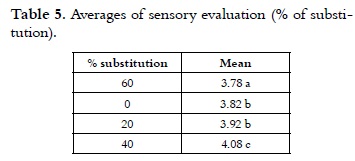
<body><![CDATA[<p><font size="2" face="Verdana, Arial, Helvetica, sans-serif">  According to the results obtained in this work, is   stated that all samples had first drop downtime   and melting percentage that are within permitted   parameters (14, 21). The amount of protein decreases   without affecting markedly the structure of ice   cream, due to the presence of starch, maltodextrin,   soy concentrates, mono and diglycerides, which   have emulsifying properties, gelling agents, capable   of foaming and to retain water, resulting in a slower   melting (45-48).</font></p>     <p><font size="2" face="Verdana, Arial, Helvetica, sans-serif"> <i>Sensory evaluation</i></font></p>     <p><font size="2" face="Verdana, Arial, Helvetica, sans-serif"> The analysis of variance for the data obtained in   the sensory test, showed significant differences (p   &lt; 0.05) in the acceptance of the product, between   replacement percentages evaluated for acceptance.   Considering the significant differences, Duncan   multiple range test was used to determine the percentage   of different substitute in relation to product   acceptance. Ice creams made with 40% NFMS   substitution have better sensory acceptance, the   opposite occur with ice creams made with a percentage   of 60% as it is shown Table 5, because with   this percentage, there are ingredients such as whey   protein concentrates, maltodextrins, soy protein   that have emulsifying effect, giving body, volume   and stability to this type of food (49). At higher   levels of substitution, the percentage of lactose is   increased, resulting in a coarser texture. Mineral   content decreases, thus affecting the appearance   and consistency of ice cream and the fat emulsion   stability (50); some marked flavors can appear with   increasing content of soybean (51-53).</font></p> <font face="Verdana, Arial, Helvetica, sans-serif" size="2">    <p>&nbsp;</p>     <p> <font size="3"><b>CONCLUSIONS</b></font></p>     <p> It is possible to produce ice cream successfully   replaced up to 40% of F1 with the NFMS substitute.   Physicochemical characteristics, viscosity, acidity,   pH, phosphorus, ash, protein and fat are found to be   within acceptable parameters for the production of   mixtures. The behavior of the freezing, melting and   mixing skills are normal. The sensory evaluation of   96 panelists of the 4 treatments resulted in greater   acceptance for the treatment with 40% substitution.</p>     <p>&nbsp;</p>     <p><font size="3"> <b>ACKNOWLEDGEMENT</b></font></p>     <p> Appreciation is expressed to the Universidad   Nacional of Colombia in Medell&iacute;n and the company   ALSEC S.A.&reg; for financial contribution to   this research.</p>     <p>&nbsp;</p>     ]]></body>
<body><![CDATA[<p><font size="3"> <b>REFERENCES</b> </font></p>     <!-- ref --><p>  1. Mojica-F TR, Castellanos D, Bernal N. Agenda prospectiva   de investigaci&oacute;n y desarrollo tecnol&oacute;gico de la cadena l&aacute;ctea   colombiana &#91;internet&#93;. Bogot&aacute; (CO): Ministerio de Agricultura;   2007 &#91;updated 2007 Nov 12; cited 2009 Oct 12 &#93;. Available from:   <a href="http://www.minagricultura.gov.co/archivos/lacteos.pdf" target="_blank">http://www.minagricultura.gov.co/archivos/lacteos.pdf</a>.&nbsp;&nbsp;&nbsp;&nbsp;&nbsp;&nbsp;&nbsp;&nbsp;[&#160;<a href="javascript:void(0);" onclick="javascript: window.open('/scielo.php?script=sci_nlinks&ref=000134&pid=S0121-4004201200020000600001&lng=','','width=640,height=500,resizable=yes,scrollbars=1,menubar=yes,');">Links</a>&#160;]<!-- end-ref --><!-- ref --><p> 2. &Aacute;lvarez V, Wolters C, Vodovotz Y, Ji T. Physical Properties of   Ice Cream Containing Milk Protein Concentrates. J Dairy Sci.   2005 Mar; 88 (3): 862-871.&nbsp;&nbsp;&nbsp;&nbsp;&nbsp;&nbsp;&nbsp;&nbsp;[&#160;<a href="javascript:void(0);" onclick="javascript: window.open('/scielo.php?script=sci_nlinks&ref=000135&pid=S0121-4004201200020000600002&lng=','','width=640,height=500,resizable=yes,scrollbars=1,menubar=yes,');">Links</a>&#160;]<!-- end-ref --><!-- ref --><p> 3. Echavarria J, G&oacute;mez M. Elaboraci&oacute;n de un helado de bajo aporte   cal&oacute;rico &#91;bachelor's thesis&#93;. &#91;Medell&iacute;n&#93;: Universidad Nacional de   Colombia; 2003. 126 p.&nbsp;&nbsp;&nbsp;&nbsp;&nbsp;&nbsp;&nbsp;&nbsp;[&#160;<a href="javascript:void(0);" onclick="javascript: window.open('/scielo.php?script=sci_nlinks&ref=000136&pid=S0121-4004201200020000600003&lng=','','width=640,height=500,resizable=yes,scrollbars=1,menubar=yes,');">Links</a>&#160;]<!-- end-ref --><!-- ref --><p> 4. Instituto Nacional de Vigilancia y Control de Medicamentos   y Alimentos. Resoluci&oacute;n 2310 de 1986 por la cual se legisla el   procesamiento, composici&oacute;n, requisitos, transporte y comercializaci&oacute;n   de los Derivados L&aacute;cteos. Bogot&aacute;, Colombia: Ministerio   de Salud; 1986. 41 p.&nbsp;&nbsp;&nbsp;&nbsp;&nbsp;&nbsp;&nbsp;&nbsp;[&#160;<a href="javascript:void(0);" onclick="javascript: window.open('/scielo.php?script=sci_nlinks&ref=000137&pid=S0121-4004201200020000600004&lng=','','width=640,height=500,resizable=yes,scrollbars=1,menubar=yes,');">Links</a>&#160;]<!-- end-ref --><!-- ref --><p> 5. Jaramillo M, Mejia I, Sepulveda J. Principios de procesamiento   y control de calidad de leches. Medell&iacute;n, Colombia: Universidad   Nacional de Colombia; 1999. 238p.&nbsp;&nbsp;&nbsp;&nbsp;&nbsp;&nbsp;&nbsp;&nbsp;[&#160;<a href="javascript:void(0);" onclick="javascript: window.open('/scielo.php?script=sci_nlinks&ref=000138&pid=S0121-4004201200020000600005&lng=','','width=640,height=500,resizable=yes,scrollbars=1,menubar=yes,');">Links</a>&#160;]<!-- end-ref --><!-- ref --><p> 6. L&oacute;pez-Marin B. Dise&ntilde;o de un producto de uso espec&iacute;fico a partir   de banano, coadyuvante en el mantenimiento o mejoramiento de   la salud &#91;master's thesis&#93;. &#91;Medell&iacute;n&#93;: Universidad de Antioquia;   2008. 140 p.&nbsp;&nbsp;&nbsp;&nbsp;&nbsp;&nbsp;&nbsp;&nbsp;[&#160;<a href="javascript:void(0);" onclick="javascript: window.open('/scielo.php?script=sci_nlinks&ref=000139&pid=S0121-4004201200020000600006&lng=','','width=640,height=500,resizable=yes,scrollbars=1,menubar=yes,');">Links</a>&#160;]<!-- end-ref --><!-- ref --><p> 7. Corrales L, Sep&uacute;lveda U. La leche, su procesamiento y control.   Medell&iacute;n, Colombia: Universidad Nacional de Colombia; 2005.   325p.&nbsp;&nbsp;&nbsp;&nbsp;&nbsp;&nbsp;&nbsp;&nbsp;[&#160;<a href="javascript:void(0);" onclick="javascript: window.open('/scielo.php?script=sci_nlinks&ref=000140&pid=S0121-4004201200020000600007&lng=','','width=640,height=500,resizable=yes,scrollbars=1,menubar=yes,');">Links</a>&#160;]<!-- end-ref --><!-- ref --><p> 8. Arbuckle WS. Ice Cream. New York, USA: AVI, editor; 1996.   349 p.&nbsp;&nbsp;&nbsp;&nbsp;&nbsp;&nbsp;&nbsp;&nbsp;[&#160;<a href="javascript:void(0);" onclick="javascript: window.open('/scielo.php?script=sci_nlinks&ref=000141&pid=S0121-4004201200020000600008&lng=','','width=640,height=500,resizable=yes,scrollbars=1,menubar=yes,');">Links</a>&#160;]<!-- end-ref --><!-- ref --><p> 9. Soler L. Development of non-dairy frozen dessert containing   soy protein and coconut milk &#91;bachelor's thesis&#93;. &#91;Louisiana&#93;:   Louisiana State University and Agricultural and Mechanical   College; 2005. 84 p.&nbsp;&nbsp;&nbsp;&nbsp;&nbsp;&nbsp;&nbsp;&nbsp;[&#160;<a href="javascript:void(0);" onclick="javascript: window.open('/scielo.php?script=sci_nlinks&ref=000142&pid=S0121-4004201200020000600009&lng=','','width=640,height=500,resizable=yes,scrollbars=1,menubar=yes,');">Links</a>&#160;]<!-- end-ref --><!-- ref --><p> 10. Marshall R, Goff D. Ice cream. New York, USA: Publishers   KAP; 2003. 375 p.&nbsp;&nbsp;&nbsp;&nbsp;&nbsp;&nbsp;&nbsp;&nbsp;[&#160;<a href="javascript:void(0);" onclick="javascript: window.open('/scielo.php?script=sci_nlinks&ref=000143&pid=S0121-4004201200020000600010&lng=','','width=640,height=500,resizable=yes,scrollbars=1,menubar=yes,');">Links</a>&#160;]<!-- end-ref --><!-- ref --><p> 11. Instituto Colombiano de Normas T&eacute;cnicas y Certif icaci&oacute;n.   Norma T&eacute;cnica Colombiana. NTC1239. Helados. Bogot&aacute;:   ICONTEC; 2002. p. 1-18.&nbsp;&nbsp;&nbsp;&nbsp;&nbsp;&nbsp;&nbsp;&nbsp;[&#160;<a href="javascript:void(0);" onclick="javascript: window.open('/scielo.php?script=sci_nlinks&ref=000144&pid=S0121-4004201200020000600011&lng=','','width=640,height=500,resizable=yes,scrollbars=1,menubar=yes,');">Links</a>&#160;]<!-- end-ref --><!-- ref --><p> 12. Aime D, Artfield S, Malcolmson L, Ryland D. Textural analysis   of fat reduced vanilla ice cream products. Food Res Int. 2001; 34   (2-3): 237-246.&nbsp;&nbsp;&nbsp;&nbsp;&nbsp;&nbsp;&nbsp;&nbsp;[&#160;<a href="javascript:void(0);" onclick="javascript: window.open('/scielo.php?script=sci_nlinks&ref=000145&pid=S0121-4004201200020000600012&lng=','','width=640,height=500,resizable=yes,scrollbars=1,menubar=yes,');">Links</a>&#160;]<!-- end-ref --><!-- ref --><p> 13. Akalm A, Karag&ouml;zl&uuml; C, &Uuml;nal G. Rheological properties of   reduced-fat and low-fat ice cream containing whey protein isolate   and inulin. Eur Food Res Technol. 2008 Jun; 227 (3): 889-895.&nbsp;&nbsp;&nbsp;&nbsp;&nbsp;&nbsp;&nbsp;&nbsp;[&#160;<a href="javascript:void(0);" onclick="javascript: window.open('/scielo.php?script=sci_nlinks&ref=000146&pid=S0121-4004201200020000600013&lng=','','width=640,height=500,resizable=yes,scrollbars=1,menubar=yes,');">Links</a>&#160;]<!-- end-ref --><!-- ref --><p> 14. Goff H, Davison V, Capp E. Viscosity of ice cream at pasteurization   temperature. J Dairy Sci. 1994 Aug; 77 (8): 2207-2013.&nbsp;&nbsp;&nbsp;&nbsp;&nbsp;&nbsp;&nbsp;&nbsp;[&#160;<a href="javascript:void(0);" onclick="javascript: window.open('/scielo.php?script=sci_nlinks&ref=000147&pid=S0121-4004201200020000600014&lng=','','width=640,height=500,resizable=yes,scrollbars=1,menubar=yes,');">Links</a>&#160;]<!-- end-ref --><!-- ref --><p> 15. AOAC International. Official methods of analysis of AOAC   International. Gaithersburg, USA: Arlington; 2000. Vol II. Cap   33. 71p&nbsp;&nbsp;&nbsp;&nbsp;&nbsp;&nbsp;&nbsp;&nbsp;[&#160;<a href="javascript:void(0);" onclick="javascript: window.open('/scielo.php?script=sci_nlinks&ref=000148&pid=S0121-4004201200020000600015&lng=','','width=640,height=500,resizable=yes,scrollbars=1,menubar=yes,');">Links</a>&#160;]<!-- end-ref --><!-- ref --><p> 16. Abd El-Rahman A, Madkor S, Ibrahim F, Kilara A. Physical   Characteristics of Frozen Desserts Made with Cream, Anhydrous   Milk Fat, or Milk Fat Fractions. J Dairy Sci. 1997 Sept; 80 (9):   1926-1935.&nbsp;&nbsp;&nbsp;&nbsp;&nbsp;&nbsp;&nbsp;&nbsp;[&#160;<a href="javascript:void(0);" onclick="javascript: window.open('/scielo.php?script=sci_nlinks&ref=000149&pid=S0121-4004201200020000600016&lng=','','width=640,height=500,resizable=yes,scrollbars=1,menubar=yes,');">Links</a>&#160;]<!-- end-ref --><!-- ref --><p> 17. Specter SE, Setser CS. Sensory and physical properties of a   reduced calory frozen dessert system made with milk fat and   sucrose substitutes. J Dairy Sci. 1994 Mar; 77 (3): 708-717.&nbsp;&nbsp;&nbsp;&nbsp;&nbsp;&nbsp;&nbsp;&nbsp;[&#160;<a href="javascript:void(0);" onclick="javascript: window.open('/scielo.php?script=sci_nlinks&ref=000150&pid=S0121-4004201200020000600017&lng=','','width=640,height=500,resizable=yes,scrollbars=1,menubar=yes,');">Links</a>&#160;]<!-- end-ref --><!-- ref --><p> 18. Torricella R, Zamora E, Pulido H. Evaluaci&oacute;n sensorial aplicada   a la Investigaci&oacute;n, desarrollo y control de alimentos. La Habana,   Cuba: Editorial Universitaria; 2007. 135p.&nbsp;&nbsp;&nbsp;&nbsp;&nbsp;&nbsp;&nbsp;&nbsp;[&#160;<a href="javascript:void(0);" onclick="javascript: window.open('/scielo.php?script=sci_nlinks&ref=000151&pid=S0121-4004201200020000600018&lng=','','width=640,height=500,resizable=yes,scrollbars=1,menubar=yes,');">Links</a>&#160;]<!-- end-ref --><!-- ref --><p> 19. Kuelh R. Dise&ntilde;o de experimentos. Principios Estad&iacute;sticos Para el   An&aacute;lisis y Dise&ntilde;o de Investigaciones. Ciudad de M&eacute;xico, M&eacute;xico:   Thompson Editores; 2001. 666 p.&nbsp;&nbsp;&nbsp;&nbsp;&nbsp;&nbsp;&nbsp;&nbsp;[&#160;<a href="javascript:void(0);" onclick="javascript: window.open('/scielo.php?script=sci_nlinks&ref=000152&pid=S0121-4004201200020000600019&lng=','','width=640,height=500,resizable=yes,scrollbars=1,menubar=yes,');">Links</a>&#160;]<!-- end-ref --><!-- ref --><p> 20. Patel M, Baer R, Acharya M. Increasing the Protein Content of   Ice Cream. J Dairy Sci. 2006 May; 89 (5): 1400-1406.&nbsp;&nbsp;&nbsp;&nbsp;&nbsp;&nbsp;&nbsp;&nbsp;[&#160;<a href="javascript:void(0);" onclick="javascript: window.open('/scielo.php?script=sci_nlinks&ref=000153&pid=S0121-4004201200020000600020&lng=','','width=640,height=500,resizable=yes,scrollbars=1,menubar=yes,');">Links</a>&#160;]<!-- end-ref --><!-- ref --><p> 21. Fl&oacute;rez C. Prueba de un nuevo estabilizante-emulsificante para   helado comercial &#91;bachelor's thesis&#93;. &#91;Medell&iacute;n&#93;: Universidad   Nacional de Colombia; 2003. 74p.&nbsp;&nbsp;&nbsp;&nbsp;&nbsp;&nbsp;&nbsp;&nbsp;[&#160;<a href="javascript:void(0);" onclick="javascript: window.open('/scielo.php?script=sci_nlinks&ref=000154&pid=S0121-4004201200020000600021&lng=','','width=640,height=500,resizable=yes,scrollbars=1,menubar=yes,');">Links</a>&#160;]<!-- end-ref --><!-- ref --><p> 22. Agudelo JP. Determinaci&oacute;n del tiempo &oacute;ptimo de maduraci&oacute;n   del helado comercial utlizando dos tipos de estabilizantes emulsificantes &#91;bachelor's thesis&#93;. &#91;Medell&iacute;n&#93;: Universidad Nacional de Colombia; 1989. 107p.&nbsp;&nbsp;&nbsp;&nbsp;&nbsp;&nbsp;&nbsp;&nbsp;[&#160;<a href="javascript:void(0);" onclick="javascript: window.open('/scielo.php?script=sci_nlinks&ref=000155&pid=S0121-4004201200020000600022&lng=','','width=640,height=500,resizable=yes,scrollbars=1,menubar=yes,');">Links</a>&#160;]<!-- end-ref --><!-- ref --><p> 23. O'Regan J, Mulvihill D. Preparation, characterisation and selected   functional properties of sodium caseinate&#8211;maltodextrin   conjugates. Food Chem. 2009 Aug 15; 115 (4): 1257-1267.&nbsp;&nbsp;&nbsp;&nbsp;&nbsp;&nbsp;&nbsp;&nbsp;[&#160;<a href="javascript:void(0);" onclick="javascript: window.open('/scielo.php?script=sci_nlinks&ref=000156&pid=S0121-4004201200020000600023&lng=','','width=640,height=500,resizable=yes,scrollbars=1,menubar=yes,');">Links</a>&#160;]<!-- end-ref --><!-- ref --><p> 24. Loret C, Meunier V, Frith W, Fryer P. Rheological characteristics   of the gelation behaviour of maltodextrin aqueous solutions.   Carbohydr Polym. 2004 Aug 30; 57 (2): 153-163.&nbsp;&nbsp;&nbsp;&nbsp;&nbsp;&nbsp;&nbsp;&nbsp;[&#160;<a href="javascript:void(0);" onclick="javascript: window.open('/scielo.php?script=sci_nlinks&ref=000157&pid=S0121-4004201200020000600024&lng=','','width=640,height=500,resizable=yes,scrollbars=1,menubar=yes,');">Links</a>&#160;]<!-- end-ref --><!-- ref --><p> 25. Cottrell J, Pass G, Phillips G. The effect of stabilizers on the   viscosity of an ice cream. J Sci Sood Agr. 1980 Oct; 31 (10):   1066-1070.&nbsp;&nbsp;&nbsp;&nbsp;&nbsp;&nbsp;&nbsp;&nbsp;[&#160;<a href="javascript:void(0);" onclick="javascript: window.open('/scielo.php?script=sci_nlinks&ref=000158&pid=S0121-4004201200020000600025&lng=','','width=640,height=500,resizable=yes,scrollbars=1,menubar=yes,');">Links</a>&#160;]<!-- end-ref --><!-- ref --><p> 26. Goff H, J. DV. Flow characteristics and holding time calculations   of ice cream mixes in HTST holding tubes. J Food Prot. 1992;   55 (1): 34-37.&nbsp;&nbsp;&nbsp;&nbsp;&nbsp;&nbsp;&nbsp;&nbsp;[&#160;<a href="javascript:void(0);" onclick="javascript: window.open('/scielo.php?script=sci_nlinks&ref=000159&pid=S0121-4004201200020000600026&lng=','','width=640,height=500,resizable=yes,scrollbars=1,menubar=yes,');">Links</a>&#160;]<!-- end-ref --><!-- ref --><p> 27. Baer RJ, Wolkow MD, Kasperson KM. Effect of emulsifiers on   the body and texture of low fat ice cream. J Dairy Sci. 1997 Dec;   80 (12): 3123-3132.&nbsp;&nbsp;&nbsp;&nbsp;&nbsp;&nbsp;&nbsp;&nbsp;[&#160;<a href="javascript:void(0);" onclick="javascript: window.open('/scielo.php?script=sci_nlinks&ref=000160&pid=S0121-4004201200020000600027&lng=','','width=640,height=500,resizable=yes,scrollbars=1,menubar=yes,');">Links</a>&#160;]<!-- end-ref --><!-- ref --><p> 28. Kus S, Altan A, Kaya A. Rheological behavior and time-dependent   characterization of ice cream mix different salep content. J   Texture Stud. 2005 Jun; 36 (3): 273-288.&nbsp;&nbsp;&nbsp;&nbsp;&nbsp;&nbsp;&nbsp;&nbsp;[&#160;<a href="javascript:void(0);" onclick="javascript: window.open('/scielo.php?script=sci_nlinks&ref=000161&pid=S0121-4004201200020000600028&lng=','','width=640,height=500,resizable=yes,scrollbars=1,menubar=yes,');">Links</a>&#160;]<!-- end-ref --><!-- ref --><p> 29. Bourriot S, Garnier C, Doublier J. Phase separation, rheology   and structure of micellar casein-galactomannan mixtures. Int   Dairy J. 1999 Mar; 9 (3-6): 353-357.&nbsp;&nbsp;&nbsp;&nbsp;&nbsp;&nbsp;&nbsp;&nbsp;[&#160;<a href="javascript:void(0);" onclick="javascript: window.open('/scielo.php?script=sci_nlinks&ref=000162&pid=S0121-4004201200020000600029&lng=','','width=640,height=500,resizable=yes,scrollbars=1,menubar=yes,');">Links</a>&#160;]<!-- end-ref --><!-- ref --><p> 30. Muse M, Hartel R. Ice cream structural elements that affect   melting rate and hardness. J Dairy Sci. 2004 Jan; 87 (1): 1-10.&nbsp;&nbsp;&nbsp;&nbsp;&nbsp;&nbsp;&nbsp;&nbsp;[&#160;<a href="javascript:void(0);" onclick="javascript: window.open('/scielo.php?script=sci_nlinks&ref=000163&pid=S0121-4004201200020000600030&lng=','','width=640,height=500,resizable=yes,scrollbars=1,menubar=yes,');">Links</a>&#160;]<!-- end-ref --><!-- ref --><p> 31. Sourdet S, Relkin P, C&eacute;sar B. Effects of milk protein type and   pre-heating on physical stability of whipped and frozen emulsions.   Colloid Surface B. 2003 Sep; 31 (1-4): 55-64.&nbsp;&nbsp;&nbsp;&nbsp;&nbsp;&nbsp;&nbsp;&nbsp;[&#160;<a href="javascript:void(0);" onclick="javascript: window.open('/scielo.php?script=sci_nlinks&ref=000164&pid=S0121-4004201200020000600031&lng=','','width=640,height=500,resizable=yes,scrollbars=1,menubar=yes,');">Links</a>&#160;]<!-- end-ref --><!-- ref --><p> 32. Murtaza A, Ud Din M, Huma N, Shabbir A, Mahmood S. Quality   Evaluation of Ice Cream Prepared with Different Stabilizers/   Emulsifier Blends. Int J Agr Biol. 2004; 6 (1): 65-67.&nbsp;&nbsp;&nbsp;&nbsp;&nbsp;&nbsp;&nbsp;&nbsp;[&#160;<a href="javascript:void(0);" onclick="javascript: window.open('/scielo.php?script=sci_nlinks&ref=000165&pid=S0121-4004201200020000600032&lng=','','width=640,height=500,resizable=yes,scrollbars=1,menubar=yes,');">Links</a>&#160;]<!-- end-ref --><!-- ref --><p> 33. Abdullah M, Saleem-ur-Rehman., Zubair H, Saeed H, S. K,   Shahid M. Effect of Skim Milk in Soymilk Blend on the Quality   of Ice Cream. Pak J Nutr. 2003; 2 (5): 305-311.&nbsp;&nbsp;&nbsp;&nbsp;&nbsp;&nbsp;&nbsp;&nbsp;[&#160;<a href="javascript:void(0);" onclick="javascript: window.open('/scielo.php?script=sci_nlinks&ref=000166&pid=S0121-4004201200020000600033&lng=','','width=640,height=500,resizable=yes,scrollbars=1,menubar=yes,');">Links</a>&#160;]<!-- end-ref --><!-- ref --><p> 34. Bylund G. Manual de industrias l&aacute;cteas. Madrid, Espa&ntilde;a: Libros   M-P, editor; 2003. 436 p.&nbsp;&nbsp;&nbsp;&nbsp;&nbsp;&nbsp;&nbsp;&nbsp;[&#160;<a href="javascript:void(0);" onclick="javascript: window.open('/scielo.php?script=sci_nlinks&ref=000167&pid=S0121-4004201200020000600034&lng=','','width=640,height=500,resizable=yes,scrollbars=1,menubar=yes,');">Links</a>&#160;]<!-- end-ref --><!-- ref --><p> 35. Hern&aacute;ndez M. Alimentaci&oacute;n infantil. Madrid, Espa&ntilde;a: D&iacute;az de   Santos; 2001. 235 p.&nbsp;&nbsp;&nbsp;&nbsp;&nbsp;&nbsp;&nbsp;&nbsp;[&#160;<a href="javascript:void(0);" onclick="javascript: window.open('/scielo.php?script=sci_nlinks&ref=000168&pid=S0121-4004201200020000600035&lng=','','width=640,height=500,resizable=yes,scrollbars=1,menubar=yes,');">Links</a>&#160;]<!-- end-ref --><!-- ref --><p> 36. Timm F. Fabricaci&oacute;n de helados. Zaragoza, Espa&ntilde;a: Acribia;   1989. 317 p.&nbsp;&nbsp;&nbsp;&nbsp;&nbsp;&nbsp;&nbsp;&nbsp;[&#160;<a href="javascript:void(0);" onclick="javascript: window.open('/scielo.php?script=sci_nlinks&ref=000169&pid=S0121-4004201200020000600036&lng=','','width=640,height=500,resizable=yes,scrollbars=1,menubar=yes,');">Links</a>&#160;]<!-- end-ref --><!-- ref --><p> 37. Tester R, Karkalas J, Qi X. Starch-composition, fine structure   and architecture. J Cereal Sci. 2004 Mar; 39 (2): 151-165.&nbsp;&nbsp;&nbsp;&nbsp;&nbsp;&nbsp;&nbsp;&nbsp;[&#160;<a href="javascript:void(0);" onclick="javascript: window.open('/scielo.php?script=sci_nlinks&ref=000170&pid=S0121-4004201200020000600037&lng=','','width=640,height=500,resizable=yes,scrollbars=1,menubar=yes,');">Links</a>&#160;]<!-- end-ref --><!-- ref --><p> 38. Turan S, Kirkland M, Trusty PA, Campbell I. Interaction of fat   and air in ice cream. Dairy Ind Int 1999; 64 (1): 27-31.&nbsp;&nbsp;&nbsp;&nbsp;&nbsp;&nbsp;&nbsp;&nbsp;[&#160;<a href="javascript:void(0);" onclick="javascript: window.open('/scielo.php?script=sci_nlinks&ref=000171&pid=S0121-4004201200020000600038&lng=','','width=640,height=500,resizable=yes,scrollbars=1,menubar=yes,');">Links</a>&#160;]<!-- end-ref --><!-- ref --><p> 39. Schmidt K. Effect of milk protein and stabilizer on ice milk. J   Food Quality. 1994 Mar; 17 (1): 9-19.&nbsp;&nbsp;&nbsp;&nbsp;&nbsp;&nbsp;&nbsp;&nbsp;[&#160;<a href="javascript:void(0);" onclick="javascript: window.open('/scielo.php?script=sci_nlinks&ref=000172&pid=S0121-4004201200020000600039&lng=','','width=640,height=500,resizable=yes,scrollbars=1,menubar=yes,');">Links</a>&#160;]<!-- end-ref --><!-- ref --><p> 40. Goff D. Colloidal Aspects of Ice Cream-A Review. Int Dairy   Journal. 1997 Jun-Jul; 7 (6-7): 363-373.&nbsp;&nbsp;&nbsp;&nbsp;&nbsp;&nbsp;&nbsp;&nbsp;[&#160;<a href="javascript:void(0);" onclick="javascript: window.open('/scielo.php?script=sci_nlinks&ref=000173&pid=S0121-4004201200020000600040&lng=','','width=640,height=500,resizable=yes,scrollbars=1,menubar=yes,');">Links</a>&#160;]<!-- end-ref --><!-- ref --><p> 41. Chiang W, Shih C, Chu Y. Functional properties of soy protein   hydrolysate produced from a continuous membrane reactor   system. Food Chem. 1999 May; 65 (2): 189-194.&nbsp;&nbsp;&nbsp;&nbsp;&nbsp;&nbsp;&nbsp;&nbsp;[&#160;<a href="javascript:void(0);" onclick="javascript: window.open('/scielo.php?script=sci_nlinks&ref=000174&pid=S0121-4004201200020000600041&lng=','','width=640,height=500,resizable=yes,scrollbars=1,menubar=yes,');">Links</a>&#160;]<!-- end-ref --><!-- ref --><p> 42. Jaskulka FJ, Smith DE, Larntz K. Development of an empirical   model to predict the freezing point of ice cream mix. Milchwissenschaft.   1995; 50 (1): 26-30.&nbsp;&nbsp;&nbsp;&nbsp;&nbsp;&nbsp;&nbsp;&nbsp;[&#160;<a href="javascript:void(0);" onclick="javascript: window.open('/scielo.php?script=sci_nlinks&ref=000175&pid=S0121-4004201200020000600042&lng=','','width=640,height=500,resizable=yes,scrollbars=1,menubar=yes,');">Links</a>&#160;]<!-- end-ref --><!-- ref --><p> 43. Romero del Castillo R, Mestres R. Productos l&aacute;cteos: Tecnolog&iacute;a.   Catalu&ntilde;a, Espa&ntilde;a: Universidad Polit&eacute;cnica de Catalu&ntilde;a; 2004.   228 p.&nbsp;&nbsp;&nbsp;&nbsp;&nbsp;&nbsp;&nbsp;&nbsp;[&#160;<a href="javascript:void(0);" onclick="javascript: window.open('/scielo.php?script=sci_nlinks&ref=000176&pid=S0121-4004201200020000600043&lng=','','width=640,height=500,resizable=yes,scrollbars=1,menubar=yes,');">Links</a>&#160;]<!-- end-ref --><!-- ref --><p> 44. Sakurai K, Kokubo K, Hakamata M, Yoshida S. Effect of production   conditions on ice cream melting resistance. Milchwissenschaft.   1996; 51 (8): 451-454.&nbsp;&nbsp;&nbsp;&nbsp;&nbsp;&nbsp;&nbsp;&nbsp;[&#160;<a href="javascript:void(0);" onclick="javascript: window.open('/scielo.php?script=sci_nlinks&ref=000177&pid=S0121-4004201200020000600044&lng=','','width=640,height=500,resizable=yes,scrollbars=1,menubar=yes,');">Links</a>&#160;]<!-- end-ref --><!-- ref --><p> 45. Cornell H, Hoveling A. Wheat chemistry and utilization. Lancaster,   USA: Springer Netherlands; 1998. 426 p.&nbsp;&nbsp;&nbsp;&nbsp;&nbsp;&nbsp;&nbsp;&nbsp;[&#160;<a href="javascript:void(0);" onclick="javascript: window.open('/scielo.php?script=sci_nlinks&ref=000178&pid=S0121-4004201200020000600045&lng=','','width=640,height=500,resizable=yes,scrollbars=1,menubar=yes,');">Links</a>&#160;]<!-- end-ref --><!-- ref --><p> 46. Lawal OS, Adebowale KO, Oderinde RA. Functional properties   of amylopectin and amylose fractions isolated from bambarra   groundnut (Voandzeia subterranean) starch. Afr J Biotechnol.   2004 Aug; 3 (8): 399-404.&nbsp;&nbsp;&nbsp;&nbsp;&nbsp;&nbsp;&nbsp;&nbsp;[&#160;<a href="javascript:void(0);" onclick="javascript: window.open('/scielo.php?script=sci_nlinks&ref=000179&pid=S0121-4004201200020000600046&lng=','','width=640,height=500,resizable=yes,scrollbars=1,menubar=yes,');">Links</a>&#160;]<!-- end-ref --><!-- ref --><p> 47. Jim&eacute;nez A. Valor nutritivo de la prote&iacute;na de soya. Investigaci&oacute;n   y Ciencia. 2006; 14 (36): 29-34.&nbsp;&nbsp;&nbsp;&nbsp;&nbsp;&nbsp;&nbsp;&nbsp;[&#160;<a href="javascript:void(0);" onclick="javascript: window.open('/scielo.php?script=sci_nlinks&ref=000180&pid=S0121-4004201200020000600047&lng=','','width=640,height=500,resizable=yes,scrollbars=1,menubar=yes,');">Links</a>&#160;]<!-- end-ref --><p> 48. Jambrak A, Lelas V, Mason T, Kre&scaron;ic G, Badanjak M. Physical   properties of ultrasound treated soy proteins. J Food Eng. 2009   Aug; 93 (4): 386-393.</p>     <!-- ref --><p> 49. Matemu A, Kayahara H, Murasaw, et al. Improved emulsifying   properties of soy proteins by acylation with saturated fatty acids.   Food Chem. 2011 Jan; 124 (2): 596-602.&nbsp;&nbsp;&nbsp;&nbsp;&nbsp;&nbsp;&nbsp;&nbsp;[&#160;<a href="javascript:void(0);" onclick="javascript: window.open('/scielo.php?script=sci_nlinks&ref=000182&pid=S0121-4004201200020000600049&lng=','','width=640,height=500,resizable=yes,scrollbars=1,menubar=yes,');">Links</a>&#160;]<!-- end-ref --><!-- ref --><p> 50. Amiot J. Ciencia y tecnolog&iacute;a de la leche, principios y aplicaciones.   Zaragoza, Espa&ntilde;a: Acribia; 1991. 324 p.&nbsp;&nbsp;&nbsp;&nbsp;&nbsp;&nbsp;&nbsp;&nbsp;[&#160;<a href="javascript:void(0);" onclick="javascript: window.open('/scielo.php?script=sci_nlinks&ref=000183&pid=S0121-4004201200020000600050&lng=','','width=640,height=500,resizable=yes,scrollbars=1,menubar=yes,');">Links</a>&#160;]<!-- end-ref --><!-- ref --><p> 51. Singh P, Kumar R, Sabapathy S, Bawa A. Functional and Edible   Uses of Soy Protein Products. Compr Rev Food Sci F. 2008 Jan;   7 (1): 14-28.&nbsp;&nbsp;&nbsp;&nbsp;&nbsp;&nbsp;&nbsp;&nbsp;[&#160;<a href="javascript:void(0);" onclick="javascript: window.open('/scielo.php?script=sci_nlinks&ref=000184&pid=S0121-4004201200020000600051&lng=','','width=640,height=500,resizable=yes,scrollbars=1,menubar=yes,');">Links</a>&#160;]<!-- end-ref --><!-- ref --><p> 52. Swanson RB, Vondekamp SL, Knight CN. Functionality of Soy   Milks as a Substitute for Cow's Milk in Food Products: Muffins,   Ice Cream, Quiche, Popovers. J Am Diet Assoc. 2006; 106 (8):   A42.&nbsp;&nbsp;&nbsp;&nbsp;&nbsp;&nbsp;&nbsp;&nbsp;[&#160;<a href="javascript:void(0);" onclick="javascript: window.open('/scielo.php?script=sci_nlinks&ref=000185&pid=S0121-4004201200020000600052&lng=','','width=640,height=500,resizable=yes,scrollbars=1,menubar=yes,');">Links</a>&#160;]<!-- end-ref --><p> 53. Arora A, Damodaran S. Removal of soy protein-bound phospholipids   by a combination of sonication, &beta;-cyclodextrin, and   phospholipase A<sub>2</sub> treatments. Food Chem. 2011 Aug; 127 (3):   1007-1013.</p> </font>      ]]></body><back>
<ref-list>
<ref id="B1">
<label>1</label><nlm-citation citation-type="book">
<person-group person-group-type="author">
<name>
<surname><![CDATA[Mojica-F]]></surname>
<given-names><![CDATA[TR]]></given-names>
</name>
<name>
<surname><![CDATA[Castellanos]]></surname>
<given-names><![CDATA[D]]></given-names>
</name>
<name>
<surname><![CDATA[Bernal]]></surname>
<given-names><![CDATA[N]]></given-names>
</name>
</person-group>
<source><![CDATA[Agenda prospectiva de investigación y desarrollo tecnológico de la cadena láctea colombiana]]></source>
<year>2007</year>
<publisher-loc><![CDATA[Bogotá ]]></publisher-loc>
<publisher-name><![CDATA[Ministerio de Agricultura]]></publisher-name>
</nlm-citation>
</ref>
<ref id="B2">
<label>2</label><nlm-citation citation-type="journal">
<person-group person-group-type="author">
<name>
<surname><![CDATA[Álvarez]]></surname>
<given-names><![CDATA[V]]></given-names>
</name>
<name>
<surname><![CDATA[Wolters]]></surname>
<given-names><![CDATA[C]]></given-names>
</name>
<name>
<surname><![CDATA[Vodovotz]]></surname>
<given-names><![CDATA[Y]]></given-names>
</name>
<name>
<surname><![CDATA[Ji]]></surname>
<given-names><![CDATA[T.]]></given-names>
</name>
</person-group>
<article-title xml:lang="en"><![CDATA[Physical Properties of Ice Cream Containing Milk Protein Concentrates]]></article-title>
<source><![CDATA[J Dairy Sci]]></source>
<year>2005</year>
<month> M</month>
<day>ar</day>
<volume>88</volume>
<numero>3</numero>
<issue>3</issue>
<page-range>862-871</page-range></nlm-citation>
</ref>
<ref id="B3">
<label>3</label><nlm-citation citation-type="book">
<person-group person-group-type="author">
<name>
<surname><![CDATA[Echavarria]]></surname>
<given-names><![CDATA[J]]></given-names>
</name>
<name>
<surname><![CDATA[Gómez]]></surname>
<given-names><![CDATA[M]]></given-names>
</name>
</person-group>
<source><![CDATA[Elaboración de un helado de bajo aporte calórico]]></source>
<year>2003</year>
<page-range>126</page-range><publisher-loc><![CDATA[Medellín ]]></publisher-loc>
<publisher-name><![CDATA[Universidad Nacional de Colombia]]></publisher-name>
</nlm-citation>
</ref>
<ref id="B4">
<label>4</label><nlm-citation citation-type="book">
<collab>Instituto Nacional de Vigilancia y Control de Medicamentos y Alimentos</collab>
<source><![CDATA[Resolución 2310 de 1986 por la cual se legisla el procesamiento, composición, requisitos, transporte y comercialización de los Derivados Lácteos.]]></source>
<year>1986</year>
<page-range>41</page-range><publisher-loc><![CDATA[Bogotá ]]></publisher-loc>
<publisher-name><![CDATA[Ministerio de Salud]]></publisher-name>
</nlm-citation>
</ref>
<ref id="B5">
<label>5</label><nlm-citation citation-type="book">
<person-group person-group-type="author">
<name>
<surname><![CDATA[Jaramillo]]></surname>
<given-names><![CDATA[M]]></given-names>
</name>
<name>
<surname><![CDATA[Mejia]]></surname>
<given-names><![CDATA[I]]></given-names>
</name>
<name>
<surname><![CDATA[Sepulveda]]></surname>
<given-names><![CDATA[J]]></given-names>
</name>
</person-group>
<source><![CDATA[Principios de procesamiento y control de calidad de leches]]></source>
<year>1999</year>
<page-range>238</page-range><publisher-loc><![CDATA[Medellín ]]></publisher-loc>
<publisher-name><![CDATA[Universidad Nacional de Colombia]]></publisher-name>
</nlm-citation>
</ref>
<ref id="B6">
<label>6</label><nlm-citation citation-type="book">
<person-group person-group-type="author">
<name>
<surname><![CDATA[López-Marin]]></surname>
<given-names><![CDATA[B]]></given-names>
</name>
</person-group>
<source><![CDATA[Diseño de un producto de uso específico a partir de banano, coadyuvante en el mantenimiento o mejoramiento de la salud]]></source>
<year>2008</year>
<page-range>140</page-range><publisher-loc><![CDATA[Medellín ]]></publisher-loc>
<publisher-name><![CDATA[Universidad de Antioquia]]></publisher-name>
</nlm-citation>
</ref>
<ref id="B7">
<label>7</label><nlm-citation citation-type="book">
<person-group person-group-type="author">
<name>
<surname><![CDATA[Corrales]]></surname>
<given-names><![CDATA[L]]></given-names>
</name>
<name>
<surname><![CDATA[Sepúlveda]]></surname>
<given-names><![CDATA[U]]></given-names>
</name>
</person-group>
<source><![CDATA[La leche, su procesamiento y control]]></source>
<year>2005</year>
<page-range>325</page-range><publisher-loc><![CDATA[Medellín ]]></publisher-loc>
<publisher-name><![CDATA[Universidad Nacional de Colombia]]></publisher-name>
</nlm-citation>
</ref>
<ref id="B8">
<label>8</label><nlm-citation citation-type="book">
<person-group person-group-type="author">
<name>
<surname><![CDATA[Arbuckle]]></surname>
<given-names><![CDATA[WS]]></given-names>
</name>
</person-group>
<source><![CDATA[Ice Cream]]></source>
<year>1996</year>
<page-range>349</page-range><publisher-loc><![CDATA[New York ]]></publisher-loc>
<publisher-name><![CDATA[AVI]]></publisher-name>
</nlm-citation>
</ref>
<ref id="B9">
<label>9</label><nlm-citation citation-type="book">
<person-group person-group-type="author">
<name>
<surname><![CDATA[Soler]]></surname>
<given-names><![CDATA[L]]></given-names>
</name>
</person-group>
<source><![CDATA[Development of non-dairy frozen dessert containing soy protein and coconut milk]]></source>
<year>2005</year>
<page-range>84</page-range><publisher-loc><![CDATA[Louisiana ]]></publisher-loc>
<publisher-name><![CDATA[Louisiana State University and Agricultural and Mechanical College]]></publisher-name>
</nlm-citation>
</ref>
<ref id="B10">
<label>10</label><nlm-citation citation-type="book">
<person-group person-group-type="author">
<name>
<surname><![CDATA[Marshall]]></surname>
<given-names><![CDATA[R]]></given-names>
</name>
<name>
<surname><![CDATA[Goff]]></surname>
<given-names><![CDATA[D]]></given-names>
</name>
</person-group>
<source><![CDATA[Ice cream]]></source>
<year>2003</year>
<page-range>375</page-range><publisher-loc><![CDATA[New York ]]></publisher-loc>
<publisher-name><![CDATA[Publishers KAP]]></publisher-name>
</nlm-citation>
</ref>
<ref id="B11">
<label>11</label><nlm-citation citation-type="book">
<collab>Instituto Colombiano de Normas Técnicas y Certif icación</collab>
<source><![CDATA[Norma Técnica Colombiana. NTC1239. Helados]]></source>
<year>2002</year>
<page-range>1-18</page-range><publisher-loc><![CDATA[Bogotá ]]></publisher-loc>
<publisher-name><![CDATA[ICONTEC]]></publisher-name>
</nlm-citation>
</ref>
<ref id="B12">
<label>12</label><nlm-citation citation-type="journal">
<person-group person-group-type="author">
<name>
<surname><![CDATA[Aime]]></surname>
<given-names><![CDATA[D]]></given-names>
</name>
<name>
<surname><![CDATA[Artfield]]></surname>
<given-names><![CDATA[S]]></given-names>
</name>
<name>
<surname><![CDATA[Malcolmson]]></surname>
<given-names><![CDATA[L]]></given-names>
</name>
<name>
<surname><![CDATA[Ryland]]></surname>
<given-names><![CDATA[D.]]></given-names>
</name>
</person-group>
<article-title xml:lang="en"><![CDATA[Textural analysis of fat reduced vanilla ice cream products]]></article-title>
<source><![CDATA[Food Res Int]]></source>
<year>2001</year>
<volume>34</volume>
<numero>2-3</numero>
<issue>2-3</issue>
<page-range>237-246</page-range></nlm-citation>
</ref>
<ref id="B13">
<label>13</label><nlm-citation citation-type="journal">
<person-group person-group-type="author">
<name>
<surname><![CDATA[Akalm]]></surname>
<given-names><![CDATA[A]]></given-names>
</name>
<name>
<surname><![CDATA[Karagözlü]]></surname>
<given-names><![CDATA[C]]></given-names>
</name>
<name>
<surname><![CDATA[Ünal]]></surname>
<given-names><![CDATA[G.]]></given-names>
</name>
</person-group>
<article-title xml:lang="en"><![CDATA[Rheological properties of reduced-fat and low-fat ice cream containing whey protein isolate and inulin]]></article-title>
<source><![CDATA[Eur Food Res Technol]]></source>
<year>2008</year>
<month> J</month>
<day>un</day>
<volume>227</volume>
<numero>3</numero>
<issue>3</issue>
<page-range>889-895</page-range></nlm-citation>
</ref>
<ref id="B14">
<label>14</label><nlm-citation citation-type="journal">
<person-group person-group-type="author">
<name>
<surname><![CDATA[Goff]]></surname>
<given-names><![CDATA[H]]></given-names>
</name>
<name>
<surname><![CDATA[Davison]]></surname>
<given-names><![CDATA[V]]></given-names>
</name>
<name>
<surname><![CDATA[Capp]]></surname>
<given-names><![CDATA[E.]]></given-names>
</name>
</person-group>
<article-title xml:lang="en"><![CDATA[Viscosity of ice cream at pasteurization temperature]]></article-title>
<source><![CDATA[J Dairy Sci]]></source>
<year>1994</year>
<month> A</month>
<day>ug</day>
<volume>77</volume>
<numero>8</numero>
<issue>8</issue>
<page-range>2207-2013</page-range></nlm-citation>
</ref>
<ref id="B15">
<label>15</label><nlm-citation citation-type="book">
<collab>AOAC International</collab>
<source><![CDATA[Official methods of analysis of AOAC International]]></source>
<year>2000</year>
<volume>II</volume>
<page-range>71</page-range><publisher-loc><![CDATA[Gaithersburg ]]></publisher-loc>
<publisher-name><![CDATA[Arlington]]></publisher-name>
</nlm-citation>
</ref>
<ref id="B16">
<label>16</label><nlm-citation citation-type="journal">
<person-group person-group-type="author">
<name>
<surname><![CDATA[Abd]]></surname>
<given-names><![CDATA[El-Rahman A]]></given-names>
</name>
<name>
<surname><![CDATA[Madkor]]></surname>
<given-names><![CDATA[S]]></given-names>
</name>
<name>
<surname><![CDATA[Ibrahim]]></surname>
<given-names><![CDATA[F]]></given-names>
</name>
<name>
<surname><![CDATA[Kilara]]></surname>
<given-names><![CDATA[A.]]></given-names>
</name>
</person-group>
<article-title xml:lang="en"><![CDATA[Physical Characteristics of Frozen Desserts Made with Cream, Anhydrous Milk Fat, or Milk Fat Fractions]]></article-title>
<source><![CDATA[J Dairy Sci]]></source>
<year>1997</year>
<month> S</month>
<day>ep</day>
<volume>80</volume>
<numero>9</numero>
<issue>9</issue>
<page-range>1926-1935</page-range></nlm-citation>
</ref>
<ref id="B17">
<label>17</label><nlm-citation citation-type="journal">
<person-group person-group-type="author">
<name>
<surname><![CDATA[Specter]]></surname>
<given-names><![CDATA[SE]]></given-names>
</name>
<name>
<surname><![CDATA[Setser]]></surname>
<given-names><![CDATA[CS.]]></given-names>
</name>
</person-group>
<article-title xml:lang="en"><![CDATA[Sensory and physical properties of a reduced calory frozen dessert system made with milk fat and sucrose substitutes]]></article-title>
<source><![CDATA[J Dairy Sci]]></source>
<year>1994</year>
<month> M</month>
<day>ar</day>
<volume>77</volume>
<numero>3</numero>
<issue>3</issue>
<page-range>708-717</page-range></nlm-citation>
</ref>
<ref id="B18">
<label>18</label><nlm-citation citation-type="book">
<person-group person-group-type="author">
<name>
<surname><![CDATA[Torricella]]></surname>
<given-names><![CDATA[R]]></given-names>
</name>
<name>
<surname><![CDATA[Zamora]]></surname>
<given-names><![CDATA[E]]></given-names>
</name>
<name>
<surname><![CDATA[Pulido]]></surname>
<given-names><![CDATA[H]]></given-names>
</name>
</person-group>
<source><![CDATA[Evaluación sensorial aplicada a la Investigación, desarrollo y control de alimentos]]></source>
<year>2007</year>
<page-range>135</page-range><publisher-loc><![CDATA[La Habana ]]></publisher-loc>
<publisher-name><![CDATA[Editorial Universitaria]]></publisher-name>
</nlm-citation>
</ref>
<ref id="B19">
<label>19</label><nlm-citation citation-type="book">
<person-group person-group-type="author">
<name>
<surname><![CDATA[Kuelh]]></surname>
<given-names><![CDATA[R]]></given-names>
</name>
</person-group>
<source><![CDATA[Diseño de experimentos. Principios Estadísticos Para el Análisis y Diseño de Investigaciones]]></source>
<year>2001</year>
<page-range>666</page-range><publisher-loc><![CDATA[Ciudad de México ]]></publisher-loc>
<publisher-name><![CDATA[Thompson Editores]]></publisher-name>
</nlm-citation>
</ref>
<ref id="B20">
<label>20</label><nlm-citation citation-type="journal">
<person-group person-group-type="author">
<name>
<surname><![CDATA[Patel]]></surname>
<given-names><![CDATA[M]]></given-names>
</name>
<name>
<surname><![CDATA[Baer]]></surname>
<given-names><![CDATA[R]]></given-names>
</name>
<name>
<surname><![CDATA[Acharya]]></surname>
<given-names><![CDATA[M.]]></given-names>
</name>
</person-group>
<article-title xml:lang="en"><![CDATA[Increasing the Protein Content of Ice Cream]]></article-title>
<source><![CDATA[J Dairy Sci]]></source>
<year>2006</year>
<month> M</month>
<day>ay</day>
<volume>89</volume>
<numero>5</numero>
<issue>5</issue>
<page-range>1400-1406</page-range></nlm-citation>
</ref>
<ref id="B21">
<label>21</label><nlm-citation citation-type="book">
<person-group person-group-type="author">
<name>
<surname><![CDATA[Flórez]]></surname>
<given-names><![CDATA[C]]></given-names>
</name>
</person-group>
<source><![CDATA[Prueba de un nuevo estabilizante-emulsificante para helado comercial]]></source>
<year>2003</year>
<page-range>74</page-range><publisher-loc><![CDATA[Medellín ]]></publisher-loc>
<publisher-name><![CDATA[Universidad Nacional de Colombia]]></publisher-name>
</nlm-citation>
</ref>
<ref id="B22">
<label>22</label><nlm-citation citation-type="book">
<person-group person-group-type="author">
<name>
<surname><![CDATA[Agudelo]]></surname>
<given-names><![CDATA[JP]]></given-names>
</name>
</person-group>
<source><![CDATA[Determinación del tiempo óptimo de maduración del helado comercial utlizando dos tipos de estabilizantes emulsificantes]]></source>
<year>1989</year>
<page-range>107</page-range><publisher-loc><![CDATA[Medellín ]]></publisher-loc>
<publisher-name><![CDATA[Universidad Nacional de Colombia]]></publisher-name>
</nlm-citation>
</ref>
<ref id="B23">
<label>23</label><nlm-citation citation-type="journal">
<person-group person-group-type="author">
<name>
<surname><![CDATA[O'Regan]]></surname>
<given-names><![CDATA[J]]></given-names>
</name>
<name>
<surname><![CDATA[Mulvihill]]></surname>
<given-names><![CDATA[D.]]></given-names>
</name>
</person-group>
<article-title xml:lang="en"><![CDATA[Preparation, characterisation and selected functional properties of sodium caseinate-maltodextrin conjugates]]></article-title>
<source><![CDATA[Food Chem]]></source>
<year>2009</year>
<month> A</month>
<day>ug</day>
<volume>115</volume>
<numero>4</numero>
<issue>4</issue>
<page-range>1257-1267</page-range></nlm-citation>
</ref>
<ref id="B24">
<label>24</label><nlm-citation citation-type="journal">
<person-group person-group-type="author">
<name>
<surname><![CDATA[Loret]]></surname>
<given-names><![CDATA[C]]></given-names>
</name>
<name>
<surname><![CDATA[Meunier]]></surname>
<given-names><![CDATA[V]]></given-names>
</name>
<name>
<surname><![CDATA[Frith]]></surname>
<given-names><![CDATA[W]]></given-names>
</name>
<name>
<surname><![CDATA[Fryer]]></surname>
<given-names><![CDATA[P.]]></given-names>
</name>
</person-group>
<article-title xml:lang="en"><![CDATA[Rheological characteristics of the gelation behaviour of maltodextrin aqueous solutions]]></article-title>
<source><![CDATA[Carbohydr Polym]]></source>
<year>2004</year>
<month> A</month>
<day>ug</day>
<volume>57</volume>
<numero>2</numero>
<issue>2</issue>
<page-range>153-163</page-range></nlm-citation>
</ref>
<ref id="B25">
<label>25</label><nlm-citation citation-type="journal">
<person-group person-group-type="author">
<name>
<surname><![CDATA[Cottrell]]></surname>
<given-names><![CDATA[J]]></given-names>
</name>
<name>
<surname><![CDATA[Pass]]></surname>
<given-names><![CDATA[G]]></given-names>
</name>
<name>
<surname><![CDATA[Phillips]]></surname>
<given-names><![CDATA[G.]]></given-names>
</name>
</person-group>
<article-title xml:lang="en"><![CDATA[The effect of stabilizers on the viscosity of an ice cream]]></article-title>
<source><![CDATA[J Sci Sood Agr]]></source>
<year>1980</year>
<month> O</month>
<day>ct</day>
<volume>31</volume>
<numero>10</numero>
<issue>10</issue>
<page-range>1066-1070</page-range></nlm-citation>
</ref>
<ref id="B26">
<label>26</label><nlm-citation citation-type="journal">
<person-group person-group-type="author">
<name>
<surname><![CDATA[Goff]]></surname>
<given-names><![CDATA[H]]></given-names>
</name>
<name>
<surname><![CDATA[J.]]></surname>
<given-names><![CDATA[DV.]]></given-names>
</name>
</person-group>
<article-title xml:lang="en"><![CDATA[Flow characteristics and holding time calculations of ice cream mixes in HTST holding tubes]]></article-title>
<source><![CDATA[J Food Prot]]></source>
<year>1992</year>
<volume>55</volume>
<numero>1</numero>
<issue>1</issue>
<page-range>34-37</page-range></nlm-citation>
</ref>
<ref id="B27">
<label>27</label><nlm-citation citation-type="journal">
<person-group person-group-type="author">
<name>
<surname><![CDATA[Baer]]></surname>
<given-names><![CDATA[RJ]]></given-names>
</name>
<name>
<surname><![CDATA[Wolkow]]></surname>
<given-names><![CDATA[MD]]></given-names>
</name>
<name>
<surname><![CDATA[Kasperson]]></surname>
<given-names><![CDATA[KM.]]></given-names>
</name>
</person-group>
<article-title xml:lang="en"><![CDATA[Effect of emulsifiers on the body and texture of low fat ice cream]]></article-title>
<source><![CDATA[J Dairy Sci]]></source>
<year>1997</year>
<month> D</month>
<day>ec</day>
<volume>80</volume>
<numero>12</numero>
<issue>12</issue>
<page-range>3123-3132</page-range></nlm-citation>
</ref>
<ref id="B28">
<label>28</label><nlm-citation citation-type="journal">
<person-group person-group-type="author">
<name>
<surname><![CDATA[Kus]]></surname>
<given-names><![CDATA[S]]></given-names>
</name>
<name>
<surname><![CDATA[Altan]]></surname>
<given-names><![CDATA[A]]></given-names>
</name>
<name>
<surname><![CDATA[Kaya]]></surname>
<given-names><![CDATA[A.]]></given-names>
</name>
</person-group>
<article-title xml:lang="en"><![CDATA[Rheological behavior and time-dependent characterization of ice cream mix different salep content]]></article-title>
<source><![CDATA[J Texture Stud]]></source>
<year>2005</year>
<month> J</month>
<day>un</day>
<volume>36</volume>
<numero>3</numero>
<issue>3</issue>
<page-range>273-288</page-range></nlm-citation>
</ref>
<ref id="B29">
<label>29</label><nlm-citation citation-type="journal">
<person-group person-group-type="author">
<name>
<surname><![CDATA[Bourriot]]></surname>
<given-names><![CDATA[S]]></given-names>
</name>
<name>
<surname><![CDATA[Garnier]]></surname>
<given-names><![CDATA[C]]></given-names>
</name>
<name>
<surname><![CDATA[Doublier]]></surname>
<given-names><![CDATA[J.]]></given-names>
</name>
</person-group>
<article-title xml:lang="en"><![CDATA[Phase separation, rheology and structure of micellar casein-galactomannan mixtures]]></article-title>
<source><![CDATA[Int Dairy J]]></source>
<year>1999</year>
<month> M</month>
<day>ar</day>
<volume>9</volume>
<numero>3-6</numero>
<issue>3-6</issue>
<page-range>353-357</page-range></nlm-citation>
</ref>
<ref id="B30">
<label>30</label><nlm-citation citation-type="journal">
<person-group person-group-type="author">
<name>
<surname><![CDATA[Muse]]></surname>
<given-names><![CDATA[M]]></given-names>
</name>
<name>
<surname><![CDATA[Hartel]]></surname>
<given-names><![CDATA[R.]]></given-names>
</name>
</person-group>
<article-title xml:lang="en"><![CDATA[Ice cream structural elements that affect melting rate and hardness]]></article-title>
<source><![CDATA[J Dairy Sci]]></source>
<year>2004</year>
<month> J</month>
<day>an</day>
<volume>87</volume>
<numero>1</numero>
<issue>1</issue>
<page-range>1-10</page-range></nlm-citation>
</ref>
<ref id="B31">
<label>31</label><nlm-citation citation-type="journal">
<person-group person-group-type="author">
<name>
<surname><![CDATA[Sourdet]]></surname>
<given-names><![CDATA[S]]></given-names>
</name>
<name>
<surname><![CDATA[Relkin]]></surname>
<given-names><![CDATA[P]]></given-names>
</name>
<name>
<surname><![CDATA[César]]></surname>
<given-names><![CDATA[B.]]></given-names>
</name>
</person-group>
<article-title xml:lang="en"><![CDATA[Effects of milk protein type and pre-heating on physical stability of whipped and frozen emulsions]]></article-title>
<source><![CDATA[Colloid Surface B]]></source>
<year>2003</year>
<month> S</month>
<day>ep</day>
<volume>31</volume>
<numero>1-4</numero>
<issue>1-4</issue>
<page-range>55-64</page-range></nlm-citation>
</ref>
<ref id="B32">
<label>32</label><nlm-citation citation-type="journal">
<person-group person-group-type="author">
<name>
<surname><![CDATA[Murtaza]]></surname>
<given-names><![CDATA[A]]></given-names>
</name>
<name>
<surname><![CDATA[Ud]]></surname>
<given-names><![CDATA[Din M]]></given-names>
</name>
<name>
<surname><![CDATA[Huma]]></surname>
<given-names><![CDATA[N]]></given-names>
</name>
<name>
<surname><![CDATA[Shabbir]]></surname>
<given-names><![CDATA[A]]></given-names>
</name>
<name>
<surname><![CDATA[Mahmood]]></surname>
<given-names><![CDATA[S.]]></given-names>
</name>
</person-group>
<article-title xml:lang="en"><![CDATA[Quality Evaluation of Ice Cream Prepared with Different Stabilizers/ Emulsifier Blends]]></article-title>
<source><![CDATA[Int J Agr Biol]]></source>
<year>2004</year>
<volume>6</volume>
<numero>1</numero>
<issue>1</issue>
<page-range>65-67</page-range></nlm-citation>
</ref>
<ref id="B33">
<label>33</label><nlm-citation citation-type="journal">
<person-group person-group-type="author">
<name>
<surname><![CDATA[Abdullah]]></surname>
<given-names><![CDATA[M]]></given-names>
</name>
<name>
<surname><![CDATA[Saleem-ur-Rehman.,]]></surname>
</name>
<name>
<surname><![CDATA[Zubair]]></surname>
<given-names><![CDATA[H]]></given-names>
</name>
<name>
<surname><![CDATA[Saeed]]></surname>
<given-names><![CDATA[H]]></given-names>
</name>
<name>
<surname><![CDATA[S.]]></surname>
<given-names><![CDATA[K]]></given-names>
</name>
<name>
<surname><![CDATA[Shahid]]></surname>
<given-names><![CDATA[M.]]></given-names>
</name>
</person-group>
<article-title xml:lang="en"><![CDATA[Effect of Skim Milk in Soymilk Blend on the Quality of Ice Cream]]></article-title>
<source><![CDATA[Pak J Nutr]]></source>
<year>2003</year>
<volume>2</volume>
<numero>5</numero>
<issue>5</issue>
<page-range>305-311</page-range></nlm-citation>
</ref>
<ref id="B34">
<label>34</label><nlm-citation citation-type="book">
<person-group person-group-type="author">
<name>
<surname><![CDATA[Bylund]]></surname>
<given-names><![CDATA[G]]></given-names>
</name>
</person-group>
<source><![CDATA[Manual de industrias lácteas]]></source>
<year>2003</year>
<page-range>436</page-range><publisher-loc><![CDATA[Madrid ]]></publisher-loc>
<publisher-name><![CDATA[Libros M-P]]></publisher-name>
</nlm-citation>
</ref>
<ref id="B35">
<label>35</label><nlm-citation citation-type="book">
<person-group person-group-type="author">
<name>
<surname><![CDATA[Hernández]]></surname>
<given-names><![CDATA[M]]></given-names>
</name>
</person-group>
<source><![CDATA[Alimentación infantil]]></source>
<year>2001</year>
<page-range>235</page-range><publisher-loc><![CDATA[Madrid ]]></publisher-loc>
<publisher-name><![CDATA[Díaz de Santos]]></publisher-name>
</nlm-citation>
</ref>
<ref id="B36">
<label>36</label><nlm-citation citation-type="book">
<person-group person-group-type="author">
<name>
<surname><![CDATA[Timm]]></surname>
<given-names><![CDATA[F]]></given-names>
</name>
</person-group>
<source><![CDATA[Fabricación de helados]]></source>
<year>1989</year>
<page-range>317</page-range><publisher-loc><![CDATA[Zaragoza ]]></publisher-loc>
<publisher-name><![CDATA[Acribia]]></publisher-name>
</nlm-citation>
</ref>
<ref id="B37">
<label>37</label><nlm-citation citation-type="journal">
<person-group person-group-type="author">
<name>
<surname><![CDATA[Tester]]></surname>
<given-names><![CDATA[R]]></given-names>
</name>
<name>
<surname><![CDATA[Karkalas]]></surname>
<given-names><![CDATA[J]]></given-names>
</name>
<name>
<surname><![CDATA[Qi]]></surname>
<given-names><![CDATA[X.]]></given-names>
</name>
</person-group>
<article-title xml:lang="en"><![CDATA[Starch-composition, fine structure and architecture]]></article-title>
<source><![CDATA[J Cereal Sci]]></source>
<year>2004</year>
<month> M</month>
<day>ar</day>
<volume>39</volume>
<numero>2</numero>
<issue>2</issue>
<page-range>151-165</page-range></nlm-citation>
</ref>
<ref id="B38">
<label>38</label><nlm-citation citation-type="journal">
<person-group person-group-type="author">
<name>
<surname><![CDATA[Turan]]></surname>
<given-names><![CDATA[S]]></given-names>
</name>
<name>
<surname><![CDATA[Kirkland]]></surname>
<given-names><![CDATA[M]]></given-names>
</name>
<name>
<surname><![CDATA[Trusty]]></surname>
<given-names><![CDATA[PA]]></given-names>
</name>
<name>
<surname><![CDATA[Campbell]]></surname>
<given-names><![CDATA[I.]]></given-names>
</name>
</person-group>
<article-title xml:lang="en"><![CDATA[Interaction of fat and air in ice cream]]></article-title>
<source><![CDATA[Dairy Ind Int]]></source>
<year>1999</year>
<volume>64</volume>
<numero>1</numero>
<issue>1</issue>
<page-range>27-31</page-range></nlm-citation>
</ref>
<ref id="B39">
<label>39</label><nlm-citation citation-type="journal">
<person-group person-group-type="author">
<name>
<surname><![CDATA[Schmidt]]></surname>
<given-names><![CDATA[K.]]></given-names>
</name>
</person-group>
<article-title xml:lang="en"><![CDATA[Effect of milk protein and stabilizer on ice milk]]></article-title>
<source><![CDATA[J Food Quality]]></source>
<year>1994</year>
<month> M</month>
<day>ar</day>
<volume>17</volume>
<numero>1</numero>
<issue>1</issue>
<page-range>9-19</page-range></nlm-citation>
</ref>
<ref id="B40">
<label>40</label><nlm-citation citation-type="journal">
<person-group person-group-type="author">
<name>
<surname><![CDATA[Goff]]></surname>
<given-names><![CDATA[D.]]></given-names>
</name>
</person-group>
<article-title xml:lang="en"><![CDATA[Colloidal Aspects of Ice Cream-A Review]]></article-title>
<source><![CDATA[Int Dairy Journal]]></source>
<year>1997</year>
<month> J</month>
<day>un</day>
<volume>7</volume>
<numero>6-7</numero>
<issue>6-7</issue>
<page-range>363-373</page-range></nlm-citation>
</ref>
<ref id="B41">
<label>41</label><nlm-citation citation-type="journal">
<person-group person-group-type="author">
<name>
<surname><![CDATA[Chiang]]></surname>
<given-names><![CDATA[W]]></given-names>
</name>
<name>
<surname><![CDATA[Shih]]></surname>
<given-names><![CDATA[C]]></given-names>
</name>
<name>
<surname><![CDATA[Chu]]></surname>
<given-names><![CDATA[Y.]]></given-names>
</name>
</person-group>
<article-title xml:lang="en"><![CDATA[Functional properties of soy protein hydrolysate produced from a continuous membrane reactor system]]></article-title>
<source><![CDATA[Food Chem]]></source>
<year>1999</year>
<month> M</month>
<day>ay</day>
<volume>65</volume>
<numero>2</numero>
<issue>2</issue>
<page-range>189-194</page-range></nlm-citation>
</ref>
<ref id="B42">
<label>42</label><nlm-citation citation-type="journal">
<person-group person-group-type="author">
<name>
<surname><![CDATA[Jaskulka]]></surname>
<given-names><![CDATA[FJ]]></given-names>
</name>
<name>
<surname><![CDATA[Smith]]></surname>
<given-names><![CDATA[DE]]></given-names>
</name>
<name>
<surname><![CDATA[Larntz]]></surname>
<given-names><![CDATA[K.]]></given-names>
</name>
</person-group>
<article-title xml:lang="en"><![CDATA[Development of an empirical model to predict the freezing point of ice cream mix]]></article-title>
<source><![CDATA[Milchwissenschaft]]></source>
<year>1995</year>
<volume>50</volume>
<numero>1</numero>
<issue>1</issue>
<page-range>26-30</page-range></nlm-citation>
</ref>
<ref id="B43">
<label>43</label><nlm-citation citation-type="book">
<person-group person-group-type="author">
<name>
<surname><![CDATA[Romero del Castillo]]></surname>
<given-names><![CDATA[R]]></given-names>
</name>
<name>
<surname><![CDATA[Mestres]]></surname>
<given-names><![CDATA[R]]></given-names>
</name>
</person-group>
<source><![CDATA[Productos lácteos: Tecnología]]></source>
<year>2004</year>
<page-range>228</page-range><publisher-loc><![CDATA[Cataluña ]]></publisher-loc>
<publisher-name><![CDATA[Universidad Politécnica de Cataluña]]></publisher-name>
</nlm-citation>
</ref>
<ref id="B44">
<label>44</label><nlm-citation citation-type="journal">
<person-group person-group-type="author">
<name>
<surname><![CDATA[Sakurai]]></surname>
<given-names><![CDATA[K]]></given-names>
</name>
<name>
<surname><![CDATA[Kokubo]]></surname>
<given-names><![CDATA[K]]></given-names>
</name>
<name>
<surname><![CDATA[Hakamata]]></surname>
<given-names><![CDATA[M]]></given-names>
</name>
<name>
<surname><![CDATA[Yoshida]]></surname>
<given-names><![CDATA[S.]]></given-names>
</name>
</person-group>
<article-title xml:lang="en"><![CDATA[Effect of production conditions on ice cream melting resistance]]></article-title>
<source><![CDATA[Milchwissenschaft]]></source>
<year>1996</year>
<volume>51</volume>
<numero>8</numero>
<issue>8</issue>
<page-range>451-454</page-range></nlm-citation>
</ref>
<ref id="B45">
<label>45</label><nlm-citation citation-type="book">
<person-group person-group-type="author">
<name>
<surname><![CDATA[Cornell]]></surname>
<given-names><![CDATA[H]]></given-names>
</name>
<name>
<surname><![CDATA[Hoveling]]></surname>
<given-names><![CDATA[A]]></given-names>
</name>
</person-group>
<source><![CDATA[Wheat chemistry and utilization]]></source>
<year>1998</year>
<page-range>426</page-range><publisher-loc><![CDATA[Lancaster ]]></publisher-loc>
<publisher-name><![CDATA[Springer Netherlands]]></publisher-name>
</nlm-citation>
</ref>
<ref id="B46">
<label>46</label><nlm-citation citation-type="journal">
<person-group person-group-type="author">
<name>
<surname><![CDATA[Lawal]]></surname>
<given-names><![CDATA[OS]]></given-names>
</name>
<name>
<surname><![CDATA[Adebowale]]></surname>
<given-names><![CDATA[KO]]></given-names>
</name>
<name>
<surname><![CDATA[Oderinde]]></surname>
<given-names><![CDATA[RA.]]></given-names>
</name>
</person-group>
<article-title xml:lang="en"><![CDATA[Functional properties of amylopectin and amylose fractions isolated from bambarra groundnut (Voandzeia subterranean) starch]]></article-title>
<source><![CDATA[Afr J Biotechnol]]></source>
<year>2004</year>
<month> A</month>
<day>ug</day>
<volume>3</volume>
<numero>8</numero>
<issue>8</issue>
<page-range>399-404</page-range></nlm-citation>
</ref>
<ref id="B47">
<label>47</label><nlm-citation citation-type="journal">
<person-group person-group-type="author">
<name>
<surname><![CDATA[Jiménez]]></surname>
<given-names><![CDATA[A.]]></given-names>
</name>
</person-group>
<article-title xml:lang="en"><![CDATA[Valor nutritivo de la proteína de soya]]></article-title>
<source><![CDATA[Investigación y Ciencia]]></source>
<year>2006</year>
<volume>14</volume>
<numero>36</numero>
<issue>36</issue>
<page-range>29-34</page-range></nlm-citation>
</ref>
<ref id="B48">
<label>48</label><nlm-citation citation-type="journal">
<person-group person-group-type="author">
<name>
<surname><![CDATA[Jambrak]]></surname>
<given-names><![CDATA[A]]></given-names>
</name>
<name>
<surname><![CDATA[Lelas]]></surname>
<given-names><![CDATA[V]]></given-names>
</name>
<name>
<surname><![CDATA[Mason]]></surname>
<given-names><![CDATA[T]]></given-names>
</name>
<name>
<surname><![CDATA[Kre&scaron;ic]]></surname>
<given-names><![CDATA[G]]></given-names>
</name>
<name>
<surname><![CDATA[Badanjak]]></surname>
<given-names><![CDATA[M.]]></given-names>
</name>
</person-group>
<article-title xml:lang="en"><![CDATA[Physical properties of ultrasound treated soy proteins]]></article-title>
<source><![CDATA[J Food Eng]]></source>
<year>2009</year>
<month> A</month>
<day>ug</day>
<volume>93</volume>
<numero>4</numero>
<issue>4</issue>
<page-range>386-393</page-range></nlm-citation>
</ref>
<ref id="B49">
<label>49</label><nlm-citation citation-type="journal">
<person-group person-group-type="author">
<name>
<surname><![CDATA[Matemu]]></surname>
<given-names><![CDATA[A]]></given-names>
</name>
<name>
<surname><![CDATA[Kayahara]]></surname>
<given-names><![CDATA[H]]></given-names>
</name>
<name>
<surname><![CDATA[Murasaw]]></surname>
</name>
</person-group>
<article-title xml:lang="en"><![CDATA[Improved emulsifying properties of soy proteins by acylation with saturated fatty acids]]></article-title>
<source><![CDATA[Food Chem]]></source>
<year>2011</year>
<month> J</month>
<day>an</day>
<volume>124</volume>
<numero>2</numero>
<issue>2</issue>
<page-range>596-602</page-range></nlm-citation>
</ref>
<ref id="B50">
<label>50</label><nlm-citation citation-type="book">
<person-group person-group-type="author">
<name>
<surname><![CDATA[Amiot]]></surname>
<given-names><![CDATA[J]]></given-names>
</name>
</person-group>
<source><![CDATA[Ciencia y tecnología de la leche, principios y aplicaciones]]></source>
<year>1991</year>
<page-range>324</page-range><publisher-loc><![CDATA[Zaragoza ]]></publisher-loc>
<publisher-name><![CDATA[Acribia]]></publisher-name>
</nlm-citation>
</ref>
<ref id="B51">
<label>51</label><nlm-citation citation-type="journal">
<person-group person-group-type="author">
<name>
<surname><![CDATA[Singh]]></surname>
<given-names><![CDATA[P]]></given-names>
</name>
<name>
<surname><![CDATA[Kumar]]></surname>
<given-names><![CDATA[R]]></given-names>
</name>
<name>
<surname><![CDATA[Sabapathy]]></surname>
<given-names><![CDATA[S]]></given-names>
</name>
<name>
<surname><![CDATA[Bawa]]></surname>
<given-names><![CDATA[A.]]></given-names>
</name>
</person-group>
<article-title xml:lang="en"><![CDATA[Functional and Edible Uses of Soy Protein Products]]></article-title>
<source><![CDATA[Compr Rev Food Sci F]]></source>
<year>2008</year>
<month> J</month>
<day>an</day>
<volume>7</volume>
<numero>1</numero>
<issue>1</issue>
<page-range>14-28</page-range></nlm-citation>
</ref>
<ref id="B52">
<label>52</label><nlm-citation citation-type="journal">
<person-group person-group-type="author">
<name>
<surname><![CDATA[Swanson]]></surname>
<given-names><![CDATA[RB]]></given-names>
</name>
<name>
<surname><![CDATA[Vondekamp]]></surname>
<given-names><![CDATA[SL]]></given-names>
</name>
<name>
<surname><![CDATA[Knight]]></surname>
<given-names><![CDATA[CN.]]></given-names>
</name>
</person-group>
<article-title xml:lang="en"><![CDATA[Functionality of Soy Milks as a Substitute for Cow's Milk in Food Products: Muffins, Ice Cream, Quiche, Popovers]]></article-title>
<source><![CDATA[J Am Diet Assoc]]></source>
<year>2006</year>
<volume>106</volume>
<numero>8</numero>
<issue>8</issue>
<page-range>A42</page-range></nlm-citation>
</ref>
<ref id="B53">
<label>53</label><nlm-citation citation-type="journal">
<person-group person-group-type="author">
<name>
<surname><![CDATA[Arora]]></surname>
<given-names><![CDATA[A]]></given-names>
</name>
<name>
<surname><![CDATA[Damodaran]]></surname>
<given-names><![CDATA[S.]]></given-names>
</name>
</person-group>
<article-title xml:lang="en"><![CDATA[Removal of soy protein-bound phospholipids by a combination of sonication, &beta;-cyclodextrin, and phospholipase A2 treatments]]></article-title>
<source><![CDATA[Food Chem]]></source>
<year>2011</year>
<month> A</month>
<day>ug</day>
<volume>127</volume>
<numero>3</numero>
<issue>3</issue>
<page-range>1007-1013</page-range></nlm-citation>
</ref>
</ref-list>
</back>
</article>