<?xml version="1.0" encoding="ISO-8859-1"?><article xmlns:mml="http://www.w3.org/1998/Math/MathML" xmlns:xlink="http://www.w3.org/1999/xlink" xmlns:xsi="http://www.w3.org/2001/XMLSchema-instance">
<front>
<journal-meta>
<journal-id>0121-4004</journal-id>
<journal-title><![CDATA[Vitae]]></journal-title>
<abbrev-journal-title><![CDATA[Vitae]]></abbrev-journal-title>
<issn>0121-4004</issn>
<publisher>
<publisher-name><![CDATA[Facultad de Química Farmacéutica, Universidad de Antioquia]]></publisher-name>
</publisher>
</journal-meta>
<article-meta>
<article-id>S0121-40042012000200007</article-id>
<title-group>
<article-title xml:lang="en"><![CDATA[COMPARATIVE DIGITAL ANALYSIS OF DIFFERENT PHENYTOIN CRYSTAL HABITS]]></article-title>
<article-title xml:lang="es"><![CDATA[ANÁLISIS DIGITAL COMPARATIVO DE DIFERENTES HÁBITOS CRISTALINOS DE FENITOINA]]></article-title>
</title-group>
<contrib-group>
<contrib contrib-type="author">
<name>
<surname><![CDATA[FLÓREZ A.]]></surname>
<given-names><![CDATA[Oscar A.]]></given-names>
</name>
<xref ref-type="aff" rid="A01"/>
</contrib>
<contrib contrib-type="author">
<name>
<surname><![CDATA[TOBÓN Z.]]></surname>
<given-names><![CDATA[Gloria E.]]></given-names>
</name>
<xref ref-type="aff" rid="A01"/>
</contrib>
<contrib contrib-type="author">
<name>
<surname><![CDATA[VALENCIA V.]]></surname>
<given-names><![CDATA[Jaime A.]]></given-names>
</name>
<xref ref-type="aff" rid="A02"/>
</contrib>
</contrib-group>
<aff id="A01">
<institution><![CDATA[,Universidad de Antioquia Facultad de Química Farmacéutica ]]></institution>
<addr-line><![CDATA[Medellín ]]></addr-line>
<country>Colombia</country>
</aff>
<aff id="A02">
<institution><![CDATA[,Universidad de Antioquia Facultad de Ingeniería ]]></institution>
<addr-line><![CDATA[Medellín ]]></addr-line>
<country>Colombia</country>
</aff>
<pub-date pub-type="pub">
<day>00</day>
<month>08</month>
<year>2012</year>
</pub-date>
<pub-date pub-type="epub">
<day>00</day>
<month>08</month>
<year>2012</year>
</pub-date>
<volume>19</volume>
<numero>2</numero>
<fpage>207</fpage>
<lpage>218</lpage>
<copyright-statement/>
<copyright-year/>
<self-uri xlink:href="http://www.scielo.org.co/scielo.php?script=sci_arttext&amp;pid=S0121-40042012000200007&amp;lng=en&amp;nrm=iso"></self-uri><self-uri xlink:href="http://www.scielo.org.co/scielo.php?script=sci_abstract&amp;pid=S0121-40042012000200007&amp;lng=en&amp;nrm=iso"></self-uri><self-uri xlink:href="http://www.scielo.org.co/scielo.php?script=sci_pdf&amp;pid=S0121-40042012000200007&amp;lng=en&amp;nrm=iso"></self-uri><abstract abstract-type="short" xml:lang="en"><p><![CDATA[Background: Description of the external shape of the particles for pharmaceutical use has usually been subjective, cumbersome or slow, even when the techniques have used digital image processing. This study sought to evaluate the crystal habit of raw material of phenytoin by two digital techniques, one of them based on the edges definition of particles images, using conventional geometric descriptors, and the other one describing the surface texture. These estimates were optimized using multivariate statistical analysis. Objective: The purpose of this study was to evaluate an appropriate way to characterize the crystalline habit of raw materials used in the pharmaceutical industry, from information obtained when it used some digital measuring techniques. Methods: Classical and mathematical descriptors were used, in addition to a modified method of texture analysis technique based on the gray levels co-occurrence matrix (GLCM). Phenytoin was used as the raw material model, since this showed different crystal habits when some conditions were changed in the recrystallization process. The evaluation of measurements was made previously calibrating the meaning of the descriptors with different geometric shapes, and then solving it with the help of multivariate analysis techniques such as principal component analysis (PCA) and hierarchical cluster analysis (ACJ). Results: Calibration figures were grouped into two descriptors based on the degree of homogenization depicted in images of the particles. The crystal habits of phenytoin were defined by compaction and by elongation and irregularity, which was also found with the technique of Matrix Co-occurrence of gray levels of texture measurement. Conclusion: It decreased the subjectivity of the definition of crystalline habits of phenytoin when using a combination of less than four classical and mathematical descriptors, obtained through multivariate analysis. The use of these descriptors, attached to digital method of surface texture analysis of the particles, proved to be a good alternative for use in quality control of solid of multisource pharmaceutical use.]]></p></abstract>
<abstract abstract-type="short" xml:lang="es"><p><![CDATA[Antecedentes: La descripción de la forma externa de las partículas de uso farmacéutico usualmente ha sido subjetiva, engorrosa o lenta, aun cuando se empleó técnicas de procesamiento digital de imágenes. En este estudio se buscó evaluar el hábito cristalino de la materia prima fenitoína por dos técnicas digitales, una basada en la definición de los bordes de las imágenes de las partículas, utilizando descriptores geométricos clásicos, y la otra que describía la textura superficial. Estas estimaciones fueron optimizadas utilizando el análisis estadístico multivariado. Objetivo: El propósito de este estudio fue evaluar una forma adecuada de caracterizar el hábito cristalino de las materias primas utilizadas en la industria farmacéutica, a partir de la información obtenida cuando se empleó algunas técnicas digitales de medición. Métodos: Se utilizó descriptores clásicos y matemáticos, además de un método modificado de análisis de textura basado en la técnica de matriz de co-ocurrencia de niveles de grises; se utilizó como modelo la materia prima fenitoína, ya que ésta mostró diferentes hábitos cristalinos cuando se modificó algunas condiciones del proceso de recristalización. La evaluación de las mediciones se realizó previamente calibrando el significado de los descriptores con diferentes formas geométricas resolviéndolo posteriormente con la ayuda de las técnicas análisis multivariados como el análisis de componentes principales (ACP) y el análisis de conglomerados jerarquizados (ACJ). Resultados: Las figuras de calibración fueron agrupadas en dos descriptores basadas en el grado de homogenización que representaban las figuras. Los hábitos cristalinos de la fenitoína se definieron por su compactación y por el alargamiento e irregularidad, lo cual también se encontró con la técnica de matriz de co-ocurrencia de niveles de grises (MCNG) de medición de textura. Conclusión: Se disminuyó la subjetividad de la definición de los hábitos cristalinos de la fenitoína cuando se usó una combinación de menos de cuatro descriptores clásicos y matemáticos, obtenidos por medio del análisis multivariado. La utilización de estos descriptores con un método digital de análisis de textura superficial de las partículas, mostró ser una buena alternativa para utilizarse en el control de calidad de las sustancias sólidas multiorigen de uso farmacéutico.]]></p></abstract>
<kwd-group>
<kwd lng="en"><![CDATA[Descriptors]]></kwd>
<kwd lng="en"><![CDATA[texture]]></kwd>
<kwd lng="en"><![CDATA[multivariate analysis]]></kwd>
<kwd lng="en"><![CDATA[crystallization]]></kwd>
<kwd lng="en"><![CDATA[phenytoin]]></kwd>
<kwd lng="es"><![CDATA[Descriptores]]></kwd>
<kwd lng="es"><![CDATA[textura]]></kwd>
<kwd lng="es"><![CDATA[análisis multivariado]]></kwd>
<kwd lng="es"><![CDATA[cristalización]]></kwd>
<kwd lng="es"><![CDATA[fenitoína]]></kwd>
</kwd-group>
</article-meta>
</front><body><![CDATA[  <font face="Verdana, Arial, Helvetica, sans-serif" size="2">     <p align="right"> <b>PHARMACEUTICAL INDUSTRY</b></p>     <p>&nbsp;</p>     <p align="center"><b><font size="4">COMPARATIVE DIGITAL ANALYSIS OF DIFFERENT PHENYTOIN CRYSTAL HABITS</font></b></p>     <p>&nbsp;</p>     <p align="center"><b><font size="3"> AN&Aacute;LISIS DIGITAL COMPARATIVO DE DIFERENTES H&Aacute;BITOS CRISTALINOS DE FENITOINA</font></b></p>     <p>&nbsp;</p>     <p>&nbsp;</p>     <p><b> Oscar A. FL&Oacute;REZ A. Ph.D.<SUP>1</SUP>*; Gloria E. TOB&Oacute;N Z. Ph.D.<sup>1</sup>; Jaime A. VALENCIA V. Ph.D.<sup>2</sup></b></p>     <p>1  Departamento de Farmacia. Facultad de Qu&iacute;mica Farmac&eacute;utica. Universidad de Antioquia. Medell&iacute;n, Colombia</p>     ]]></body>
<body><![CDATA[<p> 2 Departamento de Ingenier&iacute;a El&eacute;ctrica. Facultad de Ingenier&iacute;a. Universidad de Antioquia. Medell&iacute;n, Colombia.</p>     <p> * Corresponding author: <a href="mailto:oflorez@farmacia.udea.edu.co">oflorez@farmacia.udea.edu.co</a>.</p>     <p>&nbsp;</p>     <p>Received: 31 March 2011 Accepted: 28 August 2012</p>     <p>&nbsp;</p> <hr noshade size="1">     <p><b> ABSTRACT</b></p>     <p> <b>Background</b>: Description of the external shape of the particles for pharmaceutical use has usually been   subjective, cumbersome or slow, even when the techniques have used digital image processing. This   study sought to evaluate the crystal habit of raw material of phenytoin by two digital techniques, one of   them based on the edges definition of particles images, using conventional geometric descriptors, and the   other one describing the surface texture. These estimates were optimized using multivariate statistical   analysis. <b>Objective</b>: The purpose of this study was to evaluate an appropriate way to characterize the   crystalline habit of raw materials used in the pharmaceutical industry, from information obtained when   it used some digital measuring techniques. <b>Methods</b>: Classical and mathematical descriptors were used,   in addition to a modified method of texture analysis technique based on the gray levels co-occurrence   matrix (GLCM). Phenytoin was used as the raw material model, since this showed different crystal habits   when some conditions were changed in the recrystallization process. The evaluation of measurements   was made previously calibrating the meaning of the descriptors with different geometric shapes, and   then solving it with the help of multivariate analysis techniques such as principal component analysis   (PCA) and hierarchical cluster analysis (ACJ). <b>Results</b>: Calibration figures were grouped into two   descriptors based on the degree of homogenization depicted in images of the particles. The crystal habits   of phenytoin were defined by compaction and by elongation and irregularity, which was also found   with the technique of Matrix Co-occurrence of gray levels of texture measurement. <b>Conclusion</b>: It   decreased the subjectivity of the definition of crystalline habits of phenytoin when using a combination   of less than four classical and mathematical descriptors, obtained through multivariate analysis. The use   of these descriptors, attached to digital method of surface texture analysis of the particles, proved to be a good alternative for use in quality control of solid of multisource pharmaceutical use.</p>     <p> <b>Keywords</b>: Descriptors, texture, multivariate analysis, crystallization, phenytoin.</p> <hr noshade size="1">     <p> <b>ABSTRACT</b></p>     <p> <b>Antecedentes</b>: La descripci&oacute;n de la forma externa de las part&iacute;culas de uso farmac&eacute;utico usualmente ha   sido subjetiva, engorrosa o lenta, aun cuando se emple&oacute; t&eacute;cnicas de procesamiento digital de im&aacute;genes. En   este estudio se busc&oacute; evaluar el h&aacute;bito cristalino de la materia prima fenito&iacute;na por dos t&eacute;cnicas digitales,   una basada en la definici&oacute;n de los bordes de las im&aacute;genes de las part&iacute;culas, utilizando descriptores   geom&eacute;tricos cl&aacute;sicos, y la otra que describ&iacute;a la textura superficial. Estas estimaciones fueron optimizadas utilizando el an&aacute;lisis estad&iacute;stico multivariado. <b>Objetivo</b>: El prop&oacute;sito de este estudio fue evaluar una forma adecuada de caracterizar el h&aacute;bito cristalino de las materias primas utilizadas en la industria farmac&eacute;utica, a partir de la informaci&oacute;n obtenida cuando se emple&oacute; algunas t&eacute;cnicas digitales de medici&oacute;n. <b>M&eacute;todos</b>: Se utiliz&oacute; descriptores cl&aacute;sicos y matem&aacute;ticos, adem&aacute;s de un m&eacute;todo modificado de an&aacute;lisis de textura basado en la t&eacute;cnica de matriz de co-ocurrencia de niveles de grises; se utiliz&oacute; como modelo la materia prima fenito&iacute;na, ya que &eacute;sta mostr&oacute; diferentes h&aacute;bitos cristalinos cuando se modific&oacute; algunas condiciones del proceso de recristalizaci&oacute;n. La evaluaci&oacute;n de las mediciones se realiz&oacute; previamente calibrando el significado de los descriptores con diferentes formas geom&eacute;tricas resolvi&eacute;ndolo posteriormente con la ayuda de las t&eacute;cnicas an&aacute;lisis multivariados como el an&aacute;lisis de componentes principales (ACP) y el an&aacute;lisis de conglomerados jerarquizados (ACJ). <b>Resultados</b>: Las figuras de calibraci&oacute;n fueron agrupadas en dos descriptores basadas en el grado de homogenizaci&oacute;n que representaban las figuras. Los h&aacute;bitos cristalinos de la fenito&iacute;na se definieron por su compactaci&oacute;n y por el alargamiento e irregularidad, lo cual tambi&eacute;n se encontr&oacute; con la t&eacute;cnica de matriz de co-ocurrencia de niveles de grises (MCNG) de medici&oacute;n de textura. <b>Conclusi&oacute;n</b>: Se disminuy&oacute; la subjetividad de la definici&oacute;n de los h&aacute;bitos cristalinos de la fenito&iacute;na cuando se us&oacute; una combinaci&oacute;n de menos de cuatro descriptores cl&aacute;sicos y matem&aacute;ticos, obtenidos por medio del an&aacute;lisis multivariado. La utilizaci&oacute;n de estos descriptores con un m&eacute;todo digital de an&aacute;lisis de textura superficial de las part&iacute;culas, mostr&oacute; ser una buena alternativa para utilizarse en el control de calidad de las sustancias s&oacute;lidas multiorigen de uso farmac&eacute;utico.</p>     ]]></body>
<body><![CDATA[<p> <b>Palabras clave:</b> Descriptores, textura, an&aacute;lisis multivariado, cristalizaci&oacute;n, fenito&iacute;na.  </p> <hr noshade size="1">     <p>&nbsp;</p>     <p>&nbsp;</p>     <p><font face="Verdana, Arial, Helvetica, sans-serif" size="3"><b>INTRODUCTION</b></font></p>     <p>   External form characterization of pharmaceutical   solids is important because it affects not only the   manufacturability properties, but it also can have   an effect on the bioavailability properties. Thus,   phenytoin, an active multisource ingredient that is   used as anticonvulsant, presents significant changes   in morphology, according to the crystallization   conditions and, therefore, the crystal habit can vary according to the crystallization procedure (1-3).</p>     <p> Digital image analysis techniques provide a   higher real-time reliably and faster particle morphology   measurements than the manual method.   However, management and routine processing are   still difficult and less accessible (4, 5).</p>     <p> The regular crystal habit visual inspection consists   in comparing the shape of the particle with   reference shapes, because they are simple and easy   to digitally measure as opposed to the actual particles,   which are more complex if routine analytical   techniques of high performance are used. On one   hand, the descriptors that are based on the particle   geometrical shape are called classical descriptors   (CD) (6).</p>     <p> On the other hand, there are other techniques   called mathematical descriptors (MD), which include   an image contour description based on the measurement   of the spectral transform, such as when   the Fourier transform is applied. Other techniques   are based on fractal analysis, Eigen shape analysis,   coordinates analysis, or in methods based on measurements   made on specific points of a figure. And   finally, it is also possible to find hybrid methods   of the abovementioned techniques (7 - 9). Most of   the MD techniques have variants to describe either   the contour or the surface of particles, because an   image is presented not only as a silhouette, but it   also contains regions with surfaces.</p>     <p> Particle surface evaluation poses the advantage   of describing an entire region, doing more robust   measurement procedures and providing richer information   beyond contour measures; even though,   its interpretation is more complex. Texture analysis   is a method that merely describes the surface and it   is a good alternative to the difficulties encountered   in the process of using descriptions as reference   geometric shapes (10-12).</p>     <p> <b>Descriptions based on the particle contour</b></p>     ]]></body>
<body><![CDATA[<p> Classical descriptors (CD) use different formulas   according to the software employed; therefore, these   measures should be analyzed based on the applied   equation instead of the descriptor name in order to   avoid confusion (13, 14). The simplest CD evaluate   size and shape rather than the particle length, and   they make a statistical comparison regarding the   diameter of a circle that has the same geometric   properties (equivalent diameter). The most important   measurement used is <i>F&eacute;ret's diameter</i> (DFeret),   although there are other important measurements,   like <i>Martin's diameter </i>(DMartin) and the projected area   (PArea) (13, 15).</p>     <p> The so-called form factors provide more information   because they compare the particle contour   diameter measured with the area or perimeter of a   circle (2D) or a sphere (3D).</p>     <p> However, none of these CD can precisely specify   if a particle is exactly circular, or if it has vertices,   or if it is rough. Moreover, CD can confuse regular   or irregular shapes when there is a similar length   and width ratio. Nevertheless, there seems to be   a consensus on using several CD simultaneously   instead of only one to achieve an acceptable degree   of external form definition (16).</p>     <p> The following are some of the most explored   measurement parameters: circularity (or its opposite,   elongation), presence of vertices and roughness   (surface roughness), homogeneity, solidity or image   compaction, in a topological sense (17).</p>     <p> Although CD are still widely used, MD such as   the fractal dimension and calculations by Fourier   Transforms are very likely to promote more comprehensive   techniques, with which both edges as   the particle surface can be measured. However, its   interpretation remains to be complex, besides the   fact that they have different calculation approaches,   thus the process of making comparisons should   be used with regard to previously constructed   databases (18).</p>     <p> <b>Descriptions based on image texture</b></p>     <p> Unlike the images without texture, which can   be processed exclusively based on contour features,   texture is an inherent property of surfaces (19).   Digital image texture characterization provides   information of the statistical distribution of pixel   differences in the area of an image, which can be   coded in binary arrays and read as changes in the   patterns of intensity or of gray levels, which represent   the changes in surface elevation (20).</p>     <p> The main difficulty in texture characterization   lies in the differentiation of tonality, since both   texture and tone are complementary in an image,   but there is a method to empirically distinguish   them: small variations in the gray tone indicates   predominance of the tone; while signif icant   variations in a small area is a sign of the texture   influence (21).</p>     <p>&nbsp;</p>     <p><font size="3"> <b>MATERIALS AND METHODS</b></font></p>     ]]></body>
<body><![CDATA[<p> Benzoin, nitric acid, acetic acid, urea, sodium   hydroxide pellets (Carlo Erba<sup>&reg;</sup>), hydrochloric acid   (HCL, Merck<sup>&reg;</sup>), ethyl alcohol absolute anhydrous   ( J. T. Baker<sup>&reg;</sup>), acetonitrile (Merck<sup>&reg;</sup>), n-hexan   (Merck<sup>&reg;</sup>) were used all at a reactive grade.</p>     <p> Infrared Fourier Transform Spectroscopy   (FT-IR) was performed with PerkinElmer Spectrum   BX<sup>&reg;</sup> equipment. The solid samples were   diluted in KBr. A X-ray diffractometer and a Rigaku   Miniflex<sup>&reg;</sup> were used with a source of Cu,   Ka1 (1.542A<sup>o</sup>) radiation, and with angles ranging   between 3<sup>o</sup> and 50<sup>o</sup>. Thin layer chromatography   (TLC) plates were made out of aluminum and   silica gel, 60 F<sub>254</sub>, Merck<sup>&reg;</sup>. The Netszch fox-200   differential scanning calorimeter (DSC) was used   with Al crucibles and Ni atmosphere. An optical   light microscope (BOECO BM-180 T/SP), a digital   camera and a Microsoft Lifecam Vx6000 webcam   were also used.</p>     <p> Phenytoin was synthesized by us, according to   the method proposed by Hayward (22): benzoin   was taken as starting point, which we then proceeded   to oxidize with nitric acid in an acetic acid   medium in order to obtain the benzyl diketone. The   benzyl compound obtained was put under ref lux   with an alcoholic solution of urea alkalinized with   NaOH (30%), and then it was acidified with HCl   (2M) to obtain 5,5-diphenyl-2,4-imidazolidinedione   (Phenytoin).</p>     <p> <i>Substance chemical structure identification and evaluation</i></p>     <p> The IR spectrum (500-3000 cm-1) and Powder   X-ray diffraction (PXRD) patterns were obtained   by comparing the experimental data with the following   database references (3, 23);melting point by   DSC (298<sup>o</sup>C) and purity by TLC (using a mixture   of ethyl acetone-chloroform (1:9 v/v) as mobile   phase), after a purification process by successive   recrystallizations of the starting product.</p>     <p> This work only describes the crystallization   procedures on which different samples were obtained.   In all of them, phenytoin was dissolved in   each solvent while they are at their boiling point.   Then, after the solution was filtrated and in as far   as it is still hot and supersaturated, it was dissolved   in ethanol and its temperature was immediately   taken to -5<sup>o</sup>C to obtain the M4 sample. Phenytoin   was dissolved in acetonitrile and its temperature was   taken to approximately 25<sup>o</sup>C. Then, it was left still   to allow its temperature to cool down to 10-15<sup>o</sup>C   until the crystals formed, which corresponds to the   M7 sample. Phenytoin was dissolved in acetonitrile,   and then deionized water at 10 <sup>o</sup>C was quickly added   to it (equivalent to twice the volume of acetonitrile).   The mix was constantly stirred and then vacuumfiltered   to obtain the M8 sample. Phenytoin was   dissolved in hexane and left at room temperature for   24 hrs to produce the M18 sample. The substance   in acetonitrilo, with the rapid addition of hexane   and cooled to 10-15<sup>o</sup>C, produced the M22 sample.   The solvent completely evaporated during the   collection of samples M4, M7, M18 and M22 and   after the crystals formed. Two different stainless   steel sieves (149-micron and 125-micron) were   used for the texture test. Crystalline habits were   micro-photographed with a digital camera and an   optical light microscope.</p>     <p> <b>Particle contour assessment</b></p>     <p> <i>Shape Calibration</i></p>     <p> A preliminary assessment was carried out with   the ImageJ software (Rasband, W. National Institute   of Mental Health, Bethesda, Maryland, USA)   by measuring several figures (a circle, a rough circle,   a square, a rough square, a rectangle, a columnar   shape, a symmetrical star and a elongated star) to   define the benchmarks of the measurements (see  <a href="/img/revistas/vitae/v19n2/v19n2a7f1.jpg" target="_blank">Figure 1</a>). This preliminary assessment was done   in order to assess the relationship with common   geometric shapes and the variation caused by angularity   and roughness.</p>     <p>  <b>Particle contour measurement</b></p>     ]]></body>
<body><![CDATA[<p> Certain particles that represented the external   form were selected from several microphotographs   of each sample; then, they were isolated and converted   into binary pixels with the ImageJ software.   After that, we proceeded to measure the samples.</p>     <p> <i>Classical descriptors</i></p>     <p> Four representative descriptors were selected based   on the fact that the results of the measurements   were invariant in comparison to the sizes of the   measured particles, and because they provided an   approximation of the measurements of circularity,   roughness, angularity and compaction. The ImageJ   software, which included plug-ins like particles8   and ShapeDescriptor1p, was used for this part of   the study. The following were the selected descriptors   and the equations used for the measurements:   Aspect Ratio (AR): DFeret/amplitude; Roundness:   4Area/(&Pi;* (Larger diameter)<sup>2</sup>; Solidity: Area/Convex   area; Regularity: Area/(Perimeter)<sup>2</sup>.</p>     <p> <i>Mathematical descriptors</i></p>     <p> The Fourier descriptors (RFD) and the fractal   dimension (DFractal) were used only to describe   the particle contours.</p>     <p> The RFD analysis consisted in establishing a   point inside the area defined by the edge of the   original image and measuring the radial distances   to generate the following function:</p>     <p align="center"><img src="/img/revistas/vitae/v19n2/v19n2a7e1.jpg"></p>     <p> and thus obtained the coefficients of Fourier trigonometric   series</p>     <p align="center"><img src="/img/revistas/vitae/v19n2/v19n2a7e2.jpg"></p>     <p> where,</p>     ]]></body>
<body><![CDATA[<p align="center"><img src="/img/revistas/vitae/v19n2/v19n2a7e2a.jpg"></p>     <p> Taking coefficients <i>a<sub>n</sub></i> and<i> b<sub>n</sub></i>, it can be calculated another,<i> c<sub>n</sub>,</i> which relates them as follows:</p>     <p align="center"><img src="/img/revistas/vitae/v19n2/v19n2a7e2b.jpg"></p>     <p>The <i>a<sub>n</sub>, b<sub>n</sub></i>, or c<sub>n</sub> coefficients can be used to   identify and recognize images through the RFD   analysis, according to the specific application. In this   case, <i>c<sub>n</sub> </i>(c0, c1, &#91;...&#93;, c14) was used by means of the   Matlab calculation package tools (Image Processing   Toolbox. The mathworks, Inc. 1984-2007) (24).</p>     <p> Contour measurement with fractal dimension   (DFractal) employs the box counting method,   through which the figure perimeter length is calculated   by dividing the logarithm of self-similar   pieces (N (m)) over the magnification factor .or   size. (1/m), according to equation 3:</p>     <p align="center"><img src="/img/revistas/vitae/v19n2/v19n2a7e3.jpg"></p>     <p> In practice, log (N (m)) vs. log (1 / m) can be   plotted, where DFractal is the slope.</p>     <p> DFractal quantitatively estimate the figure edge   complexity with values between 1 and 2 for surface   measurements, such as the edges of the figures,   and it is invariant regarding the measurement scale   (25, 26).</p>     <p> The procedure used for measuring classical and   mathematical descriptors is the following: microphotographs   of recrystallized solids were taken as the   starting point; then, independent particles were selected   and binarized. Subsequently, ImageJ plug-ins   (Particles8 and Shape descriptor1u) were used for the   classical descriptors selected. Fractal Count, another   ImageJ plug-in, was used for DFractal; and for the   RFD measurement, Matlab software was used.</p>     <p> <b>Surface texture assessment</b></p>     ]]></body>
<body><![CDATA[<p> The technique called gray level co-occurrence   matrix (GLCM) is used to calculate the texture of   images by second-order ''texture histograms'' and   it measures the relationships or the gray intensity   co-presence probability among neighboring pixels   <i>i</i> and<i> j</i>. These pixels are at a<i> d</i> distance and at a &theta; angle, which provides a bi-dimensional array <i>P<sub>d</sub></i>, <sub>&theta;</sub>(<i>i, j</i>) (27, 28). This co-occurrence matrix evaluates   every neighboring pixel in an Mx x My image   (where x and y are binary numbers) and it can be   normalized by dividing each obtained value over the   total number of even-number pixels in the image.</p>     <p> In this case, a modified procedure was used for   the texture analysis as follows: the recrystallized   solids were passed through a 149-micron mesh   with the help of a porcelain pestle. Then, microphotographs   of the agglutinated particles that did   not have empty spaces were taken using an optical   light microscope with a 10x lens. The images have   a resolution of 640x480 pixels, and they had to be   converted to grayscale (8 bit) to analyze them. Then,   they were compared with the neighboring pixels   that were at a 90<sup>o</sup> angle.</p>     <p> The entire image was used for this study and   the following characteristics were selected from   fourteen textural features originally proposed by   Haralick et al., 1973 (21): <i>Entropy</i> (as measurement   of the ordering of the pixel values within a window);   and the <i>Inverse difference moment</i> (IDM), representative   of the measurement of the contrast (20, 29).</p>     <p> <i>Entropy</i></p>     <p> It is a measurement of the intensity distribution   randomization. It provided information about the   ''image regularity''. Entropy was high when the   elements of Pd, <b>&theta;</b> (i, j) had similar values and it is   low when they had not.</p>     <p align="center"><img src="/img/revistas/vitae/v19n2/v19n2a7e4.jpg"></p>     <p>   It provided a notion of homogeneity. Its highest   values were presented as minor contrasts when the   largest elements were on the main diagonal line in   the GLCM.</p>     <p align="center"><img src="/img/revistas/vitae/v19n2/v19n2a7e5.jpg"></p>     <p>&nbsp;</p>     <p>  <b>Statistical methods</b></p>     ]]></body>
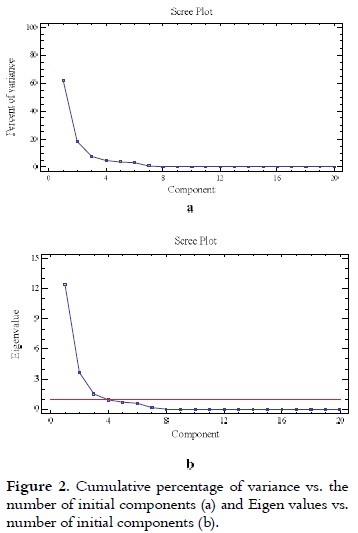
<body><![CDATA[<p> Assessments were made to the relationship   between descriptors and silhouette calibrators, the   descriptors themselves, and the different crystalline   habits of phenytoin using the correlation technique   by means of the Principal Component Analysis   (PCA). This technique performs linear and independent   combinations of all the initial variables that   are orthogonal to each other to reduce the number   that has to be considered and to establish new and   smaller groups without significant information loss.   Then, these results were taken as reference and the   hierarchical cluster analysis (HCA) was used in all   cases through the square Euclidean method for   nearest neighbors in order to specify which variables   form similar groups and could collect the greatest   homogeneity among the samples analyzed.</p>     <p> In this case, PCA interpretation was based on   variance percentage vs. components plots and the   graphics of the weight relationships among the   principal components. While for the HCA interpretation,   the graphical representations of similarity   were examined by means of dendrograms that used   the cumulative percentage diagrams of the samples.   Those techniques are the most popular multivariate   analysis methods (30).</p>     <p>&nbsp;</p>     <p><font size="3"> <b>RESULTS</b></font></p>     <p><b> Meaning of the responses obtained using the   descriptors</b></p>     <p> Initially, it is necessary to understand the information   obtained by using the contour descriptors   that are applied in geometric calibration; those are   shown in <a href="/img/revistas/vitae/v19n2/v19n2a7t1.jpg" target="_blank">Table 1</a>.</p>     <p>  According to the measurements provided by the   software, the solidity descriptor tended to evaluate   the figure edges softness, therefore, the values   decreased in the presence of roughness, mainly   when the vertices were sharpened. In the case of   roundness measurement, values increased with   homogeneity or compactness, apparently without   a direct influence from the irregularities. As it was   expected for the AR measurement, values increased   with elongation and continued to increase with   roughness. Now, in the case of the regularity measurement,   the effect of the vertices and ridges was   detected; and, additionally, the figure elongation   made the values decrease. It should be noted that   in the case of the circle used as trial, the image was   formed by pixels, therefore, the edges were not   actually round, thus the value was not exactly what   it was expected.</p>     <p> In the case of the mathematical descriptors,   Dfractal showed a propensity to differentiate parallelepiped and spherical shapes from other geometrical   shapes and it showed a decrease in the values   according to the irregularity.</p>     <p> Given the complexity of RFD interpretation, a   more logical approach to explain them was according   to their similarity with other descriptors by means   of multivariate techniques such as PCA and HCA.</p>     <p> Three new components were obtained from   this analysis (see <a href="#f2">Figures 2a</a> and <a href="#f2">2b</a>), and these   components can explain to a large extent the relationships   of all descriptors (reaching 87.85% of the   total variance).</p>       ]]></body>
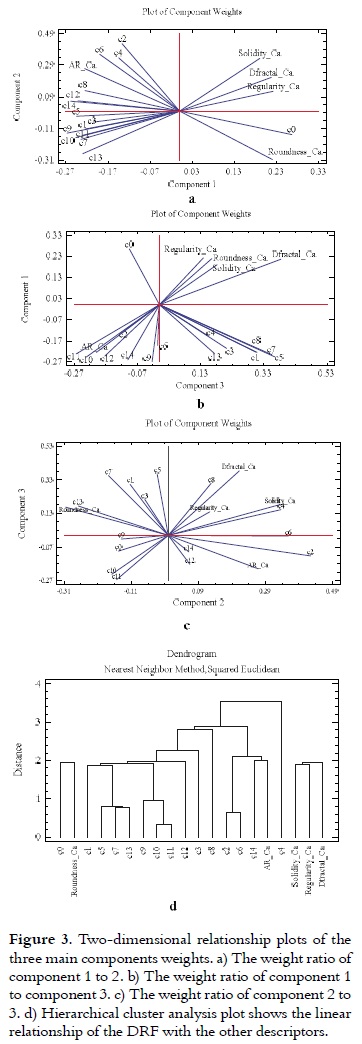
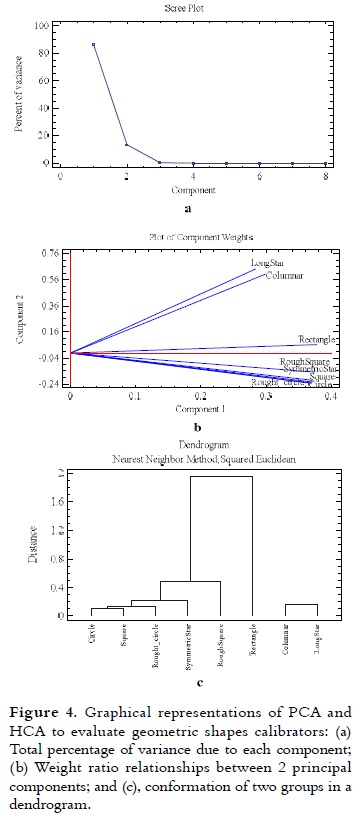
<body><![CDATA[<p align="center"><a name="f2"></a><img src="/img/revistas/vitae/v19n2/v19n2a7f2.jpg"></p>     <p>&nbsp;</p>     <p>  The first component represented homogeneity   and compactness in a topological sense, and it was   only positively related to the c0 RFD. The second   component could be grouped according to irregularity,   mainly elongation, and due to the positive   participation of the RFD c2, c4, c6, c8, c12, c14.   In the third component, which was proportionally   lighter than the first two, the roughness measurement   effects were grouped, evidencing a positive   effect from the RFD c1, c3, c4, c5, c7, c8 and c13   (see <a href="#f3">Figures 3a</a>, <a href="#f3">3b</a> and <a href="#f3">3c</a>). These new components   were linearly classified in the HCA dendrogram.</p>       <p align="center"><a name="f3"></a><img src="/img/revistas/vitae/v19n2/v19n2a7f3.jpg"></p>     <p>&nbsp;</p>     <p>  Group meaning of the used descriptors   After combining various descriptors and   applying ACP and ACJ techniques to evaluate calibrator   geometric shapes, it was inferred that these   geometric forms can be gathered in two groups   (which account for 99.32% of the variance), and they   appeared to be based on the figures homogenization   degree according to the PCA and HCA graphical   results, see <a href="#f4">Figure 4</a>.</p>       <p align="center"><a name="f4"></a><img src="/img/revistas/vitae/v19n2/v19n2a7f4.jpg"></p>     <p>&nbsp;</p>     <p>  <i>Phenytoin samples results</i></p>     <p> After analyzing the samples crystalline appearance   in <a href="#f5">Figure 5</a>, the following direct observations   were made: the M4 solid looked like columns and   needles; the M7 solid had the shape of amorphous   or irregular polyhedrons; the M8 habits were well   defined medium size flat and rectangular plates;   samples in M18 were also plates with irregular edges   that presented agglomeration; and the M22 sample   was a rectangular block smaller than the M4 and its   smaller particles were attached to the largest.</p>       ]]></body>
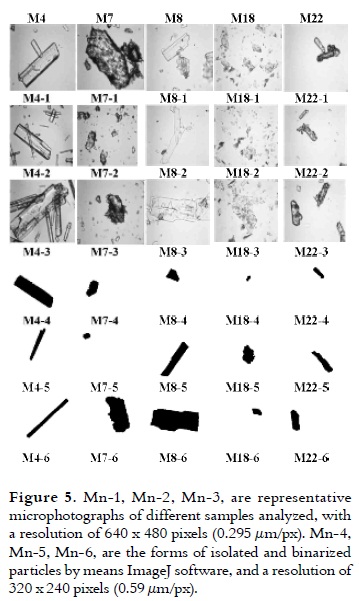
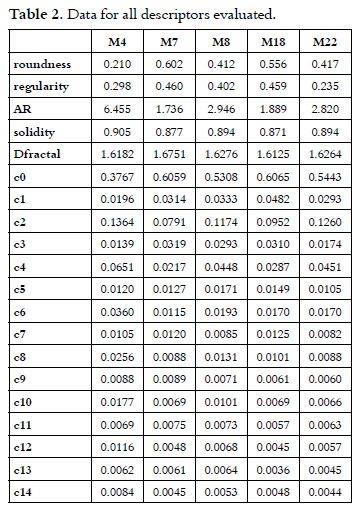
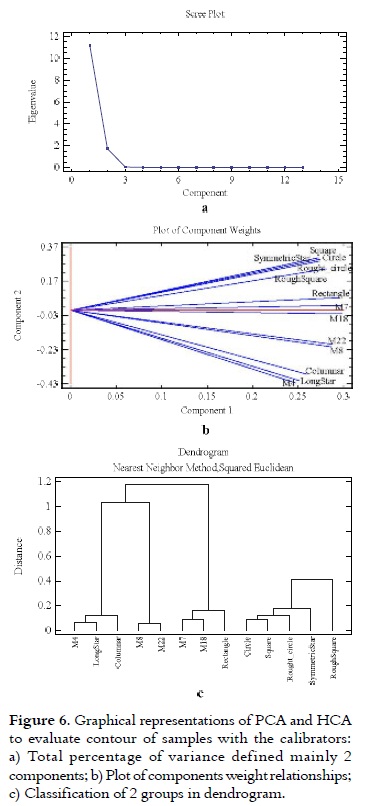
<body><![CDATA[<p align="center"><a name="f5"></a><img src="/img/revistas/vitae/v19n2/v19n2a7f5.jpg"></p>     <p>&nbsp;</p>     <p>  <a href="#t2">Table 2</a> summarizes the results of the measurements   made to these micrographs with the descriptors   and the definitions obtained in the calibration.   According to the AR descriptor, it could be inferred   that M4 habits were essentially elongated and irregular.   M22 and M8 were very similar and had average   values in comparison to other habits. The lack   of circularity of all samples and the irregularity of   the sides and edges were observed through DFractal   measurement. In the case of the solidity descriptor,   M7 and M18 showed rougher silhouettes. M4 and   M8 were the least compact in length-width terms   according to the roundness descriptor results. When   regularly measured, samples M7 and M18 appeared   to be more rectangular and angular than M8 and   M22, and even more than M4, which were individually more elongated.</p>       <p align="center"><a name="t2"></a><img src="/img/revistas/vitae/v19n2/v19n2a7t2.jpg"></p>       <p align="center">&nbsp;</p>       <p>  As it can be observed in <a href="#f6">Figure 6a</a>, the components   vs. percentage of variance graphic, created   with the results obtained through the PCA technique   and gathering calibration and the geometric   shapes of the different habits of phenytoin, it was   found that all data could be explained by only two   new groups (which explain 99.5% of the variance).   In <a href="#f6">Figure 6b</a>, the component weight plot showed   that all samples could be collected on the compaction   component (positive value); in the case of the   second component, irregularity by elongation, the   results were negatively influenced by roughness as follows: M4 &gt; M8 &gt; M22 &gt; M18 &gt; M7.</p>       <p> In the cluster analysis, HCA, two group dendrogram     confirmed the shape composition, see     <a href="#f6">Figure 6c</a>.</p>         <p align="center"><a name="f6"></a><img src="/img/revistas/vitae/v19n2/v19n2a7f6.jpg"></p>       <p>&nbsp;</p>       <p>    <i>Microtexture results</i></p>       ]]></body>
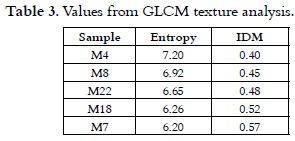
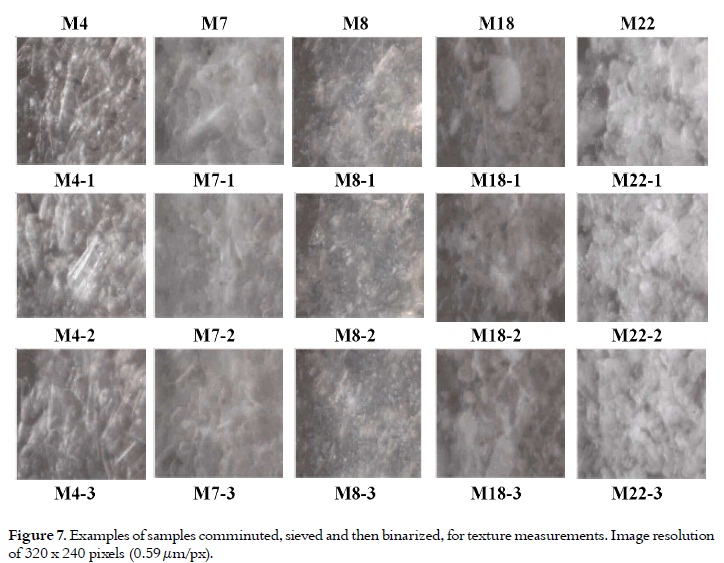
<body><![CDATA[<p> <a href="#t3">Table 3</a> summarizes the results of GLCM technique     texture analysis regarding entropy and IDM     for the five previously ground and sieved samples.</p>         <p align="center"><a name="t3"></a><img src="/img/revistas/vitae/v19n2/v19n2a7t3.jpg"></p>       <p>&nbsp;</p>       <p>    Microphotographs of these samples can be seen     in <a href="#f7">Figure 7</a>. It could be observed that these two     textural characterization results were equally related     among the samples, but in the opposite way, and     they also correspond to the definition of regularity     for entropy and the definition of the opposite of     homogeneity for IDM.</p>         <p align="center"><a name="f7"></a><img src="/img/revistas/vitae/v19n2/v19n2a7f7.jpg"></p>       <p>&nbsp;</p>       <p>  <font size="3"> <b>DISCUSSION</b></font></p>       <p> The results showed that all the information     obtained by the descriptors could be summed up     in two groups. The first one could be of compaction     of the figures, where values increasing as the     particles were angular and rough, and they showed     no negative contributions; the second one, had acicular     forms where elongation factor predominated,     showing positive effects on the elongated star and     columnar forms. The rectangle appeared to have     little contribution in either of the two components.</p>       <p> With respect to the phenytoin habits, could be     inferred from the results of <a href="#t2">Table 2</a>, according to     the AR descriptor, that M4 habits were essentially     elongated and irregular; M22 and M8 were very     similar and had average values with respect to other     habits; the lack of circularity of all samples, and the     irregularity of the sides and edges was evidenced by     DFractal measurement; with solidity descriptor, M7     and M18 showed more rough silhouettes; based on     roundness descriptor results, M4 and M8 were the     least compact in its relation length-width; measuring     regularly, the samples M7 and M18 appeared     to be more rectangular and angular than M8 and     M22, and even more than M4, which were individually     more elongated.</p>       <p> The results obtained through the classification     of entropy and IDM using principal component     analysis (PCA) and HCA, presented a great similarity     to the results of sorting the samples by ''visual     appearance'' or by expert eye inspection to sort     from lowest to highest according to the superficial     regularity: M4 seemed to have the smoothest surface,     followed by M8, M22, M18 and M7, which     was the most irregular.</p>       ]]></body>
<body><![CDATA[<p>&nbsp;</p>       <p> <font size="3">   <b>CONCLUSIONS</b></font></p>       <p> Although it is commonly stated that in order to     characterize the particles by classical descriptors it     is necessary to measure circularity (or elongation),     angularity and roughness it was confirmed in this     study that using a fourth descriptor is more effective.     According to other articles, this fourth descriptor     can be called compaction (31-33).</p>       <p> If only classical descriptors are used to characterize     particle crystal habit, the obtained representations     are considerably subjective and inaccurate.     While through mathematical descriptors or the     texture GLCM method, numerical values do not     have physical meaning and their interpretation     would still be unclear, and they should be used     as parameters for comparison among samples or     between samples and a reference.</p>       <p> Results reveal that phenytoin habits are irregular     in both elongation and rough edges.</p>       <p> This work is a contribution to the improvement     of digital techniques to characterize the crystal     habits of solids that are used in the pharmaceutical     industry. It can also be very useful for the routine     processes of quality control analysis because it     presents a new application of the GLCM texture     analysis method, which uses the complete image     of the particles. And it is combined with conventional     techniques for measuring the contour to     characterize the shape of the particles by means of     multivariate statistical analysis.</p>       <p>&nbsp;</p>       <p><font size="3"> <b>REFERENCES</b></font></p>       <!-- ref --><p> 1. Zippi G, Rodriguez-Hornedo N. Growth mechanism and     morphology of phenytoin and their relationship with crystallographic     structure. J Phys D Appl Phys. 1993; 26 (8B): B48-B55.&nbsp;&nbsp;&nbsp;&nbsp;&nbsp;&nbsp;&nbsp;&nbsp;[&#160;<a href="javascript:void(0);" onclick="javascript: window.open('/scielo.php?script=sci_nlinks&ref=000131&pid=S0121-4004201200020000700001&lng=','','width=640,height=500,resizable=yes,scrollbars=1,menubar=yes,');">Links</a>&#160;]<!-- end-ref --><!-- ref --><p> 2. Nokhodchi A, Bolourtchian N, Dinarvand R. Crystal modification     of phenytoin using different solvents and crystallization     conditions. Int J Pharm. 2003 Jan 2; 250 (1): 85-97.&nbsp;&nbsp;&nbsp;&nbsp;&nbsp;&nbsp;&nbsp;&nbsp;[&#160;<a href="javascript:void(0);" onclick="javascript: window.open('/scielo.php?script=sci_nlinks&ref=000132&pid=S0121-4004201200020000700002&lng=','','width=640,height=500,resizable=yes,scrollbars=1,menubar=yes,');">Links</a>&#160;]<!-- end-ref --><!-- ref --><p> 3. Chakrabarti S, van Severen R, Braeckman P. Studies on the     Crystalline Form of Phenytoin. Pharmazie. 1978 Jun; 33 (6):     338-339.&nbsp;&nbsp;&nbsp;&nbsp;&nbsp;&nbsp;&nbsp;&nbsp;[&#160;<a href="javascript:void(0);" onclick="javascript: window.open('/scielo.php?script=sci_nlinks&ref=000133&pid=S0121-4004201200020000700003&lng=','','width=640,height=500,resizable=yes,scrollbars=1,menubar=yes,');">Links</a>&#160;]<!-- end-ref --><!-- ref --><p> 4. Pons M, Vivier H, Belaroui K, Bernard-Michel B, Cordier F,     Oulhana D, et al. Particle morphology: from visualisation to     measurement. Powder Technol. 1999 Jun; 103 (1): 44-57.&nbsp;&nbsp;&nbsp;&nbsp;&nbsp;&nbsp;&nbsp;&nbsp;[&#160;<a href="javascript:void(0);" onclick="javascript: window.open('/scielo.php?script=sci_nlinks&ref=000134&pid=S0121-4004201200020000700004&lng=','','width=640,height=500,resizable=yes,scrollbars=1,menubar=yes,');">Links</a>&#160;]<!-- end-ref --><!-- ref --><p> 5. MacLeod N. Geometric morphometrics and geological shapeclassification     systems. Earth-Sci Rev. 2002 Nov; 59 (1-4): 27-47.&nbsp;&nbsp;&nbsp;&nbsp;&nbsp;&nbsp;&nbsp;&nbsp;[&#160;<a href="javascript:void(0);" onclick="javascript: window.open('/scielo.php?script=sci_nlinks&ref=000135&pid=S0121-4004201200020000700005&lng=','','width=640,height=500,resizable=yes,scrollbars=1,menubar=yes,');">Links</a>&#160;]<!-- end-ref --><!-- ref --><p> 6. Wojnar L, Friel J, Grande J, Hetzner D, Kurzyd&oslash;owski K, Laferty     D, et al. Practical Guide to Image Analysis. Ohio, USA: ASM     International; c2000. Chapter 7, Analysis and interpretation; p.     145-182.&nbsp;&nbsp;&nbsp;&nbsp;&nbsp;&nbsp;&nbsp;&nbsp;[&#160;<a href="javascript:void(0);" onclick="javascript: window.open('/scielo.php?script=sci_nlinks&ref=000136&pid=S0121-4004201200020000700006&lng=','','width=640,height=500,resizable=yes,scrollbars=1,menubar=yes,');">Links</a>&#160;]<!-- end-ref --><!-- ref --><p> 7. Rohlf F. Relationships among eigenshape analysis, Fourier     analysis, and analysis of coordinates. Math Geol. 1986; 18 (8):     845-854.&nbsp;&nbsp;&nbsp;&nbsp;&nbsp;&nbsp;&nbsp;&nbsp;[&#160;<a href="javascript:void(0);" onclick="javascript: window.open('/scielo.php?script=sci_nlinks&ref=000137&pid=S0121-4004201200020000700007&lng=','','width=640,height=500,resizable=yes,scrollbars=1,menubar=yes,');">Links</a>&#160;]<!-- end-ref --><!-- ref --><p> 8. Kim W, Kim Y. A region-basedshape descriptor using Zernike     moments. Signal Process-Image. 2000 Sept; 16 (1-2): 95-102.&nbsp;&nbsp;&nbsp;&nbsp;&nbsp;&nbsp;&nbsp;&nbsp;[&#160;<a href="javascript:void(0);" onclick="javascript: window.open('/scielo.php?script=sci_nlinks&ref=000138&pid=S0121-4004201200020000700008&lng=','','width=640,height=500,resizable=yes,scrollbars=1,menubar=yes,');">Links</a>&#160;]<!-- end-ref --><!-- ref --><p> 9. Mundy J, Zisserman A (editors). Geometric Invariance in Computer     Vision Taubin. Cambridge, MA. USA: MIT Press; 1992.     Chapter 19, Cooper G. Object recognition based on moment     (or Algebraic) Invariants; p. 375-397.&nbsp;&nbsp;&nbsp;&nbsp;&nbsp;&nbsp;&nbsp;&nbsp;[&#160;<a href="javascript:void(0);" onclick="javascript: window.open('/scielo.php?script=sci_nlinks&ref=000139&pid=S0121-4004201200020000700009&lng=','','width=640,height=500,resizable=yes,scrollbars=1,menubar=yes,');">Links</a>&#160;]<!-- end-ref --><!-- ref --><p> 10. Peura M, Iivarinen J. Efficiency of simple shape descriptors.     In: Arcelli C, Cordella, Sanniti di Baja G, editors. Advances in     Visual Form Analysis. 3rd. International Workshop on Visual     Form; 1997 May 28-30; Capri, Italy. Singapore: World Scientific;     1998. p. 443-451.&nbsp;&nbsp;&nbsp;&nbsp;&nbsp;&nbsp;&nbsp;&nbsp;[&#160;<a href="javascript:void(0);" onclick="javascript: window.open('/scielo.php?script=sci_nlinks&ref=000140&pid=S0121-4004201200020000700010&lng=','','width=640,height=500,resizable=yes,scrollbars=1,menubar=yes,');">Links</a>&#160;]<!-- end-ref --><!-- ref --><p> 11. Zhang D, Lu G. Review of shape representation and description     techniques. Pattern Recogn. 2004 Jan; 37 (1): 1-19.&nbsp;&nbsp;&nbsp;&nbsp;&nbsp;&nbsp;&nbsp;&nbsp;[&#160;<a href="javascript:void(0);" onclick="javascript: window.open('/scielo.php?script=sci_nlinks&ref=000141&pid=S0121-4004201200020000700011&lng=','','width=640,height=500,resizable=yes,scrollbars=1,menubar=yes,');">Links</a>&#160;]<!-- end-ref --><!-- ref --><p> 12. Laitinen N, Antikainen O, Yliruusi J. Characterization of Particle     Sizes in Bulk Pharmaceutical Solids Using Digital Image     Information. AAPS Pharm Sci Tech. 2003 Oct; 4 (4): 383-391.&nbsp;&nbsp;&nbsp;&nbsp;&nbsp;&nbsp;&nbsp;&nbsp;[&#160;<a href="javascript:void(0);" onclick="javascript: window.open('/scielo.php?script=sci_nlinks&ref=000142&pid=S0121-4004201200020000700012&lng=','','width=640,height=500,resizable=yes,scrollbars=1,menubar=yes,');">Links</a>&#160;]<!-- end-ref --><!-- ref --><p> 13. Pourghahramani P, Forssberg, E. Review of Applied Particle     Shape Descriptors and Produced Particle Shapes in Grinding     Environments. Part I: Particle Shape Descriptors. Miner Proc     Extractive Metall Rev. 2005 Mar; 26 (2): 145-166.&nbsp;&nbsp;&nbsp;&nbsp;&nbsp;&nbsp;&nbsp;&nbsp;[&#160;<a href="javascript:void(0);" onclick="javascript: window.open('/scielo.php?script=sci_nlinks&ref=000143&pid=S0121-4004201200020000700013&lng=','','width=640,height=500,resizable=yes,scrollbars=1,menubar=yes,');">Links</a>&#160;]<!-- end-ref --><!-- ref --><p> 14. Almeida-Prieto S, Blanco-M&eacute;ndez J, Otero-Espinar F. Microscopic     image analysis techniques for the morphological     characterization of pharmaceutical particles: Influence of the     software, and the factor algorithms used in the shape factor     estimation. Eur J Pharm Biopharm. 2007 Nov; 67 (3): 766-776.&nbsp;&nbsp;&nbsp;&nbsp;&nbsp;&nbsp;&nbsp;&nbsp;[&#160;<a href="javascript:void(0);" onclick="javascript: window.open('/scielo.php?script=sci_nlinks&ref=000144&pid=S0121-4004201200020000700014&lng=','','width=640,height=500,resizable=yes,scrollbars=1,menubar=yes,');">Links</a>&#160;]<!-- end-ref --><!-- ref --><p> 15. United States Pharmacopeial Convention. Pharmacopeia     USP32 &#91;Internet&#93;. USP32-NF27 ed. Rockville, (MD): Pharmacopoeial     Convention. Inc.; 2010. General chapters: &lt;776&gt;     Optical Microscopy; (cited 2010 oct 10);. Available from: <a href="http://www.uspbpep.com/usp32/pub/data/v32270/usp32nf27s0_c776.html" target="_blank">http://www.uspbpep.com/usp32/pub/data/v32270/usp32nf27s0_c776.html</a>.&nbsp;&nbsp;&nbsp;&nbsp;&nbsp;&nbsp;&nbsp;&nbsp;[&#160;<a href="javascript:void(0);" onclick="javascript: window.open('/scielo.php?script=sci_nlinks&ref=000145&pid=S0121-4004201200020000700015&lng=','','width=640,height=500,resizable=yes,scrollbars=1,menubar=yes,');">Links</a>&#160;]<!-- end-ref --><!-- ref --><p> 16. Bouwman A, Bosmaa J, Vonkb P, Wesselinghc J, Frijlink H.     Which shape factor(s) best describe granules?. Powder Technol.     2004 Aug 30; 146 (1-2): 66-72.&nbsp;&nbsp;&nbsp;&nbsp;&nbsp;&nbsp;&nbsp;&nbsp;[&#160;<a href="javascript:void(0);" onclick="javascript: window.open('/scielo.php?script=sci_nlinks&ref=000146&pid=S0121-4004201200020000700016&lng=','','width=640,height=500,resizable=yes,scrollbars=1,menubar=yes,');">Links</a>&#160;]<!-- end-ref --><!-- ref --><p> 17. Barrett P. The shape of rock particles, a critical review. Sedimentology.     1980 Jun; 27 (3): 291-303.&nbsp;&nbsp;&nbsp;&nbsp;&nbsp;&nbsp;&nbsp;&nbsp;[&#160;<a href="javascript:void(0);" onclick="javascript: window.open('/scielo.php?script=sci_nlinks&ref=000147&pid=S0121-4004201200020000700017&lng=','','width=640,height=500,resizable=yes,scrollbars=1,menubar=yes,');">Links</a>&#160;]<!-- end-ref --><!-- ref --><p> 18. Flook A. Fourier analysis of particle shape. In: Stanly-Wood NG,     Allen T, editors. Proceedings of the 4th Particle Size Analysis     conference; 1981 Sept 21-24; London, UK: Wiley Heyden Ltd;     1982. p. 255-262.&nbsp;&nbsp;&nbsp;&nbsp;&nbsp;&nbsp;&nbsp;&nbsp;[&#160;<a href="javascript:void(0);" onclick="javascript: window.open('/scielo.php?script=sci_nlinks&ref=000148&pid=S0121-4004201200020000700018&lng=','','width=640,height=500,resizable=yes,scrollbars=1,menubar=yes,');">Links</a>&#160;]<!-- end-ref --><!-- ref --><p> 19. Malik J, Belongie S, Leung T, Shi J. Contour and Texture     Analysis for Image Segmentation. Int J Comput Vision. 2001     Jun; 43 (1): 7-27.&nbsp;&nbsp;&nbsp;&nbsp;&nbsp;&nbsp;&nbsp;&nbsp;[&#160;<a href="javascript:void(0);" onclick="javascript: window.open('/scielo.php?script=sci_nlinks&ref=000149&pid=S0121-4004201200020000700019&lng=','','width=640,height=500,resizable=yes,scrollbars=1,menubar=yes,');">Links</a>&#160;]<!-- end-ref --><!-- ref --><p> 20. Amadasun M, King R. Texural Features Corresponding to     Textural Properties. IEEE T Syst Man Cyb. 1989 Sep-Oct; 19     (5): 1264-1274.&nbsp;&nbsp;&nbsp;&nbsp;&nbsp;&nbsp;&nbsp;&nbsp;[&#160;<a href="javascript:void(0);" onclick="javascript: window.open('/scielo.php?script=sci_nlinks&ref=000150&pid=S0121-4004201200020000700020&lng=','','width=640,height=500,resizable=yes,scrollbars=1,menubar=yes,');">Links</a>&#160;]<!-- end-ref --><!-- ref --><p> 21. Haralick R, Shanmugam K, Dinstein I. Textural features for     image classification. IEEE T Syst Man Cyb. 1973 Nov; 3 (6):     610-621.&nbsp;&nbsp;&nbsp;&nbsp;&nbsp;&nbsp;&nbsp;&nbsp;[&#160;<a href="javascript:void(0);" onclick="javascript: window.open('/scielo.php?script=sci_nlinks&ref=000151&pid=S0121-4004201200020000700021&lng=','','width=640,height=500,resizable=yes,scrollbars=1,menubar=yes,');">Links</a>&#160;]<!-- end-ref --><!-- ref --><p> 22. Hayward, RCJ. Synthesis of the anticonvulsant drug 5,5-diphenylhydantoin:     an undergraduate organic chemistry experiment.     J Chem Ed. 1983 Jun; 60 (6): 512-513.&nbsp;&nbsp;&nbsp;&nbsp;&nbsp;&nbsp;&nbsp;&nbsp;[&#160;<a href="javascript:void(0);" onclick="javascript: window.open('/scielo.php?script=sci_nlinks&ref=000152&pid=S0121-4004201200020000700022&lng=','','width=640,height=500,resizable=yes,scrollbars=1,menubar=yes,');">Links</a>&#160;]<!-- end-ref --><!-- ref --><p> 23. Latrofa A, Trapani G, Franco M, Serra M, Muggironi M, Fanizzi     FP, et al. Complexation of phenytoin with some hydrophilic     cyclodextrins: effect on aqueous solubility, dissolution rate, and     anticonvulsant activity in mice. Eur J Pharm Biopharm. 2001     Jul: 52 (1); 65-73.&nbsp;&nbsp;&nbsp;&nbsp;&nbsp;&nbsp;&nbsp;&nbsp;[&#160;<a href="javascript:void(0);" onclick="javascript: window.open('/scielo.php?script=sci_nlinks&ref=000153&pid=S0121-4004201200020000700023&lng=','','width=640,height=500,resizable=yes,scrollbars=1,menubar=yes,');">Links</a>&#160;]<!-- end-ref --><!-- ref --><p> 24. Tsialtas J, Maslaris N. Leaf shape and its relationship with     Leaf Area Index in a sugar beet (Beta vulgaris L.) cultivar. Photosynthetica.     2007: 45 (4); 527-532.&nbsp;&nbsp;&nbsp;&nbsp;&nbsp;&nbsp;&nbsp;&nbsp;[&#160;<a href="javascript:void(0);" onclick="javascript: window.open('/scielo.php?script=sci_nlinks&ref=000154&pid=S0121-4004201200020000700024&lng=','','width=640,height=500,resizable=yes,scrollbars=1,menubar=yes,');">Links</a>&#160;]<!-- end-ref --><!-- ref --><p> 25. Sandau K. A note on fractal sets and the measurement of fractal     dimension. Physica A. 1996 Nov; 233 (1-2): 1-18.&nbsp;&nbsp;&nbsp;&nbsp;&nbsp;&nbsp;&nbsp;&nbsp;[&#160;<a href="javascript:void(0);" onclick="javascript: window.open('/scielo.php?script=sci_nlinks&ref=000155&pid=S0121-4004201200020000700025&lng=','','width=640,height=500,resizable=yes,scrollbars=1,menubar=yes,');">Links</a>&#160;]<!-- end-ref --><!-- ref --><p> 26. Mart&iacute;nez-L&oacute;pez F, Cabrerizo-V&iacute;lchez M, Hidalgo-&Aacute;lvarez R.     A study of the different methods usually employed to compute     the fractal dimension. Physica A. 2002 Aug; 311 (3-4): 411-428.&nbsp;&nbsp;&nbsp;&nbsp;&nbsp;&nbsp;&nbsp;&nbsp;[&#160;<a href="javascript:void(0);" onclick="javascript: window.open('/scielo.php?script=sci_nlinks&ref=000156&pid=S0121-4004201200020000700026&lng=','','width=640,height=500,resizable=yes,scrollbars=1,menubar=yes,');">Links</a>&#160;]<!-- end-ref --><!-- ref --><p> 27. Julesz B. Texture and visual perception. Sci Am. 1965: 212 (2);     38-49.&nbsp;&nbsp;&nbsp;&nbsp;&nbsp;&nbsp;&nbsp;&nbsp;[&#160;<a href="javascript:void(0);" onclick="javascript: window.open('/scielo.php?script=sci_nlinks&ref=000157&pid=S0121-4004201200020000700027&lng=','','width=640,height=500,resizable=yes,scrollbars=1,menubar=yes,');">Links</a>&#160;]<!-- end-ref --><!-- ref --><p> 28. Julesz B, Gilbert E, Shepp L, Frisch H. Inability of humans to     discriminate between visual textures that agree in second-order     statistics-revisited. Perception. 1973; 2 (4): 391-405.&nbsp;&nbsp;&nbsp;&nbsp;&nbsp;&nbsp;&nbsp;&nbsp;[&#160;<a href="javascript:void(0);" onclick="javascript: window.open('/scielo.php?script=sci_nlinks&ref=000158&pid=S0121-4004201200020000700028&lng=','','width=640,height=500,resizable=yes,scrollbars=1,menubar=yes,');">Links</a>&#160;]<!-- end-ref --><!-- ref --><p>    29. Di Ruberto C, Morgera A. A Comparison of 2-D Moment-     Based Description Techniques. In: Roli F, Vitulano S, editors.     Lectures Notes in computer science: Image analysis and     processing. ICIAP 2005, 13th International Conference; 2005     September 6-8; Caligari, Italy. Berlin: Springer Science &amp;     Business; 2005. p. 212-219.&nbsp;&nbsp;&nbsp;&nbsp;&nbsp;&nbsp;&nbsp;&nbsp;[&#160;<a href="javascript:void(0);" onclick="javascript: window.open('/scielo.php?script=sci_nlinks&ref=000159&pid=S0121-4004201200020000700029&lng=','','width=640,height=500,resizable=yes,scrollbars=1,menubar=yes,');">Links</a>&#160;]<!-- end-ref --><!-- ref --><p> 30. Fadigas J, dos Santos A, de Jesus R, LimaD, FragosoW, David J,     et al.Use of multivariate analysis techniques for the characterization     of analytical results for the determination of the mineral     composition of kale. Microchem J. 2010 Nov; 51 (2): 352-356.&nbsp;&nbsp;&nbsp;&nbsp;&nbsp;&nbsp;&nbsp;&nbsp;[&#160;<a href="javascript:void(0);" onclick="javascript: window.open('/scielo.php?script=sci_nlinks&ref=000160&pid=S0121-4004201200020000700030&lng=','','width=640,height=500,resizable=yes,scrollbars=1,menubar=yes,');">Links</a>&#160;]<!-- end-ref --><!-- ref --><p> 31. Bowman E, Saga K, Drummond T. Particle Shape Characterisation     using Fourier Analysis. Geotechnique. 2001 Aug; 51 (6):     545-554.&nbsp;&nbsp;&nbsp;&nbsp;&nbsp;&nbsp;&nbsp;&nbsp;[&#160;<a href="javascript:void(0);" onclick="javascript: window.open('/scielo.php?script=sci_nlinks&ref=000161&pid=S0121-4004201200020000700031&lng=','','width=640,height=500,resizable=yes,scrollbars=1,menubar=yes,');">Links</a>&#160;]<!-- end-ref --><!-- ref --><p> 32. Fl&oacute;rez-Acosta O, Tob&oacute;n-Zapata G, Valencia-Velasquez J. Categorization     of the main descriptors of different ampicillin crystal     habits. Braz J Pharm Sci. 2010 May; 46 (4): 679-685.&nbsp;&nbsp;&nbsp;&nbsp;&nbsp;&nbsp;&nbsp;&nbsp;[&#160;<a href="javascript:void(0);" onclick="javascript: window.open('/scielo.php?script=sci_nlinks&ref=000162&pid=S0121-4004201200020000700032&lng=','','width=640,height=500,resizable=yes,scrollbars=1,menubar=yes,');">Links</a>&#160;]<!-- end-ref --><!-- ref --><p> 33. Pourghahramani P, Forssberg E. Review of Applied Particle     Shape Descriptors and Produced Particle Shapes in Grinding     Environments. Part II: The Influence of Comminution on the     Particle Shape. Miner Proc Extractive Metall Rev. 2005 Mar;     26 (2): 167-186.&nbsp;&nbsp;&nbsp;&nbsp;&nbsp;&nbsp;&nbsp;&nbsp;[&#160;<a href="javascript:void(0);" onclick="javascript: window.open('/scielo.php?script=sci_nlinks&ref=000163&pid=S0121-4004201200020000700033&lng=','','width=640,height=500,resizable=yes,scrollbars=1,menubar=yes,');">Links</a>&#160;]<!-- end-ref --> ]]></body><back>
<ref-list>
<ref id="B1">
<label>1</label><nlm-citation citation-type="journal">
<person-group person-group-type="author">
<name>
<surname><![CDATA[Zippi]]></surname>
<given-names><![CDATA[G]]></given-names>
</name>
<name>
<surname><![CDATA[Rodriguez-Hornedo]]></surname>
<given-names><![CDATA[N.]]></given-names>
</name>
</person-group>
<article-title xml:lang="en"><![CDATA[Growth mechanism and morphology of phenytoin and their relationship with crystallographic structure]]></article-title>
<source><![CDATA[J Phys D Appl Phys]]></source>
<year>1993</year>
<volume>26</volume>
<numero>8B</numero>
<issue>8B</issue>
<page-range>B48-B55</page-range></nlm-citation>
</ref>
<ref id="B2">
<label>2</label><nlm-citation citation-type="journal">
<person-group person-group-type="author">
<name>
<surname><![CDATA[Nokhodchi]]></surname>
<given-names><![CDATA[A]]></given-names>
</name>
<name>
<surname><![CDATA[Bolourtchian]]></surname>
<given-names><![CDATA[N]]></given-names>
</name>
<name>
<surname><![CDATA[Dinarvand]]></surname>
<given-names><![CDATA[R.]]></given-names>
</name>
</person-group>
<article-title xml:lang="en"><![CDATA[Crystal modification of phenytoin using different solvents and crystallization conditions]]></article-title>
<source><![CDATA[Int J Pharm]]></source>
<year>2003</year>
<month> J</month>
<day>an</day>
<volume>250</volume>
<numero>1</numero>
<issue>1</issue>
<page-range>85-97</page-range></nlm-citation>
</ref>
<ref id="B3">
<label>3</label><nlm-citation citation-type="journal">
<person-group person-group-type="author">
<name>
<surname><![CDATA[Chakrabarti]]></surname>
<given-names><![CDATA[S]]></given-names>
</name>
<name>
<surname><![CDATA[van]]></surname>
<given-names><![CDATA[Severen R]]></given-names>
</name>
<name>
<surname><![CDATA[Braeckman]]></surname>
<given-names><![CDATA[P.]]></given-names>
</name>
</person-group>
<article-title xml:lang="en"><![CDATA[Studies on the Crystalline Form of Phenytoin]]></article-title>
<source><![CDATA[Pharmazie]]></source>
<year>1978</year>
<month> J</month>
<day>un</day>
<volume>33</volume>
<numero>6</numero>
<issue>6</issue>
<page-range>338-339</page-range></nlm-citation>
</ref>
<ref id="B4">
<label>4</label><nlm-citation citation-type="journal">
<person-group person-group-type="author">
<name>
<surname><![CDATA[Pons]]></surname>
<given-names><![CDATA[M]]></given-names>
</name>
<name>
<surname><![CDATA[Vivier]]></surname>
<given-names><![CDATA[H]]></given-names>
</name>
<name>
<surname><![CDATA[Belaroui]]></surname>
<given-names><![CDATA[K]]></given-names>
</name>
<name>
<surname><![CDATA[Bernard-Michel]]></surname>
<given-names><![CDATA[B]]></given-names>
</name>
<name>
<surname><![CDATA[Cordier]]></surname>
<given-names><![CDATA[F]]></given-names>
</name>
<name>
<surname><![CDATA[Oulhana]]></surname>
<given-names><![CDATA[D]]></given-names>
</name>
</person-group>
<article-title xml:lang="en"><![CDATA[Particle morphology: from visualisation to measurement]]></article-title>
<source><![CDATA[Powder Technol]]></source>
<year>1999</year>
<month> J</month>
<day>un</day>
<volume>103</volume>
<numero>1</numero>
<issue>1</issue>
<page-range>44-57</page-range></nlm-citation>
</ref>
<ref id="B5">
<label>5</label><nlm-citation citation-type="journal">
<person-group person-group-type="author">
<name>
<surname><![CDATA[MacLeod]]></surname>
<given-names><![CDATA[N.]]></given-names>
</name>
</person-group>
<article-title xml:lang="en"><![CDATA[Geometric morphometrics and geological shapeclassification systems]]></article-title>
<source><![CDATA[Earth-Sci Rev]]></source>
<year>2002</year>
<month> N</month>
<day>ov</day>
<volume>59</volume>
<numero>1-4</numero>
<issue>1-4</issue>
<page-range>27-47</page-range></nlm-citation>
</ref>
<ref id="B6">
<label>6</label><nlm-citation citation-type="book">
<person-group person-group-type="author">
<name>
<surname><![CDATA[Wojnar]]></surname>
<given-names><![CDATA[L]]></given-names>
</name>
<name>
<surname><![CDATA[Friel]]></surname>
<given-names><![CDATA[J]]></given-names>
</name>
<name>
<surname><![CDATA[Grande]]></surname>
<given-names><![CDATA[J]]></given-names>
</name>
<name>
<surname><![CDATA[Hetzner]]></surname>
<given-names><![CDATA[D]]></given-names>
</name>
<name>
<surname><![CDATA[Kurzydøowski]]></surname>
<given-names><![CDATA[K]]></given-names>
</name>
<name>
<surname><![CDATA[Laferty]]></surname>
<given-names><![CDATA[D]]></given-names>
</name>
</person-group>
<source><![CDATA[Practical Guide to Image Analysis]]></source>
<year></year>
<page-range>145-182</page-range><publisher-loc><![CDATA[Ohio ]]></publisher-loc>
<publisher-name><![CDATA[ASM International]]></publisher-name>
</nlm-citation>
</ref>
<ref id="B7">
<label>7</label><nlm-citation citation-type="journal">
<person-group person-group-type="author">
<name>
<surname><![CDATA[Rohlf]]></surname>
<given-names><![CDATA[F.]]></given-names>
</name>
</person-group>
<article-title xml:lang="en"><![CDATA[Relationships among eigenshape analysis, Fourier analysis, and analysis of coordinates]]></article-title>
<source><![CDATA[Math Geol]]></source>
<year>1986</year>
<volume>18</volume>
<numero>8</numero>
<issue>8</issue>
<page-range>845-854</page-range></nlm-citation>
</ref>
<ref id="B8">
<label>8</label><nlm-citation citation-type="journal">
<person-group person-group-type="author">
<name>
<surname><![CDATA[Kim]]></surname>
<given-names><![CDATA[W]]></given-names>
</name>
<name>
<surname><![CDATA[Kim]]></surname>
<given-names><![CDATA[Y.]]></given-names>
</name>
</person-group>
<article-title xml:lang="en"><![CDATA[A region-basedshape descriptor using Zernike moments]]></article-title>
<source><![CDATA[Signal Process-Image]]></source>
<year>2000</year>
<month> S</month>
<day>ep</day>
<volume>16</volume>
<numero>1-2</numero>
<issue>1-2</issue>
<page-range>95-102</page-range></nlm-citation>
</ref>
<ref id="B9">
<label>9.</label><nlm-citation citation-type="book">
<person-group person-group-type="author">
<name>
<surname><![CDATA[Mundy]]></surname>
<given-names><![CDATA[J]]></given-names>
</name>
<name>
<surname><![CDATA[Zisserman]]></surname>
<given-names><![CDATA[A]]></given-names>
</name>
</person-group>
<source><![CDATA[Geometric Invariance in Computer Vision Taubin]]></source>
<year>1992</year>
<volume>19</volume>
<page-range>375-397</page-range><publisher-loc><![CDATA[Cambridge^eMA MA]]></publisher-loc>
<publisher-name><![CDATA[MIT Press]]></publisher-name>
</nlm-citation>
</ref>
<ref id="B10">
<label>10</label><nlm-citation citation-type="book">
<person-group person-group-type="author">
<name>
<surname><![CDATA[Peura]]></surname>
<given-names><![CDATA[M]]></given-names>
</name>
<name>
<surname><![CDATA[Iivarinen]]></surname>
<given-names><![CDATA[J]]></given-names>
</name>
</person-group>
<article-title xml:lang="en"><![CDATA[Efficiency of simple shape descriptors]]></article-title>
<person-group person-group-type="editor">
<name>
<surname><![CDATA[Arcelli]]></surname>
<given-names><![CDATA[C]]></given-names>
</name>
<name>
<surname><![CDATA[Cordella]]></surname>
</name>
<name>
<surname><![CDATA[Sanniti di Baja]]></surname>
<given-names><![CDATA[G]]></given-names>
</name>
</person-group>
<source><![CDATA[Advances in Visual Form Analysis]]></source>
<year>1997</year>
<month> M</month>
<day>ay</day>
<edition>3</edition>
<page-range>443-451</page-range><publisher-loc><![CDATA[Capri ]]></publisher-loc>
<publisher-name><![CDATA[International Workshop on Visual Form]]></publisher-name>
</nlm-citation>
</ref>
<ref id="B11">
<label>11</label><nlm-citation citation-type="journal">
<person-group person-group-type="author">
<name>
<surname><![CDATA[Zhang]]></surname>
<given-names><![CDATA[D]]></given-names>
</name>
<name>
<surname><![CDATA[Lu]]></surname>
<given-names><![CDATA[G.]]></given-names>
</name>
</person-group>
<article-title xml:lang="en"><![CDATA[Review of shape representation and description techniques]]></article-title>
<source><![CDATA[Pattern Recogn]]></source>
<year>2004</year>
<month> J</month>
<day>an</day>
<volume>37</volume>
<numero>1</numero>
<issue>1</issue>
<page-range>1-19</page-range></nlm-citation>
</ref>
<ref id="B12">
<label>12</label><nlm-citation citation-type="journal">
<person-group person-group-type="author">
<name>
<surname><![CDATA[Laitinen]]></surname>
<given-names><![CDATA[N]]></given-names>
</name>
<name>
<surname><![CDATA[Antikainen]]></surname>
<given-names><![CDATA[O]]></given-names>
</name>
<name>
<surname><![CDATA[Yliruusi]]></surname>
<given-names><![CDATA[J.]]></given-names>
</name>
</person-group>
<article-title xml:lang="en"><![CDATA[Characterization of Particle Sizes in Bulk Pharmaceutical Solids Using Digital Image Information]]></article-title>
<source><![CDATA[AAPS Pharm Sci Tech]]></source>
<year>2003</year>
<month> O</month>
<day>ct</day>
<volume>4</volume>
<numero>4</numero>
<issue>4</issue>
<page-range>383-391</page-range></nlm-citation>
</ref>
<ref id="B13">
<label>13</label><nlm-citation citation-type="journal">
<person-group person-group-type="author">
<name>
<surname><![CDATA[Pourghahramani]]></surname>
<given-names><![CDATA[P]]></given-names>
</name>
<name>
<surname><![CDATA[Forssberg,]]></surname>
<given-names><![CDATA[E.]]></given-names>
</name>
</person-group>
<article-title xml:lang="en"><![CDATA[Review of Applied Particle Shape Descriptors and Produced Particle Shapes in Grinding Environments. Part I: Particle Shape Descriptors]]></article-title>
<source><![CDATA[Miner Proc Extractive Metall Rev]]></source>
<year>2005</year>
<month> M</month>
<day>ar</day>
<volume>26</volume>
<numero>2</numero>
<issue>2</issue>
<page-range>145-166</page-range></nlm-citation>
</ref>
<ref id="B14">
<label>14</label><nlm-citation citation-type="journal">
<person-group person-group-type="author">
<name>
<surname><![CDATA[Almeida-Prieto]]></surname>
<given-names><![CDATA[S]]></given-names>
</name>
<name>
<surname><![CDATA[Blanco-Méndez]]></surname>
<given-names><![CDATA[J]]></given-names>
</name>
<name>
<surname><![CDATA[Otero-Espinar]]></surname>
<given-names><![CDATA[F.]]></given-names>
</name>
</person-group>
<article-title xml:lang="en"><![CDATA[Microscopic image analysis techniques for the morphological characterization of pharmaceutical particles: Influence of the software, and the factor algorithms used in the shape factor estimation]]></article-title>
<source><![CDATA[Eur J Pharm Biopharm]]></source>
<year>2007</year>
<month> N</month>
<day>ov</day>
<volume>67</volume>
<numero>3</numero>
<issue>3</issue>
<page-range>766-776</page-range></nlm-citation>
</ref>
<ref id="B15">
<label>15</label><nlm-citation citation-type="book">
<collab>United States Pharmacopeial Convention</collab>
<source><![CDATA[Pharmacopeia USP32]]></source>
<year></year>
<publisher-loc><![CDATA[Rockville^eMD MD]]></publisher-loc>
<publisher-name><![CDATA[Pharmacopoeial Convention. Inc.;]]></publisher-name>
</nlm-citation>
</ref>
<ref id="B16">
<label>16</label><nlm-citation citation-type="journal">
<person-group person-group-type="author">
<name>
<surname><![CDATA[Bouwman]]></surname>
<given-names><![CDATA[A]]></given-names>
</name>
<name>
<surname><![CDATA[Bosmaa]]></surname>
<given-names><![CDATA[J]]></given-names>
</name>
<name>
<surname><![CDATA[Vonkb]]></surname>
<given-names><![CDATA[P]]></given-names>
</name>
<name>
<surname><![CDATA[Wesselinghc]]></surname>
<given-names><![CDATA[J]]></given-names>
</name>
<name>
<surname><![CDATA[Frijlink]]></surname>
<given-names><![CDATA[H.]]></given-names>
</name>
</person-group>
<article-title xml:lang="en"><![CDATA[Which shape factor(s) best describe granules?]]></article-title>
<source><![CDATA[Powder Technol]]></source>
<year>2004</year>
<month> A</month>
<day>ug</day>
<volume>146</volume>
<numero>1-2</numero>
<issue>1-2</issue>
<page-range>66-72</page-range></nlm-citation>
</ref>
<ref id="B17">
<label>17</label><nlm-citation citation-type="journal">
<person-group person-group-type="author">
<name>
<surname><![CDATA[Barrett]]></surname>
<given-names><![CDATA[P.]]></given-names>
</name>
</person-group>
<article-title xml:lang="en"><![CDATA[The shape of rock particles, a critical review]]></article-title>
<source><![CDATA[Sedimentology]]></source>
<year>1980</year>
<month> J</month>
<day>un</day>
<volume>27</volume>
<numero>3</numero>
<issue>3</issue>
<page-range>291-303</page-range></nlm-citation>
</ref>
<ref id="B18">
<label>18</label><nlm-citation citation-type="book">
<person-group person-group-type="author">
<name>
<surname><![CDATA[Flook]]></surname>
<given-names><![CDATA[A]]></given-names>
</name>
</person-group>
<article-title xml:lang="en"><![CDATA[Fourier analysis of particle shape]]></article-title>
<person-group person-group-type="editor">
<name>
<surname><![CDATA[Stanly-Wood]]></surname>
<given-names><![CDATA[NG]]></given-names>
</name>
<name>
<surname><![CDATA[Allen]]></surname>
<given-names><![CDATA[T]]></given-names>
</name>
</person-group>
<source><![CDATA[Proceedings of the 4th Particle Size Analysis conference]]></source>
<year>1981</year>
<month> S</month>
<day>ep</day>
<page-range>255-262</page-range><publisher-loc><![CDATA[London ]]></publisher-loc>
<publisher-name><![CDATA[Wiley Heyden Ltd]]></publisher-name>
</nlm-citation>
</ref>
<ref id="B19">
<label>19</label><nlm-citation citation-type="journal">
<person-group person-group-type="author">
<name>
<surname><![CDATA[Malik]]></surname>
<given-names><![CDATA[J]]></given-names>
</name>
<name>
<surname><![CDATA[Belongie]]></surname>
<given-names><![CDATA[S]]></given-names>
</name>
<name>
<surname><![CDATA[Leung]]></surname>
<given-names><![CDATA[T]]></given-names>
</name>
<name>
<surname><![CDATA[Shi]]></surname>
<given-names><![CDATA[J.]]></given-names>
</name>
</person-group>
<article-title xml:lang="en"><![CDATA[Contour and Texture Analysis for Image Segmentation]]></article-title>
<source><![CDATA[Int J Comput Vision]]></source>
<year>2001</year>
<month> J</month>
<day>un</day>
<volume>43</volume>
<numero>1</numero>
<issue>1</issue>
<page-range>7-27</page-range></nlm-citation>
</ref>
<ref id="B20">
<label>20</label><nlm-citation citation-type="journal">
<person-group person-group-type="author">
<name>
<surname><![CDATA[Amadasun]]></surname>
<given-names><![CDATA[M]]></given-names>
</name>
<name>
<surname><![CDATA[King]]></surname>
<given-names><![CDATA[R.]]></given-names>
</name>
</person-group>
<article-title xml:lang="en"><![CDATA[Texural Features Corresponding to Textural Properties]]></article-title>
<source><![CDATA[IEEE T Syst Man Cyb]]></source>
<year>1989</year>
<month> S</month>
<day>ep</day>
<volume>19</volume>
<numero>5</numero>
<issue>5</issue>
<page-range>1264-1274</page-range></nlm-citation>
</ref>
<ref id="B21">
<label>21</label><nlm-citation citation-type="journal">
<person-group person-group-type="author">
<name>
<surname><![CDATA[Haralick]]></surname>
<given-names><![CDATA[R]]></given-names>
</name>
<name>
<surname><![CDATA[Shanmugam]]></surname>
<given-names><![CDATA[K]]></given-names>
</name>
<name>
<surname><![CDATA[Dinstein]]></surname>
<given-names><![CDATA[I.]]></given-names>
</name>
</person-group>
<article-title xml:lang="en"><![CDATA[Textural features for image classification]]></article-title>
<source><![CDATA[IEEE T Syst Man Cyb]]></source>
<year>1973</year>
<month> N</month>
<day>ov</day>
<volume>3</volume>
<numero>6</numero>
<issue>6</issue>
<page-range>610-621</page-range></nlm-citation>
</ref>
<ref id="B22">
<label>22</label><nlm-citation citation-type="journal">
<person-group person-group-type="author">
<name>
<surname><![CDATA[Hayward,]]></surname>
<given-names><![CDATA[RCJ.]]></given-names>
</name>
</person-group>
<article-title xml:lang="en"><![CDATA[Synthesis of the anticonvulsant drug 5,5-diphenylhydantoin: an undergraduate organic chemistry experiment]]></article-title>
<source><![CDATA[J Chem Ed]]></source>
<year>1983</year>
<month> J</month>
<day>un</day>
<volume>60</volume>
<numero>6</numero>
<issue>6</issue>
<page-range>512-513</page-range></nlm-citation>
</ref>
<ref id="B23">
<label>23</label><nlm-citation citation-type="journal">
<person-group person-group-type="author">
<name>
<surname><![CDATA[Latrofa]]></surname>
<given-names><![CDATA[A]]></given-names>
</name>
<name>
<surname><![CDATA[Trapani]]></surname>
<given-names><![CDATA[G]]></given-names>
</name>
<name>
<surname><![CDATA[Franco]]></surname>
<given-names><![CDATA[M]]></given-names>
</name>
<name>
<surname><![CDATA[Serra]]></surname>
<given-names><![CDATA[M]]></given-names>
</name>
<name>
<surname><![CDATA[Muggironi]]></surname>
<given-names><![CDATA[M]]></given-names>
</name>
<name>
<surname><![CDATA[Fanizzi]]></surname>
<given-names><![CDATA[FP]]></given-names>
</name>
</person-group>
<article-title xml:lang="en"><![CDATA[Complexation of phenytoin with some hydrophilic cyclodextrins: effect on aqueous solubility, dissolution rate, and anticonvulsant activity in mice]]></article-title>
<source><![CDATA[Eur J Pharm Biopharm]]></source>
<year>2001</year>
<month> J</month>
<day>ul</day>
<volume>52</volume>
<numero>1</numero>
<issue>1</issue>
<page-range>65-73</page-range></nlm-citation>
</ref>
<ref id="B24">
<label>24</label><nlm-citation citation-type="journal">
<person-group person-group-type="author">
<name>
<surname><![CDATA[Tsialtas]]></surname>
<given-names><![CDATA[J]]></given-names>
</name>
<name>
<surname><![CDATA[Maslaris]]></surname>
<given-names><![CDATA[N.]]></given-names>
</name>
</person-group>
<article-title xml:lang="en"><![CDATA[Leaf shape and its relationship with Leaf Area Index in a sugar beet (Beta vulgaris L) cultivar]]></article-title>
<source><![CDATA[Photosynthetica]]></source>
<year>2007</year>
<volume>45</volume>
<numero>4</numero>
<issue>4</issue>
<page-range>527-532</page-range></nlm-citation>
</ref>
<ref id="B25">
<label>25</label><nlm-citation citation-type="journal">
<person-group person-group-type="author">
<name>
<surname><![CDATA[Sandau]]></surname>
<given-names><![CDATA[K.]]></given-names>
</name>
</person-group>
<article-title xml:lang="en"><![CDATA[A note on fractal sets and the measurement of fractal dimension]]></article-title>
<source><![CDATA[Physica A]]></source>
<year>1996</year>
<month> N</month>
<day>ov</day>
<volume>233</volume>
<numero>1-2</numero>
<issue>1-2</issue>
<page-range>1-18</page-range></nlm-citation>
</ref>
<ref id="B26">
<label>26</label><nlm-citation citation-type="journal">
<person-group person-group-type="author">
<name>
<surname><![CDATA[Martínez-López]]></surname>
<given-names><![CDATA[F]]></given-names>
</name>
<name>
<surname><![CDATA[Cabrerizo-Vílchez]]></surname>
<given-names><![CDATA[M]]></given-names>
</name>
<name>
<surname><![CDATA[Hidalgo-Álvarez]]></surname>
<given-names><![CDATA[R.]]></given-names>
</name>
</person-group>
<article-title xml:lang="en"><![CDATA[A study of the different methods usually employed to compute the fractal dimension]]></article-title>
<source><![CDATA[Physica A]]></source>
<year>2002</year>
<month> A</month>
<day>ug</day>
<volume>311</volume>
<numero>3-4</numero>
<issue>3-4</issue>
<page-range>411-428</page-range></nlm-citation>
</ref>
<ref id="B27">
<label>27</label><nlm-citation citation-type="journal">
<person-group person-group-type="author">
<name>
<surname><![CDATA[Julesz]]></surname>
<given-names><![CDATA[B.]]></given-names>
</name>
</person-group>
<article-title xml:lang="en"><![CDATA[Texture and visual perception]]></article-title>
<source><![CDATA[Sci Am]]></source>
<year>1965</year>
<volume>212</volume>
<numero>2</numero>
<issue>2</issue>
<page-range>38-49</page-range></nlm-citation>
</ref>
<ref id="B28">
<label>28</label><nlm-citation citation-type="journal">
<person-group person-group-type="author">
<name>
<surname><![CDATA[Julesz]]></surname>
<given-names><![CDATA[B]]></given-names>
</name>
<name>
<surname><![CDATA[Gilbert]]></surname>
<given-names><![CDATA[E]]></given-names>
</name>
<name>
<surname><![CDATA[Shepp]]></surname>
<given-names><![CDATA[L]]></given-names>
</name>
<name>
<surname><![CDATA[Frisch]]></surname>
<given-names><![CDATA[H.]]></given-names>
</name>
</person-group>
<article-title xml:lang="en"><![CDATA[Inability of humans to discriminate between visual textures that agree in second-order statistics-revisited]]></article-title>
<source><![CDATA[Perception]]></source>
<year>1973</year>
<volume>2</volume>
<numero>4</numero>
<issue>4</issue>
<page-range>391-405</page-range></nlm-citation>
</ref>
<ref id="B29">
<label>29</label><nlm-citation citation-type="book">
<person-group person-group-type="author">
<name>
<surname><![CDATA[Di Ruberto]]></surname>
<given-names><![CDATA[C]]></given-names>
</name>
<name>
<surname><![CDATA[Morgera]]></surname>
<given-names><![CDATA[A]]></given-names>
</name>
</person-group>
<article-title xml:lang="en"><![CDATA[A Comparison of 2-D Moment- Based Description Techniques]]></article-title>
<person-group person-group-type="editor">
<name>
<surname><![CDATA[Roli]]></surname>
<given-names><![CDATA[F]]></given-names>
</name>
<name>
<surname><![CDATA[Vitulano]]></surname>
<given-names><![CDATA[S]]></given-names>
</name>
</person-group>
<source><![CDATA[Lectures Notes in computer science: Image analysis and processing]]></source>
<year>2005</year>
<page-range>212-219</page-range><publisher-name><![CDATA[Springer Science & Business]]></publisher-name>
</nlm-citation>
</ref>
<ref id="B30">
<label>30</label><nlm-citation citation-type="journal">
<person-group person-group-type="author">
<name>
<surname><![CDATA[Fadigas]]></surname>
<given-names><![CDATA[J]]></given-names>
</name>
<name>
<surname><![CDATA[dos Santos]]></surname>
<given-names><![CDATA[A]]></given-names>
</name>
<name>
<surname><![CDATA[de Jesus]]></surname>
<given-names><![CDATA[R]]></given-names>
</name>
<name>
<surname><![CDATA[Lima]]></surname>
<given-names><![CDATA[D]]></given-names>
</name>
<name>
<surname><![CDATA[Fragoso]]></surname>
<given-names><![CDATA[W]]></given-names>
</name>
<name>
<surname><![CDATA[David]]></surname>
<given-names><![CDATA[J]]></given-names>
</name>
</person-group>
<article-title xml:lang="en"><![CDATA[Use of multivariate analysis techniques for the characterization of analytical results for the determination of the mineral composition of kale]]></article-title>
<source><![CDATA[Microchem J]]></source>
<year>2010</year>
<month> N</month>
<day>ov</day>
<volume>51</volume>
<numero>2</numero>
<issue>2</issue>
<page-range>352-356</page-range></nlm-citation>
</ref>
<ref id="B31">
<label>31</label><nlm-citation citation-type="journal">
<person-group person-group-type="author">
<name>
<surname><![CDATA[Bowman]]></surname>
<given-names><![CDATA[E]]></given-names>
</name>
<name>
<surname><![CDATA[Saga]]></surname>
<given-names><![CDATA[K]]></given-names>
</name>
<name>
<surname><![CDATA[Drummond]]></surname>
<given-names><![CDATA[T.]]></given-names>
</name>
</person-group>
<article-title xml:lang="en"><![CDATA[Particle Shape Characterisation using Fourier Analysis]]></article-title>
<source><![CDATA[Geotechnique]]></source>
<year>2001</year>
<month> A</month>
<day>ug</day>
<volume>51</volume>
<numero>6</numero>
<issue>6</issue>
<page-range>545-554</page-range></nlm-citation>
</ref>
<ref id="B32">
<label>32</label><nlm-citation citation-type="journal">
<person-group person-group-type="author">
<name>
<surname><![CDATA[Flórez-Acosta]]></surname>
<given-names><![CDATA[O]]></given-names>
</name>
<name>
<surname><![CDATA[Tobón-Zapata]]></surname>
<given-names><![CDATA[G]]></given-names>
</name>
<name>
<surname><![CDATA[Valencia-Velasquez]]></surname>
<given-names><![CDATA[J.]]></given-names>
</name>
</person-group>
<article-title xml:lang="en"><![CDATA[Categorization of the main descriptors of different ampicillin crystal habits]]></article-title>
<source><![CDATA[Braz J Pharm Sci]]></source>
<year>2010</year>
<month> M</month>
<day>ay</day>
<volume>46</volume>
<numero>4</numero>
<issue>4</issue>
<page-range>679-685</page-range></nlm-citation>
</ref>
<ref id="B33">
<label>33</label><nlm-citation citation-type="journal">
<person-group person-group-type="author">
<name>
<surname><![CDATA[Pourghahramani]]></surname>
<given-names><![CDATA[P]]></given-names>
</name>
<name>
<surname><![CDATA[Forssberg]]></surname>
<given-names><![CDATA[E.]]></given-names>
</name>
</person-group>
<article-title xml:lang="en"><![CDATA[Review of Applied Particle Shape Descriptors and Produced Particle Shapes in Grinding Environments. Part II: The Influence of Comminution on the Particle Shape]]></article-title>
<source><![CDATA[Miner Proc Extractive Metall Rev]]></source>
<year>2005</year>
<month> M</month>
<day>ar</day>
<volume>26</volume>
<numero>2</numero>
<issue>2</issue>
<page-range>167-186</page-range></nlm-citation>
</ref>
</ref-list>
</back>
</article>