<?xml version="1.0" encoding="ISO-8859-1"?><article xmlns:mml="http://www.w3.org/1998/Math/MathML" xmlns:xlink="http://www.w3.org/1999/xlink" xmlns:xsi="http://www.w3.org/2001/XMLSchema-instance">
<front>
<journal-meta>
<journal-id>0121-4004</journal-id>
<journal-title><![CDATA[Vitae]]></journal-title>
<abbrev-journal-title><![CDATA[Vitae]]></abbrev-journal-title>
<issn>0121-4004</issn>
<publisher>
<publisher-name><![CDATA[Facultad de Química Farmacéutica, Universidad de Antioquia]]></publisher-name>
</publisher>
</journal-meta>
<article-meta>
<article-id>S0121-40042012000300004</article-id>
<title-group>
<article-title xml:lang="en"><![CDATA[VALIDATION OF A METHODOLOGY FOR INPATIENT PHARMACOTHERAPY FOLLOW-UP]]></article-title>
<article-title xml:lang="es"><![CDATA[VALIDACION DE UNA METODOLOGÍA PARA EL SEGUIMIENTO FARMACOTERAPEUTICO EN PACIENTE HOSPITALIZADO]]></article-title>
</title-group>
<contrib-group>
<contrib contrib-type="author">
<name>
<surname><![CDATA[BECERRA C.]]></surname>
<given-names><![CDATA[Jesús]]></given-names>
</name>
<xref ref-type="aff" rid="A01"/>
</contrib>
<contrib contrib-type="author">
<name>
<surname><![CDATA[MARTINEZ M.]]></surname>
<given-names><![CDATA[Fernando]]></given-names>
</name>
<xref ref-type="aff" rid="A02"/>
</contrib>
<contrib contrib-type="author">
<name>
<surname><![CDATA[BOHORQUEZ C.]]></surname>
<given-names><![CDATA[Martha]]></given-names>
</name>
<xref ref-type="aff" rid="A03"/>
</contrib>
<contrib contrib-type="author">
<name>
<surname><![CDATA[GUEVARA U.]]></surname>
<given-names><![CDATA[Martha L]]></given-names>
</name>
<xref ref-type="aff" rid="A01"/>
</contrib>
<contrib contrib-type="author">
<name>
<surname><![CDATA[RAMIREZ N.]]></surname>
<given-names><![CDATA[Edgar]]></given-names>
</name>
<xref ref-type="aff" rid="A01"/>
</contrib>
</contrib-group>
<aff id="A01">
<institution><![CDATA[,Universidad Nacional de Colombia Departamento de Farmacia ]]></institution>
<addr-line><![CDATA[Bogotá ]]></addr-line>
<country>Colombia</country>
</aff>
<aff id="A02">
<institution><![CDATA[,Universidad de Granada Facultad de Farmacia ]]></institution>
<addr-line><![CDATA[Granada ]]></addr-line>
<country>España</country>
</aff>
<aff id="A03">
<institution><![CDATA[,Universidad Nacional de Colombia Departamento de Estadística ]]></institution>
<addr-line><![CDATA[ ]]></addr-line>
</aff>
<pub-date pub-type="pub">
<day>00</day>
<month>12</month>
<year>2012</year>
</pub-date>
<pub-date pub-type="epub">
<day>00</day>
<month>12</month>
<year>2012</year>
</pub-date>
<volume>19</volume>
<numero>3</numero>
<fpage>261</fpage>
<lpage>269</lpage>
<copyright-statement/>
<copyright-year/>
<self-uri xlink:href="http://www.scielo.org.co/scielo.php?script=sci_arttext&amp;pid=S0121-40042012000300004&amp;lng=en&amp;nrm=iso"></self-uri><self-uri xlink:href="http://www.scielo.org.co/scielo.php?script=sci_abstract&amp;pid=S0121-40042012000300004&amp;lng=en&amp;nrm=iso"></self-uri><self-uri xlink:href="http://www.scielo.org.co/scielo.php?script=sci_pdf&amp;pid=S0121-40042012000300004&amp;lng=en&amp;nrm=iso"></self-uri><abstract abstract-type="short" xml:lang="en"><p><![CDATA[Background: Pharmacotherapy follow-up is a practice in which the pharmacist assumes responsibility for the patient's drug-related Problems. Its goal is to achieve positive clinical outcomes. Methods to perform pharmacotherapy follow-up have centered principally on ambulatory patients. Objective: The purpose of this study is to propose and validate a methodology for inpatient pharmacotherapy follow-up. Methods: A systematic review was performed. This consisted in a comprehensive search of databases containing studies published in English or Spanish during 1998 - 2008, and that sought to improve the transfer of accurate information about Pharmacotherapy follow-up in inpatients. The key terms used to conduct the search were identified in consultation with clinical experts and included: Pharmacotherapy follow-up methods, pharmacotherapy follow-up, drug therapy problems, and validation. A comparative table was elaborated to differentiate and evaluate the advantages of each of the proposed methodologies. The information gathered allowed to propose a sequence of general steps for inpatient Pharmacotherapy follow-up. To validate the methodology, a descriptive study was carried out with 32 randomly selected patients and was independently followed up by two pharmacists to assess the reproducibility of the process. Results: Pharmaceutical Care Practice: The Clinician's Guide, proposed by Cipolle & Strand. Applied Therapeutics: The Clinical Use of Drugs, the DÁDER method, and the IASER program, were selected. 79 drug therapy problems (DTPs) were identified and resolved, where errors in necessity of medication had the highest incidence (46.6%), followed by effectiveness (24.5%) and safety (28.9%). The degree of agreement among researchers in the identification and resolution of DTPs was quantified using the kappa coefficient, showing a high concordance (90% CI). The Fisher's exact test determined that DTPs are related to the duration of the follow up, number of medications, length of the stay and previous hospitalizations. Conclusions: The methodology allows identifying, preventing and resolving DTPs. It proved to be reproducible and have a high degree of concordance between applications.]]></p></abstract>
<abstract abstract-type="short" xml:lang="es"><p><![CDATA[Antecedentes: El Seguimiento Farmacoterapéutico es la práctica profesional donde el farmacéutico asume la responsabilidad de la medicación del paciente con el objetivo de obtener resultados clínicos positivos. Los métodos actuales para realizar Seguimiento Farmacoterapéutico se han centrado principalmente en pacientes ambulatorios. Objetivos: Proponer y validar una metodología de Seguimiento Farmacoterapéutico para paciente hospitalizado. Métodos: Se realizó una revisión sistemática mediante la búsqueda exhaustiva en bases de datos de estudios publicados en inglés o español durante el periodo 1998-2008. La búsqueda se concentró en estudios que utilizaron metodologías de Seguimiento Farmacoterapéutico en las cuales se identificara, previniera y resolviera problemas de la medicación de un paciente hospitalizado. Los principales términos utilizados para llevar a cabo la búsqueda fueron identificados en consulta con expertos clínicos e incluyó: métodos o metodologías, Seguimiento Farmacoterapéutico, seguimiento farmacoterapéutico en pacientes hospitalizados, problemas relacionados con medicamentos y validación de metodologías. Se realizó una comparación de las mismas, para establecer las ventajas y desventajas y la factibilidad de su aplicación en el entorno hospitalario. Para validarla se adelantó un estudio descriptivo en 32 pacientes, de manera aleatoria, con características distintas, que fueron seguidos de manera independiente por dos farmacéuticos para evaluar la reproducibilidad del proceso. Resultados: Las metodologías de Cipolle y Strand, Pharmaceutical Care Practice: the Clinician's Guide, Applied Therapeutics: The Clinical Use of Drugs, el método Dader y el programa IASER, fueron seleccionadas. Se identificó y se resolvió 79 resultados negativos a la medicación (RNM), de necesidad (46,6%), efectividad (24,5%) y seguridad (28,9%). El grado de acuerdo entre investigadores en la identificación y resolución de RNMs se cuantificó con el coeficiente de concordancia kappa encontrando alto acuerdo (90% CI). La prueba Fisher relacionó características del paciente y cantidad de RNMs detectados. El tiempo de seguimiento, número de medicamentos, días de estancia y hospitalizaciones previas, tienen mayor relación. Conclusiones: La metodología diseñada permite identificar, prevenir y resolver RNMs, mostrando además ser reproducible y tener un alto grado de concordancia entre las aplicaciones.]]></p></abstract>
<kwd-group>
<kwd lng="en"><![CDATA[Pharmaceutical care]]></kwd>
<kwd lng="en"><![CDATA[pharmacists]]></kwd>
<kwd lng="en"><![CDATA[inpatient]]></kwd>
<kwd lng="en"><![CDATA[validation]]></kwd>
<kwd lng="es"><![CDATA[Atención Farmacéutica]]></kwd>
<kwd lng="es"><![CDATA[farmacéutico]]></kwd>
<kwd lng="es"><![CDATA[paciente hospitalizado]]></kwd>
<kwd lng="es"><![CDATA[validación]]></kwd>
</kwd-group>
</article-meta>
</front><body><![CDATA[  <font face="Verdana, Arial, Helvetica, sans-serif" size="2">     <p align="right"> <b>PHARMACEUTICAL CARE</b></p>     <p>&nbsp;</p>     <p align="center"><b><font size="4">VALIDATION OF A METHODOLOGY FOR INPATIENT PHARMACOTHERAPY FOLLOW-UP</font></b></p>     <p>&nbsp;</p>     <p align="center"><b><font size="3"> VALIDACION DE UNA METODOLOG&Iacute;A PARA EL SEGUIMIENTO FARMACOTERAPEUTICO EN PACIENTE HOSPITALIZADO</font></b></p>     <p>&nbsp;</p>     <p>&nbsp;</p>     <p><b> Jes&uacute;s BECERRA C. M.Sc.<sup>1</sup>*, Fernando MARTINEZ M. Ph.D.<sup>2</sup>, Martha BOHORQUEZ C. M.Sc.<sup>3</sup>, Martha L GUEVARA U. Q.F.<sup>1</sup>, Edgar RAMIREZ N. Q.F.<sup>1</sup></b></p>     <p>1 Departamento de Farmacia. Universidad Nacional de Colombia. Carrera 30 No.45-03. Bogot&aacute; Colombia.</p>     ]]></body>
<body><![CDATA[<p> 2 Facultad de Farmacia Universidad de Granada. Granada, Espa&ntilde;a.</p>     <p> 3 Departamento de Estad&iacute;stica. Universidad Nacional de Colombia.</p>     <p> * Autor a quien se debe dirigir la correspondencia: <a href="mailto:jbecerrac@unal.edu.co">jbecerrac@unal.edu.co</a>.</p>     <p>&nbsp;</p>     <p>Received: 25 May 2012 Accepted: 09 September 2012</p>     <p>&nbsp;</p> <hr noshade size="1">     <p><b> ABSTRACT</b></p>     <p><b>Background</b>: Pharmacotherapy follow-up is a practice in which the pharmacist assumes responsibility   for the patient's drug-related Problems. Its goal is to achieve positive clinical outcomes. Methods to   perform pharmacotherapy follow-up have centered principally on ambulatory patients. <b>Objective</b>: The   purpose of this study is to propose and validate a methodology for inpatient pharmacotherapy follow-up.   <b>Methods</b>: A systematic review was performed. This consisted in a comprehensive search of databases   containing studies published in English or Spanish during 1998 - 2008, and that sought to improve the   transfer of accurate information about Pharmacotherapy follow-up in inpatients. The key terms used to   conduct the search were identified in consultation with clinical experts and included: Pharmacotherapy   follow-up methods, pharmacotherapy follow-up, drug therapy problems, and validation. A comparative   table was elaborated to differentiate and evaluate the advantages of each of the proposed methodologies.   The information gathered allowed to propose a sequence of general steps for inpatient Pharmacotherapy   follow-up. To validate the methodology, a descriptive study was carried out with 32 randomly selected   patients and was independently followed up by two pharmacists to assess the reproducibility of the process.   <b>Results</b>: <i>Pharmaceutical Care Practice</i>: The Clinician's Guide, proposed by Cipolle &amp; Strand. <i>Applied   Therapeutics</i>: The Clinical Use of Drugs, the D&Aacute;DER method, and the IASER program, were selected.   79 drug therapy problems (DTPs) were identified and resolved, where errors in necessity of medication   had the highest incidence (46.6%), followed by effectiveness (24.5%) and safety (28.9%). The degree of   agreement among researchers in the identification and resolution of DTPs was quantified using the kappa   coefficient, showing a high concordance (90% CI). The Fisher's exact test determined that DTPs are   related to the duration of the follow up, number of medications, length of the stay and previous hospitalizations.   <b>Conclusions</b>: The methodology allows identifying, preventing and resolving DTPs. It proved to be reproducible and have a high degree of concordance between applications.</p>     <p> <b>Keywords</b>: Pharmaceutical care, pharmacists, inpatient, validation.</p> <hr noshade size="1">     <p> <b>RESUMEN</b></p>     ]]></body>
<body><![CDATA[<p><b>Antecedentes</b>: El Seguimiento Farmacoterap&eacute;utico es la pr&aacute;ctica profesional donde el farmac&eacute;utico asume   la responsabilidad de la medicaci&oacute;n del paciente con el objetivo de obtener resultados cl&iacute;nicos positivos.   Los m&eacute;todos actuales para realizar Seguimiento Farmacoterap&eacute;utico se han centrado principalmente en      pacientes ambulatorios. <b>Objetivos</b>: Proponer y validar una metodolog&iacute;a de Seguimiento Farmacoterap&eacute;utico   para paciente hospitalizado. <b>M&eacute;todos</b>: Se realiz&oacute; una revisi&oacute;n sistem&aacute;tica mediante la b&uacute;squeda   exhaustiva en bases de datos de estudios publicados en ingl&eacute;s o espa&ntilde;ol durante el periodo 1998-2008.   La b&uacute;squeda se concentr&oacute; en estudios que utilizaron metodolog&iacute;as de Seguimiento Farmacoterap&eacute;utico   en las cuales se identificara, previniera y resolviera problemas de la medicaci&oacute;n de un paciente hospitalizado.   Los principales t&eacute;rminos utilizados para llevar a cabo la b&uacute;squeda fueron identificados en consulta   con expertos cl&iacute;nicos e incluy&oacute;: m&eacute;todos o metodolog&iacute;as, Seguimiento Farmacoterap&eacute;utico, seguimiento   farmacoterap&eacute;utico en pacientes hospitalizados, problemas relacionados con medicamentos y validaci&oacute;n   de metodolog&iacute;as. Se realiz&oacute; una comparaci&oacute;n de las mismas, para establecer las ventajas y desventajas y la   factibilidad de su aplicaci&oacute;n en el entorno hospitalario. Para validarla se adelant&oacute; un estudio descriptivo   en 32 pacientes, de manera aleatoria, con caracter&iacute;sticas distintas, que fueron seguidos de manera independiente   por dos farmac&eacute;uticos para evaluar la reproducibilidad del proceso. <b>Resultados</b>: Las metodolog&iacute;as   de Cipolle y Strand, Pharmaceutical Care Practice: the Clinician's Guide, Applied Therapeutics:   The Clinical Use of Drugs, el m&eacute;todo Dader y el programa IASER, fueron seleccionadas. Se identific&oacute;   y se resolvi&oacute; 79 resultados negativos a la medicaci&oacute;n (RNM), de necesidad (46,6%), efectividad (24,5%)   y seguridad (28,9%). El grado de acuerdo entre investigadores en la identificaci&oacute;n y resoluci&oacute;n de RNMs   se cuantific&oacute; con el coeficiente de concordancia kappa encontrando alto acuerdo (90% CI). La prueba   Fisher relacion&oacute; caracter&iacute;sticas del paciente y cantidad de RNMs detectados. El tiempo de seguimiento,   n&uacute;mero de medicamentos, d&iacute;as de estancia y hospitalizaciones previas, tienen mayor relaci&oacute;n. <b>Conclusiones</b>:   La metodolog&iacute;a dise&ntilde;ada permite identificar, prevenir y resolver RNMs, mostrando adem&aacute;s ser reproducible y tener un alto grado de concordancia entre las aplicaciones.</p>     <p> <b>Palabras clave:</b> Atenci&oacute;n Farmac&eacute;utica, farmac&eacute;utico, paciente hospitalizado, validaci&oacute;n.  </p> <hr noshade size="1">     <p>&nbsp;</p>     <p>&nbsp;</p>     <p><font size="3"><b>INTRODUCTION</b></font></p>     <p>Pharmaceutical Care is defined by Cipolle <i>et al.</i>,   2004 (1), as ''a patient-centered practice in which the   practitioner assumes responsibility for the patient's   drug-related needs and is held accountable for this commitment''.</p>     <p> The goal of Pharmaceutical care is to procure   positive clinical outcomes. Some of the desirable   outcomes are: the cure of the patient's disease,   elimination or amelioration of the patient's symptoms,   arresting or slowing of a disease process, and   preventing a disease or symptomatology. This, in   turn, involves three major functions: to identify,   resolve and prevent current and potential drug therapy problems (DTPs) (2, 3).</p>     <p> DTPs are undesirable events experienced by   the patient that are related, or are suspected to be   related, to the drug therapy and that interfere with the success of the drug therapy (4, 5).</p>     <p> DTPs can be classified into the following categories:</p>     <p>&bull; <b>Necessity</b>: This category refers to the   administration of unnecessary drug therapy   (invalid medical indication of the drug therapy,   multiple drug products are being used for a   condition that requires a single drug, the medical   condition is more appropriately treated with   nondrug therapy, drug therapy is being taken   to treat an avoidable adverse reaction associated   with another medication, the problem is being   caused by drug abuse, alcohol use, or smoking)   and additional drug therapy (a medical condition   related to not receiving a necessary medication,   preventive drug therapy to reduce the risk of   developing a new condition, a medical condition   requires of additional pharmacotherapy to attain synergistic or additive effects).</p>     ]]></body>
<body><![CDATA[<p>&bull; <b>Effectiveness</b>: Problems related to the inefficacy   of the drug therapy (the drug is not the most   effective for the medical problem being treated,   the medical condition is refractory to other   drug products, the dosage form of the drug   product is inappropriate, and the drug product   is not an effective product for the indication   being treated) and low drug dosages (the dose   is too low to produce the desired response, the   administration interval is too infrequent to   produce the desired response, a drug interaction   is reducing the amount of active drug available,   and the duration of the drug therapy is too short to produce the desired response).</p>     <p>&bull; <b>Safety</b>: These include adverse drug events   (ADEs; when the drug causes an undesirable   reaction that is not dose-related, a safer drug   product is required due to risk factors, a drug   interaction causes an undesirable reaction that   is not dose-related, the dosage regimen was   administered or changed too rapidly, the drug   product causes an allergic reaction, and the drug   product is contraindicated due to risk factors)   and problems related to high drug dosages (the   dose is too high, the dosing frequency is too   short, the duration of the drug therapy is too   long, a drug interaction occurs resulting in a   toxic reaction to the drug product, and the dose was administered too rapidly) (1, 6).</p>     <p> Studies have shown that the most frequent   DTP is related to missing the administration of the   proper dosage or not taking the drug at the proper   time, a problem that could be easily detected by a   pharmacist (7). About 19 - 80% of DTPs can be   avoided or prevented (8, 9). ADEs such as taking the   wrong medication or having an adverse reaction to   the medication are reported in 11% of patients (10).   Bates <i>et al.</i>, 1995 (11), identified 247 ADEs and 194   potential ADEs, of which 1% had a fatal outcome and 42% could have been prevented.</p>     <p> In Ibero-America, Pharmacotherapy follow-up   studies have focused on specific health services, a   particular type of patient or disease, or on a certain   group of drugs (12 - 14). This study proposes and   validates a pharmacotherapy follow-up methodology   that can be used to detect DTPs on inpatient patients and to validate the methodology procedure.</p>     <p> It is not possible to promote any pharmacist interventions   as positive models for reducing medication   errors and drug therapy problems. Insufficient   research was undertaken with any particular type   of intervention, and there were concerns regarding the level of evidence and quality of research (15).</p>     <p>&nbsp;</p>     <p><font size="3"> <b>MATERIALS AND METHODS</b></font></p>     <p> The study was carried out in two stages:</p>     <p> <b>Stage 1: Assemblage of the proposed methodology</b></p>     <p> It included a systematic review of the literature.   This consisted in a comprehensive search of databases   containing studies published in English or Spanish   during 1998 - 2008, and sought improving the transfer   of accurate information about Pharmacotherapy   follow-up on inpatients. The key terms used to   conduct the search were identified in consultation   with clinical experts and included: Pharmacotherapy   follow-up methods, pharmacotherapy follow-up,   drug therapy problems, and validation. One reviewer   examined all titles and abstracts. The full articles of   potentially relevant papers were obtained and each   study was evaluated according to the following   criteria: type of intervention, country and place where   the study was carried out, inclusion and exclusion   criteria, number of participants, and the proportion   of evaluated patients. Once having evaluated the   quality of the studies, the chosen methodologies were   selected as a model, evaluating the steps proposed by   each Pharmacotherapy follow-up methodology and its results.</p>     ]]></body>
<body><![CDATA[<p> A comparative table was elaborated to differentiate   and evaluate the advantages of each of the proposed   methodologies. The information gathered allowed   to propose a sequence of general steps for inpatient Pharmacotherapy follow-up.</p>     <p> <b>Stage 2: Validation of the proposed pharmacotherapy follow-up methodology</b></p>     <p> An observational descriptive study of a crosssectional   nature was carried out in hospitalized   elderly patients during 4 months (January - May   2008). Patients were chosen by simple random   sampling without replacement. The inclusion criteria   considered were males and females over the   age of 60 who had multiple pathologies (&ge;3), were   taking at least two or more drugs concurrently and   that had been under hospital care for less than 24   h. Patients with a hospital stay of more than 24 h were excluded from the study.</p>     <p> The sample size was calculated taking into   account the standard deviation of the age of the   geriatric patients under hospital care during the   last year, which was 10.3 years. Age information   was supplied by the hospital's statistical office and   the standard error was set at 3 years. The resulting   sample size for a confidence level of 90% was 32 patients, according to equation 1:</p>     <p align="center"><img src="/img/revistas/vitae/v19n3/v19n3a4e1.jpg"></p>     <p> This stage encompassed the selection of patients:   Among the patients admitted to the hospital   database, those over the age of 70 who had been   hospitalized for no more than 1 day were selected.   Each patient's medical history was reviewed   to check the number of prescribed drugs and   comorbidities; only those patients who were being   administered two or more drugs and had three   or more comorbidities were classified as eligible   and given a sequential number. Subsequently, the   selection was randomized. Each researcher was   in charge of the simultaneous Pharmacotherapy   follow-up of four patients until patients were   discharged. The selection process was repeated until   gathering the entire sample of 32 patients, to which the proposed methodology was applied.</p>     <p> This stage focused on determining the capacity   of the new methodology to identify, prevent and   resolve DTPs. The sampled patients included   inpatients with different characteristics to allow   assessing the robustness of the methodology.   Each patient received Pharmacotherapy followup   from two pharmacists independently to assess   the reproducibility of the methodology. The   methodology was validated according to the kappa   coefficient and its significance was determined at a   90% of confidence in order to establish whether the   two researchers using the same methodology agreed   in the detection of DTPs. Statistical procedures were   carried out using the free software R. Additionally,   the effects that characteristics such as gender, age,   number of comorbidities, length of hospital stay,   number of previous hospitalizations and prescribed   medications may have on the appearance of DTPs   were also analyzed. DTPs were classified into   necessity, efficacy and safety. Finally, the average   time required by a pharmacist to implement the   methodology was estimated and the influence of this time on the results was also assessed.</p>     <p>&nbsp;</p>     <p><font size="3"> <b>RESULTS</b></font></p>     <p> A systematic review established that there are   several Pharmacotherapy follow-up methodologies   and programs. The most widely documented and   applied Pharmacotherapy follow-up methods were   used as reference to propose a new methodology.   The mehtods were: pharmaceutical care Practice:   The Clinician's Guide developed by Cipolle &amp;   Strand (1). Applied Therapeutics: The Clinical Use   of Drugs, proposed by Young, Kradjan, Guglielmo,   Alldredge, Corelli and Koda-Kimble, The D&Aacute;DER   Pharmacotherapy follow-up Method developed by   the Research Group on Pharmaceutical care, University   of Granada, Spain and The Iaser Program, developed by the University of Valence (16 - 18).</p>     ]]></body>
<body><![CDATA[<p> The DADER method is useful for any type of   patient, suffering any disease or health condition,   in any environment, and applicable by any pharmacist.   It was originally designed for community   pharmacy and is currently used at other health care   levels. In 2005, it was revised with two fundamental   objectives: universalization and simplification, so it   could be applied to inpatients. The adapted D&Aacute;DER   method consists of 7 stages: service offering, first   interview, assessment form, study stage, assessment   stage, intervention stage and results of the intervention (19).</p>     <p> The Pharmaceutical Care Practice developed by   Cipolle &amp; Strand can be applied in all areas: community,   hospital, long-term care, and clinic. It can   be used to address all types of patients with all types   of diseases and being administered with any type   of drug treatment (1). The steps to follow up the   patient's pharmacotherapy are: the diagnostic study   of the pharmacotherapy, evaluation of the patient's   medications, the needs related to the therapy in   order to identify drug problems and their causes,   developing care plans that include therapy goals   and follow-up evaluation of results. All decisions   of the Pharmacotherapy follow-up practice are documented (20).</p>     <p> The IASER&copy; method is a standardized approach   to Pharmaceutical Care, specialized in hospital care.   It envisions five sequential and cyclical processes:   identification of patients with improvement opportunities,   pharmaceutical action, pharmacotherapy   follow-up, (individual) evaluation, and publication   of the results. It provides an operational outline with special focus on the health care process (18).</p>     <p> The SOAP method is a strategy for medical   history analysis based on the health problems of the   patient. It consists of 4 elements: <i>subjective</i> (<i>S</i>): it is   important to take into account subjective information   that other health care professionals include in the   medical record; <i>objective</i> (<i>O</i>): it corresponds to the data   registered in the medical history, such as different test   results, procedures and evaluations; they can include   vital signs, findings of the physical examinations,   X-ray results, ECG, etc.; drugs are also considered   as objective information; <i>analysis</i> (<i>A</i>): refers to the   objective and subjective information that must be   used to develop a therapeutic plan. The method   has three main elements for the evaluation of each   problem: etiology, revision of the recommended   therapy and evaluation of the ongoing therapy and/   or new therapies; and finally, <i>the plan</i> (<i>P</i>): which   considers all the recommendations obtained during   the analysis, stipulates drug changes (inclusion or   removal) and the strategies to be determined, goals   to be achieved and the parameters that will allow continuing with the plan (16, 21).</p>     <p> <a href="/img/revistas/vitae/v19n3/v19n3a4t1.jpg" target="_blank">Table 1</a> shows the most relevant aspects   considered in the design of the proposition for a   new Pharmacotherapy follow-up methodology.   The aspects of the proposed methods are shown in <a href="/img/revistas/vitae/v19n3/v19n3a4f1.jpg" target="_blank">Figure 1</a>.</p>     <p> <b>Patient characterization</b></p>     <p> The demographic characteristics of the patients   were considered to analyze risks factors. For example,   age to establish administration considerations,   weight to individualize the dose, etc. The sample   consisted of 62% males and 38% females. The   average age of the patients was 81.7 years (range   70 - 93) and their average weight 62.6 kg. According   to the reasons for the consultation, 50% of the   patients complained of pain, angina and dysnea   as their main health problems. After the number   of hospitalizations was established through the   hospital reports and an interview with the patient,   it was found that 37.5% of the patients had been   hospitalized in 3 previous occasions. The number   of hospitalizations could not be established for 22%   of the patients because they couldn't remember the   exact number and no hospital records were available.   The average time of hospitalization was less than 10 days for 90% of the patients.</p>     <p> Patients presented a total number of 98 illnesses.   Of these, 34% were cardiopathies, 11.2% dyslipemia,   and 10.2% pulmonary obstructive chronic disease   (POCD; Asthma) and the remaining 44.6%   corresponded to a variety of other illnesses, thus   hindering a more detailed classification. The number   of medications ranged from 3 to 25 per patient, with   81.25% of patients taking more than 9 drugs. Of these   drugs, 52% could be grouped into one of the following   five pharmacological groups: cytoprotective agents,   painkillers, anti-hypersensitive drugs, anticoagulant   drugs and antibiotics, with cytoprotective agents being the most prescribed medication (11.4%).</p>     <p> The identification and classification of DTPs   has an important influence on the assistance that a   patient receives. A total of 79 DTPs were identified   and treated, not including undetected adverse drug   interactions. DTs were classified according to the   D&Aacute;DER method that DTPs related to receiving or   not receiving a necessary medication were the most   frequent ones (46.6%), followed by DTPs due to effectiveness (24.5%) and safety (28.9%).</p>     <p> Among DTPs related to necessity, 75% were   due to receiving unnecessary drugs and 25% to   untreated health conditions. In 73% of the DTPs   associated to effectiveness, an inappropriate drug   was administered and in 27% the administrated   dosage was too low. All DTPs related to safety corresponded to adverse drug reactions.</p>     ]]></body>
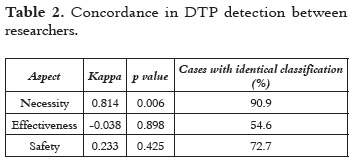
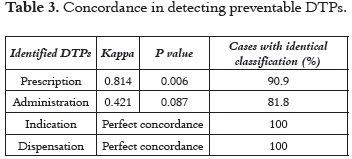
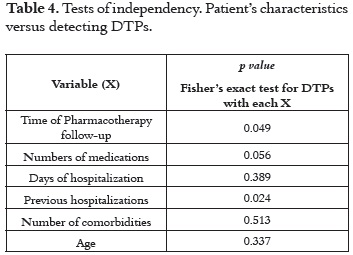
<body><![CDATA[<p>Interventions can resolve the DTPs, prevent   onset of new DTPs and satisfy the patient's needs.   Although this was not an intervention study, for   ethical considerations DTPs were treated as soon   as they were detected. Prescription errors were the most common cause of intervention (28%).</p>     <p> Information on the patient's pharmacological   follow-up supplied by the two researchers who   had similar training and experience was collected   at the same time. The degree of agreement of the   researchers on DTPs detection and resolution   was quantified with the Kappa coefficient (&kappa;)   and subjected to the respective test of hypothesis,   which resulted significant at a 90% confidence   level (<a href="#t2">Table 2</a>). In regards to the detection of DTPs   related to necessity, the degree of concordance   between researchers was almost perfect (see <a href="#t2">Table   2</a> and <a href="#t3">3</a>), which demonstrates the strength of the   methodology for DTP identification (22).</p>       <p align="center"><a name="t2"></a><img src="/img/revistas/vitae/v19n3/v19n3a4t2.jpg"></p>       <p align="center">&nbsp;</p>       <p align="center"><a name="t3"></a><img src="/img/revistas/vitae/v19n3/v19n3a4t3.jpg"></p>       <p align="center">&nbsp;</p>       <p> Documenting DTPs simultaneously with all   other health professionals allows pharmacists to act   together with the patient and the attending doctors   so as to prevent DTPs during hospitalization. The   use of the proposed Pharmacotherapy follow-up   methodology allowed researchers to detect preventable   DTPs with a good degree of agreement   (<a href="#t4">Table 4</a>).</p>       <p align="center"><a name="t4"></a><img src="/img/revistas/vitae/v19n3/v19n3a4t4.jpg"></p>       <p align="center">&nbsp;</p>       <p> The results of the Fisher's exact test allowed determining   whether there was a relationship between   the patient's general characteristics and the number   of DTPs being detected. As shown in (<a href="#t4">Table 4</a>), the   number of DTPs was significantly related to the   length of time the patient was under Pharmacotherapy   follow-up, the number of medication being   administered, duration of the hospitalization and   the number of previous hospitalizations.</p>     ]]></body>
<body><![CDATA[<p>The amount of previous hospitalizations is   relevant in the onset of DTPs as it could be related   to the presence of undiagnosed pathologies and therefore to reiterative hospitalization.</p>     <p> Finally, the detection of DTPs depended on   the pharmacists skills and clinical experience, as   shown by the significant correlation found between   the time of pharmacotherapy follow-up and the   patient's improvement; the longer the length of   the pharmacotherapy follow-up is, the smaller the   patient's risk to developing DTPs. The estimated   average time necessary to conduct pharmacotherapy   follow-up varied between 3.5 and 5 hours per patient,   per day.</p>     <p> Ethnic differences in attitudes to medicines and   medicines-taking are not apparent, although there   are some commonalities in terms of needs of support   and advice around medicines use (23).</p>     <p>&nbsp;</p>     <p><font size="3"> <b>DISCUSSION</b></font></p>     <p> A careful examination of the Pharmacotherapy   follow-up methodologies selected based on the   literature revision indicated that the Applied Therapeutics   method: The Clinical Use of Drugs is not   designed for pharmacists, but written for medical   evaluation, as it contributes with an appropriate   methodology for addressing SOAP clinical cases.   This methodology was not considered for the design   of the pharmacological follow-up methodology   here presented. The method proposed by Cipolle &amp;   Strand and the D&Aacute;DER method share high similarity.   The difference is that the D&Aacute;DER method   describes the drug assessment and includes two   activities, current situation and study phase, none   of which is present in Cipolle &amp; Strand's method.   Moreover, it considers checking the patient's drug   bag as an important activity to help in the pharmacological   follow up. In Cipolle &amp; Strand's method,   the documentation of the intervention is unclear   and could be understood that it is left to the discretion   of the pharmacist what to do and how to act in   the intervention, as no record of such is left.</p>     <p> The main difference between these two approaches   lies in the DTP classification system. In   Cipolle &amp; Strand there are four categories: indication,   effectiveness, safety and compliance, while   in the D&Aacute;DER method there are three categories:   indication, effectiveness and safety; adhesion is   not included as it does not correspond to a clinical   outcome but rather to a process.</p>     <p> The IASER method shows significant differences   compared to other methods. It implements a   quality assurance criterion to the practice of   Pharmacotherapy follow-up, particularly in such a   specialized environment as hospitals.</p>     <p> A careful revision of the three methodologies   described above was done to design a pharmacotherapy   follow-up methodology suitable for   inpatients. The resulting methodology consists of   4 sequential and cyclic steps, which constitute the   core of the Pharmacotherapy follow-up procedure:   Identification and confirmation of DTPs, pharmaceutical   intervention and evaluation of the results of   the pharmaceutical intervention. It was necessary   to design and adapt patient forms.</p>     <p> DTPs related to the need for new or additional   drug therapy can be identified by comparing the   patient's medication needs with the need for drug   therapy. The pharmacist cannot detect DTPs by   simply reviewing the list of drugs taken by a patient,   i.e., it is not enough to focus on the medication, it   is necessary to focus on patient as well. Pharmacological   follow-up methodologies help to center   pharmacy activities, which used to focus exclusively   on the medication, now on the patient as well.</p>     ]]></body>
<body><![CDATA[<p> To identify the drug outcomes, additional information   to the one provided in the medical history   should be gathered by interviewing the patient   directly. The quality of the drug information in   the medical history is not good for this purpose,   probably because it is built by professionals other   than the pharmacist; this information is crucial   because the effectiveness and safety of the pharmacotherapy   is assessed based on it and on laboratory   tests, diagnostic procedures, a physical exam,   signs and symptoms. The identification of DTPs   can be guaranteed by conducting a systematic and   continuous follow up of the pharmacotherapy. The   sporadic appearance of visible symptoms such as a   rash, redness, and the like, provide a mechanism for   identifying DTPs associated to drug safety.</p>     <p> Although it is best not to prolong a patient's stay   in the hospital, investing more time to the pharmacological   follow-up increases the probability of   detecting DTPs; a process to which the pharmacist   can contribute significantly.</p>     <p>&nbsp;</p>     <p><font size="3"> <b>CONCLUSIONS</b></font></p>     <p> The Pharmacotherapy follow-up methodology   for inpatients described in this paper is reproducible,   as indicated by the high degree of reproducibility   found in the detection of DTPs between independent   researchers applying the same methodology. Such   concordance was not affected by demographics   aspects or health conditions of the patients included   in this study, which allow concluding that the   methodology is robust for different types of patients.</p>     <p>  This methodology is suitable for identifying,   preventing and resolving DTPs, without restricting   the health practitioner's freedom to achieve these   goals through different mechanisms. Moreover, this   DTP detection procedure is explicitly described   so that it can be uniformly applied by pharmacists   and taught to students interested in learning about   pharmacotherapy follow-up.</p>     <p>&nbsp;</p>     <p><font size="3"><b>REFERENCES </b></font></p>     <!-- ref --><p> 1. Cipolle RJ, Strand LM, Morley PC. Pharmaceutical care practice:   the clinician's Guide. 2<sup>nd</sup> ed. United States of America: The   McGraw-Hill Companies; 2004. 394 p.    &nbsp;&nbsp;&nbsp;&nbsp;&nbsp;&nbsp;&nbsp;&nbsp;[&#160;<a href="javascript:void(0);" onclick="javascript: window.open('/scielo.php?script=sci_nlinks&ref=000091&pid=S0121-4004201200030000400001&lng=','','width=640,height=500,resizable=yes,scrollbars=1,menubar=yes,');">Links</a>&#160;]<!-- end-ref --></p>     ]]></body>
<body><![CDATA[<!-- ref --><p>  2. Cobaugh DJ, Amin A, Bookwalter T, Williams M, Grunwald P,   Lacivita C, Hawkins B. ASHP&#8211;SHM joint statement on hospitalist&#8211;   pharmacist collaboration. Am J Health Syst Pharm. 2008   Feb 1; 65 (3): 260 - 263.    &nbsp;&nbsp;&nbsp;&nbsp;&nbsp;&nbsp;&nbsp;&nbsp;[&#160;<a href="javascript:void(0);" onclick="javascript: window.open('/scielo.php?script=sci_nlinks&ref=000093&pid=S0121-4004201200030000400002&lng=','','width=640,height=500,resizable=yes,scrollbars=1,menubar=yes,');">Links</a>&#160;]<!-- end-ref --></p>     <!-- ref --><p>  3. Hepler CD, Strand LM. Opportunities and responsibilities in   pharmaceutical care. Am J Hosp Pharm. 1990 Mar; 47 (3): 533   - 543.    &nbsp;&nbsp;&nbsp;&nbsp;&nbsp;&nbsp;&nbsp;&nbsp;[&#160;<a href="javascript:void(0);" onclick="javascript: window.open('/scielo.php?script=sci_nlinks&ref=000095&pid=S0121-4004201200030000400003&lng=','','width=640,height=500,resizable=yes,scrollbars=1,menubar=yes,');">Links</a>&#160;]<!-- end-ref --></p>     <!-- ref --><p>    4. Van Mil JW, Westerlund LT, Hersberger KE, Schaefer MA. Drugrelated   problem classification systems. Ann Pharmacother. 2004   May; 38 (5): 859 - 867.    &nbsp;&nbsp;&nbsp;&nbsp;&nbsp;&nbsp;&nbsp;&nbsp;[&#160;<a href="javascript:void(0);" onclick="javascript: window.open('/scielo.php?script=sci_nlinks&ref=000097&pid=S0121-4004201200030000400004&lng=','','width=640,height=500,resizable=yes,scrollbars=1,menubar=yes,');">Links</a>&#160;]<!-- end-ref --></p>     <!-- ref --><p>  5. Fernandez-Llimos F, Faus MJ, Gastelurrutia MA, Baena MI,   Martinez-Martinez F. Evoluci&oacute;n del concepto de problemas   relacionados con medicamentos: resultados como el centro del   nuevo paradigma. Seguimiento Farmacoterap&eacute;utico 2005; 3 (4):   167 - 188.    &nbsp;&nbsp;&nbsp;&nbsp;&nbsp;&nbsp;&nbsp;&nbsp;[&#160;<a href="javascript:void(0);" onclick="javascript: window.open('/scielo.php?script=sci_nlinks&ref=000099&pid=S0121-4004201200030000400005&lng=','','width=640,height=500,resizable=yes,scrollbars=1,menubar=yes,');">Links</a>&#160;]<!-- end-ref --></p>     <!-- ref --><p>  6. Comit&eacute; de Consenso de Granada. Tercer Consenso de Granada,   sobre Problemas Relacionados con Medicamentos (PRM) y Resultados   Negativos de la Medicaci&oacute;n (RNM). Ars Pharm. 2007;   48 (1): 5 - 17.    &nbsp;&nbsp;&nbsp;&nbsp;&nbsp;&nbsp;&nbsp;&nbsp;[&#160;<a href="javascript:void(0);" onclick="javascript: window.open('/scielo.php?script=sci_nlinks&ref=000101&pid=S0121-4004201200030000400006&lng=','','width=640,height=500,resizable=yes,scrollbars=1,menubar=yes,');">Links</a>&#160;]<!-- end-ref --></p>     ]]></body>
<body><![CDATA[<!-- ref --><p>  7. Crook M, Ajdukovic M, Angley C, Soulsby B, Doecke C, Stupans   I, <i>et al.</i> Eliciting comprehensive medication histories in the   emergency department: the role of the pharmacist. Pharmacy Practice. 2007 Abr-Jun; 5 (2): 78 - 84.    &nbsp;&nbsp;&nbsp;&nbsp;&nbsp;&nbsp;&nbsp;&nbsp;[&#160;<a href="javascript:void(0);" onclick="javascript: window.open('/scielo.php?script=sci_nlinks&ref=000103&pid=S0121-4004201200030000400007&lng=','','width=640,height=500,resizable=yes,scrollbars=1,menubar=yes,');">Links</a>&#160;]<!-- end-ref --></p>     <!-- ref --><p>  8. Lazarou J, Pomeranz BH, Corey PN. Incidence of adverse drug   Reactions in hospitalized patients: A meta-analysis of prospective   studies. JAMA. 1998 Apr; 279 (15): 1200 - 1205.    &nbsp;&nbsp;&nbsp;&nbsp;&nbsp;&nbsp;&nbsp;&nbsp;[&#160;<a href="javascript:void(0);" onclick="javascript: window.open('/scielo.php?script=sci_nlinks&ref=000105&pid=S0121-4004201200030000400008&lng=','','width=640,height=500,resizable=yes,scrollbars=1,menubar=yes,');">Links</a>&#160;]<!-- end-ref --></p>     <!-- ref --><p>  9. Classen DC, Pestotnik SL, Evans RS, Lloyd JF, Burke JP. Adverse   drug events in hospitalized patients: excess length of stay, extra   costs, and attributable mortality. JAMA. 1997 Jan; 277 (4): 301   - 306.    &nbsp;&nbsp;&nbsp;&nbsp;&nbsp;&nbsp;&nbsp;&nbsp;[&#160;<a href="javascript:void(0);" onclick="javascript: window.open('/scielo.php?script=sci_nlinks&ref=000107&pid=S0121-4004201200030000400009&lng=','','width=640,height=500,resizable=yes,scrollbars=1,menubar=yes,');">Links</a>&#160;]<!-- end-ref --></p>     <!-- ref --><p>  10. Eaton L. Adverse reactions to drugs increase. BMJ. 2002 Jan;   324 (7328): 8.    &nbsp;&nbsp;&nbsp;&nbsp;&nbsp;&nbsp;&nbsp;&nbsp;[&#160;<a href="javascript:void(0);" onclick="javascript: window.open('/scielo.php?script=sci_nlinks&ref=000109&pid=S0121-4004201200030000400010&lng=','','width=640,height=500,resizable=yes,scrollbars=1,menubar=yes,');">Links</a>&#160;]<!-- end-ref --></p>     <!-- ref --><p>  11. Bates DW, Cullen DJ, Laird N, Petersen LA, Small SD, Servi   D, <i>et al.</i> Incidence of adverse drug events and potential adverse   drug events: implications for prevention. JAMA. 1995 Jul; 274 (1): 29 - 34.    &nbsp;&nbsp;&nbsp;&nbsp;&nbsp;&nbsp;&nbsp;&nbsp;[&#160;<a href="javascript:void(0);" onclick="javascript: window.open('/scielo.php?script=sci_nlinks&ref=000111&pid=S0121-4004201200030000400011&lng=','','width=640,height=500,resizable=yes,scrollbars=1,menubar=yes,');">Links</a>&#160;]<!-- end-ref --></p>     ]]></body>
<body><![CDATA[<!-- ref --><p>  12. Silva M, Calleja M, Tuneu L, Fuentes B, Guti&eacute;rrez J, Faus MJ.   Seguimiento del tratamiento farmacol&oacute;gico en pacientes ingresados   en un servicio de cirug&iacute;a. Farm Hosp. 2004 ; 28 (3): 154   - 169.    &nbsp;&nbsp;&nbsp;&nbsp;&nbsp;&nbsp;&nbsp;&nbsp;[&#160;<a href="javascript:void(0);" onclick="javascript: window.open('/scielo.php?script=sci_nlinks&ref=000113&pid=S0121-4004201200030000400012&lng=','','width=640,height=500,resizable=yes,scrollbars=1,menubar=yes,');">Links</a>&#160;]<!-- end-ref --></p>     <!-- ref --><p>  13. Fontana D, Sol&aacute;uthurry N. Cuidado farmac&eacute;utico en pacientes   pedi&aacute;tricos hospitalizados: adaptaci&oacute;n de la metodolog&iacute;a D&aacute;der.   Farm Hosp. 2003; 27 (2): 78 - 83.    &nbsp;&nbsp;&nbsp;&nbsp;&nbsp;&nbsp;&nbsp;&nbsp;[&#160;<a href="javascript:void(0);" onclick="javascript: window.open('/scielo.php?script=sci_nlinks&ref=000115&pid=S0121-4004201200030000400013&lng=','','width=640,height=500,resizable=yes,scrollbars=1,menubar=yes,');">Links</a>&#160;]<!-- end-ref --></p>     <!-- ref --><p>  14. Gil-Navarro MV, Bautista J, Santos B, Calleja MA, Mar&iacute;n-Gil   R. Seguimiento farmacoterap&eacute;utico en pacientes hospitalizados   en tratamiento con fentanilo transd&eacute;rmico. Rev Soc Esp Dolor.   2006; 13 (4): 238 - 245.    &nbsp;&nbsp;&nbsp;&nbsp;&nbsp;&nbsp;&nbsp;&nbsp;[&#160;<a href="javascript:void(0);" onclick="javascript: window.open('/scielo.php?script=sci_nlinks&ref=000117&pid=S0121-4004201200030000400014&lng=','','width=640,height=500,resizable=yes,scrollbars=1,menubar=yes,');">Links</a>&#160;]<!-- end-ref --></p>     <!-- ref --><p>  15. Manias E, Williams A, Liew D. Interventions to reduce medication   errors in adult intensive care: a systematic review. Br J Clin   Pharmacol. 2012 Feb 20; 74 (3): 411 - 423.    &nbsp;&nbsp;&nbsp;&nbsp;&nbsp;&nbsp;&nbsp;&nbsp;[&#160;<a href="javascript:void(0);" onclick="javascript: window.open('/scielo.php?script=sci_nlinks&ref=000119&pid=S0121-4004201200030000400015&lng=','','width=640,height=500,resizable=yes,scrollbars=1,menubar=yes,');">Links</a>&#160;]<!-- end-ref --></p>     <!-- ref --><p>  16. Koda-Kimble MA, Young LY, Kradjan WA, Guglielmo BJ, Alldredge   BK, Corelli RL. Applied Therapeutics: The Clinical Use   of Drugs. 8<sup>th</sup> ed. Philadelphia: Lippincott Williams &amp; Wilkins   Publisher; 2006. Chapter 9, 10; 76.    &nbsp;&nbsp;&nbsp;&nbsp;&nbsp;&nbsp;&nbsp;&nbsp;[&#160;<a href="javascript:void(0);" onclick="javascript: window.open('/scielo.php?script=sci_nlinks&ref=000121&pid=S0121-4004201200030000400016&lng=','','width=640,height=500,resizable=yes,scrollbars=1,menubar=yes,');">Links</a>&#160;]<!-- end-ref --></p>     ]]></body>
<body><![CDATA[<!-- ref --><p>  17 Grupo de Investigaci&oacute;n en Atenci&oacute;n Farmac&eacute;utica, Universidad   de Granada. Cuidado farmac&eacute;utico: M&eacute;todo D&aacute;der. 3<sup>a</sup> rev. Pharmacy   Practice. 2006; 4 (1): 44 - 53.    &nbsp;&nbsp;&nbsp;&nbsp;&nbsp;&nbsp;&nbsp;&nbsp;[&#160;<a href="javascript:void(0);" onclick="javascript: window.open('/scielo.php?script=sci_nlinks&ref=000123&pid=S0121-4004201200030000400017&lng=','','width=640,height=500,resizable=yes,scrollbars=1,menubar=yes,');">Links</a>&#160;]<!-- end-ref --></p>     <!-- ref --><p>  18. Climenti M, Jim&eacute;nez N. Manual para la atenci&oacute;n farmac&eacute;utica.   3&ordf; ed. Valencia, Espa&ntilde;a: AFAHPE. Hospital Universitario Dr   Peset; 2005. 157 p.    &nbsp;&nbsp;&nbsp;&nbsp;&nbsp;&nbsp;&nbsp;&nbsp;[&#160;<a href="javascript:void(0);" onclick="javascript: window.open('/scielo.php?script=sci_nlinks&ref=000125&pid=S0121-4004201200030000400018&lng=','','width=640,height=500,resizable=yes,scrollbars=1,menubar=yes,');">Links</a>&#160;]<!-- end-ref --></p>     <!-- ref --><p>  19. Sabater HD, Silva-Castro MM, Faus MJ. M&eacute;todo D&aacute;der: Gu&iacute;a   de seguimiento Farmacoterapeutico. 3&ordf; ed. Granada, Espa&ntilde;a:   Grupo de Investigaci&oacute;n en Atenci&oacute;n Farmac&eacute;utica (CTS-131).   Universidad de Granada; 2007. 128 p.    &nbsp;&nbsp;&nbsp;&nbsp;&nbsp;&nbsp;&nbsp;&nbsp;[&#160;<a href="javascript:void(0);" onclick="javascript: window.open('/scielo.php?script=sci_nlinks&ref=000127&pid=S0121-4004201200030000400019&lng=','','width=640,height=500,resizable=yes,scrollbars=1,menubar=yes,');">Links</a>&#160;]<!-- end-ref --></p>     <!-- ref --><p>  20. Zierler-Brown S, Brown TR, Chen D, Blackburn RW. Clinical   documentation for patient care: Models, concepts, and liability   considerations for pharmacists. Am J Health Syst Pharm. 2007   Sep; 64 (17): 1851-1858.    &nbsp;&nbsp;&nbsp;&nbsp;&nbsp;&nbsp;&nbsp;&nbsp;[&#160;<a href="javascript:void(0);" onclick="javascript: window.open('/scielo.php?script=sci_nlinks&ref=000129&pid=S0121-4004201200030000400020&lng=','','width=640,height=500,resizable=yes,scrollbars=1,menubar=yes,');">Links</a>&#160;]<!-- end-ref --></p>     <!-- ref --><p>  21. Bhopal J. Simple soap system. Brit Med J. 1981 Oct; 283 (6296):   889 - 892.    &nbsp;&nbsp;&nbsp;&nbsp;&nbsp;&nbsp;&nbsp;&nbsp;[&#160;<a href="javascript:void(0);" onclick="javascript: window.open('/scielo.php?script=sci_nlinks&ref=000131&pid=S0121-4004201200030000400021&lng=','','width=640,height=500,resizable=yes,scrollbars=1,menubar=yes,');">Links</a>&#160;]<!-- end-ref --></p>     ]]></body>
<body><![CDATA[<!-- ref --><p>  22. Fisher, RA. Statistical Methods for Research Workers. 14<sup>th</sup> ed.   CO: Hafner; 1970. 362p.    &nbsp;&nbsp;&nbsp;&nbsp;&nbsp;&nbsp;&nbsp;&nbsp;[&#160;<a href="javascript:void(0);" onclick="javascript: window.open('/scielo.php?script=sci_nlinks&ref=000133&pid=S0121-4004201200030000400022&lng=','','width=640,height=500,resizable=yes,scrollbars=1,menubar=yes,');">Links</a>&#160;]<!-- end-ref --></p>     <!-- ref --><p>  23. Bassett CD, Krass I, Bajorek B. Ethnic differences of medicinestaking   in older adults: a cross cultural study in New Zealand. Int J Pharm Pract. 2012 Apr; 20 (2): 90 - 98.    &nbsp;&nbsp;&nbsp;&nbsp;&nbsp;&nbsp;&nbsp;&nbsp;[&#160;<a href="javascript:void(0);" onclick="javascript: window.open('/scielo.php?script=sci_nlinks&ref=000135&pid=S0121-4004201200030000400023&lng=','','width=640,height=500,resizable=yes,scrollbars=1,menubar=yes,');">Links</a>&#160;]<!-- end-ref --></p>     <p>&nbsp;</p> </font>      ]]></body><back>
<ref-list>
<ref id="B1">
<label>1</label><nlm-citation citation-type="book">
<person-group person-group-type="author">
<name>
<surname><![CDATA[Cipolle]]></surname>
<given-names><![CDATA[RJ]]></given-names>
</name>
<name>
<surname><![CDATA[Strand]]></surname>
<given-names><![CDATA[LM]]></given-names>
</name>
<name>
<surname><![CDATA[Morley]]></surname>
<given-names><![CDATA[PC]]></given-names>
</name>
</person-group>
<source><![CDATA[Pharmaceutical care practice: the clinician's Guide]]></source>
<year>2004</year>
<edition>2</edition>
<page-range>394</page-range><publisher-name><![CDATA[The McGraw-Hill Companies]]></publisher-name>
</nlm-citation>
</ref>
<ref id="B2">
<label>2</label><nlm-citation citation-type="journal">
<person-group person-group-type="author">
<name>
<surname><![CDATA[Cobaugh]]></surname>
<given-names><![CDATA[DJ]]></given-names>
</name>
<name>
<surname><![CDATA[Amin]]></surname>
<given-names><![CDATA[A]]></given-names>
</name>
<name>
<surname><![CDATA[Bookwalter]]></surname>
<given-names><![CDATA[T]]></given-names>
</name>
<name>
<surname><![CDATA[Williams]]></surname>
<given-names><![CDATA[M]]></given-names>
</name>
<name>
<surname><![CDATA[Grunwald]]></surname>
<given-names><![CDATA[P]]></given-names>
</name>
<name>
<surname><![CDATA[Lacivita]]></surname>
<given-names><![CDATA[C]]></given-names>
</name>
<name>
<surname><![CDATA[Hawkins]]></surname>
<given-names><![CDATA[B.]]></given-names>
</name>
</person-group>
<article-title xml:lang="en"><![CDATA[ASHP-SHM joint statement on hospitalist- pharmacist collaboration]]></article-title>
<source><![CDATA[Am J Health Syst Pharm]]></source>
<year>2008</year>
<month> F</month>
<day>eb</day>
<volume>65</volume>
<numero>3</numero>
<issue>3</issue>
<page-range>260 - 263</page-range></nlm-citation>
</ref>
<ref id="B3">
<label>3</label><nlm-citation citation-type="journal">
<person-group person-group-type="author">
<name>
<surname><![CDATA[Hepler]]></surname>
<given-names><![CDATA[CD]]></given-names>
</name>
<name>
<surname><![CDATA[Strand]]></surname>
<given-names><![CDATA[LM.]]></given-names>
</name>
</person-group>
<article-title xml:lang="en"><![CDATA[Opportunities and responsibilities in pharmaceutical care]]></article-title>
<source><![CDATA[Am J Hosp Pharm]]></source>
<year>1990</year>
<month> M</month>
<day>ar</day>
<volume>47</volume>
<numero>3</numero>
<issue>3</issue>
<page-range>533 - 543</page-range></nlm-citation>
</ref>
<ref id="B4">
<label>4</label><nlm-citation citation-type="journal">
<person-group person-group-type="author">
<name>
<surname><![CDATA[Van Mil]]></surname>
<given-names><![CDATA[JW]]></given-names>
</name>
<name>
<surname><![CDATA[Westerlund]]></surname>
<given-names><![CDATA[LT]]></given-names>
</name>
<name>
<surname><![CDATA[Hersberger]]></surname>
<given-names><![CDATA[KE]]></given-names>
</name>
<name>
<surname><![CDATA[Schaefer]]></surname>
<given-names><![CDATA[MA.]]></given-names>
</name>
</person-group>
<article-title xml:lang="en"><![CDATA[Drugrelated problem classification systems]]></article-title>
<source><![CDATA[Ann Pharmacother]]></source>
<year>2004</year>
<month> M</month>
<day>ay</day>
<volume>38</volume>
<numero>5</numero>
<issue>5</issue>
<page-range>859 - 867</page-range></nlm-citation>
</ref>
<ref id="B5">
<label>5</label><nlm-citation citation-type="journal">
<person-group person-group-type="author">
<name>
<surname><![CDATA[Fernandez-Llimos]]></surname>
<given-names><![CDATA[F]]></given-names>
</name>
<name>
<surname><![CDATA[Faus]]></surname>
<given-names><![CDATA[MJ]]></given-names>
</name>
<name>
<surname><![CDATA[Gastelurrutia]]></surname>
<given-names><![CDATA[MA]]></given-names>
</name>
<name>
<surname><![CDATA[Baena]]></surname>
<given-names><![CDATA[MI]]></given-names>
</name>
<name>
<surname><![CDATA[Martinez-Martinez]]></surname>
<given-names><![CDATA[F.]]></given-names>
</name>
</person-group>
<article-title xml:lang="es"><![CDATA[Evolución del concepto de problemas relacionados con medicamentos: resultados como el centro del nuevo paradigma]]></article-title>
<source><![CDATA[Seguimiento Farmacoterapéutico]]></source>
<year>2005</year>
<volume>3</volume>
<numero>4</numero>
<issue>4</issue>
<page-range>167 - 188</page-range></nlm-citation>
</ref>
<ref id="B6">
<label>6</label><nlm-citation citation-type="journal">
<collab>Comité de Consenso de Granada</collab>
<article-title xml:lang="es"><![CDATA[Tercer Consenso de Granada, sobre Problemas Relacionados con Medicamentos (PRM) y Resultados Negativos de la Medicación (RNM)]]></article-title>
<source><![CDATA[Ars Pharm]]></source>
<year>2007</year>
<volume>48</volume>
<numero>1</numero>
<issue>1</issue>
<page-range>5 - 17</page-range></nlm-citation>
</ref>
<ref id="B7">
<label>7</label><nlm-citation citation-type="journal">
<person-group person-group-type="author">
<name>
<surname><![CDATA[Crook]]></surname>
<given-names><![CDATA[M]]></given-names>
</name>
<name>
<surname><![CDATA[Ajdukovic]]></surname>
<given-names><![CDATA[M]]></given-names>
</name>
<name>
<surname><![CDATA[Angley]]></surname>
<given-names><![CDATA[C]]></given-names>
</name>
<name>
<surname><![CDATA[Soulsby]]></surname>
<given-names><![CDATA[B]]></given-names>
</name>
<name>
<surname><![CDATA[Doecke]]></surname>
<given-names><![CDATA[C]]></given-names>
</name>
<name>
<surname><![CDATA[Stupans]]></surname>
<given-names><![CDATA[I]]></given-names>
</name>
</person-group>
<article-title xml:lang="en"><![CDATA[Eliciting comprehensive medication histories in the emergency department: the role of the pharmacist]]></article-title>
<source><![CDATA[Pharmacy Practice]]></source>
<year>2007</year>
<month> A</month>
<day>br</day>
<volume>5</volume>
<numero>2</numero>
<issue>2</issue>
<page-range>78 - 84</page-range></nlm-citation>
</ref>
<ref id="B8">
<label>8</label><nlm-citation citation-type="journal">
<person-group person-group-type="author">
<name>
<surname><![CDATA[Lazarou]]></surname>
<given-names><![CDATA[J]]></given-names>
</name>
<name>
<surname><![CDATA[Pomeranz]]></surname>
<given-names><![CDATA[BH]]></given-names>
</name>
<name>
<surname><![CDATA[Corey]]></surname>
<given-names><![CDATA[PN.]]></given-names>
</name>
</person-group>
<article-title xml:lang="en"><![CDATA[Incidence of adverse drug Reactions in hospitalized patients: A meta-analysis of prospective studies]]></article-title>
<source><![CDATA[JAMA]]></source>
<year>1998</year>
<month> A</month>
<day>pr</day>
<volume>279</volume>
<numero>15</numero>
<issue>15</issue>
<page-range>1200 - 1205</page-range></nlm-citation>
</ref>
<ref id="B9">
<label>9</label><nlm-citation citation-type="journal">
<person-group person-group-type="author">
<name>
<surname><![CDATA[Classen]]></surname>
<given-names><![CDATA[DC]]></given-names>
</name>
<name>
<surname><![CDATA[Pestotnik]]></surname>
<given-names><![CDATA[SL]]></given-names>
</name>
<name>
<surname><![CDATA[Evans]]></surname>
<given-names><![CDATA[RS]]></given-names>
</name>
<name>
<surname><![CDATA[Lloyd]]></surname>
<given-names><![CDATA[JF]]></given-names>
</name>
<name>
<surname><![CDATA[Burke]]></surname>
<given-names><![CDATA[JP.]]></given-names>
</name>
</person-group>
<article-title xml:lang="en"><![CDATA[Adverse drug events in hospitalized patients: excess length of stay, extra costs, and attributable mortality]]></article-title>
<source><![CDATA[JAMA]]></source>
<year>1997</year>
<month> J</month>
<day>an</day>
<volume>277</volume>
<numero>4</numero>
<issue>4</issue>
<page-range>301 - 306</page-range></nlm-citation>
</ref>
<ref id="B10">
<label>10</label><nlm-citation citation-type="journal">
<person-group person-group-type="author">
<name>
<surname><![CDATA[Eaton]]></surname>
<given-names><![CDATA[L.]]></given-names>
</name>
</person-group>
<article-title xml:lang="en"><![CDATA[Adverse reactions to drugs increase]]></article-title>
<source><![CDATA[BMJ]]></source>
<year>2002</year>
<month> J</month>
<day>an</day>
<volume>324</volume>
<numero>7328</numero>
<issue>7328</issue>
<page-range>8</page-range></nlm-citation>
</ref>
<ref id="B11">
<label>11</label><nlm-citation citation-type="journal">
<person-group person-group-type="author">
<name>
<surname><![CDATA[Bates]]></surname>
<given-names><![CDATA[DW]]></given-names>
</name>
<name>
<surname><![CDATA[Cullen]]></surname>
<given-names><![CDATA[DJ]]></given-names>
</name>
<name>
<surname><![CDATA[Laird]]></surname>
<given-names><![CDATA[N]]></given-names>
</name>
<name>
<surname><![CDATA[Petersen]]></surname>
<given-names><![CDATA[LA]]></given-names>
</name>
<name>
<surname><![CDATA[Small]]></surname>
<given-names><![CDATA[SD]]></given-names>
</name>
<name>
<surname><![CDATA[Servi]]></surname>
<given-names><![CDATA[D]]></given-names>
</name>
</person-group>
<article-title xml:lang="en"><![CDATA[Incidence of adverse drug events and potential adverse drug events: implications for prevention]]></article-title>
<source><![CDATA[JAMA]]></source>
<year>1995</year>
<month> J</month>
<day>ul</day>
<volume>274</volume>
<numero>1</numero>
<issue>1</issue>
<page-range>29 - 34</page-range></nlm-citation>
</ref>
<ref id="B12">
<label>12</label><nlm-citation citation-type="journal">
<person-group person-group-type="author">
<name>
<surname><![CDATA[Silva]]></surname>
<given-names><![CDATA[M]]></given-names>
</name>
<name>
<surname><![CDATA[Calleja]]></surname>
<given-names><![CDATA[M]]></given-names>
</name>
<name>
<surname><![CDATA[Tuneu]]></surname>
<given-names><![CDATA[L]]></given-names>
</name>
<name>
<surname><![CDATA[Fuentes]]></surname>
<given-names><![CDATA[B]]></given-names>
</name>
<name>
<surname><![CDATA[Gutiérrez]]></surname>
<given-names><![CDATA[J]]></given-names>
</name>
<name>
<surname><![CDATA[Faus]]></surname>
<given-names><![CDATA[MJ.]]></given-names>
</name>
</person-group>
<article-title xml:lang="es"><![CDATA[Seguimiento del tratamiento farmacológico en pacientes ingresados en un servicio de cirugía]]></article-title>
<source><![CDATA[Farm Hosp]]></source>
<year>2004</year>
<volume>28</volume>
<numero>3</numero>
<issue>3</issue>
<page-range>154 - 169</page-range></nlm-citation>
</ref>
<ref id="B13">
<label>13</label><nlm-citation citation-type="journal">
<person-group person-group-type="author">
<name>
<surname><![CDATA[Fontana]]></surname>
<given-names><![CDATA[D]]></given-names>
</name>
<name>
<surname><![CDATA[Soláuthurry]]></surname>
<given-names><![CDATA[N.]]></given-names>
</name>
</person-group>
<article-title xml:lang="es"><![CDATA[Cuidado farmacéutico en pacientes pediátricos hospitalizados: adaptación de la metodología Dáder]]></article-title>
<source><![CDATA[Farm Hosp]]></source>
<year>2003</year>
<volume>27</volume>
<numero>2</numero>
<issue>2</issue>
<page-range>78 - 83</page-range></nlm-citation>
</ref>
<ref id="B14">
<label>14</label><nlm-citation citation-type="journal">
<person-group person-group-type="author">
<name>
<surname><![CDATA[Gil-Navarro]]></surname>
<given-names><![CDATA[MV]]></given-names>
</name>
<name>
<surname><![CDATA[Bautista]]></surname>
<given-names><![CDATA[J]]></given-names>
</name>
<name>
<surname><![CDATA[Santos]]></surname>
<given-names><![CDATA[B]]></given-names>
</name>
<name>
<surname><![CDATA[Calleja]]></surname>
<given-names><![CDATA[MA]]></given-names>
</name>
<name>
<surname><![CDATA[Marín-Gil]]></surname>
<given-names><![CDATA[R.]]></given-names>
</name>
</person-group>
<article-title xml:lang="es"><![CDATA[Seguimiento farmacoterapéutico en pacientes hospitalizados en tratamiento con fentanilo transdérmico]]></article-title>
<source><![CDATA[Rev Soc Esp Dolor]]></source>
<year>2006</year>
<volume>13</volume>
<numero>4</numero>
<issue>4</issue>
<page-range>238 - 245</page-range></nlm-citation>
</ref>
<ref id="B15">
<label>15</label><nlm-citation citation-type="journal">
<person-group person-group-type="author">
<name>
<surname><![CDATA[Manias]]></surname>
<given-names><![CDATA[E]]></given-names>
</name>
<name>
<surname><![CDATA[Williams]]></surname>
<given-names><![CDATA[A]]></given-names>
</name>
<name>
<surname><![CDATA[Liew]]></surname>
<given-names><![CDATA[D.]]></given-names>
</name>
</person-group>
<article-title xml:lang="en"><![CDATA[Interventions to reduce medication errors in adult intensive care: a systematic review]]></article-title>
<source><![CDATA[Br J Clin Pharmacol]]></source>
<year>2012</year>
<month> F</month>
<day>eb</day>
<volume>74</volume>
<numero>3</numero>
<issue>3</issue>
<page-range>411 - 423</page-range></nlm-citation>
</ref>
<ref id="B16">
<label>16</label><nlm-citation citation-type="book">
<person-group person-group-type="author">
<name>
<surname><![CDATA[Koda-Kimble]]></surname>
<given-names><![CDATA[MA]]></given-names>
</name>
<name>
<surname><![CDATA[Young]]></surname>
<given-names><![CDATA[LY]]></given-names>
</name>
<name>
<surname><![CDATA[Kradjan]]></surname>
<given-names><![CDATA[WA]]></given-names>
</name>
<name>
<surname><![CDATA[Guglielmo]]></surname>
<given-names><![CDATA[BJ]]></given-names>
</name>
<name>
<surname><![CDATA[Alldredge]]></surname>
<given-names><![CDATA[BK]]></given-names>
</name>
<name>
<surname><![CDATA[Corelli]]></surname>
<given-names><![CDATA[RL]]></given-names>
</name>
</person-group>
<source><![CDATA[Applied Therapeutics: The Clinical Use of Drugs]]></source>
<year>2006</year>
<edition>8</edition>
<page-range>76</page-range><publisher-loc><![CDATA[Philadelphia ]]></publisher-loc>
<publisher-name><![CDATA[Lippincott Williams & Wilkins Publisher]]></publisher-name>
</nlm-citation>
</ref>
<ref id="B17">
<label>17</label><nlm-citation citation-type="journal">
<collab>Universidad de Granada^dGrupo de Investigación en Atención Farmacéutica</collab>
<article-title xml:lang="es"><![CDATA[Cuidado farmacéutico: Método Dáder]]></article-title>
<source><![CDATA[Pharmacy Practice]]></source>
<year>2006</year>
<volume>4</volume>
<numero>1</numero>
<issue>1</issue>
<page-range>44 - 53</page-range></nlm-citation>
</ref>
<ref id="B18">
<label>18</label><nlm-citation citation-type="book">
<person-group person-group-type="author">
<name>
<surname><![CDATA[Climenti]]></surname>
<given-names><![CDATA[M]]></given-names>
</name>
<name>
<surname><![CDATA[Jiménez]]></surname>
<given-names><![CDATA[N]]></given-names>
</name>
</person-group>
<source><![CDATA[Manual para la atención farmacéutica]]></source>
<year>2005</year>
<edition>3</edition>
<page-range>157</page-range><publisher-loc><![CDATA[Valencia ]]></publisher-loc>
<publisher-name><![CDATA[AFAHPE. Hospital Universitario Dr Peset]]></publisher-name>
</nlm-citation>
</ref>
<ref id="B19">
<label>19</label><nlm-citation citation-type="book">
<person-group person-group-type="author">
<name>
<surname><![CDATA[Sabater]]></surname>
<given-names><![CDATA[HD]]></given-names>
</name>
<name>
<surname><![CDATA[Silva-Castro]]></surname>
<given-names><![CDATA[MM]]></given-names>
</name>
<name>
<surname><![CDATA[Faus]]></surname>
<given-names><![CDATA[MJ]]></given-names>
</name>
</person-group>
<source><![CDATA[Método Dáder: Guía de seguimiento Farmacoterapeutico]]></source>
<year>2007</year>
<edition>3</edition>
<page-range>128</page-range><publisher-loc><![CDATA[Granada ]]></publisher-loc>
<publisher-name><![CDATA[Grupo de Investigación en Atención Farmacéutica (CTS-131). Universidad de Granada]]></publisher-name>
</nlm-citation>
</ref>
<ref id="B20">
<label>20</label><nlm-citation citation-type="journal">
<person-group person-group-type="author">
<name>
<surname><![CDATA[Zierler-Brown]]></surname>
<given-names><![CDATA[S]]></given-names>
</name>
<name>
<surname><![CDATA[Brown]]></surname>
<given-names><![CDATA[TR]]></given-names>
</name>
<name>
<surname><![CDATA[Chen]]></surname>
<given-names><![CDATA[D]]></given-names>
</name>
<name>
<surname><![CDATA[Blackburn]]></surname>
<given-names><![CDATA[RW.]]></given-names>
</name>
</person-group>
<article-title xml:lang="en"><![CDATA[Clinical documentation for patient care: Models, concepts, and liability considerations for pharmacists]]></article-title>
<source><![CDATA[Am J Health Syst Pharm]]></source>
<year>2007</year>
<month> S</month>
<day>ep</day>
<volume>64</volume>
<numero>17</numero>
<issue>17</issue>
<page-range>1851-1858</page-range></nlm-citation>
</ref>
<ref id="B21">
<label>21</label><nlm-citation citation-type="journal">
<person-group person-group-type="author">
<name>
<surname><![CDATA[Bhopal]]></surname>
<given-names><![CDATA[J.]]></given-names>
</name>
</person-group>
<article-title xml:lang="en"><![CDATA[Simple soap system]]></article-title>
<source><![CDATA[Brit Med J]]></source>
<year>1981</year>
<month> O</month>
<day>ct</day>
<volume>283</volume>
<numero>6296</numero>
<issue>6296</issue>
<page-range>889 - 892</page-range></nlm-citation>
</ref>
<ref id="B22">
<label>22</label><nlm-citation citation-type="book">
<person-group person-group-type="author">
<name>
<surname><![CDATA[Fisher]]></surname>
<given-names><![CDATA[RA]]></given-names>
</name>
</person-group>
<source><![CDATA[Statistical Methods for Research Workers]]></source>
<year>1970</year>
<edition>14</edition>
<page-range>362</page-range><publisher-name><![CDATA[Hafner]]></publisher-name>
</nlm-citation>
</ref>
<ref id="B23">
<label>23</label><nlm-citation citation-type="journal">
<person-group person-group-type="author">
<name>
<surname><![CDATA[Bassett]]></surname>
<given-names><![CDATA[CD]]></given-names>
</name>
<name>
<surname><![CDATA[Krass]]></surname>
<given-names><![CDATA[I]]></given-names>
</name>
<name>
<surname><![CDATA[Bajorek]]></surname>
<given-names><![CDATA[B.]]></given-names>
</name>
</person-group>
<article-title xml:lang="en"><![CDATA[Ethnic differences of medicinestaking in older adults: a cross cultural study in New Zealand]]></article-title>
<source><![CDATA[Int J Pharm Pract]]></source>
<year>2012</year>
<month> A</month>
<day>pr</day>
<volume>20</volume>
<numero>2</numero>
<issue>2</issue>
<page-range>90 - 98</page-range></nlm-citation>
</ref>
</ref-list>
</back>
</article>