<?xml version="1.0" encoding="ISO-8859-1"?><article xmlns:mml="http://www.w3.org/1998/Math/MathML" xmlns:xlink="http://www.w3.org/1999/xlink" xmlns:xsi="http://www.w3.org/2001/XMLSchema-instance">
<front>
<journal-meta>
<journal-id>0121-4004</journal-id>
<journal-title><![CDATA[Vitae]]></journal-title>
<abbrev-journal-title><![CDATA[Vitae]]></abbrev-journal-title>
<issn>0121-4004</issn>
<publisher>
<publisher-name><![CDATA[Facultad de Química Farmacéutica, Universidad de Antioquia]]></publisher-name>
</publisher>
</journal-meta>
<article-meta>
<article-id>S0121-40042012000300006</article-id>
<title-group>
<article-title xml:lang="en"><![CDATA[EVALUATION OF THE INDUCTION OF LIPOLYTIC ENZYMES FROM A Pseudomona aeruginosa ISOLATED FROM AFRICAN PALM FRUIT (Elaeis guineensis)]]></article-title>
<article-title xml:lang="es"><![CDATA[EVALUACIÓN DE LA INDUCCIÓN DE ENZIMAS LIPOLÍTICAS A PARTIR DE UNA Pseudomona aeruginosa AISLADA DEL FRUTO DE PALMA AFRICANA (Elaeis guineensis)]]></article-title>
</title-group>
<contrib-group>
<contrib contrib-type="author">
<name>
<surname><![CDATA[USCÁTEGUI]]></surname>
<given-names><![CDATA[Yomaira]]></given-names>
</name>
<xref ref-type="aff" rid="A01"/>
</contrib>
<contrib contrib-type="author">
<name>
<surname><![CDATA[JIMÉNEZ-JUNCA]]></surname>
<given-names><![CDATA[Carlos]]></given-names>
</name>
<xref ref-type="aff" rid="A01"/>
</contrib>
<contrib contrib-type="author">
<name>
<surname><![CDATA[SUÁREZ]]></surname>
<given-names><![CDATA[Camilo]]></given-names>
</name>
<xref ref-type="aff" rid="A02"/>
</contrib>
<contrib contrib-type="author">
<name>
<surname><![CDATA[PRIETO-CORREA]]></surname>
<given-names><![CDATA[Erlide]]></given-names>
</name>
<xref ref-type="aff" rid="A01"/>
</contrib>
</contrib-group>
<aff id="A01">
<institution><![CDATA[,Universidad de La Sabana Facultad de Ingeniería ]]></institution>
<addr-line><![CDATA[Chía Cundinamarca]]></addr-line>
<country>Colombia</country>
</aff>
<aff id="A02">
<institution><![CDATA[,Universidad Nacional de Colombia Facultad de Minas ]]></institution>
<addr-line><![CDATA[Medellín Antioquia]]></addr-line>
<country>Colombia</country>
</aff>
<pub-date pub-type="pub">
<day>00</day>
<month>12</month>
<year>2012</year>
</pub-date>
<pub-date pub-type="epub">
<day>00</day>
<month>12</month>
<year>2012</year>
</pub-date>
<volume>19</volume>
<numero>3</numero>
<fpage>280</fpage>
<lpage>286</lpage>
<copyright-statement/>
<copyright-year/>
<self-uri xlink:href="http://www.scielo.org.co/scielo.php?script=sci_arttext&amp;pid=S0121-40042012000300006&amp;lng=en&amp;nrm=iso"></self-uri><self-uri xlink:href="http://www.scielo.org.co/scielo.php?script=sci_abstract&amp;pid=S0121-40042012000300006&amp;lng=en&amp;nrm=iso"></self-uri><self-uri xlink:href="http://www.scielo.org.co/scielo.php?script=sci_pdf&amp;pid=S0121-40042012000300006&amp;lng=en&amp;nrm=iso"></self-uri><abstract abstract-type="short" xml:lang="en"><p><![CDATA[Background: Extracellular lipases are found in the culture broth when the fermentation is at the end of the exponential phase. Lipases can be induced easily since they are produced by the presence of oily sources or other materials as surfactants, fatty acids, some esters, glycerol and biliary salts. Objective: The aim of this work is to study the effect of carbon source concentration and the use of inductors on biomass production, and the lipolytic activity of a bacterium isolated from mature palm oil fruits. Methods: The yield biomass/substrate was evaluated with glucose as carbon source at different concentrations (3, 5, 7, 10, 15 y 20 g/L) by dry weight and OD (600 nm). Lipolytic activity was evaluated by spectrophotometric assay using p-nitrofenilpalmitate at 37&deg;C for 15 min. Results: Gram negative microorganisms with lipolytic activity isolated from palm fruit were identified as Pseudomona aeruginosa. The growth of the bacteria was inhibited when glucose was used at concentrations greater than 5%. The production of lipase was induced by using three inducers (Palm oil, Tween 20 and palm oil:Tween 20 mixture), at three different induction times (0, 11 and 18 hours of fermentation). The highest activity (3,81 &mu;moles/ mL*min) was observed when the palm oil:Tween 20 mixture was added at 11 hours of fermentation. The kinetic of p-nitrophenylpalmitate hydrolysis using the supernatant of a culture induced with palm oil:Tween 20 mixture at 11 hours showed the production of p-nitrophenol beyond 300 minutes, with the greatest hydrolysis rate during the first 7 minutes. Conclusions: The growth of P. aeruginosa was not affected by using glucose as carbon source at concentrations of 3% and 5%. There was a basal level of lipase production without inducer, and greater lipolytic activity was achieved with the addition of inducers.]]></p></abstract>
<abstract abstract-type="short" xml:lang="es"><p><![CDATA[Antecedentes: Las lipasas extracelulares se encuentran en los medios de cultivo cuando las células alcanzan el final de la fase exponencial de crecimiento. Las lipasas son fácilmente inducibles, es así como se producen en presencia de fuentes lipídicas u otros materiales como surfactantes, ácidos grasos, algunos ésteres, sales biliares y glicerol. Objetivo: El objetivo de este trabajo es estudiar el efecto de la concentración de fuente de carbono y el uso de inductores sobre la producción de biomasa, y la actividad lipolítica de una bacteria aislada de frutos maduros de palma de aceite. Métodos: Se determinó el rendimiento de biomasa/sustrato utilizando como fuente de carbono glucosa en diferentes concentraciones (3, 5, 7, 10, 15 y 20 g/L) mediante la técnica de peso seco y densidad óptica (600 nm). La actividad lipolítica fue evaluada con p-nitrofenil palmitato a 37&deg;C por 15 min. Los productos de la reacción se determinaron espectrofotométricamente (410 nm). Resultados: Los microrganismos Gram negativos con actividad lipolítica fueron identificados como Pseudomona aeruginosa. El crecimiento de las bacterias fue inhibido cuando la glucosa se utilizó a concentraciones superiores a 5%. La lipasa fue inducida usando tres inductores (aceite de palma, Tween 20 y la mezcla de aceite de palma:Tween 20), en tres tiempos diferentes de inducción (0, 11 y 18 horas de fermentación). La actividad más alta (3,81 &micro;moles/mL*min) se observó cuando se añadió la mezcla de aceite de palma:Tween 20 a las 11 horas de fermentación. La cinética de la hidrólisis de p-nitrofenil palmitato utilizando el sobrenadante de un cultivo inducido con la mezcla de aceite de palma:Tween 20 a las 11 horas presentó producción de p-nitrofenol hasta más allá de 300 minutos, con la mayor tasa de hidrólisis durante los primeros 7 minutos. Conclusiones: El crecimiento de P. aeruginosa no se vio afectada utilizando glucosa como fuente de carbono en concentraciones de 3% y 5%. Se encontró un nivel basal de producción de lipasa sin inductor y se obtuvo una mayor actividad lipolítica con la adición de inductores.]]></p></abstract>
<kwd-group>
<kwd lng="en"><![CDATA[Lipolytic activity]]></kwd>
<kwd lng="en"><![CDATA[fatty acids]]></kwd>
<kwd lng="en"><![CDATA[enzyme induction]]></kwd>
<kwd lng="en"><![CDATA[hydrolysis]]></kwd>
<kwd lng="es"><![CDATA[actividad lipolítica]]></kwd>
<kwd lng="es"><![CDATA[ácidos grasos]]></kwd>
<kwd lng="es"><![CDATA[inducción enzimática]]></kwd>
<kwd lng="es"><![CDATA[hidrólisis]]></kwd>
</kwd-group>
</article-meta>
</front><body><![CDATA[  <font face="Verdana, Arial, Helvetica, sans-serif" size="2">     <p align="right"> <b>BIOTECHNOLOGY</b></p>     <p>&nbsp;</p>     <p align="center"><b><font size="4">EVALUATION OF THE INDUCTION OF LIPOLYTIC   ENZYMES FROM A <i>Pseudomona aeruginosa</i> ISOLATED FROM AFRICAN PALM FRUIT (<i>Elaeis guineensis</i>)</font></b></p>     <p>&nbsp;</p>     <p align="center"><b><font size="3"> EVALUACI&Oacute;N DE LA INDUCCI&Oacute;N DE ENZIMAS LIPOL&Iacute;TICAS A PARTIR DE UNA <i>Pseudomona aeruginosa</i> AISLADA DEL FRUTO DE PALMA AFRICANA (<i>Elaeis guineensis</i>)</font></b></p>     <p>&nbsp;</p>     <p>&nbsp;</p>     <p><b> Yomaira USC&Aacute;TEGUI<sup>1</sup>, Carlos JIM&Eacute;NEZ-JUNCA<sup>1</sup>, Camilo SU&Aacute;REZ<sup>2</sup>, Erlide PRIETO-CORREA<sup>1</sup>*</b></p>     <p>1 Facultad de Ingenier&iacute;a. Universidad de La Sabana. Ch&iacute;a, Cundinamarca, Colombia.</p>     ]]></body>
<body><![CDATA[<p> 2 Facultad de Minas. Universidad Nacional de Colombia. Medell&iacute;n, Antioquia, Colombia.</p>     <p> * Autor a quien se debe dirigir la correspondencia: <a href="mailto:erlide.prieto@unisabana.edu.co">erlide.prieto@unisabana.edu.co</a>.</p>     <p>&nbsp;</p>     <p>Received: 03 Juny 2012 Accepted: 18 December 2012</p>     <p>&nbsp;</p> <hr noshade size="1">     <p><b> ABSTRACT</b></p>     <p><b>Background</b>: Extracellular lipases are found in the culture broth when the fermentation is at the end   of the exponential phase. Lipases can be induced easily since they are produced by the presence of oily   sources or other materials as surfactants, fatty acids, some esters, glycerol and biliary salts. <b>Objective</b>: The   aim of this work is to study the effect of carbon source concentration and the use of inductors on biomass   production, and the lipolytic activity of a bacterium isolated from mature palm oil fruits. <b>Methods</b>: The   yield biomass/substrate was evaluated with glucose as carbon source at different concentrations (3, 5, 7,   10, 15 y 20 g/L) by dry weight and OD (600 nm). Lipolytic activity was evaluated by spectrophotometric   assay using p-nitrofenilpalmitate at 37&deg;C for 15 min. Results: Gram negative microorganisms with   lipolytic activity isolated from palm fruit were identified as Pseudomona aeruginosa. The growth of   the bacteria was inhibited when glucose was used at concentrations greater than 5%. The production   of lipase was induced by using three inducers (Palm oil, Tween 20 and palm oil:Tween 20 mixture), at   three different induction times (0, 11 and 18 hours of fermentation). The highest activity (3,81 &mu;moles/   mL*min) was observed when the palm oil:Tween 20 mixture was added at 11 hours of fermentation.   The kinetic of p-nitrophenylpalmitate hydrolysis using the supernatant of a culture induced with palm   oil:Tween 20 mixture at 11 hours showed the production of p-nitrophenol beyond 300 minutes, with   the greatest hydrolysis rate during the first 7 minutes. <b>Conclusions</b>: The growth of<i> P. aeruginosa</i> was   not affected by using glucose as carbon source at concentrations of 3% and 5%. There was a basal level of lipase production without inducer, and greater lipolytic activity was achieved with the addition of inducers.</p>     <p> <b>Keywords</b>: Lipolytic activity, fatty acids, enzyme induction, hydrolysis.</p> <hr noshade size="1">     <p> <b>RESUMEN</b></p>     <p><b>Antecedentes</b>: Las lipasas extracelulares se encuentran en los medios de cultivo cuando las c&eacute;lulas alcanzan   el final de la fase exponencial de crecimiento. Las lipasas son f&aacute;cilmente inducibles, es as&iacute; como   se producen en presencia de fuentes lip&iacute;dicas u otros materiales como surfactantes, &aacute;cidos grasos, algunos   &eacute;steres, sales biliares y glicerol. <b>Objetivo</b>: El objetivo de este trabajo es estudiar el efecto de la concentraci&oacute;n   de fuente de carbono y el uso de inductores sobre la producci&oacute;n de biomasa, y la actividad lipol&iacute;tica   de una bacteria aislada de frutos maduros de palma de aceite. <b>M&eacute;todos</b>: Se determin&oacute; el rendimiento   de biomasa/sustrato utilizando como fuente de carbono glucosa en diferentes concentraciones (3, 5, 7,      10, 15 y 20 g/L) mediante la t&eacute;cnica de peso seco y densidad &oacute;ptica (600 nm). La actividad lipol&iacute;tica fue   evaluada con p-nitrofenil palmitato a 37&deg;C por 15 min. Los productos de la reacci&oacute;n se determinaron   espectrofotom&eacute;tricamente (410 nm). <b>Resultados</b>: Los microrganismos Gram negativos con actividad   lipol&iacute;tica fueron identificados como Pseudomona aeruginosa. El crecimiento de las bacterias fue inhibido   cuando la glucosa se utiliz&oacute; a concentraciones superiores a 5%. La lipasa fue inducida usando tres inductores   (aceite de palma, Tween 20 y la mezcla de aceite de palma:Tween 20), en tres tiempos diferentes de   inducci&oacute;n (0, 11 y 18 horas de fermentaci&oacute;n). La actividad m&aacute;s alta (3,81 &micro;moles/mL*min) se observ&oacute;   cuando se a&ntilde;adi&oacute; la mezcla de aceite de palma:Tween 20 a las 11 horas de fermentaci&oacute;n. La cin&eacute;tica de   la hidr&oacute;lisis de p-nitrofenil palmitato utilizando el sobrenadante de un cultivo inducido con la mezcla   de aceite de palma:Tween 20 a las 11 horas present&oacute; producci&oacute;n de p-nitrofenol hasta m&aacute;s all&aacute; de 300   minutos, con la mayor tasa de hidr&oacute;lisis durante los primeros 7 minutos. <b>Conclusiones</b>: El crecimiento   de <i>P. aeruginosa </i>no se vio afectada utilizando glucosa como fuente de carbono en concentraciones de 3%   y 5%. Se encontr&oacute; un nivel basal de producci&oacute;n de lipasa sin inductor y se obtuvo una mayor actividad lipol&iacute;tica con la adici&oacute;n de inductores.</p>     ]]></body>
<body><![CDATA[<p> <b>Palabras clave</b>: actividad lipol&iacute;tica, &aacute;cidos grasos, inducci&oacute;n enzim&aacute;tica, hidr&oacute;lisis.  </p> <hr noshade size="1">     <p>&nbsp;</p>     <p>&nbsp;</p>     <p><font size="3"><b>INTRODUCTION</b></font></p>     <p>Lipases are lipolytic enzymes, classified as carboxylic   ester hydrolases (EC. 3.1.1.3) which break   ester bounds of acylglycerides by adding a water   molecule generating free fatty acids and glycerol. Lipases   are versatile and interesting in biotechnology   since they catalyze different kind of reactions such   as partial or complete hydrolysis of triacylglycerols,   along with the esterification, transesterification and interesterification of lipids (1 - 3).</p>     <p> Lipases are used as additives in food, fine chemicals,   detergent, waste water treatment, cosmetics,   pharmaceuticals, leather processing and biomedical   assays. Furthermore, lipases have an important   application in the field of bioenergy, especially in   biodiesel production, which is an expanding sector,   as a result of the worldwide rising demand on the   use of renewable energy (3).</p>     <p> Lipases have been found in many species of   animals, plants, and microorganisms. A wide range   of microorganisms (bacteria, fungi and yeast)   can produce lipases with different enzymological   properties and substrate specificities. The enzymes   from microbial sources are receiving more attention   because of their interesting characteristics. Some   bacteria produce and excrete lipase that can   catalyze the hydrolysis and synthesis of long   chain acylglycerol, which can be produced with   high regioselectivity, enantioselectivity, under   mild conditions, while keeping the stability   in organic solvents, and so forth. Amongst   bacteria, Achromobacter, Alcaligenes, Arthrobacter,   Pseudomonas, Staphylococcus, Chromobacterium   spp. and Serratia sp. have been exploited for the   production of lipases (3 - 5).</p>     <p> The production of microbial lipolytic enzymes   is influenced by nutritional and physical-chemical   factors. Nutritional factors like carbon and nitrogen   sources and the presence of lipids in the culture   medium have been studied to improve the enzyme   production from different types of microorganisms   (6 - 8). Vegetable oils such as soybean, corn, olive,   and sunflower, non-metabolizable polysaccharides   and carbohydrates have been used as carbon sources   (2, 6). The use of different nitrogen sources (peptone,   yeast extract, corn liquor, ammonium sulfate,   ammonium nitrate) at different concentrations and   combinations have shown effects on lipolytic enzymes   production (6, 9). On the other hand, when   non fatty substances are used as carbon sources   the presence of lipids (butter, olive oil, canola oil,   fish oil) in culture medium influence the lipolytic   activity and production of microbial lipases (10, 11).</p>     <p> Since lipases have diverse properties in   accordance with their origin it is not possible to   generalize about the favorable conditions to get a   great lipolytic activity or high production, so it is   necessary to study each source to find the suitable   conditions of production (4).</p>     <p> The aim of this work is to study the effect of carbon   source concentration and the use of inductors   on biomass production, and the lipolytic activity of   a bacterium isolated from mature palm oil fruits.</p>     ]]></body>
<body><![CDATA[<p>&nbsp;</p>     <p><font size="3"> <b>MATERIALS AND METHODS</b></font></p>     <p><b> Microorganism</b></p>     <p> A gram negative microorganism with lipolytic   activity isolated previously from palm fruit oil in   this laboratory was used to produce the lipase (12).   The stock cultures of the strain were maintained in   glycerol (0.5% v/v) at -80 &deg;C. The microorganism   was identified with an API&reg; 20 NE - 24 to 48-hour   identification of Gram negative non-Enterobacteriaceae   characterization kit. The test results were   analyzed through apiweb<sup>TM</sup> software identification.</p>     <p> <b>Culture medium and carbon source</b></p>     <p> Synthetic medium (MM) was used as production   medium, which contained (NH<sub>4</sub>)<sub>2</sub>SO<sub>4</sub> (0.5%   w/v), casein peptone (1.0% w/v), K<sub>2</sub>HPO<sub>4</sub> (0.5%   w/v), and MgSO<sub>4</sub>*7H<sub>2</sub>O (0.1% w/v). The initial   pH of the medium was adjusted to 7.5 with sodium   phosphate buffer 50 mM prior to sterilization.   Glucose at concentrations of 3%, 5%, 10%, 15%   and 20% (w/v) was used as carbon source in the   fermentation broth (MM).</p>     <p> <b>Pre-inoculum and fermentation conditions</b></p>     <p> Pre-inoculum was prepared by transferring   one loopful of cryopreservation culture to a liquid   medium consisting of a nutrient broth Tryptic Soy   Broth (TSB) (30 g/L) and allowed to grow on a   rotary shaker with shaking at 200 rpm and at 37&deg;C   for 18 h. This was used as an inoculum which contained   approximately 10<sup>6</sup> cells per mL. For lipase   production, conical flasks (100 mL) containing 20   mL MM medium were inoculated with 1% inoculum   and incubated on a rotary shaker at 200 rpm   and 37 &deg;C for 24 h (13 - 15).</p>     <p> <b>Biomass determination</b></p>     <p> Cell biomass was determined by measurement   of the absorbance of cells at 600 nm, after being   centrifuged at 13000g for 20 min and 4&deg;C, washed   twice with saline solution 0.85% (w/v) and re-suspended   in saline. Dry cell weight was measured by   filtering a 25 mL sample through a 0.2 um Millipore   membrane, followed by washing with 50 mL distillated   water and drying at 60&deg;C to constant weight.   A standard curve (10 OD corresponds to 17.4 g/L   dry weight) was used to determine the biomass   production during the fermentation.</p>     ]]></body>
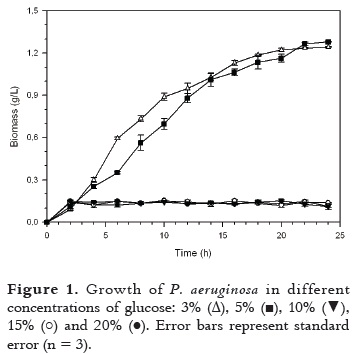
<body><![CDATA[<p> <b>Effect of lipid and surfactant on lipase production</b></p>     <p> Several experiments were carried out to determine   the inducing effect by adding 0.3 g/L of an oil   and a surfactant, namely, crude palm oil, Tween 20   and a Tween 20:Palm oil mixture (4.8:1 v/v). The   inducers were added at different times of growth   (0, 11 and 18 h) in order to determine the effect   of addition time. Samples were taken during the   stationary phase after 24 h of growth.</p>     <p> <b>Lipase assays</b></p>     <p> At the end of fermentation process, the flasks   were taken and harvested to measure the lipase   activity in the fermented broth: samples were   centrifuged at 10,000 rpm for 20 minutes at 4&deg;C   and the supernatant was taken to the lipase assay.   The spectrophotometric lipase assay was used to   determine the lipolytic activity (16). The substrate   solution was prepared by mixing 0.5 mL of 100 mM   of pNPP in acetonitrile with 2 mL of ethanol and   47.5 mL of phosphate buffer (pH 7.5). The assay   mixture consisted of 1.5 mL of substrate solution   and 0.5 mL of cell-free supernatant. The assay   mixture was incubated at 37&deg;C for 15 min and the   p-nitrophenol released was measured at 405 nm in   Spectronic-117 spectrophotometer against a control   without supernatant. One unit of enzyme is defined   as the amount of enzyme liberating 1 &mu;mol of pnitrophenol   mL<sup>-1</sup> min<sup>-1</sup> under the assay conditions.</p>     <p>&nbsp;</p>     <p><font size="3"> <b>RESULTS</b></font></p>     <p><b> Bacterial Strain</b></p>     <p> The biochemical identification that test showed   the isolated Gram negative microorganism with   lipolytic activity belongs to the genus and species   Pseudomonas aeruginosa in a 99.9% accuracy.</p>     <p> <b>Effect of the carbon source concentration</b></p>     <p> Since there is a relationship between the biomass   concentration and lipase production (11, 17), the   effect of the carbon source (glucose) concentration   was studied. <a href="#f1">Figure 1</a> shows the evolution of the <i>P. aeruginosa</i> cultures.</p>       ]]></body>
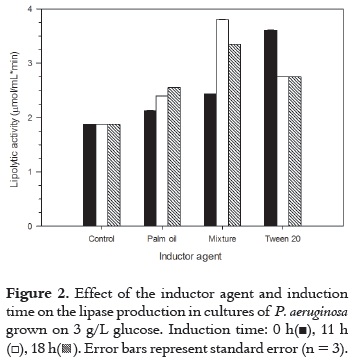
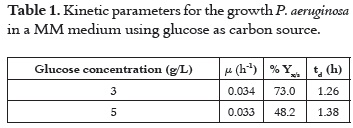
<body><![CDATA[<p align="center"><a name="f1"></a><img src="/img/revistas/vitae/v19n3/v19n3a6f1.jpg"></p>     <p>&nbsp;</p>     <p> The greatest growth of <i>P. aeruginosa</i> was observed   when glucose concentration was low (3 and   5 g/L), while the growth was minimum at higher   concentrations. Specific growth rate (&micro;) (<a href="#t1">Table   1</a>) was similar for concentrations of 3 and 5 g/L   glucose but the yield biomass/substrate (Y<sub>x/s</sub>) (at   24 h) was greater for 3 g/L. It is also noted that a   concentration of 3 g/L the doubling time (t<sub>d</sub>) was   lower, so the fermentation is more efficient since   the bacteria grow rapidly when the doubling time   is low. A concentration of 3 g/L of glucose is used   in the rest of this work.</p>       <p align="center"><a name="t1"></a><img src="/img/revistas/vitae/v19n3/v19n3a6t1.jpg"></p>       <p align="center">&nbsp;</p>       <p><b>Effect of induction agents</b></p>     <p> When <i>P. aeruginosa</i> was grown using 3 g/L of   glucose as carbon source with the inductors added at   different times during the fermentation process the   lipolytic activity showed distinct values (<a href="#f2">Figure 2</a>).</p>       <p align="center"><a name="f2"></a><img src="/img/revistas/vitae/v19n3/v19n3a6f2.jpg"></p>     <p>&nbsp;</p>     <p> Control sample shows <i>P. aeruginosa</i> produced   lipase (1.88 &micro;mol/mL*min) when it grew only in   glucose (without inductor) and the production was   greater when inductors were added at different   times. The greatest lipolytic activity (3.81 &micro;mol/   mL*min) was observed with palm oil:Tween 20   mixture added at 11 hours. Greater lipolytic activity   was obtained with Tween 20 and the mixture,   rather than with palm oil. The addition of the palm   oil:Tween 20 induced the highest lipase activity   at each time, except at 0 h, when the activity was   the greatest by using Tween 20 as inductor agent.   There was an increase of lipolytic activity with   the induction time when palm oil was added:   2.13, 2.39 and 2.55 &micro;mol/mL*min at 0, 11 and   18 h respectively; however, there was not a clear   tendency when other inductors were used.</p>     ]]></body>
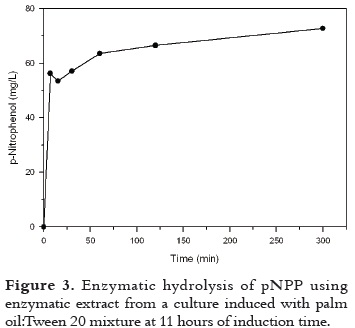
<body><![CDATA[<p> Kinetic of enzymatic hydrolysis (<a href="#f3">Figure 3</a>) was   determined for palm oil: Tween 20 mixture at 11   h of induction time, which presented the greatest   lipolytic activity. It is clear from the figure that   there was lipolytic activity beyond 300 min since   p-nitrophenol was still produced. A great hydrolysis   rate was observed during the first 7 minutes   when production of p-nitrophenol increased from   0 to 56.2 mg/L. The production of p-nitrophenol   was increasing until 300 min at lower rates until a   constant rate tendency is observed.</p>       <p align="center"><a name="f3"></a><img src="/img/revistas/vitae/v19n3/v19n3a6f3.jpg"></p>     <p>&nbsp;</p>     <p><font size="3"> <b>DISCUSSION</b></font></p>     <p><b> Effect of carbon source concentration</b></p>     <p> Under the fermentation conditions assayed,   bacteria growth in different concentrations of carbon   source was evaluated. As observed in <a href="#f1">Figure 1</a>  there was a cell growth inhibition at higher glucose   concentration (above 5 g/L). The concentrations of   glucose that favor the obtention of an acceptable   growth of <i>P. aeruginosa</i> were 3% and 5%. This result   agrees with Ito <i>et al.</i>, 2001(13), who found that cell   growth of Pseudomonas aeruginosa LST-03 was   affected by both glucose and ammonium concentration.   In the same way, Takac <i>et al.</i>, 2008 (18),   stated that high concentrations of glucose suppress the lipolytic activity.</p>     <p> On the other hand, Beyenal <i>et al.</i>, 2003 (19), and   Gupta <i>et al.</i>, 2004 (6), pointed out that glucose in   small amounts is necessary for the initial growth   phase of microorganisms for the releasing of extracellular lipase.</p>     <p> The combination of two types of carbon sources   (carbohydrate and oil) does not always improve   lipase production. For example Nahas, 1987 (20),   working with R. oligosporus, and Rapp, 1995 (21),   working with Fusarium used a mixture of glucose   and oleic acid as carbon-source, and it was found   that the consumption was produced in a sequential   pattern, so the lipase production was repressed by   the glucose present in the defined medium.</p>     <p> <b>Effect of induction agents</b></p>     <p> For lipase production different lipid based carbon   sources have been reported as inducer as well   as carbon source (alone or in combination with   carbohydrates) (1, 10, 18, 22). Results obtained from   this study showed that there was lipolytic activity   in the control sample without inducer agent. This   is known as basal level of the enzyme and it allows   concluding that glucose, as carbon source at low   concentrations (less than 5 g/L), does not repress   the release of the enzyme.</p>     ]]></body>
<body><![CDATA[<p> As shown in <a href="#f2">Figure 2</a> the inducer agents stimulated   the release of enzymes, since all media containing   inducer agents showed values greater than   1,88 &micro;mol/mL*min, which was the value for the   control sample.</p>     <p> The addition of a surfactant (Tween 20) as   inductor improved the lipolytic activity regarding   with control sample at the three induction times.   This result agrees with the studies of Gilbert <i>et al.</i>   1991 (23), Nahas, 1987 (20), and Dominguez <i>et al.</i>, 2003 (24), who used Tween 20, Tween 80 and   Tween 100, finding improvements on lipase production,   although the results depended on the type   of Tween used. Moreover, Grasian <i>et al.</i>, 2008 (5),   stated that the addition of any surfactant induces the   lipase production. Deive <i>et al.</i>, 2009 (11), explains   the effect of surfactants on the improvement of   lipase production by the solubilization of the lipids   on the membrane, forming micelles and extracting   membrane proteins (intrinsic and peripheral proteins)   which are the responsible proteins of lipolytic activity in membrane bound of microorganisms.</p>     <p> According to Wu <i>et al.</i>, 2004 (25), higher levels   of lipase production were observed when the   substrate formed an emulsion, thereby presenting   an interfacial area to the enzyme. This has   resemblance with the earlier <i>P. pseudoalkaligens</i> F-111   lipase, where addition of Triton-X-100 increased   the alkaline lipase production by 50-fold (26). An   elaborated study was performed by Lin <i>et al.</i>, 1995,   (26) about the effect of Triton-X-100 on lipase   production. Triton-X-100 may directly act as a   positive activator of lipase gene or may induce the   expression of lipase gene by removing the repressor   molecules. They also inferred that Triton-X-100   mechanistically promotes both uptake and exit of   compounds from the cell through modification of   plasma membrane permeability. Contrastingly, the   studies on lipase production by <i>Staphylococcus</i> sp. indicated the positive influence of Tween 80 (27).</p>     <p> Favorable levels of lipolytic enzyme production   were found in this work when the mixture (Palm   oil:Tween 20) was used as inductor agent at 11 hours   of growth during the exponential phase. According   to Illanes <i>et al.</i>, 2008 (4), and Reis <i>et al.</i>, 2010 (28),   lipases catalyze the hydrolysis of lipidic substrates   when they are in micelles, small aggregates or   particles in emulsion, because the place where   lipolysis occurs requires at least two phases and a   larger contact area. On the other hand, Ba&ntilde;&oacute; <i>et al.</i>,   2003 (29), and Reis <i>et al.</i>, 2009 (30), argue that using   an emulsion facilitates the interfacial activation of   lipases features, as the emulsion facilitates substrate access to enzyme active site.</p>     <p> Bisht <i>et al.</i>, 2012 (31), investigated the suitability   of adding different carbon sources for lipase production   by a mutant strain. Supplementation of production   medium with starch tremendously boosted   the lipase activity (about 129.3%) as compared to   control. Similar results were reported by Pogaku <i>et al.</i>, 2010 (27), while investigating the lipase production   by Staphylococcus sp. Lp12. Rathi <i>et al.</i>, 2001   (32), also reported increase in lipase production   from Burkholderia cepacia in the presence of oil and glucose as sugar additive.</p>     <p> We can use this fact to conclude, that mixture   is the best inducer agent compared with the other   two, because the activity increment may be due to   the presence of more interfacial area, facilitating   interaction between enzyme and substrate. Another   possibility could be that higher enzyme release was   due to the combined effect between palm oil and   Tween 20, because the latter one can act separately   and facilitate the release of more lipase.</p>     <p> According to previous results, the mixture   showed the best results, and for this reason the   kinetic of enzymatic hydrolysis was determined   with this mixture as shown in <a href="#f3">Figure 3</a>. The mixture   (palm oil:Tween 20) was added to the culture   medium at 11 hours of fermentation.</p>     <p> The release of 100 &micro;M of p-NP was achieved at   300 minutes of reaction with p-NPP when inducer   was added at 11 hours of fermentation; this means   that when the bacteria was in the exponential phase   it was found a greater rate of reaction.</p>     <p>&nbsp;</p>     <p><font size="3"> <b>CONCLUSIONS</b></font></p>     ]]></body>
<body><![CDATA[<p> According to the results, it can be stated that   the effect of adding inductors to the fermentation   medium increases the levels of enzyme production.   Similarly, it was observed that using glucose   as carbon source does not suppress the basal level   release of the enzyme in the fermentation medium.</p>     <p> Hydrolysis of p-NPP as substrate was determined   by the release of p-nitrophenol, acting as an   indicator of the presence the enzyme in the medium   after 15 minutes of reaction. The reaction showed   that an inducting agent stimulated the release of   the enzyme into the medium, and the best yield   was obtained with mixture (palm oil:Tween 20) as   inducer. The mixture was added at 11 hours of fermentation   medium and the value was 3,81 &micro;moles/   mL*min for fermentation medium.</p>     <p> A preliminary kinetic study of enzymatic hydrolysis   was performed for the best inducer agent   (mixture) found. The reaction conditions were:   100 &micro;M of p-NPP, 300 minutes of reaction, and   the inductor was added at 11 hours of fermentation   medium. The kinetic of enzymatic hydrolysis   for the control sample has lower values than those   achieved when the emulsion was used as an inducer   in the release of the enzyme.</p>     <p>&nbsp;</p>     <p><font size="3"> <b>ACKNOWLEDGEMENTS</b></font></p>     <p> To Colciencias and the Universidad de La Sabana   for financing the research project ''Obtenci&oacute;n   de enzimas lipol&iacute;ticas a partir de microorganismos   aislados del fruto de palma aceitera'', which is part   of this work.</p>     <p>&nbsp;</p>     <p><font size="3"><b>REFERENCES</b></font></p>     <!-- ref --><p>1. Toscano L, Gochev V, Montero G, Stoytcheva M. Enhanced   production of extracellular lipase by novel mutant strain of   Aspergillus niger. Biotechnol Biotech Eq. 2011 Feb; 25 (1): 2243   - 2247.    &nbsp;&nbsp;&nbsp;&nbsp;&nbsp;&nbsp;&nbsp;&nbsp;[&#160;<a href="javascript:void(0);" onclick="javascript: window.open('/scielo.php?script=sci_nlinks&ref=000091&pid=S0121-4004201200030000600001&lng=','','width=640,height=500,resizable=yes,scrollbars=1,menubar=yes,');">Links</a>&#160;]<!-- end-ref --></p>     ]]></body>
<body><![CDATA[<!-- ref --><p>  2. Treichel H, Oliveira D, Mazutti M, Luccio M, Oliveira JV. A   Review on Microbial Lipases Production. Food Bioprocess Tech.   2010 Apr; 3 (2): 182 - 196.    &nbsp;&nbsp;&nbsp;&nbsp;&nbsp;&nbsp;&nbsp;&nbsp;[&#160;<a href="javascript:void(0);" onclick="javascript: window.open('/scielo.php?script=sci_nlinks&ref=000093&pid=S0121-4004201200030000600002&lng=','','width=640,height=500,resizable=yes,scrollbars=1,menubar=yes,');">Links</a>&#160;]<!-- end-ref --></p>     <!-- ref --><p>  3. Salihu A, Alam MZ, AbdulKarim MI, Salleh HM. Lipase production:   An insight in the utilization of renewable agricultural   residues. Resour Conserv Recycling. 2012 Jan; 58 (0): 36 - 44.    &nbsp;&nbsp;&nbsp;&nbsp;&nbsp;&nbsp;&nbsp;&nbsp;[&#160;<a href="javascript:void(0);" onclick="javascript: window.open('/scielo.php?script=sci_nlinks&ref=000095&pid=S0121-4004201200030000600003&lng=','','width=640,height=500,resizable=yes,scrollbars=1,menubar=yes,');">Links</a>&#160;]<!-- end-ref --></p>     <!-- ref --><p>  4. Illanes A, &Aacute;lvarez L, &Aacute;lvaro G. Esterificaci&oacute;n quimioselectiva   de fitosteroles de madera mediante lipasas. Rev Col Biotecnol.   2008 Jul; 10 (1): 17 - 35.    &nbsp;&nbsp;&nbsp;&nbsp;&nbsp;&nbsp;&nbsp;&nbsp;[&#160;<a href="javascript:void(0);" onclick="javascript: window.open('/scielo.php?script=sci_nlinks&ref=000097&pid=S0121-4004201200030000600004&lng=','','width=640,height=500,resizable=yes,scrollbars=1,menubar=yes,');">Links</a>&#160;]<!-- end-ref --></p>     <!-- ref --><p>  5. Grasian I, Palanichamy E, Austin J, Palanisamy I, Arunachalam   P. Investigation of Lipase Production by Milk Isolate Serratia   rubidaea. Food Technol Biotechnol. 2008 Jan-Mar; 46 (1): 60 -   65.    &nbsp;&nbsp;&nbsp;&nbsp;&nbsp;&nbsp;&nbsp;&nbsp;[&#160;<a href="javascript:void(0);" onclick="javascript: window.open('/scielo.php?script=sci_nlinks&ref=000099&pid=S0121-4004201200030000600005&lng=','','width=640,height=500,resizable=yes,scrollbars=1,menubar=yes,');">Links</a>&#160;]<!-- end-ref --></p>     <!-- ref --><p>  6. Gupta R, Gupta N, Rathi P. Bacterial lipases: an overview of   production, purification and biochemical properties. Appl Microbiol   Biotechnol. 2004 Jun; 64 (6): 763 - 781.    &nbsp;&nbsp;&nbsp;&nbsp;&nbsp;&nbsp;&nbsp;&nbsp;[&#160;<a href="javascript:void(0);" onclick="javascript: window.open('/scielo.php?script=sci_nlinks&ref=000101&pid=S0121-4004201200030000600006&lng=','','width=640,height=500,resizable=yes,scrollbars=1,menubar=yes,');">Links</a>&#160;]<!-- end-ref --></p>     ]]></body>
<body><![CDATA[<!-- ref --><p>  7. Hasan F, Shah AA, Hameed A. Methods for detection and   characterization of lipases: A comprehensive review. Biotechnol   Adv. 2009 Nov-Dic; 27 (6): 782 - 798.    &nbsp;&nbsp;&nbsp;&nbsp;&nbsp;&nbsp;&nbsp;&nbsp;[&#160;<a href="javascript:void(0);" onclick="javascript: window.open('/scielo.php?script=sci_nlinks&ref=000103&pid=S0121-4004201200030000600007&lng=','','width=640,height=500,resizable=yes,scrollbars=1,menubar=yes,');">Links</a>&#160;]<!-- end-ref --></p>     <!-- ref --><p>  8. Li N, Zong M. Lipases from the genus Penicillium: Production,   purification, characterization and applications. J Molec Catal B.   2010 Sep; 66 (1-2): 43 - 54.    &nbsp;&nbsp;&nbsp;&nbsp;&nbsp;&nbsp;&nbsp;&nbsp;[&#160;<a href="javascript:void(0);" onclick="javascript: window.open('/scielo.php?script=sci_nlinks&ref=000105&pid=S0121-4004201200030000600008&lng=','','width=640,height=500,resizable=yes,scrollbars=1,menubar=yes,');">Links</a>&#160;]<!-- end-ref --></p>     <!-- ref --><p>  9. Sharma R, Chisti Y, Banerjee UC. Production, purification,   characterization, and applications of lipases. Biotechnol Adv.   2001 Dec; 19 (8): 627 - 635.    &nbsp;&nbsp;&nbsp;&nbsp;&nbsp;&nbsp;&nbsp;&nbsp;[&#160;<a href="javascript:void(0);" onclick="javascript: window.open('/scielo.php?script=sci_nlinks&ref=000107&pid=S0121-4004201200030000600009&lng=','','width=640,height=500,resizable=yes,scrollbars=1,menubar=yes,');">Links</a>&#160;]<!-- end-ref --></p>     <!-- ref --><p>  10. Gupta N, Sahai V, Gupta R. Alkaline lipase from a novel strain   Burkholderia multivorans: Statistical medium optimization and   production in a bioreactor. Process Biochem. 2007 Apr; 42 (4):   518 - 526.    &nbsp;&nbsp;&nbsp;&nbsp;&nbsp;&nbsp;&nbsp;&nbsp;[&#160;<a href="javascript:void(0);" onclick="javascript: window.open('/scielo.php?script=sci_nlinks&ref=000109&pid=S0121-4004201200030000600010&lng=','','width=640,height=500,resizable=yes,scrollbars=1,menubar=yes,');">Links</a>&#160;]<!-- end-ref --></p>     <!-- ref --><p>  11. Deive FJ, Carvalho E, Pastrana L, R&uacute;a ML, Longo MA, Sanroman   MA. Strategies for improving extracellular lipolytic enzyme   production by Thermus thermophilus HB27. Bioresour Technol.   2009 Jul; 100 (14): 3630 - 3637.    &nbsp;&nbsp;&nbsp;&nbsp;&nbsp;&nbsp;&nbsp;&nbsp;[&#160;<a href="javascript:void(0);" onclick="javascript: window.open('/scielo.php?script=sci_nlinks&ref=000111&pid=S0121-4004201200030000600011&lng=','','width=640,height=500,resizable=yes,scrollbars=1,menubar=yes,');">Links</a>&#160;]<!-- end-ref --></p>     ]]></body>
<body><![CDATA[<!-- ref --><p>  12. Pe&ntilde;a F. Aprovechamiento de aceites residuales del proceso de   fritura como sustrato para el desarrollo de microorganismos   productores de lipasas (Proyecto de grado Ingeniero de Producci&oacute;n   Agroindustrial). Ch&iacute;a, Colombia: Facultad de Ingenier&iacute;a   Universidad de la Sabana; 2006.    &nbsp;&nbsp;&nbsp;&nbsp;&nbsp;&nbsp;&nbsp;&nbsp;[&#160;<a href="javascript:void(0);" onclick="javascript: window.open('/scielo.php?script=sci_nlinks&ref=000113&pid=S0121-4004201200030000600012&lng=','','width=640,height=500,resizable=yes,scrollbars=1,menubar=yes,');">Links</a>&#160;]<!-- end-ref --></p>     <!-- ref --><p>  13. Ito T, Kikuta H, Nagamori E, Honda H, Ogino H, Ishikawa H,   <i>et al.</i> Lipase production in two-step fed-batch culture of organic   solvent-tolerant Pseudomonas aeruginosa LST-03. J Biosci Bioeng. 2001; 91 (3): 245 - 250.    &nbsp;&nbsp;&nbsp;&nbsp;&nbsp;&nbsp;&nbsp;&nbsp;[&#160;<a href="javascript:void(0);" onclick="javascript: window.open('/scielo.php?script=sci_nlinks&ref=000115&pid=S0121-4004201200030000600013&lng=','','width=640,height=500,resizable=yes,scrollbars=1,menubar=yes,');">Links</a>&#160;]<!-- end-ref --></p>     <!-- ref --><p>  14. Gaoa X, Cao S, Zhang K. Production, properties and application   to nonaqueous enzymatic catalysis of lipase from a newly isolated   Pseudomonas strain. Enzyme Microb Technol. 2000 Jul 1; 27   (1-2): 74 - 82.    &nbsp;&nbsp;&nbsp;&nbsp;&nbsp;&nbsp;&nbsp;&nbsp;[&#160;<a href="javascript:void(0);" onclick="javascript: window.open('/scielo.php?script=sci_nlinks&ref=000117&pid=S0121-4004201200030000600014&lng=','','width=640,height=500,resizable=yes,scrollbars=1,menubar=yes,');">Links</a>&#160;]<!-- end-ref --></p>     <!-- ref --><p>  15. Kanwar L, Goswami P. Isolation of a Pseudomonas lipase produced   in pure hydrocarbon substrate and its application in the   synthesis of isoamyl acetate using membrane-immobilised lipase.   Enzyme Microb Technol. 2002 Nov 1; 31 (6): 727 - 735.    &nbsp;&nbsp;&nbsp;&nbsp;&nbsp;&nbsp;&nbsp;&nbsp;[&#160;<a href="javascript:void(0);" onclick="javascript: window.open('/scielo.php?script=sci_nlinks&ref=000119&pid=S0121-4004201200030000600015&lng=','','width=640,height=500,resizable=yes,scrollbars=1,menubar=yes,');">Links</a>&#160;]<!-- end-ref --></p>     <!-- ref --><p>  16. Gupta N, Rathi P, Gupta R. Simplified para-nitrophenyl palmitate   assay for lipases and esterases. Anal Biochem. 2002 Dec 1;   311 (1): 98 - 99.    &nbsp;&nbsp;&nbsp;&nbsp;&nbsp;&nbsp;&nbsp;&nbsp;[&#160;<a href="javascript:void(0);" onclick="javascript: window.open('/scielo.php?script=sci_nlinks&ref=000121&pid=S0121-4004201200030000600016&lng=','','width=640,height=500,resizable=yes,scrollbars=1,menubar=yes,');">Links</a>&#160;]<!-- end-ref --></p>     ]]></body>
<body><![CDATA[<!-- ref --><p>  17. Lee D, Koh Y, Kim K, Kim B, Choi H, Kim D, <i>et al.</i> Isolation   and characterization of a thermophilic lipase from Bacillus   thermoleovorans ID-1. FEMS Microbiol Lett. 1999 Oct 15; 179 (2): 393 - 400.    &nbsp;&nbsp;&nbsp;&nbsp;&nbsp;&nbsp;&nbsp;&nbsp;[&#160;<a href="javascript:void(0);" onclick="javascript: window.open('/scielo.php?script=sci_nlinks&ref=000123&pid=S0121-4004201200030000600017&lng=','','width=640,height=500,resizable=yes,scrollbars=1,menubar=yes,');">Links</a>&#160;]<!-- end-ref --></p>     <!-- ref --><p>  18. Takac S, Marul B. Effects of lipidic carbon sources on the extracellular   lipolytic activity of a newly isolated strain of Bacillus   subtilis. J Ind Microbiol Biotechnol. 2008 Sep; 35 (9): 1019 - 1025.    &nbsp;&nbsp;&nbsp;&nbsp;&nbsp;&nbsp;&nbsp;&nbsp;[&#160;<a href="javascript:void(0);" onclick="javascript: window.open('/scielo.php?script=sci_nlinks&ref=000125&pid=S0121-4004201200030000600018&lng=','','width=640,height=500,resizable=yes,scrollbars=1,menubar=yes,');">Links</a>&#160;]<!-- end-ref --></p>     <!-- ref --><p>  19. Beyenal H, Chen SN, Lewandowski Z. The double substrate   growth kinetics of Pseudomonas aeruginosa. Enzyme Microb   Technol. 2003 Jan 2; 32 (1) : 92 - 98.    &nbsp;&nbsp;&nbsp;&nbsp;&nbsp;&nbsp;&nbsp;&nbsp;[&#160;<a href="javascript:void(0);" onclick="javascript: window.open('/scielo.php?script=sci_nlinks&ref=000127&pid=S0121-4004201200030000600019&lng=','','width=640,height=500,resizable=yes,scrollbars=1,menubar=yes,');">Links</a>&#160;]<!-- end-ref --></p>     <!-- ref --><p>  20. Nahas E. Control of Lipase Production by Rhizopus oligosporus   under Various Growth Conditions. J Gen Microbiol. 1987; 134   (1): 227 - 233.    &nbsp;&nbsp;&nbsp;&nbsp;&nbsp;&nbsp;&nbsp;&nbsp;[&#160;<a href="javascript:void(0);" onclick="javascript: window.open('/scielo.php?script=sci_nlinks&ref=000129&pid=S0121-4004201200030000600020&lng=','','width=640,height=500,resizable=yes,scrollbars=1,menubar=yes,');">Links</a>&#160;]<!-- end-ref --></p>     <!-- ref --><p>  21. Rapp P. Production, regulation, and some properties of lipase   activity from Fusarium oxysporum f. sp. vasinfectum. Enzyme   Microb Technol. 1995 Sep; 17 (9): 832 - 838.    &nbsp;&nbsp;&nbsp;&nbsp;&nbsp;&nbsp;&nbsp;&nbsp;[&#160;<a href="javascript:void(0);" onclick="javascript: window.open('/scielo.php?script=sci_nlinks&ref=000131&pid=S0121-4004201200030000600021&lng=','','width=640,height=500,resizable=yes,scrollbars=1,menubar=yes,');">Links</a>&#160;]<!-- end-ref --></p>     ]]></body>
<body><![CDATA[<!-- ref --><p>  22. Yadav K, Adsul M, Bastawde K, Jadhav D, Thulasiram H, Gokhale   D. Differential induction, purification and characterization of   cold active lipase from Yarrowia lipolytica NCIM 3639. Bioresour   Technol. 2011 Nov; 102 (22): 10663 - 10670.    &nbsp;&nbsp;&nbsp;&nbsp;&nbsp;&nbsp;&nbsp;&nbsp;[&#160;<a href="javascript:void(0);" onclick="javascript: window.open('/scielo.php?script=sci_nlinks&ref=000133&pid=S0121-4004201200030000600022&lng=','','width=640,height=500,resizable=yes,scrollbars=1,menubar=yes,');">Links</a>&#160;]<!-- end-ref --></p>     <!-- ref --><p>  23. Gilbert E, Cornish A, Jones C. Purification and properties of   extracellular lipase from Pseudomonas aeruginosa EF2. J Gen   Microbiol. 1991 Sep; 137 (9): 2223 - 2229.    &nbsp;&nbsp;&nbsp;&nbsp;&nbsp;&nbsp;&nbsp;&nbsp;[&#160;<a href="javascript:void(0);" onclick="javascript: window.open('/scielo.php?script=sci_nlinks&ref=000135&pid=S0121-4004201200030000600023&lng=','','width=640,height=500,resizable=yes,scrollbars=1,menubar=yes,');">Links</a>&#160;]<!-- end-ref --></p>     <!-- ref --><p>  24. Dom&iacute;nguez A, Costas M, Longo MA, Sanrom&aacute;n A. A novel   application of solid state culture: production of lipases by Yarrowia   lipolytica. Biotechnol Lett. 2003 Aug; 25 (15): 1225 - 1229.    &nbsp;&nbsp;&nbsp;&nbsp;&nbsp;&nbsp;&nbsp;&nbsp;[&#160;<a href="javascript:void(0);" onclick="javascript: window.open('/scielo.php?script=sci_nlinks&ref=000137&pid=S0121-4004201200030000600024&lng=','','width=640,height=500,resizable=yes,scrollbars=1,menubar=yes,');">Links</a>&#160;]<!-- end-ref --></p>     <!-- ref --><p>  25. Wu HS, Tsai MJ. Kinetics of tributyrin hydrolysis by lipase. Enz   Microb Technol. 2004 Dec; 35 (6-7): 488 - 493.    &nbsp;&nbsp;&nbsp;&nbsp;&nbsp;&nbsp;&nbsp;&nbsp;[&#160;<a href="javascript:void(0);" onclick="javascript: window.open('/scielo.php?script=sci_nlinks&ref=000139&pid=S0121-4004201200030000600025&lng=','','width=640,height=500,resizable=yes,scrollbars=1,menubar=yes,');">Links</a>&#160;]<!-- end-ref --></p>     <!-- ref --><p>  26. Lin SF, Chioul CM, Tsaiz YC. Effect of Triton-X-100 on alkaline   lipase production by pseudomonas pseudoatcatigenes F-111.   Biotechnol Lett. 1995; 17: 959 - 962.    &nbsp;&nbsp;&nbsp;&nbsp;&nbsp;&nbsp;&nbsp;&nbsp;[&#160;<a href="javascript:void(0);" onclick="javascript: window.open('/scielo.php?script=sci_nlinks&ref=000141&pid=S0121-4004201200030000600026&lng=','','width=640,height=500,resizable=yes,scrollbars=1,menubar=yes,');">Links</a>&#160;]<!-- end-ref --></p>     ]]></body>
<body><![CDATA[<!-- ref --><p>  27. Pogaku P, Suresh A, Srinivaslu P, Reddy SA. Optimization of   lipase production by Staphylococcus sp. Lp12. Afr J Biotechnol.   2010 Feb 8; 9 (6): 882 - 886.    &nbsp;&nbsp;&nbsp;&nbsp;&nbsp;&nbsp;&nbsp;&nbsp;[&#160;<a href="javascript:void(0);" onclick="javascript: window.open('/scielo.php?script=sci_nlinks&ref=000143&pid=S0121-4004201200030000600027&lng=','','width=640,height=500,resizable=yes,scrollbars=1,menubar=yes,');">Links</a>&#160;]<!-- end-ref --></p>     <!-- ref --><p>  28. Reis P, Watzke H, Leser M, Holmberg K, Miller R. Interfacial   mechanism of lipolysis as self-regulated process. Biophys Chem.   2010 Apr;147 (3): 93 - 103.    &nbsp;&nbsp;&nbsp;&nbsp;&nbsp;&nbsp;&nbsp;&nbsp;[&#160;<a href="javascript:void(0);" onclick="javascript: window.open('/scielo.php?script=sci_nlinks&ref=000145&pid=S0121-4004201200030000600028&lng=','','width=640,height=500,resizable=yes,scrollbars=1,menubar=yes,');">Links</a>&#160;]<!-- end-ref --></p>     <!-- ref --><p>  29. Ba&ntilde;&oacute; M, Goz&aacute;lez H, Abad C. Long-chain fatty acyl-CoA esters   induce lipase activation in absence of a water-lipid interface.   Biochim Biophys Acta. 2003 Jun 10; 1632 (1-3): 55 - 61.    &nbsp;&nbsp;&nbsp;&nbsp;&nbsp;&nbsp;&nbsp;&nbsp;[&#160;<a href="javascript:void(0);" onclick="javascript: window.open('/scielo.php?script=sci_nlinks&ref=000147&pid=S0121-4004201200030000600029&lng=','','width=640,height=500,resizable=yes,scrollbars=1,menubar=yes,');">Links</a>&#160;]<!-- end-ref --></p>     <!-- ref --><p>  30. Reis P, Holmberg K, Miller R, Leser M, Raab T, Watzke H. Lipase   reaction at interfaces as self-limiting processes. C R Chimie. 2009   Jan 2; 12 (1): 163 - 170.    &nbsp;&nbsp;&nbsp;&nbsp;&nbsp;&nbsp;&nbsp;&nbsp;[&#160;<a href="javascript:void(0);" onclick="javascript: window.open('/scielo.php?script=sci_nlinks&ref=000149&pid=S0121-4004201200030000600030&lng=','','width=640,height=500,resizable=yes,scrollbars=1,menubar=yes,');">Links</a>&#160;]<!-- end-ref --></p>     <!-- ref --><p>  31. Bisht D, Kumar K, Singh N. Enhanced Production of Extracellular   Alkaline Lipase by an Improved Strain of Pseudomonas   aeruginosa MTCC 10,055. Am J Applied Sci. 2012; 9 (2): 158   - 167.    &nbsp;&nbsp;&nbsp;&nbsp;&nbsp;&nbsp;&nbsp;&nbsp;[&#160;<a href="javascript:void(0);" onclick="javascript: window.open('/scielo.php?script=sci_nlinks&ref=000151&pid=S0121-4004201200030000600031&lng=','','width=640,height=500,resizable=yes,scrollbars=1,menubar=yes,');">Links</a>&#160;]<!-- end-ref --></p>     ]]></body>
<body><![CDATA[<!-- ref --><p>  32. Rathi P, Saxena R, Gupta R. A novel alkaline lipase from Burkholderia   cepacia for detergent formulation. Process Biochem. 2001 Oct; 37: 187 - 192.    &nbsp;&nbsp;&nbsp;&nbsp;&nbsp;&nbsp;&nbsp;&nbsp;[&#160;<a href="javascript:void(0);" onclick="javascript: window.open('/scielo.php?script=sci_nlinks&ref=000153&pid=S0121-4004201200030000600032&lng=','','width=640,height=500,resizable=yes,scrollbars=1,menubar=yes,');">Links</a>&#160;]<!-- end-ref --></p>     <p>&nbsp;</p> </font>      ]]></body><back>
<ref-list>
<ref id="B1">
<label>1</label><nlm-citation citation-type="journal">
<person-group person-group-type="author">
<name>
<surname><![CDATA[Toscano]]></surname>
<given-names><![CDATA[L]]></given-names>
</name>
<name>
<surname><![CDATA[Gochev]]></surname>
<given-names><![CDATA[V]]></given-names>
</name>
<name>
<surname><![CDATA[Montero]]></surname>
<given-names><![CDATA[G]]></given-names>
</name>
<name>
<surname><![CDATA[Stoytcheva]]></surname>
<given-names><![CDATA[M.]]></given-names>
</name>
</person-group>
<article-title xml:lang="en"><![CDATA[Enhanced production of extracellular lipase by novel mutant strain of Aspergillus niger]]></article-title>
<source><![CDATA[Biotechnol Biotech Eq]]></source>
<year>2011</year>
<month> F</month>
<day>eb</day>
<volume>25</volume>
<numero>1</numero>
<issue>1</issue>
<page-range>2243 - 2247</page-range></nlm-citation>
</ref>
<ref id="B2">
<label>2</label><nlm-citation citation-type="journal">
<person-group person-group-type="author">
<name>
<surname><![CDATA[Treichel]]></surname>
<given-names><![CDATA[H]]></given-names>
</name>
<name>
<surname><![CDATA[Oliveira]]></surname>
<given-names><![CDATA[D]]></given-names>
</name>
<name>
<surname><![CDATA[Mazutti]]></surname>
<given-names><![CDATA[M]]></given-names>
</name>
<name>
<surname><![CDATA[Luccio]]></surname>
<given-names><![CDATA[M]]></given-names>
</name>
<name>
<surname><![CDATA[Oliveira]]></surname>
<given-names><![CDATA[JV.]]></given-names>
</name>
</person-group>
<article-title xml:lang="en"><![CDATA[A Review on Microbial Lipases Production]]></article-title>
<source><![CDATA[Food Bioprocess Tech]]></source>
<year>2010</year>
<month> A</month>
<day>pr</day>
<volume>3</volume>
<numero>2</numero>
<issue>2</issue>
<page-range>182 - 196</page-range></nlm-citation>
</ref>
<ref id="B3">
<label>3</label><nlm-citation citation-type="journal">
<person-group person-group-type="author">
<name>
<surname><![CDATA[Salihu]]></surname>
<given-names><![CDATA[A]]></given-names>
</name>
<name>
<surname><![CDATA[Alam]]></surname>
<given-names><![CDATA[MZ]]></given-names>
</name>
<name>
<surname><![CDATA[AbdulKarim]]></surname>
<given-names><![CDATA[MI]]></given-names>
</name>
<name>
<surname><![CDATA[Salleh]]></surname>
<given-names><![CDATA[HM.]]></given-names>
</name>
</person-group>
<article-title xml:lang="en"><![CDATA[Lipase production: An insight in the utilization of renewable agricultural residues]]></article-title>
<source><![CDATA[Resour Conserv Recycling]]></source>
<year>2012</year>
<month> J</month>
<day>an</day>
<volume>58</volume>
<numero>0</numero>
<issue>0</issue>
<page-range>36 - 44</page-range></nlm-citation>
</ref>
<ref id="B4">
<label>4</label><nlm-citation citation-type="journal">
<person-group person-group-type="author">
<name>
<surname><![CDATA[Illanes]]></surname>
<given-names><![CDATA[A]]></given-names>
</name>
<name>
<surname><![CDATA[Álvarez]]></surname>
<given-names><![CDATA[L]]></given-names>
</name>
<name>
<surname><![CDATA[Álvaro]]></surname>
<given-names><![CDATA[G.]]></given-names>
</name>
</person-group>
<article-title xml:lang="es"><![CDATA[Esterificación quimioselectiva de fitosteroles de madera mediante lipasas]]></article-title>
<source><![CDATA[Rev Col Biotecnol]]></source>
<year>2008</year>
<month> J</month>
<day>ul</day>
<volume>10</volume>
<numero>1</numero>
<issue>1</issue>
<page-range>17 - 35</page-range></nlm-citation>
</ref>
<ref id="B5">
<label>5</label><nlm-citation citation-type="journal">
<person-group person-group-type="author">
<name>
<surname><![CDATA[Grasian]]></surname>
<given-names><![CDATA[I]]></given-names>
</name>
<name>
<surname><![CDATA[Palanichamy]]></surname>
<given-names><![CDATA[E]]></given-names>
</name>
<name>
<surname><![CDATA[Austin]]></surname>
<given-names><![CDATA[J]]></given-names>
</name>
<name>
<surname><![CDATA[Palanisamy]]></surname>
<given-names><![CDATA[I]]></given-names>
</name>
<name>
<surname><![CDATA[Arunachalam]]></surname>
<given-names><![CDATA[P.]]></given-names>
</name>
</person-group>
<article-title xml:lang="en"><![CDATA[Investigation of Lipase Production by Milk Isolate Serratia rubidaea]]></article-title>
<source><![CDATA[Food Technol Biotechnol]]></source>
<year>2008</year>
<month> J</month>
<day>an</day>
<volume>46</volume>
<numero>1</numero>
<issue>1</issue>
<page-range>60 - 65</page-range></nlm-citation>
</ref>
<ref id="B6">
<label>6</label><nlm-citation citation-type="journal">
<person-group person-group-type="author">
<name>
<surname><![CDATA[Gupta]]></surname>
<given-names><![CDATA[R]]></given-names>
</name>
<name>
<surname><![CDATA[Gupta]]></surname>
<given-names><![CDATA[N]]></given-names>
</name>
<name>
<surname><![CDATA[Rathi]]></surname>
<given-names><![CDATA[P.]]></given-names>
</name>
</person-group>
<article-title xml:lang="en"><![CDATA[Bacterial lipases: an overview of production, purification and biochemical properties]]></article-title>
<source><![CDATA[Appl Microbiol Biotechnol]]></source>
<year>2004</year>
<month> J</month>
<day>un</day>
<volume>64</volume>
<numero>6</numero>
<issue>6</issue>
<page-range>763 - 781</page-range></nlm-citation>
</ref>
<ref id="B7">
<label>7</label><nlm-citation citation-type="journal">
<person-group person-group-type="author">
<name>
<surname><![CDATA[Hasan]]></surname>
<given-names><![CDATA[F]]></given-names>
</name>
<name>
<surname><![CDATA[Shah]]></surname>
<given-names><![CDATA[AA]]></given-names>
</name>
<name>
<surname><![CDATA[Hameed]]></surname>
<given-names><![CDATA[A.]]></given-names>
</name>
</person-group>
<article-title xml:lang="en"><![CDATA[Methods for detection and characterization of lipases: A comprehensive review]]></article-title>
<source><![CDATA[Biotechnol Adv]]></source>
<year>2009</year>
<month> N</month>
<day>ov</day>
<volume>27</volume>
<numero>6</numero>
<issue>6</issue>
<page-range>782 - 798</page-range></nlm-citation>
</ref>
<ref id="B8">
<label>8</label><nlm-citation citation-type="journal">
<person-group person-group-type="author">
<name>
<surname><![CDATA[Li]]></surname>
<given-names><![CDATA[N]]></given-names>
</name>
<name>
<surname><![CDATA[Zong]]></surname>
<given-names><![CDATA[M.]]></given-names>
</name>
</person-group>
<article-title xml:lang="en"><![CDATA[Lipases from the genus Penicillium: Production, purification, characterization and applications]]></article-title>
<source><![CDATA[J Molec Catal B]]></source>
<year>2010</year>
<month> S</month>
<day>ep</day>
<volume>66</volume>
<numero>1-2</numero>
<issue>1-2</issue>
<page-range>43 - 54</page-range></nlm-citation>
</ref>
<ref id="B9">
<label>9</label><nlm-citation citation-type="journal">
<person-group person-group-type="author">
<name>
<surname><![CDATA[Sharma]]></surname>
<given-names><![CDATA[R]]></given-names>
</name>
<name>
<surname><![CDATA[Chisti]]></surname>
<given-names><![CDATA[Y]]></given-names>
</name>
<name>
<surname><![CDATA[Banerjee]]></surname>
<given-names><![CDATA[UC.]]></given-names>
</name>
</person-group>
<article-title xml:lang="en"><![CDATA[Production, purification, characterization, and applications of lipases]]></article-title>
<source><![CDATA[Biotechnol Adv]]></source>
<year>2001</year>
<month> D</month>
<day>ec</day>
<volume>19</volume>
<numero>8</numero>
<issue>8</issue>
<page-range>627 - 635</page-range></nlm-citation>
</ref>
<ref id="B10">
<label>10</label><nlm-citation citation-type="journal">
<person-group person-group-type="author">
<name>
<surname><![CDATA[Gupta]]></surname>
<given-names><![CDATA[N]]></given-names>
</name>
<name>
<surname><![CDATA[Sahai]]></surname>
<given-names><![CDATA[V]]></given-names>
</name>
<name>
<surname><![CDATA[Gupta]]></surname>
<given-names><![CDATA[R.]]></given-names>
</name>
</person-group>
<article-title xml:lang="en"><![CDATA[Alkaline lipase from a novel strain Burkholderia multivorans: Statistical medium optimization and production in a bioreactor]]></article-title>
<source><![CDATA[Process Biochem]]></source>
<year>2007</year>
<month> A</month>
<day>pr</day>
<volume>42</volume>
<numero>4</numero>
<issue>4</issue>
<page-range>518 - 526</page-range></nlm-citation>
</ref>
<ref id="B11">
<label>11</label><nlm-citation citation-type="journal">
<person-group person-group-type="author">
<name>
<surname><![CDATA[Deive]]></surname>
<given-names><![CDATA[FJ]]></given-names>
</name>
<name>
<surname><![CDATA[Carvalho]]></surname>
<given-names><![CDATA[E]]></given-names>
</name>
<name>
<surname><![CDATA[Pastrana]]></surname>
<given-names><![CDATA[L]]></given-names>
</name>
<name>
<surname><![CDATA[Rúa]]></surname>
<given-names><![CDATA[ML]]></given-names>
</name>
<name>
<surname><![CDATA[Longo]]></surname>
<given-names><![CDATA[MA]]></given-names>
</name>
<name>
<surname><![CDATA[Sanroman]]></surname>
<given-names><![CDATA[MA.]]></given-names>
</name>
</person-group>
<article-title xml:lang="en"><![CDATA[Strategies for improving extracellular lipolytic enzyme production by Thermus thermophilus HB27]]></article-title>
<source><![CDATA[Bioresour Technol]]></source>
<year>2009</year>
<month> J</month>
<day>ul</day>
<volume>100</volume>
<numero>14</numero>
<issue>14</issue>
<page-range>3630 - 3637</page-range></nlm-citation>
</ref>
<ref id="B12">
<label>12</label><nlm-citation citation-type="book">
<person-group person-group-type="author">
<name>
<surname><![CDATA[Peña]]></surname>
<given-names><![CDATA[F]]></given-names>
</name>
</person-group>
<source><![CDATA[Aprovechamiento de aceites residuales del proceso de fritura como sustrato para el desarrollo de microorganismos productores de lipasas (Proyecto de grado Ingeniero de Producción Agroindustrial)]]></source>
<year>2006</year>
<publisher-loc><![CDATA[Chía ]]></publisher-loc>
<publisher-name><![CDATA[Facultad de Ingeniería Universidad de la Sabana]]></publisher-name>
</nlm-citation>
</ref>
<ref id="B13">
<label>13</label><nlm-citation citation-type="journal">
<person-group person-group-type="author">
<name>
<surname><![CDATA[Ito]]></surname>
<given-names><![CDATA[T]]></given-names>
</name>
<name>
<surname><![CDATA[Kikuta]]></surname>
<given-names><![CDATA[H]]></given-names>
</name>
<name>
<surname><![CDATA[Nagamori]]></surname>
<given-names><![CDATA[E]]></given-names>
</name>
<name>
<surname><![CDATA[Honda]]></surname>
<given-names><![CDATA[H]]></given-names>
</name>
<name>
<surname><![CDATA[Ogino]]></surname>
<given-names><![CDATA[H]]></given-names>
</name>
<name>
<surname><![CDATA[Ishikawa]]></surname>
<given-names><![CDATA[H]]></given-names>
</name>
</person-group>
<article-title xml:lang="en"><![CDATA[Lipase production in two-step fed-batch culture of organic solvent-tolerant Pseudomonas aeruginosa LST-03]]></article-title>
<source><![CDATA[J Biosci Bioeng]]></source>
<year>2001</year>
<volume>91</volume>
<numero>3</numero>
<issue>3</issue>
<page-range>245 - 250</page-range></nlm-citation>
</ref>
<ref id="B14">
<label>14</label><nlm-citation citation-type="journal">
<person-group person-group-type="author">
<name>
<surname><![CDATA[Gaoa]]></surname>
<given-names><![CDATA[X]]></given-names>
</name>
<name>
<surname><![CDATA[Cao]]></surname>
<given-names><![CDATA[S]]></given-names>
</name>
<name>
<surname><![CDATA[Zhang]]></surname>
<given-names><![CDATA[K.]]></given-names>
</name>
</person-group>
<article-title xml:lang="en"><![CDATA[Production, properties and application to nonaqueous enzymatic catalysis of lipase from a newly isolated Pseudomonas strain]]></article-title>
<source><![CDATA[Enzyme Microb Technol]]></source>
<year>2000</year>
<month> J</month>
<day>ul</day>
<volume>27</volume>
<numero>1-2</numero>
<issue>1-2</issue>
<page-range>74 - 82</page-range></nlm-citation>
</ref>
<ref id="B15">
<label>15</label><nlm-citation citation-type="journal">
<person-group person-group-type="author">
<name>
<surname><![CDATA[Kanwar]]></surname>
<given-names><![CDATA[L]]></given-names>
</name>
<name>
<surname><![CDATA[Goswami]]></surname>
<given-names><![CDATA[P.]]></given-names>
</name>
</person-group>
<article-title xml:lang="en"><![CDATA[Isolation of a Pseudomonas lipase produced in pure hydrocarbon substrate and its application in the synthesis of isoamyl acetate using membrane-immobilised lipase]]></article-title>
<source><![CDATA[Enzyme Microb Technol]]></source>
<year>2002</year>
<month> N</month>
<day>ov</day>
<volume>31</volume>
<numero>6</numero>
<issue>6</issue>
<page-range>727 - 735</page-range></nlm-citation>
</ref>
<ref id="B16">
<label>16</label><nlm-citation citation-type="journal">
<person-group person-group-type="author">
<name>
<surname><![CDATA[Gupta]]></surname>
<given-names><![CDATA[N]]></given-names>
</name>
<name>
<surname><![CDATA[Rathi]]></surname>
<given-names><![CDATA[P]]></given-names>
</name>
<name>
<surname><![CDATA[Gupta]]></surname>
<given-names><![CDATA[R.]]></given-names>
</name>
</person-group>
<article-title xml:lang="en"><![CDATA[Simplified para-nitrophenyl palmitate assay for lipases and esterases]]></article-title>
<source><![CDATA[Anal Biochem]]></source>
<year>2002</year>
<month> D</month>
<day>ec</day>
<volume>311</volume>
<numero>1</numero>
<issue>1</issue>
<page-range>98 - 99</page-range></nlm-citation>
</ref>
<ref id="B17">
<label>17</label><nlm-citation citation-type="journal">
<person-group person-group-type="author">
<name>
<surname><![CDATA[Lee]]></surname>
<given-names><![CDATA[D]]></given-names>
</name>
<name>
<surname><![CDATA[Koh]]></surname>
<given-names><![CDATA[Y]]></given-names>
</name>
<name>
<surname><![CDATA[Kim]]></surname>
<given-names><![CDATA[K]]></given-names>
</name>
<name>
<surname><![CDATA[Kim]]></surname>
<given-names><![CDATA[B]]></given-names>
</name>
<name>
<surname><![CDATA[Choi]]></surname>
<given-names><![CDATA[H]]></given-names>
</name>
<name>
<surname><![CDATA[Kim]]></surname>
<given-names><![CDATA[D]]></given-names>
</name>
</person-group>
<article-title xml:lang="en"><![CDATA[Isolation and characterization of a thermophilic lipase from Bacillus thermoleovorans ID-1]]></article-title>
<source><![CDATA[FEMS Microbiol Lett]]></source>
<year>1999</year>
<month> O</month>
<day>ct</day>
<volume>179</volume>
<numero>2</numero>
<issue>2</issue>
<page-range>393 - 400</page-range></nlm-citation>
</ref>
<ref id="B18">
<label>18</label><nlm-citation citation-type="journal">
<person-group person-group-type="author">
<name>
<surname><![CDATA[Takac]]></surname>
<given-names><![CDATA[S]]></given-names>
</name>
<name>
<surname><![CDATA[Marul]]></surname>
<given-names><![CDATA[B.]]></given-names>
</name>
</person-group>
<article-title xml:lang="en"><![CDATA[Effects of lipidic carbon sources on the extracellular lipolytic activity of a newly isolated strain of Bacillus subtilis]]></article-title>
<source><![CDATA[J Ind Microbiol Biotechnol]]></source>
<year>2008</year>
<month> S</month>
<day>ep</day>
<volume>35</volume>
<numero>9</numero>
<issue>9</issue>
<page-range>1019 - 1025</page-range></nlm-citation>
</ref>
<ref id="B19">
<label>19</label><nlm-citation citation-type="journal">
<person-group person-group-type="author">
<name>
<surname><![CDATA[Beyenal]]></surname>
<given-names><![CDATA[H]]></given-names>
</name>
<name>
<surname><![CDATA[Chen]]></surname>
<given-names><![CDATA[SN]]></given-names>
</name>
<name>
<surname><![CDATA[Lewandowski]]></surname>
<given-names><![CDATA[Z.]]></given-names>
</name>
</person-group>
<article-title xml:lang="en"><![CDATA[The double substrate growth kinetics of Pseudomonas aeruginosa]]></article-title>
<source><![CDATA[Enzyme Microb Technol]]></source>
<year>2003</year>
<month> J</month>
<day>an</day>
<volume>32</volume>
<numero>1</numero>
<issue>1</issue>
<page-range>92 - 98</page-range></nlm-citation>
</ref>
<ref id="B20">
<label>20</label><nlm-citation citation-type="journal">
<person-group person-group-type="author">
<name>
<surname><![CDATA[Nahas]]></surname>
<given-names><![CDATA[E.]]></given-names>
</name>
</person-group>
<article-title xml:lang="en"><![CDATA[Control of Lipase Production by Rhizopus oligosporus under Various Growth Conditions]]></article-title>
<source><![CDATA[J Gen Microbiol]]></source>
<year>1987</year>
<volume>134</volume>
<numero>1</numero>
<issue>1</issue>
<page-range>227 - 233</page-range></nlm-citation>
</ref>
<ref id="B21">
<label>21</label><nlm-citation citation-type="journal">
<person-group person-group-type="author">
<name>
<surname><![CDATA[Rapp]]></surname>
<given-names><![CDATA[P.]]></given-names>
</name>
</person-group>
<article-title xml:lang="en"><![CDATA[Production, regulation, and some properties of lipase activity from Fusarium oxysporum f. Sp. vasinfectum]]></article-title>
<source><![CDATA[Enzyme Microb Technol]]></source>
<year>1995</year>
<month> S</month>
<day>ep</day>
<volume>17</volume>
<numero>9</numero>
<issue>9</issue>
<page-range>832 - 838</page-range></nlm-citation>
</ref>
<ref id="B22">
<label>22</label><nlm-citation citation-type="journal">
<person-group person-group-type="author">
<name>
<surname><![CDATA[Yadav]]></surname>
<given-names><![CDATA[K]]></given-names>
</name>
<name>
<surname><![CDATA[Adsul]]></surname>
<given-names><![CDATA[M]]></given-names>
</name>
<name>
<surname><![CDATA[Bastawde]]></surname>
<given-names><![CDATA[K]]></given-names>
</name>
<name>
<surname><![CDATA[Jadhav]]></surname>
<given-names><![CDATA[D]]></given-names>
</name>
<name>
<surname><![CDATA[Thulasiram]]></surname>
<given-names><![CDATA[H]]></given-names>
</name>
<name>
<surname><![CDATA[Gokhale]]></surname>
<given-names><![CDATA[D.]]></given-names>
</name>
</person-group>
<article-title xml:lang="en"><![CDATA[Differential induction, purification and characterization of cold active lipase from Yarrowia lipolytica NCIM 3639]]></article-title>
<source><![CDATA[Bioresour Technol]]></source>
<year>2011</year>
<month> N</month>
<day>ov</day>
<volume>102</volume>
<numero>22</numero>
<issue>22</issue>
<page-range>10663 - 10670</page-range></nlm-citation>
</ref>
<ref id="B23">
<label>23</label><nlm-citation citation-type="journal">
<person-group person-group-type="author">
<name>
<surname><![CDATA[Gilbert]]></surname>
<given-names><![CDATA[E]]></given-names>
</name>
<name>
<surname><![CDATA[Cornish]]></surname>
<given-names><![CDATA[A]]></given-names>
</name>
<name>
<surname><![CDATA[Jones]]></surname>
<given-names><![CDATA[C.]]></given-names>
</name>
</person-group>
<article-title xml:lang="en"><![CDATA[Purification and properties of extracellular lipase from Pseudomonas aeruginosa EF2]]></article-title>
<source><![CDATA[J Gen Microbiol]]></source>
<year>1991</year>
<month> S</month>
<day>ep</day>
<volume>137</volume>
<numero>9</numero>
<issue>9</issue>
<page-range>2223 - 2229</page-range></nlm-citation>
</ref>
<ref id="B24">
<label>24</label><nlm-citation citation-type="journal">
<person-group person-group-type="author">
<name>
<surname><![CDATA[Domínguez]]></surname>
<given-names><![CDATA[A]]></given-names>
</name>
<name>
<surname><![CDATA[Costas]]></surname>
<given-names><![CDATA[M]]></given-names>
</name>
<name>
<surname><![CDATA[Longo]]></surname>
<given-names><![CDATA[MA]]></given-names>
</name>
<name>
<surname><![CDATA[Sanromán]]></surname>
<given-names><![CDATA[A.]]></given-names>
</name>
</person-group>
<article-title xml:lang="en"><![CDATA[A novel application of solid state culture: production of lipases by Yarrowia lipolytica]]></article-title>
<source><![CDATA[Biotechnol Lett]]></source>
<year>2003</year>
<month> A</month>
<day>ug</day>
<volume>25</volume>
<numero>15</numero>
<issue>15</issue>
<page-range>1225 - 1229</page-range></nlm-citation>
</ref>
<ref id="B25">
<label>25</label><nlm-citation citation-type="journal">
<person-group person-group-type="author">
<name>
<surname><![CDATA[Wu]]></surname>
<given-names><![CDATA[HS]]></given-names>
</name>
<name>
<surname><![CDATA[Tsai]]></surname>
<given-names><![CDATA[MJ.]]></given-names>
</name>
</person-group>
<article-title xml:lang="en"><![CDATA[Kinetics of tributyrin hydrolysis by lipase]]></article-title>
<source><![CDATA[Enz Microb Technol]]></source>
<year>2004</year>
<month> D</month>
<day>ec</day>
<volume>35</volume>
<numero>6-7</numero>
<issue>6-7</issue>
<page-range>488 - 493</page-range></nlm-citation>
</ref>
<ref id="B26">
<label>26</label><nlm-citation citation-type="journal">
<person-group person-group-type="author">
<name>
<surname><![CDATA[Lin]]></surname>
<given-names><![CDATA[SF]]></given-names>
</name>
<name>
<surname><![CDATA[Chioul]]></surname>
<given-names><![CDATA[CM]]></given-names>
</name>
<name>
<surname><![CDATA[Tsaiz]]></surname>
<given-names><![CDATA[YC.]]></given-names>
</name>
</person-group>
<article-title xml:lang="en"><![CDATA[Effect of Triton-X-100 on alkaline lipase production by pseudomonas pseudoatcatigenes F-111]]></article-title>
<source><![CDATA[Biotechnol Lett]]></source>
<year>1995</year>
<volume>17</volume>
<page-range>959 - 962</page-range></nlm-citation>
</ref>
<ref id="B27">
<label>27</label><nlm-citation citation-type="journal">
<person-group person-group-type="author">
<name>
<surname><![CDATA[Pogaku]]></surname>
<given-names><![CDATA[P]]></given-names>
</name>
<name>
<surname><![CDATA[Suresh]]></surname>
<given-names><![CDATA[A]]></given-names>
</name>
<name>
<surname><![CDATA[Srinivaslu]]></surname>
<given-names><![CDATA[P]]></given-names>
</name>
<name>
<surname><![CDATA[Reddy]]></surname>
<given-names><![CDATA[SA.]]></given-names>
</name>
</person-group>
<article-title xml:lang="en"><![CDATA[Optimization of lipase production by Staphylococcus sp. Lp12]]></article-title>
<source><![CDATA[Afr J Biotechnol]]></source>
<year>2010</year>
<month> F</month>
<day>eb</day>
<volume>9</volume>
<numero>6</numero>
<issue>6</issue>
<page-range>882 - 886</page-range></nlm-citation>
</ref>
<ref id="B28">
<label>28</label><nlm-citation citation-type="journal">
<person-group person-group-type="author">
<name>
<surname><![CDATA[Reis]]></surname>
<given-names><![CDATA[P]]></given-names>
</name>
<name>
<surname><![CDATA[Watzke]]></surname>
<given-names><![CDATA[H]]></given-names>
</name>
<name>
<surname><![CDATA[Leser]]></surname>
<given-names><![CDATA[M]]></given-names>
</name>
<name>
<surname><![CDATA[Holmberg]]></surname>
<given-names><![CDATA[K]]></given-names>
</name>
<name>
<surname><![CDATA[Miller]]></surname>
<given-names><![CDATA[R.]]></given-names>
</name>
</person-group>
<article-title xml:lang="en"><![CDATA[Interfacial mechanism of lipolysis as self-regulated process]]></article-title>
<source><![CDATA[Biophys Chem]]></source>
<year>2010</year>
<month> A</month>
<day>pr</day>
<volume>147</volume>
<numero>3</numero>
<issue>3</issue>
<page-range>93 - 103</page-range></nlm-citation>
</ref>
<ref id="B29">
<label>29</label><nlm-citation citation-type="journal">
<person-group person-group-type="author">
<name>
<surname><![CDATA[Bañó]]></surname>
<given-names><![CDATA[M]]></given-names>
</name>
<name>
<surname><![CDATA[Gozález]]></surname>
<given-names><![CDATA[H]]></given-names>
</name>
<name>
<surname><![CDATA[Abad]]></surname>
<given-names><![CDATA[C.]]></given-names>
</name>
</person-group>
<article-title xml:lang="en"><![CDATA[Long-chain fatty acyl-CoA esters induce lipase activation in absence of a water-lipid interface]]></article-title>
<source><![CDATA[Biochim Biophys Acta]]></source>
<year>2003</year>
<month> J</month>
<day>un</day>
<volume>1632</volume>
<numero>1-3</numero>
<issue>1-3</issue>
<page-range>55 - 61</page-range></nlm-citation>
</ref>
<ref id="B30">
<label>30</label><nlm-citation citation-type="journal">
<person-group person-group-type="author">
<name>
<surname><![CDATA[Reis]]></surname>
<given-names><![CDATA[P]]></given-names>
</name>
<name>
<surname><![CDATA[Holmberg]]></surname>
<given-names><![CDATA[K]]></given-names>
</name>
<name>
<surname><![CDATA[Miller]]></surname>
<given-names><![CDATA[R]]></given-names>
</name>
<name>
<surname><![CDATA[Leser]]></surname>
<given-names><![CDATA[M]]></given-names>
</name>
<name>
<surname><![CDATA[Raab]]></surname>
<given-names><![CDATA[T]]></given-names>
</name>
<name>
<surname><![CDATA[Watzke]]></surname>
<given-names><![CDATA[H.]]></given-names>
</name>
</person-group>
<article-title xml:lang="en"><![CDATA[Lipase reaction at interfaces as self-limiting processes]]></article-title>
<source><![CDATA[C R Chimie]]></source>
<year>2009</year>
<month> J</month>
<day>an</day>
<volume>12</volume>
<numero>1</numero>
<issue>1</issue>
<page-range>163 - 170</page-range></nlm-citation>
</ref>
<ref id="B31">
<label>31</label><nlm-citation citation-type="journal">
<person-group person-group-type="author">
<name>
<surname><![CDATA[Bisht]]></surname>
<given-names><![CDATA[D]]></given-names>
</name>
<name>
<surname><![CDATA[Kumar]]></surname>
<given-names><![CDATA[K]]></given-names>
</name>
<name>
<surname><![CDATA[Singh]]></surname>
<given-names><![CDATA[N.]]></given-names>
</name>
</person-group>
<article-title xml:lang="en"><![CDATA[Enhanced Production of Extracellular Alkaline Lipase by an Improved Strain of Pseudomonas aeruginosa MTCC 10,055]]></article-title>
<source><![CDATA[Am J Applied Sci]]></source>
<year>2012</year>
<volume>9</volume>
<numero>2</numero>
<issue>2</issue>
<page-range>158 - 167</page-range></nlm-citation>
</ref>
<ref id="B32">
<label>32</label><nlm-citation citation-type="journal">
<person-group person-group-type="author">
<name>
<surname><![CDATA[Rathi]]></surname>
<given-names><![CDATA[P]]></given-names>
</name>
<name>
<surname><![CDATA[Saxena]]></surname>
<given-names><![CDATA[R]]></given-names>
</name>
<name>
<surname><![CDATA[Gupta]]></surname>
<given-names><![CDATA[R.]]></given-names>
</name>
</person-group>
<article-title xml:lang="en"><![CDATA[A novel alkaline lipase from Burkholderia cepacia for detergent formulation]]></article-title>
<source><![CDATA[Process Biochem]]></source>
<year>2001</year>
<month> O</month>
<day>ct</day>
<volume>37</volume>
<page-range>187 - 192</page-range></nlm-citation>
</ref>
</ref-list>
</back>
</article>