<?xml version="1.0" encoding="ISO-8859-1"?><article xmlns:mml="http://www.w3.org/1998/Math/MathML" xmlns:xlink="http://www.w3.org/1999/xlink" xmlns:xsi="http://www.w3.org/2001/XMLSchema-instance">
<front>
<journal-meta>
<journal-id>0121-4004</journal-id>
<journal-title><![CDATA[Vitae]]></journal-title>
<abbrev-journal-title><![CDATA[Vitae]]></abbrev-journal-title>
<issn>0121-4004</issn>
<publisher>
<publisher-name><![CDATA[Facultad de Química Farmacéutica, Universidad de Antioquia]]></publisher-name>
</publisher>
</journal-meta>
<article-meta>
<article-id>S0121-40042012000300007</article-id>
<title-group>
<article-title xml:lang="en"><![CDATA[LACTIC ACID PRODUCTION VIA CASSAVA-FLOURHYDROLYSATE FERMENTATION]]></article-title>
<article-title xml:lang="es"><![CDATA[PRODUCCIÓN DE ÁCIDO LÁCTICO VIA FERMENTATIVA A PARTIR DE HIDROLIZADO DE HARINA DE YUCA]]></article-title>
</title-group>
<contrib-group>
<contrib contrib-type="author">
<name>
<surname><![CDATA[QUINTERO M.]]></surname>
<given-names><![CDATA[Joan E.]]></given-names>
</name>
<xref ref-type="aff" rid="A01"/>
</contrib>
<contrib contrib-type="author">
<name>
<surname><![CDATA[ACOSTA C.]]></surname>
<given-names><![CDATA[Alejandro]]></given-names>
</name>
<xref ref-type="aff" rid="A02"/>
</contrib>
<contrib contrib-type="author">
<name>
<surname><![CDATA[MEJÍA G]]></surname>
<given-names><![CDATA[Carlos]]></given-names>
</name>
<xref ref-type="aff" rid="A03"/>
</contrib>
<contrib contrib-type="author">
<name>
<surname><![CDATA[RÍOS E.]]></surname>
<given-names><![CDATA[Rigoberto]]></given-names>
</name>
<xref ref-type="aff" rid="A04"/>
</contrib>
<contrib contrib-type="author">
<name>
<surname><![CDATA[TORRES L.]]></surname>
<given-names><![CDATA[Ana M.]]></given-names>
</name>
<xref ref-type="aff" rid="A05"/>
</contrib>
</contrib-group>
<aff id="A01">
<institution><![CDATA[,Universidad de Antioquia Escuela de Microbiología ]]></institution>
<addr-line><![CDATA[Medellín ]]></addr-line>
<country>Colombia</country>
</aff>
<aff id="A02">
<institution><![CDATA[,Universidad de Antioquia Escuela de Microbiología Grupo Biotransformación]]></institution>
<addr-line><![CDATA[Medellín ]]></addr-line>
<country>Colombia</country>
</aff>
<aff id="A03">
<institution><![CDATA[,Universidad de Antioquia Departamento de Ingeniería Química Grupo Biotransformación]]></institution>
<addr-line><![CDATA[Medellín ]]></addr-line>
<country>Colombia</country>
</aff>
<aff id="A04">
<institution><![CDATA[,Universidad de Antioquia Facultad de Ingeniería Departamento de Ingeniería Química]]></institution>
<addr-line><![CDATA[Medellín ]]></addr-line>
<country>Colombia</country>
</aff>
<aff id="A05">
<institution><![CDATA[,Universidad de Antioquia Programa de Bioingeniería Grupo Bioprocesos]]></institution>
<addr-line><![CDATA[Medellín ]]></addr-line>
<country>Colombia</country>
</aff>
<pub-date pub-type="pub">
<day>00</day>
<month>12</month>
<year>2012</year>
</pub-date>
<pub-date pub-type="epub">
<day>00</day>
<month>12</month>
<year>2012</year>
</pub-date>
<volume>19</volume>
<numero>3</numero>
<fpage>287</fpage>
<lpage>293</lpage>
<copyright-statement/>
<copyright-year/>
<self-uri xlink:href="http://www.scielo.org.co/scielo.php?script=sci_arttext&amp;pid=S0121-40042012000300007&amp;lng=en&amp;nrm=iso"></self-uri><self-uri xlink:href="http://www.scielo.org.co/scielo.php?script=sci_abstract&amp;pid=S0121-40042012000300007&amp;lng=en&amp;nrm=iso"></self-uri><self-uri xlink:href="http://www.scielo.org.co/scielo.php?script=sci_pdf&amp;pid=S0121-40042012000300007&amp;lng=en&amp;nrm=iso"></self-uri><abstract abstract-type="short" xml:lang="en"><p><![CDATA[Background: Lactic acid (LA) is a carboxylic acid widely used as preservative, acidulant, and/or flavouring in food industry; it is also used as a raw material for the production of lactate ester, propylene glycol, 2,3-pentanedione, propanoic acid, acrylic acid and acetaldehyde. In recent years, the demand for LA production has dramatically increased due to its application as a monomer for poly-lactic acid synthesis, a biodegradable polymer used as a plastic in many industrial applications. LA can be produced either by fermentation or chemical synthesis; the former route has received considerable interest, due to environmental concerns and the limited nature of petrochemical feedstocks; thus, 90% of LA produced worldwide is obtained by fermentation, this process comprises the bioconversion of a sugar solution (carbohydrates) into LA in the presence of a microorganism. Objectives: This work is aimed at studying the effect of pH control and culture media composition on the LA production using renewable sources from the agroindustry sector. Methods: A Lactobacillus brevis strain is used to perform lab scale experiments under aerobic and anaerobic conditions, using three different culture media compositions: a high nutritional content medium (MRS), as a reference, a low nutritional content medium with glucose as the only carbon source (GM), and a potential low nutritional content medium with cassava flour as carbon source (HY1). Results: The higher LA production is accomplished under anaerobic conditions, 17.6 &plusmn; 0.1, 12.6 &plusmn; 0.2 y 13.6 &plusmn; 0.2 g LA/L, for MRS, GM and HY1 medium, respectively. The effect of pH on LA biosynthesis in a 5L bioreactor is also studied using the HY1 medium. For a fermentation time of 120 h, the highest LA concentration obtained was 24.3 &plusmn; 0.7g LA/L, productivity 0.20 g/L/h, Y P/S 0.32g LA/g syrup, at pH 6.5. Conclusions: These results are comparable with those using expensive carbon sources such as glucose, and show cassava flour as a promising low-cost substrate source for lab and eventually large scale LA biosynthesis.]]></p></abstract>
<abstract abstract-type="short" xml:lang="es"><p><![CDATA[Antecedentes: El ácido láctico (AL) es un ácido carboxílico utilizado en la industria alimentaria como conservante, acidulante y saborizante; también es usado como materia prima para la producción de éster de lactato, propilenglicol, 2,3-pentanodiona, ácido propanoico, ácido acrílico y acetaldehído. La demanda de AL ha aumentado debido a su aplicación como monómero en la síntesis de ácido poli-láctico, un polímero biodegradable usado como plástico en aplicaciones industriales. El AL puede ser producido por fermentación o síntesis química; la primera ruta ha recibido mayor interés, debido a las preocupaciones ambientales y a la limitación en materias primas petroquímicas. El 90% del AL producido en el mundo se obtiene por fermentación, la cual involucra la bioconversión de una solución de azúcar en AL, en presencia de un microorganismo. Objetivos: En este trabajo se evalúa el efecto del pH y de medios de cultivos sobre la producción de AL a partir del cultivo de Lactobacillus brevis, usando fuentes renovables provenientes del sector agroindustrial. Métodos: El desarrollo experimental a escala de laboratorio considera la evaluación de tres medios de cultivo: uno de alto contenido nutricional (MRS), medio de referencia, uno de medio contenido nutricional, con glucosa como única fuente de carbono (GM), y un medio de cultivo de bajo contenido nutricional, con jarabe de yuca como fuente de carbono (HY1). Resultados: La más alta producción de AL se obtiene bajo condiciones anaeróbicas, 17,6 &plusmn; 0,1, 12,6 &plusmn; 0,2 y 13,6 &plusmn; 0.2 g AL/L, para los medios MRS, GM y HY1, respectivamente. El trabajo contempla el estudio del efecto del pH sobre la biosíntesis de AL en reactor de 5L, usando el medio de cultivo HY1. Para 120h de cultivo la más alta concentración de AL que se obtiene es 24,3 &plusmn; 0,7g AL/L, productividad 0,20 g/L/h, y un rendimiento de sustrato en producto (Y P/S ) de 0,32g AL/g jarabe, a pH 6,5. Conclusiones: Estos resultados son comparables con los obtenidos en otros trabajos usando glucosa como fuente de carbono, y permiten considerar al jarabe de yuca como un potencial sustrato de bajo costo y alta disponibilidad para la producción de AL a escala de laboratorio, y eventualmente a escala industrial.]]></p></abstract>
<kwd-group>
<kwd lng="en"><![CDATA[Lactic acid]]></kwd>
<kwd lng="en"><![CDATA[cassava flour]]></kwd>
<kwd lng="en"><![CDATA[cassava waste material]]></kwd>
<kwd lng="en"><![CDATA[Lactobacillus brevis]]></kwd>
<kwd lng="en"><![CDATA[pH effect]]></kwd>
<kwd lng="es"><![CDATA[Ácido láctico]]></kwd>
<kwd lng="es"><![CDATA[jarabe de yuca]]></kwd>
<kwd lng="es"><![CDATA[sustratos económicos]]></kwd>
<kwd lng="es"><![CDATA[Lactobacillus brevis]]></kwd>
<kwd lng="es"><![CDATA[efecto del pH]]></kwd>
</kwd-group>
</article-meta>
</front><body><![CDATA[  <font face="Verdana, Arial, Helvetica, sans-serif" size="2">     <p align="right"> <b>BIOTECHNOLOGY</b></p>     <p>&nbsp;</p>     <p align="center"><b><font size="4">LACTIC ACID PRODUCTION VIA CASSAVA-FLOURHYDROLYSATE FERMENTATION</font></b></p>     <p>&nbsp;</p>     <p align="center"><b><font size="3"> PRODUCCI&Oacute;N DE &Aacute;CIDO L&Aacute;CTICO VIA FERMENTATIVA A PARTIR DE HIDROLIZADO DE HARINA DE YUCA</font></b></p>     <p>&nbsp;</p>     <p>&nbsp;</p>     <p><b> Joan E. QUINTERO M. Ing.<sup>1</sup>, Alejandro ACOSTA C. M.Sc.<sup>2</sup>, Carlos MEJ&Iacute;A G M.Sc.<sup>3</sup>, Rigoberto R&Iacute;OS E. Ph.D.<sup>4</sup>, Ana M.TORRES L. M.Sc.<sup>5</sup>*</b></p>     <p>1 Estudiante de Maestr&iacute;a en Ingenier&iacute;a Qu&iacute;mica del Grupo Biotransformaci&oacute;n. Escuela de Microbiolog&iacute;a, Universidad de Antioquia. Medell&iacute;n, Colombia.</p>     ]]></body>
<body><![CDATA[<p> 2 Profesor ocasional e Investigador Grupo Biotransformaci&oacute;n. Escuela de Microbiolog&iacute;a. Universidad de Antioquia. Medell&iacute;n, Colombia.</p>     <p> 3 Profesor vinculado y Coordinador del Grupo Biotransformaci&oacute;n. Escuela de Microbiolog&iacute;a. Bioprocesos. Departamento de Ingenier&iacute;a   Qu&iacute;mica. Universidad de Antioquia. Medell&iacute;n, Colombia.</p>     <p> 4 Profesor vinculado e Investigador Grupo Bioprocesos. Departamento de Ingenier&iacute;a Qu&iacute;mica. Facultad de Ingenier&iacute;a. Universidad de   Antioquia. Medell&iacute;n, Colombia.</p>     <p> 5 Profesor ocasional e Investigador Grupo Bioprocesos. Programa de Bioingenier&iacute;a. Universidad de Antioquia. Medell&iacute;n, Colombia.</p>     <p> * Autor a quien se debe dirigir la correspondencia: <a href="mailto:atorres@udea.edu.co">atorres@udea.edu.co</a>.</p>     <p>&nbsp;</p>     <p>Received: 16 March 2012 Accepted: 17 December 2012</p>     <p>&nbsp;</p> <hr noshade size="1">     <p><b> ABSTRACT</b></p>     <p><b>Background</b>: Lactic acid (LA) is a carboxylic acid widely used as preservative, acidulant, and/or flavouring   in food industry; it is also used as a raw material for the production of lactate ester, propylene   glycol, 2,3-pentanedione, propanoic acid, acrylic acid and acetaldehyde. In recent years, the demand   for LA production has dramatically increased due to its application as a monomer for poly-lactic acid   synthesis, a biodegradable polymer used as a plastic in many industrial applications. LA can be produced   either by fermentation or chemical synthesis; the former route has received considerable interest,   due to environmental concerns and the limited nature of petrochemical feedstocks; thus, 90% of LA   produced worldwide is obtained by fermentation, this process comprises the bioconversion of a sugar   solution (carbohydrates) into LA in the presence of a microorganism. <b>Objectives</b>: This work is aimed at   studying the effect of pH control and culture media composition on the LA production using renewable   sources from the agroindustry sector. <b>Methods</b>: A <i>Lactobacillus brevis</i> strain is used to perform lab scale   experiments under aerobic and anaerobic conditions, using three different culture media compositions: a   high nutritional content medium (MRS), as a reference, a low nutritional content medium with glucose   as the only carbon source (GM), and a potential low nutritional content medium with cassava flour as   carbon source (HY1). <b>Results</b>: The higher LA production is accomplished under anaerobic conditions,   17.6 &plusmn; 0.1, 12.6 &plusmn; 0.2 y 13.6 &plusmn; 0.2 g LA/L, for MRS, GM and HY1 medium, respectively. The effect   of pH on LA biosynthesis in a 5L bioreactor is also studied using the HY1 medium. For a fermentation   time of 120 h, the highest LA concentration obtained was 24.3 &plusmn; 0.7g LA/L, productivity 0.20 g/L/h,   Y<sub>P/S</sub> 0.32g LA/g syrup, at pH 6.5. <b>Conclusions</b>: These results are comparable with those using expensive   carbon sources such as glucose, and show cassava flour as a promising low-cost substrate source for lab and eventually large scale LA biosynthesis.</p>     ]]></body>
<body><![CDATA[<p> <b>Keywords</b>: Lactic acid, cassava flour, cassava waste material, Lactobacillus brevis, pH effect.</p> <hr noshade size="1">     <p> <b>RESUMEN</b></p>     <p><b>Antecedentes</b>: El &aacute;cido l&aacute;ctico (AL) es un &aacute;cido carbox&iacute;lico utilizado en la industria alimentaria como   conservante, acidulante y saborizante; tambi&eacute;n es usado como materia prima para la producci&oacute;n de &eacute;ster   de lactato, propilenglicol, 2,3-pentanodiona, &aacute;cido propanoico, &aacute;cido acr&iacute;lico y acetaldeh&iacute;do. La demanda   de AL ha aumentado debido a su aplicaci&oacute;n como mon&oacute;mero en la s&iacute;ntesis de &aacute;cido poli-l&aacute;ctico, un   pol&iacute;mero biodegradable usado como pl&aacute;stico en aplicaciones industriales. El AL puede ser producido por   fermentaci&oacute;n o s&iacute;ntesis qu&iacute;mica; la primera ruta ha recibido mayor inter&eacute;s, debido a las preocupaciones   ambientales y a la limitaci&oacute;n en materias primas petroqu&iacute;micas. El 90% del AL producido en el mundo se   obtiene por fermentaci&oacute;n, la cual involucra la bioconversi&oacute;n de una soluci&oacute;n de az&uacute;car en AL, en presencia   de un microorganismo. <b>Objetivos</b>: En este trabajo se eval&uacute;a el efecto del pH y de medios de cultivos sobre   la producci&oacute;n de AL a partir del cultivo de <i>Lactobacillus brevis</i>, usando fuentes renovables provenientes del   sector agroindustrial. <b>M&eacute;todos</b>: El desarrollo experimental a escala de laboratorio considera la evaluaci&oacute;n   de tres medios de cultivo: uno de alto contenido nutricional (MRS), medio de referencia, uno de medio   contenido nutricional, con glucosa como &uacute;nica fuente de carbono (GM), y un medio de cultivo de bajo   contenido nutricional, con jarabe de yuca como fuente de carbono (HY1). <b>Resultados</b>: La m&aacute;s alta producci&oacute;n   de AL se obtiene bajo condiciones anaer&oacute;bicas, 17,6 &plusmn; 0,1, 12,6 &plusmn; 0,2 y 13,6 &plusmn; 0.2 g AL/L, para   los medios MRS, GM y HY1, respectivamente. El trabajo contempla el estudio del efecto del pH sobre   la bios&iacute;ntesis de AL en reactor de 5L, usando el medio de cultivo HY1. Para 120h de cultivo la m&aacute;s alta   concentraci&oacute;n de AL que se obtiene es 24,3 &plusmn; 0,7g AL/L, productividad 0,20 g/L/h, y un rendimiento de   sustrato en producto (Y   <sub>P/S</sub>   ) de 0,32g AL/g jarabe, a pH 6,5. <b>Conclusiones</b>: Estos resultados son comparables   con los obtenidos en otros trabajos usando glucosa como fuente de carbono, y permiten considerar   al jarabe de yuca como un potencial sustrato de bajo costo y alta disponibilidad para la producci&oacute;n de AL a escala de laboratorio, y eventualmente a escala industrial.</p>     <p><b> Palabras clave:</b> &Aacute;cido l&aacute;ctico, jarabe de yuca, sustratos econ&oacute;micos, Lactobacillus brevis, efecto del pH.  </p> <hr noshade size="1">     <p>&nbsp;</p>     <p>&nbsp;</p>     <p><font size="3"><b>INTRODUCTION</b></font></p>     <p>Organic acids production has become a valuable   and economic alternative to chemical synthesis,   thus contributing the biotechnological world   market with carboxylic acids, enols, sulfonic acids, mercapto-compounds, and phosphonic acids.</p>     <p> Biotechnological processes use renewable resources,   such as silage, grains, syrups, molasses, and   cheese whey as feedstock. Moreover, the products   from fermentation have a higher safety degree, which   is significant to human health. Some organic acids   cannot or are difficult to be produced via chemical   synthesis. Taking lactic acid as an example, the chemical   synthesis produces a racemic mixture of lactic acid   (L and D-forms) while fermentation can selectively synthesize the desired stereospecific lactic acid (1).</p>     <p> Among others, the major applications for organic   acids have traditionally been food, beverage, pharmaceuticals,   cosmetics, detergents, plastics and resin   industry. Organic acids are considered important as   starting materials, mainly due to their characteristic   functional groups; though for some organic acids   the actual market is relatively small, the novelty   of economical production processes would create   new markets by providing new opportunities for   the chemical industry (2). Lactic acid (LA) was the   first organic acid to be produced at industrial scale   in 1880. Recently, LA demand has dramatically   increased for poly-lactic acid production, where it is used as a monomer (3, 4).</p>     ]]></body>
<body><![CDATA[<p> The organic acid production has been traditionally   carried out by solid-state fermentation, surface   fermentation and submerged fermentation (5-7).   The organisms traditionally used in fermentation   processes are gram-positive bacteria belonging to   the species<i> Lactobacillus, Carnobacterium, Leuconostoc,   Tetragenococus, Pediococcus, Streptococcus, Lactococcus,   Vagococcus, Esterococcus, Aerococcus</i> and <i>Weissellas</i> (8, 9).   For a lactic acid strain to be considered as prominent   it is required to strength its metabolic capabilities, to   rapidly and completely convert cheap raw materials   into LA with minimal nutritional requirements,   and also providing high yields of the preferred stereoisomer without by-product formation (10).</p>     <p> Polymer producers, and industrial users in general,   commonly require large quantities of relatively   low-cost LA. Therefore, raw materials for LA production should be cheap, have low levels of contaminants,   be able to induce the synthesis of few or no   by-product formation, have ability to be fermented   with little or no pretreatment, and have year-round   availability. An alternative for LA production would   be the use of refined materials. Nonetheless, the   economical balance is unfavorable since refined substrates   are extremely expensive, causing even higher   production costs. Hence, research aiming to screen   for cheaper raw materials for economic LA production   is a very active field (10). In this regard, diverse   sources such as soybean (11), potato (12), wood (13),   corn liquor (14), and molasses have been studied.   Among these, starchy (mainly sweet sorghum,   wheat, corn, cassava, potato, rice and barley), and   cellulosic materials, are widely preferred due to their   low price, abundance and renewable characteristics   (10). Despite the number of nitrogenous materials   (whey permeate, yeast extract, malt sprouts, grass   extract, peptones, beef extract, casein hydrolysate   with supplementation of vitamins) that have been   used to supplement the carbohydrate source for fast   and heavy growth, yeast extract seems to be the most effective supplement (15).</p>     <p> For experimental studies, LA production is   commonly carried out in erlenmeyers or lab scale   batch bioreactors. Environmental conditions are   usually set at 30 - 42&ordm;C, 120 - 200 rpm, and pH   ranging from 5 to 6.8 (16). Regarding the operation   mode for LA production, batch, fed-batch, repeated   batch, and continuous fermentations are the most   frequently used. Commonly, higher LA concentrations   are obtained in batch and fed-batch cultures,   whereas a continuous process may render in a better   productivity. Combining either batch or continuous   processes with cell-recycling brings on even higher cell concentration and productivity (12).</p>     <p> This work aims at testing the use of cassava   syrup as a potential unique carbon source for   high-yield LA biosynthesis in a lab scale bioreactor,   using <i>Lactobacillus brevis</i>. The study did also consider   the important effect of pH on LA production by   controlling pH culture conditions throughout the entire fermentative process.</p>     <p>&nbsp;</p>     <p><font size="3"> <b>Materials and Methods</b></font></p>     <p><b> Microorganism and culture medium</b></p>     <p> A <i>Lactobacillus brevis</i> strain was used. Cryogenic   vials with MRS medium (in g/L): glucose   100, peptone 10, yeast extract 10, meat extract 10,   K<sub>2</sub>HPO<sub>4</sub> 2, sodium acetate 5, ammonium citrate   2, MgSO<sub>4</sub>.7H<sub>2</sub>O 0.2, MnSO4.H2O 0.05 and 30%   glycerol, were used for strain conservation at -4&deg;C.   Chemicals for MRS medium were from MERCK&reg;   (Frankfurt, Germany). The strain was maintained   in Petri dishes with MRS medium and 1% agar at 4&deg;C, and subcultured every other month.</p>     <p> For flask assays, inoculum preparation was   carried out using MRS medium with a modified   glucose concentration at 10 g/L. Inoculums for   bioreactor operation were grown in the HY   medium (in g/L): reducing sugars from enzymatic   hydrolysis of cassava flour 30, yeast extract 15,   KH<sub>2</sub>PO<sub>4</sub> 5.6, K<sub>2</sub>HPO<sub>4</sub> 4.16; initial pH set at 5.5.   Operating conditions for inoculums were set   at 38&deg;C and 150 rpm for 24 h. For enzymatic   hydrolysis of cassava, 0.13 g/L of CaCl were added   to a 30% cassava solution. pH was adjusted at 5.5.   Afterwards, 0.5 mL/L of Thermamil were added;   temperature and stirring were set at 80&deg;C and   500 rpm, respectively. After cooling to 50&deg;C, and   adjusting pH at 4.5, 1.5 mL/L of amyloglucosidase   was added and the solution heated until 60&deg;C,   stirred at 150 rpm during 6h. After filtration, a   242 g/L solution of reducing sugars was obtained, having 76% of glucose (17).</p>     <p> In addition to the MRS medium, two culture   media for LA production were used for flasks assays,   the GM medium (in g/L): glucose 100, yeast   extract 15, KH<sub>2</sub>PO<sub>4</sub> 5.6, K<sub>2</sub>HPO<sub>4</sub> 4.16, and the   HY1 medium: reducing sugars from enzymatic   hydroxylation of cassava flour 100, yeast extract 15,   KH<sub>2</sub>PO<sub>4</sub> 5.6, K<sub>2</sub>HPO<sub>4</sub> 4.16; initial pH was set at   5.5. For bioreactor operation, the HY1 medium was   used. Yeast extract was from OXOID<sup>&reg;</sup> (Hampshire,   England); glucose, KH<sub>2</sub>PO<sub>4</sub> and K<sub>2</sub>HPO<sub>4</sub> were from MERCK<sup>&reg;</sup> (Frankfurt, Germany).</p>     ]]></body>
<body><![CDATA[<p> <b>Lactic Acid production</b></p>     <p> <i>Cultivation procedure</i></p>     <p> Aerobic and anaerobic culture conditions were   used for studying the strain ability for LA production.   The MRS, GM and HY1 media were tested for   the production of LA in flasks of 100 mL with 50   mL of culture medium operating at 38&deg;C, 150 rpm   for 72h. For studying LA biosynthesis under anaerobic   conditions, a low flow rate nitrogen stream   was fed during 2 min after inoculation. Flasks were   immediately sealed using rubber stoppers to ensure that cultures were not oxygen-contaminated.</p>     <p>  In order to study the pH effect on LA   biosynthesis, a 7.5L bioreactor BioFlo/CelliGen   115-New Brunswick<sup>&reg;</sup> (Enfield CT, EEUU) was   used. Operating conditions were set at 38&ordm;C, 200   rpm for 76h. Inoculum preparation consisted of 490   mL HY. For pH control NaOH 2N and H<sub>3</sub>PO<sub>4</sub>  8.5% solutions were used. The pH effect on LA   biosynthesis was studied at three levels: 4.5, 5.5   and 6.5. Results were compared with those from   experiments carried out without pH control. In   addition to LA production and pH level on-line   determination, reducing sugar content was also measured.</p>     <p> <i>Analytical Methods</i></p>     <p> Determination of reducing sugar was performed   by the DNS method, as described elsewhere   (18). LA was measured by HPLC AGILENT   TECNHNOLOGY&reg; (EEUU) using a C-610H   column with 7.8 mm ID and 30 cm length; H<sub>3</sub>PO<sub>4</sub>  at 0.1% and 0.5ml/min as the mobile phase, UV detection at 210 nm, and 30&deg;C (19).</p>     <p> <i>Statistical Analysis</i></p>     <p> Assays for LA production were run in triplicate.   For studying the effect of pH on LA biosynthesis   the experiments in a 5L bioreactor were run in   duplicate, as well. Thus, a total of three or two   values per set of experiments were used to calculate   mean and variance for each data point. Substrate   and product concentrations were expressed as the mean value &plusmn; standard deviation.</p>     <p>&nbsp;</p>     <p><font size="3"> <b>RESULTS</b></font></p>     ]]></body>
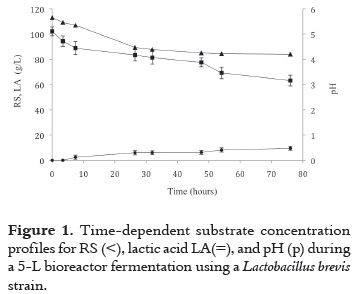
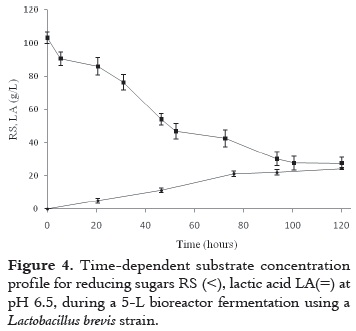
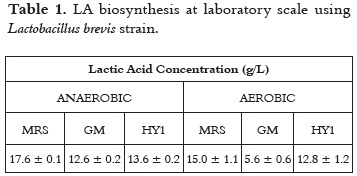
<body><![CDATA[<p><b> Lactic Acid Production under aerobic and anaerobic conditions</b></p>     <p> For the purpose of this work, a<i> Lactobacillus   brevis</i> strain was used; <a href="#t1">table 1</a> shows values for LA   production. Although the highest LA content was   achieved under anaerobic conditions, statistical   significance (P &lt; 0.05) was only found for the GM   culture medium, when comparing the effect of   presence or absence of oxygen in the same medium.   Similarly, statistical significance was found when   comparing anaerobic LA production in the three evaluated culture media.</p>     <p align="center"><a name="t1"></a><img src="/img/revistas/vitae/v19n3/v19n3a7t1.jpg"></p>     <p>&nbsp;</p>     <p> Based on these results and taking into account   the nutritional requirements of <i>Lactobacillus</i> strains,   the medium HY1, with cassava flour as carbon   source, was selected for further experiments at bioreactor scale.</p>     <p> <b>pH control effect on LA biosynthesis</b></p>     <p> LA biosynthesis is strongly influenced by pH   control. According to Adamberg <i>et al.</i>, 2003 (20),   pH levels should not exceed values around 4-7. LA   biosynthesis at bioreactor scale with no pH control,   rendered a poor yield, Y<sub>P/S</sub> = 0.24, productivity: 0.12   g/L.h and a low concentration of LA 9.55 &plusmn; 1.50   g/L, compared to that of erlenmeyer, 13.60 &plusmn; 0.20   g/L at the same culture conditions (medium HY1,   T = 38&deg;C, initial pH: 5.6). The differences between   these results are, eventually, not only a scale   difference effect but also the effect of a modified   composition in the medium for inoculum preparation,   using a rich medium (MRS) at erlenmeyer scale, and a poorer medium (HY1) at reactor scale.</p>     <p align="center"><a name="f1"></a><img src="/img/revistas/vitae/v19n3/v19n3a7f1.jpg"></p>     <p>&nbsp;</p>     <p> As it is observed in <a href="#f1">figure 1</a>, while substrate is   consumed at the beginning of the fermentation, LA   biosynthesis takes 5h to start being accumulated,   perhaps due to the lag period that the organism   needs to get comfortable with the new environment. After 48h of cultivation, pH stabilizes around 4.2.</p>     ]]></body>
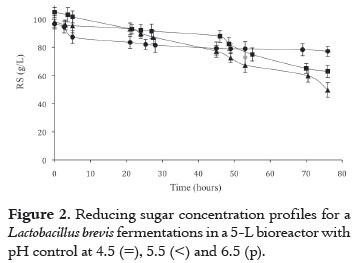
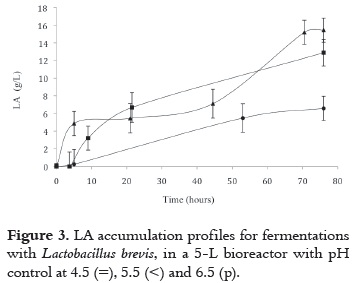
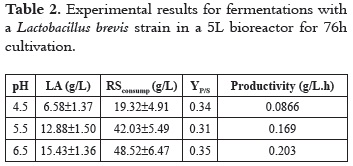
<body><![CDATA[<p> <a href="#f2">Figures 2</a> and <a href="#f3">3</a> disclose the time variation for   substrate and LA concentration, in fermentations   carried out in a 5L biorreactor with pH control.   As it is shown, the higher the pH, the higher   the LA accumulation and a corresponding lower   residual substrate concentration; thus, for pH   controlled at 4.5, 5.5 and 6.5, LA production reached   concentrations of 6.58 &plusmn; 1.37, 12.88 &plusmn; 1.50 and 15.43 &plusmn; 1.36 g/L, respectively.</p>     <p align="center"><a name="f2"></a><img src="/img/revistas/vitae/v19n3/v19n3a7f2.jpg"></p>     <p align="center">&nbsp;</p>     <p align="center"><a name="f3"></a><img src="/img/revistas/vitae/v19n3/v19n3a7f3.jpg"></p>     <p>&nbsp;</p>     <p> After running a t-student test, it was found that   there was no statistical significance (P &gt; 0.05)   by comparing LA concentration reached after a   fermentation process with pH control at 5.5 and 6.5.   Conversely, lower pH conditions (4.5) did result in   a reduction of LA accumulation; both, pH values of   4.5 and 5.5, and, 4.5 and 6.5 did render a statistical significance (P &lt; 0.05).</p>     <p> <a href="#t2">Table 2</a> summarizes the changes in product   biosynthesis and reducing sugar (RS) consumption   for different pH control levels. As it is observed,   there is a major shift in LA accumulation when pH   control is raised from 4.5 to 5.5, producing a nearly threefold higher LA concentration.</p>     <p align="center"><a name="t2"></a><img src="/img/revistas/vitae/v19n3/v19n3a7t2.jpg"></p>     <p>&nbsp;</p>     <p> Due to pH control in the fermentation process,   at pH 6.5, LA biosynthesis increased 61.6%, and Y<sub>P/S</sub>  and productivity were 45.4% and 69%, respectively, higher than those with no pH control.</p>     ]]></body>
<body><![CDATA[<p> According to <a href="#f3">figure 3</a>, LA accumulation profiles   still show product biosynthesis activity at the 76<sup>th</sup>  hour of cultivation; this might be the result of a   scarce inoculum concentration and/or insufficient   fermentation time for total substrate consumption.   Therefore, in order to asses this hypothesis further   experimentation was undertaken, increasing   inoculum concentration in the HY culture   medium in a 50%, and incubated at 28&deg;C for 24h.   Afterward, the 5L reactor was inoculated and the   fermentation was extended until the 120th hour with pH controlled at 6.5. See <a href="#f4">figure 4</a>.</p>     <p align="center"><a name="f4"></a><img src="/img/revistas/vitae/v19n3/v19n3a7f4.jpg"></p>     <p>&nbsp;</p>     <p> LA accumulated mostly during the first 76   hours of cultivation, with no significant increment   between the 76<sup>th</sup> and 120<sup>th</sup> hour. The largest LA   accumulation, reached at 120h, was 24.3 &plusmn; 0.7   g/L; however, the concentration of LA obtained   at the 76<sup>th</sup> hour with no inoculum concentration   increment (15.43 &plusmn; 1.36 g/L), was lower than   that reached at the same time of cultivation   with increased inoculum concentration (21.23 &plusmn; 1.67 g/L); therefore, the improvement in LA biosynthesis was clearly the result of increasing inoculum concentration rather than enlarging time of cultivation.</p>     <p>&nbsp;</p>     <p><font size="3"> <b>DISCUSSION</b></font></p>     <p> The genus <i>Lactobacillus</i> has been widely known   as the major LA producer strain. These organisms   have limited ability for synthesizing their own   growth factors, mainly B vitamins and aminoacids.   Typically, they require carbon and nitrogen sources   and diverse elements in the form of carbohydrates,   aminoacids, vitamins and minerals. In addition,   the use of assortments of aminoacids, peptides and   amides, stimulate growth of lactic acid bacteria   (LAB) yielding much higher values than those   obtained with free aminoacids. LAB growth is also   influenced by fatty acid and phosphate which are   the most important salt in the LA fermentation.   For most lactic strains, ammonium cannot serve as   the only nitrogen source; yet, they apparently have   shown some influence on amino acid metabolism.   Conversely, the amount of minerals found in   commercial complex media seems to be sufficient   for LA metabolism (10).</p>     <p> Taking into consideration all the aforementioned,   it can be stated that cassava f lour, the main   component for the HY1 medium, became an   appropriate substrate for LA biosynthesis. According   to Cardona <i>et al.</i>, 2011 (21), cassava flour has 81.48%   of starch. When 300g/L of cassava f lour are   prepared, 99% of starch is hydrolyzed reaching a   glucose content of about 76%; the remaining part is   maltodextrines. Based on this analysis, and besides   reducing sugars, cassava flour has different ions   including sodium, calcium, iron and magnesium,   aminoacids and proteins that might have favored bacterial growth and product biosynthesis.</p>     <p> Even though <i>Lactobacillus</i> is a facultative anaerobic   organism, its metabolic activity is enhanced in the   absence of oxygen, among other factors, by the need   of the oxidized form of the cofactor NAD<sup>+</sup>, which   is reduced during the catabolic activity. The NADH   donates its extra electrons to the pyruvate molecule   formed during glycolysis; since the NADH has lost   electrons, NAD<sup>+</sup> regenerates and is again available   for glycolysis (16). Yet, as a facultative anaerobic   bacterium, <i>Lactobacillus</i> is able to ferment and also   experience cellular respiration when oxygen is   present; the process is called heterofermentative   LA biosynthesis; in such a case, carbon dioxide   and ethanol are present, thus rendering a LA yield   reduction (22).</p>     <p> Conversely, though LAB is acid-tolerant, it has   been shown that the pH is an important factor   in acid fermentation including lactic acid (23).   Different pH values in the medium did influence   not only the cell growth but the biosynthesis rate.   Moreover, variability in the medium pH might have   stimulated a metabolic shift, a theme that merits   further experimental evidence.</p>     ]]></body>
<body><![CDATA[<p> LA concentration reached in this study is   comparable with most literature reports. For   substrates such as glucose, corn flour, sawdust,   molasses, whey, among others, LA production   ranges from 1 to 100 g/L, using commercial strains   such as <i>Lb. plantarum, Lb. casei, Lb. delbrueckii, Lb.   helveticus</i>, among others (16). Siebold <i>et al.</i>, 1995   (14), and Kious <i>et al.</i>, 2000 (24), did report LA   production close to 26.8 - 27.8 g/L and 13.3 - 19.6   g/L, respectively, using glucose as the unique   substrate. The present study reports production   of LA close to 24.3 &plusmn; 0.7g/L using an inexpensive   substrate with low salt content, and what is most relevant, with a non-commercial strain.</p>     <p>&nbsp;</p>     <p> <b>CONCLUSIONS</b></p>     <p> It was demonstrated that LA biosynthesis can   be accomplished competitively using alternative   low-cost nutrient-rich substrates such as cassava   flour. This kind of substrates show high nutrient   and reducing sugar content as well as calcium and   aminoacids, all of them available for the fermentative   process.</p>     <p> Since <i>Lactobacillus</i> is able to ferment and also   experience cellular respiration, in the presence   of oxygen, carbon dioxide and ethanol were also   synthesized, thus provoking a LA titer reduction;   therefore, the largest LA accumulation was attained   under anaerobic conditions. LA titers, reached   in this study, were comparable to most literature   reports, even those using refined and substantially   more expensive substrates as unique carbon source.</p>     <p> LA biosynthesis was also dependant on pH   control, since a strict control of pH level close to   6.5 rendered a 65% increment in LA accumulation,   weighed against lower pH values. The larger LA   accumulation might be the result of a metabolic   shift at pH values above 6. This argument entails   more detailed experimental support; work currently   in progress.</p>     <p>&nbsp;</p>     <p> <font size="3"><b>AKNOWLEDGMENT</b></font></p>     <p> The authors thank the Comit&eacute; para el desarrollo   de la investigaci&oacute;n &#8211; CODI Universidad de Antioquia   for financial aid: Project MC07-01-13.</p>     <p>&nbsp;</p>     ]]></body>
<body><![CDATA[<p><font size="3"><b>REFERENCES</b></font></p>     <!-- ref --><p>1. De Lima C, Coelho F, Contiero J. The Use of Response Surface   Methodology in Optimization of Lactic Acid Production: Focus   on Medium Supplementation, Temperature and pH Control.   Food Technol Biotechnol. 2010; 48 (2): 175 - 181.    &nbsp;&nbsp;&nbsp;&nbsp;&nbsp;&nbsp;&nbsp;&nbsp;[&#160;<a href="javascript:void(0);" onclick="javascript: window.open('/scielo.php?script=sci_nlinks&ref=000094&pid=S0121-4004201200030000700001&lng=','','width=640,height=500,resizable=yes,scrollbars=1,menubar=yes,');">Links</a>&#160;]<!-- end-ref --></p>     <!-- ref --><p>  2. Sauer M, Porro D, Mattanovich D, Branduardi P. Microbial   production of organic acids: expanding the markets. Trends   Biotechnol. 2008 Feb; 26(2):100-108.    &nbsp;&nbsp;&nbsp;&nbsp;&nbsp;&nbsp;&nbsp;&nbsp;[&#160;<a href="javascript:void(0);" onclick="javascript: window.open('/scielo.php?script=sci_nlinks&ref=000096&pid=S0121-4004201200030000700002&lng=','','width=640,height=500,resizable=yes,scrollbars=1,menubar=yes,');">Links</a>&#160;]<!-- end-ref --></p>     <!-- ref --><p>  3. Mohamed A, Yukihiro T, Kenji S. Lactic acid production from   lignocellulose-derived sugars using lactic acid bacteria: Overview   and limits. J Biotechnol. 2010 Dec 20; 156 (4): 286 - 301.    &nbsp;&nbsp;&nbsp;&nbsp;&nbsp;&nbsp;&nbsp;&nbsp;[&#160;<a href="javascript:void(0);" onclick="javascript: window.open('/scielo.php?script=sci_nlinks&ref=000098&pid=S0121-4004201200030000700003&lng=','','width=640,height=500,resizable=yes,scrollbars=1,menubar=yes,');">Links</a>&#160;]<!-- end-ref --></p>     <!-- ref --><p>  4. Harington T, Hossain Md. Extraction of lactic acid into sunflower   oil and its recovery into an aqueous solution. Department of   Chemical and Materials Engineering. 2008 Jan 5; 218: 287 - 296.    &nbsp;&nbsp;&nbsp;&nbsp;&nbsp;&nbsp;&nbsp;&nbsp;[&#160;<a href="javascript:void(0);" onclick="javascript: window.open('/scielo.php?script=sci_nlinks&ref=000100&pid=S0121-4004201200030000700004&lng=','','width=640,height=500,resizable=yes,scrollbars=1,menubar=yes,');">Links</a>&#160;]<!-- end-ref --></p>     <!-- ref --><p>  5. L&oacute;pez C, Zuluaga A, Herrera S, Ruiz A, Medina V. Producci&oacute;n   de &aacute;cido c&iacute;trico con Aspergillus niger NRRL 2270 a partir de   suero de leche. Rev Dyna. 2006 Nov; 73 (150): 39 - 57.    &nbsp;&nbsp;&nbsp;&nbsp;&nbsp;&nbsp;&nbsp;&nbsp;[&#160;<a href="javascript:void(0);" onclick="javascript: window.open('/scielo.php?script=sci_nlinks&ref=000102&pid=S0121-4004201200030000700005&lng=','','width=640,height=500,resizable=yes,scrollbars=1,menubar=yes,');">Links</a>&#160;]<!-- end-ref --></p>     <!-- ref --><p>  6. Gil R, Dom&iacute;nguez R, Pacho J. Bioproducci&oacute;n de &aacute;cido l&aacute;ctico a   partir de residuos de c&aacute;scara de naranja: Procesos de separaci&oacute;n   y purificaci&oacute;n. Tecnolog Ciencia. 2008; 23 (2): 79 - 90.    &nbsp;&nbsp;&nbsp;&nbsp;&nbsp;&nbsp;&nbsp;&nbsp;[&#160;<a href="javascript:void(0);" onclick="javascript: window.open('/scielo.php?script=sci_nlinks&ref=000104&pid=S0121-4004201200030000700006&lng=','','width=640,height=500,resizable=yes,scrollbars=1,menubar=yes,');">Links</a>&#160;]<!-- end-ref --></p>     <!-- ref --><p>  7. Darouneh E, Alavi A, Vosoughi M, Arjmand M, Sifkordi A, Rabaji   R. Citric acid production: Surface culture versus submerged   culture. African Journal of Microbiology Research. 2009 Sep; 3   (9): 541 - 545.    &nbsp;&nbsp;&nbsp;&nbsp;&nbsp;&nbsp;&nbsp;&nbsp;[&#160;<a href="javascript:void(0);" onclick="javascript: window.open('/scielo.php?script=sci_nlinks&ref=000106&pid=S0121-4004201200030000700007&lng=','','width=640,height=500,resizable=yes,scrollbars=1,menubar=yes,');">Links</a>&#160;]<!-- end-ref --></p>     <!-- ref --><p>  8. Sneath P, Bergey's. Manual of systematic bacteriology. Williams   and Wilkins Baltimore. London. 1984; Vol. II: 464.    &nbsp;&nbsp;&nbsp;&nbsp;&nbsp;&nbsp;&nbsp;&nbsp;[&#160;<a href="javascript:void(0);" onclick="javascript: window.open('/scielo.php?script=sci_nlinks&ref=000108&pid=S0121-4004201200030000700008&lng=','','width=640,height=500,resizable=yes,scrollbars=1,menubar=yes,');">Links</a>&#160;]<!-- end-ref --></p>     <!-- ref --><p>  9. Hofvendahl K, Hhanh&auml;gerdal H. Factors affecting the fermentative   lactic acid production from renowable resource. Enzyme   Microb Tech. 2000 Feb 1; 26 (2-4): 87 - 107.    &nbsp;&nbsp;&nbsp;&nbsp;&nbsp;&nbsp;&nbsp;&nbsp;[&#160;<a href="javascript:void(0);" onclick="javascript: window.open('/scielo.php?script=sci_nlinks&ref=000110&pid=S0121-4004201200030000700009&lng=','','width=640,height=500,resizable=yes,scrollbars=1,menubar=yes,');">Links</a>&#160;]<!-- end-ref --></p>     <!-- ref --><p>  10. Young-Jung Wee, Jin-Nam Kim, Hwa-Won Ryu. Biotechnological   Production of Lactic Acid and Its Recent Applications. Food   Technol Biotechnol. 2006; 44 (2): 163 - 172.    &nbsp;&nbsp;&nbsp;&nbsp;&nbsp;&nbsp;&nbsp;&nbsp;[&#160;<a href="javascript:void(0);" onclick="javascript: window.open('/scielo.php?script=sci_nlinks&ref=000112&pid=S0121-4004201200030000700010&lng=','','width=640,height=500,resizable=yes,scrollbars=1,menubar=yes,');">Links</a>&#160;]<!-- end-ref --></p>     <!-- ref --><p>  11. Kwon S, Lee P, Lee E, Chang Y, Chang N. Production of lactic   acid by <i>Lactobacillus rhamnosus</i> with vitamin-supplemented soybean   hydrolysate. Enzyme Microbiol Tech. 2000 Feb 1; 26 (2-4):   209 - 215.    &nbsp;&nbsp;&nbsp;&nbsp;&nbsp;&nbsp;&nbsp;&nbsp;[&#160;<a href="javascript:void(0);" onclick="javascript: window.open('/scielo.php?script=sci_nlinks&ref=000114&pid=S0121-4004201200030000700011&lng=','','width=640,height=500,resizable=yes,scrollbars=1,menubar=yes,');">Links</a>&#160;]<!-- end-ref --></p>     <!-- ref --><p>  12. Anuradha R, Suresh A, Venkatesh K. Simultaneous saccharification   and fermentation of starch to lactic acid. Process Biochem.   1999; 35: 367 - 375.    &nbsp;&nbsp;&nbsp;&nbsp;&nbsp;&nbsp;&nbsp;&nbsp;[&#160;<a href="javascript:void(0);" onclick="javascript: window.open('/scielo.php?script=sci_nlinks&ref=000116&pid=S0121-4004201200030000700012&lng=','','width=640,height=500,resizable=yes,scrollbars=1,menubar=yes,');">Links</a>&#160;]<!-- end-ref --></p>     <!-- ref --><p>  13. Moldes A, Alonso J, Paraj&oacute; J. Resin selection and single-step   production and recovery of lactic acid from pretreated wood.   Appl Biochem Biotechnol. 2001 Aug; 95 (2): 69 - 81.    &nbsp;&nbsp;&nbsp;&nbsp;&nbsp;&nbsp;&nbsp;&nbsp;[&#160;<a href="javascript:void(0);" onclick="javascript: window.open('/scielo.php?script=sci_nlinks&ref=000118&pid=S0121-4004201200030000700013&lng=','','width=640,height=500,resizable=yes,scrollbars=1,menubar=yes,');">Links</a>&#160;]<!-- end-ref --></p>     <!-- ref --><p>  14. Siebold M, Frieling P, Joppien R, Rindf leisch D, Sch&uuml;gerl   K, R&ouml;per H. Comparison of the production of lactic acid by   three different lactobacilli and its recovery by extraction and   electrodialysis. Process Biochem. 1995; 30 (1): 81 - 95.    &nbsp;&nbsp;&nbsp;&nbsp;&nbsp;&nbsp;&nbsp;&nbsp;[&#160;<a href="javascript:void(0);" onclick="javascript: window.open('/scielo.php?script=sci_nlinks&ref=000120&pid=S0121-4004201200030000700014&lng=','','width=640,height=500,resizable=yes,scrollbars=1,menubar=yes,');">Links</a>&#160;]<!-- end-ref --></p>     <!-- ref --><p>  15. Narayanan N, Roychoudhury P, Srivastava A. L (+) lactic acid   fermentation and its product polymerization. Electro J Biotechn.   2004 Aug 15; 7 (2): 167 - 179.    &nbsp;&nbsp;&nbsp;&nbsp;&nbsp;&nbsp;&nbsp;&nbsp;[&#160;<a href="javascript:void(0);" onclick="javascript: window.open('/scielo.php?script=sci_nlinks&ref=000122&pid=S0121-4004201200030000700015&lng=','','width=640,height=500,resizable=yes,scrollbars=1,menubar=yes,');">Links</a>&#160;]<!-- end-ref --></p>     <!-- ref --><p>  16. Serna L, Rodr&iacute;guez A. Producci&oacute;n Biotecnol&oacute;gica de &aacute;cido l&aacute;ctio:   Estado del arte. Cienc Tecnol Aliment. 2005; 5 (1): 54 - 65.    &nbsp;&nbsp;&nbsp;&nbsp;&nbsp;&nbsp;&nbsp;&nbsp;[&#160;<a href="javascript:void(0);" onclick="javascript: window.open('/scielo.php?script=sci_nlinks&ref=000124&pid=S0121-4004201200030000700016&lng=','','width=640,height=500,resizable=yes,scrollbars=1,menubar=yes,');">Links</a>&#160;]<!-- end-ref --></p>     <!-- ref --><p>  17. Rios O, Casta&ntilde;o H. Escalado del proceso de producci&oacute;n de jarabes   glucosados en un reactor Batch de 5 a 500 litros como etapa previa   a la fermentaci&oacute;n etan&oacute;lica a partir de harina de yuca &#91;Tesis de   pregrado&#93;. &#91;Medell&iacute;n, Colombia&#93;: Universidad de Antioquia:   2009. 48p.    &nbsp;&nbsp;&nbsp;&nbsp;&nbsp;&nbsp;&nbsp;&nbsp;[&#160;<a href="javascript:void(0);" onclick="javascript: window.open('/scielo.php?script=sci_nlinks&ref=000126&pid=S0121-4004201200030000700017&lng=','','width=640,height=500,resizable=yes,scrollbars=1,menubar=yes,');">Links</a>&#160;]<!-- end-ref --></p>     <!-- ref --><p>  18. Breuil C, Saddler J. Comparisons of 3,5-dinitosalicylic acid and   nelson&#8211;somogyi methods of reducing sugars and determining   cellulose activity. Enzyme Microb Technol. 1984; 7: 327 - 332.    &nbsp;&nbsp;&nbsp;&nbsp;&nbsp;&nbsp;&nbsp;&nbsp;[&#160;<a href="javascript:void(0);" onclick="javascript: window.open('/scielo.php?script=sci_nlinks&ref=000128&pid=S0121-4004201200030000700018&lng=','','width=640,height=500,resizable=yes,scrollbars=1,menubar=yes,');">Links</a>&#160;]<!-- end-ref --></p>     <!-- ref --><p>  19. Hussain M, Rouch D, Britz M. Biochemistry of non-starter lactic   acid bacteria isolate <i>Lactobacillus casei</i> GCRL163: Production of   metabolites by stationary-phase cultures. Int Dairy J. 2009; 19   (1): 12 - 21.    &nbsp;&nbsp;&nbsp;&nbsp;&nbsp;&nbsp;&nbsp;&nbsp;[&#160;<a href="javascript:void(0);" onclick="javascript: window.open('/scielo.php?script=sci_nlinks&ref=000130&pid=S0121-4004201200030000700019&lng=','','width=640,height=500,resizable=yes,scrollbars=1,menubar=yes,');">Links</a>&#160;]<!-- end-ref --></p>     <!-- ref --><p>  20. Adamberg K, Kask S, Laht T, Paalme T. The effect of temperature   and pH on the growth of lactic acid bacteria: a pH-auxostat study.   Int J Food Microbiol. 2003 Aug 15; 85 (1-2): 171 - 183.    &nbsp;&nbsp;&nbsp;&nbsp;&nbsp;&nbsp;&nbsp;&nbsp;[&#160;<a href="javascript:void(0);" onclick="javascript: window.open('/scielo.php?script=sci_nlinks&ref=000132&pid=S0121-4004201200030000700020&lng=','','width=640,height=500,resizable=yes,scrollbars=1,menubar=yes,');">Links</a>&#160;]<!-- end-ref --></p>     <!-- ref --><p>  21. Cardona M, Agudelo L. Producci&oacute;n de Biopol&iacute;meros (Polihidroxialcanoatos)   a partir de una cepa comercial empleando   sustratos no convencionales &#91;Tesis Maestr&iacute;a en Ingenier&iacute;a&#93;.   &#91;Medell&iacute;n, Colombia&#93;: Universidad de Antioquia; 2011. 50p.    &nbsp;&nbsp;&nbsp;&nbsp;&nbsp;&nbsp;&nbsp;&nbsp;[&#160;<a href="javascript:void(0);" onclick="javascript: window.open('/scielo.php?script=sci_nlinks&ref=000134&pid=S0121-4004201200030000700021&lng=','','width=640,height=500,resizable=yes,scrollbars=1,menubar=yes,');">Links</a>&#160;]<!-- end-ref --></p>     <!-- ref --><p>  22. Thomas T, Ellwood D, Longyear V. Change from homo- and   heterolactic fermentation by Streptococcus lactis resulting from   glucose limitation in anaerobic chemostat cultures. J Bacteriol.   1979 Apr; 138 (1): 109 - 117.    &nbsp;&nbsp;&nbsp;&nbsp;&nbsp;&nbsp;&nbsp;&nbsp;[&#160;<a href="javascript:void(0);" onclick="javascript: window.open('/scielo.php?script=sci_nlinks&ref=000136&pid=S0121-4004201200030000700022&lng=','','width=640,height=500,resizable=yes,scrollbars=1,menubar=yes,');">Links</a>&#160;]<!-- end-ref --></p>     <!-- ref --><p>  23. Silva E, Yang S. Kinetics and stability of a fibrous-bed bioreactor   for continuous production of lactic from unsupplemented acid   whey. J Biotechnol. 1995 Jul 15; 41 (1): 59 &#8211; 70.    &nbsp;&nbsp;&nbsp;&nbsp;&nbsp;&nbsp;&nbsp;&nbsp;[&#160;<a href="javascript:void(0);" onclick="javascript: window.open('/scielo.php?script=sci_nlinks&ref=000138&pid=S0121-4004201200030000700023&lng=','','width=640,height=500,resizable=yes,scrollbars=1,menubar=yes,');">Links</a>&#160;]<!-- end-ref --></p>     <!-- ref --><p>  24. Kious J. Lactobacillus and lactic acid production &#91;Tesis&#93;. &#91;Golden, Colorado&#93;: Le Tourneau University; 2000. 32 - 33 p.    &nbsp;&nbsp;&nbsp;&nbsp;&nbsp;&nbsp;&nbsp;&nbsp;[&#160;<a href="javascript:void(0);" onclick="javascript: window.open('/scielo.php?script=sci_nlinks&ref=000140&pid=S0121-4004201200030000700024&lng=','','width=640,height=500,resizable=yes,scrollbars=1,menubar=yes,');">Links</a>&#160;]<!-- end-ref --></p>     <p>&nbsp;</p> </font>     ]]></body>
<body><![CDATA[ ]]></body><back>
<ref-list>
<ref id="B1">
<label>1</label><nlm-citation citation-type="journal">
<person-group person-group-type="author">
<name>
<surname><![CDATA[DeLima]]></surname>
<given-names><![CDATA[C]]></given-names>
</name>
<name>
<surname><![CDATA[Coelho]]></surname>
<given-names><![CDATA[F]]></given-names>
</name>
<name>
<surname><![CDATA[Contiero]]></surname>
<given-names><![CDATA[J.]]></given-names>
</name>
</person-group>
<article-title xml:lang="en"><![CDATA[The Use of Response Surface Methodology in Optimization of Lactic Acid Production: Focus on Medium Supplementation, Temperature and pH Control]]></article-title>
<source><![CDATA[Food Technol Biotechnol]]></source>
<year>2010</year>
<volume>48</volume>
<numero>2</numero>
<issue>2</issue>
<page-range>175 - 181</page-range></nlm-citation>
</ref>
<ref id="B2">
<label>2</label><nlm-citation citation-type="journal">
<person-group person-group-type="author">
<name>
<surname><![CDATA[Sauer]]></surname>
<given-names><![CDATA[M]]></given-names>
</name>
<name>
<surname><![CDATA[Porro]]></surname>
<given-names><![CDATA[D]]></given-names>
</name>
<name>
<surname><![CDATA[Mattanovich]]></surname>
<given-names><![CDATA[D]]></given-names>
</name>
<name>
<surname><![CDATA[Branduardi]]></surname>
<given-names><![CDATA[P.]]></given-names>
</name>
</person-group>
<article-title xml:lang="en"><![CDATA[Microbial production of organic acids: expanding the markets]]></article-title>
<source><![CDATA[Trends Biotechnol]]></source>
<year>2008</year>
<month> F</month>
<day>eb</day>
<volume>26</volume>
<numero>2</numero>
<issue>2</issue>
<page-range>100-108</page-range></nlm-citation>
</ref>
<ref id="B3">
<label>3</label><nlm-citation citation-type="journal">
<person-group person-group-type="author">
<name>
<surname><![CDATA[Mohamed]]></surname>
<given-names><![CDATA[A]]></given-names>
</name>
<name>
<surname><![CDATA[Yukihiro]]></surname>
<given-names><![CDATA[T]]></given-names>
</name>
<name>
<surname><![CDATA[Kenji]]></surname>
<given-names><![CDATA[S.]]></given-names>
</name>
</person-group>
<article-title xml:lang="en"><![CDATA[Lactic acid production from lignocellulose-derived sugars using lactic acid bacteria: Overview and limits]]></article-title>
<source><![CDATA[J Biotechnol]]></source>
<year>2010</year>
<month> D</month>
<day>ec</day>
<volume>156</volume>
<numero>4</numero>
<issue>4</issue>
<page-range>286 - 301</page-range></nlm-citation>
</ref>
<ref id="B4">
<label>4</label><nlm-citation citation-type="journal">
<person-group person-group-type="author">
<name>
<surname><![CDATA[Harington]]></surname>
<given-names><![CDATA[T]]></given-names>
</name>
<name>
<surname><![CDATA[Hossain]]></surname>
<given-names><![CDATA[Md.]]></given-names>
</name>
</person-group>
<article-title xml:lang="en"><![CDATA[Extraction of lactic acid into sunflower oil and its recovery into an aqueous solution]]></article-title>
<source><![CDATA[Department of Chemical and Materials Engineering]]></source>
<year>2008</year>
<month> J</month>
<day>an</day>
<volume>218</volume>
<page-range>287 - 296</page-range></nlm-citation>
</ref>
<ref id="B5">
<label>5</label><nlm-citation citation-type="journal">
<person-group person-group-type="author">
<name>
<surname><![CDATA[López]]></surname>
<given-names><![CDATA[C]]></given-names>
</name>
<name>
<surname><![CDATA[Zuluaga]]></surname>
<given-names><![CDATA[A]]></given-names>
</name>
<name>
<surname><![CDATA[Herrera]]></surname>
<given-names><![CDATA[S]]></given-names>
</name>
<name>
<surname><![CDATA[Ruiz]]></surname>
<given-names><![CDATA[A]]></given-names>
</name>
<name>
<surname><![CDATA[Medina]]></surname>
<given-names><![CDATA[V.]]></given-names>
</name>
</person-group>
<article-title xml:lang="es"><![CDATA[Producción de ácido cítrico con Aspergillus niger NRRL 2270 a partir de suero de leche]]></article-title>
<source><![CDATA[Rev Dyna]]></source>
<year>2006</year>
<month> N</month>
<day>ov</day>
<volume>73</volume>
<numero>150</numero>
<issue>150</issue>
<page-range>39 - 57</page-range></nlm-citation>
</ref>
<ref id="B6">
<label>6</label><nlm-citation citation-type="journal">
<person-group person-group-type="author">
<name>
<surname><![CDATA[Gil]]></surname>
<given-names><![CDATA[R]]></given-names>
</name>
<name>
<surname><![CDATA[Domínguez]]></surname>
<given-names><![CDATA[R]]></given-names>
</name>
<name>
<surname><![CDATA[Pacho]]></surname>
<given-names><![CDATA[J.]]></given-names>
</name>
</person-group>
<article-title xml:lang="es"><![CDATA[Bioproducción de ácido láctico a partir de residuos de cáscara de naranja: Procesos de separación y purificación]]></article-title>
<source><![CDATA[Tecnolog Ciencia]]></source>
<year>2008</year>
<volume>23</volume>
<numero>2</numero>
<issue>2</issue>
<page-range>79 - 90</page-range></nlm-citation>
</ref>
<ref id="B7">
<label>7</label><nlm-citation citation-type="journal">
<person-group person-group-type="author">
<name>
<surname><![CDATA[Darouneh]]></surname>
<given-names><![CDATA[E]]></given-names>
</name>
<name>
<surname><![CDATA[Alavi]]></surname>
<given-names><![CDATA[A]]></given-names>
</name>
<name>
<surname><![CDATA[Vosoughi]]></surname>
<given-names><![CDATA[M]]></given-names>
</name>
<name>
<surname><![CDATA[Arjmand]]></surname>
<given-names><![CDATA[M]]></given-names>
</name>
<name>
<surname><![CDATA[Sifkordi]]></surname>
<given-names><![CDATA[A]]></given-names>
</name>
<name>
<surname><![CDATA[Rabaji]]></surname>
<given-names><![CDATA[R.]]></given-names>
</name>
</person-group>
<article-title xml:lang="en"><![CDATA[Citric acid production: Surface culture versus submerged culture]]></article-title>
<source><![CDATA[African Journal of Microbiology Research]]></source>
<year>2009</year>
<month> S</month>
<day>ep</day>
<volume>3</volume>
<numero>9</numero>
<issue>9</issue>
<page-range>541 - 545</page-range></nlm-citation>
</ref>
<ref id="B8">
<label>8</label><nlm-citation citation-type="book">
<person-group person-group-type="author">
<name>
<surname><![CDATA[Sneath]]></surname>
<given-names><![CDATA[P]]></given-names>
</name>
</person-group>
<source><![CDATA[Bergey's. Manual of systematic bacteriology]]></source>
<year>1984</year>
<volume>II</volume>
<page-range>464</page-range><publisher-loc><![CDATA[London ]]></publisher-loc>
<publisher-name><![CDATA[Williams and Wilkins Baltimore]]></publisher-name>
</nlm-citation>
</ref>
<ref id="B9">
<label>9</label><nlm-citation citation-type="journal">
<person-group person-group-type="author">
<name>
<surname><![CDATA[Hofvendahl]]></surname>
<given-names><![CDATA[K]]></given-names>
</name>
<name>
<surname><![CDATA[Hhanhägerdal]]></surname>
<given-names><![CDATA[H.]]></given-names>
</name>
</person-group>
<article-title xml:lang="en"><![CDATA[Factors affecting the fermentative lactic acid production from renowable resource]]></article-title>
<source><![CDATA[Enzyme Microb Tech]]></source>
<year>2000</year>
<month> F</month>
<day>eb</day>
<volume>26</volume>
<numero>2-4</numero>
<issue>2-4</issue>
<page-range>87 - 107</page-range></nlm-citation>
</ref>
<ref id="B10">
<label>10</label><nlm-citation citation-type="journal">
<person-group person-group-type="author">
<name>
<surname><![CDATA[Young-Jung]]></surname>
<given-names><![CDATA[Wee]]></given-names>
</name>
<name>
<surname><![CDATA[Jin-Nam]]></surname>
<given-names><![CDATA[Kim]]></given-names>
</name>
<name>
<surname><![CDATA[Hwa-Won]]></surname>
<given-names><![CDATA[Ryu.]]></given-names>
</name>
</person-group>
<article-title xml:lang="en"><![CDATA[Biotechnological Production of Lactic Acid and Its Recent Applications]]></article-title>
<source><![CDATA[Food Technol Biotechnol]]></source>
<year>2006</year>
<volume>44</volume>
<numero>2</numero>
<issue>2</issue>
<page-range>163 - 172</page-range></nlm-citation>
</ref>
<ref id="B11">
<label>11</label><nlm-citation citation-type="journal">
<person-group person-group-type="author">
<name>
<surname><![CDATA[Kwon]]></surname>
<given-names><![CDATA[S]]></given-names>
</name>
<name>
<surname><![CDATA[Lee]]></surname>
<given-names><![CDATA[P]]></given-names>
</name>
<name>
<surname><![CDATA[Lee]]></surname>
<given-names><![CDATA[E]]></given-names>
</name>
<name>
<surname><![CDATA[Chang]]></surname>
<given-names><![CDATA[Y]]></given-names>
</name>
<name>
<surname><![CDATA[Chang]]></surname>
<given-names><![CDATA[N.]]></given-names>
</name>
</person-group>
<article-title xml:lang="en"><![CDATA[Production of lactic acid by Lactobacillus rhamnosus with vitamin-supplemented soybean hydrolysate]]></article-title>
<source><![CDATA[Enzyme Microbiol Tech]]></source>
<year>2000</year>
<month> F</month>
<day>eb</day>
<volume>26</volume>
<numero>2-4</numero>
<issue>2-4</issue>
<page-range>209 - 215</page-range></nlm-citation>
</ref>
<ref id="B12">
<label>12</label><nlm-citation citation-type="journal">
<person-group person-group-type="author">
<name>
<surname><![CDATA[Anuradha]]></surname>
<given-names><![CDATA[R]]></given-names>
</name>
<name>
<surname><![CDATA[Suresh]]></surname>
<given-names><![CDATA[A]]></given-names>
</name>
<name>
<surname><![CDATA[Venkatesh]]></surname>
<given-names><![CDATA[K.]]></given-names>
</name>
</person-group>
<article-title xml:lang="en"><![CDATA[Simultaneous saccharification and fermentation of starch to lactic acid]]></article-title>
<source><![CDATA[Process Biochem]]></source>
<year>1999</year>
<volume>35</volume>
<page-range>367 - 375</page-range></nlm-citation>
</ref>
<ref id="B13">
<label>13</label><nlm-citation citation-type="journal">
<person-group person-group-type="author">
<name>
<surname><![CDATA[Moldes]]></surname>
<given-names><![CDATA[A]]></given-names>
</name>
<name>
<surname><![CDATA[Alonso]]></surname>
<given-names><![CDATA[J]]></given-names>
</name>
<name>
<surname><![CDATA[Parajó]]></surname>
<given-names><![CDATA[J.]]></given-names>
</name>
</person-group>
<article-title xml:lang="en"><![CDATA[Resin selection and single-step production and recovery of lactic acid from pretreated wood]]></article-title>
<source><![CDATA[Appl Biochem Biotechnol]]></source>
<year>2001</year>
<month> A</month>
<day>ug</day>
<volume>95</volume>
<numero>2</numero>
<issue>2</issue>
<page-range>69 - 81</page-range></nlm-citation>
</ref>
<ref id="B14">
<label>14</label><nlm-citation citation-type="journal">
<person-group person-group-type="author">
<name>
<surname><![CDATA[Siebold]]></surname>
<given-names><![CDATA[M]]></given-names>
</name>
<name>
<surname><![CDATA[Frieling]]></surname>
<given-names><![CDATA[P]]></given-names>
</name>
<name>
<surname><![CDATA[Joppien]]></surname>
<given-names><![CDATA[R]]></given-names>
</name>
<name>
<surname><![CDATA[Rindf]]></surname>
<given-names><![CDATA[leisch D]]></given-names>
</name>
<name>
<surname><![CDATA[Schügerl]]></surname>
<given-names><![CDATA[K]]></given-names>
</name>
<name>
<surname><![CDATA[Röper]]></surname>
<given-names><![CDATA[H.]]></given-names>
</name>
</person-group>
<article-title xml:lang="en"><![CDATA[Comparison of the production of lactic acid by three different lactobacilli and its recovery by extraction and electrodialysis]]></article-title>
<source><![CDATA[Process Biochem]]></source>
<year>1995</year>
<volume>30</volume>
<numero>1</numero>
<issue>1</issue>
<page-range>81 - 95</page-range></nlm-citation>
</ref>
<ref id="B15">
<label>15</label><nlm-citation citation-type="journal">
<person-group person-group-type="author">
<name>
<surname><![CDATA[Narayanan]]></surname>
<given-names><![CDATA[N]]></given-names>
</name>
<name>
<surname><![CDATA[Roychoudhury]]></surname>
<given-names><![CDATA[P]]></given-names>
</name>
<name>
<surname><![CDATA[Srivastava]]></surname>
<given-names><![CDATA[A.]]></given-names>
</name>
</person-group>
<article-title xml:lang="en"><![CDATA[L (+) lactic acid fermentation and its product polymerization]]></article-title>
<source><![CDATA[Electro J Biotechn]]></source>
<year>2004</year>
<month> A</month>
<day>ug</day>
<volume>7</volume>
<numero>2</numero>
<issue>2</issue>
<page-range>167 - 179</page-range></nlm-citation>
</ref>
<ref id="B16">
<label>16</label><nlm-citation citation-type="journal">
<person-group person-group-type="author">
<name>
<surname><![CDATA[Serna]]></surname>
<given-names><![CDATA[L]]></given-names>
</name>
<name>
<surname><![CDATA[Rodríguez]]></surname>
<given-names><![CDATA[A.]]></given-names>
</name>
</person-group>
<article-title xml:lang="es"><![CDATA[Producción Biotecnológica de ácido láctio: Estado del arte]]></article-title>
<source><![CDATA[Cienc Tecnol Aliment]]></source>
<year>2005</year>
<volume>5</volume>
<numero>1</numero>
<issue>1</issue>
<page-range>54 - 65</page-range></nlm-citation>
</ref>
<ref id="B17">
<label>17</label><nlm-citation citation-type="">
<person-group person-group-type="author">
<name>
<surname><![CDATA[Rios]]></surname>
<given-names><![CDATA[O]]></given-names>
</name>
<name>
<surname><![CDATA[Castaño]]></surname>
<given-names><![CDATA[H]]></given-names>
</name>
</person-group>
<source><![CDATA[Escalado del proceso de producción de jarabes glucosados en un reactor Batch de 5 a 500 litros como etapa previa a la fermentación etanólica a partir de harina de yuca]]></source>
<year></year>
<page-range>48</page-range></nlm-citation>
</ref>
<ref id="B18">
<label>18</label><nlm-citation citation-type="journal">
<person-group person-group-type="author">
<name>
<surname><![CDATA[Breuil]]></surname>
<given-names><![CDATA[C]]></given-names>
</name>
<name>
<surname><![CDATA[Saddler]]></surname>
<given-names><![CDATA[J.]]></given-names>
</name>
</person-group>
<article-title xml:lang="en"><![CDATA[Comparisons of 3,5-dinitosalicylic acid and nelson-somogyi methods of reducing sugars and determining cellulose activity]]></article-title>
<source><![CDATA[Enzyme Microb Technol]]></source>
<year>1984</year>
<volume>7</volume>
<page-range>327 - 332</page-range></nlm-citation>
</ref>
<ref id="B19">
<label>19</label><nlm-citation citation-type="journal">
<person-group person-group-type="author">
<name>
<surname><![CDATA[Hussain]]></surname>
<given-names><![CDATA[M]]></given-names>
</name>
<name>
<surname><![CDATA[Rouch]]></surname>
<given-names><![CDATA[D]]></given-names>
</name>
<name>
<surname><![CDATA[Britz]]></surname>
<given-names><![CDATA[M.]]></given-names>
</name>
</person-group>
<article-title xml:lang="en"><![CDATA[Biochemistry of non-starter lactic acid bacteria isolate Lactobacillus casei GCRL163: Production of metabolites by stationary-phase cultures]]></article-title>
<source><![CDATA[Int Dairy J]]></source>
<year>2009</year>
<volume>19</volume>
<numero>1</numero>
<issue>1</issue>
<page-range>12 - 21</page-range></nlm-citation>
</ref>
<ref id="B20">
<label>20</label><nlm-citation citation-type="journal">
<person-group person-group-type="author">
<name>
<surname><![CDATA[Adamberg]]></surname>
<given-names><![CDATA[K]]></given-names>
</name>
<name>
<surname><![CDATA[Kask]]></surname>
<given-names><![CDATA[S]]></given-names>
</name>
<name>
<surname><![CDATA[Laht]]></surname>
<given-names><![CDATA[T]]></given-names>
</name>
<name>
<surname><![CDATA[Paalme]]></surname>
<given-names><![CDATA[T.]]></given-names>
</name>
</person-group>
<article-title xml:lang="en"><![CDATA[The effect of temperature and pH on the growth of lactic acid bacteria: a pH-auxostat study]]></article-title>
<source><![CDATA[Int J Food Microbiol]]></source>
<year>2003</year>
<month> A</month>
<day>ug</day>
<volume>85</volume>
<numero>1-2</numero>
<issue>1-2</issue>
<page-range>171 - 183</page-range></nlm-citation>
</ref>
<ref id="B21">
<label>21</label><nlm-citation citation-type="book">
<person-group person-group-type="author">
<name>
<surname><![CDATA[Cardona]]></surname>
<given-names><![CDATA[M]]></given-names>
</name>
<name>
<surname><![CDATA[Agudelo]]></surname>
<given-names><![CDATA[L]]></given-names>
</name>
</person-group>
<source><![CDATA[Producción de Biopolímeros (Polihidroxialcanoatos) a partir de una cepa comercial empleando sustratos no convencionales]]></source>
<year>2011</year>
<page-range>50</page-range><publisher-loc><![CDATA[Medellín ]]></publisher-loc>
<publisher-name><![CDATA[Universidad de Antioquia]]></publisher-name>
</nlm-citation>
</ref>
<ref id="B22">
<label>22</label><nlm-citation citation-type="journal">
<person-group person-group-type="author">
<name>
<surname><![CDATA[Thomas]]></surname>
<given-names><![CDATA[T]]></given-names>
</name>
<name>
<surname><![CDATA[Ellwood]]></surname>
<given-names><![CDATA[D]]></given-names>
</name>
<name>
<surname><![CDATA[Longyear]]></surname>
<given-names><![CDATA[V.]]></given-names>
</name>
</person-group>
<article-title xml:lang="en"><![CDATA[Change from homo- and heterolactic fermentation by Streptococcus lactis resulting from glucose limitation in anaerobic chemostat cultures]]></article-title>
<source><![CDATA[J Bacteriol]]></source>
<year>1979</year>
<month> A</month>
<day>pr</day>
<volume>138</volume>
<numero>1</numero>
<issue>1</issue>
<page-range>109 - 117</page-range></nlm-citation>
</ref>
<ref id="B23">
<label>23</label><nlm-citation citation-type="journal">
<person-group person-group-type="author">
<name>
<surname><![CDATA[Silva]]></surname>
<given-names><![CDATA[E]]></given-names>
</name>
<name>
<surname><![CDATA[Yang]]></surname>
<given-names><![CDATA[S.]]></given-names>
</name>
</person-group>
<article-title xml:lang="en"><![CDATA[Kinetics and stability of a fibrous-bed bioreactor for continuous production of lactic from unsupplemented acid whey]]></article-title>
<source><![CDATA[J Biotechnol]]></source>
<year>1995</year>
<month> J</month>
<day>ul</day>
<volume>41</volume>
<numero>1</numero>
<issue>1</issue>
<page-range>59 - 70</page-range></nlm-citation>
</ref>
<ref id="B24">
<label>24</label><nlm-citation citation-type="book">
<person-group person-group-type="author">
<name>
<surname><![CDATA[Kious]]></surname>
<given-names><![CDATA[J]]></given-names>
</name>
</person-group>
<source><![CDATA[Lactobacillus and lactic acid production]]></source>
<year>2000</year>
<page-range>32 - 33</page-range><publisher-name><![CDATA[Le Tourneau University]]></publisher-name>
</nlm-citation>
</ref>
</ref-list>
</back>
</article>