<?xml version="1.0" encoding="ISO-8859-1"?><article xmlns:mml="http://www.w3.org/1998/Math/MathML" xmlns:xlink="http://www.w3.org/1999/xlink" xmlns:xsi="http://www.w3.org/2001/XMLSchema-instance">
<front>
<journal-meta>
<journal-id>0121-4004</journal-id>
<journal-title><![CDATA[Vitae]]></journal-title>
<abbrev-journal-title><![CDATA[Vitae]]></abbrev-journal-title>
<issn>0121-4004</issn>
<publisher>
<publisher-name><![CDATA[Facultad de Química Farmacéutica, Universidad de Antioquia]]></publisher-name>
</publisher>
</journal-meta>
<article-meta>
<article-id>S0121-40042013000100005</article-id>
<title-group>
<article-title xml:lang="en"><![CDATA[CHEMICAL COMPOSITION AND ANTI-IRRITANT CAPACITY OF WHOLE BODY EXTRACTS OF Ulomoides dermestoides (COLEOPTERA, TENEBRIONIDAE)]]></article-title>
<article-title xml:lang="es"><![CDATA[COMPOSICIÓN QUÍMICA Y CAPACIDAD ANTI-IRRITANTE DE EXTRACTOS DE CUERPO ENTERO DE Ulomoides dermestoides (COLEOPTERA, TENEBRIONIDAE)]]></article-title>
</title-group>
<contrib-group>
<contrib contrib-type="author">
<name>
<surname><![CDATA[MENDOZA M.]]></surname>
<given-names><![CDATA[Dary L.]]></given-names>
</name>
<xref ref-type="aff" rid="A01"/>
</contrib>
<contrib contrib-type="author">
<name>
<surname><![CDATA[SAAVEDRA A.]]></surname>
<given-names><![CDATA[Stephanie]]></given-names>
</name>
<xref ref-type="aff" rid="A02"/>
</contrib>
</contrib-group>
<aff id="A01">
<institution><![CDATA[,Universidad del Atlántico Facultad de Ciencias Básicas Programa de Química]]></institution>
<addr-line><![CDATA[Barranquilla ]]></addr-line>
<country>Colombia</country>
</aff>
<aff id="A02">
<institution><![CDATA[,Universidad del Atlántico Facultad de Ciencias Básicas ]]></institution>
<addr-line><![CDATA[Barranquilla ]]></addr-line>
<country>Colombia</country>
</aff>
<pub-date pub-type="pub">
<day>00</day>
<month>04</month>
<year>2013</year>
</pub-date>
<pub-date pub-type="epub">
<day>00</day>
<month>04</month>
<year>2013</year>
</pub-date>
<volume>20</volume>
<numero>1</numero>
<fpage>41</fpage>
<lpage>48</lpage>
<copyright-statement/>
<copyright-year/>
<self-uri xlink:href="http://www.scielo.org.co/scielo.php?script=sci_arttext&amp;pid=S0121-40042013000100005&amp;lng=en&amp;nrm=iso"></self-uri><self-uri xlink:href="http://www.scielo.org.co/scielo.php?script=sci_abstract&amp;pid=S0121-40042013000100005&amp;lng=en&amp;nrm=iso"></self-uri><self-uri xlink:href="http://www.scielo.org.co/scielo.php?script=sci_pdf&amp;pid=S0121-40042013000100005&amp;lng=en&amp;nrm=iso"></self-uri><abstract abstract-type="short" xml:lang="en"><p><![CDATA[Background: In traditional medicine of Central and South America, the tenebrionid beetle Ulomoides dermestoides is used as an a phrodisiac, for the treatment of inflammatory diseases and cancer. Recently was reported cytotoxic and genotoxic properties of non-polar extract of U. dermestoides; also anti-inflammatory and immunomodulatory activity of aqueous whole body extract of beetle was reported, it suggests the existence of components with potential pharmacology use. On the other hand, it is necessary to identify those polar and non-polar extracts of U. dermestoides with anti-irritant properties for the membranes and blood vessels, which will be used in subsequence biological test and clinical assays. Objectives: The purpose of this research was to identify the chemical composition of methanolic and hexanic extracts of U. dermestoides, and to assess their anti-irritant capacity. Methods: The extracts were obtained from adult beetles of U. dermestoides. The chemical composition of the extracts was determined by gas chromatography-mass spectrometry (GC-MS) and the anti-irritant effect of each extract was evaluated by means of a modified assay of irritation of the chorioallantoic membrane (CAM) of fertilized chicken eggs (HET-CAM); the results were expressed as irritation index (IR). Results: Six common compounds were identified in both extracts: limonene, myristic, palmitic, estearic, oleic, and linoleic fatty acids. But in the alone methanolic extract were found: 1-pentadecanol, alpha-pinene, beta-phellandrene and alpha-terpinene, whereas in the hexanic extract were found: 2-methyl-p-benzoquinone, 2,4-dihidroxy-1-ethylbenzene, 2,5-dimethylquinone, saturated and unsaturated hydrocarbons and alcohols. The methanolic extract of U. dermestoides showed potential anti-irritant effect in the HET-CAM test (IR = 3.09 &plusmn; 0.11), similar to that observed with Nimesulida (IR = 2.05 &plusmn; 0.14), a non-steroid anti-inflammatory drug (NSAID) used as positive control for irritation inhibition reaction. The hexanic extract did not show anti-irritant capacity. Conclusions: The results demonstrated the anti-irritant effect of the methanolic extracts of U. dermestoides that could be attributed to compounds with anti-inflammatory activity as oleic acid and limonene.]]></p></abstract>
<abstract abstract-type="short" xml:lang="es"><p><![CDATA[Antecedentes: En medicina tradicional de Centro y Sur América, el escarabajo tenebrionido Ulomoides dermestoides es usado como afrodisíaco, en tratamiento de enfermedades inflamatorias y cáncer. Recientemente se reportó las propiedades citotóxicas y genotóxicas de un extracto no polar de U. dermestoides; también la actividad anti-inflamatoria e inmunomoduladora de un extracto acuoso del cuerpo entero del coleóptero, lo cual sugiere la presencia de compuestos con potencial uso farmacológico. Adicionalmente, se requiere identificar extractos polares y no polares del U. dermestoides con propiedades anti-irritantes para las membranas y vasos sanguíneos, los cuales serían usados en subsiguientes ensayos biológicos y en pruebas clínicas. Objetivos: El propósito de esta investigación fue determinar la composición química de extractos metanólicos y hexánicos del cuerpo entero de U. dermestoides, y evaluar su capacidad antiirritante. Métodos: Los extractos fueron obtenidos de coleópteros adultos de U. dermestoides. La composición química de los extractos fue determinada por cromatografía de gases acoplada a espectrometría de masas (CG-EM) y el efecto anti-irritante fue evaluado mediante ensayo modificado de irritación de la membrana corioalantoidea (CAM) de huevos fertilizados de gallina (HET-CAM); los resultados fueron expresados como índice de irritación (IR). Resultados: Se identificó 6 compuestos comunes en ambos extractos: limoneno, los ácidos grasos mirístico, palmítico, esteárico, oleico y linoleico. En el extracto metanólico también se encontró: 1-pentadecanol, alfa- pineno, beta-felandreno y alfa-terpineno; en el extracto hexánico: 2-metil-p-benzoquinona, 2,4-dihidroxi-1-etilbenzeno, 2,5-dimetil-quinona, hidrocarburos saturados e insaturados y alcoholes. El extracto metanólico mostró efecto anti-irritante potencial en el ensayo HET-CAM (IR = 3,09 &plusmn; 0,11), similar al observado con el fármaco Nimesulida (IR = 2,05 &plusmn; 0,14), un anti-inflamatorio no esteroide (AINES) usado como control positivo de la inhibición de la irritación. El extracto hexánico no mostró capacidad anti-irritante. Conclusiones: Los resultados demostraron el efecto anti-irritante de los extractos metanólicos de U. dermestoides, lo que podría atribuirse a compuestos con actividad anti-inflamatoria como el ácido oleico y el limoneno.]]></p></abstract>
<kwd-group>
<kwd lng="en"><![CDATA[Ulomoides dermestoides]]></kwd>
<kwd lng="en"><![CDATA[beetles]]></kwd>
<kwd lng="en"><![CDATA[metabolites]]></kwd>
<kwd lng="en"><![CDATA[biological assay]]></kwd>
<kwd lng="en"><![CDATA[Chorioallantoic Membrane]]></kwd>
<kwd lng="es"><![CDATA[Ulomoides dermestoides]]></kwd>
<kwd lng="es"><![CDATA[escarabajos]]></kwd>
<kwd lng="es"><![CDATA[metabolitos]]></kwd>
<kwd lng="es"><![CDATA[bioensayo]]></kwd>
<kwd lng="es"><![CDATA[membrana corioalantóide]]></kwd>
</kwd-group>
</article-meta>
</front><body><![CDATA[  <font face="Verdana, Arial, Helvetica, sans-serif" size="2">     <p align="right"> <b>NATURAL PRODUCTS</b></p>     <p>&nbsp;</p>     <p align="center"><b><font size="4">CHEMICAL COMPOSITION AND ANTI-IRRITANT CAPACITY OF WHOLE BODY EXTRACTS OF <i>Ulomoides dermestoides</i> (COLEOPTERA, TENEBRIONIDAE)</font></b></p>     <p>&nbsp;</p>     <p align="center"><b><font size="3"> COMPOSICI&Oacute;N QU&Iacute;MICA Y CAPACIDAD ANTI-IRRITANTE DE EXTRACTOS DE CUERPO ENTERO DE <i>Ulomoides dermestoides</i> (COLEOPTERA, TENEBRIONIDAE)</font></b></p>     <p>&nbsp;</p>     <p>&nbsp;</p>     <p><b> Dary L. MENDOZA M.<sup>1</sup>*, Stephanie SAAVEDRA A.<sup>2</sup></b></p>     <p>1 Programa de Qu&iacute;mica. Facultad de Ciencias B&aacute;sicas. Universidad del Atl&aacute;ntico. Barranquilla, Colombia. <a href="mailto:dary_mendoza@yahoo.com">dary_mendoza@yahoo.com</a>.</p>     ]]></body>
<body><![CDATA[<p> 2 Facultad de Ciencias B&aacute;sicas. Universidad del Atl&aacute;ntico. Km. 7 antigua carretera a Puerto Colombia. Barranquilla, Colombia.</p>     <p>&nbsp;</p>     <p>Received: 23 July 2012     <br>Accepted: 10 April 2013</p>     <p>&nbsp;</p> <hr noshade size="1">     <p><b> ABSTRACT</b></p>     <p><b>Background</b>: In traditional medicine of Central and South America, the tenebrionid beetle Ulomoides   dermestoides is used as an a phrodisiac, for the treatment of inflammatory diseases and cancer. Recently was   reported cytotoxic and genotoxic properties of non-polar extract of <i>U. dermestoides</i>; also anti-inflammatory   and immunomodulatory activity of aqueous whole body extract of beetle was reported, it suggests the existence   of components with potential pharmacology use. On the other hand, it is necessary to identify those   polar and non-polar extracts of <i>U. dermestoides</i> with anti-irritant properties for the membranes and blood   vessels, which will be used in subsequence biological test and clinical assays. <b>Objectives</b>: The purpose of   this research was to identify the chemical composition of methanolic and hexanic extracts of <i>U. dermestoides</i>,   and to assess their anti-irritant capacity. <b>Methods</b>: The extracts were obtained from adult beetles of   <i>U. dermestoides</i>. The chemical composition of the extracts was determined by gas chromatography-mass   spectrometry (GC-MS) and the anti-irritant effect of each extract was evaluated by means of a modified   assay of irritation of the chorioallantoic membrane (CAM) of fertilized chicken eggs (HET-CAM); the   results were expressed as irritation index (IR). <b>Results</b>: Six common compounds were identified in both   extracts: limonene, myristic, palmitic, estearic, oleic, and linoleic fatty acids. But in the alone methanolic   extract were found: 1-pentadecanol, alpha-pinene, beta-phellandrene and alpha-terpinene, whereas in the   hexanic extract were found: 2-methyl-p-benzoquinone, 2,4-dihidroxy-1-ethylbenzene, 2,5-dimethylquinone,   saturated and unsaturated hydrocarbons and alcohols. The methanolic extract of <i>U. dermestoides</i>   showed potential anti-irritant effect in the HET-CAM test (IR = 3.09 &plusmn; 0.11), similar to that observed   with Nimesulida (IR = 2.05 &plusmn; 0.14), a non-steroid anti-inflammatory drug (NSAID) used as positive   control for irritation inhibition reaction. The hexanic extract did not show anti-irritant capacity. <b>Conclusions</b>:   The results demonstrated the anti-irritant effect of the methanolic extracts of <i>U. dermestoides</i> that could be attributed to compounds with anti-inflammatory activity as oleic acid and limonene.</p>     <p> <b>Keywords</b>: <i>Ulomoides dermestoides</i>, beetles, metabolites, biological assay, Chorioallantoic Membrane.</p> <hr noshade size="1">     <p> <b>RESUMEN</b></p>     <p><b>Antecedentes</b>: En medicina tradicional de Centro y Sur Am&eacute;rica, el escarabajo tenebrionido Ulomoides   dermestoides es usado como afrodis&iacute;aco, en tratamiento de enfermedades inflamatorias y c&aacute;ncer. Recientemente   se report&oacute; las propiedades citot&oacute;xicas y genot&oacute;xicas de un extracto no polar de <i>U. dermestoides</i>;   tambi&eacute;n la actividad anti-inflamatoria e inmunomoduladora de un extracto acuoso del cuerpo entero del   cole&oacute;ptero, lo cual sugiere la presencia de compuestos con potencial uso farmacol&oacute;gico. Adicionalmente,   se requiere identificar extractos polares y no polares del <i>U. dermestoides</i> con propiedades anti-irritantes   para las membranas y vasos sangu&iacute;neos, los cuales ser&iacute;an usados en subsiguientes ensayos biol&oacute;gicos y en   pruebas cl&iacute;nicas. <b>Objetivos</b>: El prop&oacute;sito de esta investigaci&oacute;n fue determinar la composici&oacute;n qu&iacute;mica   de extractos metan&oacute;licos y hex&aacute;nicos del cuerpo entero de <i>U. dermestoides</i>, y evaluar su capacidad antiirritante.   <b>M&eacute;todos</b>: Los extractos fueron obtenidos de cole&oacute;pteros adultos de <i>U. dermestoides</i>. La composici&oacute;n   qu&iacute;mica de los extractos fue determinada por cromatograf&iacute;a de gases acoplada a espectrometr&iacute;a de   masas (CG-EM) y el efecto anti-irritante fue evaluado mediante ensayo modificado de irritaci&oacute;n de la   membrana corioalantoidea (CAM) de huevos fertilizados de gallina (HET-CAM); los resultados fueron   expresados como &iacute;ndice de irritaci&oacute;n (IR). <b>Resultados</b>: Se identific&oacute; 6 compuestos comunes en ambos   extractos: limoneno, los &aacute;cidos grasos mir&iacute;stico, palm&iacute;tico, este&aacute;rico, oleico y linoleico. En el extracto   metan&oacute;lico tambi&eacute;n se encontr&oacute;: 1-pentadecanol, alfa- pineno, beta-felandreno y alfa-terpineno; en el   extracto hex&aacute;nico: 2-metil-p-benzoquinona, 2,4-dihidroxi-1-etilbenzeno, 2,5-dimetil-quinona, hidrocarburos   saturados e insaturados y alcoholes. El extracto metan&oacute;lico mostr&oacute; efecto anti-irritante potencial   en el ensayo HET-CAM (IR = 3,09 &plusmn; 0,11), similar al observado con el f&aacute;rmaco Nimesulida (IR =   2,05 &plusmn; 0,14), un anti-inflamatorio no esteroide (AINES) usado como control positivo de la inhibici&oacute;n   de la irritaci&oacute;n. El extracto hex&aacute;nico no mostr&oacute; capacidad anti-irritante. <b>Conclusiones</b>: Los resultados   demostraron el efecto anti-irritante de los extractos metan&oacute;licos de <i>U. dermestoides</i>, lo que podr&iacute;a atribuirse a compuestos con actividad anti-inflamatoria como el &aacute;cido oleico y el limoneno.</p>     ]]></body>
<body><![CDATA[<p> <b>Palabras clave</b>: <i>Ulomoides dermestoides</i>, escarabajos, metabolitos, bioensayo, membrana corioalant&oacute;ide.  </p> <hr noshade size="1">     <p>&nbsp;</p>     <p>&nbsp;</p>     <p><font size="3"><b>INTRODUCTION</b></font></p>     <p><i>Ulomoides dermestoides</i> (Chevrolat, 1893) (synonyms:   <i>Martianers dermestoides</i>; <i>Palembus dermestoides</i>),   is an Asian tenebrionid beetle commonly known   as the ''peanut beetle'' because it is a pest to peanuts   and other grains (1). The beetles are eaten alive as an   aphrodisiac in Southeast Asia (2, 3). In Central and   South America it is used in the treatment of various   illnesses such as bronchial asthma, dermatitis, rheumatoid   arthritis, hemorrhoids, inflammations and   pain in the liver and kidneys, Parkinson disease, diabetes mellitus, and different types of cancer (4-7).</p>     <p> Although the use of beetles in folk medicine is   spread, few studies have been published about the   insect compounds responsible for the potential healing   effects. A recent publication has described the   cytotoxic and genotoxic properties of <i>U. dermestoides</i>   benzoquinone (1, 4-benzoquinones) on human   lung carcinoma epithelial cell line A549; similar   results were reported with the dichloromethane   whole body extract, which could explain the positive   results reported in alternative treatments for cancer (8). Another publication has reported the   anti-inflammatory properties of polar whole body   extract of <i>U. dermestoides</i> using carrageenan-induced   paw edema assay in rats and human peripheral   blood mononuclear cells (9); however, the specific   anti-inflammatory compounds in this extract are   unknown.</p>     <p> In addition, an in vitro study about crude extracts   of the defense secretion of beetle <i>Palembus ocularis</i> reported inhibitory activity of the enzyme   5-lipoxygenase, suggesting a possible bronchodilator   effect of these beetles, the same study showed   anti-inflammatory effect from a polar extracts of   defense secretion and their major compound, hydroquinone,   using a modified in vivo test on the   chorioallantoic membrane of the fertilized hen's   egg (HET-CAM), which suggests that hydroquinone   in the defense secretion of beetles have antiinflammatory   properties (10).</p>     <p> HET-CAM test is a current method that allows   determining anti-inflammatory activity and toxic   effects of complex extracts, and has proven be useful   in screening natural products (11). Irritation causes   alterations in the vascular system of the CAM that   result in membrane discoloration, hemorrhaging   and increased perfusion. In the HET-CAM test   the anti-inf lammatory activity occurred when   irritation of the CAM, induced by an irritant   agent, decreased and the blood vessel net appeared   unchangeable (12, 13).</p>     <p> In this study we have analyzed the chemical   composition of the methanolic and hexanic extracts   of <i>U. dermestoides</i> and have determined their   potential anti-irritant effect using HET-CAM test.</p>     <p>&nbsp;</p>     ]]></body>
<body><![CDATA[<p> <font size="3"><b>MATERIALS AND METHODS</b></font></p>     <p><b> Extracts</b></p>     <p> Specimens of <i>Ulomoides dermestoides</i> were   identified in the Entomology Department of the   Natural Sciences Institute (Universidad Nacional,   Bogot&aacute;, Colombia, collection code ICN-45905).   The specimens were kept protected from light and   under controlled conditions for temperature (27 &plusmn; 2&deg;C) and relative humidity (70-75%) and were only fed with wheat bran and whole-grain bread. Extracts were prepared from 2 g of adult beetles obtained from the culture and frozen at -70&deg;C. To obtain methanolic extract, the protocol in Unruh <i>et al.</i>, 1998 (14), was followed with modifications. Briefly, beetles were crushed using traditional friction fragmentation methods with a mortar under a current of liquid nitrogen, followed by extraction with 25 mL of methanolic solution (methanol 10% v/v, HCl 10mM and ascorbic acid 25 mM). Hexanic extract was obtained from fragmented beetles using 25 mL of hexane during 12 hours and under constant stirring. Both extracts were clarified by using centrifugal force at 3500 x g for 15 min at 4&deg;C in a Beckman 81783 GS 6R centrifuge, and filtered through fiberglass membranes. All extracts were kept sealed and frozen until they were used.</p>     <p> <b>GC-MS</b></p>     <p> Simultaneous extraction and concentration   were done to the compounds found in the vapor   phase of the methanolic extract by using headspace   solid-phase microextraction (HS-SPME). A 65-&mu;m   PDMS/DVB fiber was used, and split injection   was conducted using the mode with a volume of   injection of 1 &mu;L. The hexanic extract (1 &mu;L) was   injected manually. Chromatographic analysis of   both extracts was performed in an Agilent Technologies   6890 Plus gas chromatograph coupled to   an Agilent Technologies 5973 mass selective detector   operated at a full scan of radio frequencies. A J &amp;   W Scientific DB - 5MS column (5%- phenyl- poly   (dimethylsiloxane), 60 m x 0,25 mm x 0,25 &mu;m).   The compounds in each sample were identified   using mass spectrometry data from the NIST MS   Search Program, version 2.0.</p>     <p> <b>HET-CAM Test</b></p>     <p> For this procedure, the chorioallantoic membrane   (CAM) of fertilized chicken eggs of the Hi   Line Brown was used. The CAM that surrounds   the developing embryo is highly vascular, and it   is considered insensitive to pain (15). Eggs were   donated by the company ACONDESA, S.A. The   procedures undertaken on the eggs were realized   according to the provisions of Law 84 of 1989 and   resolution 8430 of 1993 of Ministerio de Salud   de Colombia, regarding biomedical research on   animals.</p>     <p> <i>Test preparation</i></p>     <p> The eggs were placed for eight days at 37.5&deg;C   in an incubator containing an automatic revolving   mechanism. After that, the eggs were removed from   the incubator and the position of the air sacs was   marked with a pencil. Unfertilized eggs or eggs   containing embryos were discarded. The remaining   eggs were weighed, and only those weighing 60 &plusmn;   5 g were used in the HET-CAM test.</p>     <p> <i>Samples and solutions</i></p>     ]]></body>
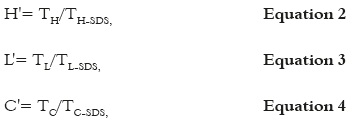
<body><![CDATA[<p> Test samples were the methanolic and hexanic   extracts of <i>U. dermestoides</i>. Because hexane is irritating   for the CAM, this solvent was evaporated of   the hexanic extract using a HEIDOLPH 4000-G1   rotary evaporator, and the liquid residue was applied   on the CAM; the methanolic extract was used directly   in the anti-irritant test. An aqueous solution   of sodium dodecyl sulphate (SDS 0.5% w/v) was   used as irritating agent. The negative control of the   inhibition of irritation reaction was a saline isotonic   solution (NaCl 0.9% w/v); the positive control for   irritation inhibition reaction was a non-steroid   anti-inflammatory drug, Nimesulida (AINEX&reg;)   at a concentration of 1 mg/mL. The anti-irritant   property of the methanolic solution was also evaluated   (solvent control). All of the solutions used in   the HET-CAM test were daily prepared.</p>     <p>  <i>Standard irritation reaction</i></p>     <p> The procedure described by Luepcke, 1985 (16),   was used, with modifications. Eggs were placed   in a Nuaire AireGard 201/301 horizontal laminar   flow cabinet. Egg shells were cut around the air   sacs with a 3200 rpm circular saw with maximum   blade capacity of 1/8''. Cut sections were removed   with a forceps and dissecting tongs. The exposed   CAM was humidified with 300 &mu;L of isotonic NaCl   solution and placed in an incubator for two hours,   after which 200 &mu;L of SDS 0.5% was placed on the   CAM. Three irritation reactions (hemorrhage, lysis,   and coagulation) were monitored and registered   with a Sony DCR-DVD 610 video camera placed   at 35 cm above the CAM. Time was recorded in   seconds, from the addition of SDS (time = 0) until   the appearance of the three irritation reactions.</p>     <p> <i>Determination of the anti-irritant capacity</i></p>     <p> CAM of eggs was exposed as described above   and pre-treated with 300 &mu;L of testing samples or   control solutions. To prevent contamination of the   CAM surface, egg-shell openings were covered   with paraffin film. Eggs were placed in the incubator   for two hours to facilitate absorption by the   membranes, and the CAM was then treated with   200 &mu;L of SDS 0.5%. Time (in seconds) was monitored   until appearance of the irritation reactions.   The irritation index (IR) was calculated using the   Equation 1.</p>     <p align="center"><img src="/img/revistas/vitae/v20n1/v20n1a5e1.jpg"></p>     <p> T<sub>H</sub>, T<sub>L</sub> and T<sub>C</sub> are, respectively, the time in   seconds from the application of the irritant to the   appearance of signs of hemorrhage (H), lysis (L),   and coagulation (C) during a period of observation   of 300 seconds. Because of the nature of the   formula, IR can take values between 0 and 21. To   determine the irritation potential of the substances,   a classification analogous to the Draiz&eacute; test was   used: not irritating (IR= 0.0 &#8211; 0.9), slightly irritating   (IR= 1.0- 4.9), moderately irritating (IR=   5.0 &#8211; 8.9), and severely irritating (IR = 9.0 &#8211; 21).   The anti-irritating capacity H', L', and C' of the   tested substances was expressed as the relationship   between the starting times of irritation reactions   in the CAM pre-treated with testing samples and   negative control, using the Equations 2, 3 and 4 (12).</p>     <p align="center"><img src="/img/revistas/vitae/v20n1/v20n1a5e2.jpg"></p>     <p align="center">&nbsp;</p>     <p> <b>Statistical analysis</b></p>     ]]></body>
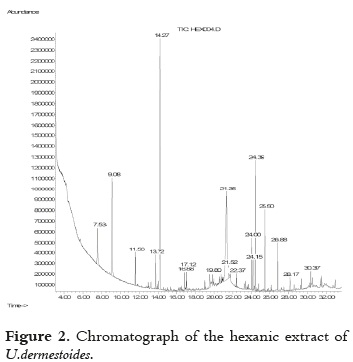
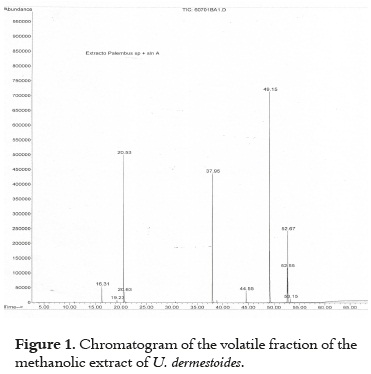
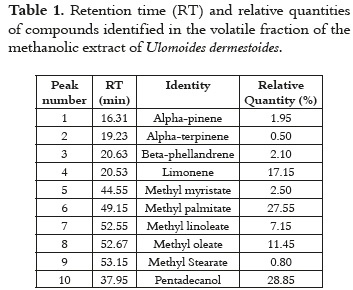
<body><![CDATA[<p> The HET- CAM test was triplicated for each test   sample and controls, the data are expressed as mean &plusmn; SD. Two group comparisons were performed using Student's t test and statistical significance was accepted at the 95% confidence level (p &lt; 0.025). All statistical evaluations were performed using IBM SPSS Statistics 19 for Windows (SPSS Inc., an IBM Company, Chicago, IL, USA).</p>     <p>&nbsp;</p>     <p> <font size="3"><b>RESULTS</b></font></p>     <p> <a href="#f1">Figure 1</a> presents the chromatographic profile   of the whole body methanolic extract of Ulomoides   dermestoides.</p>     <p align="center"><a name="f1"></a><img src="/img/revistas/vitae/v20n1/v20n1a5f1.jpg"></p>     <p align="center">&nbsp;</p>     <p> The molecules with the highest relative quantity   were pentadecanol (28.85%), methyl palmitate   (27.55%), limonene (17.15%), and methyl oleate   (11.45%) which can be seen in <a href="#t1">Table 1</a>.</p>       <p align="center"><a name="t1"></a><img src="/img/revistas/vitae/v20n1/v20n1a5t1.jpg"></p>     <p>&nbsp;</p>     <p>The chromatographic profile of the hexanic extract is shown in <a href="#f2">Figure 2</a>.</p>     ]]></body>
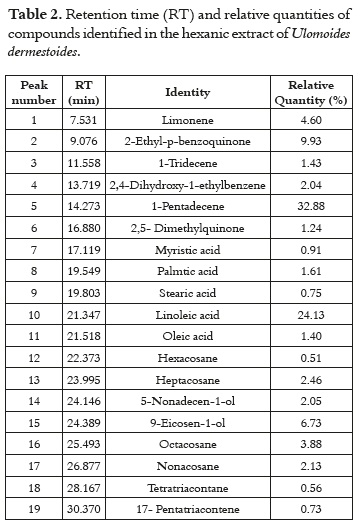
<body><![CDATA[<p align="center"><a name="f2"></a><img src="/img/revistas/vitae/v20n1/v20n1a5f2.jpg"></p>     <p align="center">&nbsp;</p>     <p> The compounds that were identified by GC-MS   are shows in the <a href="#t2">Table 2</a>. The compounds with   the highest relative quantity were 1-pentadecene   (32.88%), linoleic acid (24.13%), and 2-ethyl-p-benzoquinone   (9.93%). Other compounds were 2,5-dimethylquinone,   2,4-Dihydroxy-1-ethylbenzene,   limonene, aliphatic hydrocarbons, saturated and   unsaturated fatty acids, and long-chain alcohols.</p>     <p align="center"><a name="t2"></a><img src="/img/revistas/vitae/v20n1/v20n1a5t2.jpg"></p>     <p align="center">&nbsp;</p>     <p>  The changes of standard irritation reaction that   occur in the CAM are shown in <a href="/img/revistas/vitae/v20n1/v20n1a5f3.jpg" target="_blank">Figure 3</a>. Hemorrhage   reaction was observed in the aggrandizement   of the major blood vessels and the appearance of small   vascular complexes with multiple branches; lysis reaction   was evidenced in the rupture of blood vessels and   extravasations; clotting reaction was determined by   the darkening and hardening of the CAM.</p>     <p> The inhibition of irritant reactions in the group   pre-treat with positive control, methanolic extract   of <i>U. dermestoides</i> and hexanic extract of <i>U. dermestoides</i>   are shown in <a href="/img/revistas/vitae/v20n1/v20n1a5f4.jpg" target="_blank">Figure 4</a>.</p>     <p> The mean times for the beginning of the irritation   reactions in CAM for each one of the tested   samples and controls, as well as the mean values of   the irritation index and anti-irritant capacity are   shows in the <a href="/img/revistas/vitae/v20n1/v20n1a5t3.jpg" target="_blank">Table 3</a>.</p>     <p>&nbsp;</p>     <p> <font size="3"> <b>DISCUSSION</b></font></p>     ]]></body>
<body><![CDATA[<p> The compounds 1- pentadecene, 2-ethyl-pbenzoquinone,   limonene, and 1-tridecene identified   in the extracts of <i>U. dermestoides</i> have been   previously reported in studies to determine the   chemical characteristics of the defensive secretions   and sex-specific pheromones of <i>U. dermestoides</i> (17,   18). The monoterpene hydrocarbons alpha-pinene,   alpha-terpinene, phellandrene, and dimethylquinones   have been reported in the defensive secretions   of some Australian tenebrionid beetles (19, 20).   Insect defensive secretion is a mixture of repellent   and blocking chemoreceptor substances that are   stored in cuticular inclusions or abdominal glands,   which are expelled when beetles are stressed. Defensive   secretion of beetles has been postulated as   a source of pharmacologically active compounds in   treatment of respiratory diseases (8, 10, 21). Other   compounds identified in the present study were   saturated and unsaturated fatty acids and hydrocarbons   with chains of 16-35 carbon atoms, some   of these compounds have been found in the cuticle   of beetles <i>U. dermestoides</i> and <i>Blaps femoralis</i> (17,   22) and they have been associated with important   roles in the biology of beetles, such as sexual communication, preventing desiccation and protecting   against pathogens.</p>     <p> In the HET-CAM test, pre-treatment of the   CAM with methanolic extracts of <i>U. dermestoides</i>   decreased the vascular hemorrhaging and membrane   coagulation produced for the irritating agent   (SDS 0.5%) (Mean of IR= 3.09 &plusmn; 0.11). There was   a significant statistical difference in the irritation   index between the group pre-treated with methanolic   extract of <i>U. dermestoides</i> and negative control   group, including the solvent control (p= 0.00).   In addition, not significant statistical differences   were seen in the hemorrhage reaction (p= 0.041),   coagulation reaction (p= 0.028) and lyses reaction   (p= 0.05) of the CAM between methanolic extract   group and positive control group. Hexanic extract   of <i>U. dermestoides</i> did not show any anti-irritant   effect in the CAM test (Mean of IR= 20.6&plusmn; 0.14).   No statistical differences were observed in the index   reaction between the hexanic extract group and   negative control group (p = 0.00).</p>     <p> The potential anti-irritant capacity of methanolic   extract of <i>U. dermestoides</i> can be attributed to   the components with anti-inflammatory activity.   Omega-9 monounsaturated fatty acid (MUFA) and   omega-6 polyunsaturated fatty acid (PUFA) may   contribute to the anti-irritant capacity of methanolic   extracts. A systematic review of electronic databases   and bibliographies of selected articles showed that   diets rich in oleic acid (omega-9 MUFA) have   beneficial effects on inflammation-related diseases   (23). Bartoli <i>et al.</i>, 2000 (24), reported that oleic   acid can influence the metabolism of araquidonic   acid (omega-6 PUFA), decreasing the production   of pro-inflammatory eicosanoids. Moreover, the   anti-inflammatory effect of linoleic acid (omega-6   PUFA) is not clear, several studies have expressed   that a high intake of dietary linoleic acid contributes   to excess of chronic inflammation. Linoleic   acid can be metabolized to araquidonic acid, the   substrate for the biosynthesis of a wide array of proinflammatory,   vasoconstrictive, and/or proaggregatory   eicosanoids; but the araquidonic acid is also the   substrate for the production of anti-inflammatory   and/or anti-aggregatory eicosanoids, such as prostacyclin,   lipoxin A4 and epoxyeicosatrienoic acids   (25). In the present study, the methanolic extract of   <i>U. dermestoides</i> showed a higher quantity of oleic acid   (11.45%) and lower quantity of linoleic acid (7.15%)   compared with hexanic extract (1.4% and 24.13%,   respectively). None anti-inflammatory or antiirritant   activity has been reported for pentadecanol   and methyl palmitate.</p>     <p> In addition, the methanolic extract has high   quantity of monoterpenes (21.7%) with anti-inflammatory   properties as limonene, alpha-terpinene and   alpha-pinene (26). Recent findings suggest that Dlimonene   could be used as a potential anti-inflammatory   agent for the treatment of bronchial asthma   by suppressing pro-inflammatory cytokines, radical   oxygen species (ROS) production, and inactivating   eosinophil migration; experiments with RAW 264.7   macrophage cells demonstrated that D-limonene is   an effective inhibitor of lipopolysaccharide (LPS)-   induced nitric oxide (NO) and prostaglandin E(2)   production; likewise, D-limonene decreased the   expression of pro-inflammatory cytokines TNFalpha,   IL-1beta, and IL-6 in a dose-dependent   manner (27). In addition, D-limonene obtained   from a fruit peel of a traditional Japanese medicine   named Yuzu (<i>Citrus junos Tanaka</i>) showed inhibition   of the ROS production for eotaxin-stimulated   HL-60 clones 15 cell at a low concentration; while   at a higher concentration suppressed the cell chemotaxis   and production of the monocyte chemotactic   protein-1 (MCP-1) via NF-&kappa;B activation (28). The   anti-inflammatory properties of alpha-pinene and   alpha-terpinene have been demonstrated using an   inflammatory experimental model in mice and an   inhibition test of ovine cyclooxygenases (COX-1 y   COX-2), respectively (29, 30).</p>     <p> These results about the anti-irritant capacity of   methanolic and hexanic extracts of <i>U. dermestoides</i>   are preliminary, because it is necessary to evaluate   the effect of the extracts concentration on the CAM   and the anti-irritant effect of the major components   of each extract. In this study the hexanic extract   used in the HET CAM test was a concentrated   sample and this might influence the results. We   propose that the high irritation index of the CAM   pre-treated with hexanic extract could be caused   by the aliphatic hydrocarbons and quinones   (2-ethyl-p-benzoquinone and 2,5-dimethylquinone).   Aliphatic hydrocarbons (43.85% of hexanic   extract) may cause irritation of the skin and the   mucous membranes (31), while quinones (11.17%   of hexanic extract) have been reported as highly   cytotoxic and/or genotoxic due to the formation of   ROS and covalent binding to macromolecules (32,   33). However, the irritant effect of quinones present   in the <i>U. dermestoides</i> extracts should be confirmed   in further studies.</p>     <p>&nbsp;</p>     <p> <font size="3"> <b>CONCLUSIONS</b></font></p>     <p> The whole-body methanolic and hexanic extracts   of <i>Ulomoides dermestoides</i> presented volatile and semivolatile   compounds that are characteristic of the   defensive secretions and the cuticular surface of tenebrionids.   The main compounds in the methanolic   extract were fatty acids, pentadecanol and terpens.   The methanoic extract exhibited anti-irritant capacity   in a modified HET-CAM test that could be attributed   to oleic acid and monoterpens like limonene;   other minor compounds with anti-inflammatory   activity were alpha-pinene and alpha-terpinene.</p>     <p>&nbsp;</p>     <p><font size="3"> <b>ACKNOWLEDGEMENTS</b></font></p>     ]]></body>
<body><![CDATA[<p> We are grateful to the Entomology Department   of the Natural Sciences Institute (Universidad Nacional,   Bogot&aacute;, Colombia) for scientific advice and   to ACONDESA for technical support during this   study. This investigation was conducted with the   support of Universidad del Atl&aacute;ntico, Grupo de Productos   Naturales y Bioqu&iacute;mica de Macromol&eacute;culas.</p>     <p>&nbsp;</p>     <p><font size="3"><b> REFERENCES</b></font></p>     <!-- ref --><p> 1. Dacanay AA, Cervancia CR. Biology of <i>Palembus</i> (<i>Martianus</i>)   <i>dermestoides</i> Chevrolat (Coleoptera; Tenebrionidae). Philippines   Ent. 1989 Apr; 7 (5): 471-477.    &nbsp;&nbsp;&nbsp;&nbsp;&nbsp;&nbsp;&nbsp;&nbsp;[&#160;<a href="javascript:void(0);" onclick="javascript: window.open('/scielo.php?script=sci_nlinks&ref=000086&pid=S0121-4004201300010000500001&lng=','','width=640,height=500,resizable=yes,scrollbars=1,menubar=yes,');">Links</a>&#160;]<!-- end-ref --></p>     <!-- ref --><p> 2. Sandroni P. Aphrodisiacs past and present: a historical review.   Clin Auton Res. 2001 Oct; 11 (5): 303-307.    &nbsp;&nbsp;&nbsp;&nbsp;&nbsp;&nbsp;&nbsp;&nbsp;[&#160;<a href="javascript:void(0);" onclick="javascript: window.open('/scielo.php?script=sci_nlinks&ref=000088&pid=S0121-4004201300010000500002&lng=','','width=640,height=500,resizable=yes,scrollbars=1,menubar=yes,');">Links</a>&#160;]<!-- end-ref --></p>     <!-- ref --><p> 3. Chu GS, Palmieri JR, Sullivan JT. Beetle-eating: a Malaysia folk   medical practice and its public health implications. Trop Geogr   Med. 1977 Dec; 29 (4): 422 - 427.    &nbsp;&nbsp;&nbsp;&nbsp;&nbsp;&nbsp;&nbsp;&nbsp;[&#160;<a href="javascript:void(0);" onclick="javascript: window.open('/scielo.php?script=sci_nlinks&ref=000090&pid=S0121-4004201300010000500003&lng=','','width=640,height=500,resizable=yes,scrollbars=1,menubar=yes,');">Links</a>&#160;]<!-- end-ref --></p>     <!-- ref --><p> 4. Costa Neto EM, Ramos-Elorduy J. Los insectos comestibles de   Brasil: etnicidad, diversidad e importancia en la alimentaci&oacute;n.   Bol Soc Ent Aragonesa. 2006; 38: 423-442.    &nbsp;&nbsp;&nbsp;&nbsp;&nbsp;&nbsp;&nbsp;&nbsp;[&#160;<a href="javascript:void(0);" onclick="javascript: window.open('/scielo.php?script=sci_nlinks&ref=000092&pid=S0121-4004201300010000500004&lng=','','width=640,height=500,resizable=yes,scrollbars=1,menubar=yes,');">Links</a>&#160;]<!-- end-ref --></p>     <!-- ref --><p> 5. Costa-Neto EM. The use of insects in folk medicine in the state   of Bahia Northeastern Brazil, with notes on insects reported   elsewhere in Brazilian folk medicine. Human Ecol. 2002 Jun;   30 (2): 245-263.    &nbsp;&nbsp;&nbsp;&nbsp;&nbsp;&nbsp;&nbsp;&nbsp;[&#160;<a href="javascript:void(0);" onclick="javascript: window.open('/scielo.php?script=sci_nlinks&ref=000094&pid=S0121-4004201300010000500005&lng=','','width=640,height=500,resizable=yes,scrollbars=1,menubar=yes,');">Links</a>&#160;]<!-- end-ref --></p>     <!-- ref --><p> 6. Flores GE, Pad&iacute;n SB, Stetson RE. First records of the Oriental   species <i>Ulomoides dermestoides</i> (Coleoptera: Tenebrionidae) in   Argentina. Rev Soc Entomol Argent. 2002; 61 (3/4): 48-50.    &nbsp;&nbsp;&nbsp;&nbsp;&nbsp;&nbsp;&nbsp;&nbsp;[&#160;<a href="javascript:void(0);" onclick="javascript: window.open('/scielo.php?script=sci_nlinks&ref=000096&pid=S0121-4004201300010000500006&lng=','','width=640,height=500,resizable=yes,scrollbars=1,menubar=yes,');">Links</a>&#160;]<!-- end-ref --></p>     <!-- ref --><p> 7. Capul-Maga&ntilde;a FG. Sobre el uso de <i>Ulomoides dermestoides</i>   (Chevrolat, 1878), (Coleoptera, Tenebrionidae, Diaperini) en la   coleopteroterapia: informe de un caso en Ixtapa, Jalisco, M&eacute;xico.   Boln Asoc Esp Ent. 2010; 34 (3-4): 419-422.    &nbsp;&nbsp;&nbsp;&nbsp;&nbsp;&nbsp;&nbsp;&nbsp;[&#160;<a href="javascript:void(0);" onclick="javascript: window.open('/scielo.php?script=sci_nlinks&ref=000098&pid=S0121-4004201300010000500007&lng=','','width=640,height=500,resizable=yes,scrollbars=1,menubar=yes,');">Links</a>&#160;]<!-- end-ref --></p>     <!-- ref --><p> 8. Crespo R, Villaverde ML, Girotti JR, G&uuml;erci A, Ju&aacute;rez MP, de   Bravo MG. Cytotoxic and genotoxic effects of defence secretion   of <i>Ulomoides dermestoides</i> on A549 cells. J Ethnopharmacol. 2011   Jun 14; 136 (1): 204-209.    &nbsp;&nbsp;&nbsp;&nbsp;&nbsp;&nbsp;&nbsp;&nbsp;[&#160;<a href="javascript:void(0);" onclick="javascript: window.open('/scielo.php?script=sci_nlinks&ref=000100&pid=S0121-4004201300010000500008&lng=','','width=640,height=500,resizable=yes,scrollbars=1,menubar=yes,');">Links</a>&#160;]<!-- end-ref --></p>     <!-- ref --><p> 9. Santos RC, Lunardelli A, Caberlon E, Bastos CM, Nunes FB,   Pires MG, et al. Anti-inflammatory and immunomodulatory   effects of <i>Ulomoides dermestoides</i> on induced pleurisy in rats and   lymphoproliferation in vitro. Inflammation. 2010 Jun; 33 (3):   173-179.    &nbsp;&nbsp;&nbsp;&nbsp;&nbsp;&nbsp;&nbsp;&nbsp;[&#160;<a href="javascript:void(0);" onclick="javascript: window.open('/scielo.php?script=sci_nlinks&ref=000102&pid=S0121-4004201300010000500009&lng=','','width=640,height=500,resizable=yes,scrollbars=1,menubar=yes,');">Links</a>&#160;]<!-- end-ref --></p>     <!-- ref --><p> 10. Wahrendorf MS, Wink M. Pharmacologically active natural   products in the defence secretion of <i>Palembus ocularis</i> (Tenebrionidae,   Coleoptera). J Ethnopharmacol. 2006 Jun; 106 (1): 51-56.    &nbsp;&nbsp;&nbsp;&nbsp;&nbsp;&nbsp;&nbsp;&nbsp;[&#160;<a href="javascript:void(0);" onclick="javascript: window.open('/scielo.php?script=sci_nlinks&ref=000104&pid=S0121-4004201300010000500010&lng=','','width=640,height=500,resizable=yes,scrollbars=1,menubar=yes,');">Links</a>&#160;]<!-- end-ref --></p>     <!-- ref --><p> 11. Nia R, Paper DH, Essien EE, Oladimeji OH, Iyadi KC, Franz   G. Investigation into In vitro radical scavenging and in vivo antiinflammatory   potential of <i>Tridax procumbes</i>. Niger J Physiol Sci.   2003; 18 (1-2): 39-43.    &nbsp;&nbsp;&nbsp;&nbsp;&nbsp;&nbsp;&nbsp;&nbsp;[&#160;<a href="javascript:void(0);" onclick="javascript: window.open('/scielo.php?script=sci_nlinks&ref=000106&pid=S0121-4004201300010000500011&lng=','','width=640,height=500,resizable=yes,scrollbars=1,menubar=yes,');">Links</a>&#160;]<!-- end-ref --></p>     <!-- ref --><p> 12. Wilson TD, Steck WF. A modified HET-Cam assay approach to   the assessment of anti-irritant properties of plant extracts. Food   Chem Toxicol. 2000 Oct; 38 (10): 867-872.    &nbsp;&nbsp;&nbsp;&nbsp;&nbsp;&nbsp;&nbsp;&nbsp;[&#160;<a href="javascript:void(0);" onclick="javascript: window.open('/scielo.php?script=sci_nlinks&ref=000108&pid=S0121-4004201300010000500012&lng=','','width=640,height=500,resizable=yes,scrollbars=1,menubar=yes,');">Links</a>&#160;]<!-- end-ref --></p>     <!-- ref --><p> 13. Moura do Carmo DF, Amaral AC, Machado GM, Leon LL, Silva   JR. Chemical and Biological Analyses of the Essential Oils and   Main Constituents of Piper Species. Molecules 2012 Feb; 17:   1819-1829.    &nbsp;&nbsp;&nbsp;&nbsp;&nbsp;&nbsp;&nbsp;&nbsp;[&#160;<a href="javascript:void(0);" onclick="javascript: window.open('/scielo.php?script=sci_nlinks&ref=000110&pid=S0121-4004201300010000500013&lng=','','width=640,height=500,resizable=yes,scrollbars=1,menubar=yes,');">Links</a>&#160;]<!-- end-ref --></p>     <!-- ref --><p> 14. Unruh L, Rongda X, Kramer K. Benzoquinone levels as a function   of age and gender of the red flour beetle,<i> Tribolium casteneum</i>.   Insect Biochem Mol Biol. 1998 Aug; 28 (12): 969-977.    &nbsp;&nbsp;&nbsp;&nbsp;&nbsp;&nbsp;&nbsp;&nbsp;[&#160;<a href="javascript:void(0);" onclick="javascript: window.open('/scielo.php?script=sci_nlinks&ref=000112&pid=S0121-4004201300010000500014&lng=','','width=640,height=500,resizable=yes,scrollbars=1,menubar=yes,');">Links</a>&#160;]<!-- end-ref --></p>     <!-- ref --><p> 15. Bagley DM, Waters D, Kong BM. Development of a 10-day   chorioallantoic membrane vascular assay as an alternative to the   Draize rabbit eye irritation test. Food Chem Toxicol. 1994 Dec;   32 (12): 1115-1160.    &nbsp;&nbsp;&nbsp;&nbsp;&nbsp;&nbsp;&nbsp;&nbsp;[&#160;<a href="javascript:void(0);" onclick="javascript: window.open('/scielo.php?script=sci_nlinks&ref=000114&pid=S0121-4004201300010000500015&lng=','','width=640,height=500,resizable=yes,scrollbars=1,menubar=yes,');">Links</a>&#160;]<!-- end-ref --></p>     <!-- ref --><p> 16. Luepcke N.P. HET-chorioallantois-test: an alternative to the   Draiz&eacute; rabbit eye test. In: Goldberg, A.M. (Ed.), In Vitro Toxicology.   New York, USA: Mary Ann Libert Inc. Publishers; 1985.   353-363 p.    &nbsp;&nbsp;&nbsp;&nbsp;&nbsp;&nbsp;&nbsp;&nbsp;[&#160;<a href="javascript:void(0);" onclick="javascript: window.open('/scielo.php?script=sci_nlinks&ref=000116&pid=S0121-4004201300010000500016&lng=','','width=640,height=500,resizable=yes,scrollbars=1,menubar=yes,');">Links</a>&#160;]<!-- end-ref --></p>     <!-- ref --><p> 17. Villaverde ML, Girotti JR, Mijailovsky SJ, Pedrini N, Ju&aacute;rez MP.   Volatile secretions and epicuticular hydrocarbons of the beetle   <i>Ulomoides dermestoides</i>. Comp Biochem Physiol B Biochem Mol   Biol. 2009 Dec; 154 (4): 381-386.    &nbsp;&nbsp;&nbsp;&nbsp;&nbsp;&nbsp;&nbsp;&nbsp;[&#160;<a href="javascript:void(0);" onclick="javascript: window.open('/scielo.php?script=sci_nlinks&ref=000118&pid=S0121-4004201300010000500017&lng=','','width=640,height=500,resizable=yes,scrollbars=1,menubar=yes,');">Links</a>&#160;]<!-- end-ref --></p>     <!-- ref --><p> 18. Martins CBC, Zarbin PHG, Almeida LM. Evidence for sexspecific   pheromones in <i>Ulomoides dermestoides</i> (Coleoptera,   Tenebrionidar). Fla Entomol. 2010 Dec; 93 (4): 639-641.    &nbsp;&nbsp;&nbsp;&nbsp;&nbsp;&nbsp;&nbsp;&nbsp;[&#160;<a href="javascript:void(0);" onclick="javascript: window.open('/scielo.php?script=sci_nlinks&ref=000120&pid=S0121-4004201300010000500018&lng=','','width=640,height=500,resizable=yes,scrollbars=1,menubar=yes,');">Links</a>&#160;]<!-- end-ref --></p>     <!-- ref --><p> 19. Geiselhardt S, Schmitt T, Peschke K. Chemical composition and   pheromonal function of the defensive secretions in the subtribe   Stizopina (Coleoptera, Tenebrionidae, Opatrini). Chemoecology.   2009 Jun; 19 (1): 1-6.    &nbsp;&nbsp;&nbsp;&nbsp;&nbsp;&nbsp;&nbsp;&nbsp;[&#160;<a href="javascript:void(0);" onclick="javascript: window.open('/scielo.php?script=sci_nlinks&ref=000122&pid=S0121-4004201300010000500019&lng=','','width=640,height=500,resizable=yes,scrollbars=1,menubar=yes,');">Links</a>&#160;]<!-- end-ref --></p>     <!-- ref --><p> 20. Brown WV, Doyen JT, Moore BP, Lawren JF. Chemical composition   and taxonomic significance of defensive secretions of some   Australian Tenebrionidae (Coleoptera). J Aust Ent Soc. 1992 Feb;   31 (1): 79-89.    &nbsp;&nbsp;&nbsp;&nbsp;&nbsp;&nbsp;&nbsp;&nbsp;[&#160;<a href="javascript:void(0);" onclick="javascript: window.open('/scielo.php?script=sci_nlinks&ref=000124&pid=S0121-4004201300010000500020&lng=','','width=640,height=500,resizable=yes,scrollbars=1,menubar=yes,');">Links</a>&#160;]<!-- end-ref --></p>     <!-- ref --><p> 21. Howard RW, Jurenka RA, Blomquist GJ. Prostaglandin synthetase   inhibitors in the defensive secretion of the red flour beetle   <i>Tribolium castaneum</i> (Herbst) (Coleoptera:Tenebrionidae). Insect   Biochem. 1986 Jun; 16 (5): 757-760.    &nbsp;&nbsp;&nbsp;&nbsp;&nbsp;&nbsp;&nbsp;&nbsp;[&#160;<a href="javascript:void(0);" onclick="javascript: window.open('/scielo.php?script=sci_nlinks&ref=000126&pid=S0121-4004201300010000500021&lng=','','width=640,height=500,resizable=yes,scrollbars=1,menubar=yes,');">Links</a>&#160;]<!-- end-ref --></p>     <!-- ref --><p> 22. Gunbilig D, Boland W. Defensive Agents of<i> Blaps femoralis </i>a   Traditional Mongolian Medicinal Insect. Sci Pharm. 2009 Jul;   77 (3): 597-604.    &nbsp;&nbsp;&nbsp;&nbsp;&nbsp;&nbsp;&nbsp;&nbsp;[&#160;<a href="javascript:void(0);" onclick="javascript: window.open('/scielo.php?script=sci_nlinks&ref=000128&pid=S0121-4004201300010000500022&lng=','','width=640,height=500,resizable=yes,scrollbars=1,menubar=yes,');">Links</a>&#160;]<!-- end-ref --></p>     <!-- ref --><p> 23. Carrillo C, Cavia Mdel M, Alonso-Torre S. Role of oleic acid   in immune system; mechanism of action; a review. Nutr Hosp.   2012 Jul; 27 (4): 978-990.    &nbsp;&nbsp;&nbsp;&nbsp;&nbsp;&nbsp;&nbsp;&nbsp;[&#160;<a href="javascript:void(0);" onclick="javascript: window.open('/scielo.php?script=sci_nlinks&ref=000130&pid=S0121-4004201300010000500023&lng=','','width=640,height=500,resizable=yes,scrollbars=1,menubar=yes,');">Links</a>&#160;]<!-- end-ref --></p>     <!-- ref --><p> 24. Bartoli R, Fernandez-Banares F, Navarro E, Castella E, Mane   J, Alvarez M, et al. Effect of olive oil on early and late events   of colon carcinogenesis in rats: modulation of arachidonic acid   metabolism and local prostaglandin E2 synthesis. Gut. 2000 Feb;   46 (2): 191-199.    &nbsp;&nbsp;&nbsp;&nbsp;&nbsp;&nbsp;&nbsp;&nbsp;[&#160;<a href="javascript:void(0);" onclick="javascript: window.open('/scielo.php?script=sci_nlinks&ref=000132&pid=S0121-4004201300010000500024&lng=','','width=640,height=500,resizable=yes,scrollbars=1,menubar=yes,');">Links</a>&#160;]<!-- end-ref --></p>     <!-- ref --><p> 25. Harris WS, Mozaffarian D, Rimm E, Kris-Etherton P, Rudel LL,   Appel LJ, et al. Omega-6 fatty acids and risk for cardiovascular   disease: a science advisory from the American Heart Association   Nutrition Subcommittee of the Council on Nutrition, Physical   Activity, and Metabolism; Council on Cardiovascular Nursing;   and Council on Epidemiology and Prevention. Circulation. 2009   Feb; 119 (6): 902-907.    &nbsp;&nbsp;&nbsp;&nbsp;&nbsp;&nbsp;&nbsp;&nbsp;[&#160;<a href="javascript:void(0);" onclick="javascript: window.open('/scielo.php?script=sci_nlinks&ref=000134&pid=S0121-4004201300010000500025&lng=','','width=640,height=500,resizable=yes,scrollbars=1,menubar=yes,');">Links</a>&#160;]<!-- end-ref --></p>     <!-- ref --><p> 26. da Silveira R, Andrade L, de Sousa D. A Review on Anti-   Inflammatory Activity of Monoterpenes. Molecules. 2013 Jan;   18 (1): 1227-1254.    &nbsp;&nbsp;&nbsp;&nbsp;&nbsp;&nbsp;&nbsp;&nbsp;[&#160;<a href="javascript:void(0);" onclick="javascript: window.open('/scielo.php?script=sci_nlinks&ref=000136&pid=S0121-4004201300010000500026&lng=','','width=640,height=500,resizable=yes,scrollbars=1,menubar=yes,');">Links</a>&#160;]<!-- end-ref --></p>     <!-- ref --><p> 27. Yoon WJ, Lee NH, Hyun CG. Limonene suppresses lipopolysaccharide-   induced production of nitric oxide, prostaglandin E2,   and pro-inflammatory cytokines in RAW 264.7 macrophages. J   Oleo Sci. 2010; 59 (8): 415-421.    &nbsp;&nbsp;&nbsp;&nbsp;&nbsp;&nbsp;&nbsp;&nbsp;[&#160;<a href="javascript:void(0);" onclick="javascript: window.open('/scielo.php?script=sci_nlinks&ref=000138&pid=S0121-4004201300010000500027&lng=','','width=640,height=500,resizable=yes,scrollbars=1,menubar=yes,');">Links</a>&#160;]<!-- end-ref --></p>     <!-- ref --><p> 28. Hirota R, Roger NN, Nakamura H, Song HS, Sawamura M,   Suganuma N. Anti-inflammatory effects of limonene from yuzu   (<i>Citrus junos Tanaka</i>) essential oil on eosinophils. J Food Sci. 2010   Apr; 75 (3): H87-92.    &nbsp;&nbsp;&nbsp;&nbsp;&nbsp;&nbsp;&nbsp;&nbsp;[&#160;<a href="javascript:void(0);" onclick="javascript: window.open('/scielo.php?script=sci_nlinks&ref=000140&pid=S0121-4004201300010000500028&lng=','','width=640,height=500,resizable=yes,scrollbars=1,menubar=yes,');">Links</a>&#160;]<!-- end-ref --></p>     <!-- ref --><p> 29. Quint&atilde;o NL, da Silva GF, Antonialli CS, Rocha LW, Cechinel   Filho V, Cicci&oacute; JF. Chemical composition and evaluation of the   anti-hypernociceptive effect of the essential oil extracted from   the leaves of <i>Ugni myricoides</i> on inflammatory and neuropathic   models of pain in mice. Planta Med. 2010 Sep; 76 (13): 1411-1418.    &nbsp;&nbsp;&nbsp;&nbsp;&nbsp;&nbsp;&nbsp;&nbsp;[&#160;<a href="javascript:void(0);" onclick="javascript: window.open('/scielo.php?script=sci_nlinks&ref=000142&pid=S0121-4004201300010000500029&lng=','','width=640,height=500,resizable=yes,scrollbars=1,menubar=yes,');">Links</a>&#160;]<!-- end-ref --></p>     <!-- ref --><p> 30. Kawata, J.; Kameda, M.; Miyazawa, M. Cyclooxygenase-2 inhibitory   effects of monoterpenoids with a p-methane skeleton. Int J   Essent Oil Ther. 2008 Dic; 2 (4): 145-148.    &nbsp;&nbsp;&nbsp;&nbsp;&nbsp;&nbsp;&nbsp;&nbsp;[&#160;<a href="javascript:void(0);" onclick="javascript: window.open('/scielo.php?script=sci_nlinks&ref=000144&pid=S0121-4004201300010000500030&lng=','','width=640,height=500,resizable=yes,scrollbars=1,menubar=yes,');">Links</a>&#160;]<!-- end-ref --></p>     <!-- ref --><p> 31. Patlolla RR, Mallampati R, Fulzele SV, Babu RJ, Singh M. Dermal   microdialysis of inflammatory markers induced by aliphatic   hydrocarbons in rats. Toxicol Lett. 2009 Mar; 185 (3): 168-174.    &nbsp;&nbsp;&nbsp;&nbsp;&nbsp;&nbsp;&nbsp;&nbsp;[&#160;<a href="javascript:void(0);" onclick="javascript: window.open('/scielo.php?script=sci_nlinks&ref=000146&pid=S0121-4004201300010000500031&lng=','','width=640,height=500,resizable=yes,scrollbars=1,menubar=yes,');">Links</a>&#160;]<!-- end-ref --></p>     <!-- ref --><p> 32. Yang F, Zhou J. Cytotoxicity and DNA damage induced by 1,   4-benzoquinone in v79 Chinese hamster lung cells. J Toxicol   Environ Health, Part A. 2010 Jan: 73 (7): 483-489.    &nbsp;&nbsp;&nbsp;&nbsp;&nbsp;&nbsp;&nbsp;&nbsp;[&#160;<a href="javascript:void(0);" onclick="javascript: window.open('/scielo.php?script=sci_nlinks&ref=000148&pid=S0121-4004201300010000500032&lng=','','width=640,height=500,resizable=yes,scrollbars=1,menubar=yes,');">Links</a>&#160;]<!-- end-ref --></p>     <!-- ref --><p> 33. Ruiz-Ramos R, Cebrian ME, Garrido E. Benzoquinone activates   the ERK/MAPK signaling pathway via ROS production in HL-   60 cells. Toxicology. 2005 May; 209 (3): 279-287.    &nbsp;&nbsp;&nbsp;&nbsp;&nbsp;&nbsp;&nbsp;&nbsp;[&#160;<a href="javascript:void(0);" onclick="javascript: window.open('/scielo.php?script=sci_nlinks&ref=000150&pid=S0121-4004201300010000500033&lng=','','width=640,height=500,resizable=yes,scrollbars=1,menubar=yes,');">Links</a>&#160;]<!-- end-ref --></p>     <p>&nbsp;</p> </font>     ]]></body>
<body><![CDATA[ ]]></body><back>
<ref-list>
<ref id="B1">
<label>1</label><nlm-citation citation-type="journal">
<person-group person-group-type="author">
<name>
<surname><![CDATA[Dacanay]]></surname>
<given-names><![CDATA[AA]]></given-names>
</name>
<name>
<surname><![CDATA[Cervancia]]></surname>
<given-names><![CDATA[CR.]]></given-names>
</name>
</person-group>
<article-title xml:lang="en"><![CDATA[Biology of Palembus (Martianus) dermestoides Chevrolat (Coleoptera; Tenebrionidae)]]></article-title>
<source><![CDATA[Philippines Ent]]></source>
<year>1989</year>
<month> A</month>
<day>pr</day>
<volume>7</volume>
<numero>5</numero>
<issue>5</issue>
<page-range>471-477</page-range></nlm-citation>
</ref>
<ref id="B2">
<label>2</label><nlm-citation citation-type="journal">
<person-group person-group-type="author">
<name>
<surname><![CDATA[Sandroni]]></surname>
<given-names><![CDATA[P.]]></given-names>
</name>
</person-group>
<article-title xml:lang="en"><![CDATA[Aphrodisiacs past and present: a historical review]]></article-title>
<source><![CDATA[Clin Auton Res]]></source>
<year>2001</year>
<month> O</month>
<day>ct</day>
<volume>11</volume>
<numero>5</numero>
<issue>5</issue>
<page-range>303-307</page-range></nlm-citation>
</ref>
<ref id="B3">
<label>3</label><nlm-citation citation-type="journal">
<person-group person-group-type="author">
<name>
<surname><![CDATA[Chu]]></surname>
<given-names><![CDATA[GS]]></given-names>
</name>
<name>
<surname><![CDATA[Palmieri]]></surname>
<given-names><![CDATA[JR]]></given-names>
</name>
<name>
<surname><![CDATA[Sullivan]]></surname>
<given-names><![CDATA[JT.]]></given-names>
</name>
</person-group>
<article-title xml:lang="en"><![CDATA[Beetle-eating: a Malaysia folk medical practice and its public health implications]]></article-title>
<source><![CDATA[Trop Geogr Med]]></source>
<year>1977</year>
<month> D</month>
<day>ec</day>
<volume>29</volume>
<numero>4</numero>
<issue>4</issue>
<page-range>422 - 427</page-range></nlm-citation>
</ref>
<ref id="B4">
<label>4</label><nlm-citation citation-type="journal">
<person-group person-group-type="author">
<name>
<surname><![CDATA[Costa Neto]]></surname>
<given-names><![CDATA[EM]]></given-names>
</name>
<name>
<surname><![CDATA[Ramos-Elorduy]]></surname>
<given-names><![CDATA[J.]]></given-names>
</name>
</person-group>
<article-title xml:lang="es"><![CDATA[Los insectos comestibles de Brasil: etnicidad, diversidad e importancia en la alimentación]]></article-title>
<source><![CDATA[Bol Soc Ent Aragonesa]]></source>
<year>2006</year>
<volume>38</volume>
<page-range>423-442</page-range></nlm-citation>
</ref>
<ref id="B5">
<label>5</label><nlm-citation citation-type="journal">
<person-group person-group-type="author">
<name>
<surname><![CDATA[Costa-Neto]]></surname>
<given-names><![CDATA[EM.]]></given-names>
</name>
</person-group>
<article-title xml:lang="en"><![CDATA[The use of insects in folk medicine in the state of Bahia Northeastern Brazil, with notes on insects reported elsewhere in Brazilian folk medicine]]></article-title>
<source><![CDATA[Human Ecol]]></source>
<year>2002</year>
<month> J</month>
<day>un</day>
<volume>30</volume>
<numero>2</numero>
<issue>2</issue>
<page-range>245-263</page-range></nlm-citation>
</ref>
<ref id="B6">
<label>6</label><nlm-citation citation-type="journal">
<person-group person-group-type="author">
<name>
<surname><![CDATA[Flores]]></surname>
<given-names><![CDATA[GE]]></given-names>
</name>
<name>
<surname><![CDATA[Padín]]></surname>
<given-names><![CDATA[SB]]></given-names>
</name>
<name>
<surname><![CDATA[Stetson]]></surname>
<given-names><![CDATA[RE.]]></given-names>
</name>
</person-group>
<article-title xml:lang="en"><![CDATA[First records of the Oriental species Ulomoides dermestoides (Coleoptera: Tenebrionidae) in Argentina]]></article-title>
<source><![CDATA[Rev Soc Entomol Argent]]></source>
<year>2002</year>
<volume>61</volume>
<numero>3/4</numero>
<issue>3/4</issue>
<page-range>48-50</page-range></nlm-citation>
</ref>
<ref id="B7">
<label>7</label><nlm-citation citation-type="journal">
<person-group person-group-type="author">
<name>
<surname><![CDATA[Capul-Magaña]]></surname>
<given-names><![CDATA[FG.]]></given-names>
</name>
</person-group>
<article-title xml:lang="es"><![CDATA[Sobre el uso de Ulomoides dermestoides (Chevrolat, 1878), (Coleoptera, Tenebrionidae, Diaperini) en la coleopteroterapia: informe de un caso en Ixtapa, Jalisco, México]]></article-title>
<source><![CDATA[Boln Asoc Esp Ent]]></source>
<year>2010</year>
<volume>34</volume>
<numero>3-4</numero>
<issue>3-4</issue>
<page-range>419-422</page-range></nlm-citation>
</ref>
<ref id="B8">
<label>8</label><nlm-citation citation-type="journal">
<person-group person-group-type="author">
<name>
<surname><![CDATA[Crespo]]></surname>
<given-names><![CDATA[R]]></given-names>
</name>
<name>
<surname><![CDATA[Villaverde]]></surname>
<given-names><![CDATA[ML]]></given-names>
</name>
<name>
<surname><![CDATA[Girotti]]></surname>
<given-names><![CDATA[JR]]></given-names>
</name>
<name>
<surname><![CDATA[Güerci]]></surname>
<given-names><![CDATA[A]]></given-names>
</name>
<name>
<surname><![CDATA[Juárez]]></surname>
<given-names><![CDATA[MP]]></given-names>
</name>
<name>
<surname><![CDATA[de Bravo]]></surname>
<given-names><![CDATA[MG.]]></given-names>
</name>
</person-group>
<article-title xml:lang="en"><![CDATA[Cytotoxic and genotoxic effects of defence secretion of Ulomoides dermestoides on A549 cells]]></article-title>
<source><![CDATA[J Ethnopharmacol]]></source>
<year>2011</year>
<month> J</month>
<day>un</day>
<volume>136</volume>
<numero>1</numero>
<issue>1</issue>
<page-range>204-209</page-range></nlm-citation>
</ref>
<ref id="B9">
<label>9</label><nlm-citation citation-type="journal">
<person-group person-group-type="author">
<name>
<surname><![CDATA[Santos]]></surname>
<given-names><![CDATA[RC]]></given-names>
</name>
<name>
<surname><![CDATA[Lunardelli]]></surname>
<given-names><![CDATA[A]]></given-names>
</name>
<name>
<surname><![CDATA[Caberlon]]></surname>
<given-names><![CDATA[E]]></given-names>
</name>
<name>
<surname><![CDATA[Bastos]]></surname>
<given-names><![CDATA[CM]]></given-names>
</name>
<name>
<surname><![CDATA[Nunes]]></surname>
<given-names><![CDATA[FB]]></given-names>
</name>
<name>
<surname><![CDATA[Pires]]></surname>
<given-names><![CDATA[MG]]></given-names>
</name>
</person-group>
<article-title xml:lang="en"><![CDATA[Anti-inflammatory and immunomodulatory effects of Ulomoides dermestoides on induced pleurisy in rats and lymphoproliferation in vitro]]></article-title>
<source><![CDATA[Inflammation]]></source>
<year>2010</year>
<month> J</month>
<day>un</day>
<volume>33</volume>
<numero>3</numero>
<issue>3</issue>
<page-range>173-179</page-range></nlm-citation>
</ref>
<ref id="B10">
<label>10</label><nlm-citation citation-type="journal">
<person-group person-group-type="author">
<name>
<surname><![CDATA[Wahrendorf]]></surname>
<given-names><![CDATA[MS]]></given-names>
</name>
<name>
<surname><![CDATA[Wink]]></surname>
<given-names><![CDATA[M.]]></given-names>
</name>
</person-group>
<article-title xml:lang="en"><![CDATA[Pharmacologically active natural products in the defence secretion of Palembus ocularis (Tenebrionidae, Coleoptera)]]></article-title>
<source><![CDATA[J Ethnopharmacol]]></source>
<year>2006</year>
<month> J</month>
<day>un</day>
<volume>106</volume>
<numero>1</numero>
<issue>1</issue>
<page-range>51-56</page-range></nlm-citation>
</ref>
<ref id="B11">
<label>11</label><nlm-citation citation-type="journal">
<person-group person-group-type="author">
<name>
<surname><![CDATA[Nia]]></surname>
<given-names><![CDATA[R]]></given-names>
</name>
<name>
<surname><![CDATA[Paper]]></surname>
<given-names><![CDATA[DH]]></given-names>
</name>
<name>
<surname><![CDATA[Essien]]></surname>
<given-names><![CDATA[EE]]></given-names>
</name>
<name>
<surname><![CDATA[Oladimeji]]></surname>
<given-names><![CDATA[OH]]></given-names>
</name>
<name>
<surname><![CDATA[Iyadi]]></surname>
<given-names><![CDATA[KC]]></given-names>
</name>
<name>
<surname><![CDATA[Franz]]></surname>
<given-names><![CDATA[G.]]></given-names>
</name>
</person-group>
<article-title xml:lang="en"><![CDATA[Investigation into In vitro radical scavenging and in vivo antiinflammatory potential of Tridax procumbes]]></article-title>
<source><![CDATA[Niger J Physiol Sci]]></source>
<year>2003</year>
<volume>18</volume>
<numero>1-2</numero>
<issue>1-2</issue>
<page-range>39-43</page-range></nlm-citation>
</ref>
<ref id="B12">
<label>12</label><nlm-citation citation-type="journal">
<person-group person-group-type="author">
<name>
<surname><![CDATA[Wilson]]></surname>
<given-names><![CDATA[TD]]></given-names>
</name>
<name>
<surname><![CDATA[Steck]]></surname>
<given-names><![CDATA[WF.]]></given-names>
</name>
</person-group>
<article-title xml:lang="en"><![CDATA[A modified HET-Cam assay approach to the assessment of anti-irritant properties of plant extracts]]></article-title>
<source><![CDATA[Food Chem Toxicol]]></source>
<year>2000</year>
<month> O</month>
<day>ct</day>
<volume>38</volume>
<numero>10</numero>
<issue>10</issue>
<page-range>867-872</page-range></nlm-citation>
</ref>
<ref id="B13">
<label>13</label><nlm-citation citation-type="journal">
<person-group person-group-type="author">
<name>
<surname><![CDATA[Moura do Carmo]]></surname>
<given-names><![CDATA[DF]]></given-names>
</name>
<name>
<surname><![CDATA[Amaral]]></surname>
<given-names><![CDATA[AC]]></given-names>
</name>
<name>
<surname><![CDATA[Machado]]></surname>
<given-names><![CDATA[GM]]></given-names>
</name>
<name>
<surname><![CDATA[Leon]]></surname>
<given-names><![CDATA[LL]]></given-names>
</name>
<name>
<surname><![CDATA[Silva]]></surname>
<given-names><![CDATA[JR.]]></given-names>
</name>
</person-group>
<article-title xml:lang="en"><![CDATA[Chemical and Biological Analyses of the Essential Oils and Main Constituents of Piper Species]]></article-title>
<source><![CDATA[Molecules]]></source>
<year>2012</year>
<month> F</month>
<day>eb</day>
<volume>17</volume>
<page-range>1819-1829</page-range></nlm-citation>
</ref>
<ref id="B14">
<label>14</label><nlm-citation citation-type="journal">
<person-group person-group-type="author">
<name>
<surname><![CDATA[Unruh]]></surname>
<given-names><![CDATA[L]]></given-names>
</name>
<name>
<surname><![CDATA[Rongda]]></surname>
<given-names><![CDATA[X]]></given-names>
</name>
<name>
<surname><![CDATA[Kramer]]></surname>
<given-names><![CDATA[K.]]></given-names>
</name>
</person-group>
<article-title xml:lang="en"><![CDATA[Benzoquinone levels as a function of age and gender of the red flour beetle, Tribolium casteneum]]></article-title>
<source><![CDATA[Insect Biochem Mol Biol]]></source>
<year>1998</year>
<month> A</month>
<day>ug</day>
<volume>28</volume>
<numero>12</numero>
<issue>12</issue>
<page-range>969-977</page-range></nlm-citation>
</ref>
<ref id="B15">
<label>15</label><nlm-citation citation-type="journal">
<person-group person-group-type="author">
<name>
<surname><![CDATA[Bagley]]></surname>
<given-names><![CDATA[DM]]></given-names>
</name>
<name>
<surname><![CDATA[Waters]]></surname>
<given-names><![CDATA[D]]></given-names>
</name>
<name>
<surname><![CDATA[Kong]]></surname>
<given-names><![CDATA[BM.]]></given-names>
</name>
</person-group>
<article-title xml:lang="en"><![CDATA[Development of a 10-day chorioallantoic membrane vascular assay as an alternative to the Draize rabbit eye irritation test]]></article-title>
<source><![CDATA[Food Chem Toxicol]]></source>
<year>1994</year>
<month> D</month>
<day>ec</day>
<volume>32</volume>
<numero>12</numero>
<issue>12</issue>
<page-range>1115-1160</page-range></nlm-citation>
</ref>
<ref id="B16">
<label>16</label><nlm-citation citation-type="book">
<person-group person-group-type="author">
<name>
<surname><![CDATA[Luepcke]]></surname>
<given-names><![CDATA[N.P]]></given-names>
</name>
</person-group>
<article-title xml:lang="en"><![CDATA[HET-chorioallantois-test: an alternative to the Draizé rabbit eye test]]></article-title>
<person-group person-group-type="editor">
<name>
<surname><![CDATA[Goldberg]]></surname>
<given-names><![CDATA[A.M.]]></given-names>
</name>
</person-group>
<source><![CDATA[In Vitro Toxicology]]></source>
<year>1985</year>
<page-range>353-363</page-range><publisher-loc><![CDATA[New York ]]></publisher-loc>
<publisher-name><![CDATA[Mary Ann Libert Inc. Publishers]]></publisher-name>
</nlm-citation>
</ref>
<ref id="B17">
<label>17</label><nlm-citation citation-type="journal">
<person-group person-group-type="author">
<name>
<surname><![CDATA[Villaverde]]></surname>
<given-names><![CDATA[ML]]></given-names>
</name>
<name>
<surname><![CDATA[Girotti]]></surname>
<given-names><![CDATA[JR]]></given-names>
</name>
<name>
<surname><![CDATA[Mijailovsky]]></surname>
<given-names><![CDATA[SJ]]></given-names>
</name>
<name>
<surname><![CDATA[Pedrini]]></surname>
<given-names><![CDATA[N]]></given-names>
</name>
<name>
<surname><![CDATA[Juárez]]></surname>
<given-names><![CDATA[MP.]]></given-names>
</name>
</person-group>
<article-title xml:lang="en"><![CDATA[Volatile secretions and epicuticular hydrocarbons of the beetle Ulomoides dermestoides]]></article-title>
<source><![CDATA[Comp Biochem Physiol B Biochem Mol Biol]]></source>
<year>2009</year>
<month> D</month>
<day>ec</day>
<volume>154</volume>
<numero>4</numero>
<issue>4</issue>
<page-range>381-386</page-range></nlm-citation>
</ref>
<ref id="B18">
<label>18</label><nlm-citation citation-type="journal">
<person-group person-group-type="author">
<name>
<surname><![CDATA[Martins]]></surname>
<given-names><![CDATA[CBC]]></given-names>
</name>
<name>
<surname><![CDATA[Zarbin]]></surname>
<given-names><![CDATA[PHG]]></given-names>
</name>
<name>
<surname><![CDATA[Almeida]]></surname>
<given-names><![CDATA[LM.]]></given-names>
</name>
</person-group>
<article-title xml:lang="en"><![CDATA[Evidence for sexspecific pheromones in Ulomoides dermestoides (Coleoptera, Tenebrionidar)]]></article-title>
<source><![CDATA[Fla Entomol]]></source>
<year>2010</year>
<month> D</month>
<day>ec</day>
<volume>93</volume>
<numero>4</numero>
<issue>4</issue>
<page-range>639-641</page-range></nlm-citation>
</ref>
<ref id="B19">
<label>19</label><nlm-citation citation-type="journal">
<person-group person-group-type="author">
<name>
<surname><![CDATA[Geiselhardt]]></surname>
<given-names><![CDATA[S]]></given-names>
</name>
<name>
<surname><![CDATA[Schmitt]]></surname>
<given-names><![CDATA[T]]></given-names>
</name>
<name>
<surname><![CDATA[Peschke]]></surname>
<given-names><![CDATA[K.]]></given-names>
</name>
</person-group>
<article-title xml:lang="en"><![CDATA[Chemical composition and pheromonal function of the defensive secretions in the subtribe Stizopina (Coleoptera, Tenebrionidae, Opatrini)]]></article-title>
<source><![CDATA[Chemoecology]]></source>
<year>2009</year>
<month> J</month>
<day>un</day>
<volume>19</volume>
<numero>1</numero>
<issue>1</issue>
<page-range>1-6</page-range></nlm-citation>
</ref>
<ref id="B20">
<label>20</label><nlm-citation citation-type="journal">
<person-group person-group-type="author">
<name>
<surname><![CDATA[Brown]]></surname>
<given-names><![CDATA[WV]]></given-names>
</name>
<name>
<surname><![CDATA[Doyen]]></surname>
<given-names><![CDATA[JT]]></given-names>
</name>
<name>
<surname><![CDATA[Moore]]></surname>
<given-names><![CDATA[BP]]></given-names>
</name>
<name>
<surname><![CDATA[Lawren]]></surname>
<given-names><![CDATA[JF.]]></given-names>
</name>
</person-group>
<article-title xml:lang="en"><![CDATA[Chemical composition and taxonomic significance of defensive secretions of some Australian Tenebrionidae (Coleoptera)]]></article-title>
<source><![CDATA[J Aust Ent Soc]]></source>
<year>1992</year>
<month> F</month>
<day>eb</day>
<volume>31</volume>
<numero>1</numero>
<issue>1</issue>
<page-range>79-89</page-range></nlm-citation>
</ref>
<ref id="B21">
<label>21</label><nlm-citation citation-type="journal">
<person-group person-group-type="author">
<name>
<surname><![CDATA[Howard]]></surname>
<given-names><![CDATA[RW]]></given-names>
</name>
<name>
<surname><![CDATA[Jurenka]]></surname>
<given-names><![CDATA[RA]]></given-names>
</name>
<name>
<surname><![CDATA[Blomquist]]></surname>
<given-names><![CDATA[GJ.]]></given-names>
</name>
</person-group>
<article-title xml:lang="en"><![CDATA[Prostaglandin synthetase inhibitors in the defensive secretion of the red flour beetle Tribolium castaneum (Herbst) (Coleoptera:Tenebrionidae)]]></article-title>
<source><![CDATA[Insect Biochem]]></source>
<year>1986</year>
<month> J</month>
<day>un</day>
<volume>16</volume>
<numero>5</numero>
<issue>5</issue>
<page-range>757-760</page-range></nlm-citation>
</ref>
<ref id="B22">
<label>22</label><nlm-citation citation-type="journal">
<person-group person-group-type="author">
<name>
<surname><![CDATA[Gunbilig]]></surname>
<given-names><![CDATA[D]]></given-names>
</name>
<name>
<surname><![CDATA[Boland]]></surname>
<given-names><![CDATA[W.]]></given-names>
</name>
</person-group>
<article-title xml:lang="en"><![CDATA[Defensive Agents of Blaps femoralis a Traditional Mongolian Medicinal Insect]]></article-title>
<source><![CDATA[Sci Pharm]]></source>
<year>2009</year>
<month> J</month>
<day>ul</day>
<volume>77</volume>
<numero>3</numero>
<issue>3</issue>
<page-range>597-604</page-range></nlm-citation>
</ref>
<ref id="B23">
<label>23</label><nlm-citation citation-type="journal">
<person-group person-group-type="author">
<name>
<surname><![CDATA[Carrillo]]></surname>
<given-names><![CDATA[C]]></given-names>
</name>
<name>
<surname><![CDATA[Cavia Mdel]]></surname>
<given-names><![CDATA[M]]></given-names>
</name>
<name>
<surname><![CDATA[Alonso-Torre]]></surname>
<given-names><![CDATA[S.]]></given-names>
</name>
</person-group>
<article-title xml:lang="en"><![CDATA[Role of oleic acid in immune system; mechanism of action; a review]]></article-title>
<source><![CDATA[Nutr Hosp]]></source>
<year>2012</year>
<month> J</month>
<day>ul</day>
<volume>27</volume>
<numero>4</numero>
<issue>4</issue>
<page-range>978-990</page-range></nlm-citation>
</ref>
<ref id="B24">
<label>24</label><nlm-citation citation-type="journal">
<person-group person-group-type="author">
<name>
<surname><![CDATA[Bartoli]]></surname>
<given-names><![CDATA[R]]></given-names>
</name>
<name>
<surname><![CDATA[Fernandez-Banares]]></surname>
<given-names><![CDATA[F]]></given-names>
</name>
<name>
<surname><![CDATA[Navarro]]></surname>
<given-names><![CDATA[E]]></given-names>
</name>
<name>
<surname><![CDATA[Castella]]></surname>
<given-names><![CDATA[E]]></given-names>
</name>
<name>
<surname><![CDATA[Mane]]></surname>
<given-names><![CDATA[J]]></given-names>
</name>
<name>
<surname><![CDATA[Alvarez]]></surname>
<given-names><![CDATA[M]]></given-names>
</name>
</person-group>
<article-title xml:lang="en"><![CDATA[Effect of olive oil on early and late events of colon carcinogenesis in rats: modulation of arachidonic acid metabolism and local prostaglandin E2 synthesis]]></article-title>
<source><![CDATA[Gut]]></source>
<year>2000</year>
<month> F</month>
<day>eb</day>
<volume>46</volume>
<numero>2</numero>
<issue>2</issue>
<page-range>191-199</page-range></nlm-citation>
</ref>
<ref id="B25">
<label>25</label><nlm-citation citation-type="journal">
<person-group person-group-type="author">
<name>
<surname><![CDATA[Harris]]></surname>
<given-names><![CDATA[WS]]></given-names>
</name>
<name>
<surname><![CDATA[Mozaffarian]]></surname>
<given-names><![CDATA[D]]></given-names>
</name>
<name>
<surname><![CDATA[Rimm]]></surname>
<given-names><![CDATA[E]]></given-names>
</name>
<name>
<surname><![CDATA[Kris-Etherton]]></surname>
<given-names><![CDATA[P]]></given-names>
</name>
<name>
<surname><![CDATA[Rudel]]></surname>
<given-names><![CDATA[LL]]></given-names>
</name>
<name>
<surname><![CDATA[Appel]]></surname>
<given-names><![CDATA[LJ]]></given-names>
</name>
</person-group>
<article-title xml:lang="en"><![CDATA[Omega-6 fatty acids and risk for cardiovascular disease: a science advisory from the American Heart Association Nutrition Subcommittee of the Council on Nutrition, Physical Activity, and Metabolism; Council on Cardiovascular Nursing; and Council on Epidemiology and Prevention]]></article-title>
<source><![CDATA[Circulation]]></source>
<year>2009</year>
<month> F</month>
<day>eb</day>
<volume>119</volume>
<numero>6</numero>
<issue>6</issue>
<page-range>902-907</page-range></nlm-citation>
</ref>
<ref id="B26">
<label>26</label><nlm-citation citation-type="journal">
<person-group person-group-type="author">
<name>
<surname><![CDATA[da Silveira]]></surname>
<given-names><![CDATA[R]]></given-names>
</name>
<name>
<surname><![CDATA[Andrade]]></surname>
<given-names><![CDATA[L]]></given-names>
</name>
<name>
<surname><![CDATA[de Sousa]]></surname>
<given-names><![CDATA[D.]]></given-names>
</name>
</person-group>
<article-title xml:lang="en"><![CDATA[A Review on Anti- Inflammatory Activity of Monoterpenes]]></article-title>
<source><![CDATA[Molecules]]></source>
<year>2013</year>
<month> J</month>
<day>an</day>
<volume>18</volume>
<numero>1</numero>
<issue>1</issue>
<page-range>1227-1254</page-range></nlm-citation>
</ref>
<ref id="B27">
<label>27</label><nlm-citation citation-type="journal">
<person-group person-group-type="author">
<name>
<surname><![CDATA[Yoon]]></surname>
<given-names><![CDATA[WJ]]></given-names>
</name>
<name>
<surname><![CDATA[Lee]]></surname>
<given-names><![CDATA[NH]]></given-names>
</name>
<name>
<surname><![CDATA[Hyun]]></surname>
<given-names><![CDATA[CG.]]></given-names>
</name>
</person-group>
<article-title xml:lang="en"><![CDATA[Limonene suppresses lipopolysaccharide- induced production of nitric oxide, prostaglandin E2, and pro-inflammatory cytokines in RAW 264.7 macrophages]]></article-title>
<source><![CDATA[J Oleo Sci]]></source>
<year>2010</year>
<volume>59</volume>
<numero>8</numero>
<issue>8</issue>
<page-range>415-421</page-range></nlm-citation>
</ref>
<ref id="B28">
<label>28</label><nlm-citation citation-type="journal">
<person-group person-group-type="author">
<name>
<surname><![CDATA[Hirota]]></surname>
<given-names><![CDATA[R]]></given-names>
</name>
<name>
<surname><![CDATA[Roger]]></surname>
<given-names><![CDATA[NN]]></given-names>
</name>
<name>
<surname><![CDATA[Nakamura]]></surname>
<given-names><![CDATA[H]]></given-names>
</name>
<name>
<surname><![CDATA[Song]]></surname>
<given-names><![CDATA[HS]]></given-names>
</name>
<name>
<surname><![CDATA[Sawamura]]></surname>
<given-names><![CDATA[M]]></given-names>
</name>
<name>
<surname><![CDATA[Suganuma]]></surname>
<given-names><![CDATA[N.]]></given-names>
</name>
</person-group>
<article-title xml:lang="en"><![CDATA[Anti-inflammatory effects of limonene from yuzu (Citrus junos Tanaka) essential oil on eosinophils]]></article-title>
<source><![CDATA[J Food Sci]]></source>
<year>2010</year>
<month> A</month>
<day>pr</day>
<volume>75</volume>
<numero>3</numero>
<issue>3</issue>
<page-range>H87-92</page-range></nlm-citation>
</ref>
<ref id="B29">
<label>29</label><nlm-citation citation-type="journal">
<person-group person-group-type="author">
<name>
<surname><![CDATA[Quintão]]></surname>
<given-names><![CDATA[NL]]></given-names>
</name>
<name>
<surname><![CDATA[da Silva]]></surname>
<given-names><![CDATA[GF]]></given-names>
</name>
<name>
<surname><![CDATA[Antonialli]]></surname>
<given-names><![CDATA[CS]]></given-names>
</name>
<name>
<surname><![CDATA[Rocha]]></surname>
<given-names><![CDATA[LW]]></given-names>
</name>
<name>
<surname><![CDATA[Cechinel]]></surname>
<given-names><![CDATA[Filho V]]></given-names>
</name>
<name>
<surname><![CDATA[Cicció]]></surname>
<given-names><![CDATA[JF.]]></given-names>
</name>
</person-group>
<article-title xml:lang="en"><![CDATA[Chemical composition and evaluation of the anti-hypernociceptive effect of the essential oil extracted from the leaves of Ugni myricoides on inflammatory and neuropathic models of pain in mice]]></article-title>
<source><![CDATA[Planta Med]]></source>
<year>2010</year>
<month> S</month>
<day>ep</day>
<volume>76</volume>
<numero>13</numero>
<issue>13</issue>
<page-range>1411-1418</page-range></nlm-citation>
</ref>
<ref id="B30">
<label>30</label><nlm-citation citation-type="journal">
<person-group person-group-type="author">
<name>
<surname><![CDATA[Kawata]]></surname>
<given-names><![CDATA[J.]]></given-names>
</name>
<name>
<surname><![CDATA[Kameda]]></surname>
<given-names><![CDATA[M.]]></given-names>
</name>
<name>
<surname><![CDATA[Miyazawa]]></surname>
<given-names><![CDATA[M]]></given-names>
</name>
</person-group>
<article-title xml:lang="en"><![CDATA[Cyclooxygenase-2 inhibitory effects of monoterpenoids with a p-methane skeleton]]></article-title>
<source><![CDATA[Int J Essent Oil Ther]]></source>
<year>2008</year>
<month> D</month>
<day>ic</day>
<volume>2</volume>
<numero>4</numero>
<issue>4</issue>
<page-range>145-148</page-range></nlm-citation>
</ref>
<ref id="B31">
<label>31</label><nlm-citation citation-type="journal">
<person-group person-group-type="author">
<name>
<surname><![CDATA[Patlolla]]></surname>
<given-names><![CDATA[RR]]></given-names>
</name>
<name>
<surname><![CDATA[Mallampati]]></surname>
<given-names><![CDATA[R]]></given-names>
</name>
<name>
<surname><![CDATA[Fulzele]]></surname>
<given-names><![CDATA[SV]]></given-names>
</name>
<name>
<surname><![CDATA[Babu]]></surname>
<given-names><![CDATA[RJ]]></given-names>
</name>
<name>
<surname><![CDATA[Singh]]></surname>
<given-names><![CDATA[M.]]></given-names>
</name>
</person-group>
<article-title xml:lang="en"><![CDATA[Dermal microdialysis of inflammatory markers induced by aliphatic hydrocarbons in rats]]></article-title>
<source><![CDATA[Toxicol Lett]]></source>
<year>2009</year>
<month> M</month>
<day>ar</day>
<volume>185</volume>
<numero>3</numero>
<issue>3</issue>
<page-range>168-174</page-range></nlm-citation>
</ref>
<ref id="B32">
<label>32</label><nlm-citation citation-type="journal">
<person-group person-group-type="author">
<name>
<surname><![CDATA[Yang]]></surname>
<given-names><![CDATA[F]]></given-names>
</name>
<name>
<surname><![CDATA[Zhou]]></surname>
<given-names><![CDATA[J.]]></given-names>
</name>
</person-group>
<article-title xml:lang="en"><![CDATA[Cytotoxicity and DNA damage induced by 1, 4-benzoquinone in v79 Chinese hamster lung cells]]></article-title>
<source><![CDATA[J Toxicol Environ Health, Part A]]></source>
<year>2010</year>
<month> J</month>
<day>an</day>
<volume>73</volume>
<numero>7</numero>
<issue>7</issue>
<page-range>483-489</page-range></nlm-citation>
</ref>
<ref id="B33">
<label>33</label><nlm-citation citation-type="journal">
<person-group person-group-type="author">
<name>
<surname><![CDATA[Ruiz-Ramos]]></surname>
<given-names><![CDATA[R]]></given-names>
</name>
<name>
<surname><![CDATA[Cebrian]]></surname>
<given-names><![CDATA[ME]]></given-names>
</name>
<name>
<surname><![CDATA[Garrido]]></surname>
<given-names><![CDATA[E.]]></given-names>
</name>
</person-group>
<article-title xml:lang="en"><![CDATA[Benzoquinone activates the ERK/MAPK signaling pathway via ROS production in HL- 60 cells]]></article-title>
<source><![CDATA[Toxicology]]></source>
<year>2005</year>
<month> M</month>
<day>ay</day>
<volume>209</volume>
<numero>3</numero>
<issue>3</issue>
<page-range>279-287</page-range></nlm-citation>
</ref>
</ref-list>
</back>
</article>