<?xml version="1.0" encoding="ISO-8859-1"?><article xmlns:mml="http://www.w3.org/1998/Math/MathML" xmlns:xlink="http://www.w3.org/1999/xlink" xmlns:xsi="http://www.w3.org/2001/XMLSchema-instance">
<front>
<journal-meta>
<journal-id>0121-4004</journal-id>
<journal-title><![CDATA[Vitae]]></journal-title>
<abbrev-journal-title><![CDATA[Vitae]]></abbrev-journal-title>
<issn>0121-4004</issn>
<publisher>
<publisher-name><![CDATA[Facultad de Química Farmacéutica, Universidad de Antioquia]]></publisher-name>
</publisher>
</journal-meta>
<article-meta>
<article-id>S0121-40042013000300004</article-id>
<title-group>
<article-title xml:lang="en"><![CDATA[REDUCTION OF MATRIX EFFECTS IN PESTICIDE RESIDUE ANALYSIS IN FOOD BY PROGRAMMABLE TEMPERATURE VAPORIZER]]></article-title>
<article-title xml:lang="es"><![CDATA[REDUCCIÓN DEL EFECTO MATRIZ EN EL ANÁLISIS DE RESIDUOS DE PLAGUICIDAS EN ALIMENTOS MEDIANTE EL USO DEL INYECTOR DE TEMPERATURA PROGRAMADA]]></article-title>
</title-group>
<contrib-group>
<contrib contrib-type="author">
<name>
<surname><![CDATA[AHUMADA]]></surname>
<given-names><![CDATA[D.A]]></given-names>
</name>
<xref ref-type="aff" rid="A01"/>
</contrib>
<contrib contrib-type="author">
<name>
<surname><![CDATA[GUERRERO]]></surname>
<given-names><![CDATA[J.A.]]></given-names>
</name>
<xref ref-type="aff" rid="A01"/>
<xref ref-type="aff" rid="A02"/>
</contrib>
</contrib-group>
<aff id="A01">
<institution><![CDATA[,Universidad Nacional de Colombia Sede Bogotá Facultad de Ciencias ]]></institution>
<addr-line><![CDATA[Bogotá ]]></addr-line>
<country>Colombia</country>
</aff>
<aff id="A02">
<institution><![CDATA[,Universidad Nacional de Colombia Sede Bogotá Facultad de Ciencias ]]></institution>
<addr-line><![CDATA[ ]]></addr-line>
</aff>
<pub-date pub-type="pub">
<day>00</day>
<month>12</month>
<year>2013</year>
</pub-date>
<pub-date pub-type="epub">
<day>00</day>
<month>12</month>
<year>2013</year>
</pub-date>
<volume>20</volume>
<numero>3</numero>
<fpage>184</fpage>
<lpage>194</lpage>
<copyright-statement/>
<copyright-year/>
<self-uri xlink:href="http://www.scielo.org.co/scielo.php?script=sci_arttext&amp;pid=S0121-40042013000300004&amp;lng=en&amp;nrm=iso"></self-uri><self-uri xlink:href="http://www.scielo.org.co/scielo.php?script=sci_abstract&amp;pid=S0121-40042013000300004&amp;lng=en&amp;nrm=iso"></self-uri><self-uri xlink:href="http://www.scielo.org.co/scielo.php?script=sci_pdf&amp;pid=S0121-40042013000300004&amp;lng=en&amp;nrm=iso"></self-uri><abstract abstract-type="short" xml:lang="en"><p><![CDATA[Background: The phenomenon known as the ''matrix-induced chromatographic response enhancement'' commonly affects the sensibility, precision, and accuracy in pesticide residue analysis. The presence of matrix effects can be given by adsorption and/or thermal decomposition of pesticides on the gas chromatograph injection port. Objective: To reduce the matrix-induced chromatographic response enhancement on pesticide residues analysis in food through the use of several operational modes of programmable temperature vaporizer inlet. Methods: The analyses were carried out in potato (Solanum tuberosum) extracts by gas chromatography with mass spectrometry detector. In this study, four programmable temperature vaporizer splitless modes were investigated: hot, pulsed, cold and solvent vent. Another topic developed in this study has to do with the influence of injection volume, assessed for the matrix effects. Results: The analysis of variance (ANOVA) (&alpha; = 0.05) indicates that when the hot splitless is used most compounds are subjected to matrix-induced chromatographic response enhancement. Furthermore, with the pulsed splitless, a decrease in the number of compounds with matrix-induced chromatographic response enhancement was found, approximately 20% compared to the classic hot splitless. Finally, a remarkable decrease in matrix-induced effects was found when cold splitless mode was used, since there was up to 55% reduction in the compounds, relative to traditional hot splitless, that showed statistical differences between responses in matrix-free standards and matrix-matched standards. Conclusions: It was found that the use of conventional hot splitless and pulsed splitless modes caused matrix-induced effects in more than 70% of the studied compounds. In addition, the results indicate that for most compounds there is an inverse relationship between matrix-induced chromatographic response enhancement and the volume of injection.]]></p></abstract>
<abstract abstract-type="short" xml:lang="en"><p><![CDATA[Antecedentes: Diferentes investigaciones establecieron que el efecto matriz en el análisis de residuos de plaguicidas afecta la sensibilidad, precisión y exactitud de las metodologías; la presencia de este fenómeno se atribuye a la adsorción y/o descomposición térmica de los analitos en el puerto de inyección del cromatógrafo de gases. Objetivos: En el presente trabajo se evaluó la influencia de varios modos de operación del inyector de temperatura programada, con el objetivo de reducir el efecto matriz en la determinación de residuos de plaguicidas en alimentos. Métodos: El análisis se llevó a cabo en extractos de papa (Solanum tuberosum) mediante cromatografía de gases acoplada a espectrometría de masas. En este estudio se evaluó los modos de operación del inyector de temperatura programada sin división de la muestra, los cuales corresponden a: en caliente, con pulso de presión y en frío. Finalmente, también se evaluó el modo de venteo de solvente y el efecto del volumen de inyección sobre la variación de la respuesta cromatográfica (efecto matriz). Resultados: Los resultados mostraron que el modo sin división en caliente ocasiona que la mayoría de los compuestos presenten efecto matriz, mientras que al emplear un pulso de presión se encontró una reducción cercana al 20% de los compuestos que tienen efecto matriz. Por su parte, el sistema sin división en frío mostró el menor número de compuestos con efecto matriz. Conclusiones: Los resultados indicaron que los modos de inyección en caliente sin división y con pulso de presión ocasionaron la mayor presencia de efecto matriz en más del 70% de los compuestos estudiados. Por otro lado, el sistema sin división en frío mostró la mayor reducción de la presencia de efecto matriz, respecto a cualquiera de los sistemas sin división en caliente. Adicionalmente, los resultados mostraron que existe una relación inversa del efecto matriz con el volumen de inyección.]]></p></abstract>
<kwd-group>
<kwd lng="en"><![CDATA[Pesticides]]></kwd>
<kwd lng="en"><![CDATA[gas chromatography]]></kwd>
<kwd lng="en"><![CDATA[food]]></kwd>
<kwd lng="en"><![CDATA[mass spectrometry]]></kwd>
<kwd lng="en"><![CDATA[residues]]></kwd>
<kwd lng="en"><![CDATA[Plaguicidas]]></kwd>
<kwd lng="en"><![CDATA[cromatografía de gases]]></kwd>
<kwd lng="en"><![CDATA[alimentos]]></kwd>
<kwd lng="en"><![CDATA[espectrometría de masas]]></kwd>
<kwd lng="en"><![CDATA[residuos]]></kwd>
</kwd-group>
</article-meta>
</front><body><![CDATA[  <font face="Verdana, Arial, Helvetica, sans-serif" size="2">     <p align="right"> <b>FOODS: SCIENCE, TECHNOLOGY AND ENGINEERING</b></p>     <p>&nbsp;</p>     <p align="center"><b><font size="4">REDUCTION OF MATRIX EFFECTS IN PESTICIDE RESIDUE   ANALYSIS IN FOOD BY PROGRAMMABLE TEMPERATURE VAPORIZER</font></b></p>     <p>&nbsp;</p>     <p align="center"><b><font size="3"> REDUCCI&Oacute;N DEL EFECTO MATRIZ EN EL AN&Aacute;LISIS DE RESIDUOS DE PLAGUICIDAS   EN ALIMENTOS MEDIANTE EL USO DEL INYECTOR DE TEMPERATURA PROGRAMADA</font></b></p>     <p>&nbsp;</p>     <p>&nbsp;</p>     <p><b> AHUMADA D.A.<sup>1</sup>, GUERRERO J.A.<sup>1</sup>*</b></p>     <p>1 Grupo de Residualidad y Destino Ambiental de Plaguicidas en Sistemas Agr&iacute;colas. Departamento de Qu&iacute;mica. Facultad de Ciencias. Universidad Nacional de Colombia &#8210;Sede Bogot&aacute;. Edificio 451, Ciudad Universitaria, Carrera 30 No 45 &#8211; 03. A.A. 14490. Bogot&aacute;, Colombia.</p>     ]]></body>
<body><![CDATA[<p>  * Autor a quien se debe dirigir la correspondencia <a href="mailto:jaguerrerod@unal.edu.co">jaguerrerod@unal.edu.co</a>.</p>     <p>&nbsp;</p>     <p>Received: 15 May 2012    <br> Accepted: 28 November 2013</p>     <p>&nbsp;</p> <hr noshade size="1">     <p><b>  ABSTRACT</b></p>     <p><b>Background</b>: The phenomenon known as the ''matrix-induced chromatographic response enhancement''   commonly affects the sensibility, precision, and accuracy in pesticide residue analysis. The presence   of matrix effects can be given by adsorption and/or thermal decomposition of pesticides on the gas   chromatograph injection port. <b>Objective</b>: To reduce the matrix-induced chromatographic response   enhancement on pesticide residues analysis in food through the use of several operational modes   of programmable temperature vaporizer inlet. <b>Methods</b>: The analyses were carried out in potato   (Solanum tuberosum) extracts by gas chromatography with mass spectrometry detector. In this study, four   programmable temperature vaporizer splitless modes were investigated: hot, pulsed, cold and solvent   vent. Another topic developed in this study has to do with the influence of injection volume, assessed for   the matrix effects. <b>Results</b>: The analysis of variance (ANOVA) (&alpha; = 0.05) indicates that when the hot   splitless is used most compounds are subjected to matrix-induced chromatographic response enhancement.   Furthermore, with the pulsed splitless, a decrease in the number of compounds with matrix-induced   chromatographic response enhancement was found, approximately 20% compared to the classic hot   splitless. Finally, a remarkable decrease in matrix-induced effects was found when cold splitless mode   was used, since there was up to 55% reduction in the compounds, relative to traditional hot splitless, that   showed statistical differences between responses in matrix-free standards and matrix-matched standards.   <b>Conclusions</b>: It was found that the use of conventional hot splitless and pulsed splitless modes caused   matrix-induced effects in more than 70% of the studied compounds. In addition, the results indicate that   for most compounds there is an inverse relationship between matrix-induced chromatographic response enhancement and the volume of injection.</p>     <p>  <b>Keywords</b>: Pesticides, gas chromatography, food, mass spectrometry, residues.</p> <hr noshade size="1">     <p> <b>RESUMEN</b></p>     <p><b>Antecedentes</b>: Diferentes investigaciones establecieron que el efecto matriz en el an&aacute;lisis de residuos de   plaguicidas afecta la sensibilidad, precisi&oacute;n y exactitud de las metodolog&iacute;as; la presencia de este fen&oacute;meno   se atribuye a la adsorci&oacute;n y/o descomposici&oacute;n t&eacute;rmica de los analitos en el puerto de inyecci&oacute;n del cromat&oacute;grafo   de gases. <b>Objetivos</b>: En el presente trabajo se evalu&oacute; la influencia de varios modos de operaci&oacute;n   del inyector de temperatura programada, con el objetivo de reducir el efecto matriz en la determinaci&oacute;n de   residuos de plaguicidas en alimentos. <b>M&eacute;todos</b>: El an&aacute;lisis se llev&oacute; a cabo en extractos de papa (Solanum   tuberosum) mediante cromatograf&iacute;a de gases acoplada a espectrometr&iacute;a de masas. En este estudio se evalu&oacute;   los modos de operaci&oacute;n del inyector de temperatura programada sin divisi&oacute;n de la muestra, los cuales   corresponden a: en caliente, con pulso de presi&oacute;n y en fr&iacute;o. Finalmente, tambi&eacute;n se evalu&oacute; el modo de   venteo de solvente y el efecto del volumen de inyecci&oacute;n sobre la variaci&oacute;n de la respuesta cromatogr&aacute;fica   (efecto matriz). <b>Resultados</b>: Los resultados mostraron que el modo sin divisi&oacute;n en caliente ocasiona   que la mayor&iacute;a de los compuestos presenten efecto matriz, mientras que al emplear un pulso de presi&oacute;n   se encontr&oacute; una reducci&oacute;n cercana al 20% de los compuestos que tienen efecto matriz. Por su parte, el   sistema sin divisi&oacute;n en fr&iacute;o mostr&oacute; el menor n&uacute;mero de compuestos con efecto matriz. <b>Conclusiones</b>:   Los resultados indicaron que los modos de inyecci&oacute;n en caliente sin divisi&oacute;n y con pulso de presi&oacute;n   ocasionaron la mayor presencia de efecto matriz en m&aacute;s del 70% de los compuestos estudiados. Por otro   lado, el sistema sin divisi&oacute;n en fr&iacute;o mostr&oacute; la mayor reducci&oacute;n de la presencia de efecto matriz, respecto   a cualquiera de los sistemas sin divisi&oacute;n en caliente. Adicionalmente, los resultados mostraron que existe una relaci&oacute;n inversa del efecto matriz con el volumen de inyecci&oacute;n.</p>     ]]></body>
<body><![CDATA[<p>  <b>Palabras clave</b>: Plaguicidas, cromatograf&iacute;a de gases, alimentos, espectrometr&iacute;a de masas, residuos.  </p> <hr noshade size="1">     <p>&nbsp;</p>     <p>&nbsp;</p>     <p><font size="3"><b>INTRODUCTION</b></font></p>     <p>Fruits and vegetables are an important part of   a healthy diet as they are a significant source of   vitamins and minerals. Nevertheless, these foods   can also be a source of toxic substances, such as   pesticides, antibiotics and heavy metals (1). Initially,   pesticides are applied at various stages of food cultivation   and/or during their post-harvest storage,   playing an important role in the agriculture intensification.   The increasing demand of the consumers,   along with the higher competition on the market   emphasizes the importance of food analysis (2).   Correct assessment of food quality, as well as the   determination of food contaminants, is critical for   the benefit of consumers. Therefore, the developing   and use of analytical procedures, which helps   to control the quality of the production process and final products, is important.</p>     <p>  Nowadays, the analysis of pesticide residues is   usually carried out by gas chromatography (GC) or   high performance liquid chromatography (HPLC)   (3, 4). The GC conventional detectors most commonly   used for this purpose are the electron capture   (ECD), nitrogen-phosphorus (NPD), and flame   photometric (FPD) (5). However, gas chromatography   with a mass spectrometric detector (GC&#8211;MS)   is preferred lately due to its high selectivity and   sensitivity (6). The sample introduction into the   gas chromatograph (GC) is a very important step   that influence or affect its sensitivity, accuracy,   precision, and chromatographic response (7). The   most important injection techniques for pesticide   residues analyses are split/splitless, on-column and   programmed temperature vaporization (PTV) (8).   PTV is considered the most universal injection   technique due to their multiple modes of operation   since within it both cold splitless and solvent vent mode are included (9-11).</p>     <p>  The matrix induced enhancement effects   (matrix effect) are known to seriously affect   the measurement accuracy in GC analysis,   mostly leading to overestimated results when the   convenient matrix free calibration standards are   used (12, 13). This phenomenon has been studied   according to diverse parameters, such as sample   clean up, chemical structure of analytes, analytes   concentration, injection temperature, matrix type,   matrix concentration and injection techniques (14).   Because of this, cold splitless and solvent vent are   two PTV operation modes that have great potential   to prevent degradation processes of analytes from   the injector to the column (10). This is due to the   fact that at the time of the sample introduction into   the injection port the temperature is low, compared   to the classic splitless mode. Furthermore, the   used PTV inlet in splitless mode has an advantage   of significantly smaller internal volume of 150 &mu;l, instead of conventional splitless inlet with internal volume in the ranges of 250 &mu;l - 980 &mu;l (15). A smaller internal volume is advantageous for the analysis of thermolabile compounds due to the shorter residence time of sample vapors in a hot vaporizing chamber, so a decreased thermal decomposition is expected (14).</p>     <p>  A previous work founded that potato (<i>Solanum   tuberosum</i>) extracts causes the largest increase in   chromatographic response compared to other   fruits and vegetables (16). Based on these results,   the aim of this study was to reduce the matrix   effects produced by potato extracts through the   use of different PTV injection modes. In our study,   different operational modes of programmable   temperature vaporizer inlet were used with the aim   of reducing the matrix-induced chromatographic   response enhancement on pesticide residues analysis in potato extracts.</p>     <p>&nbsp;</p>     <p><font size="3">  <b>MATERIALS AND METHODS</b></font></p>     ]]></body>
<body><![CDATA[<p>  <b>Reference materials, reagents and solutions</b></p>     <p>  Pesticide reference standards, all &gt; 95% purity,   were obtained from Dr. Ehrenstorfer GmbH   (Augsburg, Germany) and Chemservice (West   Chester, PA, USA). Stocks were prepared in a concentration   around 500 &micro;g/mL, using ethyl acetate   as solvent, and were stored in amber glassware   under appropriate conditions, such as -20 &deg;C, and   exclusion of moisture and light. The mixture of   pesticides was made in ethyl acetate by measuring   different volumes of each stock in order to obtain   a concentration range between 1.0 &micro;g/mL to 96.1 &micro;g/mL. The internal standard (I.S.) was prepared by dissolving tris (2-chloro-1-(chloromethyl) ethyl) phosphate in ethyl acetate to make a 500 &micro;g/mL solution. All solvents used (ethyl acetate and cyclohexane) were residue grade (J.T. Baker, USA). Potatoes (<i>Solanum tuberosum</i>) were obtained from supermarkets and analysed to verify that they did not have pesticides or interfering signals; this matrix was selected according to previous studies (16).</p>     <p>  <b>Equipment</b></p>     <p>  In this study, analyses were conducted on an   Agilent Technologies GC model 7890A coupled to   a 5975 mass-selective detector equipped with a PTV   and an Agilent 7673 auto-injector. A HP-5MS (30   m x 0.25 mm ID x 0.25 &micro;m) capillary column was   used. The acquisition, control and data processing   were performed using the MSD ChemStation version E02.00.493 software.</p>     <p>  <b>Chromatographic conditions</b></p>     <p>  The carrier gas was ultrapure helium and was   set at constant pressure mode (152 kPa) using   the retention time locking (RTL) program with   chlorpyrifos. The oven temperature program   consisted of 70&deg;C (0.4 min) to 120 &deg;C at a rate of   15&deg;C/min, then increased to 200&deg;C at a rate of   3.5&deg;C/min, followed by a final ramp of 7&deg;C/min   to 290 &deg;C (6 min), the total run time was 45.4 min.   PTV was operated in splitless, pulsed splitless, cold splitless and solvent vent modes (17).</p>     <p>  The temperature program for PTV in solvent   mode was: from 63.6 &deg;C (0.53 min) to 267&deg;C (3.00   min) at a rate of 625&deg;C/min, then the temperature   increased to 300&deg;C (5.00 min) at 100&deg;C/min. The   flow through split-valve was 40 mL/min and splitvalve   was closed after 0.6 min and opened after 2.45   min. The temperature program for PTV in cold   splitless mode was: 61.7 &deg;C (0.8 min) to 267&deg;C (3.00   min) at a rate of 631&deg;C/min, then the temperature   increased to 300&deg;C (5.00 min) at 100&deg;C/min. The purge time was 1.9 min.</p>     <p>  For the pulsed splitless the conditions were: a   pulse pressure of 448 kPa, a pulse time of 0.6 min,   the temperature of injection port of 256&deg;C and   the purge time was 0.8 min. The injection port   temperature and purge time at classic hot splitless   mode were 256&deg;C and 0.8 min, respectively. For all splitless modes the purge flow was 40 mL/min.</p>     <p>  <b>Mass spectrometer conditions</b></p>     <p>  The mass spectrometer was operated in the electron   impact (EI) mode at electron energy of 70 eV   in selective ion monitoring (SIM) mode. For each   pesticide two or three specific ions were selected   and sorted into groups; the used dwell time was 25   ms. The retention times, target ions, qualifier ions   and start times of SIM groups for pesticides and for internal standards (I.S) are given in <a href="/img/revistas/vitae/v20n3/v20n3a4t1.jpg" target="_blank">table 1</a>.</p>     ]]></body>
<body><![CDATA[<p>  <b>Extraction procedure</b></p>     <p>  For the extraction, a Stephan Blender homogenizer   2010, an Ultraturrax high speed homogenizer   (IKA T25) and a Buchi R-114 rotary evaporator   were used. The Clean-up process involved a gel   permeation chromatography in a Bt Redement,   model KL-SX-3, equipped with a glass column 20   cm x 10 mm id packed with gel Biobeads&reg; S-X3 as stationary phase.</p>     <p>  30 g of sample (homogenate) were blended for 2   min (at 10 000 rpm) with 30 mL of ethyl acetate, 30   g of anhydrous sodium sulphate and 4 g of sodium   bicarbonate. The suspension was filtered through   the layer of sodium sulphate (25 g) to collect 15 mL   of the extract. Then the filtrate was concentrated   by rotary evaporation (in water bath at 35&deg;C) to approximately   250 &mu;L, then was transferred quantitatively to a 2 mL volumetric flask with ethyl acetate.</p>     <p>  A 500 &micro;L aliquot of crude extract was loaded onto   the GPC column. The flow-rate of the mobile phase   (cyclohexane&#8211;ethyl acetate, 1:1, v/v) was 1 mL/min.   The eluate fraction (7&#8211;22 mL) was concentrated to   0.5 mL using the rotary vacuum evaporator (in water   bath at 35&deg;C), and solvents were removed by a mild   stream of dry nitrogen. Afterwards, this extract was   quantitatively transferred into a 1 mL volumetric flask with ethyl acetate (Extract A).</p>     <p>  <b>Matrix-induced effects study</b></p>     <p>  Due to the objective of this work, the reduction   of the matrix effects using different PTV injection   modes, two different types of GC system calibration solutions were prepared as follows:</p> <ol type="i">       <li>  Solutions prepared in solvent (matrix-free solution):   They were prepared taking 16 &micro;L of pesticide   mixture solution, then adding the internal   standard and diluting to 1 mL with ethyl acetate.</li>       <li>Solutions prepared in potato matrix (matrixmatched   solution): these solutions were prepared   as described above (i), but adding 0.5 mL of   potato extract (Extract A) and internal standard   before filling up to the final volume of 1 mL   with ethyl acetate. These extracts were obtained   by applying the extracting method explained   above to potato, which had not been treated with   any pesticide, and the final matrix content was 1g/mL.</li>    </ol>     <p>  <b>Comparison of PTV injection modes</b></p>     ]]></body>
<body><![CDATA[<p>  Two experiments were necessary to evaluate   the PTV injection modes over the matrix-induced   effects, the first was related to the use of the   PTV splitless modes, and the second experiment   concerning to the effects of sample injection volume.</p>     <p>  A factorial design was used to evaluate and to   compare the effect of PTV splitless modes on the   matrix effect. The first factor comprised the injection   in matrix-free standard (solvent injection) and   matrix-matched standard. The second factor was   the PTV splitless modes: hot splitless (2 &micro;L), pulsed   splitless (2 &micro;L), cold splitless (2 &micro;L) and cold splitless   with injection volume of 4 &micro;L. Four replicates were   performed for each experiment and all samples were injected randomly.</p>     <p>  <i>Studies with Solvent vent mode and injection volume</i></p>     <p>  The evaluation of the solvent vent mode was   performed using a factorial design with three levels   of injection volume (10 &micro;L, 15 &micro;L and 20 &micro;L), injections   in matrix-free and matrix-matched solution.   There were four replicates of each experiment and all samples were injected randomly.</p>     <p>  <i>Statistical analysis</i></p>     <p>  In order to determine the extent in which the   co-extractives effectively affect the response, the   results of this completely randomized design were   analysed using an analysis of variance (ANOVA).   The performance of this analysis was only done   after a careful and systematic checking of the assumptions   hereafter: first of all, the experimental   error is an independent random variable due to a   random sequence analysis; secondly, that it follows   a normal distribution proved by the Shapiro-wilk   test; thirdly, that its mean is equal to zero, reckoned   by least squares method; and finally, that the design has homogenous variances tested by Levene's test.</p>     <p>  The analysis of variance (ANOVA) of the obtained   data was performed using the version 9.0   of the Software SAS&reg;. The significance level was stated at 95%, with p-value 0.05.</p>     <p>&nbsp;</p>     <p><font size="3">  <b>RESULTS</b></font></p>     <p>  <b>Matrix Effect: splitless injection modes</b></p>     ]]></body>
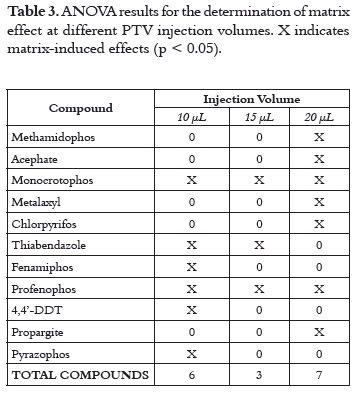
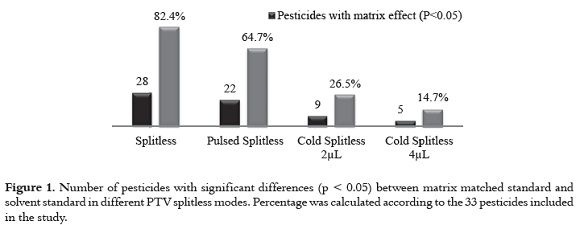
<body><![CDATA[<p>  The ratio between matrix and solvent areas   for each compound (matrix standard/matrix-free   standard x100%) is known as percentage of matrix   effect, and is the first indication of the presence of   this phenomenon (18). <a href="/img/revistas/vitae/v20n3/v20n3a4t2.jpg" target="_blank">Table 2</a> lists the percentages   of matrix effect calculated for some compounds under study.</p>     <p> The ANOVA demonstrates significant differences (p &lt; 0.05) between matrix standard and matrix-free standard for some pesticides. <a href="#f1">Figure 1</a> shows a summary of the results obtained from the corresponding analysis of variance (ANOVA) with a significance level of 0.05. This figure shows the number of compounds having statistical differences (p &lt; 0.05) between chromatographic responses of matrix-matched standard and matrix-free standard, that is, for those compounds to which matrix effect was found.</p>     <p align="center"><a name="f1"></a><img src="/img/revistas/vitae/v20n3/v20n3a4f1.jpg"></p>     <p>&nbsp;</p>     <p>  <b>Matrix Effects: Solvent vent mode and injection volume</b></p>     <p>  <a href="/img/revistas/vitae/v20n3/v20n3a4f2.jpg" target="_blank">Figure 2</a> shows the percentage of matrix effect   at different injection volumes (10 &mu;L, 15 &mu;L and   20 &mu;L) for organochlorines (OC), pyrethroids,   miscellaneous compounds and the <a href="/img/revistas/vitae/v20n3/v20n3a4f3.jpg" target="_blank">figure 3</a> shows the percentages for organophosphorus.</p>     <p>  <a href="#t3">Table 3</a> lists the results of the statistical evaluation   performed using ANOVA, for all injection   volumes, for those compounds to which matrix effect was found in some volumes (p &lt; 0.05).</p>     <p align="center"><a name="t3"></a><img src="/img/revistas/vitae/v20n3/v20n3a4t3.jpg"></p>     <p>&nbsp;</p>     <p><font size="3">  <b>DISCUSSION</b></font></p>     ]]></body>
<body><![CDATA[<p>  <a href="/img/revistas/vitae/v20n3/v20n3a4t2.jpg" target="_blank">Table 2</a> shows the percentage of matrix effect,   which is the ratio between the response of the   pesticide in extract and the response of pesticide   in pure solvent. According to some authors, ratios   over 120% suggests occurrence of matrix-induced   effects; thereby, observing <a href="/img/revistas/vitae/v20n3/v20n3a4t2.jpg" target="_blank">table 2</a>, it should be noted   that some compounds, such as chlorpyrifos, thiabendazole,   fenamiphos, profenofos, permethrin,   among others, have values above this criterion in   almost all splitless injection modes, which suggests   presence of matrix effects (18). On the contrary,   <a href="/img/revistas/vitae/v20n3/v20n3a4t2.jpg" target="_blank">table 2</a> shows that pesticides, such &alpha; &#8211;Endosulfan   and HCB in cold splitless mode, have values close   to 100%, indicating that probably these pesticides are not sensitive to matrix effect.</p>     <p>  Regarding the use of different PTV splitless   modes, <a href="/img/revistas/vitae/v20n3/v20n3a4t2.jpg" target="_blank">table 2</a> shows that hot splitless mode causes   the greatest percentages of matrix effect, these results   are in agreement with previous studies. Even   for this splitless mode, it was found that some   compounds such as HCB have high values (matrix   standard/matrix-free standard), which is not very   common (19, 20). The odd behaviour of HCB is unexpected   and there are no experimental evidences   that could explain this event; however, these results   can also be attributed to some analytical error,   instrumental variations, and/or decomposition of analytes in blank extract, among others (21).</p>     <p>  When the results of conventional hot splitless   with pulsed splitless (with a pressure pulse at the   injector) were compared, a decrease in the pesticides   with ratios up to 120% was found. For example,   <a href="/img/revistas/vitae/v20n3/v20n3a4t2.jpg" target="_blank">table 2</a> shows a considerable percentage decrease of   matrix effect for compounds such as thiabendazole,   4,4'-DDT, captan and permethrin. Moreover, a   significant decrease in these ratios was not noted   in pesticides such as chlorpyrifos, tebuconazole,   profenophos and propargite. This indicates that   pressure pulse does not decrease the adsorption   and/or decomposition of these molecules at the   injection port, which can be explained because   these molecules possibly have high adsorption and degradation kinetics.</p>     <p>  Furthermore, the cold splitless (2 &micro;L) results   shows that some pesticides had a significant improvement   in the percentages (regarding as hot   splitless and pulsed splitless); this improvement is   reflected in values closer to 100%, which indicates   a reduction in matrix-induced effects. As can be   noted, for cold splitless injection, when comparing   the results between the two injection volumes, it   was found that chlorpyrifos, thiabendazole, tebuconazole   and deltamethrin have percentages of   matrix effect closer to 100% when a volume of 4 &micro;L   is injected, which indicates that the increase in the injection volume decreases matrix effects.</p>     <p>  Several authors have reported different variables   that influence the chromatographic response enhancement   or matrix effects; one of the most important   is the pesticide concentration (14, 22), which   has an inverse relationship with matrix-induced   effects. This relationship is due to low concentrations,   since it has a lower number of molecules in   the injection port; consequently, the loss of these   molecules is more significant that when is working   with high concentrations of pesticide (13). Thus, the   chromatographic response enhancement decreases   with the increase of the injection volume, which can   be attributed to a greater number of molecules in   the injection port when cold splitless (4 &micro;L) mode is used.</p>     <p>  In the statistical evaluation we sought to   determine the influence of different PTV splitless   modes. For this purpose, we considered the   factorial design that was shown in the experimental   section. Results of analysis of variance (ANOVA)   of this design showed that there was no interaction   between the variables included. In this context,   the results presented below correspond exclusively   to the statistical evaluation for the comparison of   chromatographic responses of matrix-matched standard and matrix-free standard.</p>     <p>  <a href="#f1">Figure 1</a> shows that the hot splitless injection   presents the greatest number of compounds with   matrix-induced effects. It also shows that by applying   a pressure pulse the number of compounds   with matrix effects decrease. This behaviour indicates,   as expected, that the pressure pulse decrease   the possibility of compounds adsorption and/or   decomposition in the inlet, thus matrix-induced effects are reduced by nearly 20%.</p>     <p>  <a href="#f1">Figure 1</a> illustrates that the use of cold splitless   injection has reduced significantly the matrix effect,   because with an injection volume of 2 &mu;L only nine   pesticides presented matrix-induced effects (triflumurone,   monocrotophos, dichlofluanid, malathion,   captan, fenamiphos, profenophos, &lambda;-Cyhalothrin   and pyrazophos). With 4 &mu;L in cold splitless mode,   the number of compounds with matrix effect also decreased.</p>     <p>  Finally, when comparing the results shown in   <a href="#f1">figure 1</a> with the matrix effect percentages listed   for some compounds in <a href="/img/revistas/vitae/v20n3/v20n3a4t2.jpg" target="_blank">table 2</a>, a good correlation   between them was found. Similarly, both results   show that the increase of injection volume decreases the number of compounds having matrix effect.</p>     <p>  Experiments with solvent vent mode were not   carried out in splitless modes because the injections   of 10 &mu;L, 15 &mu;L, and 20 &mu;L produced high   chromatographic responses. Thus, for these experiments   it was used five times lower concentrations   than those reported in <a href="/img/revistas/vitae/v20n3/v20n3a4t2.jpg" target="_blank">table 2</a>. On the other hand,   the injection volume was included in the second   experimental design to observe its influence on   the matrix effect, which was not included in the   previous experiment (studies with splitless injection   modes) because it would require a more complex design.</p>     ]]></body>
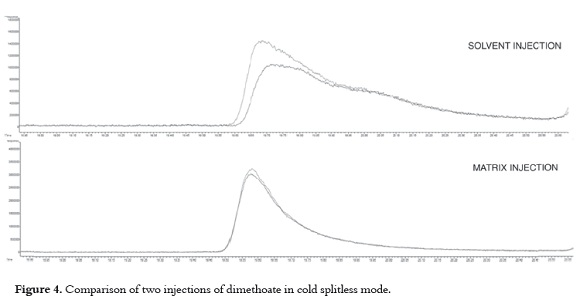
<body><![CDATA[<p>  <b>Matrix Effects: Solvent vent mode and injection volume</b></p>     <p>  The <a href="/img/revistas/vitae/v20n3/v20n3a4f2.jpg" target="_blank">figure 2</a> shows that the organochlorine   pesticides (first five in <a href="/img/revistas/vitae/v20n3/v20n3a4f2.jpg" target="_blank">figure 2</a>) presented the lowest   percentage of matrix effect. These compounds   (OC) have lower polarity, hence less susceptible to   adsorption in the injection liner; in addition, this   type of molecules are relatively thermo-stables. Interestingly,   other authors have reported chromatographic   responses enhancement similar to those   found in our study (14). In general, it was found   that for these compounds there are percentages   around 100%, indicating that matrix effect is not   present. Only in the case of 4,4'-DDT a relatively   high percentage was found, which agrees with the   sensitivity of this compound to decompose at 4,4- DDD in the injection port.</p>     <p>  Synthetic pyrethroids (next five pesticides in   <a href="/img/revistas/vitae/v20n3/v20n3a4f2.jpg" target="_blank">figure 2</a>) compounds, with high molecular masses   (over 400 g/mol), generally were compounds that   have some degree of matrix effect (23). In this study,   they presented similar results to OC pesticides since all the percentages presented values around 100%.</p>     <p>  In general, organophosphorus compounds have   greater probability to have matrix-induced effects,   due to their relatively high polarity, therefore for   these pesticides values up to 500% have been reported   (22). <a href="/img/revistas/vitae/v20n3/v20n3a4f3.jpg" target="_blank">Figure 3</a> shows that some organophosphorus   (P = O) pesticides (acephate, monocrotophos,   Fenamiphos, profenophos and iprodione) have   values considerably greater than 100%. However,   some organophosphorus containing P = S groups,   chlorpyrifos and malathion, the incidence of matrix   effect was less pronounced in some injection   volumes. On the contrary, compounds as diazinon,   parathion-methyl and isofenphos presented percentages close to 100% for all injection volumes.</p>     <p>  It is also noted in <a href="/img/revistas/vitae/v20n3/v20n3a4f3.jpg" target="_blank">figure 3</a> that some compounds,   such as metamidophos, acephate and dimethoate,   have the highest ratios of matrix standard to matrix-   free standard with 20 &mu;L injection. However,   for compounds such monocrotophos, malathion,   phenamiphos, profenophos, tetradifon, iprodione   and pyrazophos, it was found that the percentage   of matrix effect decreases as the injection volume increases.</p>     <p>  <a href="#t3">Table 3</a> shows the results only for pesticides   that presented statistical differences (p &lt; 0.05)   between the injection volumes and for the remaining   compounds, and no matrix-induced effect was   found (statistically; p &gt; 0.05). Regarding <a href="#t3">table 3</a>,   the results agree satisfactorily with those presented   previously because compounds such as HCB, that   presented low percentages of matrix effect, does   not present statistically differences (p &gt; 0.05) at   different injection volumes evaluated, and other   compounds such as monocrotophos or fenamiphos      (with high percentages of matrix effect) presents statistical differences (p &lt; 0.05).</p>     <p>  <a href="#t3">Table 3</a> shows that, for an injection volume of 10 &micro;L, pesticides such as thiabendazole, fenamiphos, 4,4'-DDT and pyrazophos have matrix-induced effects; however, if the volume increases no statistical difference (P &gt; 0.05) appears between matrixmatched and matrix-free solutions, which implies that the matrix effects disappears. This behaviour is given by the previously mentioned concentration process in the liner.</p>     <p>  In contrast, metamidophos, acephate, chlorpyrifos,   metalaxyl and propargite have a different behaviour.   As can be seen when larger volumes were   used the matrix-induced effects increased. This   may be attributed to the concentration of matrix   components along with the pesticides, at the time   of solvent elimination; consequently, there are more   matrix compounds. This facilitates the transfer of   pesticides to the analytical column and therefore   chromatographic responses are higher in matrixmatched   solution (14).</p>     <p>  From <a href="#t3">table 3</a> it can also be seen that for some   compounds it was not possible to reduce matrixinduced   effects, indicating that these molecules   are extremely sensitive to decomposition and / or   adsorption, which agrees or confirms literature   reports (13, 14). Moreover, it is possible that these   processes of loss of molecules were carried out in   the chromatographic column and not in the liner   injection (24).</p>     <p>  In addition, in our study, although a significant   reduction of matrix effects was found in potato extracts   by using cold splitless and solvent vent modes,   we noticed that the stability of the chromatographic   signals by using matrix-matched standards is greater   than the matrix-free standards. Thus, although   the area of some compounds in solvent was statistically   equal to the matrix-matched areas, the   characteristics of the chromatographic signals were   completely different. The <a href="#f4">figure 4</a> shows some   chromatograms obtained in matrix-free standards   and matrix standards. For example, for most compounds,   injections with matrix-matched solutions   had more symmetric signals and a better peak   height to peak width ratio (H/A) compared with   the matrix-free solutions, while the solvent signals   showed low symmetries, peak widths and variation   in retention times.</p>       ]]></body>
<body><![CDATA[<p align="center"><a name="f4"></a><img src="/img/revistas/vitae/v20n3/v20n3a4f4.jpg"></p>     <p>&nbsp;</p>     <p>  <b>Limitations</b></p>     <p>  Finally, it is important to note that although this   study was limited to the use of extracts of potato, the   choice of this extract was based on a previous study   which found that potato extracts causes the largest   increase in chromatographic response compared to   other fruits, vegetables and cereals (16). However,   it is believed that the results found in this study   cannot be directly extrapolated to other types of   food and other pesticides, because the effects that   can cause the different matrices on the chromatographic   responses depend on many factors, such as   chemical composition (e.g. lipids, carotenoids, water   content, chlorophylls, among others), the extraction   solvent, the amount of extractable matrix, the   clean-up procedure, the extraction procedure and,   last but not least, the physicochemical properties of   pesticides. Despite all of this, it is important to note   that the objective of this study was not to perform   the above, but to reduce the matrix effect through   the use of the PTV injector, and the results showed   that this is possible.</p>     <p>&nbsp;</p>     <p> <font size="3"> <b>CONCLUSIONS</b></font></p>     <p>  In this study it was found that the use of classic   hot splitless and pulsed splitless modes cause   matrix-induced effects in more than 70% of the   studied compounds in potato extracts. On one   hand, it was warned that the use of pulse pressure   decreases the decomposition and / or degradation of   the compounds by about 20%. On the other hand, a   remarkable decrease in matrix-induced effects was   achieved using cold splitless mode, since there was   up to 55% reduction in the compounds that showed   statistical differences between responses in matrixfree   standards and matrix-matched standards,   compared with the traditional hot splitless mode.</p>     <p>  For most compounds in cold splitless and solvent   vent modes an inverse relationship between the injection   volume and the presence of matrix-induced   effects was found, but it was not possible to clearly   determine the effect of the injection volume on the   matrix-induced effects, since in some compounds   these effects increased with the injection volume.</p>     <p>&nbsp;</p>     <p> <font size="3"> <b>ACKNOWLEDGMENTS</b></font></p>     ]]></body>
<body><![CDATA[<p>  The Authors are grateful to the Chemistry   Department of National University and the      International Atomic Energy Agency (IAEA)   through the project COL5/022.</p>     <p>&nbsp;</p>     <p> <font size="3"> <b>REFERENCES</b></font></p>     <!-- ref --><p>  1. D'Mello JPF. Food Safety: Contaminants and Toxins. 1st Ed.   Oxon, UK: CABI Publishing; 2003. 91p.    &nbsp;&nbsp;&nbsp;&nbsp;&nbsp;&nbsp;&nbsp;&nbsp;[&#160;<a href="javascript:void(0);" onclick="javascript: window.open('/scielo.php?script=sci_nlinks&ref=000106&pid=S0121-4004201300030000400001&lng=','','width=640,height=500,resizable=yes,scrollbars=1,menubar=yes,');">Links</a>&#160;]<!-- end-ref --></p>     <!-- ref --><p>  2. Harris J. Chemical Pesticide Markets, Health Risks and Residues.   1<sup>st</sup> Ed. Cambridge, USA: CABI Publishing; 2000. 64p.    &nbsp;&nbsp;&nbsp;&nbsp;&nbsp;&nbsp;&nbsp;&nbsp;[&#160;<a href="javascript:void(0);" onclick="javascript: window.open('/scielo.php?script=sci_nlinks&ref=000108&pid=S0121-4004201300030000400002&lng=','','width=640,height=500,resizable=yes,scrollbars=1,menubar=yes,');">Links</a>&#160;]<!-- end-ref --></p>     <!-- ref --><p>  3. G&oacute;mez-Ramos MM, Ferrer C, Malato O, Ag&uuml;era A, Fern&aacute;ndez-   Alba AR. Liquid Chromatography-High-Resolution Mass Spectrometry   for pesticide residue analysis in fruit and vegetables.   Screening and quantitative studies. J Chromatogr A. 2013 April;   1287 (26): 24-37.    &nbsp;&nbsp;&nbsp;&nbsp;&nbsp;&nbsp;&nbsp;&nbsp;[&#160;<a href="javascript:void(0);" onclick="javascript: window.open('/scielo.php?script=sci_nlinks&ref=000110&pid=S0121-4004201300030000400003&lng=','','width=640,height=500,resizable=yes,scrollbars=1,menubar=yes,');">Links</a>&#160;]<!-- end-ref --></p>     <!-- ref --><p>  4. Walorczyk S, Drozdzynski D, Kowalska J, Remlein-Starosta D,   Zi&oacute;lkowski A, Przewozniak M, Gnusowski B. Pesticide residues   determination in Polish organic crops in 2007-2010 applying gas   chromatography-tandem quadrupole mass spectrometry. Food   Chem. 2013 Aug; 139 (1-4): 482-487.    &nbsp;&nbsp;&nbsp;&nbsp;&nbsp;&nbsp;&nbsp;&nbsp;[&#160;<a href="javascript:void(0);" onclick="javascript: window.open('/scielo.php?script=sci_nlinks&ref=000112&pid=S0121-4004201300030000400004&lng=','','width=640,height=500,resizable=yes,scrollbars=1,menubar=yes,');">Links</a>&#160;]<!-- end-ref --></p>     <!-- ref --><p>  5. Grob R, Barry E. Modern Practice of Gas Chromatography. 4<sup>th</sup>   Ed. New York, USA: Wiley Interscience; 2004. 275p.    &nbsp;&nbsp;&nbsp;&nbsp;&nbsp;&nbsp;&nbsp;&nbsp;[&#160;<a href="javascript:void(0);" onclick="javascript: window.open('/scielo.php?script=sci_nlinks&ref=000114&pid=S0121-4004201300030000400005&lng=','','width=640,height=500,resizable=yes,scrollbars=1,menubar=yes,');">Links</a>&#160;]<!-- end-ref --></p>     <!-- ref --><p>  6. Cherta L, Beltran J, Pitarch E, Hern&aacute;ndez F. Comparison of   Simple and Rapid Extraction Procedures for the Determination   of Pesticide Residues in Fruit Juices by Fast Gas Chromatography&#8211;   Mass Spectrometry. Food Anal Method. 2013 Dec; 6 (6):   1671-1684.    &nbsp;&nbsp;&nbsp;&nbsp;&nbsp;&nbsp;&nbsp;&nbsp;[&#160;<a href="javascript:void(0);" onclick="javascript: window.open('/scielo.php?script=sci_nlinks&ref=000116&pid=S0121-4004201300030000400006&lng=','','width=640,height=500,resizable=yes,scrollbars=1,menubar=yes,');">Links</a>&#160;]<!-- end-ref --></p>     <!-- ref --><p>  7. Snow NH. Inlet Systems for Gas Chromatography. 4<sup>th</sup> Ed. New   York, USA: Wiley Interscience; 2004. 461p.    &nbsp;&nbsp;&nbsp;&nbsp;&nbsp;&nbsp;&nbsp;&nbsp;[&#160;<a href="javascript:void(0);" onclick="javascript: window.open('/scielo.php?script=sci_nlinks&ref=000118&pid=S0121-4004201300030000400007&lng=','','width=640,height=500,resizable=yes,scrollbars=1,menubar=yes,');">Links</a>&#160;]<!-- end-ref --></p>     <!-- ref --><p>  8. Zrostl&iacute;kov&aacute; J, Hajslov&aacute; J, Godula M, Mastovsk&aacute; K. Performance   of programmed temperature vaporizer, pulsed splitless and oncolumn   injection techniques in analysis of pesticide residues in   plant matrices. J Chromatogr A. 2001 Dec; 937 (1-2): 73-86.    &nbsp;&nbsp;&nbsp;&nbsp;&nbsp;&nbsp;&nbsp;&nbsp;[&#160;<a href="javascript:void(0);" onclick="javascript: window.open('/scielo.php?script=sci_nlinks&ref=000120&pid=S0121-4004201300030000400008&lng=','','width=640,height=500,resizable=yes,scrollbars=1,menubar=yes,');">Links</a>&#160;]<!-- end-ref --></p>     <!-- ref --><p>  9. Hern&aacute;ndez F, Cervera MI, Portol&eacute;s T, Beltran J, Pitarch E. The   role of GC-MS/MS with triple quadrupole in pesticide residue   analysis in food and the environment. Anal Methods. 2013 Aug;   5 (21): 5875-5894.    &nbsp;&nbsp;&nbsp;&nbsp;&nbsp;&nbsp;&nbsp;&nbsp;[&#160;<a href="javascript:void(0);" onclick="javascript: window.open('/scielo.php?script=sci_nlinks&ref=000122&pid=S0121-4004201300030000400009&lng=','','width=640,height=500,resizable=yes,scrollbars=1,menubar=yes,');">Links</a>&#160;]<!-- end-ref --></p>     <!-- ref --><p>  10. Hoh E, Mastovska K. Large volume injection techniques in   capillary gas chromatography. J Chromatogr A. 2008 Apr; 1186   (1-2): 2-15.    &nbsp;&nbsp;&nbsp;&nbsp;&nbsp;&nbsp;&nbsp;&nbsp;[&#160;<a href="javascript:void(0);" onclick="javascript: window.open('/scielo.php?script=sci_nlinks&ref=000124&pid=S0121-4004201300030000400010&lng=','','width=640,height=500,resizable=yes,scrollbars=1,menubar=yes,');">Links</a>&#160;]<!-- end-ref --></p>     <!-- ref --><p>  11. Walorczyk S. Gas chromatographic&#8211;tandem mass spectrometric   analysis of pesticides residues in produce using concurrent solvent   recondensation-large volume injection. J Chromatogr A. 2012   Jan; 1222 (27): 98-108.    &nbsp;&nbsp;&nbsp;&nbsp;&nbsp;&nbsp;&nbsp;&nbsp;[&#160;<a href="javascript:void(0);" onclick="javascript: window.open('/scielo.php?script=sci_nlinks&ref=000126&pid=S0121-4004201300030000400011&lng=','','width=640,height=500,resizable=yes,scrollbars=1,menubar=yes,');">Links</a>&#160;]<!-- end-ref --></p>     <!-- ref --><p>  12. Yu S, Xu X. Study of matrix-induced effects in multi-residue   determination of pesticides by online gel permeation chromatography-   gas chromatography/mass spectrometry. Rapid Commun   Mass Sp. 2012 Mar; 26 (9): 963-977.    &nbsp;&nbsp;&nbsp;&nbsp;&nbsp;&nbsp;&nbsp;&nbsp;[&#160;<a href="javascript:void(0);" onclick="javascript: window.open('/scielo.php?script=sci_nlinks&ref=000128&pid=S0121-4004201300030000400012&lng=','','width=640,height=500,resizable=yes,scrollbars=1,menubar=yes,');">Links</a>&#160;]<!-- end-ref --></p>     <!-- ref --><p>  13. Poole CF. Matrix-induced response enhancement in pesticide   residue analysis by gas chromatography. J Chromatogr A. 2007   Jul; 1158 (1-2): 241-250.    &nbsp;&nbsp;&nbsp;&nbsp;&nbsp;&nbsp;&nbsp;&nbsp;[&#160;<a href="javascript:void(0);" onclick="javascript: window.open('/scielo.php?script=sci_nlinks&ref=000130&pid=S0121-4004201300030000400013&lng=','','width=640,height=500,resizable=yes,scrollbars=1,menubar=yes,');">Links</a>&#160;]<!-- end-ref --></p>     <!-- ref --><p>  14. Hajslov&aacute; J, Zrostl&iacute;kov&aacute; J. Matrix effects in (ultra)trace analysis   of pesticide residues in food and biotic matrices. J Chromatogr   A. 2003 Jun; 1000 (1-2): 181-197.    &nbsp;&nbsp;&nbsp;&nbsp;&nbsp;&nbsp;&nbsp;&nbsp;[&#160;<a href="javascript:void(0);" onclick="javascript: window.open('/scielo.php?script=sci_nlinks&ref=000132&pid=S0121-4004201300030000400014&lng=','','width=640,height=500,resizable=yes,scrollbars=1,menubar=yes,');">Links</a>&#160;]<!-- end-ref --></p>     <!-- ref --><p>  15. Kende A, Vrabecz A, Angyal V, Rikker T, Eke Z, Torkos K.   Liner as the Key of Injection Optimization in Pesticide Analysis.   Chromatographia. 2006 Feb; 63 (3-4): 181-187.    &nbsp;&nbsp;&nbsp;&nbsp;&nbsp;&nbsp;&nbsp;&nbsp;[&#160;<a href="javascript:void(0);" onclick="javascript: window.open('/scielo.php?script=sci_nlinks&ref=000134&pid=S0121-4004201300030000400015&lng=','','width=640,height=500,resizable=yes,scrollbars=1,menubar=yes,');">Links</a>&#160;]<!-- end-ref --></p>     <!-- ref --><p>  16. Ahumada DA, Guerrero JA. Estudio del Efecto Matriz en el   An&aacute;lisis de Plaguicidas por Cromatograf&iacute;a de Gases. Vitae. 2010   Jan-Apr; 17 (1): 51-58.    &nbsp;&nbsp;&nbsp;&nbsp;&nbsp;&nbsp;&nbsp;&nbsp;[&#160;<a href="javascript:void(0);" onclick="javascript: window.open('/scielo.php?script=sci_nlinks&ref=000136&pid=S0121-4004201300030000400016&lng=','','width=640,height=500,resizable=yes,scrollbars=1,menubar=yes,');">Links</a>&#160;]<!-- end-ref --></p>     <!-- ref --><p>  17. Ahumada DA, Guerrero JA. Optimizaci&oacute;n del inyector de temperatura   programada en el an&aacute;lisis de residuos de plaguicidas   mediante el m&eacute;todo simplex. Rev Colomb Qu&iacute;m. 2010 May-Ago;   39 (2): 221-236.    &nbsp;&nbsp;&nbsp;&nbsp;&nbsp;&nbsp;&nbsp;&nbsp;[&#160;<a href="javascript:void(0);" onclick="javascript: window.open('/scielo.php?script=sci_nlinks&ref=000138&pid=S0121-4004201300030000400017&lng=','','width=640,height=500,resizable=yes,scrollbars=1,menubar=yes,');">Links</a>&#160;]<!-- end-ref --></p>     <!-- ref --><p>  18. Aparecida F, Guido AI, Lopes ME Queiroz, Te&oacute;filo RF, Neves   AA, Pinho G. Evaluation of matrix effect on the GC response   of eleven pesticides by PCA. Food Chem. 2012 Nov; 135 (1):   179-185.    &nbsp;&nbsp;&nbsp;&nbsp;&nbsp;&nbsp;&nbsp;&nbsp;[&#160;<a href="javascript:void(0);" onclick="javascript: window.open('/scielo.php?script=sci_nlinks&ref=000140&pid=S0121-4004201300030000400018&lng=','','width=640,height=500,resizable=yes,scrollbars=1,menubar=yes,');">Links</a>&#160;]<!-- end-ref --></p>     <!-- ref --><p>  19. Garrido A, Mart&iacute;nez JL, Fern&aacute;ndez JL, Romero-Gonz&aacute;lez R.   Compensation for matrix effects in gas chromatography&#8211;tandem   mass spectrometry using a single point standard addition.   J Chromatogr A. 2009 Jun; 1216 (23): 4798-4808.    &nbsp;&nbsp;&nbsp;&nbsp;&nbsp;&nbsp;&nbsp;&nbsp;[&#160;<a href="javascript:void(0);" onclick="javascript: window.open('/scielo.php?script=sci_nlinks&ref=000142&pid=S0121-4004201300030000400019&lng=','','width=640,height=500,resizable=yes,scrollbars=1,menubar=yes,');">Links</a>&#160;]<!-- end-ref --></p>     <!-- ref --><p>  20. Lozano A, Rajski L, Ucl&eacute;s S, Belmonte-Valles N, Mezcua M,   Fern&aacute;ndez-Alba AR. Evaluation of zirconium dioxide-based   sorbents to decrease the matrix effect in avocado and almond   multiresidue pesticide analysis followed by gas chromatography   tandem mass spectrometry. Talanta 2014 Jan; 118 (15): 68-83.    &nbsp;&nbsp;&nbsp;&nbsp;&nbsp;&nbsp;&nbsp;&nbsp;[&#160;<a href="javascript:void(0);" onclick="javascript: window.open('/scielo.php?script=sci_nlinks&ref=000144&pid=S0121-4004201300030000400020&lng=','','width=640,height=500,resizable=yes,scrollbars=1,menubar=yes,');">Links</a>&#160;]<!-- end-ref --></p>     <!-- ref --><p>  21. Kocourek V, Hajlov&aacute; J, Holadov&aacute; K, Poustka J. Stability of pesticides   in plant extracts used as calibrants in the gas chromatographic   analysis of residues. J Chromatogr A. 1998 Mar; 800 (2):   297-304.    &nbsp;&nbsp;&nbsp;&nbsp;&nbsp;&nbsp;&nbsp;&nbsp;[&#160;<a href="javascript:void(0);" onclick="javascript: window.open('/scielo.php?script=sci_nlinks&ref=000146&pid=S0121-4004201300030000400021&lng=','','width=640,height=500,resizable=yes,scrollbars=1,menubar=yes,');">Links</a>&#160;]<!-- end-ref --></p>     <!-- ref --><p>  22. Amvrazia EG, Papadi-Psylloua AT, Nikolaos G. Pesticide enrichment   factors and matrix effects on the determination of multiclass   pesticides in tomato samples by single-drop microextraction   (SDME) coupled with gas chromatography and comparison study   between SDME and acetone-partition extraction procedure. Int   J Environ Anal Ch. 2010 Mar; 90 (3-6): 245-259.    &nbsp;&nbsp;&nbsp;&nbsp;&nbsp;&nbsp;&nbsp;&nbsp;[&#160;<a href="javascript:void(0);" onclick="javascript: window.open('/scielo.php?script=sci_nlinks&ref=000148&pid=S0121-4004201300030000400022&lng=','','width=640,height=500,resizable=yes,scrollbars=1,menubar=yes,');">Links</a>&#160;]<!-- end-ref --></p>     <!-- ref --><p>  23. Schenck FJ, Lehotay S. Does further clean-up reduce the matrix   enhancement effect in gas chromatographic analysis of pesticide   residues in food? J Chromatogr A. 2000 Jan; 868 (1): 51-61.    &nbsp;&nbsp;&nbsp;&nbsp;&nbsp;&nbsp;&nbsp;&nbsp;[&#160;<a href="javascript:void(0);" onclick="javascript: window.open('/scielo.php?script=sci_nlinks&ref=000150&pid=S0121-4004201300030000400023&lng=','','width=640,height=500,resizable=yes,scrollbars=1,menubar=yes,');">Links</a>&#160;]<!-- end-ref --></p>     <!-- ref --><p>  24. Anastassiades M, Mastovsk&aacute; K, Lehotay SJ. Evaluation of analyte   protectants to improve gas chromatographic analysis of pesticides.   J Chromatogr A. 2003 Oct; 1015 (1-2): 163-184.    &nbsp;&nbsp;&nbsp;&nbsp;&nbsp;&nbsp;&nbsp;&nbsp;[&#160;<a href="javascript:void(0);" onclick="javascript: window.open('/scielo.php?script=sci_nlinks&ref=000152&pid=S0121-4004201300030000400024&lng=','','width=640,height=500,resizable=yes,scrollbars=1,menubar=yes,');">Links</a>&#160;]<!-- end-ref --></p>     <p>&nbsp;</p> </font>      ]]></body><back>
<ref-list>
<ref id="B1">
<label>1</label><nlm-citation citation-type="book">
<person-group person-group-type="author">
<name>
<surname><![CDATA[D'Mello]]></surname>
<given-names><![CDATA[JPF]]></given-names>
</name>
</person-group>
<source><![CDATA[Food Safety: Contaminants and Toxins]]></source>
<year>2003</year>
<edition>1st</edition>
<publisher-loc><![CDATA[Oxon ]]></publisher-loc>
<publisher-name><![CDATA[CABI Publishing]]></publisher-name>
</nlm-citation>
</ref>
<ref id="B2">
<label>2</label><nlm-citation citation-type="book">
<person-group person-group-type="author">
<name>
<surname><![CDATA[Harris]]></surname>
<given-names><![CDATA[J]]></given-names>
</name>
</person-group>
<source><![CDATA[Chemical Pesticide Markets, Health Risks and Residues]]></source>
<year>2000</year>
<edition>1st</edition>
<publisher-loc><![CDATA[Cambridge ]]></publisher-loc>
<publisher-name><![CDATA[CABI Publishing]]></publisher-name>
</nlm-citation>
</ref>
<ref id="B3">
<label>3</label><nlm-citation citation-type="journal">
<person-group person-group-type="author">
<name>
<surname><![CDATA[Gómez-Ramos]]></surname>
<given-names><![CDATA[MM]]></given-names>
</name>
<name>
<surname><![CDATA[Ferrer]]></surname>
<given-names><![CDATA[C]]></given-names>
</name>
<name>
<surname><![CDATA[Malato]]></surname>
<given-names><![CDATA[O]]></given-names>
</name>
<name>
<surname><![CDATA[Agüera]]></surname>
<given-names><![CDATA[A]]></given-names>
</name>
<name>
<surname><![CDATA[Fernández-Alba]]></surname>
<given-names><![CDATA[AR.]]></given-names>
</name>
</person-group>
<article-title xml:lang="en"><![CDATA[Liquid Chromatography-High-Resolution Mass Spectrometry for pesticide residue analysis in fruit and vegetables. Screening and quantitative studies]]></article-title>
<source><![CDATA[J Chromatogr A]]></source>
<year>2013</year>
<month> A</month>
<day>pr</day>
<volume>1287</volume>
<numero>26</numero>
<issue>26</issue>
<page-range>24-37</page-range></nlm-citation>
</ref>
<ref id="B4">
<label>4</label><nlm-citation citation-type="journal">
<person-group person-group-type="author">
<name>
<surname><![CDATA[Walorczyk]]></surname>
<given-names><![CDATA[S]]></given-names>
</name>
<name>
<surname><![CDATA[Drozdzynski]]></surname>
<given-names><![CDATA[D]]></given-names>
</name>
<name>
<surname><![CDATA[Kowalska]]></surname>
<given-names><![CDATA[J]]></given-names>
</name>
<name>
<surname><![CDATA[Remlein-Starosta]]></surname>
<given-names><![CDATA[D]]></given-names>
</name>
<name>
<surname><![CDATA[Ziólkowski]]></surname>
<given-names><![CDATA[A]]></given-names>
</name>
<name>
<surname><![CDATA[Przewozniak]]></surname>
<given-names><![CDATA[M]]></given-names>
</name>
<name>
<surname><![CDATA[Gnusowski]]></surname>
<given-names><![CDATA[B.]]></given-names>
</name>
</person-group>
<article-title xml:lang="en"><![CDATA[Pesticide residues determination in Polish organic crops in 2007-2010 applying gas chromatography-tandem quadrupole mass spectrometry]]></article-title>
<source><![CDATA[Food Chem]]></source>
<year>2013</year>
<month> A</month>
<day>ug</day>
<volume>139</volume>
<numero>1-4</numero>
<issue>1-4</issue>
<page-range>482-487</page-range></nlm-citation>
</ref>
<ref id="B5">
<label>5</label><nlm-citation citation-type="book">
<person-group person-group-type="author">
<name>
<surname><![CDATA[Grob]]></surname>
<given-names><![CDATA[R]]></given-names>
</name>
<name>
<surname><![CDATA[Barry]]></surname>
<given-names><![CDATA[E]]></given-names>
</name>
</person-group>
<source><![CDATA[Modern Practice of Gas Chromatography]]></source>
<year>2004</year>
<edition>4th</edition>
<publisher-loc><![CDATA[New York ]]></publisher-loc>
<publisher-name><![CDATA[Wiley Interscience]]></publisher-name>
</nlm-citation>
</ref>
<ref id="B6">
<label>6</label><nlm-citation citation-type="journal">
<person-group person-group-type="author">
<name>
<surname><![CDATA[Cherta]]></surname>
<given-names><![CDATA[L]]></given-names>
</name>
<name>
<surname><![CDATA[Beltran]]></surname>
<given-names><![CDATA[J]]></given-names>
</name>
<name>
<surname><![CDATA[Pitarch]]></surname>
<given-names><![CDATA[E]]></given-names>
</name>
<name>
<surname><![CDATA[Hernández]]></surname>
<given-names><![CDATA[F.]]></given-names>
</name>
</person-group>
<article-title xml:lang="en"><![CDATA[Comparison of Simple and Rapid Extraction Procedures for the Determination of Pesticide Residues in Fruit Juices by Fast Gas Chromatography- Mass Spectrometry]]></article-title>
<source><![CDATA[Food Anal Method]]></source>
<year>2013</year>
<month> D</month>
<day>ec</day>
<volume>6</volume>
<numero>6</numero>
<issue>6</issue>
<page-range>1671-1684</page-range></nlm-citation>
</ref>
<ref id="B7">
<label>7</label><nlm-citation citation-type="book">
<person-group person-group-type="author">
<name>
<surname><![CDATA[Snow]]></surname>
<given-names><![CDATA[NH]]></given-names>
</name>
</person-group>
<source><![CDATA[Inlet Systems for Gas Chromatography]]></source>
<year>2004</year>
<edition>4th</edition>
<publisher-loc><![CDATA[New York ]]></publisher-loc>
<publisher-name><![CDATA[Wiley Interscience]]></publisher-name>
</nlm-citation>
</ref>
<ref id="B8">
<label>8</label><nlm-citation citation-type="journal">
<person-group person-group-type="author">
<name>
<surname><![CDATA[Zrostlíková]]></surname>
<given-names><![CDATA[J]]></given-names>
</name>
<name>
<surname><![CDATA[Hajslová]]></surname>
<given-names><![CDATA[J]]></given-names>
</name>
<name>
<surname><![CDATA[Godula]]></surname>
<given-names><![CDATA[M]]></given-names>
</name>
<name>
<surname><![CDATA[Mastovská]]></surname>
<given-names><![CDATA[K.]]></given-names>
</name>
</person-group>
<article-title xml:lang="en"><![CDATA[Performance of programmed temperature vaporizer, pulsed splitless and oncolumn injection techniques in analysis of pesticide residues in plant matrices]]></article-title>
<source><![CDATA[J Chromatogr A]]></source>
<year>2001</year>
<month> D</month>
<day>ec</day>
<volume>937</volume>
<numero>1-2</numero>
<issue>1-2</issue>
<page-range>73-86</page-range></nlm-citation>
</ref>
<ref id="B9">
<label>9</label><nlm-citation citation-type="journal">
<person-group person-group-type="author">
<name>
<surname><![CDATA[Hernández]]></surname>
<given-names><![CDATA[F]]></given-names>
</name>
<name>
<surname><![CDATA[Cervera]]></surname>
<given-names><![CDATA[MI]]></given-names>
</name>
<name>
<surname><![CDATA[Portolés]]></surname>
<given-names><![CDATA[T]]></given-names>
</name>
<name>
<surname><![CDATA[Beltran]]></surname>
<given-names><![CDATA[J]]></given-names>
</name>
<name>
<surname><![CDATA[Pitarch]]></surname>
<given-names><![CDATA[E.]]></given-names>
</name>
</person-group>
<article-title xml:lang="en"><![CDATA[The role of GC-MS/MS with triple quadrupole in pesticide residue analysis in food and the environment]]></article-title>
<source><![CDATA[Anal Methods]]></source>
<year>2013</year>
<month> A</month>
<day>ug</day>
<volume>5</volume>
<numero>21</numero>
<issue>21</issue>
<page-range>5875-5894</page-range></nlm-citation>
</ref>
<ref id="B10">
<label>10</label><nlm-citation citation-type="journal">
<person-group person-group-type="author">
<name>
<surname><![CDATA[Hoh]]></surname>
<given-names><![CDATA[E]]></given-names>
</name>
<name>
<surname><![CDATA[Mastovska]]></surname>
<given-names><![CDATA[K.]]></given-names>
</name>
</person-group>
<article-title xml:lang="en"><![CDATA[Large volume injection techniques in capillary gas chromatography]]></article-title>
<source><![CDATA[J Chromatogr A]]></source>
<year>2008</year>
<month> A</month>
<day>pr</day>
<volume>1186</volume>
<numero>1-2</numero>
<issue>1-2</issue>
<page-range>2-15</page-range></nlm-citation>
</ref>
<ref id="B11">
<label>11</label><nlm-citation citation-type="journal">
<person-group person-group-type="author">
<name>
<surname><![CDATA[Walorczyk]]></surname>
<given-names><![CDATA[S.]]></given-names>
</name>
</person-group>
<article-title xml:lang="en"><![CDATA[Gas chromatographic-tandem mass spectrometric analysis of pesticides residues in produce using concurrent solvent recondensation-large volume injection]]></article-title>
<source><![CDATA[J Chromatogr A]]></source>
<year>2012</year>
<month> J</month>
<day>an</day>
<volume>1222</volume>
<numero>27</numero>
<issue>27</issue>
<page-range>98-108</page-range></nlm-citation>
</ref>
<ref id="B12">
<label>12</label><nlm-citation citation-type="journal">
<person-group person-group-type="author">
<name>
<surname><![CDATA[Yu]]></surname>
<given-names><![CDATA[S]]></given-names>
</name>
<name>
<surname><![CDATA[Xu]]></surname>
<given-names><![CDATA[X.]]></given-names>
</name>
</person-group>
<article-title xml:lang="en"><![CDATA[Study of matrix-induced effects in multi-residue determination of pesticides by online gel permeation chromatography- gas chromatography/mass spectrometry]]></article-title>
<source><![CDATA[Rapid Commun Mass Sp]]></source>
<year>2012</year>
<month> M</month>
<day>ar</day>
<volume>26</volume>
<numero>9</numero>
<issue>9</issue>
<page-range>963-977</page-range></nlm-citation>
</ref>
<ref id="B13">
<label>13</label><nlm-citation citation-type="journal">
<person-group person-group-type="author">
<name>
<surname><![CDATA[Poole]]></surname>
<given-names><![CDATA[CF.]]></given-names>
</name>
</person-group>
<article-title xml:lang="en"><![CDATA[Matrix-induced response enhancement in pesticide residue analysis by gas chromatography]]></article-title>
<source><![CDATA[J Chromatogr A]]></source>
<year>2007</year>
<month> J</month>
<day>ul</day>
<volume>1158</volume>
<numero>1-2</numero>
<issue>1-2</issue>
<page-range>241-250</page-range></nlm-citation>
</ref>
<ref id="B14">
<label>14</label><nlm-citation citation-type="journal">
<person-group person-group-type="author">
<name>
<surname><![CDATA[Hajslová]]></surname>
<given-names><![CDATA[J]]></given-names>
</name>
<name>
<surname><![CDATA[Zrostlíková]]></surname>
<given-names><![CDATA[J.]]></given-names>
</name>
</person-group>
<article-title xml:lang="en"><![CDATA[Matrix effects in (ultra)trace analysis of pesticide residues in food and biotic matrices]]></article-title>
<source><![CDATA[J Chromatogr A]]></source>
<year>2003</year>
<month> J</month>
<day>un</day>
<volume>1000</volume>
<numero>1-2</numero>
<issue>1-2</issue>
<page-range>181-197</page-range></nlm-citation>
</ref>
<ref id="B15">
<label>15</label><nlm-citation citation-type="journal">
<person-group person-group-type="author">
<name>
<surname><![CDATA[Kende]]></surname>
<given-names><![CDATA[A]]></given-names>
</name>
<name>
<surname><![CDATA[Vrabecz]]></surname>
<given-names><![CDATA[A]]></given-names>
</name>
<name>
<surname><![CDATA[Angyal]]></surname>
<given-names><![CDATA[V]]></given-names>
</name>
<name>
<surname><![CDATA[Rikker]]></surname>
<given-names><![CDATA[T]]></given-names>
</name>
<name>
<surname><![CDATA[Eke]]></surname>
<given-names><![CDATA[Z]]></given-names>
</name>
<name>
<surname><![CDATA[Torkos]]></surname>
<given-names><![CDATA[K.]]></given-names>
</name>
</person-group>
<article-title xml:lang="en"><![CDATA[Liner as the Key of Injection Optimization in Pesticide Analysis]]></article-title>
<source><![CDATA[Chromatographia]]></source>
<year>2006</year>
<month> F</month>
<day>eb</day>
<volume>63</volume>
<numero>3-4</numero>
<issue>3-4</issue>
<page-range>181-187</page-range></nlm-citation>
</ref>
<ref id="B16">
<label>16</label><nlm-citation citation-type="journal">
<person-group person-group-type="author">
<name>
<surname><![CDATA[Ahumada]]></surname>
<given-names><![CDATA[DA]]></given-names>
</name>
<name>
<surname><![CDATA[Guerrero]]></surname>
<given-names><![CDATA[JA.]]></given-names>
</name>
</person-group>
<article-title xml:lang="es"><![CDATA[Estudio del Efecto Matriz en el Análisis de Plaguicidas por Cromatografía de Gases]]></article-title>
<source><![CDATA[Vitae]]></source>
<year>2010</year>
<month> J</month>
<day>an</day>
<volume>17</volume>
<numero>1</numero>
<issue>1</issue>
<page-range>51-58</page-range></nlm-citation>
</ref>
<ref id="B17">
<label>17</label><nlm-citation citation-type="journal">
<person-group person-group-type="author">
<name>
<surname><![CDATA[Ahumada]]></surname>
<given-names><![CDATA[DA]]></given-names>
</name>
<name>
<surname><![CDATA[Guerrero]]></surname>
<given-names><![CDATA[JA.]]></given-names>
</name>
</person-group>
<article-title xml:lang="es"><![CDATA[Optimización del inyector de temperatura programada en el análisis de residuos de plaguicidas mediante el método simplex]]></article-title>
<source><![CDATA[Rev Colomb Quím]]></source>
<year>2010</year>
<month> M</month>
<day>ay</day>
<volume>39</volume>
<numero>2</numero>
<issue>2</issue>
<page-range>221-236</page-range></nlm-citation>
</ref>
<ref id="B18">
<label>18</label><nlm-citation citation-type="journal">
<person-group person-group-type="author">
<name>
<surname><![CDATA[Aparecida]]></surname>
<given-names><![CDATA[F]]></given-names>
</name>
<name>
<surname><![CDATA[Guido]]></surname>
<given-names><![CDATA[AI]]></given-names>
</name>
<name>
<surname><![CDATA[Lopes]]></surname>
<given-names><![CDATA[ME]]></given-names>
</name>
<name>
<surname><![CDATA[Queiroz]]></surname>
<given-names><![CDATA[Teófilo RF]]></given-names>
</name>
<name>
<surname><![CDATA[Neves]]></surname>
<given-names><![CDATA[AA]]></given-names>
</name>
<name>
<surname><![CDATA[Pinho]]></surname>
<given-names><![CDATA[G.]]></given-names>
</name>
</person-group>
<article-title xml:lang="en"><![CDATA[Evaluation of matrix effect on the GC response of eleven pesticides by PCA]]></article-title>
<source><![CDATA[Food Chem]]></source>
<year>2012</year>
<month> N</month>
<day>ov</day>
<volume>135</volume>
<numero>1</numero>
<issue>1</issue>
<page-range>179-185</page-range></nlm-citation>
</ref>
<ref id="B19">
<label>19</label><nlm-citation citation-type="journal">
<person-group person-group-type="author">
<name>
<surname><![CDATA[Garrido]]></surname>
<given-names><![CDATA[A]]></given-names>
</name>
<name>
<surname><![CDATA[Martínez]]></surname>
<given-names><![CDATA[JL]]></given-names>
</name>
<name>
<surname><![CDATA[Fernández]]></surname>
<given-names><![CDATA[JL]]></given-names>
</name>
<name>
<surname><![CDATA[Romero-González]]></surname>
<given-names><![CDATA[R.]]></given-names>
</name>
</person-group>
<article-title xml:lang="en"><![CDATA[Compensation for matrix effects in gas chromatography-tandem mass spectrometry using a single point standard addition]]></article-title>
<source><![CDATA[J Chromatogr A]]></source>
<year>2009</year>
<month> J</month>
<day>un</day>
<volume>1216</volume>
<numero>23</numero>
<issue>23</issue>
<page-range>4798-4808</page-range></nlm-citation>
</ref>
<ref id="B20">
<label>20</label><nlm-citation citation-type="journal">
<person-group person-group-type="author">
<name>
<surname><![CDATA[Lozano]]></surname>
<given-names><![CDATA[A]]></given-names>
</name>
<name>
<surname><![CDATA[Rajski]]></surname>
<given-names><![CDATA[L]]></given-names>
</name>
<name>
<surname><![CDATA[Uclés]]></surname>
<given-names><![CDATA[S]]></given-names>
</name>
<name>
<surname><![CDATA[Belmonte-Valles]]></surname>
<given-names><![CDATA[N]]></given-names>
</name>
<name>
<surname><![CDATA[Mezcua]]></surname>
<given-names><![CDATA[M]]></given-names>
</name>
<name>
<surname><![CDATA[Fernández-Alba]]></surname>
<given-names><![CDATA[AR.]]></given-names>
</name>
</person-group>
<article-title xml:lang="en"><![CDATA[Evaluation of zirconium dioxide-based sorbents to decrease the matrix effect in avocado and almond multiresidue pesticide analysis followed by gas chromatography tandem mass spectrometry]]></article-title>
<source><![CDATA[Talanta]]></source>
<year>2014</year>
<month> J</month>
<day>an</day>
<volume>118</volume>
<numero>15</numero>
<issue>15</issue>
<page-range>68-83</page-range></nlm-citation>
</ref>
<ref id="B21">
<label>21</label><nlm-citation citation-type="journal">
<person-group person-group-type="author">
<name>
<surname><![CDATA[Kocourek]]></surname>
<given-names><![CDATA[V]]></given-names>
</name>
<name>
<surname><![CDATA[Hajlová]]></surname>
<given-names><![CDATA[J]]></given-names>
</name>
<name>
<surname><![CDATA[Holadová]]></surname>
<given-names><![CDATA[K]]></given-names>
</name>
<name>
<surname><![CDATA[Poustka]]></surname>
<given-names><![CDATA[J.]]></given-names>
</name>
</person-group>
<article-title xml:lang="en"><![CDATA[Stability of pesticides in plant extracts used as calibrants in the gas chromatographic analysis of residues]]></article-title>
<source><![CDATA[J Chromatogr A]]></source>
<year>1998</year>
<month> M</month>
<day>ar</day>
<volume>800</volume>
<numero>2</numero>
<issue>2</issue>
<page-range>297-304</page-range></nlm-citation>
</ref>
<ref id="B22">
<label>22</label><nlm-citation citation-type="journal">
<person-group person-group-type="author">
<name>
<surname><![CDATA[Amvrazia]]></surname>
<given-names><![CDATA[EG]]></given-names>
</name>
<name>
<surname><![CDATA[Papadi-Psylloua]]></surname>
<given-names><![CDATA[AT]]></given-names>
</name>
<name>
<surname><![CDATA[Nikolaos]]></surname>
<given-names><![CDATA[G.]]></given-names>
</name>
</person-group>
<article-title xml:lang="en"><![CDATA[Pesticide enrichment factors and matrix effects on the determination of multiclass pesticides in tomato samples by single-drop microextraction (SDME) coupled with gas chromatography and comparison study between SDME and acetone-partition extraction procedure]]></article-title>
<source><![CDATA[Int J Environ Anal Ch]]></source>
<year>2010</year>
<month> M</month>
<day>ar</day>
<volume>90</volume>
<numero>3-6</numero>
<issue>3-6</issue>
<page-range>245-259</page-range></nlm-citation>
</ref>
<ref id="B23">
<label>23</label><nlm-citation citation-type="journal">
<person-group person-group-type="author">
<name>
<surname><![CDATA[Schenck]]></surname>
<given-names><![CDATA[FJ]]></given-names>
</name>
<name>
<surname><![CDATA[Lehotay]]></surname>
<given-names><![CDATA[S.]]></given-names>
</name>
</person-group>
<article-title xml:lang="en"><![CDATA[Does further clean-up reduce the matrix enhancement effect in gas chromatographic analysis of pesticide residues in food?]]></article-title>
<source><![CDATA[J Chromatogr A]]></source>
<year>2000</year>
<month> J</month>
<day>an</day>
<volume>868</volume>
<numero>1</numero>
<issue>1</issue>
<page-range>51-61</page-range></nlm-citation>
</ref>
<ref id="B24">
<label>24</label><nlm-citation citation-type="journal">
<person-group person-group-type="author">
<name>
<surname><![CDATA[Anastassiades]]></surname>
<given-names><![CDATA[M]]></given-names>
</name>
<name>
<surname><![CDATA[Mastovská]]></surname>
<given-names><![CDATA[K]]></given-names>
</name>
<name>
<surname><![CDATA[Lehotay]]></surname>
<given-names><![CDATA[SJ.]]></given-names>
</name>
</person-group>
<article-title xml:lang="en"><![CDATA[Evaluation of analyte protectants to improve gas chromatographic analysis of pesticides]]></article-title>
<source><![CDATA[J Chromatogr A]]></source>
<year>2003</year>
<month> O</month>
<day>ct</day>
<volume>1015</volume>
<numero>1-2</numero>
<issue>1-2</issue>
<page-range>163-184</page-range></nlm-citation>
</ref>
</ref-list>
</back>
</article>