<?xml version="1.0" encoding="ISO-8859-1"?><article xmlns:mml="http://www.w3.org/1998/Math/MathML" xmlns:xlink="http://www.w3.org/1999/xlink" xmlns:xsi="http://www.w3.org/2001/XMLSchema-instance">
<front>
<journal-meta>
<journal-id>0121-4004</journal-id>
<journal-title><![CDATA[Vitae]]></journal-title>
<abbrev-journal-title><![CDATA[Vitae]]></abbrev-journal-title>
<issn>0121-4004</issn>
<publisher>
<publisher-name><![CDATA[Facultad de Química Farmacéutica, Universidad de Antioquia]]></publisher-name>
</publisher>
</journal-meta>
<article-meta>
<article-id>S0121-40042014000100005</article-id>
<title-group>
<article-title xml:lang="en"><![CDATA[ISOLATION AND FUNCTIONAL CHARACTERIZATION OF A BASIC PHOSPHOLIPASE A2 FROM COLOMBIAN Bothrops asper VENOM]]></article-title>
<article-title xml:lang="es"><![CDATA[AISLAMIENTO Y CARACTERIZACIÓN FUNCIONAL DE UNA FOSFOLIPASA A2 BÁSICA DEL VENENO DE Bothrops asper DE COLOMBIA]]></article-title>
</title-group>
<contrib-group>
<contrib contrib-type="author">
<name>
<surname><![CDATA[Pereañez]]></surname>
<given-names><![CDATA[Jaime Andrés]]></given-names>
</name>
<xref ref-type="aff" rid="A01"/>
<xref ref-type="aff" rid="A04"/>
</contrib>
<contrib contrib-type="author">
<name>
<surname><![CDATA[Quintana]]></surname>
<given-names><![CDATA[Juan Carlos]]></given-names>
</name>
<xref ref-type="aff" rid="A01"/>
</contrib>
<contrib contrib-type="author">
<name>
<surname><![CDATA[Alarcón]]></surname>
<given-names><![CDATA[Juan Carlos]]></given-names>
</name>
<xref ref-type="aff" rid="A01"/>
</contrib>
<contrib contrib-type="author">
<name>
<surname><![CDATA[Núñez]]></surname>
<given-names><![CDATA[Vitelbina]]></given-names>
</name>
<xref ref-type="aff" rid="A03"/>
</contrib>
</contrib-group>
<aff id="A01">
<institution><![CDATA[,Universidad de Antioquia UdeA Facultad de Química Farmacéutica Departamento de Farmacia]]></institution>
<addr-line><![CDATA[Medellín ]]></addr-line>
<country>Colombia</country>
</aff>
<aff id="A02">
<institution><![CDATA[,Universidad Cooperativa de Colombia  ]]></institution>
<addr-line><![CDATA[Medellín ]]></addr-line>
<country>Colombia</country>
</aff>
<aff id="A03">
<institution><![CDATA[,Universidad de Antioquia UdeA Escuela de Microbiología ]]></institution>
<addr-line><![CDATA[ ]]></addr-line>
</aff>
<aff id="A04">
<institution><![CDATA[,Universidad de Antioquia UdeA  ]]></institution>
<addr-line><![CDATA[ ]]></addr-line>
</aff>
<pub-date pub-type="pub">
<day>00</day>
<month>04</month>
<year>2014</year>
</pub-date>
<pub-date pub-type="epub">
<day>00</day>
<month>04</month>
<year>2014</year>
</pub-date>
<volume>21</volume>
<numero>1</numero>
<fpage>38</fpage>
<lpage>48</lpage>
<copyright-statement/>
<copyright-year/>
<self-uri xlink:href="http://www.scielo.org.co/scielo.php?script=sci_arttext&amp;pid=S0121-40042014000100005&amp;lng=en&amp;nrm=iso"></self-uri><self-uri xlink:href="http://www.scielo.org.co/scielo.php?script=sci_abstract&amp;pid=S0121-40042014000100005&amp;lng=en&amp;nrm=iso"></self-uri><self-uri xlink:href="http://www.scielo.org.co/scielo.php?script=sci_pdf&amp;pid=S0121-40042014000100005&amp;lng=en&amp;nrm=iso"></self-uri><abstract abstract-type="short" xml:lang="en"><p><![CDATA[Background: Snakebites represent a relevant public health issue in many regions of the world, particularly in tropical and subtropical countries of Africa, Asia, Latin America and Oceania. Snake venoms are complex mixtures of toxic enzymes and proteins, where the most important and abundant muscle-damaging components in snake venoms are phospholipases A2 (PLA2s). Objective: Isolate and characterize a phospholipase A2 from Colombian Bothrops asper venom, in order to obtain information about venom composition of this species. Materials and methods: Cation-exchange chromatography followed by reverse phase HPLC were used to purify the protein. Mass spectrometry was used to determine its molecular mass. Biochemical characterization was performed using a synthetic substrate (4-nitro-3-octanoyloxy-benzoic acid). Myotoxic and edema-inducing activity of toxin were tested in mice, by measuring the plasma creatine kinase activity and footpad diameter, respectively. Moreover, cytotoxic activity was examined to murine skeletal muscle C2C12 myoblasts and myotubes. Results: A PLA2 of Bothrops asper venom from Colombia (BaspCol-PLA2) was purified. Its molecular mass was 13974.6 Da. The enzyme hydrolyzed a synthetic substrate with a K M of 3.11 mM and a V Max of 4.47 nmol/min, showing maximum activity at 40 &deg;C and at pH 8.0. The PLA2 required Ca2+ for activity. The addition of Mg2+, Cd2+, Mn2+ and Zn2+ (10mM) in the presence of low Ca2+ concentration (1mM) decreased the enzyme activity. The substitution of Ca2+ by mentioned divalent cations also reduced the activity to levels similar to those in the absence of Ca2+. Three internal fragments (CCFVHDCCYGK, AAAI/ LCFRDNI/LNTYNDKK, DAAI/LCFR) identified by a mass spectrometry analysis showed similarity with previously reported B. asper PLA2s. In mice, BaspCol-PLA2 induced a conspicuous local myotoxic effect and moderate footpad edema. In vitro, this enzyme induced cytotoxic effect on both myoblasts and myotubes. Additionally, it was classified as weakly anticoagulant PLA2, showing this effect at concentrations between 3 and 10 &mu;g/mL when using human plasma. Conclusions: A PLA2 was purified and named BaspCol-PLA2, this enzyme displayed catalytic activity and molecular mass of 13974.6 Da. The toxin showed myotoxic, edema-forming, anticoagulant and cytotoxic activities.]]></p></abstract>
<abstract abstract-type="short" xml:lang="es"><p><![CDATA[Antecedentes: Los accidentes ofídicos representan un grave problema de salud pública en muchas regiones del mundo, particularmente en países tropicales y subtropicales de África, Asia, América latina y Oceanía. Los venenos de serpiente son mezclas complejas de enzymas y proteínas tóxicas, donde las fosfolipasas A2 (PLA2s) son uno de los principales y más abundantes componentes que destruyen el tejido muscular. Objetivo: Aislar y caracterizar una fosfolipasa A2 del veneno de Bothrops asper de Colombia, con el fin de obtener información acerca de la composición del veneno de esta especie. Materiales y Métodos: Se empleó cromatografía de intercambio catiónico seguida de HPLC en fase reversa para purificar la proteína. La masa molecular fue determinada por espectrometría de masas. La caracterización bioquímica fue llevada a cabo usando un sustrato sintético (ácido 4-nitro-3-octanoyloxi-benzoico). La actividad miotóxica y edematizante fue ensayada en ratones, al medir la actividad de la creatina kinasa en plasma y el aumento del diámetro de la almohadilla plantar, respectivamente. Además, la actividad citotóxica fue examinada en mioblastos y miotubos murinos C2C12. Resultados: Fue purificada una fosfolipasa A2 básica (BaspCol-PLA2) del veneno de Bothrops asper de Colombia. Su masa molecular fue 13974,6 Da. La enzima hidrolizó un sustrato sintético con un K M de 3,11 mM y un V Max de 4,47 nmol/ min, mostrando actividad máxima a 40 &deg;C y pH 8,0. La PLA2 requirió Ca2+ para su actividad. La adición de Mg2+, Cd2+, Mn2+ y Zn2+ (10mM) en presencia de una baja concentración de Ca2+ (1mM) disminuyó la actividad enzimática. La sustitución de Ca2+ por otros cationes divalentes también redujo la actividad a niveles similares a aquellos presentados en ausencia de Ca2+. Tres péptidos internos (CCFVHDCCYGK, AAAI/LCFRDNI/LNTYNDKK, DAAI/LCFR) identificados por espectrometría de masas mostraron similitud con otras fosfolipasas A2 de B. asper previamente descritas. Cuando BaspCol-PLA2 fue inyectada en ratones indujo una miotoxicidad local considerable y un edema moderado. In vitro, esta enzima provocó efecto citotóxico sobre mioblastos y miotubos. Adicionalmente, esta proteína fue débilmente anticoagulante, mostrando este efecto sobre plasma humano en concentraciones entre 3 y 10 &mu;g/mL. Conclusiones: Una PLA2 fue purificada y llamada BaspCol-PLA2, esta enzima presentó actividad catalítica y una masa molecular de 13974,6 Da. La toxina mostró actividad miotóxica, edematizante, anticoagulante y citotóxica.]]></p></abstract>
<kwd-group>
<kwd lng="en"><![CDATA[Snake venoms]]></kwd>
<kwd lng="en"><![CDATA[snake bites]]></kwd>
<kwd lng="en"><![CDATA[Bothrops asper]]></kwd>
<kwd lng="en"><![CDATA[phospholipases A2]]></kwd>
<kwd lng="en"><![CDATA[necrosis]]></kwd>
<kwd lng="en"><![CDATA[Colombia]]></kwd>
<kwd lng="es"><![CDATA[Venenos de serpiente]]></kwd>
<kwd lng="es"><![CDATA[mordeduras de serpiente]]></kwd>
<kwd lng="es"><![CDATA[Bothrops asper]]></kwd>
<kwd lng="es"><![CDATA[fosfolipasas A2]]></kwd>
<kwd lng="es"><![CDATA[necrosis]]></kwd>
<kwd lng="es"><![CDATA[Colombia]]></kwd>
</kwd-group>
</article-meta>
</front><body><![CDATA[  <font face="Verdana, Arial, Helvetica, sans-serif" size="2">     <p align="right"> <b>FARMACOLOG&Iacute;A Y TOXICOLOG&Iacute;A</b></p>     <p>&nbsp;</p>     <p align="center"><b><font size="4">ISOLATION AND FUNCTIONAL CHARACTERIZATION OF A BASIC PHOSPHOLIPASE A</font><font size="3"><SUB>2</SUB></font><font size="4"> FROM COLOMBIAN <i><i>Bothrops asper</i></i> VENOM</font></b></p>     <p>&nbsp;</p>     <p align="center"><b><font size="3"> AISLAMIENTO Y CARACTERIZACI&Oacute;N FUNCIONAL DE UNA FOSFOLIPASA A<SUB>2</SUB> B&Aacute;SICA DEL VENENO DE <i><i>Bothrops asper</i></i> DE COLOMBIA</font></b></p>     <p>&nbsp;</p>     <p>&nbsp;</p>     <p><b> Jaime Andr&eacute;s Perea&ntilde;ez. PhD<sup>1*</sup>, Juan Carlos Quintana. PhD<sup>2</sup>, Juan Carlos Alarc&oacute;n. PhD<sup>1</sup>, Vitelbina N&uacute;&ntilde;ez. PhD<sup>3</sup></b></p>     <p>1 Programa de Ofidismo/Escorpionismo, Sede de Investigaci&oacute;n Universitaria (SIU), Universidad de Antioquia, Laboratorio 631, Departamento de Farmacia, Facultad de Qu&iacute;mica Farmac&eacute;utica, Universidad de Antioquia UdeA, Calle 70 No. 52-21, Medell&iacute;n, Colombia.</p>       ]]></body>
<body><![CDATA[<p>2 Facultad de Medicina. Universidad Cooperativa de Colombia. Medell&iacute;n-Colombia.</p>     <p>3 Escuela de Microbiolog&iacute;a. Universidad de Antioquia UdeA, Calle 70 No. 52-21, Medell&iacute;n, Colombia.</p>     <p>* Autor a quien se debe dirigir la correspondencia: <a href="mailto:andrespj20@yahoo.es">andrespj20@yahoo.es</a>.</p>     <p>&nbsp;</p>     <p>Recibido: Septiembre 20 de 2013</p>         <p>Aceptado: Enero 28 de 2014</p>        <p>&nbsp;</p> <hr noshade size="1">     <p><b> ABSTRACT</b></p>     <p><b>Background:</b> Snakebites represent a relevant public health issue in many regions of the world,   particularly in tropical and subtropical countries of Africa, Asia, Latin America and Oceania. Snake   venoms are complex mixtures of toxic enzymes and proteins, where the most important and abundant   muscle-damaging components in snake venoms are phospholipases A<sub>2</sub> (PLA<sub>2</sub>s). <b>Objective:</b> Isolate and   characterize a phospholipase A<sub>2</sub> from Colombian <i>Bothrops</i> asper venom, in order to obtain information   about venom composition of this species. <b>Materials and methods:</b> Cation-exchange chromatography   followed by reverse phase HPLC were used to purify the protein. Mass spectrometry was used to   determine its molecular mass. Biochemical characterization was performed using a synthetic substrate   (4-nitro-3-octanoyloxy-benzoic acid). Myotoxic and edema-inducing activity of toxin were tested in mice,   by measuring the plasma creatine kinase activity and footpad diameter, respectively. Moreover, cytotoxic   activity was examined to murine skeletal muscle C2C12 myoblasts and myotubes. <b>Results:</b> A PLA<sub>2</sub> of   <i><i>Bothrops asper</i></i> venom from Colombia (BaspCol-PLA<sub>2</sub>) was purified. Its molecular mass was 13974.6   Da. The enzyme hydrolyzed a synthetic substrate with a K<sub>M</sub> of 3.11 mM and a V<sub>Max</sub> of 4.47 nmol/min,   showing maximum activity at 40 &deg;C and at pH 8.0. The PLA<sub>2</sub> required Ca<sup>2+</sup> for activity. The addition   of Mg<sup>2+</sup>, Cd<sup>2+</sup>, Mn<sup>2+</sup> and Zn<sup>2+</sup> (10mM) in the presence of low Ca<sup>2+</sup> concentration (1mM) decreased   the enzyme activity. The substitution of Ca<sup>2+</sup> by mentioned divalent cations also reduced the activity   to levels similar to those in the absence of Ca<sup>2+</sup>. Three internal fragments (CCFVHDCCYGK, AAAI/   LCFRDNI/LNTYNDKK, DAAI/LCFR) identified by a mass spectrometry analysis showed similarity   with previously reported B. asper PLA<sub>2</sub>s. In mice, BaspCol-PLA<sub>2</sub> induced a conspicuous local myotoxic   effect and moderate footpad edema. In vitro, this enzyme induced cytotoxic effect on both myoblasts and   myotubes. Additionally, it was classified as weakly anticoagulant PLA<sub>2</sub>, showing this effect at concentrations   between 3 and 10 &mu;g/mL when using human plasma. <b>Conclusions:</b> A PLA<sub>2</sub> was purified and   named BaspCol-PLA<sub>2</sub>, this enzyme displayed catalytic activity and molecular mass of 13974.6 Da. The   toxin showed myotoxic, edema-forming, anticoagulant and cytotoxic activities.</p>     <p><b>Keywords:</b> Snake venoms, snake bites, <i><i>Bothrops asper</i></i>, phospholipases A<sub>2</sub>, necrosis, Colombia.</p> <hr noshade size="1">     ]]></body>
<body><![CDATA[<p> <b>RESUMEN</b></p>     <p><b>Antecedentes:</b> Los accidentes of&iacute;dicos representan un grave problema de salud p&uacute;blica en muchas   regiones del mundo, particularmente en pa&iacute;ses tropicales y subtropicales de &Aacute;frica, Asia, Am&eacute;rica latina   y Ocean&iacute;a. Los venenos de serpiente son mezclas complejas de enzymas y prote&iacute;nas t&oacute;xicas, donde las   fosfolipasas A<sub>2</sub> (PLA<sub>2</sub>s) son uno de los principales y m&aacute;s abundantes componentes que destruyen el tejido   muscular. <b>Objetivo:</b> Aislar y caracterizar una fosfolipasa A<sub>2</sub> del veneno de <i><i>Bothrops asper</i></i> de Colombia,   con el fin de obtener informaci&oacute;n acerca de la composici&oacute;n del veneno de esta especie. <b>Materiales y   M&eacute;todos:</b> Se emple&oacute; cromatograf&iacute;a de intercambio cati&oacute;nico seguida de HPLC en fase reversa para purificar   la prote&iacute;na. La masa molecular fue determinada por espectrometr&iacute;a de masas. La caracterizaci&oacute;n   bioqu&iacute;mica fue llevada a cabo usando un sustrato sint&eacute;tico (&aacute;cido 4-nitro-3-octanoyloxi-benzoico). La   actividad miot&oacute;xica y edematizante fue ensayada en ratones, al medir la actividad de la creatina kinasa   en plasma y el aumento del di&aacute;metro de la almohadilla plantar, respectivamente. Adem&aacute;s, la actividad   citot&oacute;xica fue examinada en mioblastos y miotubos murinos C2C12. <b>Resultados:</b> Fue purificada una   fosfolipasa A<sub>2</sub> b&aacute;sica (BaspCol-PLA<sub>2</sub>) del veneno de <i><i>Bothrops asper</i></i> de Colombia. Su masa molecular fue   13974,6 Da. La enzima hidroliz&oacute; un sustrato sint&eacute;tico con un K<sub>M</sub> de 3,11 mM y un V<sub>Max</sub> de 4,47 nmol/   min, mostrando actividad m&aacute;xima a 40 &deg;C y pH 8,0. La PLA<sub>2</sub> requiri&oacute; Ca<sup>2+</sup> para su actividad. La adici&oacute;n   de Mg<sup>2+</sup>, Cd<sup>2+</sup>, Mn<sup>2+</sup> y Zn<sup>2+</sup> (10mM) en presencia de una baja concentraci&oacute;n de Ca<sup>2+</sup> (1mM) disminuy&oacute;   la actividad enzim&aacute;tica. La sustituci&oacute;n de Ca<sup>2+</sup> por otros cationes divalentes tambi&eacute;n redujo la actividad a   niveles similares a aquellos presentados en ausencia de Ca<sup>2+</sup>. Tres p&eacute;ptidos internos (CCFVHDCCYGK,   AAAI/LCFRDNI/LNTYNDKK, DAAI/LCFR) identificados por espectrometr&iacute;a de masas mostraron   similitud con otras fosfolipasas A<sub>2</sub> de B. <i>asper</i> previamente descritas. Cuando BaspCol-PLA<sub>2</sub> fue inyectada   en ratones indujo una miotoxicidad local considerable y un edema moderado. <i>In vitro</i>, esta enzima provoc&oacute;   efecto citot&oacute;xico sobre mioblastos y miotubos. Adicionalmente, esta prote&iacute;na fue d&eacute;bilmente anticoagulante,   mostrando este efecto sobre plasma humano en concentraciones entre 3 y 10 &mu;g/mL. <b>Conclusiones:</b>  Una PLA<sub>2</sub> fue purificada y llamada BaspCol-PLA<sub>2</sub>, esta enzima present&oacute; actividad catal&iacute;tica y una masa   molecular de 13974,6 Da. La toxina mostr&oacute; actividad miot&oacute;xica, edematizante, anticoagulante y citot&oacute;xica.</p>       <p><b>Palabras clave: </b>Venenos de serpiente, mordeduras de serpiente, <i><i>Bothrops asper</i></i>, fosfolipasas A<sub>2</sub>, necrosis, Colombia.</p> <hr noshade size="1">     <p>&nbsp;</p>     <p>&nbsp;</p>     <p><font size="3"><b>INTRODUCTION</b></font></p>     <p>Snakebites represent a relevant public health   issue in many regions of the world, particularly in   tropical and subtropical countries of Africa, Asia,   Latin America and Oceania (1). <i><i>Bothrops asper</i></i> is responsible   for 50&#8211;80% of snakebites, and 60-90% of   deaths attributable to snakebites in Central America   and Northern South America (2). Envenoming by   this species induces marked local tissue damage that   includes pain, edema, hemorrhage, and myonecrosis   (2). The most important and abundant muscledamaging   components in snake venoms are phospholipases   A<sub>2</sub> (PLA<sub>2</sub>; EC 3.1.1.4). These enzymes   hydrolyze sn-2 ester bond of glycerophospholipids,   releasing a fatty acid and a lysophospholipid (3). In   addition, PLA<sub>2</sub>s can induce several pharmacological   effects such as edema, modulation of platelet   aggregation, as well as neurotoxicity and anticoagulation   (3, 4). Snake venom PLA<sub>2</sub>s are classified into   groups I or II, based on their sequence and mode   of disulphide pairings. Group I PLA<sub>2</sub>s are found in   the venoms of Elapidae snakes, whereas group II   PLA<sub>2</sub>s are present in the venoms of Viperidae snakes   (4). The group II is further divided into two main   subgroups: Asp49 and Lys49 (PLA<sub>2</sub> homologues)   variants. In the latter, the aspartic acid residue at   position 49, critically involved in calcium binding   and essential for catalytic activity, is replaced by   lysine. Due to this and other critical substitutions,   the Lys49 PLA<sub>2</sub>s cannot bind calcium efficiently   and are considered enzymatically inactive (5, 6).   Although catalytic activity has shown to play a   role in the toxic actions of some venom PLA<sub>2</sub>s, it   is not essential in the case of Lys49 PLA<sub>2</sub>s, which   use non-enzymatic mechanisms to alter membrane   homeostasis (6).</p>       <p>Several PLA<sub>2</sub>s have been identified from <i>B. asper</i>  venom including acidic and basic phospholipases A<sub>2</sub>.   Ferlan and Gubensek (7) purified an acidic enzyme   (PLA<sub>2</sub> I) from the venom of Costa Rica's specimens.   Alag&oacute;n et al (8) characterized three acidic isoforms   from the venom of <i>B. asper</i> from Mexico, named   PLA<sub>2</sub> 1, PLA<sub>2</sub> 2 and PLA<sub>2</sub> 3. Recently, Fern&aacute;ndez et   al. (9) isolated and characterized an acidic enzyme   (BaspPLA<sub>2</sub>-II) of <i>B. asper</i> from the Pacific region   of Costa Rica. All of these isoforms are Asp49. The   basic isoforms known as myotoxins I (Asp49) (10),   II (Lys49) (11), III (Asp49) (12) and IV (Lys49) (13)   have been isolated from the venom collected in   Costa Rica, while another basic PLA<sub>2</sub> isolated from   this species of unspecified origin was reported by   Mebs and Samejima (14). In addition, a cDNA coding   for an Lys49 isoform of Costa Rican <i>B. asper</i>  was cloned and its sequence deposited in GenBank   (AAF14241; = UniProtKB Q9PVE3, unpublished).   This diversity of PLA<sub>2</sub> isoforms found in <i>B. asper</i> venom   is in agreement with recent proteomic studies   that evidenced marked geographical, ontogenetic,   and individual venom variations (15).</p>       <p>On the other hand, the issue of intra-species   venom variability has relevant implications for antivenom   production, especially in species with wide   geographic distribution as <i>B. asper</i>, which is distributed   from southern Mexico to northern regions   in South America (2). In the same way, despite that   antivenoms could be effective in neutralize venoms   from snake of geographically separated populations,   it has been demonstrated that antivenoms tend to be   more effective in the neutralization of homologous   venoms (16). Additionally, differences in the immune   response of horse to various types of venom   components have been observed, especially to some   P-I SVMPs and PLA<sub>2</sub>s (17). Thus, is important to   know the composition of regional venom. In the   present work, a basic PLA<sub>2</sub> (BaspCol-PLA<sub>2</sub>) from   the venom of Colombia's <i>B. asper</i> has been isolated   and characterized, in order to obtain insights into   its possible biological roles and its relevance to the   pathophysiology of envenoming by this species in the   Northwest region of the country. In addition, this   work looks for new information about composition   of <i>B. asper</i> venom from Colombia, the biochemical   and toxicological profile of an isolated PLA<sub>2</sub> and its comparison with other PLA<sub>2</sub>s isolated from <i>B. asper</i> venom and other snakes from <i>Bothrops genus</i>.</p>       <p>&nbsp;</p>     ]]></body>
<body><![CDATA[<p><font size="3">  <b>MATERIAL AND METHODS</b></font></p>      <p><b>Venom and animals</b></p>     <p>The venom was obtained by manual extraction of 18 specimens from Antioquia, northwest region of Colombia, maintained in captivity at the Serpentarium of the Universidad de Antioquia (Medell&iacute;n, Colombia). Venoms were centrifuged at 3000 rpm for 10 min, and supernatants were lyophilized and stored at -20&deg;C until used. For <i>in vivo</i> assays, Swiss Webster mice, 18&#8211;20 g body weight, were used. All experiments were conducted in accordance with guidelines of the Universidad de Antioquia Ethics Committee.</p>     <p><b>Isolation of PLA<sub>2</sub></b></p>     <p>Two hundred and fifty mg of <i>B. asper</i> venom were diluted in 0.05 M Tris, 0.1 M KCl (pH 7.0) and applied to a Carboxymethyl - Sephadex C 25 column (1.8 cm x 30 cm), which had been preequilibrated with the same buffer. Proteins were eluted at a flow rate of 1.0 mL/min with a KCl gradient from 0.1 to 0.75 M (10), and elution profile was monitored at 280 nm.The fractions corresponding to main peaks were pooled, lyophilized, evaluated by PLA<sub>2</sub> activity and sodium dodecylsulphatepolyacrylamide gel electrophoresis (SDS-PAGE). Then, five milligrams of basic fraction containing PLA<sub>2</sub> activity were dissolved in 0.25 M ammonium bicarbonate at pH 8.0, and applied to a C-18 column (Shimadzu) for RP-HPLC. Proteins were eluted with a linear gradient from 0 to 66.0% (v/v) acetonitrile containing 0.1% (v/v) trifluoroacetic acid, at a flow rate of 1.0 ml/min. The elution profile was monitored at 280 nm in a UV/VIS photodiode array detector (Shimadzu) and fractions were manually collected, lyophilized and stored at -20&deg;C.</p>     <p><b>Electrophoresis and molecular mass determination</b></p>     <p>SDS-PAGE was performed on 15 % gels, under non-reducing or reducing (2-mercaptoethanol, 5%, v/v) conditions (18). Proteins were stained with Comassie blue R-250.The molecular mass of BaspCol- PLA<sub>2</sub> was determined by electrospray ionization mass spectrometry (ESI-MS) on an Ion Trap LC/ MS 1200 series (Agilent Technology) operated in Enhanced Multiple Charge positive mode in the range <i>m/z</i> 200-4000.</p>     <p><b>PLA<sub>2</sub> activity</b></p>     <p>PLA<sub>2</sub> activity was measured using the assay described by Cho and K&eacute;zdy (19) and Holzer and Mackessy (20), modified for 96-well plates. The standard assay mixture contained 200 &mu;L of buffer (10 mMTris&#8211;HCl, 10 mM CaCl<sub>2</sub>, 100 mMNaCl, pH 8.0), 20 &mu;L of substrate at different concentrations (4-nitro-3-octanoyloxy-benzoic acid), 20 <i>&mu;</i>L of water and 20 <i>&mu;</i>L of PLA<sub>2</sub> (at 1 <i>&mu;</i>g/ <i>&mu;</i>L) in a final volume of 260 <i>&mu;</i>L. After the addition of PLA<sub>2</sub> (20 <i>&mu;</i>g), the mixture was incubated 40 min at 37 &deg;C, and the absorbance was read at 10 min intervals. The optimum pH and temperature of the PLA<sub>2</sub> were determined by incubating the enzyme in buffers (10 mM citrate, 10 mM phosphate, 10 mMTris, and glycine 10 mM) of different pH (4.0-9.0), and in 10 mMTris&#8211;HCl, pH 8.0, at different temperatures (25-45 &deg;C). The effect of substrate concentration on enzyme activity was determined by measuring the absorbance increase after 20 min of incubation in 10 mMTris&#8211;HCl, pH 8.0, at 37 &deg;C. The enzyme activity, expressed as the initial velocity of the reaction (Vo), was calculated based on the increase in absorbance after 20 min. All assays were conducted in triplicate, and the absorbances read at 425 nm (Awareness, Stat Fax 3200).</p>     <p><b>Myotoxic activity</b></p>     ]]></body>
<body><![CDATA[<p>Groups of four mice received an intramuscular (i.m.) injection of 50 &mu;g of toxin diluted in 100 <i>&mu;</i>L of PBS (0.12 M NaCl, 0.04 M sodium phosphate, pH 7.2), in the gastrocnemius. A control group received 100 <i>&mu;</i>L of PBS. At different time intervals (1, 2, 3, 6, 12, and 24 hr) the blood was collected from the tail into heparinized capillary tubes, and the plasma creatine kinase (CK; EC 2.7.3.2) activity was determined by a kinetic assay (Wiener Lab, CK-NAC UV-AA). Activity was expressed in U/L, one unit defined as the phosphorylation of 1 <i>&mu;</i>mol of creatine/min at 25 &deg;C.</p>     <p><b>Edema-forming activity</b></p>     <p>Groups of four mice received a subcutaneous (s.c.) injection of 10, 20, 40 and 80 <i>&mu;</i>g of PLA<sub>2</sub> in 50 <i>&mu;</i>L of PBS, into the right footpad. The left footpad received 50 <i>&mu;</i>L of PBS, as a control. After 2 h, footpad thickness was measured with a caliper, in millimeters. Edema was expressed as the increase percentage in thickness of the right foot, as compared to the left one, and the minimum edemaforming dose (MED) was defined as the toxin dose inducing 30% edema. Experiments were carried out in duplicate. The time-course analysis of edema was performed by injecting one MED in the right footpad of mice. The left footpad received 50 <i>&mu;</i>L of PBS, as a control. Then, the edema was measured at 1, 2, 3, 6 and 24 h as described.</p>     <p><b>Cytotoxic activity</b></p>     <p>Cytotoxic activity was assayed on murine skeletal muscle C2C12 myoblasts and myotubes (ATCC CRL-1772) as described Lomonte et al. (21). Several amounts of toxin (5, 10, 20, 40 <i>&mu;</i>g) were diluted in 150 <i>&mu;</i>L of assay medium (Dulbecco's Modified Eagle's Medium supplemented with 1% fetal calf serum) and added to cells in 96-well plates. Controls for 0 and 100% toxicity consisted of assay medium and 0.1% Triton X-100, respectively. After 3 h at 37 &deg;C, a supernatant aliquot was collected for determination of lactic dehydrogenase (LDH; EC 1.1.1.27) activity released from damaged cells, using a kinetic assay (Wiener LDH-P UV).</p>     <p><b>Anticoagulant activity</b></p>     <p>Different PLA<sub>2</sub> amounts (0.15-10 <i>&mu;</i>g) diluted in 100 <i>&mu;</i>L of PBS (3.1-100 <i>&mu;</i>g/mL) were added to 0.5 mL of human plasma, and incubated for 10 min at 37 &deg;C. Plasma aliquots incubated with PBS were used as control. Then, coagulation times were recorded after adding 0.1 mL of 0.25 M CaCl<sub>2</sub>, in several assays (n= 5) (22). These doses were selected in order to determine whether the PLA<sub>2</sub> is a strong, weak or non-anticoagulant enzyme, as defined by Kini (23).</p>     <p><b>Protein identification by HPLC-nESI-MS/MS.</b></p>     <p>Purified lyophilized protein was diluted in 8 M urea containing 10 mM DTT at pH 8.0, and the disulfide bridges were then reduced by incubation at 37 &deg;C for 2 h. Iodoacetamide was used for alkylating the free thiols of cysteine residues, a 25% molar excess of iodoacetamide, relative to the total number of thiols, was eventually chosen and the mixture was incubated for 1.5 h at 37 &deg;C in the darkness. The reaction was stopped by injecting the mixture onto a RP-HPLC column, followed by lyophilization of the collected peak. Afterwards, ten micrograms of isolated PLA<sub>2</sub> was hydrolyzed with sequencing grade bovine pancreatic trypsin in 0.4% ammonium bicarbonate, pH 8.5, for 4 h at 37 &deg;C, at an enzyme:substrate ratio of 1:100 (w/w). Then, the digestion product was subjected to nano HPLC column C-18 in a Mass Spectrometer LC/ MSD IonTrap 1200 series (Agilent Technology). The results of the mass spectra of peptides were run in the program Spectrum Mill (Agilent Technology) and Mascot (MatrixScience) in the NCBInr protein databases. Peptide sequences were searched for similarity using BLAST, and the sequences of PLA<sub>2</sub>s isolated from <i>B. asper</i> venom were obtained from Uni-Prot and aligned with identified peptides using the program ClustalW (24).</p>     <p><b>Statistical analysis</b></p>     ]]></body>
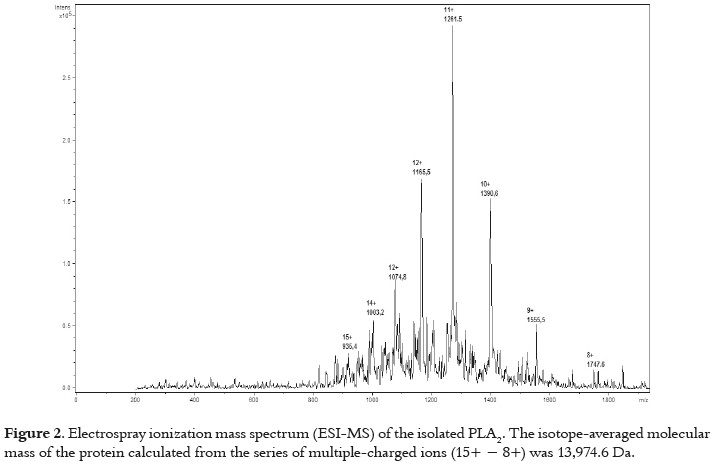
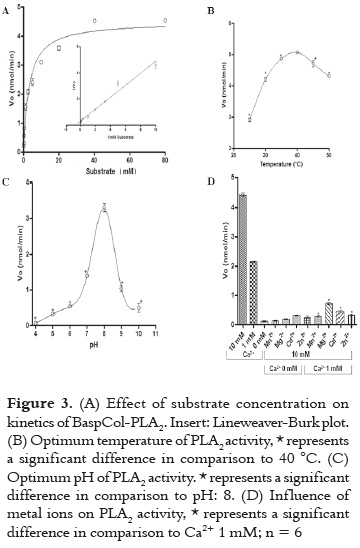
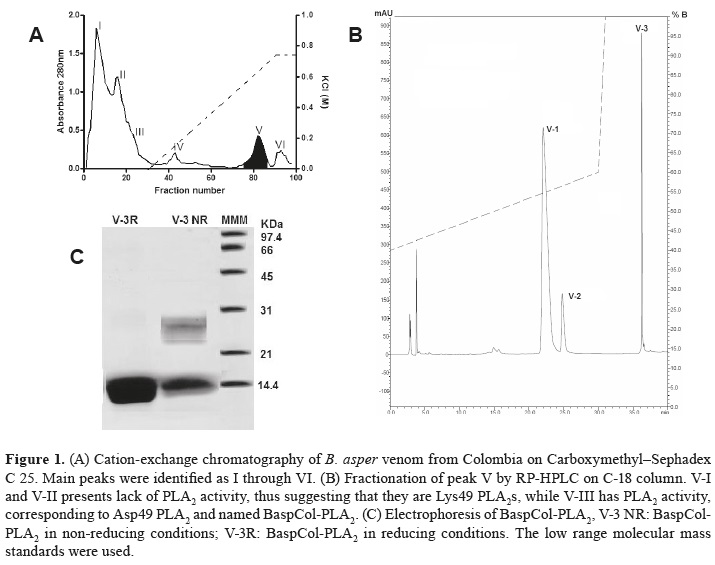
<body><![CDATA[<p>Significance of the differences recorded in enzymatic assays were analyzed by one-way ANOVA, followed by Bonferroni&acute;s test. In cytotoxic and myotoxic activities, two-way ANOVA followed by Bonferroni&acute;s test was applied. One-way ANOVA followed by Dunnet&acute;s test was carried out in anticoagulant activity. In all cases, p &lt; 0.05 was considered significant, and the results are shown as mean &plusmn; SEM of n indicated in each case. It was used the software SPSS 14.0 (<a href="http://www.spss.com"target="_blank">http://www.spss.com</a>; SPSS Inc. 233 South Wacker Drive, 11th Floor, Chicago, IL 60606-6412).</p>     <p>&nbsp;</p>     <p> <font size="3"> <b>RESULTS</b></font></p>     <p><b>Isolation of PLA<sub>2</sub></b></p>       <p><a href="#f1">Figure 1A</a> shows the Cation-exchange chromatography   on CM-Sephadex C-25 of <i>B. asper</i> venom,   which separated them into six fractions (I - VI).   Myotoxic and PLA<sub>2</sub> activities were restricted only to   fraction V, which was separated by RP-HPLC into   fractions V-1 through V-3, as shown in <a href="#f1">figure 1B</a>.   These fractions showed myotoxic activity when they   were injected in mice. However, PLA<sub>2</sub> activity was   displayed only by fraction V-3. This suggests that V-1   and V-2 could be Lys49 PLA<sub>2</sub>s, while V-3 could be   an Asp49 PLA<sub>2</sub>. Fraction V-3 was named BaspCol-   PLA<sub>2</sub>. The molecular mass of PLA<sub>2</sub> estimated by   SDS-PAGE was ~ 14 KDa as displayed figure 1C.   This was confirmed by ESI-MS, where molecular mass obtained was 13974.6 Da, as indicates <a href="#f2">figure 2</a>.</p>      <p align="center"><a name="f1"></a><img src="/img/revistas/vitae/v21n1/v21n1a5f1.jpg"></p>     <p align="center"><a name="f2"></a><img src="/img/revistas/vitae/v21n1/v21n1a5f2.jpg"></p>        <p><b>Enzymatic characterization</b></p>         <p>The PLA<sub>2</sub> activity of BaspCol-PLA<sub>2</sub> was     studied using the monodiperse substrate 4-nitro-     3-(octanoyloxy) benzoic acid. Under the conditions     used, PLA<sub>2</sub> showed a Michealian behavior indicated     in <a href="#f3">figure 3A</a><a href="#f1"></a>. The V<sub>Max</sub> was estimated to be 4.47     nmol/ min and the K<sub>M</sub> was 3.11 mM. figures 3B     and 3C displayed that maximum enzyme activity     occurred at 40 &deg;C and the optimum pH was 8.0,     respectively. In addition, in <a href="#f3">figure 3D</a> is evidenced     that BaspCol-PLA<sub>2</sub> showed a strict dependence on     calcium ions and it was active in concentrations of     1 and 10 mM Ca<sup>2+</sup>, with highest activity obtained     with 10 mM (p &lt;0.05). On the other hand, the     addition of Mg<sup>2+</sup>, Cd<sup>2+</sup>, Mn<sup>2+</sup> and Zn<sup>2+</sup> (10 mM)     in the presence of low Ca<sup>2+</sup> concentration (1mM)     decreased the enzyme activity. The substitution of     Ca<sup>2+</sup> by these other divalent cations also reduced     the activity to levels similar to those in the absence   of Ca<sup>2+</sup>.</p>      <p align="center"><a name="f3"></a><img src="/img/revistas/vitae/v21n1/v21n1a5f3.jpg"></p>      	    ]]></body>
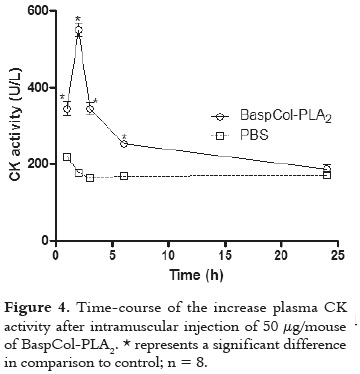
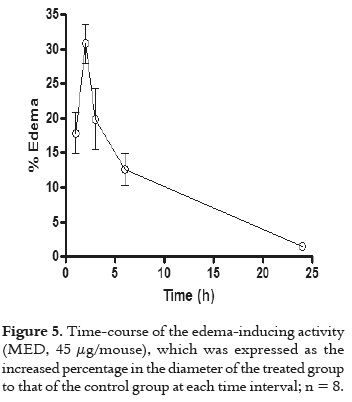
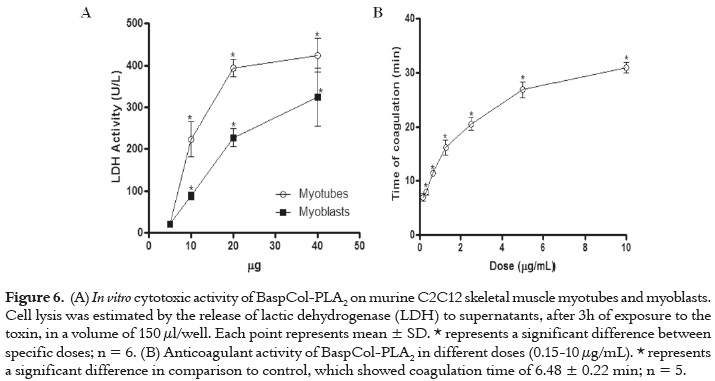
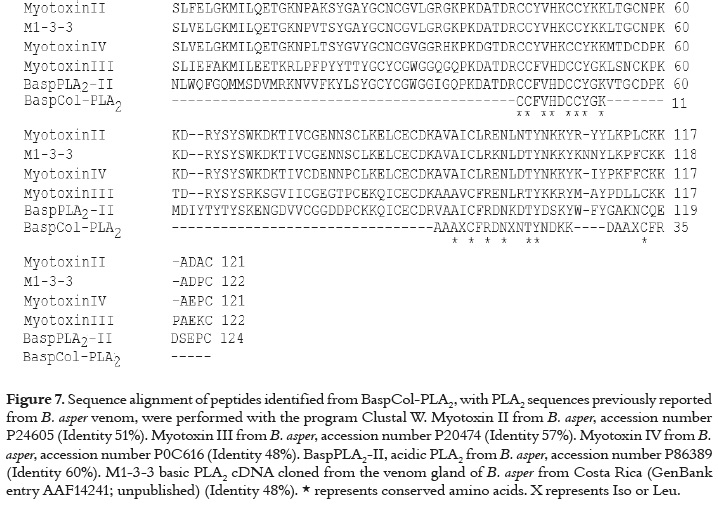
<body><![CDATA[<p><b>Biological activities</b></p>       	    <p>As displayed in <a href="#f4">figure 4</a>, BaspCol-PLA<sub>2</sub> induced       	a conspicuous myotoxic effect, evidenced by the       	rapid elevation of plasma CK activity, which reached       	a maximum 2 h after injection, and returned to normal      	by 24 h. In addition, in <a href="#f5">figure 5</a> is evidenced that      	this enzyme also induced moderate footpad edema,      	with a MED of 45.2 &plusmn; 2.4 <i>&mu;</i>g, at 2 h, evidencing the       	local increase in vascular permeability. Time-course      	analysis of edema showed that this effect reached its    	highest point after 2 h and returned to normal by 24 h.</p>  	 		    <p align="center"><a name="f4"></a><img src="/img/revistas/vitae/v21n1/v21n1a5f4.jpg"></p> 		    <p align="center"><a name="f5"></a><img src="/img/revistas/vitae/v21n1/v21n1a5f5.jpg"></p> 	    	      <p><a href="#f6">Figure 6A</a> shows that the PLA<sub>2</sub> induced cytotoxicity         on myoblast as well as on myotubes, with a         significantly higher effect recorded with the latter at         doses of 10, 20 and 40 <i>&micro;</i>g/well (p&lt;0.05). As shown         in <a href="#f6">figure 6B</a>, BaspCol-PLA<sub>2</sub> had anticoagulant         effect on human platelet-poor plasma. Doses of         0.31 <i>&mu;</i>g/100 <i>&mu;</i>L (3.1 <i>&mu;</i>g/mL) or higher caused         a delay in clot formation (8-30 min), whereas         0.15<i>&mu;</i>g/100 &mu;L (1.5 <i>&mu;</i>g/mL) of toxin did not delay         coagulation time (p&gt;0.05). Clot formation in control   	  samples occurred at 6.48 &plusmn; 0.22 min.</p> 	 	    <p align="center"><a name="f6"></a><img src="/img/revistas/vitae/v21n1/v21n1a5f6.jpg"></p> 	             <p><b>Protein identification</b></p>           <p>After protein digestion and peptide separation       in a nano C-18 HPLC column, some peptides were       identified: CCFVHDCCYGK, AAAI/LCFRDNI/       LNTYNDKK, DAAI/LCFR       by HPLC-nESI-MS/MS. The mono-isotopic       masses of peptides were: 1505.5 Da, 2014.1 Da       and 852.4 Da. Lysine residues shown in bold were       deduced on the cleavage and missed cleavage by       trypsin, and Cystein residues are shown as alkylated       cysteine (C). These peptides matched with a number       of viperid snake venom PLA<sub>2</sub>s as determined       by a BLAST search. The active site of BaspCol-       PLA<sub>2</sub> was identified in the first peptide. <a href="#f7">Figure 7</a>      display an alignment of the peptides identified in       BaspCol-PLA<sub>2</sub> with other PLA<sub>2</sub>s isolated from <i>B.       asper</i> venom. The toxin from Colombian <i>B. aper</i>      venom showed some identity (48-60%) with corresponding       segments of other PLA<sub>2</sub>s isolated from       Costa Rica's <i>B. asper</i>. 10-13)</p> 	   	      <p align="center"><a name="f7"></a><img src="/img/revistas/vitae/v21n1/v21n1a5f7.jpg"></p> 	             <p>&nbsp;</p>     ]]></body>
<body><![CDATA[<p><font size="3">  <b>DISCUSI&Oacute;N</b></font></p>     <p>A myotoxic PLA<sub>2</sub>, named BaspCol-PLA<sub>2</sub>, was   purified from the venom of <i>B. asper</i> of the northwestern   region from Colombia. The elution profile   was comparable to other that used the similar   conditions for isolating myotoxins from <i>Bothrops</i>  venoms (10, 11, 25). This basic PLA<sub>2</sub> showed enzymatic   activity on monodisperse substrate (V<sub>Max</sub>:   4.47 nmol/min and K<sub>M</sub>: 3.11 mM), with a strict   requirement of Ca<sup>2+</sup>, and maximum activity at pH   8.0 and 40 &deg;C. These characteristics are common   to other bothropic and crotalic PLA<sub>2</sub>s (26-28), and   strongly suggest that position 49 of BaspCol-PLA<sub>2</sub>  corresponds to Asp49, as was demonstrated in one   of the identified peptides (CCFVHDCCYGK).   The K<sub>M</sub> value of BaspCol-PLA<sub>2</sub> is higher in comparison   with those calculated for other PLA<sub>2</sub>s by   using non-monodispersed substrates (i.e. using   aggregated substrate). This is explained by the preference   of PLA<sub>2</sub>s for aggregated substrates, such as   glycerophospholipids membrane. In addition, these   enzymes suffer an interfacial activation when aggregated   substrates (3-5). It is known that snake venom   PLA<sub>2</sub>s are enzymes that resist extreme values of pH   and temperature (3), which is in agreement with the   values of pH and temperature of maximum activity   of BaspCol-PLA<sub>2</sub>.</p>       <p>Injection of <i>B. asper</i> venom induces local   myonecrosis in mice (29-31), in agreement with   clinical observations (2). The most important and   abundant muscle-damaging components in this   venom are basic PLA<sub>2</sub>s and PLA<sub>2</sub> homologues, as   demonstrated by neutralization experiments (32).   These toxins disrupt the integrity of muscle cell   plasma membrane, and although details of this   mechanism remain unknown at molecular level,   it is clear that catalytically-dependent and independent   events are involved (6, 33). Plasma CK   activity reached a maximum at 2 h after injection   of BaspCol-PLA<sub>2</sub>. Similar results were obtained   with D49 PLA<sub>2</sub>s BbTx-III from <i>B. brazili</i> (26)   and Cdcum6 from Colombian <i>Crotalus durrissus   cumanensis</i> (27). However, slightly different results   were obtained with other D49 PLA<sub>2</sub>s from <i>Bothrops</i>  venoms, such as myotoxin I from Costa Rican B.   asper venom, whose maximum myotoxic activity   occurred three hours after its injection (10). Likewise,   D49 PLA<sub>2</sub>s BmjeTx-I and II from <i>B. marajoensis</i>  caused maximum of plasma CK activity six hours   after their injection (28). Phospholipid hydrolysis   by Asp49 PLA<sub>2</sub>s plays a critical role in muscle fiber   plasma-membrane destabilization, since alkylation   of His48 decreases myotoxic effect (34). The partial   inhibition after catalytic inactivation suggests   that molecular regions distinct from the catalytic   site are able to interact and disrupt the integrity of   muscle fiber plasma-membrane. The identity of   these molecular regions remains largely unknown.   Observations with myotoxic Asp49 PLA<sub>2</sub>s agree   with the general hypothesis proposed by Kini and   Evans (35) to explain the pharmacological profile   of venom PLA<sub>2</sub>s, i.e. that these enzymes have in   addition to the active site some molecular regions   that determine their toxicity and tissue specificity.   Small differences in these regions and in the   catalytic properties could explain the differences   mentioned above to induce myotoxic effect. In   the same way, the use of cell cultures, such as rodent   lines of skeletal muscle myoblasts/myotubes,   appears to correlate with their <i>in vivo</i> myotoxicity   (36). This study analyzed in which stage of cellular   differentiation of C2C12 myoblasts into myotubes   BaspCol-PLA<sub>2</sub> was more cytotoxic. Higher   susceptibility of myotubes was clearly observed,   as originally described by Angulo and Lomonte   (36), using a number of myotoxic PLA<sub>2</sub>s and PLA<sub>2</sub>   homologues from crotalid venoms. Similar findings   were obtained with other bothropic PLA<sub>2</sub>s such as   BmjeTX-I and II (28), and Bj-V from <i>B. jararacussu</i>  (37). This fact is probably not only due to the ability   of these enzymes to disturb the membrane, but it   also seems to be involved with the expression acceptors/   receptors with high affinity for the PLA<sub>2</sub>s   on plasmatic membrane of myotubes. This process   could take place when differentiation of myoblast   in myotubes is performed. In addition, it is still not   possible to state which among the acceptors/receptors   or the specific region of PLA<sub>2</sub>s are involved,   or even the type of interactions implicated in the   process (3, 33).</p>       <p>BaspCol-PLA<sub>2</sub> also induced a moderate edema   with highest effect two hours after its injection.   Similar results were obtained with other D49 from     <i>Bothrops</i> venoms, such as BmjeTx-I and II from     <i>B. marajoensis</i> (28) On the other hand, different   results were obtained with Myotoxin I, BmTx-I,   and BbTx-III from Costa Rican <i>B. asper</i>, <i>B. moojeni</i>,   and <i>B. brazili</i> venoms, respectively, whose   maximum edema-inducing activity was one hour   after their injection (22, 26, 38). Edema caused by   Asp49 PLA<sub>2</sub>s may be due to their combined effect   to hydrolyze phospholipid membrane (resulting   in the loss of membrane integrity), as well as their   metabolic activity generating pro-inflammatory   products such as eicosanoids, whose function is to   amplify the inflammatory event (39). However, it   has been shown that enzymatic inhibition of PLA<sub>2</sub>s   do not completely abolish their edema-forming   activity (34), similarly to the myotoxic effect, and   as proposed Kini and Evans (35). This suggests the   presence of molecular regions that are also responsible   for inducing this effect.</p>       <p>Depending on their anticoagulant potency, PLA<sub>2</sub>   enzymes have been classified into strong, weak and   non-anticoagulant enzymes. Strong anticoagulant   PLA<sub>2</sub> enzymes inhibit blood coagulation at low concentrations   (&lt;2 <i>&mu;</i>g/mL). Weak anticoagulant PLA<sub>2</sub>   enzymes showed anticoagulant effects between 3   and 10 <i>&mu;</i>g/mL (23). BaspCol-PLA<sub>2</sub> caused delay   of clot formation at doses of 3.1<i>&mu;</i>g/mL or higher.   Therefore, this enzyme was classified as weak   anticoagulant PLA<sub>2</sub>. Early PLA<sub>2</sub> studies suggested   that catalytic activity is essential for anticoagulant   effect (40); however, recent studies have proposed   that strong anticoagulant PLA<sub>2</sub>s inhibit by both   enzymatic and non-enzymatic mechanisms. The   latter are mediated by an ''anticoagulant site'', which   would be located in a region between residues 54   and 77, considering that this region is positively   charged in the PLA<sub>2</sub>s with high anticoagulant activity.   In PLA<sub>2</sub>s with moderate or low anticoagulant   activity, there is a predominance of negative or   neutral charges in this region (23, 41).</p>       <p>The main limitation of this study was the lack   of total sequence of BaspCol-PLA<sub>2</sub>. Thus, we need   to perform further studies to obtain total sequence   in order to find the regions with highest and lowest identity regard to other snake venom PLA<sub>2</sub>s.</p>        <p>&nbsp;</p>     <p> <font size="3"> <b>CONCLUSION</b></font></p>     <p>A basic PLA<sub>2</sub> was isolated from Colombian<i> B.   asper</i> venom; it has catalytic activity and molecular   mass of 13974.6 Da. The toxin showed myotoxic,   edema-forming, anticoagulant and cytotoxic activities.   The activities displayed by this toxin are   involved in the local effects observed in Colombian   <i>B. asper</i> snakebites. However, molecular mechanisms   involved in these effects remain unknown,   and further studies of this myotoxin may provide   more elements to obtain a better understanding of   toxic effects induced by <i>B. asper</i> venom. In addition,   this work gave insights about the composition of <i>B.   asper</i> venom from Colombia that contains toxins   with similar toxic and biochemical profile of those previously reported for toxins isolated from <i>B. asper</i> in other countries.</p>      <p><b>Conflicts of interest</b></p>     ]]></body>
<body><![CDATA[<p>The authors declare no conflicts of interest.</p>     <p><b>Financial support</b></p>     <p>This Project was sponsored by Universidad de Antioquia, project CIQF-177 and Estrategia para la Sostenibilidad de los Grupos de Investigaci&oacute;n 2013-2014.</p>      <p>&nbsp;</p>     <p> <font size="3"> <b>REFERENCES</b></font></p>      <!-- ref --><p>1. Williams D, Guti&eacute;rrez JM, Harrison R, Warrell DA, White J, Winkel KD, <i>et al.</i> The Global Snake Bite Initiative: an antidote for snake bite. Lancet. 2010 Aug 24; 74 (9): 1735-1767.    &nbsp;&nbsp;&nbsp;&nbsp;&nbsp;&nbsp;&nbsp;&nbsp;[&#160;<a href="javascript:void(0);" onclick="javascript: window.open('/scielo.php?script=sci_nlinks&ref=000088&pid=S0121-4004201400010000500001&lng=','','width=640,height=500,resizable=yes,scrollbars=1,menubar=yes,');">Links</a>&#160;]<!-- end-ref --></p>     <!-- ref --><p>2. Otero-Pati&ntilde;o R. Epidemiological, clinical and therapeutic aspects of <i><i>Bothrops asper</i></i> bites. Toxicon. 2009; Dec 1; 54 (7): 998-1011.    &nbsp;&nbsp;&nbsp;&nbsp;&nbsp;&nbsp;&nbsp;&nbsp;[&#160;<a href="javascript:void(0);" onclick="javascript: window.open('/scielo.php?script=sci_nlinks&ref=000090&pid=S0121-4004201400010000500002&lng=','','width=640,height=500,resizable=yes,scrollbars=1,menubar=yes,');">Links</a>&#160;]<!-- end-ref --></p>     <!-- ref --><p>3. Kini RM. Excitement ahead: structure, function and mechanism of snake venom phospholipase A<sub>2</sub> enzymes. Toxicon. 2003; Dec 15; 42 (8): 827- 840.    &nbsp;&nbsp;&nbsp;&nbsp;&nbsp;&nbsp;&nbsp;&nbsp;[&#160;<a href="javascript:void(0);" onclick="javascript: window.open('/scielo.php?script=sci_nlinks&ref=000092&pid=S0121-4004201400010000500003&lng=','','width=640,height=500,resizable=yes,scrollbars=1,menubar=yes,');">Links</a>&#160;]<!-- end-ref --></p>     <!-- ref --><p>4. Six DA, Dennis EA. The expanding superfamily of phospholipase A<sub>2</sub> enzymes: classification and characterization. Biochim Biophys Acta. 2000; Oct 31; 1488 (1-2): 1-19.    &nbsp;&nbsp;&nbsp;&nbsp;&nbsp;&nbsp;&nbsp;&nbsp;[&#160;<a href="javascript:void(0);" onclick="javascript: window.open('/scielo.php?script=sci_nlinks&ref=000094&pid=S0121-4004201400010000500004&lng=','','width=640,height=500,resizable=yes,scrollbars=1,menubar=yes,');">Links</a>&#160;]<!-- end-ref --></p>     <!-- ref --><p>5. Arni RK, Ward RJ. Phospholipase A<sub>2</sub>-a structural review. Toxicon. 1996; Aug; 34 (8): 827-841.    &nbsp;&nbsp;&nbsp;&nbsp;&nbsp;&nbsp;&nbsp;&nbsp;[&#160;<a href="javascript:void(0);" onclick="javascript: window.open('/scielo.php?script=sci_nlinks&ref=000096&pid=S0121-4004201400010000500005&lng=','','width=640,height=500,resizable=yes,scrollbars=1,menubar=yes,');">Links</a>&#160;]<!-- end-ref --></p>     <!-- ref --><p>6. Lomonte B, Angulo Y, Calder&oacute;n, L. An overview of Lysine-49 phospholipase A<sub>2</sub> myotoxins from crotalid snake venoms and their structural determinants of myotoxic action. Toxicon. 2003; Dec 15; 42 (8): 885-901.    &nbsp;&nbsp;&nbsp;&nbsp;&nbsp;&nbsp;&nbsp;&nbsp;[&#160;<a href="javascript:void(0);" onclick="javascript: window.open('/scielo.php?script=sci_nlinks&ref=000098&pid=S0121-4004201400010000500006&lng=','','width=640,height=500,resizable=yes,scrollbars=1,menubar=yes,');">Links</a>&#160;]<!-- end-ref --></p>     <!-- ref --><p>7. Ferlan I, Gubensek F. Phospholipases of <i><i>Bothrops asper</i></i> venom. <i>Period Biol</i>. 1978; 80: 31-36.    &nbsp;&nbsp;&nbsp;&nbsp;&nbsp;&nbsp;&nbsp;&nbsp;[&#160;<a href="javascript:void(0);" onclick="javascript: window.open('/scielo.php?script=sci_nlinks&ref=000100&pid=S0121-4004201400010000500007&lng=','','width=640,height=500,resizable=yes,scrollbars=1,menubar=yes,');">Links</a>&#160;]<!-- end-ref --></p>     <!-- ref --><p>8. Alag&oacute;n AC, Molinar RR, Possani LD, Fletcher PLJr, Cronan JEJr, Julia JZ. Venom from the snake <i>Bothrops asper</i> Garman. Purification and characterization of three phospholipases A<sub>2</sub>. Biochem J. 1980; Mar 1; 185 (3): 695-704.    &nbsp;&nbsp;&nbsp;&nbsp;&nbsp;&nbsp;&nbsp;&nbsp;[&#160;<a href="javascript:void(0);" onclick="javascript: window.open('/scielo.php?script=sci_nlinks&ref=000102&pid=S0121-4004201400010000500008&lng=','','width=640,height=500,resizable=yes,scrollbars=1,menubar=yes,');">Links</a>&#160;]<!-- end-ref --></p>     <!-- ref --><p>9. Fern&aacute;ndez J, Guti&eacute;rrez JM, Angulo Y, Sanz L, Ju&aacute;rez P, Calvete JJ, et al. Isolation of an acidic phospholipase A<sub>2</sub> from the venom of the snake <i>Bothrops asper</i> of Costa Rica: biochemical and toxicological characterization. Biochimie. 2010; 2010 Mar 1; 92 (3): 273-283.    &nbsp;&nbsp;&nbsp;&nbsp;&nbsp;&nbsp;&nbsp;&nbsp;[&#160;<a href="javascript:void(0);" onclick="javascript: window.open('/scielo.php?script=sci_nlinks&ref=000104&pid=S0121-4004201400010000500009&lng=','','width=640,height=500,resizable=yes,scrollbars=1,menubar=yes,');">Links</a>&#160;]<!-- end-ref --></p>     <!-- ref --><p>10. Guti&eacute;rrez JM, Ownby CL, Odell GV. Isolation of a myotoxin from <i>Bothropsasper</i> venom: partial characterization and action on skeletal muscle. Toxicon. 1984 Jan 1; 22 (1): 115-128.    &nbsp;&nbsp;&nbsp;&nbsp;&nbsp;&nbsp;&nbsp;&nbsp;[&#160;<a href="javascript:void(0);" onclick="javascript: window.open('/scielo.php?script=sci_nlinks&ref=000106&pid=S0121-4004201400010000500010&lng=','','width=640,height=500,resizable=yes,scrollbars=1,menubar=yes,');">Links</a>&#160;]<!-- end-ref --></p>     <!-- ref --><p>11. Lomonte B, Guti&eacute;rrez JM. A new muscle-damaging toxin, myotoxin II, from the venom of the snake <i>Bothrops asper</i> (terciopelo). Toxicon. 1989 Jul 1; 27 (7): 725-733.    &nbsp;&nbsp;&nbsp;&nbsp;&nbsp;&nbsp;&nbsp;&nbsp;[&#160;<a href="javascript:void(0);" onclick="javascript: window.open('/scielo.php?script=sci_nlinks&ref=000108&pid=S0121-4004201400010000500011&lng=','','width=640,height=500,resizable=yes,scrollbars=1,menubar=yes,');">Links</a>&#160;]<!-- end-ref --></p>     <!-- ref --><p>12. Kaiser II, Gutierrez JM, Plummer D, Aird SD, Odell GV. The amino acid sequence of a myotoxic phospholipase from the venom of <i>Bothrops asper</i>. Arch Biochem Biophys. 1990 May 1; 278 (2): 319-325.    &nbsp;&nbsp;&nbsp;&nbsp;&nbsp;&nbsp;&nbsp;&nbsp;[&#160;<a href="javascript:void(0);" onclick="javascript: window.open('/scielo.php?script=sci_nlinks&ref=000110&pid=S0121-4004201400010000500012&lng=','','width=640,height=500,resizable=yes,scrollbars=1,menubar=yes,');">Links</a>&#160;]<!-- end-ref --></p>     <!-- ref --><p>13. D&iacute;az C, Lomonte B, Zamudio F, Guti&eacute;rrez JM. Purification and characterization of myotoxin IV, a phospholipase A<sub>2</sub> variant, from <i>Bothrops asper</i> snake venom. Nat Toxins.1995 May 1; 3 (1): 26-31.    &nbsp;&nbsp;&nbsp;&nbsp;&nbsp;&nbsp;&nbsp;&nbsp;[&#160;<a href="javascript:void(0);" onclick="javascript: window.open('/scielo.php?script=sci_nlinks&ref=000112&pid=S0121-4004201400010000500013&lng=','','width=640,height=500,resizable=yes,scrollbars=1,menubar=yes,');">Links</a>&#160;]<!-- end-ref --></p>     <!-- ref --><p>14. Mebs D, Samejima Y. Isolation and characterization of myotoxic phospholipases A<sub>2</sub> from crotalid venoms. Toxicon. 1986 Feb 1; 24 (2): 161-168.    &nbsp;&nbsp;&nbsp;&nbsp;&nbsp;&nbsp;&nbsp;&nbsp;[&#160;<a href="javascript:void(0);" onclick="javascript: window.open('/scielo.php?script=sci_nlinks&ref=000114&pid=S0121-4004201400010000500014&lng=','','width=640,height=500,resizable=yes,scrollbars=1,menubar=yes,');">Links</a>&#160;]<!-- end-ref --></p>     <!-- ref --><p>15. Alape-Gir&oacute;n A, Sanz L, Escolano J, Flores-D&iacute;az M, Madrigal M, Sasa M,<i> et al.</i> Snake venomics of the lance head pitviper <i>Bothrops asper</i>: geographic, individual, and ontogenetic variations. J Proteome Res. 2008 Aug; 7 (8): 3556-3571.    &nbsp;&nbsp;&nbsp;&nbsp;&nbsp;&nbsp;&nbsp;&nbsp;[&#160;<a href="javascript:void(0);" onclick="javascript: window.open('/scielo.php?script=sci_nlinks&ref=000116&pid=S0121-4004201400010000500015&lng=','','width=640,height=500,resizable=yes,scrollbars=1,menubar=yes,');">Links</a>&#160;]<!-- end-ref --></p>     <!-- ref --><p>16. Segura A, Herrera M, Villalta M, Vargas M, Uscanga-Reynell A, de Le&oacute;n-Rosales SP,<i> et al</i>. Venom of <i>Bothrops asper</i> from Mexico and Costa Rica: intraspecific variation and cross-neutralization by antivenoms. Toxicon. 2012 Jan; 59 (1): 158-162.    &nbsp;&nbsp;&nbsp;&nbsp;&nbsp;&nbsp;&nbsp;&nbsp;[&#160;<a href="javascript:void(0);" onclick="javascript: window.open('/scielo.php?script=sci_nlinks&ref=000118&pid=S0121-4004201400010000500016&lng=','','width=640,height=500,resizable=yes,scrollbars=1,menubar=yes,');">Links</a>&#160;]<!-- end-ref --></p>     <!-- ref --><p>17. Guti&eacute;rrez JM, Escalante T, Rucavado A. Experimental pathophysiology of systemic alterations induced by <i>Bothrops asper</i> snake venom. Toxicon. 2009 Dec 1; 54 (7): 976-987.    &nbsp;&nbsp;&nbsp;&nbsp;&nbsp;&nbsp;&nbsp;&nbsp;[&#160;<a href="javascript:void(0);" onclick="javascript: window.open('/scielo.php?script=sci_nlinks&ref=000120&pid=S0121-4004201400010000500017&lng=','','width=640,height=500,resizable=yes,scrollbars=1,menubar=yes,');">Links</a>&#160;]<!-- end-ref --></p>     <!-- ref --><p>18. Laemmli UK. Cleavage of structural proteins during the assembly of the head of bacteriophage T4. Nature. 1970 Aug 15; 227 (5259): 680-685.    &nbsp;&nbsp;&nbsp;&nbsp;&nbsp;&nbsp;&nbsp;&nbsp;[&#160;<a href="javascript:void(0);" onclick="javascript: window.open('/scielo.php?script=sci_nlinks&ref=000122&pid=S0121-4004201400010000500018&lng=','','width=640,height=500,resizable=yes,scrollbars=1,menubar=yes,');">Links</a>&#160;]<!-- end-ref --></p>     <!-- ref --><p>19. Cho W, K&eacute;zdy FJ. Chromogenic phospholipase A<sub>2</sub> substrates and assays. Methods Enzymol. 1991 Sept; 197: 75-79.    &nbsp;&nbsp;&nbsp;&nbsp;&nbsp;&nbsp;&nbsp;&nbsp;[&#160;<a href="javascript:void(0);" onclick="javascript: window.open('/scielo.php?script=sci_nlinks&ref=000124&pid=S0121-4004201400010000500019&lng=','','width=640,height=500,resizable=yes,scrollbars=1,menubar=yes,');">Links</a>&#160;]<!-- end-ref --></p>     <!-- ref --><p>20. Holzer M, Mackessy SP. An aqueous endpoint assay of snake venom phospholipase A<sub>2</sub>. Toxicon. 1996 Oct; 34 (10): 1149-1155.    &nbsp;&nbsp;&nbsp;&nbsp;&nbsp;&nbsp;&nbsp;&nbsp;[&#160;<a href="javascript:void(0);" onclick="javascript: window.open('/scielo.php?script=sci_nlinks&ref=000126&pid=S0121-4004201400010000500020&lng=','','width=640,height=500,resizable=yes,scrollbars=1,menubar=yes,');">Links</a>&#160;]<!-- end-ref --></p>     <!-- ref --><p>21. Lomonte B, Angulo Y, Rufini S, Cho W, Giglio JR, Ohno M, et al. Comparative study of the cytolytic activity of myotoxic phospholipases A<sub>2</sub> on mouse endothelial (tEnd) and skeletal muscle (C2C12) cells in vitro. Toxicon. 1999 Jan; 37 (1): 145-158.    &nbsp;&nbsp;&nbsp;&nbsp;&nbsp;&nbsp;&nbsp;&nbsp;[&#160;<a href="javascript:void(0);" onclick="javascript: window.open('/scielo.php?script=sci_nlinks&ref=000128&pid=S0121-4004201400010000500021&lng=','','width=640,height=500,resizable=yes,scrollbars=1,menubar=yes,');">Links</a>&#160;]<!-- end-ref --></p>     <!-- ref --><p>22. Guti&eacute;rrez JM, Lomonte B, Chaves F, Moreno E, Cerdas L. Pharmacological activities of a toxic phospholipase A<sub>2</sub> isolated from the venom of the snake <i>Bothrops asper</i>. Comp BiochemPhysiol C. 1986 Jan; 84 (1): 159-164.    &nbsp;&nbsp;&nbsp;&nbsp;&nbsp;&nbsp;&nbsp;&nbsp;[&#160;<a href="javascript:void(0);" onclick="javascript: window.open('/scielo.php?script=sci_nlinks&ref=000130&pid=S0121-4004201400010000500022&lng=','','width=640,height=500,resizable=yes,scrollbars=1,menubar=yes,');">Links</a>&#160;]<!-- end-ref --></p>     <!-- ref --><p>23. Kini RM. Structure&#8211;function relationships and mechanism of anticoagulant phospholipase A<sub>2</sub> enzymes from snake venoms. Toxicon. 2005 Jun 15; 45 (8): 1147-1161.    &nbsp;&nbsp;&nbsp;&nbsp;&nbsp;&nbsp;&nbsp;&nbsp;[&#160;<a href="javascript:void(0);" onclick="javascript: window.open('/scielo.php?script=sci_nlinks&ref=000132&pid=S0121-4004201400010000500023&lng=','','width=640,height=500,resizable=yes,scrollbars=1,menubar=yes,');">Links</a>&#160;]<!-- end-ref --></p>     <!-- ref --><p>24. Thompson JD, Higgins DG, Gibson TJ. CLUSTAL W: improving the sensitivity of progressive multiple sequence alignment through sequence weighting, position specific gap penalties and weight matrix choice. Nucleic Acids Res. 1994 Nov 11; 22 (22): 4673-4680.    &nbsp;&nbsp;&nbsp;&nbsp;&nbsp;&nbsp;&nbsp;&nbsp;[&#160;<a href="javascript:void(0);" onclick="javascript: window.open('/scielo.php?script=sci_nlinks&ref=000134&pid=S0121-4004201400010000500024&lng=','','width=640,height=500,resizable=yes,scrollbars=1,menubar=yes,');">Links</a>&#160;]<!-- end-ref --></p>     <!-- ref --><p>25. N&uacute;&ntilde;ez V, Arce V, Guti&eacute;rrez JM, Lomonte B. Structural and functional characterization of myotoxin I, a Lys49 phospholipase A<sub>2</sub> homologue from the venom of the snake <i>Bothrops atrox</i>. Toxicon. 2004 Jul; 44 (1): 91-101.    &nbsp;&nbsp;&nbsp;&nbsp;&nbsp;&nbsp;&nbsp;&nbsp;[&#160;<a href="javascript:void(0);" onclick="javascript: window.open('/scielo.php?script=sci_nlinks&ref=000136&pid=S0121-4004201400010000500025&lng=','','width=640,height=500,resizable=yes,scrollbars=1,menubar=yes,');">Links</a>&#160;]<!-- end-ref --></p>     <!-- ref --><p>26. Huancahuire-Vega S, Ponce-Soto LA, Martins-de-Souza D, Marangoni S. Structural and functional characterization of brazilitoxins II and III (BbTX-II and -III), two myotoxins from the venom of <i>Bothrops brazili</i> snake. Toxicon. 2009 Nov; 54 (6): 818-827.    &nbsp;&nbsp;&nbsp;&nbsp;&nbsp;&nbsp;&nbsp;&nbsp;[&#160;<a href="javascript:void(0);" onclick="javascript: window.open('/scielo.php?script=sci_nlinks&ref=000138&pid=S0121-4004201400010000500026&lng=','','width=640,height=500,resizable=yes,scrollbars=1,menubar=yes,');">Links</a>&#160;]<!-- end-ref --></p>     <!-- ref --><p>27. Perea&ntilde;ez JA, N&uacute;&ntilde;ez V, Huancahuire-Vega S, Marangoni S, Ponce-Soto LA. Biochemical and biological characterization of a PLA<sub>2</sub> from crotoxin complex of <i>Crotalus durissus cumanensis</i>. Toxicon. 2009 Apr; 53 (5): 534-542.    &nbsp;&nbsp;&nbsp;&nbsp;&nbsp;&nbsp;&nbsp;&nbsp;[&#160;<a href="javascript:void(0);" onclick="javascript: window.open('/scielo.php?script=sci_nlinks&ref=000140&pid=S0121-4004201400010000500027&lng=','','width=640,height=500,resizable=yes,scrollbars=1,menubar=yes,');">Links</a>&#160;]<!-- end-ref --></p>     <!-- ref --><p>28. Ponce-Soto LA, Martins-de-Souza D, Marangoni S. Neurotoxic, myotoxic and cytolytic activities of the new basic PLA<sub>2</sub> isoforms BmjeTX-I and BmjeTX-II isolated from the <i>Bothrops marajoensis</i> (Maraj&oacute; Lancehead) snake venom. Protein J. 2010 Feb; 29 (2): 103-113.    &nbsp;&nbsp;&nbsp;&nbsp;&nbsp;&nbsp;&nbsp;&nbsp;[&#160;<a href="javascript:void(0);" onclick="javascript: window.open('/scielo.php?script=sci_nlinks&ref=000142&pid=S0121-4004201400010000500028&lng=','','width=640,height=500,resizable=yes,scrollbars=1,menubar=yes,');">Links</a>&#160;]<!-- end-ref --></p>     <!-- ref --><p>29. Arce V, Brenes F, Guti&eacute;rrez JM. Degenerative and regenerative changes in murine skeletal muscle after injection of venom from the snake <i>Bothrops asper</i>: a histochemical and immunocytochemical study. Int. J. Exp. Pathol.1991 Apr; 72 (2): 211-226.    &nbsp;&nbsp;&nbsp;&nbsp;&nbsp;&nbsp;&nbsp;&nbsp;[&#160;<a href="javascript:void(0);" onclick="javascript: window.open('/scielo.php?script=sci_nlinks&ref=000144&pid=S0121-4004201400010000500029&lng=','','width=640,height=500,resizable=yes,scrollbars=1,menubar=yes,');">Links</a>&#160;]<!-- end-ref --></p>     <!-- ref --><p>30. Guti&eacute;rrez JM, Arroyo O, Bola&ntilde;os R. Mionecrosis, hemorragia y edema inducidos por el veneno de <i>Bothrops asper</i> en rat&oacute;n blanco. Toxicon.1980 Sept; 18 (5-6): 603-610.    &nbsp;&nbsp;&nbsp;&nbsp;&nbsp;&nbsp;&nbsp;&nbsp;[&#160;<a href="javascript:void(0);" onclick="javascript: window.open('/scielo.php?script=sci_nlinks&ref=000146&pid=S0121-4004201400010000500030&lng=','','width=640,height=500,resizable=yes,scrollbars=1,menubar=yes,');">Links</a>&#160;]<!-- end-ref --></p>     <!-- ref --><p>31. Otero R, Osorio RG, Valderrama R, Giraldo AC. Efectos farmacol&oacute;gicos y enzim&aacute;ticos de venenos de serpientes de Antioquia y Choc&oacute; (Colombia). Toxicon. 1992 May; 30 (5-6): 611-620.    &nbsp;&nbsp;&nbsp;&nbsp;&nbsp;&nbsp;&nbsp;&nbsp;[&#160;<a href="javascript:void(0);" onclick="javascript: window.open('/scielo.php?script=sci_nlinks&ref=000148&pid=S0121-4004201400010000500031&lng=','','width=640,height=500,resizable=yes,scrollbars=1,menubar=yes,');">Links</a>&#160;]<!-- end-ref --></p>     <!-- ref --><p>32. Lomonte B, Le&oacute;n G, Angulo Y, Rucavado A, N&uacute;&ntilde;ez V. Neutralization of <i>Bothropsasper</i> venom by antibodies, natural products and synthetic drugs: contributions to understanding snakebite envenomings and their treatment. Toxicon. 2009 Dec 1; 54 (7): 1012-1028.    &nbsp;&nbsp;&nbsp;&nbsp;&nbsp;&nbsp;&nbsp;&nbsp;[&#160;<a href="javascript:void(0);" onclick="javascript: window.open('/scielo.php?script=sci_nlinks&ref=000150&pid=S0121-4004201400010000500032&lng=','','width=640,height=500,resizable=yes,scrollbars=1,menubar=yes,');">Links</a>&#160;]<!-- end-ref --></p>     <!-- ref --><p>33. Guti&eacute;rrez JM, Ownby CL. Skeletal muscle degeneration induced by venom phospholipases A<sub>2</sub>: insights into the mechanisms of local and systemic myotoxicity. Toxicon. 2003 Dec 15; 42 (8): 915-931.    &nbsp;&nbsp;&nbsp;&nbsp;&nbsp;&nbsp;&nbsp;&nbsp;[&#160;<a href="javascript:void(0);" onclick="javascript: window.open('/scielo.php?script=sci_nlinks&ref=000152&pid=S0121-4004201400010000500033&lng=','','width=640,height=500,resizable=yes,scrollbars=1,menubar=yes,');">Links</a>&#160;]<!-- end-ref --></p>     <!-- ref --><p>34. Soares AM, Giglio JR. Chemical modifications of phospholipases A<sub>2</sub> from snake venoms: effects on catalytic and pharmacological properties. Toxicon. 2003 Dec 15; 42 (8): 855-868.    &nbsp;&nbsp;&nbsp;&nbsp;&nbsp;&nbsp;&nbsp;&nbsp;[&#160;<a href="javascript:void(0);" onclick="javascript: window.open('/scielo.php?script=sci_nlinks&ref=000154&pid=S0121-4004201400010000500034&lng=','','width=640,height=500,resizable=yes,scrollbars=1,menubar=yes,');">Links</a>&#160;]<!-- end-ref --></p>     <!-- ref --><p>35. Kini RM, Evans HJ. A model to explain the pharmacological effects of snake venom phospholipases A<sub>2</sub>. Toxicon. 1989 Jun; 27(6): 613-635.    &nbsp;&nbsp;&nbsp;&nbsp;&nbsp;&nbsp;&nbsp;&nbsp;[&#160;<a href="javascript:void(0);" onclick="javascript: window.open('/scielo.php?script=sci_nlinks&ref=000156&pid=S0121-4004201400010000500035&lng=','','width=640,height=500,resizable=yes,scrollbars=1,menubar=yes,');">Links</a>&#160;]<!-- end-ref --></p>     <!-- ref --><p>36. Angulo Y, Lomonte B. Differential susceptibility of C2C12 myoblasts and myotubes to group II phospholipase A<sub>2</sub> myotoxins from crotalid snake venoms. Cell Biochem Funct. 2005 Sept; 23 (5): 307-313.    &nbsp;&nbsp;&nbsp;&nbsp;&nbsp;&nbsp;&nbsp;&nbsp;[&#160;<a href="javascript:void(0);" onclick="javascript: window.open('/scielo.php?script=sci_nlinks&ref=000158&pid=S0121-4004201400010000500036&lng=','','width=640,height=500,resizable=yes,scrollbars=1,menubar=yes,');">Links</a>&#160;]<!-- end-ref --></p>     <!-- ref --><p>37. Bonfim VL, Ponce-Soto L, Novello JC, Marangoni S. Cytotoxic Action in Myoblasts and Myotubes (C2C12) and Enzymatic Characterization of a New Phospholipase A<sub>2</sub> Isoform (Bj-V) from <i>Bothrops jararacussu</i> Venom. Protein Pept Lett. 2006 jul; 13 (7): 707-713.    &nbsp;&nbsp;&nbsp;&nbsp;&nbsp;&nbsp;&nbsp;&nbsp;[&#160;<a href="javascript:void(0);" onclick="javascript: window.open('/scielo.php?script=sci_nlinks&ref=000160&pid=S0121-4004201400010000500037&lng=','','width=640,height=500,resizable=yes,scrollbars=1,menubar=yes,');">Links</a>&#160;]<!-- end-ref --></p>     <!-- ref --><p>38. Calgarotto AK, Damico DC, Ponce-Soto LA, Baldasso PA, Da Silva SL, Souza GH, et al. Biological and biochemical characterization of new basic phospholipase A<sub>2</sub> BmTX-I isolated from <i>Bothrops moojeni</i> snake venom. Toxicon. 2008 Jun 15; 51 (8): 1509-1519.    &nbsp;&nbsp;&nbsp;&nbsp;&nbsp;&nbsp;&nbsp;&nbsp;[&#160;<a href="javascript:void(0);" onclick="javascript: window.open('/scielo.php?script=sci_nlinks&ref=000162&pid=S0121-4004201400010000500038&lng=','','width=640,height=500,resizable=yes,scrollbars=1,menubar=yes,');">Links</a>&#160;]<!-- end-ref --></p>     <!-- ref --><p>39. Teixeira CF, Landucci EC, Antunes E, Chacur M, Cury Y. Inflammatory effects of snake venom myotoxic phospholipases A<sub>2</sub>. Toxicon. 2003 Dec 15; 42 (8): 947-962.    &nbsp;&nbsp;&nbsp;&nbsp;&nbsp;&nbsp;&nbsp;&nbsp;[&#160;<a href="javascript:void(0);" onclick="javascript: window.open('/scielo.php?script=sci_nlinks&ref=000164&pid=S0121-4004201400010000500039&lng=','','width=640,height=500,resizable=yes,scrollbars=1,menubar=yes,');">Links</a>&#160;]<!-- end-ref --></p>     <!-- ref --><p>40. Verheij HM, Boffa MC, Rothen C, Bryskaert MC, Verger R, De Haas G. Correlation of enzymatic activity and anticoagulant properties of phospholipase A<sub>2</sub>. Eur J Biochem.1980 Nov; 112 (1): 25-32.    &nbsp;&nbsp;&nbsp;&nbsp;&nbsp;&nbsp;&nbsp;&nbsp;[&#160;<a href="javascript:void(0);" onclick="javascript: window.open('/scielo.php?script=sci_nlinks&ref=000166&pid=S0121-4004201400010000500040&lng=','','width=640,height=500,resizable=yes,scrollbars=1,menubar=yes,');">Links</a>&#160;]<!-- end-ref --></p>     <!-- ref --><p>41. Kini RM, Evans HJ. Structure&#8211;function relationships of phospholipases. The anticoagulant region of phospholipases A<sub>2</sub>. J BiolChem. 1987 Oct 25; 262-(30): 14402-14407.    &nbsp;&nbsp;&nbsp;&nbsp;&nbsp;&nbsp;&nbsp;&nbsp;[&#160;<a href="javascript:void(0);" onclick="javascript: window.open('/scielo.php?script=sci_nlinks&ref=000168&pid=S0121-4004201400010000500041&lng=','','width=640,height=500,resizable=yes,scrollbars=1,menubar=yes,');">Links</a>&#160;]<!-- end-ref --></p>     <p>&nbsp;</p> </font>      ]]></body><back>
<ref-list>
<ref id="B1">
<label>1</label><nlm-citation citation-type="journal">
<person-group person-group-type="author">
<name>
<surname><![CDATA[Williams]]></surname>
<given-names><![CDATA[D]]></given-names>
</name>
<name>
<surname><![CDATA[Gutiérrez]]></surname>
<given-names><![CDATA[JM]]></given-names>
</name>
<name>
<surname><![CDATA[Harrison]]></surname>
<given-names><![CDATA[R]]></given-names>
</name>
<name>
<surname><![CDATA[Warrell]]></surname>
<given-names><![CDATA[DA]]></given-names>
</name>
<name>
<surname><![CDATA[White]]></surname>
<given-names><![CDATA[J]]></given-names>
</name>
<name>
<surname><![CDATA[Winkel]]></surname>
<given-names><![CDATA[KD]]></given-names>
</name>
</person-group>
<article-title xml:lang="en"><![CDATA[The Global Snake Bite Initiative: an antidote for snake bite]]></article-title>
<source><![CDATA[Lancet]]></source>
<year>2010</year>
<month> A</month>
<day>ug</day>
<volume>74</volume>
<numero>9</numero>
<issue>9</issue>
<page-range>1735-1767</page-range></nlm-citation>
</ref>
<ref id="B2">
<label>2</label><nlm-citation citation-type="journal">
<person-group person-group-type="author">
<name>
<surname><![CDATA[Otero-Patiño]]></surname>
<given-names><![CDATA[R.]]></given-names>
</name>
</person-group>
<article-title xml:lang="en"><![CDATA[Epidemiological, clinical and therapeutic aspects of Bothrops asper bites]]></article-title>
<source><![CDATA[Toxicon]]></source>
<year>2009</year>
<volume>Dec 1; 54</volume>
<numero>7</numero>
<issue>7</issue>
<page-range>998-1011</page-range></nlm-citation>
</ref>
<ref id="B3">
<label>3</label><nlm-citation citation-type="journal">
<person-group person-group-type="author">
<name>
<surname><![CDATA[Kini]]></surname>
<given-names><![CDATA[RM.]]></given-names>
</name>
</person-group>
<article-title xml:lang="en"><![CDATA[Excitement ahead: structure, function and mechanism of snake venom phospholipase A2 enzymes]]></article-title>
<source><![CDATA[Toxicon]]></source>
<year>2003</year>
<volume>Dec 15; 42</volume>
<numero>8</numero>
<issue>8</issue>
<page-range>827- 840</page-range></nlm-citation>
</ref>
<ref id="B4">
<label>4</label><nlm-citation citation-type="journal">
<person-group person-group-type="author">
<name>
<surname><![CDATA[Six]]></surname>
<given-names><![CDATA[DA]]></given-names>
</name>
<name>
<surname><![CDATA[Dennis]]></surname>
<given-names><![CDATA[EA.]]></given-names>
</name>
</person-group>
<article-title xml:lang="en"><![CDATA[The expanding superfamily of phospholipase A2 enzymes: classification and characterization]]></article-title>
<source><![CDATA[Biochim Biophys Acta]]></source>
<year>2000</year>
<volume>Oct 31; 1488</volume>
<numero>1-2</numero>
<issue>1-2</issue>
<page-range>1-19</page-range></nlm-citation>
</ref>
<ref id="B5">
<label>5</label><nlm-citation citation-type="journal">
<person-group person-group-type="author">
<name>
<surname><![CDATA[Arni]]></surname>
<given-names><![CDATA[RK]]></given-names>
</name>
<name>
<surname><![CDATA[Ward]]></surname>
<given-names><![CDATA[RJ.]]></given-names>
</name>
</person-group>
<article-title xml:lang="en"><![CDATA[Phospholipase A2-a structural review]]></article-title>
<source><![CDATA[Toxicon]]></source>
<year>1996</year>
<volume>Aug; 34</volume>
<numero>8</numero>
<issue>8</issue>
<page-range>827-841</page-range></nlm-citation>
</ref>
<ref id="B6">
<label>6</label><nlm-citation citation-type="journal">
<person-group person-group-type="author">
<name>
<surname><![CDATA[Lomonte]]></surname>
<given-names><![CDATA[B]]></given-names>
</name>
<name>
<surname><![CDATA[Angulo]]></surname>
<given-names><![CDATA[Y]]></given-names>
</name>
<name>
<surname><![CDATA[Calderón,]]></surname>
<given-names><![CDATA[L.]]></given-names>
</name>
</person-group>
<article-title xml:lang="en"><![CDATA[An overview of Lysine-49 phospholipase A2 myotoxins from crotalid snake venoms and their structural determinants of myotoxic action]]></article-title>
<source><![CDATA[Toxicon]]></source>
<year>2003</year>
<volume>Dec 15; 42</volume>
<numero>8</numero>
<issue>8</issue>
<page-range>885-901</page-range></nlm-citation>
</ref>
<ref id="B7">
<label>7</label><nlm-citation citation-type="journal">
<person-group person-group-type="author">
<name>
<surname><![CDATA[Ferlan]]></surname>
<given-names><![CDATA[I]]></given-names>
</name>
<name>
<surname><![CDATA[Gubensek]]></surname>
<given-names><![CDATA[F.]]></given-names>
</name>
</person-group>
<article-title xml:lang="en"><![CDATA[Phospholipases of Bothrops asper venom]]></article-title>
<source><![CDATA[Period Biol]]></source>
<year>1978</year>
<volume>80</volume>
<page-range>31-36</page-range></nlm-citation>
</ref>
<ref id="B8">
<label>8</label><nlm-citation citation-type="journal">
<person-group person-group-type="author">
<name>
<surname><![CDATA[Alagón]]></surname>
<given-names><![CDATA[AC]]></given-names>
</name>
<name>
<surname><![CDATA[Molinar]]></surname>
<given-names><![CDATA[RR]]></given-names>
</name>
<name>
<surname><![CDATA[Possani]]></surname>
<given-names><![CDATA[LD]]></given-names>
</name>
<name>
<surname><![CDATA[Fletcher]]></surname>
<given-names><![CDATA[PLJr]]></given-names>
</name>
<name>
<surname><![CDATA[Cronan]]></surname>
<given-names><![CDATA[JEJr]]></given-names>
</name>
<name>
<surname><![CDATA[Julia]]></surname>
<given-names><![CDATA[JZ.]]></given-names>
</name>
</person-group>
<article-title xml:lang="en"><![CDATA[Venom from the snake Bothrops asper Garman Purification and characterization of three phospholipases A2]]></article-title>
<source><![CDATA[Biochem J]]></source>
<year>1980</year>
<volume>Mar 1; 185</volume>
<numero>3</numero>
<issue>3</issue>
<page-range>695-704</page-range></nlm-citation>
</ref>
<ref id="B9">
<label>9</label><nlm-citation citation-type="journal">
<person-group person-group-type="author">
<name>
<surname><![CDATA[Fernández]]></surname>
<given-names><![CDATA[J]]></given-names>
</name>
<name>
<surname><![CDATA[Gutiérrez]]></surname>
<given-names><![CDATA[JM]]></given-names>
</name>
<name>
<surname><![CDATA[Angulo]]></surname>
<given-names><![CDATA[Y]]></given-names>
</name>
<name>
<surname><![CDATA[Sanz]]></surname>
<given-names><![CDATA[L]]></given-names>
</name>
<name>
<surname><![CDATA[Juárez]]></surname>
<given-names><![CDATA[P]]></given-names>
</name>
<name>
<surname><![CDATA[Calvete]]></surname>
<given-names><![CDATA[JJ]]></given-names>
</name>
</person-group>
<article-title xml:lang="en"><![CDATA[Isolation of an acidic phospholipase A2 from the venom of the snake Bothrops asper of Costa Rica: biochemical and toxicological characterization]]></article-title>
<source><![CDATA[Biochimie]]></source>
<year>2010</year>
<volume>2010 Mar 1; 92</volume>
<numero>3</numero>
<issue>3</issue>
<page-range>273-283</page-range></nlm-citation>
</ref>
<ref id="B10">
<label>10</label><nlm-citation citation-type="journal">
<person-group person-group-type="author">
<name>
<surname><![CDATA[Gutiérrez]]></surname>
<given-names><![CDATA[JM]]></given-names>
</name>
<name>
<surname><![CDATA[Ownby]]></surname>
<given-names><![CDATA[CL]]></given-names>
</name>
<name>
<surname><![CDATA[Odell]]></surname>
<given-names><![CDATA[GV.]]></given-names>
</name>
</person-group>
<article-title xml:lang="en"><![CDATA[Isolation of a myotoxin from Bothropsasper venom: partial characterization and action on skeletal muscle]]></article-title>
<source><![CDATA[Toxicon]]></source>
<year>1984</year>
<month> J</month>
<day>an</day>
<volume>22</volume>
<numero>1</numero>
<issue>1</issue>
<page-range>115-128</page-range></nlm-citation>
</ref>
<ref id="B11">
<label>11</label><nlm-citation citation-type="journal">
<person-group person-group-type="author">
<name>
<surname><![CDATA[Lomonte]]></surname>
<given-names><![CDATA[B]]></given-names>
</name>
<name>
<surname><![CDATA[Gutiérrez]]></surname>
<given-names><![CDATA[JM.]]></given-names>
</name>
</person-group>
<article-title xml:lang="en"><![CDATA[A new muscle-damaging toxin, myotoxin II, from the venom of the snake Bothrops asper (terciopelo)]]></article-title>
<source><![CDATA[Toxicon]]></source>
<year>1989</year>
<month> J</month>
<day>ul</day>
<volume>27</volume>
<numero>7</numero>
<issue>7</issue>
<page-range>725-733</page-range></nlm-citation>
</ref>
<ref id="B12">
<label>12</label><nlm-citation citation-type="journal">
<person-group person-group-type="author">
<name>
<surname><![CDATA[Kaiser]]></surname>
<given-names><![CDATA[II]]></given-names>
</name>
<name>
<surname><![CDATA[Gutierrez]]></surname>
<given-names><![CDATA[JM]]></given-names>
</name>
<name>
<surname><![CDATA[Plummer]]></surname>
<given-names><![CDATA[D]]></given-names>
</name>
<name>
<surname><![CDATA[Aird]]></surname>
<given-names><![CDATA[SD]]></given-names>
</name>
<name>
<surname><![CDATA[Odell]]></surname>
<given-names><![CDATA[GV.]]></given-names>
</name>
</person-group>
<article-title xml:lang="en"><![CDATA[The amino acid sequence of a myotoxic phospholipase from the venom of Bothrops asper]]></article-title>
<source><![CDATA[Arch Biochem Biophys]]></source>
<year>1990</year>
<month> M</month>
<day>ay</day>
<volume>278</volume>
<numero>2</numero>
<issue>2</issue>
<page-range>319-325</page-range></nlm-citation>
</ref>
<ref id="B13">
<label>13</label><nlm-citation citation-type="journal">
<person-group person-group-type="author">
<name>
<surname><![CDATA[Díaz]]></surname>
<given-names><![CDATA[C]]></given-names>
</name>
<name>
<surname><![CDATA[Lomonte]]></surname>
<given-names><![CDATA[B]]></given-names>
</name>
<name>
<surname><![CDATA[Zamudio]]></surname>
<given-names><![CDATA[F]]></given-names>
</name>
<name>
<surname><![CDATA[Gutiérrez]]></surname>
<given-names><![CDATA[JM.]]></given-names>
</name>
</person-group>
<article-title xml:lang="en"><![CDATA[Purification and characterization of myotoxin IV, a phospholipase A2 variant, from Bothrops asper snake venom]]></article-title>
<source><![CDATA[Nat Toxins]]></source>
<year>1995</year>
<month> M</month>
<day>ay</day>
<volume>3</volume>
<numero>1</numero>
<issue>1</issue>
<page-range>26-31</page-range></nlm-citation>
</ref>
<ref id="B14">
<label>14</label><nlm-citation citation-type="journal">
<person-group person-group-type="author">
<name>
<surname><![CDATA[Mebs]]></surname>
<given-names><![CDATA[D]]></given-names>
</name>
<name>
<surname><![CDATA[Samejima]]></surname>
<given-names><![CDATA[Y.]]></given-names>
</name>
</person-group>
<article-title xml:lang="en"><![CDATA[Isolation and characterization of myotoxic phospholipases A2 from crotalid venoms]]></article-title>
<source><![CDATA[Toxicon]]></source>
<year>1986</year>
<month> F</month>
<day>eb</day>
<volume>24</volume>
<numero>2</numero>
<issue>2</issue>
<page-range>161-168</page-range></nlm-citation>
</ref>
<ref id="B15">
<label>15</label><nlm-citation citation-type="journal">
<person-group person-group-type="author">
<name>
<surname><![CDATA[Alape-Girón]]></surname>
<given-names><![CDATA[A]]></given-names>
</name>
<name>
<surname><![CDATA[Sanz]]></surname>
<given-names><![CDATA[L]]></given-names>
</name>
<name>
<surname><![CDATA[Escolano]]></surname>
<given-names><![CDATA[J]]></given-names>
</name>
<name>
<surname><![CDATA[Flores-Díaz]]></surname>
<given-names><![CDATA[M]]></given-names>
</name>
<name>
<surname><![CDATA[Madrigal]]></surname>
<given-names><![CDATA[M]]></given-names>
</name>
<name>
<surname><![CDATA[Sasa]]></surname>
<given-names><![CDATA[M]]></given-names>
</name>
</person-group>
<article-title xml:lang="en"><![CDATA[Snake venomics of the lance head pitviper Bothrops asper: geographic, individual, and ontogenetic variations]]></article-title>
<source><![CDATA[J Proteome Res]]></source>
<year>2008</year>
<month> A</month>
<day>ug</day>
<volume>7</volume>
<numero>8</numero>
<issue>8</issue>
<page-range>3556-3571</page-range></nlm-citation>
</ref>
<ref id="B16">
<label>16</label><nlm-citation citation-type="journal">
<person-group person-group-type="author">
<name>
<surname><![CDATA[Segura]]></surname>
<given-names><![CDATA[A]]></given-names>
</name>
<name>
<surname><![CDATA[Herrera]]></surname>
<given-names><![CDATA[M]]></given-names>
</name>
<name>
<surname><![CDATA[Villalta]]></surname>
<given-names><![CDATA[M]]></given-names>
</name>
<name>
<surname><![CDATA[Vargas]]></surname>
<given-names><![CDATA[M]]></given-names>
</name>
<name>
<surname><![CDATA[Uscanga-Reynell]]></surname>
<given-names><![CDATA[A]]></given-names>
</name>
<name>
<surname><![CDATA[de]]></surname>
<given-names><![CDATA[León-Rosales SP]]></given-names>
</name>
</person-group>
<article-title xml:lang="en"><![CDATA[Venom of Bothrops asper from Mexico and Costa Rica: intraspecific variation and cross-neutralization by antivenoms]]></article-title>
<source><![CDATA[Toxicon]]></source>
<year>2012</year>
<month> J</month>
<day>an</day>
<volume>59</volume>
<numero>1</numero>
<issue>1</issue>
<page-range>158-162</page-range></nlm-citation>
</ref>
<ref id="B17">
<label>17</label><nlm-citation citation-type="journal">
<person-group person-group-type="author">
<name>
<surname><![CDATA[Gutiérrez]]></surname>
<given-names><![CDATA[JM]]></given-names>
</name>
<name>
<surname><![CDATA[Escalante]]></surname>
<given-names><![CDATA[T]]></given-names>
</name>
<name>
<surname><![CDATA[Rucavado]]></surname>
<given-names><![CDATA[A.]]></given-names>
</name>
</person-group>
<article-title xml:lang="en"><![CDATA[Experimental pathophysiology of systemic alterations induced by Bothrops asper snake venom]]></article-title>
<source><![CDATA[Toxicon]]></source>
<year>2009</year>
<month> D</month>
<day>ec</day>
<volume>54</volume>
<numero>7</numero>
<issue>7</issue>
<page-range>976-987</page-range></nlm-citation>
</ref>
<ref id="B18">
<label>18</label><nlm-citation citation-type="journal">
<person-group person-group-type="author">
<name>
<surname><![CDATA[Laemmli]]></surname>
<given-names><![CDATA[UK.]]></given-names>
</name>
</person-group>
<article-title xml:lang="en"><![CDATA[Cleavage of structural proteins during the assembly of the head of bacteriophage T4]]></article-title>
<source><![CDATA[Nature]]></source>
<year>1970</year>
<month> A</month>
<day>ug</day>
<volume>227</volume>
<numero>5259</numero>
<issue>5259</issue>
<page-range>680-685</page-range></nlm-citation>
</ref>
<ref id="B19">
<label>19</label><nlm-citation citation-type="journal">
<person-group person-group-type="author">
<name>
<surname><![CDATA[Cho]]></surname>
<given-names><![CDATA[W]]></given-names>
</name>
<name>
<surname><![CDATA[Kézdy]]></surname>
<given-names><![CDATA[FJ.]]></given-names>
</name>
</person-group>
<article-title xml:lang="en"><![CDATA[Chromogenic phospholipase A2 substrates and assays]]></article-title>
<source><![CDATA[Methods Enzymol]]></source>
<year>1991</year>
<month> S</month>
<day>ep</day>
<volume>197</volume>
<page-range>75-79</page-range></nlm-citation>
</ref>
<ref id="B20">
<label>20</label><nlm-citation citation-type="journal">
<person-group person-group-type="author">
<name>
<surname><![CDATA[Holzer]]></surname>
<given-names><![CDATA[M]]></given-names>
</name>
<name>
<surname><![CDATA[Mackessy]]></surname>
<given-names><![CDATA[SP.]]></given-names>
</name>
</person-group>
<article-title xml:lang="en"><![CDATA[An aqueous endpoint assay of snake venom phospholipase A2]]></article-title>
<source><![CDATA[Toxicon]]></source>
<year>1996</year>
<month> O</month>
<day>ct</day>
<volume>34</volume>
<numero>10</numero>
<issue>10</issue>
<page-range>1149-1155</page-range></nlm-citation>
</ref>
<ref id="B21">
<label>21</label><nlm-citation citation-type="journal">
<person-group person-group-type="author">
<name>
<surname><![CDATA[Lomonte]]></surname>
<given-names><![CDATA[B]]></given-names>
</name>
<name>
<surname><![CDATA[Angulo]]></surname>
<given-names><![CDATA[Y]]></given-names>
</name>
<name>
<surname><![CDATA[Rufini]]></surname>
<given-names><![CDATA[S]]></given-names>
</name>
<name>
<surname><![CDATA[Cho]]></surname>
<given-names><![CDATA[W]]></given-names>
</name>
<name>
<surname><![CDATA[Giglio]]></surname>
<given-names><![CDATA[JR]]></given-names>
</name>
<name>
<surname><![CDATA[Ohno]]></surname>
<given-names><![CDATA[M]]></given-names>
</name>
<name>
<surname><![CDATA[et]]></surname>
<given-names><![CDATA[al.]]></given-names>
</name>
</person-group>
<article-title xml:lang="en"><![CDATA[Comparative study of the cytolytic activity of myotoxic phospholipases A2 on mouse endothelial (tEnd) and skeletal muscle (C2C12) cells in vitro]]></article-title>
<source><![CDATA[Toxicon]]></source>
<year>1999</year>
<month> J</month>
<day>an</day>
<volume>37</volume>
<numero>1</numero>
<issue>1</issue>
<page-range>145-158</page-range></nlm-citation>
</ref>
<ref id="B22">
<label>22</label><nlm-citation citation-type="journal">
<person-group person-group-type="author">
<name>
<surname><![CDATA[Gutiérrez]]></surname>
<given-names><![CDATA[JM]]></given-names>
</name>
<name>
<surname><![CDATA[Lomonte]]></surname>
<given-names><![CDATA[B]]></given-names>
</name>
<name>
<surname><![CDATA[Chaves]]></surname>
<given-names><![CDATA[F]]></given-names>
</name>
<name>
<surname><![CDATA[Moreno]]></surname>
<given-names><![CDATA[E]]></given-names>
</name>
<name>
<surname><![CDATA[Cerdas]]></surname>
<given-names><![CDATA[L.]]></given-names>
</name>
</person-group>
<article-title xml:lang="en"><![CDATA[Pharmacological activities of a toxic phospholipase A2 isolated from the venom of the snake Bothrops asper]]></article-title>
<source><![CDATA[Comp BiochemPhysiol C]]></source>
<year>1986</year>
<month> J</month>
<day>an</day>
<volume>84</volume>
<numero>1</numero>
<issue>1</issue>
<page-range>159-164</page-range></nlm-citation>
</ref>
<ref id="B23">
<label>23</label><nlm-citation citation-type="journal">
<person-group person-group-type="author">
<name>
<surname><![CDATA[Kini]]></surname>
<given-names><![CDATA[RM.]]></given-names>
</name>
</person-group>
<article-title xml:lang="en"><![CDATA[Structure-function relationships and mechanism of anticoagulant phospholipase A2 enzymes from snake venoms]]></article-title>
<source><![CDATA[Toxicon]]></source>
<year>2005</year>
<month> J</month>
<day>un</day>
<volume>45</volume>
<numero>8</numero>
<issue>8</issue>
<page-range>1147-1161</page-range></nlm-citation>
</ref>
<ref id="B24">
<label>24</label><nlm-citation citation-type="journal">
<person-group person-group-type="author">
<name>
<surname><![CDATA[Thompson]]></surname>
<given-names><![CDATA[JD]]></given-names>
</name>
<name>
<surname><![CDATA[Higgins]]></surname>
<given-names><![CDATA[DG]]></given-names>
</name>
<name>
<surname><![CDATA[Gibson]]></surname>
<given-names><![CDATA[TJ.]]></given-names>
</name>
</person-group>
<article-title xml:lang="en"><![CDATA[CLUSTAL W: improving the sensitivity of progressive multiple sequence alignment through sequence weighting, position specific gap penalties and weight matrix choice]]></article-title>
<source><![CDATA[Nucleic Acids Res]]></source>
<year>1994</year>
<month> N</month>
<day>ov</day>
<volume>22</volume>
<numero>22</numero>
<issue>22</issue>
<page-range>4673-4680</page-range></nlm-citation>
</ref>
<ref id="B25">
<label>25</label><nlm-citation citation-type="journal">
<person-group person-group-type="author">
<name>
<surname><![CDATA[Núñez]]></surname>
<given-names><![CDATA[V]]></given-names>
</name>
<name>
<surname><![CDATA[Arce]]></surname>
<given-names><![CDATA[V]]></given-names>
</name>
<name>
<surname><![CDATA[Gutiérrez]]></surname>
<given-names><![CDATA[JM]]></given-names>
</name>
<name>
<surname><![CDATA[Lomonte]]></surname>
<given-names><![CDATA[B.]]></given-names>
</name>
</person-group>
<article-title xml:lang="en"><![CDATA[Structural and functional characterization of myotoxin I, a Lys49 phospholipase A2 homologue from the venom of the snake Bothrops atrox]]></article-title>
<source><![CDATA[Toxicon]]></source>
<year>2004</year>
<month> J</month>
<day>ul</day>
<volume>44</volume>
<numero>1</numero>
<issue>1</issue>
<page-range>91-101</page-range></nlm-citation>
</ref>
<ref id="B26">
<label>26</label><nlm-citation citation-type="journal">
<person-group person-group-type="author">
<name>
<surname><![CDATA[Huancahuire-Vega]]></surname>
<given-names><![CDATA[S]]></given-names>
</name>
<name>
<surname><![CDATA[Ponce-Soto]]></surname>
<given-names><![CDATA[LA]]></given-names>
</name>
<name>
<surname><![CDATA[Martins-de-Souza]]></surname>
<given-names><![CDATA[D]]></given-names>
</name>
<name>
<surname><![CDATA[Marangoni]]></surname>
<given-names><![CDATA[S.]]></given-names>
</name>
</person-group>
<article-title xml:lang="en"><![CDATA[Structural and functional characterization of brazilitoxins II and III (BbTX-II and -III), two myotoxins from the venom of Bothrops brazili snake]]></article-title>
<source><![CDATA[Toxicon]]></source>
<year>2009</year>
<month> N</month>
<day>ov</day>
<volume>54</volume>
<numero>6</numero>
<issue>6</issue>
<page-range>818-827</page-range></nlm-citation>
</ref>
<ref id="B27">
<label>27</label><nlm-citation citation-type="journal">
<person-group person-group-type="author">
<name>
<surname><![CDATA[Pereañez]]></surname>
<given-names><![CDATA[JA]]></given-names>
</name>
<name>
<surname><![CDATA[Núñez]]></surname>
<given-names><![CDATA[V]]></given-names>
</name>
<name>
<surname><![CDATA[Huancahuire-Vega]]></surname>
<given-names><![CDATA[S]]></given-names>
</name>
<name>
<surname><![CDATA[Marangoni]]></surname>
<given-names><![CDATA[S]]></given-names>
</name>
<name>
<surname><![CDATA[Ponce-Soto]]></surname>
<given-names><![CDATA[LA.]]></given-names>
</name>
</person-group>
<article-title xml:lang="en"><![CDATA[Biochemical and biological characterization of a PLA2 from crotoxin complex of Crotalus durissus cumanensis]]></article-title>
<source><![CDATA[Toxicon]]></source>
<year>2009</year>
<month> A</month>
<day>pr</day>
<volume>53</volume>
<numero>5</numero>
<issue>5</issue>
<page-range>534-542</page-range></nlm-citation>
</ref>
<ref id="B28">
<label>28</label><nlm-citation citation-type="journal">
<person-group person-group-type="author">
<name>
<surname><![CDATA[Ponce-Soto]]></surname>
<given-names><![CDATA[LA]]></given-names>
</name>
<name>
<surname><![CDATA[Martins-de-Souza]]></surname>
<given-names><![CDATA[D]]></given-names>
</name>
<name>
<surname><![CDATA[Marangoni]]></surname>
<given-names><![CDATA[S. Neurotoxic]]></given-names>
</name>
<name>
<surname><![CDATA[myotoxic]]></surname>
<given-names><![CDATA[and]]></given-names>
</name>
</person-group>
<article-title xml:lang="en"><![CDATA[cytolytic activities of the new basic PLA2 isoforms BmjeTX-I and BmjeTX-II isolated from the Bothrops marajoensis (Marajó Lancehead) snake venom]]></article-title>
<source><![CDATA[Protein J]]></source>
<year>2010</year>
<month> F</month>
<day>eb</day>
<volume>29</volume>
<numero>2</numero>
<issue>2</issue>
<page-range>103-113</page-range></nlm-citation>
</ref>
<ref id="B29">
<label>29</label><nlm-citation citation-type="journal">
<person-group person-group-type="author">
<name>
<surname><![CDATA[Arce]]></surname>
<given-names><![CDATA[V]]></given-names>
</name>
<name>
<surname><![CDATA[Brenes]]></surname>
<given-names><![CDATA[F]]></given-names>
</name>
<name>
<surname><![CDATA[Gutiérrez]]></surname>
<given-names><![CDATA[JM.]]></given-names>
</name>
</person-group>
<article-title xml:lang="en"><![CDATA[Degenerative and regenerative changes in murine skeletal muscle after injection of venom from the snake Bothrops asper: a histochemical and immunocytochemical study]]></article-title>
<source><![CDATA[Int. J. Exp. Pathol]]></source>
<year>1991</year>
<month> A</month>
<day>pr</day>
<volume>72</volume>
<numero>2</numero>
<issue>2</issue>
<page-range>211-226</page-range></nlm-citation>
</ref>
<ref id="B30">
<label>30</label><nlm-citation citation-type="journal">
<person-group person-group-type="author">
<name>
<surname><![CDATA[Gutiérrez]]></surname>
<given-names><![CDATA[JM]]></given-names>
</name>
<name>
<surname><![CDATA[Arroyo]]></surname>
<given-names><![CDATA[O]]></given-names>
</name>
<name>
<surname><![CDATA[Bolaños]]></surname>
<given-names><![CDATA[R.]]></given-names>
</name>
</person-group>
<article-title xml:lang="es"><![CDATA[Mionecrosis, hemorragia y edema inducidos por el veneno de Bothrops asper en ratón blanco]]></article-title>
<source><![CDATA[Toxicon]]></source>
<year>1980</year>
<month> S</month>
<day>ep</day>
<volume>18</volume>
<numero>5-6</numero>
<issue>5-6</issue>
<page-range>603-610</page-range></nlm-citation>
</ref>
<ref id="B31">
<label>31</label><nlm-citation citation-type="journal">
<person-group person-group-type="author">
<name>
<surname><![CDATA[Otero]]></surname>
<given-names><![CDATA[R]]></given-names>
</name>
<name>
<surname><![CDATA[Osorio]]></surname>
<given-names><![CDATA[RG]]></given-names>
</name>
<name>
<surname><![CDATA[Valderrama]]></surname>
<given-names><![CDATA[R]]></given-names>
</name>
<name>
<surname><![CDATA[Giraldo]]></surname>
<given-names><![CDATA[AC.]]></given-names>
</name>
</person-group>
<article-title xml:lang="es"><![CDATA[Efectos farmacológicos y enzimáticos de venenos de serpientes de Antioquia y Chocó (Colombia)]]></article-title>
<source><![CDATA[Toxicon]]></source>
<year>1992</year>
<month> M</month>
<day>ay</day>
<volume>30</volume>
<numero>5-6</numero>
<issue>5-6</issue>
<page-range>611-620</page-range></nlm-citation>
</ref>
<ref id="B32">
<label>32</label><nlm-citation citation-type="journal">
<person-group person-group-type="author">
<name>
<surname><![CDATA[Lomonte]]></surname>
<given-names><![CDATA[B]]></given-names>
</name>
<name>
<surname><![CDATA[León]]></surname>
<given-names><![CDATA[G]]></given-names>
</name>
<name>
<surname><![CDATA[Angulo]]></surname>
<given-names><![CDATA[Y]]></given-names>
</name>
<name>
<surname><![CDATA[Rucavado]]></surname>
<given-names><![CDATA[A]]></given-names>
</name>
<name>
<surname><![CDATA[Núñez]]></surname>
<given-names><![CDATA[V.]]></given-names>
</name>
</person-group>
<article-title xml:lang="en"><![CDATA[Neutralization of Bothropsasper venom by antibodies, natural products and synthetic drugs: contributions to understanding snakebite envenomings and their treatment]]></article-title>
<source><![CDATA[Toxicon]]></source>
<year>2009</year>
<month> D</month>
<day>ec</day>
<volume>54</volume>
<numero>7</numero>
<issue>7</issue>
<page-range>1012-1028</page-range></nlm-citation>
</ref>
<ref id="B33">
<label>33</label><nlm-citation citation-type="journal">
<person-group person-group-type="author">
<name>
<surname><![CDATA[Gutiérrez]]></surname>
<given-names><![CDATA[JM]]></given-names>
</name>
<name>
<surname><![CDATA[Ownby]]></surname>
<given-names><![CDATA[CL.]]></given-names>
</name>
</person-group>
<article-title xml:lang="en"><![CDATA[Skeletal muscle degeneration induced by venom phospholipases A2: insights into the mechanisms of local and systemic myotoxicity]]></article-title>
<source><![CDATA[Toxicon]]></source>
<year>2003</year>
<month> D</month>
<day>ec</day>
<volume>42</volume>
<numero>8</numero>
<issue>8</issue>
<page-range>915-931</page-range></nlm-citation>
</ref>
<ref id="B34">
<label>34</label><nlm-citation citation-type="journal">
<person-group person-group-type="author">
<name>
<surname><![CDATA[Soares]]></surname>
<given-names><![CDATA[AM]]></given-names>
</name>
<name>
<surname><![CDATA[Giglio]]></surname>
<given-names><![CDATA[JR.]]></given-names>
</name>
</person-group>
<article-title xml:lang="en"><![CDATA[Chemical modifications of phospholipases A2 from snake venoms: effects on catalytic and pharmacological properties]]></article-title>
<source><![CDATA[Toxicon]]></source>
<year>2003</year>
<month> D</month>
<day>ec</day>
<volume>42</volume>
<numero>8</numero>
<issue>8</issue>
<page-range>855-868</page-range></nlm-citation>
</ref>
<ref id="B35">
<label>35</label><nlm-citation citation-type="journal">
<person-group person-group-type="author">
<name>
<surname><![CDATA[Kini]]></surname>
<given-names><![CDATA[RM]]></given-names>
</name>
<name>
<surname><![CDATA[Evans]]></surname>
<given-names><![CDATA[HJ]]></given-names>
</name>
</person-group>
<article-title xml:lang="en"><![CDATA[A model to explain the pharmacological effects of snake venom phospholipases A2]]></article-title>
<source><![CDATA[Toxicon]]></source>
<year>1989</year>
<month> J</month>
<day>un</day>
<volume>27</volume>
<numero>6</numero>
<issue>6</issue>
<page-range>613-635</page-range></nlm-citation>
</ref>
<ref id="B36">
<label>36</label><nlm-citation citation-type="journal">
<person-group person-group-type="author">
<name>
<surname><![CDATA[Angulo]]></surname>
<given-names><![CDATA[Y]]></given-names>
</name>
<name>
<surname><![CDATA[Lomonte]]></surname>
<given-names><![CDATA[B.]]></given-names>
</name>
</person-group>
<article-title xml:lang="en"><![CDATA[Differential susceptibility of C2C12 myoblasts and myotubes to group II phospholipase A2 myotoxins from crotalid snake venoms]]></article-title>
<source><![CDATA[Cell Biochem Funct]]></source>
<year>2005</year>
<month> S</month>
<day>ep</day>
<volume>23</volume>
<numero>5</numero>
<issue>5</issue>
<page-range>307-313</page-range></nlm-citation>
</ref>
<ref id="B37">
<label>37</label><nlm-citation citation-type="journal">
<person-group person-group-type="author">
<name>
<surname><![CDATA[Bonfim]]></surname>
<given-names><![CDATA[VL]]></given-names>
</name>
<name>
<surname><![CDATA[Ponce-Soto]]></surname>
<given-names><![CDATA[L]]></given-names>
</name>
<name>
<surname><![CDATA[Novello]]></surname>
<given-names><![CDATA[JC]]></given-names>
</name>
<name>
<surname><![CDATA[Marangoni]]></surname>
<given-names><![CDATA[S.]]></given-names>
</name>
</person-group>
<article-title xml:lang="en"><![CDATA[Cytotoxic Action in Myoblasts and Myotubes (C2C12) and Enzymatic Characterization of a New Phospholipase A2 Isoform (Bj-V) from Bothrops jararacussu Venom]]></article-title>
<source><![CDATA[Protein Pept Lett]]></source>
<year>2006</year>
<month> j</month>
<day>ul</day>
<volume>13</volume>
<numero>7</numero>
<issue>7</issue>
<page-range>707-713</page-range></nlm-citation>
</ref>
<ref id="B38">
<label>38</label><nlm-citation citation-type="journal">
<person-group person-group-type="author">
<name>
<surname><![CDATA[Calgarotto]]></surname>
<given-names><![CDATA[AK]]></given-names>
</name>
<name>
<surname><![CDATA[Damico]]></surname>
<given-names><![CDATA[DC]]></given-names>
</name>
<name>
<surname><![CDATA[Ponce-Soto]]></surname>
<given-names><![CDATA[LA]]></given-names>
</name>
<name>
<surname><![CDATA[Baldasso]]></surname>
<given-names><![CDATA[PA]]></given-names>
</name>
<name>
<surname><![CDATA[Da]]></surname>
<given-names><![CDATA[Silva SL]]></given-names>
</name>
<name>
<surname><![CDATA[Souza]]></surname>
<given-names><![CDATA[GH]]></given-names>
</name>
</person-group>
<article-title xml:lang="en"><![CDATA[Biological and biochemical characterization of new basic phospholipase A2 BmTX-I isolated from Bothrops moojeni snake venom]]></article-title>
<source><![CDATA[Toxicon]]></source>
<year>2008</year>
<month> J</month>
<day>un</day>
<volume>51</volume>
<numero>8</numero>
<issue>8</issue>
<page-range>1509-1519</page-range></nlm-citation>
</ref>
<ref id="B39">
<label>39</label><nlm-citation citation-type="journal">
<person-group person-group-type="author">
<name>
<surname><![CDATA[Teixeira]]></surname>
<given-names><![CDATA[CF]]></given-names>
</name>
<name>
<surname><![CDATA[Landucci]]></surname>
<given-names><![CDATA[EC]]></given-names>
</name>
<name>
<surname><![CDATA[Antunes]]></surname>
<given-names><![CDATA[E]]></given-names>
</name>
<name>
<surname><![CDATA[Chacur]]></surname>
<given-names><![CDATA[M]]></given-names>
</name>
<name>
<surname><![CDATA[Cury]]></surname>
<given-names><![CDATA[Y.]]></given-names>
</name>
</person-group>
<article-title xml:lang="en"><![CDATA[Inflammatory effects of snake venom myotoxic phospholipases A2]]></article-title>
<source><![CDATA[Toxicon]]></source>
<year>2003</year>
<month> D</month>
<day>ec</day>
<volume>42</volume>
<numero>8</numero>
<issue>8</issue>
<page-range>947-962</page-range></nlm-citation>
</ref>
<ref id="B40">
<label>40</label><nlm-citation citation-type="journal">
<person-group person-group-type="author">
<name>
<surname><![CDATA[Verheij]]></surname>
<given-names><![CDATA[HM]]></given-names>
</name>
<name>
<surname><![CDATA[Boffa]]></surname>
<given-names><![CDATA[MC]]></given-names>
</name>
<name>
<surname><![CDATA[Rothen]]></surname>
<given-names><![CDATA[C]]></given-names>
</name>
<name>
<surname><![CDATA[Bryskaert]]></surname>
<given-names><![CDATA[MC]]></given-names>
</name>
<name>
<surname><![CDATA[Verger]]></surname>
<given-names><![CDATA[R]]></given-names>
</name>
<name>
<surname><![CDATA[De Haas]]></surname>
<given-names><![CDATA[G.]]></given-names>
</name>
</person-group>
<article-title xml:lang="en"><![CDATA[Correlation of enzymatic activity and anticoagulant properties of phospholipase A2]]></article-title>
<source><![CDATA[Eur J Biochem]]></source>
<year>1980</year>
<month> N</month>
<day>ov</day>
<volume>112</volume>
<numero>1</numero>
<issue>1</issue>
<page-range>25-32</page-range></nlm-citation>
</ref>
<ref id="B41">
<label>41</label><nlm-citation citation-type="">
<person-group person-group-type="author">
<name>
<surname><![CDATA[Kini]]></surname>
<given-names><![CDATA[RM]]></given-names>
</name>
<name>
<surname><![CDATA[Evans]]></surname>
<given-names><![CDATA[HJ]]></given-names>
</name>
</person-group>
<source><![CDATA[]]></source>
<year></year>
</nlm-citation>
</ref>
</ref-list>
</back>
</article>