<?xml version="1.0" encoding="ISO-8859-1"?><article xmlns:mml="http://www.w3.org/1998/Math/MathML" xmlns:xlink="http://www.w3.org/1999/xlink" xmlns:xsi="http://www.w3.org/2001/XMLSchema-instance">
<front>
<journal-meta>
<journal-id>0121-4004</journal-id>
<journal-title><![CDATA[Vitae]]></journal-title>
<abbrev-journal-title><![CDATA[Vitae]]></abbrev-journal-title>
<issn>0121-4004</issn>
<publisher>
<publisher-name><![CDATA[Facultad de Química Farmacéutica, Universidad de Antioquia]]></publisher-name>
</publisher>
</journal-meta>
<article-meta>
<article-id>S0121-40042014000100007</article-id>
<title-group>
<article-title xml:lang="en"><![CDATA[DRUG INTERACTIONS AND POSSIBLE SEROTONIN SYNDROME IN A PATIENT WITH FIBROMYALGIA]]></article-title>
<article-title xml:lang="es"><![CDATA[INTERACCIONES MEDICAMENTOSAS Y POSIBLE SÍNDROME SEROTONINÉRGICO EN UN PACIENTE CON FIBROMIALGIA]]></article-title>
</title-group>
<contrib-group>
<contrib contrib-type="author">
<name>
<surname><![CDATA[de Carvalho Mastroianni]]></surname>
<given-names><![CDATA[Patricia]]></given-names>
</name>
<xref ref-type="aff" rid="A01"/>
</contrib>
<contrib contrib-type="author">
<name>
<surname><![CDATA[Rossi Varallo]]></surname>
<given-names><![CDATA[Fabiana]]></given-names>
</name>
<xref ref-type="aff" rid="A02"/>
</contrib>
<contrib contrib-type="author">
<name>
<surname><![CDATA[Machuca]]></surname>
<given-names><![CDATA[Manuel]]></given-names>
</name>
<xref ref-type="aff" rid="A03"/>
</contrib>
</contrib-group>
<aff id="A01">
<institution><![CDATA[,Universidade Estadual Paulista Júlio de Mesquita Filho  ]]></institution>
<addr-line><![CDATA[Araraquara SP]]></addr-line>
<country>Brazil</country>
</aff>
<aff id="A02">
<institution><![CDATA[,Universidade Estadual Paulista Júlio de Mesquita Filho  ]]></institution>
<addr-line><![CDATA[Araraquara SP]]></addr-line>
<country>Brazil</country>
</aff>
<aff id="A03">
<institution><![CDATA[,Unit of Optimization of the pharmacotherapy  ]]></institution>
<addr-line><![CDATA[Sevilla ]]></addr-line>
<country>Spain</country>
</aff>
<aff id="A04">
<institution><![CDATA[,Universidade Estadual Paulista Júlio de Mesquita Filho  ]]></institution>
<addr-line><![CDATA[ ]]></addr-line>
</aff>
<pub-date pub-type="pub">
<day>00</day>
<month>04</month>
<year>2014</year>
</pub-date>
<pub-date pub-type="epub">
<day>00</day>
<month>04</month>
<year>2014</year>
</pub-date>
<volume>21</volume>
<numero>1</numero>
<fpage>60</fpage>
<lpage>61</lpage>
<copyright-statement/>
<copyright-year/>
<self-uri xlink:href="http://www.scielo.org.co/scielo.php?script=sci_arttext&amp;pid=S0121-40042014000100007&amp;lng=en&amp;nrm=iso"></self-uri><self-uri xlink:href="http://www.scielo.org.co/scielo.php?script=sci_abstract&amp;pid=S0121-40042014000100007&amp;lng=en&amp;nrm=iso"></self-uri><self-uri xlink:href="http://www.scielo.org.co/scielo.php?script=sci_pdf&amp;pid=S0121-40042014000100007&amp;lng=en&amp;nrm=iso"></self-uri></article-meta>
</front><body><![CDATA[  <font face="Verdana, Arial, Helvetica, sans-serif" size="2">     <p align="right"> <b>LETTERS TO THE EDITOR</b></p>     <p>&nbsp;</p>     <p align="center"><b><font size="4">DRUG INTERACTIONS AND POSSIBLE SEROTONIN SYNDROME IN A PATIENT WITH FIBROMYALGIA </font></b></p>     <p>&nbsp;</p>     <p align="center"><b><font size="3"> INTERACCIONES MEDICAMENTOSAS Y POSIBLE S&Iacute;NDROME SEROTONIN&Eacute;RGICO EN UN PACIENTE CON FIBROMIALGIA</font></b></p>     <p>&nbsp;</p>     <p>&nbsp;</p>     <p><b> Patricia de Carvalho Mastroianni, PhD.<sup>1</sup>, Fabiana Rossi Varallo, PhD.<sup>2</sup>, Manuel Machuca, PhD in Pharmacy<sup>3</sup></b></p>     <p>1  Assistant   Doctor Professor at the Department of Drugs   and Medications at the School of Pharmaceutical   Sciences of the Universidade Estadual Paulista   J&uacute;lio de Mesquita Filho &#8211; UNESP (Araraquara, SP , Brazil).</p>     ]]></body>
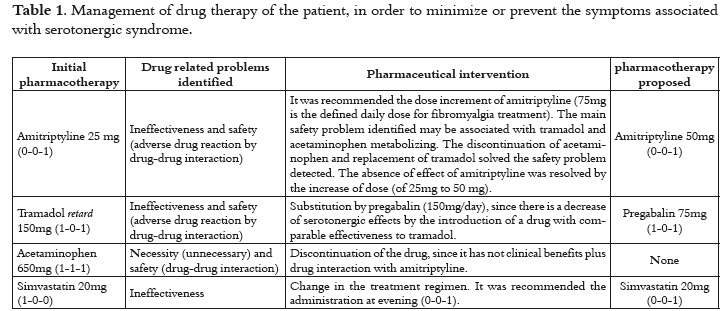
<body><![CDATA[<p>  2 student at the Department   of Drugs and Medications at the School   of Pharmaceutical Sciences of the Universidade   Estadual Paulista J&uacute;lio de Mesquita Filho &#8211; UNESP (Araraquara, SP , Brazil).</p>     <p>3 Clinical Pharmacist. Unit of Optimization of the pharmacotherapy. Sevilla-Spain</p>      <p>* Autor a quien se debe dirigir la correspondencia: <a href="mailto:patriciamastroianni@yahoo.com.br">patriciamastroianni@yahoo.com.br</a><a href="mailto:dianamgranda@gmail.com"></a>.</p>     <p>&nbsp;</p>     <p>Recibido: 16 November 2013</p>         <p>Aceptado: 02 February 2014</p>        <p>&nbsp;</p> <hr noshade size="1">     <p>&nbsp;</p>     <p align="center"><b>DEAR EDITOR</b></p>     <p>Depression associated with fibromyalgia can be treated with selective serotonin reuptake inhibitors   (SSRI) as fluoxetine, paroxetine or citalopram; or with serotonin&#8211;norepinephrine reuptake inhibitors   (duloxetine or milnacipran) (1, 2). In patients with fibromyalgia, several meta-analyses have demonstrated   the effectiveness of antidepressants, particularly the tricyclic antidepressant (TCA) amitriptyline,   which reduce the pain, fatigue, depression, and sleep disturbances. Additionally, tramadol, pregabalin, and gabapentin are other treatment options.</p>       ]]></body>
<body><![CDATA[<p>Bruxism is a rare secondary effect related to drugs with potent serotonergic activity. However, the   use of TCAs, SSRIs, and opioid analgesics have been associated to serotonergic syndrome (3, 4). The   incidence of serotonergic syndrome is about 17% in patients with migraine, depression, anxiety and panic   disorder (5); nevertheless, the incidence is still unknown in patients with fibromyalgia. The serotonergic   syndrome is characterized by signs and symptoms of agitation, tachycardia, increased tension, tremor,   fever, dyspnea, diarrhea, mental confusion, and insomnia (3-5). In this context, we report a possible   drug-induced bruxism in a patient with fibromyalgia associated with depression.</p>       <p>A complete and integral pharmacotherapy assessment of a 46 years old Caucasian woman diagnosed   with fibromyalgia associated with depression was performed according with the Strand et al (2004)   proposals (6). The medications used by the patient were: amitriptyline 25mg, (0-0-1); tramadol retard   150mg (1-0-1); acetaminophen 650mg (1-1-1); simvastatin 20mg, (1-0-0), and esomeprazole 20 mg, (1-   0-0). After six months of the treatment initiation, she reported gnashing of her teeth. The patient's drug   related needs were comprehensively assessed and, once the problems were detected, a report was sent   to her physician to propose changes in the pharmacotherapy, in order to minimize the negative clinical   outcome (bruxism) experienced by the patient (<a href="#t1">table 1</a>).</p>          <p align="center"><a name="f1"></a><img src="/img/revistas/vitae/v21n1/v21n1a7t1.jpg"></p>          <p>An unsatisfied pharmacotherapeutic problem of necessity was noted, since the patient had complained   of pain that she tried to solve with the increase of acetaminophen dose. In order to understand and   quantify her pain perception, an analgesic ladder of zero to ten was developed (zero intolerable pain   and ten without pain). Patient reported pain perception between two-three. So, a potential drug-drug   pharmacodynamic and pharmacokinetic interaction was identified among tramadol, acetaminophen   and amitriptyline, which may be associated with the development of serotonergic syndrome. Thus, we   proposed to the physician the discontinuation of acetaminophen and the replacement of tramadol by pregabalin (150mg/day) (<a href="#t1">table 1</a>).</p>      <p>Patient's physician accepted the management of pharmacotherapy proposal. In the following days after suspension of acetaminophen, and the replacement of tramadol by pregabalin, the negative outcome was resolved. Regarding the pain treatment, the patient classified the symptom between seven-eight, according to analgesic ladder.</p>     <p>Data suggest that the patient experienced a serotonergic syndrome, since after the proposed pharmaceutical intervention the signs and symptoms reported by patient disappeared. The identification of serotonergic syndrome is primarily based on exclusion, and strong suspicion based on a patient&acute;s current drug therapy.</p>     <p>Amitriptyline and tramadol are drugs with serotonergic action, which inhibit the reuptake of serotonin and noradrenalin. In addition, the main metabolic pathway of tramadol is through the CYP 2D6 enzymes, which may be partially inhibited by amitriptyline. Consequently, the tricyclic antidepressant may inhibit the metabolism of tramadol, interaction that can be a significant factor contributing to serotonin syndrome (7). Moreover, amitriptyline and acetaminophen compete for hepatic conjugation with glucuronic acid and sulfuric acid, delaying its elimination. Furthermore, the interruption of acetaminophen promotes the cessation of pharmacokinetic interaction.</p>     <p>A possible pharmacodynamic and pharmacokinetic interaction between amitriptyline, tramadol and acetaminophen may explain the bruxism as a clinical manifestation of serotonergic syndrome. The negative outcome was treated by the replacement of tramadol by pregabalin and by the discontinuation of acetaminophen.</p>     <p>&nbsp;</p>     <p> <font size="3"> <b>REFERENCIAS BIBLIOGR&Aacute;FICAS</b></font></p>     ]]></body>
<body><![CDATA[<!-- ref --><p>1. G oldenberg DL. Pharmacological treatment of fibromyalgia   and other chronic musculoskeletal pain. Best Pract Res Clin   Rheumatol. 2007; 21: 499&#8211;511.    &nbsp;&nbsp;&nbsp;&nbsp;&nbsp;&nbsp;&nbsp;&nbsp;[&#160;<a href="javascript:void(0);" onclick="javascript: window.open('/scielo.php?script=sci_nlinks&ref=000033&pid=S0121-4004201400010000700001&lng=','','width=640,height=500,resizable=yes,scrollbars=1,menubar=yes,');">Links</a>&#160;]<!-- end-ref --></p>       <!-- ref --><p>2. M iquel CA , Campayo JG, F&oacute;rez MT , et al. Documento de Consenso   interdisciplinar para el tratamiento de la fribiomialgia. Acta   Esp psiquiatr. 2010; 38 (2): 108-120.    &nbsp;&nbsp;&nbsp;&nbsp;&nbsp;&nbsp;&nbsp;&nbsp;[&#160;<a href="javascript:void(0);" onclick="javascript: window.open('/scielo.php?script=sci_nlinks&ref=000035&pid=S0121-4004201400010000700002&lng=','','width=640,height=500,resizable=yes,scrollbars=1,menubar=yes,');">Links</a>&#160;]<!-- end-ref --></p>       <!-- ref --><p>3. C hu J, Wang RY , Hill NS . Update in clinical toxicology. Am J   Respir Crit Care Med. 2002; 166 (1): 9-15.    &nbsp;&nbsp;&nbsp;&nbsp;&nbsp;&nbsp;&nbsp;&nbsp;[&#160;<a href="javascript:void(0);" onclick="javascript: window.open('/scielo.php?script=sci_nlinks&ref=000037&pid=S0121-4004201400010000700003&lng=','','width=640,height=500,resizable=yes,scrollbars=1,menubar=yes,');">Links</a>&#160;]<!-- end-ref --></p>       <!-- ref --><p>4. Jackson N, Doherty J, Coulter S. Neropsychiatric complications   of commonly used palliative care drugs. Postgrad Med J. 2008;   84 (989): 121-126.    &nbsp;&nbsp;&nbsp;&nbsp;&nbsp;&nbsp;&nbsp;&nbsp;[&#160;<a href="javascript:void(0);" onclick="javascript: window.open('/scielo.php?script=sci_nlinks&ref=000039&pid=S0121-4004201400010000700004&lng=','','width=640,height=500,resizable=yes,scrollbars=1,menubar=yes,');">Links</a>&#160;]<!-- end-ref --></p>       <!-- ref --><p>5. S chuman E. Serotonin toxicity revisited. Headache 2009; 49 (5):   784-785.    &nbsp;&nbsp;&nbsp;&nbsp;&nbsp;&nbsp;&nbsp;&nbsp;[&#160;<a href="javascript:void(0);" onclick="javascript: window.open('/scielo.php?script=sci_nlinks&ref=000041&pid=S0121-4004201400010000700005&lng=','','width=640,height=500,resizable=yes,scrollbars=1,menubar=yes,');">Links</a>&#160;]<!-- end-ref --></p>       ]]></body>
<body><![CDATA[<!-- ref --><p>6. S trand LM , Cipolle RJ, Morley PC , Frakes MJ. The impact of   pharmaceutical care practice on the practitioner and the patient in   the ambulatory practice setting: twenty- five years of experience.   Curr Pharm Des, 2004; 10 (31): 3987-4001.    &nbsp;&nbsp;&nbsp;&nbsp;&nbsp;&nbsp;&nbsp;&nbsp;[&#160;<a href="javascript:void(0);" onclick="javascript: window.open('/scielo.php?script=sci_nlinks&ref=000043&pid=S0121-4004201400010000700006&lng=','','width=640,height=500,resizable=yes,scrollbars=1,menubar=yes,');">Links</a>&#160;]<!-- end-ref --></p>       <!-- ref --><p>7. N elson EM , Philbrick AM . Avoiding serotonin syndrome: the   nature of the interaction between tramadol and selective serotonin reuptake inhibitors. Ann Pharmacother 2012; 46: 1712-6.    &nbsp;&nbsp;&nbsp;&nbsp;&nbsp;&nbsp;&nbsp;&nbsp;[&#160;<a href="javascript:void(0);" onclick="javascript: window.open('/scielo.php?script=sci_nlinks&ref=000045&pid=S0121-4004201400010000700007&lng=','','width=640,height=500,resizable=yes,scrollbars=1,menubar=yes,');">Links</a>&#160;]<!-- end-ref --></p>        <p>&nbsp;</p> </font>      ]]></body><back>
<ref-list>
<ref id="B1">
<label>1</label><nlm-citation citation-type="journal">
<person-group person-group-type="author">
<name>
<surname><![CDATA[Goldenberg]]></surname>
<given-names><![CDATA[DL.]]></given-names>
</name>
</person-group>
<article-title xml:lang="en"><![CDATA[Pharmacological treatment of fibromyalgia and other chronic musculoskeletal pain]]></article-title>
<source><![CDATA[Best Pract Res Clin Rheumatol]]></source>
<year>2007</year>
<volume>21</volume>
<page-range>499-511</page-range></nlm-citation>
</ref>
<ref id="B2">
<label>2</label><nlm-citation citation-type="journal">
<person-group person-group-type="author">
<name>
<surname><![CDATA[Miquel]]></surname>
<given-names><![CDATA[CA]]></given-names>
</name>
<name>
<surname><![CDATA[Campayo]]></surname>
<given-names><![CDATA[JG]]></given-names>
</name>
<name>
<surname><![CDATA[Fórez]]></surname>
<given-names><![CDATA[MT]]></given-names>
</name>
</person-group>
<article-title xml:lang="es"><![CDATA[Documento de Consenso interdisciplinar para el tratamiento de la fribiomialgia]]></article-title>
<source><![CDATA[Acta Esp psiquiatr]]></source>
<year>2010</year>
<volume>38</volume>
<numero>2</numero>
<issue>2</issue>
<page-range>108-120</page-range></nlm-citation>
</ref>
<ref id="B3">
<label>3</label><nlm-citation citation-type="journal">
<person-group person-group-type="author">
<name>
<surname><![CDATA[Chu]]></surname>
<given-names><![CDATA[J]]></given-names>
</name>
<name>
<surname><![CDATA[Wang]]></surname>
<given-names><![CDATA[RY]]></given-names>
</name>
<name>
<surname><![CDATA[Hill]]></surname>
<given-names><![CDATA[NS]]></given-names>
</name>
</person-group>
<article-title xml:lang="en"><![CDATA[Update in clinical toxicology]]></article-title>
<source><![CDATA[Am J Respir Crit Care Med]]></source>
<year>2002</year>
<volume>166</volume>
<numero>1</numero>
<issue>1</issue>
<page-range>9-15</page-range></nlm-citation>
</ref>
<ref id="B4">
<label>4</label><nlm-citation citation-type="journal">
<person-group person-group-type="author">
<name>
<surname><![CDATA[Jackson]]></surname>
<given-names><![CDATA[N]]></given-names>
</name>
<name>
<surname><![CDATA[Doherty]]></surname>
<given-names><![CDATA[J]]></given-names>
</name>
<name>
<surname><![CDATA[Coulter]]></surname>
<given-names><![CDATA[S.]]></given-names>
</name>
</person-group>
<article-title xml:lang="en"><![CDATA[Neropsychiatric complications of commonly used palliative care drugs]]></article-title>
<source><![CDATA[Postgrad Med J]]></source>
<year>2008</year>
<volume>84</volume>
<numero>989</numero>
<issue>989</issue>
<page-range>121-126</page-range></nlm-citation>
</ref>
<ref id="B5">
<label>5</label><nlm-citation citation-type="journal">
<person-group person-group-type="author">
<name>
<surname><![CDATA[Schuman]]></surname>
<given-names><![CDATA[E.]]></given-names>
</name>
</person-group>
<article-title xml:lang="en"><![CDATA[Serotonin toxicity revisited]]></article-title>
<source><![CDATA[Headache]]></source>
<year>2009</year>
<volume>49</volume>
<numero>5</numero>
<issue>5</issue>
<page-range>784-785</page-range></nlm-citation>
</ref>
<ref id="B6">
<label>6</label><nlm-citation citation-type="journal">
<person-group person-group-type="author">
<name>
<surname><![CDATA[Strand]]></surname>
<given-names><![CDATA[LM]]></given-names>
</name>
<name>
<surname><![CDATA[Cipolle]]></surname>
<given-names><![CDATA[RJ]]></given-names>
</name>
<name>
<surname><![CDATA[Morley]]></surname>
<given-names><![CDATA[PC]]></given-names>
</name>
<name>
<surname><![CDATA[Frakes]]></surname>
<given-names><![CDATA[MJ.]]></given-names>
</name>
</person-group>
<article-title xml:lang="en"><![CDATA[The impact of pharmaceutical care practice on the practitioner and the patient in the ambulatory practice setting: twenty- five years of experience]]></article-title>
<source><![CDATA[Curr Pharm Des]]></source>
<year>2004</year>
<volume>10</volume>
<numero>31</numero>
<issue>31</issue>
<page-range>3987-4001</page-range></nlm-citation>
</ref>
<ref id="B7">
<label>7</label><nlm-citation citation-type="journal">
<person-group person-group-type="author">
<name>
<surname><![CDATA[Nelson]]></surname>
<given-names><![CDATA[EM]]></given-names>
</name>
<name>
<surname><![CDATA[Philbrick]]></surname>
<given-names><![CDATA[AM]]></given-names>
</name>
</person-group>
<article-title xml:lang="en"><![CDATA[. Avoiding serotonin syndrome: the nature of the interaction between tramadol and selective serotonin reuptake inhibitors]]></article-title>
<source><![CDATA[Ann Pharmacother]]></source>
<year>2012</year>
<volume>46</volume>
<page-range>1712-6</page-range></nlm-citation>
</ref>
</ref-list>
</back>
</article>
