<?xml version="1.0" encoding="ISO-8859-1"?><article xmlns:mml="http://www.w3.org/1998/Math/MathML" xmlns:xlink="http://www.w3.org/1999/xlink" xmlns:xsi="http://www.w3.org/2001/XMLSchema-instance">
<front>
<journal-meta>
<journal-id>0121-4004</journal-id>
<journal-title><![CDATA[Vitae]]></journal-title>
<abbrev-journal-title><![CDATA[Vitae]]></abbrev-journal-title>
<issn>0121-4004</issn>
<publisher>
<publisher-name><![CDATA[Facultad de Química Farmacéutica, Universidad de Antioquia]]></publisher-name>
</publisher>
</journal-meta>
<article-meta>
<article-id>S0121-40042014000200003</article-id>
<title-group>
<article-title xml:lang="en"><![CDATA[ANTIMICROBIAL ACTIVITY OF PROPOLIS AND ITS EFFECT ON THE PHYSICOCHEMICAL AND SENSORAL CHARACTERISTICS IN SAUSAGES]]></article-title>
<article-title xml:lang="es"><![CDATA[ACTIVIDAD ANTIMICROBIANA DEL PROPÓLEOS Y EFECTO EN LAS CARACTERÍSTICAS FISICOQUÍMICAS Y SENSORIALES EN CHORIZOS]]></article-title>
</title-group>
<contrib-group>
<contrib contrib-type="author">
<name>
<surname><![CDATA[GUTIÉRREZ-CORTÉS]]></surname>
<given-names><![CDATA[Carolina]]></given-names>
</name>
<xref ref-type="aff" rid="A01"/>
<xref ref-type="aff" rid="A02"/>
</contrib>
<contrib contrib-type="author">
<name>
<surname><![CDATA[SUAREZ MAHECHA]]></surname>
<given-names><![CDATA[Héctor]]></given-names>
</name>
<xref ref-type="aff" rid="A02"/>
</contrib>
</contrib-group>
<aff id="A01">
<institution><![CDATA[,Universidad Nacional de Colombia sede Bogotá  ]]></institution>
<addr-line><![CDATA[Bogotá ]]></addr-line>
<country>Colombia</country>
</aff>
<aff id="A02">
<institution><![CDATA[,Universidad Nacional de Colombia sede Bogotá  ]]></institution>
<addr-line><![CDATA[ ]]></addr-line>
</aff>
<pub-date pub-type="pub">
<day>00</day>
<month>08</month>
<year>2014</year>
</pub-date>
<pub-date pub-type="epub">
<day>00</day>
<month>08</month>
<year>2014</year>
</pub-date>
<volume>21</volume>
<numero>2</numero>
<fpage>90</fpage>
<lpage>96</lpage>
<copyright-statement/>
<copyright-year/>
<self-uri xlink:href="http://www.scielo.org.co/scielo.php?script=sci_arttext&amp;pid=S0121-40042014000200003&amp;lng=en&amp;nrm=iso"></self-uri><self-uri xlink:href="http://www.scielo.org.co/scielo.php?script=sci_abstract&amp;pid=S0121-40042014000200003&amp;lng=en&amp;nrm=iso"></self-uri><self-uri xlink:href="http://www.scielo.org.co/scielo.php?script=sci_pdf&amp;pid=S0121-40042014000200003&amp;lng=en&amp;nrm=iso"></self-uri><abstract abstract-type="short" xml:lang="en"><p><![CDATA[Background: In the food industry, the use of natural additives capable of replacing chemical additives is increasing due to the tendency to consume natural and healthy foods. In nature, different substances such as propolis can fulfill that role and it is obtained from hives of honey bees. Propolis contains bioactive compounds with antimicrobial and antioxidant capacity, and thus, they could be used as an alternative for nitrites in meat products. Objective: To evaluate the in-vitro antimicrobial activity of the ethanol propolis extract (EEP) of on some pathogenic bacteria and their influence on the physicochemical and sensorial properties of sausages. Methods: The ethanol extraction was performed, and its antimicrobial activity in vitro on S. aureus, Salmonella, E. coli and Clostridium spp. was determined. Sausages were prepared according to the following treatments: (1) EEP 0.8mg/mL, (2) 0.2g/Kg sodium nitrite and sodium erythorbate, (3) Alcohol (96% v/v used as control) and the physicochemical analysis was performed to determine thiobarbituric acid (TBA), volatile nitrogen bases (TVB - N) and sensoral tests every week for four weeks. Analysis of variance and Tukey test were performed and the level of significance was p < 0.05. Results: No significant differences between EEP concentration, pH and TVB-N or sensorial properties (p &gt; 0.05) were found. However, significant differences in TBA values were observed (p < 0.05). Conclusions: A 0.8% EEP shows antimicrobial activity against some pathogenic microorganisms evaluated. Further, the physicochemical and sensorial characteristics of the product do not differ from the sausages containing nitrites.]]></p></abstract>
<abstract abstract-type="short" xml:lang="es"><p><![CDATA[Antecedentes: En la industria de alimentos es cada vez más común la utilización de aditivos naturales capaces de reemplazar los aditivos químicos, esto es debido a la tendencia a consumir alimentos más naturales y saludables. En la naturaleza existen diferentes compuestos que pueden cumplir dicha función, como el caso de los propóleos obtenidos en las colmenas de las abejas melíferas que presentan compuestos bioactivos con capacidad antimicrobiana y antioxidante y, por tanto, podría presentarse como una alternativa a la utilización de nitritos en productos cárnicos. Objetivo: Valorar la actividad antimicrobiana in-vitro del extracto etanólico de propóleos (EEP) sobre ciertas bacterias patógenas y su influencia en las características fisicoquímicas y sensoriales de chorizos. Métodos: Se realizó la extracción de los propóleos con alcohol etanólico al 96% y se determinó su actividad antimicrobiana in vitro sobre S. aureus, Salmonella spp., E. coli y Clostridium spp. Se prepararon chorizos de acuerdo a los siguientes tratamientos: (1) EEP 0.8mg/mL; (2) 0,2g/Kg de nitrito de sodio y eritorbato de sodio; (3) alcohol 96% (control) y se realizaron los análisis fisicoquímicos correspondientes a la determinación de ácido tiobarbitúrico (TBA) y bases volátiles de nitrógeno (BVT-N) y pruebas sensoriales cada ocho días durante cuatro semanas. Se realizó análisis de varianza de dos vías y prueba de Tukey, el nivel de significancia fue de p<0,05. Resultados: No se encontraron diferencias significativas entre las concentraciones de EEP en la actividad antimicrobiana in vitro, en los valores pH y BVT-N ni en la evaluación sensorial (p&gt;0,05). Se observaron diferencias significativas (p<0,05) en los valores de TBA. Conclusiones: El EEP al 0,8% presenta actividad antimicrobiana para los microorganismos patógenos evaluados. Adicionalmente, las características fisicoquímicas y sensoriales del producto no difieren de los chorizos elaborados con nitrito.]]></p></abstract>
<kwd-group>
<kwd lng="en"><![CDATA[Propolis]]></kwd>
<kwd lng="en"><![CDATA[antioxidant]]></kwd>
<kwd lng="en"><![CDATA[decarboxylation]]></kwd>
<kwd lng="en"><![CDATA[sensorial characteristics]]></kwd>
<kwd lng="en"><![CDATA[sausage]]></kwd>
<kwd lng="es"><![CDATA[Propóleos]]></kwd>
<kwd lng="es"><![CDATA[antioxidante]]></kwd>
<kwd lng="es"><![CDATA[descarboxilación]]></kwd>
<kwd lng="es"><![CDATA[características sensoriales]]></kwd>
<kwd lng="es"><![CDATA[chorizo]]></kwd>
</kwd-group>
</article-meta>
</front><body><![CDATA[  <font face="Verdana, Arial, Helvetica, sans-serif" size="2">     <p align="right"> <b>ALIMENTOS: CIENCIA, TECNOLOG&Iacute;A E INGENIER&Iacute;A</b></p>     <p>&nbsp;</p>     <p align="center"><b><font size="4">ANTIMICROBIAL ACTIVITY OF PROPOLIS AND ITS EFFECT ON THE PHYSICOCHEMICAL AND SENSORAL CHARACTERISTICS IN SAUSAGES</font></b></p>     <p>&nbsp;</p>     <p align="center"><b><font size="3"> ACTIVIDAD ANTIMICROBIANA DEL PROP&Oacute;LEOS Y EFECTO EN LAS CARACTER&Iacute;STICAS FISICOQU&Iacute;MICAS Y SENSORIALES EN CHORIZOS</font></b></p>     <p>&nbsp;</p>     <p>&nbsp;</p>     <p><b> Carolina GUTI&Eacute;RREZ-CORT&Eacute;S, MSc, PhD(c).<sup>1*</sup>, H&eacute;ctor SUAREZ MAHECHA, PhD.<sup>1</sup></b></p>     <p>1  Instituto de Ciencia y Tecnolog&iacute;a de Alimentos - ICTA, Universidad Nacional de Colombia sede Bogot&aacute;. Carrera 30 No. 45-03 edificio 500 C. Bogot&aacute; Colombia.</p>     ]]></body>
<body><![CDATA[<p>* Autor a quien se debe dirigir la correspondencia: <a href="mailto:cgutierrezco@unal.edu.co">cgutierrezco@unal.edu.co</a>.</p>     <p>&nbsp;</p>     <p>Received: 08 Novembre 2012</p>         <p>Accepted: 26 May  2014</p>        <p>&nbsp;</p> <hr noshade size="1">     <p><b> ABSTRACT</b></p>     <p><strong>Background:</strong> In the food industry, the use of natural additives capable of replacing chemical additives   is increasing due to the tendency to consume natural and healthy foods. In nature, different substances   such as propolis can fulfill that role and it is obtained from hives of honey bees. Propolis contains bioactive   compounds with antimicrobial and antioxidant capacity, and thus, they could be used as an alternative for   nitrites in meat products. <strong>Objective:</strong> To evaluate the in-vitro antimicrobial activity of the ethanol   propolis extract (EEP) of on some pathogenic bacteria and their influence on the physicochemical and   sensorial properties of sausages. <strong>Methods:</strong> The ethanol extraction was performed, and its antimicrobial   activity in vitro on <em>S. aureus</em>, <em>Salmonella</em>, <em>E. coli</em> and <em>Clostridium</em> spp. was determined. Sausages were prepared   according to the following treatments: (1) EEP 0.8mg/mL, (2) 0.2g/Kg sodium nitrite and sodium   erythorbate, (3) Alcohol (96% v/v used as control) and the physicochemical analysis was performed to   determine thiobarbituric acid (TBA), volatile nitrogen bases (TVB - N) and sensoral tests every week   for four weeks. Analysis of variance and Tukey test were performed and the level of significance was p   &lt; 0.05. <strong>Results:</strong> No significant differences between EEP concentration, pH and TVB-N or sensorial   properties (p &gt; 0.05) were found. However, significant differences in TBA values were observed (p &lt;   0.05). <strong>Conclusions: </strong>A 0.8% EEP shows antimicrobial activity against some pathogenic microorganisms   evaluated. Further, the physicochemical and sensorial characteristics of the product do not differ from the sausages containing nitrites.</p>     <p>  <b>Keywords</b>: Propolis, antioxidant, decarboxylation, sensorial characteristics, sausage.</p> <hr noshade size="1">     <p> <b>Resumen</b></p>     <p><strong>Antecedentes:</strong> En la industria de alimentos es cada vez m&aacute;s com&uacute;n la utilizaci&oacute;n de aditivos naturales   capaces de reemplazar los aditivos qu&iacute;micos, esto es debido a la tendencia a consumir alimentos   m&aacute;s naturales y saludables. En la naturaleza existen diferentes compuestos que pueden cumplir dicha   funci&oacute;n, como el caso de los prop&oacute;leos obtenidos en las colmenas de las abejas mel&iacute;feras que presentan   compuestos bioactivos con capacidad antimicrobiana y antioxidante y, por tanto, podr&iacute;a presentarse como   una alternativa a la utilizaci&oacute;n de nitritos en productos c&aacute;rnicos. <strong>Objetivo:</strong> Valorar la actividad antimicrobiana   in-vitro del extracto etan&oacute;lico de prop&oacute;leos (EEP) sobre ciertas bacterias pat&oacute;genas y su influencia   en las caracter&iacute;sticas fisicoqu&iacute;micas y sensoriales de chorizos. <strong>M&eacute;todos:</strong> Se realiz&oacute; la extracci&oacute;n de los prop&oacute;leos con alcohol etan&oacute;lico al 96% y se determin&oacute; su actividad antimicrobiana in vitro sobre <em>S. aureus</em>, <em>Salmonella</em> spp., <em>E. coli</em> y <em>Clostridium</em> spp. Se prepararon chorizos de acuerdo a los siguientes tratamientos: (1) EEP 0.8mg/mL; (2) 0,2g/Kg de nitrito de sodio y eritorbato de sodio; (3) alcohol 96% (control) y se realizaron los an&aacute;lisis fisicoqu&iacute;micos correspondientes a la determinaci&oacute;n de &aacute;cido tiobarbit&uacute;rico (TBA) y bases vol&aacute;tiles de nitr&oacute;geno (BVT-N) y pruebas sensoriales cada ocho d&iacute;as durante cuatro semanas. Se realiz&oacute; an&aacute;lisis de varianza de dos v&iacute;as y prueba de Tukey, el nivel de significancia fue de p&lt;0,05. <strong>Resultados:</strong> No se encontraron diferencias significativas entre las concentraciones de EEP en la actividad antimicrobiana <em>in vitro</em>, en los valores pH y BVT-N ni en la evaluaci&oacute;n sensorial (p&gt;0,05). Se observaron diferencias significativas (p&lt;0,05) en los valores de TBA. Conclusiones: El EEP al 0,8% presenta actividad antimicrobiana para los microorganismos pat&oacute;genos evaluados. Adicionalmente, las caracter&iacute;sticas fisicoqu&iacute;micas y sensoriales del producto no difieren de los chorizos elaborados con nitrito.     ]]></body>
<body><![CDATA[<p>  <b>Palabras clave</b>: Prop&oacute;leos, antioxidante, descarboxilaci&oacute;n, caracter&iacute;sticas sensoriales, chorizo.  </p> <hr noshade size="1">     <p>&nbsp;</p>     <p>&nbsp;</p>     <p><font size="3"><b>INTRODUCTION</b></font></p>     <p>A <em>Chorizo</em> is a meat product (sausage) of massive   consumption in Colombia, it is made from bovine   and porcine meat, porcine fat, and other species.   According to the Colombian Technical Standard   (NTC) 1325 sausages must have not more than   200 mg/Kg of nitrite, which means that nitrite is   still used in low concentrations as preservative and   color additive in the sausages commercialized in   the country.</p>       <p>Lipid autoxidation is a chemical change that can   decrease the quality of the meat products because it   generates undesirables odor, color, smell, and flavor   reducing the nutritional value (1). Another quality   indicator of this meat product is the amount of   nitrogen volatile bases (TVB-N) such as ammonium,   thrimethylamine, and dimethilamine. The   increase in the amount of TVB-N is associated   with spoilage, either from bacterial action or by   endogenic enzymes, and therefore it is an indicative   of food freshness (2). The bacterial contamination   decreases the quality of the product and also is a   present danger to the consumer health.</p>       <p>Some additives used as antioxidants and preservatives   have proved be unhealthy to the consumers.   Therefore, it is important to develop natural   additives such as sodium nitrite, which has been   commonly used as a preservative since it acts as an   antioxidant agent, reducing agent and nitrosylant.   Nitrite is converted into different compounds as   nitrous acid, nitric oxide, and nitrate (2, 3). Nitric   oxide is formed when nitrite reacts with the sulfhydryl   groups of proteins, and it can inhibit the   growing of <em>Clostridium botulinum</em>. Nevertheless, it   is known that nitrites react with the biogen amines   produced for the decarboxilation of some aminoacids   (5), producingnitrogenated compounds known   as cancer precursors (6).</p>       <p>Alternatively, there are numerous natural alternatives   substances as antimicrobial agents. For   example, essential oils obtained from aromatic   plants that can inhibit bacterial growth (4-6), chitosan,   which is obtained from the exoskeleton of   insects and crustaceans also has bactericidal activity   (7, 8). Further, bacteriocins, which are secondary   metabolites produced by certain lactic bacteria, have   been used in the food industry (9-11), and propolis,   which is extracted from hives of honeybees, has   been used in some meat products (12-15). Propolis   is an important and promising natural substitute for   antimicrobial agents.</p>       <p>Propolis is a natural product obtained from honeybees   composed from resins collected from plant   secretions in bulbs and leaves and is used to cover   hives and protect them (16). Propolis is composed of   45% resins, 30% wax and 10% fatty acids of essential   oils, 5% pollen, and 10% organic compounds and   minerals. During the extraction with ethanol the   wax and the organic waste are removed to obtain   the ethanolic extract of propolis (EEP) with all the   bioactive constituents. More than 300 components   have been isolated, such as terpenoids, flavonoids,   phenolic acids, steroids, sugars, amino acid, among   others. Propolis is known as an antioxidant, antibacterial,   antifungal, antiviral, anti-inflammatory,   antitumoral agent. It is also hepatoprotective, local   anesthetic, inmunoestimulator, and antimutagenic   (20). Numerous studies have demonstrated the   antimicrobial activity of EEP with different concentrations.</p>       <p>The aim of this work is the evaluation of the   antioxidant characteristics of propolis used in the   sausages production, and to verify the amount of   volatile nitrogen bases as indicator of the microbial   contamination of the products and compare these results with the sensorial evaluation.</p>       ]]></body>
<body><![CDATA[<p>&nbsp;</p>     <p><font size="3">  <b>MATERIALS AND METHODS</b></font></p>     <p><b>  Ethanolic extract of propolis (EEP)</b></p>     <p>100 g of propolis obtained in Boyac&aacute; - Colombia   were introduced in a precipitated glass and 400   mL of a 96% ethanol were added. The mixture   was shaken during two hours, and it was allowed   to stand overnight and filtered. The residue was   subjected to a secondary extraction under the same   conditions. Finally, the two extracts were mixed and   frozen to precipitate other compounds. The supernatant   EEP was used for the tests and contained an 8% of total solids.</p>       <p><b>In-vitro diffusion test</b></p>       <p>The antimicrobial activity of EEP was analyzed   by agar diffusion test (Mueller-Hinton). Three different   concentrations were used in order to know   which onecould be used in the formulation of the   sausages. The microorganisms used were <em>Staphylococcus   aureus</em>, <em>Escherichia coli</em>, <em>Salmonella</em> spp. and   <em>Clostridium</em> sp. These strains were obtained from   the laboratory of the Institute of Food Science and   Technology, (ICTA) National University of Colombia   in Bogot&aacute;. The activation of the strains was   performed in the BHI broth (Oxoid), TSB (Merck)   and nutritive broth (Oxoid). They were incubated   overnight and then cultivated in BHI a broth. 1 mL   of each strain was inoculated using the 0.5 McFarland   scale (concentration corresponding to 1.5 X10⁹   cells) on the surface of the Mueller-Hinton agar. A   6mm diameter disks were impregnated with three   different concentrations of propolis (0.8, 1.2, and 1.6   mg/mL) and a negative control with 96%. alcohol   was conducted. They were incubated for 48 hours   at 37oC and the inhibition zones were measured.   <em>Clostridium</em> sp. was incubated in anaerobic conditions.   The test was made in duplicate.</p>       <p><b>Production of fresh sausages</b></p>       <p>Fresh sausages of 100 g each were made with   porcine meat (60%), bovine meat (20%), and porcine   fat (20%). Three treatments were made using   the same formulation; the only difference was the   preservative content: T1) 0.8 mg/mL EEP; T2) 0.2   g/kg sodium nitrite and 0.5 g/kg sodium erythorbate;   and T3) 96% alcohol as control.</p>       <p>Meat and fat were cut into pieces and minced   using a cutter equipped with 12 mm discs and separated   into three parts to mix with the other ingredients   (pepper, garlic, salt, cayenne, scallions). The   respective preservative was added to each treatment   and the sausages were stuffed into pork casings, tied   and packaged in sealed bags under vacuum stored   in the meat plant of ICTA at a temperature of 50oC   and at 89 - 93% relative humidity.</p>       <p><b>Physicochemical analysis</b></p>       ]]></body>
<body><![CDATA[<p><b>pH</b></p>       <p>The pH measurement was performed using a   potentiometer (Schott - Handylab), samples were   passed through a manual meat grinder (Premier   MG-1724) with a mesh opening of 5 mm in diameter.   Three different measurements were made for   each sample, directly.</p>       <p><b>Determination of total volatile nitrogen bases   (TVB-N)</b></p>       <p>10 g of sample, 2 g of magnesium oxide, and 150   mL of distillated water were added in a distillation   flask. The mixture was distillated and collected in   a 3% boric acid solution to complete ~100 mL of   volume. Three drops of the Tashiro indicator were   added to the distillate. Finally, the distillate was   titrated with 0.1 N HCl (17).</p>       <p>The amount of TVB-N in mg/100 g of sample   was calculated from the volume (V) of the added   hydrochloric acid and its concentration (C) using   the following equation (1):</p>          <p align="center"><img src=".../img/revistas/vitae/v21n2/v21n2a3e1.jpg"></p>          <p><b>Thiobarbituric acid (TBA) determination</b></p>       <p>Approximately, 10 g of sausage was mixed with   50 mL of distilled water in a blender. The mixture   was transferred onto a distillation flask, and the residue   was washed with 47.5 mL of distillated water,   and transferred to the distillation flask. 2.5 mL of   4 N HCl and few drops of antifoam silicone were   added. The mixture was distilled for 10 minutes to   collect ~50 mL.</p>       <p>5 mL of the distilled product was placed in a test   tube and 5 mL of 0.02 M TBA solution was added to   the tube. It was capped and heated in a boiling water   bath for 35 minutes. The product was transferred   to a 1 cm cell to measure the absorbance at 532 nm   in a UV-Vis spectrophotometer (Jasco 530). The   results were expressed in mg of malondialdehyde   Antimicrobial activity of propolis and its effect on the physicochemical and sensoral characteristics in sausages 93   per kilogram in comparison to the calibration curve   built with 1,1,3,3-tetramethoxypropane (18). The   test was performed on a portion of the distillate   from the sample and distilled water treated under   the same conditions was used as a negative control.</p>       <p><b>Sensorial evaluation</b></p>       ]]></body>
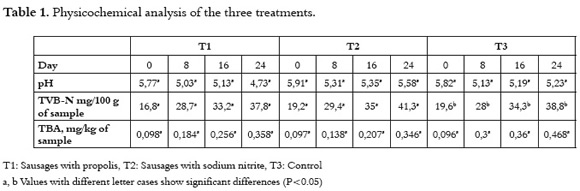
<body><![CDATA[<p>The sensorial characteristics of sausages made   with propolis and sodium nitrite were compared.   The analyses were performed at 0, 8, 16, and 24   days. Sausages were submitted to a panel of 10   trained tasters in order to evaluate the sensorial   attributes. The panelists were selected from the   staff members of the Institute of Food Science   and Technology (ICTA) taking into account their   habits, expertise with sausages, their sensitivity and   their ability to reproduce the evaluations. Prior to   testing, the panelists were trained in the sensorial   vocabulary related to meat products. Further, the   panelists were trained to know the features of the   procedure. Samples were coded and presented to all   panel members in a random order (19).</p>       <p>Sausages were cooked and fried for 20 minutes   and then were cut into slides. The sensorial evaluation   was divided in two parts. First, uncooked   samples were tested to qualify odor and color.   Then, panelists were asked to indicate taste, odor,   and color attributes of the cooked sausages in this   order. The test of cooked samples corresponding   to odor and taste attributes was made blindfolding.   Unsalted crackers and water at room temperature   were also provided to clean the palate between sampling.   Panelists were blindfolded to prevent the red   color from interfering with their judgment. Finally,   the color test was made. The Hedonic scale of nine   points was used for the attributes, where 1 corresponded   to extremely unpleasant, 9 to extremely   pleasant and 4 to satisfactory (10).</p>       <p><b>Statistical Analysis</b></p>   Data from physicochemical and sensory test   were analyzed with a two ways ANOVA for two   factor design with interactions. It was made the   multiple comparison among the treatments with   Tukey&acute;s test (P&lt;0.05) using the R program version 2.12.2</p>       <p>&nbsp;</p>     <p> <font size="3"> <b>RESULTS</b></font></p>     <p><b><i>In - vitro</i> diffusion tests</b></p>       <p>EEP concentrations of 0.8, 1.2 and 1.6 mg/   mL showed inhibition of the pathogenic bacteria.   No significant differences (p&gt; 0.05) among the   diameters of the inhibition zones presented by   the different concentrations of ethanol extract of   propolis against <em>Salmonella</em> spp., <em>E coli</em>, <em>S. aureus</em> and   <em>Clostridium</em> sp., was found at the lowest concentration   (0.8mg/mL).</p>       <p><b>Physicochemical analysis</b></p>       <p><a href="#t1">Table 1</a> shows the pH, volatile nitrogen bases   (TVB-N), and thiobarbituric acid (TBA) results.   Acid values decreased from the eight day of storage   and increased again after 24 days. The pH T1   treatment presented the lowest values. TVB-N   increased in the three treatments; however, the   T1treatment showed lower values during the whole   period of study. The TBA also increased in the three   treatments, where the T2 treatment presented the lowest values, followed by the T1treatment.</p>      <p align="center"><a name="t1"></a><img src="/img/revistas/vitae/v21n2/v21n2a3t1.jpg"></p>        ]]></body>
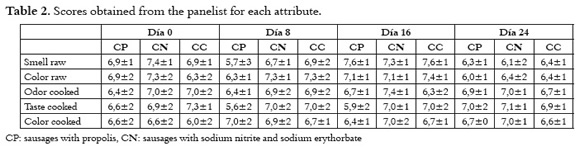
<body><![CDATA[<p><a href="#f1">Figure 1</a> shows the pH values during the 24 days   study. In all cases, the pH decreased up to the 8<sup>th</sup> day   which suggests the presence of acid lactic bacteria,   which were able to grow under anaerobic conditions   generated by the vacuum packaging. This development   produce lactic acid, which was responsible for   the pH reduction (20). From the 16 day the pH started   to increase in T2 and T1, due to the enzymatic denaturalization   which occurs during the storage period.</p>          <p align="center"><a name="f1"></a><img src=".../img/revistas/vitae/v21n2/v21n2a3f1.jpg"></p>          <p>An increase in the TVB-N was observed (<a href="#f2">Figure 2</a>). T1 presented the lower amount among the three   treatments. A correlation between the increase of   TVB-N with the increase of pH in day 16 for T1   and T2 was observed. It suggests that the presence of   microorganisms could remain until the final period of   storage and participate in the oxidative decarboxylation.</p>          <p align="center"><a name="f2"></a><img src=".../img/revistas/vitae/v21n2/v21n2a3f2.jpg"></p>            <p>The amount of TBA is related to the antioxidant   activity of propolis. Further, TBA values showed   that lipid oxidation increased (<a href="#f3">Figure 3</a>) until day   24 and significant differences among treatments   (P&lt;0.05) were observed. T1 and T2 showed a lower   increment as compared to the control, demonstrating   the antioxidant activity of propolis reported by   other authors (21, 22). T1 presented the slowest   increase, followed by T2.</p>          <p align="center"><a name="f3"></a><img src=".../img/revistas/vitae/v21n2/v21n2a3f3.jpg"></p>          <p><b>Sensorial evaluation</b></p>       <p>Panelists showed their preference for the traditional   red color. However, this was not a reason to   reject the raw or cooked product during the test.   Taste was qualified good in the cooked product   and the panelists considered that the appearance   and odor were good. For this reason, most of the   scores were higher than four, and were considered   within the acceptation range.</p>       <p><a href="#t2">Table 2</a> shows the scores for each treatment in   the sensorial evaluation. No significant differences   were found in the sensorial evaluation among the   treatments (P&gt;0.05). A scale from 1 to 9 was used,   where the scores higher than 4 were considered   within the acceptation criteria by the panelists.   Color and taste attributes improved with time.   However, the statistical test does not showed any   difference.</p>          <p align="center"><a name="t2"></a><img src="/img/revistas/vitae/v21n2/v21n2a3t2.jpg"></p>          ]]></body>
<body><![CDATA[<p>&nbsp;</p>       <p><font size="3">  <b>DISCUSSION</b></font></p>       <p>Inhibition zones higher than 8 mm in diameter     were obtained; it agreed with a study done in     different regions of Argentina which reported an     antimicrobial activity of EEP on <em>S. aureus</em> with inhibition     zones higher than9 mm diameter, which     were considered having a significant antimicrobial     activity (21).</p>         <p>In a previous study, the method of viable cell     count in a TCBS agar with different concentrations     of EEP obtained from three regions of Taiwan in     a four month period of sampling. They reported     a bactericidal activity at concentrations from 0.75     to 1.2 mg/mL depending on the site and month of     collection. According to that report, the concentration     of EEP used in the sausages (0.8mg/mL) is     included within the range (13). It has been reported     that EEP concentrations of 1.25 mg/mL has an inhibitory     activity for Gram positive and a 5 mg/mL     EEP concentration for Gram negative bacteria (23).     It suggests that using higher EEP concentrations     make the inhibition possible in a broader spectrum.</p>         <p>In another study the minimum inhibitory concentration     (MIC) testing different concentrations     of EEP against bacteria and filamentous fungi determined     that the antimicrobial activity is achieved     in a concentrations range from 0.005 to 0.5 mg/     mL. The most resistant bacteria were E. coli and       <em>Micrococcus luteus</em> (24). This concentration was lower     than the one reported by another study in which it     was 5 mg/mL inhibiting the growth of E. coli, 2.5     mg/mL inhibiting <em>Salmonella typhymurium</em>, while     <em>S. aureus</em> was inhibited with a 1.5 mg/mL of EEP     (19). The information above suggests that a low     concentration of propolis decrease the microbial     growth responsible for food spoilage and can be     related with meat product preservation.</p>         <p>In other studies, the reported initial pH of raw     material for sausages was between 5.4 and 5.5. This     acid value is due to the post-mortem glycolysis     generated by the in-situ proteolytic and lipolytic     enzymes of the meat (25). The microbial activity     can also generate acid conditions. The reported     values of pH are very close to those obtained in     this work in the first day of the study. The observed     behavior matches the ones proposed by     other authors (27). This is the result of the action     of decarboxylase enzymes from microorganisms     present in meat on proteins, and in a low proportion     by the endogenic enzymes present in the muscle.     No significant differences were found in the three     treatments (P&gt;0.05). After 24 days, T1 presented     a 37.8 TVB-N mg/100, this value was larger than     the one reported by (12) after 21 days of storage     (19.3 TVB-N mg/100 g).</p>         <p>The TBA results showed low values in contrast with     previous studies (26), where authors reported values of     16.83 and 6.07 mg of malondialdehyde (MDA)/Kg for     bovine and pig meat respectively, after ten days of storage.     In the present study, 0.358 mg MDA/Kg after 24     days of storage was observed. Further, 0.89 mg MDA/     Kg after 21 days of storage in sausages is reported in     (12). The reported main compounds responsible of the     antioxidant action of propolis from Greece and Cyprus,     were phenolic acids, anthraquinones, and flavonoids     (19). On the other hand, polyphenols are the main     compounds present in propolis from China, with an     antioxidant capacity (27).</p>         <p>Panelists commented on the different color as a     feature which does not disqualify the product, but     it could be improved due to the difference with     the color of traditional sausage. According to the     survey (28), it is possible to use the natural sources     of nitrite as celery or introduce nitrate-reducing microorganisms     which may help the color formation.</p>         <p>These can be the acid lactic bacteria, which can act     as starter in fermentation of meat products (29) and     are resistant to the antimicrobial action of propolis     (19). Finally, a mixture, in which is possible to take     advantage of the antioxidant and antimicrobial     capacities of propolis, would be obtained retaining     most of the traditional organoleptic characteristics.     In respect to taste, most consumers did not detect     differences and did not have suggestions.</p>         <p>Propolis showed similar behavior to nitrites     when was applied in a meat product by controlling     the acidification of the product and the production     of TBA and TBV-N. This presents a great opportunity     to replace sodium nitrite as a preservative     for meat products. Antimicrobial and antioxidant     activities of propolis have been studied, but few     studies have been focused on the implementation     and evaluation of products.</p>         ]]></body>
<body><![CDATA[<p>Propolis shows a huge potential in the food     industry, but it has a limitation for use because its     preparation and extraction can be expensive and     therefore, this procedure should be optimized     to increase their availability. Further, in a future     work it can be used to test higher concentrations     of propolis to perform microbiological testing to   verify counts over time.</p>        <p>&nbsp;</p>     <p> <font size="3"> <b>CONCLUSIONS</b></font></p>     <p>The concentration of EEP used in the preparation   of sausages showed an antioxidant capacity similar   to the sodium nitrite used traditionally as a curing   agent and preservative. Propolis is able to control the   formation of TVB-N, for this reason, it is assumed   its usefulness on the growth of the microorganisms   and also retarded the protein degradation. Sensorial   characteristics of the sausages with EEP are accepted   by the consumers; however, it is suggested to improve   the color. <em>In vitro</em> results show a great ability   of propolis to inhibit microbial growth; nevertheless   it is important to develop a microbiological analysis   in order to know the behavior of the bacterial   population within the products. Propolis has been   proved as an alternative for natural preservation of   meat products. The shortcoming of the red color can   be solved by using plant colorants. It is necessary to   develop a better protocol of EEP extraction because   this procedure is complicated and extensive.Furthermore,   it is important to consider possible difficulties when propolis is collected.</p>      <p>&nbsp;</p>     <p> <font size="3"> <b>REFERENCES</b></font></p>     <!-- ref --><p>1. Fern&aacute;ndez J, P&eacute;rez-&Aacute;lvarez JA, Fern&aacute;ndez-L&oacute;pez JA. Thiobarbituric   acid test for monitoring lipid oxidation in meat. Food   Chemistry. 1997; 59(3): 345-53.    &nbsp;&nbsp;&nbsp;&nbsp;&nbsp;&nbsp;&nbsp;&nbsp;[&#160;<a href="javascript:void(0);" onclick="javascript: window.open('/scielo.php?script=sci_nlinks&ref=000089&pid=S0121-4004201400020000300001&lng=','','width=640,height=500,resizable=yes,scrollbars=1,menubar=yes,');">Links</a>&#160;]<!-- end-ref --></p>       <!-- ref --><p>2. Honikel K-O. The use and control of nitrate and nitrite for the   processing of meat products Meat Science. 2008; 78(1-2): 68-76.    &nbsp;&nbsp;&nbsp;&nbsp;&nbsp;&nbsp;&nbsp;&nbsp;[&#160;<a href="javascript:void(0);" onclick="javascript: window.open('/scielo.php?script=sci_nlinks&ref=000091&pid=S0121-4004201400020000300002&lng=','','width=640,height=500,resizable=yes,scrollbars=1,menubar=yes,');">Links</a>&#160;]<!-- end-ref --></p>       ]]></body>
<body><![CDATA[<!-- ref --><p>3. Pegg RB, Shahidi F. Nitrite curing of meat: the N-nitrosamine   problem and nitrite alternatives: Food &amp; Nutrition Press; 2004.    &nbsp;&nbsp;&nbsp;&nbsp;&nbsp;&nbsp;&nbsp;&nbsp;[&#160;<a href="javascript:void(0);" onclick="javascript: window.open('/scielo.php?script=sci_nlinks&ref=000093&pid=S0121-4004201400020000300003&lng=','','width=640,height=500,resizable=yes,scrollbars=1,menubar=yes,');">Links</a>&#160;]<!-- end-ref --></p>       <!-- ref --><p>4. Duarte MCT, Leme EE, Delarmelina C, Soares AA, Figueira   GM, Sartoratto A. Activity of essential oils from Brazilian medicinal   plants on Escherichia coli. Journal of Ethnopharmacology.   2007; 111(2): 197-201.    &nbsp;&nbsp;&nbsp;&nbsp;&nbsp;&nbsp;&nbsp;&nbsp;[&#160;<a href="javascript:void(0);" onclick="javascript: window.open('/scielo.php?script=sci_nlinks&ref=000095&pid=S0121-4004201400020000300004&lng=','','width=640,height=500,resizable=yes,scrollbars=1,menubar=yes,');">Links</a>&#160;]<!-- end-ref --></p>       <!-- ref --><p>5. Lv F, Liang H, Yuan Q, Li C. In vitro antimicrobial effects and   mechanism of action of selected plant essential oil combinations   against four food-related microorganisms. Food Research International.   2011; 44(9): 3057-64.    &nbsp;&nbsp;&nbsp;&nbsp;&nbsp;&nbsp;&nbsp;&nbsp;[&#160;<a href="javascript:void(0);" onclick="javascript: window.open('/scielo.php?script=sci_nlinks&ref=000097&pid=S0121-4004201400020000300005&lng=','','width=640,height=500,resizable=yes,scrollbars=1,menubar=yes,');">Links</a>&#160;]<!-- end-ref --></p>       <!-- ref --><p>6. Rojas-Gra&uuml; MA, Avena-Bustillos RJ, Olsen C, Friedman M,   Henika PR, Mart&iacute;n-Belloso O, et al. Effects of plant essential   oils and oil compounds on mechanical, barrier and antimicrobial   properties of alginate-apple puree edible films. Journal of Food   Engineering. 2007; 81(3): 634-41.    &nbsp;&nbsp;&nbsp;&nbsp;&nbsp;&nbsp;&nbsp;&nbsp;[&#160;<a href="javascript:void(0);" onclick="javascript: window.open('/scielo.php?script=sci_nlinks&ref=000099&pid=S0121-4004201400020000300006&lng=','','width=640,height=500,resizable=yes,scrollbars=1,menubar=yes,');">Links</a>&#160;]<!-- end-ref --></p>       <!-- ref --><p>7. Fernandez-Saiz P, Lagaron JM, Ocio MJ. Optimization of the   biocide properties of chitosan for its application in the design   of active films of interest in the food area. Food Hydrocolloid.   2009; 23(3): 913-21.    &nbsp;&nbsp;&nbsp;&nbsp;&nbsp;&nbsp;&nbsp;&nbsp;[&#160;<a href="javascript:void(0);" onclick="javascript: window.open('/scielo.php?script=sci_nlinks&ref=000101&pid=S0121-4004201400020000300007&lng=','','width=640,height=500,resizable=yes,scrollbars=1,menubar=yes,');">Links</a>&#160;]<!-- end-ref --></p>       ]]></body>
<body><![CDATA[<!-- ref --><p>8. G&oacute;mez-Estaca J, L&oacute;pez de Lacey A, L&oacute;pez-Caballero ME,   G&oacute;mez-Guill&eacute;n MC, Montero P. Biodegradable gelatin-chitosan   films incorporated with essential oils as antimicrobial agents for   fish preservation. Food Microbiology. 2010; 27(7): 889-96.    &nbsp;&nbsp;&nbsp;&nbsp;&nbsp;&nbsp;&nbsp;&nbsp;[&#160;<a href="javascript:void(0);" onclick="javascript: window.open('/scielo.php?script=sci_nlinks&ref=000103&pid=S0121-4004201400020000300008&lng=','','width=640,height=500,resizable=yes,scrollbars=1,menubar=yes,');">Links</a>&#160;]<!-- end-ref --></p>       <!-- ref --><p>9. Belfiore C, Castellano P, Vignolo G. Reduction of Escherichia coli   population following treatment with bacteriocins from lactic acid   bacteria and chelators. Food Microbiology. 2007; 24(3): 223-9.    &nbsp;&nbsp;&nbsp;&nbsp;&nbsp;&nbsp;&nbsp;&nbsp;[&#160;<a href="javascript:void(0);" onclick="javascript: window.open('/scielo.php?script=sci_nlinks&ref=000105&pid=S0121-4004201400020000300009&lng=','','width=640,height=500,resizable=yes,scrollbars=1,menubar=yes,');">Links</a>&#160;]<!-- end-ref --></p>       <!-- ref --><p>10. Su&aacute;rez H., Pardo S., M. C. Calidad f&iacute;sico-qu&iacute;mica y atributos   sensoriales de filetes sajados biopreservados de cachama, empacados   al vac&iacute;o bajo refrigeraci&oacute;n. Revista colombiana de ciencias   pecuarias. 2008; 21: 330-9.    &nbsp;&nbsp;&nbsp;&nbsp;&nbsp;&nbsp;&nbsp;&nbsp;[&#160;<a href="javascript:void(0);" onclick="javascript: window.open('/scielo.php?script=sci_nlinks&ref=000107&pid=S0121-4004201400020000300010&lng=','','width=640,height=500,resizable=yes,scrollbars=1,menubar=yes,');">Links</a>&#160;]<!-- end-ref --></p>       <!-- ref --><p>11. Wijnker JJ, Weerts EAWS, Breukink EJ, Houben JH, Lipman   LJA. Reduction of Clostridium sporogenes spore outgrowth in   natural sausage casings using nisin. Food Microbiology. 2011;   28(5): 974-9.    &nbsp;&nbsp;&nbsp;&nbsp;&nbsp;&nbsp;&nbsp;&nbsp;[&#160;<a href="javascript:void(0);" onclick="javascript: window.open('/scielo.php?script=sci_nlinks&ref=000109&pid=S0121-4004201400020000300011&lng=','','width=640,height=500,resizable=yes,scrollbars=1,menubar=yes,');">Links</a>&#160;]<!-- end-ref --></p>       <!-- ref --><p>12. Ali FH, Kassem GM, Atta-Alla OA. Propolis as a natural decontaminant   and antioxidant in fresh oriental sausage. La propoli   come decontaminante e antiossidante nella salsiccia orientale   fresca. 2010; 46(2):167-72.    &nbsp;&nbsp;&nbsp;&nbsp;&nbsp;&nbsp;&nbsp;&nbsp;[&#160;<a href="javascript:void(0);" onclick="javascript: window.open('/scielo.php?script=sci_nlinks&ref=000111&pid=S0121-4004201400020000300012&lng=','','width=640,height=500,resizable=yes,scrollbars=1,menubar=yes,');">Links</a>&#160;]<!-- end-ref --></p>       ]]></body>
<body><![CDATA[<!-- ref --><p>13. Lu L-C, Chen Y-W, Chou C-C. Antibacterial activity of propolis   against Staphylococcus aureus. International Journal of Food   Microbiology. 2005;102(2): 213-20.    &nbsp;&nbsp;&nbsp;&nbsp;&nbsp;&nbsp;&nbsp;&nbsp;[&#160;<a href="javascript:void(0);" onclick="javascript: window.open('/scielo.php?script=sci_nlinks&ref=000113&pid=S0121-4004201400020000300013&lng=','','width=640,height=500,resizable=yes,scrollbars=1,menubar=yes,');">Links</a>&#160;]<!-- end-ref --></p>       <!-- ref --><p>14. Orsi RO, Sforcin JM, Rall VLM, Funari SRC, Barbosa L, Fernandes   JA. Susceptibility profile of Salmonella against the antibacterial   activity of propolis produced in two regions of Brazil. Journal of   Venomous Animal Toxins. 2005;11: 109-16.    &nbsp;&nbsp;&nbsp;&nbsp;&nbsp;&nbsp;&nbsp;&nbsp;[&#160;<a href="javascript:void(0);" onclick="javascript: window.open('/scielo.php?script=sci_nlinks&ref=000115&pid=S0121-4004201400020000300014&lng=','','width=640,height=500,resizable=yes,scrollbars=1,menubar=yes,');">Links</a>&#160;]<!-- end-ref --></p>       <!-- ref --><p>15. Tolosa L, Ca&ntilde;izares, E. Obtenci&oacute;n, caracterizaci&oacute;n y evaluaci&oacute;n   de la actividad antimicrobiana de extractos de prop&oacute;leos de   Campeche. ARS Pharmaceutical. 2002:187-204.    &nbsp;&nbsp;&nbsp;&nbsp;&nbsp;&nbsp;&nbsp;&nbsp;[&#160;<a href="javascript:void(0);" onclick="javascript: window.open('/scielo.php?script=sci_nlinks&ref=000117&pid=S0121-4004201400020000300015&lng=','','width=640,height=500,resizable=yes,scrollbars=1,menubar=yes,');">Links</a>&#160;]<!-- end-ref --></p>       <!-- ref --><p>16. Kalogeropoulos N, Konteles SJ, Troullidou E, Mourtzinos I,   Karathanos VT. Chemical composition, antioxidant activity and   antimicrobial properties of propolis extracts from Greece and   Cyprus. Food Chemistry. 2009;116(2): 452-61.    &nbsp;&nbsp;&nbsp;&nbsp;&nbsp;&nbsp;&nbsp;&nbsp;[&#160;<a href="javascript:void(0);" onclick="javascript: window.open('/scielo.php?script=sci_nlinks&ref=000119&pid=S0121-4004201400020000300016&lng=','','width=640,height=500,resizable=yes,scrollbars=1,menubar=yes,');">Links</a>&#160;]<!-- end-ref --></p>       <!-- ref --><p>17. ICONTEC. NTC 1322. Productos de la pesca. M&eacute;todos de   an&aacute;lisis f&iacute;sicos y qu&iacute;micos. 2007; Instituto Colombiano de Normas   T&eacute;cnicas y Certificaci&oacute;n:&#91;Segunda actualizaci&oacute;n Editada   2007-12-2&#93;    &nbsp;&nbsp;&nbsp;&nbsp;&nbsp;&nbsp;&nbsp;&nbsp;[&#160;<a href="javascript:void(0);" onclick="javascript: window.open('/scielo.php?script=sci_nlinks&ref=000121&pid=S0121-4004201400020000300017&lng=','','width=640,height=500,resizable=yes,scrollbars=1,menubar=yes,');">Links</a>&#160;]<!-- end-ref --></p>       ]]></body>
<body><![CDATA[<!-- ref --><p>18. Tarladgis B, Watts B, Younathan M, Dugan L, Jr. A distillation   method for the quantitative determination of malonaldehyde in   rancid foods. J Am Oil Chem Soc. 1960; 37(1): 44-8.    &nbsp;&nbsp;&nbsp;&nbsp;&nbsp;&nbsp;&nbsp;&nbsp;[&#160;<a href="javascript:void(0);" onclick="javascript: window.open('/scielo.php?script=sci_nlinks&ref=000123&pid=S0121-4004201400020000300018&lng=','','width=640,height=500,resizable=yes,scrollbars=1,menubar=yes,');">Links</a>&#160;]<!-- end-ref --></p> </font>     <!-- ref --><p><font size="2" face="Verdana, Arial, Helvetica, sans-serif">19. Duthoit F, Callon C, Tessier L, Montel M-C. Relationships   between sensorial characteristics and microbial dynamics in   ''Registered Designation of Origin'' Salers cheese. International   Journal of Food Microbiology. 2005;103(3): 259-70.    &nbsp;&nbsp;&nbsp;&nbsp;&nbsp;&nbsp;&nbsp;&nbsp;[&#160;<a href="javascript:void(0);" onclick="javascript: window.open('/scielo.php?script=sci_nlinks&ref=000125&pid=S0121-4004201400020000300019&lng=','','width=640,height=500,resizable=yes,scrollbars=1,menubar=yes,');">Links</a>&#160;]<!-- end-ref --></font></p>   <font face="Verdana, Arial, Helvetica, sans-serif" size="2">       <!-- ref --><p>20. Krockel L. The Role of Lactic Acid Bacteria in Safety and   Flavour Development of Meat and Meat Products. In: Kongo   DJM, editor. Lactic Acid Bacteria - R &amp; D for Food, Health and   Livestock Purposes. http://www.intechopen.com/books/lacticacid-   bacteria-r-d-for-food-health-and-livestock-purposes/therole-   of-lactic-acid-bacteria-in-safety-and-flavour-developmentof-   meat-and-meat-products.    &nbsp;&nbsp;&nbsp;&nbsp;&nbsp;&nbsp;&nbsp;&nbsp;[&#160;<a href="javascript:void(0);" onclick="javascript: window.open('/scielo.php?script=sci_nlinks&ref=000127&pid=S0121-4004201400020000300020&lng=','','width=640,height=500,resizable=yes,scrollbars=1,menubar=yes,');">Links</a>&#160;]<!-- end-ref --></p>       <!-- ref --><p>21. Chaillou LL, Nazareno MA. Bioactivity of propolis from Santiago   del Estero, Argentina, related to their chemical composition.   LWT - Food Science and Technology. 2009; 42(8): 1422-7.    &nbsp;&nbsp;&nbsp;&nbsp;&nbsp;&nbsp;&nbsp;&nbsp;[&#160;<a href="javascript:void(0);" onclick="javascript: window.open('/scielo.php?script=sci_nlinks&ref=000129&pid=S0121-4004201400020000300021&lng=','','width=640,height=500,resizable=yes,scrollbars=1,menubar=yes,');">Links</a>&#160;]<!-- end-ref --></p>       <!-- ref --><p>22. Choi YM, Noh DO, Cho SY, Suh HJ, Kim KM, Kim JM. Antioxidant   and antimicrobial activities of propolis from several   regions of Korea. LWT - Food Science and Technology. 2006;   39 (7): 756-61.    &nbsp;&nbsp;&nbsp;&nbsp;&nbsp;&nbsp;&nbsp;&nbsp;[&#160;<a href="javascript:void(0);" onclick="javascript: window.open('/scielo.php?script=sci_nlinks&ref=000131&pid=S0121-4004201400020000300022&lng=','','width=640,height=500,resizable=yes,scrollbars=1,menubar=yes,');">Links</a>&#160;]<!-- end-ref --></p>       ]]></body>
<body><![CDATA[<!-- ref --><p>23. Mohammadzadeh S, Shariatpanahi M, Hamedi M, Ahmadkhaniha   R, Samadi N, Ostad SN. Chemical composition, oral toxicity   and antimicrobial activity of Iranian propolis. Food Chem.   2007; 103(4): 1097-103.    &nbsp;&nbsp;&nbsp;&nbsp;&nbsp;&nbsp;&nbsp;&nbsp;[&#160;<a href="javascript:void(0);" onclick="javascript: window.open('/scielo.php?script=sci_nlinks&ref=000133&pid=S0121-4004201400020000300023&lng=','','width=640,height=500,resizable=yes,scrollbars=1,menubar=yes,');">Links</a>&#160;]<!-- end-ref --></p>       <!-- ref --><p>24. Garedew A, Schmolz E, Lamprecht I. Microbiological and calorimetric   investigations on the antimicrobial actions of different   propolis extracts: an in vitro approach. Thermochimica Acta.   2004; 422 (1-2): 115-24.    &nbsp;&nbsp;&nbsp;&nbsp;&nbsp;&nbsp;&nbsp;&nbsp;[&#160;<a href="javascript:void(0);" onclick="javascript: window.open('/scielo.php?script=sci_nlinks&ref=000135&pid=S0121-4004201400020000300024&lng=','','width=640,height=500,resizable=yes,scrollbars=1,menubar=yes,');">Links</a>&#160;]<!-- end-ref --></p>       <!-- ref --><p>25. Nychas G-JE, Skandamis PN, Tassou CC, Koutsoumanis KP.   Meat spoilage during distribution. Meat Science. 2008;78 (1-2):   77-89.    &nbsp;&nbsp;&nbsp;&nbsp;&nbsp;&nbsp;&nbsp;&nbsp;[&#160;<a href="javascript:void(0);" onclick="javascript: window.open('/scielo.php?script=sci_nlinks&ref=000137&pid=S0121-4004201400020000300025&lng=','','width=640,height=500,resizable=yes,scrollbars=1,menubar=yes,');">Links</a>&#160;]<!-- end-ref --></p>       <!-- ref --><p>26. Tang S, Kerry JP, Sheehan D, Buckley DJ, Morrissey PA. Antioxidative   effect of added tea catechins on susceptibility of cooked red   meat, poultry and fish patties to lipid oxidation. Food Research   International. 2001; 34 (8): 651-7.    &nbsp;&nbsp;&nbsp;&nbsp;&nbsp;&nbsp;&nbsp;&nbsp;[&#160;<a href="javascript:void(0);" onclick="javascript: window.open('/scielo.php?script=sci_nlinks&ref=000139&pid=S0121-4004201400020000300026&lng=','','width=640,height=500,resizable=yes,scrollbars=1,menubar=yes,');">Links</a>&#160;]<!-- end-ref --></p>       <!-- ref --><p>27. Ahn M-R, Kumazawa S, Usui Y, Nakamura J, Matsuka M, Zhu F,   et al. Antioxidant activity and constituents of propolis collected in   various areas of China. Food Chemistry. 2007; 101 (4): 1383-92.    &nbsp;&nbsp;&nbsp;&nbsp;&nbsp;&nbsp;&nbsp;&nbsp;[&#160;<a href="javascript:void(0);" onclick="javascript: window.open('/scielo.php?script=sci_nlinks&ref=000141&pid=S0121-4004201400020000300027&lng=','','width=640,height=500,resizable=yes,scrollbars=1,menubar=yes,');">Links</a>&#160;]<!-- end-ref --></p>       ]]></body>
<body><![CDATA[<!-- ref --><p>28. Sebranek JG, Bacus JN. Cured meat products without direct   addition of nitrate or nitrite: what are the issues? Meat Science.   2007; 77 (1):136-47.    &nbsp;&nbsp;&nbsp;&nbsp;&nbsp;&nbsp;&nbsp;&nbsp;[&#160;<a href="javascript:void(0);" onclick="javascript: window.open('/scielo.php?script=sci_nlinks&ref=000143&pid=S0121-4004201400020000300028&lng=','','width=640,height=500,resizable=yes,scrollbars=1,menubar=yes,');">Links</a>&#160;]<!-- end-ref --></p>       <!-- ref --><p>29. Zhang X, Kong B, Xiong YL. Production of cured meat color   in nitrite-free Harbin red sausage by Lactobacillus fermentum fermentation. Meat Science. 2007; 77 (4): 593-8.    &nbsp;&nbsp;&nbsp;&nbsp;&nbsp;&nbsp;&nbsp;&nbsp;[&#160;<a href="javascript:void(0);" onclick="javascript: window.open('/scielo.php?script=sci_nlinks&ref=000145&pid=S0121-4004201400020000300029&lng=','','width=640,height=500,resizable=yes,scrollbars=1,menubar=yes,');">Links</a>&#160;]<!-- end-ref --></p>        <p>&nbsp;</p> </font>      ]]></body><back>
<ref-list>
<ref id="B1">
<label>1</label><nlm-citation citation-type="journal">
<person-group person-group-type="author">
<name>
<surname><![CDATA[Fernández]]></surname>
<given-names><![CDATA[J]]></given-names>
</name>
<name>
<surname><![CDATA[Pérez-Álvarez]]></surname>
<given-names><![CDATA[JA]]></given-names>
</name>
<name>
<surname><![CDATA[Fernández-López]]></surname>
<given-names><![CDATA[JA.]]></given-names>
</name>
</person-group>
<article-title xml:lang="en"><![CDATA[Thiobarbituric acid test for monitoring lipid oxidation in meat]]></article-title>
<source><![CDATA[Food Chemistry]]></source>
<year>1997</year>
<volume>59</volume>
<numero>3</numero>
<issue>3</issue>
<page-range>345-53</page-range></nlm-citation>
</ref>
<ref id="B2">
<label>2</label><nlm-citation citation-type="journal">
<person-group person-group-type="author">
<name>
<surname><![CDATA[Honikel]]></surname>
<given-names><![CDATA[K-O.]]></given-names>
</name>
</person-group>
<article-title xml:lang="en"><![CDATA[The use and control of nitrate and nitrite for the processing of meat products]]></article-title>
<source><![CDATA[Meat Science]]></source>
<year>2008</year>
<volume>78</volume>
<numero>1-2</numero>
<issue>1-2</issue>
<page-range>68-76</page-range></nlm-citation>
</ref>
<ref id="B3">
<label>3</label><nlm-citation citation-type="book">
<person-group person-group-type="author">
<name>
<surname><![CDATA[Pegg]]></surname>
<given-names><![CDATA[RB]]></given-names>
</name>
<name>
<surname><![CDATA[Shahidi]]></surname>
<given-names><![CDATA[F]]></given-names>
</name>
</person-group>
<source><![CDATA[Nitrite curing of meat: the N-nitrosamine problem and nitrite alternatives]]></source>
<year>2004</year>
<publisher-name><![CDATA[Food & Nutrition Press]]></publisher-name>
</nlm-citation>
</ref>
<ref id="B4">
<label>4</label><nlm-citation citation-type="journal">
<person-group person-group-type="author">
<name>
<surname><![CDATA[Duarte]]></surname>
<given-names><![CDATA[MCT]]></given-names>
</name>
<name>
<surname><![CDATA[Leme]]></surname>
<given-names><![CDATA[EE]]></given-names>
</name>
<name>
<surname><![CDATA[Delarmelina]]></surname>
<given-names><![CDATA[C]]></given-names>
</name>
<name>
<surname><![CDATA[Soares]]></surname>
<given-names><![CDATA[AA]]></given-names>
</name>
<name>
<surname><![CDATA[Figueira]]></surname>
<given-names><![CDATA[GM]]></given-names>
</name>
<name>
<surname><![CDATA[Sartoratto]]></surname>
<given-names><![CDATA[A.]]></given-names>
</name>
</person-group>
<article-title xml:lang="en"><![CDATA[Activity of essential oils from Brazilian medicinal plants on Escherichia coli]]></article-title>
<source><![CDATA[Journal of Ethnopharmacology]]></source>
<year>2007</year>
<volume>111</volume>
<numero>2</numero>
<issue>2</issue>
<page-range>197-201</page-range></nlm-citation>
</ref>
<ref id="B5">
<label>5</label><nlm-citation citation-type="journal">
<person-group person-group-type="author">
<name>
<surname><![CDATA[Lv]]></surname>
<given-names><![CDATA[F]]></given-names>
</name>
<name>
<surname><![CDATA[Liang]]></surname>
<given-names><![CDATA[H]]></given-names>
</name>
<name>
<surname><![CDATA[Yuan]]></surname>
<given-names><![CDATA[Q]]></given-names>
</name>
<name>
<surname><![CDATA[Li]]></surname>
<given-names><![CDATA[C.]]></given-names>
</name>
</person-group>
<article-title xml:lang="en"><![CDATA[In vitro antimicrobial effects and mechanism of action of selected plant essential oil combinations against four food-related microorganisms]]></article-title>
<source><![CDATA[Food Research International]]></source>
<year>2011</year>
<volume>44</volume>
<numero>9</numero>
<issue>9</issue>
<page-range>3057-64</page-range></nlm-citation>
</ref>
<ref id="B6">
<label>6</label><nlm-citation citation-type="journal">
<person-group person-group-type="author">
<name>
<surname><![CDATA[Rojas-Graü]]></surname>
<given-names><![CDATA[MA]]></given-names>
</name>
<name>
<surname><![CDATA[Avena-Bustillos]]></surname>
<given-names><![CDATA[RJ]]></given-names>
</name>
<name>
<surname><![CDATA[Olsen]]></surname>
<given-names><![CDATA[C]]></given-names>
</name>
<name>
<surname><![CDATA[Friedman]]></surname>
<given-names><![CDATA[M]]></given-names>
</name>
<name>
<surname><![CDATA[Henika]]></surname>
<given-names><![CDATA[PR]]></given-names>
</name>
<name>
<surname><![CDATA[Martín-Belloso]]></surname>
<given-names><![CDATA[O]]></given-names>
</name>
</person-group>
<article-title xml:lang="en"><![CDATA[Effects of plant essential oils and oil compounds on mechanical, barrier and antimicrobial properties of alginate-apple puree edible films]]></article-title>
<source><![CDATA[Journal of Food Engineering]]></source>
<year>2007</year>
<volume>81</volume>
<numero>3</numero>
<issue>3</issue>
<page-range>634-41</page-range></nlm-citation>
</ref>
<ref id="B7">
<label>7</label><nlm-citation citation-type="journal">
<person-group person-group-type="author">
<name>
<surname><![CDATA[Fernandez-Saiz]]></surname>
<given-names><![CDATA[P]]></given-names>
</name>
<name>
<surname><![CDATA[Lagaron]]></surname>
<given-names><![CDATA[JM]]></given-names>
</name>
<name>
<surname><![CDATA[Ocio]]></surname>
<given-names><![CDATA[MJ.]]></given-names>
</name>
</person-group>
<article-title xml:lang="en"><![CDATA[Optimization of the biocide properties of chitosan for its application in the design of active films of interest in the food area]]></article-title>
<source><![CDATA[Food Hydrocolloid]]></source>
<year>2009</year>
<volume>23</volume>
<numero>3</numero>
<issue>3</issue>
<page-range>913-21</page-range></nlm-citation>
</ref>
<ref id="B8">
<label>8</label><nlm-citation citation-type="journal">
<person-group person-group-type="author">
<name>
<surname><![CDATA[Gómez-Estaca]]></surname>
<given-names><![CDATA[J]]></given-names>
</name>
<name>
<surname><![CDATA[López]]></surname>
<given-names><![CDATA[de Lacey A]]></given-names>
</name>
<name>
<surname><![CDATA[López-Caballero]]></surname>
<given-names><![CDATA[ME]]></given-names>
</name>
<name>
<surname><![CDATA[Gómez-Guillén]]></surname>
<given-names><![CDATA[MC]]></given-names>
</name>
<name>
<surname><![CDATA[Montero]]></surname>
<given-names><![CDATA[P.]]></given-names>
</name>
</person-group>
<article-title xml:lang="en"><![CDATA[Biodegradable gelatin-chitosan films incorporated with essential oils as antimicrobial agents for fish preservation]]></article-title>
<source><![CDATA[Food Microbiology]]></source>
<year>2010</year>
<volume>27</volume>
<numero>7</numero>
<issue>7</issue>
<page-range>889-96</page-range></nlm-citation>
</ref>
<ref id="B9">
<label>9</label><nlm-citation citation-type="journal">
<person-group person-group-type="author">
<name>
<surname><![CDATA[Belfiore]]></surname>
<given-names><![CDATA[C]]></given-names>
</name>
<name>
<surname><![CDATA[Castellano]]></surname>
<given-names><![CDATA[P]]></given-names>
</name>
<name>
<surname><![CDATA[Vignolo]]></surname>
<given-names><![CDATA[G.]]></given-names>
</name>
</person-group>
<article-title xml:lang="en"><![CDATA[Reduction of Escherichia coli population following treatment with bacteriocins from lactic acid bacteria and chelators]]></article-title>
<source><![CDATA[Food Microbiology]]></source>
<year>2007</year>
<volume>24</volume>
<numero>3</numero>
<issue>3</issue>
<page-range>223-9</page-range></nlm-citation>
</ref>
<ref id="B10">
<label>10</label><nlm-citation citation-type="journal">
<person-group person-group-type="author">
<name>
<surname><![CDATA[Suárez]]></surname>
<given-names><![CDATA[H.]]></given-names>
</name>
<name>
<surname><![CDATA[Pardo]]></surname>
<given-names><![CDATA[S.]]></given-names>
</name>
<name>
<surname><![CDATA[M.]]></surname>
<given-names><![CDATA[C]]></given-names>
</name>
</person-group>
<article-title xml:lang="es"><![CDATA[Calidad físico-química y atributos sensoriales de filetes sajados biopreservados de cachama, empacados al vacío bajo refrigeración]]></article-title>
<source><![CDATA[Revista colombiana de ciencias pecuarias]]></source>
<year>2008</year>
<volume>21</volume>
<page-range>330-9</page-range></nlm-citation>
</ref>
<ref id="B11">
<label>11</label><nlm-citation citation-type="journal">
<person-group person-group-type="author">
<name>
<surname><![CDATA[Wijnker]]></surname>
<given-names><![CDATA[JJ]]></given-names>
</name>
<name>
<surname><![CDATA[Weerts]]></surname>
<given-names><![CDATA[EAWS]]></given-names>
</name>
<name>
<surname><![CDATA[Breukink]]></surname>
<given-names><![CDATA[EJ]]></given-names>
</name>
<name>
<surname><![CDATA[Houben]]></surname>
<given-names><![CDATA[JH]]></given-names>
</name>
<name>
<surname><![CDATA[Lipman]]></surname>
<given-names><![CDATA[LJA.]]></given-names>
</name>
</person-group>
<article-title xml:lang="en"><![CDATA[Reduction of Clostridium sporogenes spore outgrowth in natural sausage casings using nisin]]></article-title>
<source><![CDATA[Food Microbiology]]></source>
<year>2011</year>
<volume>28</volume>
<numero>5</numero>
<issue>5</issue>
<page-range>974-9</page-range></nlm-citation>
</ref>
<ref id="B12">
<label>12</label><nlm-citation citation-type="journal">
<person-group person-group-type="author">
<name>
<surname><![CDATA[Ali]]></surname>
<given-names><![CDATA[FH]]></given-names>
</name>
<name>
<surname><![CDATA[Kassem]]></surname>
<given-names><![CDATA[GM]]></given-names>
</name>
<name>
<surname><![CDATA[Atta-Alla]]></surname>
<given-names><![CDATA[OA.]]></given-names>
</name>
</person-group>
<article-title xml:lang="en"><![CDATA[Propolis as a natural decontaminant and antioxidant in fresh oriental sausage]]></article-title>
<source><![CDATA[La propoli come decontaminante e antiossidante nella salsiccia orientale fresca]]></source>
<year>2010</year>
<volume>46</volume>
<numero>2</numero>
<issue>2</issue>
<page-range>167-72</page-range></nlm-citation>
</ref>
<ref id="B13">
<label>13</label><nlm-citation citation-type="journal">
<person-group person-group-type="author">
<name>
<surname><![CDATA[Lu]]></surname>
<given-names><![CDATA[L-C]]></given-names>
</name>
<name>
<surname><![CDATA[Chen]]></surname>
<given-names><![CDATA[Y-W]]></given-names>
</name>
<name>
<surname><![CDATA[Chou]]></surname>
<given-names><![CDATA[C-C.]]></given-names>
</name>
</person-group>
<article-title xml:lang="en"><![CDATA[Antibacterial activity of propolis against Staphylococcus aureus]]></article-title>
<source><![CDATA[International Journal of Food Microbiology]]></source>
<year>2005</year>
<volume>102</volume>
<numero>2</numero>
<issue>2</issue>
<page-range>213-20</page-range></nlm-citation>
</ref>
<ref id="B14">
<label>14</label><nlm-citation citation-type="journal">
<person-group person-group-type="author">
<name>
<surname><![CDATA[Orsi]]></surname>
<given-names><![CDATA[RO]]></given-names>
</name>
<name>
<surname><![CDATA[Sforcin]]></surname>
<given-names><![CDATA[JM]]></given-names>
</name>
<name>
<surname><![CDATA[Rall]]></surname>
<given-names><![CDATA[VLM]]></given-names>
</name>
<name>
<surname><![CDATA[Funari]]></surname>
<given-names><![CDATA[SRC]]></given-names>
</name>
<name>
<surname><![CDATA[Barbosa]]></surname>
<given-names><![CDATA[L]]></given-names>
</name>
<name>
<surname><![CDATA[Fernandes]]></surname>
<given-names><![CDATA[JA.]]></given-names>
</name>
</person-group>
<article-title xml:lang="en"><![CDATA[Susceptibility profile of Salmonella against the antibacterial activity of propolis produced in two regions of Brazil]]></article-title>
<source><![CDATA[Journal of Venomous Animal Toxins]]></source>
<year>2005</year>
<volume>11</volume>
<page-range>109-16</page-range></nlm-citation>
</ref>
<ref id="B15">
<label>15</label><nlm-citation citation-type="journal">
<person-group person-group-type="author">
<name>
<surname><![CDATA[Tolosa]]></surname>
<given-names><![CDATA[L]]></given-names>
</name>
<name>
<surname><![CDATA[Cañizares]]></surname>
<given-names><![CDATA[E]]></given-names>
</name>
</person-group>
<article-title xml:lang="es"><![CDATA[Obtención, caracterización y evaluación de la actividad antimicrobiana de extractos de propóleos de Campeche]]></article-title>
<source><![CDATA[ARS Pharmaceutical]]></source>
<year>2002</year>
<page-range>187-204</page-range></nlm-citation>
</ref>
<ref id="B16">
<label>16</label><nlm-citation citation-type="journal">
<person-group person-group-type="author">
<name>
<surname><![CDATA[Kalogeropoulos]]></surname>
<given-names><![CDATA[N]]></given-names>
</name>
<name>
<surname><![CDATA[Konteles]]></surname>
<given-names><![CDATA[SJ]]></given-names>
</name>
<name>
<surname><![CDATA[Troullidou]]></surname>
<given-names><![CDATA[E]]></given-names>
</name>
<name>
<surname><![CDATA[Mourtzinos]]></surname>
<given-names><![CDATA[I]]></given-names>
</name>
<name>
<surname><![CDATA[Karathanos]]></surname>
<given-names><![CDATA[VT.]]></given-names>
</name>
</person-group>
<article-title xml:lang="en"><![CDATA[Chemical composition, antioxidant activity and antimicrobial properties of propolis extracts from Greece and Cyprus]]></article-title>
<source><![CDATA[Food Chemistry]]></source>
<year>2009</year>
<volume>116</volume>
<numero>2</numero>
<issue>2</issue>
<page-range>452-61</page-range></nlm-citation>
</ref>
<ref id="B17">
<label>17</label><nlm-citation citation-type="book">
<collab>ICONTEC. NTC 1322</collab>
<source><![CDATA[Productos de la pesca. Métodos de análisis físicos y químicos]]></source>
<year>2007</year>
<publisher-name><![CDATA[Instituto Colombiano de Normas Técnicas y Certificación]]></publisher-name>
</nlm-citation>
</ref>
<ref id="B18">
<label>18</label><nlm-citation citation-type="journal">
<person-group person-group-type="author">
<name>
<surname><![CDATA[Tarladgis]]></surname>
<given-names><![CDATA[B]]></given-names>
</name>
<name>
<surname><![CDATA[Watts]]></surname>
<given-names><![CDATA[B]]></given-names>
</name>
<name>
<surname><![CDATA[Younathan]]></surname>
<given-names><![CDATA[M]]></given-names>
</name>
<name>
<surname><![CDATA[Dugan]]></surname>
<given-names><![CDATA[L, Jr]]></given-names>
</name>
</person-group>
<article-title xml:lang="en"><![CDATA[A distillation method for the quantitative determination of malonaldehyde in rancid foods]]></article-title>
<source><![CDATA[J Am Oil Chem Soc]]></source>
<year>1960</year>
<volume>37</volume>
<numero>1</numero>
<issue>1</issue>
<page-range>44-8</page-range></nlm-citation>
</ref>
<ref id="B19">
<label>19</label><nlm-citation citation-type="journal">
<person-group person-group-type="author">
<name>
<surname><![CDATA[Duthoit]]></surname>
<given-names><![CDATA[F]]></given-names>
</name>
<name>
<surname><![CDATA[Callon]]></surname>
<given-names><![CDATA[C]]></given-names>
</name>
<name>
<surname><![CDATA[Tessier]]></surname>
<given-names><![CDATA[L]]></given-names>
</name>
<name>
<surname><![CDATA[Montel]]></surname>
<given-names><![CDATA[M-C.]]></given-names>
</name>
</person-group>
<article-title xml:lang="en"><![CDATA[Relationships between sensorial characteristics and microbial dynamics in ''Registered Designation of Origin'' Salers cheese]]></article-title>
<source><![CDATA[International Journal of Food Microbiology]]></source>
<year>2005</year>
<volume>103</volume>
<numero>3</numero>
<issue>3</issue>
<page-range>259-70</page-range></nlm-citation>
</ref>
<ref id="B20">
<label>20</label><nlm-citation citation-type="">
<person-group person-group-type="author">
<name>
<surname><![CDATA[Krockel]]></surname>
<given-names><![CDATA[L]]></given-names>
</name>
</person-group>
<article-title xml:lang="en"><![CDATA[The Role of Lactic Acid Bacteria in Safety and Flavour Development of Meat and Meat Products]]></article-title>
<person-group person-group-type="editor">
<name>
<surname><![CDATA[Kongo]]></surname>
<given-names><![CDATA[DJM]]></given-names>
</name>
</person-group>
<source><![CDATA[Lactic Acid Bacteria - R & D for Food, Health and Livestock Purposes]]></source>
<year></year>
</nlm-citation>
</ref>
<ref id="B21">
<label>21</label><nlm-citation citation-type="journal">
<person-group person-group-type="author">
<name>
<surname><![CDATA[Chaillou]]></surname>
<given-names><![CDATA[LL]]></given-names>
</name>
<name>
<surname><![CDATA[Nazareno]]></surname>
<given-names><![CDATA[MA.]]></given-names>
</name>
</person-group>
<article-title xml:lang="en"><![CDATA[Bioactivity of propolis from Santiago del Estero, Argentina, related to their chemical composition]]></article-title>
<source><![CDATA[LWT - Food Science and Technology]]></source>
<year>2009</year>
<volume>42</volume>
<numero>8</numero>
<issue>8</issue>
<page-range>1422-7</page-range></nlm-citation>
</ref>
<ref id="B22">
<label>22</label><nlm-citation citation-type="journal">
<person-group person-group-type="author">
<name>
<surname><![CDATA[Choi]]></surname>
<given-names><![CDATA[YM]]></given-names>
</name>
<name>
<surname><![CDATA[Noh]]></surname>
<given-names><![CDATA[DO]]></given-names>
</name>
<name>
<surname><![CDATA[Cho]]></surname>
<given-names><![CDATA[SY]]></given-names>
</name>
<name>
<surname><![CDATA[Suh]]></surname>
<given-names><![CDATA[HJ]]></given-names>
</name>
<name>
<surname><![CDATA[Kim]]></surname>
<given-names><![CDATA[KM]]></given-names>
</name>
<name>
<surname><![CDATA[Kim]]></surname>
<given-names><![CDATA[JM.]]></given-names>
</name>
</person-group>
<article-title xml:lang="en"><![CDATA[Antioxidant and antimicrobial activities of propolis from several regions of Korea]]></article-title>
<source><![CDATA[LWT - Food Science and Technology]]></source>
<year>2006</year>
<volume>39</volume>
<numero>7</numero>
<issue>7</issue>
<page-range>756-61</page-range></nlm-citation>
</ref>
<ref id="B23">
<label>23</label><nlm-citation citation-type="journal">
<person-group person-group-type="author">
<name>
<surname><![CDATA[Mohammadzadeh]]></surname>
<given-names><![CDATA[S]]></given-names>
</name>
<name>
<surname><![CDATA[Shariatpanahi]]></surname>
<given-names><![CDATA[M]]></given-names>
</name>
<name>
<surname><![CDATA[Hamedi]]></surname>
<given-names><![CDATA[M]]></given-names>
</name>
<name>
<surname><![CDATA[Ahmadkhaniha]]></surname>
<given-names><![CDATA[R]]></given-names>
</name>
<name>
<surname><![CDATA[Samadi]]></surname>
<given-names><![CDATA[N]]></given-names>
</name>
<name>
<surname><![CDATA[Ostad]]></surname>
<given-names><![CDATA[SN.]]></given-names>
</name>
</person-group>
<article-title xml:lang="en"><![CDATA[Chemical composition, oral toxicity and antimicrobial activity of Iranian propolis]]></article-title>
<source><![CDATA[Food Chem]]></source>
<year>2007</year>
<volume>103</volume>
<numero>4</numero>
<issue>4</issue>
<page-range>1097-103</page-range></nlm-citation>
</ref>
<ref id="B24">
<label>24</label><nlm-citation citation-type="journal">
<person-group person-group-type="author">
<name>
<surname><![CDATA[Garedew]]></surname>
<given-names><![CDATA[A]]></given-names>
</name>
<name>
<surname><![CDATA[Schmolz]]></surname>
<given-names><![CDATA[E]]></given-names>
</name>
<name>
<surname><![CDATA[Lamprecht]]></surname>
<given-names><![CDATA[I.]]></given-names>
</name>
</person-group>
<article-title xml:lang="en"><![CDATA[Microbiological and calorimetric investigations on the antimicrobial actions of different propolis extracts: an in vitro approach]]></article-title>
<source><![CDATA[Thermochimica Acta]]></source>
<year>2004</year>
<volume>422</volume>
<numero>1-2</numero>
<issue>1-2</issue>
<page-range>115-24</page-range></nlm-citation>
</ref>
<ref id="B25">
<label>25</label><nlm-citation citation-type="journal">
<person-group person-group-type="author">
<name>
<surname><![CDATA[Nychas]]></surname>
<given-names><![CDATA[G-JE]]></given-names>
</name>
<name>
<surname><![CDATA[Skandamis]]></surname>
<given-names><![CDATA[PN]]></given-names>
</name>
<name>
<surname><![CDATA[Tassou]]></surname>
<given-names><![CDATA[CC]]></given-names>
</name>
<name>
<surname><![CDATA[Koutsoumanis]]></surname>
<given-names><![CDATA[KP.]]></given-names>
</name>
</person-group>
<article-title xml:lang="en"><![CDATA[Meat spoilage during distribution]]></article-title>
<source><![CDATA[Meat Science]]></source>
<year>2008</year>
<volume>78</volume>
<numero>1-2</numero>
<issue>1-2</issue>
<page-range>77-89</page-range></nlm-citation>
</ref>
<ref id="B26">
<label>26</label><nlm-citation citation-type="journal">
<person-group person-group-type="author">
<name>
<surname><![CDATA[Tang]]></surname>
<given-names><![CDATA[S]]></given-names>
</name>
<name>
<surname><![CDATA[Kerry]]></surname>
<given-names><![CDATA[JP]]></given-names>
</name>
<name>
<surname><![CDATA[Sheehan]]></surname>
<given-names><![CDATA[D]]></given-names>
</name>
<name>
<surname><![CDATA[Buckley]]></surname>
<given-names><![CDATA[DJ]]></given-names>
</name>
<name>
<surname><![CDATA[Morrissey]]></surname>
<given-names><![CDATA[PA.]]></given-names>
</name>
</person-group>
<article-title xml:lang="en"><![CDATA[Antioxidative effect of added tea catechins on susceptibility of cooked red meat, poultry and fish patties to lipid oxidation]]></article-title>
<source><![CDATA[Food Research International]]></source>
<year>2001</year>
<volume>34</volume>
<numero>8</numero>
<issue>8</issue>
<page-range>651-7</page-range></nlm-citation>
</ref>
<ref id="B27">
<label>27</label><nlm-citation citation-type="journal">
<person-group person-group-type="author">
<name>
<surname><![CDATA[Ahn]]></surname>
<given-names><![CDATA[M-R]]></given-names>
</name>
<name>
<surname><![CDATA[Kumazawa]]></surname>
<given-names><![CDATA[S]]></given-names>
</name>
<name>
<surname><![CDATA[Usui]]></surname>
<given-names><![CDATA[Y]]></given-names>
</name>
<name>
<surname><![CDATA[Nakamura]]></surname>
<given-names><![CDATA[J]]></given-names>
</name>
<name>
<surname><![CDATA[Matsuka]]></surname>
<given-names><![CDATA[M]]></given-names>
</name>
<name>
<surname><![CDATA[Zhu]]></surname>
<given-names><![CDATA[F]]></given-names>
</name>
</person-group>
<article-title xml:lang="en"><![CDATA[Antioxidant activity and constituents of propolis collected in various areas of China]]></article-title>
<source><![CDATA[Food Chemistry]]></source>
<year>2007</year>
<volume>101</volume>
<numero>4</numero>
<issue>4</issue>
<page-range>1383-92</page-range></nlm-citation>
</ref>
<ref id="B28">
<label>28</label><nlm-citation citation-type="journal">
<person-group person-group-type="author">
<name>
<surname><![CDATA[Sebranek]]></surname>
<given-names><![CDATA[JG]]></given-names>
</name>
<name>
<surname><![CDATA[Bacus]]></surname>
<given-names><![CDATA[JN.]]></given-names>
</name>
</person-group>
<article-title xml:lang="en"><![CDATA[Cured meat products without direct addition of nitrate or nitrite: what are the issues?]]></article-title>
<source><![CDATA[Meat Science]]></source>
<year>2007</year>
<volume>77</volume>
<numero>1</numero>
<issue>1</issue>
<page-range>136-47</page-range></nlm-citation>
</ref>
<ref id="B29">
<label>29</label><nlm-citation citation-type="journal">
<person-group person-group-type="author">
<name>
<surname><![CDATA[Zhang]]></surname>
<given-names><![CDATA[X]]></given-names>
</name>
<name>
<surname><![CDATA[Kong]]></surname>
<given-names><![CDATA[B]]></given-names>
</name>
<name>
<surname><![CDATA[Xiong]]></surname>
<given-names><![CDATA[YL.]]></given-names>
</name>
</person-group>
<article-title xml:lang="en"><![CDATA[Production of cured meat color in nitrite-free Harbin red sausage by Lactobacillus fermentum fermentation]]></article-title>
<source><![CDATA[Meat Science]]></source>
<year>2007</year>
<volume>77</volume>
<numero>4</numero>
<issue>4</issue>
<page-range>593-8</page-range></nlm-citation>
</ref>
</ref-list>
</back>
</article>