<?xml version="1.0" encoding="ISO-8859-1"?><article xmlns:mml="http://www.w3.org/1998/Math/MathML" xmlns:xlink="http://www.w3.org/1999/xlink" xmlns:xsi="http://www.w3.org/2001/XMLSchema-instance">
<front>
<journal-meta>
<journal-id>0121-4500</journal-id>
<journal-title><![CDATA[Avances en Enfermería]]></journal-title>
<abbrev-journal-title><![CDATA[av.enferm.]]></abbrev-journal-title>
<issn>0121-4500</issn>
<publisher>
<publisher-name><![CDATA[Universidad Nacional de Colombia]]></publisher-name>
</publisher>
</journal-meta>
<article-meta>
<article-id>S0121-45002010000200002</article-id>
<title-group>
<article-title xml:lang="en"><![CDATA[Evaluation of supportive breastfeeding hospital practices: a community perspective]]></article-title>
<article-title xml:lang="es"><![CDATA[Evaluación de prácticas hospitalarias de lactancia: una perspectiva comunitaria]]></article-title>
<article-title xml:lang="pt"><![CDATA[Avaliação de práticas hospitaleres de lactancia de apoio: uma perspectiva comunitária]]></article-title>
</title-group>
<contrib-group>
<contrib contrib-type="author">
<name>
<surname><![CDATA[DODGSON]]></surname>
<given-names><![CDATA[JOAN E.]]></given-names>
</name>
<xref ref-type="aff" rid="A01"/>
</contrib>
<contrib contrib-type="author">
<name>
<surname><![CDATA[WATKINS]]></surname>
<given-names><![CDATA[AMANDA L.]]></given-names>
</name>
<xref ref-type="aff" rid="A02"/>
</contrib>
<contrib contrib-type="author">
<name>
<surname><![CDATA[CHOI]]></surname>
<given-names><![CDATA[MYUNGHAN]]></given-names>
</name>
<xref ref-type="aff" rid="A03"/>
</contrib>
</contrib-group>
<aff id="A01">
<institution><![CDATA[,Arizona State University College of Nursing & Health Innovation Associate Professor ]]></institution>
<addr-line><![CDATA[ ]]></addr-line>
</aff>
<aff id="A02">
<institution><![CDATA[,Arizona State University College of Nursing & Health Innovation  ]]></institution>
<addr-line><![CDATA[ ]]></addr-line>
</aff>
<aff id="A03">
<institution><![CDATA[,Arizona State University College of Nursing & Health Innovation Assistant Professor ]]></institution>
<addr-line><![CDATA[ ]]></addr-line>
</aff>
<pub-date pub-type="pub">
<day>00</day>
<month>12</month>
<year>2010</year>
</pub-date>
<pub-date pub-type="epub">
<day>00</day>
<month>12</month>
<year>2010</year>
</pub-date>
<volume>28</volume>
<numero>2</numero>
<fpage>17</fpage>
<lpage>30</lpage>
<copyright-statement/>
<copyright-year/>
<self-uri xlink:href="http://www.scielo.org.co/scielo.php?script=sci_arttext&amp;pid=S0121-45002010000200002&amp;lng=en&amp;nrm=iso"></self-uri><self-uri xlink:href="http://www.scielo.org.co/scielo.php?script=sci_abstract&amp;pid=S0121-45002010000200002&amp;lng=en&amp;nrm=iso"></self-uri><self-uri xlink:href="http://www.scielo.org.co/scielo.php?script=sci_pdf&amp;pid=S0121-45002010000200002&amp;lng=en&amp;nrm=iso"></self-uri><abstract abstract-type="short" xml:lang="en"><p><![CDATA[Study objectives: (1) describe the existing supportive hospital breastfeeding practices in a major urban region and (2) determine if supportive hospital breastfeeding practices are influenced by hospital characteristics. Methods: A cross-sectional telephone survey of all hospitals with maternity services (N = 21) in Maricopa County, Arizona (USA), was conducted between July 2009 and March 2010. This major urban county, which includes Phoenix, is the fourth largest city in the USA. Supportive breastfeeding practices were 12 maternity care practices consistent with WHO Baby Friendly Hospital Initiative Ten Steps. Hospital characteristics measured were professional breastfeeding services available, institutional ownership, number of births per year, births paid for by public funds, and the level of care provided. Descriptive and inferential statistics were conducted. Results: The total number of supportive practices ranged from 5 to 10 (M = 7.52; SD = 1.53). Two practices were uniformly implemented; the remainder varied from low (> 25%) to moderate (50-75%) levels of implementation. 86% of hospitals had widespread use of supplements and provided gift bags containing formula. The number of Board Certified Lactation Consultants (IBCLCs) employed by a hospital was the only variable predicting higher levels of supportive practices. Facility ownership status was significantly correlated with the number of IBCLCs. Discussion: The differences in supportive hospital practices among hospitals suggest the effectiveness of IBCLCs in changing practice; however, additional research is needed to further explore this thesis. Findings of this study, while unique to the community studied, were consistent with a number of findings reported by researchers around the globe.]]></p></abstract>
<abstract abstract-type="short" xml:lang="es"><p><![CDATA[Objetivos del estudio: (1) describir las prácticas de lactancia hospitalaria de apoyo en una gran región urbana y (2) determinar si las prácticas de lactancia hospitalaria de apoyo están bajo la influencia de características hospitalarias. Métodos: entre los meses de julio de 2009 y marzo de 2010 se realizó una encuesta telefónica transversal en todos los hospitales con servicios de maternidad (N = 21) en el Condado de Maricopa, Arizona (USA). Este gran condado urbano, que incluye Phoenix, es la cuarta ciudad más grande de Estados Unidos. Las prácticas de lactancia de apoyo se refirieron a 12 prácticas de cuidados de maternidad acordes con los Diez Pasos e Iniciativas Hospitalarias Amigables para el Bebé de la OMS. Las características hospitalarias medidas fueron: servicios de lactancia disponibles, propiedad institucional, número de nacimiento al año, nacimientos pagados por fondos públicos, y el nivel de atención suministrado. Se realizaron estadísticas descriptivas e inferenciales. Resultados: El número total de las prácticas de apoyo variaba de 5 a 10 (M = 7.52; SD = 1.53). Se aplicaron de forma uniforme dos prácticas; el resto variaba entre niveles de implementación bajo (> 25%) y moderado (50-75%). Ochenta y seis por ciento de los hospitales utilizan ampliamente suplementos y dan bolsas de regalo con leche de fórmula. El número de de Consultores de Lactancia Certificados (IBCLC por sus siglas en inglés) empleados por un hospital fue la única variable que predecía mayores niveles de prácticas de apoyo. El estatus de propiedad de la instalación estaba ampliamente relacionado con el número de IBCLC. Discusión: Las diferencias en las prácticas hospitalarias de apoyo entre hospitales sugieren la efectividad del IBCLC en cuanto al cambio de prácticas; sin embargo, se necesita investigación adicional para explorar aún más esta tesis. Los hallazgos de este estudio, únicos para la comunidad estudiada, eran consistentes con varios de los hallazgos reportados por investigadores en todo el mundo.]]></p></abstract>
<abstract abstract-type="short" xml:lang="pt"><p><![CDATA[Objetivos do estudo: (1) descrever as práticas de lactância hospitalar de apoio em uma importante região urbana e (2) determinar se as práticas de lactância hospitalar de apoio são influenciadas pelas características hospitalares. Métodos: entre os meses de julho de 2009 e março de 2010 foi realizado um questionário telefônico transversal em todos os hospitais com serviços de maternidade (N = 21) no Condado de Maricopa, Arizona (USA). Este importante condado, que inclui Phoenix, é a quarta maior cidade dos Estados Unidos. As práticas de lactância de apoio eram 12 práticas de cuidados de maternidade congruentes com os Dez Passos e Iniciativas Hospitalares Amigáveis para o Bebê da OMS. As características hospitalares medidas foram as seguintes: serviços de lactância disponíveis, propriedade institucional, número de nascimentos por ano, nascimentos pagos por fundos públicos, e o nível de atenção fornecido. Realizaram-se estatísticas descritivas e inferenciais. Resultados: O número total das práticas de apoio variava de 5 a 10 (M = 7.52; SD = 1.53). Aplicaram-se de forma uniforme duas práticas; o resto variava entre níveis de implementação baixo (> 25%) e moderado (50-75%). Oitenta e seis por cento dos hospitais utilizam amplamente suplementos e dão sacolas de presente que contêm leite formulado. O número de Consultores de Lactância Certificados (IBCLC pelas siglas em inglês) empregados por um hospital foi a única variável que predizia maiores níveis de práticas de apoio. O estado de propriedade da instalação estava amplamente relacionado com o número de IBCLC. Discussão: As diferenças nas práticas hospitalares de apoio entre hospitais sugerem a efetividades do IBCLC quanto à mudança de práticas; contudo, é preciso fazer outras pesquisar para explorar ainda mais esta tese. Os achados deste estudo, únicos para a comunidade estudada, eram congruentes com vários dos achados mostrados por pesquisadores no mundo inteiro.]]></p></abstract>
<kwd-group>
<kwd lng="en"><![CDATA[breast feeding]]></kwd>
<kwd lng="en"><![CDATA[feeding behavior]]></kwd>
<kwd lng="en"><![CDATA[postnatal care]]></kwd>
<kwd lng="en"><![CDATA[hospitals]]></kwd>
<kwd lng="es"><![CDATA[lactancia materna]]></kwd>
<kwd lng="es"><![CDATA[conducta alimentaria]]></kwd>
<kwd lng="es"><![CDATA[atención posnatal]]></kwd>
<kwd lng="es"><![CDATA[hospitales]]></kwd>
<kwd lng="pt"><![CDATA[aleitamento materno]]></kwd>
<kwd lng="pt"><![CDATA[comportamento alimentar]]></kwd>
<kwd lng="pt"><![CDATA[cuidado pós-natal]]></kwd>
<kwd lng="pt"><![CDATA[hospitais]]></kwd>
</kwd-group>
</article-meta>
</front><body><![CDATA[ <p><font face= "verdana" size= "3"><b>    <center>Evaluation of  supportive breastfeeding hospital practices: a community perspective</center></b></font></p>     <p><font face= "verdana" size= "3"><b>    <center>Evaluaci&oacute;n de pr&aacute;cticas hospitalarias de lactancia: una  perspectiva comunitaria</center></b></font></p>     <p><font face= "verdana" size= "3"><b>    <center>Avalia&ccedil;&atilde;o de pr&aacute;ticas hospitaleres de lactancia de apoio:  uma perspectiva comunit&aacute;ria</center></b></font></p>   <font face= "verdana" size= "2">     <p>JOAN E.  DODGSON<sup>1</sup>, AMANDA L. WATKINS<sup>2</sup>, MYUNGHAN CHOI<sup>3</sup>    <br>       <br>   <sup>1</sup> PhD in Nursing from the University  of Minnessota , Associate Professor of Nursing at Arizona State University  College of Nursing &amp; Health Innovation. <a href="mailto:Joan.Dodgson@asu.edu">Joan.Dodgson@asu.edu</a>, Phoenix, Arizona, United States of America    <br>     <sup>2</sup> MS, RD, IBCLC , RLC, Doctoral  Student &amp; Research Assistant Arizona State University College of Nursing  &amp; Health Innovation. <a href="mailto:Amanda.L.Watkins@asu.edu">Amanda.L.Watkins@asu.edu</a>, Phoenix, Arizona, United  States of America    ]]></body>
<body><![CDATA[<br>     <sup>3</sup> PhD, MPH, APRN-B Assistant Professor, Research  Arizona State University College of Nursing &amp; Health Innovation  <a href="mailto:Myunghan.Choi@asu.edu">Myunghan.Choi@asu.edu</a>, Phoenix, Arizona,  United States of America    <br>       <br> Recibido: 2-06-10&nbsp;&nbsp; Aprobado: 17-09-10</p> <hr size="1">     <p><b>Abstract</b></p>     <p><b>Study objectives</b>: (1) describe the existing supportive hospital  breastfeeding practices in a major urban region and (2) determine if supportive  hospital breastfeeding practices are influenced by hospital characteristics. </p>     <p><b>Methods</b>: A cross-sectional telephone survey of all hospitals with maternity  services (N = 21) in Maricopa County, Arizona (USA), was conducted between July  2009 and March 2010. This major urban county, which includes Phoenix, is the  fourth largest city in the USA. Supportive breastfeeding practices were 12  maternity care practices consistent with WHO <i>Baby Friendly Hospital Initiative </i>Ten Steps. Hospital  characteristics measured were professional breastfeeding services available,  institutional ownership, number of births per year, births paid for by public funds,  and the level of care provided. Descriptive and inferential statistics were  conducted.</p>     <p><b>Results</b>: The total number of supportive practices ranged from 5 to 10 (M =  7.52; SD = 1.53). Two practices were uniformly implemented; the remainder  varied from low (&gt; 25%) to moderate (50-75%) levels of implementation. 86%  of hospitals had widespread use of supplements and provided gift bags  containing formula. The number of Board Certified Lactation Consultants  (IBCLCs) employed by a hospital was the only variable predicting higher levels  of supportive practices. Facility ownership status was significantly correlated  with the number of IBCLCs.</p>     <p><b>Discussion</b>: The differences in supportive hospital practices among hospitals  suggest the effectiveness of IBCLCs in changing practice; however, additional  research is needed to further explore this thesis. Findings of this study,  while unique to the community studied, were consistent with a number of  findings reported by researchers around the globe.</p>     <p><i>Keywords</i>: breast feeding, feeding behavior, postnatal care, hospitals</p>     <p><b>Resumen</b></p>     ]]></body>
<body><![CDATA[<p><b>Objetivos  del estudio</b>: (1) describir las pr&aacute;cticas de lactancia  hospitalaria de apoyo en una gran regi&oacute;n urbana y (2) determinar si las  pr&aacute;cticas de lactancia hospitalaria de apoyo est&aacute;n bajo la influencia de  caracter&iacute;sticas hospitalarias.</p>     <p><b>M&eacute;todos</b>: entre los meses de julio de 2009 y marzo de 2010 se realiz&oacute; una  encuesta telef&oacute;nica transversal en todos los hospitales con servicios de  maternidad (N = 21) en el Condado de Maricopa, Arizona (USA). Este gran condado  urbano, que incluye Phoenix, es la cuarta ciudad m&aacute;s grande de Estados Unidos.  Las pr&aacute;cticas de lactancia de apoyo se refirieron a 12 pr&aacute;cticas de cuidados de  maternidad acordes con los Diez Pasos e Iniciativas Hospitalarias Amigables  para el Beb&eacute; de la OMS. Las caracter&iacute;sticas hospitalarias medidas fueron:  servicios de lactancia disponibles, propiedad institucional, n&uacute;mero de  nacimiento al a&ntilde;o, nacimientos pagados por fondos p&uacute;blicos, y el nivel de  atenci&oacute;n suministrado. Se realizaron estad&iacute;sticas descriptivas e inferenciales.</p>     <p><b>Resultados</b>: El n&uacute;mero total de las pr&aacute;cticas de apoyo variaba de 5 a 10 (M = 7.52; SD = 1.53).  Se aplicaron de forma uniforme dos pr&aacute;cticas; el resto variaba entre niveles de  implementaci&oacute;n bajo (&gt; 25%) y moderado (50-75%). Ochenta y seis por ciento  de los hospitales utilizan ampliamente suplementos y dan bolsas de regalo con  leche de f&oacute;rmula. El n&uacute;mero de de Consultores de Lactancia Certificados (IBCLC  por sus siglas en ingl&eacute;s) empleados por un hospital fue la &uacute;nica variable que  predec&iacute;a mayores niveles de pr&aacute;cticas de apoyo. El estatus de propiedad de la  instalaci&oacute;n estaba ampliamente relacionado con el n&uacute;mero de IBCLC.</p>     <p><b>Discusi&oacute;n</b>: Las diferencias en las pr&aacute;cticas hospitalarias de apoyo entre hospitales  sugieren la efectividad del IBCLC en cuanto al cambio de pr&aacute;cticas; sin  embargo, se necesita investigaci&oacute;n adicional para explorar a&uacute;n m&aacute;s esta tesis.  Los hallazgos de este estudio, &uacute;nicos para la comunidad estudiada, eran  consistentes con varios de los hallazgos reportados por investigadores en todo  el mundo. </p>     <p><i>Palabras  clave</i>: lactancia materna, conducta alimentaria,  atenci&oacute;n posnatal,&nbsp; hospitales (fuente:  DeCS, BIREME).</p>     <p><b>Resumo</b></p>     <p><b>Objetivos  do estudo</b>: (1)&nbsp;  descrever as pr&aacute;ticas de lact&acirc;ncia hospitalar de apoio em uma importante  regi&atilde;o urbana e (2) determinar se as pr&aacute;ticas de lact&acirc;ncia hospitalar de apoio  s&atilde;o influenciadas pelas caracter&iacute;sticas hospitalares. </p>     <p><b>M&eacute;todos</b>: entre os meses de julho de 2009 e mar&ccedil;o de 2010 foi realizado um  question&aacute;rio telef&ocirc;nico transversal em todos os hospitais com servi&ccedil;os de  maternidade (N = 21) no Condado de Maricopa, Arizona (USA). Este importante  condado, que inclui Phoenix, &eacute; a quarta maior cidade dos Estados Unidos. As  pr&aacute;ticas de lact&acirc;ncia de apoio eram 12 pr&aacute;ticas de cuidados de maternidade  congruentes com os Dez Passos e Iniciativas Hospitalares Amig&aacute;veis para o Beb&ecirc;  da OMS. As caracter&iacute;sticas hospitalares medidas foram as seguintes: servi&ccedil;os de  lact&acirc;ncia dispon&iacute;veis, propriedade institucional, n&uacute;mero de nascimentos por  ano, nascimentos pagos por fundos p&uacute;blicos, e o n&iacute;vel de aten&ccedil;&atilde;o fornecido.  Realizaram-se estat&iacute;sticas descritivas e inferenciais.</p>     <p><b>Resultados</b>: O n&uacute;mero total das pr&aacute;ticas de apoio variava de 5 a 10 (M = 7.52; SD = 1.53).  Aplicaram-se de forma uniforme duas pr&aacute;ticas; o resto variava entre n&iacute;veis de  implementa&ccedil;&atilde;o baixo (&gt; 25%) e moderado (50-75%). Oitenta e seis por cento  dos hospitais utilizam amplamente suplementos e d&atilde;o sacolas de presente que  cont&ecirc;m leite formulado. O n&uacute;mero de Consultores de Lact&acirc;ncia Certificados  (IBCLC pelas siglas em ingl&ecirc;s) empregados por um hospital foi a &uacute;nica vari&aacute;vel  que predizia maiores n&iacute;veis de pr&aacute;ticas de apoio. O estado de propriedade da  instala&ccedil;&atilde;o estava amplamente relacionado com o n&uacute;mero de IBCLC.</p>     <p><b>Discuss&atilde;o</b>: As diferen&ccedil;as nas pr&aacute;ticas hospitalares de apoio entre hospitais  sugerem a efetividades do IBCLC quanto &agrave; mudan&ccedil;a de pr&aacute;ticas; contudo, &eacute;  preciso fazer outras pesquisar para explorar ainda mais esta tese. Os achados  deste estudo, &uacute;nicos para a comunidade estudada, eram congruentes com v&aacute;rios  dos achados mostrados por pesquisadores no mundo inteiro.</p>     ]]></body>
<body><![CDATA[<p><i>Palavras  chave</i>: aleitamento materno, comportamento alimentar,  cuidado p&oacute;s-natal, hospitais </p>     <p><b>INTRODUCTION</b></p>     <p>Worldwide the  importance of supporting and promoting exclusive breastfeeding during an  infants' first year of life is a major public health priority. Public health  campaigns aimed at reaching this goal on a population level only have had  moderate success, particularly in developed countries, perhaps due to the options  readily available to many women in these more affluent countries. Many  sociocultural factors have been identified as contributing to the wide spread  use of breast milk substitutes, including marketing and the distribution of  free formulas to hospitals, health care providers and new mothers. A major  factor in women's successful initiation and continuation of exclusive  breastfeeding is hospital maternity care practices. A solid and extensive body  of research has been done on the nature of maternity care practices that are  supportive of successful breastfeeding, not only during hospitalization but  also beyond this period (1-5). Yet, hospital practices often do not meet these  established international standards of care. The contextual factors affecting  this situation remain less studied. The characteristics of the institutions  offering maternity services may affect practices within that institution in  ways that have not been well studied. The purpose of this study was to describe  the existing supportive hospital breastfeeding practices in a major urban  region and to determine if hospital characteristics are associated with their  implementing supportive breastfeeding practices.</p>     <p><b>BACKGROUND</b></p>     <p>Breastfeeding provides  infants with optimal nutrition and has many preventative health effects that  have been well established by a large body of research. As the result of  considerable local, regional and international promotion efforts, breastfeeding  initiation rates have increased in many areas around the globe. However, the  benefits of breastfeeding for mothers and infants are dose-dependent,  highlighting the importance of exclusive breastfeeding for longer periods  (ideally the first year of life) and directing public health efforts toward  improving rates of exclusive breastfeeding and of duration. These efforts have  not been as successful as they were expected. Unsupportive hospital practices  often have been identified as contributing to early supplementation of foods  other than breast milk and to early weaning. Conversely, hospital practices  that are supportive of breastfeeding have been associated with increased rates  of exclusive breastfeeding and later weaning times (1,6). </p>     <p>Professional hospital  staffs' education about breastfeeding management has repeatedly been associated  with higher breastfeeding rates and more supportive breastfeeding practices  (4). Professional lactation support services provided by International Board  Certified Lactation Consultants (IBCLC) have been associated with more  supportive hospital practices (7, 8). Staffing standards for the adequacy of  lactation services have been suggested (9), but no consensus has been reached. </p>     <p>Worldwide more than  15,000 hospitals have been certified as Baby Friendly by WHO (10). Although the  Baby Friendly Hospital Initiative designation was established for individual  hospitals, globally this designation affects breastfeeding initiation,  exclusivity and duration on a community and national level (5, 6, 11, 12). In  Taiwan, researchers demonstrated a dose-response relationship between the  number of 10-step supportive breastfeeding hospital practices and breastfeeding  initiation and exclusivity (13). Since the BFHI was implemented in Sweden in  1993, the 6 month breastfeeding rate increased from a pre-BFHI implementation  rate of 58% in 1992 to 72% in 2000 (14). Likewise, Switzerland implemented the  BFHI and has seen the national median duration of any breastfeeding rise from  22 weeks in 1994 to 31 weeks in 2003 (15). A 5-year follow-up assessment of  BFHI designated hospitals in Brazil highlighted the importance of continued  monitoring of these hospitals to maintain adherence to all the practices (16).  Abrahams and Labbok&nbsp; (6) utilized country-level  data to examine the relationship between BFHI implementation and trends in  exclusive breastfeeding across 14 developing countries. Although changes in  exclusive breastfeeding rates at 2 and 6 months were not significant, increases  did occur after the BFHI implementation. The researchers suggest small sample  sizes may have attenuated the results.</p>     <p>Although relatively  few hospitals are Baby Friendly in the United States, several studies highlight  the positive impact Baby-Friendly practices have had on breastfeeding  exclusivity and duration (6, 12). Mothers who experienced 6 Baby-Friendly  practices measured on the national <i>Infant  Feeding Survey</i> (2005-2006) were 13 times more likely to be breastfeeding at  6 weeks than mothers who did not experience any of the Baby- Friendly practices  (11). Merewood et al. (5)&nbsp; analyzed all  breastfeeding data from US Baby-Friendly hospitals (N = 29) in 2001, both rates  of initiation and exclusivity were higher in the BFHI hospitals than national,  regional, and state rates regardless of sociodemographic factors commonly  associated with lower breastfeeding rates. Rosenberg et al. (17) analyzed data  from 57 hospitals in Oregon; they found breastfeeding rates at 2 days and 2  weeks postpartum increased with the implementation of the WHO 10 Steps.  Conversely, a 5-year follow-up study of hospital breastfeeding policies in the  Philadelphia area failed to show a significant increase in mean initiation rate  after implementation of the BFHI (4). </p>     <p>Although the &lsquo;ever  breastfed' rate in Arizona is higher (76.5%) than the national average (73.9%),  the overall breastfeeding report card score (62.0/100) devised by the Centers  for Disease Prevention and Control (CDC) to rank states on &ldquo;how breastfeeding  is being protected, promoted, and supported in each state using five outcome and  nine process indicators&rdquo; is slightly lower than the national average (63/100)  (8). There are no hospitals within Arizona with the BFHI designation, a  contributing factor to the low breastfeeding report card score. Other  contributing factors to Arizona's low score are higher (36.7%) than national  rates (25.6%) of formula supplementation and the low number of state health  department positions (1.5) dedicated to breastfeeding compared to the national  average (79.79) (8). Breastfeeding exclusivity rates in Arizona (29.7% at 3  months; 11.9% at 6 months) fall far below national public health goals (40% and  17% respectively) and slightly below actual national rates (33.1%; 13.6%  respectively) (8). A contributing factor to these low exclusivity rates may be  the high rates of supplementation occurring in the hospitals and/or the high  proportion of Latina women giving birth within the state (44%) (18), who often  will not provide colostrum to their infants and begin breastfeeding after  leaving the hospital; low exclusivity rates are frequently reported in this  population (19, 20). In addition, pockets of much lower breastfeeding  initiation rates also occur, especially in African American (28%) and  indigenous (30%) women (21). However, because of the proportionally low numbers  these women, population level data about their breastfeeding patterns have not  been measured; the best source of information on these rates is data from the  Women, Infants and Children's Supplemental Nutrition (WIC) public assistance  programs.</p>     <p>Public health efforts  to improve exclusive breastfeeding in Maricopa County have predominately driven  by the state and county WIC public assistant programs that have a federal  mandate to deliver nutrition information, education and food subsidies. Over  the past 10 years, the WIC programs locally and nationally have made  increasingly effective strides in promoting breastfeeding and supporting  breastfeeding families. In Arizona, efforts have included peer support  counselor programs, yearly mandatory staff training, and direct counseling with  an International Certified Lactation Consultant (IBCLC) when available (22).</p>     ]]></body>
<body><![CDATA[<p>In Arizona,  breastfeeding initiation rates have been increasing; however, looking a bit  closer reveals these rates drop off dramatically in the early postpartum period  and professional breastfeeding supports are below national levels. How hospital  practices contribute to these outcomes is unclear. Hospital practices are  heavily regulated and driven by economic concerns; until recently implementing  supportive breastfeeding practices has been the result of internal  institutional decision-making with each hospital determining policies and  processes. Promoting and supporting breastfeeding families is a public health  priority depending on these individual institutional practices. Community-level  analysis is the only way to situate patterns in hospitals' implementation of  supportive breastfeeding practices into the broader public health context. The  aims of this investigation are to (1) describe the existing supportive hospital  breastfeeding practices in a major urban region and (2) determine if supportive  hospital breastfeeding practices are influenced by hospital characteristics. </p>     <p><b>METHOD</b></p>     <p><b>Design</b></p>     <p>A cross-sectional  self-report telephone survey was conducted between July 2009 and March 2010, as  part of a larger study aimed at describing available community-based lactation  resources and associated breastfeeding rates within Maricopa County, Arizona  (USA). Community- level data does not exist on breastfeeding supportive  hospital practices in Maricopa County. This descriptive study design was chosen  to begin to build an evidence-base about community-level breastfeeding  practices and to inform program planners and policy makers. </p>     <p><b>Setting</b></p>     <p>Maricopa County,  Arizona is located within a desert valley bordered by mountains on all sides;  it includes the city of Phoenix and surrounding suburban communities. This  major urban county is the fourth largest in the US (&gt; 4 million people)  (23). It is ethnically and socioeconomically diverse: Caucasian (58.8%), Latino  (31%), African American (4.9%), Asian (3%), and indigenous peoples (2.2%). For  citizens earning a household income equal to or less than 150% of the  predetermined poverty threshold (i.e., $38,685 for a household of 4), state  subsidized health care is available. Approximately, 52% of all Arizona births  are paid for using public (government) funds, highlighting the large proportion  of low income residents within the state (18). Otherwise, the US healthcare  system is privatized with health care costs paid by third- party insurance  providers. </p>     <p><b>Sample</b></p>     <p>All hospitals with  maternity services (N = 21) in Maricopa County were identified using publicly  available information. The person(s) identified as responsible for lactation  services at each hospital was contacted and asked if study information could be  sent for their consideration and for them to discuss participation in this  study with their supervisors. A follow-up phone was scheduled to answer any  questions that potential participants had and to ask if they would participate  in this study. The response rate was 100%. Participants, who completed the  telephone survey, were 15 registered nurses (RN) with IBCLC credential, 4  perinatal RNs, 1 registered dietitian and 1 IBCLC credentialed non-licensed  staff. Two nurse managers, who did not provide direct breastfeeding services,  self-selected to complete the survey.</p>     <p><b>Data collection [T3]</b></p>     <p>Approval from the  Arizona State University Institutional Review Board Human Subjects Committee  was obtained prior to data collection. Informed consent was verbal and occurred  prior to data collection. Each institution was given a code number and  identifying information delinked with the survey data to maintain  confidentiality and minimize potential researcher bias. All surveys were  completed by one member of the research team to maximize consistency in data  collection. Follow-up phone calls were done by the same researcher to clarify  ambiguous information and to complete missing data. All data are kept securely  locked within the principal investigators office.</p>     ]]></body>
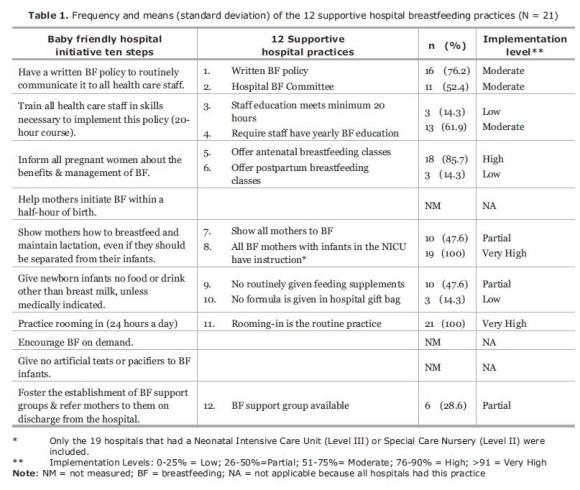
<body><![CDATA[<p><b><i>Supportive breastfeeding  practices</i></b>: Supportive  breastfeeding practices were defined as 12 practices based on the well  researched WHO <i>Baby Friendly Hospital  Initiative </i>(BFHI) Ten Steps (listed on <a href="#t1">Table 1</a>), which has become the &lsquo;gold  standard' for supportive hospital practices (6, 8, 24-27).</p>     <p align="center"><a name="t1"></a><img src="/img/revistas/aven/v28n2/2a02t1.jpg"></p>     <p>Participants answered  yes or no to 12 questions, one about each of these practices. These 12  questions did not always mirror each of the BFHI Ten Steps exactly, which often  contain more than one practice element in each step. Instead, survey questions  reflected only one supportive practice element. Additionally, data were not  collected on 3 (i.e., help mothers initiate breastfeeding within 30 minutes of  birth, encourage breastfeeding on demand, and give no artificial teats or  pacifiers to breastfeeding infants) of the BFHI Ten Steps due to the difficulty  of obtaining accurate information about these practices on a verbal self report  survey. Data needed to determine if these 3 supportive practices are not  routinely collected by the surveyed hospitals, making any response to questions  about these practices only guesses. </p>     <p><b><i>Hospital characteristics</i></b>: Based on previous studies, data about  hospital characteristics associated with breastfeeding practices [e.g.,  professional breastfeeding services available , institutional ownership status,  number of births per year , percentage of births paid for by public funds and  the level of care provided by the hospital (4)] were collected from public  records or from participants. According to the CDC and other researchers, the  professional breastfeeding support available to patients and maternity staff  affects the quality of lactation services provided (8, 28). Professional  support has been operationalized by the CDC as number of IBCLCs per 1000 live  births (8). The number of births per year occurring in each of the 21 hospitals  during 2009 was determined using Arizona State Department of Health data (18).  Due to the high proportion of births within the County paid for by public  funds, data were collected on this variable, as well. The number of IBCLCs, who  provided direct lactation services (counseling and/or education) at each  hospital, was provided by the participants. In addition, they provided the  number of maternity nursing staff who had completed (at any time) either a local  or national 40-hour lactation education course. These 2 variables were not  mutually exclusive; IBCLCs who completed a 40-hour course were included in both  categories, as it was not feasible to obtain more specific information from  participants.</p>     <p>A few researchers have  suggested that differences may exist among public and privately owned hospitals  that affect implementation of supportive breastfeeding practices (5, 15). Four  ownership categories were identified; public (funded by the federal government or  by Maricopa County), private not-for-profit hospitals and private for-profit  hospitals. Data concerning privately owned hospitals' legal status of a  &lsquo;for-profit' business or a &lsquo;not-for-profit' service organization is public  information. This variable was chosen because it has not been studied within  the current context and it might affect supportive breastfeeding practices. </p>     <p>Level of maternity  care services provided by a hospital refers to the categorization of hospitals  according to the perinatal services provided, which is determined by a  non-governmental organization: (1) Level I hospitals provide basic care for  low-risk obstetrical patients and newborns, including caesarian sections, for  36 weeks gestation and greater; (2) Level II hospitals provide specialty care  for low-risk and selected high-risk obstetrical and newborn patients from 32  weeks gestation; and (3) Level III hospitals provide intensive care services,  as well as, all levels of obstetrical and neonatal care for all gestational  ages (29). </p>     <p><b>Data analysis</b></p>     <p><b><i>Aim 1</i></b>: The descriptive analysis of supportive  breastfeeding practices included the frequency distribution along with the  means and standard deviations of each of the 12 supportive breastfeeding  practices. Using a strategy common in the literature (30), a variable of the  level of implementation for each supportive practice was created categorizing  the percentage of hospitals implementing each supportive practice: low (0-25%),  partial (26-50%), moderate (51-75%), high (76-90%) or very high (91-100%) was  created. Similar to other community-level studies (5, 15, 31), the supportive  practices were summed for each hospital creating a &lsquo;Supportive Breastfeeding  Practices Score' (SBPS) for each institution. </p>     <p><b><i>Aim 2</i></b>: Descriptive analysis of the hospital  characteristics included frequency distribution of categorical variables, and  means and standard deviations of continuous variables (number of births per  hospital, births paid for by public funds, number of staff with specialized  lactation education and number of IBCLC). The distribution of hospital  characteristics were then grouped according the hospitals' ownership category.  The national breastfeeding report card process outcome of number of IBCLCs per  1000 live births (Professional Support Score) was calculated for each hospital,  creating a score that could be compared to national and state &lsquo;Professional  Support Scores'(PSS) (8). Means and standard deviations of the PSS were  calculated for each hospital ownership category.</p>     <p>Stepwise linear regression  was conducted to determine if hospital characteristics (predictor variables)  significantly predicted SBPS (dependent variable). A stepwise method was chosen  to draw the best-fit regression model given small number of predictors and this  exploratory research. All of predictor variables (level of care, number of  birth per year, births paid for by public funds, number of IBCLCs, and facility  ownership) were entered simultaneously. The R2 was used rather than an adjusted  R2 because the number of hospital characteristics entered in regression model  was small (32). In addition, correlation coefficients using Pearson r were  calculated to determine relationships between SBPS and hospital characteristics  variables. The significance level was set at the .05 level. All data analyses  were performed using SPSS (version 18) (33).</p>     ]]></body>
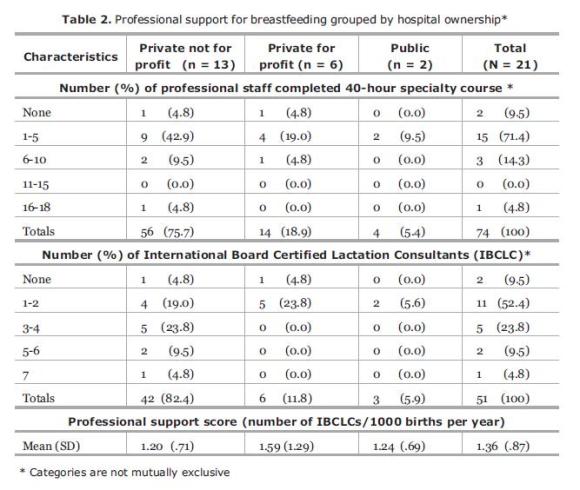
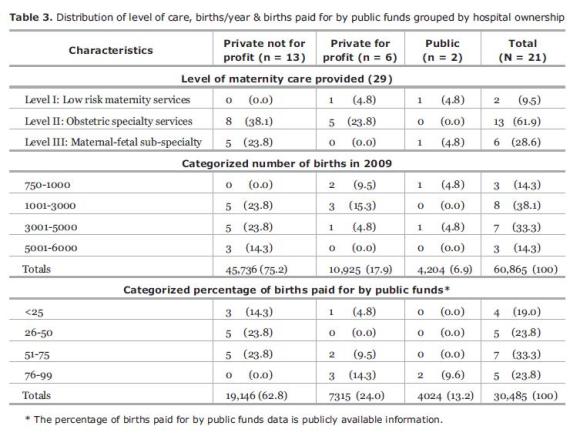
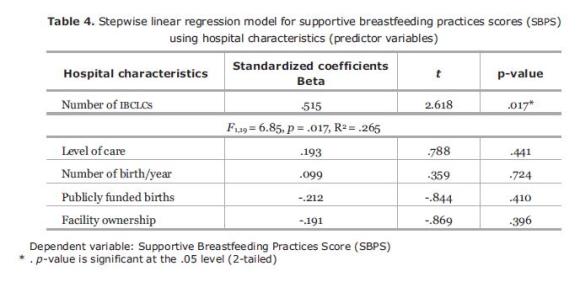
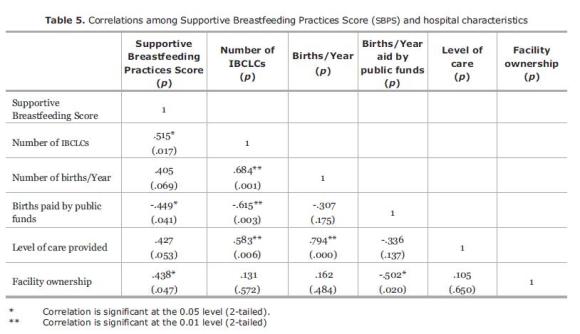
<body><![CDATA[<p><b>RESULTS</b></p>     <p><b><i>Aim 1</i></b>: The total number of the 12 supportive  breastfeeding practices (SBPS) implemented across hospitals varied considerably  ranging between 5 and 10 with a mean of 7.42 (SD = 1.53). Two of the supportive  breastfeeding practices&ndash;rooming-in and instructing breastfeeding mothers who  have infants in the neonatal special care or intensive care unit&ndash;were standard  practice (<a href="#t1">Table 1</a>). Three support practices were ranked at the low level each  having only 14.3% of the hospitals implementing these practices. </p>     <p><b><i>Aim 2</i></b>: Characteristics of the professional support  offered by publicly and privately owned hospitals varied considerably (<a href="#t2">Table  2</a>). The trend across ownership categories was similar for professional staff  that completed a 40-hours specialty course and the number of IBCLCs. The six  for-profit private hospitals had the highest mean PSS; it exceeded the mean PSS  reported by the CDC for Arizona state but fell far short of the national mean PSS.  The other mean PSS for hospitals in Maricopa County did not mirror the state  score.</p>     <p align="center"><a name="t2"></a><img src="/img/revistas/aven/v28n2/2a02t2.jpg"></p>     <p>Other hospital  characteristics also differed based on hospital ownership (<a href="#t3">Table 3</a>), with the  13 not-for-profit private hospitals serving the greatest number of women receiving  publically subsidized care but this was 41.9% of their total number of births.  Both publicly funded hospitals served far higher percentage (95.7%) of women  receiving public assistance. Three of the 6 for-profit hospitals also provided  care to high percentage of women receiving public assistance, although fewer  women gave birth in these institutions. In 2009, the number of births occurring  varied by institution from 750 at a public hospital to 5769 at a for-profit  hospital. The majority (61.9%) of hospitals in this sample provided Level II  maternity services.</p>     <p align="center"><a name="t3"></a><img src="/img/revistas/aven/v28n2/2a02t3.jpg"></p>     <p>Using the stepwise  method, a significant model emerged (F1,19 = 6.85, p = .017, R2 = .265). Number  of IBCLCs was the only predictor of supportive practice; 26.5% of the variance  in the SBPS was explained uniquely by the number of IBCLCs (<a href="#t4">Table 4</a>). We also  sought residuals of the model to determine the difference between the observed  values and those predicted by the regression equation. Standardized residuals  indicate no outliers based on 3 standard deviations are identified by casewise  diagnostics.</p>     <p align="center"><a name="t4"></a><img src="/img/revistas/aven/v28n2/2a02t4.jpg"></p>     <p>As shown in <a href="#t5">Table 5</a>,  SBPS was positively correlated with number of IBCLCs (r = .515) demonstrating  that the higher number of IBCLCs employed by a hospital the greater number of  supportive breastfeeding practices occurring in that hospital. A positive  correlation occurred between SBPS and facility ownership (r = .438),  demonstrating that private facilities were more likely to have higher SBPS.  There were a significant negative correlation between SBPS and the births paid  for by public funds (r = -.449), demonstrating that higher SBPS occur at  hospitals that have fewer births paid for by public funds. All hospital  characteristics were significantly correlated with the number of IBCLCs, except  number of births/ year.</p>     <p align="center"><a name="t5"></a><img src="/img/revistas/aven/v28n2/2a02t5.jpg"></p>     ]]></body>
<body><![CDATA[<p><b>DISCUSSION</b></p>     <p>To improve the health  of our children, breastfeeding promotion and support must occur on many social  and political levels. Improving the quality of breastfeeding support practices  in hospitals is only one of many strategies to accomplish this goal. By examining  hospital breastfeeding support practices across Maricopa County a  community-level picture of the similarities and differences in the type and  amount of these supports available to childbearing women was possible. Although  this cross-sectional view is by its nature temporal, it is the first attempt in  Arizona to view hospital breastfeeding support practices in a more  comprehensive context, which has public health implications for publicly funded  program planning and policy development. This study was an initial and  exploratory effort aimed at informing larger and more in-depth research into  the issues suggested by the findings. </p>     <p>The descriptive  analysis of the breastfeeding supportive practices (Aim 1) illustrated the wide  variations in the number and types of practices present among the surveyed  hospitals. These wide variations have been found by other researchers surveying  at the community, state and national levels (2, 6, 34). None of the hospitals  met the BFHI standard; only one hospital implemented 83.2% of supportive  practices. The reasons why hospitals in Maricopa County are not practicing  evidence-based standards of care for breastfeeding mothers is unknown,  highlighting the need for additional investigation.</p>     <p>Rooming-in and  assisting breastfeeding mothers who have infants in an intensive or special  care unit were the only two universally implemented supportive breastfeeding  practices. Over the past ten years, rooming-in has become the standard of care  in maternity units driven by consumer demand and hospital economics. The nature  and quality of the assistance provided to breastfeeding mothers who have  infants in intensive or special care nurseries was not assessed and it is well  acknowledged that these mothers will need assistance (35); therefore, it is  difficult to determine the usefulness of this finding beyond the need for  further research.</p>     <p>Rosenberg et al.&nbsp; (17) found that having a hospital policy was  the only step that was independently associated with breastfeeding rates:  &ldquo;Hospitals with comprehensive breastfeeding policies are likely to have better  breastfeeding support services and better breastfeeding outcomes&rdquo; (p. 110). It  is surprising that only two-thirds of the hospitals had specific standards in  place, given new national hospital accreditation standards that included  specific breastfeeding related hospital outcome indicators (36).</p>     <p>Increases in exclusive  breastfeeding rates have been associated with the level of maternity staff  education in many studies worldwide (7, 17, 30, 35, 37). Although the private  hospitals had many staff who had completed a 40-hour course in lactation  management, overall most hospitals did not meet the minimum 20-hours of  lactation education for all maternity nursing staff (38). This suggests that  the level of care for breastfeeding mothers is dependent on who is providing  care on a specific shift and will vary from person-to-person and  shift-to-shift, which contributes to the lack of consistency often reported by  postpartum women and which is required to meet the standard of care (17, 30).  Many other researchers have found that the supportive practices associated with  this step were among the least implemented (16, 17). The BFHI Step 2 requires  all health care staff to be educated a minimum of 20 hours on lactation  management; however in this study data were gathered on maternity nursing staff  only. </p>     <p>A long contentious  issue for proponents of BFHI is the free formula provided to hospitals and to  mothers in the form of discharge gift bags (39). Implementing the Ten Steps  requires that no supplementation be given to breastfed infants and no infant  formula be distributed to mothers in gift bags (40). Unfortunately, both of  these practices were widespread among the surveyed hospitals. This is not a new  or an unusual finding (5, 16, 22, 30). Ten years ago researchers reported WIC  participants in Arizona who had received gift bags containing formula from upon  discharge from the hospital were significantly more likely to have shorter  durations and less exclusive breastfeeding (22). The negative effects of  providing early supplemental feedings on duration and exclusivity rates have  been established by numerous studies, prompting national public health efforts  to educate health professionals and to promote exclusive breastfeeding from  birth (8). Obviously progress has been slow, raising questions about why  practices have not changed when the evidence is clear. It is a simple question  within a complex context, which remains to be answered. </p>     <p>Currently consumers of  maternity care have no way to discern implementation of supportive  breastfeeding practices independent of a hospital's advertising, expectant  mothers have a lack of accurate information and the responsibility for  determining if hospital practices are congruent with their preferences. Even in  areas with hospitals that have had the baby-friendly certification, researchers  have reported inconsistencies in maintaining these supportive practices (4,  16). </p>     <p>Examining the  relationships among the five hospital characteristics and the total number of  supportive breastfeeding practices (Aim 2) provided meaningful in-sights that  extended previous understanding about community-level supportive practices in  Maricopa County and suggested additional variables that researchers might want  to consider when examining community-level practices. Facility ownership was  used to categorize the remaining four hospital characteristics, which allowed  differences in these variables to become clearer, particularly patterns related  to distribution of births per year subsidized by public funds. A negative  correlation existed between the number of IBCLCs employed by a hospital and the  births paid for by public assistance. Additionally, facility ownership was  positively correlated with the total number of supportive breastfeeding  practices implemented in hospitals. Viewed together these results suggest  perhaps that a different standard of breastfeeding support exists for women  receiving public assistance. The possibility of 2-tiered practice standards needs  further research, highlighting the importance of taking the broader community  perspective when seeking to change practice.</p>     <p>The Professional  Support Score (PSS) has been reported by the CDC as the single most important  indicator of the level of supportive breastfeeding practices (8, 11). The PSS  for hospitals in Maricopa County were lower than the national level (8).  Although the private not-for-profit hospitals employed the greatest number of  IBCLCs, they had the lowest PSS indicating the lowest ratio of IBCLCs to number  of births. Only the private for-profit hospitals had PSS that were higher than  the state PSS. Perhaps the for-profit hospitals are more concerned with  offering services desired by higher income women, who tend to breastfeed more  often. It is unclear how the ratio of IBCLCs is affected by health care costs  and hospital budgets; however, a cost-benefit analysis would need to be done  taking hospital ownership into consideration.</p>     ]]></body>
<body><![CDATA[<p>Importance of IBCLCs  in affecting positive institutional changes in supportive breastfeeding  practice was suggested by the significance of this variable in the regression  model. In addition, it was further supported in the positive correlation with  number of supportive breastfeeding practices. This is consistent with the  findings of other researchers, who reported that number of staff available for  teaching new mothers was significantly associated with hospitals that had  implemented high levels of supportive practices (30, 41). IBCLCs are making a  difference within the institutions where they work. Using results from CDC's  Infant Feeding Study, researchers have suggested a few population-based  guidelines (including the PSS) related to the adequacy of professional  breastfeeding support services (8, 11). More specific recommendations about  adequate professional lactation services for level III hospitals were reported  by Manel and Manel (9). However, the question of what constitutes adequate  professional support services for a community has not been sufficiently  addressed.</p>     <p><b>Limitations</b></p>     <p>Self-report surveys  have some inherent methodological weaknesses that limit generalizability, even  when the complete population is surveyed. Every attempt was made to interview  the person most knowledgeable about lactation practices; in most cases, this  was an IBCLC. However, in a few instances, &lsquo;gatekeepers' within institutions  may have limited information that was shared or given politically correct  answers. Some data collected from participants required gathering information  from medical records, but most of the survey questions relied on participants'  knowledge and understanding of the supportive breastfeeding practices in their  hospital. No attempt was made to validate participants' responses beyond  clarifications of incomplete data, which may have affected the accuracy of  these data. </p>     <p>Although it was beyond  the scope of this study to determine breastfeeding rates associated with the  measured hospital practices, increasing the number of supportive breastfeeding  practices within a hospital repeatedly has been associated with increases in  breastfeeding rates (8, 17, 42, 43). Future studies are needed to link  breastfeeding outcomes to specific supportive practices.</p>     <p><b>CONCLUSION</b></p>     <p>The findings of this  study, while unique to the community studied, were consistent with a number of  findings reported by other researchers around the globe. Consistent patterns  have emerged in the research concerning the best practices for promoting and supporting  successful breastfeeding. The significance of professional staff with the IBCLC  credential in improving the quality of hospital breastfeeding support practices  was supported and it suggests the creation of more formal standards for  hospital lactation services need to be developed and implemented. </p>     <p><b>ACKNOWLEDGEMENTS</b></p>     <p>Authors would like to  thank Jeanne Stanger, CNM for her assistance during the early stages of this  manuscript. We would also like to express our appreciation to those who took  time out of their busy work days to complete the surveys.</p>  <hr size="1">     <p><b>REFERENCES</b></p>     <!-- ref --><p>(1) Chalmers B, Levitt C, Heaman M, O'Brien  B, Sauve R, Kaczorowski J. Breastfeeding rates and hospital breastfeeding  practices in Canada: a national survey of women. Birth. 2009; 36(2):122-132.&nbsp;&nbsp;&nbsp;&nbsp;&nbsp;&nbsp;&nbsp;&nbsp;[&#160;<a href="javascript:void(0);" onclick="javascript: window.open('/scielo.php?script=sci_nlinks&ref=000092&pid=S0121-4500201000020000200001&lng=','','width=640,height=500,resizable=yes,scrollbars=1,menubar=yes,');">Links</a>&#160;]<!-- end-ref --><!-- ref --><p>(2)&nbsp;Dodgson JE, Allard-Hale CJ, Bramscher A,  Brown F, Duckett L. Adherence to the ten steps of the Baby-Friendly Hospital  Initiative in Minnesota hospitals. Birth. 1999; 26(4):239-247.&nbsp;&nbsp;&nbsp;&nbsp;&nbsp;&nbsp;&nbsp;&nbsp;[&#160;<a href="javascript:void(0);" onclick="javascript: window.open('/scielo.php?script=sci_nlinks&ref=000093&pid=S0121-4500201000020000200002&lng=','','width=640,height=500,resizable=yes,scrollbars=1,menubar=yes,');">Links</a>&#160;]<!-- end-ref --><!-- ref --><p>(3)&nbsp; Duyan &Ccedil;amurdan A, &Ouml;zcan S, Y&uuml;ksel D,  Pasli F, Sahin F, Beyazova U. The effect of the baby-friendly hospital  initiative on long-term breastfeeding. Int J Clin Pract. 2007; 61(8):1251-1255.&nbsp;&nbsp;&nbsp;&nbsp;&nbsp;&nbsp;&nbsp;&nbsp;[&#160;<a href="javascript:void(0);" onclick="javascript: window.open('/scielo.php?script=sci_nlinks&ref=000094&pid=S0121-4500201000020000200003&lng=','','width=640,height=500,resizable=yes,scrollbars=1,menubar=yes,');">Links</a>&#160;]<!-- end-ref --><!-- ref --><p>(4)&nbsp; Kovach AC. A 5-year follow-up study of  hospital breastfeeding policies in the Philadelphia area: a comparison with the  ten steps. J Hum Lact. 2002; 18(2):144-154.&nbsp;&nbsp;&nbsp;&nbsp;&nbsp;&nbsp;&nbsp;&nbsp;[&#160;<a href="javascript:void(0);" onclick="javascript: window.open('/scielo.php?script=sci_nlinks&ref=000095&pid=S0121-4500201000020000200004&lng=','','width=640,height=500,resizable=yes,scrollbars=1,menubar=yes,');">Links</a>&#160;]<!-- end-ref --><!-- ref --><p>(5)&nbsp; Merewood A, Mehta SD, Chamberlain LB,  Philipp BL, Bauchner H. Breastfeeding rates in US baby-friendly hospitals:  results of a national survey. Pediatrics. 2005; 116(3):628-634.&nbsp;&nbsp;&nbsp;&nbsp;&nbsp;&nbsp;&nbsp;&nbsp;[&#160;<a href="javascript:void(0);" onclick="javascript: window.open('/scielo.php?script=sci_nlinks&ref=000096&pid=S0121-4500201000020000200005&lng=','','width=640,height=500,resizable=yes,scrollbars=1,menubar=yes,');">Links</a>&#160;]<!-- end-ref --><!-- ref --><p>(6)&nbsp; Abrahams SW, Labbok MH. Exploring the  impact of the Baby-Friendly Hospital Initiative on trends in exclusive  breastfeeding. Int Breastfeed J. 2009; 4:6.&nbsp;&nbsp;&nbsp;&nbsp;&nbsp;&nbsp;&nbsp;&nbsp;[&#160;<a href="javascript:void(0);" onclick="javascript: window.open('/scielo.php?script=sci_nlinks&ref=000097&pid=S0121-4500201000020000200006&lng=','','width=640,height=500,resizable=yes,scrollbars=1,menubar=yes,');">Links</a>&#160;]<!-- end-ref --><!-- ref --><p>(7)&nbsp; Castrucci BC, Hoover KL, Lim S, Maus KC.  A comparison of breastfeeding rates in an urban birth cohort among women  delivering infants at hospitals that employ and do not employ lactation  consultants. J Public health Manag Pract. 2006; 12(6):578-585.&nbsp;&nbsp;&nbsp;&nbsp;&nbsp;&nbsp;&nbsp;&nbsp;[&#160;<a href="javascript:void(0);" onclick="javascript: window.open('/scielo.php?script=sci_nlinks&ref=000098&pid=S0121-4500201000020000200007&lng=','','width=640,height=500,resizable=yes,scrollbars=1,menubar=yes,');">Links</a>&#160;]<!-- end-ref --><!-- ref --><p>(8)&nbsp; Centers for Disease Control and  Prevention. Breastfeeding Report Card-United States, 2009. [internet]  Atlanta:Centers for Disease Control; 2009 [May 13 2010]. Available from: <a href="http://www.cdc.gov/breastfeeding/data/reportcard/reportcard2009.htm" target="_blank">http://www.cdc.gov/breastfeeding/data/reportcard/reportcard2009.htm</a>&nbsp;&nbsp;&nbsp;&nbsp;&nbsp;&nbsp;&nbsp;&nbsp;[&#160;<a href="javascript:void(0);" onclick="javascript: window.open('/scielo.php?script=sci_nlinks&ref=000099&pid=S0121-4500201000020000200008&lng=','','width=640,height=500,resizable=yes,scrollbars=1,menubar=yes,');">Links</a>&#160;]<!-- end-ref --><!-- ref --><p>(9)&nbsp; Mannel  R, Mannel RS. Staffing for hospital lactation programs: recommendations from a  tertiary care teaching hospital. J Hum Lact. 2006; 22(4):409-417.&nbsp;&nbsp;&nbsp;&nbsp;&nbsp;&nbsp;&nbsp;&nbsp;[&#160;<a href="javascript:void(0);" onclick="javascript: window.open('/scielo.php?script=sci_nlinks&ref=000100&pid=S0121-4500201000020000200009&lng=','','width=640,height=500,resizable=yes,scrollbars=1,menubar=yes,');">Links</a>&#160;]<!-- end-ref --><!-- ref --><p>(10)&nbsp; Unicef. The Baby Friendly Hospital  Iniatiative. [internet] Geneva: Unicef; 2009 [May 5 2010]. Available from: <a href="http://www.unicef.org/nutrition/files/BFHI_2009_s1.pdf" target="_blank">http://www.unicef.org/nutrition/files/BFHI_2009_s1.pdf</a>.&nbsp;&nbsp;&nbsp;&nbsp;&nbsp;&nbsp;&nbsp;&nbsp;[&#160;<a href="javascript:void(0);" onclick="javascript: window.open('/scielo.php?script=sci_nlinks&ref=000101&pid=S0121-4500201000020000200010&lng=','','width=640,height=500,resizable=yes,scrollbars=1,menubar=yes,');">Links</a>&#160;]<!-- end-ref --><!-- ref --><p>(11)&nbsp; DiGirolamo AM, Grummer-Strawn LM, Fein SB.  Effect of maternity-care practices on breastfeeding. Pediatrics. 2008; 122:  43-49.&nbsp;&nbsp;&nbsp;&nbsp;&nbsp;&nbsp;&nbsp;&nbsp;[&#160;<a href="javascript:void(0);" onclick="javascript: window.open('/scielo.php?script=sci_nlinks&ref=000102&pid=S0121-4500201000020000200011&lng=','','width=640,height=500,resizable=yes,scrollbars=1,menubar=yes,');">Links</a>&#160;]<!-- end-ref --><!-- ref --><p>(12)&nbsp; Declercq E, Labbok MH, Sakala C, O'Hara M.  Hospital practices and women's likelihood of fulfilling their intention to  exclusively breastfeed. Am J Public Health. 2009; 99 (5): 929-935.&nbsp;&nbsp;&nbsp;&nbsp;&nbsp;&nbsp;&nbsp;&nbsp;[&#160;<a href="javascript:void(0);" onclick="javascript: window.open('/scielo.php?script=sci_nlinks&ref=000103&pid=S0121-4500201000020000200012&lng=','','width=640,height=500,resizable=yes,scrollbars=1,menubar=yes,');">Links</a>&#160;]<!-- end-ref --><!-- ref --><p>(13)&nbsp; Chien L, Tai C, Chu K, Ko Y, Chiu Y. The  number of Baby Friendly hospital practices experienced by mothers is positively  associated with breastfeeding: a questionnaire survey. Int J Nurs Stud. 2007;  44(7):1138-1146.&nbsp;&nbsp;&nbsp;&nbsp;&nbsp;&nbsp;&nbsp;&nbsp;[&#160;<a href="javascript:void(0);" onclick="javascript: window.open('/scielo.php?script=sci_nlinks&ref=000104&pid=S0121-4500201000020000200013&lng=','','width=640,height=500,resizable=yes,scrollbars=1,menubar=yes,');">Links</a>&#160;]<!-- end-ref --><!-- ref --><p>(14)&nbsp; Hofvander Y. Breastfeeding and the Baby  Friendly Hospitals Initiative (BFHI): organization, response and outcome in  Sweden and other countries. Acta Paediatr. 2005; 94 (8):1012-1016.&nbsp;&nbsp;&nbsp;&nbsp;&nbsp;&nbsp;&nbsp;&nbsp;[&#160;<a href="javascript:void(0);" onclick="javascript: window.open('/scielo.php?script=sci_nlinks&ref=000105&pid=S0121-4500201000020000200014&lng=','','width=640,height=500,resizable=yes,scrollbars=1,menubar=yes,');">Links</a>&#160;]<!-- end-ref --><!-- ref --><p>(15)&nbsp; Merten S, Dratva J, Ackermann-Liebrich U.  Do baby-friendly hospitals influence breastfeeding duration on a national  level? Pediatrics. 2005; 116(5):702-708.&nbsp;&nbsp;&nbsp;&nbsp;&nbsp;&nbsp;&nbsp;&nbsp;[&#160;<a href="javascript:void(0);" onclick="javascript: window.open('/scielo.php?script=sci_nlinks&ref=000106&pid=S0121-4500201000020000200015&lng=','','width=640,height=500,resizable=yes,scrollbars=1,menubar=yes,');">Links</a>&#160;]<!-- end-ref --><!-- ref --><p>(16)&nbsp; De Araujo MFM, Schmitz BAS. Reassessment  of baby-friendly hospitals in Brazil. J Hum Lact. 2007; 23 (3):246-252.&nbsp;&nbsp;&nbsp;&nbsp;&nbsp;&nbsp;&nbsp;&nbsp;[&#160;<a href="javascript:void(0);" onclick="javascript: window.open('/scielo.php?script=sci_nlinks&ref=000107&pid=S0121-4500201000020000200016&lng=','','width=640,height=500,resizable=yes,scrollbars=1,menubar=yes,');">Links</a>&#160;]<!-- end-ref --><!-- ref --><p>(17)&nbsp; Rosenberg KD, Stull JD, Adler MR,  Kasehagen LJ, Crivelli-Kovach A. Impact of hospital policies on breastfeeding  outcomes. Breastfeed Med. 2008; 3(2):110-116.&nbsp;&nbsp;&nbsp;&nbsp;&nbsp;&nbsp;&nbsp;&nbsp;[&#160;<a href="javascript:void(0);" onclick="javascript: window.open('/scielo.php?script=sci_nlinks&ref=000108&pid=S0121-4500201000020000200017&lng=','','width=640,height=500,resizable=yes,scrollbars=1,menubar=yes,');">Links</a>&#160;]<!-- end-ref --><!-- ref --><p>(18)&nbsp; Arizona Health Status and Vital Statistics  [database on the Internet]. Arizona Department of Health. 2008 [cited 2010.]. Available  from: <a href="http://www.azdhs.gov/plan/report/ahs/ahs2008/pdf/1b28.pdf" target="_blank">http://www.azdhs.gov/plan/report/ahs/ahs2008/pdf/1b28.pdf</a>.&nbsp;&nbsp;&nbsp;&nbsp;&nbsp;&nbsp;&nbsp;&nbsp;[&#160;<a href="javascript:void(0);" onclick="javascript: window.open('/scielo.php?script=sci_nlinks&ref=000109&pid=S0121-4500201000020000200018&lng=','','width=640,height=500,resizable=yes,scrollbars=1,menubar=yes,');">Links</a>&#160;]<!-- end-ref --><!-- ref --><p>(19)&nbsp; Gill SL. Breastfeeding by Hispanic women.  JOGNN. 2009; 38(2):244-252.&nbsp;&nbsp;&nbsp;&nbsp;&nbsp;&nbsp;&nbsp;&nbsp;[&#160;<a href="javascript:void(0);" onclick="javascript: window.open('/scielo.php?script=sci_nlinks&ref=000110&pid=S0121-4500201000020000200019&lng=','','width=640,height=500,resizable=yes,scrollbars=1,menubar=yes,');">Links</a>&#160;]<!-- end-ref --><!-- ref --><p>(20).&nbsp;&nbsp;&nbsp;&nbsp; Newton KN, Chaudhuri J, Grossman X,  Merewood A. Factors associated with exclusive breastfeeding among Latina women  giving birth at an inner-city baby-friendly hospital. J Hum Lact. 2009;  25(1):28-33.&nbsp;&nbsp;&nbsp;&nbsp;&nbsp;&nbsp;&nbsp;&nbsp;[&#160;<a href="javascript:void(0);" onclick="javascript: window.open('/scielo.php?script=sci_nlinks&ref=000111&pid=S0121-4500201000020000200020&lng=','','width=640,height=500,resizable=yes,scrollbars=1,menubar=yes,');">Links</a>&#160;]<!-- end-ref --><!-- ref --><p>(21)&nbsp; Arizona Bureau of Women's and Children's  Health. Women's and Children's Health Needs Assessment Data. In: Health  BoWsaCs, editor. Phoenix: Arizona Department of Health; 2010.&nbsp;&nbsp;&nbsp;&nbsp;&nbsp;&nbsp;&nbsp;&nbsp;[&#160;<a href="javascript:void(0);" onclick="javascript: window.open('/scielo.php?script=sci_nlinks&ref=000112&pid=S0121-4500201000020000200021&lng=','','width=640,height=500,resizable=yes,scrollbars=1,menubar=yes,');">Links</a>&#160;]<!-- end-ref --><!-- ref --><p>(22)&nbsp; Haneuse S, Sciacca J, Ratliff M, Alexander  D, Rivero ME. Factors influencing breastfeeding rates among Arizona WIC  participants. Am J Health Behav. 2000; 24(4):243-53.&nbsp;&nbsp;&nbsp;&nbsp;&nbsp;&nbsp;&nbsp;&nbsp;[&#160;<a href="javascript:void(0);" onclick="javascript: window.open('/scielo.php?script=sci_nlinks&ref=000113&pid=S0121-4500201000020000200022&lng=','','width=640,height=500,resizable=yes,scrollbars=1,menubar=yes,');">Links</a>&#160;]<!-- end-ref --><!-- ref --><p>(23)&nbsp; State and County QuickFacts [database on  the Internet]. US Census Bureau. 2009 [cited 2010.]. Available from: <a href="http://quickfacts.census.gov.ezproxy1.lib.asu.edu/qfd/states/04000.html" target="_blank">http://quickfacts.census.gov.ezproxy1.lib.asu.edu/qfd/states/04000.html</a>.&nbsp;&nbsp;&nbsp;&nbsp;&nbsp;&nbsp;&nbsp;&nbsp;[&#160;<a href="javascript:void(0);" onclick="javascript: window.open('/scielo.php?script=sci_nlinks&ref=000114&pid=S0121-4500201000020000200023&lng=','','width=640,height=500,resizable=yes,scrollbars=1,menubar=yes,');">Links</a>&#160;]<!-- end-ref --><!-- ref --><p>(24)&nbsp; Barnes M. The Baby-Friendly Hospital  Initiative: the challenge of implementing change. Birth. 2003; 12(3/4):63-8.&nbsp;&nbsp;&nbsp;&nbsp;&nbsp;&nbsp;&nbsp;&nbsp;[&#160;<a href="javascript:void(0);" onclick="javascript: window.open('/scielo.php?script=sci_nlinks&ref=000115&pid=S0121-4500201000020000200024&lng=','','width=640,height=500,resizable=yes,scrollbars=1,menubar=yes,');">Links</a>&#160;]<!-- end-ref --><!-- ref --><p>(25)&nbsp; Murray EK, Ricketts S, Dellaport J.  Hospital practices that increase breastfeeding duration: results from a  population-based study. Birth. 2007; 34(3):202-11.&nbsp;&nbsp;&nbsp;&nbsp;&nbsp;&nbsp;&nbsp;&nbsp;[&#160;<a href="javascript:void(0);" onclick="javascript: window.open('/scielo.php?script=sci_nlinks&ref=000116&pid=S0121-4500201000020000200025&lng=','','width=640,height=500,resizable=yes,scrollbars=1,menubar=yes,');">Links</a>&#160;]<!-- end-ref --><!-- ref --><p>(26)&nbsp; Perez-Escamilla R. Evidence based  breastfeeding promotion: the Baby-Friendly Hospital Initiative. J Nutr. 2007;  137(2):484-7.&nbsp;&nbsp;&nbsp;&nbsp;&nbsp;&nbsp;&nbsp;&nbsp;[&#160;<a href="javascript:void(0);" onclick="javascript: window.open('/scielo.php?script=sci_nlinks&ref=000117&pid=S0121-4500201000020000200026&lng=','','width=640,height=500,resizable=yes,scrollbars=1,menubar=yes,');">Links</a>&#160;]<!-- end-ref --><!-- ref --><p>(27)&nbsp; Saadeh R, Arke J. Ten steps to successful  breastfeeding: a summary of the rationale and scientific evidence. Birth. 1996;  23(3):154-60.&nbsp;&nbsp;&nbsp;&nbsp;&nbsp;&nbsp;&nbsp;&nbsp;[&#160;<a href="javascript:void(0);" onclick="javascript: window.open('/scielo.php?script=sci_nlinks&ref=000118&pid=S0121-4500201000020000200027&lng=','','width=640,height=500,resizable=yes,scrollbars=1,menubar=yes,');">Links</a>&#160;]<!-- end-ref --><!-- ref --><p>(28)&nbsp; Thurman SE, Allen PJ. Integrating  lactation consultants into primary health care services: are lactation  consultants affecting breastfeeding success?. Pediatr Nurs. 2008; 34(5):  419-425.&nbsp;&nbsp;&nbsp;&nbsp;&nbsp;&nbsp;&nbsp;&nbsp;[&#160;<a href="javascript:void(0);" onclick="javascript: window.open('/scielo.php?script=sci_nlinks&ref=000119&pid=S0121-4500201000020000200028&lng=','','width=640,height=500,resizable=yes,scrollbars=1,menubar=yes,');">Links</a>&#160;]<!-- end-ref --><!-- ref --><p>(29)&nbsp; Arizona Perinatal Trust. Certification of  Perinatal Services. [Internet] [May 29 2010]. Available from: <a href="https://azperinatal.org/Certification.html" target="_blank">https://azperinatal.org/Certification.html</a>.&nbsp;&nbsp;&nbsp;&nbsp;&nbsp;&nbsp;&nbsp;&nbsp;[&#160;<a href="javascript:void(0);" onclick="javascript: window.open('/scielo.php?script=sci_nlinks&ref=000120&pid=S0121-4500201000020000200029&lng=','','width=640,height=500,resizable=yes,scrollbars=1,menubar=yes,');">Links</a>&#160;]<!-- end-ref --><!-- ref --><p>&nbsp;(30)&nbsp;&nbsp;&nbsp;&nbsp; Grizzard  TA, Bartick M, Nikolov M, Griffin BA, Lee KG. Policies and practices related to  breastfeeding in Massachusetts: hospital implementation of the Ten Steps to  Successful Breastfeeding. Matern Child health J. 2006; 10(3):247-263.&nbsp;&nbsp;&nbsp;&nbsp;&nbsp;&nbsp;&nbsp;&nbsp;[&#160;<a href="javascript:void(0);" onclick="javascript: window.open('/scielo.php?script=sci_nlinks&ref=000121&pid=S0121-4500201000020000200030&lng=','','width=640,height=500,resizable=yes,scrollbars=1,menubar=yes,');">Links</a>&#160;]<!-- end-ref --><!-- ref --><p>(31)&nbsp; Martens PJ, Phillips SJ, Cheang MS,  Rosolowich V. How baby-friendly are Manitoba hospitals? The Provincial Infant  Feeding Study. Can J Public Health. 2000; 91(1):51-57.&nbsp;&nbsp;&nbsp;&nbsp;&nbsp;&nbsp;&nbsp;&nbsp;[&#160;<a href="javascript:void(0);" onclick="javascript: window.open('/scielo.php?script=sci_nlinks&ref=000122&pid=S0121-4500201000020000200031&lng=','','width=640,height=500,resizable=yes,scrollbars=1,menubar=yes,');">Links</a>&#160;]<!-- end-ref --><!-- ref --><p>(32)&nbsp; Miles J, Shevlin M. Applying Regression  and Correlation Thousand Oaks. CA: Sage Publications; 2001.&nbsp;&nbsp;&nbsp;&nbsp;&nbsp;&nbsp;&nbsp;&nbsp;[&#160;<a href="javascript:void(0);" onclick="javascript: window.open('/scielo.php?script=sci_nlinks&ref=000123&pid=S0121-4500201000020000200032&lng=','','width=640,height=500,resizable=yes,scrollbars=1,menubar=yes,');">Links</a>&#160;]<!-- end-ref --><!-- ref --><p>(33)&nbsp; SPSS. (Statistical Software). 18 ed.  Chicago IL: IBM; 2010.&nbsp;&nbsp;&nbsp;&nbsp;&nbsp;&nbsp;&nbsp;&nbsp;[&#160;<a href="javascript:void(0);" onclick="javascript: window.open('/scielo.php?script=sci_nlinks&ref=000124&pid=S0121-4500201000020000200033&lng=','','width=640,height=500,resizable=yes,scrollbars=1,menubar=yes,');">Links</a>&#160;]<!-- end-ref --><!-- ref --><p>(34)&nbsp; Tiedje LB. Toward evidence-based practice.  Adherence to the ten steps of the Baby-Friendly Hospital Initiative in  Minnesota hospitals. MCN Am J Matern Child Nurs. 2000; 25 (4):222.&nbsp;&nbsp;&nbsp;&nbsp;&nbsp;&nbsp;&nbsp;&nbsp;[&#160;<a href="javascript:void(0);" onclick="javascript: window.open('/scielo.php?script=sci_nlinks&ref=000125&pid=S0121-4500201000020000200034&lng=','','width=640,height=500,resizable=yes,scrollbars=1,menubar=yes,');">Links</a>&#160;]<!-- end-ref --><!-- ref --><p>(35)&nbsp; Castrucci BC, Hoover KL, Lim S, Maus KC.  Availability of lactation counseling services influences breastfeeding among  infants admitted to neonatal intensive care units. Am J Health Promot. 2007;  21(5):410-415.&nbsp;&nbsp;&nbsp;&nbsp;&nbsp;&nbsp;&nbsp;&nbsp;[&#160;<a href="javascript:void(0);" onclick="javascript: window.open('/scielo.php?script=sci_nlinks&ref=000126&pid=S0121-4500201000020000200035&lng=','','width=640,height=500,resizable=yes,scrollbars=1,menubar=yes,');">Links</a>&#160;]<!-- end-ref --><!-- ref --><p>(36)&nbsp; The Joint Commission. Specifications  Manual for the Joint Commission National Quality Core Measurements (Contract  No.: 2010A2). [Internet] [May 29 2010]. Available from:  <a href="http://manual.jointcommission.org/releases/TJC2010A/%20rsrc/Manual/TableOfContentsTJC/Perinatal_Care_v2010%20A2.pdf" target="_blank">http://manual.jointcommission.org/releases/TJC2010A/  rsrc/Manual/TableOfContentsTJC/Perinatal_Care_v2010 A2.pdf</a>&nbsp;&nbsp;&nbsp;&nbsp;&nbsp;&nbsp;&nbsp;&nbsp;[&#160;<a href="javascript:void(0);" onclick="javascript: window.open('/scielo.php?script=sci_nlinks&ref=000127&pid=S0121-4500201000020000200036&lng=','','width=640,height=500,resizable=yes,scrollbars=1,menubar=yes,');">Links</a>&#160;]<!-- end-ref --><!-- ref --><p>&nbsp;(37)&nbsp;&nbsp;&nbsp;&nbsp; Coutinho  SB, de Lira PI, de Carvalho Lima M, Ashworth A. Comparison of the effect of two  systems for the promotion of exclusive breastfeeding. Lancet. 2005;  366:1094-1100.&nbsp;&nbsp;&nbsp;&nbsp;&nbsp;&nbsp;&nbsp;&nbsp;[&#160;<a href="javascript:void(0);" onclick="javascript: window.open('/scielo.php?script=sci_nlinks&ref=000128&pid=S0121-4500201000020000200037&lng=','','width=640,height=500,resizable=yes,scrollbars=1,menubar=yes,');">Links</a>&#160;]<!-- end-ref --><!-- ref --><p>(38) World Health  Organization, UNICEF. Baby-friendly Hospital Initiative: Revised, updated, and  expanded for integrated care. Geneva: World Health Organization; 2009.&nbsp;&nbsp;&nbsp;&nbsp;&nbsp;&nbsp;&nbsp;&nbsp;[&#160;<a href="javascript:void(0);" onclick="javascript: window.open('/scielo.php?script=sci_nlinks&ref=000129&pid=S0121-4500201000020000200038&lng=','','width=640,height=500,resizable=yes,scrollbars=1,menubar=yes,');">Links</a>&#160;]<!-- end-ref --><!-- ref --><p>&nbsp;(39)&nbsp;&nbsp;&nbsp;&nbsp; Merewood  A, Fonrose R, Singleton M, Grossman X, Navidi T, Cook JT, et al. From Maine to  Mississippi: hospital distribution of formula sample packs along the Eastern  Seaboard. Arch Pediatr Adolesc Med. 2008; 162(9):823-827.&nbsp;&nbsp;&nbsp;&nbsp;&nbsp;&nbsp;&nbsp;&nbsp;[&#160;<a href="javascript:void(0);" onclick="javascript: window.open('/scielo.php?script=sci_nlinks&ref=000130&pid=S0121-4500201000020000200039&lng=','','width=640,height=500,resizable=yes,scrollbars=1,menubar=yes,');">Links</a>&#160;]<!-- end-ref --><!-- ref --><p>(40)&nbsp; Merewood A, Philipp BL. Becoming  baby-friendly: overcoming the issue of accepting free formula. J Hum Lact.  2000; 16(4):279-282.&nbsp;&nbsp;&nbsp;&nbsp;&nbsp;&nbsp;&nbsp;&nbsp;[&#160;<a href="javascript:void(0);" onclick="javascript: window.open('/scielo.php?script=sci_nlinks&ref=000131&pid=S0121-4500201000020000200040&lng=','','width=640,height=500,resizable=yes,scrollbars=1,menubar=yes,');">Links</a>&#160;]<!-- end-ref --><!-- ref --><p>(41)&nbsp; Grossman X, Chaudhuri J, Feldman-Winter L,  Abrams J, Newton KN, Philipp BL, et al. Hospital Education in Lactation  Practices (Project HELP): Does clinician education affect breastfeeding  initiation and exclusivity in the hospital? Birth. 2009; 36(1):54-59.&nbsp;&nbsp;&nbsp;&nbsp;&nbsp;&nbsp;&nbsp;&nbsp;[&#160;<a href="javascript:void(0);" onclick="javascript: window.open('/scielo.php?script=sci_nlinks&ref=000132&pid=S0121-4500201000020000200041&lng=','','width=640,height=500,resizable=yes,scrollbars=1,menubar=yes,');">Links</a>&#160;]<!-- end-ref --><!-- ref --><p>(42)&nbsp; Merewood A, Patel B, Newton KN, MacAuley  LP, Chamberlain LB, Francisco P, et al. Breastfeeding duration rates and  factors affecting continued breastfeeding among infants born at an inner-city  US baby-friendly hospital. J Hum Lact. 2007; 23(2):157-64.&nbsp;&nbsp;&nbsp;&nbsp;&nbsp;&nbsp;&nbsp;&nbsp;[&#160;<a href="javascript:void(0);" onclick="javascript: window.open('/scielo.php?script=sci_nlinks&ref=000133&pid=S0121-4500201000020000200042&lng=','','width=640,height=500,resizable=yes,scrollbars=1,menubar=yes,');">Links</a>&#160;]<!-- end-ref --><!-- ref --><p>(43)&nbsp; Philipp BL, Malone KL, Cimo S, Merewood A.  Sustained breastfeeding rates at a US baby-friendly hospital. Pediatrics. 2003; 112(3):234-236.&nbsp;&nbsp;&nbsp;&nbsp;&nbsp;&nbsp;&nbsp;&nbsp;[&#160;<a href="javascript:void(0);" onclick="javascript: window.open('/scielo.php?script=sci_nlinks&ref=000134&pid=S0121-4500201000020000200043&lng=','','width=640,height=500,resizable=yes,scrollbars=1,menubar=yes,');">Links</a>&#160;]<!-- end-ref --> ]]></body><back>
<ref-list>
<ref id="B1">
<label>1</label><nlm-citation citation-type="journal">
<person-group person-group-type="author">
<name>
<surname><![CDATA[Chalmers]]></surname>
<given-names><![CDATA[B]]></given-names>
</name>
<name>
<surname><![CDATA[Levitt]]></surname>
<given-names><![CDATA[C]]></given-names>
</name>
<name>
<surname><![CDATA[Heaman]]></surname>
<given-names><![CDATA[M]]></given-names>
</name>
<name>
<surname><![CDATA[O'Brien]]></surname>
<given-names><![CDATA[B]]></given-names>
</name>
<name>
<surname><![CDATA[Sauve]]></surname>
<given-names><![CDATA[R]]></given-names>
</name>
<name>
<surname><![CDATA[Kaczorowski]]></surname>
<given-names><![CDATA[J]]></given-names>
</name>
</person-group>
<article-title xml:lang="en"><![CDATA[Breastfeeding rates and hospital breastfeeding practices in Canada: a national survey of women.]]></article-title>
<source><![CDATA[Birth]]></source>
<year>2009</year>
<volume>36</volume>
<numero>2</numero>
<issue>2</issue>
<page-range>122-132</page-range></nlm-citation>
</ref>
<ref id="B2">
<label>2</label><nlm-citation citation-type="journal">
<person-group person-group-type="author">
<name>
<surname><![CDATA[Dodgson]]></surname>
<given-names><![CDATA[JE]]></given-names>
</name>
<name>
<surname><![CDATA[Allard-Hale]]></surname>
<given-names><![CDATA[CJ]]></given-names>
</name>
<name>
<surname><![CDATA[Bramscher]]></surname>
<given-names><![CDATA[A]]></given-names>
</name>
<name>
<surname><![CDATA[Brown]]></surname>
<given-names><![CDATA[F]]></given-names>
</name>
<name>
<surname><![CDATA[Duckett]]></surname>
<given-names><![CDATA[L]]></given-names>
</name>
</person-group>
<article-title xml:lang="en"><![CDATA[Adherence to the ten steps of the Baby-Friendly Hospital Initiative in Minnesota hospitals.]]></article-title>
<source><![CDATA[Birth]]></source>
<year>1999</year>
<volume>26</volume>
<numero>4</numero>
<issue>4</issue>
<page-range>239-247</page-range></nlm-citation>
</ref>
<ref id="B3">
<label>3</label><nlm-citation citation-type="journal">
<person-group person-group-type="author">
<name>
<surname><![CDATA[Duyan Çamurdan]]></surname>
<given-names><![CDATA[A]]></given-names>
</name>
<name>
<surname><![CDATA[Özcan]]></surname>
<given-names><![CDATA[S]]></given-names>
</name>
<name>
<surname><![CDATA[Yüksel]]></surname>
<given-names><![CDATA[D]]></given-names>
</name>
<name>
<surname><![CDATA[Pasli]]></surname>
<given-names><![CDATA[F]]></given-names>
</name>
<name>
<surname><![CDATA[Sahin]]></surname>
<given-names><![CDATA[F]]></given-names>
</name>
<name>
<surname><![CDATA[Beyazova]]></surname>
<given-names><![CDATA[U]]></given-names>
</name>
</person-group>
<article-title xml:lang="en"><![CDATA[The effect of the baby-friendly hospital initiative on long-term breastfeeding]]></article-title>
<source><![CDATA[Int J Clin Pract.]]></source>
<year>2007</year>
<volume>61</volume>
<numero>8</numero>
<issue>8</issue>
<page-range>1251-1255</page-range></nlm-citation>
</ref>
<ref id="B4">
<label>4</label><nlm-citation citation-type="journal">
<person-group person-group-type="author">
<name>
<surname><![CDATA[Kovach]]></surname>
<given-names><![CDATA[AC]]></given-names>
</name>
</person-group>
<article-title xml:lang="en"><![CDATA[A 5-year follow-up study of hospital breastfeeding policies in the Philadelphia area: a comparison with the ten steps.]]></article-title>
<source><![CDATA[J Hum Lact.]]></source>
<year>2002</year>
<volume>18</volume>
<numero>2</numero>
<issue>2</issue>
<page-range>144-154</page-range></nlm-citation>
</ref>
<ref id="B5">
<label>5</label><nlm-citation citation-type="journal">
<person-group person-group-type="author">
<name>
<surname><![CDATA[Merewood]]></surname>
<given-names><![CDATA[A]]></given-names>
</name>
<name>
<surname><![CDATA[Mehta]]></surname>
<given-names><![CDATA[SD]]></given-names>
</name>
<name>
<surname><![CDATA[Chamberlain]]></surname>
<given-names><![CDATA[LB]]></given-names>
</name>
<name>
<surname><![CDATA[Philipp]]></surname>
<given-names><![CDATA[BL]]></given-names>
</name>
<name>
<surname><![CDATA[Bauchner]]></surname>
<given-names><![CDATA[H]]></given-names>
</name>
</person-group>
<article-title xml:lang="en"><![CDATA[Breastfeeding rates in US baby-friendly hospitals: results of a national survey]]></article-title>
<source><![CDATA[Pediatrics]]></source>
<year>2005</year>
<volume>116</volume>
<numero>3</numero>
<issue>3</issue>
<page-range>628-634</page-range></nlm-citation>
</ref>
<ref id="B6">
<label>6</label><nlm-citation citation-type="journal">
<person-group person-group-type="author">
<name>
<surname><![CDATA[Abrahams]]></surname>
<given-names><![CDATA[SW]]></given-names>
</name>
<name>
<surname><![CDATA[Labbok]]></surname>
<given-names><![CDATA[MH]]></given-names>
</name>
</person-group>
<article-title xml:lang="en"><![CDATA[Exploring the impact of the Baby-Friendly Hospital Initiative on trends in exclusive breastfeeding.]]></article-title>
<source><![CDATA[Int Breastfeed J.]]></source>
<year>2009</year>
<volume>4</volume>
<page-range>6</page-range></nlm-citation>
</ref>
<ref id="B7">
<label>7</label><nlm-citation citation-type="journal">
<person-group person-group-type="author">
<name>
<surname><![CDATA[Castrucci]]></surname>
<given-names><![CDATA[BC]]></given-names>
</name>
<name>
<surname><![CDATA[Hoover]]></surname>
<given-names><![CDATA[KL]]></given-names>
</name>
<name>
<surname><![CDATA[Lim]]></surname>
<given-names><![CDATA[S]]></given-names>
</name>
<name>
<surname><![CDATA[Maus]]></surname>
<given-names><![CDATA[KC]]></given-names>
</name>
</person-group>
<article-title xml:lang="en"><![CDATA[A comparison of breastfeeding rates in an urban birth cohort among women delivering infants at hospitals that employ and do not employ lactation consultants.]]></article-title>
<source><![CDATA[J Public health Manag Pract.]]></source>
<year>2006</year>
<volume>12</volume>
<numero>6</numero>
<issue>6</issue>
<page-range>578-585</page-range></nlm-citation>
</ref>
<ref id="B8">
<label>8</label><nlm-citation citation-type="book">
<collab>Centers for Disease Control and Prevention.</collab>
<source><![CDATA[Breastfeeding Report Card-United States, 2009.]]></source>
<year>2009</year>
<publisher-loc><![CDATA[Atlanta ]]></publisher-loc>
<publisher-name><![CDATA[Centers for Disease Control]]></publisher-name>
</nlm-citation>
</ref>
<ref id="B9">
<label>9</label><nlm-citation citation-type="journal">
<person-group person-group-type="author">
<name>
<surname><![CDATA[Mannel]]></surname>
<given-names><![CDATA[R]]></given-names>
</name>
<name>
<surname><![CDATA[Mannel]]></surname>
<given-names><![CDATA[RS]]></given-names>
</name>
</person-group>
<article-title xml:lang="en"><![CDATA[Staffing for hospital lactation programs: recommendations from a tertiary care teaching hospital.]]></article-title>
<source><![CDATA[J Hum Lact.]]></source>
<year>2006</year>
<volume>22</volume>
<numero>4</numero>
<issue>4</issue>
<page-range>409-417</page-range></nlm-citation>
</ref>
<ref id="B10">
<label>10</label><nlm-citation citation-type="book">
<collab>Unicef</collab>
<source><![CDATA[The Baby Friendly Hospital Iniatiative.]]></source>
<year>2009</year>
<publisher-loc><![CDATA[Geneva ]]></publisher-loc>
<publisher-name><![CDATA[Unicef]]></publisher-name>
</nlm-citation>
</ref>
<ref id="B11">
<label>11</label><nlm-citation citation-type="journal">
<person-group person-group-type="author">
<name>
<surname><![CDATA[DiGirolamo]]></surname>
<given-names><![CDATA[AM]]></given-names>
</name>
<name>
<surname><![CDATA[Grummer-Strawn]]></surname>
<given-names><![CDATA[LM]]></given-names>
</name>
<name>
<surname><![CDATA[Fein]]></surname>
<given-names><![CDATA[SB]]></given-names>
</name>
</person-group>
<article-title xml:lang="en"><![CDATA[Effect of maternity-care practices on breastfeeding]]></article-title>
<source><![CDATA[Pediatrics.]]></source>
<year>2008</year>
<volume>122</volume>
<page-range>43-49</page-range></nlm-citation>
</ref>
<ref id="B12">
<label>12</label><nlm-citation citation-type="journal">
<person-group person-group-type="author">
<name>
<surname><![CDATA[Declercq]]></surname>
<given-names><![CDATA[E]]></given-names>
</name>
<name>
<surname><![CDATA[Labbok]]></surname>
<given-names><![CDATA[MH]]></given-names>
</name>
<name>
<surname><![CDATA[Sakala]]></surname>
<given-names><![CDATA[C]]></given-names>
</name>
<name>
<surname><![CDATA[O'Hara]]></surname>
<given-names><![CDATA[M]]></given-names>
</name>
</person-group>
<article-title xml:lang="en"><![CDATA[Hospital practices and women's likelihood of fulfilling their intention to exclusively breastfeed.]]></article-title>
<source><![CDATA[Am J Public Health.]]></source>
<year>2009</year>
<volume>99</volume>
<numero>5</numero>
<issue>5</issue>
<page-range>929-935</page-range></nlm-citation>
</ref>
<ref id="B13">
<label>13</label><nlm-citation citation-type="journal">
<person-group person-group-type="author">
<name>
<surname><![CDATA[Chien]]></surname>
<given-names><![CDATA[L]]></given-names>
</name>
<name>
<surname><![CDATA[Tai]]></surname>
<given-names><![CDATA[C]]></given-names>
</name>
<name>
<surname><![CDATA[Chu]]></surname>
<given-names><![CDATA[K]]></given-names>
</name>
<name>
<surname><![CDATA[Ko]]></surname>
<given-names><![CDATA[Y]]></given-names>
</name>
<name>
<surname><![CDATA[Chiu]]></surname>
<given-names><![CDATA[Y]]></given-names>
</name>
</person-group>
<article-title xml:lang="en"><![CDATA[The number of Baby Friendly hospital practices experienced by mothers is positively associated with breastfeeding: a questionnaire survey.]]></article-title>
<source><![CDATA[Int J Nurs Stud.]]></source>
<year>2007</year>
<volume>44</volume>
<numero>7</numero>
<issue>7</issue>
<page-range>1138-1146</page-range></nlm-citation>
</ref>
<ref id="B14">
<label>14</label><nlm-citation citation-type="journal">
<person-group person-group-type="author">
<name>
<surname><![CDATA[Hofvander]]></surname>
<given-names><![CDATA[Y]]></given-names>
</name>
</person-group>
<article-title xml:lang="en"><![CDATA[Breastfeeding and the Baby Friendly Hospitals Initiative (BFHI): organization, response and outcome in Sweden and other countries.]]></article-title>
<source><![CDATA[Acta Paediatr.]]></source>
<year>2005</year>
<volume>94</volume>
<numero>8</numero>
<issue>8</issue>
<page-range>1012-1016</page-range></nlm-citation>
</ref>
<ref id="B15">
<label>15</label><nlm-citation citation-type="journal">
<person-group person-group-type="author">
<name>
<surname><![CDATA[Merten]]></surname>
<given-names><![CDATA[S]]></given-names>
</name>
<name>
<surname><![CDATA[Dratva]]></surname>
<given-names><![CDATA[J]]></given-names>
</name>
<name>
<surname><![CDATA[Ackermann-Liebrich]]></surname>
<given-names><![CDATA[U]]></given-names>
</name>
</person-group>
<article-title xml:lang="en"><![CDATA[Do baby-friendly hospitals influence breastfeeding duration on a national level?]]></article-title>
<source><![CDATA[Pediatrics.]]></source>
<year>2005</year>
<volume>116</volume>
<numero>5</numero>
<issue>5</issue>
<page-range>702-708</page-range></nlm-citation>
</ref>
<ref id="B16">
<label>16</label><nlm-citation citation-type="journal">
<person-group person-group-type="author">
<name>
<surname><![CDATA[De Araujo]]></surname>
<given-names><![CDATA[MFM]]></given-names>
</name>
<name>
<surname><![CDATA[Schmitz]]></surname>
<given-names><![CDATA[BAS]]></given-names>
</name>
</person-group>
<article-title xml:lang="en"><![CDATA[Reassessment of baby-friendly hospitals in Brazil.]]></article-title>
<source><![CDATA[J Hum Lact.]]></source>
<year>2007</year>
<volume>23</volume>
<numero>3</numero>
<issue>3</issue>
<page-range>246-252</page-range></nlm-citation>
</ref>
<ref id="B17">
<label>17</label><nlm-citation citation-type="journal">
<person-group person-group-type="author">
<name>
<surname><![CDATA[Rosenberg]]></surname>
<given-names><![CDATA[KD]]></given-names>
</name>
<name>
<surname><![CDATA[Stull]]></surname>
<given-names><![CDATA[JD]]></given-names>
</name>
<name>
<surname><![CDATA[Adler]]></surname>
<given-names><![CDATA[MR]]></given-names>
</name>
<name>
<surname><![CDATA[Kasehagen]]></surname>
<given-names><![CDATA[LJ]]></given-names>
</name>
<name>
<surname><![CDATA[Crivelli-Kovach]]></surname>
<given-names><![CDATA[A]]></given-names>
</name>
</person-group>
<article-title xml:lang="en"><![CDATA[Impact of hospital policies on breastfeeding outcomes]]></article-title>
<source><![CDATA[Breastfeed Med.]]></source>
<year>2008</year>
<volume>3</volume>
<numero>2</numero>
<issue>2</issue>
<page-range>110-116</page-range></nlm-citation>
</ref>
<ref id="B18">
<label>18</label><nlm-citation citation-type="book">
<source><![CDATA[Arizona Health Status and Vital Statistics]]></source>
<year>2008</year>
<publisher-name><![CDATA[Arizona Department of Health]]></publisher-name>
</nlm-citation>
</ref>
<ref id="B19">
<label>19</label><nlm-citation citation-type="journal">
<person-group person-group-type="author">
<name>
<surname><![CDATA[Gill]]></surname>
<given-names><![CDATA[SL]]></given-names>
</name>
</person-group>
<article-title xml:lang="en"><![CDATA[Breastfeeding by Hispanic women.]]></article-title>
<source><![CDATA[JOGNN]]></source>
<year>2009</year>
<volume>38</volume>
<numero>2</numero>
<issue>2</issue>
<page-range>244-252</page-range></nlm-citation>
</ref>
<ref id="B20">
<label>20</label><nlm-citation citation-type="journal">
<person-group person-group-type="author">
<name>
<surname><![CDATA[Newton]]></surname>
<given-names><![CDATA[KN]]></given-names>
</name>
<name>
<surname><![CDATA[Chaudhuri]]></surname>
<given-names><![CDATA[J]]></given-names>
</name>
<name>
<surname><![CDATA[Grossman]]></surname>
<given-names><![CDATA[X]]></given-names>
</name>
<name>
<surname><![CDATA[Merewood]]></surname>
<given-names><![CDATA[A]]></given-names>
</name>
</person-group>
<article-title xml:lang="en"><![CDATA[Factors associated with exclusive breastfeeding among Latina women giving birth at an inner-city baby-friendly hospital.]]></article-title>
<source><![CDATA[J Hum Lact.]]></source>
<year>2009</year>
<volume>25</volume>
<numero>1</numero>
<issue>1</issue>
<page-range>28-33</page-range></nlm-citation>
</ref>
<ref id="B21">
<label>21</label><nlm-citation citation-type="book">
<collab>Arizona Bureau of Women's and Children's Health.</collab>
<article-title xml:lang="en"><![CDATA[Women's and Children's Health Needs Assessment Data.]]></article-title>
<person-group person-group-type="author">
<name>
<surname><![CDATA[Health BoWsaCs]]></surname>
</name>
</person-group>
<source><![CDATA[]]></source>
<year>2010</year>
<publisher-loc><![CDATA[Phoenix ]]></publisher-loc>
<publisher-name><![CDATA[Arizona Department of Health]]></publisher-name>
</nlm-citation>
</ref>
<ref id="B22">
<label>22</label><nlm-citation citation-type="journal">
<person-group person-group-type="author">
<name>
<surname><![CDATA[Haneuse]]></surname>
<given-names><![CDATA[S]]></given-names>
</name>
<name>
<surname><![CDATA[Sciacca]]></surname>
<given-names><![CDATA[J]]></given-names>
</name>
<name>
<surname><![CDATA[Ratliff]]></surname>
<given-names><![CDATA[M]]></given-names>
</name>
<name>
<surname><![CDATA[Alexander]]></surname>
<given-names><![CDATA[D]]></given-names>
</name>
<name>
<surname><![CDATA[Rivero]]></surname>
<given-names><![CDATA[ME]]></given-names>
</name>
</person-group>
<article-title xml:lang="en"><![CDATA[Factors influencing breastfeeding rates among Arizona WIC participants.]]></article-title>
<source><![CDATA[Am J Health Behav.]]></source>
<year>2000</year>
<volume>24</volume>
<numero>4</numero>
<issue>4</issue>
<page-range>243-53</page-range></nlm-citation>
</ref>
<ref id="B23">
<label>23</label><nlm-citation citation-type="book">
<source><![CDATA[State and County QuickFacts]]></source>
<year>2009</year>
<publisher-name><![CDATA[US Census Bureau]]></publisher-name>
</nlm-citation>
</ref>
<ref id="B24">
<label>24</label><nlm-citation citation-type="journal">
<person-group person-group-type="author">
<name>
<surname><![CDATA[Barnes]]></surname>
<given-names><![CDATA[M]]></given-names>
</name>
</person-group>
<article-title xml:lang="en"><![CDATA[The Baby-Friendly Hospital Initiative: the challenge of implementing change.]]></article-title>
<source><![CDATA[Birth]]></source>
<year>2003</year>
<volume>12</volume>
<numero>3/4</numero>
<issue>3/4</issue>
<page-range>63-8</page-range></nlm-citation>
</ref>
<ref id="B25">
<label>25</label><nlm-citation citation-type="journal">
<person-group person-group-type="author">
<name>
<surname><![CDATA[Murray]]></surname>
<given-names><![CDATA[EK]]></given-names>
</name>
<name>
<surname><![CDATA[Ricketts]]></surname>
<given-names><![CDATA[S]]></given-names>
</name>
<name>
<surname><![CDATA[Dellaport]]></surname>
<given-names><![CDATA[J]]></given-names>
</name>
</person-group>
<article-title xml:lang="en"><![CDATA[Hospital practices that increase breastfeeding duration: results from a population-based study.]]></article-title>
<source><![CDATA[Birth]]></source>
<year>2007</year>
<volume>34</volume>
<numero>3</numero>
<issue>3</issue>
<page-range>202-11</page-range></nlm-citation>
</ref>
<ref id="B26">
<label>26</label><nlm-citation citation-type="journal">
<person-group person-group-type="author">
<name>
<surname><![CDATA[Perez-Escamilla]]></surname>
<given-names><![CDATA[R]]></given-names>
</name>
</person-group>
<article-title xml:lang="en"><![CDATA[Evidence based breastfeeding promotion: the Baby-Friendly Hospital Initiative.]]></article-title>
<source><![CDATA[J Nutr.]]></source>
<year>2007</year>
<volume>137</volume>
<numero>2</numero>
<issue>2</issue>
<page-range>484-7</page-range></nlm-citation>
</ref>
<ref id="B27">
<label>27</label><nlm-citation citation-type="journal">
<person-group person-group-type="author">
<name>
<surname><![CDATA[Saadeh]]></surname>
<given-names><![CDATA[R]]></given-names>
</name>
<name>
<surname><![CDATA[Arke]]></surname>
<given-names><![CDATA[J]]></given-names>
</name>
</person-group>
<article-title xml:lang="en"><![CDATA[Ten steps to successful breastfeeding: a summary of the rationale and scientific evidence.]]></article-title>
<source><![CDATA[Birth]]></source>
<year>1996</year>
<volume>23</volume>
<numero>3</numero>
<issue>3</issue>
<page-range>154-60</page-range></nlm-citation>
</ref>
<ref id="B28">
<label>28</label><nlm-citation citation-type="journal">
<person-group person-group-type="author">
<name>
<surname><![CDATA[Thurman]]></surname>
<given-names><![CDATA[SE]]></given-names>
</name>
<name>
<surname><![CDATA[Allen]]></surname>
<given-names><![CDATA[PJ]]></given-names>
</name>
</person-group>
<article-title xml:lang="en"><![CDATA[Integrating lactation consultants into primary health care services: are lactation consultants affecting breastfeeding success?]]></article-title>
<source><![CDATA[Pediatr Nurs.]]></source>
<year>2008</year>
<volume>34</volume>
<numero>5</numero>
<issue>5</issue>
<page-range>419-425</page-range></nlm-citation>
</ref>
<ref id="B29">
<label>29</label><nlm-citation citation-type="">
<source><![CDATA[Arizona Perinatal Trust. Certification of Perinatal Services.]]></source>
<year></year>
</nlm-citation>
</ref>
<ref id="B30">
<label>30</label><nlm-citation citation-type="journal">
<person-group person-group-type="author">
<name>
<surname><![CDATA[Grizzard]]></surname>
<given-names><![CDATA[TA]]></given-names>
</name>
<name>
<surname><![CDATA[Bartick]]></surname>
<given-names><![CDATA[M]]></given-names>
</name>
<name>
<surname><![CDATA[Nikolov]]></surname>
<given-names><![CDATA[M]]></given-names>
</name>
<name>
<surname><![CDATA[Griffin]]></surname>
<given-names><![CDATA[BA]]></given-names>
</name>
<name>
<surname><![CDATA[Lee]]></surname>
<given-names><![CDATA[KG]]></given-names>
</name>
</person-group>
<article-title xml:lang="en"><![CDATA[Policies and practices related to breastfeeding in Massachusetts: hospital implementation of the Ten Steps to Successful Breastfeeding.]]></article-title>
<source><![CDATA[Matern Child health J.]]></source>
<year>2006</year>
<volume>10</volume>
<numero>3</numero>
<issue>3</issue>
<page-range>247-263</page-range></nlm-citation>
</ref>
<ref id="B31">
<label>31</label><nlm-citation citation-type="journal">
<person-group person-group-type="author">
<name>
<surname><![CDATA[Martens]]></surname>
<given-names><![CDATA[PJ]]></given-names>
</name>
<name>
<surname><![CDATA[Phillips]]></surname>
<given-names><![CDATA[SJ]]></given-names>
</name>
<name>
<surname><![CDATA[Cheang]]></surname>
<given-names><![CDATA[MS]]></given-names>
</name>
<name>
<surname><![CDATA[Rosolowich]]></surname>
<given-names><![CDATA[V]]></given-names>
</name>
</person-group>
<article-title xml:lang="en"><![CDATA[How baby-friendly are Manitoba hospitals? The Provincial Infant Feeding Study.]]></article-title>
<source><![CDATA[Can J Public Health.]]></source>
<year>2000</year>
<volume>91</volume>
<numero>1</numero>
<issue>1</issue>
<page-range>51-57</page-range></nlm-citation>
</ref>
<ref id="B32">
<label>32</label><nlm-citation citation-type="book">
<person-group person-group-type="author">
<name>
<surname><![CDATA[Miles]]></surname>
<given-names><![CDATA[J]]></given-names>
</name>
<name>
<surname><![CDATA[Shevlin]]></surname>
<given-names><![CDATA[M]]></given-names>
</name>
</person-group>
<source><![CDATA[Applying Regression and Correlation Thousand Oaks.]]></source>
<year>2001</year>
<publisher-loc><![CDATA[CA ]]></publisher-loc>
<publisher-name><![CDATA[Sage Publications]]></publisher-name>
</nlm-citation>
</ref>
<ref id="B33">
<label>33</label><nlm-citation citation-type="book">
<source><![CDATA[SPSS]]></source>
<year>2010</year>
<edition>18</edition>
<publisher-loc><![CDATA[Chicago IL ]]></publisher-loc>
<publisher-name><![CDATA[IBM]]></publisher-name>
</nlm-citation>
</ref>
<ref id="B34">
<label>34</label><nlm-citation citation-type="journal">
<person-group person-group-type="author">
<name>
<surname><![CDATA[Tiedje]]></surname>
<given-names><![CDATA[LB]]></given-names>
</name>
</person-group>
<article-title xml:lang="en"><![CDATA[Toward evidence-based practice. Adherence to the ten steps of the Baby-Friendly Hospital Initiative in Minnesota hospitals.]]></article-title>
<source><![CDATA[MCN Am J Matern Child Nurs.]]></source>
<year>2000</year>
<volume>25</volume>
<numero>4</numero>
<issue>4</issue>
<page-range>222</page-range></nlm-citation>
</ref>
<ref id="B35">
<label>35</label><nlm-citation citation-type="journal">
<person-group person-group-type="author">
<name>
<surname><![CDATA[Castrucci]]></surname>
<given-names><![CDATA[BC]]></given-names>
</name>
<name>
<surname><![CDATA[Hoover]]></surname>
<given-names><![CDATA[KL]]></given-names>
</name>
<name>
<surname><![CDATA[Lim]]></surname>
<given-names><![CDATA[S]]></given-names>
</name>
<name>
<surname><![CDATA[Maus]]></surname>
<given-names><![CDATA[KC]]></given-names>
</name>
</person-group>
<article-title xml:lang="en"><![CDATA[Availability of lactation counseling services influences breastfeeding among infants admitted to neonatal intensive care units.]]></article-title>
<source><![CDATA[Am J Health Promot.]]></source>
<year>2007</year>
<volume>21</volume>
<numero>5</numero>
<issue>5</issue>
<page-range>410-415</page-range></nlm-citation>
</ref>
<ref id="B36">
<label>36</label><nlm-citation citation-type="">
<collab>The Joint Commission.</collab>
<source><![CDATA[Specifications Manual for the Joint Commission National Quality Core Measurements (Contract No.: 2010A2).]]></source>
<year></year>
</nlm-citation>
</ref>
<ref id="B37">
<label>37</label><nlm-citation citation-type="journal">
<person-group person-group-type="author">
<name>
<surname><![CDATA[Coutinho]]></surname>
<given-names><![CDATA[SB]]></given-names>
</name>
<name>
<surname><![CDATA[de Lira]]></surname>
<given-names><![CDATA[PI]]></given-names>
</name>
<name>
<surname><![CDATA[de Carvalho Lima]]></surname>
<given-names><![CDATA[M]]></given-names>
</name>
<name>
<surname><![CDATA[Ashworth]]></surname>
<given-names><![CDATA[A]]></given-names>
</name>
</person-group>
<article-title xml:lang="en"><![CDATA[Comparison of the effect of two systems for the promotion of exclusive breastfeeding.]]></article-title>
<source><![CDATA[Lancet]]></source>
<year>2005</year>
<volume>366</volume>
<page-range>1094-1100</page-range></nlm-citation>
</ref>
<ref id="B38">
<label>38</label><nlm-citation citation-type="book">
<collab>World Health Organization, UNICEF</collab>
<source><![CDATA[Baby-friendly Hospital Initiative: Revised, updated, and expanded for integrated care.]]></source>
<year>2009</year>
<publisher-loc><![CDATA[Geneva ]]></publisher-loc>
<publisher-name><![CDATA[World Health Organization]]></publisher-name>
</nlm-citation>
</ref>
<ref id="B39">
<label>39</label><nlm-citation citation-type="journal">
<person-group person-group-type="author">
<name>
<surname><![CDATA[Merewood]]></surname>
<given-names><![CDATA[A]]></given-names>
</name>
<name>
<surname><![CDATA[Fonrose]]></surname>
<given-names><![CDATA[R]]></given-names>
</name>
<name>
<surname><![CDATA[Singleton]]></surname>
<given-names><![CDATA[M]]></given-names>
</name>
<name>
<surname><![CDATA[Grossman]]></surname>
<given-names><![CDATA[X]]></given-names>
</name>
<name>
<surname><![CDATA[Navidi]]></surname>
<given-names><![CDATA[T]]></given-names>
</name>
<name>
<surname><![CDATA[Cook]]></surname>
<given-names><![CDATA[JT]]></given-names>
</name>
</person-group>
<article-title xml:lang="en"><![CDATA[From Maine to Mississippi: hospital distribution of formula sample packs along the Eastern Seaboard.]]></article-title>
<source><![CDATA[Arch Pediatr Adolesc Med.]]></source>
<year>2008</year>
<volume>162</volume>
<numero>9</numero>
<issue>9</issue>
<page-range>823-827</page-range></nlm-citation>
</ref>
<ref id="B40">
<label>40</label><nlm-citation citation-type="journal">
<person-group person-group-type="author">
<name>
<surname><![CDATA[Merewood]]></surname>
<given-names><![CDATA[A]]></given-names>
</name>
<name>
<surname><![CDATA[Philipp]]></surname>
<given-names><![CDATA[BL]]></given-names>
</name>
</person-group>
<article-title xml:lang="en"><![CDATA[Becoming baby-friendly: overcoming the issue of accepting free formula.]]></article-title>
<source><![CDATA[J Hum Lact.]]></source>
<year>2000</year>
<volume>16</volume>
<numero>4</numero>
<issue>4</issue>
<page-range>279-282</page-range></nlm-citation>
</ref>
<ref id="B41">
<label>41</label><nlm-citation citation-type="journal">
<person-group person-group-type="author">
<name>
<surname><![CDATA[Grossman]]></surname>
<given-names><![CDATA[X]]></given-names>
</name>
<name>
<surname><![CDATA[Chaudhuri]]></surname>
<given-names><![CDATA[J]]></given-names>
</name>
<name>
<surname><![CDATA[Feldman-Winter]]></surname>
<given-names><![CDATA[L]]></given-names>
</name>
<name>
<surname><![CDATA[Abrams]]></surname>
<given-names><![CDATA[J]]></given-names>
</name>
<name>
<surname><![CDATA[Newton]]></surname>
<given-names><![CDATA[KN]]></given-names>
</name>
<name>
<surname><![CDATA[Philipp]]></surname>
<given-names><![CDATA[BL]]></given-names>
</name>
</person-group>
<article-title xml:lang="en"><![CDATA[Hospital Education in Lactation Practices (Project HELP): Does clinician education affect breastfeeding initiation and exclusivity in the hospital?]]></article-title>
<source><![CDATA[Birth]]></source>
<year>2009</year>
<volume>36</volume>
<numero>1</numero>
<issue>1</issue>
<page-range>54-59</page-range></nlm-citation>
</ref>
<ref id="B42">
<label>42</label><nlm-citation citation-type="journal">
<person-group person-group-type="author">
<name>
<surname><![CDATA[Merewood]]></surname>
<given-names><![CDATA[A]]></given-names>
</name>
<name>
<surname><![CDATA[Patel]]></surname>
<given-names><![CDATA[B]]></given-names>
</name>
<name>
<surname><![CDATA[Newton]]></surname>
<given-names><![CDATA[KN]]></given-names>
</name>
<name>
<surname><![CDATA[MacAuley]]></surname>
<given-names><![CDATA[LP]]></given-names>
</name>
<name>
<surname><![CDATA[Chamberlain]]></surname>
<given-names><![CDATA[LB]]></given-names>
</name>
<name>
<surname><![CDATA[Francisco]]></surname>
<given-names><![CDATA[P]]></given-names>
</name>
</person-group>
<article-title xml:lang="en"><![CDATA[Breastfeeding duration rates and factors affecting continued breastfeeding among infants born at an inner-city US baby-friendly hospital.]]></article-title>
<source><![CDATA[J Hum Lact.]]></source>
<year>2007</year>
<volume>23</volume>
<numero>2</numero>
<issue>2</issue>
<page-range>157-64</page-range></nlm-citation>
</ref>
<ref id="B43">
<label>43</label><nlm-citation citation-type="journal">
<person-group person-group-type="author">
<name>
<surname><![CDATA[Philipp]]></surname>
<given-names><![CDATA[BL]]></given-names>
</name>
<name>
<surname><![CDATA[Malone]]></surname>
<given-names><![CDATA[KL]]></given-names>
</name>
<name>
<surname><![CDATA[Cimo]]></surname>
<given-names><![CDATA[S]]></given-names>
</name>
<name>
<surname><![CDATA[Merewood]]></surname>
<given-names><![CDATA[A]]></given-names>
</name>
</person-group>
<article-title xml:lang="en"><![CDATA[Sustained breastfeeding rates at a US baby-friendly hospital.]]></article-title>
<source><![CDATA[Pediatrics.]]></source>
<year>2003</year>
<volume>112</volume>
<numero>3</numero>
<issue>3</issue>
<page-range>234-236</page-range></nlm-citation>
</ref>
</ref-list>
</back>
</article>