<?xml version="1.0" encoding="ISO-8859-1"?><article xmlns:mml="http://www.w3.org/1998/Math/MathML" xmlns:xlink="http://www.w3.org/1999/xlink" xmlns:xsi="http://www.w3.org/2001/XMLSchema-instance">
<front>
<journal-meta>
<journal-id>0121-5051</journal-id>
<journal-title><![CDATA[Innovar]]></journal-title>
<abbrev-journal-title><![CDATA[Innovar]]></abbrev-journal-title>
<issn>0121-5051</issn>
<publisher>
<publisher-name><![CDATA[Facultad de Ciencias Económicas. Universidad Nacional de Colombia.]]></publisher-name>
</publisher>
</journal-meta>
<article-meta>
<article-id>S0121-50512009000100009</article-id>
<title-group>
<article-title xml:lang="en"><![CDATA[Using the Black-Scholes method for estimating high-cost illness insurance premiums in Colombia]]></article-title>
<article-title xml:lang="es"><![CDATA[Determinación de las primas de reaseguro para enfermedades de alto costo en Colombia a través del método de Black-Scholes]]></article-title>
<article-title xml:lang="fr"><![CDATA[Détermination des primes de réassurance pour les maladies à coût é levé en Colombie par la méthode de Black-Scholes]]></article-title>
<article-title xml:lang="pt"><![CDATA[Determinação dos prêmios de resseguro para doenças de alto custo na Colômbia através do método de Black-Scholes]]></article-title>
</title-group>
<contrib-group>
<contrib contrib-type="author">
<name>
<surname><![CDATA[Chicaíza]]></surname>
<given-names><![CDATA[Liliana]]></given-names>
</name>
<xref ref-type="aff" rid="A01"/>
</contrib>
<contrib contrib-type="author">
<name>
<surname><![CDATA[Cabedo]]></surname>
<given-names><![CDATA[David]]></given-names>
</name>
<xref ref-type="aff" rid="A02"/>
</contrib>
</contrib-group>
<aff id="A01">
<institution><![CDATA[,Universidad Nacional de Colombia.  ]]></institution>
<addr-line><![CDATA[ ]]></addr-line>
</aff>
<aff id="A02">
<institution><![CDATA[,Universidad Jaume I  ]]></institution>
<addr-line><![CDATA[ ]]></addr-line>
</aff>
<pub-date pub-type="pub">
<day>00</day>
<month>01</month>
<year>2009</year>
</pub-date>
<pub-date pub-type="epub">
<day>00</day>
<month>01</month>
<year>2009</year>
</pub-date>
<volume>19</volume>
<numero>33</numero>
<fpage>119</fpage>
<lpage>130</lpage>
<copyright-statement/>
<copyright-year/>
<self-uri xlink:href="http://www.scielo.org.co/scielo.php?script=sci_arttext&amp;pid=S0121-50512009000100009&amp;lng=en&amp;nrm=iso"></self-uri><self-uri xlink:href="http://www.scielo.org.co/scielo.php?script=sci_abstract&amp;pid=S0121-50512009000100009&amp;lng=en&amp;nrm=iso"></self-uri><self-uri xlink:href="http://www.scielo.org.co/scielo.php?script=sci_pdf&amp;pid=S0121-50512009000100009&amp;lng=en&amp;nrm=iso"></self-uri><abstract abstract-type="short" xml:lang="en"><p><![CDATA[This article applied the Black-Scholes option valuation formula to calculating high-cost illness reinsurance premiums in the Colombian health system. The coverage pattern used in reinsuring high-cost illnesses was replicated by means of a European call option contract. The option's relevant variables and parameters were adapted to an insurance market context. The premium estimated by the Black- Scholes method fell within the range of premiums estimated by the actuarial method.]]></p></abstract>
<abstract abstract-type="short" xml:lang="es"><p><![CDATA[El artículo hace una aplicación del método de valoración de opciones de Black-Scholes al cálculo de primas de reaseguro de enfermedades de alto costo en el sistema de salud de Colombia. Se replicó el patrón de cobertura utilizado en el reaseguro de enfermedades de alto costo por medio del contrato de una opción call tipo europeo. Las variables y parámetros relevantes de la opción fueron adaptados al contexto del mercado de seguros. La prima estimada por medio de la metodología de Black-Scholes se ubicó dentro del rango estimado por medio del método actuarial.]]></p></abstract>
<abstract abstract-type="short" xml:lang="fr"><p><![CDATA[L'article applique la méthode de valorisation d'options de Black-Scholes pour le calcul de primes de réassurance de maladies à coût élevé du système de santé de Colombie. Une opposition a été faite au patron de couverture utilisé pour la réassurance de maladies à coût élevé par le biais du contrat d'une option call de type européen. Les variables et paramètres importants de cette option ont été adaptés au contexte du marché d'assurances. La prime estimée au moyen de la méthodologie de Black-Scholes s'est située dans le rang d'estimation par le biais de la méthode actuaire.]]></p></abstract>
<abstract abstract-type="short" xml:lang="pt"><p><![CDATA[O artigo faz uma aplicação do método de valoração de opções de Black-Scholes ao cálculo de prêmios de resseguro de doenças de alto custo no sistema de saúde da Colômbia. Replicou-se o padrão de cobertura utilizado no resseguro de doenças de alto custo através de um contrato de uma opção call tipo europeu. As variáveis e parâmetros relevantes da opção foram adaptados ao contexto do mercado de seguros. O prêmio estimado através da metodologia de Black-Scholes localizou-se dentro do rango estimado através do método atuarial.]]></p></abstract>
<kwd-group>
<kwd lng="en"><![CDATA[reinsurance]]></kwd>
<kwd lng="en"><![CDATA[catastrophic illness]]></kwd>
<kwd lng="en"><![CDATA[option pricing]]></kwd>
<kwd lng="es"><![CDATA[Reaseguro]]></kwd>
<kwd lng="es"><![CDATA[enfermedades de alto costo]]></kwd>
<kwd lng="es"><![CDATA[valoración de opciones]]></kwd>
<kwd lng="fr"><![CDATA[réassurance]]></kwd>
<kwd lng="fr"><![CDATA[maladies à coût élevé]]></kwd>
<kwd lng="fr"><![CDATA[valorisation d'options]]></kwd>
<kwd lng="pt"><![CDATA[resseguro]]></kwd>
<kwd lng="pt"><![CDATA[doenças de alto custo]]></kwd>
<kwd lng="pt"><![CDATA[valoração de opções]]></kwd>
</kwd-group>
</article-meta>
</front><body><![CDATA[  <font size="2" face="verdana">     <p>&nbsp;</p>     <p>&nbsp;</p>     <p>       <center>     <font size="4"><b>    Using the Black-Scholes method for     estimating high-cost illness insurance     premiums in Colombia     </b></font>   </center> </p>     <p>       <center>     <font size="3"><b> Determinaci&oacute;n de las primas de reaseguro para enfermedades de alto costo en Colombia a trav&eacute;s del     m&eacute;todo de Black-Scholes       </b></font>   </center> </p>     <p>       <center>     <font size="3"><b>D&eacute;termination des primes de r&eacute;assurance pour les maladies &agrave; co&ucirc;t &eacute; lev&eacute; en Colombie par la m&eacute;thode     de Black-Scholes</b></font>   </center> </p>     <p>        ]]></body>
<body><![CDATA[<center>     <font size="3"><b>Determina&ccedil;&atilde;o dos pr&ecirc;mios de resseguro para doen&ccedil;as de alto custo na Col&ocirc;mbia atrav&eacute;s do m&eacute;todo     de Black-Scholes       </b></font>   </center> </p>     <p>&nbsp;</p>     <p>Liliana Chica&iacute;za* &amp; David Cabedo**</p>     <p>* Profesora asociada, Universidad Nacional   de Colombia. Administradora de Empresas,   Universidad Nacional de Colombia.   Ph.D. Econom&iacute;a y Gesti&oacute;n de la Salud,   Universidad Polit&eacute;cnica de Valencia.   Correo electr&oacute;nico:   <a href="mailto:lachicaizab@unal.edu.co">lachicaizab@unal.edu.co</a></p>     <p>  ** Profesor titular, Universidad Jaume I.   Licenciado en Ciencias Econ&oacute;micas y   Empresariales, Universidad de Valencia.   Ph.D. en Administraci&oacute;n y Direcci&oacute;n de   Empresas, Universidad Jaume I.   Correo electr&oacute;nico:   <a href="mailto:cabedo@cofin.uji.es">cabedo@cofin.uji.es</a></p>     <p><hr noshade="noshade" size="1"></p>     <p><font size="3"><b>Abstract</b></font></p>     <p>  This article applied the Black-Scholes option valuation formula to calculating high-cost illness reinsurance premiums in the Colombian   health system. The coverage pattern used in reinsuring high-cost illnesses was replicated by means of a European call option contract.   The option's relevant variables and parameters were adapted to an insurance market context. The premium estimated by the Black- Scholes method fell within the range of premiums estimated by the actuarial method.</p>     <p>  <font size="3"><b>Key words:</b></font></p>     <p> reinsurance; catastrophic illness; option pricing</p>     ]]></body>
<body><![CDATA[<p>&nbsp;</p>     <p>  <font size="3"><b>Resumen</b></font></p>     <p>El art&iacute;culo hace una aplicaci&oacute;n del m&eacute;todo de valoraci&oacute;n de opciones de Black-Scholes al c&aacute;lculo de primas de reaseguro de enfermedades   de alto costo en el sistema de salud de Colombia. Se replic&oacute; el patr&oacute;n de cobertura utilizado en el reaseguro de enfermedades   de alto costo por medio del contrato de una opci&oacute;n call tipo europeo. Las variables y par&aacute;metros relevantes de la opci&oacute;n fueron adaptados   al contexto del mercado de seguros. La prima estimada por medio de la metodolog&iacute;a de Black-Scholes se ubic&oacute; dentro del rango estimado por medio del m&eacute;todo actuarial.</p>     <p>  <font size="3"><b>Palabras clave:</b></font> </p>     <p>Reaseguro; enfermedades de alto costo; valoraci&oacute;n de opciones.</p>     <p>&nbsp;</p>     <p><font size="3"><b>R&eacute;sum&eacute;</b></font></p>     <p>  L'article applique la m&eacute;thode de valorisation d'options de Black-Scholes pour le calcul de primes de r&eacute;assurance de maladies &agrave; co&ucirc;t &eacute;lev&eacute; du syst&egrave;me de sant&eacute; de Colombie. Une opposition a &eacute;t&eacute; faite au patron de couverture utilis&eacute; pour la r&eacute;assurance de maladies &agrave; co&ucirc;t &eacute;lev&eacute; par le biais du contrat d'une option call de type europ&eacute;en. Les variables et param&egrave;tres importants de cette option ont &eacute;t&eacute; adapt&eacute;s au contexte du march&eacute; d'assurances. La prime estim&eacute;e au moyen de la m&eacute;thodologie de Black-Scholes s'est situ&eacute;e dans le rang d'estimation par le biais de la m&eacute;thode actuaire.</p>     <p>  <font size="3"><b>Mots-clefs:</b></font> </p>     <p>r&eacute;assurance, maladies &agrave; co&ucirc;t &eacute;lev&eacute;, valorisation d'options.</p>     ]]></body>
<body><![CDATA[<p>&nbsp;</p>     <p><font size="3"><b>Resumo</b></font></p>     <p>O artigo faz uma aplica&ccedil;&atilde;o do m&eacute;todo de valora&ccedil;&atilde;o de op&ccedil;&otilde;es de Black-Scholes ao c&aacute;lculo de pr&ecirc;mios de resseguro de doen&ccedil;as de   alto custo no sistema de sa&uacute;de da Col&ocirc;mbia. Replicou-se o padr&atilde;o de cobertura utilizado no resseguro de doen&ccedil;as de alto custo atrav&eacute;s   de um contrato de uma op&ccedil;&atilde;o call tipo europeu. As vari&aacute;veis e par&acirc;metros relevantes da op&ccedil;&atilde;o foram adaptados ao contexto   do mercado de seguros. O pr&ecirc;mio estimado atrav&eacute;s da metodologia de Black-Scholes localizou-se dentro do rango estimado atrav&eacute;s   do m&eacute;todo atuarial.</p>     <p>  <font size="3"><b>Palavras chave:</b></font> </p>     <p>resseguro, doen&ccedil;as de alto custo, valora&ccedil;&atilde;o de op&ccedil;&otilde;es.</p>     <p>&nbsp;</p>     <p><font size="3"><b>1. Introduction</b></font></p>     <p>  The Colombian health system is comprised of Insuring   Firms and Providing Firms. Insuring Firms (called   Health Promotion Entities or Entidad Promotora de   Salud, EPS, in Spanish) take care of its affiliates, the   financial resources, organising the service and providing   affiliates with risk management and high-cost illness   reinsurance. Providing Firms are hospitals, clinics and physicians that actually deliver the health care itself.</p>     <p>  This system simulates a competitive market by fixing   a price known as "per capita payment unit" (PCPU)   and by establishing a product named the Compulsory   Health Plan (CHP). The PCPU is the value that the   system gives to EPS per affiliate, according to age,   gender and geographic location. The CHP is a comprehensive   health protection plan covering maternity   and general illness in the phases of health promotion   and advancement, prevention, diagnosis and treatment   of various 1st, 2nd, 3rd and 4th level activities   and procedures. With the value of the PCPU per affiliate,   insuring firms must guarantee CHP provision (Chica&iacute;za, 2002).</p>     <p>  One of the main risks facing insuring firms arises when   the cost per insured individual becomes excessive. Reinsurance   is the mechanism used by the system to protect   EPS against the risk of covering affiliates with   high-cost diseases. It is mandatory for insuring firms to   reinsure high-cost illnesses. What is legally defined as   high cost represents the minimum that must be reinsured. There are two available reinsurance methods:</p> <ul>     ]]></body>
<body><![CDATA[<p>       <li>Reinsurance contracts can be established to cover     the excess costs caused by the unexpected occurrence     of a specific pathology; or alternatively,</li> </p>     <p>       <li> They can be established to cover any event exceeding     a specific amount per patient (financial alternative).</li> </p>     </ul>     <p>  Both ways of reinsuring high-cost diseases are found   in the Colombian Health Care System. However, most   EPS prefer the second possibility, since, it avoids discussion   about controversial medical questions, and   therefore facilitates the recovery of costs from the reinsurance   firm<a href="#1" name="s1">&#091;1&#093;</a>.</p>     <p>  We focus our empirical work on this financial alternative   because its coverage pattern can be replicated by   using option contracts (Chica&iacute;za and Cabedo, 2007).   We use this equivalence to calculate an insurance premium   valuation framework by using option pricing   theory. Although the equivalence is well known in   the theoretical literature, this is the first time that it   has been applied to an actual case.</p>     <p>  Insurance premiums have been traditionally established   by means of actuarial methodologies. The method   used here provides an alternative to the traditional   ones.</p>     <p>  The rest of the paper is structured as follows: in the   next section we describe shortly the use of derivatives   in risk hedging. In section 3 we propose a method   to replicate the hedging pattern of a high-cost illness   insurance operation by using option contracts. This   section also demonstrates that, in an equilibrium situation,   the premium paid for the coverage pattern when   using option contracts must be equal to the premium   paid when using insurance contracts. In Section 4 we   apply the proposed method to value the premium to   be paid to the reinsurer in one of the biggest Colombian   EPS. We also compare the results thus obtained   with those provided by actuarial methods, and in the   final section, we summarise the main conclusions of   the paper.</p>     <p>&nbsp;</p>     ]]></body>
<body><![CDATA[<p><font size="3"><b>  2. Derivatives in risk hedging</b></font></p>     <p>  Many papers that have been published in recent financial   literature show how derivatives in general   and options in particular have been used for several   kinds of risk hedging. For instance, in electricity markets   with uncertainty surrounding spot prices and demand,   Bessembinder and Lemmon (2002) developed   an equilibrium model that links forward prices with   future spot prices for different levels of expected demand   and demand risk. Zettl (2002) studied the risks   derived from alterations in oil prices and other inputs,   and applied the option value theory to the valuation   of exploration and production projects in the oil industry,   using the discrete binomial model combined with   Monte Carlo simulations. Yangxiang Gu (2002) used   American-style call options for hedging against risks   in real estate prices and proposed that this kind of options   be used for employee compensation contracts in   the USA.</p>     <p>  Karpinski (1998) points out that as options were used   for other markets (such as electricity or impressionist   paintings); future and simple options were replaced by   exotic and more complex options. Although returns   have not been consistent, the difficulty involved in quantifying derivatives risk has become clear. In addition   to this risk, speculation by unsupervised traders   can also bring about financial disasters. The main alternative   in confronting this problem has been to seek   direct protection against this risk. On the one hand,   according to Bhansali (1999), the introduction of credit   derivatives and spread options provides protection   against credit default risk without introducing any new   risk. On the other hand, however, other mechanisms   that have been designed, such as variance or volatility   swaps (Demeterfi <i>et al.</i>, 1999), refer to a future level of   volatility. Although these swaps are forward or future   contracts on volatility, they can be replicated theoretically   by a covered portfolio of appropriately selected   standard options. In this way, Das <i>et al.</i> (2001) studied   the impact of insolvency probability correlations   on credit. Duffe and Zhou (2001) analysed the impact   of introducing credit derivatives in banks.</p>     <p>  Options have also been used in transactions involving   several countries, as in the case of currency options   (Geczy <i>et al.</i>, 1997), although some authors argue that   this has increased world financial instability as there   is a lag in the creation of institutions to regulate these   transactions (McClintock, 1996).</p>     <p>  But perhaps the use of derivatives as hedging tools is   most striking in a field where risks have traditionally   been managed by other instruments: the insurance   operations field. At this point, the contributions on   risks associated with natural catastrophes should be   pointed out, such as those by Harrington (1997) and   Niehaus (2002). The use of options and derivatives has   allowed the costs involved in risk coverage to be reduced   (Harrington, 1997) although it also seems to   have introduced new risks. Niehaus (2002) points out   that potential loss due to catastrophic risk has led financial   researchers to ask the following questions: to   what extent is catastrophic risk being shared? Is its   distribution consistent with the notion of optimal risk   ensuring? If the distribution is not optimal, what are   the market imperfections leading to efficient distribution   of catastrophic risk? Are there government policies   or private market solutions that lead to a more   efficient outcome?</p>     <p>  The use of derivatives in this field has transcended   the academic discussion and has been consolidated   through the creation of specific trading markets. For   example, in 1992, the CBOT launched the first coverage   tool for the insurance industry: future and option   contracts on catastrophic risks. The underlying asset   for these products is an accident rate index for catastrophic   risks. This index is built from data reported by   US firms on premiums paid and insured values. Data   availability has contributed to the proliferation of empirical   studies on financial markets (Pouget, 2001).   The success of these trading markets probably lies in   the fact that the coverage framework provided by derivatives   replicates those provided by traditional insurance   operations.</p>     <p>&nbsp;</p>     <p><font size="3"><b>3. Equivalence between option contracts and insurance contracts</b></font></p>     <p>  One of the lines of research referred to in the preceding   section is the relation between option contracts   and insurance operations. We mentioned certain papers   that deal with options on risks related to natural   catastrophes. In this field coverage has traditionally   been achieved by using insurance contracts. However,   the option markets created in the nineties constitute   an alternative to the traditional coverage method. The   reason is probably very simple: option contracts and   insurance and reinsurance operations are conceptually very close to each other:</p> <ul>     <p>       ]]></body>
<body><![CDATA[<li>  Both are hedging operations:  options cover agents     against unexpected changes in prices, while insurance     covers agents against unexpected contingencies     (accidents, illness, etc.).</li> </p>     <p>       <li> A premium must be paid: for both option and insurance     contracts a premium must be paid. The buyer     (options) / insured (insurance) must pay a premium     to the writer (options) / insurer (insurance) in order     to obtain the desired hedge.</li> </p>     <p>       <li> Compensation: when an unexpected situation arises,     compensation must be paid. If, for example, an     accident occurs, the insured will receive compensation.     If an unexpected change in prices occurs,     the buyer will execute the option and receive an     amount (compensation) equivalent to the difference     between the strike price and the market price.     In any case, if the unexpected situation does not     arise, both the insured and the buyer lose the premium     paid.</li> </p>     <p>       <li> Hedge period: timing of both insurance and option     operations is relatively short. Despite the fact that     the time horizon of insurance cover can be set in     years, it is always possible to unilaterally withdraw     from the contract; the insurance company may     purposely increase the premium, or demand conditions     that the agent objectively is not able to fulfil.     Alternatively, the agent may decide to stop paying     the premium and thus withdraw or end the insurance     contract. Similarly, options contracts may be     established for short or long periods, but options     are seldom contracted in current financial markets     for periods longer than a year.</li> </p>     </ul>     <p>  In the light of the above points, if we replicate an insurance   operation using option contracts and we demonstrate   that the premiums to be paid are equal for   both transactions, we can use the option pricing theory   to calculate the amount of the premium to be paid   for the coverage.</p>     <p>&nbsp;</p>     ]]></body>
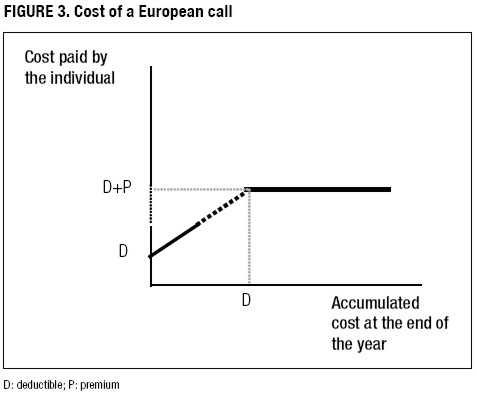
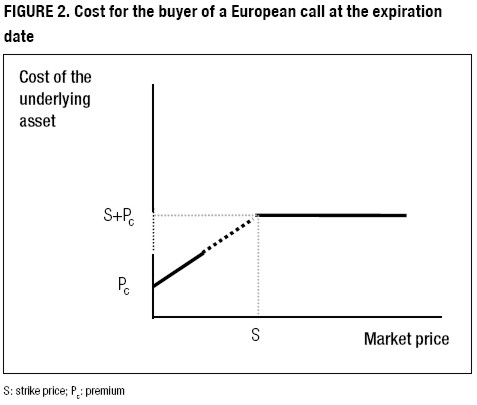
<body><![CDATA[<p><font size="3"><b><i>  3.1 Replicating the coverage pattern by using option   contracts</i></b></font></p>     <p>  Let us now assume that a hypothetical individual is   considering taking out a reinsurance contract on highcost   illnesses under the terms we have outlined above   (financial alternative). We assume that the patient's   disease will generate payments three times a year: at   moments 1, 2 and 3, and that the accumulated payments   exceed the deductible. <a href="/img/revistas/inno/v19n33/33a08f1.jpg" target="_blank">Figure 1</a> represents this   situation. On the left side of the figure we show the   payments the individual must pay out when the insurance   operation has not been agreed. On the right side   we show the payments when the high-cost disease has   been underwritten.</p>     <p>  As can be seen, when the risk is insured there is a   maximum cost for the individual. In nominal terms, the total cost paid out by the individual will equal the   deductible plus the cost of the premium paid to the   insurer at the beginning of the year. If the risk has   not been insured, the individual must assume the total   cost of the treatment, which, in the situation represented   in <a href="/img/revistas/inno/v19n33/33a08f1.jpg" target="_blank">Figure 1</a>, is higher than the cost when he or   she is insured.</p>     <p>  We now show how this coverage pattern can be replicated   by an option purchase. In this case, the buyer of   a European-style call guarantees a maximum price for   buying the underlying asset at the expiration date: if   the market price of the underlying asset is lower than   the option strike price, the holder will not exercise the   right. If he or she wants to buy the underlying asset,   the market price must be paid. Furthermore, the cost   of the asset bought will be the sum of its market price   plus the premium paid when buying the option. On   the other hand, if the market price is higher than the   strike price, the holder will exercise the right and will   pay the writer the strike price for the underlying asset.   The total cost paid by the holder will be amount to   the sum of the strike price and the premium. <a href="#f2">Figure 2</a>   shows the cost of the underlying asset for a Europeanstyle   option buyer at the expiration date, depending on   the market price.</p>     <p><a name="f2">&nbsp;</a></p>     <p>    <center><img src="/img/revistas/inno/v19n33/33a08f2.jpg"></center></p>     <p>  The two hedge schemes (figures <a href="#f2">2</a> and <a href="#f3">3</a>) are similar:   they guarantee a maximum cost to be paid when an   exceptional situation occurs, and for this to be possible,   the insured / buyer must pay a premium. Hence,   the question raised is whether an insurance operation   can be defined in terms of options contracts.</p>     <p><a name="f3">&nbsp;</a></p>     <p>    ]]></body>
<body><![CDATA[<center><img src="/img/revistas/inno/v19n33/33a08f3.jpg"></center></p>     <p>  The essential elements of an option contract are the   buyer, the writer, the expiration date, the strike price,   the premium and the underlying asset. Let us identify   these elements when an individual is insuring against   high-cost diseases. Some of these elements can be easily   defined: the buyer and the writer will be the individual   and the insurance company, respectively, and   the strike price will be the deductible. But the key item   is the underlying asset.</p>     <p>  We define the underlying asset as the accumulated cost   of treatment. If we define an expiration date as the end   of the year (it must be borne in mind that annual covers   are negotiated), and the premium of the option as   the amount to be paid to the insurance company, we   have all the items we need for an option contract.</p>     <p>  We can replicate the coverage pattern of an insurance   operation as follows:</p> <ul>     <p>       <li>  The individual buys a European-style call option at     the beginning of the year. The insurance company     is the writer of this call option.</li> </p>     <p>       <li>The expiration date of the option is at the end of     the year.</li> </p>     <p>       <li> The underlying asset is the accumulated cost of the     treatment throughout the year, and the strike price     for the call is the deductible.</li> </p>     ]]></body>
<body><![CDATA[<p>       <li> At the expiration date, the contract will be settled     by differences.</li> </p>     </ul>     <p>  Within this pattern, if the accumulated treatment   costs at the end of the year (expiration date) are lower   than the deductible, the individual will not have exercised   his or her right and will have assumed all the   payments. The patient's total cost will be the accumulated   treatment cost plus the premium paid at the beginning   of the year.</p>     <p>  In contrast, if the accumulated costs are higher than   the deductible, the individual will exercise this option.   The individual has the right to "buy" accumulated   treatment costs at a price equal to the deductible. As   the market price (the actual accumulated cost) is higher than the deductible, the individual will exercise his   or her right and "will buy" accumulated treatment cost   at the strike price (the deductible). Or, what amounts   to the same thing, the insurer will pay the individual   the difference between the current accumulated costs   (market price) and the deductible<a href="#2" name="s2">&#091;2&#093;</a> (strike price). In   this way the individual will only assume the part of   the treatment costs that falls below the deductible.</p>     <p>  The total cost will be the deductible plus the premium   paid by the option. This coverage pattern is shown in   <a href="#f3">Figure 3</a>.</p>     <p>  As can be seen, Figures <a href="#f2">2</a> and <a href="#f3">3</a> are essentially equivalent.   This means that an individual can achieve the   same coverage pattern by signing a reinsurance contract   or, alternatively, by buying a call style option.</p>     <p>&nbsp;</p>     <p><font size="3"><b><i>  3.2 Premium equivalence</i></b></font></p>     <p>  As shown above, we can replicate a reinsurance coverage   pattern by using option contracts. In this section   we will demonstrate that the premiums to be paid in   both situations must be equivalent. With this aim we   test the following hypothesis:</p>     ]]></body>
<body><![CDATA[<p>  In an equilibrium situation, the premium to be paid   for the insurance contract must equal the premium to   be paid for the purchase of the call style option. To   test this hypothesis, let us assume a time when the   price to insure against a high cost disease equals P   monetary units (m.u.), whilst the price of buying an   option such as those described above equals <i>P<sub>c</sub></i> m.u.   Let us assume that:</p>     <p>       <center>     <i>P &gt;P<sub>c</sub></i>   </center>   </p>     <p>  An arbitrager would operate by working as an insurance   company and entering into an agreement with   an individual to insure the high-cost disease. The arbitrager   would receive P m.u. for this.</p>     <p>  At the same time the arbitrager would buy a call for <i>P<sub>c</sub></i>   m.u. The profit obtained is the following:</p>     <p>       <center>     Profit = <i>P - P<sub>c</sub></i> &gt; 0   </center> </p>     <p>  The difference is positive but, what is more important,   this profit is achieved without assuming any risk. If,   at the expiration date, the accumulated cost does not   reach the deductible, the arbitrager would not exercise   the call style option, nor would he or she have any obligation   with the insured individual. But if the accumulated   cost at the end of the year is higher than the   deductible, the arbitrager would pay the individual the   difference between this cost and the deductible. However,   this amount to be paid would be equivalent to   that received from the option writer when exercising   the call style option bought.</p>     <p>  This "profit without risk" opportunity would be perceived   immediately by the arbitragers in the market,   who would begin to buy calls and to sell insurance   contracts. This would produce an increase in the premiums   to be paid by calls and a decrease in the premiums   to be paid when entering into an insurance   contract. These movements would continue until the   equilibrium situation is restored.</p>     <p>  A symmetric argument can be put forward for the opposite   situation when:</p>     ]]></body>
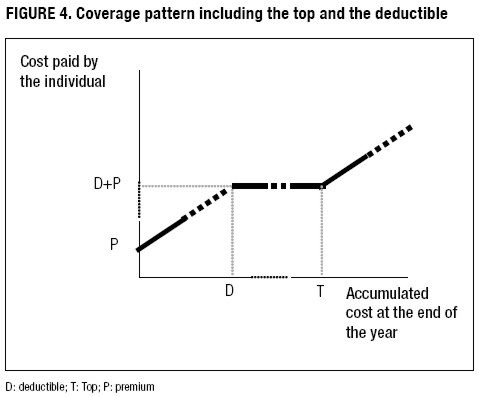
<body><![CDATA[<p>       <center>     <i>P</i> &lt; <i>P<sub>c</sub></i>   </center> </p>     <p>  In conclusion, in an equilibrium situation premiums   must be equivalent. Therefore, we can use the option   valuation theory to value the premium of an insurance   contract.</p>     <p>&nbsp;</p>     <p><font size="3"><b><i>  3.3 The introduction of the top boundary</i></b></font></p>     <p>  The situation described up to now does not always   correspond to the insurance of a high-cost disease.   We have only considered the deductible boundary,   but, sometimes there is a second boundary: the top   boundary. When considering the two boundaries, the   coverage pattern provided by the insurance operation   can be represented as shown in <a href="#f4">Figure 4.</a></p>     <p><a name="f4">&nbsp;</a></p>     <p>    <center><img src="/img/revistas/inno/v19n33/33a08f4.jpg"></center></p>     <p>  In this figure we show the four possible situations for   the individual:</p> <ol type="1">       ]]></body>
<body><![CDATA[<p>       <li>  There is no treatment and therefore  no cost. In any     case, the individual must pay the premium.</li> </p>     <p>       <li> The cost of the treatment falls below the amount     of the deductible. Here, payments assumed by the     individual will be equal to the sum of the cost and     the premium paid by the insurance operation.</li> </p>     <p>       <li> The cost of the treatment falls between the amounts     established as the deductible and the top. The individual     must pay a fixed amount: the deductible plus     the premium paid to the insurer.</li> </p>     <p>       <li> The cost of the treatment falls above the amount     established as the top. In this situation the individual     will pay the deductible, plus the premium, plus     the difference between the accumulated cost at the     end of the year and the top.</li> </p>     </ol>     <p>  We can also replicate this coverage pattern by using   option contracts. To do so, we construct an exotic option   by combining a call purchase and simultaneous   call writing.</p> <ul>       ]]></body>
<body><![CDATA[<p>       <li>The first option is that described up to this point     and is bought by the individual from the insurer.     For this option the individual will pay a premium:     <i>P<sub>c</sub></i>.</li> </p>     <p>       <li> The second option is another European-style call     on the same underlying asset and with the same expiration     date. The strike price of this option is the     top, and now it is the individual who sells and the     insurer who buys the derivative asset. For this option     the individual will receive a premium: <i>P<sub>c1</sub></i>.</li> </p>     </ul>     <p>  Considering the call-put parity, the following relation will occur:</p>     <center>       <p>  <i>P<sub>c</sub></i> &gt; <i>P<sub>c1</sub></i></p> </center>     <p>  And, therefore, the net premium to be paid by the individual (<i>NP</i>) will be:</p>     <center>       ]]></body>
<body><![CDATA[<p>  <i>NP</i> = <i>P<sub>c</sub></i> - <i>P<sub>c1</sub></i></p> </center>     <p>  Let us see how the coverage works with these options:</p> <ul>     <p>       <li> If the accumulated cost at the end of the year is     lower than the deductible, none of the options will     be exercised. The cost for the individual will be determined     by the cost of the treatment plus the net     premium (<i>NP</i>) paid.</li> </p>     <p>       <li> If this accumulated cost is above the deductible but     below the top, only the first of the options will be     exercised. The cost to be paid by the individual will     be the deductible plus the net premium.</li> </p>     <li>     <p> Finally, if the cost of the treatment (<i>C</i>) is higher   than the top (<i>T</i>),</p>     <p>       <center>     <i>C</i> &gt; <i>T</i>   </center> </p> </li>     ]]></body>
<body><![CDATA[</ul>     <p>  Both options will be exercised. By exercising the first   call the insurer will reimburse the individual the difference   between the cost of the treatment and the deductible   (<i>D</i>):</p>     <p>       <center>     <i> I<sub>IND</sub> = C - D    </i>   </center> </p>     <p>  where <i>I<sub>IND</sub></i> denotes the incomes for the individual.</p>     <p>  But the insurer will also exercise the call he or she has   bought. By settling this call by differences, the individual   will pay the insurer the difference between the   cost of the treatment (<i>C</i>) and the top (<i>T</i>):</p>     <p>       <center>     <i> I<sub>IND</sub> = -(C - T)    </i>   </center> </p>     <p>  In summary, the individual will pay the cost of the   treatment, the net premium and the difference between   the cost and the top, and will receive the difference   between the cost of the treatment and the   deductible. The net exit of funds for the individual will   be determined by:</p>     <p>       ]]></body>
<body><![CDATA[<center>     <i>E<sub>IND</sub></i> = <i>C</i> + <i>NP</i> + (<i>C - T</i>) - (<i>C - D</i>) =   </center> </p>     <p>       <center>     = <i>C</i> + <i>NP</i> + <i>D - T</i>   </center> </p>     <p>  where <i>E<sub>IND</sub></i> denotes the cost to be paid by the individual.</p>     <p>  The coverage pattern provided by simultaneously using   two calls is the same of <a href="#f4">figure 4</a> in an equilibrium   situation.</p>     <p>  To summarise, we have demonstrated that we can   replicate the coverage pattern provided by a reinsurance   operation using an exotic option, constructed by   combining two option contracts. Moreover, we have   shown that the premiums to be paid by options and by   the reinsurance coverage must be equal. Therefore, we   can use option pricing theory to estimate the amount   of the premium to be paid by a reinsurance operation.</p>     <p>&nbsp;</p>     <p><font size="3"><b>4. Data and valuation model</b></font></p>     <p>  For the empirical application of the proposed valuation   method, we used the medical bills of an EPS<a href="#3" name="s3">&#091;3&#093;</a> that   has been operating in the Colombian Health Care   System since January 1999.<a href="#4" name="s4">&#091;4&#093;</a> All figures are expressed   in Colombian 2002 pesos<a href="#5" name="s5">&#091;5&#093;</a>. We selected the bills corresponding   to the period between October 1999 and   September 2002 (over 600,000). In this three-year period,   the EPS signed three reinsurance contracts for   high-cost diseases. The relevant details of these contracts   are shown in <a href="/img/revistas/inno/v19n33/33a08f5.jpg" target="_blank">Figure 5</a>.</p>     <p>  As seen, for example, for the period between October   2001 and September 2002, the EPS entered into an insurance   contract with a deductible of $50.000.000 for which it had to pay a monthly premium per affiliate of   between $202 and $417.</p>     ]]></body>
<body><![CDATA[<p>  We divided the analysis period into two sub&#8209;periods:</p> <ul>     <p>       <li> October 1999 - September  2001: data from this period     was used for calculation purposes.</li> </p>     <p>       <li> October 2001 - September 2002: data from this period     was used for validation purposes.</li> </p>    </ul>     <p>  Within the calculation period, we estimated the cost   accumulated over 12 months at September 2000 and   at September 2001 for each affiliate. Most of the accumulated   accounts were very small. Therefore, we chose   for working purposes only those above $8.000.000<a href="#6" name="s6">&#091;6&#093;</a>.   Thus, we finally worked with 700 affiliates for the period   ending September 2000, and with 1,200 affiliates for the period ending September 2001.</p>     <p>  For the valuation of the premium, we used the Black-   Scholes (1973) model<a href="#7" name="s7">&#091;7&#093;</a>. The variables needed to apply the model are as follows:</p>     <p>  <i>S</i>: the price of the underlying asset. This is defined individually for each EPS affiliate.</p>     <p>  <i>E</i>: the strike price, equal to the deductible agreed with the reinsurer.</p>     ]]></body>
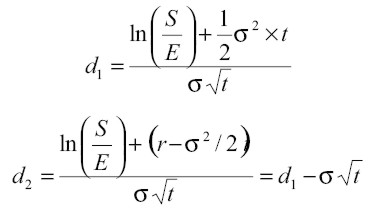
<body><![CDATA[<p>  <i>r</i>: the continuous time interest rate. This is the rate standing at the time the option is valued.</p>     <p>  <i>t</i>: time to maturity. One year. The reinsurance is underwritten   annually and the right to compensation can only be exercised at the end of that period.</p>     <p><i>&sigma;</i>: volatility of the yield (price variation) of the underlying   asset.</p>     <p>  Once the values of these variables are known, the premium   can be calculated directly with the well-known   Black-Scholes model given by the equations:</p>     <p>    <center><img src="/img/revistas/inno/v19n33/33a08e1.jpg"></center></p>     <p>    <center><img src="/img/revistas/inno/v19n33/33a08e2.jpg"></center></p>     <p>where the underlying asset does not generate any return.</p>     <p>  In addition, the following hypotheses were assumed when applying the model:</p> <ul>     ]]></body>
<body><![CDATA[<p>       <li> The underlying asset follows a continuous Gauss     Wiener stochastic process.</li> </p>     <p>       <li> Volatility is the same for all the affiliates' accounts.     <a href="#8" name="s8">&#091;8&#093;</a></li> </p>     <p>       <li> Coverage is reached by buying a call for each EPS     affiliate, and those whose annual hedging premium     is less than $1 are neglected.</li> </p>     <p>       <li> The accumulated bill at the moment of calculating     the premium is below the normal situation to     be expected at the end of any annual period. More     precisely, the mean values and the distribution of     the accumulated values are assumed to be constant     between consecutive periods.<a href="#9" name="s9">&#091;9&#093;</a></li> </p>     </ul>     <p>&nbsp;  </p>     ]]></body>
<body><![CDATA[<p><font size="3"><b><i>4.1 Volatility estimation</i></b></font></p>     <p>  The key variable when valuing these premiums is the   volatility of the yield of the underlying asset. As it is   not an observable variable, a hypothesis must be assumed   in order to estimate volatility from the information   available at the moment of the valuation. To   achieve this aim, first we constructed a time series for   the yield of the underlying asset and then estimated   the volatility from this time series.</p>     <p>  To construct the time series, we calculated the daily   mean value of the medical bills recorded by the EPS for all the days in the calculation period (October   1999 - September 2001). From this information, for   the first day of 2000, we calculated the accumulated   value of the mean medical bill over the previous 12   months. We repeated this operation for every day between   October 2000 and September 2001. In this way   we obtained a daily series of accumulated recorded   bills over one year.</p>     <p>  The next step was to estimate the daily variation of   these accumulated values in relative terms. We used   the logarithmic approximation and obtained a oneyear   time series of daily returns of the underlying asset.   This series is shown in <a href="/img/revistas/inno/v19n33/33a08f6.jpg" target="_blank">Figure 6</a>.</p>     <p>  At this point we need to forecast the value of the volatility   for the valuation period (October 2000-September   2002) in order to estimate the option premium.   With a reduced number of observations, as in this   case, perhaps the most suitable alternative is the simplest   one: to consider the volatility of the last time period   as the best forecast for the next period. However,   before assuming this behaviour, we tested the possibility   of an autoregressive conditionally heteroscedastic   (ARCH) pattern.</p>     <p>  We studied both the autocorrelation and partial autocorrelation   functions. They do not suggest the existence   of an autoregressive or moving average pattern   for the daily variation of accumulated medical bills.   This was further confirmed by the Ljung&#8209;Box test,   the results of which do not allow us to reject the null   hypothesis that the variable has no statistically significant   autocorrelation (see <a href="/img/revistas/inno/v19n33/33a08f7.jpg" target="_blank">Figure 7</a>). Once autocorrelation   in the series had been ruled out, we tested the   existence of autocorrelation when we square the variable.   Again, as shown in <a href="/img/revistas/inno/v19n33/33a08f7.jpg" target="_blank">Figure 7</a>, the Ljung&#8209;Box test   rejects the tested null hypothesis, and this indicates   that an ARCH pattern is not probable. Moreover, in   searching for this pattern, we estimated the Lagrange   multiplier test proposed by Engle (1982). The results,   shown in <a href="/img/revistas/inno/v19n33/33a08f7.jpg" target="_blank">Figure 7</a>, definitively reject an autoregressive   conditionally heteroscedastic pattern.</p>     <p>Once we have rejected using an ARCH pattern, a   possible alternative is to use the realised volatility as   a forecast for future values. Hence we estimated the   standard deviation for the daily return of accumulated   medical bills during the period October 2000 - September   2001. The standard deviation on a daily basis   equals 0.0155. However, the relevant value for the deviation   is that expressed in annual terms. Multiplying   0.0155 by the square root of the number of days on   which bills were recorded gives us a result of 0.239.   This is the value corresponding to the standard deviation   for the period October 2000 - September 2001,   on an annual basis. We use this value as a forecast for   the volatility in the validation period, that is, October 2001 - September 2002.</p>     <p>&nbsp;</p>     <p><font size="3"><b><i>  4.2 The estimation of the premium</i></b></font></p>     <p>  After determining the volatility, the other parameters   of the model must be specifically defined in order to   calculate the premium. At this point, the market price   of the underlying asset becomes especially important.   As we have stated above, we define the underlying   asset as the accumulated cost over the previous 12   months. If we estimate a premium for each of the affiliates,   there will be as many different prices as there are   EPS affiliates. We know the number of affiliates at the   moment we value the premium, but not the number   of affiliates for the following year. For this reason we   assumed one of the aforementioned hypotheses: the   distribution of accumulated bills does not change between   consecutive periods.</p>     ]]></body>
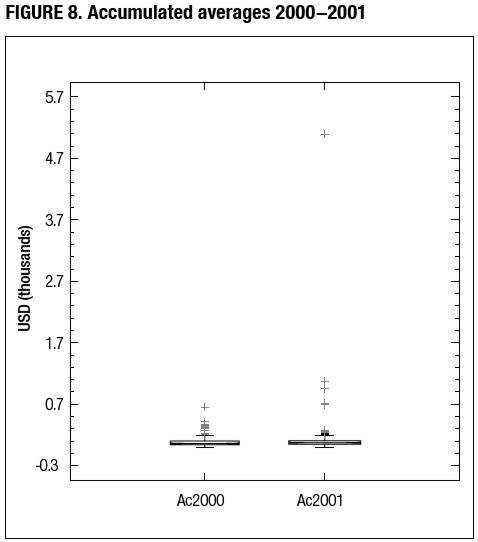
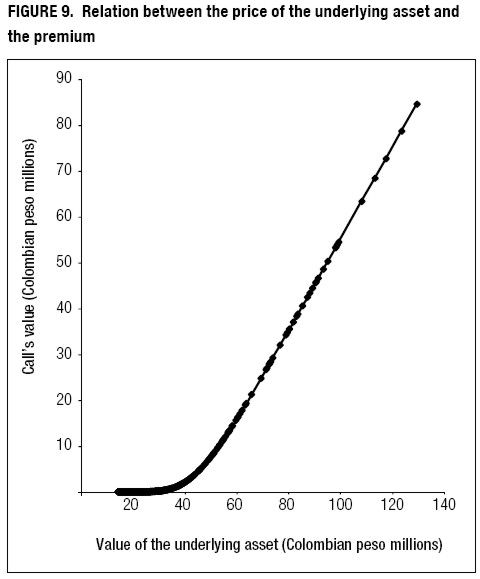
<body><![CDATA[<p>  To test this hypothesis at the moment we value the   premiums (October 2001), we compare the statistical   distribution of the accumulated costs for the two   consecutive annual periods where data are available:   October 1999 - September 2000 and October 2000 -   September 2001. Both distributions are represented in   the box graph shown in <a href="#f8">Figure 8</a>.</p>     <p><a name="f8">&nbsp;</a></p>     <p>    <center><img src="/img/revistas/inno/v19n33/33a08f8.jpg"></center></p>     <p>As can be seen, there is a high degree of coincidence   between the two boxes, which suggests that there are no   significant differences between the averages of the two   periods. This is supported by the Kolmogorov&#8209;Smirnov   test, where the null hypothesis is the equality between   the distribution functions for both periods against the   alternative hypothesis that assumes that the statistical   distribution for the period between October 1999   and September 2000 is different from that for the period   October 2000 - September 2001. The value for   the Kolmogorov-Smirnov statistic is 0.064, while the   critical value for a 99% confidence level is 0.068. This   allows us to conclude, with a level of confidence of   99% that the null hypothesis cannot be rejected and   we accept that both time periods have the same statistical   distribution. In other words, the statistical distribution   for the variable studied (the daily return of   the accumulated cost) has not changed between two   consecutive time periods. We assume this behaviour   for the future and therefore we do not expect changes   in the statistical distribution between the period October   2000 - September 2001 and the period October   2001 - September 2002 (the latter being the validation period).</p>     <p>  With this assumption we estimate the premium for   each of the affiliates, considering its accumulated cost   at September 2001. For example, for the affiliate with   the highest accumulated cost ($129.184.208) the premium   is $84.660.626. We repeated this calculation for   each of the 1,200 affiliates considered in September   2001. <a href="#f9">Figure 9</a> shows the premium calculated with the market price of the underlying asset (the individual accumulated   cost).</p>     <p><a name="f9">&nbsp;</a></p>     <p>    <center><img src="/img/revistas/inno/v19n33/33a08f9.jpg"></center></p>     <p>&nbsp;</p>     ]]></body>
<body><![CDATA[<p><font size="3"><b><i>4.3 Comparative analysis between the option   premium and the one calculated by actuarial methods</i></b></font></p>     <p>  The sum of all premiums for all affiliates with accumulated   bills higher than $14.202.442 equals   $2.078.754.970<a href="#10" name="s10">&#091;10&#093;</a> and the number of affiliates at the   time of valuation was 620,193. Hence, the premium   per affiliate would be $3.351,79 for a whole year's coverage. However, this premium is not paid immediately   at the beginning of the coverage period, but rather is   deferred 12 months and paid in instalments at the beginning   of each month. Thus, the former individual   figure must be transformed into a 12-month constant   pre&#8209;payable rent with an interest rate<a href="#11" name="s11">&#091;11&#093;</a> of 0.01025, the   current value of which is $3.351,79; the result means   that the EPS should pay a monthly premium per affiliate   of $295,25 . At present, the EPS that provided   data for this study has underwritten a contract   with the reinsurer in which the monthly premium lies   within the range between $202 and $417 per affiliate   (see <a href="/img/revistas/inno/v19n33/33a08f5.jpg" target="_blank">Figure 5</a>).</p>     <p>The value estimated by means of the option-pricing   theory therefore lies inside the range negotiated with   the reinsurer, which was estimated using actuarial techniques.</p>     <p>  Nevertheless, the estimation made to present has not   taken into account the existence of a $450.000.000   top, above which the EPS pays the excess. This variable   is easily introduced into the model. As stated   above, this involves the simple design of an exotic option   contract that replicates this situation. This would   be equivalent to assuming that, when the described   call style option (strike price: $50.000.000, one year   period, etc.) is bought from the reinsurer, a call is simultaneously   sold to the reinsurer with the same features, but at a strike price of $450.000.000.</p>     <p>  When both options are negotiated, the coverage situation can be described as follows (see also <a href="#f4">Figure 4</a>):</p> <ul>     <p>       <li>  If the price of the underlying  asset lies below     $50.000.000, the buyer of the call (the EPS) does     not exercise its right, but nevertheless pays the total     accumulated value of the bill (plus the net premium,     NP). The buyer of the call with a strike price of     $450.000.000 would not exercise its right either.</li> </p>     <p>       <li> If the underlying price lies between $50.000.000     and $450.000.000, the reinsurer will not exercise     the call it bought, but the EPS will exercise its option     and pay the maximum value of $50.000.000     (plus the net premium).</li> </p>     <li>     ]]></body>
<body><![CDATA[<p> Finally, if the underlying price lies above   $450.000.000, both parties will exercise their options;   the reinsurer (as seller of a call with a strike   price of $50.000.000) will pay the EPS the difference   between the price of the underlying asset (C)   and this strike price. But the EPS must also pay the   reinsurer the difference between the price of the   underlying asset and the strike price of the second   of the options ($450.000.000). In accordance with   (9), the net payment of the EPS would be the deductible   plus the excess of the cost of the treatment   on the top plus the net premium:</p>     <p>       <center>       <i>C</i> + <i>NP</i> + 50.000.000 - 450.000.000 =   </center> </p>     <p>         <center>     = 50.000.000 + (<i>C</i> - 450.000.000) + <i>NP</i> =   </center> </p>     <p>         <center>     = <i>C</i> + <i>NP </i>- 400.000.000   </center> </p> </li>     </ul>     <p>  For the EPS, selling a call option represents an income   or a lower premium to be paid to the reinsurer for the   coverage. Therefore, with regard to the call options   bought by the EPS, we calculated the amount corresponding   to the premiums of the calls sold by this firm.   The data used are the same, with the exception of the   strike price, which is now $450.000.000. As the top was set at such a high level, with respect to the normal   accumulated annual bill, almost all the premiums   are lower than $1. We only obtain premiums above $1   for values of the underlying asset above $115.000.000,   although the amount is still insignificant. As a consequence,   the existence of this top boundary has no   significant impact on the valuation of the premiums to   be paid by the EPS.</p>     <p>&nbsp;</p>     ]]></body>
<body><![CDATA[<p><font size="3"><b>  5. Conclusions</b></font></p>     <p>  The calculations made show that the Black-Scholes   model, used to value options, may also be used to estimate   reinsurance premiums of high cost-illness. The   premium estimated by this method is not far from the   premiums estimated by the actuarial method.</p>     <p>  To sum up, as options provide a similar scheme of   protection to that of insurance, given that they are   both financial tools allowing coverage of certain risks   in exchange of a premium, it is reasonable to use option   valuation theory in valuing insurance premiums   in general and high-cost diseases reinsurance in particular.</p>     <p>  In any case, beyond the particular application we have   carried out in this paper, the proposed premium valuation   method can be extended to other firms and other   insuring situations: the variables we have defined can   be easily adapted to other situations, and most of the   hypotheses we have assumed (e.g. those relative to a   unique volatility for all the affiliates) can be substituted   by others relevant to each particular situation   with no modification to the valuation procedure. It allows   the valuation of premiums by using an alternative   instrument to the one used by insurance firms, which   would help increase competition in negotiations with   the Colombian reinsurance market.</p>     <p>  In any case, any adaptation to the model requires the   availability of enough information. Lack of information   is perhaps the main limitation to be found now in   applying it to other firms.</p>     <p>&nbsp;</p>     <p><font size="3"><b>Pie de p&aacute;gina</b></font></p>     <p><a href="#s1" name="1">&#091;1&#093;</a> There are differences in the criteria about what a treatment precisely includes, ambiguity about the scope of the coverage due to the difficulty of assessing whether a certain event has gone beyond the expected frequency (as it is this excess that is to be reinsured), and so on. Moreover, legal definitions of high cost in health care may include pathologies, syndromes, procedures, surgical operations, services, events and treatments, all of which complicates negotiations between agents over reinsurance contracts and the costs of their claims. </p>     <p><a href="#s2" name="2">&#091;2&#093;</a> The contract is settled by differences.</p>     <p> <a href="#s3" name="3">&#091;3&#093;</a> The EPS preferred to remain anonymous.</p>     ]]></body>
<body><![CDATA[<p>  <a href="#s4" name="4">&#091;4&#093;</a> Records prior to this date were not considered reliable.</p>     <p>  <a href="#s5" name="5">&#091;5&#093;</a> The average exchange rate for that year was $2.507.</p>     <p><a href="#s6" name="6">&#091;6&#093;</a>  For this value, considering the level for the deductible (strike price), the premium would be about 0.</p>     <p>  <a href="#s7" name="7">&#091;7&#093;</a> This is a suitable model for valuing European-style options   like the one we price in this paper. Nevertheless, other valuation   models, i.e. the binomial model, can be used at this   point.</p>     <p><a href="#s8" name="8">&#091;8&#093;</a> This is only a simplifying hypothesis. It is not essential for the method we propose.</p>     <p>  <a href="#s9" name="9">&#091;9&#093;</a> Some tests on this hypothesis are calculated below.</p>     <p><a href="#s10" name="10">&#091;10&#093;</a> Lower values provide premiums below $1.</p>     <p>  <a href="#s11" name="11">&#091;11&#093;</a> The nominal Colombian market interest rate, (12.3%) divided   by 12.</p>     <p>&nbsp;</p>     <p><font size="3"><b>References</b></font></p>     ]]></body>
<body><![CDATA[<!-- ref --><p>Bhansali, J. D. (1999). Credit derivatives: An   analysis of spread options. <i>Derivatives Quarterly, 5</i>(4), 29-35.    &nbsp;&nbsp;&nbsp;&nbsp;&nbsp;&nbsp;&nbsp;&nbsp;[&#160;<a href="javascript:void(0);" onclick="javascript: window.open('/scielo.php?script=sci_nlinks&ref=000263&pid=S0121-5051200900010000900001&lng=','','width=640,height=500,resizable=yes,scrollbars=1,menubar=yes,');">Links</a>&#160;]<!-- end-ref --></p>     <!-- ref --><p>  Black, F. &amp; Scholes, M. (1973). The pricing of options   and corporate liabilities. <i>Journal of   Political Economy, 81</i>, 637-59.    &nbsp;&nbsp;&nbsp;&nbsp;&nbsp;&nbsp;&nbsp;&nbsp;[&#160;<a href="javascript:void(0);" onclick="javascript: window.open('/scielo.php?script=sci_nlinks&ref=000265&pid=S0121-5051200900010000900002&lng=','','width=640,height=500,resizable=yes,scrollbars=1,menubar=yes,');">Links</a>&#160;]<!-- end-ref --></p>     <!-- ref --><p>  Bessembinder, H. &amp; Lemmon, M. L. (2002). Equilibrium   pricing and optimal hedging in electricity   forward markets. <i>The Journal of Finance,   57</i>(3), 1347-1383.    &nbsp;&nbsp;&nbsp;&nbsp;&nbsp;&nbsp;&nbsp;&nbsp;[&#160;<a href="javascript:void(0);" onclick="javascript: window.open('/scielo.php?script=sci_nlinks&ref=000267&pid=S0121-5051200900010000900003&lng=','','width=640,height=500,resizable=yes,scrollbars=1,menubar=yes,');">Links</a>&#160;]<!-- end-ref --></p>     <!-- ref --><p>  Chica&iacute;za, L. (2002). El mercado de la salud en   Colombia y la problem&aacute;tica del alto costo.   <i>Problemas del Desarrollo, 33</i>(131), 163-   187.    &nbsp;&nbsp;&nbsp;&nbsp;&nbsp;&nbsp;&nbsp;&nbsp;[&#160;<a href="javascript:void(0);" onclick="javascript: window.open('/scielo.php?script=sci_nlinks&ref=000269&pid=S0121-5051200900010000900004&lng=','','width=640,height=500,resizable=yes,scrollbars=1,menubar=yes,');">Links</a>&#160;]<!-- end-ref --></p>     <!-- ref --><p>  Chica&iacute;za, L. &amp; Cabedo, J. (2007). Las opciones   financieras como mecanismo para estimar   las primas de seguro y reaseguro en el   sistema de salud colombiano. <i>Cuadernos   de Administraci&oacute;n, 20</i>(34), 221-236.    &nbsp;&nbsp;&nbsp;&nbsp;&nbsp;&nbsp;&nbsp;&nbsp;[&#160;<a href="javascript:void(0);" onclick="javascript: window.open('/scielo.php?script=sci_nlinks&ref=000271&pid=S0121-5051200900010000900005&lng=','','width=640,height=500,resizable=yes,scrollbars=1,menubar=yes,');">Links</a>&#160;]<!-- end-ref --></p>     ]]></body>
<body><![CDATA[<!-- ref --><p>  Das, S., Fong, G. &amp; Geng, G. (2001). Impact of   correlated default risk on credit portfolios. <i>The Journal of Fixed Income, 11</i>(3), 9-19.    &nbsp;&nbsp;&nbsp;&nbsp;&nbsp;&nbsp;&nbsp;&nbsp;[&#160;<a href="javascript:void(0);" onclick="javascript: window.open('/scielo.php?script=sci_nlinks&ref=000273&pid=S0121-5051200900010000900006&lng=','','width=640,height=500,resizable=yes,scrollbars=1,menubar=yes,');">Links</a>&#160;]<!-- end-ref --></p>     <!-- ref --><p>  Demeterf, I. K., Derman, E., Kamal, M. &amp; Zou,   J. (1999). A guide to volatility and variance   swaps. <i>Journal of Derivatives, 6</i>(4), 9-32.    &nbsp;&nbsp;&nbsp;&nbsp;&nbsp;&nbsp;&nbsp;&nbsp;[&#160;<a href="javascript:void(0);" onclick="javascript: window.open('/scielo.php?script=sci_nlinks&ref=000275&pid=S0121-5051200900010000900007&lng=','','width=640,height=500,resizable=yes,scrollbars=1,menubar=yes,');">Links</a>&#160;]<!-- end-ref --></p>     <!-- ref --><p>  Duffee, G. &amp; Zhou, C. (2001). Credit derivatives   in banking: Useful tools for managing risk?   <i>Journal of Monetary Economics, 48</i>(1), 25-   54.    &nbsp;&nbsp;&nbsp;&nbsp;&nbsp;&nbsp;&nbsp;&nbsp;[&#160;<a href="javascript:void(0);" onclick="javascript: window.open('/scielo.php?script=sci_nlinks&ref=000277&pid=S0121-5051200900010000900008&lng=','','width=640,height=500,resizable=yes,scrollbars=1,menubar=yes,');">Links</a>&#160;]<!-- end-ref --></p>     <!-- ref --><p>  Engle, R. (1982). Autoregressive conditional heteroscedasticity   with estimates of the variance   of UK inflation. <i>Econometrica, 50</i>(4),   897-1007.    &nbsp;&nbsp;&nbsp;&nbsp;&nbsp;&nbsp;&nbsp;&nbsp;[&#160;<a href="javascript:void(0);" onclick="javascript: window.open('/scielo.php?script=sci_nlinks&ref=000279&pid=S0121-5051200900010000900009&lng=','','width=640,height=500,resizable=yes,scrollbars=1,menubar=yes,');">Links</a>&#160;]<!-- end-ref --></p>     <!-- ref --><p>  Geczy, C., Minton, B. &amp; Schrand, C. (1997). Why   firms use currency derivatives. <i>Journal of   Finance, 52</i>(4), 1323-1354.    &nbsp;&nbsp;&nbsp;&nbsp;&nbsp;&nbsp;&nbsp;&nbsp;[&#160;<a href="javascript:void(0);" onclick="javascript: window.open('/scielo.php?script=sci_nlinks&ref=000281&pid=S0121-5051200900010000900010&lng=','','width=640,height=500,resizable=yes,scrollbars=1,menubar=yes,');">Links</a>&#160;]<!-- end-ref --></p>     ]]></body>
<body><![CDATA[<!-- ref --><p>  Harrington, S. E. (1997). Insurance derivatives,   tax policy, and the future of the insurance   industry. <i>Journal of Risk and Insurance,   64</i>(4), 719-726.    &nbsp;&nbsp;&nbsp;&nbsp;&nbsp;&nbsp;&nbsp;&nbsp;[&#160;<a href="javascript:void(0);" onclick="javascript: window.open('/scielo.php?script=sci_nlinks&ref=000283&pid=S0121-5051200900010000900011&lng=','','width=640,height=500,resizable=yes,scrollbars=1,menubar=yes,');">Links</a>&#160;]<!-- end-ref --></p>     <!-- ref --><p>  Karpinsky, A. (1998). The risky business of risk   management derivatives disasters revisited.   <i>Australian Banker, 112</i>(2), 60-63.    &nbsp;&nbsp;&nbsp;&nbsp;&nbsp;&nbsp;&nbsp;&nbsp;[&#160;<a href="javascript:void(0);" onclick="javascript: window.open('/scielo.php?script=sci_nlinks&ref=000285&pid=S0121-5051200900010000900012&lng=','','width=640,height=500,resizable=yes,scrollbars=1,menubar=yes,');">Links</a>&#160;]<!-- end-ref --></p>     <!-- ref --><p>  Mcclintock, B. (1996). International financial instability   and the financial derivatives market.   <i>Journal of Economic Issues, 30</i>(1), 13-34.    &nbsp;&nbsp;&nbsp;&nbsp;&nbsp;&nbsp;&nbsp;&nbsp;[&#160;<a href="javascript:void(0);" onclick="javascript: window.open('/scielo.php?script=sci_nlinks&ref=000287&pid=S0121-5051200900010000900013&lng=','','width=640,height=500,resizable=yes,scrollbars=1,menubar=yes,');">Links</a>&#160;]<!-- end-ref --></p>     <!-- ref --><p>  Niehause, G. (2002). The allocation of catastrophe   risk. <i>Journal of Banking and Finance,   26</i>(2 &amp; 3), 585-596.    &nbsp;&nbsp;&nbsp;&nbsp;&nbsp;&nbsp;&nbsp;&nbsp;[&#160;<a href="javascript:void(0);" onclick="javascript: window.open('/scielo.php?script=sci_nlinks&ref=000289&pid=S0121-5051200900010000900014&lng=','','width=640,height=500,resizable=yes,scrollbars=1,menubar=yes,');">Links</a>&#160;]<!-- end-ref --></p>     <!-- ref --><p>  Pouget, S. (2001). Finance de march&eacute; exp&eacute;rimentale:   une revue de litt&eacute;rature, Finance.   <i>Revue de l'Association Fran&ccedil;aise de Finance,   22</i>(1), 37-63.    &nbsp;&nbsp;&nbsp;&nbsp;&nbsp;&nbsp;&nbsp;&nbsp;[&#160;<a href="javascript:void(0);" onclick="javascript: window.open('/scielo.php?script=sci_nlinks&ref=000291&pid=S0121-5051200900010000900015&lng=','','width=640,height=500,resizable=yes,scrollbars=1,menubar=yes,');">Links</a>&#160;]<!-- end-ref --></p>     ]]></body>
<body><![CDATA[<!-- ref --><p>  Yanxiang, G. A. (2002). Valuing the option to purchase   an asset at a proportional discount.   <i>Journal of Financial Research, 25</i>(1), 99-109.    &nbsp;&nbsp;&nbsp;&nbsp;&nbsp;&nbsp;&nbsp;&nbsp;[&#160;<a href="javascript:void(0);" onclick="javascript: window.open('/scielo.php?script=sci_nlinks&ref=000293&pid=S0121-5051200900010000900016&lng=','','width=640,height=500,resizable=yes,scrollbars=1,menubar=yes,');">Links</a>&#160;]<!-- end-ref --></p>     <!-- ref --><p>  Zettl, M. (2002). Valuing exploration and production   projects by means of option pricing   theory. <i>International Journal of Production   Economics, 78</i>(1), 109-116.    &nbsp;&nbsp;&nbsp;&nbsp;&nbsp;&nbsp;&nbsp;&nbsp;[&#160;<a href="javascript:void(0);" onclick="javascript: window.open('/scielo.php?script=sci_nlinks&ref=000295&pid=S0121-5051200900010000900017&lng=','','width=640,height=500,resizable=yes,scrollbars=1,menubar=yes,');">Links</a>&#160;]<!-- end-ref --></p> </font>      ]]></body><back>
<ref-list>
<ref id="B1">
<nlm-citation citation-type="journal">
<person-group person-group-type="author">
<name>
<surname><![CDATA[Bhansali]]></surname>
<given-names><![CDATA[J. D]]></given-names>
</name>
</person-group>
<article-title xml:lang="en"><![CDATA[Credit derivatives: An analysis of spread options]]></article-title>
<source><![CDATA[Derivatives Quarterly]]></source>
<year>1999</year>
<volume>5</volume>
<numero>4</numero>
<issue>4</issue>
<page-range>29-35</page-range></nlm-citation>
</ref>
<ref id="B2">
<nlm-citation citation-type="journal">
<person-group person-group-type="author">
<name>
<surname><![CDATA[Black]]></surname>
<given-names><![CDATA[F]]></given-names>
</name>
<name>
<surname><![CDATA[Scholes]]></surname>
<given-names><![CDATA[M]]></given-names>
</name>
</person-group>
<article-title xml:lang="en"><![CDATA[The pricing of options and corporate liabilities]]></article-title>
<source><![CDATA[Journal of Political Economy]]></source>
<year>1973</year>
<volume>81</volume>
<page-range>637-59</page-range></nlm-citation>
</ref>
<ref id="B3">
<nlm-citation citation-type="journal">
<person-group person-group-type="author">
<name>
<surname><![CDATA[Bessembinder]]></surname>
<given-names><![CDATA[H]]></given-names>
</name>
<name>
<surname><![CDATA[Lemmon]]></surname>
<given-names><![CDATA[M. L]]></given-names>
</name>
</person-group>
<article-title xml:lang="en"><![CDATA[Equilibrium pricing and optimal hedging in electricity forward markets]]></article-title>
<source><![CDATA[The Journal of Finance]]></source>
<year>2002</year>
<volume>57</volume>
<numero>3</numero>
<issue>3</issue>
<page-range>1347-1383</page-range></nlm-citation>
</ref>
<ref id="B4">
<nlm-citation citation-type="journal">
<person-group person-group-type="author">
<name>
<surname><![CDATA[Chicaíza]]></surname>
<given-names><![CDATA[L]]></given-names>
</name>
</person-group>
<article-title xml:lang="es"><![CDATA[El mercado de la salud en Colombia y la problemática del alto costo]]></article-title>
<source><![CDATA[Problemas del Desarrollo]]></source>
<year>2002</year>
<volume>33</volume>
<numero>131</numero>
<issue>131</issue>
<page-range>163- 187</page-range></nlm-citation>
</ref>
<ref id="B5">
<nlm-citation citation-type="journal">
<person-group person-group-type="author">
<name>
<surname><![CDATA[Chicaíza]]></surname>
<given-names><![CDATA[L]]></given-names>
</name>
<name>
<surname><![CDATA[Cabedo]]></surname>
<given-names><![CDATA[J]]></given-names>
</name>
</person-group>
<article-title xml:lang="es"><![CDATA[Las opciones financieras como mecanismo para estimar las primas de seguro y reaseguro en el sistema de salud colombiano]]></article-title>
<source><![CDATA[Cuadernos de Administración]]></source>
<year>2007</year>
<volume>20</volume>
<numero>34</numero>
<issue>34</issue>
<page-range>221-236</page-range></nlm-citation>
</ref>
<ref id="B6">
<nlm-citation citation-type="journal">
<person-group person-group-type="author">
<name>
<surname><![CDATA[Das]]></surname>
<given-names><![CDATA[S]]></given-names>
</name>
<name>
<surname><![CDATA[Fong]]></surname>
<given-names><![CDATA[G]]></given-names>
</name>
<name>
<surname><![CDATA[Geng]]></surname>
<given-names><![CDATA[G]]></given-names>
</name>
</person-group>
<article-title xml:lang="en"><![CDATA[Impact of correlated default risk on credit portfolios]]></article-title>
<source><![CDATA[The Journal of Fixed Income]]></source>
<year>2001</year>
<volume>11</volume>
<numero>3</numero>
<issue>3</issue>
<page-range>9-19</page-range></nlm-citation>
</ref>
<ref id="B7">
<nlm-citation citation-type="journal">
<person-group person-group-type="author">
<name>
<surname><![CDATA[Demeterf]]></surname>
<given-names><![CDATA[I. K]]></given-names>
</name>
<name>
<surname><![CDATA[Derman]]></surname>
<given-names><![CDATA[E]]></given-names>
</name>
<name>
<surname><![CDATA[Kamal]]></surname>
<given-names><![CDATA[M]]></given-names>
</name>
<name>
<surname><![CDATA[Zou]]></surname>
<given-names><![CDATA[J]]></given-names>
</name>
</person-group>
<article-title xml:lang="en"><![CDATA[A guide to volatility and variance swaps]]></article-title>
<source><![CDATA[Journal of Derivatives]]></source>
<year>1999</year>
<volume>6</volume>
<numero>4</numero>
<issue>4</issue>
<page-range>9-32</page-range></nlm-citation>
</ref>
<ref id="B8">
<nlm-citation citation-type="journal">
<person-group person-group-type="author">
<name>
<surname><![CDATA[Duffee]]></surname>
<given-names><![CDATA[G]]></given-names>
</name>
<name>
<surname><![CDATA[Zhou]]></surname>
<given-names><![CDATA[C]]></given-names>
</name>
</person-group>
<article-title xml:lang="en"><![CDATA[Credit derivatives in banking: Useful tools for managing risk?]]></article-title>
<source><![CDATA[Journal of Monetary Economics]]></source>
<year>2001</year>
<volume>48</volume>
<numero>1</numero>
<issue>1</issue>
<page-range>25- 54</page-range></nlm-citation>
</ref>
<ref id="B9">
<nlm-citation citation-type="journal">
<person-group person-group-type="author">
<name>
<surname><![CDATA[Engle]]></surname>
<given-names><![CDATA[R]]></given-names>
</name>
</person-group>
<article-title xml:lang="en"><![CDATA[Autoregressive conditional heteroscedasticity with estimates of the variance of UK inflation]]></article-title>
<source><![CDATA[Econometrica]]></source>
<year>1982</year>
<volume>50</volume>
<numero>4</numero>
<issue>4</issue>
<page-range>897-1007</page-range></nlm-citation>
</ref>
<ref id="B10">
<nlm-citation citation-type="journal">
<person-group person-group-type="author">
<name>
<surname><![CDATA[Geczy]]></surname>
<given-names><![CDATA[C]]></given-names>
</name>
<name>
<surname><![CDATA[Minton]]></surname>
<given-names><![CDATA[B]]></given-names>
</name>
<name>
<surname><![CDATA[Schrand]]></surname>
<given-names><![CDATA[C]]></given-names>
</name>
</person-group>
<article-title xml:lang="en"><![CDATA[Why firms use currency derivatives]]></article-title>
<source><![CDATA[Journal of Finance]]></source>
<year>1997</year>
<volume>52</volume>
<numero>4</numero>
<issue>4</issue>
<page-range>1323-1354</page-range></nlm-citation>
</ref>
<ref id="B11">
<nlm-citation citation-type="journal">
<person-group person-group-type="author">
<name>
<surname><![CDATA[Harrington]]></surname>
<given-names><![CDATA[S. E]]></given-names>
</name>
</person-group>
<article-title xml:lang="en"><![CDATA[Insurance derivatives, tax policy, and the future of the insurance industry]]></article-title>
<source><![CDATA[Journal of Risk and Insurance]]></source>
<year>1997</year>
<volume>64</volume>
<numero>4</numero>
<issue>4</issue>
<page-range>719-726</page-range></nlm-citation>
</ref>
<ref id="B12">
<nlm-citation citation-type="journal">
<person-group person-group-type="author">
<name>
<surname><![CDATA[Karpinsky]]></surname>
<given-names><![CDATA[A]]></given-names>
</name>
</person-group>
<article-title xml:lang="en"><![CDATA[The risky business of risk management derivatives disasters revisited]]></article-title>
<source><![CDATA[Australian Banker]]></source>
<year>1998</year>
<volume>112</volume>
<numero>2</numero>
<issue>2</issue>
<page-range>60-63</page-range></nlm-citation>
</ref>
<ref id="B13">
<nlm-citation citation-type="journal">
<person-group person-group-type="author">
<name>
<surname><![CDATA[Mcclintock]]></surname>
<given-names><![CDATA[B]]></given-names>
</name>
</person-group>
<article-title xml:lang="en"><![CDATA[International financial instability and the financial derivatives market]]></article-title>
<source><![CDATA[Journal of Economic Issues]]></source>
<year>1996</year>
<volume>30</volume>
<numero>1</numero>
<issue>1</issue>
<page-range>13-34</page-range></nlm-citation>
</ref>
<ref id="B14">
<nlm-citation citation-type="journal">
<person-group person-group-type="author">
<name>
<surname><![CDATA[Niehause]]></surname>
<given-names><![CDATA[G]]></given-names>
</name>
</person-group>
<article-title xml:lang="en"><![CDATA[The allocation of catastrophe risk]]></article-title>
<source><![CDATA[Journal of Banking and Finance]]></source>
<year>2002</year>
<volume>26</volume>
<numero>2 & 3</numero>
<issue>2 & 3</issue>
<page-range>585-596</page-range></nlm-citation>
</ref>
<ref id="B15">
<nlm-citation citation-type="journal">
<person-group person-group-type="author">
<name>
<surname><![CDATA[Pouget]]></surname>
<given-names><![CDATA[S]]></given-names>
</name>
</person-group>
<article-title xml:lang="fr"><![CDATA[Finance de marché expérimentale: une revue de littérature, Finance]]></article-title>
<source><![CDATA[Revue de l'Association Française de Finance]]></source>
<year>2001</year>
<volume>22</volume>
<numero>1</numero>
<issue>1</issue>
<page-range>37-63</page-range></nlm-citation>
</ref>
<ref id="B16">
<nlm-citation citation-type="journal">
<person-group person-group-type="author">
<name>
<surname><![CDATA[Yanxiang]]></surname>
<given-names><![CDATA[G. A]]></given-names>
</name>
</person-group>
<article-title xml:lang="en"><![CDATA[Valuing the option to purchase an asset at a proportional discount]]></article-title>
<source><![CDATA[Journal of Financial Research]]></source>
<year>2002</year>
<volume>25</volume>
<numero>1</numero>
<issue>1</issue>
<page-range>99-109</page-range></nlm-citation>
</ref>
<ref id="B17">
<nlm-citation citation-type="journal">
<person-group person-group-type="author">
<name>
<surname><![CDATA[Zettl]]></surname>
<given-names><![CDATA[M]]></given-names>
</name>
</person-group>
<article-title xml:lang="en"><![CDATA[Valuing exploration and production projects by means of option pricing theory]]></article-title>
<source><![CDATA[International Journal of Production Economics]]></source>
<year>2002</year>
<volume>78</volume>
<numero>1</numero>
<issue>1</issue>
<page-range>109-116</page-range></nlm-citation>
</ref>
</ref-list>
</back>
</article>