<?xml version="1.0" encoding="ISO-8859-1"?><article xmlns:mml="http://www.w3.org/1998/Math/MathML" xmlns:xlink="http://www.w3.org/1999/xlink" xmlns:xsi="http://www.w3.org/2001/XMLSchema-instance">
<front>
<journal-meta>
<journal-id>0121-5051</journal-id>
<journal-title><![CDATA[Innovar]]></journal-title>
<abbrev-journal-title><![CDATA[Innovar]]></abbrev-journal-title>
<issn>0121-5051</issn>
<publisher>
<publisher-name><![CDATA[Facultad de Ciencias Económicas. Universidad Nacional de Colombia.]]></publisher-name>
</publisher>
</journal-meta>
<article-meta>
<article-id>S0121-50512010000300014</article-id>
<title-group>
<article-title xml:lang="en"><![CDATA[Internet and international trade by manufacturers: An approach using industrial sectors data]]></article-title>
<article-title xml:lang="en"><![CDATA[Internet y el Comercio internacional de manufacturas: una aproximación con datos de sectores industriales]]></article-title>
<article-title xml:lang="fr"><![CDATA[Internet et Commerce international de manufactures: une approche sur base de données de secteurs industriels]]></article-title>
<article-title xml:lang="pt"><![CDATA[Internet e Comércio internacional de manufaturas: uma aproximação com dados de setores industriais]]></article-title>
</title-group>
<contrib-group>
<contrib contrib-type="author">
<name>
<surname><![CDATA[Bernal-Jurado]]></surname>
<given-names><![CDATA[Enrique]]></given-names>
</name>
<xref ref-type="aff" rid="A01"/>
</contrib>
<contrib contrib-type="author">
<name>
<surname><![CDATA[Moral-Pajares]]></surname>
<given-names><![CDATA[Encarnación]]></given-names>
</name>
<xref ref-type="aff" rid="A02"/>
</contrib>
</contrib-group>
<aff id="A01">
<institution><![CDATA[,Universidad de Jaén Facultad de Ciencias Sociales y Jurídicas Departamento de Economía]]></institution>
<addr-line><![CDATA[ ]]></addr-line>
<country>España</country>
</aff>
<aff id="A02">
<institution><![CDATA[,Universidad de Jaén Facultad de Ciencias Sociales y Jurídicas Departamento de Economía]]></institution>
<addr-line><![CDATA[ ]]></addr-line>
<country>España</country>
</aff>
<pub-date pub-type="pub">
<day>00</day>
<month>09</month>
<year>2010</year>
</pub-date>
<pub-date pub-type="epub">
<day>00</day>
<month>09</month>
<year>2010</year>
</pub-date>
<volume>20</volume>
<numero>38</numero>
<fpage>191</fpage>
<lpage>202</lpage>
<copyright-statement/>
<copyright-year/>
<self-uri xlink:href="http://www.scielo.org.co/scielo.php?script=sci_arttext&amp;pid=S0121-50512010000300014&amp;lng=en&amp;nrm=iso"></self-uri><self-uri xlink:href="http://www.scielo.org.co/scielo.php?script=sci_abstract&amp;pid=S0121-50512010000300014&amp;lng=en&amp;nrm=iso"></self-uri><self-uri xlink:href="http://www.scielo.org.co/scielo.php?script=sci_pdf&amp;pid=S0121-50512010000300014&amp;lng=en&amp;nrm=iso"></self-uri><abstract abstract-type="short" xml:lang="en"><p><![CDATA[Some evidences show how the potential generated by using the Internet as a tool able to open new commercial markets is not being fulfilled. The study's purpose is to analyze the possible intensity with which the industrial sectors incorporate and take advantage of the Internet and the volume of business generated in international markets, based on statistical information referring to Spanish industry. Starting from the available statistical information on the incorporation and commercial use of ICT, the foreign trade and production of various Spanish industries are assigned different variables and the lineal relationships among them are contrasted. Those industries with the largest importing and exporting activities are, at the same time, those that get more and more business via electronic commerce, particularly through different communication channels, such as EDI, Minitel or Internet. However, it is interesting to note the absence of this kind of relationship when we look at the e-commerce carried out exclusively through the Internet. The results justify the necessity of taking more intensive actions to improve the use of the new electronic systems in the international commercialization, especially in the environment of the small and medium sized companies.]]></p></abstract>
<abstract abstract-type="short" xml:lang="es"><p><![CDATA[Existen evidencias de que las expectativas generadas en el caso de Internet como elemento capaz de abrir nuevos mercados a las empresas no se están cumpliendo. El propósito de este estudio es analizar la posible relación que existe entre la intensidad con que los sectores industriales de una economía incorporan y aprovechan las TIC y el volumen de negocio que contratan en los mercados internacionales, partiendo de información estadística referida a la industria de España. A partir de la información estadística disponible sobre incorporación y uso comercial de las TIC, comercio exterior y producción de las distintas industrias españolas se definen distintas variables y se somete a contraste la relación lineal entre ellas. Las industrias con mayor actividad exportadora e importadora son, asimismo, las que cada vez contratan más volumen de negocio a través del comercio electrónico, particularmente a través de distintos canales de comunicación, como EDI, Minitel o Internet. Llama la atención, sin embargo, la ausencia de dicha relación cuando se considera el comercio electrónico realizado exclusivamente a través de Internet. Los resultados justifican la necesidad de acciones más intensivas que potencien el uso de los nuevos sistemas electrónicos en la comercialización internacional, especialmente en el ámbito de las pequeñas y medianas empresas.]]></p></abstract>
<abstract abstract-type="short" xml:lang="fr"><p><![CDATA[Il est évident que les expectatives concernant Internet, en tant qu'élément pouvant produire une ouverture de nouveaux marchés pour les entreprises, ne donnent pas de résultats. Le but de cette étude est d'analyser la relation existant entre l'intensité selon laquelle les secteurs industriels d'une économie incorporent les TIC et en tirent profit et le volume d'affaires effectuées sur les marchés internationaux, à partir de l'information statistique en référence de l'industrie d'Espagne. à partir de cette information statistique disponible concernant l'incorporation et l'utilisation commerciale des TIC, le commerce extérieur et la production de différentes industries espagnoles, différentes variables sont définies dont la relation linéaire est contrastée. Ainsi, les industries démontrant une plus grande activité d'exportation et importation sont celles qui ont un volume d'affaires plus important par le biais du commerce électronique, et plus particulièrement par des chaînes de communication différentes, telles qu'EDI, Minitel ou Internet. Il faut cependant observer l'absence de cette relation si l'on considère le commerce électronique réalisé exclusivement par Internet. Le résultat justifie la nécessité d'actions plus intensives permettant l'utilisation de nouveaux systèmes électroniques dans la commercialisation internationale, et plus spécialement pour les petites et moyennes entreprises.]]></p></abstract>
<abstract abstract-type="short" xml:lang="pt"><p><![CDATA[Existem evidências de que as expectativas geradas no caso da Internet, como elemento capaz de abrir novos mercados às empresas, não estão sendo cumpridas. O propósito deste estudo é analisar a possível relação que existe entre a intensidade com que os setores industriais de uma economia incorporam e aproveitam as TIC e o volume de negócios que contratam nos mercados internacionais, partindo de informação estatística referente à indústria da Espanha. A partir da informação estatística disponível sobre incorporação e uso comercial das TIC, comércio exterior e produção das distintas indústrias espanholas definem-se distintas variáveis, contrastando-se a relação linear entre elas. As indústrias com maior atividade exportadora e importadora são, dessa forma, as que cada vez contratam maior volume de negócios através do comércio eletrônico, particularmente através de distintos canais de comunicação, como EDI, Minitel ou Internet. Sem embargo, chama a atenção a ausência de tal relação, quando se considera o comércio eletrônico realizado exclusivamente através da Internet. Os resultados justificam a necessidade de ações mais intensivas que potencializem o uso dos novos sistemas eletrônicos de comercialização internacional, especialmente no âmbito das pequenas e médias empresas.]]></p></abstract>
<kwd-group>
<kwd lng="en"><![CDATA[e-commerce]]></kwd>
<kwd lng="en"><![CDATA[electronic commerce]]></kwd>
<kwd lng="en"><![CDATA[foreign trade]]></kwd>
<kwd lng="en"><![CDATA[Internet]]></kwd>
<kwd lng="en"><![CDATA[manufacturing industries]]></kwd>
<kwd lng="en"><![CDATA[Spain]]></kwd>
<kwd lng="es"><![CDATA[comercio exterior]]></kwd>
<kwd lng="es"><![CDATA[industria manufacturera]]></kwd>
<kwd lng="es"><![CDATA[internet]]></kwd>
<kwd lng="es"><![CDATA[comercio electrónico]]></kwd>
<kwd lng="es"><![CDATA[España]]></kwd>
<kwd lng="fr"><![CDATA[commerce extérieur]]></kwd>
<kwd lng="fr"><![CDATA[industrie manufacturière]]></kwd>
<kwd lng="fr"><![CDATA[Internet]]></kwd>
<kwd lng="fr"><![CDATA[commerce électronique]]></kwd>
<kwd lng="fr"><![CDATA[Espagne]]></kwd>
<kwd lng="pt"><![CDATA[comércio exterior]]></kwd>
<kwd lng="pt"><![CDATA[indústria manufatureira]]></kwd>
<kwd lng="pt"><![CDATA[internet]]></kwd>
<kwd lng="pt"><![CDATA[comércio eletrônico]]></kwd>
<kwd lng="pt"><![CDATA[Espanha]]></kwd>
</kwd-group>
</article-meta>
</front><body><![CDATA[  <font size="2" face="verdana">     <p>&nbsp;</p>     <p>&nbsp;</p>     <p>       <center>     <font size="4"><b>    Internet and international trade  by manufacturers:</b></font> <font size="3"><b>An approach  using industrial sectors data     </b></font>   </center> </p>     <p>       <center>     <font size="3"><b>    Internet y el Comercio internacional de manufacturas: una aproximaci&oacute;n con datos de sectores industriales     </b></font>   </center> </p>     <p>       <center>     <font size="3"><b>Internet et Commerce international de manufactures: une approche sur base de donn&eacute;es de secteurs industriels</b></font>   </center> </p>     <p>       ]]></body>
<body><![CDATA[<center>     <font size="3"><b>Internet e Com&eacute;rcio internacional de manufaturas: uma aproxima&ccedil;&atilde;o com dados de setores industriais</b></font>   </center> </p>     <p>&nbsp;</p>     <p>  Enrique Bernal-Jurado* &amp;   Encarnaci&oacute;n Moral-Pajares**</p>     <p>  * Doctor en Ciencias Econ&oacute;micas y Empresariales por la Universidad de Ja&eacute;n (Espa&ntilde;a).   Profesor titular del Departamento de Econom&iacute;a de la Universidad de Ja&eacute;n, Facultad de Ciencias Sociales y Jur&iacute;dicas.  Correo electr&oacute;nico: <a href="mailto:ebernal@ujaen.es">ebernal@ujaen.es</a></p>     <p>  ** Doctora en Ciencias Econ&oacute;micas y Empresariales por la Universidad de Ja&eacute;n (Espa&ntilde;a).   Profesora titular del Departamento de Econom&iacute;a de la Universidad de Ja&eacute;n, Facultad de   Ciencias Sociales y Jur&iacute;dicas. Directora de la C&aacute;tedra de Internacionalizaci&oacute;n-EXTENDA. Correo electr&oacute;nico: <a href="mailto:emoral@ujaen.es">emoral@ujaen.es</a></p>     <p>&nbsp;</p>     <p>Recibido: marzo de 2009 Aprobado: octubre de 2010</p>     <p><hr noshade size="1"></p>     <p>&nbsp;</p>     <p> <font size="3"><b>Abstract:</b></font></p>     ]]></body>
<body><![CDATA[<p>Some evidences show how the potential generated by using the Internet as a tool able   to open new commercial markets is not being fulfilled. The study's purpose is to analyze the possible   intensity with which the industrial sectors incorporate and take advantage of the Internet and the   volume of business generated in international markets, based on statistical information referring   to Spanish industry. Starting from the available statistical information on the incorporation and   commercial use of ICT, the foreign trade and production of various Spanish industries are assigned   different variables and the lineal relationships among them are contrasted. Those industries with   the largest importing and exporting activities are, at the same time, those that get more and more   business via electronic commerce, particularly through different communication channels, such as   EDI, Minitel or Internet. However, it is interesting to note the absence of this kind of relationship   when we look at the e-commerce carried out exclusively through the Internet. The results justify   the necessity of taking more intensive actions to improve the use of the new electronic systems in   the international commercialization, especially in the environment of the small and medium sized companies.</p>     <p> <font size="3"><b>Key Words:</b></font></p>     <p>e-commerce, electronic commerce, foreign trade, Internet, manufacturing industries,  Spain.</p>     <p>&nbsp;</p>     <p><font size="3"><b>Resumen:</b></font></p>     <p>Existen evidencias de que las expectativas generadas en   el caso de Internet como elemento capaz de abrir nuevos mercados   a las empresas no se est&aacute;n cumpliendo. El prop&oacute;sito de este estudio   es analizar la posible relaci&oacute;n que existe entre la intensidad con que   los sectores industriales de una econom&iacute;a incorporan y aprovechan   las TIC y el volumen de negocio que contratan en los mercados internacionales,   partiendo de informaci&oacute;n estad&iacute;stica referida a la industria   de Espa&ntilde;a. A partir de la informaci&oacute;n estad&iacute;stica disponible   sobre incorporaci&oacute;n y uso comercial de las TIC, comercio exterior y   producci&oacute;n de las distintas industrias espa&ntilde;olas se definen distintas   variables y se somete a contraste la relaci&oacute;n lineal entre ellas. Las   industrias con mayor actividad exportadora e importadora son, asimismo,   las que cada vez contratan m&aacute;s volumen de negocio a trav&eacute;s   del comercio electr&oacute;nico, particularmente a trav&eacute;s de distintos canales   de comunicaci&oacute;n, como EDI, Minitel o Internet. Llama la atenci&oacute;n,   sin embargo, la ausencia de dicha relaci&oacute;n cuando se considera el   comercio electr&oacute;nico realizado exclusivamente a trav&eacute;s de Internet.   Los resultados justifican la necesidad de acciones m&aacute;s intensivas que   potencien el uso de los nuevos sistemas electr&oacute;nicos en la comercializaci&oacute;n   internacional, especialmente en el &aacute;mbito de las peque&ntilde;as y   medianas empresas.</p>     <p> <font size="3"><b>Palabras Clave:</b></font></p>     <p>comercio exterior, industria manufacturera, internet,  comercio electr&oacute;nico, Espa&ntilde;a.</p>     <p>&nbsp;</p>     <p><font size="3"><b>R&eacute;sum&eacute;:</b></font></p>     ]]></body>
<body><![CDATA[<p>Il est &eacute;vident que les expectatives concernant Internet, en   tant qu'&eacute;l&eacute;ment pouvant produire une ouverture de nouveaux march&eacute;s   pour les entreprises, ne donnent pas de r&eacute;sultats. Le but de cette   &eacute;tude est d'analyser la relation existant entre l'intensit&eacute; selon laquelle   les secteurs industriels d'une &eacute;conomie incorporent les TIC et en   tirent profit et le volume d'affaires effectu&eacute;es sur les march&eacute;s internationaux,   &agrave; partir de l'information statistique en r&eacute;f&eacute;rence de   l'industrie d'Espagne. &agrave; partir de cette information statistique disponible   concernant l'incorporation et l'utilisation commerciale des   TIC, le commerce ext&eacute;rieur et la production de diff&eacute;rentes industries   espagnoles, diff&eacute;rentes variables sont d&eacute;finies dont la relation lin&eacute;aire   est contrast&eacute;e. Ainsi, les industries d&eacute;montrant une plus grande   activit&eacute; d'exportation et importation sont celles qui ont un volume   d'affaires plus important par le biais du commerce &eacute;lectronique, et   plus particuli&egrave;rement par des cha&icirc;nes de communication diff&eacute;rentes,   telles qu'EDI, Minitel ou Internet. Il faut cependant observer   l'absence de cette relation si l'on consid&egrave;re le commerce &eacute;lectronique   r&eacute;alis&eacute; exclusivement par Internet. Le r&eacute;sultat justifie la n&eacute;cessit&eacute;   d'actions plus intensives permettant l'utilisation de nouveaux syst&egrave;mes   &eacute;lectroniques dans la commercialisation internationale, et plus   sp&eacute;cialement pour les petites et moyennes entreprises.</p>     <p> <font size="3"><b>Mots-clefs:</b></font></p>     <p>commerce ext&eacute;rieur, industrie manufacturi&egrave;re, Internet,  commerce &eacute;lectronique, Espagne.</p>     <p>&nbsp;</p>     <p><font size="3"><b>Resumo:</b></font></p>     <p>Existem evid&ecirc;ncias de que as expectativas geradas no caso   da Internet, como elemento capaz de abrir novos mercados &agrave;s empresas,   n&atilde;o est&atilde;o sendo cumpridas. O prop&oacute;sito deste estudo &eacute; analisar   a poss&iacute;vel rela&ccedil;&atilde;o que existe entre a intensidade com que os   setores industriais de uma economia incorporam e aproveitam as TIC   e o volume de neg&oacute;cios que contratam nos mercados internacionais,   partindo de informa&ccedil;&atilde;o estat&iacute;stica referente &agrave; ind&uacute;stria da Espanha.   A partir da informa&ccedil;&atilde;o estat&iacute;stica dispon&iacute;vel sobre incorpora&ccedil;&atilde;o e   uso comercial das TIC, com&eacute;rcio exterior e produ&ccedil;&atilde;o das distintas ind&uacute;strias   espanholas definem-se distintas vari&aacute;veis, contrastando-se   a rela&ccedil;&atilde;o linear entre elas. As ind&uacute;strias com maior atividade exportadora   e importadora s&atilde;o, dessa forma, as que cada vez contratam   maior volume de neg&oacute;cios atrav&eacute;s do com&eacute;rcio eletr&ocirc;nico, particularmente   atrav&eacute;s de distintos canais de comunica&ccedil;&atilde;o, como EDI, Minitel   ou Internet. Sem embargo, chama a aten&ccedil;&atilde;o a aus&ecirc;ncia de tal   rela&ccedil;&atilde;o, quando se considera o com&eacute;rcio eletr&ocirc;nico realizado exclusivamente   atrav&eacute;s da Internet. Os resultados justificam a necessidade   de a&ccedil;&otilde;es mais intensivas que potencializem o uso dos novos   sistemas eletr&ocirc;nicos de comercializa&ccedil;&atilde;o internacional, especialmente   no &acirc;mbito das pequenas e m&eacute;dias empresas.</p>     <p> <font size="3"><b>Palavras chave:</b></font> </p>     <p>com&eacute;rcio exterior, ind&uacute;stria manufatureira, internet,  com&eacute;rcio eletr&ocirc;nico, Espanha.</p>     <p>&nbsp;</p>     <p><font size="3"><b>  Introduction</b></font></p>     ]]></body>
<body><![CDATA[<p>  A widespread consensus points out that, close to the growing internationalization   underway promoted by the opening and liberalization of markets,   the Internet is generating changes on the foundations where the international   trade's dynamics are laid (Freund &amp; Weinhold, 2004). The arguments   wielded to support that hypothesis could be summarized in the following   way: Firstly, the new information development and communication systems   are facilitating the waking up of companies of small relative size to the possibilities   of external markets, since these new systems now permit them, in   a quick and rather inexpensive way -compared to other alternatives-, to   meet the demands of potential clients coming from worldwide. Secondly,   the growing communication favors us to take tastes, habits and consumption   patterns unification, propitiating the markets homogenization and   the rising competition development. In this ew global marketplace, prices   should tend to come down as suppliers compete each other on a world scale to obtain clients, both national as well as foreign ones. Lastly, with the decreasing costs of communication and data processing, entities can administer the production and globally dispersed distribution systems trying to maximize the comparative advantages offered by different jurisdictions, which have an impact on the flow of external trade where the national economies are involved.</p>     <p>  The available statistics suggest that one of the characteristics   of the extension and development <i>of the ICT</i> use is   its unequal level of penetration amongst companies and   individuals of different countries. In this context, those   countries most permeable to changes, adapting more   quickly to the new production, commercialization and distribution   conditions with a base in the new technologies,   obtain decisive competitive advantages for their future.   The competitiveness of their productive system and the   growth of economic activity in the national and international   environment depend on this permeability (Banegas,   2003, p. 54).</p>     <p>  The trust put on the ICT potential, and on its principal exponent   at the moment, the Internet, as an instigating element   of the internationalization process carried out by   companies, has made those concerned institutions (both   national and international) establish initiatives for ICT   installation in the managerial fabric. A good example of   this at the international level is the project "<i>emarketservices.com</i>", whose reference will be made later, or that one   developed in the ECLAC's bosom by Ueki <i>et al.</i> (2005):   Information and Communication Technologies for the Fomentation   of Exporting PYMEs in Latin America and East   Asia. In Spain, it is necessary to refer the PIPENET programs,   Arte PYME I and Arte PYME II , promoted by the Ministry of   Industry, Trade and Tourism, within the framework of The   Plan of Measures to Recover the External Competitiveness   of the Spanish Economy, and the study financed by the   Ministry of Science and Technology in 2002, Adaptation of   the Spanish Company to the Information Society, produced   within the Program for the Promotion of the Information   Society and Electronic Commerce in Spanish PYMEs (Prince   XXI), where the advantages derived from the Information   Society and from the e-commerce use, are shown by those   companies with international commercial relationships.</p>     <p>  However, evidence shows that, at the moment, the expectations   generated by ICT, and especially the Internet, able   to overcome the physical distances that separate markets   and promote the opening of other new markets, the national   and international environment, are not being met.   In fact, some surveys reveal that "the opening of new markets"   is among those benefits less frequently obtained by   the companies that carry out activities related with the   B2B electronic commerce. If we refer to cross border online   transactions, the data given by the main national   statistical bodies, such as the INE in Spain, shows that   they are insignificant compared to the transactions carried   out through electronic commerce. Other international   studies (we will approached them later in this work) end   up questioning the capacity of e-commerce via Internet to   permit those less developed world areas to gain access to   the large centers of commercial activity, as is frequently   pointed out in the literature.</p>     <p>  Starting from these premises, this work seeks to determine   if, in the Spanish case, there exists any evidence to show   that the ICT use is affecting the international commercial   relationships where companies from different industrial   sectors participate, being able to influence, therefore, the   volume of business done with foreign clients/suppliers.   Specifically, we are interested in checking whether some   relationship exists between the intensity with which companies   from various Spanish industrial sectors incorporate   and take advantage of ICT and their level in the import/   export activity. To determine this, different variables are   used to allow us to approximate the degree of the ICT incorporation   on those companies from the principal industrial   sectors of the Spanish economy (that they together   account for more than 90% of the flow of external trade),   as well as other variables related to the intensity with   which each industry uses said technology in their commercial   relationships.</p>     <p>  The analysis carried out confirms the existence of a biunivocal   relationship between the degree of internationalization   of each industrial sector and the ICT use, so the most   internationalized industries with the greatest average propensity   to import and export apply more intensively the   new communication systems for sales through e-commerce   in the development of commercial operations with clients.   Likewise, the use of more advanced commercialization systems   through electronic commerce contributes favorably   to the volume of business that the industrial companies   reach in the international market. Nevertheless, these results   are not expandable for the particular case of the Internet,   but rather they are only evidence for traditional   forms of electronic commerce (EDI , Minitel) suggesting   that, in the Spanish case, the expectations created by the   Internet as an energizing element of international transactions   are not being realized.</p>     <p>  This work is structured in four sections, including this introduction.   In the following section, different arguments are   put forward to permit the establishment of linkages between   ICT and the trade flows among countries. Another   section presents the results obtained at the empiric work   carried out. The work concludes with an interpretation of   the main reflections derived from the study.</p>     <p>&nbsp;</p>     <p><font size="3"><b><b>ICT and international commerce</b></b></font></p>     <p>  Many literature points out that ICT has the potential to reduce   transaction costs and shrink the inherent risk of each   operation (Bakos, 1991; Strader &amp; Shaw, 1997; Benjamin   &amp; Wigand, 1995 and 1997; Steinfeld <i>et al.</i>, 1997), to improve    the efficiency in the value chain activities (Rayport    &amp; Sviokla, 1995; Evans &amp; Wurster, 1997; Ghosh, 1998;     Porter &amp; Thousand, 1985), and to facilitate the organizational     knowledge diffusion (Gurteen, 1998; Swan <i>et al.</i>,     1999; Bloch &amp; Segev, 1996). In this way, the results of a     World Bank report (2006, p. 62) endorses the idea that     those companies that use ICT more intensely are more     productive, grow quickly, invest more and are more profitable.     This wide theoretical base is used to justify the ICT's     potential to alter production and organization model that     was effective until the middle eighties, favoring the transition     to a new technological paradigm whose space/time     relationships are being modified. Likewise, the networks of     tangible and intangible flows that interconnect companies     and territories are being densified, thereby determining a new spatial division of work (M&eacute;ndez, 1997, p. 159).</p>     ]]></body>
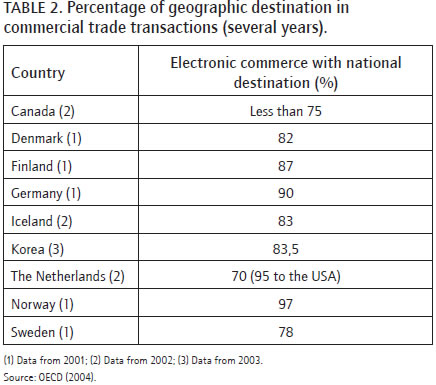
<body><![CDATA[<p>  The trade flows among countries-an expression of the productive   specialization of each territory-have been affected   by the new rules that are imposed by ICT. In fact, there is   much literature that has focused on their study in the relationship   between technological innovation and the export   activity of a national economy. The progressive installation   of an information and electronic communication system in companies is also affecting the intensity of the external   trade and the flows origin/destination of them (Canals,   2002). Specifically, we can group into three categories the   potential effects of Internet use on operations contracted   with international agents and the use of the possibilities   presented:</p> <ol type="1">       <p>    <li>ICT facilitates the companies export activity. The new   electronic systems allow the information and communication   costs to decrease and they make possible for   companies to carry out international activities from   practically the moment of their creation, thereby facilitating   the access to new markets and investors, and   the positioning in the market (L&oacute;pez, 2004). In the   same way, ICT allows entities of smaller relative size,   micro-companies with access possibilities to the net,   to develop external trade operations that were limited   to the big entities environment (Molero, 2005; Pl&aacute; &amp;   Cobos, 2002). Also, they permit small companies that   offer specialized products to be able to access to a critical   mass of consumers distributed all over the world   (Nieto, 2006).</li></p>     <p>    <li>The commercial operations development through the   Internet affects the competition forces (Porter, 1980,   1985) and contributes to an increase in the national   market activity, thereby allowing the entrance of new   offerors whose negotiation and contracting activities   can be carried out in the net. The Internet, according   with Banegas opinion (2003), reduces the purchases   costs, facilitates the search of more efficient competitors,   and reduces the transaction costs by means of   online applications. The market becomes more competitive,   with smaller margins, and the client service is improved,   which increases their loyalty and helps in the   search of other new clients.</li></p>     <p>    <li>Lastly, the information and electronic communication   systems make a dispersed localization production, distribution   and labor possible, favoring a decentralization   functions to strategically take advantage of the   comparative advantages offered by different territories,   which in turn affects the flows of intra-company   trade that take place between countries. Technological   information, particularly the exchange of electronic   information, plays an important role in the inputs administration.   The Internet facilitates the optimization   in a firm through its production program, makes communication   in real time between the different plants of   the company possible, and eliminates the flow of paper-   based information between them (Hill, 2001). It allows,   therefore, the transference -n a quicker and more   efficient way- of all the documentation needed to appropriately   coordinate the usual activities.</li></p>     </ol>       <p>  In accordance with the above, the Internet corporate use   has the capacity to speed up the development of each   one of the phases that make up a transaction (Schmid,   1995; Zbornik, 1996): the "information phase", in which   the information about the products and services characteristics   (prices, offers) is gathered; the "agreement phase",   in which parties negotiate to establish the terms of product   acquisition -it usually results in a contract (containing   the technical specifications of the product, delivery terms,   guarantees...); and, lastly, the "liquidation phase", where   the physical/virtual product delivery takes place (<a href="#f1">Figure  1</a>). A company can use the Internet to consent to the information,   know markets, competitors, and prices, to distribute   information, to promote themselves, or to sell their   products and services, so the potential client can contact   the entity and transmit directly their buy/sell orders.</p>     <p><a name="f1">&nbsp;</a></p>     ]]></body>
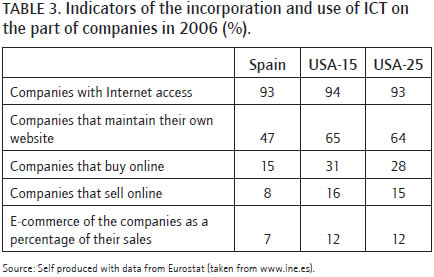
<body><![CDATA[<p>    <center><img src="/img/revistas/inno/v20n38/38a14f1.jpg"></center></p>     <p>Regarding the first and second phases, through the new   electronic channels such as the Internet, the exporter can   have within his reach a source of quicker and cheaper information   and, as well, an instrument for the promotion   and contact with clients or collaborators in any part of   the world (Jim&eacute;nez <i>et al.</i>, 2000; L&oacute;pez, 2004). Nowadays,   a great variety of public or semi-public websites exist on   Internet, created in order to foment and help companies   to take advantage of the opportunities offered by the Internet   in their internationalization process (<a href="/img/revistas/inno/v20n38/38a14t1.jpg" target="_blank">Table 1</a>). This   aspect is particularly attractive in the international transactions   environment since the external market represents   for companies a less well-known, more uncertain environment   than the national market, with more expensive and   less reliable competitors' information, commercial circuits,   demand characteristics, trademark regulations or logistics   (Alonso, 2005, p. 74). Different studies have shown a more   intensive use of e-mail and web pages on the exporting   companies than on other kind of companies, independent   of the variable of size (World Bank, 2006, p. 60; UNCTAD ,   2007, p. 31; European Commission, 2006, p. 64). In this   context, the ability that a company could have to take advantage   of the possibilities that the new technologies offer   and its attitude in face of them become decisive factors in the internationalization strategy.</p>     <p>  There exist different questions that affect the commercial   use of the new electronic systems as tools facilitating access   to new markets. The evidence shows that this application is not free from problems related to the lack of training   of the users or the existence of institutional and cultural   factors that affect its use, which is united to a perceived   insecurity in the transactions and the fact that access to   geographically dispersed markets can cause substantial increases   in administrative, marketing, logistical and, on occasion,   regulatory costs (OE CD, 2003; World Bank, 2006,   p. 68)<a href="#1" name="s1">&#91;1&#93;</a>. As a consequence, even among the companies of the developed countries where the e-commerce is part of   an integrated global strategy, most of them are focused on   online operations of a preferably local nature. According   to the INE (2007), in Spain, in 2007, the 87% of e-commerce   transactions were of a local nature. At the European   level, a report of the European Commission (2006) clearly   showed the rapid growth of electronic commerce among   the retailers of the UE, but also the preferably domestic   nature of these types of transactions (<a href="#t2">Table 2</a>): cross border sales   via the Internet only reached 14 percent of the total level   of sales carried out by this means<a href="#2" name="s2">&#91;2&#93;</a>. Some of the scarce references existing on the situation in other countries point   out the same (OE CD, 2004).</p>     <p><a name="t2">&nbsp;</a></p>     <p>    <center><img src="/img/revistas/inno/v20n38/38a14t2.jpg"></center></p>     <p>The presence of these barriers and the opportunity to assist   in overcoming them justifies the external trade promotion   organizations of ten different countries, namely Austrade   (Australia), Danish Trade Council (Denmark), EVD (The   Netherlands), Trade Council of Iceland (Iceland), ICE (Italy),   Trade New Zealand (New Zealand), Norwegian Trade   Council (Norway), ICEP (Portugal), ICEX (Spain), and Swedish   Trade Council (Sweden), participating in the creation   of the project <i>emarketservices</i>.com that offers knowledge   and information about the electronic markets of diverse   sectors in the whole world. Along these lines, the Association   of South East Asian Nations (ASEAN ) has started a   combined project of electronic commerce to help their ten   member countries to create and apply a harmonized legal infrastructure of electronic commerce (UNCTAD , 2008).</p>     <p>  The work of Humphrey <i>et al.</i> (2003) points out that, in the   case of developing countries, the expectations created by   the Internet as a tool able to facilitate access to new markets   are not being realized. After examining 180 marketplaces   based on using the Internet as a platform for the   online B2B operations of textile and horticultural products   exporters in those countries, it concluded that -although   the benefits related to having access to the best information   and the reduction of communication- costs were being   taking advantage of the generation of new business by using   the Internet was practically nonexistent. The main use   of this communication channel on the part of the studied companies was for sending and receiving electronic mail,   used primarily to exchange information with commercial   partners already existent prior to the creation of the virtual   platform (Humphrey <i>et al.</i>, 2003; World Bank, 2006).</p>     <p>  In this way, far from opening new markets, the Internet   was mainly helpful in improving the integration amongst   participants in the chain of traditional value. These results   do not differ in essence from other OECD studies (Desruelle   <i>et al.</i>, 2001, p. 6; Moodley, 2002), according to which,   in the B2B environment, signs of radical changes do not   exist in the ways in which companies develop their commercial   transactions and find new business. The report   of the United Nations (2003) also reaches similar conclusions,   when pointing out the lack of success in most of   the marketplaces created between 1990 and 2001 in the   coffee and tea sector in underdeveloped countries. In the   national environment, the study of the electronic B2B commerce   application by Spanish PYMEs, carried out by the   Spanish Association of Electronic Commerce (AECE, 2003,   p. 69), shows that -among the main benefits found by the   companies that carried out B2B transactions online- an   increase in clients/markets is listed in last place, being referred   to by only 1.4 percent of the companies.</p>     ]]></body>
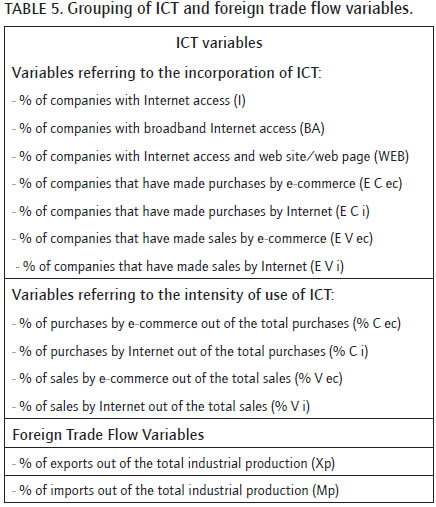
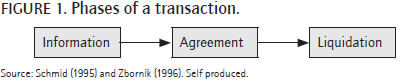
<body><![CDATA[<p>  The study of actual cases (Fern&aacute;ndez &amp; Nieto, 2006; Garc&iacute;a-   Canal <i>et al.</i>, 2007; Ueki <i>et al.</i>, 2005) allows us, however,   to identify strategic advantages associated with the   ICT use, understood as a platform of growth that can permit   the company to expand in markets abroad, to contract   with new partners and, even, to define new business   opportunities. The entity can capture possible clients   that before were simply not physically present, and which   could not have been found in another way. As well, the   prospect of immediate and continuous communication   with foreign associates or partners permits the administration   and efficient use of information, favoring the elimination   of certain barriers, as long as it allows the parties   to come closer together, contributing to the solution of   problems and the realization of business opportunities in   the international market.</p>     <p>&nbsp;</p>     <p><font size="3"><b>  Empirical analysis</b></font></p>     <p>  Starting from what was examined in the previous section,   we seek to investigate if some relationship really exists   between the external commercial activity of the Spanish   companies and their ICT level use in general, and of the Internet   in particular, with commercial goals. In short, keeping   in mind, firstly, the delay of Spain in the adoption and   use of the new technologies (<a href="#t3">Table 3</a>) and, secondly, the   existent differences in relation to the application and commercial   employment of ICT among the different Spanish industries (<a href="/img/revistas/inno/v20n38/38a14t4.jpg" target="_blank">Table 4</a>), we contrast the existence of a direct   relationship between the import/export activity carried   out by Spanish companies and their degree of incorporation   and use of ICT.</p>     <p><a name="t3">&nbsp;</a></p>     <p>    <center><img src="/img/revistas/inno/v20n38/38a14t3.jpg"></center></p>     <p>The verification of a significant relationship between the   use of ICT and the export activity carried out in the industrial   activities of the Spanish economy will allow us to   interpret appropriately the advantages derived from the   new technology, those being greater efficiency and/or   effectiveness in the use of the employed resources, and   which should result favorably in the sales of products in   foreign markets and, in consequence, in the possibilities   of growth for the national economy. In contrast, the lack   of a link would substantiate a scarce commercial application   and, therefore, the underutilization of the opportunities   offered by ICT. On the other hand, a parallel evolution   between the importation of industrial products and the incorporation   and use of ICT would imply complementarities   among these activities and, in a sense, indicate the use of   the Internet for contracting with foreign suppliers that offer   products at a better price or, perhaps, more adapted to the conditions of the intermediate or final demand.</p>     <p><a href="#t5">  Table 5</a> shows the variables used to approximate the incorporation   and use of ICT for the sectors of activity, in   accordance with the availability of statistical information   from the Survey of Use of ICT and Electronic Commerce in   the Company offered by the National Institute of Statistical   (INE ) since 2001, as well as the sectoral aggregation   carried out for the different types of industries comes by   way of said survey, as seen in <a href="/img/revistas/inno/v20n38/38a14t4.jpg" target="_blank">Table 4</a>. The statistical information   related to industrial production comes from the   Industrial Survey of Products of the INE . Additionally, the   database on foreign trade of the Chambers of Commerce, as well as the registry on said operations maintained by the   Spanish State Agency of Tributary Administration (AEAT),   allowed collecting data about the volume of exported and   imported products by National Classification of Economic   Activities (CNAE) sectors.</p>     <p><a name="t5">&nbsp;</a></p>     ]]></body>
<body><![CDATA[<p>    <center><img src="/img/revistas/inno/v20n38/38a14t5.jpg"></center></p>     <p>To learn the possible dependence among the referred variables,   we will use appropriate statistical techniques<a href="#3" name="s3">&#91;3&#93;</a> that   will facilitate a correct evaluation of the base information   and of the existent relationships, bearing in mind the impossibility   of carrying out a more complex analysis due to the scarce availability of information, which explains the small sample period (2001, 2003 2004, 2005, 2006<a href="#4" name="s4">&#91;4&#93;</a>) and the annual periodicity of the data.</p>     <p>  The data in <a href="/img/revistas/inno/v20n38/38a14t6.jpg" target="_blank">Table 6</a> showing the force of the lineal relationship   amongst the variables, allow the deduction of some   important correlations. We highlight the existent positive   linkage between the production volume that the sector   dedicates to external markets out of the totality of its   production (Xp) and the percentage of sales by electronic   commerce (% V ec) in a wide sense. A relationship that   ratifies the coefficient of correlation of Spearman indicates   that when the industry dedicates a larger percentage of its   production to the external market, the volume of sale operations   that the industry does via electronic increases. The   coefficients of Spearman, or for ranges, evidence a positive   effect between the propensity of the industry to export   and the number of companies with an Internet connection.   We must highlight that the positive relationship appears   when companies use the Internet to redefine their sale   processes using electronic commerce, without a possible   association perceived between the export activity of the   industry and the simple availability of ICT elements, such   as broadband, web pages, electronic systems for purchases   and sales, etc. The direct relationship appears when one   looks at the forms of e-commerce considered traditional,   such as EDI , Minitel or interactive telephone systems, but   not when one consider e-commerce developed exclusively   through the Internet (% V i).</p>     <p>  The existent correspondence between the export activity   of the different manufacturing activities considered and   the use of the new technologies in their business with foreign   clients does not imply a definite causal relationship   between them. In fact, a bidirectional relationship among   these variables must exist because the companies that operate   in international markets are more open to the innovation   and assimilation of new technologies to maintain   their position in the market, although ICT facilitates the   development of commercial operations with very geographically   distant clients/suppliers favoring the export   activity, as Freund &amp; Weinhold (2004) and Nieto &amp; Zulima   (2006) point. According tz &aacute;lvarez and Alonso (2003),   competition in the international market has a direct influence   on the development of innovative activities, favoring   the use of sophisticated commercialization systems   like the electronic commerce. The relationships maintained   with their commercial partners facilitate technological diffusion,   while at the same time benefiting from the learning   and knowledge developed abroad (Dehesa, 2000, p. 32).   Therefore we can onlo presume a relationship feedback between the export activitf in the sector and the use of   electronic commerce as an instrument to solidify commercial   operations with foreign clients<a href="#5" name="s5">&#91;5&#93;</a>.</p>     <p>  From the purchasing side, the correlation coefficients in   <a href="/img/revistas/inno/v20n38/38a14t7.jpg" target="_blank">Table 7</a> indicate a significant association between the relative   value of different industrial sectors imports and the   volume of sales via electronic commerce. This responds   fundamentally to the linkage that exists between the   permanency of Spanish companies in the international   markets as offerors and the probability that these same   companies import (Lucio <i>et al.</i>, p. 183). The accumulation of capacities and experiences bound to export operations   that favor the company to intervene as buyers in the international   market. In general, the relationship grows when   what is considered is the average propensity to import: A   larger percentage of business is carried out by e-commerce   when it is done by industries with a high propensity to import.   The industry's internationalization level, determined   by the volume of purchases reached in the international   markets, maintains a high correlation with the use of advanced   commercialization systems supported by the new   technologies. Apart from this, the differences among industries   are significant, as evidenced by the statistical information   in <a href="/img/revistas/inno/v20n38/38a14t4.jpg" target="_blank">Table 4 </a><a href="#6" name="s6">&#91;6&#93;</a>.</p>     <p>&nbsp;</p>     <p><font size="3"><b>Conclusions</b></font></p>     <p>  The analysis carried out in the preceding pages allows us   to bring to light crucial aspects related to the use of the Internet   and electronic commerce by the industrial sectors of   the Spanish economy that are involved in most of the real   exchanges with the exterior. The main results that come   out of this work are the following ones:</p>     <p>  The connection/disconnection level of companies and the   national productive systems to the global channels of communication   and information is indispensable in the face of   the new technological paradigm, although it does not determine,   according to the analysis carried out in the case of   the Spanish industry, whether the opportunities offered by   ICT in international operations are being taken advantage   of Spanish industrial companies show, in general, a growing   connection to the Internet by means of broadband and,   more and more, they value having a presence on the web.   However, those that negotiate by electronic means are a   small percentage, observing a relationship between the   incorporation of the Internet and the average propensity   to export. Therefore, as concluded by Garc&iacute;a-Canal <i>et al.</i>   (2007, p. 141), the mere existence of the resource does not   imply its efficient employment as an instrument of internationalization.  In this sense, one may consider as appropriate   the measures taken by different institutions with the objective of facilitating the extension and a greater application   of the ICT use amongst export companies.</p>     ]]></body>
<body><![CDATA[<p>  Those industries -where a large percentage of their production   is dedicated to foreign markets- are also those   that do a greater and greater volume of business via electronic   commerce, particularly through different communication   channels such as EDI , Minitel or the Internet. Of   interest, however, is the absence of this relationship when   one considers the electronic commerce carried out exclusively   through the Internet, in spite of a large majority of   companies have this communication channel. Everything   points to the broadly extended Internet as not having been   even able to displace the other traditional forms of electronic   commerce that, although more expensive, still enjoy   the trust derived from the possession of restricted access   and from the knowledge and familiarity of the parties to   said traditional forms. This aspect is especially attractive   for companies that operate in foreign markets.</p>     <p>  We noted linkages between the average propensity to import   of the industry and the volume of operations done   via electronic commerce. The most internationalized companies   that maintain habitual relationships with foreign   clients/suppliers apply more the new technologies to sell.</p>     <p>  The biggest difficulty borne by international as opposed   to national business results from certain attitudes and interests and, at the same time, of aptitudes and capacities   on the part of the management or the direction of the   company (Brouthers &amp; Nakos, 2005), summed up as an appropriate   training level, international experience, possibility   to assume risks, innovative effort, etc., all of which said   factors favor an appropriate exploitation of the opportunities   that ICT have as an instrument of internationalization.   In fact, the technological effort and the qualification   of the personnel are, on one hand, primary conditions for   the foreign success of Spanish companies (Donoso y Mart&iacute;n,   2008) and, on the other hand, decisive of the capacity   that the entity have to generate competitive advantages   associated with the use of the electronic channels of information   communication and commercialization.</p>     <p>  In any case, we should consider these results as an exploratory   analysis of the data. The scarce availability of statistical   information, the nonconsideration of those flows   of external commerce whose volume does not exceed the   statistical threshold established in the USA,<a href="#7" name="s7">&#91;7&#93;</a> and the short   sample period analyzed justifies the conclusions being interpreted   with caution. Therefore, the statements made   about the scarce application of ICT in the commercial activity   of Spanish industry should be pondered paying attention   to these considerations. In the long term, the virtual   mechanisms of trade will be an indispensable complement   for the development of the real flows of trade with foreign   clients/suppliers and the same dynamics of competition   will determine their use and exploitation.</p>     <p>  The results given by this work contributes only to constitute   indications of what happened in the recent past.   Nevertheless, they justify the necessity of more intensive   actions that increase the potential that the use of the new   electronic systems have in the promotion and international   commercialization of Spanish industrial production, especially   in the PYMEs' environment, given that their financial   and training limitations redound negatively in their capacity   as exporters.</p>     <p>&nbsp;</p>     <p><font size="3"><b>Pie de p&aacute;gina</b></font></p>     <p><a href="#s1" name="1">&#91;1&#93;</a> The European Commission (2006) has verified that in the retailing   sector, the principal barriers for cross border trade are the insecurity   of the transactions, the different national fiscal regulations and consumer protection.</p>     <p><a href="#s2" name="2">&#91;2&#93;</a> It is a significant fact that only one out of every two companies that carried out e-commerce and cross border transactions indicated   in this report that the Internet and e-commerce had made such   sales to the final customer much more interesting for the company (European Commission, 2006, p. 76).</p>     <p><a href="#s3" name="3">&#91;3&#93;</a> To check the possible linkage between the application and use of   ICTs and the export behavior of the different industries considered   between 2001 and 2006 requires contrasting the different relationships.   For this, once the values of the variables are known, the   correlation coefficients are calculated, as shown in <a href="/img/revistas/inno/v20n38/38a14t6.jpg" target="_blank">Table 6</a>. In the   upper part of the matrix, above the main diagonal, the coefficients   of correlation of Pearson are presented and in the lower part, below   the main diagonal, those of Spearman or for ranges. Each cell (ij)   of the matrix contains two values. The first one is the coefficient   of correlation rij between the variable Xi and Xj, and the second   is the p-value from the contrast at 95% whose null hypothesis is   p=0, with p being the true coefficient of populational correlation,   and whose alternative hypothesis is pâ‰ 0. Starting from this matrix,   one is able to draw conclusions about the dependence or independence   of the variables, quantifying the degree of same and its direction.</p>     ]]></body>
<body><![CDATA[<p><a href="#s4" name="4">&#91;4&#93;</a> 2002 was not included as the statistical information was not available in the following variables: % C ec, % C i, % V ec and % V i.</p>     <p><a href="#s5" name="5">&#91;5&#93;</a> In the interpretation of these results, we should also keep in mind   that the factor of company size is especially relevant when explaining   the export activity of the Spanish economy, because while the   big companies send more than 30% of their products to the foreign   market, the exports of the PYME s (see footnote 1) do not reach   10%. This explains why, in the opinion of Melle and Raymon (2001,   p. 91), PYME s are left behind by the entities with a worldwide presence.   In 2005, only 10 companies out of 77,300 made up 16.1% of   the total amount of exports of the Spanish economy. Therefore, the   larger companies that send a higher percentage of their production   to the international market would be those that, in addition, better   understand how to capitalize on the possibilities offered by ICT in their commercial activities.</p>     <p><a href="#s6" name="6">&#91;6&#93;</a> While the percentage of purchases by e-commerce surpassed 18%   and sales 16% in 2006 in the industry of "Machinery and mechanical   equipment, electronic equipment, electronics, optics, transport   materials and diverse manufacturing industries", the industry of   "Publishing, graphic arts and reproduction of recordings support" only reached 2.14% and 3.88%, respectively, in that year.</p>     <p><a href="#s7" name="7">&#91;7&#93;</a> This threshold increased to 200,000 euros in 2007, having increased progressively since 1993 (AEAT).</p>     <p>&nbsp;</p>     <p><font size="3"><b>References</b></font></p>     <!-- ref --><p>  Alonso, J.A. (2005). El proceso de internacionalizaci&oacute;n de la empresa:   algunas sugerencias para la pol&iacute;tica de promoci&oacute;n. En Icex, <i>Claves de la econom&iacute;a mundial 2005</i>. Madrid: Icex.    &nbsp;&nbsp;&nbsp;&nbsp;&nbsp;&nbsp;&nbsp;&nbsp;[&#160;<a href="javascript:void(0);" onclick="javascript: window.open('/scielo.php?script=sci_nlinks&ref=000109&pid=S0121-5051201000030001400001&lng=','','width=640,height=500,resizable=yes,scrollbars=1,menubar=yes,');">Links</a>&#160;]<!-- end-ref --></p>     <!-- ref --><p>  Ãlvarez, I. &amp; Alonso, J.A. (2003). Tecnolog&iacute;a, crecimiento y especializaci&oacute;n   en el comercio internacional. En Icex, <i>Claves de la econom&iacute;a mundial 2003</i> (pp. 57-64). Madrid: Icex.    &nbsp;&nbsp;&nbsp;&nbsp;&nbsp;&nbsp;&nbsp;&nbsp;[&#160;<a href="javascript:void(0);" onclick="javascript: window.open('/scielo.php?script=sci_nlinks&ref=000111&pid=S0121-5051201000030001400002&lng=','','width=640,height=500,resizable=yes,scrollbars=1,menubar=yes,');">Links</a>&#160;]<!-- end-ref --></p>     ]]></body>
<body><![CDATA[<!-- ref --><p>  Asociaci&oacute;n de Empresas de Electr&oacute;nica, Tecnolog&iacute;as de la Informaci&oacute;n   y Telecomunicaciones de Espa&ntilde;a (Aetic) &amp; DMR Consulting.   (2005). <i>Las tecnolog&iacute;as de la sociedad de la informaci&oacute;n en la empresa espa&ntilde;ola 2004</i>. Madrid: Aetic/DMR Consulting.    &nbsp;&nbsp;&nbsp;&nbsp;&nbsp;&nbsp;&nbsp;&nbsp;[&#160;<a href="javascript:void(0);" onclick="javascript: window.open('/scielo.php?script=sci_nlinks&ref=000113&pid=S0121-5051201000030001400003&lng=','','width=640,height=500,resizable=yes,scrollbars=1,menubar=yes,');">Links</a>&#160;]<!-- end-ref --></p>     <!-- ref --><p>Asociaci&oacute;n Espa&ntilde;ola de Comercio Electr&oacute;nico (AECE). (2005). <i>Estudio   sobre comercio electr&oacute;nico B2C 2005</i>. Recuperado de <a href="http://www.observatorio.red.es" target="_blank">http://www.observatorio.red.es</a>&nbsp;&nbsp;&nbsp;&nbsp;&nbsp;&nbsp;&nbsp;&nbsp;[&#160;<a href="javascript:void(0);" onclick="javascript: window.open('/scielo.php?script=sci_nlinks&ref=000115&pid=S0121-5051201000030001400004&lng=','','width=640,height=500,resizable=yes,scrollbars=1,menubar=yes,');">Links</a>&#160;]<!-- end-ref --><!-- ref --><p>  Asociaci&oacute;n Espa&ntilde;ola de Comercio Electr&oacute;nico (AECE). (2003). <i>Estudio   de la aplicaci&oacute;n del comercio electr&oacute;nico B2B en las PYMES en Espa&ntilde;a</i>. Recuperado de <a href="http://www.AECE.org" target="_blank">www.AECE.org</a>&nbsp;&nbsp;&nbsp;&nbsp;&nbsp;&nbsp;&nbsp;&nbsp;[&#160;<a href="javascript:void(0);" onclick="javascript: window.open('/scielo.php?script=sci_nlinks&ref=000116&pid=S0121-5051201000030001400005&lng=','','width=640,height=500,resizable=yes,scrollbars=1,menubar=yes,');">Links</a>&#160;]<!-- end-ref --><!-- ref --><p>  Bakos, J. Y. (1991). A strategic analysis of electronic market places. <i>Management Information Systems</i>, <i>15</i>(3), 295-310.    &nbsp;&nbsp;&nbsp;&nbsp;&nbsp;&nbsp;&nbsp;&nbsp;[&#160;<a href="javascript:void(0);" onclick="javascript: window.open('/scielo.php?script=sci_nlinks&ref=000117&pid=S0121-5051201000030001400006&lng=','','width=640,height=500,resizable=yes,scrollbars=1,menubar=yes,');">Links</a>&#160;]<!-- end-ref --></p>     <!-- ref --><p>  Banco Mundial. (2006). <i>Information and communications for development: Global trends and policies</i>. Washington, DC: World Bank.    &nbsp;&nbsp;&nbsp;&nbsp;&nbsp;&nbsp;&nbsp;&nbsp;[&#160;<a href="javascript:void(0);" onclick="javascript: window.open('/scielo.php?script=sci_nlinks&ref=000119&pid=S0121-5051201000030001400007&lng=','','width=640,height=500,resizable=yes,scrollbars=1,menubar=yes,');">Links</a>&#160;]<!-- end-ref --></p>     <!-- ref --><p>  Banegas, J. (2003). El significado de las nuevas tecnolog&iacute;as para el presente   y el futuro de la econom&iacute;a internacional. En Icex, <i>Claves de la econom&iacute;a Mundial 03</i>. Madrid: Icex.    &nbsp;&nbsp;&nbsp;&nbsp;&nbsp;&nbsp;&nbsp;&nbsp;[&#160;<a href="javascript:void(0);" onclick="javascript: window.open('/scielo.php?script=sci_nlinks&ref=000121&pid=S0121-5051201000030001400008&lng=','','width=640,height=500,resizable=yes,scrollbars=1,menubar=yes,');">Links</a>&#160;]<!-- end-ref --></p>     ]]></body>
<body><![CDATA[<!-- ref --><p>  Benjamin, R. I. &amp; Wigand, R. (1997). Electronic commerce: Effects on   electronic markets. <i>Journal of Computer Mediated Communication</i>, <i>1</i>(3). Recuperado de <a href="http://www.ascusc.org" target="_blank">http://www.ascusc.org</a>&nbsp;&nbsp;&nbsp;&nbsp;&nbsp;&nbsp;&nbsp;&nbsp;[&#160;<a href="javascript:void(0);" onclick="javascript: window.open('/scielo.php?script=sci_nlinks&ref=000123&pid=S0121-5051201000030001400009&lng=','','width=640,height=500,resizable=yes,scrollbars=1,menubar=yes,');">Links</a>&#160;]<!-- end-ref --><!-- ref --><p>  Benjamin, R. &amp; Wigand, R. (1995). Electronic markets and virtual value   chains on the information superhighway. <i>Sloan Management Review</i>, <i>36</i>(2), 62-72.    &nbsp;&nbsp;&nbsp;&nbsp;&nbsp;&nbsp;&nbsp;&nbsp;[&#160;<a href="javascript:void(0);" onclick="javascript: window.open('/scielo.php?script=sci_nlinks&ref=000124&pid=S0121-5051201000030001400010&lng=','','width=640,height=500,resizable=yes,scrollbars=1,menubar=yes,');">Links</a>&#160;]<!-- end-ref --></p>     <!-- ref --><p>  Bloch, M. &amp; Segev, A. (1996). <i>The impact of electronic commerce on   the travel industry</i>. The Fisher Center for Information Technology   and Management, Walter Haas School of Business, University of California.    &nbsp;&nbsp;&nbsp;&nbsp;&nbsp;&nbsp;&nbsp;&nbsp;[&#160;<a href="javascript:void(0);" onclick="javascript: window.open('/scielo.php?script=sci_nlinks&ref=000126&pid=S0121-5051201000030001400011&lng=','','width=640,height=500,resizable=yes,scrollbars=1,menubar=yes,');">Links</a>&#160;]<!-- end-ref --></p>     <!-- ref --><p>  Blum, B. S. &amp; Goldfarb, A. (2006). Does the internet defy the law of gravity? <i>Journal of International Economics</i>, <i>70</i>, 384-405.    &nbsp;&nbsp;&nbsp;&nbsp;&nbsp;&nbsp;&nbsp;&nbsp;[&#160;<a href="javascript:void(0);" onclick="javascript: window.open('/scielo.php?script=sci_nlinks&ref=000128&pid=S0121-5051201000030001400012&lng=','','width=640,height=500,resizable=yes,scrollbars=1,menubar=yes,');">Links</a>&#160;]<!-- end-ref --></p>     <!-- ref --><p>  Brouthers, L. E. &amp; Nakos, G. (2005). The role of systematic international   market selection on small firms export performance. <i>Journal of Small Business Management</i>, <i>43</i>(4), 363-381.    &nbsp;&nbsp;&nbsp;&nbsp;&nbsp;&nbsp;&nbsp;&nbsp;[&#160;<a href="javascript:void(0);" onclick="javascript: window.open('/scielo.php?script=sci_nlinks&ref=000130&pid=S0121-5051201000030001400013&lng=','','width=640,height=500,resizable=yes,scrollbars=1,menubar=yes,');">Links</a>&#160;]<!-- end-ref --></p>     <!-- ref --><p>  C&aacute;maras de Comercio. (2002). <i>La adaptaci&oacute;n de la empresa espa&ntilde;ola a la sociedad de la informaci&oacute;n</i>. Madrid: C&aacute;maras de Comercio.    &nbsp;&nbsp;&nbsp;&nbsp;&nbsp;&nbsp;&nbsp;&nbsp;[&#160;<a href="javascript:void(0);" onclick="javascript: window.open('/scielo.php?script=sci_nlinks&ref=000132&pid=S0121-5051201000030001400014&lng=','','width=640,height=500,resizable=yes,scrollbars=1,menubar=yes,');">Links</a>&#160;]<!-- end-ref --></p>     <!-- ref --><p>  Canals, J. (2002). La estrategia de la empresa en la era de Internet. Informaci&oacute;n comercial espa&ntilde;ola. <i>Revista de Econom&iacute;a</i>, <i>793</i>, 57-75.    &nbsp;&nbsp;&nbsp;&nbsp;&nbsp;&nbsp;&nbsp;&nbsp;[&#160;<a href="javascript:void(0);" onclick="javascript: window.open('/scielo.php?script=sci_nlinks&ref=000134&pid=S0121-5051201000030001400015&lng=','','width=640,height=500,resizable=yes,scrollbars=1,menubar=yes,');">Links</a>&#160;]<!-- end-ref --></p>     <!-- ref --><p>  Carr, N. G. (2004). <i>Does it Matter?</i> Boston: Harvard Business School Press.    &nbsp;&nbsp;&nbsp;&nbsp;&nbsp;&nbsp;&nbsp;&nbsp;[&#160;<a href="javascript:void(0);" onclick="javascript: window.open('/scielo.php?script=sci_nlinks&ref=000136&pid=S0121-5051201000030001400016&lng=','','width=640,height=500,resizable=yes,scrollbars=1,menubar=yes,');">Links</a>&#160;]<!-- end-ref --></p>     <!-- ref --><p>  Carrera, M. (1992). Factores tecnol&oacute;gicos en la explicaci&oacute;n del comercio.   Informaci&oacute;n comercial espa&ntilde;ola. <i>Revista de Econom&iacute;a</i>, <i>405</i>, 109-123.    &nbsp;&nbsp;&nbsp;&nbsp;&nbsp;&nbsp;&nbsp;&nbsp;[&#160;<a href="javascript:void(0);" onclick="javascript: window.open('/scielo.php?script=sci_nlinks&ref=000138&pid=S0121-5051201000030001400017&lng=','','width=640,height=500,resizable=yes,scrollbars=1,menubar=yes,');">Links</a>&#160;]<!-- end-ref --></p>     <!-- ref --><p> <i>Chambers of Commerce</i>. Recuperado de <a href="http://www.camaras.org" target="_blank">http://www.camaras.org</a>&nbsp;&nbsp;&nbsp;&nbsp;&nbsp;&nbsp;&nbsp;&nbsp;[&#160;<a href="javascript:void(0);" onclick="javascript: window.open('/scielo.php?script=sci_nlinks&ref=000140&pid=S0121-5051201000030001400018&lng=','','width=640,height=500,resizable=yes,scrollbars=1,menubar=yes,');">Links</a>&#160;]<!-- end-ref --><!-- ref --><p>  Comisi&oacute;n del Mercado de las Telecomunicaciones (several years). <i>Informe   sobre el comercio electr&oacute;nico en Espa&ntilde;a a trav&eacute;s de entidades de medios de pago</i>. Recuperado de <a href="http://www.cmt.es" target="_blank">http://www.cmt.es</a>&nbsp;&nbsp;&nbsp;&nbsp;&nbsp;&nbsp;&nbsp;&nbsp;[&#160;<a href="javascript:void(0);" onclick="javascript: window.open('/scielo.php?script=sci_nlinks&ref=000141&pid=S0121-5051201000030001400019&lng=','','width=640,height=500,resizable=yes,scrollbars=1,menubar=yes,');">Links</a>&#160;]<!-- end-ref --><!-- ref --><p>  Desruelle, P., Verhoest, P., Ducatel, K., Burgelman, J.C., Bogdanowicz,   M. &amp; Punie, A. (2001). <i>Techno-economic impact of e-commerce:   Future development of value chains</i>. Reports on a Workshop Held   at the Institute for Prospective Technological Studies, Report EUR   20123, Seville, European Commission Joint Research Centre (DG JRC).    &nbsp;&nbsp;&nbsp;&nbsp;&nbsp;&nbsp;&nbsp;&nbsp;[&#160;<a href="javascript:void(0);" onclick="javascript: window.open('/scielo.php?script=sci_nlinks&ref=000142&pid=S0121-5051201000030001400020&lng=','','width=640,height=500,resizable=yes,scrollbars=1,menubar=yes,');">Links</a>&#160;]<!-- end-ref --></p>     <!-- ref --><p>  Donoso, V. &amp; Mart&iacute;n, V. (2008). Caracter&iacute;sticas y comportamiento de la   empresa exportadora. <i>Papeles de Econom&iacute;a Espa&ntilde;ola</i>, <i>116</i>, 168-182.    &nbsp;&nbsp;&nbsp;&nbsp;&nbsp;&nbsp;&nbsp;&nbsp;[&#160;<a href="javascript:void(0);" onclick="javascript: window.open('/scielo.php?script=sci_nlinks&ref=000144&pid=S0121-5051201000030001400021&lng=','','width=640,height=500,resizable=yes,scrollbars=1,menubar=yes,');">Links</a>&#160;]<!-- end-ref --></p>     <!-- ref --><p>  Dyer, J. H. &amp; Singh, H. (1998). The relational view: Cooperative strategy   and sources of interorganizational competitive advantage. <i>Academy of Management Review</i>, <i>18</i>, 535-556.    &nbsp;&nbsp;&nbsp;&nbsp;&nbsp;&nbsp;&nbsp;&nbsp;[&#160;<a href="javascript:void(0);" onclick="javascript: window.open('/scielo.php?script=sci_nlinks&ref=000146&pid=S0121-5051201000030001400022&lng=','','width=640,height=500,resizable=yes,scrollbars=1,menubar=yes,');">Links</a>&#160;]<!-- end-ref --></p>     <!-- ref --><p>  Estrada, S., Heijs, J. &amp; Buesa, M. (2006). Innovaci&oacute;n y comercio internacional:   una relaci&oacute;n no lineal. Informaci&oacute;n Comercial Espa&ntilde;ola. <i>Revista de Econom&iacute;a</i>, <i>830</i>, 83-107.    &nbsp;&nbsp;&nbsp;&nbsp;&nbsp;&nbsp;&nbsp;&nbsp;[&#160;<a href="javascript:void(0);" onclick="javascript: window.open('/scielo.php?script=sci_nlinks&ref=000148&pid=S0121-5051201000030001400023&lng=','','width=640,height=500,resizable=yes,scrollbars=1,menubar=yes,');">Links</a>&#160;]<!-- end-ref --></p>     <!-- ref --><p>  European Commission (2006). Business attitudes towards cross-border   sales and consumer protection. <i>Eurobar&oacute;metro</i>, <i>186</i>.    &nbsp;&nbsp;&nbsp;&nbsp;&nbsp;&nbsp;&nbsp;&nbsp;[&#160;<a href="javascript:void(0);" onclick="javascript: window.open('/scielo.php?script=sci_nlinks&ref=000150&pid=S0121-5051201000030001400024&lng=','','width=640,height=500,resizable=yes,scrollbars=1,menubar=yes,');">Links</a>&#160;]<!-- end-ref --></p>     <!-- ref --><p>  Eurostat. (2005). <i>Information Society Statistics 2004</i>. European Commission.   Recuperado de <a href="http://epp.eurostat.cec.eu.int" target="_blank">http://epp.eurostat.cec.eu.int</a>&nbsp;&nbsp;&nbsp;&nbsp;&nbsp;&nbsp;&nbsp;&nbsp;[&#160;<a href="javascript:void(0);" onclick="javascript: window.open('/scielo.php?script=sci_nlinks&ref=000152&pid=S0121-5051201000030001400025&lng=','','width=640,height=500,resizable=yes,scrollbars=1,menubar=yes,');">Links</a>&#160;]<!-- end-ref --><!-- ref --><p>Evans, P. B. &amp; Wurster, T. S. (Sept.-Oct., 1997). Strategy and the new economics of information. <i>Harvard Business Review</i>, <i>75</i>(5), 71-82.    &nbsp;&nbsp;&nbsp;&nbsp;&nbsp;&nbsp;&nbsp;&nbsp;[&#160;<a href="javascript:void(0);" onclick="javascript: window.open('/scielo.php?script=sci_nlinks&ref=000153&pid=S0121-5051201000030001400026&lng=','','width=640,height=500,resizable=yes,scrollbars=1,menubar=yes,');">Links</a>&#160;]<!-- end-ref --></p>     <!-- ref --><p>  Fern&aacute;ndez, Z. &amp; Nieto, M. J. (2006). The Internet: competitive strategy   and boundaries of the firm. <i>International Journal of Technology Management</i>, <i>35</i>, 182-195.    &nbsp;&nbsp;&nbsp;&nbsp;&nbsp;&nbsp;&nbsp;&nbsp;[&#160;<a href="javascript:void(0);" onclick="javascript: window.open('/scielo.php?script=sci_nlinks&ref=000155&pid=S0121-5051201000030001400027&lng=','','width=640,height=500,resizable=yes,scrollbars=1,menubar=yes,');">Links</a>&#160;]<!-- end-ref --></p>     <!-- ref --><p>  Freeman, C. &amp; Soete, L. (1994). <i>Work for all or Mass Unemployment?</i>   London: Pinter Publishers. &#91;Versi&oacute;n espa&ntilde;ola de 1996, Cambio tecnol&oacute;gico y empleo, Fundaci&oacute;n Universidad-Empresa&#93;    &nbsp;&nbsp;&nbsp;&nbsp;&nbsp;&nbsp;&nbsp;&nbsp;[&#160;<a href="javascript:void(0);" onclick="javascript: window.open('/scielo.php?script=sci_nlinks&ref=000157&pid=S0121-5051201000030001400028&lng=','','width=640,height=500,resizable=yes,scrollbars=1,menubar=yes,');">Links</a>&#160;]<!-- end-ref -->.</p>     <!-- ref --><p>  Freund, C. L. &amp; Weinhold, D. (2004). The effect of Internet on international trade. <i>Journal International Economics</i>, <i>62</i>, 171-189.    &nbsp;&nbsp;&nbsp;&nbsp;&nbsp;&nbsp;&nbsp;&nbsp;[&#160;<a href="javascript:void(0);" onclick="javascript: window.open('/scielo.php?script=sci_nlinks&ref=000159&pid=S0121-5051201000030001400029&lng=','','width=640,height=500,resizable=yes,scrollbars=1,menubar=yes,');">Links</a>&#160;]<!-- end-ref --></p>     <!-- ref --><p>  Garc&iacute;a de los Salmones, M., Herrero Crespo, A. &amp; Rodr&iacute;guez del Bosque,   I. (enero-junio de 2006). Actuaci&oacute;n comercial, imagen y lealtad:   aplicaci&oacute;n al sector B2B de acceso a redes de telecomunicaciones. <i>Innovar</i>, <i>16</i>(27), 101-116.    &nbsp;&nbsp;&nbsp;&nbsp;&nbsp;&nbsp;&nbsp;&nbsp;[&#160;<a href="javascript:void(0);" onclick="javascript: window.open('/scielo.php?script=sci_nlinks&ref=000161&pid=S0121-5051201000030001400030&lng=','','width=640,height=500,resizable=yes,scrollbars=1,menubar=yes,');">Links</a>&#160;]<!-- end-ref --></p>     ]]></body>
<body><![CDATA[<!-- ref --><p>  Garc&iacute;a-Canal, E., Rialp-Criado, A. &amp; Rialp-Criado, J. (2007). Tecnolog&iacute;as   de la informaci&oacute;n y comunicaci&oacute;n (TIC) y crecimiento de la empresa.   Informaci&oacute;n Comercial Espa&ntilde;ola. <i>Revista de Econom&iacute;a</i>, <i>838</i>, 125-145.    &nbsp;&nbsp;&nbsp;&nbsp;&nbsp;&nbsp;&nbsp;&nbsp;[&#160;<a href="javascript:void(0);" onclick="javascript: window.open('/scielo.php?script=sci_nlinks&ref=000163&pid=S0121-5051201000030001400031&lng=','','width=640,height=500,resizable=yes,scrollbars=1,menubar=yes,');">Links</a>&#160;]<!-- end-ref --></p>     <!-- ref --><p>  Ghosh, S. (March-April, 1998). Making business sense of the Internet. <i>Harvard Business Review</i>, 126-135.    &nbsp;&nbsp;&nbsp;&nbsp;&nbsp;&nbsp;&nbsp;&nbsp;[&#160;<a href="javascript:void(0);" onclick="javascript: window.open('/scielo.php?script=sci_nlinks&ref=000165&pid=S0121-5051201000030001400032&lng=','','width=640,height=500,resizable=yes,scrollbars=1,menubar=yes,');">Links</a>&#160;]<!-- end-ref --></p>     <!-- ref --><p>  Gurteen, D. (1998). Knowledge, creativity and innovation. <i>Journal of Knowledge Management</i>, <i>2</i>(1), 5-13.    &nbsp;&nbsp;&nbsp;&nbsp;&nbsp;&nbsp;&nbsp;&nbsp;[&#160;<a href="javascript:void(0);" onclick="javascript: window.open('/scielo.php?script=sci_nlinks&ref=000167&pid=S0121-5051201000030001400033&lng=','','width=640,height=500,resizable=yes,scrollbars=1,menubar=yes,');">Links</a>&#160;]<!-- end-ref --></p>     <!-- ref --><p>  Gut&iacute;n, X. (2002). El factor tecnol&oacute;gico en los flujos comerciales internacionales:   evidencia emp&iacute;rica para los pa&iacute;ses industrializados de   la OCDE. Informaci&oacute;n Comercial Espa&ntilde;ola. <i>Revista de Econom&iacute;a</i>, <i>830</i>, 77-86.    &nbsp;&nbsp;&nbsp;&nbsp;&nbsp;&nbsp;&nbsp;&nbsp;[&#160;<a href="javascript:void(0);" onclick="javascript: window.open('/scielo.php?script=sci_nlinks&ref=000169&pid=S0121-5051201000030001400034&lng=','','width=640,height=500,resizable=yes,scrollbars=1,menubar=yes,');">Links</a>&#160;]<!-- end-ref --></p>     <!-- ref --><p>  Hill, C. W. (2001). <i>Negocios internacionales</i>. M&eacute;xico D.F.: McGraw-Hill.    &nbsp;&nbsp;&nbsp;&nbsp;&nbsp;&nbsp;&nbsp;&nbsp;[&#160;<a href="javascript:void(0);" onclick="javascript: window.open('/scielo.php?script=sci_nlinks&ref=000171&pid=S0121-5051201000030001400035&lng=','','width=640,height=500,resizable=yes,scrollbars=1,menubar=yes,');">Links</a>&#160;]<!-- end-ref --></p>     ]]></body>
<body><![CDATA[<!-- ref --><p>  Humphrey, J., Mansell, R., Par&eacute;, D. &amp; Schmitz, H. (2003). <i>The reality of   e-commerce with Developing Countries</i>. Institute of Development   Studies. Recuperado de <a href="http://www.gapresearch.org/production/Report.pdf" target="_blank">www.gapresearch.org/production/Report.pdf</a>&nbsp;&nbsp;&nbsp;&nbsp;&nbsp;&nbsp;&nbsp;&nbsp;[&#160;<a href="javascript:void(0);" onclick="javascript: window.open('/scielo.php?script=sci_nlinks&ref=000173&pid=S0121-5051201000030001400036&lng=','','width=640,height=500,resizable=yes,scrollbars=1,menubar=yes,');">Links</a>&#160;]<!-- end-ref --><!-- ref --><p>  Instituto Nacional de Estad&iacute;stica (INE). <i>Encuesta sobre el uso de TIC y comercio electr&oacute;nico en las empresas</i>. Recuperado de <a href="http://www.ine.es" target="_blank">http://www.ine.es</a>&nbsp;&nbsp;&nbsp;&nbsp;&nbsp;&nbsp;&nbsp;&nbsp;[&#160;<a href="javascript:void(0);" onclick="javascript: window.open('/scielo.php?script=sci_nlinks&ref=000174&pid=S0121-5051201000030001400037&lng=','','width=640,height=500,resizable=yes,scrollbars=1,menubar=yes,');">Links</a>&#160;]<!-- end-ref --><!-- ref --><p>  Instituto Nacional de Estad&iacute;stica (INE). <i>Encuesta industrial de productos</i>. Recuperado de <a href="http://www.ine.es" target="_blank">http://www.ine.es</a>&nbsp;&nbsp;&nbsp;&nbsp;&nbsp;&nbsp;&nbsp;&nbsp;[&#160;<a href="javascript:void(0);" onclick="javascript: window.open('/scielo.php?script=sci_nlinks&ref=000175&pid=S0121-5051201000030001400038&lng=','','width=640,height=500,resizable=yes,scrollbars=1,menubar=yes,');">Links</a>&#160;]<!-- end-ref --><!-- ref --><p>  Jim&eacute;nez, J. A., &aacute;guila, A. R. &amp; Padilla, A. (2000). Implicaciones estrat&eacute;gicas   del comercio electr&oacute;nico basado en Internet: modelos de negocios   y nuevos intermediarios. Informaci&oacute;n Comercial Espa&ntilde;ola. <i>Revista de Econom&iacute;a</i>, <i>783</i>, 63-78.    &nbsp;&nbsp;&nbsp;&nbsp;&nbsp;&nbsp;&nbsp;&nbsp;[&#160;<a href="javascript:void(0);" onclick="javascript: window.open('/scielo.php?script=sci_nlinks&ref=000176&pid=S0121-5051201000030001400039&lng=','','width=640,height=500,resizable=yes,scrollbars=1,menubar=yes,');">Links</a>&#160;]<!-- end-ref --></p>     <!-- ref --><p>  L&oacute;pez, A. (2004). Los mercados electr&oacute;nicos: un nuevo canal para la   internacionalizaci&oacute;n de la empresa. Informaci&oacute;n Comercial Espa&ntilde;ola. <i>Revista de Econom&iacute;a</i>, <i>813</i>, 115-139.    &nbsp;&nbsp;&nbsp;&nbsp;&nbsp;&nbsp;&nbsp;&nbsp;[&#160;<a href="javascript:void(0);" onclick="javascript: window.open('/scielo.php?script=sci_nlinks&ref=000178&pid=S0121-5051201000030001400040&lng=','','width=640,height=500,resizable=yes,scrollbars=1,menubar=yes,');">Links</a>&#160;]<!-- end-ref --></p>     <!-- ref --><p>  Lucio, J.J., Minguez, R., Valero, M. &amp; Mednik, G. (2008). Permanencia de   las empresas en la exportaci&oacute;n: una mirada a las caracter&iacute;sticas   de su actividad exterior. Informaci&oacute;n Comercial Espa&ntilde;ola. <i>Revista de Econom&iacute;a</i>, <i>840</i>, 179-195.    &nbsp;&nbsp;&nbsp;&nbsp;&nbsp;&nbsp;&nbsp;&nbsp;[&#160;<a href="javascript:void(0);" onclick="javascript: window.open('/scielo.php?script=sci_nlinks&ref=000180&pid=S0121-5051201000030001400041&lng=','','width=640,height=500,resizable=yes,scrollbars=1,menubar=yes,');">Links</a>&#160;]<!-- end-ref --></p>     <!-- ref --><p>  Malecki, E. J. &amp; Tootle, D. (1996). The role of networks in small firms   competitiveness. <i>International Journal of Technology Management</i>, <i>11</i>, 43-57.    &nbsp;&nbsp;&nbsp;&nbsp;&nbsp;&nbsp;&nbsp;&nbsp;[&#160;<a href="javascript:void(0);" onclick="javascript: window.open('/scielo.php?script=sci_nlinks&ref=000182&pid=S0121-5051201000030001400042&lng=','','width=640,height=500,resizable=yes,scrollbars=1,menubar=yes,');">Links</a>&#160;]<!-- end-ref --></p>     <!-- ref --><p>  Melle, M. &amp; Raymon, J. L. (2001). Competitividad internacional de las   PYME industriales espa&ntilde;olas. <i>Papeles de Econom&iacute;a Espa&ntilde;ola</i>, (89-90), 88-105.    &nbsp;&nbsp;&nbsp;&nbsp;&nbsp;&nbsp;&nbsp;&nbsp;[&#160;<a href="javascript:void(0);" onclick="javascript: window.open('/scielo.php?script=sci_nlinks&ref=000184&pid=S0121-5051201000030001400043&lng=','','width=640,height=500,resizable=yes,scrollbars=1,menubar=yes,');">Links</a>&#160;]<!-- end-ref --></p>     <!-- ref --><p>  M&eacute;ndez, R. (1997). <i>Geograf&iacute;a econ&oacute;mica. La l&oacute;gica espacial del capitalismo global</i>. Barcelona: Ariel.    &nbsp;&nbsp;&nbsp;&nbsp;&nbsp;&nbsp;&nbsp;&nbsp;[&#160;<a href="javascript:void(0);" onclick="javascript: window.open('/scielo.php?script=sci_nlinks&ref=000186&pid=S0121-5051201000030001400044&lng=','','width=640,height=500,resizable=yes,scrollbars=1,menubar=yes,');">Links</a>&#160;]<!-- end-ref --></p>     <!-- ref --><p>  Molero, J. (2005). Innovaci&oacute;n tecnol&oacute;gica e internacionalizaci&oacute;n. En <i>Claves de la econom&iacute;a Mundial 2005</i> (pp. 125-132). Madrid: Icex.    &nbsp;&nbsp;&nbsp;&nbsp;&nbsp;&nbsp;&nbsp;&nbsp;[&#160;<a href="javascript:void(0);" onclick="javascript: window.open('/scielo.php?script=sci_nlinks&ref=000188&pid=S0121-5051201000030001400045&lng=','','width=640,height=500,resizable=yes,scrollbars=1,menubar=yes,');">Links</a>&#160;]<!-- end-ref --></p>     <!-- ref --><p>  Moodley, S. (2002). <i>Competing in the digital economy: The dynamics   and impacts of B2B e-commerce on the South African manufacturing   sector</i>. Wider Discussion Paper, 2002/79, United Nations   University, Helsinki.    &nbsp;&nbsp;&nbsp;&nbsp;&nbsp;&nbsp;&nbsp;&nbsp;[&#160;<a href="javascript:void(0);" onclick="javascript: window.open('/scielo.php?script=sci_nlinks&ref=000190&pid=S0121-5051201000030001400046&lng=','','width=640,height=500,resizable=yes,scrollbars=1,menubar=yes,');">Links</a>&#160;]<!-- end-ref --></p>     <!-- ref --><p>  Nieto, M. J. &amp; Fern&aacute;ndez, Z. (2006). The role of information technology   in corporate strategy of small and medium enterprises. <i>Journal of International Entrepreneurship</i>, <i>3</i>, 251-263.    &nbsp;&nbsp;&nbsp;&nbsp;&nbsp;&nbsp;&nbsp;&nbsp;[&#160;<a href="javascript:void(0);" onclick="javascript: window.open('/scielo.php?script=sci_nlinks&ref=000192&pid=S0121-5051201000030001400047&lng=','','width=640,height=500,resizable=yes,scrollbars=1,menubar=yes,');">Links</a>&#160;]<!-- end-ref --></p>     <!-- ref --><p>  Nieto, M. J. (2006). Las TIC como impulsoras de la internacionalizaci&oacute;n   de la empresa. En Icex, <i>Claves de la econom&iacute;a Mundial 06</i>. Madrid: Icex.    &nbsp;&nbsp;&nbsp;&nbsp;&nbsp;&nbsp;&nbsp;&nbsp;[&#160;<a href="javascript:void(0);" onclick="javascript: window.open('/scielo.php?script=sci_nlinks&ref=000194&pid=S0121-5051201000030001400048&lng=','','width=640,height=500,resizable=yes,scrollbars=1,menubar=yes,');">Links</a>&#160;]<!-- end-ref --></p>     <!-- ref --><p>  OECD. (2003). <i>Electronic business networks. An assessment of the dynamics   of business-to-business electronic commerce in eleven  OECD countries</i>. A Summary Report on The e-Commerce Business   Impacts Project (EBIP), prepared by Pascal Verhoest (TNO-STB) and Graham Vickery (OECD). Recuperado de <a href="http://www.jrc.es" target="_blank">http://www.jrc.es</a>&nbsp;&nbsp;&nbsp;&nbsp;&nbsp;&nbsp;&nbsp;&nbsp;[&#160;<a href="javascript:void(0);" onclick="javascript: window.open('/scielo.php?script=sci_nlinks&ref=000196&pid=S0121-5051201000030001400049&lng=','','width=640,height=500,resizable=yes,scrollbars=1,menubar=yes,');">Links</a>&#160;]<!-- end-ref --><!-- ref --><p>  OECD. (2004). <i>OECD Information Technology Outlook</i>. Par&iacute;s: OECD.    &nbsp;&nbsp;&nbsp;&nbsp;&nbsp;&nbsp;&nbsp;&nbsp;[&#160;<a href="javascript:void(0);" onclick="javascript: window.open('/scielo.php?script=sci_nlinks&ref=000197&pid=S0121-5051201000030001400050&lng=','','width=640,height=500,resizable=yes,scrollbars=1,menubar=yes,');">Links</a>&#160;]<!-- end-ref --></p>     <!-- ref --><p>  Pl&aacute;, J. &amp; Cobos, A. (2002). La aceleraci&oacute;n del proceso de internacionalizaci&oacute;n   de la empresa: el caso de las new ventures internacionales   espa&ntilde;olas. Informaci&oacute;n Comercial Espa&ntilde;ola. <i>Revista de Econom&iacute;a</i>, <i>802</i>, 9-22.    &nbsp;&nbsp;&nbsp;&nbsp;&nbsp;&nbsp;&nbsp;&nbsp;[&#160;<a href="javascript:void(0);" onclick="javascript: window.open('/scielo.php?script=sci_nlinks&ref=000199&pid=S0121-5051201000030001400051&lng=','','width=640,height=500,resizable=yes,scrollbars=1,menubar=yes,');">Links</a>&#160;]<!-- end-ref --></p>     <!-- ref --><p>  Porter, M. E. &amp; Millar, V. E. (1985). How information gives you competitive advantage. <i>Harvard Business Review</i>, <i>64</i>(4), 149-160.    &nbsp;&nbsp;&nbsp;&nbsp;&nbsp;&nbsp;&nbsp;&nbsp;[&#160;<a href="javascript:void(0);" onclick="javascript: window.open('/scielo.php?script=sci_nlinks&ref=000201&pid=S0121-5051201000030001400052&lng=','','width=640,height=500,resizable=yes,scrollbars=1,menubar=yes,');">Links</a>&#160;]<!-- end-ref --></p>     ]]></body>
<body><![CDATA[<!-- ref --><p>  Porter, M. E. (1980). <i>Competitive strategy. Techniques for analyzing industries and competitors</i>. New York: The Free Press.    &nbsp;&nbsp;&nbsp;&nbsp;&nbsp;&nbsp;&nbsp;&nbsp;[&#160;<a href="javascript:void(0);" onclick="javascript: window.open('/scielo.php?script=sci_nlinks&ref=000203&pid=S0121-5051201000030001400053&lng=','','width=640,height=500,resizable=yes,scrollbars=1,menubar=yes,');">Links</a>&#160;]<!-- end-ref --></p>     <!-- ref --><p>  Porter, M. E. (1985). <i>Competitive advantage. Creating and sustaining superior performance</i>. New York: The Free Press.    &nbsp;&nbsp;&nbsp;&nbsp;&nbsp;&nbsp;&nbsp;&nbsp;[&#160;<a href="javascript:void(0);" onclick="javascript: window.open('/scielo.php?script=sci_nlinks&ref=000205&pid=S0121-5051201000030001400054&lng=','','width=640,height=500,resizable=yes,scrollbars=1,menubar=yes,');">Links</a>&#160;]<!-- end-ref --></p>     <!-- ref --><p>  Rayport, J. F. &amp; Sviokla, J. J. (1995). Exploiting the virtual value chain. <i>Harvard Business Review</i>, <i>73</i>(6), 75-85.    &nbsp;&nbsp;&nbsp;&nbsp;&nbsp;&nbsp;&nbsp;&nbsp;[&#160;<a href="javascript:void(0);" onclick="javascript: window.open('/scielo.php?script=sci_nlinks&ref=000207&pid=S0121-5051201000030001400055&lng=','','width=640,height=500,resizable=yes,scrollbars=1,menubar=yes,');">Links</a>&#160;]<!-- end-ref --></p>     <!-- ref --><p>  Schmid, B. (ed.) (1995). <i>Electronic mall: Banking and shopping in global</i> Netzen. Stuttgart: B. G. Teubner.    &nbsp;&nbsp;&nbsp;&nbsp;&nbsp;&nbsp;&nbsp;&nbsp;[&#160;<a href="javascript:void(0);" onclick="javascript: window.open('/scielo.php?script=sci_nlinks&ref=000209&pid=S0121-5051201000030001400056&lng=','','width=640,height=500,resizable=yes,scrollbars=1,menubar=yes,');">Links</a>&#160;]<!-- end-ref --></p>     <!-- ref --><p>  Shaw, S. A. &amp; Gibbs, J. (1995). Retailer-supplier relationships and the   evolution of marketing: two food industry case studies. International <i>Journal of Retail and Distribution Management</i>, <i>23</i>(7), 7-17.    &nbsp;&nbsp;&nbsp;&nbsp;&nbsp;&nbsp;&nbsp;&nbsp;[&#160;<a href="javascript:void(0);" onclick="javascript: window.open('/scielo.php?script=sci_nlinks&ref=000211&pid=S0121-5051201000030001400057&lng=','','width=640,height=500,resizable=yes,scrollbars=1,menubar=yes,');">Links</a>&#160;]<!-- end-ref --></p>     ]]></body>
<body><![CDATA[<!-- ref --><p>  Song, J. &amp; Zahedi, F. (1998). <i>Determinants of market strategies in electronic   markets</i>. Proceedings of Fourth Americas Conference on Information Systems. Baltimore, Maryland, August 14-16, 354-356.    &nbsp;&nbsp;&nbsp;&nbsp;&nbsp;&nbsp;&nbsp;&nbsp;[&#160;<a href="javascript:void(0);" onclick="javascript: window.open('/scielo.php?script=sci_nlinks&ref=000213&pid=S0121-5051201000030001400058&lng=','','width=640,height=500,resizable=yes,scrollbars=1,menubar=yes,');">Links</a>&#160;]<!-- end-ref --></p>     <!-- ref --><p>  Steinfeld, C., Kraut, R. &amp; Plummer, A. (1997). The impact of interorganizational   networks on buyer-seller relationships. <i>Journal of Computer Mediated Communications</i>, <i>1</i>(3). Recuperado de <a href="http://www.ascusc.org" target="_blank">http://www.ascusc.org</a>&nbsp;&nbsp;&nbsp;&nbsp;&nbsp;&nbsp;&nbsp;&nbsp;[&#160;<a href="javascript:void(0);" onclick="javascript: window.open('/scielo.php?script=sci_nlinks&ref=000215&pid=S0121-5051201000030001400059&lng=','','width=640,height=500,resizable=yes,scrollbars=1,menubar=yes,');">Links</a>&#160;]<!-- end-ref --><!-- ref --><p>  Strader, T. &amp; Shaw, M. J. (1997). Characteristic of electronic markets. <i>Decision Support Systems</i>, <i>21</i>, 185-198.    &nbsp;&nbsp;&nbsp;&nbsp;&nbsp;&nbsp;&nbsp;&nbsp;[&#160;<a href="javascript:void(0);" onclick="javascript: window.open('/scielo.php?script=sci_nlinks&ref=000216&pid=S0121-5051201000030001400060&lng=','','width=640,height=500,resizable=yes,scrollbars=1,menubar=yes,');">Links</a>&#160;]<!-- end-ref --></p>     <!-- ref --><p>  Ueki, Y., Tsuji, M. &amp; C&aacute;rcano, R. (2005). <i>Tecnolog&iacute;as de la informaci&oacute;n y   las comunicaciones (TIC) para el fomento de las PYME exportadoras en Am&eacute;rica Latina y Asia Oriental</i>. Santiago de Chile: Cepal.    &nbsp;&nbsp;&nbsp;&nbsp;&nbsp;&nbsp;&nbsp;&nbsp;[&#160;<a href="javascript:void(0);" onclick="javascript: window.open('/scielo.php?script=sci_nlinks&ref=000218&pid=S0121-5051201000030001400061&lng=','','width=640,height=500,resizable=yes,scrollbars=1,menubar=yes,');">Links</a>&#160;]<!-- end-ref --></p>     <!-- ref --><p>  United Nations. (2003). <i>E-Commerce and Development Report 2003</i>.   United Nations Conference on Trade and Development. New York and Geneva.    &nbsp;&nbsp;&nbsp;&nbsp;&nbsp;&nbsp;&nbsp;&nbsp;[&#160;<a href="javascript:void(0);" onclick="javascript: window.open('/scielo.php?script=sci_nlinks&ref=000220&pid=S0121-5051201000030001400062&lng=','','width=640,height=500,resizable=yes,scrollbars=1,menubar=yes,');">Links</a>&#160;]<!-- end-ref --></p>     <!-- ref --><p>  United Nations. (2004). E-Commerce and Development Report 2003.  United Nations Conference on Trade and Development. New York and Geneva.    &nbsp;&nbsp;&nbsp;&nbsp;&nbsp;&nbsp;&nbsp;&nbsp;[&#160;<a href="javascript:void(0);" onclick="javascript: window.open('/scielo.php?script=sci_nlinks&ref=000222&pid=S0121-5051201000030001400063&lng=','','width=640,height=500,resizable=yes,scrollbars=1,menubar=yes,');">Links</a>&#160;]<!-- end-ref --></p>     <!-- ref --><p>  United Nations. (2007). <i>Information Economy Report 2007-2008. Science   and Technology for development: the new paradigm of ICT</i>.   United Nations Conference on Trade and Development. New York and Geneva.    &nbsp;&nbsp;&nbsp;&nbsp;&nbsp;&nbsp;&nbsp;&nbsp;[&#160;<a href="javascript:void(0);" onclick="javascript: window.open('/scielo.php?script=sci_nlinks&ref=000224&pid=S0121-5051201000030001400064&lng=','','width=640,height=500,resizable=yes,scrollbars=1,menubar=yes,');">Links</a>&#160;]<!-- end-ref --></p>     <!-- ref --><p>  Zbornik, S. (1996). <i>Elektronische M&auml;rkte elektronische Hierarchien und   elektronische Netzwerke</i>. Konstanz: Universit&auml;tsverlag Konstanz.    &nbsp;&nbsp;&nbsp;&nbsp;&nbsp;&nbsp;&nbsp;&nbsp;[&#160;<a href="javascript:void(0);" onclick="javascript: window.open('/scielo.php?script=sci_nlinks&ref=000226&pid=S0121-5051201000030001400065&lng=','','width=640,height=500,resizable=yes,scrollbars=1,menubar=yes,');">Links</a>&#160;]<!-- end-ref --></p> </font>      ]]></body><back>
<ref-list>
<ref id="B1">
<nlm-citation citation-type="book">
<person-group person-group-type="author">
<name>
<surname><![CDATA[Alonso]]></surname>
<given-names><![CDATA[J.A]]></given-names>
</name>
</person-group>
<article-title xml:lang="es"><![CDATA[El proceso de internacionalización de la empresa: algunas sugerencias para la política de promoción]]></article-title>
<collab>Icex</collab>
<source><![CDATA[Claves de la economía mundial 2005]]></source>
<year>2005</year>
<publisher-loc><![CDATA[Madrid ]]></publisher-loc>
<publisher-name><![CDATA[Icex]]></publisher-name>
</nlm-citation>
</ref>
<ref id="B2">
<nlm-citation citation-type="book">
<person-group person-group-type="author">
<name>
<surname><![CDATA[álvarez]]></surname>
<given-names><![CDATA[I]]></given-names>
</name>
<name>
<surname><![CDATA[Alonso]]></surname>
<given-names><![CDATA[J.A]]></given-names>
</name>
</person-group>
<article-title xml:lang="es"><![CDATA[Tecnología, crecimiento y especialización en el comercio internacional]]></article-title>
<collab>Icex</collab>
<source><![CDATA[Claves de la economía mundial 2003]]></source>
<year>2003</year>
<page-range>57-64</page-range><publisher-loc><![CDATA[Madrid ]]></publisher-loc>
<publisher-name><![CDATA[Icex]]></publisher-name>
</nlm-citation>
</ref>
<ref id="B3">
<nlm-citation citation-type="book">
<collab>Asociación de Empresas de Electrónica, Tecnologías de la Información y Telecomunicaciones de España</collab>
<collab>DMR Consulting</collab>
<source><![CDATA[Las tecnologías de la sociedad de la información en la empresa española 2004]]></source>
<year>2005</year>
<publisher-loc><![CDATA[Madrid ]]></publisher-loc>
<publisher-name><![CDATA[Aetic/DMR Consulting]]></publisher-name>
</nlm-citation>
</ref>
<ref id="B4">
<nlm-citation citation-type="">
<collab>Asociación Española de Comercio Electrónico</collab>
<source><![CDATA[Estudio sobre comercio electrónico B2C 2005]]></source>
<year>2005</year>
</nlm-citation>
</ref>
<ref id="B5">
<nlm-citation citation-type="">
<collab>Asociación Española de Comercio Electrónico</collab>
<source><![CDATA[Estudio de la aplicación del comercio electrónico B2B en las PYMES en España]]></source>
<year>2003</year>
</nlm-citation>
</ref>
<ref id="B6">
<nlm-citation citation-type="journal">
<person-group person-group-type="author">
<name>
<surname><![CDATA[Bakos]]></surname>
<given-names><![CDATA[J. Y]]></given-names>
</name>
</person-group>
<article-title xml:lang="en"><![CDATA[A strategic analysis of electronic market places]]></article-title>
<source><![CDATA[Management Information Systems]]></source>
<year>1991</year>
<volume>15</volume>
<numero>3</numero>
<issue>3</issue>
<page-range>295-310</page-range></nlm-citation>
</ref>
<ref id="B7">
<nlm-citation citation-type="book">
<collab>Banco Mundial.</collab>
<source><![CDATA[Information and communications for development: Global trends and policies]]></source>
<year>2006</year>
<publisher-loc><![CDATA[Washington^eDC DC]]></publisher-loc>
<publisher-name><![CDATA[World Bank]]></publisher-name>
</nlm-citation>
</ref>
<ref id="B8">
<nlm-citation citation-type="book">
<person-group person-group-type="author">
<name>
<surname><![CDATA[Banegas]]></surname>
<given-names><![CDATA[J]]></given-names>
</name>
</person-group>
<article-title xml:lang="es"><![CDATA[El significado de las nuevas tecnologías para el presente y el futuro de la economía internacional]]></article-title>
<collab>Icex</collab>
<source><![CDATA[Claves de la economía Mundial]]></source>
<year>2003</year>
<volume>03</volume>
<publisher-loc><![CDATA[Madrid ]]></publisher-loc>
<publisher-name><![CDATA[Icex]]></publisher-name>
</nlm-citation>
</ref>
<ref id="B9">
<nlm-citation citation-type="journal">
<person-group person-group-type="author">
<name>
<surname><![CDATA[Benjamin]]></surname>
<given-names><![CDATA[R. I]]></given-names>
</name>
<name>
<surname><![CDATA[Wigand]]></surname>
<given-names><![CDATA[R]]></given-names>
</name>
</person-group>
<article-title xml:lang="en"><![CDATA[Electronic commerce: Effects on electronic markets]]></article-title>
<source><![CDATA[Journal of Computer Mediated Communication]]></source>
<year>1997</year>
<volume>1</volume>
<numero>3</numero>
<issue>3</issue>
</nlm-citation>
</ref>
<ref id="B10">
<nlm-citation citation-type="journal">
<person-group person-group-type="author">
<name>
<surname><![CDATA[Benjamin]]></surname>
<given-names><![CDATA[R]]></given-names>
</name>
<name>
<surname><![CDATA[Wigand]]></surname>
<given-names><![CDATA[R]]></given-names>
</name>
</person-group>
<article-title xml:lang="en"><![CDATA[Electronic markets and virtual value chains on the information superhighway]]></article-title>
<source><![CDATA[Sloan Management Review]]></source>
<year>1995</year>
<volume>36</volume>
<numero>2</numero>
<issue>2</issue>
<page-range>62-72</page-range></nlm-citation>
</ref>
<ref id="B11">
<nlm-citation citation-type="book">
<person-group person-group-type="author">
<name>
<surname><![CDATA[Bloch]]></surname>
<given-names><![CDATA[M]]></given-names>
</name>
<name>
<surname><![CDATA[Segev]]></surname>
<given-names><![CDATA[A]]></given-names>
</name>
</person-group>
<source><![CDATA[The impact of electronic commerce on the travel industry]]></source>
<year>1996</year>
<publisher-name><![CDATA[The Fisher Center for Information Technology and Management, Walter Haas School of Business, University of California]]></publisher-name>
</nlm-citation>
</ref>
<ref id="B12">
<nlm-citation citation-type="journal">
<person-group person-group-type="author">
<name>
<surname><![CDATA[Blum]]></surname>
<given-names><![CDATA[B. S]]></given-names>
</name>
<name>
<surname><![CDATA[Goldfarb]]></surname>
<given-names><![CDATA[A]]></given-names>
</name>
</person-group>
<article-title xml:lang="en"><![CDATA[Does the internet defy the law of gravity?]]></article-title>
<source><![CDATA[Journal of International Economics]]></source>
<year>2006</year>
<volume>70</volume>
<page-range>384-405</page-range></nlm-citation>
</ref>
<ref id="B13">
<nlm-citation citation-type="journal">
<person-group person-group-type="author">
<name>
<surname><![CDATA[Brouthers]]></surname>
<given-names><![CDATA[L. E]]></given-names>
</name>
<name>
<surname><![CDATA[Nakos]]></surname>
<given-names><![CDATA[G]]></given-names>
</name>
</person-group>
<article-title xml:lang="en"><![CDATA[The role of systematic international market selection on small firms export performance]]></article-title>
<source><![CDATA[Journal of Small Business Management]]></source>
<year>2005</year>
<volume>43</volume>
<numero>4</numero>
<issue>4</issue>
<page-range>363-381</page-range></nlm-citation>
</ref>
<ref id="B14">
<nlm-citation citation-type="book">
<collab>Cámaras de Comercio.</collab>
<source><![CDATA[La adaptación de la empresa española a la sociedad de la información]]></source>
<year>2002</year>
<publisher-loc><![CDATA[Madrid ]]></publisher-loc>
<publisher-name><![CDATA[Cámaras de Comercio]]></publisher-name>
</nlm-citation>
</ref>
<ref id="B15">
<nlm-citation citation-type="journal">
<person-group person-group-type="author">
<name>
<surname><![CDATA[Canals]]></surname>
<given-names><![CDATA[J]]></given-names>
</name>
</person-group>
<article-title xml:lang="es"><![CDATA[La estrategia de la empresa en la era de Internet: Información comercial española]]></article-title>
<source><![CDATA[Revista de Economía]]></source>
<year>2002</year>
<volume>793</volume>
<page-range>57-75</page-range></nlm-citation>
</ref>
<ref id="B16">
<nlm-citation citation-type="book">
<person-group person-group-type="author">
<name>
<surname><![CDATA[Carr]]></surname>
<given-names><![CDATA[N. G]]></given-names>
</name>
</person-group>
<source><![CDATA[Does it Matter?]]></source>
<year>2004</year>
<publisher-loc><![CDATA[Boston ]]></publisher-loc>
<publisher-name><![CDATA[Harvard Business School Press]]></publisher-name>
</nlm-citation>
</ref>
<ref id="B17">
<nlm-citation citation-type="journal">
<person-group person-group-type="author">
<name>
<surname><![CDATA[Carrera]]></surname>
<given-names><![CDATA[M]]></given-names>
</name>
</person-group>
<article-title xml:lang="es"><![CDATA[Factores tecnológicos en la explicación del comercio]]></article-title>
<source><![CDATA[Información comercial española. Revista de Economía]]></source>
<year>1992</year>
<volume>405</volume>
<page-range>109-123</page-range></nlm-citation>
</ref>
<ref id="B18">
<nlm-citation citation-type="">
<source><![CDATA[Chambers of Commerce]]></source>
<year></year>
</nlm-citation>
</ref>
<ref id="B19">
<nlm-citation citation-type="">
<collab>Comisión del Mercado de las Telecomunicaciones</collab>
<source><![CDATA[Informe sobre el comercio electrónico en España a través de entidades de medios de pago]]></source>
<year></year>
</nlm-citation>
</ref>
<ref id="B20">
<nlm-citation citation-type="book">
<person-group person-group-type="author">
<name>
<surname><![CDATA[Desruelle]]></surname>
<given-names><![CDATA[P]]></given-names>
</name>
<name>
<surname><![CDATA[Verhoest]]></surname>
<given-names><![CDATA[P]]></given-names>
</name>
<name>
<surname><![CDATA[Ducatel]]></surname>
<given-names><![CDATA[K]]></given-names>
</name>
<name>
<surname><![CDATA[Burgelman]]></surname>
<given-names><![CDATA[J.C]]></given-names>
</name>
<name>
<surname><![CDATA[Bogdanowicz]]></surname>
<given-names><![CDATA[M]]></given-names>
</name>
<name>
<surname><![CDATA[Punie]]></surname>
<given-names><![CDATA[A]]></given-names>
</name>
</person-group>
<source><![CDATA[Techno-economic impact of e-commerce: Future development of value chains]]></source>
<year>2001</year>
<volume>EUR 20123</volume>
<publisher-loc><![CDATA[Seville ]]></publisher-loc>
<publisher-name><![CDATA[European Commission Joint Research Centre (DGJRC)]]></publisher-name>
</nlm-citation>
</ref>
<ref id="B21">
<nlm-citation citation-type="journal">
<person-group person-group-type="author">
<name>
<surname><![CDATA[Donoso]]></surname>
<given-names><![CDATA[V]]></given-names>
</name>
<name>
<surname><![CDATA[Martín]]></surname>
<given-names><![CDATA[V]]></given-names>
</name>
</person-group>
<article-title xml:lang="es"><![CDATA[Características y comportamiento de la empresa exportadora]]></article-title>
<source><![CDATA[Papeles de Economía Española]]></source>
<year>2008</year>
<volume>116</volume>
<page-range>168-182</page-range></nlm-citation>
</ref>
<ref id="B22">
<nlm-citation citation-type="journal">
<person-group person-group-type="author">
<name>
<surname><![CDATA[Dyer]]></surname>
<given-names><![CDATA[J. H]]></given-names>
</name>
<name>
<surname><![CDATA[Singh]]></surname>
<given-names><![CDATA[H]]></given-names>
</name>
</person-group>
<article-title xml:lang="en"><![CDATA[The relational view: Cooperative strategy and sources of interorganizational competitive advantage]]></article-title>
<source><![CDATA[Academy of Management Review]]></source>
<year>1998</year>
<volume>18</volume>
<page-range>535-556</page-range></nlm-citation>
</ref>
<ref id="B23">
<nlm-citation citation-type="journal">
<person-group person-group-type="author">
<name>
<surname><![CDATA[Estrada]]></surname>
<given-names><![CDATA[S]]></given-names>
</name>
<name>
<surname><![CDATA[Heijs]]></surname>
<given-names><![CDATA[J]]></given-names>
</name>
<name>
<surname><![CDATA[Buesa]]></surname>
<given-names><![CDATA[M]]></given-names>
</name>
</person-group>
<article-title xml:lang="es"><![CDATA[Innovación y comercio internacional: una relación no lineal. Información Comercial Española]]></article-title>
<source><![CDATA[Revista de Economía]]></source>
<year>2006</year>
<volume>830</volume>
<page-range>83-107</page-range></nlm-citation>
</ref>
<ref id="B24">
<nlm-citation citation-type="journal">
<collab>European Commission</collab>
<article-title xml:lang="en"><![CDATA[Business attitudes towards cross-border sales and consumer protection]]></article-title>
<source><![CDATA[Eurobarómetro]]></source>
<year>2006</year>
<volume>186</volume>
</nlm-citation>
</ref>
<ref id="B25">
<nlm-citation citation-type="book">
<collab>Eurostat.</collab>
<source><![CDATA[Information Society Statistics 2004]]></source>
<year>2005</year>
<publisher-name><![CDATA[European Commission]]></publisher-name>
</nlm-citation>
</ref>
<ref id="B26">
<nlm-citation citation-type="journal">
<person-group person-group-type="author">
<name>
<surname><![CDATA[Evans]]></surname>
<given-names><![CDATA[P. B]]></given-names>
</name>
<name>
<surname><![CDATA[Wurster]]></surname>
<given-names><![CDATA[T. S]]></given-names>
</name>
</person-group>
<article-title xml:lang="en"><![CDATA[Strategy and the new economics of information]]></article-title>
<source><![CDATA[Harvard Business Review]]></source>
<year>Sept</year>
<month>.-</month>
<day>Oc</day>
<volume>75</volume>
<numero>5</numero>
<issue>5</issue>
<page-range>71-82</page-range></nlm-citation>
</ref>
<ref id="B27">
<nlm-citation citation-type="journal">
<person-group person-group-type="author">
<name>
<surname><![CDATA[Fernández]]></surname>
<given-names><![CDATA[Z]]></given-names>
</name>
<name>
<surname><![CDATA[Nieto]]></surname>
<given-names><![CDATA[M. J]]></given-names>
</name>
</person-group>
<article-title xml:lang="en"><![CDATA[The Internet: competitive strategy and boundaries of the firm]]></article-title>
<source><![CDATA[International Journal of Technology Management]]></source>
<year>2006</year>
<volume>35</volume>
<page-range>182-195</page-range></nlm-citation>
</ref>
<ref id="B28">
<nlm-citation citation-type="book">
<person-group person-group-type="author">
<name>
<surname><![CDATA[Freeman]]></surname>
<given-names><![CDATA[C]]></given-names>
</name>
<name>
<surname><![CDATA[Soete]]></surname>
<given-names><![CDATA[L]]></given-names>
</name>
</person-group>
<source><![CDATA[Work for all or Mass Unemployment?]]></source>
<year>1994</year>
<publisher-loc><![CDATA[London ]]></publisher-loc>
<publisher-name><![CDATA[Pinter Publishers]]></publisher-name>
</nlm-citation>
</ref>
<ref id="B29">
<nlm-citation citation-type="journal">
<person-group person-group-type="author">
<name>
<surname><![CDATA[Freund]]></surname>
<given-names><![CDATA[C. L]]></given-names>
</name>
<name>
<surname><![CDATA[Weinhold]]></surname>
<given-names><![CDATA[D]]></given-names>
</name>
</person-group>
<article-title xml:lang="en"><![CDATA[The effect of Internet on international trade]]></article-title>
<source><![CDATA[Journal International Economics]]></source>
<year>2004</year>
<volume>62</volume>
<page-range>171-189</page-range></nlm-citation>
</ref>
<ref id="B30">
<nlm-citation citation-type="journal">
<person-group person-group-type="author">
<name>
<surname><![CDATA[García de los Salmones]]></surname>
<given-names><![CDATA[M]]></given-names>
</name>
<name>
<surname><![CDATA[Herrero Crespo]]></surname>
<given-names><![CDATA[A]]></given-names>
</name>
<name>
<surname><![CDATA[Rodríguez del Bosque]]></surname>
<given-names><![CDATA[I]]></given-names>
</name>
</person-group>
<article-title xml:lang="es"><![CDATA[Actuación comercial, imagen y lealtad: aplicación al sector B2B de acceso a redes de telecomunicaciones]]></article-title>
<source><![CDATA[Innovar]]></source>
<year>ener</year>
<month>o-</month>
<day>ju</day>
<volume>16</volume>
<numero>27</numero>
<issue>27</issue>
<page-range>101-116</page-range></nlm-citation>
</ref>
<ref id="B31">
<nlm-citation citation-type="journal">
<person-group person-group-type="author">
<name>
<surname><![CDATA[García-Canal]]></surname>
<given-names><![CDATA[E]]></given-names>
</name>
<name>
<surname><![CDATA[Rialp-Criado]]></surname>
<given-names><![CDATA[A]]></given-names>
</name>
<name>
<surname><![CDATA[Rialp-Criado]]></surname>
<given-names><![CDATA[J]]></given-names>
</name>
</person-group>
<article-title xml:lang="es"><![CDATA[Tecnologías de la información y comunicación (TIC) y crecimiento de la empresa]]></article-title>
<source><![CDATA[Información Comercial Española. Revista de Economía]]></source>
<year>2007</year>
<volume>838</volume>
<page-range>125-145</page-range></nlm-citation>
</ref>
<ref id="B32">
<nlm-citation citation-type="journal">
<person-group person-group-type="author">
<name>
<surname><![CDATA[Ghosh]]></surname>
<given-names><![CDATA[S]]></given-names>
</name>
</person-group>
<article-title xml:lang="en"><![CDATA[Making business sense of the Internet]]></article-title>
<source><![CDATA[Harvard Business Review]]></source>
<year>Marc</year>
<month>h-</month>
<day>Ap</day>
<page-range>126-135</page-range></nlm-citation>
</ref>
<ref id="B33">
<nlm-citation citation-type="journal">
<person-group person-group-type="author">
<name>
<surname><![CDATA[Gurteen]]></surname>
<given-names><![CDATA[D]]></given-names>
</name>
</person-group>
<article-title xml:lang="en"><![CDATA[Knowledge, creativity and innovation]]></article-title>
<source><![CDATA[Journal of Knowledge Management]]></source>
<year>1998</year>
<volume>2</volume>
<numero>1</numero>
<issue>1</issue>
<page-range>5-13</page-range></nlm-citation>
</ref>
<ref id="B34">
<nlm-citation citation-type="journal">
<person-group person-group-type="author">
<name>
<surname><![CDATA[Gutín]]></surname>
<given-names><![CDATA[X]]></given-names>
</name>
</person-group>
<article-title xml:lang="es"><![CDATA[El factor tecnológico en los flujos comerciales internacionales: evidencia empírica para los países industrializados de la OCDE]]></article-title>
<source><![CDATA[Revista de Economía]]></source>
<year>2002</year>
<volume>830</volume>
<page-range>77-86</page-range></nlm-citation>
</ref>
<ref id="B35">
<nlm-citation citation-type="book">
<person-group person-group-type="author">
<name>
<surname><![CDATA[Hill]]></surname>
<given-names><![CDATA[C. W]]></given-names>
</name>
</person-group>
<source><![CDATA[Negocios internacionales]]></source>
<year>2001</year>
<publisher-loc><![CDATA[México D.F. ]]></publisher-loc>
<publisher-name><![CDATA[McGraw-Hill]]></publisher-name>
</nlm-citation>
</ref>
<ref id="B36">
<nlm-citation citation-type="">
<person-group person-group-type="author">
<name>
<surname><![CDATA[Humphrey]]></surname>
<given-names><![CDATA[J]]></given-names>
</name>
<name>
<surname><![CDATA[Mansell]]></surname>
<given-names><![CDATA[R]]></given-names>
</name>
<name>
<surname><![CDATA[Paré]]></surname>
<given-names><![CDATA[D]]></given-names>
</name>
<name>
<surname><![CDATA[Schmitz]]></surname>
<given-names><![CDATA[H]]></given-names>
</name>
</person-group>
<source><![CDATA[The reality of e-commerce with Developing Countries: Institute of Development Studies]]></source>
<year>2003</year>
</nlm-citation>
</ref>
<ref id="B37">
<nlm-citation citation-type="book">
<collab>Instituto Nacional de Estadística</collab>
<source><![CDATA[Encuesta sobre el uso de TIC y comercio electrónico en las empresas]]></source>
<year></year>
<publisher-name><![CDATA[Recuperado de http://www.ine.es]]></publisher-name>
</nlm-citation>
</ref>
<ref id="B38">
<nlm-citation citation-type="">
<collab>Instituto Nacional de Estadística</collab>
<source><![CDATA[Encuesta industrial de productos]]></source>
<year></year>
</nlm-citation>
</ref>
<ref id="B39">
<nlm-citation citation-type="journal">
<person-group person-group-type="author">
<name>
<surname><![CDATA[Jiménez]]></surname>
<given-names><![CDATA[J. A]]></given-names>
</name>
<name>
<surname><![CDATA[águila]]></surname>
<given-names><![CDATA[A. R]]></given-names>
</name>
<name>
<surname><![CDATA[Padilla]]></surname>
<given-names><![CDATA[A]]></given-names>
</name>
</person-group>
<article-title xml:lang="es"><![CDATA[Implicaciones estratégicas del comercio electrónico basado en Internet: modelos de negocios y nuevos intermediarios]]></article-title>
<source><![CDATA[Revista de Economía]]></source>
<year>2000</year>
<volume>783</volume>
<page-range>63-78</page-range></nlm-citation>
</ref>
<ref id="B40">
<nlm-citation citation-type="journal">
<person-group person-group-type="author">
<name>
<surname><![CDATA[López]]></surname>
<given-names><![CDATA[A]]></given-names>
</name>
</person-group>
<article-title xml:lang="es"><![CDATA[Los mercados electrónicos: un nuevo canal para la internacionalización de la empresa]]></article-title>
<source><![CDATA[Revista de Economía]]></source>
<year>2004</year>
<volume>813</volume>
<page-range>115-139</page-range></nlm-citation>
</ref>
<ref id="B41">
<nlm-citation citation-type="journal">
<person-group person-group-type="author">
<name>
<surname><![CDATA[Lucio]]></surname>
<given-names><![CDATA[J. J]]></given-names>
</name>
<name>
<surname><![CDATA[Minguez]]></surname>
<given-names><![CDATA[R]]></given-names>
</name>
<name>
<surname><![CDATA[Valero]]></surname>
<given-names><![CDATA[M]]></given-names>
</name>
<name>
<surname><![CDATA[Mednik]]></surname>
<given-names><![CDATA[G]]></given-names>
</name>
</person-group>
<article-title xml:lang="es"><![CDATA[Permanencia de las empresas en la exportación: una mirada a las características de su actividad exterior]]></article-title>
<source><![CDATA[Revista de Economía]]></source>
<year>2008</year>
<volume>840</volume>
<page-range>179-195</page-range></nlm-citation>
</ref>
<ref id="B42">
<nlm-citation citation-type="journal">
<person-group person-group-type="author">
<name>
<surname><![CDATA[Malecki]]></surname>
<given-names><![CDATA[E. J]]></given-names>
</name>
<name>
<surname><![CDATA[Tootle]]></surname>
<given-names><![CDATA[D]]></given-names>
</name>
</person-group>
<article-title xml:lang="en"><![CDATA[The role of networks in small firms competitiveness]]></article-title>
<source><![CDATA[International Journal of Technology Management]]></source>
<year>1996</year>
<volume>11</volume>
<page-range>43-57</page-range></nlm-citation>
</ref>
<ref id="B43">
<nlm-citation citation-type="journal">
<person-group person-group-type="author">
<name>
<surname><![CDATA[Melle]]></surname>
<given-names><![CDATA[M]]></given-names>
</name>
<name>
<surname><![CDATA[Raymon]]></surname>
<given-names><![CDATA[J. L]]></given-names>
</name>
</person-group>
<article-title xml:lang="es"><![CDATA[Competitividad internacional de las PYME industriales españolas]]></article-title>
<source><![CDATA[Papeles de Economía Española]]></source>
<year>2001</year>
<volume>(89-90)</volume>
<page-range>88-105</page-range></nlm-citation>
</ref>
<ref id="B44">
<nlm-citation citation-type="book">
<person-group person-group-type="author">
<name>
<surname><![CDATA[Méndez]]></surname>
<given-names><![CDATA[R]]></given-names>
</name>
</person-group>
<source><![CDATA[Geografía económica: La lógica espacial del capitalismo global]]></source>
<year>1997</year>
<publisher-loc><![CDATA[Barcelona ]]></publisher-loc>
<publisher-name><![CDATA[Ariel]]></publisher-name>
</nlm-citation>
</ref>
<ref id="B45">
<nlm-citation citation-type="book">
<person-group person-group-type="author">
<name>
<surname><![CDATA[Molero]]></surname>
<given-names><![CDATA[J]]></given-names>
</name>
</person-group>
<article-title xml:lang="es"><![CDATA[Innovación tecnológica e internacionalización]]></article-title>
<source><![CDATA[Claves de la economía Mundial 2005]]></source>
<year>2005</year>
<page-range>125-132</page-range><publisher-loc><![CDATA[Madrid ]]></publisher-loc>
<publisher-name><![CDATA[Icex]]></publisher-name>
</nlm-citation>
</ref>
<ref id="B46">
<nlm-citation citation-type="book">
<person-group person-group-type="author">
<name>
<surname><![CDATA[Moodley]]></surname>
<given-names><![CDATA[S]]></given-names>
</name>
</person-group>
<source><![CDATA[Competing in the digital economy: The dynamics and impacts of B2B e-commerce on the South African manufacturing sector]]></source>
<year>2002</year>
<volume>2002/79</volume>
<publisher-loc><![CDATA[Helsinki ]]></publisher-loc>
<publisher-name><![CDATA[United Nations University]]></publisher-name>
</nlm-citation>
</ref>
<ref id="B47">
<nlm-citation citation-type="journal">
<person-group person-group-type="author">
<name>
<surname><![CDATA[Nieto]]></surname>
<given-names><![CDATA[M. J]]></given-names>
</name>
<name>
<surname><![CDATA[Fernández]]></surname>
<given-names><![CDATA[Z]]></given-names>
</name>
</person-group>
<article-title xml:lang="en"><![CDATA[The role of information technology in corporate strategy of small and medium enterprises]]></article-title>
<source><![CDATA[Journal of International Entrepreneurship]]></source>
<year>2006</year>
<volume>3</volume>
<page-range>251-263</page-range></nlm-citation>
</ref>
<ref id="B48">
<nlm-citation citation-type="book">
<person-group person-group-type="author">
<name>
<surname><![CDATA[Nieto]]></surname>
<given-names><![CDATA[M. J]]></given-names>
</name>
</person-group>
<article-title xml:lang="es"><![CDATA[Las TIC como impulsoras de la internacionalización de la empresa]]></article-title>
<collab>Icex</collab>
<source><![CDATA[Claves de la economía Mundial 06]]></source>
<year>2006</year>
<publisher-loc><![CDATA[Madrid ]]></publisher-loc>
<publisher-name><![CDATA[Icex]]></publisher-name>
</nlm-citation>
</ref>
<ref id="B49">
<nlm-citation citation-type="">
<collab>OECD</collab>
<source><![CDATA[Electronic business networks: An assessment of the dynamics of business-to-business electronic commerce in eleven OECD countries]]></source>
<year>2003</year>
</nlm-citation>
</ref>
<ref id="B50">
<nlm-citation citation-type="book">
<collab>OECD.</collab>
<source><![CDATA[OECD Information Technology Outlook]]></source>
<year>2004</year>
<publisher-loc><![CDATA[París ]]></publisher-loc>
<publisher-name><![CDATA[OECD]]></publisher-name>
</nlm-citation>
</ref>
<ref id="B51">
<nlm-citation citation-type="journal">
<person-group person-group-type="author">
<name>
<surname><![CDATA[Plá]]></surname>
<given-names><![CDATA[J]]></given-names>
</name>
<name>
<surname><![CDATA[Cobos]]></surname>
<given-names><![CDATA[A]]></given-names>
</name>
</person-group>
<article-title xml:lang="es"><![CDATA[La aceleración del proceso de internacionalización de la empresa: el caso de las new ventures internacionales españolas. Información Comercial Española]]></article-title>
<source><![CDATA[Revista de Economía]]></source>
<year>2002</year>
<volume>802</volume>
<page-range>9-22</page-range></nlm-citation>
</ref>
<ref id="B52">
<nlm-citation citation-type="journal">
<person-group person-group-type="author">
<name>
<surname><![CDATA[Porter]]></surname>
<given-names><![CDATA[M. E]]></given-names>
</name>
<name>
<surname><![CDATA[Millar]]></surname>
<given-names><![CDATA[V. E]]></given-names>
</name>
</person-group>
<article-title xml:lang="en"><![CDATA[How information gives you competitive advantage]]></article-title>
<source><![CDATA[Harvard Business Review]]></source>
<year>1985</year>
<volume>64</volume>
<numero>4</numero>
<issue>4</issue>
<page-range>149-160</page-range></nlm-citation>
</ref>
<ref id="B53">
<nlm-citation citation-type="book">
<person-group person-group-type="author">
<name>
<surname><![CDATA[Porter]]></surname>
<given-names><![CDATA[M. E]]></given-names>
</name>
</person-group>
<source><![CDATA[Competitive strategy: Techniques for analyzing industries and competitors]]></source>
<year>1980</year>
<publisher-loc><![CDATA[New York ]]></publisher-loc>
<publisher-name><![CDATA[The Free Press]]></publisher-name>
</nlm-citation>
</ref>
<ref id="B54">
<nlm-citation citation-type="book">
<person-group person-group-type="author">
<name>
<surname><![CDATA[Porter]]></surname>
<given-names><![CDATA[M. E]]></given-names>
</name>
</person-group>
<source><![CDATA[Competitive advantage: Creating and sustaining superior performance]]></source>
<year>1985</year>
<publisher-loc><![CDATA[New York ]]></publisher-loc>
<publisher-name><![CDATA[The Free Press]]></publisher-name>
</nlm-citation>
</ref>
<ref id="B55">
<nlm-citation citation-type="journal">
<person-group person-group-type="author">
<name>
<surname><![CDATA[Rayport]]></surname>
<given-names><![CDATA[J. F]]></given-names>
</name>
<name>
<surname><![CDATA[Sviokla]]></surname>
<given-names><![CDATA[J. J]]></given-names>
</name>
</person-group>
<article-title xml:lang="en"><![CDATA[Exploiting the virtual value chain]]></article-title>
<source><![CDATA[Harvard Business Review]]></source>
<year>1995</year>
<volume>73</volume>
<numero>6</numero>
<issue>6</issue>
<page-range>75-85</page-range></nlm-citation>
</ref>
<ref id="B56">
<nlm-citation citation-type="book">
<person-group person-group-type="author">
<name>
<surname><![CDATA[Schmid]]></surname>
<given-names><![CDATA[B]]></given-names>
</name>
</person-group>
<source><![CDATA[Electronic mall: Banking and shopping in global Netzen]]></source>
<year>1995</year>
<publisher-loc><![CDATA[Stuttgart ]]></publisher-loc>
<publisher-name><![CDATA[B. G. Teubner]]></publisher-name>
</nlm-citation>
</ref>
<ref id="B57">
<nlm-citation citation-type="journal">
<person-group person-group-type="author">
<name>
<surname><![CDATA[Shaw]]></surname>
<given-names><![CDATA[S. A]]></given-names>
</name>
<name>
<surname><![CDATA[Gibbs]]></surname>
<given-names><![CDATA[J]]></given-names>
</name>
</person-group>
<article-title xml:lang="en"><![CDATA[Retailer-supplier relationships and the evolution of marketing: two food industry case studies]]></article-title>
<source><![CDATA[International Journal of Retail and Distribution Management]]></source>
<year>1995</year>
<volume>23</volume>
<numero>7</numero>
<issue>7</issue>
<page-range>7-17</page-range></nlm-citation>
</ref>
<ref id="B58">
<nlm-citation citation-type="confpro">
<person-group person-group-type="author">
<name>
<surname><![CDATA[Song]]></surname>
<given-names><![CDATA[J]]></given-names>
</name>
<name>
<surname><![CDATA[Zahedi]]></surname>
<given-names><![CDATA[F]]></given-names>
</name>
</person-group>
<article-title xml:lang="en"><![CDATA[Determinants of market strategies in electronic markets]]></article-title>
<source><![CDATA[]]></source>
<year>1998</year>
<conf-name><![CDATA[Fourth Americas Conference on Information Systems]]></conf-name>
<conf-date>August 14-16</conf-date>
<conf-loc>Baltimore Maryland</conf-loc>
<page-range>354-356</page-range></nlm-citation>
</ref>
<ref id="B59">
<nlm-citation citation-type="journal">
<person-group person-group-type="author">
<name>
<surname><![CDATA[Steinfeld]]></surname>
<given-names><![CDATA[C]]></given-names>
</name>
<name>
<surname><![CDATA[Kraut]]></surname>
<given-names><![CDATA[R]]></given-names>
</name>
<name>
<surname><![CDATA[Plummer]]></surname>
<given-names><![CDATA[A]]></given-names>
</name>
</person-group>
<article-title xml:lang="en"><![CDATA[The impact of interorganizational networks on buyer-seller relationships]]></article-title>
<source><![CDATA[Journal of Computer Mediated Communications]]></source>
<year>1997</year>
<volume>1</volume>
<numero>3</numero>
<issue>3</issue>
</nlm-citation>
</ref>
<ref id="B60">
<nlm-citation citation-type="journal">
<person-group person-group-type="author">
<name>
<surname><![CDATA[Strader]]></surname>
<given-names><![CDATA[T]]></given-names>
</name>
<name>
<surname><![CDATA[Shaw]]></surname>
<given-names><![CDATA[M. J]]></given-names>
</name>
</person-group>
<article-title xml:lang="en"><![CDATA[Characteristic of electronic markets]]></article-title>
<source><![CDATA[Decision Support Systems]]></source>
<year>1997</year>
<volume>21</volume>
<page-range>185-198</page-range></nlm-citation>
</ref>
<ref id="B61">
<nlm-citation citation-type="book">
<person-group person-group-type="author">
<name>
<surname><![CDATA[Ueki]]></surname>
<given-names><![CDATA[Y]]></given-names>
</name>
<name>
<surname><![CDATA[Tsuji]]></surname>
<given-names><![CDATA[M]]></given-names>
</name>
<name>
<surname><![CDATA[Cárcano]]></surname>
<given-names><![CDATA[R]]></given-names>
</name>
</person-group>
<source><![CDATA[Tecnologías de la información y las comunicaciones (TIC) para el fomento de las PYME exportadoras en América Latina y Asia Oriental]]></source>
<year>2005</year>
<publisher-loc><![CDATA[Santiago de Chile ]]></publisher-loc>
<publisher-name><![CDATA[Cepal]]></publisher-name>
</nlm-citation>
</ref>
<ref id="B62">
<nlm-citation citation-type="confpro">
<collab>United Nations</collab>
<article-title xml:lang="en"><![CDATA[E-Commerce and Development Report 2003]]></article-title>
<source><![CDATA[]]></source>
<year>2003</year>
<conf-name><![CDATA[ United Nations Conference on Trade and Development]]></conf-name>
<conf-loc>New YorkGeneva </conf-loc>
</nlm-citation>
</ref>
<ref id="B63">
<nlm-citation citation-type="confpro">
<collab>United Nations</collab>
<article-title xml:lang="en"><![CDATA[E-Commerce and Development Report 2003]]></article-title>
<source><![CDATA[]]></source>
<year>2004</year>
<conf-name><![CDATA[ United Nations Conference on Trade and Development]]></conf-name>
<conf-loc>New YorkGeneva </conf-loc>
</nlm-citation>
</ref>
<ref id="B64">
<nlm-citation citation-type="confpro">
<collab>United Nations</collab>
<article-title xml:lang="en"><![CDATA[Information Economy Report 2007-2008: Science and Technology for development: the new paradigm of ICT]]></article-title>
<source><![CDATA[]]></source>
<year>2007</year>
<conf-name><![CDATA[ United Nations Conference on Trade and Development]]></conf-name>
<conf-loc>New YorkGeneva </conf-loc>
</nlm-citation>
</ref>
<ref id="B65">
<nlm-citation citation-type="book">
<person-group person-group-type="author">
<name>
<surname><![CDATA[Zbornik]]></surname>
<given-names><![CDATA[S]]></given-names>
</name>
</person-group>
<source><![CDATA[Elektronische Märkte elektronische Hierarchien und elektronische Netzwerke]]></source>
<year>1996</year>
<publisher-loc><![CDATA[Konstanz ]]></publisher-loc>
<publisher-name><![CDATA[Universitätsverlag Konstanz]]></publisher-name>
</nlm-citation>
</ref>
</ref-list>
</back>
</article>