<?xml version="1.0" encoding="ISO-8859-1"?><article xmlns:mml="http://www.w3.org/1998/Math/MathML" xmlns:xlink="http://www.w3.org/1999/xlink" xmlns:xsi="http://www.w3.org/2001/XMLSchema-instance">
<front>
<journal-meta>
<journal-id>0121-5051</journal-id>
<journal-title><![CDATA[Innovar]]></journal-title>
<abbrev-journal-title><![CDATA[Innovar]]></abbrev-journal-title>
<issn>0121-5051</issn>
<publisher>
<publisher-name><![CDATA[Facultad de Ciencias Económicas. Universidad Nacional de Colombia.]]></publisher-name>
</publisher>
</journal-meta>
<article-meta>
<article-id>S0121-50512011000100011</article-id>
<title-group>
<article-title xml:lang="en"><![CDATA[Do foreign portfolio flows increase risk in emerging stock markets?: Evidence from six Latin American countries 1999-2008]]></article-title>
<article-title xml:lang="es"><![CDATA[Incrementa el crecimiento del Portafolio Internacional el riesgo en el surgimiento de los mercados de valores?: Evidencia de 6 países de América Latina 1999-2008]]></article-title>
<article-title xml:lang="fr"><![CDATA[Le risque de surgissement de marchés de valeurs augmente la croissance du Portefeuille International?: Evidence de 6 pays d'Amérique Latine 1999-2008]]></article-title>
<article-title xml:lang="pt"><![CDATA[Aumenta o crescimento do Portfólio Internacional ou risco no surgimento dos mercados de valores?: Evidência de 6 países da América Latina 1999-2008]]></article-title>
</title-group>
<contrib-group>
<contrib contrib-type="author">
<name>
<surname><![CDATA[Agudelo]]></surname>
<given-names><![CDATA[Diego A]]></given-names>
</name>
<xref ref-type="aff" rid="A01"/>
</contrib>
<contrib contrib-type="author">
<name>
<surname><![CDATA[Castaño]]></surname>
<given-names><![CDATA[Milena M]]></given-names>
</name>
<xref ref-type="aff" rid="A02"/>
</contrib>
</contrib-group>
<aff id="A01">
<institution><![CDATA[,EAFIT University  ]]></institution>
<addr-line><![CDATA[Medellín ]]></addr-line>
<country>Colombia</country>
</aff>
<aff id="A02">
<institution><![CDATA[,Banco de Santander  ]]></institution>
<addr-line><![CDATA[Medellín ]]></addr-line>
<country>Colombia</country>
</aff>
<pub-date pub-type="pub">
<day>01</day>
<month>01</month>
<year>2011</year>
</pub-date>
<pub-date pub-type="epub">
<day>01</day>
<month>01</month>
<year>2011</year>
</pub-date>
<volume>21</volume>
<numero>39</numero>
<fpage>133</fpage>
<lpage>152</lpage>
<copyright-statement/>
<copyright-year/>
<self-uri xlink:href="http://www.scielo.org.co/scielo.php?script=sci_arttext&amp;pid=S0121-50512011000100011&amp;lng=en&amp;nrm=iso"></self-uri><self-uri xlink:href="http://www.scielo.org.co/scielo.php?script=sci_abstract&amp;pid=S0121-50512011000100011&amp;lng=en&amp;nrm=iso"></self-uri><self-uri xlink:href="http://www.scielo.org.co/scielo.php?script=sci_pdf&amp;pid=S0121-50512011000100011&amp;lng=en&amp;nrm=iso"></self-uri><abstract abstract-type="short" xml:lang="en"><p><![CDATA[Foreign portfolio flows have been blamed for causing instability in emerging markets, especially during financial crises. This study measured the effect of foreign capital flows on volatility and exposure to world market risk in the six largest Latin American stock markets: Argentina, Brazil, Colombia, Chile, Mexico and Peru, for around 10 years including the 2008 World financial crisis. This will test whether these flows cause instability for those markets and increase their exposure to international stock market returns. A proprietary database, from Emerging Portoflio.com and time series models, both univariate (ARCH-GARCH) and multivariate (VAR), are used to estimate the effect foreign portfolio flows on the risk variables and the causality of these effects. We found no strong evidence to support the hypothesis that foreign flows cause instability in the Latin American stock markets, in spite of some evidence of causing price pressure. Instead, the evidence points to a strong dependence of market returns on international stock and foreign exchange markets, both in means and in volatility, instrumental to transmit crisis to those markets.]]></p></abstract>
<abstract abstract-type="short" xml:lang="es"><p><![CDATA[Los flujos capitales extranjeros de corto plazo han sido repetidamente señalados de causar inestabilidad en los mercados financieros emergentes, en particular en las crisis financieras, en lo que ha sido denominado el efecto de los "capitales golondrina". Este estudio, se estima el efecto de los flujos de capital extranjero de portafolio en la volatilidad y el riesgo sistémico mundial de los seis mayores mercados accionarios latinoamericanos: Argentina, Brasil, Chile, Colombia, México y Perú, en un período de 10 años que incluye la crisis financiera mundial del 2008. Para ello se emplean modelos econométricos de serie des tiempo, tanto de volatilidad condicional (ARCH-GARCH) como multivariados (VAR), así como la base de datos propietaria de Emerging_Portfolio.com. No encontramos evidencia decisiva para soportar la hipótesis de que dichos flujos causan inestabilidad en los mercados accionarios latinoamericanos, pero sí alguna evidencia del efecto de presión de precios ( "price pressure"). En su lugar, la evidencia apunta a que la transmisión de las crisis puede adjudicarse, en muy buena parte, a la alta interrelación de dichos mercados, tanto en rendimientos como en volatilidad, con los mercados accionarios y de divisas internacionales.]]></p></abstract>
<abstract abstract-type="short" xml:lang="fr"><p><![CDATA[Les flux de capitaux étrangers à court terme ont été souvent accusés de produire un manque de stabilité pour les marchés financiers émergents, particulièrement lors de crises financières, ce qui a été dénommé effet de capitaux «golondrina». Cette recherche estime l'effet des flux de capitaux étrangers du portefeuille sur la volatilité et le risque systémique mondial des six plus grands marchés actionnaires latino-américains: L'Argentine, le Brésil, le Chili, la Colombie, le Mexique et le Pérou, durant une période de 10 ans, comprenant la crise financière mondiale de 2008. Pour ce faire, des modèles économétriques de série de temps, autant de volatilité conditionnelle (ARCH-GARCH) que multi variés (VAR) sont utilisés, ainsi que la base de données propriétaire de Emerging_Portfolio.com. Les résultats obtenus ne permettent pas d'établir de façon évidente que ces flux entraînent un manque de stabilité des marchés actionnaires latino-américains, mais ils mettent plutôt en évidence l'effet de pression sur les prix («price pressure»). Par contre, il est évident que la transmission des crises peut être attribuée, en grande partie, à l'interrelation élevée de ces marchés, autant en rendements qu'en volatilité, avec les marchés actionnaires et de devises internationales.]]></p></abstract>
<abstract abstract-type="short" xml:lang="pt"><p><![CDATA[Os fluxos de capitais estrangeiros de curto prazo tem sido repetidamente acusados de causar instabilidade nos mercados financeiros emergentes, em particular nas crises financeiras, no que foi denominado o efeito dos "capitais andorinha". Neste estudo, estima- se o efeito dos fluxos de capital estrangeiro de portfólio na volatilidade e o risco sistêmico mundial dos seis maiores mercados acionários latino-americanos: Argentina, Brasil, Chile, Colômbia, México e Peru, em um período de 10 anos que inclui a crise financeira mundial de 2008. Para isso empregaram-se modelos econométricos de série de tempo, tanto de volatilidade condicional (ARCH-GARCH) como multivariados (VAR), assim como a base de dados proprietária de Emerging_Portfolio.com. Não encontramos evidência decisiva para apoiar a hipótese de que tais fluxos causem instabilidade nos mercados acionários latino-americanos, mas sim alguma evidência do efeito de pressão de preços ("price pressure"). Em seu lugar, a evidência aponta a que a transmissão das crises pode ser adjudicada, em grande parte, à alta inter-relação de ditos mercados, tanto em rendimentos como em volatilidade, com os mercados acionários e de divisas internacionais.]]></p></abstract>
<kwd-group>
<kwd lng="en"><![CDATA[foreign portfolio flows]]></kwd>
<kwd lng="en"><![CDATA[emerging markets]]></kwd>
<kwd lng="en"><![CDATA[market risk]]></kwd>
<kwd lng="en"><![CDATA[ARCH-GARCH]]></kwd>
<kwd lng="en"><![CDATA[VAR]]></kwd>
<kwd lng="es"><![CDATA[crecimiento del portafolio internacional]]></kwd>
<kwd lng="es"><![CDATA[surgimiento de mercados]]></kwd>
<kwd lng="es"><![CDATA[riesgo de mercado]]></kwd>
<kwd lng="es"><![CDATA[ARCH-GARCH]]></kwd>
<kwd lng="es"><![CDATA[VAR]]></kwd>
<kwd lng="fr"><![CDATA[croissance du portefeuille international]]></kwd>
<kwd lng="fr"><![CDATA[surgissement de marchés]]></kwd>
<kwd lng="fr"><![CDATA[risque de marché]]></kwd>
<kwd lng="fr"><![CDATA[ARCH-GARCH]]></kwd>
<kwd lng="fr"><![CDATA[VAR]]></kwd>
<kwd lng="pt"><![CDATA[crescimento do portfólio internacional]]></kwd>
<kwd lng="pt"><![CDATA[surgimento de mercados]]></kwd>
<kwd lng="pt"><![CDATA[risco de mercado]]></kwd>
<kwd lng="pt"><![CDATA[ARCH-GARCH]]></kwd>
<kwd lng="pt"><![CDATA[VAR]]></kwd>
</kwd-group>
</article-meta>
</front><body><![CDATA[  <font size="2" face="Verdana">     <p>&nbsp;</p>     <p>&nbsp;</p>     <p>       <center> <font size="4"><b>Do foreign portfolio flows increase  risk in emerging stock markets?</b></font> <b><font size="3">Evidence from six Latin American     countries 1999-2008   </font>   </b>   </center> </p>     <p>       <center>     <font size="3"><b>Incrementa el crecimiento del Portafolio Internacional el riesgo en el surgimiento de los mercados de valores? Evidencia de 6 pa&iacute;ses de Am&eacute;rica Latina 1999-2008</b></font>   </center> </p>     <p>       <center>     <font size="3"><b>Le risque de surgissement de march&eacute;s de valeurs augmente la croissance du Portefeuille International? Evidence de 6 pays d'Am&eacute;rique Latine 1999-2008</b></font>   </center> </p>     <p>       ]]></body>
<body><![CDATA[<center>     <font size="3"><b>Aumenta o crescimento do Portf&oacute;lio Internacional ou risco no surgimento dos mercados de valores? Evid&ecirc;ncia de 6 pa&iacute;ses da Am&eacute;rica Latina 1999-2008</b></font>   </center> </p>     <p>&nbsp;</p>     <p>  Diego A. Agudelo* &amp;   Milena M. Casta&ntilde;o**</p>     <p>  * PhD in Finance, Indiana University Bloomington, USA. Associate Professor, Universidad   EAFIT, Medell&iacute;n, Colombia. Chair of the Master Science on Finance, EAFIT University,   Medell&iacute;n, Colombia.   E-mail: <a href="mailto:dagudelo@eafit.edu.co">dagudelo@eafit.edu.co</a></p>     <p>  ** Master Science on Finance, EAFIT University. Credit Risk Analyst of Banco de Santander,   Medell&iacute;n, Colombia.  E-mail: <a href="mailto:mcasta16@eafit.edu.co">mcasta16@eafit.edu.co</a></p>     <p>&nbsp;</p>     <p>Recibido: diciembre de 2009 Aprobado: noviembre de 2010</p> <hr noshade size="1" />     <p>&nbsp;  </p>     <p><font size="3"><b>Abstract:</b></font></p>     <p>Foreign portfolio flows have been blamed for causing instability in emerging markets,   especially during financial crises. This study measured the effect of foreign capital flows on volatility   and exposure to world market risk in the six largest Latin American stock markets: Argentina, Brazil,   Colombia, Chile, Mexico and Peru, for around 10 years including the 2008 World financial crisis.   This will test whether these flows cause instability for those markets and increase their exposure to   international stock market returns. A proprietary database, from Emerging Portoflio.com and time   series models, both univariate (ARCH-GARCH) and multivariate (VAR), are used to estimate the   effect foreign portfolio flows on the risk variables and the causality of these effects. We found no   strong evidence to support the hypothesis that foreign flows cause instability in the Latin American   stock markets, in spite of some evidence of causing price pressure. Instead, the evidence points to a   strong dependence of market returns on international stock and foreign exchange markets, both in   means and in volatility, instrumental to transmit crisis to those markets.</p>     ]]></body>
<body><![CDATA[<p> <font size="3"><b>Keywords:</b></font></p>     <p>foreign portfolio flows, emerging markets, market risk, ARCH-GARCH, VAR.</p>     <p>&nbsp;</p>     <p><font size="3"><b>Resumen:</b></font></p>     <p>Los flujos capitales extranjeros de corto plazo han sido   repetidamente se&ntilde;alados de causar inestabilidad en los mercados   financieros emergentes, en particular en las crisis financieras, en   lo que ha sido denominado el efecto de los "capitales golondrina".   Este estudio, se estima el efecto de los flujos de capital extranjero de   portafolio en la volatilidad y el riesgo sist&eacute;mico mundial de los seis   mayores mercados accionarios latinoamericanos: Argentina, Brasil,   Chile, Colombia, M&eacute;xico y Per&uacute;, en un per&iacute;odo de 10 a&ntilde;os que incluye   la crisis financiera mundial del 2008. Para ello se emplean modelos   econom&eacute;tricos de serie des tiempo, tanto de volatilidad condicional   (ARCH-GARCH) como multivariados (VAR), as&iacute; como la base de datos   propietaria de Emerging_Portfolio.com. No encontramos evidencia   decisiva para soportar la hip&oacute;tesis de que dichos flujos causan inestabilidad   en los mercados accionarios latinoamericanos, pero s&iacute; alguna   evidencia del efecto de presi&oacute;n de precios ( "price pressure"). En   su lugar, la evidencia apunta a que la transmisi&oacute;n de las crisis puede   adjudicarse, en muy buena parte, a la alta interrelaci&oacute;n de dichos   mercados, tanto en rendimientos como en volatilidad, con los mercados accionarios y de divisas internacionales.</p>     <p> <font size="3"><b>Palabras clave:</b></font></p>     <p>crecimiento del portafolio internacional, surgimiento de mercados, riesgo de mercado, ARCH-GARCH, VAR.</p>     <p>&nbsp;</p>     <p><font size="3"><b>R&eacute;sum&eacute;:</b></font></p>     <p>Les flux de capitaux &eacute;trangers &agrave; court terme ont &eacute;t&eacute;   souvent accus&eacute;s de produire un manque de stabilit&eacute; pour les march&eacute;s   financiers &eacute;mergents, particuli&egrave;rement lors de crises financi&egrave;res, ce   qui a &eacute;t&eacute; d&eacute;nomm&eacute; effet de capitaux &laquo;golondrina&raquo;. Cette recherche   estime l'effet des flux de capitaux &eacute;trangers du portefeuille sur la   volatilit&eacute; et le risque syst&eacute;mique mondial des six plus grands march&eacute;s   actionnaires latino-am&eacute;ricains: L'Argentine, le Br&eacute;sil, le Chili, la   Colombie, le Mexique et le P&eacute;rou, durant une p&eacute;riode de 10 ans,   comprenant la crise financi&egrave;re mondiale de 2008. Pour ce faire, des   mod&egrave;les &eacute;conom&eacute;triques de s&eacute;rie de temps, autant de volatilit&eacute; conditionnelle   (ARCH-GARCH) que multi vari&eacute;s (VAR) sont utilis&eacute;s, ainsi   que la base de donn&eacute;es propri&eacute;taire de Emerging_Portfolio.com. Les   r&eacute;sultats obtenus ne permettent pas d'&eacute;tablir de fa&ccedil;on &eacute;vidente que   ces flux entra&icirc;nent un manque de stabilit&eacute; des march&eacute;s actionnaires   latino-am&eacute;ricains, mais ils mettent plut&ocirc;t en &eacute;vidence l'effet de   pression sur les prix (&laquo;price pressure&raquo;). Par contre, il est &eacute;vident que   la transmission des crises peut &ecirc;tre attribu&eacute;e, en grande partie, &agrave;   l'interrelation &eacute;lev&eacute;e de ces march&eacute;s, autant en rendements qu'en volatilit&eacute;, avec les march&eacute;s actionnaires et de devises internationales.</p>     ]]></body>
<body><![CDATA[<p> <font size="3"><b>Mots-clefs:</b></font></p>     <p>croissance du portefeuille international, surgissement de march&eacute;s, risque de march&eacute;, ARCH-GARCH, VAR.</p>     <p>&nbsp;</p>     <p><font size="3"><b>Resumo:</b></font></p>     <p>Os fluxos de capitais estrangeiros de curto prazo tem sido   repetidamente acusados de causar instabilidade nos mercados financeiros   emergentes, em particular nas crises financeiras, no que   foi denominado o efeito dos "capitais andorinha". Neste estudo, estima-   se o efeito dos fluxos de capital estrangeiro de portf&oacute;lio na   volatilidade e o risco sist&ecirc;mico mundial dos seis maiores mercados   acion&aacute;rios latino-americanos: Argentina, Brasil, Chile, Col&ocirc;mbia,   M&eacute;xico e Peru, em um per&iacute;odo de 10 anos que inclui a crise financeira   mundial de 2008. Para isso empregaram-se modelos econom&eacute;tricos   de s&eacute;rie de tempo, tanto de volatilidade condicional (ARCH-GARCH)   como multivariados (VAR), assim como a base de dados propriet&aacute;ria   de Emerging_Portfolio.com. N&atilde;o encontramos evid&ecirc;ncia decisiva   para apoiar a hip&oacute;tese de que tais fluxos causem instabilidade nos   mercados acion&aacute;rios latino-americanos, mas sim alguma evid&ecirc;ncia   do efeito de press&atilde;o de pre&ccedil;os ("price pressure"). Em seu lugar, a evid&ecirc;ncia   aponta a que a transmiss&atilde;o das crises pode ser adjudicada,   em grande parte, &agrave; alta inter-rela&ccedil;&atilde;o de ditos mercados, tanto em   rendimentos como em volatilidade, com os mercados acion&aacute;rios e de divisas internacionais.</p>     <p> <font size="3"><b>Palavras chave:</b></font></p>     <p>crescimento do portf&oacute;lio internacional, surgimento   de mercados, risco de mercado, ARCH-GARCH, VAR.</p>     <p>&nbsp;  </p>     <p><font size="3"><b>Introduction</b></font><a href="#1" name="s1">&#91;1&#93;</a></p>     <p>  Increasing financial integration between financial markets around the   world in the last 30 years has brought new investment opportunities. International   investors have looked to take advantage of important capital   gains, increased diversification, foreign exchange appreciation and differentials   in interest rates (di Tella 2004; Ferrer, 1999). As part of an increasing   interest on financial integration, academics have been studying the effect   of portfolio funds on emerging financial markets. If foreign portfolio funds   have been overall helpful or harmful for emerging markets is a complex, and   still not completely solved question, that reappears from time to time, especially   during times as the 2008 World financial crisis.</p>     ]]></body>
<body><![CDATA[<p>  On the positive side, some authors have associated foreign portfolio funds   to the decreasing cost of capital for listed companies (Bekaert and Harvey, 2000; Errunza and Miller, 2000; Miller, 1999), increasing   market efficiency (Kim and Singal, 2000) and more diversification   choices for investors (Villari&ntilde;o, 2001).</p>     <p>  On the other side, Krugman (1998, 1999) and Stiglitz   (2000) expressed fears of excessive volatilities and inflation,   increased boom and bust cycles and appreciation of   exchange rates caused by the instability of foreign investor's   flows and holdings. Unlike foreign direct investment,   which is widely regarded as beneficial, foreign portfolio   flows are considered potentially damaging for emerging   economies. Foreign portfolio investments, sometimes   dubbed 'hot money', might flee from a developing country   at the first sign of trouble during times of financial stress,   further disrupting its capital markets. Empirical studies   as Warther (1995), Brennan and Cao (1997), and Griffin,   Nardari and Stulz (2004) have supported this point of view.   Moreover, this behavior has been criticized in the context   of the worldwide financial crises during the 90s, especially   the Mexican (Villarino, 2001) and the Asian crisis (Flood   &amp; de Paterson, 2008). A more recent example is provided    by the 2008 World financial crisis, when most emerging    markets experienced important withdrawals of foreign    capital along with large negative returns. Therefore some    economists have called for increasing regulation on foreign    flows to emerging markets (Eichengreen 1999; Ffrench-Davis    and Griffith-Jones, 2002; Ito and Portes, 1998; Rubin   and Weisberg, 2003).</p>     <p>   In contrast, Edwards (1999) argues against capital controls    in emerging countries due to being costly and ineffective    in avoiding crises, and fostering corruption. Although most    of the emerging markets identified by Standard and Poors    (2004) currently have few or no direct barriers to the entry    of foreign investors, still countries such as India, China,    Colombia, Indonesia, the Philippines, Saudi Arabia, Taiwan    and Thailand have either formal restrictions for foreign    outflows or ceilings to foreign ownership. In Latin America,    from 2007 to 2009, Colombia and Brazil restricted the    mobility of foreign flows in and out the security markets in    order to stabilize and mitigate appreciations of their currencies    against the dollar. Still, the question of whether foreign    flow causes increasing risk in emerging markets is to   be solved empirically.</p>     <p>   Excessive volatility is widely regarded as harmful in stock    markets. From a theoretical standpoint, there are at least    three reasons for this. First, classical Asset pricing models    require higher expected returns (i.e. "Equitiy Risk premium")    in more volatile markets (Cochrane, 2001), implying a    higher cost of capital for projects and companies, and lower    market value. Second, in the efficient market literature    (Fama, 1970) price is an unbiased estimator or the intrinsic    value of an asset, but higher volatilities reduce the value    of market price as an indicator for economic decisions,    thus impairing the market efficiency (Shiller, 1981). Finally,   in the market microstructure models, higher volatility leads to lower liquidity, by increasing the adverse selection   and inventory costs for a market marker (Glosten and Milgrom,   1985; Ho and Stoll, 1981; Kyle, 1985).</p>     <p>  Bekaert et al., (2002) and Frenkel and Menkhoff (2003)   have provided empirical evidence of increasing volatility in   emerging markets due to foreign flows. Both studies analyze   the period around the liberalization of the markets.   Moreover, Bae, et al., (2004) provide evidence at firm level   that links higher volatility with share ownership by foreign   investors. Besides Richards (2005), provide evidence of increasing   volatility due to foreign trading in six emerging   markets of Asia during a period just after the Asian crisis.   However, the issue is far from being settled: Rea (1996),   Froot et al., (2001) and Alemmanni and Haas (2006) do   not find larger volatility related to foreign flows, whereas   Choe et al., (1999), Bekaert and Harvey (1998), Henry   (2000) and Kim and Singal (2000) cannot find evidence   of increasing volatility on the liberalization of the markets.</p>     <p>  Excessive comovement of emerging stock markets with international   markets, as measured by the beta respect to   international returns (herein named "world beta") or the   correlation with them, is also generally perceived as negative,   at least for two reasons. First, it clearly reduces the   benefit of international diversification for both local and   foreign investors in emerging markets. Second, higher comovements   are especially harmful during financial crises,   those times where risk reduction is likely to be needed the   most (Bekaert and Harvey, 2003). Transmission of negative   returns across stock markets has been too large to be   justified by fundamental factors during crises, which has   been dubbed 'Contagion' (Bekaert and Harvey, 2003). International   traders have attributed contagion to portfolio   recomposition or behavioural effects (Bikhchandani et al.,   1992; Calvo 1998; Calvo and Mendoza, 2000). Whereas   increasing correlation upon liberalization has been evidenced   in different studies (Bekaert and Harvey, 2000),   the eventual link between foreign flows and increasing correlation   in a post-liberalization period has not been tested   to our knowledge.</p>     <p>  In this context, we study the effects of foreign portfolio   flows on six Latin American emerging stock markets: Argentina,   Brazil, Chile, Colombia, Mexico and Peru. We estimate   the effects of those short-term flows on two risk   measures: First, the volatility of the local stock market returns   and, second, the local market systemic risk, measured   as the market sensitivity to international stock market returns   (world beta). This is achieved modeling the relationship   between risk measures, and measures of foreign flows,   in two types of econometric models of the return: univariate   <i>ARCH_GARCH</i> models at daily frequency, return, and   multivariate <i>4-VAR</i> models at monthly frequency. In both   types of models, it is critical to control for variables that   might well explain increasing risk, as international equity   market returns and foreign exchange rate returns.</p>     <p>  This paper contributes to the international finance literature   by testing the relationship between foreign activity   and risk in the six larger Latin American stock markets,   in a period that includes the 2008 World financial crisis.   Differently from the last big crises that hit the worldwide   financial markets: the Asian crisis in 1998, and the Russian   crisis in 1999, the 2008 one originated not in the   emerging markets but in the developed ones of US and Europe,   and brought about a world-wide recession only surpassed   in depth and length by the 1930 depression. In   that respect, this study provides an answer the question of   whether foreign flows have a role on increasing the risks   of Latin American markets in the context of an exogenous   shock, with stronger economies and more mature markets   than those of the late 90s.</p>     <p>  In a more technical vein, this paper contributes to the literature   by testing directly a relationship between foreign   flows and world betas, which has not been done before.   Besides, it uses a proprietary database of foreign flows   that has not been used in this branch of study.</p>     <p>  This paper is organized as follows: The first section describes   the data set used and examines the evolution and   possible relationships between the variables in the studied   period. The second section explains the econometric   models used to test them and defines the hypothesis to be   tested; the third section presents and discusses the results.   Finally, fourth section concludes and presents suggestions   for future research.</p>     ]]></body>
<body><![CDATA[<p>&nbsp;</p>     <p><font size="3"><b>  Data</b></font></p>     <p>  This study comprises the six largest stock exchanges of Latin   America: Argentina, Brazil, Chile, Colombia, Mexico and   Peru. <a href="/img/revistas/inno/v21n39/39a11t1.jpg" target="_blank">Table 1</a> shows a summary statistics for the markets.   Portfolio flows are taken from the proprietary database of   Emerging Portfolio. Starting in 1993, this database compiles   the buys and sales of more than 1.500 funds that   invest in 65 emerging markets, with more than US$160   billion in capital, comprising about 90% of the foreign   portfolio investments in those markets. For each country,   holdings and net flows (buys minus sales) are reported   in dollars on a monthly basis. <a href="/img/revistas/inno/v21n39/39a11f1.jpg" target="_blank">Figure 1</a> presents the total   monthly net flows for the six countries of the study from   April 1995 to December 2008. It is apparent the increasing   size and volatility of those flows, the inflow peaks during   2005 and 2007, corresponding to the boom in emerging   stock markets, and the huge outflows during 2008, related   to the World financial crisis.</p>     <p>Daily values for the main index of the local stock market,   the <i>S&amp;P500</i> and the dollar exchange rate were taken   from Bloomberg, whereas total trading values and market   capitalizations of the six markets, at a monthly frequency,   come from the database of the World Federation of Exchanges (WFE).</p>     <p>  Econometric modeling of returns, foreign flows and control   variables require transformations that guarantee stationarity.   Specifically, local market returns, <i>S&amp;P500</i> returns, and   foreign exchange returns are calculated as the logarithmic   difference of the market indexes in local currency (<i>RETURN</i>),   the <i>S&amp;P500</i> index in dollars (<i>SP500_RET</i>), and the   dollar exchange rate (<i>FEX_RET</i>) respectively, both at daily   and monthly frequencies. Net portfolio fund flows are normalized   by the monthly market capitalization, obtaining the share of market capitalization due to foreign portfolio investment (<i>FOR_CAP</i>).<a href="#2" name="s2">&#91;2&#93;</a> Dickey-Fuller and Philipps-Perron tests were applied to each series to assure stationarity.</p>     <p>  Volatility of the returns is one of the two risk measures   of the study. The daily univariate model requires a proper   specification of the conditional volatility in models of the   <i>ARCH_GARCH</i> type, as usual in the literature (Campbell et   al., 1997). For the multivariable monthly models, monthly   volatility (<i>VOLAT</i>)<a href="#3" name="s3">&#91;3&#93;</a> is defined as the average absolute value   of the daily returns within the month, as follows:</p>     <p>    <center><img src="/img/revistas/inno/v21n39/39a11e1.jpg"></center></p>     <p>Where</p>     <p><i>  R<sub>t,k</sub></i>: Daily return of the local stock index, in month t, day k.</p>     ]]></body>
<body><![CDATA[<p><i>  n</i>: number of trading days in month t</p>     <p>  For the monthly multivariable model we calculate the   variable, as the world beta, this is, the sensitivity of the   local stock market to international stock market returns.</p>     <p><i>BETA</i> is estimated for each month "t" in the following <i>OLS</i> regression</p>     <p>    <center><img src="/img/revistas/inno/v21n39/39a11e2.jpg"></center></p>     <p>Where</p>     <p><i>  R<sub>t,k</sub></i>: Daily return of the local stock index, in month t, day  k.</p>     <p><i>  R<sub>m,t,k</sub></i>: Daily return (in US$) of the S&amp;P500 index, in month t, day k.</p>     <p>  The study period for each country, listed in <a href="/img/revistas/inno/v21n39/39a11t2.jpg" target="_blank">Table 2</a>, is   defined not only by the availability of data, but also, in   three cases by structural changes in the series of returns,   induced by times of excessive volatility or institutional   changes,<a href="#4" name="s4">&#91;4&#93;</a> that demanded the partition of the series. Specifically,   for the daily univariate model Argentina's series   are divided around November 2001, due to the excessive   instability in markets brought on by the 'Corralito   crisis'. Colombia sample period starts in July 2001, with   the starting of the Colombian Stock Exchange, formed   from the merger of the three previous regional exchanges.   Colombian series had to be divided in two, excluding   the months of May and June of 2006, when the Colombian   securities market experienced extremely negative and   positive returns that could not be incorporated in a univariate   time series model. For similar reasons, we partitioned the Peru series on early July 2006.</p>     <p>  To motivate the analysis of this paper, the time series plot of   the main variables of the study are presented for each country   in figures 2 to 7 (see figures <a href="/img/revistas/inno/v21n39/39a11f2.jpg" target="_blank">2</a>, <a href="/img/revistas/inno/v21n39/39a11f3.jpg" target="_blank">3</a>, <a href="/img/revistas/inno/v21n39/39a11f4.jpg" target="_blank">4</a>, <a href="/img/revistas/inno/v21n39/39a11f5.jpg" target="_blank">5</a>, <a href="/img/revistas/inno/v21n39/39a11f6.jpg" target="_blank">6</a> &amp; <a href="/img/revistas/inno/v21n39/39a11f7.jpg" target="_blank">7</a>): The main stock market index, the volatility,   world beta, <i>FOR_CAP</i> and the share of foreign investors on market capitalization. Volatility and world beta are calculated   on daily returns during a six-month window.</p>     ]]></body>
<body><![CDATA[<p>  Overall, the series of the six Latin-American markets present   a general pattern that can be described as follows:   Prices tend to increase in the sample period, reaching a   peak between 2007 and 2008. Increases were particularly   dramatic for Colombia and Peru. The indexes for those   markets grew about 10-fold between July 2001 and January   2008. In Argentina, prices dropped by 47% between   July and November 2001. This period corresponds to the   Corralito crisis. Colombia experienced a quick crash in prices   and a similarly swift rebound in prices between May   and July in 2006. None of those two events appears to be   associated to a dramatic change of foreign flows in either   market. On the contrary, the drop in prices in the last part   of 2008, corresponding to the World financial crisis, is associated   with a reduction in the foreign share in all the   countries, with the sole exception of Chile.</p>     <p>  Volatility for each country tends to move stably within a   range, but increases dramatically to a peak around October   2008, corresponding to the World financial crisis. Other   than that, there are peaks in volatility in Argentina in   2001 associated with the Corralito crisis, and in Colombia   in the middle of 2006 to the aforementioned crash and   rebound. The volatility series do not seem to move along   with either foreign flows or foreign share for any of the six   countries. Foreign flows are actually very volatile, but their   clusters do not match the ones of the return volatility.</p>     <p>  The world beta series present a more varied behavior   across countries. In Argentina, Chile and Colombia, beta   moves in a range between 0 and 1.0, with some peaks   and valleys associated with high volatility times. In Brazil,   it oscillates between 0 and 1.0 until a period beginning in   2004 when it rises, going as high as 2.5. Indeed Brazil has   been known in recent years to have become a market very   sensitive to the US market movements. In Mexico, beta   moves between 0.5 and 1.5, until 2006, where it reaches a peak of 2, and then progressively decreases until 0.7. Peru's   Beta exhibits a different behavior: very low and relative   stable values, mostly between 0 and 0.5, until 2006, and   then a lot of variation in a wider range between -1 and 2.0.   In all countries, peaks in beta are found between 2006   and 2007, corresponding to the boom in emerging markets   but tapers off from 2008 onwards. This suggests a relationship   with foreign share that also experienced a local   or global peak in each country between 2006 and 2007   and decreased in the last part of the sample. On the other   hand, the cases of Chile, Mexico and Peru do not support   that relationship, taking the whole 10 year sample period,   since foreign shares have decreased but betas have risen.</p>     <p>  Overall, the time series plots do not show any apparent   relationship between volatility and foreign flows, but do suggest some relationship between foreign holdings and   world betas. This has to be tested formally in an econometric   model that properly controls for other factors. Indeed,   it might be that the world beta-foreign holdings relationship   is spurious. For example, at the peak of the boom   cycle, emerging markets tend to be more volatile and   attract more foreign portfolio investment. Now, higher volatility   also increases the beta with respect to international   markets.<a href="#5" name="s5">&#91;5&#93;</a> Thus, an anecdotic observation might lead to inferring that foreign investors make emerging markets   more volatile and more sensitive to international markets.   At the same time, if real economic relationships exist, they   may be too entangled to appear at first glance. Econometric   models are called for to perform a proper test of these   relationships.</p>     <p>&nbsp;</p>     <p><font size="3"><b>Econometric models</b></font></p>     <p> <font size="3"><b><i>Daily univariate models</i></b></font></p>     <p>  As mentioned, this paper uses two types of models to test   for the effects of foreign flows on the risk of six Latin American   stock exchanges. First, at daily frequency, a univariate   model from the ARCH-GARCH family is used to model   daily returns and conditional volatility, since they provide   for conditional heteroskedasticity of the variance, and allow   including exogenous factors. These models account for volatility clusters, whereas allowing controlling effects   on the mean or the conditional volatility from exogenous   variables. When required EGARCH models were also used,   since they account for the leverage effect, namely that   negative returns have a larger effect on conditional volatility   than positive returns (Nelson, 1991).</p>     <p>  Campbell et al., (1997, p. 488) support the use of exogenous   variables in the volatility equation of both GARCH   and EGARCH model to test the effect of those variables   on the conditional volatility. A specific example is provided   by Flannery and Protopapadakis (2002) that control in   the volatility equation of the GARCH(1,1) model of market returns for the volatilities of the treasury bill rate and the   junk bond premium , as well as for holidays and macro announcements.   Therefore, the proposed time series model is   the following:</p>     <p>    ]]></body>
<body><![CDATA[<center><img src="/img/revistas/inno/v21n39/39a11e3a.jpg"></center></p>     <p>    <center><img src="/img/revistas/inno/v21n39/39a11ep1.jpg"></center></p>     <p>The variance equation for the GARCH (1,1) model is the following:</p>     <p>    <center><img src="/img/revistas/inno/v21n39/39a11e3b.jpg"></center></p>     <p>Whereas the variance equation for the EGARCH model (1,1) is:</p>     <p>    <center><img src="/img/revistas/inno/v21n39/39a11e3c.jpg"></center></p>     <p>The coefficient <i>C<sub>2</sub></i> for the <i>S&amp;P500</i> return can be clearly   identified with the world beta, a measure of the sensitivity   of the local market to the US market. The model also   includes a trend variable <i>t</i>, and two interactive variables <i>SP500</i>x<i>t</i> and <i>FOR_CAP</i>x<i>SP500</i>, that account for changes on beta over time and changes on beta due to foreign flows. Terms <i>R<sub>t-k</sub></i> and <i>a<sub>t-k</sub></i> account for AR and MA effects, respectively, required for assuring white noise in the residuals.</p>     ]]></body>
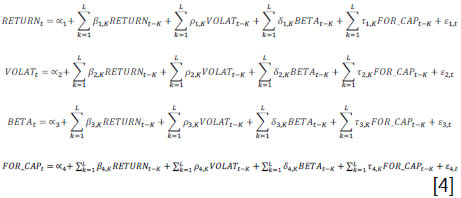
<body><![CDATA[<p>  Besides, the conditional variance equation &#91;3.b&#93; includes   past conditional variance and past disturbance effects,   as usual in a GARCH model. It also includes the absolute   value of the <i>S&amp;P500</i> and the Foreign Exchange returns,   <i>ABS_SP500</i> and <i>ABS_FEX_RET</i>, respectively, to account   for volatility transmission from those markets on the local   stock market. <i>FOR_CAP</i> is included in the variance equation   to test for the assumed effects of foreign investors on   the volatility of the local market.</p>     <p>  Dummy variables were included to filter out day of the   week, month and holiday effects, both in the equations of   the mean and the variance of model &#91;3&#93;. Some dummies   were used to filter our extreme returns as required. The   level of the ARMA model in the mean and the GARCH   model are determined based on the residual and squareof-   residual correlograms. This procedure assures that the   residuals of equation &#91;3.a&#93; are white noise in levels and   squares.</p>     <p>  Expected signs of the coefficients for the different regressors   in model &#91;3&#93; as given by the extant empirical and theoretical   literature . Regarding the foreign exchange returns,   two basic arguments are usually presented. First, the 'Portfolio   Balancing' premise of Frankel (1983) argues that a   bullish trend in the equity markets usually attracts foreign   investors, driving down the foreign exchange rate. This has   been empirically supported by Ferrari and Amalfi (2007)   in Colombia, and Muller and Verschoor (2007) for Taiwan.   In contrast, the "market of goods" argument of Dornbusch   and Fischer (1980) states that, providing that most of the   local listed companies are net exporters, higher foreign exchange   rates lead to higher earnings and returns on the local   stock market. Beer and Hebein (2008) and Harmantzis   and Miao (2009) have provided evidence on this in 10 developed   markets in developed and emerging countries. Actually,   both effects might be working at the same time in   a given country, depending on the degree of globalization   of the companies, and the relevance of foreign flows in its   security markets. Based on anecdotal evidence that supports   the "Portfolio Rebalancing" theory, it is expected a   negative relationship between foreign exchange and local   market returns for the Latin American case.</p>     <p>  It is very much expected that the <i>S&amp;P500</i> return be positively   related to local stock market returns. Both fundamental   and trading-related reasons have been provided to   explain this. Economic globalization in the last 30 years   has strengthened the economic ties between countries,   whereas financial liberalization has meant that foreign   speculators are increasingly more important players in the   emerging stock markets (Edison and Warnock, 2009). In   this context, the existent of a worldwide systematic risk   seems indisputable (Bodie et al., 2005). Benelli and Ganguly   (2007), Lucey and Zhang (2007), Miralles and Miralles   (2005), among others, have documented this strong   relationship of Latin American markets with international   ones, especially those of US. Therefore, we do expect a positive   relationship between the <i>S&amp;P500</i> return (measured in   US dollars) and the local stock market return (measured in   local currency)<a href="#6" name="s6">&#91;6&#93;</a> and a positive coefficient of the interactive   <i>SP500xT</i> term.</p>     <p>  On the effect of foreign flows (<i>FOR_CAP</i>) on returns, a positive   relationship is hypothesized, as given by two empirical   observations on the extant literature. The first one, called   "price pressure" (Froot et al., 2001), assumes that foreign   buys (sell), due to their larger liquidity demand and size of   trade rises (lower) emerging market prices. The "price pressure"   might also come from informational reasons, since   there is some evidence that foreign buys (sells) are positive   (negative) signal for an emerging market (Richards,   2005). Alternatively, positive (negative) returns on emerging   markets should lead to buys (sells) from foreigners, as   they might extrapolate that this trend continues, in what is   called "return chasing" (Choe et al., 2005).</p>     <p>  Regarding to the increasing effect of foreign flows in both   volatility and world betas, there are studies that do find   such effects (Bae et al., 2004; Frenkeln and Menkhoff,   2003), while other do not (Alemmani and Hass, 2006;   Dvorak, 2001; Rea, 1996). We assume, as the null hypothesis,   that in the variance equation &#91;3.b&#93; the coefficient of   <i>FOR_CAP</i> is not different from zero, and so the coefficient   of the interactive variable <i>FOR_CAPxSP500</i> in the mean   equation &#91;3.a&#93;. The term <i>SP500xT</i> is included in the mean   equation to control for any economic factor, different to   foreign flows, that increases over time the systemic risk of   the local market. Such an effect might be due, among others,   to increasing financial or commercial integration with   developed markets, or an increasing role of ADRs, implying   that the term <i>SP500xT</i> has a positive coefficient on the   mean equation.</p>     <p>&nbsp;</p>     <p><font size="3"><b><i>Monthly multivariate model</i></b></font></p>     <p>  Whereas univariate models are fit to describe high frequency   financial series, they are not appropriate to model   in lower frequencies (de Arce Borda, 2004). Since we are   interested in the effects of foreign flows not only during a   time span of a few days, but also during several months,   we need to model returns and flows in a monthly basis.   Additionally, univariate models do not describe multiple interactive   effects between critical variables in a stock market.   Thus, following the literature on Foreign flow effects   (Bekaert et al., 2002; Griffin et al., 2006; Richards, 2005),   we propose a non-structural monthly vector autoregressive   model (VAR). Non-structural VAR models are defined as   a system of linear simultaneous equations in which each   variable is modeled as dependent of its own lags and of   those of the other variables, thus treating, in principle, all   variables as endogenous. For this study, we take as endogenous   variables, the monthly returns, monthly volatility   (<i>VOLAT</i>), the sensitivity to international markets (<i>BETA</i>),   and the measure of foreign flows (<i>FOR_CAP</i>). The proposed   model is expressed as follows:</p>     <p>    ]]></body>
<body><![CDATA[<center><img src="/img/revistas/inno/v21n39/39a11e4.jpg"></center></p>     <p>Where</p>     <p><i>  RETURN<sub>t</sub></i>: Monthly return for the Exchange, as given   by the market index</p>     <p><i>VOLAT<sub>t</sub></i> : Monthly volatility for the Exchange, as defined   in eq. &#91;1&#93;</p>     <p><i>BETA<sub>t</sub></i> : Sensitivity to international markets, defined   as the beta of eq. &#91;2&#93;</p>     <p><i>FOR_CAP<sub>t</sub></i> : Measure of foreign flows, defined before.</p>     <p><i>Îµ<sub>1t</sub></i>, <i>Îµ<sub>2t</sub></i>, <i>Îµ<sub>3t</sub></i>, <i>Îµ<sub>4t</sub></i>: disturbance terms in each equation</p>     <p><i>L</i>: Number of lags required by the model,   specific for each country.</p>     <p>  A VAR model has two main technical requirements. First,   it requires finding the number of optimal number of lags   to obtain a parsimonious model, which is accomplished by   minimizing the Akaike (AI C) and Schwartz (SBC) statistics.<a href="#7" name="s7">&#91;7&#93;</a></p>     <p>Second, white noise has to be achieved in residuals of the   model, as measured by the LM autocorrelation and the   VAR heterokesdaticity tests. Whenever required, lags were   increased or dummy variables were included for specific dates to filter out extreme values, assuring white noise.</p>     ]]></body>
<body><![CDATA[<p>  VAR models allow to test whether a given variable might   cause changes in other variables. To do so, we performed   the Block Exogeneity Wald test, which excludes the lags   of the assumed exogenous variable in a given equation   (corresponding to an assumed endogenous variable), and   measures whether the model changes significantly. If   that is the case, it is said that the exogenous variable   is said to Granger-cause the endogenous one (Enders,   1995, p. 316). Now, the Granger causality test does not   indicate either the sign or the dynamics of the effect between   the variables. Instead, this can be seen in the Impulse-   Response function, which traces the response of   the endogenous variables to a standardized shock on the   exogenous variable.<a href="#8" name="s8">&#91;8&#93;</a></p>     <p>  The Expected signs on the VAR model are also taken from   the mentioned references for the univariate model. It is   expected that positive shocks on the foreign flows (<i>FOR_CAP</i>) induce positive shocks on the volatility of the market   (<i>VOLAT</i>), and the beta with the US market (<i>BETA</i>). In turn,   the 'price pressure' hypothesis implies that positive shocks   on <i>FOR_CAP</i> cause positive shock on <i>RETURN</i>, whereas   the 'return chasing' story implies the same positive relationship   but that the causal relationship runs the other   way around.</p>     <p>&nbsp;</p>     <p><font size="3"><b>  Results</b></font></p>     <p> <font size="3"><b><i>Univariate model</i></b></font></p>     <p> <a href="/img/revistas/inno/v21n39/39a11t3.jpg" target="_blank">Table 3</a> presents the results of the univariate model &#91;3&#93;   with effects <i>ARMA</i>, as well as conditional volatility coefficients   and corresponding p-values. There are nine versions   of the model corresponding to six countries, since -as explained   before- the series of three countries had to be divided   in two because of structural breaks.</p>     <p>  First, we discuss the resulting coefficients of the control   variables. The foreign exchange variable (<i>FEX_RET</i>) has a   negative coefficient, significant at 5% level, in five out of   nine cases. Exceptions are Colombia in both periods, and   Argentina II . In general, the evidence of Latin American Markets supports the 'Portfolio balance' point of view of   Frankel (1983). Only in one case, Argentina after Corralito,   there is a positive and significant coefficient for this variable,   supporting the 'market of goods' rationale of Dornsbuch   and Fischer (1980).</p>     <p>  As expected, the <i>SP500_RET</i> coefficient is significant and   positive in seven cases, with the exceptions of Colombia I   and Per&uacute; II . This is a clear evidence of the integration of   Latin American stock markets to that of the U.S. In contrast,   Betas are lower or not significant for Colombia and   Peru, which might be explained by being historically less   developed and internationally integrated stock markets.</p>     <p>  The coefficient of the <i>SP500xT</i> term is significant and   positive, at least at the 10% level, for five out of nine cases,   detecting an increasing beta over time, as expected.   This effect is particularly high for Brazil and both periods   of Argentina, with betas rising on 0.3, 0.43 and 0.48, respectively.   <a href="#9" name="s9">&#91;9&#93;</a> Exceptions are Colombia I and II , Mexico and   Peru II .</p>     <p>Now, we turn to the effect of foreign flows on the mean   equation &#91;3.a&#93;. This is given by two coefficients-the corresponding   to <i>FOR_CAP</i> and <i>FOR_CAPxSP500</i>. <i>FOR_CAP</i>   is significant, at least at the 10% level, for Colombia I,   Argentina I and Per&uacute; I. As explained before, these results   are consistent with both the "price pressure" and "return   chasing" stories, but do not distinguish between the two.   <i>FOR_CAPxSP500</i> variable, which measures how foreign   investors increase the sensitivity to international markets,   is only significant for Colombia I and Peru II , at 5% and   10% levels respectively. It is notable that this result only   shows up in the historically less developed stock markets   of the region (at least until 2005, see <a href="/img/revistas/inno/v21n39/39a11t1.jpg" target="_blank">Table 1</a>), during   their periods of lower foreign holding shares (see Figures <a href="/img/revistas/inno/v21n39/39a11f5.jpg" target="_blank">5</a>, <a href="/img/revistas/inno/v21n39/39a11f6.jpg" target="_blank">6</a> &amp; <a href="/img/revistas/inno/v21n39/39a11f7.jpg" target="_blank">7</a>).</p>     ]]></body>
<body><![CDATA[<p> <a href="/img/revistas/inno/v21n39/39a11t3.jpg" target="_blank">Table 3</a> presents the results of the conditional variance   equation &#91;3.b&#93;. Regarding the transmission of volatility   from the foreign exchange rate and international equity   markets, the coefficient of <i>ABS_FEX_RET</i> appears significant   at the 5% level in three cases: Chile, Peru and Argentina   II with the expected positive sign; whereas the   <i>ABS_SP500_RET</i> coefficient is positive and significant for   Colombia II , Chile, Peru and Brazil. Taking together the   above results on the equation &#91;3&#93;, they agree with Flannery   and Protopapadakis (2002) in the sense that if a variable is   a risk factor for the stock market, its volatility should transmit   to stock returns.</p>     <p>  Finally, we focus on the coefficient of <i>FOR_CAP</i> on the   conditional variance equation &#91;3.b&#93;. It appears as positive   and significant at the 10% level in Mexico and Peru, consistent   with foreigners inducing volatility in emerging stock   markets. Nevertheless, the same variable has a negative   and significant coefficient in Argentina II and Chile. Taken   together the evidence is inconclusive in the role of Foreign   investors in causing volatility in the studied markets.<a href="#10" name="s10">&#91;10&#93;</a></p>     <p>&nbsp;</p>     <p><font size="3"><b><i>  Multivariate model</i></b></font></p>     <p>  The results for the multivariate model &#91;4&#93;, Granger causality-   Block exogeneity tests and Impulse-Response function   (IRF) plots, are presented in <a href="/img/revistas/inno/v21n39/39a11t4.jpg" target="_blank">Table 4</a> and Figures <a href="/img/revistas/inno/v21n39/39a11f8.jpg" target="_blank">8</a>, <a href="/img/revistas/inno/v21n39/39a11f9.jpg" target="_blank">9</a> &amp; <a href="/img/revistas/inno/v21n39/39a11f10.jpg" target="_blank">10</a>.   <a href="/img/revistas/inno/v21n39/39a11t4.jpg" target="_blank">Table 4</a> present the result of the Wald statistic p-value testing   whether the row variable Granger causes the column   variable. Significant statistics at the 5% level are in bold,   at the 10% level are underlined. The sign and dynamics of   the causality can be inferred from the IRF plots.<a href="#11" name="s11">&#91;11&#93;</a></p>     <p>First, we check the causality between foreign flows and   return. Argentina and Mexico show evidence of Granger   causality from returns to foreign flows, and the short-term   response in the corresponding IRF plot is consistent with   the 'return chasing' explanation. Conversely, Brazil and   Mexico exhibit the reverse causality: Foreign flows Granger   cause returns, and the IRF plot show a positive response, which is consistent with the 'price pressure' story.</p>     <p>  The Granger causality tests along with the IRF plots show   returns causing volatility in Brazil and Argentina, in an   inverse relation: positive (negative) returns induce an increase   (reduction) of volatility, consistent with the Leverage   effect (Nelson, 1991).</p>     <p>  Similarly, the multivariate model results present volatility   causing betas for Colombia, Mexico and Peru, in a direct   direction: positive shocks to volatility cause higher betas.   This relationship seems to reflect the persistence on volatility   and the fact that, holding correlation and the <i>S&amp;P500</i>   volatility constant, beta increase with an increase of volatility.<a href="#12" name="s12">&#91;12&#93;</a></p>     <p>  The proposed VAR model also provides an answer to the   central question of this study. First, the results of the   Granger causality test support in no case that foreign   flows induce higher volatility and neither the IRF plots.   Second, with the only exception of M&eacute;xico, there is no   evidence of foreign flows causing Beta. Even in the case   of M&eacute;xico, the IRF plot does not show a clear effect, but   if anything appears to be inverse, contradicting the assumed   hypothesis. Overall, the multivariate model indicates   that foreign flows do not have a discernible effect   on the volatility and systemic risk of the six Latin American   markets of the study.</p>     <p>  As in any other study of this kind, the reader should be   aware that the results are constrained by the limitations   of the empirical models. First, the univariate model &#91;3&#93; of   daily returns only might detect short-term effects on both   the volatility and betas. Moreover, at this frequency the   return distribution exhibits low signal-to-noise ratio, since   volatility is significantly higher than the average return.   Thus, noise can disguise any true relationship between the   risk variables and the exogenous ones. Second, whereas   the 4-VAR model at monthly frequency can detect effects   in longer period, any causality of shorter term, for example   daily or intradaily, will not be detected by it. Finally, as in any other econometric model, the GARCH, EGARCH and   VAR models can be very sensitive to outliers and overfitting.   Whereas we controlled for outliers, and used parsimony   criteria to select simple models, chances are that the   hypothesized relationship between foreign flows and risk   might have been discarded in the process.</p>     ]]></body>
<body><![CDATA[<p>&nbsp;</p>     <p><font size="3"><b>  Conclusions</b></font></p>     <p>  Several authors using different methodologies, theories   and data have studied the influence of Foreign Portfolio   flows in emerging markets. Considering the results together,   the results are ambiguous. This study contributes to the   literature, testing not only effects on volatility but also in   systematic risk, and using a not yet used data, more recent   sample periods that includes the 2008 World financial crisis,   two different econometric models, and focusing on six   emerging markets of the same region.</p>     <p>  The results of this study, taken together, indicate that there   is no significant evidence that foreign portfolio flows increase   the risk of the six Latin American markets. In particular,   we observe the following:</p> <ul>     <p>    <li>Only in two out of nine cases, there is a positive and   significant effect from foreign flows on the betas to   S&amp;P500 returns: Colombia, before the 2006 crisis, and   Peru, after July 2006. We suspect that this result might   be due to the relative low development and integration   of both markets, which might make them more sensitive   to Foreign flows. Moreover, the fact that those   effects do not show up in the VA R monthly model suggest   that, if anything, those effects are either spurious   or very short-lived.</li></p>     <p>    <li>According to the VAR monthly model, there is no evidence   of foreign flows having lasting effects on the   volatility of the markets. In turn, the univariate model   shows only a positive effect in two out of nine samples,   but a negative and significant effect in two others.</li></p>     </ul>     <p>  The evidence presented here does support empirical regularities   reported in other studies on the behavior of returns   on emerging markets. It reports an important dependence   of the local stock returns on the returns of the foreign   exchange rate and international equity markets, both in   mean and in volatility. We leave to future research to prove   that the causality runs from those markets to the stock   one, and if those economic variables are priced risk factors   of the equity market. We find also evidence of returns causing   higher foreign flows in some countries ('return chasing')   but also of foreign flows causing higher returns ('price pressure'),   that has also been found in other emerging markets.</p>     ]]></body>
<body><![CDATA[<p>  We conclude that foreign exchange and international returns   do have a more important role on increasing risk and   dependence on international markets than foreign flows,   providing no support to the policy of restricting foreign   portfolio flows due to alleged increasing risks or causing   instability in Latin American stock markets. We have left   for future studies whether they have disrupting effects on   the foreign exchange rate markets.</p>     <p>&nbsp;</p>     <p><font size="3"><b>Footnotes</b></font></p>     <p><a href="#s1" name="1">&#91;1&#93;</a> This article is based on the thesis of Milena M. Casta&ntilde;o to obtain the Master Science on Finance in EAFIT University.</p>     <p><a href="#s2" name="2">&#91;2&#93;</a> Alternative measures were considered the total value of foreign   portfolio holdings, its first difference, and the first difference of   the absolute value of the net fund flows. Total value traded in dollars,   as taken from the WFE, was tried as an alternative to market   capitalization as normalizing variable. Whereas several of those alternatives   were discarded for non-stationarity, <i>FOR_CAP</i> was the most significant in both the univariate and the VAR models.</p>     <p> <a href="#s3" name="3">&#91;3&#93;</a> Absolute values of returns have been used as a measure of volatility   in similar <i>VAR</i> models by Chordia et al. (2005) and Agudelo   (2010). The following two alternative measures of volatility were   also considered, but performed poorly in the multivariate model:   the standard deviation of daily returns, and the average conditional   volatility measured with a <i>GARCH</i> (1,1). Results can be obtained   from the authors on request.</p>     <p><a href="#s4" name="4">&#91;4&#93;</a> We tested the structural change on returns for those three stock   markets using the Chow break point test, on times related to crises.   For Argentina on 20 November 2001, it delivered an F-test of 3.765   (0.052 p-value), for Colombia on 28 April 2006, 11.72 (0.00063), and for Peru on 4 July 2006 3.774 (0.052).</p>     <p><a href="#s5" name="5">&#91;5&#93;</a> Holding constant the correlation between the two markets and the US market risk, higher local volatility leads to higher beta, since beta = correlation x stand. Dev Local market/stand. Dev. US market.</p>     <p><a href="#s6" name="6">&#91;6&#93;</a> Whether US return should be measured in US dollars or in the local   currency in the model is, in principle, an open question. We tried   both and found the first a more meaningful measure, since entering   the US return in local currency exaggerates the corresponding effect   of the Foreign exchange return. Moreover, local traders in Colombia track closely the SP 500 expressed in US dollars.</p>     <p><a href="#s7" name="7">&#91;7&#93;</a> Whenever the two indicators gave contradictory results, SBC was upheld,   since it has show better asymptotical behavior (Enders, 2005, p. 88).</p>     ]]></body>
<body><![CDATA[<p><a href="#s8" name="8">&#91;8&#93;</a> Cholesky decomposition is required in Unstructured VAR models to   orthogonalize the disturbances. It allows resolving a system of matricial   equations. This requires defining an order on the variables.   Usual practice requires inverting the variables order and verifying that the IRF results do not depend critically on it.</p>     <p><a href="#s9" name="9">&#91;9&#93;</a> Calculated as the estimated coefficient multiplied by the number of estimated trading days of the period.</p>     <p><a href="#s10" name="10">&#91;10&#93;</a> Alternative measures of foreign flows did not have a strong effect on volatility either.</p>     <p> <a href="#s11" name="11">&#91;11&#93;</a> To obtain the IRFs, the Cholesky decomposition requires ranking the   variables. The order chosen was, initially: <i>RETURN</i>, <i>VOLAT</i>, <i>BETA</i> and <i>FOR_CAP</i>. Robustness of IRF relations were checked by inverting   the order of the Cholesky decomposition. Results are qualitatively   the same, and available from the authors upon request.</p>     <p> <a href="#s12" name="12">&#91;12&#93;</a> <i>BETA</i> = correlation x stand. Dev Local market /stand. Dev. US market.</p>     <p>&nbsp;</p>     <p><font size="3"><b>References</b></font></p>     <!-- ref --><p>  Agudelo, D. (2010). Friend or foe? Foreign investors and the liquidity   of six Asian markets. <i>Asia-Pacific Journal of Financial Studies</i>, <i>39</i>, 261-300.&nbsp;&nbsp;&nbsp;&nbsp;&nbsp;&nbsp;&nbsp;&nbsp;[&#160;<a href="javascript:void(0);" onclick="javascript: window.open('/scielo.php?script=sci_nlinks&ref=000160&pid=S0121-5051201100010001100001&lng=','','width=640,height=500,resizable=yes,scrollbars=1,menubar=yes,');">Links</a>&#160;]<!-- end-ref --><!-- ref --><p>  Alemmani, B. &amp; Haas, J. R. (2006). <i>Behavior and effects of equity foreign investors on emerging markets</i>. Published paper.&nbsp;&nbsp;&nbsp;&nbsp;&nbsp;&nbsp;&nbsp;&nbsp;[&#160;<a href="javascript:void(0);" onclick="javascript: window.open('/scielo.php?script=sci_nlinks&ref=000161&pid=S0121-5051201100010001100002&lng=','','width=640,height=500,resizable=yes,scrollbars=1,menubar=yes,');">Links</a>&#160;]<!-- end-ref --><!-- ref --><p>  Bae, K., Chan, K. &amp; Ng, A. (2004). Investibility and return volatility. <i>Journal of Financial Economics</i>, <i>71</i>, 239-263.&nbsp;&nbsp;&nbsp;&nbsp;&nbsp;&nbsp;&nbsp;&nbsp;[&#160;<a href="javascript:void(0);" onclick="javascript: window.open('/scielo.php?script=sci_nlinks&ref=000162&pid=S0121-5051201100010001100003&lng=','','width=640,height=500,resizable=yes,scrollbars=1,menubar=yes,');">Links</a>&#160;]<!-- end-ref --><!-- ref --><p>  Beer F. &amp; Hebein F. (2008). An Assessment of the stock market and exchange rate Dynamics in industrialized and emerging markets. <i>International  Business &amp; Economics Research Journal</i>, <i>7</i>(8), 59-70.&nbsp;&nbsp;&nbsp;&nbsp;&nbsp;&nbsp;&nbsp;&nbsp;[&#160;<a href="javascript:void(0);" onclick="javascript: window.open('/scielo.php?script=sci_nlinks&ref=000163&pid=S0121-5051201100010001100004&lng=','','width=640,height=500,resizable=yes,scrollbars=1,menubar=yes,');">Links</a>&#160;]<!-- end-ref --><!-- ref --><p>  Bekaert, G. &amp; Harvey, C. R. (1998). <i>Capital flows and emerging market equity returns</i>. NBER working paper 6669.&nbsp;&nbsp;&nbsp;&nbsp;&nbsp;&nbsp;&nbsp;&nbsp;[&#160;<a href="javascript:void(0);" onclick="javascript: window.open('/scielo.php?script=sci_nlinks&ref=000164&pid=S0121-5051201100010001100005&lng=','','width=640,height=500,resizable=yes,scrollbars=1,menubar=yes,');">Links</a>&#160;]<!-- end-ref --><!-- ref --><p>  Bekaert, G. &amp; Harvey, C. R. (2000). Foreign speculators and emerging equity markets. <i>Journal of Finance</i>, <i>55</i>, 565-614.&nbsp;&nbsp;&nbsp;&nbsp;&nbsp;&nbsp;&nbsp;&nbsp;[&#160;<a href="javascript:void(0);" onclick="javascript: window.open('/scielo.php?script=sci_nlinks&ref=000165&pid=S0121-5051201100010001100006&lng=','','width=640,height=500,resizable=yes,scrollbars=1,menubar=yes,');">Links</a>&#160;]<!-- end-ref --><!-- ref --><p>  Bekaert, G. &amp; Harvey, C. (2003). Emerging markets finance. <i>Journal of Empirical Finance</i>, <i>10</i>, 3-57.&nbsp;&nbsp;&nbsp;&nbsp;&nbsp;&nbsp;&nbsp;&nbsp;[&#160;<a href="javascript:void(0);" onclick="javascript: window.open('/scielo.php?script=sci_nlinks&ref=000166&pid=S0121-5051201100010001100007&lng=','','width=640,height=500,resizable=yes,scrollbars=1,menubar=yes,');">Links</a>&#160;]<!-- end-ref --><!-- ref --><p>  Bekaert, G., Harvey, C. R. &amp; Lumsdaine, R.L. (2002). The Dynamics of   emerging market equity flows. <i>Journal of International Money and Finance</i>, <i>21</i>, 295-350.&nbsp;&nbsp;&nbsp;&nbsp;&nbsp;&nbsp;&nbsp;&nbsp;[&#160;<a href="javascript:void(0);" onclick="javascript: window.open('/scielo.php?script=sci_nlinks&ref=000167&pid=S0121-5051201100010001100008&lng=','','width=640,height=500,resizable=yes,scrollbars=1,menubar=yes,');">Links</a>&#160;]<!-- end-ref --><!-- ref --><p>  Benelli, R. &amp; Ganguly, S. (2007). <i>Financial linkages between the United   States and Latin America-Evidence from Daily Data</i>. International Monetary Fund, Working Paper.&nbsp;&nbsp;&nbsp;&nbsp;&nbsp;&nbsp;&nbsp;&nbsp;[&#160;<a href="javascript:void(0);" onclick="javascript: window.open('/scielo.php?script=sci_nlinks&ref=000168&pid=S0121-5051201100010001100009&lng=','','width=640,height=500,resizable=yes,scrollbars=1,menubar=yes,');">Links</a>&#160;]<!-- end-ref --><!-- ref --><p>  Bikhchandani, S., Hirshleifer, D. &amp; Welch, I. (1998). Learning from the   behavior of others: Conformity, fads, and informational cascades. <i>Journal of Economic Perspectives</i>, <i>12</i>, 151-70.&nbsp;&nbsp;&nbsp;&nbsp;&nbsp;&nbsp;&nbsp;&nbsp;[&#160;<a href="javascript:void(0);" onclick="javascript: window.open('/scielo.php?script=sci_nlinks&ref=000169&pid=S0121-5051201100010001100010&lng=','','width=640,height=500,resizable=yes,scrollbars=1,menubar=yes,');">Links</a>&#160;]<!-- end-ref --><!-- ref --><p>  Bodie, Z., Kane, A. &amp; Marcus, A. (2005). <i>Investments</i> (Sixth edition). New York: McGraw-Hill Irwin. &nbsp;&nbsp;&nbsp;&nbsp;&nbsp;&nbsp;&nbsp;&nbsp;[&#160;<a href="javascript:void(0);" onclick="javascript: window.open('/scielo.php?script=sci_nlinks&ref=000170&pid=S0121-5051201100010001100011&lng=','','width=640,height=500,resizable=yes,scrollbars=1,menubar=yes,');">Links</a>&#160;]<!-- end-ref --><!-- ref --><p>  Brennan, M. &amp; Cao, H. (1997). International portfolio investment flows. <i>Journal of Finance</i>, <i>52</i>, 1851-1880.&nbsp;&nbsp;&nbsp;&nbsp;&nbsp;&nbsp;&nbsp;&nbsp;[&#160;<a href="javascript:void(0);" onclick="javascript: window.open('/scielo.php?script=sci_nlinks&ref=000171&pid=S0121-5051201100010001100012&lng=','','width=640,height=500,resizable=yes,scrollbars=1,menubar=yes,');">Links</a>&#160;]<!-- end-ref --><!-- ref --><p>  Calvo, G. (1998). <i>Capital market contagion and recession: An explanation of the Russian Virus</i>. Working Paper.&nbsp;&nbsp;&nbsp;&nbsp;&nbsp;&nbsp;&nbsp;&nbsp;[&#160;<a href="javascript:void(0);" onclick="javascript: window.open('/scielo.php?script=sci_nlinks&ref=000172&pid=S0121-5051201100010001100013&lng=','','width=640,height=500,resizable=yes,scrollbars=1,menubar=yes,');">Links</a>&#160;]<!-- end-ref --><!-- ref --><p>  Calvo, G. &amp; Mendoza, E. (2000). Rational contagion and the globalization   of securities markets. <i>Journal of International Economics</i>, <i>51</i>, 79-113.&nbsp;&nbsp;&nbsp;&nbsp;&nbsp;&nbsp;&nbsp;&nbsp;[&#160;<a href="javascript:void(0);" onclick="javascript: window.open('/scielo.php?script=sci_nlinks&ref=000173&pid=S0121-5051201100010001100014&lng=','','width=640,height=500,resizable=yes,scrollbars=1,menubar=yes,');">Links</a>&#160;]<!-- end-ref --><!-- ref --><p>  Campbell, J., Lo, A. &amp; MacKinlay, A. (1997). The Econometrics of financial markets. Princeton, NJ: Princeton University Press.&nbsp;&nbsp;&nbsp;&nbsp;&nbsp;&nbsp;&nbsp;&nbsp;[&#160;<a href="javascript:void(0);" onclick="javascript: window.open('/scielo.php?script=sci_nlinks&ref=000174&pid=S0121-5051201100010001100015&lng=','','width=640,height=500,resizable=yes,scrollbars=1,menubar=yes,');">Links</a>&#160;]<!-- end-ref --><!-- ref --><p>  Choe, H., Kho, B-C. &amp; Stultz, R. (1999). Do foreign investors destabilize   stocks markets? The Korean experience in 1997. <i>Journal of Financial Economics</i>, <i>54</i>, 227-264.&nbsp;&nbsp;&nbsp;&nbsp;&nbsp;&nbsp;&nbsp;&nbsp;[&#160;<a href="javascript:void(0);" onclick="javascript: window.open('/scielo.php?script=sci_nlinks&ref=000175&pid=S0121-5051201100010001100016&lng=','','width=640,height=500,resizable=yes,scrollbars=1,menubar=yes,');">Links</a>&#160;]<!-- end-ref --><!-- ref --><p>  Choe, H., Kho, B-C. &amp; Stulz, R. (2005). Do domestic investors have an   edge? The trading experience of foreign investors in Korea. <i>Review of Financial Studies</i>, <i>18</i>, 795-829.&nbsp;&nbsp;&nbsp;&nbsp;&nbsp;&nbsp;&nbsp;&nbsp;[&#160;<a href="javascript:void(0);" onclick="javascript: window.open('/scielo.php?script=sci_nlinks&ref=000176&pid=S0121-5051201100010001100017&lng=','','width=640,height=500,resizable=yes,scrollbars=1,menubar=yes,');">Links</a>&#160;]<!-- end-ref --><!-- ref --><p>  Chordia, T., Sarkar, A. &amp; Subrahmanyam, A. (2005). An empirical analysis   of stock and bond market liquidity. <i>Review of Financial Studies</i>, <i>18</i>, 85-130.&nbsp;&nbsp;&nbsp;&nbsp;&nbsp;&nbsp;&nbsp;&nbsp;[&#160;<a href="javascript:void(0);" onclick="javascript: window.open('/scielo.php?script=sci_nlinks&ref=000177&pid=S0121-5051201100010001100018&lng=','','width=640,height=500,resizable=yes,scrollbars=1,menubar=yes,');">Links</a>&#160;]<!-- end-ref --><!-- ref --><p>  Cochrane, J. H. (2001). <i>Asset pricing. Princeton</i>. New Jersey: Princeton   University Press.&nbsp;&nbsp;&nbsp;&nbsp;&nbsp;&nbsp;&nbsp;&nbsp;[&#160;<a href="javascript:void(0);" onclick="javascript: window.open('/scielo.php?script=sci_nlinks&ref=000178&pid=S0121-5051201100010001100019&lng=','','width=640,height=500,resizable=yes,scrollbars=1,menubar=yes,');">Links</a>&#160;]<!-- end-ref --><!-- ref --><p>  De Arce Borda, R. (2004). 20 a&ntilde;os de modelos ARCH: una visi&oacute;n de   conjunto de las distintas variantes de la familia. <i>Estudios de   Econom&iacute;a Aplicada</i>, <i>22</i>, 22.&nbsp;&nbsp;&nbsp;&nbsp;&nbsp;&nbsp;&nbsp;&nbsp;[&#160;<a href="javascript:void(0);" onclick="javascript: window.open('/scielo.php?script=sci_nlinks&ref=000179&pid=S0121-5051201100010001100020&lng=','','width=640,height=500,resizable=yes,scrollbars=1,menubar=yes,');">Links</a>&#160;]<!-- end-ref --><!-- ref --><p>Di Tella, T. (2004). <i>Diccionario de ciencias sociales y pol&iacute;ticas</i>. Editorial Ariel.&nbsp;&nbsp;&nbsp;&nbsp;&nbsp;&nbsp;&nbsp;&nbsp;[&#160;<a href="javascript:void(0);" onclick="javascript: window.open('/scielo.php?script=sci_nlinks&ref=000180&pid=S0121-5051201100010001100021&lng=','','width=640,height=500,resizable=yes,scrollbars=1,menubar=yes,');">Links</a>&#160;]<!-- end-ref --><!-- ref --><p>  Dornbusch, R. &amp; Fischer S. (1980). Exchange rates and the current account. <i>American Economic Review</i>, <i>70</i>(5), 960-971.&nbsp;&nbsp;&nbsp;&nbsp;&nbsp;&nbsp;&nbsp;&nbsp;[&#160;<a href="javascript:void(0);" onclick="javascript: window.open('/scielo.php?script=sci_nlinks&ref=000181&pid=S0121-5051201100010001100022&lng=','','width=640,height=500,resizable=yes,scrollbars=1,menubar=yes,');">Links</a>&#160;]<!-- end-ref --><!-- ref --><p>  Dv&oacute;rak, T. (2001). <i>Does foreign trading destabilize local stock markets?</i> Published paper. Department of Economics. Williams College.&nbsp;&nbsp;&nbsp;&nbsp;&nbsp;&nbsp;&nbsp;&nbsp;[&#160;<a href="javascript:void(0);" onclick="javascript: window.open('/scielo.php?script=sci_nlinks&ref=000182&pid=S0121-5051201100010001100023&lng=','','width=640,height=500,resizable=yes,scrollbars=1,menubar=yes,');">Links</a>&#160;]<!-- end-ref --><!-- ref --><p>  Edison, H. &amp; Warnock,. E. (2009). <i>Cross-border listings, capital controls,   and equity flows to emerging markets</i>. NBER Working Paper W12589.&nbsp;&nbsp;&nbsp;&nbsp;&nbsp;&nbsp;&nbsp;&nbsp;[&#160;<a href="javascript:void(0);" onclick="javascript: window.open('/scielo.php?script=sci_nlinks&ref=000183&pid=S0121-5051201100010001100024&lng=','','width=640,height=500,resizable=yes,scrollbars=1,menubar=yes,');">Links</a>&#160;]<!-- end-ref --><!-- ref --><p>  Edwards, S. (1999). International capital flows and the emerging markets:   Amending the rules of the game? Federal Reserve Bank of Boston Conference Series 43, June 1999, 137-57.&nbsp;&nbsp;&nbsp;&nbsp;&nbsp;&nbsp;&nbsp;&nbsp;[&#160;<a href="javascript:void(0);" onclick="javascript: window.open('/scielo.php?script=sci_nlinks&ref=000184&pid=S0121-5051201100010001100025&lng=','','width=640,height=500,resizable=yes,scrollbars=1,menubar=yes,');">Links</a>&#160;]<!-- end-ref --><!-- ref --><p>  Eichengreen, B. (1999). <i>Toward a new international financial architecture</i>. Washington, DC: Institute of International Economics.&nbsp;&nbsp;&nbsp;&nbsp;&nbsp;&nbsp;&nbsp;&nbsp;[&#160;<a href="javascript:void(0);" onclick="javascript: window.open('/scielo.php?script=sci_nlinks&ref=000185&pid=S0121-5051201100010001100026&lng=','','width=640,height=500,resizable=yes,scrollbars=1,menubar=yes,');">Links</a>&#160;]<!-- end-ref --><!-- ref --><p>  Enders, W. (1995). <i>Applied econometric time series</i>. Iowa State University, John Wiley.&nbsp;&nbsp;&nbsp;&nbsp;&nbsp;&nbsp;&nbsp;&nbsp;[&#160;<a href="javascript:void(0);" onclick="javascript: window.open('/scielo.php?script=sci_nlinks&ref=000186&pid=S0121-5051201100010001100027&lng=','','width=640,height=500,resizable=yes,scrollbars=1,menubar=yes,');">Links</a>&#160;]<!-- end-ref --><!-- ref --><p>  Errunza, V. R. &amp; Miller, D. P. (2000). Market segmentation and the cost   of capital in international equity markets. <i>Journal of Financial and Quantitative Analysis</i>, <i>35</i>, 577-600.&nbsp;&nbsp;&nbsp;&nbsp;&nbsp;&nbsp;&nbsp;&nbsp;[&#160;<a href="javascript:void(0);" onclick="javascript: window.open('/scielo.php?script=sci_nlinks&ref=000187&pid=S0121-5051201100010001100028&lng=','','width=640,height=500,resizable=yes,scrollbars=1,menubar=yes,');">Links</a>&#160;]<!-- end-ref --><!-- ref --><p>  Fama, E. F. (1970). Efficient capital markets: A review of theory and empirical work. <i>Journal of Finance</i>, <i>25</i>(2), 383-417.&nbsp;&nbsp;&nbsp;&nbsp;&nbsp;&nbsp;&nbsp;&nbsp;[&#160;<a href="javascript:void(0);" onclick="javascript: window.open('/scielo.php?script=sci_nlinks&ref=000188&pid=S0121-5051201100010001100029&lng=','','width=640,height=500,resizable=yes,scrollbars=1,menubar=yes,');">Links</a>&#160;]<!-- end-ref --><!-- ref --><p>  Ferrari, C. &amp; Amalfi, A. (2007). Business and economic foundation in   valuation of shares: The Colombian stock exchange. <i>Cuadernos de Administraci&oacute;n</i>, <i>20</i>(33), 11-48.&nbsp;&nbsp;&nbsp;&nbsp;&nbsp;&nbsp;&nbsp;&nbsp;[&#160;<a href="javascript:void(0);" onclick="javascript: window.open('/scielo.php?script=sci_nlinks&ref=000189&pid=S0121-5051201100010001100030&lng=','','width=640,height=500,resizable=yes,scrollbars=1,menubar=yes,');">Links</a>&#160;]<!-- end-ref --><!-- ref --><p>  Ferrer, A. (1999). La globalizaci&oacute;n, la crisis financiera y Latinoam&eacute;rica. <i>Revista Comercio Exterior</i>, <i>49</i>(6), 527-536.&nbsp;&nbsp;&nbsp;&nbsp;&nbsp;&nbsp;&nbsp;&nbsp;[&#160;<a href="javascript:void(0);" onclick="javascript: window.open('/scielo.php?script=sci_nlinks&ref=000190&pid=S0121-5051201100010001100031&lng=','','width=640,height=500,resizable=yes,scrollbars=1,menubar=yes,');">Links</a>&#160;]<!-- end-ref --><!-- ref --><p>  French-Davis, R. &amp; Griffith-Jones S. (2002). <i>Capital flows to developing   countries since the Asian Crises: How to manage their volatility</i>. Working paper UNU/WIDER Research Project.&nbsp;&nbsp;&nbsp;&nbsp;&nbsp;&nbsp;&nbsp;&nbsp;[&#160;<a href="javascript:void(0);" onclick="javascript: window.open('/scielo.php?script=sci_nlinks&ref=000191&pid=S0121-5051201100010001100032&lng=','','width=640,height=500,resizable=yes,scrollbars=1,menubar=yes,');">Links</a>&#160;]<!-- end-ref --><!-- ref --><p>  Flannery, M. J. &amp; Protopapadakis, A. A. (2002). Macroeconomic factor   do influence aggregate stock return. <i>Review of Financial Studies</i>, <i>15</i>, 751-782.&nbsp;&nbsp;&nbsp;&nbsp;&nbsp;&nbsp;&nbsp;&nbsp;[&#160;<a href="javascript:void(0);" onclick="javascript: window.open('/scielo.php?script=sci_nlinks&ref=000192&pid=S0121-5051201100010001100033&lng=','','width=640,height=500,resizable=yes,scrollbars=1,menubar=yes,');">Links</a>&#160;]<!-- end-ref --><!-- ref --><p>  Flood, D. &amp; De Paterson, M. (2008). <i>Efectos de las crisis asi&aacute;tica y de   Rusia en la econom&iacute;a y agricultura del Ecuador</i>. Ministerio de Agricultura,   Ganader&iacute;a, Acuacultura y Pesca del Ecuador. <a href="http://www.sica.gov.ec/agro/docs/crisis_mundial.html" target="_blank">http://www.sica.gov.ec/agro/docs/crisis_mundial.html</a>&nbsp;&nbsp;&nbsp;&nbsp;&nbsp;&nbsp;&nbsp;&nbsp;[&#160;<a href="javascript:void(0);" onclick="javascript: window.open('/scielo.php?script=sci_nlinks&ref=000193&pid=S0121-5051201100010001100034&lng=','','width=640,height=500,resizable=yes,scrollbars=1,menubar=yes,');">Links</a>&#160;]<!-- end-ref --><!-- ref --><p>  Frankel, J. A. (1983). Monetary and portfolio-balance models of exchange   rate determination, in economic interdependence and   flexible exchange rates. In J. S. Bhandari &amp; B. H. Putnam (ed.). Cambridge, MA: MIT Press.&nbsp;&nbsp;&nbsp;&nbsp;&nbsp;&nbsp;&nbsp;&nbsp;[&#160;<a href="javascript:void(0);" onclick="javascript: window.open('/scielo.php?script=sci_nlinks&ref=000194&pid=S0121-5051201100010001100035&lng=','','width=640,height=500,resizable=yes,scrollbars=1,menubar=yes,');">Links</a>&#160;]<!-- end-ref --><!-- ref --><p>  Frenkel, M. &amp; Menkhoff, L. (2003). <i>Are foreign institutional investors good for emerging markets?</i> Published paper.&nbsp;&nbsp;&nbsp;&nbsp;&nbsp;&nbsp;&nbsp;&nbsp;[&#160;<a href="javascript:void(0);" onclick="javascript: window.open('/scielo.php?script=sci_nlinks&ref=000195&pid=S0121-5051201100010001100036&lng=','','width=640,height=500,resizable=yes,scrollbars=1,menubar=yes,');">Links</a>&#160;]<!-- end-ref --><!-- ref --><p>  Froot, K. A., O'Connell, P.G. &amp; Seasholes, M. S. (2001). The portfolio   flows of international investors. <i>Journal of Financial Economics</i>, <i>59</i>, 151-193.&nbsp;&nbsp;&nbsp;&nbsp;&nbsp;&nbsp;&nbsp;&nbsp;[&#160;<a href="javascript:void(0);" onclick="javascript: window.open('/scielo.php?script=sci_nlinks&ref=000196&pid=S0121-5051201100010001100037&lng=','','width=640,height=500,resizable=yes,scrollbars=1,menubar=yes,');">Links</a>&#160;]<!-- end-ref --><!-- ref --><p>  Glosten, L. R. &amp; Milgrom, P. R. (1985). Bid, ask, and transaction prices in   a specialist market with heterogeneously informed traders. <i>Journal of Financial Economics</i>, <i>14</i>, 71-100.&nbsp;&nbsp;&nbsp;&nbsp;&nbsp;&nbsp;&nbsp;&nbsp;[&#160;<a href="javascript:void(0);" onclick="javascript: window.open('/scielo.php?script=sci_nlinks&ref=000197&pid=S0121-5051201100010001100038&lng=','','width=640,height=500,resizable=yes,scrollbars=1,menubar=yes,');">Links</a>&#160;]<!-- end-ref --><!-- ref --><p>  Griffin, J. M., Nardari, F. &amp; Stulz, R. (2004). Daily cross border flows:   Pushed or pulled? <i>The Review of Economics and Statistics</i>, <i>86</i>, 641-657.&nbsp;&nbsp;&nbsp;&nbsp;&nbsp;&nbsp;&nbsp;&nbsp;[&#160;<a href="javascript:void(0);" onclick="javascript: window.open('/scielo.php?script=sci_nlinks&ref=000198&pid=S0121-5051201100010001100039&lng=','','width=640,height=500,resizable=yes,scrollbars=1,menubar=yes,');">Links</a>&#160;]<!-- end-ref --><!-- ref --><p>  Griffin, J. M., Nardari, F. &amp; Stulz, R. (2006). Do investors trade more   when stocks have performed well? Evidence from 46 countries. <i>Review of Financial Studies</i>.&nbsp;&nbsp;&nbsp;&nbsp;&nbsp;&nbsp;&nbsp;&nbsp;[&#160;<a href="javascript:void(0);" onclick="javascript: window.open('/scielo.php?script=sci_nlinks&ref=000199&pid=S0121-5051201100010001100040&lng=','','width=640,height=500,resizable=yes,scrollbars=1,menubar=yes,');">Links</a>&#160;]<!-- end-ref --><!-- ref --><p>  Harmantzis, F. &amp; Miao, L. (2009). <i>Dynamic Asymmetric Dependencies   between Equities and Exchange Rate Markets</i>. Stevens Institute of Technology. Working Paper.&nbsp;&nbsp;&nbsp;&nbsp;&nbsp;&nbsp;&nbsp;&nbsp;[&#160;<a href="javascript:void(0);" onclick="javascript: window.open('/scielo.php?script=sci_nlinks&ref=000200&pid=S0121-5051201100010001100041&lng=','','width=640,height=500,resizable=yes,scrollbars=1,menubar=yes,');">Links</a>&#160;]<!-- end-ref --><!-- ref --><p>  Henry, P. B. (2000). Stock market liberalization, economic reform and emerging market equity prices. <i>Journal of Finance</i>, <i>55</i>, 529-564.&nbsp;&nbsp;&nbsp;&nbsp;&nbsp;&nbsp;&nbsp;&nbsp;[&#160;<a href="javascript:void(0);" onclick="javascript: window.open('/scielo.php?script=sci_nlinks&ref=000201&pid=S0121-5051201100010001100042&lng=','','width=640,height=500,resizable=yes,scrollbars=1,menubar=yes,');">Links</a>&#160;]<!-- end-ref --><!-- ref --><p>  Ho, T. &amp; Stoll, H. R. (1981). Optimal dealer pricing under transactions and return uncertainty. <i>Journal of Financial Economics</i>, <i>9</i>, 47-73.&nbsp;&nbsp;&nbsp;&nbsp;&nbsp;&nbsp;&nbsp;&nbsp;[&#160;<a href="javascript:void(0);" onclick="javascript: window.open('/scielo.php?script=sci_nlinks&ref=000202&pid=S0121-5051201100010001100043&lng=','','width=640,height=500,resizable=yes,scrollbars=1,menubar=yes,');">Links</a>&#160;]<!-- end-ref --><!-- ref --><p>  Ito, T. &amp; Portes, R. (1998). Dealing with the Asian Financial Crises. <i>European Economic Perspectives</i>, CERP.&nbsp;&nbsp;&nbsp;&nbsp;&nbsp;&nbsp;&nbsp;&nbsp;[&#160;<a href="javascript:void(0);" onclick="javascript: window.open('/scielo.php?script=sci_nlinks&ref=000203&pid=S0121-5051201100010001100044&lng=','','width=640,height=500,resizable=yes,scrollbars=1,menubar=yes,');">Links</a>&#160;]<!-- end-ref --><!-- ref --><p>  Kim, E. H. &amp; Singal, V. (2000). Stock market openings: Experience of emerging economies. <i>Journal of Business</i>, <i>73</i>, 25-66.&nbsp;&nbsp;&nbsp;&nbsp;&nbsp;&nbsp;&nbsp;&nbsp;[&#160;<a href="javascript:void(0);" onclick="javascript: window.open('/scielo.php?script=sci_nlinks&ref=000204&pid=S0121-5051201100010001100045&lng=','','width=640,height=500,resizable=yes,scrollbars=1,menubar=yes,');">Links</a>&#160;]<!-- end-ref --><!-- ref --><p>  Krugman, P. (1998). <i>What happened to Asia?</i> MIT, Unpublished paper.&nbsp;&nbsp;&nbsp;&nbsp;&nbsp;&nbsp;&nbsp;&nbsp;[&#160;<a href="javascript:void(0);" onclick="javascript: window.open('/scielo.php?script=sci_nlinks&ref=000205&pid=S0121-5051201100010001100046&lng=','','width=640,height=500,resizable=yes,scrollbars=1,menubar=yes,');">Links</a>&#160;]<!-- end-ref --><!-- ref --><p>  Krugman, P. (1999). <i>Balance sheets, the transformers the problem and the financial crises</i>. Cambridge: Department of Economics.&nbsp;&nbsp;&nbsp;&nbsp;&nbsp;&nbsp;&nbsp;&nbsp;[&#160;<a href="javascript:void(0);" onclick="javascript: window.open('/scielo.php?script=sci_nlinks&ref=000206&pid=S0121-5051201100010001100047&lng=','','width=640,height=500,resizable=yes,scrollbars=1,menubar=yes,');">Links</a>&#160;]<!-- end-ref --><!-- ref --><p>  Kyle, A. S. (1985). Continuous auctions and insider trading. <i>Econometrica</i>, <i>53</i>, 1315-1335.&nbsp;&nbsp;&nbsp;&nbsp;&nbsp;&nbsp;&nbsp;&nbsp;[&#160;<a href="javascript:void(0);" onclick="javascript: window.open('/scielo.php?script=sci_nlinks&ref=000207&pid=S0121-5051201100010001100048&lng=','','width=640,height=500,resizable=yes,scrollbars=1,menubar=yes,');">Links</a>&#160;]<!-- end-ref --><!-- ref --><p>  Lucey, B. &amp; Zhang, Q. (2007). <i>Integration analysis of Latin American stock markets 1993-2007</i>. SSRN: <a href="http://ssrn.com/abstract=1047421" target="_blank">http://ssrn.com/abstract=1047421</a>.&nbsp;&nbsp;&nbsp;&nbsp;&nbsp;&nbsp;&nbsp;&nbsp;[&#160;<a href="javascript:void(0);" onclick="javascript: window.open('/scielo.php?script=sci_nlinks&ref=000208&pid=S0121-5051201100010001100049&lng=','','width=640,height=500,resizable=yes,scrollbars=1,menubar=yes,');">Links</a>&#160;]<!-- end-ref --><!-- ref --><p>  Nelson D. B. (1991). Conditional heteroskedasticity in asset returns: A new approach. <i>Econometrica</i>, <i>59</i>, 347-370.&nbsp;&nbsp;&nbsp;&nbsp;&nbsp;&nbsp;&nbsp;&nbsp;[&#160;<a href="javascript:void(0);" onclick="javascript: window.open('/scielo.php?script=sci_nlinks&ref=000209&pid=S0121-5051201100010001100050&lng=','','width=640,height=500,resizable=yes,scrollbars=1,menubar=yes,');">Links</a>&#160;]<!-- end-ref --><!-- ref --><p>  Miller, D. P. (1999). The impact of international market segmentation   on securities prices: evidence from depositary receipts. <i>Journal of Financial Economics</i>, <i>51</i>, 103-123.&nbsp;&nbsp;&nbsp;&nbsp;&nbsp;&nbsp;&nbsp;&nbsp;[&#160;<a href="javascript:void(0);" onclick="javascript: window.open('/scielo.php?script=sci_nlinks&ref=000210&pid=S0121-5051201100010001100051&lng=','','width=640,height=500,resizable=yes,scrollbars=1,menubar=yes,');">Links</a>&#160;]<!-- end-ref --><!-- ref --><p>  Miralles M., J. L. &amp; Miralles Q., J. L. (2005). An&aacute;lisis de los efectos de   las correlaciones burs&aacute;tiles en la composici&oacute;n de las carteras   &oacute;ptimas. <i>Revista Espa&ntilde;ola de Financiaci&oacute;n and Contabilidad</i>, <i>34</i>(126), 689-708.&nbsp;&nbsp;&nbsp;&nbsp;&nbsp;&nbsp;&nbsp;&nbsp;[&#160;<a href="javascript:void(0);" onclick="javascript: window.open('/scielo.php?script=sci_nlinks&ref=000211&pid=S0121-5051201100010001100052&lng=','','width=640,height=500,resizable=yes,scrollbars=1,menubar=yes,');">Links</a>&#160;]<!-- end-ref --><!-- ref --><p>  Muller, A. &amp; Verschoor, W. F. C. (2007). Asian foreign exchange risk   exposure. <i>Journal of the Japanese and International Economies</i>, <i>21</i>(1), 16-37.&nbsp;&nbsp;&nbsp;&nbsp;&nbsp;&nbsp;&nbsp;&nbsp;[&#160;<a href="javascript:void(0);" onclick="javascript: window.open('/scielo.php?script=sci_nlinks&ref=000212&pid=S0121-5051201100010001100053&lng=','','width=640,height=500,resizable=yes,scrollbars=1,menubar=yes,');">Links</a>&#160;]<!-- end-ref --><!-- ref --><p>  Rea, J. (1996). U. S. emerging market funds: Hot money or stable source   of investment capital. <i>Investment Company Institute Perspective</i>, <i>2</i>(6).&nbsp;&nbsp;&nbsp;&nbsp;&nbsp;&nbsp;&nbsp;&nbsp;[&#160;<a href="javascript:void(0);" onclick="javascript: window.open('/scielo.php?script=sci_nlinks&ref=000213&pid=S0121-5051201100010001100054&lng=','','width=640,height=500,resizable=yes,scrollbars=1,menubar=yes,');">Links</a>&#160;]<!-- end-ref --><!-- ref --><p>  Richards, A. (2005). Big fish in small ponds: The trading behavior and   price impact of foreign investors in Asian emerging equity markets. <i>Journal of Financial and Quantitative Analysis</i>, <i>40</i>(1), 27.&nbsp;&nbsp;&nbsp;&nbsp;&nbsp;&nbsp;&nbsp;&nbsp;[&#160;<a href="javascript:void(0);" onclick="javascript: window.open('/scielo.php?script=sci_nlinks&ref=000214&pid=S0121-5051201100010001100055&lng=','','width=640,height=500,resizable=yes,scrollbars=1,menubar=yes,');">Links</a>&#160;]<!-- end-ref --><!-- ref --><p>  Rubin, R. &amp; Weisberg, J. (2003). <i>In an uncertain world: Tough choices from Wall Street to Washington</i>. New York: Random House.&nbsp;&nbsp;&nbsp;&nbsp;&nbsp;&nbsp;&nbsp;&nbsp;[&#160;<a href="javascript:void(0);" onclick="javascript: window.open('/scielo.php?script=sci_nlinks&ref=000215&pid=S0121-5051201100010001100056&lng=','','width=640,height=500,resizable=yes,scrollbars=1,menubar=yes,');">Links</a>&#160;]<!-- end-ref --><!-- ref --><p>  Shiller, R. J. (1981). Do stock prices move too much to be justified by   subsequent changes in dividends? <i>American Economic Review</i>, <i>71</i>, 421-436.&nbsp;&nbsp;&nbsp;&nbsp;&nbsp;&nbsp;&nbsp;&nbsp;[&#160;<a href="javascript:void(0);" onclick="javascript: window.open('/scielo.php?script=sci_nlinks&ref=000216&pid=S0121-5051201100010001100057&lng=','','width=640,height=500,resizable=yes,scrollbars=1,menubar=yes,');">Links</a>&#160;]<!-- end-ref --><!-- ref --><p>  Standard &amp; Poors. (2004). <i>Global Stock Markets Factbook</i>. New York: McGraw-Hill.&nbsp;&nbsp;&nbsp;&nbsp;&nbsp;&nbsp;&nbsp;&nbsp;[&#160;<a href="javascript:void(0);" onclick="javascript: window.open('/scielo.php?script=sci_nlinks&ref=000217&pid=S0121-5051201100010001100058&lng=','','width=640,height=500,resizable=yes,scrollbars=1,menubar=yes,');">Links</a>&#160;]<!-- end-ref --><!-- ref --><p>  Stiglitz, J. (2000). Capital market liberalization, economic growth and   instability. <i>World Development</i>, <i>25</i>, 1075-1086.&nbsp;&nbsp;&nbsp;&nbsp;&nbsp;&nbsp;&nbsp;&nbsp;[&#160;<a href="javascript:void(0);" onclick="javascript: window.open('/scielo.php?script=sci_nlinks&ref=000218&pid=S0121-5051201100010001100059&lng=','','width=640,height=500,resizable=yes,scrollbars=1,menubar=yes,');">Links</a>&#160;]<!-- end-ref --><!-- ref --><p>  Villari&ntilde;o, A. (2001). <i>Turbulencias financieras y riesgos de mercado</i>. Madrid:   Prentice Hall.&nbsp;&nbsp;&nbsp;&nbsp;&nbsp;&nbsp;&nbsp;&nbsp;[&#160;<a href="javascript:void(0);" onclick="javascript: window.open('/scielo.php?script=sci_nlinks&ref=000219&pid=S0121-5051201100010001100060&lng=','','width=640,height=500,resizable=yes,scrollbars=1,menubar=yes,');">Links</a>&#160;]<!-- end-ref --><!-- ref --><p>  Warther, V. A. (1995). Aggregate mutual fund and security returns.   <i>Journal of Financial Economics</i>, <i>39</i>, 205-235.&nbsp;&nbsp;&nbsp;&nbsp;&nbsp;&nbsp;&nbsp;&nbsp;[&#160;<a href="javascript:void(0);" onclick="javascript: window.open('/scielo.php?script=sci_nlinks&ref=000220&pid=S0121-5051201100010001100061&lng=','','width=640,height=500,resizable=yes,scrollbars=1,menubar=yes,');">Links</a>&#160;]<!-- end-ref --> ]]></body><back>
<ref-list>
<ref id="B1">
<nlm-citation citation-type="journal">
<person-group person-group-type="author">
<name>
<surname><![CDATA[Agudelo]]></surname>
<given-names><![CDATA[D]]></given-names>
</name>
</person-group>
<article-title xml:lang="en"><![CDATA[Friend or foe?: Foreign investors and the liquidity of six Asian markets]]></article-title>
<source><![CDATA[Asia-Pacific Journal of Financial Studies]]></source>
<year>2010</year>
<volume>39</volume>
<page-range>261-300</page-range></nlm-citation>
</ref>
<ref id="B2">
<nlm-citation citation-type="">
<person-group person-group-type="author">
<name>
<surname><![CDATA[Alemmani]]></surname>
<given-names><![CDATA[B]]></given-names>
</name>
<name>
<surname><![CDATA[Haas]]></surname>
<given-names><![CDATA[J. R]]></given-names>
</name>
</person-group>
<source><![CDATA[Behavior and effects of equity foreign investors on emerging markets]]></source>
<year>2006</year>
</nlm-citation>
</ref>
<ref id="B3">
<nlm-citation citation-type="journal">
<person-group person-group-type="author">
<name>
<surname><![CDATA[Bae]]></surname>
<given-names><![CDATA[K]]></given-names>
</name>
<name>
<surname><![CDATA[Chan]]></surname>
<given-names><![CDATA[K]]></given-names>
</name>
<name>
<surname><![CDATA[Ng]]></surname>
<given-names><![CDATA[A]]></given-names>
</name>
</person-group>
<article-title xml:lang="en"><![CDATA[Investibility and return volatility]]></article-title>
<source><![CDATA[Journal of Financial Economics]]></source>
<year>2004</year>
<volume>71</volume>
<page-range>239-263</page-range></nlm-citation>
</ref>
<ref id="B4">
<nlm-citation citation-type="journal">
<collab>Beer F. & Hebein F.</collab>
<article-title xml:lang="en"><![CDATA[An Assessment of the stock market and exchange rate Dynamics in industrialized and emerging markets]]></article-title>
<source><![CDATA[International Business & Economics Research Journal]]></source>
<year>2008</year>
<volume>7</volume>
<numero>8</numero>
<issue>8</issue>
<page-range>59-70</page-range></nlm-citation>
</ref>
<ref id="B5">
<nlm-citation citation-type="">
<person-group person-group-type="author">
<name>
<surname><![CDATA[Bekaert]]></surname>
<given-names><![CDATA[G]]></given-names>
</name>
<name>
<surname><![CDATA[Harvey]]></surname>
<given-names><![CDATA[C. R]]></given-names>
</name>
</person-group>
<source><![CDATA[Capital flows and emerging market equity returns]]></source>
<year>1998</year>
</nlm-citation>
</ref>
<ref id="B6">
<nlm-citation citation-type="journal">
<person-group person-group-type="author">
<name>
<surname><![CDATA[Bekaert]]></surname>
<given-names><![CDATA[G]]></given-names>
</name>
<name>
<surname><![CDATA[Harvey]]></surname>
<given-names><![CDATA[C. R]]></given-names>
</name>
</person-group>
<article-title xml:lang="en"><![CDATA[Foreign speculators and emerging equity markets]]></article-title>
<source><![CDATA[Journal of Finance]]></source>
<year>2000</year>
<volume>55</volume>
<page-range>565-614</page-range></nlm-citation>
</ref>
<ref id="B7">
<nlm-citation citation-type="journal">
<person-group person-group-type="author">
<name>
<surname><![CDATA[Bekaert]]></surname>
<given-names><![CDATA[G]]></given-names>
</name>
<name>
<surname><![CDATA[Harvey]]></surname>
<given-names><![CDATA[C]]></given-names>
</name>
</person-group>
<article-title xml:lang="en"><![CDATA[Emerging markets finance]]></article-title>
<source><![CDATA[Journal of Empirical Finance]]></source>
<year>2003</year>
<volume>10</volume>
<page-range>3-57</page-range></nlm-citation>
</ref>
<ref id="B8">
<nlm-citation citation-type="journal">
<person-group person-group-type="author">
<name>
<surname><![CDATA[Bekaert]]></surname>
<given-names><![CDATA[G]]></given-names>
</name>
<name>
<surname><![CDATA[Harvey]]></surname>
<given-names><![CDATA[C. R]]></given-names>
</name>
<name>
<surname><![CDATA[Lumsdaine]]></surname>
<given-names><![CDATA[R.L]]></given-names>
</name>
</person-group>
<article-title xml:lang="en"><![CDATA[The Dynamics of emerging market equity flows]]></article-title>
<source><![CDATA[Journal of International Money and Finance]]></source>
<year>2002</year>
<volume>21</volume>
<page-range>295-350</page-range></nlm-citation>
</ref>
<ref id="B9">
<nlm-citation citation-type="book">
<person-group person-group-type="author">
<name>
<surname><![CDATA[Benelli]]></surname>
<given-names><![CDATA[R]]></given-names>
</name>
<name>
<surname><![CDATA[Ganguly]]></surname>
<given-names><![CDATA[S]]></given-names>
</name>
</person-group>
<source><![CDATA[Financial linkages between the United States and Latin America-Evidence from Daily Data]]></source>
<year>2007</year>
<publisher-name><![CDATA[International Monetary Fund]]></publisher-name>
</nlm-citation>
</ref>
<ref id="B10">
<nlm-citation citation-type="journal">
<person-group person-group-type="author">
<name>
<surname><![CDATA[Bikhchandani]]></surname>
<given-names><![CDATA[S]]></given-names>
</name>
<name>
<surname><![CDATA[Hirshleifer]]></surname>
<given-names><![CDATA[D]]></given-names>
</name>
<name>
<surname><![CDATA[Welch]]></surname>
<given-names><![CDATA[I]]></given-names>
</name>
</person-group>
<article-title xml:lang="en"><![CDATA[Learning from the behavior of others: Conformity, fads, and informational cascades]]></article-title>
<source><![CDATA[Journal of Economic Perspectives]]></source>
<year>1998</year>
<volume>12</volume>
<page-range>151-70</page-range></nlm-citation>
</ref>
<ref id="B11">
<nlm-citation citation-type="book">
<person-group person-group-type="author">
<name>
<surname><![CDATA[Bodie]]></surname>
<given-names><![CDATA[Z]]></given-names>
</name>
<name>
<surname><![CDATA[Kane]]></surname>
<given-names><![CDATA[A]]></given-names>
</name>
<name>
<surname><![CDATA[Marcus]]></surname>
<given-names><![CDATA[A]]></given-names>
</name>
</person-group>
<source><![CDATA[Investments (Sixth edition)]]></source>
<year>2005</year>
<publisher-loc><![CDATA[New York ]]></publisher-loc>
<publisher-name><![CDATA[McGraw-Hill Irwin]]></publisher-name>
</nlm-citation>
</ref>
<ref id="B12">
<nlm-citation citation-type="journal">
<person-group person-group-type="author">
<name>
<surname><![CDATA[Brennan]]></surname>
<given-names><![CDATA[M]]></given-names>
</name>
</person-group>
<article-title xml:lang="en"><![CDATA[International portfolio investment flows]]></article-title>
<source><![CDATA[Journal of Finance]]></source>
<year>1997</year>
<volume>52</volume>
<page-range>1851-1880</page-range></nlm-citation>
</ref>
<ref id="B13">
<nlm-citation citation-type="">
<person-group person-group-type="author">
<name>
<surname><![CDATA[Calvo]]></surname>
<given-names><![CDATA[G]]></given-names>
</name>
</person-group>
<source><![CDATA[Capital market contagion and recession: An explanation of the Russian Virus]]></source>
<year>1998</year>
</nlm-citation>
</ref>
<ref id="B14">
<nlm-citation citation-type="journal">
<person-group person-group-type="author">
<name>
<surname><![CDATA[Calvo]]></surname>
<given-names><![CDATA[G]]></given-names>
</name>
<name>
<surname><![CDATA[Mendoza]]></surname>
<given-names><![CDATA[E]]></given-names>
</name>
</person-group>
<article-title xml:lang="en"><![CDATA[Rational contagion and the globalization of securities markets]]></article-title>
<source><![CDATA[Journal of International Economics]]></source>
<year>2000</year>
<volume>51</volume>
<page-range>79-113</page-range></nlm-citation>
</ref>
<ref id="B15">
<nlm-citation citation-type="book">
<person-group person-group-type="author">
<name>
<surname><![CDATA[Campbell]]></surname>
<given-names><![CDATA[J]]></given-names>
</name>
<name>
<surname><![CDATA[Lo]]></surname>
<given-names><![CDATA[A]]></given-names>
</name>
<name>
<surname><![CDATA[MacKinlay]]></surname>
<given-names><![CDATA[A]]></given-names>
</name>
</person-group>
<source><![CDATA[The Econometrics of financial markets]]></source>
<year>1997</year>
<publisher-loc><![CDATA[Princeton^eNJ NJ]]></publisher-loc>
<publisher-name><![CDATA[Princeton University Press]]></publisher-name>
</nlm-citation>
</ref>
<ref id="B16">
<nlm-citation citation-type="journal">
<person-group person-group-type="author">
<name>
<surname><![CDATA[Choe]]></surname>
<given-names><![CDATA[H]]></given-names>
</name>
<name>
<surname><![CDATA[Kho]]></surname>
<given-names><![CDATA[B-C]]></given-names>
</name>
<name>
<surname><![CDATA[Stultz]]></surname>
<given-names><![CDATA[R]]></given-names>
</name>
</person-group>
<article-title xml:lang="en"><![CDATA[Do foreign investors destabilize stocks markets?: The Korean experience in 1997]]></article-title>
<source><![CDATA[Journal of Financial Economics]]></source>
<year>1999</year>
<volume>54</volume>
<page-range>227-264</page-range></nlm-citation>
</ref>
<ref id="B17">
<nlm-citation citation-type="journal">
<person-group person-group-type="author">
<name>
<surname><![CDATA[Choe]]></surname>
<given-names><![CDATA[H]]></given-names>
</name>
<name>
<surname><![CDATA[Kho]]></surname>
<given-names><![CDATA[B-C]]></given-names>
</name>
<name>
<surname><![CDATA[Stulz]]></surname>
<given-names><![CDATA[R]]></given-names>
</name>
</person-group>
<article-title xml:lang="en"><![CDATA[Do domestic investors have an edge?: The trading experience of foreign investors in Korea]]></article-title>
<source><![CDATA[Review of Financial Studies]]></source>
<year>2005</year>
<volume>18</volume>
<page-range>795-829</page-range></nlm-citation>
</ref>
<ref id="B18">
<nlm-citation citation-type="journal">
<person-group person-group-type="author">
<name>
<surname><![CDATA[Chordia]]></surname>
<given-names><![CDATA[T]]></given-names>
</name>
<name>
<surname><![CDATA[Sarkar]]></surname>
<given-names><![CDATA[A]]></given-names>
</name>
<name>
<surname><![CDATA[Subrahmanyam]]></surname>
<given-names><![CDATA[A]]></given-names>
</name>
</person-group>
<article-title xml:lang="en"><![CDATA[An empirical analysis of stock and bond market liquidity]]></article-title>
<source><![CDATA[Review of Financial Studies]]></source>
<year>2005</year>
<volume>18</volume>
<page-range>85-130</page-range></nlm-citation>
</ref>
<ref id="B19">
<nlm-citation citation-type="book">
<person-group person-group-type="author">
<name>
<surname><![CDATA[Cochrane]]></surname>
<given-names><![CDATA[J. H]]></given-names>
</name>
</person-group>
<source><![CDATA[Asset pricing: Princeton]]></source>
<year>2001</year>
<publisher-loc><![CDATA[New Jersey ]]></publisher-loc>
<publisher-name><![CDATA[Princeton University Press]]></publisher-name>
</nlm-citation>
</ref>
<ref id="B20">
<nlm-citation citation-type="journal">
<person-group person-group-type="author">
<name>
<surname><![CDATA[De Arce Borda]]></surname>
<given-names><![CDATA[R]]></given-names>
</name>
</person-group>
<article-title xml:lang="es"><![CDATA[20 años de modelos ARCH: una visión de conjunto de las distintas variantes de la familia]]></article-title>
<source><![CDATA[Estudios de Economía Aplicada]]></source>
<year>2004</year>
<volume>22</volume>
<page-range>22</page-range></nlm-citation>
</ref>
<ref id="B21">
<nlm-citation citation-type="book">
<person-group person-group-type="author">
<name>
<surname><![CDATA[Di Tella]]></surname>
<given-names><![CDATA[T]]></given-names>
</name>
</person-group>
<source><![CDATA[Diccionario de ciencias sociales y políticas]]></source>
<year>2004</year>
<publisher-name><![CDATA[Editorial Ariel]]></publisher-name>
</nlm-citation>
</ref>
<ref id="B22">
<nlm-citation citation-type="journal">
<person-group person-group-type="author">
<name>
<surname><![CDATA[Dornbusch]]></surname>
<given-names><![CDATA[R]]></given-names>
</name>
<name>
<surname><![CDATA[Fischer]]></surname>
<given-names><![CDATA[S]]></given-names>
</name>
</person-group>
<article-title xml:lang="en"><![CDATA[Exchange rates and the current account]]></article-title>
<source><![CDATA[American Economic Review]]></source>
<year>1980</year>
<volume>70</volume>
<numero>5</numero>
<issue>5</issue>
<page-range>960-971</page-range></nlm-citation>
</ref>
<ref id="B23">
<nlm-citation citation-type="book">
<person-group person-group-type="author">
<name>
<surname><![CDATA[Dvórak]]></surname>
<given-names><![CDATA[T]]></given-names>
</name>
</person-group>
<source><![CDATA[Does foreign trading destabilize local stock markets?]]></source>
<year>2001</year>
<publisher-name><![CDATA[Department of Economics. Williams College]]></publisher-name>
</nlm-citation>
</ref>
<ref id="B24">
<nlm-citation citation-type="">
<person-group person-group-type="author">
<name>
<surname><![CDATA[Edison]]></surname>
<given-names><![CDATA[H]]></given-names>
</name>
<name>
<surname><![CDATA[Warnock]]></surname>
<given-names><![CDATA[E]]></given-names>
</name>
</person-group>
<source><![CDATA[Cross-border listings, capital controls, and equity flows to emerging markets]]></source>
<year>2009</year>
<volume>W12589</volume>
</nlm-citation>
</ref>
<ref id="B25">
<nlm-citation citation-type="">
<person-group person-group-type="author">
<name>
<surname><![CDATA[Edwards]]></surname>
<given-names><![CDATA[S]]></given-names>
</name>
</person-group>
<source><![CDATA[International capital flows and the emerging markets: Amending the rules of the game?]]></source>
<year>1999</year>
<volume>43</volume>
<page-range>137-57</page-range></nlm-citation>
</ref>
<ref id="B26">
<nlm-citation citation-type="book">
<person-group person-group-type="author">
<name>
<surname><![CDATA[Eichengreen]]></surname>
<given-names><![CDATA[B]]></given-names>
</name>
</person-group>
<source><![CDATA[Toward a new international financial architecture]]></source>
<year>1999</year>
<publisher-loc><![CDATA[Washington^eDC DC]]></publisher-loc>
<publisher-name><![CDATA[Institute of International Economics]]></publisher-name>
</nlm-citation>
</ref>
<ref id="B27">
<nlm-citation citation-type="book">
<person-group person-group-type="author">
<name>
<surname><![CDATA[Enders]]></surname>
<given-names><![CDATA[W]]></given-names>
</name>
</person-group>
<source><![CDATA[Applied econometric time series]]></source>
<year>1995</year>
<publisher-name><![CDATA[Iowa State UniversityJohn Wiley]]></publisher-name>
</nlm-citation>
</ref>
<ref id="B28">
<nlm-citation citation-type="journal">
<person-group person-group-type="author">
<name>
<surname><![CDATA[Errunza]]></surname>
<given-names><![CDATA[V. R]]></given-names>
</name>
<name>
<surname><![CDATA[Miller]]></surname>
<given-names><![CDATA[D. P]]></given-names>
</name>
</person-group>
<article-title xml:lang="en"><![CDATA[Market segmentation and the cost of capital in international equity markets]]></article-title>
<source><![CDATA[Journal of Financial and Quantitative Analysis]]></source>
<year>2000</year>
<volume>35</volume>
<page-range>577-600</page-range></nlm-citation>
</ref>
<ref id="B29">
<nlm-citation citation-type="journal">
<person-group person-group-type="author">
<name>
<surname><![CDATA[Fama]]></surname>
<given-names><![CDATA[E. F]]></given-names>
</name>
</person-group>
<article-title xml:lang="en"><![CDATA[Efficient capital markets: A review of theory and empirical work]]></article-title>
<source><![CDATA[Journal of Finance]]></source>
<year>1970</year>
<volume>25</volume>
<numero>2</numero>
<issue>2</issue>
<page-range>383-417</page-range></nlm-citation>
</ref>
<ref id="B30">
<nlm-citation citation-type="journal">
<person-group person-group-type="author">
<name>
<surname><![CDATA[Ferrari]]></surname>
<given-names><![CDATA[C]]></given-names>
</name>
<name>
<surname><![CDATA[Amalfi]]></surname>
<given-names><![CDATA[A]]></given-names>
</name>
</person-group>
<article-title xml:lang="en"><![CDATA[Business and economic foundation in valuation of shares: The Colombian stock exchange]]></article-title>
<source><![CDATA[Cuadernos de Administración]]></source>
<year>2007</year>
<volume>20</volume>
<numero>33</numero>
<issue>33</issue>
<page-range>11-48</page-range></nlm-citation>
</ref>
<ref id="B31">
<nlm-citation citation-type="journal">
<person-group person-group-type="author">
<name>
<surname><![CDATA[Ferrer]]></surname>
<given-names><![CDATA[A]]></given-names>
</name>
</person-group>
<article-title xml:lang="es"><![CDATA[La globalización, la crisis financiera y Latinoamérica]]></article-title>
<source><![CDATA[Revista Comercio Exterior]]></source>
<year>1999</year>
<volume>49</volume>
<numero>6</numero>
<issue>6</issue>
<page-range>527-536</page-range></nlm-citation>
</ref>
<ref id="B32">
<nlm-citation citation-type="">
<person-group person-group-type="author">
<name>
<surname><![CDATA[French-Davis]]></surname>
<given-names><![CDATA[R]]></given-names>
</name>
<name>
<surname><![CDATA[Griffith-Jones]]></surname>
<given-names><![CDATA[S]]></given-names>
</name>
</person-group>
<source><![CDATA[Capital flows to developing countries since the Asian Crises: How to manage their volatility]]></source>
<year>2002</year>
</nlm-citation>
</ref>
<ref id="B33">
<nlm-citation citation-type="journal">
<person-group person-group-type="author">
<name>
<surname><![CDATA[Flannery]]></surname>
<given-names><![CDATA[M. J]]></given-names>
</name>
<name>
<surname><![CDATA[Protopapadakis]]></surname>
<given-names><![CDATA[A. A]]></given-names>
</name>
</person-group>
<article-title xml:lang="en"><![CDATA[Macroeconomic factor do influence aggregate stock return]]></article-title>
<source><![CDATA[Review of Financial Studies]]></source>
<year>2002</year>
<volume>15</volume>
<page-range>751-782</page-range></nlm-citation>
</ref>
<ref id="B34">
<nlm-citation citation-type="book">
<person-group person-group-type="author">
<name>
<surname><![CDATA[Flood]]></surname>
<given-names><![CDATA[D]]></given-names>
</name>
<name>
<surname><![CDATA[De Paterson]]></surname>
<given-names><![CDATA[M]]></given-names>
</name>
</person-group>
<source><![CDATA[Efectos de las crisis asiática y de Rusia en la economía y agricultura del Ecuador]]></source>
<year>2008</year>
<publisher-name><![CDATA[Ministerio de Agricultura, Ganadería, Acuacultura y Pesca del Ecuador]]></publisher-name>
</nlm-citation>
</ref>
<ref id="B35">
<nlm-citation citation-type="book">
<person-group person-group-type="author">
<name>
<surname><![CDATA[Frankel]]></surname>
<given-names><![CDATA[J. A]]></given-names>
</name>
</person-group>
<article-title xml:lang="en"><![CDATA[Monetary and portfolio-balance models of exchange rate determination, in economic interdependence and flexible exchange rates]]></article-title>
<person-group person-group-type="editor">
<name>
<surname><![CDATA[Bhandari]]></surname>
<given-names><![CDATA[J. S]]></given-names>
</name>
<name>
<surname><![CDATA[Putnam]]></surname>
<given-names><![CDATA[B. H]]></given-names>
</name>
</person-group>
<source><![CDATA[]]></source>
<year>1983</year>
<publisher-loc><![CDATA[Cambridge^eMA MA]]></publisher-loc>
<publisher-name><![CDATA[MIT Press]]></publisher-name>
</nlm-citation>
</ref>
<ref id="B36">
<nlm-citation citation-type="">
<person-group person-group-type="author">
<name>
<surname><![CDATA[Frenkel]]></surname>
<given-names><![CDATA[M]]></given-names>
</name>
<name>
<surname><![CDATA[Menkhoff]]></surname>
<given-names><![CDATA[L]]></given-names>
</name>
</person-group>
<source><![CDATA[Are foreign institutional investors good for emerging markets?]]></source>
<year>2003</year>
</nlm-citation>
</ref>
<ref id="B37">
<nlm-citation citation-type="journal">
<person-group person-group-type="author">
<name>
<surname><![CDATA[Froot]]></surname>
<given-names><![CDATA[K. A]]></given-names>
</name>
<name>
<surname><![CDATA[O'Connell]]></surname>
<given-names><![CDATA[P.G]]></given-names>
</name>
<name>
<surname><![CDATA[Seasholes]]></surname>
<given-names><![CDATA[M. S]]></given-names>
</name>
</person-group>
<article-title xml:lang="en"><![CDATA[The portfolio flows of international investors]]></article-title>
<source><![CDATA[Journal of Financial Economics]]></source>
<year>2001</year>
<volume>59</volume>
<page-range>151-193</page-range></nlm-citation>
</ref>
<ref id="B38">
<nlm-citation citation-type="journal">
<person-group person-group-type="author">
<name>
<surname><![CDATA[Glosten]]></surname>
<given-names><![CDATA[L. R]]></given-names>
</name>
<name>
<surname><![CDATA[Milgrom]]></surname>
<given-names><![CDATA[P. R]]></given-names>
</name>
</person-group>
<article-title xml:lang="en"><![CDATA[Bid, ask, and transaction prices in a specialist market with heterogeneously informed traders]]></article-title>
<source><![CDATA[Journal of Financial Economics]]></source>
<year>1985</year>
<volume>14</volume>
<page-range>71-100</page-range></nlm-citation>
</ref>
<ref id="B39">
<nlm-citation citation-type="journal">
<person-group person-group-type="author">
<name>
<surname><![CDATA[Griffin]]></surname>
<given-names><![CDATA[J. M]]></given-names>
</name>
<name>
<surname><![CDATA[Nardari]]></surname>
<given-names><![CDATA[F]]></given-names>
</name>
<name>
<surname><![CDATA[Stulz]]></surname>
<given-names><![CDATA[R]]></given-names>
</name>
</person-group>
<article-title xml:lang="en"><![CDATA[Daily cross border flows: Pushed or pulled?]]></article-title>
<source><![CDATA[The Review of Economics and Statistics]]></source>
<year>2004</year>
<volume>86</volume>
<page-range>641-657</page-range></nlm-citation>
</ref>
<ref id="B40">
<nlm-citation citation-type="journal">
<person-group person-group-type="author">
<name>
<surname><![CDATA[Griffin]]></surname>
<given-names><![CDATA[J. M]]></given-names>
</name>
<name>
<surname><![CDATA[Nardari]]></surname>
<given-names><![CDATA[F]]></given-names>
</name>
<name>
<surname><![CDATA[Stulz]]></surname>
<given-names><![CDATA[R]]></given-names>
</name>
</person-group>
<article-title xml:lang="en"><![CDATA[Do investors trade more when stocks have performed well?: Evidence from 46 countries]]></article-title>
<source><![CDATA[Review of Financial Studies]]></source>
<year>2006</year>
</nlm-citation>
</ref>
<ref id="B41">
<nlm-citation citation-type="">
<person-group person-group-type="author">
<name>
<surname><![CDATA[Harmantzis]]></surname>
<given-names><![CDATA[F]]></given-names>
</name>
<name>
<surname><![CDATA[Miao]]></surname>
<given-names><![CDATA[L]]></given-names>
</name>
</person-group>
<source><![CDATA[Dynamic Asymmetric Dependencies between Equities and Exchange Rate Markets: Stevens Institute of Technology]]></source>
<year>2009</year>
</nlm-citation>
</ref>
<ref id="B42">
<nlm-citation citation-type="journal">
<person-group person-group-type="author">
<name>
<surname><![CDATA[Henry]]></surname>
<given-names><![CDATA[P. B]]></given-names>
</name>
</person-group>
<article-title xml:lang="en"><![CDATA[Stock market liberalization, economic reform and emerging market equity prices]]></article-title>
<source><![CDATA[Journal of Finance]]></source>
<year>2000</year>
<volume>55</volume>
<page-range>529-564</page-range></nlm-citation>
</ref>
<ref id="B43">
<nlm-citation citation-type="journal">
<person-group person-group-type="author">
<name>
<surname><![CDATA[Ho]]></surname>
<given-names><![CDATA[T]]></given-names>
</name>
<name>
<surname><![CDATA[Stoll]]></surname>
<given-names><![CDATA[H. R]]></given-names>
</name>
</person-group>
<article-title xml:lang="en"><![CDATA[Optimal dealer pricing under transactions and return uncertainty]]></article-title>
<source><![CDATA[Journal of Financial Economics]]></source>
<year>1981</year>
<volume>9</volume>
<page-range>47-73</page-range></nlm-citation>
</ref>
<ref id="B44">
<nlm-citation citation-type="journal">
<person-group person-group-type="author">
<name>
<surname><![CDATA[Ito]]></surname>
<given-names><![CDATA[T]]></given-names>
</name>
<name>
<surname><![CDATA[Portes]]></surname>
<given-names><![CDATA[R]]></given-names>
</name>
</person-group>
<source><![CDATA[European Economic PerspectivesDealing with the Asian Financial Crises]]></source>
<year>1998</year>
<publisher-name><![CDATA[CERP]]></publisher-name>
</nlm-citation>
</ref>
<ref id="B45">
<nlm-citation citation-type="journal">
<person-group person-group-type="author">
<name>
<surname><![CDATA[Kim]]></surname>
<given-names><![CDATA[E. H]]></given-names>
</name>
<name>
<surname><![CDATA[Singal]]></surname>
<given-names><![CDATA[V]]></given-names>
</name>
</person-group>
<article-title xml:lang="en"><![CDATA[Stock market openings: Experience of emerging economies]]></article-title>
<source><![CDATA[Journal of Business]]></source>
<year>2000</year>
<volume>73</volume>
<page-range>25-66</page-range></nlm-citation>
</ref>
<ref id="B46">
<nlm-citation citation-type="book">
<person-group person-group-type="author">
<name>
<surname><![CDATA[Krugman]]></surname>
<given-names><![CDATA[P]]></given-names>
</name>
</person-group>
<source><![CDATA[What happened to Asia?]]></source>
<year>1998</year>
<publisher-name><![CDATA[MIT]]></publisher-name>
</nlm-citation>
</ref>
<ref id="B47">
<nlm-citation citation-type="book">
<person-group person-group-type="author">
<name>
<surname><![CDATA[Krugman]]></surname>
<given-names><![CDATA[P]]></given-names>
</name>
</person-group>
<source><![CDATA[Balance sheets, the transformers the problem and the financial crises]]></source>
<year>1999</year>
<publisher-loc><![CDATA[Cambridge ]]></publisher-loc>
<publisher-name><![CDATA[Department of Economics]]></publisher-name>
</nlm-citation>
</ref>
<ref id="B48">
<nlm-citation citation-type="journal">
<person-group person-group-type="author">
<name>
<surname><![CDATA[Kyle]]></surname>
<given-names><![CDATA[A. S]]></given-names>
</name>
</person-group>
<article-title xml:lang="en"><![CDATA[Continuous auctions and insider trading]]></article-title>
<source><![CDATA[Econometrica]]></source>
<year>1985</year>
<volume>53</volume>
<page-range>1315-1335</page-range></nlm-citation>
</ref>
<ref id="B49">
<nlm-citation citation-type="book">
<person-group person-group-type="author">
<name>
<surname><![CDATA[Lucey]]></surname>
<given-names><![CDATA[B]]></given-names>
</name>
<name>
<surname><![CDATA[Zhang]]></surname>
<given-names><![CDATA[Q]]></given-names>
</name>
</person-group>
<source><![CDATA[Integration analysis of Latin American stock markets 1993-2007]]></source>
<year>2007</year>
<publisher-name><![CDATA[SSRN]]></publisher-name>
</nlm-citation>
</ref>
<ref id="B50">
<nlm-citation citation-type="journal">
<collab>Nelson D. B.</collab>
<article-title xml:lang="en"><![CDATA[Conditional heteroskedasticity in asset returns: A new approach]]></article-title>
<source><![CDATA[Econometrica]]></source>
<year>1991</year>
<volume>59</volume>
<page-range>347-370</page-range></nlm-citation>
</ref>
<ref id="B51">
<nlm-citation citation-type="journal">
<person-group person-group-type="author">
<name>
<surname><![CDATA[Miller]]></surname>
<given-names><![CDATA[D. P]]></given-names>
</name>
</person-group>
<article-title xml:lang="en"><![CDATA[The impact of international market segmentation on securities prices: evidence from depositary receipts]]></article-title>
<source><![CDATA[Journal of Financial Economics]]></source>
<year>1999</year>
<volume>51</volume>
<page-range>103-123</page-range></nlm-citation>
</ref>
<ref id="B52">
<nlm-citation citation-type="journal">
<person-group person-group-type="author">
<name>
<surname><![CDATA[Miralles M.]]></surname>
<given-names><![CDATA[J. L]]></given-names>
</name>
<name>
<surname><![CDATA[Miralles Q]]></surname>
<given-names><![CDATA[J. L]]></given-names>
</name>
</person-group>
<article-title xml:lang="es"><![CDATA[Análisis de los efectos de las correlaciones bursátiles en la composición de las carteras óptimas]]></article-title>
<source><![CDATA[Revista Española de Financiación and Contabilidad]]></source>
<year>2005</year>
<volume>34</volume>
<numero>126</numero>
<issue>126</issue>
<page-range>689-708</page-range></nlm-citation>
</ref>
<ref id="B53">
<nlm-citation citation-type="journal">
<person-group person-group-type="author">
<name>
<surname><![CDATA[Muller]]></surname>
<given-names><![CDATA[A]]></given-names>
</name>
<name>
<surname><![CDATA[Verschoor]]></surname>
<given-names><![CDATA[W. F. C]]></given-names>
</name>
</person-group>
<article-title xml:lang="en"><![CDATA[Asian foreign exchange risk exposure]]></article-title>
<source><![CDATA[Journal of the Japanese and International Economies]]></source>
<year>2007</year>
<volume>21</volume>
<numero>1</numero>
<issue>1</issue>
<page-range>16-37</page-range></nlm-citation>
</ref>
<ref id="B54">
<nlm-citation citation-type="journal">
<person-group person-group-type="author">
<name>
<surname><![CDATA[Rea]]></surname>
<given-names><![CDATA[J]]></given-names>
</name>
</person-group>
<article-title xml:lang="en"><![CDATA[U S emerging market funds: Hot money or stable source of investment capital]]></article-title>
<source><![CDATA[Investment Company Institute Perspective]]></source>
<year>1996</year>
<volume>2</volume>
<numero>6</numero>
<issue>6</issue>
</nlm-citation>
</ref>
<ref id="B55">
<nlm-citation citation-type="journal">
<person-group person-group-type="author">
<name>
<surname><![CDATA[Richards]]></surname>
<given-names><![CDATA[A]]></given-names>
</name>
</person-group>
<article-title xml:lang="en"><![CDATA[Big fish in small ponds: The trading behavior and price impact of foreign investors in Asian emerging equity markets]]></article-title>
<source><![CDATA[Journal of Financial and Quantitative Analysis]]></source>
<year>2005</year>
<volume>40</volume>
<numero>1</numero>
<issue>1</issue>
<page-range>27</page-range></nlm-citation>
</ref>
<ref id="B56">
<nlm-citation citation-type="book">
<person-group person-group-type="author">
<name>
<surname><![CDATA[Rubin]]></surname>
<given-names><![CDATA[R]]></given-names>
</name>
<name>
<surname><![CDATA[Weisberg]]></surname>
<given-names><![CDATA[J]]></given-names>
</name>
</person-group>
<source><![CDATA[In an uncertain world: Tough choices from Wall Street to Washington]]></source>
<year>2003</year>
<publisher-loc><![CDATA[New York ]]></publisher-loc>
<publisher-name><![CDATA[Random House]]></publisher-name>
</nlm-citation>
</ref>
<ref id="B57">
<nlm-citation citation-type="journal">
<person-group person-group-type="author">
<name>
<surname><![CDATA[Shiller]]></surname>
<given-names><![CDATA[R. J]]></given-names>
</name>
</person-group>
<article-title xml:lang="en"><![CDATA[Do stock prices move too much to be justified by subsequent changes in dividends?]]></article-title>
<source><![CDATA[American Economic Review]]></source>
<year>1981</year>
<volume>71</volume>
<page-range>421-436</page-range></nlm-citation>
</ref>
<ref id="B58">
<nlm-citation citation-type="book">
<collab>Standard & Poors.</collab>
<source><![CDATA[Global Stock Markets Factbook]]></source>
<year>2004</year>
<publisher-loc><![CDATA[New York ]]></publisher-loc>
<publisher-name><![CDATA[McGraw-Hill]]></publisher-name>
</nlm-citation>
</ref>
<ref id="B59">
<nlm-citation citation-type="journal">
<person-group person-group-type="author">
<name>
<surname><![CDATA[Stiglitz]]></surname>
<given-names><![CDATA[J]]></given-names>
</name>
</person-group>
<article-title xml:lang="en"><![CDATA[Capital market liberalization, economic growth and instability]]></article-title>
<source><![CDATA[World Development]]></source>
<year>2000</year>
<volume>25</volume>
<page-range>1075-1086</page-range></nlm-citation>
</ref>
<ref id="B60">
<nlm-citation citation-type="book">
<person-group person-group-type="author">
<name>
<surname><![CDATA[Villariño]]></surname>
<given-names><![CDATA[A]]></given-names>
</name>
</person-group>
<source><![CDATA[Turbulencias financieras y riesgos de mercado]]></source>
<year>2001</year>
<publisher-loc><![CDATA[Madrid ]]></publisher-loc>
<publisher-name><![CDATA[Prentice Hall]]></publisher-name>
</nlm-citation>
</ref>
<ref id="B61">
<nlm-citation citation-type="journal">
<person-group person-group-type="author">
<name>
<surname><![CDATA[Warther]]></surname>
<given-names><![CDATA[V. A]]></given-names>
</name>
</person-group>
<article-title xml:lang="en"><![CDATA[Aggregate mutual fund and security returns]]></article-title>
<source><![CDATA[Journal of Financial Economics]]></source>
<year>1995</year>
<volume>39</volume>
<page-range>205-235</page-range></nlm-citation>
</ref>
</ref-list>
</back>
</article>