<?xml version="1.0" encoding="ISO-8859-1"?><article xmlns:mml="http://www.w3.org/1998/Math/MathML" xmlns:xlink="http://www.w3.org/1999/xlink" xmlns:xsi="http://www.w3.org/2001/XMLSchema-instance">
<front>
<journal-meta>
<journal-id>0121-5051</journal-id>
<journal-title><![CDATA[Innovar]]></journal-title>
<abbrev-journal-title><![CDATA[Innovar]]></abbrev-journal-title>
<issn>0121-5051</issn>
<publisher>
<publisher-name><![CDATA[Facultad de Ciencias Económicas. Universidad Nacional de Colombia.]]></publisher-name>
</publisher>
</journal-meta>
<article-meta>
<article-id>S0121-50512011000100016</article-id>
<title-group>
<article-title xml:lang="en"><![CDATA[Internationalization of Peruvian cuisine: An analysis of internationalization strategies of Peruvian restaurants]]></article-title>
<article-title xml:lang="es"><![CDATA[Internacionalización de la Gastronomía Peruana: Un análisis de las estrategias de internacionalización de los restaurantes peruanos]]></article-title>
<article-title xml:lang="fr"><![CDATA[L'internationalisation de la cuisine péruvienne: Une analyse des stratégies d'internationalisation des restaurants péruviens]]></article-title>
<article-title xml:lang="pt"><![CDATA[Internacionalização da culinária peruana: ma análise das estratégias de internacionalização de restaurantes peruanos]]></article-title>
</title-group>
<contrib-group>
<contrib contrib-type="author">
<name>
<surname><![CDATA[Rivas]]></surname>
<given-names><![CDATA[Ronald M]]></given-names>
</name>
<xref ref-type="aff" rid="A01"/>
</contrib>
<contrib contrib-type="author">
<name>
<surname><![CDATA[Mayorga]]></surname>
<given-names><![CDATA[David]]></given-names>
</name>
<xref ref-type="aff" rid="A02"/>
</contrib>
</contrib-group>
<aff id="A01">
<institution><![CDATA[,Canisius College Department of Management and Marketing ]]></institution>
<addr-line><![CDATA[New York ]]></addr-line>
</aff>
<aff id="A02">
<institution><![CDATA[,Universidad del Pacifico Facultad de Administración y Contabilidad ]]></institution>
<addr-line><![CDATA[Lima ]]></addr-line>
<country>Perú</country>
</aff>
<pub-date pub-type="pub">
<day>01</day>
<month>01</month>
<year>2011</year>
</pub-date>
<pub-date pub-type="epub">
<day>01</day>
<month>01</month>
<year>2011</year>
</pub-date>
<volume>21</volume>
<numero>39</numero>
<fpage>205</fpage>
<lpage>216</lpage>
<copyright-statement/>
<copyright-year/>
<self-uri xlink:href="http://www.scielo.org.co/scielo.php?script=sci_arttext&amp;pid=S0121-50512011000100016&amp;lng=en&amp;nrm=iso"></self-uri><self-uri xlink:href="http://www.scielo.org.co/scielo.php?script=sci_abstract&amp;pid=S0121-50512011000100016&amp;lng=en&amp;nrm=iso"></self-uri><self-uri xlink:href="http://www.scielo.org.co/scielo.php?script=sci_pdf&amp;pid=S0121-50512011000100016&amp;lng=en&amp;nrm=iso"></self-uri><abstract abstract-type="short" xml:lang="en"><p><![CDATA[We study the multinationalizationâ€"the decision to establish foreign direct investment (FDI)â€"of Peruvian restaurants. Despite a long exporting tradition, many Peruvian firms have only recently become multinational enterprises (MNEs). The analysis of eighty-two cases of Peruvian restaurants FDI in the Americas, Europe and Asia, reveals several findings. First, it confirms the received view that Multilatinas take a long time to become MNEs, and they become MNEs after changes in the home country that follow structural reform induce them to upgrade their competitiveness to international levels. However, unlike previous studies, we found that Peruvian restaurants expand to countries with proximate as well as with distant psychic distance. These findings are at odds with the gradual internationalization model and the eclectic paradigm. Second, this study found support for the institutional proposition of internationalization, that is, institutional pro-market reforms benefit domestic firms over foreign MNEs, which facilitate domestic firms' multinationalization. Peru has seen a significant economic recovery during the last decade, which just recently has created opportunities for the emergence of Peruvian Multilatinas. Third, this study found support for the RBV proposition of multinationalization namely, that unique business level strategies have different multinationalization processes.]]></p></abstract>
<abstract abstract-type="short" xml:lang="es"><p><![CDATA[Esta investigación estudia la multinacionalización -es decir la decisión de establecer inversión extranjera directa (IED)- de los restaurantes peruanos. A pesar de una larga tradición exportadora, muchas empresas peruanas se han convertido recientemente en multinacionales. El análisis de 82 casos de inversión extranjera directa de restaurantes peruanos en América, Europa y Asía revela datos interesantes. El estudio confirmó la percepción que las Multilatinas toman un largo tiempo en llegar a ser multinacionales. A diferencia de estudios anteriores, se encontró que los restaurantes peruanos se expandieron tanto a países próximos como lejanos en términos de la distancia psíquica entre el Perú y el país de la inversión. Estos resultados están en desacuerdo con lo planteado en el modelo gradual de internacionalización y el paradigma ecléctico. Asimismo, el estudio apoya la teoría institucional de internacionalización. Las reformas institucionales y económicas favorecen el crecimiento de empresas locales, facilitando así la multinacionalización de la empresa local. Perú ha experimentado una significativa recuperación económica la última década, que recientemente ha creado oportunidades para la aparición de las multilatinas peruanas. Finalmente, este estudio sugiere que la teoría de crecimiento empresarial desde la perspectiva basada en los recursos da una explicación plausible de la multinacionalización de las empresas Latinoamericanas. En particular esta teoría sugiere que diferentes modelos de negocios conducen a diferente ubicación geográfica de IED de las multilatinas.]]></p></abstract>
<abstract abstract-type="short" xml:lang="fr"><p><![CDATA[Cette recherche étudie la multinationalisation - à savoir la décision d'établir l'investissement étranger direct (IED) - des restaurants péruviens. Malgré une longue tradition d'exportation, de nombreuses entreprises péruviennes sont récemment devenues des multinationales. L'analyse de 82 cas d'investissements directs étrangers de restaurants du Pérou en Amérique, en Europe et en Asie révèle des faits intéressants. L'étude a confirmé l'impression que les Multilatinas prennent un certain temps pour devenir des multinationales. Contrairement aux études antérieures, nous avons constaté que l'expansion des restaurants péruviens est à la fois proche et lointaine en termes de distance psychique entre le Pérou et le pays d'investissement. Ces résultats sont en désaccord avec les déclarations contenues dans le modèle graduel d'internationalisation et le paradigme éclectique. L'étude prend également en charge la théorie institutionnelle de l'internationalisation. Les réformes institutionnelles et économiques favorisent la multinationalisation des entreprises locales. Le Pérou a connu une reprise économique significative au cours de la dernière décennie, ce qui a récemment créé des opportunités pour l'émergence de multinationales au Pérou. Finalement, cette étude suggère que la théorie de la croissance des entreprises en ce qui concerne les ressources fournit une explication plausible de la multinationalisation des entreprises latinoaméricaines. En particulier, cette théorie suggère que les modèles d'affaires différents entraînent une localisation géographique différente de l'IED par des multinationales.]]></p></abstract>
<abstract abstract-type="short" xml:lang="pt"><p><![CDATA[Este trabalho estuda a multinacionalização - ou seja, a decisão de estabelecer o investimento direto estrangeiro (IDE) - dos restaurantes peruanos. Apesar da longa tradição de exportação, muitas empresas peruanas recentemente se tornaram multinacionais. A análise de 82 casos de investimento direto estrangeiro dos restaurantes peruanos na América, Europa e ásia revela fatos interessantes. O estudo confirmou a percepção de que as Multilatinas demorar muito tempo para tornarem-se multinacionais Ao contrário de estudos anteriores, verificamos que os restaurantes peruanos investiram no exterior em países próximos e distantes em termos de distância psíquica entre o Peru e o país de investimento. Estes resultados estão em desacordo com as declarações do modelo de internacionalização gradual e do paradigma eclético. O estudo também apóia a teoria institucional de internacionalização. As reformas econômicas incentivaram o crescimento das empresas locais, facilitando assim a internacionalização das mesmas. O Peru tem experimentado uma recuperação econômica significativa na última década, que recentemente criou oportunidades para o surgimento de multinacionais no Peru. Finalmente, este estudo sugere que a teoria do crescimento dos negócios a partir da perspectiva baseada em recursos fornece uma explicação plausível para a internacionalização das empresas latino-americanas. Em particular, esta teoria sugere que os modelos de negócios diferentes levam a diferente localização geográfica do IDE por multinacionais.]]></p></abstract>
<kwd-group>
<kwd lng="en"><![CDATA[multinationalization]]></kwd>
<kwd lng="en"><![CDATA[internationalization]]></kwd>
<kwd lng="en"><![CDATA[Emerging countries]]></kwd>
<kwd lng="en"><![CDATA[Multilatinas]]></kwd>
<kwd lng="en"><![CDATA[Multinational corporation]]></kwd>
<kwd lng="en"><![CDATA[Peru]]></kwd>
<kwd lng="en"><![CDATA[Peruvian restaurants]]></kwd>
<kwd lng="es"><![CDATA[multinacionalización]]></kwd>
<kwd lng="es"><![CDATA[internacionalización]]></kwd>
<kwd lng="es"><![CDATA[economías emergentes]]></kwd>
<kwd lng="es"><![CDATA[multilatinas]]></kwd>
<kwd lng="es"><![CDATA[corporación multinacional]]></kwd>
<kwd lng="es"><![CDATA[Perú]]></kwd>
<kwd lng="es"><![CDATA[restaurantes peruanos]]></kwd>
<kwd lng="fr"><![CDATA[multinationalisation]]></kwd>
<kwd lng="fr"><![CDATA[internationalisation]]></kwd>
<kwd lng="fr"><![CDATA[économies émergentes]]></kwd>
<kwd lng="fr"><![CDATA[multilatinas]]></kwd>
<kwd lng="fr"><![CDATA[entreprise multinationale]]></kwd>
<kwd lng="fr"><![CDATA[Pérou]]></kwd>
<kwd lng="fr"><![CDATA[restaurants péruviens]]></kwd>
<kwd lng="pt"><![CDATA[multinacionalização]]></kwd>
<kwd lng="pt"><![CDATA[internacionalização]]></kwd>
<kwd lng="pt"><![CDATA[economias emergentes]]></kwd>
<kwd lng="pt"><![CDATA[multilatinas]]></kwd>
<kwd lng="pt"><![CDATA[empresa multinacional]]></kwd>
<kwd lng="pt"><![CDATA[Peru]]></kwd>
<kwd lng="pt"><![CDATA[restaurantes peruanos]]></kwd>
</kwd-group>
</article-meta>
</front><body><![CDATA[  <font size="2" face="verdana">     <p>&nbsp;</p>     <p>&nbsp;</p>     <p>       <center> <font size="4"><b>Internationalization of  Peruvian cuisine:</b></font> <b><font size="3">An analysis of  internationalization strategies  of Peruvian restaurants</font>   </b>   </center> </p>     <p>       <center>     <font size="3"><b>Internacionalizaci&oacute;n de la Gastronom&iacute;a Peruana: Un an&aacute;lisis de las estrategias de internacionalizaci&oacute;n de los restaurantes peruanos     </b></font>   </center> </p>     <p>       <center>     <font size="3"><b>L'internationalisation de la cuisine p&eacute;ruvienne: Une analyse des strat&eacute;gies d'internationalisation des restaurants p&eacute;ruviens</b></font>   </center> </p>     <p>       ]]></body>
<body><![CDATA[<center>     <font size="3"><b>Internacionaliza&ccedil;&atilde;o da culin&aacute;ria peruana: ma an&aacute;lise das estrat&eacute;gias de internacionaliza&ccedil;&atilde;o de restaurantes peruanos     </b></font>   </center> </p>     <p>&nbsp;</p>     <p>  Ronald M. Rivas* &amp;   David Mayorga**</p>     <p>*  Associate Professor of Management. Department of Management and Marketing. Canisius College. Buffalo, New York.  E-mail: <a href="mailto:rivasr@canisius.edu">rivasr@canisius.edu</a></p>     <p>**  Decano. Facultad de Administraci&oacute;n y Contabilidad. Universidad del Pacifico. Lima, Per&uacute;. E-mail: <a href="mailto:mayorga_dj@up.edu.pe">mayorga_dj@up.edu.pe</a></p>     <p>&nbsp;</p>     <p>Recibido: julio de 2010 Aprobado: noviembre de 2010</p><hr noshade size="1" />     <p>&nbsp;</p>     <p> <font size="3"><b>Abstract:</b></font></p>     <p>We study the multinationalizationâ€”the decision to establish foreign direct investment   (FDI)â€”of Peruvian restaurants. Despite a long exporting tradition, many Peruvian firms have only   recently become multinational enterprises (MNEs). The analysis of eighty-two cases of Peruvian restaurants   FDI in the Americas, Europe and Asia, reveals several findings. First, it confirms the received   view that Multilatinas take a long time to become MNEs, and they become MNEs after changes in   the home country that follow structural reform induce them to upgrade their competitiveness to   international levels. However, unlike previous studies, we found that Peruvian restaurants expand   to countries with proximate as well as with distant psychic distance. These findings are at odds with   the gradual internationalization model and the eclectic paradigm. Second, this study found support   for the institutional proposition of internationalization, that is, institutional pro-market reforms   benefit domestic firms over foreign MNEs, which facilitate domestic firms' multinationalization.   Peru has seen a significant economic recovery during the last decade, which just recently has created   opportunities for the emergence of Peruvian Multilatinas. Third, this study found support for   the RBV proposition of multinationalization namely, that unique business level strategies have different multinationalization processes.</p>     ]]></body>
<body><![CDATA[<p> <font size="3"><b>Keywords:</b></font></p>     <p>multinationalization, internationalization, Emerging countries, Multilatinas, Multinational  corporation, Peru, Peruvian restaurants.</p>     <p>&nbsp;</p>     <p> <font size="3"><b>Resumen:</b></font></p>     <p>Esta investigaci&oacute;n estudia la multinacionalizaci&oacute;n -es decir   la decisi&oacute;n de establecer inversi&oacute;n extranjera directa (IED)- de los restaurantes   peruanos. A pesar de una larga tradici&oacute;n exportadora, muchas empresas   peruanas se han convertido recientemente en multinacionales. El   an&aacute;lisis de 82 casos de inversi&oacute;n extranjera directa de restaurantes peruanos   en Am&eacute;rica, Europa y As&iacute;a revela datos interesantes. El estudio confirm&oacute;   la percepci&oacute;n que las Multilatinas toman un largo tiempo en llegar a   ser multinacionales. A diferencia de estudios anteriores, se encontr&oacute; que   los restaurantes peruanos se expandieron tanto a pa&iacute;ses pr&oacute;ximos como   lejanos en t&eacute;rminos de la distancia ps&iacute;quica entre el Per&uacute; y el pa&iacute;s de la   inversi&oacute;n. Estos resultados est&aacute;n en desacuerdo con lo planteado en el modelo   gradual de internacionalizaci&oacute;n y el paradigma ecl&eacute;ctico. Asimismo, el   estudio apoya la teor&iacute;a institucional de internacionalizaci&oacute;n. Las reformas   institucionales y econ&oacute;micas favorecen el crecimiento de empresas locales,   facilitando as&iacute; la multinacionalizaci&oacute;n de la empresa local. Per&uacute; ha experimentado   una significativa recuperaci&oacute;n econ&oacute;mica la &uacute;ltima d&eacute;cada, que   recientemente ha creado oportunidades para la aparici&oacute;n de las multilatinas   peruanas. Finalmente, este estudio sugiere que la teor&iacute;a de crecimiento   empresarial desde la perspectiva basada en los recursos da una explicaci&oacute;n   plausible de la multinacionalizaci&oacute;n de las empresas Latinoamericanas. En   particular esta teor&iacute;a sugiere que diferentes modelos de negocios conducen   a diferente ubicaci&oacute;n geogr&aacute;fica de IED de las multilatinas.</p>     <p> <font size="3"><b>Palabras clave:</b></font></p>     <p>multinacionalizaci&oacute;n, internacionalizaci&oacute;n, econom&iacute;as  emergentes, multilatinas, corporaci&oacute;n multinacional, Per&uacute;, restaurantes   peruanos.</p>     <p>&nbsp;</p>     <p> <font size="3"><b>R&eacute;sum&eacute;:</b></font></p>     <p>Cette recherche &eacute;tudie la multinationalisation - &agrave; savoir la   d&eacute;cision d'&eacute;tablir l'investissement &eacute;tranger direct (IED) - des restaurants   p&eacute;ruviens. Malgr&eacute; une longue tradition d'exportation, de nombreuses   entreprises p&eacute;ruviennes sont r&eacute;cemment devenues des multinationales.   L'analyse de 82 cas d'investissements directs &eacute;trangers de restaurants   du P&eacute;rou en Am&eacute;rique, en Europe et en Asie r&eacute;v&egrave;le des faits int&eacute;ressants.   L'&eacute;tude a confirm&eacute; l'impression que les Multilatinas prennent un certain   temps pour devenir des multinationales. Contrairement aux &eacute;tudes ant&eacute;rieures,   nous avons constat&eacute; que l'expansion des restaurants p&eacute;ruviens   est &agrave; la fois proche et lointaine en termes de distance psychique entre le   P&eacute;rou et le pays d'investissement. Ces r&eacute;sultats sont en d&eacute;saccord avec   les d&eacute;clarations contenues dans le mod&egrave;le graduel d'internationalisation   et le paradigme &eacute;clectique. L'&eacute;tude prend &eacute;galement en charge la th&eacute;orie   institutionnelle de l'internationalisation. Les r&eacute;formes institutionnelles et   &eacute;conomiques favorisent la multinationalisation des entreprises locales. Le   P&eacute;rou a connu une reprise &eacute;conomique significative au cours de la derni&egrave;re   d&eacute;cennie, ce qui a r&eacute;cemment cr&eacute;&eacute; des opportunit&eacute;s pour l'&eacute;mergence de   multinationales au P&eacute;rou. Finalement, cette &eacute;tude sugg&egrave;re que la th&eacute;orie   de la croissance des entreprises en ce qui concerne les ressources fournit   une explication plausible de la multinationalisation des entreprises latinoam&eacute;ricaines.   En particulier, cette th&eacute;orie sugg&egrave;re que les mod&egrave;les d'affaires   diff&eacute;rents entra&icirc;nent une localisation g&eacute;ographique diff&eacute;rente de l'IED par   des multinationales.</p>     ]]></body>
<body><![CDATA[<p> <font size="3"><b>Mots-clefs:</b></font></p>     <p>multinationalisation, internationalisation, &eacute;conomies   &eacute;mergentes, multilatinas, entreprise multinationale, P&eacute;rou, restaurants   p&eacute;ruviens.</p>     <p>&nbsp;</p>     <p><font size="3"><b>Resumo:</b></font></p>     <p>Este trabalho estuda a multinacionaliza&ccedil;&atilde;o - ou seja, a decis&atilde;o   de estabelecer o investimento direto estrangeiro (IDE) - dos restaurantes   peruanos. Apesar da longa tradi&ccedil;&atilde;o de exporta&ccedil;&atilde;o, muitas empresas   peruanas recentemente se tornaram multinacionais. A an&aacute;lise de 82 casos   de investimento direto estrangeiro dos restaurantes peruanos na Am&eacute;rica,   Europa e &aacute;sia revela fatos interessantes. O estudo confirmou a percep&ccedil;&atilde;o   de que as Multilatinas demorar muito tempo para tornarem-se multinacionais   Ao contr&aacute;rio de estudos anteriores, verificamos que os restaurantes   peruanos investiram no exterior em pa&iacute;ses pr&oacute;ximos e distantes em termos   de dist&acirc;ncia ps&iacute;quica entre o Peru e o pa&iacute;s de investimento. Estes resultados   est&atilde;o em desacordo com as declara&ccedil;&otilde;es do modelo de internacionaliza&ccedil;&atilde;o   gradual e do paradigma ecl&eacute;tico. O estudo tamb&eacute;m ap&oacute;ia a teoria institucional   de internacionaliza&ccedil;&atilde;o. As reformas econ&ocirc;micas incentivaram o   crescimento das empresas locais, facilitando assim a internacionaliza&ccedil;&atilde;o   das mesmas. O Peru tem experimentado uma recupera&ccedil;&atilde;o econ&ocirc;mica significativa   na &uacute;ltima d&eacute;cada, que recentemente criou oportunidades para o   surgimento de multinacionais no Peru. Finalmente, este estudo sugere que   a teoria do crescimento dos neg&oacute;cios a partir da perspectiva baseada em   recursos fornece uma explica&ccedil;&atilde;o plaus&iacute;vel para a internacionaliza&ccedil;&atilde;o das   empresas latino-americanas. Em particular, esta teoria sugere que os modelos   de neg&oacute;cios diferentes levam a diferente localiza&ccedil;&atilde;o geogr&aacute;fica do   IDE por multinacionais.</p>     <p> <font size="3"><b>Palavras chave:</b></font></p>     <p>multinacionaliza&ccedil;&atilde;o, internacionaliza&ccedil;&atilde;o, economias   emergentes, multilatinas, empresa multinacional, Peru, restaurantes peruanos.</p>     <p>&nbsp;</p>     <p> <font size="3"><b>Introduction</b></font></p>     <p>  How different is the multinationalization process of companies from   small emerging economies and what are the more prevalently strategies   that such multinationals use? The rise of multinational corporations from   emerging countries is reshaping the global competitive landscape. The   value of outward FDI stock from developing countries rose from $130 billion   in 1990 to $860 billion in 2003, South-South FDI represents one third   of all FDI going to developing countries. These flows increased from 15   USD billion in 1995 to 50 USD billion in 2003 (Aykut &amp; Goldstein, 2006;   Santiso, 2007). In particular, emerging corporations from Latin America,   or Multilatinas, have attracted interest of researchers (Cuervo-Cazurra,   2008; da Silva et al., 2009; Santiso, 2008) and practitioners alike (Martinez   et al., 2003; Toledo, 2008). Companies from Argentina, Mexico   and Brazil that were dominant multilatinas in the 1990s, were joined by   emerging multilatinas from Chile, Colombia, Venezuela and Peru in the last two decades (Am&eacute;ricaEconom&iacute;a, 2008).</p>     ]]></body>
<body><![CDATA[<p>The study of multinationalization, which is the process of   international expansion via foreign direct investment (FDI),   is explained by two main theoretical streams, namely, the   incremental internationalization model and the eclectic   paradigm. The incremental internationalization model   originally proposed that liability foreignness, the relative   psychic distance between the home country and the FDI   host country, acted as a dampening of multinationalization   speed. The liability of foreignness restrained the direction   of FDI from closer to gradually expanding to further   psychic distance (Johanson &amp; Vahlne, 1977). Firms have   recently revised this model to include liability of Outsidership,   in relation to the relevant global network. In this   revised perspective, liability of Outsidership more than psychic   distance is the root of uncertainty associated to multinationalization   (Johanson &amp; Vahlne, 2009). The eclectic   paradigm proposed that multinationalization is the result   of firms exploiting ownership, location, and internalization   advantages (Dunning, 1979, 1980). These models   emerged and were tested mainly in the context of multinational   from developed countries. Recent studies have   raised the issue of extending (Cuervo-Cazurra, 2008; Cuervo-   Cazurra &amp; Dau, 2009) or altogether developing a new   theory that address the peculiarities of multinationals from emerging economies (Guill&eacute;n &amp; Garc&iacute;a-Canal, 2009).</p>     <p>  These extensions address the multinationalization process   or large multinationals from the largest countries in   the Latin America, such as Argentina, Brazil, and Mexico.   However, there few little empirical evidence revealing the   multinationalization process of multilatinas from small   emerging countries. In addition, studies addressing multilatinas   use large diversified multinationals with operations   in multiple industries. Such research design is intended to   generalize multinationalization practices at the corporate   strategy level of analysis. However, a multiple industry research   design lends itself to confound firm strategies at   the business unit level of analysis.</p>     <p>  Therefore, in this paper we analyze the multinationalization   of developing country MNEs. In particular, we study   the multinationalization strategies at the business level of   analysis. We use a sample of Peruvian restaurants to illustrate   the process. Peruvian restaurants present perhaps the   most remarkable example of multinationalization of small   companies, based on individual skills, ownership advantage,   and organizational capabilities. Restaurants require   a small investment in comparison to the FDI necessary to   expand large technology (e.g., Embraer), natural resources   exploitation (e.g., PetroBras), industrial manufacturing   (e.g., Cemex), or packaged food distribution (i.e., Grupo   Bimbo). In addition, restaurants face stiff competition   from already established large foreign fast food multinationals   (e.g., McDonalds, Yum! Brands, or Burger King).</p>     <p>  The analysis confirms previous findings that multilatinas   take a long time to become MNEs, and they become   MNEs after changes in the home country that follow   structural reform induce them to upgrade their competitiveness   to international levels. Peru has seen a significant   economic recovery during the last decade, which just   recently has created opportunities for the emergence of   Peruvian multilatinas. Second, this study compares eight   factors affecting multinationalization, namely, 1) time of   FDI, 2) geographic, 3) cultural, 4) development distance,   5) market integration in products, 6) market integration   of factors of production, 7) growth of domestic market,   and 8) business models. We found that Peruvian restaurant's   multinationalization speeded up after the implementation   of economic reforms. Their domestic growth   and international expansion is relatively faster that the   growth of foreign fast food multinationals in Peru. In addition,   we found that all Peruvian restaurants FDI occurred   in countries that had high market integration. Both   findings lend additional support to the institutional hypothesis   of expansion of domestic firms, namely, that domestic   firms rather than foreign multinational firms are   the main beneficiaries of local and regional institutional   premarket reforms.</p>     <p>  Finally, this paper introduces a RBV analysis of business   model of multinationalization strategies. We found that   Low Cost leaders' restaurants grew faster in the domestic   market and had higher levels of FDI than Premium Niche   restaurants. In addition, the direction of multinationalization   varied by business model. Low Cost leaders' restaurants   concentrated their FDI in Central America. A RBV   explanation of that behavior is the search to increase their   organizational capabilities via close observation and learning   of multinational competitors. For instance, Guatemala   has almost all the franchises in the world in their domestic   market. Peruvian restaurants could see such markets as a   relatively safe learning ground on how to learn to compete   with multinational franchises operations (e.g., Bembos). In   contrast, Premium Niche restaurants expanded simultaneously   to both psychic-proximate markets in the Southern   Cone of South America, and psychic-distant markets such   as North America, Europe and Asia (e.g., Astrid y Gast&oacute;n).   A RBV explanation of this behavior suggests that Premium   Niche companies expanded based on the acceptance of a   business model designed to please global customers with   an innovative cuisine that uniquely fused Peruvian and European   culinary traditions.</p>     <p>The paper is organized as follow. In the next section, we   present the research design to analyze the case studies. A   discussion of insights obtained from the analysis follows   their description. We conclude with a summary of contributions and future research.</p>     <p>&nbsp;</p>     <p><font size="3"><b>  Research design</b></font></p>     <p>  To establish external validity of the findings, this paper   replicated findings with the use of variables employed in   previous studies (Cuervo-Cazurra, 2008). Cuervo-Cazurra   (2008) used cultural and development distance in addition   to time of FDI as measures psychic distance and gradual   internationalization. This paper also analyzes growth   of domestic firms vis a vis foreign multinationals. This is   to address new theorizing on the impact of the economic   deregulation on domestic firms (Cuervo-Cazurra &amp; Dau,   2009). In addition, this paper introduces measures of   market integration, namely, products-market and factorsmarket   integration (Rivas et al., 2006). Recent theorizing   on semiglobalization suggests that incomplete market integration   constrains multinationals expansion behavior   (Ghemawat, 2003). Third, based on the resource Based   View of the firm (RBV) this paper introduces archetypical   business strategies to explain multinationalization strategies of small restaurants.</p>     <p>  We followed the general guidelines for case analysis   (Maanen, 1983; Miles &amp; Huberman, 1984 &#91;1990&#93;; Yin,   1989). This study performs a literal replication of previous   case research of multilatinas (Cuervo-Cazurra, 2008), an   expands the analysis to a theoretical replication following the design recommended by Yin (1989).</p>     ]]></body>
<body><![CDATA[<p>  We selected the cases from secondary data sources in   Peru. Arellano Marketing, a Peruvian consulting company,   estimated 18,144 restaurants in Lima in 2002, a number   that grew to approximately 31,450 by 2009. We crossreferenced   two local databases, namely, the <i>directorio de   datos categorizados</i> (June 2009), and the <i>directorio de empresas</i>   (<i>DIME</i>), and we obtained 86 top restaurants. The <i>directorio de datos categorizados</i> (directory of categorized   data) was developed by the Ministry of Commerce and   Tourism (MINCETUR). The DDC database has information   on restaurants registered in the roster of MINCETUR. The   <i>directorio de empresas</i> (DIME) was elaborated by a consulting   company namely, <i>IPSOS APOYO Opinion y Mercado</i>.   The DIME database has information on companies located   in Lima and surrounding provinces categorized by the Peruvian   industry code (CIIU). We used the CIIU 5520 corresponding   to restaurants and bars.</p>     <p>  From cross-referencing the DDC and DIME databases, we   selected the 86 restaurants from Lima that were listed on   both databases. From these 86 restaurants, we selected   those that had at least one instance of FDI, and excluded   any foreign multinational fast food restaurant. The resulting   sample had 16 restaurants. Most of these restaurants   opened various locales in different countries per year after   2000. We recorded 38 company/year events of investment   abroad resulting from 1989 to 2009 for 82 FDIs.</p>     <p> <a href="/img/revistas/inno/v21n39/39a16t1.jpg" target="_blank">Table 1</a> shows a description of our final sample, in comparison   to the top foreign multinational fast food franchises   (Pizza Hut, Burger King, KFC, and McDonalds). The sample   has a limitation of size, but presents a very interesting set   of rising stars. Recognizing the economic potential for this   business segment, the Peruvian government has designated   the culinary industry as "producto bandera", which is a   category designating eight business segments deemed of   national marketing efforts. Restaurants like Astrid y Gast&oacute;n   have received much international notoriety for their   culinary innovations such as the Fusion cuisine, yielding   dishes with an intriguing blend of European and native flavors   and spices. Founder and entrepreneur Gast&oacute;n Acurio   has achieved the status of a local hero. Acurio along with   other entrepreneurs founded the <i>Asociaci&oacute;n Peruana de   Gastronom&iacute;a</i> (APEGA) to promote Peruvian cuisine at domestic   and international markets.</p>     <p>&nbsp;</p>     <p><font size="3"><b>  Insights from the case studies</b></font></p>     <p>  We performed an analysis of time to start multinationalization   and location of first multinationalization to replicate   findings of previous research on multinationalization   of multilatinas (Cuervo-Cazurra, 2008).</p>     <p>&nbsp;</p>     <p><font size="3"><b><i>Time to start multinationalization</i></b></font></p>     <p>  We coded the year of the first FDI and compared this to the   year when they were created. On the y-axis, we have the   year when the firms first established FDI. On the x-axis, we have the year when the firms were created.</p>     <p> <a href="/img/revistas/inno/v21n39/39a16f1.jpg" target="_blank">Figure 1</a> findings are in line with previous research of internationalization   of multilatinas (Cuervo-Cazurra, 2008).   <a href="/img/revistas/inno/v21n39/39a16f1.jpg" target="_blank">Figure 1</a> confirms that Latin American firms started multinationalization   much later than they were created, with   an average of 12 years lapsing between their foundation   and the start of multinationalization. In addition, these   findings lend support to the institutional hypothesis of   internationalization, namely, that pro-market reforms in   Latin America benefited internationalization of domestic firms(Cuervo-Cazurra &amp; Dau, 2009).</p>     ]]></body>
<body><![CDATA[<p>  Structural pro-market reforms started in 1990 with the first   government of President Alberto Fujimori. Economic reforms   were implemented in response to a crisis that erupted   in the mid eighties, during President Alan Garc&iacute;a's first   term in office. President Alan Garcia served a first term as   President from 1985 to 1990. A severe economic crisis, social   unrest and violence marked his first term. After the default   foreign debt and debt crisis of 1983, Peru plunged in   a hyperinflationary spiral and saw the onset of insurgency   led by two terrorist groups, namely, Shining Path (Sendero   Luminoso) and the MRTA (Movimiento Revolucionario   Tupac Amar&uacute;). By 1990, the country was isolated from   the international trade and investment community. During   the early 1990s, Fujimori implemented macroeconomic   economic reforms that set Peru on a recovery path. He   also defeated the two main guerrilla movements that were   rampaging Peru amidst a civil war restoring a sense of stability   to the nation. His methods were drastic and later will   bring him dramatically to his downfall. In 1992, President   Fujimori closed Congress to retain control. When Congress   was reopened, it approved an unconstitutional third period   for the president. During his second term 1995-1999,   he pushed aggressive pro-market reforms and conducted   the privatization of state owned corporations. His third   term ended abruptly in 2000 amidst corruption charges   and with President Fujimori resigning to his commission   and fleeing to Japan. The president of Congress, Valent&iacute;n   Paniagua, formed government of transition charged with   organizing general elections that led to the election of   Alejandro Toledo as president of Peru. Alejandro Toledo   came to international prominence after leading the opposition   against President Alberto Fujimori, who held the   presidency from 1990 to 2000. President Alejandro Toledo   (2001-2006) pushed aggressively the implementation of   pro-market reforms and pushed for regional integration.   Alan Garc&iacute;a won the 2006 elections in a run-off against   Union for Peru candidate Ollanta Humala. Unlike his first   disastrous presidential term, President Alan Garc&iacute;a (2006-   2011) continued with the pro-market reforms and regional   integration efforts of his two predecessors. During Alan   Garcia second term, former President Fujimori was captured   in 2005 during a visit to Chile. He was tried, convicted   in 2007 for crimes against Humanity, and sentenced to   a 25-year prison term. The court also added a 7 and 1/2   year term for embezzlement of state funds.</p>     <p>  Remarkably, <a href="/img/revistas/inno/v21n39/39a16f1.jpg" target="_blank">Figure 1</a> shows that restaurants speeded-up   their multinationalization after the onset of pro-market reforms   in 1990. Restaurants that started before 1990 had an average of 12 years of delay from founded to multinationalization.   Besides, restaurants that were founded after   1990 had an average of 4 years of delay from founded   to multinationalization. The latter restaurants started multinationalization   three times faster that the former did.   Hence, these findings contradict the gradual internationalization   model and support the institutional preposition   of internationalization.</p>     <p>&nbsp;</p>     <p><font size="3"><b><i>  Location to start multinationalization</i></b></font></p>     <p> <a href="/img/revistas/inno/v21n39/39a16f2.jpg" target="_blank">Figure 2</a> findings are in line with previous research on first   FDI of multilatinas (Cuervo-Cazurra, 2008). <a href="/img/revistas/inno/v21n39/39a16f2.jpg" target="_blank">Figure 2</a> shows   the location of the restaurants first FDI. These results are   hard to explain by either of the two theoretical model of   internationalization. The gradual internationalization proposes   that firms expand first to countries with proximate   psychic distance, such the Southern region of South America.   A cluster of restaurants follows this pattern. However,   other group of restaurants follows the opposite pattern   by internationalizing first to countries with remote psychic   distance such as the US or India. Even if we consider liability   of Outsidership instead of psychic distance, it seems   apparent that USA and India would score high in Outsidership   relative to global network based in Peru. In addition,   no apparent location advantage explains both close FDI   and distant FDI.</p>     <p>&nbsp;  </p>     <p><font size="3"><b><i>Market integration to start multinationalization</i></b></font></p>     <p>  After performing a literal replication of previous findings   (Cuervo-Cazurra, 2008), we expanded the theory by adding   a comparison of other institutional factors, such as   market integration with other countries. We include this   variable to build support in favor of the institutional proposition   of internationalization of multilatinas (Cuervo-Cazurra   &amp; Dau, 2009).</p>     <p>  An important institutional phenomenon in Latin America   was the spread of domestic pro-market policies across the   region. Most Latin American countries realized that they   had lost a decade or two since the debt crisis of 1983 and   launched aggressive regional and global integration trade   policies. Consequently, the region joined the world after   1990 on a race towards economic globalization.</p>     <p>  From an economic globalization perspective there are   two types of market integration: product-market integration   and factor-market integration (Ghemawat, 2003).   Ghemawat defined product-market-integration as the incomplete   integration among countries achieved by global   trade, foreign direct investment, and convergence of prices.   Factor-market-integration refers to the (uneven) pooling   of country's resource endowments such as capital, labor,   and knowledge across borders.</p>     ]]></body>
<body><![CDATA[<p>We measured the above-mentioned two aspects of market   integration (i.e., integration of markets of products, and integration   of markets of factors of production) using the following   items: trade integration, foreign direct investment   integration, price integration, capital integration, labor   integration, and knowledge integration. These items are   the most relevant measures suggested by the emerging IB   literature in globalization (Buckley &amp; Ghauri, 2004; Ghemawat, 2003; Ricart et al., 2004).</p>     <p>  Our measures captured "how similarly countries are integrated   to the world" as indicators of market integration   between countries. Our market integration measures are   based on Balassa's inequality indices. The international   trade literature use extensively Balassa's indices (Balassa,   1986; Balassa &amp; Bauwens, 1987; Bergstrand, 1990). The   following expression is the similarity index of trade intensity or "Trade integration" (TRD):</p>     <p>    <center><img src="/img/revistas/inno/v21n39/39a16e1.jpg"></center></p>     <p>Trade-integration between countries (TRDij) is equal to 1   when both countries i and j have equal values of trade intensity   (TRDi and TRDj), and TRDij is equal to 0 when   trade intensity of one country is very small in comparison   to the other. We also calculated each of the items. To calculate   FDI integration we used FDI inflows; for Price integration,   consumer prices indices; for Capital integration, capital   intensity; for Labor integration, wages; and for knowledge   integration, average years of higher schooling in the total population.</p>     <p>  A recent study of the above-mentioned measures of market   integration (Rivas et al., 2006) revealed a slightly different   definition from the one proposed by Ghemawat (2003).   Rivas et al. (2006) performed a factor analysis between   1970 and 2000 on these items. The authors found that   integration of trade and FDI loaded on one factor, whereas   integration of prices, capital, wages, and education loaded   on a different factor. Based on this insight, we calculated   product market integration as the average of measures of   trade integration and FDI integration. We calculated factor   market integration as the average of measures of integration of prices, capital, wages, and schooling.</p>     <p>  We then calculated the product-market and factors-market   integration indices for every event of FDI made by Peruvian   restaurants. These indices were calculated between Per&uacute;   and the FDI target country. We had indices available from   1970 to 2000. However, with the exception of two instances,   most of the FDI events occurred after 2000. Given this   limitation, we used the indices for 2000 for all instances of FDI occurred between 2000 and 2009.</p>     <p><a href="/img/revistas/inno/v21n39/39a16f3.jpg" target="_blank">  Figure 3</a> shows that all restaurants started multinationalization   to countries with high market integration. The earliest   restaurant to internationalize was, in 1989, El Otro   Sitio. This restaurant is positioned in high factor-market integration   (high integration of prices, capital stock, wages,   and schooling). However, it is positioned close to the   threshold for low product-market integration (low integration   of trade and FDI). This indicates that this restaurant   had its first FDI when markets where fairly closed to trade   and investment, nevertheless they were similar in other institutional   aspects. These findings lend additional support   to the institutional proposition of internationalization of multilatinas.</p>     <p>&nbsp;  </p>     <p><font size="3"><b><i>Business level multinationalization strategies</i></b></font></p>     ]]></body>
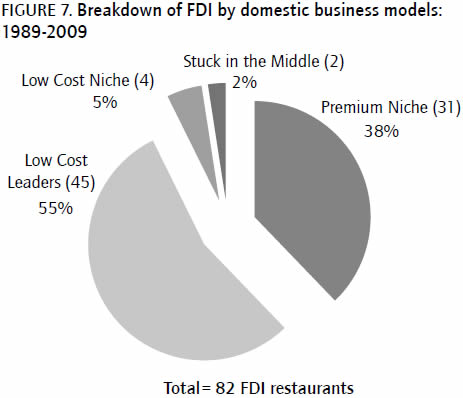
<body><![CDATA[<p>  We used a resource based view (RBV) to analyze the impact   of business model and multimatinalization. The resource   based view states that the resource profile controlled by   firms determine their performance (Barney, 1991; Barney,   1996; Penrose, 1959; Wernerfelt, 1984). We classified the   business models by using a price versus quality map. The   two authors and two research assistansts ranked the top   Peruvian restaurants by price and quality. Data for price   was obtained from websites and menu cartes obtained   for each reataurant. Data for quality was obtained from   the "<i>directorio de restaurantes categorizados y calificados</i>",   a local directory of restaurants. Once everybody had a   chance to review the categories, we discussed the corresponding   restaurant positions on the map. In addition, the   main authors visited most of the restaurants in the sample to verify the quality classification.</p>     <p> <a href="/img/revistas/inno/v21n39/39a16f4.jpg" target="_blank">Figure 4</a> shows four archetypical business models, namely,   Low Cost Leadership, Premium Niche, Low Coast Niche,   and Stuck in the Middle. The Premium Niche business   model represents restaurants that have created culinary innovations   fusing or mixing elements of European or Asian   food with the traditions of Peruvian cuisine (e.g., Astrid   and Gast&oacute;n). They are higher in price and quality than their   competitors are. Low Cost leaders are restaurants that offer   a reduced variety of fast food, but at a high quality and   similar or lower price than competitors (Bembos). Low Cost   Niche restaurants focus on rotisserie chicken at lower price   than competitors do. Peruvian rotisserie chicken or "pollo a   la brasa" has levels of devotion and national pride among   the vast local population. We coded each restaurant with a dummy variable representing each business model.</p>     <p>  We propose a RBV hypothesis of internationalization   of multilatinas; namely, firms learned and developed organizational   capabilities that ultimately improved their   effectiveness for competing abroad. The institutional proposition of internationalization assigns the gain in competitiveness,   on the reduction in transaction costs for domestic   firms due to favorable institutional factors. The RBV   proposition assigns such gains to learning, accumulation   of assets and unique capabilities. The two propositions   are complementary: the institutional framework addresses   the overall reduction of transaction costs for all domestic   firms, whereas the RBV addresses why there is heterogeneity   of performance among domestic firms.</p>     <p><a href="/img/revistas/inno/v21n39/39a16f5.jpg" target="_blank">  Figure 5</a> shows the average net revue and growth for each   business model (average of companies of our sample),   compared to foreign fast food multinationals competing   in Peru. Growth for US-MNCs decline gradually whereas   growth for Low Cost Leaders and Premium Niche increase   gradually over the period. In the last year of the   trend (2007), growth of both Premium Niche and Low Cost   Leaders were substantially larger than the growth of US   fast food MNCs.</p>     <p>  These findings lend support to both the institutional proposition   of internationalization of multilatinas as well as   the RBV proposition. Regarding the institutional proposition,   pacification of the insurgency, pro-market reforms,   and market integration with countries of the region reduced   transaction costs for domestic firms creating the   conditions for a rapid growth of domestic companies. Domestic   restaurants benefit more from economic globalization   that foreign multinational companies competing   in Peru. Regarding the RBV proposition, domestic restaurants   in the two top performing groups were able to accumulate   resources and gain organizational capabilities   while perfecting their business models. Low cost leaders   benefited the most presumably, because the standardization   inherent to such business model accelerated their   speed of expansion.</p>     <p><a href="/img/revistas/inno/v21n39/39a16f6.jpg" target="_blank">  Figure 6</a> shows a logarithmic scale of number of FDI on the   y-axis and net revenues on the x-axis. The logarithmic scale   facilitates the visualization of elasticity between FDI and   domestic revenues, which is the slope of the trend shown   in the logarithmic-scale scatter-plot. The findings suggest   that the percentage growth of FDI increases with the percentage growth of domestic revenues. Both revenues   and FDI were an order of magnitude larger for Low Cost   Leaders than for Premium Niche restaurants. We had incomplete   data and could not calculate the trend for Low   Cost Niche restaurants.</p>     <p>  These findings lend support to both the RBV and the institutional   propositions of internationalization of multilatinas.   Regarding the institutional proposition, pro-market   reforms led to international expansion of domestic firms.   Regarding the RBV proposition, different business models   with unique organizational capabilities and resource profiles   yield different internationalization rates.</p>     <p><a href="#f7">  Figure 7</a> shows the breakdown of FDI by business model   over the past two decades. The two dominant business   models of multinationalization are Low Cost leaders   (55%) and Premium Niche (38%).</p>     <p><a name="f7">&nbsp;</a></p>     <p>    ]]></body>
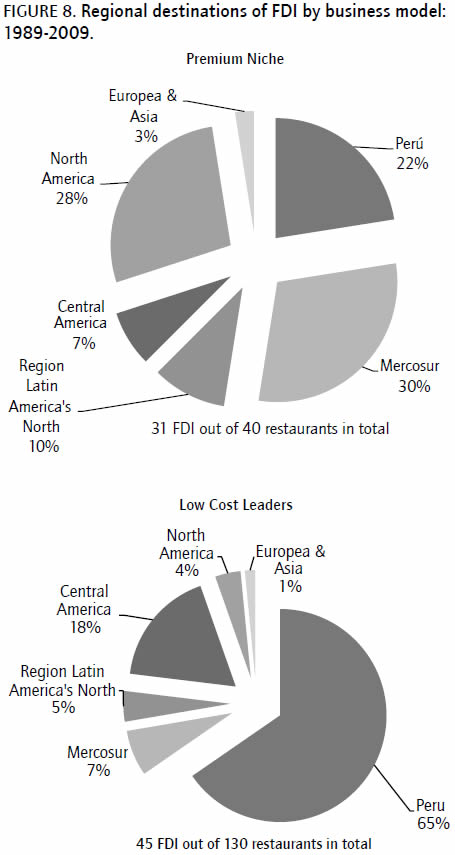
<body><![CDATA[<center><img src="/img/revistas/inno/v21n39/39a16f7.jpg"></center></p>     <p><a href="#f8">Figure 8</a> reveals each business model has a distinctive   and unique multinationalization process. Low Cost leaders   focused on Central America, whereas Premium Niche   focused both on the Southern region of South America   and North America. These findings lend support to the   RBV proposition. For instance, Guatemala hosts most of   the existing foreign multinational franchises companies.   Such a place is an ideal learning ground for Low Cost   leader such as Bembos, in their efforts to become a multinational   franchise.</p>     <p><a name="f8">&nbsp;</a></p>     <p>    <center><img src="/img/revistas/inno/v21n39/39a16f8.jpg"></center></p>     <p>&nbsp;</p>     <p><font size="3"><b>  Discussion</b></font></p>     <p> <font size="3"><b><i>Received view</i></b></font></p>     <p>  To improve the external validity of this study, we replicate   the findings of previous research on internationalization   of multilatinas (Cuervo-Cazurra, 2008). Regarding Time to   start multinationalization, we found that multilatinas have   a substantial delay between the year funded and the first   FDI. However, FDI increased exponentially after the implementation   of pro-market reforms in the 1990s. Regarding   location to start multinationalization, we found that multilatinas   expand to countries with proximate as well to countries   with distant psychic distance. These findings are at   odds with the gradual internationalization model and the   eclectic paradigm, the two predominant theoretical models   to explain multinationalization.</p>     <p>&nbsp;</p>     ]]></body>
<body><![CDATA[<p><font size="3"><b><i>Institutional environment to start   multinationalization: Pro-market reforms of domestic markets and regional market integration</i></b></font></p>     <p>  We found support instead for the institutional propositions   of internationalization of multilatinas, namely, that institutional   reforms reduced transaction costs for domestic   firms, which benefited domestic firms over multinationals   competing in the host country. We measured the economic   market integration between Per&uacute; and the destination   country of FDI. These are measures of the spread of institutional   reforms in the region and the increasing economic   globalization of Latin American countries. We found that   all the firms started their first FDI in countries with high   market integration; hence, their first FDI was in countries   with similarly favorable institutional environments.</p>     <p>&nbsp;</p>     <p><font size="3"><b><i>  Business level multinationalization strategies</i></b></font></p>     <p>  We found support for the RBV proposition of internationalization   of multilatinas; namely, firms learned and developed   organizational capabilities that ultimately improved   their effectiveness for competing abroad. The institutional   proposition of internationalization explains gains in competitiveness   based on the reduction of transaction costs   for domestic firms due to institutional reforms. The RBV   proposition explains such gains due to learning, accumulation   of assets and unique capabilities. The two propositions   are complementary: The institutional framework addresses   the overall reduction of transaction costs for all domestic   firms, whereas the RBV addresses why there is heterogeneity   of performance among domestic firms.</p>     <p>  The study found three main Peruvian restaurants business   strategies namely, premium niche, low cost leader, and low   cost niche. Two strategies dominated the Peruvian restaurants   industry's multinationalization: premium niche and low cost   leaders. The regional destination of FDI varied drastically   between these two strategies, where premium niche companies   focused on the US and the Southern Cone of South   America (Mercosur), whereas lows cost leaders focused on   Central America. Premium niche companies created high   quality restaurants that introduced products that combined   European flavors and Peruvian spices, which captured the   imagination of international enthusiasts of the Peruvian   cuisine. These restaurants almost simultaneously opened   restaurants in neighboring countries (Mercosur) and in the   US. These restaurants targeted their FDI to cities in the US   with substantial Hispanic markets. Besides, low cost leaders   developed fast food franchises that expanded in the local   domestic market and became serious competitors of foreign   fast food chains. Low cost leaders' pattern of multinationalization   was more conservative and sought learning from competitors on high competitive markets. This motive led   them to expand to Central America, where there is a substantial   presence of foreign fast food franchises.</p>     <p>&nbsp;</p>     <p><font size="3"><b>  Conclusion</b></font></p>     <p>  This study endorses the growing view that there is a need   to expand the theorizing on multinationalization of firms   from emerging economies. Both institutional model and   the Resource based View of the Firm seem promising theories   to build a new understanding of multinationalization   of firms from emerging economies.</p>     <p>&nbsp;</p>     ]]></body>
<body><![CDATA[<p><font size="3"><b>  Acknowledgements</b></font></p>     <p>  We acknowledge the able research assistance of Claudia   Sober&oacute;n and Sully SiuCho, students at Universidad del   Pac&iacute;fico. This research was possible by support of the Fulbright   Commission, the Wehle School of Business from Canisius   College, and the Facultad de Administraci&oacute;n de la   Universidad del Pac&iacute;fico (Per&uacute;). All errors remain ours.</p>     <p>&nbsp;</p>     <p><font size="3"><b>  References</b></font></p>     <!-- ref --><p>  Am&eacute;ricaEconom&iacute;a. (April 2008). Especial multilatinas: Ranking. <i>Am&eacute;ricaEconom&iacute;a</i>,   26-36.&nbsp;&nbsp;&nbsp;&nbsp;&nbsp;&nbsp;&nbsp;&nbsp;[&#160;<a href="javascript:void(0);" onclick="javascript: window.open('/scielo.php?script=sci_nlinks&ref=000117&pid=S0121-5051201100010001600001&lng=','','width=640,height=500,resizable=yes,scrollbars=1,menubar=yes,');">Links</a>&#160;]<!-- end-ref --><!-- ref --><p>  Aykut, D. &amp; Goldstein, A. (2006). Developing country multinationals:   South-south investment comes of age. <i>OECD Papers</i>, <i>6</i>(13), 1-42.&nbsp;&nbsp;&nbsp;&nbsp;&nbsp;&nbsp;&nbsp;&nbsp;[&#160;<a href="javascript:void(0);" onclick="javascript: window.open('/scielo.php?script=sci_nlinks&ref=000118&pid=S0121-5051201100010001600002&lng=','','width=640,height=500,resizable=yes,scrollbars=1,menubar=yes,');">Links</a>&#160;]<!-- end-ref --><!-- ref --><p>  Balassa, B. (1986). Intra industry trade among exporters of manufactured   goods. In D. Greenway &amp; P. K. M. Tharkan (Eds.), <i>Imperfect   competition and international trade: The policy aspects of intraindustry   trade</i>. Brighton: Wheatsheaf Press.&nbsp;&nbsp;&nbsp;&nbsp;&nbsp;&nbsp;&nbsp;&nbsp;[&#160;<a href="javascript:void(0);" onclick="javascript: window.open('/scielo.php?script=sci_nlinks&ref=000119&pid=S0121-5051201100010001600003&lng=','','width=640,height=500,resizable=yes,scrollbars=1,menubar=yes,');">Links</a>&#160;]<!-- end-ref --><!-- ref --><p>  Balassa, B. &amp; Bauwens, L. (1987). Intra-industry specialization in a   multi-country and multi-industry framework. <i>Economic Journal,    </i><i>97</i>, 923-939.&nbsp;&nbsp;&nbsp;&nbsp;&nbsp;&nbsp;&nbsp;&nbsp;[&#160;<a href="javascript:void(0);" onclick="javascript: window.open('/scielo.php?script=sci_nlinks&ref=000120&pid=S0121-5051201100010001600004&lng=','','width=640,height=500,resizable=yes,scrollbars=1,menubar=yes,');">Links</a>&#160;]<!-- end-ref --><!-- ref --><p>  Barney, J. (1991). Firm resources and sustained competitive advantage.   <i>Journal of Management</i>, <i>17</i>(1), 99-120.&nbsp;&nbsp;&nbsp;&nbsp;&nbsp;&nbsp;&nbsp;&nbsp;[&#160;<a href="javascript:void(0);" onclick="javascript: window.open('/scielo.php?script=sci_nlinks&ref=000121&pid=S0121-5051201100010001600005&lng=','','width=640,height=500,resizable=yes,scrollbars=1,menubar=yes,');">Links</a>&#160;]<!-- end-ref --><!-- ref --><p>  Barney, J. B. (1996). The resource-based theory of the firm. <i>Organization   Science</i>, <i>7</i>(5), 469-469.&nbsp;&nbsp;&nbsp;&nbsp;&nbsp;&nbsp;&nbsp;&nbsp;[&#160;<a href="javascript:void(0);" onclick="javascript: window.open('/scielo.php?script=sci_nlinks&ref=000122&pid=S0121-5051201100010001600006&lng=','','width=640,height=500,resizable=yes,scrollbars=1,menubar=yes,');">Links</a>&#160;]<!-- end-ref --><!-- ref --><p>  Bergstrand, J. (1990). The heckscher-ohlin-samuelson model, the linder   hypothesis and the determinants of bilateral intra-industry trade.   <i>The Economic Journal</i>, <i>100</i>, 1216-1229.&nbsp;&nbsp;&nbsp;&nbsp;&nbsp;&nbsp;&nbsp;&nbsp;[&#160;<a href="javascript:void(0);" onclick="javascript: window.open('/scielo.php?script=sci_nlinks&ref=000123&pid=S0121-5051201100010001600007&lng=','','width=640,height=500,resizable=yes,scrollbars=1,menubar=yes,');">Links</a>&#160;]<!-- end-ref --><!-- ref --><p>  Buckley, P. J. &amp; Ghauri, P. N. (2004). Globalization, economic geography   and the strategy of multinational enterprises. (perspective). <i>Journal   of International Business Studies</i>, <i>35</i>(2), 81-98.&nbsp;&nbsp;&nbsp;&nbsp;&nbsp;&nbsp;&nbsp;&nbsp;[&#160;<a href="javascript:void(0);" onclick="javascript: window.open('/scielo.php?script=sci_nlinks&ref=000124&pid=S0121-5051201100010001600008&lng=','','width=640,height=500,resizable=yes,scrollbars=1,menubar=yes,');">Links</a>&#160;]<!-- end-ref --><!-- ref --><p>  Cuervo-Cazurra, A. (2008). The multinationalization of developing   country mnes: The case of multilatinas. <i>Journal of International   Management</i>, <i>14</i>(2), 138-154.&nbsp;&nbsp;&nbsp;&nbsp;&nbsp;&nbsp;&nbsp;&nbsp;[&#160;<a href="javascript:void(0);" onclick="javascript: window.open('/scielo.php?script=sci_nlinks&ref=000125&pid=S0121-5051201100010001600009&lng=','','width=640,height=500,resizable=yes,scrollbars=1,menubar=yes,');">Links</a>&#160;]<!-- end-ref --><!-- ref --><p>  Cuervo-Cazurra, A. &amp; Dau, L. A. (2009). Promarket reforms and firm   profitability in developing countries. Academy of Management   Journal, 52(6), 1348-1368.&nbsp;&nbsp;&nbsp;&nbsp;&nbsp;&nbsp;&nbsp;&nbsp;[&#160;<a href="javascript:void(0);" onclick="javascript: window.open('/scielo.php?script=sci_nlinks&ref=000126&pid=S0121-5051201100010001600010&lng=','','width=640,height=500,resizable=yes,scrollbars=1,menubar=yes,');">Links</a>&#160;]<!-- end-ref --><!-- ref --><p>  da Silva, J. F., da Rocha, A. &amp; Carneiro, J. (2009). The international expansion   of firms from emerging markets: Toward a typology of   brazilian mnes. <i>Latin American Business Review</i>, <i>10</i>(2/3), 95-115.&nbsp;&nbsp;&nbsp;&nbsp;&nbsp;&nbsp;&nbsp;&nbsp;[&#160;<a href="javascript:void(0);" onclick="javascript: window.open('/scielo.php?script=sci_nlinks&ref=000127&pid=S0121-5051201100010001600011&lng=','','width=640,height=500,resizable=yes,scrollbars=1,menubar=yes,');">Links</a>&#160;]<!-- end-ref --><!-- ref --><p>  Dunning, J. H. (1979). Explaining changing patterns of international   production: In defense of the eclectic theory. <i>Oxford Bulletin of   Economics &amp; Statistics</i>, <i>41</i>(4), 269-295.&nbsp;&nbsp;&nbsp;&nbsp;&nbsp;&nbsp;&nbsp;&nbsp;[&#160;<a href="javascript:void(0);" onclick="javascript: window.open('/scielo.php?script=sci_nlinks&ref=000128&pid=S0121-5051201100010001600012&lng=','','width=640,height=500,resizable=yes,scrollbars=1,menubar=yes,');">Links</a>&#160;]<!-- end-ref --><!-- ref --><p>  Dunning, J. H. (1980). Toward an eclectic theory of international production:   Some empirical tests. <i>Journal of International Business   Studies</i>, <i>11</i>(1), 9-31.&nbsp;&nbsp;&nbsp;&nbsp;&nbsp;&nbsp;&nbsp;&nbsp;[&#160;<a href="javascript:void(0);" onclick="javascript: window.open('/scielo.php?script=sci_nlinks&ref=000129&pid=S0121-5051201100010001600013&lng=','','width=640,height=500,resizable=yes,scrollbars=1,menubar=yes,');">Links</a>&#160;]<!-- end-ref --><!-- ref --><p>  Ghemawat, P. (2003). Semiglobalization and international business   strategy. <i>Journal of International Business Studies</i>, <i>34</i>(2), 138-152.&nbsp;&nbsp;&nbsp;&nbsp;&nbsp;&nbsp;&nbsp;&nbsp;[&#160;<a href="javascript:void(0);" onclick="javascript: window.open('/scielo.php?script=sci_nlinks&ref=000130&pid=S0121-5051201100010001600014&lng=','','width=640,height=500,resizable=yes,scrollbars=1,menubar=yes,');">Links</a>&#160;]<!-- end-ref --><!-- ref --><p>  Guill&eacute;n, M. F. &amp; Garc&iacute;a-Canal, E. (2009). The american model of the   multinational firm and the "New" Multinationals from emerging   economies. <i>Academy of Management Perspectives</i>, <i>23</i>(2), 23-35.&nbsp;&nbsp;&nbsp;&nbsp;&nbsp;&nbsp;&nbsp;&nbsp;[&#160;<a href="javascript:void(0);" onclick="javascript: window.open('/scielo.php?script=sci_nlinks&ref=000131&pid=S0121-5051201100010001600015&lng=','','width=640,height=500,resizable=yes,scrollbars=1,menubar=yes,');">Links</a>&#160;]<!-- end-ref --><!-- ref --><p>  Johanson, J. &amp; Vahlne, J.E. (1977). The internationalization process of   the firm--a model of knowledge development and increasing foreign   market commitments. <i>Journal of International Business Studies</i>,   <i>8</i>(1), 25-34.&nbsp;&nbsp;&nbsp;&nbsp;&nbsp;&nbsp;&nbsp;&nbsp;[&#160;<a href="javascript:void(0);" onclick="javascript: window.open('/scielo.php?script=sci_nlinks&ref=000132&pid=S0121-5051201100010001600016&lng=','','width=640,height=500,resizable=yes,scrollbars=1,menubar=yes,');">Links</a>&#160;]<!-- end-ref --><!-- ref --><p>  Johanson, J. &amp; Vahlne, J.-E. (2009). The uppsala internationalization   process model revisited: From liability of foreignness to liability   of outsidership. <i>Journal of International Business Studies</i>, <i>40</i>(9),   1411-1431.&nbsp;&nbsp;&nbsp;&nbsp;&nbsp;&nbsp;&nbsp;&nbsp;[&#160;<a href="javascript:void(0);" onclick="javascript: window.open('/scielo.php?script=sci_nlinks&ref=000133&pid=S0121-5051201100010001600017&lng=','','width=640,height=500,resizable=yes,scrollbars=1,menubar=yes,');">Links</a>&#160;]<!-- end-ref --><!-- ref --><p>  Maanen, J. V. (Ed.). (1983). <i>Qualitative methodology</i>. (An updated reprint   of the december 1979 issue of administrative science quarterly).   Newbury Park, CA: Sage Publications Inc.&nbsp;&nbsp;&nbsp;&nbsp;&nbsp;&nbsp;&nbsp;&nbsp;[&#160;<a href="javascript:void(0);" onclick="javascript: window.open('/scielo.php?script=sci_nlinks&ref=000134&pid=S0121-5051201100010001600018&lng=','','width=640,height=500,resizable=yes,scrollbars=1,menubar=yes,');">Links</a>&#160;]<!-- end-ref --><!-- ref --><p>  Martinez, A., De Souza, I. &amp; Liu, F. (2003). Multinationals vs. Multilatinas:   Latin America's great race. <i>Strategy + Business</i>, (Fall),  1-12.&nbsp;&nbsp;&nbsp;&nbsp;&nbsp;&nbsp;&nbsp;&nbsp;[&#160;<a href="javascript:void(0);" onclick="javascript: window.open('/scielo.php?script=sci_nlinks&ref=000135&pid=S0121-5051201100010001600019&lng=','','width=640,height=500,resizable=yes,scrollbars=1,menubar=yes,');">Links</a>&#160;]<!-- end-ref --><!-- ref --><p>  Miles, M. B. &amp; Huberman, A. M. (1984 &#91;1990&#93;). <i>Qualitative data analysis:   A sourcebook of new methods</i>. Newbury Park, CA: Sage Publications   Inc.&nbsp;&nbsp;&nbsp;&nbsp;&nbsp;&nbsp;&nbsp;&nbsp;[&#160;<a href="javascript:void(0);" onclick="javascript: window.open('/scielo.php?script=sci_nlinks&ref=000136&pid=S0121-5051201100010001600020&lng=','','width=640,height=500,resizable=yes,scrollbars=1,menubar=yes,');">Links</a>&#160;]<!-- end-ref --><!-- ref --><p>  Penrose, E. (1959). <i>The theory of the growth of the firm</i>. London: Basil   Blackwell.&nbsp;&nbsp;&nbsp;&nbsp;&nbsp;&nbsp;&nbsp;&nbsp;[&#160;<a href="javascript:void(0);" onclick="javascript: window.open('/scielo.php?script=sci_nlinks&ref=000137&pid=S0121-5051201100010001600021&lng=','','width=640,height=500,resizable=yes,scrollbars=1,menubar=yes,');">Links</a>&#160;]<!-- end-ref --><!-- ref --><p>  Ricart, J. E., Enright, M. J., Ghemawat, P., Hart, S. L., &amp; Khanna, T.   (2004). New frontiers in international strategy. <i>Journal of International   Business Studies</i>, <i>35</i>(3), 175-200.&nbsp;&nbsp;&nbsp;&nbsp;&nbsp;&nbsp;&nbsp;&nbsp;[&#160;<a href="javascript:void(0);" onclick="javascript: window.open('/scielo.php?script=sci_nlinks&ref=000138&pid=S0121-5051201100010001600022&lng=','','width=640,height=500,resizable=yes,scrollbars=1,menubar=yes,');">Links</a>&#160;]<!-- end-ref --><!-- ref --><p>  Rivas, R. M., Rakovski, C. C. &amp; Skaletsky, M. (2006). Bilateral measures   of globalization 1970-2000. <i>Eruditio de Commercio, Richard J. Wehle   School of Business Working Papers Series</i>, <i>WP 2006-01</i>, 1-27.&nbsp;&nbsp;&nbsp;&nbsp;&nbsp;&nbsp;&nbsp;&nbsp;[&#160;<a href="javascript:void(0);" onclick="javascript: window.open('/scielo.php?script=sci_nlinks&ref=000139&pid=S0121-5051201100010001600023&lng=','','width=640,height=500,resizable=yes,scrollbars=1,menubar=yes,');">Links</a>&#160;]<!-- end-ref --><!-- ref --><p>  Santiso, J. (2007). The emergence of multilatinas. In <i>Current issues:   Latin America</i>. Frankfurt am Main, Germany: Deutsche Bank Research.&nbsp;&nbsp;&nbsp;&nbsp;&nbsp;&nbsp;&nbsp;&nbsp;[&#160;<a href="javascript:void(0);" onclick="javascript: window.open('/scielo.php?script=sci_nlinks&ref=000140&pid=S0121-5051201100010001600024&lng=','','width=640,height=500,resizable=yes,scrollbars=1,menubar=yes,');">Links</a>&#160;]<!-- end-ref --><!-- ref --><p>  Santiso, J. (Agosto 2008). La emergencia de las multilatinas. <i>Revista de   la CEPAL</i>, <i>95</i>, 7-30.&nbsp;&nbsp;&nbsp;&nbsp;&nbsp;&nbsp;&nbsp;&nbsp;[&#160;<a href="javascript:void(0);" onclick="javascript: window.open('/scielo.php?script=sci_nlinks&ref=000141&pid=S0121-5051201100010001600025&lng=','','width=640,height=500,resizable=yes,scrollbars=1,menubar=yes,');">Links</a>&#160;]<!-- end-ref --><!-- ref --><p>  Toledo, R. (2008). The rise of the multilatinas. <i>PM Network</i>, <i>22</i>(9), 28-29.&nbsp;&nbsp;&nbsp;&nbsp;&nbsp;&nbsp;&nbsp;&nbsp;[&#160;<a href="javascript:void(0);" onclick="javascript: window.open('/scielo.php?script=sci_nlinks&ref=000142&pid=S0121-5051201100010001600026&lng=','','width=640,height=500,resizable=yes,scrollbars=1,menubar=yes,');">Links</a>&#160;]<!-- end-ref --><!-- ref --><p>  Wernerfelt, B. (1984). A resource-based view of the firm. <i>Strategic Management   Journal</i>, <i>5</i>(2), 171-180.&nbsp;&nbsp;&nbsp;&nbsp;&nbsp;&nbsp;&nbsp;&nbsp;[&#160;<a href="javascript:void(0);" onclick="javascript: window.open('/scielo.php?script=sci_nlinks&ref=000143&pid=S0121-5051201100010001600027&lng=','','width=640,height=500,resizable=yes,scrollbars=1,menubar=yes,');">Links</a>&#160;]<!-- end-ref --><!-- ref --><p>  Yin, R. K. (1989). <i>Case study research: Design and methods</i> (volume   5). Sage Publications Inc.&nbsp;&nbsp;&nbsp;&nbsp;&nbsp;&nbsp;&nbsp;&nbsp;[&#160;<a href="javascript:void(0);" onclick="javascript: window.open('/scielo.php?script=sci_nlinks&ref=000144&pid=S0121-5051201100010001600028&lng=','','width=640,height=500,resizable=yes,scrollbars=1,menubar=yes,');">Links</a>&#160;]<!-- end-ref --> ]]></body><back>
<ref-list>
<ref id="B1">
<nlm-citation citation-type="journal">
<collab>AméricaEconomía.</collab>
<article-title xml:lang="es"><![CDATA[Especial multilatinas: Ranking]]></article-title>
<source><![CDATA[AméricaEconomía]]></source>
<year>Apri</year>
<month>l </month>
<day>20</day>
<page-range>26-36</page-range></nlm-citation>
</ref>
<ref id="B2">
<nlm-citation citation-type="journal">
<person-group person-group-type="author">
<name>
<surname><![CDATA[Aykut]]></surname>
<given-names><![CDATA[D]]></given-names>
</name>
<name>
<surname><![CDATA[Goldstein]]></surname>
<given-names><![CDATA[A]]></given-names>
</name>
</person-group>
<article-title xml:lang="en"><![CDATA[Developing country multinationals: South-south investment comes of age]]></article-title>
<source><![CDATA[OECD Papers]]></source>
<year>2006</year>
<volume>6</volume>
<numero>13</numero>
<issue>13</issue>
<page-range>1-42</page-range></nlm-citation>
</ref>
<ref id="B3">
<nlm-citation citation-type="book">
<person-group person-group-type="author">
<name>
<surname><![CDATA[Balassa]]></surname>
<given-names><![CDATA[B]]></given-names>
</name>
</person-group>
<article-title xml:lang="en"><![CDATA[Intra industry trade among exporters of manufactured goods]]></article-title>
<person-group person-group-type="editor">
<name>
<surname><![CDATA[Greenway]]></surname>
<given-names><![CDATA[D]]></given-names>
</name>
<name>
<surname><![CDATA[Tharkan]]></surname>
<given-names><![CDATA[P. K. M]]></given-names>
</name>
</person-group>
<source><![CDATA[Imperfect competition and international trade: The policy aspects of intraindustry trade]]></source>
<year>1986</year>
<publisher-loc><![CDATA[Brighton ]]></publisher-loc>
<publisher-name><![CDATA[Wheatsheaf Press]]></publisher-name>
</nlm-citation>
</ref>
<ref id="B4">
<nlm-citation citation-type="journal">
<person-group person-group-type="author">
<name>
<surname><![CDATA[Balassa]]></surname>
<given-names><![CDATA[B]]></given-names>
</name>
<name>
<surname><![CDATA[Bauwens]]></surname>
<given-names><![CDATA[L]]></given-names>
</name>
</person-group>
<article-title xml:lang="en"><![CDATA[Intra-industry specialization in a multi-country and multi-industry framework]]></article-title>
<source><![CDATA[Economic Journal]]></source>
<year>1987</year>
<volume>97</volume>
<page-range>923-939</page-range></nlm-citation>
</ref>
<ref id="B5">
<nlm-citation citation-type="journal">
<person-group person-group-type="author">
<name>
<surname><![CDATA[Barney]]></surname>
<given-names><![CDATA[J]]></given-names>
</name>
</person-group>
<article-title xml:lang="en"><![CDATA[Firm resources and sustained competitive advantage]]></article-title>
<source><![CDATA[Journal of Management]]></source>
<year>1991</year>
<volume>17</volume>
<numero>1</numero>
<issue>1</issue>
<page-range>99-120</page-range></nlm-citation>
</ref>
<ref id="B6">
<nlm-citation citation-type="journal">
<person-group person-group-type="author">
<name>
<surname><![CDATA[Barney]]></surname>
<given-names><![CDATA[J. B]]></given-names>
</name>
</person-group>
<article-title xml:lang="en"><![CDATA[The resource-based theory of the firm]]></article-title>
<source><![CDATA[Organization Science]]></source>
<year>1996</year>
<volume>7</volume>
<numero>5</numero>
<issue>5</issue>
<page-range>469-469</page-range></nlm-citation>
</ref>
<ref id="B7">
<nlm-citation citation-type="journal">
<person-group person-group-type="author">
<name>
<surname><![CDATA[Bergstrand]]></surname>
<given-names><![CDATA[J]]></given-names>
</name>
</person-group>
<article-title xml:lang="en"><![CDATA[The heckscher-ohlin-samuelson model, the linder hypothesis and the determinants of bilateral intra-industry trade]]></article-title>
<source><![CDATA[The Economic Journal]]></source>
<year>1990</year>
<volume>100</volume>
<page-range>1216-1229</page-range></nlm-citation>
</ref>
<ref id="B8">
<nlm-citation citation-type="journal">
<person-group person-group-type="author">
<name>
<surname><![CDATA[Buckley]]></surname>
<given-names><![CDATA[P. J]]></given-names>
</name>
<name>
<surname><![CDATA[Ghauri]]></surname>
<given-names><![CDATA[P. N]]></given-names>
</name>
</person-group>
<article-title xml:lang="en"><![CDATA[Globalization, economic geography and the strategy of multinational enterprises. (perspective)]]></article-title>
<source><![CDATA[Journal of International Business Studies]]></source>
<year>2004</year>
<volume>35</volume>
<numero>2</numero>
<issue>2</issue>
<page-range>81-98</page-range></nlm-citation>
</ref>
<ref id="B9">
<nlm-citation citation-type="journal">
<person-group person-group-type="author">
<name>
<surname><![CDATA[Cuervo-Cazurra]]></surname>
<given-names><![CDATA[A]]></given-names>
</name>
</person-group>
<article-title xml:lang="en"><![CDATA[The multinationalization of developing country mnes: The case of multilatinas]]></article-title>
<source><![CDATA[Journal of International Management]]></source>
<year>2008</year>
<volume>14</volume>
<numero>2</numero>
<issue>2</issue>
<page-range>138-154</page-range></nlm-citation>
</ref>
<ref id="B10">
<nlm-citation citation-type="journal">
<person-group person-group-type="author">
<name>
<surname><![CDATA[Cuervo-Cazurra]]></surname>
<given-names><![CDATA[A]]></given-names>
</name>
<name>
<surname><![CDATA[Dau]]></surname>
<given-names><![CDATA[L. A]]></given-names>
</name>
</person-group>
<article-title xml:lang="en"><![CDATA[Promarket reforms and firm profitability in developing countries]]></article-title>
<source><![CDATA[Academy of Management Journal]]></source>
<year>2009</year>
<volume>52</volume>
<numero>6</numero>
<issue>6</issue>
<page-range>1348-1368</page-range></nlm-citation>
</ref>
<ref id="B11">
<nlm-citation citation-type="journal">
<person-group person-group-type="author">
<name>
<surname><![CDATA[da Silva]]></surname>
<given-names><![CDATA[J. F]]></given-names>
</name>
<name>
<surname><![CDATA[da Rocha]]></surname>
<given-names><![CDATA[A]]></given-names>
</name>
<name>
<surname><![CDATA[Carneiro]]></surname>
<given-names><![CDATA[J]]></given-names>
</name>
</person-group>
<article-title xml:lang="en"><![CDATA[The international expansion of firms from emerging markets: Toward a typology of brazilian mnes]]></article-title>
<source><![CDATA[Latin American Business Review]]></source>
<year>2009</year>
<volume>10</volume>
<numero>2/3</numero>
<issue>2/3</issue>
<page-range>95-115</page-range></nlm-citation>
</ref>
<ref id="B12">
<nlm-citation citation-type="journal">
<person-group person-group-type="author">
<name>
<surname><![CDATA[Dunning]]></surname>
<given-names><![CDATA[J. H]]></given-names>
</name>
</person-group>
<article-title xml:lang="en"><![CDATA[Explaining changing patterns of international production: In defense of the eclectic theory]]></article-title>
<source><![CDATA[Oxford Bulletin of Economics & Statistics]]></source>
<year>1979</year>
<volume>41</volume>
<numero>4</numero>
<issue>4</issue>
<page-range>269-295</page-range></nlm-citation>
</ref>
<ref id="B13">
<nlm-citation citation-type="journal">
<person-group person-group-type="author">
<name>
<surname><![CDATA[Dunning]]></surname>
<given-names><![CDATA[J. H]]></given-names>
</name>
</person-group>
<article-title xml:lang="en"><![CDATA[Toward an eclectic theory of international production: Some empirical tests]]></article-title>
<source><![CDATA[Journal of International Business Studies]]></source>
<year>1980</year>
<volume>11</volume>
<numero>1</numero>
<issue>1</issue>
<page-range>9-31</page-range></nlm-citation>
</ref>
<ref id="B14">
<nlm-citation citation-type="journal">
<person-group person-group-type="author">
<name>
<surname><![CDATA[Ghemawat]]></surname>
<given-names><![CDATA[P]]></given-names>
</name>
</person-group>
<article-title xml:lang="en"><![CDATA[Semiglobalization and international business strategy]]></article-title>
<source><![CDATA[Journal of International Business Studies]]></source>
<year>2003</year>
<volume>34</volume>
<numero>2</numero>
<issue>2</issue>
<page-range>138-152</page-range></nlm-citation>
</ref>
<ref id="B15">
<nlm-citation citation-type="journal">
<person-group person-group-type="author">
<name>
<surname><![CDATA[Guillén]]></surname>
<given-names><![CDATA[M. F]]></given-names>
</name>
<name>
<surname><![CDATA[García-Canal]]></surname>
<given-names><![CDATA[E]]></given-names>
</name>
</person-group>
<article-title xml:lang="en"><![CDATA[The american model of the multinational firm and the "New" Multinationals from emerging economies]]></article-title>
<source><![CDATA[Academy of Management Perspectives]]></source>
<year>2009</year>
<volume>23</volume>
<numero>2</numero>
<issue>2</issue>
<page-range>23-35</page-range></nlm-citation>
</ref>
<ref id="B16">
<nlm-citation citation-type="journal">
<person-group person-group-type="author">
<name>
<surname><![CDATA[Johanson]]></surname>
<given-names><![CDATA[J]]></given-names>
</name>
<name>
<surname><![CDATA[Vahlne]]></surname>
<given-names><![CDATA[J.E]]></given-names>
</name>
</person-group>
<article-title xml:lang="en"><![CDATA[The internationalization process of the firm--a model of knowledge development and increasing foreign market commitments]]></article-title>
<source><![CDATA[Journal of International Business Studies]]></source>
<year>1977</year>
<volume>8</volume>
<numero>1</numero>
<issue>1</issue>
<page-range>25-34</page-range></nlm-citation>
</ref>
<ref id="B17">
<nlm-citation citation-type="journal">
<person-group person-group-type="author">
<name>
<surname><![CDATA[Johanson]]></surname>
<given-names><![CDATA[J]]></given-names>
</name>
<name>
<surname><![CDATA[Vahlne]]></surname>
<given-names><![CDATA[J.-E]]></given-names>
</name>
</person-group>
<article-title xml:lang="en"><![CDATA[The uppsala internationalization process model revisited: From liability of foreignness to liability of outsidership]]></article-title>
<source><![CDATA[Journal of International Business Studies]]></source>
<year>2009</year>
<volume>40</volume>
<numero>9</numero>
<issue>9</issue>
<page-range>1411-1431</page-range></nlm-citation>
</ref>
<ref id="B18">
<nlm-citation citation-type="book">
<person-group person-group-type="author">
<name>
<surname><![CDATA[Maanen]]></surname>
<given-names><![CDATA[J. V]]></given-names>
</name>
</person-group>
<source><![CDATA[Qualitative methodology: (An updated reprint of the december 1979 issue of administrative science quarterly)]]></source>
<year>1983</year>
<publisher-loc><![CDATA[Newbury Park^eCA CA]]></publisher-loc>
<publisher-name><![CDATA[Sage Publications Inc]]></publisher-name>
</nlm-citation>
</ref>
<ref id="B19">
<nlm-citation citation-type="journal">
<person-group person-group-type="author">
<name>
<surname><![CDATA[Martinez]]></surname>
<given-names><![CDATA[A]]></given-names>
</name>
<name>
<surname><![CDATA[De Souza]]></surname>
<given-names><![CDATA[I]]></given-names>
</name>
<name>
<surname><![CDATA[Liu]]></surname>
<given-names><![CDATA[F]]></given-names>
</name>
</person-group>
<article-title xml:lang="en"><![CDATA[Multinationals vs. Multilatinas: Latin America's great race]]></article-title>
<source><![CDATA[Strategy + Business]]></source>
<year>2003</year>
<volume>(Fall)</volume>
<page-range>1-12</page-range></nlm-citation>
</ref>
<ref id="B20">
<nlm-citation citation-type="book">
<person-group person-group-type="author">
<name>
<surname><![CDATA[Miles]]></surname>
<given-names><![CDATA[M. B]]></given-names>
</name>
<name>
<surname><![CDATA[Huberman]]></surname>
<given-names><![CDATA[A. M]]></given-names>
</name>
</person-group>
<source><![CDATA[Qualitative data analysis: A sourcebook of new methods]]></source>
<year>1984</year>
<month> &</month>
<day>#9</day>
<publisher-loc><![CDATA[Newbury Park^eCA CA]]></publisher-loc>
<publisher-name><![CDATA[Sage Publications Inc]]></publisher-name>
</nlm-citation>
</ref>
<ref id="B21">
<nlm-citation citation-type="book">
<person-group person-group-type="author">
<name>
<surname><![CDATA[Penrose]]></surname>
<given-names><![CDATA[E]]></given-names>
</name>
</person-group>
<source><![CDATA[The theory of the growth of the firm]]></source>
<year>1959</year>
<publisher-loc><![CDATA[London ]]></publisher-loc>
<publisher-name><![CDATA[Basil Blackwell]]></publisher-name>
</nlm-citation>
</ref>
<ref id="B22">
<nlm-citation citation-type="journal">
<person-group person-group-type="author">
<name>
<surname><![CDATA[Ricart]]></surname>
<given-names><![CDATA[J. E]]></given-names>
</name>
<name>
<surname><![CDATA[Enright]]></surname>
<given-names><![CDATA[M. J]]></given-names>
</name>
<name>
<surname><![CDATA[Ghemawat]]></surname>
<given-names><![CDATA[P]]></given-names>
</name>
<name>
<surname><![CDATA[Hart]]></surname>
<given-names><![CDATA[S. L]]></given-names>
</name>
<name>
<surname><![CDATA[Khanna]]></surname>
<given-names><![CDATA[T]]></given-names>
</name>
</person-group>
<article-title xml:lang="en"><![CDATA[New frontiers in international strategy]]></article-title>
<source><![CDATA[Journal of International Business Studies]]></source>
<year>2004</year>
<volume>35</volume>
<numero>3</numero>
<issue>3</issue>
<page-range>175-200</page-range></nlm-citation>
</ref>
<ref id="B23">
<nlm-citation citation-type="journal">
<person-group person-group-type="author">
<name>
<surname><![CDATA[Rivas]]></surname>
<given-names><![CDATA[R. M]]></given-names>
</name>
<name>
<surname><![CDATA[Rakovski]]></surname>
<given-names><![CDATA[C. C]]></given-names>
</name>
<name>
<surname><![CDATA[Skaletsky]]></surname>
<given-names><![CDATA[M]]></given-names>
</name>
</person-group>
<article-title xml:lang="en"><![CDATA[Bilateral measures of globalization 1970-2000]]></article-title>
<source><![CDATA[Eruditio de Commercio, Richard J. Wehle School of Business Working Papers Series]]></source>
<year>2006</year>
<numero>WP 2006-01</numero>
<issue>WP 2006-01</issue>
<page-range>1-27</page-range></nlm-citation>
</ref>
<ref id="B24">
<nlm-citation citation-type="book">
<person-group person-group-type="author">
<name>
<surname><![CDATA[Santiso]]></surname>
<given-names><![CDATA[J]]></given-names>
</name>
</person-group>
<article-title xml:lang="en"><![CDATA[The emergence of multilatinas]]></article-title>
<source><![CDATA[Current issues: Latin America]]></source>
<year>2007</year>
<publisher-loc><![CDATA[Frankfurt am Main ]]></publisher-loc>
<publisher-name><![CDATA[Deutsche Bank Research]]></publisher-name>
</nlm-citation>
</ref>
<ref id="B25">
<nlm-citation citation-type="journal">
<person-group person-group-type="author">
<name>
<surname><![CDATA[Santiso]]></surname>
<given-names><![CDATA[J]]></given-names>
</name>
</person-group>
<article-title xml:lang="es"><![CDATA[La emergencia de las multilatinas]]></article-title>
<source><![CDATA[Revista de la CEPAL]]></source>
<year>Agos</year>
<month>to</month>
<day> 2</day>
<volume>95</volume>
<page-range>7-30</page-range></nlm-citation>
</ref>
<ref id="B26">
<nlm-citation citation-type="journal">
<person-group person-group-type="author">
<name>
<surname><![CDATA[Toledo]]></surname>
<given-names><![CDATA[R]]></given-names>
</name>
</person-group>
<article-title xml:lang="en"><![CDATA[The rise of the multilatinas]]></article-title>
<source><![CDATA[PM Network]]></source>
<year>2008</year>
<volume>22</volume>
<numero>9</numero>
<issue>9</issue>
<page-range>28-29</page-range></nlm-citation>
</ref>
<ref id="B27">
<nlm-citation citation-type="journal">
<person-group person-group-type="author">
<name>
<surname><![CDATA[Wernerfelt]]></surname>
<given-names><![CDATA[B]]></given-names>
</name>
</person-group>
<article-title xml:lang="en"><![CDATA[A resource-based view of the firm]]></article-title>
<source><![CDATA[Strategic Management Journal]]></source>
<year>1984</year>
<volume>5</volume>
<numero>2</numero>
<issue>2</issue>
<page-range>171-180</page-range></nlm-citation>
</ref>
<ref id="B28">
<nlm-citation citation-type="book">
<person-group person-group-type="author">
<name>
<surname><![CDATA[Yin]]></surname>
<given-names><![CDATA[R. K]]></given-names>
</name>
</person-group>
<source><![CDATA[Case study research: Design and methods]]></source>
<year>1989</year>
<volume>5</volume>
<publisher-name><![CDATA[Sage Publications Inc]]></publisher-name>
</nlm-citation>
</ref>
</ref-list>
</back>
</article>