<?xml version="1.0" encoding="ISO-8859-1"?><article xmlns:mml="http://www.w3.org/1998/Math/MathML" xmlns:xlink="http://www.w3.org/1999/xlink" xmlns:xsi="http://www.w3.org/2001/XMLSchema-instance">
<front>
<journal-meta>
<journal-id>0121-5051</journal-id>
<journal-title><![CDATA[Innovar]]></journal-title>
<abbrev-journal-title><![CDATA[Innovar]]></abbrev-journal-title>
<issn>0121-5051</issn>
<publisher>
<publisher-name><![CDATA[Facultad de Ciencias Económicas. Universidad Nacional de Colombia.]]></publisher-name>
</publisher>
</journal-meta>
<article-meta>
<article-id>S0121-50512011000300013</article-id>
<title-group>
<article-title xml:lang="en"><![CDATA[ATC-PSQUAL scale: A proposal to measure perceived quality of the Air Traffic Control Service]]></article-title>
<article-title xml:lang="es"><![CDATA[Medición de la calidad percibida del servicio de control de tránsito aéreo]]></article-title>
<article-title xml:lang="fr"><![CDATA[Mesure de la perception de la qualite du service de controle du trafic aerien]]></article-title>
<article-title xml:lang="pt"><![CDATA[Medição da qualidade percebida do serviço de controle de trânsito aéreo]]></article-title>
</title-group>
<contrib-group>
<contrib contrib-type="author">
<name>
<surname><![CDATA[Duque-Oliva]]></surname>
<given-names><![CDATA[Edison Jair]]></given-names>
</name>
<xref ref-type="aff" rid="A01"/>
</contrib>
<contrib contrib-type="author">
<name>
<surname><![CDATA[Mercado-Barboza]]></surname>
<given-names><![CDATA[Manuel]]></given-names>
</name>
<xref ref-type="aff" rid="A02"/>
</contrib>
</contrib-group>
<aff id="A01">
<institution><![CDATA[,Universidad Nacional de Colombia Escuela de Administración y Contaduría Pública ]]></institution>
<addr-line><![CDATA[Bogotá ]]></addr-line>
</aff>
<aff id="A02">
<institution><![CDATA[,Universidad Nacional de Colombia  ]]></institution>
<addr-line><![CDATA[ ]]></addr-line>
</aff>
<pub-date pub-type="pub">
<day>01</day>
<month>07</month>
<year>2011</year>
</pub-date>
<pub-date pub-type="epub">
<day>01</day>
<month>07</month>
<year>2011</year>
</pub-date>
<volume>21</volume>
<numero>41</numero>
<fpage>169</fpage>
<lpage>186</lpage>
<copyright-statement/>
<copyright-year/>
<self-uri xlink:href="http://www.scielo.org.co/scielo.php?script=sci_arttext&amp;pid=S0121-50512011000300013&amp;lng=en&amp;nrm=iso"></self-uri><self-uri xlink:href="http://www.scielo.org.co/scielo.php?script=sci_abstract&amp;pid=S0121-50512011000300013&amp;lng=en&amp;nrm=iso"></self-uri><self-uri xlink:href="http://www.scielo.org.co/scielo.php?script=sci_pdf&amp;pid=S0121-50512011000300013&amp;lng=en&amp;nrm=iso"></self-uri><abstract abstract-type="short" xml:lang="en"><p><![CDATA[This paper describes the development of the construction of a 21-item instrument, called ATC-PSQUAL, to measure the perceived quality of the Air Traffic Control service (ATC-Air Traffic Control). It begins with the conceptualization and operationalization of the service quality, the conceptualization of the ATS service and the methodology used in the development of the research; continuing with the procedure used in the construction and refinement of a multi-item scale to measure the construct referenced. Subsequently, evidence of the reliability and construct validity of the proposed instrument, based on surveys applied to customers of the ATC service -aircrafts pilots- who have used, in the last three months, the service provided by La Unidad Administrativa Especial de Aeronautica Civil (the Colombian Civil aviation Authority) in the aerospace designated as Barranquilla FIR / UTA is presented. The paper concludes with the important contribution of the ATC-PSQUAL instrument for the improvement of ATC service, not only for civil aviation in Colombia but also globally, becoming a pioneering study in the aeronautical sector, based on the discipline of service marketing, leaving the proposal open for future studies on the subject.]]></p></abstract>
<abstract abstract-type="short" xml:lang="es"><p><![CDATA[Este trabajo describe el desarrollo de la construcción de un instrumento de 21 ítems, llamado ATC-PSQUAL, para medir la calidad percibida del servicio de Control de Tránsito Aéreo (ATC - Air Traffic Control). Inicia con la conceptualización y operativización de la calidad del servicio, la conceptualización de los servicios ATS y la metodología empleada en el desarrollo de la investigación, continuando con el procedimiento utilizado en la construcción y refinación de la escala multi-ítems para medir el constructo referenciado. Posteriormente, se presentan las evidencias de la fiabilidad y validez de constructo del instrumento propuesto, basados en observaciones (encuestas) efectuadas a clientes del servicio ATC (pilotos de aeronaves) que han usado en los últimos tres meses el servicio prestado por la Unidad Administrativa Especial de Aeronáutica Civil (Autoridad aeronáutica colombiana) en el espacio aéreo designado como FIR/UTA Barranquilla. El trabajo concluye con el importante aporte del instrumento ATC-PSQUAL para el mejoramiento del servicio ATC, no solo para la aviación civil en Colombia sino también a nivel mundial, constituyéndose en un estudio pionero en el sector aeronáutico, basado en la disciplina del marketing de servicio, que deja abierta la discusión para futuros estudios sobre el tema.]]></p></abstract>
<abstract abstract-type="short" xml:lang="fr"><p><![CDATA[Cet article décrit le développement de la construction d'un instrument de 21 ítems, ATC-PSQUAL, pour mesurer la qualité de service perçue du Contrôle du Trafic Aérien (ATC - Air Traffic Control). L'article commence par la conceptualisation et le caractère opérationnel de la qualité de service, la conceptualisation des services ATS et la méthodologie utilisée pour le développement de l'investigation, déterminant ensuite la procédure utilisée pour la construction er le perfectionnement de l'échelle multi-items pour la mesure du modèle de référence. Il présente les évidences de fiabilité et de validité de construction de l'instrument proposé, sur base d'observations (enquêtes) effectuées auprès de clients du service ATC (pilotes d'aéronef) ayant utilisé, durant les trois derniers mois, les services de l'Unité Administrative Spéciale d'Aéronautique Civile (Autorité aéronautique colombienne) dans l'espace aérien désigné FIR/UTA Barranquilla. En conclusion, cette étude fournit l'instrument ATC-PSQUAL pour l'amélioration du service ATC, non seulement pour l'aviation civile colombienne mais aussi au niveau mondial, constituant ainsi une étude pionnière du secteur aéronautique, basée sur la discipline du marketing de service, laissant la discussion ouverte pour de futures études sur ce thème.]]></p></abstract>
<abstract abstract-type="short" xml:lang="pt"><p><![CDATA[Este trabalho descreve o desenvolvimento da construção de um instrumento de 21 itens, chamado ATC-PSQUAL, para medir a qualidade percebida do serviço de Controle de Tráfego Aéreo (ATC - Air Traffic Control). Inicia com a conceituação e operatividade da qualidade do serviço, a conceituação dos serviços ATS e a metodologia empregada no desenvolvimento da pesquisa, continuando com o procedimento utilizado na construção e refinação da escala multi-itens para medir o constructo referenciado. Posteriormente, apresentam-se as evidências da fiabilidade e validade do constructo do instrumento proposto, baseados em observações (enquetes) efetuadas a clientes do serviço ATC (pilotos de aeronaves) que usaram, nos últimos três meses, o serviço prestado pela Unidade Administrativa Especial de Aeronáutica Civil (Autoridade aeronáutica colombiana) no espaço aéreo designado como FIR/UTA Barranquilla. O trabalho é concluído com a importante contribuição do instrumento ATC-PSQUAL para o melhoramento do serviço ATC, não só para a aviação civil na Colômbia, como também em nível mundial, constituindo-se em um estudo pioneiro no setor aeronáutico, baseado na disciplina do marketing de serviço, que deixa aberta a discussão para futuros estudos sobre o tema.]]></p></abstract>
<kwd-group>
<kwd lng="en"><![CDATA[Measuring the quality]]></kwd>
<kwd lng="en"><![CDATA[service quality]]></kwd>
<kwd lng="en"><![CDATA[perceived service quality]]></kwd>
<kwd lng="en"><![CDATA[air traffic services]]></kwd>
<kwd lng="en"><![CDATA[ATS]]></kwd>
<kwd lng="en"><![CDATA[quality of air traffic control services]]></kwd>
<kwd lng="en"><![CDATA[air traffic control service]]></kwd>
<kwd lng="en"><![CDATA[ATC]]></kwd>
<kwd lng="en"><![CDATA[quality of air traffic control]]></kwd>
<kwd lng="en"><![CDATA[quality measurement for air traffic control]]></kwd>
<kwd lng="en"><![CDATA[measureament of the quality of air traffic control service]]></kwd>
<kwd lng="es"><![CDATA[calidad percibida del servicio]]></kwd>
<kwd lng="es"><![CDATA[servicios de transito aereo - ATS]]></kwd>
<kwd lng="es"><![CDATA[servicio de control de transito aereo - ATC]]></kwd>
<kwd lng="es"><![CDATA[medición de la calidad del control de tránsito aéreo]]></kwd>
<kwd lng="es"><![CDATA[medición de la calidad del servicio de tránsito aéreo]]></kwd>
<kwd lng="fr"><![CDATA[qualité de service perçue]]></kwd>
<kwd lng="fr"><![CDATA[services du trafic aérien - ATS]]></kwd>
<kwd lng="fr"><![CDATA[service du contrôle du trafic aérien - ATC]]></kwd>
<kwd lng="fr"><![CDATA[mesure de la qualité du contrôle du trafic aérien]]></kwd>
<kwd lng="fr"><![CDATA[mesure de la qualité du service du trafic aérien]]></kwd>
<kwd lng="pt"><![CDATA[qualidade percebida do serviço]]></kwd>
<kwd lng="pt"><![CDATA[serviços de trânsito aéreo -ATS]]></kwd>
<kwd lng="pt"><![CDATA[serviço de controle de tráfego aéreo- ATC]]></kwd>
<kwd lng="pt"><![CDATA[medição da qualidade do controle do tráfego aéreo]]></kwd>
<kwd lng="pt"><![CDATA[medição da qualidade do serviço de tráfego aéreo]]></kwd>
</kwd-group>
</article-meta>
</front><body><![CDATA[  <font size="2" face="verdana">     <p>&nbsp;</p>     <p>&nbsp;</p>     <p>       <center>     <font size="4">    <b>ATC-PSQUAL scale: A proposal to     measure perceived quality of the Air     Traffic Control Service</b> </font>   </center> </p>     <p>       <center>     <font size="3">    <b>Medici&oacute;n de la calidad percibida del servicio de control de tr&aacute;nsito a&eacute;reo</b></font>   </center> </p>     <p>       <center>     <font size="3"><b>Mesure de la perception de la qualite du service de controle du trafic aerien</b></font>   </center> </p>     <p>       ]]></body>
<body><![CDATA[<center>     <font size="3"><b>Medi&ccedil;&atilde;o da qualidade percebida do servi&ccedil;o de controle de tr&acirc;nsito a&eacute;reo</b></font>   </center> </p>     <p>&nbsp;</p>     <p>  Edison Jair Duque-Oliva* &amp;   Manuel Mercado-Barboza**</p>     <p>  Associate Professor, Escuela de Administraci&oacute;n y Contadur&iacute;a P&uacute;blica, Universidad Nacional de   Colombia, sede Bogot&aacute;. E-mail: <a href="mailto:ejduqueo@unal.edu.co">ejduqueo@unal.edu.co</a></p>     <p>  Universidad Nacional de Colombia, Mechanical Engineering, Universidad del Norte, Specialist   in Industrial Electronics, Universidad Nacional de Colombia, Master in Administration.   E-mail: <a href="mailto:manuelmercado@telecom.com.co">manuelmercado@telecom.com.co</a></p>     <p>&nbsp;</p>     <p>Recibido: diciembre de 2010 Aprobado: abril de 2011.</p> <hr noshade="noshade" size="1" />     <p>&nbsp;</p>     <p> <font size="3"><b>Abstract:</b></font></p>     <p>This paper describes the development of the construction of a 21-item instrument, called   ATC-PSQUAL, to measure the perceived quality of the Air Traffic Control service (ATC-Air Traffic Control).   It begins with the conceptualization and operationalization of the service quality, the conceptualization   of the ATS service and the methodology used in the development of the research; continuing   with the procedure used in the construction and refinement of a multi-item scale to measure the   construct referenced.</p>     ]]></body>
<body><![CDATA[<p>  Subsequently, evidence of the reliability and construct validity of the proposed instrument, based on   surveys applied to customers of the ATC service -aircrafts pilots- who have used, in the last three months, the service provided by La Unidad Administrativa Especial de Aeronautica Civil (the Colombian Civil aviation Authority) in the aerospace designated as Barranquilla FIR / UTA is presented.</p>     <p>  The paper concludes with the important contribution of the ATC-PSQUAL instrument for the improvement   of ATC service, not only for civil aviation in Colombia but also globally, becoming a pioneering   study in the aeronautical sector, based on the discipline of service marketing, leaving the proposal   open for future studies on the subject.</p>     <p> <font size="3"><b>Keywords:</b></font></p>     <p>Measuring the quality, service quality, perceived service quality, air traffic services, ATS,   quality of air traffic control services, air traffic control service, ATC, quality of air traffic control, quality   measurement for air traffic control, measureament of the quality of air traffic control service.</p>     <p>&nbsp;</p>     <p> <font size="3"><b>Resumen:</b></font></p>     <p>Este trabajo describe el desarrollo de la construcci&oacute;n de un   instrumento de 21 &iacute;tems, llamado ATC-PSQUAL, para medir la calidad percibida   del servicio de Control de Tr&aacute;nsito A&eacute;reo (ATC - Air Traffic Control).   Inicia con la conceptualizaci&oacute;n y operativizaci&oacute;n de la calidad del servicio,   la conceptualizaci&oacute;n de los servicios ATS y la metodolog&iacute;a empleada en el   desarrollo de la investigaci&oacute;n, continuando con el procedimiento utilizado   en la construcci&oacute;n y refinaci&oacute;n de la escala multi-&iacute;tems para medir el   constructo referenciado.</p>     <p>  Posteriormente, se presentan las evidencias de la fiabilidad y validez de   constructo del instrumento propuesto, basados en observaciones (encuestas)   efectuadas a clientes del servicio ATC (pilotos de aeronaves) que han   usado en los &uacute;ltimos tres meses el servicio prestado por la Unidad Administrativa Especial de Aeron&aacute;utica Civil (Autoridad aeron&aacute;utica colombiana) en el espacio a&eacute;reo designado como FIR/UTA Barranquilla.</p>     <p>  El trabajo concluye con el importante aporte del instrumento ATC-PSQUAL   para el mejoramiento del servicio ATC, no solo para la aviaci&oacute;n civil en   Colombia sino tambi&eacute;n a nivel mundial, constituy&eacute;ndose en un estudio   pionero en el sector aeron&aacute;utico, basado en la disciplina del marketing de servicio, que deja abierta la discusi&oacute;n para futuros estudios sobre el tema.</p>     <p> <font size="3"><b>Palabras clave:</b></font></p>     ]]></body>
<body><![CDATA[<p>calidad percibida del servicio, servicios de transito   aereo - ATS, servicio de control de tr&aacute;nsito a&eacute;reo - ATC, medici&oacute;n de la   calidad del control de transito a&eacute;reo, medici&oacute;n de la calidad del servicio de tr&aacute;nsito a&eacute;reo.</p>     <p>&nbsp;</p>     <p><font size="3"><b>R&eacute;sum&eacute; :</b></font></p>     <p>Cet article d&eacute;crit le d&eacute;veloppement de la construction d'un instrument   de 21 &iacute;tems, ATC-PSQUAL, pour mesurer la qualit&eacute; de service per&ccedil;ue   du Contr&ocirc;le du Trafic A&eacute;rien (ATC - Air Traffic Control).</p>     <p>  L'article commence par la conceptualisation et le caract&egrave;re op&eacute;rationnel   de la qualit&eacute; de service, la conceptualisation des services ATS et la   m&eacute;thodologie utilis&eacute;e pour le d&eacute;veloppement de l'investigation, d&eacute;terminant   ensuite la proc&eacute;dure utilis&eacute;e pour la construction er le perfectionnement   de l'&eacute;chelle multi-items pour la mesure du mod&egrave;le de r&eacute;f&eacute;rence.</p>     <p>  Il pr&eacute;sente les &eacute;vidences de fiabilit&eacute; et de validit&eacute; de construction de   l'instrument propos&eacute;, sur base d'observations (enqu&ecirc;tes) effectu&eacute;es aupr&egrave;s   de clients du service ATC (pilotes d'a&eacute;ronef) ayant utilis&eacute;, durant   les trois derniers mois, les services de l'Unit&eacute; Administrative Sp&eacute;ciale   d'A&eacute;ronautique Civile (Autorit&eacute; a&eacute;ronautique colombienne) dans l'espace a&eacute;rien d&eacute;sign&eacute; FIR/UTA Barranquilla.</p>     <p>  En conclusion, cette &eacute;tude fournit l'instrument ATC-PSQUAL pour   l'am&eacute;lioration du service ATC, non seulement pour l'aviation civile colombienne   mais aussi au niveau mondial, constituant ainsi une &eacute;tude pionni&egrave;re   du secteur a&eacute;ronautique, bas&eacute;e sur la discipline du marketing de service, laissant la discussion ouverte pour de futures &eacute;tudes sur ce th&egrave;me.</p>     <p>&nbsp;</p>     <p> <font size="3"><b>Mots-clefs :</b></font></p>     <p>qualit&eacute; de service per&ccedil;ue, services du trafic a&eacute;rien - ATS,   service du contr&ocirc;le du trafic a&eacute;rien - ATC, mesure de la qualit&eacute; du contr&ocirc;le du trafic a&eacute;rien, mesure de la qualit&eacute; du service du trafic a&eacute;rien.</p>     ]]></body>
<body><![CDATA[<p>&nbsp;</p>     <p><font size="3"><b>Resumo:</b></font></p>     <p>Este trabalho descreve o desenvolvimento da constru&ccedil;&atilde;o de   um instrumento de 21 itens, chamado ATC-PSQUAL, para medir a qualidade   percebida do servi&ccedil;o de Controle de Tr&aacute;fego A&eacute;reo (ATC - Air Traffic   Control). Inicia com a conceitua&ccedil;&atilde;o e operatividade da qualidade do   servi&ccedil;o, a conceitua&ccedil;&atilde;o dos servi&ccedil;os ATS e a metodologia empregada no   desenvolvimento da pesquisa, continuando com o procedimento utilizado   na constru&ccedil;&atilde;o e refina&ccedil;&atilde;o da escala multi-itens para medir o constructo referenciado.</p>     <p>  Posteriormente, apresentam-se as evid&ecirc;ncias da fiabilidade e validade do   constructo do instrumento proposto, baseados em observa&ccedil;&otilde;es (enquetes)   efetuadas a clientes do servi&ccedil;o ATC (pilotos de aeronaves) que usaram, nos   &uacute;ltimos tr&ecirc;s meses, o servi&ccedil;o prestado pela Unidade Administrativa Especial de Aeron&aacute;utica Civil (Autoridade aeron&aacute;utica colombiana) no espa&ccedil;o a&eacute;reo designado como FIR/UTA Barranquilla.</p>     <p>  O trabalho &eacute; conclu&iacute;do com a importante contribui&ccedil;&atilde;o do instrumento   ATC-PSQUAL para o melhoramento do servi&ccedil;o ATC, n&atilde;o s&oacute; para a avia&ccedil;&atilde;o   civil na Col&ocirc;mbia, como tamb&eacute;m em n&iacute;vel mundial, constituindo-se em   um estudo pioneiro no setor aeron&aacute;utico, baseado na disciplina do marketing   de servi&ccedil;o, que deixa aberta a discuss&atilde;o para futuros estudos sobre   o tema.</p>     <p> <font size="3"><b>Palavras chave:</b></font></p>     <p>qualidade percebida do servi&ccedil;o, servi&ccedil;os de tr&acirc;nsito   a&eacute;reo -ATS, servi&ccedil;o de controle de tr&aacute;fego a&eacute;reo- ATC, medi&ccedil;&atilde;o da qualidade   do controle do tr&aacute;fego a&eacute;reo, medi&ccedil;&atilde;o da qualidade do servi&ccedil;o de tr&aacute;fego a&eacute;reo.</p>     <p>&nbsp;</p>     <p>    <center><font size="3"><b>Introduction</b></font></center></p>     ]]></body>
<body><![CDATA[<p>  Aviation is remarkable for the giant technological leaps it has made over   the last century. This progress would not have been possible without parallel   achievements in the control and reduction of aviation's safety hazards. Given   the many ways that aviation can result in injury or harm, those involved with   aviation have been preoccupied with prevenying accidents since the earliest   days of flying. Through the disciplined application of best safety management   practices, the frequency and severity of aviation occurrences have declines significantly (ICAO, 2006).</p>     <p>  Phenomena such as globalization, mergers of airlines, tourism, open skies   policies among nations, technological advances in the aviation industry and   the speed of air transportation, have increased the number of air operations   worldwide, causing many aircrafts to use the same routes simultaneously,   consistent with its high speed performance, making it difficult for the   pilots to take overall control traffic in areas where they are flying, these   situations increase the risk on air navigation, the possibility of collisions   and near misses between aircrafts. These environmental conditions have increased the need for an external service to aircrafts to ensure   safety; The service is called Air Traffic Service (ATS),   maintaining and providing standard separation guides   the aircraft from the ground, supported in aeronautical   infrastructure such as communication, radar, radio navigation,   and meteorology systems, among others. These   services are classified as Air Traffic Control (ATC) service,   the flight information service, and alerting service. The   present study is focused on the ATC service provided in   the Barranquilla FIR.</p>     <p>  Aerial accidents and incidents are disastrous, causing   loss of human lives, moral effects, and high economic   costs, while having insurance can distribute the costs of   an accident over time, accidents are not a good business.   While insurance may cover specific risks, there are   many uninsured costs. In addition, there are less tangible   costs (but no less important) such as loss of confidence   of the traveling public. Understanding the total cost of   an accident is critical to understanding the need for high   quality indicators in the various services provided to civil   aviation.</p>     <p>  Statistically speaking, few aircraft accidents are caused by   a fault of ATC service, but less serious incidents still occur   with a moderate frequency, those are signs that suggest   safety issues underlying. Ignoring these underlying risks to   safety could pave the way for an increase of more serious   incidents. This is the reason why any ATC service provider   worldwide should strive to understand the flaws in service   delivery and the needs, desires and expectations of its customers   or users.</p>     <p>  Therefore, it is essential to have measurement tools to assess   the quality of the ATC service, which will allow the   ATC service provider to set the required strategy within   the organization to minimize the occurrence of failures in   the ATC service delivery ensuring optimal safety conditions   and continuous improvement of its processes with customer   focus, given the impact of the service on human life.</p>     <p>  Since aviation accidents are rare events, accident rates are   not good indicators of safety performance. They may be   of limited value at the global, regional or national level.   However, the absence of accidents may belie many unsafe   conditions in the system, creating situation "ripe for accident".   Accident rates are even less useful as an indicator   of safety when applied to individual aerodromes or flight   information regions (FIRs). For any given FIR, for example,   the expected time between en-route accidents could be in   excess of 100 years (ICAO, 2006).</p>     <p>  Given the importance of providing excellent service and   considering ATC strong impact on safety is why the need   to examine how to measure the quality of the services provided   was originated. In the exploration phase of this research   was found that the agencies providers of this service   compile quantitative data to provide indicators to measure   quality, such as frequency of occurrence and aircraft proximity   in flight near misses, runway incursions, loss required   separation techniques, delays, notification of proximity   of aircraft in flight, warning messages and alerts TCAS,   loss of radar coverage and communications, among others;   however it was found that there is not an instrument   to measure the perceived quality of ATC services based on   the discipline of marketing the service. This result originated   the overall objective of this study: <i>measuring perceived   ATC service quality</i>.</p>     <p>  By the above considerations, it is intended to make a contribution   to aviation, not only in Colombia but worldwide,   building a measuring instrument with empirical validity   and reliability to evaluate perceived quality of the ATC service,   which allows, together with other quantitative measures   established by any aviation authority, the continuous   improvement of these services, and structure of the customer-oriented service.</p>     <p>  This article is divided into four sections: The first section   focuses in the conceptualization of perceived service quality   and the ATC service (ATS - Air Traffic Service), in accordance   with the provisions of the International Civil   Aviation Organization (ICAO); the second section refers to   the methodology used for the development of the work,   the third section deals with the analysis of the scale and   the results obtained, and ending in the fourth section with an analysis of the results or conclusions.</p>     <p>&nbsp;</p>     ]]></body>
<body><![CDATA[<p>       <center>     <font size="3"><b>    Conceptualization of perceived service     quality and Air Traffic Service     </b></font>   </center> </p>     <p> <i>The concept of quality of service</i>: Any product, service or   good, consists of one or more attributes that characterize   it; all those attributes or properties that allow the consumer   to assign value to that product are considered its quality.   The single most researched area in services marketing   to date is service quality. The interest in service quality   parallels the focus on quality, total quality management,   and satisfaction in business. (Fisk <i>et al</i>., 1993, p. 77). As a   starting point, it should be noted that the quality, whether   in tangible products or services, is what customers perceive   (Gr&ouml;nroos, 1994, p. 35); The very intangibility of the services   causes that they are largely perceived in a subjective   way (Gr&ouml;nroos, 1994, p. 37); Unlike goods quality, which   can be measured objectively by such indicators as durability   and number of defects (Crosby,1979; Garvin, 1983), service quality is an abstract and elusive construct because   of three features unique to services: intangibility, heterogeneity,   and inseparability of production and consumption   (Parasuramant <i>et al</i>., 1985), and finally it is worth mentioning   that "Knowledge about goods quality, however, is   insufficient to understand service quality" (Parasuraman et al., 1985: p. 42).</p>     <p>  As defined by Parasuraman <i>et al</i>. (1985: p. 41), referring to   the importance of quality of services, "while the substance   and determinants of quality may be undefined, its importance   to firms and consumers is unequivocal." Researchers   have demonstrated the strategic benefits of quality in   contributing to expand the market share and return on investment   (Anderson &amp; Zeithaml, 1984; Phillips, Chang, &amp;   Buzzell, 1983), as well as in reducing manufacturing costs   and improving productivity (Garvin, 1983). Service quality   is an elusive (indefinable) and abstract term hard to define   and measure. (Brown &amp; Swartz, 1989; Carman, 1990; Crosby,   1979; Garvin, 1983; Parasuraman <i>et al</i>., 1985, 1988;   Rathmell, 1966). In marketing literature we find definitions   associated with this concept; we could classify the two perspectives,   one from the customer's perception and other   from the perspective of the expectations and perceptions   of customers, then highlighting the following: Approach from the customer's perception:</p>     <p>  - The consumer's judgment about an entity's overall excellence or superiority (Zeithaml, 1987).</p>     <p>  - A high quality service is the one that satisfies the client in a given situation (Eiglier &amp; Langeard, 1989).</p>     <p>  - Overall customer judgment about service excellence or superiority (Casino, 1999).</p>     <p>  - It is what the consumer perceives it is (Llorens &amp; Fuentes, 2005).</p>     <p>  Approach from the expectations and perceptions of customers:</p>     <p>  - Comparison of customer expectations with the actual   result of the service received (Parasuraman <i>et al</i>., 1985).</p>     ]]></body>
<body><![CDATA[<p>  - It is the result of comparing the expectations and perceptions (Zeithaml, 1992).</p>     <p>  - Results of the consumer-perceived difference between   their expectations and perception of the outcome (Rust &amp; Oliver, 1994).</p>     <p>   - Comparison of expectations and actual service performance (Gr&ouml;nroos, 1984).</p>     <p>    In classical literature related to the concept of quality,    there are two approaches: The Objective quality and the    Subjective quality. Authors as Reeves &amp; Bednar (1994) distinguished    four trends for the analysis of the quality concept,    based on: Quality as an experience, quality as value    perceived, quality as in being able to conform to specifications,   and quality as meeting customer's expectations.</p>     <p>  The Objective quality is related to compliance with specifications   or compliance of a good or service with the technical   standards. According to V&aacute;zquez <i>et al</i>. (1996), the   Objective quality is an inside view of quality since it is a view from a production standpoint. Statistical Process   Control could be considered as the basic tool of the Objective quality.</p>     <p>  On the other hand, the Subjective quality is focused on the   consumer or client perspective and relates to the extent of   their perception or to the difference between expectation   and perception of a product or a service. Vazquez <i>et al</i>.   (1996) talk about subjective quality as an external view,   as this quality is obtained through the determination and   fulfillment of needs, desires and expectations of customers,   since service activities are highly related to the contact with customers (Duque, 2006).</p>     <p>  With all this, the service quality construct as it is conceptualized   in the service marketing literature refers to the   perceived quality. Perceived quality is the opinion of consumers   about an entity's superiority or overall excellence   (Zeithaml, 1987). Parasuraman <i>et al</i>. (1988), contrasting   the perceived quality versus objective quality, state that:   Researchers (Garvin, 1983; Dodds &amp; Monroe, 1984; Holbrook   &amp; Corfman, 1985; Zeithaml, 1987) have emphasized    the difference between objective quality and perceived quality.</p>     <p>&nbsp;</p>     <p>       <center>     <font size="3"><b>    Assessment of Quality of Service     </b></font>   </center> </p>     ]]></body>
<body><![CDATA[<p>   Referring to the intrinsic characteristics of services (intangibility,    heterogeneity, inseparability, and expiration), Crist&oacute;bal    (2002) states that these distinguishing features of    the services are the ones needed to determine its quality;    they help to know which are the aspects that customers use    to evaluate the service and what is the perception about    them (Gr&ouml;nroos, 1994, p. 35), directing the assessment to    the process rather than to the result. This perspective implies    admitting that the determination of the quality of    services should be based primarily on the perception that    customers have on services (Gr&ouml;nroos, 1994; Parasuraman    <i>et al</i>., 1985; Steenkamp, 1990) -the fundament that opens    the door to introduce the concept of perceived quality of    services, which has been the way of conceptualizing the quality, predominantly in the field of services.</p>     <p>   The service marketing literature provides the multidimensional    nature of perceived service quality construct. The dimensions    are elements of comparison that individuals use    to evaluate the various objects (Bou, 1997) and in many    cases are not directly observable, but are abstractions    which the subject perceives from service attributes; from    the results of these studies can be inferred that there is not    an unified approach about the dimensions that characterize   the services.</p>     <p>   The multidimensional nature of service quality has always    been accepted with both practical and theoretical approaches.    Being the point of divergence the determinants    of this "quality of service identity". The different classifications    of dimensions that are given to the construct are    highly variable and heterogeneous, but for now there is no   consensus (Duque, 2006).</p>     <p>   Based on the multidimensional nature of the construct    "service quality", many authors in the field of service marketing    have proposed abstract models in order to establish    what are the determining dimensions or attributes    that characterize services and to make its assessment. The    assessment of quality of service in the traditional atmosphere    is studied through concepts such as perceived quality, satisfaction and value (Gil <i>et al</i>., 2004, p. 4).</p>     <p>   Being the main point the disconfirmation process, the    comparison of expectations, and actual service performance    (Duque, 2006), based on the disconfirmation    paradigm of Oliver (1980), which states that the client    evaluates the quality making a comparison (divergence)    between expectation and perception of service received,    a trend that originated among others the Nordic model    (Gr&ouml;nroos, 1984), the model of the five gaps developed    by Parasuraman <i>et al</i>. (1985), and the SERVQUAL scale    (Parasuraman <i>et al</i>., 1988, 1994a, 1994b); likewise there    is another trend oriented to recognize only the perception    as a determinant for assessing the quality of any    service. This trend is considered unnecessary to compare    perceptions with expectations; taking into account the    latter, in most cases is above the perception of service    performance by the client; this concept originated the    SERVPERF scale (Cronin &amp; Taylor, 1992) and model RSQS    - Retail Service Quality Scale (Dabholkar <i>et al</i>., 1996), among others.</p>     <p>  Measuring the perceived quality of service is developed   from the research conducted by Parasuraman, Zeithaml,   and Berry, who created the model of the five discrepancies   (gaps) and the SERVQUAL measuring instrument.</p>     <p>  SERVQUAL is a concise multi-item scale with good reliability   and validity, which service companies can use to   improve the understanding of the perceptions and expectations   of service and as a result to improve the service.   The instrument has been designed to be applied to a wide   range of services. As it is, provide a basic skeleton through   the expectations and perceptions formats covering items   for each of the five dimensions of service quality. The model   can be adapted or supplemented to fit the characteristics   or specific research needs of a particular organization (Parasuraman <i>et al</i>., 1988).</p>     <p>The SERVQUAL scale, being one of the pioneering researches   in measuring the scale of services-and perhaps   the most consulted-has faced many criticisms, which may   be summarized as shown by Buttle (1996, p. 10): "Notwithstanding   its growing popularity and widespread application,   SERVQUAL has been subjected to a number of theoretical and operational criticisms"</p>     <p>  Due to the criticisms and limitations of the scale, proposed   alternative were presented as follows the revised   SERVQUAL scale (Parasuraman <i>et al</i>., 1991a; 1991b), the   SERVPERF scale (Cronin &amp; Taylor, 1992), and the Evaluated Performance Model (Teas, 1993).</p>     <p>&nbsp;</p>     ]]></body>
<body><![CDATA[<p><font size="3"><b>  The concept "ATS (Air Traffic Service)"</b></font></p>     <p>  The conceptualization of the service ATS (Air Traffic   Service) is a large and very technical topic; we will approach   some specific aspects of it, beginning with the   rationale for providing this service, its definition, objectives,   classification, regulation, how the aerospace is distributed   in Colombia, finishing with the issue of quality   in the provision of ATS according to the suggestions or   guidelines of the International Civil Aviation Organization (ICAO).</p>     <p>  With the spectacular growth of civil aviation after World   War II, the need for an international organization that regulates   the aviation activity increased, so as to allow the   transport of people and goods safely. The organization   mandated international standardization of facilities and   services, among others, the services that allow management   and control of aerospace, to prevent each state independently   establishing standards and procedures for air   navigation, making difficult the usage of their aerospace for international aviation.</p>     <p>  As a result of the meetings and talks led by U.S., Allied   and neutral countries, in order to normalize international   civil aviation, was successfully concluded on December 7,   1944, in Chicago - USA, an agreement on international   civil aviation, called the Chicago Convention, giving rise   to the International Civil Aviation Organization (ICAO),   specialized agency of the United Nations responsible for   administering the principles established in the agreement,   setting rules on aviation safety and its efficiency,   consistency and ensuring environmental protection and aviation.</p>     <p>  Phenomena such as globalization, technological advances   in the aviation industry, and the speed of air transportation,   have increased the number of air operations   worldwide, causing many aircrafts to use the same routes   simultaneously, consistent with its high speed performance,   making it difficult for the pilot to take overall control   traffic in areas where he is flying. These situations   increase the risk of air navigation, the possibility of collisions   and near misses between aircrafts. Hence the need   for an external service called ATC offered to the crews   to ensure safety, maintaining and providing standardized   separation of aircrafts, and guidance from the ground,   supported by an aviation infrastructure, including communications   systems, radars, radio aids, and meteorology services, among others.</p>     <p>  International civil aviation from its beginnings was linked   to efforts of many states to standardize their operations   and enable peaceful use; finally, with the Chicago Convention   (1944), the international regulation begins, setting   standards for safety aviation, as well as efficiency,   consistency, and ensuring environmental and aviation protection.   Later in the year of 1947 the International Civil   Aviation Organization (ICAO) emerged as a specialized   agency of the United Nations, responsible for administering the principles established in the agreement.</p>     <p>  For the specific case of ATS, the ICAO has issued annexes   and documents in order to regulate the provision   of these services; it is important to clarify that both documents   and annexes are constantly updated through   amendments in accordance with the accelerated evolution   of aviation; in the case of our country, the Colombian   aviation authority grounded in the Annexes to the   ICAO established the Colombian Aeronautical Regulations - RAC.</p>     <p>  ICAO (1984, p. 1) Air Traffic Services has been defined   in Annex 11, as being "a generic term meaning variously   flight information service, alerting service, air traffic   advisory service, air traffic control service, area control   service, approach control service or aerodrome control service".</p>     <p>  In accordance with paragraph 2.2 of Annex 11 (ICAO,   2001), the objectives of air traffic services are in summary   the following: To prevent aircraft collisions; accelerate   and maintain an orderly flow of air traffic and provide useful   advice for safe and effective operation of the flights,   notifying the relevant authorities about aircrafts needing   search and rescue aid and assist such agencies as needed.</p>     <p>  In accordance with paragraph 2.3 of Annex 11 (ICAO,   2001), air traffic services comprise three services, with   the following names: 1. Service Air Traffic Control (ATC) to   meet the objectives of: Preventing collisions between aircraft;   prevent collisions between aircraft on the maneuvering   area and between them and the obstacles they have   in that area, and expediting and maintaining an orderly flow air traffic. This service is divided into: Service Area   Control, Approach Control Service, and Aerodrome Control   Service 2. The Flight Information Service to meet the   objective of advising and providing information useful for   safe and effective running of the flights, and 3. Alert Service   to meet the goal of notifying the relevant agencies   for aircraft needing search and rescue aid, and assist such   agencies as needed.</p>     ]]></body>
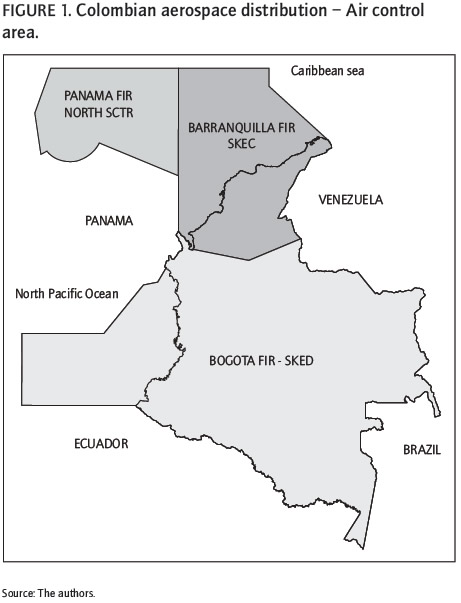
<body><![CDATA[<p>  The designation given to the person providing ATS is   the air traffic controller, responsible for directing the   movement of aircraft in the airspace and aerodromes,   in a safe, orderly and quick way. In accordance with annex   1 of ICAO (2010, p. 1), "As long as air travel cannot   do without pilots and other air and ground personnel,   their competence, skills and training will remain the   essential guarantee for efficient and safe operations.   Adequate personnel training and licensing also instill   confidence between States, leading to international   recognition and acceptance of personnel qualifications   and licences and greater trust in aviation on the part   of the traveller".</p>     <p>  ATS aerospace, according to the ICAO, is classified as class   A, B, C, D, E, F and G, depending on type of flight (IFR,   VFR) and the type of services offered; its designation is as   follows: Flight Information Regions (FIR), control areas, and   control zones, controlled aerodrome.</p>     <p>  Due to international civil aviation, aerospace organization   for a state cannot be considered in isolation, which means   it is an integral part of a much larger system that includes   at least one ICAO region; our country (Colombia) is part   of the CAR-SAM region (Caribbean region - South America).   The aerospace where air trafffic services are provided   is designated as follows: Flight Information Region (FIR),   Control Area (CTA), and Control Zone.</p>     <p>  Normally the FIR, which corresponds to a flight information   region, covers the entire air space above the territory   of a state. The FIR in Colombia is divided into two sectors: The Bogot&aacute; FIR/UTA (controlled from Bogot&aacute;) and the Barranquilla FIR/UTA (controlled from Barranquilla). The UTA corresponds to a greater control area above specific vertical limits (see <a href="#f1">Figure 1</a>).</p>     <p><a name="f1">&nbsp;</a></p>     <p>    <center><img src="/img/revistas/inno/v21n41/41a13f1.jpg" /></center></p>     <p>  The ATC service is provided from air traffic control towers   of different airports and control centers. Control towers   provide information, in accordance with regulations on   traffic control service to aerodrome, to the various incoming   and outgoing flights at each airport. The services provided   from the control centers are approaching control and   superior area control to all aircraft entering, departing, and overflying the airspace UTA.</p>     <p>The concept of aviation safety may have different connotations,   such as: No accidents (or serious incident), absence   of hazards or risks, the extent to which risks are acceptable   to aviation, processes of hazard identification and management   of risks, and control of accidental loss, among others.</p>     <p>  In the Document 9859 (Operational Safety Management   Manual - SMM) , ICAO (2006: p. 1) defines operational   safety as follows: "Is the state in which the risk of   harm to persons or of property damage is reduced to,   and maintained at or below, an acceptable level through   a continuing process of hazard identification and risk management."</p>     ]]></body>
<body><![CDATA[<p>  Annex 11 requires to states to establish an acceptable level   of operational safety applicable to the provision of ATS   within their aerospace and at aerodromes. In Chapter 17   (ATS) of the Document 9859 (ICAO, 2006) are established   the guidelines related to service ATS.</p>     <p>  The quality in the provision of ATS is critical considering   the implications, sometimes catastrophic, due to operational   errors in the provision of such services.</p>     <p>  For anticipating operational incidents or accidents associated   with the provision of ATS services, any ATS unit must   take corrective action related to the following factors: The training of human resources (improvement of aeronautical   phraseology, English language proficiency, training simulator,   improvement of staff communications, etc.), teamwork,   and customer service feedback.</p>     <p>  According to ICAO (2002), Quality Assurance is a dynamic   process used to continually improve an ATS. Although the   quality of service continue to be measured by any method   of historical data, such as the number of ATS incidents,   delays, feedback from employees and customers, we also   must recognize factors that cannot be measured so quickly.   The success of the quality assurance effort depends on recognizing that all ATS providers in the CAR/SAM, independently and collectively, must strive to provide the best   possible service.</p>     <p>  In order to identify and correct deficiencies in the ATS   provision, before the occurrence of an incident or accident,   in the Third Regional Air Navigation Caribbean/South American (CAR/SAM/3) held in Buenos Aires, Argentina (October 1999) was addressed the   issue of quality assurance programs in ATS. As a result,   ICAO (2001) developed a regional guidance material CAR/SAM for quality assurance programs for ATS.</p>     <p>&nbsp;</p>     <p>       <center>     <font size="3"><b>    Methodology     </b></font>   </center> </p>     <p>  The methodology applied consist of the applications of   techniques to collect information from primary sources: Exploratory   interviews with experienced personnel-air traffic   controllers and pilots-and secondary sources such as   books, journals, ICAO publications, magazines, and Internet, among others.</p>     <p>  For the specific case of marketing of the service, revisions   to several journals such as <i>Journal of Marketing</i>, <i>Journal   of Marketing Research</i>, <i>European Journal of Marketing</i>,   <i>Journal of Consumer Marketing</i>, <i>Journal of Service Marketing</i>,   <i>European Journal of Information Systems</i>, among   others, were made; searches were performed under the   following parameters: Quality measure, Service Quality,   Perceived Service Quality, Measure Service, and Service   Quality performance. The usage of databases such as: Emerald, JSTOR, Science Direct, Google Scholar, and IEE Electronic Library, among others. Likewise the libraries   of the following universities: Fundaci&oacute;n Universidad   del Norte (Barranquilla), and National University of Colombia   at its headquarters in Bogota and Medellin were researched.</p>     ]]></body>
<body><![CDATA[<p>  For the specific case of ATS, revisions were made to various   publications of the ICAO in the 2010 catalog of publications and on its website (<a href="http://www.icao.int" target="_blank">www.icao.int</a>).</p>     <p>  ICAO documents and the Colombian aviation authority   documents were consulted also in the library of the Centro   de Estudios Aeron&aacute;uticos (CEA) of the Unidad Administrativa   Especial de la Aeron&aacute;utica Civil in the city of Bogota   and on its website (<a href="http://www.aerocivil.gov.co" target="_blank">www.aerocivil.gov.co</a>).</p>     <p>  Likewise, the following databases: Emerald, JSTOR, Science   Direct, Google Scholar, Academic Search Compete,   Business Source Complete were searched using the following   parameters: Air Traffic Service (ATS), Air Traffic Service   Quality, Air Traffic Service Measurement, Air Traffic Control   (ATC), Air Quality Traffic Control, Air Traffic Control Measurement.</p>     <p>  After performing all the searches and consultations mentioned   it was found that there is not a measurement instrument   or scale to measure the perceived quality of ATC services, based on the discipline of marketing the service.</p>     <p>  Through the process of measurement we can obtain some   quantifiable knowledge about the characteristics of a concept,   a construct or latent variable (which is not directly   observable in a given time)<a href="#1" name="s1">&#91;1&#93;</a>, such as market trends, the   quality of a product or behavior of organizational design   variables in response to the conditions imposed by contextual   factors. Thus, measuring a phenomenon is essential   for any scientific activity because numbers (values) are assigned   to the observed objects in a way that adequately   represents the characteristics they have (Nunally &amp; Bernstein, 1995).</p>     <p>  Considering the criticism and alternative scales to   SERVQUAL and the high levels of standardization of ATC   services, we will use as the basis for the construction of the   instrument to measure the perceived quality of these services,   the scale SERVPERF proposed by Cronin and Taylor   (1992), which confirms the dimensionality of service quality   proposed by Parasuraman <i>et al</i>. (1988), given the convenience   and methodological aspects of operationalization   of this scale, and the fact that the concept of perceived   service quality is considered by many authors even by the same authors of the SERVQUAL scale, as an attitude.</p>     <p>  The methodology for the construction of the instrument   used to measure the perceived quality of ATC services and   the stage of empirical testing of its reliability and construct   validity is presented in <a href="/img/revistas/inno/v21n41/41a13t1.jpg" target="_blank">Table 1</a>, based on the recommendations   suggested by Churchill (1979) and used by   Parasuraman, Zeithaml, and Berry in the construction of   the SERVQUAL scale.</p>     <p>  In general, the methodology is summarized in two main   stages: The structure, culminating in the development of the questionnaire for data processing, and verification,   which aims to show empirical evidence of reliability and   validity of the scale proposed.</p>     <p>&nbsp;</p> <ul>     <p><font size="3"><b>  The structure of the Analysis Model</b></font></p>    ]]></body>
<body><![CDATA[</ul>     <p>  Whereas this study is a quantitative research, the goal of   this phase of the methodology is to determine the dimensions   that characterize the service of air traffic control and   attributes through which we can quantify the perceived   quality of the service (items' generation) and the development   of the questionnaire for data collection; this stage is   key to the construction of the instrument or measurement   scale.</p>     <p><i>  Generate sample of items</i>. In general, in theoretical models   a set of relationships between variables not directly observable   and measurable of reality is posed, but they can   be presented through a set of manifest variables, items or   indicators. Thus "a measurement scale is a set of items,   phrases or questions to measure the level reached by a   particular attribute or concept is not directly observable in an object" (Vila <i>et al</i>., 2000: p. 1).</p>     <p>  As suggested by Hayes (1999, p. 10), there are "two methods   designed to identify important dimensions of quality   of products or services. The first method is the establishment   of quality dimensions, an approach that requires the   supplier to set the dimensions of the quality of your service   or product. The second method is based on critical incidents   (Flanagan, 1954) and involves clients in determining   the dimensions of quality." It is also stated, consistent   with the above, that "we consider the needs of the client   as the characteristics of the product or service that represent   important dimensions." On his side, Quivy (2006, P.   117) argues that "there are two ways of structuring a concept,   each corresponding to a different level of conceptualization,   one is inductive and produce 'operational concept   isolated', the other is deductive and make 'systematic concepts'   ". Defining the concept isolated operating as a structured   concept empirically from direct observations or other   information collected. Through readings and interviews   from the exploration phase meet the necessary elements   for such structuring; and the system concept as a concept   is not induced by experience; it is structured by abstract   reasoning: deduction, analogy, opposition, involvement,   etc., although necessarily inspire the behavior of real objects   and previously acquired knowledge on these objects.</p>     <p>  Hayes (1999) recommends group interviews or individual   interviews to obtain indicators; for individual interviews   suggests a number of 10 to 20 people, recommending a   higher number to compensate for deficiencies in each approach   that really needs to characterize the service and to   achieve a correct dimensionality of the service.</p>     <p>  The generation of samples of items was based on conceptualizing   perceived service quality, in the conceptualization   and ATS regulations, and in the open exploratory interviews   conducted in the preliminary design stage, accepting the   arguments presented by Hayes (1999) and Quivy (2006).   Gorden (1975), comparing interviews with questionnaires,   shows the following advantages of the interview: Provides   more opportunity to motivate the respondent to supply a   complete and accurate information immediately, offering   greater flexibility in the formulation of questions and more   opportunity to assess the validity of the information, observing   non-verbal expressions of the interviewee.</p>     <p>  Specifically for this study we used a semi-structured type   interview, which is the method used to discern a person's   knowledge about a specific aspect of his daily life. It takes   the form of a conversation that revolves around an open   questionnaire related to a precise field of research -often   the questionnaire only contains the topics addressed (L&eacute;tourneau, 2007).</p>     <p>In this way, semi-structured interviews were conducted with   ten pilots of commercial aircrafts and ten air traffic controllers   with more than ten years of experience in their respective   professions. The purpose of the interviews was to   determine the perception and needs of the service by drivers   -such as direct customers of the service air traffic control,   customers using the ATC service provided in the Barranquilla   FIR and the opinion of air traffic controllers of this same   aerospace, about the characteristics that an air traffic control   service with excellent quality should have, because they   are the direct suppliers of the service and also they understand the purpose and function of the service itself.</p>     <p>  To ensure the quality of the interviews, for reliability and   validity of the information collected, suggestions of L&eacute;tourneau   (2007) related to ethical issues in conexion with the   respect to respondents and the characteristics of a good   interviewer (listening capacity, ability to engage in harmonious   conversation, etc.) were implemented. The interview   research objectives were revealed to each of the interviewees   and their approvals were obtained by recording in magnetic media at the beginning of the interview.</p>     <p><i>  Determination of Dimensions</i>. With the participation of an   air traffic controller with more than 15 years of expertise   the analysis of the 20 interviews was performed. 410 relevant   prepositions or sentences, some of them with the   same meaning, were obtained. These prepositions were   categorized or grouped deductively, in the five dimensions   of service quality (tangibility, reliability, responsiveness,   assurance, and empathy) established by Parasuraman et   al. (1985 &amp; 1991a) (SERVQUAL scale). Following the suggestion   of Hayes (1999), the key to classify the prepositions   was based on personal discernment and selection of   relevant adjectives and verbs that they contain. Later-after   having categorized the different prepositions-phrases   were written constituting the most representative indicators   of the category or dimension, with the assistance of the expert air traffic controller.</p>     ]]></body>
<body><![CDATA[<p>  On the other hand, considering the statements made by   Parasuraman <i>et al</i>. (1988) that the SERVQUAL instrument   is a multi-item scale concise with good reliability and validity,   and that despite being designed for use in a wide   range of services, adaptation or supplementation is required   to suit the characteristics of a particular service, the   revised SERVQUAL scale with each of the 22 items that   form it were review and evaluated, eliminating those items   that did not apply due to lack of coherence and relevance   to the ATC service. In that way, questions (Q) (1, 2, 3, 4, 5,   7, 8,10,13,18, 19, and 20) were eliminated of the scale. The   items that really applied to the service were included without   modifications to the scale construction process; they   were added to the indicators obtained from the inductive   process of analysis of the preliminary interviews, giving a list of 27 indicators and 5 dimensions<a href="#2" name="s2">&#91;2&#93;</a>.</p>     <p> <i>Content validity</i>. Content validity seeks-according to what   Devlin <i>et al</i>. (1993) point-that the measuring scale or   questionnaire complies with the following characteristics:   a) induces a minimal response bias, b) easy to understand   and interpret, c) is easily administered or applied in the   field, and d) has ability to discriminate (Zapata, 2008). By   estimating the content validity we are looking to identify   if what is being measured is actually the variable or latent   construct we are looking to measure (Vila <i>et al</i>., 2000; Martinez &amp; Hernandez, 2006).</p>     <p>  Once collected and grouped the attributes in the above   dimensions, we proceeded by using the Delphi Method to   check the validity of its content; in that way, we developed   a format in which the 27 statements were related, proposing   a Likert-type scale from 1 and 5 to value with a score   of 1 meaning "Strongly Disagree" and 5 meaning "Strongly   agree" making these statements part of the scale or instrument   to measure the quality of ATC services, also keeping in   mind to have an opening for suggested modifications and/or inclusion of new claims. Following the recommendations of Hayes (1999) in the header of the questionnaire we   asked the respondents to indicate the degree to which they agree or disagree with the assertions of the questionnaire.</p>     <p>  For the development of this exercise 20 experts (commercial   pilots) were contacted. From those, 17 returned the   filled out forms; the forms came with a unanimous score   agreeing with the inclusion of the proposed statements in   the measuring instrument; for that reason it was not necessary   to make amendments to the initial set of statements or sending the format (iteration) back to the experts.</p>     <p><i>  Preparation of questionnaire for data collection</i>. As a result   of the above, an instrument was developed to measure the   perceived quality of ATC services in the Barranquilla FIR,   which included the 27 initial claims for assessment, as perceived   by pilots, proposing a Likert scale from 1 through 7,   where a score of 1 is equivalent to "Strongly disagree" and 7 is equivalent to "Strongly Agree" with the statements listed.</p>     <p>  At the conclusion of the structuration phase the following   hypothesis was proposed:</p>     <p>  The proposed scale, based upon the concepts of perceived   quality of the service and the ATS, has the validity   and reliability to measure the perceived quality of the   ATC Service.</p>     <p>&nbsp;</p>     <p><font size="3"><b>Observation</b></font></p>     <p> <i>Design of the population and sample</i>. The sample size in   a random sample depends on the behavior of the population   variables measured. To calculate were analyzed three   probability distributions: Rectangular Distribution, Normal   Distribution, and the Bimodal Distribution. For a categorical   variable (1 to 7) we have the following results for each   set of distributions:</p>     ]]></body>
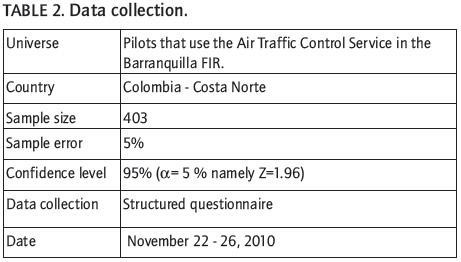
<body><![CDATA[<p> <i>Rectangular Distribution</i>: Assuming a 5% error (e); 95%   reliability (&alpha;=5% meaning a Z=1.96), the sample size will   be 171.</p>     <p> <i>Normal Distribution</i>: Assuming a 5% error (e); 95% reliability   (&alpha;=5% namely Z=1.96), the sample size will be 100.</p>     <p><i>  Bimodal Distribution</i>: Assuming a 5% error (e); 95% reliability   (&alpha;=5% namely Z=1.96), the sample size will be 385.</p>     <p>  Considering that there are no previous studies that allow   us to asumme a definite behavior of the variable evaluated -and with the purpose of supporting the study in a solid   way- we will use as a reference the most critical case (maximum   variance), that will maximixe the size of the sample.   In this case scenario the error will be inferior to 5% in the case the variable behaves in a different way.</p>     <p>  Under the above premise, we asumme that the population   variable has a Bimodal Distribution, meaning that one half   of the population is in the lower end of the scale and the   other half is at the top.</p>     <p><i>  Data collection</i>. With the support of the Colombian aviation   authority, the FAC - Colombian Air Force (CACOM 3)   and the Caribbean Naval Air Group of the Navy in their   air base located in the airport Ernesto Cortissoz of the city   of Barranquilla and Air Transport Association of Colombia   (ATAC)-which currently has 18 members: ADA, Aerorep&uacute;blica,   Air France, Aires, Avianca, American Airlines, Continental,   COPA, EasyFly, Helicol, Iberia, LAN, Martin, Satin, TACA,   Tampa, Delta Airlines, and Aerolineas Argentinas-403 surveys   were conducted in general with pilots that currently   use the ATC services in the Barranquilla FIR. The answers   received surpassed the initial calculated sample of 385 surveys   . Data were analyzed by generating a matrix of 27 x 403 (27 variables and 403 pilots) (See <a href="#t2">Table 2</a>).</p>     <p><a name="t2">&nbsp;</a></p>     <p>    <center><img src="/img/revistas/inno/v21n41/41a13t2.jpg" /></center></p>     <p>&nbsp;</p>     ]]></body>
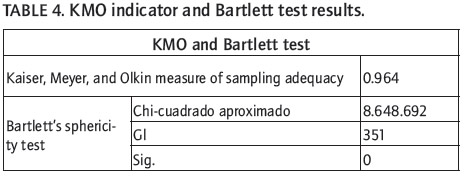
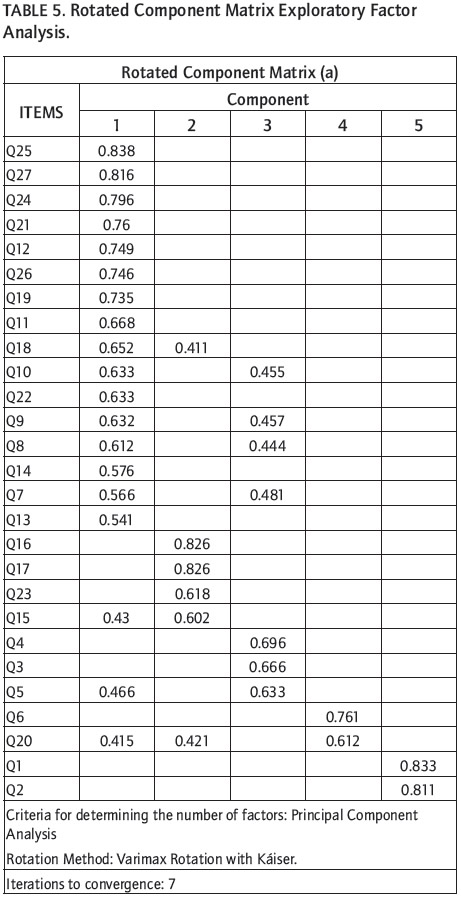
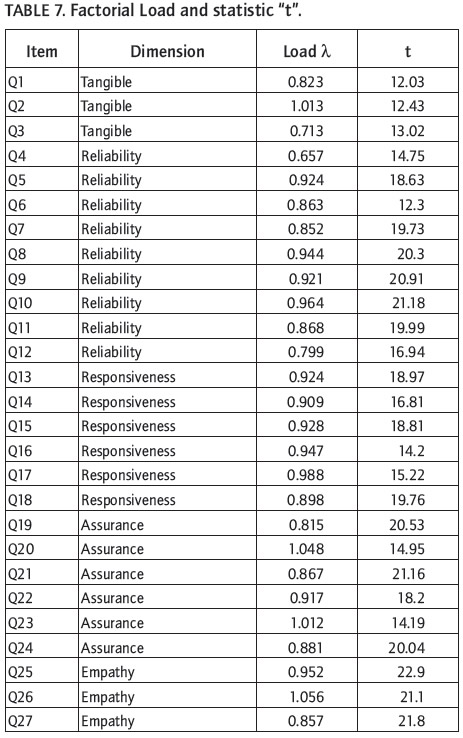
<body><![CDATA[<p><font size="3"><b>  Data analysis and Results</b></font></p>     <p>  For data analysis software was used Statistical Package for   the Social Sciences (SPSS) version 15.0 for Windows, considered   the most widely used computerized statistical program   in the social sciences and business market research.   Other software used were SAS Version 9 and AMOS version   16, through which the psychometric calculations of   the reliability scale and construct validity were performed.</p>     <p>Diagram design PATH: PATH diagram is the most common   form of representing the relationships between different   items of the scale and the concept that you are seeking to   quantify. (Vila <i>et al</i>., 2000). The proposed model to measure   the perceived quality of the Air Traffic control service (ATC) is shown in <a href="/img/revistas/inno/v21n41/41a13f2.jpg" target="_blank">Figure 2</a>.</p>     <p>  Scale Purification: Before starting with the purification of   the scale, through a confirmatory factor analysis, and in order   to check the grouping of items or questions on the five   dimensions (tangibles, reliability, responsiveness, assurance   and empathy) that constitute the model proposed above,   an exploratory factor analysis was performed using the   SPSS software by applying the method of Principal Components   and the Varimax orthogonal rotation. The parameters used for the exploratory analysis are shown in <a href="/img/revistas/inno/v21n41/41a13t3.jpg" target="_blank">Table 3</a>.</p>     <p>  Prior to the removal of the factors we applied Bartlett''   sphericity contrast and the Kaiser, Meyer, and Olkin (KMO)   measure of sampling adequacy, with the aim of verifying   whether the data collected meet the conditions for the application of factorial analysis (see <a href="#t4">Table 4</a>).</p>     <p><a name="t4">&nbsp;</a></p>     <p>    <center><img src="/img/revistas/inno/v21n41/41a13t4.jpg"></center></p>     <p>  The KMO measure of sampling adequacy is satisfactory   since it is above the minimum acceptable value (0.5) as   well as Bartlett's sphericity test, as the critical significance   level obtained was of 0.000, as manifested by Uriel &amp; Aldas (2005).</p>     <p>  The grouping of the items in the five groups or dimensions   resulting from the exploratory analysis generated a cumulative   percentage of variance of 71.553% (see <a href="#t5">Table 5</a>).   Due to the fact that the resulting groups (group 1 consists   of q7, q8, q9, q10, q11, q12, q13, q14, q18, q19, q21, q22,   q24, q25, q26, and q27; group 2: q15, q16, q17, and q23;   group 3: q3, q4, and q5; group 4: q6 and q20; and group   5: q1 and q2 do not fit the theoretical model proposed, we   will perform a confirmatory factor analysis to adjust the data model proposed collected in the observation stage   of this research.</p>     ]]></body>
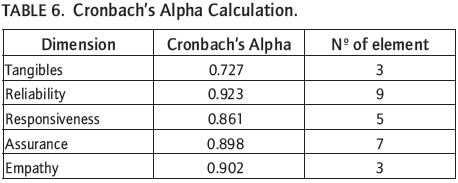
<body><![CDATA[<p><a name="t5">&nbsp;</a></p>     <p>    <center><img src="/img/revistas/inno/v21n41/41a13t5.jpg"></center></p>     <p>  We start from a model composed by 27 questions classified   as follows:</p>     <p>  Tangibility: Q1, Q2, and Q3.</p>     <p>  Reliability: Q4, Q5, Q6, Q7, Q8, Q9, Q10, Q11, and Q12.</p>     <p>  Responsiveness: Q13, Q14, Q15, Q16, and Q17.</p>     <p>  Assurance: Q18, Q19, Q20, Q21, Q22, Q23, and Q24.</p>     <p>  Empathy: Q25, Q26, and Q27.</p>     <p>  Reliability of each one of the dimensions of the scale was   calculated, in accordance with Cronbach (1951); the results   obtained through the SPSS are shown in the <a href="#t6">Table 6</a>.</p>     ]]></body>
<body><![CDATA[<p><a name="t6">&nbsp;</a></p>     <p>    <center><img src="/img/revistas/inno/v21n41/41a13t6.jpg"></center></p>     <p>  From the results obtained a satisfactory internal consistency   is inferred because the indices calculated are above 0.7 as stated by Hair <i>et al</i>. (1999).</p>     <p>  In order to test the construct validity, we conducted a confirmatory   factor analysis via AMOS V16 software with the   purpose of check the fit of the proposed model; the factor   loadings of each of the items and the value of the statistic   "t" are shown in <a href="#t7">Table 7</a> and values of the adjustment indices   are shown in <a href="/img/revistas/inno/v21n41/41a13t8.jpg" target="_blank">Table 8</a>.</p>     <p><a name="t7">&nbsp;</a></p>     <p>    <center><img src="/img/revistas/inno/v21n41/41a13t7.jpg"></center></p>     <p>  In conducting the t test of the factor loadings of the items   that measure each of the latent variables or constructs, it   appears that they are loaded positively and significantly   on the construct and its value is greater than 0.4 as recommended   by Hair <i>et al</i>. (1999); however, signs of adjustment   are below the values considered acceptable -this is the   reason why we did not consider them satisfactory for the convergent validity of the scale.</p>     <p>  With the object of improve the fit indices, we proceeded   to evaluate the recommendations given by the statistical   packages, through Lagrange multipliers, but ultimately we   did not take into account their recommendations to modify   the theoretical structure of the proposed model, due to the fact that his recommendations were oriented to modify   the proposed correlations between questions (items) and   dimensions and the proposed changes did not have affinity   or were meaningless. The matrix of waste were also reviewed   in order to identify those items or questions that   had residues above the value recommended by Hair <i>et al</i>. (1999) of 2.58, with the purpose of remove them from the   scale without sacrificing those items that in theory and in   practice are considered indicators of weight in the corresponding dimensions.</p>     ]]></body>
<body><![CDATA[<p>  In summary, the eliminated &iacute;tems per each dimensi&oacute;n were   as follows:</p>     <p>  Tangible: Q3.</p>     <p>  Reliability: Q6, Q8, and Q12.</p>     <p>  Responsiveness: Q16 and Q17.</p>     <p>  The step by step of this procedure is shown in <a href="/img/revistas/inno/v21n41/41a13t9.jpg" target="_blank">Table 9</a>,   which shows the fit indices for each of the models that   arise by removing the items mentioned above.</p>     <p>  As manifested by Zapata &amp; Canet (2008), the statistics   Normed Fix Index (NNF), Non-Normed Fit Index (NNFI),   Comparative Fit Index (CFI), and LISREL: Goodness of Fix   Index (GFI) and Adjusted Goodness of Fix Index (AGFI)   should reach values above or very close to 0.9 to properly consider the goodness of fit of the model (Bentler, 1990;   Schumacker &amp; Lomax, 2004; Uriel &amp; Aldas, 2005). In our   case, the above indicators are above 0.9, with the exception   of AGFI sign that has a value of 0.872, which could be   considered acceptable in accordance with the suggestion   of the authors mentioned above.</p>     <p>  Following the previously analyzed, the model 6 is the one   that most closely matches the recommended indexes to   ensure the convergent validity of the scale, sacrificing least   as possible the spirit of the proposed model, based on the   theory of service quality concept ATS -and implementing exploratory interviews with experts.</p>     <p>  The item Q3 was deleted as it had standardized residual   values above 0.258; perhaps this result is due to Q1 and   Q2 items, with whom it formed the dimension called "tangibility",   possibly biased due to interference generated by   an external source that affected the service one month before   conducting the surveys.</p>     <p>  Item 6 was removed due to high values of the standardized   residuals; we analyzed the remaining items comprising the   scale and found that the intention of the measure was included   in items 7 and 10.</p>     <p>  Likewise item 8 was eliminated due to high values of the   standardized residuals; in addition ATC services in Barranquilla   FIR statistics have a 100% availability; after analyzing   the remaining items comprising the scale, it was   determined that the intended measure was already included   in other items that make up the dimension of "reliability".</p>     ]]></body>
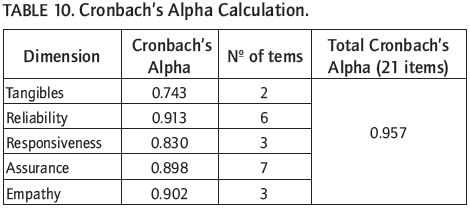
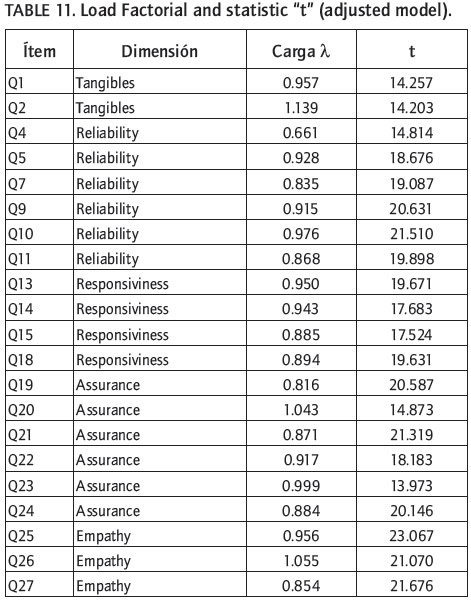
<body><![CDATA[<p>  The item Q12 was removed from the SERVQUAL scale due   to the facts that had too high values of standardized residuals   and that it was not interpreted the same way by the   pilots surveyed.</p>     <p>  Items Q16 and Q17 were eliminated for the scale not only   for their high residuals but also because they are included   in item Q13; in developing the Delphi Method two comments   were received which stated that the Q13 and Q16   statements were similar, although not initially excluded   due to the fact that they were a very low percentage and   because they served as a parameter to assess how respondents   were concentrated in the processing of the survey   form.</p>     <p><i>  Final adjustment of the scale</i>: The resulting final model   shown in Figure 3, which we call "ATC-PSQUAL" stands   originating from "Air Traffic Control-Perceived Service   Quality" is the product of the purification of the scale,   which consists of 5 dimensions and 21 items. The calculation   of internal consistency or reliability of the scale "ATCPSQUAL"   is shown in <a href="#t10">Table 10</a> and the load factor of each   of their items are shown in <a href="#t11">Table 11</a>.</p>     <p><a name="t10">&nbsp;</a></p>     <p>    <center><img src="/img/revistas/inno/v21n41/41a13t10.jpg"></center></p>     <p><a name="t11">&nbsp;</a></p>     <p>    <center><img src="/img/revistas/inno/v21n41/41a13t11.jpg"></center></p>     <p>The Cronbach reliability indices of the scale ATC-PSQUAL   are met in a satisfactory manner, which allows us to infer   that the scale has sufficient reliability to measure perceived   service quality of air traffic control; for the above   mentioned there was not necessary to remove items from   the scale, using as parameters the correlation item - total   items suggested by Churchill and applied by Parasuraman   <i>et al</i>. (1988). Although the tangibility dimension has two   items, internal consistency is satisfactory, indicating that Q1 and Q2 items are strongly correlated.</p>     ]]></body>
<body><![CDATA[<p>&nbsp;</p>     <p>       <center>     <font size="3"><b>    Conclusions     </b></font>   </center> </p>     <p>  In general aviation is characterized by its high standards of   quality, from the manufacture of components, instrumentation,   aircraft, telecommunications systems, etc., including   the processes involved in the diversity of services that   make up this transport sector. The quality with which the   ATS is provided is no exception, playing a leading role in   safety, making it necessary to have measurement tools to   evaluate not only quantitative parameters, such as delays,   number of incidents per period, availability, and reliability   of aircraft equipment, but also qualitative parameters such   as the quality of the service expected or perceived by the different users of this service.</p>     <p>  Given the importance of providing excellent ATC service   due to its strong impact on operational safety, developing   a way to evaluate how to measure the quality of how   these services are provided became necessary. The exploration   phase of this research proved that an instrument   based on the marketing of the service to measure the   perceived quality of ATC service did not exist. This result   confirms the need to undertake this study whose main objective was:</p>     <p><i>To measure the perceived quality of the ATC Service</i>.</p>     <p>  The methodology used for the construction of the measuring   instrument and empirical testing of its reliability and   validity was based on the recommendations suggested by   Churchill (1979) and used by Parasuraman, Zeithaml, &amp; Berry in the construction of the SERVQUAL scale.</p>     <p>  As a result of the structuring stage came a model for measuring   perceived quality of ATC service based on the theory   of marketing the service, the ATS concept and content   validity of the concepts supported by experts (pilots and air traffic controllers). The attributes or items that make up the proposed model were grouped into five (5) dimensions (tangibility, reliability, responsiveness, assurance and empathy) empirically supported by Parasuraman <i>et al</i>., (1998) and Cronin &amp; Taylor (1992). Considering the criticisms made of the SERVQUAL scale and before the highly suspected of standardization of ATC services, was used as the basis for the construction of the instrument to measure perceived quality, the scale SERVPERF of Cronin and Taylor (1992), given its convenience and methodological aspects of operationalization, based on the fact that the perceived service quality concept is considered by many authors, even by the authors of the SERVQUAL scale, as an attitude.</p>     <p>  In the observation phase of data collection was conducted   through the diligence of 403 questionnaires (proposed   model, the product of methodological structuring phase),   by pilots who use the ATC service in the Barranquilla FIR.</p>     <p>  The reliability and construct validity of the proposed model   was calculated with the AMOS statistical package SPSS   version 16 and version 15. Although the internal consistency   or reliability of the proposed model was successful,   achieving Cronbach's Alpha values above recommended   values (tangibility: 0727; reliability: 0923; responsiveness:   0861; assurance : 0898 and empathy: 0902), the exploratory   factor analysis did not conform to the theoretical   model, hence the need to run a confirmatory factor analysis   using AMOS v16 to adjust the theoretical model to the   data collected in the observation stage. The goodness of   fit indices resulting from the confirmatory analysis of the   theoretical model were below recommended levels, still not   satisfactory for the convergent validity of the scale. Then,   in order to improve the fit indices, we proceeded to evaluate   the recommendations given by the statistical packages,   through Lagrange multipliers, but ultimately did not   take into account his recommendations and modified the   theoretical structure of the proposed model; the proposed   correlations between questions (items) and dimensions   had no affinity or no sense, so we had to rely in the use of   the matrix of the residues to identify those items or questions   that had residues above the value recommended by   Hair <i>et al</i>. (1999), to remove them from the scale, as long   as those items are not sacrificed in the theory and practice,   and are considered indicators of weight in the dimensions   that make up the perceived quality of service. The result   of this process was the removal of items Q3, Q6, Q8, Q12,   Q16 and Q17, reaching a model whose fit indices are satisfactory,   implying a construct validity (&chi;<sup>2/g.l.</sup>: 2.5530726;   GFI: 0.901; AGFI: 0.872; RMR: 0.052; RMSEA: 0.062; NFI:   0.932; CFI: 0.957; IFI: 0.957; PGFI: 0.698). Then we made   the calculation of the reliability of the model (Cronbach's   Alpha coefficient) for each of the five dimensions giving   the following satisfactory results (tangibility: 0743; Reliability:   0.913; Responsiveness: 0.830; Assurance: 0.898;   Empathy: 0.902).</p>     ]]></body>
<body><![CDATA[<p>  After the psychometric calculations were completed in   the research of the present study, we concluded that the   scale of the proposed instrument, which we called "ATCPSQUAL,"   has reliability and the validity of the construct   with empirical evidence, corroborating the hypothesis stated:   "The proposed scale, based on the concepts of perceived   quality of service and the ATS, has the reliability   and validity for measuring perceived service quality of air   traffic control in the Barranquilla FIR" in compliance with   our overall objective. Additionally, as an aggregate contribution   of the research, the dimensions that characterize the   service were determined -and we also verified that the perceived service quality is a multidimensional construct.</p>     <p>  To improve the quality of the air traffic control service provided   for any global ATC, it is necessary to measure not   only the quantitative results of this service, but to measure   the qualitative aspects too; the ATC-PSQUAL scale created   allow to measure the perceived quality of ATC services   from point of view of the customers; this scale is a valuable   contribution to aviation because allow researchers to get   knowledge from the customer's perspective in each of the   dimensions that make up the scale. The information obtained   from the scale provide valuable information to determine   the strengths, weaknesses and critical conditions   of service, and can be used as a tool to develop strategies   aimed at strengthening aviation safety through human   talent (groups of air traffic controllers), investments in   technology, improving relationships with customers (pilots,   airlines, associations, etc.), and maintenance of aviation infrastructure,   among others.</p>     <p>  Under the consideration that this study is pioneering in   the aviation sector in Colombia and possibly worldwide,   this work becomes a benchmark for future research, within   which we might suggest, creating scales to measure the   perceived quality of services flight information and alerting   services, tools that might allow, together with ATCPSQUAL   scale, measuring the perceived overall quality of   ATS.</p>     <p>&nbsp;</p>     <p>&nbsp;</p>     <p>       <center>     <font size="3"><b>    Pie de p&aacute;gina     </b></font>   </center> </p>     <p><a href="#s1" name="1">&#91;1&#93;</a> Our parethesis.</p>     <p><a href="#s2" name="2">&#91;2&#93;</a> Please contact the authors to get a more detailed description of the instruments employed.</p>     <p>&nbsp;</p>     ]]></body>
<body><![CDATA[<p>       <center>     <font size="3"><b>Relevant Reference </b></font>   </center> </p>     <p> ICAO. (1944). Convenio sobre aviaci&oacute;n civil internacional. Doc 7300.   International civil aviation organization, Chicago.</p>     <p> ICAO. (1995). Manual de planificaci&oacute;n de servicios de tr&aacute;nsito a&eacute;reo.   Doc 9426. International civil aviation organization, Montreal.</p>     <p> ICAO. (1995). Plan mundial de navegaci&oacute;n a&eacute;rea para los sistemas CNS/ATM Gesti&oacute;n del tr&aacute;nsito a&eacute;reo. Documento 4444. International civil aviation organization, Montreal.</p>     <p>ICAO. (2001). PANS/ATM Gesti&oacute;n del tr&aacute;nsito a&eacute;reo. Documento   4444. International civil aviation organization, Montreal.</p>     <p> ICAO. (2005). Anexo 2. Reglamento del aire. International civil aviation   organization, Montreal.</p>     <p>&nbsp;</p>     <p>       <center>     <font size="3"><b>    References     </b></font>   </center> </p>     ]]></body>
<body><![CDATA[<!-- ref --><p>  Anderson, Carl, R. &amp; Zeithaml, V. (1984). Stage of the Product Life Cycle,   Business Strategy and Business Performance. <i>Academy of Management Journal</i>, <i>27</i>(1), 5-24.    &nbsp;&nbsp;&nbsp;&nbsp;&nbsp;&nbsp;&nbsp;&nbsp;[&#160;<a href="javascript:void(0);" onclick="javascript: window.open('/scielo.php?script=sci_nlinks&ref=000243&pid=S0121-5051201100030001300001&lng=','','width=640,height=500,resizable=yes,scrollbars=1,menubar=yes,');">Links</a>&#160;]<!-- end-ref --></p>     <!-- ref --><p>  Bentler, P. (1990). Comparative Fit Indexes in Structural Models. <i>Psychological   Bulletin</i>, <i>107</i>(2), 238-246.    &nbsp;&nbsp;&nbsp;&nbsp;&nbsp;&nbsp;&nbsp;&nbsp;[&#160;<a href="javascript:void(0);" onclick="javascript: window.open('/scielo.php?script=sci_nlinks&ref=000245&pid=S0121-5051201100030001300002&lng=','','width=640,height=500,resizable=yes,scrollbars=1,menubar=yes,');">Links</a>&#160;]<!-- end-ref --></p>     <!-- ref --><p>Bou, J.C. (1997). Influencia de la calidad percibida sobre la competitividad:   analisis de los efectos via "demanda". Tesis Doctoral no publicada,   Dpto. de Administraci&oacute;n de Empresas y Marketing, Universitat Jaume I, Castell&oacute;n.    &nbsp;&nbsp;&nbsp;&nbsp;&nbsp;&nbsp;&nbsp;&nbsp;[&#160;<a href="javascript:void(0);" onclick="javascript: window.open('/scielo.php?script=sci_nlinks&ref=000247&pid=S0121-5051201100030001300003&lng=','','width=640,height=500,resizable=yes,scrollbars=1,menubar=yes,');">Links</a>&#160;]<!-- end-ref --></p>     <!-- ref --><p>  Brown, S.W. &amp; Swartz, T.A. (1989). A gap analysis of the professional service quality. <i>Journal of Marketing</i>, <i>53</i>, 92-98.    &nbsp;&nbsp;&nbsp;&nbsp;&nbsp;&nbsp;&nbsp;&nbsp;[&#160;<a href="javascript:void(0);" onclick="javascript: window.open('/scielo.php?script=sci_nlinks&ref=000249&pid=S0121-5051201100030001300004&lng=','','width=640,height=500,resizable=yes,scrollbars=1,menubar=yes,');">Links</a>&#160;]<!-- end-ref --></p>     <!-- ref --><p>  Buttle, F. (1996). SERVQUAL: Review, critique, research agenda. <i>European Journal of Marketing</i>, <i>30</i>(1), 8-32.    &nbsp;&nbsp;&nbsp;&nbsp;&nbsp;&nbsp;&nbsp;&nbsp;[&#160;<a href="javascript:void(0);" onclick="javascript: window.open('/scielo.php?script=sci_nlinks&ref=000251&pid=S0121-5051201100030001300005&lng=','','width=640,height=500,resizable=yes,scrollbars=1,menubar=yes,');">Links</a>&#160;]<!-- end-ref --></p>     ]]></body>
<body><![CDATA[<!-- ref --><p>  Casino, A. (1999). Medici&oacute;n de calidad de servicio. Una aplicaci&oacute;n a los establecimientos de alojamiento tur&iacute;stico. En Blanquer D. (Dtor.). Turismo. Organizaci&oacute;n   administrativa, calidad de servicios y competitividad empresarial.    I Congreso Universitario de Turismo: Tirant Lo Blanch, Valencia.    &nbsp;&nbsp;&nbsp;&nbsp;&nbsp;&nbsp;&nbsp;&nbsp;[&#160;<a href="javascript:void(0);" onclick="javascript: window.open('/scielo.php?script=sci_nlinks&ref=000253&pid=S0121-5051201100030001300006&lng=','','width=640,height=500,resizable=yes,scrollbars=1,menubar=yes,');">Links</a>&#160;]<!-- end-ref --></p>     <!-- ref --><p>  Carman, J.M. (1990). Consumer perceptions of service quality: An assessment   of the servqual dimensions. <i>Journal of Retailing</i>, <i>69</i>, 127-139.    &nbsp;&nbsp;&nbsp;&nbsp;&nbsp;&nbsp;&nbsp;&nbsp;[&#160;<a href="javascript:void(0);" onclick="javascript: window.open('/scielo.php?script=sci_nlinks&ref=000255&pid=S0121-5051201100030001300007&lng=','','width=640,height=500,resizable=yes,scrollbars=1,menubar=yes,');">Links</a>&#160;]<!-- end-ref --></p>     <!-- ref --><p>  Churchill, G.A. (1979). A paradigm for developing better measures of marketing constructs. <i>Journal of Marketing Research</i>, <i>XVI</i>, 64-73.    &nbsp;&nbsp;&nbsp;&nbsp;&nbsp;&nbsp;&nbsp;&nbsp;[&#160;<a href="javascript:void(0);" onclick="javascript: window.open('/scielo.php?script=sci_nlinks&ref=000257&pid=S0121-5051201100030001300008&lng=','','width=640,height=500,resizable=yes,scrollbars=1,menubar=yes,');">Links</a>&#160;]<!-- end-ref --></p>     <!-- ref --><p>  Cristobal, E. (2002). <i>Conceptualizacion de la calidad de servicio al   cliente percibida en el comercio electr&oacute;nico. Evaluaci&oacute;n y aplicaci&oacute;n   en el establecimiento virtua</i>l. Tesis Doctoral, Universidad de Lleida.    &nbsp;&nbsp;&nbsp;&nbsp;&nbsp;&nbsp;&nbsp;&nbsp;[&#160;<a href="javascript:void(0);" onclick="javascript: window.open('/scielo.php?script=sci_nlinks&ref=000259&pid=S0121-5051201100030001300009&lng=','','width=640,height=500,resizable=yes,scrollbars=1,menubar=yes,');">Links</a>&#160;]<!-- end-ref --></p>     <!-- ref --><p>  Cronbach, L. (1951). Coefficient alpha and the internal structure of tests. <i>Psycometrika</i>, <i>16</i>, 297-334.    &nbsp;&nbsp;&nbsp;&nbsp;&nbsp;&nbsp;&nbsp;&nbsp;[&#160;<a href="javascript:void(0);" onclick="javascript: window.open('/scielo.php?script=sci_nlinks&ref=000261&pid=S0121-5051201100030001300010&lng=','','width=640,height=500,resizable=yes,scrollbars=1,menubar=yes,');">Links</a>&#160;]<!-- end-ref --></p>     ]]></body>
<body><![CDATA[<!-- ref --><p>  Cronin, J. &amp; Taylor, S.A. (1992). Measuring service quality: A reexamination and extension. <i>Journal of Marketing</i>, <i>56</i>, 55-68.    &nbsp;&nbsp;&nbsp;&nbsp;&nbsp;&nbsp;&nbsp;&nbsp;[&#160;<a href="javascript:void(0);" onclick="javascript: window.open('/scielo.php?script=sci_nlinks&ref=000263&pid=S0121-5051201100030001300011&lng=','','width=640,height=500,resizable=yes,scrollbars=1,menubar=yes,');">Links</a>&#160;]<!-- end-ref --></p>     <!-- ref --><p>  Crosby, P. (1979). <i>Quality is Free: The Art of Making Quality Certain</i>. New York: New American Library.    &nbsp;&nbsp;&nbsp;&nbsp;&nbsp;&nbsp;&nbsp;&nbsp;[&#160;<a href="javascript:void(0);" onclick="javascript: window.open('/scielo.php?script=sci_nlinks&ref=000265&pid=S0121-5051201100030001300012&lng=','','width=640,height=500,resizable=yes,scrollbars=1,menubar=yes,');">Links</a>&#160;]<!-- end-ref --></p>     <!-- ref --><p>  Dabholkar, P., Thorpe, D. &amp; Rentz, J. (1996). A measure of service quality   for retail stores: Scale development and validation. <i>Journal of the Academy of Marketing Science</i>, <i>24</i>(1), 3-16.    &nbsp;&nbsp;&nbsp;&nbsp;&nbsp;&nbsp;&nbsp;&nbsp;[&#160;<a href="javascript:void(0);" onclick="javascript: window.open('/scielo.php?script=sci_nlinks&ref=000267&pid=S0121-5051201100030001300013&lng=','','width=640,height=500,resizable=yes,scrollbars=1,menubar=yes,');">Links</a>&#160;]<!-- end-ref --></p>     <!-- ref --><p>  Dodds, W.B. &amp; Monroe, K.B. (1985). The Effect of Brand and Price Information   on Subjective Product Evaluations. <i>Advances in Consumer Research</i>, <i>12</i>, 85-90.    &nbsp;&nbsp;&nbsp;&nbsp;&nbsp;&nbsp;&nbsp;&nbsp;[&#160;<a href="javascript:void(0);" onclick="javascript: window.open('/scielo.php?script=sci_nlinks&ref=000269&pid=S0121-5051201100030001300014&lng=','','width=640,height=500,resizable=yes,scrollbars=1,menubar=yes,');">Links</a>&#160;]<!-- end-ref --></p>     <!-- ref --><p>  Duque, E. J. (2006). <i>Revisi&oacute;n del concepto de calidad percibida del servicio   en internet</i>. Trabajo de Investigaci&oacute;n. Universidad de Valencia, Facultad de Ciencias Econ&oacute;micas y Administrativas.    &nbsp;&nbsp;&nbsp;&nbsp;&nbsp;&nbsp;&nbsp;&nbsp;[&#160;<a href="javascript:void(0);" onclick="javascript: window.open('/scielo.php?script=sci_nlinks&ref=000271&pid=S0121-5051201100030001300015&lng=','','width=640,height=500,resizable=yes,scrollbars=1,menubar=yes,');">Links</a>&#160;]<!-- end-ref --></p>     ]]></body>
<body><![CDATA[<!-- ref --><p>  Eiglier, P. &amp; Langeard, E. (1989). <i>Servuccion. El marketing de servicios</i>. Madrid: Ed. Mc-Graw Hill.    &nbsp;&nbsp;&nbsp;&nbsp;&nbsp;&nbsp;&nbsp;&nbsp;[&#160;<a href="javascript:void(0);" onclick="javascript: window.open('/scielo.php?script=sci_nlinks&ref=000273&pid=S0121-5051201100030001300016&lng=','','width=640,height=500,resizable=yes,scrollbars=1,menubar=yes,');">Links</a>&#160;]<!-- end-ref --></p>     <!-- ref --><p>  Fisk, R.P., Brown, S.W. &amp; Bitner, M.J. (1993). Tracking the evolution of the services marketing literature. <i>Journal of Retailing</i>, <i>69</i>, 61-103.    &nbsp;&nbsp;&nbsp;&nbsp;&nbsp;&nbsp;&nbsp;&nbsp;[&#160;<a href="javascript:void(0);" onclick="javascript: window.open('/scielo.php?script=sci_nlinks&ref=000275&pid=S0121-5051201100030001300017&lng=','','width=640,height=500,resizable=yes,scrollbars=1,menubar=yes,');">Links</a>&#160;]<!-- end-ref --></p>     <!-- ref --><p>  Flanagan, J. C. (1954). The critical incident technique. <i>Psychological   Bulletin</i>, <i>51</i>, 327-358.    &nbsp;&nbsp;&nbsp;&nbsp;&nbsp;&nbsp;&nbsp;&nbsp;[&#160;<a href="javascript:void(0);" onclick="javascript: window.open('/scielo.php?script=sci_nlinks&ref=000277&pid=S0121-5051201100030001300018&lng=','','width=640,height=500,resizable=yes,scrollbars=1,menubar=yes,');">Links</a>&#160;]<!-- end-ref --></p>     <!-- ref --><p>  Garvin, D.A. (1983) . Quality on the Line. <i>Harvard Business Review</i>, <i>61</i>(4), 65-75.    &nbsp;&nbsp;&nbsp;&nbsp;&nbsp;&nbsp;&nbsp;&nbsp;[&#160;<a href="javascript:void(0);" onclick="javascript: window.open('/scielo.php?script=sci_nlinks&ref=000279&pid=S0121-5051201100030001300019&lng=','','width=640,height=500,resizable=yes,scrollbars=1,menubar=yes,');">Links</a>&#160;]<!-- end-ref --></p>     <!-- ref --><p>  Gil, I., Berenguer, G., Gallarza, M. &amp; Moliner, B. (2004). Calidad, satisfaccion   y valor del servicio, una revision. <i>Quaderns de treball</i>, (152).    &nbsp;&nbsp;&nbsp;&nbsp;&nbsp;&nbsp;&nbsp;&nbsp;[&#160;<a href="javascript:void(0);" onclick="javascript: window.open('/scielo.php?script=sci_nlinks&ref=000281&pid=S0121-5051201100030001300020&lng=','','width=640,height=500,resizable=yes,scrollbars=1,menubar=yes,');">Links</a>&#160;]<!-- end-ref --></p>     ]]></body>
<body><![CDATA[<!-- ref --><p>  Gorden, R.L. (1975). <i>Interviewing Strategy, techniques and tactics</i>. Illinois: Dorsey press.    &nbsp;&nbsp;&nbsp;&nbsp;&nbsp;&nbsp;&nbsp;&nbsp;[&#160;<a href="javascript:void(0);" onclick="javascript: window.open('/scielo.php?script=sci_nlinks&ref=000283&pid=S0121-5051201100030001300021&lng=','','width=640,height=500,resizable=yes,scrollbars=1,menubar=yes,');">Links</a>&#160;]<!-- end-ref --></p>     <!-- ref --><p>  Gr&ouml;nroos, C. (1984). A service quality model and its marketing implications. <i>European Journal of Marketing</i>, <i>18</i>(4).    &nbsp;&nbsp;&nbsp;&nbsp;&nbsp;&nbsp;&nbsp;&nbsp;[&#160;<a href="javascript:void(0);" onclick="javascript: window.open('/scielo.php?script=sci_nlinks&ref=000285&pid=S0121-5051201100030001300022&lng=','','width=640,height=500,resizable=yes,scrollbars=1,menubar=yes,');">Links</a>&#160;]<!-- end-ref --></p>     <!-- ref --><p>  Gr&ouml;nroos, C. (1994). <i>Marketing y gesti&oacute;n de servicios: la gesti&oacute;n de los   momentos de la verdad y la competencia en los servicios</i>. Madrid: Editorial D&iacute;az de Santos.    &nbsp;&nbsp;&nbsp;&nbsp;&nbsp;&nbsp;&nbsp;&nbsp;[&#160;<a href="javascript:void(0);" onclick="javascript: window.open('/scielo.php?script=sci_nlinks&ref=000287&pid=S0121-5051201100030001300023&lng=','','width=640,height=500,resizable=yes,scrollbars=1,menubar=yes,');">Links</a>&#160;]<!-- end-ref --></p>     <!-- ref --><p>  Hair, J., Anderson, R., Tatham, R. &amp; Black, W. (1999). <i>An&aacute;lisis Multivariante</i>. Madrid: Prentice Hall.    &nbsp;&nbsp;&nbsp;&nbsp;&nbsp;&nbsp;&nbsp;&nbsp;[&#160;<a href="javascript:void(0);" onclick="javascript: window.open('/scielo.php?script=sci_nlinks&ref=000289&pid=S0121-5051201100030001300024&lng=','','width=640,height=500,resizable=yes,scrollbars=1,menubar=yes,');">Links</a>&#160;]<!-- end-ref --></p>     <!-- ref --><p>  Hayes, B. E. (1999). <i>C&oacute;mo medir la satisfacci&oacute;n del cliente</i>. M&eacute;xico: Oxford University Press.    &nbsp;&nbsp;&nbsp;&nbsp;&nbsp;&nbsp;&nbsp;&nbsp;[&#160;<a href="javascript:void(0);" onclick="javascript: window.open('/scielo.php?script=sci_nlinks&ref=000291&pid=S0121-5051201100030001300025&lng=','','width=640,height=500,resizable=yes,scrollbars=1,menubar=yes,');">Links</a>&#160;]<!-- end-ref --></p>     ]]></body>
<body><![CDATA[<!-- ref --><p>  Holbrook, M. &amp; Corfman, K. (1985). Quality and value in the consumption   experience: Phaedrus rides again. In J.Jacoby and J. Olson (Eds.) <i>Perceived Quality</i>. Lexington, MA: Lexington Books, 31-51.    &nbsp;&nbsp;&nbsp;&nbsp;&nbsp;&nbsp;&nbsp;&nbsp;[&#160;<a href="javascript:void(0);" onclick="javascript: window.open('/scielo.php?script=sci_nlinks&ref=000293&pid=S0121-5051201100030001300026&lng=','','width=640,height=500,resizable=yes,scrollbars=1,menubar=yes,');">Links</a>&#160;]<!-- end-ref --></p>     <!-- ref --><p> ICAO. (1984). <i>Air traffic service planning manual</i>. Doc 9426-AN/924. Montreal: International civil aviation organization.    &nbsp;&nbsp;&nbsp;&nbsp;&nbsp;&nbsp;&nbsp;&nbsp;[&#160;<a href="javascript:void(0);" onclick="javascript: window.open('/scielo.php?script=sci_nlinks&ref=000295&pid=S0121-5051201100030001300027&lng=','','width=640,height=500,resizable=yes,scrollbars=1,menubar=yes,');">Links</a>&#160;]<!-- end-ref --></p>     <!-- ref --><p>  ICAO. (2001). <i>Annex 11. Air traffic services</i>. Montreal: International civil aviation organization.    &nbsp;&nbsp;&nbsp;&nbsp;&nbsp;&nbsp;&nbsp;&nbsp;[&#160;<a href="javascript:void(0);" onclick="javascript: window.open('/scielo.php?script=sci_nlinks&ref=000297&pid=S0121-5051201100030001300028&lng=','','width=640,height=500,resizable=yes,scrollbars=1,menubar=yes,');">Links</a>&#160;]<!-- end-ref --></p>     <!-- ref --><p>ICAO. (2001). <i>Material de orientaci&oacute;n regional CAR/SAM para programas de garant&iacute;a de calidad de servicio de tr&aacute;nsito a&eacute;reo</i>. Montreal: International civil aviation organization.    &nbsp;&nbsp;&nbsp;&nbsp;&nbsp;&nbsp;&nbsp;&nbsp;[&#160;<a href="javascript:void(0);" onclick="javascript: window.open('/scielo.php?script=sci_nlinks&ref=000299&pid=S0121-5051201100030001300029&lng=','','width=640,height=500,resizable=yes,scrollbars=1,menubar=yes,');">Links</a>&#160;]<!-- end-ref --></p>     <!-- ref --><p>  ICAO. (2002). Primera Reunion de Directores de Aviacion Civil de la Regi&oacute;n Caribe (CAR/CDA/1). International civil aviation organization. Gran Caim&aacute;n, Islas Caimanes 8 al 11 de octubre del 2002.    &nbsp;&nbsp;&nbsp;&nbsp;&nbsp;&nbsp;&nbsp;&nbsp;[&#160;<a href="javascript:void(0);" onclick="javascript: window.open('/scielo.php?script=sci_nlinks&ref=000301&pid=S0121-5051201100030001300030&lng=','','width=640,height=500,resizable=yes,scrollbars=1,menubar=yes,');">Links</a>&#160;]<!-- end-ref --></p>     ]]></body>
<body><![CDATA[<!-- ref --><p>ICAO. (2006). Safety management manual (SMM). Doc 9859-AN/460. Montreal: International civil aviation organization.    &nbsp;&nbsp;&nbsp;&nbsp;&nbsp;&nbsp;&nbsp;&nbsp;[&#160;<a href="javascript:void(0);" onclick="javascript: window.open('/scielo.php?script=sci_nlinks&ref=000303&pid=S0121-5051201100030001300031&lng=','','width=640,height=500,resizable=yes,scrollbars=1,menubar=yes,');">Links</a>&#160;]<!-- end-ref --></p>     <!-- ref --><p>  ICAO. (2010). The Convention on International Civil Aviation. Annexes 1 to 18. Montreal: International civil aviation organization.    &nbsp;&nbsp;&nbsp;&nbsp;&nbsp;&nbsp;&nbsp;&nbsp;[&#160;<a href="javascript:void(0);" onclick="javascript: window.open('/scielo.php?script=sci_nlinks&ref=000305&pid=S0121-5051201100030001300032&lng=','','width=640,height=500,resizable=yes,scrollbars=1,menubar=yes,');">Links</a>&#160;]<!-- end-ref --></p>     <!-- ref --><p>  L&eacute;tourneau, J. (2007). <i>La caja de herramientas del joven investigador - Guia de iniciacion al trabajo intelectual</i>. E.U.: La carreta editors.    &nbsp;&nbsp;&nbsp;&nbsp;&nbsp;&nbsp;&nbsp;&nbsp;[&#160;<a href="javascript:void(0);" onclick="javascript: window.open('/scielo.php?script=sci_nlinks&ref=000307&pid=S0121-5051201100030001300033&lng=','','width=640,height=500,resizable=yes,scrollbars=1,menubar=yes,');">Links</a>&#160;]<!-- end-ref --></p>     <!-- ref --><p>  Llor&eacute;ns, F. J. &amp; Fuentes, M. M. (2005). <i>Gesti&oacute;n de la calidad empresarial. Fundamentos e implantaci&oacute;n</i>. Madrid: Editorial Pir&aacute;mide.    &nbsp;&nbsp;&nbsp;&nbsp;&nbsp;&nbsp;&nbsp;&nbsp;[&#160;<a href="javascript:void(0);" onclick="javascript: window.open('/scielo.php?script=sci_nlinks&ref=000309&pid=S0121-5051201100030001300034&lng=','','width=640,height=500,resizable=yes,scrollbars=1,menubar=yes,');">Links</a>&#160;]<!-- end-ref --></p>     <!-- ref --><p>  Mart&iacute;nez, L. &Aacute;. &amp; Hern&aacute;ndez, E. M. (2006). La Fiabilidad y la Validez   en las Escalas de Medida de Modelos de Direcci&oacute;n de Operaciones. XVI Congreso Nacional de ACED, Valencia, Espa&ntilde;a.    &nbsp;&nbsp;&nbsp;&nbsp;&nbsp;&nbsp;&nbsp;&nbsp;[&#160;<a href="javascript:void(0);" onclick="javascript: window.open('/scielo.php?script=sci_nlinks&ref=000311&pid=S0121-5051201100030001300035&lng=','','width=640,height=500,resizable=yes,scrollbars=1,menubar=yes,');">Links</a>&#160;]<!-- end-ref --></p>     ]]></body>
<body><![CDATA[<!-- ref --><p>  Nunnally, J.C. &amp; Bernstein, I.J. (1995). <i>Teor&iacute;a psicom&eacute;trica</i>. M&eacute;xico: McGraw-Hill.    &nbsp;&nbsp;&nbsp;&nbsp;&nbsp;&nbsp;&nbsp;&nbsp;[&#160;<a href="javascript:void(0);" onclick="javascript: window.open('/scielo.php?script=sci_nlinks&ref=000313&pid=S0121-5051201100030001300036&lng=','','width=640,height=500,resizable=yes,scrollbars=1,menubar=yes,');">Links</a>&#160;]<!-- end-ref --></p>     <!-- ref --><p>  Oliver, R.L. (1980). A cognitive model of the antecedents and consequences   of satisfaction decisions. <i>Journal of Marketing Research</i>, <i>17</i>, 460-69.    &nbsp;&nbsp;&nbsp;&nbsp;&nbsp;&nbsp;&nbsp;&nbsp;[&#160;<a href="javascript:void(0);" onclick="javascript: window.open('/scielo.php?script=sci_nlinks&ref=000315&pid=S0121-5051201100030001300037&lng=','','width=640,height=500,resizable=yes,scrollbars=1,menubar=yes,');">Links</a>&#160;]<!-- end-ref --></p>     <!-- ref --><p>  Parasuraman, A., Berry, L. &amp; Zeithaml, V. (1991a). Refinement and reassessment   of the SERVQUAL scale. <i>Journal of Retailing</i>, <i>67</i>(4), 420-450.    &nbsp;&nbsp;&nbsp;&nbsp;&nbsp;&nbsp;&nbsp;&nbsp;[&#160;<a href="javascript:void(0);" onclick="javascript: window.open('/scielo.php?script=sci_nlinks&ref=000317&pid=S0121-5051201100030001300038&lng=','','width=640,height=500,resizable=yes,scrollbars=1,menubar=yes,');">Links</a>&#160;]<!-- end-ref --></p>     <!-- ref --><p>  Parasuraman, A., Berry, L. &amp; Zeithaml, V. (1991b). Understanding customer expectations of service. <i>Sloan Management Review</i>, <i>32</i>, 39-48.    &nbsp;&nbsp;&nbsp;&nbsp;&nbsp;&nbsp;&nbsp;&nbsp;[&#160;<a href="javascript:void(0);" onclick="javascript: window.open('/scielo.php?script=sci_nlinks&ref=000319&pid=S0121-5051201100030001300039&lng=','','width=640,height=500,resizable=yes,scrollbars=1,menubar=yes,');">Links</a>&#160;]<!-- end-ref --></p>     <!-- ref --><p>  Parasuraman, A., Zeithaml, V. &amp; Berry, L. (1985). A conceptual model of   service quality and its implications for future research. Journal <i>of Marketing</i>, <i>49</i>(4), 41-50.    &nbsp;&nbsp;&nbsp;&nbsp;&nbsp;&nbsp;&nbsp;&nbsp;[&#160;<a href="javascript:void(0);" onclick="javascript: window.open('/scielo.php?script=sci_nlinks&ref=000321&pid=S0121-5051201100030001300040&lng=','','width=640,height=500,resizable=yes,scrollbars=1,menubar=yes,');">Links</a>&#160;]<!-- end-ref --></p>     ]]></body>
<body><![CDATA[<!-- ref --><p>  Parasuraman, A., Zeithaml, V., &amp; Berry, L. (1988). SERVQUAL: A multiple-item scale for measuring consumer perceptions of services quality. <i>Journal of Retailing</i>, <i>64</i>(1), 12-40.    &nbsp;&nbsp;&nbsp;&nbsp;&nbsp;&nbsp;&nbsp;&nbsp;[&#160;<a href="javascript:void(0);" onclick="javascript: window.open('/scielo.php?script=sci_nlinks&ref=000323&pid=S0121-5051201100030001300041&lng=','','width=640,height=500,resizable=yes,scrollbars=1,menubar=yes,');">Links</a>&#160;]<!-- end-ref --></p>     <!-- ref --><p>  Parasuraman, A., Zeithaml, V.A. &amp; Berry, L.L. (1994a). Reassessment   of expectations as a comparison standard in measuring service   quality: Implications for further research. <i>Journal of Marketing</i>, <i>58</i>, 111-124.    &nbsp;&nbsp;&nbsp;&nbsp;&nbsp;&nbsp;&nbsp;&nbsp;[&#160;<a href="javascript:void(0);" onclick="javascript: window.open('/scielo.php?script=sci_nlinks&ref=000325&pid=S0121-5051201100030001300042&lng=','','width=640,height=500,resizable=yes,scrollbars=1,menubar=yes,');">Links</a>&#160;]<!-- end-ref --></p>     <!-- ref --><p>  Parasuraman, A., Zeithaml, V.A. &amp; Berry, L.L. (1994b). Alternative   scales for measuring service quality: A comparative assessment   based on psychometric and diagnostic criteria. <i>Journal of Retailing</i>, <i>70</i>, 201-230.    &nbsp;&nbsp;&nbsp;&nbsp;&nbsp;&nbsp;&nbsp;&nbsp;[&#160;<a href="javascript:void(0);" onclick="javascript: window.open('/scielo.php?script=sci_nlinks&ref=000327&pid=S0121-5051201100030001300043&lng=','','width=640,height=500,resizable=yes,scrollbars=1,menubar=yes,');">Links</a>&#160;]<!-- end-ref --></p>     <!-- ref --><p>  Phillips, L. W., Dae, R. C. &amp; Buzzell, R. (1983). Product Quality, Cost Position   and Business Performance: A Test of Some Key Hypotheses. <i>Journal of Marketing</i>, <i>47</i>(Spring), 26-43.    &nbsp;&nbsp;&nbsp;&nbsp;&nbsp;&nbsp;&nbsp;&nbsp;[&#160;<a href="javascript:void(0);" onclick="javascript: window.open('/scielo.php?script=sci_nlinks&ref=000329&pid=S0121-5051201100030001300044&lng=','','width=640,height=500,resizable=yes,scrollbars=1,menubar=yes,');">Links</a>&#160;]<!-- end-ref --></p>     <!-- ref --><p>  Quivy, R. (2006). <i>Manual de investigacion en ciencias sociales</i>. Editorial Limusa.    &nbsp;&nbsp;&nbsp;&nbsp;&nbsp;&nbsp;&nbsp;&nbsp;[&#160;<a href="javascript:void(0);" onclick="javascript: window.open('/scielo.php?script=sci_nlinks&ref=000331&pid=S0121-5051201100030001300045&lng=','','width=640,height=500,resizable=yes,scrollbars=1,menubar=yes,');">Links</a>&#160;]<!-- end-ref --></p>     ]]></body>
<body><![CDATA[<!-- ref --><p>  Rathmell J.M. (1966). What is Meant by Services? <i>Journal of Marketing</i>, <i>30</i>, 32 -36.    &nbsp;&nbsp;&nbsp;&nbsp;&nbsp;&nbsp;&nbsp;&nbsp;[&#160;<a href="javascript:void(0);" onclick="javascript: window.open('/scielo.php?script=sci_nlinks&ref=000333&pid=S0121-5051201100030001300046&lng=','','width=640,height=500,resizable=yes,scrollbars=1,menubar=yes,');">Links</a>&#160;]<!-- end-ref --></p>     <!-- ref --><p>  Reeves, C. A. &amp; Bednar, C. A. (1994). Defining quality: Alternatives and implications. <i>Academy of Management Review</i>, <i>19</i>, 419-445.    &nbsp;&nbsp;&nbsp;&nbsp;&nbsp;&nbsp;&nbsp;&nbsp;[&#160;<a href="javascript:void(0);" onclick="javascript: window.open('/scielo.php?script=sci_nlinks&ref=000335&pid=S0121-5051201100030001300047&lng=','','width=640,height=500,resizable=yes,scrollbars=1,menubar=yes,');">Links</a>&#160;]<!-- end-ref --></p>     <!-- ref --><p>  Rust, R. &amp; Oliver, R. (1994). <i>Service quality. New directions in the theory y practice</i>.    &nbsp;&nbsp;&nbsp;&nbsp;&nbsp;&nbsp;&nbsp;&nbsp;[&#160;<a href="javascript:void(0);" onclick="javascript: window.open('/scielo.php?script=sci_nlinks&ref=000337&pid=S0121-5051201100030001300048&lng=','','width=640,height=500,resizable=yes,scrollbars=1,menubar=yes,');">Links</a>&#160;]<!-- end-ref --></p>     <!-- ref --><p>Schumacker, R. &amp; Lomax, R. (2004). <i>A Beginner's Guide to Structural   Equation Modeling</i>. Nueva Jersey: Lawrence Erbaum Associates, Inc.    &nbsp;&nbsp;&nbsp;&nbsp;&nbsp;&nbsp;&nbsp;&nbsp;[&#160;<a href="javascript:void(0);" onclick="javascript: window.open('/scielo.php?script=sci_nlinks&ref=000339&pid=S0121-5051201100030001300049&lng=','','width=640,height=500,resizable=yes,scrollbars=1,menubar=yes,');">Links</a>&#160;]<!-- end-ref --></p>     <!-- ref --><p>  Steenkamp, J.B (1990). Conceptual Model of the Quality Perception Process. <i>Journal of Business Research</i>, <i>21</i>, 309-333.    &nbsp;&nbsp;&nbsp;&nbsp;&nbsp;&nbsp;&nbsp;&nbsp;[&#160;<a href="javascript:void(0);" onclick="javascript: window.open('/scielo.php?script=sci_nlinks&ref=000341&pid=S0121-5051201100030001300050&lng=','','width=640,height=500,resizable=yes,scrollbars=1,menubar=yes,');">Links</a>&#160;]<!-- end-ref --></p>     ]]></body>
<body><![CDATA[<!-- ref --><p>  Teas, R.K. (1993). Expectations, performance evaluation and customers perceptions of quality. <i>Journal of Marketing</i>, <i>57</i>, 18-34.    &nbsp;&nbsp;&nbsp;&nbsp;&nbsp;&nbsp;&nbsp;&nbsp;[&#160;<a href="javascript:void(0);" onclick="javascript: window.open('/scielo.php?script=sci_nlinks&ref=000343&pid=S0121-5051201100030001300051&lng=','','width=640,height=500,resizable=yes,scrollbars=1,menubar=yes,');">Links</a>&#160;]<!-- end-ref --></p>     <!-- ref --><p>  Uriel, E. &amp; Aldas, J. (2005). <i>An&aacute;lisis Multivariante Aplicado</i>. M&eacute;xico: Editorial Thomson.    &nbsp;&nbsp;&nbsp;&nbsp;&nbsp;&nbsp;&nbsp;&nbsp;[&#160;<a href="javascript:void(0);" onclick="javascript: window.open('/scielo.php?script=sci_nlinks&ref=000345&pid=S0121-5051201100030001300052&lng=','','width=640,height=500,resizable=yes,scrollbars=1,menubar=yes,');">Links</a>&#160;]<!-- end-ref --></p>     <!-- ref --><p>  Vila, N., Kuster, I. &amp; Ald&aacute;s, J. (2000). Desarrollo y Validaci&oacute;n de Escalas   de Medidas en Marketing. <i>Quaderns de Treball</i>, <i>104</i>.    &nbsp;&nbsp;&nbsp;&nbsp;&nbsp;&nbsp;&nbsp;&nbsp;[&#160;<a href="javascript:void(0);" onclick="javascript: window.open('/scielo.php?script=sci_nlinks&ref=000347&pid=S0121-5051201100030001300053&lng=','','width=640,height=500,resizable=yes,scrollbars=1,menubar=yes,');">Links</a>&#160;]<!-- end-ref --></p>     <!-- ref --><p>  V&aacute;zquez, R., Rodr&iacute;guez, I. &amp; D&iacute;az, A. M. (1996). <i>Estructura multidimensional   de la calidad de servicio en cadenas de supermercados:   desarrollo y validaci&oacute;n de la escala Calsuper Oviedo</i>. Facultad   de Ciencias Econ&oacute;micas y Empresariales. Universidad de Oviedo. Documento de trabajo 119/96.    &nbsp;&nbsp;&nbsp;&nbsp;&nbsp;&nbsp;&nbsp;&nbsp;[&#160;<a href="javascript:void(0);" onclick="javascript: window.open('/scielo.php?script=sci_nlinks&ref=000349&pid=S0121-5051201100030001300054&lng=','','width=640,height=500,resizable=yes,scrollbars=1,menubar=yes,');">Links</a>&#160;]<!-- end-ref --></p>     <!-- ref --><p>  Zapata, R., Canet &amp; Giner, M. (2008). Propuesta metodologica para la   construccion de escalas de medicion a partir de una aplicaci&oacute;n   empirica. <i>Revista electr&oacute;nica actualidades investigativas en educaci&oacute;n</i>, (Mayo-Agosto), 1-26.    &nbsp;&nbsp;&nbsp;&nbsp;&nbsp;&nbsp;&nbsp;&nbsp;[&#160;<a href="javascript:void(0);" onclick="javascript: window.open('/scielo.php?script=sci_nlinks&ref=000351&pid=S0121-5051201100030001300055&lng=','','width=640,height=500,resizable=yes,scrollbars=1,menubar=yes,');">Links</a>&#160;]<!-- end-ref --></p>     ]]></body>
<body><![CDATA[<!-- ref --><p>  Zeithaml, V. (1988). Consumer perceptions of price, quality and value: a   means-end model and s&iacute;ntesis of evidence. <i>Journal of Marketing</i>, <i>52</i>(3).    &nbsp;&nbsp;&nbsp;&nbsp;&nbsp;&nbsp;&nbsp;&nbsp;[&#160;<a href="javascript:void(0);" onclick="javascript: window.open('/scielo.php?script=sci_nlinks&ref=000353&pid=S0121-5051201100030001300056&lng=','','width=640,height=500,resizable=yes,scrollbars=1,menubar=yes,');">Links</a>&#160;]<!-- end-ref --></p>     <!-- ref --><p>  Zeithaml, V. (1992). <i>Calidad total en la gesti&oacute;n de los servicios</i>. Madrid: Editorial D&iacute;az de Santos.    &nbsp;&nbsp;&nbsp;&nbsp;&nbsp;&nbsp;&nbsp;&nbsp;[&#160;<a href="javascript:void(0);" onclick="javascript: window.open('/scielo.php?script=sci_nlinks&ref=000355&pid=S0121-5051201100030001300057&lng=','','width=640,height=500,resizable=yes,scrollbars=1,menubar=yes,');">Links</a>&#160;]<!-- end-ref --></p>     <!-- ref --><p>  Zeithaml, V. (1987). <i>Defining and Relating Price, Perceived Quality, and   Perceived Value</i>. Report N. 87-101. Cambridge, MA: Marketing Science Institute.    &nbsp;&nbsp;&nbsp;&nbsp;&nbsp;&nbsp;&nbsp;&nbsp;[&#160;<a href="javascript:void(0);" onclick="javascript: window.open('/scielo.php?script=sci_nlinks&ref=000357&pid=S0121-5051201100030001300058&lng=','','width=640,height=500,resizable=yes,scrollbars=1,menubar=yes,');">Links</a>&#160;]<!-- end-ref --></p>     <!-- ref --><p>  Zeithaml, V., Berry, L.L. &amp; Parasuraman, A. (1988). Communication and   control processes in delivery of service quality. <i>Journal of Marketing</i>, <i>52</i>, 35-48.    &nbsp;&nbsp;&nbsp;&nbsp;&nbsp;&nbsp;&nbsp;&nbsp;[&#160;<a href="javascript:void(0);" onclick="javascript: window.open('/scielo.php?script=sci_nlinks&ref=000359&pid=S0121-5051201100030001300059&lng=','','width=640,height=500,resizable=yes,scrollbars=1,menubar=yes,');">Links</a>&#160;]<!-- end-ref --></p> </font>      ]]></body><back>
<ref-list>
<ref id="B1">
<nlm-citation citation-type="journal">
<person-group person-group-type="author">
<name>
<surname><![CDATA[Anderson]]></surname>
<given-names><![CDATA[Carl, R]]></given-names>
</name>
<name>
<surname><![CDATA[Zeithaml]]></surname>
<given-names><![CDATA[V]]></given-names>
</name>
</person-group>
<article-title xml:lang="en"><![CDATA[Stage of the Product Life Cycle, Business Strategy and Business Performance]]></article-title>
<source><![CDATA[Academy of Management Journal]]></source>
<year>1984</year>
<volume>27</volume>
<numero>1</numero>
<issue>1</issue>
<page-range>5-24</page-range></nlm-citation>
</ref>
<ref id="B2">
<nlm-citation citation-type="journal">
<person-group person-group-type="author">
<name>
<surname><![CDATA[Bentler]]></surname>
<given-names><![CDATA[P]]></given-names>
</name>
</person-group>
<article-title xml:lang="en"><![CDATA[Comparative Fit Indexes in Structural Models]]></article-title>
<source><![CDATA[Psychological Bulletin]]></source>
<year>1990</year>
<volume>107</volume>
<numero>2</numero>
<issue>2</issue>
<page-range>238-246</page-range></nlm-citation>
</ref>
<ref id="B3">
<nlm-citation citation-type="">
<person-group person-group-type="author">
<name>
<surname><![CDATA[Bou]]></surname>
<given-names><![CDATA[J.C]]></given-names>
</name>
</person-group>
<source><![CDATA[Influencia de la calidad percibida sobre la competitividad: analisis de los efectos via "demanda"]]></source>
<year>1997</year>
</nlm-citation>
</ref>
<ref id="B4">
<nlm-citation citation-type="journal">
<person-group person-group-type="author">
<name>
<surname><![CDATA[Brown]]></surname>
<given-names><![CDATA[S.W]]></given-names>
</name>
<name>
<surname><![CDATA[Swartz]]></surname>
<given-names><![CDATA[T.A]]></given-names>
</name>
</person-group>
<article-title xml:lang="en"><![CDATA[A gap analysis of the professional service quality]]></article-title>
<source><![CDATA[Journal of Marketing]]></source>
<year>1989</year>
<volume>53</volume>
<page-range>92-98</page-range></nlm-citation>
</ref>
<ref id="B5">
<nlm-citation citation-type="journal">
<person-group person-group-type="author">
<name>
<surname><![CDATA[Buttle]]></surname>
<given-names><![CDATA[F]]></given-names>
</name>
</person-group>
<article-title xml:lang="en"><![CDATA[SERVQUAL: Review, critique, research agenda]]></article-title>
<source><![CDATA[European Journal of Marketing]]></source>
<year>1996</year>
<volume>30</volume>
<numero>1</numero>
<issue>1</issue>
<page-range>8-32</page-range></nlm-citation>
</ref>
<ref id="B6">
<nlm-citation citation-type="confpro">
<person-group person-group-type="author">
<name>
<surname><![CDATA[Casino]]></surname>
<given-names><![CDATA[A]]></given-names>
</name>
</person-group>
<article-title xml:lang="es"><![CDATA[Medición de calidad de servicio: Una aplicación a los establecimientos de alojamiento turístico]]></article-title>
<person-group person-group-type="editor">
<name>
<surname><![CDATA[Blanquer]]></surname>
<given-names><![CDATA[D]]></given-names>
</name>
</person-group>
<source><![CDATA[Turismo: Organización administrativa, calidad de servicios y competitividad empresarial]]></source>
<year>1999</year>
<conf-name><![CDATA[I Congreso Universitario de Turismo: Tirant Lo Blanch]]></conf-name>
<conf-loc>Valencia </conf-loc>
</nlm-citation>
</ref>
<ref id="B7">
<nlm-citation citation-type="journal">
<person-group person-group-type="author">
<name>
<surname><![CDATA[Carman]]></surname>
<given-names><![CDATA[J.M]]></given-names>
</name>
</person-group>
<article-title xml:lang="en"><![CDATA[Consumer perceptions of service quality: An assessment of the servqual dimensions]]></article-title>
<source><![CDATA[Journal of Retailing]]></source>
<year>1990</year>
<volume>69</volume>
<page-range>127-139</page-range></nlm-citation>
</ref>
<ref id="B8">
<nlm-citation citation-type="journal">
<person-group person-group-type="author">
<name>
<surname><![CDATA[Churchill]]></surname>
<given-names><![CDATA[G.A]]></given-names>
</name>
</person-group>
<article-title xml:lang="en"><![CDATA[A paradigm for developing better measures of marketing constructs]]></article-title>
<source><![CDATA[Journal of Marketing Research]]></source>
<year>1979</year>
<volume>XVI</volume>
<page-range>64-73</page-range></nlm-citation>
</ref>
<ref id="B9">
<nlm-citation citation-type="">
<person-group person-group-type="author">
<name>
<surname><![CDATA[Cristobal]]></surname>
<given-names><![CDATA[E]]></given-names>
</name>
</person-group>
<source><![CDATA[Conceptualizacion de la calidad de servicio al cliente percibida en el comercio electrónico: Evaluación y aplicación en el establecimiento virtual]]></source>
<year>2002</year>
</nlm-citation>
</ref>
<ref id="B10">
<nlm-citation citation-type="journal">
<person-group person-group-type="author">
<name>
<surname><![CDATA[Cronbach]]></surname>
<given-names><![CDATA[L]]></given-names>
</name>
</person-group>
<article-title xml:lang="en"><![CDATA[Coefficient alpha and the internal structure of tests]]></article-title>
<source><![CDATA[Psycometrika]]></source>
<year>1951</year>
<volume>16</volume>
<page-range>297-334</page-range></nlm-citation>
</ref>
<ref id="B11">
<nlm-citation citation-type="journal">
<person-group person-group-type="author">
<name>
<surname><![CDATA[Cronin]]></surname>
<given-names><![CDATA[J]]></given-names>
</name>
<name>
<surname><![CDATA[Taylor]]></surname>
<given-names><![CDATA[S.A]]></given-names>
</name>
</person-group>
<article-title xml:lang="en"><![CDATA[Measuring service quality: A reexamination and extension]]></article-title>
<source><![CDATA[Journal of Marketing]]></source>
<year>1992</year>
<volume>56</volume>
<page-range>55-68</page-range></nlm-citation>
</ref>
<ref id="B12">
<nlm-citation citation-type="book">
<person-group person-group-type="author">
<name>
<surname><![CDATA[Crosby]]></surname>
<given-names><![CDATA[P]]></given-names>
</name>
</person-group>
<source><![CDATA[Quality is Free: The Art of Making Quality Certain]]></source>
<year>1979</year>
<publisher-loc><![CDATA[New York ]]></publisher-loc>
<publisher-name><![CDATA[New American Library]]></publisher-name>
</nlm-citation>
</ref>
<ref id="B13">
<nlm-citation citation-type="journal">
<person-group person-group-type="author">
<name>
<surname><![CDATA[Dabholkar]]></surname>
<given-names><![CDATA[P]]></given-names>
</name>
<name>
<surname><![CDATA[Thorpe]]></surname>
<given-names><![CDATA[D]]></given-names>
</name>
<name>
<surname><![CDATA[Rentz]]></surname>
<given-names><![CDATA[J]]></given-names>
</name>
</person-group>
<article-title xml:lang="en"><![CDATA[A measure of service quality for retail stores: Scale development and validation]]></article-title>
<source><![CDATA[Journal of the Academy of Marketing Science]]></source>
<year>1996</year>
<volume>24</volume>
<numero>1</numero>
<issue>1</issue>
<page-range>3-16</page-range></nlm-citation>
</ref>
<ref id="B14">
<nlm-citation citation-type="journal">
<person-group person-group-type="author">
<name>
<surname><![CDATA[Dodds]]></surname>
<given-names><![CDATA[W.B]]></given-names>
</name>
<name>
<surname><![CDATA[Monroe]]></surname>
<given-names><![CDATA[K.B]]></given-names>
</name>
</person-group>
<article-title xml:lang="en"><![CDATA[The Effect of Brand and Price Information on Subjective Product Evaluations]]></article-title>
<source><![CDATA[Advances in Consumer Research]]></source>
<year>1985</year>
<volume>12</volume>
<page-range>85-90</page-range></nlm-citation>
</ref>
<ref id="B15">
<nlm-citation citation-type="book">
<person-group person-group-type="author">
<name>
<surname><![CDATA[Duque]]></surname>
<given-names><![CDATA[E. J]]></given-names>
</name>
</person-group>
<source><![CDATA[Revisión del concepto de calidad percibida del servicio en internet]]></source>
<year>2006</year>
<publisher-name><![CDATA[Universidad de Valencia, Facultad de Ciencias Económicas y Administrativas]]></publisher-name>
</nlm-citation>
</ref>
<ref id="B16">
<nlm-citation citation-type="book">
<person-group person-group-type="author">
<name>
<surname><![CDATA[Eiglier]]></surname>
<given-names><![CDATA[P]]></given-names>
</name>
<name>
<surname><![CDATA[Langeard]]></surname>
<given-names><![CDATA[E]]></given-names>
</name>
</person-group>
<source><![CDATA[Servuccion: El marketing de servicios]]></source>
<year>1989</year>
<publisher-loc><![CDATA[Madrid ]]></publisher-loc>
<publisher-name><![CDATA[Ed. Mc-Graw Hill]]></publisher-name>
</nlm-citation>
</ref>
<ref id="B17">
<nlm-citation citation-type="journal">
<person-group person-group-type="author">
<name>
<surname><![CDATA[Fisk]]></surname>
<given-names><![CDATA[R.P]]></given-names>
</name>
<name>
<surname><![CDATA[Brown]]></surname>
<given-names><![CDATA[S.W]]></given-names>
</name>
<name>
<surname><![CDATA[Bitner]]></surname>
<given-names><![CDATA[M.J]]></given-names>
</name>
</person-group>
<article-title xml:lang="en"><![CDATA[Tracking the evolution of the services marketing literature]]></article-title>
<source><![CDATA[Journal of Retailing]]></source>
<year>1993</year>
<volume>69</volume>
<page-range>61-103</page-range></nlm-citation>
</ref>
<ref id="B18">
<nlm-citation citation-type="journal">
<person-group person-group-type="author">
<name>
<surname><![CDATA[Flanagan]]></surname>
<given-names><![CDATA[J. C]]></given-names>
</name>
</person-group>
<article-title xml:lang="en"><![CDATA[The critical incident technique]]></article-title>
<source><![CDATA[Psychological Bulletin]]></source>
<year>1954</year>
<volume>51</volume>
<page-range>327-358</page-range></nlm-citation>
</ref>
<ref id="B19">
<nlm-citation citation-type="journal">
<person-group person-group-type="author">
<name>
<surname><![CDATA[Garvin]]></surname>
<given-names><![CDATA[D.A]]></given-names>
</name>
</person-group>
<article-title xml:lang="en"><![CDATA[Quality on the Line]]></article-title>
<source><![CDATA[Harvard Business Review]]></source>
<year>1983</year>
<volume>61</volume>
<numero>4</numero>
<issue>4</issue>
<page-range>65-75</page-range></nlm-citation>
</ref>
<ref id="B20">
<nlm-citation citation-type="journal">
<person-group person-group-type="author">
<name>
<surname><![CDATA[Gil]]></surname>
<given-names><![CDATA[I]]></given-names>
</name>
<name>
<surname><![CDATA[Berenguer]]></surname>
<given-names><![CDATA[G]]></given-names>
</name>
<name>
<surname><![CDATA[Gallarza]]></surname>
<given-names><![CDATA[M]]></given-names>
</name>
<name>
<surname><![CDATA[Moliner]]></surname>
<given-names><![CDATA[B]]></given-names>
</name>
</person-group>
<article-title xml:lang="es"><![CDATA[Calidad, satisfaccion y valor del servicio, una revision]]></article-title>
<source><![CDATA[Quaderns de treball]]></source>
<year>2004</year>
<numero>152</numero>
<issue>152</issue>
</nlm-citation>
</ref>
<ref id="B21">
<nlm-citation citation-type="book">
<person-group person-group-type="author">
<name>
<surname><![CDATA[Gorden]]></surname>
<given-names><![CDATA[R.L]]></given-names>
</name>
</person-group>
<source><![CDATA[Interviewing Strategy, techniques and tactics]]></source>
<year>1975</year>
<publisher-loc><![CDATA[^eIllinois Illinois]]></publisher-loc>
<publisher-name><![CDATA[Dorsey press]]></publisher-name>
</nlm-citation>
</ref>
<ref id="B22">
<nlm-citation citation-type="journal">
<person-group person-group-type="author">
<name>
<surname><![CDATA[Grönroos]]></surname>
<given-names><![CDATA[C]]></given-names>
</name>
</person-group>
<article-title xml:lang="en"><![CDATA[A service quality model and its marketing implications]]></article-title>
<source><![CDATA[European Journal of Marketing]]></source>
<year>1984</year>
<volume>18</volume>
<numero>4</numero>
<issue>4</issue>
</nlm-citation>
</ref>
<ref id="B23">
<nlm-citation citation-type="book">
<person-group person-group-type="author">
<name>
<surname><![CDATA[Grönroos]]></surname>
<given-names><![CDATA[C]]></given-names>
</name>
</person-group>
<source><![CDATA[Marketing y gestión de servicios: la gestión de los momentos de la verdad y la competencia en los servicios]]></source>
<year>1994</year>
<publisher-loc><![CDATA[Madrid ]]></publisher-loc>
<publisher-name><![CDATA[Editorial Díaz de Santos]]></publisher-name>
</nlm-citation>
</ref>
<ref id="B24">
<nlm-citation citation-type="book">
<person-group person-group-type="author">
<name>
<surname><![CDATA[Hair]]></surname>
<given-names><![CDATA[J]]></given-names>
</name>
<name>
<surname><![CDATA[Anderson]]></surname>
<given-names><![CDATA[R]]></given-names>
</name>
<name>
<surname><![CDATA[Tatham]]></surname>
<given-names><![CDATA[R]]></given-names>
</name>
<name>
<surname><![CDATA[Black]]></surname>
<given-names><![CDATA[W]]></given-names>
</name>
</person-group>
<source><![CDATA[Análisis Multivariante]]></source>
<year>1999</year>
<publisher-loc><![CDATA[Madrid ]]></publisher-loc>
<publisher-name><![CDATA[Prentice Hall]]></publisher-name>
</nlm-citation>
</ref>
<ref id="B25">
<nlm-citation citation-type="book">
<person-group person-group-type="author">
<name>
<surname><![CDATA[Hayes]]></surname>
<given-names><![CDATA[B. E]]></given-names>
</name>
</person-group>
<source><![CDATA[Cómo medir la satisfacción del cliente]]></source>
<year>1999</year>
<publisher-loc><![CDATA[México ]]></publisher-loc>
<publisher-name><![CDATA[Oxford University Press]]></publisher-name>
</nlm-citation>
</ref>
<ref id="B26">
<nlm-citation citation-type="book">
<person-group person-group-type="author">
<name>
<surname><![CDATA[Holbrook]]></surname>
<given-names><![CDATA[M]]></given-names>
</name>
<name>
<surname><![CDATA[Corfman]]></surname>
<given-names><![CDATA[K]]></given-names>
</name>
</person-group>
<article-title xml:lang="en"><![CDATA[Quality and value in the consumption experience: Phaedrus rides again]]></article-title>
<person-group person-group-type="editor">
<name>
<surname><![CDATA[Jacoby]]></surname>
<given-names><![CDATA[J]]></given-names>
</name>
<name>
<surname><![CDATA[Olson]]></surname>
<given-names><![CDATA[J]]></given-names>
</name>
</person-group>
<source><![CDATA[Perceived Quality]]></source>
<year>1985</year>
<page-range>31-51</page-range><publisher-loc><![CDATA[Lexington^eMA MA]]></publisher-loc>
<publisher-name><![CDATA[Lexington Books]]></publisher-name>
</nlm-citation>
</ref>
<ref id="B27">
<nlm-citation citation-type="book">
<collab>ICAO.</collab>
<source><![CDATA[Air traffic service planning manual]]></source>
<year>1984</year>
<volume>Doc 9426-AN/924</volume>
<publisher-loc><![CDATA[Montreal ]]></publisher-loc>
<publisher-name><![CDATA[International civil aviation organization]]></publisher-name>
</nlm-citation>
</ref>
<ref id="B28">
<nlm-citation citation-type="book">
<collab>ICAO.</collab>
<source><![CDATA[Annex 11: Air traffic services]]></source>
<year>2001</year>
<publisher-loc><![CDATA[Montreal ]]></publisher-loc>
<publisher-name><![CDATA[International civil aviation organization]]></publisher-name>
</nlm-citation>
</ref>
<ref id="B29">
<nlm-citation citation-type="book">
<collab>ICAO.</collab>
<source><![CDATA[Material de orientación regional CAR/SAM para programas de garantía de calidad de servicio de tránsito aéreo]]></source>
<year>2001</year>
<publisher-loc><![CDATA[Montreal ]]></publisher-loc>
<publisher-name><![CDATA[International civil aviation organization]]></publisher-name>
</nlm-citation>
</ref>
<ref id="B30">
<nlm-citation citation-type="confpro">
<collab>ICAO</collab>
<source><![CDATA[]]></source>
<year>2002</year>
<conf-name><![CDATA[ Primera Reunion de Directores de Aviacion Civil de la Región Caribe]]></conf-name>
<conf-date>8 al 11 de octubre del 2002</conf-date>
<conf-loc>Gran Caimán </conf-loc>
</nlm-citation>
</ref>
<ref id="B31">
<nlm-citation citation-type="book">
<collab>ICAO.</collab>
<source><![CDATA[Safety management manual (SMM)]]></source>
<year>2006</year>
<volume>Doc 9859-AN/460</volume>
<publisher-loc><![CDATA[Montreal ]]></publisher-loc>
<publisher-name><![CDATA[International civil aviation organization]]></publisher-name>
</nlm-citation>
</ref>
<ref id="B32">
<nlm-citation citation-type="book">
<collab>ICAO.</collab>
<source><![CDATA[The Convention on International Civil Aviation]]></source>
<year>2010</year>
<publisher-loc><![CDATA[Montreal ]]></publisher-loc>
<publisher-name><![CDATA[International civil aviation organization]]></publisher-name>
</nlm-citation>
</ref>
<ref id="B33">
<nlm-citation citation-type="book">
<person-group person-group-type="author">
<name>
<surname><![CDATA[Létourneau]]></surname>
<given-names><![CDATA[J]]></given-names>
</name>
</person-group>
<source><![CDATA[La caja de herramientas del joven investigador: Guia de iniciacion al trabajo intelectual]]></source>
<year>2007</year>
<publisher-name><![CDATA[La carreta editors]]></publisher-name>
</nlm-citation>
</ref>
<ref id="B34">
<nlm-citation citation-type="book">
<person-group person-group-type="author">
<name>
<surname><![CDATA[Lloréns]]></surname>
<given-names><![CDATA[F. J]]></given-names>
</name>
<name>
<surname><![CDATA[Fuentes]]></surname>
<given-names><![CDATA[M. M]]></given-names>
</name>
</person-group>
<source><![CDATA[Gestión de la calidad empresarial: Fundamentos e implantación]]></source>
<year>2005</year>
<publisher-loc><![CDATA[Madrid ]]></publisher-loc>
<publisher-name><![CDATA[Editorial Pirámide]]></publisher-name>
</nlm-citation>
</ref>
<ref id="B35">
<nlm-citation citation-type="confpro">
<person-group person-group-type="author">
<name>
<surname><![CDATA[Martínez]]></surname>
<given-names><![CDATA[L. Á]]></given-names>
</name>
<name>
<surname><![CDATA[Hernández]]></surname>
<given-names><![CDATA[E. M]]></given-names>
</name>
</person-group>
<article-title xml:lang="es"><![CDATA[La Fiabilidad y la Validez en las Escalas de Medida de Modelos de Dirección de Operaciones]]></article-title>
<source><![CDATA[]]></source>
<year>2006</year>
<conf-name><![CDATA[XVI Congreso Nacional de ACED]]></conf-name>
<conf-loc>Valencia </conf-loc>
</nlm-citation>
</ref>
<ref id="B36">
<nlm-citation citation-type="book">
<person-group person-group-type="author">
<name>
<surname><![CDATA[Nunnally]]></surname>
<given-names><![CDATA[J.C]]></given-names>
</name>
<name>
<surname><![CDATA[Bernstein]]></surname>
<given-names><![CDATA[I.J]]></given-names>
</name>
</person-group>
<source><![CDATA[Teoría psicométrica]]></source>
<year>1995</year>
<publisher-name><![CDATA[McGraw-Hill]]></publisher-name>
</nlm-citation>
</ref>
<ref id="B37">
<nlm-citation citation-type="journal">
<person-group person-group-type="author">
<name>
<surname><![CDATA[Oliver]]></surname>
<given-names><![CDATA[R.L]]></given-names>
</name>
</person-group>
<article-title xml:lang="en"><![CDATA[A cognitive model of the antecedents and consequences of satisfaction decisions]]></article-title>
<source><![CDATA[Journal of Marketing Research]]></source>
<year>1980</year>
<volume>17</volume>
<page-range>460-69</page-range></nlm-citation>
</ref>
<ref id="B38">
<nlm-citation citation-type="journal">
<person-group person-group-type="author">
<name>
<surname><![CDATA[Parasuraman]]></surname>
<given-names><![CDATA[A]]></given-names>
</name>
<name>
<surname><![CDATA[Berry]]></surname>
<given-names><![CDATA[L]]></given-names>
</name>
<name>
<surname><![CDATA[Zeithaml]]></surname>
<given-names><![CDATA[V]]></given-names>
</name>
</person-group>
<article-title xml:lang="en"><![CDATA[Refinement and reassessment of the SERVQUAL scale]]></article-title>
<source><![CDATA[Journal of Retailing]]></source>
<year>1991</year>
<month>a</month>
<volume>67</volume>
<numero>4</numero>
<issue>4</issue>
<page-range>420-450</page-range></nlm-citation>
</ref>
<ref id="B39">
<nlm-citation citation-type="journal">
<person-group person-group-type="author">
<name>
<surname><![CDATA[Parasuraman]]></surname>
<given-names><![CDATA[A]]></given-names>
</name>
<name>
<surname><![CDATA[Berry]]></surname>
<given-names><![CDATA[L]]></given-names>
</name>
<name>
<surname><![CDATA[Zeithaml]]></surname>
<given-names><![CDATA[V]]></given-names>
</name>
</person-group>
<article-title xml:lang="en"><![CDATA[Understanding customer expectations of service]]></article-title>
<source><![CDATA[Sloan Management Review]]></source>
<year>1991</year>
<month>b</month>
<volume>32</volume>
<page-range>39-48</page-range></nlm-citation>
</ref>
<ref id="B40">
<nlm-citation citation-type="journal">
<person-group person-group-type="author">
<name>
<surname><![CDATA[Parasuraman]]></surname>
<given-names><![CDATA[A]]></given-names>
</name>
<name>
<surname><![CDATA[Zeithaml]]></surname>
<given-names><![CDATA[V]]></given-names>
</name>
<name>
<surname><![CDATA[Berry]]></surname>
<given-names><![CDATA[L]]></given-names>
</name>
</person-group>
<article-title xml:lang="en"><![CDATA[A conceptual model of service quality and its implications for future research]]></article-title>
<source><![CDATA[Journal of Marketing]]></source>
<year>1985</year>
<volume>49</volume>
<numero>4</numero>
<issue>4</issue>
<page-range>41-50</page-range></nlm-citation>
</ref>
<ref id="B41">
<nlm-citation citation-type="journal">
<person-group person-group-type="author">
<name>
<surname><![CDATA[Parasuraman]]></surname>
<given-names><![CDATA[A]]></given-names>
</name>
<name>
<surname><![CDATA[Zeithaml]]></surname>
<given-names><![CDATA[V]]></given-names>
</name>
<name>
<surname><![CDATA[Berry]]></surname>
<given-names><![CDATA[L]]></given-names>
</name>
</person-group>
<article-title xml:lang="en"><![CDATA[SERVQUAL: A multiple-item scale for measuring consumer perceptions of services quality]]></article-title>
<source><![CDATA[Journal of Retailing]]></source>
<year>1988</year>
<volume>64</volume>
<numero>1</numero>
<issue>1</issue>
<page-range>12-40</page-range></nlm-citation>
</ref>
<ref id="B42">
<nlm-citation citation-type="journal">
<person-group person-group-type="author">
<name>
<surname><![CDATA[Parasuraman]]></surname>
<given-names><![CDATA[A]]></given-names>
</name>
<name>
<surname><![CDATA[Zeithaml]]></surname>
<given-names><![CDATA[V.A]]></given-names>
</name>
<name>
<surname><![CDATA[Berry]]></surname>
<given-names><![CDATA[L.L]]></given-names>
</name>
</person-group>
<article-title xml:lang="en"><![CDATA[Reassessment of expectations as a comparison standard in measuring service quality: Implications for further research]]></article-title>
<source><![CDATA[Journal of Marketing]]></source>
<year>1994</year>
<month>a</month>
<volume>58</volume>
<page-range>111-124</page-range></nlm-citation>
</ref>
<ref id="B43">
<nlm-citation citation-type="journal">
<person-group person-group-type="author">
<name>
<surname><![CDATA[Parasuraman]]></surname>
<given-names><![CDATA[A]]></given-names>
</name>
<name>
<surname><![CDATA[Zeithaml]]></surname>
<given-names><![CDATA[V.A]]></given-names>
</name>
<name>
<surname><![CDATA[Berry]]></surname>
<given-names><![CDATA[L.L]]></given-names>
</name>
</person-group>
<article-title xml:lang="en"><![CDATA[Alternative scales for measuring service quality: A comparative assessment based on psychometric and diagnostic criteria]]></article-title>
<source><![CDATA[Journal of Retailing]]></source>
<year>1994</year>
<month>b</month>
<volume>70</volume>
<page-range>201-230</page-range></nlm-citation>
</ref>
<ref id="B44">
<nlm-citation citation-type="journal">
<person-group person-group-type="author">
<name>
<surname><![CDATA[Phillips]]></surname>
<given-names><![CDATA[L. W]]></given-names>
</name>
<name>
<surname><![CDATA[Dae]]></surname>
<given-names><![CDATA[R. C]]></given-names>
</name>
<name>
<surname><![CDATA[Buzzell]]></surname>
<given-names><![CDATA[R]]></given-names>
</name>
</person-group>
<article-title xml:lang="en"><![CDATA[Product Quality, Cost Position and Business Performance: A Test of Some Key Hypotheses]]></article-title>
<source><![CDATA[Journal of Marketing]]></source>
<year>1983</year>
<volume>47</volume>
<numero>Spring</numero>
<issue>Spring</issue>
<page-range>26-43</page-range></nlm-citation>
</ref>
<ref id="B45">
<nlm-citation citation-type="book">
<person-group person-group-type="author">
<name>
<surname><![CDATA[Quivy]]></surname>
<given-names><![CDATA[R]]></given-names>
</name>
</person-group>
<source><![CDATA[Manual de investigacion en ciencias sociales]]></source>
<year>2006</year>
<publisher-name><![CDATA[Editorial Limusa]]></publisher-name>
</nlm-citation>
</ref>
<ref id="B46">
<nlm-citation citation-type="journal">
<collab>Rathmell J.M.</collab>
<article-title xml:lang="en"><![CDATA[What is Meant by Services?]]></article-title>
<source><![CDATA[Journal of Marketing]]></source>
<year>1966</year>
<volume>30</volume>
<page-range>32-36</page-range></nlm-citation>
</ref>
<ref id="B47">
<nlm-citation citation-type="journal">
<person-group person-group-type="author">
<name>
<surname><![CDATA[Reeves]]></surname>
<given-names><![CDATA[C. A]]></given-names>
</name>
<name>
<surname><![CDATA[Bednar]]></surname>
<given-names><![CDATA[C. A]]></given-names>
</name>
</person-group>
<article-title xml:lang="en"><![CDATA[Defining quality: Alternatives and implications]]></article-title>
<source><![CDATA[Academy of Management Review]]></source>
<year>1994</year>
<volume>19</volume>
<page-range>419-445</page-range></nlm-citation>
</ref>
<ref id="B48">
<nlm-citation citation-type="">
<person-group person-group-type="author">
<name>
<surname><![CDATA[Rust]]></surname>
<given-names><![CDATA[R]]></given-names>
</name>
<name>
<surname><![CDATA[Oliver]]></surname>
<given-names><![CDATA[R]]></given-names>
</name>
</person-group>
<source><![CDATA[Service quality: New directions in the theory y practice]]></source>
<year>1994</year>
</nlm-citation>
</ref>
<ref id="B49">
<nlm-citation citation-type="book">
<person-group person-group-type="author">
<name>
<surname><![CDATA[Schumacker]]></surname>
<given-names><![CDATA[R]]></given-names>
</name>
<name>
<surname><![CDATA[Lomax]]></surname>
<given-names><![CDATA[R]]></given-names>
</name>
</person-group>
<source><![CDATA[A Beginner's Guide to Structural Equation Modeling]]></source>
<year>2004</year>
<publisher-loc><![CDATA[Nueva Jersey ]]></publisher-loc>
<publisher-name><![CDATA[Lawrence Erbaum Associates, Inc]]></publisher-name>
</nlm-citation>
</ref>
<ref id="B50">
<nlm-citation citation-type="journal">
<collab>Steenkamp^dJ.B</collab>
<article-title xml:lang="en"><![CDATA[Conceptual Model of the Quality Perception Process]]></article-title>
<source><![CDATA[Journal of Business Research]]></source>
<year>1990</year>
<volume>21</volume>
<page-range>309-333</page-range></nlm-citation>
</ref>
<ref id="B51">
<nlm-citation citation-type="journal">
<person-group person-group-type="author">
<name>
<surname><![CDATA[Teas]]></surname>
<given-names><![CDATA[R.K]]></given-names>
</name>
</person-group>
<article-title xml:lang="en"><![CDATA[Expectations, performance evaluation and customers perceptions of quality]]></article-title>
<source><![CDATA[Journal of Marketing]]></source>
<year>1993</year>
<volume>57</volume>
<page-range>18-34</page-range></nlm-citation>
</ref>
<ref id="B52">
<nlm-citation citation-type="book">
<person-group person-group-type="author">
<name>
<surname><![CDATA[Uriel]]></surname>
<given-names><![CDATA[E]]></given-names>
</name>
<name>
<surname><![CDATA[Aldas]]></surname>
<given-names><![CDATA[J]]></given-names>
</name>
</person-group>
<source><![CDATA[Análisis Multivariante Aplicado]]></source>
<year>2005</year>
<publisher-loc><![CDATA[México ]]></publisher-loc>
<publisher-name><![CDATA[Editorial Thomson]]></publisher-name>
</nlm-citation>
</ref>
<ref id="B53">
<nlm-citation citation-type="journal">
<person-group person-group-type="author">
<name>
<surname><![CDATA[Vila]]></surname>
<given-names><![CDATA[N]]></given-names>
</name>
<name>
<surname><![CDATA[Kuster]]></surname>
<given-names><![CDATA[I]]></given-names>
</name>
<name>
<surname><![CDATA[Aldás]]></surname>
<given-names><![CDATA[J]]></given-names>
</name>
</person-group>
<article-title xml:lang="es"><![CDATA[Desarrollo y Validación de Escalas de Medidas en Marketing]]></article-title>
<source><![CDATA[Quaderns de Treball]]></source>
<year>2000</year>
<volume>104</volume>
</nlm-citation>
</ref>
<ref id="B54">
<nlm-citation citation-type="book">
<person-group person-group-type="author">
<name>
<surname><![CDATA[Vázquez]]></surname>
<given-names><![CDATA[R]]></given-names>
</name>
<name>
<surname><![CDATA[Rodríguez]]></surname>
<given-names><![CDATA[I]]></given-names>
</name>
<name>
<surname><![CDATA[Díaz]]></surname>
<given-names><![CDATA[A. M]]></given-names>
</name>
</person-group>
<source><![CDATA[Estructura multidimensional de la calidad de servicio en cadenas de supermercados: desarrollo y validación de la escala Calsuper Oviedo]]></source>
<year>1996</year>
<volume>Documento de trabajo 119/96</volume>
<publisher-name><![CDATA[Facultad de Ciencias Económicas y Empresariales. Universidad de Oviedo]]></publisher-name>
</nlm-citation>
</ref>
<ref id="B55">
<nlm-citation citation-type="journal">
<person-group person-group-type="author">
<name>
<surname><![CDATA[Zapata]]></surname>
<given-names><![CDATA[R]]></given-names>
</name>
<name>
<surname><![CDATA[Canet]]></surname>
</name>
<name>
<surname><![CDATA[Giner]]></surname>
<given-names><![CDATA[M]]></given-names>
</name>
</person-group>
<article-title xml:lang="es"><![CDATA[Propuesta metodologica para la construccion de escalas de medicion a partir de una aplicación empirica]]></article-title>
<source><![CDATA[Revista electrónica actualidades investigativas en educación]]></source>
<year>2008</year>
<numero>Mayo-Agosto</numero>
<issue>Mayo-Agosto</issue>
<page-range>1-26</page-range></nlm-citation>
</ref>
<ref id="B56">
<nlm-citation citation-type="journal">
<person-group person-group-type="author">
<name>
<surname><![CDATA[Zeithaml]]></surname>
<given-names><![CDATA[V]]></given-names>
</name>
</person-group>
<article-title xml:lang="en"><![CDATA[Consumer perceptions of price, quality and value: a means-end model and síntesis of evidence]]></article-title>
<source><![CDATA[Journal of Marketing]]></source>
<year>1988</year>
<volume>52</volume>
<numero>3</numero>
<issue>3</issue>
</nlm-citation>
</ref>
<ref id="B57">
<nlm-citation citation-type="book">
<person-group person-group-type="author">
<name>
<surname><![CDATA[Zeithaml]]></surname>
<given-names><![CDATA[V]]></given-names>
</name>
</person-group>
<source><![CDATA[Calidad total en la gestión de los servicios]]></source>
<year>1992</year>
<publisher-loc><![CDATA[Madrid ]]></publisher-loc>
<publisher-name><![CDATA[Editorial Díaz de Santos]]></publisher-name>
</nlm-citation>
</ref>
<ref id="B58">
<nlm-citation citation-type="book">
<person-group person-group-type="author">
<name>
<surname><![CDATA[Zeithaml]]></surname>
<given-names><![CDATA[V]]></given-names>
</name>
</person-group>
<source><![CDATA[Defining and Relating Price, Perceived Quality, and Perceived Value]]></source>
<year>1987</year>
<volume>Report N. 87-101</volume>
<publisher-loc><![CDATA[Cambridge^eMA MA]]></publisher-loc>
<publisher-name><![CDATA[Marketing Science Institute]]></publisher-name>
</nlm-citation>
</ref>
<ref id="B59">
<nlm-citation citation-type="journal">
<person-group person-group-type="author">
<name>
<surname><![CDATA[Zeithaml]]></surname>
<given-names><![CDATA[V]]></given-names>
</name>
<name>
<surname><![CDATA[Berry]]></surname>
<given-names><![CDATA[L.L]]></given-names>
</name>
<name>
<surname><![CDATA[Parasuraman]]></surname>
<given-names><![CDATA[A]]></given-names>
</name>
</person-group>
<article-title xml:lang="en"><![CDATA[Communication and control processes in delivery of service quality]]></article-title>
<source><![CDATA[Journal of Marketing]]></source>
<year>1988</year>
<volume>52</volume>
<page-range>35-48</page-range></nlm-citation>
</ref>
</ref-list>
</back>
</article>