<?xml version="1.0" encoding="ISO-8859-1"?><article xmlns:mml="http://www.w3.org/1998/Math/MathML" xmlns:xlink="http://www.w3.org/1999/xlink" xmlns:xsi="http://www.w3.org/2001/XMLSchema-instance">
<front>
<journal-meta>
<journal-id>0121-5051</journal-id>
<journal-title><![CDATA[Innovar]]></journal-title>
<abbrev-journal-title><![CDATA[Innovar]]></abbrev-journal-title>
<issn>0121-5051</issn>
<publisher>
<publisher-name><![CDATA[Facultad de Ciencias Económicas. Universidad Nacional de Colombia.]]></publisher-name>
</publisher>
</journal-meta>
<article-meta>
<article-id>S0121-50512011000400007</article-id>
<title-group>
<article-title xml:lang="en"><![CDATA[Colombian ADRs: Why so few?]]></article-title>
<article-title xml:lang="es"><![CDATA[ADR colombianos: ¿Por qué tan pocos?]]></article-title>
<article-title xml:lang="fr"><![CDATA[ADR's colombiens: Pourquoi si peu nombreux ?]]></article-title>
<article-title xml:lang="pt"><![CDATA[ADR's colombianos: Por que tão poucos?]]></article-title>
</title-group>
<contrib-group>
<contrib contrib-type="author">
<name>
<surname><![CDATA[González]]></surname>
<given-names><![CDATA[Maximiliano]]></given-names>
</name>
<xref ref-type="aff" rid="A01"/>
</contrib>
<contrib contrib-type="author">
<name>
<surname><![CDATA[Guzmán]]></surname>
<given-names><![CDATA[Alexander]]></given-names>
</name>
<xref ref-type="aff" rid="A02"/>
</contrib>
<contrib contrib-type="author">
<name>
<surname><![CDATA[Trujillo]]></surname>
<given-names><![CDATA[María Andrea]]></given-names>
</name>
<xref ref-type="aff" rid="A03"/>
</contrib>
</contrib-group>
<aff id="A01">
<institution><![CDATA[,Universidad de los Andes School of Management ]]></institution>
<addr-line><![CDATA[Bogotá ]]></addr-line>
<country>Colombia</country>
</aff>
<aff id="A02">
<institution><![CDATA[,Universidad de los Andes School of Management ]]></institution>
<addr-line><![CDATA[Bogotá ]]></addr-line>
<country>Colombia</country>
</aff>
<aff id="A03">
<institution><![CDATA[,Universidad de los Andes School of Management ]]></institution>
<addr-line><![CDATA[Bogotá ]]></addr-line>
<country>Colombia</country>
</aff>
<pub-date pub-type="pub">
<day>01</day>
<month>10</month>
<year>2011</year>
</pub-date>
<pub-date pub-type="epub">
<day>01</day>
<month>10</month>
<year>2011</year>
</pub-date>
<volume>21</volume>
<numero>42</numero>
<fpage>69</fpage>
<lpage>88</lpage>
<copyright-statement/>
<copyright-year/>
<self-uri xlink:href="http://www.scielo.org.co/scielo.php?script=sci_arttext&amp;pid=S0121-50512011000400007&amp;lng=en&amp;nrm=iso"></self-uri><self-uri xlink:href="http://www.scielo.org.co/scielo.php?script=sci_abstract&amp;pid=S0121-50512011000400007&amp;lng=en&amp;nrm=iso"></self-uri><self-uri xlink:href="http://www.scielo.org.co/scielo.php?script=sci_pdf&amp;pid=S0121-50512011000400007&amp;lng=en&amp;nrm=iso"></self-uri><abstract abstract-type="short" xml:lang="en"><p><![CDATA[We address the question of why Colombian companies have had such a limited presence in the American Depositary Receipts (ADRs) market. Traditional explanations state that weak investor protection and the degree of economic and financial development in Colombia increase the cost of entry in the ADR market. However, in the case of Colombia these explanations do not suffice because in these respects Colombia is no different from other Latin American countries. Using a theoretical model, we show that additional factors such as drug trafficking and armed conflict better explain why Colombian firms have moved away from the ADRs market.]]></p></abstract>
<abstract abstract-type="short" xml:lang="es"><p><![CDATA[Los autores abordan el cuestionamiento de por qué las empresas colombianas han tenido una presencia limitada en el mercado de los American Depositary Receipts (ADRs). Explicaciones tradicionales sustentan que una débil protección al inversionista y el grado de desarrollo económico y financiero de los países incrementan el costo de entrar en el mercado de ADR. Sin embargo, en el caso de Colombia estas explicaciones no son suficientes porque su situación no difiere de manera significativa con respecto a otros países latinoamericanos. Utilizando un modelo teórico, en este artículo se afirma que factores como el narcotráfico y el conflicto armado explican mejor por qué las empresas colombianas se han apartado del mercado de ADR.]]></p></abstract>
<abstract abstract-type="short" xml:lang="fr"><p><![CDATA[Les auteurs se posent la question de la présence limitée des entreprises colombiennes sur le marché des American Depositary Receipts (ADRs). Il est traditionnellement expliqué qu'une faible protection de l'investisseur et le degré de développement économique et financier des pays augmentent le coût d'entrée sur le marché des ADRs. Cependant, ces explications se révèlent insuffisantes pour le cas de la Colombie qui, pour ces aspects, ne diffère pas de façon significative par rapport à d'autres pays latino-américains. Utilisant un modèle théorique, l'article affirme que certains facteurs additionnels tels que le trafic de stupéfiants et le conflit armé expliquent mieux les raisons pour lesquelles les entreprises colombiennes se sont écartées du marché des ADRs.]]></p></abstract>
<abstract abstract-type="short" xml:lang="pt"><p><![CDATA[Os autores abordam o questionamento de por que as empresas colombianas têm tido uma presença limitada no mercado dos American Depositary Receipts (ADRs). Explicações tradicionais sustentam que uma fraca proteção ao investidor e o grau de desenvolvimento econômico e financeiro dos países aumentam o custo de entrar no mercado de ADRs. Sem embargo, no caso da Colômbia, estas explicações não são suficientes porque, nestes aspectos, a Colômbia não difere de maneira significativa de outros países latino-americanos. Utilizando um modelo teórico, afirma-se, neste artigo, que fatores adicionais como o narcotráfico e o conflito armado explicam melhor o porquê das empresas colombianas terem se afastado do mercado de ADRs.]]></p></abstract>
<kwd-group>
<kwd lng="en"><![CDATA[Corporate governance]]></kwd>
<kwd lng="en"><![CDATA[ADRs]]></kwd>
<kwd lng="en"><![CDATA[economic and financial development]]></kwd>
<kwd lng="en"><![CDATA[internal conflict]]></kwd>
<kwd lng="es"><![CDATA[gobierno corporativo]]></kwd>
<kwd lng="es"><![CDATA[ADR]]></kwd>
<kwd lng="es"><![CDATA[desarrollo económico y financiero]]></kwd>
<kwd lng="es"><![CDATA[conflicto interno]]></kwd>
<kwd lng="fr"><![CDATA[gouvernement corporatif]]></kwd>
<kwd lng="fr"><![CDATA[ADRs]]></kwd>
<kwd lng="fr"><![CDATA[développement économique et financier]]></kwd>
<kwd lng="fr"><![CDATA[conflit interne]]></kwd>
<kwd lng="pt"><![CDATA[governo corporativo]]></kwd>
<kwd lng="pt"><![CDATA[ADRs]]></kwd>
<kwd lng="pt"><![CDATA[desenvolvimento econômico e financeiro]]></kwd>
<kwd lng="pt"><![CDATA[conflito interno]]></kwd>
</kwd-group>
</article-meta>
</front><body><![CDATA[  <font size="2" face="verdana">     <p>&nbsp;</p>     <p>&nbsp;</p>     <p>       <center> <font size="4"><b>Colombian ADRs:</b></font> <font size="3"><b>Why so few?</b></font>   </center> </p>     <p>       <center>     <font size="3"><b>ADR colombianos: &iquest;Por qu&eacute; tan pocos?     </b></font>   </center> </p>     <p>       <center>     <font size="3"><b>ADR's colombiens : Pourquoi si peu nombreux ?</b></font>   </center> </p>     <p>       ]]></body>
<body><![CDATA[<center>     <font size="3"><b>ADR's colombianos: Por que t&atilde;o poucos?     </b></font>   </center> </p>     <p>&nbsp;</p>     <p>  Maximiliano Gonz&aacute;lez*,   Alexander Guzm&aacute;n** &amp;   Mar&iacute;a Andrea Trujillo***</p>     <p>  *Associate professor, School of Management, Universidad de los Andes,   Bogot&aacute;, Colombia. E-mail: <a href="mailto:mgf@adm.uniandes.edu.co">mgf@adm.uniandes.edu.co</a></p>     <p>**   Titular professor, Colegio de Estudios Superiores de Administraci&oacute;n - CESA, and is   associate researcher, School of Management, Universidad de los Andes, Bogot&aacute;, Colombia. E-mail: <a href="mailto:ale-guzm@uniandes.edu.co">ale-guzm@uniandes.edu.co</a></p>     <p>***  Titular professor, Colegio de Estudios Superiores de Administraci&oacute;n - CESA, and is   associate researcher, School of Management, Universidad de los Andes, Bogot&aacute;, Colombia. E-mail: <a href="mailto:ma.trujillo53@uniandes.edu.co">ma.trujillo53@uniandes.edu.co</a></p>     <p>&nbsp;</p>     <p>Submitted: June 2010 Accepted: September 2011</p> <hr noshade size="1">     <p>&nbsp;</p>     <p><font size="3">  <b>Abstract :</b></font></p>     ]]></body>
<body><![CDATA[<p>We address the question of why Colombian companies have had such a limited presence   in the American Depositary Receipts (ADRs) market. Traditional explanations state that weak   investor protection and the degree of economic and financial development in Colombia increase   the cost of entry in the ADR market. However, in the case of Colombia these explanations do not   suffice because in these respects Colombia is no different from other Latin American countries. Using   a theoretical model, we show that additional factors such as drug trafficking and armed conflict better explain why Colombian firms have moved away from the ADRs market.</p>     <p> <font size="3"><b>Keywords:</b></font></p>     <p>Corporate governance, ADRs, economic and financial development, internal conflict.</p>     <p>&nbsp;</p>     <p><font size="3"><b>Resumen:</b></font></p>     <p>Los autores abordan el cuestionamiento de por qu&eacute; las empresas   colombianas han tenido una presencia limitada en el mercado de   los American Depositary Receipts (ADRs). Explicaciones tradicionales sustentan   que una d&eacute;bil protecci&oacute;n al inversionista y el grado de desarrollo   econ&oacute;mico y financiero de los pa&iacute;ses incrementan el costo de entrar en el   mercado de ADR. Sin embargo, en el caso de Colombia estas explicaciones   no son suficientes porque su situaci&oacute;n no difiere de manera significativa   con respecto a otros pa&iacute;ses latinoamericanos. Utilizando un modelo   te&oacute;rico, en este art&iacute;culo se afirma que factores como el narcotr&aacute;fico y el   conflicto armado explican mejor por qu&eacute; las empresas colombianas se han   apartado del mercado de ADR.</p>     <p> <font size="3"><b>Palabras clave:</b></font></p>     <p>gobierno corporativo, ADR, desarrollo econ&oacute;mico y financiero,   conflicto interno.</p>     <p>&nbsp;</p>     <p><font size="3"><b>R&eacute;sum&eacute;:</b></font></p>     ]]></body>
<body><![CDATA[<p>Les auteurs se posent la question de la pr&eacute;sence limit&eacute;e des entreprises   colombiennes sur le march&eacute; des American Depositary Receipts   (ADRs). Il est traditionnellement expliqu&eacute; qu'une faible protection de   l'investisseur et le degr&eacute; de d&eacute;veloppement &eacute;conomique et financier des   pays augmentent le co&ucirc;t d'entr&eacute;e sur le march&eacute; des ADRs. Cependant, ces   explications se r&eacute;v&egrave;lent insuffisantes pour le cas de la Colombie qui, pour   ces aspects, ne diff&egrave;re pas de fa&ccedil;on significative par rapport &agrave; d'autres   pays latino-am&eacute;ricains. Utilisant un mod&egrave;le th&eacute;orique, l'article affirme que   certains facteurs additionnels tels que le trafic de stup&eacute;fiants et le conflit   arm&eacute; expliquent mieux les raisons pour lesquelles les entreprises colombiennes   se sont &eacute;cart&eacute;es du march&eacute; des ADRs.</p>     <p> <font size="3"><b>Mots-clefs :</b></font></p>     <p>gouvernement corporatif, ADRs, d&eacute;veloppement &eacute;conomique   et financier, conflit interne.</p>     <p>&nbsp;</p>     <p><font size="3"><b>Resumo:</b></font></p>     <p>Os autores abordam o questionamento de por que as empresas   colombianas t&ecirc;m tido uma presen&ccedil;a limitada no mercado dos American   Depositary Receipts (ADRs). Explica&ccedil;&otilde;es tradicionais sustentam que uma   fraca prote&ccedil;&atilde;o ao investidor e o grau de desenvolvimento econ&ocirc;mico e   financeiro dos pa&iacute;ses aumentam o custo de entrar no mercado de ADRs.   Sem embargo, no caso da Col&ocirc;mbia, estas explica&ccedil;&otilde;es n&atilde;o s&atilde;o suficientes   porque, nestes aspectos, a Col&ocirc;mbia n&atilde;o difere de maneira significativa de   outros pa&iacute;ses latino-americanos. Utilizando um modelo te&oacute;rico, afirma-se,   neste artigo, que fatores adicionais como o narcotr&aacute;fico e o conflito armado   explicam melhor o porqu&ecirc; das empresas colombianas terem se afastado   do mercado de ADRs.</p>     <p> <font size="3"><b>Palavras Chave:</b></font></p>     <p>governo corporativo; ADRs; desenvolvimento econ&ocirc;mico   e financeiro; conflito interno.</p>     <p>&nbsp;</p>     <p>       ]]></body>
<body><![CDATA[<center>     <font size="3"><b>    Introduction     </b></font>   </center> </p>     <p>  Over past fifteen years, many Latin American firms have cross-listed in the   US through the American Depository Receipts (ADR) program. Although   there are several theories that explain why firms issue ADRs<a href="#1" name="s1">&#91;1&#93;</a>, proposed   by Coffee (1999) and Karolyi (2004, 2006), this movement is part of the   "functional convergence"<a href="#2" name="s2">&#91;2&#93;</a> toward a stronger corporate governance environment.   In 1990, the only Latin American country with significant participation   in the US ADR market was Mexico, holding the nineteenth place   among the countries with ADRs. However, the situation changed completely   a decade later. In 2003, Mexico and Brazil were the largest issuers in the   US ADR market. In 2005, two of the twenty most successful ADRs were   Latin American and the number was duplicated in 2006 (Chong and L&oacute;pez   de Silanes, 2007, pp. 41). Generally, for an average Latin American country around fifty percent of the most important stocks have a cross-listing in the US. The number has reached 80% for all the largest issuers in Mexico and Venezuela, with the number of Brazilian and Chilean firms also growing substantially. However, the situation in Colombia is not consistent with this trend. Currently only eight of the largest one hundred companies trading in the Colombian market have issued ADRs, four of them in the last two years. In this paper we ask why.</p>     <p>  We argue that in addition to observable firm characteristics   such as investment opportunities, size, and ownership   structure; and country characteristics, such as economic   and financial development, there are other factors that increase   the costs of listing abroad. Problems related to "internal   order" such as drug trafficking and armed conflict   affect the incentives of local companies to adopt global financing   mechanisms. Reviewing the case of Colombia provides   a good opportunity to show how factors not usually   found in the business literature affect firms' participation   in the international financial markets.</p>     <p>  It is generally agreed that there are more advantages than   disadvantages when a firm lists its shares on a more developed   stock exchange. According to La Porta et al. (2002),   Sarkissian and Shill (2004), and Doidge et al. (2004), companies   that commit themselves to adopting better corporate   governance practices have better market valuation.   This valuation is the result of, among other things, the confidence   that foreign investors have that the controlling   shareholders will limit the extraction of private benefits.   Likewise, various authors have recognized the reduction of   the firms' cost of capital as another important reason to   issue ADRs (Hail and Leuz, 2009; Bekaert and Campbell,   2000; Errunza and Miller, 2000; Stulz, 1999).</p>     <p>  Moreover, through the ADR market firms can improve their   ability to finance growth opportunities to the extent that it   increases and diversifies its investment base (Foerster and   Karolyi, 1999). Chong and L&oacute;pez-de-Silanes (2007) maintain   that the high liquidity of the foreign market allows   firms to avoid illiquidity during recessions in the local market.   At the same time, Reese and Weisbach (2002) argue   that foreign cross-listing is associated with lower agency   costs due to better supervision. Similarly, Pagano et al.   (2002) indicate that experience in foreign markets and a   firm's reputation are other advantages when listed abroad.</p>     <p>  A large portion of the literature explores the benefits of   cross-listing (see Iacobucci, 2004, and Doidge et al., 2010).   However, there are also disadvantages. Trading in US increases   the transparency and disclosure requirements,   which produce an increase in the probability of losing control   of the firm. Improvements required by corporate governance   standards and the potential penalties imposed for   violations represent threats to controlling shareholders. In   addition, the costs associated with adoption of standards   of information disclosure at the international level are part   of the restrictions facing companies that choose to participate   in the international market (Aggarwal et al., 2007).</p>     <p>  Doidge et al. (2007) propose another perspective to analyze   the process of listing in foreign markets. They point   out that the adoption of corporate governance mechanisms   depends on the cost of applying them. The authors   state that these costs are largely determined by the country's   economic and financial development, but also by the   investor protection environment. If a country provides sufficiently   high investor protection, the adoption of strong   corporate governance mechanisms is not necessary. On the   other hand, if the economic and financial development of   a country is too low, the adoption of corporate governance   mechanisms such as cross-listing carries transaction costs   that are too high to compensate for their potential benefits.</p>     <p>  Extending Doidge, Karolyi and Stulz's model (2007), we   derived factors that explain the limited presence of Colombian   firms in the US ADR market. We state that in addition   to investor protection and the country's economic and financial   development, factors related to internal order have   an important impact on transaction costs when issuing   ADRs and ultimately on the desire of firms to implement   good governance practices. We stress that the economic   and financial development of Colombia is similar to that of   Argentina, Brazil, Chile, Mexico, and Venezuela. Moreover,   for some investor protection measures and financial development   ratios, Colombia scores better than the rest of the   countries in the region. However, factors associated with   internal order, such as drug trafficking and armed conflict,   have an impact on the willingness of Colombian firms to   issue ADRs.</p>     <p>  In this paper, we contribute to the literature by considering   other country-specific factors, beyond economic and financial   development, which until now have been absent in   the corporate governance literature, such as internal order   problems. When companies issue ADRs to obtain funds,   the foreign investor's perception of the internal order situation   could affect his willingness to invest in turbulent environments.   Since we are building our work through the   analysis of the case of Colombia, it is important to highlight   that in the case-study methodology in general, but   in this paper in particular, we do not seek to provide "statistical   proof" of anything. Here the goal is to validate our   ideas conceptually using a single case. Further efforts will be necessary to go forwards from this conceptual validation   (as in our paper) to a statistical validation<a href="#3" name="s3">&#91;3&#93;</a>.</p>     <p>In the following section we present our extension of   Doidge, Karolyi and Stulz's model (2007), from which we   obtain our principal predictions. Then, we analyze predictions   of the model in the context of the Colombian case. Finally, we offer conclusions.</p>     ]]></body>
<body><![CDATA[<p>&nbsp;</p>     <p>       <center>     <font size="3"><b>    The model     </b></font>   </center> </p>     <p>  Our model follows closely Doidge, Karolyi and Stulz' model   (2007), which in turn extends to Shleifer and Wolfenzon   (2002). The model's general idea is that countries differ   not only in how they protect investors, but also in the costs   associated with market access and implementation of corporate   governance mechanisms. Doidge, Karolyi and Stulz   (2007) show that if the cost of implementing good corporate   governance in countries with low economic and financial   development is excessive, the benefits perceived   by firms in implementing such a process are, if anything,   marginal. Thus, firms located in countries with such characteristics   tend to find unnecessary to implement good   corporate governance mechanisms. In synthesis, the contribution   these authors make is in recognizing the existence   of economic and financial development, below which, convergence   mechanisms in corporate governance are inaccessible   due to the high transaction costs<a href="#4" name="s4">&#91;4&#93;</a>.</p>     <p>  According to this analysis, we can define three levels at   which firms can decide to implement or not external governance   mechanisms: A low level, where firms operate in   countries with very poor economic and financial development   and weak investor protection, and therefore they   cannot obtain any net benefit by issuing ADRs. A high   level where firms enjoy a very high standard in terms of   financial development and investor protection, and therefore   there is no need to list abroad to improve their already   good corporate governance. Finally, a medium level where   firms can improve their corporate governance by taking actions   such as issuing ADRs.</p>     <p>  Our extension is based on a simple idea: Transaction costs   are not solely affected by the country's economic and financial   development, but also by problems of social order   a country faces. This new factor changes the level at which   the implementation of external corporate governance,   such as issuing ADRs, is optimal.</p>     <p>&nbsp;</p>     <p><font size="3"><b>  Structure of the model</b></font></p>     <p>  The model assumes that the proportion of private benefits,   <i>f</i>, which the controlling shareholder can extract from minority shareholders, is influenced by the costs of good   corporate governance mechanisms, as well as by the legal   system and the country's economic situation. As the controlling   shareholder's private benefits are not, by nature,   observable, cross-listing could limit such extraction and   create favorable expectations for minority shareholders. At   the same time, the model explains that if transaction costs   for issuing shares abroad exceed the benefits ex post, issuing   ADRs may not be feasible.</p> <ul>       <p><font size="3"><b>  Stage t = 0</b></font></p>    ]]></body>
<body><![CDATA[</ul>     <p>  As in Doidge et al. (2007), a controlling shareholder has   an initial wealth equal to W and has to invest K to take   advantage of an investment opportunity, where (K &gt; W).   The return on the investment is R = aKa, where 0 &lt; a &lt; 1   and a &gt; 0. The controlling shareholder must issue (K - W)   in shares to foreign investors. In this way, when the controlling   shareholder secures the funds, investors develop expectations   regarding the proportion of the company's cash   flow that will be expropriated as private benefits, f, by the controlling shareholder.</p> <ul>     <p><font size="3"><b>  Stage t = 1</b></font></p>    </ul>     <p>  Expropriation by the controlling shareholder is costly. This   cost increases because minority shareholders are protected   at the country level, <i>p</i>, and at the company level, <i>q</i>. Thus,   the cost of extracting private benefits <i>E</i>(<i>f</i>) is </p>     <p>    <center><img src="/img/revistas/inno/v21n42/42a07e1.jpg"></center></p>     <p>where 0.5<i>bf</i><sup>2</sup> is a cost factor associated with the proportion   of private benefits, <i>f</i>, which the controlling shareholder   could extract. <i>K</i> is the amount required to realize the   investment opportunity; <i>p</i> and <i>q</i> are the level of investor   protection by the country and by the firm respectively; and   <i>b</i>, <i>a</i> and a are positive parameters. From equation (1) we   can see that the expropriation costs increase with <i>p</i> and <i>q</i>   and, ultimately, minority shareholders are better protected when <i>p</i> and <i>q</i> increase.</p>     <p>  Given that the level of investor protection chosen by the   firm, denoted by <i>q</i>, makes it costly to adopt good governance   mechanisms, it is assumed that the marginal cost of   corporate governance is increasing. This supports a functional   form for the cost of corporate governance, given that   <i>C</i>(<i>q</i>) = <i>mq</i><sup>2</sup>, where m and q are both positive constants.   The reasoning is that other measures to increase the quality of the firm's corporate governance could be available.</p>     <p>  As in Doidge et al. (2007), there are transaction costs associated   with raising capital from foreign investors, for example,   by issuing ADRs. So an issue equal to (<i>K</i> - <i>W</i>) is   associated with a cost of <i>n</i>(<i>K</i> - <i>W</i>), where n is the transaction   costs of obtaining capital, which is influenced by the   country's economic and financial development. The value   of n is assumed as a constant between 0 and 1. We assumed   a risk neutral world with a risk free rate normalized   at zero. That is, minority shareholders buy shares as long   as they can guarantee, through the payment of dividends,   an amount equal to their initial investment. Ultimately, n   represents non-financial transaction costs, such as investment   in more efficient operating systems, specifying processes   and costs incurred in complying with international   standards, among others.</p>     ]]></body>
<body><![CDATA[<p>  We assume that n is influenced by two basic factors: The   country's economic and financial development, d, and the   internal order problems that increase the transaction costs   of obtaining foreign capital, s. As stated above, the foreign   investor's perception of the internal order situation could   affect his or her willingness to invest. In addition, companies   may adopt practices that protect them from such   situations but also distance them from international standards;   or compliance with international standards may be   costly. Therefore, the capital needed to invest in the project   is associated with a cost of <i>n</i>(<i>K</i> - <i>W</i>) = <i>n</i>(<i>d</i> + <i>s</i>)(<i>K</i> - <i>W</i>), 0 &le; <i>d</i> + <i>s</i> &le; 1.</p> <ul>       <p><font size="3"><b>  Stage t = 2</b></font></p>    </ul>     <p>  The controlling shareholder extracts an optimal proportion   of private benefits f* that maximize the ex post value of   his payments. He seeks to maximize his share of a company's   benefit, <i>S</i>, that is the firm's total cash flow after   subtracting the transaction costs associated with issuing   foreign capital <i>n</i>(<i>K</i> - <i>W</i>), the cost of the corporate governance   mechanisms <i>C</i>(<i>q</i>), the cost of extracting private   benefits <i>E</i>(<i>f</i>), and the dividend payment to minority shareholders   <u><i>U</i></u>, </p>     <p>    <center><img src="/img/revistas/inno/v21n42/42a07e2a.jpg"></center></p>       <p>which, after substituting, is equal to</p>     <p>    <center><img src="/img/revistas/inno/v21n42/42a07e2.jpg"></center></p>     <p>subject to <i>S</i> &ge; 0 and f*.</p>     ]]></body>
<body><![CDATA[<p>  In the maximization problem in (2), the controlling shareholder   chooses <i>K</i>, <i>q</i> and <i>f</i>. It is important to point out that   <i>K</i> could be considered as a variable to the extent that   there are various amounts associated with different investments   opportunities. However, once the controlling shareholder   has chosen an investment opportunity, the amount   <i>K</i> becomes fixed. The maximization problem is subject to   two restrictions. The first refers to the controlling shareholder   only investing if <i>S</i> &ge; 0 (participation constraints).   The second restriction refers to the amount of private benefits   to extract, <i>f</i>, which must be such that it maximizes the   controlling shareholder's benefit (incentives compatibility   constraints).</p>     <p>  The selection of <i>K</i>, <i>q</i> and f is not simultaneous. <i>f</i> is determined   once the shares have been sold to foreign investors.   Therefore, after the controlling investor has chosen <i>q</i> and   <i>K</i> (level of protection for the investor and the amount required   to realize the respective investment opportunity),   minority investors purchase shares for an amount equal to   (<i>K</i> - <i>W</i>). Subsequent to the sale of shares, to the controlling   shareholder is given a proportion, <i>v</i>, of the firm's total   cash flow, which in turn is determined by the quantity of   private benefits he extracts, <i>f</i>.</p>     <p>  In a scenario without expropriation, v is determined by the   firm's total cash flow, <i>CF</i>, which in turn is the return on   investment, that is, <i>CF</i> = <i>R</i> = <i>aK</i><sup>&alpha;</sup>. However, when there   is expropriation by the controlling shareholder, the firm's   total cash flow is reduced in proportion to private benefits   expropriated, <i>CF</i> = (1 - <i>f</i>*)<i>aK</i><sup>&alpha;</sup>. Therefore, and given that   the amount of cash flow the minority shareholder receives   is equal to its reserve profit, <i><u>U</u></i> = (<i>K</i> - <i>W</i>), the proportion of   the firm's total cash flow that he or she receives under the   expropriation scenario is given by.</p>     <p>Ultimately, the proportion of cash flows appropriated by the controlling shareholder, <i>v</i>, is:</p>     <p>    <center><img src="/img/revistas/inno/v21n42/42a07e3.jpg"></center></p>     <p>Therefore, after securing funds the controlling shareholder   chooses the proportion to be expropriated, <i>f</i>, where 0 &le; <i>f</i> &lt; 1, such that it maximizes </p>     <p>    <center>   <img src="/img/revistas/inno/v21n42/42a07e4.jpg"> </center></p>     <p>where <i>v</i>(1-<i>f</i>*)<i>aK</i><sup>&alpha;</sup> is the liquidated dividends that the controlling   shareholder receives, 0.5<i>bf<sup>2</sup></i> <i>aK</i><sup>&alpha;</sup> (<i>p</i> + <i>q</i>) is the costs   of extracting private benefits, and faKa is the total of private   benefits extracted by the controlling shareholder. Taking first order conditions yields:</p>     ]]></body>
<body><![CDATA[<p>    <center>   <img src="/img/revistas/inno/v21n42/42a07e5.jpg"> </center></p>     <p>The above solution indicates that the amount of cash flow   expropriated decreases as (<i>p</i> + <i>q</i>) increases. Likewise, v is   decreasing, that is, to the extent that the controlling shareholder   has greater participation in the firm's cash flows, he   or she will have less incentive to expropriate. Replacing (3) in (5) it holds that</p>     <p>    <center><img src="/img/revistas/inno/v21n42/42a07e6.jpg"></center></p>     <p>The previous result shows that <i>f</i> depends on <i>K</i> and <i>q</i>,   which are variables of the controlling shareholder's decision.   Therefore, <i>f</i> could be seen as <i>f</i>(<i>K</i>, <i>q</i>). So, <i>f</i> depends on   the firm's level of protection, <i>q</i>, and the expropriation costs   <i>C</i>(<i>q</i>) = <i>mq</i><sup>2</sup>. If <i>m</i> is low, the company could cheaply improve   investor protection in the country, by improving protection   at the company level. In the extreme case, if <i>m</i> = 0, investor   protection at the country level becomes irrelevant and   the controlling shareholder chooses a level <i>q</i> sufficiently   high (<i>q</i> &rarr; &infin;) so that <i>f</i> = 0. However, if the amount of foreign   capital secured by the firm, for example through issuing   ADRs, is very small, there are no incentives for the   firm to improve the level of q, if the associated transaction   costs, n, do not compensate the perceived benefits   of adopting good governance mechanisms. Thus, following Doidge et al. (2007), we state:</p> <ul>     <p><i><b>  Proposition 1</b>: If parameter m, which is the inductor of   cost of governance at the firm level, is equal to zero, all   the firms that secure funds abroad choose a value of investment   protection at the firm level, q, that is sufficiently   high so that the fraction of cash flow expropriated, f,   will equal zero and investor protection by the State is irrelevant.</i></p>     <p>  Proof: See appendix.</p>     <p><i>  <b>Proposition 2</b>: To the extent that m increases, q decreases   and investor protection depends almost exclusively on   protection guaranteed by the State, p.</i></p>     <p>  Proof: See appendix.</p>     ]]></body>
<body><![CDATA[<p> <i><b>Proposition 3</b>: To the extent that p increases and m is   greater than zero, q decreases because governance mechanisms   at the firm level are redundant and costly.</i></p>     <p>  Proof: See appendix.</p>     <p> <i><b>Proposition 4</b>: Finally, for firms whose inductor parameter   of the costs of securing foreign capital, n, is sufficiently   elevated, q equals zero because the firm does not   expect to secure foreign capital.</i></p>     <p>  Proof: See appendix.</p>     </ul>     <p>  These propositions show that the company's choice of governance   mechanisms (for example, issuing ADRs) depends   on the cost of applying these mechanisms and the transaction   costs of issuing shares. These costs are determined   not only by investor protection at the country level and   by the country's economic and financial development, but   also, as we propose in this paper, by problems related to   social order, such as illegal armed groups, illegal traffic in   arms and drugs, asset laundering and the presence of illicit   money in the economy. All of which affects the willingness   of companies located in a given country to adopt mechanisms   such as issuing ADRs.</p> <ul>       <p><font size="3"><b>  Stage t = 3</b></font></p>    </ul>     <p>  Payments made by the controlling shareholder to the minority   shareholders after the expropriation, are the following:   Payment for the controlling shareholder, pc, is determined   by the dividends corresponding to his participation in the   firm's cash flow after expropriation, <i>v</i>(1-<i>f</i>)<i>aK</i><sup>&alpha;</sup>, the expropriation   costs 0.5<i>bf</i><sup>2</sup> <i>aK</i><sup>&alpha;</sup> (<i>p</i> + <i>q</i>), and the benefits obtained   by it <i>faK</i><sup>&alpha;</sup>:</p>     <p>    ]]></body>
<body><![CDATA[<center><img src="/img/revistas/inno/v21n42/42a07e7.jpg"></center></p>     <p>The payment to the minority shareholder, &pi;<sub><i>M</i></sub>, is determined   by the dividends corresponding to participation   (1 - <i>v</i>) in the firm's cash flows after the expropriation, which will equal the reservation profits:</p>     <p>    <center><img src="/img/revistas/inno/v21n42/42a07e8.jpg"></center></p>     <p>&nbsp;</p>     <p><font size="3"><b>Predictions of the model</b></font></p>     <p>  The model developed up to this point offers the following   predictions. In the hypothetical unrealistic scenario in   which the implementation of good governance practices   at the firm level does not have cost, all companies would   develop business practices that would make state protection   unnecessary. In countries with high investor protection,   additional efforts by companies to implement good   corporate governance practices beyond those required   by the regulatory framework are costly and redundant. In   countries with low economic and financial development it   is possible that the costs of implementing good corporate   governance mechanisms exceed the perceived benefits.   Finally, the transaction costs assumed by the companies   could be affected, not just by the country's economic and   financial development, but also by factors associated with   internal order, such as the armed conflict and drug trafficking.</p>     <p>  In the following section, we address the Colombian case,   not with a view to empirically validating the model, which   is clearly not possible from just one observation, but to   highlight some of the model's main theoretical arguments.</p>     <p>&nbsp;</p>     <p>       ]]></body>
<body><![CDATA[<center>     <font size="3"><b>    Analysis of the Colombian case     </b></font>   </center> </p>     <p>  Corporate governance literature shows a substantial heterogeneity   in the behavior of firms in emerging markets.   Chong and L&oacute;pez-de-Silanes (2007) maintain that for the case of Latin America, even under distorting conditions   such as insufficient legal protection and weak rule of law,   improvement could be made if firms begin to adopt better   corporate governance practices. Following Coffee (1999),   one of the alternatives available to firms to reach high corporate   governance standards is functional convergence,   which refers to changes at the firm level that somehow bypass   the local investor protection environment. In this sense,   functional convergence does not require legal reforms per   se, but firms could attract more investors under the rubric   of self-imposed protection for shareholders. The existence   of cross-listing programs in the US is a good mechanism to   promote the improvement of corporate governance at the   firm level regardless of the local legal environment.</p>     <p>&nbsp;</p>     <p><font size="3"><b>  Development of ADR programs in Latin America</b></font></p>     <p>  In the past fifteen years, there has been a great movement   toward cross-listing by Latin American firms. Latin   American ADRs programs represent about 13% of the total   programs available throughout the world. In the period   2005-2006, Latin American companies had five of   the largest fifteen ADR programs in the world and five of   the twenty most actively traded ADRs in the United States   (Chong y L&oacute;pez de Silanes, 2007, p. 41). Some cases are   worth mentioning. For example, Venezuelan firms showed   a great dynamism in the nineties with nine new firms in the   ADRs program, while in this decade only two companies   decided to issue this type of instrument. The second interesting   case is Brazil, which in 2007 increased the number   of firms with ADRs programs by nearly 50%. Finally, the   special case of Colombia stands out from the rest, with   poor participation by the country's firms in the issuing of   ADRs, although this situation has been changing over the   past decade.</p>     <p><a href="/img/revistas/inno/v21n42/42a07f1.jpg" target="_blank">  Figure 1</a> shows the percentage of issuers from each country   in the ADR program of the New York Stock Exchange.   Mexico and Argentina are the countries in which more   national firms have adopted these corporate governance   mechanisms. Venezuela and Brazil show very similar percentages   despite the difference in their market size. While   in Venezuela 10 firms of the 65 issuers have ADRs, in Brazil   88 of the 573 issuers have ADRs. Chilean companies   have participated moderately in implementing these governance   mechanisms, possibly due to the liquidity of the   market in which these firms operate. It is evident that Colombian   firms are the least active in the region in issuing   ADRs. Fewer than 7% of the firms listed on the exchange   have ADRs. Karolyi (2004) states that for the average   Latin American country, around 50 percent of the most   active stocks have cross-listed their shares in the US market.   In the case of Mexico and Venezuela, in 2000 this   percentage has approached 80 percent. The number of   Chilean and Brazilian firms has likewise shown a substantial   increase.</p>     <p>Generally, the growth in the number of Latin American   firms that issue ADRs is evident. This would support the   idea that, in countries with weak investor protection, firms   implement functional convergence mechanisms. However,   this intuition does not apply for Colombia. The first Colombian   firm to issue ADRs was <i>Bancolombia</i>, a financial sector   company, in July 1995. The second did not take place   until December 2002, by the <i>Corporaci&oacute;n Financiera Colombiana</i>,   which belonged to the same sector. In 2004 the   third issuer was <i>Interconexi&oacute;n El&eacute;ctrica S. A.</i>, a company   from the electricity sector. <i>Almacenes &Eacute;xito</i>, a firm in the   "big box" store sector, was to issue ADRs in 2007. Finally,   since 2008 <i>Ecopetrol</i> (the Colombian petroleum company)   (2008), <i>Cementos Argos</i> (2008), <i>Grupo de Inversiones   Suramericana</i> (2008), <i>Grupo Nutresa S. A.</i> (2009), and <i>Interbolsa</i>   (2010), these latter four being private companies,   have issued ADRs challenging the low participation in international markets by Colombian firms in recent years.</p>     <p>  We revised the SEC's requirements to identify if they represent   potentials obstacles for Colombian firms to decide   to issue ADRs. <a href="/img/revistas/inno/v21n42/42a07t1.jpg" target="_blank">Table 1</a> shows the types and characteristics   of the ADRs programs. As seen in this table, the program   type of depositary receipts determines the requirements   that the issuer has to accomplish. Five of the Colombian   firms with ADRs programs are Level 1 (Cementos Argos, Interconexi&oacute;n El&eacute;ctrica S. A., Interbolsa, Grupo de Inversiones   Suramericana, and Grupo Nutresa S. A.), two are Level   2 (Ecopetrol and Corporaci&oacute;n Financiera Colombiana),   and two are Level 3 (Bancolombia and Almacenes &Eacute;xito). If   we take into account the requirements of the lowest level,   all firms with high and medium marketability in the Colombian   Stock Exchange are eligible (38 firms) to cross list   in the U.S market. In percentage terms, approximately 24   percent of the eligible firms are ADRs issuers in the foreign   market. This percentage was only the 3% in 2000 and 8%   in 2005.</p>     <p>  This situation shows the backwardness of the nineties and   the slow movement of Colombian companies toward North   American markets. It is worth asking: Why have only few   Colombian firms issued ADRs, despite the potential advantages   inherent in this type of mechanism?</p>     <p>&nbsp;</p>     ]]></body>
<body><![CDATA[<p><font size="3"><b>  The country's economic and financial   development and transaction costs</b></font></p>     <p>  Arguments put forth by Doidge et al. (2007) call attention   to the importance of the country's characteristics for   the implementation of good corporate governance systems;   these characteristics influence the cost-benefit ratio   incurred by firms when committing themselves to good   corporate governance practices. In this way, the decision   that firms make to adopt mechanisms that guarantee   high quality corporate governance depends largely on the   country in which the firm is located. However, this commitment   could be prohibitively costly in countries with weak   investor protection and low economic and financial development.   Along these lines, it is conceivable that firms in   countries with low economic and financial development   will find it optimal to invest less in corporate governance,   and minority shareholders' rights will be determined mainly   at the country level rather than at the firm level.</p>     <p>  Therefore, it becomes important to analyze Colombia's   economic and financial development in recent decades,   and to compare it with other Latin American countries and   see if this explains the limited presence of this country in   the ADRs market. We use 2008 as year of comparison because   up until that year, Colombia had only four companies   issuing ADRs and, if theoretical predictions of Doidge   et al. (2007) apply to this country, we would find Colombia   to be the country showing the worst economic and financial   development in Latin America.</p>     <p>  Countries in this region have shown capacity to grow   at relatively high rates over an extended period of time   (Cardoso and Fishlow, 1992). However, with regard to the economic performance as well as the perception of foreign   investors, Colombia has performed in many cases better   than the rest of the countries in the region.</p>     <p>  Using data from UNESCO (2000) and CEPAL (2007) regarding   Gross Domestic Product (GDP) in Latin American   countries between 1990 and 2008 (estimated), the following   facts emerge: The aggregate average growth of the   GDP for Latin American countries over the past 19 years is   80.64%, which equals a 3.16% average annual increase.   Growth for Colombia has been about average (95.82% aggregate   and 3.6% annual average). This growth is greater   than Brazil (61.1% aggregate and 2.54% annual average),   Venezuela (86.75% aggregate and 3.34% annual average)   and Mexico (79.7% aggregate and 3.13% annual   average). The only countries in this study that exceed Colombia's   growth rate are Argentina (104.94% aggregate   and 3.85% annual average) and Chile (158.17% aggregate   and 5.12% annual average). This provides evidence   that Colombia's economic performance in terms of GDP   has been better than the countries that are most active in   issuing ADRs, such as Brazil and Mexico. <a href="/img/revistas/inno/v21n42/42a07f2.jpg" target="_blank">Figure 2</a> shows   the aggregate percent variation in GDP for Chile, the country   with the highest economic growth in the region, for Colombia,   and the average for Latin America.</p>     <p> <a href="/img/revistas/inno/v21n42/42a07f3.jpg" target="_blank">Figure 3</a> shows comparative data for the five countries analyzed   in this article and the average for Latin America,   in relation to aggregate percentage growth in the Gross   Domestic Product between 1990 and 2008. Note how the   countries with the greatest economic growth in the sample   are Chile, Argentina and Colombia.</p>     <p>  Now we review the published country risk classifications   (see <a href="/img/revistas/inno/v21n42/42a07f4.jpg" target="_blank">Figure 4</a>). The scores granted by Fitch Ratings and   Moody's put only Chile and Mexico in the "investment   grade" category. On the other hand, Colombia and Brazil   earned a similar classification, while Venezuela and Argentina   display the lowest scores in the group of countries   we studied. Given the importance that investors assign to   these risk classifications, this could indicate that for firms   located in Argentina and Venezuela access to ADRs programs   would be more limited than for Colombia. One can   expect that Colombia would have the same level of participation   as Brazil and similar to Mexico. However, this is not   the case, as is seen in <a href="/img/revistas/inno/v21n42/42a07f1.jpg" target="_blank">Figure 1</a><a href="#5" name="s5">&#91;5&#93;</a>.</p>     <p>The Emerging Markets Bond Index (EMBI), calculated by JP   Morgan, shows the spread between the yields of sovereign   bonds from a given country with respect to the yield of US   sovereign bonds. This difference is attributable to a default   risk premium on the sovereign debt market. EMBI makes it   possible to predict the costs of capital for firms in a given   country. In 2008, Mexico and Chile were the countries that   offer the lower premium to foreign investors. After these   two countries came Colombia. This performance is attributable   to the tradition of payment that has sustained the   country throughout its history. For Brazil, Argentina, and   Venezuela, securing funds in foreign capital markets were   more costly, so one can assume that Colombian firms must   have shown a greater propensity to enter the foreign capital   markets. Despite a deficient risk classification, firms located   in Brazil, Argentina and Venezuela have been more active in the ADRs market.</p>     <p>  Finally, in relation to economic policies it is pertinent to   analyze currency devaluation in Latin American countries.   To the extent that a country shows greater devaluation,   abroad financing is more costly. Ultimately, high devaluation   could be a factor that affects the propensity of firms   to enter foreign capital markets. To show the performance   of devaluation we took data from the official rate of exchange   from December 2002 to 2008. The most stable   countries in terms of exchange rate have been Chile and   Colombia, followed by Argentina, Mexico and Venezuela.   Brazil shows devaluation without a point of comparison in   the period analyzed, approximately three hundred times   greater than Chile's devaluation in percentage terms. This   implies that firms located in Chile and Colombia that seek   outside debt get on average the lowest costs in cumulative   terms, due to losses on the exchange rate. <a href="/img/revistas/inno/v21n42/42a07f5.jpg" target="_blank">Figure 5</a>   shows the aggregate variation in currency devaluation for   the countries studied, except Brazil due to its atypical performance,   for the period 1992-2008.</p>     <p>  In addition to taking into account economic development,   it is also necessary to analyze financial development as   well. Chong and L&oacute;pez-de-Silanes (2007) show that Colombian   stock market capitalization as a fraction of GDP   equals 14.27%, which puts Colombia behind Chile, Argentina,   Mexico and Brazil, but ahead of Venezuela, which has   stock market capitalization of 5.5% of its GDP for 2006.</p>     ]]></body>
<body><![CDATA[<p>  With respect to market depth, measured in terms of ownership   concentration, Colombia and Mexico are the countries   with the greatest ownership concentration with 64%   and 65%, respectively. Various authors have argued that   these high levels of shareholder ownership could affect   the propensity to issue ADRs. For example, Doidge et al.   (2009) found that the rights of controlling shareholders are negatively related to the existence of cross-listing in the   US. Even though these arguments would partially explain   what we see in the Colombian case, they do not correspond   to the case of Mexico. Ultimately, ownership concentration   does not offer a satisfactory explanation for the   lack of utilization of ADRs by Colombian companies.</p>     <p>  In addition, Chong and L&oacute;pez-de-Silanes (2007) argue   that Latin American capital markets are poorly developed.   In fact, the size of the capital market on average in Latin   American countries is less than half of the world mean.   This is supported by the ratio of the number of firms relative   to the population being approximately a quarter of   the world mean (5.29% compared to 27.73%), and that   number of IPOs with respect to the population is almost   10 times smaller than the global mean (0.23% compared   to 2.97%).</p>     <p>  Given these conditions, the intuition offered by Doidge et   al. (2007) is insufficient to explain why Colombian firms   have such a limited presence in the ADR market. As shown,   economic and financial development of Mexico, Argentina,   Brazil, Chile and Venezuela are relatively similar to that   of Colombia and so the transaction costs that Colombian   companies incur in implementing ADRs would be similar   to those assumed by companies located in other countries   in the region. We will show below how internal order problems   offer a complementary explanation of the particularities   of the Colombian case.</p>     <p>&nbsp;</p>     <p><font size="3"><b>  Firm level characteristics</b></font></p>     <p>  Some authors recognize the importance of the firm's   characteristics for implementation of good governance   mechanisms, such as the issuing of ADRs. Coffee (2002)   maintains that firms with high ownership concentration   tend to behave differently from those with dispersed   ownership, with the first seeking to maximize private control   benefits and the latter tending to maximize share   price. As a result, they have different attitudes toward   accessing foreign financial markets and imposing more   stringent legal rules on themselves. Ultimately, firms that   issue ADRs limit their expropriation ability (Coffee, 1999;   Reese and Weisbach, 2002; Doidge et al., 2004; Dyck   and Zingales, 2004).</p>     <p>  However, Latin American firms' ownership concentration   levels have always been high relatively to other developed   nations. Chong and L&oacute;pez-de-Silanes (2007) show that average ownership concentration worldwide is 47%, while   the average for Latin America is 58%. Chile is the country   with the lowest shareholder concentration (45%), while   the countries that are the most active in ADRs, such as   Mexico and Brazil, display high shareholder concentration   (64% and 57%, respectively). This indicator for Colombia,   Argentina and Venezuela is equally high (63%, 53%, and   51%). Despite the dispersion in concentration levels, the   differences are not representative and do not explain why   Colombian firms have issued so few ADRs.</p>     <p>  On the other hand, Durnev and Kim (2005) found that   the quality of governance practices is positively related to   the firms' growth opportunities. From this, one can assume   that the companies that have issued ADRs in Colombia are   those with the highest growth ratios. However, our analysis   of the 530 largest companies in Colombia for the period   1996-2006 reveals that growth ratios (percentage of   increase in sales) do not explain the firm's decision of issue   ADRs after controlling for firm size, age and industry.   To do this, we collected information from the National Equity-Issuer Registry Forms (Registro Nacional de Valores   e Intermediarios, RNVI) filed by Colombia's Financial Superintendence   (SFIN) and the Colombia's Superintendence   for Commercial Societies (SSO C), mainly. Thus, the working   sample consists of an unbalanced panel of 530 firms for   the period 1996-2006 (5,150 firm-year observations). Of   those, 477 belong to one of the 30 largest business groups   in the country. This sample includes nine Colombian firms   that have issued ADRs.</p>     <p> <a href="/img/revistas/inno/v21n42/42a07t2.jpg" target="_blank">Table 2</a> shows a preliminary descriptive statistic (Panel A)   and a panel probit random effects regression (Panel B)   studying the relationship between growth opportunities   and the decision of issue ADRs. In an univariate analysis   (Panel A), preliminary statistic shows a higher level of   growth opportunities for firms with ADRs when comparing   with those firms that do not issue that kind of instruments.   This difference is statistically significant in a test   of differences in means. However, these results change in   a multivariate analysis. To perform this analysis (Panel B)   we use as endogenous variable a dummy that takes the   value of 1 if the firm has issued ADRs, and zero otherwise.   Our explanatory variables are growth opportunities (as the   percentage growth in sales), firm size (as the natural log   of the book value of total assets), firm age (as the number   of years since the firm's inception), and the industrial sector   of the firm (we break down the data by major industry   sector, ISIC-two digits). The regression specification tests   reject the null hypothesis of no individual effects. Thus, we   perform a panel data regression. In addition, we choose   the random effects specification due to the industrial sector   variables are time invariant dummies. The results show   that the growth opportunities do not have an impact on   the decision of firms in regards to the issuance of ADRs in   the Colombian case.</p>     <p>  This result in regards to the relation between growth opportunities   and the issuance of ADRs suggests that Colombian   firms have been satisfying their funding necessities in   the internal market. This supports the predictions of our   theoretical model because it seems that the benefits of   issue ADRs for Colombian firms are lower than the costs   associated to this kind of instrument. During the 1990s   the interest rate in Colombia was extremely high, reaching   levels of 45% for the Colombian sovereign debt, and levels   of 75% for consumption loans. In despite of this high level   of cost for local loans and in despite of growth opportunities,   firms did not use ADRs as a mechanism to get funding   abroad.</p>     ]]></body>
<body><![CDATA[<p>  As with the country's economic and financial development,   some firm's characteristics do not appear to be a   strong enough factor to explain the behavior of Colombian   companies with respect to cross-listing their shares in the   US market.</p>     <p>  It is important to stress that we decided to control by industry   in the regression reported in <a href="/img/revistas/inno/v21n42/42a07t2.jpg" target="_blank">Table 2</a> because the   decision of issue ADRs could be affected by this variable.   Revising the Colombian case, we have four firms in financial   services industry and one bank as issuers of ADRs. This   fact is in accordance with the pattern that we find in Latin   America. <a href="/img/revistas/inno/v21n42/42a07t3.jpg" target="_blank">Table 3</a> shows the number of firms that issue   ADRs classified by industries for Argentina, Brazil, Chile,   Colombia, Mexico and Venezuela. The most active industries   issuing ADRs are electricity, real estate investment   and services, banks, financial services, food producers, and   construct and materials. The nine Colombian firms that issue   ADRs belong to five of these six sectors.</p>     <p>&nbsp;</p>     <p><font size="3"><b>  Internal order problems and transaction costs</b></font></p>     <p>  The North American Congress on Latin America (NACLA,   1997) characterized the drug trafficking kings in Colombia,   Pablo Escobar (from the city of Medell&iacute;n), and the   Rodriguez Orejuela brothers (from the city of Cal&iacute;), in a   contradictory manner. While the first was associated with   acts of violence, the latter were considered businessmen.   Gilberto Orejuela created his first pharmaceutical company   at the age of 25 and by the time he was 50 it had   become the biggest diversified group in the Colombian   pharmaceutical sector. In a 1991 interview, Gilberto Orejuela   stated that in the city of Cal&iacute;, his companies generated   employment for more than 4,000 people (Quinn,   1991). According to anti-drug intelligence services, the   Rodriguez brothers used their legal economic activities to   launder money, obtain supplies and gather the intelligence   information necessary to keep their illicit operations hidden.   Many Colombian drug traffickers used these tactics:   To penetrate established businesses or to start their own to   hide their illegal activities.</p>     <p>  On the other hand, legitimate firms felt threatened by the   possibility of being captured by the drug business and responded   with even more concentrated ownership. Following   the analysis of Guti&eacute;rrez et al. (2008), the idea behind   the consolidation of the <i>Grupo Empresarial Antioque&ntilde;o</i>   (<i>GEA - Antioquian Business Group</i>), one of the principal   economic groups in Colombia, arose because of a defensive   strategy against the drug cartels. The GEA is formed   in part by highly liquid listed companies, four of which are   among the nine that have issued ADRs in Colombia: <i>Bancolombia</i>,   <i>Almacenes &Eacute;xito</i>, <i>Grupo de Inversiones Suramericana</i>,   and <i>Grupo Nutresa</i>. The first has succeeded in its   expansion plans and the second was recently sold to the   <i>Casino de Francia</i> group.</p>     <p>This is just an example to illustrate the influence of drug   trafficking in Colombia and the defensive business practices   adopted by some legitimate firms. Many firms and   individuals have, in fact, been involved with illicit operations.   Some of them were listed in the Foreign Assets   Control Office (OFAC) report called the <i>Specialty Designated   Nationals List (SDN List)</i>. This list includes the   names of individuals and organizations with which permanent   residents and citizens of the US are prohibited   from doing business with. Inspecting the list (informally   called the Clinton List) it is evident that Colombia has   been the country with the greatest number of names on   that list. In 2008 alone, Colombia has 9,309 references,   Mexico has 2,645, Brazil has 98, Venezuela has 80, Argentina   has 56, and Chile has 31. As stated previously,   trading in US markets increases the demand for transparency   and information disclosure, requirements that persons   or companies who have or have had relationships with illicit organizations could not accept.</p>     <p>  However, it is important to highlight that since 1995 the   Colombian government has improved the legal requirements   about disclosure and corporate governance to public   and private firms in Colombia. In addition, since 2007   the Colombian government has asked firms to implement   the SARLAFT (System of Administration of the Risk of Money Laundering and Terrorism Financing) to make more   difficult the money laundering and the financing of terrorism   activities in the country. These efforts could, in part,   explain the increase of ADR's issuers that grow from only   one firm in 2000 to nine in 2010.</p>     <p>  Drug trafficking is not the only problem of internal order   in Colombia. Probably the most important is the armed   conflict with the left-wing guerrillas, the most important   of these being the FARC, <i>Fuerzas Armadas Revolucionarias   de Colombia</i> (Armed Revolutionary Forces of Colombia),   and with the right-wing paramilitary forces that fight with   the guerrillas but also fight with the state. All subversive   groups are active in the "kidnapping business&quot;, as shown   in <a href="/img/revistas/inno/v21n42/42a07f6.jpg" target="_blank">Figure 6</a>, where the growth of kidnapping cases has increased   since the eighties, reaching more than three thousand   in 2001.</p>     <p>  Subversive groups in Colombia have always justified the   armed conflict from an ideological point of view. Violence   associated with guerrillas is recent, dating back only to the   late 1940s, when Liberal peasants organized self-defense   associations in response to Conservative attacks during <i>La   Violencia</i> (Boudon, 1996). However, the presence of drug   trafficking and use of resources from it to finance their   activities de-legitimized this justification (Pizarro-Leong&oacute;mez,   2004). According to Duncan (2005, 2007), FARC as   well as the self-defense forces are armies and therefore   can provide protective services to drug trafficking organizations.   Both illegal actors dominate the drugs trade   (Duncan, 2006). Drug trafficking consumes key resources;   armed conflict and crime in Colombia are at high levels   compared to other countries (Echeverry, 2004). Besides,   according to Avil&eacute;s (2006), the elite civilian politicians   who dominated the Colombian state promoted formal institutional   changes, but tolerated paramilitary repression   in order to counteract a strengthening guerrilla insurgency.   In summary, drug trafficking introduced an element   of business reasoning into the Colombian armed conflict,   which brought other effects of the conflict into the political and economic sphere.</p>     ]]></body>
<body><![CDATA[<p>  This particular context is a key factor for doing business   and investment initiatives in Colombia because it affects   perceptions about the Colombian environment. The problems   derived from drug trafficking and organized crime,   supported by illegal groups in Colombia, increase the security   risks for business people and foreign investors. It   is evident that criminal bands use kidnapping, extortion,   and robbery of businesspersons and civilians as financing   mechanisms. Guerrillas and paramilitary groups carried out   around 75% of the kidnappings in recent years, a percentage   that has dramatically dropped thanks to the current government's military offensive. These situations limit the   willingness of foreign investors to buy shares of Colombian   companies issued abroad because of the impact of the internal   conflict problems on the operation of the firm, and   in consequences, on the stock prices. This potentially limits   the amount of funds that can be raised in foreign markets   through the issuing of ADRs.</p>     <p>  The Colombian case is not unique in the world. Countries   such as Italy have lived similar situations. According to a   <i>Nuevo Diario</i> (2004) report, the Neapolitan Mafia agreed   with the Italian groups <i>Parmalat</i> and <i>Cirio</i> to impose their   products on the southern Italian peninsula. In exchange   for an "honorarium&quot;, the mafia employed its traditional   methods to intimidate small business owners.</p>     <p>  All this demonstrates there is, in fact, an understudied relationship   between organized crime and business where   information disclosure and legitimacy plays a key role.   First, "legal" businesses react to avoid infiltration by illegal   groups, in part, by increasing ownership concentration   levels through complicated business arrangements that reduce   the firm's transparency which in turn make it harder   for an international investor to be willing to invest capital   in such a firm. Second, the drug trafficking business   (money laundering) was so widespread in the eighties and   nineties that it touched many companies and individuals   directly or indirectly, with or without their knowledge, and   they faced restrictions on their participation in the international   market. And third, the evolution of the armed conflict   in Colombia and the use of criminal practices such   as kidnapping and systematic attacks on corporate infrastructure   substantially deteriorate the image of the country   as a good place to invest. At the same time, this kind   of illegal practices affects the willingness of the managers   and owners of Colombian firms to implement high levels   of disclosure. To reveal information would also make   managers and owners targets. This is one of the reasons   behind the low level of information about ownership structures   and shareholders of private firms in Colombia. The   governmental organisms collect this information but keep   it in the strictest confidence. This situation would lead to   less cross-listing.</p>     <p>  From our theoretical model, the internal order problems, <i>d</i>,   in Colombia are so high that it separates itself from other   countries with similar economic and financial development   levels in the ADRs market. This affects the use of ADRs as   a viable governance mechanism. As we said before, the Colombian   case analyzed here allows us to give conceptual   support for our model; however, the theory we developed   could also be validated empirically in order to additionally   gain statistical support.</p>     <p>&nbsp;</p>     <p>       <center>     <font size="3"><b>    Conclusion     </b></font>   </center> </p>     <p>  We posited the question of why only few Colombian firms   have issued ADRs, despite the potential advantages of   participating in the international financial market. We   showed that in addition to the firms' and country's observable   characteristics there are other factors, not usually   taken into account in the literature, that affect the transaction   costs of listing on the foreign market. Problems of   social order such as illegal armed groups and illegal drug   trafficking significantly reduce foreigners' willingness to   invest. Confronted with this situation, Colombian firms   have excluded themselves from the ADRs markets, and the   possibility of using it as a signaling mechanism of good   corporate governance. Our theoretical proposal highlights   the relevance of the security and institutional strengthening   at country level for businesses in general and for good   governance practices in particular.</p>     <p>&nbsp;</p>     <p>       ]]></body>
<body><![CDATA[<center>     <font size="3"><b>    Pie de p&aacute;gina     </b></font>   </center> </p>     <p><a href="#s1" name="1">&#91;1&#93;</a> For a review of these theories, see Reese and Weisbach (2002), Karolyi (2004), Karolyi (2006), Doidge et al. (2004, 2007, 2009, 2010), among others.</p>     <p> <a href="#s2" name="2">&#91;2&#93;</a> Functional convergence is an alternative path to reach higher standards of investor protection,   based on more decentralized, market-based, and firm level changes. Functional   convergence does not require legal reform per se but still brings more firms and assets   under the umbrella of effective legal protection for investors (Chong and Lopez-de-Silanes,   2007).</p>     <p><a href="#s3" name="3">&#91;3&#93;</a> Yin (2003) put it in this way: "A second common concern about   case studies is that they provide little basis for scientific generalization.   How can you generalize from a single case? Is a frequently   heard question &#91;...&#93; The short answer is that case studies,   like experiments, are generalizable to theoretical proposition and   not to populations or universes. In this sense, the case study, like   the experiment, does not represent a 'sample' and in doing a case study, your goal will be to expand and generalize theories (analytic generalization) and not to enumerate frequencies (statistical generalization)" (Yin, 2003, p. 10).</p>     <p><a href="#s4" name="4">&#91;4&#93;</a> Bergman and Nicolaievsky (2007) present another model studying   additional factors affecting the mechanisms adopted by firms to   provide better protection to their investors. These authors assume   that each country regime is characterized by the set of contracts   that it can enforce; hence, legal regimes differ in their ability to   enforce some kind of contracts. This assumption allows them to   present a model in which the insiders choose offer protection contracts   inside a country according to their motivations and the legal regime.</p>     <p><a href="#s5" name="5">&#91;5&#93;</a> In March 2011, Standard &amp; Poor's raised Colombia's rating to investment   grade. However, for twelve years, Colombia had had a speculative-   grade rating while similar countries as Chile and Mexico have   investment-grade rating. An alternative explanation for a higher level   of country risk classification of Colombia in comparison to Venezuela   and Argentina during the 2000s in despite of the Colombian   internal order problems, it is its excellent payment history. Colombia has never missed a payment.</p>     <p>&nbsp;</p>     <p>       <center>     <font size="3"><b>    Appendix     </b></font>   </center> </p>     <p>  Consider the following sequence of events (<a href="/img/revistas/inno/v21n42/42a07f1a.jpg" target="_blank">figure 1A</a>).</p>     ]]></body>
<body><![CDATA[<p>  The model has four periods. In <i>t</i> = 0, the controlling shareholder   has an initial level of risk and an investment opportunity,   which could be carried out through the securing of   funds in outside markets. In <i>t</i> = 1, the controlling shareholder   sells to outside investors a share participation necessary   to advance the project. Prior to the sale, the controlling   shareholder chooses the level of investor protection. In   <i>t</i> = 2, the controlling shareholder retains a fraction of cash   flows in order to later define the level of expropriation. En   <i>t</i> = 3, payments are made to the controlling and minority   shareholders. The controlling shareholder has an initial   level of risk and an investment opportunity, which could   be carried out through the securing of funds in foreign   markets. The controlling shareholder sells outside investors   share participation necessary to advance the project. Prior   to the sale, the controlling shareholder chooses the level of   investor protection. The controlling shareholder retains a   fraction of cash flows in order to define the level of expropriation   later. Payments are made to the controlling and   minority shareholders.</p>     <p>&nbsp;</p>     <p><font size="3"><b><i>Proofs</i></b></font></p>     <p>  Taking the problem of maximization proposed in equation   (2).</p>     <p>    <center><img src="/img/revistas/inno/v21n42/42a07e2.jpg"></center></p>     <p>First order conditions set out</p>     <p>    <center><img src="/img/revistas/inno/v21n42/42a07eayb.jpg"></center></p>     <p>From (b) it holds that</p>     ]]></body>
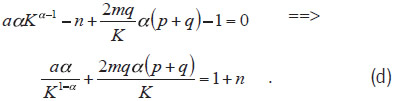
<body><![CDATA[<p>    <center><img src="/img/revistas/inno/v21n42/42a07ec.jpg"></center></p>     <p>Replacing (c) in (a)</p>     <p>    <center><img src="/img/revistas/inno/v21n42/42a07ed.jpg"></center></p>     <p>Starting from equation (d), denote, from which it holds that   <i>h</i>(<i>K</i>,<i>q</i>) = 1 + <i>n</i> (e), with <i>h<sub>K</sub></i> &lt; 0 y <i>h<sub>q</sub></i> &gt; 0, which implies an inverse relation between <i>K</i> and <i>q</i>.</p>     <p>  Starting with the preceding, we proceed to demonstrate   each of the propositions.</p>     <p>&nbsp;</p>     <p><font size="3"><b><i>i. Proposition 1</i></b></font></p>     <p>  If <i>m</i> = 0 equation (c) holds that -0.5<i>bf</i><sup>2</sup><i>aK</i><sup>&alpha;-1</sup> = 0. From   which, for constant values of <i>b</i>, <i>a</i> and <i>K</i>, necessarily f = 0.   In addition, it is known about equation (6) that </p>     ]]></body>
<body><![CDATA[<p>    <center><img src="/img/revistas/inno/v21n42/42a07ep3.jpg"></center></p>     <p>Therefore, so that <i>f</i> = 0, (<i>q</i> &rarr; &infin;)</p>     <p>&nbsp;</p>     <p><font size="3"><b><i>ii) Proposition 2</i></b></font></p>     <p>  From equation (e) it holds that <i>h</i>(<i>K</i>, <i>q</i>) = 1 + <i>n</i>, because of   which it is known that</p>     <p>    <center><img src="/img/revistas/inno/v21n42/42a07ep4.jpg"></center></p>     <p>So, to maintain equality, to the extent that m increases q must be reduced.</p>     <p>&nbsp;</p>     ]]></body>
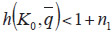
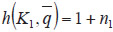
<body><![CDATA[<p><font size="3"><b><i>  iii) Proposition 3</i></b></font></p>     <p>  From equation (e) it holds that <i>h</i>(<i>K</i>, <i>q</i>) = 1 + <i>n</i>, because of   which it is known that</p>     <p>    <center><img src="/img/revistas/inno/v21n42/42a07ep4.jpg"></center></p>       <p>So, to maintain equality, to the extent that p increases, q must decrease.</p>     <p>&nbsp;</p>     <p><font size="3"><b><i>  iv) Proposition 4</i></b></font></p>     <p>  Starting from equation (e), <i>h</i>(<i>K</i>, <i>q</i>) = 1 + <i>n</i>, and taking as a   starting point a specific level of <i>n</i>, in this case <i>n</i><sub>0</sub>, a specific   level of <i>K</i>, in this case <i>K</i><sub>0</sub>, and assuming a constant <i>q</i>, then. To the extent that <i>n</i><sub>1</sub> is present, such that   <i>n</i><sub>1</sub> &gt; <i>n</i><sub>0</sub>, the following situation is generated:</p>     <p>    <center><img src="/img/revistas/inno/v21n42/42a07ep6.jpg"></center></p>     ]]></body>
<body><![CDATA[<p>Given that <i>h<sub>K</sub></i> &lt; 0, to maintain equality in the equation (e) then,</p>     <p>    <center><img src="/img/revistas/inno/v21n42/42a07ep7.jpg"></center></p>     <p>in which <i>K</i><sub>1</sub> &lt; <i>K</i><sub>0</sub>. Therefore, there is an inverse relation between <i>n</i> and <i>K</i>.</p>     <p>&nbsp;</p>     <p>       <center>     <font size="3"><b>    References     </b></font>   </center> </p>     <!-- ref --><p>  Aggarwal, R., Erel, I., Stulz, R. M. &amp; Williamson, R. (2007). Differences   in governance practices between U.S. and foreign firms: Measurement,   causes, and consequences. <i>NBER Working papers series</i>, <i>14</i>, 1-53.&nbsp;&nbsp;&nbsp;&nbsp;&nbsp;&nbsp;&nbsp;&nbsp;[&#160;<a href="javascript:void(0);" onclick="javascript: window.open('/scielo.php?script=sci_nlinks&ref=000230&pid=S0121-5051201100040000700001&lng=','','width=640,height=500,resizable=yes,scrollbars=1,menubar=yes,');">Links</a>&#160;]<!-- end-ref --><!-- ref --><p>  Avil&eacute;s, W. (2006). Paramilitarism and Colombia's low-intensity democracy. <i>Journal of Latin American Studies</i>, <i>38</i>(2), 379-408.&nbsp;&nbsp;&nbsp;&nbsp;&nbsp;&nbsp;&nbsp;&nbsp;[&#160;<a href="javascript:void(0);" onclick="javascript: window.open('/scielo.php?script=sci_nlinks&ref=000231&pid=S0121-5051201100040000700002&lng=','','width=640,height=500,resizable=yes,scrollbars=1,menubar=yes,');">Links</a>&#160;]<!-- end-ref --><!-- ref --><p>  Bekaert, G. &amp; Campbell, R. H. (2000). Foreign speculators and emerging equity markets. <i>Journal of Finance</i>, <i>55</i>(2), 565-613.&nbsp;&nbsp;&nbsp;&nbsp;&nbsp;&nbsp;&nbsp;&nbsp;[&#160;<a href="javascript:void(0);" onclick="javascript: window.open('/scielo.php?script=sci_nlinks&ref=000232&pid=S0121-5051201100040000700003&lng=','','width=640,height=500,resizable=yes,scrollbars=1,menubar=yes,');">Links</a>&#160;]<!-- end-ref --><!-- ref --><p>  Bergman, N. &amp; Nicolaievsky, D. (2007). Investor protection and the Coasian view. <i>Journal of Financial Economics</i>, <i>84</i>(3), 738-771.&nbsp;&nbsp;&nbsp;&nbsp;&nbsp;&nbsp;&nbsp;&nbsp;[&#160;<a href="javascript:void(0);" onclick="javascript: window.open('/scielo.php?script=sci_nlinks&ref=000233&pid=S0121-5051201100040000700004&lng=','','width=640,height=500,resizable=yes,scrollbars=1,menubar=yes,');">Links</a>&#160;]<!-- end-ref --><!-- ref --><p>  Boudon, L. (1996). Guerrillas and the state: The role of the state in   the Colombian peace process. <i>Journal of Latin American Studies</i>, <i>28</i>(2), 279-297.&nbsp;&nbsp;&nbsp;&nbsp;&nbsp;&nbsp;&nbsp;&nbsp;[&#160;<a href="javascript:void(0);" onclick="javascript: window.open('/scielo.php?script=sci_nlinks&ref=000234&pid=S0121-5051201100040000700005&lng=','','width=640,height=500,resizable=yes,scrollbars=1,menubar=yes,');">Links</a>&#160;]<!-- end-ref --><!-- ref --><p>  Cardoso, E. &amp; Fishlow, A. (1992). Latin American economic development:   1950-1980. Quincentenary Supplement: The Colonial and   Post Colonial Experience. Five Centuries of Spanish and Portuguese America, <i>Journal of Latin American Studies</i>, <i>24</i>, 197-218.&nbsp;&nbsp;&nbsp;&nbsp;&nbsp;&nbsp;&nbsp;&nbsp;[&#160;<a href="javascript:void(0);" onclick="javascript: window.open('/scielo.php?script=sci_nlinks&ref=000235&pid=S0121-5051201100040000700006&lng=','','width=640,height=500,resizable=yes,scrollbars=1,menubar=yes,');">Links</a>&#160;]<!-- end-ref --><!-- ref --><p>  CEPAL (2007). <i>Anuario estad&iacute;stico de Am&eacute;rica Latina y el Caribe 2007</i>   (Annual statistical survey of Latin America and the Caribbean   2007). Comisi&oacute;n Econ&oacute;mica para Am&eacute;rica Latina y el Caribe (Economic   Commission for Latin America and the Caribbean - CEPAL).&nbsp;&nbsp;&nbsp;&nbsp;&nbsp;&nbsp;&nbsp;&nbsp;[&#160;<a href="javascript:void(0);" onclick="javascript: window.open('/scielo.php?script=sci_nlinks&ref=000236&pid=S0121-5051201100040000700007&lng=','','width=640,height=500,resizable=yes,scrollbars=1,menubar=yes,');">Links</a>&#160;]<!-- end-ref --><!-- ref --><p>  Chong, A. &amp; L&oacute;pez de Silanes, F. (2007). <i>Gobierno corporativo en Am&eacute;rica   Latina</i> (Corporate governance in Latin America), Inter-American Development Bank, Working paper 59, University of Amsterdam.&nbsp;&nbsp;&nbsp;&nbsp;&nbsp;&nbsp;&nbsp;&nbsp;[&#160;<a href="javascript:void(0);" onclick="javascript: window.open('/scielo.php?script=sci_nlinks&ref=000237&pid=S0121-5051201100040000700008&lng=','','width=640,height=500,resizable=yes,scrollbars=1,menubar=yes,');">Links</a>&#160;]<!-- end-ref --><!-- ref --><p>  Coffee, J. (1999). The future as history: The prospects for global convergence   in corporate governance and its implications. <i>Northwestern Law Review</i>, <i>93</i>, 631-707.&nbsp;&nbsp;&nbsp;&nbsp;&nbsp;&nbsp;&nbsp;&nbsp;[&#160;<a href="javascript:void(0);" onclick="javascript: window.open('/scielo.php?script=sci_nlinks&ref=000238&pid=S0121-5051201100040000700009&lng=','','width=640,height=500,resizable=yes,scrollbars=1,menubar=yes,');">Links</a>&#160;]<!-- end-ref --><!-- ref --><p>  Coffee, J. (2002). Racing towards the top?: The impact of cross-listings   and stock market competition on international corporate governance. <i>Columbia Law Review</i>, <i>102</i>(7), 1757-1831.&nbsp;&nbsp;&nbsp;&nbsp;&nbsp;&nbsp;&nbsp;&nbsp;[&#160;<a href="javascript:void(0);" onclick="javascript: window.open('/scielo.php?script=sci_nlinks&ref=000239&pid=S0121-5051201100040000700010&lng=','','width=640,height=500,resizable=yes,scrollbars=1,menubar=yes,');">Links</a>&#160;]<!-- end-ref --><!-- ref --><p>  Doidge, C., Karolyi, A. &amp; Stulz, R. (2004). Why are foreign firms listed   in the U.S. worth more? <i>Journal of Financial Economics</i>, <i>71</i>, 205-238.&nbsp;&nbsp;&nbsp;&nbsp;&nbsp;&nbsp;&nbsp;&nbsp;[&#160;<a href="javascript:void(0);" onclick="javascript: window.open('/scielo.php?script=sci_nlinks&ref=000240&pid=S0121-5051201100040000700011&lng=','','width=640,height=500,resizable=yes,scrollbars=1,menubar=yes,');">Links</a>&#160;]<!-- end-ref --><!-- ref --><p>Doidge, C., Karolyi, A. &amp; Stulz, R. (2007). Why do countries matter so   much for corporate governance? <i>Journal of Financial Economics</i>, <i>86</i>, 1-39.&nbsp;&nbsp;&nbsp;&nbsp;&nbsp;&nbsp;&nbsp;&nbsp;[&#160;<a href="javascript:void(0);" onclick="javascript: window.open('/scielo.php?script=sci_nlinks&ref=000241&pid=S0121-5051201100040000700012&lng=','','width=640,height=500,resizable=yes,scrollbars=1,menubar=yes,');">Links</a>&#160;]<!-- end-ref --><!-- ref --><p>  Doidge, C., Karolyi, A. &amp; Stulz, R. (2010). Why do foreign firms leave U.S. equity markets? <i>Journal of Finance</i>, <i>65</i>(4), 1507-1554.&nbsp;&nbsp;&nbsp;&nbsp;&nbsp;&nbsp;&nbsp;&nbsp;[&#160;<a href="javascript:void(0);" onclick="javascript: window.open('/scielo.php?script=sci_nlinks&ref=000242&pid=S0121-5051201100040000700013&lng=','','width=640,height=500,resizable=yes,scrollbars=1,menubar=yes,');">Links</a>&#160;]<!-- end-ref --><!-- ref --><p>  Doidge, C., Karolyi, A., Lins, K., Miller, D. &amp; Stulz, R. (2009). Private benefits   of control, ownership, and the cross-listing decision. <i>Journal of Finance</i>, <i>64</i>(1), 425-466.&nbsp;&nbsp;&nbsp;&nbsp;&nbsp;&nbsp;&nbsp;&nbsp;[&#160;<a href="javascript:void(0);" onclick="javascript: window.open('/scielo.php?script=sci_nlinks&ref=000243&pid=S0121-5051201100040000700014&lng=','','width=640,height=500,resizable=yes,scrollbars=1,menubar=yes,');">Links</a>&#160;]<!-- end-ref --><!-- ref --><p>  Duncan, G. (2005). <i>Del campo a la ciudad: la infiltraci&oacute;n urbana de los   se&ntilde;ores de la guerra</i>. Documento (From country to city: the urban infiltration of guerrillas). CEDE 2005-2. Bogot&aacute;: Universidad de los   Andes.&nbsp;&nbsp;&nbsp;&nbsp;&nbsp;&nbsp;&nbsp;&nbsp;[&#160;<a href="javascript:void(0);" onclick="javascript: window.open('/scielo.php?script=sci_nlinks&ref=000244&pid=S0121-5051201100040000700015&lng=','','width=640,height=500,resizable=yes,scrollbars=1,menubar=yes,');">Links</a>&#160;]<!-- end-ref --><!-- ref --><p>  Duncan, G. (2006). <i>Los se&ntilde;ores de la guerra</i>. Bogot&aacute;: Planeta.&nbsp;&nbsp;&nbsp;&nbsp;&nbsp;&nbsp;&nbsp;&nbsp;[&#160;<a href="javascript:void(0);" onclick="javascript: window.open('/scielo.php?script=sci_nlinks&ref=000245&pid=S0121-5051201100040000700016&lng=','','width=640,height=500,resizable=yes,scrollbars=1,menubar=yes,');">Links</a>&#160;]<!-- end-ref --><!-- ref --><p>  Duncan, G. (2007). Historia de una subordinaci&oacute;n. &iquest;C&oacute;mo los guerreros   sometieron a los narcotraficantes? Zorro, C. (comp). <i>El desarrollo:   perspectivas y dimensiones. Aportes interdisciplinarios</i> (433-452). Bogot&aacute;: Universidad de los Andes, Cider.&nbsp;&nbsp;&nbsp;&nbsp;&nbsp;&nbsp;&nbsp;&nbsp;[&#160;<a href="javascript:void(0);" onclick="javascript: window.open('/scielo.php?script=sci_nlinks&ref=000246&pid=S0121-5051201100040000700017&lng=','','width=640,height=500,resizable=yes,scrollbars=1,menubar=yes,');">Links</a>&#160;]<!-- end-ref --><!-- ref --><p>  Durnev, A. &amp; Kim, H. (2005). To steal or not to steal: Firm attributes,   legal environment, and valuation. <i>Journal of Finance</i>, <i>60</i>, 1461-1493.&nbsp;&nbsp;&nbsp;&nbsp;&nbsp;&nbsp;&nbsp;&nbsp;[&#160;<a href="javascript:void(0);" onclick="javascript: window.open('/scielo.php?script=sci_nlinks&ref=000247&pid=S0121-5051201100040000700018&lng=','','width=640,height=500,resizable=yes,scrollbars=1,menubar=yes,');">Links</a>&#160;]<!-- end-ref --><!-- ref --><p>  Dyck, A. &amp; Zingales, L. (2004). Private benefits of control: An international comparison. <i>Journal of Finance</i>, <i>59</i>(2), 537-600.&nbsp;&nbsp;&nbsp;&nbsp;&nbsp;&nbsp;&nbsp;&nbsp;[&#160;<a href="javascript:void(0);" onclick="javascript: window.open('/scielo.php?script=sci_nlinks&ref=000248&pid=S0121-5051201100040000700019&lng=','','width=640,height=500,resizable=yes,scrollbars=1,menubar=yes,');">Links</a>&#160;]<!-- end-ref --><!-- ref --><p>  Echeverry, J. (2004). <i>Colombia and the war on drugs, how short is the short run?</i> Bogot&aacute;: Uniandes. Documento CEDE 2004/13.&nbsp;&nbsp;&nbsp;&nbsp;&nbsp;&nbsp;&nbsp;&nbsp;[&#160;<a href="javascript:void(0);" onclick="javascript: window.open('/scielo.php?script=sci_nlinks&ref=000249&pid=S0121-5051201100040000700020&lng=','','width=640,height=500,resizable=yes,scrollbars=1,menubar=yes,');">Links</a>&#160;]<!-- end-ref --><!-- ref --><p>  Errunza, V. R. &amp; Miller, D. P. (2000). Market segmentation and the cost   of capital in international equity markets. <i>The Journal of Financial and Quantitative Analysis</i>, <i>35</i>, 577-600.&nbsp;&nbsp;&nbsp;&nbsp;&nbsp;&nbsp;&nbsp;&nbsp;[&#160;<a href="javascript:void(0);" onclick="javascript: window.open('/scielo.php?script=sci_nlinks&ref=000250&pid=S0121-5051201100040000700021&lng=','','width=640,height=500,resizable=yes,scrollbars=1,menubar=yes,');">Links</a>&#160;]<!-- end-ref --><!-- ref --><p>  Fitch Ratings. (2008). Consulted April 30, 2008, <a href="http://www.fitchratings.com/" target="_blank">http://www.fitchratings.com/</a>&nbsp;&nbsp;&nbsp;&nbsp;&nbsp;&nbsp;&nbsp;&nbsp;[&#160;<a href="javascript:void(0);" onclick="javascript: window.open('/scielo.php?script=sci_nlinks&ref=000251&pid=S0121-5051201100040000700022&lng=','','width=640,height=500,resizable=yes,scrollbars=1,menubar=yes,');">Links</a>&#160;]<!-- end-ref --><!-- ref --><p>  Foerster, S. R. &amp; Karolyi, G. A. (1999). The effects of market segmentation   and investor recognition on asset prices: Evidence from foreign   stocks listing in the United States. <i>Journal of Finance</i>, <i>54</i>(3), 981-1013.&nbsp;&nbsp;&nbsp;&nbsp;&nbsp;&nbsp;&nbsp;&nbsp;[&#160;<a href="javascript:void(0);" onclick="javascript: window.open('/scielo.php?script=sci_nlinks&ref=000252&pid=S0121-5051201100040000700023&lng=','','width=640,height=500,resizable=yes,scrollbars=1,menubar=yes,');">Links</a>&#160;]<!-- end-ref --><!-- ref --><p>  Guti&eacute;rrez, L., Pombo, C. &amp; Taborda, R. (2008). Ownership and control in   Colombian corporations. <i>The Quarterly Review of Economics and Finance</i>, <i>48</i>(1), 22-47.&nbsp;&nbsp;&nbsp;&nbsp;&nbsp;&nbsp;&nbsp;&nbsp;[&#160;<a href="javascript:void(0);" onclick="javascript: window.open('/scielo.php?script=sci_nlinks&ref=000253&pid=S0121-5051201100040000700024&lng=','','width=640,height=500,resizable=yes,scrollbars=1,menubar=yes,');">Links</a>&#160;]<!-- end-ref --><!-- ref --><p>  Hail, L. &amp; Leuz, C. (2009). Cost of capital effects and changes in growth   expectations around U.S. cross-listings. <i>Journal of Financial Economics</i>, <i>93</i>(3), 428-454.&nbsp;&nbsp;&nbsp;&nbsp;&nbsp;&nbsp;&nbsp;&nbsp;[&#160;<a href="javascript:void(0);" onclick="javascript: window.open('/scielo.php?script=sci_nlinks&ref=000254&pid=S0121-5051201100040000700025&lng=','','width=640,height=500,resizable=yes,scrollbars=1,menubar=yes,');">Links</a>&#160;]<!-- end-ref --><!-- ref --><p>  Iacobucci, E. (2004). Toward a signaling explanation of the private   choice of corporate law. <i>American Law &amp; Economics Review</i>, <i>6</i>, 319-344.&nbsp;&nbsp;&nbsp;&nbsp;&nbsp;&nbsp;&nbsp;&nbsp;[&#160;<a href="javascript:void(0);" onclick="javascript: window.open('/scielo.php?script=sci_nlinks&ref=000255&pid=S0121-5051201100040000700026&lng=','','width=640,height=500,resizable=yes,scrollbars=1,menubar=yes,');">Links</a>&#160;]<!-- end-ref --><!-- ref --><p>  Karolyi, G. A. (2004). The role of ADRs in the development of emerging   equity markets. <i>Review of Economics and Statistics</i>, <i>86</i>(3), 670-90.&nbsp;&nbsp;&nbsp;&nbsp;&nbsp;&nbsp;&nbsp;&nbsp;[&#160;<a href="javascript:void(0);" onclick="javascript: window.open('/scielo.php?script=sci_nlinks&ref=000256&pid=S0121-5051201100040000700027&lng=','','width=640,height=500,resizable=yes,scrollbars=1,menubar=yes,');">Links</a>&#160;]<!-- end-ref --><!-- ref --><p>  Karolyi, G. A. (2006). The world of cross-listings and cross-listings of   the world: Challenging conventional wisdom. <i>Review of Finance</i>, <i>10</i>(1), 3-115.&nbsp;&nbsp;&nbsp;&nbsp;&nbsp;&nbsp;&nbsp;&nbsp;[&#160;<a href="javascript:void(0);" onclick="javascript: window.open('/scielo.php?script=sci_nlinks&ref=000257&pid=S0121-5051201100040000700028&lng=','','width=640,height=500,resizable=yes,scrollbars=1,menubar=yes,');">Links</a>&#160;]<!-- end-ref --><!-- ref --><p>  La Porta, R., L&oacute;pez-de-Silanes, F. &amp; Shleifer, A. (2002). Investor protection and corporate valuation. <i>Journal of Finance</i>, <i>57</i>, 1147-1170.&nbsp;&nbsp;&nbsp;&nbsp;&nbsp;&nbsp;&nbsp;&nbsp;[&#160;<a href="javascript:void(0);" onclick="javascript: window.open('/scielo.php?script=sci_nlinks&ref=000258&pid=S0121-5051201100040000700029&lng=','','width=640,height=500,resizable=yes,scrollbars=1,menubar=yes,');">Links</a>&#160;]<!-- end-ref --><!-- ref --><p>  Moody's Investors Service. (2008). Consulted on April 30, 2008,   <a href="http://www.moodys.com/" target="_blank">http://www.moodys.com/</a>&nbsp;&nbsp;&nbsp;&nbsp;&nbsp;&nbsp;&nbsp;&nbsp;[&#160;<a href="javascript:void(0);" onclick="javascript: window.open('/scielo.php?script=sci_nlinks&ref=000259&pid=S0121-5051201100040000700030&lng=','','width=640,height=500,resizable=yes,scrollbars=1,menubar=yes,');">Links</a>&#160;]<!-- end-ref --><!-- ref --><p>  NACLA. (1997). The rise and fall of the "gentlemen from Cali". <i>NACLA   Report on the Americas</i>, North American Congress on Latin America, May/Jun97, 30(6).&nbsp;&nbsp;&nbsp;&nbsp;&nbsp;&nbsp;&nbsp;&nbsp;[&#160;<a href="javascript:void(0);" onclick="javascript: window.open('/scielo.php?script=sci_nlinks&ref=000260&pid=S0121-5051201100040000700031&lng=','','width=640,height=500,resizable=yes,scrollbars=1,menubar=yes,');">Links</a>&#160;]<!-- end-ref --><!-- ref --><p>  Nuevo Diario. (March 3, 2004). "Camorra" napolitana "proteg&iacute;a" a Parmalat. <i>Nuevo Diario</i>, Nicaragua.&nbsp;&nbsp;&nbsp;&nbsp;&nbsp;&nbsp;&nbsp;&nbsp;[&#160;<a href="javascript:void(0);" onclick="javascript: window.open('/scielo.php?script=sci_nlinks&ref=000261&pid=S0121-5051201100040000700032&lng=','','width=640,height=500,resizable=yes,scrollbars=1,menubar=yes,');">Links</a>&#160;]<!-- end-ref --><!-- ref --><p>  Pagano, M., R&ouml;ell, A. A. &amp; Zechner, J. (2002). The geography of equity   listing: Why do companies list abroad? <i>Journal of Finance</i>, <i>57</i>(6), 2651-2694.&nbsp;&nbsp;&nbsp;&nbsp;&nbsp;&nbsp;&nbsp;&nbsp;[&#160;<a href="javascript:void(0);" onclick="javascript: window.open('/scielo.php?script=sci_nlinks&ref=000262&pid=S0121-5051201100040000700033&lng=','','width=640,height=500,resizable=yes,scrollbars=1,menubar=yes,');">Links</a>&#160;]<!-- end-ref --><!-- ref --><p>  Pizarro-Leong&oacute;mez, E. (2004). <i>Una democracia asediada: balance y perspectiva del conflicto armado en Colombia</i>. Bogot&aacute;: Norma.&nbsp;&nbsp;&nbsp;&nbsp;&nbsp;&nbsp;&nbsp;&nbsp;[&#160;<a href="javascript:void(0);" onclick="javascript: window.open('/scielo.php?script=sci_nlinks&ref=000263&pid=S0121-5051201100040000700034&lng=','','width=640,height=500,resizable=yes,scrollbars=1,menubar=yes,');">Links</a>&#160;]<!-- end-ref --><!-- ref --><p>  Quinn, T. (June 30, 1991). Passion-fruit mousse with the king of cocaine.   <i>The Sunday Telegraph</i>, p. 16.&nbsp;&nbsp;&nbsp;&nbsp;&nbsp;&nbsp;&nbsp;&nbsp;[&#160;<a href="javascript:void(0);" onclick="javascript: window.open('/scielo.php?script=sci_nlinks&ref=000264&pid=S0121-5051201100040000700035&lng=','','width=640,height=500,resizable=yes,scrollbars=1,menubar=yes,');">Links</a>&#160;]<!-- end-ref --><!-- ref --><p>  Reese, W. &amp; Weisbach, M. (2002). Protection of minority shareholder interests,   cross-listings in the United States, and subsequent equity offerings. <i>Journal of Financial Economics</i>, <i>66</i>, 65-104.&nbsp;&nbsp;&nbsp;&nbsp;&nbsp;&nbsp;&nbsp;&nbsp;[&#160;<a href="javascript:void(0);" onclick="javascript: window.open('/scielo.php?script=sci_nlinks&ref=000265&pid=S0121-5051201100040000700036&lng=','','width=640,height=500,resizable=yes,scrollbars=1,menubar=yes,');">Links</a>&#160;]<!-- end-ref --><!-- ref --><p>  Sarkissian, S. &amp; Schill, M. (2004). The overseas listing decision: New evidence   of proximity preference. <i>Review of Financial Studies</i>, <i>17</i>(3), 769-809.&nbsp;&nbsp;&nbsp;&nbsp;&nbsp;&nbsp;&nbsp;&nbsp;[&#160;<a href="javascript:void(0);" onclick="javascript: window.open('/scielo.php?script=sci_nlinks&ref=000266&pid=S0121-5051201100040000700037&lng=','','width=640,height=500,resizable=yes,scrollbars=1,menubar=yes,');">Links</a>&#160;]<!-- end-ref --><!-- ref --><p>  Shleifer, A. &amp; Wolfenzon, D. (2002). Investor protection and equity markets. <i>Journal of Financial Economics</i>, <i>66</i>, 3-27.&nbsp;&nbsp;&nbsp;&nbsp;&nbsp;&nbsp;&nbsp;&nbsp;[&#160;<a href="javascript:void(0);" onclick="javascript: window.open('/scielo.php?script=sci_nlinks&ref=000267&pid=S0121-5051201100040000700038&lng=','','width=640,height=500,resizable=yes,scrollbars=1,menubar=yes,');">Links</a>&#160;]<!-- end-ref --><!-- ref --><p>  Stulz, R. M. (1999). Globalization, corporate finance, and the cost of   capital. <i>Journal of Applied Corporate Finance</i>, <i>12</i>(3), 8-25.&nbsp;&nbsp;&nbsp;&nbsp;&nbsp;&nbsp;&nbsp;&nbsp;[&#160;<a href="javascript:void(0);" onclick="javascript: window.open('/scielo.php?script=sci_nlinks&ref=000268&pid=S0121-5051201100040000700039&lng=','','width=640,height=500,resizable=yes,scrollbars=1,menubar=yes,');">Links</a>&#160;]<!-- end-ref --><!-- ref --><p>  The Economist Intelligence Unit Limited. (2007). <i>Security risks in Colombia.   Country Profile Colombia</i>, 13-14.&nbsp;&nbsp;&nbsp;&nbsp;&nbsp;&nbsp;&nbsp;&nbsp;[&#160;<a href="javascript:void(0);" onclick="javascript: window.open('/scielo.php?script=sci_nlinks&ref=000269&pid=S0121-5051201100040000700040&lng=','','width=640,height=500,resizable=yes,scrollbars=1,menubar=yes,');">Links</a>&#160;]<!-- end-ref --><!-- ref --><p>  UNESCO, Organizaci&oacute;n de las Naciones Unidas para la Educaci&oacute;n, la   Ciencia y la Cultura. (2000). <i>An&aacute;lisis de prospectivas de la educaci&oacute;n   en la regi&oacute;n de Am&eacute;rica Latina y el Caribe</i>.&nbsp;&nbsp;&nbsp;&nbsp;&nbsp;&nbsp;&nbsp;&nbsp;[&#160;<a href="javascript:void(0);" onclick="javascript: window.open('/scielo.php?script=sci_nlinks&ref=000270&pid=S0121-5051201100040000700041&lng=','','width=640,height=500,resizable=yes,scrollbars=1,menubar=yes,');">Links</a>&#160;]<!-- end-ref --><!-- ref --><p>  Yin, R. (2003). <i>Case study research: Design and methods</i>, 3rd edition.   London: Sage Publications Ltd.&nbsp;&nbsp;&nbsp;&nbsp;&nbsp;&nbsp;&nbsp;&nbsp;[&#160;<a href="javascript:void(0);" onclick="javascript: window.open('/scielo.php?script=sci_nlinks&ref=000271&pid=S0121-5051201100040000700042&lng=','','width=640,height=500,resizable=yes,scrollbars=1,menubar=yes,');">Links</a>&#160;]<!-- end-ref --> ]]></body><back>
<ref-list>
<ref id="B1">
<nlm-citation citation-type="journal">
<person-group person-group-type="author">
<name>
<surname><![CDATA[Aggarwal]]></surname>
<given-names><![CDATA[R]]></given-names>
</name>
<name>
<surname><![CDATA[Erel]]></surname>
<given-names><![CDATA[I]]></given-names>
</name>
<name>
<surname><![CDATA[Stulz]]></surname>
<given-names><![CDATA[R. M]]></given-names>
</name>
<name>
<surname><![CDATA[Williamson]]></surname>
<given-names><![CDATA[R]]></given-names>
</name>
</person-group>
<article-title xml:lang="en"><![CDATA[Differences in governance practices between U.S. and foreign firms: Measurement, causes, and consequences]]></article-title>
<source><![CDATA[NBER Working papers series]]></source>
<year>2007</year>
<volume>14</volume>
<page-range>1-53</page-range></nlm-citation>
</ref>
<ref id="B2">
<nlm-citation citation-type="journal">
<person-group person-group-type="author">
<name>
<surname><![CDATA[Avilés]]></surname>
<given-names><![CDATA[W]]></given-names>
</name>
</person-group>
<article-title xml:lang="en"><![CDATA[Paramilitarism and Colombia's low-intensity democracy]]></article-title>
<source><![CDATA[Journal of Latin American Studies]]></source>
<year>2006</year>
<volume>38</volume>
<numero>2</numero>
<issue>2</issue>
<page-range>379-408</page-range></nlm-citation>
</ref>
<ref id="B3">
<nlm-citation citation-type="journal">
<person-group person-group-type="author">
<name>
<surname><![CDATA[Bekaert]]></surname>
<given-names><![CDATA[G]]></given-names>
</name>
<name>
<surname><![CDATA[Campbell]]></surname>
<given-names><![CDATA[R. H]]></given-names>
</name>
</person-group>
<article-title xml:lang="en"><![CDATA[Foreign speculators and emerging equity markets]]></article-title>
<source><![CDATA[Journal of Finance]]></source>
<year>2000</year>
<volume>55</volume>
<numero>2</numero>
<issue>2</issue>
<page-range>565-613</page-range></nlm-citation>
</ref>
<ref id="B4">
<nlm-citation citation-type="journal">
<person-group person-group-type="author">
<name>
<surname><![CDATA[Bergman]]></surname>
<given-names><![CDATA[N]]></given-names>
</name>
<name>
<surname><![CDATA[Nicolaievsky]]></surname>
<given-names><![CDATA[D]]></given-names>
</name>
</person-group>
<article-title xml:lang="en"><![CDATA[Investor protection and the Coasian view]]></article-title>
<source><![CDATA[Journal of Financial Economics]]></source>
<year>2007</year>
<volume>84</volume>
<numero>3</numero>
<issue>3</issue>
<page-range>738-771</page-range></nlm-citation>
</ref>
<ref id="B5">
<nlm-citation citation-type="journal">
<person-group person-group-type="author">
<name>
<surname><![CDATA[Boudon]]></surname>
<given-names><![CDATA[L]]></given-names>
</name>
</person-group>
<article-title xml:lang="en"><![CDATA[Guerrillas and the state: The role of the state in the Colombian peace process]]></article-title>
<source><![CDATA[Journal of Latin American Studies]]></source>
<year>1996</year>
<volume>28</volume>
<numero>2</numero>
<issue>2</issue>
<page-range>279-297</page-range></nlm-citation>
</ref>
<ref id="B6">
<nlm-citation citation-type="journal">
<person-group person-group-type="author">
<name>
<surname><![CDATA[Cardoso]]></surname>
<given-names><![CDATA[E]]></given-names>
</name>
<name>
<surname><![CDATA[Fishlow]]></surname>
<given-names><![CDATA[A]]></given-names>
</name>
</person-group>
<article-title xml:lang="en"><![CDATA[Latin American economic development: 1950-1980]]></article-title>
<source><![CDATA[Journal of Latin American Studies]]></source>
<year>1992</year>
<volume>24</volume>
<page-range>197-218</page-range></nlm-citation>
</ref>
<ref id="B7">
<nlm-citation citation-type="book">
<collab>CEPAL</collab>
<source><![CDATA[Anuario estadístico de América Latina y el Caribe 2007]]></source>
<year>2007</year>
<publisher-name><![CDATA[Comisión Económica para América Latina y el Caribe (Economic Commission for Latin America and the Caribbean - CEPAL)]]></publisher-name>
</nlm-citation>
</ref>
<ref id="B8">
<nlm-citation citation-type="book">
<person-group person-group-type="author">
<name>
<surname><![CDATA[Chong]]></surname>
<given-names><![CDATA[A]]></given-names>
</name>
<name>
<surname><![CDATA[López de Silanes]]></surname>
<given-names><![CDATA[F]]></given-names>
</name>
</person-group>
<source><![CDATA[Gobierno corporativo en América Latina]]></source>
<year>2007</year>
<volume>59</volume>
<publisher-name><![CDATA[Inter-American Development Bank]]></publisher-name>
</nlm-citation>
</ref>
<ref id="B9">
<nlm-citation citation-type="journal">
<person-group person-group-type="author">
<name>
<surname><![CDATA[Coffee]]></surname>
<given-names><![CDATA[J]]></given-names>
</name>
</person-group>
<article-title xml:lang="en"><![CDATA[The future as history: The prospects for global convergence in corporate governance and its implications]]></article-title>
<source><![CDATA[Northwestern Law Review]]></source>
<year>1999</year>
<volume>93</volume>
<page-range>631-707</page-range></nlm-citation>
</ref>
<ref id="B10">
<nlm-citation citation-type="journal">
<person-group person-group-type="author">
<name>
<surname><![CDATA[Coffee]]></surname>
<given-names><![CDATA[J]]></given-names>
</name>
</person-group>
<article-title xml:lang="en"><![CDATA[Racing towards the top?: The impact of cross-listings and stock market competition on international corporate governance]]></article-title>
<source><![CDATA[Columbia Law Review]]></source>
<year>2002</year>
<volume>102</volume>
<numero>7</numero>
<issue>7</issue>
<page-range>1757-1831</page-range></nlm-citation>
</ref>
<ref id="B11">
<nlm-citation citation-type="journal">
<person-group person-group-type="author">
<name>
<surname><![CDATA[Doidge]]></surname>
<given-names><![CDATA[C]]></given-names>
</name>
<name>
<surname><![CDATA[Karolyi]]></surname>
<given-names><![CDATA[A]]></given-names>
</name>
<name>
<surname><![CDATA[Stulz]]></surname>
<given-names><![CDATA[R]]></given-names>
</name>
</person-group>
<article-title xml:lang="en"><![CDATA[Why are foreign firms listed in the U.S. worth more?]]></article-title>
<source><![CDATA[Journal of Financial Economics]]></source>
<year>2004</year>
<volume>71</volume>
<page-range>205-238</page-range></nlm-citation>
</ref>
<ref id="B12">
<nlm-citation citation-type="journal">
<person-group person-group-type="author">
<name>
<surname><![CDATA[Doidge]]></surname>
<given-names><![CDATA[C]]></given-names>
</name>
<name>
<surname><![CDATA[Karolyi]]></surname>
<given-names><![CDATA[A]]></given-names>
</name>
<name>
<surname><![CDATA[Stulz]]></surname>
<given-names><![CDATA[R]]></given-names>
</name>
</person-group>
<article-title xml:lang="en"><![CDATA[Why do countries matter so much for corporate governance?]]></article-title>
<source><![CDATA[Journal of Financial Economics]]></source>
<year>2007</year>
<volume>86</volume>
<page-range>1-39</page-range></nlm-citation>
</ref>
<ref id="B13">
<nlm-citation citation-type="journal">
<person-group person-group-type="author">
<name>
<surname><![CDATA[Doidge]]></surname>
<given-names><![CDATA[C]]></given-names>
</name>
<name>
<surname><![CDATA[Karolyi]]></surname>
<given-names><![CDATA[A]]></given-names>
</name>
<name>
<surname><![CDATA[Stulz]]></surname>
<given-names><![CDATA[R]]></given-names>
</name>
</person-group>
<article-title xml:lang="en"><![CDATA[Why do foreign firms leave U.S. equity markets?]]></article-title>
<source><![CDATA[Journal of Finance]]></source>
<year>2010</year>
<volume>65</volume>
<numero>4</numero>
<issue>4</issue>
<page-range>1507-1554</page-range></nlm-citation>
</ref>
<ref id="B14">
<nlm-citation citation-type="journal">
<person-group person-group-type="author">
<name>
<surname><![CDATA[Doidge]]></surname>
<given-names><![CDATA[C]]></given-names>
</name>
<name>
<surname><![CDATA[Karolyi]]></surname>
<given-names><![CDATA[A]]></given-names>
</name>
<name>
<surname><![CDATA[Lins]]></surname>
<given-names><![CDATA[K]]></given-names>
</name>
<name>
<surname><![CDATA[Miller]]></surname>
<given-names><![CDATA[D]]></given-names>
</name>
<name>
<surname><![CDATA[Stulz]]></surname>
<given-names><![CDATA[R]]></given-names>
</name>
</person-group>
<article-title xml:lang="en"><![CDATA[Private benefits of control, ownership, and the cross-listing decision]]></article-title>
<source><![CDATA[Journal of Finance]]></source>
<year>2009</year>
<volume>64</volume>
<numero>1</numero>
<issue>1</issue>
<page-range>425-466</page-range></nlm-citation>
</ref>
<ref id="B15">
<nlm-citation citation-type="book">
<person-group person-group-type="author">
<name>
<surname><![CDATA[Duncan]]></surname>
<given-names><![CDATA[G]]></given-names>
</name>
</person-group>
<source><![CDATA[Del campo a la ciudad: la infiltración urbana de los señores de la guerra]]></source>
<year>2005</year>
<volume>CEDE 2005-2</volume>
<publisher-loc><![CDATA[Bogotá ]]></publisher-loc>
<publisher-name><![CDATA[Universidad de los Andes]]></publisher-name>
</nlm-citation>
</ref>
<ref id="B16">
<nlm-citation citation-type="book">
<person-group person-group-type="author">
<name>
<surname><![CDATA[Duncan]]></surname>
<given-names><![CDATA[G]]></given-names>
</name>
</person-group>
<source><![CDATA[Los señores de la guerra]]></source>
<year>2006</year>
<publisher-loc><![CDATA[Bogotá ]]></publisher-loc>
<publisher-name><![CDATA[Planeta]]></publisher-name>
</nlm-citation>
</ref>
<ref id="B17">
<nlm-citation citation-type="book">
<person-group person-group-type="author">
<name>
<surname><![CDATA[Duncan]]></surname>
<given-names><![CDATA[G]]></given-names>
</name>
</person-group>
<article-title xml:lang="es"><![CDATA[Historia de una subordinación.¿Cómo los guerreros sometieron a los narcotraficantes?]]></article-title>
<person-group person-group-type="editor">
<name>
<surname><![CDATA[Zorro]]></surname>
<given-names><![CDATA[C]]></given-names>
</name>
</person-group>
<source><![CDATA[El desarrollo: perspectivas y dimensiones: Aportes interdisciplinarios]]></source>
<year>2007</year>
<page-range>433-452</page-range><publisher-loc><![CDATA[Bogotá ]]></publisher-loc>
<publisher-name><![CDATA[Universidad de los Andes, Cider]]></publisher-name>
</nlm-citation>
</ref>
<ref id="B18">
<nlm-citation citation-type="journal">
<person-group person-group-type="author">
<name>
<surname><![CDATA[Durnev]]></surname>
<given-names><![CDATA[A]]></given-names>
</name>
<name>
<surname><![CDATA[Kim]]></surname>
<given-names><![CDATA[H]]></given-names>
</name>
</person-group>
<article-title xml:lang="en"><![CDATA[To steal or not to steal: Firm attributes, legal environment, and valuation]]></article-title>
<source><![CDATA[Journal of Finance]]></source>
<year>2005</year>
<volume>60</volume>
<page-range>1461-1493</page-range></nlm-citation>
</ref>
<ref id="B19">
<nlm-citation citation-type="journal">
<person-group person-group-type="author">
<name>
<surname><![CDATA[Dyck]]></surname>
<given-names><![CDATA[A]]></given-names>
</name>
<name>
<surname><![CDATA[Zingales]]></surname>
<given-names><![CDATA[L]]></given-names>
</name>
</person-group>
<article-title xml:lang="en"><![CDATA[Private benefits of control: An international comparison]]></article-title>
<source><![CDATA[Journal of Finance]]></source>
<year>2004</year>
<volume>59</volume>
<numero>2</numero>
<issue>2</issue>
<page-range>537-600</page-range></nlm-citation>
</ref>
<ref id="B20">
<nlm-citation citation-type="book">
<person-group person-group-type="author">
<name>
<surname><![CDATA[Echeverry]]></surname>
<given-names><![CDATA[J]]></given-names>
</name>
</person-group>
<source><![CDATA[Colombia and the war on drugs, how short is the short run?]]></source>
<year>2004</year>
<volume>CEDE 2004/13</volume>
<publisher-loc><![CDATA[Bogotá ]]></publisher-loc>
<publisher-name><![CDATA[Uniandes]]></publisher-name>
</nlm-citation>
</ref>
<ref id="B21">
<nlm-citation citation-type="journal">
<person-group person-group-type="author">
<name>
<surname><![CDATA[Errunza]]></surname>
<given-names><![CDATA[V. R]]></given-names>
</name>
<name>
<surname><![CDATA[Miller]]></surname>
<given-names><![CDATA[D. P]]></given-names>
</name>
</person-group>
<article-title xml:lang="en"><![CDATA[Market segmentation and the cost of capital in international equity markets]]></article-title>
<source><![CDATA[The Journal of Financial and Quantitative Analysis]]></source>
<year>2000</year>
<volume>35</volume>
<page-range>577-600</page-range></nlm-citation>
</ref>
<ref id="B22">
<nlm-citation citation-type="">
<source><![CDATA[Fitch Ratings]]></source>
<year>2008</year>
</nlm-citation>
</ref>
<ref id="B23">
<nlm-citation citation-type="journal">
<person-group person-group-type="author">
<name>
<surname><![CDATA[Foerster]]></surname>
<given-names><![CDATA[S. R]]></given-names>
</name>
<name>
<surname><![CDATA[Karolyi]]></surname>
<given-names><![CDATA[G. A]]></given-names>
</name>
</person-group>
<article-title xml:lang="en"><![CDATA[The effects of market segmentation and investor recognition on asset prices: Evidence from foreign stocks listing in the United States]]></article-title>
<source><![CDATA[Journal of Finance]]></source>
<year>1999</year>
<volume>54</volume>
<numero>3</numero>
<issue>3</issue>
<page-range>981-1013</page-range></nlm-citation>
</ref>
<ref id="B24">
<nlm-citation citation-type="journal">
<person-group person-group-type="author">
<name>
<surname><![CDATA[Gutiérrez]]></surname>
<given-names><![CDATA[L]]></given-names>
</name>
<name>
<surname><![CDATA[Pombo]]></surname>
<given-names><![CDATA[C]]></given-names>
</name>
<name>
<surname><![CDATA[Taborda]]></surname>
<given-names><![CDATA[R]]></given-names>
</name>
</person-group>
<article-title xml:lang="en"><![CDATA[Ownership and control in Colombian corporations]]></article-title>
<source><![CDATA[The Quarterly Review of Economics and Finance]]></source>
<year>2008</year>
<volume>48</volume>
<numero>1</numero>
<issue>1</issue>
<page-range>22-47</page-range></nlm-citation>
</ref>
<ref id="B25">
<nlm-citation citation-type="journal">
<person-group person-group-type="author">
<name>
<surname><![CDATA[Hail]]></surname>
<given-names><![CDATA[L]]></given-names>
</name>
<name>
<surname><![CDATA[Leuz]]></surname>
<given-names><![CDATA[C]]></given-names>
</name>
</person-group>
<article-title xml:lang="en"><![CDATA[Cost of capital effects and changes in growth expectations around U.S. cross-listings]]></article-title>
<source><![CDATA[Journal of Financial Economics]]></source>
<year>2009</year>
<volume>93</volume>
<numero>3</numero>
<issue>3</issue>
<page-range>428-454</page-range></nlm-citation>
</ref>
<ref id="B26">
<nlm-citation citation-type="journal">
<person-group person-group-type="author">
<name>
<surname><![CDATA[Iacobucci]]></surname>
<given-names><![CDATA[E]]></given-names>
</name>
</person-group>
<article-title xml:lang="en"><![CDATA[Toward a signaling explanation of the private choice of corporate law]]></article-title>
<source><![CDATA[American Law & Economics Review]]></source>
<year>2004</year>
<volume>6</volume>
<page-range>319-344</page-range></nlm-citation>
</ref>
<ref id="B27">
<nlm-citation citation-type="journal">
<person-group person-group-type="author">
<name>
<surname><![CDATA[Karolyi]]></surname>
<given-names><![CDATA[G. A]]></given-names>
</name>
</person-group>
<article-title xml:lang="en"><![CDATA[The role of ADRs in the development of emerging equity markets]]></article-title>
<source><![CDATA[Review of Economics and Statistics]]></source>
<year>2004</year>
<volume>86</volume>
<numero>3</numero>
<issue>3</issue>
<page-range>670-90</page-range></nlm-citation>
</ref>
<ref id="B28">
<nlm-citation citation-type="journal">
<person-group person-group-type="author">
<name>
<surname><![CDATA[Karolyi]]></surname>
<given-names><![CDATA[G. A]]></given-names>
</name>
</person-group>
<article-title xml:lang="en"><![CDATA[The world of cross-listings and cross-listings of the world: Challenging conventional wisdom]]></article-title>
<source><![CDATA[Review of Finance]]></source>
<year>2006</year>
<volume>10</volume>
<numero>1</numero>
<issue>1</issue>
<page-range>3-115</page-range></nlm-citation>
</ref>
<ref id="B29">
<nlm-citation citation-type="journal">
<person-group person-group-type="author">
<name>
<surname><![CDATA[La Porta]]></surname>
<given-names><![CDATA[R]]></given-names>
</name>
<name>
<surname><![CDATA[López-de-Silanes]]></surname>
<given-names><![CDATA[F]]></given-names>
</name>
<name>
<surname><![CDATA[Shleifer]]></surname>
<given-names><![CDATA[A]]></given-names>
</name>
</person-group>
<article-title xml:lang="en"><![CDATA[Investor protection and corporate valuation]]></article-title>
<source><![CDATA[Journal of Finance]]></source>
<year>2002</year>
<volume>57</volume>
<page-range>1147-1170</page-range></nlm-citation>
</ref>
<ref id="B30">
<nlm-citation citation-type="">
<source><![CDATA[Moody's Investors Service]]></source>
<year>2008</year>
</nlm-citation>
</ref>
<ref id="B31">
<nlm-citation citation-type="journal">
<collab>NACLA</collab>
<article-title xml:lang="en"><![CDATA[The rise and fall of the "gentlemen from Cali"]]></article-title>
<source><![CDATA[NACLA Report on the Americas]]></source>
<year>1997</year>
<volume>30</volume>
<numero>6</numero>
<issue>6</issue>
<publisher-name><![CDATA[North American Congress on Latin America]]></publisher-name>
</nlm-citation>
</ref>
<ref id="B32">
<nlm-citation citation-type="journal">
<collab>Nuevo Diario</collab>
<article-title xml:lang="es"><![CDATA["Camorra" napolitana "protegía" a Parmalat]]></article-title>
<source><![CDATA[Nuevo Diario]]></source>
<year>Marc</year>
<month>h </month>
<day>3,</day>
</nlm-citation>
</ref>
<ref id="B33">
<nlm-citation citation-type="journal">
<person-group person-group-type="author">
<name>
<surname><![CDATA[Pagano]]></surname>
<given-names><![CDATA[M]]></given-names>
</name>
<name>
<surname><![CDATA[Röell]]></surname>
<given-names><![CDATA[A. A]]></given-names>
</name>
<name>
<surname><![CDATA[Zechner]]></surname>
<given-names><![CDATA[J]]></given-names>
</name>
</person-group>
<article-title xml:lang="en"><![CDATA[The geography of equity listing: Why do companies list abroad?]]></article-title>
<source><![CDATA[Journal of Finance]]></source>
<year>2002</year>
<volume>57</volume>
<numero>6</numero>
<issue>6</issue>
<page-range>2651-2694</page-range></nlm-citation>
</ref>
<ref id="B34">
<nlm-citation citation-type="book">
<person-group person-group-type="author">
<name>
<surname><![CDATA[Pizarro-Leongómez]]></surname>
<given-names><![CDATA[E]]></given-names>
</name>
</person-group>
<source><![CDATA[Una democracia asediada: balance y perspectiva del conflicto armado en Colombia]]></source>
<year>2004</year>
<publisher-loc><![CDATA[Bogotá ]]></publisher-loc>
<publisher-name><![CDATA[Norma]]></publisher-name>
</nlm-citation>
</ref>
<ref id="B35">
<nlm-citation citation-type="journal">
<person-group person-group-type="author">
<name>
<surname><![CDATA[Quinn]]></surname>
<given-names><![CDATA[T]]></given-names>
</name>
</person-group>
<article-title xml:lang="en"><![CDATA[Passion-fruit mousse with the king of cocaine]]></article-title>
<source><![CDATA[The Sunday Telegraph]]></source>
<year>June</year>
<month> 3</month>
<day>0,</day>
<page-range>16</page-range></nlm-citation>
</ref>
<ref id="B36">
<nlm-citation citation-type="journal">
<person-group person-group-type="author">
<name>
<surname><![CDATA[Reese]]></surname>
<given-names><![CDATA[W]]></given-names>
</name>
<name>
<surname><![CDATA[Weisbach]]></surname>
<given-names><![CDATA[M]]></given-names>
</name>
</person-group>
<article-title xml:lang="en"><![CDATA[Protection of minority shareholder interests, cross-listings in the United States, and subsequent equity offerings]]></article-title>
<source><![CDATA[Journal of Financial Economics]]></source>
<year>2002</year>
<volume>66</volume>
<page-range>65-104</page-range></nlm-citation>
</ref>
<ref id="B37">
<nlm-citation citation-type="journal">
<person-group person-group-type="author">
<name>
<surname><![CDATA[Sarkissian]]></surname>
<given-names><![CDATA[S]]></given-names>
</name>
<name>
<surname><![CDATA[Schill]]></surname>
<given-names><![CDATA[M]]></given-names>
</name>
</person-group>
<article-title xml:lang="en"><![CDATA[The overseas listing decision: New evidence of proximity preference]]></article-title>
<source><![CDATA[Review of Financial Studies]]></source>
<year>2004</year>
<volume>17</volume>
<numero>3</numero>
<issue>3</issue>
<page-range>769-809</page-range></nlm-citation>
</ref>
<ref id="B38">
<nlm-citation citation-type="journal">
<person-group person-group-type="author">
<name>
<surname><![CDATA[Shleifer]]></surname>
<given-names><![CDATA[A]]></given-names>
</name>
<name>
<surname><![CDATA[Wolfenzon]]></surname>
<given-names><![CDATA[D]]></given-names>
</name>
</person-group>
<article-title xml:lang="en"><![CDATA[Investor protection and equity markets]]></article-title>
<source><![CDATA[Journal of Financial Economics]]></source>
<year>2002</year>
<volume>66</volume>
<page-range>3-27</page-range></nlm-citation>
</ref>
<ref id="B39">
<nlm-citation citation-type="journal">
<person-group person-group-type="author">
<name>
<surname><![CDATA[Stulz]]></surname>
<given-names><![CDATA[R. M]]></given-names>
</name>
</person-group>
<article-title xml:lang="en"><![CDATA[Globalization, corporate finance, and the cost of capital]]></article-title>
<source><![CDATA[Journal of Applied Corporate Finance]]></source>
<year>1999</year>
<volume>12</volume>
<numero>3</numero>
<issue>3</issue>
<page-range>8-25</page-range></nlm-citation>
</ref>
<ref id="B40">
<nlm-citation citation-type="journal">
<collab>The Economist Intelligence Unit Limited.</collab>
<article-title xml:lang="en"><![CDATA[Security risks in Colombia]]></article-title>
<source><![CDATA[Country Profile Colombia]]></source>
<year>2007</year>
<page-range>13-14</page-range></nlm-citation>
</ref>
<ref id="B41">
<nlm-citation citation-type="">
<collab>UNESCO, Organización de las Naciones Unidas para la Educación, la Ciencia y la Cultura</collab>
<source><![CDATA[Análisis de prospectivas de la educación en la región de América Latina y el Caribe]]></source>
<year>2000</year>
</nlm-citation>
</ref>
<ref id="B42">
<nlm-citation citation-type="book">
<person-group person-group-type="author">
<name>
<surname><![CDATA[Yin]]></surname>
<given-names><![CDATA[R]]></given-names>
</name>
</person-group>
<source><![CDATA[Case study research: Design and methods, 3rd edition]]></source>
<year>2003</year>
<publisher-loc><![CDATA[London ]]></publisher-loc>
<publisher-name><![CDATA[Sage Publications Ltd]]></publisher-name>
</nlm-citation>
</ref>
</ref-list>
</back>
</article>