<?xml version="1.0" encoding="ISO-8859-1"?><article xmlns:mml="http://www.w3.org/1998/Math/MathML" xmlns:xlink="http://www.w3.org/1999/xlink" xmlns:xsi="http://www.w3.org/2001/XMLSchema-instance">
<front>
<journal-meta>
<journal-id>0121-5051</journal-id>
<journal-title><![CDATA[Innovar]]></journal-title>
<abbrev-journal-title><![CDATA[Innovar]]></abbrev-journal-title>
<issn>0121-5051</issn>
<publisher>
<publisher-name><![CDATA[Facultad de Ciencias Económicas. Universidad Nacional de Colombia.]]></publisher-name>
</publisher>
</journal-meta>
<article-meta>
<article-id>S0121-50512011000400010</article-id>
<title-group>
<article-title xml:lang="en"><![CDATA[Innovation patterns and intellectual property in SMEs of a developing country]]></article-title>
<article-title xml:lang="es"><![CDATA[Patrones de innovación y propiedad intelectual en pequeñas y medianas empresas de un país en desarrollo]]></article-title>
<article-title xml:lang="fr"><![CDATA[Modèles d'innovation et propriété intellectuelle dans les petites et moyennes entreprises d'un pays en développement]]></article-title>
<article-title xml:lang="pt"><![CDATA[Padrões de inovação e propriedade intelectual em pequenas e médias empresas de um país em desenvolvimento]]></article-title>
</title-group>
<contrib-group>
<contrib contrib-type="author">
<name>
<surname><![CDATA[Forero-Pineda]]></surname>
<given-names><![CDATA[Clemente]]></given-names>
</name>
<xref ref-type="aff" rid="A01"/>
</contrib>
<contrib contrib-type="author">
<name>
<surname><![CDATA[Laureiro-Martinez]]></surname>
<given-names><![CDATA[Daniella]]></given-names>
</name>
<xref ref-type="aff" rid="A02"/>
</contrib>
<contrib contrib-type="author">
<name>
<surname><![CDATA[Marín]]></surname>
<given-names><![CDATA[Alejandra]]></given-names>
</name>
<xref ref-type="aff" rid="A03"/>
</contrib>
</contrib-group>
<aff id="A01">
<institution><![CDATA[,Universidad de los Andes School of Management ]]></institution>
<addr-line><![CDATA[Bogotá ]]></addr-line>
<country>Colombia</country>
</aff>
<aff id="A02">
<institution><![CDATA[,Universidad de los Andes School of Management ]]></institution>
<addr-line><![CDATA[Bogotá ]]></addr-line>
<country>Colombia</country>
</aff>
<aff id="A03">
<institution><![CDATA[,Universidad de los Andes School of Management ]]></institution>
<addr-line><![CDATA[Bogotá ]]></addr-line>
<country>Colombia</country>
</aff>
<pub-date pub-type="pub">
<day>01</day>
<month>10</month>
<year>2011</year>
</pub-date>
<pub-date pub-type="epub">
<day>01</day>
<month>10</month>
<year>2011</year>
</pub-date>
<volume>21</volume>
<numero>42</numero>
<fpage>113</fpage>
<lpage>128</lpage>
<copyright-statement/>
<copyright-year/>
<self-uri xlink:href="http://www.scielo.org.co/scielo.php?script=sci_arttext&amp;pid=S0121-50512011000400010&amp;lng=en&amp;nrm=iso"></self-uri><self-uri xlink:href="http://www.scielo.org.co/scielo.php?script=sci_abstract&amp;pid=S0121-50512011000400010&amp;lng=en&amp;nrm=iso"></self-uri><self-uri xlink:href="http://www.scielo.org.co/scielo.php?script=sci_pdf&amp;pid=S0121-50512011000400010&amp;lng=en&amp;nrm=iso"></self-uri><abstract abstract-type="short" xml:lang="en"><p><![CDATA[Based on empirical results, this article reopens the discussion about the relationship between intellectual property and innovation in developing countries. Intellectual property grants a monopoly over the commercial exploitation of innovations. Ex ante, this monopoly may promote innovation but ex post it may become a disincentive to diffusion and subsequent innovation. After reviewing the terms of the debate in the classical and current literature, we address two empirical issues: What patterns of intellectual property behavior coexist among the small and medium enterprises (SMEs) of a developing country (Colombia) and how these patterns relate to the innovation performance of these firms.]]></p></abstract>
<abstract abstract-type="short" xml:lang="es"><p><![CDATA[Con fundamento en resultados empíricos, este artículo reabre la discusión acerca de la relación entre propiedad intelectual e innovación en países en desarrollo. La propiedad intelectual otorga un monopolio para la explotación comercial de una innovación. La expectativa de gozar de un monopolio puede promover la innovación; sin embargo, una vez establecido el monopolio, éste puede desincentivar la difusión de la idea y el desarrollo de innovaciones derivadas de ella. Después de revisar los términos del debate en las literaturas clásica y actual, enfocamos nuestra atención en dos cuestiones empíricas: (1) qué patrones de comportamiento frente a la propiedad intelectual coexisten entre las pequeñas y medianas empresas de un país en desarrollo como Colombia y (2) cómo se relacionan estos patrones con el desempeño innovador de las firmas.]]></p></abstract>
<abstract abstract-type="short" xml:lang="fr"><p><![CDATA[Sur base de résultats empiriques, cet article ouvre à nouveau la discussion sur la relation entre propriété intellectuelle et innovation dans les pays en développement. La propriété intellectuelle accorde le monopole pour l'exploitation commerciale d'une innovation. Le désir de détention d'un monopole peut promouvoir l'innovation; cependant, le monopole établi peut arriver à dissuader la diffusion de l'idée et le développement d'innovations dérivées de celle-ci. Après avoir revu les termes du débat dans les publications classiques et actuelles, nous nous concentrons sur deux questions empiriques : (1) Quels sont les modèles de comportement en rapport avec la propriété intellectuelle qui coexistent dans les petites et moyennes entreprises d'un pays en développement comme la Colombie. (2) Quels sont les rapports de ces modèles avec le développement innovateur des entreprises.]]></p></abstract>
<abstract abstract-type="short" xml:lang="pt"><p><![CDATA[Com fundamento em resultados empíricos, este artigo reabre a discussão sobre a relação entre propriedade intelectual e inovação em países em desenvolvimento. A propriedade intelectual outorga um monopólio para a exploração comercial de uma inovação. A expectativa de gozar de um monopólio pode promover a inovação; sem embargo, uma vez estabelecido o monopólio, este pode desestimular a difusão da idéia e o desenvolvimento de inovações delas derivadas. Depois de revisar os termos do debate na literatura clássica e atual, enfocamos nossa atenção em duas questões empíricas: (1) que padrões de comportamento frente à propriedade intelectual coexistem entre as pequenas e médias empresas de um país em desenvolvimento como a Colômbia e (2) como se relacionam estes padrões com o desempenho inovador das firmas.]]></p></abstract>
<kwd-group>
<kwd lng="en"><![CDATA[Innovation patterns]]></kwd>
<kwd lng="en"><![CDATA[intellectual property]]></kwd>
<kwd lng="en"><![CDATA[SMEs]]></kwd>
<kwd lng="en"><![CDATA[developing country]]></kwd>
<kwd lng="es"><![CDATA[patrones de innovación]]></kwd>
<kwd lng="es"><![CDATA[propiedad intelectual]]></kwd>
<kwd lng="es"><![CDATA[PYMES]]></kwd>
<kwd lng="es"><![CDATA[desarrollo]]></kwd>
<kwd lng="fr"><![CDATA[modèles d'innovation]]></kwd>
<kwd lng="fr"><![CDATA[propriété intellectuelle]]></kwd>
<kwd lng="fr"><![CDATA[petites et moyennes entreprises]]></kwd>
<kwd lng="fr"><![CDATA[développement]]></kwd>
<kwd lng="pt"><![CDATA[padrões de inovação]]></kwd>
<kwd lng="pt"><![CDATA[propriedade intelectual]]></kwd>
<kwd lng="pt"><![CDATA[PME]]></kwd>
<kwd lng="pt"><![CDATA[desenvolvimento]]></kwd>
</kwd-group>
</article-meta>
</front><body><![CDATA[  <font size="2" face="verdana">     <p>&nbsp;</p>     <p>&nbsp;</p>     <p>       <center>     <font size="4"><b>    Innovation patterns and     intellectual property in SMEs     of a developing country     </b></font>   </center> </p>     <p>       <center>     <font size="3">    <b>Patrones de innovaci&oacute;n y propiedad intelectual en     peque&ntilde;as y medianas empresas de un pa&iacute;s en desarrollo     </b></font>   </center> </p>     <p>       <center>     <font size="3"><b>Mod&egrave;les d'innovation et propri&eacute;t&eacute; intellectuelle     dans les petites et moyennes entreprises d'un pays en     d&eacute;veloppement</b></font>   </center> </p>     <p>       ]]></body>
<body><![CDATA[<center>     <font size="3"><b>Padr&otilde;es de inova&ccedil;&atilde;o e propriedade intelectual em     pequenas e m&eacute;dias empresas de um pa&iacute;s em desenvolvimento</b></font>   </center> </p>     <p>&nbsp;</p>     <p>  Clemente Forero-Pineda*,   Daniella Laureiro-Martinez** &amp;   Alejandra Mar&iacute;n***</p>     <p>  * Universidad de los Andes School of Management, Bogot&aacute;, Colombia   E-mail address: <a href="mailto:cfp@adm.uniandes.edu.co">cfp@adm.uniandes.edu.co</a></p>     <p>  ** Universidad de los Andes School of Management, Bogot&aacute;, Colombia E-mail address: <a href="mailto:dlaureiro@gmail.com">dlaureiro@gmail.com</a></p>     <p>  *** Universidad de los Andes School of Management, Bogot&aacute;, Colombia   E-mail address: <a href="mailto:amm@adm.uniandes.edu.co">amm@adm.uniandes.edu.co</a></p>     <p>&nbsp;</p>     <p>Submitted: March de 2011 Accepted: August 2011</p> <hr noshade size="1">     <p>&nbsp;</p>     <p> <font size="3"><b>Abstract :</b></font></p>     ]]></body>
<body><![CDATA[<p>Based on empirical results, this article reopens the discussion about the relationship   between intellectual property and innovation in developing countries. Intellectual property grants   a monopoly over the commercial exploitation of innovations. Ex ante, this monopoly may promote   innovation but ex post it may become a disincentive to diffusion and subsequent innovation. After   reviewing the terms of the debate in the classical and current literature, we address two empirical   issues: What patterns of intellectual property behavior coexist among the small and medium enterprises   (SMEs) of a developing country (Colombia) and how these patterns relate to the innovation   performance of these firms.</p>     <p> <font size="3"><b>Keywords:</b></font></p>     <p>Innovation patterns, intellectual property, SMEs, developing country.</p>     <p>&nbsp;</p>     <p> <font size="3"><b>Resumen:</b></font></p>     <p>Con fundamento en resultados emp&iacute;ricos, este art&iacute;culo reabre   la discusi&oacute;n acerca de la relaci&oacute;n entre propiedad intelectual e innovaci&oacute;n   en pa&iacute;ses en desarrollo. La propiedad intelectual otorga un monopolio   para la explotaci&oacute;n comercial de una innovaci&oacute;n. La expectativa de gozar   de un monopolio puede promover la innovaci&oacute;n; sin embargo, una vez establecido   el monopolio, &eacute;ste puede desincentivar la difusi&oacute;n de la idea   y el desarrollo de innovaciones derivadas de ella. Despu&eacute;s de revisar los   t&eacute;rminos del debate en las literaturas cl&aacute;sica y actual, enfocamos nuestra   atenci&oacute;n en dos cuestiones emp&iacute;ricas: (1) qu&eacute; patrones de comportamiento   frente a la propiedad intelectual coexisten entre las peque&ntilde;as y medianas   empresas de un pa&iacute;s en desarrollo como Colombia y (2) c&oacute;mo se relacionan   estos patrones con el desempe&ntilde;o innovador de las firmas.</p>     <p> <font size="3"><b>Palabras clave:</b></font></p>     <p>patrones de innovaci&oacute;n, propiedad intelectual, PYMES,   desarrollo.</p>     <p>&nbsp;</p>     <p><font size="3"><b>R&eacute;sum&eacute; :</b></font></p>     ]]></body>
<body><![CDATA[<p>Sur base de r&eacute;sultats empiriques, cet article ouvre &agrave; nouveau la   discussion sur la relation entre propri&eacute;t&eacute; intellectuelle et innovation dans   les pays en d&eacute;veloppement. La propri&eacute;t&eacute; intellectuelle accorde le monopole   pour l'exploitation commerciale d'une innovation. Le d&eacute;sir de d&eacute;tention   d'un monopole peut promouvoir l'innovation; cependant, le monopole   &eacute;tabli peut arriver &agrave; dissuader la diffusion de l'id&eacute;e et le d&eacute;veloppement   d'innovations d&eacute;riv&eacute;es de celle-ci.</p>     <p>  Apr&egrave;s avoir revu les termes du d&eacute;bat dans les publications classiques et   actuelles, nous nous concentrons sur deux questions empiriques : (1) Quels   sont les mod&egrave;les de comportement en rapport avec la propri&eacute;t&eacute; intellectuelle   qui coexistent dans les petites et moyennes entreprises d'un pays   en d&eacute;veloppement comme la Colombie. (2) Quels sont les rapports de ces   mod&egrave;les avec le d&eacute;veloppement innovateur des entreprises.</p>     <p> <font size="3"><b>Mots-clefs :</b></font></p>     <p>mod&egrave;les d'innovation, propri&eacute;t&eacute; intellectuelle, petites et   moyennes entreprises, d&eacute;veloppement.</p>     <p>&nbsp;</p>     <p><font size="3"><b>Resumo:</b></font></p>     <p>Com fundamento em resultados emp&iacute;ricos, este artigo reabre a   discuss&atilde;o sobre a rela&ccedil;&atilde;o entre propriedade intelectual e inova&ccedil;&atilde;o em pa&iacute;ses   em desenvolvimento. A propriedade intelectual outorga um monop&oacute;lio   para a explora&ccedil;&atilde;o comercial de uma inova&ccedil;&atilde;o. A expectativa de gozar de   um monop&oacute;lio pode promover a inova&ccedil;&atilde;o; sem embargo, uma vez estabelecido   o monop&oacute;lio, este pode desestimular a difus&atilde;o da id&eacute;ia e o desenvolvimento   de inova&ccedil;&otilde;es delas derivadas. Depois de revisar os termos do   debate na literatura cl&aacute;ssica e atual, enfocamos nossa aten&ccedil;&atilde;o em duas   quest&otilde;es emp&iacute;ricas: (1) que padr&otilde;es de comportamento frente &agrave; propriedade   intelectual coexistem entre as pequenas e m&eacute;dias empresas de um   pa&iacute;s em desenvolvimento como a Col&ocirc;mbia e (2) como se relacionam estes   padr&otilde;es com o desempenho inovador das firmas.</p>     <p> <font size="3"><b>Palavras chave:</b></font></p>     <p>padr&otilde;es de inova&ccedil;&atilde;o, propriedade intelectual, PME,  desenvolvimento.</p>     <p>&nbsp;</p>     ]]></body>
<body><![CDATA[<p>    <center><font size="3"><b>Introduction</b></font></center></p>     <p>  How do small and medium enterprises (SMEs) in a developing country innovate,   and what is the role of intellectual property in the innovative behavior   of these firms? This article addresses these two central questions, reporting   the results of empirical research on patterns of intellectual property behavior   and innovation effort and their impact on the innovative performance   of Colombian SMEs.</p>     <p>  The relationship between intellectual property rights (IPR) and innovative   behavior has been a major focus of interest in innovation studies. Some researchers   claim that IPR-enhancing policies promote innovation, while others   reach the opposite conclusion. Most of the literature on the subject   refers to industrialized countries, though a series of studies in the past two   decades have addressed the policy dilemma faced by developing countries,   both theoretically and in empirical analyses of specific sectors.</p>     <p>  Structural and institutional contexts of innovation are different in industrialized   and developing countries. Credit and human-capital restrictions,   higher costs of innovating, lower enforcement of IPR, and the ensuing limited   ability to appropriate innovations in developing economies are oft-cited   characteristics that affect innovation processes. Indeed, the frequency of major innovations and of patenting among SMEs in developing   countries is so low that conventional measures, such   as patent statistics, fail to differentiate among substantially   different innovation behaviors in SMEs. Nonetheless,   patent ownership may play an important role as a determinant   of the firm's innovative behavior.</p>     <p>  We intend to clarify these relationships by presenting the   results of empirical research on SMEs in Colombia. In the   next section, we review the main contributions to the debate   on patent monopoly and competition, and relate it   to patent ownership. We then present the methodology of   our survey and identify distinct innovation patterns, where   patent ownership is a key variable. Finally, we summarize   our findings about the relationship between the patterns   of intellectual property behavior of SMEs and innovation   performance.</p>     <p>&nbsp;</p>     <p>       <center>     <font size="3"><b>    Patent monopoly and competition     </b></font>   </center> </p>     <p>  The effect of patents on innovation has been the subject   of a long debate in industrialized countries. Patents grant   a monopoly over the commercial exploitation of innovations,   which may promote innovation ex ante but can become   a disincentive ex post to diffusion and, under certain   conditions, to subsequent innovations. An analysis of the   relationship between monopoly and innovation in general   is a good starting point for understanding how intellectual   property is related to innovation.</p>     ]]></body>
<body><![CDATA[<p>  In 1942, Schumpeter studied a regime where a firm's innovation   creates a competitive advantage that leads to   develop the next innovation to maintain its monopoly. In   previous work from 1912, he had analyzed a regime where   a "step-by-step" process occurs: Entrants move up to the   innovator's level and then face the same chances, and perhaps   sharper incentives than the original firm, to innovate   further<a href="#1" name="s1">&#91;1&#93;</a>.</p>     <p>  Arrow (1962, p. 70) explored an effect that lowers the incentives   of a monopolist to innovate. Since the new product   competes with the firm's old product, "the incentive to   invent is less under monopolistic than under competitive   conditions, but even in the latter case it will be less than is   socially desirable"<a href="#2" name="s2">&#91;2&#93;</a>.</p>     <p>  Within this general framework, Nordhaus (1969, pp. 88-89) set the problem of designing an optimal intellectual property policy as a trade-off between the ex ante incentives   for innovation associated with stronger IPR and the   ex post incentives for the innovation's diffusion, associated   with weaker IPR. For Nordhaus, "The patent system may   give a level of research that is close to the optimum, but -as   shown- only at the expense of higher prices, lower output, and the inefficiencies usually associated with monopoly".</p>     <p>  In 1981, Mansfield et al. concluded that patent protection   did not seem essential for the development and introduction   of innovations. In 1986, Mansfield argued that the   patent system -often viewed as having a global positive   effect on innovation- has a small impact on the number of   inventions in most industries. Levin et al. (1987) interpreted   the results of the Yale survey, inferring that other means   of appropriation were more important than the patent system   in many industries.</p>     <p>  For Bessen and Maskin (2000), "Imitation invariably inhibits   innovation in a static world; in a dynamic world, imitators   can provide benefit to both the original innovator and to society as a whole" (2000, p. 21).</p>     <p>  The relationship between intellectual property, concentration   and innovation has also been analyzed from an evolutionary   perspective. Metcalfe and Ramlogan (2005, p.   215) conclude that "the most plausible competition policy   is a pro-innovation policy in which markets are open to   entry and enforce exit and in which abnormal profits and losses are the norm".</p>     <p>  One of the neo-Schumpeterian strands of literature on the   relationship between competition and innovation has obtained   important results. Aghion et al. (1997) developed   a model with step-by-step innovation, demonstrating that   more intense product market competition and imitation promote growth and innovation.</p>     <p>  Aghion and Griffith (2005) show a strong inverted-U relationship   between innovation, as measured by the citationweighted   patent count, and product market competition.   These predictions have important policy implications for   the design of competition policy. Nonetheless, these results   are obtained with indicators not easily available in   developing countries. In the case of India, Aghion and   Griffith (2005) refer to the empirical work of Aghion et al.   (2005), which shows differences in the growth-enhancing effects of market liberalization in different zones.</p>     <p>  From a different theoretical perspective, Heller and Eisenberg   (1998) draw on Harding's "tragedy of the commons",   to argue that intellectual property may slow down innovation.   For these authors, "a resource (in this case, knowledge)   is prone to underuse in a 'tragedy of the anticommons' when multiple owners each have a right to exclude others from a scarce resource and no one has an effective privilege of use".</p>     <p>  Several other studies have accompanied policy decisions   on intellectual property, transfer of technology and innovation   in developing countries in the past two decades.</p>     ]]></body>
<body><![CDATA[<p>  In the 1990s, the debate evolved most interestingly toward   considering the impact of stronger intellectual property   rights in the context of North-South trade. Helpman (1993,   pp. 1274-75) based his analysis on a two-region model by   Krugman (1979): The North, where firms only innovate;   and the South, where firms only imitate. Helpman's conclusion   was that, with tighter IPR, "if anyone benefits, it is   not the South... In the absence of foreign direct investment   tighter IPRs move the terms of trade against the South   and bring about a reallocation of manufacturing towards   higher priced Northern products, which harms the South".   In the presence of foreign direct investment, the South also   loses while the effects on the North are not clear.</p>     <p>  Yang and Maskus (2001, p. 171) responded to Helpman by   arguing that, when licensing is accounted for, the North   increases its innovation rates and the rate of licensing increases in the South. Nonetheless, both Helpman and   Yang and Maskus rule out innovation in the South, eluding   the discussion of the impact of IPRs on innovation dynamics   in the South.</p>     <p>  Summarizing one policy stance on this debate, Correa   (2007) examines the role of IPRs in learning and knowledge   accumulation in least developed countries (LDCs). He   notes that the type and content of technology transfers   improve with capabilities of domestic firms, but most LDCs   are in an initiation phase. He claims that "the lack of IPR   protection may be essential to allow learning through imitation   at the initial levels of technological development &#91;...&#93;   More generally, competition (as opposed to the monopolization   entailed in some cases by IPRs) can be a powerful   incentive to introduce product, process or organizational   innovations" (Correa, 2007, p. 7). This statement should   be qualified for certain sectors and countries. For instance,   Dutta and Sharma (2008) found that Indian firms in more   innovation-intense industries increased their R&amp;D spending   after the implementation of the TRIPs agreement, while   Aboites and Cimoli (2001) obtained opposite evidence in   their analysis of the pharmaceutical sector in Mexico.</p>     <p>  Foray (2007, p. 13) observes that "the patent system excludes   a certain type of competition which is the competition   by copying (usually defined as a competition on   prices) while not excluding another type of competition   which is a competition by substitution (or innovation)". Foray   observes that this relationship between imitation and   research, development and design efforts should be taken   into account for a proper design of innovation policies.</p>     <p>  Although a vast amount of theoretical work illustrates the   links between IPRs, innovation and technology transfer,   how "it translates to strengthening innovation at the firmlevel   behaviour and to what extent this relationship holds   true in the case of least developed countries remains unanswered"   (Sampath 2007, p. 3). Sampath (2007) conducted   an in-depth investigation of the pharmaceutical, agro-processing   and textiles and ready-made garments (RMG) sectors   in Bangladesh, and concludes that "the presence of   intellectual property rights in the local context does not   play a role, either as a direct incentive for innovation or as   an indirect incentive enabling knowledge spillovers" (Sampath,   2007, p. 5). A large number of local firms considered   themselves to be involved in new product or process innovations,   "but there was no observable positive impact of   intellectual property rights on licensing, technology transfer,   or technology sourcing through foreign subsidiaries &#91;...&#93;   The only important sources of innovation at the firm level   are the firms' own indigenous innovation efforts, and innovation   through imitation/copying" (Sampath, 2007, p. 5).</p>     <p>  These contrasting criteria have led some researchers to   look for the optimal level of intellectual property rights   protection, when facing a trade-off between encouraging   domestic firms' imitation of foreign technology and   the promotion of domestic R&amp;D based inventions. Chen   and Puttitanun (2005) analyze the case of China, and find   that, depending on the level of economic development, the   optimal level of protection exhibits a U-shape. Lin et al.   (2010) present findings that complement the work of Chen   and Puttitanun (2005). These authors present evidence   that property rights (including intellectual property rights)   protection promote R&amp;D investments.</p>     <p>  In reference to the context of Latin American and Caribbean   countries (LAC), Alcorta and Peres (1998, p. 878) analyzed   various country-specific empirical studies, concluding   that "by and large, patenting &#91;...&#93; has been negligible" and   that "the innovative performance of LAC's innovation systems,   with the only exception perhaps of Mexico &#91;...&#93;, is low   in absolute terms and has lost relatively to many countries   that started at similar levels twenty years ago". These authors   relate this result with the issue of the technological   content of Latin American exports, observing that "LAC   exports are relatively less geared &#91;...&#93; &#91;at the end of the   nineties&#93; to the most technologically advanced products   than what they were in the mid-1970s".</p>     <p>&nbsp;</p>     <p>       <center>     <font size="3">    <b>An empirical approach to the debate     </b></font>   </center> </p>     ]]></body>
<body><![CDATA[<p> <font size="3"><b>The national context</b></font></p>     <p>  The circumstances in which innovation takes place in   developing countries and specifically in Colombia determined   the definition of variables in our empirical exploration   of the relationship between patenting and   innovation behavior.</p>     <p>  Colombia is an intermediate developing country that is neither   among the newly industrialized nor among the least   developed countries. According to Nelson (1968), Colombia's   total factor productivity was similar to that of Japan   in the 1960s. Today, it is remarkably lower. Ranked 101   among 232 countries in income per capita worldwide, and   69 among 177 countries in the Human Development Index   for the year 2005 (United Nations, 2006), Colombia has   relatively low technological development and its R&amp;D expenditure   as a percentage of national income was 0.37%   in 2008 (Salazar, 2001). Our survey focused on SMEs,   which account for 67.2% of employment in the country   (Ayyagari et al., 2003) and where the issue of autonomous   innovation vs. imitation is presumably most poignant.</p>     <p>In an early study of Colombian industry, Nelson (1968,   p. 1243) pointed out that large Colombian industries operate   in an environment similar to that of firms in industrialized   countries: "Notice how much closer the large   Colombian firms were to their U.S. counterparts in terms   of value added per worker than were the small Colombian   firms". Small firms were quite different. According to Nelson,   "this group was composed of the traditional small   craft firms using significantly less in the way of modern   equipment, and quite different (and less related to formal   education) skills, and creating a far lower added value   per worker" (1968, p. 1239). A decade later, Ogliastri   et al. (1977) analyzed the results of a survey with SMEs   and found that low capital accumulation, limited technology   absorption, and strong financial restrictions were the main obstacles to their innovation processes.</p>     <p>  Little has changed since. Three decades later, Malaver   and Vargas (2004) noted that the role of technology   and innovation in Colombian industry is not strategic   but functional and that innovation is concentrated in the   entrepreneur. In an analysis of the innovation survey of   1996, Salazar (1998) found that innovation is a function   relegated almost exclusively to the firm's management.   Their attendance at fairs, trade shows and seminars contributes   more frequently to innovation than formal R&amp;D does.</p>     <p>  In the present decade, following the 1994 GATT-WTO   agreement on trade related aspects of intellectual property   rights, and in prior fulfillment of conditions related   to expectations of bilateral trade agreements, Colombia   substantially raised the levels of protection and enforcement   of intellectual property rights. The Government has   implemented the TRIPs agreement; in the pharmaceutical   sector, it has adopted the protection of clinical trial   data for pharmaceuticals, and the Attorney General has   opened a specialized division for the prosecution of IPR violations.</p>     <p>&nbsp;</p>     <p><font size="3"><b>  The research</b></font></p>     <p>  A common feature of the literature on intellectual property,   innovation and the sources of innovation is the recognition   that reality is more complex than theoretical models   can reflect. To shed light on this issue, we carried out an   empirical exploration of the relationship between intellectual   property, firm characteristics, and innovation. The   focus here is on the patterns of research effort behavior, intellectual property, and innovation performance of SMEs.</p>     <p>  The point of departure of our empirical exploration is that firms in developing countries innovate and imitate.</p>     ]]></body>
<body><![CDATA[<p>  Consequently, we hypothesize that, when firms in developing   countries innovate, they face a choice that is definitely   more complex than either innovating or imitating   foreign products and technology. Actually, it is observed   that firms, both in industrialized and developing countries, combine innovation and imitation.</p>     <p>  To recognize the diversity of innovation behaviors among   Colombian SMEs, and to study the differential role of patent   ownership and imitation in their innovation strategies,   we look for clusters of innovation patterns, defined   in terms of patent ownership, imitation and expenditure in research, design and development (RD&amp;D).</p>     <p>  For this study of innovation and intellectual property in   Colombian SMEs, a relatively large group of 27 variables   related to innovation, imitation, and intellectual property   ownership was initially surveyed and analyzed. Seven are   related to IP issues: patent ownership; imitation and adaptation   of foreign models or designs; imitation and adaptation   of models or designs found in national markets;   reverse engineering; ideas of middle management and   workers; the presence of foreign technical assistance; consulting.   Three other variables were also included: the ratio   of research, development and design expenditures to sales   of the firm (RD&amp;D); the educational level of the manager,   and the use of knowledge derived from customer satisfaction studies.</p>     <p>  Rather than aiming at the detection of a unique underlying   pattern of innovation and intellectual property behavior,   we searched for the coexistence of diverse patterns in the   same economic space. This explains our choice of cluster   analysis and the subsequent analysis of variance between clusters.</p>     <p>  After a preliminary exploration of possible patterns, the   analysis led us to select three of these variables, related   to IP and innovation: patent ownership, imitation of foreign   models and designs, and the magnitude of the effort   in research, development and design (RD&amp;D). These three   variables are related to concepts that have been the object   of a substantial amount of theoretical literature and seem   appropriate for the analysis of the various forms of innovation in SMEs of a developing country.</p>     <p>  The strategic choice made by an SME over these three dimensions   describes what is hereby defined as a pattern of   innovation and intellectual property behavior. SMEs in the   sample were grouped in clusters, according to their combination   of these three variables. Patent ownership was   measured as a dummy variable indicating whether the   SME declared to possess one or more patents. 7.72% of   the SMEs in the sample declared to own patents (19 SMEs).</p>     <p>Imitation of foreign models and designs was measured   with a multinomial scale that signaled the level of importance   for the firm of the imitation of foreign products as   one of the three main sources of innovation. 28.9% of   the sample (71 firms of a total of 213 valid answers) recognized   the imitation of foreign products as a source of   innovation. The magnitude of the effort in research, development,   and design (RD&amp;D) was measured as the percent   of research, development and design expenditures in proportion to the total sales of the firm.</p>     <p>  Each of the patterns was then related to the innovation   performance and organizational and structural variables   of the SMEs studied. Innovation performance was measured   in terms of new products or designs. This choice   deserves some discussion. Geroski (1994) suggested measuring   the output of innovation processes as the sum of   major and minor innovations that directly impact on markets,   instead of measuring it through R&amp;D expenditure or   patents granted, and innovative activity has indeed been   measured as the percentage of sales that can be attributed   to products newly developed in the preceding five   years. This implies that both the number of new products   and their success in the market are taken into consideration (Kraft, 1989).</p>     <p>  Innovativeness is a multi-dimensional concept, but since   product innovations are usually more frequent than process   innovations in small firms (Utterback and Abernathy,   1975), a measure including only the firm's product innovations is preferred (Hadjimanolis, 2000).</p>     <p>  To cope with the imperfection of any of these indicators,   we adopted several measures of product innovation. Different   definitions of "new products" were reviewed, including   those in the Oslo Manual (OECD and Eurostat,   2005) and the Bogota Manual, as analyzed in Dur&aacute;n et al.   (2000). In these studies, product innovation consists of the   acquisition, assimilation, or imitation of new technologies   to improve existing products or to fabricate new ones. In   contrast with the Oslo Manual, we included product design   innovations since these comprise most of the innovation activities of SMEs in developing countries.</p>     ]]></body>
<body><![CDATA[<p>  Referring to an industrialized country, Landry and Amara   (2002) object measuring innovation through new products,   since this measure does not discriminate accurately   between highly innovative manufacturing firms and those   of only average innovativeness. However, we observed no   radical innovators in our study and so adopted new product   counts or a standardized transformation of this variable as an acceptable output measure.</p>     <p>&nbsp;</p>     <p><font size="3">  <b>Clustering variables</b></font></p> <ul>     <p> <font size="3"><b>Ownership of patents</b></font></p>    </ul>     <p>  Many studies have used R&amp;D expenditures or patent statistics   as proxies for innovative activity, but as Cohen and   Levin (1989, p. 1063) note, "There are significant problems with patent counts as a measure of innovation".</p>     <p>  As Geroski (1994, p. 7) observes, "patents signal that there   is appropriable innovative knowledge&quot;, but since patenting   activity in Colombia is so uncommon, rather than considering   patents as a measure of the output of innovation processes,   in this research we used the ownership of patents   (whether developed in-house or not) as a determinant of   innovative behavior and a clustering variable. In the empirical   analysis that follows, patent ownership was measured   as a binary variable: The firm owns one or more patents or not.</p>     <p>&nbsp;</p> <ul>     <p><font size="3"><b>  Imitation of foreign models</b></font></p>    </ul>     ]]></body>
<body><![CDATA[<p>  Imitation has an aspect of knowledge diffusion that has   long been ignored (Mukoyama, 2003). Though widespread   in industrialized countries, imitation is vital in the analysis   of developing countries (Alcorta and Peres, 1998; Helpman,   1993; Juma and Clark, 2002; Foray 2007; Correa   2007). Helpman (1993) argued that imitation is a major   effort in less developed countries involving the development   of absorptive capacity for advanced technology and particular efforts to assimilate and adopt foreign technologies.   Analyzing the case of China, Siu et al. (2006, p. 329)   reported that SMEs use two sources to generate new products:   Attribute listing and copying. "The 'new products'   are products with modified product attributes only, rather   than 'state-of-the-art' new products". Pack and Westphal   (1986, p. 105) consider that in imitation "effort is required   in using technological information and accumulating technological   knowledge to evaluate and choose technology;   to acquire and operate processes and manufacture products;   to manage changes in products, processes, procedures,   and organizational arrangements; and to create new technology".</p>     <p>  Imitation often relates to the concept of "catch-up". The   literature views catch-up as a complex function going beyond   the path of development followed earlier by industrialized   countries. In this context, imitation is a critical stage   in the process of learning to industrialize (Juma and Clark,   2002). Import substitution policies applied in Latin America in the 1950s and 1960s viewed imitation and adaptation as an important strategy for industrialization and catch-up. The rate at which a follower is able to undertake technological imitation is crucial in catch-up models. The rate of imitation is greatly influenced by existing technological capabilities, policies, and institutional arrangements. Different authors see catch-up through imitation as requiring conscious and policy-guided efforts on the part of governments (Helpman, 1993; Juma and Clark, 2002).</p>     <p>  For these reasons, the imitation of foreign products was   chosen as a key clustering variable. To obtain values for   the variable "imitation of foreign models&quot;, we asked the   firms surveyed to rank the three main sources of innovation,   chosen from a menu of eight options. 28.9% of the   firms included imitation and adaptation of foreign models   in the ranking. In a multinomial scale from 0 to 3, where 0   means that the firm did not consider imitation of foreign   models as one of the three most important sources and 3   means that the firm considers imitation the most important   source of innovation, the average score was 0.54, with   a standard deviation of 0.932.</p>     <p>&nbsp;</p> <ul>     <p><font size="3"><b>  The magnitude of RD&amp;D effort</b></font></p>    </ul>     <p>  The expenditure in research and development (R&amp;D) is   one of the easiest to identify inputs of innovation (Freel,   2005), and an acceptable indicator of innovation effort.   Innovation theory positively links innovativeness with the   expenditure on R&amp;D (Tidd et al., 2005; Acs and Audretsch,   2005). Nonetheless, many small firms simply have no formal   R&amp;D operation, and efforts devoted to technological   innovation are typically an unmeasured fraction of the   time worked by the firm's engineers and managers (Freel,   2005; Cohen and Levin, 1989; Hadjimanolis, 2000). In   many cases, the formal concept of R&amp;D does not exist at   all in many SMEs (Adeboye, 1997).</p>     <p>  In consequence, we adopted a broader definition of R&amp;D,   taking into account adaptation efforts, design (an activity   that may be very substantial in these firms), and development   activities. Following Rosenberg (1994, p. 126),   we understood "development" (in R&amp;D) as "a range of activities   whose content differs widely from one industry to   another. It generally includes designing of new products,   testing and evaluating their performance (which in some   industries may involve the building and testing of prototypes,   or experimentation with pilot plants), and inventing   and designing new and appropriate manufacturing   processes". Mahemba and De Bruijn (2003, pp. 167-168)   argue that because of the low technological level of developing   countries, the objectives of R&amp;D in SMEs are   "focused on alteration and adoption of discoveries made   elsewhere". Imitation generally requires an effort of adaptation   and may be quite costly, as certain authors have   stressed (Weiner, 1969; Mansfield et al., 1981; Mansfield,   1984; Helpman, 1993; Juma and Clark, 2002). The inclusion   of imitation costs in R&amp;D expenditures of SMEs in developing   countries is also supported by Rubenstein (1980).</p>     <p>  Roper (1999) affirms that there is considerable evidence   of systematic under-reporting of R&amp;D in small firms.   Moreover, small firms "tend to undertake a significant   amount of innovative activities in their design, production   and sales departments rather than in their R&amp;D departments   (which often do not exist at all). The problem   with the R&amp;D figures provided by official surveys is that   they do not include these informal R&amp;D activities" (Santarelli   and Sterlacchini, 1990 p. 223). Rosenberg (1994,   p. 126) expresses it similarly, "&#91;...&#93; R&amp;D is, in fact, overwhelmingly   D. Yet, we know more about the 12 percent of   R&amp;D that constitutes basic research than about the 68%   that constitutes development. While this may be understandable   on the part of natural scientists, it is less so on   the part of economists".</p>     <p>  Macpherson (1997) takes into account internal and external   research, development and design (RD&amp;D). To emphasize   the inclusion of design and other innovation-oriented   expenses of SMEs, we adopted his denomination "RD&amp;D".   Macpherson found that "successful product innovation   can flow from a variety of strategies, one of which involves   almost zero spending on RD&amp;D inputs -either internal or   external. On balance, however, the probability of successful   innovation is higher among SMEs that augment their   in-house skills with outside assistance" (1997, p. 300). In   terms of the Oslo and Frascati manuals (OECD and Eurostat   2005, p. 36) this encompassing definition of RD&amp;D   covers both "R&amp;D" and "other innovative activity". It includes   permanent research, development and design expenditure   and occasional investment in these activities. In   their study of innovation in Argentinean industry, Chudnovsky   et al. (2006, p. 283) find that "firms consider R&amp;D   activities as part of their routines and a valuable asset to   be preserved even in bad times".</p>     ]]></body>
<body><![CDATA[<p>  Following Mansfield et al. (1981), we asked firms in our   study to incorporate in R&amp;D "all costs of developing and introducing   the imitated product, including applied research,   product specification, pilot plan or prototype construction,   investment in plant and equipment, and manufacturing   and marketing start up". RD&amp;D was operationalized as a   metric variable between zero and 1 representing the percentage   of all RD&amp;D expenses over total sales at the time   of the survey.</p>     <p>&nbsp;</p> <ul>     <p><font size="3"><b>The empirical analysis</b></font></p>    </ul>     <p>  The three variables just presented (ownership of patents,   imitation of foreign models, and RD&amp;D as a fraction of   total sales) were used to obtain clusters exhibiting more   homogeneous patterns of combination. The predictive   power of this clustering compared to the value of other   variables related to the innovation process and the role of   intellectual property was then analyzed. This allowed interpretations   of how innovation is determined in SMEs of   a developing country, and what is the role of imitation and   patent ownership in this process. The environment of these   innovation efforts was then analyzed and some policy implications were extracted.</p>     <p>&nbsp;</p> <ul>     <p> <font size="3"><b>Statistical framework</b></font></p>    </ul>     <p>  Since a general listing of SMEs does not exist in Colombia,   we aggregated information from different databases,   compiled by governmental and non-governmental organizations:   Proexport, Acopi-Antioquia and the Chambers of   Commerce in the cities of Cali and Bucaramanga.</p>     <p>  Eight manufacturing and one service ISIC sectors were included   in the study. The criteria for their selection were   the percentage contribution of SMEs to total production   and their total exports (see <a href="/img/revistas/inno/v21n42/42a10t1.jpg" target="_blank">Table 1</a>). These shares indicate   the extent of competition in local and foreign markets.   In agreement with Williamson's suggestion (1965), we   thought that the relationship between intellectual property   and competition should be studied in sectors with a   significant share of SMEs in total production; also, we concentrated   on tradable-good sectors, in order to place the   issue of intellectual property in an international context.</p>     ]]></body>
<body><![CDATA[<p>  The eight manufacturing sectors chosen were: tanning   and dressing of leather and manufacture of leather products,   rubber and plastic products, apparel, food products   and beverages, metal products and machinery<a href="#3" name="s3">&#91;3&#93;</a>, publishing,   printing and reproduction of recorded media, wood   and products of wood and cork, chemicals and chemical   products. Although the shares of SMEs in production and   exports were not available for the service sector, this sector   contributes 67.7% to GNP and 11.3 % to total exports   (WTO, 2005). Tradable services were thus included in the   sample.</p>     <p>  Two other restrictions limited the universe of the survey.   Cities included in the study were the five largest in Colombia   (Bogota, Medellin, Cali, Barranquilla and Bucaramanga),   where approximately 83% of Colombian SMEs   operate. Since the failure rate of newly created firms in developing   countries is high (between 50% and 75% in the   first three years, according to the Economic Commission   for Latin America), firms in existence for less than three   years were excluded, leaving 4,168 SMEs for potential inclusion   in the survey.</p>     <p>&nbsp;</p> <ul>     <p><font size="3"><b>  Sample selection and cluster analysis</b></font></p>    </ul>     <p>  A stratified random procedure was applied to the 4,168   SMEs of these eight sectors in the five largest Colombian   cities (<a href="/img/revistas/inno/v21n42/42a10t1.jpg" target="_blank">Table 1</a>). In each city, an unrestricted random sample   was chosen. A priori sector stratification was applied   only in Bogota, where 50% of SMEs in the country are   located (Rodr&iacute;guez, 2003). Data was collected between   February and August 2004. Regional offices and universities   were contacted to serve as intermediaries to reach   the firms outside Bogota. Personal visits, email and direct   mail were used to collect the information. The researchers   visited at least one time the cities that participated in the   study to have access to verify the information collected.</p>     <p>The response rate was 32.67%. There were 246 usable responses, with a margin of error of 6.04%.</p>     <p>  Cluster analysis was applied to identify patterns of combined   sources of innovation. To determine whether there   are different innovation patterns among Colombian small   firms, we applied two-step cluster analysis, which is particularly   effective for differentiation when both scale variables   and continuous clustering variables are combined<a href="#4" name="s4">&#91;4&#93;</a>   (SPSS, 2005). As expressed by de Jong and Marsili (2006,   pp. 225-226), "Empirical taxonomies have proven to be   a useful tool for understanding the diversity of innovative   behavior that can be observed across firms". Actually,   many categories may appear in the analysis. As these authors   conclude, "The innovation patterns in small firms are   more diverse than generally believed, more diverse than   was suggested in Pavitt's taxonomy, in which they are represented mainly by two categories".</p>     <p>&nbsp;</p>     <p>       ]]></body>
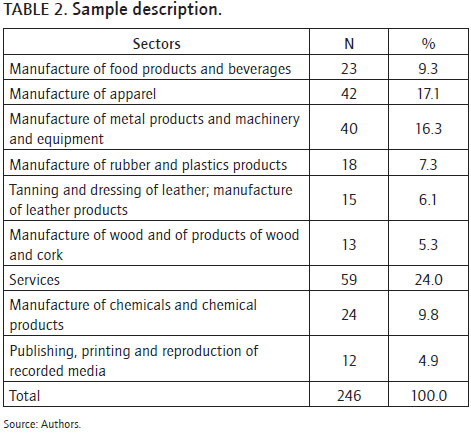
<body><![CDATA[<center>     <font size="3">    <b>Results</b></font>   </center> </p>     <p> <font size="3"><b>Description of the sample</b></font></p>     <p>  The sample reflected a geographical distribution similar to   the universe pool: 58% of SMEs were located in Bogota,   and the remaining 42% were located in the next four largest   cities (Medellin 16%, Cali 13%, Barranquilla 7%, and   Bucaramanga 6%). The average year the SMEs in the sample   began operation is 1989; thus the average age of firms   is 15 years at the time of the survey. In 2003, the average   number of employees was 60, with a standard deviation   (s.d.) of 166. Average sales were 1.07 million dollars (s.d.   2,90 million dollars) and average assets were 0.62 million   dollars (s.d. 2.61 million dollars)<a href="#5" name="s5">&#91;5&#93;</a>. The sector distribution of firms in the sample is presented in <a href="#t2">Table 2</a>.</p>     <p><a name="t2">&nbsp;</a></p>     <p>    <center><img src="/img/revistas/inno/v21n42/42a10t2.jpg"></center></p>     <p>  Nineteen companies in the sample (7.7%) own one or more   patents. The average expenditure in RD&amp;D as a percentage   of total sales is 5.45%, with a standard deviation of   7.8%. This is not too far away from the 4 to 5% average   reported by Dur&aacute;n et al. (1998) following the 1996 Colombian National Survey of Science and Technology.</p>     <p>&nbsp;</p>     <p><font size="3"><b>Description of the clusters</b></font></p>     <p>  Akaike's information criterion for conglomeration was used   to determine the number of clusters. The two-step cluster   analysis produces a sequence of partitions in one run. Partitions   of up to 15 clusters were considered and the criterion   was applied. The highest ratio of the measures of the   distances was obtained for four clusters. <a href="/img/revistas/inno/v21n42/42a10t3.jpg" target="_blank">Table 3</a> shows the   distinct characteristics of the firms belonging to each of   the four clusters, the distribution of the SMEs in the four   clusters, the average values and variance analysis for each   grouping variable. Clusters are statistically distinct in each of the clustering variables.</p>     ]]></body>
<body><![CDATA[<p>  These clusters were then compared in terms of their innovation   performance, measured by the number of new products   and designs in 2003. Observation of the clusters and   patterns of combination of the three innovation sources   considered shows clearly distinct patterns of innovation.   We labeled these four patterns of innovations (a) determined   by patent ownership, (b) imitation and adaptationbased, (c) RD&amp;D-based, and (d) classical innovation.</p>     <p>  Of 246 firms, 19 firms belong to the first cluster. They own   one or more patents and form a <i>pattern determined by   patent ownership</i>. Their average expenditure in RD&amp;D is   10%, while imitation of foreign models has an average of   0.26 (s.d. 0.65) in a multinomial scale from 0 to 3, where   3 represents the most important source of innovation for   the firm. Firms in this cluster have the lowest innovation   performance: The number of new products or designs in 2003 is 3.47.</p>     <p>  66 firms form the <i>imitation and adaptation-based pattern</i>.   They hold no patents. Their average expenditure in RD&amp;D is 4% (s.d. 6%). The average score in imitation of foreign models was 1.91 (s.d. 0.70). They have the second highest innovation rate, 10.3 new products in 2003 and 3.29 new design or product lines.</p>     <p>  43 firms form the <i>RD&amp;D pattern of innovation</i>. They own   no patents, and their average expenditure in RD&amp;D is 15%   (the highest among the four clusters). Imitation of foreign   models has an average of 0.07 (s.d 0.34), the second lowest   score in the four clusters. They have the highest rate of   new products or designs in 2003 (an average of 24.28 new   products or designs in 2003).</p>     <p>  Of 246 firms, 118 belong to what we call the <i>classical pattern</i><a href="#6" name="s6">&#91;6&#93;</a>   cluster. None of them owns patents. Their average   expenditure in RD&amp;D as a percentage of total sales is 2%   (s. d. 2%). They do not report imitation or adaptation of   foreign models. On the average, they bring 7.23 new products   or designs to the market in 2003.</p>     <p>  Several observations can be made concerning this classification.   First, SMEs with the best innovation performance   do not own patents; they spend a larger share of their income   on RD&amp;D, and display a low score of imitation of   foreign models. This validates a common assumption in   innovation studies that "R&amp;D has the highest correlation   with product innovation, suggesting that the main objective   of R&amp;D is to develop products" (Tang, 2006, p. 72).   The results also confirm a hypothesis put forward by Weiner   (1969), Mansfield et al. (1981), and others that imitation   and adaptation require substantial RD&amp;D efforts. SMEs in   the imitation and adaptation-based cluster spend an average   of 4% on RD&amp;D. Though only 66 firms belong to this   cluster, when imitation and adaptation of both national   and foreign products and designs are observed, we find   that 42.7 % of the firms in the sample of 246 engage in   imitation and adaptation practices.</p>     <p>  As expected, 100% of SMEs in this cluster imitate and   adapt foreign or national products and designs. Paradoxically,   the cluster of patent owners ranks second in percentage   of firms engaging in imitation and adaptation of   foreign or national products and designs (31.6%).</p>     <p>  The positive relationship between imitation/adaptation   and innovation performance is consistent with the competitive   environment where these firms operate. Helpman   (1993, p. 1275) states that "imitation is an economic activity   much the same as innovation" Teubal (1996, p.449)   argued that "successful penetration of research and development   (R&amp;D) in a newly industrialized country (NIC) context is a process involving extensive learning, including   collective learning ('learning by others'); multidisciplinary   learning (both techno-economic and managerial/organizational);   and learning which is cumulative through time.   This is especially so at an early ('infant') phase of diffusion   of this process through the economy".</p>     <p>  Our empirical findings are consistent with one of Helpman's   conclusions (1993, p. 1276) that "in less developed   countries imitation is a major effort that involves the development   of absorptive capacity for advanced technologies   on the one hand and particular efforts to assimilate and   adopt foreign technologies on the other".</p>     <p>  Firms owning patents have the lowest innovation performance.   Even though their expenditures in RD&amp;D are relatively   high, the number of new products they take to the   market is, on average, the lowest. This may be interpreted   either as reflecting qualitative differences in these firms'   new products or as a confirmation of the hypothesis, reviewed   in the section <i>Patent monopoly and competition</i>,   that the monopoly granted by a patent induces less innovative   behavior. This may occur through Arrow's replacement   effect, which states that an incumbent monopolist   has weaker incentives than entrants do to innovate, because   the new product must compete with the firm's old   product (Aghion et al., 2001). This dilemma is dealt with in   the following section.</p>     ]]></body>
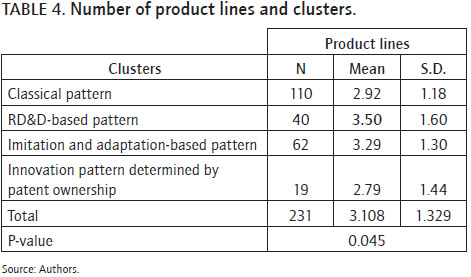
<body><![CDATA[<p>&nbsp;</p>     <p><font size="3"><b>  Refined measures of innovation output</b></font></p>     <p>  Bessen and Maskin (2000), Cohen and Levin (1989), and   Tang (2006) argue that the output of innovation differs by   sector, and a statistically significant relationship between   sector and the number of new products developed is in   fact observed. Accordingly, the z-score method was used to   standardize the measure of innovation output: The mean   of each sector was subtracted from the number of new   products of each firm and the difference obtained was divided   by the standard deviation of each sector. The main   results do not change after this normalization. The RD&amp;Dbased   cluster still has the highest measure of standardized   new products (0.639). The cluster determined by patent   ownership still had the lowest value (-0.223); see <a href="/img/revistas/inno/v21n42/42a10t3.jpg" target="_blank">Table 3</a>.</p>     <p>  A third measure of innovation output is the average number   of product lines that SMEs in each cluster report. A   product line is a group of closely related products or services,   usually sharing the same production techniques. Significant   differences among the four clusters and comparable   results were found in terms of this output indicator (p=0.045), with the RD&amp;D-based pattern showing the highest   average of product lines. The ranking of the four groups was the same, and patent owners showed the lowest innovation   performance (see <a href="#t4">Table 4</a>).</p>     <p><a name="t4">&nbsp;</a></p>     <p>    <center><img src="/img/revistas/inno/v21n42/42a10t4.jpg"></center></p>     <p>&nbsp;</p>     <p>       <center>     <font size="3"><b>    Other differences among clusters     </b></font>   </center> </p>     ]]></body>
<body><![CDATA[<p>  In the following sections, we test the differentiating power   of the clustering of SMEs in terms of their innovation, imitation   and RD&amp;D investment. For that, we compare the   four clusters obtained in terms of a few innovation related   characteristics.</p>     <p>&nbsp;</p>     <p><font size="3"><b>  Internal and external innovation sources</b></font></p>     <p> <i>Technical assistance and consulting</i> are particularly appropriate   for small firms, as reported by Macpherson (1991)   for North America and Rothwell (1991) and Freel (2005)   for Europe. Since these firms have inevitable internal constraints   in resources for innovative activities, external   sources of technology and knowledge such as innovation   networks, innovation-related cooperation, and consulting   activities are useful. As Freel (2000, p. 263) put it, "The   evidence suggests that the most innovative firms are involved   in extensive and diverse links with a variety of external   sources of knowledge and expertise".</p>     <p>  Foreign technical assistance appears to be particularly important   for Colombian SMEs in the RD&amp;D-based pattern of   innovation; 39.4% ranked foreign technical assistance and   consulting activities among their three most important   sources of innovation. Firms in this cluster also show the   highest percentage in mentioning consulting as a source   of innovation (72.7%). Note that this is the cluster with the   highest performance in terms of new products. One possible   explanation is Freel's analysis (2005) of participation in   innovation networks. When small firms have the opportunity   to combine their internal sources with external sources,   their innovative performance improves. In contrast,   the cluster with the smallest percentage both in foreign   technical assistance and consulting is the imitation and   adaptation-based pattern with 15.15% and 25.76%, respectively.</p>     <p>  In their research on SMEs in Tanzania, Mahemba and De   Bruijn (2003) also found that the most innovating companies   were likely to seek external technical support. Perhaps,   as Nelson (1968) observed for large industries in   Colombia in the 1960s, the most innovative groups among   SMEs in developing countries also share a few similarities   with those in industrialized countries.</p>     <p>&nbsp;</p>     <p><font size="3"><b>  Internal sources of ideas for innovation</b></font></p>     <p>  Regarding the internal sources of innovation, although for   most of the SMEs in the sample the manager's education   is a very important source, the called classical pattern has   the highest percentage (88.5%), followed by the RD&amp;D-based   pattern (84.8%). Ideas of middle management and   workers appears to be particularly important for the innovation   pattern determined by patent ownership (50%), followed   by the RD&amp;D-based pattern.</p>     <p>&nbsp;</p>     ]]></body>
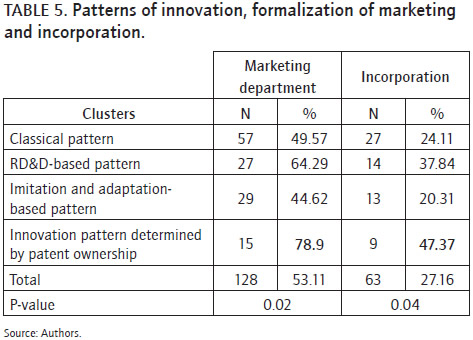
<body><![CDATA[<p><font size="3"><b>  Patterns of innovation and ownership structure</b></font></p>     <p>  A significant difference is observed among the four clusters   in terms of the incorporation of firms (p=0.04)<a href="#7" name="s7">&#91;7&#93;</a>. Patent   owners have the highest percentage of incorporation   (47.37%) while firms in the imitation and adaptationbased   pattern have the lowest (20.31%).</p>     <p>  It is interesting to note that patent owners' efforts are   aimed at marginal improvements of their patented products,   and investing in the formalization of marketing activities is more frequent (see <a href="#t5">Table 5</a>). It is possible to   raise the hypothesis that patent ownership is an attractive   characteristic and a signal for potential investors. Since   patent-owning firms show lower performance in terms of   different measures of new products and since these firms   are often incorporated, one could question the economic   value of this signal, except for the market monopoly it entails.</p>     <p><a name="t5">&nbsp;</a></p>     <p>    <center><img src="/img/revistas/inno/v21n42/42a10t5.jpg"></center></p>     <p>  Analyzing innovation in British firms, Geroski (1994) obtained   a result comparable to ours: "&#91;...&#93; small firms or   fringe players have an incentive to use them &#91;major innovations&#93;   to improve their market position, while large incumbent   firms who enjoy rents on their existing activities have   an incentive to resist their advance &#91;...&#93; Although large, monopolistic   firms may have superior resources to generate   new innovations and may be in a better position to exploit   them than other firms, innovative activity is often rent-displacing   and this dulls the incentives of such firms to innovate"   (p. 149).</p>     <p>&nbsp;</p>     <p><font size="3"><b>  Common characteristics of clusters</b></font></p>     <p>  Nonsignificant differences among the four clusters are   found in terms of the following variables: Age of the firm   (p= 0.46); size, measured in terms of number of employees,   sales and assets (p= 0.40, 0.20 and 0.40, respectively);   capital and non-capital cities (p= 0.48), and large and medium-   sized cities (p= 0.56); efficiency ratios such as sales   per employee (p= 0.24), and assets per employee (p= 0.90).</p>     ]]></body>
<body><![CDATA[<p>  Firms in the sample are 15 years old on average, and all   clusters had averages close to this value. Though there is   considerable controversy in the literature about a positive   or negative relationship between size and innovation (Acs   and Audretsch, 2005; Damanpour, 1996; Vossen, 1998),   the results obtained here do not support either hypothesis.   Nor do the assets of a firm appear to be predetermining   its innovation pattern. These results, which coincide with   those of Hadjimanolis (2000) and Kannebley et al. (2005),   support the hypothesis that size is not a barrier for innovation   in small firms.</p>     <p>  Service firms are present in similar proportions in the different   clusters. The differences were not significant (p=   0.77). Neither service nor manufacture predominates in   any cluster. This coincides with the results of Kannebley et   al. (2005) and de Jong and Marsili (2006). The differences   among clusters in terms of the percentage of exports over   total sales for the firms in each cluster (p= 0.48) and the   percentage of firms in each cluster that were regular exporters   (those exporting continuously for 3 or more years)   were also explored (p= 0.54). Neither of these two measures   of internationalization showed significant differences   among clusters.</p>     <p>&nbsp;</p>     <p>       <center>     <font size="3"><b>    Conclusions     </b></font>   </center> </p>     <p>  Our empirical exploration of the relationship between the   intellectual property assets and the innovation behavior of   SMEs in a developing country yields one central result: The   cluster of SMEs owning patents has a significantly lower   rate of new products brought to the market per year than   firms in the other clusters.</p>     <p>  This implies that patent owning firms are less innovative   in terms of new products, when compared to other SMEs.   Their innovation efforts (as measured by RD&amp;D) are also   relatively low. This would support the hypothesis that,   through the so-called "replacement effect" or other reasons   mentioned earlier, patents exempt their owners from   the necessity of pursuing a continuous process of innovation.   As the average age of these firms is not significantly   different from the average age of firms in other clusters,   one could also infer that an innovative behavior is not required   from them to survive over time. The protection of   patents seems to be sufficient to guarantee their survival   and appears to be related to less innovative behavior.</p>     <p>Patent owning firms operate in a market environment   which is completely different from that of the other clusters   identified in the analysis. Patent owners rely on the   monopoly granted to them by the patent system while the   three other clusters of SMEs identified in the analysis operate   in an environment of competition. In the monopolistic   environment of patent owners, innovation efforts are   geared toward marginal improvements of their patented   products, and investing in the formalization of marketing   activities is more frequent (see <a href="#t5">Table 5</a>). The significantly   higher proportion of incorporated firms in this cluster suggests   that patent ownership operates as an efficient signal   to investors in the imperfect capital market of this developing   country. This signal, together with a well organized,   formal management of marketing, seems to provide them with a relatively easier access to capital resources.</p>     <p>  In contrast, firms in the RD&amp;D-based cluster do not own   patents; they operate in markets where patents do not prevent   direct competition and where the life cycle of new   products is short or where product differentiation is high;   these firms depend on an intense innovation activity and   spend the highest share of their sales in research, development   and design (RD&amp;D); they are the most innovative in   terms of new products, but do not patent or register their   new products or designs. They have an intermediate propensity   to imitate the innovations of other firms, and they   rely on technical assistance and external consulting more often than firms in other clusters.</p>     <p>  The third cluster found in the analysis relies primarily on   imitation and adaptation, especially of foreign models, to   innovate and survive in their markets. Their expenditures   in RD&amp;D are an important part of their total sales. This is   consistent with the hypothesis, proven by different studies   for industrialized countries, that engaging in imitation   and adaptation demands an important fraction of what   these firms would spend if they developed these products on their own.</p>     ]]></body>
<body><![CDATA[<p>  In the competitive environment where the RD&amp;D and imitation-based firms operate, either important investments   in RD&amp;D, high rates of innovation and imitation, or a formalization   of design activities are required. Competitors   are closely watched, and their products sometimes inspire each other's designs.</p>     <p>  The fourth and largest cluster (more than half of the surveyed   firms) is made of SMEs that follow what we have   called the 'classical pattern of innovation'. Since their inception,   they have survived depending on the ideas and   education of the entrepreneur; they do not own patents or carry any formal process of research and development;   they spend the lowest proportion of sales in RD&amp;D, and do not report imitating national or foreign models.</p>     <p>  This empirical result, obtained for a sample of SMEs in a   specific developing country, is in line with the monopoly   interpretation rather than with the incentive interpretation   of the effects of the protection of intellectual property.   The most innovative firms operate in a competitive   environment, where markets are not protected. Firms enjoying   the protection of patents have survived, apparently   without as much pressure to introduce new products continuously   into the market. One can conclude that, in the   specific context of this study, where frontier technologies   are not at issue, the ownership of intellectual property is   not an incentive to innovation. Instead, firms owning patents   exhibit a less intensive innovative activity. The effects   of IP protection may allow the long-term survival of firms   with relatively lower RD&amp;D efforts and which put less new products or designs into the market.</p>     <p>  An interesting aspect of the analysis is that differences in   sector or regional composition of the four clusters are not   significant. The size of the firm, its age or the percentage   of its sales that is being exported are not significantly different   among clusters.</p>     <p>  What are the policy implications of these results? First, intellectual   property protection should not be viewed as a   panacea for improving the innovation performance of small   and medium enterprises of all kinds. Rather than adopting   international across-the-board intellectual property   standards, developing-country governments interested in   promoting innovation should design specific intellectual   property policies that weigh the two-sided impact of patenting   on innovation. For that, special efforts should be   made by the authorities of these countries to raise more   detailed statistics allowing to understand the various innovation   processes taking place in SMEs. Also, since no single   innovation policy would be optimal for all kinds on SMEs   identified in this study, alternative schemes for the promotion   of innovation should coexist to attract the attention   of different kinds of SMEs to innovative activities.</p>     <p>&nbsp;</p>     <p>       <center>     <font size="3"><b>    Acknowledgements     </b></font>   </center> </p>     <p>  The authors thank Paul A. David and Martin Bell for valuable   guidance and comments. Luz Marina Ferro, Vicente   Pinilla and Jos&eacute; Miguel Ospina, members of the research   team on Export Potential of Developing-Country SMEs,   shared the SMEsurvey. Rafael Bautista and attendants   at the UASM Faculty Seminar on Innovation and Intellectual   Property made valuable comments. The authors acknowledge the financial support of Universidad de los   Andes School of Management.</p>     <p>&nbsp;</p>     ]]></body>
<body><![CDATA[<p>       <center>     <font size="3"><b>    Pie de p&aacute;gina     </b></font>   </center> </p>     <p><a href="#s1" name="1">&#91;1&#93;</a> See Schumpeter (1942) and Schumpeter (1912).</p>     <p> <a href="#s2" name="2">&#91;2&#93;</a> This effect, later called "replacement effect" by Tirole (1988, p.   392), is related to Arrow's definition of a monopoly which does not   include the case of innovations competing with old products of the same firm (1962, p. 619).}</p>     <p><a href="#s3" name="3">&#91;3&#93;</a> Manufacture of metal products and manufacture of machinery were integrated in one sector.</p>     <p><a href="#s4" name="4">&#91;4&#93;</a> To determine the number of clusters automatically, two-step cluster   analysis works with the hierarchical clustering method. The first   step calculates Bayesian (Schwartz) information criteria-BIC-for   each number of clusters within a specified range and uses it to   find the initial estimate for the number of clusters. The second   step refines the initial estimate by finding the greatest change   in distance between the two closest clusters in each hierarchical clustering stage.</p>     <p> <a href="#s5" name="5">&#91;5&#93;</a> The exchange rate was 2 807.97 COP/USD, the average reported   by the Colombian Central Bank for 2003.</p>     <p><a href="#s6" name="6">&#91;6&#93;</a> This model was called classical because the main source of   innovation reported is the education and ideas of the entrepreneur   or manager, as in the classical Schumpeterian theory. The quantitative result is presented in the following section.</p>     <p><a href="#s7" name="7">&#91;7&#93;</a> In Colombian law, societies with limited responsibility and equity   shares are regulated by the authority and are called "anonymous   societies". The law for these societies is similar to the law of incorporation in the Anglo-Saxon legislation.</p>     <p>&nbsp;</p>     ]]></body>
<body><![CDATA[<p>       <center>     <font size="3"><b>    References     </b></font>   </center> </p>     <!-- ref --><p>  Aboites, J. &amp; Cimoli, M. (2001). <i>Intellectual property rights and national   innovation systems. Some lessons from the mexican experience</i>.   Conference paper, Druid - Danish Research Unit for Industrial   Dynamics Conference, Denmark, June. <a href="http://www.business.auc.dk/druid/conferences/nw/conf-papers.html" target="_blank">http://www.business.auc.dk/druid/conferences/nw/conf-papers.html</a>&nbsp;&nbsp;&nbsp;&nbsp;&nbsp;&nbsp;&nbsp;&nbsp;[&#160;<a href="javascript:void(0);" onclick="javascript: window.open('/scielo.php?script=sci_nlinks&ref=000215&pid=S0121-5051201100040001000001&lng=','','width=640,height=500,resizable=yes,scrollbars=1,menubar=yes,');">Links</a>&#160;]<!-- end-ref --><!-- ref --><p>  Acs, Z. J. &amp; Audretsch, D. B. (2005). Innovation and technological   change. In Acs, Z. J. &amp; Audretsch, D. B. (eds.), <i>Handbook of entrepreneurship   research: An interdisciplinary survey and introduction</i> (pp. 55-80). New York: Springer.&nbsp;&nbsp;&nbsp;&nbsp;&nbsp;&nbsp;&nbsp;&nbsp;[&#160;<a href="javascript:void(0);" onclick="javascript: window.open('/scielo.php?script=sci_nlinks&ref=000216&pid=S0121-5051201100040001000002&lng=','','width=640,height=500,resizable=yes,scrollbars=1,menubar=yes,');">Links</a>&#160;]<!-- end-ref --><!-- ref --><p>  Adeboye, T. (1997). Models of innovation and sub-Saharan Africa's   development tragedy. <i>Technology Analysis &amp; Strategic Management</i>, <i>9</i>(2), 213-235.&nbsp;&nbsp;&nbsp;&nbsp;&nbsp;&nbsp;&nbsp;&nbsp;[&#160;<a href="javascript:void(0);" onclick="javascript: window.open('/scielo.php?script=sci_nlinks&ref=000217&pid=S0121-5051201100040001000003&lng=','','width=640,height=500,resizable=yes,scrollbars=1,menubar=yes,');">Links</a>&#160;]<!-- end-ref --><!-- ref --><p>  Aghion, P., Harris, C. &amp; Vickers, J. (1997). Competition and growth with   step-by-step innovation: An example. <i>European Economic Review</i>, <i>41</i>, 771-782.&nbsp;&nbsp;&nbsp;&nbsp;&nbsp;&nbsp;&nbsp;&nbsp;[&#160;<a href="javascript:void(0);" onclick="javascript: window.open('/scielo.php?script=sci_nlinks&ref=000218&pid=S0121-5051201100040001000004&lng=','','width=640,height=500,resizable=yes,scrollbars=1,menubar=yes,');">Links</a>&#160;]<!-- end-ref --><!-- ref --><p>  Aghion, P., Harris, C., Howitt, P. &amp; Vickers, J. (2001). Competition, imitation   and growth with step-by-step innovation. <i>Review of Economic Studies</i>, <i>68</i>(3), 467-492.&nbsp;&nbsp;&nbsp;&nbsp;&nbsp;&nbsp;&nbsp;&nbsp;[&#160;<a href="javascript:void(0);" onclick="javascript: window.open('/scielo.php?script=sci_nlinks&ref=000219&pid=S0121-5051201100040001000005&lng=','','width=640,height=500,resizable=yes,scrollbars=1,menubar=yes,');">Links</a>&#160;]<!-- end-ref --><!-- ref --><p>  Aghion, P., Burgess, R., Redding, S. &amp; Zilibotti, F. (2005). Entry liberalization   and inequality in industrial performance. <i>Journal of the European Economic Association</i>, <i>3</i>(2-3), 291-302.&nbsp;&nbsp;&nbsp;&nbsp;&nbsp;&nbsp;&nbsp;&nbsp;[&#160;<a href="javascript:void(0);" onclick="javascript: window.open('/scielo.php?script=sci_nlinks&ref=000220&pid=S0121-5051201100040001000006&lng=','','width=640,height=500,resizable=yes,scrollbars=1,menubar=yes,');">Links</a>&#160;]<!-- end-ref --><!-- ref --><p>  Aghion, P. &amp; Griffith, R. (2005). <i>Competition and growth: Reconciling theory and evidence</i>. Cambridge, MA: MIT Press.&nbsp;&nbsp;&nbsp;&nbsp;&nbsp;&nbsp;&nbsp;&nbsp;[&#160;<a href="javascript:void(0);" onclick="javascript: window.open('/scielo.php?script=sci_nlinks&ref=000221&pid=S0121-5051201100040001000007&lng=','','width=640,height=500,resizable=yes,scrollbars=1,menubar=yes,');">Links</a>&#160;]<!-- end-ref --><!-- ref --><p>  Alcorta, L. &amp; Peres, W. (1998). Innovation systems and technological   specialization in Latin America and the Caribbean. <i>Research Policy</i>, <i>26</i>, 857-881.&nbsp;&nbsp;&nbsp;&nbsp;&nbsp;&nbsp;&nbsp;&nbsp;[&#160;<a href="javascript:void(0);" onclick="javascript: window.open('/scielo.php?script=sci_nlinks&ref=000222&pid=S0121-5051201100040001000008&lng=','','width=640,height=500,resizable=yes,scrollbars=1,menubar=yes,');">Links</a>&#160;]<!-- end-ref --><!-- ref --><p>  Arrow, K. J. (1962). Economic welfare and the allocation of resources for   inventions. In Nelson, R., (ed.), <i>The rate and direction of inventive activity</i> (pp. 609-625). New Jersey: Princeton University Press.&nbsp;&nbsp;&nbsp;&nbsp;&nbsp;&nbsp;&nbsp;&nbsp;[&#160;<a href="javascript:void(0);" onclick="javascript: window.open('/scielo.php?script=sci_nlinks&ref=000223&pid=S0121-5051201100040001000009&lng=','','width=640,height=500,resizable=yes,scrollbars=1,menubar=yes,');">Links</a>&#160;]<!-- end-ref --><!-- ref --><p>  Ayyagari, M., Thorsten, B. &amp; Demirg&uuml;&ccedil;-Kunt, A. (2003). <i>Small and medium   enterprises across the globe: A new database</i>. World Bank Policy Research Working Paper 3127, 27-28.&nbsp;&nbsp;&nbsp;&nbsp;&nbsp;&nbsp;&nbsp;&nbsp;[&#160;<a href="javascript:void(0);" onclick="javascript: window.open('/scielo.php?script=sci_nlinks&ref=000224&pid=S0121-5051201100040001000010&lng=','','width=640,height=500,resizable=yes,scrollbars=1,menubar=yes,');">Links</a>&#160;]<!-- end-ref --><!-- ref --><p>  Bessen, J. &amp; Maskin, E. (2000).<i> Sequential innovation, patents, and imitation</i>. Massachusetts Institute of Technology, Working Paper Department of Economics 00-01, 1-35.&nbsp;&nbsp;&nbsp;&nbsp;&nbsp;&nbsp;&nbsp;&nbsp;[&#160;<a href="javascript:void(0);" onclick="javascript: window.open('/scielo.php?script=sci_nlinks&ref=000225&pid=S0121-5051201100040001000011&lng=','','width=640,height=500,resizable=yes,scrollbars=1,menubar=yes,');">Links</a>&#160;]<!-- end-ref --><!-- ref --><p>  Chen, Y. &amp; Puttitanun, T. (2005). Intellectual property rights and innovation   in developing countries. <i>Journal of Development Economics</i>, <i>78</i>, 474-493.&nbsp;&nbsp;&nbsp;&nbsp;&nbsp;&nbsp;&nbsp;&nbsp;[&#160;<a href="javascript:void(0);" onclick="javascript: window.open('/scielo.php?script=sci_nlinks&ref=000226&pid=S0121-5051201100040001000012&lng=','','width=640,height=500,resizable=yes,scrollbars=1,menubar=yes,');">Links</a>&#160;]<!-- end-ref --><!-- ref --><p>  Chudnovsky, D., L&oacute;pez, A. &amp; Pupato, G. (2006). Innovation and productivity   in developing countries: A study of Argentine manufacturing firms' behavior (1992-2001). <i>Research Policy</i>, <i>35</i>, 266-288.&nbsp;&nbsp;&nbsp;&nbsp;&nbsp;&nbsp;&nbsp;&nbsp;[&#160;<a href="javascript:void(0);" onclick="javascript: window.open('/scielo.php?script=sci_nlinks&ref=000227&pid=S0121-5051201100040001000013&lng=','','width=640,height=500,resizable=yes,scrollbars=1,menubar=yes,');">Links</a>&#160;]<!-- end-ref --><!-- ref --><p>  Cohen, W. &amp; Levin, R. (1989). Empirical studies of innovation and market   structure. In Schmalensee, R. W. (ed.), <i>Handbook of industrial   organization</i>, 2 (pp. 1060-1107). North-Holland: Elsevier Science Publications.&nbsp;&nbsp;&nbsp;&nbsp;&nbsp;&nbsp;&nbsp;&nbsp;[&#160;<a href="javascript:void(0);" onclick="javascript: window.open('/scielo.php?script=sci_nlinks&ref=000228&pid=S0121-5051201100040001000014&lng=','','width=640,height=500,resizable=yes,scrollbars=1,menubar=yes,');">Links</a>&#160;]<!-- end-ref --><!-- ref --><p>  Correa, C. (2007). <i>Intellectual property in LDCs: Strategies for enhancing   technology transfer and dissemination</i>. University of Buenos Aires (Background Paper No. 4), 40 pages.&nbsp;&nbsp;&nbsp;&nbsp;&nbsp;&nbsp;&nbsp;&nbsp;[&#160;<a href="javascript:void(0);" onclick="javascript: window.open('/scielo.php?script=sci_nlinks&ref=000229&pid=S0121-5051201100040001000015&lng=','','width=640,height=500,resizable=yes,scrollbars=1,menubar=yes,');">Links</a>&#160;]<!-- end-ref --><!-- ref --><p>  Damanpour, F. (1996). Organizational complexity and innovation: Developing   and testing multiple contingency models. <i>Management Science</i>, <i>42</i>(5), 693-716.&nbsp;&nbsp;&nbsp;&nbsp;&nbsp;&nbsp;&nbsp;&nbsp;[&#160;<a href="javascript:void(0);" onclick="javascript: window.open('/scielo.php?script=sci_nlinks&ref=000230&pid=S0121-5051201100040001000016&lng=','','width=640,height=500,resizable=yes,scrollbars=1,menubar=yes,');">Links</a>&#160;]<!-- end-ref --><!-- ref --><p>  De Jong, J.P.J. &amp; Marsili, O. (2006). The fruit flies of innovations: A taxonomy of innovative small firms. <i>Research Policy</i>, <i>35</i>, 213-229.&nbsp;&nbsp;&nbsp;&nbsp;&nbsp;&nbsp;&nbsp;&nbsp;[&#160;<a href="javascript:void(0);" onclick="javascript: window.open('/scielo.php?script=sci_nlinks&ref=000231&pid=S0121-5051201100040001000017&lng=','','width=640,height=500,resizable=yes,scrollbars=1,menubar=yes,');">Links</a>&#160;]<!-- end-ref --><!-- ref --><p>  Departamento Administrativo Nacional de Estad&iacute;stica, DANE. (2002).   <i>Encuesta Anual Manufacturera (Manufacturing Annual Survey)</i>. Retrieved from <a href="http://www.dane.gov.co" target="_blank">http://www.dane.gov.co</a>.&nbsp;&nbsp;&nbsp;&nbsp;&nbsp;&nbsp;&nbsp;&nbsp;[&#160;<a href="javascript:void(0);" onclick="javascript: window.open('/scielo.php?script=sci_nlinks&ref=000232&pid=S0121-5051201100040001000018&lng=','','width=640,height=500,resizable=yes,scrollbars=1,menubar=yes,');">Links</a>&#160;]<!-- end-ref --><!-- ref --><p>  Departamento Nacional de Planeaci&oacute;n, DNP. (2003).<i> Indicadores Industria,   Microempresas y Empresariales (Industry, Micro-businesses   and Business Indicators)</i>. Retrieved from <a href="http://www.dnp.gov.co" target="_blank">http://www.dnp.gov.co</a>.&nbsp;&nbsp;&nbsp;&nbsp;&nbsp;&nbsp;&nbsp;&nbsp;[&#160;<a href="javascript:void(0);" onclick="javascript: window.open('/scielo.php?script=sci_nlinks&ref=000233&pid=S0121-5051201100040001000019&lng=','','width=640,height=500,resizable=yes,scrollbars=1,menubar=yes,');">Links</a>&#160;]<!-- end-ref --><!-- ref --><p>  Dur&aacute;n, X., Ib&aacute;&ntilde;ez, R., Salazar, M. &amp; Vargas, M. (1998). <i>La innovaci&oacute;n tecnol&oacute;gica   en Colombia: caracter&iacute;sticas por tama&ntilde;o y tipo de empresa</i>. Bogot&aacute;: Departamento Nacional de Planeaci&oacute;n.&nbsp;&nbsp;&nbsp;&nbsp;&nbsp;&nbsp;&nbsp;&nbsp;[&#160;<a href="javascript:void(0);" onclick="javascript: window.open('/scielo.php?script=sci_nlinks&ref=000234&pid=S0121-5051201100040001000020&lng=','','width=640,height=500,resizable=yes,scrollbars=1,menubar=yes,');">Links</a>&#160;]<!-- end-ref --><!-- ref --><p>  Dur&aacute;n, X., Ib&aacute;&ntilde;ez, R., Salazar, M. &amp; Vargas, M. (2000). <i>La innovaci&oacute;n   tecnol&oacute;gica en Colombia: caracter&iacute;sticas por sector industrial y   regi&oacute;n geogr&aacute;fica</i>. Bogot&aacute;: Observatorio Colombiano de Ciencia y Tecnolog&iacute;a.&nbsp;&nbsp;&nbsp;&nbsp;&nbsp;&nbsp;&nbsp;&nbsp;[&#160;<a href="javascript:void(0);" onclick="javascript: window.open('/scielo.php?script=sci_nlinks&ref=000235&pid=S0121-5051201100040001000021&lng=','','width=640,height=500,resizable=yes,scrollbars=1,menubar=yes,');">Links</a>&#160;]<!-- end-ref --><!-- ref --><p>  Dutta, A. &amp;  Sharma, S. (2008). <i>Intellectual property rights and innovation   in developing countries: Evidence from India</i>. Washington, D.C.: Georgetown University.&nbsp;&nbsp;&nbsp;&nbsp;&nbsp;&nbsp;&nbsp;&nbsp;[&#160;<a href="javascript:void(0);" onclick="javascript: window.open('/scielo.php?script=sci_nlinks&ref=000236&pid=S0121-5051201100040001000022&lng=','','width=640,height=500,resizable=yes,scrollbars=1,menubar=yes,');">Links</a>&#160;]<!-- end-ref --><!-- ref --><p>  Foray, D. (2007). <i>Knowledge, intellectual property and development in   LDCs: Toward innovative policy initiatives</i>. Ecole Polytechnique F&eacute;d&eacute;rale de Lausanne (Background Paper No. 2), 68 pages.&nbsp;&nbsp;&nbsp;&nbsp;&nbsp;&nbsp;&nbsp;&nbsp;[&#160;<a href="javascript:void(0);" onclick="javascript: window.open('/scielo.php?script=sci_nlinks&ref=000237&pid=S0121-5051201100040001000023&lng=','','width=640,height=500,resizable=yes,scrollbars=1,menubar=yes,');">Links</a>&#160;]<!-- end-ref --><!-- ref --><p>  Freel, M. S. (2000). External linkages and product innovation in small   manufacturing firms. <i>Entrepreneurship &amp; Regional Development</i>, <i>12</i>, 245-266.&nbsp;&nbsp;&nbsp;&nbsp;&nbsp;&nbsp;&nbsp;&nbsp;[&#160;<a href="javascript:void(0);" onclick="javascript: window.open('/scielo.php?script=sci_nlinks&ref=000238&pid=S0121-5051201100040001000024&lng=','','width=640,height=500,resizable=yes,scrollbars=1,menubar=yes,');">Links</a>&#160;]<!-- end-ref --><!-- ref --><p>  Freel, M. S. (2005). Patterns of innovation and skills in small firms. <i>Technovation</i>, <i>25</i>, 123-134.&nbsp;&nbsp;&nbsp;&nbsp;&nbsp;&nbsp;&nbsp;&nbsp;[&#160;<a href="javascript:void(0);" onclick="javascript: window.open('/scielo.php?script=sci_nlinks&ref=000239&pid=S0121-5051201100040001000025&lng=','','width=640,height=500,resizable=yes,scrollbars=1,menubar=yes,');">Links</a>&#160;]<!-- end-ref --><!-- ref --><p>  Geroski, P. A. (1994). <i>Market structure, corporate performance and innovative activity</i>. New York: Oxford University Press.&nbsp;&nbsp;&nbsp;&nbsp;&nbsp;&nbsp;&nbsp;&nbsp;[&#160;<a href="javascript:void(0);" onclick="javascript: window.open('/scielo.php?script=sci_nlinks&ref=000240&pid=S0121-5051201100040001000026&lng=','','width=640,height=500,resizable=yes,scrollbars=1,menubar=yes,');">Links</a>&#160;]<!-- end-ref --><!-- ref --><p>  Hadjimanolis, A. (2000). An investigation of innovation antecedents   in small firms in the context of a small developing country. <i>R &amp; D Management</i>, <i>30</i>(3), 235-245.&nbsp;&nbsp;&nbsp;&nbsp;&nbsp;&nbsp;&nbsp;&nbsp;[&#160;<a href="javascript:void(0);" onclick="javascript: window.open('/scielo.php?script=sci_nlinks&ref=000241&pid=S0121-5051201100040001000027&lng=','','width=640,height=500,resizable=yes,scrollbars=1,menubar=yes,');">Links</a>&#160;]<!-- end-ref --><!-- ref --><p>  Heller, M. &amp; Eisenberg, R. (1998). Can patents deter innovation? <i>Science</i>, <i>280</i>(5364), 698-701.&nbsp;&nbsp;&nbsp;&nbsp;&nbsp;&nbsp;&nbsp;&nbsp;[&#160;<a href="javascript:void(0);" onclick="javascript: window.open('/scielo.php?script=sci_nlinks&ref=000242&pid=S0121-5051201100040001000028&lng=','','width=640,height=500,resizable=yes,scrollbars=1,menubar=yes,');">Links</a>&#160;]<!-- end-ref --><!-- ref --><p>  Helpman, E. (1993). Innovation, imitation and intellectual property rights. <i>Econometrica</i>, <i>61</i>(6), 1247-1280.&nbsp;&nbsp;&nbsp;&nbsp;&nbsp;&nbsp;&nbsp;&nbsp;[&#160;<a href="javascript:void(0);" onclick="javascript: window.open('/scielo.php?script=sci_nlinks&ref=000243&pid=S0121-5051201100040001000029&lng=','','width=640,height=500,resizable=yes,scrollbars=1,menubar=yes,');">Links</a>&#160;]<!-- end-ref --><!-- ref --><p>  Juma, C. &amp; Clark, N. (2002). <i>Technological catch-up: Opportunities and   challenges for developing countries</i>. Scottish Universities Policy   Research and Advice Network, SUPRA Working Series Papers 28, 1-24.&nbsp;&nbsp;&nbsp;&nbsp;&nbsp;&nbsp;&nbsp;&nbsp;[&#160;<a href="javascript:void(0);" onclick="javascript: window.open('/scielo.php?script=sci_nlinks&ref=000244&pid=S0121-5051201100040001000030&lng=','','width=640,height=500,resizable=yes,scrollbars=1,menubar=yes,');">Links</a>&#160;]<!-- end-ref --><!-- ref --><p>  Kannebley Jr, S., Silveira Porto, G. &amp; Toldo Pazello, E. (2005). Characteristics   of Brazilian innovative firms: An empirical analysis based   on PINTEC-industrial research on technological innovation. <i>Research Policy</i>, <i>34</i>, 872-893.&nbsp;&nbsp;&nbsp;&nbsp;&nbsp;&nbsp;&nbsp;&nbsp;[&#160;<a href="javascript:void(0);" onclick="javascript: window.open('/scielo.php?script=sci_nlinks&ref=000245&pid=S0121-5051201100040001000031&lng=','','width=640,height=500,resizable=yes,scrollbars=1,menubar=yes,');">Links</a>&#160;]<!-- end-ref --><!-- ref --><p>  Kraft, K. (1989). Market structure, firm characteristics and innovative activity. <i>Journal of Industrial Economics</i>, <i>37</i>(3), 329-336.&nbsp;&nbsp;&nbsp;&nbsp;&nbsp;&nbsp;&nbsp;&nbsp;[&#160;<a href="javascript:void(0);" onclick="javascript: window.open('/scielo.php?script=sci_nlinks&ref=000246&pid=S0121-5051201100040001000032&lng=','','width=640,height=500,resizable=yes,scrollbars=1,menubar=yes,');">Links</a>&#160;]<!-- end-ref --><!-- ref --><p>  Krugman, P. (1979). A model of innovation, technology transfer, and the   world distribution of income. <i>Journal of Political Economy</i>, <i>87</i>(2), 253-266.&nbsp;&nbsp;&nbsp;&nbsp;&nbsp;&nbsp;&nbsp;&nbsp;[&#160;<a href="javascript:void(0);" onclick="javascript: window.open('/scielo.php?script=sci_nlinks&ref=000247&pid=S0121-5051201100040001000033&lng=','','width=640,height=500,resizable=yes,scrollbars=1,menubar=yes,');">Links</a>&#160;]<!-- end-ref --><!-- ref --><p>  Landry, R. &amp; Amara, N. (2002). <i>Effects of sources of information on   novelty of innovation in Canadian manufacturing firms: Evidence   from the 1999 Statistics Canada Innovation Survey</i>. Study prepared for Industry Canada, Innovation Policy Branch, Qu&eacute;bec.&nbsp;&nbsp;&nbsp;&nbsp;&nbsp;&nbsp;&nbsp;&nbsp;[&#160;<a href="javascript:void(0);" onclick="javascript: window.open('/scielo.php?script=sci_nlinks&ref=000248&pid=S0121-5051201100040001000034&lng=','','width=640,height=500,resizable=yes,scrollbars=1,menubar=yes,');">Links</a>&#160;]<!-- end-ref --><!-- ref --><p>  Levin, R. C., Klevorick, A. K., Nelson, R., Winter, S. G., Gilbert, R. &amp;   Griliches, Z. (1987). Appropriating the returns from industrial research   and development. <i>Brooking Papers on Economic Activity</i>, <i>3</i>, 783-831.&nbsp;&nbsp;&nbsp;&nbsp;&nbsp;&nbsp;&nbsp;&nbsp;[&#160;<a href="javascript:void(0);" onclick="javascript: window.open('/scielo.php?script=sci_nlinks&ref=000249&pid=S0121-5051201100040001000035&lng=','','width=640,height=500,resizable=yes,scrollbars=1,menubar=yes,');">Links</a>&#160;]<!-- end-ref --><!-- ref --><p>  Lin, C., Lin, P. &amp; Song, F. (2010). Property rights protection and corporate   R&amp;D: Evidence from China. <i>Journal of Development Economics</i>, <i>93</i>, 49-62.&nbsp;&nbsp;&nbsp;&nbsp;&nbsp;&nbsp;&nbsp;&nbsp;[&#160;<a href="javascript:void(0);" onclick="javascript: window.open('/scielo.php?script=sci_nlinks&ref=000250&pid=S0121-5051201100040001000036&lng=','','width=640,height=500,resizable=yes,scrollbars=1,menubar=yes,');">Links</a>&#160;]<!-- end-ref --><!-- ref --><p>  Macpherson, A. D. (1991). New product development among small industrial   firms: A comparative assessment of the role of technical   service linkages in Toronto and Buffalo. <i>Economic Geography</i>,   <i>67</i>(2), 136-146.&nbsp;&nbsp;&nbsp;&nbsp;&nbsp;&nbsp;&nbsp;&nbsp;[&#160;<a href="javascript:void(0);" onclick="javascript: window.open('/scielo.php?script=sci_nlinks&ref=000251&pid=S0121-5051201100040001000037&lng=','','width=640,height=500,resizable=yes,scrollbars=1,menubar=yes,');">Links</a>&#160;]<!-- end-ref --><!-- ref --><p>  Macpherson, A. D. (1997). A comparison of within-firm and external   sources of product innovation. <i>Growth and Change</i>, <i>28</i>, 289-308.&nbsp;&nbsp;&nbsp;&nbsp;&nbsp;&nbsp;&nbsp;&nbsp;[&#160;<a href="javascript:void(0);" onclick="javascript: window.open('/scielo.php?script=sci_nlinks&ref=000252&pid=S0121-5051201100040001000038&lng=','','width=640,height=500,resizable=yes,scrollbars=1,menubar=yes,');">Links</a>&#160;]<!-- end-ref --><!-- ref --><p>Mahemba, C. M. &amp; De Bruijn, E. J. (2003). Innovation activities by small   and medium-sized manufacturing enterprises in Tanzania. <i>Creativity and Innovation Management</i>, <i>12</i>(3), 162-173.&nbsp;&nbsp;&nbsp;&nbsp;&nbsp;&nbsp;&nbsp;&nbsp;[&#160;<a href="javascript:void(0);" onclick="javascript: window.open('/scielo.php?script=sci_nlinks&ref=000253&pid=S0121-5051201100040001000039&lng=','','width=640,height=500,resizable=yes,scrollbars=1,menubar=yes,');">Links</a>&#160;]<!-- end-ref --><!-- ref --><p>  Malaver, F. &amp; Vargas, M. (2004). Hacia una caracterizaci&oacute;n de los procesos   de innovaci&oacute;n en la industria colombiana. Los resultados de un estudio de casos. <i>Academia</i>, <i>33</i>, 5-33.&nbsp;&nbsp;&nbsp;&nbsp;&nbsp;&nbsp;&nbsp;&nbsp;[&#160;<a href="javascript:void(0);" onclick="javascript: window.open('/scielo.php?script=sci_nlinks&ref=000254&pid=S0121-5051201100040001000040&lng=','','width=640,height=500,resizable=yes,scrollbars=1,menubar=yes,');">Links</a>&#160;]<!-- end-ref --><!-- ref --><p>  Mansfield, E. (1984). R&amp;D and innovation: Some empirical findings. In   Griliches, Z. (ed.), <i>R&amp;D, patents, and productivity</i> (pp. 127-154).   National Bureau of Economic Research. Chicago, IL: University of Chicago Press.&nbsp;&nbsp;&nbsp;&nbsp;&nbsp;&nbsp;&nbsp;&nbsp;[&#160;<a href="javascript:void(0);" onclick="javascript: window.open('/scielo.php?script=sci_nlinks&ref=000255&pid=S0121-5051201100040001000041&lng=','','width=640,height=500,resizable=yes,scrollbars=1,menubar=yes,');">Links</a>&#160;]<!-- end-ref --><!-- ref --><p>  Mansfield, E. (1986). Patents and innovation: An empirical study. <i>Management Science</i>, <i>32</i>(2), 173-181.&nbsp;&nbsp;&nbsp;&nbsp;&nbsp;&nbsp;&nbsp;&nbsp;[&#160;<a href="javascript:void(0);" onclick="javascript: window.open('/scielo.php?script=sci_nlinks&ref=000256&pid=S0121-5051201100040001000042&lng=','','width=640,height=500,resizable=yes,scrollbars=1,menubar=yes,');">Links</a>&#160;]<!-- end-ref --><!-- ref --><p>  Mansfield, E., Schwartz, M. &amp; Wagner, S. (1981). Imitation costs and   patents: An empirical study. <i>The Economic Journal</i>, <i>91</i>(364), 907-918.&nbsp;&nbsp;&nbsp;&nbsp;&nbsp;&nbsp;&nbsp;&nbsp;[&#160;<a href="javascript:void(0);" onclick="javascript: window.open('/scielo.php?script=sci_nlinks&ref=000257&pid=S0121-5051201100040001000043&lng=','','width=640,height=500,resizable=yes,scrollbars=1,menubar=yes,');">Links</a>&#160;]<!-- end-ref --><!-- ref --><p>  Metcalfe, J. S. &amp; Ramlogan, R. (2005). Competition and the regulation   of economic development. <i>Quarterly Review of Economics and Finance</i>, <i>45</i>, 215-235.&nbsp;&nbsp;&nbsp;&nbsp;&nbsp;&nbsp;&nbsp;&nbsp;[&#160;<a href="javascript:void(0);" onclick="javascript: window.open('/scielo.php?script=sci_nlinks&ref=000258&pid=S0121-5051201100040001000044&lng=','','width=640,height=500,resizable=yes,scrollbars=1,menubar=yes,');">Links</a>&#160;]<!-- end-ref --><!-- ref --><p>  Mukoyama, T. (2003). Innovation, imitation, and growth with cumulative technology. <i>Journal of Monetary Economics</i>, <i>50</i>(2), 361-380.&nbsp;&nbsp;&nbsp;&nbsp;&nbsp;&nbsp;&nbsp;&nbsp;[&#160;<a href="javascript:void(0);" onclick="javascript: window.open('/scielo.php?script=sci_nlinks&ref=000259&pid=S0121-5051201100040001000045&lng=','','width=640,height=500,resizable=yes,scrollbars=1,menubar=yes,');">Links</a>&#160;]<!-- end-ref --><!-- ref --><p>  Nelson, R. (1968). A "diffusion" model of international productivity differences   in manufacturing industry. <i>American Economic Review</i>, <i>58</i>(5), 1219-1248.&nbsp;&nbsp;&nbsp;&nbsp;&nbsp;&nbsp;&nbsp;&nbsp;[&#160;<a href="javascript:void(0);" onclick="javascript: window.open('/scielo.php?script=sci_nlinks&ref=000260&pid=S0121-5051201100040001000046&lng=','','width=640,height=500,resizable=yes,scrollbars=1,menubar=yes,');">Links</a>&#160;]<!-- end-ref --><!-- ref --><p>  Nordhaus, W. D. (1969). An economic theory of technological change.   <i>American Economic Review, Papers and Proceedings</i>, <i>59</i>(2), 18-28.&nbsp;&nbsp;&nbsp;&nbsp;&nbsp;&nbsp;&nbsp;&nbsp;[&#160;<a href="javascript:void(0);" onclick="javascript: window.open('/scielo.php?script=sci_nlinks&ref=000261&pid=S0121-5051201100040001000047&lng=','','width=640,height=500,resizable=yes,scrollbars=1,menubar=yes,');">Links</a>&#160;]<!-- end-ref --><!-- ref --><p>  OECD &amp; Eurostat (2005). <i>Oslo manual.  The measurement of   scientific and technological activities. Guidelines for collecting and interpreting innovation data.</i> Third ed.&nbsp;&nbsp;&nbsp;&nbsp;&nbsp;&nbsp;&nbsp;&nbsp;[&#160;<a href="javascript:void(0);" onclick="javascript: window.open('/scielo.php?script=sci_nlinks&ref=000262&pid=S0121-5051201100040001000048&lng=','','width=640,height=500,resizable=yes,scrollbars=1,menubar=yes,');">Links</a>&#160;]<!-- end-ref --><!-- ref --><p>  Ogliastri, E., Sardi, A. &amp; Azuero, E. (1977). <i>La transferencia y desarrollo de la tecnolog&iacute;a</i>. New York: CAI.&nbsp;&nbsp;&nbsp;&nbsp;&nbsp;&nbsp;&nbsp;&nbsp;[&#160;<a href="javascript:void(0);" onclick="javascript: window.open('/scielo.php?script=sci_nlinks&ref=000263&pid=S0121-5051201100040001000049&lng=','','width=640,height=500,resizable=yes,scrollbars=1,menubar=yes,');">Links</a>&#160;]<!-- end-ref --><!-- ref --><p>  Pack, H. &amp; Westphal, L. E. (1986). Industrial strategy and technological change. <i>Journal of Development Economics</i>, <i>22</i>, 87-128.&nbsp;&nbsp;&nbsp;&nbsp;&nbsp;&nbsp;&nbsp;&nbsp;[&#160;<a href="javascript:void(0);" onclick="javascript: window.open('/scielo.php?script=sci_nlinks&ref=000264&pid=S0121-5051201100040001000050&lng=','','width=640,height=500,resizable=yes,scrollbars=1,menubar=yes,');">Links</a>&#160;]<!-- end-ref --><!-- ref --><p>  Rodr&iacute;guez, A. (2003). <i>La realidad de la PYME colombiana. Desaf&iacute;o para el desarrollo</i>. Bogot&aacute;: Fundes.&nbsp;&nbsp;&nbsp;&nbsp;&nbsp;&nbsp;&nbsp;&nbsp;[&#160;<a href="javascript:void(0);" onclick="javascript: window.open('/scielo.php?script=sci_nlinks&ref=000265&pid=S0121-5051201100040001000051&lng=','','width=640,height=500,resizable=yes,scrollbars=1,menubar=yes,');">Links</a>&#160;]<!-- end-ref --><!-- ref --><p>  Roper, S. (1999). Under-reporting of R&amp;D in small firms: The impact   on international R&amp;D comparisons. <i>Small Business Economics</i>, <i>12</i>, 131-135.&nbsp;&nbsp;&nbsp;&nbsp;&nbsp;&nbsp;&nbsp;&nbsp;[&#160;<a href="javascript:void(0);" onclick="javascript: window.open('/scielo.php?script=sci_nlinks&ref=000266&pid=S0121-5051201100040001000052&lng=','','width=640,height=500,resizable=yes,scrollbars=1,menubar=yes,');">Links</a>&#160;]<!-- end-ref --><!-- ref --><p>  Rosenberg, N. (1994). <i>Exploring the Black Box. Technology, economics and history</i>. Cambridge: Cambridge University Press.&nbsp;&nbsp;&nbsp;&nbsp;&nbsp;&nbsp;&nbsp;&nbsp;[&#160;<a href="javascript:void(0);" onclick="javascript: window.open('/scielo.php?script=sci_nlinks&ref=000267&pid=S0121-5051201100040001000053&lng=','','width=640,height=500,resizable=yes,scrollbars=1,menubar=yes,');">Links</a>&#160;]<!-- end-ref --><!-- ref --><p>  Rothwell, R. (1991). External networking and innovation in small and   medium-sized manufacturing firms in Europe. <i>Technovation</i>, <i>11</i>(2), 93-112.&nbsp;&nbsp;&nbsp;&nbsp;&nbsp;&nbsp;&nbsp;&nbsp;[&#160;<a href="javascript:void(0);" onclick="javascript: window.open('/scielo.php?script=sci_nlinks&ref=000268&pid=S0121-5051201100040001000054&lng=','','width=640,height=500,resizable=yes,scrollbars=1,menubar=yes,');">Links</a>&#160;]<!-- end-ref --><!-- ref --><p>  Rubenstein, A. H. (1980). Research and development issues in developing   countries. In Dean, B. V., Goldhar, J. L. (eds.), <i>Management of   research and innovation</i> (pp. 253-283). New York: North-Holland Publishing.&nbsp;&nbsp;&nbsp;&nbsp;&nbsp;&nbsp;&nbsp;&nbsp;[&#160;<a href="javascript:void(0);" onclick="javascript: window.open('/scielo.php?script=sci_nlinks&ref=000269&pid=S0121-5051201100040001000055&lng=','','width=640,height=500,resizable=yes,scrollbars=1,menubar=yes,');">Links</a>&#160;]<!-- end-ref --><!-- ref --><p>  Salazar, M. (1998). Panorama de la innovaci&oacute;n tecnol&oacute;gica en la industria colombiana. <i>Revista de la ANDI</i>, <i>151</i>, 66-74.&nbsp;&nbsp;&nbsp;&nbsp;&nbsp;&nbsp;&nbsp;&nbsp;[&#160;<a href="javascript:void(0);" onclick="javascript: window.open('/scielo.php?script=sci_nlinks&ref=000270&pid=S0121-5051201100040001000056&lng=','','width=640,height=500,resizable=yes,scrollbars=1,menubar=yes,');">Links</a>&#160;]<!-- end-ref --><!-- ref --><p>  Salazar, M., Lucio, J., Rivera, S.C., Bernal, E., Ruiz, C., Usgame, D., Daza   Caicedo, S., Lucio-Arias, D., Albis, N., Colorado, L., Guerrero, J.,   Le&oacute;n, A., Usgame, G., Bueno, E., Perea, G.I., Garc&iacute;a, M., Guevara,   A. &amp; Pardo, M. (2011). <i>Indicadores de ciencia y tecnolog&iacute;a - Colombia 2010</i>.  Bogot&aacute;: OCYT (Observatorio Colombiano de Ciencia y Tecnolog&iacute;a).&nbsp;&nbsp;&nbsp;&nbsp;&nbsp;&nbsp;&nbsp;&nbsp;[&#160;<a href="javascript:void(0);" onclick="javascript: window.open('/scielo.php?script=sci_nlinks&ref=000271&pid=S0121-5051201100040001000057&lng=','','width=640,height=500,resizable=yes,scrollbars=1,menubar=yes,');">Links</a>&#160;]<!-- end-ref --><!-- ref --><p>  Sampath, P. G. (2007). <i>Intellectual property and innovation in least developed   countries: Pharmaceuticals, agro-processing and textiles   and RMG in Bangladesh</i>. United Nations University - MERIT (Background Paper No. 9), 58 pages.&nbsp;&nbsp;&nbsp;&nbsp;&nbsp;&nbsp;&nbsp;&nbsp;[&#160;<a href="javascript:void(0);" onclick="javascript: window.open('/scielo.php?script=sci_nlinks&ref=000272&pid=S0121-5051201100040001000058&lng=','','width=640,height=500,resizable=yes,scrollbars=1,menubar=yes,');">Links</a>&#160;]<!-- end-ref --><!-- ref --><p>  Santarelli, E. &amp; Sterlacchini, A. (1990). Innovation, formal vs. informal   R&amp;D, and firm size: Some evidence from Italian manufacturing firm. <i>Small Business Economics</i>, <i>2</i>, 223-228.&nbsp;&nbsp;&nbsp;&nbsp;&nbsp;&nbsp;&nbsp;&nbsp;[&#160;<a href="javascript:void(0);" onclick="javascript: window.open('/scielo.php?script=sci_nlinks&ref=000273&pid=S0121-5051201100040001000059&lng=','','width=640,height=500,resizable=yes,scrollbars=1,menubar=yes,');">Links</a>&#160;]<!-- end-ref --><!-- ref --><p>  Schumpeter, J. A. (1912). <i>Theorie der wirtschaftlichen Entwicklung</i>. First edition. M&uuml;nchen and Leipzig: Verlag von Duncker &amp; Humblot.&nbsp;&nbsp;&nbsp;&nbsp;&nbsp;&nbsp;&nbsp;&nbsp;[&#160;<a href="javascript:void(0);" onclick="javascript: window.open('/scielo.php?script=sci_nlinks&ref=000274&pid=S0121-5051201100040001000060&lng=','','width=640,height=500,resizable=yes,scrollbars=1,menubar=yes,');">Links</a>&#160;]<!-- end-ref --><!-- ref --><p>  Schumpeter, J. A. (1942). <i>Capitalism, socialism, and democracy</i>. New York: Harper and Brothers.&nbsp;&nbsp;&nbsp;&nbsp;&nbsp;&nbsp;&nbsp;&nbsp;[&#160;<a href="javascript:void(0);" onclick="javascript: window.open('/scielo.php?script=sci_nlinks&ref=000275&pid=S0121-5051201100040001000061&lng=','','width=640,height=500,resizable=yes,scrollbars=1,menubar=yes,');">Links</a>&#160;]<!-- end-ref --><!-- ref --><p>  Siu, W., Lin, T., Fang, W. &amp; Liu, S. (2006). An institutional analysis of the   new product development process of small and medium enterprises   (SMEs) in China, Hong Kong and Taiwan. <i>Industrial Marketing Management</i>, <i>35</i>, 323-335.&nbsp;&nbsp;&nbsp;&nbsp;&nbsp;&nbsp;&nbsp;&nbsp;[&#160;<a href="javascript:void(0);" onclick="javascript: window.open('/scielo.php?script=sci_nlinks&ref=000276&pid=S0121-5051201100040001000062&lng=','','width=640,height=500,resizable=yes,scrollbars=1,menubar=yes,');">Links</a>&#160;]<!-- end-ref --><!-- ref --><p>  SPSS (2005). <i>The SPSS two step cluster component. A scalable component   enabling more efficient customer segmentation</i>. White Paper   - technical report. <a href="http://www.spss.com/downloads" target="_blank">www.spss.com/downloads</a> on December 5, 2005.&nbsp;&nbsp;&nbsp;&nbsp;&nbsp;&nbsp;&nbsp;&nbsp;[&#160;<a href="javascript:void(0);" onclick="javascript: window.open('/scielo.php?script=sci_nlinks&ref=000277&pid=S0121-5051201100040001000063&lng=','','width=640,height=500,resizable=yes,scrollbars=1,menubar=yes,');">Links</a>&#160;]<!-- end-ref --><!-- ref --><p>  Tang, J. (2006). Competition and innovation behavior. <i>Research Policy</i>, <i>35</i>, 68-82.&nbsp;&nbsp;&nbsp;&nbsp;&nbsp;&nbsp;&nbsp;&nbsp;[&#160;<a href="javascript:void(0);" onclick="javascript: window.open('/scielo.php?script=sci_nlinks&ref=000278&pid=S0121-5051201100040001000064&lng=','','width=640,height=500,resizable=yes,scrollbars=1,menubar=yes,');">Links</a>&#160;]<!-- end-ref --><!-- ref --><p>  Teubal, M. (1996). R&amp;D and technology policy in NI CS as a learning processes. <i>World Development</i>, <i>24</i>(3), 449-460.&nbsp;&nbsp;&nbsp;&nbsp;&nbsp;&nbsp;&nbsp;&nbsp;[&#160;<a href="javascript:void(0);" onclick="javascript: window.open('/scielo.php?script=sci_nlinks&ref=000279&pid=S0121-5051201100040001000065&lng=','','width=640,height=500,resizable=yes,scrollbars=1,menubar=yes,');">Links</a>&#160;]<!-- end-ref --><!-- ref --><p>  Tidd, J., Bessant, J. &amp; Pavitt, K. (2005). <i>Managing innovation. Integrating   technological, market and organizational change</i>, 3rd ed. West Sussex: John Wiley &amp; Sons, Ltd.&nbsp;&nbsp;&nbsp;&nbsp;&nbsp;&nbsp;&nbsp;&nbsp;[&#160;<a href="javascript:void(0);" onclick="javascript: window.open('/scielo.php?script=sci_nlinks&ref=000280&pid=S0121-5051201100040001000066&lng=','','width=640,height=500,resizable=yes,scrollbars=1,menubar=yes,');">Links</a>&#160;]<!-- end-ref --><!-- ref --><p>  Tirole, J. (1988). <i>The theory of industrial organization</i>. Cambridge, MA: MIT Press.&nbsp;&nbsp;&nbsp;&nbsp;&nbsp;&nbsp;&nbsp;&nbsp;[&#160;<a href="javascript:void(0);" onclick="javascript: window.open('/scielo.php?script=sci_nlinks&ref=000281&pid=S0121-5051201100040001000067&lng=','','width=640,height=500,resizable=yes,scrollbars=1,menubar=yes,');">Links</a>&#160;]<!-- end-ref --><!-- ref --><p>  United Nations (2006). <i>Human development report</i>, downloaded from <a href="http://hdr.undp.org/presskit/hdr2005/pdf/presskit/HDR05_PKE_HDI.pdf" target="_blank">http://hdr.undp.org/presskit/hdr2005/pdf/presskit/HDR05_PKE_HDI.pdf</a>, on June 9, 2006.&nbsp;&nbsp;&nbsp;&nbsp;&nbsp;&nbsp;&nbsp;&nbsp;[&#160;<a href="javascript:void(0);" onclick="javascript: window.open('/scielo.php?script=sci_nlinks&ref=000282&pid=S0121-5051201100040001000068&lng=','','width=640,height=500,resizable=yes,scrollbars=1,menubar=yes,');">Links</a>&#160;]<!-- end-ref --><!-- ref --><p>  Utterback, J. M. &amp; Abernathy, W. J. (1975). A dynamic model of process and product innovation. <i>Omega</i>, <i>3</i>(6), 639-656.&nbsp;&nbsp;&nbsp;&nbsp;&nbsp;&nbsp;&nbsp;&nbsp;[&#160;<a href="javascript:void(0);" onclick="javascript: window.open('/scielo.php?script=sci_nlinks&ref=000283&pid=S0121-5051201100040001000069&lng=','','width=640,height=500,resizable=yes,scrollbars=1,menubar=yes,');">Links</a>&#160;]<!-- end-ref --><!-- ref --><p>  Vossen, R. W. (1998). Relative strengths and weaknesses of small firms   in innovation (research note). <i>International Small Business Journal</i>, <i>16</i>(3), 88-94.&nbsp;&nbsp;&nbsp;&nbsp;&nbsp;&nbsp;&nbsp;&nbsp;[&#160;<a href="javascript:void(0);" onclick="javascript: window.open('/scielo.php?script=sci_nlinks&ref=000284&pid=S0121-5051201100040001000070&lng=','','width=640,height=500,resizable=yes,scrollbars=1,menubar=yes,');">Links</a>&#160;]<!-- end-ref --><!-- ref --><p>  Weiner, M. (1969). La modernizaci&oacute;n empresarial. M&eacute;xico: Editorial Roble.&nbsp;&nbsp;&nbsp;&nbsp;&nbsp;&nbsp;&nbsp;&nbsp;[&#160;<a href="javascript:void(0);" onclick="javascript: window.open('/scielo.php?script=sci_nlinks&ref=000285&pid=S0121-5051201100040001000071&lng=','','width=640,height=500,resizable=yes,scrollbars=1,menubar=yes,');">Links</a>&#160;]<!-- end-ref --><!-- ref --><p>  Williamson, O. E. (1965). Innovation and market structure. <i>Journal of Political Economy</i>, <i>73</i>(1), 67-73.&nbsp;&nbsp;&nbsp;&nbsp;&nbsp;&nbsp;&nbsp;&nbsp;[&#160;<a href="javascript:void(0);" onclick="javascript: window.open('/scielo.php?script=sci_nlinks&ref=000286&pid=S0121-5051201100040001000072&lng=','','width=640,height=500,resizable=yes,scrollbars=1,menubar=yes,');">Links</a>&#160;]<!-- end-ref --><!-- ref --><p>  WTO (2005). <i>Trade by sector International Trade Statistics 2005</i>. &lt;<a href="http://www.wto.org/" target="_blank">http://www.wto.org/</a>&gt;.&nbsp;&nbsp;&nbsp;&nbsp;&nbsp;&nbsp;&nbsp;&nbsp;[&#160;<a href="javascript:void(0);" onclick="javascript: window.open('/scielo.php?script=sci_nlinks&ref=000287&pid=S0121-5051201100040001000073&lng=','','width=640,height=500,resizable=yes,scrollbars=1,menubar=yes,');">Links</a>&#160;]<!-- end-ref --><!-- ref --><p>  Yang, G. &amp; Maskus, K. E. (2001). Intellectual property rights, licensing,   and innovation in an endogenous product-cycle model. <i>Journal of International Economics</i>, <i>53</i>, 169-187.&nbsp;&nbsp;&nbsp;&nbsp;&nbsp;&nbsp;&nbsp;&nbsp;[&#160;<a href="javascript:void(0);" onclick="javascript: window.open('/scielo.php?script=sci_nlinks&ref=000288&pid=S0121-5051201100040001000074&lng=','','width=640,height=500,resizable=yes,scrollbars=1,menubar=yes,');">Links</a>&#160;]<!-- end-ref --> ]]></body><back>
<ref-list>
<ref id="B1">
<nlm-citation citation-type="confpro">
<person-group person-group-type="author">
<name>
<surname><![CDATA[Aboites]]></surname>
<given-names><![CDATA[J]]></given-names>
</name>
<name>
<surname><![CDATA[Cimoli]]></surname>
<given-names><![CDATA[M]]></given-names>
</name>
</person-group>
<source><![CDATA[Intellectual property rights and national innovation systems: Some lessons from the mexican experience]]></source>
<year>2001</year>
<conf-name><![CDATA[ Druid - Danish Research Unit for Industrial Dynamics Conference]]></conf-name>
<conf-loc> </conf-loc>
</nlm-citation>
</ref>
<ref id="B2">
<nlm-citation citation-type="book">
<person-group person-group-type="author">
<name>
<surname><![CDATA[Acs]]></surname>
<given-names><![CDATA[Z. J]]></given-names>
</name>
<name>
<surname><![CDATA[Audretsch]]></surname>
<given-names><![CDATA[D. B]]></given-names>
</name>
</person-group>
<article-title xml:lang="en"><![CDATA[Innovation and technological change]]></article-title>
<person-group person-group-type="editor">
<name>
<surname><![CDATA[Acs]]></surname>
<given-names><![CDATA[Z. J]]></given-names>
</name>
<name>
<surname><![CDATA[Audretsch]]></surname>
<given-names><![CDATA[D. B]]></given-names>
</name>
</person-group>
<source><![CDATA[Handbook of entrepreneurship research: An interdisciplinary survey and introduction]]></source>
<year>2005</year>
<page-range>55-80</page-range><publisher-loc><![CDATA[New York ]]></publisher-loc>
<publisher-name><![CDATA[Springer]]></publisher-name>
</nlm-citation>
</ref>
<ref id="B3">
<nlm-citation citation-type="journal">
<person-group person-group-type="author">
<name>
<surname><![CDATA[Adeboye]]></surname>
<given-names><![CDATA[T]]></given-names>
</name>
</person-group>
<article-title xml:lang="en"><![CDATA[Models of innovation and sub-Saharan Africa's development tragedy]]></article-title>
<source><![CDATA[Technology Analysis & Strategic Management]]></source>
<year>1997</year>
<volume>9</volume>
<numero>2</numero>
<issue>2</issue>
<page-range>213-235</page-range></nlm-citation>
</ref>
<ref id="B4">
<nlm-citation citation-type="journal">
<person-group person-group-type="author">
<name>
<surname><![CDATA[Aghion]]></surname>
<given-names><![CDATA[P]]></given-names>
</name>
<name>
<surname><![CDATA[Harris]]></surname>
<given-names><![CDATA[C]]></given-names>
</name>
<name>
<surname><![CDATA[Vickers]]></surname>
<given-names><![CDATA[J]]></given-names>
</name>
</person-group>
<article-title xml:lang="en"><![CDATA[Competition and growth with step-by-step innovation: An example]]></article-title>
<source><![CDATA[European Economic Review]]></source>
<year>1997</year>
<volume>41</volume>
<page-range>771-782</page-range></nlm-citation>
</ref>
<ref id="B5">
<nlm-citation citation-type="journal">
<person-group person-group-type="author">
<name>
<surname><![CDATA[Aghion]]></surname>
<given-names><![CDATA[P]]></given-names>
</name>
<name>
<surname><![CDATA[Harris]]></surname>
<given-names><![CDATA[C]]></given-names>
</name>
<name>
<surname><![CDATA[Howitt]]></surname>
<given-names><![CDATA[P]]></given-names>
</name>
<name>
<surname><![CDATA[Vickers]]></surname>
<given-names><![CDATA[J]]></given-names>
</name>
</person-group>
<article-title xml:lang="en"><![CDATA[Competition, imitation and growth with step-by-step innovation]]></article-title>
<source><![CDATA[Review of Economic Studies]]></source>
<year>2001</year>
<volume>68</volume>
<numero>3</numero>
<issue>3</issue>
<page-range>467-492</page-range></nlm-citation>
</ref>
<ref id="B6">
<nlm-citation citation-type="journal">
<person-group person-group-type="author">
<name>
<surname><![CDATA[Aghion]]></surname>
<given-names><![CDATA[P]]></given-names>
</name>
<name>
<surname><![CDATA[Burgess]]></surname>
<given-names><![CDATA[R]]></given-names>
</name>
<name>
<surname><![CDATA[Redding]]></surname>
<given-names><![CDATA[S]]></given-names>
</name>
<name>
<surname><![CDATA[Zilibotti]]></surname>
<given-names><![CDATA[F]]></given-names>
</name>
</person-group>
<article-title xml:lang="en"><![CDATA[Entry liberalization and inequality in industrial performance]]></article-title>
<source><![CDATA[Journal of the European Economic Association]]></source>
<year>2005</year>
<volume>3</volume>
<numero>2-3</numero>
<issue>2-3</issue>
<page-range>291-302</page-range></nlm-citation>
</ref>
<ref id="B7">
<nlm-citation citation-type="book">
<person-group person-group-type="author">
<name>
<surname><![CDATA[Aghion]]></surname>
<given-names><![CDATA[P]]></given-names>
</name>
<name>
<surname><![CDATA[Griffith]]></surname>
<given-names><![CDATA[R]]></given-names>
</name>
</person-group>
<source><![CDATA[Competition and growth: Reconciling theory and evidence]]></source>
<year>2005</year>
<publisher-loc><![CDATA[Cambridge^eMA MA]]></publisher-loc>
<publisher-name><![CDATA[MIT Press]]></publisher-name>
</nlm-citation>
</ref>
<ref id="B8">
<nlm-citation citation-type="journal">
<person-group person-group-type="author">
<name>
<surname><![CDATA[Alcorta]]></surname>
<given-names><![CDATA[L]]></given-names>
</name>
<name>
<surname><![CDATA[Peres]]></surname>
<given-names><![CDATA[W]]></given-names>
</name>
</person-group>
<article-title xml:lang="en"><![CDATA[Innovation systems and technological specialization in Latin America and the Caribbean]]></article-title>
<source><![CDATA[Research Policy]]></source>
<year>1998</year>
<volume>26</volume>
<page-range>857-881</page-range></nlm-citation>
</ref>
<ref id="B9">
<nlm-citation citation-type="book">
<person-group person-group-type="author">
<name>
<surname><![CDATA[Arrow]]></surname>
<given-names><![CDATA[K. J]]></given-names>
</name>
</person-group>
<article-title xml:lang="en"><![CDATA[Economic welfare and the allocation of resources for inventions]]></article-title>
<collab>Nelson^dR.,</collab>
<source><![CDATA[The rate and direction of inventive activity (pp: 609-625)]]></source>
<year>1962</year>
<publisher-loc><![CDATA[New Jersey ]]></publisher-loc>
<publisher-name><![CDATA[Princeton University Press]]></publisher-name>
</nlm-citation>
</ref>
<ref id="B10">
<nlm-citation citation-type="">
<person-group person-group-type="author">
<name>
<surname><![CDATA[Ayyagari]]></surname>
<given-names><![CDATA[M]]></given-names>
</name>
<name>
<surname><![CDATA[Thorsten]]></surname>
<given-names><![CDATA[B]]></given-names>
</name>
<name>
<surname><![CDATA[Demirgüç-Kunt]]></surname>
<given-names><![CDATA[A]]></given-names>
</name>
</person-group>
<source><![CDATA[Small and medium enterprises across the globe: A new database]]></source>
<year>2003</year>
<volume>3127</volume>
<page-range>27-28</page-range></nlm-citation>
</ref>
<ref id="B11">
<nlm-citation citation-type="book">
<person-group person-group-type="author">
<name>
<surname><![CDATA[Bessen]]></surname>
<given-names><![CDATA[J]]></given-names>
</name>
<name>
<surname><![CDATA[Maskin]]></surname>
<given-names><![CDATA[E]]></given-names>
</name>
</person-group>
<source><![CDATA[Sequential innovation, patents, and imitation]]></source>
<year>2000</year>
<volume>00-01</volume>
<page-range>1-35</page-range><publisher-name><![CDATA[Massachusetts Institute of Technology]]></publisher-name>
</nlm-citation>
</ref>
<ref id="B12">
<nlm-citation citation-type="journal">
<person-group person-group-type="author">
<name>
<surname><![CDATA[Chen]]></surname>
<given-names><![CDATA[Y]]></given-names>
</name>
<name>
<surname><![CDATA[Puttitanun]]></surname>
<given-names><![CDATA[T]]></given-names>
</name>
</person-group>
<article-title xml:lang="en"><![CDATA[Intellectual property rights and innovation in developing countries]]></article-title>
<source><![CDATA[Journal of Development Economics]]></source>
<year>2005</year>
<volume>78</volume>
<page-range>474-493</page-range></nlm-citation>
</ref>
<ref id="B13">
<nlm-citation citation-type="journal">
<person-group person-group-type="author">
<name>
<surname><![CDATA[Chudnovsky]]></surname>
<given-names><![CDATA[D]]></given-names>
</name>
<name>
<surname><![CDATA[López]]></surname>
<given-names><![CDATA[A]]></given-names>
</name>
<name>
<surname><![CDATA[Pupato]]></surname>
<given-names><![CDATA[G]]></given-names>
</name>
</person-group>
<article-title xml:lang="en"><![CDATA[Innovation and productivity in developing countries: A study of Argentine manufacturing firms' behavior (1992-2001)]]></article-title>
<source><![CDATA[Research Policy]]></source>
<year>2006</year>
<volume>35</volume>
<page-range>266-288</page-range></nlm-citation>
</ref>
<ref id="B14">
<nlm-citation citation-type="book">
<person-group person-group-type="author">
<name>
<surname><![CDATA[Cohen]]></surname>
<given-names><![CDATA[W]]></given-names>
</name>
<name>
<surname><![CDATA[Levin]]></surname>
<given-names><![CDATA[R]]></given-names>
</name>
</person-group>
<article-title xml:lang="en"><![CDATA[Empirical studies of innovation and market structure]]></article-title>
<person-group person-group-type="editor">
<name>
<surname><![CDATA[Schmalensee]]></surname>
<given-names><![CDATA[R. W]]></given-names>
</name>
</person-group>
<source><![CDATA[Handbook of industrial organization]]></source>
<year>1989</year>
<volume>2</volume>
<page-range>1060-1107</page-range><publisher-name><![CDATA[Elsevier Science Publications]]></publisher-name>
</nlm-citation>
</ref>
<ref id="B15">
<nlm-citation citation-type="book">
<person-group person-group-type="author">
<name>
<surname><![CDATA[Correa]]></surname>
<given-names><![CDATA[C]]></given-names>
</name>
</person-group>
<source><![CDATA[Intellectual property in LDCs: Strategies for enhancing technology transfer and dissemination]]></source>
<year>2007</year>
<volume>4</volume>
<publisher-name><![CDATA[University of Buenos Aires]]></publisher-name>
</nlm-citation>
</ref>
<ref id="B16">
<nlm-citation citation-type="journal">
<person-group person-group-type="author">
<name>
<surname><![CDATA[Damanpour]]></surname>
<given-names><![CDATA[F]]></given-names>
</name>
</person-group>
<article-title xml:lang="en"><![CDATA[Organizational complexity and innovation: Developing and testing multiple contingency models]]></article-title>
<source><![CDATA[Management Science]]></source>
<year>1996</year>
<volume>42</volume>
<numero>5</numero>
<issue>5</issue>
<page-range>693-716</page-range></nlm-citation>
</ref>
<ref id="B17">
<nlm-citation citation-type="journal">
<person-group person-group-type="author">
<name>
<surname><![CDATA[De Jong]]></surname>
<given-names><![CDATA[J.P.J]]></given-names>
</name>
<name>
<surname><![CDATA[Marsili]]></surname>
<given-names><![CDATA[O]]></given-names>
</name>
</person-group>
<article-title xml:lang="en"><![CDATA[The fruit flies of innovations: A taxonomy of innovative small firms]]></article-title>
<source><![CDATA[Research Policy]]></source>
<year>2006</year>
<volume>35</volume>
<page-range>213-229</page-range></nlm-citation>
</ref>
<ref id="B18">
<nlm-citation citation-type="">
<collab>Departamento Administrativo Nacional de Estadística, DANE</collab>
<source><![CDATA[Encuesta Anual Manufacturera]]></source>
<year>2002</year>
</nlm-citation>
</ref>
<ref id="B19">
<nlm-citation citation-type="">
<collab>Departamento Nacional de Planeación, DNP</collab>
<source><![CDATA[Indicadores Industria, Microempresas y Empresariales]]></source>
<year>2003</year>
</nlm-citation>
</ref>
<ref id="B20">
<nlm-citation citation-type="book">
<person-group person-group-type="author">
<name>
<surname><![CDATA[Durán]]></surname>
<given-names><![CDATA[X]]></given-names>
</name>
<name>
<surname><![CDATA[Ibáñez]]></surname>
<given-names><![CDATA[R]]></given-names>
</name>
<name>
<surname><![CDATA[Salazar]]></surname>
<given-names><![CDATA[M]]></given-names>
</name>
<name>
<surname><![CDATA[Vargas]]></surname>
<given-names><![CDATA[M]]></given-names>
</name>
</person-group>
<source><![CDATA[La innovación tecnológica en Colombia: características por tamaño y tipo de empresa]]></source>
<year>1998</year>
<publisher-loc><![CDATA[Bogotá ]]></publisher-loc>
<publisher-name><![CDATA[Departamento Nacional de Planeación]]></publisher-name>
</nlm-citation>
</ref>
<ref id="B21">
<nlm-citation citation-type="book">
<person-group person-group-type="author">
<name>
<surname><![CDATA[Durán]]></surname>
<given-names><![CDATA[X]]></given-names>
</name>
<name>
<surname><![CDATA[Ibáñez]]></surname>
<given-names><![CDATA[R]]></given-names>
</name>
<name>
<surname><![CDATA[Salazar]]></surname>
<given-names><![CDATA[M]]></given-names>
</name>
<name>
<surname><![CDATA[Vargas]]></surname>
<given-names><![CDATA[M]]></given-names>
</name>
</person-group>
<source><![CDATA[La innovación tecnológica en Colombia: características por sector industrial y región geográfica]]></source>
<year>2000</year>
<publisher-loc><![CDATA[Bogotá ]]></publisher-loc>
<publisher-name><![CDATA[Observatorio Colombiano de Ciencia y Tecnología]]></publisher-name>
</nlm-citation>
</ref>
<ref id="B22">
<nlm-citation citation-type="book">
<person-group person-group-type="author">
<name>
<surname><![CDATA[Dutta]]></surname>
<given-names><![CDATA[A]]></given-names>
</name>
<name>
<surname><![CDATA[Sharma]]></surname>
<given-names><![CDATA[S]]></given-names>
</name>
</person-group>
<source><![CDATA[Intellectual property rights and innovation in developing countries: Evidence from India]]></source>
<year>2008</year>
<publisher-loc><![CDATA[Washington, D.C ]]></publisher-loc>
<publisher-name><![CDATA[Georgetown University]]></publisher-name>
</nlm-citation>
</ref>
<ref id="B23">
<nlm-citation citation-type="book">
<person-group person-group-type="author">
<name>
<surname><![CDATA[Foray]]></surname>
<given-names><![CDATA[D]]></given-names>
</name>
</person-group>
<source><![CDATA[Knowledge, intellectual property and development in LDCs: Toward innovative policy initiatives]]></source>
<year>2007</year>
<volume>2</volume>
<publisher-name><![CDATA[Ecole Polytechnique Fédérale de Lausanne]]></publisher-name>
</nlm-citation>
</ref>
<ref id="B24">
<nlm-citation citation-type="journal">
<person-group person-group-type="author">
<name>
<surname><![CDATA[Freel]]></surname>
<given-names><![CDATA[M. S]]></given-names>
</name>
</person-group>
<article-title xml:lang="en"><![CDATA[External linkages and product innovation in small manufacturing firms]]></article-title>
<source><![CDATA[Entrepreneurship & Regional Development]]></source>
<year>2000</year>
<volume>12</volume>
<page-range>245-266</page-range></nlm-citation>
</ref>
<ref id="B25">
<nlm-citation citation-type="journal">
<person-group person-group-type="author">
<name>
<surname><![CDATA[Freel]]></surname>
<given-names><![CDATA[M. S]]></given-names>
</name>
</person-group>
<article-title xml:lang="en"><![CDATA[Patterns of innovation and skills in small firms]]></article-title>
<source><![CDATA[Technovation]]></source>
<year>2005</year>
<volume>25</volume>
<page-range>123-134</page-range></nlm-citation>
</ref>
<ref id="B26">
<nlm-citation citation-type="book">
<person-group person-group-type="author">
<name>
<surname><![CDATA[Geroski]]></surname>
<given-names><![CDATA[P. A]]></given-names>
</name>
</person-group>
<source><![CDATA[Market structure, corporate performance and innovative activity]]></source>
<year>1994</year>
<publisher-loc><![CDATA[New York ]]></publisher-loc>
<publisher-name><![CDATA[Oxford University Press]]></publisher-name>
</nlm-citation>
</ref>
<ref id="B27">
<nlm-citation citation-type="journal">
<person-group person-group-type="author">
<name>
<surname><![CDATA[Hadjimanolis]]></surname>
<given-names><![CDATA[A]]></given-names>
</name>
</person-group>
<article-title xml:lang="en"><![CDATA[An investigation of innovation antecedents in small firms in the context of a small developing country]]></article-title>
<source><![CDATA[R & D Management]]></source>
<year>2000</year>
<volume>30</volume>
<numero>3</numero>
<issue>3</issue>
<page-range>235-245</page-range></nlm-citation>
</ref>
<ref id="B28">
<nlm-citation citation-type="journal">
<person-group person-group-type="author">
<name>
<surname><![CDATA[Heller]]></surname>
<given-names><![CDATA[M]]></given-names>
</name>
<name>
<surname><![CDATA[Eisenberg]]></surname>
<given-names><![CDATA[R]]></given-names>
</name>
</person-group>
<article-title xml:lang="en"><![CDATA[Can patents deter innovation?]]></article-title>
<source><![CDATA[Science]]></source>
<year>1998</year>
<volume>280</volume>
<numero>5364</numero>
<issue>5364</issue>
<page-range>698-701</page-range></nlm-citation>
</ref>
<ref id="B29">
<nlm-citation citation-type="journal">
<person-group person-group-type="author">
<name>
<surname><![CDATA[Helpman]]></surname>
<given-names><![CDATA[E]]></given-names>
</name>
</person-group>
<article-title xml:lang="en"><![CDATA[Innovation, imitation and intellectual property rights]]></article-title>
<source><![CDATA[Econometrica]]></source>
<year>1993</year>
<volume>61</volume>
<numero>6</numero>
<issue>6</issue>
<page-range>1247-1280</page-range></nlm-citation>
</ref>
<ref id="B30">
<nlm-citation citation-type="book">
<person-group person-group-type="author">
<name>
<surname><![CDATA[Juma]]></surname>
<given-names><![CDATA[C]]></given-names>
</name>
<name>
<surname><![CDATA[Clark]]></surname>
<given-names><![CDATA[N]]></given-names>
</name>
</person-group>
<source><![CDATA[Technological catch-up: Opportunities and challenges for developing countries]]></source>
<year>2002</year>
<volume>28</volume>
<page-range>1-24</page-range><publisher-name><![CDATA[Scottish Universities Policy Research and Advice Network]]></publisher-name>
</nlm-citation>
</ref>
<ref id="B31">
<nlm-citation citation-type="journal">
<person-group person-group-type="author">
<name>
<surname><![CDATA[Kannebley Jr]]></surname>
<given-names><![CDATA[S]]></given-names>
</name>
<name>
<surname><![CDATA[Silveira Porto]]></surname>
<given-names><![CDATA[G]]></given-names>
</name>
<name>
<surname><![CDATA[Toldo Pazello]]></surname>
<given-names><![CDATA[E]]></given-names>
</name>
</person-group>
<article-title xml:lang="en"><![CDATA[Characteristics of Brazilian innovative firms: An empirical analysis based on PINTEC-industrial research on technological innovation]]></article-title>
<source><![CDATA[Research Policy]]></source>
<year>2005</year>
<volume>34</volume>
<page-range>872-893</page-range></nlm-citation>
</ref>
<ref id="B32">
<nlm-citation citation-type="journal">
<person-group person-group-type="author">
<name>
<surname><![CDATA[Kraft]]></surname>
<given-names><![CDATA[K]]></given-names>
</name>
</person-group>
<article-title xml:lang="en"><![CDATA[Market structure, firm characteristics and innovative activity]]></article-title>
<source><![CDATA[Journal of Industrial Economics]]></source>
<year>1989</year>
<volume>37</volume>
<numero>3</numero>
<issue>3</issue>
<page-range>329-336</page-range></nlm-citation>
</ref>
<ref id="B33">
<nlm-citation citation-type="journal">
<person-group person-group-type="author">
<name>
<surname><![CDATA[Krugman]]></surname>
<given-names><![CDATA[P]]></given-names>
</name>
</person-group>
<article-title xml:lang="en"><![CDATA[A model of innovation, technology transfer, and the world distribution of income]]></article-title>
<source><![CDATA[Journal of Political Economy]]></source>
<year>1979</year>
<volume>87</volume>
<numero>2</numero>
<issue>2</issue>
<page-range>253-266</page-range></nlm-citation>
</ref>
<ref id="B34">
<nlm-citation citation-type="">
<person-group person-group-type="author">
<name>
<surname><![CDATA[Landry]]></surname>
<given-names><![CDATA[R]]></given-names>
</name>
<name>
<surname><![CDATA[Amara]]></surname>
<given-names><![CDATA[N]]></given-names>
</name>
</person-group>
<source><![CDATA[Effects of sources of information on novelty of innovation in Canadian manufacturing firms: Evidence from the 1999 Statistics Canada Innovation Survey]]></source>
<year>2002</year>
<publisher-loc><![CDATA[Québec ]]></publisher-loc>
</nlm-citation>
</ref>
<ref id="B35">
<nlm-citation citation-type="journal">
<person-group person-group-type="author">
<name>
<surname><![CDATA[Levin]]></surname>
<given-names><![CDATA[R. C]]></given-names>
</name>
<name>
<surname><![CDATA[Klevorick]]></surname>
<given-names><![CDATA[A. K]]></given-names>
</name>
<name>
<surname><![CDATA[Nelson]]></surname>
<given-names><![CDATA[R]]></given-names>
</name>
<name>
<surname><![CDATA[Winter]]></surname>
<given-names><![CDATA[S. G]]></given-names>
</name>
<name>
<surname><![CDATA[Gilbert]]></surname>
<given-names><![CDATA[R]]></given-names>
</name>
<name>
<surname><![CDATA[Griliches]]></surname>
<given-names><![CDATA[Z]]></given-names>
</name>
</person-group>
<article-title xml:lang="en"><![CDATA[Appropriating the returns from industrial research and development]]></article-title>
<source><![CDATA[Brooking Papers on Economic Activity]]></source>
<year>1987</year>
<volume>3</volume>
<page-range>783-831</page-range></nlm-citation>
</ref>
<ref id="B36">
<nlm-citation citation-type="journal">
<person-group person-group-type="author">
<name>
<surname><![CDATA[Lin]]></surname>
<given-names><![CDATA[C]]></given-names>
</name>
<name>
<surname><![CDATA[Lin]]></surname>
<given-names><![CDATA[P]]></given-names>
</name>
<name>
<surname><![CDATA[Song]]></surname>
<given-names><![CDATA[F]]></given-names>
</name>
</person-group>
<article-title xml:lang="en"><![CDATA[Property rights protection and corporate R&D: Evidence from China]]></article-title>
<source><![CDATA[Journal of Development Economics]]></source>
<year>2010</year>
<volume>93</volume>
<page-range>49-62</page-range></nlm-citation>
</ref>
<ref id="B37">
<nlm-citation citation-type="journal">
<person-group person-group-type="author">
<name>
<surname><![CDATA[Macpherson]]></surname>
<given-names><![CDATA[A. D]]></given-names>
</name>
</person-group>
<article-title xml:lang="en"><![CDATA[New product development among small industrial firms: A comparative assessment of the role of technical service linkages in Toronto and Buffalo]]></article-title>
<source><![CDATA[Economic Geography]]></source>
<year>1991</year>
<volume>67</volume>
<numero>2</numero>
<issue>2</issue>
<page-range>136-146</page-range></nlm-citation>
</ref>
<ref id="B38">
<nlm-citation citation-type="journal">
<person-group person-group-type="author">
<name>
<surname><![CDATA[Macpherson]]></surname>
<given-names><![CDATA[A. D]]></given-names>
</name>
</person-group>
<article-title xml:lang="en"><![CDATA[A comparison of within-firm and external sources of product innovation]]></article-title>
<source><![CDATA[Growth and Change]]></source>
<year>1997</year>
<volume>28</volume>
<page-range>289-308</page-range></nlm-citation>
</ref>
<ref id="B39">
<nlm-citation citation-type="journal">
<person-group person-group-type="author">
<name>
<surname><![CDATA[Mahemba]]></surname>
<given-names><![CDATA[C. M]]></given-names>
</name>
<name>
<surname><![CDATA[De Bruijn]]></surname>
<given-names><![CDATA[E. J]]></given-names>
</name>
</person-group>
<article-title xml:lang="en"><![CDATA[Innovation activities by small and medium-sized manufacturing enterprises in Tanzania]]></article-title>
<source><![CDATA[Creativity and Innovation Management]]></source>
<year>2003</year>
<volume>12</volume>
<numero>3</numero>
<issue>3</issue>
<page-range>162-173</page-range></nlm-citation>
</ref>
<ref id="B40">
<nlm-citation citation-type="journal">
<person-group person-group-type="author">
<name>
<surname><![CDATA[Malaver]]></surname>
<given-names><![CDATA[F]]></given-names>
</name>
<name>
<surname><![CDATA[Vargas]]></surname>
<given-names><![CDATA[M]]></given-names>
</name>
</person-group>
<article-title xml:lang="es"><![CDATA[Hacia una caracterización de los procesos de innovación en la industria colombiana]]></article-title>
<source><![CDATA[Los resultados de un estudio de casos. Academia]]></source>
<year>2004</year>
<volume>33</volume>
<page-range>5-33</page-range></nlm-citation>
</ref>
<ref id="B41">
<nlm-citation citation-type="book">
<person-group person-group-type="author">
<name>
<surname><![CDATA[Mansfield]]></surname>
<given-names><![CDATA[E]]></given-names>
</name>
</person-group>
<article-title xml:lang="en"><![CDATA[R&D and innovation: Some empirical findings]]></article-title>
<person-group person-group-type="editor">
<name>
<surname><![CDATA[Griliches]]></surname>
<given-names><![CDATA[Z]]></given-names>
</name>
</person-group>
<source><![CDATA[R&D, patents, and productivity]]></source>
<year>1984</year>
<page-range>127-154</page-range><publisher-loc><![CDATA[Chicago^eIL IL]]></publisher-loc>
<publisher-name><![CDATA[University of Chicago Press]]></publisher-name>
</nlm-citation>
</ref>
<ref id="B42">
<nlm-citation citation-type="journal">
<person-group person-group-type="author">
<name>
<surname><![CDATA[Mansfield]]></surname>
<given-names><![CDATA[E]]></given-names>
</name>
</person-group>
<article-title xml:lang="en"><![CDATA[Patents and innovation: An empirical study]]></article-title>
<source><![CDATA[Management Science]]></source>
<year>1986</year>
<volume>32</volume>
<numero>2</numero>
<issue>2</issue>
<page-range>173-181</page-range></nlm-citation>
</ref>
<ref id="B43">
<nlm-citation citation-type="journal">
<person-group person-group-type="author">
<name>
<surname><![CDATA[Mansfield]]></surname>
<given-names><![CDATA[E]]></given-names>
</name>
<name>
<surname><![CDATA[Schwartz]]></surname>
<given-names><![CDATA[M]]></given-names>
</name>
<name>
<surname><![CDATA[Wagner]]></surname>
<given-names><![CDATA[S]]></given-names>
</name>
</person-group>
<article-title xml:lang="en"><![CDATA[Imitation costs and patents: An empirical study]]></article-title>
<source><![CDATA[The Economic Journal]]></source>
<year>1981</year>
<volume>91</volume>
<numero>364</numero>
<issue>364</issue>
<page-range>907-918</page-range></nlm-citation>
</ref>
<ref id="B44">
<nlm-citation citation-type="journal">
<person-group person-group-type="author">
<name>
<surname><![CDATA[Metcalfe]]></surname>
<given-names><![CDATA[J. S]]></given-names>
</name>
<name>
<surname><![CDATA[Ramlogan]]></surname>
<given-names><![CDATA[R]]></given-names>
</name>
</person-group>
<article-title xml:lang="en"><![CDATA[Competition and the regulation of economic development]]></article-title>
<source><![CDATA[Quarterly Review of Economics and Finance]]></source>
<year>2005</year>
<volume>45</volume>
<page-range>215-235</page-range></nlm-citation>
</ref>
<ref id="B45">
<nlm-citation citation-type="journal">
<person-group person-group-type="author">
<name>
<surname><![CDATA[Mukoyama]]></surname>
<given-names><![CDATA[T]]></given-names>
</name>
</person-group>
<article-title xml:lang="en"><![CDATA[Innovation, imitation, and growth with cumulative technology]]></article-title>
<source><![CDATA[Journal of Monetary Economics]]></source>
<year>2003</year>
<volume>50</volume>
<numero>2</numero>
<issue>2</issue>
<page-range>361-380</page-range></nlm-citation>
</ref>
<ref id="B46">
<nlm-citation citation-type="journal">
<person-group person-group-type="author">
<name>
<surname><![CDATA[Nelson]]></surname>
<given-names><![CDATA[R]]></given-names>
</name>
</person-group>
<article-title xml:lang="en"><![CDATA[A "diffusion" model of international productivity differences in manufacturing industry]]></article-title>
<source><![CDATA[American Economic Review]]></source>
<year>1968</year>
<volume>58</volume>
<numero>5</numero>
<issue>5</issue>
<page-range>1219-1248</page-range></nlm-citation>
</ref>
<ref id="B47">
<nlm-citation citation-type="journal">
<person-group person-group-type="author">
<name>
<surname><![CDATA[Nordhaus]]></surname>
<given-names><![CDATA[W. D]]></given-names>
</name>
</person-group>
<article-title xml:lang="en"><![CDATA[An economic theory of technological change]]></article-title>
<source><![CDATA[American Economic Review, Papers and Proceedings]]></source>
<year>1969</year>
<volume>59</volume>
<numero>2</numero>
<issue>2</issue>
<page-range>18-28</page-range></nlm-citation>
</ref>
<ref id="B48">
<nlm-citation citation-type="">
<collab>OECD & Eurostat</collab>
<source><![CDATA[Oslo manual: The measurement of scientific and technological activities. Guidelines for collecting and interpreting innovation data]]></source>
<year>2005</year>
<edition>Third</edition>
</nlm-citation>
</ref>
<ref id="B49">
<nlm-citation citation-type="book">
<person-group person-group-type="author">
<name>
<surname><![CDATA[Ogliastri]]></surname>
<given-names><![CDATA[E]]></given-names>
</name>
<name>
<surname><![CDATA[Sardi]]></surname>
<given-names><![CDATA[A]]></given-names>
</name>
<name>
<surname><![CDATA[Azuero]]></surname>
<given-names><![CDATA[E]]></given-names>
</name>
</person-group>
<source><![CDATA[La transferencia y desarrollo de la tecnología]]></source>
<year>1977</year>
<publisher-loc><![CDATA[New York ]]></publisher-loc>
<publisher-name><![CDATA[CAI]]></publisher-name>
</nlm-citation>
</ref>
<ref id="B50">
<nlm-citation citation-type="journal">
<person-group person-group-type="author">
<name>
<surname><![CDATA[Pack]]></surname>
<given-names><![CDATA[H]]></given-names>
</name>
<name>
<surname><![CDATA[Westphal]]></surname>
<given-names><![CDATA[L. E]]></given-names>
</name>
</person-group>
<article-title xml:lang="en"><![CDATA[Industrial strategy and technological change]]></article-title>
<source><![CDATA[Journal of Development Economics]]></source>
<year>1986</year>
<volume>22</volume>
<page-range>87-128</page-range></nlm-citation>
</ref>
<ref id="B51">
<nlm-citation citation-type="book">
<person-group person-group-type="author">
<name>
<surname><![CDATA[Rodríguez]]></surname>
<given-names><![CDATA[A]]></given-names>
</name>
</person-group>
<source><![CDATA[La realidad de la PYME colombiana: Desafío para el desarrollo]]></source>
<year>2003</year>
<publisher-loc><![CDATA[Bogotá ]]></publisher-loc>
<publisher-name><![CDATA[Fundes]]></publisher-name>
</nlm-citation>
</ref>
<ref id="B52">
<nlm-citation citation-type="journal">
<person-group person-group-type="author">
<name>
<surname><![CDATA[Roper]]></surname>
<given-names><![CDATA[S]]></given-names>
</name>
</person-group>
<article-title xml:lang="en"><![CDATA[Under-reporting of R&D in small firms: The impact on international R&D comparisons]]></article-title>
<source><![CDATA[Small Business Economics]]></source>
<year>1999</year>
<volume>12</volume>
<page-range>131-135</page-range></nlm-citation>
</ref>
<ref id="B53">
<nlm-citation citation-type="book">
<person-group person-group-type="author">
<name>
<surname><![CDATA[Rosenberg]]></surname>
<given-names><![CDATA[N]]></given-names>
</name>
</person-group>
<source><![CDATA[Exploring the Black Box: Technology, economics and history]]></source>
<year>1994</year>
<publisher-loc><![CDATA[Cambridge ]]></publisher-loc>
<publisher-name><![CDATA[Cambridge University Press]]></publisher-name>
</nlm-citation>
</ref>
<ref id="B54">
<nlm-citation citation-type="journal">
<person-group person-group-type="author">
<name>
<surname><![CDATA[Rothwell]]></surname>
<given-names><![CDATA[R]]></given-names>
</name>
</person-group>
<article-title xml:lang="en"><![CDATA[External networking and innovation in small and medium-sized manufacturing firms in Europe]]></article-title>
<source><![CDATA[Technovation]]></source>
<year>1991</year>
<volume>11</volume>
<numero>2</numero>
<issue>2</issue>
<page-range>93-112</page-range></nlm-citation>
</ref>
<ref id="B55">
<nlm-citation citation-type="book">
<person-group person-group-type="author">
<name>
<surname><![CDATA[Rubenstein]]></surname>
<given-names><![CDATA[A. H]]></given-names>
</name>
</person-group>
<article-title xml:lang="en"><![CDATA[Research and development issues in developing countries]]></article-title>
<person-group person-group-type="editor">
<name>
<surname><![CDATA[Dean]]></surname>
<given-names><![CDATA[B. V]]></given-names>
</name>
<name>
<surname><![CDATA[Goldhar]]></surname>
<given-names><![CDATA[J. L]]></given-names>
</name>
</person-group>
<source><![CDATA[Management of research and innovation]]></source>
<year>1980</year>
<page-range>253-283</page-range><publisher-loc><![CDATA[New York ]]></publisher-loc>
<publisher-name><![CDATA[North-Holland Publishing]]></publisher-name>
</nlm-citation>
</ref>
<ref id="B56">
<nlm-citation citation-type="journal">
<person-group person-group-type="author">
<name>
<surname><![CDATA[Salazar]]></surname>
<given-names><![CDATA[M]]></given-names>
</name>
</person-group>
<article-title xml:lang="es"><![CDATA[Panorama de la innovación tecnológica en la industria colombiana]]></article-title>
<source><![CDATA[Revista de la ANDI]]></source>
<year>1998</year>
<volume>151</volume>
<page-range>66-74</page-range></nlm-citation>
</ref>
<ref id="B57">
<nlm-citation citation-type="book">
<person-group person-group-type="author">
<name>
<surname><![CDATA[Salazar]]></surname>
<given-names><![CDATA[M]]></given-names>
</name>
<name>
<surname><![CDATA[Lucio]]></surname>
<given-names><![CDATA[J]]></given-names>
</name>
<name>
<surname><![CDATA[Rivera]]></surname>
<given-names><![CDATA[S.C]]></given-names>
</name>
<name>
<surname><![CDATA[Bernal]]></surname>
<given-names><![CDATA[E]]></given-names>
</name>
<name>
<surname><![CDATA[Ruiz]]></surname>
<given-names><![CDATA[C]]></given-names>
</name>
<name>
<surname><![CDATA[Usgame]]></surname>
<given-names><![CDATA[D]]></given-names>
</name>
<name>
<surname><![CDATA[Daza Caicedo]]></surname>
<given-names><![CDATA[S]]></given-names>
</name>
<name>
<surname><![CDATA[Lucio-Arias]]></surname>
<given-names><![CDATA[D]]></given-names>
</name>
<name>
<surname><![CDATA[Albis]]></surname>
<given-names><![CDATA[N]]></given-names>
</name>
<name>
<surname><![CDATA[Colorado]]></surname>
<given-names><![CDATA[L]]></given-names>
</name>
<name>
<surname><![CDATA[Guerrero]]></surname>
<given-names><![CDATA[J]]></given-names>
</name>
<name>
<surname><![CDATA[León]]></surname>
<given-names><![CDATA[A]]></given-names>
</name>
<name>
<surname><![CDATA[Usgame]]></surname>
<given-names><![CDATA[G]]></given-names>
</name>
<name>
<surname><![CDATA[Bueno]]></surname>
<given-names><![CDATA[E]]></given-names>
</name>
<name>
<surname><![CDATA[Perea]]></surname>
<given-names><![CDATA[G.I]]></given-names>
</name>
<name>
<surname><![CDATA[García]]></surname>
<given-names><![CDATA[M]]></given-names>
</name>
<name>
<surname><![CDATA[Guevara]]></surname>
<given-names><![CDATA[A]]></given-names>
</name>
<name>
<surname><![CDATA[Pardo]]></surname>
<given-names><![CDATA[M]]></given-names>
</name>
</person-group>
<source><![CDATA[Indicadores de ciencia y tecnología - Colombia 2010]]></source>
<year>2011</year>
<publisher-loc><![CDATA[Bogotá ]]></publisher-loc>
<publisher-name><![CDATA[OCYT (Observatorio Colombiano de Ciencia y Tecnología)]]></publisher-name>
</nlm-citation>
</ref>
<ref id="B58">
<nlm-citation citation-type="book">
<person-group person-group-type="author">
<name>
<surname><![CDATA[Sampath]]></surname>
<given-names><![CDATA[P. G]]></given-names>
</name>
</person-group>
<source><![CDATA[Intellectual property and innovation in least developed countries: Pharmaceuticals, agro-processing and textiles and RMG in Bangladesh]]></source>
<year>2007</year>
<volume>9</volume>
<publisher-name><![CDATA[United Nations University]]></publisher-name>
</nlm-citation>
</ref>
<ref id="B59">
<nlm-citation citation-type="journal">
<person-group person-group-type="author">
<name>
<surname><![CDATA[Santarelli]]></surname>
<given-names><![CDATA[E]]></given-names>
</name>
<name>
<surname><![CDATA[Sterlacchini]]></surname>
<given-names><![CDATA[A]]></given-names>
</name>
</person-group>
<article-title xml:lang="en"><![CDATA[Innovation, formal vs. informal R&D, and firm size: Some evidence from Italian manufacturing firm]]></article-title>
<source><![CDATA[Small Business Economics]]></source>
<year>1990</year>
<volume>2</volume>
<page-range>223-228</page-range></nlm-citation>
</ref>
<ref id="B60">
<nlm-citation citation-type="book">
<person-group person-group-type="author">
<name>
<surname><![CDATA[Schumpeter]]></surname>
<given-names><![CDATA[J. A]]></given-names>
</name>
</person-group>
<source><![CDATA[Theorie der wirtschaftlichen Entwicklung]]></source>
<year>1912</year>
<edition>First</edition>
<publisher-loc><![CDATA[MünchenLeipzig ]]></publisher-loc>
<publisher-name><![CDATA[Verlag von DunckerHumblot]]></publisher-name>
</nlm-citation>
</ref>
<ref id="B61">
<nlm-citation citation-type="book">
<person-group person-group-type="author">
<name>
<surname><![CDATA[Schumpeter]]></surname>
<given-names><![CDATA[J. A]]></given-names>
</name>
</person-group>
<source><![CDATA[Capitalism, socialism, and democracy]]></source>
<year>1942</year>
<publisher-loc><![CDATA[New York ]]></publisher-loc>
<publisher-name><![CDATA[Harper and Brothers]]></publisher-name>
</nlm-citation>
</ref>
<ref id="B62">
<nlm-citation citation-type="journal">
<person-group person-group-type="author">
<name>
<surname><![CDATA[Siu]]></surname>
<given-names><![CDATA[W]]></given-names>
</name>
<name>
<surname><![CDATA[Lin]]></surname>
<given-names><![CDATA[T]]></given-names>
</name>
<name>
<surname><![CDATA[Fang]]></surname>
<given-names><![CDATA[W]]></given-names>
</name>
<name>
<surname><![CDATA[Liu]]></surname>
<given-names><![CDATA[S]]></given-names>
</name>
</person-group>
<article-title xml:lang="en"><![CDATA[An institutional analysis of the new product development process of small and medium enterprises (SMEs) in China, Hong Kong and Taiwan]]></article-title>
<source><![CDATA[Industrial Marketing Management]]></source>
<year>2006</year>
<volume>35</volume>
<page-range>323-335</page-range></nlm-citation>
</ref>
<ref id="B63">
<nlm-citation citation-type="">
<collab>SPSS</collab>
<source><![CDATA[The SPSS two step cluster component: A scalable component enabling more efficient customer segmentation]]></source>
<year>2005</year>
</nlm-citation>
</ref>
<ref id="B64">
<nlm-citation citation-type="journal">
<person-group person-group-type="author">
<name>
<surname><![CDATA[Tang]]></surname>
<given-names><![CDATA[J]]></given-names>
</name>
</person-group>
<article-title xml:lang="en"><![CDATA[Competition and innovation behavior]]></article-title>
<source><![CDATA[Research Policy]]></source>
<year>2006</year>
<volume>35</volume>
<page-range>68-82</page-range></nlm-citation>
</ref>
<ref id="B65">
<nlm-citation citation-type="journal">
<person-group person-group-type="author">
<name>
<surname><![CDATA[Teubal]]></surname>
<given-names><![CDATA[M]]></given-names>
</name>
</person-group>
<article-title xml:lang="en"><![CDATA[R&D and technology policy in NICS as a learning processes]]></article-title>
<source><![CDATA[World Development]]></source>
<year>1996</year>
<volume>24</volume>
<numero>3</numero>
<issue>3</issue>
<page-range>449-460</page-range></nlm-citation>
</ref>
<ref id="B66">
<nlm-citation citation-type="book">
<person-group person-group-type="author">
<name>
<surname><![CDATA[Tidd]]></surname>
<given-names><![CDATA[J]]></given-names>
</name>
<name>
<surname><![CDATA[Bessant]]></surname>
<given-names><![CDATA[J]]></given-names>
</name>
<name>
<surname><![CDATA[Pavitt]]></surname>
<given-names><![CDATA[K]]></given-names>
</name>
</person-group>
<source><![CDATA[Managing innovation: Integrating technological, market and organizational change]]></source>
<year>2005</year>
<edition>3</edition>
<publisher-loc><![CDATA[West Sussex ]]></publisher-loc>
<publisher-name><![CDATA[John Wiley & Sons, Ltd]]></publisher-name>
</nlm-citation>
</ref>
<ref id="B67">
<nlm-citation citation-type="book">
<person-group person-group-type="author">
<name>
<surname><![CDATA[Tirole]]></surname>
<given-names><![CDATA[J]]></given-names>
</name>
</person-group>
<source><![CDATA[The theory of industrial organization]]></source>
<year>1988</year>
<publisher-loc><![CDATA[Cambridge^eMA MA]]></publisher-loc>
<publisher-name><![CDATA[MIT Press]]></publisher-name>
</nlm-citation>
</ref>
<ref id="B68">
<nlm-citation citation-type="">
<collab>United Nations</collab>
<source><![CDATA[Human development report]]></source>
<year>2006</year>
</nlm-citation>
</ref>
<ref id="B69">
<nlm-citation citation-type="journal">
<person-group person-group-type="author">
<name>
<surname><![CDATA[Utterback]]></surname>
<given-names><![CDATA[J. M]]></given-names>
</name>
<name>
<surname><![CDATA[Abernathy]]></surname>
<given-names><![CDATA[W. J]]></given-names>
</name>
</person-group>
<article-title xml:lang="en"><![CDATA[A dynamic model of process and product innovation]]></article-title>
<source><![CDATA[Omega]]></source>
<year>1975</year>
<volume>3</volume>
<numero>6</numero>
<issue>6</issue>
<page-range>639-656</page-range></nlm-citation>
</ref>
<ref id="B70">
<nlm-citation citation-type="journal">
<person-group person-group-type="author">
<name>
<surname><![CDATA[Vossen]]></surname>
<given-names><![CDATA[R. W]]></given-names>
</name>
</person-group>
<article-title xml:lang="en"><![CDATA[Relative strengths and weaknesses of small firms in innovation (research note)]]></article-title>
<source><![CDATA[International Small Business Journal]]></source>
<year>1998</year>
<volume>16</volume>
<numero>3</numero>
<issue>3</issue>
<page-range>88-94</page-range></nlm-citation>
</ref>
<ref id="B71">
<nlm-citation citation-type="book">
<person-group person-group-type="author">
<name>
<surname><![CDATA[Weiner]]></surname>
<given-names><![CDATA[M]]></given-names>
</name>
</person-group>
<source><![CDATA[La modernización empresarial]]></source>
<year>1969</year>
<publisher-loc><![CDATA[México ]]></publisher-loc>
<publisher-name><![CDATA[Editorial Roble]]></publisher-name>
</nlm-citation>
</ref>
<ref id="B72">
<nlm-citation citation-type="journal">
<person-group person-group-type="author">
<name>
<surname><![CDATA[Williamson]]></surname>
<given-names><![CDATA[O. E]]></given-names>
</name>
</person-group>
<article-title xml:lang="en"><![CDATA[Innovation and market structure]]></article-title>
<source><![CDATA[Journal of Political Economy]]></source>
<year>1965</year>
<volume>73</volume>
<numero>1</numero>
<issue>1</issue>
<page-range>67-73</page-range></nlm-citation>
</ref>
<ref id="B73">
<nlm-citation citation-type="">
<collab>WTO</collab>
<source><![CDATA[Trade by sector International Trade Statistics 2005]]></source>
<year>2005</year>
</nlm-citation>
</ref>
<ref id="B74">
<nlm-citation citation-type="journal">
<person-group person-group-type="author">
<name>
<surname><![CDATA[Yang]]></surname>
<given-names><![CDATA[G]]></given-names>
</name>
<name>
<surname><![CDATA[Maskus]]></surname>
<given-names><![CDATA[K. E]]></given-names>
</name>
</person-group>
<article-title xml:lang="en"><![CDATA[Intellectual property rights, licensing, and innovation in an endogenous product-cycle model]]></article-title>
<source><![CDATA[Journal of International Economics]]></source>
<year>2001</year>
<volume>53</volume>
<page-range>169-187</page-range></nlm-citation>
</ref>
</ref-list>
</back>
</article>