<?xml version="1.0" encoding="ISO-8859-1"?><article xmlns:mml="http://www.w3.org/1998/Math/MathML" xmlns:xlink="http://www.w3.org/1999/xlink" xmlns:xsi="http://www.w3.org/2001/XMLSchema-instance">
<front>
<journal-meta>
<journal-id>0121-5051</journal-id>
<journal-title><![CDATA[Innovar]]></journal-title>
<abbrev-journal-title><![CDATA[Innovar]]></abbrev-journal-title>
<issn>0121-5051</issn>
<publisher>
<publisher-name><![CDATA[Facultad de Ciencias Económicas. Universidad Nacional de Colombia.]]></publisher-name>
</publisher>
</journal-meta>
<article-meta>
<article-id>S0121-50512011000400014</article-id>
<title-group>
<article-title xml:lang="en"><![CDATA[Impact of quality improvement tools on the performance of firms using different quality management systems]]></article-title>
<article-title xml:lang="es"><![CDATA[Impacto de las herramientas de la calidad en el desempeño de empresas que utilizan diferentes sistemas de gestión de la calidad]]></article-title>
<article-title xml:lang="fr"><![CDATA[Impact des instruments de la qualité sur le développement d'entreprises utilisant différents systèmes de gestion de la qualité]]></article-title>
<article-title xml:lang="pt"><![CDATA[Impacto das ferramentas da qualidade no desempenho de empresas que utilizam diferentes sistemas de gestão da qualidade]]></article-title>
</title-group>
<contrib-group>
<contrib contrib-type="author">
<name>
<surname><![CDATA[Heras]]></surname>
<given-names><![CDATA[Iñaki]]></given-names>
</name>
<xref ref-type="aff" rid="A01"/>
</contrib>
<contrib contrib-type="author">
<name>
<surname><![CDATA[Marimon]]></surname>
<given-names><![CDATA[Frederic]]></given-names>
</name>
<xref ref-type="aff" rid="A02"/>
</contrib>
<contrib contrib-type="author">
<name>
<surname><![CDATA[Casadesús]]></surname>
<given-names><![CDATA[Martí]]></given-names>
</name>
<xref ref-type="aff" rid="A03"/>
</contrib>
</contrib-group>
<aff id="A01">
<institution><![CDATA[,University of the Basque Country Department of Management ]]></institution>
<addr-line><![CDATA[ ]]></addr-line>
</aff>
<aff id="A02">
<institution><![CDATA[,Universitat Internacional de Catalunya Faculty of Economics and Social Sciences Department of Management]]></institution>
<addr-line><![CDATA[ ]]></addr-line>
</aff>
<aff id="A03">
<institution><![CDATA[,Polytechnic School University of Girona Department of Management & Product Design ]]></institution>
<addr-line><![CDATA[ ]]></addr-line>
</aff>
<pub-date pub-type="pub">
<day>01</day>
<month>10</month>
<year>2011</year>
</pub-date>
<pub-date pub-type="epub">
<day>01</day>
<month>10</month>
<year>2011</year>
</pub-date>
<volume>21</volume>
<numero>42</numero>
<fpage>161</fpage>
<lpage>174</lpage>
<copyright-statement/>
<copyright-year/>
<self-uri xlink:href="http://www.scielo.org.co/scielo.php?script=sci_arttext&amp;pid=S0121-50512011000400014&amp;lng=en&amp;nrm=iso"></self-uri><self-uri xlink:href="http://www.scielo.org.co/scielo.php?script=sci_abstract&amp;pid=S0121-50512011000400014&amp;lng=en&amp;nrm=iso"></self-uri><self-uri xlink:href="http://www.scielo.org.co/scielo.php?script=sci_pdf&amp;pid=S0121-50512011000400014&amp;lng=en&amp;nrm=iso"></self-uri><abstract abstract-type="short" xml:lang="en"><p><![CDATA[This study compares the impact of quality management tools on the performance of organisations utilising the ISO 9001:2000 standard as a basis for a quality-management system and those utilising the EFQM model for this purpose. A survey is conducted among 107 experienced and independent quality-management assessors. The study finds that organisations with qualitymanagement systems based on the ISO 9001:2000 standard tend to use general-purpose qualitative tools, and that these do have a relatively positive impact on their general performance. In contrast, organisations adopting the EFQM model tend to use more specialised quantitative tools, which produce significant improvements in specific aspects of their performance. The findings of the study will enable organisations to choose the most effective quality-improvement tools for their particular quality strategy.]]></p></abstract>
<abstract abstract-type="short" xml:lang="es"><p><![CDATA[Este estudio compara el impacto de las herramientas para la gestión de la calidad en el desempeño de organizaciones que utilizan el estándar ISO 9001:2000 como referencia para implantar un sistema de gestión de la calidad, de los que utilizan el modelo EFQM para tal fin. Se llevó a cabo un estudio empírico en el que participaron 107 evaluadores de gestión de la calidad independientes y experimentados. El estudio concluye que las organizaciones con un sistema de gestión de la calidad basado en el estándar ISO 9001:2000 tienden a utilizar herramientas cualitativas de carácter genérico y que dichas herramientas tienen un impacto relativo positivo en el desempeño. Por el contrario, las organizaciones que adoptan el modelo EFQM tienden a utilizar herramientas cuantitativas más especializadas que producen una mejora significativa en el desempeño de dichas organizaciones. Los resultados del estudio posibilitarán a las organizaciones elegir las herramientas para la mejora de la calidad más efectivas para su estrategia de calidad particular.]]></p></abstract>
<abstract abstract-type="short" xml:lang="fr"><p><![CDATA[Cette étude compare l'impact des instruments pour la gestion de la qualité dans le développement d'organisations qui utilisent le standard ISO 9001:2000 comme référence pour implanter un système de gestion de la qualité, avec les entreprises qui utilisent le modèle EFQM à cet effet. Une étude empirique a été réalisée avec la participation de 107 évaluateurs de gestion de la qualité, indépendants et expérimentés. En conclusion, les organisations qui utilisent un système de gestion de la qualité basé sur le standard ISO 9001:2000 ont tendance à utiliser des instruments qualitatifs génériques et ces instruments ont un impact positif relatif sur le développement. Par contre, les organisations qui adoptent le modèle EFQM ont tendance à utiliser des instruments quantitatifs plus spécialisés produisant des améliorations significatives dans le développement de ces entreprises. Les résultats de l'étude permettront aux organisations de choisir les instruments plus effectifs pour améliorer la qualité pour leur stratégie de qualité particulière.]]></p></abstract>
<abstract abstract-type="short" xml:lang="pt"><p><![CDATA[Este estudo compara o impacto das ferramentas para a gestão da qualidade no desempenho de organizações que utilizam o padrão ISO 9001:2000 como referência para implantar um sistema de gestão da qualidade, dos que utilizam o modelo EFQM para tal fim. Realizou-se um estudo empírico em que participaram 107 avaliadores de gestão da qualidade independentes e experientes. O estudo conclui que as organizações com um sistema de gestão da qualidade baseado no padrão ISO 9001:2000 tendem a utilizar ferramentas qualitativas de caráter genérico e que tais ferramentas têm um impacto relativo positivo no desempenho. Pelo contrário, as organizações que adotam o modelo EFQM tendem a utilizar ferramentas quantitativas mais especializadas que produzem uma melhora significativa no desempenho de tais organizações. Os resultados do estudo possibilitarão às organizações escolher as ferramentas para a melhora da qualidade mais efetivas para sua estratégia de qualidade particular.]]></p></abstract>
<kwd-group>
<kwd lng="en"><![CDATA[Quality improvement tools]]></kwd>
<kwd lng="en"><![CDATA[quality management models and systems]]></kwd>
<kwd lng="en"><![CDATA[ISO 9001:2000]]></kwd>
<kwd lng="en"><![CDATA[EFQM]]></kwd>
<kwd lng="es"><![CDATA[herramientas de la calidad]]></kwd>
<kwd lng="es"><![CDATA[modelos y sistemas de gestión de la calidad]]></kwd>
<kwd lng="es"><![CDATA[ISO 9001:2000]]></kwd>
<kwd lng="es"><![CDATA[EFQM]]></kwd>
<kwd lng="fr"><![CDATA[instruments de la qualité]]></kwd>
<kwd lng="fr"><![CDATA[modèles et systèmes de gestion de la qualité]]></kwd>
<kwd lng="fr"><![CDATA[ISO 9001:2000]]></kwd>
<kwd lng="fr"><![CDATA[EFQM]]></kwd>
<kwd lng="pt"><![CDATA[ferramentas da qualidade]]></kwd>
<kwd lng="pt"><![CDATA[modelos e sistemas de gestão da qualidade]]></kwd>
<kwd lng="pt"><![CDATA[ISO 9001:2000]]></kwd>
<kwd lng="pt"><![CDATA[EFQM]]></kwd>
</kwd-group>
</article-meta>
</front><body><![CDATA[  <font size="2" face="verdana">     <p>&nbsp;</p>     <p>&nbsp;</p>     <p>       <center>     <font size="4"><b>    Impact of quality improvement     tools on the performance     of firms using different quality     management systems     </b></font>   </center> </p>     <p>       <center>     <font size="3">    <b>Impacto de las herramientas de la calidad en el desempe&ntilde;o     de empresas que utilizan diferentes sistemas de gesti&oacute;n de     la calidad</b> </font>   </center> </p>     <p>       <center>     <font size="3"><b>Impact des instruments de la qualit&eacute; sur le d&eacute;veloppement     d'entreprises utilisant diff&eacute;rents syst&egrave;mes de gestion de     la qualit&eacute;</b></font>   </center> </p>     <p>       ]]></body>
<body><![CDATA[<center>     <font size="3"><b>Impacto das ferramentas da qualidade no desempenho de     empresas que utilizam diferentes sistemas de gest&atilde;o da     qualidade</b></font>   </center> </p>     <p>&nbsp;</p>     <p>  I&ntilde;aki Heras*,   Frederic Marimon** &amp;   Mart&iacute; Casades&uacute;s***</p>     <p>  *Associated Professor Department of Management   University of the Basque Country E-mail: <a href="mailto:iheras@ehu.es">iheras@ehu.es</a></p>     <p>**    Associated Professor Department of Management   Faculty of Economics and Social Sciences   Universitat Internacional de Catalunya E-mail: <a href="mailto:fmarimon@cir.uic.es">fmarimon@cir.uic.es</a></p>     <p>***    Professor Department of Management &amp; Product Design   Polytechnic School   University of Girona E-mail: <a href="mailto:marti.casadesus@udg.es">marti.casadesus@udg.es</a></p>     <p>&nbsp;</p>     <p>Submitted: March 2009 Accepted: November 2010</p> <hr noshade size="1">     <p>&nbsp;</p>     <p> <font size="3"><b>Abstract:</b></font></p>     ]]></body>
<body><![CDATA[<p>This study compares the impact of quality management tools on the performance of   organisations utilising the ISO 9001:2000 standard as a basis for a quality-management system   and those utilising the EFQM model for this purpose. A survey is conducted among 107 experienced   and independent quality-management assessors. The study finds that organisations with qualitymanagement   systems based on the ISO 9001:2000 standard tend to use general-purpose qualitative   tools, and that these do have a relatively positive impact on their general performance. In   contrast, organisations adopting the EFQM model tend to use more specialised quantitative tools,   which produce significant improvements in specific aspects of their performance. The findings of   the study will enable organisations to choose the most effective quality-improvement tools for their particular quality strategy.</p>     <p><font size="3">  <b>Keywords:</b></font></p>     <p>Quality improvement tools, quality management models and systems, ISO 9001:2000,   EFQM.</p>     <p>&nbsp;</p>     <p> <font size="3"><b>Resumen:</b></font></p>     <p>Este estudio compara el impacto de las herramientas para la   gesti&oacute;n de la calidad en el desempe&ntilde;o de organizaciones que utilizan el   est&aacute;ndar ISO 9001:2000 como referencia para implantar un sistema de   gesti&oacute;n de la calidad, de los que utilizan el modelo EFQM para tal fin. Se   llev&oacute; a cabo un estudio emp&iacute;rico en el que participaron 107 evaluadores de   gesti&oacute;n de la calidad independientes y experimentados. El estudio concluye   que las organizaciones con un sistema de gesti&oacute;n de la calidad basado   en el est&aacute;ndar ISO 9001:2000 tienden a utilizar herramientas cualitativas   de car&aacute;cter gen&eacute;rico y que dichas herramientas tienen un impacto relativo   positivo en el desempe&ntilde;o. Por el contrario, las organizaciones que adoptan   el modelo EFQM tienden a utilizar herramientas cuantitativas m&aacute;s especializadas   que producen una mejora significativa en el desempe&ntilde;o de dichas   organizaciones. Los resultados del estudio posibilitar&aacute;n a las organizaciones   elegir las herramientas para la mejora de la calidad m&aacute;s efectivas para   su estrategia de calidad particular.</p>     <p> <font size="3"><b>Palabras clave:</b></font></p>     <p>herramientas de la calidad, modelos y sistemas de gesti&oacute;n   de la calidad, ISO 9001:2000, EFQM.</p>     <p>&nbsp;</p>     <p><font size="3"><b>R&eacute;sum&eacute;Â :</b></font> </p>     ]]></body>
<body><![CDATA[<p>Cette &eacute;tude compare l'impact des instruments pour la gestion   de la qualit&eacute; dans le d&eacute;veloppement d'organisations qui utilisent le standard   ISO 9001:2000 comme r&eacute;f&eacute;rence pour implanter un syst&egrave;me de gestion   de la qualit&eacute;, avec les entreprises qui utilisent le mod&egrave;le EFQM &agrave;   cet effet. Une &eacute;tude empirique a &eacute;t&eacute; r&eacute;alis&eacute;e avec la participation de 107   &eacute;valuateurs de gestion de la qualit&eacute;, ind&eacute;pendants et exp&eacute;riment&eacute;s. En   conclusion, les organisations qui utilisent un syst&egrave;me de gestion de la qualit&eacute;   bas&eacute; sur le standard ISO 9001:2000 ont tendance &agrave; utiliser des instruments   qualitatifs g&eacute;n&eacute;riques et ces instruments ont un impact positif   relatif sur le d&eacute;veloppement. Par contre, les organisations qui adoptent   le mod&egrave;le EFQM ont tendance &agrave; utiliser des instruments quantitatifs plus   sp&eacute;cialis&eacute;s produisant des am&eacute;liorations significatives dans le d&eacute;veloppement   de ces entreprises. Les r&eacute;sultats de l'&eacute;tude permettront aux organisations   de choisir les instruments plus effectifs pour am&eacute;liorer la qualit&eacute; pour   leur strat&eacute;gie de qualit&eacute; particuli&egrave;re.</p>     <p><font size="3">  <b>Mots-clefs :</b></font></p>     <p>instruments de la qualit&eacute;, mod&egrave;les et syst&egrave;mes de gestion   de la qualit&eacute;, ISO 9001:2000, EFQM.</p>     <p>&nbsp;</p>     <p><font size="3"><b>Resumo:</b></font></p>     <p>Este estudo compara o impacto das ferramentas para a gest&atilde;o   da qualidade no desempenho de organiza&ccedil;&otilde;es que utilizam o padr&atilde;o ISO   9001:2000 como refer&ecirc;ncia para implantar um sistema de gest&atilde;o da qualidade,   dos que utilizam o modelo EFQM para tal fim. Realizou-se um estudo   emp&iacute;rico em que participaram 107 avaliadores de gest&atilde;o da qualidade   independentes e experientes. O estudo conclui que as organiza&ccedil;&otilde;es com   um sistema de gest&atilde;o da qualidade baseado no padr&atilde;o ISO 9001:2000   tendem a utilizar ferramentas qualitativas de car&aacute;ter gen&eacute;rico e que tais   ferramentas t&ecirc;m um impacto relativo positivo no desempenho. Pelo contr&aacute;rio,   as organiza&ccedil;&otilde;es que adotam o modelo EFQM tendem a utilizar ferramentas   quantitativas mais especializadas que produzem uma melhora   significativa no desempenho de tais organiza&ccedil;&otilde;es. Os resultados do estudo   possibilitar&atilde;o &agrave;s organiza&ccedil;&otilde;es escolher as ferramentas para a melhora   da qualidade mais efetivas para sua estrat&eacute;gia de qualidade particular.</p>     <p> <font size="3"><b>Palavras chave:</b></font></p>     <p>ferramentas da qualidade, modelos e sistemas de gest&atilde;o   da qualidade, ISO 9001:2000, EFQM.</p>     <p>&nbsp;</p>     <p>       ]]></body>
<body><![CDATA[<center>     <font size="3"><b>Acknowledgment     </b></font>   </center> </p>     <p>  This article has been written within the framework of the research project   entitled "Improving customer satisfaction through standardization in Spanish   companies" (ECO2009-12754-C02-01) financed by the Ministry for Education   and Science under the system of aid grants for R+D projects. The   fieldwork was carried out as part of a more extensive study conducted for   the Basque Institute of Competitiveness, a member of the world network   of centres for competitiveness of the Harvard Business School Institute for   Strategy and Competitiveness. Quality management assessors from Euskalit,   the Basque Foundation for Quality, took part in the field study. The authors thank all of these organisations for their collaboration and participation.</p>     <p>&nbsp;</p>     <p>       <center>     <font size="3"><b>    Introduction     </b></font>   </center> </p>     <p>  The historical and conceptual development of quality   management has been traditionally divided into four progressive   stages, which are usually characterised as: (i)   quality inspection (QI); (ii) quality control (QC); (iii) quality   assurance (QA); and (iv) total quality management   (TQM) (James, 1996; Dale et al., 2007). In addition to   these four 'traditional' stages, several authors have identified   a fifth phase in quality management. Kaye and   Dyason, 1999) referred to this fifth stage as being "beyond   the strategic direction of quality", and attempted to   define its essential criteria. Devadasan et al. (2003) subsequently   analysed the literature on this 'fifth era' and   reported that the term 'strategic quality management'   (SQM) had been generally accepted as the name for this   phase, in which the principles of TQM and strategic management have been merged.</p>     <p>  Within individual organisations, this sequence of stages   has been associated with the use of increasingly complex   quality-management tools as a given company advances   through the sequence of stages towards 'total quality'   (Bunney and Dale, 1997). For example, during the earlier   stages the emphasis is on diagnosis and data collection;   typical tools in these earlier stages include benchmarking,   stakeholder surveys, suggestion systems, and improvement   groups (Casades&uacute;s et al., 2005). As 'higher'   stages of quality management are reached and the emphasis   moves to management commitment and continuous   improvement, more elaborate and complex tools are   required -such as statistical process control (SPC), failure   mode effects and criticality analysis (FMECA), six sigma,   and so on. In this regard, Perry (1995) distinguished three   phases in any organisation's implementation of a quality   system (the 'survival phase', the 'prevention phase', and   the 'continuous improvement phase') and identified a set   of specific tools corresponding to each phase.</p>     <p>  It is thus generally accepted that it is possible to identify   increasingly sophisticated levels of quality management   and that these appear to be associated with the use of   increasingly complex quality-management tools by individual   organisations. However, there is some uncertainty   regarding the impact of these developments on the performance   of the companies that implement them. Handfield   et al. (1999) did conduct an extensive bibliographical review   of studies that had analysed the results of the use of   various quality techniques, but there does not appear to   have been any attempt to analyse the implementation of   these tools as part of a specific quality strategy. Nor has   any attempt been made to study the impact of these tools   on the performance of the firms that implement them as   part of such a strategy.</p>     <p>  The overall aim of this study is, therefore, to ascertain   whether the way in which quality-improvement tools are   implemented has an influence on the improvement of the   performance of a company. In particular, the study analyses   whether the use of quality-management tools influences   the performance of organisations that have deployed   a quality system based on: (i) the International Organisation   for Standardisation (ISO) 9001:2000 quality standard;   and (ii) the European Foundation for Quality Management   (EFQM) model.</p>     <p>  The remainder of this paper is arranged as follows. Following   this introduction, the paper presents a brief overview of   the relevant literature on the classification of quality-management   tools and systems. This concludes with the formulation   of two proposed hypotheses for examination in the   study. The methodology of an empirical study of the use   of quality-improvement tools in a sample of Spanish firms   is then described. The results are presented in the subsequent   section. The paper then proposes and tests two conceptual   models (one for firms utilising the ISO 9001:2000   standard and one for firms following the EFQM model).   The paper concludes with a summary of the main findings   and suggestions for future research.</p>     ]]></body>
<body><![CDATA[<p>&nbsp;</p>     <p>       <center>     <font size="3"><b>    Literature review     </b></font>   </center> </p>     <p>  The many tools and methods related to quality management   have been categorised in various ways according   to different criteria. The so-called 'seven quality-control   tools' of Ishikawa (1985) represented one of the earliest   attempts at classification, but many other classifications   have been proposed in the literature (Juran and Gryna,   1988; Besterfield et al., 1999; Dale et al., 2007). The huge   number of tools and methods that can be considered in   such classifications was reflected in the work of Greene   (1993), who grouped no fewer than 98 tools according to   the objectives set by companies.</p>     <p>  Apart from attempts to <i>classify</i> such tools, there have also   been numerous studies of the <i>implementation</i> of these   tools in a wide variety of sectors and situations. Most of   these studies have adopted qualitative research methodologies,   and many have been based on the analysis of a single   case. Noteworthy studies have included: (i) Adams and   Dale (2001), who studied the implementation of qualityimprovement   tools in manufacturing companies; (ii) Cleary   (1997), who studied the educational sector; and (iii) Jackson   (2001) and Murray (2003) in the healthcare sector.   The use of these tools has even been assessed in 'everyday situations' by Bamford and Greatbanks (2005). Among the   most commons tools suggested by these academic literature   (Cleary, 1997; Jackson, 2001; Adams and Dale, 2001;   Murray, 2003; Bamford and Greatbanks, 2005) that could   be completed by more practitioner-oriented literature   (Casades&uacute;s et al., 2005; Dale et al., 2007), we could mention   the following quality improvement tools: 'poka-yoke'   mechanisms; failure mode effects and criticality analysis;   Pareto diagrams; quality cost control; cause-effect diagrams;   statistical process control; six sigma; improvement   groups; process management; benchmarking; employee   satisfaction survey; suggestion system; 5S methodology;   in-house auditing; customer satisfaction survey; control   sheets and graphs; and flow diagrams.</p>     <p>  In contrast to the large number of studies that have examined   the <i>classification</i> and the <i>implementation</i> of quality-improvement tools, the impact of these tools on the   <i>performance</i> of organisations has not been as extensively   analysed. Nevertheless, some quantitative studies of   specific cases and sectors can be found in the literature,   such as those conducted by He et al. (1996), Ahmed and   Hassan (2003), and Tar&iacute; and Sabater (2004). In particular,   Ahmed and Hassan (2003) analysed the use of some   quality-improvement tools in a quantitative study (complemented   by some qualitative case studies) of 63 small and   medium-sized enterprises. The authors concluded that use   of these tools was associated with 'better' results, irrespective   of the size of the company. Tar&iacute; and Sabater (2004)   undertook an empirical study of the impact of these tools   in 106 Spanish companies to analyse the relationship between   the use of these tools and TQM itself. They concluded   that, in general, firms with a higher TQM level and the   best TQM results had a greater interest in the use of these   tools (although it is noteworthy that a significant number   of organisations had not improved their TQM performance   through the use of these tools). The authors also suspected,   without providing empirical data to corroborate it, that   organisations taking their first steps towards in quality   management (such as implementation of ISO 9000) used   few fools, whereas those at higher levels of quality management tended to use quality-improvement tools to a   greater extent.</p>     <p>  Although they have provided some interesting and useful   findings regarding the impact of the use of quality-improvement   tools, neither of these two studies (Ahmed and   Hassan, 2003; Tar&iacute; and Sabater, 2004) specifically examined   the extent to which these impacts differed between   organisations implementing the ISO standard 9001:2000   and those adopting the EFQM model, which is the focus of   the present study. However, Tar&iacute; and Sabater (2004) did   suggest that future studies might pursue the line of research   adopted in the present study.</p>     <p>  In pursuit of this objective, the study proposes two working   hypotheses for examination:</p> <ul>       <p><b>  Hypothesis H1</b>: <i>The use of quality-improvement tools improves   the global performance of organisations using the   reference standard ISO 9001:2000.</i></p>     <p><b>Hypothesis H2</b>: <i>The use of quality-improvement tools improves   the global performance of organisations using the   EFQM quality model.</i></p>    ]]></body>
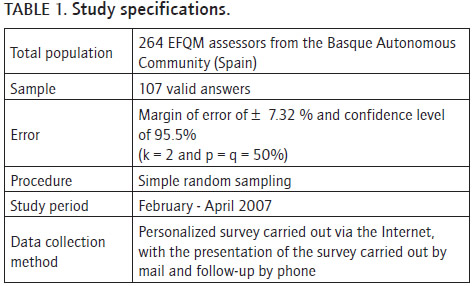
<body><![CDATA[</ul>     <p>&nbsp;</p>     <p>       <center>     <font size="3">    <b>Methodology</b></font>   </center> </p>     <p> <font size="3"><b>Sample and data collection</b></font></p>     <p>  To test the proposed hypotheses, a quantitative empirical   study was carried out in the Basque Autonomous Community,   which has one of the highest proportions of ISO   9001-certified firms in Spain and the European Union   (Heras et al., 2008), and which has accumulated many international   prizes from the EFQM foundation: 19 of the   27 Excellence Awards that EFQM had conceded to Spanish   organisations were given to Basque ones (Heras et al.,   2008).</p>     <p>  In a departure from common practice in studies of this   type, the survey was not sent to the managers of the surveyed   firms; rather, it was sent to assessors from the Basque   Foundation for Quality ('Euskalit'), which is a private,   not-for-profit organisation that exists to promote a culture   of TQM and Business Excellence (Euskalit, 2008). The Euskalit   assessors are independent professionals (academics,   consultants, and managers) who offer support to Basque   Country organizations that seek to improve their management   and achieve standards of excellence. In view of their   specialised training in quality-management standards   and assessment, these assessors thus represent a reliable   source of independent information, as opposed to the potential   bias that is entailed if managers are asked about   the implementation of quality-management standards in   their own organisations that several authors have already   pointed out (Vloeberghs and Bellens, 1996; Heras et al.,   2002; Wayhan et al., 2002 and 2007).</p>     <p>The specifications for the study are shown in <a href="#t1">Table 1</a>. Data   for the study were collected between February 2007 and   April 2007. The survey was sent to a total of 264 assessors,   all of whom had completed at least one external assessment   in the manufacturing and service sectors in 2006.   Of the 264 assessors, 115 (44%) worked in the manufacturing   sector, 93 (35%) in the consultancy sector, and 56   (21%) in the generic services sector (including assessors of non-profit companies).</p>     <p><a name="t1">&nbsp;</a></p>     <p>    ]]></body>
<body><![CDATA[<center><img src="/img/revistas/inno/v21n42/42a14t1.jpg"></center></p>     <p>  A total of 107 valid responses were received, which corresponded   to a good response rate of 40.53%. Of the 107   responses received, 46 (43%) came from industrial companies,   32 (30%) from service companies, and 29 (27%) from the consultancy sector.</p>     <p>&nbsp;</p>     <p><font size="3"><b>  Measures</b></font></p>     <p>  The survey collected data on: (i) the degree of use of quality-   improvement tools; and (ii) their impact on the performance of the organisations.</p>     <p>  The quality-improvement tools to be assessed were chosen   on the basis of relevant studies in the literature mentioned   in the literature review section. The quantitative tools that   were taken into consideration included: SPC, six sigma, Pareto   analysis, quality costs, and FMECA, among others.   The qualitative tools included benchmarking, qualitative   surveys, suggestion systems, and improvement groups, among others.</p>     <p>  The full list of tools that were examined was as follows:</p> <ul>     <p>      <li> 'poka-yoke' mechanisms;</li></p>     <p>      ]]></body>
<body><![CDATA[<li> failure mode effects and criticality analysis (FMECA);</li></p>     <p>      <li> Pareto diagrams;</li></p>     <p>      <li> quality cost control (QCC);</li></p>     <p>      <li> cause-effect diagrams;</li></p>     <p>      <li> statistical process control (SPC);</li></p>     <p>      ]]></body>
<body><![CDATA[<li> six sigma;</li></p>     <p>      <li> improvement groups;</li></p>     <p>      <li> process management;</li></p>     <p>      <li> benchmarking;</li></p>     <p>      <li> employee satisfaction survey;</li></p>     <p>      ]]></body>
<body><![CDATA[<li> suggestion system;</li></p>     <p>      <li> 5S methodology</li></p>     <p>      <li> in-house auditing;</li></p>     <p>      <li> customer satisfaction survey;</li></p>     <p>      <li> control sheets and graphs; and</li></p>     <p>      ]]></body>
<body><![CDATA[<li> flow diagrams</li></p>     </ul>     <p>  The extent of use of each tool was measured on a scale of   1 to 3, in which 1 indicated 'non-use', 2 indicated 'specific   use', and 3 indicated 'systematic use'.</p>     <p>  To measure the performance of the organisations, the academic   literature was again consulted for commonly used   indicators of the impact of quality management on company   performance (Powell, 1995; Hendricks and Singhal,   1997; Anderson et al., 1999; Simmons and White, 1999;   Rahman, 2001; Singels et al., 2001; Chow-Chua et al.,   2003; Sila and Ebrahimpour, 2005; Heras, 2006).</p>     <p>  Twelve commonly used indicators were chosen for use in   the present study.</p> <ul>       <p>      <li> improvement in quality of its products/services;</li></p>     <p>      <li> cost-effectiveness of the company;</li></p>     <p>      ]]></body>
<body><![CDATA[<li> productivity;</li></p>     <p>      <li> price/cost ratio of the product;</li></p>     <p>      <li> sales growth;</li></p>     <p>      <li> improvement in commercial margins;</li></p>     <p>      <li> growth in market share;</li></p>     <p>      ]]></body>
<body><![CDATA[<li> growth in exporting capacity;</li></p>     <p>      <li> external image improvement;</li></p>     <p>      <li> improvement in personnel training;</li></p>     <p>      <li> greater use of external consultants; and</li></p>     <p>      <li> incorporation of new qualified staff.</li></p>     </ul>     ]]></body>
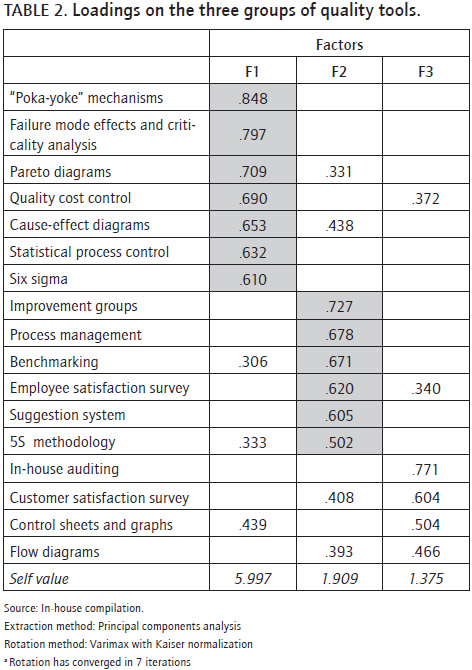
<body><![CDATA[<p>  Assessors were asked to indicate the values of these items   on a scale of 1 to 5, in which 1 indicated 'very little impact'   (of the management system on the indicator), and 5 indicated   'very great impact'.</p>     <p>&nbsp;</p>     <p>       <center>     <font size="3">    <b>Results</b></font>   </center> </p>     <p> <font size="3"><b>Use of quality-improvement tools</b></font></p>     <p>  The extent of use of the quality-management tools and   methods in the organisations with which the assessors   were associated is shown in <a href="/img/revistas/inno/v21n42/42a14f1.jpg" target="_blank">Figure 1</a>.</p>     <p>It is apparent that the tools that required a greater level   of knowledge and/or experience (especially the quantitative   techniques, such as SPC or six sigma) were used much   less frequently than other tools. In contrast, the qualitative   techniques of 'opinion-gathering' (such as surveys and improvement groups) were obviously used more frequently.</p>     <p>  Exploratory factor analysis was utilised to ascertain how   the use of these various techniques varied among the   different organisations in the sample. The principal component   method with varimax rotation was used for this   purpose, with extraction of factors with eigenvalues greater   than one. Both the Kaiser-Meyen-Olkin (KMO) measure   (0.847) and the Bartlett test of sphericity forecast good results.   The analysis captured 60.89% of variance with four   factors.</p>     <p>Variables were then loaded onto several factors, and the   criteria for scale purification of John and Reve (1982) were   subsequently applied. The results of a second factor analysis, made up of only three factors, are shown in <a href="#t2">Table 2</a>.</p>     <p><a name="t2">&nbsp;</a></p>     ]]></body>
<body><![CDATA[<p>    <center><img src="/img/revistas/inno/v21n42/42a14t2.jpg"></center></p>     <p>  The first two factors, labelled 'quantitative tools' (F1) and   'group tools' (F2), coincided with the descriptive analysis   noted above, which had clearly identified at least two   groups of techniques. The first factor (F1) thus consisted of   such quantitative (or 'hard') tools as: (i) cause-effect diagrams;   (ii) Pareto diagrams; (iii) six sigma; (iv) quality control   costs; (v) 'Poka-yoke' mechanisms; (vi) FMECA; and (vii)   SPC. The second factor (F2) consisted of such qualitative   (or 'soft') tools as: (i) improvement groups; (ii) suggestion   systems; (iii) employee satisfaction surveys; (iv) process   management; (v) Benchmarking; and (vi) 5S methodology.   However, the factor analysis also detected a third group,   albeit less clearly than the first two. This group, which was   labelled 'control tools' (F3), consisted of such tools as: (i) internal   auditing; (ii) customer satisfaction surveys; (iii) control   sheets and graphs; and (iv) flow diagrams.</p>     <p>  The psychometric properties of the three groups are presented   in <a href="/img/revistas/inno/v21n42/42a14t3.jpg" target="_blank">Table 3</a>. An acceptable level of reliability for F1   and F2 was revealed by the values of Cronbach's alpha,   which exceeded 0.7 in both cases (Nunnally and Bernstein,   1994; Hair et al., 1998). Two exploratory analyses were   also carried out, one for each of these two factors; in both   cases, a single factor was extracted, which confirmed the   internal convergent validity of these two constructs. In   contrast, Cronbach's alpha for the third factor (0.419) did   not exceed the minimum criterion of 0.7. The reliability of   this factor was not guarantied and it led us to decide to   remove this factor in our analysis.</p>     <p>  In accordance with the descriptive statistics shown in <a href="/img/revistas/inno/v21n42/42a14f1.jpg" target="_blank">Figure  1</a>, it was confirmed that quantitative tools (F1) were   used to a lesser degree than those used to obtain group   information (F2). On a scale of 1 to 3, the average degree   of use of the 'quantitative tools' was 1.76, whereas that of   the 'group tools' was 2.41.</p>     <p>  An alternative nomenclature for these two groups of tools   might be 'hard' and 'soft', according to their difficulty of   implementation. Adopting this nomenclature, 'soft' tools would be largely those included in the second group -that   is, tools that do not require infrastructure, significant initial   investment, or education and training for their implementation;   results from these tools can emerge relatively quickly.   In contrast, 'hard' tools would include those grouped   in the first factor -that is, quantitative tools that require   greater knowledge and expense to implement.</p>     <p>&nbsp;</p>     <p><font size="3"><b>  The performance of the firms</b></font></p>     <p> <a href="/img/revistas/inno/v21n42/42a14t4.jpg" target="_blank">Table 4</a> shows the values of the items used to assess performance   on a scale of 1 to 5 (1 = 'very little impact'; 5 =  'very great impact') in the context of ISO 9001 or EFQM.   The table also includes a difference of means test of all the   indicators.</p>     <p>  As can be observed, significant differences existed in all   cases except the first. Thus, according to the assessors, the   impact on performance differed according to whether the   quality system of the organisation was based on the ISO   9001:2000 standard or on the EFQM model.</p>     ]]></body>
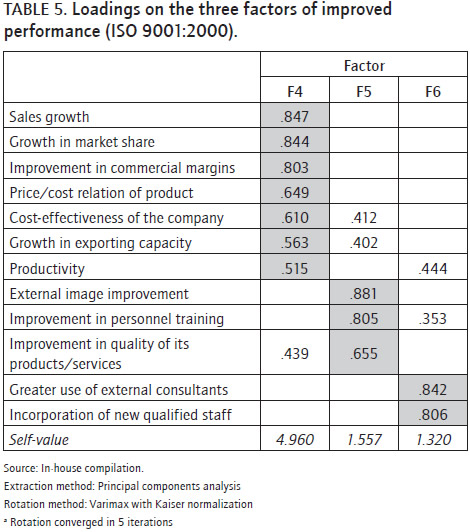
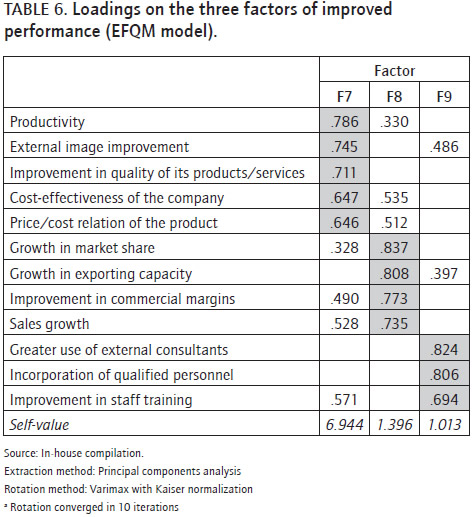
<body><![CDATA[<p>  However, it is noteworthy that the average assessment of   the twelve indicators in the context of the ISO 9001:2000   standard was 2.76, which is less than the neutral value   (3.0) of the measurement scale. Moreover, the average value   of the indicators in the context of the EFQM model was   only 3.19, which is slightly above the neutral value. Based   on these results, it would seem that the contribution of   these tools to the improvement of the performance was   not great (albeit 'better' in the case of the EFQM model).</p>     <p>  An exploratory factor analysis was then made of the elements   related to performance in the ISO 9001:2000 setting.   The KMO measure of sampling adequacy was 0.792,   which promised good analytical results. The Bartlett indicator   was also positive. Three factors with an eigenvalue   greater than one captured 65.31% of the sampling variance   (see <a href="#t5">Table 5</a>).</p>     <p><a name="t5">&nbsp;</a></p>     <p>    <center><img src="/img/revistas/inno/v21n42/42a14t5.jpg"></center></p>     <p>The analysis identified three factors. The first (F4), labelled   'commercial improvement', included indicators that were   associated with an improvement in performance from a   commercial perspective. Applying the same scale-purification   criteria as was described in the analysis of the qualityimprovement   tools, the items of 'productivity' and 'growth   in exporting capacity' were eliminated. This left the following   items on F4: (i) sales growth; (ii) growth in market   share; (iii) improvement in commercial margins; (iv) price/cost ratio of the product; and (v) cost-effectiveness of the company.</p>     <p>The second factor (F5), labelled 'external image improvement',   was not as conceptually distinct. It consisted of the   following items: (i) improvement in quality of products/   services; (ii) external image improvement; and (iii) improvement in staff training.</p>     <p>  The third factor (F6), labelled 'incorporation of external   knowledge', was quite distinct. It consisted of the following   items: (i) greater use of external consultants; and (ii)   incorporation of new qualified staff.</p>     <p> <a href="#t6">Table 6</a> shows the analysis for the same items, but with   the EFQM model (rather than the ISO 9001 standard) as   the basis for implementing the quality system. In this case,   the KMO index was 0.855, and the three identified factors   captured 77.93% of the variability.</p>     <p><a name="t6">&nbsp;</a></p>     ]]></body>
<body><![CDATA[<p>    <center><img src="/img/revistas/inno/v21n42/42a14t6.jpg"></center></p>     <p>In this case, the first factor (F7) was labelled 'global efficiency'.   It consisted of the following items: (i) improvement   in quality of products/services; (ii) cost-effectiveness of   the company; (iii) productivity; (iv) price/cost ratio of the product; and (v) external image improvement.</p>     <p>  The second factor (F8), which was labelled 'commercial   improvement', was similar to the first factor (F4) of the   same name in the previous analysis; indeed, of the four   items that constituted F8, four had also appeared in F4:   (i) sales growth; (ii) improvement in commercial margins;   (iii) growth in market share; and (iv) growth in exporting   capacity.</p>     <p>  As in the previous analysis, the third factor (F9) was labelled   'incorporation of external knowledge'. This referred   to the organisation's capacity to attract external talent   and know-how by employing qualified personnel, training   staff, or taking on consultancy services. It consisted of   the following items: (i) improvement in staff training; (ii)   greater use of external consultants; and (iii) incorporation   of new qualified staff.</p>     <p>  A subsequent reliability analysis of the six sub-scales related   to improved performance (F4-F9) is shown in <a href="/img/revistas/inno/v21n42/42a14t7.jpg" target="_blank">Table  7</a>. It is apparent that the criterion for reliability (Cronbach's   alpha of 0.7) was exceeded by all of the factors, except F6.</p>     <p>  As summary of this subsection, the significant differences   on performance among the organisations based on the ISO   9001 and the EFQM model have to be pointed out. In our   opinion, this is a very interesting finding that might need   further research.</p>     <p>&nbsp;</p>     <p>       <center>     <font size="3">    <b>Explanatory models</b></font>   </center> </p>     ]]></body>
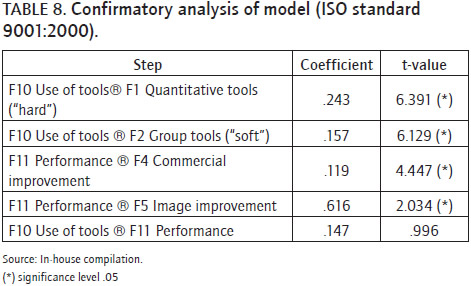
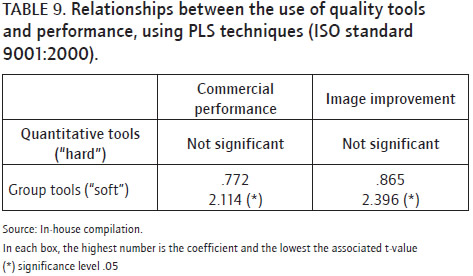
<body><![CDATA[<p> <font size="3"><b>Impact of quality tools on ISO 9001:2000 firms</b></font></p>     <p>  On the basis of the results described above, an explanatory   model can be proposed to conceptualise and test the first   of the hypotheses -which proposed that the use of quality-improvement tools improves the global performance of organisations using the ISO standard 9001:2000. The   model is presented in <a href="/img/revistas/inno/v21n42/42a14f2.jpg" target="_blank">Figure 2</a>.</p>     <p>  As can be seen in the diagram the second-order construct   'use of tools' (F10) is derived from two first-order latent   variables: (i) the use of 'hard' quantitative tools (F1); and   (ii) the use of 'soft' qualitative tools (F2). Another second-   order construct, which reflects the level of global   performance of the company (F11), is also related to two   first-order latent variables: (i) 'commercial performance'   (F4); and (ii) 'image improvement' (F5).</p>     <p>  Structural equation modelling (SEM) was used to confirm   the model. The fit statistics were adequate. A Satorra-   Bentler chi-squared statistic of 219.9 (with 182 degrees   of freedom and an associated p-value of 0.02877) was   obtained. The comparative fit index (CFI) was 0.927,   which was compatible with the level recommended by   Byrne (1994). The RMSEA of 0.055 and the confidence   limits (of 90% of the limits of the RMSEA) of 0.019 and   0.079 were all within acceptable limits in accordance   with Hu and Bentler's (1999) proposed cut-off value of   0.06 for the RMSEA. All the loadings of the measurement   model (external model) were high, with only one variable   loading below 0.5 on its factor. The internal model coefficients   with their corresponding statistics are shown in   <a href="#t8">Table 8</a>.</p>     <p><a name="t8">&nbsp;</a></p>}     <p>    <center><img src="/img/revistas/inno/v21n42/42a14t8.jpg"></center></p>     <p>  Although all the second-order steps were significant, no   significant relationship was definitively identified between   the use of quality tools and an increase in a company's   performance when it based its quality system on the ISO   9001:2000 standard. The first hypothesis (which proposed   that the use of quality-improvement tools improves the   global performance of organisations using the reference   standard ISO 9001:2000) must therefore be rejected.</p>     <p>To ascertain whether specific groups of quality tools had a   direct impact on particular factors of performance, analysis   by partial least squares (PLS) was undertaken using a   so-called 'bootstrap routine' (which involved taking 1000   samples of 100 cases each). The results are presented in   <a href="#t9">Table 9</a>. In this modelling, the goodness-of-fit index (Tenenhaus et al., 2004) was 0.4880.</p>     <p><a name="t9">&nbsp;</a></p>     ]]></body>
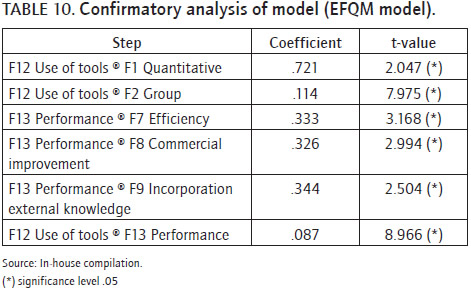
<body><![CDATA[<p>    <center><img src="/img/revistas/inno/v21n42/42a14t9.jpg"></center></p>     <p>It is apparent from these results that the use of 'soft' quality   tools <i>did</i> improve performance -from both a commercial perspective and from the perspective of image enhancement.</p>     <p>&nbsp;</p>     <p><font size="3"><b>Impact of quality tools on EFQM firms</b></font></p>     <p>  The model shown in <a href="/img/revistas/inno/v21n42/42a14f3.jpg" target="_blank">Figure 3</a> for EFQM firms was of a similar   structure to that of <a href="/img/revistas/inno/v21n42/42a14f2.jpg" target="_blank">Figure 2</a> for ISO 9001 firms, with   the exception that the EFQM model had three (rather than   two) dependent variables. In this case, the dependent variables   were: (i) efficiency (F7); (ii) commercial improvement   (F8); and (iii) incorporation of external knowledge (F9).   This model conceptualises the second proposed hypothesis   -which proposed that the use of quality-improvement   tools improves the global performance of organisations using   the EFQM management model.</p>     <p>  The confirmatory analysis of this model was again conducted   with the robust maximum likelihood (RML) method.   Due to the size of the sample, the fit statistics were   not expected to be completely satisfactory; the results   were: Satorra-Bentler chi-square = 367.72 (with 267 degrees   of freedom and an associated p-value of.00001);   CFI = 0.791; and a confidence interval of 90% of RMSEA   between 0.073 and 0.118. Nevertheless, all the loadings of   the measurement model (external model) were high, with   only one variable loading below 0.5 on its factor. Taking   into account the fit limitations noted above, the model's   coefficients with its corresponding statistics are shown in   <a href="#t10">Table 10</a>.</p>     <p><a name="t10">&nbsp;</a></p>     <p>    <center><img src="/img/revistas/inno/v21n42/42a14t10.jpg"></center></p>     ]]></body>
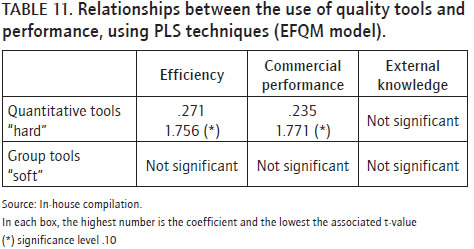
<body><![CDATA[<p>  The significance of the coefficient relating the 'use of tools'   construct (F12) with 'performance' (F13) was significant,   although the coefficient value itself was quite low. This indicates   that the implementation of quality tools increased   the level of performance, although the influence was weak.</p>     <p>This finding is different from that in the preceding model,   in which the analogous t-value was far from significant.   Therefore, allowing for the reservations regarding the fit of   the model, it can be concluded that Hypothesis 2 (which   proposed that the use of quality-improvement tools improves   the global performance of organisations using the EFQM quality model) is confirmed.</p>     <p>  To ascertain whether specific groups of quality tools had a   direct impact on particular factors of performance, analysis   by PLS was again undertaken. The goodness-of-fit index   was quite low (0.1908); indeed, the r<sup>2</sup> of the three performance   factors were all low (between 0.04 and 0.08).</p>     <p>  The results show that, although the model does not explain   the variability of the three constructs of performance,   quantitative tools do help to improve the performance of   firms that adopt the EFQM model -considered from both   the perspective of efficiency and the perspective of commercial performance (<a href="#t11">Table 11</a>). It is noteworthy that these   are precisely the tools that had no influence on the ISO   9001:2000-certified companies.</p>     <p><a name="t11">&nbsp;</a></p>     <p>    <center><img src="/img/revistas/inno/v21n42/42a14t11.jpg"></center></p>     <p>&nbsp;</p>     <p><font size="3"><b>  Common factors in both models</b></font></p>     <p>  To analyse the impact of the common factors in both models,   two new constructs were introduced:</p> <ul>       ]]></body>
<body><![CDATA[<p> <b>F14</b>: <i>shared commercial improvement in an ISO   9001:2000 setting; and</i></p>     <p> <b>F15</b>: <i>shared commercial improvement in an EFQM setting</i>.</p>    </ul>     <p>  These factors were made up of the same items, which included:   (i) sales growth; (ii) improvement in commercial   margins; (iii) growth in market share; and (iv) growth in   exporting capacity. The reliability of both constructs was   positive, and the models were confirmed as having a sufficient   fit.</p>     <p>  The aim was to ascertain whether 'quantitative tools'   and 'group tools' had an influence on 'commercial improvement'   for organisations implementing either the ISO   9001:2000 standard or the EFQM model. The main finding   was confirmation of the existence of a significant relationship   between the use of quality tools and commercial   improvement in performance for companies that had implemented   the EFQM model.</p>     <p>  In summary, all of these results indicated that 'soft' tools   (those that extract group information) were associated   with ISO 9001:2000 and did not have a significant impact   on performance, whereas a substantial improvement   in performance was apparent in firms implementing the   EFQM model using quantitative 'hard' tools.</p>     <p>&nbsp;</p>     <p>       <center>     <font size="3"><b>    Conclusions     </b></font>   </center> </p>     <p>  This study of the implementation of quality-improvement   tools in firms utilising the ISO 9001:2000 standard or the   EFQM model has identified two groups of quality tools: (i)   those of a quantitative kind, characterised as 'hard' in the   present study, which focus on specific tasks and objectives   and which typically require knowledge and experience of   the tools to be implemented effectively; and (ii) tools of a   generally qualitative nature, characterised as 'soft' in the   present study, which focus on general knowledge-sharing   to generate ideas for improvement.</p>     ]]></body>
<body><![CDATA[<p>  The specific contribution of the paper can be summarized   as follows: In the empirical work that has been carried out   'hard' quality tools are used much less frequently than 'soft'   tools, which probably reflects the greater degree of knowledge   and experience required within the organisation to   utilise the former compared with the latter. However, the   study has also shown that these 'hard' tools are precisely   the instruments that enable organisations to improve their   performance. In particular, the study has confirmed that   the use of such tools and methodologies as six sigma, SPC,   and FMECA has a significant impact on commercial performance.   These results confirm the findings of Bunney and   Dale (1997) in their study of one empirical case.</p>     <p>  The effect of quality-improvement tools on performance   was especially noted in firms that used the EFQM model. In   the case of ISO 9001:2000, the use of quality tools barely   improved performance. However, ISO 9001:2000 is associated   with a more intensive use of the tools that were characterised   as 'soft' in the present study, and the analysis has   provided enough evidence to conclude that extensive use   of these 'soft' tools has an influence on improving performance   from a commercial perspective.</p>     <p>  The study has thus concluded that the approach used for   quality management (ISO 90009001:2000 or EFQM in   this study) determines the type of tools used. These findings   are in general accordance with those of Greene (1993)   and Tar&iacute; and Sabater (2004) in noting that the specific   circumstances of a given company require the use of particular   quality-improvement tools. When a given organisation   begins to implement total quality management, it will   use 'soft' general-purpose tools that do not require great   knowledge or experience. At a later ('higher') level of quality   management, this organisation will utilise more sophisticated   tools for specific purposes, thus gaining a greater   impact in terms of improved performance.</p>     <p>  For managers, this article has some clear implications. On   the one hand, the significant differences on performance   among the organisations based on the ISO 9001 and   EFQM model have to be pointed out. Furthermore, in our   opinion this is a very interesting finding that might need   further research in order to explain the nature of those   differences. In short, we'll put forward that the differences   could be related to the varied motivations (internal or external) that drive the organisations to adopt both ISO   9001 and EFQM models, something that could impact on   their outcomes and performance, an effect that has been   recently evidenced for the ISO 9001 context (e.g. Boiral   and Roy, 2007). On the other hand, the study has shown   which are the specific quality management tools that enable   organisations to improve their performance.</p>     <p>  It is acknowledged that the present study is of an exploratory   nature and that it used a relatively small sample size.   Nevertheless, it is contended that the study has been robust   enough to indicate clear tendencies in the production   and service sectors. Future studies could investigate these   trends in other sectors of importance, such as education   and healthcare, in which significant progress in quality   management has occurred in recent years.</p>     <p>&nbsp;</p>     <p>       <center>     <font size="3"><b>    References     </b></font>   </center> </p>     <!-- ref --><p>  Adams, A. B. J. &amp; Dale, B. G. (2001). The use of quality management   tools and techniques: A study in plastic injection moulding manufacture,   Proceedings of the Institution of Mechanical Engineers   Part B. <i>Journal of Engineering Manufacture</i>, <i>215</i>(6), 847-855.&nbsp;&nbsp;&nbsp;&nbsp;&nbsp;&nbsp;&nbsp;&nbsp;[&#160;<a href="javascript:void(0);" onclick="javascript: window.open('/scielo.php?script=sci_nlinks&ref=000231&pid=S0121-5051201100040001400001&lng=','','width=640,height=500,resizable=yes,scrollbars=1,menubar=yes,');">Links</a>&#160;]<!-- end-ref --><!-- ref --><p>  Ahmed, S. &amp; Hassan, M. (2003). Survey and case investigations on application   of quality management tools and techniques in SMIs.   <i>International Journal of Quality &amp; Reliability Management</i>, <i>20</i>(7),   795-826.&nbsp;&nbsp;&nbsp;&nbsp;&nbsp;&nbsp;&nbsp;&nbsp;[&#160;<a href="javascript:void(0);" onclick="javascript: window.open('/scielo.php?script=sci_nlinks&ref=000232&pid=S0121-5051201100040001400002&lng=','','width=640,height=500,resizable=yes,scrollbars=1,menubar=yes,');">Links</a>&#160;]<!-- end-ref --><!-- ref --><p>  Anderson, S. W., Daly, J. D. &amp; Johnson, M. F. (1999). Why firms seek ISO   9000 certification: Regulatory compliance or competitive advantage?   <i>Production &amp; Operations Management</i>, <i>8</i>(1), 28-43.&nbsp;&nbsp;&nbsp;&nbsp;&nbsp;&nbsp;&nbsp;&nbsp;[&#160;<a href="javascript:void(0);" onclick="javascript: window.open('/scielo.php?script=sci_nlinks&ref=000233&pid=S0121-5051201100040001400003&lng=','','width=640,height=500,resizable=yes,scrollbars=1,menubar=yes,');">Links</a>&#160;]<!-- end-ref --><!-- ref --><p>  Bamford, D. R. &amp; Greatbanks, R. W. (2005). The use of quality management   tools and techniques: A study of application in everyday   situations. <i>International Journal of Quality &amp; Reliability Management</i>,   <i>22</i>(4), 376-392.&nbsp;&nbsp;&nbsp;&nbsp;&nbsp;&nbsp;&nbsp;&nbsp;[&#160;<a href="javascript:void(0);" onclick="javascript: window.open('/scielo.php?script=sci_nlinks&ref=000234&pid=S0121-5051201100040001400004&lng=','','width=640,height=500,resizable=yes,scrollbars=1,menubar=yes,');">Links</a>&#160;]<!-- end-ref --><!-- ref --><p>  Besterfield, D., Besterfield-Michna, C., Besterfield, G. &amp; Besterfield-   Sacre, M. (1999). <i>Total quality management</i>. New Jersey: Prentice-Hall.&nbsp;&nbsp;&nbsp;&nbsp;&nbsp;&nbsp;&nbsp;&nbsp;[&#160;<a href="javascript:void(0);" onclick="javascript: window.open('/scielo.php?script=sci_nlinks&ref=000235&pid=S0121-5051201100040001400005&lng=','','width=640,height=500,resizable=yes,scrollbars=1,menubar=yes,');">Links</a>&#160;]<!-- end-ref --><!-- ref --><p>  Boiral, O. &amp; Roy, M. J. (2007). ISO 9000: Integration rationales and organizational   impacts. <i>International Journal of Operations &amp; Production   Management</i>, <i>27</i>(2), 226-247.&nbsp;&nbsp;&nbsp;&nbsp;&nbsp;&nbsp;&nbsp;&nbsp;[&#160;<a href="javascript:void(0);" onclick="javascript: window.open('/scielo.php?script=sci_nlinks&ref=000236&pid=S0121-5051201100040001400006&lng=','','width=640,height=500,resizable=yes,scrollbars=1,menubar=yes,');">Links</a>&#160;]<!-- end-ref --><!-- ref --><p>  Bunney, H. &amp; Dale, B. (1997). The implementation of quality management   tools and techniques: A study. <i>The TQM Magazine</i>, <i>9</i>(3),   183-189.&nbsp;&nbsp;&nbsp;&nbsp;&nbsp;&nbsp;&nbsp;&nbsp;[&#160;<a href="javascript:void(0);" onclick="javascript: window.open('/scielo.php?script=sci_nlinks&ref=000237&pid=S0121-5051201100040001400007&lng=','','width=640,height=500,resizable=yes,scrollbars=1,menubar=yes,');">Links</a>&#160;]<!-- end-ref --><!-- ref --><p>  Byrne, B. M. (1994). <i>Structural equation modeling with EQS and EQS/Windows. Basic concepts. Applications and programming</i>. Thousand   Oaks: Sage Publications.&nbsp;&nbsp;&nbsp;&nbsp;&nbsp;&nbsp;&nbsp;&nbsp;[&#160;<a href="javascript:void(0);" onclick="javascript: window.open('/scielo.php?script=sci_nlinks&ref=000238&pid=S0121-5051201100040001400008&lng=','','width=640,height=500,resizable=yes,scrollbars=1,menubar=yes,');">Links</a>&#160;]<!-- end-ref --><!-- ref --><p>  Casades&uacute;s, M., Heras, I. &amp; Merino, J. (2005). <i>Calidad pr&aacute;ctica. Una   gu&iacute;a para no perderse en el mundo de la calidad</i>. Madrid: Prentice   Hall.&nbsp;&nbsp;&nbsp;&nbsp;&nbsp;&nbsp;&nbsp;&nbsp;[&#160;<a href="javascript:void(0);" onclick="javascript: window.open('/scielo.php?script=sci_nlinks&ref=000239&pid=S0121-5051201100040001400009&lng=','','width=640,height=500,resizable=yes,scrollbars=1,menubar=yes,');">Links</a>&#160;]<!-- end-ref --><!-- ref --><p>  Chow-Chua, C., Goh, M. &amp; Wan, T. B. (2003). Does ISO 9000 certification   improve business performance? <i>International Journal of   Quality &amp; Reliability Management</i>, <i>20</i>(8), 936-953.&nbsp;&nbsp;&nbsp;&nbsp;&nbsp;&nbsp;&nbsp;&nbsp;[&#160;<a href="javascript:void(0);" onclick="javascript: window.open('/scielo.php?script=sci_nlinks&ref=000240&pid=S0121-5051201100040001400010&lng=','','width=640,height=500,resizable=yes,scrollbars=1,menubar=yes,');">Links</a>&#160;]<!-- end-ref --><!-- ref --><p>  Cleary, B. (1997). Promoting the use of quality management tools in the   classroom. <i>Quality Progress</i>, <i>30</i>(5), 8.&nbsp;&nbsp;&nbsp;&nbsp;&nbsp;&nbsp;&nbsp;&nbsp;[&#160;<a href="javascript:void(0);" onclick="javascript: window.open('/scielo.php?script=sci_nlinks&ref=000241&pid=S0121-5051201100040001400011&lng=','','width=640,height=500,resizable=yes,scrollbars=1,menubar=yes,');">Links</a>&#160;]<!-- end-ref --><!-- ref --><p>  Dale, B. G., van der Wiele, T. &amp; van Iwaarden, J. (2007). <i>Managing quality</i>,   5th edition. Oxford: Blackwell Publishing.&nbsp;&nbsp;&nbsp;&nbsp;&nbsp;&nbsp;&nbsp;&nbsp;[&#160;<a href="javascript:void(0);" onclick="javascript: window.open('/scielo.php?script=sci_nlinks&ref=000242&pid=S0121-5051201100040001400012&lng=','','width=640,height=500,resizable=yes,scrollbars=1,menubar=yes,');">Links</a>&#160;]<!-- end-ref --><!-- ref --><p>  Devadasan, S., Muthu, S., Samson, R. &amp; Sankaran, R. (2003). Design of   total failure mode and effects analysis programme. International   <i>Journal of Quality &amp; Reliability Management</i>, <i>20</i>(5), 551-568.&nbsp;&nbsp;&nbsp;&nbsp;&nbsp;&nbsp;&nbsp;&nbsp;[&#160;<a href="javascript:void(0);" onclick="javascript: window.open('/scielo.php?script=sci_nlinks&ref=000243&pid=S0121-5051201100040001400013&lng=','','width=640,height=500,resizable=yes,scrollbars=1,menubar=yes,');">Links</a>&#160;]<!-- end-ref --><!-- ref --><p>  Euskalit. (2008). <i>Basque Foundation for Quality</i> ('Euskalit'). &lt;<a href="http://www.euskalit.net" target="_blank">www.euskalit.net</a>&gt;, acccessed 2008.&nbsp;&nbsp;&nbsp;&nbsp;&nbsp;&nbsp;&nbsp;&nbsp;[&#160;<a href="javascript:void(0);" onclick="javascript: window.open('/scielo.php?script=sci_nlinks&ref=000244&pid=S0121-5051201100040001400014&lng=','','width=640,height=500,resizable=yes,scrollbars=1,menubar=yes,');">Links</a>&#160;]<!-- end-ref --><!-- ref --><p>  Greene, R. (1993). <i>Global quality. A synthesis of the world's best management   methods</i>. Milwaukee: AS QC Quality Press.&nbsp;&nbsp;&nbsp;&nbsp;&nbsp;&nbsp;&nbsp;&nbsp;[&#160;<a href="javascript:void(0);" onclick="javascript: window.open('/scielo.php?script=sci_nlinks&ref=000245&pid=S0121-5051201100040001400015&lng=','','width=640,height=500,resizable=yes,scrollbars=1,menubar=yes,');">Links</a>&#160;]<!-- end-ref --><!-- ref --><p>  Hair, J. F., Anderson, R. E., Tatham, R. L. &amp; Black, W. C. (1998). <i>Multivariate   data analysis</i>, 5th ed. Upper Saddle River, New Jersey: Ed.   Prentice Hall International. Inc.&nbsp;&nbsp;&nbsp;&nbsp;&nbsp;&nbsp;&nbsp;&nbsp;[&#160;<a href="javascript:void(0);" onclick="javascript: window.open('/scielo.php?script=sci_nlinks&ref=000246&pid=S0121-5051201100040001400016&lng=','','width=640,height=500,resizable=yes,scrollbars=1,menubar=yes,');">Links</a>&#160;]<!-- end-ref --><!-- ref --><p>  Handfield, R., Jayaram, J. &amp; Ghosh, S. (1999). An empirical examination   of quality tool deployment patterns and their impact on performance.   <i>International Journal of Production Research</i>, <i>37</i>(6), 1043-1426.&nbsp;&nbsp;&nbsp;&nbsp;&nbsp;&nbsp;&nbsp;&nbsp;[&#160;<a href="javascript:void(0);" onclick="javascript: window.open('/scielo.php?script=sci_nlinks&ref=000247&pid=S0121-5051201100040001400017&lng=','','width=640,height=500,resizable=yes,scrollbars=1,menubar=yes,');">Links</a>&#160;]<!-- end-ref --><!-- ref --><p>  He, Z., Staples, G., Ross, M. &amp;  Court, I. (1996). Fourteen Japanese quality   tools in software process improvement. <i>The TQM Magazine</i>,   <i>8</i>(4), 40-44.&nbsp;&nbsp;&nbsp;&nbsp;&nbsp;&nbsp;&nbsp;&nbsp;[&#160;<a href="javascript:void(0);" onclick="javascript: window.open('/scielo.php?script=sci_nlinks&ref=000248&pid=S0121-5051201100040001400018&lng=','','width=640,height=500,resizable=yes,scrollbars=1,menubar=yes,');">Links</a>&#160;]<!-- end-ref --><!-- ref --><p>  Hendricks, K. B. &amp; Singhal, V. R. (1997). Does implementing an effective   TQM-Program actually improve operating performance? Empirical   evidence from firms that have won quality awards. <i>Management   Science</i>, <i>43</i>(9), 1258-1274.&nbsp;&nbsp;&nbsp;&nbsp;&nbsp;&nbsp;&nbsp;&nbsp;[&#160;<a href="javascript:void(0);" onclick="javascript: window.open('/scielo.php?script=sci_nlinks&ref=000249&pid=S0121-5051201100040001400019&lng=','','width=640,height=500,resizable=yes,scrollbars=1,menubar=yes,');">Links</a>&#160;]<!-- end-ref --><!-- ref --><p>  Heras, I. (2006). How quality management models influence company   results. <i>Total Quality Management &amp; Business Excellence</i>, <i>17</i>(6),   775-794.&nbsp;&nbsp;&nbsp;&nbsp;&nbsp;&nbsp;&nbsp;&nbsp;[&#160;<a href="javascript:void(0);" onclick="javascript: window.open('/scielo.php?script=sci_nlinks&ref=000250&pid=S0121-5051201100040001400020&lng=','','width=640,height=500,resizable=yes,scrollbars=1,menubar=yes,');">Links</a>&#160;]<!-- end-ref --><!-- ref --><p>  Heras, I. (dir.), Arana, G., Camis&oacute;n, C., Casades&uacute;s, M. &amp; Martiarena, A.   (2008). <i>Gesti&oacute;n de la calidad y competitividad de las empresas   de la CAPV</i>. Bilbao: Publicaciones de la Universidad de Deusto.&nbsp;&nbsp;&nbsp;&nbsp;&nbsp;&nbsp;&nbsp;&nbsp;[&#160;<a href="javascript:void(0);" onclick="javascript: window.open('/scielo.php?script=sci_nlinks&ref=000251&pid=S0121-5051201100040001400021&lng=','','width=640,height=500,resizable=yes,scrollbars=1,menubar=yes,');">Links</a>&#160;]<!-- end-ref --><!-- ref --><p>  Heras, I., Dick, G. P. M. &amp; Casadesus, M. (2002). ISO 9000 registration's   impact on sales and profitability. A longitudinal analysis of performance   before and after accreditation. <i>International Journal of   Quality and Reliability Management</i>, <i>19</i>(6), 774-791.&nbsp;&nbsp;&nbsp;&nbsp;&nbsp;&nbsp;&nbsp;&nbsp;[&#160;<a href="javascript:void(0);" onclick="javascript: window.open('/scielo.php?script=sci_nlinks&ref=000252&pid=S0121-5051201100040001400022&lng=','','width=640,height=500,resizable=yes,scrollbars=1,menubar=yes,');">Links</a>&#160;]<!-- end-ref --><!-- ref --><p>  Hu, L. &amp; Bentler, P. (1999). Cutoff criteria for fit indexes in covariance   structure analysis: Conventional criteria versus new alternatives.   <i>Structural Equation Modeling</i>, <i>6</i>(1), 1-55.&nbsp;&nbsp;&nbsp;&nbsp;&nbsp;&nbsp;&nbsp;&nbsp;[&#160;<a href="javascript:void(0);" onclick="javascript: window.open('/scielo.php?script=sci_nlinks&ref=000253&pid=S0121-5051201100040001400023&lng=','','width=640,height=500,resizable=yes,scrollbars=1,menubar=yes,');">Links</a>&#160;]<!-- end-ref --><!-- ref --><p>  Ishikawa, K. (1985). <i>What is total quality control? The Japanese way</i>.   New Jersey, Prentice Hall.&nbsp;&nbsp;&nbsp;&nbsp;&nbsp;&nbsp;&nbsp;&nbsp;[&#160;<a href="javascript:void(0);" onclick="javascript: window.open('/scielo.php?script=sci_nlinks&ref=000254&pid=S0121-5051201100040001400024&lng=','','width=640,height=500,resizable=yes,scrollbars=1,menubar=yes,');">Links</a>&#160;]<!-- end-ref --><!-- ref --><p>  Jackson, S. (2001). Successfully implementing total quality management   tools within healthcare: What are the key actions? <i>International   Journal of Health Care Quality Assurance</i>, <i>14</i>(4), 157-163.&nbsp;&nbsp;&nbsp;&nbsp;&nbsp;&nbsp;&nbsp;&nbsp;[&#160;<a href="javascript:void(0);" onclick="javascript: window.open('/scielo.php?script=sci_nlinks&ref=000255&pid=S0121-5051201100040001400025&lng=','','width=640,height=500,resizable=yes,scrollbars=1,menubar=yes,');">Links</a>&#160;]<!-- end-ref --><!-- ref --><p>  James, P. (1996). <i>Total quality management. An introductory text</i>. Madrid:   Prentice Hall.&nbsp;&nbsp;&nbsp;&nbsp;&nbsp;&nbsp;&nbsp;&nbsp;[&#160;<a href="javascript:void(0);" onclick="javascript: window.open('/scielo.php?script=sci_nlinks&ref=000256&pid=S0121-5051201100040001400026&lng=','','width=640,height=500,resizable=yes,scrollbars=1,menubar=yes,');">Links</a>&#160;]<!-- end-ref --><!-- ref --><p>  John, G. &amp; Reve, T. (1982). The reliability and validity of key informant   data from dyadic relationship in marketing channels. <i>Journal of   Marketing Research</i>, <i>19</i>, 517-524.&nbsp;&nbsp;&nbsp;&nbsp;&nbsp;&nbsp;&nbsp;&nbsp;[&#160;<a href="javascript:void(0);" onclick="javascript: window.open('/scielo.php?script=sci_nlinks&ref=000257&pid=S0121-5051201100040001400027&lng=','','width=640,height=500,resizable=yes,scrollbars=1,menubar=yes,');">Links</a>&#160;]<!-- end-ref --><!-- ref --><p>  Juran, J. &amp; Gryna, F. (1988). <i>Quality control handbook</i>. New York: McGraw-Hill.&nbsp;&nbsp;&nbsp;&nbsp;&nbsp;&nbsp;&nbsp;&nbsp;[&#160;<a href="javascript:void(0);" onclick="javascript: window.open('/scielo.php?script=sci_nlinks&ref=000258&pid=S0121-5051201100040001400028&lng=','','width=640,height=500,resizable=yes,scrollbars=1,menubar=yes,');">Links</a>&#160;]<!-- end-ref --><!-- ref --><p>  Kaye, M. &amp; Anderson, R. (1999). Continuous improvement: The ten essential   criteria. <i>International Journal of Quality &amp; Reliability Management</i>,   <i>16</i>(5), 485-506.&nbsp;&nbsp;&nbsp;&nbsp;&nbsp;&nbsp;&nbsp;&nbsp;[&#160;<a href="javascript:void(0);" onclick="javascript: window.open('/scielo.php?script=sci_nlinks&ref=000259&pid=S0121-5051201100040001400029&lng=','','width=640,height=500,resizable=yes,scrollbars=1,menubar=yes,');">Links</a>&#160;]<!-- end-ref --><!-- ref --><p>  Kaye, M. &amp; Dyason, M. (1995). The fifth era. <i>The TQM Magazine</i>, <i>7</i>(1),  33-37.&nbsp;&nbsp;&nbsp;&nbsp;&nbsp;&nbsp;&nbsp;&nbsp;[&#160;<a href="javascript:void(0);" onclick="javascript: window.open('/scielo.php?script=sci_nlinks&ref=000260&pid=S0121-5051201100040001400030&lng=','','width=640,height=500,resizable=yes,scrollbars=1,menubar=yes,');">Links</a>&#160;]<!-- end-ref --><!-- ref --><p>  Murray, P. (2003). Applying quality management tools to medical photography   services: A pilot project. <i>Journal of Audiovisual Media   Med</i>, <i>26</i>(1), 23-26.&nbsp;&nbsp;&nbsp;&nbsp;&nbsp;&nbsp;&nbsp;&nbsp;[&#160;<a href="javascript:void(0);" onclick="javascript: window.open('/scielo.php?script=sci_nlinks&ref=000261&pid=S0121-5051201100040001400031&lng=','','width=640,height=500,resizable=yes,scrollbars=1,menubar=yes,');">Links</a>&#160;]<!-- end-ref --><!-- ref --><p>  Nunnally, J. C. &amp; Bernstein, I. H. (1994). <i>Psychometric theory</i>. New York:   McGraw-Hill.&nbsp;&nbsp;&nbsp;&nbsp;&nbsp;&nbsp;&nbsp;&nbsp;[&#160;<a href="javascript:void(0);" onclick="javascript: window.open('/scielo.php?script=sci_nlinks&ref=000262&pid=S0121-5051201100040001400032&lng=','','width=640,height=500,resizable=yes,scrollbars=1,menubar=yes,');">Links</a>&#160;]<!-- end-ref --><!-- ref --><p>  Perry, L. (1995). Effective facilitators. A key element in successful continuous   improvement process. <i>Training for Quality</i>, <i>3</i>(4), 9-14.&nbsp;&nbsp;&nbsp;&nbsp;&nbsp;&nbsp;&nbsp;&nbsp;[&#160;<a href="javascript:void(0);" onclick="javascript: window.open('/scielo.php?script=sci_nlinks&ref=000263&pid=S0121-5051201100040001400033&lng=','','width=640,height=500,resizable=yes,scrollbars=1,menubar=yes,');">Links</a>&#160;]<!-- end-ref --><!-- ref --><p>Powell, T. C. (1995). Total quality management as competitive advantage:   A review and empirical study. <i>Strategic Management Journal</i>, <i>16</i>(1), 15-37.&nbsp;&nbsp;&nbsp;&nbsp;&nbsp;&nbsp;&nbsp;&nbsp;[&#160;<a href="javascript:void(0);" onclick="javascript: window.open('/scielo.php?script=sci_nlinks&ref=000264&pid=S0121-5051201100040001400034&lng=','','width=640,height=500,resizable=yes,scrollbars=1,menubar=yes,');">Links</a>&#160;]<!-- end-ref --><!-- ref --><p>  Rahman, S. (2001). A comparative study of TQM practice and organizational   performance of SME s with and without ISO 9000 certification.   <i>International Journal of Quality &amp; Reliability Management</i>, <i>18</i>(1), 35-49.&nbsp;&nbsp;&nbsp;&nbsp;&nbsp;&nbsp;&nbsp;&nbsp;[&#160;<a href="javascript:void(0);" onclick="javascript: window.open('/scielo.php?script=sci_nlinks&ref=000265&pid=S0121-5051201100040001400035&lng=','','width=640,height=500,resizable=yes,scrollbars=1,menubar=yes,');">Links</a>&#160;]<!-- end-ref --><!-- ref --><p>  Sila, I. &amp; Ebrahimpour, M. (2005). Critical linkages among TQM factors   and business results. <i>International Journal of Operations &amp; Production Management</i>, <i>25</i>(11), 1123-1155.&nbsp;&nbsp;&nbsp;&nbsp;&nbsp;&nbsp;&nbsp;&nbsp;[&#160;<a href="javascript:void(0);" onclick="javascript: window.open('/scielo.php?script=sci_nlinks&ref=000266&pid=S0121-5051201100040001400036&lng=','','width=640,height=500,resizable=yes,scrollbars=1,menubar=yes,');">Links</a>&#160;]<!-- end-ref --><!-- ref --><p>  Simmons, B. L. &amp; White, M. A. (1999). The relationship between ISO   9000 and business performance: Does registration really matter? <i>Journal of Managerial Issues</i>, <i>11</i>, 330-343.&nbsp;&nbsp;&nbsp;&nbsp;&nbsp;&nbsp;&nbsp;&nbsp;[&#160;<a href="javascript:void(0);" onclick="javascript: window.open('/scielo.php?script=sci_nlinks&ref=000267&pid=S0121-5051201100040001400037&lng=','','width=640,height=500,resizable=yes,scrollbars=1,menubar=yes,');">Links</a>&#160;]<!-- end-ref --><!-- ref --><p>  Singels, J., Ru&euml;l, G. &amp; van de Water, H. (2001). ISO 9000 series certification   and performance. <i>International Journal of Quality &amp; Reliability Management</i>, <i>18</i>, 62-75.&nbsp;&nbsp;&nbsp;&nbsp;&nbsp;&nbsp;&nbsp;&nbsp;[&#160;<a href="javascript:void(0);" onclick="javascript: window.open('/scielo.php?script=sci_nlinks&ref=000268&pid=S0121-5051201100040001400038&lng=','','width=640,height=500,resizable=yes,scrollbars=1,menubar=yes,');">Links</a>&#160;]<!-- end-ref --><!-- ref --><p>  Tar&iacute;, J. &amp; Sabater, V. (2004). Quality tools and techniques: Are they necessary   for quality management? <i>International Journal of Production Economics</i>, <i>92</i>, 267-280.&nbsp;&nbsp;&nbsp;&nbsp;&nbsp;&nbsp;&nbsp;&nbsp;[&#160;<a href="javascript:void(0);" onclick="javascript: window.open('/scielo.php?script=sci_nlinks&ref=000269&pid=S0121-5051201100040001400039&lng=','','width=640,height=500,resizable=yes,scrollbars=1,menubar=yes,');">Links</a>&#160;]<!-- end-ref --><!-- ref --><p>  Tenenhaus, M., Amato, S. &amp; Esposito, V. (2004). <i>A global goodness-offit   index for PLS structural equation modeling</i>. Proceedings of the   Italian Statistical Society meeting in 2004 (Bari on June 9-11, 2004).&nbsp;&nbsp;&nbsp;&nbsp;&nbsp;&nbsp;&nbsp;&nbsp;[&#160;<a href="javascript:void(0);" onclick="javascript: window.open('/scielo.php?script=sci_nlinks&ref=000270&pid=S0121-5051201100040001400040&lng=','','width=640,height=500,resizable=yes,scrollbars=1,menubar=yes,');">Links</a>&#160;]<!-- end-ref --><!-- ref --><p>  Vloeberghs, D. &amp; Bellens, J. (1996). Implementing the ISO 9000 standards. <i>Quality Progress</i>, <i>29</i>(6), 43-48.&nbsp;&nbsp;&nbsp;&nbsp;&nbsp;&nbsp;&nbsp;&nbsp;[&#160;<a href="javascript:void(0);" onclick="javascript: window.open('/scielo.php?script=sci_nlinks&ref=000271&pid=S0121-5051201100040001400041&lng=','','width=640,height=500,resizable=yes,scrollbars=1,menubar=yes,');">Links</a>&#160;]<!-- end-ref --><!-- ref --><p>  Wayhan, V. B. &amp; Balderson, E. L. (2007). TQM and financial performance:   A research standard. <i>Total Quality Management and Business Excellence</i>, <i>18</i>(4), 393-401.&nbsp;&nbsp;&nbsp;&nbsp;&nbsp;&nbsp;&nbsp;&nbsp;[&#160;<a href="javascript:void(0);" onclick="javascript: window.open('/scielo.php?script=sci_nlinks&ref=000272&pid=S0121-5051201100040001400042&lng=','','width=640,height=500,resizable=yes,scrollbars=1,menubar=yes,');">Links</a>&#160;]<!-- end-ref --><!-- ref --><p>  Wayhan, V. B., Kirche, E. T. &amp; Khumawala, B. M. (2002). ISO 9000 certification:   The financial performance implications. <i>Total Quality Management and Business Excellence</i>, <i>13</i>, 217-231.&nbsp;&nbsp;&nbsp;&nbsp;&nbsp;&nbsp;&nbsp;&nbsp;[&#160;<a href="javascript:void(0);" onclick="javascript: window.open('/scielo.php?script=sci_nlinks&ref=000273&pid=S0121-5051201100040001400043&lng=','','width=640,height=500,resizable=yes,scrollbars=1,menubar=yes,');">Links</a>&#160;]<!-- end-ref --> ]]></body><back>
<ref-list>
<ref id="B1">
<nlm-citation citation-type="journal">
<person-group person-group-type="author">
<name>
<surname><![CDATA[Adams]]></surname>
<given-names><![CDATA[A. B. J]]></given-names>
</name>
<name>
<surname><![CDATA[Dale]]></surname>
<given-names><![CDATA[B. G]]></given-names>
</name>
</person-group>
<article-title xml:lang="en"><![CDATA[The use of quality management tools and techniques: A study in plastic injection moulding manufacture, Proceedings of the Institution of Mechanical Engineers Part B]]></article-title>
<source><![CDATA[Journal of Engineering Manufacture]]></source>
<year>2001</year>
<volume>215</volume>
<numero>6</numero>
<issue>6</issue>
<page-range>847-855</page-range></nlm-citation>
</ref>
<ref id="B2">
<nlm-citation citation-type="journal">
<person-group person-group-type="author">
<name>
<surname><![CDATA[Ahmed]]></surname>
<given-names><![CDATA[S]]></given-names>
</name>
<name>
<surname><![CDATA[Hassan]]></surname>
<given-names><![CDATA[M]]></given-names>
</name>
</person-group>
<article-title xml:lang="en"><![CDATA[Survey and case investigations on application of quality management tools and techniques in SMIs]]></article-title>
<source><![CDATA[International Journal of Quality & Reliability Management]]></source>
<year>2003</year>
<volume>20</volume>
<numero>7</numero>
<issue>7</issue>
<page-range>795-826</page-range></nlm-citation>
</ref>
<ref id="B3">
<nlm-citation citation-type="journal">
<person-group person-group-type="author">
<name>
<surname><![CDATA[Anderson]]></surname>
<given-names><![CDATA[S. W]]></given-names>
</name>
<name>
<surname><![CDATA[Daly]]></surname>
<given-names><![CDATA[J. D]]></given-names>
</name>
<name>
<surname><![CDATA[Johnson]]></surname>
<given-names><![CDATA[M. F]]></given-names>
</name>
</person-group>
<article-title xml:lang="en"><![CDATA[Why firms seek ISO 9000 certification: Regulatory compliance or competitive advantage]]></article-title>
<source><![CDATA[Production & Operations Management]]></source>
<year>1999</year>
<volume>8</volume>
<numero>1</numero>
<issue>1</issue>
<page-range>28-43</page-range></nlm-citation>
</ref>
<ref id="B4">
<nlm-citation citation-type="journal">
<person-group person-group-type="author">
<name>
<surname><![CDATA[Bamford]]></surname>
<given-names><![CDATA[D. R]]></given-names>
</name>
<name>
<surname><![CDATA[Greatbanks]]></surname>
<given-names><![CDATA[R. W]]></given-names>
</name>
</person-group>
<article-title xml:lang="en"><![CDATA[The use of quality management tools and techniques: A study of application in everyday situations]]></article-title>
<source><![CDATA[International Journal of Quality & Reliability Management]]></source>
<year>2005</year>
<volume>22</volume>
<numero>4</numero>
<issue>4</issue>
<page-range>376-392</page-range></nlm-citation>
</ref>
<ref id="B5">
<nlm-citation citation-type="book">
<person-group person-group-type="author">
<name>
<surname><![CDATA[Besterfield]]></surname>
<given-names><![CDATA[D]]></given-names>
</name>
<name>
<surname><![CDATA[Besterfield-Michna]]></surname>
<given-names><![CDATA[C]]></given-names>
</name>
<name>
<surname><![CDATA[Besterfield]]></surname>
<given-names><![CDATA[G]]></given-names>
</name>
<name>
<surname><![CDATA[Besterfield- Sacre]]></surname>
<given-names><![CDATA[M]]></given-names>
</name>
</person-group>
<source><![CDATA[Total quality management]]></source>
<year>1999</year>
<publisher-loc><![CDATA[New Jersey ]]></publisher-loc>
<publisher-name><![CDATA[Prentice-Hall]]></publisher-name>
</nlm-citation>
</ref>
<ref id="B6">
<nlm-citation citation-type="journal">
<person-group person-group-type="author">
<name>
<surname><![CDATA[Boiral]]></surname>
<given-names><![CDATA[O]]></given-names>
</name>
<name>
<surname><![CDATA[Roy]]></surname>
<given-names><![CDATA[M. J]]></given-names>
</name>
</person-group>
<article-title xml:lang="en"><![CDATA[ISO 9000: Integration rationales and organizational impacts]]></article-title>
<source><![CDATA[International Journal of Operations & Production Management]]></source>
<year>2007</year>
<volume>27</volume>
<numero>2</numero>
<issue>2</issue>
<page-range>226-247</page-range></nlm-citation>
</ref>
<ref id="B7">
<nlm-citation citation-type="journal">
<person-group person-group-type="author">
<name>
<surname><![CDATA[Bunney]]></surname>
<given-names><![CDATA[H]]></given-names>
</name>
<name>
<surname><![CDATA[Dale]]></surname>
<given-names><![CDATA[B]]></given-names>
</name>
</person-group>
<article-title xml:lang="en"><![CDATA[The implementation of quality management tools and techniques: A study]]></article-title>
<source><![CDATA[The TQM Magazine]]></source>
<year>1997</year>
<volume>9</volume>
<numero>3</numero>
<issue>3</issue>
<page-range>183-189</page-range></nlm-citation>
</ref>
<ref id="B8">
<nlm-citation citation-type="book">
<person-group person-group-type="author">
<name>
<surname><![CDATA[Byrne]]></surname>
<given-names><![CDATA[B. M]]></given-names>
</name>
</person-group>
<source><![CDATA[Structural equation modeling with EQS and EQS/Windows: Basic concepts. Applications and programming]]></source>
<year>1994</year>
<publisher-loc><![CDATA[Thousand Oaks ]]></publisher-loc>
<publisher-name><![CDATA[Sage Publications]]></publisher-name>
</nlm-citation>
</ref>
<ref id="B9">
<nlm-citation citation-type="book">
<person-group person-group-type="author">
<name>
<surname><![CDATA[Casadesús]]></surname>
<given-names><![CDATA[M]]></given-names>
</name>
<name>
<surname><![CDATA[Heras]]></surname>
<given-names><![CDATA[I]]></given-names>
</name>
<name>
<surname><![CDATA[Merino]]></surname>
<given-names><![CDATA[J]]></given-names>
</name>
</person-group>
<source><![CDATA[Calidad práctica: Una guía para no perderse en el mundo de la calidad]]></source>
<year>2005</year>
<publisher-loc><![CDATA[Madrid ]]></publisher-loc>
<publisher-name><![CDATA[Prentice Hall]]></publisher-name>
</nlm-citation>
</ref>
<ref id="B10">
<nlm-citation citation-type="journal">
<person-group person-group-type="author">
<name>
<surname><![CDATA[Chow-Chua]]></surname>
<given-names><![CDATA[C]]></given-names>
</name>
<name>
<surname><![CDATA[Goh]]></surname>
<given-names><![CDATA[M]]></given-names>
</name>
<name>
<surname><![CDATA[Wan]]></surname>
<given-names><![CDATA[T. B]]></given-names>
</name>
</person-group>
<article-title xml:lang="en"><![CDATA[Does ISO 9000 certification improve business performance?]]></article-title>
<source><![CDATA[International Journal of Quality & Reliability Management]]></source>
<year>2003</year>
<volume>20</volume>
<numero>8</numero>
<issue>8</issue>
<page-range>936-953</page-range></nlm-citation>
</ref>
<ref id="B11">
<nlm-citation citation-type="journal">
<person-group person-group-type="author">
<name>
<surname><![CDATA[Cleary]]></surname>
<given-names><![CDATA[B]]></given-names>
</name>
</person-group>
<article-title xml:lang="en"><![CDATA[Promoting the use of quality management tools in the classroom]]></article-title>
<source><![CDATA[Quality Progress]]></source>
<year>1997</year>
<volume>30</volume>
<numero>5</numero>
<issue>5</issue>
<page-range>8</page-range></nlm-citation>
</ref>
<ref id="B12">
<nlm-citation citation-type="book">
<person-group person-group-type="author">
<name>
<surname><![CDATA[Dale]]></surname>
<given-names><![CDATA[B. G]]></given-names>
</name>
<name>
<surname><![CDATA[van der Wiele]]></surname>
<given-names><![CDATA[T]]></given-names>
</name>
<name>
<surname><![CDATA[van Iwaarden]]></surname>
<given-names><![CDATA[J]]></given-names>
</name>
</person-group>
<source><![CDATA[Managing quality]]></source>
<year>2007</year>
<edition>5</edition>
<publisher-loc><![CDATA[Oxford ]]></publisher-loc>
<publisher-name><![CDATA[Blackwell Publishing]]></publisher-name>
</nlm-citation>
</ref>
<ref id="B13">
<nlm-citation citation-type="journal">
<person-group person-group-type="author">
<name>
<surname><![CDATA[Devadasan]]></surname>
<given-names><![CDATA[S]]></given-names>
</name>
<name>
<surname><![CDATA[Muthu]]></surname>
<given-names><![CDATA[S]]></given-names>
</name>
<name>
<surname><![CDATA[Samson]]></surname>
<given-names><![CDATA[R]]></given-names>
</name>
<name>
<surname><![CDATA[Sankaran]]></surname>
<given-names><![CDATA[R]]></given-names>
</name>
</person-group>
<article-title xml:lang="en"><![CDATA[Design of total failure mode and effects analysis programme]]></article-title>
<source><![CDATA[International Journal of Quality & Reliability Management]]></source>
<year>2003</year>
<volume>20</volume>
<numero>5</numero>
<issue>5</issue>
<page-range>551-568</page-range></nlm-citation>
</ref>
<ref id="B14">
<nlm-citation citation-type="">
<collab>Euskalit</collab>
<source><![CDATA[Basque Foundation for Quality ('Euskalit')]]></source>
<year>2008</year>
</nlm-citation>
</ref>
<ref id="B15">
<nlm-citation citation-type="book">
<person-group person-group-type="author">
<name>
<surname><![CDATA[Greene]]></surname>
<given-names><![CDATA[R]]></given-names>
</name>
</person-group>
<source><![CDATA[Global quality: A synthesis of the world's best management methods]]></source>
<year>1993</year>
<publisher-loc><![CDATA[Milwaukee ]]></publisher-loc>
<publisher-name><![CDATA[ASQC Quality Press]]></publisher-name>
</nlm-citation>
</ref>
<ref id="B16">
<nlm-citation citation-type="book">
<person-group person-group-type="author">
<name>
<surname><![CDATA[Hair]]></surname>
<given-names><![CDATA[J. F]]></given-names>
</name>
<name>
<surname><![CDATA[Anderson]]></surname>
<given-names><![CDATA[R. E]]></given-names>
</name>
<name>
<surname><![CDATA[Tatham]]></surname>
<given-names><![CDATA[R. L]]></given-names>
</name>
<name>
<surname><![CDATA[Black]]></surname>
<given-names><![CDATA[W. C]]></given-names>
</name>
</person-group>
<source><![CDATA[Multivariate data analysis]]></source>
<year>1998</year>
<edition>5</edition>
<publisher-loc><![CDATA[Upper Saddle RiverNew Jersey ]]></publisher-loc>
<publisher-name><![CDATA[Ed. Prentice Hall International. Inc]]></publisher-name>
</nlm-citation>
</ref>
<ref id="B17">
<nlm-citation citation-type="journal">
<person-group person-group-type="author">
<name>
<surname><![CDATA[Handfield]]></surname>
<given-names><![CDATA[R]]></given-names>
</name>
<name>
<surname><![CDATA[Jayaram]]></surname>
<given-names><![CDATA[J]]></given-names>
</name>
<name>
<surname><![CDATA[Ghosh]]></surname>
<given-names><![CDATA[S]]></given-names>
</name>
</person-group>
<article-title xml:lang="en"><![CDATA[An empirical examination of quality tool deployment patterns and their impact on performance]]></article-title>
<source><![CDATA[International Journal of Production Research]]></source>
<year>1999</year>
<volume>37</volume>
<numero>6</numero>
<issue>6</issue>
<page-range>1043-1426</page-range></nlm-citation>
</ref>
<ref id="B18">
<nlm-citation citation-type="journal">
<person-group person-group-type="author">
<name>
<surname><![CDATA[He]]></surname>
<given-names><![CDATA[Z]]></given-names>
</name>
<name>
<surname><![CDATA[Staples]]></surname>
<given-names><![CDATA[G]]></given-names>
</name>
<name>
<surname><![CDATA[Ross]]></surname>
<given-names><![CDATA[M]]></given-names>
</name>
<name>
<surname><![CDATA[Court]]></surname>
<given-names><![CDATA[I]]></given-names>
</name>
</person-group>
<article-title xml:lang="en"><![CDATA[Fourteen Japanese quality tools in software process improvement]]></article-title>
<source><![CDATA[The TQM Magazine]]></source>
<year>1996</year>
<volume>8</volume>
<numero>4</numero>
<issue>4</issue>
<page-range>40-44</page-range></nlm-citation>
</ref>
<ref id="B19">
<nlm-citation citation-type="journal">
<person-group person-group-type="author">
<name>
<surname><![CDATA[Hendricks]]></surname>
<given-names><![CDATA[K. B]]></given-names>
</name>
<name>
<surname><![CDATA[Singhal]]></surname>
<given-names><![CDATA[V. R]]></given-names>
</name>
</person-group>
<article-title xml:lang="en"><![CDATA[Does implementing an effective TQM-Program actually improve operating performance?: Empirical evidence from firms that have won quality awards]]></article-title>
<source><![CDATA[Management Science]]></source>
<year>1997</year>
<volume>43</volume>
<numero>9</numero>
<issue>9</issue>
<page-range>1258-1274</page-range></nlm-citation>
</ref>
<ref id="B20">
<nlm-citation citation-type="journal">
<person-group person-group-type="author">
<name>
<surname><![CDATA[Heras]]></surname>
<given-names><![CDATA[I]]></given-names>
</name>
</person-group>
<article-title xml:lang="en"><![CDATA[How quality management models influence company results]]></article-title>
<source><![CDATA[Total Quality Management & Business Excellence]]></source>
<year>2006</year>
<volume>17</volume>
<numero>6</numero>
<issue>6</issue>
<page-range>775-794</page-range></nlm-citation>
</ref>
<ref id="B21">
<nlm-citation citation-type="book">
<person-group person-group-type="author">
<name>
<surname><![CDATA[Heras]]></surname>
<given-names><![CDATA[I]]></given-names>
</name>
<name>
<surname><![CDATA[Arana]]></surname>
<given-names><![CDATA[G]]></given-names>
</name>
<name>
<surname><![CDATA[Camisón]]></surname>
<given-names><![CDATA[C]]></given-names>
</name>
<name>
<surname><![CDATA[Casadesús]]></surname>
<given-names><![CDATA[M]]></given-names>
</name>
<name>
<surname><![CDATA[Martiarena]]></surname>
<given-names><![CDATA[A]]></given-names>
</name>
</person-group>
<source><![CDATA[Gestión de la calidad y competitividad de las empresas de la CAPV]]></source>
<year>2008</year>
<publisher-loc><![CDATA[Bilbao ]]></publisher-loc>
<publisher-name><![CDATA[Publicaciones de la Universidad de Deusto]]></publisher-name>
</nlm-citation>
</ref>
<ref id="B22">
<nlm-citation citation-type="journal">
<person-group person-group-type="author">
<name>
<surname><![CDATA[Heras]]></surname>
<given-names><![CDATA[I]]></given-names>
</name>
<name>
<surname><![CDATA[Dick]]></surname>
<given-names><![CDATA[G. P. M]]></given-names>
</name>
<name>
<surname><![CDATA[Casadesus]]></surname>
<given-names><![CDATA[M]]></given-names>
</name>
</person-group>
<article-title xml:lang="en"><![CDATA[ISO 9000 registration's impact on sales and profitability: A longitudinal analysis of performance before and after accreditation]]></article-title>
<source><![CDATA[International Journal of Quality and Reliability Management]]></source>
<year>2002</year>
<volume>19</volume>
<numero>6</numero>
<issue>6</issue>
<page-range>774-791</page-range></nlm-citation>
</ref>
<ref id="B23">
<nlm-citation citation-type="journal">
<person-group person-group-type="author">
<name>
<surname><![CDATA[Hu]]></surname>
<given-names><![CDATA[L]]></given-names>
</name>
<name>
<surname><![CDATA[Bentler]]></surname>
<given-names><![CDATA[P]]></given-names>
</name>
</person-group>
<article-title xml:lang="en"><![CDATA[Cutoff criteria for fit indexes in covariance structure analysis: Conventional criteria versus new alternatives]]></article-title>
<source><![CDATA[Structural Equation Modeling]]></source>
<year>1999</year>
<volume>6</volume>
<numero>1</numero>
<issue>1</issue>
<page-range>1-55</page-range></nlm-citation>
</ref>
<ref id="B24">
<nlm-citation citation-type="book">
<person-group person-group-type="author">
<name>
<surname><![CDATA[Ishikawa]]></surname>
<given-names><![CDATA[K]]></given-names>
</name>
</person-group>
<source><![CDATA[What is total quality control?: The Japanese way]]></source>
<year>1985</year>
<publisher-loc><![CDATA[New Jersey ]]></publisher-loc>
<publisher-name><![CDATA[Prentice Hall]]></publisher-name>
</nlm-citation>
</ref>
<ref id="B25">
<nlm-citation citation-type="journal">
<person-group person-group-type="author">
<name>
<surname><![CDATA[Jackson]]></surname>
<given-names><![CDATA[S]]></given-names>
</name>
</person-group>
<article-title xml:lang="en"><![CDATA[Successfully implementing total quality management tools within healthcare: What are the key actions?]]></article-title>
<source><![CDATA[International Journal of Health Care Quality Assurance]]></source>
<year>2001</year>
<volume>14</volume>
<numero>4</numero>
<issue>4</issue>
<page-range>157-163</page-range></nlm-citation>
</ref>
<ref id="B26">
<nlm-citation citation-type="book">
<person-group person-group-type="author">
<name>
<surname><![CDATA[James]]></surname>
<given-names><![CDATA[P]]></given-names>
</name>
</person-group>
<source><![CDATA[Total quality management: An introductory text]]></source>
<year>1996</year>
<publisher-loc><![CDATA[Madrid ]]></publisher-loc>
<publisher-name><![CDATA[Prentice Hall]]></publisher-name>
</nlm-citation>
</ref>
<ref id="B27">
<nlm-citation citation-type="journal">
<person-group person-group-type="author">
<name>
<surname><![CDATA[John]]></surname>
<given-names><![CDATA[G]]></given-names>
</name>
<name>
<surname><![CDATA[Reve]]></surname>
<given-names><![CDATA[T]]></given-names>
</name>
</person-group>
<article-title xml:lang="en"><![CDATA[The reliability and validity of key informant data from dyadic relationship in marketing channels]]></article-title>
<source><![CDATA[Journal of Marketing Research]]></source>
<year>1982</year>
<volume>19</volume>
<page-range>517-524</page-range></nlm-citation>
</ref>
<ref id="B28">
<nlm-citation citation-type="book">
<person-group person-group-type="author">
<name>
<surname><![CDATA[Juran]]></surname>
<given-names><![CDATA[J]]></given-names>
</name>
<name>
<surname><![CDATA[Gryna]]></surname>
<given-names><![CDATA[F]]></given-names>
</name>
</person-group>
<source><![CDATA[Quality control handbook]]></source>
<year>1988</year>
<publisher-loc><![CDATA[New York ]]></publisher-loc>
<publisher-name><![CDATA[McGraw-Hill]]></publisher-name>
</nlm-citation>
</ref>
<ref id="B29">
<nlm-citation citation-type="journal">
<person-group person-group-type="author">
<name>
<surname><![CDATA[Kaye]]></surname>
<given-names><![CDATA[M]]></given-names>
</name>
<name>
<surname><![CDATA[Anderson]]></surname>
<given-names><![CDATA[R]]></given-names>
</name>
</person-group>
<article-title xml:lang="en"><![CDATA[Continuous improvement: The ten essential criteria]]></article-title>
<source><![CDATA[International Journal of Quality & Reliability Management]]></source>
<year>1999</year>
<volume>16</volume>
<numero>5</numero>
<issue>5</issue>
<page-range>485-506</page-range></nlm-citation>
</ref>
<ref id="B30">
<nlm-citation citation-type="journal">
<person-group person-group-type="author">
<name>
<surname><![CDATA[Kaye]]></surname>
<given-names><![CDATA[M]]></given-names>
</name>
<name>
<surname><![CDATA[Dyason]]></surname>
<given-names><![CDATA[M]]></given-names>
</name>
</person-group>
<article-title xml:lang="en"><![CDATA[The fifth era]]></article-title>
<source><![CDATA[The TQM Magazine]]></source>
<year>1995</year>
<volume>7</volume>
<numero>1</numero>
<issue>1</issue>
<page-range>33-37</page-range></nlm-citation>
</ref>
<ref id="B31">
<nlm-citation citation-type="journal">
<person-group person-group-type="author">
<name>
<surname><![CDATA[Murray]]></surname>
<given-names><![CDATA[P]]></given-names>
</name>
</person-group>
<article-title xml:lang="en"><![CDATA[Applying quality management tools to medical photography services: A pilot project]]></article-title>
<source><![CDATA[Journal of Audiovisual Media Med]]></source>
<year>2003</year>
<volume>26</volume>
<numero>1</numero>
<issue>1</issue>
<page-range>23-26</page-range></nlm-citation>
</ref>
<ref id="B32">
<nlm-citation citation-type="book">
<person-group person-group-type="author">
<name>
<surname><![CDATA[Nunnally]]></surname>
<given-names><![CDATA[J. C]]></given-names>
</name>
<name>
<surname><![CDATA[Bernstein]]></surname>
<given-names><![CDATA[I. H]]></given-names>
</name>
</person-group>
<source><![CDATA[Psychometric theory]]></source>
<year>1994</year>
<publisher-loc><![CDATA[New York ]]></publisher-loc>
<publisher-name><![CDATA[McGraw-Hill]]></publisher-name>
</nlm-citation>
</ref>
<ref id="B33">
<nlm-citation citation-type="journal">
<person-group person-group-type="author">
<name>
<surname><![CDATA[Perry]]></surname>
<given-names><![CDATA[L]]></given-names>
</name>
</person-group>
<article-title xml:lang="en"><![CDATA[Effective facilitators: A key element in successful continuous improvement process]]></article-title>
<source><![CDATA[Training for Quality]]></source>
<year>1995</year>
<volume>3</volume>
<numero>4</numero>
<issue>4</issue>
<page-range>9-14</page-range></nlm-citation>
</ref>
<ref id="B34">
<nlm-citation citation-type="journal">
<person-group person-group-type="author">
<name>
<surname><![CDATA[Powell]]></surname>
<given-names><![CDATA[T. C]]></given-names>
</name>
</person-group>
<article-title xml:lang="en"><![CDATA[Total quality management as competitive advantage: A review and empirical study]]></article-title>
<source><![CDATA[Strategic Management Journal]]></source>
<year>1995</year>
<volume>16</volume>
<numero>1</numero>
<issue>1</issue>
<page-range>15-37</page-range></nlm-citation>
</ref>
<ref id="B35">
<nlm-citation citation-type="journal">
<person-group person-group-type="author">
<name>
<surname><![CDATA[Rahman]]></surname>
<given-names><![CDATA[S]]></given-names>
</name>
</person-group>
<article-title xml:lang="en"><![CDATA[A comparative study of TQM practice and organizational performance of SME s with and without ISO 9000 certification]]></article-title>
<source><![CDATA[International Journal of Quality & Reliability Management]]></source>
<year>2001</year>
<volume>18</volume>
<numero>1</numero>
<issue>1</issue>
<page-range>35-49</page-range></nlm-citation>
</ref>
<ref id="B36">
<nlm-citation citation-type="journal">
<person-group person-group-type="author">
<name>
<surname><![CDATA[Sila]]></surname>
<given-names><![CDATA[I]]></given-names>
</name>
<name>
<surname><![CDATA[Ebrahimpour]]></surname>
<given-names><![CDATA[M]]></given-names>
</name>
</person-group>
<article-title xml:lang="en"><![CDATA[Critical linkages among TQM factors and business results]]></article-title>
<source><![CDATA[International Journal of Operations & Production Management]]></source>
<year>2005</year>
<volume>25</volume>
<numero>11</numero>
<issue>11</issue>
<page-range>1123-1155</page-range></nlm-citation>
</ref>
<ref id="B37">
<nlm-citation citation-type="journal">
<person-group person-group-type="author">
<name>
<surname><![CDATA[Simmons]]></surname>
<given-names><![CDATA[B. L]]></given-names>
</name>
<name>
<surname><![CDATA[White]]></surname>
<given-names><![CDATA[M. A]]></given-names>
</name>
</person-group>
<article-title xml:lang="en"><![CDATA[The relationship between ISO 9000 and business performance: Does registration really matter]]></article-title>
<source><![CDATA[Journal of Managerial Issues]]></source>
<year>1999</year>
<volume>11</volume>
<page-range>330-343</page-range></nlm-citation>
</ref>
<ref id="B38">
<nlm-citation citation-type="journal">
<person-group person-group-type="author">
<name>
<surname><![CDATA[Singels]]></surname>
<given-names><![CDATA[J]]></given-names>
</name>
<name>
<surname><![CDATA[Ruël]]></surname>
<given-names><![CDATA[G]]></given-names>
</name>
<name>
<surname><![CDATA[van de Water]]></surname>
<given-names><![CDATA[H]]></given-names>
</name>
</person-group>
<article-title xml:lang="en"><![CDATA[ISO 9000 series certification and performance]]></article-title>
<source><![CDATA[International Journal of Quality & Reliability Management]]></source>
<year>2001</year>
<volume>18</volume>
<page-range>62-75</page-range></nlm-citation>
</ref>
<ref id="B39">
<nlm-citation citation-type="journal">
<person-group person-group-type="author">
<name>
<surname><![CDATA[Tarí]]></surname>
<given-names><![CDATA[J]]></given-names>
</name>
<name>
<surname><![CDATA[Sabater]]></surname>
<given-names><![CDATA[V]]></given-names>
</name>
</person-group>
<article-title xml:lang="en"><![CDATA[Quality tools and techniques: Are they necessary for quality management]]></article-title>
<source><![CDATA[International Journal of Production Economics]]></source>
<year>2004</year>
<volume>92</volume>
<page-range>267-280</page-range></nlm-citation>
</ref>
<ref id="B40">
<nlm-citation citation-type="confpro">
<person-group person-group-type="author">
<name>
<surname><![CDATA[Tenenhaus]]></surname>
<given-names><![CDATA[M]]></given-names>
</name>
<name>
<surname><![CDATA[Amato]]></surname>
<given-names><![CDATA[S]]></given-names>
</name>
<name>
<surname><![CDATA[Esposito]]></surname>
<given-names><![CDATA[V]]></given-names>
</name>
</person-group>
<article-title xml:lang="en"><![CDATA[A global goodness-offit index for PLS structural equation modeling]]></article-title>
<source><![CDATA[]]></source>
<year>2004</year>
<conf-name><![CDATA[ Italian Statistical Society meeting]]></conf-name>
<conf-date>June 9-11, 2004</conf-date>
<conf-loc>Bari </conf-loc>
</nlm-citation>
</ref>
<ref id="B41">
<nlm-citation citation-type="journal">
<person-group person-group-type="author">
<name>
<surname><![CDATA[Vloeberghs]]></surname>
<given-names><![CDATA[D]]></given-names>
</name>
<name>
<surname><![CDATA[Bellens]]></surname>
<given-names><![CDATA[J]]></given-names>
</name>
</person-group>
<article-title xml:lang="en"><![CDATA[Implementing the ISO 9000 standards]]></article-title>
<source><![CDATA[Quality Progress]]></source>
<year>1996</year>
<volume>29</volume>
<numero>6</numero>
<issue>6</issue>
<page-range>43-48</page-range></nlm-citation>
</ref>
<ref id="B42">
<nlm-citation citation-type="journal">
<person-group person-group-type="author">
<name>
<surname><![CDATA[Wayhan]]></surname>
<given-names><![CDATA[V. B]]></given-names>
</name>
<name>
<surname><![CDATA[Balderson]]></surname>
<given-names><![CDATA[E. L]]></given-names>
</name>
</person-group>
<article-title xml:lang="en"><![CDATA[TQM and financial performance: A research standard]]></article-title>
<source><![CDATA[Total Quality Management and Business Excellence]]></source>
<year>2007</year>
<volume>18</volume>
<numero>4</numero>
<issue>4</issue>
<page-range>393-401</page-range></nlm-citation>
</ref>
<ref id="B43">
<nlm-citation citation-type="journal">
<person-group person-group-type="author">
<name>
<surname><![CDATA[Wayhan]]></surname>
<given-names><![CDATA[V. B]]></given-names>
</name>
<name>
<surname><![CDATA[Kirche]]></surname>
<given-names><![CDATA[E. T]]></given-names>
</name>
<name>
<surname><![CDATA[Khumawala]]></surname>
<given-names><![CDATA[B. M]]></given-names>
</name>
</person-group>
<article-title xml:lang="en"><![CDATA[ISO 9000 certification: The financial performance implications]]></article-title>
<source><![CDATA[Total Quality Management and Business Excellence]]></source>
<year>2002</year>
<volume>13</volume>
<page-range>217-231</page-range></nlm-citation>
</ref>
</ref-list>
</back>
</article>