<?xml version="1.0" encoding="ISO-8859-1"?><article xmlns:mml="http://www.w3.org/1998/Math/MathML" xmlns:xlink="http://www.w3.org/1999/xlink" xmlns:xsi="http://www.w3.org/2001/XMLSchema-instance">
<front>
<journal-meta>
<journal-id>0123-3432</journal-id>
<journal-title><![CDATA[Íkala, Revista de Lenguaje y Cultura]]></journal-title>
<abbrev-journal-title><![CDATA[Íkala]]></abbrev-journal-title>
<issn>0123-3432</issn>
<publisher>
<publisher-name><![CDATA[Escuela de Idiomas, Universidad de Antioquia]]></publisher-name>
</publisher>
</journal-meta>
<article-meta>
<article-id>S0123-34322008000100007</article-id>
<title-group>
<article-title xml:lang="en"><![CDATA[Cross-linguistic influence in multilingual language acquisition: The role of L1 and non-native languages in English and Catalan oral production]]></article-title>
<article-title xml:lang="es"><![CDATA[La influencia entre lenguas en su adquisición multilingüe: el papel de L1 y de lenguas no nativas en la producción oral en inglés y en catalán]]></article-title>
</title-group>
<contrib-group>
<contrib contrib-type="author">
<name>
<surname><![CDATA[Ortega]]></surname>
<given-names><![CDATA[Mireia]]></given-names>
</name>
<xref ref-type="aff" rid="A01"/>
</contrib>
</contrib-group>
<aff id="A01">
<institution><![CDATA[,Universiat de Barcelona English and German Philology Department ]]></institution>
<addr-line><![CDATA[ ]]></addr-line>
</aff>
<pub-date pub-type="pub">
<day>00</day>
<month>06</month>
<year>2008</year>
</pub-date>
<pub-date pub-type="epub">
<day>00</day>
<month>06</month>
<year>2008</year>
</pub-date>
<volume>13</volume>
<numero>19</numero>
<fpage>121</fpage>
<lpage>142</lpage>
<copyright-statement/>
<copyright-year/>
<self-uri xlink:href="http://www.scielo.org.co/scielo.php?script=sci_arttext&amp;pid=S0123-34322008000100007&amp;lng=en&amp;nrm=iso"></self-uri><self-uri xlink:href="http://www.scielo.org.co/scielo.php?script=sci_abstract&amp;pid=S0123-34322008000100007&amp;lng=en&amp;nrm=iso"></self-uri><self-uri xlink:href="http://www.scielo.org.co/scielo.php?script=sci_pdf&amp;pid=S0123-34322008000100007&amp;lng=en&amp;nrm=iso"></self-uri><abstract abstract-type="short" xml:lang="en"><p><![CDATA[Most research in third language acquisition has focused on the effects that factors such as language distance, second language (L2) status, proficiency or recency have on the choice of the source language (L1) in cross-linguistic influence (CLI). This paper presents a study of these factors, and of the influence that the L1 (Spanish) has on L2 (English) and L3 (Catalan) oral production. Lexical and syntactic transfer are analysed in the production of Catalan and English of two multilingual speakers with similar knowledge of non-native languages. They were interviewed twice in an informal environment. The results show that the L1 is the main source of transfer, both in L2 and L3 production, but its influence decreases as proficiency in the target language increases. Language distance also plays an important role in CLI, especially if proficiency in the source language is high and if there has been recent exposure to it. The findings also suggest that while syntactic transfer is exclusively L1-based, lexical transfer can occur from a non-native language.]]></p></abstract>
<abstract abstract-type="short" xml:lang="es"><p><![CDATA[Gran parte de la investigación en la adquisición de terceras lenguas se ha centrado en los efectos que tienen factores como la distancia entre lenguas, la competencia, el uso reciente, o el estatus de la segunda lengua (L2) en la elección de la lengua origen (L1) desde el punto de vista de la influencia interlingüística. Se presenta aquí un análisis de dichos factores, así como la influencia que tiene la L1 (español) en la producción oral en L2 (inglés) y L3 (catalán). Se analiza la transferencia léxica y sintáctica en la producción en catalán e inglés de dos hablantes plurilingües con conocimiento similar de lenguas extranjeras. Fueron entrevistados dos veces en un ambiente informal. Los resultados muestran que la L1 es la principal fuente de transferencia, tanto en la producción oral en L2, como en L3; pero su influencia disminuye a medida que la competencia en la lengua meta incrementa. La distancia entre lenguas también tiene un papel importante en la influencia interlingüística, especialmente si la competencia en la lengua de origen es buena, y si ha habido un contacto reciente con ella. Los resultados también sugieren que mientras que la transferencia sintáctica se basa exclusivamente en la L1, la transferencia léxica se puede basar en la lengua no nativa.]]></p></abstract>
<abstract abstract-type="short" xml:lang="fr"><p><![CDATA[Une grande partie de la recherche sur l'acquisition d'une troisième langue a été centrée sur les effets de facteurs tels que la distance entre les langues, la compétence, l'emploi récent, ou le statut de la L2 en ce qui concerne le choix de la langue source du point de vue de l'influence inter linguistique. Cet article a pour but de présenter une analyse de ces facteurs et de l'influence de la L1 (espagnol) sur la production orale en L2 (anglais) et en L3 (catalan). Des facteurs tels que le transfert lexical et syntactique dans la production orale en catalan et en anglais de deux sujets plurilingues ayant une connaissance similaire des langues étrangères y sont analysés. Les résultats montrent que la L1 est la source principale de transfert aussi bien dans la production orale en L2 qu'en L3; mais son influence diminue dans la mesure où la compétence dans la langue d'arrivée augmente. La distance entre langues joue aussi un rôle important dans l'influence inter linguistique, notamment si la compétence dans la langue source est bonne, et s'il y a eu un contact récent avec cette langue. Les résultats suggèrent aussi que, tandis que le transfert syntactique est exclusivement basé sur la L1, le transfert lexical peut s'appuyer sur les langues non natives.]]></p></abstract>
<kwd-group>
<kwd lng="en"><![CDATA[cross-linguistic influence]]></kwd>
<kwd lng="en"><![CDATA[third language acquisition]]></kwd>
<kwd lng="en"><![CDATA[multilingual speaker]]></kwd>
<kwd lng="en"><![CDATA[lexical transfer]]></kwd>
<kwd lng="en"><![CDATA[syntactic transfer]]></kwd>
<kwd lng="es"><![CDATA[influencia interlingüística]]></kwd>
<kwd lng="es"><![CDATA[adquisición de terceras lenguas]]></kwd>
<kwd lng="es"><![CDATA[hablante plurilingüe]]></kwd>
<kwd lng="es"><![CDATA[transferencia léxica]]></kwd>
<kwd lng="es"><![CDATA[transferencia sintáctica]]></kwd>
<kwd lng="fr"><![CDATA[influence inter linguistique]]></kwd>
<kwd lng="fr"><![CDATA[acquisition d'une troisième langue]]></kwd>
<kwd lng="fr"><![CDATA[sujet plurilingue]]></kwd>
<kwd lng="fr"><![CDATA[transfert lexical]]></kwd>
<kwd lng="fr"><![CDATA[transfert syntactique]]></kwd>
</kwd-group>
</article-meta>
</front><body><![CDATA[ <p align="right"><font size="2" face="Verdana, Arial, Helvetica, sans-serif"><b>ART&Iacute;CULOS DE INVESTIGACI&Oacute;N</b></font></p>     <p>&nbsp;</p>     <p align="center"><font size="4" face="Verdana, Arial, Helvetica, sans-serif"><b>Cross-linguistic influence in multilingual language acquisition: The role of L1 and non-native languages in English and Catalan oral production*<a name="en1"></a><a href="#n1"><sup>1</sup></a> </b></font></p>     <p>&nbsp;</p>     <p align="center"><font size="3" face="Verdana, Arial, Helvetica, sans-serif"><b>La influencia entre  lenguas en su adquisici&oacute;n multiling&uuml;e: el papel de L1 y de lenguas no nativas  en la producci&oacute;n oral en ingl&eacute;s y en catal&aacute;n</b></font></p>     <p>&nbsp;</p>     <p>&nbsp;</p>     <p><font size="2" face="Verdana, Arial, Helvetica, sans-serif"><b>Mireia Ortega** </b><br /> **Mireia   Ortega holds a Masters degree inApplied Linguistics from Universitat   Pompeu Fabra. She is currently pursuing her Ph.D. in Applied Linguistics   at the English and German Philology Department of the Universiat de   Barcelona. E-mail: <a href="mailto:mireiaod@yahoo.es">mireiaod@yahoo.es</a> </font></p>     <p>&nbsp;</p>     <p>&nbsp;</p> <hr size="1" noshade="noshade" />     ]]></body>
<body><![CDATA[<p><font size="2" face="Verdana, Arial, Helvetica, sans-serif"><b>ABSTRACT</b></font></p>     <p><font size="2" face="Verdana, Arial, Helvetica, sans-serif">Most research in third language acquisition has focused on the effects that factors such as language   distance, second language (L2) status, proficiency or recency have on   the choice of the source language (L1) in cross-linguistic influence   (CLI). This paper presents a study of these factors, and of the influence   that the L1 (Spanish) has on L2 (English) and L3 (Catalan) oral   production. Lexical and syntactic transfer are analysed in the   production of Catalan and English of two multilingual speakers with   similar knowledge of non-native languages. They were interviewed twice   in an informal environment. The results show that the L1 is the main   source of transfer, both in L2 and L3 production, but its influence   decreases as proficiency in the target language increases. Language   distance also plays an important role in CLI, especially if proficiency   in the source language is high and if there has been recent exposure to   it. The findings also suggest that while syntactic transfer is   exclusively L1-based, lexical transfer can occur from a non-native   language. </font></p>     <p><font size="2" face="Verdana, Arial, Helvetica, sans-serif"><b>Key words:</b> cross-linguistic influence, third language acquisition, multilingual speaker, lexical transfer, syntactic transfer </font></p>   <hr size="1" noshade="noshade" />       <p><font size="2" face="Verdana, Arial, Helvetica, sans-serif"><b>RESUMEN</b></font></p>       <p><font size="2" face="Verdana, Arial, Helvetica, sans-serif">Gran   parte de la investigaci&oacute;n en la adquisici&oacute;n de terceras lenguas se ha   centrado en los efectos que tienen factores como la distancia entre   lenguas, la competencia, el uso reciente, o el estatus de la segunda   lengua (L2) en la elecci&oacute;n de la lengua origen (L1) desde el punto de   vista de la influencia interling&uuml;&iacute;stica. Se presenta aqu&iacute; un an&aacute;lisis de   dichos factores, as&iacute; como la influencia que tiene la L1 (espa&ntilde;ol) en la   producci&oacute;n oral en L2 (ingl&eacute;s) y L3 (catal&aacute;n). Se analiza la   transferencia l&eacute;xica y sint&aacute;ctica en la producci&oacute;n en catal&aacute;n e ingl&eacute;s   de dos hablantes pluriling&uuml;es con conocimiento similar de lenguas   extranjeras. Fueron entrevistados dos veces en un ambiente informal. Los   resultados muestran que la L1 es la principal fuente de transferencia,   tanto en la producci&oacute;n oral en L2, como en L3; pero su influencia   disminuye a medida que la competencia en la lengua meta incrementa. La   distancia entre lenguas tambi&eacute;n tiene un papel importante en la   influencia interling&uuml;&iacute;stica, especialmente si la competencia en la lengua   de origen es buena, y si ha habido un contacto reciente con ella. Los   resultados tambi&eacute;n sugieren que mientras que la transferencia sint&aacute;ctica   se basa exclusivamente en la L1, la transferencia l&eacute;xica se puede basar   en la lengua no nativa. </font></p>     <p><font size="2" face="Verdana, Arial, Helvetica, sans-serif"><b>Palabras   clave:</b> influencia interling&uuml;&iacute;stica, adquisici&oacute;n de terceras lenguas,   hablante pluriling&uuml;e, transferencia l&eacute;xica, transferencia sint&aacute;ctica </font></p> <hr size="1" noshade="noshade" />     <p><font size="2" face="Verdana, Arial, Helvetica, sans-serif"><b>R&Eacute;SUM&Eacute;</b></font></p>     <p><font size="2" face="Verdana, Arial, Helvetica, sans-serif">Une   grande partie de la recherche sur l'acquisition d'une troisi&egrave;me langue a   &eacute;t&eacute; centr&eacute;e sur les effets de facteurs tels que la distance entre les   langues, la comp&eacute;tence, l'emploi r&eacute;cent, ou le statut de la L2 en ce qui   concerne le choix de la langue source du point de vue de l'influence   inter linguistique. Cet article a pour but de pr&eacute;senter une analyse de   ces facteurs et de l'influence de la L1 (espagnol) sur la production   orale en L2 (anglais) et en L3 (catalan). Des facteurs tels que le   transfert lexical et syntactique dans la production orale en catalan et   en anglais de deux sujets plurilingues ayant une connaissance similaire   des langues &eacute;trang&egrave;res y sont analys&eacute;s. Les r&eacute;sultats montrent que la L1   est la source principale de transfert aussi bien dans la production   orale en L2 qu'en L3; mais son influence diminue dans la mesure o&ugrave; la   comp&eacute;tence dans la langue d'arriv&eacute;e augmente. La distance entre langues   joue aussi un r&ocirc;le important dans l'influence inter linguistique,   notamment si la comp&eacute;tence dans la langue source est bonne, et s'il y a   eu un contact r&eacute;cent avec cette langue. Les r&eacute;sultats sugg&egrave;rent aussi   que, tandis que le transfert syntactique est exclusivement bas&eacute; sur la   L1, le transfert lexical peut s'appuyer sur les langues non natives. </font></p>     <p><font size="2" face="Verdana, Arial, Helvetica, sans-serif"><b>Mots   cl&eacute;s:</b> influence inter linguistique, acquisition d'une troisi&egrave;me langue,   sujet plurilingue, transfert lexical, transfert syntactique </font></p> <hr size="1" noshade="noshade" />     <p>&nbsp;</p>     ]]></body>
<body><![CDATA[<p>&nbsp;</p>     <p><font size="3" face="Verdana, Arial, Helvetica, sans-serif"><b>1. INTRODUCTION </b></font></p>     <p><font size="2" face="Verdana, Arial, Helvetica, sans-serif">The   study of transfer in second language acquisition (SLA) has a long   history and has enjoyed a central role in SLA research. The idea of   language transfer or cross-linguistic influence (CLI) appeared in the   1950s and 60s with the behaviourist approach, which supported the idea   that old habits formed when learning the L1 would influence the way in   which new habits were learnt in the L2. This approach considered   transfer as a crucial factor in SLA. Since then, transfer has gone   through a series of changes in its conceptualisation and has been   challenged by a number of researchers, such as Chomsky (1959). The   innatist approach demonstrated that not all errors result from the   negative influence of the L1, and nowadays transfer is generally   considered to be one of various possible factors in SLA. </font></p>     <p><font size="2" face="Verdana, Arial, Helvetica, sans-serif">Most   research on language transfer has only considered the influence of the   mother tongue on L2 acquisition, without taking into account the   learner's knowledge of other languages. Ellis (1985:40) describes the   importance that the L1 has in acquiring a foreign language. For him,   ''the learner's L1 is an important determinant of SLA. It is not the only   determinant, however, and may not be the most important. But it is   theoretically unsound to attempt a precise specification of its   contribution or even try to compare its contribution with that of other   factors''. </font></p>     <p><font size="2" face="Verdana, Arial, Helvetica, sans-serif">The   study of transfer in third language acquisition (TLA) is a much more   recent field, and therefore there are more areas that need to be   explored. This change of perspective can be observed in the description   that Odlin (1989:27) gives of transfer. He takes into account the   influence of both native and nonnative knowledge in the   acquisition of a new language and describes it as ''the influence   resulting from similarities and differences between the target language   and any other language that has been previously (and perhaps   imperfectly) acquired.'' </font></p>     <p><font size="2" face="Verdana, Arial, Helvetica, sans-serif">The   studies that have been carried out so far on TLAprovide evidence that   prior L2 knowledge can actually be the source of influence when   acquiring a new language (Ringbom, 1987; Williams &amp; Hammarberg,   1998; Cenoz, 2001).</font></p>     <p><font size="2" face="Verdana, Arial, Helvetica, sans-serif">The   rise in interest in the study of TLA over the last few years has   occurred for a number of reasons. Nowadays, learning more than two   languages, English usually being one of them, is not exceptional, and   SLA research needs to account for this increase in the number of   languages known by each individual. This increase is due, on the one   hand, to the global spread of English, and on the other, to the mobility   of the world population and the recognition of minority languages   (Grosjean, 1992; Cook, 1995; Jessner, 1999).From a psycholinguistic   perspective, it is important to differentiate between second and third   language learners, since the latter present specific characteristics   different to those of monolingual learners; they are experienced   learners and have a different type of competence (Grosjean, 1992; Cook,   1995; Jessner, 1999). Third language learners have specific experiences   and strategies related to foreign language learning, as well as a good   knowledge of how languages are structured (Thomas, 1992).Second language   learners have two systems that can influence each other (L1 L2),   transfer from L1 to L2 (substratum transfer) being the most widely   researched. On the other hand, in TLA there are two further   bi-directional relationships; the L3 can influence and be influenced by   the L1 (L1 &lt;=&gt; L3) and CLI can also take place between the L2 and the L3 (L2 &lt;=&gt; L3)   (Cenoz, 2001).This paper will contribute to the study of third language   acquisition, and more precisely to the research of the factors that favour cross-linguistic influence in multilingual learners. </font></p>       <p>&nbsp;  </p>       <p><font size="3" face="Verdana, Arial, Helvetica, sans-serif"><b>2. REVIEW OF THE LITERATURE </b></font></p>       <p><font size="2" face="Verdana, Arial, Helvetica, sans-serif">The   study of CLI in TLA is complex since there are a number of factors that   can be associated with transfer and many possible interactions. The   main areas of investigation have focused on the effects of these   factors. Thus, factors such as typological distance (Kellerman, 1983; De   Angelis &amp; Selinker, 2001; Cenoz, 2001), L2 status (Williams &amp;   Hammarberg, 1998; Hammarberg, 2001), recency (Hammarberg, 2001), context   (Dewaele, 2001), proficiency (Ringbom, 1987; Williams &amp; Hammarberg,   1998; Tremblay, 2006), age and grade (Celaya &amp; Torras, 2001; Nav&eacute;s   et al., 2005), order of acquisition of the languages (Dewaele, 1998) and   constraints on verbal memory (Williams &amp; Hammarberg,   1998) have been taken into account in the study of CLI. Other areas   such as the acquisition of additional languages (L4, L5) or the effect   of the L3 on the L2 and L1 (Ringbom, 2001) have recently been receiving   more attention.</font></p>          ]]></body>
<body><![CDATA[<p><font size="2" face="Verdana, Arial, Helvetica, sans-serif">Many   researchers (Cenoz, Hammarberg, De Angelis &amp; Selinker, 2001)   consider the roles of typology, recency, L2 status and proficiency as   the main factors affecting preference for either the L1 or the L2 as the   source language of CLI in L3 production. These factors will be central   to the analysis presented in this paper. Although all these factors have   been identified, there is still no clear understanding of the   importance of each factor in the acquisition of a new language. </font></p>     <p><font size="2" face="Verdana, Arial, Helvetica, sans-serif">Early   research in the field revealed that CLI was affected by the linguistic   or typological distances between the languages involved (Bild &amp;   Swain, 1989). It is commonly believed by experts that if the languages   involved are considered to be typologically similar, some facilitating   effects in acquisition will appear (positive transfer). On the other   hand, when there is divergence between the native and the non-native   language, CLI can occur in the form of errors, overproduction,   underproduction and miscomprehension (negative transfer) (Odlin, 1989). </font></p>     <p><font size="2" face="Verdana, Arial, Helvetica, sans-serif">Language   typology has proved to be influential in the choice of the source   language. The learner prefers to borrow a form from the language that is   typologically closer to the L3 (Cenoz, 2001; Odlin, &amp; Jarvis,   2004), or from the language that the learner perceives as being closer.   This is linked to the concept of psychotypology coined by Kellerman   (1983); the closer a language is felt, the more chances there are for   transfer to appear. </font></p>     <p><font size="2" face="Verdana, Arial, Helvetica, sans-serif">Cenoz's   research (2001), as well as confirming previous studies on typological   distance in multilingual acquisition, proves that linguistic distance is   a stronger predictor of CLI than, for example, L2 status. It should   also be noted that influence from the L2 is favoured when it is   typologically close to the L3, especially if the L1 is more distant. </font></p>     <p><font size="2" face="Verdana, Arial, Helvetica, sans-serif">While   the typological similarity of the L2 and the L3 has been emphasised as a   reason for transfer by different researchers, only De Angelis &  Selinker (2001) mention the possibility of transferring from an L2 that is typologically distant from the L3. </font></p>     <p><font size="2" face="Verdana, Arial, Helvetica, sans-serif">Proficiency,   both in the target language and in the other languages known by the   speaker (Odlin, T. & Jarvis, S.), also has an important role in the   appearance of CLI (Cenoz, 2001). In this respect, it has been reported   that less proficient L3 learners transfer more elements than learners   with a higher level of proficiency (Ringbom, 1987; Williams &   Hammarberg, 1998). </font></p>     <p><font size="2" face="Verdana, Arial, Helvetica, sans-serif">The   influence of the L2 on the L3 is stronger in the early stages of   learning, and decreases as learning progresses and a higher proficiency   is reached. L2 proficiency is of great importance since an advanced   learner of the L2 will be able to use L2 strategies that are normally   borrowed only from the L1 (Williams &amp; Hammarberg, 1998; Ringbom,   1987). Thus, no L3 forms are borrowed from the L2 unless proficiency is   high. This can be particularly true in cases where the L1 is perceived   to be more similar to the L3 than the L2 (Tremblay, 2006). This   researcher also claims that unless the learner has achieved a high level   of automatisation, the influence that the L2 has on the L3 is negative.   Nevertheless, a high proficiency in the L2 is not enough for the L2 to   become automatised and L2 exposure is needed for transfer to appear. </font></p>     <p><font size="2" face="Verdana, Arial, Helvetica, sans-serif">Another   factor that can determine the presence of interlanguage transfer (ILT)   is L2 status and the 'foreign language effect' (Hammarberg, 2001). The   L2 can be activated to the detriment of the L1 when a desire to suppress   the L1 is present. It is believed that suppressing the L1 is inherently   'non-foreign', and therefore using an L2 form is a more favourable   strategy in acquiring another 'foreign'language.The speakermightnotwant   to soundlikehe isusing hisL1 (Williams & Hammarberg, 1998). These   reasearchers postulate that there are different acquisition mechanisms   for the L1 and the L2, and therefore, when an additional non-native   language is learned, the L2 mechanism is activated. </font></p>     <p><font size="2" face="Verdana, Arial, Helvetica, sans-serif">Hammarberg   (2001) also makes reference to recency as one factor that may affect   the choice of the source language. Speakers are more likely to borrow   from a language that they use actively than from a language that they   know but do not use in an active way. </font></p>     <p><font size="2" face="Verdana, Arial, Helvetica, sans-serif">Other   factors that need to be taken into account are those related to the   specific context in which communication takes place. In this respect,   Grosjean (1998) identifies the interlocutors, the setting and the topic   as factors that need to be analysed in the study of interlanguage   transfer. </font></p>     ]]></body>
<body><![CDATA[<p><font size="2" face="Verdana, Arial, Helvetica, sans-serif">CLI   can occur in different linguistic sub-systems. Although phonological   and lexical transfer are the most obvious displays of CLI, they are not   the only ones. Thus, syntactic, morphological, orthographic and even   pragmatic transfer can take place in L2 or L3 production. </font></p>     <p><font size="2" face="Verdana, Arial, Helvetica, sans-serif">Phonological   transfer is the most noticeable type of CLI. Almost all learners, even   at advanced levels, retain a foreign accent, which is typically   L1-based. L2 transfer at this level is not so common, unless the learner   has been recently exposed to an L2 environment. If this is the case, L2   features can occur for a time. </font></p>     <p><font size="2" face="Verdana, Arial, Helvetica, sans-serif">Syntactic   transfer has been a controversial issue, and word order, alongside   relative clauses, articles and verbal phrases (Kellerman, 1984), is one   of the syntactic properties that has been most extensively studied   (Odlin, 1990). </font></p>     <p><font size="2" face="Verdana, Arial, Helvetica, sans-serif">Grammatical   transfer is nearly always L1-based. It can be L2-based if L2   proficiency is close to that of the L1. As Williams &amp; Hammarberg   (1998) have pointed out, the extent of L2 transfer in grammar varies   according to both exposure to the L2 and L2 proficiency. It is thought   that learners with extensive exposure and high proficiency are likely to   transfer more from the L2 than those with low levels of exposure and   proficiency. The extent of L2 transfer in grammar and phonology also   depends on the typological distance between the L2 and the L3. </font></p>     <p><font size="2" face="Verdana, Arial, Helvetica, sans-serif">L2   transfer in L3 production is especially shown in lexis, which Ringbom   (2001) puts down to the cross-linguistic identification of single word   forms. This takes place when there is formal similarity between   languages. On the other hand, as Ringbom (1986) has claimed, transfer of   meaning does not occur so often between non-native languages; it might   be restricted to L1 influence. </font></p>     <p>&nbsp;</p>     <p><font size="3" face="Verdana, Arial, Helvetica, sans-serif"><b>3. THE STUDY </b></font></p>     <p><font size="2" face="Verdana, Arial, Helvetica, sans-serif">The   aim of the present study is to analyse the different factors that can   contribute to the choice of one source language to the detriment of   other languages known by learners in L2 and L3 production. It also   intends to analyse lexical and grammatical transfer, and to identify the   conditions under which these types of transfer appear in L2 and L3   production. In this paper, L3 acquisition and L3 production not only   refer to the third language acquired by the learners, but also to all   the other languages acquired after this one. Therefore, in this study,   the participants' L1 is Spanish, the L2 is English, and the L3   corresponds to all the other non-native languages known by the learners   (French, German and Catalan).<a name="en2" id="en2"></a><a href="#n2"><sup>2</sup></a> </font></p>     <p><font size="2" face="Verdana, Arial, Helvetica, sans-serif">This research study aims to find answers to the following research questions. (1)   To what extent does the subjects' first language influence the   acquisition of an L2 and an L3? (2) What are the main factors that can   be associated with transfer? And finally, (3) Do lexical and syntactic   transfer have the same source language? It is assumed that the L1 has an   important role in L2 and L3 oral production and that it is therefore   the main source of transfer. Transfer appears more extensively in low   proficiency levels, and linguistic distance is a stronger predictor of   CLI than L2 status. It is also presumed that influence from non-native   languages is only present if the following conditions are met: the   learner's proficiency is high, the languages are typologically close,   and there has been recent exposure to the non-native language. Finally,   the study aims to demonstrate that syntactic transfer is mainly   L1-based, whereas lexical transfer can occur from non-native languages   when the three conditions stated above are present. </font></p>     <p><font size="2" face="Verdana, Arial, Helvetica, sans-serif"><b>3.1. Subjects </b></font></p>     ]]></body>
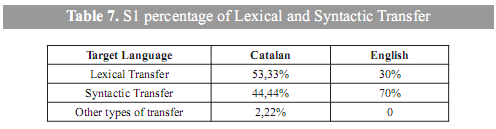
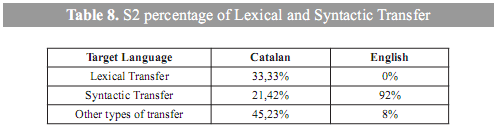
<body><![CDATA[<p><font size="2" face="Verdana, Arial, Helvetica, sans-serif">The   participants of this study are two multilingual adults, both living in   Barcelona at the time of data collection. Both come from Colombia and   studied at the same university in their country of origin. Thus, they   have the same L1 (Spanish) and similar non-native languages (English,   French, German and Catalan). </font></p>     <p><font size="2" face="Verdana, Arial, Helvetica, sans-serif">Subject   1 (S1) is a 27-year-old man with three different interlanguages:   English, French and Catalan.This is the order in which S1 has acquired   these languages. S1 is a fluent speaker of English and Catalan and has   an intermediate level of French. He lived in the USAfor two years, where   he attended classes at postgraduate level, and has received formal   instruction in English for thirteen years. He also attended French   classes for five years at college but has never acquired the language in   a naturalistic context. He is currently completing his studies in   Barcelona, where he has spent one year.After his arrival, he attended a   three-month Catalan course and some of his university modules were   taught in this language; he is currently receiving formal instruction in   Catalan. At present, French is not used in his daily life; he uses   English most frequently with certain friends, with his English students   and in an academic setting. Finally, S1 uses Catalan in the language   classes that he is attending and with some of his friends. </font></p>     <p>&nbsp;</p>     <p align="center"><font size="2" face="Verdana, Arial, Helvetica, sans-serif"><a name="t01" id="t01"></a><img src="/img/revistas/ikala/v13n19/v13n19a7t1.gif" /></font></p>     <p>&nbsp;</p>     <p><font size="2" face="Verdana, Arial, Helvetica, sans-serif">Subject   2 (S2) is a 33-year-old man with four interlanguages: English, French,   German and Catalan. This is the order in which S2 has acquired these   languages. S2 is a fluent speaker of English, French and Catalan, and a   non-fluent speaker of German. He has received formal instruction in   English for ten years and in German for six months. He has had natural   exposure as well as formal instruction in   the other two languages (French and Catalan). He studied French for 6   years at secondary school and at university and recently spent four   months in France. He has lived in Barcelona for the last five   years.After his arrival to the city he attended a six-month Catalan   course and some of his university modules were taught in this language.   Currently, S2 does not use German and he uses French only by e-mail with   some of his friends. English is the language that he uses with his   students and in his academic field.Although Catalan is the language of   his environment, he only uses this language in an academic setting and   not in his daily life. </font></p>     <p>&nbsp;</p>     <p align="center"><font size="2" face="Verdana, Arial, Helvetica, sans-serif"><a name="t02" id="t02"></a><img src="/img/revistas/ikala/v13n19/v13n19a7t2.gif" /></font></p>     <p>&nbsp;</p>     <p><font size="2" face="Verdana, Arial, Helvetica, sans-serif"><b>3.2. Tools </b></font></p>       ]]></body>
<body><![CDATA[<p><font size="2" face="Verdana, Arial, Helvetica, sans-serif">Both   participants were interviewed individually on two separate occasions.   The interviews were semi-structured and took place in an informal   environment. </font></p>       <p><font size="2" face="Verdana, Arial, Helvetica, sans-serif">The   subjects also completed a background questionnaire regarding their   language learning history, which included questions regarding the   knowledge and use of each of the languages known by the two   participants, the onset age and the type of exposure to each language.   It requested details concerning the number of years that they had been   exposed to each language, both in formal and informal settings, as well   as their current use of the languages. The questionnaires were completed   some days before the interviews took place. </font></p>       <font size="2" face="Verdana, Arial, Helvetica, sans-serif"><b>3.3 Procedure </b></font>       <p><font size="2" face="Verdana, Arial, Helvetica, sans-serif">The   questionnaire was the first activity that the participants were   involved in. It was written in Catalan so both participants decided to   use this language o   answer the questions. There was no time limit for the completion of the   questionnaire and they were asked to report on their experience of   second and foreign language acquisition. </font></p>       <p><font size="2" face="Verdana, Arial, Helvetica, sans-serif">Some   days later, the semi-structured interviews began. Participants were   interviewed twice. The first interview was held in English and the   subjects were asked to talk about the last film that they had seen,   movies and cinema in general. One week later, they were interviewed   again, but this time the interview was in Catalan and they were asked to   explain what they had done during that day, leading to an explanation   of their interests and current occupations. Therefore, both   conversations dealt with everyday topics, enabling the comparison of the   two productions. </font></p>       <p><font size="2" face="Verdana, Arial, Helvetica, sans-serif">The   interlocutor was a native speaker of Catalan and Spanish and a fluent   speaker of English. The interview was consciously designed to instigate   spontaneous production from the subjects; thus, the conversations took   different directions depending on the subjects' interests. </font></p>       <p><font size="2" face="Verdana, Arial, Helvetica, sans-serif">Each   conversation lasted between 15 and 20 minutes. The interviews were   audio-taped and transcribed and all instances of CLI at the lexical and   syntactic level were identified and subsequently analysed.</font></p>          <p><font size="2" face="Verdana, Arial, Helvetica, sans-serif"><b>3.4. Data analysis </b></font></p>     <p><font size="2" face="Verdana, Arial, Helvetica, sans-serif">Analysis   consisted of identifying instances of transfer and determining their   language of origin. In order to be able to compare the four   transcriptions in a consistent way, the first 1100 words of each   transcription were selected for analysis. </font></p>     <p><font size="2" face="Verdana, Arial, Helvetica, sans-serif">First   of all, the total number of errors in the four transcriptions were   identified and subsequently classified according to the type of error:   transfer and developmental errors.<a name="en3" id="en3"></a><a href="#n3"><sup>3</sup></a> The next step was to identify the source language of the   transferred forms. Not only the L1 (Spanish), but also the other   foreign languages known by the learners were taken into account. The   transferred forms were then further classified into instances of lexical   transfer and syntactic transfer. Other types of CLI were identified,   such as morphological or pragmatic transfer, but they were classified in   the 'other types of transfer' category. </font></p>     <p><font size="2" face="Verdana, Arial, Helvetica, sans-serif">Lexical   interlanguage transfer consists of the use of an entire non-target word   in the production of the target language (borrowing), the adaptation of   the morphology or phonology of an L1 word to the target language   (coinage or lexical invention), the use of a target word with the L1   meaning (deceptive cognate or false friend) or the literal translation   from one language to another of idiomatic phrases (calque) (Dewale,   1998; Celaya &amp; Torras, 2001; Ringbom, 2001, 2006). Words   intentionally and consciously borrowed from the L1 have also been   included in this group. Some examples of what has been considered as   lexical transfer can be observed in the following sentences, which are   taken from the conversations with the two subjects: </font></p>     ]]></body>
<body><![CDATA[<blockquote>    <p><font size="2" face="Verdana, Arial, Helvetica, sans-serif">(1)&#91;...&#93; nosaltres li donem tota la informaci&oacute; i bon... hi ha molta feina. &#91;Target form (TF): b&eacute;&#93; </font></p>     <p><font size="2" face="Verdana, Arial, Helvetica, sans-serif">&#91;we give him all the information and well... there's a lot of work&#93;. </font></p>     <p><font size="2" face="Verdana, Arial, Helvetica, sans-serif">(2)&#91;...&#93; molta de la feina grossa termina sent responsabilitat meva. &#91;TF: acaba&#93;</font></p>     <p><font size="2" face="Verdana, Arial, Helvetica, sans-serif">&#91;much of the difficult work ends up being my responsibility&#93;. </font></p>     <p><font size="2" face="Verdana, Arial, Helvetica, sans-serif">(3)&#91;...&#93; this film is very particular. &#91;TF: peculiar&#93; </font></p>     <p><font size="2" face="Verdana, Arial, Helvetica, sans-serif">(4)Normalment cada dia m'aixeco cap a les set i mitja. &#91;TF: dos quarts de vuit&#93;</font></p>     <p> <font size="2" face="Verdana, Arial, Helvetica, sans-serif">&#91;I usually get up at around half past seven&#93; </font></p>     <p><font size="2" face="Verdana, Arial, Helvetica, sans-serif">(5)He has problems making friends because he is very rude in his manners. &#91;TF: he has very rude manners&#93; </font></p>     <p><font size="2" face="Verdana, Arial, Helvetica, sans-serif">(6)Tinc dos capitols per reafer. &#91;TF: refer&#93;   </font></p>     ]]></body>
<body><![CDATA[<p><font size="2" face="Verdana, Arial, Helvetica, sans-serif">&#91;I have two chapters that need to be rewritten&#93; </font></p> </blockquote>     <p><font size="2" face="Verdana, Arial, Helvetica, sans-serif">Sentences   (1) and (2) are examples of borrowing, taken from the oral production   in Catalan of one of the subjects. In the former, the source language of   the borrowing is French whereas in the latter it is Spanish. Example   (3) is an instance of false friend in which the English word   'particular' is used with the Spanish meaning. Sentences (4) and (5) are   examples of calque, since the expressions used both in Catalan and   English are literal translations from the L1 (Spanish)<a name="en4" id="en4"></a><a href="#n4"><sup>4</sup></a>.   Finally, (6) is an example of lexical invention, since the learner   creates a non-existing word in the target language by adapting an L1   word (rehacer) to the conventions of the L3. </font></p>     <p><font size="2" face="Verdana, Arial, Helvetica, sans-serif">On   the other hand, each entire syntactic structure or idiomatic expression   that was literally translated into the target language was considered   syntactic transfer. Syntax includes areas such as word order, relative   clauses, subject elision or articles (Manch&oacute;n, 2001). The following   examples illustrate this type of transfer: </font></p>     <blockquote>    <p><font size="2" face="Verdana, Arial, Helvetica, sans-serif">(7)&#91;...&#93; lliuraran un treball acad&egrave;mic de una complexitat considerable. &#91;TF: d'una&#93; </font></p>     <p><font size="2" face="Verdana, Arial, Helvetica, sans-serif">&#91;they will hand in an academic project of considerable complexity&#93;. </font></p>     <p><font size="2" face="Verdana, Arial, Helvetica, sans-serif">(8)&#91;...&#93; is... is sort of like, like some mixture about drama and a comedy. &#91;TF: it is&#93; </font></p>     <p><font size="2" face="Verdana, Arial, Helvetica, sans-serif">(9)&#91;...&#93; comedies I like them a lot also. &#91;TF: comedies, I also like them a lot&#93; </font></p>     <p><font size="2" face="Verdana, Arial, Helvetica, sans-serif">(10) 	I despr&eacute;s va marxar cap a la seva casa &#91;TF: casa seva&#93; &#91;And then he went home&#93;</font></blockquote>  <font size="2" face="Verdana, Arial, Helvetica, sans-serif"> Example   (7) illustrates CLI from Spanish in Catalan production. In this   example, the preposition 'de'and the article 'una'need to be contracted   ('d'una'). However, the learner prefers to use the form in his mother   tongue. Sentences (8) and (9) are   taken from the subjects' oral production in English and are also   examples of L1 transfer. The former is an instance of subject elision   whereas the latter illustrates transfer of word order. Example (10) is   also an instance of transfer of word order, but in this case, it is   taken from the oral Catalan data.</font>     <p>&nbsp;</p>     ]]></body>
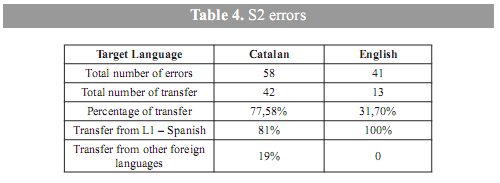
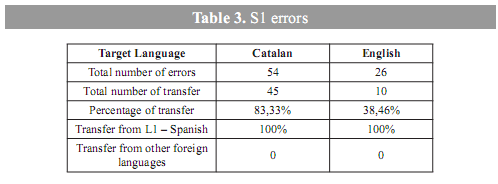
<body><![CDATA[<p><font size="3" face="Verdana, Arial, Helvetica, sans-serif"><b>4. RESULTS AND DISCUSSION </b></font></p>     <p><font size="2" face="Verdana, Arial, Helvetica, sans-serif">The results of the present case study provide tentative answers to the three research questions stated above. </font></p>     <p><font size="2" face="Verdana, Arial, Helvetica, sans-serif">Regarding   the first hypothesis, that the L1 has an important role in L2 and L3   production and is the main source of transfer, the analysis revealed   that Spanish, the participants'L1, is by far the main source of   influence on English and Catalan oral production. As can be observed in   the results in <a href="#t03">tables 3</a> and <a href="#t04">4</a>, both subjects mostly produce   Spanish-based words and expressions when word transfer from one language   to the other occurs. </font></p>     <p>&nbsp;</p>     <p align="center"><font size="2" face="Verdana, Arial, Helvetica, sans-serif"><a name="t03" id="t03"></a><img src="/img/revistas/ikala/v13n19/v13n19a7t3.gif" /></font></p>     <p>&nbsp;</p>     <p><font size="2" face="Verdana, Arial, Helvetica, sans-serif">S1   transfer is 100 % Spanish-based in both Catalan and English production.   The other languages known by the speaker do not have any influence in   L2 and L3 production. The situation is the same for S2 when the target   language is English. However, in Catalan oral production, Spanish-based   transfer comprises 81% of the occurrences. The other 19% is made up of   transferred forms from French (7 tokens) and English (1 token). </font></p>     <p><font size="2" face="Verdana, Arial, Helvetica, sans-serif">These   results confirm those of prior studies that have focused on the   importance of the mother tongue. However, it should also be noted that   this high percentage of   L1 transfer may be due to language distance in the case of Catalan   production. Some researchers (Cenoz, 2001; Odlin &amp; Jarvis, 2004)   have reported that learners prefer to borrow a form from the language   that is closer to the L3. The participants may perceive Catalan as being   typologically close to their L1, Spanish, and thus, transfer from this   language in the majority of cases. It is reasonable to predict that if   the two languages were not so close, the percentage of L1 transfer would   considerably decrease. </font></p>     <p><font size="2" face="Verdana, Arial, Helvetica, sans-serif">The   case of English is quite different. English is the only non-Romance   language known by S1; thus, it is the only Germanic language from which   he could transfer. Therefore, his L1 is chosen as the source language   for transfer. S2, on the other hand, has some knowledge of another   Germanic language. Nevertheless, his level of proficiency is not high   enough to be able to transfer from this language. </font></p>     <p>&nbsp;</p>     ]]></body>
<body><![CDATA[<p align="center"><font size="2" face="Verdana, Arial, Helvetica, sans-serif"><a name="t04" id="t04"></a><img src="/img/revistas/ikala/v13n19/v13n19a7t4.gif" /></font></p>     <p>&nbsp;</p>     <p><font size="2" face="Verdana, Arial, Helvetica, sans-serif">With   respect to the second research question, which made reference to the   main factors that can be associated with transfer, it has been   demonstrated that transfer appears more extensively at lower levels.   This finding confirms that of prior studies (Ringbom, 1987; William   &amp; Hammarberg, 1998). Given that in this research study transfer from   the L1 is virtually the only transfer that takes place, it can also be   stated that L1 influence has a tendency to decrease as target language   proficiency increases. </font></p>     <p><font size="2" face="Verdana, Arial, Helvetica, sans-serif">Both   subjects have a lower level in Catalan than in English. Thus, they   transfer more when they speak in the former language. While S1   transferred 45 forms or expressions when speaking in Catalan (83% of the   total number of errors), he only transferred 10 times in English   production (38% of the total number of errors).   The same applies to S2, who transferred 42 times in Catalan production   (77% of the total number of errors), and only 13 times in English   production (31% of the total number of errors). </font></p>     <p><font size="2" face="Verdana, Arial, Helvetica, sans-serif">The   results also suggest that in Catalan production the number of instances   of CLI is always higher than the number of developmental errors. On the   other hand, in English production this is reversed; that is to say, the   number of developmental errors surpasses instances of CLI. This might   be due to language distance. It is easier to transfer from a language   that is typologically closer to the target language, and developmental   errors are more likely to occur when the vocabulary and structures in   the target language are very different from those in the L1. In this   situation, positive transfer from the L1 Spanish to the L3 Catalan takes   place. </font></p>     <p><font size="2" face="Verdana, Arial, Helvetica, sans-serif">As   demonstrated in previous research (Cenoz, 2001), linguistic distance is   a stronger predictor of CLI than L2 status. Thus, the language that   most influenced Catalan production was the language that is   typologically closer to it, corresponding to the L1 in this study. It   should be noted that linguistic distance only plays an important role   when the learner has a high proficiency in the source language. Thus,   oral production in English was not influenced by German (the language   most related to English), since proficiency in German was not high   enough for transfer to occur. Some researchers such as Ringbom (1998)   and Williams &amp; Hammarberg (1998) have reported that no L3 forms are   borrowed from non-native languages unless proficiency is high. It can be   concluded that language distance goes hand in hand with source language   proficiency in this study. </font></p>     <p><font size="2" face="Verdana, Arial, Helvetica, sans-serif">Although   S1 knows another language closely related to Catalan, i.e. French, his   knowledge in this language is not high enough. Furthermore, it could be   the case that S1 perceived Spanish as being closer to Catalan than   French. This might also explain why S2 transfers more extensively from   Spanish than from French in Catalan production. It could also be   explained in terms of frequency of use and recency, since French is not   very often used by S1 and has not been used recently. </font></p>     <p><font size="2" face="Verdana, Arial, Helvetica, sans-serif">The   role that other foreign languages have in CLI has already been   discussed; the influence of these languages is not as significant as   that of the L1 in this study.   However, since some French influence occurred in the Catalan oral   production of one of the participants, it is worth mentioning. As   hypothesized, influence from non-native languages only occurs when three   conditions are present. Firstly, the learner's proficiency must be   high; secondly, the languages need to be closely related; and finally,   the subject needs to have been recently exposed to the non-native   language. </font></p>     <p><font size="2" face="Verdana, Arial, Helvetica, sans-serif">This   is the case of S2. He is competent in French, which like Catalan is a   Romance language. Furthermore, S2 has been recently exposed to French in   a naturalistic context, having spent four months in France. In   contrast, since no instances of French influence have been found in the   Catalan and English production of the learner with an intermediate level   of French proficiency, and who has had no natural exposure to French,   it is reasonable that this language had no significant influence on his   other foreign languages. Tremblay (2006) has already pointed out that L2   exposure is fundamental for transfer from the L2 to occur. </font></p>     <p><font size="2" face="Verdana, Arial, Helvetica, sans-serif">The   only instance of English influence in Catalan production has not been   considered in this study as the data is insufficient to be taken into   account. </font></p>     ]]></body>
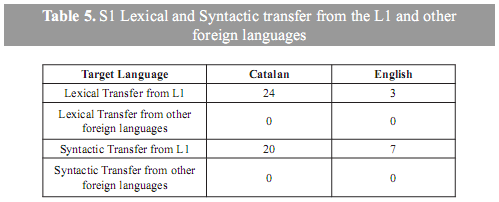
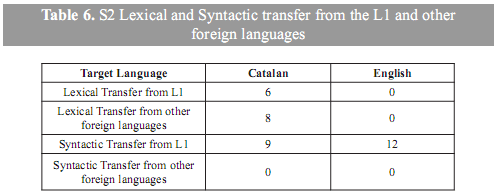
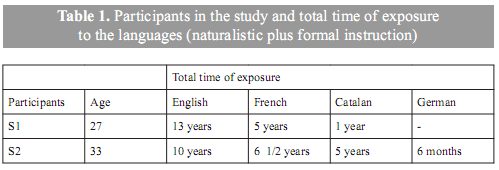
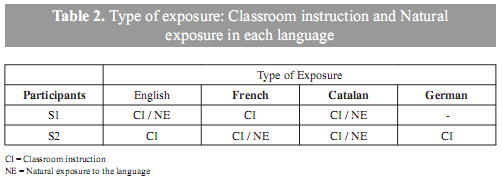
<body><![CDATA[<p><font size="2" face="Verdana, Arial, Helvetica, sans-serif">The   third hypothesis has also been proved: syntactic transfer is   exclusively L1-based, and lexical transfer can occur from a non-native   language only when proficiency in the non-native language is high, the   languages are close and the subject has been recently exposed to the   language. This result contradicts some prior findings (Williams and   Hammarberg, 1998) which suggest that transfer in grammar from non-native   languages can occur if exposure and proficiency are high. </font></p>     <p><font size="2" face="Verdana, Arial, Helvetica, sans-serif">As   can be observed in <a href="#t05">tables 5</a> and <a href="#t06">6</a>, syntactic transfer is exclusively   L1-based in both participants in Catalan and English production. On the   other hand, some transfer from other languages known by the subjects can   occur in instances of lexical transfer. S1 only transferred from his   L1, but S2 transferred words from non-native languages, mainly from   French, on 8 occasions. Moreover, the number of transfer instances from   French surpasses transfer from Spanish. This does not occur in the   production of S1 because the three necessary conditions allowing   transfer from an L2 are not present. </font></p>     <p>&nbsp;</p>     <p align="center"><font size="2" face="Verdana, Arial, Helvetica, sans-serif"><a name="t05" id="t05"></a><img src="/img/revistas/ikala/v13n19/v13n19a7t5.gif" /></font></p>     <p>&nbsp;</p>     <p align="center"><font size="2" face="Verdana, Arial, Helvetica, sans-serif"><a name="t06" id="t06"></a><img src="/img/revistas/ikala/v13n19/v13n19a7t6.gif" /></font></p>     <p>&nbsp;</p>     <p><font size="2" face="Verdana, Arial, Helvetica, sans-serif"><a href="#t07">Tables   7</a> and <a href="#t08">8</a> show the percentages of lexical and syntactic transfer. As can   be observed in these tables, lexical transfer is higher than syntactic   transfer in Catalan oral production (the language that is typologically   closer to Spanish) in both participants. In English, on the other hand,   syntactic transfer is higher than lexical transfer. </font></p>     <p><font size="2" face="Verdana, Arial, Helvetica, sans-serif">It   seems that it is easier to transfer words when the vocabulary in both   the L1 and the target language is similar. If the vocabulary in the   target language does not look like that of the L1, the speaker seems to   be more reluctant to transfer from his mother tongue. </font></p>     <p><font size="2" face="Verdana, Arial, Helvetica, sans-serif">Regarding   syntactic transfer, it appears that both participants transfer from   their L1 in both Catalan and English oral production. However, since   Catalan is   much closer to Spanish than English, positive transfer takes place in   oral production in this language. In English oral production the type of   transfer that takes place is negative, producing more non-target forms. </font></p>     ]]></body>
<body><![CDATA[<p>&nbsp;</p>     <p align="center"><font size="2" face="Verdana, Arial, Helvetica, sans-serif"><a name="t07" id="t07"></a><img src="/img/revistas/ikala/v13n19/v13n19a7t7.gif" /></font></p>     <p>&nbsp;</p>     <p align="center"><font size="2" face="Verdana, Arial, Helvetica, sans-serif"><a name="t08" id="t08"></a><img src="/img/revistas/ikala/v13n19/v13n19a7t8.gif" /></font></p>     <p>&nbsp;</p>     <p><font size="3" face="Verdana, Arial, Helvetica, sans-serif"><b>5. CONCLUSION </b></font></p>     <p><font size="2" face="Verdana, Arial, Helvetica, sans-serif">Overall,   this study confirms findings from previous L3 research. First, it has   shown that the L1 plays an important role in CLI in multilingual   learners. This importance could have been increased by the fact that the   participants' L1 and one of the target languages analysed are   typologically very close. Thus, it would be interesting to analyse   subjects with other languages, especially languages which are   typologically different, in order to measure the importance of the L1 in   CLI. </font></p>     <p><font size="2" face="Verdana, Arial, Helvetica, sans-serif">Although   most transfer in this study is L1-based, transfer from other foreign   languages is also found. Researchers have already identified the factors   that can contribute to the choice of the source language, but they do   not agree on the importance that each factor holds in the acquisition of   a new language. Thus, some highlight the importance of proficiency and   exposure while others emphasise the significance of language distance.   In this study it has been shown that each of   these three conditions must be present in order to transfer from a   non-native language. If only one of these is missing, transfer from a   non-native language does not occur. This has been found to be the case   in lexical transfer. On the other hand, syntactical transfer appears to   be exclusively L1-based in this study. </font></p>     <p><font size="2" face="Verdana, Arial, Helvetica, sans-serif">Follow-up   studies involving more subjects are required in order to validate many   of the hypotheses and findings from this study.Additonally, it is   necessary to encompass other languages, including typologically   different languages, as well as subjects with different degrees of   language proficiency. </font></p>     <p><font size="2" face="Verdana, Arial, Helvetica, sans-serif">Finally,   it would be interesting to collect and analyse French oral production   since it is a Romance language and both participants in the study speak   it. In this case, it would be worth analysing the influence of the two   dominant languages (L1 Spanish and L2 English) on the less dominant   languages (L3s French and Catalan), thus confirming or refuting the   'foreign' language effect. </font></p>     ]]></body>
<body><![CDATA[<p>&nbsp;</p>     <p><font size="3" face="Verdana, Arial, Helvetica, sans-serif"><b>ACKNOWLEDGEMENTS </b></font></p>     <p><font size="2" face="Verdana, Arial, Helvetica, sans-serif">The   author would like to express her gratitude to Prof. Dr. M. Luz Celaya,   whose valuable insights and suggestions were essential in elaborating   the final version of this article. </font></p>     <p>&nbsp;</p>     <p><font size="3" face="Verdana, Arial, Helvetica, sans-serif"><b>REFERENCES</b></font></p>     <!-- ref --><p><font size="2" face="Verdana, Arial, Helvetica, sans-serif">1. Bild, E.R. and Swain, M. (1989). Minority language students in a French immersion programme: their French proficiency. <i>Journal of Multilingual and Multicultural Development, </i>10, 255-74. </font>&nbsp;&nbsp;&nbsp;&nbsp;&nbsp;&nbsp;&nbsp;&nbsp;[&#160;<a href="javascript:void(0);" onclick="javascript: window.open('/scielo.php?script=sci_nlinks&ref=000138&pid=S0123-3432200800010000700001&lng=','','width=640,height=500,resizable=yes,scrollbars=1,menubar=yes,');">Links</a>&#160;]<!-- end-ref --><!-- ref --><p><font size="2" face="Verdana, Arial, Helvetica, sans-serif">2. Celaya, M.L. and Torras, R. (2001). L1 influence and EFL vocabulary: Do children rely more on L1 than adult learners? <i>Proceedings of the 25 AEDEAN Conference.</i> Granada.</font>&nbsp;&nbsp;&nbsp;&nbsp;&nbsp;&nbsp;&nbsp;&nbsp;[&#160;<a href="javascript:void(0);" onclick="javascript: window.open('/scielo.php?script=sci_nlinks&ref=000139&pid=S0123-3432200800010000700002&lng=','','width=640,height=500,resizable=yes,scrollbars=1,menubar=yes,');">Links</a>&#160;]<!-- end-ref --><!-- ref --><p><font size="2" face="Verdana, Arial, Helvetica, sans-serif">3. Cenoz, J., Hufeisen, B. And Jessner, U. (2001). <i>Cross-linguistic Influence in Third Language Acquisition: Psycholinguistic Perspectives. </i>Clevedon: Multilingual Matters. </font>&nbsp;&nbsp;&nbsp;&nbsp;&nbsp;&nbsp;&nbsp;&nbsp;[&#160;<a href="javascript:void(0);" onclick="javascript: window.open('/scielo.php?script=sci_nlinks&ref=000140&pid=S0123-3432200800010000700003&lng=','','width=640,height=500,resizable=yes,scrollbars=1,menubar=yes,');">Links</a>&#160;]<!-- end-ref --><!-- ref --><p><font size="2" face="Verdana, Arial, Helvetica, sans-serif">4. Cenoz,   J. (2001). The effect of linguistic distance, L2 status and age on   cross-linguistic influence in third language acquisition. In J. Cenoz, B.   Hufeisen &amp; U. Jessner (eds.), <i>Crosslinguistic Influence in Third Language Acquisition: Psycholinguistic Perspectives </i>(pp. 8-20). Clevedon: Multilingual Matters. </font>&nbsp;&nbsp;&nbsp;&nbsp;&nbsp;&nbsp;&nbsp;&nbsp;[&#160;<a href="javascript:void(0);" onclick="javascript: window.open('/scielo.php?script=sci_nlinks&ref=000141&pid=S0123-3432200800010000700004&lng=','','width=640,height=500,resizable=yes,scrollbars=1,menubar=yes,');">Links</a>&#160;]<!-- end-ref --><!-- ref --><p><font size="2" face="Verdana, Arial, Helvetica, sans-serif">5. Chomsky, N. (1959). Review of Verbal Behaviour by B.K. Skinner. <i>Language,</i> 35, 26-58. </font>&nbsp;&nbsp;&nbsp;&nbsp;&nbsp;&nbsp;&nbsp;&nbsp;[&#160;<a href="javascript:void(0);" onclick="javascript: window.open('/scielo.php?script=sci_nlinks&ref=000142&pid=S0123-3432200800010000700005&lng=','','width=640,height=500,resizable=yes,scrollbars=1,menubar=yes,');">Links</a>&#160;]<!-- end-ref --><!-- ref --><p><font size="2" face="Verdana, Arial, Helvetica, sans-serif">6. Cook, V. (1995). Multi-competence and the learning of many languages. <i>Language, Culture and curriculum,</i> 8, 93-8.</font>&nbsp;&nbsp;&nbsp;&nbsp;&nbsp;&nbsp;&nbsp;&nbsp;[&#160;<a href="javascript:void(0);" onclick="javascript: window.open('/scielo.php?script=sci_nlinks&ref=000143&pid=S0123-3432200800010000700006&lng=','','width=640,height=500,resizable=yes,scrollbars=1,menubar=yes,');">Links</a>&#160;]<!-- end-ref --><!-- ref --><p><font size="2" face="Verdana, Arial, Helvetica, sans-serif">7.  De Angelis, G. and Selinker, L. (2001). Interlanguage transfer and competing linguistic   systems in the multilingual mind. In J. Cenoz, B. Hufeisen &amp; U. Jessner (eds.), <i>Cross-linguistic Influence in Third Language Acquisition: Psycholinguistic Perspectives </i>(pp. 42-58). Clevedon:   Multilingual Matters. </font>&nbsp;&nbsp;&nbsp;&nbsp;&nbsp;&nbsp;&nbsp;&nbsp;[&#160;<a href="javascript:void(0);" onclick="javascript: window.open('/scielo.php?script=sci_nlinks&ref=000144&pid=S0123-3432200800010000700007&lng=','','width=640,height=500,resizable=yes,scrollbars=1,menubar=yes,');">Links</a>&#160;]<!-- end-ref --><!-- ref --><p><font size="2" face="Verdana, Arial, Helvetica, sans-serif">8. Dewaele, J-M. (1998). Lexical inventions: French interlanguage as L2 versus L3. <i>Applied Linguistics,</i> 19, 471-490.</font>&nbsp;&nbsp;&nbsp;&nbsp;&nbsp;&nbsp;&nbsp;&nbsp;[&#160;<a href="javascript:void(0);" onclick="javascript: window.open('/scielo.php?script=sci_nlinks&ref=000145&pid=S0123-3432200800010000700008&lng=','','width=640,height=500,resizable=yes,scrollbars=1,menubar=yes,');">Links</a>&#160;]<!-- end-ref --><!-- ref --><p><font size="2" face="Verdana, Arial, Helvetica, sans-serif">9. Dewaele, J-M. (2001). Activation or inhibition? The interaction of L1, L2 and L3 on the   language mode continuum. In J. Cenoz, B. Hufeisen &amp; U. Jessner (eds.), <i>Cross-linguistic Influence in Third Language Acquisition: Psycholinguistic Perspectives </i>(pp. 69-89). Clevedon:   Multilingual Matters. </font>&nbsp;&nbsp;&nbsp;&nbsp;&nbsp;&nbsp;&nbsp;&nbsp;[&#160;<a href="javascript:void(0);" onclick="javascript: window.open('/scielo.php?script=sci_nlinks&ref=000146&pid=S0123-3432200800010000700009&lng=','','width=640,height=500,resizable=yes,scrollbars=1,menubar=yes,');">Links</a>&#160;]<!-- end-ref --><!-- ref --><p><font size="2" face="Verdana, Arial, Helvetica, sans-serif">10. Ellis, R. (1985). <i>Understanding Second Language Acquisition. </i>Oxford: Oxford University Press. </font>&nbsp;&nbsp;&nbsp;&nbsp;&nbsp;&nbsp;&nbsp;&nbsp;[&#160;<a href="javascript:void(0);" onclick="javascript: window.open('/scielo.php?script=sci_nlinks&ref=000147&pid=S0123-3432200800010000700010&lng=','','width=640,height=500,resizable=yes,scrollbars=1,menubar=yes,');">Links</a>&#160;]<!-- end-ref --><!-- ref --><p><font size="2" face="Verdana, Arial, Helvetica, sans-serif">11. Grosjean, F. (1992). Another view of bilingualism. In R.J. Harris (ed.), <i>Cognitive Processing in Bilinguals</i> (pp. 51-62). Amsterdam: North Holland.</font>&nbsp;&nbsp;&nbsp;&nbsp;&nbsp;&nbsp;&nbsp;&nbsp;[&#160;<a href="javascript:void(0);" onclick="javascript: window.open('/scielo.php?script=sci_nlinks&ref=000148&pid=S0123-3432200800010000700011&lng=','','width=640,height=500,resizable=yes,scrollbars=1,menubar=yes,');">Links</a>&#160;]<!-- end-ref --><!-- ref --><p><font size="2" face="Verdana, Arial, Helvetica, sans-serif">12. Grosjean, F. (1998). Studying bilinguals: Methodological and conceptual issues. <i>Bilingualism: Language and Cognition, </i>1, 131-49.</font>&nbsp;&nbsp;&nbsp;&nbsp;&nbsp;&nbsp;&nbsp;&nbsp;[&#160;<a href="javascript:void(0);" onclick="javascript: window.open('/scielo.php?script=sci_nlinks&ref=000149&pid=S0123-3432200800010000700012&lng=','','width=640,height=500,resizable=yes,scrollbars=1,menubar=yes,');">Links</a>&#160;]<!-- end-ref --><!-- ref --><p><font size="2" face="Verdana, Arial, Helvetica, sans-serif">13. Hammarberg, B. (2001). Roles of L1 and L2 in L3 production and acquisition. In J. Cenoz, B. Hufeisen &amp; U. Jessner (eds.), <i>Cross-linguistic Influence in Third Language Acquisition: Psycholinguistic Perspectives</i> (pp. 21-41). Clevedon: Multilingual Matters.</font>&nbsp;&nbsp;&nbsp;&nbsp;&nbsp;&nbsp;&nbsp;&nbsp;[&#160;<a href="javascript:void(0);" onclick="javascript: window.open('/scielo.php?script=sci_nlinks&ref=000150&pid=S0123-3432200800010000700013&lng=','','width=640,height=500,resizable=yes,scrollbars=1,menubar=yes,');">Links</a>&#160;]<!-- end-ref --><!-- ref --><p><font size="2" face="Verdana, Arial, Helvetica, sans-serif">14. Jessner, U. (1999). Metalinguistic awareness in multilinguals: Cognitive aspects of third   language learning. <i>Language Awareness,</i> 8, 3&amp;4: 201-9. </font>&nbsp;&nbsp;&nbsp;&nbsp;&nbsp;&nbsp;&nbsp;&nbsp;[&#160;<a href="javascript:void(0);" onclick="javascript: window.open('/scielo.php?script=sci_nlinks&ref=000151&pid=S0123-3432200800010000700014&lng=','','width=640,height=500,resizable=yes,scrollbars=1,menubar=yes,');">Links</a>&#160;]<!-- end-ref --><!-- ref --><p><font size="2" face="Verdana, Arial, Helvetica, sans-serif">15. Kellerman, E. (1983). Now you see it, now you don't. In S. Gass and L. Selinker (eds.), <i>Language Transfer in Language Learning</i> (pp. 112-34). Rowley, MA: Newbury House.</font>&nbsp;&nbsp;&nbsp;&nbsp;&nbsp;&nbsp;&nbsp;&nbsp;[&#160;<a href="javascript:void(0);" onclick="javascript: window.open('/scielo.php?script=sci_nlinks&ref=000152&pid=S0123-3432200800010000700015&lng=','','width=640,height=500,resizable=yes,scrollbars=1,menubar=yes,');">Links</a>&#160;]<!-- end-ref --><!-- ref --><p><font size="2" face="Verdana, Arial, Helvetica, sans-serif">16. Kellerman, E. (1984). The empirical evidence for the influence of the L1 in interlanguage. In A. Davies et al. (eds.), <i>Interlanguage.</i> Edinburgh: Edinburgh University Press.</font>&nbsp;&nbsp;&nbsp;&nbsp;&nbsp;&nbsp;&nbsp;&nbsp;[&#160;<a href="javascript:void(0);" onclick="javascript: window.open('/scielo.php?script=sci_nlinks&ref=000153&pid=S0123-3432200800010000700016&lng=','','width=640,height=500,resizable=yes,scrollbars=1,menubar=yes,');">Links</a>&#160;]<!-- end-ref --><!-- ref --><p><font size="2" face="Verdana, Arial, Helvetica, sans-serif">17. Manch&oacute;n, R.M. (2001). Un acercamiento psicoling&uuml;&iacute;stico al fen&oacute;meno de la transferencia en el aprendizaje y uso de segundas lenguas. In S. Pastor &amp; V. Salazar (eds.), <i>Estudios de ling&uuml;&iacute;stica</i> (pp. 39-72). Alicante: Universidad de Alicante.</font>&nbsp;&nbsp;&nbsp;&nbsp;&nbsp;&nbsp;&nbsp;&nbsp;[&#160;<a href="javascript:void(0);" onclick="javascript: window.open('/scielo.php?script=sci_nlinks&ref=000154&pid=S0123-3432200800010000700017&lng=','','width=640,height=500,resizable=yes,scrollbars=1,menubar=yes,');">Links</a>&#160;]<!-- end-ref --><!-- ref --><p><font size="2" face="Verdana, Arial, Helvetica, sans-serif">18. Odlin, T. (1989). <i>Language Transfer. Cross-Linguistic Influence in Language Learning. </i></font>&nbsp;&nbsp;&nbsp;&nbsp;&nbsp;&nbsp;&nbsp;&nbsp;[&#160;<a href="javascript:void(0);" onclick="javascript: window.open('/scielo.php?script=sci_nlinks&ref=000155&pid=S0123-3432200800010000700018&lng=','','width=640,height=500,resizable=yes,scrollbars=1,menubar=yes,');">Links</a>&#160;]<!-- end-ref --><!-- ref --><p><font size="2" face="Verdana, Arial, Helvetica, sans-serif">19. Cambridge: Cambridge University Press.   Odlin, T. and Jarvis, S. (2004). Same source, different outcomes: A study of Swedish influence on the acquisition of English in Finland. <i>The International Journal of Multilingualism </i>1, 2,   123-140.</font>&nbsp;&nbsp;&nbsp;&nbsp;&nbsp;&nbsp;&nbsp;&nbsp;[&#160;<a href="javascript:void(0);" onclick="javascript: window.open('/scielo.php?script=sci_nlinks&ref=000156&pid=S0123-3432200800010000700019&lng=','','width=640,height=500,resizable=yes,scrollbars=1,menubar=yes,');">Links</a>&#160;]<!-- end-ref --><!-- ref --><p><font size="2" face="Verdana, Arial, Helvetica, sans-serif"> 20. Ringbom, H. (1986). Crosslinguistic influence and the foreign language learning process. In El. Kellerman &amp; Shardwood Smith (eds.), <i>Crosslinguistic Influence in Second Language Acquisition</i> (pp. 150-62). New York: Pergamon Press.</font>&nbsp;&nbsp;&nbsp;&nbsp;&nbsp;&nbsp;&nbsp;&nbsp;[&#160;<a href="javascript:void(0);" onclick="javascript: window.open('/scielo.php?script=sci_nlinks&ref=000157&pid=S0123-3432200800010000700020&lng=','','width=640,height=500,resizable=yes,scrollbars=1,menubar=yes,');">Links</a>&#160;]<!-- end-ref --><!-- ref --><p><font size="2" face="Verdana, Arial, Helvetica, sans-serif">21. Ringbom, H. (1987). <i>The Role of the First Language in Foreign Language Learning. </i>Clevedon:   Multilingual Matters. </font>&nbsp;&nbsp;&nbsp;&nbsp;&nbsp;&nbsp;&nbsp;&nbsp;[&#160;<a href="javascript:void(0);" onclick="javascript: window.open('/scielo.php?script=sci_nlinks&ref=000158&pid=S0123-3432200800010000700021&lng=','','width=640,height=500,resizable=yes,scrollbars=1,menubar=yes,');">Links</a>&#160;]<!-- end-ref --><!-- ref --><p><font size="2" face="Verdana, Arial, Helvetica, sans-serif">22. Ringbom, H. (2001). Lexical transfer in L3 production. In J. Cenoz, B. Hufeisen &amp; U. Jessner (eds.), <i>Cross-linguistic Influence in Third Language Acquisition: Psycholinguistic Perspectives </i>(pp. 59-68). Clevedon: Multilingual Matters. </font>&nbsp;&nbsp;&nbsp;&nbsp;&nbsp;&nbsp;&nbsp;&nbsp;[&#160;<a href="javascript:void(0);" onclick="javascript: window.open('/scielo.php?script=sci_nlinks&ref=000159&pid=S0123-3432200800010000700022&lng=','','width=640,height=500,resizable=yes,scrollbars=1,menubar=yes,');">Links</a>&#160;]<!-- end-ref --><!-- ref --><p><font size="2" face="Verdana, Arial, Helvetica, sans-serif">23. Ringbom, H. (2006). The importance of different types of similarity in transfer studies. In J. Arabski (eds.), <i>Cross-linguistic Influences in the Second Language Lexicon </i>(pp. 36-45). Clevedon:   Multilingual Matters.</font>&nbsp;&nbsp;&nbsp;&nbsp;&nbsp;&nbsp;&nbsp;&nbsp;[&#160;<a href="javascript:void(0);" onclick="javascript: window.open('/scielo.php?script=sci_nlinks&ref=000160&pid=S0123-3432200800010000700023&lng=','','width=640,height=500,resizable=yes,scrollbars=1,menubar=yes,');">Links</a>&#160;]<!-- end-ref --><!-- ref --><p><font size="2" face="Verdana, Arial, Helvetica, sans-serif">24. Nav&eacute;s, T., Miralpeix, I. and Celaya, M.L. (2005). Who transfers more...   and what? Crosslinguistic influence in relation to school grade and   language dominance in EFL. <i>International Journal of Multilingualism,</i> 2, 2, 1-22. </font>&nbsp;&nbsp;&nbsp;&nbsp;&nbsp;&nbsp;&nbsp;&nbsp;[&#160;<a href="javascript:void(0);" onclick="javascript: window.open('/scielo.php?script=sci_nlinks&ref=000161&pid=S0123-3432200800010000700024&lng=','','width=640,height=500,resizable=yes,scrollbars=1,menubar=yes,');">Links</a>&#160;]<!-- end-ref --><!-- ref --><p><font size="2" face="Verdana, Arial, Helvetica, sans-serif">25. Thomas, J. (1992). Metalinguistic awareness in second &#8211; and third &#8211; language learning. In R.J. Harris (ed.), <i>Cognitive Processing in Bilinguals</i> (pp. 531 &#8211; 45). Amsterdam: North Holland. </font>&nbsp;&nbsp;&nbsp;&nbsp;&nbsp;&nbsp;&nbsp;&nbsp;[&#160;<a href="javascript:void(0);" onclick="javascript: window.open('/scielo.php?script=sci_nlinks&ref=000162&pid=S0123-3432200800010000700025&lng=','','width=640,height=500,resizable=yes,scrollbars=1,menubar=yes,');">Links</a>&#160;]<!-- end-ref --><!-- ref --><p><font size="2" face="Verdana, Arial, Helvetica, sans-serif">26. Tremblay, M. (2006). Cross-linguistic influence in third language acquisition: The role of L2   proficiency and L2 exposure. <i>CLO/OPL,</i> 34, 109-119. </font>&nbsp;&nbsp;&nbsp;&nbsp;&nbsp;&nbsp;&nbsp;&nbsp;[&#160;<a href="javascript:void(0);" onclick="javascript: window.open('/scielo.php?script=sci_nlinks&ref=000163&pid=S0123-3432200800010000700026&lng=','','width=640,height=500,resizable=yes,scrollbars=1,menubar=yes,');">Links</a>&#160;]<!-- end-ref --><!-- ref --><p><font size="2" face="Verdana, Arial, Helvetica, sans-serif">27. Williams, S and Hammarberg, B. (1998). Language switches in L3 production: Implications for a polyglot speaking model. <i>Applied Linguistics</i> 19, 295 &#8211; 333. </font>&nbsp;&nbsp;&nbsp;&nbsp;&nbsp;&nbsp;&nbsp;&nbsp;[&#160;<a href="javascript:void(0);" onclick="javascript: window.open('/scielo.php?script=sci_nlinks&ref=000164&pid=S0123-3432200800010000700027&lng=','','width=640,height=500,resizable=yes,scrollbars=1,menubar=yes,');">Links</a>&#160;]<!-- end-ref --><p>&nbsp;</p>     <p>&nbsp;</p>     <p align=""><font size="2" face="Verdana, Arial, Helvetica, sans-serif">*   Recibido: 16-11-2007<br /> Aceptado: 11-02-2008</font></p>     <p align="">&nbsp;</p>     <p align="">&nbsp;</p>     <p align=""><font size="3" face="Verdana, Arial, Helvetica, sans-serif"><b>NOTES</b></font></p>     <p align=""><font size="2" face="Verdana, Arial, Helvetica, sans-serif"><a name="n1" id="n1"></a><a href="#en1">1</a> El presente art&iacute;culo es el   producto de una investigaci&oacute;n dentro del programa de doctorado de   Ling&uuml;&iacute;stica Aplicada de la Universidad de Barcelona, concretamente en el   marco de la asignatura ''Transfer in Foreign Language Acquisition''. Dicha investigaci&oacute;n se llev&oacute; a cabo durante el a&ntilde;o 2007. <br />   <a name="n2" id="n2"></a><a href="#en2">2</a> It   has been decided to include all the non-native languages acquired after   the L2 under the heading L3 in order to avoid specifying each time if   it is L3, L4 or L5 acquisition, since it varies from one participant to   the other. The main point is to differentiate between L2 acquisition and   multilingual acquisition (L3, L4...), as these two groups present   different characteristics due to their specific experience of foreign   language learning.<br />   <a name="n3" id="n3"></a><a href="#en3">3</a> In this study, errors should be understood as non-target-like forms. Transfer cannot always be considered an error because in many cases it is just a choice that the multilingual speaker makes in a conversation with another multilingual speaker. <br /> <a name="n4" id="n4"></a><a href="#en4">4</a> I have classified 'set i mitja' as a calque, but it is important to point out that this calque is not exclusive to the participants of the present study. Some Catalan native speakers also produce the same type of construction, especially in the area of Barcelona. </font></p>      ]]></body><back>
<ref-list>
<ref id="B1">
<label>1</label><nlm-citation citation-type="journal">
<person-group person-group-type="author">
<name>
<surname><![CDATA[Bild]]></surname>
<given-names><![CDATA[E.R.]]></given-names>
</name>
<name>
<surname><![CDATA[Swain]]></surname>
<given-names><![CDATA[M.]]></given-names>
</name>
</person-group>
<article-title xml:lang="en"><![CDATA[Minority language students in a French immersion programme: their French proficiency]]></article-title>
<source><![CDATA[Journal of Multilingual and Multicultural Development]]></source>
<year>1989</year>
<volume>10</volume>
<page-range>255-74</page-range></nlm-citation>
</ref>
<ref id="B2">
<label>2</label><nlm-citation citation-type="">
<person-group person-group-type="author">
<name>
<surname><![CDATA[Celaya]]></surname>
<given-names><![CDATA[M.L.]]></given-names>
</name>
<name>
<surname><![CDATA[Torras]]></surname>
<given-names><![CDATA[R.]]></given-names>
</name>
</person-group>
<source><![CDATA[L1 influence and EFL vocabulary: Do children rely more on L1 than adult learners?]]></source>
<year>2001</year>
</nlm-citation>
</ref>
<ref id="B3">
<label>3</label><nlm-citation citation-type="book">
<person-group person-group-type="author">
<name>
<surname><![CDATA[Cenoz]]></surname>
<given-names><![CDATA[J.]]></given-names>
</name>
<name>
<surname><![CDATA[Hufeisen]]></surname>
<given-names><![CDATA[B.]]></given-names>
</name>
<name>
<surname><![CDATA[Jessner]]></surname>
<given-names><![CDATA[U.]]></given-names>
</name>
</person-group>
<source><![CDATA[Cross-linguistic Influence in Third Language Acquisition: Psycholinguistic Perspectives]]></source>
<year>2001</year>
<publisher-loc><![CDATA[Clevedon ]]></publisher-loc>
<publisher-name><![CDATA[Multilingual Matters]]></publisher-name>
</nlm-citation>
</ref>
<ref id="B4">
<label>4</label><nlm-citation citation-type="book">
<person-group person-group-type="author">
<name>
<surname><![CDATA[Cenoz]]></surname>
<given-names><![CDATA[J.]]></given-names>
</name>
</person-group>
<article-title xml:lang="en"><![CDATA[The effect of linguistic distance, L2 status and age on cross-linguistic influence in third language acquisition]]></article-title>
<person-group person-group-type="editor">
<name>
<surname><![CDATA[Cenoz]]></surname>
<given-names><![CDATA[J.]]></given-names>
</name>
<name>
<surname><![CDATA[Hufeisen]]></surname>
<given-names><![CDATA[B.]]></given-names>
</name>
<name>
<surname><![CDATA[Jessner]]></surname>
<given-names><![CDATA[U.]]></given-names>
</name>
</person-group>
<source><![CDATA[Crosslinguistic Influence in Third Language Acquisition: Psycholinguistic Perspectives]]></source>
<year>2001</year>
<page-range>8-20</page-range><publisher-loc><![CDATA[Clevedon ]]></publisher-loc>
<publisher-name><![CDATA[Multilingual Matters]]></publisher-name>
</nlm-citation>
</ref>
<ref id="B5">
<label>5</label><nlm-citation citation-type="journal">
<person-group person-group-type="author">
<name>
<surname><![CDATA[Chomsky]]></surname>
<given-names><![CDATA[N.]]></given-names>
</name>
</person-group>
<article-title xml:lang="en"><![CDATA[Review of Verbal Behaviour by B.K. Skinner]]></article-title>
<source><![CDATA[Language]]></source>
<year>1959</year>
<volume>35</volume>
<page-range>26-58</page-range></nlm-citation>
</ref>
<ref id="B6">
<label>6</label><nlm-citation citation-type="journal">
<person-group person-group-type="author">
<name>
<surname><![CDATA[Cook]]></surname>
<given-names><![CDATA[V.]]></given-names>
</name>
</person-group>
<article-title xml:lang="en"><![CDATA[Multi-competence and the learning of many languages]]></article-title>
<source><![CDATA[Language, Culture and curriculum]]></source>
<year>1995</year>
<volume>8</volume>
<page-range>93-8</page-range></nlm-citation>
</ref>
<ref id="B7">
<label>7</label><nlm-citation citation-type="book">
<person-group person-group-type="author">
<name>
<surname><![CDATA[De Angelis]]></surname>
<given-names><![CDATA[G.]]></given-names>
</name>
<name>
<surname><![CDATA[Selinker]]></surname>
<given-names><![CDATA[L.]]></given-names>
</name>
</person-group>
<article-title xml:lang="en"><![CDATA[Interlanguage transfer and competing linguistic systems in the multilingual mind]]></article-title>
<person-group person-group-type="editor">
<name>
<surname><![CDATA[Cenoz]]></surname>
<given-names><![CDATA[J.]]></given-names>
</name>
<name>
<surname><![CDATA[Hufeisen]]></surname>
<given-names><![CDATA[B.]]></given-names>
</name>
<name>
<surname><![CDATA[Jessner]]></surname>
<given-names><![CDATA[U.]]></given-names>
</name>
</person-group>
<source><![CDATA[Cross-linguistic Influence in Third Language Acquisition: Psycholinguistic Perspectives]]></source>
<year>2001</year>
<page-range>42-58</page-range><publisher-loc><![CDATA[Clevedon ]]></publisher-loc>
<publisher-name><![CDATA[Multilingual Matters]]></publisher-name>
</nlm-citation>
</ref>
<ref id="B8">
<label>8</label><nlm-citation citation-type="journal">
<person-group person-group-type="author">
<name>
<surname><![CDATA[Dewaele]]></surname>
<given-names><![CDATA[J-M.]]></given-names>
</name>
</person-group>
<article-title xml:lang="en"><![CDATA[Lexical inventions: French interlanguage as L2 versus L3]]></article-title>
<source><![CDATA[Applied Linguistics]]></source>
<year>1998</year>
<volume>19</volume>
<page-range>471-490</page-range></nlm-citation>
</ref>
<ref id="B9">
<label>9</label><nlm-citation citation-type="book">
<person-group person-group-type="author">
<name>
<surname><![CDATA[Dewaele]]></surname>
<given-names><![CDATA[J-M.]]></given-names>
</name>
</person-group>
<article-title xml:lang="en"><![CDATA[Activation or inhibition? The interaction of L1, L2 and L3 on the language mode continuum]]></article-title>
<person-group person-group-type="editor">
<name>
<surname><![CDATA[Cenoz]]></surname>
<given-names><![CDATA[J.]]></given-names>
</name>
<name>
<surname><![CDATA[Hufeisen]]></surname>
<given-names><![CDATA[B.]]></given-names>
</name>
<name>
<surname><![CDATA[Jessner]]></surname>
<given-names><![CDATA[U.]]></given-names>
</name>
</person-group>
<source><![CDATA[Cross-linguistic Influence in Third Language Acquisition: Psycholinguistic Perspectives]]></source>
<year>2001</year>
<page-range>69-89</page-range><publisher-loc><![CDATA[Clevedon ]]></publisher-loc>
<publisher-name><![CDATA[Multilingual Matters]]></publisher-name>
</nlm-citation>
</ref>
<ref id="B10">
<label>10</label><nlm-citation citation-type="book">
<person-group person-group-type="author">
<name>
<surname><![CDATA[Ellis]]></surname>
<given-names><![CDATA[R.]]></given-names>
</name>
</person-group>
<source><![CDATA[Understanding Second Language Acquisition]]></source>
<year>1985</year>
<publisher-loc><![CDATA[Oxford ]]></publisher-loc>
<publisher-name><![CDATA[Oxford University Press]]></publisher-name>
</nlm-citation>
</ref>
<ref id="B11">
<label>11</label><nlm-citation citation-type="book">
<person-group person-group-type="author">
<name>
<surname><![CDATA[Grosjean]]></surname>
<given-names><![CDATA[F.]]></given-names>
</name>
</person-group>
<article-title xml:lang="en"><![CDATA[Another view of bilingualism]]></article-title>
<person-group person-group-type="editor">
<name>
<surname><![CDATA[Harris]]></surname>
<given-names><![CDATA[R.J.]]></given-names>
</name>
</person-group>
<source><![CDATA[Cognitive Processing in Bilinguals]]></source>
<year>1992</year>
<page-range>51-62</page-range><publisher-loc><![CDATA[Amsterdam ]]></publisher-loc>
<publisher-name><![CDATA[North Holland]]></publisher-name>
</nlm-citation>
</ref>
<ref id="B12">
<label>12</label><nlm-citation citation-type="journal">
<person-group person-group-type="author">
<name>
<surname><![CDATA[Grosjean]]></surname>
<given-names><![CDATA[F.]]></given-names>
</name>
</person-group>
<article-title xml:lang="en"><![CDATA[Studying bilinguals: Methodological and conceptual issues]]></article-title>
<source><![CDATA[Bilingualism: Language and Cognition]]></source>
<year>1998</year>
<volume>1</volume>
<page-range>131-49</page-range></nlm-citation>
</ref>
<ref id="B13">
<label>13</label><nlm-citation citation-type="book">
<person-group person-group-type="author">
<name>
<surname><![CDATA[Hammarberg]]></surname>
<given-names><![CDATA[B.]]></given-names>
</name>
</person-group>
<article-title xml:lang="en"><![CDATA[Roles of L1 and L2 in L3 production and acquisition]]></article-title>
<person-group person-group-type="editor">
<name>
<surname><![CDATA[Cenoz]]></surname>
<given-names><![CDATA[J.]]></given-names>
</name>
<name>
<surname><![CDATA[Hufeisen]]></surname>
<given-names><![CDATA[B.]]></given-names>
</name>
<name>
<surname><![CDATA[Jessner]]></surname>
<given-names><![CDATA[U.]]></given-names>
</name>
</person-group>
<source><![CDATA[Cross-linguistic Influence in Third Language Acquisition: Psycholinguistic Perspectives]]></source>
<year>2001</year>
<page-range>21-41</page-range><publisher-loc><![CDATA[Clevedon ]]></publisher-loc>
<publisher-name><![CDATA[Multilingual Matters]]></publisher-name>
</nlm-citation>
</ref>
<ref id="B14">
<label>14</label><nlm-citation citation-type="journal">
<person-group person-group-type="author">
<name>
<surname><![CDATA[Jessner]]></surname>
<given-names><![CDATA[U.]]></given-names>
</name>
</person-group>
<article-title xml:lang="en"><![CDATA[Metalinguistic awareness in multilinguals: Cognitive aspects of third language learning]]></article-title>
<source><![CDATA[Language Awareness]]></source>
<year>1999</year>
<volume>8</volume>
<numero>3&4</numero>
<issue>3&4</issue>
<page-range>201-9</page-range></nlm-citation>
</ref>
<ref id="B15">
<label>15</label><nlm-citation citation-type="book">
<person-group person-group-type="author">
<name>
<surname><![CDATA[Kellerman]]></surname>
<given-names><![CDATA[E.]]></given-names>
</name>
</person-group>
<article-title xml:lang="en"><![CDATA[Now you see it, now you don't]]></article-title>
<person-group person-group-type="editor">
<name>
<surname><![CDATA[Gass]]></surname>
<given-names><![CDATA[S.]]></given-names>
</name>
<name>
<surname><![CDATA[Selinker]]></surname>
<given-names><![CDATA[L.]]></given-names>
</name>
</person-group>
<source><![CDATA[Language Transfer in Language Learning]]></source>
<year>1983</year>
<page-range>112-34</page-range><publisher-loc><![CDATA[Rowley^eMA MA]]></publisher-loc>
<publisher-name><![CDATA[Newbury House]]></publisher-name>
</nlm-citation>
</ref>
<ref id="B16">
<label>16</label><nlm-citation citation-type="book">
<person-group person-group-type="author">
<name>
<surname><![CDATA[Kellerman]]></surname>
<given-names><![CDATA[E.]]></given-names>
</name>
</person-group>
<article-title xml:lang="en"><![CDATA[The empirical evidence for the influence of the L1 in interlanguage]]></article-title>
<person-group person-group-type="editor">
<name>
<surname><![CDATA[Davies]]></surname>
<given-names><![CDATA[A.]]></given-names>
</name>
</person-group>
<source><![CDATA[Interlanguage]]></source>
<year>1984</year>
<publisher-loc><![CDATA[Edinburgh ]]></publisher-loc>
<publisher-name><![CDATA[Edinburgh University Press]]></publisher-name>
</nlm-citation>
</ref>
<ref id="B17">
<label>17</label><nlm-citation citation-type="book">
<person-group person-group-type="author">
<name>
<surname><![CDATA[Manchón]]></surname>
<given-names><![CDATA[R.M.]]></given-names>
</name>
</person-group>
<article-title xml:lang="es"><![CDATA[Un acercamiento psicolingüístico al fenómeno de la transferencia en el aprendizaje y uso de segundas lenguas]]></article-title>
<person-group person-group-type="editor">
<name>
<surname><![CDATA[Pastor]]></surname>
<given-names><![CDATA[S.]]></given-names>
</name>
<name>
<surname><![CDATA[Salazar]]></surname>
<given-names><![CDATA[V.]]></given-names>
</name>
</person-group>
<source><![CDATA[Estudios de lingüística]]></source>
<year>2001</year>
<page-range>39-72</page-range><publisher-loc><![CDATA[Alicante ]]></publisher-loc>
<publisher-name><![CDATA[Universidad de Alicante]]></publisher-name>
</nlm-citation>
</ref>
<ref id="B18">
<label>18</label><nlm-citation citation-type="">
<person-group person-group-type="author">
<name>
<surname><![CDATA[Odlin]]></surname>
<given-names><![CDATA[T.]]></given-names>
</name>
</person-group>
<article-title xml:lang="en"><![CDATA[Language Transfer: Cross-Linguistic Influence in Language Learning]]></article-title>
<source><![CDATA[]]></source>
<year>1989</year>
</nlm-citation>
</ref>
<ref id="B19">
<label>19</label><nlm-citation citation-type="journal">
<person-group person-group-type="author">
<name>
<surname><![CDATA[Odlin]]></surname>
<given-names><![CDATA[T.]]></given-names>
</name>
<name>
<surname><![CDATA[Jarvis]]></surname>
<given-names><![CDATA[S]]></given-names>
</name>
</person-group>
<collab>Cambridge University Press</collab>
<article-title xml:lang="en"><![CDATA[Same source, different outcomes: A study of Swedish influence on the acquisition of English in Finland]]></article-title>
<source><![CDATA[The International Journal of Multilingualism]]></source>
<year>2004</year>
<volume>1</volume>
<numero>2</numero>
<issue>2</issue>
<page-range>123-140</page-range></nlm-citation>
</ref>
<ref id="B20">
<label>20</label><nlm-citation citation-type="book">
<person-group person-group-type="author">
<name>
<surname><![CDATA[Ringbom]]></surname>
<given-names><![CDATA[H.]]></given-names>
</name>
</person-group>
<article-title xml:lang="en"><![CDATA[Crosslinguistic influence and the foreign language learning process]]></article-title>
<person-group person-group-type="editor">
<name>
<surname><![CDATA[Kellerman]]></surname>
<given-names><![CDATA[El.]]></given-names>
</name>
<name>
<surname><![CDATA[Smith]]></surname>
<given-names><![CDATA[Shardwood]]></given-names>
</name>
</person-group>
<source><![CDATA[Crosslinguistic Influence in Second Language Acquisition]]></source>
<year>1986</year>
<page-range>150-62</page-range><publisher-loc><![CDATA[New York ]]></publisher-loc>
<publisher-name><![CDATA[Pergamon Press]]></publisher-name>
</nlm-citation>
</ref>
<ref id="B21">
<label>21</label><nlm-citation citation-type="book">
<person-group person-group-type="author">
<name>
<surname><![CDATA[Ringbom]]></surname>
<given-names><![CDATA[H.]]></given-names>
</name>
</person-group>
<source><![CDATA[The Role of the First Language in Foreign Language Learning]]></source>
<year>1987</year>
<publisher-loc><![CDATA[Clevedon ]]></publisher-loc>
<publisher-name><![CDATA[Multilingual Matters]]></publisher-name>
</nlm-citation>
</ref>
<ref id="B22">
<label>22</label><nlm-citation citation-type="book">
<person-group person-group-type="author">
<name>
<surname><![CDATA[Ringbom]]></surname>
<given-names><![CDATA[H.]]></given-names>
</name>
</person-group>
<article-title xml:lang="en"><![CDATA[Lexical transfer in L3 production]]></article-title>
<person-group person-group-type="editor">
<name>
<surname><![CDATA[Cenoz]]></surname>
<given-names><![CDATA[J.]]></given-names>
</name>
<name>
<surname><![CDATA[Hufeisen]]></surname>
<given-names><![CDATA[B.]]></given-names>
</name>
<name>
<surname><![CDATA[Jessner]]></surname>
<given-names><![CDATA[U.]]></given-names>
</name>
</person-group>
<source><![CDATA[Cross-linguistic Influence in Third Language Acquisition: Psycholinguistic Perspectives]]></source>
<year>2001</year>
<page-range>59-68</page-range><publisher-loc><![CDATA[Clevedon ]]></publisher-loc>
<publisher-name><![CDATA[Multilingual Matters]]></publisher-name>
</nlm-citation>
</ref>
<ref id="B23">
<label>23</label><nlm-citation citation-type="book">
<person-group person-group-type="author">
<name>
<surname><![CDATA[Ringbom]]></surname>
<given-names><![CDATA[H.]]></given-names>
</name>
</person-group>
<article-title xml:lang="en"><![CDATA[The importance of different types of similarity in transfer studies]]></article-title>
<person-group person-group-type="editor">
<name>
<surname><![CDATA[Arabski]]></surname>
<given-names><![CDATA[J.]]></given-names>
</name>
</person-group>
<source><![CDATA[Cross-linguistic Influences in the Second Language Lexicon]]></source>
<year>2006</year>
<page-range>36-45</page-range><publisher-loc><![CDATA[Clevedon ]]></publisher-loc>
<publisher-name><![CDATA[Multilingual Matters]]></publisher-name>
</nlm-citation>
</ref>
<ref id="B24">
<label>24</label><nlm-citation citation-type="journal">
<person-group person-group-type="author">
<name>
<surname><![CDATA[Navés]]></surname>
<given-names><![CDATA[T.]]></given-names>
</name>
<name>
<surname><![CDATA[Miralpeix]]></surname>
<given-names><![CDATA[I.]]></given-names>
</name>
<name>
<surname><![CDATA[Celaya]]></surname>
<given-names><![CDATA[M.L.]]></given-names>
</name>
</person-group>
<article-title xml:lang="en"><![CDATA[Who transfers more... and what? Crosslinguistic influence in relation to school grade and language dominance in EFL]]></article-title>
<source><![CDATA[International Journal of Multilingualism]]></source>
<year>2005</year>
<volume>2</volume>
<numero>2</numero>
<issue>2</issue>
<page-range>1-22</page-range></nlm-citation>
</ref>
<ref id="B25">
<label>25</label><nlm-citation citation-type="book">
<person-group person-group-type="author">
<name>
<surname><![CDATA[Thomas]]></surname>
<given-names><![CDATA[J.]]></given-names>
</name>
</person-group>
<article-title xml:lang="en"><![CDATA[Metalinguistic awareness in second - and third - language learning]]></article-title>
<person-group person-group-type="editor">
<name>
<surname><![CDATA[Harris]]></surname>
<given-names><![CDATA[R.J.]]></given-names>
</name>
</person-group>
<source><![CDATA[Cognitive Processing in Bilinguals]]></source>
<year>1992</year>
<page-range>531 - 45</page-range><publisher-loc><![CDATA[Amsterdam ]]></publisher-loc>
<publisher-name><![CDATA[North Holland]]></publisher-name>
</nlm-citation>
</ref>
<ref id="B26">
<label>26</label><nlm-citation citation-type="journal">
<person-group person-group-type="author">
<name>
<surname><![CDATA[Tremblay]]></surname>
<given-names><![CDATA[M.]]></given-names>
</name>
</person-group>
<article-title xml:lang="en"><![CDATA[Cross-linguistic influence in third language acquisition: The role of L2 proficiency and L2 exposure]]></article-title>
<source><![CDATA[CLO/OPL]]></source>
<year>2006</year>
<volume>34</volume>
<page-range>109-119</page-range></nlm-citation>
</ref>
<ref id="B27">
<label>27</label><nlm-citation citation-type="journal">
<person-group person-group-type="author">
<name>
<surname><![CDATA[Williams]]></surname>
<given-names><![CDATA[S]]></given-names>
</name>
<name>
<surname><![CDATA[Hammarberg]]></surname>
<given-names><![CDATA[B.]]></given-names>
</name>
</person-group>
<article-title xml:lang="en"><![CDATA[Language switches in L3 production: Implications for a polyglot speaking model]]></article-title>
<source><![CDATA[Applied Linguistics]]></source>
<year>1998</year>
<volume>19</volume>
<page-range>295 - 333</page-range></nlm-citation>
</ref>
</ref-list>
</back>
</article>